
















Institutional Foreign-Policy, Economic-Security and Geopolitical Assessment
Executive Summary / Bottom Line Up Front
The 28 October 2026 United Nations vote revealed a significant change in Western diplomatic alignment without establishing a corresponding change in the underlying causes of Cuba’s economic crisis. The General Assembly adopted its annual resolution calling for the termination of the United States economic, commercial and financial embargo by 130 votes to 17, with 25 abstentions. In 2025, the result had been 165 in favour, seven against and 12 abstentions. Support therefore fell by 35 votes in one year, while opposition increased by ten votes and abstentions by 13. UN Transcripts+1
Italy’s decision to abstain alongside Germany, the Netherlands, Poland, Greece, Bulgaria, Romania, Estonia, Latvia and Croatia marks a shift in the political meaning of a long-established United Nations procedure. Rome explicitly recognises that American restrictions impose economic and humanitarian costs on Cuba. It nevertheless argues that domestic policy failures, inadequate reforms, economic inefficiencies and restrictions on fundamental freedoms are substantial independent causes of the crisis. Ministero degli Affari Esteri+1
The most important analytical distinction is between the economic damage caused by external restrictions, the failures generated by Cuba’s domestic political-economic system, and the interaction between them. Neither the Cuban government’s external-causation narrative nor Washington’s attribution of suffering exclusively to Havana provides an adequate basis for determining relative responsibility.
Italy’s abstention is intellectually defensible as a rejection of this false binary, but diplomatically ambiguous. A vote intended to demand reform from Havana can simultaneously reduce visible European opposition to Washington’s embargo and weaken the Union’s collective influence unless accompanied by concrete conditions, humanitarian safeguards and coordinated diplomacy.
For European decision-makers, the priority should not be a binary choice between unconditional engagement and comprehensive economic isolation. It should be a policy framework capable of reducing civilian hardship, protecting independent economic activity, demanding political reform and maintaining a coherent transatlantic position without surrendering European legal and diplomatic autonomy.
Cuba’s Embargo Vote Exposes a Deeper Western Divide: Sanctions, Economic Failure and the Limits of Diplomatic Pressure
Italy’s abstention at the United Nations on 28 October 2026 marks a significant change in European diplomacy toward Cuba, but the consequences extend well beyond the annual confrontation between Washington and Havana. Rome has acknowledged that the American economic, commercial and financial embargo damages the Cuban population while simultaneously holding the Cuban authorities responsible for structural economic failure, restrictions on fundamental freedoms and inadequate reform. Germany and eight other European governments joined the abstention, whereas France and the United Kingdom supported the resolution. The disagreement exposes a problem that Western governments have avoided resolving: economic restrictions can aggravate a national crisis without being its principal domestic cause, and political condemnation does not establish that sanctions are effective. The central question is whether Europe can turn this more demanding diagnosis into a policy that reduces civilian hardship without financing the preservation of Cuba’s unreformed political-economic system.
The numbers reveal a diplomatic retreat that Havana cannot dismiss
The General Assembly adopted the 2026 resolution calling for the termination of the American embargo by 130 votes to 17, with 25 abstentions. In 2025, the result had been 165 in favour, seven against and 12 abstentions. In 2024, the corresponding figures were 187, two and one. Within two years, support fell by 57 countries, while explicit opposition increased by 15 and abstentions by 24. The favourable vote declined from 96.9% of the United Nations’ 193-member total in 2024 to 67.4% in 2026. These figures are not evidence that the embargo has become economically harmless or universally accepted. They establish something politically more significant: Washington no longer faces the same overwhelming diplomatic isolation on this issue, even though the General Assembly continues to oppose its restrictions.
The decline cannot be attributed automatically to countries changing sides. In 2026, only 172 states registered a vote in favour, against or as an abstention, compared with 190 in 2024. Changes in participation therefore form part of the outcome. Nevertheless, the increase in recorded opposition and abstention demonstrates that the erosion of support cannot be explained by non-participation alone. The importance of the result is consequently diplomatic rather than juridical. The resolution does not repeal American legislation, authorise prohibited financial transactions or determine the relative responsibility of Washington and Havana for Cuba’s economic deterioration.
For Cuban Foreign Minister Bruno Rodríguez Parrilla, the vote remained a confrontation over American economic coercion. Havana accused Washington of a diplomatic offensive involving pressure on other governments and described its methods as coercive. US Ambassador Mike Waltz challenged the Cuban government’s account, rejected the characterisation of the American measures as a blockade and placed responsibility for the population’s suffering on the regime. Their confrontation in the General Assembly exposed the weakness of both absolute narratives. The existence of restrictions does not absolve Cuban authorities of domestic responsibility; the existence of permitted commerce does not establish that international restrictions impose no economic cost.
Rome has made Cuban governance part of the price of diplomatic support
The Italian Ministry of Foreign Affairs identified Germany, the Netherlands, Poland, Greece, Bulgaria, Romania, Estonia, Latvia and Croatia as joining Italy in abstention. Rome recognised the embargo’s negative economic and humanitarian effects and acknowledged that its removal could facilitate economic reforms and greater openness. It nevertheless argued that Cuba’s crisis also reflects the absence of political and economic freedoms, longstanding institutional inefficiencies and insufficient reform. The government demanded implementation of the 176 economic and social measures adopted by Havana in June 2026, rather than accepting their announcement as proof of transformation.
Italy also connected its position to political prisoners, the consequences of the July 2021 protests and Cuba’s stance on Russia’s war against Ukraine, including Havana’s vote against the General Assembly resolution of 24 February 2026 concerning a ceasefire and durable peace. Rome thereby transformed an annual dispute over commercial restrictions into a wider judgment about political accountability and international conduct. The logic is defensible, but its effectiveness remains unproven. Abstention creates no binding obligation to reform, changes no American sanctions regulation and does not ensure the release of a single prisoner.
The contradiction is sharper because Italy has not abandoned humanitarian engagement. The Foreign Ministry reported 12 ongoing Italian development-cooperation initiatives worth approximately €30 million, alongside approximately €32 million in EU delegated cooperation. European humanitarian assistance to Cuba reached €16 million in 2026. Further Italian initiatives included a planned €250,000 contribution for nutritional support through the World Food Programme and €3.5 million for rural development and food security. These amounts belong to different financial and programme categories and cannot be treated as one consolidated annual disbursement. They nevertheless demonstrate that Rome’s criticism of the Cuban government coexists with continued support for the population.
The effectiveness of that distinction depends on what European money achieves. Emergency nutritional assistance can protect vulnerable households without transforming the institutions responsible for agricultural production. Rural development may improve food security, but only where producers can obtain inputs, retain sufficient economic incentives and move goods through functioning distribution systems. Rome’s diplomatic position will acquire practical credibility only if its demand for reform is connected to measurable institutional changes and its humanitarian commitments produce verified civilian benefits.
Cuba’s economic collapse cannot be explained by Washington alone
The humanitarian and macroeconomic evidence establishes severe economic deterioration without supporting an exclusive explanation. The World Food Programme reports that Cuba’s economy contracted by approximately 15% over six years, while the World Bank records a real GDP decline of 1.1% in 2024. ECLAC estimated the fiscal deficit at approximately 8–9% of GDP in 2024, compared with roughly 11% in 2023, and subsequently projected a further contraction for 2025. Its preliminary figures indicated that year-on-year inflation fell from 27.0% in November 2024 to 14.95% in November 2025. Slower inflation, however, does not restore purchasing power when prices continue rising and essential goods remain scarce.
The World Food Programme assisted approximately 1.5 million people in 2025, supplying around 7,000 metric tonnes of food. Its 2026–2030 Country Strategic Plan identifies declining purchasing power, low agricultural productivity, post-harvest losses and shortages of fuel and foreign currency among the pressures affecting food security. Electricity interruptions compound those difficulties by disrupting water pumping, refrigeration, healthcare, transportation and industrial production. The resulting damage is not limited to the immediate loss of electricity: unreliable energy reduces the productive value of existing machinery, labour and infrastructure.
These outcomes reveal why domestic governance cannot be treated as an incidental factor. Cuba’s system of state-dominated production, administrative resource allocation, currency distortions, controlled prices and restrictions affecting private activity influences how efficiently available inputs become goods and services. An enterprise may receive imported equipment without possessing the autonomy, financing or electricity required to use it. Agricultural producers may face demand for their output while lacking fuel, storage, distribution capacity or adequate commercial incentives. Additional foreign exchange can alleviate immediate shortages without correcting the rules that repeatedly reproduce them.
The humanitarian consequences are also unequally distributed. Households receiving foreign-currency income or remittances may purchase goods unavailable to families dependent on domestic wages and pensions. Administered prices can preserve nominal affordability while actual shortages force consumers toward more expensive channels. These differences cannot be captured adequately by one national inflation rate or an official exchange-rate conversion. They matter because sanctions relief that increases imports without addressing domestic distribution may benefit households and institutions very unevenly.
The trade record disproves isolation, not the economic cost of sanctions
The US Census Bureau’s merchandise figures provide an important corrective to Havana’s description of comprehensive commercial isolation. American exports to Cuba increased from US$585.4 million in 2024 to US$809.6 million in 2025, a rise of approximately 38.3%. They reached US$876.5 million during January–August 2026 alone. American imports from Cuba were considerably smaller: US$4.9 million in 2024, US$17.5 million in 2025 and US$0.6 million over the first eight months of 2026. Commerce is plainly possible under the existing framework, but the extraordinary imbalance in realised merchandise flows does not measure how much Cuban trade might occur without restrictions.
The decisive economic mechanism lies partly outside the value of goods crossing the border. International trade requires banking, insurance, freight, working capital and legally acceptable counterparties. Restrictions can increase financing costs or discourage intermediaries from processing transactions that are otherwise permitted. In September 2026, American regulatory amendments tightened the treatment of specified direct and indirect financial transactions involving restricted Cuban entities and removed authorisation for certain Cuba-related U-turn payments through US financial institutions. Such measures can affect commercial relationships between non-American parties when settlement depends on a covered American intermediary.
The same distinction applies to energy and investment. Fuel shortages may reflect external financing and procurement difficulties, while electricity failures may also result from inadequate domestic maintenance and deteriorating equipment. Additional fuel cannot restore generating units that are mechanically unavailable. Equally, modernising generating capacity may produce limited benefits without access to fuel and replacement components. Foreign investment faces a similar double constraint: American exposure can discourage potential investors, but Cuban property rules, contractual uncertainty, administrative permissions and currency arrangements remain independent determinants of commercial viability.
No credible aggregate percentage assigning Cuba’s overall economic losses between sanctions and domestic policy emerges from the available evidence. Cuba’s official estimates of embargo damage, realised merchandise trade and macroeconomic contraction measure different things. Adding foregone exports, extra financing charges and hypothetical production losses without correcting for overlap would create artificial precision. The appropriate comparison concerns transactions and output that could realistically have occurred under different external restrictions and domestic institutional conditions.
American law limits how far diplomacy can move
The American embargo is not a single presidential measure that can be abolished through a diplomatic declaration. Its architecture includes the Cuban Democracy Act of 1992, the Helms-Burton Act of 1996, the Trade Sanctions Reform and Export Enhancement Act of 2000 and the Cuban Assets Control Regulations administered by the Treasury’s Office of Foreign Assets Control. Executive orders and regulatory licences can modify particular permissions, but comprehensive termination must respect the constraints established by federal legislation. The non-binding General Assembly resolution cannot alter that framework.
The regulatory environment became more restrictive in 2026. Executive Order 14404, issued on 1 May, established additional sanctions authorities affecting specified activities involving Cuban institutions and certain foreign counterparties. OFAC’s General License 1, issued on 7 May, preserved transactions otherwise authorised or exempt under the Cuban Assets Control Regulations against the additional restrictions. It did not create general permission for previously prohibited business. The result is a layered legal system in which a humanitarian or commercial transaction must satisfy every relevant rule before its practical feasibility can be established.
Europe faces a separate legal problem. Council Regulation (EC) No 2271/96 was established to protect European operators against the effects of specified extraterritorial legislation, including American measures concerning Cuba. Its existence reflects a longstanding European objection to foreign laws reaching into otherwise lawful third-country commercial activity. Yet legal protection does not guarantee that a European bank will complete a transaction when it faces American exposure, uncertainty over counterparties or ordinary credit risk.
The practical space for compromise therefore lies between the existing permissions and comprehensive legislative repeal. Washington can clarify or modify qualifying activities within its legal powers. Havana can change the domestic rules governing private enterprise, property and production. European governments can support humanitarian delivery, protect lawful commercial interests and condition discretionary cooperation on verifiable reform. None controls the decisions of the others, which is precisely why unconditional promises of normalisation offer little security to investors or governments.
Europe’s split is manageable only if its economic policy remains coherent
Italy’s abstention and Germany’s parallel decision did not eliminate the European Union’s common substantive position. Ireland, speaking on behalf of the Union and its member states, recognised the embargo’s adverse effects while demanding political and economic reform and opposing its extraterritorial consequences. France’s support for the resolution and the United Kingdom’s comparable vote demonstrate that close Western security relationships do not require agreement with every American instrument of economic pressure. The European dispute concerns how those principles should translate into voting and policy, not necessarily whether Cuba needs reform.
The EU-Cuba Political Dialogue and Cooperation Agreement, signed on 12 December 2016 and provisionally applied from 1 November 2017, already provides an institutional framework for cooperation, democracy, human rights and economic modernisation. Political and sectoral discussions during 2024 addressed agriculture, energy, sustainable development and unilateral coercive measures. The fourth EU-Cuba Joint Committee, meeting in Brussels on 4 June 2025, adopted a roadmap for agreed activities. These mechanisms offer more scope for measurable influence than the annual exchange of accusations at the United Nations.
A European approach built around these instruments would distinguish emergency assistance from commercial investment, and independent enterprise from opaque state-linked counterparties. Humanitarian deliveries should be evaluated through completed payments and actual receipt by beneficiaries. Economic cooperation should depend on identifiable improvements in licensing, foreign-exchange access, contractual protection and production. Political dialogue should examine judicial safeguards, civic freedoms and the treatment of prisoners. Where American restrictions obstruct otherwise authorised transactions, European governments should seek specific regulatory clarification rather than assume that broad political agreement will solve the operational problem.
The relationship with Washington remains consequential. Rome and Berlin may find common ground with the United States on Cuban governance, but they cannot assume that American extraterritorial restrictions are always consistent with European commercial interests. France can maintain opposition to the embargo while supporting stronger conditionality toward Havana. Britain, outside the EU but inside NATO, demonstrates the possibility of preserving a transatlantic security relationship while adopting a different position on Cuba. European cohesion consequently depends less on identical votes than on common standards for the instruments that governments actually administer.
The next 24 months will determine whether abstention produces leverage or merely reduces European influence
Between October 2026 and October 2028, the consequences of the new Western voting alignment will be measured by decisions rather than declarations. Washington will determine whether additional restrictions remain principally instruments directed at specified institutions or whether their implementation further obstructs civilian transactions. Havana will determine whether its 176 announced measures produce meaningful economic autonomy, better access to productive inputs and more credible institutional protections. European governments will determine whether the EU-Cuba agreement becomes a vehicle for measurable reforms or remains a forum for diplomatic positions that change little on the ground.
Italy’s immediate test is particularly clear. Having acknowledged both the humanitarian damage caused by the embargo and the responsibilities of the Cuban authorities, Rome must be able to show that its abstention supports a more effective policy than continued opposition to the embargo accompanied by criticism of Havana. Its development programmes offer instruments for measuring results, but funding announcements alone do not establish improved food security or durable production. The same standard should apply to economic conditionality: reform is demonstrated through institutional practice, not the number of measures announced.
The cost of inaction will be distributed unevenly. Cuban households dependent on domestic-currency incomes will continue bearing the effects of shortages, declining real purchasing power and unreliable essential services. Cuban businesses will remain constrained by the interaction of domestic administrative rules and external financial restrictions. European commercial and humanitarian operators may face continuing legal and payment uncertainty. Washington risks maintaining expensive coercive instruments without demonstrating corresponding changes in Cuban conduct. Rome risks sacrificing part of its established diplomatic position without obtaining greater influence over either government.
The 2026 vote has weakened Havana’s diplomatic coalition, but it has not settled the argument about Cuba’s economic crisis. For Italy and Europe, the consequential choice is now whether to convert diplomatic differentiation into enforceable, measurable economic and political conditions. Without that conversion, the embargo will remain in place, Cuban structural weaknesses will remain substantially uncorrected, and the principal costs will continue falling on the population whose welfare both governments invoke to defend their positions.
Navigational Index
PILLAR I — THE DIPLOMATIC AND LEGAL REALIGNMENT
- Chapter 1. The 2026 United Nations Resolution: Institutional History, Text and Voting Record
- Chapter 2. Western Voting Fragmentation: Italy, Germany, France, the United Kingdom and the European Union
- Chapter 3. US Sanctions Architecture, Extraterritorial Reach and International Legal Disputes
PILLAR II — CUBA’S ECONOMIC CRISIS AND COMPETING CAUSAL EXPLANATIONS
- Chapter 4. Economic Performance, Humanitarian Stress and Statistical Reliability
- Chapter 5. External Restrictions: Trade, Banking, Energy, Investment and Remittances
- Chapter 6. Domestic Governance: Production, Currency, Prices, Reform and Political Rights
PILLAR III — STRATEGIC CONSEQUENCES AND POLICY OPTIONS, 2027–2031
- Chapter 7. Rome’s Diplomatic Doctrine and the Western Alliance Dilemma
- Chapter 8. Conditional Engagement, Sanctions Adjustment and Reform Scenarios
- Chapter 9. European Policy Options, Strategic Indicators and Final Net Assessment
Master Abstract
A change in diplomatic coalitions, not an economic verdict
The 2026 General Assembly vote constitutes a diplomatic setback for Havana, but it must not be confused with a determination that the American embargo has ceased to damage the Cuban economy. The annual resolution remains non-binding, and the United States maintains an extensive sanctions regime anchored in legislation, executive measures and financial regulations. The political significance lies instead in the willingness of several European governments to qualify or withdraw support for a resolution they previously regarded principally as a statement against unilateral economic restrictions. The recorded change is substantial: the 2026 resolution received approximately 67.4% of all 193 UN member states’ votes in favour, compared with approximately 85.5% in 2025. These figures describe voting support, not the legal legitimacy of the embargo or the relative contribution of Cuban economic policies to deteriorating living conditions. UN Transcripts+2
Italy’s official explanation is distinctive because it explicitly acknowledges adverse economic and humanitarian consequences of the embargo while maintaining that Cuban authorities have failed to implement necessary reforms. Its statement also identifies political prisoners, the aftermath of the July 2021 protests and Cuba’s position on Russia’s war against Ukraine as additional elements relevant to diplomatic judgment. That broadens the issue from a bilateral commercial dispute to a question of democratic accountability, international alignment and the credibility of European foreign policy. Ministero degli Affari Esteri
The Cuban crisis cannot be credibly reduced to one cause
American restrictions operate through identifiable legal and economic channels, including constraints on transactions, financing, commercial investment and dealings with designated entities. The 2026 US measures have added risks for non-US economic actors and financial institutions. Yet authorisations and exemptions remain available for specified activities, including humanitarian transactions. The existence of such exceptions demonstrates why the sanctions system cannot accurately be described as an absolute prohibition on all trade; it does not prove that the resulting compliance, liquidity and financing barriers are economically negligible. Office of Foreign Assets Control+2
Conversely, Cuba’s domestic arrangements influence how effectively available imports, foreign exchange, investment and productive resources are mobilised. State control, administrative distortions, investment decisions and uncertainty over the conditions facing private enterprises can amplify external shocks. The causal relationship is therefore interactive. Scarce foreign currency can impair energy imports; malfunctioning energy supply can then reduce domestic production, worsen shortages and undermine export capacity. Removing an external restriction might ease the initial constraint without correcting the domestic failures that magnify its consequences.
The public statistical record does not provide a sufficiently reliable counterfactual to assign precise percentages of Cuba’s overall economic contraction to sanctions versus domestic policy. The available evidence supports identifying particular mechanisms and measuring selected outcomes, but not converting competing political narratives into a credible numerical allocation of total responsibility.
Europe faces a problem of policy design
The dispute now has consequences beyond Cuba. Italy’s abstention may support transatlantic political management and sharpen the demand for Cuban reform, but it also creates pressure for Europe to explain why governments acknowledging humanitarian harm declined to endorse the resolution calling for the end of the measures causing part of that harm. A coherent policy must distinguish opposition to indiscriminate economic costs from opposition to political repression. These positions are compatible in principle, but their credibility depends on whether European diplomacy establishes measurable reform conditions, protects humanitarian channels, supports genuinely independent Cuban economic actors and resists the extraterritorial effects of third-country restrictions when they conflict with European policy.
The decisive question through 2031 is whether Western governments can develop a sequenced policy in which relief from selected restrictions generates demonstrable benefits for ordinary Cubans while Cuban authorities face verifiable incentives to expand economic freedoms, judicial protections and political space. Without that sequence, easing restrictions risks strengthening existing state-controlled distribution systems without transforming them. Without any adjustment, however, prolonged restrictions risk further damaging household welfare while allowing Havana to attribute the consequences of its domestic decisions to external pressure.
Key Evidence Table
The following table separates institutionally documented facts from economic claims whose causal interpretation requires additional evidence.
| Indicator | Verified value or status | Reference period | Issuer and documentary source |
|---|---|---|---|
| UN resolution | Draft A/81/L.5 adopted, calling for the embargo’s termination | 28 October 2026 | UN General Assembly, 28th plenary meeting UN Transcripts |
| Votes in favour | 130 | 2026 | United Nations Global Issues |
| Votes against | 17 | 2026 | United Nations UN Transcripts |
| Abstentions | 25 | 2026 | United Nations UN Transcripts |
| Previous voting result | 165 in favour, seven against, 12 abstentions | 29 October 2025 | UN resolution A/RES/80/4 Biblioteca Digitale ONU |
| Italian voting position | Abstention alongside nine specifically identified European partners | 28 October 2026 | Italian Ministry of Foreign Affairs Ministero degli Affari Esteri |
| Announced Cuban reform measures | 176 economic and social measures adopted in June; implementation demanded | 2026 | Italian Ministry of Foreign Affairs Ministero degli Affari Esteri |
| EU humanitarian assistance | €16 million | 2026 | Italian Ministry of Foreign Affairs and EU statement at the UN Ministero degli Affari Esteri+1 |
| Italian development cooperation | 12 ongoing initiatives, approximately €30 million | October 2026 | Italian Ministry of Foreign Affairs Ministero degli Affari Esteri |
| EU delegated cooperation reported by Italy | Approximately €32 million | October 2026 | Italian Ministry of Foreign Affairs Ministero degli Affari Esteri |
| Additional Italian initiatives | €250,000 for WFP nutritional support and €3.5 million for rural development and food security | Planned for 2026 | Italian Ministry of Foreign Affairs Ministero degli Affari Esteri |
| Cuban GDP growth | −1.1%, latest observation returned in the World Bank’s country-specific GDP growth series | 2024 | World Bank, World Development Indicators Data |
| US sanctions architecture | Longstanding statutory and regulatory restrictions, supplemented by additional 2026 executive measures | 2026 | US Treasury, OFAC Office of Foreign Assets Control+1 |
| Foreign financial institution exposure | Additional sanctions risk for specified transactions and support activities | From May 2026 | US Treasury, OFAC FAQ 1251 Office of Foreign Assets Control |
Interpretation of financial figures: Italian and European cooperation amounts represent different programmes and reporting categories. They should not be treated automatically as a single disbursed cash total. The distinction between allocations, ongoing programme values, planned contributions and actual expenditure remains essential.
The scale of the voting realignment
UN General Assembly support for ending the Cuba embargo
Number of favourable votes in the 2024, 2025 and 2026 annual resolutions. Voting totals do not measure the embargo’s economic consequences.
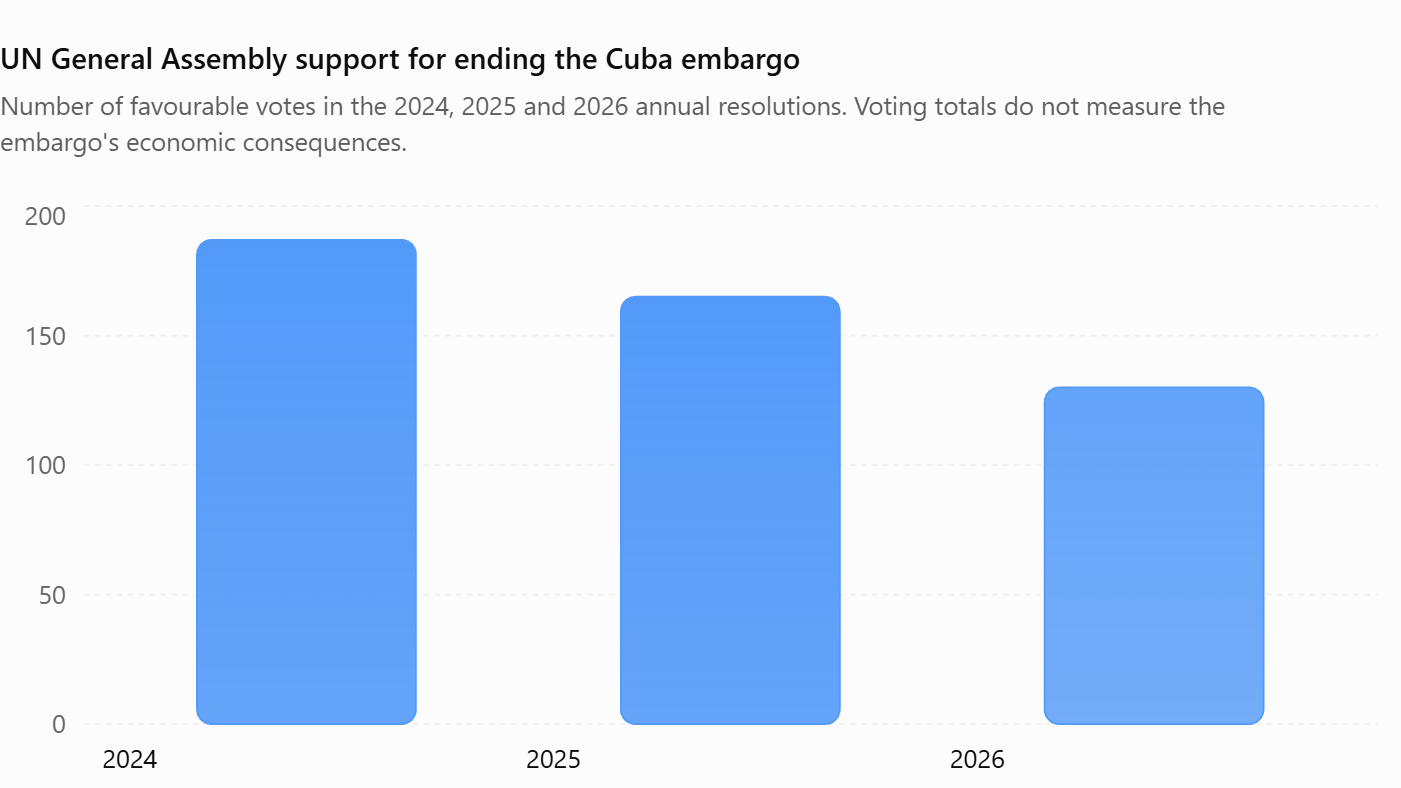
Source: United Nations annual voting results, 2024–2026. The 2026 result represents a decline of 57 favourable votes from 2024. Global Issues+1
Competing Explanations of Cuba’s Crisis
The evidence permits three principal explanations. They are not mutually exclusive; each identifies a mechanism that may operate simultaneously with the others.
| Hypothesis | Diagnostic support | Evidence limiting the hypothesis | Current assessment |
|---|---|---|---|
| H1. External restrictions dominate | Documented transaction restrictions, sanctions exposure for foreign financial institutions, pressure on energy imports and humanitarian disruption | Permitted US trade, humanitarian exceptions and independent domestic policy failures | Strong support for substantial external effects; insufficient evidence for predominant responsibility across the entire economy |
| H2. Domestic governance dominates | Persistent inefficiencies, restrictions on economic freedom, insufficient investment and reform implementation, and institutional controls | External restrictions impose additional demonstrable financing and trade constraints | Strong support for significant independent domestic responsibility; insufficient evidence for exclusive causation |
| H3. External and internal factors reinforce one another | Financial restrictions reduce available resources while domestic allocation failures and weak productive capacity magnify shortages | Interaction effects cannot be quantified reliably from the currently available aggregate series | Most defensible overall explanation, with the relative contribution remaining unresolved |
Why the distinction matters
An economy suffering from energy shortages can deteriorate through several simultaneous pathways. Restrictions on international financing or fuel shipments may reduce energy availability, while inadequate domestic investment, inefficient management and limited private-sector participation weaken the ability to generate electricity, maintain infrastructure or finance substitute imports. Reduced electricity supply then damages productive output, transport, refrigeration, healthcare and export performance, worsening the foreign-exchange shortage that contributed to the original energy deficit.
This interaction means that simply identifying a binding external constraint is insufficient to establish that sanctions explain all subsequent losses. Conversely, identifying domestic inefficiency does not establish that removing external restrictions would have no beneficial effect. The correct counterfactual concerns how Cuba’s economy would perform under different combinations of external access and domestic governance.
The United Nations debate itself supplies a useful warning against absolute claims. US Ambassador Mike Waltz argued that there was no blockade and cited more than US$876 million in American exports to Cuba during the first eight months of 2026. This supports the narrower proposition that trade is not comprehensively prohibited. It does not invalidate the existence of extensive legal restrictions, which the US Treasury documents explicitly. The export figure is a US diplomatic claim reported by the United Nations, not an estimate of the total economic impact of sanctions. Global Issues+1
Likewise, Cuba’s statements concerning the overall financial damage attributable to the embargo need to be distinguished from independently audited welfare losses. Direct transaction losses, foregone potential exports, financing costs and estimated cumulative economic effects cannot be combined into one reliable counterfactual without adjustments for double-counting, exchange rates, behavioural responses and domestic production constraints.
A defensible quantified assessment would therefore require sector-specific intervals, rather than a fabricated national percentage. For example, energy-import costs could be assessed using observed prices, freight rates, quantities and a documented alternative procurement scenario. Medicine shortages would require data separating legal availability, payment barriers, procurement decisions and hospital inventories. No validated aggregate attribution range is established by the records reviewed here.
The European Diplomatic Realignment
The October 2026 vote should be understood as differentiated Western positioning rather than a unified European endorsement of Washington’s approach.
| Alignment | Countries | Strategic interpretation |
|---|---|---|
| Abstention | Italy, Germany, Netherlands, Poland, Greece, Bulgaria, Romania, Estonia, Latvia and Croatia | Explicitly identified together by Italy; consistent with a stronger emphasis on Cuban internal responsibility |
| Support for the resolution | France and United Kingdom | Continued opposition to the embargo as an international policy instrument, without necessarily endorsing Havana’s domestic governance |
| Opposition to the resolution | United States and Israel, together with other opposing states | Rejection of the resolution’s political framing; individual motivations must not be presumed identical |
| Collective EU diplomatic statement | Delivered by Ireland on behalf of the EU and its member states | Maintained criticism of the embargo alongside extensive demands for Cuban reform and respect for human rights |
The first group’s country membership is established by the Italian Foreign Ministry. France’s and the United Kingdom’s supportive votes are reflected in the contemporaneous UN voting coverage. The collective EU intervention is documented in the UN plenary transcript. Ministero degli Affari Esteri+2
The political logic differs across the countries.
Italy has articulated an explicit dual position. Its abstention offers political distance from Havana’s account of its crisis while avoiding a vote against a resolution whose underlying humanitarian concerns Rome itself recognises.
Germany joined the abstaining group, giving the shift additional importance because of its role in European diplomatic coordination and its influence over the Union’s economic relationship with the United States. Its vote should not, however, be treated as evidence of an identical motivation to Italy’s without a separate German explanation.
France retains a policy interest in opposing extraterritorial measures and preserving an autonomous European diplomatic position. Support for the resolution remains compatible with criticism of Cuban authoritarian practices.
The United Kingdom, as a NATO ally outside the European Union, demonstrates that transatlantic security alignment does not require agreement with Washington on every instrument of economic coercion.
For the European Union, the most revealing evidence is the common statement delivered by Ireland after the vote. It simultaneously recognised the embargo’s humanitarian costs, demanded political and economic reform, criticised the detention of political prisoners and rejected extraterritorial measures affecting European interests. UN Transcripts
This shows that the principal divergence among EU governments concerns the political meaning of the vote more than the basic catalogue of problems facing Cuba.
The risk of contradictory European signalling
Europe can reasonably maintain that sanctions are economically damaging while refusing to absolve the sanctioned government of responsibility for domestic policy. The difficulty is operational rather than logical.
If European states abstain because they oppose Havana’s use of the resolution for political legitimacy, they must explain why abstention is a better instrument for protecting human rights than supporting the resolution while issuing a separate condemnation of repression. If they support the resolution, they must explain why doing so does not reduce pressure for reform or reinforce the claim that sanctions alone explain Cuba’s crisis.
A coherent European position must therefore be evaluated by subsequent action, not by the annual vote alone.
The United Nations Confrontation: Diplomatic Consequences
The dispute between Foreign Minister Bruno Rodríguez Parrilla and Ambassador Mike Waltz extended beyond opposing economic interpretations. At the General Assembly’s 27 October session, repeated procedural objections interrupted the American intervention, and the chair suspended the meeting during the confrontation.
The UN’s publicly accessible transcription records the procedural dispute, including references to Rule 71 and the chair’s attempts to distinguish procedural objections from substantive argument. The transcription is automatically generated and is not itself the official verbatim record, a limitation that matters for disputed quotations. UN Transcripts
Havana’s accusations of an American diplomatic offensive, coercion and improper pressure over voting choices must be understood as claims by an interested government. Washington’s denial of those allegations is likewise a diplomatic position rather than independent proof that no pressure occurred.
The contest has three strategic consequences.
First, the General Assembly vote has become an instrument for measuring the relative ability of Washington and Havana to mobilise diplomatic support. Second, the deterioration of procedural conduct shifts attention away from the detailed legal and economic consequences of American restrictions. Third, governments such as Italy become particularly important because their abstentions can be represented by Washington as evidence of declining support for Havana, even though Rome explicitly recognises that the embargo causes harm.
The European interest is to prevent rhetorical confrontation from replacing a substantive examination of trade restrictions, economic governance, humanitarian access and political freedoms.
Conditions for Sanctions Adjustment
Not every form of sanctions relief would have the same economic or political consequences.
| Policy pathway | Conditions for civilian benefit | Principal failure risk |
|---|---|---|
| Targeted humanitarian facilitation | Reliable payment channels, access to medical supplies, functioning distribution systems and independent monitoring | Supplies delayed, diverted or captured by privileged institutions |
| Greater access for independent private businesses | Transparent licensing, reliable property protections, permitted foreign transactions and market access | Benefits concentrated among politically connected intermediaries |
| Broader financial restrictions relief | Banking access, enforceable contracts, transparent foreign-exchange allocation and credible fiscal governance | Expanded liquidity without corresponding productivity reform |
| Comprehensive embargo termination | Durable US legislative change plus meaningful Cuban regulatory and institutional reform | Removal of external constraints without correction of domestic structural weaknesses |
| Continued or increased pressure | Clearly defined objectives, credible exemptions and evidence that restrictions change government behaviour | Further civilian hardship without measurable political liberalisation |
A specific institutional constraint is that the core embargo cannot be dismantled entirely through an annual UN resolution or a discretionary diplomatic declaration. The American statutory framework, including the Helms-Burton legislation and related laws, limits the scope of unilateral executive relaxation. The US Treasury’s current legal framework confirms the continued relevance of legislation alongside executive sanctions powers. Office of Foreign Assets Control
The realistic European policy space is therefore narrower than the General Assembly debate might suggest. European governments can facilitate humanitarian assistance, oppose particular extraterritorial effects, support carefully structured economic engagement and negotiate targeted exemptions. They cannot independently terminate American federal restrictions.
Principal Gaps and Watch Indicators
| Priority | Observable development | Decision relevance |
|---|---|---|
| High | Full country-by-country explanations of the 2026 vote | Determines whether abstentions reflect coordinated alliance management or genuinely different national doctrines |
| High | Implementation details for Cuba’s 176 announced measures | Distinguishes nominal reform announcements from observable changes in economic freedom |
| High | Actual humanitarian disbursements and delivery outcomes | Measures whether assistance reaches vulnerable households |
| High | Verified import, banking and fuel transaction data | Allows a more credible estimate of the impact of external restrictions |
| High | Changes in private-sector licensing, ownership protection and access to foreign exchange | Tests whether sanctions relief could translate into independent productive growth |
| High | Political-prisoner releases, legal safeguards and treatment of independent civil society | Tests whether economic engagement is accompanied by meaningful political change |
| Medium | Subsequent EU and US diplomatic or sanctions decisions | Identifies whether October’s voting changes become an operational policy shift |
The decisive missing evidence is not another general statement about the embargo’s severity. It is a consistent combination of official import statistics, transaction-level restrictions, humanitarian delivery records, fiscal information, enterprise performance and reform implementation data that can support credible comparisons across time.
Preliminary Strategic Net Assessment
Italy’s 2026 abstention is best interpreted as an attempt to introduce political conditionality into a diplomatic process that has historically concentrated on external economic restrictions. It neither establishes that the embargo is harmless nor constitutes direct approval of its continuation. Instead, Rome has made the Cuban government’s responsibility for economic reform, political rights and international conduct part of its explanation for declining to support the resolution.
That approach offers an analytical advantage: it avoids treating Cuban economic suffering as proof that all responsibility lies abroad. Its weakness is that an abstention, by itself, provides no mechanism for reducing civilian hardship or accelerating institutional reform. Unless followed by measurable policy initiatives, the change risks remaining principally symbolic.
For European diplomacy, the central requirement is to preserve four distinctions: between sanctions and humanitarian exemptions; between the Cuban state and Cuban citizens; between economic liberalisation and political democratisation; and between transatlantic cooperation and automatic endorsement of American policy instruments.
The strongest European position would combine continued humanitarian assistance, scrutiny of extraterritorial sanctions, support for independent Cuban economic activity, and specific, verifiable demands for political and judicial reform. Its credibility would depend on consistency across countries and on willingness to judge outcomes rather than declarations.
The 2026 vote has altered Havana’s diplomatic environment. It has not removed the embargo, resolved Cuba’s economic crisis, or demonstrated which single cause dominates the island’s decline. The strategic question for 2027–2031 is whether Italy and its European partners can turn this diplomatic differentiation into a more effective policy—one that neither excuses domestic authoritarian governance nor accepts avoidable humanitarian damage as an instrument of international pressure.
Source-control qualification: The UN meeting transcripts used for the immediate debates are preliminary automated transcriptions rather than certified official verbatim records. The available quantitative evidence also does not establish a defensible economy-wide percentage allocation between sanctions and domestic governance failures. These limits must remain explicit in subsequent chapters.
CUBA: THE EMBARGO VOTE
AND THE WESTERN DIVIDE
An institutional intelligence dashboard examining the 2026 UN General Assembly vote, Italy’s diplomatic abstention, the fragmentation of Western positions, competing explanations of Cuba’s economic crisis and policy options for 2027–2031.
The Decline in International Support
Interactive 3D-style bar chart · UN annual votes
Vote mode: bars scaled to 193 UN member states. Share mode: percentages of the same 193-member denominator. The figures measure diplomatic support, not the economic validity of the resolution or the embargo’s humanitarian impact.
2025 vs 2026: A Changing Diplomatic Coalition
2025
2026
The residual category is calculated as 193 minus recorded favourable, opposing and abstaining votes. It is not necessarily equivalent to absences alone. Bar widths use the complete UN membership as their denominator.
The Western Diplomatic Divide
The EU and NATO should not be treated as unified voting blocs. Italy’s official explanation named nine European partners taking the same abstention position.
Abstention alignment
Other selected positions
Selected country positions are shown, not the complete country-by-country UN roll-call.
Abstention combines recognition of embargo-related humanitarian harm with demands for internal Cuban reform.
Abstention creates a significant point of convergence with Italy, without proving identical national motivations.
Support for the resolution can coexist with criticism of Cuban political repression and governance failures.
Support illustrates that NATO alignment does not require identical policy on unilateral economic restrictions.
Two Sources of Pressure — One Interacting Crisis
External sanctions and domestic governance create different constraints. Their interaction can magnify the consequences of both. No verified economy-wide percentage attribution is available for separating their contributions.
External restrictions
- US transaction and financial restrictions
- Banking compliance and settlement difficulties
- Constraints on investment and commercial activity
- Energy procurement and financing exposure
- Risk of humanitarian supply disruption
Domestic governance
- State dominance of productive activity
- Currency and price distortions
- Administrative allocation inefficiencies
- Restrictions and uncertainty facing private enterprise
- Political and institutional constraints
External financial and supply constraints can intensify domestic production weaknesses. Domestic inefficiencies can magnify the economic impact of external restrictions.
Causal mechanism, not a measured national econometric model. The sequence illustrates plausible transmission and feedback, not a quantified decomposition of observed GDP losses.
Verified Indicators and Their Limits
| Indicator | Reported value | Period | Interpretation |
|---|---|---|---|
| UN votes in favour | 130 | 2026 | Support for the resolution |
| EU humanitarian assistance | €16 million | 2026 | Reported humanitarian allocation |
| Italian cooperation | 12 initiatives / approximately €30 million | October 2026 | Ongoing programme portfolio |
| EU delegated cooperation reported by Italy | Approximately €32 million | October 2026 | Distinct cooperation reporting category |
| Italian WFP contribution | €250,000 | Planned 2026 | Nutritional support |
| Rural development contribution | €3.5 million | Planned 2026 | Food security and agricultural development |
| Cuban GDP growth | −1.1% | 2024 | World Bank country-series observation |
| Announced Cuban reform measures | 176 | June 2026 | Announcement is not proof of implementation |
Cooperation allocations, programme portfolios and planned contributions are not interchangeable with disbursements. The 2024 GDP figure is not a measurement of 2026 GDP.
Five Policy Pathways
Select a pathway to examine its potential benefit and principal implementation risk. These are conditional analytical assessments, not probability forecasts.
Humanitarian facilitation
More reliable access to food, medicine and essential supplies through authorised and functioning channels.
Implementation exposure
Payment failures, logistical obstacles or diversion through privileged distribution channels can prevent relief from reaching intended beneficiaries.
What Would Change the Assessment?
Reform implementation
Evidence that announced Cuban measures become operational changes in investment, licensing and production.
Humanitarian delivery
Verified delivery and use of supplies, not simply announced programme funding.
Financial access
Documented changes in payment capacity, banking access and transaction costs.
Political freedoms
Observable changes in political detention, judicial protections and independent civic activity.
European cohesion
Whether EU states convert divergent voting positions into an agreed operational policy.
US policy adjustment
Changes to sanctions rules, licensing, exemptions or the applicable legislative framework.
The Central European Policy Dilemma
Italy’s abstention is compatible with recognising that the US embargo damages Cuba’s economy while insisting that Cuban domestic policy and political restrictions contribute independently to the crisis.
The diplomatic challenge is to turn this distinction into policy: reduce avoidable civilian harm, support independent economic opportunity, demand measurable institutional reform and preserve both transatlantic coordination and European diplomatic autonomy.
Humanitarian protection + verifiable economic reform + political accountability + coordinated diplomacy. None is a substitute for the others.
PILLAR I — THE DIPLOMATIC AND LEGAL REALIGNMENT
Cuba, the United States and the European Crisis of Diplomatic Coherence
OPEN-SOURCE INSTITUTIONAL INTELLIGENCE ASSESSMENT | 29 OCTOBER 2026
Chapter 1. The 2026 United Nations Resolution: Institutional History, Text and Voting Record
The 2026 vote marks a structural change in diplomatic alignment, not a reversal of the General Assembly’s position
The resolution adopted by the United Nations General Assembly on 28 October 2026 represents one of the most consequential changes in the diplomatic history of the international campaign against the American economic, commercial and financial embargo on Cuba. Its significance derives less from the formal outcome, which once again called for the termination of the restrictions, than from the substantial erosion of the coalition traditionally supporting that position. The resolution was adopted with 130 votes in favour, 17 against and 25 abstentions. Only two years earlier, on 30 October 2024, the comparable resolution had attracted 187 favourable votes, with two countries voting against and one abstaining. In 2025, support declined to 165, opposition increased to seven and abstentions reached 12. The 2026 result therefore marks a loss of 57 favourable votes compared with 2024, accompanied by an increase of 15 opposing votes and 24 abstentions. The United Nations’ official 2024 digital-library record establishes the earlier baseline, while the recorded proceedings of the General Assembly’s twenty-eighth plenary meeting on 28 October 2026 establish the latest outcome. Necessity of Ending the Economic, Commercial and Financial Embargo Imposed by the United States of America against Cuba, A/RES/79/7 — United Nations — October 2024; General Assembly, Twenty-Eighth Plenary Meeting, Eighty-First Session — United Nations — October 2026.
The political change is substantial because the Cuba resolution has historically functioned as an annual demonstration of opposition to unilateral American restrictions, especially their extraterritorial consequences. Governments supporting the resolution have not necessarily endorsed the Cuban political system, defended the country’s domestic economic organisation or rejected the legitimacy of every targeted sanction. They have generally treated the embargo itself as the principal object of the vote. The decline in favourable votes therefore cannot be interpreted automatically as a corresponding increase in international approval of Havana’s economic governance. It may instead reflect the growing willingness of governments to make their votes contingent on a broader political assessment encompassing Cuban domestic repression, the government’s international relationships, concerns about security and the management of relations with Washington. The distinction is fundamental: an international coalition can weaken because its members change their assessment of the instrument under consideration, because they alter their diplomatic priorities, or because the wider strategic environment changes the political costs of maintaining an established position. The UN vote records a decision, but does not independently establish the motivations behind every delegation’s choice.
The most revealing feature of the 2026 outcome is the difference between the continued majority in favour of the resolution and the accelerated loss of the overwhelming international consensus that had characterised earlier votes. In 2024, favourable votes represented approximately 96.9% of the United Nations’ 193-member total. In 2025, that proportion declined to approximately 85.5%, before falling to 67.4% in 2026. These percentages use total UN membership as the denominator, rather than only votes cast, and therefore include the effects of non-participation. They are useful for measuring the resolution’s overall diplomatic reach, but should not be described as a measure of global public opinion or of the legitimacy of the American embargo. At the same time, the share of members formally voting against the resolution increased from approximately 1.0% in 2024 to 8.8% in 2026, while abstentions increased from approximately 0.5% to 13.0%. The combined movement indicates that the change is not simply a matter of several governments remaining outside the vote: there has been a substantial redistribution among the recorded voting categories.
The evolution of the voting record, 2024–2026
| Voting indicator | 2024 | 2025 | 2026 | Change, 2024–2026 |
|---|---|---|---|---|
| Votes in favour | 187 | 165 | 130 | −57 |
| Votes against | 2 | 7 | 17 | +15 |
| Abstentions | 1 | 12 | 25 | +24 |
| Total recorded votes | 190 | 184 | 172 | −18 |
| Not recorded in the three voting categories | 3 | 9 | 21 | +18 |
| Favourable votes as a share of 193 UN members | 96.89% | 85.49% | 67.36% | −29.53 percentage points |
| Opposing votes as a share of 193 UN members | 1.04% | 3.63% | 8.81% | +7.77 percentage points |
| Abstentions as a share of 193 UN members | 0.52% | 6.22% | 12.95% | +12.43 percentage points |
The values in this table are calculated directly from the three annual voting totals. The category not recorded as a vote in favour, against or as an abstention is the mathematical residual of UN membership; it should not be equated automatically with simple absence, since the underlying circumstances of non-voting require individual examination. The applicable documentary references are Resolution A/RES/79/7 — United Nations — October 2024, General Assembly, Twenty-Second Plenary Meeting, Eightieth Session — United Nations — October 2025, and General Assembly, Twenty-Eighth Plenary Meeting, Eighty-First Session — United Nations — October 2026.
This progression deserves attention because the political interpretation changes depending on whether the analyst considers the number of countries actively rejecting the resolution, the number declining to take a position, or the share continuing to support it. Between 2025 and 2026, favourable votes fell by 35, but only ten additional votes appeared in the opposing category and 13 additional votes in the abstaining category. The remaining movement is reflected in the increase in countries outside the three recorded voting categories. The arithmetic does not permit an analyst to conclude that 35 governments directly changed their positions from support to opposition. Such a conclusion would require a country-by-country transition matrix comparing the annual voting records and separately identifying changes in participation. Nevertheless, the direction is clear: the resolution has ceased to command the same nearly universal recorded support it received in 2024.
The institutional history of the resolution and its legal significance
The General Assembly’s annual consideration of the American embargo belongs to a diplomatic process that began in 1992 and developed into one of the longest-running recurring disputes between Washington and an overwhelming majority of UN member states. The contemporary votes continue to address the necessity of ending the economic, commercial and financial embargo imposed by the United States against Cuba. The institutional framework is important because it distinguishes the General Assembly’s political authority to adopt recommendations and express collective positions from the separate legal powers of the United States to establish, amend or repeal national sanctions legislation. The resolution does not itself revoke American statutory restrictions, authorise banks to disregard US regulations, release blocked property or change licensing obligations. Its immediate effect is political: it records the views of states, strengthens or weakens diplomatic arguments and provides a recurring occasion for scrutiny of the consistency of national positions with principles of sovereignty, international commerce and non-intervention.
The 2026 proceedings identify the draft as A/81/L.5, entitled Necessity of Ending the Economic, Commercial and Financial Embargo Imposed by the United States of America against Cuba. The General Assembly adopted that draft following a recorded vote. In institutional terms, the resolution’s principal demand concerns ending the American measures; it should not be treated as an approval of Cuba’s domestic political arrangements. Conversely, an abstention cannot be interpreted as a legal determination that American restrictions are fully compatible with international law. The debate concerns different legal questions: the freedom of a sovereign state to regulate economic relations under its own jurisdiction, the international limits applicable to coercive economic measures, the permissibility of extending national restrictions to third-country actors and the humanitarian consequences of restrictions that affect access to essential goods and financial services. These questions have different legal foundations and cannot be resolved through the voting totals alone. General Assembly, Twenty-Eighth Plenary Meeting — United Nations — October 2026.
The distinction is particularly important because the terminology used in diplomatic debate is not neutral. Havana commonly describes the American system as a blockade, emphasising its broad economic reach and consequences for relations with third countries. Washington generally uses the language of sanctions or embargo restrictions, arguing that Cuba remains able to trade internationally and that specified authorised transactions continue to operate. A naval blockade, in its strict legal meaning, is a different instrument from economic restrictions administered through domestic trade, financial and sanctions legislation. Nevertheless, rejecting the terminology of a physical blockade does not establish the absence of coercive restrictions or their extraterritorial effects. The practical question is not whether every commercial transaction is prohibited, but which transactions remain legally restricted, which counterparties face sanctions exposure, which financial institutions decline otherwise permissible operations and how these constraints interact with Cuba’s own productive capacity and governance arrangements.
The 2026 proceedings and the transformation of a commercial dispute into a confrontation over political legitimacy
The debate surrounding the 2026 vote was unusually confrontational. Cuban Foreign Minister Bruno Rodríguez Parrilla accused Washington of conducting a diplomatic offensive designed to alter the annual voting outcome, while the United States presented the Cuban government’s own policies as the central source of the island’s difficulties. American Ambassador Mike Waltz publicly denied that Cuba was subject to a blockade in the sense advanced by Havana and used the existence of continuing international commercial transactions to challenge the Cuban government’s description of comprehensive economic isolation. The competing interventions reveal a substantial disagreement not simply over economic policy but over how international responsibility should be assigned: Havana presents the restrictions as an external constraint undermining development and household welfare, whereas Washington portrays the Cuban government as using the embargo to evade accountability for repression and economic mismanagement.
The UN meeting transcription records the confrontation as part of the General Assembly’s proceedings, but the available online transcription is automatically generated and explicitly identified by the United Nations as distinct from its formal official records. It is therefore appropriate to use it to identify the general positions and procedural sequence, while avoiding the presentation of contested wording as an independently certified verbatim quotation. General Assembly, Twenty-Eighth Plenary Meeting — United Nations — October 2026.
This confrontation matters for the interpretation of the vote because it created an environment in which supporting the resolution could be portrayed as supporting Havana’s explanation of the crisis, while opposing or abstaining could be presented as support for Washington. Neither inference follows necessarily from the legal object of the resolution. A government may oppose the American embargo because it believes broad restrictions impose unacceptable humanitarian or extraterritorial costs, while simultaneously condemning Cuban political repression and demanding market reforms. Another government may acknowledge the restrictions’ costs but abstain because it regards the resolution’s political context as insufficiently attentive to Cuban responsibilities. The 2026 outcome demonstrates that a number of governments elected to express precisely such distinctions through their voting behaviour.
The diplomatic effectiveness of the General Assembly procedure
For Cuba, annual adoption of the resolution has traditionally served three purposes. First, it provides a formal demonstration that the American embargo is contested internationally. Second, it reinforces the legal and political argument that bilateral restrictions should not impose costs on third states seeking lawful commercial relations with Havana. Third, it supports Cuba’s diplomatic efforts to frame its economic difficulties as partly attributable to restrictions originating outside its jurisdiction. None of these purposes necessarily requires the General Assembly resolution to possess binding legal force. The political value arises from the repeated public expression of international opposition.
For Washington, the annual debate has often presented the opposite challenge: defending a sanctions framework against an international majority while contesting Cuba’s claim to be the exclusive victim of external coercion. The 2026 voting change reduces that diplomatic asymmetry, even though the resolution was again adopted. An American administration can point to the substantially smaller majority as evidence that its argument about Cuban political responsibility is receiving greater attention. Havana, by contrast, can correctly maintain that the General Assembly continues to call for termination of the embargo, but it can no longer claim the same degree of near-universal recorded backing demonstrated in 2024.
The resulting diplomatic environment creates a new burden of explanation for European states. Abstaining governments must demonstrate that they are not disregarding the effects of American restrictions, while supporting governments must clarify that their vote does not amount to political endorsement of Cuban authoritarian governance. The credibility of either position depends on whether the distinction is reflected in subsequent policies toward humanitarian assistance, financial transactions, private enterprise, civil liberties and international diplomatic cooperation.
Chapter 1 — Key judgments
The 2026 vote represents a demonstrable reduction in support for the anti-embargo resolution, but not its rejection. The international majority remains opposed to maintaining the American restrictions, while a growing number of governments decline to accept the historical voting formula without attaching broader political considerations. The principal institutional conclusion is that the UN vote must be interpreted as a measure of diplomatic positioning, not as a determination of the embargo’s net economic consequences or Cuba’s domestic responsibility for its crisis.
The assessment would change materially if the full country-level voting transitions showed that most of the decline resulted from temporary non-participation rather than deliberate political realignment, or if subsequent official explanations established that specific governments had altered their positions for reasons unrelated to Cuba or US diplomatic pressure. A definitive comparison therefore requires both the complete official roll-call and the corresponding national explanations of vote.
Chapter 2. Western Voting Fragmentation: Italy, Germany, France, the United Kingdom and the European Union
Italy’s abstention introduces political conditionality into a traditionally anti-embargo diplomatic position
Italy’s abstention on 28 October 2026 deserves examination as a deliberate diplomatic decision rather than an isolated procedural change. The official statement published by the Ministry of Foreign Affairs and International Cooperation identifies a group of ten European countries—Italy, Germany, the Netherlands, Poland, Greece, Bulgaria, Romania, Estonia, Latvia and Croatia—that abstained from supporting the General Assembly resolution. More importantly, the Italian government supplied a substantive explanation of the position. It acknowledged that the American embargo produces negative economic and humanitarian consequences for the Cuban population and that its termination could facilitate economic reform and greater openness. At the same time, Rome attributed significant responsibility for the crisis to Cuban domestic decisions, restrictions on political and economic freedom, structural weaknesses and longstanding inefficiencies. Italy also demanded political, economic, social and judicial reforms, called for the release of political prisoners, and criticised Cuba’s position on Russia’s war against Ukraine. These elements transform the Italian abstention from a narrowly commercial position into an expression of broader foreign-policy conditionality. UN Vote on the US Embargo against Cuba: Italy Abstained and, Alongside Germany and Other Allied Countries, Made Its Position Clear — Italian Ministry of Foreign Affairs — October 2026.
The decision establishes an important distinction between recognising the damaging consequences of a restrictive measure and concluding that a government should vote in favour of a resolution demanding its termination. Rome’s position rests on the judgment that the annual UN debate, considered in its diplomatic context, does not adequately address the contribution of the Cuban authorities to the country’s difficulties. This is analytically coherent in one respect: the embargo’s existence does not absolve Havana of responsibility for maintaining institutions that constrain production, investment, enterprise and political freedoms. It is more difficult in another respect: abstaining from a resolution directed against an instrument whose humanitarian consequences are acknowledged can weaken the visibility of opposition to that instrument without creating an equivalent mechanism for securing Cuban reform. The policy therefore needs to be judged against two separate standards. The first is diagnostic accuracy—whether it identifies the multiple causes of the crisis. The second is practical effectiveness—whether abstention creates greater incentives for economic and political change than would support for the resolution accompanied by an equally forceful declaration on governance and human rights.
This tension is especially visible in the Italian statement’s discussion of the 176 economic and social measures adopted by the Cuban authorities in June 2026. Rome demanded their rapid implementation rather than treating their announcement as sufficient proof of reform. The distinction is important because a programme of reform can exist formally without changing the effective incentives faced by producers, consumers, private enterprises or foreign investors. A credible assessment of implementation would require evidence of changes in licensing, administrative permissions, access to imported inputs, currency convertibility, payment settlements, property protection, pricing rules and the independent operation of businesses. It would also require determining whether the reforms materially reduce the discretion exercised by state institutions over commercial activity or simply reorganise existing restrictions. Italy’s demand for implementation is thus a potentially testable basis for diplomatic conditionality, but the number of announced measures alone cannot establish their effectiveness or justify an inference that structural transformation is underway.
Italy’s broader diplomatic calculus: alliance relations, international principles and humanitarian engagement
The official Italian explanation also introduces the Russian war against Ukraine into a debate formally concerned with American restrictions on Cuba. Rome specifically criticised Havana’s vote against the General Assembly resolution of 24 February 2026 concerning a ceasefire and durable peace in Ukraine, presenting Cuba’s position as inconsistent with the principles of the United Nations Charter. This addition matters because it demonstrates that Italy was not evaluating only the direct consequences of trade restrictions. It was also assessing Cuba’s wider diplomatic conduct and the consistency of its international positions with principles Rome regards as fundamental. From an Italian strategic perspective, it is possible to interpret the abstention as an attempt to connect economic engagement with a broader expectation of responsible international behaviour. Nevertheless, the legal and political questions remain distinct. Cuba’s position on Ukraine is relevant to Rome’s bilateral and multilateral assessment of Havana, but it does not independently determine whether particular American commercial or financial restrictions are proportionate, whether their extraterritorial application is justified, or whether they generate humanitarian costs. Combining these issues into a voting explanation is a diplomatic choice, not a demonstration that they constitute a single legal question. Italian Ministry of Foreign Affairs Statement on the Cuba Embargo Vote — October 2026.
Italy’s continued humanitarian and development commitments add another dimension to the policy. According to the Foreign Ministry, the European Union increased humanitarian assistance to Cuba to €16 million in 2026, prioritising healthcare, emergency food assistance and access to water and energy. Rome also reported 12 ongoing Italian development-cooperation initiatives worth approximately €30 million, alongside approximately €32 million in EU delegated cooperation. Further planned Italian interventions included €250,000 for nutritional support through the World Food Programme and €3.5 million for a rural-development and food-security initiative undertaken with the Lavazza Foundation. These figures demonstrate that abstention was not accompanied by an announced withdrawal of civilian assistance. They also establish why humanitarian policy and diplomatic voting should not be conflated. A state may abstain on a political resolution while continuing to finance food security, nutrition and essential services. However, these values refer to different financial categories and should not be added indiscriminately as though they represented a single year’s disbursed expenditure. Portfolio values, delegated cooperation, humanitarian allocations and future commitments require separate accounting. Italian Ministry of Foreign Affairs — Official Statement, 28 October 2026.
These commitments permit a more nuanced assessment of Italy’s strategy. Rome is neither pursuing comprehensive disengagement from Cuba nor endorsing unconditional cooperation. Instead, the government’s public position combines political criticism, conditional expectations and continued assistance. Such a position can be effective if humanitarian programmes are designed to reach vulnerable groups and if diplomatic engagement establishes concrete benchmarks. Its credibility becomes weaker if economic restrictions reduce the practical effectiveness of assistance while the diplomatic message concentrates exclusively on Cuba’s failure to reform. In particular, emergency food support and rural-development cooperation address different time horizons. Nutritional assistance can alleviate immediate hardship, whereas agricultural development requires productive inputs, functioning infrastructure, reliable distribution arrangements and commercial incentives. Any assessment of Italian cooperation should therefore examine the degree to which projects address temporary shortages or modify the conditions that reproduce them.
Germany’s abstention and the meaning of convergence among leading European states
Germany’s decision to abstain alongside Italy gives the 2026 vote significance beyond the preferences of an individual Mediterranean government. The two countries are major participants in the European Union’s political and economic decision-making, and their convergence introduces a potentially influential position into discussions over the future of EU-Cuba relations. Yet there is a critical evidentiary distinction between documented alignment and shared motivation. The Italian Foreign Ministry explicitly identified Germany among the abstaining states, but that fact alone does not establish that Berlin adopted the same hierarchy of concerns, attached identical significance to Cuba’s international conduct or reached the decision through a coordinated negotiation with Rome. Alliance management, domestic political priorities, the assessment of Cuban human rights and the perceived effects of American sanctions are plausible considerations; their relative weight must be established through authoritative German statements rather than inferred from the vote.
For Germany, the structural issue is how to reconcile three objectives that can conflict in their practical application: maintaining a coherent relationship with Washington, preserving the European Union’s legal position against unwanted extraterritorial economic measures, and sustaining a credible human-rights policy toward an authoritarian state. The first objective creates incentives to avoid highly visible diplomatic confrontation with the United States on a relatively limited bilateral file. The second creates incentives to defend the ability of European enterprises and financial institutions to conduct activities permitted by European law. The third supports pressure for political freedoms, judicial guarantees and institutional reform. Abstention can offer a temporary compromise because it avoids explicitly endorsing either the American or Cuban narrative. Whether that compromise constitutes a sustainable German doctrine depends on the policy instruments that follow. If German authorities continue to oppose extraterritorial restrictions while intensifying conditional engagement with Havana, the vote can be interpreted as an effort to separate legal opposition to particular American measures from political approval of Cuba. If no corresponding operational framework emerges, the abstention remains primarily a diplomatic signal.
Germany’s importance also lies in its potential role in European consensus formation. A common EU position on Cuba must account for substantial differences among member states in diplomatic tradition, exposure to transatlantic strategic concerns, historical relationships with Latin America and willingness to employ economic conditionality. Berlin can contribute to a more coordinated position by insisting that discussions distinguish humanitarian transactions, private-sector activity, military-linked enterprises and political rights. The underlying European institutional framework already permits this differentiation through the EU-Cuba Political Dialogue and Cooperation Agreement, whose objectives include economic and social modernisation, political dialogue, sustainable development, democracy and human rights. A German policy grounded in those instruments would carry greater operational significance than an isolated abstention. Political Dialogue and Cooperation Agreement between the European Union and Its Member States and the Republic of Cuba — Council of the European Union — December 2016.
France’s position: diplomatic autonomy and the distinction between sanctions opposition and political endorsement
France’s support for the resolution places it on a different side of the recorded vote from Italy and Germany, but the difference should not be exaggerated into an irreconcilable disagreement over the character of the Cuban political system. The French approach can be examined against two established institutional considerations: the European tradition of contesting the extraterritorial application of third-country economic laws and the objective of maintaining political dialogue with governments whose domestic systems differ substantially from European democratic standards. France’s vote is compatible with the judgment that the American embargo should end because of its economic and diplomatic consequences, without requiring acceptance of Havana’s explanations of the crisis or approval of Cuban restrictions on fundamental rights.
The French strategic interest lies partly in the autonomy of European external economic relations. Extraterritorial sanctions create a situation in which a European undertaking may face commercial and legal consequences from foreign legislation even when its underlying activity is permissible under the laws of its home jurisdiction. This raises issues of regulatory sovereignty, access to finance, competition, investment security and the ability of the European Union to implement an independent commercial policy. The EU’s blocking framework, established by Council Regulation (EC) No 2271/96, was designed precisely to address the effects of specified extraterritorial legislation, including American measures concerning Cuba. French support for the resolution can therefore be analysed as consistent with a longer-standing European legal objection to particular external restrictions, rather than as a rejection of human-rights conditionality. Council Regulation (EC) No 2271/96 — Council of the European Union — November 1996.
Nevertheless, voting in favour carries its own reputational risks. If French diplomacy concentrates exclusively on the damage caused by American restrictions, Havana can present the international vote as confirmation that domestic governance is a secondary problem. That would exceed what the resolution establishes. France’s strongest position would therefore combine opposition to broad economic restrictions with explicit scrutiny of political imprisonment, civil liberties, the rights of independent economic actors and the functioning of judicial institutions. This combination is not contradictory: European opposition to extraterritorial sanctions is a question of legal authority and economic sovereignty, while the demand for political reform concerns the conduct of the Cuban government toward its own population. France can defend both positions without treating either as subordinate to the other.
The United Kingdom: transatlantic alignment without diplomatic uniformity
The United Kingdom’s support for the resolution illustrates a separate but equally important principle: close security cooperation with Washington does not automatically determine national positions on every question of economic statecraft. As a NATO ally and a permanent member of the United Nations Security Council, Britain has strong reasons to maintain a predictable strategic relationship with the United States. Yet the British vote demonstrates that alliance membership and agreement on the embargo are not interchangeable. The United Kingdom can maintain security cooperation with Washington while reaching a different judgment about the desirability of continuing extensive economic restrictions against Cuba.
Britain’s position must also be distinguished from the institutional framework of the European Union. Having left the EU, the United Kingdom is not governed by subsequent EU foreign-policy decisions in the same manner as member states, even though its sanctions practices, commercial interests and international legal commitments may overlap with those of European partners. Its vote therefore provides a useful comparative case: support for the resolution can reflect a national diplomatic judgment rather than participation in a unified EU position. The British case weakens any interpretation that the 2026 abstaining group simply represents the necessary position of states maintaining close relations with the United States. Washington’s security partners retain discretion over their responses to measures whose costs and legal implications extend beyond the US-Cuba bilateral relationship.
For British policymakers, the relevant distinction is between strategic alignment on security matters and automatic adoption of the economic restrictions preferred by an ally. The two can coexist where the alliance’s core defence obligations are not directly implicated. Conversely, divergence may become more difficult when American sanctions are justified through national-security instruments with substantial implications for foreign banks or companies. The increasing reach of the 2026 American measures makes this distinction particularly important. British authorities, like European counterparts, must consider both the political consequences of disagreement with Washington and the practical exposure of internationally active financial institutions to American regulatory requirements.
The European Union’s common position remains more coherent than the individual voting pattern suggests
The most important institutional evidence concerning European cohesion is the intervention delivered by Ireland on behalf of the European Union and its member states after the 2026 vote. The intervention acknowledged the adverse economic and humanitarian effects of the embargo, reiterated the importance of humanitarian access and recognised that responsibility for Cuba’s domestic economic policies rests with its authorities. It also expressed the view that lifting the embargo could facilitate economic reforms and further opening of the Cuban economy. This formulation is significant because it demonstrates that European governments were able to articulate a shared substantive assessment even while casting different votes on the resolution. The contradiction is therefore primarily in the translation of common principles into multilateral voting behaviour, rather than in the complete absence of common principles. General Assembly, Twenty-Eighth Plenary Meeting, EU Statement Delivered by Ireland — United Nations — October 2026.
The distinction has consequences for the credibility of the European Union’s Common Foreign and Security Policy. A common statement can preserve a shared vocabulary, but governments must also coordinate the instruments used to pursue the objectives it identifies. Otherwise, external actors can exploit the difference between a jointly expressed assessment and fragmented national behaviour. Washington can interpret abstentions as greater European receptiveness to American pressure, while Havana can highlight the continuing support of other European governments and the common EU acknowledgment of humanitarian damage. Each interpretation selects the evidence most favourable to its position. A strategically coherent European Union must therefore demonstrate that neither interpretation fully captures its policy. Its position should be assessed in terms of sanctions-related legal protections, humanitarian implementation, diplomatic conditionality and the benchmarks applied to economic and political reform.
The legal foundation for that policy predates the 2026 vote. The EU-Cuba Political Dialogue and Cooperation Agreement was signed in Brussels on 12 December 2016 and provisionally applied from 1 November 2017. It established a framework for political dialogue, cooperation and sectoral engagement, with objectives encompassing sustainable development, democratic principles, human rights and the modernisation of Cuba’s economy and society. These objectives are not exhausted by the General Assembly’s annual consideration of the American embargo. The agreement provides a vehicle for engagement with Havana in which European governments can assess reform, raise specific concerns and maintain cooperation without treating an anti-embargo vote as the principal measure of the bilateral relationship’s success. Political Dialogue and Cooperation Agreement — Council of the European Union — December 2016; EU-Cuba: Council Opens New Chapter in Relations — Council of the European Union — December 2016.
Comparative assessment of the principal European positions
| Actor | 2026 voting position | Documented or analytically relevant policy emphasis | Principal institutional constraint | Implication for coordination |
|---|---|---|---|---|
| Italy | Abstention | Humanitarian concern, Cuban reform obligations, political prisoners, Cuba’s international alignment | Maintaining a distinction between criticism of Havana and recognition of sanctions-related harm | Could articulate a conditional-engagement framework |
| Germany | Abstention | European coordination, transatlantic relationships and Cuban governance are relevant analytical considerations; the vote alone does not establish their relative weight | Reconciling economic autonomy, EU policy and relations with Washington | Important potential partner for a common European approach |
| France | In favour | Opposition to the embargo; compatibility with European economic autonomy and political dialogue | Ensuring that sanctions opposition is not presented as endorsement of Havana | Can defend legal autonomy and human-rights demands simultaneously |
| United Kingdom | In favour | Independent national judgment within a close transatlantic security relationship | Managing disagreement with Washington alongside financial and security cooperation | Demonstrates that NATO alignment does not dictate Cuba policy |
| European Union | Differentiated national votes; common EU intervention | Recognition of humanitarian harm and Cuban domestic responsibility | Translating shared principles into coherent instruments | Requires coordination beyond annual voting statements |
The comparison distinguishes formally recorded positions from analytical considerations. It does not attribute undocumented national motives as established facts. The primary supporting records are the Italian Ministry of Foreign Affairs Statement — October 2026 and the UN General Assembly Proceedings — October 2026.
The significance of the wider abstaining group
The presence of Poland, Romania, Bulgaria, Estonia and Latvia among the states identified by Rome draws attention to the importance of security and alliance considerations in European diplomatic decisions. These countries have different histories and institutional relationships with Cuba, but their contemporary foreign-policy environments are substantially influenced by European security, transatlantic relations and the conflict involving Russia and Ukraine. That background provides a reasonable analytical basis for examining whether Cuba’s international positioning influenced their votes. It does not, however, justify assuming that all five governments abstained for identical reasons or that their decisions were coordinated through NATO. Greece, Croatia and the Netherlands introduce additional variation in geopolitical experience, domestic political priorities and economic interests. The common voting outcome is a fact; a unified explanatory theory requires further documentary evidence.
This matters because the abstaining group is neither institutionally homogeneous nor reducible to a single geopolitical category. Its composition may reflect the convergence of several distinct motivations rather than a new organised diplomatic bloc. Some governments may regard the Cuban government’s political conduct as a decisive objection to supporting the resolution. Others may place greater weight on relations with Washington or on the general direction of their foreign policy. Still others may consider the annual vote an inadequate vehicle for addressing contemporary humanitarian and economic problems. The analytical consequence is that the group should be assessed through separate national explanations and subsequent diplomatic action, not merely through geographic classification.
European policy credibility and the problem of selective conditionality
The central challenge for the European Union is the consistent application of principles across different international relationships. Europe regularly argues that economic cooperation should be compatible with respect for human rights, legal predictability and international obligations. At the same time, European states oppose the uncontrolled extraterritorial application of foreign legislation that interferes with their legitimate economic interests. Cuba exposes the tension between those principles because the American restrictions can affect European commercial autonomy while the Cuban government’s domestic policies raise serious questions concerning fundamental freedoms and economic governance.
A credible approach must distinguish the accountability of a government from the economic rights and humanitarian needs of its population. Punishing ordinary households for the failures of political institutions would be difficult to reconcile with a policy centred on human welfare. Conversely, removing constraints without examining whether economic benefits are captured by privileged state institutions would weaken the effectiveness of engagement. The appropriate policy instruments must therefore be differentiated. Humanitarian transactions require reliable channels and monitoring; economic cooperation requires transparency and institutional accountability; private enterprise requires protection against arbitrary administrative interference; and political dialogue requires measurable benchmarks concerning judicial independence, civic freedoms and political detention.
European coherence does not necessarily require every government to cast the same vote in the General Assembly. It does, however, require agreement about the standards used to evaluate both American restrictions and Cuban policies. If countries supporting and abstaining from the resolution nonetheless defend the same humanitarian protections, legal principles and reform objectives, the apparent fragmentation may be manageable. If the voting divisions translate into incompatible sanctions policies, inconsistent assistance programmes or conflicting diplomatic conditions, the European Union’s ability to influence either Washington or Havana will weaken.
Chapter 2 — Key judgments
Italy’s abstention is a substantive political decision supported by an unusually explicit official explanation. It introduces Cuban political reform, economic governance, human rights and international conduct into the interpretation of the embargo resolution. Germany’s parallel vote increases the significance of that approach, but the available national record does not establish that every abstaining government shares Rome’s reasoning. France and the United Kingdom demonstrate that opposition to the embargo remains compatible with strategic alignment with Washington and criticism of Cuban authoritarianism.
The European Union retains an articulated common substantive position through its UN intervention and the existing EU-Cuba cooperation framework. The primary challenge is translating that common assessment into operational policies that distinguish civilians from state authorities, authorised economic activity from sanctions exposure, and genuine reform from unimplemented declarations.
The assessment would change if further national explanations demonstrated a coordinated European abstention strategy, if the EU adopted new common conditions linking engagement to verified reforms, or if subsequent American measures significantly altered European enterprises’ legal exposure. The principal unresolved documentary requirement remains a complete set of official explanations from the abstaining and supporting European governments.
Chapter 3. US Sanctions Architecture, Extraterritorial Reach and International Legal Disputes
The American embargo is not a single prohibition but a cumulative system of legislation, executive powers and financial controls
The legal architecture governing American economic relations with Cuba is considerably more complex than the political language employed during the General Assembly debate suggests. It cannot be described accurately as an absolute prohibition on every transaction involving Cuba, nor can the existence of authorised transactions justify the assertion that no embargo exists. The system is constructed from overlapping statutory authorities, executive orders, financial regulations, export controls, licensing provisions and restrictions directed at specified individuals and institutions. Its effects extend beyond direct bilateral commerce because internationally active banks, insurers, exporters, shipping companies and investors may face American jurisdictional requirements or sanctions risks even when their commercial interests originate outside the United States. The principal legal instruments include the Trading with the Enemy Act, the Cuban Democracy Act of 1992, the Cuban Liberty and Democratic Solidarity Act of 1996, commonly known as the Helms-Burton Act, and the Trade Sanctions Reform and Export Enhancement Act of 2000. The Office of Foreign Assets Control administers important parts of this framework through the Cuban Assets Control Regulations and additional regulations implementing more recent executive measures. Cuba Sanctions: Legal Framework, Statutes, Executive Orders and Regulations — US Department of the Treasury, OFAC — October 2026.
The difference between these legal instruments is decisive for any credible discussion of sanctions adjustment. American statutory law determines important elements of the embargo’s durability, while executive powers and implementing regulations can change the practical scope of particular prohibitions, licences and enforcement priorities. Congress possesses authority over the repeal or amendment of federal statutes, whereas the executive branch administers existing legislation and exercises powers delegated by Congress within the applicable statutory limits. Consequently, a decision by the US President to ease some restrictions would not necessarily terminate the overall embargo. Conversely, an administration may tighten financial and commercial restrictions through regulatory changes or additional sanctions designations without creating an entirely new statutory embargo. This distinction defines the practical limits of diplomacy: a negotiated arrangement between Washington and Havana may produce meaningful changes in licences, travel-related transactions or specified financial activities, while comprehensive termination of the statutory framework would require a different legal process.
The institutional complexity also explains why commercial actors can face restrictions even when a transaction is theoretically permitted. Sanctions compliance is not exhausted by determining whether a product belongs to an authorised category. A bank must examine the parties involved, ownership relationships, the location and currency of payment, the regulatory treatment of intermediary institutions, the applicable licence conditions and the possibility that a counterparty falls within a designated or otherwise restricted category. A permissible export may therefore encounter practical difficulties if the payment route requires a prohibited financial transaction or if the institution responsible for settlement cannot establish satisfactory compliance. The resulting commercial friction may take the form of increased transaction costs, delayed payments, reduced availability of insurance, more expensive trade finance or the withdrawal of counterparties from potentially lawful business. These effects are analytically different from a direct statutory prohibition, but can nevertheless influence the real economic consequences of the sanctions system.
The principal American legal instruments and their functions
| Instrument | Legal authority and structure | Principal regulatory function | Implication for policy adjustment |
|---|---|---|---|
| Trading with the Enemy Act | Federal statutory authority historically underlying the Cuban sanctions framework | Provides part of the legal foundation for restrictions administered through federal regulations | Changes depend on the applicable statutory and executive authorities |
| Cuban Assets Control Regulations, 31 CFR Part 515 | Treasury regulations administered by OFAC | Govern prohibited, exempt and authorised financial and commercial transactions involving Cuba | General and specific licences can change permitted activities within legal limits |
| Cuban Democracy Act of 1992 | Federal legislation, 22 USC §§ 6001–6010 | Establishes statutory restrictions affecting commerce and related activities | Material amendment requires legislative authority |
| Helms-Burton Act of 1996 | Federal legislation, 22 USC §§ 6021–6091 | Reinforces the embargo framework and addresses claims involving confiscated property | Constrains the conditions and legal mechanisms for comprehensive termination |
| Trade Sanctions Reform and Export Enhancement Act of 2000 | Federal legislation, 22 USC §§ 7201–7211 | Establishes statutory provisions affecting specified agricultural and medical trade | Authorised trade remains subject to relevant regulatory conditions |
| Executive Order 14380 | Presidential emergency measure of 29 January 2026 | Establishes the national emergency subsequently supplemented by additional Cuba-related measures | Executive implementation and the underlying legal authority are material |
| Executive Order 14404 | Presidential order of 1 May 2026 | Authorises sanctions targeting specified activities, persons and sectors connected with Cuba | Introduces additional designation and sanctions exposure |
| September 2026 regulatory amendments | Treasury implementation measures | Tighten specified financial, banking, travel and restricted-entity provisions | Directly alter practical transaction permissions and compliance requirements |
The primary authority for this classification is the US Treasury OFAC Cuba Sanctions Programme — October 2026, supplemented by OFAC FAQ 1251: Executive Order 14404 — May 2026 and the OFAC Cuba-Related Regulatory Guidance Updated September 2026.
The central conclusion from this legal architecture is that the embargo’s commercial reach is variable rather than absolute. Legal changes can alter the treatment of particular counterparties, payments, business activities or forms of travel without eliminating the underlying framework. This variability also makes historical comparisons difficult. An economic assessment referring generically to the embargo over several decades may combine periods governed by materially different regulations. A credible causal analysis requires the analyst to identify the precise restriction applicable to each transaction and the date on which that restriction became effective.
The 2026 expansion: a significant change in sanctions exposure for foreign economic actors
The 2026 American measures substantially reinforce the importance of distinguishing traditional restrictions under the Cuban Assets Control Regulations from additional sanctions authorities. On 1 May 2026, Executive Order 14404 established a further Cuba-related sanctions programme under the International Emergency Economic Powers Act, following the national emergency declared by Executive Order 14380 on 29 January. According to the US Treasury, the May order authorises the designation of foreign persons involved in specified activities connected with Cuba, including activities in the energy, defence, metals and mining, financial-services and security sectors, as well as support for the Cuban government or designated persons and participation in serious human-rights abuses or corruption. The order also expands exposure for foreign financial institutions involved in certain significant transactions with persons blocked under the new authority. The legal significance is not merely that additional Cuban entities can become targets, but that non-Cuban parties may face consequences under American sanctions rules because of their connections with designated actors or specified activities. OFAC FAQ 1251: Scope and Operation of Executive Order 14404 — US Department of the Treasury — May 2026.
This development creates a potentially important tension for European policy. The United States presents such measures as instruments directed against repression, corruption, threats to national security and entities connected with the Cuban state. European governments may recognise the legitimacy of concerns about those activities while disputing the degree to which American law should regulate independent third-country commercial relationships. The distinction is especially relevant where transactions involve complex corporate ownership structures. A European enterprise may not deal directly with a prohibited institution but may encounter a counterparty with ownership or operational links to a designated group. The legal evaluation then depends on the precise applicable rule, including ownership thresholds, covered conduct, licence provisions and the identity of the parties subject to American jurisdiction.
The implications are also sector-specific. Energy is unusually sensitive because fuel supply, electricity generation, transport and industrial production are tightly connected in an economy already facing shortages. Financial services determine whether authorised imports and exports can be paid for. Metals and mining may involve state-linked enterprises whose transactions also support other economic activities. Security and defence restrictions have a more direct connection to the American objective of targeting institutions associated with the Cuban state. Treating all these sectors as economically equivalent would obscure important differences between transactions that generate revenue for designated entities and those that provide essential civilian inputs. A proportionate sanctions assessment must therefore examine how designation criteria are implemented and whether authorised humanitarian and civilian commercial activities remain practically accessible.
The Treasury also clarified that Executive Order 14404 did not invalidate existing authorisations under the Cuban Assets Control Regulations. On 7 May 2026, OFAC issued Cuba-related General License 1 to authorise transactions prohibited by the new executive order where those transactions are otherwise authorised or exempt under the existing Cuban regulatory framework. This is an important legal safeguard, but it should not be overstated. The licence does not independently expand the scope of permitted activity under the Cuban Assets Control Regulations; it preserves the treatment of qualifying transactions under the additional sanctions authority. A transaction outside the underlying authorisation cannot be made permissible merely by invoking General License 1. OFAC FAQ 1253: Cuba-Related General License 1 — US Department of the Treasury — May 2026.
September 2026: tighter financial restrictions and the importance of payment infrastructure
The September 2026 regulatory changes are particularly important because they affect the infrastructure through which international transactions are executed. The Treasury’s guidance records restrictions on direct and, from 30 September 2026, indirect financial transactions involving entities and subentities on the State Department’s Cuba Restricted List, subject to applicable exceptions. The changes also affected transactions that pass through American financial institutions despite originating and terminating outside the United States. In particular, OFAC’s guidance indicates that American banks are no longer authorised to process the relevant Cuba-related U-turn transactions, while rejection rather than blocking is authorised for those transfers under the specified rule. This distinction matters because a transaction between two non-American parties can still be affected by US financial regulation when its settlement requires a covered American intermediary. OFAC Frequently Asked Questions on Changes to the Cuba Sanctions Programme — US Department of the Treasury — September 2026.
The consequence is a potential reduction in usable financial connectivity. International trade depends not only on the existence of a buyer, a seller and an available product, but also on the ability to transmit payments, obtain confirmation, document compliance and settle obligations through reliable institutions. When an important intermediary banking route becomes unavailable, counterparties may need to identify alternative banks, currencies or settlement arrangements. Those alternatives can be more expensive, less liquid, operationally slower or subject to different regulatory risks. It would nevertheless be incorrect to assume that every transaction affected by the rule necessarily fails; the outcome depends on whether a lawful and commercially viable alternative exists. The relevant measurement is the difference between transactions actually completed under the applicable conditions and the transactions that would plausibly have occurred under a less restrictive framework.
The September changes also affected certain arrangements involving independent Cuban private-sector entrepreneurs. OFAC’s guidance records the removal of a previous authorisation permitting US banking institutions to open and maintain specified accounts in the name of qualifying independent private entrepreneurs in Cuba for authorised or exempt transactions. This restriction deserves particular attention because American policy commonly distinguishes the Cuban population and independent enterprise from institutions associated with the state. When restrictions apply to channels that could support independent businesses, the regulatory design must be evaluated against the stated objective of encouraging economic activity outside government-controlled structures. The precise impact depends on how many enterprises used the affected arrangements, whether alternatives remained available and whether the compliance burden discouraged financial institutions from serving otherwise eligible clients. Those figures are not established by the legal text itself. OFAC Guidance on Banking Accounts and Independent Cuban Entrepreneurs — September 2026.
The Cuba Restricted List and the distinction between ownership risk and humanitarian activity
The Cuba Restricted List occupies an important position in the American sanctions framework because it identifies entities and subentities associated with Cuban military, intelligence or security institutions, or regarded by the United States as benefiting those institutions at the expense of private enterprise and the Cuban population. The legal significance of inclusion on the list must be analysed alongside the applicable regulations, including the rules governing direct and indirect financial transactions. It is insufficient to conclude that an enterprise is unaffected merely because the immediate contractual counterparty does not appear by name on a public list. Ownership, indirect financial relationships and the structure of the transaction may all matter. The Treasury’s published guidance explains the treatment of the Cuba Restricted List and the expanded indirect-transaction restrictions in effect from September 2026. OFAC Frequently Asked Questions: Cuba Restricted List and Related Transactions — September 2026.
The corporate-ownership dimension becomes particularly significant in a state-dominated economy. Where important commercial activities are conducted by enterprises connected to public institutions or military-linked groups, restrictions intended to target those structures may affect economic activities extending beyond their immediate political or security functions. This does not mean that such restrictions are necessarily indiscriminate. It means their practical incidence cannot be inferred exclusively from the identity of the institution named in the sanctions measure. Commercial chains may include transport providers, storage facilities, import intermediaries, financial agents and distribution businesses. A civilian transaction that depends on services provided by a restricted intermediary can encounter legal or operational obstacles even when the goods themselves are not prohibited.
This creates a difficult policy-design problem. Exempting a humanitarian product does not guarantee that it can reach its intended recipients if indispensable transport, payment or distribution services remain unavailable. Conversely, allowing unrestricted access to state-controlled commercial infrastructure may increase revenues or resources available to entities that sanctions seek to constrain. An effective approach requires sufficiently precise permissions to protect necessary civilian activity while maintaining enforceable restrictions on the conduct or entities actually targeted. Such permissions must be assessed through their practical operation rather than merely through their existence in the regulatory text.
Legal permission, commercial feasibility and humanitarian delivery must be assessed separately
The debate over Cuba frequently collapses three distinct questions into one. The first concerns whether a transaction is legally prohibited. The second concerns whether an authorised transaction is commercially feasible. The third concerns whether a completed transaction produces the intended benefit for Cuban households or institutions. These stages are connected but not identical. A medical shipment may be legally eligible for export, yet face financing or logistical difficulties. A shipment may arrive successfully but encounter domestic distribution problems. Alternatively, an import may be completed without significant sanctions-related obstruction but remain unaffordable because of domestic currency or income constraints. The relevant source of failure changes at each stage, and responsibility cannot be assigned accurately without establishing where the transaction was interrupted.
This distinction is central to evaluating the opposing claims advanced by Washington and Havana. The existence of authorised agricultural, medical or humanitarian transactions provides evidence against the assertion that all exchange is prohibited. It does not establish that legal exemptions eliminate the economic impact of the wider sanctions system. At the same time, the existence of shortages does not prove that external restrictions caused every failure in procurement, production or distribution. Cuban authorities retain responsibility for domestic resource allocation, import priorities, institutional administration, productive incentives and the functioning of public services. A credible assessment must identify the specific mechanism involved rather than treating aggregate shortages as sufficient evidence of either explanation.
The United States Treasury’s guidance demonstrates that the current framework includes general licences, exemptions and provisions covering particular types of authorised activity, including humanitarian, educational, information-related and other transactions. It also establishes that those permissions are subject to detailed limitations and may be affected by the status of the parties involved. The existence of such a regulatory system makes transaction-level analysis essential: the real economic effect depends on the interaction between authorisations, prohibitions, private-sector compliance decisions and domestic Cuban institutions. Cuba Sanctions Programme and General Licensing Framework — US Department of the Treasury — October 2026.
European extraterritoriality concerns and the blocking regulation
The European Union’s legal objection to certain American restrictions has an institutional history extending well beyond the 2026 General Assembly vote. Council Regulation (EC) No 2271/96 was adopted to protect European legal and economic interests against the extraterritorial application of specified third-country legislation. The regulation’s annex identifies American measures concerning Cuba, including provisions of the Cuban Democracy Act and the Helms-Burton Act. This establishes an important distinction between the European Union’s objection to the reach of particular American laws and its separate political assessment of the Cuban government. The EU can reject the imposition of specified foreign legal obligations on European operators without approving the economic or political system of the country against which those foreign measures are directed. Council Regulation (EC) No 2271/96 — Council of the European Union — November 1996.
The blocking regulation is significant because it addresses a structural conflict between overlapping legal systems. A European enterprise may be subject to European rules intended to protect it from the effects of specified American measures while simultaneously conducting operations with substantial exposure to American markets or financial institutions. The legal conflict cannot always be resolved through a simple choice to follow one jurisdiction’s rules. A firm may face obligations arising from the EU blocking framework, restrictions under applicable American law and practical commercial dependencies that make the preservation of US market or banking access particularly important. The economic result may be withdrawal from a transaction even where the European operator has a legal basis to resist extraterritorial pressure. This is why the existence of protective European legislation should not be mistaken for a guarantee that every affected business can continue trading without cost.
The regulation’s relevance also extends to political credibility. If European governments acknowledge the costs of extraterritorial restrictions but take no practical steps to clarify their legal treatment or support lawful commercial activity, European economic autonomy becomes largely declaratory. Conversely, defending the independence of European commercial law does not oblige governments to finance or support Cuban institutions implicated in political repression or corruption. The challenge is to preserve the distinction between a state’s right to regulate its own economic relations and an attempt to determine the lawful conduct of third-country actors beyond an accepted jurisdictional basis.
The Helms-Burton Act and the additional dispute over confiscated property
The Helms-Burton Act introduces another dimension into the legal disagreement because it concerns not only trade restrictions but also claims involving property confiscated by the Cuban state. Title III establishes a framework for civil litigation in specified circumstances involving trafficking in confiscated property, while Title IV addresses restrictions associated with entry into the United States for qualifying persons. The European blocking framework explicitly identifies these provisions as potential sources of harm to European economic interests, including litigation exposure and restrictions affecting individuals connected with certain commercial activities. This demonstrates why European concerns cannot be reduced to questions of humanitarian imports or agricultural exports. Property claims, investment security and the potential reach of US civil liability are independent dimensions of the dispute. Council Regulation (EC) No 2271/96, Annex Concerning US Legislation on Cuba — European Union — November 1996.
The legal assessment must nevertheless distinguish the existence of a statutory cause of action from the outcome of individual proceedings. Whether a particular commercial activity satisfies the relevant statutory definitions, whether a defendant falls within the court’s jurisdiction and whether relief is available depend on the facts and applicable law. The presence of investment in Cuba does not automatically establish liability. Similarly, the existence of contested property rights does not itself resolve the broader legality of every aspect of the American sanctions framework. The dispute involves overlapping questions of property compensation, jurisdiction, sovereign conduct and the protection of third-country commercial interests.
For Europe, the Helms-Burton framework raises a particularly sensitive issue: whether enterprises operating under European law should face litigation or commercial penalties arising from American statutory claims concerning historical confiscations in Cuba. The underlying property rights can be legally substantial, while the use of extraterritorial enforcement to pursue them remains contested. The European position must therefore be capable of recognising legitimate property disputes without accepting that foreign legislation possesses unlimited reach over European economic activity.
The international-law debate cannot be reduced to a single claim of legality or illegality
The international legal controversy surrounding the embargo includes several questions that require separate treatment. One concerns whether the United States may restrict commerce and financial dealings involving persons and transactions within its jurisdiction. Another concerns the circumstances in which such measures affect third countries or parties that do not otherwise fall clearly within American jurisdiction. A third concerns the compatibility of particular coercive economic measures with international obligations relating to sovereignty, non-intervention and human rights. A fourth concerns humanitarian consequences and whether the design and implementation of restrictions adequately protect civilian needs. These questions should not be collapsed into a single assertion that the entire American system has one universally settled legal status.
The General Assembly’s repeated adoption of resolutions calling for an end to the embargo carries considerable political significance, particularly in demonstrating the persistent objections of numerous states. It does not, by itself, function as a judgment of an international court determining the legality of every American measure. Similarly, Washington’s ability to cite domestic legislative authority establishes the measures’ basis within the American legal system, but does not independently settle every dispute concerning their effects on third-country rights or international obligations. Domestic legality and international legal compatibility are different questions.
The practical European issue is consequently more precise than a general choice between declaring the embargo lawful or unlawful. European governments must determine which US restrictions are applicable to their nationals and enterprises, which measures create genuine extraterritorial conflicts, which authorised activities remain commercially viable, and which forms of cooperation with Cuba are consistent with European human-rights commitments. A measure targeting an identified official responsible for serious abuses presents a different legal and policy profile from a restriction that disrupts payment for essential medical equipment. Both may exist within a broader sanctions system, but their proportionality, legal basis and humanitarian consequences should be assessed individually.
The economic geography of extraterritorial sanctions
The effect of extraterritorial restrictions depends on the structure of international commerce. Large financial institutions operate across jurisdictions and often maintain relationships with American banks, investors and markets. International logistics involves multiple service providers, including insurers, carriers, port operators and agents. Trade finance can involve institutions different from both the importer and exporter. Consequently, the restrictions affecting a single counterparty or settlement route can influence the willingness of several independent participants to complete a transaction. The mechanism becomes particularly important where commercial participants prefer to avoid uncertain sanctions exposure rather than incur the cost of detailed legal analysis. This form of compliance-driven withdrawal is analytically distinct from a formal prohibition, but it can still reduce trade or raise its cost.
The magnitude of such effects cannot be inferred from the legal architecture alone. It requires evidence concerning transaction volumes, banking relationships, rejected payments, shipping and insurance costs, financing conditions and substitution possibilities. The absence of a conventional payment route does not necessarily mean that a transaction becomes impossible; alternative arrangements may exist. Likewise, increased financing costs cannot automatically be attributed to sanctions where the borrower also faces substantial credit risk, shortages of convertible currency or domestic policy uncertainty. The economic evaluation must therefore compare realistic alternatives and distinguish the contribution of American restrictions from the independent risks associated with Cuban counterparties.
The 2026 financial changes make this issue particularly salient because they affect transactions involving indirect relationships and international settlement mechanisms. The resulting compliance problem is relevant not only to American entities but also to foreign businesses that rely on internationally connected banking systems. For governments seeking to protect humanitarian assistance and lawful private-sector trade, the most useful evidence would identify the exact stages at which otherwise authorised transactions fail or become uneconomic. Such evidence would support targeted remedial measures more effectively than aggregate political claims about total sanctions damage. OFAC Cuba-Related Financial Transactions Guidance — September 2026.
Legal and operational exposure by economic activity
| Economic activity | Principal US legal exposure | Potential European concern | Evidence needed to determine actual impact |
|---|---|---|---|
| Humanitarian medicines and equipment | Licensing conditions, counterparties and payment routes | Delivery disruption despite permitted categories | Shipment completion, payment rejection and procurement records |
| Agricultural and food imports | Export authorisation, financing terms and transaction restrictions | Food-security costs and financing barriers | Actual imports, finance costs and distribution outcomes |
| Energy transactions | Sectoral sanctions, ownership links and financing exposure | Effects on civilian electricity and industrial production | Fuel cargoes, payment routes, generation data and alternative supply costs |
| International banking | Covered persons, indirect transactions and intermediary-bank restrictions | Loss of payment connectivity for otherwise lawful transactions | Rejected transfers, compliance decisions and alternative settlement costs |
| Independent private enterprise | Account permissions, licensing, restricted intermediaries | Reduced access to independent commercial finance | Enterprise-level banking and transaction data |
| Investment and property | Statutory restrictions and potential Helms-Burton exposure | Litigation risk and protection of European investors | Relevant claims, ownership history and transaction-specific legal analysis |
| Shipping and logistics | Covered transactions, restricted entities and contractual exposure | Higher transport costs or withdrawal of service providers | Freight contracts, insurance premiums and route availability |
| Educational and professional exchange | Travel and transaction authorisations | Reduced institutional cooperation and professional access | Licence conditions and verified exchange activity |
This table is a mechanism-based legal and operational comparison, not a quantified estimate of economic damage. The principal sources are the OFAC Cuba Sanctions Legal Framework — October 2026, OFAC September 2026 Guidance, and Council Regulation (EC) No 2271/96 — European Union.
The limits of sanctions relief under the current American institutional framework
The complexity of the American legal framework also places limits on possible diplomatic agreements. Administrative licences and executive modifications may permit additional activities within the scope of the powers available to the executive branch. They can therefore have meaningful effects even when the underlying statutes remain in place. However, the comprehensive removal of the embargo is a different legal objective because statutory provisions restrict the conditions under which the framework can be terminated. Any diplomatic proposal that treats the annual UN resolution, a presidential announcement and repeal of federal legislation as interchangeable instruments would misrepresent the institutional process.
This distinction is strategically important for European governments considering proposals for a gradual reduction in restrictions. They must distinguish measures that Washington could implement administratively from those requiring legislative cooperation. The former may be more accessible but potentially reversible through subsequent executive action. The latter may provide greater durability but involve a more difficult political process. The reliability of a proposed arrangement therefore depends not only on the benefits promised but on the legal authority required, the duration of the authorisation and the possibility that counterparties will hesitate to invest because the permission may be withdrawn.
The sequencing of potential sanctions adjustments also matters for the incentives confronting Havana. A limited relaxation directed toward independent enterprises may have different institutional effects from a broad relaxation benefiting state-controlled commercial organisations. Humanitarian facilitation can be justified principally by civilian welfare, whereas larger investment or financial arrangements may require stronger assurances concerning transparency, governance and accountability. These are not arguments for treating humanitarian need as a bargaining instrument. They demonstrate that different categories of economic engagement should be designed according to their purposes and the institutions through which benefits are transmitted.
Italy and the European Union face a test of legal consistency
Italy’s abstention acquires a more complex meaning when examined alongside the European Union’s established resistance to specified extraterritorial American measures. Rome’s official statement acknowledges the humanitarian consequences of the embargo, but its vote distances Italy from the resolution demanding termination of those measures. At the same time, as an EU member state, Italy participates in a legal order that includes protections directed against the effects of certain third-country extraterritorial legislation. There is no necessary legal contradiction: a government may oppose extraterritorial enforcement while declining to support a particular political resolution. Nevertheless, that distinction must be made explicit if the policy is to remain credible.
The European Union has a legitimate interest in preventing foreign sanctions from unnecessarily interfering with lawful European economic activities. It also has an interest in ensuring that its engagement with Cuba does not strengthen institutions responsible for repression or entrench practices that restrict economic freedom. These objectives require legal and policy differentiation rather than a uniform approach to all transactions. The EU should therefore assess the compatibility of American restrictions with its own legal framework independently of its political assessment of Havana, while evaluating cooperation with Cuban institutions against transparent governance and human-rights standards.
The EU-Cuba Political Dialogue and Cooperation Agreement supplies a framework for the latter objective. Its emphasis on dialogue, economic modernisation, democracy and human rights allows Europe to connect commercial engagement with institutional expectations. The blocking regulation addresses a separate issue: the ability of European operators to act under European law without being subjected improperly to specified foreign restrictions. These instruments do not serve identical functions, but together they illustrate the possibility of a policy that maintains legal autonomy while requiring political accountability. EU-Cuba Political Dialogue and Cooperation Agreement — Council of the European Union — 2016; Council Regulation (EC) No 2271/96 — European Union — 1996.
The consequences for transatlantic coordination
The 2026 vote creates an opportunity for closer political coordination between Washington and several European capitals, but it does not eliminate their underlying differences over sanctions policy. Italy’s and Germany’s abstentions may be interpreted by the American administration as evidence of greater willingness to recognise Cuba’s domestic responsibility for the crisis. Yet neither abstention automatically implies acceptance of the full American sanctions architecture, particularly its effects on third-country commercial and financial relationships. The transatlantic opportunity lies in identifying areas where American and European objectives overlap: political rights, protection of independent economic activity, transparency, the accountability of state-linked institutions and the delivery of humanitarian assistance.
The principal risk is that political convergence over the character of Cuban governance obscures legal disagreement concerning the means employed to influence it. European governments may support targeted measures against individuals implicated in abuses while opposing broader restrictions that interfere with humanitarian payments or lawful third-country commerce. Washington may regard sanctions affecting state-linked commercial structures as necessary to deny resources to institutions associated with the Cuban government. Both positions can arise from legitimate policy objectives, but they will not produce a coherent strategy unless their operational implications are examined.
The most useful basis for coordination would therefore be a clear differentiation between targeted sanctions, general commercial restrictions and humanitarian permissions. Measures intended to penalise specific conduct should have sufficiently precise designation criteria and review procedures. Humanitarian authorisations should be evaluated according to their ability to function in practice. Financial restrictions affecting third-country institutions should be assessed for their impact on transactions that the relevant authorities intend to permit. Economic engagement should be designed to avoid the automatic transfer of benefits to privileged intermediaries. Such an approach would allow Italy and its European partners to maintain pressure for Cuban reform without treating all forms of economic restriction as equally effective or equally defensible.
The wider implications for the credibility of international economic governance
The dispute over Cuba is also relevant to the broader international debate about economic coercion. The effectiveness of sanctions depends on more than their immediate ability to restrict a target’s access to resources. Sanctions must be evaluated against clearly defined objectives, the conduct they seek to change, the costs imposed on civilians and third countries, and the likelihood that restrictions alter political incentives rather than merely reduce economic welfare. Measures that damage productive capacity without establishing a realistic pathway to reform may strengthen the targeted government’s claim that foreign pressure is responsible for domestic hardship. Conversely, removing restrictions without addressing institutional barriers to investment, production and political freedom may provide temporary relief without generating durable development.
The Cuba case therefore illustrates the limits of both comprehensive sanctions narratives and unconditional engagement. The American legal framework has identifiable mechanisms through which it can affect financial access, commercial relations and the availability of essential inputs. The Cuban government retains independent authority over economic organisation, property rules, public expenditure, currency administration, domestic enterprise and political rights. Neither set of decisions can be treated as economically irrelevant. The challenge for governments seeking effective policy is to distinguish between external constraints that can be reduced through international negotiation and internal governance failures that require decisions by Havana.
Chapter 3 — Key judgments
The American embargo remains a legally complex and operationally consequential system. It includes statutory restrictions whose comprehensive termination requires legislative action, executive powers that permit the modification or expansion of particular measures, and detailed financial regulations that determine the legality of individual transactions. The 2026 expansion of sanctions authorities and the September financial amendments increase the importance of third-country exposure, especially for financial intermediaries and economic actors dealing with designated Cuban institutions.
European legal concerns are not limited to the existence of the embargo. They include the extraterritorial application of specific American restrictions, the protection of European commercial autonomy and the possible effects on legitimate humanitarian and civilian economic activity. The EU blocking regulation and the EU-Cuba Political Dialogue and Cooperation Agreement address different aspects of those concerns and provide a basis for a more differentiated European policy.
The decisive legal distinction is between sanctions intended to constrain identifiable state conduct and restrictions that obstruct permitted civilian transactions through financial or commercial spillovers. The decisive economic distinction is between legal prohibition and actual commercial infeasibility. The decisive diplomatic distinction is between recognition of Cuban domestic responsibility and acceptance of every instrument employed by Washington.
Further assessment would require transaction-level evidence of banking disruption, the precise implementation of the 2026 regulatory changes, documented effects on European enterprises and humanitarian operations, and official clarification of how American and European authorities intend to manage conflicts between their respective legal systems. Without those records, claims concerning the total economic damage produced by extraterritorial restrictions cannot be assigned defensible aggregate values.
The most consequential conclusion is that European diplomatic credibility depends on the ability to maintain legal consistency while applying political conditionality. Italy’s abstention and the wider Western voting realignment may strengthen pressure for Cuban reform, but only if they are followed by policies that distinguish between the institutions responsible for repression and economic mismanagement and the civilian population bearing the consequences of both domestic failures and external restrictions.
OPEN-SOURCE ANALYTICAL ASSESSMENT | 29 OCTOBER 2026
PILLAR II — CUBA’S ECONOMIC CRISIS AND COMPETING CAUSAL EXPLANATIONS
Macroeconomic deterioration, humanitarian vulnerability, international financial restrictions and the political economy of domestic reform
Chapter 4. Economic Performance, Humanitarian Stress and Statistical Reliability
Cuba’s crisis is no longer adequately described as a conventional recession: it is a prolonged deterioration of productive capacity, purchasing power and essential-service reliability
Cuba’s economic deterioration must be analysed as a structural crisis in which contracting output, weakening external purchasing capacity, unstable energy supplies, declining household purchasing power and deficiencies in productive investment reinforce one another. The World Food Programme reports that the Cuban economy has contracted by approximately 15% over the past six years, while shortages of fuel, foreign currency and essential goods have affected food security, transportation, healthcare, education, water supplies and the preservation of medicines and perishable products. The significance of this assessment lies in its multidimensional character. Economic contraction is not confined to aggregate national accounts: the deterioration of energy infrastructure can interrupt industrial production, food storage and medical services simultaneously, while shortages of imported inputs constrain both public distribution programmes and domestic agricultural production. A six-year cumulative contraction of 15%, if measured on a consistent real-output basis, implies that the remaining level of production is approximately 85% of the initial level. It does not mean that annual output declined by 15% in each year, nor does it imply that the same percentage of household consumption disappeared. The contraction may be distributed very unevenly across sectors and social groups. Cuba Country Overview — World Food Programme — 2026.
The macroeconomic problem is particularly consequential because Cuba’s economy depends on imported goods and production inputs while its ability to generate usable foreign exchange has been weakened by the performance of important export activities, insufficient recovery in international tourism, difficulties attracting investment and restrictions affecting international transactions. The United Nations Economic Commission for Latin America and the Caribbean (ECLAC) describes the economy as suffering from the combined effects of external shocks and domestic structural imbalances, including delays in reform, inadequate investment and persistent shortages of fuel and productive inputs. In its 2025 economic assessment, ECLAC reported a 1.1% contraction in real GDP in 2024 and identified a further deterioration in 2025. Its December 2025 preliminary assessment projected a decline of 1.5% for that year, a forecast that must not be confused with a subsequently verified final national-accounts outcome. ECLAC’s September 2026 country study provides a more recent institutional basis for examining 2025 performance and the outlook for 2026, but the publicly accessible summary of that study does not reproduce the underlying tables. The correct analytical treatment is therefore to distinguish confirmed historical observations, estimates and forecasts, rather than merging different statistical vintages into an apparently continuous series. Economic Survey of Latin America and the Caribbean 2025: Cuba — ECLAC — 2025; Preliminary Overview of the Economies of Latin America and the Caribbean 2025 — ECLAC — December 2025; Macroeconomic Developments in Cuba in 2025 and Prospects for 2026 — ECLAC — September 2026.
The distinction between recession and structural deterioration is fundamental for policy design. A conventional cyclical downturn may respond to improved demand, temporary fiscal support or a restoration of external financing. Cuba’s difficulties are more complex because shortages of capital goods, deterioration of generating equipment, insufficient maintenance, unreliable payments and weak production incentives can damage the economy’s capacity to respond even when additional resources become available. A productive enterprise that cannot obtain electricity reliably may reduce output despite having workers, equipment and demand for its products. An agricultural producer may be unable to increase deliveries despite higher market prices if transport fuel, irrigation equipment, fertilisers or accessible distribution channels are unavailable. A hospital may possess qualified personnel but lack the uninterrupted electricity, consumables or refrigeration capacity required to provide consistent services. These are supply-capacity constraints, not merely shortfalls in purchasing demand, and they explain why recovery cannot be assumed to follow automatically from the easing of one external restriction.
Statistical baselines: what is established and what remains uncertain
The first obstacle to rigorous economic attribution is the uneven coverage and comparability of Cuba’s statistical record. The World Bank’s World Development Indicators database identifies −1.1% as Cuba’s latest available annual GDP growth observation for 2024, while its country profile does not provide an equivalent current inflation series or a complete recent series for remittances expressed as a share of GDP. The absence of a particular indicator in an international database should not be interpreted as proof that the underlying economic phenomenon is unmeasurable or that no Cuban domestic publication exists. It does, however, prevent the analyst from assuming that recent figures can be compared with those of other countries on an identical methodological basis. The World Bank also displays nominal US-dollar GDP and per-capita values, but such indicators require particular caution in an economy where official exchange rates, administered prices and the availability of foreign currency may differ substantially from effective transaction conditions. A nominal dollar estimate derived from an official conversion convention cannot be treated automatically as a measure of Cuba’s externally usable purchasing power. Cuba — World Development Indicators — World Bank — 2026; GDP Growth, Annual Percentage: Cuba — World Bank.
A defensible analysis must separate at least four economic dimensions. Real GDP attempts to measure the volume of goods and services produced after removing price changes. Nominal GDP reflects the valuation of output at current prices and can therefore rise even when real production declines. Household purchasing power depends on nominal income, prices, access to goods and the exchange rates actually available to consumers. External liquidity depends on the amount of foreign exchange accessible for imports, debt service and international payments. These variables can move in different directions. A country’s nominal domestic output can increase during inflation while electricity generation, food availability and real wages deteriorate. An economy can also possess productive assets whose accounting value is substantial while lacking the convertible currency required to purchase replacement components or fuel. For Cuba, this distinction is essential because aggregate monetary figures alone cannot establish whether households are able to obtain the goods and services included in their measured expenditure.
The ECLAC assessment of 2024 identifies an estimated fiscal deficit in the range of 8–9% of GDP, compared with an estimated 11% in 2023, together with persistent external-account difficulties. The same assessment identifies low exports, an insufficient recovery of tourism and remittances, and higher import costs as contributors to the current-account imbalance. These observations are important because they connect domestic fiscal and monetary instability with the external resource constraint, rather than treating them as unrelated problems. A persistent fiscal deficit may increase inflationary pressure where financing options are limited, while insufficient export receipts and incoming transfers restrict access to the foreign currency required for imports. Exchange-rate uncertainty can then influence the cost of imported inputs and the domestic prices of goods supplied through private commercial channels. The relationship is circular: weaker productive performance limits fiscal revenue and foreign-exchange earnings, while financial instability reduces investment, maintenance and the availability of production inputs. Economic Survey of Latin America and the Caribbean 2025: Cuba — ECLAC — 2025.
Principal macroeconomic and humanitarian indicators
| Indicator | Value or documented status | Reference period | Interpretation and statistical limitation |
|---|---|---|---|
| Cumulative real economic contraction | Approximately 15% | Six-year period reported by WFP | Cumulative loss of real output; not an annual rate |
| Real GDP growth | −1.1% | 2024 | Latest Cuba observation displayed in the World Bank GDP growth series |
| ECLAC preliminary GDP estimate | −1.5% | 2025 | Forecast in the December 2025 publication, not automatically the final 2025 result |
| Fiscal deficit | Approximately 8–9% of GDP | 2024 | Range reported in ECLAC’s 2025 economic assessment |
| Estimated fiscal deficit | Approximately 11% of GDP | 2023 | Earlier comparative estimate |
| Annual inflation | 27.0% | November 2024, year-on-year | ECLAC’s reported comparison observation |
| Annual inflation | 14.95% | November 2025, year-on-year | ECLAC’s preliminary assessment; price deceleration does not imply falling prices |
| Population | Approximately 10.9 million | WFP country profile | Rounded reference figure, not a current population census |
| WFP beneficiaries | Approximately 1.5 million | 2025 | People supported through WFP operations; not an estimate of everyone experiencing food insecurity |
| WFP food assistance | Approximately 7,000 metric tonnes | 2025 | Food provided through WFP operations |
| Human Development Index position | 97th of 193 | Human Development Report 2025 | Relative development ranking, not a direct measure of current household hardship |
Source records: World Food Programme, Cuba Country Overview, WFP Cuba Country Strategic Plan 2026–2030, World Bank Cuba Country Data, and ECLAC Preliminary Overview 2025. The ECLAC PDF observations cited here are identified in the retrieved publication extracts; its full underlying tables were not independently reproduced in this session, so those estimates retain their stated publication-vintage qualifications.
The inflation figures illustrate the importance of distinguishing a reduction in the rate of price increases from a restoration of purchasing power. A fall in year-on-year inflation from 27.0% to 14.95% means that the measured price level continued rising, but at a slower annual rate. For households whose nominal incomes do not keep pace, a slower increase in prices can still produce a further deterioration in real consumption possibilities. Moreover, official consumer-price indices may not fully capture the economic cost of shortages where goods are unavailable at administered prices and must be obtained through other channels. A household can face substantial effective inflation if the price of the goods it actually purchases rises faster than the measured representative basket, or if rationed goods are unavailable in the expected quantities and must be replaced by more expensive alternatives. This does not establish that the official index is necessarily incorrect; it establishes that consumer welfare cannot be inferred from a single headline inflation figure without examining availability, expenditure weights and the distribution of consumption across households.
Food insecurity and the limits of universal social provision
Cuba’s humanitarian stress is not adequately described by the aggregate availability of food alone. The World Food Programme’s 2026–2030 Country Strategic Plan, approved by its Executive Board in June 2026, recognises the historical role of Cuba’s universal public-service provision in reducing poverty and hunger, while identifying substantial contemporary difficulties in food security and nutrition. The programme states that high inflation, declining purchasing power, external restrictions and recurrent natural hazards have reduced both the availability and affordability of food. It also identifies inadequate dietary diversity and insufficient energy intake among affected households. This assessment is especially important because it comes from an institution directly engaged in humanitarian and food-system operations rather than from either government participating in the bilateral dispute. It does not absolve either side of responsibility: it identifies multiple interacting factors and defines practical assistance needs. Cuba Country Strategic Plan 2026–2030 — World Food Programme — June 2026.
The distinction between food availability and food accessibility is central. A commodity may be physically present in Cuba but economically inaccessible to households whose wages, pensions or transfer income have lost purchasing power. Conversely, a household may possess sufficient nominal income but find that essential products cannot be obtained consistently through available distribution networks. Imports may alleviate physical scarcity, but they require payment capacity, transport, storage and functioning commercial or administrative distribution. Domestic food production offers an alternative to imports only where producers can acquire inputs, maintain equipment and deliver goods without prohibitive losses. The WFP identifies low agricultural productivity and significant post-harvest losses as continuing challenges, which demonstrates that improving domestic food security requires attention to production and logistics as well as import financing. The WFP’s programme accordingly includes work on agricultural value chains and connections between producers and social-protection systems. World Food Programme — Cuba Country Operations and Food-System Challenges — 2026.
The reported 1.5 million people assisted by WFP in 2025 should be interpreted precisely. It provides evidence of the scale of the programme’s operational reach, not a comprehensive headcount of Cuban citizens experiencing poverty or food insecurity. Some vulnerable people may not receive assistance, while other beneficiaries may receive support for reasons that do not correspond to a single standardised severity threshold. Similarly, the provision of approximately 7,000 metric tonnes of food records programme output, but does not independently establish the share of national nutritional requirements covered. Such a calculation would require information about commodity composition, nutritional content, distribution, duration, beneficiary overlap and other food sources. Presenting the programme’s output as though it supplied a known percentage of Cuba’s total food requirement would create unsupported precision.
Electricity shortages as a multiplier of humanitarian damage
The World Food Programme identifies the deterioration of energy supply as a direct constraint on healthcare, education, sanitation, food preservation and transport. This evidence matters because electricity shortages produce consequences extending far beyond the immediate inconvenience of interrupted household lighting. Hospitals and clinics require continuous or reliable backup electricity for refrigeration, sterilisation, laboratory equipment and certain forms of treatment. Water and sanitation systems depend on electrically operated pumping, purification and distribution equipment. Cold chains for food and medicine require uninterrupted temperature control. Schools can face disrupted schedules, while firms may reduce productive hours or incur additional costs for backup generation. The humanitarian burden therefore depends not only on the duration of outages but on their timing, geographic distribution and interaction with critical services. World Food Programme, Cuba Country Overview — 2026.
An economy with unstable electricity supply can experience a multiplier effect through reduced utilisation of labour and capital. Workers may be formally employed while production is repeatedly interrupted. Manufacturing equipment may remain installed but fail to operate at economically efficient capacity. Food producers may lose output because refrigeration or irrigation cannot be maintained, while transport interruptions can delay delivery of goods that have already been produced. Under these conditions, conventional labour-market statistics may understate the degree of economic distress. The World Bank’s displayed modelled unemployment figure of approximately 1.7% for 2025 should therefore not be interpreted as evidence that productive employment, labour income or available working hours are satisfactory. Unemployment, underemployment, low real compensation, informal activity and involuntary reductions in production are different phenomena, particularly in an economy with a large public employment sector. World Bank Country Indicators: Cuba — 2026.
Statistical reliability and the problem of measuring welfare through administrative prices
A further challenge concerns the valuation of goods and services in a mixed system of administered prices, public distribution, private commerce and multiple effective currency-conversion conditions. In conventional national accounting, output measured at constant prices provides a basis for estimating changes in real production. Yet the interpretation of household welfare requires information about whether products are actually available, whether consumers can purchase them at recorded prices and whether official exchange rates correspond to the conditions facing households and businesses. If essential products are sold through rationed channels at relatively low administered prices but are unavailable in the expected quantities, a measured price basket may not fully represent the cost of obtaining the same quantity in practice. Conversely, prices in commercial channels may include scarcity premiums, import costs and distribution margins that are not representative of all transactions. A rigorous assessment should therefore distinguish measured CPI inflation from changes in effective household purchasing power and from the implicit cost of unavailable goods.
The same principle applies to real wages. Dividing nominal remuneration by a published consumer-price index yields a conventional purchasing-power measure, but its interpretation depends on the representativeness of the index and the goods available to the worker. A household with access to remittances, foreign-currency earnings or private-sector income may experience very different consumption possibilities from a pensioner dependent on domestic-currency payments. The distribution of welfare can therefore deteriorate even if an average nominal indicator appears stable. For policy purposes, this means that humanitarian vulnerability should be evaluated by income source, purchasing channel, household composition, geographic access and exposure to infrastructure failure rather than by aggregate national indicators alone.
The principal measurement problems
| Measurement question | Why it matters | Principal limitation | Evidence needed for a stronger assessment |
|---|---|---|---|
| Real GDP contraction | Establishes changes in productive volume | Different statistical vintages and delayed reporting | Reconciled national accounts and sectoral output indices |
| Nominal GDP in US dollars | Used for international comparisons | Conversion rates can distort external purchasing-power interpretation | Exchange-rate methodology and reconciliation of domestic and external accounts |
| Consumer inflation | Measures changes in recorded consumer prices | Scarcity, rationing and market segmentation can complicate welfare interpretation | Prices by distribution channel and actual household expenditure |
| Fiscal deficit | Indicates macroeconomic financing pressure | Financing method and public-sector coverage determine transmission | Consolidated fiscal accounts and monetary financing data |
| External balance | Measures foreign-currency constraints | Incomplete or delayed information on services, transfers and financing | Balance-of-payments accounts and external debt data |
| Household poverty | Identifies vulnerable populations | Comparable poverty measures and survey access are limited | Household income, expenditure and nutrition surveys |
| Food security | Evaluates physical and economic access | Assistance coverage is not equivalent to population-wide prevalence | Representative food-security and dietary-diversity assessments |
| Electricity availability | Determines infrastructure and productive losses | National totals may conceal regional and hourly variation | Generation, outages, fuel receipts and maintenance records |
| Labour-market stress | Measures lost earning capacity | Low unemployment may coexist with underemployment and low real wages | Hours worked, real earnings and sectoral productivity |
| Migration | Influences labour supply and demographics | Administrative flows may differ from population estimates | Census reconciliation and comparable migration records |
Chapter 4 — Key judgments
The documented evidence establishes that Cuba is experiencing prolonged economic deterioration accompanied by significant humanitarian stress. The WFP’s cumulative contraction estimate, ECLAC’s macroeconomic assessments and the World Bank’s available GDP data confirm an economy under substantial pressure, while WFP operational evidence demonstrates how shortages of fuel, foreign exchange and reliable infrastructure affect food security and essential services. The humanitarian consequences cannot be measured accurately through GDP alone, and no single available index establishes the number of people experiencing all forms of deprivation.
The most consequential statistical limitation is the absence of a complete, independently reconciled and current public dataset connecting national output, external transactions, inflation, household purchasing power and sectoral shortages. This prevents reliable economy-wide numerical attribution of losses to external restrictions or domestic policy. The appropriate starting point for causal assessment is therefore sector-specific evidence, clearly distinguished by period and data source, rather than politically convenient percentages of national economic damage.
Chapter 5. External Restrictions: Trade, Banking, Energy, Investment and Remittances
The principal economic effect of the American restrictions is to alter the cost, accessibility and structure of Cuba’s international transactions
The economic impact of the American embargo cannot be established simply by counting prohibited goods or identifying the volume of trade that remains possible. Its effects arise through several distinct mechanisms, including restrictions on direct commercial relationships, limitations on investment, additional costs of international financial intermediation, uncertainty over the status of business counterparties and the potential withdrawal of private service providers from transactions that are legally permissible but commercially difficult to execute. The distinction matters because Cuba participates in international trade and continues to import products from the United States, yet commercial participation under restrictive conditions does not imply that the sanctions have no economic effect. A supplier may accept a higher price to compensate for financing or logistical complexity; an importer may substitute a less efficient procurement route; or a bank may decline a transaction because the cost of determining its legal status exceeds the expected commercial return. These consequences are not equivalent to a direct prohibition, but they can create measurable economic losses when compared against a realistic alternative transaction. The regulatory basis for the relevant restrictions and authorisations is documented by the US Department of the Treasury, Office of Foreign Assets Control, Cuba Sanctions Programme — 2026.
A rigorous economic assessment should distinguish between four channels through which restrictions can affect output and welfare. The first is the direct trade channel, in which a prohibited or restricted transaction prevents the acquisition of goods or services that would otherwise have been purchased. The second is the financing channel, in which a legally permissible transaction becomes more expensive or difficult because of payment limitations, reduced bank participation or additional compliance requirements. The third is the investment channel, through which restrictions reduce access to capital, technology, management capabilities and future productive capacity. The fourth is the expectations channel, in which firms alter their behaviour because they anticipate regulatory changes, sanctions exposure or difficulty repatriating revenue. These mechanisms can overlap, but their costs should not be aggregated without accounting for duplication. If a financing restriction causes the cancellation of an import, adding both the full value of the cancelled import and the associated financing-cost estimate as separate losses could overstate the economic effect. Equally, a claimed loss of potential tourism revenue must be adjusted for actual hotel capacity, energy availability, transport, demand and the ability of the destination to provide the services that prospective visitors would purchase.
Direct trade: the 2026 American export data contradict the proposition of complete commercial isolation
The most useful counterweight to absolute claims of commercial isolation is the United States Census Bureau’s official record of merchandise trade with Cuba. The Bureau reports US$585.4 million in American goods exports to Cuba in 2024, followed by US$809.6 million in 2025. For January through August 2026, recorded US exports reached US$876.5 million, already exceeding the entire 2025 total. American imports from Cuba remained much smaller, at US$4.9 million in 2024, US$17.5 million in 2025 and US$0.6 million during the first eight months of 2026. The figures are nominal merchandise values, not seasonally adjusted, and the 2026 total reflects the months available in the published series. They demonstrate substantial continuing one-way merchandise commerce, but do not establish the composition of all transactions, the sources of their financing or the costs of transactions that could not take place. Trade in Goods with Cuba — United States Census Bureau — 2024–2026.
The comparison has particular evidentiary value because it does not depend on an estimate produced by the Cuban government or a political interpretation offered in the General Assembly. It is a statistical record published by the United States itself. It establishes that American suppliers can continue selling substantial quantities of goods to Cuban buyers under applicable conditions. Nevertheless, it would be equally misleading to use the existence of this trade as proof that the embargo is economically inconsequential. The Census figures measure realised transactions, not the volume of trade that might have occurred without restrictions. They also describe merchandise trade between the United States and Cuba, rather than Cuba’s full international trade, service exports, financial access or investment relationships. A country can import substantial quantities of food or other products from one trading partner while facing constraints on its ability to export to that partner, raise investment finance or conduct payments through particular banking systems.
US merchandise trade with Cuba: verified official observations
| Indicator | 2024 | 2025 | January–August 2026 |
|---|---|---|---|
| US merchandise exports to Cuba, US$ million | 585.4 | 809.6 | 876.5 |
| US merchandise imports from Cuba, US$ million | 4.9 | 17.5 | 0.6 |
| US merchandise trade balance, US$ million | +580.5 | +792.0 | +875.9 |
| Change in US exports relative to previous complete year | Not calculated | +38.3% | Not directly comparable |
| Period covered | 12 months | 12 months | Eight months |
The 2025 export growth rate of approximately 38.3% is calculated from the published annual totals. The 2026 eight-month value must not be presented as a completed annual total. Source: United States Census Bureau — Trade in Goods with Cuba.
The 2026 monthly data also show substantial variation within the observed period. American exports increased from US$64.9 million in January to US$202.5 million in August, with intervening monthly values of US$61.7 million in February, US$73.5 million in March, US$91.4 million in April, US$116.0 million in May, US$117.6 million in June and US$148.9 million in July. The increase is striking, but the data do not establish why the pattern occurred. Changes in product composition, shipment timing, contractual deliveries, temporary demand, prices or other commercial factors may contribute. Interpreting the August value as evidence that sanctions were ineffective, or extrapolating it mechanically over the remainder of the year, would be analytically unjustified. United States Census Bureau — Cuba Merchandise Trade, Monthly Data for 2026.
| Month, 2026 | US exports to Cuba, US$ million | US imports from Cuba, US$ million |
|---|---|---|
| January | 64.9 | 0.0 |
| February | 61.7 | 0.0 |
| March | 73.5 | 0.2 |
| April | 91.4 | 0.2 |
| May | 116.0 | 0.1 |
| June | 117.6 | 0.1 |
| July | 148.9 | 0.0 |
| August | 202.5 | 0.1 |
| Published eight-month total | 876.5 | 0.6 |
The monthly entries are rounded by the issuing institution, and their displayed sum may differ slightly from the published aggregate because of rounding conventions. The values are nominal US dollars. US Census Bureau — Trade in Goods with Cuba, 2026.
The merchandise imbalance deserves particular attention. In 2025, American goods exports to Cuba were approximately 46 times the recorded value of American imports from the island. This asymmetry reflects the regulatory environment affecting the two directions of trade, but the ratio alone cannot prove that restrictions caused a specific amount of foregone Cuban exports. A causal calculation would require identifying products for which Cuban producers possess commercially competitive export capacity, evaluating their eligibility under American law, estimating potential demand and accounting for production limitations. The same applies to Cuba’s foreign-exchange position. The country must finance imports through exports, tourism, transfers, other service receipts, investment, borrowing or existing assets. Restrictions on access to one important export market may increase pressure on this financing structure, but the extent depends on the availability of alternative markets and the competitiveness of Cuban production.
Banking restrictions and the difference between a legal exemption and a usable payment channel
International banking represents one of the most economically important mechanisms through which sanctions can affect a country beyond the precise transactions explicitly prohibited. A commercial agreement does not generate economic exchange until payment obligations can be settled. Banks must assess the identity of counterparties, ownership structures, the currencies involved, the location of intermediary institutions, the applicable authorisations and the possibility that a transaction falls within restricted categories. Where regulatory exposure is significant, institutions can decline participation even when a transaction is potentially lawful. For Cuba, this can create financing difficulties for imports, export services, private enterprise and humanitarian supply chains. The scale of these difficulties must be measured through observed payment conditions rather than inferred from the existence of sanctions regulations.
The September 2026 changes to the Cuban Assets Control Regulations sharpen this issue. According to OFAC, banking institutions subject to American jurisdiction are no longer authorised to process certain U-turn transactions involving Cuba or Cuban nationals, even where the transfer originates and terminates outside the United States and neither the payer nor the beneficiary is subject to American jurisdiction. The Treasury distinguishes rejection from blocking in the treatment of those transactions. This means that an otherwise international payment can be interrupted because of its passage through a covered American financial institution. The economic effect depends on whether an alternative lawful settlement route exists, its cost and the willingness of counterparties to use it. Frequently Asked Questions on Changes to the Cuba Sanctions Programme — US Department of the Treasury — September 2026.
The relevant commercial mechanism can be expressed through the difference between the price charged for an imported good and its total landed and financed cost. The supplier’s invoice price is only one component. Freight, insurance, financing, currency conversion, intermediary charges, compliance requirements and delays may all affect the final cost. If restrictions force an importer to use a less efficient settlement route or reduce the availability of trade finance, the additional cost can be transmitted to purchasers through higher prices or lower available quantities. Where goods are rationed or public institutions absorb the additional cost, the burden may instead appear as larger fiscal expenditure, reduced inventories or delayed deliveries. These are alternative transmission mechanisms, and their relative importance cannot be determined without transaction-level evidence.
A meaningful analysis of banking restrictions should therefore collect the number and value of attempted transactions, the share rejected by financial institutions, the regulatory reason for rejection, the cost of alternative channels, the average payment delay and the final commercial outcome. It should also distinguish sanctions-related rejection from ordinary credit assessment. A bank may decline Cuban exposure because of sovereign or counterparty credit risk even in the absence of a direct legal prohibition. That risk may be aggravated by sanctions but can also arise independently from limited foreign currency, uncertain contract enforcement or the financial condition of the borrower. Assigning every rejected transaction to sanctions would consequently exaggerate external responsibility; ignoring the interaction between compliance exposure and credit risk would understate it.
Energy exposure: import access and domestic generating capacity are separate constraints
Cuba’s energy crisis provides perhaps the clearest example of the need to distinguish external supply restrictions from domestic operational capacity. Fuel procurement depends on the availability of foreign exchange, relationships with international suppliers, shipping arrangements, contractual terms and access to payment systems. Electricity generation, however, also depends on the condition of power plants, maintenance schedules, spare parts, transmission infrastructure, operational management and the ability to balance demand with available generating capacity. A shortage of imported fuel can reduce output at otherwise serviceable generating facilities. Conversely, the availability of additional fuel may produce only limited benefits where equipment is unavailable because of mechanical deterioration or inadequate maintenance. Both pathways can operate simultaneously, but the appropriate remedies differ.
ECLAC’s economic assessment identifies the structural energy crisis, frequent outages, chronic fuel shortages and deterioration of generating and distribution infrastructure as major constraints on Cuban economic performance. It also identifies international restrictions as aggravating access to essential inputs. The WFP independently documents the effect of energy shortages on healthcare, transport, education, food preservation and water systems. Together, these records support the conclusion that energy insecurity is a major mechanism transmitting economic stress into humanitarian vulnerability. They do not, however, establish a reliable percentage allocation between fuel procurement constraints and domestic infrastructure failures. Economic Survey of Latin America and the Caribbean 2025: Cuba — ECLAC; Cuba Country Overview — World Food Programme.
The economic consequences of unreliable electricity can extend into tourism, transport, manufacturing, public administration, agricultural irrigation and digital connectivity. Yet quantifying those consequences requires careful separation of lost production from the cost of compensating measures. If an enterprise purchases fuel for a generator to maintain production during an outage, the additional fuel and operating expense represents a cost of maintaining output, not necessarily a complete loss of that output. If the enterprise instead suspends operations, the lost value added becomes relevant. If a food processor loses refrigerated inventory, the inventory loss is a separate consequence, but care must be taken not to count the same loss again through reduced sales and reduced output. This illustrates why aggregate estimates of sanctions damage can become unreliable when they combine several overlapping transmission effects without an auditable accounting framework.
Investment restrictions and the accumulation of lost productive capacity
Investment restrictions have a different economic profile from disruptions to current imports. A foregone fuel shipment can create an immediate shortage; a foregone investment project may reduce productive capacity over many years. Investment decisions depend on expected revenue, regulatory stability, market access, ownership rights, currency convertibility, contract enforcement and the ability to repatriate earnings. American restrictions can constrain the participation of persons subject to US jurisdiction and influence the calculations of third-country investors with substantial American exposure. Nevertheless, Cuba’s domestic investment environment remains independently relevant. Even where US restrictions do not prohibit a particular project, investors may be deterred by uncertainty over payments, administrative permissions, property rights, availability of inputs or the commercial viability of the proposed activity.
The resulting analytical problem concerns counterfactual investment. A project that never reaches financial close cannot automatically be valued as a realised economic loss equal to its announced investment amount. A memorandum of understanding is not an investment disbursement; a planned production facility is not operating capacity; and a proposed export business is not evidence of future foreign-exchange earnings. To attribute foregone investment to sanctions, the analyst must identify a credible project, establish that external restrictions prevented or materially delayed it, and distinguish those restrictions from domestic barriers that might independently have prevented completion. An investment-cost estimate should then reflect the likely timing of expenditure, probability of implementation, expected net value added and the possibility of substitute investment.
The importance of this distinction increases over longer time horizons. A restrictive economic environment can deter maintenance, technology renewal and capital formation even when its immediate effect on merchandise imports appears limited. However, cumulative losses are particularly difficult to estimate because they depend on assumptions about hypothetical productivity growth, alternative markets, future policy stability and the capacity of the domestic economy to absorb investment. The most defensible analysis therefore separates direct observed costs from modelled future losses and presents the latter through transparent scenarios rather than a single politically compelling cumulative figure.
Remittances: household protection, foreign exchange and uneven distribution
Remittances provide another channel through which external restrictions can affect Cuban households, but they are economically different from merchandise trade, tourism receipts or foreign direct investment. A remittance transfers purchasing power to a recipient without necessarily corresponding to the production of a currently exported good or service. It can finance food, medicine, housing, household maintenance, private enterprise or other consumption. It may also increase domestic demand for imported goods and contribute indirectly to the availability of foreign currency. The economic and distributional consequences depend on the channels used, the currency received, transaction fees, effective exchange rates and whether recipients can obtain essential goods at reasonable prices.
The American regulatory framework continues to authorise specified categories of remittances subject to conditions. OFAC’s published guidance explains that qualifying remittances may be transmitted through authorised channels, including certain digital payment services, while restrictions involving designated entities and specific transaction types remain relevant. The existence of these permissions is important, but they do not establish the volume of remittances actually received by Cuban households or the net amount available after fees and currency conversion. The available World Bank country profile does not display a recent comprehensive remittance-to-GDP figure that would support a reliable current estimate. Consequently, claims that remittance restrictions explain a particular share of Cuba’s economic contraction require additional evidence from payment operators, financial institutions or consistent balance-of-payments reporting. OFAC Consolidated Frequently Asked Questions: Cuba Remittances and Digital Payments — US Department of the Treasury — 2026; World Bank Cuba Country Indicators.
Remittances also produce important distributional differences. Households receiving transfers from relatives abroad can possess substantially greater purchasing capacity than households relying exclusively on domestic wages or pensions. If imported goods are sold at prices reflecting foreign-currency costs, access to remittances can become a determinant of food security and household resilience. Restricting transfers can therefore impose particularly direct costs on recipients who depend on them for essential purchases. At the same time, greater remittance inflows do not automatically increase domestic production, particularly where the economy lacks adequate supply responses. Additional household purchasing power may raise demand for scarce goods, increase imports where foreign exchange can be mobilised, or contribute to price pressure in constrained markets. The effects depend on production elasticity, exchange-rate arrangements and distribution mechanisms.
Transmission channels and evidentiary requirements
| External channel | Immediate transmission | Possible economic consequence | Evidence needed for attribution |
|---|---|---|---|
| Restrictions on direct imports | Reduced availability of eligible suppliers or products | Higher procurement costs or missing inputs | Import records, alternative supplier quotes and legal restrictions |
| Restrictions on Cuban exports | Reduced access to potential markets | Foregone foreign-exchange earnings | Product competitiveness, market demand and actual legal barriers |
| Banking and settlement restrictions | Failed, delayed or more expensive payments | Higher costs and reduced transaction completion | Payment rejection data and alternative settlement costs |
| Energy-related exposure | Fuel and equipment procurement constraints | Reduced generation, transport and industrial production | Fuel deliveries, outage records, maintenance data and supplier terms |
| Investment restrictions | Reduced access to finance or investors | Lower capital formation and productivity growth | Project-level financial close, cancellation and counterfactual evidence |
| Remittance restrictions | Reduced or more expensive household transfers | Lower purchasing power for affected recipients | Transfer values, fees and household surveys |
| Compliance uncertainty | Withdrawal of foreign counterparties | Reduced commercial competition and higher risk premiums | Firm-level compliance decisions and observed contract outcomes |
| Shipping and insurance costs | Fewer or more expensive service options | Higher landed import prices | Comparable freight rates, insurance premiums and routes |
What the available evidence establishes about external responsibility
The strongest evidence for external economic effects concerns the existence and operation of specific restrictions and the plausible commercial pathways through which they impose costs. OFAC’s regulations identify the legal mechanisms; the Census Bureau demonstrates that some trade continues; ECLAC recognises sanctions as an aggravating factor; and WFP documents the humanitarian conditions experienced by the population. These sources support the conclusion that external restrictions contribute to Cuba’s economic difficulties. They do not support the stronger proposition that sanctions alone explain the crisis or that the cumulative cost can be expressed as a single independently verified percentage of GDP.
A precise causal estimate would require a transaction-level comparison between actual outcomes and plausible alternative outcomes under different sanctions conditions, controlling for domestic infrastructure, administrative capacity, credit risk and external market conditions. The relevant ranges would need to be constructed separately for trade costs, rejected payments, fuel procurement, remittance receipts and delayed investment. Without those inputs, providing numerical attribution bands would manufacture precision rather than improve the analysis.
Chapter 5 — Key judgments
American economic restrictions impose identifiable legal and commercial constraints, particularly through financial intermediation, selected counterparties, investment access and specific import and export transactions. The official US merchandise record confirms substantial continuing exports to Cuba, including US$876.5 million in the first eight months of 2026, but does not measure the counterfactual trade that could occur without restrictions. Banking and energy are particularly consequential because their effects can propagate across multiple sectors.
The central analytical distinction is between activities directly prohibited, activities legally authorised but commercially obstructed, and transactions whose difficulties arise principally from Cuban domestic conditions. Until those categories are quantified separately, competing claims assigning most or all of Cuba’s economic losses to the embargo remain insufficiently supported.
Chapter 6. Domestic Governance: Production, Currency, Prices, Reform and Political Rights
Cuba’s domestic economic model determines whether additional resources translate into sustained production, greater household welfare or temporary relief from scarcity
The independent contribution of Cuban governance to the present crisis must be assessed through the country’s productive organisation, macroeconomic management, institutional incentives and treatment of private economic activity. External restrictions constrain access to certain markets, financing arrangements and technologies, but domestic authorities retain extensive influence over investment priorities, production incentives, administrative approvals, public expenditure, prices, currency arrangements and the distribution of scarce resources. This distinction is essential because the removal of external obstacles cannot guarantee an effective supply response in an economy where domestic institutions restrict commercial decisions or weaken the incentives to invest and produce. The relevant analytical question is not whether state ownership is inherently incompatible with development, but whether the specific allocation mechanisms operating in Cuba generate sufficient production, maintain infrastructure, distribute scarce inputs efficiently and permit enterprises to respond to changes in demand. ECLAC identifies delays in reform, limited foreign investment, inadequate productive dynamism and persistent macroeconomic imbalances among the factors undermining Cuban performance. The WFP separately identifies low agricultural productivity and post-harvest losses as major challenges to national food security. These assessments establish an evidentiary basis for examining domestic governance independently from the American embargo. Macroeconomic Developments in Cuba in 2025 and Prospects for 2026 — ECLAC — September 2026; Cuba Country Strategic Plan 2026–2030 — World Food Programme.
The economic importance of domestic governance arises from its control over how limited resources are allocated. Every economy facing scarce foreign exchange must decide which goods to import, which investments to prioritise and how to distribute available financing. Where these decisions are largely administrative, their effectiveness depends heavily on the information available to public authorities, the incentives facing managers, the transparency of allocation procedures and the ability to correct mistakes. A system that allocates foreign currency according to administrative priorities can protect essential public services, but it can also produce shortages in productive sectors if decisions do not respond sufficiently to changing demand or expected economic returns. Similarly, publicly administered prices may protect consumers from immediate increases in the cost of essential goods, but prices fixed below the cost of sustainable supply can encourage rationing, reduce incentives to expand output and require fiscal subsidies. The assessment must therefore distinguish the social objective of a policy from the efficiency of its implementation. A policy intended to provide universal access to food, energy or healthcare can generate important public benefits while simultaneously suffering from financial and operational weaknesses that threaten its long-term sustainability.
State dominance and the economic consequences of constrained enterprise autonomy
The central economic issue surrounding state dominance is not simply the proportion of productive assets under public ownership, but the extent to which enterprises possess authority over investment, purchasing, employment, pricing and the use of retained earnings. Where managers operate under administratively determined output targets or input allocations, they may have limited capacity to respond when international prices change, imported components become unavailable or consumer demand shifts. The result can be a mismatch between the goods the economy needs and the goods that enterprises are authorised or incentivised to produce. In a country experiencing chronic scarcity of foreign currency and energy, such mismatches are especially costly because an inefficient investment decision can absorb resources that cannot readily be replaced.
The distinction between ownership and governance is important for avoiding an overly ideological interpretation. State-owned enterprises can operate efficiently when they face transparent performance requirements, reliable accounting, appropriate investment incentives and effective supervision. Conversely, private enterprises can also be inefficient or politically privileged where competition is restricted and market access depends on administrative favour. The relevant test for Cuba is therefore institutional: whether enterprises are permitted to respond to costs and demand, whether losses and subsidies are transparently recorded, whether capital is allocated according to credible economic criteria and whether access to foreign exchange or distribution networks depends on discretionary decisions. These questions provide a stronger basis for evaluating domestic responsibility than a general claim that the Cuban economy is inefficient because it remains state-dominated.
Insufficient enterprise autonomy can also interact with the external restrictions analysed in Chapter 5. A company facing difficulty importing machinery may seek alternative suppliers, redesign production or invest in local substitutes. Its ability to do so depends on whether it can retain revenue, obtain permission to purchase equipment, access foreign currency and enter commercial contracts. Where those domestic permissions are restrictive, the economic effect of an external supply shock can become more severe. Conversely, reforms that expand enterprise autonomy may improve resilience even if American restrictions remain unchanged. The magnitude of the improvement would depend on the availability of inputs, market opportunities, managerial capability and financing.
Currency management and the allocation of scarce foreign exchange
Currency arrangements are among the most consequential instruments through which domestic economic policy affects production and household welfare. In an economy where important inputs are imported, the exchange rate influences the domestic-currency cost of machinery, fuel, medicines, food and other goods. If the exchange rate used for official accounting differs materially from the rate effectively available to firms or households, price signals become distorted. Enterprises may appear profitable under one conversion convention but be unable to obtain the foreign currency needed to finance replacement imports. Public accounts may record expenditure at administered values that differ from actual procurement costs. Households with access to foreign-currency income can possess greater purchasing capacity than households receiving only domestic-currency wages. These outcomes can generate different effective price systems within the same national economy.
The relevant economic problem is not simply the existence of multiple exchange rates or administrative foreign-exchange arrangements, but the consequences for incentives, resource allocation and statistical interpretation. Where foreign exchange is scarce and allocation is discretionary, enterprises have incentives to obtain preferential access to conversion facilities or payment approvals rather than compete solely through productivity. The economic value of preferential foreign-exchange access can become substantial because an enterprise receiving currency at a favourable rate can obtain imports at a lower effective domestic cost than an otherwise comparable competitor. This produces opportunities for arbitrage, encourages non-transparent allocation and complicates the measurement of relative profitability across sectors.
A durable reform would require more than a formal announcement of exchange-rate changes. It would need to address the availability of currency at the announced rate, the financial position of enterprises and banks, the fiscal consequences of changing import costs, and the protection of vulnerable households against transitional price increases. A nominally unified exchange rate that cannot be used for a sufficient volume of actual transactions may fail to provide reliable economic signals. Conversely, a rapid adjustment without adequate fiscal and social preparation can increase the domestic cost of imported essentials and produce additional inflationary pressure. The policy challenge therefore concerns the sequence of currency reform, fiscal adjustment, price liberalisation and social protection.
The available official record supports identifying foreign-exchange scarcity and inflation as serious economic constraints. It does not provide a complete current reconciliation of Cuba’s effective exchange-rate arrangements, enterprise access to convertible currency and all relevant transaction volumes. As a result, the economic effects of currency policy can be described through identifiable mechanisms, but should not be converted into a numerical estimate of GDP losses without additional evidence. Economic Survey of Latin America and the Caribbean 2025: Cuba — ECLAC; World Bank Country Data: Cuba.
Prices, subsidies and the difference between nominal affordability and actual availability
Price controls and subsidies occupy a particularly sensitive position in Cuba’s political economy because they are intended to preserve access to essential goods in a country where many households have limited purchasing power. Their effects, however, depend on whether the supply of those goods can be maintained at the administered price. A low official price has limited protective value when goods are unavailable in the required quantities or must be purchased through more expensive channels. Conversely, removing a subsidy may improve accounting transparency or reduce fiscal pressure while imposing immediate hardship on households that cannot increase their income. The economic challenge is to develop pricing and social-protection arrangements that preserve essential consumption without systematically undermining production incentives or generating unsustainable fiscal commitments.
The fiscal dimension is significant. Public subsidies must ultimately be financed through revenue, borrowing, monetary financing or adjustments elsewhere in public expenditure. Where fiscal resources are limited and external financing is constrained, maintaining extensive price subsidies becomes increasingly difficult. Enterprises providing goods or services below cost may accumulate losses or depend on transfers from the public budget. If those transfers are delayed or financed through monetary expansion, the economic pressure can reappear as shortages, deteriorating service quality or inflation. This is not a claim that subsidies are inherently undesirable. It is an argument that their benefits and costs must be evaluated together, including their effects on production, distribution and the fiscal position.
The ECLAC figures cited in Chapter 4 indicate substantial fiscal deficits and continuing inflationary pressure, while the WFP describes difficulties in the distribution of Cuba’s basic food basket. These observations are consistent with an economy in which fiscal constraints, controlled distribution arrangements and limited supplies create significant challenges for the protection of household welfare. They do not establish that every shortage results from price controls or that fiscal policy is the principal cause of inflation. More precise attribution requires expenditure accounts, the structure of subsidies, monetary financing data, consumer-price observations and evidence of the prices and quantities available through different distribution channels. Preliminary Overview of the Economies of Latin America and the Caribbean 2025 — ECLAC; Cuba Country Strategic Plan 2026–2030 — World Food Programme.
Private-sector reform: legal permission must be distinguished from effective economic independence
The development of private enterprise is one of the most important potential mechanisms for increasing Cuban productivity, expanding employment opportunities and diversifying sources of income. Yet evaluating reform requires more than counting registered enterprises or noting that new legal categories have been introduced. Economic independence depends on whether businesses can make investment decisions, hire workers, set commercial terms, obtain inputs, compete for customers, access financing and retain a predictable share of earnings. A private enterprise that remains dependent on discretionary permission for imports, foreign-exchange access or distribution may have less autonomy than its formal legal status suggests. Similarly, a business can be privately registered but remain commercially dependent on state-controlled infrastructure or privileged intermediaries.
The distinction is particularly important when evaluating the claim that sanctions relief would strengthen the Cuban private sector. External access to finance and commercial markets can improve business opportunities, but the outcome depends on domestic rules governing enterprise activity. Where private firms can import inputs directly, obtain payment services and respond to market demand, relief from external constraints may support new production and competition. Where firms remain dependent on administrative allocation or state-controlled transaction channels, the benefits may be reduced or captured by intermediaries. The relevant policy question is therefore not simply whether the United States should permit more private-sector transactions, but whether Cuba will permit independent firms to use those opportunities without disproportionate administrative restrictions.
The 2026 American regulatory changes introduce a further complication. OFAC’s September amendments removed a previous authorisation permitting American banking institutions to open and maintain certain accounts in the name of qualifying Cuban independent private-sector entrepreneurs for authorised or exempt transactions. According to OFAC’s guidance, funds and accounts falling within the affected provision require treatment under the amended rules unless separately authorised. This change demonstrates that opportunities for private enterprise depend on the interaction between Cuban domestic regulation and American financial restrictions. An effective assessment must avoid attributing every financing difficulty to one side when both legal systems may constrain the same transaction. OFAC FAQ 1273, September 2026 Changes Affecting Cuban Private-Sector Entrepreneurs — US Department of the Treasury.
The institutional requirements for effective private-sector development
| Reform area | Required institutional change | Expected economic mechanism | Principal implementation risk |
|---|---|---|---|
| Enterprise registration | Predictable authorisation procedures and transparent eligibility rules | Lower barriers to business formation | Administrative discretion or unequal access |
| Import access | Reliable procedures for acquiring productive inputs | Increased productive capacity and substitution possibilities | Dependence on restricted intermediaries |
| Foreign-exchange access | Transparent and usable conversion and payment arrangements | Improved import planning and investment decisions | Preferential allocation and exchange-rate distortions |
| Commercial pricing | Greater responsiveness to costs and demand | Improved supply incentives | Affordability shocks without social protection |
| Property and contract protection | Enforceable commercial rights | Greater investment confidence | Arbitrary intervention or uncertain dispute resolution |
| Employment arrangements | Predictable labour and enterprise rules | Greater flexibility and formal employment opportunities | Informality and inadequate worker protections |
| Competition policy | Fair access to markets and inputs | Reduced privileges and improved productivity | Concentration among politically connected firms |
| Financial services | Legal access to domestic and international payment systems | Improved working capital and business continuity | Banking restrictions and counterparty risk |
| Public enterprise reform | Transparent performance and investment requirements | More efficient resource allocation | Resistance to accountability and opaque subsidies |
| Statistical transparency | Comparable reporting on firms, output and employment | Better policy assessment and investor confidence | Incomplete coverage and inconsistent definitions |
These are policy mechanisms and reform criteria, not claims that all listed changes have been implemented. The table identifies the minimum institutional issues that would need to be examined when evaluating the effectiveness of Cuba’s announced reforms.
Agricultural productivity: the importance of land, inputs and distribution rather than import substitution alone
Agriculture provides a particularly useful test of domestic economic capacity because food security depends on both imported supplies and the ability to produce, store and distribute goods locally. The WFP identifies low agricultural productivity and substantial post-harvest losses as continuing challenges. These weaknesses cannot be attributed automatically to one factor. Agricultural output depends on land access, machinery, irrigation, fuel, fertilisers, labour, storage infrastructure, distribution systems, market prices and the institutional arrangements governing producers. External restrictions can affect the availability and cost of some inputs, but domestic policies determine important aspects of land use, procurement, pricing, transport and commercial incentives.
The distinction matters for evaluating proposals to reduce dependence on food imports. Import substitution is not necessarily efficient simply because a country faces foreign-exchange scarcity. Some agricultural products may be more economically produced domestically, while others may remain cheaper to import under normal international conditions. The policy objective should be to increase food-system resilience and productive efficiency rather than to maximise domestic production regardless of cost. A strategy that imposes additional restrictions on imports without increasing agricultural productivity can worsen scarcity. Conversely, an approach that improves access to inputs, reduces post-harvest losses and strengthens producer incentives can generate benefits even before broader international restrictions change.
The WFP’s approach to agricultural value chains is therefore important because it links local producers with social-protection programmes and seeks to improve the availability of nutritious food. The economic logic is to increase the productive supply available to vulnerable populations rather than rely exclusively on repeated emergency shipments. The effectiveness of this approach depends on measurable changes in yields, losses, storage capacity, distribution reliability and the ability of producers to sustain output after external assistance ends. World Food Programme — Cuba Country Strategic Plan 2026–2030.
The allocation of investment and the maintenance of essential infrastructure
The deterioration of productive and public-service infrastructure raises questions about how domestic investment priorities are determined and evaluated. Energy facilities, water systems, transport equipment, hospitals and industrial assets require recurrent maintenance and replacement expenditure. When foreign currency is scarce, governments must decide whether to allocate available resources to new projects, existing asset maintenance, imports for immediate consumption or other priorities. These decisions involve trade-offs that can affect the economy for years. Delaying maintenance may temporarily preserve funds for immediate expenditure, but can increase the probability of equipment failure and the ultimate cost of restoration. Conversely, investing in new capacity without sufficient resources for operation and maintenance can create assets that cannot be used effectively.
The key analytical distinction is between investment expenditure and the delivery of productive services. A government can report the completion of a capital project without demonstrating its operating availability, utilisation rate or economic return. For the electricity system, installed generating capacity is not the same as power reliably available to consumers. For agriculture, installed irrigation equipment is not evidence of increased output unless water, electricity, maintenance and productive incentives are available. For healthcare, the acquisition of equipment does not establish effective service capacity without consumables, trained personnel and operating conditions. These distinctions are important because the visible results of investment policy may differ substantially from the amounts allocated in public accounts.
A rigorous assessment of domestic responsibility would require sectoral public-investment data, asset condition assessments, maintenance expenditure, operational availability and the criteria used to allocate scarce foreign exchange. Without such information, it is possible to identify the economic risks associated with underinvestment and poor maintenance, but not to assign a precise share of infrastructure deterioration to domestic investment choices rather than external restrictions.
The political economy of reform: incentives, beneficiaries and institutional resistance
Economic reform is rarely a purely technical exercise. Changes in enterprise autonomy, foreign-exchange allocation, pricing and investment rules alter the distribution of economic opportunities and institutional authority. Reforms that expand market participation may reduce the discretionary control exercised by existing administrative bodies. Greater transparency in public-enterprise accounts may expose previously concealed losses or subsidies. More reliable property and contractual protections can limit the ability of authorities to intervene selectively. These changes may improve economic efficiency, but they also redistribute power within the institutional system.
This creates a political-economy problem for Cuba. A reform programme may be designed to improve production while preserving the existing political structure, but some of the measures required to increase efficiency may conflict with administrative practices or institutional interests. Permitting independent enterprises to compete for resources, retain foreign currency or enter external commercial relationships can reduce dependence on state intermediaries. Whether such reforms are implemented fully depends on political willingness to accept the resulting changes in economic authority.
The distinction between reform announcement and reform implementation is therefore crucial. A government may introduce new legal categories or administrative programmes while maintaining restrictions that limit their effective impact. A credible reform assessment should examine the behaviour of institutions after the announcement: whether approvals become faster, whether enterprises obtain predictable access to inputs, whether ownership and contracts are protected, whether official and effective prices converge, and whether productive performance improves. The number of reforms announced is not a substitute for these outcomes.
Political freedoms and economic governance are connected, but they are not identical
The relationship between political repression and economic performance requires careful interpretation. Restrictions on freedom of expression, association and political participation can affect the circulation of information, the identification of administrative failures and the ability of citizens or enterprises to challenge arbitrary decisions. Where independent scrutiny is weak, policymakers may receive incomplete or distorted information about shortages, public-service performance and institutional misconduct. Where judicial protections are uncertain, economic actors may be less willing to make investments whose returns depend on enforceable contracts and predictable administrative decisions. These are plausible economic mechanisms connecting political institutions with productive outcomes. They do not establish that every reduction in output is caused by repression, or that economic liberalisation necessarily produces political democratisation.
The human-rights evidence must also be assessed independently from economic indicators. The United Nations Committee on Enforced Disappearances reported six new urgent-action requests concerning Cuba during its 1 March–16 September 2025 reporting period, involving allegations that human-rights defenders and other people were detained without adequate judicial or family notification. The Committee subsequently received information clarifying the fate and whereabouts of the six individuals, discontinued two urgent-action requests after locating the persons in detention and closed four after their release. This distinction matters: the report documents serious allegations and the Committee’s subsequent case handling, but the six requests should not be presented as six unresolved disappearances or as a comprehensive measure of all political detention in Cuba. Report on Requests for Urgent Action Submitted under Article 30 of the Convention, CED/C/29/2 — United Nations Committee on Enforced Disappearances — November 2025.
The Committee’s treatment of the cases demonstrates the importance of precise human-rights reporting. An allegation, a registered urgent-action request, a confirmed detention, a release and a judicial finding are different evidentiary categories. Governments evaluating Cuba’s political conditions should distinguish these categories rather than treating every reported case as having identical legal status. At the same time, the need for urgent-action procedures and the allegations concerning access to family information and legal counsel are relevant to assessing institutional protections. They provide concrete issues for diplomatic dialogue: registration of detention, access to counsel, communication with relatives, judicial supervision and effective remedies.
The economic relevance of these rights is indirect but important. A commercial environment in which decisions cannot be challenged predictably may discourage long-term investment and reduce confidence in institutional commitments. Public accountability can also improve the quality of economic information by allowing businesses, workers and civil society to report shortages, administrative failures and corruption. However, the relationship between political openness and economic performance is mediated by many factors, including macroeconomic stability, infrastructure, education, investment and international market access. It would therefore be analytically unsound to estimate the economic cost of political repression without a specified causal model and appropriate comparative evidence.
Three competing explanations and the evidence capable of distinguishing them
The central analytical challenge is to determine whether Cuba’s crisis is primarily the consequence of external restrictions, primarily the result of domestic governance failures, or the interaction of both. The evidence supports the presence of all three mechanisms to different degrees, but does not support treating them as mutually exclusive. External restrictions can reduce financing and international commercial options. Domestic governance can weaken the efficiency with which resources are converted into output and welfare. Their interaction can magnify economic losses because the economy possesses limited capacity to adapt to shocks.
| Analytical proposition | Evidence supporting it | Evidence limiting it | What would discriminate between explanations |
|---|---|---|---|
| External restrictions are the dominant cause | US sanctions rules, financial restrictions, ECLAC recognition of sanctions effects | Persistent domestic inefficiencies and reform delays; continuing authorised trade | Transaction-level counterfactuals with verified alternative prices and payment routes |
| Domestic governance is the dominant cause | Fiscal and productive weaknesses, currency distortions, inadequate investment, WFP agricultural concerns | External restrictions demonstrably constrain transactions and financing | Comparable productivity and supply outcomes after genuine domestic reforms |
| External and domestic constraints interact | Energy, foreign exchange, food distribution and financing mechanisms | Interaction effects are difficult to separate statistically | Joint analysis of fuel receipts, generation, import payments, prices and production |
| A reduction in restrictions would produce sustained growth | Potential improvement in finance, inputs and investment access | Supply response remains dependent on Cuban institutional conditions | Evidence of productive investment, export growth and independent enterprise expansion |
| Reform without sanctions relief could still improve performance | Better incentives and allocation could increase efficiency | External financing and market constraints would remain | Sectoral productivity improvements under unchanged external conditions |
The most defensible current assessment is that the interaction explanation has the broadest explanatory reach. This does not establish an equal division of responsibility. A causal mechanism can be jointly determined even where one factor contributes more than another. The relative weight is likely to vary by sector and period. Fuel procurement may be particularly sensitive to external financing and supplier access. Agricultural productivity may be more sensitive to land use, production incentives, inputs and distribution rules. Investment performance may reflect both international restrictions and domestic institutional uncertainty. Political repression is independently attributable to domestic state conduct in a way that cannot be explained away by the existence of an external embargo.
Counterfactual analysis: what can be bounded without manufacturing numerical attribution
The strongest approach to estimating the relative importance of external and domestic constraints would be to construct separate counterfactuals for specific economic activities. For an observed import, the relevant external-cost estimate would compare the actual landed and financed cost with the cost under a clearly specified lawful alternative settlement, supplier or shipping arrangement. For electricity, the analysis would compare actual generation with the output achievable using available equipment under alternative fuel-delivery assumptions, while separately examining the effect of maintenance and operational failures. For private enterprise, it would compare observed production and investment with outcomes under specified changes in domestic regulation while holding external restrictions constant. Such approaches could produce bounded estimates if the necessary transaction, technical and administrative records were available.
A lower bound could sometimes be established from directly documented incremental charges, cancelled transactions or identifiable physical losses. An upper bound would require assumptions about feasible alternative supply, production capacity, market demand and financing. Neither bound should include revenue that could not realistically have been generated because of independently binding domestic constraints. For example, removing a fuel procurement restriction cannot restore generation from equipment that is mechanically unavailable. Similarly, granting a private business access to international banking cannot produce new exports if the enterprise lacks the legal right, equipment or inputs required to manufacture the goods concerned.
The quantitative record reviewed for this dossier does not provide sufficient observations to estimate such bounds consistently across the Cuban economy. The appropriate conclusion is therefore not that the contribution of each factor is zero or equal, but that its exact magnitude remains unresolved. The relevant analytical advance is to identify the information that would permit those magnitudes to be estimated.
Domestic-policy mechanisms and measurable reform outcomes
| Policy domain | Principal domestic mechanism | Outcome that would demonstrate improvement | Evidence needed |
|---|---|---|---|
| Foreign-exchange allocation | Administrative control and currency scarcity | More predictable conversion and import financing | Exchange transaction data and enterprise access |
| Fiscal management | Deficits, subsidies and financing choices | More sustainable public finances without loss of essential protection | Consolidated budget and financing accounts |
| Price administration | Controls and rationing | Improved availability with contained household welfare losses | Price, quantity and household expenditure data |
| State enterprise governance | Investment and managerial incentives | Higher productivity and reliable operating performance | Audited enterprise accounts and output indicators |
| Private enterprise | Licensing, trade permissions and finance | Greater independent production, investment and employment | Firm-level registration, revenue and employment statistics |
| Agriculture | Input access, productivity and post-harvest losses | Increased marketable output and reduced losses | Crop yields, input supply and distribution data |
| Energy infrastructure | Maintenance and capital allocation | Greater reliable generation and fewer service interruptions | Technical availability, fuel and outage data |
| Public services | Resource allocation and operational capacity | Improved continuity of healthcare, water and education | Service-level operational records |
| Legal protection | Contract enforcement and administrative predictability | Increased investment confidence and fewer arbitrary interventions | Judicial and administrative case records |
| Civil and political rights | Restrictions on expression, association and legal safeguards | Documented improvement in legal and civic protections | UN treaty-body records and verifiable domestic reforms |
The implications for Italy and European conditional engagement
For Italian and European policymakers, the domestic-governance evidence supports a distinction between protecting the Cuban population and strengthening the existing political-economic system without reform. Assistance directed toward food security, healthcare, water, energy resilience and productive agriculture can be justified by immediate humanitarian needs, independently of the broader political disagreement with Havana. However, larger commercial and investment initiatives should be evaluated for their institutional beneficiaries, the degree of independent enterprise participation and the transparency of financial arrangements. This does not imply that economic cooperation should be withheld until comprehensive political reform occurs. Such an approach could impose additional costs on the population without establishing a realistic mechanism for changing government behaviour. It does imply that different forms of engagement require different safeguards and performance criteria.
The most important condition for a durable economic improvement is that additional resources expand productive capacity rather than merely finance continued shortages. Greater access to foreign currency may permit more imports, but sustained growth requires enterprises capable of using those imports productively. Energy assistance may reduce outages, but lasting reliability requires maintenance, investment and accountable management. Agricultural support may improve production, but its benefits depend on incentives and functioning distribution systems. Private-sector access to international transactions may increase economic autonomy, but only where domestic rules permit businesses to operate independently. These relationships provide concrete criteria for evaluating future changes in American or European policy.
The same logic applies to political conditionality. The release of detainees, improved judicial safeguards and greater freedom of expression can be pursued as independently important human-rights objectives, rather than treated merely as instruments for increasing GDP. Their economic consequences should be analysed through identifiable institutional mechanisms, not assumed automatically. A policy centred on verifiable outcomes would distinguish formal legal amendments from actual administrative behaviour, announced reform packages from implemented changes and investment commitments from productive results.
Chapter 6 — Key judgments
Cuba’s domestic economic organisation contributes independently to the country’s structural difficulties through the allocation of scarce resources, the operation of state enterprises, fiscal and currency management, production incentives, investment decisions and restrictions affecting private economic activity. These mechanisms can intensify the effects of external sanctions, but they also represent policy choices over which Cuban authorities retain substantial responsibility.
The principal reform priority is not simply to expand the formal number of authorised enterprises or announce additional measures. It is to establish predictable rules governing production, pricing, investment, foreign-exchange access and commercial autonomy, supported by transparent public accounts and functioning legal safeguards. Political rights and judicial protections are independent requirements of accountable governance and may also affect economic information, institutional credibility and investment confidence.
The strongest evidence supports a combined causal explanation rather than the exclusive attribution advanced by either side of the diplomatic dispute. The external and internal mechanisms do not need to be assigned arbitrary numerical weights to establish their coexistence. Their relative importance should be tested through observed transactions, enterprise performance, sectoral production and the implementation of reforms.
The net assessment of Pillar II is that Cuba’s recovery depends on both improved external economic access and changes in the domestic institutions that determine how resources are used. Sanctions relief without productive and institutional reform could alleviate immediate shortages without establishing sustained growth. Domestic reform without relief from restrictive international financial and commercial arrangements could improve economic efficiency while leaving important external constraints in place. A credible Italian and European policy must recognise both propositions while ensuring that immediate humanitarian protection does not depend on the resolution of the wider political dispute.
OPEN-SOURCE ANALYTICAL ASSESSMENT | 29 OCTOBER 2026 | STRATEGIC HORIZON 2027–2031
PILLAR III — STRATEGIC CONSEQUENCES AND POLICY OPTIONS, 2027–2031
The Future of Western Policy toward Cuba: Italian Diplomatic Positioning, Conditional Engagement, Sanctions Adjustment and European Strategic Autonomy
Chapter 7. Rome’s Diplomatic Doctrine and the Western Alliance Dilemma
Italy’s abstention creates an opportunity to redefine Western engagement with Cuba, but its strategic value depends on the policy architecture that follows
Italy’s decision to abstain from the United Nations General Assembly resolution of 28 October 2026 should be examined not simply as a change in diplomatic voting behaviour but as a test of Rome’s ability to translate a differentiated assessment of international responsibility into coherent foreign-policy instruments. The significance of the Italian position lies in the decision to connect the economic and humanitarian consequences of American restrictions with a demand for substantial political, economic, social and judicial reform by the Cuban authorities, without endorsing either the complete external-causation narrative advanced by Havana or the proposition that external restrictions have no material consequences. The Ministry of Foreign Affairs explicitly identified ten European states sharing the abstention position and presented the absence of sufficient Cuban reform as central to Italy’s explanation. This establishes a more demanding political standard than a vote based exclusively on opposition to unilateral trade restrictions. However, the practical effectiveness of this approach remains to be demonstrated. Abstention creates no enforceable reform obligation, changes no American financial regulation, releases no political prisoner and provides no additional productive capacity to Cuban enterprises. It is a diplomatic signal whose value depends on whether Rome can use the resulting political position to obtain specific commitments from Havana, improve the implementation of existing European instruments and maintain a productive relationship with Washington over the treatment of civilian economic activity. UN Vote on the US Embargo against Cuba: Italy Abstained and, alongside Germany and Other Allied Countries, Made Its Position Clear — Italian Ministry of Foreign Affairs — October 2026.
The strongest strategic interpretation is that Italy is attempting to make reform accountability an indispensable component of its Cuba policy rather than allowing the annual General Assembly vote to define the relationship. This has implications beyond Havana because similar dilemmas arise when European governments engage with economies characterised by extensive public control, restrictions on political freedoms, institutional opacity or significant exposure to foreign sanctions. In such cases, the challenge is to distinguish the legal and humanitarian consequences of external restrictions from the independent obligations of the national authorities responsible for domestic governance. A consistent Italian doctrine would require Rome to evaluate external coercive measures against international-law principles and their civilian effects, while assessing partner governments against transparent standards concerning political rights, institutional reform and economic opportunity. The two evaluations must remain distinct even when they interact. Otherwise, opposition to sanctions risks becoming an implicit justification of domestic repression, while criticism of repression risks becoming an implicit endorsement of economic measures whose consequences are not necessarily confined to government institutions.
This framework has a direct implication for Italy’s diplomatic credibility. A government that acknowledges the humanitarian harm of sanctions yet declines to support their termination must explain what alternative instruments it believes will better protect civilians and encourage reform. The answer cannot rest indefinitely on the assertion that both sides contribute to the crisis. That is a diagnosis rather than a strategy. A strategy requires identifying which restrictions should remain, which legitimate transactions should be protected, which domestic reforms should be prioritised and which institutions possess authority to make those changes. Italy’s opportunity is to establish this hierarchy through European diplomacy, bilateral engagement and cooperation with international humanitarian organisations. Its vulnerability is that Washington may interpret the abstention as broader acceptance of the sanctions regime while Havana regards it as abandonment of a longstanding international position. Rome therefore needs to maintain control over the political interpretation of its own decision.
The Italian position must be tested against six separate dimensions of national interest
The immediate diplomatic value of Rome’s approach can be evaluated across alliance management, international legal consistency, economic sovereignty, humanitarian credibility, governance conditionality and wider geopolitical signalling. These dimensions do not necessarily point toward the same voting choice. Transatlantic political coordination may favour avoiding direct confrontation with Washington, particularly when the United States regards Cuba through a national-security lens. European economic autonomy may favour opposing the extraterritorial application of US measures affecting lawful European transactions. Humanitarian policy may favour maintaining essential trade and financial channels even where economic relations with state-linked institutions remain restricted. Human-rights policy may favour more explicit pressure on Havana, while the effectiveness of economic engagement may depend on maintaining a working relationship with Cuban administrative authorities. Italy must therefore distinguish between interests that can be pursued simultaneously and those requiring genuine trade-offs.
The most difficult trade-off concerns the relationship between maintaining influence in Washington and preserving influence in Havana. A diplomatic position perceived in Washington as constructive may improve opportunities to discuss sanctions implementation or humanitarian exceptions, but only if American authorities are prepared to modify their operational approach. Conversely, a position perceived in Havana as hostile may reduce the willingness of Cuban authorities to cooperate on reform monitoring, development programmes or economic dialogue. This does not establish that abstention necessarily produces either outcome. The point is that diplomatic leverage must be measured by subsequent access, commitments and policy changes, not by the symbolic interpretation of the vote. Rome’s negotiating value would increase if its position gave it credible access to both sides while retaining an independent assessment of their respective responsibilities. It would diminish if abstention were treated as automatic alignment with one side and therefore reduced Italy’s ability to broker practical arrangements.
The European Union’s official explanation of vote provides the central institutional reference for this balancing exercise. Delivered by Ireland on behalf of the Union and its member states, it recognised the adverse consequences of the embargo, demanded implementation of Cuba’s announced reforms, called for political freedoms and the release of political prisoners, criticised Havana’s position regarding Russia’s war against Ukraine and opposed the extraterritorial application of American measures affecting European interests. The statement also confirmed the European intention to maintain critical but constructive engagement. This combination demonstrates that Italy does not need to invent an entirely new European doctrine. The necessary principles already exist at EU level. What remains missing is a sufficiently operational mechanism translating them into verifiable conditions, corresponding measures and a common method for assessing progress. EU Explanation of Vote — UN General Assembly Draft Resolution A/81/L.5 — European External Action Service — October 2026.
Strategic interests and policy tensions for Italy
| Strategic dimension | Italian objective | Principal tension | Instrument available to Rome | Evidence of effective implementation |
|---|---|---|---|---|
| Transatlantic coordination | Preserve constructive relations with Washington | US pressure instruments may conflict with European commercial autonomy | Bilateral diplomatic engagement and EU-US coordination | Written clarification of permitted activities and practical arrangements |
| European institutional cohesion | Maintain influence over common EU positions | Member states interpreted the UN vote differently | Council coordination and EU-Cuba political dialogue | Common implementation priorities despite voting differences |
| Humanitarian protection | Support vulnerable Cuban households | Financial and distribution constraints may impede assistance | Development cooperation and multilateral assistance | Verified deliveries and beneficiary outcomes |
| Human-rights policy | Encourage political and judicial reform | Havana may reject externally defined political conditions | Political dialogue and UN mechanisms | Observable legal protections and institutional changes |
| Economic governance | Support productive reform | Domestic restrictions may limit the benefits of cooperation | Technical cooperation and carefully structured projects | Enterprise autonomy, productivity and investment outcomes |
| International legal consistency | Oppose problematic extraterritorial effects | American sanctions exposure can conflict with European legal interests | EU blocking framework and legal coordination | Reduced uncertainty for lawful European transactions |
| Wider geopolitical positioning | Defend UN Charter principles consistently | Cuba’s diplomatic positions may diverge from European priorities | Multilateral diplomacy and bilateral political dialogue | Documented alignment on specific international obligations |
The table identifies policy interests and proposed performance criteria rather than asserting that particular negotiations or agreements have already occurred. Its institutional foundations are the Italian Foreign Ministry’s October 2026 statement, the EU explanation of vote and the EU-Cuba Political Dialogue and Cooperation Agreement — Council of the European Union.
The transatlantic dilemma: Washington’s security priorities and Europe’s economic sovereignty
The 2026 American sanctions environment makes diplomatic coordination more complicated because Washington’s Cuba policy now involves additional authorities under Executive Order 14404. The US Treasury explains that the order supplements the longstanding Cuban Assets Control Regulations and expands potential sanctions exposure to certain non-Cuban foreign persons and financial institutions involved in specified activities. This creates a political situation in which the United States can seek greater allied recognition of Cuban domestic repression while simultaneously employing sanctions instruments capable of affecting European commercial relationships. The issue for Italy is therefore not whether it shares American concerns about political rights or state-linked institutions, but whether agreement on political objectives requires acceptance of every extraterritorial enforcement mechanism. Those are different questions, and diplomatic coherence requires keeping them separate. OFAC FAQ 1251: Executive Order 14404 and Additional Cuba-Related Sanctions — US Department of the Treasury — May 2026.
A productive transatlantic arrangement would begin by identifying overlapping objectives before negotiating the treatment of specific economic activities. Both Washington and European governments can have an interest in preventing resources from supporting repression or serious corruption, protecting humanitarian deliveries and creating opportunities for genuinely independent Cuban businesses. Their disagreements may concern the categories of transactions permitted, the designation of counterparties, the required financial safeguards and the use of secondary sanctions against non-American entities. These disagreements should be addressed through technical legal and diplomatic channels rather than through competing public interpretations of the General Assembly vote. For Italy, this would mean pursuing clarity on the circumstances in which European development programmes, banking arrangements and commercial transactions may proceed, while maintaining its ability to object to measures that impose disproportionate costs on civilian activities or interfere with European legal autonomy.
An important existing mechanism is OFAC’s General License 1, issued on 7 May 2026. The Treasury states that the licence authorises transactions otherwise prohibited by Executive Order 14404 where those transactions are independently authorised or exempt under the Cuban Assets Control Regulations. It is therefore a measure preserving existing permissions under the additional sanctions framework, not a general authorisation to conduct previously prohibited business. For European policymakers, the lesson is practical: meaningful humanitarian protection requires precise regulatory permissions, not simply general declarations of goodwill. An assistance operation must determine whether its counterparties, payments and services fall within an applicable authorisation, and whether the financial institutions needed to execute the transaction are willing and able to participate. OFAC FAQ 1253: Transactions Authorized Pursuant to the Cuban Assets Control Regulations — US Department of the Treasury — May 2026.
Europe should distinguish geopolitical convergence from regulatory subordination
The Italian abstention also creates a broader precedent for European foreign-policy autonomy. If agreement with Washington over the political behaviour of another state is automatically interpreted as support for all American sanctions measures, Europe’s ability to pursue differentiated economic and humanitarian policies will narrow. Conversely, if opposition to extraterritorial sanctions is interpreted as an obligation to support the sanctioned government politically, Europe will struggle to maintain credible human-rights conditionality. Neither inference is necessary. European governments possess an interest in safeguarding lawful economic activity and an independent capacity to criticise authoritarian governance. Preserving both requires a diplomatic language that identifies the specific object of agreement or disagreement rather than using general labels of support or opposition.
This is why the European Union’s blocking regulation remains relevant even when several member states abstain on the Cuba resolution. Council Regulation (EC) No 2271/96 addresses the effects of specified extraterritorial foreign legislation on European operators. Its application is a matter of European law rather than a consequence of an individual government’s vote at the United Nations. Italy’s abstention therefore does not suspend its participation in the European legal framework, nor does support for the resolution by another EU member state create a new legal obligation to trade with Cuba. The legal and diplomatic instruments operate on different levels. Council Regulation (EC) No 2271/96 — Council of the European Union — November 1996.
The strategic requirement for Rome is to develop a clear account of when European autonomy should be exercised and what it is intended to protect. Legal autonomy should not become a justification for opaque transactions that benefit institutions associated with repression, but neither should concerns about repression justify allowing all categories of civilian commerce to become collateral to foreign sanctions enforcement. The distinction requires careful counterparty assessment, contractual transparency, reliable audit procedures and, where necessary, direct discussion with American regulatory authorities. This is a more demanding approach than either automatic compliance with Washington’s political preferences or blanket opposition to every American restriction.
The EU-Cuba institutional framework provides negotiating capacity that the annual UN vote does not
The Political Dialogue and Cooperation Agreement is particularly important because it establishes a continuing channel for engagement across political, economic and sectoral issues. The agreement was signed on 12 December 2016 and provisionally applied from 1 November 2017. In April 2024, the European External Action Service documented a series of EU-Cuba discussions covering unilateral coercive measures, sustainable development, agriculture, environment, climate change, energy and cooperation. On 4 June 2025, the fourth EU-Cuba Joint Committee met in Brussels, reviewed implementation and adopted a roadmap for mutually agreed activities following the preceding dialogue processes. These records demonstrate the existence of institutional mechanisms through which the European Union can address both economic development and political disagreements without relying exclusively on the General Assembly’s annual resolution. Political Dialogue and Cooperation Agreement — Council of the European Union — December 2016; Cuba: Political and Sectoral Dialogues Held under the EU-Cuba Political Dialogue and Cooperation Agreement — European External Action Service — April 2024; Fourth Joint Committee between Cuba and the European Union — European External Action Service — June 2025.
The significance of these institutional channels is that they can connect diplomatic expectations with observable implementation. A general demand for economic reform may be dismissed as political interference or satisfied through declarations that do not alter economic conditions. A structured sectoral dialogue can instead identify specific administrative measures, implementation schedules, technical cooperation requirements and outcome indicators. Agricultural discussions can address producer access to inputs and distribution. Energy discussions can examine infrastructure reliability and maintenance capacity. Sustainable-development dialogue can evaluate institutional and environmental conditions. Human-rights dialogue can establish demands concerning judicial protections and civic freedoms. These negotiations remain politically sensitive, and their existence does not guarantee progress. Nevertheless, they provide a mechanism through which Italian and European demands can become more precise and therefore more difficult to satisfy through rhetoric alone.
For Rome, the principal institutional advantage is the ability to pursue influence through European mechanisms without surrendering its distinct national position. Italy can continue to maintain bilateral development cooperation, contribute to common EU approaches and support multilateral humanitarian operations while advocating greater conditionality in European political dialogue. The challenge is to ensure that the conditions attached to cooperation are related to measurable institutional outcomes and do not inadvertently undermine urgent assistance. Economic and humanitarian projects should be distinguished from political negotiations concerning fundamental rights, while each remains subject to appropriate transparency and accountability.
The distribution of diplomatic leverage is not symmetrical
Washington, Havana and the European Union possess different kinds of leverage. The United States controls the modification of its own sanctions framework within the applicable statutory and executive authorities. Cuba controls the domestic rules governing economic production, political participation and institutional reform. The European Union does not control either of these domains directly, but possesses development-cooperation instruments, economic relationships, diplomatic access and legal authority concerning European operators. Italy’s influence is more limited still when acting alone, but can become materially greater when exercised through coordinated European institutions.
This asymmetry matters because it determines what each actor can realistically offer in a negotiation. Europe cannot credibly promise comprehensive removal of American statutory sanctions, and Washington cannot guarantee that the Cuban authorities will change domestic enterprise rules or political practices. Havana cannot guarantee that foreign banks will conduct transactions permitted by Cuban law if those banks remain exposed to international sanctions risks. Effective bargaining therefore requires commitments within the authority of each participant, accompanied by verification and sequencing. Agreements that depend on promises outside an actor’s institutional control are vulnerable to failure even when their political objectives are broadly shared.
The European Union’s potential contribution lies in creating an intermediate policy space. It can support humanitarian access, assess legitimate European commercial interests, provide technical cooperation and demand institutional reform. It can also use its dialogue with Washington to seek greater clarity concerning transactions that serve agreed civilian objectives. The political opportunity created by Italy’s abstention is to promote this intermediate approach without treating the vote as a mandate for either comprehensive isolation or unconditional engagement.
Chapter 7 — Key judgments
Italy’s abstention should be judged by the diplomatic and institutional results it produces, not by the degree to which Washington or Havana claims the vote as a political victory. The decision offers Rome a basis for linking economic cooperation to governance and human-rights expectations, but it creates a burden to demonstrate that this position is more effective than established support for the anti-embargo resolution accompanied by critical statements concerning Cuba.
The most promising Italian contribution is to promote differentiated European policy through existing EU-Cuba dialogue mechanisms, coordinated humanitarian assistance, scrutiny of extraterritorial financial effects and measurable reform requirements. The principal risk is a loss of diplomatic autonomy if abstention becomes interpreted as endorsement of the full American sanctions system, or a loss of influence in Havana if political criticism is not accompanied by credible routes toward cooperation.
The assessment would change if Italy secured identifiable regulatory clarifications, jointly agreed reform benchmarks or verifiable improvements in assistance delivery, or if European divisions prevented the Union from maintaining a coherent operational approach.
Chapter 8. Conditional Engagement, Sanctions Adjustment and Reform Scenarios
A credible policy toward Cuba requires sequencing, verifiable reciprocity and protection against the diversion of economic benefits
The central strategic question for 2027–2031 is whether changes in American restrictions and Cuban domestic governance can be organised in a sequence that produces measurable improvements in civilian welfare and productive capacity without reducing incentives for political and institutional reform. The problem is more complicated than a choice between maintaining and terminating the embargo. Different restrictions affect different economic activities; some transactions are already authorised; certain measures can be modified administratively while others are embedded in federal legislation; and Cuban domestic institutions determine whether additional financial resources, commercial permissions and investment opportunities generate independent economic activity or primarily strengthen existing channels of state control. A credible policy must therefore be structured around specific transactions, identifiable beneficiaries, administrative reforms and enforceable conditions rather than an abstract exchange of sanctions relief for promises of future change. The United States Treasury’s distinction between permissions under the Cuban Assets Control Regulations and the additional programme created by Executive Order 14404 illustrates the importance of this differentiation. General License 1 preserves specified existing authorisations against the additional prohibitions but does not itself legalise transactions that remain prohibited under the underlying regulations. This means that relief can be meaningful only when the full applicable legal framework is examined, including the conditions attached to financial intermediaries and commercial counterparties. Cuba Sanctions Programme — US Department of the Treasury — 2026; OFAC FAQ 1253 — May 2026.
A sequencing framework should begin by distinguishing humanitarian needs, economic modernisation and political accountability. Humanitarian assistance is justified by the protection of people facing shortages of food, medicine, clean water, electricity and essential services. It should not be suspended merely because wider political negotiations fail. Economic modernisation involves different considerations because investment, commercial finance and institutional cooperation can generate durable benefits or reinforce inefficient allocation mechanisms depending on how they are structured. Political accountability concerns rights and freedoms that possess independent normative significance and should not be reduced to indicators of economic productivity. These three dimensions interact, but they cannot be governed by identical conditions. Requiring comprehensive political reform before delivering emergency nutritional assistance would expose vulnerable people to additional harm without establishing that the resulting pressure would change government behaviour. Conversely, providing unrestricted commercial financing to opaque institutions without examining ownership, governance and intended use could weaken the credibility of a policy designed to promote accountability. Effective conditionality should therefore be proportionate to the activity concerned, directed toward conduct that the relevant authorities can actually change and accompanied by a transparent method for assessing whether agreed conditions have been met.
The first stage should protect essential transactions and distinguish regulatory permissions from actual delivery capacity
The most immediately feasible component of a differentiated policy concerns transactions that are already authorised or eligible for humanitarian treatment under existing rules. The relevant policy task is not necessarily to negotiate a comprehensive revision of American legislation, but to determine whether permissible food, healthcare, water, energy-related humanitarian and other civilian activities can be completed through functioning commercial and financial channels. The US Treasury identifies general and specific licensing mechanisms for Cuba, while the European Union has confirmed its intention to maintain humanitarian assistance and protect access to essential goods. The operational problem arises when legal permission is not accompanied by usable payment routes, acceptable counterparties, transport capacity or reliable distribution. This requires an approach centred on the transaction rather than the political declaration. OFAC Cuba Sanctions and Licensing Guidance — US Department of the Treasury — October 2026; EU Explanation of Vote — European External Action Service — October 2026.
An effective humanitarian facilitation arrangement would require the parties involved to document the relevant authorisation, identify the paying and receiving institutions, establish the status of intermediary service providers, verify the intended civilian beneficiaries and record the outcome. Where a transaction is interrupted, the cause should be classified precisely. A rejection based on a sanctions prohibition is different from a bank’s commercial refusal, a shortage of available foreign currency, an unresolved documentation requirement or a failure of domestic distribution. This classification matters because the remedy depends on the cause. A legal prohibition may require a licence or regulatory change. A compliance misunderstanding may be resolved through authoritative clarification. A foreign-exchange shortage may require financing. A distribution failure may require changes in procurement or operational management. Without this distinction, governments risk negotiating sanctions adjustments that do not address the binding obstacle or attributing the failure of a humanitarian project to the wrong institution.
The European Union could make an important contribution by establishing standardised reporting arrangements for humanitarian transactions supported through European programmes. Such reporting need not disclose commercially sensitive information publicly, but it should provide competent authorities and relevant implementing organisations with sufficient information to identify repeated obstacles. A systematic record of delayed, rejected and completed transactions would permit governments to distinguish restrictions whose practical effects are substantial from provisions that are legally prominent but rarely binding in the activities under examination. The value of such a system would lie in reducing uncertainty and directing diplomatic efforts toward demonstrable problems. It would also protect European credibility by ensuring that claims concerning humanitarian access are assessed through observed delivery outcomes rather than competing political assertions.
The second stage should connect commercial facilitation to demonstrable enterprise autonomy
An expansion of independent economic activity would represent a more ambitious stage because it addresses productive capacity rather than emergency consumption alone. The intended effect would be to increase the ability of Cuban businesses to obtain productive inputs, access financial services, develop supply relationships, retain earnings and respond to demand. Yet these benefits depend on institutional conditions within Cuba. A business that can legally receive foreign payment but cannot reliably import machinery or obtain administrative permission to expand production may derive limited benefit from financial liberalisation. Similarly, a nominally private company whose essential commercial arrangements depend on politically privileged intermediaries may not provide the independent economic opportunities that external policy is intended to encourage.
For this reason, commercial engagement should be evaluated against actual autonomy rather than legal designation alone. Eligibility criteria could examine whether an enterprise possesses identifiable beneficial ownership, maintains reliable accounts, can enter contracts independently, is able to employ workers under clear rules and does not function primarily as a financial conduit for restricted institutions. These criteria must be proportionate and should not become so burdensome that ordinary small businesses are effectively excluded. The objective is to distinguish activities likely to expand independent production from those that merely increase access to external resources for organisations whose governance remains opaque. Such an approach would also require Cuban authorities to demonstrate that private firms can exercise the rights formally granted to them, rather than relying on announcements concerning the number of measures adopted or enterprises registered.
The political sensitivity of this stage is considerable. Greater economic independence can alter the distribution of resources and bargaining power within Cuba. Businesses that possess reliable access to international finance and commercial counterparties may become less dependent on central administrative allocation. That development could strengthen productive resilience, but it may also encounter resistance where existing institutions benefit from discretionary control over imports, financing or distribution. A credible reform arrangement must therefore examine whether administrative practices change after formal amendments. Observable indicators include approval times, actual transaction volumes, enterprise access to inputs, changes in investment and the number of businesses able to operate without privileged state intermediaries. These indicators provide a more defensible test of economic opening than a simple count of newly authorised activities.
The third stage should address financial normalisation through differentiated and reversible measures
Broader financial relief would be more economically consequential but also more difficult to design. International banking access can improve the ability of firms and public institutions to purchase goods, settle obligations and obtain financing. However, financial normalisation does not automatically generate new productive capacity. Where domestic institutions allocate foreign currency inefficiently, additional liquidity can finance imports without improving productivity or long-term external sustainability. Where legal uncertainty persists, international banks may remain unwilling to participate despite regulatory relaxation. Where politically connected institutions dominate commercial transactions, expanded financing may reinforce concentration rather than competition.
A staged approach would therefore require financial permissions to be connected to identifiable economic functions and governance safeguards. Transactions supporting essential civilian services, verifiable private enterprise or transparent productive investment could be considered separately from unrestricted access for institutions subject to serious concerns about ownership, accountability or involvement in prohibited conduct. The legal feasibility of each adjustment would depend on American statutory and regulatory requirements, including the permissions applicable under the Cuban Assets Control Regulations and any additional sanctions authority. The European Union could advocate specific improvements but could not independently repeal American restrictions. The importance of this distinction is that a practical arrangement must be based on actions that each participant has authority to implement. OFAC FAQ 1251 — US Department of the Treasury — May 2026; OFAC FAQ 1253 — US Department of the Treasury — May 2026.
Reversibility should be treated as a design characteristic rather than an assumption. A general licence may be legally more reversible than a change in statutory law, but commercial investment decisions respond to the expected durability of permission. Businesses may be unwilling to commit substantial capital where future regulatory changes could interrupt payments or prevent operations. Conversely, authorities may be reluctant to grant broad and difficult-to-reverse benefits without evidence that agreed reforms have occurred. A balanced policy should therefore distinguish short-term authorisations for essential transactions from medium-term commercial arrangements and longer-term investment commitments. Each requires a different degree of legal certainty, political confidence and monitoring.
Five conditional pathways for 2027–2031
The available evidence supports five analytically distinct pathways. They are not assigned numerical probabilities because the public record does not provide a defensible base rate or calibrated model for forecasting the interaction of American policy, Cuban institutional decisions and European diplomacy. They should instead be evaluated through observable conditions that would make each outcome more or less plausible.
| Pathway | Defining development | Potential economic outcome | Political implication | Principal evidence required |
|---|---|---|---|---|
| Managed conditional opening | Selective financial and commercial facilitation accompanied by implemented Cuban reforms | Gradual improvement in productive capacity and transaction reliability | Greater credibility for negotiated engagement | Legal changes, enterprise autonomy and actual investment |
| Humanitarian stabilisation without structural reform | Continued essential assistance with limited changes in domestic economic governance | Reduced immediate hardship but persistent supply weaknesses | Existing institutions retain their structure | Delivery outcomes, household welfare and unchanged productivity |
| Sanctions intensification with limited reform | Additional restrictions or enforcement pressure without substantial Cuban adjustment | Greater financing friction and potential civilian costs | Increased confrontation and political polarisation | New measures, failed transactions and humanitarian indicators |
| Domestic reform under continuing external restrictions | Cuban authorities expand economic autonomy while US restrictions remain largely unchanged | Potential efficiency gains constrained by external access | Stronger evidence of domestic reform capacity | Enterprise performance and independent production |
| Negotiated comprehensive adjustment | Substantial US legal change and verifiable Cuban institutional transformation | Broader investment and trade opportunities | Possible redefinition of bilateral relations | Legislative action, implemented reforms and durable agreements |
These pathways differ in the relative importance of external and domestic changes. Managed conditional opening requires cooperation across both dimensions. Humanitarian stabilisation depends less on comprehensive political agreement but may produce limited structural transformation. Sanctions intensification may increase immediate pressure without ensuring political concessions. Domestic reform under continued restrictions would provide particularly useful evidence concerning the independent contribution of Cuban governance. Comprehensive adjustment would offer the widest potential change in external access but also requires the greatest degree of institutional and political cooperation.
Managed conditional opening: the pathway with the strongest balance between potential benefit and controllability
Managed conditional opening would begin with activities whose civilian purpose can be established clearly, expand toward productive enterprise and introduce broader financial or investment permissions only where institutional conditions become sufficiently reliable. Its principal advantage is that progress could be assessed incrementally rather than depending on a comprehensive settlement at the outset. Humanitarian outcomes could be measured through actual delivery and service continuity. Enterprise development could be assessed through production, employment and independently documented transactions. Institutional reform could be examined through implemented rules, administrative practice and judicial protections. These indicators would reduce the risk that diplomatic claims are accepted without supporting evidence.
The principal limitation is that sequencing requires reciprocal credibility. Washington would need to provide sufficient legal predictability for authorised transactions to proceed, while Havana would need to demonstrate that reforms are operational and not merely announced. European governments would need to sustain coordination despite differences in their voting positions and their assessments of American sanctions. If any participant regards initial concessions as an opportunity to obtain benefits without delivering the expected counterpart measures, negotiations could stagnate. The appropriate response would not necessarily be immediate reversal of all assistance, but a separation between protected humanitarian activities and discretionary commercial concessions whose continuation depends on agreed performance criteria.
A managed approach also requires clarity over what constitutes compliance. A reform benchmark should specify the institution responsible, the observable change required, the relevant date and the evidence used for verification. For example, a general commitment to support independent businesses is too ambiguous to permit reliable evaluation. A measurable administrative commitment concerning licensing procedures, transaction permissions or published eligibility rules would be more useful, although its significance would still depend on how it operates in practice. Similarly, an announcement concerning judicial reform should be distinguished from evidence that affected individuals receive the protections described.
Humanitarian stabilisation without structural reform: immediate benefits but limited productive transformation
A humanitarian stabilisation pathway could emerge even if wider political relations remain confrontational. International organisations and European governments might continue or expand assistance directed toward food, nutrition, essential healthcare, water access and energy resilience, while American restrictions and Cuban economic institutions remain largely unchanged. This pathway could reduce the immediate severity of deprivation where programmes are well designed and successfully implemented. Its limitations would arise from the persistence of the productive and financial weaknesses that generate repeated humanitarian needs. Assistance can alleviate shortages, but a programme that does not improve local productive capacity or institutional performance may require continued external support.
The policy implication is that humanitarian success should be measured in humanitarian terms rather than confused with macroeconomic recovery. Improved access to nutrition, essential medicines or water services represents a valuable result even if GDP does not recover immediately. At the same time, governments should distinguish emergency programme outputs from lasting improvements in domestic capacity. A reliable evaluation would examine whether local systems can maintain services after temporary assistance ends, whether agricultural production becomes more resilient and whether public institutions can finance maintenance and supplies sustainably.
This pathway presents a particular challenge for European diplomacy because its political visibility may be limited despite its practical value. Governments can face criticism for continuing assistance to a state whose political system they oppose, or for failing to secure reform in exchange for cooperation. Such criticism should be answered through programme transparency and beneficiary evidence. Humanitarian assistance directed toward civilian needs should not be represented as political endorsement of the government administering the territory.
Sanctions intensification: economic leverage may increase without producing reform
A more confrontational pathway would involve additional American restrictions or tighter enforcement, accompanied by limited Cuban reform and continuing disagreement over responsibility for the crisis. The potential economic consequences would depend on which transactions became restricted, whether financial institutions withdrew from additional activities and whether alternative commercial arrangements remained available. The effects could be concentrated in particular sectors or transmitted more broadly through financial services, fuel supply and investment uncertainty. However, greater economic pressure does not itself establish greater political effectiveness. The relevant measure is whether targeted conduct changes, not simply whether economic costs increase.
This scenario illustrates a central limitation of coercive economic instruments. Restrictions may reduce the resources available to state-linked institutions, but they can also affect private economic activity and civilian welfare. Where political authorities control scarce resources, greater scarcity may increase the value of administrative privileges rather than weaken them. A government may respond to additional pressure by reallocating resources, tightening domestic controls or attributing further hardship to foreign measures. These are possible mechanisms, not inevitable outcomes. The appropriate assessment would require evidence of changes in government behaviour, the distribution of economic burdens and the ability of sanctions to influence the institutions responsible for the conduct being targeted.
For Europe, sanctions intensification would increase the importance of legal coordination with Washington. Wider restrictions affecting foreign financial institutions or designated commercial counterparties could create additional uncertainty for European operators. Italy and its partners would then have to determine whether their political convergence with the United States over Cuban reform remained compatible with their obligations to protect lawful European economic interests and civilian assistance programmes.
Domestic reform under continued restrictions: the most informative test of internal responsibility
A particularly important possibility is that Havana introduces meaningful domestic reforms while the American sanctions architecture remains substantially unchanged. Such a development would provide evidence concerning the degree to which institutional barriers independently suppress economic performance. If enterprises gain greater autonomy, agricultural productivity improves, investment conditions become more predictable and domestic supply increases despite continuing external constraints, the results would strengthen the conclusion that internal governance changes can produce substantial benefits. Conversely, if credible reforms generate limited improvement because financing, equipment or external market access remains unavailable, the evidence would indicate that external constraints are binding in the affected activities.
This pathway is analytically useful because it offers a partial counterfactual. The external environment would not be entirely constant—global market conditions and enforcement practices could still change—but substantial domestic reforms could permit comparison of economic performance before and after institutional adjustments. The strongest evidence would come from sectoral studies examining enterprises or activities affected differently by the reforms, while accounting for changes in energy availability, imports, prices and international demand. Such analysis would be more informative than comparing aggregate GDP across a small number of years without controlling for simultaneous shocks.
For European policymakers, the appropriate response would be to support reform implementation through technical cooperation and targeted economic engagement while documenting the obstacles that remain outside Havana’s control. This would strengthen the credibility of a policy that demands domestic responsibility without denying external constraints. It would also reduce the likelihood that negotiations become immobilised by the argument that one side must act comprehensively before the other can take any useful step.
Comprehensive adjustment: the broadest potential benefits and the greatest institutional obstacles
A comprehensive change in the embargo regime would require more than executive administrative relief because important restrictions remain embedded in American federal legislation. Substantial legal change could permit a wider range of trade, financing and investment activities, but its economic effects would depend on Cuba’s capacity to absorb capital, expand production and provide predictable commercial conditions. A rapid opening to external markets could benefit productive firms and households, yet it might also expose inefficient enterprises to greater competition before they have adapted. If foreign exchange remains scarce or domestic financial arrangements remain distorted, expanded trade permissions may not translate immediately into higher imports or productive investment.
The principal political obstacle is the sequencing of concessions. American authorities may demand meaningful institutional reform before broad relief, while Cuban authorities may insist that restrictions be lifted before their economy can perform sufficiently well to support reform. An agreement that requires both parties to act simultaneously without credible verification could fail because neither trusts the other to complete its commitments. A more feasible arrangement would divide the process into stages associated with different legal authorities and measurable outcomes. Certain administrative permissions could precede broader legislative changes, while Cuban commitments could progress from commercial transparency to greater enterprise autonomy and political safeguards. The details would require negotiation; they cannot be inferred from the present diplomatic record.
A conditionality framework for practical negotiations
| Stage | Proposed action | Competent authority | Minimum verification standard | Reversibility and implementation risk |
|---|---|---|---|---|
| Immediate civilian protection | Identify and facilitate eligible humanitarian transactions | Relevant US authorities, implementing organisations, European partners | Completed transactions and beneficiary delivery records | Relatively adaptable; risk of payment or distribution failure |
| Banking clarification | Publish transaction-specific guidance where lawful activity faces uncertainty | OFAC and other competent financial authorities | Documented ability to execute qualifying payments | Regulatory permissions may change |
| Enterprise facilitation | Expand operational autonomy and lawful commercial access | Cuban authorities and relevant foreign regulators | Actual business transactions, not registration totals alone | Administrative reversal and counterparty exposure |
| Productive-sector cooperation | Improve investment, procurement and operating conditions | Cuban authorities, European implementing bodies and commercial partners | Verified output, service availability and investment expenditure | Longer commitments create higher reversal costs |
| Human-rights measures | Implement identifiable legal and procedural protections | Cuban legislative, executive and judicial authorities | Observable practice and independent institutional assessment | Political resistance and incomplete enforcement |
| Broader financial adjustment | Modify specified restrictions where legal conditions are satisfied | US executive agencies and, where required, Congress | Published legal changes and functioning transaction channels | Depends on legal durability and political conditions |
| Comprehensive normalisation | Negotiate durable statutory and bilateral changes | US legislative and executive institutions, Cuban authorities | Enacted measures and implemented commitments | Highest political burden and greatest complexity |
This framework is a proposed policy design, not a description of an existing agreement. Its regulatory distinctions derive from the OFAC Cuba Sanctions Programme and OFAC FAQ 1253, while the European institutional context is established by the EU-Cuba Political Dialogue and Cooperation Agreement.
The financial architecture of conditional engagement should distinguish grants, commercial finance and contingent commitments
European policy would also benefit from separating different forms of financial involvement. Humanitarian grants serve immediate welfare objectives and should be evaluated through delivery, coverage and the quality of services provided. Development cooperation may finance institutional capacity, infrastructure or productive systems whose benefits materialise over longer periods. Commercial loans and investment commitments depend on repayment capacity, governance, contractual rights and the durability of the underlying legal environment. These instruments should not be assessed through identical metrics or combined into a single headline figure describing European support.
The distinction has practical implications for budget management and accountability. A multi-year development programme with a stated financial envelope is not equivalent to expenditure already disbursed. A project approved by a financing institution is not necessarily completed investment. A commercial commitment may be contingent on regulatory permissions or future contractual conditions. A guarantee can create contingent public exposure even where no immediate cash payment occurs. European institutions should therefore report authorisations, commitments, disbursements, delivered outputs and observed outcomes separately. Such reporting would improve the credibility of European assistance and help distinguish programmes that produce measurable benefits from announcements whose implementation remains uncertain.
A further requirement concerns additionality. If a European project finances an activity that Cuban institutions would otherwise have undertaken, its incremental benefit may be smaller than the gross amount committed. Conversely, a relatively modest intervention that removes a binding logistical or technical constraint could produce benefits greater than its direct financial cost. This is particularly relevant for energy maintenance, water infrastructure, agricultural storage and payment facilitation. The objective should be to identify the constraint whose removal produces the largest practical improvement, rather than favour projects because their nominal investment values are politically visible.
Scenario indicators should be observable, not arbitrary probability scores
Forecasting the course of US-Cuba relations through 2031 requires substantial caution because the outcome depends on political decisions, regulatory changes, economic conditions and international developments that cannot be predicted reliably from the limited public record. Assigning numerical probabilities to the five pathways would create a false appearance of precision. A more useful method is to establish observable indicators that favour or weaken each scenario. An increase in completed authorised payments, for example, would support the judgment that financial facilitation is becoming effective. Greater enterprise autonomy accompanied by higher production would support the domestic-reform pathway. Additional sanctions designations without corresponding humanitarian safeguards would increase concern about the intensification pathway. Changes in American legislation would provide stronger evidence of comprehensive adjustment than general statements supporting improved bilateral relations.
The indicators must also be interpreted in context. A rise in imports could reflect temporary external financing rather than improved productive capacity. An increase in registered businesses might reflect administrative reclassification rather than genuine autonomy. A fall in inflation could coexist with deteriorating real purchasing power. A decrease in reported political detention might be difficult to interpret without independent access to judicial and prison records. The purpose of monitoring is therefore to evaluate coherent combinations of indicators rather than treating isolated movements as proof of success.
Chapter 8 — Key judgments
The most defensible pathway for 2027–2031 is a conditional and differentiated approach that protects urgent humanitarian activity, supports genuinely independent productive capacity and connects wider financial or commercial facilitation to demonstrable institutional changes. This is a policy preference based on controllability and downside exposure, not a forecast that the relevant governments will adopt it.
Comprehensive normalisation could provide broader economic opportunities, but its legal and political requirements are substantially greater. Continued pressure could maintain leverage over selected institutions, but its effectiveness would have to be demonstrated through changes in targeted conduct rather than increased economic hardship. Humanitarian stabilisation remains necessary even if wider negotiations fail, although it cannot substitute for domestic productive reform.
The assessment would change if Havana implemented verifiable reforms, Washington materially altered its statutory or regulatory restrictions, or European governments established a more effective mechanism for coordinating lawful economic engagement and humanitarian delivery.
Chapter 9. European Policy Options, Strategic Indicators and Final Net Assessment
The European Union needs an operational policy that survives differences over the annual UN vote and produces measurable results
The strategic consequence of the October 2026 vote is that European governments can no longer assume that a common substantive assessment of Cuba will automatically produce a common diplomatic position. Italy and Germany abstained, while other European partners continued to support the resolution, yet the European Union was still able to issue a collective statement recognising both the adverse consequences of American restrictions and the independent responsibility of the Cuban authorities for their country’s economic and political conditions. This creates a distinction between diplomatic voting cohesion and policy cohesion. Voting differences may be politically visible, but they are not necessarily the greatest obstacle to European effectiveness. The more consequential question is whether European institutions and national governments can maintain consistent positions on humanitarian access, economic conditionality, human rights, financial regulation and the extraterritorial application of American measures. The Union’s official explanation of vote already provides a common statement of principles, including opposition to extraterritorial restrictions, support for humanitarian assistance, demands for reform and continued critical engagement. What remains necessary is to convert those principles into operational decisions with assigned responsibility, identifiable resources, monitoring arrangements and explicit criteria for adjustment. EU Explanation of Vote on Draft Resolution A/81/L.5 — European External Action Service — October 2026.
The first policy requirement is to distinguish what Europe can decide independently from what depends on Washington or Havana. The European Union and its member states possess authority over their diplomatic positions, applicable European legal instruments, development cooperation, humanitarian programmes and many forms of external economic engagement. They do not control the American statutory embargo, and they cannot independently create the political and economic freedoms that depend on decisions by Cuban institutions. Consequently, a European strategy built around demanding comprehensive American sanctions removal or complete Cuban transformation as a precondition for every other action would leave much of the policy dependent on decisions outside European control. A more effective approach would begin with measures that European institutions can implement, seek cooperation where practical benefits require American or Cuban participation, and reserve more ambitious commitments for conditions in which the necessary legal and institutional changes are credible.
This approach requires a clear hierarchy of objectives. Civilian protection should remain an immediate obligation of humanitarian policy. Economic development should be directed toward the restoration of productive capacity and the reduction of chronic dependence on emergency assistance. Political conditionality should focus on identifiable rights, legal safeguards and institutional changes rather than general declarations of reform. European commercial autonomy should be protected through the competent legal mechanisms, but not treated as an unrestricted entitlement to deal with every Cuban institution. Transatlantic coordination should be pursued where objectives overlap, without assuming that American measures automatically satisfy European standards of effectiveness, proportionality or legal consistency. These objectives are compatible in principle, but their implementation requires different instruments and different forms of evidence.
Establishing a European Cuba policy coordination mechanism
One institutional option would be to strengthen coordination between the European External Action Service, the European Commission, relevant Council structures and national authorities responsible for foreign policy, development assistance and economic regulation. The purpose would not be to create a new treaty organisation or duplicate the existing EU-Cuba Political Dialogue and Cooperation Agreement. It would be to ensure that the Union’s positions on humanitarian assistance, economic reform, sanctions exposure and human rights are assessed together, with clear responsibility for implementation. The existing agreement and the sectoral dialogue architecture provide an institutional basis for such coordination. The European External Action Service documented political and sectoral discussions on agriculture, energy, sustainable development, unilateral coercive measures and human rights, while the June 2025 EU-Cuba Joint Committee adopted a roadmap for agreed activities. This experience demonstrates that the Union already possesses channels through which operational policy can be pursued. Cuba: Political and Sectoral Dialogues under the Political Dialogue and Cooperation Agreement — European External Action Service — April 2024; Fourth EU-Cuba Joint Committee — European External Action Service — June 2025.
The coordination mechanism should organise decisions around specific functions rather than general declarations of solidarity or criticism. Humanitarian specialists would assess delivery obstacles and service outcomes. Economic authorities would examine the implementation of Cuban reforms and the conditions facing productive enterprises. Legal officials would evaluate the treatment of European operators under relevant sanctions and blocking rules. Diplomatic officials would monitor progress on political freedoms and the implementation of commitments under the EU-Cuba relationship. These functions should share a common evidence base while retaining separate decision standards. An interruption to medical supplies should not be treated in the same manner as a failure to implement enterprise reform, and neither should automatically determine the Union’s position on a particular American financial restriction.
For Italy, participation in such a framework would provide an opportunity to turn the political message of abstention into a concrete European contribution. Rome could advocate the distinction between civilian protection and institutional accountability while using its bilateral cooperation experience to identify operational obstacles. Germany could contribute to the development of common economic and regulatory positions, while France and other states supporting the General Assembly resolution could ensure that the Union’s longstanding concerns about extraterritorial measures remain fully represented. The objective should not be to eliminate disagreement over the historical vote, but to prevent that disagreement from paralysing activities on which European governments have already articulated shared principles.
Policy Option A: maintain the existing approach with stronger implementation monitoring
The least institutionally disruptive option would preserve the European Union’s current policy of critical but constructive engagement while improving the monitoring and public explanation of existing programmes. This would require no fundamental change in the EU-Cuba agreement and would maintain the existing distinction between development cooperation, political dialogue and European objections to extraterritorial American measures. The principal advantage is feasibility. European authorities already possess relevant diplomatic channels and programme structures, and an enhanced monitoring approach could be introduced without waiting for a comprehensive US-Cuba political agreement.
Its limitation is that improved monitoring does not itself remove binding economic constraints or create political incentives strong enough to produce reform. A government may continue to participate in dialogue without implementing the changes discussed. Humanitarian programmes may demonstrate successful delivery while the underlying productive weaknesses persist. European coordination may remain procedural if national governments decline to agree on operational priorities. This option would therefore reduce certain information and accountability problems but might leave the main strategic impasse unchanged.
Policy Option B: establish conditional economic engagement with measurable benchmarks
A more ambitious option would use the EU-Cuba institutional framework to establish specific benchmarks for economic reform and connect selected forms of cooperation to their implementation. The benchmarks should concern actions within Cuban institutional control, including predictable commercial permissions, the reduction of discretionary obstacles to enterprise activity, transparency in the use of programme resources and reliable access to inputs required for productive projects. The European Union would not need to assume that every reform produces an immediate macroeconomic improvement. Instead, it would distinguish implementation indicators from economic outcome indicators and evaluate both over time.
This option could improve the effectiveness of European cooperation by ensuring that resources are directed toward activities capable of producing lasting benefits. It would also make political conditionality more credible because expectations would be observable rather than purely rhetorical. The principal risk is that Cuban authorities might reject requirements perceived as infringements of sovereignty, or agree formally while maintaining administrative practices that limit their effect. A second risk is that European governments could attach conditions to activities whose humanitarian justification should remain independent of political negotiations. The framework must therefore specify which programmes are protected from broader political conditionality and which forms of discretionary economic cooperation require additional governance safeguards.
Policy Option C: negotiate targeted transatlantic regulatory coordination
A third option would concentrate on the relationship between American sanctions implementation and European economic and humanitarian interests. The objective would be to identify transactions that European and American authorities both consider legitimate, clarify the applicable authorisations and reduce avoidable compliance uncertainty. Such an approach would not require Europe to endorse the entire American sanctions framework, nor would it require Washington to abandon its concerns concerning Cuban political institutions. It would focus instead on the legal and operational treatment of specific activities, including humanitarian deliveries, eligible independent enterprises and development projects with clearly defined civilian purposes.
The US Treasury’s current guidance provides a relevant starting point because it distinguishes transactions prohibited under the new 2026 sanctions programme from those authorised under the Cuban Assets Control Regulations. General License 1 establishes that specified existing permissions remain valid against additional prohibitions under Executive Order 14404. However, the licence also demonstrates the limits of general statements: it does not expand the underlying scope of authorised activity. Regulatory coordination would therefore need to examine the full transaction structure rather than relying on the existence of a single licence. OFAC FAQ 1253 — US Department of the Treasury — May 2026.
This option would be particularly relevant for European financial institutions and organisations concerned about the interaction of American sanctions exposure with European legal requirements. The EU blocking regulation establishes a framework addressing specified extraterritorial measures, but its existence does not eliminate every commercial conflict or guarantee bank participation in particular transactions. A practical arrangement would seek clarity over permitted activities, applicable counterparties and documentation requirements while respecting the competence of the relevant regulatory authorities. The principal risk is that Washington might be unwilling to provide the desired permissions or that legal clarity would not overcome commercial concerns about Cuban creditworthiness and payment capacity.
Policy Option D: adopt a more restrictive European conditionality framework
A fourth option would place greater emphasis on political rights and institutional reform by conditioning additional discretionary cooperation on observable changes in Cuban governance. The Union could distinguish existing humanitarian commitments from new forms of institutional or commercial cooperation, requiring stronger assurances before expanding activities involving opaque or politically sensitive counterparties. This approach would align closely with the concerns articulated in Italy’s October 2026 statement, particularly regarding political prisoners, judicial reform and the implementation of announced economic measures.
The potential advantage is greater clarity concerning European expectations. Rather than allowing Havana to interpret economic engagement as implicit approval of its domestic political system, the Union would establish that expanded cooperation depends on identifiable changes. The principal disadvantage is that stronger conditionality may reduce the willingness of Cuban authorities to participate in dialogue without necessarily producing reform. It could also limit European access to institutions essential for understanding economic and social conditions. The policy would therefore be most defensible where conditions are directly related to the activity concerned, where humanitarian safeguards remain effective and where the Union can articulate a realistic pathway for restoring or expanding cooperation after compliance.
Comparative policy assessment for European decision-makers
| Policy option | Principal authority | Expected effect | Implementation burden | Reversibility | Main downside |
|---|---|---|---|---|---|
| A. Enhanced monitoring of existing engagement | EEAS, Commission, member states and implementing bodies | Better evidence and programme accountability | Low to moderate | High | Limited influence on structural constraints |
| B. Conditional economic engagement | EU institutions, member states and Cuban counterpart authorities | Greater incentives for implemented economic reform | Moderate to high | Medium | Political resistance and risk of excessive conditionality |
| C. Targeted EU-US regulatory coordination | Competent US and European authorities | Reduced uncertainty for qualifying transactions | Moderate | Depends on applicable legal measures | American non-cooperation or limited banking participation |
| D. Stronger political conditionality | EU and member-state diplomatic institutions | More explicit accountability requirements | Moderate | Medium to high | Reduced dialogue and cooperation opportunities |
| E. Comprehensive negotiated normalisation | US legislative and executive institutions, Cuba and supporting international partners | Potentially broad commercial and institutional changes | Very high | Low for durable legislative arrangements | High political dependence and implementation uncertainty |
The comparison is qualitative. The implementation-burden categories are analytical classifications based on the institutional changes required; they are not numerical scores derived from a formal cost model. The underlying institutional arrangements are documented in the EU-Cuba Political Dialogue and Cooperation Agreement — Council of the European Union, the European External Action Service’s 2024 and 2025 dialogue records and the US Treasury’s current Cuba sanctions guidance.
The recommended European configuration combines different instruments rather than selecting a single exclusive option
The most defensible European policy would combine enhanced monitoring, conditional economic engagement and targeted transatlantic regulatory coordination, while retaining the ability to apply stronger political conditions to discretionary forms of cooperation. These approaches are complementary rather than mutually exclusive. Monitoring provides the information required to assess whether programmes work. Conditional engagement connects expanded cooperation to actual reform. Regulatory coordination seeks to prevent lawful and socially valuable transactions from failing because of avoidable uncertainty. Human-rights requirements provide an independent standard for judging the conduct of the Cuban authorities. A combined approach would allow European governments to respond differently to different categories of activity instead of applying a uniform policy of either pressure or engagement.
The combined framework should be implemented through a limited number of specific workstreams with assigned institutional responsibility. The first would concern civilian transactions and the effective delivery of essential goods. The second would assess productive economic cooperation and the conditions facing genuinely independent enterprises. The third would address legal and financial exposure affecting European operators. The fourth would examine the implementation of Cuban economic reforms and the condition of political and judicial rights. Each workstream would require different evidence, but all should contribute to a common assessment of whether European policy is improving civilian welfare, strengthening productive autonomy and maintaining the credibility of its stated principles.
Such a configuration would also provide an answer to the interpretive problem created by the 2026 General Assembly vote. Italy and Germany could maintain that the Cuban government bears significant responsibility for domestic conditions without accepting that all American restrictions are desirable or effective. France and other supporters of the resolution could maintain their opposition to the embargo without appearing indifferent to political repression. European unity would then be expressed through operational policy rather than measured solely by identical annual votes.
A five-year monitoring framework requires different indicators for humanitarian, economic, legal and political performance
The effectiveness of European policy cannot be assessed through a single headline measure. GDP growth is important but may respond slowly to reform and can be influenced by external conditions. The volume of trade is useful but does not establish its contribution to productive investment or household welfare. The number of political prisoners is significant but requires reliable definitions and access to records. The existence of new licences or financial permissions is relevant but does not guarantee that transactions are completed. A robust monitoring framework must therefore combine administrative evidence, economic outcomes, humanitarian indicators and independent institutional assessment.
For the 2027–2031 period, the monitoring system should use the latest available observation as its baseline, preserve the original publication date and distinguish preliminary estimates from subsequently revised data. It should also identify the institution responsible for each indicator and the conditions under which an observed change would justify policy adjustment. Where reliable quantitative data are unavailable, the absence should be recorded rather than replaced by arbitrary estimates.
| Monitoring area | Indicator | Primary evidence | Frequency proposed | Policy significance |
|---|---|---|---|---|
| Humanitarian access | Completed deliveries of essential goods | Implementing-agency records and beneficiary verification | Quarterly | Determines whether assistance mechanisms function |
| Payment connectivity | Qualifying transactions completed, delayed or rejected | Participating banks and transaction records | Quarterly | Identifies binding financial obstacles |
| Energy reliability | Available generation and service interruptions | Technical operating records | Monthly or quarterly | Tests infrastructure and fuel-supply improvements |
| Food-system performance | Production, post-harvest losses and market availability | Agricultural statistics and programme evaluations | Agricultural season | Tests productive resilience |
| Private enterprise | Operational firms, independent transactions and investment | Enterprise and financial records | Semiannual | Measures effective economic autonomy |
| Currency access | Availability and cost of foreign exchange for eligible activities | Monetary and transaction records | Quarterly | Measures financial constraints and reform |
| Fiscal performance | Revenue, expenditure, deficit and financing composition | Official fiscal accounts | Annual, with interim updates where available | Tests macroeconomic sustainability |
| Investment execution | Projects reaching financial close and operating capacity | Contracts, audited expenditure and operating evidence | Semiannual | Separates commitments from delivered capacity |
| Human rights | Detention safeguards, releases and judicial access | UN mechanisms and competent records | Event-based and semiannual | Tests institutional accountability |
| European legal exposure | Documented conflicts involving specified extraterritorial rules | Competent legal and regulatory authorities | Semiannual | Supports European economic autonomy |
| Diplomatic implementation | Completed actions under agreed EU-Cuba work programmes | EEAS and counterpart institutional records | Annual | Measures implementation rather than declarations |
The periodicities are proposed monitoring intervals, not existing official reporting schedules. The framework builds on the European External Action Service’s institutional dialogue record, the World Food Programme’s Cuba Country Strategic Plan 2026–2030 and the OFAC Cuba Sanctions Programme.
Decision thresholds should be based on observable failures or improvements, not invented numerical probabilities
A useful monitoring system must do more than collect indicators. It must identify the circumstances under which policymakers should reconsider an existing measure. The relevant thresholds need not always be expressed as numerical percentages. Some can be defined by legal events, verified changes in practice or repeated operational failures. For example, a new American regulation that materially changes the treatment of European humanitarian transactions would justify immediate legal review. A documented pattern of rejected payments for otherwise authorised assistance would justify targeted regulatory engagement. A verified improvement in Cuban enterprise autonomy could support expansion of appropriately structured commercial cooperation. Serious deterioration in fundamental rights could justify reconsideration of discretionary institutional engagement while preserving protected humanitarian activity.
The purpose of a decision threshold is to establish a connection between evidence and policy response. A numerical threshold chosen without a defensible baseline may create arbitrary incentives or encourage selective reporting. An event-based threshold can be more appropriate where the relevant decision is legal or institutional. For economic outcomes, thresholds should be established only after identifying the available data, their normal variation and the minimum change that would be materially significant. Where those conditions are absent, policymakers should use qualitative criteria and document the reasons for decisions.
Proposed policy triggers and responses
| Observed condition | Policy interpretation | Recommended response | Authority required |
|---|---|---|---|
| Repeated failure of authorised humanitarian payments | Legal permissions may not be operationally effective | Review transaction routes and seek regulatory clarification | Implementing bodies and competent regulators |
| Verified diversion of assistance | Civilian protection mechanisms are inadequate | Strengthen oversight or change delivery arrangements | Donors and implementing organisations |
| Documented improvement in independent-enterprise access | Domestic reform may be producing usable opportunities | Consider expanding eligible productive cooperation | Cuban authorities and European partners |
| New sanctions affecting European lawful activity | Increased regulatory and commercial exposure | Conduct coordinated legal assessment | EU and relevant national authorities |
| Failure to implement agreed economic measures | Reform credibility is weakened | Review discretionary cooperation and request corrective action | EU-Cuba dialogue institutions |
| Verified improvement in judicial safeguards | Evidence of political-institutional progress | Consider proportionate diplomatic recognition or deeper dialogue | Competent European diplomatic authorities |
| Serious deterioration in political rights | Increased accountability concerns | Reassess discretionary political cooperation while protecting humanitarian channels | EU and member states |
| Durable US statutory adjustment | Change in the legal environment for normalisation | Reassess investment, trade and cooperation opportunities | Relevant European and Cuban authorities |
| Major change in Cuban economic institutions | Altered productive and investment environment | Review medium-term cooperation priorities | EU, member states and Cuban authorities |
A practical implementation sequence for 2027–2031
The first year should concentrate on establishing a reliable evidence and coordination framework rather than announcing comprehensive economic objectives whose feasibility remains uncertain. European institutions could begin by consolidating available programme information, identifying recurring obstacles to civilian transactions and selecting a limited number of reform indicators that can be verified through existing institutional channels. This stage should also clarify the division of responsibilities among European institutions and member states. Its purpose would be to establish the baseline against which subsequent changes can be evaluated.
During 2028, assuming adequate cooperation from the relevant authorities, the emphasis could move toward testing targeted improvements in humanitarian delivery, productive-sector cooperation and the treatment of qualifying private enterprises. Such activities should be selected for their ability to produce observable results, not for their symbolic value or announced financial scale. Where legal barriers arise from American restrictions, European authorities should document the obstacle and determine whether an applicable licence or clarification is available. Where barriers arise from Cuban administrative rules, they should be addressed through the relevant dialogue mechanism. If neither side is prepared to change a binding constraint, the programme should not be presented as commercially feasible merely because its objectives are desirable.
The 2029–2030 period could provide an opportunity to evaluate whether initial institutional changes have produced durable economic improvements. The relevant evidence would include actual productive output, investment execution, transaction reliability, enterprise autonomy, public-service availability and verified human-rights developments. The results could then inform decisions concerning the scale and conditions of additional European cooperation. Projects producing strong civilian benefits with acceptable governance safeguards could be expanded. Projects whose resources are repeatedly obstructed, diverted or ineffective should be redesigned or discontinued according to their legal and humanitarian obligations. The objective should be institutional learning rather than the preservation of programmes because they have already received political endorsement.
By 2031, the European Union should be able to distinguish between three broad outcomes: meaningful improvement in Cuban economic and institutional conditions, partial humanitarian stabilisation without structural reform, or continued deterioration despite engagement. The corresponding policy would differ substantially. Sustained improvement would justify considering deeper economic cooperation and advocating further lawful international commercial access. Limited stabilisation would justify retaining civilian protection while reconsidering the effectiveness of broader development instruments. Continued deterioration would require examination of whether the principal obstacles arise from external restrictions, domestic governance or their interaction, followed by policy adjustment directed toward the demonstrated causes.
Proposed implementation timetable
| Period | Main objective | Operational deliverable | Condition for progression |
|---|---|---|---|
| 2027 | Establish baseline and coordination | Common evidence framework, transaction monitoring and reform criteria | Reliable data and institutional participation |
| 2028 | Test targeted facilitation | Documented humanitarian and productive-sector improvements | Verified implementation and manageable legal exposure |
| 2029 | Evaluate structural outcomes | Assessment of enterprise autonomy, production and service reliability | Evidence of durable rather than temporary improvement |
| 2030 | Adjust the scale of engagement | Expansion, redesign or reduction of selected programmes | Demonstrated effectiveness and governance safeguards |
| 2031 | Conduct strategic review | Five-year assessment of economic, humanitarian, legal and political outcomes | Decision on future engagement and conditionality |
This is a proposed planning horizon, not a schedule announced or agreed by the European Union, the United States or Cuba.
The implications for Italy, Germany, France and the United Kingdom
For Italy, the recommended approach would provide a means of demonstrating that its abstention was connected to a substantive policy rather than a temporary diplomatic calculation. Rome could make its position credible by advocating measurable reform requirements, effective civilian assistance and European coordination over sanctions-related legal difficulties. The value of this contribution would depend on the ability to work with governments that voted differently rather than treating the abstaining group as a separate political bloc.
Germany’s role would be important in translating common objectives into practical European economic and regulatory positions. Its abstention alongside Italy creates an opportunity for convergence, but the success of such cooperation would depend on agreement over specific instruments. An effective German contribution would focus on implementation, legal predictability and the conditions required for sustainable productive activity. The vote alone does not establish that Berlin has adopted this approach; it identifies an opportunity for policy coordination.
France would have a significant role in preserving the distinction between opposition to the embargo and criticism of the Cuban government. Its support for the resolution demonstrates that continued opposition to American restrictions remains a prominent European position. A coordinated framework would allow France to defend European economic autonomy and international-law principles while participating fully in governance conditionality and humanitarian monitoring. This would reduce the risk that voting differences become interpreted as incompatible foreign-policy doctrines.
The United Kingdom, although outside the European Union, remains relevant as a European NATO ally and an important participant in transatlantic diplomacy. Its support for the resolution shows that close strategic relations with the United States can coexist with a different assessment of the embargo. British participation in appropriately structured diplomatic discussions could help distinguish common Western objectives from disagreements about instruments. However, the United Kingdom’s legal and institutional position differs from that of EU members, and any coordination would need to respect those distinctions.
The broader European interest is to ensure that the Union is not forced into a binary choice between accepting American sanctions policy in its entirety and defending the Cuban government’s account of its economic crisis. The available institutional framework permits a more sophisticated position, but only if European governments agree on practical implementation.
The costs of failing to establish a coherent European policy
The absence of coordination would create several distinct risks. The first is diplomatic fragmentation, in which European governments continue to issue common statements but pursue inconsistent operational policies. The second is regulatory uncertainty, in which European commercial and humanitarian actors face conflicting expectations without sufficiently clear guidance. The third is humanitarian inefficiency, in which assistance programmes encounter repeated logistical or financial obstacles that are not addressed systematically. The fourth is ineffective conditionality, in which political reforms are demanded without measurable benchmarks or consequences for implementation. The fifth is strategic misinterpretation, in which Washington and Havana selectively present European decisions as evidence of support for their respective positions.
These risks have different consequences and cannot be reduced to a single measure of European influence. Diplomatic fragmentation can weaken negotiating credibility even when individual national policies remain coherent. Regulatory uncertainty can discourage legitimate commercial activity even in the absence of additional formal prohibitions. Humanitarian inefficiency can produce immediate welfare costs. Weak conditionality can permit political declarations to substitute for institutional change. Strategic misinterpretation can reduce Europe’s capacity to communicate an independent position to international partners.
The solution does not require Europe to eliminate every national difference. It requires governments to identify a common minimum operational standard: preserve essential civilian assistance, oppose unjustified extraterritorial interference with European legal interests, evaluate Cuban reforms through observable evidence and maintain consistent expectations regarding fundamental rights.
Final Net Assessment: the strategic significance of the 2026 vote for European foreign policy
The October 2026 General Assembly vote should be interpreted as the beginning of a more contested phase in Western policy toward Cuba rather than as a conclusive determination of the economic or legal merits of the American embargo. The resolution was still adopted, but the reduction in support and the differentiated positions of European governments demonstrate that the diplomatic consensus surrounding the annual procedure has weakened. Italy’s abstention represents a particularly explicit attempt to connect opposition to the humanitarian effects of restrictions with demands for domestic reform and political accountability. Its significance is therefore greater than the procedural choice alone, but its strategic value remains contingent on the actions that follow.
The central economic conclusion is that Cuba’s difficulties arise through interacting external and internal mechanisms. American restrictions affect commercial transactions, financial access and investment opportunities. Cuban institutions determine how available resources are allocated, how enterprises operate and whether reforms produce genuine economic autonomy. Humanitarian deterioration can result from the interaction of those constraints, particularly where shortages of foreign exchange, energy and productive inputs combine with administrative inefficiencies and inadequate investment. The existing public record does not support a precise national percentage allocating responsibility between the two, and presenting one would misrepresent the available evidence.
The central legal conclusion is that the American sanctions system is neither an absolute prohibition on every transaction nor an economically inconsequential framework. Its statutory and regulatory instruments differ in scope, authority and practical effects. The 2026 additions increase the importance of the treatment of foreign financial institutions and commercial counterparties. European objections to specified extraterritorial applications remain legally and politically distinct from European demands for reform within Cuba. Italy and its partners can therefore maintain a principled objection to particular foreign restrictions while holding the Cuban authorities responsible for the rights and economic opportunities of their population.
The central diplomatic conclusion is that Europe possesses more policy space than the General Assembly voting division suggests. The European Union has an established agreement with Cuba, existing political and sectoral dialogue mechanisms, development-cooperation instruments and legal protections addressing specified extraterritorial measures. Its collective statement of 28 October 2026 demonstrates that governments voting differently can nevertheless agree on the importance of humanitarian access, reform, fundamental rights and international-law principles. The challenge is not the absence of a shared vocabulary but the lack of a sufficiently developed mechanism connecting that vocabulary to operational decisions.
The preferred strategy for 2027–2031 is therefore conditional, differentiated and evidence-based engagement. Humanitarian protection should remain independent of wider political negotiations. Economic cooperation should favour productive capacity, transparent counterparties and genuine enterprise autonomy. Larger commercial or financial adjustments should be connected to verifiable implementation and the relevant legal authority. Human-rights requirements should be maintained as independent obligations rather than reduced to economic bargaining variables. European positions on extraterritorial restrictions should remain grounded in the Union’s own legal framework. Diplomatic coordination with Washington should focus on shared objectives and the practical treatment of legitimate transactions, not on automatic acceptance of every American enforcement instrument.
The most important measure of success will not be the number of governments supporting the next annual Cuba resolution. It will be whether European policy helps preserve essential civilian services, strengthens independent economic opportunity, improves the transparency and effectiveness of cooperation and contributes to demonstrable institutional change. If these outcomes do not materialise, the strategic assessment must be revised rather than preserved through increasingly emphatic diplomatic statements.
Italy’s abstention has created an opportunity to articulate a more differentiated policy. Whether it becomes a meaningful contribution to European foreign-policy coherence or merely another expression of Western fragmentation will depend on Rome’s ability to connect its diagnosis of Cuba’s crisis with actions that governments and institutions can implement, monitor and defend.
The final strategic judgment is that neither unconditional sanctions relief nor indefinite economic pressure offers a sufficiently credible policy on its own. Europe’s comparative advantage lies in maintaining humanitarian access, defending legal autonomy, supporting productive reform and insisting on political accountability simultaneously, while refusing to treat the policies of either Washington or Havana as a substitute for independent evidence.


