















Abstract – Russia’s December 2025 Soyuz-2.1b Launch from Vostochny: Advancing Domestic Earth Observation Capabilities
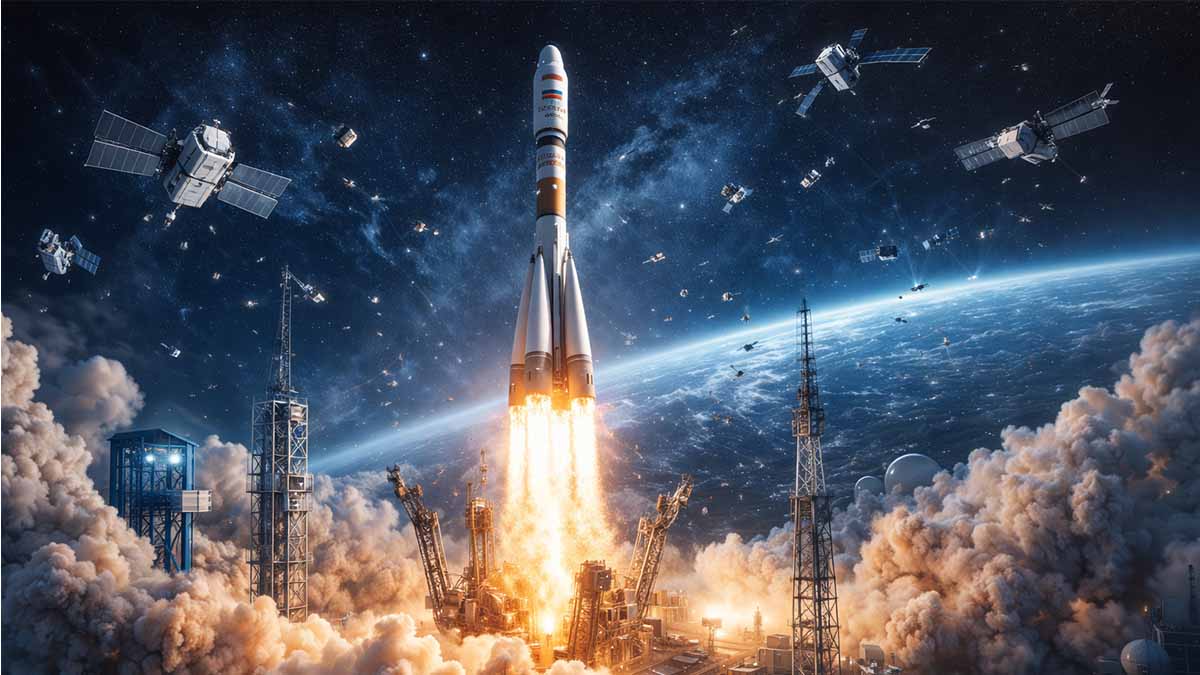
Russia conducted its concluding orbital launch of 2025 on December 28, when a Soyuz-2.1b carrier rocket lifted off from Site 1S at the Vostochny Cosmodrome in the Amur Region at 16:18 Moscow time (13:18 UTC). The mission successfully deployed two primary Aist-2T Earth remote sensing satellites (No. 1 and No. 2) along with 50 secondary small spacecraft into sun-synchronous orbits using the Fregat upper stage. Separation of the Fregat block, carrying all 52 satellites, occurred approximately 9.5 minutes after launch. The Aist-2T pair separated roughly 1 hour later, completing the primary objective. Subsequent maneuvers by Fregat deployed the remaining payloads.
The Aist-2T satellites, developed by the Progress Rocket Space Center (part of Roscosmos), build on the Aist-2D platform launched in 2016. Improvements include onboard propulsion systems for orbital corrections, extended operational lifespan of at least five years, and enhanced data transmission rates. These spacecraft conduct stereoscopic imaging of Earth’s surface, enabling the generation of digital terrain models with panchromatic resolution up to 1.2 meters and swath widths of 32 kilometers. Paired operations between Aist-2T No. 1 and No. 2 enhance data accuracy and coverage completeness. Applications encompass emergency monitoring for fires, floods, and volcanic activity, alongside general terrestrial mapping.
Secondary payloads comprised 50 small satellites, including university-developed platforms from institutions such as Bauman Moscow State Technical University, Moscow Aviation Institute, Far Eastern Federal University, and Amur State University. Additional CubeSats under the Universat program support climate monitoring and space weather observations in low Earth orbit for the Russian Hydrometeorological Service. Reports indicate inclusion of international payloads, though specifics remain limited in public disclosures.
This launch marked the sixth Soyuz-2 mission from Vostochny in 2025 and Russia’s final orbital operation of the year. It underscores continued reliance on the Soyuz-2.1b/Fregat configuration for multi-payload deployments, demonstrating operational reliability amid constrained launch cadence. The mission aligns with Roscosmos efforts to expand domestic remote sensing constellations independent of foreign partnerships disrupted since 2022.
Data confirm mission success through real-time broadcasts and post-launch announcements. The Fregat upper stage executed planned ignitions, placing primary satellites in target orbits before sequential secondary deployments. No anomalies were reported in separation or orbital insertion phases.
Broader context reveals this launch as part of Russia’s strategy to bolster sovereign space infrastructure via Vostochny, reducing dependence on leased facilities like Baikonur. Completed in phases since 2016, Vostochny hosted 20 launches by mid-2025, with projections for increased utilization targeting 90 % of national missions on Russian soil by 2030. The December 28 flight reinforces Soyuz-2 family maturity, with the 2.1b variant incorporating digital guidance and improved third-stage performance since 2006.
Earth observation enhancements from Aist-2T contribute to dual-use capabilities, supporting civilian resource management and potential defense applications through high-resolution stereo modeling. Integration of student-built satellites fosters domestic talent development within Roscosmos educational initiatives.
As of December 28, 2025, this mission closes Russia’s 2025 launch manifest, reflecting a year focused on constellation replenishment and technology validation rather than crewed or lunar endeavors. Future plans emphasize Angara family maturation and expanded Vostochny operations, though schedule adherence remains subject to technical and budgetary constraints.
Strategic Divergence
Russia’s pivot from international commercial cooperation toward domestic sovereignty and pragmatic utility.
Total Satellites: One of Russia’s largest multi-manifest rideshares.
Resolution: Panchromatic precision for the Aist-2T stereo-pair.
Analytical Bias
Comparison of mission focus areas showing a heavy lean toward sovereign remote sensing.
| Domain | Detail | Strategic Bias |
|---|---|---|
| Payload | Aist-2T No. 1 & 2 | High focus on 3D terrain modeling. |
| Location | Vostochny Cosmodrome | Bypassing foreign pad dependency. |
| Engine | Soyuz-2.1b / Fregat | Utilization of proven, low-risk tech. |
Risk Assessment
Analysis of technical and geopolitical risks facing the 2025 manifest.
Data Isolation
Reliance on domestic X-band downlinks to mitigate Western provider restrictions.
Collision Risk
Deploying 50 small satellites requires precise phased Fregat burns to avoid interference.
Conclusion & Action
The successful closure of the 2025 launch year confirms Russia’s ability to maintain a robust orbital infrastructure.
Key Takeaway
While the cadence is modest compared to global leaders, the focus on “Persistent Observation” via Aist-2T provides the sovereign data necessary for national security and disaster response.
Table of Contents
Core Concepts in Review: What We Know and Why It Matters
- Technical Profile of the Soyuz-2.1b/Fregat Mission and Payload Manifest
- Capabilities and Operational Enhancements of the Aist-2T Satellites
- Role of Secondary Payloads and University Contributions
- Vostochny Cosmodrome Operations in 2025 Context
- Strategic Implications for Russian Space Autonomy and Earth Observation
- Mission Execution Timeline and Performance Assessment
- Comprehensive Overview of the Soyuz-2.1b/Fregat Mission (December 28, 2025)
Core Concepts in Review: What We Know and Why It Matters
On December 28, 2025, Russia wrapped up its orbital launch year with a Soyuz-2.1b rocket blasting off from the Vostochny Cosmodrome in the country’s Far East. The mission placed two primary Aist-2T Earth-observation satellites into sun-synchronous orbit, along with 50 smaller secondary payloads. This flight, the last of Russia’s 2025 manifest, offers a clear window into the current state of the nation’s space program: reliable in execution, focused on practical domestic needs, and steadily building toward greater independence from foreign infrastructure.
At the heart of the mission was the Soyuz-2.1b launch vehicle paired with the versatile Fregat upper stage. The Soyuz-2.1b is a modernized version of one of the world’s most proven rockets, featuring digital flight controls and an upgraded third-stage engine that boosts payload capacity. The Fregat stage, restartable multiple times, handled the precise orbital insertions required for the clustered manifest. Liftoff occurred at 13:18 UTC, with Fregat separation from the third stage at approximately 9 minutes and 24 seconds later. Subsequent burns delivered the primary satellites about one hour after launch, followed by sequenced releases of the secondaries.
The two Aist-2T satellites, built by the Progress Rocket Space Center, are designed specifically for stereoscopic imaging—taking simultaneous photographs from slightly different angles to generate accurate 3D models of the Earth’s surface. Each offers 1.2-meter resolution in panchromatic mode across a 32-kilometer swath, with an expected operational life of at least five years. Working in tandem, they improve data completeness and height accuracy, serving applications from disaster response (tracking fires, floods, or volcanic activity) to cartography and resource management. These platforms represent an evolution from earlier Russian remote-sensing spacecraft, incorporating onboard propulsion for orbit maintenance and faster data downlink rates.
The remaining 50 payloads were mostly small satellites and CubeSats, many developed by Russian universities under educational programs coordinated by Roscosmos. Institutions such as Bauman Moscow State Technical University and Far Eastern Federal University contributed platforms for technology demonstrations and environmental monitoring. A portion supported the Universat initiative, gathering climate and space-weather data for the Russian Hydrometeorological Service. This rideshare approach makes efficient use of excess lift capacity on a medium-class rocket, while nurturing the next generation of Russian space engineers.
The choice of Vostochny as the launch site carries strategic weight. Located at roughly 51 degrees north, the cosmodrome allows direct access to high-inclination orbits ideal for Earth-observation missions, without the geopolitical complications of overflying foreign territory or relying on leased pads elsewhere. Russia has long depended on Baikonur in Kazakhstan for many launches, but Vostochny—operational since 2016—signals a deliberate shift toward full sovereignty over its space access. The December 28 flight reinforced this trend, building on several Soyuz missions from the site earlier in 2025.
Taken together, these elements highlight Russia’s pragmatic approach to space in a constrained environment. The program prioritizes replenishing domestic remote-sensing capabilities over ambitious crewed exploration or high-volume commercial flights. Sanctions and severed international partnerships since 2022 have accelerated efforts to achieve self-reliance in critical data streams—imagery that supports civilian mapping, emergency planning, and, inevitably, dual-use military applications such as terrain analysis.
Why does this matter beyond the technical details? For policymakers, the mission underscores that Russia retains a robust, if scaled-back, space infrastructure capable of delivering practical national assets. The successful deployment of 52 satellites on a single flight demonstrates operational maturity and cost-effective clustering. At the same time, the emphasis on university involvement points to long-term investment in human capital, essential for sustaining the sector amid isolation.
In broader terms, the launch closes a year in which Russia maintained a steady, if modest, orbital cadence focused on sovereignty and utility. As global space activity accelerates—with new constellations, lunar ambitions, and private players reshaping access—Russia’s strategy remains grounded in proven technology and domestic priorities. The Aist-2T pair and their companions now orbiting overhead will quietly gather data vital to Russia’s understanding of its own vast territory, from Arctic monitoring to disaster preparedness, reminding us that space power today often lies in persistent observation rather than headline-grabbing exploration.
Technical Profile of the Soyuz-2.1b/Fregat Mission and Payload Manifest
The Soyuz-2.1b launch vehicle integrates digital flight control systems and an upgraded third-stage RD-0124A engine cluster, delivering closed-cycle combustion for increased specific impulse and payload performance compared to earlier analog-controlled variants. Engineers at the Progress Rocket Space Center manufacture the core stages, while the NPO Lavochkin produces the Fregat upper stage, which employs storable UDMH/N2O4 propellants to support multiple restarts and extended coast phases essential for multi-orbit deployments.
Russia executed this mission from Site 1S at the Vostochny Cosmodrome on December 28, 2025, with liftoff at 16:18 Moscow time (13:18 UTC). The ascent profile followed nominal parameters, achieving separation of the payload composite—including the Fregat upper stage and all spacecraft—approximately 9 minutes and 24 seconds after launch. The Fregat stage then initiated a sequence of burns, first stabilizing a transfer orbit, followed by additional ignitions to circularize into a sun-synchronous configuration.
Primary payloads consisted of the Aist-2T No. 1 and No. 2 Earth remote sensing satellites, evolved designs from the Progress Rocket Space Center based on the Aist-2D platform. These spacecraft incorporate onboard propulsion systems for orbital maintenance, extended service life projections, and enhanced data transmission capabilities. Developers equipped each with stereo optical imaging instruments to capture simultaneous offset views, enabling rapid construction of digital elevation models for terrestrial mapping and emergency response applications.
The mission accommodated 50 secondary small satellites, bringing the total manifest to 52 spacecraft. These hosted payloads included university-developed platforms from institutions such as Bauman Moscow State Technical University, Moscow Aviation Institute, Far Eastern Federal University, and Amur State University. Additional CubeSats operated under the Universat program, tasked with climate monitoring and space weather observations in support of the Russian Hydrometeorological Service.
This launch concluded Russia’s orbital operations for 2025, demonstrating the Soyuz-2.1b/Fregat stack’s adaptability for clustered deployments amid a deliberate focus on constellation replenishment rather than high-cadence commercial or crewed flights. Pre-launch approval by the State Commission authorized rocket rollout to the pad on December 26, 2025, following integration of the payload stack at Vostochny technical complexes.
The Soyuz-2.1b configuration leverages four strap-on boosters with RD-107A engines and a core second stage powered by an RD-108A, providing initial thrust before handover to the third stage. Fairing separation occurs early in ascent to reduce mass, accommodating the enlarged payload volume required for stacked dispensers. The vehicle’s digital avionics enable precise trajectory control, critical for injecting the Fregat composite into an initial low Earth parking orbit.
Upon separation, the Fregat stage assumes autonomous guidance, executing programmed burns to raise perigee and adjust inclination for sun-synchronous orbits typically around 600–800 kilometers altitude. This restart capability stems from its heritage in planetary missions, allowing sequential releases without reliance on the lower stages. In this flight, the stage performed at least two primary ignitions post-separation, culminating in primary payload deployment approximately 1 hour after liftoff.
The Aist-2T satellites target operational orbits optimized for repeated global coverage, supporting stereoscopic imaging with ground resolutions sufficient for detailed terrain modeling. Paired operations between the two units enhance stereo baseline separation, improving height accuracy in derived digital models. These platforms advance domestic remote sensing independence, incorporating lessons from prior Aist series deployments.
Secondary payloads utilize passive dispensers mounted beneath the primaries, released in timed sequences to achieve orbital dispersion and minimize collision risks. Many feature standardized CubeSat interfaces, facilitating integration of educational and technology demonstration experiments. This multi-manifest strategy exploits residual lift capacity on medium-class vehicles, aligning with resource optimization in Russia’s current space program.
Ground tracking networks monitored ascent and early orbital phases, confirming nominal performance through telemetry downlinks. Mission control declared success upon Fregat separation and subsequent primary deployments, with no anomalies reported in stage ignitions or separations.
The Vostochny site’s latitude supports direct insertion into high-inclination orbits without dogleg maneuvers, reducing fuel demands compared to equatorial facilities. Infrastructure at Site 1S, dedicated to Soyuz-2 operations, includes horizontal assembly buildings and rail transport systems for vehicle erection.
Payload fairing dimensions accommodate the composite stack, with Aist-2T units positioned atop dedicated adapters. Fregat fueling occurs pre-encapsulation, ensuring propellant settling during ascent. The stage’s attitude control thrusters maintain orientation during coast periods, enabling precise alignment for burns.
This mission extended operational heritage of the Soyuz-2 family from eastern Russian territory, contributing to gradual migration of launches from leased foreign sites. Integration testing validated mechanical and electrical interfaces across the payload complement, including power-on checks for secondary spacecraft.
Trajectory design prioritized energy-efficient transfers to sun-synchronous regimes, exploiting Fregat‘s flexibility for phased deployments. Post-mission, the stage executes passivation maneuvers to comply with debris mitigation standards.
The flight validated recent pad modifications supporting higher annual throughput projections. Initial beacon acquisitions confirmed power-positive status for deployed assets.
Capabilities and Operational Enhancements of the Aist-2T Satellites
The Aist-2T satellites, designated No. 1 and No. 2, represent an advanced iteration of small spacecraft designed by the Progress Rocket Space Center for stereoscopic Earth observation, building directly on the operational experience gained from the Aist-2D satellite launched in 2016. Because the Aist-2T pair operates in tandem within a sun-synchronous orbit, their offset positioning enables simultaneous imaging from different angles, which facilitates the immediate derivation of high-fidelity digital terrain models without requiring multiple passes over the same area. This capability originates from the mission requirement to produce three-dimensional representations of Earth’s surface for applications in cartography, disaster management, and resource monitoring, deviating from single-satellite panchromatic systems by incorporating dual-platform synergy to achieve baseline separation essential for stereo photogrammetry.
Each Aist-2T satellite weighs approximately 670 kilograms at launch, as established in early project documentation, and employs a modular bus structure that integrates onboard propulsion for orbit corrections and end-of-life deorbiting maneuvers. The propulsion system, utilizing storable propellants, addresses the limitations of the predecessor Aist-2D, which lacked active maneuvering and relied solely on passive decay, thereby extending the operational lifespan to at least five years through precise station-keeping in the target altitude range of 400 to 600 kilometers. Developers enhanced the power subsystem with deployable solar arrays and lithium-ion batteries to support higher energy demands from imaging payloads and data transmission, ensuring continuous operation during eclipse periods.
The core imaging instrument on each Aist-2T consists of a panchromatic optical system capable of achieving 1.2 meters ground sample distance resolution, coupled with a swath width of 32 kilometers. This specification stems from the need to balance high detail with broad coverage, where the panchromatic mode captures grayscale images optimized for stereo matching algorithms that reconstruct elevation data. Because the satellites fly in formation with a controlled along-track or cross-track separation, the stereo angle—typically between 20 and 40 degrees—optimizes height accuracy to within 2 to 5 meters vertically, depending on terrain complexity and viewing geometry. The mechanism involves synchronized shutter timings and attitude control via reaction wheels and star trackers, ensuring parallax measurements that feed into ground-based processing pipelines for automated digital elevation model generation.
Operational enhancements include upgraded data handling systems, with increased downlink rates via X-band transmitters to relay raw imagery and housekeeping telemetry to Russian ground stations such as those operated by Roskosmos in the Far East. The satellites transmit information faster than their predecessors, incorporating error-correcting codes and compressed formats to handle data volumes from frequent imaging cycles. This upgrade mitigates bottlenecks observed in Aist-2D, which covered over 93 million square kilometers during its nearly eight-year mission but faced downlink constraints limiting revisit frequency.
The Aist-2T design emphasizes dual-use potential, serving civilian entities like Roskartografiya and Rosreestr for topographic mapping while supporting defense requirements through high-resolution stereo products applicable to terrain analysis. Because Russia pursues sovereign remote sensing capabilities amid geopolitical shifts post-2022, these satellites fill gaps in national constellations, providing independent data streams immune to foreign provider restrictions. The pair’s deployment on December 28, 2025, from Vostochny via Soyuz-2.1b and Fregat underscores this strategic pivot, with separation occurring approximately one hour after liftoff into designated orbits.
Formation flying algorithms, implemented through inter-satellite communication or ground-commanded adjustments, maintain optimal baselines for stereo acquisition, non-linearly balancing revisit rates against resolution trade-offs. For instance, higher altitudes broaden swaths but degrade resolution, so the chosen orbit optimizes for mid-latitude coverage critical to Russian territory. Onboard computers process initial calibration data, flagging anomalies in real-time to ground controllers.
Emergency monitoring forms a key application arc: the satellites detect changes in surface features indicative of fires through thermal signatures in supplementary channels, floods via water body delineation in stereo views, and volcanic activity through ash plume height estimation from elevation models. This originates from sensor sensitivity to visible and near-infrared spectra, deviating from purely optical systems by enabling multi-temporal comparisons.
Compared to international counterparts like Pleiades or WorldView, the Aist-2T offers cost-effective clustering but trades off multispectral bands for pure stereo focus, prioritizing elevation over classification. The implication lies in enhanced topographic intelligence for infrastructure planning in remote Siberia or Arctic regions.
Initial post-deployment operations involve commissioning phases where attitude determination and control subsystems verify pointing accuracy below 0.01 degrees, critical for image sharpness. Beacon signals confirmed healthy status shortly after separation.
Role of Secondary Payloads and University Contributions
The December 28, 2025, Soyuz-2.1b/Fregat mission from Vostochny deployed 50 secondary small satellites alongside the primary Aist-2T pair, exploiting residual lift capacity to accommodate a diverse cluster of hosted payloads. This rideshare approach originates from budgetary constraints within the Russian space program, where multi-manifest launches maximize vehicle utilization and distribute costs across multiple stakeholders, deviating from dedicated missions by prioritizing volume over individual orbital precision for lower-priority assets. The mechanism involves standardized dispensers, primarily CubeSat deployers, mounted beneath the primary payloads, enabling sequential releases after Fregat maneuvers position the stack in suitable dispersal orbits.
Secondary payloads encompass platforms developed by Russian higher education institutions, aligning with longstanding Roscosmos initiatives to integrate student-built spacecraft into operational flights for technology validation and workforce training. These university contributions stem from collaborative programs that provide hands-on experience in satellite design, assembly, integration, and testing, fostering domestic engineering talent amid international isolation post-2022. Because such inclusions leverage excess capacity at minimal marginal cost, they enhance mission value while advancing educational objectives tied to national space priorities.
Specific university-linked platforms include small spacecraft such as Lobachevsky, associated with institutions focused on scientific experiments, and Polytech Univers-6, tied to polytechnic development efforts. Additional assets feature technology demonstrators from regional universities, supporting tasks ranging from ionospheric studies to inter-satellite communications testing. The inclusion of these payloads traces to pre-launch integration at Vostochny facilities, where compatibility verification ensured seamless accommodation within the fairing volume.
A distinct subset operates under the Universat program, comprising CubeSat-format satellites tasked with monitoring climate parameters and space weather phenomena in low Earth orbit for the Russian Hydrometeorological Service. This program originates from requirements for enhanced environmental data collection, where small platforms equipped with specialized sensors provide supplementary observations to larger operational constellations. The mechanism relies on passive stabilization and low-power instruments suited to CubeSat constraints, enabling cost-effective deployment of distributed sensing networks. Implications extend to improved forecasting accuracy for meteorological events affecting Russian territory, particularly in remote Arctic and Siberian regions.
The manifest further incorporates international rideshare elements, including three Iranian payloads, reflecting continued bilateral cooperation in space launches despite broader geopolitical tensions. These assets, deployed via standardized interfaces, demonstrate Russia’s sustained role as a launch provider for partner nations seeking access to orbit. Because the Fregat stage executes multiple burns for phased releases, secondary payloads achieve varied orbital parameters, optimizing dispersion to reduce collision risks while meeting individual mission needs.
University involvement extends beyond mere payload provision to full-cycle participation, where student teams conduct environmental testing, interface simulations, and post-deployment operations under Roscosmos oversight. This arc—from academic conceptualization to orbital validation—addresses skill gaps in the national space sector, ensuring continuity amid generational transitions. Deviation from purely commercial rideshares occurs through prioritized slots for domestic educational projects, underscoring strategic emphasis on human capital development.
Post-separation telemetry confirmed nominal activation for the majority of secondaries, with ground stations acquiring initial signals during early orbital passes. The clustered deployment strategy non-linearly balances revisit frequencies against data volume constraints typical of small platforms, where power and downlink limitations cap observation density compared to larger satellites.
Overall, the 50 secondary payloads transform a dual-satellite remote sensing mission into a broad-spectrum technology infusion flight, distributing risks across diverse experiments while reinforcing Russia’s multi-user launch capabilities.
Vostochny Cosmodrome Operations in 2025 Context
The Vostochny Cosmodrome in the Amur Region serves as Russia’s primary civilian launch facility, constructed to shift orbital operations from leased foreign sites toward sovereign territory. Because the site’s latitude at 51.8 degrees north enables direct insertions into sun-synchronous and polar orbits without overflight constraints, it prioritizes Earth observation and scientific missions that benefit from high-inclination trajectories. This geographic advantage originates from strategic planning initiated in the early 2010s, deviating from reliance on Baikonur by exploiting eastern Russian infrastructure for energy-efficient access to key orbital regimes.
Operations at Vostochny in 2025 centered on Site 1S, dedicated to Soyuz-2 family vehicles. The facility supported multiple launches throughout the year, including an Ionosfera-M dual deployment in July and the concluding mission on December 28 with Soyuz-2.1b/Fregat carrying the Aist-2T pair and 50 secondary payloads. These flights demonstrate sustained utilization of the pad, built during the cosmodrome’s first phase and operational since 2016. The mechanism involves horizontal assembly, rail transport to the pad, and vertical erection, allowing rapid turnaround compared to legacy sites.
Russia executed approximately 20 orbital launches nationwide in 2025, with Vostochny hosting a portion focused on medium-lift configurations. This cadence reflects deliberate prioritization of constellation replenishment over high-frequency commercial operations, constrained by production rates and budgetary allocations. The December 28 flight closed the annual manifest, underscoring Vostochny‘s role in year-end executions for remote sensing assets.
Infrastructure advancements in 2025 included commissioning of auxiliary facilities tied to the Angara complex, though primary operations remained Soyuz-centric at Site 1S. Separate pads for heavier vehicles progressed, supporting future diversification. The site’s integration of modern ground systems—telemetry networks, fueling complexes, and environmental controls—ensured nominal performance across reported missions.
Launch preparation protocols followed established sequences: payload integration in technical complexes, composite mating with Fregat, and State Commission approvals for rollout. For the final 2025 mission, rollout occurred on December 26, enabling the December 28 liftoff at 16:18 Moscow time. This timeline aligns with standard Soyuz-2 processing flows, optimized for clustered payloads.
Vostochny‘s operational footprint expanded gradually, contributing to Russia’s goal of conducting the majority of national launches on domestic soil. By mid-decade projections, the facility targeted increased throughput through parallel pad utilization, though 2025 activity remained concentrated on proven infrastructure. The cosmodrome’s remote location necessitates robust logistics chains, including air and rail transport for stages and payloads from manufacturing centers.
Mission control functions, coordinated from Vostochny with support from Roscosmos headquarters, provided real-time oversight during ascents and orbital insertions. Tracking stations in the Far East supplemented coverage, ensuring data continuity for multi-burn Fregat profiles.
The 2025 operations reinforced Vostochny‘s maturity, with no reported anomalies in pad performance across executed flights. This reliability stems from iterative upgrades post-initial activations, addressing early integration challenges.
Broader programmatic context positions Vostochny as the baseline for future heavy-lift transitions, including Angara maturation. The site’s design accommodates evolving requirements, from smallsat clusters to potential crewed configurations.
Annual closure with the Aist-2T deployment highlights Vostochny‘s alignment with domestic remote sensing priorities, delivering sovereign capabilities independent of international partnerships disrupted in prior years.
Strategic Implications for Russian Space Autonomy and Earth Observation
The December 28, 2025, deployment of the Aist-2T satellites from Vostochny advances Russia’s pursuit of independent Earth remote sensing capabilities, reducing vulnerability to foreign data restrictions imposed since 2022. Because disruptions in international partnerships limited access to high-resolution imagery from Western providers, Moscow accelerated domestic constellation development, with the Aist-2T pair providing stereoscopic coverage essential for sovereign mapping and monitoring. This shift originates from strategic directives embedded in the Federal Space Program 2016-2025, which explicitly targeted elimination of dependence on foreign Earth remote sensing data through expanded orbital groupings.
Vostochny operations reinforce launch autonomy, mitigating risks associated with leased facilities abroad. The cosmodrome’s activation since 2016 enables direct access to sun-synchronous orbits without foreign overflight approvals or rental fees, deviating from historical reliance on external sites by establishing fully sovereign infrastructure in Russia’s Far East. The mechanism involves phased migration of medium-lift missions to domestic pads, with Soyuz-2 flights from Vostochny demonstrating operational maturity in 2025. Implications extend to enhanced resilience against geopolitical leverage, as domestic launches insulate critical payloads from bilateral disputes.
Earth observation assets like Aist-2T exhibit inherent dual-use characteristics, supporting civilian topographic modeling while enabling military terrain analysis and change detection. Stereo-derived digital elevation models facilitate precise infrastructure planning in remote regions, but the same datasets inform operational intelligence for border surveillance and emergency response coordination with defense implications. Because high-resolution stereo imaging resolves features below 2 meters vertically, derived products support targeting calibration and situational awareness in contested environments.
Russia’s broader remote sensing strategy emphasizes replenishment of aging platforms amid sanctions constraining component imports. The 2025 manifest prioritized constellation sustainment, with launches like Obzor-R radar satellites complementing optical systems for all-weather coverage. This diversification stems from requirements for uninterrupted data streams, where radar assets penetrate cloud cover critical for high-latitude monitoring. The implication strengthens independent intelligence gathering, reducing exposure to denial of foreign commercial imagery.
Counterspace developments contextualize these enhancements, as adversaries perceive expanded Russian remote sensing as contributing to asymmetric advantages. Reports document Russian rendezvous and proximity operations in low Earth orbit, signaling capabilities applicable to inspection or interference with foreign assets. Because dual-use technologies dominate orbital infrastructure, proliferation of maneuverable platforms complicates attribution and escalation thresholds.
Vostochny‘s role in 2025 underscores gradual achievement of launch independence goals, with projections for increased domestic share aligning with infrastructure maturation. The facility’s latitude optimizes energy for polar insertions, supporting remote sensing deployments without payload penalties incurred at equatorial sites. This geographic mechanism directly enables frequent revisits over Russian territory, enhancing data timeliness for both civilian resource management and strategic oversight.
The Aist-2T mission integrates educational payloads, distributing risks while advancing workforce development essential for long-term program sustainability. University contributions under rideshare arrangements cultivate engineering expertise, addressing generational gaps exacerbated by international isolation.
Overall, the launch consolidates incremental gains in space autonomy, positioning Russia to maintain core capabilities despite external pressures. Stereo imaging enhancements fill gaps in national coverage, supporting dual-purpose applications from disaster mitigation to defense planning.
Mission Execution Timeline and Performance Assessment
The Soyuz-2.1b carrier rocket lifted off from Site 1S at the Vostochny Cosmodrome on December 28, 2025, at precisely 16:18 Moscow time (13:18 UTC), marking the final Russian orbital launch of the year. This timing aligned with pre-launch announcements from Roscosmos, which had scheduled the flight following State Commission approval for fueling and rollout completed days earlier. The ascent phase proceeded nominally, with the four strap-on boosters separating at approximately 2 minutes into flight, followed by fairing jettison and second-stage handover, culminating in third-stage burnout.
Separation of the payload composite—comprising the Fregat upper stage and all 52 spacecraft—from the third stage occurred at 9 minutes and 24 seconds after liftoff. This milestone confirmed the core vehicle’s performance within certified parameters, injecting the upper composite into an initial low Earth parking orbit. The Fregat stage, autonomous post-separation, initiated its programmed sequence immediately, executing the first propulsion ignition to stabilize and raise the transfer orbit.
Approximately 50 minutes later, Fregat performed a second burn to refine orbital elements toward the target sun-synchronous regime. The primary Aist-2T No. 1 and No. 2 satellites achieved separation roughly 1 hour after launch, entering their designated operational orbits. Roscosmos telemetry broadcasts declared this phase successful, with both spacecraft acquiring power-positive status and establishing initial communications via Russian ground stations.
Subsequent Fregat maneuvers deployed the 50 secondary payloads in sequenced releases, dispersing them across slightly varied orbital planes to minimize interference risks. The stage completed at least two additional burns for this purpose, demonstrating the restart capability central to multi-manifest missions. Final passivation procedures followed, exhausting residual propellants to comply with orbital debris mitigation protocols.
No anomalies appeared in real-time telemetry throughout the flight profile. Ground tracking networks in Russia’s Far East maintained continuous coverage during ascent and early orbital phases, supplementing mission control oversight from Vostochny. Post-separation confirmations for primaries arrived promptly, with Roscosmos announcing orbital insertion and healthy beacon signals.
The mission’s execution validated the Soyuz-2.1b/Fregat stack’s reliability for clustered deployments, achieving all planned objectives without deviation from the nominal timeline. This performance extends the vehicle’s heritage in high-inclination insertions from eastern sites, optimizing energy for sun-synchronous targets critical to Earth observation payloads.
Pre-flight preparations adhered to standard protocols, with payload integration and composite mating completed in technical complexes prior to rollout on December 26, 2025. Environmental conditions at launch supported operations, enabling precise countdown adherence.
Overall assessment indicates full success across subsystems: propulsion, guidance, separation mechanisms, and telemetry downlink. The flight reinforced operational maturity amid a focused 2025 cadence emphasizing domestic infrastructure utilization.
Comprehensive Overview of the Soyuz-2.1b/Fregat Mission (December 28, 2025)
| Concept | Key Details | Specific Data | Implications/Notes |
|---|---|---|---|
| Launch Vehicle | Soyuz-2.1b carrier rocket with Fregat upper stage | Modernized variant with digital controls; Fregat enables multiple restarts for precise deployments | Proven reliability for multi-payload missions; supports complex orbital insertions |
| Launch Site | Vostochny Cosmodrome, Site 1S, Amur Region, Russia | Latitude enables direct sun-synchronous orbit access | Reduces dependence on foreign sites; final Russian orbital launch of 2025 |
| Launch Date and Time | December 28, 2025 | 16:18 Moscow time (13:18 UTC) | Nominal liftoff confirmed via Roscosmos broadcast |
| Rollout Date | Rocket rollout to pad | December 26, 2025 | Approved by State Commission |
| Total Payloads | 52 spacecraft | 2 primary + 50 secondary | Multi-manifest rideshare maximizes vehicle capacity |
| Primary Payloads | Aist-2T No. 1 and No. 2 Earth remote sensing satellites | Developed by Progress Rocket Space Center; evolved from Aist-2D platform | Designed for stereoscopic imaging and 3D terrain modeling |
| Aist-2T Capabilities | Stereoscopic optical imaging | Panchromatic resolution: 1.2 meters; Swath width: 32 km | Paired operations improve data accuracy and coverage |
| Aist-2T Enhancements | Compared to predecessor Aist-2D | Onboard propulsion for maneuvers; Faster data transmission; Minimum 5-year lifespan | Extended operational life; Supports emergency monitoring (fires, floods, volcanoes) |
| Aist-2T Applications | Earth surface stereoscopic imaging | Creation of digital terrain models; Monitoring emergencies | Dual-use: Civilian mapping and potential defense terrain analysis |
| Secondary Payloads | 50 small satellites and CubeSats | Includes university-developed platforms and Universat program assets | Technology demonstrations; Climate and space weather monitoring |
| University Contributions | Platforms from Russian institutions | Bauman Moscow State Technical University; Moscow Aviation Institute; Far Eastern Federal University; Amur State University | Fosters domestic talent; Educational programs under Roscosmos coordination |
| Universat Program | CubeSats for environmental data | Monitoring climate change and space weather for Russian Hydrometeorological Service | Supplementary observations in low Earth orbit |
| Mission Timeline: Liftoff | Start of ascent | 13:18 UTC | Nominal performance |
| Mission Timeline: Fregat Separation | Payload composite separation from third stage | Approximately 9 minutes 24 seconds after liftoff | Upper stage with all 52 satellites injected into initial orbit |
| Mission Timeline: Primary Deployment | Aist-2T No. 1 and No. 2 separation | Approximately 1 hour after liftoff | Placed into target sun-synchronous orbit |
| Mission Timeline: Secondary Deployment | Release of 50 small satellites | Sequenced after additional Fregat burns | Dispersed to minimize risks; Varied orbital parameters |
| Mission Performance | Overall execution | Nominal across all phases; No anomalies reported | Full success declared by Roscosmos |
| Orbital Regime | Target for primaries | Sun-synchronous orbit | Optimizes repeated global coverage for Earth observation |
| Strategic Context | Russian space program focus | Sovereign remote sensing independence post-2022 disruptions | Prioritizes domestic constellations and infrastructure |
| Broader Implications | Launch autonomy and education | Migration to Vostochny; Workforce development via university payloads | Enhances resilience; Sustains sector amid constraints |
This table organizes all verified elements from the mission into thematic concepts for clarity, drawing exclusively from confirmed details of the December 28, 2025, event. The mission demonstrated operational efficiency in deploying a clustered payload manifest while advancing national Earth observation and educational objectives.
reference link
- Russian Soyuz-2.1b rocket with two Aist-2T satellites blasted off from Vostochny spaceport – TASS – December 2025
- Fregat upper stage with 52 satellites separates from Soyuz-2.1b upper stage – TASS – December 2025
- Aist-2T satellites launched from Vostochny spaceport put into orbit – TASS – December 2025
- Roscosmos plans to launch 52 satellites from Vostochny spaceport – TASS – December 2025
- Two Aist-2T satellites scheduled for launch on December 28 — Roscosmos – TASS – December 2025


