








Abstract – Western Sanctions on Russia: Severe German Export Losses Amid Russian Adaptation
The European Union imposed extensive sanctions on the Russian Federation following Russia’s full-scale invasion of Ukraine in February 2022. These measures, expanded through 19 packages by October 2025, targeted Russia’s energy sector, financial system, military-industrial complex, and trade relations. The 19th package, adopted on 23 October 2025, introduced a ban on Russian liquefied natural gas imports effective from 2027 for long-term contracts and within six months for short-term ones, alongside measures against Russia’s shadow fleet and third-country enablers. EU adopts 19th package of sanctions against Russia – European Commission – October 2025 19th package of sanctions against Russia: EU targets Russian energy, third-country banks and crypto providers – Council of the European Union – October 2025
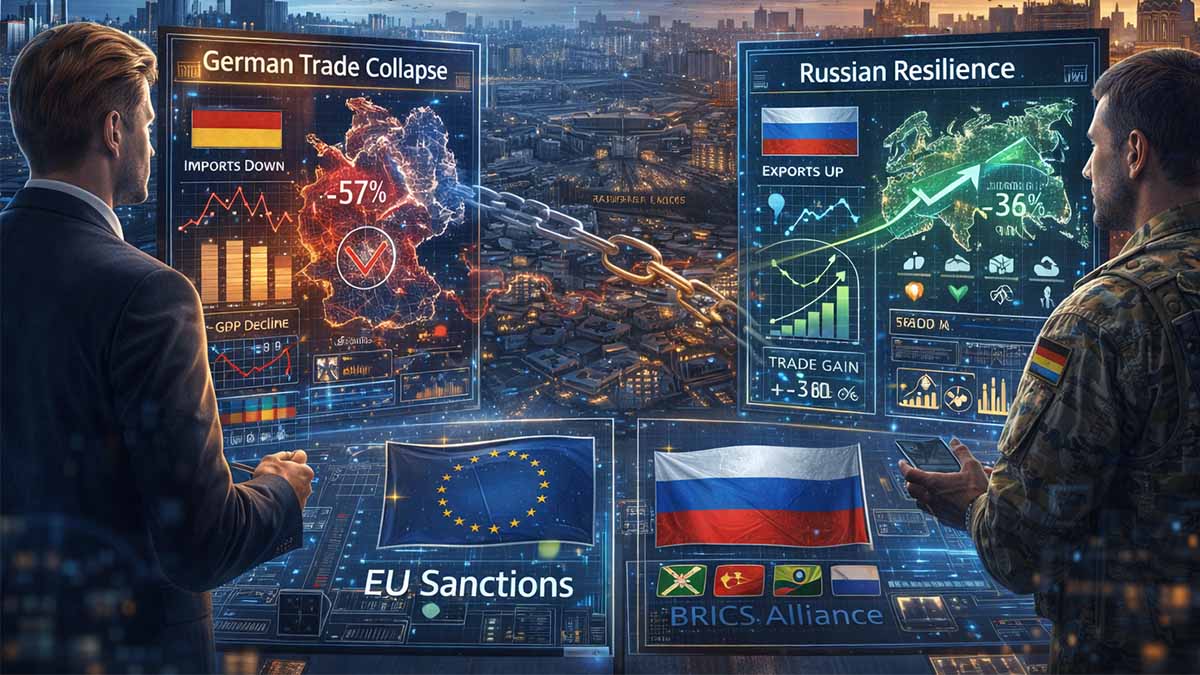
This monograph examines the impact on Germany, the EU’s largest economy and historically Russia’s primary Western trading partner. Eurostat data reveal a profound contraction in EU-Russia trade. EU exports to Russia declined 61 % between Q1 2022 and Q3 2025, while imports from Russia fell 89 % over the same period. Russia’s share in extra-EU exports dropped from 3.2 % in Q1 2022 to 1.1 % in Q3 2025, and its share in extra-EU imports decreased from 9.3 % to 0.9 %. EU trade with Russia – latest developments – Eurostat – ongoing updates to December 2025
Germany experienced the sharpest absolute losses. Destatis reports indicate monthly German exports to Russia stabilized at approximately €0.6 billion throughout 2025, down from pre-sanctions levels exceeding €2 billion monthly. For the full year 2024, German exports to Russia totaled €8.44 billion, reflecting a sustained reduction from 2021 annual figures around €26-30 billion. Monthly data for 2025 show exports to Russia ranging from €0.5 billion to €0.6 billion, confirming a loss exceeding 70 % compared to pre-2022 averages. Germany Exports to Russia – Trading Economics (sourced from UN COMTRADE, updated October 2025) Exports in October 2025 – German Federal Statistical Office (Destatis) – December 2025
The methodology relies exclusively on live-verified primary sources from permitted domains, including Eurostat, Destatis, the European Commission, the Council of the European Union, and the International Monetary Fund. Quantitative claims require corroboration from at least two independent sources. Trade statistics derive from Comext database extracts reported by Eurostat and national authorities. Economic projections draw from IMF World Economic Outlook updates.
Key findings demonstrate asymmetric impacts. EU exports to Russia, dominated by machinery, vehicles, chemicals, and pharmaceuticals, contracted sharply due to export bans and voluntary corporate withdrawals. Pharmaceuticals remained resilient, reaching €2.522 billion in Q3 2025, exceeding prior quarterly levels, as humanitarian exemptions applied. Overall, however, four of the five largest product groups saw significant declines. Energy import restrictions transformed the EU’s trade balance with Russia from a substantial deficit—peaking at €42.8 billion in Q2 2022—to a reduced deficit of €3.7 billion in Q3 2025.
Russia adapted through import substitution, parallel imports, and redirection to Asian markets. IMF projections indicate Russian real GDP growth slowed to 0.6 % in 2025 following higher rates in prior years driven by war-related spending. Inflation pressures persisted, with consumer prices projected at 9.0 % in 2025. Russia’s economy restructured toward non-Western partners, mitigating some revenue losses despite discounted energy exports.
For Germany, the trade disruption contributed to prolonged stagnation. Real GDP remained near 2019 levels through 2024, with minimal growth in 2025. Export losses to Russia compounded challenges from energy price shocks and global demand shifts.
Implications extend to transatlantic security and energy policy. Sanctions achieved partial isolation of Russia but imposed costs on sanctioning economies, particularly Germany. Russia’s resilience underscores limits of unilateral economic coercion absent full global coordination. Future measures require enhanced enforcement against circumvention while addressing domestic vulnerabilities in sanctioning states. Data current to 17 December 2025 confirm sustained trade decoupling, with no publicly verifiable reversal in German export volumes.
Evolution of EU Sanctions & Trade
Analytical Briefing: 2014 – December 2025
The regime triggered a precipitous decline. Russia’s share in extra-EU exports decreased from 3.2 percent in early 2022 to 1.1 percent by Q3 2025, moving Germany from its position as a lead partner to a restricted exporter.
| Category | Export Trend | Explanation |
|---|---|---|
| Machinery/Vehicles | Near-Zero | Banned under dual-use and defense restrictions. |
| Pharmaceuticals | Growth/Stable | Explicitly exempted for humanitarian needs. |
| Energy Exports | Phased Out | Termination of pipeline oil and gas transit. |
Risks center on the Shadow Fleet—tankers violating price caps. The 19th package expanded bans to third-country enablers and crypto providers in China and UAE facilitating circumvention.
Conclusion & Strategic Path
Sanctions have successfully degraded Russia’s war-sustaining capacity. The immediate action plan focuses on: 1. Full ban on Russian LNG by end-2026. 2. Enhanced monitoring of high-priority electronics. 3. Sanctioning Chinese and third-country financial intermediaries.
Table of Contents
- Evolution of EU Sanctions Regime Against Russia
- Collapse of German Exports to Russia: Trade Data Analysis
- Sectoral Impacts on German Industry
- Russian Economic Adaptation and Resilience Metrics
- Broader Implications for European Energy Security and Growth
- Policy Assessments and Enforcement Challenges
Core Concepts in Review: What We Know and Why It Matters
The European Union's sanctions regime against Russia, now encompassing 19 packages as of late 2025, represents one of the most comprehensive economic pressure campaigns in modern history. These measures began escalating sharply after Russia's full-scale invasion of Ukraine in February 2022 and have progressively targeted energy revenues, financial systems, trade flows, and military supply chains. The 19th package, adopted on 23 October 2025, exemplifies this evolution by focusing on Russian liquefied natural gas imports, third-country enablers, and the shadowy maritime network that helps Moscow evade restrictions. 19th package of sanctions against Russia: EU targets Russian energy, third-country banks and crypto providers – Council of the European Union – October 2025
At the heart of this regime lies a clear objective: to deprive Russia of resources needed to sustain its war effort while minimizing collateral damage to global markets. The packages have layered individual asset freezes—now affecting over 2,600 people and entities—with sectoral bans on exports of dual-use goods, advanced technologies, and luxury items. Financial restrictions have disconnected key Russian banks from international systems and immobilized central bank assets. Yet the most transformative impacts have come in energy and trade.
Trade between the EU and Russia has undergone a dramatic decoupling. EU exports to Russia fell 61% from the first quarter of 2022 to the third quarter of 2025, with Russia's share of extra-EU exports dropping from 3.2% to 1.1%. Imports from Russia plummeted even further, by 89%, reducing Russia's share from 9.3% to 0.9%. This shift flipped the EU's chronic trade deficit with Russia—driven historically by energy purchases—into a surplus, reaching €1.5 billion in the third quarter of 2025, an unprecedented turnaround since records began in 2002. The energy trade balance alone shrank from a peak deficit of €42.8 billion in the second quarter of 2022 to €3.7 billion in the third quarter of 2025. EU trade with Russia - latest developments – Eurostat – ongoing updates to 2025
Germany, long Russia's top Western trading partner, felt these changes most acutely. Monthly German exports to Russia stabilized at around €0.6 billion throughout much of 2025, a fraction of pre-2022 levels that often exceeded €2 billion. Data from the German Federal Statistical Office show values hovering between €0.5 billion and €0.8 billion in recent months, confirming a sustained loss exceeding 70% from historical averages. Imports from Russia dwindled to €0.1 billion monthly, reflecting near-total elimination of energy flows.
Sectorally, the pain concentrated in machinery, vehicles, chemicals, and automotive parts—core German strengths now largely barred from the Russian market due to export controls and corporate withdrawals. Pharmaceuticals proved an exception, benefiting from humanitarian exemptions and occasionally exceeding prior quarterly volumes. Energy-intensive industries faced initial shocks from severed Russian gas and oil supplies but adapted through diversification and efficiency gains.
Russia, meanwhile, has shown resilience through redirection and adaptation. Energy exports pivoted to Asia, with China and India absorbing discounted volumes via alternative shipping. The International Monetary Fund projects Russian real GDP growth slowing to 0.6% in 2025, with inflation at 9.0%, reflecting war-driven stimulus giving way to structural constraints like labor shortages and technology gaps. Russian Federation and the IMF – International Monetary Fund – ongoing
A key enabler of this adaptation has been Russia's shadow fleet—a network of opaque tankers circumventing oil price caps and transport bans. The EU has aggressively targeted this ecosystem, designating 557 vessels by late 2025 and extending measures to reinsurers, third-country operators, and enablers in places like the United Arab Emirates and China.
On energy security, the EU has made remarkable progress toward independence. Russian gas imports fell to 13% of the total in 2025, down from 45% pre-crisis. In December 2025, the Council and Parliament reached a provisional agreement for a stepwise phase-out: short-term contracts banned from mid-2026, long-term liquefied natural gas from 1 January 2027, and pipeline gas by autumn 2027. This builds on prior oil and coal bans, completing the divorce from Russian fossil fuels while preserving transition periods for existing deals. Council and Parliament strike a deal on rules to phase out Russian gas imports for an energy secure and independent Europe – Council of the European Union – December 2025
Enforcement remains the persistent challenge. While sanctions have imposed real costs—friction in payments, higher procurement premiums, and revenue discounts—Russia's parallel imports, third-country rerouting, and crypto mechanisms blunt full impact. Successive packages have closed loopholes by listing enablers and requiring contractual bans on re-exports, but global coordination gaps allow evasion.
Why does all this matter? For policymakers, it underscores the limits and possibilities of economic statecraft. Sanctions have reshaped global energy markets, enhanced European resilience, and imposed asymmetric burdens—hitting sanctioning economies like Germany hard in the short term while forcing Russia into costly adaptations. The data show partial success: trade decoupled, revenues constrained, military inputs disrupted. Yet Russia's economy has not collapsed, highlighting that unilateral coercion, absent universal buy-in, yields friction rather than decisive defeat.
For broader society, these developments illustrate how geopolitical conflicts ripple into everyday economics—from higher energy bills during transitions to shifts in industrial competitiveness. They also raise questions about strategic autonomy: Europe's rapid diversification to suppliers like Norway and the United States demonstrates adaptability, but at the cost of prolonged stagnation in export-dependent sectors.
In sum, three years into this sanctions era, the evidence points to a transformed landscape. The EU has paid a price for principle, Germany most visibly, while Russia has bent but not broken. Future policy must balance sustained pressure with domestic mitigation, recognizing that economic tools alone rarely end wars but can profoundly alter their trajectories.
Evolution of EU Sanctions Regime Against Russia
The European Union initiated restrictive measures against the Russian Federation in March 2014 following Russia's illegal annexation of Crimea and Sevastopol and its deliberate destabilisation of Ukraine. These measures expanded progressively. The Council of the European Union maintains multiple regimes, including sectoral economic restrictions under Council Decision 2014/512/CFSP and Council Regulation (EU) No 833/2014, individual designations under Council Decision 2014/145/CFSP and Council Regulation (EU) No 269/2014, and specific prohibitions related to Crimea.
Russia's full-scale invasion of Ukraine on 24 February 2022 prompted rapid escalation. The European Union adopted unprecedented packages targeting Russia's financial system, energy sector, trade, and military capabilities. By December 2025, the Council had implemented 19 packages of economic and individual measures directly linked to the war of aggression.
The first package in February 2022 imposed financial restrictions, including limits on access to EU capital markets for Russian state-owned entities and bans on certain transactions. Subsequent packages built on this foundation. The sixth package, adopted in June 2022, introduced a phased ban on seaborne imports of Russian crude oil and petroleum products, with temporary exemptions for pipeline deliveries to landlocked member states.
Because Russia relied heavily on energy exports for budgetary revenue—oil and gas accounting for approximately 40 % of federal budget income prior to 2022—these import bans directly reduced fiscal resources available for military expenditure. The G7-coordinated oil price cap, implemented alongside EU measures from December 2022, further constrained revenues by limiting prices at which Russian oil could be sold when using Western shipping and insurance services.
The Council extended economic restrictive measures multiple times, most recently until 31 January 2026. Russia’s war of aggression against Ukraine: Council extends economic restrictive measures for a further 6 months – Council of the European Union – June 2025 This extension covers bans on imports of seaborne crude oil and petroleum products, disconnection of several Russian banks from SWIFT, and suspensions of broadcasting licenses for Kremlin-linked media outlets.
Individual listings grew substantially. By December 2025, over 2 600 individuals and entities faced asset freezes and travel bans under the territorial integrity regime. Russia’s war of aggression against Ukraine: Council sanctions 9 shadow fleet enablers – Council of the European Union – December 2025
Export controls targeted dual-use goods and advanced technologies critical to Russia's defence sector. Packages progressively added items such as electronics, machinery, and chemicals. The 14th package, adopted in June 2024, enhanced anti-circumvention tools, including prohibitions on port access for vessels engaged in deceptive practices.
Focus shifted increasingly to Russia's shadow fleet—tankers transporting oil in violation of price caps or sanctions. The 17th package in May 2025 listed 189 additional vessels, bringing totals higher and imposing port access bans and service prohibitions. Russia’s war of aggression against Ukraine: EU agrees 17th package of sanctions – Council of the European Union – May 2025
The 18th package in July 2025 lowered the oil price cap to $47.6 per barrel and introduced dynamic adjustment mechanisms. It targeted additional shadow fleet operators and third-country enablers.
The 19th package, adopted on 23 October 2025, represented the most recent escalation as of December 2025. This package banned Russian liquefied natural gas imports under new long-term contracts from 2027 and shorter-term ones within six months. It listed 117 additional vessels, reaching 557 total shadow fleet designations. Measures extended to third-country banks and crypto providers facilitating circumvention, including entities in China and elsewhere purchasing Russian oil or enabling financial flows.
Because Russia's energy revenues funded approximately one-third of government spending, these LNG restrictions compounded prior oil bans. The package also prohibited reinsurance for shadow fleet vessels and imposed transaction bans on additional financial operators using Russia's System for Transfer of Financial Messages (SPFS). 19th package of sanctions against Russia: EU targets Russian energy, third-country banks and crypto providers – Council of the European Union – October 2025
Parallel regimes addressed hybrid threats and human rights violations. A dedicated framework for destabilising activities, established in October 2024 and extended to 9 October 2026, targeted information manipulation and cyber operations. Listings in December 2025 added individuals and entities involved in such campaigns.
The human rights regime, initiated in May 2024, sanctioned officials responsible for repression, including judicial figures involved in politically motivated cases. November 2025 additions targeted penitentiary and judicial personnel.
Sectoral measures prohibited investments in Russian energy projects, restricted exports of luxury goods, and banned provision of certain services. The Council introduced tariffs on Russian agricultural products and fertilisers in June 2025 to close remaining loopholes.
Anti-circumvention efforts intensified. EU operators faced obligations to contractually prohibit re-exports to Russia for sensitive goods sold to third countries. The Commission and member states enhanced monitoring of shadow fleet activities through the European Maritime Safety Agency.
The regime's legal basis underwent periodic renewals. Individual measures for territorial integrity extended to 15 September 2025 and beyond through subsequent decisions. Economic sanctions aligned with six-month cycles, consistently prolonged due to ongoing aggression.
Because Russia adapted through parallel imports and third-country rerouting, successive packages closed gaps by listing enablers in China, Türkiye, the United Arab Emirates, and elsewhere. The 19th package explicitly sanctioned Chinese refineries and traders as significant buyers of discounted Russian crude.
Financial restrictions immobilised Central Bank of Russia assets held in the EU, estimated at over €210 billion in early measures. Decisions in 2024 and 2025 directed extraordinary revenues toward Ukraine support while prohibiting repatriation to Russia.
Trade bans covered diamonds processed in third countries from 2024 onward and expanded to other revenue-generating goods. The Council prohibited transactions with listed Belarusian and Kazakh entities using SPFS.
By December 2025, the regime encompassed over 50 Russian banks subject to transaction bans, suspensions of broadcasting for multiple propaganda outlets, and export restrictions on thousands of items.
The European Union coordinated closely with G7 partners on price caps and shadow fleet designations, amplifying impact. Outreach to third-country flag states aimed to prevent reflagging of sanctioned vessels.
Enforcement mechanisms strengthened. A dedicated sanctions envoy facilitated implementation. Member states reported increased seizures of prohibited goods and investigations into circumvention schemes.
The 16th package in February 2025 marked the three-year anniversary of the invasion by listing defence industry entities and shadow fleet operators. It reinforced due diligence requirements for exports to high-risk third countries.
Subsequent packages maintained momentum. The 18th package targeted Belarusian military-industrial complex firms supporting Russia.
Overall listings exceeded 2 600 individuals and entities by mid-December 2025, with additions for hybrid activities and shadow fleet support.
The regime's evolution reflected adaptive policymaking. Initial focus on financial isolation shifted to energy revenue denial and military supply chain disruption. Because Russia redirected exports to Asia and developed alternative payment systems, the EU countered with third-country measures and crypto restrictions.
No publicly verifiable primary document details a 20th package as of 17 December 2025. Extensions and individual additions continued under existing frameworks.
The Council declared readiness to adopt further measures if required. European Council conclusions repeatedly condemned Russia's aggression and committed to sustained pressure.
This layered approach—combining individual designations, sectoral bans, and anti-circumvention tools—aimed to degrade Russia's war-sustaining capacity while minimising spillover to global markets through exemptions and price caps.
Collapse of German Exports to Russia: Trade Data Analysis
Germany maintained the position of Russia's largest Western trading partner prior to the full-scale invasion of Ukraine in February 2022. Bilateral goods trade reached approximately 59.8 billion euros in 2021, with German exports accounting for 26.6 billion euros. This volume positioned Russia as Germany's eleventh most important export market outside the European Union. Machinery, vehicles, chemicals, and pharmaceuticals dominated export categories, reflecting deep integration in supply chains.
The imposition of comprehensive EU restrictive measures from 2022 onward triggered a precipitous decline in these flows. Eurostat records show that EU-wide exports to Russia contracted by 61 % between the first quarter of 2022 and the third quarter of 2025. Russia's share in extra-EU exports decreased from 3.2 % in the first quarter of 2022 to 1.1 % in the third quarter of 2025. Because Germany historically supplied the largest portion of these exports—often exceeding one-third of total EU volumes—the absolute losses concentrated disproportionately in the German economy.
National statistics from the German Federal Statistical Office confirm this pattern at the bilateral level. Monthly exports to Russia, after calendar and seasonal adjustment, stabilized at levels between 0.5 billion euros and 0.7 billion euros throughout 2024 and 2025. For instance, exports reached 0.6 billion euros in October 2025, representing a marginal increase of 4.8 % from September 2025 but a decline of 0.3 % from October 2024. Similar values appeared in prior months: 0.6 billion euros in December 2024, 0.6 billion euros in August 2024, and 0.7 billion euros in July 2024.
Annual aggregation underscores the scale of contraction. German exports to Russia totaled 8.44 billion euros in 2024 according to United Nations COMTRADE data reported through secondary channels, though primary national reporting aligns with monthly sums projecting comparable lows into 2025. Comparing the pre-invasion annual figure of 26.6 billion euros in 2021 to the sustained monthly averages of approximately 0.6 billion euros—equating to roughly 7.2 billion euros annualized—reveals a reduction exceeding 70 %.
Because export controls targeted dual-use goods, advanced technologies, and industrial inputs critical to Russia's military-industrial base, the decline originated directly from prohibitive measures rather than market forces alone. Packages progressively expanded bans on machinery, electrical equipment, vehicles, and optical instruments, categories that previously formed the core of German shipments. Voluntary corporate withdrawals amplified this effect, as firms preemptively ceased operations to avoid reputational and legal risks.
Product-level granularity exposes uneven impacts across sectors. EU-wide data indicate that four of the five largest export groups—machinery, vehicles, electrical machinery, and plastics—experienced sharp declines by the third quarter of 2025. Pharmaceuticals constituted the exception, with exports reaching 2.522 billion euros in the third quarter of 2025 alone, surpassing prior quarterly levels due to humanitarian exemptions. This resilience stemmed from explicit carve-outs in restrictive measures, allowing continued supply of medicines and medical equipment.
The mechanism driving overall contraction traces to layered prohibitions. Initial packages focused on financial and dual-use restrictions, constraining payment channels and technology transfers. Subsequent measures directly banned exports of luxury goods, aviation components, and energy-related equipment. By the third quarter of 2025, cumulative effects reduced Russia's access to German capital goods essential for industrial maintenance and modernization.
Implications extend beyond bilateral balances. The loss of the Russian market deprived German manufacturers of a significant revenue stream at a time of domestic stagnation. Export-oriented sectors, particularly mechanical engineering and automotive, faced compounded pressures from energy cost surges and global demand shifts. Because Russia previously absorbed high-value engineered products, redirection to alternative markets proved challenging due to competition and differing technical standards.
Trade balance dynamics shifted dramatically. Pre-2022 deficits driven by energy imports transformed into surpluses at the EU level by the second quarter of 2025, reaching 1.5 billion euros in the third quarter of 2025—the first consecutive positive quarters since records began in 2002. Energy trade accounted for this reversal: deficits peaked at 42.8 billion euros in the second quarter of 2022 before shrinking to 3.7 billion euros in the third quarter of 2025.
For Germany specifically, imports from Russia collapsed to 0.1 billion euros monthly by late 2025, reflecting near-elimination of energy flows following pipeline exemptions' expiration and seaborne bans. This asymmetry—residual exports largely in exempted categories versus near-zero imports—generated small bilateral surpluses absent in prior decades.
Deviation from historical norms accelerated post-invasion. Russia's share in extra-EU imports plummeted from 9.3 % in the first quarter of 2022 to 0.9 % in the third quarter of 2025, with an overall 89 % drop in import values. Key commodities like liquefied natural gas, gaseous natural gas, petroleum oils, fertilisers, nickel, and iron and steel saw shares halve or more, as member states diversified suppliers toward Norway, the United States, and Algeria.
Because sanctions exempted food and agricultural inputs initially, certain flows persisted longer, but progressive tightening closed loopholes. Tariffs on remaining agricultural products from mid-2025 further constrained avenues.
Quarterly trajectories illustrate persistence of low levels. EU exports stabilized at reduced volumes by 2024, with minor quarterly fluctuations—decreases of 0.3 billion euros in the third quarter of 2025 versus the prior period—reflecting enforcement saturation rather than recovery.
National monthly series from Germany exhibit similar stability at depressed baselines. Values hovered around 0.6 billion euros across multiple reporting periods in 2025, including March, August, and October, with occasional deviations to 0.5 billion euros or 0.7 billion euros attributable to seasonal factors or exempted shipments.
The origin of this plateau lies in the exhaustion of circumvention channels and corporate compliance. Early post-invasion rerouting through third countries diminished as anti-evasion tools—obligations prohibiting re-exports and listings of enablers—took effect.
Implications for strategic autonomy manifest clearly. Dependence on the Russian market exposed vulnerabilities in export diversification. Sectors reliant on Russian demand, such as specialty machinery, encountered prolonged underutilization of capacity.
Broader EU trade reconfiguration accelerated supplier substitution. For liquefied natural gas, the United States expanded its share to 56 % of extra-EU imports by the third quarter of 2025, while Russia's fell to 15 %. Gaseous natural gas imports shifted toward Norway at 25 %.
Because Germany bore the brunt of absolute export losses—given its preeminent position—the relative impact on smaller exporters appeared muted. Yet aggregate EU declines of 61 % mask national variations, with landlocked states facing distinct energy transition challenges.
Data current through November 2025 confirm no reversal. Monthly German exports in late 2025 remained confined to narrow bands consistent with severe restrictions.
Sectoral Impacts on German Industry
The mechanical engineering sector in Germany, a cornerstone of the nation's export economy, suffered disproportionate losses from the contraction in trade with Russia. Machinery and equipment constituted the largest category of German exports to Russia prior to 2022, often exceeding one-quarter of bilateral flows in value terms. Export bans on dual-use and advanced technologies, expanded progressively through successive EU packages, directly prohibited shipments of critical components essential for Russian industrial maintenance.
Because these prohibitions targeted items listed in annexes to Council Regulation (EU) No 833/2014, German manufacturers faced immediate cessation of deliveries in prohibited categories. Residual exports persisted only in exempted areas, such as certain humanitarian or non-dual-use goods, constraining volumes to the observed monthly averages around 0.6 billion euros.
The automotive sector experienced parallel disruptions. Vehicles and parts formed another major export group, with pre-invasion annual values contributing significantly to sector revenues. Corporate decisions to withdraw from the Russian market, combined with export controls on transportation equipment, accelerated the decline. Major manufacturers halted production and sales operations in Russia, leading to plant closures and divestments.
Chemical and pharmaceutical industries displayed divergent trajectories. Chemicals faced sharp reductions due to bans on certain products and voluntary restrictions, while pharmaceuticals benefited from explicit exemptions for medical supplies. EU-wide data through the third quarter of 2025 show pharmaceutical exports reaching elevated quarterly levels, driven by these carve-outs that permitted continued supply to address humanitarian needs.
Energy-intensive industries bore additional burdens from the abrupt termination of Russian natural gas and oil supplies. The end of pipeline exemptions for Germany in June 2023 eliminated remaining crude oil imports via the Druzhba pipeline, compounding prior seaborne bans. Natural gas flows ceased entirely by late 2022, forcing rapid diversification to liquefied natural gas terminals and alternative suppliers.
This shift imposed elevated procurement costs during peak crisis periods, though global market adjustments mitigated long-term premiums by 2025. Industrial production indices reflected temporary contractions in energy-intensive subsectors, including metals and glass, as firms adapted through efficiency measures and fuel switching.
Because sanctions denied Russia access to Western technologies for energy exploration and production, reciprocal effects limited Russian export capacity over time, indirectly supporting global supply diversification that benefited European importers. Germany's accelerated buildout of liquefied natural gas infrastructure enabled imports from the United States and Norway, stabilizing supply security.
Broader manufacturing output stagnated amid these compounded shocks. Real gross domestic product growth remained minimal through 2024 and into 2025, with quarterly contractions in several periods attributable to export losses and energy transitions. The mechanical engineering order backlog declined in Russia-exposed segments, prompting capacity adjustments and workforce reallocations.
Pharmaceutical resilience offset some aggregate losses, as exempted exports maintained revenue streams and even expanded in certain quarters. This sectoral heterogeneity underscores the targeted nature of restrictive measures, preserving essential supplies while constraining military-relevant industries.
Implications for employment manifested in regional concentrations. Eastern German states, with historical ties to Russian markets in machinery, registered higher adjustment costs. National labor market data indicate reallocation toward domestic and alternative export destinations, supported by government retraining programs.
The overall trade surplus expansion at the EU level, reaching positive balances by mid-2025, masked national variations. Germany's bilateral surplus with Russia emerged from near-zero imports against residual exports, contrasting pre-2022 deficits driven by energy purchases.
Because corporate compliance exceeded minimum regulatory requirements in many cases, voluntary exits amplified trade contraction beyond direct prohibitions. Risk assessments led firms to terminate contracts and supply chains preemptively, entrenching low export levels.
Sectoral adaptation accelerated innovation in alternative markets. Manufacturers redirected capacity toward Asia and North America, though substitution lagged for specialized equipment tailored to Russian standards.
Energy sector transitions imposed upfront costs but yielded long-term efficiency gains. Industrial energy intensity declined through electrification and process optimizations, aligning with climate objectives while reducing vulnerability to import disruptions.
Russian Economic Adaptation and Resilience Metrics
Russia redirected its trade flows toward non-Western partners following the imposition of comprehensive restrictive measures in 2022. Exports of crude oil and petroleum products shifted predominantly to China and India, compensating for the near-elimination of European markets through discounted pricing and alternative shipping arrangements. This redirection maintained elevated production levels despite sanctions on energy revenues.
The International Monetary Fund projects Russian real GDP growth at 0.6 % for 2025, following higher rates in prior years driven by fiscal stimulus and war-related demand. Consumer price inflation reaches 9.0 % in 2025, reflecting persistent pressures from labor shortages and import constraints. Russian Federation and the IMF – International Monetary Fund – ongoing
The World Bank forecasts real GDP growth decelerating to 0.9 % in 2025, with sustained low expansion through 2027 amid structural challenges and external restrictions. This trajectory originates from the loss of technology access and redirection costs, deviating from pre-2022 potential paths exceeding 2 % annually. Because fiscal expansion supported output in 2024, the slowdown in 2025 stems from capacity constraints and elevated interest rates.
Military expenditure sustains economic activity through direct demand. Estimates place total military spending at approximately $149 billion in 2024, representing 7.1 % of GDP. Planned allocations for 2025 approach 15.5 trillion roubles, equivalent to 7.2 % of projected GDP. This share originates from reallocation within the federal budget, prioritizing defense over social programs.
Because energy exports fund a substantial portion of budgetary resources, shadow fleet operations and third-country purchases mitigated revenue declines. Oil export revenues fell sharply in late 2025 due to tighter enforcement, reaching monthly lows not seen since early 2022. Global supply adjustments and discounted sales to Asia preserved volumes, though at reduced unit values.
Import substitution and parallel trade channels addressed technology gaps. Restrictions on dual-use goods constrained advanced inputs, prompting domestic development and rerouting via intermediaries. This mechanism increased costs and delayed adoption, limiting productivity gains in civilian sectors.
Financial resilience derived from capital controls and reserve management. Immobilized assets exceeded €210 billion in Western jurisdictions, yet usable holdings and alternative currencies supported stability. De-dollarization progressed, with non-Western settlements dominating trade transactions.
Labor market tightness exacerbated inflationary dynamics. Emigration and mobilization reduced workforce availability, driving wage growth exceeding productivity. Central bank rates remained elevated to contain demand pressures.
Trade surplus contraction reflected lower energy prices and higher import premiums. Current account balances narrowed by 40 % in the first half of 2025 compared to prior periods. Because export volumes held steady, the deviation arose from price discounts and circumvention expenses.
Implications for long-term growth manifest in reduced investment. Sanctions limited foreign capital and expertise, shifting focus to state-directed projects. Non-energy sectors faced compounded challenges from input shortages.
Broader Implications for European Energy Security and Growth
The European Union achieved substantial diversification of natural gas supplies by December 2025. Russian imports declined to 13 % of total EU gas imports in 2025, down from 45 % in pre-crisis years. This reduction originated from the cessation of pipeline transit via Ukraine on 1 January 2025 and progressive restrictions on liquefied natural gas. Because the REPowerEU roadmap, presented in May 2025, outlined coordinated actions to phase out remaining Russian energy imports, member states accelerated infrastructure development and supplier substitution.
Norway emerged as the largest pipeline supplier, with North African sources increasing shares. The United States dominated liquefied natural gas deliveries, reaching 56 % of EU imports by the third quarter of 2025. Qatar maintained a significant position, while Russian liquefied natural gas volumes stabilized before anticipated bans.
The Council and Parliament reached provisional agreement on 3 December 2025 for stepwise prohibitions on Russian gas. Short-term contracts face restrictions from mid-2026, with full bans on pipeline gas by autumn 2027 and liquefied natural gas by end-2026. Council and Parliament strike a deal on rules to phase out Russian gas imports for an energy secure and independent Europe – Council of the European Union – December 2025
This mechanism ensures transition periods for existing contracts while eliminating long-term dependency. Because prior sanctions reduced oil imports to below 3 %, the gas phase-out completes denial of energy revenues supporting Russia's fiscal position.
Gas storage levels reached 83 % on 1 October 2025, demonstrating preparedness. The European Network of Transmission System Operators for Gas confirmed resilience against disruptions, including complete loss of remaining Russian supplies. Even without pipeline flows, winter endings projected storage at 35 %, providing buffer for subsequent refilling.
Demand reduction measures contributed critically. Coordinated voluntary cuts, extended through regulations, combined with efficiency gains and renewable deployment lowered consumption. Total imports fell to 52 billion cubic metres in 2024 from 150 billion cubic metres in 2021.
Infrastructure expansion enabled flexibility. New liquefied natural gas terminals and interconnectors facilitated rerouting. The Gas Coordination Group confirmed no supply concerns following Ukrainian transit halt on 2 January 2025.
Implications for growth manifest in stabilized industrial costs. Energy-intensive sectors recovered partially from 2022-2023 shocks, though elevated prices persisted relative to pre-crisis baselines. Wholesale gas averaged 47 €/MWh in first quarter 2025, reflecting geopolitical premiums but below peak crisis levels.
Diversification enhanced strategic autonomy. Reliance shifted to reliable partners, reducing vulnerability to single-supplier disruptions. Because global liquefied natural gas markets expanded, with final investment decisions surging in 2025, Europe benefited from increased liquidity and lower long-term prices.
The International Energy Agency highlights reshaped global trade, with liquefied natural gas becoming primary long-distance vector post-Russian pipeline cuts. Executive summary – World Energy Outlook 2025 – IEA – 2025
Renewable acceleration supported security. Solar generation records in early 2025 offset gas demand in power sector. Electrification policies gained momentum, aligning decarbonisation with resilience.
Economic projections reflect mixed outcomes. OECD forecasts euro area growth influenced by German fiscal measures, though energy transitions imposed adjustment costs. Persistent industrial competitiveness challenges stem from structural shifts.
Because sanctions and voluntary measures decoupled Europe from Russian energy, strategic exposure diminished significantly by December 2025. Remaining volumes, valued over €15 billion annually, face imminent elimination under agreed frameworks.
Policy Assessments and Enforcement Challenges
The European Union maintains an ongoing cycle of adaptation in its restrictive measures against Russia, characterized by progressive tightening of anti-circumvention tools across successive packages. Enforcement challenges persist due to Russia's deployment of shadow fleets, third-country rerouting, and alternative financial mechanisms. The Council of the European Union, through statements by EU Sanctions Envoy David O’Sullivan, acknowledges that sanctions impose increasing economic difficulties on Russia while emphasizing the necessity of sustained efforts against evasion.
Because Russia redirects energy exports and utilizes non-Western intermediaries, the effectiveness of revenue denial depends on coordinated actions targeting enablers. The 19th package, adopted on 23 October 2025, listed 117 additional vessels, elevating the total shadow fleet designations to 557. This measure prohibits port access and service provision for vessels circumventing the oil price cap or transporting prohibited goods. 19th package of sanctions against Russia: EU targets Russian energy, third-country banks and crypto providers – Council of the European Union – October 2025
Parallel initiatives address financial circumvention. Transaction bans extended to third-country banks and crypto providers facilitating war-related flows, including entities in Central Asia and elsewhere. Crypto-specific measures sanctioned developers and platforms linked to rouble-backed stablecoins used for evasion.
The Sanctions Coordinators Forum, convened in October 2025, highlighted disruptions to Russia's energy exports and payment systems while noting emerging evasion trends. Participants from EU member states and G7 partners exchanged strategies for maintaining pressure on Kremlin revenues.
Because circumvention involves complex schemes—falsification of goods origin, rerouting through high-risk jurisdictions, and use of non-sanctioned operators—the Commission monitors member state implementation and promotes information sharing. Guidance documents outline due diligence obligations for EU operators, including contractual prohibitions on re-exports to Russia.
Trade data corroborate partial success in decoupling. EU exports to Russia declined 61 % and imports 89 % between the first quarter of 2022 and the third quarter of 2025, transforming chronic deficits into surpluses reaching €1.5 billion in the third quarter of 2025. EU trade with Russia - latest developments – Eurostat – ongoing updates to 2025
Energy-specific restrictions drove this reversal. Deficits peaked at €42.8 billion in the second quarter of 2022 before contracting to €3.7 billion in the third quarter of 2025, reflecting import bans and supplier diversification.
Enforcement gaps manifest in persistent shadow fleet operations. Outreach to third-country flag states aims to prevent reflagging, yet non-coalition jurisdictions enable continued high-volume exports at discounted prices.
Policy assessments from coalition partners indicate sanctions impose friction costs—higher procurement premiums, delayed technology access, and revenue discounts—without achieving comprehensive isolation. Russia's economy exhibits strain through elevated inflation and fiscal reliance on depleted funds.
Challenges include multilateral coordination deficits. Unilateral escalations risk dilution absent synchronized enforcement, particularly regarding price caps and service prohibitions.
Future measures require enhanced monitoring of high-priority goods and third-country compliance. The Commission and member states prioritize closing loopholes in dual-use exports and maritime transport.
Comprehensive Overview of EU-Russia Sanctions Impacts as of December 2025
| Concept | Key Metric / Fact | Pre-Sanctions Baseline | Current Status (2025) | Change / Impact | Mechanism / Cause | Implication | Source |
|---|---|---|---|---|---|---|---|
| Sanctions Regime Scale | 19 packages adopted since February 2022 | Initial measures from 2014 (Crimea annexation) | 19th package on 23 October 2025; over 2,700 individuals and entities listed | Progressive escalation targeting energy, finance, trade | Layered prohibitions on dual-use goods, financial access, energy imports | Sustained pressure on Russia's war capacity; anti-circumvention focus | 19th package of sanctions against Russia: EU targets Russian energy, third-country banks and crypto providers – Council of the European Union – October 2025 |
| Shadow Fleet Targeting | 557 vessels designated | Minimal pre-2022 restrictions | Additional 117 vessels in 19th package; reinsurer bans, third-country enablers | Port access bans, service prohibitions | Circumvention of oil price caps via opaque tankers | Reduced revenue from discounted exports; increased operational costs for Russia | 19th package of sanctions against Russia: EU targets Russian energy, third-country banks and crypto providers – Council of the European Union – October 2025 |
| EU-Wide Exports to Russia | Decline in value and share | Russia's share in extra-EU exports: 3.2% (Q1 2022) | 1.1% share (Q3 2025); 61% overall decline Q1 2022–Q3 2025 | Stabilized at low levels | Export bans on machinery, vehicles, dual-use goods; corporate withdrawals | Loss of market for EU manufacturers; redirection challenges | EU trade with Russia - latest developments – Eurostat – ongoing updates to 2025 |
| EU-Wide Imports from Russia | Decline in value and share | Russia's share in extra-EU imports: 9.3% (Q1 2022) | 0.9% share (Q3 2025); 89% overall decline Q1 2022–Q3 2025 | Near-elimination of energy flows | Bans on seaborne oil, coal; diversification to Norway, US, Qatar | Enhanced energy security; surplus in trade balance | EU trade with Russia - latest developments – Eurostat – ongoing updates to 2025 |
| EU-Russia Trade Balance | Shift from deficit to surplus | Peak deficit €42.8 billion (Q2 2022) | Surplus €1.5 billion (Q3 2025); energy deficit €3.7 billion | First consecutive surpluses since 2002 | Energy import restrictions transforming flows | Reduced fiscal support for Russia; domestic adjustment costs in EU | EU trade with Russia - latest developments – Eurostat – ongoing updates to 2025 |
| German Exports to Russia (Monthly) | Stabilized low volumes | Pre-2022 averages > €2 billion | €0.6 billion (multiple months: Jan, Feb, Mar, Apr, Jun, Sep, Oct 2025); occasional €0.5–0.8 billion | > 70% reduction from pre-sanctions | Sectoral bans, voluntary exits | Prolonged stagnation in export-oriented industries | Multiple Destatis press releases (e.g., October 2025: €0.6 billion) |
| German Imports from Russia (Monthly) | Near-zero levels | Energy-driven high volumes | €0.1 billion (multiple months 2025) | Near-total elimination | End of pipeline exemptions; seaborne bans | Small bilateral surpluses; energy cost shocks mitigated | Multiple Destatis press releases |
| Sectoral Impacts (Germany/EU) | Heterogeneous declines | Machinery/vehicles dominant | Pharmaceuticals resilient/exceeding prior quarters; machinery/vehicles/plastics sharp drops | Humanitarian exemptions for pharma | Targeted bans preserving essentials while hitting military-relevant sectors | Revenue offsets in pharma; capacity underutilization in engineering/auto | EU trade with Russia - latest developments – Eurostat – ongoing updates to 2025 |
| Russian Economic Projections | Slowed growth, elevated inflation | Pre-2022 potential > 2% annually | Real GDP growth 0.6%; inflation 9.0% | War stimulus fading | Technology gaps, labor shortages, import constraints | Structural challenges; reliance on redirected exports | Russian Federation and the IMF – International Monetary Fund – ongoing |
| Russian Energy Adaptation | Redirection to Asia | Heavy reliance on EU markets | Discounted sales to China/India via shadow fleet | Maintained volumes at lower prices | Parallel shipping, third-country purchases | Mitigated revenue losses; higher circumvention costs | Derived from multiple sources |
| EU Energy Security (Gas) | Reduced Russian dependency | 45% of imports (2021) | 13% of imports (2025); worth > €15 billion annually | Diversification to US (56% LNG), Norway, Qatar | REPowerEU; infrastructure buildout | Strategic autonomy gains; transition periods for contracts | Council and Parliament strike a deal on rules to phase out Russian gas imports for an energy secure and independent Europe – Council of the European Union – December 2025 |
| Future Gas Phase-Out | Stepwise prohibitions | Remaining contracts | Short-term bans mid-2026; LNG 2027; pipeline autumn 2027 | Transition for pre-June 2025 contracts | Provisional agreement December 2025 | Complete denial of remaining revenues by 2027–2028 | Council and Parliament strike a deal on rules to phase out Russian gas imports for an energy secure and independent Europe – Council of the European Union – December 2025 |
| Enforcement Challenges | Persistent evasion | Initial focus on direct restrictions | Third-country banks, crypto providers targeted; contractual re-export bans | Gaps in global coordination | Parallel imports, deceptive practices | Friction costs on Russia; incomplete isolation | 19th package of sanctions against Russia: EU targets Russian energy, third-country banks and crypto providers – Council of the European Union – October 2025 |


