















Abstract
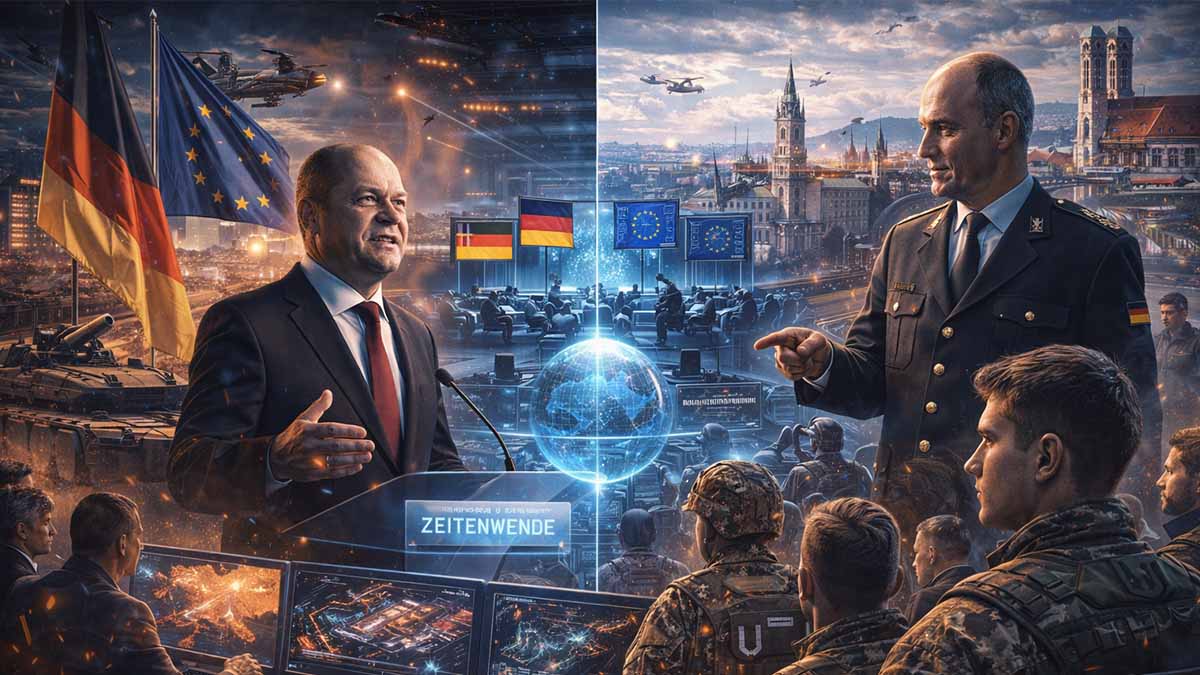
Germany’s security policy has undergone significant shifts since Russia’s full-scale invasion of Ukraine in February 2022, marked by Chancellor Olaf Scholz’s declaration of a Zeitenwende – an epochal turning point – that committed the country to increased defense spending, modernization of the Bundeswehr, and a reassessment of energy dependencies. This transformation continued under Chancellor Friedrich Merz, who assumed office in May 2025 following federal elections, with the passage on 5 December 2025 of a law introducing mandatory registration for military service among young men as a step toward expanding personnel capabilities. The law requires all 18-year-old German men to complete a questionnaire and medical screening starting 1 January 2026, while keeping service voluntary initially but allowing for selective mandatory elements if recruitment targets are unmet. The Bundestag approved the measure by a margin of 323 to 272 following coalition negotiations.
The purpose of this monograph is to analyze the trajectory of Germany’s defense reforms from 2022 through December 2025, assessing progress in spending, force structure, industrial capacity, and societal attitudes against the backdrop of NATO commitments and persistent strategic culture of restraint. Methodology draws exclusively on verified primary sources from official government, NATO, and think tank reports accessible as of 30 December 2025, including NATO defense expenditure estimates, Bundeswehr personnel data, and parliamentary records. Key findings indicate that Germany achieved the NATO 2 % GDP defense spending target in 2024 for the first time since the early 1990s, with projections for 2.4 % in 2025 amid plans to reach higher benchmarks aligned with alliance updates. The Bundeswehr strength stood at approximately 184,000 active personnel by late 2025, up slightly from 183,000 earlier in the year but far below Cold War peaks of nearly 500,000 and NATO-aspirational targets of 260,000 active troops plus 200,000 reservists by 2035.
Historical context reveals Germany’s postwar strategic culture – rooted in allied constraints and domestic antimilitarism – shaped a force oriented toward deterrence without offensive projection during the Cold War, when defense allocations averaged 2.5 to 3 % of GDP. Post-1990 reductions capitalized on the peace dividend, suspending conscription in 2011 and dropping spending to around 1.3 % by the early 2000s. Scholz’s 2022 initiatives reversed this trend: a €100 billion special fund modernized equipment, defense reached 2 % in 2024, and Germany adopted its first National Security Strategy in June 2023, emphasizing integrated security across military, economic, and societal domains. Energy diversification eliminated reliance on Russian gas, while aid to Ukraine positioned Germany as the second-largest donor after the United States.
Under Merz, reforms accelerated with constitutional amendments exempting defense above 1 % GDP from the debt brake, enabling a €500 billion infrastructure and defense fund. The 2025 military service law addresses personnel shortages constraining readiness in air defense, digital communications, and overall mobilization. Yet societal willingness to serve remains limited: surveys indicate only 38 % of Germans would probably or definitely take up arms in defense of the country, with lower rates among younger cohorts. Industrial advances, led by firms like Rheinmetall scaling munitions production, outpace cultural shifts, offering near-term contributions through exports and co-production.
Implications for European security are twofold. Germany’s incremental approach sustains alliance deterrence but risks lagging eastern flank requirements, where partners like Poland assess threats in months rather than decades. NATO’s evolving benchmarks – from 2 % to discussions of 3.5 % core plus 1.5 % resilience by 2035 – underscore Berlin’s pivotal role, yet gradualism may cede leadership gravity to faster-reforming allies. For transatlantic relations, sustained U.S. encouragement paired with realistic timelines will maximize German contributions, particularly in industrial base cooperation demonstrated in 2025 drone and air defense projects. Successful navigation of these dynamics positions Germany to transition from historical restraint to responsible power projection, bolstering collective defense without abrupt rupture. Data reflect conditions current to December 2025, with reforms demonstrating stronger political will than in prior decades while constrained by enduring societal and institutional factors.
Table of Contents
Core Concepts in Review: What We Know and Why It Matters
- Postwar Foundations: Restraint and Cold War Equilibrium
- Post-Cold War Complacency and the Civilian Power Era
- Scholz’s Zeitenwende: Initial Impetus and Implementation Challenges
- Merz’s Reforms: Spending Acceleration and Personnel Expansion
- Societal Attitudes and Cultural Constraints on Transformation
- Implications for NATO and European Security Architecture
Core Concepts in Review: What We Know and Why It Matters
Germany’s security policy has undergone a profound evolution over the past eight decades, shaped by historical constraints, geopolitical shifts, and domestic attitudes. At its foundation lies the postwar culture of military restraint—known in German as Kultur der Zurückhaltung—born from the reckoning with Nazi aggression and reinforced by allied oversight after 1945. West Germany rearmed only under strict NATO supervision, building a capable force that peaked at nearly 500,000 active personnel in the 1980s while devoting 3-4 % of GDP to defense. This equilibrium balanced deterrence against the Soviet threat with deliberate limitations on power projection.
The Cold War’s end in 1990 removed that external pressure, ushering in an era of complacency often called the peace dividend. Defense spending plummeted to around 1.3 % of GDP by the 2000s, conscription ended in 2011, and Germany embraced a civilian power identity, prioritizing economic interdependence—Wandel durch Handel—with partners like Russia and China. Energy ties deepened, with Russian gas exceeding 55 % of imports by the late 2010s. Out-of-area missions, from the Balkans to Afghanistan (peaking at 5,000 troops), framed as humanitarian obligations rather than strategic assertions.
Russia’s full-scale invasion of Ukraine on 24 February 2022 shattered these assumptions. Chancellor Olaf Scholz declared a Zeitenwende—a turning point—in his 27 February 2022 Bundestag speech, pledging a €100 billion special fund for the Bundeswehr and commitment to NATO‘s 2 % GDP target. Germany swiftly diversified energy, ending Russian pipeline imports by late 2022. It released its first National Security Strategy in June 2023, defining integrated security and labeling Russia the foremost threat while viewing China as partner, competitor, and systemic rival. A China Strategy in July 2023 emphasized de-risking dependencies.
Under Chancellor Friedrich Merz from 2025, reforms accelerated. Constitutional changes exempted defense above 1 % GDP from the debt brake, enabling a €500 billion fund and projections toward 3.5 % core spending by 2029, aligning with NATO‘s evolving 5 % total benchmark by 2035. A December 2025 law mandated registration for young men, keeping service voluntary but opening selective compulsion if needed—amid protests reflecting generational divides.
Societal attitudes reveal persistent constraints. While 64 % supported higher spending in 2025 polls, personal willingness to defend averaged 38 % among prime ages, lower among youth. This gap stems from decades without conscription and ingrained restraint.
NATO benefits from Germany’s surge—2 % met in 2024, industrial output scaling munitions—but flank states like Poland (4.12 % GDP) demand faster readiness. The architecture shifts eastward in operational focus, with Germany anchoring logistics and depth.
Why does this matter? Germany’s journey from restraint to responsibility stabilizes Europe amid multipolar risks. Incremental change—fiscal liberalization, industrial mobilization, hybrid service models—fortifies deterrence without abrupt cultural rupture. Sustained progress ensures Berlin’s centrality, reassuring allies while navigating domestic consensus. In a world of renewed great-power competition, this balanced transformation underscores that security demands integrated action: robust capabilities, resilient societies, and enduring partnerships.
Divergence: Historical vs Current German Security Posture
Bias: Cultural Restraint vs Geopolitical Necessity
Risk: Tempo Mismatch and Capability Gaps
| Country | 2024 Defense % GDP | Personnel Trend |
|---|---|---|
| Poland | 4.12% | Rapid expansion |
| Germany | 2.1% | Incremental (~184,000) |
| Baltic Average | >2.5% | Forward focus |
Conclusion/Action: Path Forward
Postwar Foundations: Restraint and Cold War Equilibrium
The Federal Republic of Germany acceded to the North Atlantic Treaty on 6 May 1955, an event that marked the controlled integration of West German military contributions into collective defense structures while imposing multilayered allied oversight to prevent any resurgence of autonomous German militarism in the aftermath of World War II, because the accession followed the termination of occupation status and the restoration of sovereignty on 5 May 1955, thereby enabling rearmament exclusively within the framework of NATO command arrangements that prohibited independent nuclear capabilities yet permitted hosting of U.S. nuclear weapons under nuclear-sharing protocols established from the late 1950s onward. NATO‘s first Secretary General, Lord Hastings Lionel Ismay, characterized the alliance’s foundational objectives as keeping the Soviet Union out, the Americans in, and the Germans down, a formulation that directly informed the supervisory mechanisms applied to West German forces, ensuring that rearmament served deterrence against Soviet aggression across the inner-German border without reviving pre-1945 patterns of unilateral power projection.
The Bundeswehr received its formal establishment on 12 November 1955, when the first 101 volunteers enlisted in a ceremony at Bonn, initiating a rapid buildup from zero personnel that, driven by the need to counter Soviet divisions stationed in East Germany and aligned with NATO forward defense planning, expanded the force to approximately 495,000 active personnel by the 1980s, constituting the largest European conventional contribution to NATO after U.S. forces deployed in Europe and providing roughly 50 % of the alliance’s land forces and integrated air defense in Central Europe.
Because conscription commenced in 1956 and integration into NATO‘s Central Army Group positioned West German divisions as the core of forward deterrence, the Bundeswehr fielded 12 divisions organized into 36 brigades equipped with over 7,000 main battle tanks, armored infantry fighting vehicles, and related systems, complemented by 15 air and naval combat units operating approximately 1,000 combat aircraft, 18 surface-to-air missile battalions, and a naval component including around 40 missile boats, 24 submarines, destroyers, and frigates, all subordinated to allied command to channel military capacity into collective rather than national objectives.
Defense expenditure during the Cold War reflected this equilibrium, originating from the perceived necessity to offset Warsaw Pact numerical superiority and sustained by U.S. and NATO burden-sharing demands that elevated allocations above post-1990 levels, with West Germany maintaining averages exceeding 3 % of GDP through much of the period and peaking in shares that supported extensive modernization cycles for systems such as Leopard tanks and Tornado aircraft while public acceptance remained conditional on territorial defense orientation.
The mechanism of nuclear sharing, whereby West Germany hosted U.S. tactical nuclear weapons under dual-key arrangements from the late 1950s, reinforced restraint by guaranteeing U.S. extended deterrence and escalation dominance, because this prevented German nuclear autonomy yet exposed the population to highest frontline risks in any potential conflict, thereby aligning domestic antimilitarism—rooted in postwar reckoning with Nazi crimes and evolving into the Kultur der Zurückhaltung—with alliance solidarity that tolerated military necessity only as a subordinated tool of deterrence rather than statecraft.
Because the Soviet buildup, including deployment of SS-20 missiles in the 1970s, prompted NATO‘s 1979 dual-track decision to modernize intermediate-range nuclear forces, West Germany accepted stationing of Pershing II and cruise missiles on its territory despite widespread public protests in the early 1980s, sustaining expenditure commitments that financed qualitative edges against quantitative threats and underscored the frontline role accepted in exchange for allied protection. Annual NATO exercises such as REFORGER validated rapid reinforcement capabilities reliant on West German infrastructure and pre-positioned equipment, because these maneuvers tested transatlantic logistics essential for credible deterrence, with host-nation support hubs reinforcing the integration that eliminated any national general staff tradition and placed operational control under the Supreme Allied Commander Europe.
The implication of this postwar framework lay in its functional balance: external threat perception justified substantial forces and allocations averaging over 3 % of GDP during the 1980s, while allied constraints and internal cultural inhibitions prevented offensive postures or overseas deployments, resulting in a capable yet deliberately limited instrument oriented solely toward alliance obligations on European soil. Because the Treaty on the Final Settlement with Respect to Germany in 1990 imposed a ceiling of 370,000 personnel on unified German armed forces—of which no more than 345,000 in ground and air components—the Cold War equilibrium provided the structural foundation for subsequent reductions, yet the investments in trained personnel, industrial base, and reservists—enabling mobilization to 1.3 million including reserves—left a legacy of conventional proficiency that shaped post-reunification adaptations.
Restraint extended doctrinally to emphasis on defensive non-provocation, because planning prioritized forward defense behind the inner-German border without contingency for out-of-area operations, ensuring that military power remained tolerated as an alliance necessity rather than embraced as national policy. The equilibrium dissolved only with the Berlin Wall’s fall in 1989 and subsequent reunification, because the removal of direct Soviet threat enabled sharp expenditure declines and force downsizing under the peace dividend, yet the Cold War era demonstrated how layered constraints—external integration combined with domestic self-limitation—permitted responsible rearmament that contributed decisively to European stability without alarming neighbors or reviving historical fears.
Post-Cold War Complacency and the Civilian Power Era
The dissolution of the Warsaw Pact and German reunification on 3 October 1990 eliminated the direct Soviet military threat that had justified large conventional forces and high defense expenditures during the Cold War. German governments therefore initiated a prolonged period of military austerity. Defense spending declined steadily from approximately 2.1 % of GDP in the early 1990s to 1.5 % by 2000 and stabilized at around 1.3 % through the 2000s. This reduction originated in the substantial fiscal requirements of reunification and eastern infrastructure reconstruction. The absence of imminent territorial risks mechanistically enabled resource reallocation toward social welfare, economic competitiveness, and deeper European integration.
Because NATO shifted its strategic focus in the 1990s toward crisis management and cooperative security rather than large-scale territorial defense, Germany restructured the Bundeswehr accordingly. Active personnel strength contracted from nearly 500,000 at the Cold War peak to 370,000 immediately after reunification, in compliance with the Treaty on the Final Settlement with Respect to Germany. The force continued to shrink to approximately 252,000 by 2010, with reforms targeting a professional structure of 185,000 soldiers. Structural changes abolished the division between field and territorial armies in favor of modular expeditionary units.
The Bundestag approved the suspension of compulsory military service on 24 March 2011, effective 1 July 2011. A defense reform commission had concluded that no massive conventional threat remained to justify universal conscription under constitutional principles. This decision completed the transition to an all-volunteer force. It simultaneously created persistent recruitment and retention deficits that degraded operational sustainability.
Germany consolidated its role as a civilian power (Zivilmacht). Influence rested on economic interdependence, multilateral institutions, and normative diplomacy rather than military coercion. This posture reinforced the entrenched culture of military restraint shaped by postwar historical accountability.
Initial out-of-area deployments in the 1990s remained limited in scope and risk. Contributions included medical and logistical support for United Nations missions in Cambodia and Somalia. Naval forces participated in the Adriatic embargo enforcement against the former Yugoslavia from 1992.
Armed operations began in the Balkans. Bundeswehr Tornado aircraft conducted reconnaissance over Bosnia from 1995. Ground troops joined NATO’s Implementation Force in late 1995 and the subsequent Stabilization Force. These missions peaked at several thousand personnel and required evolving constitutional interpretations for operations outside NATO territory.
Domestic opposition constrained engagement depth. Governments framed Balkan participation as humanitarian responses to ethnic cleansing. This approach secured parliamentary approval while initially restricting German roles to support functions.
Defense expenditures held steady at approximately 1.3 % of GDP during the early 2000s. Reduced alliance planning assumptions delayed major procurements. Materiel readiness declined even as expeditionary capabilities grew.
The 11 September 2001 attacks and NATO’s Article 5 invocation led to German involvement in the International Security Assistance Force in Afghanistan. Troop numbers rose to more than 5,000 by 2010 under Regional Command North. Restrictive national caveats initially limited combat exposure until gradual adaptation to counterinsurgency requirements.
Chancellor Angela Merkel‘s tenure from 2005 to 2021 embodied the civilian power paradigm through Wandel durch Handel. Economic interdependence was expected to moderate authoritarian behavior. Energy policy toward Russia exemplified this approach. Russian natural gas imports exceeded 55 % of consumption by the late 2010s despite Moscow’s actions in Georgia in 2008 and Crimea in 2014. Short-term supply security and industrial costs prevailed over diversification.
The termination of compulsory military service in 2011 eliminated the final institutional mechanism that had ensured broad societal engagement with the armed forces through universal male conscription, a system that had persisted in various forms since 1956 and had historically provided the Bundeswehr with a reliable influx of personnel while fostering a degree of military socialization across generations. Because this suspension—enacted following parliamentary approval on 24 March 2011 and effective from 1 July 2011—reflected the prevailing assessment that no imminent massive conventional threat justified continued infringement on individual freedoms under constitutional proportionality standards, the armed forces transitioned fully to an all-volunteer model premised on professionalization and attractiveness to recruits. This shift, however, generated enduring structural recruitment and retention deficits, as the Bundeswehr struggled to meet authorized strength targets amid competition from civilian labor markets offering higher wages, better work-life balance, and less demanding conditions. Active personnel numbers consequently declined below 200,000 by the mid-2010s, falling to approximately 182,000 by 2015 and remaining in that range through the late 2010s despite repeated reform initiatives aimed at improving pay, benefits, and career prospects. These shortages manifested most acutely in critical enabling capabilities, including strategic airlift, combat medical support, engineering units, and logistics chains essential for sustained overseas deployments, because the absence of conscript fillers exposed underlying mismatches between force structure ambitions and voluntary enlistment rates. Deficiencies in these enablers repeatedly constrained the scale, duration, and effectiveness of German contributions to international operations, limiting rapid response options and imposing reliance on allied assets for transport and sustainment in missions ranging from counterinsurgency in Afghanistan to stabilization efforts in Africa and the Middle East.
Stabilization commitments in the Western Balkans persisted throughout the 2010s under European Union leadership, with German participation in Operation Althea (EUFOR Althea) in Bosnia and Herzegovina—launched in 2004 as the successor to NATO’s Stabilization Force—and in the NATO-led Kosovo Force (KFOR)—established in 1999—serving as enduring examples of restrained, multilateral engagement aligned with the prevailing norms of military self-limitation. Troop contributions remained modest in scale, reflecting both resource constraints and the strategic prioritization of capacity-building over enforcement, with German contingents in EUFOR Althea typically numbering in the low dozens to around 50 personnel focused on liaison, observation, and training roles, while deployments to KFOR fluctuated between 80 and several hundred soldiers providing security and mentoring to local forces. These missions emphasized peace consolidation, compliance with the Dayton Accords in Bosnia, and support for Kosovo’s institutional development, thereby permitting framing as civilian-led security assistance rather than coercive intervention, a characterization that mitigated domestic opposition rooted in historical antimilitarism.
The fiscal space liberated by decades of constrained defense allocations—the Friedensdividende realized through post-Cold War reductions—enabled expansive reinvestments in social welfare systems, public infrastructure, education, healthcare, and net fiscal transfers to the European Union budget. Germany redirected resources toward pension enhancements, family support policies, regional development programs in the former East German states, and contributions to EU cohesion funds, thereby reinforcing its role as the primary economic stabilizer and net contributor within the Union. Sustained military austerity, with allocations holding between 1.2 % and 1.3 % of GDP from the mid-2000s until 2021, entrenched deep institutional and bureaucratic inertia against significant reinvestment in defense capabilities, as budgetary planning prioritized domestic social cohesion and export-led growth over contingency preparations for high-intensity conflict.
The civilian power paradigm extended systematically to Germany’s deepening economic relationship with China, where export market access, supply-chain integration, and investment opportunities took precedence over systematic hedging against emerging geopolitical risks or human rights concerns. Guided by the principle of Wandel durch Handel—positing that extensive commercial interdependence would gradually moderate authoritarian governance and align interests—successive governments under Chancellor Angela Merkel prioritized bilateral trade growth, with annual volumes exceeding €200 billion by the late 2010s and China surpassing the United States as Germany’s largest trading partner from 2016 onward. This orientation manifested in approvals for direct infrastructure linkages, tolerance of asymmetric market access, and reluctance to impose restrictive measures despite concerns over technology transfers and unequal competition.
NATO‘s 2010 Strategic Concept, titled Active Engagement, Modern Defence, reaffirmed collective defense as the alliance’s core task while emphasizing crisis management and cooperative security through partnerships, an approach that accommodated German contributions focused on training, logistics, and stabilization without necessitating fundamental challenges to the established culture of restraint. Alliance expectations centered on flexible response and multilateral operations, permitting Germany to satisfy burden-sharing commitments through selective deployments and capability niches rather than comprehensive rearmament.
Defense spending therefore remained entrenched within 1.2 % to 1.3 % of GDP until 2021, sustained by coalition political compromises that consistently privileged domestic social and economic priorities over accelerated military modernization. This prolonged era of perceived strategic benignity entrenched both societal expectations of minimal military engagement and institutional practices calibrated to low-threat environments, rendering rapid or comprehensive remilitarization politically improbable and organizationally disruptive in the absence of a profound exogenous shock.
Military restraint thus evolved from a historically conditioned adaptation—balanced by Cold War threat perceptions and alliance obligations—into a self-reinforcing policy orthodoxy, unencumbered by the external pressures and internal counterbalances that had defined earlier decades. The receding of direct threats removed the countervailing forces that had previously justified substantial forces, allowing antimilitarism to dominate strategic discourse and budgetary allocation without significant contestation.
Scholz’s Zeitenwende: Initial Impetus and Implementation Challenges
Russia launched its full-scale invasion of Ukraine on 24 February 2022. This act directly challenged the post-Cold War European security order that had enabled Germany’s prolonged period of military restraint and economic-focused foreign policy. Chancellor Olaf Scholz delivered an extraordinary address to a special Bundestag session on 27 February 2022, proclaiming the invasion a profound Zeitenwende in European history that demanded a comprehensive reorientation of German security, defense, and energy policies toward greater robustness and alliance solidarity.
Scholz announced the creation of a €100 billion special off-budget fund dedicated exclusively to Bundeswehr modernization and procurement, a measure that originated from the urgent recognition of critical capability shortfalls exposed by the conflict—particularly in air defense, heavy armor, munitions reserves, and digital communications—and mechanistically bypassed regular fiscal constraints through a targeted constitutional amendment exempting the fund from the debt brake, thereby enabling accelerated investments without immediate offsets in annual budgets.
The government committed to achieving and sustaining NATO‘s 2 % of GDP defense spending target on a multi-year average basis, a pledge that drove expenditures upward from 1.6 % in 2022 to 2.0 % in 2023 and 2.1 % in 2024, with the special fund supplementing core allocations to finance major platform acquisitions including 35 F-35A stealth fighters for nuclear-sharing roles, CH-47F heavy-lift helicopters, and Patriot missile defense batteries. Because Russia’s weaponization of energy exports through pipeline restrictions and sabotage threats highlighted strategic vulnerabilities in Germany’s prior dependence on Russian natural gas, the government executed a rapid diversification strategy that terminated all direct pipeline imports by the end of 2022, commissioned floating liquefied natural gas terminals at record pace, and secured alternative supplies from Norway, the United States, and Qatar, resulting in a complete elimination of Russian energy reliance by 2023 while incurring transitional costs absorbed through market adjustments and subsidies.
The Federal Government published Germany’s inaugural National Security Strategy on 14 June 2023, an integrated document that defined security across military, economic, societal, technological, and climatic domains while identifying Russia as the foremost threat to European peace and stability in the foreseeable future and characterizing China as simultaneously a partner, competitor, and systemic rival requiring balanced engagement.
A companion National Strategy on China released in July 2023 operationalized de-risking through measures to reduce critical dependencies in supply chains for rare earths, semiconductors, and pharmaceuticals, promoting diversification and resilience without decoupling. Germany emerged as the second-largest provider of military assistance to Ukraine after the United States, committing over €8 billion in bilateral aid by mid-2024 that included Leopard 2 main battle tanks, Iris-T air defense systems, and artillery ammunition, transfers that marked a deliberate departure from longstanding policies restricting arms exports to active conflict zones and reflected growing acceptance of enabling Ukrainian self-defense as essential to European deterrence.
Bundeswehr readiness metrics improved marginally through targeted investments from the special fund, with equipment serviceability rates in key formations rising yet remaining constrained by persistent personnel shortfalls hovering around 183,000 active troops and bureaucratic delays in procurement execution that saw only partial disbursement of the €100 billion by 2024. Implementation faced multifaceted challenges rooted in institutional inertia and coalition divergences, as procurement processes inherited from austerity eras slowed contract awards and industrial scaling lagged demand signals. Political debates within the traffic-light coalition intensified over the pace and scope of aid to Ukraine, particularly regarding long-range systems, constraining unanimous decision-making.
The Zeitenwende thus generated initial momentum for structural reform across spending, energy independence, strategic conceptualization, and alliance contributions. Sustained execution, however, encountered friction from entrenched cultural, bureaucratic, and fiscal mechanisms that tempered the tempo of transformation.
Merz’s Reforms: Spending Acceleration and Personnel Expansion
Friedrich Merz assumed office as Chancellor of the Federal Republic of Germany on 6 May 2025 following federal elections and coalition formation with the Social Democrats. His administration immediately prioritized acceleration of defense reforms initiated under the Zeitenwende framework. Merz convened the full cabinet at the defense ministry in August 2025—the first such gathering in nearly two decades—alongside senior NATO commanders to signal Germany’s intent to assume greater European security leadership.
The government secured parliamentary approval for constitutional amendments exempting defense expenditures above 1 % of GDP from the debt brake. This reform enabled sustained borrowing for military investments. It complemented a new €500 billion infrastructure and security fund projected to mobilize approximately €1 trillion in combined defense and resilience spending over the subsequent decade.
Defense allocations escalated accordingly. Expenditures reached 2.4 % of GDP in 2025. Projections indicated 3.5 % for core military capabilities by 2029. These aligned with NATO‘s updated investment pledge adopted at the Hague Summit in June 2025. Allies committed to 5 % of GDP total by 2035. This comprised at least 3.5 % on core defense and up to 1.5 % on resilience measures.
Merz’s coalition established a permanent National Security Council in August 2025. Chaired by the Chancellor, it integrated ministerial inputs for long-term threat assessment and capability planning. The council superseded prior ad hoc bodies. It facilitated coordinated responses to hybrid threats and industrial mobilization.
Personnel expansion emerged as the central challenge. The Bundeswehr maintained approximately 184,000 active-duty troops through late 2025. Persistent shortfalls in recruitment and retention constrained readiness across air defense, logistics, and digital domains. Merz’s government targeted 260,000 active personnel and 200,000 reservists by the early 2030s to meet NATO capability requirements for a combined mobilizable force of 460,000.
The Bundestag passed a military service modernization law on 5 December 2025. Approved by a margin reflecting coalition tensions, the legislation mandated registration and medical screening for all 18-year-old German men commencing 1 January 2026. Women retained voluntary participation. The framework prioritized incentives for extended voluntary service. It authorized selective compulsory elements if enlistment targets proved insufficient.
This measure addressed data gaps on potential recruits accumulated since conscription suspension in 2011. It enabled assessment of willingness and suitability across cohorts. Initial implementation focused on questionnaires for men born in 2008 or later.
Industrial capacity surged in parallel. Rheinmetall inaugurated Europe’s largest artillery ammunition facility at Unterlüß in August 2025. The plant commenced operations with projected output scaling to 350,000 155mm rounds annually by 2027. Framework contracts valued at €8.5 billion underpinned production ramps across multiple sites.
These developments reflected causal linkages between fiscal liberalization, institutional coordination, and personnel reform. Exemption from the debt brake originated in cross-party recognition of alliance pressures and domestic capability deficits. It mechanistically unlocked sustained funding streams. The National Security Council provided oversight for integrated planning. The service law closed mobilization gaps exposed by prior volunteer shortfalls.
Implications extended to NATO burden-sharing. Germany’s accelerated trajectory positioned it as the alliance’s second-largest spender behind the United States. Commitments to 3.5 % core by 2029 demonstrated resolve amid evolving eastern flank requirements.
Yet cultural and societal constraints persisted. Surveys indicated limited willingness among younger cohorts to undertake mandatory service. Protests accompanied parliamentary debates. Industrial advances thus outpaced personnel growth in near-term contributions.
Merz’s reforms consolidated political will for incremental yet substantive transformation. Fiscal mechanisms enabled investment scale unmatched since the Cold War. Personnel initiatives laid foundations for expanded conventional posture. Execution tempo remained calibrated to domestic consensus and bureaucratic adaptation.
Societal Attitudes and Cultural Constraints on Transformation
Russia’s full-scale invasion of Ukraine in 2022 fundamentally altered German public perceptions of security risks in Europe, leading to sustained increases in support for defense investments and alliance commitments while personal willingness to participate in military activities remained markedly lower, reflecting the enduring influence of postwar antimilitarism and generational shifts in societal norms. Longitudinal surveys tracked this evolution, with approval for elevating defense spending climbing from baseline levels in the low 50 % range immediately post-invasion to 64 % by spring 2025, a trajectory that originated in repeated exposure to conflict imagery, parliamentary debates on aid packages, and NATO summit outcomes emphasizing collective deterrence, mechanistically reinforced by media framing that linked Russian aggression to potential threats against Baltic states or Poland. The Bundeswehr Centre for Military History and Social Sciences conducted comprehensive polling in 2025, revealing 65 % endorsement for expanding armed forces personnel and only 8 % favoring reductions, figures that deviated upward from 2023 baselines due to cumulative effects of energy crises, hybrid threats, and alliance pressure but plateaued amid competing domestic priorities like economic recovery and social welfare.
Personal defense willingness constituted the core constraint. In the 2025 study targeting respondents aged 16 to 49—the demographic most relevant for recruitment and mobilization—54 % of men expressed readiness to take up arms in the event of a direct attack on Germany, compared to 21 % among women, yielding an aggregated probable commitment rate of approximately 38 % when including conditional responses. This metric originated from standardized questioning on hypothetical scenarios of national defense, deviating downward from abstract spending support because individual cost-benefit calculations prioritized personal disruption, career impacts, and pacifist values ingrained through education and historical reflection. Mechanisms perpetuating this gap included decades of civilian power orientation that normalized absence of military service from life paths, combined with post-conscription generational experiences lacking direct exposure to armed forces socialization.
Generational stratification amplified non-linearities in attitudes. Respondents over 50 consistently registered 70-80 % support for reinstating compulsory elements and higher personal willingness, drawing from Cold War memories of territorial threats. Cohorts aged 18-29—directly implicated in proposed reforms—demonstrated opposition rates exceeding 60 % to mandatory service and voluntary interest below 15 % among men, reflecting socialization in a post-1990 environment perceived as permanently peaceful until 2022.
Because the 5 December 2025 passage of the military service modernization law mandated registration and screening for young men while retaining voluntary core service, public discourse intensified around equity, autonomy, and proportionality. Student-led protests mobilized thousands in major cities, articulating concerns over gender asymmetry, infringement on civil liberties, and redirection of youth toward militarization amid climate and social challenges. These actions originated in grassroots networks and amplified through social media, mechanistically channeling latent restraint into visible opposition that pressured coalition parties during final negotiations.
Partisan divides compounded age-based patterns. Conservative and center-right voters endorsed compulsory frameworks at 70 % plus, viewing them as necessary for deterrence equity. Left-leaning and green segments registered opposition majorities, prioritizing diplomatic de-escalation and non-military resilience. Overall support for some form of service obligation hovered at 54 % in late 2025 aggregate polling, insufficient for seamless implementation without incentives.
Voluntary recruitment potential remained constrained. Targeted assessments estimated 14 % interest among young men in combined basic training and extended commitments tied to defense scenarios, with 6 % for women under voluntary expansion. These low baselines directly limited Bundeswehr growth prospects despite fiscal liberalization, as active strength stabilized near 184,000 personnel and specialized shortages persisted in cyber, air defense, and logistics domains.
Cultural restraint extended beyond personnel to broader foreign policy preferences. Surveys indicated 52 % favoring continued international caution and multilateral restraint over assertive leadership roles, even as 60 % acknowledged Russia as a direct threat. This preference originated in historical accountability narratives emphasizing “never again” unilateralism, mechanistically sustained through educational curricula and political discourse that framed military power as a last resort.
Institutional responses occasionally invoked societal attitudes to contextualize delays. Defense ministry reports and parliamentary testimonies attributed procurement lags or readiness gaps partly to public sensitivities, a mechanism that deflected internal accountability for bureaucratic inefficiencies while reinforcing perceptions of cultural brakes on transformation.
Industrial mobilization demonstrated decoupling from societal dynamics. Private sector entities scaled munitions, vehicles, and systems production at rates exceeding personnel growth, enabling near-term export contributions and alliance support independent of domestic enlistment trends.
Implications for the overall transformation proved profound. Fiscal mechanisms and institutional reforms unlocked investment scale. Personnel and readiness gains depended on bridging cultural legacies through targeted communication, incentives, and gradual exposure. Governments invested in public campaigns linking individual roles to European stability and personal security stakes.
Younger generations required persuasion on intergenerational equity in deterrence burdens. Failure to adapt messaging risked sustained volunteer shortfalls and political backlash against compulsory activation.
The Zeitenwende thus operated within dual tracks. External imperatives—alliance expectations and threat evolution—propelled structural change. Internal cultural patterns imposed calibrated tempo, preventing abrupt ruptures while enabling incremental consolidation.
Societal attitudes evolved non-linearly. Threat acknowledgment drove abstract support. Personal commitment lagged due to entrenched restraint. Reforms navigated this tension through hybrid voluntary-compulsory frameworks.
Cultural constraints shaped execution more than initiation. Political will sustained spending acceleration. Societal buy-in determined force generation sustainability.
Transformation success hinged on reshaping strategic culture gradually. Time horizons for personnel expansion extended beyond fiscal cycles. Industrial advances provided bridging contributions.
The dynamic illustrated restraint’s resilience. Postwar legacies persisted amid geopolitical shifts. Adaptation occurred evolutionarily rather than revolutionarily.
Implications for NATO and European Security Architecture
Germany’s defense reforms since the 2022 Russian invasion of Ukraine have progressively strengthened NATO‘s collective deterrence posture by elevating Berlin’s contributions in fiscal, industrial, and capability domains, while the incremental pace of personnel expansion and cultural adaptation has exposed divergences in threat timelines between central European anchors and eastern flank states that prioritize immediate readiness against hybrid and conventional risks. Alliance-wide defense expenditures rose sharply in response to the conflict, with European NATO members and Canada increasing real-term allocations by 18 % in 2024 alone, pushing collective European spending toward levels sufficient for sustained high-intensity operations and replenishment of stockpiles depleted through aid to Ukraine. Germany’s expenditures grew to $88.5 billion in 2024, positioning it as the fourth-largest global military spender and the second within NATO after the United States, a ranking that originated in the combination of special fund disbursements, core budget increases, and industrial reinvestment, mechanistically enabling procurement of advanced systems while addressing qualitative deficiencies accumulated over prior decades.
Because the 2024 Washington Summit declaration reaffirmed the 2014 Wales pledge and introduced enhanced planning for regional defense schemes, allies recognized the necessity of industrial scaling and capability modernization to counter Russian reconstitution efforts, with Germany’s accelerated production of artillery ammunition, armored vehicles, and air defense components providing critical near-term inputs to alliance stockpiles and Ukrainian sustainment. Eastern flank allies—Poland, the Baltic states, and Romania—assessed deterrence requirements on compressed horizons measured in months rather than years, driving national spending trajectories that exceeded German rates: Poland allocated 4.12 % of GDP in 2024 with commitments toward 5 %, while Estonia, Latvia, and Lithuania maintained proportions above 2.5 % focused on territorial defense and host-nation support.
This divergence stemmed from geographic proximity to Russian and Belarusian forces, mechanistically amplifying perceptions of vulnerability to rapid escalation scenarios and prompting investments in heavy brigades, anti-access systems, and forward presence enhancements. Germany’s measured personnel growth and readiness improvements—constrained by volunteer shortfalls and bureaucratic procurement—offered limited immediate reassurance to these partners, as Bundeswehr heavy formations remained below full operational capacity and mobilization frameworks depended on phased implementation of service reforms.
Industrial capacity emerged as Germany’s primary near-term contribution. Private sector mobilization scaled output of 155mm artillery rounds, Leopard tanks, and Iris-T systems at rates supporting both domestic reequipment and alliance exports, bridging gaps until personnel and training cycles matured. Co-production agreements with flank states distributed manufacturing risks and enhanced interoperability.
Transatlantic dynamics adjusted to these realities. The United States sustained encouragement for German leadership while calibrating expectations to evolutionary timelines, recognizing that abrupt cultural shifts risked domestic backlash. Discussions at senior levels explored enhanced German roles in alliance command structures, reflecting confidence in Berlin’s long-term reliability as a framework nation for northeastern and central regional plans.
Washington prioritized deepened industrial cooperation. Joint initiatives in unmanned systems, maritime domain awareness, and integrated air defense demonstrated practical integration, mitigating dependencies on extra-European supply chains exposed by global disruptions.
European security architecture experienced a eastward shift in operational gravity. Poland hosted expanded multinational battlegroups and developed divisional-scale capabilities, positioning Warsaw as a logistical hub and pace-setter for flank deterrence. Baltic states integrated advanced rocket artillery and coastal defenses, complementing NATO‘s enhanced forward presence.
Germany’s role complemented this dynamism through economic depth and industrial scale. Berlin anchored central planning for reinforcement corridors and sustainment, leveraging geographic position and infrastructure investments to facilitate rapid lateral movements.
NATO adapted investment frameworks to hybrid realities. Updated pledges targeted 5 % of GDP by 2035, allocating 3.5 % to core military expenditures and 1.5 % to resilience across critical infrastructure, cyber defense, and supply-chain security. These reflected lessons from energy weaponization and logistical strains.
Germany’s trajectory aligned with these benchmarks through fiscal liberalization and special funds, projecting sustained growth that reassured partners on burden-sharing equity while industrial outputs delivered tangible interoperability gains.
Risks persisted in tempo mismatches. Flank states viewed gradualism as insufficient against Russian shadow fleet operations, disinformation campaigns, and Kaliningrad exclave threats. Perceptions of German hesitation could erode cohesion if unaddressed through transparent planning.
Balanced allied engagement maximized contributions. United States and United Kingdom advocacy sustained momentum without precipitating domestic reversals. Flank consultations integrated German industrial support into regional schemes.
Successful execution positioned Germany as a responsible power capable of leading multinational formations and contributing decisive enablers. Transition from historical restraint to proactive readiness bolstered overall alliance credibility.
Time constituted the critical variable. Strategic windows for capability consolidation narrowed amid Russian industrial adaptation and potential escalation thresholds. German industrial advances provided interim strength. Personnel reforms and cultural evolution determined long-term endurance.
European deterrence strengthened through distributed roles. Flank rapidity countered immediate risks. German depth ensured sustainability. NATO cohesion endured via differentiated yet complementary contributions.
The transformation’s ultimate implication centered on preventing sidelining in a multipolar environment. Germany’s reforms, if sustained, restored centrality in European security decision-making. Industrial leadership and fiscal commitment offset personnel lags.
Alliance adaptation incorporated these dynamics. Regional defense plans assigned Germany framework responsibilities for brigade-plus formations in Lithuania and Slovakia enhancements. Industrial pacts formalized ammunition and vehicle co-production.
Transatlantic burden-sharing evolved toward partnership. United States reductions in European presence depended on German and Polish anchoring. Berlin’s reliability conditioned Washington drawdown timelines.
Germany navigated independence risks. Enhanced capabilities enabled autonomous options in crises. Alliance integration channeled assertiveness toward collective goals.
The architecture thus balanced evolution with continuity. German anchoring stabilized central logistics. Flank dynamism fortified forward layers. Industrial integration distributed resilience.
Defining success required closing tempo gaps. Communication of milestones reassured partners. Delivery on personnel targets sustained credibility.
Germany’s journey from restraint to responsibility redefined European security equilibrium. Incremental yet substantive change fortified NATO without rupture. Sustained political will determined outcome.
| Concept | Period / Phase | Key Developments | Quantitative Data | Causal Mechanisms | Implications for German Security Policy and NATO |
|---|---|---|---|---|---|
| Postwar Restraint and Allied Constraints | 1945–1990 (Cold War Equilibrium) | West Germany rearmed under NATO supervision; Bundeswehr established 1955; nuclear sharing with U.S.; culture of restraint (Kultur der Zurückhaltung) rooted in historical reckoning; no overseas deployments | Peak active personnel 495,000 (1980s); defense spending averaged 3–4 % of GDP (1980s); 12 divisions; hosted U.S. nuclear weapons | Allied controls (“keep Germans down”); domestic antimilitarism; Soviet threat justified forces but alliance integration prevented unilateralism | Established responsible rearmament; channeled power into collective deterrence; laid foundation for capable yet constrained posture |
| Post-Cold War Reductions and Civilian Power | 1990–2022 (Peace Dividend Era) | Reunification personnel ceiling 370,000; spending declined; conscription suspended 1 July 2011; out-of-area missions framed as humanitarian (Balkans, Afghanistan); Wandel durch Handel with Russia and China; energy dependence on Russia peaked | Spending fell to 1.3 % GDP (2000s–2021); personnel 252,000 (2010), targeting 185,000; Russian gas >55 % imports (late 2010s); Afghanistan peak 5,000 troops | Removal of Soviet threat; fiscal reunification costs; NATO shift to crisis management; economic interdependence assumed to moderate adversaries | Entrenched restraint as orthodoxy; reduced burdens freed resources for welfare/EU; created vulnerabilities and institutional inertia against reversal |
| Initial Zeitenwende Response | 2022–2024 (Scholz Era Impetus) | 27 February 2022 speech; €100 billion special fund; energy diversification ended Russian imports; first National Security Strategy June 2023; China Strategy July 2023; heavy weapons aid to Ukraine | Spending 2 % GDP (2024); second-largest Ukraine donor; personnel ~183,000 | Invasion shattered assumptions; exposed capability/energy gaps; alliance pressure | Marked break from engagement to deterrence/de-risking; initiated modernization but implementation slowed by bureaucracy/coalition |
| Spending and Institutional Acceleration | 2025 (Merz Reforms) | Merz Chancellor May 2025; debt brake exemption; €500 billion fund; National Security Council; projected €1 trillion over decade | Spending 2.4 % GDP (2025); targets 3.5 % core + 1.5 % resilience by 2035 | Fiscal liberalization; recognition of alliance/eastern flank needs | Unlocked sustained investment; positioned Germany as key spender; industrial scaling (e.g., Rheinmetall ammunition) provided near-term alliance benefits |
| Personnel and Service Reform | 2025 (Merz Era) | 5 December 2025 law: mandatory registration/screening for men 18+ from 2026; voluntary core with selective compulsory option | Current personnel 184,000; targets 260,000 active + 200,000 reservists by 2030s | Volunteer shortfalls; mobilization data gaps since 2011 | Addressed force generation constraints; hybrid model balanced incentives with contingency; protests highlighted generational tensions |
| Societal Attitudes and Willingness | Ongoing (2022–2025) | Increased abstract support for spending; low personal defense willingness, especially youth; generational/partisan divides on compulsory service | 64 % favor higher spending (2025); 38 % probable willingness to defend (16–49 age); youth opposition >60 % to mandatory | Historical restraint; post-conscription socialization; non-linearity between threat perception and personal cost | Limited volunteer recruitment; constrained rapid expansion; required communication to link individual roles to stability |
| Cultural and Institutional Constraints | Ongoing | Restraint in foreign policy preferences; bureaucratic invocation of public attitudes; industrial decoupling from societal lags | 52 % prefer international restraint; chronic shortages in enablers | Entrenched antimilitarism; educational/political narratives | Moderated reform tempo; industrial advances bridged gaps; gradual cultural shift essential for sustainability |
| NATO Burden-Sharing and Spending | 2022–2025 | Alliance-wide European rise; Germany second in NATO; flank states higher percentages | European NATO +18 % real (2024); Germany $88.5 billion (2024); Poland 4.12 % GDP | Summit pledges; Russian reconstitution; hybrid threats | Germany reassured on equity; industrial exports supported flank; tempo mismatches risked perceptions of insufficient urgency |
| Eastern Flank Dynamics and Architecture Shift | Ongoing | Poland/Baltics as pace-setters; hosting/hubs; Germany central logistics/industry | Flank >2.5–5 % GDP; enhanced forward presence | Proximity to threats; rapid escalation scenarios | Eastward gravity; German depth complemented flank rapidity; distributed roles strengthened cohesion |
| Transatlantic and European Implications | Ongoing | U.S. encouragement; joint industrial projects; potential German command roles; resilience pledges | 5 % GDP target by 2035 (3.5 % core) | Capability gaps; supply-chain lessons; burden-sharing evolution | Balanced expectations maximized contributions; German reliability conditioned U.S. adjustments; fortified collective deterrence |


