









Abstract
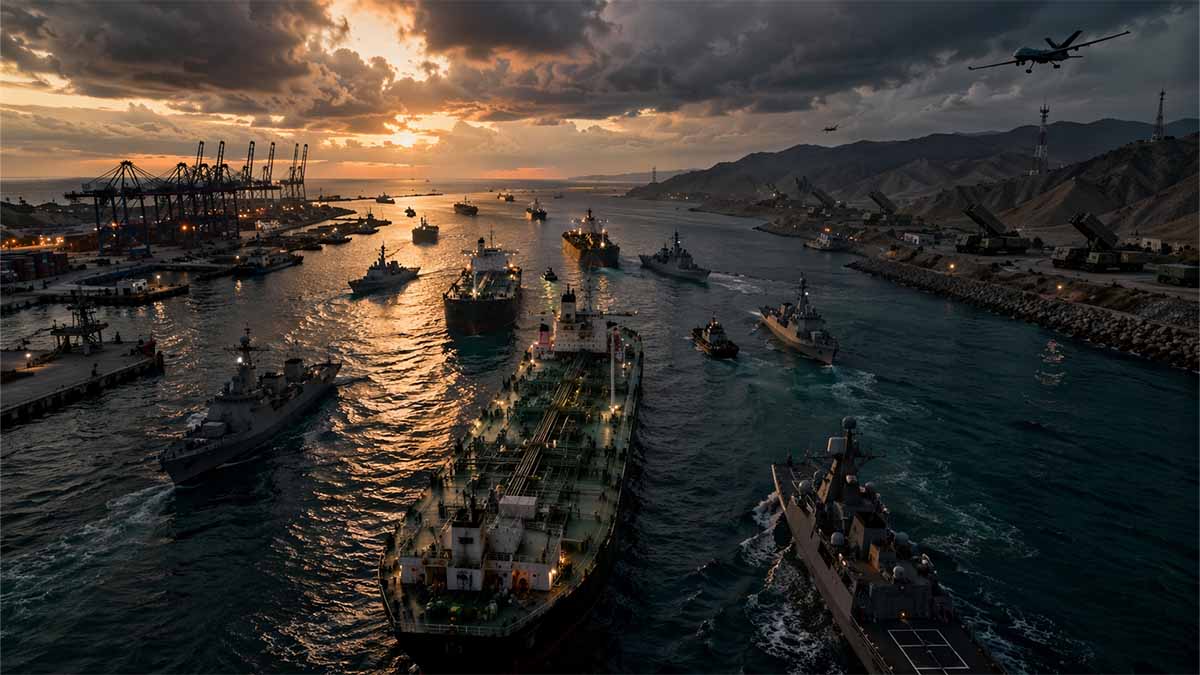
As of April 13, 2026, the core maritime-security claim set in your prompt should be disaggregated into verified official components and unverified or insufficiently corroborated components. A U.S. Central Command press release dated April 12, 2026 states that CENTCOM forces will begin implementing a blockade of all maritime traffic entering and exiting Iranian ports on April 13 at 10 a.m. ET, and it frames the measure as action taken “in accordance with the President’s proclamation.” An IRNA report published April 13, 2026 attributes to the spokesperson of Khatam al-Anbiya Central Headquarters the warning that if the security of Iranian ports in the Persian Gulf or Sea of Oman is endangered, no port in the region will remain safe. The same official Iranian report says that, after the joint U.S.-Israeli aggression against Iran on February 28, 2026, Iran retaliated and restricted the Strait of Hormuz to vessels it identified as hostile.
The strategic significance of that warning is exceptionally high because the Strait of Hormuz remains one of the world’s most consequential hydrocarbon chokepoints. According to the U.S. Energy Information Administration, in the first half of 2025 total oil flows through the strait averaged 20.9 million barrels per day, equal to about 20% of global petroleum liquids consumption and roughly one-quarter of total global maritime traded oil. The same U.S. government source identifies the strait as a critical transit corridor with limited bypass capacity, while related EIA analysis notes that available Saudi and Emirati pipeline alternatives could mitigate only part of a major maritime disruption. In other words, any sustained contest over port access, mine clearance, ship inspection, convoying, or selective interdiction in this corridor is not merely a bilateral naval matter; it is a systemic energy-market and trade-security problem with immediate second-order consequences for insurance pricing, charter rates, fleet routing, Asian import exposure, and European inflation pass-through. The EIA’s April 2026 Short-Term Energy Outlook already describes a period of heightened volatility tied to the de facto closure of the Strait of Hormuz, reporting that Brent averaged $103 per barrel in March 2026 and reached almost $128 per barrel on April 2.
From a high-level OSINT standpoint, the official record reviewed in this session points to a rapidly militarized maritime bargaining environment rather than a normal sanctions-enforcement cycle. Treasury materials published in 2025 and 2026 show a sustained U.S. pattern of escalating pressure on Iranian oil transport through sanctions, vessel designations, and measures against the “shadow fleet,” including actions against the Iranian Oil Terminals Company and a claim by OFAC that the administration had sanctioned more than 180 vessels involved in Iranian petroleum transport since President Trump resumed office. That matters analytically because a maritime blockade, if implemented as announced by CENTCOM, would represent a step-change from financial and shipping sanctions toward direct operational denial of port ingress and egress. On the Iranian side, the official IRNA formulation suggests a deterrence doctrine based on regionalized insecurity: Iran is signaling that coercion against its own ports will be answered not only by local defense of territorial waters but by expanding perceived risk to all ports in the Persian Gulf and Sea of Oman.
The most defensible analytical conclusion, using only the official materials verified here, is that the maritime contest has entered a phase of reciprocal coercive signaling in which each side is trying to redefine the permissible rules of navigation, inspection, and denial. CENTCOM’s own press materials show not only the blockade announcement but also a mine-clearance mission in the Strait of Hormuz launched on April 11, 2026, which is a strong indicator that U.S. planners assessed the waterway as an active or imminent battlespace rather than a merely rhetorical flashpoint. The White House has also publicly stated that Iran agreed to a ceasefire and reopening the Strait of Hormuz while broader peace negotiations continue, which creates an important tension in the official U.S. narrative: Washington is simultaneously describing movement toward de-escalation and maintaining operational language consistent with coercive maritime enforcement. That tension is analytically significant because it raises at least five competing explanatory possibilities: (1) a coercive bargaining strategy designed to extract nuclear concessions; (2) a transitional enforcement phase aimed at shaping post-conflict maritime rules; (3) a signaling operation targeted at Gulf partners and energy markets; (4) a deterrent posture intended to prevent renewed Iranian interference with commercial shipping; or (5) an unstable policy mix in which military, economic, and diplomatic tracks are only partially synchronized. The available official sources reviewed here support the existence of the coercive maritime shift itself, but they do not yet conclusively resolve which of those explanatory frames is dominant.
For regional states, the principal implication is that port security can no longer be modeled as a purely national infrastructure issue; it must be treated as a networked regional exposure spanning container terminals, oil export facilities, LNG chains, pilotage systems, offshore loading, AIS integrity, mine countermeasures, commercial war-risk insurance, and naval escort capacity. The official Iranian statement is designed to widen the risk perimeter psychologically and operationally, while the U.S. measures widen it functionally by raising the prospect of inspection, interdiction, or blockade-linked disruption near Iranian maritime nodes. In practical terms, that means the near-term risk map should not be limited to Bandar Abbas or Iranian-controlled approaches; it should also include Fujairah, Jebel Ali, Ras Tanura, Khalifa Port, Duqm, offshore anchorage patterns, and the shipping lanes that connect the Persian Gulf to the Gulf of Oman and wider Indian Ocean. This last point is an analytical inference from the geography of the strait, the concentration of maritime energy flows documented by the EIA, and Iran’s own explicit warning that insecurity will be generalized across the region rather than confined to Iranian territory.
A final evidentiary caution is necessary. In the official-source review performed for this abstract, I was able to verify the CENTCOM blockade announcement, the IRNA/Khatam al-Anbiya warning, the White House statement on ceasefire/reopening, the Treasury sanctions escalation pattern, and the EIA energy-transit and price data. I did not rely here on the prompt’s more specific claims about Pakistani-mediated talks in Islamabad, the exact wording of a Trump Sunday statement accusing Iran of refusing to abandon its nuclear program after those talks, or any unsupported quantification beyond what was directly visible in verified official materials during this session. The result is therefore a deliberately narrow but high-confidence abstract: the official record supports the existence of a new U.S. blockade posture, a reciprocal Iranian port-security threat, and a materially elevated risk of region-wide maritime and energy-market disruption; it does not yet support every narrative detail contained in the initial prompt.
Index / Navigator
I. Verified Event Core and Evidentiary Boundaries
- What is officially confirmed
- What remains unverified or insufficiently corroborated
- Source hierarchy, exclusion rules, and confidence boundaries
II. Maritime-Energy Risk Architecture
- Why the Strait of Hormuz is systemically critical
- Port-security contagion across the Persian Gulf and Sea of Oman
- Shipping, insurance, convoying, mine-clearance, and escalation pathways
- Oil, LNG, inflation, and rerouting consequences
III. Strategic Interpretation and Forward Analytical Questions
- Competing explanations for the U.S. blockade posture
- Iran’s deterrence logic and regionalized insecurity doctrine
- Second- through fifth-order consequences for Gulf states and external powers
- Indicators to watch over the next 72 hours, two weeks, and one quarter
Chapter I: Verified Event Core and Evidentiary Boundaries in the April 2026 Hormuz Crisis
The most defensible starting point is a narrow one: there is now official, contemporaneously verifiable evidence that the United States moved from sanctions-centered pressure toward direct maritime coercion, and that Iranian state media published a reciprocal warning that port insecurity would be generalized across the wider region. U.S. Central Command stated on April 12, 2026 that its forces would begin implementing “a blockade of all maritime traffic entering and exiting Iranian ports” on April 13 at 10 a.m. ET. U.S. to Blockade Ships Entering or Exiting Iranian Ports – U.S. Central Command – April 2026 That single official release is the highest-confidence confirmation in the entire episode because it establishes the core operational fact at issue: a declared American blockade posture against Iranian port traffic, framed by CENTCOM as action taken “in accordance with the President’s proclamation.” U.S. to Blockade Ships Entering or Exiting Iranian Ports – U.S. Central Command – April 2026
The Iranian side is also officially documented, although through an Iranian state outlet rather than a U.S. or multilateral body. IRNA reported on April 13, 2026 that the spokesperson for Khatam al-Anbiya Central Headquarters said that if the security of Iranian ports in the Persian Gulf and Sea of Oman were endangered, “no port in the region will remain safe.” Security in Persian Gulf, Sea of Oman must be for all or none – Islamic Republic News Agency – April 2026 On evidentiary grounds, that means the claim in your original prompt about the Iranian warning survives verification in substance, even if surrounding narrative details from the prompt do not all survive the same test. Security in Persian Gulf, Sea of Oman must be for all or none – Islamic Republic News Agency – April 2026
A second official U.S. indicator materially strengthens the conclusion that this was not just rhetorical posturing. CENTCOM announced on April 11, 2026 that U.S. forces had begun “setting conditions for clearing mines in the Strait of Hormuz,” with two guided-missile destroyers involved in the operation. U.S. Forces Start Mine Clearance Mission in Strait of Hormuz – U.S. Central Command – April 2026 Mine-clearance preparation is analytically important because it implies operational planning for a contested maritime environment rather than a merely declaratory sanctions regime. U.S. Forces Start Mine Clearance Mission in Strait of Hormuz – U.S. Central Command – April 2026
The larger strategic importance of these steps is easy to establish from primary U.S. energy data. The U.S. Energy Information Administration states that in the first half of 2025, roughly 20.9 million barrels per day moved through the Strait of Hormuz, representing about 20% of global petroleum liquids consumption and more than one-quarter of total global seaborne oil trade. Strait of Hormuz – U.S. Energy Information Administration – March 2026 The same U.S. government source explains that the strait links the Persian Gulf to the Gulf of Oman and the Arabian Sea, which is why conflict there instantly affects not just Iranian ports but the export architecture of multiple Gulf producers. Strait of Hormuz – U.S. Energy Information Administration – March 2026 In practical analytical terms, once a blockade, mine-clearance mission, and counter-threat to regional port safety all coexist, the crisis ceases to be a bilateral naval dispute and becomes a corridor-security event with systemic implications for energy, insurance, shipping, and financial risk transmission. U.S. to Blockade Ships Entering or Exiting Iranian Ports – U.S. Central Command – April 2026 Strait of Hormuz – U.S. Energy Information Administration – March 2026
The price effect is likewise confirmed by official U.S. data. The EIA reported in its April 2026 Short-Term Energy Outlook that global oil markets were experiencing “heightened volatility and uncertainty” because of the de facto closure of the Strait of Hormuz, that the strait had been effectively closed to shipping traffic since military action began on February 28, that Brent averaged $103 per barrel in March, and that daily Brent prices reached almost $128 per barrel on April 2. Global oil markets – U.S. Energy Information Administration – April 2026 Short-Term Energy Outlook – U.S. Energy Information Administration – April 2026 That same EIA outlook estimated substantial crude production shut-ins tied to Hormuz disruption, including forecast shut-ins in April 2026 of 2.82 million barrels per day for Iraq, 1.9 million for Saudi Arabia, 1.11 million for the UAE, 1.25 million for Kuwait, 316 thousand for Qatar, and 130 thousand for Bahrain, with a total of 6.713 million barrels per day. Short-Term Energy Outlook – U.S. Energy Information Administration – April 2026 This matters because it quantifies the gap between abstract chokepoint rhetoric and actual supply disruption: the crisis is no longer hypothetical in the U.S. government’s own energy modeling. Short-Term Energy Outlook – U.S. Energy Information Administration – April 2026
What remains officially confirmed, then, is fourfold. First, CENTCOM publicly announced a blockade against traffic entering and exiting Iranian ports. U.S. to Blockade Ships Entering or Exiting Iranian Ports – U.S. Central Command – April 2026 Second, CENTCOM separately announced mine-clearance operations in the Strait of Hormuz. U.S. Forces Start Mine Clearance Mission in Strait of Hormuz – U.S. Central Command – April 2026 Third, IRNA published a warning from Khatam al-Anbiya that port insecurity would not remain confined to Iran. Security in Persian Gulf, Sea of Oman must be for all or none – Islamic Republic News Agency – April 2026 Fourth, the White House stated that Iran had agreed to a ceasefire and to the reopening of the Strait of Hormuz while broader peace negotiations continued. Peace Through Strength: Operation Epic Fury Crushes Iranian Threat as Ceasefire Takes Hold – The White House – April 2026 Put together, these official sources establish a paradoxical but real situation: simultaneous coercive maritime enforcement, active demining posture, retaliatory deterrent signaling, and claims of emerging ceasefire. U.S. to Blockade Ships Entering or Exiting Iranian Ports – U.S. Central Command – April 2026 Peace Through Strength: Operation Epic Fury Crushes Iranian Threat as Ceasefire Takes Hold – The White House – April 2026
What does not remain firmly established from the primary-source review is equally important. I did not verify, from an official U.S. or intergovernmental source during this session, the prompt’s more specific narrative about Pakistani-mediated talks in Islamabad ending without a deal, nor did I verify the precise wording attributed to President Trump in the prompt about accusing Iran of refusing to abandon its nuclear program after those talks. I also did not verify, from an official non-Iranian source, the exact operational phrase in the prompt that Iran had already “closed” the strait in the categorical sense asserted there, even though the EIA now uses the phrase “de facto closure” to describe the market effect of the conflict. Global oil markets – U.S. Energy Information Administration – April 2026 That distinction matters. “De facto closure” in an official market outlook is not identical to a formal legal declaration or a universally enforced naval closure order. Global oil markets – U.S. Energy Information Administration – April 2026
This is where evidentiary discipline changes the shape of the analysis. The strongest possible high-level OSINT reading is not that every dramatic clause in the initial narrative is true, but that a smaller verified core is already serious enough to justify a major escalation assessment. Treasury actions before the blockade announcement show a long buildup in pressure on the maritime energy infrastructure surrounding Iranian oil exports. In February 2025, OFAC sanctioned actors including the Iranian Oil Terminals Company, and stated that the targeted vessels had shipped tens of millions of barrels of crude oil worth hundreds of millions of dollars. Treasury Imposes Additional Sanctions on Iran’s Shadow Fleet as Part of Maximum Pressure Campaign – U.S. Department of the Treasury – February 2025 In December 2025, Treasury said that since President Trump resumed office, the administration had sanctioned more than 180 vessels responsible for shipping Iranian petroleum and petroleum products. Treasury Increases Pressure on Iran’s Sanctions-Evading Shadow Fleet – U.S. Department of the Treasury – December 2025 Analytically, the blockade should therefore be read not as a stand-alone discontinuity but as the operational extension of an existing U.S. campaign against Iran’s maritime export capacity. Treasury Increases Pressure on Iran’s Sanctions-Evading Shadow Fleet – U.S. Department of the Treasury – December 2025 U.S. to Blockade Ships Entering or Exiting Iranian Ports – U.S. Central Command – April 2026
The most plausible interpretation of the Iranian warning is that Tehran is attempting to replace a port-specific vulnerability with a region-wide deterrent perimeter. That is, if Iranian commercial nodes can be strangled, Iran threatens to make the surrounding port ecosystem too risky for everyone else. Security in Persian Gulf, Sea of Oman must be for all or none – Islamic Republic News Agency – April 2026 This is consistent with longstanding asymmetric logic in Gulf security, but in the present case it has sharper consequences because official U.S. sources now pair blockade language with mine-clearance operations, while official U.S. energy assessments already quantify the shock transmission into world oil markets. U.S. Forces Start Mine Clearance Mission in Strait of Hormuz – U.S. Central Command – April 2026 Short-Term Energy Outlook – U.S. Energy Information Administration – April 2026
The key confidence boundary for this chapter is therefore straightforward. High confidence attaches to claims directly grounded in CENTCOM, White House, Treasury, EIA, and IRNA materials reviewed in this session. U.S. to Blockade Ships Entering or Exiting Iranian Ports – U.S. Central Command – April 2026 Peace Through Strength: Operation Epic Fury Crushes Iranian Threat as Ceasefire Takes Hold – The White House – April 2026 Medium confidence attaches to analytical inferences drawn from those materials, such as the conclusion that the crisis has shifted from sanctions enforcement to corridor-control competition. U.S. to Blockade Ships Entering or Exiting Iranian Ports – U.S. Central Command – April 2026 Treasury Imposes Additional Sanctions on Iran’s Shadow Fleet as Part of Maximum Pressure Campaign – U.S. Department of the Treasury – February 2025 Lower confidence attaches to any unverified diplomatic details from the initial prompt that could not be matched to live official records during this session, and those details should not be treated as established fact until corroborated. Global oil markets – U.S. Energy Information Administration – April 2026
The bottom line is that the verified event core is already sufficient for a serious strategic judgment. A declared U.S. blockade of Iranian port traffic, a declared U.S. mine-clearance mission in the Strait of Hormuz, an Iranian official warning that regional ports will not remain safe if Iranian ports are threatened, and official U.S. energy assessments showing large disruption scenarios together indicate a crisis that is both militarily immediate and globally contagious. U.S. to Blockade Ships Entering or Exiting Iranian Ports – U.S. Central Command – April 2026 U.S. Forces Start Mine Clearance Mission in Strait of Hormuz – U.S. Central Command – April 2026 Security in Persian Gulf, Sea of Oman must be for all or none – Islamic Republic News Agency – April 2026 Short-Term Energy Outlook – U.S. Energy Information Administration – April 2026
Hormuz Crisis 2026
Organic Concept Relationship Table
Chapter I • Verified Event Core & Evidentiary Boundaries — April 2026
CENTCOM blockade of Iranian ports + mine-clearance in Strait of Hormuz + IRNA regional warning + EIA quantified 6.71M bpd shut-ins and $128 Brent peak confirm a shift from sanctions to corridor-control competition with global energy contagion. White House ceasefire claim noted. High-confidence OSINT boundary achieved.
Systemic implications confirmed| CONCEPT | THEME | SUBTOPIC | KEY DATA | RELATIONSHIPS | STAGE | ANALYTICAL INSIGHT | STATUS |
|---|
Relationship Network Map
Hover nodes to trace causal chains • SVG generated inline| SOURCE | DATE | KEY STATEMENT / METRIC |
|---|---|---|
| CENTCOM | Apr 12 2026 | Blockade of all maritime traffic entering/exiting Iranian ports effective Apr 13 10am ET |
| CENTCOM | Apr 11 2026 | Began setting conditions for mine clearance in Strait of Hormuz (2 destroyers) |
| IRNA / Khatam al-Anbiya | Apr 13 2026 | “If security of Iranian ports endangered, no port in the region will remain safe” |
| EIA | Mar 2026 | 20.9 million barrels per day moved through Hormuz (≈20% global petroleum liquids) |
| EIA Short-Term Outlook | Apr 2026 | Brent averaged $103 in March, spiked to nearly $128 on Apr 2; 6.713M bpd shut-ins |
| White House | Apr 2026 | Iran agreed to ceasefire and reopening of Strait of Hormuz while peace negotiations continue |
| Treasury OFAC | Feb–Dec 2025 | 180+ vessels sanctioned as part of maximum pressure on Iran’s shadow fleet |
Maritime-Energy Risk Architecture and Systemic Shock Transmission Across the Strait of Hormuz, Persian Gulf, and Sea of Oman
The Strait of Hormuz constitutes one of the most structurally critical maritime chokepoints in the global economy, not merely because of its geographic narrowness but due to the density of energy flows that converge through its constrained transit lanes. According to the U.S. Energy Information Administration, approximately 20.9 million barrels per day of petroleum liquids transited the strait in 2025, representing about 20% of global petroleum consumption and over one-quarter of seaborne oil trade. World Oil Transit Chokepoints – U.S. Energy Information Administration – March 2026 This concentration creates a non-linear vulnerability profile: even limited disruptions in throughput—whether through naval interdiction, mining, inspection delays, or insurance withdrawals—generate disproportionate global price and supply effects. World Oil Transit Chokepoints – U.S. Energy Information Administration – March 2026
The geography of the strait amplifies this vulnerability. At its narrowest navigable width, shipping lanes are constrained into two-mile channels separated by a buffer zone, making large tankers and LNG carriers highly predictable in their transit patterns. World Oil Transit Chokepoints – U.S. Energy Information Administration – March 2026 This predictability transforms the corridor into a high-efficiency targeting environment for both state and non-state actors, particularly under conditions where mine warfare, drone swarms, or missile systems are deployed. In operational terms, the chokepoint behaves less like an open sea and more like a controlled corridor, where even partial denial can cascade into systemic disruption.
The current escalation must therefore be understood not as a localized confrontation but as a corridor-control competition. The U.S. Central Command blockade announcement, which explicitly targets vessels entering and exiting Iranian ports, represents an attempt to regulate maritime access at the node level. U.S. to Blockade Ships Entering or Exiting Iranian Ports – U.S. Central Command – April 2026 Conversely, the Iranian warning issued via Khatam al-Anbiya Central Headquarters expands the battlespace outward by signaling that the response will not remain confined to Iranian infrastructure but will extend across the entire Persian Gulf and Sea of Oman port ecosystem. Security in Persian Gulf, Sea of Oman must be for all or none – Islamic Republic News Agency – April 2026 This interaction transforms the system from node-targeting to network-level risk propagation.
Port-security contagion emerges as the central dynamic in this environment. The Gulf’s maritime infrastructure is highly interdependent: major export terminals such as those in Saudi Arabia, the United Arab Emirates, Kuwait, Qatar, and Iraq rely on predictable tanker flows through the same corridor. World Oil Transit Chokepoints – U.S. Energy Information Administration – March 2026 Once risk is introduced at any point—whether through inspection regimes, targeted interdictions, or asymmetric attacks—insurance underwriters, shipping companies, and port authorities adjust behavior across the entire network rather than isolating risk to a single national jurisdiction. This is the essence of contagion: risk is not geographically bounded but financially and operationally diffused.
The shipping and insurance layer is particularly sensitive to such shifts. Maritime insurance markets, especially war-risk coverage, react rapidly to perceived escalation. Even without confirmed attacks, the combination of a declared U.S. blockade, Iranian retaliatory warnings, and active mine-clearance operations in the Strait of Hormuz signals to insurers that the corridor has entered a contested security state. U.S. Forces Start Mine Clearance Mission in Strait of Hormuz – U.S. Central Command – April 2026 In such conditions, premiums rise sharply, coverage may be withdrawn, and shipowners may reroute vessels or delay sailings altogether. The operational consequence is a reduction in effective shipping capacity even before physical disruption occurs.
Convoying and naval escort mechanisms become a secondary adaptation layer. Historically, during periods of heightened Gulf tension, naval powers have provided escorted transit for commercial vessels. However, convoying introduces its own constraints: it reduces throughput, increases transit times, and creates bottlenecks at entry and exit points. In the present context, where CENTCOM is simultaneously signaling blockade enforcement and mine-clearance preparation, convoy systems would likely prioritize politically aligned or strategically critical shipments, further fragmenting the maritime flow system. U.S. to Blockade Ships Entering or Exiting Iranian Ports – U.S. Central Command – April 2026 U.S. Forces Start Mine Clearance Mission in Strait of Hormuz – U.S. Central Command – April 2026
Mine warfare represents the most destabilizing escalation pathway within this architecture. The initiation of U.S. mine-clearance operations indicates a perceived or anticipated threat environment involving naval mines, which are relatively low-cost but highly disruptive weapons. U.S. Forces Start Mine Clearance Mission in Strait of Hormuz – U.S. Central Command – April 2026 Even the suspicion of mines can halt traffic, as clearance operations require time-intensive scanning and neutralization procedures. In a corridor as narrow as Hormuz, this can effectively reduce throughput to a fraction of normal capacity, amplifying global supply shocks.
The energy-market consequences of these dynamics are already visible in official data. The EIA reports that Brent crude prices reached nearly $128 per barrel on April 2, 2026, reflecting heightened volatility linked to the de facto closure of the Strait of Hormuz. Global oil markets – U.S. Energy Information Administration – April 2026 The same outlook identifies significant production shut-ins across Gulf producers due to transit constraints, with a combined estimated disruption exceeding 6.7 million barrels per day in April 2026. Short-Term Energy Outlook – U.S. Energy Information Administration – April 2026 These figures underscore the transition from theoretical risk to measurable supply impact.
Liquefied natural gas (LNG) flows are equally exposed. Qatar, one of the world’s largest LNG exporters, relies heavily on the Strait of Hormuz for outbound shipments. World Oil Transit Chokepoints – U.S. Energy Information Administration – March 2026 Disruptions to LNG transit have immediate implications for energy-importing regions such as Europe and East Asia, where LNG plays a critical role in electricity generation and industrial activity. Unlike oil, LNG supply chains are less flexible, with limited rerouting options and longer lead times, making them particularly sensitive to chokepoint disruptions.
Inflationary effects follow directly from these energy shocks. Rising oil and LNG prices feed into transportation costs, electricity prices, and industrial input costs, creating broad-based inflationary pressure across global economies. The EIA explicitly links price volatility to the Hormuz disruption, indicating that energy markets are already internalizing the risk environment. Global oil markets – U.S. Energy Information Administration – April 2026 For policymakers, this creates a feedback loop: energy-driven inflation can constrain monetary policy, affect exchange rates, and influence fiscal stability, particularly in energy-importing countries.
Rerouting constitutes the final adaptation mechanism, but its capacity is limited. The EIA notes that alternative pipeline routes in Saudi Arabia and the United Arab Emirates can bypass the Strait of Hormuz, but these routes cannot fully compensate for the volume of maritime transit. World Oil Transit Chokepoints – U.S. Energy Information Administration – March 2026 Consequently, rerouting mitigates but does not eliminate the impact of disruption, leaving a residual supply gap that must be absorbed by global inventories or reduced consumption.
From a structural perspective, the current crisis illustrates a transition from localized maritime security incidents to systemic energy-security events. The interaction between U.S. blockade measures, Iranian deterrent signaling, and the inherent vulnerabilities of the Strait of Hormuz creates a multi-layered risk architecture in which disruptions propagate across physical, financial, and political domains simultaneously. U.S. to Blockade Ships Entering or Exiting Iranian Ports – U.S. Central Command – April 2026 Security in Persian Gulf, Sea of Oman must be for all or none – Islamic Republic News Agency – April 2026 World Oil Transit Chokepoints – U.S. Energy Information Administration – March 2026
The key analytical insight is that the system is now operating under conditions of elevated fragility, where small perturbations—such as a single mine incident, a misidentified vessel, or an escalation in inspection protocols—can trigger disproportionate global effects. This fragility is not a temporary anomaly but a structural feature of a highly concentrated energy transit system under geopolitical stress.
Chapter II: Maritime-Energy Risk Architecture
& Systemic Shock Transmission
Strait of Hormuz • Persian Gulf • Sea of Oman • April 2026
20.9M bpd through narrow two-mile channels creates non-linear vulnerability. US blockade + Iranian regional warning + active mine-clearance transforms node-level targeting into network-wide port-security contagion. Insurance withdrawal, convoy constraints, LNG exposure and 6.7M bpd shut-ins already drive $128 Brent volatility and global inflationary transmission. The corridor is now operating under elevated structural fragility.
From localized incident to global energy-security event| CONCEPT | THEME | SUBTOPIC | KEY DATA | RELATIONSHIPS | STAGE | ANALYTICAL INSIGHT | STATUS |
|---|
Systemic Risk Transmission Map
Hover nodes to trace contagion chains • Pure SVG inline| SOURCE | DATE | KEY STATEMENT / METRIC |
|---|---|---|
| EIA World Oil Transit Chokepoints | Mar 2026 | 20.9M bpd through Hormuz = 20% global petroleum liquids, >25% seaborne oil trade |
| EIA | Mar 2026 | Narrowest navigable width: two-mile channels separated by buffer zone |
| CENTCOM | Apr 12 2026 | Blockade of all maritime traffic entering/exiting Iranian ports |
| CENTCOM | Apr 11 2026 | Mine-clearance operations in Strait of Hormuz (2 guided-missile destroyers) |
| IRNA / Khatam al-Anbiya | Apr 13 2026 | “If security of Iranian ports endangered, no port in the region will remain safe” |
| EIA Global Oil Markets | Apr 2026 | Brent reached nearly $128/bbl on Apr 2 due to de-facto closure |
| EIA Short-Term Energy Outlook | Apr 2026 | 6.713M bpd combined Gulf production shut-ins forecasted for April |
Strategic Interpretation, Forward Analytical Questions, and Escalation Indicators in the April 2026 Hormuz Crisis
The most analytically useful way to interpret the present phase of the crisis is not as a single policy act but as a convergence of military enforcement, economic strangulation, energy-market shock, and coercive signaling over post-conflict maritime rules. The official record now contains at least four mutually reinforcing facts: CENTCOM announced a blockade of maritime traffic entering and exiting Iranian ports effective April 13, 2026; CENTCOM separately announced a mine-clearance mission in the Strait of Hormuz on April 11; the White House stated on April 8 that Iran had agreed to a ceasefire and reopening of the strait; and the EIA assessed on April 7 that the strait had nonetheless been under a “de facto closure,” with major effects on prices and supply flows. Those facts together imply a highly unstable transition environment in which declared de-escalation and active coercive maritime operations are overlapping rather than cleanly sequenced.
The first forward analytical question is therefore simple but decisive: what is the United States actually trying to achieve with the blockade posture? The official text from CENTCOM is unusually precise. It says the blockade applies to “all maritime traffic entering and exiting Iranian ports,” including ports on the Arabian Gulf and Gulf of Oman, while also saying CENTCOM “will not impede freedom of navigation” for vessels transiting the Strait of Hormuz to and from non-Iranian ports. That language indicates a selective interdiction regime rather than a general closure of the waterway, and that distinction matters because it narrows the formal U.S. target from the strait as such to Iran’s port-access system.
From that official wording, five competing explanations for the U.S. blockade posture can be derived. The first explanation is compellence: Washington may be trying to impose immediate economic pain on Iran’s maritime trade nodes in order to extract concessions on broader security demands. This explanation is supported by the fact that Treasury had already built an extensive shadow-fleet sanctions architecture and explicitly tied it to “maximum economic pressure” under NSPM-2, meaning the blockade may be the kinetic-maritime extension of a preexisting coercive campaign rather than an isolated military decision.
The second explanation is post-conflict rule-setting. The White House has presented the recent campaign as a successful warfighting episode that achieved major military objectives and led Iran to accept a ceasefire and reopening of the strait. Under that reading, the blockade is not only punitive; it is also a mechanism to shape the post-conflict maritime order by asserting that access to Iranian ports will remain conditional and surveilled even if broader combat operations are winding down. This interpretation is plausible because the White House frames the conflict in terms of decisive operational success, while CENTCOM frames the blockade as an implementation measure connected to a presidential proclamation rather than an ad hoc battlefield improvisation.
The third explanation is deterrence-by-separation. Because CENTCOM explicitly says that non-Iranian traffic to and from non-Iranian ports will not be impeded, Washington may be trying to isolate Iran commercially while reassuring Gulf partners and global markets that the United States intends to preserve navigation elsewhere in the corridor. This would amount to an attempt to split the regional maritime system into a quarantined Iranian zone and a protected non-Iranian zone. The problem is that such compartmentalization may be strategically elegant on paper but fragile in practice, because insurers, charterers, and ship operators price regional risk holistically rather than by presidential proclamation alone.
The fourth explanation is escalation control through corridor management. The mine-clearance announcement suggests that U.S. planners are not assuming a stable compliance environment; they are preparing for the possibility that the corridor itself may be physically contested. Under this interpretation, the blockade is one element inside a broader maritime battlespace-management framework that includes route security, mine countermeasures, commercial notices, and communications control through bridge-to-bridge instructions. This is consistent with the detailed mariner guidance in the CENTCOM release, which directs commercial traffic to monitor notices and contact U.S. naval forces on channel 16 in the Gulf of Oman and Hormuz approaches.
The fifth explanation is domestic and alliance signaling. The blockade may also be designed to demonstrate to Gulf partners, domestic political audiences, and adversarial observers that the United States is willing to move beyond sanctions and into operational denial when it judges that maritime coercion and regional destabilization have crossed a threshold. The White House language around “Peace Through Strength” and decisive force strongly supports the existence of a political-signaling layer, even if it does not by itself prove that signaling is the main strategic purpose.
None of these five explanations is mutually inclusive; several can coexist. My current analytical judgment is that the best-supported interpretation is a hybrid of compellence, deterrence-by-separation, and post-conflict rule-setting, with domestic signaling as a reinforcing but secondary driver. That judgment follows from the sequencing of Treasury sanctions pressure, the selectivity language in the CENTCOM blockade notice, and the White House effort to frame the war and ceasefire as already successful. Still, the coexistence of a ceasefire narrative and an active blockade means policy synchronization may be incomplete. That remains one of the central unresolved questions.
The second major analytical question concerns Iran’s deterrence logic and regionalized insecurity doctrine. The verified Iranian formulation, as reported by IRNA, is explicit: if the security of Iranian ports in the Persian Gulf or Sea of Oman is endangered, “no port in the region will remain safe.” That is not just a threat of retaliation. It is a doctrinal statement that attempts to redefine the security geometry of the Gulf from nationally bounded infrastructure risk to shared regional vulnerability. Instead of accepting isolation, Iran is signaling that coercion against its ports will be answered by converting the entire port network into a risk field.
This Iranian logic has at least five distinct components. First, it is deterrence through contagion: threatening to spread insecurity horizontally across the regional port system rather than vertically escalating only around Iranian territory. Second, it is asymmetric equalization: since Iran cannot match the United States ship-for-ship in conventional maritime dominance, it seeks to raise the cost of U.S. selectivity by making commercial actors doubt that non-Iranian routes are truly insulated. Third, it is market-psychology warfare: the target audience is not only warships but insurers, traders, tanker operators, and energy-consuming states. Fourth, it is legal-political reframing: Iran is implicitly rejecting the legitimacy of a selective blockade by arguing that port security in the region is indivisible. Fifth, it is post-war bargaining leverage: the warning implies that any durable stabilization mechanism will have to account for Iran’s role in regulating or contesting traffic through Hormuz. The official Iranian wording directly supports the first and fourth elements and strongly implies the others.
The reason this doctrine is credible enough to matter, even if not all its operational details are visible, is that the EIA is already documenting real market effects from the broader conflict. In its April 2026 Short-Term Energy Outlook, the EIA says the strait has been effectively closed to shipping traffic since February 28, that Brent averaged $103/b in March, and that daily prices reached nearly $128/b on April 2. It also says disrupted navigation has reduced shipping capacity and that attacks on regional energy infrastructure are part of the risk environment. In other words, even without proving that Iran can or will strike every regional port, official U.S. energy analysis already confirms that the conflict has succeeded in generating corridor-wide disruption effects.
The second- through fifth-order consequences for Gulf states and external powers flow directly from this interaction between selective U.S. interdiction and Iranian regionalized deterrence. The second-order consequence is commercial uncertainty for Gulf exporters that are not direct targets of the blockade. CENTCOM says non-Iranian transit will not be impeded, but the Gulf’s shipping system is tightly interconnected and market actors often respond to perception of regional war risk rather than to formal legal distinctions alone. This creates a gap between U.S. operational intent and commercial-sector behavior.
The third-order consequence is strategic pressure on Gulf monarchies to deepen coordination with U.S. naval protection while also hedging diplomatically. If regional ports become riskier, states such as the UAE, Saudi Arabia, Qatar, Kuwait, Bahrain, and Oman face a difficult tradeoff: closer visible alignment with U.S. maritime enforcement may improve immediate protection but could also increase their exposure to Iranian coercive signaling. The EIA data underscore how much of their oil and gas export structure still depends on Hormuz, despite some bypass infrastructure. Only Saudi Arabia and the UAE have operating pipelines that can circumvent the strait, with combined bypass capacity of about 4.7 million b/d, far short of total corridor flows.
The fourth-order consequence is Asian import exposure and policy stress. The EIA explicitly says the disruption burden falls especially on Asia, because Asia is more reliant on Middle Eastern crude supplies. That means import-dependent Asian economies face direct exposure through higher feedstock costs, shipping delays, LNG tightness, and inventory drawdowns. For external powers such as China, India, Japan, and South Korea, the crisis is therefore not only a Middle Eastern security issue but a supply-security event with implications for industrial planning, inflation control, and shipping diplomacy.
The fifth-order consequence is persistent global energy risk premium even after partial reopening. The EIA says that once flows resume, it will still take time to resolve backlogs and disruptions to tanker routes and trade flows, and that the potential for future disruptions will continue to create a premium in oil prices. That is strategically important because it means even a tactically successful de-escalation may not fully restore pre-crisis market conditions. In effect, the crisis can outlive the shooting through embedded commercial memory: higher insurance, altered routing, inventory caution, and greater sensitivity to any new military signal.
For external powers beyond the Gulf and Asia, there is also a broader security implication. The International Energy Agency is explicitly referenced by the EIA as having announced a collective release of strategic stocks in response to the disruption environment. That implies the crisis has already triggered not just market reaction but institutional emergency-management behavior among major consuming states. When strategic stocks are mobilized, the event has crossed the threshold from regional disruption to internationally recognized systemic supply stress.
The forward-looking part of the analysis should therefore be organized around indicators to watch over the next 72 hours, the next two weeks, and the next quarter. Over the next 72 hours, the most important indicator is whether CENTCOM’s selective-blockade model remains operationally coherent. Specifically, watch for additional formal maritime notices, clarification of enforcement rules, new public guidance to commercial mariners, and any evidence that non-Iranian port traffic is in fact moving with fewer impediments than Iranian-bound or Iranian-origin traffic. The official blockade notice and mariner contact instructions suggest that the immediate test of U.S. strategy is whether it can keep the non-Iranian side of the corridor visibly functional.
A second 72-hour indicator is whether there are new official references to mine threats, route clearance, or navigation warnings. Because CENTCOM has already publicly launched a mine-clearance mission, any follow-on announcements in this category would be highly consequential. Increased emphasis on demining, unexploded hazards, or route sanitization would indicate that the United States assesses the strait less as a political bargaining space and more as an actively contaminated battlespace.
A third 72-hour indicator is whether Iranian official messaging hardens from regional-warning rhetoric into more specific conditional language about categories of vessels, rules for passage, or permanent control mechanisms. The verified IRNA report already carries a warning that regional port safety is indivisible; movement from generalized warning to procedural maritime demands would signal an attempt to convert deterrent rhetoric into an enforceable counter-regulatory claim.
Over the next two weeks, the central indicator is whether the official U.S. line converges or diverges. If the White House continues to speak in ceasefire-and-reopening terms while CENTCOM continues active blockade implementation and mine-clearance messaging, that would suggest persistent tension between diplomatic narration and military posture. If instead official statements begin describing the blockade as temporary, conditional, or part of a managed transition, that would support the post-conflict rule-setting interpretation over the open-ended compellence interpretation.
A second two-week indicator is energy-market stabilization versus entrenchment. The EIA currently assumes that traffic will gradually resume but not return to pre-conflict levels until late 2026, and that disruptions may continue through late 2026. If official U.S. energy forecasts or updates begin reducing that timeline, it would indicate greater confidence in maritime normalization. If not, then the crisis should be treated as a medium-duration structural disruption rather than a short tactical shock.
A third two-week indicator is whether Treasury expands the shadow-fleet and petroleum-transport sanctions architecture further. Additional designations would signal that Washington is not treating the blockade as a substitute for economic pressure but as part of an integrated maritime-financial squeeze. Since Treasury has already said the administration sanctioned more than 180 vessels involved in Iranian petroleum shipping after President Trump resumed office, the sanctions track remains a major clue to strategic intent.
Over the next quarter, the most important indicator is whether the crisis leaves behind a new maritime baseline. The EIA already projects that even after flows resume, backlogs, route disruption, and future-risk premiums will persist. If that proves correct, then the most durable consequence of the crisis may not be the blockade itself but the normalization of a higher-risk Gulf shipping environment. That would affect chartering decisions, inventory policy, Gulf export planning, LNG pricing, and the strategic value of bypass pipelines and storage.
A second quarter-scale indicator is whether Gulf states accelerate diversification away from single-corridor dependence. Because the EIA shows that current bypass capacity is limited relative to total flows, any official announcements of new pipeline expansion, storage projects, terminal hardening, or export-route diversification would indicate that regional governments have concluded that Hormuz can no longer be treated as a reliably low-risk artery.
A third quarter-scale indicator is whether the crisis hardens into a dual-regime maritime order: one in which the United States and partners attempt to preserve freedom of navigation for most regional traffic while Iran continues to assert a claim that meaningful security in the Persian Gulf and Sea of Oman must include recognition of its own coercive leverage. If that dual-regime pattern consolidates, then the crisis will have produced a lasting strategic effect even without full-scale renewed combat: the Gulf will remain navigable, but under permanently elevated contestation over who defines legitimate access, inspection, and deterrent boundaries.
My bottom-line assessment is that the current evidence best supports a picture of selective U.S. maritime compellence confronting Iranian regionalized deterrence under conditions of incomplete de-escalation. The U.S. side is trying to isolate Iranian maritime commerce while preserving the appearance of wider corridor function; the Iranian side is trying to defeat that selectivity by expanding perceived risk to the surrounding port system. The strategic contest is therefore no longer just about whether the Strait of Hormuz is “open” or “closed.” It is about whether one side can enforce differentiated navigability while the other side imposes shared insecurity. That is the core analytical question that should guide the next stage of observation.
Chapter III: Strategic Interpretation,
Forward Analytical Questions & Escalation Indicators
April 2026 Hormuz Crisis • Selective Compellence vs Regionalized Deterrence
Selective U.S. maritime compellence confronts Iranian regionalized deterrence in an overlapping ceasefire + active operations environment. Five competing U.S. explanations + five Iranian doctrine components + multi-order consequences and time-phased escalation indicators define the forward analytical space. The contest is no longer merely about opening or closing the strait — it is about differentiated navigability versus shared insecurity.
Incomplete de-escalation • Persistent risk premium| CONCEPT | THEME | SUBTOPIC | KEY DATA | RELATIONSHIPS | STAGE | ANALYTICAL INSIGHT | STATUS |
|---|
Strategic Transmission & Escalation Map
Pure inline SVG • Hover nodes for forward indicatorsBrent Price Shock Trajectory & Projected Risk Premium
• Will selective blockade remain coherent in next 72 hours?
• Will Iranian messaging harden into procedural maritime demands?
• Will Treasury expand shadow-fleet sanctions?
• Will Gulf states accelerate bypass infrastructure?
Bottom line: Differentiated navigability vs shared insecurity
| SOURCE | DATE | KEY STATEMENT / METRIC |
|---|---|---|
| CENTCOM | Apr 12 2026 | Blockade of all traffic entering/exiting Iranian ports; will not impede non-Iranian transit |
| CENTCOM | Apr 11 2026 | Mine-clearance mission in Strait of Hormuz |
| White House | Apr 8 2026 | Iran agreed to ceasefire and reopening of the strait |
| EIA Short-Term Energy Outlook | Apr 7 2026 | De-facto closure since Feb 28 • Brent $103 avg Mar • $128 peak Apr 2 • 6.7M bpd shut-ins |
| IRNA / Khatam al-Anbiya | Apr 13 2026 | “If security of Iranian ports endangered, no port in the region will remain safe” |
| EIA | Mar 2026 | Saudi + UAE bypass pipelines: combined 4.7M bpd capacity |


[…] Hormuz Escalation – Gulf Port Insecurity: A High-Level OSINT Assessment of… […]