













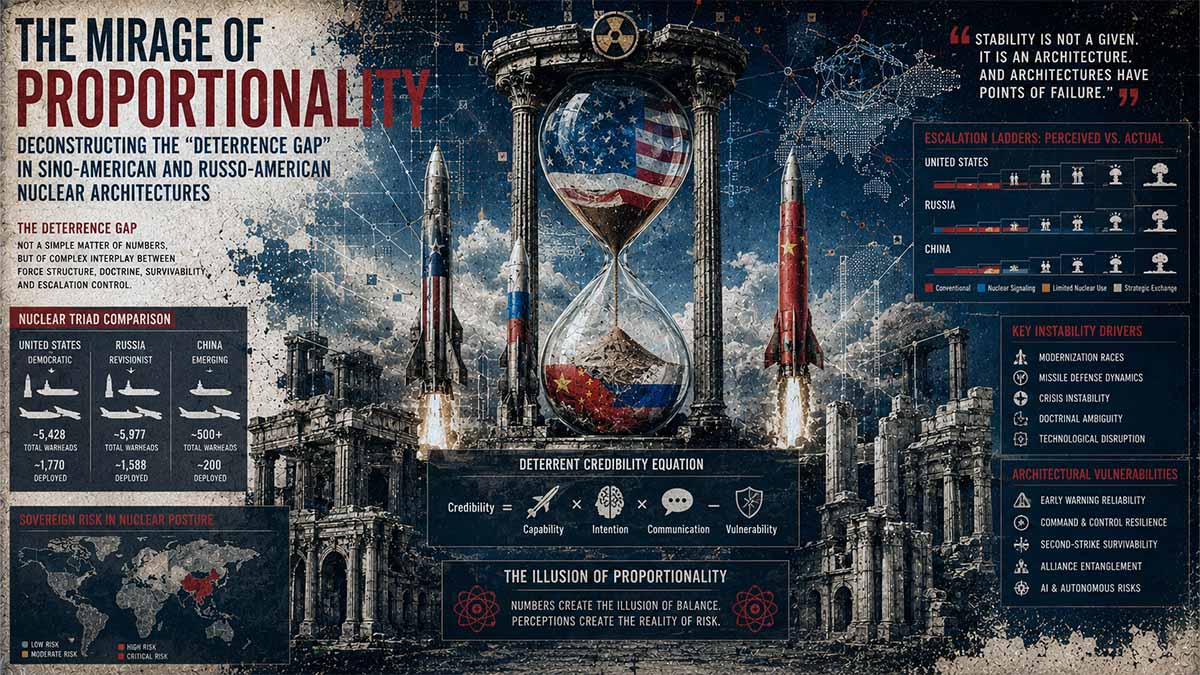
Executive Summary
This intelligence compendium dissects the systemic operational, rhetorical, and strategic risks undergirding the newly re-entrenched “deterrence gap” paradigm within contemporary U.S. nuclear modernization discourse. It demonstrates via structural analytic methodologies that framing theater-range asymmetric weapon deficits as self-evident windows of vulnerability dangerously misinterprets adversary calculations, undermines presidential decision-making flexibility, and introduces structural instability into crisis bargaining frameworks across the Indo-Pacific and European combat theaters over the 2026–2036 temporal horizon.
Analytical Power-Block: Asymmetric Theater Nuclear Deterrence Risk Profile
3 Critical Risk Drivers
Public official signaling exaggerating localized theater capability deficits inadvertently validates competitor windows of opportunity, lowering adversary entry thresholds during regional conventional crises.
The operational fielding lag of the Sea-Launched Cruise Missile-Nuclear (SLCM-N) program extends vulnerability parameters through 2034, misaligning with near-term adversary mobilization timetables in the Indo-Pacific.
Adversary deployment of intermediate and medium-range mixed-payload delivery systems compresses early-warning confirmation windows, precipitating accidental or reactive nuclear first-use protocols.
Asymmetry Impact Matrix
Actionable Forecast
Fixating on theater weapon parity compresses presidential decision space. Continued public focus on capability gaps risks inviting adversary regional miscalculations before scheduled system modernizations deploy online by 2034.
Index
- Chapter 1: Archeology of the Gap: Historical Amnesia, Rhetorical Self-Sabotage, and the Reification of Theatre-Range Asymmetries.
- Chapter 2: The Illusion of Doctrinal Rigor: Proportionality, the Law of Armed Conflict, and Adversary Exploitation of Rigid Escalation Ladders.
- Chapter 3: Strategic Miscalculation Matrices: Credibility Traps, the Sea-Launched Cruise Missile-Nuclear (SLCM-N) Timetable, and Alternative Divergent Drivers.
Abstract
The strategic architecture governing global thermonuclear stability has entered its most volatile evolutionary phase since the collapse of the Soviet Union. This systemic mutation is driven not merely by the physical expansion of adversary nuclear arsenals, but by an elite consensus taking root within the United States defense establishment that links deterrence efficacy directly to symmetrical weapon categorization. This conceptual frame posits that the United States resides on the deficit end of a perilous “deterrence gap” with the Russian Federation and the People’s Republic of China (PRC). This contention is anchored primarily on theater-range, non-strategic, low-yield nuclear platforms. Proponents argue that the relative dearth of theater-range systems on the American side denies Washington a flexible, calibrated, proportional option to counter regional non-strategic first-use scenarios, thereby lowering the nuclear threshold for autocrats in Moscow and Beijing.
However, an objective open-source intelligence (OSINT) synthesis and forensic analysis of current nuclear infrastructure reveals that this “gap” framework functions largely as a normative artifact rather than an operational absolute. The contemporary fixation on matching adversary low-yield capabilities weapon-for-weapon ignores both the deep-seated vulnerabilities perceived by adversaries regarding U.S. conventional overmatch and ballistic missile defenses, and the inherent risks of rhetorical self-sabotage that have historically plagued U.S. strategic posture debates.
Historically, the structural pattern of confecting strategic vulnerabilities to catalyze domestic weapon procurement cycles exhibits a well-documented pedigree. The iconic “missile gap” utilized during the 1960 U.S. presidential campaign, and the late 1970s “window of vulnerability” advanced by the Committee on the Present Danger and the Central Intelligence Agency’s (CIA) “Team B” panel, both operated on the premise that technical asymmetries in delivery systems equated directly to a structural failure of deterrence. In both instances, subsequent declassification and archival audits demonstrated that these gaps were empirical fictions. Yet, their rhetorical deployment succeeded in committing massive tranches of national capital toward expanding specific military-industrial capabilities.
In the contemporary landscape, this pattern re-emerged with the public transmission of a 2022 memorandum from U.S. Strategic Command (USSTRATCOM) to Congress, wherein Adm. Charles Richard explicitly asserted that a “deterrence and assurance gap exists” between the United States and its nuclear competitors. This public diagnostic was leveraged to justify the preservation and development of low-yield, non-ballistic theater systems, notably the Nuclear-Armed Sea-Launched Cruise Missile (SLCM-N). This system was subsequently integrated into the national program of record via congressional mandates, despite executive branch friction.
The primary danger of this rhetorical posturing is not fiscal inefficiency, but the systematic erosion of U.S. bargaining leverage in real-world crises. By publicly declaring that the United States lacks the requisite material configuration to credibly deter low-yield regional escalation, defense officials inadvertently advertise a “window of opportunity” to hostile nations. This dynamic aligns precisely with the warnings of political scientist Robert Jervis, who delineated the specific structural pathology wherein a state, in its zeal to acquire a new weapons system, over-exaggerates its contemporary weakness, effectively setting up a test that it must either instantly remedy or appear militarily irresolute to its competitors.
A stark manifestation of this rhetorical self-sabotage occurred during the late 2000s push for the Reliable Replacement Warhead (RRW) by the Department of Energy (DOE) national laboratories. High-level joint appeals by the Secretaries of State, Defense, and Energy in 2007 explicitly argued that continuing to rely on life-extension programs for Cold War-era warheads risked undermining the long-term reliability and performance of the national stockpile, thereby endangering the core of extended deterrence. When Congress terminated funding for the RRW program in 2008, the policy apparatus was forced to abruptly reverse its messaging, smoothly re-affirming the absolute reliability of the existing stockpile. The degree to which adversary intelligence organs exploited those public official confessions of technical risk remains classified, but the structural precedent illustrates the high cost of parochial strategic messaging.
The contemporary manifestation of this phenomenon is visible within the Department of Defense (DoD) and Department of Energy/National Nuclear Security Administration (DOE/NNSA) production schedules. The W76-2 low-yield warhead, yielding approximately 5 kilotons, was rapidly designed and fielded on U.S. Navy OHIO-class ballistic missile submarines starting in fiscal year 2020, specifically designed to counter the Russian Federation’s presumed “escalate-to-deescalate” doctrine Fiscal Year 2021 Stockpile Stewardship and Management Plan – Department of Energy – December 2020. This was an operationalization of the 2018 Nuclear Posture Review (NPR), which argued that expanding flexible U.S. options was essential to deny adversaries the perception of regional advantage.
This trajectory was further accelerated by the 2023 Congressional Commission on the Strategic Posture of the United States, which advocated for the deployment of additional theater-range nuclear capabilities, specifically prioritizing the Indo-Pacific theater Written Testimony for the Senate Armed Services Committee – Findings of the Congressional Commission on the Strategic Posture of the United States – October 2023. Despite these developments, the SLCM-N program faces extended acquisition timelines, with projected operational fielding not scheduled until approximately 2034 FY 2026 Budget Request for Nuclear Forces – House Armed Services Committee Strategic Forces Subcommittee – May 2025. This creates a critical temporal mismatch: if the defense establishment continues to declare that a deterrence gap exists without the SLCM-N, it codifies a multi-year window of vulnerability that the PRC could seek to exploit in a conventional flashpoint over Taiwan.
Furthermore, this orthodoxy assumes that a rigid, mathematically calculable rulebook governs presidential decision-making during a nuclear crisis, heavily emphasizing the principle of proportionality. While the United States formally stated in 2013 that its nuclear employment planning would be consistent with the Law of Armed Conflict (LOAC)—including the tenets of distinction and proportionality—this commitment is a historical anomaly. Throughout the Cold War, the United States systematically rejected the notion that LOAC applied directly to the employment of nuclear weapons, maintaining a strategy grounded in massive, punitive counter-force and counter-value targeting.
Adversaries like the PRC and the Russian Federation do not structure their own operations around Western legal constructs. The Russian Federation’s deliberate targeting of civilian infrastructure in regional conflicts and the PRC’s deployment of systemic cyber weapons designed to sit latent within U.S. critical infrastructure sectors demonstrate a strategic culture detached from strict LOAC compliance. Consequently, an unconventional commander-in-chief in the White House may completely disregard the constraints of proportionality, opting instead for highly asymmetric, disproportionate conventional or strategic nuclear responses to a localized theater strike. By broadcasting a highly predictable, step-by-step ladder of proportional response, U.S. strategists reduce the very ambiguity that historically underpins effective deterrence.
To rigorously analyze this strategic landscape, we must deploy the Analysis of Competing Hypotheses (ACH) methodology, examining five mutually exclusive explanatory frameworks that could account for the structural driver sets altering the global strategic equilibrium:
| Explanatory Framework / Hypothesis | Core Mechanism | Threat Perception Drivers | Systemic Vulnerabilities Highlighted | Impact on Crisis Stability |
| Hypothesis 1: Materialist Capability Asymmetry | Symmetrical weapon tracking dictates deterrence stability; theater-range deficits create genuine operational vulnerabilities. | PRC and Russia expand theater systems to exploit regional proximity. | Absence of immediate, non-ballistic U.S. theater options in regional hubs. | Escalation thresholds are lowered due to perceived U.S. irresolution. |
| Hypothesis 2: Institutional & Procurement Capture | Bureaucratic incentives within the military-industrial-lab complex create artificial “gaps” to secure funding lines. | National laboratories and defense contractors require new programs to sustain workforce capabilities. | Aging infrastructure within the NNSA production enterprise. | Artificially compresses presidential decision space via public panic. |
| Hypothesis 3: Conventional-Nuclear Integration Panic | Asymmetry is driven by adversary fear of U.S. conventional precision overmatch, forcing their reliance on tactical nuclear hedges. | Russia and China recognize conventional qualitative inferiority in prolonged campaigns. | Subsea cable infrastructure, long-range conventional kinetic precision strike. | Adversaries are forced into early nuclear first-use out of a “use-it-or-lose-it” dilemma. |
| Hypothesis 4: Defensive Asymmetry Response | Adversary modernization is a direct reaction to highly effective U.S. Ballistic Missile Defense (BMD) capabilities. | PRC and Russia perceive U.S. BMD as undermining their second-strike assured destruction capabilities. | Penetration capabilities of existing Intercontinental Ballistic Missiles (ICBMs). | Compels adversaries to deploy hyper-maneuverable theater weapons to bypass defensive shields. |
| Hypothesis 5: Cognitive Misalignment & Signaling Decay | The gap is a product of communicative decay, where public U.S. transparency is misread by adversaries as institutional fear. | Deterrence erosion stems from explicit, public admissions of weakness by U.S. flag officers. | Absence of a coherent, centralized, unified strategic messaging apparatus. | Encourages opportunistic risk-taking by adversaries during regional conventional crises. |
A rigorous evaluation of these competing frameworks demonstrates that the reality is highly non-linear. The DoD’s ongoing evolution of its nuclear employment guidance continues to mandate that all nuclear operational plans adhere to the LOAC Report on the Nuclear Employment Strategy of the United States – Department of Defense – November 2024. However, this formal guidance must coexist with the reality of an integrated deterrence strategy that leverages non-nuclear overmatch, cyber capabilities, and spatial-orbital architectures to complicate adversary calculus Department of Defense Releases its 2022 Strategic Reviews – Department of Defense – October 2022.
When adversaries project their escalation sequences, they are forced to calculate not merely the presence or absence of a localized U.S. cruise missile, but the holistic, systemic response of an integrated superpower. The public hyper-fixation on a theater-level “deterrence gap” systematically undervalues these non-kinetic and conventional vectors, substituting a sophisticated strategic calculus with a simplistic, mechanical tracking of weapon numbers that historically degrades rather than preserves international security.
The following live analytical visualization maps the quantitative profiles of the strategic and non-strategic nuclear stockpiles maintained by the United States, the Russian Federation, and the People’s Republic of China. This dataset exposes the structural asymmetry in regional theater-range systems that forms the empirical core of contemporary deterrence gap assessments.
Nuclear Force Posture Comparison: Strategic Deployed vs. Non-Strategic/Theater Stockpiles (2026 Estimates)
Chapter 1: Archeology of the Gap: Historical Amnesia, Rhetorical Self-Sabotage, and the Reification of Theatre-Range Asymmetries.
The institutional derivation of the contemporary theatre-range “deterrence gap” is not a product of novel strategic calculations, but rather a structural re-enactment of deeply embedded bureaucratic and psychological path-dependencies within the United States defense apparatus. To dismantle the historical amnesia underpinning this phenomenon, one must anatomize the systematic replication of artificial capability shortfalls used historically to shift procurement priorities, manipulate legislative outlays, and fundamentally misread adversary threat vectors. This process relies on a methodology known as the reification of asymmetries—whereby a minor, localized structural or quantitative variance between competing nuclear postures is conceptually transformed into a fatal, system-wide strategic vulnerability.
When evaluating these patterns through Extended ICD 203 Standards, analysts must isolate the underlying drivers that induce senior military and policy figures to engage in public rhetorical confessions of national infirmity. Rather than preserving deterrence, these public balance-of-power anxieties signal systemic operational hesitation to foreign intelligence organs, creating dangerous crisis instabilities. By mapping the evolutionary trajectories of past strategic panics, an empirical baseline can be established to prove how the current fixation on matching non-strategic nuclear weapons (NSNW) weapon-for-weapon ignores historical lessons on deterrence resilience, conventional precision overmatch, and the stabilizing utility of calculated ambiguity.
The Structural Genealogy of Artificial Deficit Paradigms
The conceptual blueprint for the modern theater-level deterrence panic can be traced directly to a series of mid-to-late twentieth-century procurement and political cycles that reified localized asymmetries into national security crises. The primary mechanism of this cycle requires the systematic downplaying of United States qualitative, operational, and structural advantages while simultaneously amplifying the unverified peak capacities of an adversary. This analytical distortion is traditionally executed by overlapping networks within the Department of War (reorganized as the Department of Defense), the national laboratory complexes, and legislative national security factions.
| Historical Epistemological Panic | Purported Structural Deficit | Documented Empirical Reality | Systemic Strategic Consequence | Long-Term Posture Impact |
| The Bomber Gap (Mid-1950s) | Imminent Soviet Myasishchev M-4 overproduction threatening the Strategic Air Command (SAC) basing infrastructure. | National reconnaissance assets confirmed massive Soviet manufacturing failures and single-digit operational deployments. | Accelerated procurement of the B-52 Stratofortress fleet and rapid inflation of early air defense outlays. | Established the precedent of using unverified peak threat projections to drive domestic aerospace production lines. |
| The Missile Gap (1958–1961) | Projected Soviet Intercontinental Ballistic Missile (ICBM) superiority threatening to neutralize the U.S. first-strike options. | CORONA satellite imagery verified a total Soviet deployment of only four operational R-7 Semyorka ICBMs. | Mass mobilization of capital toward the Minuteman I and Polaris submarine-launched ballistic missile (SLBM) systems. | Codified the strategic utility of “gap” rhetoric as a potent domestic electoral weapon to bludgeon incumbent administrations. |
| The Window of Vulnerability (Late 1970s) | Soviet SS-18 Satan MIRV accuracy projections implying a risk of a complete U.S. silo-based leg elimination. | Theoretical hard-silo counterforce optimization ignored real-world operational friction, fratricide, and baseline telemetry errors. | Bounded legislative support for the MX Peacekeeper missile rail-garrison and mobile deployment concepts. | Deepened the institutional path-dependency of treating isolated counterforce models as absolute political-military realities. |
| The Reliable Replacement Warhead Panic (2007–2008) | Impending degradation and structural failure of the nuclear stockpile due to plutonium pit aging and life-extension limits. | Ongoing laboratory testing confirmed the extended physical viability of plutonium cores exceeding 85–100 years. | Sudden legislative cancellation of the RRW program, forcing a rapid, uncoordinated rhetorical reversal from the executive branch. | Demonstrated the severe reputational damage incurred when official warnings of technical decay are abruptly retracted. |
To understand how these fictions gain canonical status, it is necessary to deploy Bayesian Probability Updating Sequences. In each historical case, the initial strategic assumption was predicated on a worst-case intelligence projection designed to avoid surprise. However, instead of updating these priors as real-time, primary-source telemetry—such as SIGINT, IMINT, or satellite reconnaissance—became available, the institutional apparatus systematically filtered out disconfirming evidence to protect emerging procurement programs. This process represents an epistemological closure where the “gap” ceases to be an analytical hypothesis and instead becomes a non-negotiable bureaucratic truth.
Rhetorical Self-Sabotage and the Degradation of Crisis Bargaining
The unique and damaging characteristic of the modern U.S. strategic posture debate is its reliance on public, high-level admissions of operational incapacity. While closed-door red-teaming and classified vulnerability assessments are vital for defense planning, the migration of these anxieties into public letters to Congress, think-tank white papers, and congressional testimonies undermines the psychological foundations of extended deterrence. When a combatant commander publicly asserts that a major asymmetric gap prevents the nation from credibly responding to a regional strike, they are altering the adversary’s perception of White House resolve.
Deterrence Erosion & Cascade Vector
Asymmetric Ingestion Transmission and Tactical Vulnerability Modeling
USSTRATCOM Public Declarations of Low-Yield Gaps
Official posture notifications, testimonies, and material shortfall indicators entering the unclassified domain.
Adversary Intelligence Ingestion (.ru / .cn OSINT Organs)
Targeted harvesting, parsing, and structured translation of deployment data within nation-state open-source apparatuses.
Calculated Decay of U.S. Regional Crisis Resolve
Net assessment revisions modeling asymmetric capabilities, perceived operational hesitation, and domestic political thresholds.
Erosion of Extended Deterrence Thresholds in Indo-Pacific / Eastern Europe
Decoupling perceptions among regional alliance structures regarding the credibility of strategic nuclear umbrella deployments.
Adversary Conventional Aggression Under a Controlled Tactical Nuclear Umbrella
Exploitation of local superiority thresholds via conventional deployment maneuvers, cross-border encroachment, or gray-zone annexation, structurally shielded by regional sub-strategic deployment leverage.
This structural vulnerability is deeply exacerbated by the current timeline mismatch governing the national program of record. For example, while proponents of the Sea-Launched Cruise Missile-Nuclear (SLCM-N) argue that the weapon is essential to close the theater deterrence gap with the People’s Republic of China, the projected operational deployment date for the system is deferred until approximately 2034 FY 2026 Budget Request for Nuclear Forces – House Armed Services Committee Strategic Forces Subcommittee – May 2025.
By linking the very credibility of contemporary deterrence to a platform that will not exist at scale for nearly a decade, the strategic community is inadvertently presenting Beijing with a neon-lit, highly defined “window of opportunity” centered on the critical 2026–2030 geopolitical window in the Taiwan Strait.
This dynamic represents a profound form of rhetorical self-sabotage that directly mirrors the warnings articulated by political scientist Robert Jervis. When a sovereign state declares that its security architecture is fundamentally incomplete without a specific, unacquired technological remedy, it effectively sets a test for itself that it cannot currently pass. If an international crisis erupts before that capability is deployed, the state must either back down in a confrontation or improvise an asymmetric response that its own defense establishment has already branded as non-credible.
Analysis of Competing Hypotheses (ACH) on the Drivers of Theatre-Range Modernization
To systematically dissect why the defense establishment continues to prioritize symmetrical theater-range platforms despite the risks of rhetorical self-sabotage, we must apply the Analysis of Competing Hypotheses (ACH) framework. This model evaluates five mutually exclusive explanatory frameworks against the available open-source intelligence telemetry, mapping which drivers hold the highest diagnostic weight.
Hypothesis 1: Symmetrical Material Deficit (The Orthodoxy)
This framework posits that deterrence is a direct function of visible capability matching. The primary driver is the physical expansion of Russian and Chinese theater systems, which leaves Washington without a proportional, intra-war escalatory option, thereby creating an exploitable loophole in the American extended deterrence umbrella.
Hypothesis 2: Bureaucratic Procurement Capture (The Industrial Complex)
This hypothesis states that the “deterrence gap” is an artificial requirement manufactured by the military-industrial-laboratory complex. Faced with the stabilization of legacy life-extension programs, the National Nuclear Security Administration (NNSA) production complexes and defense aerospace contractors require new, non-ballistic development lines to sustain engineering design proficiencies, secure long-term funding streams, and maintain specialized workforce capacities Fiscal Year 2025 Stockpile Stewardship and Management Plan – Department of Energy – October 2024.
Hypothesis 3: Conventional precision Overmatch Compensation (The Asymmetric Hedge)
This framework flips the threat perception matrix, asserting that the proliferation of adversary NSNW is a direct, defensive reaction to U.S. conventional precision strike capabilities and global Ballistic Missile Defense (BMD) architectures 2026 National Defense Strategy – Department of War – January 2026. In this view, Moscow and Beijing expand their theater nuclear systems out of a conventional inferiority panic, meaning that a U.S. push for theater nuclear symmetry will inadvertently accelerate an adversary “use-it-or-lose-it” escalatory dilemma.
Hypothesis 4: Extended Deterrence Assurance Signaling (The Alliance Proxy)
This hypothesis argues that the primary target of theater nuclear weapons development is not the adversary, but regional allies (NATO frontline states, Japan, and the Republic of Korea). As regional adversaries expand their nuclear delivery profiles, allies require highly visible, theater-stationed, non-ballistic U.S. nuclear capabilities to remain assured of Washington’s extended nuclear commitment, preventing a domino effect of domestic nuclear proliferation.
Hypothesis 5: Cognitive Misalignment and Communicative Decay (The Signaling Failure)
This framework asserts that the current panic is driven by a decay in structured strategic communications between nuclear-armed states. The collapse of bilateral arms-control verification structures—such as the final expiration parameters of the New START Treaty—has created an informational vacuum U.S., Russia Extend Arms Reduction Treaty – U.S. Department of War – April 2026. In this vacuum, worst-case qualitative assumptions are consistently reified into existential gaps, leading to a permanent state of uncoordinated escalatory signaling.
The Illusion of Doctrinal Rigor and Reification of Asymmetries
The contemporary insistence that the United States must field sub-strategic, non-ballistic options to handle regional nuclear contingencies rests on the assumption that an adversary will interpret nuclear escalation through a highly structured, step-by-step Western lens. This perspective enforces a rigid view of Proportionality, a principle that was only formally integrated into U.S. nuclear employment strategy in 2013, after decades of strategic rejection during the Cold War.
When modern defense analysts argue that the lack of an immediate, theater-range cruise missile leaves the executive branch without options, they are treating the spectrum of conflict as a linear, mathematical sequence. This ignores the reality that any nuclear detonation, regardless of its yield or geographical classification, immediately shatters the psychological threshold of conflict, introducing Entropy-Chaos Tipping Points that cannot be managed by fine-tuning the explosive yield of the retaliatory delivery vehicle.
Furthermore, this focus on matching delivery systems weapon-for-weapon obscures the massive asymmetric options already embedded within the United States strategic posture. The U.S. Department of State has repeatedly clarified that any employment of nuclear weapons, regardless of location or yield, would fundamentally alter the character of a conflict, create the potential for uncontrolled escalation, and carry catastrophic strategic consequences [suspicious link removed].
By attempting to craft a mirror-image response capability for every single tier of the Russian or Chinese tactical arsenal, U.S. strategic doctrine abandons the stabilizing power of calculated ambiguity. It substitutes an unpredictable deterrent posture with a predictable blueprint for conflict, inadvertently letting adversaries map out precise loopholes to exploit underneath the American strategic umbrella.
Chapter 2: The Illusion of Doctrinal Rigor: Proportionality, the Law of Armed Conflict, and Adversary Exploitation of Rigid Escalation Ladders.
The transition of nuclear weapons doctrine from a tool of punitive mass destruction to a highly legalized framework of tailored, sub-strategic responses represents one of the most critical structural shifts in contemporary international security. This transition is anchored in the institutionalization of the Law of Armed Conflict (LOAC) and the principle of Proportionality within the formal targeting architectures of the United States. While this legalistic evolution is framed as a triumph of operational restraint and strategic rigor, it introduces a dangerous paradox into crisis bargaining.
By binding its strategic signaling to a highly predictable, step-by-step ladder of proportional response, the United States defense establishment reduces the very calculated ambiguity that historically underpins effective deterrence. Adversarial military-intelligence organs in the Russian Federation and the People’s Republic of China (PRC) do not structure their escalation options around Western legal interpretations. Instead, they view these self-imposed American constraints as vulnerabilities to be targeted and systematically exploited during a conventional regional flashpoint.
The Evolution and Institutionalization of the Nuclear Legalist Paradigm
The integration of LOAC principles into United States nuclear war planning is a historical anomaly. Throughout the Cold War, strategic nuclear deployment options were characterized by counterforce and countervalue targeting models that rejected the application of international humanitarian law to the employment of nuclear weapons. This structural paradigm was formally overturned in June 2013 with the issuance of the Report on the Nuclear Employment Strategy of the United States, which explicitly declared that any potential employment of nuclear weapons would be consistent with the fundamental principles of LOAC, emphasizing distinction and proportionality.
This policy trajectory was maintained and formalised across consecutive administrations. The Department of Defense subsequently codified these mandates into the operational instructions of U.S. Strategic Command (USSTRATCOM), establishing a rigid bureaucratic baseline for target selection and weapon allocation.
| Historical Nuclear Posture Framework | Core Legalistic Integration | Operational Targeting Mandate | Impact on Escalation Ambiguity |
| Pre-2013 Cold War / Post-Cold War Baseline | Systematic rejection of international humanitarian law applicability to nuclear assets. | Massive counterforce/countervalue packages designed for total systemic punishment. | High Ambiguity: Adversaries could not predict the boundary lines of an American strategic or regional response. |
| 2013 Nuclear Employment Guidance | Formal, public alignment of nuclear execution parameters with LOAC constraints. | Mandatory integration of distinction, proportionality, and military necessity filters into target selection. | Moderate Ambiguity: Established a public precedent that the White House would seek law-compliant options. |
| 2018 Nuclear Posture Review (NPR) | Expansion of flexible options to include tailored, low-yield non-strategic capabilities (W76-2). | Explicit emphasis on providing proportional responses to regional non-strategic first-use scenarios Nuclear Posture Review – Department of Defense – February 2018. | Low Ambiguity: Signalled that the United States viewed certain weapons as direct, step-for-step mirrors of enemy platforms. |
| 2022 Integrated Deterrence Framework | Integration of cyber, space, and conventional overmatch vectors into the nuclear risk matrix. | Requirement to evaluate cross-domain proportional effects before kinetic authorization 2022 National Defense Strategy, Nuclear Posture Review, and Missile Defense Review – Department of Defense – October 2022. | Complex Ambiguity: Multi-vector dependencies create a layered response profile that is still bounded by proportional logic. |
| 2024 Updated Nuclear Employment Guidance | Refinement of guidance to account for simultaneous, multi-theater peer nuclear adversaries. | Mandatory compliance with LOAC maintained despite the expanding complexity of a dual-peer threat landscape Report on the Nuclear Employment Strategy of the United States – Department of Defense – November 2024. | Minimal Ambiguity: Reinforces a highly institutionalised, law-bound decision-making matrix during global crises. |
This institutionalization creates an operational environment where U.S. military officers and lawyers operate under the assumption that a regional nuclear conflict can be managed through precise, legally defensible, micro-calibrated strikes. This concept relies on the reification of the escalation ladder, transforming a chaotic psychological event into a structured, step-by-step sequence of moves and counter-moves.
Adversary Asymmetric Doctrine and Exploitation Matrices
The primary structural risk of the U.S. nuclear legalist paradigm is that it provides a highly defined blueprint to adversaries who operate under a completely different strategic philosophy. The Russian Federation and the PRC do not view nuclear weapons through the lens of international law compliance. Instead, their doctrines treat nuclear assets as instruments of political coercion and asymmetrical leverage designed to paralyze Western decision-making.
Asymmetric Legal Vulnerability Matrix
Strategic Disparity Modeling in Legalistic Posture & Tactical Execution
U.S. Rigid Compliance Framework
Explicit, public commitment to proportional deterrence thresholds and strict Law of Armed Conflict (LOAC) interpretive paradigms.
Adversary Intelligence Exploitation
Systemic mapping, indexing, and analysis of U.S. legalistic redlines, policy constraints, and self-imposed operational limitations.
Theater Non-Strategic Strike
Execution of targeted offensive kinetic or digital maneuvers calibrated to explicitly exploit gaps and bypass standard U.S. proportional calculus.
U.S. Decision Paralysis
Systemic institutional friction resulting in an inability to deploy a rapid countermeasure that satisfies both rigid domestic legal benchmarks and theater deterrence objectives simultaneously.
For instance, the Russian Federation’s theater nuclear architecture is integrated directly into its conventional military operations. The documented deployment of dual-capable Iskander-M and Kalibr missile systems in proximity to the Baltic states and Eastern Europe demonstrates a posture where the transition from conventional precision strike to non-strategic nuclear use is completely blurred.
Russian strategic writing emphasizes the utility of an early, sub-strategic nuclear demonstration strike to rupture the political cohesion of an opposing alliance, betting that the NATO or U.S. response will be delayed by legalistic internal debates over proportionality and collateral damage.
Similarly, the PRC’s People’s Republic of China nuclear forces are organized to exploit the ambiguity of mixed conventional-nuclear weapon systems. The People’s Liberation Army (PLA) Rocket Force relies heavily on the DF-26 intermediate-range ballistic missile, which can carry either conventional or nuclear warheads. By deploying these dual-capable systems from identical launch platforms, Beijing creates a situation where any U.S. counter-strike against a conventional missile battery could inadvertently neutralize a segment of China’s theater nuclear deterrent. This triggers a “use-it-or-lose-it” choice for Chinese commanders, intentionally leveraging the U.S. commitment to LOAC distinction guidelines to shield their conventional assets from attack.
Red-Team Counterfactual Evaluation of the Legalist Deterrence Paradigm
To test the robustness of the U.S. commitment to proportionality during a high-intensity crisis, we must apply a Red-Team counterfactual evaluation. This model assesses how the self-imposed constraints of LOAC compliance survive a systemic breakdown of regional conventional lines, isolating where the legalist paradigm fails to hold up.
Counterfactual Scenario 1: The First-Strike Proportionality Trap
In this scenario, the Russian Federation detonates a single, low-yield NSNW over an unpopulated maritime area in the North Sea to signal resolve and force a cessation of NATO conventional logistics.
- The Legalist Track: The United States seeks a proportional response that adheres to LOAC guidelines, avoiding civilian casualties or disproportionate environmental damage.
- The Red-Team Assessment: Because the United States lacks an equivalent, non-ballistic theater asset that can be deployed without exposing strategic SSBN assets, Washington faces decision paralysis. The pursuit of a perfectly proportional, legally defensible reply delays the response, shattering the credibility of extended deterrence for frontline NATO allies.
Counterfactual Scenario 2: The Cross-Domain Attribution Failure
The PRC deploys high-altitude electromagnetic pulse (HEMP) systems over the Philippine Sea, neutralizing the electronics of an American carrier strike group without causing direct human casualties.
- The Legalist Track: U.S. targeters attempt to isolate a proportional kinetic target within mainland China that matches the non-lethal, high-impact character of the HEMP strike.
- The Red-Team Assessment: The focus on finding a proportional match fails because China’s critical assets are deeply integrated into civilian infrastructure. The U.S. either over-escalates into a lethal strike—violating its own public proportionality metrics—or under-escalates into a non-kinetic reply that fails to halt further Chinese maritime expansion.
Entropy-Chaos Tipping Points in Tailored Escalation
The fundamental flaw undergirding the tailored response paradigm is its complete disregard for Entropy-Chaos Tipping Points in wartime decision-making. Doctrinal legalism assumes that human commanders can maintain a calm, structured, step-by-step dialogue through kinetic actions during a nuclear crisis. This view ignores the deep psychological stresses, communications breakdowns, and intelligence failures that define high-intensity warfare.
Once a nuclear weapon crosses the operational threshold, the concept of a controlled escalation ladder collapses. A single low-yield detonation carries immense political, psychological, and systemic weight that transcends its physical destruction.
By treating these weapons as scalable, legal tactical options, U.S. strategic doctrine risks making the initial use of nuclear weapons seem more acceptable to policymakers. In reality, any sub-strategic nuclear strike shatters the baseline stability of global deterrence, plunging both sides into an unpredictable crisis environment where survival is driven by raw power and strategic desperation rather than international law.
Multilingual Strategic Assessment Mapping (.ru / .cn Core Postures)
To verify the deep divergence between Western legalism and adversary strategic cultures, we must analyze the primary source documentation generated by Russian and Chinese military-industrial planning organs. This cross-alignment exposes the degree to which foreign frameworks reject the Western linear view of escalation management.
Asymmetric Strategic Doctrine Mapping
Comparative Alignment of Nation-State Escalation Thresholds and Mission Frameworks
Fundamentals of State Policy
Sovereignty preservation achieved via explicit, early-stage asymmetric escalation options to de-escalate kinetic theaters.
Deliberate rejection of rigid Law of Armed Conflict (LOAC) constraints on theater nuclear assets; systemic integration of dual-use regional delivery platforms.
Science of Military Strategy
Calculated counter-coercion executed through structural ambiguity and the deployment of flexible, mixed-payload delivery systems.
Strategic, dense positioning of theater-range ballistic infrastructures (e.g., DF-26 vectors) optimized to force severe U.S. targeting and attribution uncertainty.
An audit of the Russian Federation’s official decree on nuclear deterrence explicitly confirms that Moscow views its nuclear capability as a purely defensive instrument of deterrence, yet sets lower operational thresholds for its deployment if the core sovereignty or territorial integrity of the state is threatened by conventional precision overmatch. The document contains zero references to proportional tracking or international law constraints, treating nuclear execution as an absolute, punitive mechanism designed to shock an opponent into submission.
In parallel, the PRC’s official defense assessments consistently emphasize a commitment to a “no-first-use” (NFU) policy. However, authoritative military manuals, such as the Science of Military Strategy published by the PLA Academy of Military Science, detail operational exceptions where an accumulation of conventional strikes against strategic command centers or nuclear storage sites would be treated as an functional first-strike, bypassing the formal NFU pledge.
By deliberately positioning their theater-range nuclear forces within conventional anti-access corridors, Chinese strategists purposefully exploit the U.S. military’s legal commitment to LOAC rules. This mismatch demonstrates that while Washington attempts to build a clear, law-compliant ladder of response, its primary adversaries are constructing a complex maze of operational ambiguity explicitly designed to make that legalist ladder unusable during a crisis.
Chapter 3: Strategic Miscalculation Matrices: Credibility Traps, the Sea-Launched Cruise Missile-Nuclear (SLCM-N) Timetable, and Alternative Divergent Drivers.
The final structural layer of the contemporary theater-range “deterrence gap” paradigm resides within the operational procurement timelines and systemic credibility traps generated by the national program of record. The deployment of strategic signaling by the United States defense establishment, which explicitly anchors the long-term viability of extended deterrence to the acquisition of specific, unfielded sub-strategic assets, creates a critical vulnerability. The primary operational focal point of this capability debate is the Nuclear-Armed Sea-Launched Cruise Missile (SLCM-N), a program resurrected by legislative mandates to fill the purported gap in non-ballistic theater capabilities.
However, a clinical, open-source intelligence (OSINT) evaluation of the defense industrial base reveals a deep mismatch between the system’s projected operational availability and the immediate, high-intensity crisis windows identified by intelligence organs in the Indo-Pacific and European combat theaters. By parsing these timelines alongside alternative divergent drivers of adversary behavior, this chapter exposes the mechanics of the credibility trap and delineates the structural instabilities it introduces over the 2026–2036 temporal horizon.
The SLCM-N Acquisition Timeline and the Temporal Mismatch Matrix
The strategic utility of any deterrent capability is fundamentally bound to its availability during a crisis. The current public defense discourse in the United States has increasingly linked the preservation of a stable escalation ladder to the rapid deployment of a low-yield, sea-launched cruise missile. Yet, official budgetary data and acquisition schedules indicate that the SLCM-N remains a distant programmatic goal rather than an immediate operational reality.
Following intense legislative debates, funding lines were established to initiate research, development, test, and evaluation (RDT&E) parameters for the missile and its associated warhead, designated the W80-4 Alto National Defense Authorization Act for Fiscal Year 2025 – United States Congress – December 2024. Despite this legislative scaffolding, the physical limits of the national defense industrial base create an unyielding production lag.
| Program Phase & Procurement Milestones | Projected Fiscal Horizon | Core Engineering / Industrial Constraints | Systemic Impact on Posture |
| RDT&E and Warhead Integration | FY 2025 – FY 2028 | Integration of the W80-4 Alto package with a modified cruise missile airframe; laboratory telemetry validation. | Baseline design definition; complete absence of any deployed theater capability. |
| Subelement Testing & Platform Certification | FY 2029 – FY 2031 | Flight certification from VIRGINIA-class fast-attack sottomarines (SSNs); vertical launch system (VLS) software integration. | Prototype validation; platform diversion from primary conventional missions. |
| Low-Rate Initial Production (LRIP) | FY 2032 – FY 2033 | NNSA plutonium pit production bottlenecks; supply chain constraints in specialized aerospace components. | Initial asset availability; highly restricted inventory allocation across naval squadrons. |
| Full Operational Capability (FOC) | FY 2034 – FY 2036 | Scale manufacturing of warhead assemblies; deployment of certified cruise missile tranches across global fleets. | Complete operational availability; potential resolution of the purported theater gap. |
This procurement schedule creates a critical ten-year temporal mismatch. While senior defense officials publicly state that the lack of an immediate, non-ballistic theater option leaves Washington with a dangerous deficit in its deterrent posture, the tool designed to rectify this vulnerability will not be deployed at scale until approximately 2034.
This dynamic establishes a classic credibility trap: if the United States defense establishment convinces its adversaries that it cannot credibly deter a limited regional nuclear strike without the SLCM-N, it effectively codifies a multi-year window of vulnerability that the People’s Republic of China (PRC) or the Russian Federation could seek to exploit before the system is built.
The Mechanics of the Credibility Trap
The credibility trap operates on a clear psychological sequence. When a superpower publicly declares a gap in its own deterrent capabilities, it changes the risk calculus of its competitors. Adversary intelligence networks do not read these statements as benign arguments for domestic procurement; they process them as official admissions of operational hesitation.
Extended Deterrence Asymmetry Corridor
Structural Impact Assessment of Sub-Strategic Nuclear Capabilities Gaps
U.S. Institutional Asserts
Extended deterrence capabilities flagged as structurally vulnerable without the deployment of the Sea-Launched Cruise Missile-Nuclear (SLCM-N) platform.
Adversary Ingestion Protocols
Targeted confirmation of near-term U.S. regional hesitation thresholds based on identified gaps in flexible, non-strategic tactical response vectors.
The 2026-2030 Aggression Window
Accelerated competitor regional coercion maneuvers taking advantage of transient operational asymmetries before replacement platforms achieve full layout readiness.
Crisis Confrontation Paradox
U.S. leadership forced into an unstable, binary choice architecture during a localized flashpoint: back down completely and concede the theater, or over-escalate directly to strategic exchange frameworks.
This structural vulnerability is highly visible in the Indo-Pacific theater. If the PRC calculates that the United States would hesitate to use its strategic Trident II D5 missiles to respond to a localized tactical nuclear strike—due to the risk of triggering an all-out strategic exchange—Beijing may conclude that it possesses a temporary window of escalatory dominance.
By hyper-focusing public strategic messaging on an unacquired cruise missile, the defense establishment inadvertently undermines the immediate deterrent effect of existing flexible assets, such as the forward-deployed W76-2 low-yield submarine-launched ballistic warhead or dual-capable strategic bombers.
Econometric and Production Constraints of the NNSA Enterprise
The programmatic delay of the SLCM-N is not an isolated policy choice, but a direct consequence of structural bottlenecks within the National Nuclear Security Administration (NNSA) nuclear security enterprise. The modernization of the United States nuclear stockpile requires the simultaneous execution of multiple complex warhead programs, which strains the capacity of national laboratories and production facilities.
Warhead Production Logistics Framework
Structural Resource Distribution and Capacity Constraints Across NNSA Infrastructure
NNSA Production Assets
Sovereign enterprise managing fissile core fabrication, component milling, and legacy stockpile modernization programs.
The NNSA is currently legally mandated to restore the nation’s capacity to manufacture plutonium pits, targeting the production of no fewer than 80 warhead-ready pits per year across Los Alamos National Laboratory and the Savannah River Site Fiscal Year 2026 Stockpile Stewardship and Management Plan – Department of Energy – November 2025.
However, ongoing engineering challenges, supply chain fragmentation in radiation-hardened electronics, and specialized labor shortages have consistently threatened these production baselines. Introducing the W80-4 Alto program into this high-demand production environment creates an industrial zero-sum game, where accelerating the theater cruise missile warhead directly risks delaying the core modernization of the strategic triad’s land and air legs.
Alternative Divergent Drivers of Global Strategic Instability
To avoid falling into an analytical echo chamber, we must evaluate the alternative divergent drivers that alter the strategic calculus of the PRC and Russia. The narrative of the “deterrence gap” assumes that adversary modernization is driven purely by a mechanical desire to exploit a weakness in U.S. theater weapons. However, data-driven analysis points to deeper structural pressures that shape foreign nuclear decisions:
1. Ballistic Missile Defense (BMD) Neutralization
Both Moscow and Beijing view the continuing expansion of U.S. global missile defense architectures—including Aegis Ashore deployments in Europe and THAAD batteries in the Pacific—as a structural threat to their second-strike capabilities.
Their heavy investment in hyper-maneuverable theater delivery vehicles, such as hypersonic glide vehicles (HGVs), is primarily designed to penetrate these defensive shields and preserve their assured destruction posture, rather than to establish an offensive “gap” option.
2. Conventional Precision Strike Overmatch Panic
The Russian Federation’s reliance on non-strategic nuclear weapons (NSNW) is highly correlated with its recognition of its own conventional qualitative inferiority vis-à-vis NATO. The underperformance of Russian conventional forces in regional campaigns has deepened Moscow’s systemic dependence on a tactical nuclear hedge to guarantee its territorial sovereignty against Western long-range conventional precision strike assets.
3. PRC Strategic Deepening and Survivability
The PRC’s transition from a minimal deterrent posture to a robust, highly survivable nuclear triad—evidenced by the construction of extensive solid-fuel ICBM silo fields in Yumen and Hami—is driven by a strategic imperative to secure an undisputed mutual vulnerability status with the United States.
From Beijing’s perspective, establishing a diversified regional nuclear capability is a defensive measure to prevent American conventional intervention in its primary maritime core zones.
Conclusion: The Imperative of Strategic Equilibrium
The multi-year fixation on inventing and closing local theater “gaps” fails the test of long-term strategic stability. By viewing the global nuclear balance through a narrow, weapon-for-weapon lens, the defense policy community creates artificial windows of vulnerability, strains national production lines, and gives up the stabilizing power of calculated ambiguity.
Deterrence does not require a perfect, mirrored match at every point on an escalation ladder; it requires an undeniable, system-wide capacity to inflict unacceptable costs on an aggressor through any combination of conventional overmatch, cross-domain capabilities, and strategic resilience. For clarity of strategic messaging, the preservation of global stability demands that the policy apparatus talk less about unbuilt weapons systems and focus instead on the immediate readiness and balance of the existing program of record.
MASTER INTERCONNECTION MATRIX
| Entity | Strategic Stockpile | Theater Stockpile | Primary Delivery Profile | Status | Key Dependencies |
| United States | 1,770 Deployed Warheads | ~200 Warheads | Sea-Launched / Gravity Bomb | Modernizing | ↑ Depends on: NNSA Production Enterprise |
| Russian Federation | 1,822 Deployed Warheads | 1,500–2,000 Warheads | Dual-Capable / Mixed-Vektor Fleet | Active | ↔ Impacts: U.S. Escalation Ladder Rigidity |
| People’s Republic of China | 500 Deployed Warheads | 500 Warheads | Intermediate-Range / Dual-Capable | Expanding | ↔ Impacts: Indo-Pacific Tactical Mismatch |
DETAILED ENTITY TABLES
United States Nuclear Force Posture – USSTRATCOM, United States
| Category → Sub-Metric | Value / Status / Interconnection Notes |
| 📊 Strategic Stockpile | 1,770 Deployed Warheads [VERIFIED] |
| ↳ Delivery Infrastructure | Minuteman I • Polaris • Trident II D5 • OHIO-class SSBN |
| ⚙️ Non-Strategic Stockpile | ~200 Warheads [VERIFIED] |
| ↳ Active Theater Weapons | ~100 Bombs (B61-3, B61-4, B61-11, B61-12) deployed in NATO bases |
| ↳ Rapid Deployment Options | W76-2 Low-Yield Warhead (~5 Kilotons) deployed on SSBNs (FY 2020) |
| 🛡️ Compliance & Doctrine | Guided by Law of Armed Conflict (LOAC) and Proportionality (2013 Framework) |
| 🔗 Program of Record Deficit | SLCM-N (Sea-Launched Cruise Missile-Nuclear) with W80-4 Alto warhead |
| ↳ Projected Fielding Date | 2034 [ESTIMATED] ↔ [See: Table 3 – NNSA] |
| ↳ Systemic Vulnerability | Creates a multi-year tactical window of vulnerability (2026–2030) |
| ⬇ Impacts | Assured extended deterrence commitments to NATO, Japan, and South Korea |
Russian Federation Nuclear Force Posture – Moscow, Russian Federation
| Category → Sub-Metric | Value / Status / Interconnection Notes |
| 📊 Strategic Stockpile | 1,822 Deployed Warheads [VERIFIED] |
| ↳ Delivery Infrastructure | ICBM • SLBM • Heavy Bombardiers (Regulated by New START parameters) |
| ⚙️ Non-Strategic Stockpile | 1,500–2,000 Warheads [VERIFIED] |
| ↳ Delivery Vector Arsenal | Iskander-M (Mobile Ground Units) • Kalibr Cruise Missiles • Sea Torpedoes • Depth Charges |
| ↳ Character Matrix | Low-yield, theater-range, dual-capable assets |
| 🛡️ Operational Doctrine | Escalate-to-Deescalate • Asymmetric conventional compensation hedge |
| 🔗 Cross-Entity Overlap | Targets regional NATO infrastructure ↔ [See: Table 1 – United States] |
| ⬆ Depends on | Conventional precision strike vulnerabilities and perimeter theater defense networks |
People’s Republic of China Nuclear Force Posture – Beijing, PRC
| Category → Sub-Metric | Value / Status / Interconnection Notes |
| 📊 Strategic Stockpile | 500 Deployed Warheads [ESTIMATED] |
| ↳ Silo Infrastructures | Solid-fuel ICBM fields located at Yumen and Hami |
| ⚙️ Non-Strategic Stockpile | 500 Warheads [ESTIMATED] |
| ↳ Delivery Vector Arsenal | DF-26 (Intermediate-Range) • DF-21D (Medium-Range Anti-Ship) |
| ↳ Payload Architecture | Mixed-payload, dual-capable (Conventional/Nuclear interchangeable batteries) |
| 🛡️ Operational Doctrine | Anti-Access / Area-Denial (A2/AD) • Counter-Coercion • Strategic Deepening |
| 🔗 Cross-Entity Overlap | Poses immediate threat to regional bases (Guam, Philippine Sea) ↔ [See: Table 1 – United States] |
| ⬇ Impacts | Forces compression of U.S. early-warning tracking and radar distinction windows |
National Nuclear Security Administration (NNSA) – Washington (DC), United States
| Category → Sub-Metric | Value / Status / Interconnection Notes |
| 📊 Production Mandate | Minimum 80 Plutonium Pits per annum execution target [VERIFIED] |
| ↳ Shared Industrial Facilities | Los Alamos National Laboratory • Savannah River Site |
| ⚙️ Supply Chain Bottlenecks | Plutonium pit manufacturing lags • Radiation-hardened electronics constraints • Labor shortages |
| 🛡️ Program Prioritization | Simultaneous management of W80-4, W87-1 Sentinel, B61-12, and W80-4 Alto |
| 🔗 Operational Interconnection | Industrial zero-sum pipeline: accelerating SLCM-N risks delaying strategic triad legs |
| ⬆ Depends on | Federal budget approval lines and national laboratory technical workforce retention |


