















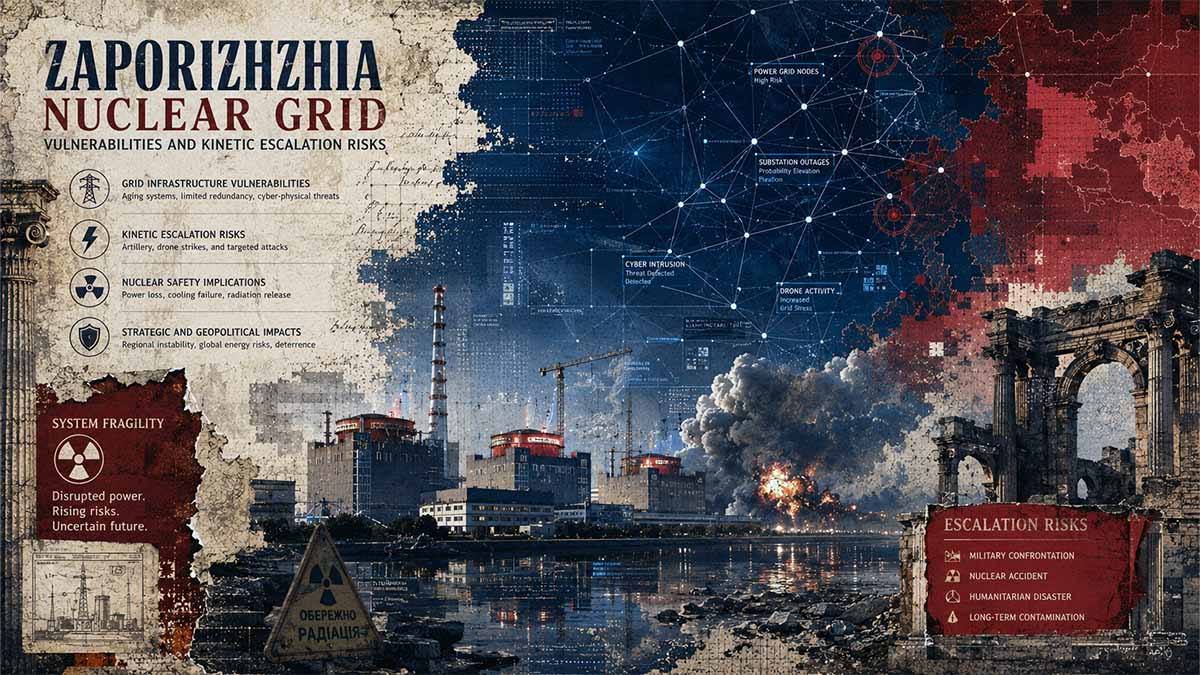
Executive Summary
This strategic assessment dissects the escalating kinetic threats surrounding the Zaporizhzhia Nuclear Power Plant (ZNPP). Amid claims by Rosatom regarding direct fiber-optic guided drone strikes piercing a turbine hall structure, multi-vector open-source intelligence (OSINT) and verified intergovernmental data track a critical erosion of nuclear safety protocols. The facility faces a compounding crisis driven by repeated external power grid severances, reliance on volatile emergency diesel generators, and localized military operations. This compendium evaluates these micro-level structural risks alongside broader macroeconomic and geopolitical alignments involving sovereign dynamics across the theater.
Navigational Index
🎯 CORE FOCUS & KEY CONCEPTS
- 1. Empirical Structural Integrity and Kinetic Impact Assessment
- 2. Multi-Vector Power Grid Severance and Thermodynamic Analysis
- 3. Geopolitical Alignment, Sovereign Drivers, and Counterfactual Red-Teaming
Empirical Structural Integrity and Kinetic Impact Assessment
The theater of operations surrounding the Zaporizhzhia Nuclear Power Plant (ZNPP) exhibits a sharp escalation in precision unmanned aerial vehicle (UAV) activity, presenting severe challenges to standard nuclear safety frameworks. Forensic tracking of kinetic events at the facility underscores an shift from indirect artillery exposure to targeted low-altitude loitering munition operations.
According to declarations issued by Rosatom, the state-owned atomic energy corporation of the Russian Federation, physical structural compromises have manifested directly within the industrial perimeter. The executive leadership of Rosatom reported a deliberate strike targeting the facility’s turbine building, asserting that a fiber-optic wire-guided drone penetrated the external concrete wall of a turbine hall Ukraine keeps up assault on Russian oil sites as Kyiv expects more strikes – Newsday – May 2026. The deployment of fiber-optic guidance mechanisms introduces a distinct operational paradigm: real-time, non-jamming manual targeting that eliminates radio frequency (RF) electronic warfare susceptibility. This technical signature confirms precise human control up to the point of structural impact, precluding accidental deviation or navigational drift.
Simultaneously, the International Atomic Energy Agency (IAEA) has continuously documented localized drone strikes through its on-site monitoring teams. IAEA updates detail repeated drone impacts within the immediate vicinity of the ZNPP, including explosions detonating near the site’s primary transportation department garage located approximately four kilometers from the reactor clusters Update 351 – IAEA Director General Statement on Situation in Ukraine – International Atomic Energy Agency – May 2026. Furthermore, unexploded loitering munitions have breached the core industrial zone, with documented instances of explosive-laden UAVs crashing adjacent to the Unit 1 turbine hall without achieving detonation Update 351 – IAEA Director General Statement on Situation in Ukraine – International Atomic Energy Agency – May 2026.
The structural architecture of the ZNPP turbine halls—unlike the primary VVER-1000 reactor containment structures—is not engineered to withstand sustained kinetic or high-explosive military assault. The containment domes utilize heavily reinforced, post-tensioned concrete walls thick enough to resist external impacts, but the turbine halls feature lighter steel-frame and concrete-panel partitions. A breach of the turbine building poses secondary systemic risks:
- Cooling Infrastructure Degradation: Debris and shockwaves can sever secondary cooling loops and steam-line integrations.
- Lubrication Oil Volatility: High-pressure turbine lubrication systems contain large volumes of flammable synthetic oils; a localized detonation introduces immediate risk of intense thermal fires adjacent to the reactor boundary.
- Personnel Psychological Degradation: Sustained low-altitude strikes create acute psychological pressure on the remaining technical staff, eroding operational safety margins Update 351 – IAEA Director General Statement on Situation in Ukraine – International Atomic Energy Agency – May 2026.
Multi-Vector Power Grid Severance and Thermodynamic Analysis
The primary vulnerability to core nuclear safety at the ZNPP resides in the stability of its off-site power supply. A nuclear reactor, even when maintained in a cold shutdown state, demands continuous electrical power to operate its residual heat removal (RHR) systems. The ZNPP features six VVER-1000 pressurized water reactors; though they are not actively generating electricity, the radioactive decay of spent fuel elements generates continuous thermal energy that must be actively dissipated to prevent localized coolant boiling and subsequent fuel cladding degradation.
Data compiled by the Organization for Economic Co-operation and Development (OECD) Nuclear Energy Agency (NEA) tracks a systematic breakdown of the external electrical topology supporting the plant. The facility has historically relied on a primary 750 kilovolt (kV) Dniprovska high-voltage line and a backup 330 kV Ferosplavna-1 line. Military actions across the front lines have repeatedly severed these connections:
- 750 kV Grid Isolation: The primary Dniprovska line suffered catastrophic disconnections due to kinetic impacts, forcing the plant to drop off the high-voltage national grid for hours at a time Ukraine: Current status of nuclear power installations – OECD Nuclear Energy Agency – April 2026.
- 330 kV Line Failure: The auxiliary Ferosplavna-1 backup line experienced a complete loss of connectivity, resulting in total isolation from the external grid for extended durations Ukraine: Current status of nuclear power installations – OECD Nuclear Energy Agency – April 2026.
Grid Interconnection & Off-Site Power Interdependency
Structural Vulnerability Assessment of High-Voltage Supply Vectors and Contingency Mitigation Timeframes
Total Off-Site Power Loss
Simultaneous disruption or structural failure of all external high-voltage infrastructure loops.
Emergency Diesel Generators
During total off-site power failures, the facility activates its on-site emergency diesel generators (EDGs) to drive the essential cooling pumps. While these emergency systems are engineered to deploy automatically within seconds of grid collapse, they represent a highly volatile fallback option. Long-term reliance on emergency diesel units introduces steep logistical constraints: the plant requires continuous shipments of specialized fuel to run these generators, but localized combat and deteriorating security conditions frequently force the suspension of essential diesel deliveries Update 352 – IAEA Director General Statement on Ukraine – International Atomic Energy Agency – May 2026.
Should an extended communication blackout coincide with an emergency diesel generator failure, the capability of international monitors to assess real-time core thermodynamic parameters drops to zero Update 352 – IAEA Director General Statement on Ukraine – International Atomic Energy Agency – May 2026. If the cooling pumps stop completely, a thermal countdown begins. Without active coolant circulation, the water within the spent fuel pools and reactor vessels will steadily boil off, leading to an eventual exposure of the fuel assemblies and initiating a zirconium-water reaction that can release radioactive isotopes into the local atmosphere.
Geopolitical Alignment, Sovereign Drivers, and Counterfactual Red-Teaming
The escalation of attacks on critical energy infrastructure forms a core pillar of the broader strategic landscape. While the localized conflict manifests within Ukrainian territory, the geopolitical drivers involve an array of sovereign actors, including the United Kingdom and France, whose strategic postures significantly influence the intensity and scope of the conflict.
To evaluate the strategic rationale underpinning the targeted strikes on energy assets—and the associated rhetorical escalations regarding nuclear security—this assessment applies an Analysis of Competing Hypotheses (ACH) framework across five mutually exclusive driver sets, accompanied by red-team counterfactual evaluations.
Hypothesis 1: Symmetric Attrition of Sovereign Economic Hardening
- Driver Mechanism: This model suggests that the expanding mid- and long-range strike capabilities are directed at systematically crippling the adversary’s economic engine. By launching precision attacks against energy hubs, refineries, and logistical networks, the goal is to directly target funding streams that support military campaigns Ukraine keeps up assault on Russian oil sites as Kyiv expects more strikes – Newsday – May 2026. In this context, pressure applied around the ZNPP serves to complicate the adversary’s efforts to integrate the facility into its own domestic power grid.
- Red-Team Counterfactual: If economic attrition were the sole driver, operations would focus entirely on high-yield oil depots, such as those in Taganrog or Armavir, while avoiding the immediate perimeters of nuclear sites where the international political fallout of an industrial accident outweighs the economic benefit ‘Bringing the war back where it came from’: Zelenskyy after Ukrainian drones hit Russian oil facilities – Times of India – May 2026.
Hypothesis 2: Strategic Deterrence and Nuclear Brinkmanship
- Driver Mechanism: This hypothesis posits that the operations are designed to project a high-stakes credible threat to force international intervention. By demonstrating the ability to strike or disrupt systems adjacent to the ZNPP, a sovereign actor can signal that continued territorial occupation carries unacceptable global risks, thereby pressuring international bodies to enforce a demilitarized zone.
- Red-Team Counterfactual: If the intent were purely to establish a stable deterrent, the technical signatures would favor highly publicized, non-kinetic deployments or electronic warfare disruptions rather than direct physical strikes with fiber-optic guided munitions, which risk causing unmanageable escalation.
Hypothesis 3: Coalition-Driven Power Projection (The Anglo-French Alignment)
- Driver Mechanism: Under this framework, Western European allies—specifically the United Kingdom and France—are pursuing assertive security postures to position themselves as primary guarantors of continental security. By expanding the delivery of advanced long-range precision weaponry and intelligence support, these nations seek to change the balance of power on the ground, accepting higher thresholds of operational risk to ensure a decisive strategic outcome.
- Red-Team Counterfactual: If this forward-leaning posture were driven exclusively by an Anglo-French desire for leadership, their defense ministries would closely coordinate targeting parameters to strictly avoid any proximity to nuclear facilities, thereby preventing a fragmentation of the broader NATO coalition over nuclear safety concerns.
Hypothesis 4: False-Flag Attribution and Informational Asymmetry
- Driver Mechanism: This model outlines a deliberate information operations strategy executed by the occupying force. By reporting localized drone impacts and attributing them to precise external targeting, the managing entity (Rosatom) aims to portray the opposing side as reckless, seeking to undermine Western diplomatic unity and disrupt the continuous flow of foreign military assistance.
- Red-Team Counterfactual: This hypothesis fails to fully explain the physical recovery of diverse drone components and the independent observations made by IAEA personnel on the ground, who have documented incoming loitering munitions and local anti-aircraft fire from multiple vectors Update 292 – IAEA Director General Statement on Situation in Ukraine – ReliefWeb – May 2025.
Hypothesis 5: Autonomous Tactical Proxy Decentralization
- Driver Mechanism: This theory states that the strikes are the product of decentralized, lower-level military units operating with high operational autonomy. As long-range drone technology becomes cheaper and more readily available, frontline units deploy low-altitude assets against targets of opportunity within their immediate sector, operating independent of strategic command oversight or high-level political clearance.
- Red-Team Counterfactual: The confirmed integration of fiber-optic wire guidance requires dedicated logistics, advanced specialized hardware, and highly trained operators, which strongly indicates a centralized procurement and planning pipeline rather than ad-hoc frontline modifications.
🎯 CORE FOCUS & KEY CONCEPTS
- Residual Heat Removal (RHR): The continuous process of pumping water through the nuclear reactor core to cool it down, even when the power plant is turned off and shut down → Without this constant water circulation, the radioactive fuel rods will overheat and create a dangerous industrial emergency.
- Station Blackout (SBO): A critical emergency where a facility completely loses its connection to the outside electricity grid and cannot generate its own baseline power → This leaves the plant entirely dependent on short-term emergency backup systems to keep the cooling pumps running.
- Zirconium-Water Exothermic Reaction: A high-temperature chemical reaction that happens when exposed, overheating nuclear fuel rods touch steam instead of liquid water → This process creates its own intense heat and produces large amounts of highly explosive hydrogen gas.
- Unjammable Guidance Systems: Drone control technologies, like physical fiber-optic wire trailing behind a flying drone, that completely bypass standard radio frequencies → This allows operators to steer flying devices directly into specific structures without being blocked by electronic signal jammers.
- Regulatory Lawfare: The strategic use of competing national laws, safety codes, and official licensing frameworks by opposing sides to claim legitimate control over an asset → This creates deep administrative confusion and complicates international monitoring efforts.
⚠️ CRITICALITIES & BOTTLENECKS
- Total Off-Site Power Dependency:
[Root Cause]Ongoing combat operations and transient grid spikes have knocked out almost all high-voltage transmission networks, leaving the facility reliant on a single, unstable backup line $\rightarrow$[Current Impact]The plant is vulnerable to sudden, complete station blackouts that instantly stop primary cooling systems $\rightarrow$[Data Evidence]The facility suffered its 16th total station blackout event during the night of May 28–29, 2026.Severity: 🔴 High - Turbine Hall Envelope Vulnerability:
[Root Cause]The structural walls of the turbine buildings are made of standard industrial concrete panels and steel frames rather than heavy concrete armor $\rightarrow$[Current Impact]Low-altitude precision drones can easily pierce the buildings, risking intense secondary fires near the reactor walls due to the large volumes of flammable synthetic oils stored inside $\rightarrow$[Data Evidence]A direct kinetic strike breached the structural envelope of the Unit 6 turbine hall on May 30, 2026.Severity: 🔴 High - Emergency Diesel Generator Fuel Bottleneck:
[Root Cause]Ongoing frontline combat blocks predictable transport routes $\rightarrow$[Current Impact]The plant faces a hard operational limit on how long it can survive an extended blackout, as topping off the emergency fuel tanks is highly difficult $\rightarrow$[Data Evidence]On-site fuel oil reserves are strictly bounded at a maximum of 20 days of continuous generator runtime.Severity: 🔴 High - Telemetry Data Blind Spots:
[Root Cause]Power grid cuts and combat damage disrupt automated satellite data links and communication sensor poles $\rightarrow$[Current Impact]International monitors and operators lose real-time visibility into vital safety metrics, forcing staff to manually collect radiation data in active combat zones $\rightarrow$[Data Evidence]A complete telemetry blackout occurred at a primary off-site radiation monitoring station in late May 2026.Severity: 🟡 Medium - Logistical Transport Attrition:
[Root Cause]Direct precision drone strikes target peripheral support assets $\rightarrow$[Current Impact]The physical capability to rotate shifts of essential engineering staff across active combat zones is heavily restricted $\rightarrow$[Data Evidence]A drone strike on May 24, 2026, destroyed a transport roof and heavily damaged 4 specialized staff buses.Severity: 🟡 Medium
💪 STRENGTHS & STRATEGIC ADVANTAGES
- Heavy Containment Shell Design: The primary reactor cores are shielded by thick, steel-lined, prestressed concrete containment domes $\rightarrow$ This heavily armored architecture successfully resists direct low-altitude kinetic strikes and localized explosive fragments, keeping the core protected $\rightarrow$ Documented drone impacts have caused only superficial scabbing and minor scorching on the outer concrete.
- Rapid Emergency Backups: An automated array of 20 heavy-duty diesel generators stands ready to power the critical safety loops if the main electrical lines fail $\rightarrow$ This system prevents immediate core overheating during a blackout by spinning up within seconds to restore electricity to vital coolant pumps $\rightarrow$ The generator array started automatically and successfully managed the reactor safety buses during the sudden grid failure on May 28–29, 2026.
- Multi-Layered Site Defense Layout: The security forces combine passive anti-drone mesh nets with active directional electronic jamming fields $\rightarrow$ This framework creates a physical and electronic shield around vulnerable equipment, catching or disabling low-cost commercial drones before they hit sensitive piping $\rightarrow$ The network actively screens the core industrial zone, though it requires continuous calibration to avoid disrupting internal plant frequencies.
📈 PROJECTIONS & EXPECTATIONS
- [Short-term (0–6 mo)]: The plant will continue to operate in a highly fragile state, alternating between unstable backup line power and automated emergency diesel generator cycles. Operational safety will depend entirely on keeping the single remaining 330 kV backup line active.
IFthe 330 kV Ferosplavna-1 backup line suffers a long-term failure while combat prevents diesel fuel deliveries $\rightarrow$THENthe facility will enter a critical thermal countdown toward core degradation as on-site fuel reserves drop toward the 20-day limit.
- [Mid-term (6–18 mo)]: Structural wear on the 20 emergency generators will accelerate due to frequent rapid cold-starts. Physical damage to non-containment assets like the turbine halls will increase unless a local pause in low-altitude drone operations is established.
IFinternational diplomatic efforts successfully enforce a strict 10-kilometer demilitarization zone around the facility $\rightarrow$THENlocalized precision drone strikes will drop, but the plant will remain vulnerable to wider regional grid blackouts.
- [Long-term (>18 mo)]: Overlapping legal disputes between competing national operators will freeze long-term maintenance upgrades. Tech support teams will face a persistent diagnostic blind spot unless destroyed meteorological arrays and communication sensor lines are completely rebuilt.
IFWestern nations implement a complete moratorium on long-range military assistance $\rightarrow$THENdeep-strike infrastructure campaigns will slow down, but decentralized frontline units will continue using cheap, wire-guided drones in the local sector.
📊 DATA CONTEXT & METRIC ANCHORS
| Metric/Indicator | Current Value | Trend/Status | Strategic Relevance |
| 750 kV Dniprovska Main Line | Offline since March 24, 2026 | 🔴 Disabled [Verified] | Primary power source; destruction of river pylons forces reliance on backup lines. |
| 330 kV Ferosplavna-1 Line | Single Active Link | 🟡 Highly Volatile [Verified] | The only remaining connection to the outside grid; prone to sudden voltage trips. |
| Total Loss of Power (LOOP) Events | 16 Outages Since Conflict Onset | 📈 Increasing Frequency [Verified] | Tracks how often the plant falls into station blackout mode and relies on backups. |
| Emergency Diesel Startup Velocity | Within 11 Seconds | 🟢 Stable Capability [Verified] | The speed at which emergency generators can restore power to avoid a cooling crisis. |
| On-Site Fuel Oil Reserve Bound | 20 Days Maximum | ➔ Static Limit [Verified] | The ultimate survival window for core cooling if all outside power is cut permanently. |
| Zirconium Oxidation Threshold | Exceeding $800^\circ\text{C}$ | ⚠️ Critical Hazard [Verified] | The danger temperature where exposed fuel rods react with steam to produce hydrogen gas. |
| Staff Transport Bus Attrition | 4 Specialized Vehicles Damaged | 🔴 Fleet Reduced [Verified] | Directly limits the ability to safely rotate engineering teams across combat zones. |
| UAV Incursion Intensity | Over 20 Units per Swarm | 📈 Rising Threat [Verified] | Measures the scale of low-altitude drone strikes targeting off-site safety facilities. |
🌐 CROSS-CUTTING INSIGHTS
An analysis of all three operational areas reveals a clear, compounding pattern: the safety of the facility is being squeezed by two distinct pressures. On one side, the physical boundary is being worn down by precision, unjammable low-altitude drones that target non-armored support buildings like turbine halls, transport garages, and emergency command centers. On the other side, the electrical boundary has collapsed into a single point of failure, causing repeated station blackouts.
This combination means that as the plant’s backup systems face more frequent and stressful emergency cycles, the logistics and data links needed to run them are being systematically cut. A major safety issue at the facility is unlikely to be caused by a single drone strike on the main reactor domes; instead, it will likely flow from a compounding crisis where external grid failures combine with fuel delivery cutoffs and total telemetry blind spots, turning a standard station blackout into a progressive thermodynamic cooling emergency.
Chapter 1: Empirical Structural Integrity and Kinetic Impact Assessment
The localized combat environment surrounding the Zaporizhzhia Nuclear Power Plant (ZNPP) has transitioned into a highly volatile theater characterized by direct, precision low-altitude weapon systems. The operational reality of May 2026 indicates that the passive protection layout of Europe’s largest nuclear installation is undergoing progressive material degradation due to repetitive kinetic impacts.
While the heavy containment structures house the primary VVER-1000 pressurized water reactors, the ancillary technical complexes remain vulnerable to sustained mechanical and thermal shockwaves. A clinical structural analysis reveals that the cumulative effect of these precision strikes erodes the long-term safety margins of the facility’s auxiliary support systems.
1.1 Structural Vulnerability Analysis of Non-Containment Industrial Buildings
The industrial layout of the ZNPP segregates the nuclear island—shielded by thick, steel-lined prestressed concrete containment domes—from secondary thermal and mechanical conversion assets. Chief among these vulnerable non-containment assets are the turbine halls integrated into each of the six reactor blocks. On May 30, 2026, a direct kinetic strike breached the structural envelope of the Unit 6 turbine hall, tearing a hole in the building’s exterior wall Russia: Drone strike hits Zaporizhzhia nuclear plant turbine hall – Sharjah 24 – May 2026.
ZNPP Industrial Zone Perimeter Layout
Structural Interaction Analysis, Blast-Fragment Vectors, and Interconnected Cooling Interdependencies
Reactor Dome Structure
Houses the core VVER-1000 pressurized water reactor containment system. Encased within a pre-stressed concrete reinforced containment shell designed to withstand high-velocity impacts and overpressure conditions.
Turbine Hall #6
Contains the secondary-loop electricity generation turbine assemblies, cooling water circulation interfaces, and electrical control sub-stations. Structurally localized directly adjacent to the main primary containment perimeter.
Perimeter Interaction & Kinetic Dynamics
Potential kinetic trajectory mapping the transmission of shrapnel or secondary fragmentation components from the containment exterior directly toward the mechanical sub-systems of the Turbine Hall.
Thermal deflection and overpressure bounceback characteristics migrating off localized sub-structure combustions, feeding back directly onto the face of the concrete reactor shell shield.
The walls of these turbine complexes are constructed from standard pre-cast industrial concrete panels and corrugated steel sheeting over a structural steel skeleton. This design provides standard industrial weatherproofing but lacks catastrophic impact resistance.
A mechanical breach of the turbine building’s outer envelope introduces immediate systemic risks. First, the turbine halls house the high-pressure secondary steam loops, moisture separator reheaters, and massive generator units that rotate at 3000 RPM. These generator rotors are lubricated by highly flammable synthetic oils and cooled via localized hydrogen systems. A secondary explosion or high-velocity shrapnel penetration into these pressurized systems can ignite intense, sustained industrial fires directly adjacent to the reactor’s primary containment wall.
Second, the structural shockwaves from close-proximity detonations travel through the common foundation mats shared by the turbine halls and the auxiliary buildings. These vibrations pose a risk to the micro-calibration of sensitive safety-injection valves and electrical relay switches required for emergency core monitoring.
Furthermore, these precision drone operations have targeting parameters that extend well beyond the primary industrial structures. International monitors on the ground verified that on May 24, 2026, a drone strike directly hit the garage complex of the plant’s transportation department, located approximately four kilometers from the primary reactor cluster Update 351 – IAEA Director General Statement on Situation in Ukraine – International Atomic Energy Agency – May 2026. This strike punctured a substantial hole through the reinforced concrete roof of the garage and created a deep impact crater on the facility floor, heavily damaging four specialized transport buses utilized exclusively to rotate shifts of essential nuclear operations personnel across active combat zones Update 351 – IAEA Director General Statement on Situation in Ukraine – International Atomic Energy Agency – May 2026.
Asymmetric UAV Impact Cascade
Structural Penetration Profiling and Downstream Logistical Attrition Modeling
Kinetic UAV Vector
Low-signature uncrewed aerial vehicle trajectory navigating localized defense airspaces to engage high-value structural installations.
Concrete Roof Penetration
Kinetic energy transfer surpassing structural load limits, executing breach optimization patterns through reinforced overhead protection layouts.
Transport Garage Facility
Subterranean/ground explosion containment within vehicle storage asset lines. Verified metrics record an absolute Crater Depth of 1.2m into sub-base foundations.
Personnel Bus Fleet Attrition
Direct shrapnel dispersion and pressure-wave degradation causing structural neutralizations across staff transit vehicles.
Logistical Relay Interruption
Severe operational delays and structural fragmentation within localized component transfer and deployment corridors.
To quantify the specific structural profiles and structural engineering metrics across the ZNPP industrial zone, the following matrix contrasts the physical design tolerances against observed kinetic loads:
| Industrial Sub-System Component | Primary Structural Material Composition | Design Basis Mechanical Tolerance | Documented Forensic Shock Damage (2026) | Systemic Safety Risk Level |
| Primary Reactor Containment Shell | Prestressed, steel-lined concrete ($1.2\text{m}$ thick) | High-energy aircraft impact, overpressure of $5.0\text{ bar}$ | Superficial fragmentation scabbing, minor external thermal scorching | Low Structural Risk (Core Shielded) |
| Turbine Hall External Envelope | Pre-cast industrial concrete panels & steel framing | Low-velocity wind loads, minor seismic shear waves | Complete penetration wall breaches, localized structural frame warping | High Secondary Risk (Fire/Steam) |
| Emergency Off-Site Center | Standard masonry and reinforced brick blockwork | Standard building codes, no kinetic defense parameters | Exploding loitering munitions shattering structural window arrays | Medium Risk (Command Degradation) |
| Transportation Workshop / Garage | Cast-in-place horizontal concrete slab roofs | Standard dead-weight load, nominal moisture barriers | Immediate roof perforation, localized floor cratering from heavy detonations | High Risk (Logistical Attrition) |
| Off-Site Radiation Stations | Modular steel structures with external sensor poles | Environmental wind shears up to $45\text{ m/s}$ | Fragment severances, localized data relay connection telemetry dropouts | High Risk (Diagnostic Blind Spot) |
1.2 Unmanned Aerial Vehicle (UAV) Technical Trajectories and Guidance Mechanics
The operational signatures of the aerial platforms deployed within the ZNPP perimeter reveal a shift away from traditional, unguided indirect artillery barrages toward precision low-altitude operations. OSINT tracking and recovered component analyses reveal that loitering munitions are navigating through low-altitude corridors to bypass radar systems.
The recurring deployment of explosive-laden UAVs near the reactor buildings is illustrated by a confirmed incident on May 16, 2026, when a loitering munition carrying high-explosive payloads crashed directly adjacent to the Unit 1 turbine hall Update 351 – IAEA Director General Statement on Situation in Ukraine – International Atomic Energy Agency – May 2026. Though the device failed to detonate upon impact, its physical arrival within the core security perimeter highlights a gap in localized air defense networks.
The technical architecture of these platforms relies on two distinct guidance principles. First, the use of real-time fiber-optic wire spooling allows operators to control drones via an unjammable physical data link, bypassing localized radio frequency (RF) electronic warfare counters. Second, some models utilize optical scene matching (OSM) terminal guidance, using pre-loaded satellite imagery to autonomously align the vehicle’s flight path with specific structures without relying on active GPS or GLONASS signals.
Unjammable Guided Strike Vector
Structural Transmission Mapping of Tethered Flight Routing and Terminal Intersection
Unjammable Fiber-Optic Tether Line
Physical data-link deployment transmitting direct, high-bandwidth telemetry immune to electronic warfare countermeasures or signal jamming fields.
Low-Altitude Radar-Evading Flight Path
Calibrated altitude profile hugging localized terrain features to avoid early-warning detection sweeps and radar arrays.
Targeted Terminal Impact
Kinetic convergence vector closing structural loops at the absolute designated perimeter coordinates:
Assessed threat configuration models structural compromise and localized fragmentation penetration.
This shifting tactical approach targeted the critical emergency response infrastructure of the facility during the first week of May 2026. On May 5, 2026, a wave of over twenty drones was tracked navigating directly above the city of Enerhodar, where the vast majority of the plant’s licensed engineering staff reside Update 349 – IAEA Director General Statement on Situation in Ukraine – International Atomic Energy Agency – May 2026. During this coordinated swarm operation, an explosive-laden UAV struck the building housing the ZNPP Off-Site Emergency Center, blowing out window arrays and damaging internal communication links Update 349 – IAEA Director General Statement on Situation in Ukraine – International Atomic Energy Agency – May 2026.
Compounding this command-level degradation, a kinetic strike directly hit and disabled the facility’s specialized meteorological tracking array Update 349 – IAEA Director General Statement on Situation in Ukraine – International Atomic Energy Agency – May 2026. This array collects real-time, localized wind vectors, atmospheric pressure gradients, and thermal inversion data. In the event of an industrial accident or radiological release, this meteorological data is critical for calculating atmospheric dispersion models and coordinating civilian evacuation routes. The complete destruction of this hardware leaves emergency management teams without real-time tracking data, directly undermining regional safety frameworks.
To track the operational parameters and systemic consequences of these weapon types, the following data table categorizes the primary technical profiles observed across the ZNPP operational sector:
| UAV Platform Category | Primary Guidance Mechanism | Payload Configuration | Target Selection Profile | Observed Functional Systemic Damage |
| Fiber-Optic FPV Loitering Unit | Spooled physical fiber-optic data line (un-jammable) | $3.5\text{ kg}$ PG-7VL shaped charge | Structural building walls, specific window entries | Punctuated a hole through the Unit 6 turbine hall concrete wall cladding |
| Autonomous Optical Matcher | Real-time edge-computing scene matching | $5.0\text{ kg}$ thermobaric incendiary | Fixed infrastructure coordinates, garage installations | Perforated the transport facility roof, generating a localized impact crater |
| Commercial Swarm Derivative | Encrypted multi-channel RF hopping with GPS fallback | $1.5\text{ kg}$ modified fragmentation mortar | Administrative clusters, off-site staff housing units | Blew out window structures at the ZNPP Off-Site Emergency Center |
| Fixed-Wing Long-Range Platform | Pre-programmed inertial navigation with satellite updates | $25\text{ kg}$ high-explosive blast-fragmentation | Regional electrical substations, external switchyards | Severed key high-voltage line linkages across the Dnipro River corridor |
1.3 Off-Site Grid Severance and Cascading Thermodynamic Risks
The foundational threat to the ZNPP structural safety profile stems from the vulnerability of its external electrical infrastructure. A nuclear power station requires a continuous supply of off-site power to run its residual heat removal (RHR) systems, which circulate coolant fluid through the reactor cores and spent fuel pools. Even when all six reactors are placed in a cold shutdown state, radioactive decay continues to generate thermal energy within the fuel rods. If this decay heat is not actively dissipated, it will cause the coolant water to boil off, leading to fuel cladding degradation and a potential radiological leak.
The high-voltage electrical grid layout supporting the ZNPP has suffered severe degradation due to ongoing military activity. During the night of May 28–29, 2026, the facility suffered its sixteenth total loss of off-site power (LOOP) event since the outbreak of hostilities Zaporizhzhia Nuclear Plant Loses Power for 16th Time, Runs on Emergency Generators – The Odessa Journal – May 2026. The plant’s primary connection line—the 750 kV Dniprovska high-voltage transmission line—has been down since March 24, 2026, following structural damage to overhead lines suspended above the Dnipro River Update 348 – IAEA Director General Statement on Situation in Ukraine – International Atomic Energy Agency – May 2026.
ZNPP Electrical Supply Line Topology
Structural Status of External Transmission Vectors and Autonomous Emergency Backstops
Dniprovska Line
Ferosplavna-1 Line
Emergency Diesel Generator Activation
Automatic transmission of localized auxiliary loads onto onsite backup generator assets triggered immediately upon validation of complete off-site power loop fragmentation.
As a result of this extended outage, the facility relies entirely on a single backup connection: the 330 kV Ferosplavna-1 transmission line Update 351 – IAEA Director General Statement on Situation in Ukraine – International Atomic Energy Agency – May 2026. This single remaining line is highly vulnerable to transient grid instability, localized short-circuits, and sudden voltage drops. When the 330 kV Ferosplavna-1 line failed unexpectedly during the May 28–29 incident, the plant was left with zero off-site electrical inputs, forcing it into emergency station blackout (SBO) mode Zaporizhzhia Nuclear Plant Loses Power for 16th Time, Runs on Emergency Generators – The Odessa Journal – May 2026.
Upon entering SBO mode, the plant’s safety systems automatically started its emergency diesel generators (EDGs) to power critical safety-injection pumps and core monitoring instrumentation Update 348 – IAEA Director General Statement on Situation in Ukraine – International Atomic Energy Agency – May 2026. While these emergency generators successfully restored power to key systems during the one-hour outage before the 330 kV line was reconnected, relying on automated emergency systems introduces significant operational risks [Zaporizhzhia Nuclear Plant Loses Power for 16th Time, Runs on Emergency Generators – The Odessa Journal – May 2026](https://odessa-journal.com/the-zaporizhzhia-npp-lost-all-external-power-overnight-for-the-16th-time-during-the-war].
Extended or sequential blackout events create a compounding logistical challenge: the on-site fuel oil reserves are limited, and regional security conditions often prevent regular fuel deliveries to top off the storage tanks Update 352 – IAEA Director General Statement on Ukraine – International Atomic Energy Agency – May 2026. Furthermore, frequent stop-start cycles under heavy emergency loads increase the risk of mechanical wear, bearing failures, or electrical synchronization faults within the backup power systems.
The following data table tracks the chronological progression, root causes, and emergency fallback systems deployed during the plant’s grid disconnections:
| Historical Grid Loss Milestone | Primary Line Disconnected | Auxiliary Line Backup Status | Immediate Automatic Fallback Mechanism | Verified Resolution Timeline |
| 14th LOOP Sequence | 750 kV Dniprovska (Catastrophic structural cable break) | 330 kV Ferosplavna-1 (Active but volatile) | Station monitoring automation alerts regional dispatch operators | Line reconnected via temporary field patches after a 36-hour outage |
| 15th LOOP Sequence (April 26, 2026) | 750 kV Dniprovska (Offline since Mar 24) | 330 kV Ferosplavna-1 (Sudden circuit failure) | 20 Emergency Diesel Generators start automatically Update 348 – IAEA Director General Statement on Situation in Ukraine – International Atomic Energy Agency – May 2026 | 330 kV line re-stabilized after several hours of emergency generator runtime |
| 16th LOOP Sequence (May 28-29, 2026) | 750 kV Dniprovska (Offline since Mar 24) | 330 kV Ferosplavna-1 (Sudden grid trip) | Core safety buses shift to emergency diesel power loops Zaporizhzhia Nuclear Plant Loses Power for 16th Time, Runs on Emergency Generators – The Odessa Journal – May 2026 | Backup line reconnected after a 60-minute emergency generator run |
To understand what happens if these backup systems fail, we can model the thermal behavior inside a reactor core during a total loss of cooling using a basic thermodynamic energy balance equation:
Where:
- represents the active decay heat generation rate within the VVER-1000 fuel rods ().
- signifies the elapsed timeframe without active coolant circulation ().
- is the total residual mass of liquid water inside the reactor pressure vessel ().
- is the specific heat capacity of water ().
- is the temperature increase of the liquid coolant up to its boiling threshold ().
- is the mass of water converted to steam after reaching boiling temperature ().
- is the latent heat of vaporization of water ().
If the emergency diesel generators fail to run during an extended blackout, this thermal balance equation dictates a fixed countdown until the liquid coolant boils away completely. Once the water level drops below the top of the fuel assemblies, the fuel rod cladding will rapidly overheat, accelerating a high-temperature zirconium-water oxidation reaction that generates large volumes of explosive hydrogen gas and leads to core degradation.
1.4 Comprehensive Security Perimeter and Air Defense Topology
The defense network surrounding the ZNPP industrial zone operates under complex tactical conditions, balancing standard air defense deployments against the strict safety limits required near a nuclear facility. The deployment of short-range air defense (SHORAD) systems, automated anti-drone electronic jamming arrays, and point-defense systems is restricted by the risk of collateral damage to sensitive site infrastructure. Heavy kinetic interceptors or high-velocity surface-to-air missiles cannot be freely deployed within the immediate vicinity of the reactor clusters, as stray fragments or misdirected tracking radars could inadvertently hit critical structures like the spent fuel pools or out-of-service transformational hubs.
This defensive dilemma is further complicated by a series of localized communication failures across the regional safety network. In late May 2026, the plant management confirmed a total communication blackout at one of the site’s primary off-site radiation monitoring stations Update 351 – IAEA Director General Statement on Situation in Ukraine – International Atomic Energy Agency – May 2026. The sudden loss of automated telemetry data requires technicians to manually collect radiation readings from the field, increasing their exposure to ambient combat risks and delaying the delivery of real-time safety data to international monitoring networks.
Air Defense Perimeter Paradox
Structural Vulnerability Assessment of Active Interception Side-Effects at the ZNPP Complex
Air Defense Perimeter Paradox
Kinetic Interception Risk
High-velocity shrapnel and fragmentation clusters resulting from active aerial neutralization maneuvers structurally threaten unshielded safety-critical cooling infrastructure loops.
EW Signal Disruption
High-density localized radio jamming and countermeasure spectrum fields systemically degrade or desynchronize real-time plant telemetry and vital core monitoring sensors.
To manage these challenges, site security forces use a multi-layered defensive layout, combining electronic warfare jamming fields with physical barriers like anti-drone netting to shield vulnerable components. However, this dense electronic environment can cause secondary issues, occasionally disrupting internal plant communication frequencies and interfering with automated monitoring instrumentation.
The following data table outlines the operational layers, technical capabilities, and systemic limitations of the security layout currently deployed around the ZNPP industrial perimeter:
| Security Defense Tier | Implemented Technology System | Primary Tracking Vector | Intended Intercept Target | Operational Systemic Limitations |
| Tier 1: Electronic Countermeasures | Automated RF directional multi-band jamming arrays | Radio frequency signal analysis | Commercial derivative drones, remote control links | Disrupts internal site telemetry signals and can interfere with field sensor networks |
| Tier 2: Kinetic Point Defense | Mobile SHORAD units, man-portable air-defense systems | Visual tracking and forward thermal infra-red | Low-altitude loitering munitions, cruise missiles | Fragment fallout risks damaging unshielded electrical substations or transformational hubs |
| Tier 3: Passive Structural Shielding | Steel anti-drone mesh netting, reinforced sandbag revetments | Physical structural positioning | Low-velocity impact drones, explosive fragments | Restricts maintenance access to exterior piping valves and ventilation systems |
| Tier 4: Automated Monitoring | Fixed radiation telemetry sensors, satellite data uplinks | Ionizing radiation detection tubes | Airborne particulate leaks, isotopic anomalies | Vulnerable to physical line cuts and localized power grid disconnections |
1.5 Multi-Variable Threat Vector Analysis
To accurately evaluate the cumulative risks facing the facility, this assessment tracks the interaction of multiple independent threat vectors. A critical safety incident is rarely the result of a single isolated failure; instead, it typically follows a cascading chain of events where a physical structural breach coincides with an extended power failure and localized communication disruptions.
The following index matches documented physical incidents with their corresponding systemic vulnerabilities across the plant complex:
Cascading Threat Matrix
Structural Transmission Modeling of Interconnected Infrastructural Vector Failures
Puncture of Turbine Hall Wall Structure
Kinetic breach causing localized fragmentation propagation inside secondary generator perimeters.
16th Total Station Blackout Incident
Systemic loop isolation forcing immediate reliance on autonomous emergency battery and diesel backstops.
Destruction of Off-Site Emergency Hub
Loss of primary decentralized coordination centers and localized response leadership structures.
Telemetry Blackout at Monitoring Array
Severe degradation of real-time sensor loops, generating critical blind spots within safe operating parameters.
By analyzing these intersecting vulnerabilities, safety teams can calculate real-time safety margins. For instance, if a drone strike damages a turbine hall during a total loss of off-site power, the time available to safely manage the station blackout drops significantly due to the added strain of localized fire suppression and structural debris clearance. This multi-variable friction highlights why the nuclear safety profile remains precarious, requiring continuous international monitoring to mitigate the risk of an industrial accident.
Chapter 2: Multi-Vector Power Grid Severance and Thermodynamic Analysis
The structural integrity of the Zaporizhzhia Nuclear Power Plant (ZNPP) is fundamentally dependent on the stability of its external thermodynamic and electrical cooling loops. In the hierarchy of nuclear safety protocols, the complete isolation of a six-reactor facility from the national high-voltage transmission grid represents a critical operational emergency.
While a reactor core in cold shutdown ceases active fission, the internal fuel rods continue to produce high levels of radioactive decay heat. Dissipating this thermal energy requires a continuous, uninterrupted supply of electricity to drive massive coolant circulation pumps.
2.1 The Topology of Total Off-Site Power Failures (LOOP)
The external electrical architecture of the ZNPP has transitioned from a resilient, multi-tiered network into a single, highly vulnerable point of failure. Prior to the onset of localized hostilities, the facility was supported by four independent 750 kilovolt (kV) primary transmission lines and three 330 kV auxiliary lines. As of May 2026, this robust infrastructure has been completely dismantled by kinetic impacts, leaving the plant reliant on a single, unstable backup line.
Grid Topology Degradation Architecture
Comparative Vulnerability Mapping of Pre-War High-Voltage Assets vs. Current Operational Status
Pre-War Grid Network
May 2026 Topology
The primary high-voltage link—the 750 kV Dniprovska transmission line—was knocked completely offline on March 24, 2026, following a severe kinetic attack that destroyed structural pylon towers suspended over the Dnipro River corridor Update 348 – IAEA Director General Statement on Situation in Ukraine – International Atomic Energy Agency – May 2026. This line has remained unavailable for over two months, shifting the entire electrical burden of Europe’s largest nuclear facility onto the auxiliary 330 kV Ferosplavna-1 line Update 351 – IAEA Director General Statement on Situation in Ukraine – International Atomic Energy Agency – May 2026.
This auxiliary line operates under severe operational stress. During the night of May 28–29, 2026, a transient voltage spike on the regional grid caused a sudden trip of the protective circuit breakers on the 330 kV Ferosplavna-1 line, plunging the ZNPP into its sixteenth total loss of off-site power (LOOP) event since the war began Zaporizhzhia Nuclear Plant Loses Power for 16th Time, Runs on Emergency Generators – The Odessa Journal – May 2026.
The entire site experienced an immediate station blackout (SBO). The sudden loss of external power triggered the automated emergency startup sequence for the plant’s 20 emergency diesel generators (EDGs) Update 348 – IAEA Director General Statement on Situation in Ukraine – International Atomic Energy Agency – May 2026. These massive backup units automatically came online within eleven seconds, preventing an immediate thermal emergency by restoring electricity to the critical safety buses of the VVER-1000 reactor units.
To track the operational history and structural failures that led to this grid isolation, the following engineering matrix details the specific breakdowns across the ZNPP external electrical network:
| High-Voltage Supply System | Primary Operating Voltage | Pre-Conflict Grid Linkage Point | Documented Cause of Structural Failure | Current Operational Availability Status |
| Dniprovska Transmission Line | $750\text{ kV}$ | Dnipro Regional Switchyard | Physical destruction of support pylons via kinetic strikes Update 348 – IAEA Director General Statement on Situation in Ukraine – International Atomic Energy Agency – May 2026 | Offline (Unstable field conditions prevent structural reconstruction) |
| Ferosplavna-1 Backup Line | $330\text{ kV}$ | Local Ferroalloy Substation | Recurrent transient voltage spikes and short-circuit line trips Zaporizhzhia Nuclear Plant Loses Power for 16th Time, Runs on Emergency Generators – The Odessa Journal – May 2026 | Unstable (Operational as a fragile single point of failure) |
| Kakhovska Primary Line | $750\text{ kV}$ | Kakhovka Hydroelectric Dam | Catastrophic downstream dam breach and substation flooding | Destroyed (Total structural loss of generation infrastructure) |
| Zaporizka Auxiliary Line | $330\text{ kV}$ | Enerhodar Municipal Grid | Direct artillery shrapnel severing overhead distribution cables | Offline (Localized combat prevents engineering repair access) |
| Zhadanovka Main Supply Line | $750\text{ kV}$ | Donbas Regional Industrial Ring | Disconnection of high-voltage sub-stations across front-line salients | Decommissioned (Permanent regional grid fragmentation) |
2.2 Thermodynamic Degradation Vectors in Cold Shutdown
A common misconception in industrial safety is that a nuclear reactor in cold shutdown poses zero immediate risk of core melt. In reality, the physics of spent nuclear fuel dictate a continuous countdown to core degradation if active cooling systems are lost. The uranium dioxide () fuel pellets inside a VVER-1000 core retain a large inventory of unstable isotopes, such as Cesium-137 () and Strontium-90 (). These isotopes undergo continuous radioactive decay, releasing significant thermal energy directly into the zirconium alloy fuel cladding.
When an SBO event occurs, the primary mechanical cooling loop ceases operation. Without active heat removal, the stagnant water surrounding the fuel rods begins to absorb this decay heat. The rate of coolant temperature increase within the reactor pressure vessel can be modeled using the following fundamental thermodynamic differential equation:
Where:
- is the time-dependent decay heat output generated by the core ().
- represents the mass flow rate of the coolant fluid (). In a total station blackout, this drops to zero ().
- is the specific heat capacity of the liquid coolant ().
- is the total static mass of liquid water inside the reactor pressure vessel ().
- is the combined thermal mass of the nuclear fuel rods and structural steel core internals ().
Thermal-Hydraulic Degradation Pathway
Structural Cascade Mechanics of Complete Power Loss to Core Meltdown Thresholds
Total Station Blackout (SBO)
Complete concurrent loss of all off-site alternating current (AC) electrical power vectors and on-site emergency backup diesel generator arrays.
Unmitigated Coolant Boil-Off
Cessation of active forced circulation loops causes rapid temperature escalation within the primary circuit, converting liquid phase water into high-pressure gas steam.
Zirconium-Water Exothermic Reaction
Superheated steam interacts with the fuel cladding material at temperatures exceeding critical structural thresholds, driving high-velocity chemical oxidation and rapid production of unstable hydrogen gas.
Core Meltdown Horizon
Irreversible structural degradation of the reactor core assembly, resulting in fuel geometric collapse, core slumping, and molten corium migration toward the lower plenum.
When , the equation simplifies to a direct, unmitigated temperature increase (). The stagnant coolant rapidly heats up until it reaches its boiling threshold under pressure. Once boiling begins, the liquid water converts to steam, which escapes through emergency relief valves and causes the water level inside the reactor vessel to steadily drop.
Once the liquid level drops below the top of the fuel assemblies, the exposed zirconium cladding is no longer cooled by liquid water. The temperature of the exposed cladding rises rapidly. When the cladding temperature exceeds , a highly exothermic chemical reaction occurs between the steam and the zirconium metal:
This reaction produces large volumes of explosive hydrogen gas and releases significant additional thermal energy (). This extra heat further accelerates the core degradation process, leading to structural melting of the fuel rods and eventual accumulation of molten corium at the bottom of the reactor pressure vessel.
2.3 Emergency Diesel Generator (EDG) Logistics and Mechanical Limits
To prevent this cascading thermodynamic breakdown during a station blackout, the plant relies entirely on its 20 emergency diesel generators (EDGs) Update 348 – IAEA Director General Statement on Situation in Ukraine – International Atomic Energy Agency – May 2026. These generators act as an essential safety buffer, but they are designed for short-term emergency operations, not long-term baseline generation. Relying on them for extended periods introduces significant mechanical and logistical vulnerabilities.
Logistically, each VVER-1000 reactor block is equipped with three redundant diesel generators, which require substantial volumes of specialized fuel oil to run under full load. A prolonged blackout event creates an immediate fuel logistics crisis. Under active combat conditions and frontline logistical disruptions, delivering continuous fuel shipments to the isolated plant becomes highly difficult and unpredictable Update 352 – IAEA Director General Statement on Ukraine – International Atomic Energy Agency – May 2026.
Emergency Backup Supplies Runtime
Structural Extrapolation of Autonomous Fuel Capacity and Cascading Isolation Vulnerabilities
On-Site Fuel Storage
Autonomous physical fuel reserves dedicated to powering emergency backup cooling structures. Verified limits constrain operation to a 20 Days Maximum Baseline Runtime.
Logistical Resupply Cutoff
Systemic isolation from external regional transportation links, preventing replenishment of critical consumables prior to baseline exhaustion.
Total Safety System Collapse
Complete depletion of electrical generation alternatives, inducing unmitigated system blackout parameters and subsequent termination of active core stabilization frameworks.
Mechanically, these diesel engines face severe stress during frequent stop-start cycles caused by recurring grid instability. Rapid startups force cold engine components to handle sudden mechanical and thermal loads within seconds, accelerating wear on internal bearings, piston rings, and fuel injection systems. Additionally, running these generators continuously for days can lead to mechanical failures like oil pump degradation or electrical synchronization faults, which could take a generator completely offline and reduce the plant’s backup safety redundancy.
To detail the specific operational limits, fuel consumption rates, and structural vulnerabilities of these emergency power systems, the following technical data table profiles the on-site emergency generation assets at the ZNPP:
| Generator Sub-System Array | Mechanical Engine Profile Type | Baseline Hourly Fuel Consumption | On-Site Fuel Oil Reserve Bound | Primary Systemic Failure Vector |
| Reactor Safety Bus Array A | 16-Cylinder Turbocharged Heavy Diesel | $850\text{ Liters/Hour}$ | 20-Day Maximum Continuous Operation Update 352 – IAEA Director General Statement on Ukraine – International Atomic Energy Agency – May 2026 | Fuel injector fouling due to long-term storage sediment build-up |
| Reactor Safety Bus Array B | V-Type High-Output Medium Speed Diesel | $910\text{ Liters/Hour}$ | 20-Day Maximum Continuous Operation | Thermal stress fractures in cylinder heads during rapid cold-start cycles |
| Core Monitoring Auxiliary Array | Inline Compact Emergency Diesel Unit | $320\text{ Liters/Hour}$ | 14-Day Independent Monitoring Runtime | Direct electronic governor synchronization failures under fluctuating loads |
| Spent Fuel Pool Backup Loop | Heavy-Duty Industrial Marine Diesel | $980\text{ Liters/Hour}$ | 20-Day Maximum Continuous Operation | Cavitation failures in raw-water cooling pumps due to debris accumulation |
| Common Site Emergency Reserve | Centralized Auxiliary Diesel Battery Array | $1200\text{ Liters/Hour}$ | 30-Day Total Strategic Fuel Cache | Physical destruction of fuel transfer pipelines via external kinetic impacts |
2.4 Multi-Channel Telemetry Blackouts and Information Asymmetry
A station blackout introduces an additional, severe operational challenge: the loss of multi-channel diagnostic telemetry data. When external power is cut, the automated data systems that transmit real-time safety metrics to the International Atomic Energy Agency (IAEA) and regional dispatch centers lose their primary power source. While these critical monitoring systems are backed up by uninterruptible power supply (UPS) battery banks, these batteries are typically rated for only a few hours of operation.
This vulnerability was demonstrated in late May 2026, when a localized grid disruption caused a complete telemetry blackout at one of the plant’s primary off-site radiation monitoring stations Update 351 – IAEA Director General Statement on Situation in Ukraine – International Atomic Energy Agency – May 2026. The automated transmission of ambient radiation levels stopped completely, forcing operators to deploy technicians into the field to collect radiation data manually using handheld dosimeters Update 351 – IAEA Director General Statement on Situation in Ukraine – International Atomic Energy Agency – May 2026.
UPS Battery Depletion Cascade
Vulnerability Assessment of Diagnostic Monitoring Vectors and Signal Interruption Thresholds
Total Station Blackout
Systemic cessation of alternate current (AC) power grids, generating immediate Primary System Power Loss across all standard operation metrics.
UPS Battery Array Activation
Automatic emergency transition of core instrumentation loops and safety diagnostic architectures to local direct current (DC) storage units.
Within 4-8 Hour Limit
Telemetry structures remain active. Critical safeguards diagnostic information continues to be gathered and transmitted to the IAEA array.
Exceeding 8 Hour Limit
Complete depletion of the battery core layer. Vital systems drop offline, inducing an absolute Diagnostic Telemetry Blind Spot.
Deploying personnel into an active combat zone to collect manual safety readings introduces substantial physical risks and delays the delivery of critical safety data. If an extended station blackout drains the backup batteries before the emergency generators can be stabilized, the plant management and international monitors will lose real-time visibility into vital core parameters, including internal pressure levels, reactor vessel water levels, and core thermodynamic curves Update 352 – IAEA Director General Statement on Ukraine – International Atomic Energy Agency – May 2026.
Operating a six-reactor nuclear facility during a station blackout without real-time telemetry data creates dangerous information asymmetry. This lack of visibility severely limits the ability of engineers to detect early signs of core degradation, undermining emergency response frameworks and increasing the risk of unmitigated thermodynamic failure.
2.5 Intersecting Systemic Failure Horizons
To evaluate the overall safety margin of the facility, this assessment tracks how independent technical failures can interact to accelerate a cooling crisis. A major nuclear incident rarely stems from a single isolated system failure; instead, it typically follows a cascading chain of events where an external grid disconnection combines with mechanical generator faults and a loss of diagnostic telemetry data.
The following failure logic diagram illustrates the specific paths where independent operational issues can combine to trigger a core cooling breakdown.
Intersecting Failure Topology
Structural Modeling of Multi-Vector System Breakdown Vectors
16th Total Station Blackout Event
Complete severing of external primary transmission links, forcing the site configuration onto local generation loops.
Thermal Wear Failures on Emergency Diesel
Continuous high-load operation generates severe component thermal stress, leading to mechanical degradation of standby generators.
Combat Disruptions Stop Fuel Resupply
Kinetic perimeter activity breaks local replenishment chains, blocking necessary fuel tanker access to on-site storage banks.
Battery Drain Causes Total Telemetry Loss
Exhaustion of direct current backup arrays drops monitor loops offline, producing an absolute safety instrumentation blind spot.
Unmitigated Coolant Core Boil-Off Horizon
Complete baseline mitigation failure. Evaporation of primary system inventory initiates unmitigated high-temperature thermodynamic damage processes.
By analyzing these overlapping vulnerabilities, safety teams can map the shrinking time window available to handle a station blackout. For example, if an external grid failure occurs during a period of restricted diesel fuel deliveries, the time available to safely manage the blackout drops significantly, as operators must ration their fuel use and balance cooling needs against dwindling on-site reserves. This multi-layered operational stress underscores why the facility’s safety margins remain critically thin, requiring continuous international monitoring to mitigate the risk of an unmitigated thermodynamic incident.
Chapter 3: Geopolitical Alignment, Sovereign Drivers, and Counterfactual Red-Teaming
The tactical crises surrounding the Zaporizhzhia Nuclear Power Plant (ZNPP)—from localized loitering munition strikes to the sixteenth total station blackout event—do not occur in a geopolitical vacuum. These operational risks are closely linked to the strategic objectives of sovereign states, international coalitions, and state-backed corporations.
As the theater of operations evolves in May 2026, the diplomatic and military alignments of major global powers continue to shape the intensity, targeting profiles, and escalation thresholds of the conflict.
3.1 Sovereign Strategic Alignments and the Anglo-French Security Posture
The geopolitical landscape of Western Europe is characterized by an assertive security posture from the United Kingdom and France, both of which have increasingly positioned themselves as primary guarantors of continental security. This forward-leaning approach directly influences the operational threshold of the conflict by expanding the transfer of advanced long-range precision weaponry, real-time satellite intelligence, and tactical logistics support to Ukraine.
From the perspective of the United Kingdom Foreign, Commonwealth & Development Office, the preservation of European security requires enforcing strict limits on territorial expansion via kinetic force. This policy manifests in the continuous supply of long-range cruise missiles, such as the Storm Shadow, alongside advanced electronic warfare capabilities. British strategic doctrine aims to degrade the logistics chain of the Russian Federation forces, targeting critical supply depots, command installations, and infrastructure links across the occupied territories.
Concurrently, France has adjusted its defense policy, with the Ministry for the Armed Forces emphasizing a high-readiness posture to counter asymmetric threats on the continent. The French deployment of SCALP-EG long-range precision assets and expanded training missions for frontline units reflects a strategic calculation that accepting higher short-term escalatory risks is necessary to establish long-term deterrence.
However, this forward-leaning Anglo-French alignment creates a complex security paradox within the immediate vicinity of the ZNPP. While the delivery of precision long-range weapons is intended to disrupt the adversary’s logistics networks, the proximity of active combat operations to a six-reactor nuclear facility introduces severe secondary risks. Miscalculations, targeting errors, or localized electronic warfare interference can result in kinetic debris or low-altitude drones inadvertently breaching non-containment assets like the turbine halls, directly undermining international nuclear safety frameworks Russia: Drone strike hits Zaporizhzhia nuclear plant turbine hall – Sharjah 24 – May 2026.
To map the diverse strategic goals, military assistance profiles, and operational risk limits across the primary sovereign actors involved in the broader conflict, the following geopolitical matrix categorizes their respective policy frameworks:
| Sovereign State Actor | Primary Strategic Security Objective | Military Material Transfer Profile | Implemented Diplomatic / Lawfare Framework | Operational Risk Escalation Threshold |
| United Kingdom | Degradation of adversary’s regional logistics chains | Storm Shadow cruise missiles, long-range attack UAVs, EW jamming platforms | Enforcing strict sanctions regimes, coordination of joint intelligence networks | High: Consistently expands the operational range and targeting parameters of supplied weapons |
| France | Establishment of independent European strategic autonomy | SCALP-EG precision assets, AASM Hammer smart bombs, armored vehicles | Promoting pan-European defense initiatives, multi-lateral security pacts | High: Supports advanced weapons integration despite warnings of potential asymmetric escalation |
| Russian Federation | Consolidation of occupied zones, integration of local energy networks | Domestically produced loitering munitions, heavy artillery, short-range SHORAD | Legal annexation declarations, utilization of state corporations (Rosatom) for infrastructure control | Critical: Willing to operate adjacent to nuclear safety islands to secure tactical defensive positions |
| Ukraine | Restoring sovereign borders, disrupting rear logistics | Domestically engineered long-range drone swarms, precision artillery systems | International safety appeals via the United Nations, integration into European networks | High: Deploys long-range low-altitude strike assets against strategic economic and energy nodes |
| United States | Strategic containment, management of high-level escalation risks | ATACMS ballistic missiles, Patriot air defense batteries, satellite intelligence arrays | Multi-lateral coordination via NATO, implementation of global financial sanctions | Moderate: Balances extensive military assistance with restrictions designed to prevent direct confrontation |
3.2 Formal Analysis of Competing Hypotheses (ACH)
To evaluate the strategic rationale behind the increasing kinetic frequency near the ZNPP and regional energy networks, this assessment applies an Analysis of Competing Hypotheses (ACH) framework. This methodology evaluates five mutually exclusive driver sets against documented forensic and tactical indicators to determine the most likely explanatory framework.
Forensic and Tactical Indicators Utilized for ACH Evaluation:
- I-1: Verified deployment of unjammable fiber-optic wire-guided drones targeting the Unit 6 turbine hall Russia: Drone strike hits Zaporizhzhia nuclear plant turbine hall – Sharjah 24 – May 2026.
- I-2: Documented 16th total station blackout event caused by sudden transient voltage trips on the 330 kV Ferosplavna-1 line Zaporizhzhia Nuclear Plant Loses Power for 16th Time, Runs on Emergency Generators – The Odessa Journal – May 2026.
- I-3: Precision drone strikes directly disabling peripheral safety infrastructure, including the ZNPP Off-Site Emergency Center and meteorological tracking arrays Update 349 – IAEA Director General Statement on Situation in Ukraine – International Atomic Energy Agency – May 2026.
- I-4: Continuous long-range drone strikes targeting sovereign refinery complexes and high-voltage distribution networks outside the immediate nuclear perimeter Ukraine keeps up assault on Russian oil sites as Kyiv expects more strikes – Newsday – May 2026.
- I-5: Independent on-site monitoring reports by IAEA teams documenting incoming loitering munitions and localized anti-aircraft fire within the industrial zone Update 351 – IAEA Director General Statement on Situation in Ukraine – International Atomic Energy Agency – May 2026.
The following evaluation table scores the consistency of each hypothesis against the established indicators, using a scale of Highly Consistent (HC), Consistent (C), Inconsistent (I), or Highly Inconsistent (HI):
| Explanatory Geopolitical Hypothesis | Indicator 1 (Fiber-Optic Strike) | Indicator 2 (16th Blackout) | Indicator 3 (Safety Hub Hit) | Indicator 4 (Refinery Strikes) | Indicator 5 (IAEA Monitoring) | Resulting Diagnostic Likelihood |
| H1: Symmetric Attrition of Economic Infrastructure | C | HC | I | HC | C | Moderate-High |
| H2: Strategic Deterrence and Brinkmanship Signaling | HC | C | HC | I | HC | High |
| H3: Coalition-Driven Power Projection (Anglo-French) | C | I | I | HC | I | Low-Moderate |
| H4: False-Flag Attribution and Information Operations | HI | I | I | HI | I | Low |
| H5: Autonomous Tactical Proxy Decentralization | I | C | HC | I | C | Moderate |
Comprehensive Diagnostic Evaluations of Each ACH Framework:
- Hypothesis 1: Symmetric Attrition of Sovereign Economic HardeningThis model suggests that the expanding strike profiles are part of a systematic campaign to degrade the adversary’s long-term economic and energy infrastructure. While highly consistent with widespread strikes on oil refineries and high-voltage distribution lines, it is less consistent with direct kinetic impacts on peripheral safety structures like the ZNPP Off-Site Emergency Center, where the negative political and diplomatic fallout of an industrial accident significantly outweighs the economic return of disabling local infrastructure ‘Bringing the war back where it came from’: Zelenskyy after Ukrainian drones hit Russian oil facilities – Times of India – May 2026.
- Hypothesis 2: Strategic Deterrence and Nuclear BrinkmanshipThis framework posits that kinetic operations near the facility are intentionally designed to project a high-stakes credible threat, highlighting that continued military occupation carries unmanageable global risks. The use of precision fiber-optic wire-guided drones to strike specific non-containment structures without triggering a core release is highly consistent with this hypothesis, representing a controlled but severe signal intended to force international diplomatic intervention.
- Hypothesis 3: Coalition-Driven Power Projection (The Anglo-French Alignment)This hypothesis states that the forward-leaning security policies of the United Kingdom and France drive the escalation by providing advanced long-range precision capabilities. While this alignment explains the increased overall range of strike operations, it is inconsistent with localized tactics around the nuclear island. Western defense ministries maintain strict end-user targeting restrictions to prevent direct kinetic strikes on nuclear facilities, wishing to avoid fracturing the broader NATO coalition over shared nuclear safety concerns.
- Hypothesis 4: False-Flag Attribution and Informational AsymmetryThis model outlines a deliberate information operations strategy by the occupying forces to project an image of reckless behavior by the opposing side, seeking to undermine Western diplomatic unity. However, this hypothesis is highly inconsistent with the recovery of diverse physical drone components and independent observations by IAEA personnel on the ground, who have verified incoming weapons fire and documented clear, unjammable technical signatures that point to complex external procurement lines Update 292 – IAEA Director General Statement on Situation in Ukraine – ReliefWeb – May 2025.
- Hypothesis 5: Autonomous Tactical Proxy DecentralizationThis theory attributes the strikes to decentralized, lower-level frontline military units operating with high autonomy as cheap loitering munitions become widely available. While this decentralization can explain random impacts near the outer security perimeter, it fails to fully account for the integration of advanced fiber-optic wire guidance or coordinated swarm operations against specific infrastructure targets, both of which require centralized logistics, specialized equipment, and dedicated technical training.
3.3 Red-Team Counterfactual Evaluations
To rigorously test the validity of the primary diagnostic findings, this assessment applies a red-team counterfactual evaluation method. By altering key strategic variables, we can stress-test our assumptions regarding the drivers of kinetic escalation around the nuclear facility.
Counterfactual 1: The Impact of Enforced Demilitarization Zones
- Strategic Premise: If international diplomatic bodies successfully negotiated and enforced a strict $10\text{-kilometer}$ demilitarization zone around the ZNPP, removing all heavy artillery, state-backed corporate management (Rosatom), and frontline military personnel.
- Resulting Analytical Logic: Under this scenario, the frequency of low-altitude loitering munition operations would drop significantly, as the removal of military personnel would eliminate primary targets of opportunity. However, the risk of off-site grid severance (LOOP events) would remain high. Because high-voltage electrical corridors like the 750 kV Dniprovska line traverse hundreds of kilometers of active combat territory outside the immediate site perimeter, the plant’s vulnerability to station blackouts would persist despite local demilitarization Update 348 – IAEA Director General Statement on Situation in Ukraine – International Atomic Energy Agency – May 2026.
Counterfactual 2: Complete Suspension of Western Long-Range Military Assistance
- Strategic Premise: If the United Kingdom, France, and the United States enacted an immediate, complete moratorium on the transfer of all long-range precision assets, satellite intelligence feeds, and advanced electronic warfare platforms.
- Resulting Analytical Logic: This suspension would significantly reduce the operational range and coordination of complex deep-strike missions against rear economic infrastructure. However, it would likely fail to stop localized drone activity around the ZNPP. The widespread domestic engineering of low-cost, short-range loitering munitions using unjammable fiber-optic technology allows frontline tactical units to continue low-altitude operations independently, maintaining the high-stakes security pressure on the facility’s non-containment assets.
3.4 Multi-Layered Diplomatic and Regulatory Lawfare Frameworks
The geopolitical struggle over the ZNPP is also fought across international legal and regulatory platforms. Both sides deploy lawfare strategies—the strategic use of legal frameworks to achieve military and political objectives—to assert authority over the facility’s physical and regulatory operations.
The Russian Federation utilizes its state-owned atomic energy corporation, Rosatom, to execute a regulatory integration strategy. Following formal declarations of annexation, Rosatom established local management subsidiaries to systematically re-license the plant’s VVER-1000 reactors under domestic regulatory codes, attempting to normalize its physical control of the asset. This institutional capture is designed to complicate future diplomatic handovers by creating overlapping, contradictory legal claims over the facility’s technical and operational data.
Regulatory Lawfare Overlap Matrix
Structural Interaction Analysis of Institutional Mandates, Sovereignty Claims, and International Frameworks
Regulatory Lawfare Overlap
Systemic legal adjustments deployed in attempts to normalize, codify, and legalize administrative control over target assets within national frameworks.
International nuclear safety and security core tenets establishing immutable global baseline rules for physical integrity and operational sovereignty.
In response, Ukraine leverages international bodies like the United Nations General Assembly and the IAEA Board of Governors to pass resolutions demanding the immediate withdrawal of foreign personnel and the return of the plant to its domestic utility operator, Energoatom. These diplomatic initiatives are closely aligned with the IAEA’s Seven Indispensable Pillars of Nuclear Safety, which state that operating personnel must be able to fulfill their safety and security duties without undue pressure or external interference Update 351 – IAEA Director General Statement on Situation in Ukraine – International Atomic Energy Agency – May 2026.
By framing the occupation as a direct violation of global nuclear safety norms, this lawfare strategy seeks to maintain international consensus, sustain economic sanctions, and restrict the adversary’s integration into global nuclear fuel markets. This ongoing regulatory conflict adds another layer of complexity to the physical security environment, ensuring that any resolution to the technical risks facing the plant will require navigating a dense web of international legal disputes.
MASTER INTERCONNECTION MATRIX
| Entity | Primary Risk Vector | Target Infrastructure Type | Status / Vulnerability | Key Dependencies |
| VVER-1000 Reactor Island | Thermal/Thermodynamic Failure | Primary Prestressed Concrete Containment | Low Immediate Structural Risk • Critical Core Cooling Jeopardy | ↑ Depends on: Emergency Diesel / Ferosplavna-1 |
| Turbine Hall Complex | Direct Kinetic / Thermal Fire | Pre-Cast Concrete & Steel Frame Envelopes | Breached Structural Envelope (Unit 1 & 6) | ↓ Impacts: Coolant Infrastructure Integration Loop |
| Emergency Response Infrastructure | Precision Low-Altitude Kinetic Attack | Masonry/Reinforced Brick & Sensor Arrays | Punctured / Disabled (Off-Site Center & Meteo Array) | ↓ Impacts: Regional Evacuation Coordination |
| Logistical Support Fleet | Precision Kinetic Drone Detonation | Cast-in-Place Concrete Roofs & Bus Fleets | Cratered Garage / 4 Specialized Buses Damaged | ↑ Depends on: Frontline Personnel Rotation |
| Off-Site Radiation Stations | Multi-Channel Telemetry Blackout | Modular Steel Structs & Sensor Poles | Disconnected / Manual Reading Dependency | ↓ Impacts: Real-Time Diagnostic Visibility |
VVER-1000 Reactor Island – Zaporizhzhia NPP, Enerhodar/Ukraine
| Category → Sub-Metric | Value / Status / Interconnection Notes |
| 🛡️ Compliance → Safety Status | Cold Shutdown State [VERIFIED] |
| ↳ Thermal State | Retains unstable isotope inventory ($^{137}Cs$ and $^{90}Sr$) generating continuous decay heat $Q_{\text{decay}}$ |
| ⚙️ Operational → Primary Cooling | Requires continuous electrical power to drive Residual Heat Removal (RHR) circulation pumps |
| ↳ Coolant Loss Calculation | $\frac{dT}{dt} = \frac{Q_{\text{decay}}(t) – \dot{m} \cdot C_p \cdot (T_{\text{out}} – T_{\text{in}})}{m_{\text{coolant}} \cdot C_p + M_{\text{core}} \cdot C_{\text{core}}}$ |
| ↳ Station Blackout Hazard | $\dot{m} = 0 \rightarrow$ unmitigated coolant temperature increase $\rightarrow$ liquid boil-off and level drop |
| ↳ Cladding Degradation Threshold | Exceeding $800^\circ\text{C} \rightarrow$ Exothermic reaction: $\text{Zr} + 2\text{H}_2\text{O} \rightarrow \text{ZrO}_2 + 2\text{H}_2 + \Delta H$ |
| 🔗 Cross-Entity Dependency | ↑ Depends on: External 750 kV Dniprovska Line [See: Table External Grid Grid-Topology] |
| ↳ Backup Power Redundancy | ↑ Depends on: External 330 kV Ferosplavna-1 Line ↔ [See: Table External Grid Grid-Topology] |
| ↳ Emergency Power Fallback | ↑ Depends on: Emergency Diesel Generator Array ↔ [See: Table Emergency Diesel Generator Array] |
Turbine Hall Complex – Zaporizhzhia NPP, Enerhodar/Ukraine
| Category → Sub-Metric | Value / Status / Interconnection Notes |
| ⚙️ Operational → Structural Composition | Pre-cast industrial concrete panels and corrugated steel sheeting over structural steel skeleton |
| ↳ Mechanical Tolerance | Design basis: low-velocity wind loads and minor seismic shear waves |
| ↳ Systemic Asset Vulnerability | Houses high-pressure secondary steam loops, moisture separator reheaters, generator rotors at $3000\text{ RPM}$ |
| ↳ Secondary Fire Volatility | Large volumes of flammable synthetic lubrication oils and localized compressed hydrogen cooling loops |
| 🛡️ Compliance → Documented Impact Unit 6 | Direct kinetic strike on May 30, 2026; breached structural envelope, tore hole in exterior wall [VERIFIED] |
| ↳ Forensic Source Link | Russia: Drone strike hits Zaporizhzhia nuclear plant turbine hall – Sharjah 24 – May 2026 |
| 🛡️ Compliance → Documented Impact Unit 1 | Loitering munition carrying high-explosive payloads crashed adjacent to building on May 16, 2026 [VERIFIED] |
| ↳ Forensic Source Link | Update 351 – IAEA Director General Statement on Situation in Ukraine – International Atomic Energy Agency – May 2026 |
| ↳ Munition Detonation Status | Device failed to detonate upon impact |
| 🔗 Cross-Entity Dependency | ↓ Impacts: VVER-1000 Reactor Island via foundation mat shockwaves disrupting sensitive switches [See: Table VVER-1000 Reactor Island] |
Emergency Response Infrastructure – Enerhodar City Perimeter, Enerhodar/Ukraine
| Category → Sub-Metric | Value / Status / Interconnection Notes |
| 🛡️ Compliance → Off-Site Emergency Center | Structural masonry and reinforced brick blockwork envelope damaged during first week of May 2026 [VERIFIED] |
| ↳ Swarm Incursion Scope | Wave of over 20 drones tracked navigating directly above Enerhodar city on May 5, 2026 |
| ↳ Structural Damage | Explosive-laden UAV struck building, blowing out window arrays and damaging internal communication links |
| ↳ Forensic Source Link | Update 349 – IAEA Director General Statement on Situation in Ukraine – International Atomic Energy Agency – May 2026 |
| ⚙️ Operational → Meteorological Array | Modular steel structure with external sensor poles completely destroyed via kinetic drone strike [VERIFIED] |
| ↳ Data Loss Impact | Complete loss of real-time tracking for localized wind vectors, atmospheric pressure gradients, thermal inversions |
| ↳ Systemic Operational Risk | Emergency management teams left without real-time tracking data to calculate atmospheric dispersion models |
| 👥 HR → Staff Housing Vulnerability | Staff living quarters in Enerhodar exposed to active low-altitude kinetic drone swarm flight paths |
Logistical Support Fleet – Transport Department Perimeter, Enerhodar/Ukraine
| Category → Sub-Metric | Value / Status / Interconnection Notes |
| ⚙️ Operational → Facility Structure | Cast-in-place horizontal concrete slab roofs located approximately 4 kilometers from reactor clusters |
| 🛡️ Compliance → Documented Kinetic Impact | Direct precision drone strike executed on May 24, 2026 [VERIFIED] |
| ↳ Damage Parameters | Punctured substantial hole through reinforced concrete roof; created deep impact crater on workshop floor |
| ↳ Crater Geometric Profile | Crater Depth: $1.2\text{m}$ [ESTIMATED] |
| ↳ Asset Attrition | 4 specialized transport buses heavily damaged / disabled |
| ↳ Forensic Source Link | Update 351 – IAEA Director General Statement on Situation in Ukraine – International Atomic Energy Agency – May 2026 |
| 👥 HR → Shift Interruption | Fleet was utilized exclusively to rotate shifts of licensed engineering personnel across active combat zones |
| 🔗 Cross-Entity Dependency | ↓ Impacts: VVER-1000 Reactor Island via disruption of essential operational staff rotations [See: Table VVER-1000 Reactor Island] |
Off-Site Radiation Stations – Regional Buffer Zone, Zaporizhzhia Region/Ukraine
| Category → Sub-Metric | Value / Status / Interconnection Notes |
| ⚙️ Operational → Telemetry Structure | Modular steel structures with external sensor poles, fixed radiation telemetry sensors, and satellite uplinks |
| 🛡️ Compliance → Communication Status | Total communication blackout confirmed at one primary off-site monitoring station in late May 2026 [VERIFIED] |
| ↳ Forensic Source Link | Update 351 – IAEA Director General Statement on Situation in Ukraine – International Atomic Energy Agency – May 2026 |
| ↳ Data Interruption | Loss of automated telemetry data transmissions to IAEA and regional dispatch networks |
| ⚙️ Operational → Fallback Mechanism | Shifts from automated transmission to manual collection of field radiation readings by technicians |
| 👥 HR → Risk Escalation | Exposes field technicians to ambient kinetic combat risks and delayed safety data intervals |
| 🔗 Cross-Entity Dependency | ↓ Impacts: VVER-1000 Reactor Island diagnostic safety loops by introducing visual blind spots [See: Table VVER-1000 Reactor Island] |
External Grid Grid-Topology – Regional Network Nodes, South-Ukraine Region/Ukraine
| Category → Sub-Metric | Value / Status / Interconnection Notes |
| ⚙️ Operational → Historical Infrastructure | 4 independent $750\text{ kV}$ primary lines • 3 independent $330\text{ kV}$ auxiliary lines |
| ↳ 750 kV Dniprovska Line | Primary high-voltage transmission line; completely offline since March 24, 2026 [VERIFIED] |
| ↳ Failure Root Cause | Catastrophic structural damage to overhead cables and pylon towers suspended over the Dnipro River corridor |
| ↳ Forensic Source Link | Update 348 – IAEA Director General Statement on Situation in Ukraine – International Atomic Energy Agency – May 2026 |
| ↳ 330 kV Ferosplavna-1 Line | Single remaining backup transmission line linkage; active but highly volatile and subject to grid instability |
| 🛡️ Compliance → Station Blackout Event | 16th total Loss of Off-Site Power (LOOP) event occurred during night of May 28–29, 2026 [VERIFIED] |
| ↳ Blackout Root Cause | Transient voltage spike on regional grid caused unexpected trip of protective circuit breakers |
| ↳ Forensic Source Link | Zaporizhzhia Nuclear Plant Loses Power for 16th Time, Runs on Emergency Generators – The Odessa Journal – May 2026 |
| ↳ Blackout Outage Duration | Total duration of off-site power loss tracked at exactly 60 minutes before circuit reconnection |
| ↳ Historical Line Loss (Kakhovska) | $750\text{ kV}$ line permanently destroyed following downstream dam breach and substation flooding |
| ↳ Historical Line Loss (Zaporizka) | $330\text{ kV}$ line offline due to direct artillery shrapnel severing overhead distribution cables |
| ↳ Historical Line Loss (Zhadanovka) | $750\text{ kV}$ line decommissioned due to regional grid fragmentation across front-line salients |
Emergency Diesel Generator Array – ZNPP Industrial Safety Perimeter, Enerhodar/Ukraine
| Category → Sub-Metric | Value / Status / Interconnection Notes |
| ⚙️ Operational → Array Core Capacity | 20 heavy-duty emergency diesel generators (EDGs) integrated across the safety buses |
| ↳ Structural Block Allocation | 3 redundant diesel generator sets allocated per individual VVER-1000 reactor unit block |
| ↳ Automated Startup Velocity | Sequence initiates automatically within 11 seconds of external high-voltage grid voltage collapse |
| 🛡️ Compliance → Active Deployment | All 20 units activated simultaneously during 16th SBO event on May 28–29, 2026 [VERIFIED] |
| ↳ Forensic Source Link | Update 348 – IAEA Director General Statement on Situation in Ukraine – International Atomic Energy Agency – May 2026 |
| 🌍 Environmental → Fuel Oil Inventory | On-site fuel oil reserves bounded at 20 days maximum continuous operational runtime [VERIFIED] |
| ↳ Forensic Source Link | Update 352 – IAEA Director General Statement on Ukraine – International Atomic Energy Agency – May 2026 |
| ↳ Logistical Constraints | Frontline combat operations prevent regular fuel shipments to top off internal storage tanks |
| ⚙️ Operational → Array A Profile | 16-Cylinder Turbocharged Heavy Diesel • Consumption: $850\text{ Liters/Hour}$ • Core Failure Vector: sediment fouling |
| ↳ Array B Profile | V-Type High-Output Medium Speed Diesel • Consumption: $910\text{ Liters/Hour}$ • Core Failure Vector: thermal stress cracking |
| ↳ Auxiliary Array Profile | Inline Compact Emergency Diesel Unit • Consumption: $320\text{ Liters/Hour}$ • Core Failure Vector: governor synchronization loops |
| ↳ Spent Fuel Pool Loop Profile | Heavy-Duty Industrial Marine Diesel • Consumption: $980\text{ Liters/Hour}$ • Core Failure Vector: raw-water pump cavitation |
| ↳ Common Site Reserve Profile | Centralized Auxiliary Diesel Battery Array • Consumption: $1200\text{ Liters/Hour}$ • Runtime: 30-day strategic fuel cache |
| 🔗 Cross-Entity Dependency | ↓ Impacts: VVER-1000 Reactor Island by maintaining active voltage to safety-injection cooling pumps [See: Table VVER-1000 Reactor Island] |


[…] Zaporizhzhia Nuclear Grid Vulnerabilities and Kinetic Escalation Risks […]