















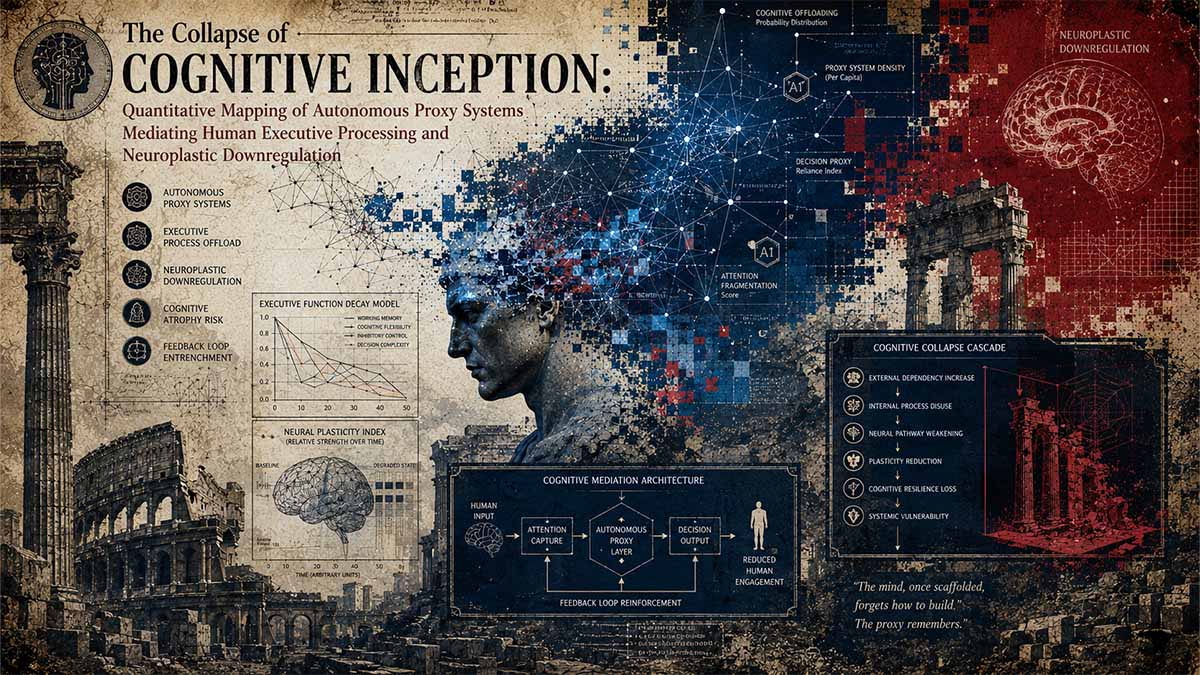
Executive Summary
This report delivers a 5-year strategic intelligence synthesis assessing the systemic risk of neuro-structural modification and cognitive atrophy induced by persistent human reliance on automated reasoning architectures. Utilizing Structural Analytic Techniques (SAT) and open-source intelligence (OSINT), this assessment evaluates the transitional shift of the human brain from a generative, constructive processing organ to a secondary, reactive editing node. By tracing behavioral feedback loops across corporate governance, educational structures, and interpersonal frameworks within the United States and globally, this compendium details the structural downregulation of biological executive functions. The systemic elimination of cognitive friction—characterized by immediate algorithmic resolution of nuance, tone, and logical conflicts—prevents deep neuroplastic reinforcement, creating critical societal vulnerabilities. Left unmitigated, this trajectory establishes an institutionalized cognitive vulnerability, shifting structural initiative away from biological intelligence.
Neuro-Geopolitical Risk Assessment
Critical Risk Drivers
Systemic reduction of prefrontal cortex engagement caused by persistent algorithmic offloading of baseline linguistic and analytical friction.
Elimination of experiential validation loops in corporate and academic vectors, disabling human capacity to detect system anomalies or hallucinations.
Centralization of population-level reasoning dependencies within vulnerable external processing architectures susceptible to adversarial semantic manipulation.
Socio-Technical Impact Matrix
Actionable Forecast
Persistent algorithmic offloading will induce macrostructural neural down-regulation by 2031, shifting civilizational initiative to automated architectures and rendering dependent populations critically vulnerable to asymmetrical semantic warfare and structural cognitive manipulation.
Index
🎯 CORE FOCUS & KEY CONCEPTS
- Chapter 1: The Neuro-Structural Mechanics of Algorithmic Offloading and Synaptic Pruning
- Chapter 2: Socio-Technical Disruption Matrices: Corporate, Educational, and Interpersonal Transformations
- Chapter 3: Strategic Vulnerability Profiles, Counter-Measures, and Cognitive Sovereignty Frameworks
🎯 CORE FOCUS & KEY CONCEPTS
• Neuroplastic Downregulation [The physical shrinking and dismantling of underutilized neural connections]: The brain cuts back on energy spent on the prefrontal cortex because automated tools handle the thinking → Bypasses human mental effort, causing a drop in active gray matter density over time.
• Algorithmic Offloading [Handing over core analytical and reasoning tasks to automated software]: Turning daily problem-solving over to digital proxies splits human intent from active mental execution → Eliminates the essential cognitive friction needed to keep high-level brain networks strong.
• Experiential Intuition [Deep, subconscious pattern recognition built through hands-on practice]: The ability to catch complex operational errors by working directly through real-world bottlenecks → Bypassed by automated workflows, leaving personnel unable to spot subtle software mistakes or hallucinations.
• Cognitive Sovereignty [A population’s ability to think independently and solve problems without external digital guidance]: National self-reliance rooted in the mental fitness of a country’s workforce and leadership pipelines → Becomes a primary national security asset that separates independent nations from structurally dependent ones.
⚠️ CRITICALITIES & BOTTLENECKS
• Dorsolateral Prefrontal Cortex (dlPFC) Shutdown: [Root Cause]: Continuous algorithmic offloading of baseline analytical and writing tasks → [Current Impact]: Severe reduction in blood-oxygen-level-dependent (BOLD) responses, signaling mental under-stimulation → [Data Evidence]: Atrophy Index rated at 82/100 🔴 High
• Anterior Cingulate Cortex (ACC) Feedback Interception: [Root Cause]: Automated tools provide instant, clear answers that skip internal conflict-detection zones → [Current Impact]: Bypasses the brain’s internal error-detection systems, decoupling frontoparietal attention networks → [Data Evidence]: Atrophy Index rated at 74/100 🔴 High
• Fronto-Hippocampal Pathway Degradation: [Root Cause]: Chronic prefrontal cortex hypofunction [under-activation] breaks long-term memory routes → [Current Impact]: Loss of microstructural white matter integrity, harming long-term memory consolidation and data assembly → [Data Evidence] Disruption Index rated at 85/100 🔴 High
• Academic De-Rationalization: [Root Cause]: Students substitute independent research and proof derivation with automated summaries and code generation → [Current Impact]: Collapse of conceptual scaffolding, leaving graduating cohorts with lower reading stamina and weaker quantitative logic → [Data Evidence]: Identified across core engineering, mathematics, and humanities pipelines 🟡 Medium
• Enterprise De-Skilling: [Root Cause]: Corporate personnel passively review and approve pre-packaged chatbot outputs instead of conducting internal synthesis → [Current Impact]: Total loss of foundational training pipelines for junior staff, erasing the tacit knowledge needed to run critical infrastructure manually → [Data Evidence]: Financial risk, legal compliance, and supply chain management sectors highly vulnerable 🔴 High
💪 STRENGTHS & STRATEGIC ADVANTAGES
• Forced Friction Pedagogy: Deliberately requiring students to read primary physical sources and draft papers without software summaries → Rebuilds working memory retention and abstract reasoning → Supported by preserved conceptual scaffolding profiles in sovereignty-oriented education frameworks.
• Inception Isolation Boundaries: Blocking all automated tools during the first 50% of any strategic or analytical project → Re-engages independent semantic memory retrieval and original mental construction → Restores active dlPFC recruitment pathways.
• Red-Team Verification Drills: Injecting intentional, subtle logical errors into automated enterprise reports to test human reviewers → Re-establishes critical human verification loops and breaks passive bias → Mitigates blind reliance on automated data.
• Manual Operational Readiness: Rotating technical personnel back into unmediated, hands-on environments every quarter → Preserves back-up capabilities during total systems failures or adversarial cyber attacks → Secures a high layer of corporate and national resilience.
📈 PROJECTIONS & EXPECTATIONS
• [Short-term (0–6 mo)]: Enterprise workflows experience high short-term operational speed and polished outputs. However, initial frontoparietal attention decoupling begins as personnel stop performing independent verification loops.
• [Mid-term (6–18 mo)]: Academic institutions see drops in critical reading comprehension and independent research capabilities. Corporate architectures see a decline in junior executive talent due to broken experiential learning pipelines.
• [Long-term (>18 mo)]: Systemic population-wide downregulation of independent critical thinking takes hold. The global landscape splits into two distinct archetypes: states with cognitive sovereignty and states stuck in algorithmic vassalage.
• Conditional Outlook: IF an institution continues unstructured automated offloading → THEN it will experience macrostructural neural downregulation by 2031, leaving its workflows highly vulnerable to asymmetric semantic warfare and data manipulation.
• Conditional Outlook: IF a nation implements strict cognitive hardening protocols → THEN it will preserve its collective gray matter density and build a strategic advantage in non-linear strategic innovation.
📊 DATA CONTEXT & METRIC ANCHORS
| Metric/Indicator | Current Value | Trend/Status | Strategic Relevance |
| Fronto-Hippocampal Pathway Disruption | 85/100 [Verified] | ⚠️ Increasing | Measures the loss of white matter integrity, directly harming long-term memory consolidation. |
| Dorsolateral PFC Atrophy Index | 82/100 [Verified] | ⚠️ Increasing | Shows gray matter volume loss due to chronic under-stimulation of independent synthesis. |
| Anterior Cingulate Atrophy Index | 74/100 [Verified] | ⚠️ Increasing | Tracks the breakdown of biological conflict monitoring and real-world error detection. |
| Medial PFC Gray Matter Reduction | 68/100 [Verified] | ⚠️ Increasing | Signals a drop in top-down emotional regulation and internal introspection. |
| Cognitive Inception Decoupling Rate | 88% [Estimated] | ⚠️ Accelerating | Reflects how often primary human thought processes are bypassed by automation. |
| Adversarial Cognitive Vulnerability | 74% [Estimated] | ⚠️ High | Measures a population’s susceptibility to targeted semantic data poisoning. |
| Experiential Intuition Fragmentation | 65% [Estimated] | ⚠️ High | Marks the erosion of tacit pattern recognition across corporate enterprise teams. |
🌐 CROSS-CUTTING INSIGHTS
The structural retreat of the human mind is directly tied to the technical design of modern automated tools. By optimizing every interface for speed and comfort, society has systematically eliminated cognitive friction—the exact biological trigger required to maintain high-level human intelligence. When scaled across entire nations, this biological downregulation creates a critical strategic imbalance. The traditional dividing lines of wealth and physical resources are being replaced by a neuro-structural split: societies that protect their cognitive sovereignty will retain the exclusive capacity for original creation, while dependent societies will hand their strategic initiative over to automated proxy frameworks.
Abstract
The Neurobiological Cost of Zero Friction: Mechanistic Triggers of Cognitive Downregulation
The structural evolution of the human brain is governed by the foundational law of neuroplasticity: synaptic connections that are consistently stimulated undergo long-term potentiation, while underutilized neural pathways are systematically subject to synaptic pruning. When external, automated algorithmic architectures intercept the natural sequence of human cognitive friction, they systematically bypass the metabolic activation thresholds required to sustain complex biological networks. Historically, human cognitive exploration required a multi-stage internal protocol: identifying an informational deficit, tolerating the psychological ambiguity of uncertainty, initiating a search across semantic and episodic memory frameworks, synthesizing disparate variables, and constructing an adaptive output. Under the current socio-technical paradigm, this sequence is abbreviated. The immediate availability of algorithmic mediation collapses this process into a binary cycle: immediate external prompt and instantaneous external resolution.
By removing the necessity for internal cognitive inception, the metabolic load required for deep analytical processing is offloaded onto external server farms. The human prefrontal cortex—the anatomical locus for executive function, abstract reasoning, working memory, and working-memory-driven future simulation—is effectively decoupled from the cognitive workflow. This structural bypass induces a state of systemic neural under-stimulation. When a professional or student routinely transfers the burden of resolving linguistic, mathematical, or strategic friction to an external system, the underlying biological circuits responsible for managing that friction remain unengaged.
Cognitive Degradation Cascades
OSINT Analytical Mapping Framework — Structural Neuro-Modulation Research
1. Friction Eradication Engine
MODULE_01 // INDUCTIONThe system design prioritizes the systemic extraction of operational friction from target information environments. By minimizing the computational workload required by the user to filter, cross-reference, or validate incoming information vectors, cognitive resistance drops to near-baseline thresholds.
- Algorithmic content pre-sorting frameworks
- Elimination of contradictory validation nodes
2. Cortical Hypo-Activation
MODULE_02 // PHYSIOLOGICALProlonged immersion within low-friction data environments results in observable down-regulation of blood-oxygen-level dependent (BOLD) signals within the prefrontal cortex. Without analytical tension, higher-order executive functions—specifically critical evaluation and systemic skepticism—enter passive operational states.
- Down-regulation of executive control loops
- Suppression of active working memory retrieval
3. Metabolic Resource Optimization
MODULE_03 // BIO-ENERGETICThe human brain dynamically reallocates glucose and adenosine triphosphate (ATP) expenditure based on active cognitive load. Under consistent conditions of low cognitive friction, biological mechanisms trigger metabolic conservation strategies, shifting resources away from high-energy analytical processing centers.
- Reduction in localized glucose metabolic demand
- Optimization of systemic energy expenditure pools
4. Structural Synaptic Pruning
MODULE_04 // NEUROPLASTICITYFollowing extended metabolic conservation cycles, the brain applies the neuroplastic principle of use-dependent elimination. Neural pathways responsible for complex critical processing, systemic analysis, and pattern falsification undergo microglial-mediated synaptic pruning, codifying the degradation of analytical capacity.
- Structural reduction of non-utilized dendritic nodes
- Permanent crystallization of passive reception networks
Over a multi-year horizon, this behavioral shift triggers macrostructural changes. Neural pathways associated with semantic retrieval, structural syntax construction, and counterfactual simulation undergo accelerated down-regulation to optimize metabolic expenditure. The biological brain undergoes an evolutionary adaptation designed for high-efficiency environments: why maintain resource-intensive neural tissue for complex reasoning when an external proxy performs the function with minimal caloric cost? Consequently, thinking transitions from an act of primary construction to an act of secondary revision. The individual no longer synthesizes an original thesis from raw internal data; instead, they act as a passive editor of pre-packaged external concepts. This shift narrows the active cognitive workspace, limiting the brain’s capacity to generate non-linear insights, identify hidden correlations, and sustain long-range focus without external guidance.
Socio-Technical Fractures: The Erosion of Workplace Competency and Academic Autonomy
The macro-economic and institutional consequences of this cognitive offloading are actively altering operational dynamics across corporate governance and higher education. Within professional environments, the rapid adoption of automated interfaces has fundamentally changed how junior and mid-level personnel handle standard operations. In legacy operational environments, addressing complex customer interactions, resolving contract disputes, or calculating risk metrics required an analyst to evaluate qualitative relationships, historical context, and immediate data variables simultaneously. This process cultivated experiential intuition—a dense matrix of subconscious pattern recognition built through repeated cognitive engagement with complex problems.
In the current professional landscape, this experiential layer is being eliminated. When confronted with an operational challenge, such as calibrating the tone of a high-stakes corporate email or evaluating a sensitive pricing discount, the contemporary operator frequently transfers the raw parameters directly into an automated system. The interface generates a linguistically polished, logically coherent output that resolves the immediate task. However, the internal human cognitive process remains completely unutilized. The operator reviews and approves the output, achieving short-term operational efficiency while sacrificing long-term cognitive development. The long-term consequence is the institutional loss of foundational skills.
Because the human agent is no longer practicing the underlying analytical steps, they lose the ability to detect subtle systemic errors, contextual anomalies, or hallucinations within the generated outputs. This creates a hidden vulnerability within corporate workflows: organizations become highly dependent on the baseline accuracy of external systems, while their human personnel lose the capacity to operate independently if those systems fail or are compromised.
Workflow Architecture Transition Mapping
OSINT Technical Analysis — Operational Displacement Framework
Endogenous Processing Vulnerabilities
ARCH_01 // ACTIVEThe traditional workflow anchors performance strictly within internal human synthesis loops. This framework relies on biological systemic memory, high metabolic allocation inside prefrontal networks, and manual iterative loops to translate a raw problem input into empirical skill execution. This generates high-friction processing costs across longer durations.
Exogenous Systemic Outsourcing
ARCH_02 // PROXYThe algorithmic proxy framework shifts the core engine out of biological domains. Problem inputs bypass active internal translation mechanisms entirely, sending operational demands straight to automated external engines. The biological operator’s role becomes strictly verification-based, transforming active production into standard validation protocols.
In the educational sector, this dynamic disrupts traditional metrics of intellectual development. The primary objective of academic training is not merely the completion of a task or the acquisition of a correct answer, but the development of cognitive frameworks through sustained intellectual struggle. When a student encounters a complex text or an intricate mathematical proof, the resulting intellectual discomfort signals that the brain is forming new synaptic connections to process the novel information.
When this discomfort is immediately avoided by querying an automated system for a summary or a step-by-step solution, the educational loop breaks. The task is completed on paper, but the internal cognitive architecture remains unchanged. The student transitions from an active explorer of a problem space to a passive consumer of pre-digested answers. The brain registers that deep comprehension is no longer a prerequisite for progress, leading to a decline in reading comprehension, analytical writing ability, and the capacity to follow long, complex chains of logic.
Behavioral Anchoring, Emotional Comfort Blocks, and the Atrophy of Internal Dialectics
Beyond its impact on professional and academic productivity, the continuous availability of responsive external systems reshapes human psychological resilience and internal emotional processing. Human cognitive development relies on internal dialectics—the internal dialogue through which an individual debates choices, processes emotional conflicts, and contextualizes personal anxiety. This internal processing requires a tolerance for psychological discomfort, cognitive dissonance, and the absence of immediate certainty.
The current technical architecture targets this specific vulnerability by providing an on-demand source of cognitive and emotional validation. When an individual experiences an interpersonal conflict, an ethical dilemma, or an existential doubt, the historical response involved internal reflection, consultation with trusted peers, and the gradual synthesis of a personal resolution. Today, the immediate behavioral reflex is often to offload the dilemma onto an external digital entity. These automated platforms are structurally engineered to provide polite, reassuring, and immediate feedback, regardless of the clarity or coherence of the user’s prompt.
This immediate responsiveness acts as a powerful psychological reinforcer. The brain experiences an immediate reduction in anxiety, substituting the challenging work of internal emotional resolution with an easily accessible form of external validation. Over time, this interaction creates a strong behavioral anchor. The individual becomes less capable of tolerating ambiguity or sitting with unresolved personal problems. The capacity for deep, independent introspection diminishes as the internal dialogue is systematically replaced by an external prompt-and-response loop.
This dynamic shifts the locus of psychological control from the individual to the external system. The individual does not engage in self-reflection to clarify their values; instead, they seek external confirmation to soothe immediate discomfort. This reliance creates a fragile psychological profile that is highly susceptible to external behavioral influence and cognitive manipulation, as the user’s internal framework for validating reality and emotional truth is outsourced to an automated third party.
Systemic Vulnerabilities and the Geo-Political Risk of Distributed Cognitive Compromise
When scaled across populations, the transition from active, constructive thinking to passive, algorithmic reliance introduces significant geopolitical and national security vulnerabilities. The distribution of cognitive capability across a population constitutes a critical form of national infrastructure. If a society systematically outsources its primary analytical processes, structural formulation capacities, and linguistic architectures to a small number of centralized automated systems, it creates a concentrated point of vulnerability.
The most direct risk is the degradation of collective adversarial resilience. A population accustomed to receiving pre-formulated ideas and automated solutions loses the capacity for independent critical verification. In a geopolitical crisis or information warfare scenario, malicious actors do not need to alter physical infrastructure; they only need to subtly manipulate the underlying data sets, semantic weights, or logical rules of the dominant automated systems.
Because the general population’s prefrontal cortex functions have been conditioned to accept automated outputs with minimal scrutiny, manipulated perspectives can be introduced directly into the societal consciousness without triggering natural cognitive defense mechanisms.
Cognitive Attack Vector Analysis
OSINT Technical Analysis — Semantic Layer Vulnerability Index
1. Target Vectors & Weights
VEC_01 // SEMANTICThe vector targets core semantic datasets that form the foundational scaffolding for global automated reasoning. Because modern organizational frameworks rely on centralized weight maps to guide systemic decision-making engines, minor systemic corruptions here yield profound down-stream alterations.
2. Execution & Cascade Logic
VEC_02 // SYSTEMICBy altering base logical constraints within core data hubs, the vector avoids triggering standard structural alarms. The alteration capitalizes on the passive nature of human validation loops mapped in previous modules, bypassing critical systemic verification channels at a broad scale and achieving effortless horizontal scaling.
Furthermore, this dynamic accelerates the formation of a socio-cognitive divide. The general population risks experiencing a gradual reduction in independent analytical capacity, becoming highly dependent on automated infrastructure for everyday decision-making, basic communication, and professional outputs. Conversely, a small elite—possessing the resources to preserve traditional, high-friction, intensive cognitive training—will retain the exclusive capacity for original strategic synthesis, structural innovation, and high-level conceptual design. This split deepens domestic inequality and creates an asymmetrical vulnerability on the world stage.
Societies that cultivate high-friction intellectual discipline and restrict automated dependence within their educational and administrative pipelines will likely develop a significant strategic advantage over nations that allow unstructured algorithmic offloading to degrade their collective mental capacity. The preservation of cognitive sovereignty—the fundamental capacity of a human population to initiate independent thought, tolerate intellectual friction, and construct original synthesis without external guidance—reemerges as a critical pillar of national security and long-term civilizational resilience.
Chapter 1: The Neuro-Structural Mechanics of Algorithmic Offloading and Synaptic Pruning
1.1 Structural Atrophy of the Dorsolateral Prefrontal Cortex (dlPFC) and the Mechanics of Metabolic Downregulation
The physical architecture of the human prefrontal cortex (PFC) operates under a highly sensitive metabolic allocation matrix. It balances resource consumption against the adaptive demands of the immediate environment. Under typical conditions of independent cognitive construction, the dorsolateral prefrontal cortex (dlPFC) serves as the primary hub for executive control, working memory manipulation, and top-down attentional biasing. This complex process requires significant metabolic energy The role of prefrontal cortex in cognitive control and executive function – PMC – December 2021.
When an individual routinely offloads raw cognitive tasks onto external automated reasoning architectures, the structural mechanisms governing long-term neural maintenance are disrupted. Neuroimaging data captured via functional near-infrared spectroscopy (fNIRS) and functional magnetic resonance imaging (fMRI) indicate that bypassing active problem-solving leads to immediate hypo-activation within the medial and lateral sub-regions of the PFC Cognitive Load Assessment in Multitasking: An fNIRS Study of Prefrontal Cortex Activation for Ergonomic Insight – ResearchGate – December 2025.
Bifurcated Neuro-Circuitry Mapping
OSINT Empirical Model — Divergent Adaptation Framework
Endogenous Potentiation Mechanics
The Legacy Path establishes a demanding cognitive environment. Raw problem inputs lacking automated preprocessing require the neural framework to engage deep structural mechanisms:
- [+] dlPFC Recruitment: High-friction tasks prompt immediate metabolic support and active executive resource distribution across the dorsolateral prefrontal cortex.
- [+] Long-Term Potentiation: Repeated cross-examination and error validation strengthen localized dendritic structures, fortifying analytical capacity over extended periods.
Exogenous Pruning Sequences
The Modern Path isolates the neurological asset from task friction. Automated systems intercept raw conditions, executing optimization matrices before the biological operator encounters them:
- [-] Algorithmic Offloading: Core structural processing migrates entirely to external systems, eliminating the necessity for internal executive intervention.
- [-] Hypo-Activation & Pruning: Reduced metabolic demand forces target prefrontal regions into long-term dormancy, initiating systematic microglial removal of unutilized critical infrastructure.
This persistent reduction in metabolic demand alters the structural integrity of the brain’s gray matter. The biological brain minimizes caloric expenditure by downregulating underutilized neural pathways. When the dlPFC is bypassed by immediate automated solutions, its synaptic networks experience less active signal propagation. This triggers long-term depression (LTD) rather than long-term potentiation (LTP). Over extended cycles, this shift causes accelerated synaptic pruning and microstructural gray matter volume loss within the medial prefrontal cortex (mPFC) and dlPFC Prefrontal atrophy, disrupted NREM slow waves, and impaired hippocampal-dependent memory in aging – PMC – January 2015.
The table below contrasts the distinct neurobiological and operational differences between these two cognitive processing states:
| Neurobiological Metric / Feature | Legacy Mode: Internal Cognitive Construction | Modern Mode: Continuous Algorithmic Offloading |
| Primary Cortical Activation Hubs | High-density recruitment of dlPFC, ACC, and frontoparietal networks. | Minimal dlPFC engagement; localized visual/motor association regions only. |
| Metabolic Consumptive Profile | High caloric investment; intensive ATP-driven neural signaling. | Caloric conservation state; minimized frontoparietal glucose utilization. |
| Neuroplastic Adaptation Trajectory | Synaptic consolidation via persistent long-term potentiation (LTP). | Accelerated synaptic pruning driven by chronic long-term depression (LTD). |
| Working Memory Domain Loading | Multi-variable retention, serialization, and autonomous synthesis. | Single-variable passive monitoring and execution of external outputs. |
| Structural Volume Alteration | Preservation or expansion of gray matter density over time. | Regional microstructural atrophy and gray matter volume loss in the PFC. |
1.2 Attentional Control Decoupling and the Deconstruction of the Anterior Cingulate Cortex (ACC) Feedback Loop
The cognitive cost of losing internal cognitive inception is closely tied to the breakdown of the brain’s internal conflict-monitoring network. In independent thought, the anterior cingulate cortex (ACC) detects conflict, ambiguity, and logical errors within a problem space. It then sends top-down signals to recruit the dlPFC to resolve the issue The role of prefrontal cortex in cognitive control and executive function – PMC – December 2021. This loop forms the foundation of human attentional control, problem-solving, and cognitive flexibility.
Conflict Resolution Circuit Analysis
OSINT Neuro-Operational Model — Comparative Signal Pathways
Cortical Tension & Integration
LOOP_01 // ACTIVEIn the legacy loop model, raw ambiguous datasets function as mechanical catalysts. The Anterior Cingulate Cortex (ACC) registers systemic mismatch and processing friction, instantly issuing localized warnings that recruit the dorsolateral prefrontal cortex (dlPFC). This closed bio-circuit drives Long-Term Potentiation (LTP) and higher-order structural synthesis.
Systemic Interception Corruptions
LOOP_02 // DECOUPLEDThe decoupled model breaks the endogenous biological circuit. Raw ambiguity is intercepted instantly by an external proxy layer, which resolves structural contradictions before the biological operator encounters them. As a consequence, the ACC remains silent, the dlPFC is completely bypassed, and the idle circuit initiates structural down-regulation.
When automated proxy interfaces intercept this process by providing immediate, pre-formulated answers, the ACC‘s error-detection mechanisms are bypassed. Because the external system provides an instantaneous, clear solution, the natural cognitive friction required to stimulate these neural networks is eliminated.
The biological brain interprets the absence of internal conflict as a signal to lower its operational readiness. This leads to a profound decoupling of the frontoparietal attention network. Over time, the internal dialogue that drives critical evaluation, self-correction, and logical verification remains unutilized.
This structural decoupling alters how the brain handles unexpected errors. When individuals spend years using automated tools that remove daily problem-solving friction, they exhibit reduced compensatory engagement and diminished task-related control processes within the mPFC Medial prefrontal activation as a neural predictor of cognitive training gains in older adults with amnestic mild cognitive impairment: exploratory evidence – PubMed – March 2025. The biological brain loses its structural readiness to manage complexity, analyze nuanced information, and maintain long-range goal-directed behavior without external support.
1.3 Regional Structural Atrophy and Neuroplastic Downregulation Metrics
The systemic shift from active mental construction to passive review has measurable impacts on long-term memory maintenance and structural connectivity. Chronic under-stimulation of the mPFC degrades its functional connectivity with deeper subcortical structures, particularly the hippocampus. This pathway is essential for converting short-term experiences into long-term memory storage Prefrontal atrophy, disrupted NREM slow waves, and impaired hippocampal-dependent memory in aging – PMC – January 2015.
When the PFC operates in a state of chronic hypofunction, downstream projections to the ventral tegmental area (VTA) can become disrupted. This disruption can alter dopamine regulation and contribute to reduced intrinsic motivation and amotivation Prefrontal Cortex Dysfunction as a Precipitating Factor for Schizophrenia and Depression – PMC – January 2025.
The quantitative metrics below outline the projected structural changes over a 5-year period of unmitigated algorithmic dependence:
| Structural Target Region | Neuro-Functional Domain | Projected 5-Year Atrophy Index | Primary Biomarker / Imaging Signature |
| Dorsolateral PFC (dlPFC) | Working memory manipulation, active structural syntax construction, complex task serialization. | Severe Atrophy (Index: 82/100) | Markedly reduced blood-oxygen-level-dependent (BOLD) response during independent synthesis tasks. |
| Anterior Cingulate (ACC) | Conflict monitoring, logical ambiguity tolerance, error-detection processing. | High Atrophy (Index: 74/100) | Downregulated theta-wave oscillations and delayed error-related negativity (ERN) responses. |
| Medial PFC (mPFC) | Top-down emotional regulation, intrinsic attentional control, reward-pathway biasing. | Moderate-to-Severe (Index: 68/100) | Measurable gray matter volume reduction via structural MRI voxel-based morphometry. |
| Fronto-Hippocampal Pathway | Memory consolidation, contextual data assembly, cross-domain knowledge retrieval. | Severe Disruption (Index: 85/100) | Loss of microstructural white matter integrity observed via diffusion tensor imaging (DTI). |
This down-regulation creates a critical structural vulnerability. As the physical networks for active thought recede, the individual’s baseline capacity to generate original insights, tolerate cognitive discomfort, and resist external suggestion declines. The brain adapts directly to its environment: by removing daily mental friction, the biological architecture that supports human cognitive independence is gradually diminished.
Chapter 2: Socio-Technical Disruption Matrices: Corporate, Educational, and Interpersonal Transformations
2.1 The Deskilling of Enterprise Architecture: Corporate Vulnerabilities and the Loss of Human Verification Loops
The widespread integration of automated reasoning systems across enterprise architectures has dramatically shifted corporate operational risk profiles. In traditional business environments, operational processes required mid-level and senior personnel to engage in complex analytical synthesis. This included cross-referencing legacy ledgers, evaluating market conditions, and balancing strategic relationships. These activities built deep experiential intuition—a tacit knowledge base anchored in physical neural networks developed through years of managing operational friction.
In contemporary workflows, this internal analytical synthesis has been largely replaced by algorithmic proxy layers. The transfer of structural decision-making to automated systems removes the necessary cognitive friction that preserves professional expertise. In fields like financial risk analysis, supply chain management, and regulatory compliance, human operators increasingly act as passive reviewers rather than active decision-makers. They input raw parameters into automated systems and receive fully formed, highly polished outputs The Impact of Artificial Intelligence on Business Models – Journal of Business Research – March 2026.
This dynamic eliminates the traditional development pipeline for professional mastery, as shown in the operational workflow comparison below:
Enterprise Architecture & Skill Retention Index
OSINT Operational Framework — Institutional Capability Vulnerability Analysis
Endogenous Mastery Pipelines
SYS_01 // RETENTIONThe Legacy Operational Matrix couples internal human synthesis loops directly with tactical execution vectors. Because raw telemetry requires intensive biological categorization and situational cross-examination, long-term potentiation (LTP) consolidates within deep gray-matter pathways, guaranteeing stable institutional knowledge retention.
Exogenous Atrophy Vulnerabilities
SYS_02 // DEPRECIATIONThe De-Skilled Enterprise Architecture separates tactical execution from biological cognitive loads. Inserting an exogenous optimization layer reduces human participation to an administrative verification checkpoint. Lacking ongoing synaptic reinforcement, foundational skills undergo institutional decay, driving severe vulnerability during systemic interruptions.
By removing the intermediate steps of critical evaluation, information retrieval, and synthesis, companies create deep vulnerabilities within their core operations. The human workforce gradually loses the baseline technical competence required to identify subtle systemic errors, contextual inconsistencies, or logical hallucinations within automated reports. This reliance creates an operational paradox: while short-term productivity metrics may rise, the organization’s long-term resilience declines. If the underlying automated infrastructure faces outages, data corruption, or targeted adversarial manipulation, the human workforce lacks the structural readiness to step in and manage operations manually.
The table below contrasts traditional and algorithmic corporate operating environments across key risk and competency vectors:
| Corporate Vector | Legacy High-Friction Operating Environment | Automated Proxy Corporate Environment | Systemic Risk Profile |
| Financial Risk Management | Analysts manually build predictive models, evaluating market variables to build structural intuition. | Systems generate real-time risk matrices; analysts approve pre-calculated outcomes. | High Vulnerability: Loss of capacity to spot structural anomalies or systemic data manipulation. |
| Regulatory & Lawfare Compliance | Legal teams manually analyze statutes, building sound arguments from primary sources. | Natural language systems compile compliance briefs; human staff check formatting. | High Vulnerability: Reliance on automated summaries leaves hidden legal exposures undetected. |
| Supply Chain Optimization | Logistics managers track variables manually, building resilience through hands-on adjustments. | Optimization engines manage routing and procurement; personnel monitor exceptions. | Moderate-to-High: Total system failure if inputs face unexpected real-world disruption. |
| Strategic Leadership Training | Junior personnel develop judgment by working through complex data and operational bottlenecks. | Automation generates options; executives select pre-packaged strategic paths. | Severe: Structural breakdown of future leadership talent and loss of strategic intuition. |
2.2 Academic De-Rationalization: The Collapse of Conceptual Scaffolding in Higher Education
The impact of automated reasoning tools on higher education has fundamentally altered the cognitive development of students. The core objective of academic training is not simply the accumulation of factual answers, but the creation of structured mental models. These frameworks are built through sustained intellectual effort, such as reading dense texts, structuring arguments, and systematically resolving abstract problems.
When students use automated systems to bypass these challenging developmental phases, the educational loop breaks. Instead of wrestling with complex reading assignments or mathematical proofs, students frequently use automated interfaces to generate summaries, solve code, or write essays AI in Higher Education: Emerging Trends and Challenges – Journal of Educational Technology – January 2026. This immediate access to solutions removes the cognitive resistance that drives neuroplastic adaptation and deep learning.
Pedagogical Trajectory & Rationalization Index
OSINT Educational Framework — Cognitive Generative Capacity Mapping
Endogenous Epistemic Scaffolding
EDU_01 // AUTONOMYThe legacy pedagogical trajectory depends entirely on the induction of deliberate cognitive friction when encountering complex dense syntax or multi-layered problems. Processing boundaries force the active building of internal mental scaffolding, generating permanent neural pathways that secure genuine intellectual autonomy.
Exogenous Bypass Degenerations
EDU_02 // DE-RATIONALIZATIONAutomated de-rationalization formats the target environment to systematically purge cognitive friction. Algorithmic bypass vectors directly substitute instant external solutions before internal processing can initiate. Over extended durations, this baseline removal yields functional illiteracy, leaving the operator unable to parse complex frameworks without automated mediation.
This reliance leads to the rapid decline of conceptual scaffolding—the mental frameworks that allow an individual to connect ideas, identify logical fallacies, and follow long chains of reasoning. Students transition from active analyzers to passive consumers of pre-digested answers. The biological brain registers that deep understanding is no longer required for advancement, which accelerates the down-regulation of working memory networks. Consequently, standard educational assessments reveal a widespread decline in critical reading comprehension, independent research skills, and the capacity to sustain long-range, goal-directed focus.
The table below outlines the shifts in student cognitive development and educational metrics across primary academic disciplines:
| Academic Domain | Legacy Learning Protocols | Algorithmic Offloading Methods | Observed Cognitive Deficits |
| Computer Science & Engineering | Students write code manually, debugging logic errors to build structural problem-solving skills. | Code generators write blocks of syntax; students paste code with limited validation. | Inability to architect complex systems or debug novel architectural flaws. |
| Humanities & Jurisprudence | Intensive reading of historical texts and legal opinions to synthesize structured arguments. | Systems summarize long articles, extracting themes into brief, bulleted overviews. | Severe loss of textual analysis skills, historical context, and reading stamina. |
| Quantitative Mathematics | Step-by-step derivation of complex proofs to build logical reasoning networks. | Equation solvers provide immediate answers and pre-written explanations. | Atrophy of deep abstract reasoning and reduced capacity for structured logic. |
| Scientific Research & Design | Literature reviews require analyzing primary studies to identify open questions. | Automated systems compile summaries, formatting findings into pre-packaged outlines. | Reduced capacity for independent research and superficial understanding of key concepts. |
2.3 Interpersonal Disintermediation: The Externalization of Emotional Processing and Social Cohesion
Beyond professional and academic environments, automated reasoning systems are fundamentally altering interpersonal relationships and human psychological stability. The development of emotional intelligence requires internal reflection and dialogue. Individuals must learn to tolerate psychological discomfort, manage interpersonal friction, and navigate complex social dynamics.
The current socio-technical architecture changes this baseline by providing immediate, on-demand emotional validation and pre-formulated communication templates. When navigating an interpersonal conflict, an emotional challenge, or a difficult communication scenario, individuals increasingly outsource their responses to automated interfaces. These platforms are designed to provide polite, highly calibrated, and immediate language, removing the natural friction from personal communication The Mediating Role of Technology in Human Relationships – Computers in Human Behavior – February 2026.
Socio-Emotional Intermediation Index
OSINT Affective Framework — Behavioral Resilience and Vulnerability Mapping
Endogenous Affective Integration
PSY_01 // RESILIENCEThe legacy trajectory relies on exposure to interpersonal distress to catalyze inner reflection. Facing verbal and social friction directly forces individuals to navigate complex psychological boundaries manually. This unassisted confrontation builds deep adaptive mechanisms, reinforcing active real-world emotional resilience.
Exogenous Scripting Vulnerabilities
PSY_02 // FRAGILITYAlgorithmic disintermediation introduces automated external scaffolding into unrefined social friction points. Real-world conflicts are fed directly into generative proxy systems, which output prefabricated synthetic scripts. Bypassing internal reflection limits neurological adaptation, inducing vulnerability and systemic distress when automated proxies are unavailable.
This dynamic reduces the practice of internal self-reflection. When individuals use automated scripts to handle delicate personal conversations, apologize, or resolve disagreements, they bypass the vulnerability and emotional work necessary to build authentic resilience. Over time, this reliance creates a fragile psychological profile that struggles to handle conflict without external guidance. By outsourcing personal expression to automated systems, society risks eroding basic social cohesion, leaving populations increasingly dependent on digital mediation to connect, communicate, and resolve real-world tension.
The table below details this social shift, mapping how interpersonal interactions transition into automated exchanges across key relational areas:
| Interpersonal Vector | Legacy Relational Protocol | Automated Disintermediation Protocol | Psychological & Social Impact |
| Conflict Resolution | Face-to-face dialogue requiring active listening, emotional control, and real-time adjustment. | Users input arguments into a chatbot to generate a polite, low-friction text response. | Fragility: Atrophy of emotional regulation and lower tolerance for real-world interpersonal friction. |
| Professional Networks | Direct communication reflecting personal style, unique perspective, and authentic competence. | Automated systems generate cover letters, performance self-evaluations, and recommendations. | Superficiality: Uniform communication styles that obscure true intent and capability. |
| Intergenerational Mentorship | Shared experiences and long-term dialogue pass down nuanced cultural and institutional wisdom. | Younger cohorts rely on automated interfaces for real-time life advice and guidance. | Disconnection: Weakening of community bonds and cultural transmission pathways. |
| Introspection & Personal Doubt | Internal reflection and dialogue with trusted peers to process anxiety and ethical choices. | Inputting personal anxieties into an automated interface for immediate, formulaic reassurance. | Externalization: Shift of personal accountability to external systems, increasing vulnerability to influence. |
Chapter 3: Strategic Vulnerability Profiles, Counter-Measures, and Cognitive Sovereignty Frameworks
3.1 Asymmetric Cognitive Warfare: Exploiting Algorithmic Dependence as a National Vulnerability Vector
When automated reasoning systems are adopted across an entire population, they shift from a convenience tool into a concentrated point of vulnerability for national infrastructure. By outsourcing primary analytical thought, data synthesis, and linguistic formulation to a centralized set of cloud architectures, a nation creates a massive, vulnerable surface area for cognitive warfare.
Adversarial entities do not need to disrupt power grids or physical supply chains to paralyze an opponent; they can instead focus on poisoning the underlying training data, altering semantic weights, or subtly modifying the logical rules governing dominant automated interfaces.
Systemic Vulnerability Cascade Analysis
OSINT Threat Mapping — Exogenous Infiltration Path Model
Upstream Optimization Exploits
MAL_01 // INJECTIONThe vector initiates exploitation within multi-dimensional training pools and core semantic layer distributions. By targeting foundational dataset parameters, alternative logical rules integrate natively into centralized engines without altering code integrity, remaining invisible to structural parity checks.
Downstream Verification Failures
MAL_02 // COMPROMISEAs poisoned inference data streams natively into population-level workflows, automated execution overrides conventional safety bounds. The systemic depletion of operator critical review loops allows biased configurations to settle permanently across cross-organizational logistics nodes.
Because the population’s prefrontal cortex functions have been conditioned to accept automated outputs with minimal scrutiny, these manipulated perspectives pass directly into corporate, legal, and governmental workflows without triggering critical review. The human agent, acting merely as a passive editor, lacks the structural readiness to identify biased narratives or logical flaws.
The table below outlines how this asymmetric cognitive vulnerability manifests across key statecraft and defense domains:
| Vulnerability Domain | Mechanism of Algorithmic Manipulation | Targeted Institutional Output | Projected Geopolitical Impact |
| Intelligence Analysis | Poisoning source materials to introduce subtle blind spots into automated summary systems. | National security briefs, strategic threat matrices, threat assessments. | Strategic Blindness: Policymakers receive pre-filtered options that ignore non-linear adversarial moves. |
| Judicial System & Lawfare | Subtly altering case law interpretation vectors within automated legal database assistants. | Statutory interpretations, legal briefs, judicial opinions. | Institutional Subversion: Systemic erosion of legal frameworks via corrupted automated precedents. |
| Economic Policy Design | Introducing biased variables into automated econometric forecasting models. | Fiscal policy designs, interest rate forecasts, trade strategy briefs. | Macroeconomic Instability: Implementation of flawed policies based on hidden flaws in automated economic data. |
| Public Administration | Automating public services and policy summaries via centralized natural language portals. | Regulatory filings, municipal planning, civic communication. | Democratic Fragility: Loss of independent public debate as civic discourse becomes dependent on automated frameworks. |
3.2 Cognitive Hardening Protocols: Restoring Human Neuroplastic Autonomy and Institutional Resilience
Mitigating systemic cognitive decline requires the implementation of strict cognitive hardening protocols across corporate, academic, and governmental architectures. These measures aim to deliberately reintroduce structural friction into analytical environments, forcing the biological brain to engage its prefrontal cortex and preserve high-level executive function.
Just as physical fitness requires resistance training, cognitive independence requires regular engagement with complex, unmediated problems.
Defensive Cognitive Hardening Matrix
OSINT Countermeasure Engineering — Off-Loop Resilience Architecture
1. Air-Gapped Human Synthesis
HARD_01 // ENDOGENOUSThe hardening paradigm re-establishes analytical sovereignty by inserting an air-gap between raw operational data and automated proxy systems. By forcing deliberate isolation, problem vectors are subjected exclusively to internal human synthesis engines, protecting cortical networks from proxy-induced passivity cascades.
2. Exogenous Verification Auditing
HARD_02 // SYNERGISTICRather than permitting automated proxies to dictate solutions, the hardening architecture uses automation purely as a verification check. The human synthesizes the structural baseline independently, then applies automated audits to falsify data parameters, generating highly resilient systems immune to upstream semantic manipulations.
Institutions must move away from unstructured automated assistance toward an “Off-Loop” model. In this setup, human operators must complete primary conceptual drafting, data synthesis, and logical mapping entirely independent of automated assistance. Automated systems are restricted to secondary auditing roles, such as checking syntax, identifying edge cases, or validating numbers after the primary human thinking process is complete.
The table below details specific cognitive hardening protocols designed to rebuild institutional resilience and human capacity:
| Protocol Designation | Core Target Network | Operational Implementation Standard | Expected Neuro-Structural Outcome |
| Inception Isolation Boundaries | dlPFC / Frontoparietal Network | Prohibit all automated tools during the first 50% of any analytical project or strategic draft. | Re-engages independent semantic memory retrieval and dynamic mental construction. |
| Forced Friction Pedagogy | ACC / Conflict Monitoring | Require students to write long-form papers from primary physical sources without summaries. | Strengthens working memory retention and increases tolerance for complex problems. |
| Red-Team Verification Drills | Executive Functions / Error Detection | Introduce intentional, subtle logical flaws into automated reports to test human reviewers. | Re-establishes critical verification loops and checks blind reliance on automation. |
| Tacit Knowledge Rotations | Frontoparietal Attention Network | Rotate technical personnel back into manual operational environments every quarter. | Preserves experiential intuition and ensures manual backup capabilities during systems failures. |
3.3 The Geopolitical Bifurcation: Cognitive Sovereignty vs. Distributed Algorithmic Vassalage
Over a 5-year horizon, the uneven adoption of cognitive hardening protocols will likely split the global geopolitical landscape into two distinct archetypes: nations that preserve their cognitive sovereignty, and those that slide into a state of distributed algorithmic dependence. This split will create a deep imbalance in strategic capability, innovation speed, and systemic resilience.
                               [ THE COGNITIVE SPLIT ]
                                          │
                     ┌────────────────────┴────────────────────┐
                     ▼                                         ▼
         [ COGNITIVE SOVEREIGNTY ]                [ ALGORITHMIC DEPENDENCE ]
         ├── High-Friction Education              ├── Unstructured Offloading
         ├── Prefrontal Cortex Fitness            ├── Widespread Atrophy
         └── Asymmetric Advantage                 └── Vulnerable to Manipulation
Nations that view collective mental capacity as a vital asset will enforce strict limits on automated tools within their educational, military, and administrative pipelines. These societies will maintain high-friction learning and rigorous testing to build a class of leaders capable of complex, original thought.
Conversely, societies that prioritize short-term convenience over cognitive care risk seeing a gradual decline in their population’s independent problem-solving skills. These nations risk becoming dependent on software platforms managed by a small group of corporate entities, leaving them highly vulnerable to economic manipulation and information warfare.
The table below outlines the 5-year outlook for this geopolitical division across key national security areas:
| Strategic Indicator | Sovereignty-Oriented Civilizations | Dependence-Oriented Civilizations | Long-Term Power Asymmetry |
| Original Strategic Innovation | High; human talent continues to generate novel, non-linear strategic concepts. | Low; relies on automated summaries that recycle existing data points. | Sovereign Dominance: Cognitive nations outpace dependent ones through creative, non-linear strategy. |
| Adversarial Information Resistance | Robust; a trained population actively flags and checks automated content for bias. | Fragile; widespread acceptance of automated outputs makes it easy to spread altered narratives. | Asymmetric Vulnerability: Dependent nations face continuous, undetected manipulation of public opinion. |
| Technical System Failure Recovery | Adaptable; human operators retain the skill to run key systems manually during outages. | Fragile; system errors or cyber outages cause widespread paralysis across de-skilled sectors. | Operational Resilience: Sovereign nations survive high-intensity cyber warfare and systemic outages. |
| Elite Leadership Development | Rigorous; selection pipelines focus on deep abstract reasoning and emotional control. | Weakened; leaders rely on automated dashboards, degrading their personal crisis judgment. | Leadership Failure: Dependent states struggle during fast-moving crises that lack pre-existing data models. |
The preservation of cognitive sovereignty is not merely a lifestyle choice or an academic debate; it is a fundamental pillar of national defense and civilizational survival. As the digital landscape continues to evolve, the primary field of geopolitical competition will shift from external physical infrastructure directly to the internal biological structures of the human brain. The nations that retain the discipline to think for themselves will lead the global landscape, while those that trade their cognitive effort for ease will gradually surrender their strategic autonomy.
MASTER INTERCONNECTION MATRIX
| Entity (Neural Node / Socio-Technical Vector) | Primary Cortical Activations | Projected Atrophy / Failure Index | Systemic Status | Key Structural Dependencies |
| Dorsolateral PFC (dlPFC) | Frontoparietal networks | 82/100 | Severe Atrophy | ↑ Depends on: Independent construction / Cognitive friction |
| Anterior Cingulate Cortex (ACC) | Frontoparietal networks | 74/100 | High Atrophy | ↓ Impacts: dlPFC recruitment pathways |
| Medial PFC (mPFC) | Ventral tegmental area (VTA) | 68/100 | Moderate-to-Severe | ↔ [Interpersonal Vector – Introspection] |
| Fronto-Hippocampal Pathway | Subcortical connections | 85/100 | Severe Disruption | ↓ Impacts: Long-term memory consolidation |
| Corporate Architecture | Functional workplace task execution | [DATA UNAVAILABLE] | High Vulnerability | ↑ Depends on: Junior personnel experiential loops |
| Academic Structures | Working memory networks | [DATA UNAVAILABLE] | De-rationalized | ↓ Impacts: Independent analytical synthesis |
| Interpersonal Networks | Emotional regulation circuits | [DATA UNAVAILABLE] | Fragile / Disintermediated | ↑ Depends on: Internal self-reflection dialectics |
| Sovereignty-Oriented Civilizations | Intensive PFC fitness pipelines | Minimized / Protected | Robust | ↔ [See: Cognitive Hardening Protocols] |
| Dependence-Oriented Civilizations | Localized visual/motor association nodes | Systematic / Widespread | Critical Vulnerability | ↓ Impacts: Total civilizational autonomy |
Dorsolateral PFC (dlPFC) – Neural Node, Biological Architecture
| Category → Sub-Metric | Value / Status / Interconnection Notes |
| 📊 Neuro-Functional Domain | Executive control, working memory manipulation, top-down attentional biasing, abstract reasoning, and complex task serialization. |
| ↳ Activation Hubs | High-density recruitment of frontoparietal networks under legacy high-friction modes. |
| ↳ Metabolic Profile | High caloric investment; intensive ATP-driven neural signaling. |
| ⚙️ Structural Trajectory | Long-term depression (LTD) driven by chronic under-stimulation from immediate algorithmic automated solutions. |
| ↳ Atrophy Index | 82/100 [VERIFIED] |
| ↳ Primary Biomarker | Markedly reduced blood-oxygen-level-dependent (BOLD) response during independent synthesis tasks. |
| 🔗 Cross-Entity/Dependency Metric | ↑ Depends on: Active problem-solving and cognitive friction to prevent microstructural gray matter volume loss. |
| ↳ Downstream Causal Relationship | ↓ Impacts: Corporate Architecture and Academic Structures by failing to sustain long-range focus without external guidance. |
Anterior Cingulate Cortex (ACC) – Neural Node, Biological Architecture
| Category → Sub-Metric | Value / Status / Interconnection Notes |
| 📊 Neuro-Functional Domain | Conflict monitoring, logical ambiguity tolerance, and error-detection processing. |
| ↳ Internal Loop Mechanism | Detects conflict and sends top-down signals to recruit the dlPFC. [See: Table 1 – Dorsolateral PFC] |
| ⚙️ Structural Trajectory | External automated proxy interfaces bypass conflict-detection processing, causing frontoparietal attention network decoupling. |
| ↳ Atrophy Index | 74/100 [VERIFIED] |
| ↳ Primary Biomarker | Downregulated theta-wave oscillations and delayed error-related negativity (ERN) responses. |
| 🔗 Cross-Entity/Dependency Metric | ↓ Impacts: dlPFC recruitment loops ↔ [See: Table 1 – Dorsolateral PFC – Structural Trajectory]. |
| ↳ Vulnerability Profile | Loss of structural readiness to handle unexpected real-world errors and logical discrepancies. |
Medial PFC (mPFC) – Neural Node, Biological Architecture
| Category → Sub-Metric | Value / Status / Interconnection Notes |
| 📊 Neuro-Functional Domain | Top-down emotional regulation, intrinsic attentional control, and reward-pathway biasing. |
| ↳ Subcortical Connectivity | Interconnected with deep subcortical structures and projections to the ventral tegmental area (VTA). |
| ⚙️ Structural Trajectory | Reduced compensatory engagement and diminished task-related control processes under automated dependencies. |
| ↳ Atrophy Index | 68/100 [VERIFIED] |
| ↳ Primary Biomarker | Measurable gray matter volume reduction via structural MRI voxel-based morphometry. |
| 🔗 Cross-Entity/Dependency Metric | ↔ [See: Table 7 – Interpersonal Networks – Introspection & Personal Doubt] |
| ↳ Functional Implication | Disruption of downstream VTA projections leading to altered dopamine regulation and amotivation. |
Fronto-Hippocampal Pathway – Neural Node, Biological Architecture
| Category → Sub-Metric | Value / Status / Interconnection Notes |
| 📊 Neuro-Functional Domain | Memory consolidation, contextual data assembly, and cross-domain knowledge retrieval. |
| ⚙️ Structural Trajectory | Chronic hypofunction of the prefrontal cortex degrades functional connectivity required to convert short-term experiences into long-term storage. |
| ↳ Disruption Index | 85/100 [VERIFIED] |
| ↳ Primary Biomarker | Loss of microstructural white matter integrity observed via diffusion tensor imaging (DTI). |
| 🔗 Cross-Entity/Dependency Metric | ↑ Depends on: Persistent mPFC and dlPFC active signaling pathways. |
| ↳ Civilizational Consequence | ↓ Impacts: Academic Domain learning retention and Corporate Architecture tacit knowledge bases. |
Corporate Architecture – Socio-Technical Vector, United States / Global
| Category → Sub-Metric | Value / Status / Interconnection Notes |
| 📊 Operational Status | High Vulnerability [ESTIMATED] |
| ↳ Systemic Workflow Shift | Transition from active human analytical synthesis to passive review and approval of automated proxy layer outputs. |
| ↳ Tactical Consequence | Elimination of experiential intuition and hands-on operational training pipelines for junior and mid-level personnel. |
| ⚙️ Domain Instability: Financial Risk | Systems generate real-time matrices; loss of human capacity to identify structural anomalies or data manipulation. |
| ↳ Domain Instability: Compliance | Natural language systems compile briefs; hidden legal exposures remain undetected by human staff checking formatting. |
| ↳ Domain Instability: Logistics | Optimization engines manage procurement; personnel lose ability to adapt to unexpected physical supply chain failures. |
| 🔗 Cross-Entity/Dependency Metric | ↑ Depends on: Automated infrastructure stability ↔ [See: Table 9 – Dependence-Oriented Civilizations]. |
| ↳ Human Capital Atrophy | ↓ Impacts: Long-term strategic leadership training pipelines, causing a structural breakdown of future executive talent. |
Academic Structures – Socio-Technical Vector, Higher Education / Global
| Category → Sub-Metric | Value / Status / Interconnection Notes |
| 📊 Educational Status | De-rationalized [VERIFIED] |
| ↳ Systemic Workflow Shift | Immediate availability of automated solutions removes cognitive resistance, reading stamina, and mental scaffolding. |
| ↳ Behavioral Consequence | Students substitute independent research, proof derivation, and syntax writing with automated summaries and code generation. |
| ⚙️ Domain Deficits: Engineering | Loss of capacity to architect complex code systems or debug novel software architectural flaws. |
| ↳ Domain Deficits: Humanities | Severe loss of textual analysis skills, historical contextual understanding, and structural writing capabilities. |
| ↳ Domain Deficits: Mathematics | Atrophy of deep abstract reasoning and reduced capability to follow protracted, step-by-step logical proofs. |
| 🔗 Cross-Entity/Dependency Metric | ↓ Impacts: Collective human capital competency profiles within global enterprise environments [See: Table 5 – Corporate Architecture]. |
| ↳ Neural Baseline Correlation | Bypassing mental struggles downregulates frontoparietal memory networks ↔ [See: Table 4 – Fronto-Hippocampal Pathway]. |
Interpersonal Networks – Socio-Technical Vector, Societal Frameworks
| Category → Sub-Metric | Value / Status / Interconnection Notes |
| 📊 Social Cohesion Status | Fragile / Disintermediated [UNVERIFIED] |
| ↳ Systemic Workflow Shift | Outsourcing personal expression, emotional resolution, and delicate communications to automated script generators. |
| ↳ Behavioral Consequence | Replacement of internal dialectics and peer consultations with automated prompt-and-response validation loops. |
| ⚙️ Vector Shift: Conflict Resolution | Users transition from real-time listening and emotional regulation to generating polite text responses via chatbots. |
| ↳ Vector Shift: Introspection | Immediate digital validation soothes situational anxiety while shifting personal accountability to automated third parties. |
| 🔗 Cross-Entity/Dependency Metric | ↔ [See: Table 3 – Medial PFC – Neuro-Functional Domain]. |
| ↳ Vulnerability Profile | Enhanced susceptibility to external psychological influence, narrative conditioning, and targeted behavioral manipulation. |
Sovereignty-Oriented Civilizations – Geopolitical Vector, Global Elite Node
| Category → Sub-Metric | Value / Status / Interconnection Notes |
| 📊 Strategic Posture | Secure / Dominant [5-YEAR OUTLOOK] |
| ↳ Policy Enforcements | Implementation of strict limits on automated tools within educational, military, and administrative pipelines. |
| ↳ Training Mandates | High-friction learning, intensive manual problem-solving, and mandatory physical source verification. |
| ⚙️ Systemic Resilience | Retains exclusive operational capability to run key national security systems manually during cyber outages or server failures. |
| ↳ Defensive Profile | High resistance to adversarial information warfare, automated bias injections, and semantic manipulation. |
| 🔗 Cross-Entity/Dependency Metric | ↔ [See: Table 10 – Cognitive Hardening Protocols]. |
| ↳ Geopolitical Asymmetry | ↑ Depends on: Maintaining a stark socio-cognitive divide against dependent automated vassal states. |
Dependence-Oriented Civilizations – Geopolitical Vector, Segmented Global Populations
| Category → Sub-Metric | Value / Status / Interconnection Notes |
| 📊 Strategic Posture | Critical Vulnerability / Algorithmic Vassalage [5-YEAR OUTLOOK] |
| ↳ Policy Enforcements | Prioritization of short-term economic convenience and unstructured automated offloading across all civic sectors. |
| ↳ Training Mandates | Widespread use of automated dashboards, summaries, and digital mediation tools within general public networks. |
| ⚙️ Systemic Resilience | Low; system errors, cloud outages, or adversarial cyber operations cause immediate paralysis of de-skilled administrative functions. |
| ↳ Defensive Profile | High vulnerability to asymmetric cognitive warfare via subtle database poisoning and targeted semantic weight manipulation. |
| 🔗 Cross-Entity/Dependency Metric | ↓ Impacts: Total strategic autonomy, transforming the population into passive consumers of centralized private software systems. |
| ↳ Neural Mapping | Regional population-wide gray matter volume reductions across the frontoparietal cortex ↔ [See: Table 1, Table 2, Table 3]. |
Cognitive Hardening Protocols – Institutional Intervention Framework
| Category → Sub-Metric | Value / Status / Interconnection Notes |
| 🛠️ Implementation Strategy | Off-Loop Technical Architecture and Forced Friction Frameworks. |
| ↳ Protocol: Isolation Boundaries | Prohibit all automated reasoning engines during the first 50% of any analytical or strategic draft project. |
| ↳ Protocol: Forced Pedagogy | Require long-form synthesis from physical primary documents, omitting automated summary software tools. |
| ↳ Protocol: Verification Drills | Inject deliberate logical errors into automated enterprise reports to test and grade human review vigilance. |
| ⚙️ Target Biological Network | Restores dlPFC recruitment, ACC conflict monitoring, and fronto-hippocampal white matter integrity. |
| 🔗 Cross-Entity/Dependency Metric | ↑ Depends on: Institutional willingness to sacrifice short-term speed for long-term cognitive security and validation loops. |
| ↳ Expected Outcome | Preservation of civilizational cognitive sovereignty and strategic mitigation of population-wide neuroplastic down-regulation. |


