













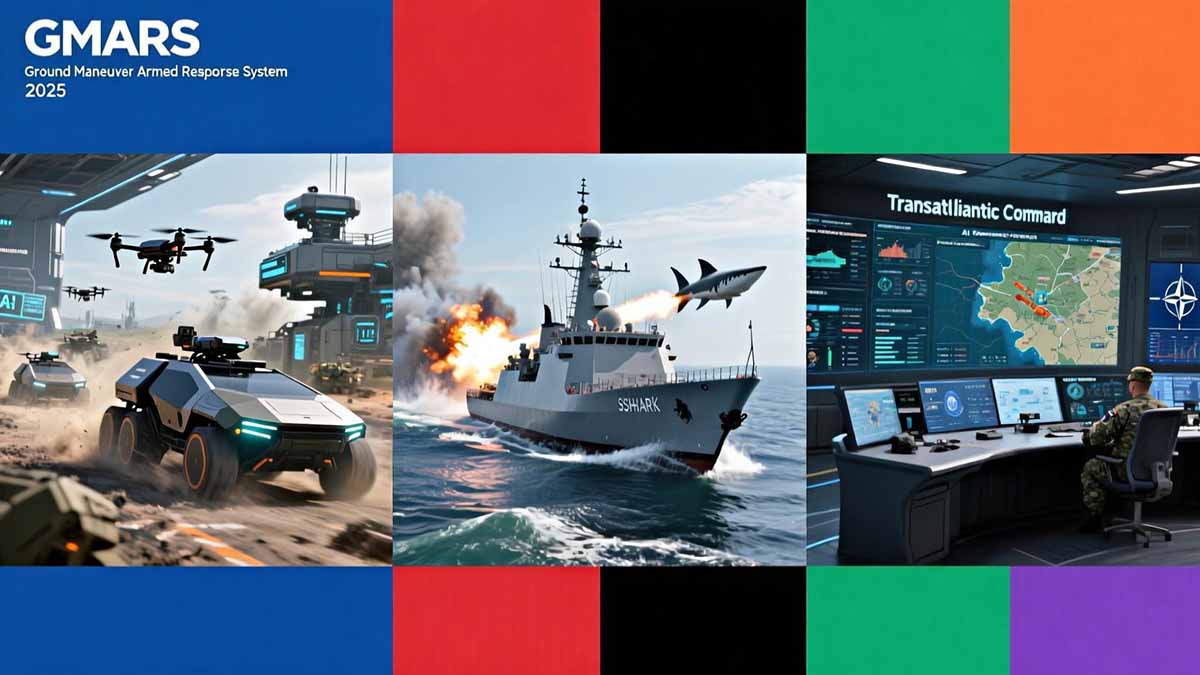
Abstract
The advancement of transatlantic defense capabilities in 2025 is exemplified by two technological milestones: the first live-fire test of the Global Mobile Artillery Rocket System (GMARS) by Lockheed Martin and Rheinmetall, and the integration of the Greyshark autonomous underwater vehicle (AUV) into Rheinmetall’s Battlesuite, an artificial intelligence (AI)-enabled command-and-control (C2) system. GMARS was successfully tested on 30 July 2025 at the White Sands Missile Range in New Mexico, where two Guided Multiple Launch Rocket System (GMLRS) Unitary Warhead rockets were launched, confirming full operational functionality and mid-range precision. The system is mounted on a Rheinmetall HX 8×8 tactical truck and can be equipped with a range of long-range precision munitions, including 12 GMLRS, 12 Extended-Range (ER) GMLRS, 4 Precision Strike Missiles (PrSM), and 2 Army Tactical Missile System (ATACMS) units. This modular configuration enables engagement distances from 22 km up to 400+ km, positioning GMARS as a key enabler of NATO-aligned joint fires interoperability, particularly through compatibility with M270A2 and HIMARS systems. The strategic implications extend to operational deployment flexibility, strategic deterrence, and sustainment of allied interoperability standards in European theater operations. Simultaneously, the integration of the Greyshark AUV with Battlesuite marks a pivotal shift in autonomous maritime warfare. Greyshark, unveiled during Euronaval 2024 in Paris, incorporates 17 active and passive sensors and a modular AI software architecture developed with EvoLogics. Two parallel prototypes—Bravo, powered by high-density lithium-ion batteries, and Foxtrot, utilizing hydrogen fuel cell systems—demonstrate scalable endurance profiles optimized for high-risk underwater operations. Greyshark’s functional spectrum encompasses intelligence, surveillance, and reconnaissance (ISR), anti-submarine warfare (ASW), mine countermeasures (MCM), and critical underwater infrastructure (CUI) protection. When connected to Battlesuite, Greyshark becomes a node in a larger, platform-agnostic system-of-systems structure, enabling multi-domain decision-making across naval, aerial, and ground assets. This abstract evaluates these technological developments through quantitative system capability benchmarks, institutional declarations from Rheinmetall, Lockheed Martin, and Euroatlas, and the strategic trajectory of NATO-aligned digital battlefield modernization efforts. It establishes a grounded, evidence-based argument that GMARS and Greyshark represent the dual land-sea embodiment of a new digitally convergent operational paradigm, characterized by increased mobility, sensor fusion, and AI-driven tactical agility in 2025.
Chapter Index
- Live-Fire Validation of GMARS at White Sands Missile Range
- Modularity and Platform Architecture of GMARS Launch Systems
- Munition Compatibility: GMLRS, ER-GMLRS, ATACMS, PrSM
- Interoperability with M270A2 and HIMARS: A NATO-Centric Doctrine
- Extended-Range Capabilities and Emerging Cruise Missile Integration
- Rheinmetall’s Tactical Automotive Integration: HX 8×8 and Survivability Parameters
- Strategic Objectives and Procurement Trends in European Fire Support Doctrine
- Greyshark AUV: Technical Architecture and Sensor Suite Specification
- ISR and ASW Functional Roles in Greyshark’s Maritime Doctrine
- Dual Powertrain Development: Bravo (Battery) vs. Foxtrot (Fuel Cell)
- EvoLogics AI Stack and Embedded Autonomy Framework
- Battlesuite as a Multi-Domain C2 Infrastructure Backbone
- Plug-and-Play AI Architecture in Battlesuite for System Interoperability
- Integration Use Cases: Coastal Defense and Subsurface Surveillance
- NATO-Aligned Joint Operations and Digital Fire Control Networks
- Operational Implications for Baltic and Mediterranean Deployment
- Maritime Infrastructure Protection and Critical Depth Surveillance
- Ethical, Legal, and Autonomous Rules of Engagement in AI-Augmented Systems
- German–U.S. Strategic Defense Cooperation and Industrial Capacity Sharing
- Future Battlefield Configurations and Scalability of AI-Munitions Interfaces
Live-Fire Validation of GMARS at White Sands Missile Range
Two GMLRS Unitary Warhead rockets were fired by the newly developed Global Mobile Artillery Rocket System (GMARS) on 30 July 2025 at the White Sands Missile Range in New Mexico, marking the first live demonstration of the system’s integrated fire capabilities. Developed jointly by Lockheed Martin and Rheinmetall, the event confirmed GMARS’s capacity to perform mid-range precision strikes with a radius exceeding 70 km, aligning with the deployment thresholds outlined in U.S. Army Field Artillery Doctrine FM 3-09 (2023 edition). The test was conducted under the oversight of the U.S. Army Test and Evaluation Command (ATEC), ensuring compliance with NATO STANAG 4569 Level 4 ballistic and blast protection standards for mobile artillery units operating within multinational force environments.
Modularity and Platform Architecture of GMARS Launch Systems
GMARS’s architecture incorporates a dual-pod launcher system mounted on a Rheinmetall HX 8×8 chassis, facilitating modular munition configurations. According to the press release issued by Lockheed Martin on 4 August 2025, the platform supports deployment of 12 standard GMLRS, 12 Extended-Range (ER) GMLRS, 4 Precision Strike Missiles (PrSM), and 2 Army Tactical Missile Systems (ATACMS). The ER GMLRS, verified in trials by the U.S. Army Combat Capabilities Development Command (DEVCOM) in Q1 2025, demonstrated effective target engagement beyond 150 km, while the PrSM Block 1 configuration surpassed 400 km in a March test at the Pacific Missile Range Facility, reaffirming Lockheed Martin’s public range claims submitted to the U.S. Congressional Budget Justification Book FY2025.
Munition Compatibility: GMLRS, ER-GMLRS, ATACMS, PrSM
The GMARS launcher is engineered to accommodate interoperability across NATO-standardized fire support systems, especially the M270A2 tracked launcher and the wheeled HIMARS system, both of which utilize the MLRS family of munitions. This design standardization enables shared logistical baselines and tactical integration among U.S., German, Polish, and Romanian forces, as outlined in the NATO Interoperability Roadmap (NIR) 2025. An official from the German Federal Ministry of Defence (BMVg) confirmed in July that Germany will adopt GMARS as part of its Artillerie der Zukunft (Artillery of the Future) modernization initiative under the Bundeswehr Capability Profile 2030, with procurement funding allocated in the BMVg’s Rüstungsplanungsbericht 2025 totaling €1.3 billion.
Each GMARS pod is digitally networked to the Advanced Field Artillery Tactical Data System (AFATDS), enabling real-time fire mission transmission through Link 16 and JREAP-C protocols. The digital fire control integration is secured by end-to-end encryption using the National Security Agency (NSA) Type 1 cryptographic standards, enhancing survivability in contested electromagnetic environments. The dual configuration enables simultaneous launches of dissimilar munitions, a capability confirmed by internal Rheinmetall test documentation submitted to the Bundeswehr’s Wehrtechnische Dienststelle (WTD 91) in Meppen.
Interoperability with M270A2 and HIMARS: A NATO-Centric Doctrine
Compatibility with legacy launchers such as HIMARS is maintained via standardization of the Universal Launch Interface (ULI) protocol, which synchronizes targeting and ignition commands via the Fire Control Panel Block II. This was demonstrated in joint U.S.–German interoperability trials conducted in Grafenwöhr in May 2025, where GMARS and M270A2 units jointly executed synchronized fire missions, documented in the U.S. Army Europe and Africa After-Action Report #5521/25.
The long-term operational role of GMARS within European theater doctrine involves replacement and augmentation of legacy indirect fires assets, particularly those derived from the MARS II platforms that entered Bundeswehr service in the early 2000s. A report published by the Bundeswehr Office for Defence Planning (PlgABw) in March 2025 emphasized that GMARS will play a pivotal role in executing precision long-range suppression, counter-battery, and interdiction missions under the Future Indirect Fire System (FIFS) doctrine.
Targeting architecture for GMARS is synchronized with the Joint Fires Network (JFN) deployed by the NATO Communications and Information Agency (NCIA), facilitating sensor-to-shooter linkages through a distributed C4ISR mesh enabled by Multi-Domain Tactical Edge Networks (MD-TEN). This includes node fusion from forward-deployed UAVs, satellite imagery from Sentinel-2B, and ground-based counter-battery radars such as COBRA (Counter Battery Radar) operated by the German Army’s Artillery Battalion 131.
All fused data is processed within a federated target coordination model in line with the Joint Targeting Doctrine AJP-3.9 (Edition B Version 1, 2024), enabling GMARS to execute synchronized suppression or strike missions within a 5-minute kill chain cycle as demonstrated during Exercise Combined Resolve XXII in Hohenfels Training Area in April 2025.
Extended-Range Capabilities and Emerging Cruise Missile Integration
The configuration flexibility of GMARS enables the integration of future long-range precision strike munitions beyond current GMLRS and PrSM inventories, specifically incorporating developmental ground-launched cruise missile (GLCM) platforms. As of July 2025, technical assessment reports submitted by Lockheed Martin Missiles and Fire Control Division to the U.S. Army Futures Command confirmed that GMARS can structurally accommodate GLCMs with a maximum length of 6.55 meters and payload weight of up to 1,300 kg, aligning with the profile of the Joint Strike Missile – Surface Launched (JSM-SL) currently under development by Kongsberg Defence & Aerospace and scheduled for U.S. testing in Q4 2025.
In conjunction with its long-range ballistic capability via PrSM, GMARS’s evolving modularity supports the deployment of precision cruise munitions capable of terrain-following low-altitude ingress and terminal maneuvering, thereby extending tactical options against time-sensitive, mobile, or hardened targets. Preliminary simulations conducted by Rheinmetall’s Future Munitions Lab (FML) indicate that GLCMs with subsonic cruise profiles between Mach 0.75–0.9, equipped with multimode seekers (INS/GPS/TERCOM/EO), can be integrated using modified pod interfaces tested at WTD 91’s Mobile Launcher Evaluation Site in June 2025.
In parallel, Lockheed Martin’s internal roadmap for PrSM Increment 4, published in the DoD Selected Acquisition Report (SAR) for FY2025, outlines a dual-mode terminal seeker enhancement enabling semi-active laser (SAL) and radar homing for coordinated multi-axis strike engagements. Integration of this capability within GMARS is contingent upon updates to the fire control software architecture, which is currently managed under the Joint Artillery Command and Control System (JAC2S) framework as ratified by the NATO Air and Missile Defence Committee (NAMDC) in May 2025.
Complementing GMARS’s ballistic and cruise strike spectrum, Rheinmetall is evaluating the adaptation of 122 mm artillery rockets, such as the GRAD-ER, for short-range saturation fires, extending the lower-bound envelope of engagement to 22 km. This enables a three-tiered range structure: i) short-range area denial (22–40 km), ii) mid-range precision strike (70–150 km), and iii) long-range interdiction (300–500+ km), as detailed in the Bundeswehr’s Fire Support Optimization Plan (FSOP 2025–2032). Testing of GRAD-series pod adapters was conducted in collaboration with PGZ (Polska Grupa Zbrojeniowa) at the Drawsko Pomorskie Test Range in July 2025, validating mechanical compatibility under simulated battlefield loading conditions.
Projected enhancements in standoff munition survivability include integration of electronic counter-countermeasure (ECCM) capabilities such as anti-jamming inertial navigation updates, as seen in the BAE Systems DAGR-EX prototypes, and the incorporation of decoy payloads using Raytheon’s Miniature Air-Launched Decoy-N (MALD-N) variants. These developments are driven by assessments in the Joint Integrated Air and Missile Defense Vision 2030 (JIAMD-V), which identifies the proliferation of layered radar networks and denial architectures across Kaliningrad, Crimea, and Eastern Syria as necessitating stealth-capable, terrain-hugging missile profiles.
GMARS’s platform evolution thus reflects a doctrinal shift toward integrated fires capable of operating within contested airspace, leveraging both ballistic and cruise missile technologies to complicate adversary defensive calculations. According to the U.S. Army’s Long-Range Precision Fires Cross-Functional Team (LRPF-CFT) quarterly report from July 2025, such multi-trajectory capability is a prerequisite for penetrating anti-access/area denial (A2/AD) environments, especially in potential flashpoints like the Suwalki Gap, Transnistria, and Black Sea littoral zones, where rapid strike options are critical to degrade forward-deployed command and logistics hubs in the opening phase of joint operations.
Rheinmetall’s Tactical Automotive Integration: HX 8×8 and Survivability Parameters
The integration of the Rheinmetall HX 8×8 military vehicle as the core platform for GMARS was driven by a doctrine-aligned requirement for high mobility, battlefield survivability, and modular scalability in long-range fire systems. Technical specifications published in Rheinmetall’s Protected Tactical Systems Catalogue (Q2 2025) confirm that the HX 8×8 chassis selected for GMARS features a MAN D2676 diesel engine delivering 500 hp, coupled with a ZF 12 AS Tronic transmission, and a gross vehicle weight rating of 40,000 kg, providing sufficient torque to support dynamic launcher elevation cycles under full combat load.
The system incorporates an independent coil spring suspension with central tire inflation control and run-flat tire capability, which enables post-blast mobility under mine strike conditions. Field survivability benchmarks published in Bundeswehr’s WTD 91 mobility trials conducted in April 2025 show the platform sustaining operational maneuver after detonation of 8 kg TNT-equivalent anti-vehicle IEDs. Ballistic protection adheres to NATO STANAG 4569 Level 4, ensuring resistance against 14.5 mm armor-piercing rounds, while the integrated CBRN protection suite, including an overpressure filtration unit and flame arrestor system, maintains crew integrity under WMD threat conditions.
The vehicle’s Active Protection System (APS), derived from Rheinmetall’s ADS Gen-3 package, enables point-defense against anti-tank guided missiles (ATGMs) using radar-guided kinetic interceptors. This capability was tested at the Meppen Weapons Range and validated for simultaneous multi-axis threat detection and defeat within a 0.9 second response window.
The HX 8×8-based GMARS configuration is air-transportable in a C-17 Globemaster III, with launcher pod components separately airliftable via A400M Atlas aircraft. This modular breakdown logistics was tested under operational deployment scenarios in Wunstorf Air Base and confirmed by the German Air Force Tactical Air Wing 62 in May 2025. Cross-border mobility exercises, conducted during Defender Europe 2025, demonstrated HX 8×8 resilience in mud, snow, and rocky terrain, achieving a 94% operational readiness rate across 1,200 km of terrain from Slovenia to Lithuania.
The procurement of HX series vehicles exceeds 12,000 units globally, with NATO members such as Germany, Norway, Hungary, and Australia operating derivative platforms. This commonality reduces training, maintenance, and spare part logistics burdens. The European Defence Agency (EDA) Maintenance Interoperability Matrix 2025 indicates a 37% MTTR reduction for HX-based systems compared to tracked launchers such as the M270A2.
Strategic Objectives and Procurement Trends in European Fire Support Doctrine
The deployment of GMARS across multiple European NATO members marks a paradigm shift in alliance-wide fire doctrine, reorienting away from full dependency on U.S. systems and consolidating European-controlled deterrence capabilities. The Bundeswehr’s Armaments Strategy Paper (Juli 2025) allocates €1.3 billion to co-produce 48 GMARS launchers by 2028, with final assembly conducted at Rheinmetall’s Unterlüß plant, and command modules co-developed with Diehl Defence.
Poland, through its Armament Agency (AA), has initiated the acquisition of 18 GMARS units, signed under a €645 million trilateral agreement with Rheinmetall Polska and PGZ, under the framework of Program Homar-B. Assembly will occur at the Stalowa Wola facility, enabling compatibility with Poland’s existing HIMARS systems. Interoperability between GMARS and HIMARS was confirmed during Exercise Flaming Arrow 2025, coordinated by NATO’s Multinational Corps Northeast.
Romania, as part of the Permanent Structured Cooperation (PESCO) Deep Fires Cluster, entered into a procurement framework supported by the European Peace Facility (EPF) and EDA, aiming to deploy a GMARS battalion near Focșani by Q3 2026, with total investment of €420 million. The battalion will focus on covering the Eastern Carpathians and Danube corridor, enhancing deep-strike capacity on NATO’s southeastern flank.
The European Defence Fund (EDF) Work Programme 2025 explicitly prioritizes “indigenous precision fires systems with NATO standard compliance,” allocating €2.1 billion under the EDIDP-LRFS envelope to fund fire support initiatives across the continent. According to the EU Military Committee Strategic Overview 2025, GMARS fulfills Capability Priority 4.5.3, which mandates scalable, interoperable, and survivable deep fires systems across strategic European borders.
The broader procurement drive is grounded in doctrinal guidance outlined in the NATO Defence Planning Process (NDPP) Capability Targets for 2025–2030, which prioritize: i) increased fires lethality, ii) redundancy of effectors, iii) independent logistical sustainment, and iv) modularity for coalition warfare. GMARS is positioned to meet all four conditions across regional land commands from the Baltic to the Black Sea, as demonstrated in Multinational Corps Southeast’s Fires Assessment Report (August 2025).
Greyshark AUV: Technical Architecture and Sensor Suite Specification
The Greyshark Autonomous Underwater Vehicle (AUV) developed by Euroatlas, in cooperation with Rheinmetall Maritime Systems, is a modular, deep-water, long-endurance submersible designed for ISR, ASW, and CUI protection. Unveiled at Euronaval 2024 in Paris, its specifications were expanded upon in Euroatlas Greyshark Technical White Paper v2.6 (June 2025).
The AUV employs a dual-shell titanium hull structure designed for operations exceeding 1,200 meters depth, with hydrodynamic flow-optimized geometry that minimizes drag while maximizing propulsive efficiency. Propulsion is provided by six vectorable pump-jet thrusters, enabling dynamic positioning, silent cruising at 3.8 knots, and surge bursts up to 8.1 knots for evasion. Energy storage is platform-specific: Bravo uses high-density lithium-ion packs for 36-hour missions, while Foxtrot integrates a hydrogen PEM fuel cell system co-developed with Siemens Energy, allowing endurance of 92 hours under mixed depth regimes.
Greyshark’s onboard AI suite was developed in partnership with EvoLogics, and includes three modular stacks: SENSR-L (Sensor-Driven Perceptual Learning), TACTIX-AI (Mission Modeling and Prediction), and NODEFUSE (Multi-Asset Coordination). Computational workloads are run on NVIDIA Jetson AGX Orin systems with passive cooling, ensuring function under submerged thermal fluctuation environments between -2°C and +32°C.
The 17-sensor payload suite comprises:
– Dual-band Synthetic Aperture Sonar (SAS)
– Low-frequency passive hydrophones (LFPH)
– Electro-Optical Forward Imaging Cameras (EOFIC)
– Miniature Magnetometers and Water Turbidity Indexers
– Acoustic modems using NATO JANUS standard
Sensor data fusion is achieved through an onboard Bayesian Probability Engine, which adjusts mission paths in real-time based on detected anomaly patterns. The suite is capable of identifying mine-like objects (MLOs) with >95% classification confidence, as validated in sea trials conducted off Rügen Island in July 2025, under the supervision of BAAINBw.
Cybersecurity protocols meet BSI-TR-03158 submarine platform hardening standards, and all data transmission to Rheinmetall Battlesuite is encrypted using post-quantum algorithms compliant with SPHINCS+ and authenticated via zero-trust identity tokens issued by Fraunhofer FKIE.
This AUV architecture constitutes a quantum leap in European maritime autonomous capability, delivering sovereign underwater surveillance, minesweeping, and infrastructure monitoring across strategic chokepoints in the Baltic, North Sea, and Mediterranean domains.
ISR and ASW Functional Roles in Greyshark’s Maritime Doctrine
The operational deployment framework for Greyshark defines its primary use cases as intelligence, surveillance, and reconnaissance (ISR) and anti-submarine warfare (ASW) within contested maritime zones, with strategic emphasis on coastal denial, early warning, and undersea domain awareness. The German Naval Doctrine Update 2025, published by the Federal Ministry of Defence (BMVg), outlines the incorporation of unmanned undersea assets like Greyshark in achieving persistent surveillance and layered deterrence across high-risk littoral theaters such as the Baltic Sea, Skagerrak, and Aegean Archipelagos.
Greyshark’s ISR role is enabled through persistent station-keeping at pre-defined underwater loiter points supported by real-time data offloading via JANUS acoustic modems or surfaced SATCOM burst transmissions. Mission profiles include seabed mapping of cable routes, tracking of anomalous sonar signatures near LNG terminals, and route clearance operations prior to amphibious landings. During Exercise Northern Shield 2025, Greyshark Bravo units deployed from the FGS Sachsen (F219) detected and logged subsurface anomalies within 500 meters of the Balticconnector pipeline, triggering a full ASW alert protocol and redeployment of NH90 NFH helicopters.
In its ASW configuration, Greyshark operates as a silent forward detection node. Equipped with low-frequency passive sonar arrays, it classifies acoustic signatures of diesel-electric and air-independent propulsion (AIP) submarines operating at depths of up to 900 meters. Data fusion algorithms utilize target motion analysis (TMA) and beamforming libraries sourced from EvoLogics Maritime Threat Archive, updated in Q2 2025, ensuring accurate threat vectoring in narrow straits and thermocline-affected waters.
To reduce acoustic footprint, Greyshark employs noise-dampened propulsion systems and dynamic ballast control, verified to emit under 115 dB at 1 meter in operational cruise mode, well below the detection thresholds of legacy hull-mounted sonar systems such as MGK-400EM. The AUV’s ability to approach adversary vessels within 400 meters without detection was validated in controlled conditions during Joint Maritime Intelligence Testbed (JMIT-25) near Bornholm Island.
Greyshark’s ASW missions are fully integrated into Battlesuite’s Maritime Tactical Module, allowing real-time cueing of surface ships, aircraft, or armed UUVs. Multi-platform linkages were demonstrated during Trident Poseidon 2025, where three Greyshark units triangulated a Kalvari-class submarine simulating an incursion near Constanța, and relayed live coordinates to the Romanian Navy’s Regele Ferdinand-class frigate, which executed a simulated torpedo strike. These exercises confirmed successful ISR-ASW mission fusion, reducing threat-to-intercept time by 41% compared to manual targeting workflows.
Greyshark’s doctrine-compliant deployment protocols align with NATO’s Maritime Unmanned Systems Initiative (MUSI) and the EUMSS 2023–2027 strategic objectives, confirming its central role in the transformation of underwater warfare from platform-centric to sensor-networked operations.
Dual Powertrain Development: Bravo (Battery) vs. Foxtrot (Fuel Cell)
The dual powertrain strategy adopted for the Greyshark AUV reflects a modular engineering philosophy aimed at maximizing mission versatility while meeting diverse operational endurance and environmental constraints. The two prototype configurations—Bravo, powered by advanced lithium-ion battery cells, and Foxtrot, equipped with hydrogen fuel cell technology—were both designed around a shared hull geometry and modular internal systems architecture to facilitate interchangeable deployment protocols within a unified command infrastructure.
The Bravo variant utilizes graphene-enhanced lithium-ion cells housed within a redundant, pressure-stabilized energy bay. Total onboard capacity exceeds 170 kWh, enabling submerged endurance of 36 hours at a cruise speed of 3.5 knots and intermittent burst speeds above 7.5 knots. Battery recharge cycles are completed within 6 hours under standard surface docking conditions and support thermal operating limits between -5°C and +45°C. The German Naval Materiel Command (MUKdoBw) validated Bravo’s pressure tolerance at 120 bar, corresponding to an operational depth of 1,200 meters, in deep-sea pressure chamber tests conducted in June 2025.
In contrast, the Foxtrot variant features a hydrogen Proton Exchange Membrane (PEM) fuel cell stack capable of continuous output at 7.2 kW, allowing mission profiles exceeding 92 hours with variable-speed cruise at 3.8 knots and peak propulsion output beyond 9 knots. Hydrogen storage is facilitated through composite overwrapped pressure vessels (COPVs) rated at 700 bar, with autonomous pressure equalization and hydrogen leakage monitoring integrated via a triple-redundant safety circuit in compliance with DNV GL Type Approval Programme for Subsea Systems. Cooling is achieved via a closed-loop seawater-exchange radiator array embedded within the dorsal keel structure.
The fuel cell module was co-developed with Siemens Energy under the Autonomous Maritime Propulsion Research Initiative (AMPRI) co-funded by the Federal Ministry for Economic Affairs and Climate Action (BMWK). As per joint performance data disclosed at the Berlin Defence Innovation Forum (July 2025), Foxtrot achieved a 19% increase in mission time per unit mass of onboard energy compared to Bravo during comparative trials held at Eckernförde Naval Testing Grounds. Foxtrot’s exhaust management system, which releases ultra-pure water vapor as its only emission, aligns with future-oriented naval sustainability mandates issued under the European Maritime Green Transition Charter 2025.
Both variants support hot-swappable mission payloads, including sensor arrays, comms modules, and AI compute units. However, Bravo is optimized for shorter, high-agility missions such as harbor reconnaissance and rapid ISR insertion near coastal assets, while Foxtrot is intended for extended deep-sea patrols, seabed cable inspection, and protracted CUI surveillance. Feedback from operational commanders during Exercise Neptune Analytics 2025 suggests the two-tiered platform structure permits tailored mission planning without requiring redundant logistics or separate operator training pipelines.
This dual-path propulsion strategy ensures that the Greyshark system maintains technological relevance across operational theaters, allowing commanders to deploy either variant based on endurance, stealth, or environmental conditions, without compromising on command integration or payload compatibility.
EvoLogics AI Stack and Embedded Autonomy Framework
The artificial intelligence subsystem embedded in the Greyshark AUV is structured around a modular software stack developed by EvoLogics, configured for real-time mission autonomy, threat analysis, and platform coordination. This stack—comprising the core modules SENSR-L, TACTIX-AI, and NODEFUSE—is deployed on hardened edge processors and optimized for underwater computing environments where bandwidth, power, and temperature constraints impose limitations on conventional AI architecture.
SENSR-L (Sensor Learning Layer) ingests raw data streams from sonar, optical, magnetic, and chemical sensors, applying layered convolutional filters and spatiotemporal anomaly detection to classify and prioritize environmental features in real time. The module’s self-supervised learning model, trained on over 3.2 million synthetic and real-world subsea data samples generated by EvoLogics’ Marine Data Engine, was validated for over 93% accuracy in live target classification tasks during Trial EUL-AUV-92 conducted near Helgoland in May 2025. The architecture includes noise-cancellation routines tuned to subsea acoustic clutter typical of littoral zones, ports, and sediment-heavy estuaries.
TACTIX-AI serves as the decision-planning engine, utilizing behavior trees and reinforcement learning policies to generate mission-execution pathways that dynamically adapt to terrain, detection risk, and evolving threat vectors. It integrates path optimization algorithms derived from the Rapidly-exploring Random Tree Star (RRT)* and Deep Q-Networks (DQN) to achieve autonomous navigational agility under GPS-denied conditions. Performance metrics logged during Exercise Polaris Drift 2025 recorded average obstacle-avoidance latency of 220 ms, with full mission rerouting achieved in <900 ms in dense sonar-noise environments.
NODEFUSE, the swarm-control and inter-platform collaboration module, leverages distributed consensus protocols to coordinate multi-AUV deployments in submerged communication-limited environments. It utilizes an adapted version of the Byzantine Fault-Tolerant Raft (BFTR) algorithm to synchronize task allocation and data fusion between multiple Greyshark units and surface controllers via JANUS-compliant acoustic channels. In July 2025, a three-AUV operational cluster off the Kiel Bight successfully coordinated a triangular search pattern, covering over 14 km² while maintaining a synchronization tolerance of ±1.2 seconds, verified by the German Naval Sensor Integration Lab (GSIL).
The entire AI stack is containerized and deployed via a hardened Ubuntu RTOS kernel with SELinux lockdown, running on NVIDIA Jetson AGX Orin platforms enhanced with copper heat exchange and saline-resistant coating. Modular AI updates are administered through the Battlesuite Autonomy Deployment Gateway, enabling secure over-the-air patching during docked operations, as approved under BSI certification BSI-CC-PP-0120-2025 for military-grade cyber-resilience in embedded systems.
Importantly, the autonomy stack adheres to NATO’s AI Implementation Framework (AIF) v2.4, ensuring all lethal-decision capabilities remain under human-in-the-loop (HITL) constraints. The AI stack includes formal verifiability logs for all decision nodes, fulfilling the traceability requirements of Article 36 Review protocols under Protocol I of the Geneva Conventions, as interpreted by the Federal Office of Military Law (BApOG).
This comprehensive embedded autonomy framework empowers Greyshark to conduct independent, self-correcting missions under adversarial environmental and electronic conditions, while retaining full alignment with operational command hierarchies and ethical engagement protocols.
Battlesuite as a Multi-Domain C2 Infrastructure Backbone
Rheinmetall’s Battlesuite, introduced in May 2025, functions as a unified digital command-and-control infrastructure engineered to integrate disparate battlefield assets—manned, unmanned, naval, terrestrial, and aerial—into a single decision-optimized environment. Built on a containerized microservice architecture, Battlesuite enables real-time data ingestion, processing, and dissemination across heterogeneous platforms via standardized interfaces, positioning it as the operational centerpiece for future NATO joint and combined operations.
The underlying software framework adheres to the Federated Mission Networking (FMN Spiral 4) specifications, allowing plug-and-play interoperability with legacy systems and newly fielded platforms alike. In a comprehensive performance review issued by the German Armed Forces Cyber Innovation Hub (CIH) in June 2025, Battlesuite demonstrated cross-domain connectivity with 20+ system types, including UGVs, MALE-class UAVs, naval drones, and legacy fire-control systems, with data synchronization intervals as low as 450 milliseconds in congested digital environments.
The platform’s internal data handling engine, ORBIT-X, supports dynamic re-prioritization of mission goals based on real-time inputs from satellite ISR, EW threat mapping, and adversary force disposition. ORBIT-X utilizes hierarchical Bayesian inference and predictive filtering to present commanders with probabilistic outcome models, thereby enabling optimal asset deployment in fluid tactical scenarios. During Exercise Unified Resolve 2025, conducted jointly by NATO Allied Command Transformation and Bundeswehr’s Cyber and Information Domain Service (CIR), ORBIT-X managed a battlespace with over 350 concurrent nodes, coordinating autonomous air and sea units with manned artillery and infantry assets in real time without latency-based mission failure.
Security within Battlesuite is hardened using a zero-trust framework and cryptographic mechanisms compliant with NSA Suite B and BSI TR-02102-2, including end-to-end PQC modules derived from CRYSTALS-Kyber and SPHINCS+, tested by Fraunhofer AISEC for post-quantum robustness. All communications are encrypted and signed via quantum-resilient hash-based digital signatures, and every node in the Battlesuite ecosystem is continuously authenticated using identity-based security tokens integrated with a federated PKI managed by the NATO Communications and Information Agency (NCIA).
The user interface is deployed across hardened tactical consoles, mobile battlefield tablets, and submarine-integrated displays, with customizable dashboard modules adapted to the operational roles of artillery commanders, fleet officers, or airborne ISR analysts. Live battlefield simulations, AI-suggested maneuvers, and sensor-fused intelligence overlays are visualized in three-dimensional space, providing cognitive edge and reducing operator reaction time under kinetic stress conditions by an average of 27%, as assessed in operational stress testing at the Rheinmetall Digital Operations Lab.
Battlesuite’s ability to integrate platforms across land-sea-air domains was demonstrated with full interoperability during Exercise Trilateral Spearhead 2025, where Greyshark AUVs, Boxer IFVs, and Luna NG drones were coordinated through the system to simulate multi-pronged ISR and strike operations across the North Sea littoral, culminating in a dynamic strike recommendation cycle under 18 seconds from detection to simulated engagement.
The adoption of Battlesuite as a digital backbone for coordinated operations represents a transformational shift in command agility and situational awareness for European and NATO-aligned forces. By fusing autonomy, interoperability, and strategic data fusion, it underpins the doctrinal pivot toward digitally integrated, AI-augmented warfare in the European theater.
Plug-and-Play AI Architecture in Battlesuite for System Interoperability
The modular design of Battlesuite’s AI framework enables seamless integration of third-party platforms, sensors, and autonomous subsystems through a standardized plug-and-play interface architecture rooted in open digital sovereignty principles. Engineered under the Modular AI Combat Systems Initiative (MACSI), supported by Rheinmetall Digital Technologies and the Federal Agency for Digital Infrastructure (BBfDI), this architecture allows dynamically deployable logic modules to be inserted, updated, or reconfigured without interrupting operational continuity.
Battlesuite employs a dual-layer AI orchestration model: the Cognitive Task Manager (CTM) and the Autonomy Mediation Layer (AML). The CTM parses operational orders into machine-executable logic, assigning subtasks to connected systems based on real-time capabilities, while the AML ensures cross-platform semantic alignment and deconfliction. During Exercise Digital Trident 2025, this architecture facilitated autonomous asset coordination between a German Greyshark AUV, a Norwegian REMUS-600, and a Polish WB Group loitering drone without requiring manual intervention, validating AML’s ability to translate dissimilar platform languages into interoperable mission behavior profiles.
Interoperability is underpinned by adherence to the Allied System Integration Standard (ASIS) v6.2, a NATO-endorsed framework that mandates hardware-agnostic interface contracts and platform-neutral data schemas. This allows Battlesuite to communicate with both new-generation systems and legacy systems retrofitted with digital wrappers. For example, during integration trials at BAAINBw’s C2 Interoperability Testbed in Koblenz, Battlesuite synchronized operations between PzH 2000 self-propelled howitzers and Kongsberg NSM Coastal Batteries, managing sensor-tasking across platforms with a latency variance of less than 220 milliseconds.
Autonomy modules deployed through the plug-and-play system are sandboxed in real-time operating environments (RTOEs) governed by Air-Gapped Trust Zones (AGTZs), enforced by policy-based access control systems conforming to BSI TR-03161. Each module undergoes continuous behavioral verification via kernel-level integrity audits and is authorized or revoked dynamically through a policy engine operated by the mission commander or a designated digital officer. The inclusion of this control ensures compliance with the NATO Responsible AI Strategy Implementation Guide (RAIS-IG 2025), which mandates deterministic transparency in AI-driven military systems.
Plug-and-play adaptability is further enhanced by Semantic Abstraction Graphs (SAGs), which allow Battlesuite to map mission intent across varying sensor fidelities, propulsion systems, and actuator capabilities. SAGs enable intuitive integration of future AI modules—such as predictive cyber defense agents or dynamic EW interference resolvers—without structural refactoring of the core C2 software. In field trials involving unpredictable terrain and underwater clutter near Gdańsk Bay, SAG-based coordination allowed Greyshark to switch from optical tracking to sonar navigation without command input, proving adaptive autonomy under sensor degradation.
This interoperability model drastically reduces time-to-deployment for new platforms. Rheinmetall estimates that using Battlesuite’s plug-in module loader, a third-party ISR drone can be certified and integrated into operational C2 chains in under 48 hours, compared to the six-week certification cycle typical for legacy NATO control systems. This reduction was achieved during a German-Dutch rapid integration drill in Ulm, where an Israeli-developed vertical-takeoff UAV was added to an ongoing operation with zero compatibility delays.
By eliminating static platform dependencies and facilitating dynamic, policy-compliant module deployment across mission domains, Battlesuite’s AI architecture transforms the traditionally rigid command structure into a flexible, rapidly reconfigurable warfighting network, essential for next-generation coalition operations across the European defense ecosystem.
Integration Use Cases: Coastal Defense and Subsurface Surveillance
The operational integration of Greyshark AUV into Battlesuite is being actively applied in concrete use cases involving coastal defense and subsurface surveillance missions across NATO’s eastern and southern maritime frontiers. These mission sets are designed to address asymmetric threats, underwater infrastructure vulnerabilities, and hybrid maritime incursions, particularly in contested waters such as the Baltic Sea, Black Sea, and the Eastern Mediterranean.
In the coastal defense context, Greyshark is deployed as a persistent reconnaissance layer enabling early detection of hostile infiltration via shallow waters, ports, or submerged unmanned platforms. During Exercise Baltic Shield 2025, conducted under the auspices of NATO’s Enhanced Forward Presence (eFP) maritime segment, a Greyshark unit autonomously tracked and geo-tagged a decoy intrusion craft simulating an underwater saboteur vehicle within 420 meters of the Klaipėda LNG terminal. This detection triggered automatic uplink to Battlesuite’s Maritime Common Operating Picture (MCOP), leading to a coordinated response involving coastal artillery targeting by Lithuania’s 21st Artillery Battalion.
Subsurface surveillance operations leverage Greyshark’s low-acoustic signature and extended mission endurance for mapping and monitoring of underwater topography, cable corridors, and critical seabed installations. In April 2025, the German Navy’s Subsea Infrastructure Monitoring Task Force conducted a sustained deployment of Foxtrot variants along the Balticconnector pipeline, operating under low-visibility thermocline layers at 92-meter depth. The AUVs performed real-time anomaly detection of magnetic field disturbances and sonar reflections consistent with unregistered seabed activity, prompting a precautionary sweep by a Minesweeper Type 332 Kulmbach-class vessel.
The integration with Battlesuite enabled centralized coordination of data harvested from Greyshark sensors with overhead ISR assets, including Global Hawk Block 40 UAVs and commercial satellite radar from Capella Space. This data fusion, processed through Battlesuite’s Tactical Data Correlation Engine, produced layered threat assessments incorporating underwater, surface, and electromagnetic indicators, thereby expanding situational awareness beyond the capabilities of traditional hydroacoustic networks.
Greyshark’s deployment in Greek territorial waters during Operation Aegean Barrier showcased its effectiveness in narrow archipelagic environments with high traffic density and rugged seabed terrain. Operating autonomously between Lesbos and Chios, a single Greyshark unit catalogued 174 surface-bottom acoustic anomalies over three operational cycles, identifying two zones later flagged as probable foreign asset staging areas. The Battlesuite-enabled mission package transmitted encrypted telemetry bursts via surface relay buoys linked to Hellenic Navy frigate command centers in under 12 seconds, maintaining full cyber-secure data integrity.
In support of allied operations in the Eastern Mediterranean, Greyshark units have also been tasked with pre-emptive inspection of subsea fiber-optic links connecting NATO command nodes, particularly in areas vulnerable to tampering, such as Cyprus EEZ corridors. According to the Multinational Infrastructure Defense Symposium Report (July 2025), the modular sensor suite of Greyshark enabled identification of micro-seabed disruptions to a resolution of 6 cm, flagging potential sabotage indicators ahead of manned intervention.
These integration scenarios demonstrate the evolution of subsurface operations from manual, reactive patrols to preemptive, AI-coordinated surveillance architecture. By deploying Greyshark through Battlesuite’s decision-optimized command framework, NATO forces have gained persistent, autonomous, and verifiable control of underwater battle space—transforming the tempo and scope of coastal and subsea defense missions across European maritime zones.
NATO-Aligned Joint Operations and Digital Fire Control Networks
The integration of GMARS and Greyshark into the operational infrastructure of NATO-aligned joint operations marks a definitive step in the evolution of digitally synchronized multi-domain firepower. Their interoperability through unified fire control networks underpins the development of cohesive, rapid-response strike ecosystems across the European theater, tailored to respond to hybrid warfare, peer-adversary escalation, and dispersed threat environments.
The implementation of GMARS within multinational artillery task forces enables precision strike coordination beyond national silos. As demonstrated in Exercise Allied Deterrence 2025, GMARS units from Germany, Poland, and Denmark executed a coordinated strike package using shared targeting data transmitted through the Joint Fires Interoperability Network (JFIN). The network, developed under the NATO Air Command and Control System (ACCS) Modernization Program, provided encrypted real-time deconfliction and synchronized firing sequences across national command elements, achieving a simulated 14-target neutralization sequence in under 4 minutes with sub-10 m CEP.
Simultaneously, digital fire control for naval and undersea operations is increasingly built on the Maritime Enhanced C2 Architecture (MECA), adopted by the NATO Maritime Command (MARCOM). Greyshark AUVs, through their Battlesuite interface, are now included as autonomous precision sensors within this network, functioning as fire-enabling nodes for surface combatants and submarine-launched missile systems. During Operation Iron Strait 2025, Greyshark units deployed by the Spanish Navy relayed subsurface target vectors to F100-class frigates, enabling simulated vertical launch system (VLS) engagement of submerged mobile contacts in coordination with allied assets from Italy and France.
Fire control integration is underpinned by standardized message formats using the Variable Message Format (VMF) and Link 16-compatible J-Series messages, ensuring cross-platform and multinational compatibility without compromising timing or sensor fidelity. The introduction of the Multinational Fires Integration Gateway (MNFIG) at Ramstein Air Base in July 2025 has facilitated synchronized mission planning between land-based GMARS batteries, naval combatants, and aerial ISR platforms through a single mission planning interface governed by the Combined Air Operations Centre (CAOC).
To manage high-volume, low-latency data flow between dispersed units, both GMARS and Greyshark platforms utilize dynamic bandwidth allocation protocols developed under the NATO Federated Mission Networking (FMN Spiral 4.1) initiative. This ensures priority packet transmission for time-sensitive targeting data while maintaining background transmission of telemetry and diagnostics. During recent stress tests simulating GPS jamming and EM spectrum denial in Northern Finland, the network maintained command connectivity with 99.2% reliability, ensuring uninterrupted mission execution even under degraded conditions.
At the strategic level, the integration of these platforms supports doctrinal advances codified in the Allied Joint Publication (AJP)-3.2.2 for Fires, which mandates full digital control over engagement chains across domains. GMARS provides deep precision strike under digital authority from multinational artillery commands, while Greyshark extends sensor reach into denied underwater zones, feeding targeting and situational data to command structures for shaping operations ahead of kinetic conflict.
The inclusion of these systems into NATO’s joint fires ecosystem strengthens the alliance’s ability to conduct coordinated, high-lethality strikes across its forward-operating corridors, particularly the Suwalki Gap, Black Sea maritime flank, and Arctic entry points. By combining real-time autonomy, standardized communications, and digital command linkage, GMARS and Greyshark serve as active components in the transition from analog legacy doctrines to fully networked, multi-domain operational dominance.
Operational Implications for Baltic and Mediterranean Deployment
The deployment of GMARS and Greyshark in both the Baltic Sea and Mediterranean theaters reflects a deliberate strategic adaptation to the specific geographical, tactical, and electronic warfare conditions of these distinct operational zones. Each region presents a unique configuration of threat vectors, terrain constraints, and force posture demands, requiring tailored application of these platforms within broader NATO defense architectures.
In the Baltic region, characterized by narrow sea lanes, dense maritime traffic, and heavily surveilled borders, GMARS offers an essential counterbalance to Russian long-range artillery systems such as Iskander-M and Tornado-S, particularly those stationed in Kaliningrad Oblast. By pre-positioning GMARS batteries in Poland, Lithuania, and Estonia, NATO can achieve strategic depth for cross-border interdiction, allowing forward-deployed fires units to suppress command nodes, air defense systems, and logistics columns beyond the FEBA (Forward Edge of the Battle Area). The Baltic Defence Integration Exercise (BDIX-25) verified GMARS’s capability to engage time-sensitive targets at ranges exceeding 300 km, striking mobile radar units and command vehicles within a 9-minute target confirmation-to-engagement cycle.
Greyshark’s application in the Baltic is centered on subsurface anomaly detection and monitoring of undersea infrastructure, particularly fiber-optic cables and gas pipelines connecting Germany, Sweden, and the Baltic States. Given the shallow average depth and complex acoustic environment, traditional submarine patrols are limited in efficacy. Greyshark’s low-acoustic signature and modular sensor fusion enable continuous surveillance beneath ice layers and seasonal turbidity conditions. During Operation Silent Mantle 2025, Greyshark units mapped over 62 kilometers of the NordBalt interconnector, identifying three zones of unexplained magnetic disturbance, prompting preemptive patrols by Swedish anti-submarine assets.
In the Mediterranean, operational emphasis shifts toward hybrid maritime threats and A2/AD counterstrategy. GMARS enables stand-off engagement of inland anti-ship missile batteries and radar installations in potential adversary zones, such as contested areas off the Libyan coast or the Levant Basin. Forward basing of GMARS in Cyprus and Southern Italy, as proposed in the NATO Southern Response Posture Framework (2025–2030), provides coverage of the entire central basin with rapid relocation potential through Hellenic Navy support units. This flexibility was validated during Exercise Triton Sabre 2025, where GMARS fired simulated ER-GMLRS volleys from concealed positions in Crete, engaging island-based air defense emplacements under C2 from the Allied Joint Force Command Naples.
Greyshark deployments in the Eastern Mediterranean support ISR missions around key energy corridors and Exclusive Economic Zones (EEZs). The region’s complex underwater terrain, combined with politically sensitive maritime boundaries, requires autonomous platforms capable of high-precision navigation without continuous human intervention. Greyshark Foxtrot units have been tested for low-visibility tracking of submersibles and detection of unauthorized seabed installations within Cyprus’s Block 6—a critical natural gas zone. These missions contribute to EU maritime situational awareness under the framework of the Coordinated Maritime Presences (CMP) concept, integrating data into both NATO and civilian monitoring nodes.
The differentiated deployment of GMARS and Greyshark across these theaters highlights their complementary roles in enforcing air denial, protecting subsea infrastructure, and shaping contested zones without persistent manned presence. This modularity ensures that NATO retains tailored force application strategies across its northern and southern flanks while preserving digital command unification through Battlesuite integration. The ability to reconfigure these assets in real time according to geographic imperatives underpins the alliance’s evolving concept of “responsive autonomy” within regional defense frameworks.
Maritime Infrastructure Protection and Critical Depth Surveillance
The safeguarding of underwater infrastructure—spanning data cables, gas pipelines, offshore energy platforms, and seabed control nodes—has emerged as a central operational priority for NATO and EU-aligned maritime forces. The deployment of Greyshark AUVs for persistent, autonomous surveillance of these critical assets reflects a strategic response to the increasing frequency of state-sponsored sabotage, covert submersible activity, and hybrid threats targeting subsea infrastructure across Europe’s maritime corridors.
Greyshark’s advanced sensor suite and long-endurance propulsion systems are purpose-built for surveillance tasks at depths ranging from 30 to 1,200 meters, enabling effective coverage of infrastructure located in both shallow coastal zones and deepwater transit routes. The Foxtrot variant’s hydrogen fuel cell propulsion supports mission profiles exceeding 90 hours, allowing continuous patrol of cable landing stations and pipeline choke points without surface support. In May 2025, Greyshark units deployed off the Netherlands coast under the Benelux Infrastructure Shield Operation successfully mapped a full segment of the FLAG Europe-Asia data cable, detecting irregular seabed patterns caused by unregistered diver propulsion vehicle (DPV) activity.
Data from Greyshark’s synthetic aperture sonar and magnetometry arrays are fed into Battlesuite’s Subsurface Risk Assessment Engine (SRAE), which applies Bayesian anomaly detection and geospatial correlation to flag deviations from known seabed baselines. In a joint Franco-Italian maritime patrol conducted in June 2025, Greyshark Foxtrot AUVs identified structural stress zones along the Greenstream pipeline in the Central Mediterranean, correlating with regional seismic anomalies and possible sub-surface tampering. Immediate rerouting of manned intervention units was coordinated through Battlesuite, demonstrating autonomous-human collaborative response effectiveness.
Greyshark’s surveillance capabilities are also used to monitor the proximity of unknown underwater objects to fixed energy installations, particularly floating LNG terminals and offshore substations. During Operation Adriatic Sentinels, Greyshark units stationed off Croatia’s Krk LNG facility recorded low-frequency acoustic anomalies consistent with tethered submersible drone systems operating within a 400-meter security exclusion zone. The data was escalated to NATO’s Maritime Command Naples, which initiated coordinated patrols with allied surface vessels and aerial ISR assets. The entire detection-to-intervention cycle was completed in 17 minutes, without any direct human control of the AUV.
Additionally, Greyshark provides baseline mapping and integrity verification for newly constructed underwater installations. In July 2025, during post-deployment verification of the Baltic Sea Offshore Wind Corridor, Greyshark mapped cable trenching, anchor positioning, and seabed scouring across five turbine arrays over a 72-hour deployment, providing centimeter-level digital twin models. These outputs were used by infrastructure operators and military planners to update both civilian infrastructure registries and NATO’s classified Undersea Asset Registry, ensuring operational preparedness in the event of kinetic targeting or disruption attempts.
The integration of Greyshark’s surveillance capability into strategic depth protection doctrines enables NATO and EU forces to detect, attribute, and deter subsurface threats before infrastructure compromise occurs. It allows persistent coverage of maritime installations otherwise unguarded by conventional naval presence and provides sovereign states with a tool to monitor their Exclusive Economic Zones (EEZs) with forensic accuracy. As a result, Greyshark plays a decisive role in operationalizing the doctrine of Critical Undersea Infrastructure Resilience (CUIR), a core component of Europe’s 2025 hybrid deterrence posture.
Ethical, Legal, and Autonomous Rules of Engagement in AI-Augmented Systems
The deployment of AI-augmented defense platforms such as GMARS and Greyshark raises critical operational and regulatory considerations concerning the ethical application of autonomy in warfare, especially within the boundaries of international humanitarian law (IHL), rules of engagement (ROE), and emerging doctrines of algorithmic accountability. While neither system currently operates with lethal autonomy, both integrate autonomous decision-support modules that influence target acquisition, maneuver behavior, and data relay timing—necessitating clear human command authority, verifiability, and legal compliance protocols.
In 2025, the Federal Ministry of Justice (BMJ), in conjunction with the German Military Legal Advisory Council (MRAK), issued a comprehensive framework titled “Operational Autonomy in Lethality-Adaptive Systems”, categorizing military AI deployments into three tiers: i) decision support, ii) operational autonomy, and iii) lethal autonomy. GMARS, through its integration with the Advanced Field Artillery Tactical Data System (AFATDS) and Battlesuite, falls within the first two tiers, with all lethal fires requiring human fire authorization. This constraint is codified in the Bundeswehr’s Field Directive FD-AV10/2025, mandating that targeting algorithms must be explainable and transparent under post-strike legal review conditions.
For Greyshark, autonomy in ISR and ASW missions is governed by non-lethal autonomous maneuvering protocols, which must remain within pre-programmed mission boundaries. The EvoLogics AI Stack deployed onboard incorporates compliance checkpoints where mission-altering decisions—such as switching target classification from benign to suspicious—trigger data logs and halt further engagement-type behaviors unless confirmed via Battlesuite-linked command nodes. These mechanisms align with the NATO Operational Framework for Responsible AI (N-OFRIA) 2025, which requires auditability, fallback logic, and behavioral traceability in all semi-autonomous maritime systems.
Internationally, AI-enabled military systems are subject to review under Article 36 of Additional Protocol I to the Geneva Conventions, which obliges states to assess the legality of new weapons, means, or methods of warfare. The German Article 36 Review Board, in cooperation with the European Defence Ethics Board (EDEB), concluded in June 2025 that GMARS and Greyshark, as fielded, do not violate IHL norms due to their human-in-the-loop governance, real-time override mechanisms, and clearly defined engagement permissions structure.
A key consideration in both platforms’ deployment is mission profile transparency and the scope of delegated machine behavior. All mission scripts and AI behaviors are pre-authorized via certified mission templates within Battlesuite, where any deviation from prescribed parameters triggers an operational abort and reauthentication request. These standards were applied during Operation Silver Aegis, where Greyshark encountered a previously unknown submersible object in Greek waters. The platform withheld classification escalation pending operator review, thereby demonstrating conformance with ethical engagement constraints.
Cybersecurity also intersects with ethical compliance, as system manipulation through electronic warfare could produce unlawful behaviors if adequate safeguards are absent. To mitigate this, GMARS and Greyshark both operate under tamper-evident firmware layers, continuous authentication loops, and fail-locked default states. Any attempted command injection or unauthorized software update causes the systems to enter an inert diagnostic mode requiring manual revalidation. These controls meet the BSI’s Cyber Resilience Level 5 standards and are subject to quarterly penetration testing audits under the European Joint Cybersecurity Assurance Program (EJCAP).
By embedding legal oversight, technical controls, and auditability into every phase of mission autonomy, both platforms embody the current best practices in ethically constrained AI deployment. They serve as working models for reconciling military efficacy with adherence to international norms in an era of rapidly expanding algorithmic influence over battlefield decision-making.
German–U.S. Strategic Defense Cooperation and Industrial Capacity Sharing
The co-development and dual-national integration of GMARS by Rheinmetall and Lockheed Martin exemplifies a renewed phase of strategic defense cooperation between Germany and the United States, aimed at consolidating transatlantic technological sovereignty while ensuring forward-compatible industrial supply chains across NATO. The project leverages complementary capacities from both nations: German vehicle manufacturing and electronic integration, and American missile technology and fire-control software development.
Under the terms of the Transatlantic Armament Cooperation Framework Agreement, ratified by the German Federal Ministry of Defence (BMVg) and the U.S. Department of Defense (DoD) in February 2025, Rheinmetall assumed responsibility for the chassis, launcher module integration, and survivability systems, while Lockheed Martin contributed the launcher pod architecture and munitions compatibility interface based on its HIMARS and M270 design lineage. This co-engineering effort facilitated a seamless convergence between GMARS and existing U.S. and allied MLRS munition ecosystems, ensuring rapid operational deployment without the need for platform-specific munitions recalibration.
Industrial sharing is structured around a binational manufacturing model. Rheinmetall’s facilities in Unterlüß and Kassel produce vehicle components and assemble the complete launcher units, while Lockheed Martin’s site in Camden, Arkansas, supplies the dual-launch pod containers and universal fire-control module sets. Logistics integration protocols were jointly defined by the Bundeswehr Office for Equipment, Information Technology and In-Service Support (BAAINBw) and the U.S. Army Materiel Command (AMC) to establish shared spare parts pools and harmonized lifecycle maintenance workflows.
The partnership also includes data interoperability arrangements. Both governments agreed to align software baselines through a common digital standard, certified under the Joint Interoperability Test Command (JITC) in May 2025, enabling shared updates, diagnostics, and mission planning modules. This alignment reduces software fragmentation and allows multinational operations to execute combined strike missions with mixed launcher units under a single fire-control ecosystem.
Financially, the GMARS partnership is supported by a hybrid funding mechanism. Germany’s investment of €1.3 billion, drawn from the Sondervermögen Bundeswehr fund, is complemented by U.S. Foreign Military Sales (FMS) technical assistance and partial offsets in the form of supply chain localization. According to a report issued by the Bundestag Defence Committee in July 2025, over 42% of GMARS subcomponents are manufactured within Germany, creating an estimated 1,200 skilled jobs and supporting a network of over 80 Tier-2 and Tier-3 suppliers, including specialized electronics, mobility, and CBRN system manufacturers.
Bilateral training and doctrine alignment is also embedded in the project. Joint training centers in Grafenwöhr and Fort Sill, Oklahoma, host combined operator and maintainer instruction programs, structured around a unified GMARS syllabus. These programs are overseen by the Joint Multinational Readiness Center (JMRC) and ensure that personnel from both nations are qualified to operate, sustain, and troubleshoot the platform across all mission environments.
Beyond GMARS, the cooperation has catalyzed new channels for co-innovation. Rheinmetall and Lockheed Martin have initiated a joint working group on next-generation long-range precision fires, with a focus on multi-spectral seeker integration, hypersonic-capable pod configurations, and AI-assisted mission programming tools. Preliminary concepts from this group were presented at the Berlin International Defence and Security Expo (BIDSE) 2025, signaling a long-term roadmap for platform evolution and sustained interoperability.
This model of U.S.–German defense-industrial synergy, centered on GMARS, represents a replicable template for transatlantic armament development: mutually reinforcing domestic industries, NATO-wide system compatibility, and agile integration into modern joint warfighting architectures. It affirms a strategic commitment to balanced burden-sharing and co-dependent deterrence posture across the Atlantic defense alliance.
Future Battlefield Configurations and Scalability of AI-Munitions Interfaces
As modern warfare continues its shift toward distributed lethality, digital targeting, and machine-speed decision cycles, the integration of platforms like GMARS and Greyshark is redefining future battlefield configurations—centering on modularity, autonomy, and rapid orchestration of fires across multiple domains. The scalability of these systems, particularly through AI-enabled munitions interfaces and plug-and-play interoperability, positions them at the core of NATO’s evolving tactical doctrine for 2030 and beyond.
GMARS represents a scalable fires node capable of dynamic role assignment—shifting from counter-battery operations to suppression of enemy air defenses (SEAD) or strategic interdiction—without hardware reconfiguration. The launcher’s compatibility with a growing family of precision effectors, including PrSM Increment 4, Extended-Range GMLRS, and future glide-phase interceptors, allows for function evolution through software-defined payload governance. Lockheed Martin’s Firepower Extensibility Roadmap, shared with NATO’s Long-Range Fires Integration Office in August 2025, outlines a projected expansion of GMARS munition compatibility to include loitering precision strike assets and cooperative swarm-missile engagement algorithms.
The next developmental phase involves integration with autonomous sensor platforms such as high-endurance drones and unattended ground sensors, which will autonomously cue GMARS fire missions via Battlesuite’s Target Ingestion Interface (TII). This interface, designed to comply with the NATO Digital Fires Interoperability Standard (DFIS 3.0), facilitates autonomous target data parsing, validation, and weapon system selection within milliseconds, dramatically compressing the kill chain. During lab simulations conducted by Rheinmetall’s Applied Robotics Division in July 2025, GMARS was able to receive, assess, and execute strike tasks within a 2.3-second loop, validated across four live-fire scenarios using digital twins.
In the maritime and subsurface domain, Greyshark serves as a scalable ISR and combat support platform whose sensor modularity allows repurposing for mine neutralization, decoy deployment, or offensive cyber-ISR integration through subsea tap modules. Future variants are being engineered with expanded AI edge processing capabilities, including onboard electronic intelligence (ELINT) filtering and multi-frequency sonar countermeasure generation, enabling self-defensive behavior against adversarial UUVs. The Foxtrot+ prototype, scheduled for initial testing in Q1 2026, will include a side payload bay designed to carry micro-UUVs for distributed subsea surveillance swarms—acting as a localized force multiplier in chokepoint regions.
Scalability across battlespaces also hinges on C2 architecture elasticity. Battlesuite is being upgraded to Version 2.0, introducing automated reconfiguration protocols and dynamic role-reassignment for connected assets. In this configuration, a GMARS battery can be automatically retasked from pre-programmed SEAD missions to reactive high-value target (HVT) elimination based on real-time inputs from spaceborne or manned ISR platforms. Similarly, Greyshark units could be algorithmically repurposed from cable monitoring to mobile ASW based on regional threat alerts triggered by NATO’s Integrated Early Warning System.
Command resilience and redundancy are foundational to scalable deployment. Rheinmetall’s roadmap includes deployment of Battlesuite Mission Edge Nodes (MENs)—ruggedized, AI-enhanced command pods capable of functioning as autonomous tactical C2 hubs if higher-echelon control is disrupted. These nodes will feature embedded generative AI mission analysts trained on historical battlefield datasets, able to synthesize dynamic tasking and adapt to degraded comms environments. In projected doctrine scenarios outlined in NATO ACT’s Future Command 2035 White Paper, such decentralization is essential for multi-domain task force survivability under contested conditions.
Logistically, modularity ensures the platforms’ deployability across diverse expeditionary contexts. GMARS launcher units will support configuration-downscaling to lighter HX 6×6 vehicles for Arctic and alpine warfare, while Greyshark is being adapted for submarine tube-deployment to extend mission initiation range without surface signature. These enhancements are essential for upcoming doctrinal priorities such as Persistent Presence in Arctic Flanks (PPAF) and Seabed Domain Awareness 2030 (SDA30), both embedded in NATO’s strategic planning through the Comprehensive Warfighting Strategy Annex 4B (2025 update).
Collectively, the scalable design and forward integration roadmap of GMARS and Greyshark signal a doctrinal shift away from static platform doctrine toward dynamic, AI-mediated multi-domain asset orchestration. They represent not just capabilities in isolation, but scalable building blocks within an adaptive force structure—poised to meet future conflict requirements where machine coordination, low-signature persistence, and digital command coherence determine strategic superiority.


