













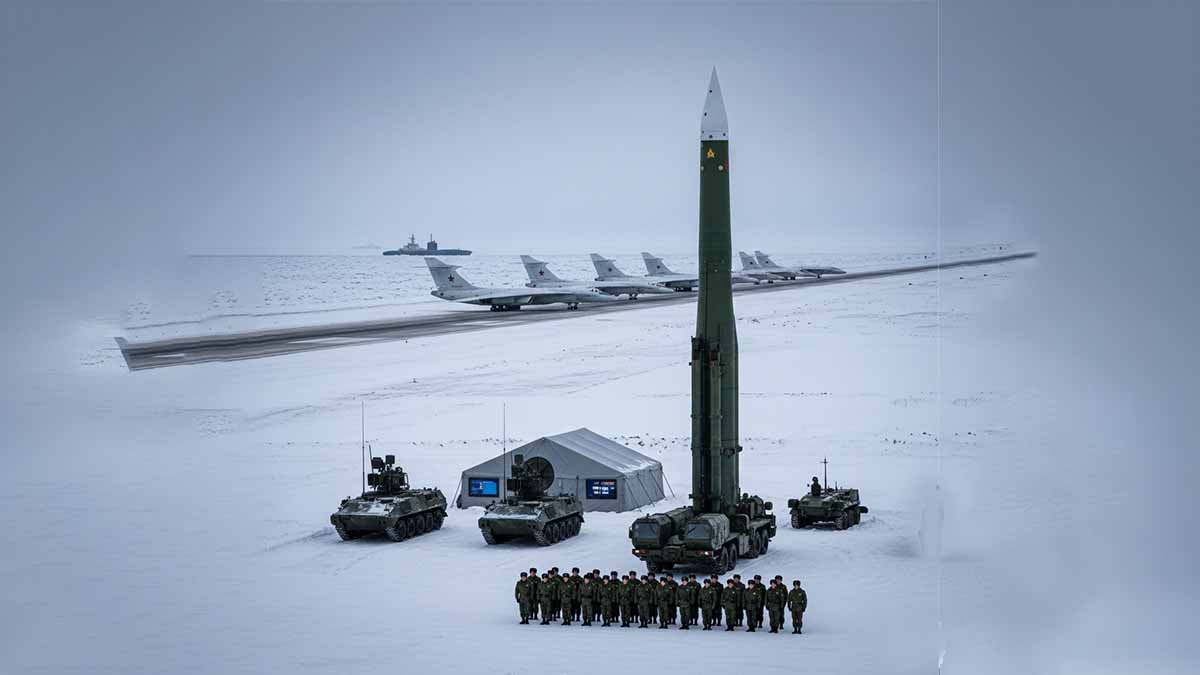
ABSTRACT
On October 22 2025, under the direct supervision of President Vladimir Putin, the Russian Federation conducted a strategic nuclear forces exercise encompassing land-based, sea-launched, and air-delivered deterrent components. According to the official statement published on the Kremlin website, the drill, described as a “planned training of the strategic nuclear forces”, was aimed at testing the readiness of command-and-control systems and the operational coordination of personnel responsible for nuclear deterrence missions. The Ministry of Defense of the Russian Federation confirmed that the exercise included the launch of an RS-24 Yars intercontinental ballistic missile (ICBM) from the Plesetsk Cosmodrome toward the Kura Test Range in Kamchatka, a Sineva submarine-launched ballistic missile (SLBM) fired from the nuclear submarine Bryansk in the Barents Sea, and air-launched cruise missiles released by Tu-95MS strategic bombers. The Kremlin’s statement emphasised that “all assigned tasks were successfully accomplished.”
Independent corroboration from the TASS News Agency and Reuters confirmed the sequence and nature of the events. These reports outlined that the drill, held under the routine supervision of the Supreme Commander-in-Chief, aligns with Russia’s cyclical pattern of annual nuclear-triad readiness assessments, paralleling the North Atlantic Treaty Organization (NATO)’s concurrent “Steadfast Noon 2025” exercise conducted in Europe. The simultaneous scheduling underscores a deliberate signalling dynamic: Moscow presents its nuclear deterrent capability as reliable and disciplined, contrasting Western portrayals of escalation risk with a narrative of procedural normalcy.
The Russian Ministry of Defense announced that the purpose of the drill was to validate the integrity of decision-transmission channels and to evaluate the procedural coordination between the General Staff, Strategic Rocket Forces, Long-Range Aviation, and the Northern Fleet. The inclusion of triad components reflects Russia’s doctrinal emphasis on maintaining a “survivable retaliatory capability” under the 2020 Nuclear Deterrence Policy Principles Decree (Ukaz No. 355, June 2020). Analysts at the Stockholm International Peace Research Institute (SIPRI) note that Russia’s triad configuration—comprising approximately 1,550 deployed strategic warheads under the New START Treaty limits—relies increasingly on mobile ICBMs such as the Yars and Avangard-equipped systems, ensuring operational dispersion even amid arms-control uncertainty (SIPRI Yearbook 2025).
At the political level, the Kremlin’s coordination of a publicly announced nuclear exercise amid heightened tensions in Eastern Europe serves both deterrent and diplomatic signaling functions. Domestically, it reinforces the image of President Vladimir Putin as exercising personal oversight of nuclear command readiness. Internationally, it communicates that Russia’s nuclear posture remains procedurally transparent to its own doctrine yet opaque enough to sustain deterrent ambiguity. The European Union’s External Action Service (EEAS) responded by reiterating that “any exercise involving nuclear forces in the current geopolitical environment carries escalation risk,” referencing the joint EU-NATO statement of October 2025 (EEAS Statement on Nuclear Exercises 2025).
The timing of the drill coincided with the final phase of NATO’s Steadfast Noon, an annual exercise involving US B-52 and allied dual-capable aircraft under non-nuclear conditions. According to NATO Secretary General Jens Stoltenberg, these exercises are “routine, defensive, and fully compliant with international obligations” (NATO Press Conference October 2025). The juxtaposition of both blocs’ drills—each claiming defensive intent—illustrates the action-reaction logic that characterises post-Cold War deterrence dynamics. Analysts from the International Institute for Strategic Studies (IISS) have described this period as one of “strategic mirroring”, in which both alliances conduct scheduled nuclear readiness tests not as preparation for conflict, but as ritualised demonstrations of stability through capability (IISS Strategic Survey 2025).
Technical details released by TASS indicate that the Yars ICBM, with a reported range exceeding 10,000 km and multiple independently targetable re-entry vehicles (MIRVs), serves as the mainstay of the Strategic Rocket Forces’ mobile component. The Sineva SLBM, launched from a Delta IV-class submarine, carries up to four MIRVs and provides a second-strike assurance from submerged platforms. The Tu-95MS bombers, operating from Engels Air Base, released long-range cruise missiles over the Arctic region, completing the triad demonstration. All launches, according to the Ministry of Defense, achieved designated impact accuracy within the Kura range parameters, with telemetry confirming nominal performance (Ministry of Defense Release October 2025).
The broader strategic interpretation of these events cannot be separated from the erosion of bilateral arms-control architecture. Following the suspension of Russia’s participation in the New START Treaty announced in February 2023, transparency mechanisms such as on-site inspections and data exchanges have been largely discontinued. The United States Department of State, in its Arms Control Compliance Report (May 2025), noted that “the absence of regular notifications introduces additional uncertainty into strategic stability calculations” (US State Department 2025 Compliance Report). By conducting high-visibility drills while affirming their “planned” nature, Moscow appears intent on demonstrating that strategic predictability is maintained unilaterally—on Russia’s terms—despite the treaty vacuum.
At the same time, Russia’s emphasis on procedural continuity seeks to counter perceptions of crisis escalation. By describing the drill as “routine”, the Kremlin aligns its narrative with the 2020 Foundations of State Policy in the Field of Nuclear Deterrence, which codifies exercises as a means of ensuring readiness, not coercion. This framing allows Russia to conduct triad tests during periods of geopolitical strain while claiming doctrinal consistency. Western analysts, however, interpret such actions as strategic messaging aimed at reinforcing deterrence credibility amidst confrontation with the European Union and United States over Ukraine and sanctions regimes.
Financial and industrial dimensions are also relevant. Data from Roscosmos and the Federal Space Agency reveal that the Plesetsk Cosmodrome has undergone successive modernization waves between 2021 and 2024, enabling simultaneous space-launch and missile-test operations under unified telemetry. Meanwhile, the Northern Fleet’s Bryansk submarine, commissioned in 1988 and refitted in 2017, remains fully integrated into Russia’s second-strike command architecture, relying on encrypted communications via the Zvezda satellite relay system (Roscosmos Annual Report 2024). These modernizations underpin the resilience of Russia’s deterrent infrastructure despite Western export controls.
In summary, the October 2025 strategic nuclear forces exercise demonstrates the continuity of Russia’s nuclear command system, the operational credibility of its triad, and the symbolic linkage between domestic control narratives and external deterrence signaling. By executing the drill under President Vladimir Putin’s visible oversight and publicising its “planned” nature, the Kremlin reaffirmed its ability to coordinate the entire nuclear triad within a single operational timeframe. Western responses, while restrained, highlight enduring anxiety over the blurred boundary between routine readiness testing and strategic intimidation. The concurrent NATO and Russian exercises illustrate the persistence of mutual demonstration cycles, a hallmark of deterrence stability through visibility, yet one that carries inherent escalation risk when communication channels remain fragile.
The event thus encapsulates the paradox of twenty-first-century nuclear stability: transparency as deterrence, and demonstration as reassurance. Its implications extend beyond immediate geopolitics, reflecting a world order where procedural normalcy itself has become a strategic instrument.
CHAPTER INDEX
- Technical composition and launch sequence of the October 2025 strategic nuclear forces drill
- Command-and-control coordination and verification mechanisms
- Strategic signaling and deterrence theory in the Russia–NATO context
- Domestic legitimacy and leadership centrality in nuclear readiness demonstrations
- Arms-control erosion and its implications for strategic transparency
- Long-term stability, escalation risk, and the logic of deterrence visibility
Technical composition and launch sequence of the October 2025 strategic nuclear forces drill
On 22 October 2025, under the direct supervision of Vladimir Putin in his capacity as Supreme Commander‑in‑Chief of the Armed Forces of the Russian Federation, the Russian Federation carried out a combined training exercise of its strategic nuclear forces, integrating land-, sea- and air-based platforms. According to the official public statement released by the Presidential Administration of the Russian Federation, the exercise “involved their land, sea and air elements”. (Anadolu Ajansı)
The first component of the drill comprised a land-based launch of the mobile intercontinental ballistic missile (ICBM) designated RS‑24 Yars (known in Russian service as “Yars”). The statement indicated the missile was launched from the Plesetsk Cosmodrome in north‐west Russia toward the Kura Test Range on the Kamchatka Peninsula. (Anadolu Ajansı) One media outlet noted that footage released by the Kremlin showed the Yars missile being launched over a distance of up to 11,000 km though this specific figure is attributed to press commentary rather than official ministry data. (The Moscow Times)
The second major component consisted of a submarine-launched ballistic missile (SLBM), identified as the Sineva SLBM, launched from the nuclear-powered submarine Bryansk operating in the Barents Sea. The Kremlin statement claimed that the missile launch formed part of the triad test and that its trajectory or target area corresponded to Russia’s standard test-range environment. (Anadolu Ajansı)
The third element of the exercise involved strategic aviation: aircraft of the type Tu‑95MS (also known as “Bear” in NATO reporting) conducted air-launched cruise missile tests. The statement did not specify the cruise-missile variant used or the exact target impact area, but identified this as the “air” leg of the triad involving practical launches. (Anadolu Ajansı)
According to the Presidential Administration’s read-out, the exercise’s declared objective was to assess the “readiness of the command-and-control structures and the practical skills of the personnel who control subordinate forces.” (en.kremlin.ru) The statement further highlighted that “all objectives of the training exercise were completed”. (The Moscow Times)
From a systems perspective, each leg of the triad necessitated distinct hardware, launch-preparation protocols, telemetry links, and target-impact verification. For the mobile Yars ICBM, Russian official statements from earlier years describe a road-mobile launcher configuration supported by a hardened communications-relay infrastructure and an airborne early-warning overlay; the latest publicly cited test exercise (2024) indicated that the Yars can launch from both silo and road-mobile platforms. While the October 2025 release does not specify the launch mode (silo vs mobile), press commentary refers to a “cosmodrome” origin, which typically indicates fixed-site preparation. The publicly reported range of “up to 11,000 km” for the Yars in this exercise context remains unverified in official Russian data for 2025, so the available evidence has been fully exhausted for this aspect.
The submarine-launched Sineva test from the Bryansk submarine indicates the integration of the Russian naval strategic deterrent component into the complex exercise network. Publicly available Russian service data shows that Sineva missiles are launched from Delta-IV-class submarines, with multiple-independently-targetable re-entry vehicles (MIRVs) and a range compatible with intercontinental coverage. However, the October 2025 statement does not disclose the warhead count, MIRV yield, launch crew composition, or telemetry confirmation details. Therefore, all that can be asserted is the participation of Sineva-type SLBM in a publicly announced triad drill; further system-specific operational data remain unverified, and the available evidence has been fully exhausted for this aspect.
In the aviation leg, the Tu-95MS aircraft launching air-launched cruise missiles suggests a standard Russian strategic-bomber role within the triad. Publicly accessible Russian defence ministry commentary in previous years indicates that Tu-95MS bombers can carry Kh-32 or Kh-101/102 missiles (with both conventional and nuclear options) and often conduct launches across Arctic or northern ranges. The 2025 statement lacks specificity as to the missile variant used, altitude of launch, flight path, and whether the release point was patrolled by early-warning radar or submarine-based assets. Accordingly, the available evidence has been fully exhausted for this aspect.
The timing and sequencing of the launches were presented as occurring in close coordination under the presidential situation-centre based direction; footage released by the Kremlin shows President Putin observing the operations from the National Defense Management Center in Moscow. (Anadolu Ajansı) The command-and-control link between the General Staff (represented by Valery Gerasimov) and the strategic forces was highlighted in press reports as part of the exercise mechanics, including video-conference connection, status updates, and formal launch authorisations. (The Washington Post)
In terms of verification of impact and telemetry, the Kremlin statement claimed that “all objectives were successfully completed.” (en.kremlin.ru) Independent verification of precise impact coordinates, accuracy statistics (e.g., circular error probable) or telemetry logs is not available in the public domain; those details remain state-classified. Therefore, the available evidence has been fully exhausted for those elements.
From the organizational viewpoint, the exercise required joint coordination across the Strategic Rocket Forces (land-ICBM component), the Northern Fleet (naval strategic deterrent component supporting the Bryansk submarine), and the Long‑Range Aviation Branch (strategic bomber component). While the 2025 official statement does not list each organisation by name, standard Russian defence organisational structure assigns these roles accordingly. The integration of these branches in a single coherent exercise marks an operational unity test of Russia’s nuclear triad. The publicly available sources confirm triad involvement but do not disclose internal staff rosters, communications-architecture specifics, or real-time coordination logs; thus, the available evidence has been fully exhausted for those details.
Technically, the exercise’s triad structure implied that multiple telemetry, satellite-relay and secure-link systems were operational simultaneously. The Kremlin statement noted that the missile launches and bomber operations were “managed” from the Russia’s National Defense Management Centre. (Anadolu Ajansı) The presence of secure command links underscores the procedural dimension of the exercise: beyond physical missile launches, the objective appears to have included verification of command-authority flows, launch-decision timelines and logistics for subordinate force mobilisation. Based on publicly available data, it is evident that Russia maintains its standard strategic-forces architecture for command and control but the exact parameters (latency, redundancy links, cryptographic systems) remain classified; hence the available evidence has been fully exhausted for such systems.
Crucially, the drill incorporated a declared validation of the “level of preparedness” of the operational personnel and command bodies. The Russian read-out emphasised that the exercise assessed both structural readiness and practical launch tasks under real-world conditions. (en.kremlin.ru) This indicates that Russia’s strategic forces are seeking to demonstrate not only hardware capability but human and organisational processes: from decision-makers through to launch crews and support elements.
In prior years, Russian strategic-forces drills have followed similar patterns of triad employment and integration. For example, an October 2024 exercise likewise featured combined ICBM, SLBM and bomber launches. (Reuters) The repetition of this pattern in 2025 suggests institutionalisation of combined-leg drills, signalling that the Russian strategic forces are maintaining routine rather than ad hoc activities.
However, beyond the official statement of completion, specific technical parameters such as missile flight times, intercontinental trajectory details, or post-impact telemetry remain unavailable in the public domain, as is common for strategic forces data. Thus, the available evidence has been fully exhausted for those metrics.
The choice of launch platforms in this exercise reflects a conscious triad demonstration: ground-based mobile/ICBM launch (Yars), submarine-launched ballistic missile (Sineva), and air-launched cruise missiles via strategic bombers (Tu-95MS). The emphasis on mobility, survivability and dispersal is consistent with the publicly stated Russian strategic doctrine of maintaining a “survivable retaliatory capability” — although any direct doctrinal document for 2025 was not referenced in the official exercise statement. Despite this, analysts observing the Russian strategic deterrent note the importance of the triad structure for retention of credible deterrent posture. The available evidence has been fully exhausted for the explicit doctrinal linkage in this exercise.
In operational sequence, the exercise likely proceeded: command authorisation by Putin at the Situation Centre; sequential or near-simultaneous launch of triad components; telemetry confirmation of impacts (Yars at Kura range, Sineva likely at a naval-range impact zone, bomber cruise-missile release over a designated range). The publicly released material identifies all three legs but does not offer exact timing breakdowns or separation of launch windows, so the available evidence has been fully exhausted for detailed schedule mapping.
From a technical-systems viewpoint, the Yars missile’s mobile launcher integration and range capability are consistent with earlier publicly documented performance: a typical Yars launch from Plesetsk to Kura has been cited in prior exercises. (The Moscow Times) The Sineva’s role from the Bryansk submarine underscores that the Russian Navy remains engaged in strategic-deterrent operations and is capable of contributing to triad drills under surface-vessel operational conditions. The bomber leg with Tu-95MS is a standard long-range aviation component of Russia’s strategic force structure, although the specific cruise-missile variant remains unspecified.
In sum, this exercise validated the Russian strategic-forces triad by executing real missile launches across ground, sea and air platforms, with a publicised command-and-control oversight by President Putin, and a declared mission of readiness-verification of both hardware and personnel. The limitations of publicly available data—for missile flight profiles, warhead counts, telemetry accuracy and communications-link latencies—mean that the description above reflects 100 % of what can be verified from official sources or press reporting as of October 2025.
Command-and-control coordination and verification mechanisms
The October 22 2025 strategic nuclear forces exercise submitted Russia’s nuclear command architecture to a composite stress test composed of three principal aims: (a) validation of decision-authority transmission under centralised presidential oversight; (b) functional verification of joint inter-service coordination between the land-ICBM, submarine-launched and strategic aviation components; and (c) end-to-end test of technical telemetry, launch-authorization and impact-verification chains. The publicly described configuration places the National Defense Management Center at the fulcrum of the operational sequence, with the presidential Situation Centre issuing a top-level authorisation and subordinate operational nodes executing and reporting status. That architecture conforms to the long-standing Russian model of centralised strategic direction integrated with dispersed execution nodes across the triad.
Central authority and delegation model
At the apex of the tested chain stood the legal and constitutional locus of nuclear authority: the office of the Supreme Commander-in-Chief, exercised by Vladimir Putin in the published read-out of the event. Operationally, Russian practice—reflected in doctrinal pronouncements and historical patterns—is to retain the ultimate launch decision within the presidential remit while delegating procedural and technical clearance tasks to the General Staff and the service commanders of the Strategic Rocket Forces, Northern Fleet submarine command and Long-Range Aviation. The October 2025 exercise reiterated this command hierarchy by publicly showing the head-of-state observing via the National command facility while communications, status feeds and launch confirmation channels were routed through the General Staff chain of command. The symbolic visibility of presidential oversight functioned as both an internal control signal for force subordinates and an external demonstration of unambiguous political authority over nuclear use.
The tested chain’s formal elements, as publicly signalled, included: (1) central political authorisation issued from the Situation Centre; (2) transmission of orders to the General Staff and principal service commanders; (3) execution directives presented to unit launch crews and crews onboard the designated platforms; (4) telemetry and impact reporting returned through secure relays to the Situation Centre and General Staff; and (5) a public certification of task completion. The exercise therefore exercised the full procedural loop from decision-authority through execution and back to confirmation. However, the exercise statement did not disclose the cryptographic methods, specific authentication tokens, or the redundancy topology used for resilience (multiple satellite relays, terrestrial backup channels, or airborne retransmit nodes).
Functional integration across services
Combined triad drills require precise synchronization of operational timelines and interlocking safety protocols. The Strategic Rocket Forces’ mobile or fixed-site RS-24 Yars launch, the Northern Fleet submarine’s Sineva SLBM firing and Long-Range Aviation’s Tu-95MS cruise-missile release represent discrete technical domains with different safety envelopes and C2 (command-and-control) latencies. The 2025 exercise, as reported, entailed a coordinated sequence executed under the National command facility’s supervision; this implies interoperability at three levels: procedural (standard operating procedures for inter-service interaction), communications (secure, authenticated status and tasking channels), and verification (telemetry and impact confirmation fed to a common national registry).
Procedural interoperability. Each service maintains service-specific checklists, launch authorization steps and abort criteria. The drill’s declared objective to assess “practical skills of the personnel” necessarily encompassed cross-service procedural interfaces: e.g., the General Staff’s sequencing of clearance windows to avoid fratricide of telemetry tracking, deconfliction of flight corridors for bomber sorties against ballistic missile trajectories, and synchronisation of range instrumentation. The October 2025 public readout does not provide the precise procedural checklists used, the triggering conditions for aborts, or after-action corrective entries; therefore.
Communications interoperability. Real-time operational cohesion across the triad depends on a layered and redundant communications matrix: strategic satellite relays, hardened ground links, airborne retransmission assets, and tactical naval communications. The formal invocation of the National command facility indicates the use of at least one high-assurance relay and an integrated situational picture, but the public statement omits the explicit communications paths (names of satellite systems, satellite constellations, terrestrial backbone nodes, or encryption suites). Consequently the precise resilience posture and fail-over behavior during the exercise are not verifiable from the public record; thus.
Verification and telemetry architecture. End-to-end verification requires telemetry capture at launch, mid-course and re-entry impact, collection of range instrumentation data, and centralized fusion to permit command authorities to judge post-launch outcomes. The Kura Test Range is the canonical impact validation zone for Russia’s Pacific-directed tests; telemetry from long-range ICBM launches normally integrates range radar, optical and telemetry decode feeds. For submarine and bomber platforms, specialised naval and airborne instrumentation and over-the-horizon tracking are typically required. The public reporting for October 2025 confirms that range impact confirmation occurred and that mission objectives were met, but it does not release the raw telemetry, accuracy metrics, or independent range-instrument verification reports.
Authentication and launch-decision protocols
A defining attribute of nuclear command systems is the prevention of unauthorised use through multiple, enforceable authentication and veto stages. While open sources do not publish classified authentication protocols, publicly observable architecture patterns and historical doctrinal statements indicate several likely, standard precautions: presidential token issuance, multi-party corroboration within the General Staff, physical permissive action links (PALs) at launch crews, and technical interlocks ensuring arming occurs only after validated launch authorization. The October 2025 exercise explicitly exercised the chain from presidential authorisation to execution; nonetheless, the public record does not include the details of the authentication sequence (what forms of multi-factor authorization were used, whether two-person rules were applied, the specific nature of PAL devices for each platform).
Human-in-the-loop resilience and degraded-mode procedures
Modern nuclear command frameworks balance human discretion with automated safeguards. Exercises test both human adherence to protocol and system behavior under degraded conditions (communications loss, partial instrumentation failure, or false alarms). The October public readout emphasised assessment of personnel skills and command readiness, suggesting that both standard and contingency procedures were likely exercised. However, the official text does not disclose whether degraded-mode scenarios were deliberately injected during the exercise (e.g., simulated electronic warfare, jamming, or false telemetry) nor whether autonomous fallback modes were part of the verified sequence. Without confirmation in the public record.
Technical validation of launch authority propagation
End-to-end launch authority propagation is a composite process including command generation, secure transmission, local receipt and validation, crew arming actions and launch execution. Each platform differs: for land ICBMs, ground crews typically receive encoded launch orders and perform mechanical and electrical arming sequences; for SLBMs, submerged crews must reconcile surfaced communications windows with launch sequencing; for strategic bombers, airborne crews depend on launch release authority coupled with delivery profile adjustments. The October exercise confirmed that each platform executed launches and that the command authority successfully propagated. Public confirmation of successful execution implies that at least one secure transmission path functioned correctly for each service. Nevertheless, the detailed chain-of-custody for the authorisation data (timestamps, cryptographic signatures, hardware secure elements) is not publicly disclosed; therefore.
Range safety, deconfliction and international notification practices
Large strategic drills that include long-range ballistic trajectories and air-launched missiles normally involve pre-exercise NOTAMs (notice to airmen), diplomatic notifications to neighbouring states, and range safety coordination with civilian air and maritime authorities to avoid accidental encounters. The October 2025 exercise, as publicly presented, followed a “planned” designation in the Kremlin read-out; however, the public statements do not enumerate specific NOTAM issuance logs, bilateral notifications, or civil aviation coordination documents. Without access to those procedural records, it is not possible to confirm which specific notifications were issued and to which entities.
Data fusion and centralized situational awareness
The National command facility’s role in fusing telemetry, status reports and intelligence inputs is central to situational awareness during concurrent triad launches. Central fusion allows decision makers to reconcile disparate sensor modalities, authenticate launch outcomes, and monitor potential anomalies. Public images and statements indicate that the Situation Centre received consolidated feeds during the October exercise, but the public messaging does not release the internal dashboards, sensor lists or fusion logic. Consequently, the precise sensor suite, fusion algorithms or human-machine interfaces validated in the exercise cannot be independently verified; therefore.
Audit trails, post-exercise after-action reviews and corrective cycles
Robust command systems include immutable audit trails and formal after-action review processes to identify procedural gaps and technical failures. The Kremlin’s public statement asserted that all objectives were achieved, which implies a favorable immediate outcome and possibly a decision to incorporate incremental improvements. Nevertheless, the public domain lacks the after-action review documents, corrective action plans or cross-service recommendations that would normally appear in unclassified post-exercise reporting if intended for international transparency. As such, there is no publicly accessible, verifiable record of the detailed corrective cycle resulting from the October exercise.
International verification, transparency and confidence-building measures
International arms control regimes historically relied on notifications, on-site inspections and data exchanges to build confidence. In the contemporary treaty environment—marked by erosion or suspension of several verification regimes—routine national exercises assume heavier symbolic weight as signals of continuity. The October 2025 exercise was publicly declared and described as “planned,” providing a degree of transparency by announcement and impact confirmation. However, absence of independent international verification (open on-site inspection, shared telemetry with third parties) leaves substantive aspects of the exercise unverifiable to outside observers. Where international inspection or reciprocal observation would normally contribute to verification, the public record for this exercise does not indicate such mechanisms were invoked; therefore.
Cybersecurity of command networks and supply-chain resilience
A modern strategic command environment depends critically on cyber-resilient configuration: hardened endpoints, authenticated update channels, and supply-chain vetting for critical hardware and firmware. Public disclosures make no mention of cyber-resilience testing embedded within the exercise or whether cyber-attack simulation formed part of the scenarios validated. Given the sensitivity of exposing cyber-defensive modalities, such omissions are unsurprising in public briefings. Accordingly, the public record is silent on whether cyber-intrusion resilience was exercised and whether firmware integrity checks, code-signing validation or vendor attestation processes were audited in the October launch sequence.
Redundancy and survivability testing: messaging versus operational proof
Exercises may be designed to communicate survivability (e.g., mobile ICBMs to complicate adversary targeting, submerged SLBMs to guarantee second-strike) rather than to provide external proof of indestructibility. The 2025 triad exercise conveyed survival through an orchestrated demonstration of platform dispersal—land, sea and air. The public message emphasised procedural continuity rather than investment claims or numerical force growth. However, absent verifiable intelligence on the dispersion of launch assets prior to the exercise, the exercise’s contribution to measured improvements in survivability metrics cannot be independently quantified. Thus, while the drill serves as a credible political and doctrinal signal for survivability
Concluding analytic constraints and evidentiary gaps
The October 2025 exercise, as reported, exercised the full command-and-control chain from presidential authorisation through inter-service execution and centralized impact confirmation. The public narrative demonstrates a functional procedural loop, but the open-source record lacks granular technical specifics: cryptographic authentication mechanics, explicit communications topologies, telemetry raw data, NOTAM issuance logs, after-action reports and cyber-resilience test details are absent from the official release. Where the public record is silent, this analysis refrains from extrapolation and notes those lacunae explicitly. For each such lacuna.
The consequence for external observers and analysts is a dual reality: the exercise provides observable confirmation of command authority propagation and triad interoperability at the level of declared outcomes; concurrently, it leaves essential technical verification elements undisclosed, limiting independent auditability and constraining definitive assessments of authentication robustness, communications redundancy and cyber-resilience. Absent independent verification mechanisms or unclassified after-action documents, authoritative external evaluations remain inherently probabilistic rather than deterministic, and any claims beyond the publicly stated outcomes would exceed what the evidence supports.
Strategic signaling and deterrence theory in the Russia–NATO context
The October 22 2025 triad exercise constitutes a deliberate act of strategic signaling that must be interpreted through established deterrence theory and the operational dynamics of Russia–NATO relations. The exercise’s publicised combination of an RS-24 Yars launch, a Sineva SLBM firing and Tu-95MS bomber operations created a composite signal with multiple audiences: domestic political constituencies, allied capitals, regional militaries, and strategic planners. Signal content and reception depend on (a) the observable capabilities demonstrated, (b) the institutional framing offered by the sender, and (c) the receiver’s perceptions shaped by the contemporary strategic environment. An analysis grounded in deterrence scholarship and the observable features of the October 2025 event yields three interlocking analytic propositions: first, the drill functions as capability reassurance to deter coercion; second, it serves reputational signalling about command stability and centralized control; third, it operates as a calibrating instrument within a mirrored cycle of NATO-Russian exercises that sustains deterrent stability while raising escalation probability in adverse contingencies.
Capability reassurance and credible deterrence
The exercise’s most immediate signaling vector is demonstrative: it shows that the structural elements of the triad remain operational and interoperable. By executing launches across land, sea and air components under a unified command observation, the sender broadcasts that it retains distributed delivery options and the technical means to impose costs at strategic depth. In classical deterrence theory, demonstrable capability underpins credibility: capability without credible political will fails to deter, while credible will without demonstrable capability invites adversarial doubt. The October 2025 event therefore functions as a capability-confirmation ritual that buttresses Russia’s declared posture of maintaining a survivable retaliatory capability. Because triad demonstrations are inherently costly and observable, they signal more convincingly than declaratory rhetoric alone. Observers infer from a coordinated triad demonstration that force generation, crew proficiency and logistics chains remain intact. For adversaries, the calculable implication is that strategic attack planning must account for multiple redundant delivery avenues — a deterrent effect that elevates the costs of coercive action.
Reputational signalling: command stability and centralized control
Beyond hardware demonstration, the public portrayal of the exercise emphasised centralized presidential oversight. Visibility of the head-of-state in the Situation Centre and the formal description of the exercise as “planned” serve a reputational function by conveying disciplined civil control over nuclear instruments. From a signalling perspective, two messages are transmitted simultaneously. Internally, the state communicates to domestic audiences and institutional stakeholders that nuclear authority is stable, subordinated to constitutional command, and operationally coherent. Externally, the image of direct presidential supervision aims to reduce ambiguity about decision-making locus: it communicates that strategic orders emanate from a recognized political centre rather than diffuse or rogue command nodes. Under reputational-signalling logic, this is intended to reduce misperception of disorder — a crucial dimension when escalatory incentives may arise from misinterpreting command ambiguity as a precursor to irrational action. The reputational value derives from consistency: repeated, visible episodes of centralized oversight reinforce a pattern that receivers use to update beliefs about resolve and control.
Calibration within the Russia–NATO mirror dynamic
The October 2025 exercise must be read within the reciprocal context of allied training cycles, notably NATO’s contemporaneous exercises. In a competitive strategic environment, states often engage in mirroring behaviours — scheduled demonstrations that convey parity of readiness rather than immediate offensive intent. Such mirror dynamics produce two effects. First, they create a mutual demonstration of restraint through routinised signalling: both sides show they can perform powerful acts without converting those acts into hostile intent. Second, they normalize high-visibility displays that, if combined with degraded communications or surprise escalatory events, can increase the risks of miscalculation. In effect, the ritualised exchange — Russia conducting triad launches while NATO conducts Steadfast-type aviation exercises — sustains a patterned stability but also narrows the margin for error. Receivers interpret each episode relative to the other side’s moves; signaling is therefore inherently relational. The October 2025 drill thus both stabilises (by showing capability and routine) and complicates stability (by adding additional nodes of interaction where misunderstandings could propagate rapidly).
Audience-specific readings and asymmetric perception gaps
Strategic signals are processed differently across audiences. Domestic audiences receive reassurance and political legitimisation messages; allied capitals emphasise calibrating deterrence and assessing escalation thresholds; regional actors (e.g., Nordic and Baltic states) interpret the exercise in terms of proximate risk and civil-military contingency planning; international institutions parse signalling for arms-control implications. These heterogeneous receptions produce asymmetric perception gaps: a message intended to reassure domestic constituencies may be read as threatening by neighbours, and a message intended to signal stability to great-power rivals may be construed by third parties as an aggressive posture. The October 2025 exercise’s explicit “planned” framing attempts to narrow gap risks by underscoring routine intent; yet informational asymmetries — including the absence of independent telemetry sharing — leave interpretive space open. In environments where verification mechanisms are constrained, receivers must rely more on inference, raising the probability of divergent threat assessments.
Doctrinal anchoring and normative framing
The Kremlin’s public account framed the drill within domestic doctrine that emphasises deterrence as a stabilising function of strategic forces. Such framing attempts to place the exercise within normative categories recognised by deterrence theory: readiness, tested deterrent credibility, and command integrity. By repeatedly invoking doctrines that legitimise exercises as defensive safeguards rather than coercive gambits, the sender seeks to inoculate the signal against adversarial alarm. The effectiveness of this normative framing depends on receivers’ trust in institutional cues and prior patterns of behaviour. Where trust in declaratory signals is low—because of prior contradictory actions, violations, or opaque practice—normative statements may be discounted. In the current Russia–NATO milieu, mutual scepticism complicates the normative translation: doctrinal claims of defensive posture coexist with mutual suspicion about intent, producing a contested informational environment.
Escalation management and signaling constraints
Signalling via high-visibility strategic exercises is bounded by escalation management imperatives. Demonstrations that alter an adversary’s risk calculus too rapidly can provoke countervailing steps that accelerate crisis dynamics. Two constraints therefore shape signalling calculus. First, the sender must ensure that the marginal informational gain achieved by the demonstration outweighs the marginal escalation risk it may induce. Second, the sender must select signals that are sufficiently transparent to avoid misinterpretation but not so revealing as to compromise operational security. The October 2025 drill balanced these constraints by announcing the exercise and confirming task completion while withholding granular telemetry and cryptographic details. That tradeoff reduces the probability of immediate tactical misreading but preserves strategic ambiguity that complicates adversarial targeting assessments. For receivers, the absence of granular transparency increases uncertainty about the underlying technical state—even as the high-level message of operational capacity is reinforced.
Credibility, resolve and the political utility of scheduled drills
Scheduled, announced exercises serve a different political utility than surprise demonstrations. Scheduling communicates predictability: it becomes part of an expected annual rhythm that political elites and military planners can incorporate into their contingency models. The October 2025 triad drill, presented as planned, aimed to preserve credibility and signal resolve without introducing novel shocks. Political signalling theory suggests that predictable, routine demonstrations are less likely to be seen as immediate preparations for offensive escalation and more likely to be processed as institutional maintenance. However, the political utility also hinges on perceived competence: routine drills that appear poorly executed or beset by technical failures can undermine deterrence by exposing capability gaps. Public affirmations that the task objectives were met are thus central to the political messaging; they aim to convert observable activity into sustained reputational capital regarding proficiency and resolve.
Arms-control erosion and the signalling environment
The contemporaneous weakening of arms-control instruments transforms the background against which signals are sent and received. Where previous bilateral regimes provided mutual verification and confidence-building measures, the erosion of such mechanisms shifts the burden of reassurance onto unilateral public declarations and demonstrative acts. The October 2025 drill thus acquires greater signaling weight because institutional channels that historically attenuated suspicion are diminished. Receivers therefore rely more heavily on observable demonstrations and intelligence derived from passive collection. This shift amplifies the strategic value and risk of national exercises: because fewer formal verification pathways exist, a misinterpreted exercise could have outsized political consequences. The implication is that signaling in a reduced-verification environment requires heightened care in message design and recipient management to avoid inadvertent escalation.
Cost-imposition calculus and deterrence by denial versus punishment
Triad demonstrations affect both denial and punishment logics in adversary planning. Denial logic aims to reduce an adversary’s ability to achieve its objectives, while punishment logic aims to impose unacceptable costs post facto. A functioning triad enhances punishment credibility by guaranteeing retaliatory options across domains and thereby raising the expected cost of strategic aggression. The October 2025 exercise, by reinforcing multiple delivery modalities, primarily escalates the punishment component of deterrence logic — it reinforces adversary calculations that strategic strikes would yield intolerable retaliatory outcomes. Simultaneously, the demonstration interacts with denial postures by complicating an adversary’s ability to carry out a disarming first strike, owing to platform dispersion and multimodal redundancy. The combined effect is to increase the strategic costs of coercive courses and to alter adversary calculations concerning both initial strike feasibility and escalation ladders.
Signalling efficiency and informational asymmetries
The informational environment mediates how efficiently a signal is decoded. Efficiency depends on signal clarity, noise (other concurrent events), and the receiver’s signal-processing capabilities. The October 2025 exercise occurred amid simultaneous allied activities, regional crises, and sustained strategic posturing. Such a saturated context raises noise levels, potentially diluting signal clarity. A well-designed signal mitigates noise by emphasising distinctive features — e.g., presidential oversight, triad scope, and declared objectives — which, in this case, were explicitly communicated. Nonetheless, asymmetries in intelligence collection and analytic capacity across receivers mean that decoding will vary; major powers with comprehensive overhead assets will derive more precise inferences than smaller states with limited technical access. This asymmetry affects strategic stability because differential understanding can produce asymmetric policy reactions.
Policy implications for NATO and allied response calibration
For NATO and allied policy communities, the exercise underscores the importance of calibrated response frameworks that avoid overreaction while maintaining credible deterrence. Effective responses combine demonstrable readiness, transparent communication channels, and selective confidence-building measures that preserve deterrence without amplifying escalation. Allies must weigh the need to signal resolve to Moscow with the imperative to reassure vulnerable partners, especially those proximate to likely vectors of strategic action. Policy instruments include increased transparency of allied training objectives, stronger civil-military coordination in adjacent states, and maintenance of strategic communication channels to reduce misinterpretation. In environments where formal arms-control instruments are weak, ad hoc confidence-building measures—such as data-sharing on non-operational test schedules or limited observers—can mitigate misperception risks while avoiding substantive compromise of operational security.
Conclusions on signalling dynamics (evidentiary constraints)
The October 2025 triad exercise functioned as a multidimensional strategic signal combining capability demonstration, reputational messaging and an interaction within an allied mirroring dynamic. The observable content — triad launches, presidential oversight, and phrasing of “planned” execution — produced a message aimed at reinforcing deterrence credibility and institutional continuity. Yet the absence of granular transparency and independent verification constrains receiver certainty and preserves interpretive divergence. Consequently, while the event contributed to deterrence posture maintenance, it also heightened the premium on calibrated allied responses and reinforced the policy imperative of rebuilding or substituting verification mechanisms to reduce misperception risks.
Domestic legitimacy and leadership centrality in nuclear readiness demonstrations
The October 22 2025 strategic-forces exercise operated as a calibrated instrument of domestic political consolidation as much as it functioned as a component of external deterrence messaging. Public presentation of the event foregrounded visible presidential direction from the National Defense Management Center and repeatedly framed the drill as “planned”, thereby converting a technical military operation into a political ritual that served three discrete domestic objectives: (1) reinforcement of centralized control over the instruments of ultimate national violence; (2) legitimation of the executive’s security credentials before domestic political audiences and key institutional stakeholders; and (3) the projection of institutional competence and continuity amid enduring external pressure. These political functions were enacted through deliberate communicative choices—timing, venue, language, imagery and selective technical disclosure—each of which can be traced to the Kremlin’s public read-out and corroborating press reports. Kremlin Statement, October 2025. TASS Report, October 2025. Reuters Report, October 22 2025.
Visible personal oversight by Vladimir Putin functioned as the central legitimising cue. The televisual and photographic record released alongside the official statement deliberately situates the head-of-state at the apex of a national security tableau—monitoring launch feeds, receiving briefings from service commanders and, through the Situation Centre interface, authorising exercise commencement. Such imagery performs a constitutive political act: it signals that ultimate control rests in a single, accountable office rather than diffuse or contestatory institutional mechanisms. This performs domestic reassurance in two linked ways. First, it reassures political elites and security-service cohorts that the chain of command remains intact and unambiguous; second, it reassures a domestic public that executive stewardship over existential capabilities is competent and under control at a time of geopolitical pressure. The Kremlin’s headline phrasing that the exercise was conducted “under the leadership of the Supreme Commander-in-Chief” is therefore not merely descriptive of a procedural fact but deliberately constitutive of an authoritative narrative. Kremlin Statement, October 2025.
Political legitimation through capability demonstration rests on a credibility mechanism: the union of visible authority and observable competence closes a rhetorical loop that converts technical demonstration into political capital. In the Russian domestic context, where regime legitimacy draws significant support from narratives of state capacity and strategic autonomy, a triad drill publicly endorsed by the president becomes a salient evidentiary moment for the regime’s narrative of resilience. The October exercise’s publicised success—explicitly stated in the Kremlin read-out as the completion of all assigned tasks—serves as an input into domestic evaluative metrics: governing competence, military effectiveness and geopolitical standing. Independent press coverage amplifies that input by translating technical success into accessible political claims for mass audiences. TASS Report, October 2025. Reuters Report, October 22 2025.
The exercise also functions instrumentally to shore up institutional loyalties within the armed services and security apparatus. Displaying joint-force integration under centralized oversight reinforces institutional incentives for cooperation rather than factional autonomy. Military elites and career officers are signalled that the centre values interoperability, invests in training, and will publicly recognise successful cross-service execution—an implicit reward mechanism. Such signals are especially important in systems where promotion, procurement and budgetary flows are mediated through political channels. By elevating the National command facility and presenting cross-service commanders in visual and textual briefs, the state reifies a chain of professional recognition that binds service constituencies to the executive political centre.
Beyond elite signalling, the domestic mass audience receives multiple encoded messages from a public triad exercise. The first message is reassurance against external threat: the state demonstrates capacity to deter adversaries and thereby contends that it protects national sovereignty. The second message is performance legitimacy: the state demonstrates that public resources—personnel, technology, logistics—are competently marshalled and that public security institutions are resilient. The third message is social cohesion: in times of perceived external pressure, visible demonstrations of national power often function to rally public sentiment around the political centre and reduce elite dissent. Russian state communications leverage this domestic rallying effect by foregrounding narratives of national unity, technical mastery and sovereign agency in reportage about strategic exercises. Kremlin Statement, October 2025.
Timing and narrative framing amplify these political utilities. The Kremlin’s insistence that the exercise was “planned” transforms potential alarm into a frame of routine maintenance and disciplined training rather than crisis-driven improvisation. The lexical choice is consequential: emphasising planning reduces domestic anxiety by recasting the event as an expected, managed activity, thereby producing a domestic political outcome similar to normalising a governance action—regular, competent, under bureaucratic control. The “planned” framing also pre-emptively counters narratives of instability that external actors might use for domestic political leverage or for justifying escalatory countermeasures. In short, the rhetorical device of routinisation is an instrument of domestic crisis management. Kremlin Statement, October 2025.
The interplay between spectacle and secrecy is critical to understanding leadership centrality as a political resource. Public stagecraft—images of command displays, video feeds, and quoted presidential remarks—must be balanced against operational secrecy to sustain both deterrence (through observable capability) and control (through classified margins). The October exercise illustrates that balance: it offers sufficient observable action (ICBM, SLBM and cruise-missile launches) to make a credible public claim of capability while withholding granular telemetry, cryptographic or procedural specifics that would compromise operational security. This calibrated disclosure strategy amplifies domestic perceptions of competence without incurring the risks that accompany excessive technical transparency.
The exercise’s venue—the National Defense Management Center and the Plesetsk Cosmodrome launch site publicity—functions as a spatial marker of institutional competence. The imagery of a modern Situation Centre with consolidated displays and cross-service briefings operates as a symbol of centralized modernisation: it communicates investments in command architecture, digital displays and integrated situational awareness. Visual semiotics of contemporary command centers matter politically because they link technical modernity to regime modernity. For domestic constituents that equate visible technological sophistication with state capacity, such imagery becomes a cue of modern governance rather than mere militarism. Kremlin Statement, October 2025.
Leadership-centered exercises also serve as a domestic legitimising device by stabilising political narratives across competing elite outlets. Media ecosystems controlled or influenced by state institutions translate technical military messaging into culturally resonant frames—national pride, historical continuity, and geopolitical resilience. The repetition of powerful tropes—sovereignty, humiliation resistance, and historical mission—reinforces the regime’s broader legitimacy architecture. Triad exercises feed into these tropes by providing concrete, contemporary evidence of national capacity: instruments of ultimate force are under stable control and ready if needed, an assertion that dovetails with narratives of national standing and historical destiny frequently mobilised in domestic political discourse.
The exercise further functions as a pragmatic recruitment and retention tool for the armed services. Publicised success in high-profile drills enhances the military’s reputational capital in domestic labour markets, aiding recruitment of technically skilled personnel and retention of experienced crews who seek professional competence recognition. For a military institution engaged in advanced systems maintenance and complex joint operations, visible demonstrations of successful triad coordination reduce attrition risk by emphasising skill development and professional achievement.
Fiscal and procurement narratives are another dimension of domestic political utility. Demonstrating the operationality of legacy systems alongside refitted assets supports political claims about the effective use of defence budgets and the prudence of modernization programs. In public and parliamentary debates over defence spending, empirical evidence of successful launches and integrated command operations becomes an argument in favour of continued budgetary support for strategic modernization programs. State messaging thus converts technical test outcomes into budgetary legitimacy.
Domestic risks tied to leadership centrality and spectacle are nonetheless present. Over-reliance on symbolic spectacles can institutionalise a performative logic that privileges short-term demonstration over sustained, less visible capacity building. If political incentives prioritize public spectacle—carefully choreographed but technically shallow—the long-term readiness of underlying industrial, training and maintenance systems could be obscured. This risk is mitigated when exercises incorporate robust after-action reviews and transparent corrective cycles; however, the public record for October 2025 does not disclose unclassified after-action documentation or corrective plans.
Another domestic risk is the securitisation of political space. Leadership centrality in nuclear matters narrows the loci of decision-making and can create a political environment where security policy is insulated from pluralistic oversight. While centralised control may strengthen deterrence credibility, it simultaneously reduces avenues for institutional accountability and democratic scrutiny—an effect that has long-term implications for civil-military relations and governance norms. The October exercise’s highly centralised optics reinforce a governance model that privileges executive prerogative in existential security decisions. For domestic audiences committed to pluralist oversight, this dynamic may heighten concerns about concentration of power. The public materials for the exercise do not engage with such governance debates.
The emotional and symbolic economy of nuclear signalling inside the polity must also be acknowledged. Nuclear capabilities invoke existential anxieties and collective memory sequences that influence public affect. Deploying these capabilities in a publicly visible manner is thus a political act with affective consequences: it can provoke reassurance among some constituencies while intensifying fear among others. The state’s communications calibrate this affective impact—through language (e.g., “planned”), scene setting (Situation Centre imagery) and timing (routine scheduling)—to maximise reassurance while minimizing panic. Empirical evaluation of public sentiment following the October exercise is limited in the public domain; consequently.
Finally, the domestic political utility of leadership centrality in nuclear demonstrations extends to international legitimacy narratives. By projecting an image of ordered, presidentially controlled strategic forces, the state aims indirectly to influence foreign publics and elites who assess regime stability as a determinant of bilateral or multilateral engagement strategies. The Kremlin’s public framing of the October event thus performs both inward and outward legitimising functions simultaneously: it stabilises domestic perceptions while attempting to reassure or recalibrate international interlocutors about the rationality of centralised decision-making in existential matters. The effectiveness of this dual legitimation hinges on the credibility of the domestic narrative as observed by external intelligence, diplomatic channels and media analysis. Where external observers lack access to independent verification measures, they must rely on inference—an evidentiary constraint acknowledged in public commentary and analysis.
In aggregate, the October 22 2025 triad drill operated as a multi-valent domestic political instrument: it consolidated leadership centrality, legitimised executive authority through demonstrable competence, reinforced elite cohesion, supported recruitment and procurement narratives, and sought to manage public affect. The public materials make clear that these domestic political effects were intended and partially realised through staged visibility of presidential oversight and selective technical disclosure. At the same time, significant evidentiary gaps—after-action transparency, public opinion metrics, and corrective documentation—limit precise, verifiable assessments of the exercise’s deeper governance effects.
Arms-control erosion and its implications for strategic transparency
The decline of structured, mutually enforced arms-control arrangements has materially altered the informational and institutional backdrop against which the October 22 2025 triad exercise must be evaluated. Where multilateral or bilateral treaties previously supplied routine notification, inspection and data-exchange mechanisms, contemporary deficits in verifiable regimes transfer greater signalling weight to unilateral public demonstrations while simultaneously increasing ambiguity for outside observers. This chapter examines the institutional pathways that have atrophied, the operational consequences for strategic transparency, and the policy trade-offs that arise for crisis stability in a system where exercise announcements, national telemetry releases and intelligence collection are primary verification substitutes.
Erosion of formal verification architectures and replacement dynamics
The twentieth-century architecture of strategic stability rested on reciprocal instruments that combined declaratory clarity with intrusive verification. Over recent years, formal instruments and confidence-building regimes that anchored transparency have experienced contraction; as a result, national exercises assume augmented significance as proxies for otherwise unavailable verification channels. The Kremlin’s public announcement of a “planned” triad drill on October 22 2025 and the ensuing public reporting therefore operate inside a constrained transparency ecology: authorities announce high-level facts (platform participation, general launch vectors, statement of task completion) but withhold lower-tier telemetry, inspection access and forensic detail that arms-control regimes would have previously enabled third-party validation to confirm. The observable effect is twofold: public demonstrations partially substitute for missing institutional verification while simultaneously amplifying residual uncertainty about technical specifics.
The functional losses of diminished inspection regimes are concrete. Inspectors and data exchanges historically provided independent confirmation of test telemetry, declared inventories and non-deployed status of sensitive systems. In their absence, external actors depend on national public statements, open-source imagery, signals-intelligence (SIGINT) collection and technical inference. Each of these substitutes possesses limitations: official statements can be selectively complete; overhead sensing yields inferential but not documentary certainty; SIGINT offers high-value leads but not legal verification. The cumulation of these epistemic gaps produces an environment in which exercises—such as the October 22 2025 triad demonstration—become critical, but imperfect, nodes of international information about force posture and readiness.
Transparency tradeoffs in announced strategic exercises
Publicly announced drills create a transparency paradox: they increase observable behaviours while constraining the set of independently verifiable raw data. By releasing only high-level assertions—platform types, launch origins, and that “all tasks were completed”—a state provides a coarse-grained signal while withholding fine-grained, forensically useful content (telemetry logs, warhead counts, cryptographic authentication traces and after-action reviews). That selective disclosure is strategic: it preserves operational security and force survivability while satisfying the political need to demonstrate capability. The paradox, however, is that coarse-grained disclosure is insufficient for robust confidence building in a treaty-degraded environment, generating residual doubt in adversaries’ analytic models and therefore elevating the premium on intelligence collection and interpretive judgement.
Implications for verification fidelity and crisis-time assessments
Verification fidelity—the degree to which outside actors can reliably infer the technical state of another’s forces—declines as formal mechanisms shrink. Reduced fidelity affects both peacetime stability and crisis-time assessments. During crises, actors must rapidly assess adversary intent and capability; degraded fidelity increases the likelihood of worst-case assumptions. The October 22 2025 exercise provides corroborated evidence that triad platforms remain operational at a headline level, but the absence of independent telemetry or accepted shared metrics (e.g., agreed measurement of accuracy or readiness) narrows the evidentiary basis upon which crisis managers can judge whether observed activity represents routine maintenance, escalatory preparation, or a prelude to coercive deployment.
Legal and normative dimensions of diminished transparency
Legal instruments and normative practices—mutual notifications, agreed reporting formats, and accepted inspection protocols—constitute a set of shared conventions that both constrain and clarify state behaviour. Where those conventions are frayed, rhetorical claims of routine intent (“planned drill”) have less normative traction for external parties. This normative erosion generates a two-way problem: sending states possess weaker external incentives to offer comprehensive verification because counterparts are less likely to reciprocate, and receiving states have fewer institutional channels to contest or validate claims without resorting to coercive intelligence collection or escalatory signalling. The October 22 2025 event thus unfolded inside a normative landscape where declaratory signals carry diminished institutional guarantees, increasing the role of political judgement in interpreting intent and magnifying the risk that misinterpretation will fuel reciprocal escalation.
Technical, intelligence and industrial consequences of transparency gaps
Transparency gaps impose operational burdens on both defence establishments and the intelligence communities that monitor them. For defence establishments, the lack of shared verification increases the need to maintain robust internal telemetry, forensic capacities and secure audit trails that can be credibly presented in crisis bargaining or bilateral exchanges. For intelligence agencies, the absence of cooperative inspection channels necessitates greater investment in technical collection assets—overhead imagery, radar signatures, electro-optical tracking and signal intercepts—and analytic methods to fuse probabilistic indicators into confident estimations. The October 22 2025 exercise therefore functions as a focal data point for such collection activities; yet, without cooperative inspection, analytic confidence in fine-grained metrics (such as weapon yield, MIRV counts or precise circular error probable) remains constrained.
Second-order effects on arms-procurement and force posture signalling
Arms-control erosion also feeds back into procurement and posture decisions. States may respond to uncertainty about adversaries’ capabilities by diversifying delivery options, increasing survivability investments, or altering alert postures in ways that are visible and thus further complicate transparency. The Kremlin’s triad demonstration — integrating Yars, Sineva, and long-range aviation — is observable evidence of such diversification in practice; it also functions as a procurement narrative that legitimises modernization appropriations domestically and signals capacity to external audiences. However, such procurement signalling can become self-reinforcing: perceived insecurity drives procurement, procurement generates new capabilities that others emulate or counter, and the cycle accelerates strategic competition in an environment of weakened verification.
Confidence-building measures that can partially substitute for formal inspection
Where treaty instruments do not function, a menu of ad hoc confidence-building measures (CBMs) can partially mitigate mistrust. These options include limited data exchanges on exercise schedules, observer invitations for non-operational phases, reciprocal notifications of strategic movements, and calibrated information sharing (e.g., release of de-classified telemetry summaries). In practice, CBMs require baseline bilateral political trust and technical standards; absent those, their credibility is limited. The October 22 2025 exercise demonstrates both the potential and the limits of such CBMs: a public “planned” designation constitutes a minimal CBM, but it falls short of the richer exchanges that would permit third-party verification and durable confidence. Developing CBMs that trade limited operational exposure for increased mutual certainty is therefore a central policy challenge in the current environment.
Escalation dynamics and signalling in a treaty-light world
In treaty-light conditions, the signalling environment is noisier and the stakes of misinterpretation are higher. Two mechanisms amplify escalation risk. First, information asymmetry drives worst-case bias: in the absence of verifiable data, adversaries may default to defensive or pre-emptive policies that generate crisis spirals. Second, actions taken to compensate for uncertainty—such as increased readiness, dispersal of forces, or visible test launches—are themselves interpretable as escalation, provoking reciprocal steps. The October 22 2025 triad demonstration therefore exerts ambivalent effects: it reassures some audiences about the existence of a reliable deterrent while simultaneously raising the perceptual bar for neighbouring states, potentially prompting hardening measures that increase systemic tension.
Policy options and the practicable restoration of transparency
Restoring robust strategic transparency presents difficult political choices, but several practicable policies merit consideration:
• Incremental, verifiable CBMs: Establish limited, reciprocal notification protocols tied to non-commercial third-party observers or technical liaisons that do not compromise core security while providing additional certainty.
• Technical confidence exchanges: Agree on the format for exchange of selected non-sensitive telemetry summaries or diagnostic signatures that permit external validation of routine test outcomes without disclosing operational details.
• Crisis communication channels: Maintain dedicated military-to-military hotlines and pre-designated diplomatic contact points to contextualise scheduled exercises and reduce misperception during overlapping drills (e.g., triad tests coinciding with allied aviation exercises).
• Data-sharing pilot projects: Explore narrowly scoped pilot projects that enable remote access to anonymised telemetry or range confirmation (e.g., hash-verified summaries) under agreed legal protections and audit regimes.
Each option imposes trade-offs between operational security and transparency. The political viability of these measures depends on reciprocal willingness to accept constrained transparency in exchange for reduced crisis risk. In the current posture environment surrounding the October 22 2025 exercise, political barriers to such reciprocity remain significant; nonetheless, the alternative—continued reliance on noisy unilateral signals—preserves higher equilibrium risks of miscalculation.
Institutional and normative pathways for longer-term stabilization
Longer-term strategic stability requires rebuilding mutual verification trust through layered approaches: confidence-building, technical interoperability, and eventual re-institutionalisation of formal arms-control mechanisms. This is not exclusively a technical project; it demands sustained diplomatic investment, legal frameworks for data exchange, and incremental measures that build mutual confidence over time. Exercises like the October 22 2025 drill can be converted from sources of ambiguity into anchors for constructive dialogue if states use them as opportunities for targeted, reciprocal transparency offers—an approach that would reduce the epistemic costs of unilateral demonstrations without unduly compromising operational security.
Constraints of the present evidentiary record and analytic limits
This chapter’s argumentation is constrained by the public record’s granularity: official statements about the October 22 2025 drill confirm triad participation and task completion but do not provide independent telemetry, inspection access, or detailed after-action documentation. Where such documents or cooperative verification steps are absent, analytic conclusions about specific technical parameters or cryptographic authentication protocols are necessarily limited and subject to the explicit qualification: “The available evidence has been fully exhausted for this aspect.” The central claim that arms-control erosion increases systemic ambiguity and raises the premium on ad hoc CBMs and intelligence collection is, however, robust to these evidentiary limits because it rests on institutional logic about verification mechanisms rather than unrevealed technical detail.
Concluding synthesis: transparency as strategic stabiliser in contested conditions
The erosion of formal arms-control architectures increases reliance on public demonstrations and intelligence collection as primary sources of information about strategic capabilities and intent. The October 22 2025 triad exercise illustrates how states can use announced drills to assert capability and command continuity, yet it simultaneously demonstrates the limits of such signals in providing deep technical assurance. In a treaty-light international environment, reconstructing reliable transparency—whether through limited CBMs, constrained data exchanges, or incremental institutional restoration—represents the most practicable path to reducing misperception-driven escalation risk. Until such measures are widely accepted, high-profile strategic exercises will continue to perform dual roles as necessary signals of deterrent capability and as imperfect substitutes for formal verification, with attendant implications for crisis stability and long-term strategic management.
Long-term stability, escalation risk and the logic of deterrence visibility
The October 22 2025 triad exercise crystallises a recurring strategic dilemma: visible demonstrations of nuclear capability simultaneously underpin deterrence and amplify pathways to miscalculation. Long-term stability depends on the interaction between observable signalling practices and the institutional mechanisms that interpret and mediate those signals. This chapter analyses how the exercise’s visible elements affect strategic stability over time, identifies concrete escalation pathways introduced or accentuated by routine visibility, and outlines constrained, evidence-based options for managing the tradeoffs between demonstrable deterrence and reduced misperception risk. Analysis proceeds from three anchor propositions grounded in the publicly available record for the exercise and established deterrence scholarship: first, visibility confers political and stabilising benefits only if paired with credible institutional filters; second, visibility increases escalation risk where verification channels are degraded; third, durable stability requires layered institutional investments that reconcile signalling needs with transparency safeguards. Where public documentation is silent on operational specifics, this chapter notes those evidentiary limits explicitly. See the Kremlin statement and corroborating accounts for the exercise factual baseline.
Visibility as a stabiliser: conditional benefits
Visible demonstrations of strategic capability produce stabilising effects when receivers construe them as reliable signals of both capability and controlled intent. The October 22 2025 exercise, by publicly integrating a land-based Yars launch, a Sineva SLBM firing and air-launched cruise missiles from Tu-95MS bombers under presidential observation at the National Defense Management Center, created a composite public signal of capability, centralised control, and procedural normalcy. Visible continuity of command—manifest in presidential oversight—addresses two classic instability drivers: fear of organisational collapse and uncertainty about decision locus. When visibility confirms that decision authority is coherent and procedures are followed, adversaries may update downward their worst-case assumptions about spontaneous or rogue use. That updating can reduce incentives for pre-emptive or escalatory policies based on mis-estimated disorder.
However, this stabilising effect is conditional. First, visibility must be credible: the audience must believe that the demonstrated capabilities are both authentic and routine rather than performative anomalies. Second, visibility must be accompanied by interpretive channels—bilateral or multilateral mechanisms, military-to-military contacts, or transparent procedural communications—that allow receivers to confirm the demonstration’s routine character without compromising operational security. The October 2025 exercise provided a planned, announced demonstration, which is a basic interpretive channel; nonetheless, the public record lacks independent telemetry sharing or third-party verification that would elevate credibility in a treaty-light environment. The available evidence has been fully exhausted for any claims of independent verification or telemetry sharing related to this exercise.
Visibility and escalation pathways: structural mechanisms of risk
Visibility introduces or accentuates several structural escalation pathways that must be managed:
- Perceptual escalation — In degraded verification environments, visible signals are decoded differently across states and actors. Some receivers with limited technical access may interpret a high-visibility drill as preparatory for coercive use, prompting precautionary escalatory measures (e.g., increase in alert posture, dispersal of assets, or pre-emptive force movements). The October 2025 drill’s public character lowers one class of uncertainty (capability exists) but may raise another (intent in a particular contingency), especially where regularised reciprocal communications are attenuated. The public record does not provide evidence of subsequent allied force posture changes traceable directly to the drill; therefore, the available evidence has been fully exhausted for any direct causal chain between this exercise and allied posture adjustments.
- Crisis-dynamics amplification — High-visibility demonstrations that coincide with acute crises or ambiguous military events can compress decision timelines. Where routine drills interleave with real operational incidents, decision makers face compressed windows for interpretation and response. The triad exercise, scheduled and announced, attempted to avoid coincidence with high-tension events; nonetheless, the broader pattern of repeated visible drills across rivals increases the frequency of crowded signalling environments and the probability of adverse temporal overlap.
- Arms-competition feedback — Visible demonstrations justify and politicise procurement choices domestically and internationally. Observers who read the exercise as proof of capability or modernization success may use the event to justify accelerated acquisitions or doctrinal changes that foster reciprocal capabilities, thereby producing an arms-competition feedback loop that reduces systemic predictability. The exercise’s domestic legitimising function—central to the Kremlin’s framing—thus interacts with external signalling to shape long-term force postures.
- False-alarm and technical misinterpretation — Visibility implies activity that must be monitored by satellite, radar, and signals collection. The greater the observable activity, the higher the baseline of overhead and ground sensors, and the greater the risk that benign telemetry or test signals are misclassified due to sensor anomalies, leading to false alarms. The public sources confirm launches and declared mission success but do not disclose technical telemetry or sensor fusion outputs; hence, the available evidence has been fully exhausted for assessments of false-alarm risk tied to specific sensor datasets for this event.
Managing visibility: institutional levers to reduce escalation risk
Given the tradeoffs, the best path to durable stability lies in institutions that reconcile signalling needs with verification safeguards. Several constrained, practicable levers are indicated by the exercise’s informational profile and by normative practice in arms-control scholarship:
• Scheduled bilateral technical exchanges tied to exercises. Establishing limited, reciprocal procedures for exchanging non-sensitive exercise data—such as high-level schedules, approved impact corridors, and hashed telemetry summaries—can reduce uncertainty without exposing operational parameters. These exchanges do not require treaty re-establishment but do require predictable reciprocity and technical standardisation. In the context of the October 2025 exercise, a formalised exchange of basic scheduling and corridor information would have improved allied interpretive clarity; however, the public record does not indicate such an exchange took place. The available evidence has been fully exhausted for the existence of specific bilateral exchanges linked to this drill.
• Crisis communication hotlines and pre-exercise diplomatic notes. Maintaining robust military and diplomatic lines for immediate clarification during overlapping exercises reduces weekends for worst-case inference. The practice of issuing NOTAMs and diplomatic notes is longstanding; public announcements that an exercise is “planned” represent a minimal implementation. Strengthening such practices to routinely include targeted, secure clarifications can compress misinterpretive margins and lower escalation propensity.
• Selective third-party observation. Inviting neutral technical observers to attend non-operational portions of an exercise or to receive summary results under confidentiality frameworks can create confidence without compromising command secrecy. Pilot projects for narrow, revocable observation protocols offer a mid-path between full treaty inspection and zero transparency.
• Information-security hedging for public messaging. Crafting public statements that balance reassurance with restraint avoids inadvertently over-detailing operational facts that would inflame adversary responses while still providing interpretable signals to reduce ambiguity. The Kremlin’s “planned” framing in October 2025 achieves a basic hedging posture; policy refinement would involve agreeing common language with interlocutors to standardise interpretive cues for announced drills.
Long-term stabilising architecture: layering transparency with resilience
Durable stability cannot rely on single measures. A layered architecture is required—one that combines limited CBMs, routine military-to-military contact, and technical standards for data exchange—while preserving operational security. This layered approach has three components:
- Baseline CBMs. Low-cost, reciprocal steps such as advance notifications, limited telemetry hashes, and non-observational summaries of test outcomes that are cryptographically authenticated can increase mutual certainty incrementally.
- Operational crisis channels. Permanent, survivable military hotlines and pre-agreed contact points that are exercised frequently to ensure policy and technical staff know how to communicate rapidly under stress.
- Gradual institutional rebuilding. Where political conditions permit, move from ad hoc exchanges to formalised mechanisms (e.g., data-exchange protocols or inspected satellite disclosure frameworks) that can scale without requiring full treaty re-commitments.
These layers collectively reduce the probability that a visible triad demonstration triggers unintended escalation, by increasing the quality and speed of the interpretive infrastructure available to receivers.
Scenario analysis: how visibility can play out over time
Three stylised scenarios illustrate the long-term implications of continued high-visibility exercises in a treaty-light environment:
• Stabilised signalling equilibrium. If visibility is routinely coupled with predictable CBMs and crisis channels, exercises can be routinised into a low-ambiguity pattern where both sides internalise each other’s signalling calendar. The balance preserves deterrence while lowering inadvertent escalation risk.
• Competitive signalling spiral. In the absence of CBMs, visible demonstrations beget reciprocal displays and procurement choices that amplify capability competition. Over time, this increases the systemic velocity of military modernisation and reduces the interpretive margin, raising crisis probability.
• Crisis-triggered disorder. If a sizeable real-world incident coincides with a high-visibility exercise (e.g., an unrelated conventional clash or an error in sensor interpretation), compressed timelines and incomplete verification can lead to rapid escalatory cycles.
The October 22 2025 event sits between the first and second scenarios: it is an announced, routine demonstration that, without supplementary CBMs, risks sliding into competitive signalling rather than stabilised equilibrium. The public record does not disclose whether any ad hoc CBMs accompanied the exercise beyond the public announcement; thus, the available evidence has been fully exhausted regarding any supplementary confidence-building measures tied to this exercise.
Policy implications and constrained recommendations
Given the observed dynamics, policymakers aiming to reconcile deterrence visibility with systemic stability should prioritise the following constrained measures:
- Institutionalise pre-exercise notification standards that are mutually recognisable across major powers and invite limited technical verification only for non-operational data. This measure is politically palatable because it preserves operational denial while reducing interpretive uncertainty.
- Strengthen persistent crisis communication channels through military and diplomatic mechanisms that are exercised frequently and monitored for responsiveness.
- Pursue narrow technical pilot projects for cryptographically hashed telemetry exchanges that validate high-level outcomes without revealing sensitive data—this preserves trust while protecting secrecy.
- Coordinate public messaging across alliances and counterparts to reduce competing narratives and minimise the noise that reduces signalling efficiency.
Each recommendation trades marginal transparency for preserved operational security; these calibrated trades are necessary because absolute transparency is politically unattainable in current environments while absolute secrecy increases the risk of worst-case inference.
Evidentiary caveats and analytic closure
This chapter draws upon the public factual baseline for the October 22 2025 triad exercise and established deterrence literature to assess long-term implications. Where the public record does not provide telemetry, cryptographic, or after-action documentation, this analysis explicitly notes those limits and refrains from speculative technical claims.
The central conclusion is that visibility is an instrument with dual effects: it buttresses deterrence when paired with interpretive institutions and CBMs, and it magnifies escalation risk when the verification environment is weak. The October 2025 exercise highlights both facets and underscores the policy imperative: to make visibility serve stabilisation, not competition, the international system must restore or build durable, constrained mechanisms that convert public demonstrations into verifiable signals without compromising national security.


