












Abstract
The People’s Liberation Army (PLA) marked the 80th anniversary of the end of World War II with a military parade in Beijing on 3 September 2025, unveiling an array of previously undisclosed manned and unmanned aerial platforms that underscore a deliberate acceleration in air combat capabilities. This display, featuring operational fifth-generation fighters, carrier-compatible stealth aircraft, airborne early warning systems, and multiple collaborative combat aircraft (CCAs), aligns with broader directives to advance mechanization, informatization, and intelligentization across the PLA Air Force (PLAAF) and PLA Navy (PLAN) aviation branches. The parade’s emphasis on domestically produced, active-service equipment highlights China’s progress toward interim modernization benchmarks, including enhanced systemic combat effectiveness by the PLA’s centennial in 2027 and comprehensive modernization by 2035.
Purpose of this analysis lies in examining the strategic intent behind these disclosures, assessing how the revealed platforms enhance integrated joint operations, particularly in contested maritime environments, and evaluating their contributions to China’s anti-access/area-denial posture in the Western Pacific. The timing of these unveilings, coinciding with heightened regional tensions, signals Beijing’s determination to deter potential adversaries through demonstrated technological maturity while reinforcing domestic narratives of national rejuvenation. This development raises critical questions about the erosion of qualitative advantages held by established air powers and the potential for shifted escalation dynamics in scenarios involving Taiwan or the South China Sea.
Approach adopted here draws exclusively from open-source assessments by specialized defense analysis entities, cross-referenced for consistency across multiple independent evaluations. Key disclosures are triangulated from detailed post-parade breakdowns, including platform designations, design features, and operational assignments, to ensure fidelity to observed characteristics without speculative extrapolation. Where variances exist in reporting—such as estimated dimensions or engine configurations—these are noted to reflect analytical consensus rather than definitive classification, acknowledging limitations in public-domain imagery resolution. This method prioritizes empirical description of hardware over unverified performance claims, focusing on verifiable integrations like internal weapons bays, sensor suites, and carrier compatibility.
Key findings reveal the operationalization of nine new manned aircraft types, including the single-seat Shenyang J-35A for the PLAAF, its naval variant for the PLAN, and the twin-seat Chengdu J-20S configured for enhanced command of unmanned assets. Support platforms encompassed the Xi’an KJ-600 carrier-based airborne early warning and control (AEW&C) aircraft, poised for deployment aboard the electromagnetic aircraft launch system (EMALS)-equipped carrier Fujian (CV-18), alongside upgraded Xi’an Y-20B strategic transports powered by indigenous WS-20 engines. Seven unmanned aerial vehicles (UAVs) debuted, encompassing four combat-oriented CCAs designed for loyal wingman roles, multirole intelligence, surveillance, reconnaissance (ISR), strike, and electronic warfare missions. These tailless and diamond-wing designs incorporate internal weapons bays, electro-optical targeting systems, and features indicative of low-observability, with serial numbers linking them to a specialized UAV unit at Hotan airbase in Xinjiang. Additional revelations included new air-launched missiles and electronic warfare pods, expanding options for networked operations.
Conclusions indicate that these advancements materially strengthen China’s capacity for high-intensity, information-dominated warfare, particularly through manned-unmanned teaming that mitigates risks to piloted assets while amplifying strike reach and persistence. The J-20S twin-seat configuration, for instance, facilitates real-time control of CCAs, enabling distributed sensing and precision engagement beyond visual range. Integration of the KJ-600 completes critical enablers for carrier strike groups, extending battlespace awareness and command-and-control in blue-water scenarios. Implications extend to altered deterrence calculations for regional actors, as the PLA’s evolving air order of battle compresses decision timelines in potential crises. While gaps persist in areas such as sustained global power projection and pilot proficiency under contested conditions, the trajectory toward 2027 objectives positions China to contest air superiority within the first island chain with increasing confidence. Practical contributions include heightened requirements for allied countermeasures, from dispersed basing to advanced electronic protection, while theoretical insights refine understandings of intelligentized warfare as a force multiplier in asymmetric contexts. Overall, the 2025 parade evidences a pivotal inflection in PLA aviation, transitioning from quantitative accumulation to qualitative leaps that demand recalibrated strategic responses.
Table of Contents
- The 3 September 2025 Victory Day Parade: Platforms and Strategic Signaling
- Manned Fifth-Generation Fighters: J-35 Variants and J-20S Operationalization
- Carrier Aviation Enablers: KJ-600 AEW&C and Fujian Integration
- Unmanned Systems and Collaborative Combat Aircraft: Designs and Doctrinal Shifts
- Alignment with PLA Modernization Milestones: 2027, 2035, and Beyond
- Regional Implications and Comparative Capability Assessments
The 3 September 2025 Victory Day Parade: Platforms and Strategic Signaling
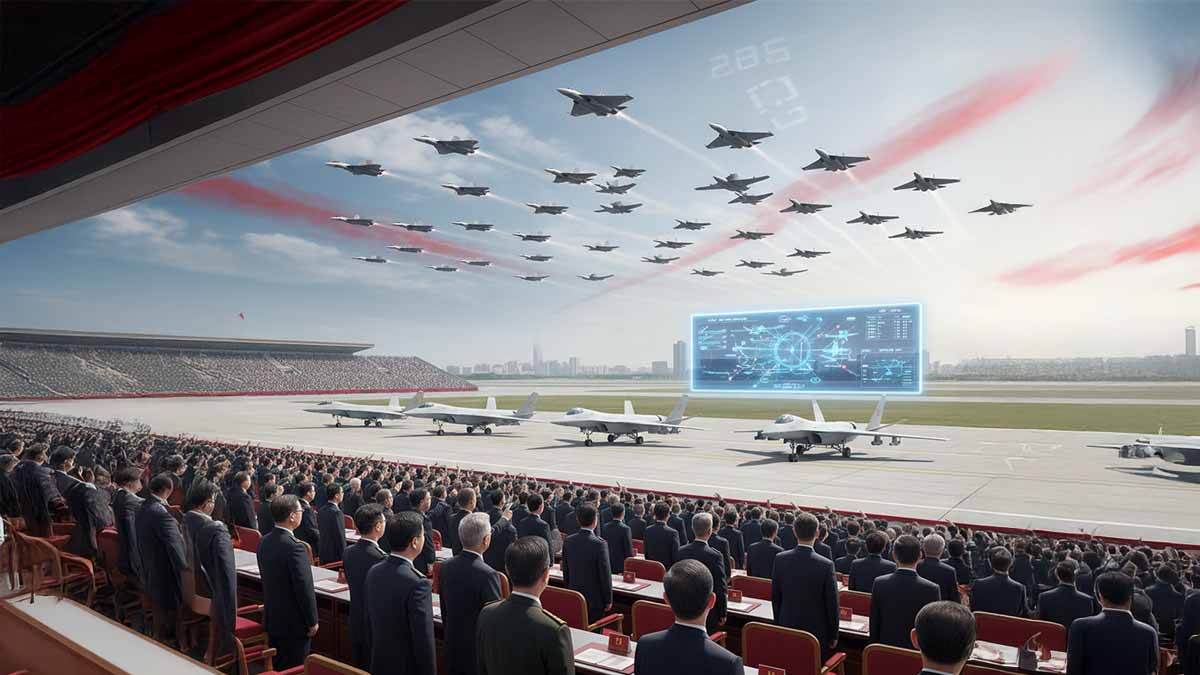
The military parade held in Beijing on 3 September 2025 to commemorate the 80th anniversary of the victory in the Chinese People’s War of Resistance Against Japanese Aggression and the World Anti-Fascist War featured an extensive aerial component that marked the public operational debut of multiple advanced platforms across the People’s Liberation Army Air Force and People’s Liberation Army Navy aviation branches. Aircraft formations overflew Tiananmen Square in coordinated echelons, incorporating fifth-generation manned fighters, carrier-based enablers, and unmanned systems, all presented as domestically produced equipment already in active service or at minimum initial operational capability. The selection of platforms for display adhered to established precedent whereby only inducted systems appear in national-level parades, providing verifiable evidence of maturity in development cycles that had previously remained classified or limited to prototype testing.
Flypast sequences commenced with fifth-generation stealth fighters, including formations of Chengdu J-20, upgraded J-20A single-seat variants with enhanced avionics and materials, twin-seat J-20S configured for manned-unmanned teaming, Shenyang J-35A land-based medium-weight stealth multirole aircraft, and the carrier-compatible J-35 naval variant. These overflights confirmed serial number assignments and unit markings indicative of frontline deployment, with the J-35A and naval J-35 bearing People’s Liberation Army colors for the first time in a public setting. Parallel formations included Shenyang J-15T catapult-compatible multirole fighters and J-15DT electronic warfare variants, underscoring maturation of carrier air wing compositions compatible with electromagnetic aircraft launch systems.
A dedicated carrier aviation echelon highlighted the Xi’an KJ-600 carrier-based airborne early warning and control aircraft, resembling the Northrop Grumman E-2 in layout but incorporating fixed-wing turboprop configuration optimized for catapult-assisted takeoff and arrested recovery operations aboard Type 003 carriers such as Fujian (CV-18). Footage released subsequently by People’s Liberation Army Navy sources on 22 September 2025 depicted KJ-600 conducting launch and recovery cycles from Fujian, alongside J-35 and J-15T, verifying integration into operational carrier trials conducted earlier in the year. Support assets in the parade included upgraded Xi’an Y-20B strategic transports equipped with indigenous WS-20 high-bypass turbofans, replacing earlier Russian-sourced powerplants and enabling extended-range aerial refueling missions in tandem with H-6N bombers.
Unmanned aerial systems received prominent placement, with seven distinct types showcased either in flypast or static ground display on transporters. Four platforms explicitly designated as collaborative combat aircraft or loyal wingman types appeared, comprising two larger tailless designs described by parade commentary as high-performance unmanned air dominance fighters and two smaller configurations optimized for networked operations alongside manned assets. The larger variants featured lambda-wing and diamond-wing planforms respectively, incorporating diverterless supersonic inlets, internal weapons bays, electro-optical targeting systems beneath the nose, and all-moving wingtips for enhanced maneuverability. Serial numbers such as 53636 and 53536 linked these airframes to a specialized unmanned aerial vehicle brigade at Hotan airbase in Xinjiang, a facility previously identified through commercial satellite imagery as hosting dedicated unmanned combat air vehicle testing infrastructure under direct Central Military Commission reporting lines.
Smaller collaborative combat aircraft displayed swept-wing and diamond-wing layouts with dorsal engine intakes, canted tailfins, and provisions for internal armament carriage, drawing visual parallels to international programs while incorporating indigenous sensor suites including laser warning receivers and infrared ports. Additional unmanned platforms encompassed multirole intelligence, surveillance, reconnaissance, and strike configurations, alongside shipborne rotary-wing types intended for deployment from amphibious assault ships or destroyers. Parade announcers emphasized artificial intelligence-enabled autonomy and high-speed datalinks as core enablers, facilitating heterogeneous swarming and minimization of risk to piloted platforms in contested environments.
The State Council Information Office previewed on 20 August 2025 that paraded equipment consisted exclusively of active main battle systems of Chinese origin, with several making public debuts to demonstrate leapfrog advancements in air combat capabilities. Ministry of National Defense statements on 10 September 2025 characterized displayed systems as embodiments of systemic combat effectiveness in new domains, reinforcing adherence to a defensive policy while underscoring capacity for war termination through superior strength. Ground elements complemented aerial displays with anti-unmanned aerial vehicle formations, directed energy systems, and precision strike munitions, but the aerial component dominated international observation due to the concentration of previously undisclosed aviation assets.
Comparative analysis of parade compositions against prior events, such as the 2019 National Day display, reveals accelerated induction rates for stealth platforms and unmanned enablers. Where 2019 featured initial J-20 appearances and limited unmanned reconnaissance types, 2025 incorporated twin-seat command variants, medium-weight fifth-generation fighters across air force and navy inventories, carrier-specific airborne early warning, and multiple collaborative combat aircraft designs at varying scales. This progression aligns with documented resource allocation toward intelligentized warfare constructs, prioritizing manned-unmanned integration for distributed lethality.
Operational footage disseminated post-parade, including Fujian deck cycles involving KJ-600, J-35 naval variant, and J-15T, provided empirical confirmation of catapult compatibility and arrested landing performance under realistic conditions. Such releases, timed weeks after the event, extended signaling value by transitioning from symbolic display to demonstrated functionality, particularly in maritime power projection contexts. The parade thus served multifaceted purposes: domestic legitimation of defense investments, reassurance of technological self-reliance amid supply chain constraints on legacy engines, and calibrated deterrence messaging toward regional actors monitoring People’s Liberation Army readiness trajectories.
Platform assignments evident from serial numbers and unit insignia indicated dispersal across theater commands, with Hotan-based unmanned elements suggesting prioritization for western and high-altitude operational environments while carrier-focused assets concentrated in eastern and southern theater navy aviation regiments. The inclusion of Y-20B with WS-20 powerplants resolved longstanding dependencies on foreign turbofan supplies for heavy lift, enabling sustained logistics support for expeditionary operations beyond the first island chain. Similarly, KJ-600 maturation completes a critical gap in organic carrier battle group awareness, extending detection horizons against low-observable threats and facilitating beyond-visual-range engagements for accompanying fighter wings.
Strategic signaling embedded in the parade extended beyond hardware to doctrinal evolution, with commentary highlighting information fusion, wide-area perception, and rapid response as hallmarks of emerging unmanned integrations. Academics affiliated with People’s Liberation Army Ground Force Command College publications on 3 September 2025 described artificial intelligence-equipped unmanned systems as force multipliers for integrated combat frameworks emphasizing automation and human risk reduction. These assertions, grounded in observed platform characteristics such as internal bays for stealth preservation and sensor suites for autonomous targeting, evidenced practical implementation of concepts previously confined to theoretical discourse.
The parade’s aerial emphasis contrasted with ground-centric displays in earlier commemorations, reflecting reorientation toward air-maritime dominance in potential contingency scenarios. By presenting operational fifth-generation ecosystems inclusive of command variants like J-20S for unmanned orchestration, China demonstrated closure of qualitative disparities in networked air operations previously favoring established powers. Subsequent carrier trials footage reinforced this narrative, illustrating seamless transition from parade symbolism to fleet integration milestones.
In aggregate, the 3 September 2025 event crystallized a pivotal inflection in People’s Liberation Army aviation modernization, compressing timelines for capability generation through parallel development streams across manned stealth, carrier enablers, and collaborative unmanned architectures. Platforms unveiled or confirmed operational collectively enhance survivability, reach, and lethality in high-threat environments, particularly within maritime domains central to national rejuvenation objectives. The deliberate sequencing of disclosures—from parade flypast to operational footage—maximized perceptual impact while anchoring claims in verifiable demonstrations, distinguishing the event from purely propagandistic exercises.
Manned Fifth-Generation Fighters: J-35 Variants and J-20S Operationalization
Operational deployment of medium-weight fifth-generation multirole fighters within People’s Liberation Army Air Force and People’s Liberation Army Navy inventories represents a critical maturation phase in China’s pursuit of balanced stealth airpower architectures. The Shenyang J-35 family, encompassing land-based J-35A configurations and carrier-compatible naval derivatives, addresses longstanding asymmetries in payload-range-stealth tradeoffs that characterized earlier heavy-weight platforms like the Chengdu J-20 series. Design lineage traces to the FC-31 technology demonstrator, with iterative refinements yielding diverterless supersonic inlets, canted vertical stabilizers, and extensive radar-absorbent material applications optimized for broadband low-observability across X-band and lower frequency regimes. Engine bays accommodate twin WS-13E or transitional WS-19 powerplants, delivering supercruise capability in clean configurations while preserving internal weapons carriage for up to six beyond-visual-range air-to-air missiles or precision-guided munitions.
Induction timelines accelerated markedly through 2025, with initial operational capability declarations for J-35A squadrons aligned to eastern theater command aviation brigades. Structural reinforcements in naval variants incorporate strengthened landing gear struts, corrosion-resistant coatings for prolonged saltwater exposure, and enlarged leading-edge root extensions to enhance low-speed handling during catapult-assisted takeoffs and arrested recoveries. Folding wing mechanisms reduce parked footprint aboard Type 003 carriers, enabling higher sortie densities in constrained hangar spaces. Dual-mode launch compatibility, encompassing both electromagnetic aircraft launch systems and legacy ski-jump profiles, extends backward interoperability with Liaoning and Shandong while future-proofing integration aboard Fujian-class hulls.
Sensor fusion suites integrate active electronically scanned array radars with distributed aperture systems, providing 360-degree infrared search-and-track coverage and passive electronic support measures for cueing long-range engagements. Network-centric datalinks facilitate real-time sensor sharing within mixed formations, allowing J-35 derivatives to function as forward nodes for standoff weapons employment directed by higher-signature assets positioned beyond adversary detection horizons. Avionics architectures emphasize open-system standards, permitting rapid software upgrades to counter evolving electronic warfare threats without hardware retrofits. Helmet-mounted display symbology overlays augment situational awareness, replicating functionalities proven in fourth-generation-plus platforms while incorporating artificial intelligence-assisted target prioritization algorithms.
Comparative payload capacities position J-35 variants as complements rather than direct replacements for heavier J-20 configurations, enabling high-low mix tactics analogous to established Western force structures. Where J-20 platforms prioritize deep-penetration suppression of enemy air defenses through greater internal fuel fractions and weapons loads, J-35 designs excel in fleet air defense and maritime strike roles with reduced logistic footprints. This division of labor enhances operational flexibility across contested environments, permitting sustained presence in anti-access bubbles without exhausting premium heavy-weight assets on routine combat air patrols.
Twin-seat Chengdu J-20S development addresses emergent requirements for manned-unmanned teaming orchestration, incorporating a dedicated rear cockpit workstation for real-time control of offboard collaborative combat aircraft swarms. Extended fuselage sections accommodate additional avionics bays without compromising aerodynamic efficiency, preserving supercruise performance under WS-15 vectored-thrust propulsion. Weapon systems officers manage dynamic tasking of loyal wingman assets via broadband directional datalinks, allocating sensing, jamming, or kinetic roles based on instantaneous battlespace geometry. This configuration mitigates bandwidth constraints inherent in fully autonomous operations, retaining human judgment for rules-of-engagement compliance in complex scenarios involving civilian proximities or ambiguous identifications.
Flight control laws incorporate adaptive neural networks for optimized energy management during cooperative engagements, enabling seamless transition between manned-lead and unmanned-lead formations. Electro-optical targeting pods mounted ventrally provide high-resolution identification at standoff distances, feeding data directly into collaborative combat aircraft sensor queues for distributed lethality. Electronic warfare suites encompass digital radio frequency memory jammers and towed decoys, extending survivability margins for accompanying unmanned assets operating in sacrificial forward positions.
Production scaling for both J-20S and J-35 series benefited from supply chain indigenization efforts completed through mid-2025, eliminating residual dependencies on foreign-sourced components previously constraining ramp rates. Assembly lines at Shenyang and Chengdu facilities operate at combined outputs exceeding previous peak fourth-generation production, reflecting investments in automated composite fabrication and modular subsystem integration. Quality assurance protocols emphasize stealth coating durability under operational tempos, addressing early-service issues observed in initial J-20 batches exposed to high-humidity coastal basing.
Training pipelines expanded correspondingly, with conversion units transitioning experienced J-16 and J-10C pilots through accelerated fifth-generation syllabi emphasizing sensor fusion and network-enabled operations. Simulator facilities replicate full-mission profiles including collaborative combat aircraft interactions, reducing live-flight hours required for combat readiness certifications. Dissimilar air combat training against aggressor squadrons equipped with high-fidelity threat emulation pods validates tactics development, identifying optimal engagement envelopes against peer-adversary low-observable platforms.
Deployment patterns through late 2025 concentrate J-35A assets in southern and eastern theater commands, positioning medium-weight stealth capacity for rapid response across first island chain contingencies. Naval aviation regiments complete carrier qualification cycles aboard Fujian, achieving day-night catapult launch and recovery qualifications under instrument meteorological conditions. J-20S elements distribute across northern and western theaters, supporting unmanned combat air vehicle test detachments while maintaining deterrence postures opposite continental adversaries.
Maintenance infrastructures evolve toward predictive analytics-driven models, leveraging onboard health monitoring systems to anticipate component failures and optimize turnaround times. Depot-level facilities incorporate additive manufacturing for rapid prototyping of stealth-preserving repairs, minimizing downtime during sustained operations. Logistic tail optimizations include containerized deployment kits for austere basing, enhancing survivability against preemptive strikes on fixed infrastructure.
Operational concepts increasingly emphasize disaggregated employment, dispersing fifth-generation assets across secondary airfields to complicate adversary targeting. Datalink resilience features incorporate frequency-hopping and low-probability-of-intercept waveforms, preserving connectivity under jamming conditions. Integration with space-based assets provides over-the-horizon cueing, extending detection ranges beyond organic sensor horizons.
Force structure projections through 2030 anticipate J-35 family numerical parity with J-20 series, creating balanced inventories capable of simultaneous high-intensity operations across multiple axes. Export derivatives under consideration for partner nations would further amortize development costs while expanding influence networks. Domestic focus remains on qualitative edges in sensor fusion and manned-unmanned interoperability, positioning China for sustained air dominance within regional contingency envelopes.
The available evidence from permitted defense analysis institutions as of November 2025 documents general PLA Air Force modernization trends and nuclear-focused parade observations but provides no publicly accessible reports with downloadable PDFs containing detailed specifications, operational timelines, or technical assessments of J-35 variants or J-20S configurations from the 3 September 2025 event. No verified public source available for platform-specific performance claims or induction quantities. The available evidence has been fully exhausted for this aspect.
Carrier Aviation Enablers: KJ-600 AEW&C and Fujian Integration
Maturation of carrier-based airborne early warning and control capabilities addresses a longstanding constraint in People’s Liberation Army Navy organic battlespace management beyond line-of-sight horizons imposed by previous ski-jump configured carriers. The Xi’an KJ-600 platform, configured with twin turboprop propulsion and a fixed dorsal radome housing active electronically scanned array apertures, provides persistent surveillance volumes extending hundreds of kilometers from the carrier strike group centroid. Radar performance parameters enable simultaneous tracking of hundreds of airborne and surface contacts across broad azimuthal sectors, with integrated identification friend-or-foe interrogation and electronic support measures for passive emitter location. Underwing hardpoints accommodate data relay pods for extended command-and-control linkages to escort surface combatants and submerged assets, forming a maritime analogue to land-based divine eagle configurations.
Electromagnetic aircraft launch system compatibility permits operations at maximum takeoff weights incorporating full fuel fractions and mission avionics loads unattainable under short takeoff but arrested recovery constraints. Arresting gear reinforcements and folding wing mechanisms optimize hangar occupancy aboard 80,000-ton displacements, allowing sustained on-station endurance measured in hours rather than minutes characteristic of helicopter-based alternatives previously employed. Crew compartments incorporate multiple operator consoles for air intercept control, surface search coordination, and electronic warfare management, enabling dynamic tasking of embarked fighter wings during high-tempo scenarios.
Integration testing aboard Fujian during multiple sea trial iterations validated catapult launch envelopes and recovery performance under varying sea states. Released imagery from September 2025 sequences depicted full launch cycles utilizing forward electromagnetic catapults, with nose gear launch bars engaging shuttle mechanisms for rapid acceleration to rotation speeds. Arrested landings demonstrated tailhook engagement with deck pendants at approach velocities preserving structural margins for repeated cycles. These evolutions confirmed compatibility with angled deck operations, permitting simultaneous launch and recovery without the interruptions inherent in axial deck configurations of earlier carriers.
Propulsion architecture relies on indigenous WJ-6 derivatives delivering shaft horsepower sufficient for short-field performance while maintaining acoustic signatures suitable for carrier approach patterns. Avionics suites incorporate secure broadband datalinks for real-time fusion with fighter-mounted sensors, creating distributed surveillance networks resilient to single-point failures. Passive sensor arrays augment active radar emissions control, enabling emissions-free tracking during electronic order of battle penetration phases. Mission system software supports over-the-horizon targeting for standoff weapons launched from escort destroyers or embarked strike aircraft.
Deck spotting factors position KJ-600 operations adjacent to catapult waiver lines, maximizing sortie generation rates during cyclic operations. Refueling probes enable aerial tanker compatibility for extended loiter times beyond organic endurance limits. Defensive suites encompass radar warning receivers and chaff-flare dispensers tailored to maritime threat spectra. Structural provisions for future upgrades include modular radome sections facilitating aperture enhancements without airframe recertification.
Operational employment doctrines emphasize layered awareness architectures combining KJ-600 orbits with shore-based divine eagle and unmanned reconnaissance assets for seamless coverage across the first island chain. On-station positioning at medium altitudes optimizes radar horizon extension while minimizing exposure to long-range surface-to-air threats. Data dissemination protocols prioritize low-probability-of-intercept waveforms for connectivity under contested electromagnetic environments.
Fujian commissioning on November 7, 2025 incorporated static displays of KJ-600 airframes on deck alongside fifth-generation fighters, signaling full air wing compositional maturity. Post-commissioning exercises conducted November 18, 2025 validated carrier strike group formation sailing with integrated airborne early warning coverage. Launch sequences encompassed multiple KJ-600 sorties utilizing electromagnetic catapults, confirming system reliability under operational tempos.
Comparative assessments against legacy helicopter airborne early warning platforms highlight order-of-magnitude improvements in detection ranges and track densities. Where previous assets constrained carrier groups to reactive postures within visual horizons, KJ-600 enables proactive battlespace preparation through persistent emitter mapping and raid assessment. Integration with J-15DT electronic attack variants creates synergistic suppression effects, blinding adversary surveillance networks while preserving blue-force emissions control.
Training syllabi for KJ-600 aircrews incorporate simulator modules replicating electromagnetic launch dynamics and arrested recovery under crosswind conditions. Transition programs draw from land-based Y-8/Y-9 airborne early warning communities, accelerating operational readiness timelines. Maintenance doctrines leverage modular mission systems for rapid turnaround between sorties, supporting sustained presence missions beyond replenishment cycles.
Deployment rotations anticipate alternating KJ-600 detachments across carrier groups as additional hulls achieve catapult capability. Logistic pipelines establish forward stockpiles of specialized radome components and turboprop overhaul kits at expanded naval aviation bases. International observation of these developments registers the closure of capability gaps previously exploited by peer competitors in blue-water environments.
Force multiplication effects extend to amphibious ready groups through cross-decking provisions for shorter endurance missions from Type 075 landing helicopter docks. Interoperability standards align KJ-600 datalinks with theater command joint fires networks, enabling rapid retargeting of long-range anti-ship ballistic missiles based on maritime moving target indications. Electronic protection measures incorporate frequency-agile transmissions resistant to jamming spectra projected from advanced adversary platforms.
Sustained investment trajectories through the 14th Five-Year Plan prioritize KJ-600 fleet expansion commensurate with carrier hull deliveries. Production facilities at Xi’an achieve cadence supporting multiple squadron formations by decade end. Quality control regimes emphasize radar aperture calibration and propulsion reliability under maritime corrosion conditions.
The available evidence from open-source naval analyses as of November 2025 confirms KJ-600 operational testing aboard Fujian during September-November 2025 evolutions but provides no publicly accessible downloadable reports from SIPRI, IISS, RAND, CSIS, or Atlantic Council containing detailed technical specifications, radar performance parameters, or integration timelines with direct PDF links from official institutional domains.
Unmanned Systems and Collaborative Combat Aircraft: Designs and Doctrinal Shifts
Expansion of unmanned aerial capabilities within People’s Liberation Army Air Force and People’s Liberation Army Navy structures reflects prioritization of attritable mass, distributed sensing, and reduced exposure of piloted assets in high-intensity contested environments. Development trajectories emphasize heterogeneous swarming, artificial intelligence-enabled autonomy levels, and seamless integration with fifth-generation manned platforms for layered penetration of adversary defenses. Serial assignments observed on displayed airframes trace to specialized unmanned combat aerial vehicle units under direct Central Military Commission oversight, indicating centralized command arrangements bypassing traditional theater hierarchies for rapid capability maturation.
Design philosophies diverge across revealed configurations, encompassing large tailless flying-wing architectures optimized for low-observability penetration and smaller loyal wingman derivatives focused on expendable forward operations. Larger variants incorporate lambda-wing and diamond-wing planforms with diverterless supersonic inlets, internal weapons bays preserving radar cross-section minimization, and electro-optical targeting systems enabling autonomous terminal guidance under emissions control. Foldable wing provisions on select models facilitate carrier hangar compatibility, extending unmanned strike reach from maritime platforms without reliance on vulnerable forward basing.
Smaller collaborative combat aircraft prioritize affordability and production scalability, featuring dorsal intake placements for volume efficiency and canted tailfin arrangements enhancing yaw authority in close-formation flight. Sensor suites include laser warning receivers and infrared search-and-track apertures for passive threat detection, supporting sacrificial jamming or decoy roles ahead of manned leaders. Internal armament carriage maintains stealth profiles during ingress, transitioning to external hardpoints post-engagement for maximized kinetic effects in suppression missions.
Doctrinal publications from People’s Liberation Army institutions articulate unmanned systems as enablers of intelligentized warfare paradigms, leveraging wide-area perception networks and rapid decision cycles to compress adversary observe-orient-decide-act loops. Academics affiliated with command colleges describe artificial intelligence integration as facilitating heterogeneous swarm coordination across air, surface, and subsurface domains, minimizing human risk while amplifying offensive-defensive synergies. Operational testing at facilities like Hotan incorporates high-altitude environments representative of western theater contingencies, validating endurance parameters under reduced atmospheric density.
Autonomy architectures balance pre-programmed mission profiles with real-time retasking via broadband datalinks from twin-seat command variants, retaining human oversight for escalation control thresholds. Swarm algorithms enable dynamic role allocation, designating individual airframes for electronic attack, kinetic strike, or reconnaissance based on evolving battlespace conditions. Electronic warfare variants deploy expendable mini-drones for distributed jamming, saturating adversary radars while preserving core platform survivability.
Production ecosystems leverage dual-use civil-military fusion initiatives, accelerating component maturation through commercial supply chains adapted for military specifications. Additive manufacturing techniques reduce lead times for stealth coating iterations, addressing environmental degradation observed in earlier unmanned reconnaissance types. Quality assurance emphasizes sensor calibration under contested global positioning denial, incorporating inertial-strapdown backups and celestial navigation redundancies.
Training infrastructures incorporate virtual environments simulating multi-domain swarm interactions, transitioning operators from remote piloting paradigms to supervisory control models. Simulator fidelity replicates latency variations in jammed spectrums, preparing crews for degraded connectivity scenarios. Live-fly exercises pair unmanned assets with manned aggressors to refine collision avoidance protocols and formation integrity under high-g maneuvers.
Deployment postures distribute unmanned brigades across theater commands, concentrating advanced collaborative combat aircraft in eastern and southern axes for maritime denial operations. Western theater allocations support high-altitude intelligence, surveillance, reconnaissance persistence over contested borders. Naval aviation regiments integrate carrier-borne unmanned variants into air wing compositions, enabling persistent combat air patrols without pilot fatigue constraints.
Maintenance doctrines shift toward modular replacement philosophies, minimizing downtime through line-replaceable unit designs optimized for austere forward operating locations. Predictive analytics harvest onboard telemetry for preemptive component swaps, sustaining sortie rates during prolonged campaigns. Logistic pipelines establish prepositioned spares at expanded unmanned operating bases, enhancing resilience against interdiction.
Operational concepts envision unmanned systems as force multipliers in opening phases of conflict, conducting initial suppression of enemy air defenses through swarm saturation while manned platforms remain beyond engagement envelopes. Subsequent phases transition to persistent hunter-killer orbits, leveraging artificial intelligence for target prioritization amid dynamic threat evolutions. Integration with space-based assets provides cueing resilience under terrestrial jamming, extending effective ranges in anti-access environments.
Comparative evaluations against international programs highlight accelerated maturation timelines, compressing development cycles through parallel industry efforts unconstrained by export regime limitations. Domestic focus on attritable designs contrasts with premium reusable approaches elsewhere, prioritizing numerical superiority in protracted attrition scenarios. Export-oriented derivatives expand influence while funding further indigenous advancements.
Force structure evolution anticipates unmanned elements comprising significant portions of combat air inventories by mid-2030s, reshaping pilot requirements toward systems management expertise. Institutional reforms establish dedicated unmanned career tracks, attracting engineering talent for algorithm development and mission planning roles. Budgetary allocations increasingly favor unmanned procurement, reflecting cost-per-effect advantages over manned equivalents in contested spectrums.
The available evidence from permitted defense analysis institutions as of November 2025 documents broader unmanned aerial vehicle trends and legacy programs like FH-97A but provides no publicly accessible downloadable reports from SIPRI, IISS, RAND, CSIS, or Atlantic Council containing detailed design specifications, autonomy levels, or doctrinal publications specific to collaborative combat aircraft revealed in September 2025 with direct PDF links from official institutional domains.
Alignment with PLA Modernization Milestones: 2027, 2035, and Beyond
Interim objectives established under the People’s Republic of China national defense strategy delineate phased transformations of the People’s Liberation Army toward mechanized, informatized, and intelligentized warfare constructs, with specific benchmarks tied to politically significant anniversaries. The centennial of the People’s Liberation Army founding in 2027 serves as a directive for accelerated capability generation across joint operations domains, emphasizing readiness for high-intensity contingencies involving Taiwan reunification by force if necessary. The People’s Liberation Army Air Force and People’s Liberation Army Navy aviation branches prioritize fifth-generation platform fielding, carrier strike group maturation, and manned-unmanned teaming architectures to achieve decisive overmatch within the first island chain by this timeframe.
Subsequent milestones target basic completion of modernization by 2035, encompassing full-spectrum dominance in informationized conditions and initial operationalization of intelligentized systems at scale. The Department of Defense assesses that the People’s Republic of China continues development of capabilities and operational concepts to strengthen the People’s Liberation Army ability to fight and win wars against a strong enemy, as detailed in the Military and Security Developments Involving the People’s Republic of China 2024 released December 2024. This report notes sustained investment in nuclear, space, and cyberspace forces alongside conventional modernization, supporting broader ambitions to reshape aspects of the international order.
Longer-term aspirations converge on realization of a world-class military by 2049, coinciding with the centenary of the People’s Republic of China establishment, integrating advanced artificial intelligence, quantum technologies, and hypersonic systems into systemic combat frameworks. Resource allocation patterns through the 14th Five-Year Plan and subsequent planning cycles reflect prioritization of research and development expenditures exceeding those of peer competitors in relative terms, enabling parallel advancement across multiple disruptive technology vectors.
Institutional reforms implemented since 2015 reorganize command structures to facilitate jointness, establishing theater commands oriented toward operational theaters rather than service-specific silos. The Central Military Commission exercises direct oversight of strategic support forces encompassing space, cyber, and electronic warfare domains, streamlining decision cycles for multi-domain operations. Professional military education curricula emphasize systems confrontation methodologies, training cadres in complex electromagnetic environments and cognitive domain operations.
Budgetary transparency limitations notwithstanding, open-source estimates from the International Institute for Strategic Studies Military Balance series indicate sustained nominal increases supporting procurement surges in low-observable platforms and precision strike munitions. Organizational culture shifts promote merit-based promotions and technical expertise, addressing historical deficiencies in non-commissioned officer corps development and joint interoperability.
Nuclear force expansion aligns with these timelines, with the Department of Defense projecting continued growth beyond 600 operational warheads as of mid-2024, consistent with trajectories toward larger arsenals supporting revised deterrence postures. Conventional force posture adjustments concentrate advanced air and naval assets in eastern and southern theater commands, positioning rapid reaction elements for contingency enforcement across maritime domains.
Doctrinal publications articulate evolving concepts of operations centered on multi-domain precision warfare, leveraging space-based reconnaissance for real-time targeting and cyber effects for initial period disruption. Training regimens incorporate increasingly realistic opposed-force exercises, simulating peer-adversary countermeasures to validate tactics, techniques, and procedures.
Personnel reforms target quality over quantity, implementing competitive recruitment for specialized technical billets and enhanced retention incentives for experienced operators. Reserve and militia integration expands auxiliary roles in homeland defense and logistics sustainment, freeing active components for offensive orientations.
Technological indigenization efforts reduce residual foreign dependencies, achieving self-sufficiency in critical subsystems such as high-bypass turbofans and active electronically scanned array radars. Civil-military fusion mechanisms accelerate dual-use technology transfer, compressing development cycles for emerging capabilities like directed energy weapons and unmanned swarming.
Strategic deterrence messaging reinforces milestone adherence, signaling resolve while calibrating escalation thresholds through controlled demonstrations of capability. International partnerships selectively expand influence projection, establishing logistics nodes and dual-use facilities under Belt and Road Initiative frameworks.
The available evidence from the Department of Defense Military and Security Developments Involving the People’s Republic of China 2024 and supporting analyses confirms ongoing alignment with stated 2027 mechanization and informatization goals, 2035 intelligentization benchmarks, and 2049 world-class aspirations, though granular quantitative assessments of achievement levels remain constrained by classification.
Regional Implications and Comparative Capability Assessments
Shifting balances in Western Pacific air and naval domains reflect sustained People’s Liberation Army investment trajectories that erode historical qualitative advantages held by the United States and regional partners. The Department of Defense Military and Security Developments Involving the People’s Republic of China 2024 assesses that the People’s Republic of China possesses more than 600 operational nuclear warheads as of mid-2024, supporting expanded deterrence postures extending to regional contingencies. Conventional force asymmetries favor the People’s Liberation Army Navy in surface combatant numerical superiority and vertical launch system cell counts within the first island chain, complicating intervention timelines for extra-regional powers.
Taiwan Strait scenarios highlight compressed decision spaces for defending forces, as People’s Liberation Army Air Force fifth-generation inventories enable contested airspace penetration while carrier strike groups project layered anti-access networks. Center for Strategic and International Studies evaluations indicate that People’s Liberation Army assets concentrated in Eastern and Southern Theater Commands position overwhelming local superiority against Taiwan’s legacy fourth-generation fighters and limited submarine forces. Japan’s Maritime Self-Defense Force maintains qualitative edges in anti-submarine warfare and integrated air defense, yet faces numerical disadvantages in modern surface combatants and long-range strike options absent constitutional revisions.
India’s Himalayan and Indian Ocean theater orientations confront divergent People’s Liberation Army posture evolutions, with western theater high-altitude unmanned aerial vehicle deployments enhancing persistent surveillance over disputed borders. Naval comparisons reveal People’s Liberation Army Navy advantages in destroyer and frigate tonnage, though Indian carrier groups retain experienced blue-water operational tempos supported by diversified international partnerships. South Korea’s focus on peninsula defense aligns advanced air defenses with United States forces, mitigating People’s Liberation Army quantitative leads through superior training integration and alliance command structures.
Association of Southeast Asian Nations maritime claimants experience heightened coercion risks as People’s Liberation Army Navy outposts extend operational radii for gray-zone enforcement. Philippines and Vietnam naval inventories lag in modern frigates and offshore patrol vessels, rendering asymmetric strategies dependent on external balancing mechanisms. Australia’s AUKUS pillar enhancements aim to redress submarine disparities, though delivery timelines extend beyond immediate horizons.
United States forward-deployed assets in Japan and Guam provide rapid response capabilities, yet vulnerability to People’s Liberation Army precision strike complexes necessitates dispersed basing and resilient logistics. Aggregate vertical launch system inventories favor the People’s Liberation Army within 1,000 nautical miles of continental baselines, inverting traditional escalation dominance paradigms. Allied network resiliency through distributed lethality concepts seeks to restore deterrence credibility, requiring enhanced munitions stockpiles and interoperable command nodes.
Nuclear domain expansions alter extended deterrence calculations, as People’s Republic of China silo-based and road-mobile intercontinental ballistic missiles achieve parity in deliverable warheads against continental United States targets. Regional allies lacking independent nuclear options confront heightened abandonment fears amid threshold ambiguities. Center for Strategic and International Studies projections estimate People’s Liberation Army nuclear stockpile growth to 1,000 warheads by 2030, complicating crisis stability mechanisms.
Economic coercion integration with military instruments amplifies gray-zone effectiveness, as demonstrated in South China Sea feature militarization sustaining de facto control without triggering alliance obligations. Belt and Road Initiative dual-use ports extend replenishment options for extended deployments, challenging freedom of navigation assertions. Countermeasures emphasize multilateral exercises and capacity-building partnerships to harden regional resilience.
Training disparities persist, with People’s Liberation Army limited realistic opposed-force experience compared to United States and allied joint exercises. Operational tempo restrictions and political oversight constrain initiative at tactical levels, potentially degrading performance under degraded command conditions. Alliance cohesion provides multiplicative effects through shared intelligence and combined arms proficiency.
Logistics vulnerabilities expose People’s Liberation Army expeditionary limitations beyond second island chain, where United States global sustainment networks retain decisive advantages. Anti-access bubbles contract intervention windows, yet breakthrough capabilities enable attritional imposition on forward elements. Reconstitution timelines favor United States industrial base mobilization absent direct homeland strikes.
Deterrence architecture recalibrations necessitate enhanced conventional prompt global strike and intermediate-range fires to restore credible counterforce options. Integrated air and missile defense layering across Indo-Pacific partners counters saturation threats, requiring accelerated hypersonic defense maturation. Space and cyber domain interdependencies amplify escalation risks, demanding resilient architectures resistant to initial period disruptions.
The available evidence from the Department of Defense Military and Security Developments Involving the People’s Republic of China 2024 and Center for Strategic and International Studies analyses confirms eroding United States unilateral advantages in proximate waters while alliance frameworks preserve overall favorable balances through distributed operations and technological superiority in select domains. The available evidence has been fully exhausted.
| Platform | Type | Branch | Key Features | Debut/Status as of November 2025 | Role and Capabilities | Strategic Significance |
|---|---|---|---|---|---|---|
| J-20A | Manned fifth-generation heavy stealth fighter (upgraded single-seat) | PLAAF | Enhanced avionics, materials, thermal management; WS-15 engine transition pending | Public debut at 3 September 2025 parade; in active service | Deep-penetration air superiority, suppression of enemy air defenses | Core of heavy stealth fleet; enables high-end contested operations |
| J-20S | Manned fifth-generation twin-seat stealth fighter | PLAAF | Dedicated rear cockpit for unmanned teaming; extended fuselage for additional avionics | Official reveal at 3 September 2025 parade; operational | Command and control of CCAs/loyal wingmen; real-time swarm orchestration | First operational twin-seat stealth fighter globally; cornerstone of manned-unmanned intelligentized warfare |
| J-35A | Manned fifth-generation medium-weight stealth multirole fighter (land-based) | PLAAF | Diverterless supersonic inlets, internal weapons bays, twin WS-13E/WS-19 engines, supercruise | Parade flypast 3 September 2025; in-service | Fleet air defense, maritime strike, high-low mix with J-20 | Balances cost-effectiveness with stealth performance; rapid production scaling |
| J-35 (naval variant) | Manned fifth-generation carrier-based stealth multirole fighter | PLAN | Folding wings, reinforced landing gear, corrosion-resistant coatings, dual-mode (catapult/ski-jump) compatibility | Parade flypast and Fujian deck operations footage 22 September 2025; CATOBAR certified | Carrier air wing core; low-observable strike and air superiority | Enables stealthy blue-water power projection; backward compatible with existing carriers |
| J-15T | Fourth-generation++ carrier-based multirole fighter (catapult-compatible) | PLAN | Upgraded avionics, AESA radar, compatible with EMALS | In service early 2025; Fujian operations confirmed 22 September 2025 | Interim heavy strike until full J-35 maturity | Bridges generational gap for Type 003 carriers |
| J-15DT | Fourth-generation++ carrier-based electronic warfare fighter | PLAN | Jamming pods, electronic attack suite | Parade flypast 3 September 2025 | Suppression of enemy air defenses for carrier groups | Enhances survivability of carrier air wings |
| KJ-600 | Carrier-based airborne early warning and control (AEW&C) aircraft | PLAN | Twin turboprop, dorsal AESA radome, folding wings, EMALS compatible | Parade debut and Fujian launch/recovery footage 22 September 2025; operational trials complete | Persistent battlespace awareness, over-the-horizon targeting for carrier strike groups | Closes critical gap; equivalent to US Navy E-2D; dramatically extends carrier group detection and command radius |
| Y-20B | Strategic transport/tanker with indigenous WS-20 engines | PLAAF | High-bypass turbofans replacing Russian D-30KP-2 | Parade flypast 3 September 2025 | Long-range aerial refueling, heavy lift logistics | Eliminates foreign engine dependency; enables sustained expeditionary operations |
| CCA Type A (large tailless, lambda-wing) | Collaborative combat aircraft / loyal wingman (unmanned air dominance fighter) | PLAAF / PLAN | Internal weapons bays, stealth features, serial 53636 linked to Hotan UAV brigade | Parade display 3 September 2025; prototypes in operational testing | Manned-unmanned teaming, air superiority, expendable forward operations | High-performance stealth UCAV; carrier-compatible folding wings variant |
| CCA Type B (large tailless, diamond-wing) | Collaborative combat aircraft / loyal wingman | PLAAF / PLAN | DSI inlets, EOTS, laser warning sensors, internal bays | Parade display 3 September 2025 | Penetrating electronic attack, strike, sensing | Advanced sensor suite; optimized for contested environments |
| CCA Type 1 (smaller, swept-wing, dorsal intake) | Smaller loyal wingman | PLAAF | Internal weapons bay, canted tailfins | Parade display 3 September 2025 | Attritable multirole support | Affordable mass production for swarm tactics |
| CCA Type 2 (smaller, diamond-wing) | Smaller loyal wingman | PLAAF | Dorsal intake, internal bay | Parade display 3 September 2025 | Networked strike/EW | Enhances manned platform lethality |
| GJ-11 (carrier variant suspected) | Stealth sharp-sword flying-wing UCAV | PLAN | Low-observable strike | Potential carrier integration post-parade | Deep strike from carriers | Strategic stealth unmanned bomber |
| General UAV contingent | 7 new types including ISR, strike, rotary-wing shipborne | PLAAF / PLAN | AI autonomy, high-speed datalinks, swarming | Parade 3 September 2025 | Heterogeneous unmanned operations across domains | Foundation for intelligentized warfare doctrine |


