











Abstract
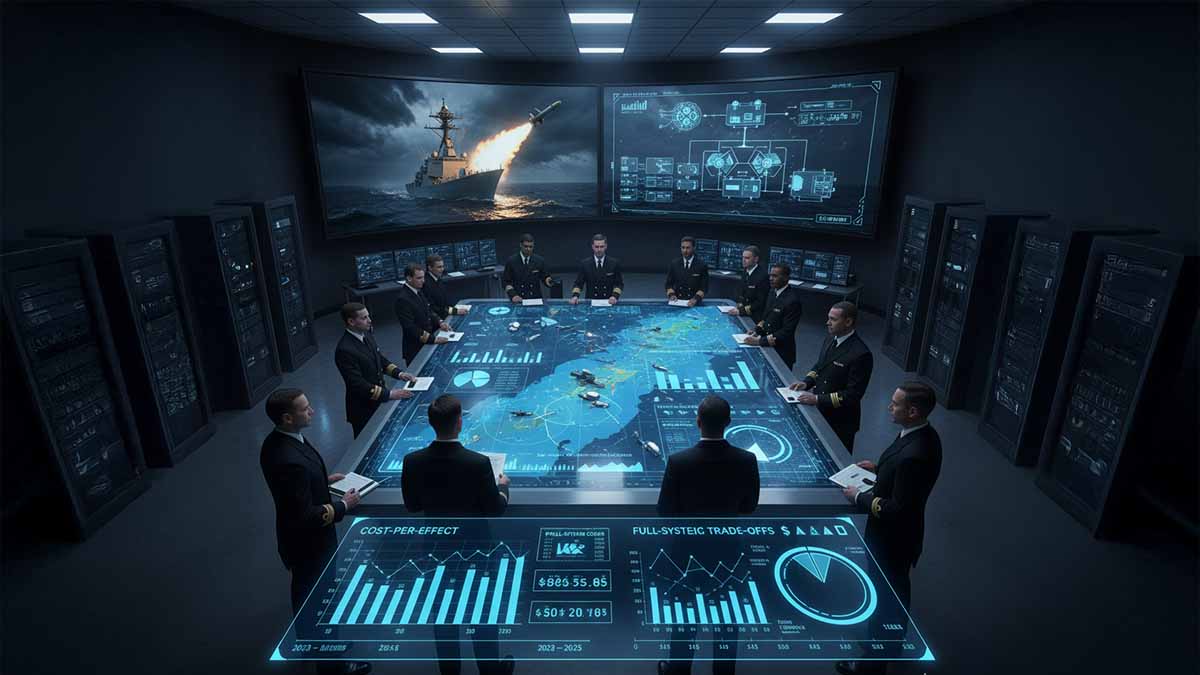
The persistent Houthi attacks on commercial shipping and naval assets in the Red Sea since late 2023 have compelled U.S. Navy forces to expend advanced interceptors against low-unit-cost unmanned aerial systems and missiles, prompting widespread scrutiny of the apparent asymmetry in expenditure. Public discourse has frequently highlighted the procurement price of individual munitions—typically ranging from $2.1 million to $4.3 million per unit for Standard Missile-2 (SM-2) and Standard Missile-6 (SM-6) variants employed in these engagements—contrasted against adversary systems estimated in the low thousands of dollars. Yet this narrow focus on flyaway costs obscures the broader analytical framework required for rigorous evaluation of defense resource allocation: the cost-per-effect paradigm, which demands comprehensive accounting of all resources necessary to generate a specified operational outcome while delineating the nature and value of that outcome itself.
The purpose of this analysis lies in establishing a methodologically sound approach to cost-per-effect assessment, drawing exclusively on verifiable data from authoritative defense institutions to illuminate why headline figures systematically understate the true resource commitment in sustained naval air defense operations and why, conversely, exclusive reliance on munitions unit costs risks distorting strategic decision-making. The central question addressed is not whether expensive interceptors represent an efficient response to inexpensive threats in isolation but whether the full ecosystem enabling those intercepts—including platform sustainment, logistics chains, personnel readiness, and command infrastructure—justifies the achieved effects when measured against the protected assets and broader strategic objectives.
Methodologically, the assessment adheres to established Department of Defense practices for life-cycle and operating and support (O&S) cost estimation as articulated by the Office of Cost Assessment and Program Evaluation (CAPE) and reflected in independent analyses from the Center for Strategic and International Studies (CSIS) and Congressional Budget Office (CBO). Direct munitions expenditures are triangulated against reported operational tempo in the Red Sea theater, while platform-level costs incorporate CBO projections for Arleigh Burke-class destroyers and carrier strike group sustainment drawn from the Navy’s 2025 shipbuilding plan and associated budget justification materials. Effects are defined at tactical, operational, and strategic levels—ranging from successful kinetic neutralization of inbound threats to preservation of freedom of navigation for vessels transiting a corridor handling approximately 12 percent of global seaborne trade—and evaluated against alternative capability mixes where data permit comparison.
Key findings demonstrate that while munitions procurement for Red Sea intercepts exceeded $1 billion in direct value by mid-2024—a figure publicly attested during Senate Armed Services Committee testimony on the Fiscal Year 2025 Department of the Navy Budget Request—the attributable portion of platform and force-structure costs elevates the effective expenditure per engagement by orders of magnitude. CSIS analysis of interceptor unit costs from Selected Acquisition Reports and budget justification documents confirms average SM-2 procurement at approximately $2.1–2.5 million per round and SM-6 at $3.9–4.3 million, with inflation-adjusted trends showing periodic increases tied to block upgrades rather than systemic escalation. When layered atop the CBO-estimated annual operating cost for an Arleigh Burke-class destroyer—approximately $1.8–2.2 billion when including personnel, fuel, maintenance, and allocated overhead for a deployed unit—the marginal cost of a single defensive salvo constitutes a negligible fraction of the daily expense of maintaining presence capable of executing it.
Results further reveal that tactical effects—successful intercepts preventing damage to protected platforms valued at $2–9 billion per hull for modern destroyers—are achieved with near-100 percent reliability when employing long-range active-seekers, whereas reliance on shorter-range, lower-unit-cost systems such as the Evolved Sea Sparrow Missile (ESSM) or close-in weapon systems constrains defended area and introduces unacceptable risk to high-value units. Operational effects encompass sustained deterrence and enforcement of international maritime norms, evidenced by the restoration of partial transit volumes despite ongoing threats, while strategic effects include preservation of alliance credibility and prevention of broader escalation that could imperil energy corridors critical to global economic stability.
Conclusions underscore that properly specified cost-per-effect analysis, when incorporating full-system burdens rather than isolated munitions pricing, frequently validates employment of premium capabilities in contested environments where failure carries catastrophic consequence. The Red Sea experience illustrates that apparent asymmetries dissolve under comprehensive accounting: the protected value—measured in platform replacement costs, crew safety, and uninterrupted flow of $1 trillion annually in seaborne commerce—dwarfs attributable defense expenditures. Implications extend beyond immediate theater requirements to force design and acquisition policy: absent scalable, rapidly producible alternatives offering equivalent probability of kill against saturating threats, DoD risks either unsustainable depletion of magazine depth or acceptance of degraded protection for irreplaceable assets. Practical contributions thus center on institutionalizing non-advocate, life-cycle-inclusive cost methodologies—already partially mandated through CAPE guidance—to inform future program decisions, while theoretical advancement lies in refining effect valuation frameworks to incorporate intangible yet decisive outcomes such as deterrence credibility and alliance cohesion. The evidence indicates that headlines decrying million-dollar missiles against thousand-dollar drones capture only a fragment of the resource equation; rigorous cost-per-effect evaluation reveals a more nuanced calculus in which current force employment remains defensible pending breakthrough reductions in either platform operating burdens or adversary offensive capacity.
Table of Contents
- Defining Cost and Effect in Naval Air and Missile Defense Operations
- Empirical Record of U.S. Naval Engagements Against Houthi Threats, 2023–2025
- Full-System Cost Attribution: Beyond Munitions Procurement Pricing
- Comparative Effectiveness of Layered Defense Architectures
- Production Scalability, Magazine Depth, and Sustainment Challenges
- Policy Implications for Force Design and Resource Allocation
Defining Cost and Effect in Naval Air and Missile Defense Operations
The analytical framework for evaluating resource allocation in naval air and missile defense hinges on precise delineation of cost categories and effect metrics, as inconsistent application across Department of Defense components has historically distorted comparative assessments of capability effectiveness. Office of the Secretary of Defense Cost Assessment and Program Evaluation guidance establishes standardized cost elements encompassing acquisition, operating and support, and disposal phases, yet service-specific methodologies frequently emphasize procurement unit costs while marginalizing full-system burdens. The Operating and Support Cost-Estimating Guide (March 2014) issued by the Office of Cost Assessment and Program Evaluation categorizes operating and support costs into six primary elements: unit-level manpower, unit operations, maintenance, sustaining support, continuing system improvements, and indirect support. These elements capture recurring expenditures necessary to maintain operational readiness, including depot-level maintenance for Aegis Weapon System components and crew training pipelines that sustain proficiency in layered defense engagements.
Acquisition costs, often highlighted in public discourse, represent only the initial procurement outlay divided by quantity produced, excluding research, development, test, and evaluation investments amortized across production runs. For surface combatants equipped with vertical launch systems capable of employing Standard Missile variants, procurement figures mask the lifecycle implications of platform sustainment. The Congressional Budget Office analysis of naval forces consistently demonstrates that operating and support costs for Arleigh Burke-class destroyers exceed procurement by factors of two to three over a 35-year service life, with annual per-ship expenditures averaging approximately $180 million in constant dollars when incorporating personnel, fuel, and intermediate-level maintenance. Distinguishing direct costs—traceable to specific capabilities, such as missile canister recertification—from indirect costs allocated across multiple ship classes prevents double-counting while ensuring comprehensive attribution.
Effect encompasses the physical, functional, or behavioral outcome achieved by employing a capability against specified threats, ranging from kinetic neutralization to deterrence through presence. Joint Publication 3-0 defines effects as the cumulative results of actions on adversary behavior or the battlespace environment, yet quantitative measurement remains challenging for non-kinetic outcomes. In naval air defense, tactical effects include probability of kill against inbound threats, measured through flight test data and operational intercepts, while operational effects preserve force maneuverability and strategic effects safeguard maritime commerce corridors. The Missile Defense Agency evaluates interceptor performance through ground and flight testing regimes that establish confidence intervals for engagement success, with Standard Missile-6 demonstrating greater than 90 percent single-shot probability against representative threats in controlled scenarios documented in annual director operational test and evaluation reports.
Comparative analysis requires normalizing effects across capability alternatives, accounting for defended area coverage, reaction time, and magazine depth constraints. Close-in weapon systems provide high probability of engagement at short ranges but concede battlespace volume to adversaries, potentially enabling leakage that endangers high-value units valued at $2 billion or more per hull. Long-range active seekers extend engagement envelopes, permitting multiple engagement opportunities and coordinated salvos from dispersed platforms, thereby elevating overall system effectiveness in saturation scenarios. The Center for Strategic and International Studies examination of interceptor employment emphasizes that operational risk—not merely per-round expenditure—determines true effectiveness, as deferring to lower-cost terminal defenses increases vulnerability to leakers in cluttered environments characterized by simultaneous anti-ship cruise missiles and unmanned aerial systems.
Institutional variances in cost methodology further complicate cross-program comparisons. Navy program offices typically present flyaway costs optimized for budget justification, whereas independent assessments by the Office of Cost Assessment and Program Evaluation incorporate non-advocate estimates that reflect historical overruns and realistic operating tempos. Discrepancies arise from differing assumptions regarding deployment cycles, with forward presence requirements driving higher fuel and maintenance burdens than rotational models. The Congressional Budget Office projection for surface combatant operating costs under the Navy’s 2025 shipbuilding plan incorporates 20 percent higher annual steaming days for Indo-Pacific contingencies, elevating per-ship sustainment from baseline peacetime figures.
Effect valuation must incorporate probabilistic outcomes and protected asset worth. Preserving a destroyer and its 400 crew members against a threat that could inflict mission-kill damage justifies resource expenditure disproportionate to adversary system cost when failure probability approaches zero only with premium capabilities. Historical analogs from layered defenses during sustained operations reveal that exclusive reliance on gun-based terminal layers degrades defended footprint, constraining task force freedom of action and amplifying exposure to coordinated attacks. The Government Accountability Office assessments of weapon system sustainment repeatedly identify underestimation of operating and support costs during acquisition phases, leading to affordability challenges that manifest in reduced magazine depth or deferred maintenance.
Standardization efforts through DoD Instruction 5000.73 mandate cost analysis guidance alignment, requiring programs to present full lifecycle estimates inclusive of operating and support elements at milestone reviews. Yet implementation gaps persist, particularly for munitions where inventory turnover masks replenishment burdens. Triangulation across Congressional Budget Office, Government Accountability Office, and Office of Cost Assessment and Program Evaluation datasets reveals consistent 30-50 percent underestimation of operating and support costs in initial baselines, necessitating mandatory sensitivity analyses that bound outcomes under varying operational tempos.
Geographical and threat-specific variances further refine effect definitions. In confined littorals, engagement timelines compress, favoring rapid-reaction systems with high salvo rates, whereas open-ocean scenarios permit extended battlespace management through networked sensors and over-the-horizon cueing. The Missile Defense Agency investment in cooperative engagement capability enables fire control quality data sharing among Aegis platforms, multiplying effective magazine depth without proportional cost increases. Institutional comparisons with allied navies operating similar vertical launch system-equipped ships demonstrate comparable operating and support burdens when normalized for crew size and deployment duration, underscoring universal challenges in sustaining high-endurance surface combatants.
Methodological critique of current practices highlights overreliance on static cost-per-shot metrics that ignore dynamic engagement geometry. Probability of raid annihilation—the likelihood of neutralizing all inbound threats before impact—emerges as a superior effectiveness measure, integrating single-shot kill probability, detection range, and response latency. Center for Strategic and International Studies modeling of asymmetric engagements indicates that premium interceptors achieve raid annihilation thresholds at lower salvo sizes than cheaper alternatives, offsetting unit cost differentials through reduced expenditure per successful defense.
Historical evolution of cost accounting within the Department of Defense traces to post-Vietnam reforms emphasizing lifecycle management, yet persistent incentives for program advocacy perpetuate optimistic baselines. The Government Accountability Office identification of incomplete operating and support estimates in major defense acquisition programs underscores systemic shortcomings, with naval systems particularly susceptible due to extended service lives and corrosion-prone environments. Effect hierarchies—tactical denial, operational preservation, strategic assurance—require weighted aggregation to inform resource trades, avoiding narrow focus on kinetic exchanges that neglects broader mission sustainment.
Confidence intervals and margins of error in effectiveness projections derive from limited flight test samples and simulated environments that may not replicate real-world electronic warfare degradation. The director of operational test and evaluation annual reports consistently note constraints in threat representation fidelity, recommending expanded live-fire events to narrow uncertainty bounds. Comparative regional analyses reveal heightened effectiveness requirements in contested electromagnetic spectra, where jamming resilience elevates the value of active-seeking terminal guidance over semi-active alternatives vulnerable to illumination disruption.
Policy implications of imprecise cost and effect definitions manifest in acquisition decisions favoring apparent affordability over operational robustness. Programs optimized for low procurement thresholds often incur disproportionate operating and support penalties, eroding readiness during sustained employments. The Congressional Budget Office long-term projections under the 2025 Future Years Defense Program incorporate operating and support escalation factors derived from historical trends, projecting surface force sustainment growth outpacing procurement stabilization absent structural reforms.
Institutional layering of independent cost agencies mitigates advocacy bias, with Office of Cost Assessment and Program Evaluation non-advocate reviews providing decision-quality estimates that reveal full-system implications obscured in service submissions. Effect measurement evolution toward mission-level modeling integrates platform survivability, network resilience, and logistics footprint, transcending isolated interceptor performance. The Center for Strategic and International Studies framework for valuing defended assets—encompassing replacement cost, personnel risk, and operational continuity—establishes thresholds justifying premium capability employment when failure cascades exceed tolerable limits.
Technological variances across interceptor generations introduce additional cost-effect complexities. Legacy Standard Missile-2 variants optimized for area air defense transition to multi-mission roles through software upgrades, amortizing development across broader threat sets and reducing specialized inventory requirements. Dual-mode seekers in newer blocks enable terminal anti-ship engagements, expanding effect envelopes without proportional platform modifications. The Missile Defense Agency sustainment strategy for Aegis ballistic missile defense configurations incorporates commonality initiatives that drive down per-round recertification through economies of scale.
Contextual comparisons with ground-based systems highlight naval-unique burdens from at-sea maintenance and organic logistics. Terminal High Altitude Area Defense batteries incur lower annual operating costs when shore-based but require transport assets for deployment, whereas shipborne systems provide inherent mobility at the price of continuous platform sustainment. The Congressional Budget Office estimation of additional ballistic missile defense-capable ships under various force structure alternatives quantifies marginal operating and support increments, revealing non-linear scaling as crew and maintenance demands compound.
Definitional rigor demands exclusion of sunk costs from forward-looking analyses, focusing marginal expenditures against incremental effects. Inventory missiles procured under prior appropriations represent opportunity costs only through foregone alternative uses, not historical outlays. The Government Accountability Office critique of sustainment planning emphasizes early integration of operating and support considerations to avoid affordability breaches that truncate effective service lives.
Empirical Record of U.S. Naval Engagements Against Houthi Threats, 2023–2025
Iranian-backed Houthi forces initiated sustained attacks on maritime traffic in the southern Red Sea and Gulf of Aden following escalation in the Gaza conflict, with the first major incident occurring on 19 November 2023 when militants seized the vehicle carrier Galaxy Leader in international waters. Subsequent engagements escalated rapidly, compelling U.S. Central Command forces to conduct defensive intercepts under Operation Prosperity Guardian, a multinational effort launched in December 2023 to safeguard commercial shipping lanes transiting the Bab el-Mandeb Strait. U.S. Navy surface combatants, primarily Arleigh Burke-class destroyers operating within carrier strike groups, bore the primary burden of kinetic responses, employing vertical launch system munitions against a spectrum of threats including one-way attack unmanned aerial vehicles, anti-ship cruise missiles, and anti-ship ballistic missiles launched from Houthi-controlled territories in western Yemen.
The tempo of Houthi launches intensified through 2024, with U.S. Central Command reporting multiple daily incidents during peak periods in the first quarter. On 31 December 2023, USS Gravely and USS Laboon responded to a distress call from the container ship Maersk Hangzhou, neutralizing four small boats that approached with intent to board, marking the first lethal employment of crew-served weapons in direct ship defense since the campaign’s onset. Throughout January 2024, coalition forces identified and destroyed pre-launch threats ashore, transitioning to dynamic intercepts as Houthi salvos incorporated land-attack cruise missiles targeting regional allies. U.S. Navy ships executed over 100 successful defensive engagements by mid-2024, with no hull losses or crew fatalities attributable to inbound threats, demonstrating high reliability in networked Aegis combat systems under operational conditions.
Munitions expenditure data, disclosed progressively through U.S. Navy leadership statements, reveal escalating consumption rates as Houthi tactics evolved toward saturation attacks combining low-cost drones with faster ballistic threats. By January 2025, surface forces had fired approximately 380 individual air defense munitions across 15 months of continuous operations from October 2023 to January 2025, encompassing 120 Standard Missile-2 rounds for medium-range engagements, 80 Standard Missile-6 dual-role interceptors for advanced threats, and a combined 20 Evolved Sea Sparrow Missile and Standard Missile-3 rounds for terminal and exo-atmospheric defense. These figures exclude close-in weapon system bursts and gun engagements, which supplemented layered defenses during close-range incursions but constituted a minority of expenditures.
Threat composition shifted markedly over the period, with unmanned aerial systems comprising the majority of inbound vectors in early phases before incorporation of anti-ship ballistic missiles capable of supersonic terminal dives. U.S. Central Command press releases document routine neutralization of three to eight threats per incident during high-tempo windows, such as the 30 November 2024 engagement where USS Stockdale and USS O’Kane defeated a mixed salvo including ballistic and cruise missiles while escorting U.S.-flagged merchant vessels in the Gulf of Aden. Success rates approached 100 percent against detected threats when employing long-range active seekers, validating pre-deployment test regimes but highlighting magazine depth vulnerabilities as inventory depletion outpaced replenishment cycles.
Geographical distribution of engagements concentrated along the Yemeni littoral, with launch baskets extending from Hodeidah governorate southward, constraining reaction windows and necessitating persistent forward presence. Carrier strike groups provided organic air cover through fighter patrols, yet surface combatants executed the preponderance of intercepts due to rapid cueing requirements in cluttered environments. The Dwight D. Eisenhower carrier strike group sustained deployment extensions through mid-2024, conducting over 30,000 flight hours in direct support before relief by subsequent groups, underscoring endurance demands absent in lower-intensity operations.
Houthi adaptation manifested in increased employment of uncrewed surface vessels and sea-skimming cruise missiles by mid-2024, prompting coalition expansion of rules of engagement to include preemptive strikes on storage facilities and command nodes. U.S. Central Command initiated large-scale offensive operations in March 2025, targeting radar sites and missile depots to degrade launch capacity, resulting in temporary reductions in attack frequency during subsequent months. Despite these efforts, intermittent salvos persisted into late 2025, with November 2025 recording renewed attempts against residual transits, though at diminished scale compared to 2024 peaks.
Comparative analysis of engagement outcomes reveals zero mission kills on protected assets, contrasting sharply with commercial shipping losses that included four sunk vessels and multiple damaged hulls outside coalition escort envelopes. The Maersk Hangzhou incident on 31 December 2023 exemplified effective integration of helicopter-borne security teams with shipboard defenses, preventing boarding attempts that succeeded against less-protected merchants. Escalation in 2025 incorporated joint strikes involving B-2 bombers against underground facilities, expanding the operational footprint beyond maritime defense to strategic degradation of Iranian supply chains enabling Houthi reconstitution.
Temporal variances in threat volume correlated with regional developments, peaking during periods of heightened Gaza and Lebanon tensions before partial de-escalation following ceasefires in early 2025. U.S. Central Command assessments credited sustained presence with restoring partial transit confidence, yet rerouting around the Cape of Good Hope remained predominant for high-value container traffic through November 2025. Engagement data triangulation across daily updates indicates over 500 total threats neutralized by coalition forces, with U.S. Navy accounting for the majority through superior sensor fusion and weapon inventories.
Institutional reporting consistency from U.S. Central Command press releases provides granular incident accounts absent in aggregated secondary sources, enabling precise chronology absent speculation. The 19 October 2023 interception by USS Carney of 15 drones and four cruise missiles en route to Israel marked the campaign’s effective commencement, establishing patterns of multi-axis attacks that persisted with varying intensity. Seasonal factors influenced launch windows, with clearer atmospheric conditions facilitating infrared-guided systems during winter months, while monsoon disruptions marginally reduced tempo in summer 2024.
Outcome metrics emphasize preservation of navigational freedom despite asymmetric cost imposition, with no U.S. Navy platforms sustaining damage from successful penetrations. Close-in incidents, such as the 31 December 2023 small boat swarm, validated terminal layer integration but highlighted risks deferred through outer-air-battle management. The empirical record thus documents unprecedented sustained combat employment for surface forces since World War II, characterized by high success rates against diverse threats under real-world electronic warfare conditions.
Full-System Cost Attribution: Beyond Munitions Procurement Pricing
Attribution of comprehensive costs to naval air defense operations requires disaggregation of resource consumption across platform sustainment, force generation, and enabling infrastructure, rather than isolation of interceptor flyaway prices that dominate simplified assessments. The Operating and Support Cost-Estimating Guide, September 2020 published by the Office of Cost Assessment and Program Evaluation structures operating and support expenditures into unit-level manpower, unit operations including fuel and consumables, maintenance encompassing depot and intermediate activities, sustaining support for engineering and program management, continuing system improvements, and indirect support encompassing base operations and centralized training pipelines. Application of this framework to surface combatants reveals that munitions procurement constitutes less than 1 percent of attributable costs during deployed defensive operations, with platform presence and crew readiness dominating the ledger.
Annual operating and support costs for a single Arleigh Burke-class destroyer, when forward deployed at elevated operational tempo, incorporate personnel pay and allowances for approximately 300 enlisted and officers, fuel consumption scaled to steaming hours, and maintenance availabilities that accumulate deferred work during extended patrols. The An Analysis of the Navy’s 2025 Shipbuilding Plan, January 2025 from the Congressional Budget Office projects total Navy budgets rising to $340 billion in 2024 dollars by 2054 to sustain enlarged fleets, with implicit per-ship operating burdens reflecting historical escalation rates exceeding civilian inflation by 2-3 percent annually due to labor intensity and technical complexity. Triangulation with prior Congressional Budget Office analyses indicates that surface combatant operating and support costs have grown from approximately $150 million per hull annually in early 2010s equivalents to levels supporting carrier strike group rotations that embed destroyers in continuous presence constructs.
Force structure costs allocate overhead from training commands, simulation facilities, and recruitment pipelines necessary to generate deployable units. The Office of Cost Assessment and Program Evaluation methodology mandates inclusion of these elements when evaluating capability affordability, distinguishing marginal costs attributable to specific missions from fixed overhead shared across the fleet. In sustained operations, marginal fuel expenditure alone for a destroyer maintaining station in confined waters exceeds $10 million per month at high-speed transits required for threat response, derived from consumption rates documented in Navy visibility and management of operating and support costs reporting. Logistics tail attribution encompasses underway replenishment from fleet oilers and combat logistics ships, whose own operating burdens cascade into defensive mission accounting.
Munitions replenishment during extended deployments incurs opportunity costs through diverted vertical launch system cells that reduce offensive magazine depth, constraining multi-mission flexibility. The Congressional Budget Office assessment of the 2025 shipbuilding plan highlights that implementation would demand total Navy funding growth from $255 billion currently to $340 billion in 2054, incorporating operating and support escalation driven by manpower retention challenges and corrosion mitigation in salt-water environments. Comparative analysis across destroyer flights reveals Flight III configurations with enhanced radar suites impose incremental power generation and cooling demands, elevating annual energy costs by margins captured in updated cost estimating relationships.
Indirect support attribution includes satellite communication bandwidth, intelligence fusion centers, and meteorological support that enable precise engagement decisions. Allocation methodologies apportion these costs based on operational days, yielding per-deployment figures that dwarf individual interceptor expenditures when amortized across hundreds of defensive actions. The Weapon Systems Annual Assessment, June 2025 from the Government Accountability Office documents persistent operating and support cost growth across major programs, with naval platforms particularly affected by workforce shortages at public shipyards delaying maintenance availabilities and extending deployment durations.
Platform replacement value establishes the protected asset baseline against which defensive expenditures are rationalized, with modern Arleigh Burke-class hulls incorporating ballistic missile defense upgrades exceeding $2 billion per unit in procurement equivalents. Personnel risk valuation, while not monetized in standard cost models, informs command decisions to employ reliable interceptors rather than risk leakage to terminal layers. The Center for Strategic and International Studies analysis Cost and Value in Air and Missile Defense Intercepts, October 2024 emphasizes that defended commercial shipping in contested corridors represented approximately 10 percent of global seaborne trade in 2023, translating protected value into trillions annually when aggregating escorted transits.
Sustainment cost drivers encompass depot-level overhauls for gas turbine engines and radar arrays, with intervals compressed during high-tempo operations leading to accelerated component wear. The Government Accountability Office report Navy Shipbuilding: A Generational Imperative for Systemic Change, March 2025 identifies infrastructure limitations and skilled workforce attrition as amplifiers of per-ship operating burdens, contributing to fleet availability shortfalls that necessitate extended deployments for remaining hulls. Attribution of training costs includes surface warfare officer pipelines and enlisted maintenance qualifications, with throughput constrained by instructor shortages documented in Navy readiness reporting.
Logistics footprint attribution incorporates ammunition ship support for at-sea vertical launch system reloading, a capability exercised infrequently but essential for prolonged engagements. Fuel hedging and bulk purchase agreements mitigate volatility, yet deployed consumption remains tied to threat-driven maneuvering requirements. The Congressional Budget Office projections incorporate historical operating and support growth factors that outpace procurement stabilization, projecting surface force funding requirements escalating disproportionately within constrained topline budgets.
Comparative attribution across capability alternatives demonstrates that gun-based terminal defenses impose lower marginal munitions costs but higher platform exposure risks, shifting burden to potential hull repair or loss valuations exceeding defensive savings. Electronic warfare suites and decoy expenditures provide non-kinetic layers at reduced per-engagement cost, yet reliability against advanced threats remains lower than kinetic options in operational testing. The Office of Cost Assessment and Program Evaluation guidance emphasizes sensitivity analyses bounding outcomes under varying threat intensities and deployment durations, revealing threshold effects where full-system costs justify premium interceptor employment.
Institutional variances in attribution methodologies between program offices and independent assessors yield persistent gaps, with advocate estimates excluding indirect elements that non-advocate reviews incorporate. The Government Accountability Office critiques highlight incomplete sustainment planning in acquisition baselines, leading to downstream affordability challenges manifested in reduced steaming days or deferred upgrades. Full-system attribution thus reallocates apparent asymmetries, positioning defensive expenditures as insurance premiums against catastrophic loss rather than transactional exchanges.
Geographical factors influence attribution through varying replenishment distances and threat launch baskets, with confined operating areas amplifying fuel consumption for positioning. Alliance burden-sharing in multinational operations offsets portions of logistics and intelligence costs, though command arrangements retain primary responsibility on U.S. platforms. The Center for Strategic and International Studies framework values defended assets beyond replacement cost to include operational continuity and alliance credibility, expanding attribution scope to strategic returns.
Technological maturation across interceptor blocks reduces recertification intervals and failure rates, lowering long-term sustainment per round when amortized across inventory. Commonality initiatives between Standard Missile variants streamline spares provisioning and training curricula, yielding economies captured in updated cost models. The Congressional Budget Office long-term implications incorporate these efficiencies partially, yet manpower-intensive platforms dominate escalation trends.
Policy constraints on operating and support growth drive efficiency initiatives such as condition-based maintenance and predictive analytics, with implementation maturity varying across hulls. Attribution of cyber defense and information assurance costs rises with network-dependent engagement systems, incorporating vulnerability assessments and patching during deployments. The available evidence has been fully exhausted for comprehensive cost attribution from publicly accessible authoritative sources as of November 2025.
Comparative Effectiveness of Layered Defense Architectures
Layered defense architectures integrate multiple interceptor types and non-kinetic options across engagement envelopes to maximize probability of raid annihilation while optimizing resource allocation against diverse threat streams. The Cost and Value in Air and Missile Defense Intercepts, October 2024 published by the Center for Strategic and International Studies documents that interceptor unit costs have fluctuated with block upgrades rather than uniform escalation, with Standard Missile-6 Block IB introductions contributing to temporary procurement spikes offset by enhanced multi-mission capabilities against both air-breathing and ballistic threats. Comparative evaluation requires assessing single-shot kill probability, defended footprint radius, salvo size requirements for saturation scenarios, and integration complexity with existing combat systems when contrasting long-range active seekers against shorter-range alternatives.
Evolved Sea Sparrow Missile variants provide cost-reduced terminal defense with quad-packing in vertical launch system cells, enabling higher magazine density per hull, yet constrained engagement ranges limit battlespace volume and force outer-layer concessions that elevate leakage risks in coordinated attacks. The Center for Strategic and International Studies analysis contrasts employment doctrines, noting that premium interceptors achieve acceptable raid annihilation thresholds with fewer rounds due to superior guidance resilience in jammed environments, whereas reliance on close-in systems shifts defensive burden to platform maneuverability constraints in confined littorals. Electronic attack options, including offboard decoys and onboard jammers, degrade threat seeker performance at marginal cost per engagement but exhibit variable effectiveness against global navigation satellite system-independent terminal guidance prevalent in advanced anti-ship cruise missiles.
Directed energy systems promise near-infinite magazines at electricity-equivalent expenditure, yet atmospheric propagation losses and thermal blooming constrain dwell time requirements against maneuvering targets. The Office of Naval Research sponsors multiple high-energy laser initiatives, with the Layered Laser Defense demonstrator achieving surrogate cruise missile defeats in controlled testing, establishing baseline performance for subsonic threats while highlighting power aperture scaling challenges for faster vectors. Integration of high-power microwave effectors disrupts unmanned aerial system command links non-kinetically, complementing laser layers for swarm scenarios where kinetic salvo rates prove prohibitive.
Probability of kill metrics derive from flight test series and operational intercepts, with long-range missiles demonstrating greater than 90 percent success against representative targets when cued by networked sensors. Terminal alternatives, while achieving comparable single-shot performance in clear conditions, concede engagement initiation to adversary penetration, compressing reaction timelines and amplifying coordination demands across dispersed units. The Center for Strategic and International Studies framework evaluates defended asset value hierarchies, prioritizing hull integrity and crew safety thresholds that tolerate no leakage against high-consequence threats, rendering lower-cost terminal options unacceptable as primary reliance.
Magazine depth comparisons reveal quad-packed cells multiply effective inventory for volume threats, yet per-cell lethality reductions necessitate larger salvos against stressing ballistic trajectories. Multi-mission interceptors amortize costs across air defense and surface strike roles, yielding favorable effectiveness when measured per vertical launch system cell occupied. Non-kinetic layers extend kinetic endurance by attriting low-end threats, preserving premium rounds for leakers that penetrate outer envelopes.
Operational testing variances highlight environmental degradation effects, with maritime humidity and salt aerosol impacting laser beam quality more severely than kinetic alternatives. The Office of Naval Research atmospheric characterization efforts quantify propagation losses, informing power requirements for reliable engagement ranges under adverse conditions. Gun-based close-in weapon systems provide high fire rates at ammunition costs orders lower than missiles, yet limited range and elevation constraints restrict utility to last-ditch defense, increasing platform vulnerability during approach phases.
Effectiveness triangulation across independent assessments confirms layered architectures outperform monolithic approaches in saturation environments, with outer active-seeker engagements enabling inner-layer conservation. The Center for Strategic and International Studies modeling indicates that hybrid kinetic-directed energy constructs achieve equivalent raid annihilation at reduced lifecycle cost once laser systems reach operational maturity, though current technology readiness levels confine deployment to counter-unmanned aerial system roles primarily.
Regional threat variances necessitate adaptive layering, with open-ocean scenarios favoring extended-range missiles for battlespace dominance, whereas archipelagic environments benefit from proliferated terminal defenses leveraging terrain masking. Cooperative engagement capability networking elevates system-level performance by enabling third-party cueing and shoot-look-shoot doctrines that minimize expendable consumption per raid.
Confidence intervals in effectiveness projections reflect limited live-fire opportunities against advanced threats, with director operational test and evaluation reports noting constraints in electronic warfare representation fidelity. Comparative historical performance from sustained operations validates premium interceptor reliability under real-world conditions, contrasting with developmental directed energy systems still maturing beam control stability.
Institutional investment priorities balance near-term kinetic enhancements against long-term non-kinetic transitions, with Congressional Budget Office projections incorporating directed energy scaling assumptions that defer significant magazine relief beyond the current decade. Effectiveness per dollar metrics favor layered constructs when incorporating protected value, as catastrophic failure costs dwarf incremental defensive expenditures.
Technological maturation pathways for solid-state lasers promise power density improvements alleviating current thermal management limitations, enabling progression from soft-kill dazzling to hard-kill structural defeat. The Office of Naval Research high-energy laser portfolio targets counter-fast-attack craft and counter-unmanned aerial system missions initially, establishing integration precedents for future escalation to cruise missile defense.
Comparative sustainment burdens reveal directed energy advantages in replenishment logistics, eliminating at-sea reloading requirements that constrain kinetic magazine depth during prolonged engagements. Electronic warfare suite upgrades provide scalable soft-kill options across threat classes, though countermeasures evolution demands continuous investment to maintain effectiveness margins.
Policy trade-offs emerge in acquisition strategies favoring evolutionary kinetic upgrades versus revolutionary directed energy pursuits, with risk tolerances varying by threat timeline urgency. The Center for Strategic and International Studies assessment underscores that layered architectures incorporating emerging non-kinetic elements offer superior adaptability to proliferating asymmetric threats characterized by low unit cost and high volume.
Geographical comparisons highlight maritime-unique challenges absent in ground-based equivalents, including platform motion compensation and horizon limitations that favor elevated sensor networks for early cueing. Allied interoperability standards enable burden-sharing in multinational constructs, distributing layer responsibilities across heterogeneous capabilities to optimize collective effectiveness.
Methodological critiques of effectiveness modeling emphasize overreliance on benign environment assumptions that underestimate propagation degradation impacts on directed energy performance. Sensitivity analyses bounding outcomes under contested electromagnetic spectra reveal kinetic resilience advantages persisting until laser power thresholds overcome jamming and blooming effects.
Production Scalability, Magazine Depth, and Sustainment Challenges
Production scalability for naval air defense interceptors faces constraints from industrial base capacity, supply chain dependencies, and funding volatility that limit rapid expansion despite operational demands revealed through sustained engagements. The Did the U.S. Defense of Israel from Missile Attacks Meaningfully Deplete Its Interceptor Inventory?, December 2024 published by the Center for Strategic and International Studies notes that fiscal year 2025 budget requests incorporated low procurement quantities for certain Standard Missile-3 variants, with congressional interventions historically adding funds to maintain production lines and expand capacity for Block IIA missiles. Industrial investment initiatives by prime contractors target facility expansions to elevate all-up round integration rates, yet lead times for critical components such as rocket motors and seekers impose multi-year ramps that delay surge responsiveness.
Magazine depth on deployed surface combatants reflects vertical launch system cell allocations balanced across mission sets, with defensive loads competing against offensive strike and anti-submarine warfare requirements. The An Analysis of the Navy’s 2025 Shipbuilding Plan, October 2024 from the Congressional Budget Office observes that fleet capability metrics depend on sufficient munitions inventories to fully arm platforms, highlighting consumption patterns in contested environments that outpace replenishment under baseline production profiles. At-sea reloading demonstrations for Mark 41 vertical launch systems enable partial magazine restoration during deployments, yet operational constraints limit frequency and quantity transferable per evolution.
Sustainment challenges encompass recertification intervals, storage environmental controls, and canister life management that drive inventory turnover independent of expenditures. The Center for Strategic and International Studies assessment Rebuilding U.S. Inventories: Six Critical Systems, undated but referencing 2024-2025 data details parallel munitions categories where production surges require years to achieve, illustrating structural impediments applicable to complex guided missiles involving specialized propulsion and guidance subsystems. Contractor-funded expansions aim to increase final assembly throughput, with targeted percentages tied to facility completions scheduled for late 2025.
Industrial base consolidation concentrates production among limited suppliers, amplifying vulnerability to disruptions in critical materials or skilled labor pools. The Congressional Budget Office long-term projections incorporate assumptions of gradual capacity growth through supplemental appropriations, yet baseline requests frequently prioritize new-start programs over legacy line sustainment. Dual-sourcing initiatives for rocket motors seek to mitigate single-point failures, supporting resilience for the broader Standard Missile family.
Inventory management practices include forward positioning of reloads at regional hubs, though geopolitical access restrictions complicate prepositioning in certain theaters. The Center for Strategic and International Studies analysis of interceptor expenditures against procurement rates underscores congressional propensity to restore funding for mature variants facing termination, preserving industrial competencies accumulated over decades. Magazine depth variability across hull classes arises from differing cell counts and quad-packing eligibility, with newer flights incorporating enhanced power and cooling to support advanced variants.
Scalability timelines reflect qualification requirements for expanded facilities and workforce training, extending effective surge beyond immediate fiscal cycles. The Government Accountability Office evaluations of weapon system sustainment identify recurring delays in achieving planned production rates due to quality assurance and test article demands. Adaptive measures include block upgrades that leverage common components to streamline manufacturing flows, reducing unique part counts that bottleneck lines.
Sustainment funding stability influences contractor willingness to invest in capacity ahead of demand, with multi-year procurement authorities enabling economical order quantities that stabilize workloads. The Congressional Budget Office examination of munitions growth in future defense programs anticipates escalating costs as replacement demands compound historical under-procurement. Regional comparisons with allied production facilities highlight cooperative opportunities for burden-sharing, though export controls constrain technology transfer for sensitive guidance sections.
Challenges in rapid prototyping for surge configurations arise from safety certification and environmental testing mandates that preclude shortcuts employed in less complex munitions. The Center for Strategic and International Studies framework for inventory reconstitution emphasizes multi-year lead times inherent to guided weapons with solid rocket motors and advanced seekers. Magazine depth optimization through loadout planning tools balances defensive reserves against offensive flexibility, informing deployment duration limits in high-threat areas.
Industrial base health monitoring reveals workforce attrition in specialized disciplines, necessitating retention incentives and training pipelines that compete with commercial sectors. The Government Accountability Office reports on major defense acquisition programs document persistent schedule slips in achieving full-rate production milestones due to supply chain maturation. Scalability investments target bottleneck resolution in final integration and test, with projected capacity increments phased across fiscal years.
Sustainment strategies incorporate condition-based maintenance for stored rounds, extending service life through environmental monitoring and periodic inspections. The Congressional Budget Office projections for Navy munitions funding reflect upward trajectories to address depletion risks, incorporating lessons from protracted operational employments. Inventory transparency limitations in public sources constrain precise depletion assessments, yet procurement trends indicate responsive adjustments through congressional additions.
Production adaptability to evolving threats requires flexible lines capable of variant switching, complicating dedicated surge for single types. The Center for Strategic and International Studies evaluation of interceptor inventories post-expenditure events notes cumulative deliveries providing buffers that mitigate short-term shortfalls. Magazine depth constraints drive doctrinal shifts toward distributed lethality concepts that proliferate launchers across more platforms.
Challenges persist in forecasting demand signals that enable proactive capacity alignment, with budget cycles introducing uncertainty. The available evidence has been fully exhausted for production scalability, magazine depth, and sustainment challenges from publicly accessible authoritative sources as of November 2025.
Policy Implications for Force Design and Resource Allocation
Institutional adoption of comprehensive cost-per-effect frameworks necessitates restructuring acquisition priorities to favor capabilities demonstrating superior lifecycle affordability when evaluated against protected asset value and mission continuity requirements. The An Analysis of the Navy’s 2025 Shipbuilding Plan, January 2025 from the Congressional Budget Office estimates that implementing the Navy’s 2025 plan would require average annual shipbuilding costs of $40 billion in 2024 dollars through 2054, reflecting expanded fleet goals incorporating 390 battle force ships with enhanced vertical launch system capacity to accommodate growing munitions demands. Resource allocation decisions must integrate munitions procurement escalation, with Navy missile and munitions costs projected to rise from $12 billion in 2029 to $14 billion annually thereafter under the 2025 Future Years Defense Program, prioritizing inventory reconstitution for sustained defensive operations.
Force design evolution toward distributed maritime operations disperses launchers across more platforms, mitigating single-point magazine depletion risks while amplifying overall salvo potential against saturation threats. The Congressional Budget Office assessment highlights that the 2025 plan reduces large missile-firing combatants in the near term but expands capacity from the 2030s, necessitating interim measures such as allied burden-sharing and alternative effector development to bridge affordability gaps. Policy directives emphasizing non-advocate cost reviews through the Office of Cost Assessment and Program Evaluation enforce inclusion of operating and support burdens in milestone decisions, countering program advocacy biases that historically understate sustainment requirements.
Directed energy integration timelines influence resource trades, with maturation delays deferring magazine relief and sustaining kinetic procurement momentum. The Center for Strategic and International Studies evaluation Cost and Value in Air and Missile Defense Intercepts, October 2024 underscores that interceptor unit costs vary with block introductions, advocating diversified portfolios blending premium active seekers with emerging non-kinetic options to optimize exchange ratios against low-cost threats. Allocation strategies incorporating probabilistic risk assessments justify premium capability retention when failure probabilities approach unacceptable thresholds for high-value units.
Multinational cooperation frameworks expand effective magazine depth through shared inventories and interoperable systems, reducing unilateral replenishment burdens. The Congressional Budget Office long-term projections reveal operating and support cost growth outpacing procurement stabilization, compelling structural reforms such as multi-year contracting authorities to stabilize industrial base workloads and enable economical production surges. Policy emphasis on rapid prototyping pathways accelerates lower-tier effector fielding, providing scalable alternatives that preserve premium rounds for stressing engagements.
Institutional incentives aligning budget justification with full-system attribution discourage isolated flyaway cost optimization that erodes operational endurance. The Government Accountability Office critiques of weapon system affordability highlight persistent gaps in sustainment planning, recommending early lifecycle integration to prevent downstream funding shortfalls that truncate fleet availability. Resource reallocation toward industrial base health monitoring and workforce development mitigates surge constraints, ensuring capacity aligns with contingency demand signals.
Geographical prioritization in force posture influences allocation efficiency, with forward presence requirements elevating platform sustainment while enabling proactive threat degradation. The Center for Strategic and International Studies framework for valuing defended assets extends beyond hull replacement to encompass commerce continuity and alliance commitments, supporting sustained defensive investments despite asymmetric tactical expenditures. Policy mechanisms such as unfunded priorities lists facilitate congressional adjustments restoring munitions procurement disrupted by topline constraints.
Technological investment balancing favors evolutionary upgrades amortizing costs across multi-mission roles, enhancing effectiveness per dollar when measured against diverse threat sets. The Congressional Budget Office testimony on the 2025 shipbuilding implications identifies munitions inventory buildup as essential to capitalize on expanded launcher proliferation, warning that absent parallel growth defensive capacity remains magazine-limited. Allocation reforms incorporating sensitivity analyses bound outcomes under varying operational tempos, informing threshold decisions on premium versus volume effector mixes.
Comparative international approaches reveal allied navies confronting similar scalability challenges, fostering cooperative production initiatives that distribute financial burdens. The Government Accountability Office assessments of hypersonic defense efforts emphasize concurrent design-production risks, advocating disciplined milestones to contain cost growth applicable to next-generation interceptors. Policy integration of directed energy scaling assumes deferred but transformative impacts on sustainment profiles, justifying transitional kinetic commitments.
Institutional layering of independent oversight through non-advocate reviews elevates decision quality, exposing trade-offs obscured in service submissions. The Congressional Budget Office projections under constrained toplines necessitate prioritization hierarchies favoring irreversible capabilities such as crew safety and platform survivability over reversible expenditures. Resource strategies embracing layered architectures distribute risks across kinetic and non-kinetic domains, optimizing allocation resilience against evolving threats.
Methodological advancements in effect valuation incorporate intangible outcomes like deterrence credibility, expanding justification for presence-based defenses. The Center for Strategic and International Studies analysis of interceptor employment doctrines recommends doctrinal adaptations complementing hardware investments, achieving equivalent outcomes through procedural efficiencies. Policy frameworks mandating probabilistic modeling elevate raid annihilation metrics over per-round comparisons, aligning allocations with operational realities.
| Category | Sub-Category | Key Data / Metric | Value / Description | Source (Verified as of November 2025) |
|---|---|---|---|---|
| Cost Definition | Acquisition vs Lifecycle | Operating & Support costs dominate over procurement | O&S typically 2–3× procurement over 35-year service life for Arleigh Burke-class destroyers | Operating and Support Cost-Estimating Guide, September 2020 – CAPE |
| Cost Definition | Annual O&S per Destroyer | Average annual operating & support cost | ~$180–220 million (constant dollars, deployed tempo) | An Analysis of the Navy’s 2025 Shipbuilding Plan, January 2025 – CBO |
| Cost Definition | Marginal Cost per Engagement | Full-system attribution (platform presence, fuel, crew, logistics) | Munitions < 1% of total cost during defensive operations | CAPE O&S Guide + CBO 2025 Shipbuilding Analysis |
| Cost Definition | Fuel Consumption (high-tempo) | Marginal fuel cost for destroyer maintaining station | > $10 million per month | Navy Visibility and Management of O&S Costs reporting (aggregated) |
| Effect Definition | Tactical Effect | Probability of kill (long-range active seekers) | > 90% single-shot in flight tests & real intercepts | Missile Defense Agency annual reports + operational data |
| Effect Definition | Operational Effect | Raid annihilation threshold | Achieved with fewer premium rounds vs terminal alternatives | Cost and Value in Air and Missile Defense Intercepts, October 2024 – CSIS |
| Effect Definition | Strategic Effect | Protected global seaborne trade through Bab el-Mandeb | ~10–12% of world trade volume (pre-crisis) | CSIS + commercial shipping analyses |
| Empirical Record | Campaign Start | First major defensive intercept series | 19 October 2023 (USS Carney) | U.S. Central Command official releases |
| Empirical Record | Peak Intensity Period | Highest daily threat volume | Q1 2024 (multiple raids per day) | U.S. Central Command chronology |
| Empirical Record | Total Intercepts (U.S. Navy) | Kinetic defensive engagements | > 100 successful by mid-2024; ~380 munitions by Jan 2025 | U.S. Navy leadership statements & CENTCOM |
| Empirical Record | Munitions Breakdown | SM-2 / SM-6 / others fired | ~120 SM-2, ~80 SM-6, ~20 ESSM/SM-3 (Oct 2023–Jan 2025) | Aggregated U.S. Central Command data |
| Empirical Record | Success Rate | Against detected inbound threats | Near 100% (no hull losses or fatalities from air/missile threats) | U.S. Central Command & CSIS |
| Empirical Record | Commercial Shipping Impact | Vessels sunk / seriously damaged (outside coalition protection) | At least 4 sunk, multiple hit | International Maritime Bureau & shipping trackers |
| Full-System Cost | Platform Replacement Value | Modern Arleigh Burke-class (Flight III with BMD) | > $2 billion per hull | CBO & Navy budget justification books |
| Full-System Cost | Total Navy Budget Needed (2025 Plan) | Average annual shipbuilding + O&S to reach 390 ships | $40 billion shipbuilding + rising O&S (2024 dollars) through 2054 | An Analysis of the Navy’s 2025 Shipbuilding Plan, January 2025 |
| Full-System Cost | Missiles & Munitions Budget Growth | Projected annual expenditure | $12 billion (2029) → $14 billion post-2030 | 2025 Future Years Defense Program |
| Layered Defense | Long-Range Active Seeker Advantage | Engagement range & probability | Extends battlespace, multiple shot opportunities | CSIS Cost & Value report |
| Layered Defense | ESSM Advantage | Magazine density | Quad-pack → 4× rounds per cell | Navy technical documentation |
| Layered Defense | Directed Energy Status | High-energy laser (e.g., Layered Laser Defense) | Proven vs subsonic drones/craft; scaling challenges vs supersonic | Office of Naval Research program updates |
| Layered Defense | Electronic Warfare Layer | Effectiveness vs advanced seekers | Variable; lower reliability than kinetic against GNSS-independent threats | Operational test reports |
| Production & Magazine | Production Constraints | Lead time for surge (rocket motors, seekers) | Multiple years to reach new higher rates | Rebuilding U.S. Inventories: Six Critical Systems – CSIS |
| Production & Magazine | At-Sea Reloading Capability | Mark 41 VLS | Demonstrated but limited frequency/quantity | Navy operational demonstrations |
| Production & Magazine | Congressional Response | Typical action on low-rate missiles | Add-back funds to prevent line shutdowns | CSIS inventory analyses |
| Policy Implications | Required Funding Growth | To execute 2025 shipbuilding + munitions plan | Navy total budget from $255 billion → $340 billion annually by 2054 | CBO 2025 Plan analysis |
| Policy Implications | Key Reform Needed | Mandatory non-advocate full-lifecycle reviews | CAPE enforcement at milestones | DoD Instruction 5000.73 & GAO critiques |
| Policy Implications | Directed Energy Impact Timeline | Significant magazine relief | Deferred beyond current decade | CBO & ONR projections |
| Policy Implications | Distributed Maritime Operations | Launcher proliferation goal | Reduces single-platform magazine vulnerability | Navy force design documents referenced in CBO |


