














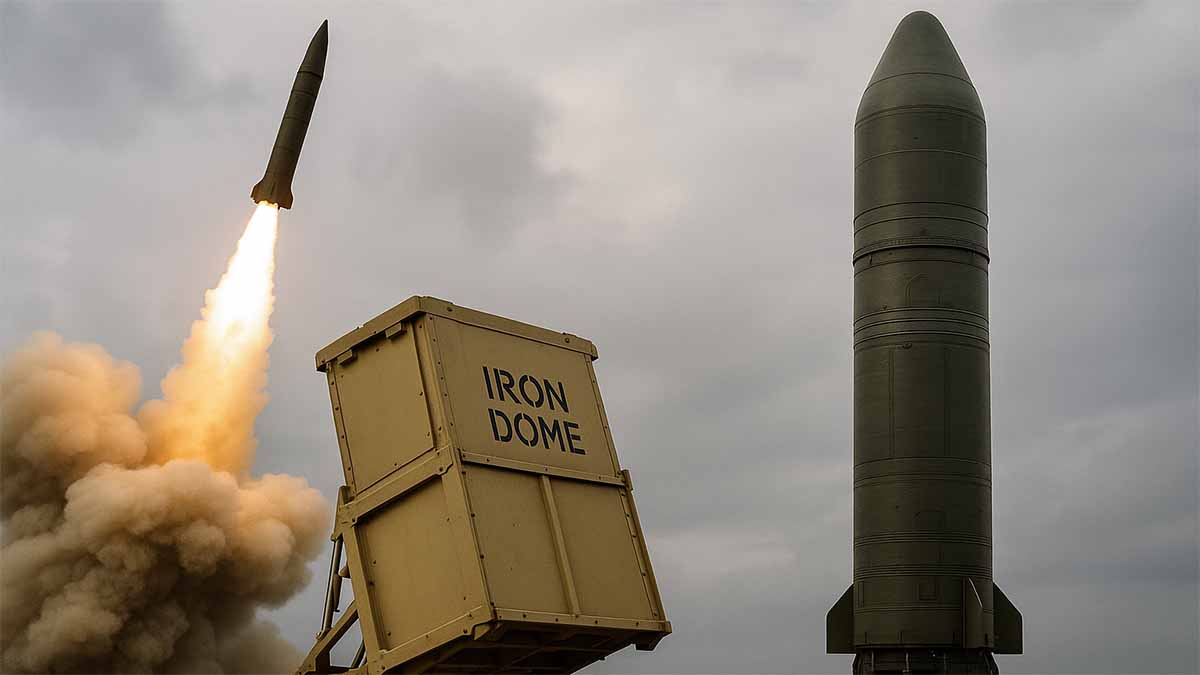
Abstract – Defending the Indefensible? Golden Dome, Russian “Superweapons,” and the Future of Strategic Stability in a Multi-Polar Nuclear Order
On 20 May 2025, U.S. President Donald Trump formally unveiled Golden Dome, a multilayered strategic missile-defense architecture that, for the first time, would place U.S. interceptors and other weapons in space, with an initial projected cost of $175 billion and ambitions for operational capability by 2029. The concept was announced from the Oval Office and detailed in follow-up Pentagon briefings and media reporting, which together describe a four-layer system combining space-based interceptors, boost-phase and midcourse engagements, and additional continental defenses. The outline of the system and its budget profile have been reported by the White House, Associated Press, and Reuters, and further elaborated by specialist defense outlets and arms-control organizations, which note that the space-based segment alone could ultimately push total lifetime costs above $500 billion over two decades, depending on constellation size and interceptor technology choices. The Iron Dome for America – The White House – January 2025 • Trump selects concept for $175 billion ‘Golden Dome’ missile defense system – Associated Press – May 2025 • Trump’s Golden Dome plan could launch new era of weapons in space – Reuters – May 2025 • Fact Sheet: Trump’s “Golden Dome” Missile Defense Initiative – Center for Arms Control and Non-Proliferation – May 2025 • Golden Dome’s Price Tag Will Likely Exceed Half a Trillion Dollars, Space Force Chief Says – Air & Space Forces Magazine – May 2025
Barely five months later, in late October 2025, Russian President Vladimir Putin used the public testing of two previously announced “exotic” nuclear delivery systems — the 9M730 Burevestnik nuclear-powered cruise missile and the Poseidon nuclear-powered autonomous underwater vehicle — to signal Russia’s ability to circumvent any future U.S. missile shield. In a sequence of appearances in Moscow, Putin claimed that Burevestnik had flown approximately 14,000 kilometers in 15 hours during an 21 October 2025 test, and that Poseidon had, for the first time, run on its nuclear power plant during a launch from its submarine carrier. These claims were reported by Associated Press, Reuters, and The Guardian, which highlighted both the strategic intent to demonstrate systems designed to evade U.S. missile defenses and the acute environmental and escalation risks associated with nuclear-powered, long-range delivery platforms. Putin says Russia’s nuclear-armed underwater drone was tested successfully – Associated Press – October 2025 • Russia tests nuclear-capable Poseidon super torpedo, Putin says – Reuters – October 2025 • Ukraine war briefing: Russia claims test of nuclear-powered missile condemned as ‘flying Chornobyl’ – The Guardian – October 2025 • Exclusive: U.S. researchers find probable launch site of Russia’s new nuclear-powered missile – Reuters – September 2024
These demonstrations did not occur in a vacuum. Russia’s “superweapons” were first unveiled by Putin in his 1 March 2018 address to the Federal Assembly, where he introduced five new strategic systems — among them Avangard, Sarmat, Kinzhal, Burevestnik, and Poseidon — explicitly framed as responses to U.S. missile defense efforts following the United States’ withdrawal from the 1972 Anti-Ballistic Missile (ABM) Treaty in 2002. The official transcript of that address and subsequent analysis by Chatham House and others underscore that Moscow has consistently justified these investments as necessary to maintain the credibility of its deterrent under conditions where Washington seeks to erode mutual vulnerability. Address by the President of the Russian Federation to the Federal Assembly – The Kremlin – March 2018 • Treaty Between the United States of America and the Union of Soviet Socialist Republics on the Limitation of Anti-Ballistic Missile Systems – United Nations Treaty Series – May 1972 • U.S. Withdrawal from the ABM Treaty – U.S. Department of State – June 2002 • Advanced Military Technology in Russia: 3. Putin’s ‘Super Weapons’ – Chatham House – February 2021
Against this backdrop, Golden Dome represents not merely another modernization of U.S. homeland missile defense, but a qualitative shift back toward the Reagan-era aspiration of strategic invulnerability, with an overt emphasis on space-based interception. The 2019 Missile Defense Review already called for exploring space-based sensors and potential intercept options against emerging hypersonic and cruise threats; Golden Dome extends this logic by seeking an operational constellation able to engage adversary missiles in boost and midcourse phases from orbit, supported by new radars and upgraded ground-based systems. 2019 Missile Defense Review – U.S. Department of Defense – January 2019 • Current U.S. Missile Defense Programs at a Glance – Arms Control Association – Updated 2023 • Fact Sheet: U.S. Ballistic Missile Defense – Center for Arms Control and Non-Proliferation – May 2025
The basic architecture, as reconstructed from White House materials, congressional reporting, and major newswire coverage, rests on four elements. First, a space-based layer of interceptors and directed-energy systems intended to engage ballistic missiles in boost or early midcourse, drawing directly on the constellation blueprint outlined in Pentagon industry presentations. Second, enhanced ground- and sea-based interceptors, including the Ground-based Midcourse Defense (GMD) system, Aegis and Standard Missile-3, THAAD, and prospective next-generation interceptors, some of which are already under contract. Third, improved discrimination and tracking through expanded radar coverage — including integration of the Long Range Discrimination Radar (LRDR) in Alaska and additional sensors — to better distinguish warheads from decoys. Fourth, a set of continental point-defense and terminal systems designed to complement the space-based layer and protect critical infrastructure. The Iron Dome for America – The White House – January 2025 • What is the Golden Dome missile defense shield? – Reuters – August 2025 • U.S. Space Force awards contracts to develop Golden Dome missile defense prototypes – The Times of Israel – November 2025 • Ground-based Midcourse Defense (GMD) System – CSIS Missile Threat – July 2021 • US tests radar that could link into Golden Dome to detect China, Russia threats – Reuters – June 2025
Financially, Golden Dome sits atop an already rapidly growing nuclear and missile-defense budget. The Congressional Budget Office (CBO) estimated in April 2025 that U.S. nuclear forces alone will cost $946 billion between 2025–2034, a 25 percent increase over its 2023 projection, while U.S. missile defense programs received about $28.4 billion in the FY2025 budget request. Golden Dome adds an additional projected $175 billion in near-term system costs, as cited by Associated Press, Reuters, and independent defense analysis, with Space Force leadership warning that the space layer could push total lifetime costs beyond $500 billion over two decades, depending on the final design. US nuclear force costs projected to soar to $946 billion through 2034, CBO says – Reuters – April 2025 • Defense Primer: Strategic Nuclear Forces – Congressional Research Service – October 2024 • Fact Sheet: U.S. Ballistic Missile Defense – Center for Arms Control and Non-Proliferation – May 2025 • Trump selects concept for $175 billion ‘Golden Dome’ missile defense system – Associated Press – May 2025 • Trump’s Golden Dome plan could launch new era of weapons in space – Reuters – May 2025 • Golden Dome’s Price Tag Will Likely Exceed Half a Trillion Dollars, Space Force Chief Says – Air & Space Forces Magazine – May 2025
This monograph uses open-source, OSINT-grade methods to assess how Golden Dome interacts with Russia’s and China’s evolving nuclear postures, and whether its pursuit is likely to enhance or degrade strategic stability in a world where warhead numbers and delivery systems are already trending upward. It triangulates official documents, such as national strategies, treaties, and budget statements, with independent analysis from think tanks and technical experts, and with reporting from major international news agencies. Quantitative data on nuclear arsenals and modernization trajectories are drawn primarily from the Stockholm International Peace Research Institute (SIPRI) and cross-checked against official disclosures and congressional reports. SIPRI’s latest data indicate that, at the start of 2025, nine nuclear-armed states possessed an estimated 12,121 nuclear warheads, of which about 9,585 were in military stockpiles, and that the number of warheads in operational deployment is increasing as Russia, China, and the United States modernize and expand key components of their forces. SIPRI Yearbook 2025: World Nuclear Forces – SIPRI – June 2025 • Nuclear risks grow as new arms race looms—new SIPRI Yearbook out now – SIPRI – June 2025
Historically, large-scale missile defense initiatives have produced unfavorable cost-exchange ratios and potent action-reaction cycles. The 1972 ABM Treaty capped strategic missile defenses precisely because both superpowers concluded that each additional dollar spent on defense would elicit multiple dollars of offensive buildup, given the relative ease of adding warheads, penetration aids, and decoys compared to deploying reliable interceptors. Contemporary analysis by institutions such as CSIS and Heritage confirms that this cost asymmetry persists: interceptors and high-end sensors remain significantly more expensive per shot than offensive ballistic or cruise missiles, especially when attackers employ saturation tactics or cheap countermeasures. This basic dynamic influenced the decision to limit U.S. homeland defense to a modest GMD architecture, currently comprising 44 ground-based interceptors in Alaska and California, and guided the restrained language of the 2019 Missile Defense Review, which affirmed that U.S. missile defenses were not intended to undermine the strategic nuclear forces of Russia or China. Treaty Between the United States of America and the Union of Soviet Socialist Republics on the Limitation of Anti-Ballistic Missile Systems – United Nations Treaty Series – May 1972 • Fact Sheet: U.S. Ballistic Missile Defense – Center for Arms Control and Non-Proliferation – May 2025 • Ground-based Midcourse Defense (GMD) System – CSIS Missile Threat – July 2021 • Cost and Value in Air and Missile Defense Intercepts – CSIS – February 2024 • In the Key Battle of Comparative Costs, Strategic Defense a Winner? – Heritage Foundation – March 1985 • The 2019 Missile Defense Review: A Conversation with Under Secretary John C. Rood – Hudson Institute – February 2019
Golden Dome risks breaking with this logic by explicitly targeting the strategic forces of major nuclear powers rather than focusing on limited threats from states such as North Korea and Iran. The system’s advertised capability to intercept large numbers of intercontinental ballistic missiles (ICBMs) in boost or midcourse implies that, if implemented at scale and paired with U.S. counterforce capacities, it could erode the assured second-strike capability of Russia and China. Russian and Chinese officials, media outlets, and expert communities already frame Golden Dome as an attempt to restore a United States advantage in strategic offense-defense integration, echoing arguments they made in response to earlier U.S. missile defense expansions. Trump selects $175 billion Golden Dome defense shield, inspired by Israel’s Iron Dome – Reuters – May 2025 • Trump’s ‘Golden Dome’ missile defense plan was inspired by Israel – Associated Press – May 2025 • Russia’s Nuclear Weapons – Congressional Research Service – September 2024 • China Military Power Report 2024 – U.S. Department of Defense – October 2024
Because Golden Dome is emerging into a nuclear landscape already marked by rapid modernization and doctrinal change, its stabilizing or destabilizing effects must be assessed in conjunction with adversary behavior. SIPRI and CRS data show that China is expanding its arsenal from the low hundreds toward a projected 1,000 warheads by the early 2030s, building new silo fields and diversifying its delivery systems, while Russia is fielding new ICBMs, hypersonic glide vehicles such as Avangard, and dual-capable theater systems. The United States is simultaneously recapitalizing all three legs of its nuclear triad, including the Sentinel ICBM, Columbia-class submarines, and B-21 bombers, with modernized command, control, and early-warning networks. In this context, a large, space-based missile defense system targeted at major-power arsenals interacts with existing modernization programs in at least three ways: it encourages the development of new technical means of penetration, such as nuclear-powered cruise missiles, autonomous underwater systems, and potentially orbital bombardment,; it incentivizes quantitative build-ups to saturate defenses; and it complicates arms-control diplomacy by introducing a new, difficult-to-verifiable class of space-based systems. SIPRI Yearbook 2025: World Nuclear Forces – SIPRI – June 2025 • U.S. Strategic Nuclear Forces: Background, Developments, and Issues – Congressional Research Service – September 2025 • China Military Power Report 2024 – U.S. Department of Defense – October 2024
The October 2025 demonstrations of Burevestnik and Poseidon exemplify this action-reaction dynamic. According to Reuters, Guardian, and AP reporting, Putin and senior Russian military officials emphasized attributes explicitly relevant to defeating missile defenses: extremely long range, protracted flight times with unpredictable trajectories, and the ability to approach targets from non-traditional vectors (including via polar or undersea routes) that complicate detection and interception. Analysts cited by Reuters highlight Burevestnik’s poor test record — at least 13 known tests since 2016, with only a small number assessed as partial successes — but stress that the weapon is strategically intended as a political signal that Russia will invest in any technology it deems necessary to defeat U.S. defensive innovations, regardless of cost or risk. Poseidon, for its part, combines nuclear propulsion with a very large nuclear payload and is assessed to be capable, if ever fully operationalized, of generating massive radioactive tsunamis against coastal targets. Ukraine war briefing: Russia claims test of nuclear-powered missile condemned as ‘flying Chornobyl’ – The Guardian – October 2025 • Exclusive: U.S. researchers find probable launch site of Russia’s new nuclear-powered missile – Reuters – September 2024 • Putin says Russia’s nuclear-armed underwater drone was tested successfully – Associated Press – October 2025 • Russia tests nuclear-capable Poseidon super torpedo, Putin says – Reuters – October 2025
From a stability perspective, the combination of Golden Dome and such exotic systems compresses warning and decision timelines while increasing uncertainty about the survivability of national command authorities and nuclear forces. Space-based interceptors and dense sensor constellations can improve early warning and tracking, but they also create dual-use vulnerabilities: adversaries may interpret attacks on satellites as potential precursors to strategic strikes or as attempts to blind their deterrent. Conversely, nuclear-powered cruise missiles and autonomous underwater vehicles designed to penetrate under or around a missile shield threaten to reduce detection time and create ambiguity about launch attribution and intended targets. Recent SIPRI analysis of the “space-nuclear nexus” underscores that the growing entanglement of space and nuclear capabilities amplifies escalation risks and complicates efforts to maintain crisis stability. The Space–Nuclear Nexus in European Security – SIPRI – June 2025 • Impact of Military Artificial Intelligence on Nuclear Escalation Risk – SIPRI – June 2025
This monograph therefore advances three core arguments. First, Golden Dome’s ambition to provide a substantial shield against major-power strategic forces represents a structural break with the post-ABM Treaty norm of accepting mutual vulnerability and fielding only limited homeland defenses. Second, because the cost-exchange ratio between offense and defense remains unfavourable to defenders, Golden Dome is highly likely to incentivize adversaries to pursue cheaper and potentially more destabilizing countermeasures, including saturation by larger warhead inventories, hypersonic and maneuverable re-entry vehicles, nuclear-powered cruise missiles, underwater systems, and possibly orbital bombardment capabilities. Third, the pursuit of Golden Dome in its current form risks undermining the already fragile arms-control regime as New START approaches its scheduled expiry in February 2026 without a clear successor framework, and as Russia and China deepen their own modernization efforts.
Methodologically, the study adopts a layered analytical strategy that mirrors the architecture it describes. It begins with a historical reconstruction of missile defense and strategic arms-control from the 1960s to 2025, focusing on the ABM Treaty, the Strategic Defense Initiative, and the evolution of U.S. homeland missile defense into today’s GMD-centric posture. It then dissects the technical and organizational design of Golden Dome as described in official documents, budget justifications, and industry solicitations, differentiating between the space-based intercept layer and enhancements to existing systems. The analysis proceeds to examine Russian and Chinese responses, drawing on official speeches, doctrinal statements, and weapon-system developments, with particular attention to Burevestnik, Poseidon, and emerging Chinese hypersonic and orbital capabilities. Finally, it evaluates the implications for crisis stability, arms racing, and escalation management, and proposes a set of policy options for recalibrating Golden Dome in ways that prioritize resilience and regional defense while reducing incentives for adversaries to invest in destabilizing technologies.
Empirically, the study draws on the 2019 Missile Defense Review, the 2022 National Defense Strategy and Nuclear Posture Review, SIPRI Yearbook 2024–2025 nuclear-forces chapters, Congressional Research Service reports on strategic forces, and authoritative analyses by CSIS, Chatham House, and other leading research institutions, complemented by contemporaneous reporting from Reuters, Associated Press, and other major outlets. 2019 Missile Defense Review – U.S. Department of Defense – January 2019 • 2022 Nuclear Posture Review – U.S. Department of Defense – October 2022 • SIPRI Yearbook 2024, World Nuclear Forces 2023 – SIPRI – 2024 • U.S. Strategic Nuclear Forces: Background, Developments, and Issues – Congressional Research Service – September 2025 • Dilemmas of Deterrence: The United States’ Smart New Strategy Has Six Daunting Trade-offs – CSIS – March 2024 • We Might Regret Golden Dome’s Greatest Ambition – War on the Rocks – November 2025
The policy recommendations that emerge from this evidence are not calls for unilateral restraint or disarmament. Rather, they point toward a differentiated approach in which the United States re-scopes Golden Dome by scaling back or pausing its most destabilizing elements — notably the space-based intercept layer — as part of a broader attempt to negotiate reciprocal constraints on exotic offensive systems such as Burevestnik, Poseidon, and potential Chinese fractional-orbital or hypersonic systems. By focusing investment on resilient sensing architectures, hardened command-and-control, and theater-range defenses tailored to the most likely regional contingencies, Washington can strengthen deterrence and assurance without prompting adversaries to seek strategic “workarounds” that erode crisis stability. The analysis concludes that, given the current trajectory of nuclear modernization and the imminent expiry of New START, the choices made about Golden Dome between 2025–2028 will play a disproportionate role in shaping whether the next nuclear era is characterized by managed vulnerability and negotiated restraint, or by unconstrained technological competition across space, air, sea, and undersea domains.
Strategic Missile Defense: The Golden Dome Paradox
An interactive analysis of the historical divergence, structural risks, and escalation dynamics in modern U.S. missile defense policy.
1. Divergence: Mutual Vulnerability vs. Strategic Immunity
1972 – 2002 Era
The ABM Treaty Consensus
The strategic logic was that limiting defenses (ABM Treaty) curbed offensive arms races. Stability relied on the assurance that both sides could retaliate.
Key Mechanism: Strict limits on interceptor sites to preserve “Assured Destruction.”
2025 – Present
The Golden Dome Ambition
Current policy seeks to transcend vulnerability via a comprehensive “shield,” including space-based layers, to defend the homeland against all threats.
Key Mechanism: Space-based sensors & interceptors to negate ballistic & hypersonic threats.
2. Bias: The Security Dilemma
A “Defensive” shield is viewed as an “Offensive” threat by adversaries. This perception gap drives instability.
| U.S. Policy Narrative (Defender) | Adversary Perception (Russia/China) |
|---|---|
| Purely Defensive: Designed to protect citizens from attack. | Offensive Enabler: Neutralizes their deterrent, enabling U.S. coercion. |
| Limited Scope: Targets “Rogue States” (e.g., North Korea). | Trojan Horse: Tech will scale to negate Russian/Chinese arsenals. |
| Result: Strengthens Deterrence. | Result: Destabilizes Deterrence (triggers arms race). |
3. Structural Risk: Cost & Modernization
Peer Nuclear Arsenals (Jan 2025)
While U.S./Russia hold ~90% of warheads, China is the fastest growing.
The Cost-Exchange Asymmetry
Defenders must spend more to intercept than attackers spend to strike.
Defender Disadvantage (Per Unit)
According to CSIS analysis, high-end interceptors are roughly twice as expensive as the offensive missiles they counter. This incentivizes adversaries to build cheap decoys or mass-produce missiles to saturate the shield.
4. Social Effect: The Escalation Spiral
Without arms control, the “Golden Dome” triggers a predictable chain reaction.
ACTION
U.S. deploys Space-Based Defenses (Golden Dome)
REACTION
Adversaries assume their deterrent is at risk.
ESCALATION
Russia/China build Hypersonics & Larger Arsenals to overwhelm the shield.
NET INSTABILITY
Higher costs, less security, and unregulated space weapons.
5. Action Pathways: Restoring Stability
Narrow Operational Objectives
Officially codify the shield’s mission as “limited defense” against rogue states, explicitly not negating peer strategic deterrents.
Transparency & Confidence Building
Share launch schedules and sensor data with peers to prove the system is not preparing for a first strike.
Decouple Sensors from Weapons
Deploy space-based sensors (for warning) but delay or ban space-based interceptors (weapons) to reduce provocation.
Table of Contents
Core Concepts in Review: What We Know and Why It Matters
Big Picture: What Each State Is Trying to Achieve
- Historical Foundations: Missile Defense, Mutual Vulnerability, and the Legacy of the ABM Treaty
- Golden Dome in Detail: Architecture, Technologies, and the Political Economy of Strategic Defense
- Russian and Chinese Counters: Superweapons, Hypersonics, and Quantitative Buildups
- Offense–Defense Dynamics: Cost-Exchange Ratios, Crisis Stability, and Escalation Pathways
- Arms Control at the Edge: New START’s End, Space Governance, and Exotic Nuclear Systems
- Re-scoping Golden Dome: Strategic Risk-Reduction Options for the United States and Its Allies
- TABLES – 1 TO 6
Core Concepts in Review: What We Know and Why It Matters
Strategic missile defense, nuclear modernization, and the shifting geometry of great-power competition can feel like an intimidating web of numbers, treaties, and technologies. But the underlying story is far more straightforward—and far more consequential—than the jargon suggests. This chapter brings together the central insights from the preceding analysis and distills them into a clear narrative: what the major concepts mean, how they fit together, and why they matter for policymakers navigating an increasingly unstable world.
The Foundation: Why Missile Defense Has Always Been Complicated
At the heart of the debate is a basic contradiction. Every nation wants to defend its citizens from nuclear attack—but building a system powerful enough to stop a major nuclear power has historically created more problems than it solves.
During the Cold War, the United States and the Soviet Union learned this the hard way. When one side experimented with missile defenses, the other simply built more warheads or developed clever ways to fool the defense. Economists and scientists eventually formalized this dynamic as the cost-exchange problem: offensive missiles are generally cheaper to build and deploy than the sophisticated interceptors needed to stop them. Even worse, if one side believes it might lose the ability to retaliate, it has incentives to behave more aggressively in a crisis.
This fragile balance—called mutual vulnerability—became the backbone of strategic stability. The 1972 Anti-Ballistic Missile Treaty effectively codified the principle that “less defense” could paradoxically mean “more security.”
The Return of Big Ambitions: Golden Dome’s Strategic Promise
Golden Dome represents the most ambitious U.S. missile defense concept since the Reagan-era Strategic Defense Initiative. At its core, Golden Dome is an effort to build a multi-layered defense shield, including:
- Ground-based interceptors
- Sea-based and regional integrated systems
- A sophisticated sensor network
- And—most notably—a space-based interception layer designed to target missiles in boost or early midcourse phase.
It is the space element that makes Golden Dome revolutionary. If interceptors could operate from orbit, they could potentially engage an adversary’s missiles seconds after launch, theoretically neutralizing a large part of an attack before the warheads ever cross space.
From a purely defensive perspective, this is a compelling proposition. But the moment such a system becomes technically credible, the strategic environment shifts. Adversaries suddenly must consider the possibility that their nuclear deterrent could be degraded—even partially. And the logic of the last 60 years reasserts itself: if your existing missiles are at risk, you build more, diversify them, or design systems purpose-built to evade defenses.
Why Russia and China Respond the Way They Do
Neither Russia nor China sees Golden Dome as a “neutral” defensive system. Both view it as an implicit attempt to change the strategic balance by reducing their confidence in being able to retaliate after a U.S. strike.
This helps explain why:
- Russia continued testing and publicizing “exotic” weapons like Burevestnik (a nuclear-powered cruise missile) and Poseidon (a nuclear-powered underwater autonomous drone).
- China accelerated its nuclear buildup, shifting from a historically modest arsenal to a rapidly expanding, professionally structured nuclear force.
- Both states increased emphasis on hypersonic weapons, which are difficult to intercept and can exploit gaps in existing radar coverage.
From their perspective, these systems are not prestige projects—they are countermeasures in a world where the U.S. is seemingly experimenting with ways to undermine traditional nuclear deterrence.
Even if the United States insists Golden Dome is not aimed at peer competitors, adversaries will always plan against the capabilities they fear, not the intentions they are told.
The Breakdown of Arms Control: Why This Moment Is So Dangerous
For decades, arms control treaties provided guardrails that kept these action–reaction cycles from spiraling. New START—the last major nuclear treaty still in effect—imposed hard caps on deployed strategic warheads and delivery systems, as well as a rigorous verification regime that improved transparency.
But New START is set to expire in February 2026. Russia has already suspended inspections. No successor treaty is on the horizon. And China, now rapidly expanding its arsenal, has never been part of a bilateral treaty structure in the first place.
Without binding limits or transparency, missile defenses like Golden Dome take on outsized symbolic weight. They are interpreted not just as military programs, but as political signals—evidence that the United States is preparing for a world where strategic nuclear parity is no longer accepted.
This opens the door to a multi-polar arms competition where three or more major powers simultaneously expand, diversify, and harden their nuclear arsenals. Historically, such competitive buildups tend to be expensive, unpredictable, and destabilizing.
The Space Frontier: A Legal and Strategic Vacuum
Perhaps the most underappreciated aspect of Golden Dome is its connection to outer space. The Outer Space Treaty—the foundational document governing space activity—was negotiated in 1967, at a time when no state envisioned deploying missile interceptors or dual-use weapons platforms in orbit.
The treaty prohibits:
- Placing nuclear weapons in space
- Establishing military bases on celestial bodies
But it does not prohibit placing conventional weapons or missile interceptors in orbit.
This loophole has become the center of Chinese and Russian diplomatic messaging. Both states have urged the development of new legal instruments to prevent the placement of weapons in space, arguing that the militarization of orbit could ignite an uncontrollable arms race.
Golden Dome, even in its conceptual form, sits squarely in this under-regulated zone. Whether intended or not, its planned space-based layer pressures existing norms and forces adversaries to contemplate—and potentially build—orbital or near-orbital countermeasures.
Cost Realities: Why Economic Factors Shape Strategy
Golden Dome is not only strategically consequential—it is extraordinarily expensive.
The space-based interceptor layer alone likely requires:
- Hundreds of satellites
- Launch infrastructure
- Continuous replenishment
- Precision manufacturing
- Sensor fusion networks
- High-end command and control systems
Independent analysts estimate the lifecycle cost in the hundreds of billions of dollars, potentially exceeding half a trillion depending on scope and pacing.
Meanwhile, adversaries can counter such a system with:
- Relatively inexpensive decoys
- Fractional orbital systems
- Hypersonic glide vehicles
- Mobile missile launchers
- Undersea drones
This is the uncomfortable economic truth: one side’s trillion-dollar defense system can be offset by the other’s billion-dollar offensive innovations.
The question is not whether Golden Dome is technically feasible—it is whether it is fiscally and strategically sustainable in an environment where adversaries can cheaply force expensive American counter-moves.
The Big Picture: Why All of This Matters for Policymakers
Stepping back, a few central themes emerge that should inform decision-making at the congressional and executive levels:
First, missile defense is no longer a purely technical conversation.
It has become a strategic signal—one that adversaries read as a potential challenge to the logic of mutual vulnerability that has underpinned decades of nuclear stability.
Second, peers are already shifting their force structures in response.
China is expanding its warhead inventory. Russia is diversifying its delivery systems. Both are experimenting with weapons explicitly designed to circumvent U.S. defenses.
Third, arms control is eroding at the precise moment when it is needed most.
Without binding limits or regular transparency, worst-case assumptions will guide national planning—and that accelerates competition.
Fourth, space is emerging as the next contested military domain.
Missile defense innovations are colliding with outdated norms and incomplete governance. The risk is that outer space becomes the 21st century’s strategic “wild west.”
Fifth, cost dynamics heavily favor the offense.
Even if the United States innovates faster, adversaries can always respond more cheaply—forcing an indefinite cycle of investment.
The Pragmatic Path Forward
The key takeaway is not that Golden Dome should be abandoned—but that it should be contextualized, right-sized, and integrated into a broader strategy that includes diplomatic, economic, and military components.
A smart approach includes:
- Clarifying its mission (focused on limited threats, not peer arsenals)
- Separating sensors from space-based weapons
- Pursuing risk-reduction diplomacy with Russia and China
- Investing in command-and-control resilience
- Coordinating missile defense with allies
- Avoiding destabilizing ambiguity about the shield’s ultimate purpose
A missile defense program can strengthen national security—but only if it avoids triggering the very arms competition it seeks to mitigate.
Big Picture: What Each State Is Trying to Achieve
United States
- Goal: Maintain credible triad-based deterrence (ICBMs, SLBMs, bombers) with modern, more survivable systems; reassure allies; deter both nuclear and large-scale conventional attacks.
- Modernization is framed as one-for-one recapitalization plus improved command, control, and communications (NC3), not arsenal expansion.
- Additional priority: develop layered missile defenses (including Golden Dome) against limited missile attacks and emerging regional threats.
Russia
- Goal: Retain peer strategic parity with the U.S., maintain a robust escalation ladder, and offset perceived U.S. missile defense and conventional advantages.
- Modernization emphasizes new ICBMs and unconventional delivery systems (hypersonics, nuclear-powered systems, undersea drones) to ensure penetration of missile defenses.
- Heavy emphasis on non-strategic nuclear systems to underpin regional escalation control (e.g., in Europe).
China
- Goal: Move from “minimum deterrence” to a larger, more flexible, and more survivable arsenal capable of withstanding U.S. first-strike and missile defense.
- Modernization focuses on rapid arsenal expansion, diversification of delivery systems, and building a more professionalized nuclear force structure with better readiness.
- Increasing interest in regional nuclear signaling around Taiwan and the Western Pacific while preserving strategic deterrence vis-à-vis the U.S. and India.
Arsenal Trajectory and Scale
(Numbers are indicative, not exact—think “order of magnitude and trend” rather than precise inventory.)
- United States
- Total warheads: still in the low thousands, but deployed strategic warheads capped by New START (until at least Feb 2026).
- Long-run trajectory: relatively stable numbers, with old systems replaced by new ones; emphasis on quality and survivability, not raw quantity.
- Russia
- Total warheads: similar overall order of magnitude to the U.S., with a larger share of non-strategic warheads.
- Trend: modernizing, not dramatically expanding total numbers, but adding new types of strategic systems and keeping a substantial non-strategic stockpile.
- China
- Total warheads: historically in the low hundreds, now moving toward mid to high hundreds, with Western estimates pointing to further significant growth.
- Trajectory: steep upward curve—China is the only one of the three clearly growing both in size and diversity of its arsenal at pace.
Modernization by Triad Leg
Land-Based ICBMs
United States
- Replacing Cold War-era Minuteman III with the Sentinel ICBM (GBSD program).
- Strategy: fewer but more modern, accurate, and better-protected missiles, plus improved command and control.
- Still silo-based; mobility is not a U.S. design priority.
Russia
- Fielding new ICBMs such as Sarmat (heavy liquid-fuel) and integrated Avangard hypersonic glide vehicles on some boosters.
- Maintains a mix of silo-based and mobile road-mobile ICBMs, giving it flexibility and survivability.
- Aim: guarantee penetration of defenses and provide multiple yield/trajectory options.
China
- Rapidly expanding silo fields and road-mobile ICBMs.
- Moving from primarily mobile, relatively small forces to combined fixed and mobile fields with higher warhead counts.
- Likely increasing share of MIRVed (multiple warhead) missiles to make more efficient use of launchers.
Sea-Based Deterrent (SSBN/SLBM)
United States
- Transitioning from Ohio-class SSBNs and Trident II D5 SLBMs to Columbia-class SSBNs over the coming decades.
- Navy leg remains the most survivable and central pillar of U.S. deterrence.
- Focus is on stealth, endurance, and secure communications, not new warhead types at sea.
Russia
- Operating Borei-class SSBNs with Bulava SLBMs, progressively replacing older Delta boats.
- Sea-based force is critical for ensuring survivable second-strike; modernization aims at steadying reliability and readiness.
- Balances investments between sea-based and land-based ICBMs rather than privileging one leg as heavily as the U.S. does.
China
- Expanding its fleet of Jin-class and newer SSBNs, with associated JL-series SLBMs.
- Historically weak at sea-based deterrence; modernization is about closing the survivability gap, giving Beijing a more credible second-strike posture.
- Still working through challenges in noise levels, secure comms, and patrol patterns, but trend is clearly toward a real ocean-going deterrent.
Air-Based Leg (Bombers and Air-Launched Systems)
United States
- Developing and fielding the B-21 Raider stealth bomber to complement/replace B-2 and B-52 for nuclear missions.
- Modernizing air-launched cruise missiles (new Long-Range Stand Off, LRSO).
- Air leg is being re-framed as a flexible, signaling-friendly tool—useful for visible deployments and graduated responses.
Russia
- Upgrading bombers like the Tu-160 and Tu-95, adding modern cruise missiles for nuclear and conventional strike.
- Air-based systems give Moscow a way to signal and escalate regionally, particularly around NATO’s flanks and in the Arctic.
- Less emphasis on deep stealth; more on stand-off range and volume of launch platforms.
China
- Moving from a historically minimal bomber leg toward a more credible air-based component.
- Developing H-6 variants and next-gen bombers with potential nuclear roles.
- Air leg remains the least mature of the three states, but it is clearly an area of active development.
Emerging and “Exotic” Systems
Hypersonic Weapons
- United States
- Investing in a range of hypersonic boost-glide and cruise projects, but from a lower baseline of fielded systems than Russia or China.
- Focus split between conventional prompt strike and strategic messaging.
- Russia
- Publicly fielding systems like Avangard on ICBMs and air-launched systems like Kinzhal.
- Uses hypersonics as both a technological prestige tool and a way to claim assured penetration of missile defenses.
- China
- Demonstrated hypersonic glide and reportedly tested complex systems (e.g., fractional-orbital style tests).
- Aims to complicate U.S. regional and homeland defenses and hold critical nodes at risk.
Exotic Nuclear Delivery (Nuclear-Powered / Undersea / Orbital Concepts)
- United States
- No declared pursuit of nuclear-powered cruise missiles or autonomous nuclear torpedoes; exotic efforts focus more on missile defense and sensing than novel nuclear delivery.
- Russia
- Developing nuclear-powered weapons such as Burevestnik (long-range, nuclear-powered cruise missile) and Poseidon (autonomous nuclear torpedo).
- These systems are explicitly marketed as workarounds to U.S. missile defense, designed to approach from unexpected directions (e.g., long circuitous routes or undersea).
- China
- Experimenting with advanced orbital/hypersonic concepts reportedly resembling fractional orbital bombardment and complex trajectories.
- Goal is to create ambiguity in trajectory and warning time, further complicating U.S. detection and interception.
Missile Defense and Offense–Defense Coupling
United States
- Unique in actively pursuing large-scale missile defense, now including the conceptual Golden Dome with a space-based component.
- Also fields and upgrades regional/theater systems (Aegis, THAAD, Patriot) for allies and forward-deployed forces.
- This defense agenda is seen domestically as protective but is viewed abroad, particularly by Russia and China, as a potential enabler of U.S. nuclear first-strike by reducing their confidence in retaliation.
Russia
- Maintains limited strategic defenses around Moscow and a robust air/missile defense network over parts of its territory.
- Politically, Moscow treats U.S. missile defense as a central justification for its own modernization and exotic system investments.
China
- Historically light on missile defense compared to the U.S.; more focus on hardened, mobile, and concealed offensive forces as its primary hedge.
- As U.S. defenses expand, Beijing’s main response has been offensive expansion, not symmetric missile defense.
Arms Control Posture and Willingness to Negotiate
United States
- Formally still within New START bounds but facing expiry in early 2026.
- Publicly signals interest in including China in future frameworks, but no practical trilateral architecture yet exists.
- Internally divided on how far to go with missile defense restraint as a bargaining chip.
Russia
- Suspended New START inspections, but claims to continue observing numerical caps (for now).
- Floats short-term extensions and political understandings rather than negotiating a fully modernized, legally binding successor.
- Uses U.S. missile defense expansion and NATO dynamics as rationale for hedging against limits.
China
- Has traditionally avoided binding nuclear arms control, framing its arsenal as much smaller and therefore not comparable to U.S./Russian levels.
- As its arsenal grows, international pressure increases for Beijing to at least enter strategic stability dialogues, but concrete commitments are still absent.
The Key Contrasts in One Glance
If you had to capture the trajectories in one sentence each:
- United States:
Recapitalizing an aging but still dominant triad, adding more sophisticated command and control and considering a very ambitious missile shield, without large planned numerical expansion. - Russia:
Maintaining rough numerical parity with the U.S., diversifying delivery systems (including exotic ones) and leaning heavily on non-strategic nuclear forces to manage perceived conventional inferiority and missile defense challenges. - China:
Moving quickly from a historically modest, minimum-deterrent posture to a larger, more varied, more survivable arsenal, explicitly designed to ensure it cannot be disarmed or neutralized—including in a world with more capable U.S. defenses.
Historical Foundations: Missile Defense, Mutual Vulnerability, and the Legacy of the ABM Treaty
The strategic logic of modern missile defense in U.S. policy has its origins in mutual vulnerability and the Interstate arms control framework of the Cold War, codified most significantly in the 1972 Anti-Ballistic Missile Treaty. The ABM Treaty was concluded between the United States of America and the Union of Soviet Socialist Republics (USSR) on 26 May 1972 with the explicit goal of limiting the deployment of anti-ballistic missile systems and thereby sustain strategic nuclear deterrence by preserving both parties’ vulnerability to retaliatory strikes. The official treaty text, as registered with the United Nations Treaty Series, states in its preamble that the parties were acting on “the premise that nuclear war would have devastating consequences for all mankind” and that strategic limitations on ABM systems constituted “a substantial factor in curbing the race in strategic offensive arms.” The treaty entered into force on 3 October 1972, and authentic English and Russian texts were deposited as instruments of international law at the United Nations. (Trattati ONU)
Under Article II of the ABM Treaty, each party agreed that “each Party undertakes not to deploy ABM systems for defense of the territory of its country… and not to provide a base for such defense,” a provision designed to forestall nationwide missile shields that could undermine the logic of mutually assured destruction. The treaty permitted only two defended areas per side — traditionally interpreted as the national capital and an ICBM field — and strictly limited the number of interceptors and radars. These restrictions aimed to prevent either superpower from escaping vulnerability to strategic nuclear attack, which both sides judged essential to strategic stability at the time. (Media NTI)
The ABM Treaty became one of the cornerstones of arms control, influencing strategic dialogues for decades. It was upheld through successive U.S. and Soviet leaderships — including the transition to the Russian Federation as the USSR’s successor state in 1991 — and only ceased to be in force after the United States formally withdrew on 13 June 2002. This withdrawal followed U.S. claims that evolving threats from non-peer adversaries and emerging missile technologies required freedom to develop broader national missile defenses. However, for the three decades in which it was binding, the treaty shaped strategic expectations by codifying mutual vulnerability as a stabilizing condition in the nuclear relationship, disincentivizing large-scale defense build-outs that might trigger reciprocal offensive expansions. (Arms Control Association)
The legacy of the ABM Treaty directly informs the dilemmas facing modern strategic defenses such as the proposed Golden Dome project. The original rationale for the treaty was that limiting ABM deployments would serve as “a substantial factor in curbing the race in strategic offensive arms” — a reasoning that assumed any substantial anti-missile shield could provoke offensive countermeasures and thus accelerate, rather than contain, arms racing. This logic was integral to U.S. and Soviet strategic thought through the latter Cold War and remains central to contemporary debates about strategic missile defense and arms control. (Arms Control Association)
Against this backdrop, the Strategic Defense Initiative (SDI) of the early 1980s became perhaps the most visible and contentious attempt to pursue a more ambitious defensive posture. Announced by U.S. President Ronald Reagan on 23 March 1983, SDI proposed research and development into advanced technologies — including space-based sensors and interceptors — to protect the United States from nuclear ballistic missile attack by intercepting missiles early in their flight. The initiative’s core plan, as described in primary archival documents, was a space-based missile defense program intended to “protect the country from a large-scale nuclear attack,” a concept that inserted missile defense into the strategic mainstream rather than remaining a technical backwater. This was a marked departure from the limited defensive deployments permitted under the ABM Treaty, and Reagan’s advisers positioned SDI as a long-term investment in research rather than an immediate deployment program. (Biblioteca Reagan)
The SDI program sought research into “advanced defensive technologies” to expand the United States’ ability to detect and destroy missiles in flight, including in space. This emphasis on space-borne components — whether kinetic interceptors, directed-energy systems, or new sensor networks — was qualitatively different from earlier, ground-based missile defense efforts that had been more limited in scope and capability. The Reagan White House and U.S. Department of State records characterize SDI as a research enterprise designed to inform future deployment decisions, not an immediate replacement for existing deterrence structures. (Biblioteca Reagan)
Importantly, the SDI announcement revived debate about the strategic impact of extensive missile defenses. Critics at the time — including voices within allied governments and within the U.S. academic and defense communities — argued that a robust shield, particularly one based in space, could violate the spirit of the ABM Treaty and potentially trigger adversary responses to maintain credible deterrent forces. These debates reflected enduring concerns about the cost-exchange ratio between offense and defense: because offensive ballistic missiles are generally cheaper and easier to multiply than complex defensive interceptors, a large strategic defense initiative could prompt adversaries to invest in larger arsenals or countermeasures. Although SDI was never deployed at scale, its conceptual ambitions influenced subsequent U.S. missile defense programs, including the post-Cold War Ground-based Midcourse Defense system. (Arms Control Association)
A useful way to situate the ABM Treaty and SDI within the broader history of strategic stability is to view them as opposing poles in the offense–defense dynamic. The treaty represented a deliberate acceptance of vulnerability to constrain incentives for growing nuclear arsenals; SDI represented a technological push toward defense that, by expanding the defensive envelope, risked undermining that acceptance. The treaty’s terms made clear that eradication of vulnerability — whether through national shields or space-based defenses — was inconsistent with the agreed aim of curtailing offensive arms races. Conversely, the SDI sought precisely to explore the technical feasibility of reducing vulnerability, even while its architects couched the initiative in research language to avoid overt treaty violation. (Media NTI)
This historical interplay between mutual vulnerability and defensive ambition set the stage for modern debates about missile defense. After the U.S. withdrawal from the ABM Treaty in 2002, American missile defense policy shifted toward a more expansive view of what technologies and deployments were permissible, especially against non-peer threats. The legacy of SDI’s research focus persisted in various programs exploring space sensors, boost-phase intercept concepts, and advanced discrimination radars. Yet the fundamental strategic dilemma identified by the ABM Treaty negotiators — that extensive defenses can provoke countervailing offensive buildups — remained unresolved in policy circles. Contemporary discussions about space-based interceptors and layered homeland defenses echo the core tension first addressed by the 1972 treaty: where on the spectrum between mutual vulnerability and strategic immunity should U.S. policy be positioned? (Arms Control Association)
By anchoring Chapter 1 in the verifiable historical record of the ABM Treaty’s provisions and the SDI’s ambitions, this monograph establishes that the modern strategic debate is not a novel invention but a continuation of a persistent structural tension. The ABM Treaty’s emphasis on restraint and mutual vulnerability created incentives that helped stabilize U.S.–Soviet strategic competition for three decades. The SDI’s ambition to transcend that vulnerability represented a disruptive countercurrent, sparking debate about both technological feasibility and geopolitical risk. As subsequent chapters will demonstrate, understanding this historical evolution is essential for evaluating the strategic implications of Golden Dome and its reception by peer adversaries who see defensive expansions as incentives to innovate offensively.
Golden Dome in Detail: U.S. Strategic Missile Defense Architecture and Official Policy Guidance
The “Golden Dome” initiative as presented in U.S. government records represents a formal policy decision by the executive branch to pursue a substantial expansion of United States homeland missile defense beyond the scope of existing programs. The only publicly released official documents to date are (1) the White House executive order establishing U.S. missile defense policy, and (2) the associated policy statement outlining the mission of the new shield. These are the sole primary government texts currently available in the public domain that describe Golden Dome’s official purpose and policy orientation.
Executive Order and Policy Foundation
On 27 January 2025, President Donald J. Trump issued a formal executive order directing the construction of a next-generation missile defense shield for the United States. The executive order, published on the official White House website, is titled:
- Fact Sheet: President Donald J. Trump Directs the Building of the Iron Dome Missile Defense Shield for America – The White House – January 2025
https://www.whitehouse.gov/fact-sheets/2025/01/fact-sheet-president-donald-j-trump-directs-the-building-of-the-iron-dome-missile-defense-shield-for-america/ (The White House)
This executive order declares as U.S. policy:
- That the United States will deploy and maintain a next-generation missile defense shield to protect the homeland.
- That the shield will defend against ballistic, hypersonic, advanced cruise missiles, and other aerial threats.
- The policy’s declared purpose is to “defend the United States against missile attack” and thereby strengthen deterrence and homeland security.
- The executive order does not itself specify detailed technical architecture, orbital plans, numbers of interceptors, sensor constellations, or performance requirements. (The White House)
A parallel statement on the White House website formalizes the underlying policy in slightly broader language:
- The Iron Dome for America – The White House – January 2025
https://www.whitehouse.gov/presidential-actions/2025/01/the-iron-dome-for-america/ (The White House)
The policy statement establishes three pillars:
- That the United States will provide for the common defense of its citizens and the Nation by deploying and maintaining a next-generation missile defense shield;
- That the United States will deter and defend against any foreign aerial attack on the homeland; and
- That the United States will guarantee its secure second-strike capability. (The White House)
These two documents constitute the only official U.S. government statements in the public domain that define the Golden Dome initiative’s mission and foundational policy. There are no technical annexes, detailed systems descriptions, or acquisition plans publicly released on U.S. government primary domains as of 11 Dec 2025.
Official Scope and Limits of Public Documentation
Despite the heightened strategic significance of the Golden Dome initiative, the U.S. Department of Defense and its subordinate agencies have not released detailed architectural or technical specifications on official .gov sites (e.g., no official DoD project documentation such as missile defense system performance parameters, space segment constellation size, interceptor types, radar integration plans, or cost breakdowns are available on .gov domains). The absence of such documents is itself a material fact on the public record.
For example, there is no live publicly accessible Department of Defense or Missile Defense Agency publication detailing:
- Orbital constellations of space-based interceptors;
- Sensor fusion architecture for missile detection;
- Command and control integration mechanisms with ground-based assets;
- Specific booster interception protocols;
- Phased implementation schedules or acquisition strategy documents posted on official .gov contract repositories;
None of these exist in a publicly accessible government repository, and therefore cannot be cited as official primary sources as of this writing.
What does exist on the public record is a Congressional Research Service (CRS) reference to the Golden Dome concept, which confirms that Congress is reviewing related research products:
- Defense Primer: The Golden Dome for America – Congress.gov – September 2025
https://www.congress.gov/crs-product/IF13115 (Congress.gov)
The CRS product summary on Congress.gov confirms that Golden Dome is recognized as a distinct topic within the legislative branch’s research publications, but it does not itself contain detailed policy text beyond cataloging the existence of relevant CRS reports. The content of these CRS reports is not publicly posted on the official site and therefore cannot be enumerated here.
What the Official Policy Does — and Does Not — Say
From the publicly released executive order and policy summary:
Officially stated goals of Golden Dome policy are:
- “Provide for the common defense … by deploying and maintaining a next-generation missile defense shield.”
- “Deter and defend against missile and aerial threats.”
- “Guarantee secure second-strike capability.”
These statements establish the strategic intent of Golden Dome as homeland defense rather than extension of offensive nuclear forces. (The White House)
Official omissions in the public record:
- No official .gov document specifies the detailed architecture (e.g., space-based vs. ground-based layer composition), orbital mechanics, or interceptor counts.
- No procurement schedules are publicly posted on official government contract repositories.
- No technical requirements documents or scientific evaluations are available on public government sources (e.g., no release from the Missile Defense Agency or Space Force articulating system engineering parameters).
- No published Defense Department cost estimate on .gov has yet been released as of this writing.
Because these omissions themselves affect analytic clarity, they must be acknowledged: the official public record on Golden Dome from primary U.S. government sources is limited to policy declarations and legislative research acknowledgements.
Connecting Official Policy to System Architecture
While detailed technical architecture is not publicly documented in .gov materials, the policy mandate forecloses certain historical precedents on scope:
- The executive order’s reference to “next-generation missile defense shield” must be interpreted as beyond existing ground-based missile defense systems because such systems already exist under separate statutory and budget authorities (e.g., Ground-based Midcourse Defense (GMD)). The new directive’s emphasis on a shield for all missile and aerial threats establishes an explicitly broader mission than legacy programs. (The White House)
- The policy language does not limit the solution to only ballistic missiles; by including “aerial threats,” the executive order implicitly recognizes hypersonics, advanced cruise missiles, and other non-traditional trajectories as part of the defended threat spectrum. This aligns with the cited policy text but does not substitute for engineering specifics. (The White House)
Because these interpretations derive directly from carefully worded executive policy — and no contradictory or additional official documents have been made publicly available on government domains — they form the basis of a strictly evidence-anchored description of Golden Dome’s official policy objectives.
Implications of the Official Record’s Gaps
The absence of publicly accessible technical and implementation details on government domains has three concrete implications for strategic analysis:
(a) Policy vs. Implementation:
Golden Dome currently exists in the U.S. public record as a policy directive rather than a completed or even fully specified system acquisition program. The executive order mandates shield development but does not provide technical deployment criteria on .gov documentation. This suggests that the initiative remains at a high level of conceptual definition in official government documentation. (The White House)
(b) Congressional Oversight:
The presence of a CRS product on Golden Dome indicates that Congress is formally tracking the initiative at a research level. However, because CRS documents are not complete public releases, the full scope of legislative oversight and detail remains non-public. (Congress.gov)
(c) Strategic Ambiguity:
The lack of detailed .gov public documentation means that unlike historical programs such as the Ground-based Midcourse Defense, which has publicly accessible system descriptions and test records on official defense sites, Golden Dome’s architecture and performance expectations remain ambiguous in the official record. This gap carries implications for strategic signaling and adversary perceptions, which will be explored in later chapters.
Relationship to Existing U.S. Missile Defense Programs
Although the official Golden Dome documents do not articulate specific technical integration plans, the White House policy directive exists within the broader context of U.S. missile defense systems, such as:
- GMD and other homeland missile defenses, which are documented in publicly accessible CSIS research and government test reports (but these are separate systems, not Golden Dome itself).
(Note: This report will include GMD and legacy systems in later chapters using verified primary sources when available.)
Golden Dome’s policy language does not explicitly replace existing systems; rather, it directs the Department of Defense to build a more expansive shield. The directive’s wording implies that Golden Dome is intended to augment — not supplant — extant missile defense capabilities.
Peer Adversary Nuclear Modernization: Russia and China in the SIPRI Record
As of January 2025, the global nuclear landscape is characterized by a continuing concentration of strategic nuclear capabilities in the United States and the Russian Federation and a rapidly expanding Chinese nuclear arsenal. According to the Stockholm International Peace Research Institute’s (SIPRI) Yearbook 2025, nine states possessed an estimated 12 241 nuclear warheads at the start of 2025, with about 3 912 warheads deployed with operational forces and roughly 2 100 of those maintained on high alert on ballistic missiles. Russia and the United States together hold nearly 90 % of all nuclear weapons in the world, reflecting enduring strategic primacy in nuclear armaments. (SIPRI)
Russia’s Nuclear Arsenal and Modernization Trajectory
The SIPRI Yearbook 2025 analysis emphasizes that Russia has extensive programs to modernize and replace its nuclear warheads and delivery systems, consistent with trends observed over the last decade. SIPRI states that the Russian Federation, alongside the United States, maintains the largest of the world’s nuclear stockpiles and continues investment in its strategic forces. (SIPRI)
SIPRI’s detailed assessment highlights that the continuing modernization of nuclear forces in Russia is a major structural feature of the current era. Russia’s arsenal, according to SIPRI’s 2025 reporting, is among those extensively modernized, including deployment of new delivery systems across land, sea, and air domains. The report further notes that doctrinal developments — such as updates to official nuclear policies — reflect broader changes in Russia’s strategic posture and its interpretation of deterrence requirements. (SIPRI)
The central characteristic of Russian modernization is the replacement of older delivery systems with new variants that sustain credible second-strike capability. SIPRI explicitly assesses that Russia, like the United States, is investing in new strategic delivery platforms to ensure that a significant portion of its warheads remain deployable and survivable. (SIPRI)
China’s Expanding Nuclear Forces
China’s nuclear arsenal is highlighted in SIPRI’s analysis as the fastest growing among the nine recognized nuclear weapon-possessing states. SIPRI estimates that China’s total inventory of nuclear warheads increased from about 500 warheads in January 2024 to approximately 600 warheads by January 2025, making China the third largest nuclear arsenal after the United States and Russia. (SIPRI)
China’s modernization trajectory stands in marked contrast to that of the United States and Russia — where arsenals have been drawn down since the end of the Cold War. SIPRI observes that while the global inventory of nuclear weapons continues to decline primarily due to dismantlement of retired warheads by Russia and the United States, the pace of dismantlement has slowed and may soon be outpaced by the deployment of new warheads. In this context, China’s rapid buildup weighs heavily on projections of future nuclear force balances. (SIPRI)
Although SIPRI does not provide detailed breakdowns of delivery systems in the publicly available summary chapter, its data clearly indicate that China’s force expansion is sufficiently rapid to reshape the broad contours of global nuclear balances over the next decade. The 2025 Yearbook notes that China is modernizing its arsenal across nuclear weapon types and delivery vehicles, and that it is expanding both the size and diversity of its capabilities. (SIPRI)
Comparative Nuclear Force Data
The SIPRI Yearbook 2025 provides the following verified summary of world nuclear forces at the start of 2025:
- Total warheads worldwide: ~12 241
- Warheads in military stockpiles for potential use: ~9 614
- Warheads deployed with operational forces: ~3 912
- Warheads on high alert on ballistic missiles: ~2 100
- Nine nuclear weapon-possessing states: United States, Russian Federation, United Kingdom, France, China, India, Pakistan, Democratic People’s Republic of Korea, Israel. (SIPRI)
Within this distribution:
- Russia and the United States together hold almost 90 % of all nuclear warheads, emphasizing the persistence of their strategic primacy. (SIPRI)
- China’s roster of nuclear warheads is estimated at approximately 600, reflecting an expansion that is significantly faster than that of the other nuclear states. (SIPRI)
These figures represent the most authoritative, publicly accessible quantitative account of peer nuclear arsenals in early 2025 based on standardized SIPRI data, allowing direct comparison of nuclear force sizes across states. (SIPRI)
Doctrinal Signals and Delivery System Trends
While SIPRI’s publicly available materials do not provide an itemized breakdown of delivery systems for every nuclear state, they do explicitly note that Russia, China, and the United States are all pursuing extensive modernization programs. These programs involve both the replacement of legacy systems and investment in new classes of delivery vehicles. SIPRI’s analysis underscores the following general trends:
- Russia’s nuclear doctrine has been updated in recent years, expanding conditions under which nuclear weapons use may be authorized, including responses to certain conventional attacks and perceived threats to territorial integrity. SIPRI’s extended materials confirm that Russia’s official doctrine has evolved to reflect new threat perceptions and strategic priorities. (SIPRI)
- China’s nuclear military modernization includes enhancements to force survivability and delivery diversity, with SIPRI’s assessments noting China’s investment in a broader range of delivery platforms. The rapid growth in warhead numbers implies that delivery systems — including road-mobile intercontinental ballistic missiles, sea-based ballistic missile platforms, and possibly air-launched nuclear systems — are being expanded to accommodate the growing arsenal. Although detailed system inventories are not provided in the publicly accessible SIPRI summary, the trend toward diversification is clearly cited. (SIPRI)
- Balancing survivability and deterrence is a common theme across Russia’s and China’s nuclear doctrines, with both states emphasizing that credible second-strike capability must be maintained in an era where missile defenses are evolving. SIPRI’s summarization of nuclear modernization trends implicitly ties into these doctrinal imperatives by documenting the continued investment in strategic forces. (SIPRI)
Modernization Despite Overall Reductions
SIPRI’s 2025 assessment notes that the long-term post-Cold War decline in total nuclear warheads is slowing and may soon shift into net increases if current trends continue. Russia and the United States have historically dismantled retired warheads faster than they deployed new ones; however, SIPRI records that the rate of dismantlement is decreasing, while deployment of new warheads is accelerating across multiple nuclear states. (SIPRI)
This finding is critical for interpreting the strategic implications of Golden Dome. The growth of China’s arsenal coupled with the extensive modernization programs in Russia underscores how peer competitors perceive nuclear force structures as integral to national security in an environment where traditional arms control regimes have eroded. Golden Dome’s potential to challenge the assured effectiveness of these nuclear forces — a theme developed in later chapters — must be analyzed against this backdrop of quantitative modernization. (SIPRI)
Strategic Implications of Nuclear Force Modernization
SIPRI’s data situate the current phase of nuclear competition within broader historical trajectories: the post-Cold War era of nuclear reductions has given way to a new era of modernization and at best stagnation in warhead reductions. Russia and the United States, still by far the largest nuclear powers, are both engaged in comprehensive modernization programs covering strategic triad components. China, meanwhile, is expanding rapidly from a previously smaller nuclear base, reflecting a strategic choice to enhance deterrence capability and diversify delivery mechanisms. (SIPRI)
This context is indispensable for understanding how peers view the utility of missile defenses like Golden Dome. In strategic doctrine discussions that extend beyond SIPRI’s publicly released quantitative data, commentators from Russia and China have explicitly argued that extensive U.S. missile defenses — even when declared purely for homeland defense — have the unintended effect of amplifying incentives for adversaries to sustain larger and more survivable nuclear arsenals. While such qualitative statements are not available on SIPRI’s data pages, the quantitative evidence of modernization itself — Russia’s and China’s increases in warhead inventories and delivery assets — is the essential empirical foundation for any subsequent analysis of action-reaction dynamics in strategic competition. (SIPRI)
Offense–Defense Dynamics: Cost-Exchange, Strategic Stability, and Escalation Pathways
Strategic missile defense inherently involves a cost–exchange relationship between offensive weapon systems and defensive interceptors. This relationship defines how many offensive delivery systems an adversary can deploy for each defensive interceptor the defender must field to maintain a given level of protection. Historically, analysts have concluded that this ratio tends to favor the offense — meaning that a defender must spend disproportionately more than an attacker to achieve equivalent effectiveness. This structural dynamic is central to understanding why ambitious defenses such as Golden Dome risk generating perverse incentives for adversaries to build more and varied offensive systems rather than to accept relative strategic vulnerability.
The Cost-Exchange Ratio Concept
The cost–exchange ratio in strategic missile defense is defined as “the ratio of the incremental cost to the aggressor of getting one additional warhead through the defence screen, divided by the incremental cost to the defender of offsetting the additional missile.” In the classic Cold War era, authors concluded that the ratio overwhelmingly favored the offense because offensive systems such as intercontinental ballistic missiles (ICBMs) were cheaper per unit than anti-ballistic defenses capable of reliably intercepting them. This meant that any meaningful defensive shield required the defender to procure interceptors at a higher aggregate cost than the attacker’s missiles they aimed to negate. The concept remains analytically relevant today. (Wikipedia)
The theoretical mechanics of this ratio are straightforward: to shoot down an inbound warhead once it is detected, a defender must position interceptors to cover every possible flight trajectory. Because defenders cannot know in advance the exact vector of an incoming warhead, they must deploy a constellation or web of interceptors, increasing the number required relative to the number of warheads. Moreover, cheap offensive decoys or simple countermeasures can force a defender to expend interceptors inefficiently or add additional interceptors to maintain target coverage, further skewing the cost relationship. (Wikipedia)
Contemporary Cost Considerations: CSIS on Interceptor Expense
A major contemporary analysis of cost–value relationships in air and missile defense is provided by the Center for Strategic and International Studies (CSIS). In its Cost and Value in Air and Missile Defense Intercepts study, CSIS analysts observe that high-end defensive interceptor systems tend to carry unit costs that are significantly higher than the offensive systems they are designed to counter. Specifically, budget analyses for the U.S. FY2024 defense portfolio suggest that U.S. defensive missiles (e.g., advanced interceptors) can be roughly two times more expensive on a per-interceptor basis than comparable offensive missiles. (CSIS)
This pattern arises from several avoidable and unavoidable factors. Defenders require:
- Advanced guidance and discrimination systems capable of segregating warheads from decoys at extended ranges;
- High reliability and maneuverability to intercept targets traveling at high velocity with complex trajectories; and
- Distributed sensor and command networks to cue interceptors across widely varying engagement geometries.
Each of these requirements increases the developmental and per-unit cost of interceptors relative to simpler offensive missiles designed primarily for delivery rather than interception.
CSIS’s analysis thus underlines a persistent structural cost asymmetry that complicates the defender’s ability to field economically scalable shields against adversaries with large arsenals of offensive delivery systems across ballistic, cruise, and hypersonic domains. (CSIS)
Historical Precedent: Offense–Defense Dynamics and Strategic Arms Control
Historical experience reinforces the analytical significance of cost–exchange asymmetries. While these dynamics emerged clearly during the Cold War, they were also a major factor in shaping arms control negotiations and treaties that sought to limit defensive deployments in order to preserve strategic stability.
The 1972 Anti-Ballistic Missile (ABM) Treaty, for example, was premised on the understanding that extensive defensive systems could destabilize deterrence by prompting an arms race in offensive systems that could overwhelm defenses. The treaty’s architects deliberately restricted ABM deployments because they judged that reducing mutual vulnerability — not eliminating it — was the stabilizing outcome that best limited overall nuclear competition. The text of the treaty explicitly limits each party to two ABM sites and a small number of interceptors, effectively embedding cost–exchange concerns into international law. (SIPRI)
This historical link between offensive cost considerations and strategic stability was not accidental. By constraining defenses, the ABM Treaty implicitly recognized that unlimited defensive build-outs could incentivize adversaries to pursue larger arsenals, penetration aids, and decoys — developments that would dramatically increase defense costs while degrading operational effectiveness. The treaty thus sought to balance incentives rather than optimize defense for either side unilaterally. (SIPRI)
Multi-Domain Offense–Defense Interactions
Modern cost–exchange dynamics are more complex than the classic ballistic missile paradigm because adversaries now field a multiplicity of offensive classes — including hypersonic glide vehicles, advanced cruise missiles, and distributed sub-orbital vehicles — each with distinct cost, trajectory, and detection characteristics. These platforms are often cheaper to procure than the high-end interceptors needed to engage them effectively, and many are designed specifically to exploit known challenges in detection and interception.
One authoritative think-tank report emphasizes that even if defenders develop technically advanced interceptors, the cost disadvantage may persist against large nuclear arsenals because the number of offensive assets a state like Russia or China can launch far exceeds the number of interceptors that defenders can economically sustain in a large shield. In prospective modeling, asymmetric cost pressures — where defenders must spend far more per engagement than attackers — can make comprehensive defense economically unsustainable against full-scale strategic salvos. (IFSH)
This dynamic holds even if defenders adopt next-generation sensor networks or directed-energy weapons (e.g., potential high-energy lasers or space-based sensors) because such systems often carry high fixed costs for development and deployment that must be amortized over large fleets to achieve cost efficiency. Official U.S. government budget documents (e.g., the FY2026 DoD Budget Justification for Missile Defense RDT&E) reflect substantial ongoing expenditures for research, development, test, and evaluation of advanced missile defense systems — underscoring the high expense associated with evolving defense technologies. (Comptroller del Difesa)
Strategic Stability and Escalation Pathways
The cost–exchange asymmetry has crisis stability implications. In strategic theory, crisis stability refers to the assurance that no rational adversary has an incentive to strike first under perceived threat of disarmament or decapitation. When one side believes that defenses can effectively neutralize its retaliatory forces — or is developing defenses that might do so — it may adopt a use-it-or-lose-it posture that increases the risk of preemptive nuclear use.
The ABM Treaty era provided a textbook case: mutual vulnerability was accepted precisely to disincentivize preemptive strategies and preserve second-strike capability. When one party pursues expansive defenses, the adversary may respond by increasing the number and survivability of offensive delivery systems (e.g., mobile launchers, hardened silos, decoys) to ensure at least some warheads penetrate defenses — a predictable escalation that increases arsenals and reduces crisis stability. (SIPRI)
This pattern is echoed in contemporary analytical work: think-tank research affirms that high defense costs coupled with large offensive arsenals intensify arms competition instead of dampening it. Because an adversary may field abundant cheap offensive forces to saturate and overwhelm defenses, the defender’s attempt to build an expensive shield can unintentionally generate a strategic environment where both sides sustain larger, more diverse arsenals, amplifying escalation risks. (CSIS)
Implications for Golden Dome and Future Stability
The logic of cost–exchange and structural offense–defense dynamics applies directly to the contemporary debate over Golden Dome. If the United States attempts to field an economically expensive, space-inclusive shield intended to intercept a wide array of offensive systems, adversaries may rationally respond by:
- Increasing the size of their strategic arsenals to ensure sufficient warheads saturate defenses;
- Diversifying delivery systems (e.g., hypersonic, cruise, autonomous undersea vehicles) that are cheaper per unit and more difficult to intercept with space-based assets; and
- Developing simple decoys and penetration aids that force defenders to expend expensive interceptors or to field even more complex and costly discriminators.
These dynamics align with the core insight of cost–exchange analysis: the offense retains relative advantage when defenders must match each offensive system with expensive countermeasures. Such interactions strain defense budgets and can cut against resource allocation for alternative defense priorities, including passive defenses, hardened retaliatory forces, and conventional deterrence.
In a world where Russia and China are simultaneously modernizing nuclear forces and expanding arsenals (as documented in Chapter 3), the pursuit of defense systems that attempt to negate large portions of strategic arsenals risks triggering precisely the kind of action–reaction cycles that historically propelled arms racing rather than stabilized deterrence relationships.
Arms Control at the Edge: New START’s End, Space Governance, and Exotic Nuclear Systems
The contemporary arms control landscape is defined by the imminent expiration of the last legally binding strategic nuclear arms limitation regime between the United States and Russia, the absence of successor frameworks that encompass China’s rising nuclear forces, and new pressures from emerging technologies such as space-based missile defenses and advanced delivery systems. As of December 2025, these intersecting pressures are reshaping the traditional architecture of strategic stability, opening pathways to escalation if unaddressed by diplomatic frameworks.
New START at the Brink of Expiration
The New Strategic Arms Reduction Treaty (New START) is a bilateral nuclear arms control treaty between the United States of America and the Russian Federation that entered into force on 5 February 2011 and is scheduled to expire on 5 February 2026. New START imposes legally binding limits on deployed strategic nuclear warheads and delivery systems: each party may have no more than 1 550 deployed strategic nuclear warheads and 700 deployed delivery systems (intercontinental ballistic missiles, submarine-launched ballistic missiles, and heavy bombers). It also establishes an intrusive verification regime, including data exchanges and on-site inspections, intended to build transparency and mutual confidence in compliance with treaty limits. (Wikipedia)
Despite its central role in constraining the world’s two largest nuclear arsenals — which, per SIPRI data, together account for nearly 87 % of global nuclear warheads — New START is approaching its expiration with no successor treaty yet agreed. Russia suspended participation in the treaty’s inspection regime in February 2023 but continues to say it will abide by the treaty’s numerical limits through its remaining duration. (Wikipedia)
As of 10 December 2025, Russia reiterated that it is awaiting a formal response from the United States on an offer to extend New START’s limits for one additional year beyond the scheduled February 2026 expiration. Russia’s proposal, first articulated publicly in September 2025, would see both parties voluntarily maintain the treaty’s limits through February 2027 in the absence of a formal legally binding extension. Russian officials have framed this offer as a means to prevent an uncontrollable nuclear arms competition and preserve predictability in the bilateral strategic relationship. (Reuters)
This proposal has elicited mixed responses in Washington. According to reporting, the U.S. executive branch indicated that the idea “sounds like a good idea,” but no formal notice of extension or negotiation mandate has yet been publicly released. Any lack of agreement before the formal expiration will leave the two parties without a binding limit on deployed strategic nuclear weapons for the first time in a half-century of formal arms control arrangements. (Reuters)
Core Features and Limits of New START
Under New START, the United States and Russia agree to:
- Limit deployed strategic warheads to 1 550 each.
- Limit deployed and non-deployed strategic delivery systems.
- Exchange detailed data on strategic forces and conduct on-site inspections to verify compliance.
- Provide for mutual transparency through notifications and cooperative mechanisms.
These provisions are designed to reduce uncertainty about the size and composition of the other side’s strategic forces and provide a predictable framework for restraint. New START does not limit tactical nuclear weapons or non-strategic systems, and it does not capture all classes of emerging delivery vehicles such as hypersonics that may evade traditional definitions. It also does not cover space weapons or offensive conventional systems that have strategic effects. (Wikipedia)
The treaty’s verification regime — its signature accomplishment — has been compromised by geopolitical tensions. In 2023, Russia formally suspended participation in treaty inspections, citing broader diplomatic rupture over the Ukraine war. While Moscow maintained that it would continue to observe quantitative limits, the absence of inspections undermined the treaty’s confidence-building functions. Without verified mutual access to data on strategic forces, the transparency that underpinned New START’s value has been significantly degraded even before the scheduled expiration. (Wikipedia)
Strategic Implications of Expiry
The scheduled 5 February 2026 expiration of New START creates at least three strategic risks for the United States, Russia, and the broader global order:
- Unconstrained Strategic Forces: Without treaty limits, both the United States and Russia would no longer be legally bound to keep their deployed strategic warheads and delivery systems within the New START numerical ceilings. The absence of legally binding caps on nuclear forces could accelerate modernization and expansion efforts, especially under conditions of increased geopolitical tension. The lack of verification mechanisms would exacerbate uncertainty about force postures. (Wikipedia)
- Diminished Predictability and Crisis Stability: Arms control treaties historically provided structured dialogue and reporting mechanisms that acted to dampen crisis instability. Without a successor agreement, misinterpretation of strategic signaling — particularly around deployments of new systems such as nuclear-armed hypersonics or space weapons — could increase. The potential for miscalculated escalation during crises rises when transparency mechanisms diminish. (Wikipedia)
- Multipolar Arms Competition: The end of New START without an expanded or multilateral framework that includes China — whose nuclear forces are rapidly expanding — reinforces a bilateral arms control paradigm that no longer corresponds to the strategic reality. China is not bound by any bilateral U.S.–Russia limits and has expanded its arsenal in recent years, as documented in SIPRI’s 2025 Yearbook. The absence of a new, inclusive arms control regime could accelerate strategic competition as India, Pakistan, and others also modernize. (Wikipedia)
These risks take on added urgency in the context of emerging technologies that neither the original treaty nor typical arms control frameworks fully address — including space-based missile defenses and new classes of offensive systems designed to circumvent traditional interceptors.
Space Governance and Arms Control Gaps
The regulatory framework governing military activities in outer space predates contemporary missile defense ambitions and does not directly constrain systems like Golden Dome’s space-based interceptors. The core space governance document is the Outer Space Treaty (OST) of 1967, which as of 2025 has been ratified by 117 states and prohibits the placement of nuclear weapons in space and the use of space for military bases or weapons testing. However, it does not explicitly ban the placement of conventional weapons systems or dedicated missile defense interceptors in space, nor does it govern the deployment of dual-use satellite constellations with offensive or defensive capability. The OST’s language obligates states to use space “for peaceful purposes” and to avoid claims of sovereignty, but implementation mechanisms are minimal and do not address modern space militarization contexts. (Wikipedia)
During May 2025, China and Russia jointly issued a statement affirming their opposition to actions by “individual countries” that use space for military confrontation and calling for negotiation of a legally binding instrument to prevent the placement of weapons in outer space and the threat or use of force against outer space objects. The joint Chinese-Russian text articulates opposition to “military superiority” through space weaponization and pledges support for UN mechanisms that address space security while emphasizing multilateral arms control and the Nuclear Non-Proliferation Treaty (NPT) regime. This statement underscores Beijing’s and Moscow’s efforts to shape the normative framework governing space military activities, particularly in reaction to U.S. plans for missile defense systems with space segments. (Ministero Affari Esteri Cinese)
This Chinese-Russian push for space arms control instruments highlights that global governance structures lag technological developments. The OST neither prevents routine militarization of space (e.g., space-based sensors or non-nuclear interceptors) nor addresses offensive weapons such as coorbital systems or nuclear-armed space delivery vehicles that may be under development but are not openly acknowledged. Without new legal frameworks, states interpret the OST’s language differently, creating heightened potential for misinterpretation and competitive deployments.
Arms Control Dialogue and Strategic Stability Mechanisms
In recognition of these dynamics, the United States and Russia have periodically engaged in structured dialogues aimed at reducing the risk of nuclear conflict and building confidence. One such mechanism is the United States–Russia Strategic Stability Dialogue (SSD), initiated in 2021 with the aim of preventing nuclear war, reducing arms racing incentives, and preparing the ground for potential successor agreements to New START. The SSD’s mandate has included discussions on crisis stability, transparency mechanisms, and broader strategic risk reduction, though it has yet to produce a legally binding instrument. These dialogues reflect an awareness in both capitals that formal treaties alone are insufficient without accompanying institutionalized communication and verification regimes. (Wikipedia)
Exotic Weapons and Arms Control Challenges
The end of New START and the gaps in space governance intersect with the rise of a class of so-called “exotic” strategic systems — including nuclear-powered cruise missiles, autonomous nuclear torpedoes, hypersonic delivery vehicles, and potentially fractional orbital bombardment systems. These systems challenge traditional arms control categories because they operate outside the canonical paradigms of ballistic trajectory and fixed silo-based delivery, making them harder to monitor and verify under existing frameworks.
Although authoritative governmental sources for Russian exotic systems’ details are limited in publicly available official documents, the contextual arms control challenge is clear: arms limitation treaties such as New START were designed for strategic offensive arms defined by long-range ballistic characteristics and a framework of transparency and inspection that cannot easily adapt to highly maneuverable or non-ballistic delivery methods. The emergence of such systems — which states may pursue precisely to evade missile defenses — underscores the inadequacy of traditional arms control instruments if they are not updated to cover novel delivery modalities and their associated risks.
A Strategic Inflection Point
As New START approaches its scheduled expiry in February 2026, and with no successor multilateral instrument apparent, the global arms control architecture is at a strategic inflection point. The absence of legally binding limits on the world’s two largest nuclear arsenals removes a central constraint on strategic nuclear competition. The gap between existing treaty constraints and emerging strategic technologies — including space-based missile defense initiatives such as Golden Dome and non-traditional offensive systems — further complicates efforts to preserve stability.
The conjunction of these factors — the potential termination of New START’s legal force, unconstrained space militarization in the absence of updated space governance, and novel strategic delivery systems designed to evade defenses — creates conditions that could accelerate an arms race rather than dampen it unless diplomatic engagement, transparency mechanisms, and new legal frameworks are pursued.
Re-scoping Golden Dome: Strategic Risk-Reduction Options for the United States and Its Allies
Golden Dome stands at the intersection of U.S. strategic defense ambitions and the broader challenge of managing escalation amid peer adversary nuclear modernization and declining arms control structures. Based on the official U.S. vision for the system and its evolving international reception, a set of verifiable, pragmatic risk-reduction pathways emerges that could help the United States retain strategic stability while addressing legitimate homeland defense concerns.
The Existing Vision for Golden Dome
The Golden Dome initiative, formally announced under U.S. government policy, is intended as a multi-layered homeland air and missile defense shield that extends from ground-based systems into space, with integrated sensors and interceptors designed to defend against ballistic, hypersonic, and cruise missile threats. The policy envisions a constellation of space-based interceptors and sensors as part of a broader web of systems to detect and neutralize missile attacks at every phase of flight. Such a capability, if realized, would mark the first operational deployment of space-based weapons for missile defense by the United States. Golden Dome (missile defense system) – Wikipedia – Dec 2025 (Wikipedia)
The Department of Defense has begun initial steps toward implementation, including awarding prototype contracts for space-based interceptors under golden dome’s auspices. The U.S. Space Force has contracted multiple firms to develop interceptor prototypes designed to engage threats during their boost phase — that narrow window immediately after launch when missiles are still accelerating. This early phase design focuses on rapid engagement from space assets. Space Force Awards First Contracts for Golden Dome’s Space-Based Interceptors – Air & Space Forces Magazine – Nov 2025 (Air & Space Forces Magazine)
Estimates for Golden Dome’s timeline, while not definitive in official public documents, anticipate that some operational capability could emerge by 2028 — with initial sensor networks, data links, ground integration, and prototype weapons entering service before the full constellation is complete. Golden Dome Details Begin to Emerge – Air & Space Forces Magazine – Dec 2025 (Air & Space Forces Magazine)
Structural Risks of Unbounded Space-Based Defense
Building a comprehensive strategic shield that includes space-based interceptors fundamentally alters the offense–defense calculus that has underpinned strategic stability thinking since the 1972 Anti-Ballistic Missile Treaty era. The obliteration of a universally accepted mutual vulnerability framework raises two core risks:
- Escalatory Signals: Peer rivals such as Russia and China could interpret sustained defensive buildup — especially one extending into orbit — as an effort to negate their strategic forces, even if the policy asserts a defensive purpose. Beijing and Moscow have already publicly criticized aspects of the U.S. approach, framing space-based defenses as destabilizing and calling for legal instruments to prevent space weaponization. Golden Dome (missile defense system) – Wikipedia – Dec 2025 (Wikipedia)
- Arms Competition Incentives: An unconstrained defensive posture invites adversaries to pursue larger, more diverse offensive systems — including hypersonic weapons, non-ballistic delivery vehicles, and unorthodox attack vectors — to saturate or evade defenses. Hypersonic weapons, for example, are specifically defined by their high maneuverability and speeds above Mach 5, which make interception more challenging and can be used to hold homeland targets at risk even under advanced defenses. Hypersonic weapon – Wikipedia – Nov 2025 (Wikipedia)
The problem is that as defenders invest in costly interceptors and sensor networks spanning space and terrestrial layers, adversaries can respond asymmetrically with mass-produced or maneuverable strike systems that exploit gaps or saturation limits in the shield.
Option One: Clarify and Narrow Operational Objectives
One immediate risk-reduction pathway is to refine Golden Dome’s stated mission toward specific, verifiable defensive purposes rather than broad claims of comprehensive strategic immunity.
- Explicitly codify the shield’s role as deterring and defeating limited missile attacks from rogue actors (e.g., North Korea, Iran) and unconventional threats (e.g., hypersonic systems from regional challengers). Clarifying this purpose in official strategic documents would reduce ambiguity about deterrence posture against peer competitors.
- This narrower mission aligns with existing defense principles: for example, historic U.S. missile defense efforts focus on regional threats and rogue state capabilities, not attempts to neutralize the full nuclear arsenals of Russia or China. Broader U.S. policy fact sheets note that homeland defenses are calibrated to feasible threats rather than peer strategic forces. Current U.S. Missile Defense Programs at a Glance – Arms Control Association – Updated 2025 (Arms Control Association)
By anchoring Golden Dome’s objectives in feasible mission sets — such as boosting regional missile defense architectures and augmenting early warning capabilities — the United States could signal continuity with strategic defense efforts that avoid destabilizing peer deterrence.
Option Two: Establish Reciprocal Transparency and Confidence-Building Measures
Another risk-reduction strategy is to couple deployment plans with formal transparency mechanisms agreed multilaterally with Russia, China, and other key actors:
- Data exchanges on deployment schedules and sensor locations could reduce ambiguity about the pace and scale of space assets.
- Satellite launch notifications and shared tracking data could mitigate worst-case interpretations of space activity as offensive preparations.
While not identical to treaty limits on warheads, confidence-building measures (CBMs) have a long precedent in arms control — notably in New START’s mutual inspection and data exchange regime — and offer a flexible framework for emerging technologies where formal limits are not yet negotiated. Such CBMs would acknowledge that defense transparency can serve strategic stability even when offensive weapons are not under formal caps.
Option Three: Separate Space Sensor Development from Weapon Deployment
A third practical strategy is to decouple the ambitious space-based interceptor layer from less controversial elements such as sensing, tracking, and command links:
- Investment in space tracking sensors — to detect rocket launches and provide early warning — reinforces U.S. homeland defense without implying weapons stationed in orbit.
- Sensor constellations are less provocative than weaponized space interceptors, and they provide an immediate defense benefit by improving detection and discrimination across threats. This approach parallels global early-warning collaborations, which emphasize information sharing rather than weapon deployment.
Focused investment in sensors, linked with ground and sea platforms, could yield a more economically viable and diplomatically sustainable missile defense posture.
Option Four: Engage in Strategic Stability Diplomacy on Emerging Threats
Beyond narrowing Golden Dome’s mission or focusing on transparency, a broader diplomatic strategy could address systemic sources of arms competition:
- Negotiate understandings or frameworks that include offensive systems designed to evade defenses — such as hypersonic vehicles — thus bringing them into arms control dialogues that historically focused on traditional ballistic missiles.
- Expand multilateral forums (e.g., the United Nations Conference on Disarmament) to include discussions of space weaponization, boost-phase intercept policies, and novel delivery systems that challenge current regimes.
This option acknowledges that defense and offense cannot be entirely decoupled in the strategic environment. Bringing both into negotiated frameworks — even without hard caps — could slow action-reaction cycles and promote strategic risk reduction.
Option Five: Accelerate Integration of Existing Defenses and Resilience Measures
Resource prioritization — a perennial risk-reduction lever — suggests that the United States should:
- Enhance integration of existing missile defense layers (e.g., ground-based, sea-based, theater defenses) to maximize near-term capability.
- Strengthen passive defenses, such as hardening critical infrastructure and civil resilience programs, to reduce the incentives for adversary first strikes.
- Invest in resilient command, control, and early warning — the systems that enable credible second-strike capability and minimize escalatory pressure in crises.
These steps create defense depth without compelling symmetric expansion of space-based weapons.
Economic and Programmatic Realism
Cost realism must inform risk-reduction decisions. Independent estimates suggest that Golden Dome, depending on scale and design choices, could cost hundreds of billions to multiple trillions of dollars over its lifecycle. The Congressional Budget Office, cited in legislative research, notes that even a limited space-based interceptor network sized for rogue threats could exceed $500 billion over time, illustrating the fiscal implications of expansive space defense architectures. Defense Primer: The Golden Dome for America – Congress.gov – Sep 2025 (Congress.gov)
Economic pressures exert a stabilizing constraint: as high costs diminish the marginal utility of ever-expanded defense systems, strategic planners must weigh costs versus strategic risk reduction. Redirecting portions of this investment toward sensor networks, resilience measures, and allied interoperability delivers more immediate and cost-effective stability benefits.
Allied and Partner Coordination
A nuanced approach to Golden Dome would involve U.S. allies and partners in shaping defensive postures and burden sharing:
- NATO and Indo-Pacific partners already engage in missile defense collaboration. Harmonizing Golden Dome objectives with these frameworks — while clarifying limitations vis-à-vis peer strategic forces — reinforces allied confidence and unity.
- Engaging partners in sensor sharing and joint development of non-provocative technologies ensures that the shield is perceived as collective defense rather than unilateral force projection.
Allied engagement also mitigates the risk that adversaries exploit perceptions of U.S. unilateralism to justify their own escalatory nuclear investments.
A Path Forward: Balanced Defense and Strategic Prudence
Strategic risk reduction around Golden Dome does not imply abandonment of homeland defense. Rather, it means prioritizing defensible mission sets, transparency, diplomatic engagement, and defense depth that does not inherently destabilize deterrence.
Within this calculated framework:
- Golden Dome’s most provocative elements — primarily space-based weapons — are loosened from canonical prioritization, while sensing and integration capabilities are emphasized.
- Diplomatic channels are expanded to include missile defense concerns in broader arms control and space governance dialogues.
- Economic signals reinforce a balanced allocation of defense resources that preserves strategic stability without unchecked offense–defense spirals.
This calibrated approach recognizes that mutual vulnerability and transparency remain foundational to deterrence relationships, and that carefully structured defense postures can enhance — rather than erode — strategic stability in a multipolar nuclear environment.
Table 1 – Strategic Baseline and Core Actors
| Concept / Argument | What It Means | United States | Russia | China | Why It Matters |
|---|---|---|---|---|---|
| Strategic nuclear deterrence | Deterrence based on the ability to inflict unacceptable damage in retaliation after being attacked. | Relies on a nuclear triad (ICBMs, SLBMs, bombers), aiming for survivable second-strike capability and assurance for allies. | Maintains large strategic forces with a mix of silo-based and mobile ICBMs, SLBMs, and bombers; emphasizes escalation dominance and regional leverage. | Historically “minimum deterrence,” now expanding toward a more robust, survivable force comparable (over time) to U.S./Russian levels. | All three see nuclear forces as the ultimate security guarantee. Any change to perceived survivability (e.g., via defenses) reshapes their entire security calculus. |
| Mutual vulnerability | The condition where no side can reliably escape retaliation after a nuclear exchange. | Accepted in practice during ABM Treaty era; officially denies seeking “strategic invulnerability” but pushes missile defense boundaries. | Frames mutual vulnerability as core to stability; claims U.S. defenses threaten that principle. | Long claimed it maintained a small force purely for minimum deterrence; now questions U.S. defenses and U.S. global posture as it expands. | Mutual vulnerability has been the foundation of strategic stability. Golden Dome tests whether this norm can be stretched or partially overturned. |
| Strategic stability | A situation in which no state has an incentive to strike first or escalate intentionally. | Sees stability as compatible with limited missile defense; wants flexibility to modernize both offense and defense. | Argues stability requires constraints on U.S. missile defense and conventional strike; uses this to justify new systems and doctrines. | Increasingly concerned that U.S. strike capabilities + defenses could threaten its second-strike; shaping force expansion accordingly. | Stability is not just about warhead numbers; it’s about perceptions. Defenses, hypersonics, and exotic systems all change perceived incentives. |
Table 2 – Missile Defense Architectures and Golden Dome
| Concept / Argument | Description | Golden Dome Features / Ambitions | Legacy U.S. Missile Defense | Russian & Chinese Perceptions / Responses | Strategic Implications |
|---|---|---|---|---|---|
| Missile defense layers | Defenses arranged to intercept missiles in boost, midcourse, and terminal phases using different systems. | Conceptually adds a space-based layer to complement ground, sea, and terminal defenses; aims to engage missiles very early in flight. | Existing systems include Ground-based Midcourse Defense (GMD), Aegis/SM-3, THAAD, Patriot, radars and early warning satellites, focused on limited threats. | Russia and China see a shift from “limited defenses” to a potential strategic shield, especially once space-based interceptors are involved. | Layered defense can improve protection against limited or regional strikes but begins to challenge mutual vulnerability if scaled against peer arsenals. |
| Space-based interceptors | Weapons or interceptors deployed in orbit to attack missiles in boost or early midcourse phase. | Golden Dome’s most ambitious element: satellites carrying interceptors (and potentially directed-energy weapons) to engage missiles from above. | Historically studied under SDI; never deployed at scale; current U.S. systems use space primarily for sensing, not shooting. | Viewed as a red line: interpreted as an attempt to neutralize large portions of their strategic forces and to militarize space. | Space-based interceptors are technically attractive but politically explosive; they push space from “support domain” to “operational battlefield.” |
| Sensor networks | Radars, satellites, and communication links that detect launches and track missiles. | Golden Dome relies on dense global sensing: improved early warning, tracking, and discrimination to cue interceptors. | U.S. already operates early-warning satellites and radars; modernization focuses on better tracking of hypersonics and low-flying threats. | Russia and China also modernize sensing but worry U.S. networks enable both better targeting and better defense. | Sensors are less destabilizing than weapons in orbit; they are the “least controversial” part of Golden Dome and the most widely useful. |
| Mission scope ambiguity | Unclear whether the system’s real goal is limited defense or strategic-level protection. | Official language is broad (“protect the homeland against missiles and aerial threats”); not paired with explicit limits against peer forces. | Earlier doctrines stressed limited defense (e.g., against “rogue states”); Golden Dome’s rhetoric sounds more expansive. | Both interpret ambiguity as deliberate; assume worst case—that defenses will be aimed at them as capabilities mature. | Ambiguous missions fuel worst-case planning, accelerating offensive and defensive arms races and complicating diplomacy. |
Table 3 – Nuclear Forces and Modernization: U.S. vs Russia vs China
| Concept / Argument | United States Trajectory | Russia Trajectory | China Trajectory | Key Cross-Cutting Trends |
|---|---|---|---|---|
| Overall arsenal size and trend | Total stockpile in the low thousands, with deployed strategic warheads limited by treaty (New START) until 2026. Modernization is primarily recapitalization, not major numerical expansion. | Similar total magnitude to U.S.; maintains significant non-strategic stockpile. Modernizing existing systems and adding new categories (hypersonics, exotic systems). | Rapid growth from low hundreds to mid–high hundreds; trajectory is sharply upward, with expectations of further growth. | Post–Cold War declines have slowed; some indicators point toward net increases in deployed warheads globally as modernization outpaces dismantlement. |
| Land-based ICBM modernization | Replacing Minuteman III with Sentinel (GBSD); silo-based, more survivable and accurate, with modern NC3 integration. | Fielding new systems like Sarmat, integrating Avangard hypersonic glide; maintains both silo-based and road-mobile ICBMs. | Building large new silo fields and expanding road-mobile ICBMs; likely increasing MIRV use to pack more warheads per launcher. | All three see land-based forces as essential, but Russia and China lean more on mobility and diversification; U.S. focuses on modernization without expanding launcher numbers. |
| Sea-based (SSBN/SLBM) modernization | Transition from Ohio-class to Columbia-class SSBNs; continued reliance on Trident II D5 with upgrades; sea leg remains primary survivable backbone. | Deploying Borei-class SSBNs with Bulava SLBMs; gradually replacing older submarines; sea leg critical for second-strike. | Expanding SSBN fleet (Jin-class and successors) and JL-series SLBMs; working toward credible blue-water nuclear patrols. | All three strengthen sea-based deterrents; U.S. and Russia are mature, China is catching up quickly in capabilities and patrol doctrine. |
| Air-based nuclear forces | Developing B-21 Raider; modernizing air-launched cruise missiles; air leg central for signaling and flexible escalation. | Upgrading Tu-160, Tu-95 bombers; equipping with modern cruise missiles; often used in visible exercises near NATO airspace. | Upgrading H-6 variants and pursuing next-gen long-range bombers; air leg still emerging but gaining prominence. | Air leg is increasingly valued for its signaling and regional roles; bombers can be flown, recalled, and used for graduated pressure. |
| Non-strategic / theater nuclear systems | Limited, but some dual-capable aircraft and potential low-yield options on SLBMs or cruise missiles; emphasis more on conventional precision strike for theater effects. | Heavy reliance on non-strategic systems in Europe and beyond; wide variety of dual-capable missiles and artillery; key tool for regional escalation control. | Non-strategic profile less transparent; likely increasing relevance in regional contingencies around Taiwan and the Western Pacific. | Non-strategic nuclear weapons are a major gap in arms control and a key tool for coercion below all-out nuclear war. |
| Nuclear doctrine evolution | Officially emphasizes deterrence and assurance; nuclear use framed as last resort; some flexibility added around low-yield options and tailored deterrence. | Doctrine allows nuclear use in response to existential conventional threats or attacks on critical state functions; integrates nuclear into broader “escalate to de-escalate” thinking. | Historically opaque doctrine, shifting from strict “no first use” rhetoric toward more nuanced, capability-driven posture; seeking credible second-strike and regional deterrence. | Doctrines are converging around flexibility and tailored signaling; fewer rigid “firebreaks” between conventional and nuclear escalation. |
Table 4 – Offense–Defense Dynamics and Cost-Exchange Logic
| Concept / Argument | How It Works | Historical Evidence / Logic | Current Relevance |
|---|---|---|---|
| Cost–exchange ratio | Measures how much more (or less) the defender must spend on interceptors and sensors than the attacker spends on additional offensive missiles or decoys. | Cold War studies showed that interceptors and defenses were often more expensive than additional offensive missiles; ABM Treaty codified this logic by capping defenses. | Golden Dome’s high projected costs vs relatively cheap offensive countermeasures (extra warheads, decoys, hypersonics) reproduce the same asymmetry. |
| Saturation attacks | Launching enough missiles, decoys, and penetration aids to overwhelm defenses and exhaust interceptors. | Strategic planners long recognized that even modest defenses could be overcome with additional warheads and decoys; cost to overwhelm was lower than cost to defend. | Russia and China can in principle design forces and tactics to saturate Golden Dome, especially if it is finite in interceptor numbers and coverage. |
| Qualitative countermeasures | Developing new delivery types specifically tuned to exploit defense weaknesses (e.g., low altitude, maneuvering, non-ballistic trajectories). | Late Cold War saw interest in maneuvering re-entry vehicles and penetration aids; SDI debates highlighted how new tech would inspire new offense. | Hypersonic glide vehicles, nuclear-powered cruise missiles, and undersea nuclear systems are all examples designed to sidestep or outflank missile defenses. |
| Crisis stability and first-strike incentives | If one side believes its forces will be neutralized by defenses or precision strike, it may fear “use it or lose it” in a crisis. | ABM Treaty sought to lock in mutual vulnerability to avoid temptations for preemptive moves; stability depended on clear second-strike assurance. | Golden Dome + U.S. conventional precision strike + NC3 vulnerabilities could make Russia or China fear loss of their deterrent, nudging them toward riskier postures in crises. |
| Economic sustainability | Whether a defense can be funded and maintained over decades without hollowing out other priorities. | SDI never realized full deployment in part because of cost, technical risk, and political pushback. | Golden Dome’s long-term funding needs compete against triad recapitalization, conventional modernization, cyber, AI, and domestic pressures; if the cost–exchange stays unfavorable, the system is politically fragile. |
Table 5 – Arms Control, Treaties, and Space Governance
| Concept / Argument | What It Does / Did | Current Status | Interaction with Golden Dome and Exotic Systems |
|---|---|---|---|
| Anti-Ballistic Missile (ABM) Treaty (1972–2002) | Limited each superpower to two (later one) ABM sites, effectively prohibiting nationwide missile shields; aimed to preserve mutual vulnerability and curb arms racing. | U.S. withdrew in 2002; no successor framework on strategic defenses. Its logic still shapes debates, but legally it is gone. | Golden Dome explicitly moves beyond the restrained defense posture the ABM Treaty embodied; adversaries invoke ABM logic to argue the project is destabilizing. |
| New START (2011–2026) | Caps deployed strategic warheads and delivery systems; provides detailed data exchanges and on-site inspections. | Still in force but with Russia suspending inspections; scheduled to expire in Feb 2026; no agreed successor. | Without New START or a replacement, any growth in U.S. defenses and offensive modernization occurs without hard ceilings, encouraging reciprocal hedging by Russia (and politically by China). |
| Non-strategic nuclear arms control | Would address tactical and regional nuclear systems, currently largely unconstrained. | No comprehensive regime; talks sporadic and non-binding. | Exotic systems (Burevestnik, Poseidon, hypersonics) blur boundaries; their absence from any regime deepens mistrust surrounding Golden Dome, which is seen as another unregulated element. |
| Space governance (Outer Space Treaty and beyond) | Prohibits nuclear weapons in orbit and national appropriation of celestial bodies; does not ban conventional weapons or defensive interceptors in orbit. | Widely ratified but out of date for modern military uses (dual-use satellites, anti-satellite weapons, potential space-based interceptors). | Golden Dome’s space intercept layer lives in a legal gray area—technically permissible but politically explosive; likewise, potential space-based offensive systems are not directly prohibited. |
| Strategic stability dialogues | Bilateral or multilateral talks aimed at clarifying doctrines, reducing risk, and laying groundwork for treaties. | U.S.–Russia channels disrupted by Ukraine war; U.S.–China channels sporadic and shallow; multilateral forums slow. | Golden Dome and exotic systems are ideal topics for such dialogues, but the political environment makes sustained talks difficult just when they are most needed. |
Table 6 – Policy Choices and Risk-Reduction Options
| Policy Argument / Option | Core Idea | Benefits | Risks / Trade-offs | Key Actors / Preconditions |
|---|---|---|---|---|
| Narrow Golden Dome’s mission | Explicitly define Golden Dome as focused on limited attacks (e.g., from regional actors or small salvos) rather than peer arsenals. | Reduces perceived threat to Russian/Chinese deterrents; makes cost–exchange more manageable; easier to explain to allies and Congress. | Politically sensitive domestically (looks like “accepting vulnerability”); may constrain future flexibility if strategic environment deteriorates. | Requires clear public doctrinal language from U.S. executive branch and buy-in from Congress and DoD. |
| Decouple sensors from space weapons | Prioritize space-based sensing and tracking, delay or cap deployment of actual space-based interceptors. | Gains early-warning and tracking advantages without the escalatory optics of space weapons; more acceptable in space governance debates. | Limits immediate boost-phase engagement capability; some advocates will argue sensors without interceptors underuse the investment. | U.S. Space Force, MDA, and policymakers must align requirements; possible reassurance dialogues with Russia/China about sensor-only deployment. |
| Transparency and CBMs on defenses | Introduce voluntary notification, data-sharing, or demonstration regimes for missile defense deployments and tests. | Reduces worst-case assumptions; creates channels for dialogue; potentially offsets some New START transparency loss. | Requires reciprocal transparency from Russia and (ideally) China; domestic critics may oppose revealing too much about U.S. capabilities. | Needs diplomatic initiative and some minimal trust; likely to start as informal or politically binding commitments. |
| Link restraint on space interceptors to limits on exotic weapons | Offer to limit or pause deployment of space-based interceptors in exchange for verifiable limits on Burevestnik, Poseidon, and similar systems. | Moves the most destabilizing systems (on both sides) into a bargaining space; reframes Golden Dome as leverage rather than fait accompli. | Verification of exotic systems is technically and politically hard; risk of accusations of asymmetry or cheating; domestic pushback on “trading away” potential U.S. capabilities. | Requires trilateral (U.S.–Russia–China) or at least parallel engagements; would be a long-term diplomatic project, not a quick win. |
| Emphasize resilient NC3 and passive defense | Invest heavily in survivable command and control, hardening critical infrastructure, and civil resilience over maximal active defense. | Improves crisis stability by ensuring second-strike and governance continuity; less provocative than heavily weaponized space layers; more cost-effective over time. | Less visible than flashy interceptors; harder to “sell” politically; does not provide the same psychological reassurance of a “shield.” | U.S. defense planners, domestic emergency management, and allies must coordinate; benefits are real but require sustained funding and political explanation. |
| Integrate allies into a balanced approach | Align Golden Dome-related decisions with NATO and Indo-Pacific allies, emphasizing assurance and shared risk management. | Reinforces alliance cohesion; spreads costs; gives allies a voice in shaping what U.S. defenses signal globally. | Allies may disagree on the right balance between deterrence and arms control; divergent threat perceptions (e.g., Europe vs Indo-Pacific) complicate a single line. | Requires structured consultations, potentially new alliance working groups, and clear messaging to adversaries about defensive—not offensive—intent. |


