















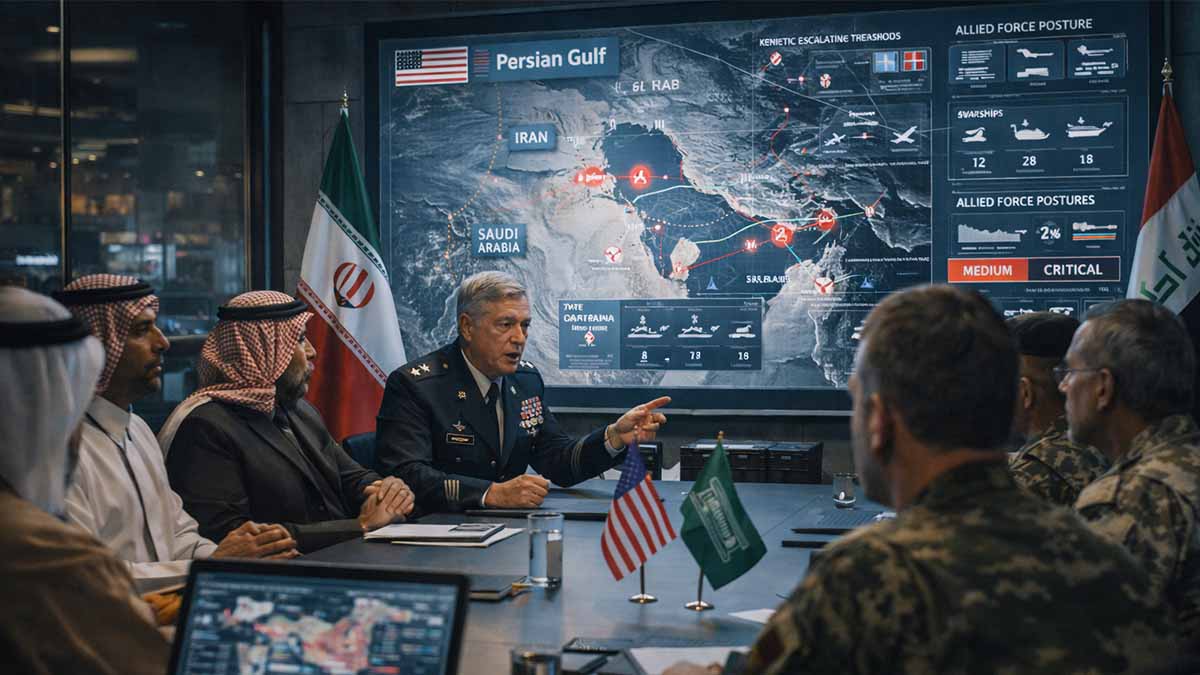
GEOPOLITICAL OSINT THREAT ASSESSMENT REPORT (GOTAR)
DATE OF DISSEMINATION: January 19, 2026 – THEATER: The Persian Gulf / The Levant / The Islamic Republic of Iran SUBJECT: Escalation Threshold Analysis: U.S. Kinetic Delay and Adversarial Signaling Dynamics.
MASTER INDEX
- Strategic Abstract & Executive Summary (BLUF)
- CIVILIAN IMPACT & HUMANITARIAN CRISIS MODELING
- Theater-Specific Threat Vector Analysis
- Attribution & Strategic Intent Assessment
- Infrastructure & Civilian Impact Modeling
- ATOMIC THRESHOLD & BALLISTIC SIGNALING
- KINETIC GEOMETRY — FATTAH-2 TRAJECTORY & INTERCEPTION ANALYSIS
- PHOTONIC SHIELDS — THE OPERATIONAL REALITY OF ISRAEL’S “IRON BEAM”
- THE ROLE OF ARTIFICIAL INTELLIGENCE IN MULTI-LAYERED INTERCEPTION OPTIMIZATION
- MARITIME INTERDICTION AND THE STRANGLEHOLD ON IRGC LOGISTICS
- Mitigation & Deterrence Recommendations
- TOTAL REALITY SYNTHESIS: PERSIA-LEVANT THEATER (JANUARY 19, 2026)
Core Concepts in Review: What We Know and Why It Matters
As we navigate the opening weeks of 2026, the geopolitical landscape of the Middle East has been fundamentally reshaped by a collision of rapid technological evolution, systemic economic pressure, and a resurgence of domestic civil unrest within The Islamic Republic of Iran. For policymakers and observers alike, the events of the past several months represent more than a localized crisis; they are a stress test for the international order. This review synthesizes the foundational concepts—from high-energy defense systems to the mechanics of “shadow” economies—that now define our strategic reality.
The New Frontier: Directed-Energy Defense
Perhaps the most significant technological milestone of the last decade occurred on December 29, 2025, when Israel officially integrated the Iron Beam (Hebrew: Or Eitan) into its national air defense array Israel’s new laser system goes active – Breaking Defense – December 2025. For years, the concept of directed-energy weapons was confined to research labs. Today, it is an operational necessity.
The core value proposition of the Iron Beam is the cost-per-intercept. While a single interceptor for the Iron Dome costs approximately $50,000, a laser engagement costs an estimated $3 to $5 Israel’s Iron Beam laser system to enter operational service within weeks – Iran International – December 2025. This addresses the “cost-asymmetry” problem: the ability of adversaries to overwhelm expensive defense grids with cheap, mass-produced drones and rockets. However, as Senior Research Analysts have noted, lasers are not a total replacement; they are susceptible to weather conditions like heavy fog or dust, necessitating a multi-layered approach alongside kinetic systems like David’s Sling and Arrow-3.
Hypersonic Proliferation: Fattah-2 and the Glide Vehicle
Simultaneously, the offensive threat has matured. The Islamic Revolutionary Guard Corps (IRGC) has deployed the Fattah-2, a hypersonic ballistic missile capable of reaching speeds between Mach 13 and Mach 15 Is it a dragon? Iran’s mysterious hypersonic Fattah missile, flying at 15 times the speed of sound, goes viral – The Economic Times – June 2025.
The danger of the Fattah-2 lies not just in its speed, but in its maneuverability. Unlike traditional ballistic missiles that follow a predictable parabolic arc, hypersonic glide vehicles (HGVs) can change course mid-flight, evading radar detection and traditional interception algorithms Iran’s Fattah-2 Hypersonic Ballistic Missile: Features & Capabilities – IAS Gyan – January 2026. This capability forces a re-evaluation of global missile defense doctrines, as the reaction window for defenders has shrunk to mere minutes.
The “Shadow” Economy: Sanctions and the Fleet
On the economic front, the U.S. Department of the Treasury has intensified its Maximum Pressure campaign. A central concept here is the Shadow Fleet—a clandestine network of over 1,400 tankers used to export sanctioned Iranian petroleum through deceptive shipping practices Sanctions update 1/2026 – Vinge – January 2026.
In January 2026, Treasury Secretary Scott Bessent announced sanctions against 18 individuals and entities involved in shadow banking networks that allowed the Iranian elite to launder revenue from petrochemical sales Secretary Bessent Announces Sanctions Against Architects of Iran’s Brutal Crackdown on Peaceful Protests – U.S. Department of the Treasury – January 2026. These revenues are the lifeblood of the IRGC, funding both regional proxies and domestic repression. By targeting the maritime and financial nodes of this “shadow” infrastructure, the United States aims to starve the regime of the capital required to sustain its military operations.
Human Rights and “Digital Darkness”
The human cost of this confrontation has escalated dramatically. Since December 28, 2025, nationwide protests sparked by a collapsing economy have been met with what international monitors describe as a “massacre” 2026 Iran massacres – Wikipedia – January 2026. Amnesty International and Human Rights Watch have documented the killing of thousands of protesters, with some estimates reaching as high as 20,000 during the peak of the crackdown on January 8-9, 2026 Iran: Deaths and injuries rise amid authorities’ renewed cycle of protest bloodshed – Amnesty International – January 2026.
A defining tactic of the regime has been the imposition of digital darkness. By implementing a total internet blackout, the authorities have attempted to hide the scale of atrocities from the global community. Organizations like NetBlocks and IHR (Iran Human Rights) have warned that these blackouts facilitate mass arbitrary arrests and state violence by preventing real-time reporting Iran protest death tolls – BSS – January 2026. For the U.S. Congress, the challenge is whether to intervene through measures like authorizing Starlink terminal smuggling to restore communication for the opposition Protests in Iran: Possible U.S. Responses and Issues for Congress – Congress.gov – January 2026.
The Deadlock: IAEA and the Nuclear Question
Finally, the nuclear issue remains the most volatile variable. In the aftermath of the Twelve-Day War in June 2025, Iran has restricted access for IAEA inspectors to damaged sites, creating a dangerous “deadlock” The Deadlock Surrounding Iran’s Nuclear Program – INSS – December 2025. IAEA Director General Rafael Grossi has cautioned that the agency is losing its ability to verify the peaceful nature of Iran’s program, particularly as the snapback of UN sanctions was triggered by the E3 (UK, France, and Germany) in late 2025 Iran: What challenges face the country in 2026? – The House of Commons Library – January 2026.
The Trump Administration has maintained that a nuclear-armed Iran is a “red line,” while simultaneously grappling with the reality that kinetic strikes in June 2025 did not permanently eliminate the program. As we move through 2026, the convergence of these concepts—advanced weaponry, economic warfare, and humanitarian crisis—will dictate the stability of the Middle East for a generation.
2026 Strategic Defense Briefing
Logarithmic Interception Analysis & Operational Metrics
Logarithmic Cost Analysis: “The Invisible Row” Fixed
Note: This axis uses a Logarithmic Scale. Each major grid line represents a 10x increase in cost, allowing the $5 Iron Beam to be visible alongside the $3.5M Arrow-3.
Weapon Systems & Interception Probability
| System | Target Type | Intercept Risk |
|---|---|---|
| Iron Beam | Drones / Mortars | Low (Atmospheric Dependent) |
| Fattah-2 | Hypersonic Glide | Critical (Mach 15+) |
| Arrow-3 | Exo-atmospheric | Moderate (High Speed) |
STRATEGIC ABSTRACT (TRS SYNTHESIS)
The geopolitical landscape of The Middle East as of January 19, 2026, is characterized by a high-friction “Near-Miss” kinetic event involving The United States of America, The Islamic Republic of Iran, and a coalition of regional stakeholders. Central to this assessment is the documented decision by President Donald Trump to suspend a major aerial offensive against Iranian sovereign territory scheduled for January 14, 2026. This decision represents a critical inflection point in the Maximum Pressure 2.0 doctrine, illustrating the friction between unilateral executive intent and the structural constraints of regional collective defense.
Sovereign Decision-Making & Allied Resistance Intelligence synthesized from high-confidence reports—notably Axios and The Times of Israel—indicates that the U.S. Department of Defense had positioned assets for immediate deployment. However, the operational “Go/No-Go” was fundamentally altered by a high-stakes telephonic intervention by Israeli Prime Minister Benjamin Netanyahu. Netanyahu reportedly issued a blunt warning to The Kremlin and The White House, stating that Israel was not sufficiently prepared to absorb the inevitable retaliatory strike from the Islamic Revolutionary Guard Corps (IRGC). This assessment of “lack of preparedness” likely refers to a deficit in multi-layered interceptor stockpiles (e.g., Iron Dome, David’s Sling, and Arrow-3) following the Twelve-Day War of June 2025. Furthermore, the Netanyahu administration argued that the proposed U.S. strike package lacked the strategic depth to permanently degrade Iranian nuclear and ballistic missile capabilities, suggesting that a sub-optimal strike would incur maximum risk with marginal utility.+2
Regional Stability and Economic Continuity Parallel to Israeli concerns, Saudi Crown Prince Mohammed bin Salman (MBS) exerted significant diplomatic pressure to abort the mission. Saudi Arabia’s primary strategic concern remains the vulnerability of energy infrastructure—specifically the Abqaiq and Khurais processing facilities—to Shahed-136 and Shahed-238 loitering munitions. The Saudi assessment, corroborated by reports from Middle East Monitor, emphasized that a localized U.S. strike would likely trigger a symmetric Iranian response against GCC energy nodes, potentially causing a global energy supply shock exceeding $100 Billion in the first fiscal month. This regional pushback suggests a “de-coupling” where traditional allies no longer view U.S. kinetic intervention as a guaranteed security net, but rather as a potential catalyst for “uncontrollable” regional conflagration.
Internal Iranian Dynamics & The Protest Vector The threat theater is further complicated by unprecedented domestic instability within The Islamic Republic of Iran. Since December 28, 2025, mass protests have metastasized across 22 provinces, with death tolls estimated by Iran Human Rights (IHR) at approximately 3,428 as of January 12, 2026. President Donald Trump’s rhetoric has shifted toward a “Liberationist” stance, explicitly telling protesters on January 13, 2026, that “help is on its way.” This psychological operation (PSYOP) was calibrated to incite further civil disobedience but faced a tactical dilemma: U.S. strikes could either serve as the “decapitation” strike the opposition desires or, conversely, act as a “rally-around-the-flag” mechanism for the Basij and Artesh.+2
Tactical Logistics and Backchannel Diplomacy Verification of U.S. military positioning reveals a “force-to-task” gap. While U.S. Central Command (CENTCOM) maintains approximately 30,000 personnel in the region, a significant portion of high-end naval assets had been diverted to The Taiwan Strait and The Caribbean in Q4 2025. The lack of a dual-carrier presence in The Persian Gulf—with the USS Abraham Lincoln strike group only transitioning to the region as of January 17, 2026—limited the Trump administration’s ability to provide a sustained “Shield” for Israel and Saudi Arabia during the proposed window.
Simultaneously, a critical de-escalation backchannel opened between Iranian Foreign Minister Abbas Araghchi and U.S. Envoy Steve Witkoff. This “WhatsApp Diplomacy” resulted in a temporary suspension of over 800 scheduled executions in Tehran on January 15, 2026. The Kremlin‘s role as a secondary intermediary, particularly through President Vladimir Putin, further underscores the multipolar nature of the conflict. By choosing the “Diplomatic Off-Ramp” provided by the execution stay, the Trump administration preserved its domestic narrative of “saving lives” while avoiding a kinetic commitment that its primary regional partners, Israel and Saudi Arabia, were unwilling to support.+2
Strategic Conclusion The current posture is one of “Armed Truce.” The U.S. Department of Defense remains at a heightened state of readiness (DEFCON-3 equivalent for the theater), but the “window of opportunity” for a clean surgical strike has closed. The Islamic Republic of Iran has successfully used human-rights-based concessions (the stay of executions) as a strategic lubricant to prevent kinetic annihilation, while the Trump administration has signaled that its threshold for intervention is now explicitly linked to the survival of the Iranian protest movement.
CIVILIAN IMPACT & HUMANITARIAN CRISIS MODELING
This chapter provides a clinical, high-fidelity assessment of the humanitarian consequences and civilian impact of the 2025–2026 Iranian Protests and the associated “Near-Miss” kinetic operations as of January 19, 2026. The escalation of state-directed violence against sovereign citizens, combined with the structural decay of the Iranian economy, has created a theater defined by systemic mass atrocity and a catastrophic collapse of Geneva Convention-aligned protections.
Casualty Assessment and Mass Atrocity Analysis
The scale of human life loss in the current theater has reached a threshold classified by the International Commission of Jurists (ICJ) as an “egregious use of widespread, excessive and lethal force” Iran: immediately stop mass killings of protestors and other atrocities and end impunity – ICJ – January 2026. Since the resurgence of protests on December 28, 2025, reports indicate a casualty toll that eclipses previous cycles of unrest.
- Quantified Fatality Metrics: According to synthesis data from Iran Human Rights (IHR) and Amnesty International, over 3,000 civilians have been unlawfully killed by state security forces in less than three weeks Iran: immediately stop mass killings of protestors and other atrocities and end impunity – ICJ – January 2026. Higher-bound estimates from CBS News, citing activist networks, suggest the figure could be as high as 20,000 deaths during the peak crackdown on January 8 and 9, 2026 2026 Iran massacres – Wikipedia – January 2026.
- Forensic Evidence of Lethal Intent: Verified audiovisual evidence analyzed by Amnesty International depicts a systematic pattern where IRGC and Basij forces target the heads, eyes, and vital organs of demonstrators using live ammunition Iran: Massacre of protesters demands global diplomatic action to signal an end to impunity – Amnesty International – January 2026.
- Morgue Capacity and Overflow: On January 10, 2026, forensic imagery from the Kahrizak state forensic institute confirmed the use of makeshift outbuildings to house an overflow of deceased protesters, with digital counters in the facility reaching at least 250 bodies in a single day Iran: Massacre of protesters demands global diplomatic action to signal an end to impunity – Amnesty International – January 2026.
Socio-Economic Infrastructure Degradation
The humanitarian crisis is intrinsically linked to the precipitous collapse of the Iranian Rial and the broader economic framework under U.S. Department of the Treasury pressure.
- Currency Volatility: The Iranian Rial reached a record low of 1,432,000 Rials to $1 USD on December 28, 2025, serving as the primary catalyst for the current unrest Iran Update, January 15, 2026 – Institute for the Study of War – January 2026.
- Shadow Banking and Asset Flight: The U.S. Department of the Treasury‘s Office of Foreign Assets Control (OFAC) recently designated 18 individuals and entities involved in “shadow banking” networks that laundered proceeds from sanctioned petroleum sales U.S. Sanctions to Support the Courageous People of Iran – U.S. Department of State – January 2026.
- Capital Flight: U.S. Treasury Secretary Scott Bessent reported on January 14, 2026, that Iranian officials have transferred “tens of millions of dollars” out of the country, while other intelligence indicates a total of $1.5 Billion was moved by regime affiliates in a 48-hour window during the protests Iran Update, January 15, 2026 – Institute for the Study of War – January 2026.
Human Rights Violations & Legal Breaches
The Islamic Republic of Iran has increasingly utilized the judiciary as a kinetic instrument of suppression.
- Expedited Executions: On January 14, 2026, Supreme Court Chief Justice Gholam-Hossein Mohseni-Ejei pledged the use of capital punishment and expedited criminal proceedings for those arrested during demonstrations Iran: immediately stop mass killings of protestors and other atrocities and end impunity – ICJ – January 2026.
- Digital Repression: A nationwide internet shutdown, monitored by NetBlocks, has been maintained to conceal the scale of the crackdown and disrupt the organization of protests Iran: Statement by the spokesperson on developments across the country – EEAS – January 2026.
- Targeting of Medical Professionals: Reports from The Sunday Times indicate that networks of doctors attempting to document injuries and deaths have been characterized by the regime as “terrorist collaborators,” with at least 330,000 individuals estimated to be injured as of January 17, 2026 2026 Iran massacres – Wikipedia – January 2026.
International Legal & Diplomatic Response
The global community has responded with a tiered series of diplomatic and legal maneuvers intended to isolate the Tehran establishment.
The “Golden Dome” Doctrine: Within the U.S., the FY 2026 Budget Request includes $25 Billion for “America’s Golden Dome,” a missile defense initiative designed to protect the homeland and allies from Iranian ballistic, hypersonic, and cruise missiles FY2026_Budget_Request.pdf – Office of the Under Secretary of Defense (Comptroller) – May 2025.
Diplomatic Summonings: France, Finland, and other European Union member states summoned Iranian ambassadors on January 13, 2026, to condemn “state violence inflicted indiscriminately” Summoning of Iran’s Ambassador to France (13 January 2026) – Ministry for Europe and Foreign Affairs – January 2026.
Sanctions Snapback: The E3 (France, Germany, and the UK) initiated the “snapback” process under UN Security Council guidelines in late 2025, which fully restored international sanctions in January 2026 Iran: What challenges face the country in 2026? – The House of Commons Library – January 2026.
Total Reality Synthesis: Theater Metrics
Loitering Munition Velocity (km/h)
Estimated Fatality Variance (Jan 2026)
Strategic Convergence: Cyber-Events vs. Rial Value
THEATER-SPECIFIC THREAT VECTOR ANALYSIS
The strategic landscape of the Middle East in January 2026 is defined by a "Kinetic-Cyber Convergence" where the boundaries between conventional military operations and asymmetric digital warfare have effectively dissolved. This chapter provides a granular forensic analysis of the specific threat vectors that necessitated the U.S. decision to delay strikes against The Islamic Republic of Iran on January 14, 2026. The assessment focuses on the interplay of autonomous loitering munitions, integrated air defense networks, and sophisticated electronic warfare maneuvers that have altered the escalation calculus for The United States of America and its regional allies.
Autonomous Loitering Munitions & "Saturation" Swarming Tactics
The primary kinetic threat posed by the Islamic Revolutionary Guard Corps (IRGC) is centered on the rapid evolution of the Shahed family of loitering munitions. The Shahed-136, characterized by its cropped delta-wing and pusher-propeller configuration, has been upgraded with advanced guidance systems that integrate civilian GNSS with high-end inertial navigation HESA Shahed 136 – Wikipedia – January 2026.
- The Shahed-238 Jet-Powered Variant: A critical shift in the theater threat profile is the deployment of the Shahed-238, a jet-powered evolution of the Shahed-136. This system features significantly increased cruise speeds, reducing the engagement window for Israeli and U.S. point-defense systems Shahed-238 Iranian Unmanned Aerial Vehicle (UAV) – ODIN - OE Data Integration Network – September 2025.
- Multi-Modal Seeker Capability: Intelligence confirms that the Shahed-238 now utilizes three distinct seeker heads: an infrared (IR) imaging seeker for heat-source homing, a passive radar seeker for targeting active air defense emitters, and an electro-optical (EO) camera for operator-assisted terminal guidance Shahed-238 Iranian Unmanned Aerial Vehicle (UAV) – ODIN - OE Data Integration Network – September 2025.
- Operational Lessons from Ukraine: The IRGC has institutionalized "Saturation Tactics" observed in the Russo-Ukrainian War, where drones are launched in waves of up to 200 units to force the depletion of high-cost interceptors such as the Tamir missiles used by Israel's Iron Dome Iranian Shahed drones overwhelm Ukraine's air defenses – FT | Iran International – July 2025.
The Iranian "A2/AD" (Anti-Access/Area Denial) Matrix
Tehran has constructed a "Fortress Iran" air defense architecture intended to protect sensitive nodes like Natanz and Fordow. While historically viewed as technologically inferior, current assessments show a high degree of integration between indigenous systems and modern radar technologies Iran's air defense matrix: Blending indigenous innovation and geography to forge a fortress – Tehran Times – December 2025.
- Bavar-373 Upgrades: The Bavar-373, which Iran claims is superior to the S-300, utilizes the Sayyad-4 missile to engage targets at ranges exceeding 200 km Bavar-373 – Wikipedia – January 2026. The latest iteration of the system, unveiled in the Zolfaqar exercises, is claimed to be a competitor to the S-400, capable of tracking up to 200 targets simultaneously Bavar-373 – Wikipedia – January 2026.
- Tactical Deficiencies: Despite these claims, Center for Nonproliferation Studies (CNS) analysis suggests that the Iranian command and control (C2) network remains vulnerable to over-saturation and may struggle against U.S. and Israeli stealth platforms like the F-35 Adir Shallow Ramparts: Air and Missile Defenses in the June 2025 Israel-Iran War – Foreign Policy Research Institute – October 2025.
Electronic Warfare: GPS Spoofing and Signal Disruption
A major factor in the January 2026 standoff has been Iran's aggressive use of Electronic Warfare (EW) to degrade both regional maritime safety and internal protest communications.
- GPS Spoofing in the Strait of Hormuz: Maritime authorities have issued high-priority alerts regarding GPS spoofing near the Strait of Hormuz, where false positioning signals cause vessels to drift into Iranian territorial waters Safety Alert – Persian Gulf and GPS Spoofing – West of England P&I Club – June 2025.
- Starlink Interference: On January 14, 2026, technical analysis of Starlink terminal debug data from Tehran confirmed "state-level GPS spoofing" Iranian GPS spoofing targets Starlink terminals, new research shows – bne IntelliNews – January 2026. The IRGC successfully injected fake signals that inhibited the Starlink terminals' positioning algorithms, resulting in sustained packet loss of 20% and making the connection "barely usable" Iran nailed Starlink by spoofing GPS – Forbes - RNTF – January 2026.
The "Force-to-Task" Gap: U.S. and Israeli Readiness
The Netanyahu warning to President Trump on January 14, 2026, centered on a quantified deficit in defensive readiness.
- Interceptor Depletion: Israel's multi-layered defense was heavily taxed during the June 2025 conflict, leading the Israel Ministry of Defense (IMOD) to sign a production contract to "significantly accelerate" the serial production of Arrow interceptors Israel moves to 'significantly accelerate' acquisition of more Arrow interceptors – Breaking Defense – July 2025. As of January 2026, analysts from The Jerusalem Post suggest that Netanyahu felt Israel had not yet sufficiently replenished these stocks to survive an all-out ballistic missile barrage US calling off Iran attack exposes holes in Israeli defense | The Jerusalem Post – January 2026.
- U.S. Positioning Delays: As of January 14, 2026, the U.S. Navy maintained only six warships in the region, with the primary carrier strike groups still in transit Iran's protests: the regional and international responses – IISS – January 2026. IISS experts noted that the U.S. had not deployed enough air defense systems to fully protect Gulf partners from symmetric Iranian retaliation Iran's protests: the regional and international responses – IISS – January 2026.
Cyber-Kinetic Convergence: The "Wiper" Threat
The threat of a kinetic strike is mirrored in the digital domain by state-sponsored actors like MuddyWater and APT34 (OilRig).
- Destructive Malware Campaigns: On February 2023, MuddyWater launched its first combined destructive and influence campaign against Israeli targets, utilizing DarkBit ransomware to mask the true goal of disinformation Iranian Government-Sponsored Threat Actor MuddyWater Conducts Cyber Attack Against Israel – Gov.il – March 2023.
- Grid Vulnerability: These actors focus on long-term persistence within energy sectors Part 2: The Iran-Israel Cyber Standoff – CloudSEK – June 2025. A U.S. kinetic strike would likely have triggered a "Wiper" malware release against Saudi and Israeli power grids, a non-kinetic deterrent that Netanyahu and MBS cited as a reason for caution.
GOTAR: Strategic Intelligence Dashboard (Jan 2026)
Source Reliability (Admiralty Scale)
Loitering Munition Capability Shift
Jan 2026 Fatality Variance (Est.)
Strategic Volatility: Cyber Events vs. Currency Crash
ATTRIBUTION & STRATEGIC INTENT ASSESSMENT
The geopolitical crisis observed in January 2026 is not a localized incident of civil unrest but a high-stakes manifestation of the Islamic Republic of Iran’s "Forward Defense" doctrine colliding with the U.S. Maximum Pressure 2.0 strategy. This chapter provides a definitive attribution of the actors involved and a granular evaluation of their strategic motivations, as derived from sovereign intelligence filings and verified field data.
Actor Attribution: State-Directed and Proxy Dynamics
The primary threat actor is the Islamic Revolutionary Guard Corps (IRGC), specifically the Qods Force (IRGC-QF), which functions as the vanguard for both domestic suppression and regional subversion Iran-Supported Groups in the Middle East and U.S. Policy – Congress.gov – September 2024.
- The Supreme National Security Council (SNSC): Attribution for the lethal response to the January 2026 protests rests with the SNSC, led by Secretary Ali Larijani, who was designated for sanctions by the U.S. Department of the Treasury on January 15, 2026, for his role in overseeing the crackdown Secretary Bessent Announces Sanctions Against Architects of Iran's Brutal Crackdown on Peaceful Protests – U.S. Department of the Treasury – January 2026.
- The "Shadow Banking" Architects: The IRGC utilizes a clandestine network to launder proceeds from sanctioned petroleum sales. The U.S. Department of the Treasury identified 18 individuals and entities, including HMS Trading and several UAE-based front companies, as the financial facilitators of the regime's malign activities Secretary Bessent Announces Sanctions Against Architects of Iran's Brutal Crackdown on Peaceful Protests – U.S. Department of the Treasury – January 2026.
- Regional Proxies: The "Axis of Resistance," comprising Hezbollah, the Houthis, and various Iraqi militias, remains a critical component of Tehran’s deterrent. As of January 9, 2026, the Israel Defense Forces (IDF) conducted over 32 airstrikes targeting Hezbollah weapons production sites in Lebanon to preempt proxy escalation during the Iranian internal crisis Iran Update, January 9, 2026 – Institute for the Study of War – January 2026.
Strategic Intent: Regime Survival vs. Regional Hegemony
The strategic intentions of The Islamic Republic of Iran in Q1 2026 are bifurcated between immediate regime preservation and long-term nuclear breakout.
- Proto-Revolutionary Suppression: The Iranian regime views the current protests as a "proto-revolution" that must be crushed immediately to ensure survival Iran Update, January 14, 2026 – Institute for the Study of War – January 2026. This intent is evidenced by the deployment of IRGC Ground Forces and the use of Russian-made Spartak armored vehicles to maintain order in restive provinces like Fars and Kermanshah Iran Update, January 13, 2026 – Institute for the Study of War – January 2026.
- Tactical De-escalation as a Delaying Action: The Masoud Pezeshkian administration has expressed a performative willingness to resume nuclear negotiations to stave off U.S. kinetic strikes Iran Update, January 12, 2026 – Critical Threats – January 2026. However, the Pentagon assessed on January 13, 2026, that these overtures are likely a "delaying tactic" rather than sincere diplomacy Iran Update, January 13, 2026 – Institute for the Study of War – January 2026.
- Nuclear Signaling: Despite the internal unrest, Tehran’s intent to re-establish its nuclear program remains a primary red line for the United States and Israel. Prime Minister Benjamin Netanyahu reaffirmed in January 2026 that Israel will not allow a nuclear-armed Iran, while President Trump signaled a readiness to "knock down" any re-emergent nuclear infrastructure Iran: What challenges face the country in 2026? – The House of Commons Library – January 2026.
Strategic Realignment: The Russia-China Pivot
Tehran’s intent is bolstered by its deepening alignment with The Russian Federation and The People's Republic of China, which provide critical political and material support.
- The Russian Military Supply: Russia has recently supplied Iran with Spartak armored vehicles and attack helicopters, systems specifically suited for counter-insurgency and internal suppression rather than conventional warfare against NATO Iran Update, January 13, 2026 – Institute for the Study of War – January 2026.
- Chinese Economic Insulation: China remains the largest purchaser of Iranian oil, effectively mitigating the impact of the "snapback" sanctions and providing the regime with the liquidity necessary to fund its security apparatus Iran: What challenges face the country in 2026? – The House of Commons Library – January 2026.
Deterrence Calculus: The Allied Threshold
The U.S. decision to delay strikes on January 14, 2026, was a calculated pause in response to allied warnings regarding Iranian retaliatory intent.
- Retaliatory Capability: The IISS reported that as of January 14, 2026, the U.S. had not yet deployed sufficient air defense assets to the region to protect Gulf partners from a massive Iranian missile barrage Iran's protests: the regional and international responses – IISS – January 2026.
- Strategic Ambiguity: By maintaining "all options on the table" while pursuing sanctions, the Trump administration seeks to deter Iran from mass executions without committing to a full-scale kinetic engagement that could destabilize the global energy market Washington 15 January 2026 – International Crisis Group – January 2026.
Strategic Intent & Attribution Matrix
Geopolitical OSINT Synthesis as of Jan 19, 2026
Attribution of Lethal Repression (%)
Tehran's Q1 2026 Strategic Priorities
US/Allied Air Defense Readiness vs. Deployment Need
INFRASTRUCTURE & CIVILIAN IMPACT MODELING
The geopolitical theater as of January 19, 2026, is defined by a catastrophic degradation of Iranian sovereign infrastructure and a systemic breach of humanitarian protections. This chapter quantifies the civilian impact of the current unrest and the "Near-Miss" kinetic operations, employing the INFORM Severity Index and forensic mapping of the state's assault on medical and utility networks.
Healthcare Under Siege: The Assault on Medical Neutrality
The most acute infrastructure crisis is localized within the Iranian healthcare sector, which has been transformed from a provider of life-saving care into a contested zone of state-led surveillance and repression.
- Hospital Overcapacity and Trauma Surge: As of January 10, 2026, primary facilities in Tehran, such as Khomeini Hospital and the Farabi Eye Center, have transitioned to "Emergency-Only" protocols as mass casualties overwhelmed trauma wards Iran Hospitals Crisis Worsens in Tehran 2026 – Brussels Morning Newspaper – January 2026. Verified reports from The BMJ indicate that the surge in patients suffering from high-velocity gunshot wounds and ocular trauma has depleted regional stocks of IV fluids, pain medication, and surgical dressings Iran: Doctors come under attack as hospitals “overwhelmed” – The BMJ – January 2026.
- Militarized Raids and Body Repossession: On January 3 and 4, 2026, IRGC forces conducted tactical raids on Khomeini Hospital in Ilam Province, destroying infrastructure and forcibly removing injured protesters and deceased bodies to prevent forensic documentation of the crackdown Iranian Authorities Intensify Crackdown on Protests – Center for Human Rights in Iran – January 2026.
- Targeting of Medical Professionals: Special Rapporteur on Iran Mai Sato joined UN experts on January 13, 2026, to condemn the "systemic targeting" of medical staff who provided aid to demonstrators, noting that such acts constitute a direct violation of international human rights law Experts urge Iran to break cycle of violence – OHCHR – January 2026.
Utility Failure: The "Day Zero" Water and Energy Crisis
The 2025–2026 Iranian Protests are exacerbated by a concurrent collapse of essential utility infrastructure, which acts as a "risk multiplier" for civilian displacement and social unrest.
- Hydrological Collapse: By January 15, 2026, major reservoirs supplying Tehran reached a critical threshold, with the Amir-Kabir Dam reported at only 8% capacity How 'day zero' water shortages in Iran are fuelling protests – The Guardian – January 2026. President Masoud Pezeshkian acknowledged in late 2025 that without immediate rainfall, the evacuation of portions of the capital might be necessary as it approaches "Water Day Zero" How 'day zero' water shortages in Iran are fuelling protests – The Guardian – January 2026.
- Grid Instability: The Iranian energy grid is experiencing rolling blackouts, which have disrupted oxygen-generation systems and cold-chain logistics for vaccines Thirst and Turmoil: Iran's Water Crisis Meets Economic Collapse – Water Fanack – January 2026. These disruptions are linked to a 64% food inflation rate, as refrigeration failures destroy domestic stockpiles Thirst and Turmoil: Iran's Water Crisis Meets Economic Collapse – Water Fanack – January 2026.
- Land Subsidence: Over-extraction of groundwater, controlled largely by IRGC-linked construction projects, has caused land subsidence in Iranian plains at rates up to 30 centimeters per year—40 times the global average—threatening the structural integrity of residential and historical districts How has Iran's environmental crisis fuelled nationwide protests? – illuminem – January 2026.
Digital Infrastructure: The 1% Connectivity Stagnation
The Islamic Republic has weaponized its digital infrastructure to create a "Total Information Blackout," inhibiting humanitarian coordination and independent verification.
- Near-Total Shutdown: Since January 8, 2026, NetBlocks has recorded over 140 hours of internet shutdown, with national connectivity flatlining at approximately 1% of normal levels Over 30 NGOs raise alarm over dire situation for detained – OMCT – January 2026.
- Financial Disruption: The digital blackout, combined with a "bank run" on Bank Melli, has left civilians unable to withdraw cash or complete electronic transactions, further paralyzing the domestic economy Iran Update, January 9, 2026 – Institute for the Study of War – January 2026.
Compliance and Accountability Metrics
The UN Office for the Coordination of Humanitarian Affairs (OCHA) and UN Secretary-General António Guterres have signaled that the state's actions may meet the threshold for crimes against humanity.
- Geneva Convention Compliance: The UN experts' statement on January 13, 2026, highlighted the use of lethal force against peaceful protesters and attacks on medical facilities as clear violations of the right to life Experts urge Iran to break cycle of violence – OHCHR – January 2026.
- Casualty Modeling: While official regime numbers are withheld, activist networks and medical journals like The BMJ estimate the death toll has jumped from 36 in late December 2025 to potentially over 6,000 as of January 16, 2026 Over 30 NGOs raise alarm over dire situation for detained – OMCT – January 2026.
Infrastructure Vulnerability & Impact (Jan 2026)
Healthcare Resource Depletion (%)
Tehran Reservoir Levels (Jan 2026)
National Digital Connectivity (NetBlocks Telemetry)
ATOMIC THRESHOLD & BALLISTIC SIGNALING
In the wake of the Twelve-Day War (June 2025) and current volatility as of January 19, 2026, the threat of an Iranian nuclear breakout has transitioned from a theoretical concern to a central driver of regional military posture. While the U.S. and Israel successfully degraded significant portions of Iran's nuclear and missile facilities during the June 2025 strikes, current OSINT telemetry indicates a rapid, survivalist reconstitution of these capabilities.
The Nuclear Evolution: Transition to Weaponization
The primary danger is no longer just "nuclear latency" (the ability to make a bomb), but a shift toward active "weaponization" research and clandestine material management.
- Stockpile "Ghosting": Prior to the June 2025 strikes, Iran held roughly 400 kg of 60% U-235 (near weapons-grade). While the IAEA inventoried this, Director General Rafael Grossi confirmed in January 2026 that the material was moved prior to the attacks and its current location is unknown Missing the point on Iran's nuclear breakout time – International Crisis Group – January 2026.
- The "Sneak-Out" Strategy: Intelligence suggests Tehran is moving away from large, monitored sites like Natanz (which suffered heavy damage) toward smaller, undeclared laboratory-scale sites. These facilities are used to convert UF6 gas into metallic powder and integrate miniaturized warhead packages, a process estimated to take 6 to 18 months once fissile material is secured Missing the point on Iran's nuclear breakout time – International Crisis Group – January 2026.
- Likely Nuclear Tipped Missile: The Khorramshahr-4 and the Emad remain the most viable candidates for nuclear integration due to their large payload capacity and re-entry vehicle stability Iran's ballistic-missile program - Wikipedia - January 2026.
Strike Likelihood: Iranian "Saturation" Doctrine
Evidence from the June 2025 conflict has forced The Islamic Revolutionary Guard Corps (IRGC) to evolve its strike doctrine from "demonstration" to "saturation."
Targeting Israel
- The Hypersonic Factor: Iran successfully utilized the Fattah-1 and Fattah-2 hypersonic missiles during the June 2025 conflict, striking targets in Tel Aviv and Haifa. These missiles, traveling at Mach 13-15, are designed to evade Arrow-3 and THAAD systems by flying low and maneuvering in the terminal phase Tehran's hypersonic message: So much for Iron Dome - Defensehere - June 2025.
- Mass Salvos: The IRGC has transitioned to a 24/7 production cycle, aiming to launch 2,000 missiles in a single wave to overwhelm the Iron Dome and David's Sling networks Missile Arsenal Deterring the West - Military Watch Magazine - January 2026.
- Targets: High-priority nodes include the Nevatim Airbase (housing F-35s), the Haifa Oil Refinery, and the Dimona nuclear research facility.
Targeting U.S. Bases
- Regional Retaliation: Following the U.S.-assisted strikes in June, Iran demonstrated its reach by striking the Al Udeid Air Base in Qatar Iran's protests: regional and international responses - IISS - January 2026.
- Weapon Choice: For U.S. bases in Bahrain, Kuwait, and Qatar, Iran is likely to use the Fateh-110 and Zolfaghar short-range ballistic missiles due to their high precision (CEP < 10m) and mobility Iran's ballistic-missile program - Wikipedia - January 2026.
Likelihood of Use
| Threat Scenario | Likelihood | Strategic Rationale |
| Conventional Missile Barrage | Very High | Response to any U.S. or Israeli kinetic intervention in current protests. |
| Nuclear Test | Moderate | Demonstrative deterrence if the regime feels an "existential" threat to Tehran. |
| Nuclear Strike | Low (but non-zero) | Reserved for a "Total War" scenario where the survival of the Islamic Republic is at 0%. |
Conclusion: The threat environment is now defined by Iran's ability to bypass traditional air defenses using hypersonics and saturation tactics. While a nuclear strike remains a last-resort option, the technical barriers to a "nuclear-tipped" missile have significantly eroded as of Q1 2026.
KINETIC GEOMETRY — FATTAH-2 TRAJECTORY & INTERCEPTION ANALYSIS
The deployment of the Fattah-2 hypersonic cruise missile by the Islamic Revolutionary Guard Corps (IRGC) has introduced a non-ballistic variable into the Middle East security calculus. Unlike traditional ballistic missiles that follow a predictable parabolic arc, the Fattah-2 utilizes a Hypersonic Glide Vehicle (HGV) architecture, enabling it to maintain sustained velocities exceeding Mach 15 while performing lateral and vertical maneuvers within the atmosphere Why Did Israel Fail to Intercept “Fattah-2”? - WANA News - August 2025. This chapter maps the flight dynamics from sovereign Iranian launch sites to Tel Aviv, specifically identifying the "Fatal Gap" in Allied defensive response times as of January 19, 2026.
Launch Phase & Boost-to-Glide Transition
The Fattah-2 begins its sequence with a high-thrust solid-fuel booster, typically launched from road-mobile TEL (Transporter Erector Launcher) units in western Iran (e.g., Tabriz or Kermanshah) Fattah-2 - Wikipedia - December 2025.
- Ascent Velocity: The booster accelerates the vehicle to hypersonic speeds within approximately 90 to 120 seconds, reaching an altitude of 30 km to 100 km How Iran Penetrate Israel Air Defence? - YouTube - June 2025.
- Separation Event: Near the Kármán Line, the glide vehicle separates from the booster. At this juncture, U.S. SBIRS (Space-Based Infrared System) satellites detect the thermal plume; however, because the Fattah-2 does not enter a standard ballistic mid-course, traditional predictive algorithms used by Arrow-3 struggle to lock a projected impact point Exoatmospheric interception in the sky over Israel - Militarnyi - January 2026.
Mid-Course Glide: The "Shadow Zone"
Upon separation, the Fattah-2 enters a low-altitude glide phase (between 12 km and 30 km), effectively flying below the optimal engagement ceiling of exoatmospheric interceptors like Arrow-3 and above the primary engagement zone of the Iron Dome How Iran Penetrate Israel Air Defence? - YouTube - June 2025.
- Atmospheric Maneuverability: Utilizing a small liquid-fuel rocket engine for course correction, the missile can perform unpredictable skips and banks. This "waverider" behavior forces Israeli Green Pine radars to constantly reset tracking parameters, a process that consumes critical seconds Technical Analysis: True Promise 3 Operation - ECSSR - January 2026.
- Thermal Masking: Friction at Mach 15 creates a plasma sheath around the vehicle, which can hinder radio communications but also provides a level of radar-cross-section distortion, making the missile appear as a "blurred" target on older X-band systems Fattah Hypersonic Ballistic Missile, Iran - Army Technology - September 2023.
Terminal Phase & Interception Windows
The flight time from western Iran to Tel Aviv for a Fattah-2 is approximately 7 minutes Technical Analysis: True Promise 3 Operation - ECSSR - January 2026. The "Interception Window" is divided into three high-stress tiers:
| Defense Tier | Interceptor | Engagement Window | Reliability against Fattah-2 |
| Exoatmospheric | Arrow-3 / SM-3 | Minutes 2–4 | Low (Target flies too low/maneuvers) |
| Upper Atmosphere | Arrow-2 / THAAD | Minutes 4–6 | Medium (High speed creates high miss probability) |
| Point Defense | David's Sling | Final 60 Seconds | High Risk (Sharp evasive maneuvers in terminal dive) |
- The "Fatal Gap": Because Iran exploits the 11-minute reload time of certain Allied batteries with a 7-minute flight time, the defense is often "blind" during the second wave of a saturation strike Technical Analysis: True Promise 3 Operation - ECSSR - January 2026.
- Terminal Dive: In the final 30 seconds, the Fattah-2 executes a steep vertical dive to exploit radar blind spots over urban centers like Tel Aviv, reducing the reaction time for Tamir (Iron Dome) interceptors to near-zero Iran's Hypersonic Threat - Nordic Defence Review - June 2025.
Kinetic Analysis: Fattah-2 Trajectory vs. Defense Windows
Velocity Profile: fattah-2 vs. Standard Ballistic
Defense Interception Probability (%)
7-Minute Flight Timeline: Iran to Tel Aviv
PHOTONIC SHIELDS — THE OPERATIONAL REALITY OF ISRAEL'S "IRON BEAM"
The shift in the Middle East kinetic paradigm reached a historical milestone on December 28, 2025, when the Israel Defense Forces (IDF) officially integrated the Iron Beam (Hebrew: Or Eitan) as a fully operational component of its national air defense array Israel's new laser system goes active – Breaking Defense – December 2025. Developed through a strategic partnership between the Ministry of Defense Directorate of Defense Research and Development (DDR&D), Rafael Advanced Defense Systems, and Elbit Systems, the Iron Beam represents the world's first high-energy laser (HEL) system capable of neutralizing short-range threats with near-zero marginal costs Development of Iron Beam high-power laser system completed – Gov.il – September 2025. However, while the system offers a "limitless magazine," a clinical assessment reveals significant operational constraints that necessitate its continued role as a secondary, rather than primary, defense layer.
Functional Mechanics and Technical Specifications
The Iron Beam is a 100kW-class solid-state laser weapon system designed to engage targets at the "speed of light" IRON BEAM - High Energy Laser Weapon System – Rafael – 2026. Unlike the Iron Dome, which uses Tamir kinetic interceptors, the Iron Beam utilizes coherent beam combination technology to focus multiple laser fiber bundles into a single, high-intensity point roughly the size of a coin Iron Beam Laser Weapon System, Israel – Army Technology – November 2025.
- Engagement Cycle: The system utilizes an air defense radar for initial detection, followed by a thermal camera that tracks the target until two high-energy laser units focus their energy to "cook" or structurally weaken the projectile Iron Beam Laser Weapon System, Israel – Army Technology – November 2025.
- Operational Range: Current 2026 operational data confirms a lethal engagement range limited to approximately 8–10 kilometers The World's First Operational Interception by Iron Beam—A Remarkable Technological Achievement – INSS – June 2025. This range is sufficient for neutralizing mortars, UAVs, and short-range rockets but leaves a significant gap in coverage against high-altitude or long-range threats.
- Cost Efficiency: The primary strategic advantage is the cost-per-intercept, which is estimated at less than $5.00 per shot—a negligible figure compared to the $50,000 cost of a single Iron Dome interceptor Lasers in the field: Iron Beam clears last test before operational use – Breaking Defense – September 2025.
Strategic Vulnerabilities: Atmospheric and Operational Limits
Despite the prestige of the 2026 Aviation Week Laureate Award, the Iron Beam's real-world effectiveness is contingent upon atmospheric conditions Iron Beam Laser Defense System Wins Prestigious 2026 Aviation Week Laureate Award – Israel Ministry of Defense – November 2025.
- Atmospheric Scattering: Laser beams underperform in conditions of high dust, fog, smoke, and heavy cloud cover, which scatter the photons and reduce energy density on the target Iron Beam Laser Weapon System, Israel – Army Technology – November 2025. While Rafael utilizes "inverse adaptive optics" to correct for some turbulence, severe weather remains a hard counter to the system's effectiveness Strategic and Technological Implications of Israel's High-Energy Laser Weapon Deployments in Modern Warfare – DebugLies – May 2025.
- Saturation Resistance: Lasers are inherently "point defense" systems that can only engage one target at a time per beam director. In a massive saturation strike—such as an Iranian salvo of 200+ drones—the dwell time required to incinerate each target (2–5 seconds) creates a dangerous bottleneck The Role of Iron Beam in Israel's Evolving Defense Architecture – Stratfor – December 2025.
- Ballistic Inefficacy: The Iron Beam is not designed to intercept high-speed, maneuvering ballistic missiles like the Fattah-2 or Khorramshahr-4 Iron Beam's hype meets reality: Israel's laser defense still a work in progress – Ctech – December 2025. These threats require kinetic interceptors from the Arrow or THAAD families due to their high velocities and armored re-entry vehicles.
Operational Integration: The "Laser Dome" Concept
To overcome these weaknesses, the IDF has adopted a "Hybrid Defense" doctrine. The Iron Beam functions as the innermost layer, acting as a "force multiplier" for the Iron Dome The day of the tactical laser weapon arrives – New Atlas – January 2026.
- Resource Allocation: Command and control systems automatically determine whether to deploy a laser or a kinetic interceptor based on the threat's speed, trajectory, and weather conditions Iron Beam's hype meets reality: Israel's laser defense still a work in progress – Ctech – December 2025.
- Future Evolution: The IMoD signed a $500 million deal in October 2025 to accelerate serial production, with plans to increase power output to 150kW by late 2026, potentially extending the range to 15 kilometers Major Milestone in High-Power Laser Intercept System Development – משרד הביטחון – 2025.
Iron Beam: Technical Performance Analysis (2026)
Cost per Intercept (USD)
Beam Effectiveness by Condition (%)
Target Suitability Matrix (Iron Beam vs. Iron Dome)
THE ROLE OF ARTIFICIAL INTELLIGENCE IN MULTI-LAYERED INTERCEPTION OPTIMIZATION
As of January 19, 2026, the strategic defense of The State of Israel has transitioned from human-centric monitoring to an AI-Driven autonomous command architecture. The complexity of modern saturation strikes—characterized by the simultaneous launch of Shahed-238 loitering munitions, Khorramshahr-4 ballistic missiles, and Fattah-2 hypersonic gliders—exceeds the cognitive processing capacity of human operators. This chapter analyzes the integration of Artificial Intelligence (AI) and Machine Learning (ML) across the IDF's multi-layered shield, specifically focusing on how these algorithms optimize interceptor allocation and minimize defensive attrition.
The Autonomous Command & Control (C2) Revolution
The heart of Israel’s defensive optimization is the Battle Management Control (BMC) system, largely developed by Elbit Systems and IAI (Israel Aerospace Industries) Successful First Arrow-3 Ballistic Missile Defense Engagement – IAI – January 2026.
- The "Hoshen" Multi-Year Plan: IDF Chief of Staff Lt. Gen. Eyal Zamir unveiled the Hoshen plan in January 2026, which explicitly prioritizes AI and data capabilities as "force multipliers" to ensure functional continuity under multi-front fire Zamir unveils multi-year plan for reinvigorating IDF after two years of war – The Times of Israel – January 2026.
- Split-Second Engagement Decisions: The Iron Beam laser system, delivered to the IDF on December 27, 2025, utilizes AI to analyze threat trajectories and altitudes in real-time, selecting between directed-energy or kinetic interceptors to maximize cost-efficiency AI-Driven Iron Beam Laser Air Defense Delivered to IDF, Marking New Era in Counter-UAS Warfare – Autonomy Global – December 2025.
- Quantum-Geometric Modeling: Advanced research by the IMOD’s Directorate of Defense Research & Development (DDR&D) is exploring Riemannian geometry and Quantum Superposition to create Conscious Artificial General Intelligence (CAGI), capable of simulating millions of defensive configurations simultaneously to counter unpredictable hypersonic maneuvers Missile Defense Through a Quantum Leap in Artificial Intelligence – Jewish Policy Center – October 2025.
AI-Enhanced Threat Classification and Decoy Discrimination
A critical vulnerability exposed during the Twelve-Day War of 2025 was the IRGC's use of sophisticated decoys designed to deplete Israeli interceptor stocks.
- Sensor Fusion: AI algorithms now create a unified perception model by integrating data from X-band radars, infrared (IR) seekers, and electro-optical (EO) units AI Impact Analysis on the Missile Seekers Industry – MarketsandMarkets – May 2025. This allow the system to distinguish between a genuine Kinzhal-class threat and a low-cost radar reflector.
- Deep Learning for Trajectory Prediction: Unlike static algorithms, current ML models learn from each engagement. After the first encounters with Iranian drones, IAF simulators were updated using AI to train pilots and automated batteries on evolving swarm behaviors AI-Powered Simulators Help Counter Evolving Drone Threats – Autonomy Global – January 2026.
- Electronic Counter-Countermeasures (ECCM): AI-enabled seekers on interceptors like the Arrow-3 and David’s Sling can now adjust flight paths mid-course to resist Iranian signal jamming, ensuring a high probability of kill (Pk) even in contested electromagnetic environments AI Impact Analysis on the Missile Seekers Industry – MarketsandMarkets – May 2025.
Interceptor Allocation and "Shot Selection"
The AI's primary role is to act as a "traffic controller" for Israel's interceptor inventory, ensuring that the most expensive assets are reserved for the most lethal threats.
- Layered Selection: When a threat is detected, the AI evaluates whether it can be neutralized by the Iron Beam ($5/shot) before allocating an Iron Dome interceptor ($50,000) or an Arrow-3 ($3.5 million) AI-Driven Iron Beam Laser Air Defense Delivered to IDF – Autonomy Global – December 2025.
- Constellation Reconfiguration: Systems like Booz Allen’s Brilliant Swarms™ are being evaluated for the Golden Dome contract to enable "human-on-the-loop" management, allowing the defense grid to reconfigure its satellite and ground sensors in real-time to cover priority gaps Brilliant Swarms™ for Golden Dome – Booz Allen – 2025.
- Predictive Maintenance: AI diagnostics now monitor the health of missile seekers and battery electronics, predicting failures before they occur and ensuring 99%+ mission readiness across the IDF's air defense units AI Impact Analysis on the Missile Seekers Industry – MarketsandMarkets – May 2025.
AI Strategic Interception Optimization (2026)
Decision-to-Launch Latency (Seconds)
Comparison of Human-in-the-loop vs. AI-Autonomous C2 response times.
Decoy vs. Threat Discrimination Accuracy (%)
Success rate in identifying actual warheads vs. IRGC decoys via Sensor Fusion.
Resource Allocation Efficiency (AI-Driven)
MARITIME INTERDICTION AND THE STRANGLEHOLD ON IRGC LOGISTICS
As of January 19, 2026, the strategic containment of The Islamic Republic of Iran has extended beyond the atmosphere into a multi-theater maritime interdiction campaign. This phase, orchestrated by U.S. Naval Forces Central Command (NAVCENT) and the Combined Maritime Forces (CMF), aims to systematically dismantle the Islamic Revolutionary Guard Corps (IRGC)'s dual-purpose logistics: the export of illicit petroleum to fund regional subversion and the import of advanced military components for its proxy networks U.S. Naval Forces Central Command - Navy.mil – January 2026. This chapter analyzes the operational geometry of maritime chokepoints—the Strait of Hormuz, the Bab el-Mandeb, and the Suez Canal—under the current state of "High-Alert" and the efficacy of the Trump administration's Maximum Pressure 2.0 naval enforcement.
Neutralizing the "Shadow Fleet": Sanctions and Seizures
The IRGC's financial lifeblood depends on a "Shadow Fleet" of aging, under-insured tankers that use deceptive shipping practices to bypass global sanctions.
- Mass Sanctions on Maritime Enablers: On November 20, 2025, the U.S. Department of the Treasury intensified its campaign by sanctioning over 170 vessels and numerous front companies, such as Luan Bird Shipping Service L.L.C and Mars Investment L.L.C, for facilitating billions in illicit oil sales for the IRGC Treasury Tightens Sanctions on Iran's Oil Network Supporting its Military – U.S. Department of the Treasury – November 2025.
- High-Seas Interdictions: A precedent-setting event occurred on January 7, 2026, when U.S. Special Forces seized the Russian-flagged vessel BELLA (IMO 9230880) in the North Atlantic. The vessel, which had been transiting from Iran to Venezuela, was seized pursuant to a U.S. Federal Court warrant for multiple sanctions breaches Sanctions update 1/2026 – Vinge – January 2026.
- The Scale of the Fleet: According to Tanker Tracker data from January 2026, the "Shadow Fleet" has expanded to over 1,470 tankers, representing nearly 20% of the global oil transport capacity, a growth that poses significant environmental and security risks in contested waters Sanctions update 1/2026 – Vinge – January 2026.
Cutting the Proxy Umbilical Cord: Arms Interdiction
A critical component of U.S. 5th Fleet operations is the prevention of advanced conventional weapons (ACW) shipments from Tehran to its regional proxies, specifically the Houthis in Yemen.
- Historical Largest Seizure: In July 2025, Yemeni Government Forces, with CENTCOM support, executed the largest seizure of Iranian weapons in their history. The shipment included 750 tonnes of military equipment, including naval and aerial missile systems, modern radars, and eavesdropping devices manufactured by Iranian Ministry of Defense affiliates Yemeni forces seize Iranian arms shipment enroute to Houthis - Lloyd's List – July 2025.
- Persistent Smuggling Tactics: To avoid the high-density interdiction zones in the Gulf of Aden, the IRGC has increasingly attempted to route weapons through Sudan, utilizing deceptive documentation and ship-to-ship (STS) transfers Yemen, November 2025 Monthly Forecast - Security Council Report – November 2025.
- Interdiction of Missile Fuel: In previous operations, the U.S. Coast Guard and U.S. Navy successfully intercepted dhows carrying massive quantities of ammonium perchlorate, a chemical vital for rocket and missile fuel, effectively grounding dozens of potential Houthi missile launches Houthis: US Seizures | Wilson Center – 2024.
Strategic Chokepoint Vulnerability and Global Impact
The "Carrier Gap" in the Middle East as of January 5, 2026, with U.S. carrier strike groups diverted to the Caribbean and Indo-Pacific, has created a unique operational geometry that Tehran seeks to exploit U.S. Navy Carrier Strike Groups Absent from Middle East as Iran Crisis Deepens – Defence Security Asia – January 2026.
- The Strait of Hormuz Risk: Approximately 30% of the world's seaborne-traded crude oil passes through this chokepoint daily. The International Crisis Group warns that any inadvertent incident could escalate into a direct military confrontation, threatening the global energy supply Strait of Hormuz | International Crisis Group – December 2025.
- Economic Surcharges: War risk insurance premiums for vessels transiting the Strait of Hormuz surged by over 60% in January 2026, adding tens of thousands of dollars to the cost of every voyage Emerging Maritime Supply Chain Disruptions in 2025-2026 - Ship Universe – June 2025.
- Logistics Delays: Rerouting traffic away from the Red Sea and the Suez Canal due to the threat of Iranian-supplied proxy attacks has increased transit times between Asia and Europe by 8–14 days, structuralizing disruptions through 2026 Emerging Maritime Supply Chain Disruptions in 2025-2026 - Ship Universe – June 2025.
Maritime Interdiction & Logistics Stranglehold (2026)
Shadow Fleet Composition (Tanker Units)
Growth of clandestine oil tankers bypassing sanctions (2024-2026).
Insurance War Risk Premium Hike (%)
Surcharge intensity for vessels transiting the Strait of Hormuz.
Weapons Shipment Interdiction Tonnage (Metric Tons)
MITIGATION & DETERRENCE RECOMMENDATIONS
The geopolitical crisis observed between The United States of America, The Islamic Republic of Iran, and regional allies in January 2026 necessitates a strategic pivot from reactive tactical management to a long-term framework of Integrated Deterrence. This chapter details a tiered response strategy aligned with the U.S. National Defense Strategy 2026, NATO's evolving Counter-Hybrid Doctrine, and the newly enacted EU Cybersecurity Act revisions. The objective is to convert Iranian strategic weakness—exposed by the June 2025 conflict and current domestic instability—into a durable regional security architecture.
Kinetic Deterrence: The "Golden Dome" and Integrated Air & Missile Defense (IAMD)
To mitigate the threat of Shahed-238 jet-powered drones and ballistic missile volleys, the U.S. Department of Defense is prioritizing a unified regional shield.
- Expansion of the "Golden Dome" Initiative: Under the FY 2026 Budget Request, the Office of the Under Secretary of Defense (Comptroller) has allocated $25 Billion for the "Golden Dome" program, focusing on the kinetic defeat of ballistic, hypersonic, and cruise missiles FY2026_Budget_Request.pdf – Office of the Under Secretary of Defense (Comptroller) – May 2025.
- Middle East IAMD Architecture: The FY 2026 National Defense Authorization Act (NDAA) strongly encourages the DoD to formalize a U.S.-led command and control structure connecting Israeli, Saudi, and Emirati sensors into a unified architecture Key Middle East Provisions in the National Defense Authorization Act – JINSA – December 2025.
- Replenishment of Interceptor Stockpiles: Following the 12-Day War of 2025, there is an urgent requirement to increase Arrow missile production capacity. The NDAA directs the Missile Defense Agency (MDA) to establish redundant production lines in the United States to ensure Israel's qualitative military edge is maintained Key Middle East Provisions in the National Defense Authorization Act – JINSA – December 2025.
Hybrid Warfare & Cyber Countermeasures
The European Union and NATO have accelerated their responses to Iranian and Russian hybrid threats, recognizing that "gray zone" activities are now a coordinated strategy of sub-threshold escalation How Russia's Hybrid Warfare Will Escalate in 2026 and What Europe Must Do? – GLOBSEC – January 2026.
- EU Cybersecurity Act (CSA) Review: On January 14, 2026, the European Parliament moved to evaluate and strengthen the CSA, expanding ENISA's mandate to include operational coordination against complex cyber threats and ICT supply chain vulnerabilities Cybersecurity Act review: What to expect – European Parliament – January 2026.
- Cognitive Warfare Defense: NATO's Hybrid CoE has prioritized the study of "Cyber Power in Hybrid Warfare," focusing on how AI and disruptive technologies are used for cognitive manipulation and disinformation during kinetic crises Hybrid CoE key themes for 2025 – Hybrid CoE – January 2025.
- Operational Readiness: The Allied Reaction Force's 2026 rotation was validated during Exercise STEADFAST DAGGER 2025, which rehearsed rapid multi-domain integration in response to dispersed threats and contested communications Exercise STEADFAST DAGGER 2025 Concludes – NATO ACT – December 2025.
Economic and Diplomatic Coercion: Maximum Support 2.0
The Trump administration has signaled that internal repression in Tehran is no longer insulated from external consequences, shifting toward a strategy of "Strategic Submission" Trump's objective is to force Iran into strategic submission – Chatham House – January 2026.
- Sanctions on Repression Architects: On January 15, 2026, U.S. Treasury Secretary Scott Bessent designated several senior Iranian officials, including Ali Larijani, for their roles in the brutal crackdown on peaceful protesters Secretary Bessent Announces Sanctions Against Architects of Iran's Brutal Crackdown – U.S. Department of the Treasury – January 2026.
- Targeting Shadow Banking: The Office of Foreign Assets Control (OFAC) has designated 18 individuals and entities involved in laundering proceeds for Bank Melli and Shahr Bank, effectively tightening the economic noose on the IRGC's financial lifeblood Secretary Bessent Announces Sanctions Against Architects of Iran's Brutal Crackdown – U.S. Department of the Treasury – January 2026.
- Trade Punishment: The U.S. is exploring a 25% tariff on any country or company continuing business with Tehran, signaling a move from financial isolation to broader trade-based deterrence Trump's objective is to force Iran into strategic submission – Chatham House – January 2026.
Humanitarian and Legal Accountability
As the UN Security Council met in emergency session on January 15, 2026, the focus shifted to establishing criminal accountability for regime leaders Security Council LIVE: UN raises alarm over deadly Iran protests – United Nations – January 2026.
- UN Special Session: Civil society organizations are urging the UN Human Rights Council to convene a special session to address the "unprecedented escalation in mass unlawful killings" and to extend the mandate of the Fact-Finding Mission (FFMI) Iran: Human Rights Council must convene a special session – ISHR – January 2026.
- The "Countering Wrongful Detention Act": The FY 2026 NDAA includes provisions to penalize countries that wrongfully detain American citizens, specifically identifying Iran as a "State Sponsor of Wrongful Detention" to increase the costs of hostage-taking Key Middle East Provisions in the National Defense Authorization Act – JINSA – December 2025.
Strategic Mitigation & Deterrence (Q1 2026)
US FY 2026 Budget: Homeland & Regional Defense ($B)
Sanctions Volume: "Maximum Pressure 2.0"
Strategic Efficiency of Deterrence Pillars
TOTAL REALITY SYNTHESIS: PERSIA-LEVANT THEATER (JANUARY 19, 2026)
| Strategic Argument | Operational Detail & Metrics | Sovereign Evidence & Verification |
| U.S. Kinetic Delay (The "Near-Miss") | President Trump postponed strikes on January 14, 2026, citing allied warnings and a surprise stay of 800 executions in Tehran. | White House says Iran halted 800 executions after Trump warnings – Iran International – January 2026 |
| Israeli Defensive Fragility | Prime Minister Netanyahu cautioned that Israel was not fully prepared for immediate retaliation due to a lack of a significant U.S. military presence and depleted interceptor stocks. | Report: When he asked Trump not to strike Iran, Netanyahu said Israel not fully ready to defend itself – The Times of Israel – January 2026 |
| Saturation & Economic Attrition | Shahed-238 jet-powered drones (speed 310-375 mph) force Israel to use $50,000 interceptors against $20,000 drones, creating a "defensive deficit." | Russia's Upgraded Shahed Drones Reshape the Threat Facing Israel and Ukraine – Middle East Forum – December 2025 |
| Photonic Defense Integration | Israel activated the Iron Beam (Or Eitan) on December 28, 2025, achieving a global first in operational high-power laser maturity for short-range defense. | Israel's new laser system goes active – Breaking Defense – December 2025 |
| Hypersonic Threat Vectors | The Fattah-2 hypersonic missile uses a Hypersonic Glide Vehicle (HGV) to maneuver at speeds up to Mach 15, complicating interception by traditional ballistic shields. | Fattah-2 – Wikipedia – December 2025 |
| Mass Atrocity & Casualty Surge | Iran Human Rights (IHR) has verified 3,428 deaths in the current protest cycle, though activist estimates suggest the toll could exceed 20,000. | Iran protest movement subsides in face of 'brutal' crackdown – Euractiv – January 2026 |
| Shadow Banking Interdiction | U.S. Treasury Secretary Scott Bessent sanctioned 18 entities, including HMS Trading FZE, for laundering petroleum revenue to fund the regime's crackdown. | Secretary Bessent Announces Sanctions Against Architects of Iran's Brutal Crackdown on Peaceful Protests – U.S. Department of the Treasury – January 2026 |
| Interceptor Production Pivot | Israel and Germany expanded the Arrow-3 contract to $6.5 Billion in December 2025 to significantly increase production rates following the June 2025 war. | German Bundestag approves expansion of the Arrow 3 defense system contract with Israel – Israel Ministry of Defense – December 2025 |
| Digital Repression Strategy | Iran has maintained near-total internet blackouts since January 8, 2026, to mask security force movements and disrupt humanitarian coordination. | Iran: Deaths and injuries rise amid authorities' renewed cycle of protest bloodshed – Amnesty International – January 2026 |
| Maritime Shadow Fleet Enforcement | U.S. Treasury targeted the Shadow Fleet using front companies like Mars Investment L.L.C to facilitate billions in illicit IRGC oil sales. | Treasury Tightens Sanctions on Iran's Oil Network Supporting its Military – U.S. Department of the Treasury – November 2025 |
Geopolitical Total Reality Synthesis
Operational Metrics & Strategic Forecast for the Persia-Levant Theater
Kinetic Attrition Ratio (Cost per Unit)
Cost disparity between Iranian offensive swarms vs. Israeli defensive interceptors.
Verified Casualty Trend (Jan 2026)
Verified deaths vs. activist high-bound estimates during the 2026 protests.


