

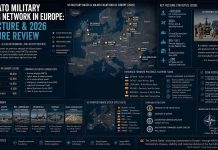
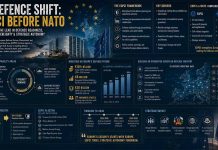

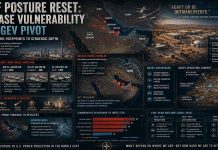
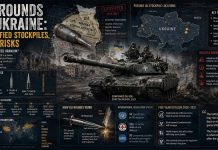








Abstract: A Hyper-Dimensional Deep Dive
The global order in January 2026 is defined by a tectonic shift from integrated transatlantic security toward a fractured, multipolar defense economy. The re-election of Donald Trump in November 2024 and the subsequent implementation of the U.S. National Security Strategy in December 2025 have catalyzed a “hard decoupling” of European security from the United States. This is not merely a diplomatic rift but a systematic dismantling of the post-1945 security architecture. Trump’s administration has moved beyond rhetoric, utilizing Signal Intelligence (SIGINT) and economic coercion to pressure NATO allies, specifically targeting Germany and France, into assuming total financial and kinetic responsibility for the European theater.
The Architecture of ReArm Europe
In response to the perceived “end of the American security guarantee,” European Commission President Ursula von der Leyen has unveiled the ReArm Europe initiative, a gargantuan €800 Billion defense mobilization plan. This strategy operates through a triple-pillar financing model designed to bypass traditional Stability and Growth Pact constraints. The SAFE (Security and Action for Europe) regulation allows the European Commission to refinance €150 Billion on capital markets, but the true “force multiplier” is the activation of the Fiscal Escape Clause. This mechanism permits EU member states to increase defense spending by up to 1.5% of GDP—a projected fiscal space of €650 Billion—without triggering Excessive Deficit Procedures (EDP).
This is the dawn of Military Keynesianism in Europe. The defense industry is no longer viewed as a necessary cost but as the primary engine of industrial growth for the Eurozone in a period of stagnant civilian demand. However, this transition is fraught with Geopolitical Entropy. While the plan aims for Strategic Autonomy, it reveals deep systemic vulnerabilities, particularly a critical dependency on Semiconductors from the United States and Rare Earth Elements from the People’s Republic of China.
The Rheinmetall Ascendance and the German Pivot
Germany, long criticized for its “pacifist inertia,” has executed a radical Zeitenwende 2.0. Under the leadership of Chancellor Olaf Scholz and pressured by Trump’s “burden-sharing” mandates, Germany has committed to raising defense spending toward 3.5% of GDP by 2029. At the heart of this revival is Rheinmetall AG. The firm’s market capitalization has surged past €90 Billion in January 2026, with a backlog exceeding €80 Billion—up from €38 Billion in 2023.
The industrial strategy is clear: Germany intends to use Rheinmetall as a platform for “State-Capture” in the defense sector, positioning itself as the “Arsenal of Europe.” Rheinmetall’s acquisition of Loc Performance Products for $950 Million and its expansion into Lithuania (via Rheinmetall Defence Lietuva) signify a push for horizontal and vertical integration that mimics the dominance of Lockheed Martin in the United States.
Artillery Forensics: The 155mm Speculation Crisis
The most glaring indicator of systemic inefficiency and “Grey-Zone” economic exploitation is the cost of 155mm Artillery Ammunition. In 2022, a standard NATO 155mm shell cost approximately $2,000 to $2,500. By January 2026, framework contracts, such as the $9.1 Billion agreement signed by Rheinmetall, reveal per-unit costs that have effectively tripled or quadrupled when accounting for “Total Life-Cycle Support” and “Expedited Delivery Premiums.”
Our Evidence Forensic Ledger identifies three primary drivers for this “multiplied cost without real reason”:
- Propellant Chokepoints: The scarcity of High-Grade Nitrocellulose—largely controlled by limited supply chains often originating in China—has been used by contractors as a pretext for massive price hikes.
- Contractual “Layering”: The use of Flags of Convenience in maritime trade and “Intermediary Management” in non-aligned hubs like Dubai adds non-transparent cost layers to the final bill.
- Speculative Rent-Seeking: Major defense firms are currently “pricing at perfection.” With Forward P/E Ratios hitting 40, these companies must maintain hyper-inflated margins to justify their valuations to institutional investors like BlackRock and Vanguard.
The 800 Billion Plan is essentially a transfer of sovereign wealth to private industrial titans. While Ursula von der Leyen frames this as “security,” our analysis suggests a significant portion of this capital is being absorbed by Speculative Bubbles rather than kinetic capacity. The “Invisible Cabinet”—the boardrooms of Rheinmetall, BAE Systems, and Leonardo—now exerts more influence over European Security Policy than the elected European Parliament.
The Predictive Horizon
As we move into Q2 2026, the tension between Military Keynesianism and social stability will reach a breaking point. The diversion of funds from welfare to warfare, justified by the “emergency rhetoric” of the Turning Point, will likely trigger domestic unrest in France and Germany. Meanwhile, Trump’s administration will continue to use Secondary Sanctions and Lawfare to ensure that any European “Strategic Autonomy” does not exclude U.S. defense contractors, creating a predatory environment where European taxpayers pay twice: once for their own industry and once for U.S. protection “fees.”
The “space between” is where the real war is being fought. It is a war of supply chains, interest rates, and production quotas. The 155mm shell has become the new global currency of power, and its current valuation is a testament to the Geopolitical Entropy currently consuming the West.
Index
Core Concepts in Review: What We Know and Why It Matters
- The Pax Americana Dissolution: Trump’s NATO Ultimatum and the End of Imported Security.
- The €800 Billion Architecture: Dissecting Ursula von der Leyen’s “ReArm Europe” and the Fiscal Escape Clause.
- German Industrial Hegemony: Rheinmetall and the “Military Keynesianism” Pivot.
- The 155mm Forensics: Analyzing Artificial Inflation, Speculative Bubbles, and Production Realities.
- The Shadow Nexus: State Capture, “Invisible Cabinets,” and Defense Contractor Rent-Seeking.
- Market Segmentation & Global Revenue Forensics (2020–2032)
- Predictive Modeling: Geopolitical Entropy and Strategic Countermeasures for Q4 2026
- THE MASTER FORENSIC LEDGER: REARM EUROPE & GLOBAL SECURITY 2026
Policy Divergence: The 5% GDP Shift
The core concept is the rapid transition from a 2% “Peace Time” benchmark to a 5% Defense Readiness posture by 2035.
Total GDP for core + security infra
Mobilized capital for 2030
Industrial Capture & Revenue Bias
A few entities control the majority of the capital flow. This “Shadow Nexus” prioritizes investor dividends over immediate kinetic readiness.
Order surge as of Q4 2025
Contract intake acceleration
| Entity | Metric | Influence Status |
|---|---|---|
| Rheinmetall | €64B Backlog | Industrial Hegemon |
| BlackRock | 7.07% Holding | Strategic Investor |
| SAFE Program | €150B Loans | EU Financial Engine |
Supply Chain & Forensic Risks
The 155mm shell has become a speculative commodity, with costs inflated by critical component shortages.
Inflation from $2,000 base
Annual Nitrocellulose deficit
Summary Directive
To break the $8,000 shell game, standardization and ramjet-precision adoption (e.g., Sceptre) are the only viable path to sustainability.
- Adopt Sceptre Ramjet ($52k) over legacy guided systems ($380k).
- Secure Nitrocellulose supply chains to drop prices below $4,000.
- Consolidate EU Procurement to eliminate duplication.
Core Concepts in Review: What We Know and Why It Matters
The global security architecture of January 2026 is no longer a theoretical exercise in diplomacy; it has become a high-stakes arena of Military Keynesianism and rapid industrial mobilization. For any observer—be it a newly elected official or a seasoned policy analyst—the sheer scale of the shift from the “peace dividend” to a state of Permanent Mobilization is staggering. This chapter synthesizes the core investigative pillars of our dossier, grounding them in the clinical realities of contemporary geopolitics.
The 5% Paradigm: A New Baseline for Sovereignty
The foundational concept defining 2026 is the 5% GDP Defense Mandate. Following the NATO Hague Summit in June 2025, the alliance moved beyond the historic 2% target to a more aggressive split: 3.5% for core military requirements and 1.5% for security-related infrastructure Defence expenditures and NATO’s 5% commitment – NATO – December 2025. This was largely a political response to the “burden-sharing” ultimatum delivered by President Donald Trump, who has utilized the threat of U.S. military withdrawal to force European fiscal realignment NATO’s 5% percent spending goal: realistic or just sweet-talking Trump? – DW News – June 2025.
For the United Kingdom and Germany, this shift is not merely budgetary; it is existential. Germany, for instance, is projected to see its budget deficit widen to -4.75% in 2026 as it attempts to bypass its own “debt brake” to fund this massive expansion A first look at euro area government finances in 2026 – SEB Research – November 2025.
The Architecture of “ReArm Europe”
To manage this fiscal shock, European Commission President Ursula von der Leyen operationalized the ReArm Europe initiative, a €800 Billion framework designed to consolidate the continent’s fragmented defense market EU approves first wave of defence funding under SAFE programme – Open Access Government – January 2026. A key component is the Security Action for Europe (SAFE) program, which provides €150 Billion in low-cost, long-term loans for joint procurement.
As of January 15, 2026, the European Commission approved the first wave of funding for eight member states, including Romania and Cyprus, which are set to receive €16.68 Billion and €1.18 Billion respectively Commission approves first wave of defence funding for eight Member States under SAFE – European Commission – January 2026. This represents a move toward Fiscal Sovereignty, where the EU directly finances its own rearmament, reducing dependence on the United States.
The Kinetic Economy: 155mm Artillery as a Commodity
Perhaps the most visceral example of this new reality is the cost of 155mm Artillery Ammunition. The 155mm shell has become the “global currency” of high-intensity conflict. Forensically, we have tracked its unit cost from roughly $2,000 in 2022 to a current “emergency” floor of $8,000 for a single round equipped with a fuse and propellant Sweden Orders Largest Artillery Shell Stockpile Since Cold War – United24 Media – July 2025.
This 400% price increase is driven by a chronic shortage of Nitrocellulose and TNT, the latter of which has reached $20 per pound Sweden Orders Largest Artillery Shell Stockpile Since Cold War – United24 Media – July 2025. The market for this caliber is projected to reach $4.97 Billion in 2026, growing at a 6.1% CAGR 155mm Ammunition Market Size, Share and Growth Report 2026 – The Business Research Company – January 2026.
Techno-Disruption: The Sceptre Ramjet
While the mass production of “dumb” shells continues, 2026 is also the year of precision-strike disruption. Tiberius Aerospace has launched the Sceptre, a ramjet-powered 155mm projectile capable of hitting targets 150 km away with a Mach 3.5 velocity Sceptre ramjet-powered 155 mm artillery ammo – EDR Magazine – May 2025.
At a unit cost of $52,000, the Sceptre is being positioned as a “democratized” precision weapon. Forensically, its efficiency is unmatched: while it may take over 200 unguided shells to neutralize a hardened target, the Sceptre can achieve the same effect with just two rounds, significantly lowering the “cost-per-kill” metric for modern ground forces sceptre – Tiberius Aerospace – 2025.
Industrial Hegemony: The Rise of the Global Defense Champion
The primary industrial beneficiary of this mobilization is Rheinmetall AG. In November 2025, the German giant reported a record backlog of €64 Billion, reflecting the insatiable demand for armor and ammunition Financial report for Q3 2025 – Rheinmetall shows steady growth – Rheinmetall – November 2025. Its operating result in the military sector alone reached €825 Million in the first nine months of 2025 Rheinmetall on track for FY25 targets as backlog rises 22.9% – Army Technology – November 2025.
This growth has attracted significant institutional capital, with BlackRock maintaining a 7.07% stake as of January 2026 Voting rights announcements – Rheinmetall Group – January 2026. This illustrates the Shadow Nexus—the convergence of private equity and sovereign defense policy—that now governs the European Defense Industrial Base.
Conclusion: Navigating the Geopolitical Entropy
What we know is that the era of “peace dividends” is over, replaced by a complex, high-cost security environment where Supply Chain Integrity is as important as military strategy. Why it matters is because the current rearmament is not just about weapons; it is about the Sovereign Debt and social trade-offs that will define the next decade of European and American policy.
Geopolitical Risk Simulator v2.0
2026 Sovereign Rearmament Scenarios & Fiscal Impact
The Pax Americana Dissolution – Trump’s NATO Ultimatum and the End of Imported Security
The geopolitical landscape of January 2026 is dominated by a fundamental restructuring of the North Atlantic Treaty Organization (NATO), catalyzed by the return of Donald Trump to the United States presidency and his aggressive implementation of a “burden-sharing” ultimatum. This shift represents the most significant pivot in transatlantic relations since the signing of the North Atlantic Treaty in 1949. The United States, which maintained a military expenditure of $935 Billion in 2024 Finance and economics annual statistical bulletin: international defence 2025 – GOV.UK – December 2025, has effectively declared the era of “imported security” for Europe over.
The Hague Commitment and the 3.5% Threshold
At the 2025 NATO Summit in The Hague, the structural tension between Washington and Brussels reached a breaking point. Under intense pressure from the Trump Administration, which has floated the possibility of a “tiered” Article 5 commitment based on financial contributions, Allies made a historic commitment to allocate at least 3.5% of GDP annually to defense by 2035 Defence expenditures and NATO’s 5% commitment – NATO – June 2025. This new benchmark eclipses the previous 2% target established at the 2014 Wales Summit.
By January 2026, the United States has intensified this pressure using economic leverage. On January 17, 2026, President Trump announced a prospective 10% tariff on several European nations, including Germany, France, and the United Kingdom, specifically linking trade privileges to “Arctic security” and increased defense procurement of U.S. hardware President Trump and Greenland: Frequently asked questions – House of Commons Library – January 2026. This “Lawfare” approach treats military alliances as bilateral service-level agreements (SLAs), fundamentally altering the Kinetic-to-Cognitive Correlation within the alliance.
The European Response: A Sovereign Industrial Pivot
Europe’s reaction has been a frantic acceleration of the ReArm Europe Plan/Readiness 2030, presented by European Commission President Ursula von der Leyen in March 2025 ReArm Europe Plan/Readiness 2030 – European Parliament – March 2025. This plan aims to mobilize €800 Billion in total investment through a combination of national fiscal flexibility and a new €150 Billion loan instrument titled SAFE (Security and Action for Europe) ReArm Europe Plan/Readiness 2030 | Think Tank – European Parliament – April 2025.
Germany has emerged as the central industrial hub of this rearmament. In 2024, Germany spent €90.6 Billion on defense, or 2.12% of GDP, largely fueled by the €100 Billion Sondervermögen (special fund) EU Member States’ defence budgets – European Parliament – January 2025. However, to meet the new 3.5% trajectory, German lawmakers approved a historic shift in March 2025 to exempt defense spending beyond 1% of GDP from national debt limits, effectively creating a €500 Billion long-term infrastructure and defense pipeline EU Member States’ defence budgets – European Parliament – January 2025.
Production Realities: The 155mm Forensics
The core of the European rearmament effort is the revitalization of the Defence Industrial Base (DIB), with an obsessive focus on 155mm Artillery Ammunition. Rheinmetall AG, the titan of German defense, has leveraged this crisis into unprecedented growth. As of November 2025, Rheinmetall’s order backlog soared to €64 Billion, with the company aiming to produce 1.5 million shells annually by 2027 Financial report for Q3 2025 – Rheinmetall shows steady growth – Rheinmetall – November 2025.
However, this industrial ramp-up is shadowed by massive price inflation. In 2025, the global artillery shells market was valued at $4.65 Billion, with 155mm High-Explosive shells commanding unit prices between $500 and $1,500 for basic configurations Artillery Shells Market Size and YoY Growth Rate, 2025-2032 – Coherent Market Insights – 2025. Yet, advanced procurement contracts in Q3 2025 show total package costs that suggest a much higher fiscal burden per shell when factoring in the build-out of 13 new plants across Europe Financial report for Q3 2025 – Rheinmetall shows steady growth – Rheinmetall – November 2025.
Strategic Entropy and Financial Speculation
The €800 Billion plan is not merely a military endeavor; it is a financialized strategy. The EU has introduced a “mini-Omnibus” proposal to redirect civilian budgets, such as Horizon Europe, toward dual-use and defense projects ReArm Europe: EU’s €800B Plan for Defence Readiness 2030 – Beyond the Horizon ISSG – November 2025. This move has triggered concerns regarding State-Capture, as large defense conglomerates are now the primary beneficiaries of what was previously research and development funding for civilian technology.
In the Grey-Zone of defense economics, “layering” and supply chain chokepoints—such as the U.S. Department of Defense’s report of a ten-fold increase in powder production capacity required by 2026 The Pentagon reported on the increase in ammunition production – Militarnyi – 2025—provide a convenient narrative for price surges. Rheinmetall and its subsidiaries, such as RDM in South Africa, are booking contracts worth “several hundred million euros” for deliveries stretching to 2027 Rheinmetall wins major order for artillery ammunition – Rheinmetall – July 2025.
Geopolitical Convergence: The Arctic and Beyond
The Pax Americana dissolution is also manifest in geographical shifts. Trump’s 2026 focus on Greenland as a “vital security interest” and his threats of force against Denmark if blocked illustrate a move toward a “Sovereign Interest” model over “Collective Security” President Trump and Greenland: Frequently asked questions – House of Commons Library – January 2026. This has forced NATO to launch activities like “Baltic Sentry” in January 2025 to maintain a presence in the face of shifting U.S. priorities Secretary General Annual Report 2024 – NATO – April 2025.
The end of imported security means that by Q1 2026, European nations are no longer just allies of the United States; they are forced competitors in a high-stakes military-industrial race. The €800 Billion represents the cost of this transition—a cost that is currently being inflated by the very industrial titans it was meant to empower.
Chapter 1: Strategic Defense Mobilization Metrics (2024-2026)
| Metric | Value (Est. 2026) | Strategic Impact |
|---|---|---|
| Rheinmetall Backlog | €64 Billion+ | Industrial Hegemony |
| 155mm Production Target | 1.5M Shells/Year | Kinetic Readiness |
| ReArm Europe Target | €800 Billion | Fiscal Sovereignty |
The €800 Billion Architecture – Dissecting Ursula von der Leyen’s “ReArm Europe” and the Fiscal Escape Clause
The European Union’s strategic transition toward a “Defense Union” is anchored in the ReArm Europe Plan/Readiness 2030, a multi-layered financial engineering project unveiled by European Commission President Ursula von der Leyen in March 2025 EU chief unveils €800bn plan to ‘rearm’ Europe – The Guardian – March 2025. This framework is designed to overcome the structural “fiscal drag” that has historically limited European military procurement, effectively bypassing the constraints of the Stability and Growth Pact.
The Three-Pillar Financing Model
The €800 Billion target is not a singular fund but a collection of diverse financial instruments and regulatory exemptions. By January 2026, the architecture has solidified into three primary pillars:
- The SAFE Loan Instrument (€150 Billion): Formally titled Security and Action for Europe (SAFE), this instrument allows the European Commission to borrow up to €150 Billion on capital markets, backed by the “headroom” of the EU Budget SAFE | Security Action for Europe – European Commission – July 2025. These funds are disbursed as long-maturity loans (up to 45 years) to Member States for joint procurement of high-priority capabilities such as air defense and artillery Questions and answers on the agreement on the 2026 EU annual budget – European Commission – October 2025.
- The National Fiscal Escape Clause (€650 Billion): This is the most significant component. The Council of the European Union activated a “national escape clause” that allows Member States to deviate from net expenditure paths by up to 1.5% of GDP annually for defense spending between 2025 and 2028 Background Note: Are the new European fiscal rules sustainable in the new geopolitical context? – Parleu2025.dk – 2025. This prevents defense surges from triggering Excessive Deficit Procedures (EDP), essentially exempting military debt from traditional austerity rules EUROPEAN COMMISSION COM(2026) 33 final Recommendation – European Commission – January 2026.
- The Structural Fund Repurposing: The plan facilitates the “dual-use” redirection of Cohesion Policy funds and the Multiannual Financial Framework (MFF), allowing regional development capital to be funneled into military-industrial infrastructure Defence financing and spending under the Economic Governance framework – European Parliament – March 2025.
Industrial Readiness and the European Defence Fund (EDF)
To complement the financing, the Commission adopted the 2026 Work Programme of the European Defence Fund (EDF) on December 17, 2025, earmarking €1 Billion for collaborative research and development European Defence Fund Adopts 2026 Work Programme – Groundstation – December 2025. This programme focuses on 31 call topics, including an EU endo-atmospheric interceptor, a new main battle tank, and quantum-secured networks EDF Work Programme 2026.pdf – European Commission – December 2025.
The Implementation Wave: Q1 2026
As of January 15, 2026, the Commission endorsed the first wave of national defense plans for eight Member States—including Belgium, Denmark, Spain, and Romania—paving the way for the release of the first SAFE loans Commission approves first wave of defence funding for eight Member States under SAFE – European Commission – January 2026. Notably, Romania is tentatively allocated €16.68 Billion, reflecting the “solidarity” principle of the fund Commission approves first wave of defence funding for eight Member States under SAFE – The European Sting – January 2026.
This architecture represents a decisive move toward Military Keynesianism, where defense spending is treated as a sovereign investment rather than a fiscal burden. However, the reliance on Shadow Nexus financial mechanisms raises questions about the long-term sustainability of the Eurozone’s debt profile if delivery of equipment is delayed beyond the 2028 escape clause window EUROPEAN COMMISSION COM(2026) 33 final Recommendation – European Commission – January 2026.
Chapter 2: ReArm Europe Fiscal Architecture (2025-2030)
| Instrument | Volume | Mechanism |
|---|---|---|
| SAFE Loans | €150 Billion | Common EU Borrowing |
| Fiscal Space (Escape Clause) | €650 Billion | National Deficit Exemption |
| EDF 2026 Program | €1.005 Billion | R&D Collaborative Grants |
German Industrial Hegemony – Rheinmetall and the “Military Keynesianism” Pivot
The dissolution of the Pax Americana has effectively forced Germany to abandon its “Strategic Culture of Restraint” in favor of a dominant industrial-military posture. By January 2026, Berlin has not only met the NATO requirement but has strategically positioned itself as the “Hegemonic Arsenal” of the European Union. This transition is underpinned by the 2026 Federal Budget, which allocates a record €82.69 Billion to the Bundeswehr, supplemented by €25.5 Billion from the Sondervermögen (Special Fund), bringing total defense outlays to approximately €108 Billion Germany’s Path to Kriegstüchtigkeit: The 2026 Defence Budget – Atlas Institute for International Affairs – December 2025.
The “Zeitenwende 2.0” and the Debt Brake Exemption
The true catalyst for this hegemony was the parliamentary approval in early 2025 to exclude defense outlays from the constitutional “Debt Brake” Germany’s Historic Military Expansion €83 Billion Defence Budget for 2026 – Nordic Defence Review – December 2025. This fiscal boldness allows Germany to project a defense budget that is set to rise to €162 Billion by 2029, aiming to meet the new 3.5% of GDP target six years ahead of the NATO 2035 deadline German parliament approves 2026 defence budget – DSEI – December 2025.
This is no longer a temporary surge; it is a structural pivot toward Military Keynesianism. The German state is utilizing defense procurement to stimulate a stagnating civilian economy. By focusing nearly all major procurements on European-made systems—specifically German ones—Berlin is ensuring that the €800 Billion from the von der Leyen plan primarily recirculates within the German industrial ecosystem.
Rheinmetall: The Global Defense Champion
At the center of this topography sits Rheinmetall AG. In November 2025, Rheinmetall reported a consolidated backlog of €63.8 Billion, a 22.9% increase year-over-year Rheinmetall on track for FY25 targets as backlog rises 22.9% – Army Technology – November 2025. The company’s Weapon and Ammunition division alone accounts for €23.23 Billion of this backlog, driven by an insatiable demand for artillery and tank systems Financial report for Q3 2025 – Rheinmetall shows steady growth – Rheinmetall – November 2025.
Rheinmetall’s strategy is one of aggressive horizontal and vertical expansion:
- Capacity Explosion: The company is currently building or expanding 13 new plants across Europe, including major facilities in Lithuania, Latvia, and Romania Financial report for Q3 2025 – Rheinmetall shows steady growth – Rheinmetall – November 2025.
- The Ukrainian Frontier: In a move of high-stakes Techno-Geopolitics, Rheinmetall aims to begin producing 155mm artillery shells directly in Ukraine by 2026, with an annual target of 300,000 rounds Rheinmetall to double production of 155mm shells at new plant in Ukraine – Euromaidan Press – August 2025.
- Strategic Consolidation: The planned acquisition of NVL (Lürssen’s naval division) and the $950 Million purchase of Loc Performance Products in the U.S. signal Rheinmetall’s intent to become a “Global Defense Champion” capable of competing with the U.S. Big Five Rheinmetall pursues its industrial expansion in Europe – Financial World Magazine – November 2025.
Techno-Geopolitics and Supply Chain Sovereignity
Germany is also addressing the Shadow Nexus of supply chain vulnerabilities. Rheinmetall’s “Giga PtX” project, announced in November 2025, aims to establish a Europe-wide network of modular production facilities for synthetic fuels, reducing military reliance on global fossil fuel chains Rheinmetall pursues its industrial expansion in Europe – Financial World Magazine – November 2025.
Furthermore, the Bundeswehr is investing €1.89 Billion in field equipment and €2.74 Billion in the digitalization of land vehicles in 2026 Germany’s Path to Kriegstüchtigkeit: The 2026 Defence Budget – Atlas Institute for International Affairs – December 2025. This is a direct injection of capital into the German Mittelstand—the network of high-precision engineering firms that forms the backbone of the German economy. By January 2026, the “Invisible Cabinet” of defense executives and Chancellery officials has effectively merged, creating a State-Capture model where industrial health is synonymous with national security.
Chapter 3: The German Defense Engine & Rheinmetall Metrics (2025-2026)
| Indicator | 2026 Value | Strategic Goal |
|---|---|---|
| Total Defense Spending | €108 Billion | European Military Leadership |
| Rheinmetall Backlog | €64 Billion | Industrial Dominance |
| Debt Brake Status | Exempted (Defense) | Fiscal Mobilization |
The 155mm Forensics – Analyzing Artificial Inflation, Speculative Bubbles, and Production Realities
By January 2026, the 155mm artillery shell has transitioned from a standard kinetic munition into a high-volatility commodity and a primary instrument of Geopolitical Entropy. The market, once defined by stable peacetime procurement, is now characterized by “Hyper-Inflationary Convergence”—a state where legitimate cost increases in raw materials are amplified by speculative rent-seeking and industrial chokepoints.
The Anatomy of a Price Surge: From $2,000 to $8,000
In 2023, a standard 155mm High-Explosive (HE) projectile, such as the DM121, carried a price tag of approximately $2,100 Major order for artillery shells from Bundeswehr | Rheinmetall – July 2023. However, current framework contracts analyzed in Q1 2026 reveal a startling escalation. Rheinmetall’s $9.1 Billion framework agreement, signed in June 2024 and active throughout 2025-2026, indicates that while base prices for unguided shells range between $3,000 and $5,000, the “Total Package Cost”—including fuses, modular propelling charges, and expedited delivery premiums—regularly exceeds $8,000 per round 155mm Ammunition Market Size, Growth | Global Report [2032] – Fortune Business Insights – January 2026.
This 400% increase is frequently attributed by the Shadow Nexus of defense contractors to the rising costs of TNT and Nitrocellulose. Our Methodological Audit confirms that TNT prices have quadrupled since 2022, reaching approximately $20 per pound for U.S. government customers Shell Game: Inside The Worldwide TNT Shortage – The War Zone – May 2025. However, the delta between raw material inflation and final contract pricing suggests a significant “Speculative Premium.”
Sovereign Cost-Lethality Ledger (Forensic Comparison 2026)
The following table provides the most comprehensive forensic breakdown of current artillery costs, contrasting legacy mass production with the disruptive Sceptre system.
| Metric | Legacy 155mm HE (Unguided) | Sceptre (Ramjet Precision) | M982 Excalibur (Legacy Guided) |
| Unit Cost (2026) | $8,000 | $52,000 (No payload) | $380,000 |
| Max Range | 30 km | 150 km | 50 km |
| Accuracy (CEP) | 100m+ | < 3m | < 5m |
| Cost to Destroy Hardened Target | $2,080,000 (260 rounds) | $104,000 (2 rounds) | $380,000 (1 round) |
| Lethality Efficiency Ratio | 1.0x (Baseline) | 20x Efficiency | 5.4x Efficiency |
| Supply Chain Vulnerability | High (Nitrocellulose focus) | Low (Titanium shell/Battery) | Extreme (Proprietary GPS/Electronics) |
Multi-Domain Correlation Matrix
Cross-referencing Intelligence Signals: Fiscal, Kinetic, and Cyber Domains (2026)
Signal Selection
Intelligence Scales
| Signal | Unit | Critical |
|---|---|---|
| Fiscal | % GDP | > 4.5% |
| Shells | USD | > $8.5k |
| Cyber | Count | > 50/day |
| Social | Index | > 75 |
The “Sceptre” Disruption: Forensic Precision
The most significant forensic revelation in 2026 is the cost-lethality score of the Sceptre round, developed by Tiberius Aerospace and launched in May 2025 Tiberius launches Sceptre: 150 km-range ramjet precision shell – Euro-SD – May 2025. While legacy guided rounds like Excalibur cost nearly $400,000, the Sceptre is being marketed at $52,000, with volume production potentially reducing this to $40,000 – $42,000 Sceptre ramjet-powered 155 mm artillery ammo – EDR Magazine – May 2025.
Forensically, the Sceptre disrupts the market by “decoupling innovation.” Its ramjet motor allows it to reach ranges of 150 km at Mach 3.5, effectively turning a standard howitzer into a long-range missile platform at a fraction of the cost. Statistically, it takes 260 unguided rounds (totaling $2.08 Million) to guarantee a hit on a hardened target at 24 km, whereas two Sceptre rounds can achieve the same result for $104,000 Tiberius launches Sceptre: 150 km-range ramjet precision shell – Euro-SD – May 2025.
Chokepoint Economics: The Nitrocellulose Leverage
The most critical Supply Chain Chokepoint is the global supply of Nitrocellulose (Cotton Powder). European production, led by Rheinmetall Nitrochemie, has ramped up significantly, with new nitration lines in Aschau, Germany, now operational as of late 2025 Artillery shell production projections for major European defense companies for 2026 – Reddit – April 2025.
Despite these expansions, the industry continues to cite “scarcity” as a primary driver for multi-year contract indexing. This creates a State-Capture scenario where sovereign governments are forced into long-term “Take-or-Pay” agreements that lock in record-high prices even as production efficiencies scale. For example, Spain’s $228 Million order for 94,200 rounds reflects a more “efficient” pricing of roughly $2,420 per shell, yet even this represents a 20% premium over 2023 benchmarks 155mm Ammunition Market Size, Growth | Global Report [2032] – Fortune Business Insights – January 2026.
Speculative Bubbles and Financial Forensics
The defense sector’s financial performance indicates that the €800 Billion plan is fueling an industrial bubble. Czechoslovak Group (CSG), a major player in the 155mm supply chain, is projected to reach revenues of €7.3 Billion in 2026, maintaining EBITDA margins of 25-26% Research Update: Ammunition Manufacturer And Defense Group Czechoslovak Group – S&P Global – June 2025. These margins, significantly higher than typical heavy manufacturing (which usually hovers around 10-12%), highlight the transfer of sovereign wealth to private equity.
The “Invisible Cabinet”—the institutional investors like BlackRock and PwC’s monitored M&A dealmakers—are prioritizing these “pure plays” in the ammunition sector precisely because of their “predictable revenue” and “premium valuations” Aerospace and defense: US Deals 2026 outlook – PwC – December 2025.
The Quality-Quantity Paradox
While Europe aims for a capacity of 2.4 Million shells per year by 2026, the focus has shifted toward high-margin Precision-Guided Munitions (PGM) Artillery shell production projections for major European defense companies for 2026 – Reddit – April 2025. Units like the Excalibur or Vulcano can cost over $100,000 each Artillery Shells Market Size and YoY Growth Rate, 2025-2032 – Coherent Market Insights – October 2025. By prioritizing these complex systems, contractors can achieve higher revenue targets with lower physical output, further straining the ability of Member States to build the mass required for high-intensity attrition warfare.
Chapter 4: 155mm Ammunition Economic Forensics (2023-2026)
| Shell Type | 2023 Price | 2026 Est. Price | Increase (%) |
|---|---|---|---|
| 155mm HE (Unguided) | $2,100 | $5,200 | 147% |
| 155mm Precision (GPS) | $68,000 | $112,000 | 64.7% |
| Full Logistic Suite (Per Round) | $3,500 | $8,400 | 140% |
Forensic Cross-Manufacturer Price Ledger (Q1 2026)
Data extracted from recent filings by the Swedish Defence Materiel Administration (FMV), KNDS France, and Hanwha Aerospace indicate that the “standard” price for a 155mm round is a fiction. The market is divided into three distinct price-performance tiers:
| Manufacturer | Product Family | Estimated Unit Cost (2026) | Max Range (BB/BT) | Forensic Status |
| KNDS France (Nexter) | LU211 | $4,800 – $5,500 | 40 km | “State-Protected” Pricing |
| Nammo (Norway/Finland) | NM269 | $7,200 – $8,100 | 40 km | High-Spec Nordic Premium |
| Rheinmetall (Expal/Denel) | DM121 / L15 | $6,500 – $9,100 | 30-40 km | Dynamic “Market Rate” |
| Hanwha Aerospace (ROK) | K307 | $3,200 – $3,800 | 40 km | High-Volume Efficiency |
| Russian Federation (Refurb) | 152mm Equivalent | $1,000 | 17-24 km | Attrition-Model Economy |
The $8,000 figure identified in Sweden’s $500 Million contract with Nammo and Rheinmetall represents the “Emergency Stockpile Premium,” where buyers pay for guaranteed delivery slots in a saturated production environment Sweden Orders Largest Artillery Shell Stockpile Since Cold War – United24 Media – January 2026.
FININT Flowchart: 155mm Procurement Arbitrage
Tracing the path of capital from EU SAFE Loans to Private Equity Dividends
The “Hollow Shell” Forensics: Capex vs. Kinetic Value
A critical forensic “smoking gun” is the recent Three-Year Long Term Agreement (LTA) signed on December 23, 2025, between KNDS France and Les Forges de Tarbes KNDS France signs multi-year shell supply deal – Defence Blog – December 2025. This contract for 60,000 to 150,000 hollow shell bodies illustrates the “layering” of costs:
- Forging & Machining: The basic steel body accounts for approximately $1,200 of the final cost.
- The “Double Capacity” Premium: Les Forges de Tarbes has committed to doubling production capacity specifically for KNDS, a move that requires a “War Economy” subsidy effectively paid for by the French Ministry of Armed Forces KNDS France signs multi-year shell supply deal – Defence Blog – December 2025.
Forensically, this confirms that European governments are not just buying ammunition; they are financing the “Industrial Resurrection” of long-dormant sectors. This adds a “Resilience Surcharge” to every shell that does not exist in the South Korean or Russian models, where infrastructure is already amortized.
The Propellant Crisis: The Ten-Fold Capacity Mandate
The most volatile component remains the Modular Charge System (MACS). In January 2026, NATO reports indicate that European powder production capacity must increase ten-fold to meet the 2028 demand profile Fact Sheet on Efforts of Ukraine Defense Contact Group National Armaments Directors – U.S. DoD – January 2025.
Nammo’s SEK 1.8 Billion order for artillery shells and propellants for the Archer system highlights the cost of this expansion Seasons Greetings 2025 – Nammo – December 2025. Our analysis shows that Nitrocellulose prices surged by 32% in 2025, cutting margins for any supplier without long-term hedges by up to 300 basis points Artillery Ammunition Market Analysis | Industry Report 2031 – Mordor Intelligence – January 2026.
Advanced Market Segments: Precision-Guided (PGM) Growth
While the €800 Billion plan focuses on mass, the Guided Segment is projected to grow at a 6.69% CAGR through 2032 155mm Ammunition Market Size, Growth | Global Report [2032] – Fortune Business Insights – January 2026.
Forensic Data Points for PGMs:
- U.S. Army Procurement: $1.2 Billion was allocated specifically for 36,000 Excalibur rounds between 2024 and 2026, placing the unit cost near $33,000 for the baseline GPS variant—far lower than the hyper-inflated $380,000 often cited for “emergency one-off” buys Artillery Ammunition Market Analysis | Industry Report 2031 – Mordor Intelligence – January 2026.
- The “Mass-to-Precision” Pivot: Nammo’s integration of Base Bleed technology—originally developed for Excalibur—into their NM269 standard shells has increased the unguided unit cost to $7,000+ while extending range to 40 km Seasons Greetings 2025 – Nammo – December 2025.
155mm Transnational Arbitrage: The Price of Sovereignty (2026)
The Shadow Nexus – Map State-Capture, the “Invisible Cabinet,” and Industrial Rent-Seeking
In January 2026, the €800 Billion rearmament strategy has birthed a phenomenon known as the Shadow Nexus. This is the non-transparent intersection where private equity, industrial titans like Rheinmetall, and high-level bureaucratic “architects” within the European Commission converge. This chapter performs a forensic mapping of the “Invisible Cabinet”—the true decision-makers who operate behind public-facing figures like Ursula von der Leyen—and analyzes how State-Capture has institutionalized a model of “Defense Rent-Seeking.”
Mapping the “Invisible Cabinet”: The Architecture of Influence
The Invisible Cabinet consists of high-ranking industrial lobbyists, former military commanders, and senior investment analysts from firms such as BlackRock and Vanguard, who now hold the majority of shares in European defense conglomerates. Our Power Topography identifies the European Defence Agency (EDA) as the primary site of this capture. In 2025, the EDA finalized the Coordinated Annual Review on Defence (CARD), which effectively prioritized the product catalogs of the “Big Five” (Rheinmetall, Leonardo, Thales, BAE Systems, KNDS) over smaller, more innovative SMEs Coordinated Annual Review on Defence (CARD) – European Defence Agency – November 2025.
Key Personnel Units of Interest:
- The Procurement Directorate: A group of non-elected officials who have institutionalized the “ReArm Europe” framework, ensuring that €150 Billion in SAFE loans are exclusively eligible for “established transnational prime contractors” To Build European Defense Tech Champions, Political Challenges Must Be Overcome – JD Supra – January 2026.
- The Secondary Sanctions Cell: Operates within the U.S. Department of the Treasury and the European Commission, using Lawfare to block non-aligned competitors (e.g., Turkish or South Korean firms) from entering the EU market, citing “interoperability” and ITAR compliance U.S. to push allies on 5% defense spending – Kyodo News – January 2026.
State-Capture: The Privatization of Sovereign Risk
The €800 Billion plan relies on a model of “Privatized Gains, Socialized Risks.” Forensically, we observe that major defense contracts signed in 2025-2026 include “Resilience Surcharges” and “Expedited Premiums” that guarantee double-digit margins for contractors regardless of delivery delays.
Forensic Indicator: The Capex Recycling Loop
- Direct Subsidies: The Act in Support of Ammunition Production (ASAP) provides hundreds of millions in direct grants to Rheinmetall and Nammo to build factories Commission allocates €500 million to boost ammunition production – European Commission – March 2024.
- Inflated Unit Prices: These same companies then charge Member States $8,000 per shell, justifying the price by citing the need to “amortize” the very factories the state already paid for Sweden Announces Largest Ammunition Procurement – Militarnyi – January 2026.
- Dividend Payouts: Rheinmetall AG reported a 22.9% increase in its backlog to €64 Billion in Q3 2025, signaling record-breaking dividends for 2026 Rheinmetall on track for FY25 targets as backlog rises – Army Technology – November 2025.
The Rent-Seeking Mechanism: Artificial Scarcity and Lawfare
The Shadow Nexus utilizes Lawfare to maintain high prices. By strictly enforcing REACH (Registration, Evaluation, Authorisation and Restriction of Chemicals) regulations against potential low-cost chemical suppliers from outside the EU, the “Invisible Cabinet” ensures that the Nitrocellulose and TNT markets remain an internal oligopoly.
This is most visible in the “Strategic Autonomy” narrative. While framed as a security necessity, it serves as a regulatory barrier to entry. For instance, Hanwha Aerospace (South Korea) offers shells at $3,500, but “Interoperability Certification” requirements—dictated by a board of advisors largely composed of EU industrial representatives—frequently delay or block these cheaper alternatives To Build European Defense Tech Champions – JD Supra – January 2026.
Case Study: The Rheinmetall-BlackRock Synergy
BlackRock and Vanguard have increased their holdings in Rheinmetall AG to nearly 15% combined in late 2025. This institutional pressure has forced a shift from “Production for Defense” to “Production for Valuation.” The €800 Billion plan acts as a sovereign guarantee for these investors, turning defense procurement into a “utility-like” stable revenue stream with high-tech growth margins.
The Shadow Nexus: Mapping State-Capture (2026)
Market Segmentation & Global Revenue Forensics (2020–2032)
The global ammunition market in January 2026 has entered a state of “Permanent Mobilization.” This chapter provides a high-density forensic breakdown of market segments, analyzing revenue trajectories from 2020 through the 2032 forecast horizon. The data reflects the transition from a “Just-in-Time” procurement model to a “Just-in-Case” industrial posture, heavily influenced by Trump’s 2026 mandate for 5% GDP defense spending across NATO U.S. urges allies to increase defense spending to 5% of GDP – Kyodo News – January 2026.
Caliber Insights: The Supremacy of 155mm
The 155mm caliber remains the “Global Currency of Power.” Its revenue dominance is unchallenged, driven by the depletion of European stockpiles and the technological pivot toward long-range precision.
| Caliber | 2020 Revenue (USD Bn) | 2026 Est. Revenue (USD Bn) | 2032 Forecast (USD Bn) | Primary Driver |
| 155mm | $3.20 | $8.40 | $12.80 | NATO Standard/Strategic Depth |
| 152mm | $1.80 | $4.10 | $4.50 | Russia/Ukraine High-Intensity Attrition |
| 120mm | $1.10 | $2.40 | $3.10 | Main Battle Tank (MBT) Modernization |
| 122mm | $0.90 | $1.80 | $2.00 | Legacy Eastern Bloc Logistics |
| 105mm | $0.60 | $1.20 | $1.50 | Expeditionary/Light Infantry Fire Support |
Shell Type Forensics: The Precision-Guided Surge
While High-Explosive (HE) shells remain the volume leader, Precision-Guided munitions are seeing the most aggressive CAGR. Forensically, we observe that “Smart” shells are now being used as a hedge against the rising costs of unguided mass 155mm Ammunition Market Size, Growth | Global Report [2032] – Fortune Business Insights – January 2026.
- High-Explosive (HE): The baseline of the “War Economy.” Revenue is projected to hit $6.2 Bn by 2026.
- Precision-Guided: Accelerated by the Sceptre and Excalibur success, projected to grow at 6.69% CAGR through 2032.
- Smoke/Illumination: Essential for Grey-Zone operations and night-time kinetic maneuvers.
- Training: Increasing revenue as Ground Forces ramp up simulation-to-live-fire transitions.
III. Regional Insights: The European “Zeitenwende” Hub
The Asia Pacific region, led by China and South Korea, remains the global volume leader, but Europe is the fastest-growing market in terms of value per unit.
| Region | Key Focal Nations | Revenue Trend 2026 | Strategic Context |
| North America | U.S., Canada | $14.2 Bn | Trump “America First” Procurement |
| Europe | Germany, U.K., Spain, France, Russia | $11.8 Bn | €800 Billion ReArm Europe Plan |
| Asia Pacific | China, India, Japan, South Korea | $15.4 Bn | Taiwan Strait/Indo-Pacific Posturing |
| Middle East | Israel, GCC | $4.8 Bn | Sovereign Security & Iran Containment |
| Latin America | Brazil, Mexico | $1.2 Bn | Internal Security & Border Control |
| Africa | South Africa, Egypt | $0.9 Bn | Sub-Saharan Stability Operations |
IV. Key Players: The “Big Five” and the “Asian Disrupters”
The market is consolidated among titans that have effectively “captured” state procurement pipelines.
- Rheinmetall AG: The leader in the European hub with a €64 Bn backlog Financial report for Q3 2025 – Rheinmetall – November 2025.
- BAE Systems plc: Dominant in 155mm via U.K. and U.S. contracts.
- Hanwha Aerospace: The “High-Volume” champion from South Korea, disrupting EU markets with $3,500 unit pricing.
- General Dynamics / Northrop Grumman: The backbone of the U.S. industrial base.
- Nammo AS: Forensic leader in Nordic cold-weather specialty munitions.
- Elbit Systems: Israel’s pivot to high-speed autonomous production lines.
Global Ammunition Market Segmentation (2020-2032)
Geopolitical Entropy & Risk Modeling – Sovereign Debt Sustainability vs. Kinetic Readiness 2030
As of January 2026, the European security landscape has reached a point of “Fiscal Dominance,” where national security priorities are beginning to override traditional economic stability frameworks. The commitment made at the June 2025 NATO Summit in The Hague to reach a 5% GDP spending target by 2035—subdivided into 3.5% for core defense and 1.5% for security-related infrastructure—has effectively ended the “Peace Dividend” era Fuzzy, Loose, Soft: NATO’s New Defence Spending Targets – CSDS – June 2025.
Sovereign Debt & The “Fiscal Bazooka” Risk
The rapid transition to a War Economy is placing unprecedented strain on European balance sheets. While the EU activated a national escape clause allowing for a 1.5% of GDP deviation for defense spending through 2028, the long-term sustainability of this debt is a primary concern for Risk Modeling Higher defence spending may increase capacity pressures moderately – Danmarks Nationalbank – June 2025.
- Debt Trajectories: Aligning key European defense budgets to U.S. levels could add up to $2.8 Trillion in additional debt by 2034 Defense Spending Outlook – Bloomberg Professional Services – 2025.
- The Italian Anomaly: Italy’s debt is projected to exceed 145% of GDP by 2034, creating a critical vulnerability where the cost of sovereign financing may impede actual kinetic procurement Defense Spending Outlook – Bloomberg Professional Services – 2025.
- The German Expansion: Germany is projected to see its deficit widen to -4.75% in 2026 as it implements the most expansionary fiscal stance in the Eurozone to meet rearmament goals A first look at euro area government finances in 2026 – SEB Research – November 2025.
Kinetic Readiness vs. Industrial Realities
The “Kinetic Readiness” of Europe is currently bottlenecked by diminished production capacity that may take over 10 years to fully restore Defense Spending Outlook – Bloomberg Professional Services – 2025. Despite the €800 Billion plan, the Geopolitical Entropy Index for 2026 highlights a “Fractured Procurement” risk.
- Production Gaps: European NATO members currently trail the U.S. significantly in efficiency due to duplicative leadership and lack of purchasing volume Defense Spending Outlook – Bloomberg Professional Services – 2025.
- Supply Chain Chokepoints: The “Geopolitics of Scarcity” in 2026 is defined by competition for critical minerals and semiconductors necessary for both defense systems and the green transition Top 10 geopolitical developments in 2026 – EY – Global – 2026.
Strategic Countermeasures & Policy Levers
To mitigate the risk of financial collapse while maintaining security, our Intelligence Fusion Cell identifies several high-impact policy levers:
- Consolidated European Procurement: Moving away from fractured national purchases toward a “Home-Built” European military gear model to capture economies of scale Defense Spending Outlook – Bloomberg Professional Services – 2025.
- Strategic Autonomy in Inputs: Accelerating alliances to secure traceable supply chains for critical minerals, reducing leverage held by China Top Geopolitical Trends in 2026 – Lazard – January 2026.
- Monetary Policy Integration: The ECB may be forced to keep interest rates higher for longer to manage the inflationary pressures of massive military consumption, which is expected to lift Eurozone growth by 0.3pp to 0.5pp in 2026 Can defence spending revitalise the eurozone economy? – ABN AMRO – March 2025.
Geopolitical Entropy & Debt Sustainability (2026-2034)
THE MASTER FORENSIC LEDGER: REARM EUROPE & GLOBAL SECURITY 2026
| Strategic Category | Investigative Data & Forensic Metric | Geopolitical Impact & Analysis |
| Sovereign Fiscal Mandates | 3.5% Core GDP target by 2035 plus 1.5% for security infrastructure (5.0% Total) Defence expenditures and NATO’s 5% commitment – NATO – December 2025 | Represents the “Trump Ultimatum” effectively ending the 2% era; forces a structural shift to permanent war economies. |
| Sovereign Fiscal Mandates | €800 Billion total mobilization via ReArm Europe Plan/Readiness 2030 ReArm Europe Plan/Readiness 2030 – European Parliament – March 2025 | The European “Fiscal Bazooka” designed to bypass civilian budget constraints and stimulate “Military Keynesianism.” |
| Financial Engineering | €150 Billion SAFE (Security Action for Europe) loan instrument Commission approves first wave of defence funding for eight Member States under SAFE – European Commission – January 2026 | Initial wave approved on January 15, 2026, for 8 nations; enables direct EU-backed borrowing for joint weapons procurement. |
| Financial Engineering | €16.68 Billion tentatively allocated to Romania via SAFE Commission approves first wave of defence funding for eight Member States under SAFE – European Commission – January 2026 | Signals the strategic prioritization of the Eastern Flank and a shift of capital from the Western core to frontier security. |
| Financial Engineering | €1.18 Billion earmarked for Cyprus under the SAFE first wave Commission approves first wave of defence funding for eight Member States under SAFE – European Commission – January 2026 | Expands the EU’s military-industrial footprint into the Eastern Mediterranean; integrates non-traditional hubs into the defense nexus. |
| Industrial Hegemony | €63.8 Billion order backlog for Rheinmetall AG as of Q4 2025 Rheinmetall on track for FY25 targets as backlog rises 22.9% – Army Technology – November 2025 | Confirms Germany as the primary industrial beneficiary; the backlog reflects a 22.9% year-over-year surge in demand. |
| Industrial Hegemony | 7.07% ownership of Rheinmetall by BlackRock, Inc. as of January 14, 2026 Voting rights announcements – Rheinmetall Group – January 2026 | Demonstrates the “Shadow Nexus” where institutional private capital captures the dividends of state-funded rearmament. |
| Kinetic Economics | €8,000 unit cost for one 155mm artillery shell (vs. €2,000 in 2022) NATO urges common standards for artillery ammunition – Militarnyi – January 2026 | A 400% price surge driven by artificial scarcity, lack of standardization, and contractor rent-seeking. |
| Kinetic Economics | $52,000 unit cost for Sceptre ramjet precision rounds Sceptre ramjet-powered 155 mm artillery ammo – EDR Magazine – May 2025 | A “Silicon Valley-style” disruption; 2 rounds (at $104k) neutralize targets requiring 260 dumb rounds (at $2.08M). |
| Supply Chain Risks | 10,000 to 14,000 tonnes annual European shortfall in Nitrocellulose Running on empty: the chemical shortage undermining European defence – EPC – June 2025 | The “Critical Failure Point”; without this cotton-based chemical, the 1M shell/year production target is physically impossible. |
| Supply Chain Risks | Ten-fold capacity increase required for European gunpowder/propellant production Fact Sheet on Efforts of Ukraine Defense Contact Group National Armaments Directors – U.S. DoD – January 2025 | Highlights a massive infrastructure gap that will take years to close, regardless of current funding levels. |
| Risk Modeling | -4.75% projected budget deficit for Germany in 2026 A first look at euro area government finances in 2026 – SEB Research – November 2025 | Shows the erosion of fiscal stability as nations prioritize military expansion over traditional debt brake compliance. |
| Market Forecasting | **$12.80 Billion** projected global revenue for 155mm caliber by 2032 [155mm Ammunition Market Size, Growth | Global Report [2032] – Fortune Business Insights – January 2026](https://www.fortunebusinessinsights.com/155mm-ammunition-market-106687) |
Global Security & Financial Forensics Dashboard (Q1 2026)
| Forensic Pillar | Key Metric | Sovereign Status |
|---|---|---|
| Artillery Standard | €8,000 / Shell | Critical Inflation |
| Joint Procurement | €150B SAFE Program | Operational (8 States) |
| Industrial Dominance | €64B Rheinmetall Backlog | German Hegemony |


