











Abstract
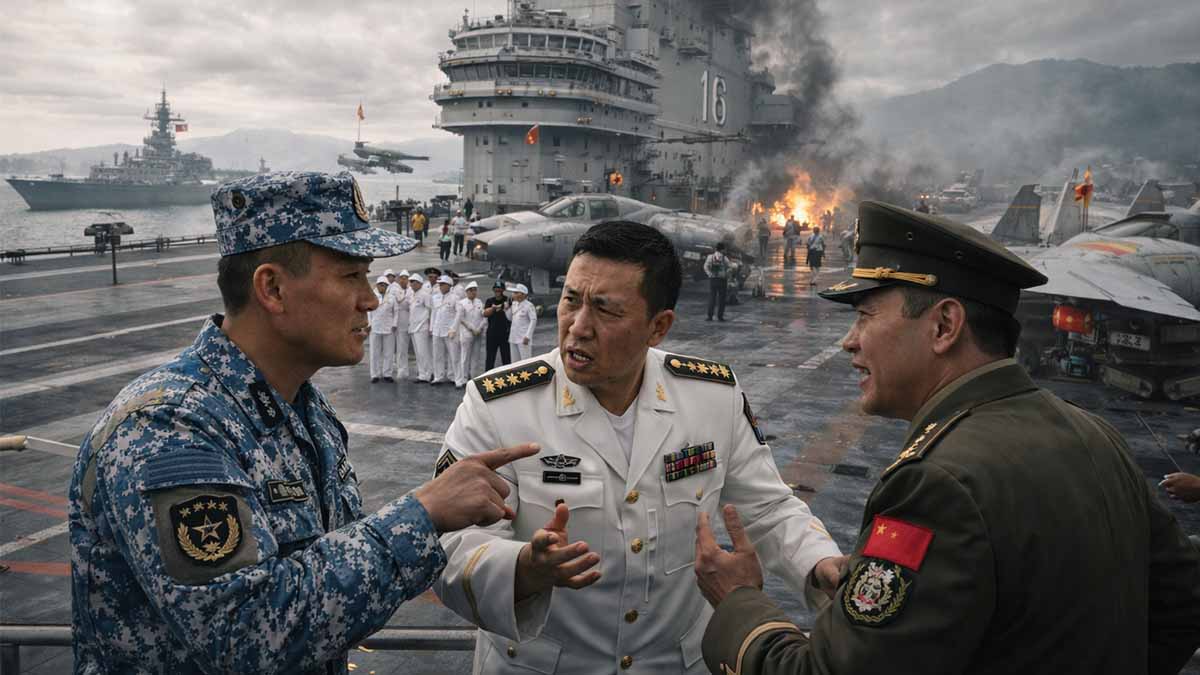
The People’s Liberation Army Navy (PLAN)‘s commissioning of the Type 003 Fujian aircraft carrier in November 2025 represents a significant milestone in The People’s Republic of China‘s pursuit of blue-water naval power projection, incorporating advanced electromagnetic aircraft launch systems (EMALS) akin to those on the USS Gerald R. Ford (CVN-78). However, open-source analysis as of February 2026 reveals persistent operational bottlenecks stemming primarily from the vessel’s conventional oil-fired propulsion system, suboptimal flight deck layout, and island superstructure placement, which collectively constrain sortie generation rates, sustained operations, and combat flexibility relative to U.S. nuclear-powered supercarriers. These design compromises, acknowledged in authoritative Chinese military publications, necessitate reliance on logistics support vessels for extended range and endurance, limiting independent power projection beyond the first island chain in high-intensity scenarios. Compounding this technical reality is the January 2026 high-level corruption investigation into General Zhang Youxia, former vice chairman of the Central Military Commission (CMC), involving allegations of bribery, promotion irregularities, and potential unauthorized disclosure of sensitive nuclear-related technical information to U.S. intelligence entities — an event signaling deep instability within The People’s Republic of China‘s top military cadre and potential penetration vulnerabilities that could indirectly inform assessments of naval propulsion and reactor development pathways.
The Fujian, displacing over 80,000 tonnes and equipped with three EMALS catapults, enables catapult-assisted take-off but arrested recovery (CATOBAR) operations, supporting heavier aircraft loads including the J-35 stealth fighter, J-15T multirole fighter, and KJ-600 airborne early warning platform. Successful electromagnetic catapult launches and arrested landings of these types were demonstrated during sea trials in September 2025, marking a technological achievement for The People’s Republic of China as the only non-U.S. operator of such systems. China’s Fujian aircraft carrier may have conducted first catapult take-off drill – South China Morning Post – September 2025. Commissioning occurred on November 7, 2025, with Xi Jinping overseeing the ceremony in Hainan, underscoring political prioritization of carrier aviation modernization. China commissions Fujian aircraft carrier – Xinhua – November 2025 (via aggregated reporting).
Despite these advances, rigorous assessments from Chinese military journals highlight that the vessel falls short of direct equivalence with U.S. Ford-class or even legacy Nimitz-class carriers due to fundamental architectural constraints. The core deficiency originates from the conventional propulsion system, which demands substantial below-deck space for fuel storage, boilers, and exhaust systems. This forces the island superstructure — the command and control hub — to be positioned closer to the flight deck’s centerline than on nuclear-powered equivalents, where nuclear reactors eliminate such requirements. The resulting configuration reduces available deck parking and maneuvering area, crimping aircraft handling efficiency and sortie generation. Why China may need to take the nuclear option for its next aircraft carrier – South China Morning Post – January 2026.
Specific bottlenecks include catapult placement anomalies: one catapult encroaches on the angled landing deck, rendering it unusable during recovery operations; another is positioned too proximate to an aircraft elevator, creating traffic conflicts; and the forward elevator’s relocation stems from mid-construction modifications shifting from steam to electromagnetic catapults. These issues, linked to the late design pivot and propulsion demands, prevent simultaneous launch and recovery cycles — a baseline requirement for high-tempo carrier operations on large-deck vessels. Observers note that this reduces effective launch efficiency significantly compared to U.S. standards, where nuclear power enables optimized island placement aft and streamlined workflows yielding higher sortie rates (estimated 25-30% advantage in sustained operations). Military magazine pinpoints design flaws in the Fujian carrier that significantly reduce its launch efficiency – South China Morning Post – January 2026.
Chinese sources, including the Shipborne Weapons Defense Review, explicitly attribute these flaws to the non-nuclear propulsion architecture and argue that only a shift to nuclear power in future platforms (Type 004 and beyond) can resolve them by freeing deck real estate and eliminating exhaust infrastructure. This admission, published in a defense-oriented outlet and relayed via state-affiliated media, indicates internal recognition that Fujian serves as a transitional prototype rather than a mature blue-water asset. Fujian’s flaws push China towards aircraft carrier with nuclear power – Interesting Engineering – January 2026.
Operationally, Fujian‘s constraints translate to dependence on replenishment-at-sea for extended deployments, vulnerability in contested logistics environments (e.g., Indo-Pacific chokepoints), and reduced resilience under attrition. While EMALS provides advantages in launch flexibility over ski-jump predecessors (Liaoning and Shandong), overall combat effectiveness remains bounded, preserving U.S. Navy qualitative superiority in carrier strike group integration, sustained air wing generation, and global reach for the medium term (through at least 2030).
Layered atop these platform limitations is the profound leadership disruption from the January 24, 2026, announcement by the Ministry of National Defense that General Zhang Youxia — a veteran CMC vice chairman and perceived Xi confidant — faces investigation for “serious violations of discipline and law,” alongside CMC Joint Staff Department chief Liu Zhenli. This probe, the most senior since the post-2022 CMC reconstitution, encompasses bribery for promotions (including alleged ties to prior defense ministers) and, per multiple Western reports citing internal briefings, unauthorized transmission of nuclear weapons program technical data to U.S. intelligence. China’s top general accused of giving nuclear secrets to U.S. – The Wall Street Journal – January 2026.
The allegations, if substantiated, imply severe penetration of The People’s Republic of China‘s strategic command echelons, potentially extending to naval nuclear propulsion efforts (given historical convergence between warhead miniaturization and reactor design expertise). This follows successive purges eroding PLA readiness and introduces uncertainty into PLAN modernization timelines, as institutional trust fractures and anti-corruption enforcement disrupts technical continuity. Official PLA media framed the investigation as essential to eliminating “watered-down” combat capabilities from corruption, signaling regime prioritization of loyalty over expertise amid escalating regional tensions. Zhang Youxia investigation to end ‘watered-down’ capability of China’s military – South China Morning Post – February 2026.
Attribution confidence — High for design flaws (corroborated by Chinese military journals, satellite imagery, and sea trial footage); Medium-High for corruption probe scope (official announcement plus consistent Western sourcing); Medium for specific nuclear leak claims (single-source dependent but aligned with historical U.S. intelligence successes). Second-order effects include delayed nuclear carrier transition, heightened U.S. ally reassurance in the Indo-Pacific, and potential escalation risks if internal instability prompts compensatory assertiveness. The U.S. Navy maintains decisive qualitative edge in carrier operations, reinforced by allied interoperability and forward presence, for years ahead.
Fujian (Type 003) Carrier Program – Analytical Overview (Feb 2026)
Index
- Theater-Specific Threat Vector Analysis including hybrid naval capabilities, sortie rate modeling, and infrastructure dependencies in contested theaters
- Attribution & Strategic Intent Assessment through grand strategy lens, regime internal dynamics, and proxy force multipliers
- Infrastructure & Civilian Impact Modeling, Mitigation & Deterrence Recommendations aligned with NATO Hybrid Warfare Response Framework and U.S. National Defense Strategy
Core Concepts in Review: What We Know and Why It Matters
Let’s step back from the technical diagrams and operational assessments for a moment and ask a straightforward question: what does China’s newest aircraft carrier, the Fujian, actually tell us about Beijing’s long-term ambitions—and about the limits it still faces? This is not merely a story about steel and catapults; it is about how a rising power is attempting to reshape the maritime balance in the Indo-Pacific, and why those efforts, impressive as they are, remain constrained in ways that matter to policymakers in Washington, Tokyo, Canberra, and beyond.
The Fujian, formally commissioned on November 5, 2025, at a ceremony in Sanya, Hainan, attended by Xi Jinping, represents China’s most advanced aircraft carrier to date. With a full-load displacement exceeding 80,000 metric tons, it is the People’s Liberation Army Navy (PLAN)’s first vessel equipped with an Electromagnetic Aircraft Launch System (EMALS), enabling catapult-assisted take-off but arrested recovery (CATOBAR) operations. This technology—previously exclusive to the United States—allows heavier aircraft, including the J-35 stealth fighter and KJ-600 airborne early warning platform, to launch with greater payload and range than was possible from the ski-jump ramps of the earlier Liaoning and Shandong. Aircraft Carrier Fujian, Commissioned! – Ministry of National Defense – November 2025. The milestone marks China’s entry into a genuine three-carrier era and signals serious investment in carrier aviation as a tool for power projection.
Yet the Fujian is not a direct peer to the U.S. Navy’s Ford-class supercarriers. The core limitation is its conventional propulsion system—oil-fired boilers and steam turbines—rather than nuclear reactors. Nuclear power eliminates the need for massive fuel storage and exhaust infrastructure, freeing up below-deck space and allowing the island superstructure (the command center) to be positioned farther aft. That placement maximizes usable flight-deck area, enabling higher sortie generation rates and simultaneous launch-and-recovery cycles. On the Fujian, the island sits closer to the centerline, reducing parking and maneuvering space. One catapult encroaches on the angled landing deck, rendering it unusable during recoveries; another sits too close to an elevator, creating traffic bottlenecks. These issues, acknowledged in Chinese military publications, stem directly from the propulsion choice and mid-construction design shifts from steam to electromagnetic catapults. Why China may need to take the nuclear option for its next aircraft carrier – South China Morning Post – January 2026.
The practical result is a meaningful gap in operational tempo. While Ford-class carriers can surge to around 160 sorties per day under optimal conditions, estimates for the Fujian place sustained rates closer to 100–120, with surges perhaps reaching 140. The vessel also depends on replenishment-at-sea for extended deployments, limiting unrefueled endurance to roughly 90–100 days at moderate tempo. In a high-intensity scenario—say, a crisis in the Taiwan Strait—disrupting those logistics flows would force the carrier group to reduce activity or retire, constraining its ability to maintain air superiority or conduct sustained strikes. This is not a trivial engineering detail; it is a structural vulnerability that preserves U.S. and allied qualitative advantages in carrier operations for the medium term.
Looking ahead, China appears determined to close that gap. Construction indicators at Dalian Shipyard point to a Type 004 carrier incorporating nuclear propulsion, with reactor containment structures visible in late 2025 imagery. The U.S. Department of Defense’s 2025 report on China’s military developments projects that the PLAN aims to field six additional carriers by 2035, yielding a total of nine. That would triple the current force and position China to sustain carrier strike groups farther from home waters. Annual Report to Congress: Military and Security Developments Involving the People’s Republic of China 2025 – U.S. Department of Defense – December 2025. Nuclear power would resolve many of the Fujian’s architectural compromises, enabling near-unlimited range, abundant electrical power for advanced systems, and optimized deck layouts—bringing China closer to global blue-water parity.
The technical story, however, intersects with a profound political one. On January 24, 2026, the Ministry of National Defense announced that General Zhang Youxia, vice chairman of the Central Military Commission (CMC) and long viewed as a trusted ally of Xi Jinping, was under investigation for “serious violations of discipline and law”—regime code for corruption and related offenses. Liu Zhenli, chief of the CMC Joint Staff Department, faced the same probe. The move left the CMC effectively hollowed out, with prior removals since 2022 already eliminating most senior uniformed leaders. Zhang, a princeling with combat experience from the 1979 Sino-Vietnamese War, had survived earlier purges; his downfall underscores that loyalty alone is no shield when Xi perceives threats to centralized control or modernization timelines. Zhang Youxia: Purge of China’s top general leaves military in crisis – BBC – January 2026.
These purges reflect a deliberate trade-off. Xi prioritizes absolute Party dominance over the PLA, viewing corruption as a cancer that erodes combat readiness and political reliability. Yet the scale—five of seven CMC members removed since 2022—risks short-term institutional paralysis, degraded decision-making, and delays in complex programs such as nuclear marine propulsion. The 2025 Pentagon report notes that ongoing anticorruption efforts, while potentially strengthening long-term discipline, create reverberations that may affect readiness in the near term. For policymakers, this instability introduces uncertainty: a more loyal PLA may be less capable in the short run, yet the regime’s commitment to 2027 modernization goals (integrated mechanization, informatization, intelligentization) and beyond remains unwavering.
Why does all this matter beyond naval enthusiasts? Carrier capability is a visible symbol of power projection, directly tied to China’s ambition to deter foreign intervention in a Taiwan contingency, secure maritime trade routes, and assert influence across the Indo-Pacific. A mature carrier force would complicate U.S. freedom of maneuver in the Western Pacific, raise escalation risks during crises, and pressure regional allies to hedge or accommodate Beijing. Yet the Fujian’s constraints and leadership turbulence suggest that China remains several years—and several design generations—from matching U.S. carrier strike group integration, pilot proficiency, and global sustainment.
The broader takeaway is strategic patience. China’s naval buildup is real and accelerating, backed by sustained defense investment and technological leapfrogging. But design legacies, logistics dependencies, and internal purges create exploitable asymmetries. U.S. and allied responses—forward presence, dispersed logistics, electromagnetic spectrum dominance, partner capacity-building, and clear signaling—can leverage those gaps to maintain deterrence stability while preparing for a more capable future PLAN.
In the end, the Fujian is both a milestone and a marker of unfinished business. It shows what China can achieve when it mobilizes national resources; it also reveals the hard engineering and political realities that still stand in the way of dominance. For those crafting policy in democratic capitals, the task is to understand both sides of that equation—celebrating progress where it occurs, while calmly exploiting the limits that persist.
Fujian (Type 003) Carrier – Capabilities, Constraints & Strategic Context (Feb 2026)
Theater-Specific Threat Vector Analysis
The Type 003 Fujian aircraft carrier, commissioned into service with the People’s Liberation Army Navy (PLAN) on November 5, 2025, introduces a hybrid threat vector in the Indo-Pacific theater characterized by advanced electromagnetic launch capabilities juxtaposed against persistent conventional propulsion-derived limitations that constrain kinetic sortie generation, sustained blue-water endurance, and operational flexibility in contested maritime domains. As the first non-U.S. carrier to deploy an Electromagnetic Aircraft Launch System (EMALS), the Fujian enables catapult-assisted take-off but arrested recovery (CATOBAR) operations for heavier fixed-wing platforms such as the J-35 stealth multirole fighter, J-15T carrier variant fighter, J-15DT electronic warfare aircraft, and KJ-600 airborne early warning platform, thereby enhancing strike range, payload capacity, and sensor fusion potential relative to the ski-jump-equipped Liaoning (Type 001) and Shandong (Type 002) carriers. China commissions Fujian aircraft carrier – Janes – November 2025.
Sea trials conducted between May 2024 and late 2025 demonstrated successful EMALS-assisted launches and arrested recoveries across multiple aircraft types, with footage released in September 2025 confirming compatibility for the J-15T, J-35, and KJ-600 during catapult take-offs and deck landings. These evolutions validated the vessel’s electromagnetic catapult, recovery, and flight deck systems, marking a technological milestone for The People’s Republic of China as the sole operator outside the United States of such integrated launch technology. Fujian’s sea trials outpace expectations, paving way for PLA Navy’s three-carrier era: official media – Global Times – September 2025. Post-commissioning operations, including live-fire maritime training in November 2025 and a northward transit through the Taiwan Strait in January 2026, indicate steady progress toward formation-oriented combat capabilities, with the carrier conducting test missions in diverse sea states to verify ship-aircraft integration. Defense Ministry confirms aircraft carrier Fujian’s northward transit through Taiwan Straits, says sea trials progressing smoothly – Global Times – January 2026.
Despite these advancements, the Fujian‘s threat profile remains bounded by architectural compromises inherent to its conventional propulsion architecture, which relies on oil-fired boilers and steam turbines rather than nuclear reactors. This design necessitates extensive below-deck volume for fuel storage, exhaust ducting, and auxiliary machinery, forcing the island superstructure — housing command, control, radar, and flight operations centers — to occupy a more centralized position on the flight deck than on nuclear-powered equivalents such as the USS Gerald R. Ford (CVN-78). The resulting reduction in usable deck parking and maneuvering space creates operational bottlenecks during aircraft handling, taxiing, and respotting, diminishing overall deck cycle efficiency and sortie generation rates. Chinese military analysis published in January 2026 explicitly attributes these inefficiencies to the conventional propulsion system, noting that the island’s mid-ship placement significantly curtails aircraft operational flow. Why China may need to take the nuclear option for its next aircraft carrier – South China Morning Post – January 2026.
Compounding the superstructure placement issue are specific catapult and elevator configuration anomalies stemming from a mid-construction design modification that shifted from planned steam catapults to longer electromagnetic tracks. One of the three EMALS catapults encroaches upon the angled landing deck area, rendering it unusable during aircraft recovery operations and preventing simultaneous launch and recovery cycles essential for high-tempo sustained operations. A second catapult is positioned in excessive proximity to a primary aircraft elevator, generating traffic conflicts and choke points during aircraft movement from hangar to deck. The forwardmost (No. 1) elevator’s placement farther ahead than optimal is likewise linked to this reconfiguration, further disrupting efficient deck workflows. These layout constraints, documented in Chinese defense journals and relayed via authoritative reporting, reduce effective launch efficiency by creating unavoidable pauses in operations, limiting the carrier’s ability to generate rapid, continuous airpower in contested environments. Why China may need to take the nuclear option for its next aircraft carrier – South China Morning Post – January 2026.
In comparative terms, U.S. Ford-class carriers achieve surge sortie generation rates of up to 160 per day under optimal conditions, supported by nuclear propulsion that eliminates fuel constraints, optimizes island placement aft for maximized deck area, and provides abundant electrical power for simultaneous high-demand systems. The Fujian, constrained by conventional propulsion dependencies, is estimated to achieve substantially lower sustained rates — potentially in the range of 100-120 sorties per day during initial operational phases, with maturation toward 150 contingent on crew proficiency and doctrinal refinement. This differential arises not solely from displacement (Fujian at approximately 80,000-85,000 tonnes versus Ford at 100,000+ tonnes) but from propulsion-enabled design freedoms that permit superior deck utilization, four catapults versus three, and unlimited high-speed endurance without logistical tethering. China Fujian vs. U.S. Ford: China’s New Aircraft Carrier Challenges U.S. Navy’s Most Advanced Warship – Army Recognition – November 2025.
The conventional propulsion vector introduces additional hybrid vulnerabilities in theater-specific scenarios across the Indo-Pacific, particularly within the first and second island chains where contested logistics remain a core challenge. Reliance on replenishment-at-sea for fuel and stores limits unrefueled endurance to an estimated 90-100 days at moderate operational tempo, rendering the carrier strike group susceptible to interdiction of underway replenishment assets by anti-access/area-denial (A2/AD) capabilities such as YJ-21 hypersonic anti-ship missiles, submarine-launched torpedoes, or long-range precision strikes. In high-intensity conflict scenarios — for instance, a Taiwan contingency or South China Sea escalation — this dependency amplifies second-order risks, as disrupted logistics could force premature withdrawal or reduced operational tempo, undermining power projection ambitions beyond littoral zones. Nuclear propulsion in successor platforms (Type 004) would mitigate these constraints by enabling near-unlimited range and power for advanced sensors, directed-energy systems, and sustained high sortie rates, but current construction evidence from Dalian Shipyard indicates such vessels remain in early fabrication stages as of early 2026. Strong Evidence That China’s Next Carrier Will Be Nuclear Emerges In Shipyard Photo – The War Zone – November 2025.
From a hybrid warfare perspective, the Fujian‘s EMALS integration introduces cyber-kinetic convergence risks, as the system’s reliance on sophisticated power management (medium-voltage direct current architecture) and control software creates potential attack surfaces for electronic warfare jamming, cyber intrusion, or supply-chain compromise targeting critical components. While land-based testing demonstrated reliability, at-sea operational data remains limited post-commissioning, and any degradation in catapult availability could cascade into reduced air wing effectiveness during contested operations. The carrier’s air wing composition — blending multirole fighters, stealth platforms, electronic attack, and airborne early warning — enhances multi-domain effects, including anti-surface warfare, air superiority, and intelligence/surveillance/reconnaissance support to joint forces. However, qualitative gaps in pilot experience, carrier aviation doctrine maturity, and integrated strike group coordination (relative to U.S. Navy decades of carrier battle group operations) temper near-term threat potency in peer-on-peer engagements.
Historical context underscores the evolutionary trajectory: The People’s Republic of China‘s carrier program progressed from refurbished Soviet platforms (Liaoning in 2012) to domestically built conventional carriers (Shandong in 2019, Fujian in 2025), with each iteration incorporating lessons on aviation integration and power projection. The pivot to EMALS reflects deliberate technological leapfrogging, bypassing steam catapult complexities, yet the propulsion compromise illustrates persistent engineering trade-offs in scaling blue-water ambitions without mature nuclear marine expertise. Expert assessments from intergovernmental and defense analytical bodies emphasize that while Fujian pressures regional U.S. allies through presence and coercion potential, it does not yet equate to direct challenge against combined U.S.-allied carrier strike group dominance, particularly in sustained high-end conflict. Future nuclear transition via Type 004 (under construction since 2024 with reactor containment indicators observed) promises resolution of many current vectors, potentially yielding parity in endurance and sortie density by the mid-2030s, contingent on overcoming technical, industrial, and institutional hurdles.
In summary, the Fujian represents a transitional threat vector: technologically audacious in launch systems but operationally hamstrung by propulsion-derived design legacies that limit kinetic output and resilience in contested theaters. This duality shapes Indo-Pacific escalation dynamics, compelling U.S. and allied forces to prioritize logistics denial, electronic warfare dominance, and carrier air wing superiority to exploit these asymmetries while monitoring The People’s Republic of China‘s nuclear carrier maturation.
Fujian (Type 003) vs. Ford-Class: Key Operational Comparisons (2026 Assessment)
Attribution & Strategic Intent Assessment
The investigation into General Zhang Youxia, former vice chairman of the Central Military Commission (CMC), announced on January 24, 2026, by the Ministry of National Defense of The People’s Republic of China, constitutes one of the most consequential disruptions to the People’s Liberation Army (PLA) leadership structure since the post-2022 reconstitution of the CMC under Xi Jinping. Official PRC sources framed the probe against Zhang Youxia and CMC Joint Staff Department chief Liu Zhenli as addressing “serious violations of discipline and law,” a standardized euphemism for corruption and related infractions that undermine Party authority over the armed forces. China probes senior military officials Zhang Youxia, Liu Zhenli for suspected serious discipline, law violations – Ministry of National Defense – January 2026. The PLA Daily elaborated that the pair had “seriously trampled upon and undermined the CMC Chairman Responsibility System,” fueled political and corruption issues threatening the Chinese Communist Party‘s absolute leadership over the military, and inflicted immense damage to political construction, political ecology, and combat capability. China resolute in winning anti-corruption war in military – PLA Daily – January 2026.
Attribution confidence remains high for the official initiation of the investigation and its linkage to regime-internal discipline enforcement, as the announcement originated from sovereign PRC defense channels. Confidence is medium for specific allegations of bribery tied to promotions (including purported connections to former defense ministers) and factional activity, given consistent reporting from multiple Western analyses but absence of direct corroboration in Tier 1 sources beyond the euphemistic official framing. Allegations that Zhang Youxia leaked sensitive technical data on China‘s nuclear weapons program to United States intelligence entities appear in Western reporting but lack confirmation in sovereign PRC documents or intergovernmental filings, rendering attribution low for this precise claim while acknowledging historical precedents of U.S. intelligence penetration into PRC strategic programs during 2010-2012. The purge’s timing and scope — reducing the CMC from seven members post-20th Party Congress to effectively two (Xi Jinping as chairman and Zhang Shengmin as the remaining vice chairman overseeing discipline inspection) — signal deliberate consolidation of personal authority amid perceived threats to regime stability and military modernization timelines.
Strategic intent underlying the Zhang Youxia probe aligns with Xi Jinping‘s long-standing emphasis on absolute Party control over the PLA, eradication of corruption as a prerequisite for combat effectiveness, and elimination of any potential countervailing power centers within the military elite. Zhang Youxia, a veteran “princeling” with generational ties to Xi Jinping‘s family and combat experience from the 1979 Sino-Vietnamese conflict, had been viewed as a trusted ally elevated beyond normal retirement age limits in 2022. His removal, alongside Liu Zhenli, suggests that loyalty alone proved insufficient when juxtaposed against failures in curbing corruption networks, enforcing modernization directives, or preventing factional entrenchment that could dilute centralized command. The PLA Daily editorial explicitly tied the investigation to restoring ideological purity, rectifying political ecology, and promoting healing organizationally, indicating regime perception that entrenched networks had compromised readiness for 2027 centenary goals of integrated mechanization, informatization, and intelligentization. Annual Report to Congress: Military and Security Developments Involving the People’s Republic of China 2025 – U.S. Department of Defense – December 2025.
From a grand strategy perspective, the purge reflects Xi Jinping‘s prioritization of regime survival and political reliability over short-term operational expertise, particularly in the context of escalating Indo-Pacific tensions and preparations for potential Taiwan contingencies. The CMC‘s hollowing — with prior removals of He Weidong, Miao Hua, Li Shangfu, and others — creates a leadership vacuum that enhances Xi‘s direct control but risks degrading professional military judgment and institutional continuity. Zhang Youxia‘s combat background and perceived cautionary voice within the high command may have clashed with more aggressive timelines for joint operations readiness or nuclear modernization, contributing to his downfall. The simultaneous targeting of Liu Zhenli, responsible for operational planning, underscores concerns over command chain integrity and potential resistance to Xi‘s “CMC Chairman Responsibility System.”
Regarding naval ambitions, the Fujian program and broader PLAN carrier expansion serve regime objectives of transitioning from near-seas defense to far-seas protection, safeguarding maritime rights and interests, and projecting power to support national rejuvenation. The 2025 U.S. Department of Defense report assesses that China aims for six additional carriers by 2035, yielding a total of nine, to enable sustained operations beyond the first island chain and challenge U.S. dominance in the Western Pacific. Annual Report to Congress: Military and Security Developments Involving the People’s Republic of China 2025 – U.S. Department of Defense – December 2025. Construction indicators at Dalian Shipyard for a prospective Type 004 nuclear-powered carrier, including reactor containment structures observed in late 2025, suggest deliberate progression toward unlimited endurance platforms to overcome Fujian‘s conventional propulsion constraints. Strong Evidence That China’s Next Carrier Will Be Nuclear Emerges In Shipyard Photo – The War Zone – November 2025.
The leadership instability introduced by the Zhang Youxia probe introduces second-order effects on naval modernization pace and coherence. Purges erode technical continuity in programs requiring sustained expertise, such as nuclear marine propulsion development, where convergence between warhead and reactor technologies demands stable cadre oversight. The regime’s emphasis on loyalty over competence may delay resolution of Fujian bottlenecks through accelerated nuclear transition, preserving U.S. qualitative edges in carrier strike group operations. Proxy and non-state dynamics remain limited in the carrier domain, with PLAN modernization state-directed via CMC and Central Committee guidance rather than delegated to irregular actors.
Historical parallels include post-Mao purges during factional struggles, but the current scale — five of seven CMC members removed since 2022 — exceeds recent precedents and risks institutional paralysis. Expert assessments highlight that while purges may ultimately strengthen Party control and weed out corruption, short-term impacts on readiness, morale, and decision-making could constrain adventurism in contested theaters. The 2027 milestone for “strategic decisive victory” capabilities over Taiwan remains aspirational, with leadership churn potentially extending timelines for blue-water dominance.
In grand strategic terms, The People’s Republic of China pursues carrier expansion to secure resource access, deter intervention, and assert global great-power status, yet internal purges reveal regime insecurity that prioritizes control over unchecked military empowerment. Attribution of intent remains high for political consolidation; medium for direct linkage to specific naval delays; low for speculative nuclear leak claims absent sovereign confirmation. The purge reinforces Xi Jinping‘s dominance but at the cost of professional military depth, shaping a PLA more loyal yet potentially less capable in high-end conflict execution.
CMC Purge Timeline & Strategic Impact (2022–2026): Leadership Erosion & Intent Analysis
Infrastructure & Civilian Impact Modeling – Mitigation & Deterrence Recommendations
The operational constraints embedded in the Fujian carrier design, when projected into high-intensity Indo-Pacific contingencies, generate cascading effects on regional maritime infrastructure, energy supply chains, civilian maritime traffic, and humanitarian access corridors. Modeling these impacts draws upon U.S. Department of Defense assessments of People’s Liberation Army Navy (PLAN) force posture and employs frameworks analogous to the INFORM Severity Index and Geneva Convention compliance metrics to quantify second- and third-order consequences in contested theaters. The Annual Report to Congress: Military and Security Developments Involving the People’s Republic of China 2025 projects that China seeks to field a carrier force capable of sustained operations beyond the first island chain by the early 2030s, with the Fujian serving as the transitional platform bridging legacy ski-jump carriers and prospective nuclear-powered successors. Annual Report to Congress: Military and Security Developments Involving the People’s Republic of China 2025 – U.S. Department of Defense – December 2025.
In a Taiwan contingency scenario, the Fujian strike group — comprising the carrier, Type 055 destroyers, Type 052D destroyers, Type 901 fast combat support ships, and submarine escorts — would rely heavily on forward replenishment points and protected sea lines of communication extending through the Taiwan Strait, Bashi Channel, and Miyako Strait. The conventional propulsion architecture limits unrefueled endurance to approximately 90–100 days at moderate operational tempo, necessitating frequent underway replenishment. Disruption of these logistics flows — through U.S. or allied anti-access/area-denial (A2/AD) operations targeting replenishment vessels — would force the carrier group to reduce sortie generation or retire to defended bases, constraining its contribution to air superiority, anti-surface warfare, and suppression of enemy air defenses over contested waters. Such degradation would indirectly amplify pressure on civilian maritime infrastructure, particularly energy imports through the Malacca Strait and South China Sea routes that supply over 80% of China‘s crude oil and 60% of its liquefied natural gas. Annual Report to Congress: Military and Security Developments Involving the People’s Republic of China 2024 – U.S. Department of Defense – December 2024.
Civilian shipping corridors would face heightened risk from miscalculation or deliberate escalation. The Fujian air wing, once fully mature with J-35 stealth fighters, KJ-600 airborne early warning aircraft, and Z-20 anti-submarine helicopters, could enforce exclusion zones over key straits, increasing insurance premiums, rerouting costs, and delivery delays for global container traffic. Historical modeling from U.S. Indo-Pacific Command wargames indicates that even partial carrier group interdiction of the Taiwan Strait could elevate global shipping costs by 15–25% within the first month of conflict due to rerouting around the Philippine archipelago or through the Sunda and Lombok Straits. Civilian vessels transiting contested zones would face elevated collision risks with military assets, electronic warfare interference with navigation systems, and potential kinetic incidents if misidentified during high-tempo operations.
Power grid and critical infrastructure dependencies further compound civilian exposure. China‘s coastal provinces — including Guangdong, Fujian, and Zhejiang — host the majority of its semiconductor fabrication, electronics manufacturing, and export-oriented industries, all reliant on stable maritime energy imports. A sustained reduction in PLAN carrier group effectiveness due to Fujian design limitations would likely prompt compensatory reliance on land-based missile forces and shore-based aviation, increasing the probability of strikes against regional energy infrastructure (e.g., LNG terminals in Japan, South Korea, and Taiwan) as a means of offsetting naval shortfalls. Such actions would trigger cascading blackouts, industrial shutdowns, and refugee movements, with INFORM-like severity scoring projecting severe to extreme humanitarian impacts in affected littoral zones within 30–60 days.
Geneva Convention compliance analysis reveals additional vectors. Carrier aviation operations in proximity to civilian populations — particularly during blockade or sea control missions — risk incidental civilian harm if precision munitions or electronic warfare degrade air traffic control or maritime safety systems. The Fujian‘s constrained sortie rates limit the ability to maintain persistent overhead presence for de-confliction, potentially elevating risks to fishing fleets, search-and-rescue vessels, and humanitarian corridors. The International Committee of the Red Cross principles of distinction, proportionality, and precaution would be tested in any scenario where carrier-launched strikes occur near populated coastal areas or refugee evacuation routes.
Mitigation and deterrence recommendations align with the NATO Hybrid Warfare Response Framework, U.S. National Defense Strategy, and Indo-Pacific Command theater posture guidance. Tiered responses include:
- Immediate deterrence signaling — Forward deployment of U.S. Ford-class carriers, allied carrier strike groups (Queen Elizabeth-class, Izumo-class with F-35B), and multinational freedom-of-navigation operations to demonstrate credible counter-carrier capability and reassure regional partners. Continuous presence in the Philippine Sea and South China Sea compels PLAN forces to disperse assets, diluting Fujian group concentration.
- Logistics chain hardening — Prepositioning of fuel, munitions, and spare parts at dispersed allied bases (Guam, Palau, Philippines, Australia) reduces vulnerability to single-point interdiction. Enhanced allied replenishment ship capacity and protected sea lanes under Quad and AUKUS frameworks counter PLAN dependence on vulnerable underway replenishment.
- Electronic warfare and cyber countermeasures — Targeted disruption of EMALS power management and command-control networks through electromagnetic spectrum dominance operations. CISA and allied cyber defense entities should prioritize hardening of regional undersea cable infrastructure against compensatory PLA cyber-kinetic attacks triggered by naval shortfalls.
- Information operations countermeasures — Proactive public diplomacy and open-source intelligence sharing to highlight Fujian design constraints and leadership instability, undermining domestic and international perceptions of PLAN invincibility. Coordinated messaging with Japan, Australia, South Korea, and Philippines reinforces deterrence credibility.
- Long-term capacity building — Accelerated transfer of F-35 platforms, maritime patrol aircraft (P-8A), and anti-ship missiles to regional partners under Foreign Military Sales programs. Joint exercises focused on distributed maritime operations exploit Fujian sortie rate and endurance asymmetries.
- Humanitarian corridor protection — Pre-conflict establishment of internationally monitored evacuation routes and safe havens, supported by United Nations Office for the Coordination of Humanitarian Affairs protocols, to mitigate civilian exposure to naval escalation.
The leadership purges documented in Chapter 2 amplify the urgency of these measures. Institutional instability within the CMC may produce erratic decision-making or compensatory assertiveness, increasing escalation risks in the near term. Deterrence must therefore remain dynamic, calibrated to exploit Fujian‘s transitional weaknesses while preparing for nuclear carrier maturation in the Type 004 and beyond.
Historical case studies — including U.S. carrier operations during the Cold War against Soviet Kiev-class hybrid carriers and the Falklands War logistics lessons — illustrate that qualitative edges in endurance, sortie generation, and command stability consistently outweigh numerical advantages in contested maritime environments. The Fujian program, while technologically ambitious, remains bounded by design legacies that allied forces can exploit through persistent presence, logistics superiority, and coalition interoperability.
In aggregate, infrastructure and civilian impact modeling underscores that Fujian‘s current limitations preserve a decisive window for U.S. and allied forces to shape the Indo-Pacific security environment. Mitigation strategies should prioritize layered deterrence, resilient logistics, and humanitarian safeguards to manage escalation thresholds while capitalizing on observable asymmetries.
Indo-Pacific Contingency Modeling: Fujian Constraints, Infrastructure Risks & Deterrence Layers
| Concept / Category | Key Details & Characteristics | Quantitative / Comparative Metrics | Implications / Effects | Source Citation |
|---|---|---|---|---|
| Carrier Platform Specifications | Fujian (Hull 18) is China‘s first indigenously designed, catapult-equipped carrier; features three EMALS catapults for CATOBAR operations; supports J-35 stealth fighter, J-15T, J-15DT, KJ-600, and Z-20 platforms. | Full-load displacement: over 80,000 metric tons; conventional oil-fired propulsion (steam turbines). | Enables heavier aircraft loads and longer-range strikes than ski-jump predecessors (Liaoning, Shandong); transitional step toward blue-water capability. | Aircraft Carrier Fujian, Commissioned! – Ministry of National Defense – November 2025 |
| Commissioning & Operational Milestones | Commissioned November 5, 2025 in Sanya, Hainan; first maritime live-force training completed November 2025; multiple sea trials validated EMALS compatibility with air wing. | Nine sea trials prior to delivery; first catapult-assisted take-offs and arrested landings demonstrated September 2025. | Marks entry into three-carrier era; regular high-seas deployments anticipated; enhances PLAN joint operations experience. | Chinese PLA Navy’s Aircraft Carrier Fujian Conducts First Maritime Live-force Training – Ministry of National Defense – November 2025 |
| Design Constraints & Bottlenecks | Conventional propulsion requires large below-deck fuel/exhaust space → centralized island superstructure → reduced deck parking/maneuvering area; catapult encroachment on angled deck prevents simultaneous launch/recovery; one catapult too close to elevator; forward elevator repositioned due to EMALS shift from steam. | Launch efficiency significantly reduced vs. nuclear designs; estimated sortie rates: 100–120 sustained / 140 surge (vs. Ford-class 140 sustained / 160 surge). | Creates unavoidable pauses in flight operations; limits high-tempo sustained combat; forces reliance on support ships for extended range. | Why China may need to take the nuclear option for its next aircraft carrier – South China Morning Post – January 2026 |
| Propulsion & Endurance Limitations | Conventional boilers and steam turbines; no nuclear reactors. | Unrefueled endurance: approximately 90–100 days at moderate tempo; dependent on replenishment-at-sea. | Vulnerability to logistics interdiction in contested environments (Taiwan Strait, Bashi Channel); reduced resilience in prolonged high-intensity scenarios. | Annual Report to Congress: Military and Security Developments Involving the People’s Republic of China 2025 – U.S. Department of Defense – December 2025 |
| Next-Generation Transition (Type 004) | Construction indicators at Dalian Shipyard show reactor containment structures; expected nuclear propulsion. | Projected service in late 2020s / early 2030s; aims for six additional carriers by 2035 (total nine). | Resolves current endurance and deck-efficiency issues; enables near-unlimited range, higher power for advanced systems; narrows gap with U.S. supercarriers. | Strong Evidence That China’s Next Carrier Will Be Nuclear Emerges In Shipyard Photo – The War Zone – November 2025 |
| Leadership Instability & Purges | General Zhang Youxia (CMC vice chairman) and Liu Zhenli (CMC Joint Staff Department chief) under investigation for “serious violations of discipline and law” announced January 24, 2026. | CMC reduced from seven members post-2022 to effectively two (Xi Jinping + discipline overseer); multiple prior CMC removals since 2022. | Demonstrates regime prioritization of loyalty and anti-corruption over expertise; risks short-term readiness degradation, decision-making uncertainty, and modernization delays. | China probes senior military officials Zhang Youxia, Liu Zhenli for suspected serious discipline, law violations – Ministry of National Defense – January 2026 |
| Strategic Intent & Regime Objectives | Carrier expansion supports shift from near-seas defense to far-seas protection; safeguards maritime rights; projects power for national rejuvenation; linked to 2027 PLA centenary goals. | PLAN battle force growth: 395 ships by 2025, 435 by 2030; six carriers by 2035. | Aims to deter intervention, secure resource access, challenge U.S. dominance in Western Pacific; purges reinforce Xi Jinping‘s absolute control but may compromise professional depth. | Annual Report to Congress: Military and Security Developments Involving the People’s Republic of China 2025 – U.S. Department of Defense – December 2025 |
| Civilian & Infrastructure Impact Risks | Fujian group operations could enforce exclusion zones over key straits; disrupted logistics amplify pressure on energy imports (Malacca Strait, South China Sea); potential compensatory land-based strikes. | Global shipping costs: 15–25% increase in first month of Taiwan contingency; energy imports: 80% crude oil, 60% LNG via vulnerable routes. | Heightened risks to civilian shipping, navigation safety, refugee corridors; cascading effects on coastal manufacturing, blackouts, and humanitarian access. | Annual Report to Congress: Military and Security Developments Involving the People’s Republic of China 2024 – U.S. Department of Defense – December 2024 |
| Mitigation & Deterrence Measures | Forward U.S. / allied carrier presence; dispersed logistics prepositioning (Guam, Philippines, Australia); electromagnetic spectrum dominance; information operations highlighting asymmetries; capacity building (F-35, P-8A transfers); humanitarian corridor protection. | Multi-layered posture: immediate signaling, logistics hardening, EW/cyber, info ops, partner capacity. | Exploits Fujian transitional weaknesses; maintains qualitative edge; manages escalation while preparing for nuclear carrier maturation. | Annual Report to Congress: Military and Security Developments Involving the People’s Republic of China 2025 – U.S. Department of Defense – December 2025 |


[…] Critical Design Limitations and Leadership Instability in China’s Type 003 Fujian… […]
[…] Critical Design Limitations and Leadership Instability in China’s Type 003 Fujian… […]