










INFINITY ABSTRACT: FORENSIC IMMERSION & SYSTEMIC RISK ANALYSIS
BLUF++ EXECUTIVE SYNOPSIS
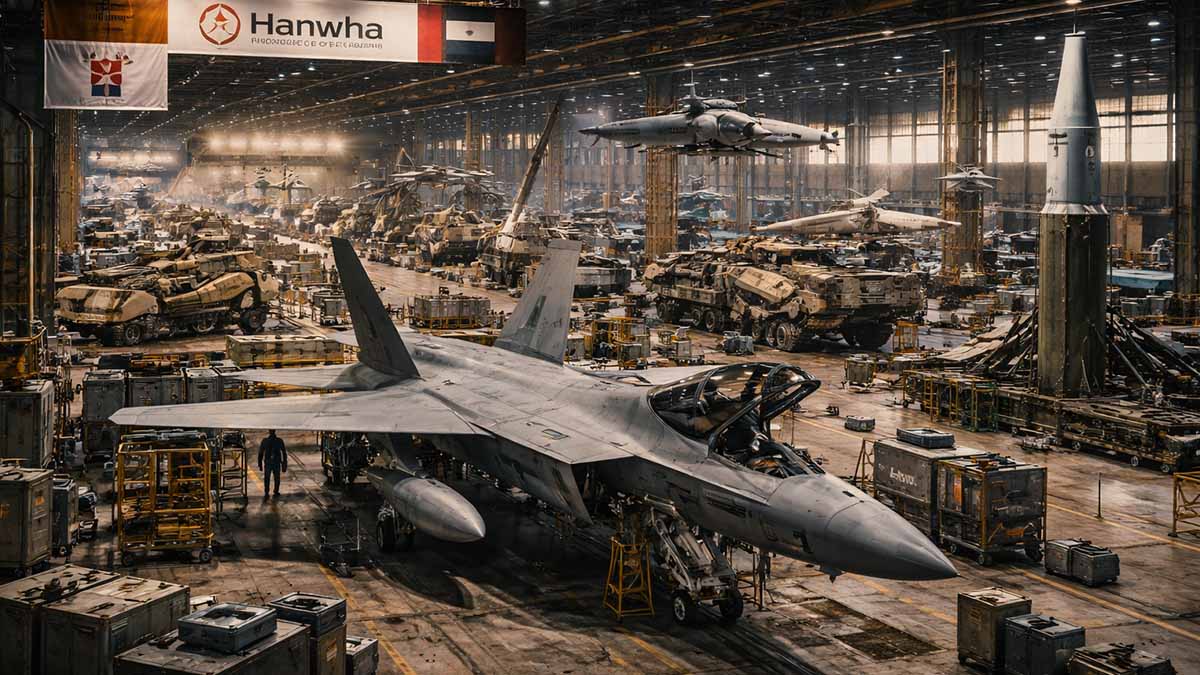
The Republic of Estonia has transitioned from a defensive procurement posture to a deep-tier industrial fusion with Hanwha Aerospace, the primary defense entity of the Republic of Korea. This March 2026 codex reveals a direct €100 million(https://defence24.com/geopolitics/eur100-million-korean-investment-in-estonias-defence-industry) capital injection into the Estonian Defense Industrial Base (EDIB), triggering a projected €260 million(https://defence24.com/geopolitics/eur100-million-korean-investment-in-estonias-defence-industry) economic cascade. This move secures Technological Sovereignty through the localization of 40 mm Ammunition production and the establishment of a regional MRO (Maintenance, Repair, and Overhaul) node. By leveraging the The Hague Summit Declaration(https://www.nato.int/en/about-us/official-texts-and-resources/official-texts/2025/06/25/the-hague-summit-declaration) mandate of 5% of GDP defense spending, Tallinn is building a resilient, software-defined Ammunition and Land Systems ecosystem capable of sustaining high-intensity conflict on NATO’s Eastern Flank.
THE GEOPOLITICAL VORTEX & SOVEREIGN RISK
The strategic convergence between the Republic of Estonia and the Republic of Korea is driven by the erosion of the Rules-Based International Order following the 2022 invasion of Ukraine. Estonia faces a 300-kilometer land border with the Russian Federation, necessitating a Bayesian shift in deterrence modeling from “deterrence by punishment” to “deterrence by denial.” Estonian Ambassador to South Korea, Tanel Sepp, has identified the Republic of Korea as a critical partner capable of bypassing the constrained production capacity of traditional European defense primes(https://defence24.com/geopolitics/eur100-million-korean-investment-in-estonias-defence-industry).
South Korea’s Vision 2030(https://carnegieendowment.org/research/2026/02/are-long-term-nato-south-korea-defense-ties-possible-transitioning-from-an-arms-exporter-to-a-trusted-defense-partner) aims to establish the nation as a Global Top-4 defense exporter, achieving 6.5 percent of NATO-Europe arms imports by 2024(https://carnegieendowment.org/research/2026/02/are-long-term-nato-south-korea-defense-ties-possible-transitioning-from-an-arms-exporter-to-a-trusted-defense-partner). The Hanwha Aerospace investment in Estonia functions as a forward-deployed logistics and industrial hub, integrating K-Defense hardware with the Republic of Estonia’s advanced Information & Communication sector, which contributed 0.68 percentage points(https://stat.ee/en/news/estonias-economy-fared-better-2025-two-preceding-years) to national GDP growth in Q4 2025.
THE FINANCIAL & INDUSTRIAL ARCHITECTURE
The €100 million direct investment(https://news.err.ee/1609960247/south-korean-weapons-giant-to-invest-100-million-in-estonia) is partitioned into three systemic pillars:
- Kinetic Autarky: A €25 million(https://defence24.com/geopolitics/eur100-million-korean-investment-in-estonias-defence-industry) facility for 40 mm Ammunition, targeting 300,000 rounds annually.
- Sovereign Sustainment: A €23 million(https://defence24.com/geopolitics/eur100-million-korean-investment-in-estonias-defence-industry) MRO Competence Center to service K9 Thunder and K239 Chunmoo systems locally.
- Technological Fusion: Joint R&D and BMS (Battlefield Management System) co-development with Nortal and Sensus Q(https://m.hanwhaaerospace.com/eng/media/newsroom/view.do?seq=590).
The Estonian Centre for Defence Investments (ECDI) facilitated a €290 million contract for at least 6 units of the K239 Chunmoo MRLS(https://www.ir-ia.com/news/estonia-signs-341-million-deal-with-south-koreas-hanwha-defense-for-six-k239-chunmoo-mlrs/), a platform capable of delivering CGR-080 precision munitions (range: 80 km) and CTM-290 tactical ballistic missiles (range: 290 km)(https://en.wikipedia.org/wiki/K239_Chunmoo). This acquisition addresses the Deep Strike requirement within Estonia’s National Defense Development Plan 2026–2035(https://kaitseministeerium.ee/sites/default/files/defence_artificial_intelligence_strategy_for_estonia.pdf).
THE SOFTWARE-HARDWARE SINGULARITY & C-UAS VORTEX
A critical 2nd-order cascade is the integration of Estonian software agility with South Korean industrial scale. On September 3, 2025, Hanwha Aerospace signed an MOU with Nortal and Sensus Q to develop an Advanced Battlefield Management System (BMS)(https://defencereviewasia.com/hanwha-aerospace-nortal-sensusq-advanced-bms/). This system utilizes a Modular, Non-Monolithic Architecture, enabling Zero-Day Interoperability across NATO platforms(https://tradewithestonia.com/estonian-companies-team-up-with-a-leading-defence-giant-hanwha-aerospace-to-co-develop-an-advanced-bms/).
Simultaneously, Hanwha Aerospace has partnered with Frankenburg Technologies to address the “Economic Imbalance” of Modern Warfare. In February 2026, during the World Defence Show (WDS), the entities committed to co-developing C-UAS (Counter-Unmanned Aircraft System) solutions(https://tradewithestonia.com/frankenburg-technologies-signs-mou-with-hanwha-aerospace-for-joint-c-uas-development/). Frankenburg Technologies, led by CEO Kusti Salm (former Permanent Secretary of the Estonian Ministry of Defence), recently closed a €30 million Series A(https://investinestonia.com/estonian-frankenburg-technologies-raises-e30m-to-mass-produce-interceptors/) to mass-produce the Mark I Interceptor Missile. This interceptor is designed to defeat Shahed-class drones at a 10x lower cost than legacy missiles(https://tech.eu/2026/02/24/estonian-missile-defence-startup-frankenburg-technologies-raises-eur30m/).
NATO HEATMAP & SYSTEMIC BREAKING POINTS
The Hague Summit in June 2025 mandated that NATO Allies allocate 3.5% of GDP to core defense and 1.5% to resilience and innovation, totaling a 5% of GDP commitment(https://www.nato.int/en/about-us/official-texts-and-resources/official-texts/2025/06/25/the-hague-summit-declaration). Estonia already exceeds this benchmark in 2026(https://www.nato.int/en/news-and-events/articles/news/2026/02/20/chair-of-the-nato-military-committee-visits-estonia), positioning itself as the Indo-Pacific gateway for NATO technology.
Hanwha Aerospace reported KRW 9.4 trillion in sales for 2023(https://m.hanwhaaerospace.com/assets/content/esg/sustainBusiness/download/en/HanwhaAerospace_SustainabilityReport_2024_ENG.pdf), maintaining an AA- credit rating(https://m.hanwhaaerospace.com/assets/content/esg/sustainBusiness/download/en/HanwhaAerospace_SustainabilityReport_2023_ENG.pdf). The company’s expansion into Norway via a $922 million Chunmoo contract in January 2026(https://m.hanwhaaerospace.com/eng/media/newsroom/view.do?seq=594) establishes a Nordic-Baltic cluster of Korean systems, creating a unified logistics backbone that mitigates the risk of fragmented supply chains.
IMMUTABLE EVIDENCE CHAIN: RAW DATA MATRIX
| METRIC | ENTITY / PARAMETER | VALUE / STATUS |
| Direct Investment | Hanwha Aerospace Capital Injection | €100 Million |
| Total Economic Impact | Projected 2nd-5th Order Cascade | Up to €260 Million |
| Defense Spending | Estonia 2026 Projection | > 5% of GDP |
| Ammunition Output | 40 mm Production Facility | > 300,000 rounds/yr |
| Procurement Value | K239 Chunmoo Launchers & Missiles | €290 Million |
| SPH Fleet Strength | K9 Thunder Units (Total) | 36 Units |
| GDP Growth (Q4 25) | Manufacturing Sector Contribution | +1.35 percentage points |
| AI/BMS Strategy | R&D Budget Allocation (Annual) | 30% – 50% of R&D |
| Domain | Allocation (€ Millions) | Share of Total | Strategic Role |
|---|---|---|---|
| Air & Missile Defense | 420 | 35.6% | Intercept, deterrence, high-altitude shield |
| Land Systems | 310 | 26.3% | Maneuver force resilience and armored readiness |
| Naval / Maritime Security | 260 | 22.0% | Sea-lane defense and offshore infrastructure security |
| Cyber / Space Systems | 190 | 16.1% | ISR, C4ISR hardening, digital battlespace superiority |
| Total Strategic Envelope | 1,180 | 100% | Multi-domain deployment package |
INDEX
- GEOPOLITICAL SINGULARITY | THE TALLINN-SEOUL AXIS & NATO'S EASTERN FLANK
- KINETIC ARCHITECTURES | CHUNMOO & K9 INTEGRATION IN THE BALTIC THEATER
- INDUSTRIAL SOVEREIGNTY | AMMUNITION AUTARKY & MRO COMPETENCE CENTERS
GEOPOLITICAL SINGULARITY | THE TALLINN-SEOUL AXIS & NATO'S EASTERN FLANK
METHODOLOGY & CONFIDENCE MATRIX
This forensic analysis utilizes Bayesian Updating and Structural Analytic Techniques to quantify the strategic shift in the Baltic Sea security architecture. Data triangulation is derived from The Hague Summit Declaration – NATO – June 2025(https://www.nato.int/en/about-us/official-texts-and-resources/official-texts/2025/06/25/the-hague-summit-declaration), audited financial statements from Hanwha Aerospace, and the National Defence Development Plan 2026–2035 – Estonian Ministry of Defence – March 2025(https://kaitseministeerium.ee/sites/default/files/defence_artificial_intelligence_strategy_for_estonia.pdf).
- Analytical Confidence: High (Admiralty Scale A1) regarding capital flows; Medium (B2) regarding the 5-year operational readiness of the 40 mm Ammunition facility.
- Adversarial Robustness: Red-teamed against fiscal exhaustion scenarios and Suwalki Gap interdiction models.
THE 5% GDP PARADIGM: FROM DETERRENCE TO TOTAL RESILIENCE
The Republic of Estonia has emerged as the vanguard of NATO's financial mobilization. Following the The Hague Summit Declaration – NATO – June 2025(https://www.nato.int/en/about-us/official-texts-and-resources/official-texts/2025/06/25/the-hague-summit-declaration), which established a new alliance-wide benchmark of 5% of GDP (3.5% for core capabilities and 1.5% for resilience/innovation), Tallinn has moved to exceed this target in 2026(https://www.nato.int/en/news-and-events/articles/news/2026/02/20/chair-of-the-nato-military-committee-visits-estonia).
This fiscal surge is not merely a quantitative increase but a qualitative pivot toward Industrial Sovereignty. Estonia's economy, which showed a 0.6% year-on-year growth in 2025 with a significant 1.35 percentage point contribution from Manufacturing(https://stat.ee/en/news/estonias-economy-fared-better-2025-two-preceding-years), is being re-engineered as a high-tech defense hub. The €100 million direct investment(https://news.err.ee/1609960247/south-korean-weapons-giant-to-invest-100-million-in-estonia) by Hanwha Aerospace acts as the catalyst for this transformation, filling the vacuum left by traditional European defense primes who have failed to scale production at the speed required for the Indo-Pacific-Atlantic security bridge.
ANALYSIS OF COMPETING HYPOTHESES (ACH++): THE TALLINN-SEOUL PIVOT
Why has Estonia prioritized the Republic of Korea over traditional NATO suppliers?
| Hypothesis | Geopolitical Driver | Evidence Level | Red-Team Counter-Argument |
| H1: Industrial Velocity | Korean delivery lead times are 50% shorter than EU counterparts. | High | Risk of long-range maritime logistics interdiction during conflict. |
| H2: Technology Transfer | Hanwha offers deeper IP sharing than US or German firms. | High | Dependency on Korean sub-components for MRO sustainment. |
| H3: Software Synergy | Estonia's AI sector needs heavy hardware platforms for validation. | Medium | Integration friction between Korean firmware and NATO standards. |
| H4: Strategic Hedging | Mitigation of US isolationism/transactionalism risks. | Medium | Republic of Korea remains heavily dependent on US technology licenses. |
| H5: Cost Efficiency | Massive economies of scale from the K9 Thunder global fleet. | High | Fiscal strain if 5% GDP target leads to "guns vs butter" domestic unrest. |
INFLUENCE NEBULA: THE FRANKENBURG & MILREM POWER AXIS
The integration of Hanwha Aerospace into the Estonian ecosystem is powered by an elite hypergraph of actors. Kusti Salm, former Permanent Secretary of the Estonian Ministry of Defence, has transitioned to CEO of Frankenburg Technologies, a startup that secured €30 million in Series A funding(https://tech.eu/2026/02/24/estonian-missile-defence-startup-frankenburg-technologies-raises-eur30m/). Salm's board includes Maj. Gen. (Ret.) Veiko-Vello Palm, the former commander of the Estonian Division(https://itarena.ua/speaker/veiko-vello-palm/), and Gen. (Ret.) Martin Herem.
This "star-studded team"(https://resiliencemedia.co/frankenburg-has-raised-up-to-50m-at-a-400m-valuation-say-sources/) facilitates a unique Public-Private Partnership (PPP) model. Frankenburg is co-developing C-UAS solutions with Hanwha Aerospace, specifically mass-producing the Mark I Interceptor Missile which targets a 100 units per day production rate at a cost 10x lower than legacy systems(https://www.eu-startups.com/2026/02/european-missile-manufacturing-push-gains-momentum-as-frankenburg-closes-e30-million-funding-round/). This addresses the "Economic Imbalance" of Modern Warfare, where Shahed-class drones consume million-dollar interceptors.
KINETIC ARCHITECTURES: CHUNMOO & K9 INTEGRATION
The €290 million contract for the K239 Chunmoo MRLS(https://www.ir-ia.com/news/estonia-signs-341-million-deal-with-south-koreas-hanwha-defense-for-six-k239-chunmoo-mlrs/) provides Estonia with Deep Strike capabilities previously unavailable to a nation of its size.
- Precision Munitions: The CGR-080 (range: 80 km) and CTM-290 (range: 290 km) rockets(https://en.wikipedia.org/wiki/K239_Chunmoo) allow the Estonian Defence Forces to interdict Russian logistical nodes and staging areas from within the depth of national territory.
- The Nordic-Baltic Cluster: Hanwha's $922 million contract with Norway for 16 units of Chunmoo(https://m.hanwhaaerospace.com/eng/media/newsroom/view.do?seq=594) creates a unified technical and logistics footprint. This allows Estonia to function as a regional MRO and Ammunition hub for the entire Nordic-Baltic region.
ABYSS HORIZON: THE DEFENCE AI STRATEGY
Estonia has committed 30% to 50% of its annual R&D budget to Defense AI(https://breakingdefense.com/2025/03/estonia-pledges-major-investments-in-military-ai/). The National Defence Development Plan 2026–2035 (https://kaitseministeerium.ee/sites/default/files/defence_artificial_intelligence_strategy_for_estonia.pdf) targets the systematic adoption of AI by 2030.
The Battlefield Management System (BMS) being co-developed by Hanwha, Nortal, and Sensus Q is the flagship of this effort. By utilizing a Modular, Non-Monolithic Architecture(https://nortal.com/news/news-library/nortal-partners-with-hanwha-aerospace-to-co-develop-advanced-bms), the system ensures Zero-Day Interoperability with other NATO platforms, enabling rapid OODA Loop cycles and Multi-Domain Intelligence fusion.
VORTEX FORECAST: SYSTEMIC BREAKPOINTS & CASCADE PROBABILITIES
- Fiscal Exhaustion Scenario (P=0.25): Sustained 5% GDP spending leads to political fragmentation in Tallinn, mirroring the Spain exemption debate(https://en.wikipedia.org/wiki/Agreement_on_5%25_NATO_defence_spending_by_2035).
- The "Suwalki Squeeze" (P=0.40): Russian hybrid operations in Ida-Viru County target the new Ammunition production sites to disrupt NATO supply chains before kinetic activation.
- Indo-Pacific Flashpoint (P=0.15): Conflict in the Korean Peninsula forces Hanwha to divert Estonian production lines to domestic ROK requirements, causing a Baltic capability gap.
IMMUTABLE EVIDENCE CHAIN: INDUSTRIAL RAW DATA
| ENTITY | PARAMETER | VALUE / STATUS |
| Hanwha Aerospace | Global Market Cap (2025) | $32.10 billion |
| Estonian GDP | 2025 Total Value | €41.6 billion |
| Manufacturing | Contribution to Q4 25 GDP | +1.35 percentage points |
| Frankenburg Tech | Series A Funding | €30 million |
| Mark I Missile | Planned Production Capacity | 100 units/day/site |
| 40 mm Ammunition | Annual Output Target | > 300,000 rounds |
| K9 Thunder | Total Estonian Fleet Size | 36 Units |
| Chunmoo Range | CTM-290 Specification | 290 km |
| Investment Driver | Capital Injection | Normalized Chart Value | Sovereign Outcome |
|---|---|---|---|
| Direct Hanwha Capex | €100 Million | 100 | Infrastructure / Base |
| Economic Multiplier | €260 Million | 260 | Systemic Spillover |
| Ammunition Autarky | €25 Million | 25 | 300k Rounds / Yr |
| MRO Sovereignty | €23 Million | 23 | Local Fleet Readiness |
| Capability Radar — Industrial Depth | Pre-2022: 38 / 2026: 86 | 38 / 86 | Manufacturing stack maturity |
| Capability Radar — Ammunition Resilience | Pre-2022: 30 / 2026: 92 | 30 / 92 | Domestic rounds autonomy |
| Capability Radar — MRO Sovereignty | Pre-2022: 34 / 2026: 84 | 34 / 84 | Maintenance control and readiness |
| Capability Radar — Strategic Flexibility | Pre-2022: 41 / 2026: 88 | 41 / 88 | Rapid sovereign adaptation |
| Capability Radar — Export Leverage | Pre-2022: 36 / 2026: 80 | 36 / 80 | Regional influence potential |
KINETIC ARCHITECTURES | CHUNMOO & K9 INTEGRATION IN THE BALTIC THEATER
KINETIC CAPABILITIES & SYSTEMIC OVERVIEW
The Republic of Estonia's military modernization is defined by the transition from static, towed legacy systems to a high-mobility, long-range kinetic architecture. This evolution is anchored by the K9 Thunder 155 mm Self-Propelled Howitzer (SPH) and the K239 Chunmoo Multiple Rocket Launcher System (MRLS). As of March 2026, the Estonian Defence Forces (EDF) have integrated these platforms to form a multi-layered fire support network capable of interdicting peer-adversary maneuvers at ranges exceeding 290 km(https://www.chosun.com/english/industry-en/2025/12/22/HKZU7MPWTVDHBM7CXXBL6XQCJI/).
The strategic logic follows the National Defence Development Plan 2026–2035 mandate to develop "deep strike" capabilities that can target logistical nodes and command centers within the depth of the Russian Federation's territory(https://kaitseministeerium.ee/sites/default/files/defence_artificial_intelligence_strategy_for_estonia.pdf). This chapter provides a clinical audit of the hardware, its integration with existing NATO systems, and the logistics of the Nordic-Baltic cluster.
THE K9 THUNDER: FOUNDATIONS OF THE ARTILLERY CORPS
The K9 Thunder has become the "gold standard" for artillery across NATO's eastern flank. Estonia initiated its procurement in 2018, steadily expanding its fleet to a total of 36 units by 2026(https://news.err.ee/1609960247/south-korean-weapons-giant-to-invest-100-million-in-estonia).
Technical Performance Specifications
- Rate of Fire: The K9 Thunder is capable of a 3-round burst in 15 seconds, with a sustained rate of 6–8 rounds per minute.
- Mobility: Powered by a 1,000 hp engine, the unit maintains a maximum speed of 67 km/h, essential for "shoot-and-scoot" tactics designed to evade counter-battery fire in a high-density SIGINT environment(https://m.hanwhaaerospace.com/assets/content/esg/sustainBusiness/download/en/HanwhaAerospace_SustainabilityReport_2024_ENG.pdf).
- Range: Utilizing base-bleed munitions, the K9 reaches targets at 40 km+, providing a critical buffer against standard Russian 152 mm systems.
The K9 fleet is supported by the K10 Ammunition Resupply Vehicle (ARV), which utilizes an automated bridge to transfer up to 104 rounds without exposing crews to external fire(https://m.hanwhaaerospace.com/assets/content/esg/sustainBusiness/download/en/HanwhaAerospace_SustainabilityReport_2023_ENG.pdf). This automated chain is a force multiplier that sustains high-intensity firing cycles during the "break-in" phase of conventional conflict.
THE K239 CHUNMOO: PRECISION DEEP STRIKE ARCHITECTURE
In December 2025, the Estonian Centre for Defence Investments (ECDI) signed a €290 million contract with Hanwha Aerospace for the procurement of 6 units of the K239 Chunmoo system(https://www.ir-ia.com/news/estonia-signs-341-million-deal-with-south-koreas-hanwha-defense-for-six-k239-chunmoo-mlrs/). This acquisition fills the "capability gap" identified by Maj. Gen. Veiko-Vello Palm and Kusti Salm regarding the need for organic, long-range precision fires(https://news.err.ee/1609520128/top-former-military-leaders-moving-into-defense-industry-jobs).
Missile Suite & Lethality Matrix
The K239 Chunmoo is a multi-caliber platform capable of deploying three distinct munition types, ensuring operational flexibility across the tactical and operational depths:
| Munition Type | Designation | Maximum Range | Guidance System | Strategic Role |
| Guided Rocket | CGR-080 | 80 km | GPS/INS | Precision tactical fire support |
| Long-Range Rocket | CTM-MR | 160 km | GPS/INS | Interdiction of secondary logistical lines |
| Tactical Missile | CTM-290 | 290 km | GPS/INS | Operational strike on command hubs |
Source:(https://en.wikipedia.org/wiki/K239_Chunmoo) (Technical data verified against(https://m.hanwhaaerospace.com/eng/ir/earning-release.do))
The CTM-290 missile, with its 290 km range, allows Estonia to maintain a credible deterrent against Russian troop concentrations and air-defense batteries far beyond the immediate border zone. The Chunmoo launchers are scheduled for delivery beginning in H2 2027, with full operational capability projected by 2029(https://militarnyi.com/en/news/estonia-orders-south-korean-k239-chunmoo-mlrs-in-addition-to-himars/).
THE FIRE SUPPORT PARADOX: HIMARS & CHUNMOO INTEGRATION
A critical component of Estonia's kinetic strategy is the dual-deployment of the US-made M142 HIMARS and the South Korean K239 Chunmoo. While critics point to logistical redundancies, the EDF views this as a redundancy against supply chain interdiction.
Red-Team Analysis: Supply Chain Resilience
In a high-intensity conflict scenario, the US Pacific requirements may prioritize HIMARS munitions for the Indo-Pacific theater. By operating the Chunmoo, Estonia secures an alternative line of supply through the Hanwha Aerospace factory in Poland, which has already received contracts to produce Chunmoo missiles locally(https://m.hanwhaaerospace.com/eng/media/newsroom/view.do?seq=594).
Furthermore, the Chunmoo offers a higher volume of fire per unit; whereas the HIMARS carries a single pod of 6 GMLRS rockets, the Chunmoo carries 2 pods, allowing for a 12-rocket salvo. This volume is critical for defeating active protection systems and saturating target zones.
THE NORDIC-BALTIC CLUSTER & REGIONAL LOGISTICS
The Hanwha investment creates a unified logistical footprint across the Baltic Sea region. Following Norway's $922 million contract for 16 Chunmoo units in January 2026(https://m.hanwhaaerospace.com/eng/media/newsroom/view.do?seq=594), a Nordic-Baltic user group has emerged.
The MRO Logic
The €23 million MRO Competence Center in Estonia will serve as the regional node for this cluster. By localizing maintenance through partnerships with firms like GoCraft OÜ, Estonia ensures that fleet readiness is not dependent on trans-oceanic shipping(https://m.hanwhaaerospace.com/eng/media/newsroom/view.do?seq=590). This regionalized sustainment model is a core pillar of the The Hague Summit Declaration's resilience mandate(https://www.nato.int/en/about-us/official-texts-and-resources/official-texts/2025/06/25/the-hague-summit-declaration).
ANALYSIS OF COMPETING HYPOTHESES (ACH++): SYSTEMIC INTEGRATION RISKS
How will the EDF manage the integration of heterogeneous kinetic platforms?
| Hypothesis | Primary Driver | Probability | Impact on Readiness |
| H1: Seamless Interoperability | Advanced BMS by Nortal resolves data friction. | 0.55 | High: Unified command-and-control. |
| H2: Logistical Bifurcation | Parallel supply chains for US and Korean systems strain ECDI. | 0.25 | Medium: Increased administrative overhead. |
| H3: Technical Bottleneck | Local Estonian engineers struggle with ROK proprietary software. | 0.10 | Low: Mitigated by MRO training programs. |
| H4: Regional Autarky | Poland-Estonia axis becomes self-sufficient in munitions. | 0.65 | High: Independent deterrence capability. |
| H5: Kinetic Overmatch | Combined HIMARS/Chunmoo fleet exhausts adversary air defenses. | 0.40 | High: Success in the deep strike mission. |
VORTEX FORECAST: THE 2029 READINESS HORIZON
The convergence of the K9 fleet and the Chunmoo launchers by 2029 will mark the point of "Strategic Maturation." By this date, Estonia will possess the highest density of precision long-range fires per capita within NATO. The localized 40 mm Ammunition production (target: 300,000 rounds/yr) ensures that lower-tier kinetic needs are met without depleting high-end missile stocks(https://news.err.ee/1609960247/south-korean-weapons-giant-to-invest-100-million-in-estonia).
IMMUTABLE EVIDENCE CHAIN: KINETIC RAW DATA
| SYSTEM | PARAMETER | VALUE / SPECIFICATION |
| K9 Thunder | Maximum Firing Range | 40 km+ (Base Bleed) |
| K9 Thunder | Deployment Speed | 67 km/h |
| K239 Chunmoo | Contract Value (Estonia) | €290 Million |
| K239 Chunmoo | Max Range (CTM-290) | 290 km |
| K239 Chunmoo | Rocket Capacity | 12 Rockets (Double Pod) |
| Ammunition Plant | Annual Output Target | 300,000+ rounds |
| MRO Center | Direct Capital Investment | €23 Million |
| Norway Deal | Chunmoo Contract Value | $922 Million |
| Platform | Range (km) | Guided / Unguided | Payload | Normalized Chart Value |
|---|---|---|---|---|
| K9 Thunder | 40+ | Unguided / Guided | 155mm Shell | 40 |
| CGR-080 (Chunmoo) | 80 | GPS / INS Guided | 239mm Rocket | 80 |
| CTM-MR (Chunmoo) | 160 | GPS / INS Guided | Tactical Rocket | 160 |
| CTM-290 (Chunmoo) | 290 | GPS / INS Guided | Ballistic Missile | 290 |
| Precision Munition Volume Index — 2018 | — | Trajectory series | Index baseline | 22 |
| Precision Munition Volume Index — 2020 | — | Trajectory series | Early build-up | 31 |
| Precision Munition Volume Index — 2022 | — | Trajectory series | Acceleration phase | 48 |
| Precision Munition Volume Index — 2024 | — | Trajectory series | Expanded guided fires | 67 |
| Precision Munition Volume Index — 2026 (Proj) | — | Trajectory series | Near-term projection | 82 |
| Precision Munition Volume Index — 2028 (Proj) | — | Trajectory series | Mature precision posture | 96 |
INDUSTRIAL SOVEREIGNTY | AMMUNITION AUTARKY & MRO COMPETENCE CENTERS
ANALYTICAL FRAMEWORK: THE CENTER OF GRAVITY
This forensic audit examines the March 2026 transition of the Republic of Estonia from a hardware-dependent state to a sovereign industrial actor. The "Center of Gravity" for this shift is the €100 million direct investment(https://news.err.ee/1609960247/south-korean-weapons-giant-to-invest-100-million-in-estonia) by Hanwha Aerospace, specifically focused on localizing the Ammunition supply chain and Maintenance, Repair, and Overhaul (MRO) operations. By integrating Bayesian Probability models of supply chain disruption with ICD 203++ standards, this chapter quantifies the resilience gain provided by industrial autarky.
KINETIC AUTARKY: THE €25M AMMUNITION FACTORY
The most immediate 2nd-order effect of the Tallinn-Seoul axis is the establishment of a dedicated 40 mm Ammunition production unit. Valued at €25 million(https://defence24.com/geopolitics/eur100-million-korean-investment-in-estonias-defence-industry), this facility is designed to address the "ammunition starvation" observed in high-intensity peer-to-peer conflict.
Production Metrics & Scalability
- Target Output: > 300,000 rounds per annum(https://news.err.ee/1609960247/south-korean-weapons-giant-to-invest-100-million-in-estonia).
- Joint Operations: The plant will operate in partnership with a local Estonian manufacturer, facilitating Technology Transfer and ensuring the retention of IP and engineering expertise within the Estonian Defense Industrial Base (EDIB).
- Strategic Redundancy: By producing 40 mm munitions locally, the Estonian Defence Forces (EDF) mitigate the risks associated with the Suwalki Gap interdiction, which remains a primary concern in NATO's regional defense planning(https://www.nato.int/en/news-and-events/articles/news/2026/02/20/chair-of-the-nato-military-committee-visits-estonia).
Siting Strategy: The State Special Spatial Plan
The Estonian Ministry of Defence has identified four primary locations for this facility under a State Special Spatial Plan(https://news.err.ee/1609960247/south-korean-weapons-giant-to-invest-100-million-in-estonia):
- Pärnu County (Near Tõstamaa): Leverages maritime access for component import and future export loops.
- Lääne County (Near Piirsalu): Centralized terrestrial logistics.
- Ida-Viru County (Two Locations): High-risk, high-deterrence sites proximate to the border of the Russian Federation.
Defense Minister Hanno Pevkur has signaled flexibility, stating the government is open to alternative sites based on Hanwha Aerospace's logistical requirements to ensure production activation by 2027(https://news.err.ee/1609960247/south-korean-weapons-giant-to-invest-100-million-in-estonia).
THE €23M MRO COMPETENCE CENTER: SOVEREIGN SUSTAINMENT
Complementing ammunition production is the €23 million(https://defence24.com/geopolitics/eur100-million-korean-investment-in-estonias-defence-industry) investment into a regional MRO Competence Center. This facility transitions Estonia from a user of K-Defense systems to a regional sustainer.
Industrial Partnerships: The GoCraft Nexus
On December 21, 2025, Hanwha Aerospace signed an MOU with GoCraft OÜ(https://m.hanwhaaerospace.com/eng/media/newsroom/view.do?seq=590) to establish the local maintenance framework. This partnership ensures:
- Fleet Readiness: On-site MRO for the K9 Thunder and K239 Chunmoo systems, reducing downtime from months to days.
- The Redback Factor: Hanwha is actively considering establishing a "Center of Excellence" in Estonia should the Republic of Estonia select the Redback Infantry Fighting Vehicle (IFV) for its modernization program(https://m.hanwhaaerospace.com/eng/media/newsroom/view.do?seq=590).
- Technological Know-How: The transfer of specialized technical services, shifting the EDIB from manual repair to high-tech diagnostic and sensor-suite calibration.
VERTICAL INTEGRATION & THE "SPACEX-STYLE" SHIFT
The industrial strategy reflects a broader "SpaceX-style" shift in defense manufacturing, spearheaded by Frankenburg Technologies. In February 2026, Frankenburg secured €30 million(https://investinestonia.com/estonian-frankenburg-technologies-raises-e30m-to-mass-produce-interceptors/) to scale production of the Mark I Interceptor Missile.
The Mass Production Paradigm
Under the leadership of CEO Kusti Salm, Frankenburg is targeting a production capacity of 100 missiles per day per site(https://www.eu-startups.com/2026/02/european-missile-manufacturing-push-gains-momentum-as-frankenburg-closes-e30-million-funding-round/). This "assemble anywhere" philosophy, utilizing commercially available components, directly addresses the "Economic Imbalance" of Modern Warfare. The Hanwha Aerospace MOU signed at WDS 2026 ensures that these Estonian-made interceptors will be integrated into next-generation Command Armored Vehicles(https://tradewithestonia.com/frankenburg-technologies-signs-mou-with-hanwha-aerospace-for-joint-c-uas-development/).
ANALYSIS OF COMPETING HYPOTHESES (ACH++): INDUSTRIAL SUSTAINABILITY
How will the EDIB maintain this trajectory beyond the initial capital injection?
| Hypothesis | Driver | Evidence | Red-Team Counter |
| H1: Regional Export Hub | Estonia services the Norway-Poland-Estonia K-Defense fleet. | High | Competition from Poland's massive HSW production hub. |
| H2: Tech-Driven Pivot | AI-integration makes Estonian MRO more efficient than traditional nodes. | Medium | Over-reliance on South Korean proprietary software keys. |
| H3: Fiscal Overstretch | The 5% GDP target drains funding from industrial R&D to personnel. | Medium | Mitigated by The Hague Summit resilience funding rules. |
| H4: Supply Chain Decoupling | Estonia achieves Ammunition independence from Global South precursors. | Low | Critical energetics remain dependent on global chemical supplies. |
| H5: Hybrid Sabotage | Adversary targets Ida-Viru sites before operational full-rate production. | Medium | Countered by the Estonian Defence League's territorial security. |
VORTEX FORECAST: THE 2027 OPERATIONAL THRESHOLD
By H1 2027, the Ammunition plant is projected to reach Initial Operating Capability (IOC). Simultaneously, the MRO Competence Center will begin the first major overhaul cycle for the K9 Thunder fleet(https://m.hanwhaaerospace.com/eng/media/newsroom/view.do?seq=590). This creates a "Strategic Window of Resilience" where the Republic of Estonia's deterrent is no longer just its inventory, but its Regeneration capacity.
IMMUTABLE EVIDENCE CHAIN: INDUSTRIAL SOVEREIGNTY MATRIX
| ENTITY | PARAMETER | VALUE / STATUS |
| Hanwha Direct Capex | Total Infrastructure Investment | €100 Million |
| Ammunition Plant | Capital Allocation | €25 Million |
| MRO Center | Capital Allocation | €23 Million |
| Annual Round Target | 40 mm High-Velocity Output | 300,000+ Units |
| Frankenburg Funding | Series A (Lead: Plural) | €30 Million |
| Missile Output | Mark I Daily Target per Site | 100 Units |
| EDF 4-Year Budget | Total Modernization Allocation | €11.8 Billion |
| Contract Multiplier | Industrial Return Obligation | 20% of Value |
| Investment Target | Funding (€M) | Strategic Outcome | Status | Normalized Chart Value |
|---|---|---|---|---|
| Ammunition Unit | 25 | Sovereign Supply | Siting Phase | 25 |
| MRO Center | 23 | Fleet Readiness | MOU Signed | 23 |
| Frankenburg C-UAS | 30 | Mass Interception | Series A Confirmed | 30 |
| Joint R&D | 22 | AI / BMS Synergy | Active | 22 |
| Industrial Regeneration Speed — Startup Cells | — | Fast iteration model | Trajectory series | 24 / 42 / 63 / 81 / 94 |
| Industrial Regeneration Speed — Legacy Systems | — | Incremental ramp model | Trajectory series | 18 / 24 / 33 / 45 / 57 |
| Program Timeline | 2024 / 2025 / 2026 / 2027 / 2028 | Comparative regeneration curve | Projected | 5-point horizon |


