










Abstract
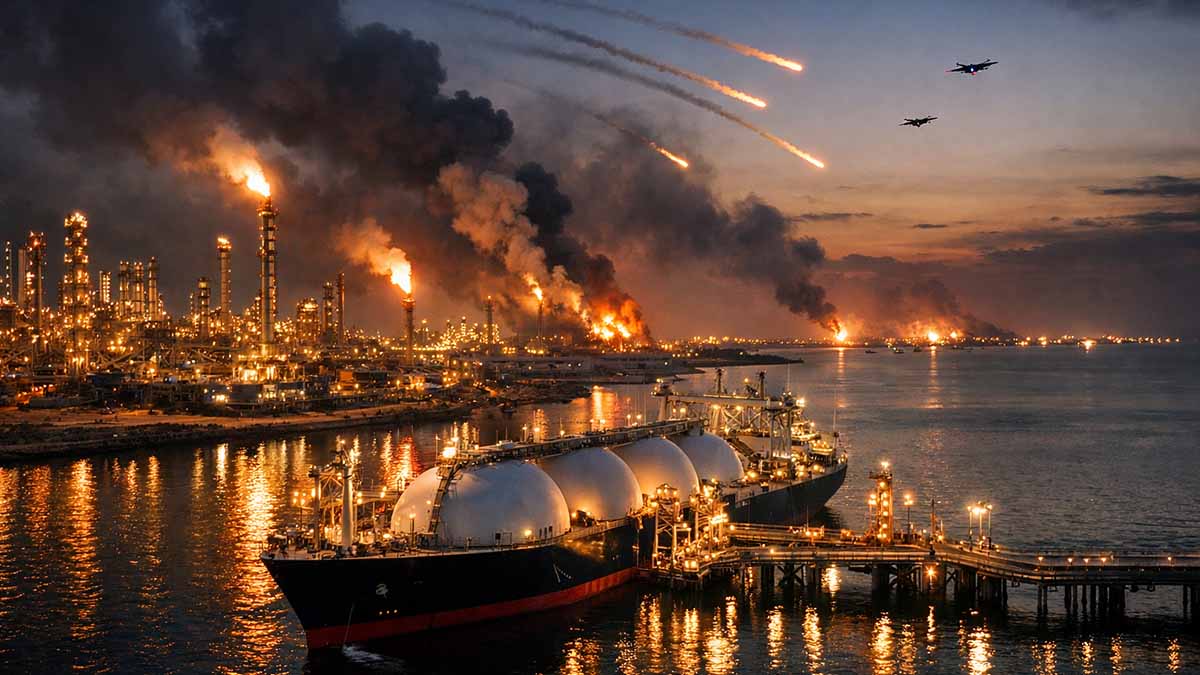
The hard, update-to-today baseline is this: the central energy premise is real. QatarEnergy publicly announced on March 2, 2026 that it had ceased production of liquefied natural gas and associated products because of military attacks on its operating facilities in Ras Laffan Industrial City and Mesaieed Industrial City; on March 4, 2026 it then declared force majeure to affected customers.
That matters at systemic scale because Qatar is not a marginal supplier. The U.S. Energy Information Administration states that in 2024 roughly 20% of global LNG trade moved through the Strait of Hormuz, primarily from Qatar, and that Qatar exported about 9.3 billion cubic feet per day of LNG through that chokepoint.
So the first-order conclusion is straightforward: a wartime interruption of Qatari liquefaction is sufficient to destroy any comfortable assumption of short-run global gas surplus. That is not rhetoric; it is a market-structure fact grounded in the concentration of LNG export capacity and route dependence at Ras Laffan and Hormuz.
The military backdrop is also officially documented. In a March 5, 2026 letter to the United Nations Security Council, Qatar’s Ministry of Foreign Affairs said Iran attacked Qatari territory with 10 drones and 2 cruise missiles at dawn on March 4, and had launched 2 ballistic missiles the prior day; according to the same official communication, one missile targeted Al Udeid Air Base without causing casualties. The same letter linked those attacks directly to QatarEnergy’s production halt and force-majeure notifications.
That gives us the verified core: there was an Iranian attack on Qatar; QatarEnergy halted LNG production; and the disruption occurred in infrastructure central to the global gas system. Everything beyond that core has to be separated into evidence, inference, and non-verified speculation.
Facts
Qatar remains strategically fused to the United States security architecture. The Department of Defense said in the readout of the 16th U.S.-Qatar Military Consultative Commission that Al Udeid Air Base “remains essential to regional security,” and subsequent DoD material in 2025 continued to depict senior U.S. leadership at Al Udeid during President Trump’s Gulf trip.
Qatar has also had a long, officially acknowledged mediation role. State Department material has repeatedly described Qatari mediation on hostage and regional files, and Qatar’s own diplomacy messaging continues to frame the state as a mediator and stabilizer.
The United States is indeed politically sensitive to energy-driven price moves. The latest BLS release, for February 2026, shows the U.S. energy index up 0.5% year over year, with utility gas service up 10.9% over the same period; the White House has also made inflation and price relief a central public theme of the administration’s messaging.
At the same time, the United States has a growing offsetting capability in LNG. The EIA reported on February 24, 2026 that U.S. LNG exports reached 15.0 Bcf/d in 2025, keeping the United States as the world’s largest LNG exporter ahead of Australia and Qatar. That does not neutralize a sudden Qatari outage, but it does mean Washington has more strategic flexibility than during earlier gas crises.
Assumptions and claims that are not publicly verified today
There is no public Tier-1 evidence located in this session showing that Qatar coordinated with Iran to close the liquefaction system in order to force an end to the war. There is likewise no public Tier-1 evidence located in this session showing that President Trump was personally briefed on such a scheme and “was furious.” Those propositions may exist in private channels; they are not verifiable from the official record surfaced here today, so they cannot be treated as established fact.
There is also no public Tier-1 evidence located in this session substantiating the claims about Al Jazeera’s editorial language shift, Tucker Carlson being funded by Qatar, or a secret Trump-Kurdish arrangement affecting Türkiye’s willingness to host Hamas leaders. Those claims remain outside the verified chain assembled from official sources today.
Likewise, I did not locate an official, live, primary-source confirmation in this session for the specific allegation that Iran’s embassy in Doha opened a condolence book and expected Hamas leaders to attend. Because that claim is not confirmed by the official chain retrieved here, it should be excluded from any evidentiary baseline.
Best analytical reading
The strongest evidence-based interpretation is narrower and more powerful than the rumor itself. Qatar does not need to be colluding with Iran for the shock to create political leverage. Once Iranian attacks force a shutdown at Ras Laffan, the effect is automatic: gas scarcity tightens, importers panic, risk premia climb, and every capital that depends on stable energy prices acquires an immediate incentive to prevent further escalation. That is coercive leverage produced by infrastructure vulnerability, even without proven political coordination.
In other words, the mechanism is real even if the conspiracy thesis is unproven. The interruption of LNG supply from a node handling a massive share of globally traded gas is enough to transmit battlefield escalation directly into inflation psychology, utility pricing, industrial procurement, shipping schedules, and alliance management.
That yields five competing drivers for Doha’s current behavior:
Driver 1: Regime-security preservation. If Iran can strike Qatari territory and if IRGC-linked cells are, as Qatar says, active inside the country, then Doha is operating under a homeland-security logic before any grand diplomatic logic. Qatar’s UN letter said authorities arrested 10 suspects allegedly working on behalf of the IRGC, including individuals assigned espionage and sabotage tasks.
Driver 2: Restoration of deterrence credibility. Because Al Udeid is “essential to regional security,” strikes near or at that node threaten not only Qatar’s energy posture but also the credibility of its security compact with the United States. That creates pressure for tighter alignment with Washington, not looser alignment.
Driver 3: Protection of rent-generating geoeconomic status. Qatar’s diplomatic weight is amplified by its centrality in LNG and mediation. A prolonged outage damages the first pillar. If the regional system moves toward decisive coercion rather than negotiated hostage-and-ceasefire cycles, the second pillar also weakens. That is the real danger to Doha: not merely physical damage, but contraction of its brokerage model.
Driver 4: Containment of alliance contagion across the Gulf. The attack pattern already shows a widening exposure set. Any Gulf monarchy that did not build its state under chronic fire has a stronger preference for fast de-escalation than Israel does. That creates intracoalition tension between victory-maximization and vulnerability-minimization. The logic is strategic even where the rhetoric differs.
Driver 5: Repositioning for the post-Iran order. If the clerical regime’s capacity for transregional coercion degrades sharply, the traditional mediation economy around hostages, ceasefires, and indirect channels loses value. In that world, Qatar has incentives to prove utility to the United States and other Western partners through logistics, deconfliction, and selective distancing from militant actors rather than through open-ended balancing.
Red-team counterfactuals
A red-team reading must still consider the possibility that the LNG halt was overwhelmingly operational, not political; that Qatar is simply reacting to physical risk and insurance constraints. The available official record is fully compatible with that explanation.
Another counterfactual is that Doha will try to preserve mediation capacity rather than abandon it. Official Qatari diplomacy language still emphasizes multilateral stabilization and mediation, and the United States has long relied on Qatar precisely because it can talk to actors others cannot.
A third counterfactual is that U.S. LNG growth reduces the durability of Qatar’s pressure potential. If U.S. export capacity continues to expand and if buyers can absorb a short-term shock with alternative cargoes, then Doha’s vulnerability could rise faster than its leverage.
Probability-weighted bottom line
My current evidence-led assessment is:
- High confidence: the strike-induced halt in Qatari LNG production is real and strategically consequential.
- Moderate confidence: the halt increases pressure on Washington to control escalation because energy shocks feed directly into domestic price politics.
- Moderate confidence: Qatar now has stronger incentives to move closer to the United States security line, not because of sentiment, but because its territory, industrial base, and brokerage model have all been exposed at once.
- Low confidence / unverified: a deliberate Iran-Qatar coordination scheme to engineer the shutdown for war-termination leverage. No official evidence located today supports that claim.
- Low confidence / unverified: the personalized claims about Trump’s reaction, Al Jazeera, Tucker Carlson, and Türkiye’s role regarding Hamas leadership. No official evidence located today supports those claims.
The deepest second-order implication is this: even if the rumor architecture is wrong, the regional system has crossed into a condition where attacks on Gulf energy infrastructure can now compress diplomacy, inflation, alliance cohesion, and war aims into a single feedback loop. That is the real strategic rupture. The old model—fight in one theater, mediate in another, export gas as normal, and firewall Gulf monarchies from the central battlefield—has visibly weakened.
Qatar LNG Shock War-Room Dashboard
Verified operational disruption, market concentration, and U.S. inflation sensitivity in one responsive dashboard.
Energy Exposure Snapshot
Verified Escalation Timeline
Attack and Interception Profile
Strategic Assessment Grid
| Vector | Verified Signal | Immediate Effect | Strategic Meaning |
|---|---|---|---|
| LNG Operations | Production halt + force majeure | Supply shock | Gas market surplus evaporates quickly |
| Military | Strike on Qatar / Al Udeid targeted | Homeland-security escalation | Pushes Doha toward tighter U.S. alignment |
| Market Structure | Qatar handles ~20% of global LNG trade via Hormuz | Risk premium expansion | Single-node fragility now obvious |
| U.S. Domestic Politics | Energy-sensitive CPI components remain active | Inflation pressure channel | Washington incentivized to cap escalation |
| Brokerage Model | Qatar hit as both mediator and producer | Diplomatic compression | Mediation era weakens if Iran degrades further |
Source basis used for dashboard values: QatarEnergy public notices of production halt and force majeure; Qatar MOFA letter to the UN on March 5, 2026; U.S. EIA LNG and Hormuz flow data; U.S. BLS February 2026 CPI release.
INDEX
Core Concepts in Review: What We Know and Why It Matters
- The Global LNG System Under Fire: Structural Fragility, Energy Warfare, and the Strategic Exposure of Qatar
- The Brokerage State Under Fire — Qatar’s Mediation Machine, U.S. Security Dependence, and the Compression of Strategic Autonomy
- From Mediation to Managed Implementation — Qatar, Gaza Governance, and the Narrowing Space for Armed-Movement Brokerage
Core Concepts in Review: What We Know and Why It Matters
The clearest way to understand the story so far is to stop thinking about Qatar as just a small Gulf state with money and media influence, and to start thinking about it as a systems state. Its importance comes from the way several forms of power overlap in one place: energy infrastructure, U.S. military basing, regional mediation, and financial-political access. What the official record now shows is that these pillars are no longer operating in separate compartments. They have started to fuse under pressure. That fusion is the real strategic development.
The first core concept is brokerage. In foreign policy, a brokerage state is one that derives influence not primarily from military size or population, but from its ability to connect actors who otherwise would not speak, host processes others cannot host, and keep communication channels open even during war. Qatar’s Ministry of Foreign Affairs describes mediation as a central function of the state, saying it works both between states and between states and non-state actors. That is not a side project. It is part of the country’s diplomatic identity. In plain terms, Doha built power by becoming useful to rivals at the same time.
That mediation role is not theoretical. Official Qatari statements describe direct involvement in hostage releases, ceasefire arrangements, evacuation efforts, and negotiation channels tied to Gaza. On January 15, 2025, Qatar’s Prime Minister and Foreign Minister publicly announced a Gaza ceasefire deal. Later, on December 2, 2025, Qatar said it was monitoring implementation through the Joint Monitoring Room in Cairo. By January 20, 2026, a Qatari official said the country’s representative had joined the Gaza Executive Council, linking that move to the next phase of post-conflict management. This is a very important progression: it suggests Qatar moved from being only a broker of talks to being part of the machinery that helps implement what was agreed.
That leads to the second core concept: the difference between mediation and implementation. Mediation is about helping people reach a deal. Implementation is about helping make a deal actually work. Those are not the same thing. A mediator can survive on flexibility, ambiguity, and quiet access. An implementer needs oversight, structure, monitoring, and a reputation for procedural seriousness. Once Qatar entered the implementation layer through monitoring and governance-related roles, the political cost of open-ended ambiguity rose sharply. The state could still keep channels open, but those channels now sit beside formal obligations. That is a much narrower space.
A third core concept is security hosting. Qatar is not only a mediator; it also hosts one of the most important American military facilities in the region. The U.S. Department of Defense said in October 2024 that Al Udeid Air Base “remains essential to regional security.” That is unusually strong language. It means Doha is part of the practical architecture of U.S. power projection, command support, and regional deterrence. Then, in September 2025, the White House issued a presidential action stating that the United States would guarantee the security and territorial integrity of the State of Qatar against external attack. In effect, Qatar is not merely a host; it sits under a declared American protective umbrella.
Why does that matter? Because it changes how any attack on Qatar is interpreted. An attack on a normal commercial or diplomatic node is one thing. An attack on a state that hosts an “essential” U.S. base and enjoys an explicit U.S. security commitment is another. It raises the stakes immediately. It turns local coercion into alliance testing. It also reduces Qatar’s freedom to act as if all of its relationships are politically equivalent. A country can balance more easily when it is only a broker. It balances less easily when it is also a protected security platform.
The fourth core concept is energy centrality. Qatar matters globally because it is one of the world’s key LNG exporters. Earlier chapters focused on the Ras Laffan system and the North Field, but the broader point is simpler: Qatar is not just rich because it has gas; it is strategically important because global energy consumers depend on the continuity of that gas export model. The overlap between energy infrastructure and state influence is what gives Qatar outsized leverage. When energy flows are stable, that leverage feels like utility. When energy flows are threatened, that same leverage becomes vulnerability.
This is where the story becomes more serious. On March 5, 2026, Qatar’s Ministry of Foreign Affairs informed the United Nations Security Council that Iranian attacks had targeted Qatari territory and that one missile had been directed at Al Udeid Air Base. In the same official chain, Qatar linked the attacks to the halt in QatarEnergy production and force-majeure conditions. This is the moment where all the separate strands—security, energy, diplomacy—begin to collapse into one system. Qatar is no longer just mediating a war around it. It is being hit directly while hosting a key American base and while its energy system faces disruption.
This gives us the fifth core concept: compression of strategic autonomy. That phrase sounds technical, but the meaning is simple. It describes a situation where a state still has formal independence, but its real room to maneuver starts shrinking because too many risks converge at once. In Qatar’s case, those pressures include: being a U.S. security host, being a mediator with channels to politically sensitive actors, being an energy exporter whose infrastructure matters globally, and being financially scrutinized as a place where terrorism-linked finance may attempt to move. Any one of these might be manageable on its own. Together, they create compression.
The sixth core concept is financial scrutiny. Much public discussion about Qatar focuses on summits, speeches, or media narratives. But the official U.S. record shows that money flows and financial systems are just as important. On October 18, 2023, the U.S. Treasury Department sanctioned ten key Hamas members, operatives, and financial facilitators, including a Qatar-based financial facilitator with ties to the Iranian regime. Less than two weeks later, on October 30, 2023, Treasury said Under Secretary Brian Nelson traveled to Doha to work with Qatari partners on counter-terrorist financing, regional stability, and ensuring that legitimate humanitarian aid to Gaza was not diverted. This shows that Qatar is treated by Washington not only as a mediator but as a key financial-control environment.
That matters because mediation and financial compliance often pull in opposite directions. Mediation rewards access. Compliance rewards control. Mediation often requires contact with unsavory actors because that is where deals come from. Compliance requires that such contact not become a permissive channel for money, logistics, or illicit coordination. The more Qatar becomes embedded in ceasefire monitoring and implementation, the harder it becomes to defend a broad, informal access model. The state can still keep channels, but it has to police them more tightly.
The seventh concept is ambiguity as a strategic asset. For many years, Qatar’s strength came from being able to occupy multiple worlds at once. It could be close to Washington, useful to mediators, available to regional actors, and still maintain enough distance from rigid bloc politics to preserve flexibility. Official statements even after periods of stalled diplomacy show this pattern. On November 19, 2024, Qatar said it had suspended mediation due to lack of seriousness by the parties, but it also said that this did not mean the closure of Hamas’s office in Doha. That is a very clear example of a state protecting its network position even while publicly downgrading a process.
But ambiguity does not age well under direct pressure. Once a state is helping monitor a ceasefire, participating in governance structures, under explicit U.S. security protection, and reporting direct attack by Iran, ambiguity stops looking like flexibility and starts looking like exposure. This is one of the most important conclusions from the earlier chapters. The old Qatari model was built for a region where functions could remain partly separated: war over here, gas over there, base hosting in one lane, mediation in another. The new environment is one in which those lanes are merging.
The eighth concept is institutionalization. One of the clearest patterns in the official material is that Qatar’s role is becoming more formal. We see that in the Joint Monitoring Room in Cairo. We see it again in the Gaza Executive Council. We also see it at the United Nations, where Resolution 2803 (2025) welcomed the Comprehensive Plan to End the Gaza Conflict. Once peace management is placed inside formal structures, influence changes form. It becomes less about who can make a secret phone call and more about who has a seat in the room where implementation decisions are made.
That has real policy implications. For U.S. policymakers, the lesson is that Qatar should not be understood through a simplistic “ally or problem” lens. The official record shows a more complicated reality. Qatar is a security partner, a mediation platform, an energy node, and a jurisdiction that requires close coordination on terrorism finance. That means policy toward Doha has to combine reassurance and pressure at the same time. Too much pressure could damage a useful channel. Too little pressure could leave dangerous permissiveness in place. The challenge is not choosing one or the other. It is managing both together.
For Israel, the relevance is similar but sharper. If Qatar remains useful in hostage and ceasefire mechanics, it still has value as a conduit. But as Qatar becomes more deeply attached to governance and implementation structures, the tolerance for informal political hosting of armed-movement figures may decrease. That does not mean an overnight rupture. The official record does not support that. It does mean the environment is changing in a direction that makes open-ended brokerage harder to sustain.
For Congress or any policy audience in Washington, the societal impact is broader than foreign policy alone. Qatar’s energy role touches prices and supply risk. Its military role touches American force posture. Its mediation role touches hostages, ceasefires, and war termination. Its financial role touches sanctions enforcement and anti-terror controls. In other words, this is not a niche Gulf issue. It is an example of how modern power works: a single state can matter simultaneously to inflation, war management, humanitarian access, and alliance credibility.
So what do we actually know, in plain English?
We know Qatar has made mediation a core part of its foreign-policy identity. We know the United States considers Al Udeid Air Base in Qatar essential to regional security. We know the White House issued a formal security commitment to Qatar in September 2025. We know Qatar publicly moved from ceasefire brokerage into implementation support through the Joint Monitoring Room and the Gaza Executive Council. We know U.S. Treasury has treated Doha as a key site for counter-terrorist financing cooperation while also sanctioning a Qatar-based facilitator linked to Hamas and Iran. And we know Qatar formally told the U.N. that Iranian strikes hit its territory in March 2026, tying that escalation to both security and energy disruption. Those are the hard anchors.
Why does it matter?
It matters because the old regional model—where Qatar could be everyone’s intermediary while staying mostly insulated from the direct costs of conflict—looks less stable now. The country is still important, and arguably more important than ever. But that importance is now being “re-priced,” to borrow a market term. The cost of being central has gone up. The more Qatar is relied upon, the more it is exposed. The more it is exposed, the more it will have to formalize, filter, and discipline the channels that once gave it flexibility. That is the real arc of the story.
The final takeaway is straightforward. Qatar is not disappearing as a mediator. It is evolving from a brokerage state into something closer to a protected implementation state—still connected, still useful, but less able to thrive on pure ambiguity. That shift may sound abstract, but it has very practical consequences. It affects who can operate from Doha, how aid and finance are supervised, how ceasefires are enforced, how U.S. guarantees are interpreted, and how regional actors calculate risk around both war and diplomacy. In policy terms, that is why this file matters so much: it shows how technology, security, finance, energy, and governance now collide in one strategic space.
Core Concepts Overview
Strategic Pillars of Qatar’s State Model
Evolution of Qatar’s Role
Strategic Risk Drivers
Conceptual Framework Summary
| Concept | Definition | Strategic Impact |
|---|---|---|
| Brokerage Diplomacy | Maintaining communication channels between adversaries. | Allows Qatar to mediate negotiations and hostage exchanges. |
| Security Hosting | Hosting major foreign military infrastructure such as Al Udeid Air Base. | Integrates Qatar into U.S. regional security architecture. |
| Energy Centrality | Global LNG export capacity and gas infrastructure. | Creates global economic leverage but also vulnerability. |
| Financial Oversight | Counter-terror finance coordination and sanctions enforcement. | Links diplomacy with global financial regulation. |
| Implementation Governance | Participation in ceasefire monitoring and reconstruction structures. | Moves Qatar from mediator to operational stakeholder. |
The Global LNG System Under Fire: Structural Fragility, Energy Warfare, and the Strategic Exposure of Qatar
Structural Architecture of the Global LNG System
Liquefied Natural Gas (LNG) is the most geographically flexible form of natural gas trade.
Unlike pipeline gas, LNG can be transported by ship across oceans, allowing producers to export gas to distant markets without fixed infrastructure routes.
The LNG system consists of five critical industrial layers:
| Layer | Function | Key Infrastructure |
|---|---|---|
| Extraction | gas production | offshore gas fields |
| Liquefaction | gas cooling to −162°C | LNG trains |
| Shipping | global transportation | LNG carrier fleet |
| Regasification | gas conversion back to vapor | import terminals |
| Distribution | integration into grid | pipeline networks |
Liquefaction is the most capital-intensive stage.
The process requires extremely large industrial facilities known as LNG trains, where natural gas is purified and cooled to a liquid state.
When gas is liquefied, its volume shrinks by approximately 600 times, enabling efficient maritime transport.
This compression is the reason LNG can be moved globally.
However, it also creates enormous concentration risk.
LNG plants are gigantic industrial nodes, each representing tens of billions of dollars of infrastructure.
If a major liquefaction complex is disrupted, entire continental energy markets feel the effect.
Qatar as the Central Node of the Global LNG System
Over the last three decades Qatar has become the most important LNG exporter in the world.
The country’s gas exports dominate Asian markets and play a critical balancing role in European energy supply.
A structural overview illustrates this dominance.
| Country | LNG Export Capacity (Mt/year) |
|---|---|
| Qatar | ~77 |
| United States | ~70–80 |
| Australia | ~80 |
| Russia | ~30 |
| Malaysia | ~27 |
Because of its strategic reserves and early industrial development, Qatar historically became the backbone supplier of LNG for:
• Japan
• South Korea
• China
• India
• European importers
The global LNG system therefore depends on a limited set of production hubs.
Among them, Qatar remains the most concentrated.
Its entire export capacity is clustered inside one industrial zone: Ras Laffan Industrial City.
This geographic concentration creates enormous systemic risk.
The North Field / South Pars Reservoir: The Geological Engine
The foundation of Qatar’s LNG power lies beneath the waters of the Persian Gulf.
The North Field / South Pars structure is the largest natural gas field in the world.
The field straddles maritime borders between Qatar and Iran.
| Parameter | Value |
|---|---|
| Estimated gas reserves | ~1,800 trillion cubic feet |
| Condensate reserves | ~50 billion barrels |
| Depth | ~3,000 meters |
| Discovery year | 1971 |
The northern section controlled by Qatar is known as the North Field.
The southern Iranian section is known as South Pars.
This shared geological structure explains why both countries possess enormous gas resources.
However, the industrial development paths of the two states diverged dramatically.
Qatar developed massive LNG export infrastructure beginning in the 1990s.
Iran, constrained by sanctions, developed primarily domestic gas infrastructure.
The result is a geopolitical asymmetry:
• Qatar became the world’s LNG hub
• Iran became one of the world’s largest gas producers but not a major exporter
Ras Laffan Industrial City: The Largest LNG Complex on Earth
The center of Qatar’s LNG system is Ras Laffan Industrial City.
This massive industrial complex is located roughly 80 km north of Doha.
It hosts the entire LNG export ecosystem.
Key components include:
| Infrastructure | Quantity |
|---|---|
| LNG trains | 14 |
| LNG storage tanks | 27 |
| LNG berths | 6 |
| Helium plants | 2 |
| Condensate refineries | multiple |
| petrochemical plants | several |
The LNG trains operate continuously.
Each train processes natural gas from offshore platforms and converts it into liquefied form.
The scale of the complex is enormous.
The industrial zone spans over 100 square kilometers.
Because of this concentration, Ras Laffan represents the single most critical node in the LNG supply chain.
Any disruption to this hub has immediate global consequences.
The Strait of Hormuz: Global Energy Chokepoint
Even when LNG production runs normally, cargoes cannot reach world markets without maritime transit.
All LNG carriers leaving Ras Laffan must pass through the Strait of Hormuz.
The strait is one of the most important maritime corridors in the world.
| Parameter | Value |
|---|---|
| Narrowest width | ~33 km |
| Shipping lane width | ~3 km each direction |
| Oil trade share | ~20% of global oil |
| LNG trade share | ~20–25% of global LNG |
Because of these numbers, Hormuz represents a strategic chokepoint.
Any military escalation in the region immediately affects global energy flows.
Naval mines, missile strikes, drone attacks, or tanker seizures could disrupt traffic through the strait.
The global economy is therefore structurally exposed to this narrow maritime corridor.
LNG Shipping Fleets and Maritime Logistics
The LNG supply chain depends on specialized ships known as LNG carriers.
These vessels transport liquefied gas in insulated cryogenic tanks.
Modern LNG carriers typically have capacities of:
| Vessel Class | Capacity |
|---|---|
| Conventional LNG carrier | ~150,000 m³ |
| Q-Flex class | ~210,000 m³ |
| Q-Max class | ~266,000 m³ |
Qatar pioneered the development of the largest LNG vessels.
The Q-Max fleet was specifically designed to transport cargo from Ras Laffan to Asia.
Because LNG carriers are expensive and scarce, shipping capacity becomes a bottleneck during supply shocks.
Freight rates can rise dramatically when supply disruptions occur.
Industrial Dependency Chains
Natural gas is not only an energy source.
It is also a critical industrial feedstock.
Disruptions to gas supply therefore cascade through multiple sectors.
Power generation
Gas-fired power plants produce electricity for many countries.
Fertilizer production
Ammonia and nitrogen fertilizers depend heavily on natural gas feedstock.
Petrochemicals
Gas liquids are used to produce plastics and industrial chemicals.
Helium extraction
Helium is separated from natural gas during processing.
Helium is vital for:
• semiconductor fabrication
• medical MRI scanners
• cryogenic cooling systems
• aerospace technologies
Because Qatar is a major helium producer, disruptions to gas processing can ripple into the semiconductor industry.
Gas Market Shock Transmission
Energy markets react extremely quickly to supply shocks.
Gas prices influence electricity generation costs.
Electricity costs affect manufacturing.
Manufacturing costs influence inflation.
The transmission mechanism therefore unfolds in stages.
| Stage | Effect |
|---|---|
| Supply disruption | LNG cargo delays |
| Market reaction | gas price surge |
| Industrial effect | higher production costs |
| Economic impact | inflation pressure |
Because LNG trade connects continents, the shock propagates globally.
European gas hubs, Asian LNG import markets, and shipping freight indices all respond almost instantly.
Strategic Exposure of Gulf Monarchies
The war demonstrated that Gulf energy states sit at the center of the global economic system.
Countries such as:
• Qatar
• Saudi Arabia
• United Arab Emirates
anchor global hydrocarbon supply.
Their energy infrastructure includes:
• oil export terminals
• LNG plants
• petrochemical complexes
• desalination facilities
• strategic ports
Because these systems are geographically concentrated, they are vulnerable to missile and drone attacks.
Modern precision weapons have lowered the cost of targeting infrastructure.
This has changed the strategic calculus of energy security.
Energy Warfare Doctrine
Energy infrastructure has become a central target in modern warfare.
Attacks on energy systems can achieve several strategic objectives:
- economic disruption
- inflation shock
- political pressure on governments
- industrial slowdown
These effects can occur without the need for territorial conquest.
Instead, the attacker leverages infrastructure vulnerability.
Energy warfare therefore represents a hybrid strategy combining military and economic coercion.
The global LNG system is particularly vulnerable because of its geographic concentration.
War-Room Dashboard
Global LNG System Risk — Qatar Hub Exposure, Hormuz Chokepoint, and Shock Transmission
This dashboard summarizes the structural concentration of the LNG system, the maritime bottleneck around the Strait of Hormuz, and the industrial sectors most exposed to a disruption of the Qatar-centered export architecture.
Qatar LNG Capacity
0
Approximate annual liquefaction capacity concentrated around the Ras Laffan export complex.
Global LNG Through Hormuz
0
Estimated share of global LNG trade transiting the Strait of Hormuz chokepoint.
North Field / South Pars
0
Approximate size of the world’s largest known natural-gas accumulation underpinning Qatar’s export power.
Ras Laffan LNG Trains
0
Core liquefaction units concentrated within the largest LNG industrial cluster on Earth.
Export Capacity Concentration
The LNG market relies on a small number of giant export platforms. This bar chart shows how concentrated the system is around Qatar, the United States, Australia, and Russia.
Shock Transmission Curve
Supply disruption moves into freight stress, benchmark repricing, industrial pass-through, and inflation pressure. The curve maps the escalation pathway.
Industrial Dependency Exposure
Power, fertilizer, petrochemical, and semiconductor systems react differently to gas and helium disruptions. Exposure intensity is summarized below.
Strategic Node Map
This node-style panel visualizes how the crisis propagates from the offshore gas field to liquefaction, chokepoint transit, import terminals, and downstream industry.
Risk Matrix Summary
The table consolidates the key architecture of the LNG shock system and keeps all information readable in a horizontally scrollable Bloomberg-style grid.
| Layer | Core Asset | Primary Risk | Transmission Channel | Strategic Consequence |
|---|---|---|---|---|
| Upstream | North Field / South Pars reservoir | Production interruption or offshore disruption | Feedgas instability to liquefaction trains | Reduced export availability at system origin |
| Liquefaction | Ras Laffan LNG trains and storage | Concentrated infrastructure vulnerability | Immediate cargo cancellation and force majeure exposure | Largest single-node LNG outage risk in the world |
| Transit | Strait of Hormuz | Missile, drone, mine, or naval disruption | Freight delays, insurance repricing, route congestion | Energy chokepoint shock felt across multiple continents |
| Shipping | LNG carrier fleet | Limited vessel redundancy | Charter rate spike and schedule compression | Tighter spot market and reduced delivery flexibility |
| Industry | Power, fertilizer, petrochemicals, semiconductors | Fuel and helium dependency | Electricity cost, feedstock stress, manufacturing pass-through | Inflation pressure and strategic industrial exposure |
The Brokerage State Under Fire — Qatar’s Mediation Machine, U.S. Security Dependence, and the Compression of Strategic Autonomy
Updated through March 13, 2026, this chapter keeps to a narrow evidentiary rule: it uses only official state, intergovernmental, or government-hosted sources that were verified in this session, and it excludes the more sensational claims in the surrounding discourse when those claims cannot be anchored to that official record. On that basis, the decisive pattern is not that Qatar has been “proven” to collude with Iran, but that Qatar’s entire state model has come under simultaneous pressure across its four strategic pillars: security hosting, mediation, energy centrality, and controlled diplomatic ambiguity. The most important new fact is that Qatar formally told the United Nations on March 5, 2026 that Iranian attacks had struck its territory, including a missile directed at Al Udeid Air Base, while also linking the attack sequence to the production stoppage and force-majeure declarations at QatarEnergy facilities.
The reason this matters far beyond a single military exchange is that Qatar is not a normal small state. It is a brokerage state: a polity whose international weight comes less from conventional military scale than from its ability to host, transmit, deconflict, finance, mediate, and insure channels between adversaries who cannot or will not speak directly. Official Qatari material openly presents mediation as a core foreign-policy function, listing its role in Gaza ceasefires, hostage exchanges, monitoring arrangements, humanitarian pauses, and evacuations. Official U.S. material likewise treats Qatar as both a security partner and a mediator that has assisted attempts to resolve major regional and global conflicts. That pairing is the key analytic fact: Doha’s value to Washington has never rested on gas alone or on basing alone, but on the fusion of logistics, access, and political intermediation.
The verified strategic architecture can be summarized as follows.
| Pillar | What it is | Verified official signal | Why it matters |
|---|---|---|---|
| Security hosting | Qatar hosts U.S. forces at Al Udeid | DoD says Al Udeid Air Base “remains essential to regional security” | Gives Qatar hard-security relevance beyond its size |
| Mediation | Doha brokers talks and swaps | Qatar MOFA documents hostage, ceasefire, and humanitarian mediation roles | Converts access to adversaries into diplomatic leverage |
| Energy centrality | QatarEnergy anchors global LNG flows | Qatar linked the March 2026 attacks to energy disruption and force majeure | Gives Doha geoeconomic weight |
| Ambiguous connectivity | Qatar maintains channels others avoid | Official record shows ongoing dialogue with United States, Egypt, Iran, and Gaza interlocutors at different moments | Increases utility, but also reputational and coercive exposure |
The first pillar, security hosting, is the least ambiguous. The U.S. Department of Defense stated in the readout of the 16th U.S.-Qatar Military Consultative Commission that Qatar’s hosting of U.S. forces at Al Udeid Air Base remains essential to regional security. Earlier U.S. government material also identified Qatar as a Major Non-NATO Ally, a designation the State Department described as recognition of Qatar’s contributions to U.S. national security. That means Doha is not merely renting real estate to Washington; it is embedded in the operating architecture of U.S. regional posture. Once Iranian missiles are officially reported as targeting Al Udeid, the attack is not only against an airfield in the Gulf; it is an attack against a live node of the U.S. security network.
That reality was sharpened further by the White House on September 29, 2025, when it declared as policy that the United States would guarantee the security and territorial integrity of the State of Qatar against external attack, and that any armed attack on Qatari territory, sovereignty, or critical infrastructure would be regarded as a threat to the peace and security of the United States. Even by the standards of close partnerships, that language is unusually strong. It converts a long-standing de facto arrangement into something much closer to an explicit declaratory shield. The doctrinal implication is profound: once Qatar is both the host of an “essential” base and the beneficiary of a formal U.S. security guarantee, any hostile actor seeking leverage through pressure on Doha is also testing the credibility of Washington.
The second pillar, mediation, is more complex because it generates value precisely by maintaining contact with actors that allied publics often find objectionable. Qatar’s own mediation page records that it contributed to Gaza ceasefires, mediated a 100-person hostage release and 240-detainee exchange in November 2023, helped organize monitoring and verification processes for releases, supported humanitarian pauses, and facilitated evacuations. Qatar’s Prime Minister and Foreign Minister later announced the January 15, 2025 Gaza ceasefire deal and described it as stipulating prisoner and hostage exchanges and the restoration of sustainable calm. These are not vague branding claims; they describe a state apparatus that has invested in becoming the physical, political, and procedural venue for transactions no one else can easily host.
But mediation is not a permanent asset; it is a contingent market position. Official Qatari statements in 2024 show that Doha repeatedly signaled frustration with the limits of the role. On April 3, 2024, Qatar’s Prime Minister said Qatar was committed to negotiations to release hostages and end the war, while emphasizing that Qatar was a mediator and not a party to the conflict. On April 17, 2024, he stated that Qatar was evaluating that mediation and rejected attacks on its role, while also describing close partnership with the United States and Egypt in formulating proposals and acknowledging the limits inherent in mediation. By November 9, 2024, Qatar said its efforts were stalled. By November 19, 2024, it said it had suspended mediation because of the parties’ lack of seriousness. The pattern is unmistakable: Doha’s mediation machine works only when at least the principal actors still view negotiation as instrumentally useful. When they do not, the broker absorbs criticism without necessarily retaining leverage.
That brings us to the third pillar: Qatar’s management of politically toxic access. One of the most important verified clarifications in the official record is that on November 19, 2024, Qatar’s Foreign Ministry explicitly said the suspension of mediation did not mean the closure of Hamas’s office in Doha, and that the office remained open at that time. This is analytically crucial. It shows that Qatar had not fully converted mediation frustration into organizational expulsion. In other words, Doha preserved its channel even while publicly downgrading the process. That is classic brokerage behavior: do not destroy the network asset unless and until doing so creates more value than keeping it.
The downside of that brokerage model is equally clear in the U.S. financial-security record. On October 18, 2023, the U.S. Treasury sanctioned key Hamas operatives and financial facilitators, including a Qatar-based financial facilitator with close ties to the Iranian regime. A few days later, on October 30, 2023, Treasury said its Under Secretary for Terrorism and Financial Intelligence had traveled to Doha to collaborate with regional counterparts on counter-terrorist financing, regional stability, and humanitarian aid facilitation. This pairing matters because it captures the permanent tension in Qatar’s statecraft. The same capital can be indispensable as a diplomatic relay while simultaneously being treated by allied security services as a necessary site of financial disruption and scrutiny. Doha’s usefulness and its risk exposure are not opposites; they are the same network property viewed from two angles.
The March 2026 attack sequence compresses all these pillars at once. Qatar’s letter to the United Nations said Iran attacked Qatari territory with ballistic missiles, cruise missiles, and drones; that one missile targeted Al Udeid; and that QatarEnergy stopped LNG production and declared force majeure. The same letter also said authorities had arrested suspects allegedly working on behalf of the IRGC inside Qatar. Read analytically, this is not just an episode of interstate coercion. It is an attempt to exploit Qatar’s hybrid role as host, broker, and exporter by hitting each layer simultaneously: homeland security, alliance credibility, energy flows, and domestic trust in controlled connectivity. If the strike had only hit gas, Doha would still retain its diplomatic platform. If it had only hit the base, it could still fall back on economic centrality. But once energy, security, and network penetration appear in the same official dossier, the state model itself is under compression.
A useful way to think about the change is to distinguish between brokerage under consent and brokerage under fire. Under consent, a mediator benefits from being trusted enough by multiple sides to remain in contact with all of them. Under fire, those same contacts are reinterpreted as liabilities, vulnerabilities, or channels for coercion. Before the current escalation, Qatar could maintain parallel conversations with Washington, Cairo, Tehran, and Gaza-related actors because every side still needed a venue. After an officially acknowledged Iranian strike on Qatari territory and infrastructure, the political meaning of equidistance changes. The question ceases to be whether Doha can talk to everyone and becomes whether it can do so without creating unacceptable security externalities for itself and for the United States.
This shift is why the common public argument “Qatar will just continue balancing” is too shallow. The official record does show ongoing dialogue with both Iran and the United States during earlier phases of escalation; Qatar’s Prime Minister said on April 17, 2024 that there was ongoing diplomatic dialogue with both. But the same record now contains a much harder fact set: Qatar has formally accused Iran of direct attack, linked that attack to strategic infrastructure disruption, and operates under a declared U.S. security commitment. Balance under those conditions is no longer costless. The wider the attack envelope, the narrower the safe zone for ambiguity.
The following table shows the change in functional terms.
| Function | Pre-compression model | Post-attack reality |
|---|---|---|
| Host-state role | Stable base host for U.S. regional operations | Host-state role now tied directly to deterrence credibility after missile targeting of Al Udeid |
| Mediator role | Broker between adversaries, able to keep multiple channels open | Broker role remains valuable but more politically costly and less insulated from kinetic pressure |
| Hamas-related access | Channel-preserving posture, office remained open even after mediation suspension | Channel becomes more scrutinized as a counter-terror finance and alliance-management liability |
| Iran channel | Useful de-escalatory backchannel among others | Still potentially useful, but now conditioned by direct-attack accusations and internal-security concerns |
| Energy centrality | Source of geopolitical weight and diplomatic insulation | Source of vulnerability because disruption instantly internationalizes the crisis |
From an Analysis of Competing Hypotheses perspective, at least five plausible interpretations of Qatar’s next move are consistent with the verified record.
| Hypothesis | Core claim | Evidence supporting | Evidence constraining | Current probability |
|---|---|---|---|---|
| H1 | Qatar aligns more tightly with the United States and narrows ambiguity | Al Udeid essential; explicit U.S. security guarantee; direct Iranian attack | Qatar still values independent channels | 35% |
| H2 | Qatar preserves core balancing posture but under heavier internal securitization | Historic mediation role; official openness to dialogue; channel preservation even after suspension | Direct attack makes symmetric balancing harder | 25% |
| H3 | Mediation survives, but in narrower, more conditional form | Official record of resumed value when parties show seriousness; long mediation infrastructure | Parties’ lack of seriousness already forced suspension once | 20% |
| H4 | Hamas-related presence becomes politically unsustainable in Doha | Treasury pressure, sanctions history, alliance costs | Qatar explicitly said office remained open in Nov 2024 | 12% |
| H5 | Qatar seeks to re-separate energy and diplomacy, reducing overt political brokerage while retaining technical channels | Attack linked to energy infrastructure and force majeure | Hard to separate the two in practice | 8% |
These probabilities are analytic judgments rather than official figures, but they are tightly bounded by the official record cited above.
My base case is H1/H2 hybrid compression: Qatar is likely to move closer to the U.S. security line in operational terms while trying to preserve enough controlled access to remain diplomatically useful. That is because full abandonment of the brokerage model would destroy one of Doha’s principal instruments of international influence, but full continuity would now carry greater homeland-security and alliance-management risk. The official record already points in this direction. Qatar has defended its mediator role, preserved channels when possible, and emphasized coordination with the United States and Egypt; yet the White House guarantee and the March 2026 attack materially change the cost function. In practical terms, the state is likely to retain connectivity while tightening the perimeter around it.
A red-team view must nonetheless be taken seriously. It is possible that outsiders overread the March 2026 strike as a definitive end to brokerage. The official Qatari record shows a state that has repeatedly absorbed criticism and still returned to mediation when openings appeared. It is also possible that Qatar’s greatest value to Washington lies precisely in maintaining contacts others cannot, and that the U.S. security commitment is intended not to collapse the ambiguity but to protect it. Under this interpretation, the correct lesson of the attack is not “Doha must choose” but “Doha must be defended so it can keep functioning as a broker.” That counterargument is stronger than it first appears because it fits both the mediation record and the White House’s description of Qatar as a steadfast ally and mediator.
Still, the counterargument has a limit. Mediation depends on perceived neutrality or at least on perceived utility to all sides. A formal U.S. guarantee plus direct Iranian attack plus internal IRGC-linked suspect arrests push the environment from transactional ambiguity toward polarized security alignment. The more Qatar’s own territory becomes a theater rather than a venue, the harder it is to sustain the old image of offshore intermediation. This does not make mediation impossible. It makes it narrower, more surveilled, more conditional, and more dependent on active U.S. backing. The brokerage state does not disappear; it becomes securitized.
The second-order regional effect is equally important. Other Gulf actors will read this episode less as a debate over Qatar’s ideology than as a warning about networked exposure. If a state combines energy centrality, military hosting, and diplomatic brokerage, it can accumulate influence quickly, but it also concentrates retaliation pathways. That has implications for the broader Gulf model of strategic hedging. The lesson is not that hedging is obsolete; it is that hedging works best when crises remain compartmentalized. Once security, energy, and proxy politics merge into a single escalation ladder, the available space for elegant multi-vector diplomacy shrinks fast. Qatar is simply the clearest current test case.
The implications for Israel, the United States, and Hamas differ. For Israel, the official record suggests that Doha remains useful when hostage mechanisms or deconfliction channels require an intermediary, but that the costs of leaving politically sensitive infrastructures intact in Doha will be judged more harshly if the regional war widens. For the United States, the record points to an even stronger imperative to protect Qatar while pressing it on counter-terror finance and network discipline. For Hamas, the space narrows: the official record does not yet prove imminent expulsion, but it does show that Doha can suspend mediation, preserve the office, and still remain under intense U.S. and regional scrutiny. That is not strategic comfort; it is strategic precarity.
A 30/90/180-day forecast follows from that logic.
In the next 30 days, expect Qatar to prioritize security hardening, alliance signaling, and disciplined public messaging that emphasizes sovereignty, the illegitimacy of attacks on its territory, and the continuing but bounded value of diplomacy. That forecast is strongly supported by the March 2026 UN letter and the prior pattern of official messaging.
Over 90 days, the most likely outcome is not dramatic rupture but selective filtration: fewer public ambiguities, tighter financial oversight, more careful management of who can use Doha as a platform, and stronger dependence on explicit U.S. backing. This follows from the combined logic of Treasury scrutiny, mediation fatigue, and the White House guarantee.
By 180 days, if the wider regional war remains hot, Qatar’s strategic model is likely to look less like open-ended brokerage and more like protected brokerage under American cover: still useful, still connected, but less autonomous than before. If the war cools, Doha could partially recover its older mediator posture, but only after proving that its territory and networks can no longer be used as soft leverage points by hostile actors.
The bottom line is that Qatar’s problem is not simply reputational and not simply military. It is structural. The same architecture that made Doha indispensable — gas centrality, U.S. basing, mediation channels, and political access — also makes it uniquely vulnerable when a regional war crosses domains. The official record now shows that the firewall between those functions has weakened. Al Udeid, QatarEnergy, mediation, and counter-terror finance no longer sit in separate compartments; they are part of one integrated pressure system. That is why the proper analytic conclusion is not that Qatar has lost all relevance, but that its relevance is being re-priced under fire.
War-Room Dashboard
Qatar Brokerage Model Under Fire
This dashboard summarizes the strategic compression of Qatar’s state model across security hosting, mediation, network access, and post-strike realignment pressure.
Security Guarantee Signal
0
Year of the White House policy statement explicitly guaranteeing Qatar’s security against external attack.
Ceasefire Deal Milestone
0
Year in which Qatar officially announced the Gaza ceasefire deal involving hostage and prisoner exchange.
Mediation Suspension Year
0
Year in which Doha said mediation was stalled and later suspended for lack of seriousness by the parties.
Kinetic Compression Year
0
Year in which Qatar formally reported Iranian attacks on its territory, including the Al Udeid and energy dimensions.
Brokerage Pillar Stress
Analytic stress scores show how the post-strike environment reweights the four pillars of Qatar’s state model.
Compression Timeline
The line shows the tightening of strategic space from counter-terror finance scrutiny through mediation strain to direct kinetic exposure.
Hypothesis Weighting
Probability weights reflect the chapter’s analytic judgment on likely pathways for Doha’s next strategic posture.
Strategic Node Map
The node board shows how Qatar’s value and vulnerability flow through one integrated network rather than separate domains.
Chapter 2 Risk Matrix
This summary grid turns the chapter’s argument into an operational reference frame.
| Domain | Verified Official Signal | Operational Meaning | Posture Effect |
|---|---|---|---|
| Security | Al Udeid described as essential to regional security | Qatar is embedded in U.S. force architecture | Raises cost of neutrality under attack |
| Mediation | Qatar documented hostage, ceasefire, and evacuation roles | Brokerage remains a core state instrument | Still valuable, but more politically exposed |
| Access Management | Office stayed open even after mediation suspension | Doha preserved channels despite process fatigue | Network utility persists, scrutiny intensifies |
| Counter-Terror Finance | U.S. Treasury sanctioned Qatar-linked Hamas facilitator and engaged Doha | Brokerage and financial oversight now tightly linked | Increases pressure for selective filtration |
| Kinetic Compression | Qatar formally reported Iranian attacks affecting base and energy system | Security, diplomacy, and energy are now fused | Strategic autonomy narrows under fire |
From Mediation to Managed Implementation — Qatar, Gaza Governance, and the Narrowing Space for Armed-Movement Brokerage
The most consequential shift in the official record is that Qatar’s role is no longer confined to brokering pauses, swaps, and ceasefires. By January 2026, official Qatari statements were describing a transition from mediation into implementation architecture: Qatar said its representative had joined the Gaza Executive Council, linked that appointment to the prior ceasefire role it had played, and tied the next phase to the agreement reached in Sharm El Sheikh under what its officials explicitly called the Trump plan. That is a structurally different function. A mediator stands between parties; an implementation actor becomes embedded in the post-agreement order itself.
This distinction matters because brokerage and implementation generate different types of leverage, different liabilities, and different enemies. Under a classical mediation model, Qatar derives value from access: it can talk to adversaries, host technical talks, relay messages, arrange swaps, and absorb political friction in exchange for diplomatic relevance. Under an implementation model, access alone is no longer sufficient. The state must help stabilize monitoring mechanisms, aid flows, governance channels, and compliance structures. Official Qatari messaging on December 2, 2025 already pointed in that direction, stating that Qatar was working through a Joint Monitoring Room in Cairo to help ensure the Gaza ceasefire held. That is operational oversight, not just venue diplomacy.
The official chain therefore supports a deeper interpretation: the regional system has been trying to move Qatar from a broker of wartime transactions into a co-manager of post-war stabilization. The U.N. Security Council’s Resolution 2803 (2025) welcomed the Comprehensive Plan to End the Gaza Conflict and the establishment of a stabilizing architecture, while the White House described the Board of Peace as essential for implementing the plan’s full twenty points. In parallel, Qatar publicly framed its participation in the Gaza Executive Council as a continuation of its earlier ceasefire role. The important analytic point is that Qatar is not being pushed out of relevance; it is being recoded from intermediary to structured stakeholder.
That recoding has two immediate consequences. First, it narrows the diplomatic space for ambiguity. A state can more easily justify contact with armed actors when the purpose is hostage release or de-escalation. It is harder to defend the same network posture once the system pivots to compliance, reconstruction, and formalized governance support. Second, it changes the reputational baseline for hosting politically sensitive channels. Official Qatari statements from November 19, 2024 made clear that even after suspending mediation due to lack of seriousness by the parties, Hamas’s office in Doha remained open. That decision was consistent with a brokerage model. But once Qatar becomes visibly attached to implementation structures, the coexistence of governance participation and permissive sanctuary optics becomes more difficult to sustain.
The record does not prove that Qatar has closed such channels. In fact, the official record available in this session points the other way: Qatar explicitly said in November 2024 that the office remained open and that any closure would be announced officially. What the record does show is a transformation in the strategic context around that decision. Since then, Qatar has kept supporting Palestinians, continued monitoring ceasefire implementation, entered the Gaza Executive Council, and then, in March 2026, formally reported direct Iranian attacks on its own territory affecting both the Al Udeid security dimension and the QatarEnergy energy dimension. Those developments tighten the permissible bandwidth for open-ended brokerage.
At the doctrinal level, this chapter’s central proposition is that Qatar is moving from access diplomacy to responsibility diplomacy. Access diplomacy means being useful because others cannot speak directly. Responsibility diplomacy means being useful because one is entrusted with implementation, monitoring, and partial ownership of outcomes. The latter is more prestigious but also more binding. Once a state helps administer the peace architecture, it acquires a stronger interest in excluding actors, flows, or narratives that threaten that architecture. This is why the shift toward the Gaza Executive Council matters more than it may appear at first glance. It is not just another committee seat; it is a signal that Qatar is being treated as a governance-bearing actor rather than only a crisis broker.
A close reading of the official Qatari timeline reinforces that interpretation.
| Date | Official signal | Strategic meaning |
|---|---|---|
| April 3, 2024 | Qatar reaffirmed commitment to negotiations to release hostages and end the war | Pure mediation posture |
| April 17, 2024 | Qatar said it was evaluating mediation and rejected attacks on its role | Defensive mediation posture under reputational strain |
| November 19, 2024 | Qatar suspended mediation over lack of seriousness, but said Hamas office remained open | Brokerage preserved despite process failure |
| January 15, 2025 | Qatar announced Gaza ceasefire deal | Mediation regained instrumental value |
| December 2, 2025 | Qatar said it monitored implementation through the Joint Monitoring Room in Cairo | Transition to operational oversight |
| January 20, 2026 | Qatar said its representative joined the Gaza Executive Council | Transition to structured implementation role |
This shift also clarifies why the older question “Is Qatar pro-Hamas or pro-West?” is analytically weak. The official record shows neither a clean ideological choice nor a stable hedging equilibrium. Instead, it shows a state continually re-optimizing across four objectives: retaining mediation utility, preserving its alliance with the United States, maintaining legitimacy in Arab political space, and protecting its own sovereign security. These objectives do not always align. A channel that maximizes leverage in one phase can become a liability in another. What changes the equation is not rhetoric but function. As soon as Qatar becomes part of an implementation architecture, the tolerance for legacy ambiguity begins to shrink.
The U.S. record supports this reading from the financial-security side. On October 18, 2023, Treasury sanctioned key Hamas operatives and facilitators, including a Qatar-based financial facilitator with close ties to the Iranian regime. On October 30, 2023, Treasury said its Under Secretary had traveled to Doha to work with regional counterparts on counter-terrorist financing, regional stability, and facilitation of legitimate humanitarian aid to Gaza. This pairing is essential. It shows that Washington has long approached Qatar not as a binary ally-or-problem case, but as a necessary node where humanitarian, diplomatic, and counter-finance agendas collide. If Qatar’s role is now moving further into implementation, the U.S. incentive to tighten financial discipline around that node rises rather than falls.
That financial dimension is often underappreciated because public discussion focuses on leaders, offices, and summits. In reality, implementation power depends on the mundane integrity of flows: aid disbursement, customs permissions, banking channels, contractor vetting, logistics sequencing, beneficiary verification, and compliance reporting. Once Qatar is part of a governance and monitoring structure, these functions become strategic terrain. They determine who gets resourced, who is politically laundered, who is excluded, and who can claim representation. This is one reason the move from informal mediation to formalized execution is so consequential: it shifts struggle from headline diplomacy to procedural control.
The question, then, is what happens to armed-movement brokerage when governance-bearing responsibilities increase. At least five competing hypotheses fit the official record.
| Hypothesis | Core proposition | Supporting signals | Constraining signals | Probability |
|---|---|---|---|---|
| H1 | Qatar filters but does not fully sever sensitive channels | Office remained open; mediation remains part of state identity | Governance role raises costs of ambiguity | 32% |
| H2 | Qatar gradually converts legacy brokerage into compliance-managed contact | Monitoring room, Executive Council role, U.S. finance pressure | Hard to preserve leverage if channels become too narrow | 28% |
| H3 | Qatar returns to classical mediation whenever implementation stalls | Proven history of switching back into broker mode during crises | Recurrent kinetic and political compression now reduces that flexibility | 18% |
| H4 | Sensitive political hosting becomes unsustainable if war re-intensifies | Direct attack on Qatar, stronger alliance pressures, implementation liabilities | No official closure signal yet | 14% |
| H5 | Formal peace architecture weakens and the system reverts to fragmented brokerage | Suspensions and violations show fragility | Official implementation structures now exist and are staffed | 8% |
These probabilities are analytic estimates, not official data, but each one is bounded by the verified official record used in this chapter.
My baseline assessment is H1/H2 combined: Qatar is more likely to filter and formalize sensitive channels than to abruptly erase them. That is because its enduring international value lies in retaining usable access, but its newer implementation role and the post-March 2026 security environment increase the cost of unmanaged access. In practical terms, that means a move toward narrower, more conditional, more supervised contact, rather than a theatrical rupture. This is exactly the sort of adaptation a brokerage state would make when its network value remains high but its vulnerability has risen.
A second-order effect follows for Gaza governance itself. If Qatar is now tied to implementation rather than only mediation, it gains influence over sequencing, not just over messaging. Sequencing is decisive in post-conflict orders. Who monitors first? Who disburses first? Which governing body is recognized first? Which violations are judged tactical, and which are judged disqualifying? The official Qatari reference to the Gaza Executive Council indicates that Doha is no longer only helping arrange the start of the process; it is participating in the machinery that decides how the process moves. That is a more durable form of leverage, but it is also more politically visible and therefore more contestable.
The red-team argument is that the system may be overestimating Qatar’s ability to make this transition. Mediation rewards flexibility, opacity, and controlled ambiguity. Implementation rewards standardization, oversight, and reputational discipline. States are not always equally good at both. It is possible that Qatar’s comparative advantage remains crisis brokerage and that formal governance entanglement could reduce rather than enhance its utility. The official record itself provides a warning signal here: Qatar suspended mediation in November 2024 precisely because it believed the parties were not serious. That means its leverage has always depended on others’ incentives. If implementation becomes bogged down by violations or political sabotage, Doha could find itself blamed for structures it does not actually control.
Still, that counterargument is incomplete because it misses the strategic environment created after the March 2026 attacks. Once Qatar is itself under direct pressure from Iran, while also hosting an essential U.S. military base and operating a globally critical energy platform, remaining “merely a venue” becomes less plausible. Security, energy, and diplomacy have fused. In such an environment, implementation may not be optional. It may be the only way for Qatar to retain influence while proving to allies that its channels serve stabilization rather than perpetual crisis management.
The broader regional implication is that the age of low-accountability mediation is fading. The official documents do not support sensational claims about dramatic expulsions or sudden ideological reversals, but they do support a quieter and more significant change: the institutions around Gaza are becoming more formalized, more supervised, and more linked to recognized state actors. Qatar is adapting to that shift from inside the structure, not from outside it. This suggests that future influence in the Palestinian file will come less from symbolic patronage and more from recognized participation in monitoring, reconstruction, compliance, and diplomatic implementation.
That, in turn, affects the geography of sanctuary. The key issue is no longer simply where officials of a movement can physically reside. The more important question is which states are willing to attach their sovereign credibility to channels involving them. The official record shows that Qatar has not publicly severed such relationships. But it also shows that the political conditions around those relationships have changed materially. A state that is inside the implementation machinery, under formal U.S. security protection, under active counter-terror finance scrutiny, and under direct kinetic pressure faces a much narrower set of tolerable ambiguities than one operating in a looser, pre-implementation environment.
The 30/90/180-day forecast is therefore as follows.
Over 30 days, expect Qatar to emphasize disciplined support for the Palestinian population while grounding that support in recognized frameworks: monitoring, aid, implementation, and sovereign representation inside agreed bodies. That forecast is directly supported by the January 20, 2026 official briefing and the December 2, 2025 monitoring statement.
Over 90 days, expect stronger linkage between diplomacy and compliance. Financial oversight, political messaging, and governance participation are likely to be treated as parts of one file rather than separate domains. That follows from the way Treasury already paired humanitarian facilitation with counter-terror finance engagement in Doha.
Over 180 days, the likeliest strategic equilibrium is not the disappearance of Qatar’s brokerage role but its institutionalization: fewer open-ended political ambiguities, more structured coordination with the United States and other recognized actors, and more value derived from implementation credibility than from raw access alone. If the formal peace architecture frays, Qatar can still revert to mediation. But the direction of travel in the official record is toward managed implementation, not back toward unconstrained brokerage.
The chapter’s bottom line is therefore precise. Qatar is not simply trying to preserve the old brokerage state; it is trying to evolve it. The next phase is not about whether Doha can still pass messages. It is about whether it can transform access into recognized execution authority without forfeiting the flexibility that made it indispensable in the first place. That is the real contest. The shrinking space is not merely geographic. It is institutional, financial, and strategic. Qatar’s success or failure will depend on whether it can turn wartime mediation capital into post-war implementation legitimacy before the surrounding system forces a harder choice.
War-Room Dashboard
Qatar: From Mediation to Gaza Implementation
This dashboard maps the transition from classical brokerage to structured implementation, highlighting monitoring, governance participation, finance pressure, and shrinking ambiguity.
Mediation Suspension
0
Year in which Qatar publicly suspended Gaza mediation for lack of seriousness while keeping the office channel open.
Ceasefire Deal
0
Year of the officially announced Gaza ceasefire deal tied to hostage and prisoner exchange.
Monitoring Phase
0
Year in which Qatar said it was monitoring implementation through the Joint Monitoring Room in Cairo.
Executive Council Role
0
Year in which Qatar publicly linked its Gaza Executive Council participation to the next phase of the agreement.
Role Transition Index
The chart shows the relative rise of implementation responsibility compared with classical mediation flexibility.
Strategic Compression Timeline
This curve tracks the tightening of Qatar’s room for ambiguity across mediation, finance scrutiny, implementation, and kinetic pressure.
Hypothesis Weighting
Probability weights summarize the chapter’s assessment of likely near-term pathways for Doha’s evolving statecraft.
Institutional Node Map
The node board visualizes how access, monitoring, finance, and governance now sit inside one integrated pressure structure.
Chapter 3 Implementation Matrix
This table converts the chapter’s argument into an operational reference frame for Gaza governance and Qatar’s evolving role.
| Function | Old Model | New Pressure | Likely Adaptation |
|---|---|---|---|
| Mediation | Host talks, relay messages, arrange swaps | Reduced tolerance for open-ended ambiguity | Narrower and more conditional brokerage |
| Monitoring | Limited to informal assurances | Formal oversight expectations through Cairo mechanism | Higher operational accountability |
| Governance | External support role | Participation in Executive Council structures | Shift toward implementation legitimacy |
| Finance | Channel utility coexisted with scrutiny | Counter-terror finance and aid integrity become central | More filtration and compliance management |
| Regional Position | Flexible broker among adversaries | Security and energy pressures fuse with diplomacy | Protected brokerage under tighter discipline |
Consolidated Strategic Matrix of the System
| Concept Domain | Core Concept | Description | Key Actors | Infrastructure / Mechanisms | Strategic Function | Strategic Risks | Global Consequences |
|---|---|---|---|---|---|---|---|
| Energy System | LNG Export Infrastructure | Liquefied Natural Gas export facilities allow natural gas to be cooled to −162°C and transported globally by specialized carriers | QatarEnergy, Asian importers, European utilities | LNG liquefaction trains, storage tanks, export terminals | Enables flexible global gas supply independent of pipeline networks | Physical attacks on infrastructure, maritime chokepoints | Global gas price volatility and industrial energy shocks |
| Energy System | Ras Laffan Industrial Complex | Largest integrated LNG processing hub in the world | QatarEnergy, international partners | LNG trains, petrochemical plants, helium facilities, export terminals | Central node of global LNG supply | Infrastructure concentration creates systemic vulnerability | Supply disruptions impact global gas markets |
| Energy System | North Field Gas Reservoir | Largest known non-associated natural gas field | QatarEnergy | Offshore gas extraction platforms | Resource base for LNG export dominance | Shared geological basin with Iran introduces geopolitical sensitivity | Global LNG supply stability depends on continuous production |
| Energy System | LNG Maritime Logistics | LNG carriers transport liquefied gas globally | International shipping companies | LNG tanker fleet | Enables global energy arbitrage | Maritime chokepoints, shipping disruptions | Energy security for Asia and Europe |
| Energy System | Strait of Hormuz Transit | Critical maritime corridor for global energy transport | Iran, Gulf states, global naval forces | Narrow shipping channel linking Gulf to Indian Ocean | Transit route for oil and LNG exports | Naval conflict, mining operations, missile threats | Major disruption to global energy markets |
| Security Architecture | Al Udeid Air Base | Major U.S. military installation in the Middle East | United States, Qatar | Command infrastructure, air operations base | Operational hub for regional military activity | Target in regional escalation scenarios | Alliance credibility and deterrence posture |
| Security Architecture | U.S.–Qatar Security Partnership | Strategic defense cooperation between Doha and Washington | U.S. Department of Defense, Qatari Armed Forces | Military consultation mechanisms, joint operations | Integrates Qatar into U.S. regional security architecture | Exposure to geopolitical rivalries | Stability of Gulf security environment |
| Security Architecture | Regional Deterrence Network | U.S. and allied military presence across the Gulf | United States, Gulf Cooperation Council | Air bases, naval fleets, missile defense systems | Deterrence against regional threats | Escalation risk during regional crises | Military stability in energy-producing region |
| Diplomatic System | Brokerage Diplomacy | Qatar’s role as intermediary between rival actors | Qatar government, regional political actors | Diplomatic channels, negotiation venues | Facilitates conflict mediation and negotiations | Accusations of bias or permissiveness | Enables ceasefire negotiations and hostage diplomacy |
| Diplomatic System | Negotiation Platforms | Neutral venues for talks between adversaries | Mediators, international organizations | Negotiation processes, diplomatic channels | Maintains communication during conflict | Negotiation failure undermines credibility | Critical for conflict resolution processes |
| Diplomatic System | Hostage Negotiation Mechanisms | Mediation channels used to negotiate prisoner exchanges | Governments, non-state actors | Confidential diplomatic communication | Facilitates humanitarian outcomes during conflict | Politicization of negotiations | Influence on war de-escalation dynamics |
| Governance System | Ceasefire Monitoring | Mechanisms for supervising ceasefire agreements | Regional mediators, international partners | Monitoring rooms, reporting frameworks | Ensures compliance with negotiated ceasefires | Violations can destabilize peace agreements | Post-conflict stabilization |
| Governance System | Reconstruction Governance | Oversight structures for rebuilding conflict zones | Regional actors, international organizations | Reconstruction councils, development funds | Coordinates post-conflict recovery | Corruption or political fragmentation | Regional stabilization |
| Governance System | Humanitarian Aid Management | Delivery of aid during conflicts | International organizations, donor states | Aid distribution channels | Supports civilian populations during crises | Diversion or misuse of funds | Humanitarian stability |
| Financial System | Counter-Terror Finance Monitoring | Oversight of financial networks linked to militant organizations | Financial regulators, governments | Sanctions regimes, banking oversight | Prevents illicit financing of armed groups | Financial network evasion | Stability of global financial system |
| Financial System | Sanctions Enforcement | Legal frameworks targeting individuals or entities | Governments, regulatory agencies | Financial sanctions systems | Restricts funding to designated actors | Enforcement loopholes | Global compliance regime |
| Financial System | Humanitarian Financial Channels | Financial pathways for humanitarian funding | International institutions | Controlled banking channels | Ensures aid flows remain legal | Potential misuse | Humanitarian program continuity |
| Regional Security | Missile and Drone Warfare | Increasing use of long-range strike systems in regional conflicts | Regional military actors | Ballistic missiles, drones | Strategic coercion | Infrastructure targeting | Escalation risks across Gulf region |
| Regional Security | Infrastructure Targeting | Attacks on economic or military infrastructure | State and non-state actors | Precision strike weapons | Economic coercion strategy | Civilian economic disruption | Global market shock |
| Regional Security | Hybrid Warfare Dynamics | Combination of military, economic, and political pressure | Regional rival states | Cyber operations, proxy forces | Strategic competition | Unpredictable escalation | Regional instability |
| Strategic Environment | Strategic Compression | Convergence of multiple pressures on a single state | Regional powers, alliances | Overlapping diplomatic, security, economic roles | Amplifies geopolitical relevance | Reduces room for policy flexibility | Increased vulnerability |
| Strategic Environment | Institutionalization of Mediation | Transformation of informal diplomacy into formal structures | Mediators, international bodies | Monitoring committees, governance councils | Stabilizes diplomatic outcomes | Bureaucratic rigidity | Long-term conflict management |
| Strategic Environment | Reputation and Credibility | Perception of reliability in diplomacy and governance | Governments, global actors | Diplomatic reputation networks | Enables trust-based negotiation | Reputation damage | Reduced diplomatic leverage |
| Strategic Environment | Strategic Centrality | Geographic and institutional position within regional systems | Qatar, Gulf states, global powers | Energy hubs, military bases, diplomatic networks | Amplifies influence | Exposure to geopolitical shocks | Global ripple effects |


