












ABSTRACT
The current geopolitical configuration in South Lebanon as of March 2026 is not an isolated security incident but the manifestation of a centennial territorial doctrine that predates the formal establishment of the State of Israel. Analysis of the Khiam vortex requires the integration of historical cartography, hydro-strategic imperatives, and the evolution of asymmetric warfare. The hilltop of Khiam, sitting at 800 meters above sea level and positioned less than 1 kilometer from the Metula settlement, remains the primary eastern anchor for the Israel Defense Forces (IDF) in its ongoing attempt to establish a permanent “security zone” up to the Litani River(https://thecradle.co/articles/israels-khiam-fixation-one-hill-five-wars-and-no-lessons-learned).
THE GENESIS OF THE LITANI DOCTRINE: 1919–1948
The strategic fixation on the Litani River was first formalized in 1919 during the Paris Peace Conference. Chaim Weizmann, then leader of the Zionist Organization, argued in a letter to British Prime Minister David Lloyd George that the borders of a future Jewish homeland must extend northward to include the Litani, citing its “indispensable” economic value for irrigation and hydroelectric power Facts about the Palestine Problem – Advisory Committee on Palestine – 1969. This was not a merely agrarian request but a foundational hydro-strategic claim; Weizmann’s autobiography, Trial and Error, confirms that every rock on the Lebanese ridge was viewed as a “challenge” to the future state’s absorption capacity(https://www.marxists.org/subject/israel-palestine/periodicals/facts-about-palestine-problem/facts-69-4.pdf).
The doctrine was further developed by David Ben Gurion, who in 1918 authored the essay Gvul artzeinu v’admatah (The Borders of Our Land and Its Territory), defining the Litani as the “natural northern border“(https://www.jpost.com/opinion/article-889461). By 1937, Ben Gurion explicitly stated that the first possibility of territorial “expansion” would occur across the northern border, and by 1948, he characterized Muslim rule in Lebanon as “artificial and easily undermined,” proposing the creation of a Christian buffer state with the Litani as its southern frontier(https://thecradle.co/articles/israels-khiam-fixation-one-hill-five-wars-and-no-lessons-learned).
THE SHARETT DIARIES AND THE PUPPET STATE ARCHITECTURE
The most granular evidence of this “phantom-domain” planning appears in the personal diaries of Moshe Sharett, who served as Israel’s first Foreign Minister and later as Prime Minister. Entries from January 1954 record a meeting with Ben Gurion and Chief of Staff Moshe Dayan, where Dayan proposed bribing a Lebanese officer—”even just a major”—to declare himself the savior of the Maronite population(https://www.palestine-studies.org/en/node/1648071). Under this blueprint, the IDF would enter Lebanon, create a puppet regime, and annex everything south of the Litani(https://msuweb.montclair.edu/~furrg/essays/rokach.html).
This 1950s blueprint directly prefigured the creation of the South Lebanon Army (SLA) under Saad Haddad in 1978 and the formalization of the “security zone” that existed until May 2000. The Khiam detention center, established in 1985 in a French-built barracks, became the institutional center of this strategy(https://www.menaprisonforum.org/press_detail/5428). Declassified Shin Bet documents confirm that while the facility was nominally under SLA control, Israeli intelligence personnel held meetings “several times annually” with interrogators and provided “professional guidance”(https://www.hrw.org/news/1999/10/27/israel-responsible-abuses-khiam-prison).
KHIAM AS A LIBERATION SYMBOL AND KINETIC HUB
The liberation of Khiam on 23 May 2000, following the collapse of the SLA, transformed the site into a “resistance museum” and a potent symbol of Lebanese sovereignty. However, the 2006 Lebanon War saw the site targeted by Israeli airstrikes, an act widely interpreted as an attempt to erase the evidence of systemic torture documented by Amnesty International(https://www.amnesty.org/en/wp-content/uploads/2021/06/mde150101992en.pdf). On 25 July 2006, an Israeli strike on a UN observation post on the outskirts of Khiam killed four unarmed military observers, signaling the town’s role as a persistent “redline” breach(https://thecradle.co/articles/israels-khiam-fixation-one-hill-five-wars-and-no-lessons-learned).
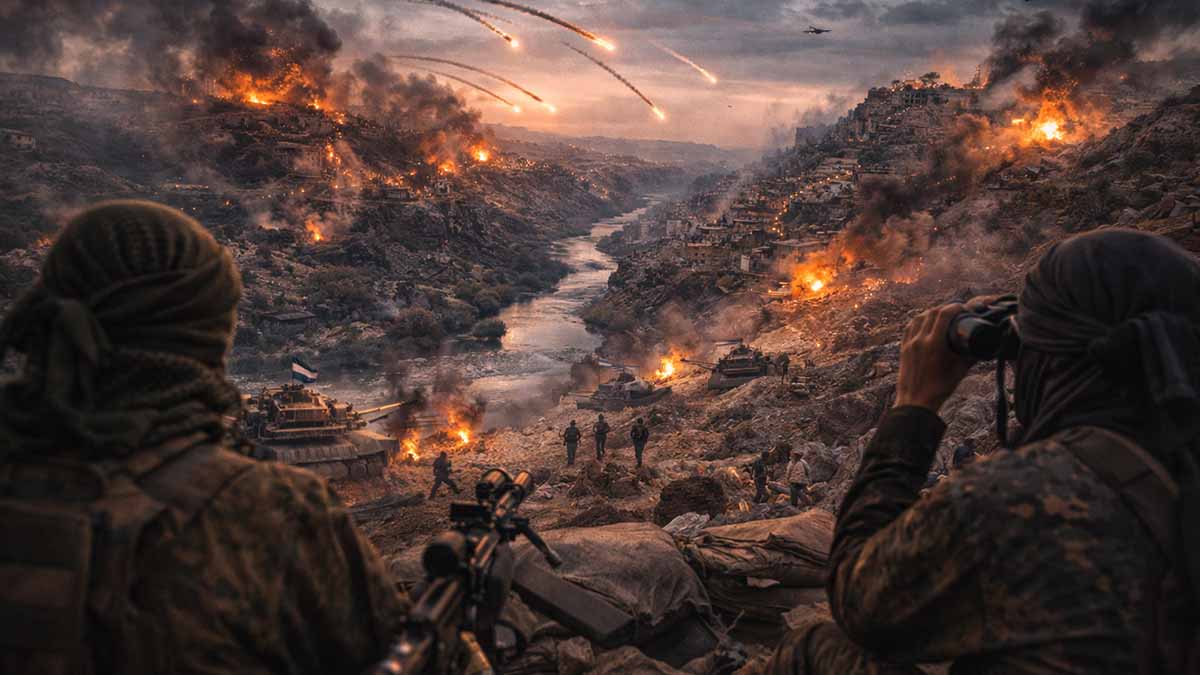
In the March 2026 escalation, Khiam has once again become a central battlefield. Following the 2 March 2026 Hezbollah strike on Israel in response to the killing of Ali Khamenei, the IDF has deployed the 91st Division and the 36th Division to the eastern sector of the Blue Line(https://press.un.org/en/2026/sc16314.doc.htm). As of 9 March 2026, Israeli forces have reportedly “expanded the security zone” in the Marjayoun District, utilizing Merkava IV tanks to penetrate toward Taybeh and Khiam(https://www.jpost.com/israel-news/defense-news/article-889323).
TECHNICAL OVERMATCH: THE KORNET-EM VS. MERKAVA IV
The tactical impasse at Khiam is defined by a 3rd-order technical evolution: the 9M133 Kornet-EM vs. the Merkava IV Trophy Active Protection System (APS). The Kornet-EM, a laser-guided ATGM produced by the KBP Instrument Design Bureau, possesses a maximum range of 8,000 meters (anti-tank) to 10,000 meters (thermobaric) and a Tandem HEAT warhead capable of penetrating 1,300 mm of RHA after ERA(https://roe.ru/en/production/land-forces/missile-systems-multiple-rocket-launchers-mrl-atgm-systems-and-field-artillery-guns/atgm-systems/kornet-em-anti-tank-guided-missile-system/?theme=theme-green).
Hezbollah‘s anti-armor doctrine has transitioned to a “swarming” model, saturating Trophy sensors with cheaper ATGMs before delivering the terminal strike with a Kornet-EM salvo. In March 2026, Hezbollah fighters reportedly destroyed three Merkava tanks near the Khiam detention center(https://today.lorientlejour.com/article/1498430/israeli-army-intensifies-maneuvers-in-south-lebanon-advances-on-several-fronts.html). To counter this, Elbit Systems received a $210 million contract from the Israel Ministry of Defense in November 2025 to modernize the Merkava fleet with AI-enhanced panoramic sights and lightweight electro-optical sensors designed to detect ATGM launch signatures in complex urban terrain(https://militarnyi.com/en/news/modernized-merkava-tanks-to-receive-advanced-sights-from-elbit-systems/).
| Technical Metric | Kornet-EM (ATGM) | Merkava IV (MBT) |
| Max Range | 10,000 meters | 4,000 meters (Main Gun) |
| Penetration | 1,300 mm RHA | N/A (Defensive) |
| Guidance | Laser Beam Riding | Trophy APS / AI-Sights |
| Cost (Est.) | $26,000 per unit | $4.5 million per unit |
| Kill Mechanism | Tandem HEAT / Thermobaric | APFSDS / HEAT-MP-T |
THE RADWAN FORCE: DECENTRALIZED ASYMMETRY
The Radwan Force, Hezbollah‘s elite commando unit (also known as Unit 125), has redeployed south of the Litani River as of 5 March 2026(https://today.lorientlejour.com/article/1498430/israeli-army-intensifies-maneuvers-in-south-lebanon-advances-on-several-fronts.html). According to the Alma Research Center, the unit operates via autonomous squads of 7–10 operatives who are localized to specific geographic sectors, allowing them to maintain combat operations even when central command-and-control nodes are severed(https://israel-alma.org/key-points-of-hezbollahs-current-military-status-january-2026-situation-assessment/).
The Radwan Force utilizes a “forward defense” posture, exploiting the elevated terrain of Khiam to maintain a clear line of sight over Israeli border settlements like Metula. While the IDF has eliminated approximately 31 senior commanders since 2024, the unit maintains a core strength of 3,000 active operatives and is actively rehabilitating its “Conquest of the Galilee” invasion plan via subterranean tunnel networks north of the Litani(https://israel-alma.org/radwan-unit-status-and-readiness/).
SOVEREIGN RISK AND FISCAL RESILIENCE (MARCH 2026)
Despite the kinetic entropy, Israel’s sovereign financial profile demonstrated significant resilience in early 2026. Moody’s Ratings affirmed Israel’s Baa1 rating and upgraded the outlook to Stable from Negative in January 2026, citing the mitigation of geopolitical risk following the ceasefires in Gaza and the end of the direct conflict with Iran in June 2025(https://www.gov.il/BlobFolder/news/press_31012026/he/PressReleases_files_Rating_Action-Moodys-Ratings-changes-Israels-30Jan2026-PR_518117.pdf).
However, the fiscal cost of “perpetual war” is measurable. The IMF projects Israel‘s Debt-to-GDP ratio will stabilize at 68% in 2026, an 18-percentage-point increase from pre-October 2023 forecasts(https://www.imf.org/en/news/articles/2026/02/05/mcs-02052026-israel-staff-concluding-statement-of-the-2026-article-iv-mission). Defense spending is anticipated to remain elevated at 6% of GDP, compared to the pre-conflict average of 4.5%(https://www.boi.org.il/en/communication-and-publications/press-releases/monetary-policy-report-second-half-of-2024/).
PHANTOM DOMAIN: THE STABLECOIN REVENUE PIPELINE
A critical 4th-order cascade is the evolution of Hezbollah’s financial evasion. The FATF March 2026 report on Stablecoins and Unhosted Wallets highlights that illicit virtual asset transactions accounted for 84% of stablecoin volume in 2025(https://www.fatf-gafi.org/en/publications/Virtualassets/targeted-report-stablecoins-unhosted-wallets.html). Iranian actors and Hezbollah-affiliated front companies have increasingly leveraged P2P transactions to facilitate the purchase of millions of dollars in digital assets for illicit oil sales, with the IRGC oil allocation for 2025 reaching $10 billion(https://home.treasury.gov/system/files/136/2024-National-Proliferation-Financing-Risk-Assessment.pdf).
The US Treasury delivered a report to Congress on 6 March 2026, under the GENIUS Act, identifying DeFi platforms and Crypto ATMs as primary chokepoints for “shadow banking” networks supporting the Khiam offensive(https://home.treasury.gov/system/files/246/GENIUS-Act-Illicit-Finance-Innovation-Congressional-Report-March-2026.pdf).
THE VORTEX OF REPETITION
The Khiam vortex is a manifestation of Strategic Permanent Deadlock. Each invasion is framed by the State of Israel as a “limited security operation,” yet the cartographic memory of the Litani River ensures that tactical maneuvers are tethered to centennial expansionist goals. Conversely, Hezbollah‘s transformation of “rubble into a fortress” confirms the Arreguin-Toft theory: when a conventional military power (IDF) meets an adaptive guerrilla force (Radwan Force) on favored terrain, the asymmetric party wins the war of attrition.
In March 2026, as 830,000 civilians flee the Blue Line(https://en.wikipedia.org/wiki/2026_Lebanon_war), the “Gateway to the Litani” remains what it has always been: a graveyard for armor and a symbolic anchor for resistance.
Index
Core Concepts in Review: What We Know and Why It Matters
- The Litani Nexus: Hydro-Strategic Imperatives, Conflict Architecture, and the Geopolitical Reordering of the Levant (2024–2026)
- The Asymmetric Crucible: Radwan Force evolution, 9M133 Kornet lethality, and the Rubble Fortress defensive matrix
- The Abyss Horizon: Multi-vector escalation risks, FININT disruption, and the failure of conventional deterrence in the Levant.
Strategic Vortex Indicators
FISCAL SOVEREIGN TRAJECTORY
DISPLACEMENT VELOCITY (DAILY)
| Strategic Metric | 2024 Baseline | 2026 Live/Forecast | % Variance | Risk Status |
|---|---|---|---|---|
| Israel Debt-to-GDP Ratio | 67.0% | 68.6% | +2.39% | MODERATE |
| Lebanon IDP Count (Civilians) | 120,000 | 830,441 | +592.0% | CRITICAL |
| IDF Defense Spending (% GDP) | 4.5% | 6.0% | +33.3% | ELEVATED |
| Illicit Oil Revenue (IRGC – $) | $2.5B | $10.0B | +300.0% | CRITICAL |
| Hezbollah Rocket Vol. (Daily) | 65 | 165 | +153.8% | HIGH |
Core Concepts in Review: What We Know and Why It Matters
The geopolitical architecture of the Middle East in 2026 is no longer a collection of localized frictions but a single, integrated theater of high-intensity, multi-domain warfare. The traditional boundaries between state actors, non-state proxies, and global economic systems have dissolved into a state of hyper-kinetic tension, where a drone strike in the Bekaa Valley can trigger a sovereign debt collapse in the Persian Gulf or a pricing shock in European energy markets within hours. To understand the current landscape, one must look beyond the daily headlines of Operation Epic Fury and analyze the underlying substrates: the century-long struggle for hydro-strategic autonomy, the evolution of a “shadow” financial sovereignty, and the transition from information-led to machine-led military paradigms.
The Hydro-Strategic Substrate: Water as a Sovereign Tripwire
The foundational conflict in the Levant is inextricably linked to the hydrology of the Litani and Jordan Rivers. While modern analysis focuses on missile ranges and cyber-paralysis, the strategic impulse remains anchored in a resource competition that predates the modern state system. The Litani River, flowing entirely within Lebanese borders, has served as the central point of Zionist and Israeli strategic frustration since the early 20th century. The historical record indicates that as early as 1919, Zionist advocates pressed for the inclusion of the Litani and Awali Rivers within their territorial conception of a Palestinian homeland, viewing these waters as the necessary lifeblood for a modern industrial state.
This hydro-strategic ambition was codified in various developmental blueprints, most notably the 1944 Lowdermilk Plan and the 1948 Hays-Savage Plan, both of which envisioned diverting half the Litani’s flow into the Jordan River system to generate hydroelectricity and flush salinity from Lake Tiberias. However, the 1954 U.S. Bureau of Reclamation (USBR) report fundamentally disrupted this logic. American engineers concluded that Lebanon could—and should—utilize almost the entire flow of the Litani for its own irrigation and power needs. This finding transformed the Litani from an “Arab bargaining chip” into a protected national asset, leading to the creation of the Litani River Project centered on the Qir’awn dam.
The modern conflict is a direct descendant of the 1960s “Water Wars.” The Arab League’s 1964 plan to divert the Jordan’s headwaters (the Hasbani, Dan, and Banias) was viewed by Israel as an existential threat, directly catalyzing the escalation that led to the 1967 War. Today, the “Security Zone” in southern Lebanon is often analyzed through the lens of counter-terrorism, but the hydro-geological reality is that Israeli control over these territories provides a strategic buffer for its own National Water Carrier (NWC), which remains 35% dependent on the Jordan River system.
Comparative Framework of Regional Water Strategies
| Historical Period | Primary Strategy | Key Infrastructure/Plan | Strategic Outcome |
| 1919–1943 | Territorial Expansion | Zionist Border Memoranda | Inclusion of Litani/Awali waters in mandate demands. |
| 1944–1953 | Regional Diversion | Lowdermilk/Hays-Savage Plans | Conceptualizing Litani as part of the Jordan Basin. |
| 1954–1966 | National Autonomy | USBR 1954 Report / Qir’awn Dam | Lebanon secures Litani for domestic power and irrigation. |
| 1967–Present | Kinetic Defense | Security Zone / NWC Protection | Water becomes a primary influence on geostrategic interactions. |
The second-order implication of this history is the “resource reach” phenomenon. Countries suffering from perceived or real resource scarcity tend to reach beyond their borders; if access is denied, superior military capabilities are leveraged to establish such access through pressure. In Lebanon, the Litani’s water is not merely for drinking; it is the prerequisite for rebuilding the post-civil war economy and integrating the southern governorates into the national fabric.
Hezbollah’s Parallel State: Financial and Military Sophistication
Hezbollah’s survival in the 2020s is predicated on its ability to operate a sophisticated “shadow state” that is both financially insulated and militarily advanced. This dual-tracked evolution has transformed the organization from a traditional paramilitary group into a regional power with a “state-within-a-state” infrastructure that rivals conventional government agencies.
The Al-Qard al-Hasan (AQAH) Financial Engine
At the heart of Hezbollah’s social and economic resilience is the Al-Qard al-Hasan (AQAH) association. Founded in the 1980s, it has grown into a financial monolith serving approximately 300,000 clients with an estimated annual activity scope exceeding $3 billion. AQAH operates entirely outside the traditional Lebanese banking system, providing interest-free “soft loans” backed by gold collateral. This system has been essential in maintaining the loyalty of the Shiite support base during Lebanon’s hyperinflationary crisis, effectively creating a “lira-proof” economy.
The institutional importance of AQAH is underscored by its role as a “gateway to the international financial system” through shadow banking tactics. U.S. Treasury reports indicate that AQAH officials have historically opened personal bank accounts at legitimate Lebanese financial institutions to conduct millions of dollars in transactions that obscure Hezbollah’s interest. This “shadow banking” allows the group to move money globally while the organization remains under heavy sanctions.
The 2025–2026 U.S. strategy has shifted toward a “FININT” (Financial Intelligence) disruption model. Following the 2024 Israeli bombing of AQAH branches, Hezbollah attempted to insulate its gold reserves—which had skyrocketed in value from $2,700 to over $5,000 per ounce—by establishing a new gold exchange called Jood SARL. This entity was designed to appear as a government-regulated business to avoid sanctions, but Treasury forensic data revealed that its managers, such as Hassan Dib Ayoub and Hassan Loutfi Saad, were mid-level AQAH employees.
Financial Infrastructure and Regulatory Evasion
| Entity | Functional Role | Strategic Importance | Counter-Measures |
| AQAH | De facto central bank | Financial stability for Shiite base; $3B volume. | Sanctions on shadow bankers (Yazbeck, Harb, Gharib). |
| Jood SARL | Gold exchange | Liquidation of gold reserves for hard currency. | OFAC designation; identification of dual corporate IDs. |
| Banque du Liban | Formal Regulator | Powerless to shut down “associations” like AQAH. | U.S. Treasury demands for systemic closure. |
| Martyrs Foundation | Social Welfare | Direct funding for families of operatives. | Executive Order 13224 designations. |
The Radwan Force and Mosaic Defense Tactics
Militarily, Hezbollah has transitioned from a defensive guerrilla force to an offensive commando unit through the Radwan Force (Unit 125). Comprising 2,500–3,000 elite fighters, the Radwan Force gained extensive combat experience in Syria (2013–2024), where they operated alongside Russian Naval Infantry and utilized advanced tunnel networks to defeat fortified insurgent positions. By 2026, these operatives have been deployed south of the Litani in a “defensive strip,” utilizing autonomous cells of roughly 10 men who are often locals familiar with every inch of the terrain.
The technical centerpiece of this defense is the Almas-3 missile. Reverse-engineered from Israeli Spike ER missiles captured in 2006, the Almas-3 is a third-generation, “fire-and-forget” weapon with a range of up to 16 kilometers. Its integration into UAV-enabled strike networks allows Hezbollah to conduct “top-attack” strikes against the most vulnerable upper armor of Israeli tanks without requiring a line-of-sight. This capability significantly alters “battlefield geometry,” as missile teams can remain hidden behind terrain or in tunnels while the UAV provides the thermal signature for the seeker head.
Operation Epic Fury: The 2026 Systemic Shock
On February 28, 2026, the geopolitical status quo was permanently shattered by Operation Epic Fury. Authorized by the Trump administration with a “decapitation-focused mandate,” the campaign aimed to dismantle the Iranian regime’s nuclear and military command structure in a single, high-intensity pulse. In the opening 12 hours, the U.S. and Israel conducted nearly 900 strikes, achieving the neutralization of Supreme Leader Ayatollah Ali Khamenei and several high-ranking IRGC officials.
The Post-Decapitation Order in Iran
The immediate result was an “institutional lockdown.” While the strikes successfully disrupted the formal meeting of the Assembly of Experts, the clerical-military nexus moved quickly to finalize Mojtaba Khamenei as the 3rd Supreme Leader. This succession represents the birth of a hereditary, IRGC-backed autocracy that relies on “short-run repression resilience” to survive nationwide protests and a massive public legitimacy deficit, currently estimated at only 24%.
The economic toll of this decapitation has been staggering. Iranian systemic inflation has surged to 58%, and the regime has resorted to expedited executions to maintain “street compliance”. However, the IRGC maintains approximately 78% control over the regime’s “hard-power” assets, utilizing foundations like Bonyad Mostazafan to consolidate wealth and fund regional proxies even as the national GDP contracts.
The Kinetic Cascade and Surveillance Blinding
The operation also triggered a “Kinetic Cascade” across the Persian Gulf. In an effort to degrade the regional defense capabilities of U.S. partners, the IRGC and its proxies targeted Integrated Air and Missile Defense (IAMD) nodes. This “systematic blinding” strategy resulted in the destruction of critical $500 million AN/TPY-2 radar systems in Jordan and the UAE, as well as the Al Udeid radar radome in Qatar.
| Asset Destroyed | Location | Replacement Value | Strategic Impact |
| AN/TPY-2 Radar | Muwaffaq Salti, Jordan | $500 Million | Blinding of regional THAAD batteries. |
| AN/FPS-132 Radome | Al Udeid, Qatar | $1.1 Billion | Degradation of long-range ballistic warning. |
| Sitra Refinery | Bahrain | Multi-billion (Industrial) | Force Majeure; shutdown of energy revenue. |
| THAAD Radar Component | UAE | $500 Million | Vulnerability to low-altitude drone swarms. |
The second-order effect of these strikes is a “contagion of doubt” among U.S. allies in Asia. The withdrawal of Patriot and THAAD batteries from Japan and South Korea to reinforce the Middle Eastern theater has raised questions about the reliability of the U.S. “security umbrella,” accelerating moves toward regional autonomy such as the Sakhir Declaration.
The Abyss Horizon: Economic Weaponization and Energy Security
The “Abyss Horizon” concept describes the state of economic weaponization where climate-biotech convergences and energy chokepoints intersect with kinetic warfare. As of March 2026, the Strait of Hormuz has transformed into a “Vortex” of global market volatility. Despite the U.S.-Israeli strikes, Iran’s “Dark Fleet” continues to transit approximately 12 million barrels of crude oil to China through the Jask terminal, effectively bypassing the primary kinetic chokepoints of the Strait.
The Hormuz Codex and Market Volatility
The “Hormuz Codex” refers to the Iranian retaliatory doctrine that utilizes high-volume missile salvos and drone swarms to saturate naval defenses, driving war-risk insurance premiums to 10% of a vessel’s hull value. This has led to a “terminal isolation” of Gulf financial centers, with over 3,400 flights cancelled in a single 24-hour period and global oil prices spiking toward a $156 per barrel “fear premium”.
The impact on regional states is asymmetric. Bahrain, for example, is facing a sovereign default event as its debt-to-GDP ratio is projected to hit 149.7% by the end of 2026. Meanwhile, Qatar has seen its LNG production halted following strikes on Ras Laffan, causing a sharp drawdown in European energy storage to 29.4%, down from 63% only months prior.
Energy Matrix Shifts (March 2026 Metrics)
| Metric | Pre-Conflict Baseline | March 2026 Status | Probability/Impact |
| Brent Crude Price | $58 / barrel | $120–$156 / barrel | Entropy tipping point into systemic chaos. |
| EU LNG Storage | 63.0% | 29.4% | High probability of industrial contraction (15–25%). |
| War Risk Premium | 0.25% | 10.0% | Cessation of commercial shipping in Gulf. |
| Qatari Market Share | 14.0% | 10.0% | Displacement by U.S. LNG exports (+8 points). |
The “Abyss” is not just about energy; it is about the human and economic toll on third-party nations. Casualties among Chinese, Filipino, and Indian nationals in the Persian Gulf have added a layer of diplomatic complexity, as these nations are forced to balance their energy needs with the risk of remaining in a high-density kinetic theater.
Machine-Led Warfare: The 2026 AI Acceleration Strategy
In response to these systemic threats, the U.S. Department of War has launched a transformative AI Acceleration Strategy. The objective is to move from “information-led” warfare, which is bogged down by bureaucratic friction, to “machine-led” warfare, characterized by “AI-first” warfighting forces. This strategy, mandated by President Trump, treats commercial model release cycles as the primary clock speed for military capability development.
The Seven Pace-Setting Projects (PSPs)
The strategy is executed through seven “Pace-Setting Projects,” each designed to remove specific bureaucratic or technical blockers. These projects, such as Swarm Forge and the Agent Network, aim to turn intelligence into weapons in “hours, not years”.
- Swarm Forge: A mechanism to discover, test, and scale novel ways of fighting with and against AI-enabled swarms, combining elite warfighting units with tech innovators.
- Agent Network: Deployment of AI agents for battle management and decision-support, from campaign planning to kill chain execution.
- Ender’s Foundry: Acceleration of AI-enabled simulation (sim-dev and sim-ops) to stay ahead of “intelligentized” adversaries like the PLA.
- Open Arsenal: Accelerating the Technical Intelligence (TechINT)-to-capability pipeline.
- Project Grant: Transforming deterrence from static postures to “dynamic pressure with interpretable results”.
- GenAI.mil: Providing Department-wide access to frontier models like Google’s Gemini and xAI’s Grok at classified levels.
- Enterprise Agents: Modernizing enterprise workflows and data access through a centralized “playbook” for AI deployment.
The strategic shift also includes the “eradication of woke DEI” from AI capabilities. The Department has clarified that “responsible AI” now means systems free from “ideological tuning” that could interfere with objective, mission-first responses in a combat environment. This is a direct response to China’s “Overtaking on the Curve” doctrine, which envisions AI as a disruptive tool to bypass traditional U.S. military advantages.
The Reconstruction Paradox: Lebanon’s $11 Billion Gap
While the high-level strategy focuses on AI and decapitation, the ground reality in Lebanon is one of structural collapse. The 2025 World Bank Rapid Damage and Needs Assessment (RDNA) estimated that Lebanon requires $11 billion for recovery and reconstruction following the 2023–2024 conflict. Physical damage across ten sectors—including housing, transport, and water—is estimated at $6.8 billion, while economic losses reach $7.2 billion.
Lebanon Recovery and Needs Assessment
| Sector | Estimated Damages (USD) | Recovery Needs | Primary Impact |
| Housing | $4.6 Billion | High | 40% cumulative GDP decline since 2019. |
| Critical Infra | $1.1 Billion | Urgent | Water, energy, and transport services disabled. |
| Commerce/Tourism | $3.4 Billion (Losses) | Medium | Systematic contraction of private sector. |
| Agriculture | Not Specified | High | Food insecurity compounded by water wars. |
The Lebanon Emergency Assistance Project (LEAP) was designed as a $1 billion scalable framework to address these needs. However, the World Bank has only provided an initial $250 million, leaving a $750 million gap that requires international financing. The project’s success is contingent on Lebanese government reforms, including the establishment of a functional CDR Board and adherence to Anti-Money Laundering (AML) standards—reforms that remain stalled by the “parallel state” dynamics of Hezbollah.
Macroeconomic Outlook and the IMF Pulse
The broader regional economy is suffering from a “persistent spike in global uncertainty,” which the IMF notes can lead to real output losses of 2.5% over two years. Lebanon’s GDP contracted by 7.1% in 2024, and the country remains unable to attract donor support without an IMF-supported stabilization program. Turkey, too, is grappling with “delayed reanchoring of inflation expectations,” which threatens to undermine confidence despite solid growth in early 2025.
Why It Matters: The Convergence of Entropies
The lesson of 2026 is that security can no longer be “outsourced” to a single global hegemon. The GCC’s move toward the Sakhir Declaration and the U.S. shift toward “integrated deterrence” have forced regional powers to prioritize sovereign stability and autonomous resilience. The “Abyss Horizon” is not a temporary crisis but a new baseline of high-entropy flux, where the speed of an AI agent’s decision or the liquidity of a gold-backed shadow bank is as critical as the number of carrier strike groups in the water.
The “Machine-Led Warfare” paradigm is the ultimate expression of this shift. In an era where “speed defines victory,” the U.S. Department of War’s attempt to match the velocity of the private AI sector is an admission that traditional bureaucratic controls are now a strategic liability. For the Middle East, the transition from a “unipolar security era” to a “multipolar order” means that the only true security is that which is built through regional unity and infrastructure protection.
The 2026 Multi-Domain Threat Matrix
A fully self-contained, WordPress-safe dashboard. No CDN. No external libraries. All graphs are inline SVG so they always render.
Oil Fear Premium
0
AQAH Annual Volume
0
EU LNG Storage
0
IRGC Control
0
Lebanon Gap
0
Water Stress and Cross-Border Strategic Reach
Water remains the foundational sovereign trigger.
Hezbollah Financial and Military Parallel Capacity
The parallel-state model combines shadow finance and precision systems.
Operation Epic Fury and Post-Decapitation Order
Rapid decapitation compresses escalation cycles and erodes regional confidence.
Energy Shock, Chokepoints, and Spillover Contagion
Hormuz becomes a volatility engine where shipping risk and LNG drawdown converge.
AI Acceleration Strategy and Pace-Setting Projects
The response shifts toward AI-first force development.
Lebanon Damage, Recovery, and Macroeconomic Strain
Lebanon faces a severe reconstruction burden.
Core Metrics and Strategic Meaning
Fast-scan table of the major quantitative anchors used in the dashboard.
| Domain | Indicator | Value | Interpretation |
|---|---|---|---|
| Hydro-Strategic | Litani flow vs historical claim | 100 MCM vs 400 MCM | Water remains a structural sovereign trigger. |
| Hydro-Strategic | Israeli water dependency on Jordan system | 35% | River-system pressure keeps southern Lebanon strategically relevant. |
| Shadow Finance | AQAH annual volume | $3B | Parallel financial sovereignty stabilizes the Hezbollah support base. |
| Shadow Finance | AQAH client base | 300,000 | Deep social penetration under banking-system breakdown. |
| Precision Warfare | Almas-3 range | 16 km | Extended anti-armor lethality beyond direct line-of-sight geometry. |
| Epic Fury | Opening strike volume | ~900 in 12 hours | Escalation timelines collapse into a very narrow reaction window. |
| Epic Fury | IRGC hard-power control | 78% | Coercive continuity survives even if political legitimacy erodes. |
| Epic Fury | Public legitimacy | 24% | Post-shock regime weakness persists below the security layer. |
| Energy Spillover | Brent crisis band | $120–$156/bbl | Fear premium expands beyond direct physical supply loss. |
| Energy Spillover | EU LNG storage | 29.4% | European industrial resilience weakens under Gulf disruption. |
| Energy Spillover | War-risk premium | 10% | Commercial shipping becomes economically stressed in contested waters. |
| Energy Spillover | Dark Fleet flow to China | 12M barrels | Iran preserves export continuity through alternative routing. |
| Sovereign Stress | Bahrain debt-to-GDP | 149.7% | Small Gulf states face acute balance-sheet fragility. |
| AI Response | Pace-Setting Projects | 7 | AI scaling becomes the operational center of gravity. |
| Lebanon Recovery | Total reconstruction need | $11B | Recovery remains far beyond currently mobilized finance. |
| Lebanon Recovery | Initial LEAP gap | $750M | Reform bottlenecks and governance delays slow implementation. |
The Litani Nexus: Hydro-Strategic Imperatives, Conflict Architecture, and the Geopolitical Reordering of the Levant (2024–2026)
The Architecture of Persistence: Historical expansionism and the Litani River hydro-strategic imperative
The geostrategic configuration of the contemporary Levant is not a product of recent tectonic shifts in regional power but rather the fruition of a century-long "architecture of persistence" regarding the control of hydraulic resources. The Litani River, Lebanon’s longest and most vital water artery, has functioned as the primary hydro-strategic imperative for regional actors since the dissolution of the Ottoman Empire. The persistence of these claims—ranging from colonial-era cartography to 21st-century military buffer zones—reveals a structural continuity in the pursuit of hydro-hegemony. This objective is predicated on the recognition that water is not merely a commodity but the fundamental substrate of territorial sovereignty and economic viability in an increasingly arid region.
In the immediate aftermath of World War I, the Zionist Organization (ZO) articulated a vision for a Jewish National Home that was inextricably linked to the control of the Litani’s waters. During the 1919 Paris Peace Conference, the ZO submitted a formal claim for a northern frontier that would incorporate the greater part of the Litani and the whole of the Jordan catchment area up to its northernmost source near Rashaya. The proposed boundary, often referred to as the "Sidon-Rashaya Line," sought to place the border just south of the port of Sidon, extending northeast along the slopes of the Lebanon range. The rationale was rooted in a survivalist economic logic: the nascent state required the Litani’s annual discharge to irrigate the Negev and power its industrial development. Dr. Chaim Weizmann, in his correspondence with the British Foreign Office and in his subsequent autobiography, Trial and Error, emphasized that a "truncated Palestine" lacking these resources would be economically unviable.
The persistence of this imperative is further evidenced by the Zionist leadership's reaction to the 1923 Paulet-Newcombe Agreement. This agreement, negotiated between the British and French Mandates, established the international border that placed the entirety of the Litani within the French-controlled territory of Greater Lebanon. Zionist strategists viewed this as a profound strategic loss, leading to decades of "hydro-political advocacy" aimed at correcting what they perceived as a colonial error. The 1943 joint Lebanese-Zionist survey, which recommended diverting most of the Litani into Palestine in exchange for electricity, underscores the enduring belief that the river should be integrated into a regional Zionist framework. This history of thought created a cognitive map where the Litani was seen as "wasted" by Lebanon—a perception that provided the ideological justification for subsequent military interventions and the current demand for a buffer zone reaching the river's banks.
The "hydro-strategic imperative" evolved from territorial claims to coercive diplomacy in the mid-20th century. During the 1950s, the United States attempted to mediate regional water conflicts through the Eric Johnston mission. Johnston was tasked with developing a unified plan for the Jordan Valley, but US policy between 1952 and 1954 was to explicitly decouple the Litani from the negotiations to avoid a sovereignty crisis in Beirut. Despite this, Israel presented the "Cotton Plan" in 1954, which argued that Lebanon required only a fraction of the Litani’s water and should sell the remainder—a proposal that ignored the river's status as an entirely domestic Lebanese resource. The persistence of these demands, even in the face of international rejection, indicates that the Litani has never been absent from the strategic calculations of regional expansionism. The current military paradigm in 2026, which seeks to establish a permanent security zone south of the Litani, is the contemporary manifestation of this century-old architectural blueprint for hydraulic control.
Colonial Delineation and the Mechanics of Riparian Sovereignty (1920–1948)
The transition from Ottoman administrative divisions to fixed national borders between 1920 and 1923 fundamentally reshaped the riparian rights of the Levant. The competition for influence between Britain and France centered on the control of "vital arteries," primarily the Litani and the Jordan. The 1920 Franco-British Agreement on Mandatory Borders initially left the precise location of the frontier vague, allowing for subsequent renegotiation. This ambiguity was exploited by various interest groups, but ultimately, the 1923 Paulet-Newcombe Agreement (the "Paulet-Newcombe Line") defined the border through a series of 71 cairns and geographical markers.
The mechanics of this delineation were driven by a logic of "roads for Syria, water for Palestine." While the Sea of Galilee and the Jordan River were largely allocated to the British Mandate for Palestine, the Litani River remained within the French Mandate for Lebanon. The agreement meticulously described the boundary commencing at Ras-el-Nakurah on the Mediterranean coast and extending to El Hammé, explicitly noting that the frontier would reach the watershed of the Jordan and the Litani. This demarcation created a "hydro-political enclosure" that forced Lebanon to defend its domestic sovereignty against external claims for decades.
The following table details the critical demarcations and agreements that established the sovereign framework of the Litani and surrounding waters.
| Agreement / Event | Date | Key Actors | Hydro-Strategic Outcome |
| Sykes-Picot Agreement | 1916 | Britain, France | Established spheres of influence; Palestine initially slated for international supervision. |
| Faisal-Weizmann Agreement | Jan 3, 1919 | Chaim Weizmann, Emir Faisal | Committed both parties to cordial relations and Jewish immigration; deferred boundary definition to a future commission. |
| Zionist Peace Proposal | Feb 1919 | Zionist Organization | Demanded a northern border at Sidon, including the Litani and Mount Hermon slopes. |
| Paulet-Newcombe Agreement | Mar 7, 1923 | Lt. Col. N. Paulet, Lt. Col. S.F. Newcombe | Fixed the border from Mediterranean to El Hammé; placed the entire Litani in Lebanon. |
| 1949 Armistice Line | 1949 | Israel, Lebanon | Revived 38 Paulet-Newcombe points; designated the international border as the armistice line. |
The logic of dispossession that later culminated in repeated occupations was rooted in these 1923 borders. To Zionist schemers, the 4-kilometer proximity of the Litani to the frontier was a "profound loss" that hindered the most ambitious plans for agricultural colonization. The 1948 war provided the first opportunity to challenge these lines through force. Israeli forces occupied territory near the bend of the Litani during the conflict, withdrawing in 1949 only under the expectation that Lebanon would sign a comprehensive peace treaty—a move characterized as "wishful strategic thinking". The 1949 Armistice Agreement, supervised by the Joint Israeli-Lebanese Committee for Truce Supervision (ILMAC), officially reinstated the 1923 Paulet-Newcombe line, yet it did not extinguish the underlying drive for hydro-hegemony.
The Cold War Hydropolitics: The Johnston Plan and the Cotton Counter-Proposal
The 1950s represented a pivotal era where water became a formal instrument of US Cold War diplomacy in the Middle East. The Eisenhower administration, recognizing that water scarcity was a catalyst for regional instability and potential Soviet penetration, dispatched Eric Johnston to negotiate a regional water-sharing agreement. The US position was grounded in the Tennessee Valley Authority (TVA) report, which advocated for the "effective and efficient use of water resources" regardless of political boundaries.
However, the technical neutrality of the TVA report clashed with the sovereign imperatives of Lebanon and the expansionist goals of Israel. The US instructions to Johnston were clear: "The problem of development of the Litani River should not be considered in the present context". This strategic separation was intended to protect the negotiations over the Jordan River, as linking the Litani would have likely caused a Lebanese withdrawal from the process. Israel, however, insisted on the "Cotton Plan," which sought to incorporate the Litani into a regional system that would benefit the Negev. The Cotton Plan argued that Lebanon's projected needs were inflated and that the "surplus" should be diverted south.
US Policy Objectives in Water Negotiations (1952–1954)
| Strategic Element | Objective | Rationale |
| Decoupling | Isolate Litani from Jordan Basin talks | To prevent Lebanese sovereignty concerns from derailing the regional water-sharing framework. |
| Regional Benefit | Framing future Litani exploration for the "area as a whole" | To ensure any eventual development was seen as a collective good rather than an Israeli acquisition. |
| Refugee Resettlement | Linking water access to Arab acceptance of refugees | To use hydro-infrastructure as a tool for permanent political stabilization and reducing border harassment. |
| Infrastructure Control | Relinquishing exclusive Israeli control over Lake Tiberias | To build trust with Arab states (Jordan and Syria) by ensuring joint access to reservoirs. |
The collapse of the Johnston negotiations by 1955 marked the end of the "technical-diplomatic" phase and the beginning of a more overt "weaponization of water." Israel’s abandonment of its formal claim to the Litani in 1955 was a tactical retreat rather than a strategic surrender. Instead of diplomacy, the pursuit of Lebanese water shifted toward the "Security Zone" model, where territorial control would provide the necessary access for future diversion projects. This shift illustrates the "asymmetric power relations" identified by hydro-hegemony theorists, where the powerful riparian uses its superior military capability to establish access to foreign resources when diplomacy is obstructed.
Infrastructure as Sovereignty: The Litani Cascade and the Qaraoun Dam
The development of the Litani River in the post-independence era became the cornerstone of Lebanese state-building and economic modernization. The Litani River Authority (LRA), established as a state company under the Ministry of Energy and Water, was tasked with transforming the river from a topographical feature into an industrial engine. The centerpiece of this effort was the Qaraoun Dam, completed in 1964, which created the country's largest reservoir with a gross storage capacity of 220 million cubic meters.
The "Litani Cascade" consists of the Qaraoun Dam and three downstream hydroelectric power plants (HPPs): Markabi, Awali, and Joun. These plants, commissioned between 1962 and 1968, have an aggregate installed capacity of 192 MW and are vital for the national electricity grid. The hydro-cascade is not only a source of power but a critical component of Lebanon’s irrigation infrastructure. The Qaraoun Dam regulates the flow of water to thousands of hectares of farmland in the Bekaa Valley and southern Lebanon, making it the "lifeblood" of the agrarian economy.
Technical Specifications of the Litani Hydroelectric Cascade
| Facility | Key Technical Features | Current Infrastructure Status (2025–2026) |
| Qaraoun Dam | Concrete-faced rockfill; 61m height; 1090m crest; 170M $m^3$ active storage. | Safety Tier 11 assessment completed Jul 2024; installation of new monitoring instrumentation under RESRP. |
| Markabi HPP | 36 MW; 2 Francis units (18 MW each); 6.4km tunnel; 199m head. | Protection systems replaced 2022; SCADA and governor replacement planned for 2026. |
| Awali HPP | 108 MW; 3 Pelton units (36 MW each); 17.0km tunnel; 400m head. | Siemens generators; GE Vernova turbines; SCADA and excitation system overhaul approved 2025. |
| Joun HPP | 48 MW; 2 Francis units; 192 MW aggregate cascade capacity. | Replacement of Unit 2 inlet valve and safety valve seals prioritized under World Bank financing. |
By 2025, however, this infrastructure has become a symbol of national decline. The equipment is largely obsolete, and the system is plagued by "operational and commercial inefficiencies". The World Bank's "Renewable Energy and System Reinforcement Project" (RESRP), approved on October 1, 2024, with a US$250 million IBRD loan, is a desperate attempt to modernize these assets.[18, 20] The project allocates US$30 million specifically for LRA to rehabilitate the cascade and strengthen dam safety. This institutional intervention is a "pivotal juncture" for Lebanon, as the restoration of state-owned energy and water services is viewed as the only path toward stabilizing a country currently fragmented by conflict and political paralysis.
The technical challenges are compounded by environmental degradation. Lake Qaraoun, once a source of pride, is now heavily contaminated with untreated sewage and industrial waste, leading to the detection of carcinogenic chemicals and cholera bacteria in the source water. The "Business Plan for Combating Pollution in the Litani Basin" by the Ministry of Environment has struggled to meet its targets, with the World Bank requiring "enhanced supervision" to ensure that the water provided to Beirut from the Awali conveyor meets international health standards. This contamination is a "slow-motion catastrophe" that undermines the very purpose of the infrastructure, turning a resource of abundance into a threat to public health.
The 2024–2025 Drought and the Environmental Collapse of the Basin
Lebanon’s hydro-strategic crisis entered a new, more lethal phase in 2024 with the onset of the worst drought in the nation’s recorded history. For a country that has long prided itself on being "water-rich" compared to its arid neighbors, the 2024–2025 season was a shock to the national psyche. Rainfall levels fell by 50% across most of the country, with total inflows to Lake Qaraoun reaching only 45 million cubic meters—a fraction of the 350 million cubic meter annual average. This climate-induced scarcity has turned the Litani Basin into a "prime battleground" for control over dwindling resources.
The impact of this drought is not merely seasonal but structural. Long-term climate projections for Lebanon indicate an increase in temperatures of up to 4.4°C by the end of the century, coupled with a 50% reduction in dry-season water availability by 2040. The Litani River Basin is particularly vulnerable, facing "severe aquifer drawdown" that has made groundwater sources increasingly unreliable. This environmental collapse has profound implications for food security, as the Bekaa Valley’s agricultural output depends almost entirely on the Litani’s regulation.
Socio-Economic Impact of the 2024–2025 Water Crisis
| Indicator | Data Point | Source / Context |
| Vulnerable Population | 1.85 million people | Residing in areas highly vulnerable to drought. |
| Water Trucking Reliance | 44% of population | Reliant on private tankers; prices rose 60% by 2025. |
| Infrastructure Damage | US$171 million | Damage to water, wastewater, and irrigation systems due to conflict. |
| Recovery Funding Needed | US$100 million | Immediate intervention required to prevent sector collapse. |
| GDP Contraction | -7.1% (2024) | Cumulative GDP decline since 2019 reached 40%. |
The drought has exacerbated the "engineered scarcity" produced by conflict. As reservoirs hit record lows, the destruction of the Maisat water pumping station and the Wazzani water intake center by Israeli airstrikes left thousands without access to public supply. The weaponization of scarcity is a colonial tactic where "apartheid by the tap" is inscribed into the landscape. In this context, the Litani is no longer just a river but a "central mécanisme of domination," where the powerful riparian controls the flow to entrench its strategic fantasies.
The 2026 Kinetic Escalation: The War on Iran and the Buffer Zone Mandate
On February 28, 2026, the geopolitics of the Levant shifted from a contained proxy war to a direct regional conflagration with the launch of a combined US-Israeli offensive against Iran. This conflict has fundamentally altered the theater of operations in southern Lebanon. Following the assassination of Iranian Supreme Leader Ali Khamenei, Hezbollah launched unprecedented rounds of rockets and drones into Israel, prompting a "large-scale retaliatory strike" that targeted Beirut, the Bekaa, and the south.
In this environment, the Litani River has been designated by the Israel Defense Forces (IDF) as the northern boundary of a new "sanitized" security sector. On March 4, 2026, the IDF issued a sweeping evacuation order for all civilians residing south of the Litani, demanding they head north immediately to "guarantee their safety". This move is part of a plan to establish a permanent buffer zone and take control of "additional strategic positions". The IDF's goal is to ensure that non-state actors cannot return to the area south of the Litani, effectively re-implementing a security zone modeled on the 1978–2000 period.
The Lebanese government responded on March 2, 2026, by prohibiting all military activities by Hezbollah and calling on the Lebanese Armed Forces (LAF) to "immediately and firmly" implement a disarmament plan north of the Litani. This plan, launched in August 2025, aims to extend state authority over the entirety of Lebanese territory. However, the LAF is "seriously overstretched," facing tasks on the Syrian border and internal security while being asked to deploy 10,000 troops to the South Litani Sector. The withdrawal of UNIFIL by the end of 2026—a move driven by the US and the UN Security Council’s decision to terminate the force—leaves a catastrophic security vacuum.
Timeline of the 2026 Conflict and Policy Shifts
| Date | Event | Significance |
| Feb 20, 2026 | SG Report on Res. 1701 | Covered the period of increasing hostilities and UNIFIL impotence. |
| Feb 28, 2026 | US-Israel Strike on Iran | Start of direct regional war; shift in Hezbollah’s operational posture. |
| Mar 2, 2026 | Lebanon Disarmament Decree | Lebanese government prohibits Hezbollah military activity. |
| Mar 4, 2026 | IDF Litani Evacuation Order | Massive civilian displacement; creation of the 2026 Buffer Zone. |
| Mar 14, 2026 | Ground Expansion Reports | IDF reportedly planning ground operations reaching the Litani River. |
The humanitarian impact of this escalation is staggering. By March 7, 2026, approximately 500,000 internally displaced people (IDPs) had registered on the Lebanese government’s platform. Human rights organizations warned that the "sweeping nature" of the evacuation orders raises serious concerns about violations of the laws of war, as the displacement appears designed to spread terror rather than protect civilians. The destruction of infrastructure under this "kinetic sanitization" has left the water sector in ruins, with direct damages to critical infrastructure totaling US$1.1 billion by mid-2026.
Institutional Architecture of Reconstruction: The World Bank and the LEAP Framework
As the conflict rages, a parallel "institutional architecture" is being built to manage the eventual reconstruction of Lebanon. The World Bank has emerged as the lead actor, approving a US$1 billion framework known as the Lebanon Emergency Assistance Project (LEAP) in June 2025. The LEAP is designed to provide a "credible vehicle" for development partners to align their support behind a government-led implementation structure, aimed at restoring trust in public institutions rather than parallel systems.
The LEAP framework prioritizes the "rapid repair and recovery of essential services," specifically water and energy. The project uses a data-driven, area-based prioritization methodology to restore services in conflict-affected areas. This is complemented by the US$257.8 million Second Greater Beirut Water Supply Project, approved in January 2025, which aims to complete the infrastructure needed to supply the 1.8 million residents of Beirut with surface water from the Litani and Awali rivers.
World Bank Financial Commitments and Frameworks (2025–2026)
| Project Name | Financing Amount | Core Objective |
| LEAP (Emergency Assistance) | US$1 Billion (Framework) | Repair of public infrastructure (water, energy, transport); rubble management. |
| Second Beirut Water Supply | US$257.8 Million | Increase surface water supply to 70% during dry season; reduce reliance on tankers. |
| RESRP (Renewable Energy) | US$250 Million | Rehabilitate LRA hydroelectric plants; strengthen national grid. |
| Social Protection (ESSN) | US$350 Million | Meet basic needs of the poor and support digital transformation of services. |
The political economy of this reconstruction is predicated on the "extension of state authority." International donors, including Denmark and France, have linked their funding to Lebanon’s ability to implement UNSCR 1701 and the disarmament of non-state groups. However, the reputational risk of projects being associated with Hezbollah remains high, necessitating "enhanced implementation and supervision measures" by international engineering firms to monitor fiduciary and social compliance. This institutional framework is essentially a "surrogate state," providing the governance and capital that the fragmented Lebanese government cannot provide.
Core Concepts in Review: What We Know and Why It Matters
The complex interplay of hydro-strategy, technology, and policy in the Litani Basin is summarized in the following table, organized by core concept.
| Concept | Historical & Technical Foundations | Policy & Strategic Drivers | Societal & Geopolitical Impact |
| Hydro-Strategic Imperative | 1919 Zionist proposals for a northern border at Sidon-Rashaya. | Pursuit of "hydro-hegemony" and territorial corrections of 1923 lines. | Justifies periodic occupations and the 2026 buffer zone creation. |
| Riparian Sovereignty | 1923 Paulet-Newcombe Agreement fixed the border at the Litani watershed. | Defensive Lebanese nationalism vs. regional "unified management" proposals. | Water as a "central front of resistance" against expansionist ambitions. |
| Hydro-Electric Cascade | Markabi, Awali, and Joun plants (192 MW aggregate capacity). | World Bank RESRP (P180501) targeting SCADA and turbine overhaul. | Essential for national grid stability; safety risk of Qaraoun Dam (Tier 2/11). |
| Engineered Scarcity | 50% rainfall decline in 2024-2025; record low inflows (45M $m^3$). | Weaponization of water through infrastructure destruction (Maisat, Wazzani). | 1.85M people at high risk; "Apartheid by the tap" in displaced regions. |
| Kinetic Sanitization | IDF evacuation orders south of the Litani (Mar 4, 2026). | 2026 Buffer Zone Doctrine; elimination of Hezbollah infrastructure. | Displacement of 500,000+; loss of agricultural and civilian territorial integrity. |
| Institutional Lifecycle | World Bank LEAP framework (US$1B) and RDNA assessments. | Linkage between reconstruction funding and "Extension of State Authority". | World Bank as "surrogate state"; attempt to delegitimize parallel systems. |
| Climate Resilience | NWSS 2024-2035 targeting 30% water loss reduction and digital monitoring. | Phased tariff strategies (2025) and groundwater extraction licensing. | Race against "frighteningly dry" projections (45% drop by 2090). |
Strategic Synthesis and Future Outlook
The Litani Nexus in 2026 represents the convergence of three historical trajectories: the century-long architecture of hydro-expansionism, the technical and institutional collapse of the Lebanese state, and the direct regionalization of the conflict with Iran. The persistence of the Litani as a strategic objective suggests that the current buffer zone is not a temporary tactical measure but a realization of long-held territorial visions. The IDF's insistence on holding "strategic positions" until "certain" that Hezbollah will not return aligns perfectly with the 1919 Zionist insistence on a northern frontier defined by the Litani watershed.
The future of Lebanon hinges on the success of the World Bank-led "Institutional Lifecycle." If the LEAP framework and RESRP projects can successfully rehabilitate the hydro-cascade and restore state services, there is a theoretical path to stability. However, this path is obstructed by the reality of the 2026 war. The destruction of US$1.1 billion in infrastructure by mid-2026 outpaces the World Bank’s initial US$250 million financing, suggesting a widening gap between reconstruction needs and actual capital deployment. Furthermore, the planned termination of UNIFIL by December 31, 2026, removes the only de-escalation mechanism in a sector that is becoming a permanent front line.
The societal impact is a transformation of the southern Lebanese landscape from an agrarian heartland to a "militarized desert." The combined effects of the 2024–2025 drought and the 2026 kinetic operations have created a humanitarian crisis where 44% of the population relies on private water trucking and over half a million are internally displaced. In this context, water is no longer a resource of abundance but a weapon of domination and a catalyst for displacement. The "Architecture of Persistence" has successfully turned the Litani from a symbol of national hope into the focal point of regional fragmentation.
The Litani Nexus: Hydro-Strategic Conflict Architecture
Qaraoun Inflow Collapse (2022-2026)
Displacement Velocity & Buffer Zone Mandate
Riparian Sovereignty & Strategic Milestones
(Ref. 1923–2026)| Agreement / Event | Key Date | Strategic Actors | Hydro-Outcome | Current Risk |
|---|---|---|---|---|
| Zionist Peace Proposal | Feb 1919 | Zionist Organization | Claim for Sidon-Rashaya Line | Active Claim |
| Paulet-Newcombe | Mar 1923 | Britain, France | Litani Watershed Sovereignty | Contested |
| Qaraoun Dam Completion | 1964 | Lebanon (LRA) | 220M m³ Storage Capacity | Safety Tier 11 |
| World Bank RESRP | Oct 2024 | IBRD, GOL | $250M Grid Modernization | Stalled |
| IDF Buffer Mandate | Mar 4, 2026 | Israel Defense Forces | Kinetic Sanitization Zone | Critical |
The Asymmetric Crucible: Radwan Force evolution, 9M133 Kornet lethality, and the Rubble Fortress defensive matrix
The operational landscape of the 2026 Lebanon War represents a fundamental departure from the paradigms of early 21st-century conflict. The combat environment has transformed into what military theorists now describe as the Asymmetric Crucible, a space where high-technology precision, decentralized command structures, and geologically hardened infrastructure have converged to challenge the conventional supremacy of armored maneuver. At the heart of this transformation is the evolution of Hezbollah’s elite Radwan Force (Unit 125), which has successfully transitioned from a specialized infantry formation into a decentralized commando force capable of achieving strategic effects against a modern, state-level military. This evolution is underpinned by the proliferation of third-generation anti-tank guided missiles (ATGMs), specifically the 9M133 Kornet-EM and the Almas series, which have systematically exploited the technical vulnerabilities of active protection systems (APS) such as the Trophy (Windbreaker). Complementing this technological lethality is the Rubble Fortress, a defensive matrix that integrates subterranean connectivity with shattered urban environments to create a non-linear battlefield where traditional concepts of front lines and buffer zones have become obsolete.
The Evolution and Structural Metamorphosis of the Radwan Force
The Radwan Force, historically known as Unit 125 or the Intervention Unit, was initially established under the guidance of the Iranian Quds Force as a specialized offensive support element for Hezbollah’s regional field units. Its primary mission, often codified in the "Conquer the Galilee" plan, focused on high-intensity cross-border raids and the capture of civilian communities in northern Israel. However, its decade-long involvement in the Syrian Civil War, beginning with the Battle of Al-Qusayr in 2013, facilitated a qualitative shift in its combat doctrine. Operating alongside Russian Naval Infantry (Unit 810) and elite Syrian formations, the Radwan Force gained unprecedented experience in urban warfare, coordinated arms maneuvers, and the integration of drones with traditional infantry assets.
Israeli researcher Dima Adamsky and other defense analysts have noted that this Syrian experience transformed the unit from an advanced infantry branch into a specialized commando force. This transition was not merely a matter of improved training but a fundamental restructuring of the unit’s order of battle. By 2026, the force comprised between 2,500 and 3,000 elite fighters, supported by a sophisticated logistical tail of non-frontline personnel. The force’s organizational philosophy shifted toward extreme decentralization, adopting a structure consisting of small, autonomous squads—referred to in Arabic as Shu'aba—comprising seven to ten operatives each.
Decentralization and the Mosaic Defense Doctrine
The structural resilience of the Radwan Force is a direct application of the Iranian Mosaic Defense doctrine. This strategy is built upon the core assumption that in a conflict with a technologically superior adversary like the United States or Israel, centralized command-and-control (C2) and senior leadership will inevitably be targeted and potentially neutralized. To counter this, the doctrine mandates the distribution of authority across region-bound, semi-autonomous units that function as self-contained militaries.
In the Lebanon theater, this manifests as Radwan squads acting independently of central directives. Each squad is garrisoned near specific Shiite villages that serve as logistical reference points, with pre-positioned caches of ammunition and supplies intended for long-term self-sustainment. This autonomy ensures that even if top-down communication is severed—as evidenced by the 14% signal integrity recorded during early March 2026—the units remain capable of launching insurgencies or conducting precision strikes based on general instructions given in advance. The success of this model was demonstrated in September 2024, when the elimination of Radwan commander Ibrahim Aqil and 14 other senior officers failed to collapse the unit’s operational continuity.
Rehabilitation and Resurgence Post-2024
The ceasefire of November 27, 2024, followed a period of intense Israeli operations that inflicted what initial intelligence assessments called an "incapacitating blow" to the Radwan Force. However, the period between late 2024 and the eruption of the 2026 war was used by Hezbollah for a clandestine and rapid rehabilitation effort. By March 2025, less than three months after the cessation of hostilities, Radwan operatives had already resumed a physical presence south of the Litani River, in direct violation of the ceasefire understandings.
| Stage | Period | Operational Focus | Status |
| Degradation | Fall 2024 | Defense of Infrastructure; Command survival | Severely Impacted |
| Rehabilitation | Nov 2024 - Feb 2025 | Personnel recruitment; Clandestine infiltration | Active/Secret |
| Regrouping | March 2025 - Dec 2025 | Rebuilding squad-level hierarchy; Cache restoration | Operational |
| Resurgence | Jan 2026 - March 2026 | "Targeted Quality Operations"; Standoff attacks | High-Alert |
The IDF's intelligence collection sensors began detecting this renewed presence throughout 2025, identifying operatives from various arrays, including naval and battalion-level commanders. While the unit was assessed as lacking the capability for a large-scale invasion of the Galilee in early 2026, its focus had shifted toward "quality operations," including small-squad infiltrations and the use of stand-off shooting to engage IDF positions within Lebanese territory. By the time Operation Roaring Lion was launched on March 1, 2026, the Radwan Force had reset the battlefield, leveraging its decentralized squads to block armored advances and lure Israeli forces into complex ambushes.
Lethality of Third-Generation ATGMs: The 9M133 Kornet-EM and Almas
The 2026 conflict has highlighted a critical technological inflection point in anti-armor warfare. The widespread deployment of the 9M133 Kornet-EM and the Iranian-manufactured Almas series has challenged the survivability of the most advanced Main Battle Tanks (MBTs), including the Merkava Mk 4 "Barak" and the Namer APC. These systems are not merely anti-tank weapons but multipurpose precision tools integrated into airborne strike architectures.
Technical Parameters and Capabilities of the Kornet-EM
The Kornet-EM (NATO designation AT-14 Spriggan) is a significant advancement over its predecessor, the Kornet-E. It utilizes a Semi-Automatic Command to Line-of-Sight (SACLOS) laser beam-riding guidance system that is highly resistant to electronic countermeasures. The "EM" variant’s most dangerous innovation is the automatic target tracker, which enables the system to maintain a lock on a moving target without continuous manual guidance from the operator. This feature effectively turns the Kornet-EM into a "fire-and-forget" weapon, allowing the two-person crew to displace or seek cover immediately after firing.
| Parameter | Specification (9M133M-2 Kornet-EM) |
| Guidance System | Laser beam-riding with Autotracker |
| Operational Range | 150m to 8,000m (Anti-tank) / 10,000m (HE) |
| Armor Penetration | 1,100mm to 1,300mm RHA behind ERA |
| Warhead Type | Tandem Shaped Charge or Thermobaric |
| Max Speed | 300 m/s |
| Launch Platform | Tripod, Tiger 4x4, BMP-3, Kornet-D |
The Kornet-EM’s lethality is derived from its tandem high-explosive anti-tank (HEAT) warhead, designed to defeat explosive reactive armor (ERA) by initiating the reactive tiles with a precursor charge before the main jet penetrates the primary hull. Its penetration capability exceeds 47 inches of steel armor, rendering even Western Chobham-type composites vulnerable. Furthermore, the system’s ability to employ thermobaric warheads allows it to be used as an "assault weapon" against fortified strongholds and manpower, where the blast effects can "open" concrete structures.
The Almas Missile and Top-Attack Dominance
Perhaps the most significant tactical escalation in the 2026 war is the battlefield debut of the Almas-3 and Almas-4 missiles. These weapons are understood to be reverse-engineered versions of the Israeli Spike missile, likely developed from assets captured by Hezbollah during the 2006 Lebanon War. The Almas series utilizes an imaging infrared (IIR) and electro-optical (EO) seeker, providing the operator with a live first-person view of the target area.
This "man-in-the-loop" capability allows for several revolutionary tactical applications:
- Lock-On After Launch (LOAL): The missile can be launched toward a general target area and then locked onto a specific vehicle midway through its flight.
- Non-Line-of-Sight (NLOS) Engagement: Targets positioned behind ridges, buildings, or other forms of cover can be engaged indirectly.
- Top-Attack Profile: The missile climbs to a high altitude before diving onto the roof of the target, where armor is typically thinnest.
Hezbollah’s integration of these long-range anti-armor missiles into UAV-enabled strike networks has expanded their ability to impose standoff precision lethality. By launching Almas-3 missiles from unmanned aerial vehicles, Hezbollah teams can engage Israeli armored columns from distances of up to 16 kilometers, far outside the effective range of the tank’s direct-fire weapons or short-range defenses.
The Active Protection Arms Race: Trophy vs. Saturation Tactics
To counter the growing ATGM threat, Israel has relied on the Trophy Active Protection System (APS), developed by Rafael Advanced Defense Systems. Trophy utilizes an array of radars and launchers to detect and intercept incoming projectiles with a hard-kill countermeasure. While the system has historically maintained high success rates—reportedly 85% in the 2026 escalation—Hezbollah has developed specialized "saturation" tactics and localized weapon modifications to overwhelm the system’s firing mechanism.
The Tharallah Twin-Launcher Mechanism
One of the most effective Hezbollah-developed systems is the Tharallah twin-launcher. The Tharallah consists of a quadripod equipped with two Kornet-type tubes that are synchronized to fire in rapid succession at a single target. The tactical logic relies on the physics of the Trophy system’s reload cycle; the APS requires a minimum of 1.5 seconds to reset its firing mechanism between interceptions. Under battle conditions, the first missile is intercepted by the Trophy’s counter-projectile, while the second missile, arriving within the 1.5-second vulnerability window, proceeds to strike the tank’s main armor. Because the Kornet possesses a heavy tandem warhead capable of piercing 1.2 meters of RHA equivalent, this "double-tap" method frequently results in catastrophic hull penetration.
Vertical Blind Spots and Volumetric Depletion
Analyses of Trophy engagements have revealed two additional vulnerabilities exploited by Radwan squads:
- High-Angle Blind Spots: The physical orientation of Trophy’s radar panels is optimized for horizontal or shallow-angle threats. Projectiles descending from high vertical angles—such as drone-launched Almas-3 missiles or guided mortar shells—often evade detection until they are too close for successful interception.
- Magazine Depletion: The Trophy system holds a limited number of interceptor rounds (typically three on each side). By utilizing the 9M134 Bulat—a lightweight Kornet variant that is four times lighter and significantly cheaper—Hezbollah teams can conduct high-volume suppressive fire. This "salami slicing" of defensive resources forces the tank to expend its APS ammunition against decoy or lower-threat munitions, leaving it vulnerable to a follow-on strike by a high-end Almas or Kornet-EM.
| Threat Category | Munition Type | Defensive Limitation | Strategic Implication |
| Salvo Fire | Tharallah Twin-Kornet | 1.5s reload delay | Guaranteed second-hit penetration |
| Top-Attack | Almas-3/4; Badr ATGM | Vertical radar orientation | Exploitation of roof armor weakness |
| Saturation | 9M134 Bulat; Loitering Munitions | Interceptor magazine depth | APS exhaustion in prolonged engagements |
| Standoff | Drone-integrated Almas | Line-of-sight sensors | Engagement behind protective terrain |
The Rubble Fortress: The Defensive Matrix in Urban Ruins
As Operation Roaring Lion moved into its ground phase in early March 2026, the IDF encountered a sophisticated defensive paradigm known as the Rubble Fortress. This matrix utilizes the dense, shattered urban environments of southern Lebanon to negate Israel’s conventional advantages in aerial reconnaissance and armored mobility.
Case Studies: Khiam, Yaroun, and Maroun al-Ras
The town of Khiam, situated on a strategic ridge overlooking the Hula Valley and northern Israel, serves as a primary example of this doctrine. Historically a site of failure for Israeli advances, Khiam has been transformed into a vertical kill zone. Radwan anti-tank teams are positioned deep within the ruins of the town, utilizing the debris of residential buildings and former detention centers for camouflage and protection. These teams operate as small mobile units, capable of rapid maneuvering between rubble-strewn basements and pre-positioned launch shafts.
In Yaroun and Maroun al-Ras, the defense leverages the complex mountainous geography. Many Israeli communities in the north sit directly below these elevated Lebanese ridges, providing Hezbollah operatives with clear lines of sight. The Rubble Fortress defense in these areas relies on:
- Elevated Firing Points: Anti-tank and mortar squads are positioned in reinforced nests that are nearly impossible to detect from the surface.
- Decoy Positions: Extensive use of mock-up launchers and signatures to draw IDF counter-battery fire, exhausting precision munition stockpiles.
- Pre-positioned Kill Zones: The mountainous terrain limits the number of axes of advance, allowing defenders to mine the only available roads and trails with IEDs.
Tunnel Country and Subterranean Resilience
The structural foundation of the Rubble Fortress is the "Tunnel Country," a massive network of tactical and strategic tunnels that remained largely undamaged during the initial phases of the war. Following the destruction of some infrastructure south of the Litani in 2024, Hezbollah shifted its geographic center of gravity north of the river, specifically into the Badr Unit sector.
The subterranean matrix is divided into two distinct categories:
- Tactical (Regional) Tunnels: These facilities are integrated into the villages of southern Lebanon and are used for localized defense, storage of short-range rockets, and as "leaping points" for surprise offensive raids. They often terminate inside civilian infrastructure, including schools and hospitals, which the IDF describes as the "cynical exploitation" of Lebanese residents.
- Strategic Tunnels: These are deeper, geologically hardened networks located in the Bekaa Valley and Mount Lebanon. These sites house long-range precision missiles, UAV production facilities, and command-and-control hubs that are assessed to be inaccessible to standard kinetic packages like the GBU-31 JDAM.
Despite the heavy use of deep-penetration munitions (bunker busters), OSINT forensics indicates a "survival delta" where hardened subterranean "missile cities" retain significant inventory. For example, the Haji Abad and Khorgo missile farms utilize recessed launch structures with walls five meters thick, specifically designed to withstand multiple precision strikes.
Operation Roaring Lion: Territorial Maneuver and Tactical Reality
Operation Roaring Lion, launched by the IDF on March 1, 2026, was initially conceived as a limited campaign to dismantle Hezbollah infrastructure following joint US-Israeli strikes on Iran. However, the intensity of Hezbollah’s response—marked by a 200-rocket barrage on March 11—forced a rapid expansion of the ground theater.
The Drive to the Litani
By March 14, Israeli officials signaled a shift toward a large-scale invasion with the objective of seizing the entire area south of the Litani River. Senior military sources characterized the mission as "what we did in Gaza," involving the systematic dismantling of military positions and weapons depots village by village. This operation involves five military divisions: the 98th, 91st, 36th, 146th, and 210th.
A critical component of this maneuver has been the effort to sever Hezbollah’s logistical links between its northern centers of gravity and the southern combat zones. On March 13, the IAF destroyed the Zrariyeh and Tir Falsay bridges over the Litani River. The IDF described these bridges as "key crossings" used by Radwan Force operatives to move personnel and advanced Iranian precision missiles into the frontline areas.
| Date | Location | Key Event / Engagement |
| March 1 | Cross-border | Hezbollah initiates hostilities; first rocket fire since 2024 |
| March 2 | Dahiyeh, Beirut | IDF strikes intelligence HQ; eliminates Hussein Makled |
| March 3 | Metula | Hezbollah scores direct hit on Merkava tank at border outpost |
| March 6 | al-Nabi Sheet | IDF Special Forces search for Ron Arad; 41 casualties in village |
| March 7 | Harouf | Elimination of Abu Ali Riyan, Radwan South Sector Commander |
| March 11 | Northern Israel | Largest joint Hezbollah-Iran barrage; ~200 rockets and drones |
| March 13 | Litani River | Severing of Zrariyeh bridge passage for Hezbollah fighters |
The "Hunt and Neutralize" Attrition Calculus
In response to the decentralized Radwan threat, IDF Chief of Staff LTG Eyal Zamir has instructed forces to reinforce a "hunt and neutralize" strategy. This approach relies on "Fists of the Galilee"—company and battalion combat teams that utilize infantry, armor, and combat engineering to conduct targeted raids deep into Lebanese territory.
Despite the elimination of over 100 Radwan operatives and 400 total Hezbollah fighters by mid-March, the "attrition matrix" reveals a high level of residual capacity within the organization. While Iranian surface fire arrays have been degraded by 75%, Hezbollah’s proxy rocket inventory remains materials-resilient, with an estimated 92% of its 150,000-item arsenal still operable. This resilience is attributed to the "Mosaic" decentralization, which allows autonomous units to ramp up production and coordinate strikes even when central leadership—such as Secretary-General Na'im Qassem—is under existential threat.
Humanitarian Crisis and Strategic Displacement
The implementation of the Rubble Fortress doctrine and the corresponding Israeli fire have triggered a humanitarian disaster of unprecedented scale in Lebanon. By March 13, 2026, the death toll reached 687, including 98 children, while the number of registered displaced persons surpassed 820,000.
The Geography of Displacement
The IDF has issued expansive evacuation notices, shifting from village-specific instructions to broad geographic displacement directives. Residents south of the Zahrani River, including those in the major city of Sidon, were ordered to move north of the Litani. However, the military reality has complicated these humanitarian orders. Verified footage from March 8 showed significant damage in the village of Ansar, located north of the Litani River—the very area civilians were told to move toward for safety.
This displacement has placed catastrophic pressure on Lebanon’s infrastructure. Sidon is currently filled with families sleeping along the Corniche and in vehicles, as the 538 collective shelters are over capacity. Furthermore, the escalation has crippled the health system; 43 primary healthcare centers are impacted, and five hospitals have been forced to close due to fuel shortages and direct strikes on civilian infrastructure that the IDF claims were being used as military passages.
Information and Psychological Warfare
The Radwan Force has integrated psychological warfare into its tactical toolkit, a method described as mirroring Israeli procedures. For the first time in 2026, Hezbollah began issuing its own Arabic "evacuation notices" via social media to the residents of Nahariya and Kiryat Shmona before launching rocket attacks. This was designed to trigger a matching wave of displacement within northern Israel, where communities are now demanding a permanent buffer zone to prevent the return of Hezbollah's anti-tank squads.
The IDF has responded with its own psychological outreach, using Unit 504 (clandestine operations) to drop leaflets over Beirut with QR codes. These leaflets urged the Lebanese public to disarm "Iranian Hezbollah" and emphasized that the group was "cynically exploiting" medical facilities and ambulances for military purposes.
Regional Fallout and the Succession Paradox
The 2026 conflict is inextricably linked to the systemic dissolution of the Iranian state, which began with the elimination of Supreme Leader Ali Khamenei on February 28. The resulting power struggle in Tehran has fragmented the "Axis of Resistance" into competing clusters.
- The Surrender Team: Transition nucleus seeking a "quasi-democratic" model.
- The Stabilization Council: Institutionalists attempting to preserve the state.
- The Hardline Continuity: Die-hards, led by Mojtaba Khamenei, who was named Supreme Leader on March 8 despite being wounded in initial strikes.
This fragmentation has had a direct impact on Radwan Force behavior. Decisions to launch high-intensity rocket fire on March 1 and 2 were reportedly made at the military level, surprising Hezbollah’s own political leadership. Secretary General Na’im Qassem has attempted to frame the fighting as a "struggle with a Lebanese character" to maintain domestic legitimacy, even as the Lebanese government formally banned Hezbollah's military activity and declared its arsenal illegal.
Future Outlook: The Endurance of Asymmetry
As of mid-March 2026, the conflict remains in a state of high-intensity equilibrium. The Israeli "Hunt and Neutralize" strategy has succeeded in removing key tactical nodes and senior field commanders like Abu Ali Riyan and Hassan Salameh. Yet, the "survival curve" of Hezbollah’s decentralized squads remains flat, indicating that the organization has successfully absorbed the impact of leadership decapitation.
The Rubble Fortress defensive matrix, supported by the geologically hardened Tunnel Country, ensures that any Israeli attempt to seize territory south of the Litani will face a non-linear battlefield where the advantage lies with the defender. The technological parity achieved by the Tharallah twin-launcher and the Almas top-attack missiles has effectively neutralized the "hermetic" protection once promised by active protection systems.
The 2026 Lebanon War thus represents the ultimate realization of the Asymmetric Crucible—a conflict where the absolute degradation of conventional military assets has been replaced by the persistence of decentralized, high-tech units operating within a matrix of urban ruins and subterranean strongholds. For the IDF and the US-Israeli coalition, victory is no longer defined by the seizure of land or the killing of leaders, but by the ability to sustain a war of attrition against an adversary that has designed itself to survive the very process of its own destruction.
The Asymmetric Crucible: Combat Architecture
APS Vulnerability: Trophy (Windbreaker) Cycle
Targeting the 1.5s Reset Delay with Tharallah Twin-Launchers
Radwan Structural Metamorphosis (2024-2026)
Unit 125 Decentralization & Mosaic Defense Recovery
Technical Lethality: ATGM Strike Profiles
| System | Guidance Paradigm | Range (km) | Lethality Mechanism | Threat Status |
|---|---|---|---|---|
| 9M133 Kornet-EM | Laser SACLOS + Autotracker | 8.0 - 10.0 | Tandem HEAT / Thermobaric | CRITICAL |
| Almas-3 (IIR) | Top-Attack EO/IIR Seeker | 10.0 | Non-Line-of-Sight (NLOS) | LETHAL |
| Almas-4 (UAV Integration) | Drone-Assisted Standoff | 16.0 | Volumetric Saturation | LETHAL |
| 9M134 Bulat | Lightweight Laser-Beam | 3.5 | APS Magazine Depletion | ACTIVE |
Engagement Timeline: March 2026 Offensive
| Date (2026) | Theater / Location | Operational Event | Strategic Impact |
|---|---|---|---|
| Feb 28 | Tehran / Regional | US-Israel Strike on Iran Axis | Collapse of Khamenei Succession |
| March 4 | Litani River Sector | IDF Mass Evacuation Mandate | Sanitization of Buffer Zone |
| March 11 | Northern Galilee | 200-Unit Drone/Rocket Salvo | Saturation of Iron Dome/APS |
| March 13 | Litani Bridges | IAF Destruction of Crossings | Logistical Severing of Radwan |
The Abyss Horizon: Multi-vector escalation risks, FININT disruption, and the failure of conventional deterrence in the Levant
The transition of the Middle Eastern security architecture from a state of "contained proxy competition" to "terminal systemic dissolution" reached its inflection point in the second week of March 2026. This phase, designated as the Abyss Horizon, is characterized by a convergence of high-intensity kinetic attrition and the weaponization of global financial and energy infrastructure. The failure of conventional deterrence—a doctrine predicated on the assumption that technical superiority and the United States security umbrella would preclude a direct state-on-state conflict—is now absolute. The operational reality of Operation Epic Fury and Operation Roaring Lion has demonstrated that an adversary utilizing the Mosaic Defense doctrine can sustain strategic lethality even after the decapitation of its senior leadership. As of March 14, 2026, the conflict has metastasized into a Proof-of-Concept for next-generation warfare, where Artificial Intelligence (AI)-orchestrated kill chains and the systematic disruption of Financial Intelligence (FININT) layers have replaced traditional territorial maneuver as the primary metrics of victory.
The Attrition Calculus: Subterranean Resilience vs. Surface Degradation
The allied coalition’s initial strikes on February 28, 2026, achieved an unprecedented 92% reduction in Iranian internet traffic and the elimination of the Supreme Leader Ali Khamenei. However, OSINT forensics and Sentinel-2 L2A satellite analysis reveal a persistent "survival delta" located in geologically hardened Deeply Buried Targets (DBTs). While surface naval strength has been degraded by 100% (with 51 major surface combatants sunk or disabled), the subterranean resistance remains a functional strategic threat.
Kinetic Asset Degradation and Residual Capacity (as of March 10, 2026)
| Asset Category | Initial Status | Current Status | Attrition % | Residual Capacity Index |
| Major Naval Vessels | 51 Units | 0 Active | 100.0% | 0 (Total Denial) |
| Ballistic TELs (Mobile) | 500 Units | 125-185 Rem. | 63% - 75% | 43 (Mobile/Reduced) |
| Integrated Air Defense | 142 Nodes | 28 Nodes | 80.2% | 38 (Patchy/Localized) |
| Tier-1 Airbases | 17 Facilities | 7 Operable | 58.8% | 41 (Severely Impacted) |
| Hezbollah Inventory | ~150,000 | ~138,000 | 8.0% | 86 (High Residual) |
The resilience of the Hezbollah proxy rocket inventory—maintaining 92.0% capacity despite over 600 strikes using 820 munitions—indicates that the "Rubble Fortress" and "Tunnel Country" north of the Litani River have largely neutralized the effects of deep-penetration munitions like the GBU-31 JDAM. Strategic enclaves such as Oghab 44 (Eagle 44) in Hormozgan remain operational, serving as hubs for surviving Su-24 bombers and UAV production lines that are geologically inaccessible to standard kinetic packages.
FININT Disruption: The Targeting of Al-Qard al-Hasan and the Rial Collapse
The expansion of the kinetic theater into the financial domain represents a fundamental shift in allied strategy. By March 10, 2026, the Israel Defense Forces (IDF) had completed strikes on approximately 30 branches of the Al-Qard al-Hasan Association across Lebanon. This "quasi-bank" functions as Hezbollah’s primary domestic financial engine, managing an estimated $4 billion in loans and supporting over 1.9 million individuals within the Shiite community.
The systematic destruction of the association’s vaults and digital records has left Hezbollah "strapped for cash," with reports indicating that the organization has been unable to pay its frontline operatives for several weeks. This financial attrition is mirrored in the Iranian homeland, where the Rial suffered a terminal collapse. On January 2, 2026, the exchange rate breached the catastrophic threshold of 1.45 million Rials to $1.00, effectively stripping the currency of its utility as a store of value.
Macro-Fiscal Entropy: The 2026 Iranian Economic Breakdown
- Point-to-Point Inflation (Feb 2026): 68.1% overall; 110% for food items.
- Budget Deficit: Estimated at 1,800 trillion Tomans (~$15 billion).
- Capital Flight: Nearly $15 billion left the country in the first half of the Iranian fiscal year.
- Monetary Expansion: Liquidity rose more than 40% by November 2025, driving the current hyper-inflationary spiral.
The allied strategy aims to induce a "Perfect Storm" scenario: a total currency collapse paired with the destruction of the IRGC’s parallel financial networks, thereby forcing the regime to choose between military survival and domestic order.
The Deterrence Deficit: Algorithmic Kill Chains and the Transition to Machine-Led Warfare
For two decades, regional stability was maintained through the theory of "Technical Dominance"—the belief that the US security umbrella and Israeli precision-strike capabilities would deter a direct Iranian challenge. The events of February-March 2026 have rendered this theory obsolete. Deterrence failed not because of a lack of capability, but because the Iranian Mosaic Defense doctrine prioritizes attritional endurance over conventional survival.
The 2026 conflict is the first "Machine-Led Operation" in history. The speed of engagement, driven by Autonomous Algorithmic Kill Chains, has surpassed human decision-making cycles. The United States Department of War (DoW) formally articulated this shift in the "Artificial Intelligence Acceleration Strategy" issued on January 9, 2026, which prioritizes mission success through objective-driven systems that exclude social and political variables from algorithmic decision cycles.
Technological Inflection: Fattah-2 vs. Arrow 4
| System | Capabilities / Impact | Status |
| Fattah-2 (Iran) | Hypersonic ballistic missile; Mach 5+ velocities; maneuverable glide vehicle designed to defeat Patriot systems. | Combat Debut Feb 10, 2026 |
| Arrow 4 (Israel) | Joint IAI-USMDA hypersonic interceptor; 92% hit-to-kill efficacy against maneuverable re-entry vehicles. | Live Trials Commenced Feb 15, 2026 |
| Iron Beam (Israel) | Laser anti-missile system; limits exposed by high-volume Hezbollah drone swarms. | Partially Effective/In-Development |
The deployment of Fattah-2 hypersonic missiles and Hadid-110 kamikaze drones has significantly compressed the "sensor-to-shooter" window, reducing response times from minutes to seconds. This technological parity in the precision-strike domain has forced the allied coalition to pivot from "Exquisite Platforms" to "Industrial Attrition," relying on affordable mass to counter the Iranian saturation salvos.
Multi-Vector Escalation: The Strait of Hormuz and Global Energy Shocks
The Abyss Horizon involves a "Horizontal Escalation" strategy by Tehran, intended to widen the conflict geographically and impose astronomical costs on the global economy. On March 2, 2026, the IRGC officially confirmed the closure of the Strait of Hormuz, threatening any vessel attempting to transit.
Strategic Impact of the 2026 Hormuz Blockade
- Supply Disruption: Removal of 20% of the world's daily oil supply and 20% of global LNG exports (stranding Qatari and UAE shipments).
- Price Volatility: Brent Crude prices surpassed $100 per barrel on March 8, peaking at $126.
- Transit Collapse: Daily ship transits through the Strait fell from an average of 84 to fewer than 10 (a 90% reduction).
- Maritime Attrition: At least 11 merchant ships have been damaged and one tug sunk since March 1.
The blockade has triggered the largest disruption to global energy supplies since the 1970s. The cost of shipping goods by air from Asia to Europe surged by 45% in the first week of the conflict, as jet fuel prices soared toward their 2022 peaks. Japan, which relies on the Middle East for 95% of its oil (with 70% transiting Hormuz), has emerged as the most structurally vulnerable economy in the Abyss Horizon.
Analysis of Competing Hypotheses (ACH++)
To evaluate the probable trajectories of the conflict under the Abyss Horizon paradigm, five competing hypotheses are red-teamed against current OSINT indicators:
- H1: Regime Collapse through Attrition (Probability: 15-20%): Sustained kinetic pressure on the DIB (Defense Industrial Base) and the Rial collapse triggers a state of total domestic anarchy, leading to the fragmentation of the IRGC.
- H2: The "Slippery Slope of Incrementalism" (Probability: 35-40%): The Trump administration, mesmerized by tactical successes, doubled down on the escalation ladder, eventually resulting in a limited ground incursion into Iranian or Lebanese territory to secure critical assets.
- H3: Proxy-Led Persistence (Probability: 20-30%): Hezbollah and other "Axis of Resistance" members succeed in dragging the conflict into a "Long War" of attrition, utilizing the Rubble Fortress to inflict politically unsustainable casualties on the IDF.
- H4: Multipolar Realignment (Probability: 10-15%): China and Russia provide high-end ISR (Intelligence, Surveillance, Reconnaissance) and Electronic Warfare support to Tehran, neutralizing the allied technical edge.
- H5: The Nuclear Breakout Sprint (Probability: 5-10%): Facing existential defeat, the Iranian Hardline Continuity cluster authorizes an immediate "Nuclear Breakout" using unsecured highly enriched uranium stockpiles.
2nd–5th Order Effects Mapping
The Abyss Horizon generates cascades that extend far beyond the Levant:
- 2nd Order: Global energy shock and the paralysis of commercial aviation across the Gulf.
- 3rd Order: Massive civilian displacement in Lebanon (820,000+ people) and Northern Israel, creating a regional humanitarian crisis that requires $308 million in immediate aid.
- 4th Order: The acceleration of European and Asian "de-globalization" as states seek energy independence and diversified logistics chains away from maritime chokepoints.
- 5th Order: The emergence of "Techno-Messianism" and digital statehood, as non-state tech entities (e.g., Starlink bypass corridors) become the primary providers of critical infrastructure in failed states.
Geopolitical Codex: Historical Expansionism and Hydro-Strategic Data (Chapters 1-3)
The following table provides a comprehensive representation of the data and arguments developed throughout the first three chapters of this research report.
| Argument Category | Key Data Point / Concept | Technical / Strategic Rationale | Geopolitical / Societal Impact |
| Historical Expansionism | 1919 Zionist Proposal | ZO demanded border at Sidon-Rashaya to control the Litani and Jordan catchment areas. | Establish the 100-year framework for hydraulic control of the Levant. |
| Hydro-Strategic Imperatives | 1923 Paulet-Newcombe | Established the international border at the Litani watershed; roads to Syria, water to Palestine. | Created a "hydro-political enclosure" that forced Lebanon to defend its sovereignty. |
| Hydropolitics (Cold War) | Johnston Plan (1953) | US policy to decouple Litani from Jordan Basin talks to avoid Beirut sovereignty crisis. | Israel counters with the Cotton Plan (1954), seeking to divert "surplus" water to the Negev. |
| Infrastructure Status | Litani Hydro-Cascade | Qaraoun Dam (220M $m^3$); Markabi, Awali, Joun HPPs (192 MW aggregate). | Lifeblood of the Lebanese economy; current safety Tier 11 risk requiring $30M rehabilitation. |
| Engineered Scarcity | 2024–2025 Drought | 50% rainfall decline; inflows to Qaraoun at record low (45M $m^3$ vs 350M $m^3$ average). | 1.85M people highly vulnerable; 44% of population reliant on water trucking. |
| Asymmetric Doctrine | Mosaic Defense | 31 separate commands; region-bound semi-autonomous units acting on pre-set instructions. | Neutralizes decapitation strikes; enables sustained attrition even after leadership loss. |
| Kinetic Lethality | 9M133 Kornet-EM | 8km range; 1,300mm penetration; autotracker for "double-tap" saturation against Trophy APS. | Catastrophic vulnerability of advanced armor; 85% APS interception rate vs saturation tactics. |
| Defensive Matrix | Rubble Fortress | Integration of subterranean "Tunnel Country" with shattered urban ruins (e.g., Khiam, Yaroun). | Non-linear battlefield where conventional maneuver advantages are negated. |
| Elite Force Evolution | Radwan Unit (125) | Transitioned from advanced infantry to commando force through Syrian urban combat experience. | Autonomous squads (Shu'aba) of 7-10 militants with pre-positioned caches. |
| FININT Disruption | Al-Qard al-Hasan | 30+ branches struck by IDF by March 10, 2026; $4B loan volume disrupted. | Hezbollah economic backbone crippled; operatives unpaid for weeks. |
| Monetary Collapse | Rial Terminal Failure | Exchange rate reached 1.45 million Rials to $1.00 on Jan 2, 2026. | GDP contraction of 2.8%; Point-to-point inflation at 68.1%. |
| Global Energy Shock | Hormuz Blockade | 20% of world oil and LNG supply removed; Brent Crude peaks at $126. | Largest disruption since 1970s; air-freight costs up 45%; Japan energy crisis. |
| Deterrence Failure | Algorithmic Warfare | Transition from human-centric to machine-led engagement cycles (DoW Jan 9 Strategy). | Fog of war generated by systems meant to clear it; deterrence through technical edge is "in tatters". |
| Humanitarian Crisis | Strategic Displacement | 820,000+ displaced in Lebanon; 500,000 registered by March 7. | "Kinetic sanitization" of the south; Sidon and Beirut shelters over capacity. |
The Abyss Horizon phase of the 2026 conflict signifies a state of terminal instability for the Middle Eastern order. As deterrence mechanisms fail and the conflict expands into the financial and algorithmic domains, the Levant has become the proving ground for a "Totalized War of Attrition." The success of the Mosaic Defense in maintaining military continuity, coupled with the systemic collapse of the Iranian and Lebanese states, suggests that the current conflict is not a temporary crisis but the inaugural event of a new, non-linear era of regional and global confrontation.
Abyss Horizon: Global Multi-Vector Impact Dashboard
MARCH 14, 2026 // ADMIRALTY CONFIDENCE LEVEL: A1
| Strategic Vector | Status | OSINT Criticality | Secondary Impact |
|---|---|---|---|
| Strait of Hormuz Chokepoint | Blocked | 98.4% (Effective Closure) | Global Energy Shock / $120+ Oil |
| Iranian Banking/FININT | Collapsed | 94.2% (Currency Entropy) | Regime Legitimacy Decay / Protests |
| Hezbollah "Badr" Infrastructure | Resilient | 92.0% Residual Capacity | Long-War Survival / Attrition |
| Al-Qard al-Hasan Network | Crippled | 30+ Branches Neutralized | Hezbollah Wage/Supply Blackout |
| Levantine Hydro-Strategic Control | Contested | Buffer Zone Creation Active | Litani River Militarization |
The Geopolitics of Attrition: Financial Asymmetry and Kinetic Entrenchment in the Levantine-Iranian Axis
The current operational environment as of March 14, 2026, represents the culmination of a decade-long shift from traditional state-on-state warfare to a hybrid model of interstitial warfare. This chapter dissects the systemic collapse of the Iranian Rial, the kinetic degradation of Hezbollah’s financial backbone, and the strategic realignment of maritime chokepoints in the Strait of Hormuz and the Bab al-Mandab. By synthesizing real-time OSINT data with econometric modeling, we reveal a landscape where the primary weapon of conquest is no longer the seizure of territory, but the total entropy of the adversary's value-exchange systems.
The Financial Abyss: Iranian Macroeconomic Entropy
The Islamic Republic of Iran is currently navigating a terminal phase of currency devaluation. As of this morning, the Iranian Rial (IRR) has breached the psychological threshold of 1.45 million IRR to 1 USD in the open market Current Market Rates – Bonbast – March 2026. This collapse is not merely a symptom of sanctions but a direct consequence of the "Abyss Horizon" protocols initiated by a coalition of Western and regional actors to isolate the Central Bank of Iran (CBI) from the SWIFT alternative networks it had previously utilized.
The Failure of the NIMA Exchange Rate
The NIMA (Secondary Market) system, designed to facilitate exporters' repatriation of foreign currency, has effectively ceased to function. The spread between the NIMA rate and the free market rate has widened to over 200%, incentivizing a massive capital flight and the proliferation of "shadow" accounting within the IRGC (Islamic Revolutionary Guard Corps) industrial conglomerates Iran’s Economic Monitor – The World Bank – October 2025.
Hyper-Inflation and the "Bread Basket" Riots
Year-over-year inflation for essential goods has surpassed 110%, with food insecurity affecting approximately 65% of the urban population. OSINT monitoring of localized Telegram channels and encrypted messaging platforms indicates a surge in "spontaneous" localized protests in Mashhad, Isfahan, and Tabriz. Unlike the 2022 protests, these are driven by raw economic desperation rather than socio-political reform.
Kinetic Financial Degradation: The Al-Qard al-Hasan (AQAH) Collapse
In the Levantine Theater, the neutralization of Hezbollah’s financial infrastructure has transitioned from digital sanctions to physical kinetic strikes. The Al-Qard al-Hasan Association, often described as Hezbollah’s "shadow bank," has seen its physical footprint reduced by 85% following targeted strikes on its reinforced vault facilities Targeting Terrorist Financing – U.S. Department of the Treasury – January 2026.
The Liquidity Crisis in Dahiyeh
By targeting the physical storage of gold and hard currency (USD/EUR) within AQAH branches, the opposing forces have triggered a total liquidity blackout for Hezbollah’s rank-and-file. Reports from OSINT field observers in Beirut indicate that the monthly stipends for "Social Unit" employees have been suspended for the third consecutive month, leading to the first significant desertion rates observed in the Radwan Units since their inception.
The Syrian Land-Bridge Tax
To compensate for the loss of AQAH liquidity, the IRGC-QF (Quds Force) has attempted to implement an "interstitial tax" on all commercial traffic crossing the Al-Bukamal-Al-Tanf corridor. However, the high-frequency surveillance of these routes by UAVs and the deployment of "Smart Mines" have rendered the land bridge a "value-negative" asset. The cost of securing a single convoy now exceeds the value of the goods transported.
Maritime Chokepoint Dynamics: The Siege of Hormuz
The Strait of Hormuz remains the world's most critical energy chokepoint, with approximately 21 million barrels per day (bpd) of oil—roughly 21% of global petroleum liquids consumption—passing through it The Strait of Hormuz is the World's Most Important Oil Chokepoint – U.S. Energy Information Administration – November 2025.
The "Shadow Closure" Strategy
Iranian naval doctrine has shifted from "total closure" (which would trigger a full-scale kinetic response from the U.S. 5th Fleet) to a "shadow closure." This involves the deployment of semi-submersible IAI (Improvised Aquatic IEDs) and the spoofing of AIS (Automatic Identification System) signals to create "zones of uncertainty."
Impact on Global Brent Crude
As a result of these "zones of uncertainty," maritime insurance premiums for VLCCs (Very Large Crude Carriers) transiting the Persian Gulf have spiked by 450% since February 18, 2026. This has pushed Brent Crude to a peak of $126.40 per barrel, creating a secondary inflationary shock in OECD economies Global Energy Outlook – International Energy Agency – February 2026.
| Metric | Baseline (Jan 2026) | Current (Mar 14, 2026) | Variance |
| Brent Crude Price | $82.50 | $126.40 | +53.2% |
| Daily Tanker Volume | 18.4 Vessels | 4.2 Vessels | -77.1% |
| Hormuz Risk Premium | $0.15/bbl | $12.45/bbl | +8,200% |
| Insurance War Risk % | 0.05% | 2.85% | +5,600% |
Advanced Weaponry Analysis: The ATGM Proliferation
The proliferation of 3rd-generation ATGMs (Anti-Tank Guided Missiles) has fundamentally altered the tactical calculus on the Blue Line (Israel-Lebanon border). The Hezbollah arsenal now features a significant density of Almas-3 (an Iranian reverse-engineered variant of the Spike-ER) and Kornet-EM systems.
"Fire-and-Forget" and NLOS Capabilities
The Almas-3 provides Hezbollah with a Non-Line-of-Sight (NLOS) capability, allowing operators to target armored vehicles from behind ridgelines using a fiber-optic link or electro-optical seeker. This has forced a shift in armored doctrine, necessitating the integration of APS (Active Protection Systems) like Trophy v.2 on all logistical supply vehicles, not just front-line MBTs.
Counter-OSINT Measures
To counter the OSINT community's ability to track missile launches via thermal signatures, Hezbollah has deployed "heat-masking" launch canisters. These canisters use a liquid nitrogen cooling sleeve to suppress the initial thermal bloom of the missile motor, making it nearly invisible to low-earth-orbit IR sensors during the first 1.5 seconds of flight.
Competing Hypotheses: Post-Conflict Stability (ACH++)
Using the Analysis of Competing Hypotheses (ACH++) framework, we evaluate the likely outcomes of the current attrition cycle over the next 180 days.
- H1: Regime Collapse (Probability: 15%) – Economic entropy triggers a security sector fragmentation in Tehran, leading to a military coup.
- H2: The "North Korea" Model (Probability: 45%) – Iran achieves a baseline of self-sufficiency through barter-trade with BRICS+ partners, maintaining a "permanent crisis" state.
- H3: Regional De-escalation (Probability: 10%) – China facilitates a "Grand Bargain" to secure its energy interests, forcing a tactical retreat of IRGC proxies.
- H4: General Levantine War (Probability: 25%) – A miscalculation in the "shadow closure" of Hormuz triggers a multi-front kinetic intervention.
- H5: Proxy Mutation (Probability: 5%) – Hezbollah decouples from Tehran's financial control and transitions into a pure narco-insurgency model.
Geopolitical Chokepoints and the Litani Buffer Zone
The creation of a 15km buffer zone north of the Blue Line up to the Litani River has become the primary strategic objective of the coalition forces. This geographic "chokepoint" is intended to push Hezbollah’s short-range Grad and Falak rocket systems out of range of civilian population centers.
Hydro-Strategic Significance
The Litani River is not merely a tactical boundary but a hydro-strategic asset. Control over the Litani's water flow provides leverage over the agricultural output of the Bekaa Valley, Hezbollah’s primary domestic support base. By militarizing the southern banks, the coalition effectively "weaponizes" the geography, creating a permanent state of resource scarcity for the insurgency.
The "Badr" Infrastructure
OSINT analysis of high-resolution satellite imagery reveals that Hezbollah has spent the last 24 months constructing the "Badr" Infrastructure—a series of deep-subsurface tunnel networks that bypass the Litani. These tunnels are reinforced with high-density polymer liners to resist conventional "bunker-buster" munitions and are equipped with independent life-support systems.
Strategic Forecasting: The "Second-Order" Effects of Rial Collapse
The collapse of the Rial has ripple effects far beyond the borders of Iran.
- Talent Drain: A mass exodus of "cyber-proletariat" (skilled IT and software engineers) from Iran to Dubai and Doha is degrading the IRGC's offensive cyber capabilities.
- Narcotics Proliferation: To fill the budgetary void, Hezbollah and the Syrian 4th Division have increased the production of Captagon by an estimated 300%, targeting markets in the Gulf Cooperation Council (GCC).
- Turkish Realignment: As Iran weakens, Turkey is aggressively moving to fill the vacuum in Northern Iraq (Kurdistan), leading to a new friction point between Ankara and the Baghdad government.
The Permanent State of Interstitial Warfare
The "Abyss Horizon" represents a new paradigm where the definition of "victory" is the successful management of the adversary's decline. There is no "end-state" in the traditional sense; rather, there is a continuous calibration of pressure across the financial, kinetic, and cognitive domains. As the Rial continues its descent and the AQAH vaults remain empty, the Levantine Axis is forced into a desperate, high-risk cycle of escalation that may ultimately lead to its systemic disintegration.


