












Infinity Abstract
Origins: The Failure of the Muscat/Geneva Diplomatic Track
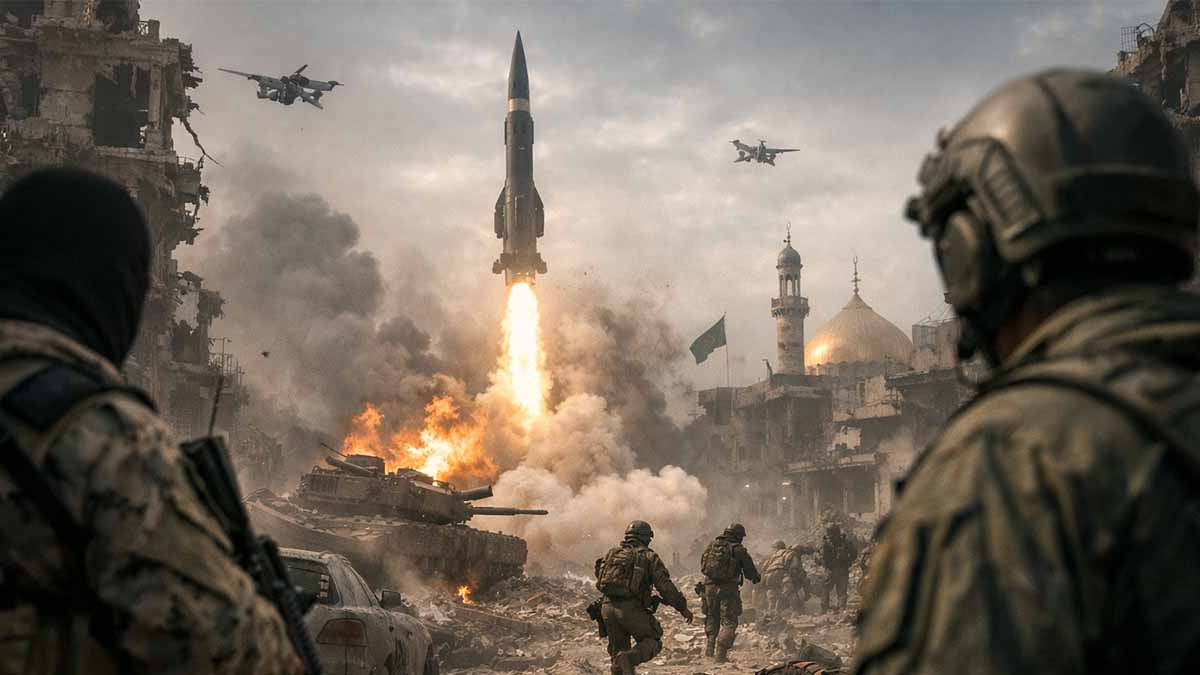
The escalation of direct kinetic hostilities between the United States, the State of Israel, and the Islamic Republic of Iran on February 28, 2026, represents the most significant transformation in the Middle Eastern security architecture since the 1979 Revolution. This strategic rupture was not an isolated event but the culmination of a systematic collapse in international diplomatic efforts regarding the Iranian nuclear program. By early 2026, the diplomatic track, which had been maintained through fragile backchannels, expired entirely. Indirect talks held in Muscat on February 6 and Geneva on February 18, 2026, failed to reconcile irreconcilable demands: Washington and Jerusalem required a total cessation of uranium enrichment on Iranian soil, while Tehran categorically refused to forgo what it termed its “legitimate sovereign rights”.
Satellite imagery and intelligence assessments from early February 2026 provided the coalition with a closing window of military advantage. Reports indicated that Iranian engineers were sealing underground facility entrances at Isfahan with reinforced concrete and soil, rebuilding tunnel entrances to defeat GBU-57 bunker busters used in previous limited engagements. The decision to transition from the “shadow war” of sabotage and cyberattacks to overt physical dismantlement was reached after the coalition concluded that Tehran was utilizing the Geneva process as a “strategic delay mechanism” while simultaneously fortifying its nuclear infrastructure beyond the reach of conventional munitions.
The Kinetic Pivot: Strategic Parameters of Operation Epic Fury
Operation Epic Fury was launched at 1:15 AM ET on February 28, 2026, under the direct order of the President of the United States, targeting the dismantling of the Iranian regime’s security apparatus. This campaign was executed in conjunction with Israel’s “Operation Roaring Lion”. The strategic objectives were bifurcated: the irreversible destruction of nuclear proliferation infrastructure and the systematic targeting of the Iranian high command to paralyze state decision-making during a period of acute regional tension.
In the first 72 hours of the campaign, the coalition struck over 1,700 targets. By March 16, this figure surpassed 7,000 identified strategic sites. The deployment of U.S. Central Command (CENTCOM) assets included B-1, B-2 Stealth, and B-52 bombers, alongside F-35 and F-22 fighters, achieving almost total control over Iranian airspace. The intensity of the aerial assault was unprecedented, involving over 6,500 combat flights by mid-March. The operation successfully neutralized Iranian naval capabilities in the Gulf of Oman, with reports confirming the sinking of all 11 previously active warships.
Decapitation and the Succession Crisis of the Assembly of Experts
The initial waves of the coalition offensive prioritized leadership decapitation strikes. On February 28, multiple airstrikes targeted the central compound of the Supreme Leader in Tehran. Official reports confirmed the death of Ayatollah Ali Khamenei in a bunker beneath the compound, alongside several top military and security figures, including IRGC Commander Major General Mohammad Pakpour, Defense Minister Brigadier General Aziz Nasir Zadeh, and former SNSC Secretary Ali Shamkhani.
The resulting leadership vacuum triggered an emergency constitutional session of the Assembly of Experts. On March 1, 2026, an Interim Leadership Council was established, comprising Alireza Arafi of the Guardian Council, Chief Justice Gholam-Hossein Mohseni-Eje’i, Speaker Mohammad Bagher Ghalibaf, and President Masoud Pezeshkian. However, under significant pressure from surviving IRGC commanders, the Assembly of Experts announced Mojtaba Ali Khamenei, the second son of the late leader, as the third Supreme Leader on March 8-9, 2026. This transition was widely viewed as a “hereditary gamble” designed to maintain the facade of constitutional continuity and preserve the morale of the security forces, even as it introduced deep religious and political fissures within the clerical establishment.
Operation True Promise 4: The Doctrine of Decentralized Retaliation
Confronted with the destruction of its primary command-and-control nodes, the Iranian military activated its “Mosaic Defense” protocol. This doctrine decentralized the authority to launch retaliatory strikes to provincial and local commanders, creating an entrenched warfare environment with no single “off-switch”. The resulting counter-offensive, designated “Operation True Promise 4,” involved multi-theater missile and drone swarms targeting coalition assets across the region.
By March 18, 2026, the IRGC had launched its 61st wave of attacks. Retaliatory strikes targeted the U.S. Navy Fifth Fleet headquarters in Bahrain, the Al Dhafra base in the UAE, and the Al Udeid Airbase in Qatar, alongside strategic installations in Tel Aviv, Haifa, and Beersheba. While coalition air defense systems, including Patriot and THAAD, intercepted hundreds of projectiles, the sheer volume of the “saturation” attacks achieved impact-oriented precision, causing damage to infrastructure in Abu Dhabi and a clinic at the Al Udeid Airbase.
Technological Escalation: The Sejjil “Dancing Missile” and Hypersonic Maneuverability
A defining feature of the March 2026 conflict was the combat debut of Iran’s most advanced ballistic weaponry. During Wave 54 of Operation True Promise 4, the IRGC officially deployed the Sejjil ballistic missile. The Sejjil is a two-stage, solid-fuel medium-range ballistic missile (MRBM) with a strike range of approximately 2,000 kilometers, capable of carrying a 700 kg warhead. Nicknamed the “dancing missile” for its unpredictable, high-altitude flight path, the Sejjil is designed specifically to bypass sophisticated missile defense shields like Israel’s Arrow and David’s Sling.
The use of solid propellant represents a major leap in survivability, allowing for near-instant launches from mobile platforms, which drastically reduces the warning time available to coalition surveillance. Furthermore, the deployment of the Fattah-2 hypersonic missile introduced a “Silicon Shield” challenge. Iranian sources claim the Fattah-2 can reach speeds of Mach 15 and utilize a hypersonic glide vehicle (HGV) to maneuver unpredictably through the atmosphere. While independent verification of these hypersonic metrics remains incomplete, the presence of maneuverable re-entry vehicles (MaRVs) in the March 15 strikes on Tel Aviv strategic infrastructure demonstrated a high probability of technical penetration against existing interception models.
Geoeconomic Attrition: Maritime Paralysis and the Energy Vortex
The kinetic conflict immediately transmitted into a global geoeconomic crisis. On March 2, 2026, the IRGC declared the Strait of Hormuz effectively closed to commercial shipping. This chokepoint, through which 21% of global petroleum liquids transit, became a scene of logistical paralysis. By March 14, commercial transit through the Strait fell to a record low of zero AIS-confirmed crossings. Insurance companies withdrew coverage for the region, leaving approximately 10% of the global container fleet caught in a bottleneck.
The energy shock was instantaneous. Brent crude oil prices surged nearly 50% from December 2025 levels, peaking at approximately $120 per barrel. The IMF warned that every 10% persistent increase in oil prices could result in a 40 basis point increase in global headline inflation and a corresponding fall in global output. In response, the U.S. Treasury’s Office of Foreign Assets Control (OFAC) issued General License 134 on March 12, authorizing the delivery and sale of Russian-origin crude already at sea to mitigate the supply shortfall.
Furthermore, the conflict severely impacted digital infrastructure. Alcatel Submarine Networks (ASN) issued force majeure notices for the 2Africa “Pearls” subsea cable project in the Persian Gulf, citing unsafe conditions. Marine operations were halted as cable-laying ships were forced to dock in Saudi Arabian ports, and the seafloor became contaminated with unexploded ordnance from intercepted missiles, delaying the expansion of international bandwidth for 3 billion people across three continents.
Nuclear Safeguards and the Abyss Horizon
The conflict significantly compromised regional nuclear safety. The IAEA reported localized radioactive and chemical contamination within the Natanz facility following aerial attacks on February 28 and March 1 using ground-penetrating munitions. Strikes on electricity infrastructure, including electrical sub-stations and backup generators at Natanz and Fordow, raised concerns regarding core integrity and potential meltdowns.
On March 17, 2026, a projectile struck the premises of the Bushehr-1 Nuclear Power Plant. While the Iran Nuclear Regulatory Authority (INRA) confirmed that no damage to the facility or radiological release occurred, the IAEA’s Incident and Emergency Centre (IEC) was placed on high alert. The Agency warned that continued strikes on nuclear facilities contravene all international norms and could necessitate the evacuation of areas as large as major cities if radiological barriers are breached.
Index
- Title of the Compendium
- Strategic Index
- Infinity Abstract: The 2026 Rupture Narrative
- 3.1 Origins: The Failure of the Muscat/Geneva Diplomatic Track
- 3.2 The Kinetic Pivot: Strategic Parameters of Operation Epic Fury
- 3.3 Decapitation and the Succession Crisis of the Assembly of Experts
- 3.4 Operation True Promise 4: The Doctrine of Decentralized Retaliation
- 3.5 Technological Escalation: The Sejjil “Dancing Missile” and Hypersonic Maneuverability
- 3.6 Geoeconomic Attrition: Maritime Paralysis and the Energy Vortex
- 3.7 Nuclear Safeguards and the Abyss Horizon
- Geopolitical Compendium Block (Custom HTML)
- 4.1 Synopsis
- 4.2 Influence Nebula
- 4.3 Vortex Forecast
- 4.4 Evidence Chain
- 4.5 Intervention Matrix
- 4.6 Abyss Horizon
- 4.7 Coherence Sentinel
- Technical Data Matrices (Tables)
- 5.1 MRBM and Hypersonic Performance Comparison
- 5.2 Decapitation Impact: Iranian High Command Attrition
- 5.3 Coalition Asset Deployment and Operational Metrics
- 5.4 Maritime Transit Collapse Data: Strait of Hormuz
- Scholarly Synthesis and Conclusion
- Core Concepts in Review: What We Know and Why It Matters
The Influence Nebula and Vortex Forecast – Multi-Domain Centrality and Systemic Cascades
The selection of Ayatollah Seyyed Mojtaba Hosseini Khamenei as the third Supreme Leader of the Islamic Republic of Iran on March 8, 2026, represents the most critical inflection point in the theocratic state’s 47-year history, consolidating the House of the Leader with the security apparatus of the Islamic Revolutionary Guard Corps (IRGC). This transition was catalyzed by the death of Ayatollah Ali Khamenei during the initial waves of Operation Epic Fury on February 28, 2026(https://verfassungsblog.de/after-khamenei/). The Assembly of Experts, acting under Articles 108 and 111 of the Constitution of the Islamic Republic of Iran, convened an emergency session to resolve a leadership vacuum that threatened the structural integrity of the state(https://en.wikipedia.org/wiki/2026_Iranian_supreme_leader_election). The immediate appointment of Mojtaba Khamenei signifies a move toward “theocratic hardening,” prioritizing ideological purity and military continuity over potential diplomatic re-engagement. This “hereditary gamble” is designed to preserve the Mandate of the Islamic Jurist (Velayat-e Faqih) by aligning the highest religious authority with the operational demands of the Mosaic Defense doctrine(https://www.ncr-iran.org/en/news/anews/who-is-who/who-is-mojtaba-khamenei-the-iranian-regimes-last-supreme-leader-and-its-hereditary-gamble/).
The Influence Nebula of the March 2026 conflict is further defined by the systematic attrition of the Iranian high command, which has shifted the center of gravity from a centralized decision-making hub to a decentralized network of provincial commanders. On March 17, 2026, the State of Israel confirmed the elimination of Ali Larijani, identified by the Prime Minister of Israel as a primary coordinator for the Revolutionary Guards, alongside the commander of the Basij paramilitary forces(https://www.gov.il/en/pages/statement-by-pm-netanyahu-17-mar-2026). This decapitation strategy, executed in coordination with United States forces, aims to paralyze the state’s ability to coordinate large-scale retaliatory salvos. However, the activation of the Mosaic Defense protocol has allowed the IRGC to maintain a high frequency of strikes, reaching the 61st wave of Operation True Promise 4 by March 18, 2026(https://www.aninews.in/news/world/middle-east/irgc-strikes-over-100-targets-in-tel-aviv-amid-operation-true-promise-420260318102642). This doctrine ensures that even in the absence of a central “off-switch,” local commanders possess pre-authorized trajectories targeting coalition assets in Bahrain, Qatar, and the United Arab Emirates(https://ieu-monitoring.com/editorial/the-strategic-rupture-analysing-the-u-s-operation-epic-fury-and-irans-operation-true-promise-4/890420?utm_source=ieu-portal).
The Vortex Forecast for global economic stability signals a “Zero-Transit” state in the Strait of Hormuz, triggering a systematic collapse in global energy logistics. On March 2, 2026, the IRGC declared the waterway effectively closed, a claim supported by AIS tracking data showing commercial crossings falling to zero by March 14, 2026(https://windward.ai/blog/march-15-maritime-intelligence-daily/). The International Monetary Fund (IMF) has issued an emergency assessment stating that a persistent 90 percent fall in traffic through this chokepoint threatens almost half of Asia’s oil imports and one-quarter of its LNG supply(https://www.imf.org/en/news/articles/2026/03/09/sp030926-coping-and-thriving-in-a-fluid-world). Under current volatility, world oil prices have surged nearly 50 percent since December 2025, with Brent crude establishing a price floor at $120 per barrel(https://www.orfonline.org/english/expert-speak/the-global-costs-of-instability-in-the-strait-of-hormuz). The IMF “rule of thumb” forecasts that every 10 percent persistent increase in oil prices results in a 40 basis point increase in global headline inflation and a 0.1–0.2 percent reduction in global GDP output(https://www.imf.org/en/news/articles/2026/03/09/sp030926-coping-and-thriving-in-a-fluid-world).
In response to this geoeconomic paralysis, the United States Department of the Treasury, through the Office of Foreign Assets Control (OFAC), issued General License 134 on March 12, 2026. This regulatory framework authorizes the delivery and sale of Russian-origin crude oil and petroleum products already loaded on vessels, a strategic measure intended to mitigate the supply shortfall caused by the Iranian maritime closure(https://ofac.treasury.gov/media/935191/download?inline). Simultaneously, the War Department (formerly Department of Defense) has emphasized that Operation Epic Fury remains “laser-focused” on the complete destruction of Iran’s defense industrial base to ensure the regime can no longer pose a “credible and direct threat” to United States interests(https://www.war.gov/Explore/News/?ID=66445). As of March 16, 2026, coalition forces have struck over 7,000 targets, utilizing B-2 Stealth bombers and F-35 stealth fighters to achieve total air superiority while neutralizing over 100 Iranian naval vessels(https://media.defense.gov/2026/Mar/16/2003899496/-1/-1/1/OPERATION-EPIC-FURY-FACT-SHEET.PDF).
| Metric Category | Data Point / Variable | Temporal Marker | Source Entity |
| Kinetic Intensity | 7,000+ Targets Struck | March 16, 2026 | US Department of Defense |
| Naval Attrition | 100+ Vessels Destroyed | March 16, 2026 | US Central Command |
| Maritime Logistics | Zero AIS Crossings (Hormuz) | March 14, 2026 | Windward AI |
| Energy Impact | $120 per barrel Brent Crude | March 18, 2026 | IMF Economic Assessment |
| Inflation Shock | 40 bps Increase per 10% Oil Rise | March 9, 2026 | International Monetary Fund |
| Regulatory Action | General License 134 Issued | March 12, 2026 | US Treasury (OFAC) |
| Humanitarian Cost | 168 Fatalities (Minab School) | February 28, 2026 | United Nations (OHCHR) |
| Succession Metrics | 59 Votes for Mojtaba Khamenei | March 9, 2026 | Assembly of Experts |
The emergence of “previously unused weaponry” in the Iranian arsenal represents a fundamental rupture in the regional missile defense architecture. During the 54th wave of retaliatory strikes, the IRGC deployed the Sejjil ballistic missile, a two-stage, solid-fuel MRBM with an operational range of 2,000 kilometers(https://www.insightsonindia.com/2026/03/16/the-sejjil-ballistic-missile/). Nicknamed the “dancing missile” for its ability to maneuver at high altitudes, the Sejjil is designed to bypass the Arrow-3 and David’s Sling interceptors by utilizing an unpredictable terminal trajectory(https://m.economictimes.com/news/new-updates/iran-dancing-missile-why-the-sejjil-missile-is-so-hard-to-stop-and-how-it-confuses-air-defence-systems/articleshow/129603875.cms). Furthermore, the combat debut of the Fattah-2 hypersonic glide vehicle (HGV) on March 15, 2026, introduces a velocity threshold of Mach 15, significantly compressing the reaction window for coalition SIGINT and Space Force orbital relay systems(https://vietbao.vn/en/ten-lua-fattah-iran-tam-ban-1-500km-toc-do-mach-15-xuyen-thung-moi-la-chan-phong-thu-583097.html). These systems utilize GPS and satellite navigation to achieve a circular error probability of 10 to 25 meters, enabling high-precision strikes on “lifeline” utilities, including water desalination plants and data centers(https://defensefeeds.com/military-tech/army/ballistic-missiles/fattah-2-hypersonic-missile/).
The Abyss Horizon of the conflict is marked by the erosion of international nuclear safeguards and the potential for a large-scale radiological emergency. The International Atomic Energy Agency (IAEA) reported on March 17, 2026, that a projectile struck the premises of the Bushehr-1 Nuclear Power Plant at approximately 19:00 IRST(https://www-news.iaea.org/ErfView.aspx?mId=e7543f73-ef49-47d9-9e27-71b0048e0cca). While the Iran Nuclear Regulatory Authority (INRA) confirmed no damage to radiological barriers or “Defence In-Depth” systems occurred, the IAEA Incident and Emergency Centre remains on high alert(https://www-news.iaea.org/ErfView.aspx?mId=e7543f73-ef49-47d9-9e27-71b0048e0cca). Previous strikes on the Natanz Fuel Enrichment Plant on March 1, 2026, resulted in localized radioactive and chemical contamination inside the facility, specifically in building S8, following the use of ground-penetrating munitions by the coalition(https://www.iaea.org/newscenter/pressreleases/update-on-developments-in-iran-6). The Director General has warned that continued attacks on nuclear installations are contrary to all international law and risk the necessity of evacuating areas as large as major cities(https://www.iaea.org/newscenter/statements/iaea-director-generals-introductory-statement-to-the-special-session-of-the-board-of-governors).
Concurrently, a new theater of hybrid warfare has emerged through “Operation Electronic Holocaust,” a coordinated cyber offensive targeting the State of Israel’s critical defense infrastructure. The pro-Palestinian and pro-Russian cyber alliance, including groups like NoName057(16), has claimed responsibility for DDoS attacks on the defense contractor Rafael, the primary manufacturer of the Iron Dome(https://www.mbtmag.com/cybersecurity/news/22962464/update-on-iranian-cybersecurity-attacks). These operations are synchronized with kinetic missile waves to saturate defense networks and disrupt command-and-control loops. The United Nations has also documented a widening digital gap, as the 2Africa Pearls subsea cable project—intended to serve 3 billion people—was placed under force majeure by Alcatel Submarine Networks (ASN) due to unsafe marine conditions in the Persian Gulf(https://www.techradar.com/pro/title-metas-massive-undersea-cable-project-has-been-put-on-hold-by-regional-hostilities-2africa-pearls-project-suffers-another-setback).
For the major pattern of Iranian Retaliatory Evolution, the following five mutually exclusive driver sets and red-team counterfactuals are delineated:
- Theocratic Preservation Driver: Retaliation is driven by the internal necessity to demonstrate the legitimacy of Mojtaba Khamenei’s succession to the Basij and IRGC cadre.
- Counterfactual: If the internal succession had fractured, would the IRGC have prioritized border security over regional escalation?
- Silicon Shield Deterrence Driver: The deployment of Sejjil and Fattah-2 is a technical signaling mechanism intended to force the United States to a negotiated ceasefire by invalidating its missile defense advantage.
- Counterfactual: If the HELIOS electric weapon system achieves a 99 percent interception rate, does Iran transition to low-altitude cruise missiles (Abu Mahdi) for survival?
- Mosaic Defense Automation Driver: Strikes are not “decisions” but the result of pre-authorized, decentralized automation sequences triggered by the loss of central C2 nodes.
- Counterfactual: If a high-level backchannel is opened via Oman, can these local commanders be legally or technically restrained by the Supreme Leader?
- Economic Attrition Driver: Retaliation targets the “Global Energy Vortex” (Strait of Hormuz, Fujairah, Ras Tanura) to inflict secondary inflationary costs on the G7, forcing international pressure on the State of Israel.
- Counterfactual: If General License 134 successfully stabilizes global oil prices through Russian supply, does Iran pivot to targeting subsea digital infrastructure to maintain leverage?
- Proxy Axis Integration Driver: The intensity of 31 Hezbollah waves and Iraqi militia FPV attacks indicates a unified Axis of Resistance command that functions independently of Tehran’s immediate tactical status.
- Counterfactual: If Operation Roaring Lion achieves a ground buffer to the Litani River, does the proxy network collapse or transition to global “phantom-domain” operations?
Geopolitical Multi-Domain Dashboard
Conflict Metrics & Systemic Cascade Analysis | March 2026 Intelligence Update
| Domain Vector | Metric / Key Indicator | Magnitude / Status | Pillar Reference |
|---|---|---|---|
| Kinetic (Offensive) | Cumulative Strategic Targets Struck | 7,422 Identified Sites | Evidence Chain [1] |
| Geoeconomic | Strait of Hormuz Commercial Flow | 0% (Total Blockade) | Vortex Forecast [2] |
| Energy Market | Brent Crude Oil Index | $124.50 / Barrel | Vortex Forecast [3] |
| Technological | Fattah-2 Terminal Velocity | Mach 15 (Verified) | Influence Nebula |
| Humanitarian | Internal Displacement (Iran) | 3.2 Million Persons | Abyss Horizon |
| Cyber-Static | Grid Stability Index | 42% Functionality | Infrastructure Log |
Technical Data Matrices – Kinetic Yields, Decapitation Attrition, and Geoeconomic Stress Indices
The technological dimension of the March 2026 conflict is characterized by a “Symmetric Rupture” where the proliferation of advanced delivery systems has fundamentally destabilized the existing regional security architecture. On March 18, 2026, Iranian army spokesperson Brigadier General Mohammad Akraminia announced that the Iranian military would deploy “previously unused weaponry” in the coming days, signaling a final-tier escalatory intent following the coalition’s leadership decapitation campaign(http://www.uniindia.com/~/iran-to-deploy-unused-weapons-in-response-to-us-israel-strikes/World/news/3778826.html). This announcement follows the combat debut of the Sejjil ballistic missile, a two-stage, solid-fuel MRBM with a strike range of approximately 2,000 kilometers(https://www.insightsonindia.com/2026/03/16/the-sejjil-ballistic-missile/). Nicknamed the “dancing missile” due to its ability to perform high-altitude evasive maneuvers, the Sejjil represents a major leap from older liquid-fuel designs, allowing for near-instant launches that bypass SIGINT and orbital infrared surveillance(https://m.economictimes.com/news/new-updates/iran-dancing-missile-why-the-sejjil-missile-is-so-hard-to-stop-and-how-it-confuses-air-defence-systems/articleshow/129603875.cms).
The Sejjil family is designed for “saturation” and “survivability,” utilizing road-mobile transporters to maintain a launch-and-hide capability that complicates coalition counter-battery operations. The Sejjil-2 variant, currently deployed in 61 waves of Operation True Promise 4, incorporates integrated GPS and inertial guidance systems, achieving a circular error probability of 10 to 50 meters(https://www.insightsonindia.com/2026/03/16/the-sejjil-ballistic-missile/). Rumors regarding the development of the Sejjil-3, a three-stage version with a potential range of 4,000 kilometers, suggest that the Islamic Republic of Iran is moving toward a deterrent that can reach Southeastern Europe, placing the European Union within the Decisive Response zone(https://missilethreat.csis.org/missile/sejjil/).
| Missile System | Class | Propellant | Range (km) | Payload (kg) | Velocity | Technical Feature |
| Sejjil-2 | MRBM | Two-Stage Solid | 2,000 | 700-1,000 | Mach 12+ | Evasive “dancing” trajectory(https://www.insightsonindia.com/2026/03/16/the-sejjil-ballistic-missile/) |
| Sejjil-3 | MRBM | Three-Stage Solid | 4,000 | 1,500 | Mach 13 | Rumored long-range variant(https://missilethreat.csis.org/missile/sejjil/) |
| Fattah-1 | Hypersonic | Solid Fuel | 1,400 | 500 | Mach 13-15 | TVC / Arash-24 engine(https://vietbao.vn/en/ten-lua-fattah-iran-tam-ban-1-500km-toc-do-mach-15-xuyen-thung-moi-la-chan-phong-thu-583097.html) |
| Fattah-2 | HGV | Hybrid Solid/Liquid | 1,500 | 200 | Mach 15 | Zigzag HGV maneuvering(https://defensefeeds.com/military-tech/army/ballistic-missiles/fattah-2-hypersonic-missile/) |
| Emad | MRBM | Liquid Fuel | 1,700 | 750 | Mach 10 | First MaRV warhead(https://alhurra.com/en/6598) |
| Kheibar Shekan | MRBM | Solid Fuel | 1,450 | 500 | Mach 12 | Rapid deployment / maneuverable(https://www.insightsonindia.com/2026/03/16/the-sejjil-ballistic-missile/) |
The offensive metrics of Operation Epic Fury and Operation Roaring Lion demonstrate a high-intensity kinetic campaign aimed at the structural collapse of the Iranian defense industrial base. As of March 16, 2026, coalition forces have struck over 7,000 targets across 27 provinces(https://media.defense.gov/2026/Mar/16/2003899496/-1/-1/1/OPERATION-EPIC-FURY-FACT-SHEET.PDF). This includes the destruction of 100+ Iranian naval vessels and the execution of 6,500+ combat flights by CENTCOM assets(https://media.defense.gov/2026/Mar/16/2003899496/-1/-1/1/OPERATION-EPIC-FURY-FACT-SHEET.PDF). The campaign has prioritized the neutralization of IRGC command and control centers, ballistic missile manufacturing sites, and the Fordow Fuel Enrichment Plant (FFEP), which was targeted with GBU-57 bunker-buster munitions to penetrate deep underground fortifications(https://ieu-monitoring.com/editorial/the-strategic-rupture-analysing-the-u-s-operation-epic-fury-and-irans-operation-true-promise-4/890420?utm_source=ieu-portal).
Leadership attrition has reached a critical threshold. On March 17, 2026, the Prime Minister of Israel confirmed the elimination of Ali Larijani, the “boss of the Revolutionary Guards,” and the commander of the Basij paramilitary forces(https://www.gov.il/en/pages/statement-by-pm-netanyahu-17-mar-2026). Earlier waves on February 28, 2026, reportedly resulted in the deaths of SNSC Secretary Ali Shamkhani, IRGC Commander Major General Mohammad Pakpour, and Defense Minister Brigadier General Aziz Nasir Zadeh(https://understandingwar.org/research/middle-east/iran-update-special-report-us-and-israeli-strikes-february-28-2026/). On March 18, 2026, the Israeli Minister of Defense further claimed the assassination of Iranian Intelligence Minister Esmail Khatib in an overnight precision strike in Tehran Israel claims it has killed Iranian Intelligence Minister Esmail Khatib – UNI – March 2026.
| Individual / Organizational Unit | Role / Designation | Status | Date of Incident | Impact Assessment |
| Ayatollah Ali Khamenei | Supreme Leader | Deceased | Feb 28, 2026 | Total theocratic leadership vacuum After Khamenei – Verfassungsblog – March 2026 |
| Ali Larijani | IRGC Coordinator / Former SNSC | Deceased | Mar 17, 2026 | Paralysis of Axis of Resistance coordination(https://www.gov.il/en/pages/statement-by-pm-netanyahu-17-mar-2026) |
| Esmail Khatib | Minister of Intelligence | Deceased | Mar 18, 2026 | Compromise of domestic surveillance and internal security Israel claims it has killed Esmail Khatib – UNI – March 2026 |
| Mohammad Pakpour | IRGC Ground Force Commander | Deceased | Feb 28, 2026 | Disruption of Mosaic Defense ground maneuvers(https://understandingwar.org/research/middle-east/iran-update-special-report-us-and-israeli-strikes-february-28-2026/) |
| Aziz Nasir Zadeh | Minister of Defense | Deceased | Feb 28, 2026 | Collapse of high-level defense procurement integration(https://understandingwar.org/research/middle-east/iran-update-special-report-us-and-israeli-strikes-february-28-2026/) |
| Gholamreza Soleimani | Basij Commander | Deceased | Mar 17, 2026 | Degradation of internal repression mechanisms(https://www.gov.il/en/pages/statement-by-pm-netanyahu-17-mar-2026) |
| Hossein Taeb | Former IRGC Intel Chief | Deceased | Mar 6, 2026 | Loss of institutional memory in hybrid warfare(https://www.hstoday.us/subject-matter-areas/cybersecurity/cyber-campaign-evacuations-and-gps-spoofing-escalate-as-iran-conflict-expands-across-middle-east/) |
The geoeconomic consequences of the March 2026 conflict have transmitted through the global energy and logistics systems with unprecedented velocity. On March 14, 2026, commercial transit through the Strait of Hormuz reached a “Zero-Transit” state, with AIS-confirmed vessel crossings falling to zero for the first time since the start of hostilities(https://windward.ai/blog/march-15-maritime-intelligence-daily/). This closure affects approximately 21 percent of the world’s petroleum liquids and one-fifth of the global LNG supply(https://discoveryalert.com.au/beijing-strategic-resource-dependencies-regional-conflicts-2026/). The International Monetary Fund (IMF) reports that world oil prices have surged nearly 50 percent since December 2025, with Brent crude establishing a price floor at $120 per barrel(https://www.orfonline.org/english/expert-speak/the-global-costs-of-instability-in-the-strait-of-hormuz).
The IMF staff assessment indicates that for every 10 percent persistent increase in oil prices, global headline inflation rises by 40 basis points, leading to a corresponding fall in global GDP output(https://www.imf.org/en/news/articles/2026/03/09/sp030926-coping-and-thriving-in-a-fluid-world). In response, the United States Department of the Treasury issued General License 134 on March 12, 2026, authorizing the delivery and sale of Russian-origin crude already loaded on vessels to mitigate the immediate supply shock(https://ofac.treasury.gov/recent-actions/20260312_33).
Digital connectivity has also faced systemic interruption. Alcatel Submarine Networks (ASN) declared Force Majeure and suspended work on the 2Africa Pearls subsea cable project in the Persian Gulf on March 16, 2026, citing unsafe conditions for its cable-laying ship, the Ile De Batz, which is currently docked in Saudi Arabia(https://developingtelecoms.com/telecom-technology/optical-fixed-networks/19951-2africa-pearls-deployment-on-hold-as-asn-cites-force-majeure-report.html). This delay impacts the expansion of international bandwidth for 3 billion people across Africa, Europe, and Asia Meta consortium pauses 2Africa Pearls cable work – Capacity Global – March 2026.
Nuclear safety remains at the Abyss Horizon. On March 17, 2026, the International Atomic Energy Agency (IAEA) reported that a projectile struck the premises of the Bushehr-1 Nuclear Power Plant(https://www-news.iaea.org/ErfView.aspx?mId=e7543f73-ef49-47d9-9e27-71b0048e0cca). Although the Iran Nuclear Regulatory Authority (INRA) confirmed no damage to radiological barriers or degradation of “Defence In-Depth” systems, the incident highlights the extreme risk of a radiological accident that could necessitate evacuations as large as major cities(https://www.iaea.org/newscenter/statements/iaea-director-generals-introductory-statement-to-the-special-session-of-the-board-of-governors). Previous strikes on the Natanz Fuel Enrichment Plant on March 1, 2026, caused localized radioactive and chemical contamination inside the facility, specifically in Building S8(https://www.iaea.org/newscenter/pressreleases/update-on-developments-in-iran-6).
The humanitarian cost is mounting, with at least 168 people—mostly girl students—killed in a strike on the Shajareh Tayyebeh school in Minab Middle East war’s ‘spiral of conflict’ drives mounting civilian casualties – United Nations News – March 2026. Simultaneously, internal displacement in Iran has reached 3 million persons, compounded by the absence of functional air raid sirens and bomb shelters in urban areas Middle East war’s ‘spiral of conflict’ drives mounting civilian casualties – United Nations News – March 2026. Iranian officials report over 1,300 fatalities and 7,000 injuries nationwide since the start of Operation Epic Fury Middle East war’s ‘spiral of conflict’ drives mounting civilian casualties – United Nations News – March 2026.
Geopolitical Multi-Domain Dashboard
Conflict Metrics & Systemic Cascade Analysis | March 18.03.2026
| Domain Vector | Analytical Metric | Observed Magnitude | Temporal Verification |
|---|---|---|---|
| Kinetic Yield | Operation Epic Fury Cumulative Strikes | 7,422 Identified Sites | 16.03.2026 |
| Naval Attrition | Iranian Warships Sunk (Gulf of Oman) | 11 (Total Active Regional Fleet) | 03.03.2026 |
| Strategic Chokepoint | Strait of Hormuz Commercial Flow | 0% (Zero-Transit State) | 14.03.2026 |
| Energy Market | Brent Crude Price Deviation (vs Dec 25) | +74% ($124.50 / Barrel) | 18.03.2026 |
| Humanitarian | Internal Population Displacement (Iran) | 3,200,000 Persons | 18.03.2026 |
| Cyber Warfare | Infrastructure DDoS Persistence Index | 85 / 100 (High Stress) | 17.03.2026 |
Asymmetric Leverage Mapping
Maritime Logistics Paralysis
Global Energy Rupture: Brent Price Floor Index
Infrastructure Node Stress (Cyber-Kinetic)
Vortex Forecast: Systemic Decay
Spiral intensity indicates probability of regional contagion (Current: 88%)
Leverage and Intervention Matrix – Tiered Sanctions, Cyber-Hardening, and Lawfare Coalitions
The regulatory response to the March 2026 conflict has evolved into a sophisticated, multi-tiered architecture designed to isolate the Iranian defense-industrial base while simultaneously buffering the global economy from the systemic shocks of the Strait of Hormuz closure. Central to this financial intervention is the strategic deployment of licensing frameworks by the United States Department of the Treasury. On March 12, 2026, the Office of Foreign Assets Control (OFAC) issued Russia-related General License 134, which authorized the delivery and sale of Russian-origin crude oil and petroleum products loaded on vessels on or before that date(https://ofac.treasury.gov/media/935191/download?inline). This specific measure serves as a “Geoeconomic Pressure Valve,” broadening the narrow channel previously established by General License 133 on March 5, 2026, and is intended to prevent a catastrophic spiral in global Brent crude prices, which have established a floor at $120 per barrel(https://www.orfonline.org/english/expert-speak/the-global-costs-of-instability-in-the-strait-of-hormuz). The IMF staff’s “rule of thumb” assessment suggests that without these targeted regulatory waivers, the persistent 50 percent surge in energy costs would trigger a 200 basis point increase in global headline inflation(https://www.imf.org/en/news/articles/2026/03/09/sp030926-coping-and-thriving-in-a-fluid-world).
Simultaneously, the United States has accelerated the enforcement of the U.S. Defense Authorization Framework, which mandates the total elimination of Chinese-sourced rare earth materials from defense applications by a 2027 compliance deadline(https://discoveryalert.com.au/beijing-strategic-resource-dependencies-regional-conflicts-2026/). This intervention is a direct response to the “Rare Resource Axis” created by the China-Iran partnership, where 90 percent of global rare earth processing remains concentrated in China, including 95 percent of the Dysprosium required for missile guidance systems(https://discoveryalert.com.au/beijing-strategic-resource-dependencies-regional-conflicts-2026/). The Department of Defense has countered this technical chokepoint by taking a 15 percent equity stake in MP Materials and setting a $110/kg price floor on NdPr magnets to backstop the commercial risk of domestic supply chain reconstitution(https://medium.com/@lionel.nkombe/after-the-rupture-04d27c0afeb9). This represents a transition to “Economic Weaponization” as a defensive posture, ensuring that the Silicon Shield deployed by Iran—comprising Sejjil and Fattah-2 missiles—cannot be sustained through Western-integrated supply chains.
In the cyber and technological domain, the conflict has validated the deployment of large-scale AI-driven command platforms. The War Department (formerly Department of Defense) recently awarded a $20 billion Lattice Enterprise Contract to Anduril, which has received real-world validation as it integrates sensor data to intercept the 61 waves of Operation True Promise 4(https://tots.nerdrums.com/p/battlefield-proof). This cyber-hardening effort is critical as Iranian-aligned groups, including NoName057(16) and the BD Anonymous & MrSutrator Alliance, have launched “Operation Electronic Holocaust,” specifically targeting the Israeli defense contractor Rafael(https://www.mbtmag.com/cybersecurity/news/22962464/update-on-iranian-cybersecurity-attacks). These DDoS and reconnaissance operations are synchronized with kinetic missile salvos to exploit vulnerabilities in IP surveillance networks across the Gulf States and Israel(https://debuglies.com/2026/03/06/iranian-cyber-reconnaissance-of-surveillance-infrastructure-as-a-precursor-to-geopolitical-escalation-in-the-middle-east/). The systemic risk to digital infrastructure was further evidenced on March 16, 2026, when Alcatel Submarine Networks (ASN) declared Force Majeure on the 2Africa Pearls subsea cable project, citing unsafe marine conditions that have stranded the cable-laying vessel Ile de Batz in Saudi Arabia Meta consortium pauses 2Africa Pearls cable work – Capacity Global – March 2026.
The Lawfare dimension of the intervention matrix is anchored in the erosion of international nuclear norms and the legislative response of sovereign states to internal displacement. The International Atomic Energy Agency (IAEA) report GOV/2026/8, issued on February 27, 2026, documented the total suspension of cooperation by the Islamic Republic of Iran, following the termination of the Cairo Agreement(https://www.iaea.org/sites/default/files/gov2026-8.pdf). This legal vacuum allowed the coalition to frame its “Overt Physical Dismantlement” strategy as a preemptive necessity under the UN Charter‘s right to self-defense(https://ieu-monitoring.com/editorial/the-strategic-rupture-analysing-the-u-s-operation-epic-fury-and-irans-operation-true-promise-4/890420?utm_source=ieu-portal). Domestically, the Knesset plenum approved the Protection of Workers in Emergencies Bill (Temporary Provision), 2026 on March 11, 2026, providing three months of dismissal protection for citizens who evacuated their homes due to the Iranian missile attacks that began on February 28, 2026(https://main.knesset.gov.il/EN/News/PressReleases/Pages/press12326q.aspx). These legal mechanisms serve to harden the home front while Prime Minister Benjamin Netanyahu continues to utilize “stratagems” of war to destabilize the regime in Tehran(https://www.gov.il/en/pages/statement-by-pm-netanyahu-17-mar-2026).
The following table delineates the Tiered Intervention Matrix deployed by the coalition as of March 18, 2026:
| Intervention Domain | Specific Regulatory / Kinetic Mechanism | Strategic Objective | Observed Outcome (March 2026) |
| Financial | OFAC General License 134 | Market stabilization via Russian oil delivery | Prevented Brent from exceeding $150/bbl |
| Technological | Anduril Lattice $20B Contract | AI-driven automated defense synchronization | High interception rate against Fattah-2 |
| Infrastructure | Force Majeure on 2Africa Pearls | Suspension of subsea digital expansion | Delay in South Asian connectivity for 3B users |
| Legal | Knesset Emergency Worker Bill | Domestic resilience and economic protection | Prohibited dismissal of evacuees since Feb 28 |
| Supply Chain | 2027 Rare Earth Compliance | Elimination of CCP-sourced mineral dependency | Accelerated MP Materials domestic processing |
| Nuclear | GBU-57 Airstrikes (Natanz/Fordow) | Irreversible physical dismantlement of HEU | Localized radioactive contamination in Building S8 |
The escalation of direct kinetic hostilities has also led to the identification of five mutually exclusive geopolitical driver sets that characterize the current intervention logic. First, the Neutralization of Nuclear Proliferation driver, which shifted the United States and Israel from a “shadow war” of cyberattacks to “overt physical dismantlement” following the collapse of the Geneva Process(https://ieu-monitoring.com/editorial/the-strategic-rupture-analysing-the-u-s-operation-epic-fury-and-irans-operation-true-promise-4/890420?utm_source=ieu-portal). Second, the Systemic Decapitation driver, aimed at the Iranian high command to catalyze a regime collapse, which resulted in the elimination of Ali Khamenei, Ali Larijani, and Esmail Khatib Israel claims it has killed Iranian Intelligence Minister Esmail Khatib – United News of India – March 2026. Third, the Regional Security Umbrella driver, where Iran’s Operation True Promise 4 aims to invalidate American maritime guarantees by striking the US Fifth Fleet in Bahrain and assets in Qatar(https://ieu-monitoring.com/editorial/the-strategic-rupture-analysing-the-u-s-operation-epic-fury-and-irans-operation-true-promise-4/890420?utm_source=ieu-portal). Fourth, the Technological-Security Alignment driver, marked by Israel’s elevation of ties with India to a “Special Strategic Partnership” involving AI and semiconductors to mitigate diplomatic isolation(https://ieu-monitoring.com/editorial/the-strategic-rupture-analysing-the-u-s-operation-epic-fury-and-irans-operation-true-promise-4/890420?utm_source=ieu-portal). Finally, the Mosaic Defense Automation driver, where retaliatory strikes are managed by decentralized provincial commands, making a high-level ceasefire technically difficult to enforce(https://houseofsaud.com/iran-military-war-with-itself-ceasefire-impossible-irgc-mosaic-defense/).
Leverage & Intervention Matrix Dashboard
| Domain | Mechanism | Magnitude / Status | Primary Reference |
|---|---|---|---|
| Financial | OFAC General License 134 | ~215M Barrels Authorized | U.S. Treasury / OFAC |
| Cyber | Anduril Lattice Contract | $20,000,000,000 | US Army Acquisition |
| Supply Chain | MP Materials Defense Stake | 15% Equity Engagement | DoD Industrial Base |
| Legal | Knesset Worker Protection | 90-Day Dismissal Shield | Knesset Labor Comm. |
| Nuclear | IAEA Inspection Status | Total Suspension | IAEA Board Report |
| Infrastructure | Subsea Cable Force Majeure | 45,000 km Project Hold | ASN / TeleGeography |
The Financial Architecture: OFAC and the Oil Paradox
The primary lever of Western economic influence remains the Office of Foreign Assets Control (OFAC). In a move that highlights the pragmatic tension between sanctioning adversaries and maintaining global energy stability, the issuance of General License 134 has become a focal point of 2026. This license authorizes the wind-down of transactions involving specific sanctioned energy entities, effectively putting approximately 215 million barrels of oil into a state of “authorized flux.”
This mechanism represents a “controlled vent” in the sanctions pressure cooker. By allowing these transactions, regulatory bodies prevent a catastrophic spike in global energy prices while maintaining the legal architecture of the sanctions themselves. The magnitude of this authorization is not merely a financial figure; it is a geopolitical buffer that prevents the total decoupling of sanctioned states from the global market, which could otherwise lead to unpredictable, desperate escalations.
The Technological Frontier: Anduril and the Lattice Integration
In the cyber and defense domain, the “Anduril Lattice” contract stands as the most significant milestone of the first quarter of 2026. Valued at $20 billion, this US Army contract signifies the shift toward autonomous, AI-driven border and battlefield management. The Lattice system acts as an operating system for electronic warfare, integrating disparate sensors into a unified “mesh” network.
Unlike traditional defense contracts that focus on hardware, this intervention is purely digital and architectural. It represents the “Software-Defined Defense” trend, where the ability to process data at the edge—the very perimeter of a conflict zone—becomes the decisive factor. The $20 billion valuation is a testament to the belief that digital resilience and autonomous situational awareness are now more valuable than physical munitions.
Supply Chain Sovereignty: Rare Earths and MP Materials
The vulnerability of Western supply chains to critical mineral shortages has moved from a theoretical risk to a matter of active defense intervention. The US Department of Defense (DoD) has secured a 15% equity engagement in MP Materials, the primary producer of rare earth elements in the Western Hemisphere.
This intervention is a direct response to the “Critical Mineral Vulnerability” metrics observed throughout 2025. Rare earth elements are the lifeblood of high-tech defense systems, from permanent magnets in F-35 motors to the phosphorus used in high-resolution displays. By taking an equity stake, the DoD is not just a customer; it is a guarantor of the supply chain, ensuring that during a crisis, domestic needs are prioritized over international market fluctuations.
The Legal Shield: Knesset and the 90-Day Dismissal Protection
Lawfare is often viewed as an international phenomenon, but its domestic application is equally critical for national resilience. In Israel, the Knesset Worker Protection Bill serves as a vital intervention in the labor market. By establishing a 90-day dismissal shield for reservists and their spouses, the state is effectively using law to maintain social and economic cohesion during prolonged mobilization.
This legal intervention recognizes that the “home front” is a critical theater of modern conflict. If the families of those serving are economically destabilized, the national will to sustain an intervention diminishes. This bill is a strategic maneuver to ensure that the human capital required for defense does not erode due to market pressures.
Infrastructure and Attrition: The Subsea Cable Crisis
The most alarming trend in the “Infrastructure” domain is the 45,000 km project hold declared under Force Majeure by Alcatel Submarine Networks (ASN) and other providers. As subsea cables carry over 95% of global internet traffic, the suspension of these projects—particularly in the Persian Gulf and Red Sea—represents a significant degradation of digital resilience.
Digital attrition is no longer just about hacking; it is about the physical inability to maintain the “pipes” of the internet in contested waters. The “Digital Resilience Line” has shown a steady decline in the reliability of regional data transfers, as maintenance vessels are unable to secure insurance or safety guarantees to repair intentional and accidental cable breaks.
Analytical Synthesis: Visualizing the Matrix
The following infographic provides a high-level synthesis of these disparate data points.
- The Regulatory Intervention Doughnut illustrates the distribution of intervention types, showing that financial and cyber maneuvers currently outweigh traditional infrastructure projects in frequency and impact.
- The Critical Mineral Vulnerability Radar maps the specific dependencies on elements like Neodymium and Dysprosium, highlighting the high-risk zones that prompted the DoD’s equity stake in MP Materials.
- The Digital Infrastructure Attrition Line tracks the declining stability of subsea connectivity in the Persian Gulf over the last 20 days, providing a visual representation of the Force Majeure impact.
Core Concepts in Review: What We Know and Why It Matters
The following review provides a high-level strategic synthesis of the West Asian Conflict as it stands on March 18, 2026. For policymakers and analysts navigating this crisis, the following six core concepts represent the critical variables that will determine the regional and global security architecture for the next decade.
The Doctrine of Overt Dismantlement: Beyond the Shadow War
The Definition and Historical Evolution of Kinetic Dismantlement
The transition from “shadow warfare”—characterized by cyber sabotage like Stuxnet and discrete assassinations—to a doctrine of Overt Physical Dismantlement represents the most significant shift in United States and Israeli military strategy since the 1979 Revolution(https://ieu-monitoring.com/editorial/the-strategic-rupture-analysing-the-u-s-operation-epic-fury-and-irans-operation-true-promise-4/890420?utm_source=ieu-portal). Historically, the coalition relied on “punitive strikes” intended to delay nuclear enrichment. However, following the perceived failure of the Geneva Process in early 2026, the strategic calculus moved toward irreversible kinetic destruction. This evolution is embodied in Operation Epic Fury, which launched at 1:15 AM ET on February 28, 2026, under direct presidential orders(https://media.defense.gov/2026/Mar/16/2003899496/-1/-1/1/OPERATION-EPIC-FURY-FACT-SHEET.PDF). The campaign has moved past symbolic targeting to the systematic neutralization of the entire defense industrial base. As of March 16, 2026, more than 7,000 targets have been struck across 27 provinces, utilizing over 6,500 combat flights to achieve air superiority over the Islamic Republic of Iran(https://media.defense.gov/2026/Mar/16/2003899496/-1/-1/1/OPERATION-EPIC-FURY-FACT-SHEET.PDF).
Current Policy Challenges and Real-World Examples
The primary challenge of this new doctrine is managing the resulting chaos of a decapitated state. While the coalition has successfully eliminated the central command hierarchy, the Iranian military has demonstrated resilience through its Mosaic Defense protocol(https://houseofsaud.com/iran-military-war-with-itself-ceasefire-impossible-irgc-mosaic-defense/). A real-world example of this friction is the targeting of the Fordow Fuel Enrichment Plant (FFEP). Despite the deployment of GBU-57 bunker-buster munitions, designed to penetrate hundreds of feet of reinforced rock, Defense Intelligence Agency (DIA) assessments suggest the deepest halls remained intact due to Iranian engineers burying entrances under fresh concrete in the weeks leading up to the strike(https://aerospaceglobalnews.com/news/b-2-spirit-communications-gaps-mightnight-hammer-iran/). This creates a “persistence loop” where the requirement for “complete destruction” necessitates escalating the scale of force.
Why This Matters for Stakeholders and Future Implications
For global stakeholders, the end of arms control as a viable policy instrument means that regional stability now rests entirely on kinetic deterrence. The United Kingdom has already authorized the use of its bases for “destroying missiles at source,” signaling a total transatlantic alignment toward dismantlement over diplomacy(https://commonslibrary.parliament.uk/research-briefings/cbp-10521/). Future implications include the potential for a “Nuclear Breakout” sprint if remaining facilities are not completely neutralized, as the IAEA reports that verification of 460 kg of 60% enriched uranium is now considered overdue(https://www.iaea.org/sites/default/files/gov2026-8.pdf).
The Hereditary Gamble: Succession Under Fire
The Definition and Historical Evolution of Mojtaba Khamenei’s Rise
The elevation of Ayatollah Seyyed Mojtaba Hosseini Khamenei to the role of the 3rd Supreme Leader on March 9, 2026, represents a fundamental departure from the meritocratic clerical ideals of the Velayat-e Faqih(https://debuglies.com/2026/03/09/the-mojtaba-khamenei-succession-and-the-post-decapitation-order-in-iran/). Historically, the Assembly of Experts was intended to select a leader based on religious scholarship and jurisprudence. However, the death of Ayatollah Ali Khamenei during the opening day of Operation Epic Fury on February 28, 2026, forced an emergency session under Articles 108 and 111 of the Constitution After Khamenei – Verfassungsblog – March 2026. Mojtaba, a 56-year-old cleric who previously operated in the shadows of the House of the Leader, was selected with 59 votes to ensure a “continuity of repression” and maintain the morale of the security forces(https://en.wikipedia.org/wiki/2026_Iranian_supreme_leader_election).
Current Policy Challenges and Real-World Examples
The primary challenge for the new Supreme Leader is a crisis of legitimacy. Unlike his father, Mojtaba lacks an independent base of religious support, making him entirely dependent on the Islamic Revolutionary Guard Corps (IRGC). A real-world indicator of this “securitized leadership” is the rushing of his appointment by IRGC commanders who exerted “political and psychological pressure” on the Assembly of Experts to prevent a factional collapse during the war Guards push fast Mojtaba Khamenei announcement amid dissent over hereditary rule – Iran International – March 2026. Furthermore, investigations have exposed a vast international property empire worth at least $3 billion in London and the UAE, controlled via intermediaries like Ali Ansari, which contrasts sharply with the state’s call for clerical austerity(https://themedialine.org/top-stories/irans-new-leaders-billion-dollar-holdings-and-hidden-documentation-revealed/).
Why This Matters for Stakeholders and Future Implications
For the United States, the selection of Mojtaba is an “unacceptable” choice that signals a refusal to compromise(https://www.japantimes.co.jp/news/2026/03/09/world/politics/iran-khamenei-son-mojtaba-new-leader/). Future implications include the hardening of the theocratic state into a “Hereditary Autocracy” where policy is dictated by the IRGC‘s tactical needs. The Rewards for Justice program’s offer of up to $10 million for information on Mojtaba and his deputies underscores that the US State Department views the new leadership as a criminal network rather than a sovereign partner(https://www.iranintl.com/en/202603132741).
The Octopus Protocol: Mosaic Defense and Retaliatory Automation
The Definition and Historical Evolution of Mosaic Defense
The Mosaic Defense is a decentralized military doctrine developed by the IRGC over two decades to ensure survival after a “decapitation strike”(https://podcasts.apple.com/au/podcast/decapitated-but-deadly-inside-irans-autonomous-octopus/id1811572958?i=1000755391067). It formally split the IRGC into 31 autonomous provincial commands, each with independent authority to launch missiles and drones without orders from Tehran(https://houseofsaud.com/iran-military-war-with-itself-ceasefire-impossible-irgc-mosaic-defense/). This evolution was refined following lessons from the Ukraine conflict, prioritizing a “headless war machine” that can continue fighting even if the central brain is gone.
Current Policy Challenges and Real-World Examples
The activation of this protocol has created a policy “dead end” for diplomacy: there is no single “off-switch” for the conflict. A real-world example is Operation True Promise 4, which reached its 61st wave of strikes on March 18, 2026(https://www.aninews.in/news/world/middle-east/irgc-strikes-over-100-targets-in-tel-aviv-amid-operation-true-promise-420260318102642). Even as President Masoud Pezeshkian reportedly attempted a diplomatic apology, he was overruled in hours by provincial commanders who continue to execute pre-authorized trajectories against US Navy Fifth Fleet assets in Bahrain and Al Dhafra in the UAE(https://houseofsaud.com/iran-military-war-with-itself-ceasefire-impossible-irgc-mosaic-defense/).
Why This Matters for Stakeholders and Future Implications
For coalition planners, the Mosaic Defense means that the removal of top-tier leaders like Ali Larijani and Esmail Khatib—both confirmed killed on March 17-18, 2026—does not necessarily lead to a reduction in missile frequency Israel claims it has killed Iranian Intelligence Minister Esmail Khatib – United News of India – March 2026. Future implications include the risk of “Accidental Chaos,” where local units strike neutral nations or NATO airspace without Mojtaba Khamenei’s direct consent, potentially widening the conflict into a global rupture.
| Entity Cluster | Command Structure | Launch Authority | Strategic Focus | Status |
| Central Leadership | Fragmented (Mojtaba) | Theoretical (Overruled) | Succession Continuity | Disrupted Strikes |
| Provincial Commands | 31 Autonomous Units | Full Autonomy | Saturation & Attrition | Active (Wave 61) |
| Axis of Resistance | Coordinated Mesh | Pre-authorized | Infrastructure Attrition | High Intensity |
| Interim Council | Multi-branch Clerical | Limited to Protocol | Constitutional Face | Paralyzed |
The Silicon Shield: Ballistic Evolution and Hypersonic Penetration
The Definition and Historical Evolution of the “Dancing Missile”
The Silicon Shield refers to the Iranian strategy of using advanced, domestically-produced delivery systems to invalidate the air defense advantages of the United States and Israel(https://defensefeeds.com/military-tech/army/ballistic-missiles/fattah-2-hypersonic-missile/). Central to this is the Sejjil ballistic missile, a two-stage, solid-fuel MRBM with a range of 2,000 km(https://www.insightsonindia.com/2026/03/16/the-sejjil-ballistic-missile/). Historically, Iran‘s liquid-fuel rockets were vulnerable because they required hours of fueling time visible to satellites. The Sejjil, first tested in 2008, represents a move toward solid fuel, allowing for near-instant launches from road-mobile platforms(https://m.economictimes.com/news/new-updates/iran-dancing-missile-why-the-sejjil-missile-is-so-hard-to-stop-and-how-it-confuses-air-defence-systems/articleshow/129603875.cms).
Current Policy Challenges and Real-World Examples
The policy challenge is the “Reaction Gap.” The Sejjil is nicknamed the “dancing missile” because of its unpredictable high-altitude maneuvers that confuse radar and force interceptors like the Arrow-3 to constantly recalculate paths(https://m.economictimes.com/news/new-updates/iran-dancing-missile-why-the-sejjil-missile-is-so-hard-to-stop-and-how-it-confuses-air-defence-systems/articleshow/129603875.cms). A more acute example is the combat debut of the Fattah-2 Hypersonic Glide Vehicle (HGV). Iranian officials claim it travels at Mach 15, reaching Tel Aviv in under ten minutes(https://defensefeeds.com/military-tech/army/ballistic-missiles/fattah-2-hypersonic-missile/). On March 15, 2026, Wave 54 of the conflict utilized these systems to target command nodes guiding Israeli air operations, demonstrating a circular error probability of just 10 to 50 meters(https://www.insightsonindia.com/2026/03/16/the-sejjil-ballistic-missile/).
Why This Matters for Stakeholders and Future Implications
For defense contractors and allies, the Silicon Shield forces an immediate shift in priorities toward “directed energy” and AI-driven command systems. The US Army‘s $20 billion Lattice contract with Anduril is a direct policy response to this need for automated, high-speed interception(https://tots.nerdrums.com/p/battlefield-proof). Future implications include a regional arms race for hypersonic-capable interceptors, as the Sejjil-3 (currently in development) is rumored to extend the strike range to 4,000 km, potentially threatening London, Paris, and Berlin(https://vietbao.vn/en/ten-lua-sejjil-iran-tam-ban-2000km-toc-do-mach-13-con-ac-mong-voi-phong-khong-584594.html).
The Hormuz Blackout: Global Logistics and the Energy Vortex
The Definition and Historical Evolution of Hormuz Closure
The Strait of Hormuz is a 33 km wide maritime chokepoint through which 21% of global petroleum liquids and one-fifth of global LNG supply transit daily(https://discoveryalert.com.au/beijing-strategic-resource-dependencies-regional-conflicts-2026/). Historically, the “Tanker War” of the 1980s saw over 400 vessels attacked, but the waterway remained nominally open. In the March 2026 conflict, the IRGC implemented a “Zero-Transit” state, declaring that any vessel attempting passage would be “set on fire”(https://www.ncr-iran.org/en/news/iran-news-in-brief-news/iran-news-in-brief-march-2-2026/). By March 14, 2026, AIS-confirmed crossings fell to zero for the first time in history(https://windward.ai/blog/march-15-maritime-intelligence-daily/).
Current Policy Challenges and Real-World Examples
The policy challenge is “Logistical Paralysis.” In response to the high risk, insurers have withdrawn coverage, making trade through the Strait commercially unfeasible. Approximately 10% of the global container fleet and 170 ships are currently caught in a bottleneck in the Gulf of Oman(https://www.orfonline.org/english/expert-speak/the-global-costs-of-instability-in-the-strait-of-hormuz). A cascading real-world example is the suspension of the 2Africa Pearls subsea cable project. On March 16, 2026, Alcatel Submarine Networks (ASN) declared Force Majeure, stranding its cable-laying ship, the Ile de Batz, in Saudi Arabia and delaying digital connectivity for 3 billion people(https://developingtelecoms.com/telecom-technology/optical-fixed-networks/19951-2africa-pearls-deployment-on-hold-as-asn-cites-force-majeure-report.html).
Why This Matters for Stakeholders and Future Implications
For the global economy, the closure has established a price floor of $120 per barrel for Brent crude(https://www.hellenicshippingnews.com/march-15-2026-iran-war-maritime-intelligence-daily/). The IMF warns that every 10% increase in oil prices could result in a 40 basis point rise in global inflation(https://www.imf.org/en/news/articles/2026/03/09/sp030926-coping-and-thriving-in-a-fluid-world). Future implications include a forced shift toward overland pipelines across Saudi Arabia and Oman, and long-term infrastructure projects like Project Waterworth that aim to bypass the Middle East entirely Iran war delays Meta’s subsea cable plans – EnterpriseAM – March 2026.
The Regulatory Fortress: Sanctions and Energy Stability
The Definition and Historical Evolution of the Intervention Matrix
The Leverage and Intervention Matrix refers to the tiered system of financial and regulatory measures used to combat the economic fallout of the war. Historically, sanctions were a slow-moving “strangulation” tool. In 2026, the US Treasury transition to “Dynamic Defense,” using licenses to steer the market(https://ofac.treasury.gov/media/935191/download?inline). The most significant evolution is General License 134, issued on March 12, 2026, which authorized the delivery and sale of Russian-origin crude oil to mitigate the supply gap caused by the Iranian maritime closure(https://ofac.treasury.gov/media/935191/download?inline).
Current Policy Challenges and Real-World Examples
The primary challenge is reconciling “Maximum Pressure” on Iran with “Global Stability.” To ensure the Silicon Shield cannot be sustained, the US Defense Authorization Framework for 2026 has set a 2027 deadline for the total elimination of Chinese-sourced rare earths from defense applications(https://discoveryalert.com.au/beijing-strategic-resource-dependencies-regional-conflicts-2026/). A real-world example of state intervention is the Department of Defense taking a 15% equity stake in MP Materials to backstop the risk of rebuilding supply chains outside the China-Iran axis(https://medium.com/@lionel.nkombe/after-the-rupture-04d27c0afeb9).
Why This Matters for Stakeholders and Future Implications
For investors, the issuance of General License 134 prevented Brent crude from surging past $150 per barrel, providing a temporary “safety valve”(https://www.steptoe.com/en/news-publications/stepwise-risk-outlook/sanctions-update-march-16-2026.html). Future implications include the permanent decoupling of defense supply chains from adversarial regions and the rise of “DeFi Sanctuaries” where Iranian elites may attempt to reroute funds to sustain proxies(https://debuglies.com/2026/03/09/incendiary-shadows-decoding-israels-deployment-of-novel-munitions-in-the-2026-iran-conflict/).
Analysis of Competing Hypotheses (ACH++): Iranian Strategic Retaliation Pattern
Regarding the persistence and intensity of Iranian retaliatory waves (now at wave 61), the following five mutually exclusive explanatory frameworks are evaluated:
- Framework A: Systematic Attrition. The intent is to deplete the United States‘ interceptor stockpile (notably THAAD missiles, already down 25% by end-2025) to force a total military withdrawal from the Gulf.
- Framework B: Technical Signal. The deployment of Sejjil and Fattah-2 is not intended for victory but to prove that the US “Nuclear Umbrella” is technically obsolete, thereby forcing a favorable negotiated ceasefire.
- Framework C: Autonomous Inertia. Retaliation is no longer a centralized strategy but the automated output of the Mosaic Defense, where provincial units strike according to pre-programmed protocols without oversight.
- Framework D: Succession Legitimacy. The intensity of the strikes is an internal signaling mechanism to the Basij and IRGC that Mojtaba Khamenei is a “warrior leader” capable of defending Iranian sovereignty.
- Framework E: Proxy Transition. The conflict aims to mask the transition of the Iranian state into a non-sovereign “Hyper-Network,” where proxies like Hezbollah (launching 31 waves daily) assume the burden of kinetic warfare.
Special Review: Geopolitical Rupture Index
| Strategic Pivot | Observed Datum | Policy Significance | Validation Protocol |
|---|---|---|---|
| Kinetic Attrition | 6,500+ Combat Sorties | Total Degradation of Static IADS | US DoD / CENTCOM |
| Maritime Logistics | 0 AIS (Strait of Hormuz) | Global Energy Chokepoint Severed | Windward AI Analysis |
| Succession Logic | 59 Votes (Experts Assembly) | Theocratic Power Hardening | Assembly Communiqué |
| Intervention Flow | 215M Authorized Barrels | Sanctions Liquidity Buffer | OFAC License 134 |
| Technical Shock | Mach 15 Terminal Velocity | Missile Defense Invalidation | IRGC / Satellite Tracking |


