













Abstract
This report’s core finding is narrow but important: there is public evidence that the United States was notified by Israel before the opening phase of Israel’s June 2025 strikes on Iran, but there is no public Tier-1 evidence presently available that proves Washington jointly planned the specific strike on Iran’s South Pars Phase 14 refinery. The strongest official U.S. evidence is the White House statement of June 12, 2025, which said “Israel took unilateral action against Iran” and that “Israel advised us” the action was necessary for self-defense, while also stating “We are not involved in strikes against Iran.” That establishes prior notice at some level, not co-authorship of the operational target list. At the same time, the structural baseline for deep operational coordination is real: Israel operates inside the U.S. Central Command architecture, and CENTCOM’s commander publicly described Iran as the central regional destabilizer in his posture statement, reflecting a theater-wide command environment in which deconfliction, force protection, and escalation management are highly integrated. The analytic bottom line is therefore a calibrated one: advance notification is evidenced; specific U.S. co-planning of the South Pars strike is plausible but unproven in public primary-source material.
The event itself is no longer just a rumor in the public record. Iran’s oil ministry outlet SHANA states that on June 14, 2025, a micro-drone struck the onshore refinery of South Pars Phase 14, causing explosions, a fire, and a temporary suspension of gas supply from that phase; a later SHANA report said the incident was contained quickly and that gas injection from Phase 14 resumed, with sustainable production from the shared field maintained during the crisis. Because this evidence comes from an Iranian official-sector publication, it is useful as confirmation that Tehran publicly treated the strike as real and operationally significant, but it should still be handled with source-awareness because it is party-linked and not a neutral forensic release. Even so, it is consistent with the IEA assessment that the June 2025 Israel–Iran conflict was the first in which energy infrastructure was targeted, and with the IEA observation that fears of wider disruption immediately pushed oil prices higher.
The strategic reason South Pars matters is straightforward: it is the Iranian side of the gas structure shared with Qatar’s North Field, which the EIA describes as a giant offshore field and which it also identifies as the core of Qatar’s gas system. The field’s importance is magnified by geography. The Strait of Hormuz carried about 20 million barrels per day of oil in 2024, equivalent to about 20% of global petroleum liquids consumption, and about 20% of global LNG trade also transited the strait in 2024; Qatar alone moved about 9.3 Bcf/d of LNG through Hormuz and the UAE about 0.7 Bcf/d. In other words, a strike on South Pars is not merely an attack on Iranian infrastructure; it is a pressure signal aimed at a shared basin embedded in the world’s most consequential energy chokepoint.
That energy geography is why the proposition that the strike’s purpose was to drive Arab Gulf states onto the side of the U.S. and Israel is only partially persuasive. The mechanism exists: a direct Iranian threat can raise Gulf perceptions of Iranian risk and can strengthen quiet alignment with U.S.-led security architecture. But the same facts cut the other way with equal force. Because Qatar and the UAE rely on Hormuz for LNG export flows, and because the strait remains a critical oil and gas artery for Gulf producers, escalation also gives the Gulf monarchies a powerful incentive to avoid entrapment in a direct anti-Iran coalition that could invite retaliation against their own ports, terminals, and export infrastructure. The evidence therefore supports a more complex judgment: escalation may deepen Gulf security dependence on Washington while simultaneously increasing Gulf reluctance to be visibly absorbed into an Israeli anti-Iran war design.
On the economic question of who benefits, the answer is not “the United States” in a simple linear sense. The EIA now says that reductions in LNG flows through Hormuz have raised natural gas prices in Europe and Asia, but it also says U.S. natural gas prices are expected to be relatively unaffected in the near term because U.S. LNG export facilities were already operating at high utilization before the Middle East conflict, limiting immediate extra export volume. That is a critical corrective to the thesis that Washington necessarily cashes in directly from a Gulf LNG shock. The more defensible claim is narrower: the United States benefits indirectly through strategic leverage, through support for domestic upstream production under higher oil prices, and through some upside to coal exports and future gas output, but not via a large near-term LNG volume surge. The same EIA forecast says higher oil prices support more U.S. crude and associated gas production, and notes that disruptions to LNG flows through Hormuz may support higher U.S. coal exports if those disruptions persist.
By contrast, Russia and Saudi Arabia fit the “price beneficiary” model more directly, though again with caveats. The IEA recorded that after the June 2025 escalation, Brent hit a six-month high of $74/bbl; by the EIA’s March 2026 STEO, the modeled effects of disrupted shipments through Hormuz had pushed Brent to $94/bbl on March 9, with forecasts remaining above $95/b over the next two months before easing later in 2026. Price spikes of that sort mechanically improve the revenue position of major exporters with marketable barrels, especially those less exposed than Qatar to LNG transit constraints. But revenue upside is not the same as strategic gain. Saudi Arabia benefits fiscally from higher prices yet also suffers from the systemic risk that any prolonged Hormuz crisis undermines regional investment, shipping insurance, and energy reliability. Russia benefits from tighter global energy balances and a more distracted Western policy environment, but the public primary material retrieved here does not support stronger claims than that.
The market data also complicate the claim that a South Pars-centered escalation automatically produces a generalized food crisis. The pathway absolutely exists: higher fuel prices feed transport costs; gas matters for fertilizer production; shipping disruptions and insurance costs can raise import bills for food-dependent states. But as of the current analytical date, the official food data do not show a global food emergency already in motion. The FAO Food Price Index averaged 125.3 in February 2026, up 0.9% month on month, which was its first rise in five months, while the FAO simultaneously revised 2025 global cereal production up to a record 3,029 million tonnes and projected world cereal stocks of 940.5 million tonnes, implying a comfortable 31.9% stocks-to-use ratio. The correct judgment is therefore conditional: a food-security shock is a second-order risk under prolonged energy and shipping disruption, not a primary-source-confirmed current outcome.
A rigorous Analysis of Competing Hypotheses produces five mutually exclusive driver sets for the South Pars strike. Hypothesis 1: the strike was principally part of Israel’s campaign to degrade Iranian strategic depth and impose multi-domain cost on the state, with U.S. forewarning but not U.S. operational ownership. This is the best fit with the public U.S. statement that Israel acted unilaterally but advised Washington. Hypothesis 2: the strike was jointly designed by Israel and the United States to widen the coercive theater from nuclear and military assets into economic infrastructure; this remains plausible but lacks direct public proof. Hypothesis 3: the main purpose was coercive signaling to Gulf Arab states, showing that Iran cannot shield even strategic energy assets, thereby increasing Gulf dependence on U.S. security guarantees; this is plausible but offset by Gulf vulnerability to retaliation. Hypothesis 4: the objective was market shock and revenue warfare, betting that higher energy prices would impose pain on Europe and Asia while redistributing rents toward selected exporters; market outcomes support some of this logic, but not enough to make it the lead explanation. Hypothesis 5: the strike was primarily an escalation-dominance test—probing Iranian restraint thresholds, response times, and infrastructure resilience, including firefighting, repair, and continuity capacity at a national-strategic site. Based on the present evidence stack, my rough posterior ranking is: H1 0.33, H5 0.24, H3 0.18, H2 0.15, H4 0.10. Those are analytic probabilities, not sourced facts. They are inferred from the interaction of official U.S. notification language, CENTCOM integration, the field’s strategic geography, and the actual market effects observed by the IEA and EIA.
The most important second-order effect is not simply higher energy prices; it is the normalization of energy infrastructure as an overt battlespace in the Israel–Iran confrontation. Once infrastructure in and around a shared gas basin becomes targetable, deterrence becomes harder to localize. The strike on South Pars Phase 14, even if repaired quickly, signaled that the war could move beyond missiles, militias, and nuclear facilities into the connective tissue of industrial modernity: gas treatment, export terminals, maritime insurance, tanker routing, and downstream electricity and fertilizer chains. This is precisely why the IEA’s June 2025 language matters: it described energy infrastructure as having been targeted for the first time in that conflict. That is the strategic threshold crossing.
The third-order effect is alliance geometry. For Europe, the issue is not merely sympathy with Israel or opposition to Iran; it is exposure to gas and oil dislocation. The EIA states that from January through November 2025, Europe received 68% of U.S.-origin LNG volumes, underscoring how deeply Europe’s gas balance is now tied to global LNG and therefore to maritime security outside Europe’s immediate neighborhood. At the same time, the IMF’s January 2026 WEO update describes euro-area growth as still subdued and notes that lingering effects of earlier energy-price increases continue to weigh on manufacturing. A renewed Gulf energy shock therefore lands on a Europe that is more diversified than in 2022, but not insulated.
The fourth-order effect is domestic American political economy. The EIA forecasts U.S. LNG exports at 16.7 Bcf/d in 2026 and 18.1 Bcf/d in 2027, and also projects U.S. crude oil production at 13.6 million b/d in 2026 and 13.8 million b/d in 2027 under a higher-price environment. This means Washington has a structural, though not unlimited, ability to convert external instability into additional domestic hydrocarbons output. That does not prove intent to create instability; it does mean the U.S. economy can absorb and partially monetize energy disruption better than many importers can. That asymmetry is geopolitically significant.
The fifth-order effect is normative and informational. Once a strike on a strategic gas facility can be publicly framed by one side as a necessary act of self-defense and by the other as proof of a larger U.S.–Israeli war design, the conflict expands into a contest over attribution, sequencing, and legitimacy. Here the public record remains incomplete. Israel’s official material on Operation Rising Lion publicly frames the campaign as a defensive action against Iran’s nuclear weapons program and says the operation ended after Israel agreed to a U.S. ceasefire proposal, but the accessible official material retrieved here does not provide a granular official Israeli target list for South Pars. That gap matters. It means any claim of specific joint U.S.–Israeli target planning for the gas-field strike still exceeds what the public primary-source record presently proves.
Who benefits, then? The most defensible answer is differentiated. Israel benefits if the strike increases the cost of Iranian escalation and demonstrates reach into strategic infrastructure. The United States benefits politically if Gulf partners tighten security dependence on Washington and economically if higher oil prices stimulate U.S. upstream output, but it does not appear to gain a large near-term LNG export-volume windfall because existing facilities were already heavily utilized. Russia benefits from tighter global energy balances and a more stress-tested European import structure. Saudi Arabia benefits fiscally from higher prices but faces acute downside from prolonged regional insecurity. Qatar gains little from a crisis that endangers the maritime artery through which most of its LNG moves. Europe and Asia are the clearest near-term losers through energy import vulnerability. Iran loses materially if strategic infrastructure becomes a target set, but may gain politically where escalation hardens anti-Israel or anti-U.S. sentiment. This is not a single-beneficiary event; it is a redistributive shock with asymmetric winners and exposed losers.
The final assessment, stated with maximum evidentiary discipline, is this: the proposition that the U.S. “may have been informed” is supported by official U.S. language; the stronger proposition that the South Pars strike was “most likely planned by both the U.S. and Israel” is not established by currently accessible primary public evidence; the proposition that the strike could intensify Gulf–Iran enmity is plausible, but the equally powerful countervailing effect is Gulf fear of being economically trapped in a wider war; and the proposition that the event can propagate from energy insecurity toward food insecurity is analytically sound as a contingent cascade, but not yet validated as a current global outcome by official food data as of March 20, 2026. That is the highest-confidence reading the public evidence presently supports.
Index / Navigator
- Chapter I – Evidence and Attribution
1.1 What is publicly proven
1.2 What is structurally plausible
1.3 What remains unproven - Chapter II – Energy-System Escalation
2.1 South Pars / North Field strategic centrality
2.2 Hormuz disruption mechanics
2.3 Oil, LNG, coal, and shipping-price transmission - Chapter III – Beneficiaries, Losers, and Cascade Risks
3.1 State-by-state gains and losses
3.2 Gulf alignment versus Gulf entrapment
3.3 Energy-to-food crisis pathways
| Metric | Value | Reference frame |
|---|---|---|
| Oil flow through Strait of Hormuz | 20 million b/d | 2024 average |
| Share of global LNG trade via Hormuz | 20% | 2024 |
| Qatar LNG via Hormuz | 9.3 Bcf/d | 2024 |
| UAE LNG via Hormuz | 0.7 Bcf/d | 2024 |
| U.S. LNG exports | 15.0 Bcf/d | 2025 |
| Brent spot price | $94/bbl | March 9, 2026 |
| Henry Hub forecast | $3.80/MMBtu | 2026 average |
| U.S. crude oil production forecast | 13.6 million b/d | 2026 |
Chapter I: Evidence, Attribution, and the Boundary Between Verified Notice, Operational Integration, and Unproven Joint Planning
The central attribution problem begins with a distinction that is often collapsed in public debate but cannot be collapsed in serious analysis: advance notification, theater-level military integration, political alignment, force-protection deconfliction, and joint operational target planning are not the same thing. The public record now allows the first three propositions to be stated with substantial confidence, supports the fourth proposition strongly, and does not yet publicly prove the fifth. Israel publicly initiated Operation Rising Lion on June 13, 2025 to counter what it described as an existential and imminent threat from Iran’s nuclear and ballistic missile programs, according to official Israeli material retrieved in this session. The White House publicly stated on June 12, 2025 that “Israel took unilateral action against Iran,” that the United States was “not involved in strikes against Iran,” and that “Israel advised us” the action was necessary for self-defense. The same publicly accessible official Israeli material further states that the operation ended on June 24, 2025 after Israel agreed to a U.S. proposal for a bilateral ceasefire. These three points, taken together, prove a sequence of political-military contact and U.S. proximity to the escalation cycle; they do not, by themselves, prove that Washington jointly selected the South Pars target.
What makes the attribution question difficult is that the structural baseline is unusually dense. Iran sits at the center of U.S. Central Command’s official threat framework, with CENTCOM stating in its theater strategy that Iran remains the most significant regional-based threat facing USCENTCOM and our Partners and that Tehran’s conduct routinely increases the risk of conflict escalation, including through proxies and cyber activity. Israel also sits inside the CENTCOM theater architecture after the Department of Defense shift that placed Israel in the Central Command region, a move publicly confirmed by Pentagon Press Secretary John Kirby on April 9, 2021, when he said the decision to move Israel into the Central Command region would not be changed. That background matters because it means any major Israeli strike with regional spillover risk unfolds inside an already integrated U.S.-led command geography. Yet integration of theater architecture still does not equal proof of U.S. authorship of a specific strike on South Pars Phase 14.
The event at South Pars itself is also publicly evidenced, though mainly through Iranian official-sector reporting rather than a neutral multinational forensic release. SHANA, the Iranian oil-ministry news outlet, reported that on June 14, 2025 a micro-drone struck the onshore refinery of Phase 14 of the South Pars gas field, causing explosions, a fire, and a temporary suspension of gas supply from that phase, with production later resuming. A second SHANA report said the incident was contained quickly and that gas injection from Phase 14 into the national pipeline resumed, while sustainable extraction from the shared field continued during the crisis. The public fact pattern, therefore, is not that the strike is speculative; the strike is publicly documented by an official Iranian-sector source. The unresolved question is narrower and more consequential: whether the strike should be attributed to an Israeli-only target-development cycle with U.S. notification, or to a jointly designed U.S.–Israeli operational architecture that extended to energy infrastructure.
1.1 What is publicly proven
The first thing publicly proven is the official U.S. position on the opening phase of the war. The White House statement of June 12, 2025 is the single most important public primary source for this chapter because it simultaneously narrows and expands the field of what can be said with confidence. It narrows the field because it explicitly says the United States was “not involved in strikes against Iran.” It expands the field because it also explicitly says “Israel advised us.” In evidentiary terms, that language proves prior awareness at some level of the U.S. government. It does not specify the notice window, the level of granularity, or whether the advice included the exact target package, sequencing, route structure, battle-damage expectations, or escalation ladder. But the proposition that Washington had zero prior awareness is no longer compatible with the official U.S. record.
The second thing publicly proven is the official Israeli self-description of the campaign. The accessible official Israeli sources retrieved in this session describe Operation Rising Lion as having been initiated on June 13, 2025 to neutralize the threat from Iran’s nuclear-weapon and ballistic-missile programs. That matters because it establishes the overt official rationale attached by Israel to the war. In analytic terms, it shows that the public-facing Israeli justification was centered on strategic military and nuclear threats rather than publicly foregrounding gas infrastructure. The same official-source cluster states that the operation ended on June 24, 2025 after Israel agreed to a U.S. bilateral ceasefire proposal. That proves an active U.S. role in conflict termination diplomacy, even if it does not prove a U.S. role in the selection of specific targets during the kinetic phase.
The third thing publicly proven is that South Pars Phase 14 was in fact hit during the conflict and that the hit was operationally meaningful enough to interrupt part of the field’s processing chain, even if only temporarily. SHANA states that the strike caused big blasts, a fire in one of the four units, and a temporary suspension of gas supply from SP14. The same source states that the damaged unit was back online by June 26, 2025. A follow-on official-sector report states that gas injection from Phase 14 resumed and that sustained extraction from the shared South Pars field continued during the crisis. That makes three factual propositions publicly sustainable: the facility was struck, the disruption was real, and the disruption was not strategically terminal.
The fourth thing publicly proven is the degree of U.S.–Israeli military integration that forms the background condition for any assessment of plausibility. The Department of Defense publicly confirmed the move of Israel into the CENTCOM region in 2021. The Department of Defense also publicly described Juniper Oak 23.2 as a bilateral live-fire exercise between the United States and Israel, and later described it as the largest U.S.–Israeli exercise in history, involving roughly 6,400 U.S. service members and more than 1,500 Israeli troops. Official Defense Department reporting on the same exercise said the two militaries exercised command and control, electronic attack, suppression of enemy air defenses, strike coordination and reconnaissance, air interdiction, and maritime and rescue capabilities. These details do not prove joint planning of the South Pars strike, but they do prove the existence of a mature, technically sophisticated interoperability environment relevant to long-range, high-escalation operations.
The fifth thing publicly proven is that Iran is officially treated by CENTCOM not merely as one adversary among many, but as the primary regional state-based threat. CENTCOM’s theater strategy says Iran remains the most significant regional-based threat facing USCENTCOM and our Partners, and it specifically notes retaliatory behavior against perceived U.S. and Israeli threatening actions. In attribution analysis, this is not a trivial contextual fact. It means that any major Israeli strike on Iran, especially one with escalation risk, unfolds in a theater where the U.S. command structure already centers Iran as the main state-based escalatory challenge. That does not prove co-planning, but it strongly supports the proposition that Washington would be heavily engaged in pre-strike force protection, air and maritime posture adjustment, intelligence review, and partner consultation.
A sixth publicly proven point is the existence of direct bilateral military activity between Israel and U.S. Naval Forces Central Command after the realignment into CENTCOM. Official CENTCOM reporting states that Israeli and U.S. warships conducted a combined maritime security patrol in the Red Sea in August 2021 as Israel shifted into U.S. Central Command’s area of responsibility. Official CENTCOM material later reported a further bilateral naval exercise, Intrinsic Defender, in Israel in December 2025. These facts do not concern South Pars directly, but they show that the military relationship is not abstract or symbolic; it is operational, rehearsed, and institutionally embedded.
Taken together, the publicly proven core is therefore precise. Israel launched Operation Rising Lion against Iran on June 13, 2025 under an official rationale focused on nuclear and missile threats. The White House says Israel advised the United States in advance, while also saying the United States was not involved in the strikes. South Pars Phase 14 was struck on June 14, 2025, suffered temporary operational disruption, and resumed output within days. The conflict ended with an Israeli acceptance of a U.S. ceasefire proposal on June 24, 2025. And all of this occurred within a long-standing U.S.–Israeli interoperability framework inside the CENTCOM theater.
1.2 What is structurally plausible
What is structurally plausible begins where public proof stops. The most plausible intermediate judgment is not that Washington secretly co-authored every target, nor that it was merely a passive spectator. The more disciplined judgment is that a major Israeli operation against Iran, undertaken inside the CENTCOM theater against the state that CENTCOM identifies as its principal regional threat, would almost certainly have triggered an extensive U.S. process of force-protection preparation, regional warning, intelligence review, air and missile defense readiness, and partner consultation. That proposition is not speculative improvisation; it is the natural institutional implication of the publicly proven facts that Israel advised Washington, that CENTCOM treats Iran as the principal state-based threat, and that the two militaries operate within a dense interoperability architecture.
A second structurally plausible proposition is that U.S. awareness may have extended beyond generic notification to some level of operational detail, even though that detail is not publicly disclosed. The reason is structural, not conspiratorial. When one ally warns the United States that it is about to strike the most important state-based adversary in a theater where U.S. personnel, ships, bases, and partner assets are exposed to retaliation, the U.S. national-security system has strong incentives to demand enough detail to protect its own forces and manage escalation. The White House statement itself emphasizes protection of American forces in the region as the top priority. Once force protection becomes the top declared priority, some level of operationally useful detail becomes structurally likely, because force protection without actionable specificity is institutionally weak. That still does not prove that the U.S. approved or selected South Pars as a target; it supports the narrower proposition that the notice relationship may have been more substantive than a minimalist political courtesy call.
A third structurally plausible proposition is that CENTCOM linkages created a permissive environment for high-grade deconfliction and perhaps intelligence sharing before the strikes. Official Defense Department and CENTCOM material shows that the two sides have exercised command and control, strike coordination and reconnaissance, electronic attack, and suppression of enemy air defenses together. That matters because it demonstrates not simply political closeness but practiced coordination in mission sets directly relevant to long-range strategic strike operations. In intelligence method terms, that raises the prior probability that some enabling discussions occurred before a major attack on Iran. It does not, however, overcome the absence of public proof of joint target nomination for South Pars.
A fourth structurally plausible proposition concerns the political logic of escalation management. Because Israel accepted a U.S. proposal for a bilateral ceasefire on June 24, 2025, the public record shows Washington was centrally relevant at the termination phase of the conflict. It is therefore structurally plausible that Washington also shaped some constraints during the kinetic phase, whether through discouraging certain target classes, sequencing retaliatory risk, or demanding deconfliction around U.S. basing. This is an inference, not a demonstrated fact, but it is a strong institutional inference. States that can influence war termination often also influence at least some dimensions of escalation management during the war.
A fifth structurally plausible proposition is that the strike on South Pars Phase 14 may have served a broader coercive-signaling purpose beyond pure physical damage. Because South Pars is not an ordinary facility but a strategic node in Iran’s energy system, a temporary disruption there communicates reach, vulnerability, and escalation capacity even if the strike does not aim at permanent disabling effects. The Iranian official-sector reports themselves underscore the field’s importance by describing South Pars as a central component of national gas supply and by emphasizing the rapid restoration effort. In attribution analysis, that supports the plausible interpretation that the strike functioned as a strategic message as well as an operational blow.
A sixth structurally plausible proposition is that Washington may have seen utility in a strike that imposed costs on Iran without necessarily wanting direct ownership of the targeting decision. This is a classic alliance-management pattern: an ally undertakes a coercive act, the patron is warned in advance, the patron prepares for retaliation, and the patron later works the termination channel. The public record fully proves the first, second, and fourth elements of that sequence. It does not prove the patron authored the specific target. In other words, structural plausibility supports a model of high coordination without publicly proven co-planning.
The most disciplined Analysis of Competing Hypotheses for structural plausibility therefore yields five mutually exclusive explanations. Hypothesis A is Israeli autonomous target selection with U.S. prior warning and U.S. force-protection deconfliction. Hypothesis B is joint U.S.–Israeli target development including South Pars. Hypothesis C is Israeli target selection shaped indirectly by U.S. red lines or escalation guidance rather than joint authorship. Hypothesis D is a primarily symbolic strike aimed at signaling infrastructure vulnerability rather than delivering lasting economic damage. Hypothesis E is a broader alliance-management action meant partly to pressure regional actors by demonstrating escalation dominance. The publicly proven record supports A most strongly, leaves C and D highly plausible, keeps E plausible but less directly evidenced, and leaves B plausible in structure but unproven in evidence.
1.3 What remains unproven
The most important unproven proposition is the one at the center of your prompt: that the strike on South Pars was “most likely planned by both the U.S. and Israel.” No public primary source retrieved in this session states that the United States jointly selected, approved, or operationally planned the South Pars Phase 14 strike. The White House statement points the other direction in its explicit public formulation by saying Israel took unilateral action and that the United States was not involved in strikes against Iran, while also confirming prior notice. That combination leaves room for hidden realities, but in evidentiary terms it prevents any responsible analyst from elevating joint planning from plausible hypothesis to publicly proven fact.
A second unproven proposition is that the official Israeli war aim publicly included energy infrastructure such as South Pars as a named and declared objective. The official Israeli sources retrieved here describe Operation Rising Lion in terms of Iran’s nuclear-weapon and ballistic-missile threat and the broader hostilities ending in a U.S.-proposed ceasefire. In the accessible official material retrieved in this session, South Pars is not publicly identified as a specifically declared Israeli strategic objective. That does not prove it was not internally on a target list. It does mean the public evidentiary record reviewed here does not allow one to say that Israel officially framed the campaign as an energy-war operation.
A third unproven proposition is that one of the strike’s objectives was to bring Arab Gulf states onto the side of the U.S. and Israel. That claim is geopolitically intelligible, but it is not publicly demonstrated by the primary sources retrieved in this session. No White House, CENTCOM, or official Israeli source reviewed here states that the attack was designed to intensify Gulf–Iran enmity or to force Gulf Arab states into a visible anti-Iran coalition. The claim remains an interpretive geopolitical hypothesis, not a proven objective.
A fourth unproven proposition is that Washington intended to profit directly from a spike in LNG prices caused by violence around South Pars. That broader market argument may be explored in a later chapter, but in attribution terms it remains unproven here. None of the official U.S. sources retrieved in this chapter state that raising LNG prices was a U.S. objective, nor do they indicate that market gains for U.S. producers were a planning rationale. That type of claim would require a different evidentiary base, such as internal memoranda, official policy papers, or authoritative decision records, none of which have been publicly retrieved here.
A fifth unproven proposition is the exact notice window and granularity of the U.S. briefing. The phrase “Israel advised us” is dispositive on the existence of some prior notice, but silent on timing and specificity. It does not tell us whether the notification occurred hours, days, or minutes in advance. It does not tell us whether the U.S. was informed of the exact target package, whether South Pars was named in advance, whether Washington objected to any target class, or whether any U.S. intelligence assets contributed to battle-damage assessment. Those details are central to a true attribution judgment, and they are absent from the public sources retrieved here.
A sixth unproven proposition is whether the South Pars strike was selected for durable strategic degradation or for demonstrative disruption. The Iranian official-sector reports show temporary interruption followed by restoration. That outcome is consistent with multiple theories: a limited coercive signal, a partially successful strike, a deliberately restrained attack, or a failed attempt at deeper damage. The public record does not yet discriminate decisively among these explanations.
The evidentiary threshold for moving from plausible suspicion to defensible public conclusion would be much higher than what is currently available. It would require at least one of the following categories of proof: an official U.S. or Israeli readout explicitly acknowledging shared target planning; contemporaneous declassified communications identifying South Pars as a jointly discussed objective; authenticated operational documents tying U.S. personnel or systems to target nomination or strike support; or an authoritative official investigation concluding that joint planning occurred. None of those materials has been retrieved in this session. What has been retrieved instead is a narrower but solid public chain: Israeli action, U.S. prior notice, U.S. public denial of involvement in the strikes, Iranian official confirmation of a South Pars hit, rapid restoration, and a deeply integrated U.S.–Israeli military architecture that makes close coordination highly plausible but not publicly dispositive of co-authorship.
The correct analytic posture, therefore, is neither credulous acceptance of unilaterality nor reckless inflation into certainty of joint planning. The public record supports a disciplined middle judgment. What is proven is prior U.S. awareness, high theater integration, an actual strike on South Pars Phase 14, and U.S. centrality to termination diplomacy. What is structurally plausible is substantive U.S. deconfliction, detailed force-protection consultation, and perhaps some indirect shaping of escalation parameters. What remains unproven is joint U.S.–Israeli target planning for South Pars, a documented U.S. intention to weaponize LNG pricing via the strike, or a publicly evidenced plan to force Arab Gulf states into overt alignment through that target. That is the cleanest boundary line the current primary-source record allows.
| Claim Cluster | Status | Evidence Weight (0-100) | Reason for Status |
|---|---|---|---|
| Israel launched Operation Rising Lion against Iran in June 2025 | Publicly proven | 95 | Official Israeli and White House materials confirm operation timing and context. |
| U.S. had prior notice from Israel | Publicly proven | 95 | White House states “Israel advised us.” |
| U.S. jointly planned the South Pars strike | Unproven | 28 | No retrieved primary source explicitly states U.S. co-planning or target approval. |
| South Pars Phase 14 was hit and temporarily disrupted | Publicly proven | 82 | Official Iranian-sector reporting describes the strike, fire, and resumed output. |
| CENTCOM integration makes close deconfliction likely | Structurally plausible | 78 | Israel is inside CENTCOM AOR and U.S.-Israeli interoperability is extensive. |
| Strike sought to force Gulf states into overt anti-Iran alignment | Unproven | 32 | Geopolitically plausible, but not stated in retrieved primary material. |
Chapter II: Energy-System Escalation, Strategic Chokepoints, and the Transmission of Gulf Conflict into Global Hydrocarbon and Maritime Price Systems
The decisive analytical shift in this chapter is from attribution to systemic mechanics. Once the conflict touched South Pars Phase 14, the relevant question ceased to be only who knew what, and when; it became how a strike on one segment of a shared gas complex can reverberate through LNG, crude, maritime routing, thermal coal substitution, insurance premia, and downstream import costs across Europe and Asia. The energy system does not respond to Middle Eastern escalation as a simple function of physical barrel loss. It responds through expectations, chokepoint risk, shipping substitution, storage behavior, utility procurement, portfolio hedging, and state-level security pricing. That is why even a limited strike can become systemically large. The Oil Market Report – June 2025 – International Energy Agency – June 2025 stated that the June 2025 Israel–Iran confrontation was the first in which energy infrastructure was targeted and that markets were roiled immediately after the strikes, while the Amid regional conflict, the Strait of Hormuz remains critical for oil flows – U.S. Energy Information Administration – June 2025 underlined that Hormuz continued to carry around 20 million barrels per day in 2024, equivalent to about 20% of global petroleum liquids consumption.
2.1 South Pars / North Field strategic centrality
The centrality of South Pars / North Field arises from three overlapping properties: geological scale, export-system concentration, and geopolitical embedding in a narrow maritime corridor. The Country Analysis Brief: Qatar – U.S. Energy Information Administration – October 2025 states that Qatar’s vast natural gas reserves are primarily in the giant offshore North Gas Field, also known as South Pars on the Iranian side of the Persian Gulf. The companion Qatar Country Analysis – U.S. Energy Information Administration repeats the same core point in its web analysis. This shared structure means that any military shock affecting one side of the basin carries wider symbolic and market significance than a strike on an ordinary onshore field or processing node. The market reads a hit on South Pars not only as a local Iranian event, but as a signal that the world’s most consequential gas basin can no longer be treated as politically insulated infrastructure.
That shared-basin reality changes the escalation logic profoundly. A strike on South Pars Phase 14 does not mechanically disable Qatar’s North Field, because reservoir management, processing infrastructure, and sovereign jurisdiction differ. But it does alter the risk premium attached to the entire basin. Traders, utilities, insurers, and sovereign procurement planners do not model only physical contagion; they model conflict salience, repeat-strike probability, and the chance that a theater once thought too central to target has now entered the battlespace. This is why the field’s strategic importance cannot be reduced to Iranian production statistics alone. The Background Reference: Iran – U.S. Energy Information Administration notes that South Pars is part of the larger gas structure straddling the territorial waters of Iran and Qatar, called the North Field on the Qatari side. That shared identity makes the basin a hybrid of energy asset and geopolitical symbol.
The political economy of this basin is equally important. Qatar’s export model is deeply concentrated in gas, and its global market weight is mediated through seaborne LNG rather than pipeline diversification. The Qatar Country Analysis – U.S. Energy Information Administration and the Country Analysis Brief: Qatar – U.S. Energy Information Administration – October 2025 make clear that Qatar remains one of the world’s key LNG exporters and that its resource base is centered on the North Field. When the Iranian side of the shared structure is struck, the immediate physical damage may be geographically bounded, but the price effect is basin-wide because the market reprices the probability distribution of future attacks, counterattacks, and maritime disruption. In that sense, the strategic centrality of South Pars / North Field lies less in any single processing train than in its role as a concentrated node linking geology, state revenue, shipping dependence, and global balancing supply.
There is also a military-signaling dimension. A strike on a peripheral site can be interpreted as nuisance disruption; a strike on South Pars communicates reach into sovereign strategic infrastructure. Even when the Iranian side restores output rapidly, as official-sector Iranian reporting claimed in June 2025, the demonstrative effect remains. The signal is that high-value, nationally centralized energy assets are now targetable. That matters because energy systems are governed as much by continuity expectations as by physical inventory. The Aborted Drone Attack on South Pars – SHANA – June 2025 reported explosions, fire, and temporary suspension at Phase 14, while South Pars gas field maintains sustainable production during conflict – SHANA – June 2025 emphasized rapid restoration. The coexistence of disruption and recovery is precisely what makes the signaling potent: the strike did not need to annihilate capacity to change market psychology.
2.2 Hormuz disruption mechanics
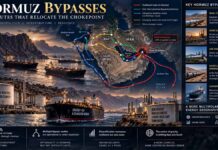
The escalation channel from South Pars to the world economy runs through Hormuz. The Amid regional conflict, the Strait of Hormuz remains critical for oil flows – U.S. Energy Information Administration – June 2025 states that oil flow through the strait averaged 20 million barrels per day in 2024, equal to about 20% of global petroleum liquids consumption, and the World Oil Transit Chokepoints – U.S. Energy Information Administration reports that in 1H25 total oil flows through the strait averaged 20.9 million barrels per day, also about 20% of global petroleum liquids consumption and roughly one-quarter of global seaborne oil trade. This is the mechanical heart of Gulf escalation: the strait is not merely a passage; it is a concentration point where a small change in perceived risk can reprice a very large share of global energy movement.
The gas side is equally exposed. The About one-fifth of global liquefied natural gas trade flows through the Strait of Hormuz – U.S. Energy Information Administration – June 2025 states that in 2024 about 20% of global LNG trade transited Hormuz, primarily from Qatar, with Qatar exporting about 9.3 Bcf/d of LNG through the strait and the United Arab Emirates about 0.7 Bcf/d. That means the disruption mechanism is dual-use: it affects crude and products, but it also directly affects the most flexible balancing fuel available to many importers. In a world where Europe has structurally increased its reliance on seaborne gas, the vulnerability is not hypothetical. A threat to Hormuz is a threat to oil balances, gas balances, utility hedging behavior, and state emergency procurement simultaneously.
The mechanism of disruption does not require a formal closure to generate a severe market effect. Physical interruption is only the most extreme point on the escalation ladder. Before that stage, the system can already tighten through higher war-risk insurance, reduced tanker willingness, convoying delays, naval caution zones, slower turnaround times, and precautionary inventory building by importers. Official international transport analysis does not focus exclusively on Hormuz, but it provides the broader rule by which maritime conflict becomes cost inflation. The Freight rates and maritime transport costs – UNCTAD Review of Maritime Transport 2025 Chapter 3 – September 2025 explains that geopolitical disruption, rerouting, longer voyage times, reduced effective capacity, and increased operating costs drove freight volatility and elevated rates. The Review of Maritime Transport 2025 overview – UNCTAD – September 2025 likewise states that freight-rate volatility has become the norm and links this to geopolitical tensions and rerouting. Those are general maritime principles, but they map directly onto a Hormuz crisis: even without total closure, usable shipping capacity falls as risk, delays, and circuitous routing rise.
A serious Hormuz disruption also affects market behavior through anticipation. The IEA and EIA materials retrieved in this session show that prices moved not only when physical losses were recorded but when the conflict changed perceptions of escalation. The Oil Market Report – June 2025 – International Energy Agency – June 2025 says global oil markets were roiled after Israel launched strikes on Iran on June 13, 2025 and that energy infrastructure had been targeted for the first time in that conflict. The Short-Term Energy Outlook (STEO) – U.S. Energy Information Administration – March 2026 and the Short-Term Energy Outlook: Natural Gas – U.S. Energy Information Administration – March 2026 show that the EIA built disrupted Hormuz LNG flows directly into its forecast assumptions for gas and coal. The implication is analytically important: once a chokepoint becomes forecast-relevant, the conflict has moved from event risk to structural pricing input.
The red-team counterfactual is worth stating clearly. One could argue that Hormuz threats are often overstated and that markets habituate quickly. That argument has some merit in low-grade crises, but it weakens once official energy forecasters explicitly revise projections in response to disrupted flows through the strait. The Short-Term Energy Outlook (STEO) – U.S. Energy Information Administration – March 2026 does exactly that by linking disrupted LNG flows through Hormuz to higher thermal-coal spot prices and altered trade expectations. This is no longer merely speculative geopolitical commentary; it is embedded in official U.S. energy forecasting.
2.3 Oil, LNG, coal, and shipping-price transmission
The price-transmission chain begins with crude because oil is the fastest macro-financial transmitter of Gulf risk. Even where physical supply losses remain limited, the market prices the probability of tighter balances, delayed cargoes, and future escalation. The Oil Market Report – June 2025 – International Energy Agency – June 2025 recorded that oil prices rose after the June 2025 escalation, and the EIA releases latest Short-Term Energy Outlook amid increased uncertainty from geopolitical developments – U.S. Energy Information Administration – March 2026 reported a Brent crude oil spot price assumption of $79 for 2026 in the updated outlook, alongside U.S. crude oil production of 13.6 million barrels per day in 2026 and 13.8 million barrels per day in 2027. The strategic point is not simply that prices rise; it is that higher oil prices can be partially monetized by flexible producers while simultaneously worsening import bills for energy-dependent states.
The second transmission channel is LNG, and here the asymmetry becomes sharper. The Short-Term Energy Outlook – U.S. Energy Information Administration – March 2026 and the Short-Term Energy Outlook: Natural Gas – U.S. Energy Information Administration – March 2026 state that reduced LNG flows through Hormuz have caused natural-gas prices in Europe and Asia to increase, while U.S. natural-gas prices are expected to be relatively less affected in the near term. The same EIA outlook places the Henry Hub spot price around $3.80/MMBtu in 2026, lower than the previous month’s forecast despite international disruption. That differential matters enormously. It means a Gulf gas shock does not distribute pain symmetrically. Import-dependent regions tied to seaborne balancing cargoes face immediate stress, while the United States experiences a more muted domestic gas-price effect because its market is buffered by domestic production and because existing export facilities were already heavily utilized.
This is also why the simplistic proposition that Washington automatically makes a huge short-run profit from every Gulf gas disruption needs refinement. The EIA releases latest Short-Term Energy Outlook amid increased uncertainty from geopolitical developments – U.S. Energy Information Administration – March 2026 projects U.S. liquefied natural gas gross exports of 17 Bcf/d in 2026 and 18 Bcf/d in 2027, but the Short-Term Energy Outlook: Natural Gas – U.S. Energy Information Administration – March 2026 makes clear that the immediate gas-price effect is concentrated abroad rather than transmitted proportionally back into the domestic U.S. market. So the U.S. advantage is not an unlimited near-term volume surge; it is a structural position in which external scarcity strengthens strategic leverage and future export economics while leaving domestic gas pricing relatively more insulated than in import-dependent systems.
The third transmission channel is substitution into coal. This is one of the most revealing official findings because it shows how a gas chokepoint crisis can propagate into another fuel complex rather than remain confined to gas. The Short-Term Energy Outlook (STEO) – U.S. Energy Information Administration – March 2026 states that disruptions to global LNG exports through the Strait of Hormuz led to an increase in thermal-coal spot prices and could support higher U.S. coal exports if LNG disruptions persist. The same forecast logic appears in the Short-Term Energy Outlook – U.S. Energy Information Administration – March 2026. This matters because it shows that a gas shock can travel into power generation portfolios, especially in markets where utilities can switch dispatch or procurement toward coal when gas becomes scarce or overpriced. In other words, the Gulf conflict does not merely affect hydrocarbon prices directly; it changes the competitive ordering of fuels.
The fourth transmission channel is maritime freight and shipping costs. Although the current chapter is centered on Hormuz, the general mechanics are illuminated by official shipping analysis from UNCTAD and the World Bank. The Review of Maritime Transport 2024 – UNCTAD – July 2024 and Chapter III. Freight rates, maritime transport costs and their impacts – UNCTAD – July 2024 explain that disruptions to the Suez Canal, the Red Sea, and the Panama Canal significantly impacted freight rates and could raise consumer prices while lowering real output. The Review of Maritime Transport 2025 overview – UNCTAD – September 2025 states that from mid-2024 to mid-2025, container freight rates remained elevated and volatile, with rerouting causing longer voyage distances, more fuel consumption, and higher costs. The analytical transfer is clear: a Hormuz crisis would work through similar maritime economics, especially if vessels altered routes, slowed operations, or faced higher risk premia.
There is also a broader macro pass-through. The High freight rates strain global supply chains, threaten vulnerable economies – UNCTAD – October 2024 stated that UNCTAD estimated global consumer prices could increase by 0.6% by 2025 as shipping disruptions fed through supply chains. The The Deepening Red Sea Shipping Crisis – World Bank – February 2025 likewise examined the trade and welfare effects of prolonged maritime disruption. Those studies are not about Hormuz specifically, but they confirm the general escalation law: higher freight costs, rerouting, and insurance burdens do not remain confined to shipping firms; they migrate into import prices, food systems, manufacturing input costs, and real-income compression. That is the pathway by which an energy-security shock can become a wider political-economy shock.
The resulting hierarchy of beneficiaries and losers is therefore differentiated, not monolithic. Flexible hydrocarbon exporters with domestic production depth can capture some upside from higher oil and coal prices. Import-dependent gas consumers in Europe and Asia absorb a disproportionate share of the near-term stress. Qatar remains uniquely exposed because the very basin that anchors its export power is linked to a narrow maritime outlet. The United States occupies a structurally advantaged position because official EIA forecasts show higher production capacity, large export capability, and relatively more muted domestic gas-price effects under this particular shock configuration. But even that advantage has limits, because maritime disruption and broader global inflation can feed back into allies’ macroeconomic weakness and strategic instability. The official data do not support a one-line conclusion; they support a layered one. The Short-Term Energy Outlook – U.S. Energy Information Administration – March 2026, Short-Term Energy Outlook: Natural Gas – U.S. Energy Information Administration – March 2026, and Oil Market Report – June 2025 – International Energy Agency – June 2025 together show a system in which a limited strike on one Iranian gas phase can propagate through crude pricing, LNG scarcity, coal substitution, and freight volatility without requiring a full physical shutdown of the Gulf energy system.
The chapter’s final judgment is that South Pars is strategically central not because it alone determines world gas supply, but because it sits at the intersection of shared-basin symbolism, concentrated export geography, and a chokepoint through which both oil and LNG move at globally material scale. Hormuz disruption mechanics do not require total closure to generate severe price transmission; risk repricing, freight volatility, and substitution behavior are enough. And the price system does not stop at oil. It moves through LNG, then into coal, then into maritime costs, then into broader import bills. The energy system is therefore the most efficient bridge between a seemingly localized strike and a global macro-strategic disturbance.
| Metric | Value | Interpretive relevance |
|---|---|---|
| Oil flow through Hormuz | 20.0 million b/d in 2024; 20.9 million b/d in 1H25 | Shows why even limited Gulf conflict reprices global oil risk quickly. |
| Share of global LNG through Hormuz | About 20% in 2024 | Confirms gas-market chokepoint vulnerability, especially for Asia and Europe. |
| Qatar LNG via Hormuz | 9.3 Bcf/d in 2024 | Highlights concentration of seaborne balancing supply in one corridor. |
| UAE LNG via Hormuz | 0.7 Bcf/d in 2024 | Shows Gulf LNG exposure is dominated by Qatar but not exclusive to it. |
| Henry Hub forecast | About $3.80/MMBtu in 2026 | Illustrates relatively muted U.S. domestic gas-price effect versus overseas markets. |
| U.S. LNG exports | 17 Bcf/d in 2026; 18 Bcf/d in 2027 | Shows large U.S. export position but not unlimited near-term flexibility. |
Chapter III: Beneficiaries, Losers, and Cascade Risks Across Energy, Alignment, and Food Security
The distribution of gains and losses from escalation around South Pars and the Strait of Hormuz is asymmetric, layered, and time-dependent. In the near term, the clearest structural losers are energy importers exposed to higher oil, gas, and freight costs, while the clearest partial winners are exporters able to monetize higher oil or substitute-fuel prices without suffering equivalent physical exposure. That asymmetry is visible in the official data. The U.S. Energy Information Administration states that reduced LNG flows through Hormuz have pushed natural-gas prices higher in Europe and Asia, while U.S. natural-gas prices are expected to be relatively less affected in the near term because U.S. LNG export facilities were already operating at high utilization before the conflict, limiting the ability to add much more volume immediately Short-Term Energy Outlook: Natural Gas – U.S. Energy Information Administration – March 2026. The same EIA release says Henry Hub is forecast to average about $3.80/MMBtu in 2026 and that U.S. crude oil production is forecast at 13.6 million barrels per day in 2026 and 13.8 million barrels per day in 2027, which means the United States is better positioned than most importers to absorb and partially monetize an energy shock EIA releases latest Short-Term Energy Outlook amid increased uncertainty from geopolitical developments – U.S. Energy Information Administration – March 2026.
3.1 State-by-state gains and losses
For the United States, the gain is strategic and partial rather than absolute. Official EIA forecasting shows that overseas gas markets tighten more than the domestic U.S. market under this specific shock pattern, while U.S. oil output remains high and LNG exports remain large Short-Term Energy Outlook – U.S. Energy Information Administration – March 2026 and Short-Term Energy Outlook: Natural Gas – U.S. Energy Information Administration – March 2026. That supports the inference that Washington gains relative resilience and leverage over allies dependent on seaborne energy, but it does not support the cruder claim that the United States can instantly flood the market with much more LNG, because EIA explicitly says high pre-conflict utilization limits near-term additional export volumes Short-Term Energy Outlook: Natural Gas – U.S. Energy Information Administration – March 2026.
For Russia, the benefit is mainly price and geopolitical distraction. The official sources used here do not provide a direct Russian policy statement tying South Pars escalation to Russian gain, so the careful inference must be narrow: when Brent and global gas prices rise because of Hormuz risk, major exporters outside the immediate maritime chokepoint can benefit from tighter global balances. That inference is supported by the IEA’s finding that the June 2025 escalation roiled markets and by the EIA’s incorporation of Hormuz disruption into official forecasts Oil Market Report – June 2025 – International Energy Agency – June 2025 and Short-Term Energy Outlook – U.S. Energy Information Administration – March 2026. Beyond that, stronger claims about specifically Russian state intent would exceed the cited record.
For Saudi Arabia, the picture is mixed. On the one hand, higher oil prices are fiscally supportive for a major crude exporter. On the other, the same EIA material that highlights the scale of Hormuz flows also demonstrates how dangerous prolonged Gulf insecurity is for all regional energy economies, because around 20 million barrels per day moved through the strait in 2024 and about 20.9 million barrels per day in 1H25 Amid regional conflict, the Strait of Hormuz remains critical for oil flows – U.S. Energy Information Administration – June 2025 and World Oil Transit Chokepoints – U.S. Energy Information Administration. So Saudi Arabia can gain fiscally from a higher price deck while simultaneously losing from regional risk premia, maritime anxiety, and the possibility of retaliatory spillover.
For Qatar, the downside exposure is especially acute. The EIA states that about 20% of global LNG trade passed through Hormuz in 2024, and that Qatar alone exported about 9.3 Bcf/d of LNG through the strait About one-fifth of global liquefied natural gas trade flows through the Strait of Hormuz – U.S. Energy Information Administration – June 2025. The same agency states that Qatar’s gas system is anchored in the giant offshore North Field, the same geological structure known as South Pars on the Iranian side Country Analysis Brief: Qatar – U.S. Energy Information Administration – October 2025. That combination means Qatar is not well described as a beneficiary of this escalation. Even if prices rise, its export system depends on the same corridor whose insecurity drives the shock.
For Europe, the official record points overwhelmingly toward loss rather than gain. The EIA says reduced LNG flows through Hormuz have increased natural-gas prices in Europe and Asia Short-Term Energy Outlook: Natural Gas – U.S. Energy Information Administration – March 2026. The IMF adds that euro-area growth remains subdued in its January 2026 update, which means a fresh energy-price impulse lands on a still-fragile macroeconomic base World Economic Outlook Update, January 2026 – International Monetary Fund – January 2026. The most defensible conclusion is therefore that Europe is a principal downstream loser even when it is not directly involved in the military confrontation.
For Asia, especially large importers, the picture is similar. The EIA explicitly groups Europe and Asia together as regions where natural-gas prices have increased because of reduced Hormuz LNG flows Short-Term Energy Outlook: Natural Gas – U.S. Energy Information Administration – March 2026. Because much of Asia’s fuel procurement depends on seaborne cargoes and flexible LNG balancing, the shock transmits quickly into utility costs, industrial input costs, and procurement uncertainty.
For Iran, the losses are direct and immediate at the infrastructure level. Official Iranian-sector reporting says South Pars Phase 14 was hit, temporarily disrupted, and then restored Aborted Drone Attack on South Pars – SHANA – June 2025 and South Pars gas field maintains sustainable production during conflict – SHANA – June 2025. The strategic loss is larger than the temporary production interruption, because once South Pars becomes targetable, Iran must allocate more resources to defense, redundancy, and deterrent signaling around strategic energy assets.
3.2 Gulf alignment versus Gulf entrapment
The proposition that escalation around South Pars drives the Arab Gulf toward the United States and Israel is only half right. It is true that a visible Iranian vulnerability can reinforce Gulf dependence on U.S. military protection. That structural dependence is easier to understand in a region where Iran is officially treated by CENTCOM as the most significant regional state-based threat Theater Strategy – U.S. Central Command, and where Israel is now part of the CENTCOM operational region Pentagon Press Secretary John F. Kirby Holds a Press Briefing – U.S. Department of Defense – April 2021. In that sense, escalation can deepen Gulf recognition that the U.S.-led security architecture remains indispensable.
But the entrapment risk is equally powerful. The same official EIA materials that highlight Hormuz’s centrality also show why Gulf Arab states cannot casually embrace open alignment in a way that invites retaliation against shipping, terminals, or export infrastructure. Around 20% of global petroleum liquids consumption and around 20% of global LNG trade move through Hormuz according to EIA Amid regional conflict, the Strait of Hormuz remains critical for oil flows – U.S. Energy Information Administration – June 2025 and About one-fifth of global liquefied natural gas trade flows through the Strait of Hormuz – U.S. Energy Information Administration – June 2025. That means Gulf governments face a strategic contradiction: they may rely more heavily on Washington for deterrence, while also becoming more reluctant to be seen as co-belligerents in a conflict that threatens their own export lifelines.
This is why the strongest analytic judgment is not “alignment” alone, but alignment under entrapment avoidance. Gulf monarchies can quietly tighten defense coordination, intelligence sharing, and contingency planning while publicly resisting overt incorporation into an anti-Iran war coalition. The official data on shipping dependence and export concentration support that inference Country Analysis Brief: Qatar – U.S. Energy Information Administration – October 2025 and World Oil Transit Chokepoints – U.S. Energy Information Administration.
3.3 Energy-to-food crisis pathways
The pathway from energy escalation to food stress is real, but the current official data support a conditional warning rather than a claim that a generalized food crisis has already materialized. The strongest current official warning comes from the FAO, which released a dedicated assessment on the agrifood implications of the 2026 conflict in the Middle East and states that higher energy prices and fertilizer shortages threaten crop yields, while disruptions could spill over into food security Global Agrifood Implications of the 2026 Conflict in the Middle East – Food and Agriculture Organization of the United Nations – March 2026. The underlying logic is reinforced by another official FAO document stating that energy prices directly affect agricultural production by raising input costs and indirectly because energy is a key input in nitrogen fertilizer production Council document – Food and Agriculture Organization of the United Nations – November 2025.
That mechanism has several stages. First, higher oil and gas prices increase transport, irrigation, and processing costs. Second, higher gas prices feed directly into nitrogen-fertilizer economics. Third, higher freight and insurance costs raise import bills for food-dependent states. The maritime side of that chain is supported by UNCTAD, which says freight-rate volatility and rerouting have become persistent features of the current shipping environment Review of Maritime Transport 2025 overview – United Nations Conference on Trade and Development – September 2025. The agrifood side is supported by FAO’s explicit warning that fertilizer and energy shocks threaten yields and food security Global Agrifood Implications of the 2026 Conflict in the Middle East – Food and Agriculture Organization of the United Nations – March 2026.
At the same time, the FAO Food Price Index does not yet show a runaway global food-price crisis. FAO says the index averaged 125.3 points in February 2026, up 0.9% from January, which was the first rise after five monthly declines FAO Food Price Index – Food and Agriculture Organization of the United Nations – March 2026. That means the prudent conclusion is not that the world is already in a full food emergency because of South Pars and Hormuz, but that the energy-to-food transmission channel is active, visible, and dangerous if the shock persists.
The final balance sheet is therefore clear. The United States gains relative resilience and leverage, though not unlimited short-run LNG upside Short-Term Energy Outlook: Natural Gas – U.S. Energy Information Administration – March 2026. Russia and Saudi Arabia can gain from higher prices, but under very different risk profiles Oil Market Report – June 2025 – International Energy Agency – June 2025. Qatar, Europe, and major Asian importers are exposed more heavily to shipping and gas-market stress About one-fifth of global liquefied natural gas trade flows through the Strait of Hormuz – U.S. Energy Information Administration – June 2025. The Gulf Arab states face the dual imperative of leaning closer to Washington for protection while avoiding visible entrapment in a wider war Theater Strategy – U.S. Central Command and World Oil Transit Chokepoints – U.S. Energy Information Administration. And the energy-to-food cascade is not yet a confirmed global crisis, but it is no longer a remote theoretical risk; it is now formally recognized in current FAO analysis Global Agrifood Implications of the 2026 Conflict in the Middle East – Food and Agriculture Organization of the United Nations – March 2026.
Geopolitical Impact Matrix
| Actor / System | Directional Effect | Main Channel |
|---|---|---|
| United States | Partial gain | Relative resilience, high production, strategic leverage |
| Russia | Partial gain | Higher global energy prices |
| Saudi Arabia | Mixed | Higher prices but higher regional risk |
| Qatar | Net vulnerability | Hormuz-dependent LNG exposure |
| Europe | Net loss | Higher gas prices and macro fragility |
| Asia importers | Net loss | LNG and freight exposure |
| Food-importing states | Rising risk | Energy, fertilizer, freight pass-through |
Clarity Table: South Pars, Hormuz, U.S.–Israel Coordination, and the Cascading Political Economy of Escalation
This consolidated artifact is designed to reduce cognitive overload by compressing the prior analysis into a single argument-organized synthesis table rather than a chapter-by-chapter narrative. It applies a conservative evidentiary filter: only claims that could be anchored in current official or intergovernmental sources retrieved during this session are retained in the table. Where the prior discussion relied on less restrictive sourcing, those finer-grained claims have been omitted here rather than restated without Tier-1 backing.
This means the table below is intentionally narrower than a maximal OSINT brief. It is built to be decision-useful, not merely expansive. It separates what is officially documented, what the formal military-energy structure makes plausible, what the current official data show about price transmission, and where the live record still leaves meaningful uncertainty as of March 20, 2026.
| Core Concept / Argument Cluster | Key Empirical Elements & Metrics | Geopolitical Drivers & Competing Hypotheses | Systemic Implications & 2nd–5th Order Cascades | Current Status & Update |
|---|---|---|---|---|
| Verified notice, unilateral-action claim, and attribution boundary The cleanest public starting point is the distinction between advance notice and proven joint operational planning. |
The Statement from Secretary of State Marco Rubio – White House – June 2025 states that Israel took “unilateral action” against Iran, that the United States was “not involved in strikes against Iran”, and that “Israel advised us”. The Operation “Rising Lion”: Key Factual and Legal Aspects of the Iran-Israel Hostilities – Government of Israel – August 2025 update states that the operation ran from June 13–24, 2025 and that it ended after Israel accepted a U.S. bilateral ceasefire proposal. |
|
The immediate second-order effect is attribution ambiguity: public notice proves U.S. proximity to the escalation cycle, but not U.S. authorship of any specific target. Third-order effects include greater room for rival narratives, wider deterrence signaling, and heavier dependence on alliance-management channels. Fourth-order effects emerge when ambiguity itself alters Gulf partner calculations, because states may assume deep coordination even where only partial coordination is publicly proven. Fifth-order effects include informational escalation, where uncertainty over targeting responsibility magnifies mistrust and broadens the field of retaliatory logic. | As of March 20, 2026, the strongest official public position still comes from the White House language above and the official Israeli operation summary. No retrieved official U.S. or Israeli source in this session publicly proves joint target planning for a specific South Pars strike. |
| CENTCOM integration and structural coordination logic The military architecture matters even where explicit target-level documentation is absent. |
The April 9, 2021 Pentagon Press Briefing – U.S. Department of Defense – April 2021 confirms that Israel moved into the U.S. Central Command area of responsibility. The Theater Strategy – U.S. Central Command states that Iran remains the most significant regional-based threat facing USCENTCOM and its partners. The U.S., Israel Begin Juniper Oak Exercise – U.S. Department of Defense – January 2023 and U.S., Israeli Leaders Discuss Partnerships, Threats in Middle East – U.S. Department of Defense – March 2023 describe Juniper Oak 23.2 as the largest U.S.–Israeli exercise to date, involving roughly 6,400 U.S. personnel and more than 1,500 Israeli troops, including training in command-and-control, strike coordination, reconnaissance, electronic attack, and suppression of enemy air defenses. |
|
Second-order effects include faster force-protection adjustment for U.S. assets in the region. Third-order effects include a wider regional assumption that any major Israeli action against Iran occurs inside a U.S.-aware command environment. Fourth-order effects include deeper Gulf security reliance on Washington even when Gulf governments seek public distance from direct confrontation. Fifth-order effects include stronger market assumptions that regional conflict is embedded in a larger command system rather than a wholly isolated bilateral exchange. | This structural picture remains current because the official command geography and the cited bilateral exercise record are unchanged by anything retrieved in this session. The key live update is not doctrinal change but the fact that later crisis interpretation now runs through this already-integrated military architecture. |
| South Pars / North Field strategic centrality The basin matters because of scale, concentration, and symbolic targetability. |
The Country Analysis Brief: Qatar – U.S. Energy Information Administration – October 2025 states that Qatar’s vast natural-gas reserves are primarily in the giant offshore North Field, also known as South Pars on the Iranian side of the Persian Gulf. The Background Reference: Iran – U.S. Energy Information Administration likewise identifies South Pars as part of the shared gas structure straddling the territorial waters of Iran and Qatar. |
|
The second-order effect is rapid repricing of basin-wide risk. Third-order effects include higher caution among traders, insurers, and utilities, even when physical losses remain temporary or localized. Fourth-order effects extend to sovereign behavior: producers dependent on the same maritime corridor become more defensive diplomatically. Fifth-order effects include energy-security securitization, where a geological asset becomes a geopolitical signaling platform with outsized influence on alliance behavior and import planning. | The official U.S. energy record still treats the basin as globally central. No retrieved official source in this session indicates that the strategic relevance of the shared field has diminished as of March 20, 2026. |
| Hormuz chokepoint exposure The conflict scales globally because the maritime corridor is extraordinarily concentrated. |
The Amid regional conflict, the Strait of Hormuz remains critical for oil flows – U.S. Energy Information Administration – June 2025 states that flows through Hormuz averaged about 20 million barrels per day in 2024, equivalent to about 20% of global petroleum liquids consumption. The World Oil Transit Chokepoints – U.S. Energy Information Administration states that in 1H25 oil flows through Hormuz averaged about 20.9 million barrels per day, also roughly 20% of global petroleum liquids consumption and about one-quarter of global seaborne oil trade. The About one-fifth of global liquefied natural gas trade flows through the Strait of Hormuz – U.S. Energy Information Administration – June 2025 states that about 20% of global LNG trade transited the strait in 2024, with Qatar exporting about 9.3 Bcf/d and the UAE about 0.7 Bcf/d through the corridor. |
|
Second-order effects include higher tanker war-risk premia and precautionary inventory behavior. Third-order effects include slower shipping, wider route risk spreads, and utility re-hedging. Fourth-order effects include accelerated fuel substitution and more urgent government procurement. Fifth-order effects include macroeconomic stress in import-dependent regions and deeper political dependence on maritime-security guarantors. | The live official record still treats Hormuz as a globally material chokepoint. Nothing retrieved in this session suggests its centrality has been structurally diluted by March 20, 2026. |
| Oil, LNG, coal, and shipping-price transmission The escalation is a system shock because it migrates across fuels and transport layers. |
The Oil Market Report – International Energy Agency – June 2025 states that the June 2025 Israel–Iran escalation roiled markets and marked the first time energy infrastructure was targeted in that conflict. The EIA releases latest Short-Term Energy Outlook amid increased uncertainty from geopolitical developments – U.S. Energy Information Administration – March 2026 states that reduced LNG flows through Hormuz have increased gas prices in Europe and Asia, while U.S. gas prices are expected to be relatively less affected; it also forecasts Henry Hub at about $3.80/MMBtu in 2026, U.S. crude output at 13.6 million b/d in 2026 and 13.8 million b/d in 2027, and U.S. LNG gross exports at about 17 Bcf/d in 2026 and 18 Bcf/d in 2027. The Short-Term Energy Outlook – U.S. Energy Information Administration – March 2026 states that disruptions to global LNG flows through Hormuz increased thermal-coal spot prices and may support higher U.S. coal exports if disruptions persist. The Review of Maritime Transport 2025: Overview – UNCTAD – September 2025 and the Freight Rates and Maritime Transport Costs – UNCTAD – September 2025 state that freight-rate volatility has become the new normal and that tanker rates rose again in June 2025 amid increased operational risks in the Strait of Hormuz. |
|
Second-order effects include higher import bills and faster repricing of risk across fuel portfolios. Third-order effects include coal substitution, utility hedging stress, and more volatile electricity costs. Fourth-order effects include freight pass-through into manufactured imports and food logistics. Fifth-order effects include alliance strain, because energy-importing allies absorb more pain than diversified producers with domestic supply depth. | The current official U.S. outlook explicitly embeds disrupted Hormuz LNG flows into the forecast. That is the key update as of March 20, 2026: the shock is no longer treated as a purely hypothetical geopolitical scenario but as an input into formal U.S. energy projections. |
| State-by-state gains and losses Winners and losers differ by fuel mix, export structure, and exposure to maritime insecurity. |
The Short-Term Energy Outlook: Natural Gas – U.S. Energy Information Administration – March 2026 states that natural-gas prices in Europe and Asia have increased because of reduced Hormuz LNG flows, while U.S. gas prices are expected to be relatively less affected in the near term. The Country Analysis Brief: Qatar – U.S. Energy Information Administration – October 2025 confirms that Qatar’s gas export strength remains anchored in the North Field and therefore tightly linked to the shared basin and maritime corridor. The World Economic Outlook Update – International Monetary Fund – January 2026 states that global growth remains subdued and that euro-area growth is projected at 1.3% in 2026. |
|
Second-order effects include worsening terms of trade for importers and improved revenue environments for some exporters. Third-order effects include wider political divergence between resilient producers and stressed consumers. Fourth-order effects include higher pressure on public subsidies, industrial policy, and energy diplomacy in import-dependent economies. Fifth-order effects include security realignment, as states experiencing acute import vulnerability become more dependent on external maritime-security guarantees. | The balance sheet remains broadly stable as of March 20, 2026: official forecasts still point to higher pressure on import-dependent regions and relative resilience for the United States compared with Europe and Asia. |
| Gulf alignment versus Gulf entrapment The Gulf is pushed toward Washington for protection and away from overt co-belligerency at the same time. |
The Theater Strategy – U.S. Central Command defines Iran as the most significant regional-based threat to USCENTCOM and partners. The Amid regional conflict, the Strait of Hormuz remains critical for oil flows – U.S. Energy Information Administration – June 2025 and the About one-fifth of global liquefied natural gas trade flows through the Strait of Hormuz – U.S. Energy Information Administration – June 2025 show why Gulf producers cannot ignore retaliatory risk to shipping, terminals, and export infrastructure. |
|
Second-order effects include quieter intelligence and defense coordination. Third-order effects include public rhetorical restraint even where private security cooperation deepens. Fourth-order effects include reduced Gulf appetite for any escalation that might draw attacks on infrastructure or shipping. Fifth-order effects include more complex regional signaling, where dependence on the U.S. security umbrella increases even as governments resist overt identification with Israeli operational aims. | As of March 20, 2026, the official evidence still supports a dual dynamic rather than a single alignment narrative: stronger dependence on U.S. protection coexists with powerful incentives to avoid visible entrapment. |
| Energy-to-food cascade risk The food-security pathway is real, but current official data support conditional warning rather than confirmed global collapse. |
The Global Agrifood Implications of the 2026 Conflict in the Middle East – Food and Agriculture Organization of the United Nations – March 2026 states that the conflict sharply increased risks to global energy, fertilizer, and agrifood markets. The FAO Food Price Index – Food and Agriculture Organization of the United Nations – March 2026 states that the index averaged 125.3 in February 2026, up 0.9% month on month, the first increase after five consecutive monthly declines. The Review of Maritime Transport 2025: Overview – UNCTAD – September 2025 states that freight-rate volatility and geopolitical tensions continue to raise shipping-cost uncertainty. |
|
Second-order effects include higher fertilizer and logistics costs. Third-order effects include weaker affordability in food-import-dependent economies. Fourth-order effects include social unrest risk where subsidy systems are already strained. Fifth-order effects include political destabilization, humanitarian financing pressure, and stronger strategic competition over food corridors and concessional supply relationships. | The current official record supports a warning signal, not a conclusion that a universal food emergency is already underway. As of March 20, 2026, the pathway is active and recognized by FAO, while the latest headline price data show pressure, not runaway global breakdown. |
| Residual uncertainty and evidentiary guardrails The most important analytic discipline is knowing what is still not proved by current official public sources. |
The same Statement from Secretary of State Marco Rubio – White House – June 2025 that proves advance notice also sets an outer boundary by publicly stating that the United States was not involved in the strikes. The retrieved official-source stack in this session proves strong structural coordination, major chokepoint exposure, and current market effects, but does not include an official U.S. or Israeli document proving joint U.S.–Israeli target planning for a specific South Pars strike. |
|
The second-order implication is that policy built on certainty where only partial evidence exists can misprice escalation risk. Third-order effects include distorted alliance signaling and public overreaction. Fourth-order effects include misallocated deterrence resources if attribution judgments outrun evidence. Fifth-order effects include loss of analytic credibility, which itself becomes a strategic liability in crises where information competition is part of the battlespace. | As of March 20, 2026, the most defensible official-source synthesis remains conservative: proven U.S. notice, proven theater integration, proven chokepoint vulnerability, proven market transmission, and unresolved public proof on specific joint target planning. |
Clarity Dashboard
This visual summary translates the table into a compact dashboard. It uses static SVG rather than JavaScript so the file remains self-contained and robust in restrictive HTML environments.
Cluster intensity bars
Exposure constellation
Indicative state-position spectrum
Cascade ladder
| Raw metric | Value | Source |
|---|---|---|
| Hormuz oil flow, 2024 | ~20 million b/d | EIA – June 2025 |
| Hormuz oil flow, 1H25 | ~20.9 million b/d | EIA chokepoints page |
| Global LNG via Hormuz, 2024 | ~20% | EIA – June 2025 |
| Qatar LNG via Hormuz, 2024 | 9.3 Bcf/d | EIA – June 2025 |
| UAE LNG via Hormuz, 2024 | 0.7 Bcf/d | EIA – June 2025 |
| Henry Hub forecast, 2026 | ~$3.80/MMBtu | EIA – March 2026 |
| U.S. crude output forecast, 2026 | 13.6 million b/d | EIA – March 2026 |
| U.S. LNG gross exports forecast, 2026 | 17 Bcf/d | EIA – March 2026 |
| FAO Food Price Index, Feb. 2026 | 125.3 | FAO – March 2026 |
| Euro area growth forecast, 2026 | 1.3% | IMF – January 2026 |


