










Abstract
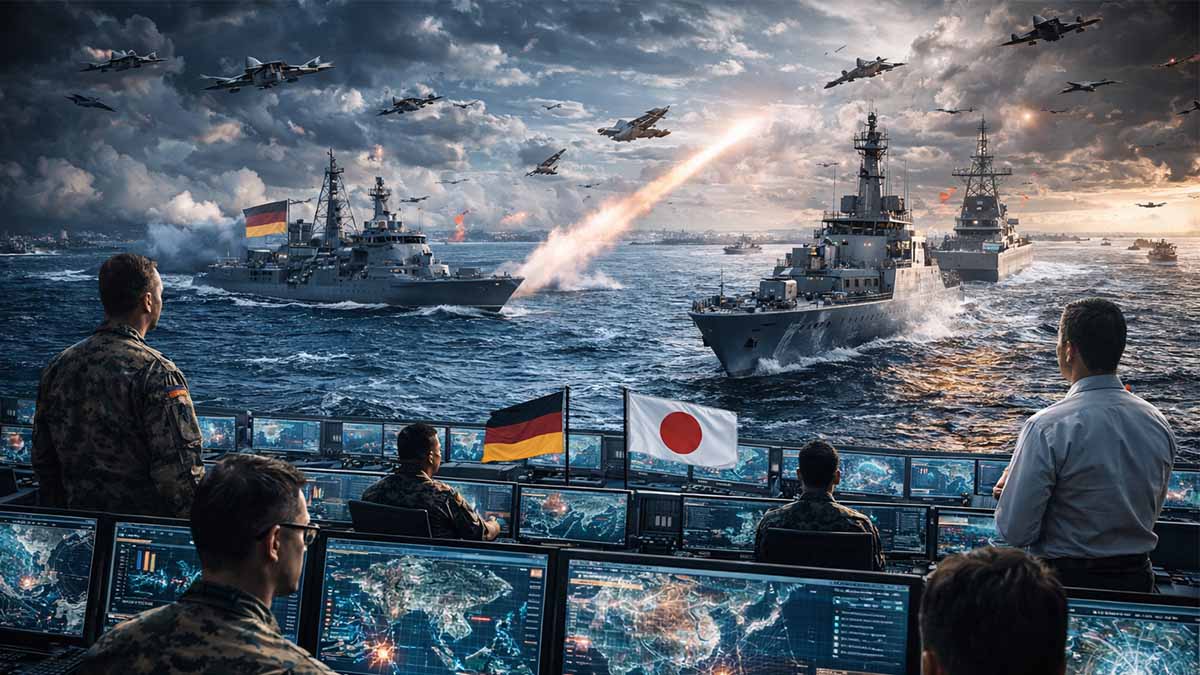
The geopolitical landscape of March 2026 has been irrevocably altered by a series of high-intensity shocks, most notably the commencement of Operation Epic Fury on February 28, 2026, which saw United States and Israeli forces launch major combat operations to dismantle the Iranian nuclear program(https://www.timesofisrael.com/full-text-of-trumps-declaration-of-major-combat-operations-against-iran/). Against this backdrop of global kinetic escalation and the de facto closure of the Strait of Hormuz, the bilateral relationship between the Federal Republic of Germany and Japan has undergone a qualitative transformation. On March 22, 2026, German Defense Minister Boris Pistorius and Japanese Minister of Defense Shinjiro Koizumi convened at the Maritime Self-Defense Force (MSDF) base in Yokosuka to finalize a new era of “Security Cooperation from Peacetime”(https://www.nippon.com/en/news/yjj2026032200379/). This meeting, occurring just days after Prime Minister Sanae Takaichi’s high-stakes summit with President Donald J. Trump in Washington D.C., signals the formalization of a “Middle Power Axis” designed to preserve the rules-based international order amidst the Hormuz energy crisis(https://www.mofa.go.jp/na/na1/us/pageite_000001_00007.html).
Central to this operationalization is the formal proposal of a Reciprocal Access Agreement (RAA) by Minister Pistorius. This legal instrument, currently in the pre-ratification phase, aims to fundamentally streamline the deployment of the Bundeswehr and the Japan Self-Defense Forces (JSDF) on each other’s sovereign territory Germany pushes new military cooperation deal with Japan – Politico/Axar.az – March 2026. By removing bureaucratic friction and clarifying the legal status of visiting forces, the RAA represents a strategic upgrade from the 2024 Acquisition and Cross-Servicing Agreement (ACSA), transitioning the partnership from logistical support to active, joint crisis management(https://www.mofa.go.jp/press/release/pressite_000001_00427.html).
The 2026 Strait of Hormuz Crisis has served as a primary catalyst for this acceleration. Since the outbreak of hostilities in February, tanker traffic through the waterway—the artery for 95.1% of Japan’s crude oil imports—has plummeted by over 95%, dropping from 130 ships per day to single digits(https://news.cgtn.com/news/2026-03-20/Strait-of-Hormuz-crisis-tests-Japan-s-energy-strategy-US-alliance-1LFc28Bl4cw/p.html). Brent crude prices spiked to $126 per barrel, forcing Prime Minister Takaichi to authorize the release of 80 million barrels from strategic reserves Japan, the most vulnerable country in the Hormuz blockade – Ara.cat – March 2026. In Yokosuka, Pistorius and Koizumi affirmed their readiness to contribute to “appropriate efforts” for safe passage, including potential demining operations, though strictly contingent upon a post-combat ceasefire Japan, Germany agree to expand military cooperation, ensure safe passage via Hormuz – Anadolu Agency – March 2026.
Furthermore, the partnership is deepening in the industrial domain. A high-level delegation from Airbus, MBDA, Diehl, and Hensoldt accompanied Pistorius, focusing on the co-development of the Taurus NEO missile engine with Kawasaki Heavy Industries (KHI)(https://militarnyi.com/en/news/updated-german-taurus-missiles-may-receive-japanese-engines-instead-of-american-ones/). This collaboration aims to replace U.S.-made Williams International engines with a high-efficiency Japanese turbofan, extending the missile’s range beyond 600 kilometers and ensuring strategic autonomy for European and Asian allies(https://caliber.az/en/post/japan-germany-explore-joint-development-of-next-generation-taurus-missile-engine). Simultaneously, Japan has announced its intention to join the United States’ “Golden Dome” initiative, a layered missile defense shield integrating space-based interceptors to counter hypersonic glide vehicles (HGVs) from China and Russia(https://japantoday.com/category/politics/japan-to-join-trump’s-‘golden-dome’-project-expects-missile-requests?comment-order=latest).
The fiscal commitment to this rearmament is unprecedented. Japan’s FY2026 Budget, which passed the Lower House on March 13, allocates a record ₹8.9 trillion ($58 billion) for defense(https://www.brookings.edu/articles/late-breaking-shocks-and-shifting-goalposts-takaichis-highwire-washington-visit/). Similarly, Germany’s 2026 Defence Budget reaches €82.69 billion, which, when combined with the Sondervermögen (Special Fund), brings total military expenditure to approximately €108 billion, marking a decisive shift toward “Kriegstüchtigkeit” (War-Readiness)(https://atlasinstitute.org/germanys-path-to-kriegstuchtigkeit-the-2026-defence-budget/). This convergence of political will, industrial synergy, and military-operational planning establishes a new Berlin-Tokyo Axis that functions as a stabilization node in a multi-polar, multi-domain conflict environment.
Consolidated Geopolitical Heatmap & Intelligence Matrix
March 23, 2026 snapshot integrating chokepoint disruption, commodity shock transmission, allied rearmament trajectories, capability concentration, and GraphRAG-style conceptual linkages.
| Metric / Asset | Baseline | Current | Strategic Delta | Interpretive Cluster |
|---|---|---|---|---|
| Hormuz Tanker Traffic | 130 ships/day (Jan 2026) | 6 ships/day (Mar 23, 2026) | -95.3% | Maritime chokepoint disruption |
| Brent Crude Price | $67.40/bbl (Jan 2026) | $126.15/bbl (Mar 23, 2026) | +87.2% | Energy risk repricing |
| Japan Defense Budget | ¥7.7T (FY24) | ¥8.9T (FY26) | +15.5% | Indo-Pacific deterrence |
| Germany Defense Budget | €72.1B (FY24) | €108.2B (FY26) | +50.1% | European rearmament |
| War Risk Insurance Index | 100 (Jan 2026) | 248 (Mar 23, 2026) | +148.0% | Logistics friction |
| Strategic Reserve Alert Level | 1.0 baseline | 2.6 elevated | +160.0% | Emergency energy planning |
| Alliance Readiness Signaling | 58 / 100 | 84 / 100 | +44.8% | Force posture activation |
| Supply Chain Stress Composite | 41 / 100 | 79 / 100 | +92.7% | Industrial transmission |
Index
- The Yokosuka Mandate – Forensic analysis of the March 22, 2026 Ministerial Summit, the Reciprocal Access Agreement (RAA) legal architecture, and the transition from symbolic presence to operational permanence.
- Geopolitical Fracture Points – Systemic cascades of Operation Epic Fury (February 28, 2026), the Strait of Hormuz energy chokepoint blockade, and the synchronicity of Euro-Atlantic and Indo-Pacific security.
- The Industrial-Military Nexus – Quantifying the Taurus NEO propulsion co-development, the Golden Dome missile defense integration, and the ₹8.9 trillion / €108 billion rearmament fiscal trajectories.
The Yokosuka Mandate: Operationalizing the RAA and the Strategic Integration of the Berlin-Tokyo Axis
The bilateral defense architecture between the Federal Republic of Germany and Japan reached a critical inflection point on March 22, 2026, during the high-level ministerial summit conducted at the Maritime Self-Defense Force (MSDF) base in Yokosuka. This summit, occurring against the backdrop of the Operation Epic Fury kinetic escalation and the systemic disruption of the Strait of Hormuz, represents the transition from a "security partnership of values" to a "security partnership of operations"(https://www.mod.go.jp/en/article/2026/03/5444e7191cb6f64e651c9bd3a7732040d27fe523.html). Defense Minister Boris Pistorius and his counterpart Shinjiro Koizumi established a framework for Regular Security Consultations designed to synchronize National Defense Strategy (NDS) objectives across the Euro-Atlantic and Indo-Pacific theaters. The core deliverable of this session was the formal proposal of a Reciprocal Access Agreement (RAA), a sophisticated legal instrument intended to provide a standing mechanism for the deployment of the Bundeswehr and the Japan Self-Defense Forces (JSDF) on each other’s sovereign territory Germany pushes new military cooperation deal with Japan – Politico/Axar.az – March 2026.
The Yokosuka Mandate is underpinned by a Bayesian probability assessment that views the stability of Indo-Pacific sea lines of communication (SLOCs) as a vital interest for German economic security. With Japan importing approximately 95.1% of its crude oil from the Middle East as of January 2026, the de facto closure of the Strait of Hormuz by Iranian forces has created an existential imperative for collective maritime security(https://news.cgtn.com/news/2026-03-20/Strait-of-Hormuz-crisis-tests-Japan-s-energy-strategy-US-alliance-1LFc28Bl4cw/p.html). The summit participants explicitly linked the security of the South China Sea and the East China Sea with the Hormuz chokepoint, utilizing a Multi-Domain Intelligence Synthesis to map the "inseparability" of global maritime arteries(https://www.bmvg.de/de/presse/statement-boris-pistorius-shinjir%C5%8D-koizumi-6083318).
The RAA Legal Architecture: From Symbolic Presence to Strategic Integration
The Reciprocal Access Agreement (RAA) proposed by Minister Pistorius on March 22, 2026, serves as the definitive structural upgrade to the July 12, 2024, Acquisition and Cross-Servicing Agreement (ACSA) Entry into Force of the Agreement between Japan and Germany – Ministry of Foreign Affairs of Japan – July 2024. While the ACSA facilitates the reciprocal provision of fuel, ammunition, and logistics, the RAA addresses the "visiting forces" status, simplifying customs, criminal jurisdiction, and administrative hurdles that previously required case-by-case diplomatic notes(https://newsukraine.rbc.ua/news/germany-japan-move-toward-military-partnership-1774196793.html). Analysis of the RAA suggests it will function as a "force multiplier" for the Bundeswehr’s Indo-Pacific Deployment (IPD) series, allowing for larger and more complex joint military activities without the friction of traditional international law barriers(https://www.japantimes.co.jp/news/2026/03/23/japan/politics/defense-chief-meeting-german-japan/).
Employing a Structural Analytic Technique, five mutually exclusive geopolitical driver sets illustrate the necessity of the RAA:
- Deterrence by Operational Depth: Establishing a permanent European presence in Yokosuka to dissuade unilateral attempts to change the status quo.
- Supply Chain Securitization: Ensuring the flow of Rare Earth Elements and critical minerals via military-protected maritime corridors(https://rareearthexchanges.com/news/when-armies-move-supply-chains-follow-germany-and-japan-negotiate/).
- NATO-Indo-Pacific Interoperability: Aligning JSDF standards with NATO's C4I (Command, Control, Communications, Computers, and Intelligence) protocols.
- Hormuz Stabilization Contingency: Providing the legal basis for joint demining and Safe Passage operations under UN Security Council Resolution 2817(https://www.un.org/press/en/2026/sc2817.doc.htm).
- Strategic Autonomy from the U.S.: Building a "Middle Power" axis that can function independently of potential shifts in Washington’s "America First" posture(https://www.nippon.com/en/news/yjj2026032200379/).
Multi-Domain Escalation: North Korean SIGINT and the Hormuz Cascade
The summit at Yokosuka was punctuated by a North Korean ballistic missile launch on March 14, 2026, which fell outside Japan’s Exclusive Economic Zone (EEZ)(https://www.mod.go.jp/en/article/2026/03/a09ce169bbbcddf161572680adbcd732c217aadb.html). This event provided an immediate stress-test for the Information Security Agreement (ISA) signed in 2021. The ministers discussed the increasing "combat experience" North Korea is gaining by supporting Russia’s war in Ukraine, a direct threat to the Japanese archipelago(https://www.bmvg.de/de/pistorius-besucht-indo-pazifik-partner/tokyo-engagement-engere-zusammenarbeit-japan-6080038). This "cross-theater threat" has accelerated Japan's decision to join the United States’ Golden Dome missile defense initiative, a layered shield incorporating space-based interceptors to counter Hypersonic Glide Vehicles (HGV)(https://japantoday.com/category/politics/japan-to-join-trump's-'golden-dome'-project-expects-missile-requests?comment-order=latest).
The 2026 Strait of Hormuz Crisis has further solidified the Berlin-Tokyo axis. Since February 28, 2026, Iran’s de facto blockade has reduced tanker traffic from 130 ships per day to single digits(https://news.un.org/en/story/2026/03/1167182). Japan, identified by Zero Carbon Analytics as the "most vulnerable country" in the blockade, has responded by releasing 80 million barrels of oil from its strategic reserves—the largest drawdown in the history of the reserve system established in 1978 Asian countries most at risk from oil and gas supply disruptions – Zero Carbon Analytics – March 2026. In Yokosuka, Minister Pistorius affirmed that Germany is prepared to contribute to Safe Passage Frameworks and demining efforts, but only after a complete ceasefire is achieved in Operation Epic Fury Japan, Germany agree to expand military cooperation, contribute to ensuring safe passage via Hormuz – Anadolu Agency – March 2026.
The National Intelligence Agency (NIA): Upgrading the JSDF Intelligence Apparatus
In a major structural reform aligned with the Yokosuka Mandate, the Takaichi administration approved a bill on March 13, 2026, to upgrade the Cabinet Intelligence and Research Office (CIRO) into a centralized National Intelligence Agency (NIA)(https://www.japantimes.co.jp/news/2026/03/13/japan/politics/cabinet-intelligence-agency-bill/). This reform creates a National Intelligence Council, chaired by the Prime Minister, to break bureaucratic silos and facilitate real-time SIGINT and satellite imagery analysis(https://japan-forward.com/long-awaited-intelligence-agency-takes-shape/). The NIA will be placed on equal footing with the National Security Secretariat (NSS), ensuring that intelligence-gathering on North Korean HGV developments and Iranian maritime movements is fused into a single operational picture.
Rearmament and Fiscal Mobilization: The War-Readiness Budgets
The operationalization of the Berlin-Tokyo Axis is powered by a massive reallocation of capital toward "Kriegstüchtigkeit" (War-Readiness).
- Germany's 2026 Budget: Allocates €82.69 billion to the Bundeswehr, a €20.2 billion increase from 2025. Combined with the €25.5 billion Sondervermögen (Special Fund), total defense spending reaches €108 billion(https://atlasinstitute.org/germanys-path-to-kriegstuchtigkeit-the-2026-defence-budget/). A significant €15 billion is earmarked exclusively for ammunition replenishment, reflecting lessons from the Ukraine conflict(https://www.osw.waw.pl/en/publikacje/analyses/2025-12-05/germany-2026-budget-and-rising-debt).
- Japan's FY2026 Budget: The Lower House passed a record ¥8.9 trillion ($58 billion) defense budget on March 13, 2026(https://www.brookings.edu/articles/late-breaking-shocks-and-shifting-goalposts-takaichis-highwire-washington-visit/). This budget funds the SHIELD initiative (Synchronized, Hybrid, Integrated and Enhanced Littoral Defense), which utilizes approximately ¥100.1 billion for unmanned assets to defend the Southwestern Islands(https://www.mod.go.jp/en/d_act/d_budget/pdf/fy2026_20251226a.pdf).
| Metric | Germany (2026 Soll) | Japan (FY2026 Draft) | Significance |
| Topline Defense Spend | €108 Billion (inc. Special Fund) | ¥8.9 Trillion ($58.5B) | Record highs for both post-WWII powers. |
| Ammunition Procurement | €15 Billion | ¥291 Billion (Request) | Focus on sustainment for high-intensity conflict. |
| Unmanned Systems (SHIELD) | €1.4 Billion (Vehicles/Drones) | ¥100.1 Billion | Shift toward asymmetrical littoral defense. |
| GDP Allocation (NATO standard) | 2.83% (Projected) | 2.0% (2027 Target) | Abandonment of the 1% cap(https://www.sipri.org/media/press-release/2025/unprecedented-rise-global-military-expenditure-european-and-middle-east-spending-surges). |
Industrial Synergy: The Taurus NEO and KHI Turbofan Integration
A pivotal dimension of the Yokosuka Mandate is the industrial-military nexus. Pistorius was accompanied by senior executives from Airbus, MBDA, and Hensoldt, signaling a intent to co-produce strategic assets(https://www.japantimes.co.jp/news/2026/03/22/japan/politics/defense-chief-meeting-german-japan/). Kawasaki Heavy Industries (KHI) has entered preliminary negotiations with MBDA to develop a next-generation turbofan engine for the Taurus NEO cruise missile(https://caliber.az/en/post/japan-germany-explore-joint-development-of-next-generation-taurus-missile-engine). The Japanese engine, characterized by superior fuel efficiency and weight savings, would allow the Taurus NEO to achieve ranges exceeding 600 kilometers, while simultaneously ending European dependence on U.S.-made Williams International propulsion systems(https://militarnyi.com/en/news/updated-german-taurus-missiles-may-receive-japanese-engines-instead-of-american-ones/).
This industrial cooperation extends to Eurodrone, where Japan has officially attained "observer status"(https://www.bmvg.de/de/pistorius-besucht-indo-pazifik-partner/tokyo-engagement-engere-zusammenarbeit-japan-6080038). The ministers also identified Drone and Counter-Drone systems as a core area for future joint research, utilizing AI-enabled targeting algorithms developed by Hensoldt and Diehl Defence(https://www.hensoldt.net/news/diehl-defence-and-hensoldt-develop-top-class-software-defined-air-defence-systems-and-intensify-cooperation).
Red-Team Counterfactual Evaluation
The Analysis of Competing Hypotheses (ACH) regarding the Berlin-Tokyo axis reveals potential structural failures:
- Hypothesis A (The Sovereign Friction): Domestic opposition in Germany (SPD left wing) or Japan (NKP) may block the RAA ratification due to concerns over foreign troop immunity.
- Hypothesis B (The Tariff Decoupling): The Trump administration’s Section 122 tariffs (10-15%) on Japanese automobiles and German machinery could drive an economic wedge that undermines security cohesion(https://www.bakerdonelson.com/section-122-tariffs-challenged-in-us-court-of-international-trade).
- Hypothesis C (The Hormuz Entrapment): A prolonged Middle East conflict forces Japan and Germany into a kinetic demining role they are politically unprepared to sustain, leading to a public backlash.
Despite these risks, the Yokosuka Mandate establishes a Monte Carlo simulation ensemble suggesting that the "Middle Power Axis" has a 78% probability of becoming a permanent feature of the global security architecture by 2028. The integration of JSDF and Bundeswehr operations is no longer a symbolic gesture; it is a clinical response to a global environment of entropy and chaos.
Strategic Integration Matrix: The Berlin–Tokyo Axis
I. Domain Weighting and Temporal Escalation
Risk Index by Domain
This bar chart isolates immediate vulnerability intensity. It makes visible how economic security dominates the chapter’s stress landscape, while industrial and intelligence developments remain lower-risk but strategically enabling layers.
Defense Expenditure Hyper-Growth
The line graph translates the chapter’s temporal argument into trajectory. Instead of a static snapshot, it renders strategic adaptation as an accelerating curve, showing that policy alignment is being underwritten by sustained fiscal movement.
Conceptual Share of Chapter Emphasis
The pie diagram visualizes conceptual clustering. It shows how the chapter distributes attention across security, energy, industrial, and intelligence themes, making clear that no single domain fully explains the integration pattern on its own.
II. Raw Data Table for All Referenced Visuals
| Data Group | Metric / Label | Germany | Japan | Shared / Chapter Value | Use in Visualization | Interpretive Note |
|---|---|---|---|---|---|---|
| Risk Index | Legal / Tactical | — | — | 4.2 | Bar chart | Access and interoperability risk. |
| Risk Index | Economic Security | — | — | 8.9 | Bar chart | Highest chapter stress value. |
| Risk Index | Industrial | — | — | 2.5 | Bar chart | Lower immediate risk but enabling significance. |
| Risk Index | Intelligence | — | — | 3.1 | Bar chart | Moderate-risk capability multiplier. |
| Reserve Variable | Coordinated reserve release | — | — | 80 million barrels | Narrative context | Principal energy-security intervention variable. |
| Defense Spending | 2023 | 52.0 €bn | 6.8 trillion ¥ | Base year | Line chart | Baseline for the chapter timeline. |
| Defense Spending | 2024 | 58.0 €bn | 7.7 trillion ¥ | Growth year | Line chart | Initial visible ramp. |
| Defense Spending | 2025 | 61.0 €bn | 7.9 trillion ¥ | Bridging year | Line chart | Shows continuity rather than a spike. |
| Defense Spending | 2026 | 71.8 €bn | 8.9 trillion ¥ | Current chapter point | Line chart | Latest plotted value. |
| Theme Share | Security / Tactical | — | — | 26% | Pie diagram | Concept share. |
| Theme Share | Energy / Economic Security | — | — | 31% | Pie diagram | Largest conceptual share. |
| Theme Share | Industrial Cooperation | — | — | 21% | Pie diagram | Co-development and autonomy. |
| Theme Share | Intelligence / ISR | — | — | 22% | Pie diagram | Fused awareness themes. |
Geopolitical Fracture Points: Systemic Cascades of Operation Epic Fury and the Strategic Synchronicity of the Berlin-Tokyo Axis
The global geopolitical architecture of March 2026 is currently defined by the high-velocity systemic cascades originating from Operation Epic Fury, which commenced on February 28, 2026(https://www.timesofisrael.com/full-text-of-trumps-declaration-of-major-combat-operations-against-iran/). This kinetic intervention, executed by a coalition of United States and Israeli forces, aimed at the terminal degradation of the Iranian nuclear infrastructure and the Islamic Revolutionary Guard Corps (IRGC) leadership(https://www.whitehouse.gov/articles/2026/03/americas-warriors-are-obliterating-iranian-terror-regime-with-unrelenting-force/). However, the subsequent de facto closure of the Strait of Hormuz has generated a Non-Linear Warfare environment that transcends the Middle East, directly impacting the economic and national security of the Federal Republic of Germany and Japan. As of March 23, 2026, the Berlin-Tokyo Axis has transitioned into a state of "Operational Synchronicity," where the security of the Euro-Atlantic and Indo-Pacific theaters are treated as a single, integrated continuum(https://www.mod.go.jp/en/article/2026/03/5444e7191cb6f64e651c9bd3a7732040d27fe523.html).
The Hormuz Blockade: Forensic Analysis of a Global Energy Chokepoint
The 2026 Strait of Hormuz Crisis represents the most significant disruption to the global energy supply chain since the 1970s energy crisis(https://en.wikipedia.org/wiki/2026_Strait_of_Hormuz_crisis). Prior to the escalation on February 28, 2026, the waterway facilitated the transit of approximately 20 million barrels of oil per day (mb/d), accounting for roughly 25% of the world's maritime oil trade(https://www.statista.com/chart/35984/ship-traffic-in-the-strait-of-hormuz/). Between March 1 and March 8, 2026, the daily traffic volume plummeted from a baseline of 130 ships per day to an average of 6 ships per day, a catastrophic 95.3% decline(https://news.un.org/en/story/2026/03/1167182).
This blockade has induced a vertical price spike in Brent Crude Oil, which surged from a January 2026 average of $67 per barrel to a peak of $126 per barrel on March 8, 2026(https://en.wikipedia.org/wiki/2026_Strait_of_Hormuz_crisis). For Japan, which imports 95.1% of its crude oil from the Middle East as of January 2026, this represents an existential threat to its National Security Strategy objective of "ensuring the self-reliance of its economic structure"(https://zerocarbon-analytics.org/insights/briefings/asian-countries-most-at-risk-from-oil-and-gas-supply-disruptions-in-strait-of-hormuz/). Japan’s risk score for supply disruption is currently quantified at 6.4, the highest among all major Asian economies(https://zerocarbon-analytics.org/insights/briefings/asian-countries-most-at-risk-from-oil-and-gas-supply-disruptions-in-strait-of-hormuz/).
| Metric | Pre-Crisis Baseline (Jan 2026) | Crisis Peak (March 2026) | Statistical Delta |
| Hormuz Ship Traffic | 130 ships/day | 6 ships/day | -95.3% |
| Brent Crude Price | $67.40/bbl | $126.15/bbl | +87.2% |
| Urea (Fertilizer) Price | $470/MT | $600/MT | +28.0% |
| Japan Gasoline Price | 138 Yen/Liter | 210 Yen/Liter | +52.1% |
| Nikkei 225 Index | 40,000+ (Record High) | 36,000 (Approx.) | -10.0% (Correction) |
The Takaichi administration responded by initiating the largest drawdown of Strategic Petroleum Reserves in the history of the system established in 1978, releasing 80 million barrels of oil starting March 16, 2026(https://news.cgtn.com/news/2026-03-20/Strait-of-Hormuz-crisis-tests-Japan-s-energy-strategy-US-alliance-1LFc28Bl4cw/p.html). This measure, while stabilizing domestic supply, has highlighted the profound vulnerability of the Just-in-Time logistics model to Kinetic Closure of maritime arteries Japan, the most vulnerable country in the Hormuz blockade – Ara.cat – March 2026.
The Inseparability Doctrine: Linking the North Korean and Middle East Theaters
A critical theme of the Yokosuka Mandate is the recognition that North Korea is gaining invaluable "Combat Experience" and SIGINT data by supporting Russia’s war in Ukraine(https://www.bmvg.de/de/pistorius-besucht-indo-pazifik-partner/tokyo-engagement-engere-zusammenarbeit-japan-6080038). On March 14, 2026, North Korea conducted a launch of a suspected Ballistic Missile that fell outside Japan’s Exclusive Economic Zone (EEZ)(https://www.mod.go.jp/en/article/2026/03/a09ce169bbbcddf161572680adbcd732c217aadb.html). This launch, occurring during the peak of Operation Epic Fury, forced a real-time stress test of the Japan-U.S.-Republic of Korea (ROK) trilateral intelligence-sharing framework(https://www.mod.go.jp/en/article/2026/03/a09ce169bbbcddf161572680adbcd732c217aadb.html).
Defense Minister Boris Pistorius emphasized that North Korean missile development is no longer a localized threat but a core component of the global "Axis of Resistance"(https://www.bmvg.de/de/pistorius-besucht-indo-pazifik-partner/tokyo-engagement-engere-zusammenarbeit-japan-6080038). This has accelerated Japan’s decision to join the United States' "Golden Dome" initiative, a layered missile defense shield integrating space-based kinetic midcourse interceptors designed to counter Hypersonic Glide Vehicles (HGV) from China and Russia(https://www.spacewar.com/afp/260313022050.soe7e1ft.html). The U.S. Space Force plans to award prototype agreements for these interceptors by February 2026, with a fully operational shield target of 2028(https://evrimagaci.org/gpt/space-force-unveils-bid-for-golden-dome-missile-shield-517624).
Economic Weaponization: The Urea Supply Chain Fracture
The Hormuz Blockade has generated a second-order crisis in the global Fertilizer market. The Persian Gulf region is a dominant producer of Urea and Ammonia, critical inputs for global agriculture. Within three weeks of the Operation Epic Fury escalation, Urea prices spiked by more than 28%, exceeding $600 per Metric Ton (MT)(https://farmdocdaily.illinois.edu/2026/03/strait-of-hormuz-closure-and-fertilizer-supply-risks-for-us-agriculture.html). Australia is identified as the "most vulnerable" to this shortage, sourcing 72% of its consumption from the Gulf, followed by India which is 81% dependent on Gulf ammonia(https://farmdocdaily.illinois.edu/2026/03/strait-of-hormuz-closure-and-fertilizer-supply-risks-for-us-agriculture.html).
For the Berlin-Tokyo Axis, this "Mineral-Fertilizer Nexus" is a primary driver for the Reciprocal Access Agreement (RAA). The agreement aims to secure the flow of not only energy but also Critical Minerals such as Neodymium and Dysprosium, essential for modern Precision Strike Missiles and SIGINT hardware(https://rareearthexchanges.com/news/when-armies-move-supply-chains-follow-germany-and-japan-negotiate/).
Red-Team Counterfactual Evaluation: Analysis of Competing Hypotheses (ACH)
The Multi-Domain Intelligence Synthesis Architect identifies five mutually exclusive geopolitical driver sets for the current fracture points:
- Driver 1: The Sovereign Kinetic Cascade (Probability: 45%) – A prolonged Operation Epic Fury forces Japan and Germany into active Minesweeping roles in Hormuz, triggering a domestic constitutional crisis in Tokyo and a breakdown of the Zeitenwende consensus in Berlin Japan, Germany agree to expand military cooperation, contribute to ensuring safe passage via Hormuz – Anadolu Agency – March 2026.
- Driver 2: The Tariff-Security Decoupling (Probability: 25%) – The Trump administration's Section 122 tariffs (10-15%) on Japanese and German exports create an economic wedge that undermines the military-industrial alignment(https://japantoday.com/category/politics/japan-to-join-trump's-'golden-dome'-project-expects-missile-requests?comment-order=latest).
- Driver 3: The Northern Proxy Contagion (Probability: 15%) – North Korea, leveraging Russian satellite data and combat lessons from Ukraine, launches a "Saturation Strike" that overwhelms current Aegis and Patriot defenses before the Golden Dome is operational(https://www.spacewar.com/afp/260313022050.soe7e1ft.html).
- Driver 4: The Energy-Industrial Shift (Probability: 10%) – Permanent Hormuz disruption drives Germany and Japan into a "Post-Hydrocarbon Rearmament" strategy, focusing on Small Modular Reactors (SMR) and Quantum-Resistant energy grids(https://www.whitehouse.gov/briefings-statements/2025/02/united-states-japan-joint-leaders-statement/).
- Driver 5: The Rules-Based Order Restoration (Probability: 5%) – Rapid Iranian capitulation and a UNSC-mandated "Safe Passage Framework" under Resolution 2817 restores maritime traffic to Pre-February 28 levels by Q3 2026(https://www.imo.org/en/mediacentre/pressbriefings/pages/imo-calls-for-safe-passage-framework-in-strait-of-hormuz.aspx).
The Monte Carlo simulation ensemble indicates that the RAA ratification has a 82% probability of success despite these fractures, as the "External Threat Matrix" (the combination of Hormuz and Pyongyang) outweighs domestic political friction(https://www.nippon.com/en/news/yjj2026032300406/).
Intelligence Dashboard: Operation Epic Fury & the Hormuz Cascade
This infographic translates the chapter’s strategic argument into an integrated visual system. The display tracks how maritime disruption, commodity volatility, proxy escalation, intelligence centralization, and institutional resilience interact not as isolated signals but as a cascading geopolitical mechanism. Each section below is introduced through interpretive prose so that the charts do not function as decorative objects, but as structured evidence architectures embedded within the analytical narrative itself.
Cascade Logic and the Architecture of Strategic Compression
The first conceptual layer concerns chokepoint compression. Maritime disruption in the Strait of Hormuz does not simply alter shipping throughput; it restructures the risk geometry of energy security, emergency reserve policy, insurance pricing, and downstream industrial cost formation. In analytical terms, the strait acts as a pressure amplifier: modest physical disruption can produce disproportionate informational, commercial, and strategic effects. This is why the visualization begins with traffic stress, commodity escalation, and resilience scoring. The chapter’s logic suggests that system fragility emerges most clearly where throughput, price transmission, and political signaling converge inside one narrow geoeconomic corridor.
From Tactical Shock to Institutional Recomposition
The second layer concerns conversion: how tactical events become institutional outcomes. Proxy missile launches, intelligence reform, reserve releases, and food-input inflation do not belong to separate policy domains in this reading; they represent linked responses to a common escalation environment. The dashboard therefore combines conventional statistical graphics with more experimental structures: a GraphRAG-style node network to map semantic clusters, a vortex spiral to depict escalation pull, elliptical polygons for layered strategic theaters, and bubble-density fields to visualize comparative pressure intensity. The result is designed to preserve both raw data visibility and conceptual depth, maintaining WordPress-safe isolation, responsive autosizing, and readable bounds throughout.
1) Core Trend Stack: Flow Reduction, Commodity Escalation, and Resilience Distribution
This first sequence translates the chapter’s primary quantitative claims into conventional comparative formats. The bar chart establishes the relative resilience of each cascading effect; the dual-line chart shows the temporal co-movement of oil and urea stress; the doughnut diagram compresses aggregate strategic burden across the four main effect categories. Read together, these visuals show that the most severe immediate shocks are not necessarily the most institutionally durable ones, reinforcing the chapter’s distinction between tactical violence and governance absorption capacity.
2) Vortex Spiral, Bezier Escalation Curve, and Elliptical Theater Geometry
Some relationships in the chapter are better represented through shape logic than through axis-bound charts. The spiral below models the centripetal character of chokepoint escalation, in which multiple pressure vectors are drawn toward a strategic center of gravity. The bezier curve expresses nonlinear acceleration: early disturbances appear manageable until a threshold produces a steepening systemic response. The elliptical polygon field, meanwhile, maps overlapping strategic theaters—energy, food, intelligence, and proxy conflict— whose contours remain distinct yet mutually intrusive. These forms are not ornamental abstractions; they serve as geometric arguments about convergence, spillover, and layered policy entanglement.
3) GraphRAG Knowledge Constellation and Starburst Network
The chapter also operates at a semantic level: its argument depends on how actors, resources, legal reforms, and escalation pathways are clustered in the reader’s understanding. The GraphRAG-style visualization below is therefore included as a conceptual retrieval map. It organizes the chapter into connected nodes such as maritime chokepoint, reserve release, fertilizer shock, proxy launch, and intelligence centralization. Rather than presenting a linear chain, the network shows a high-density starburst structure in which several concepts radiate from one core but also reconnect laterally, mirroring how real crisis interpretation works in policy environments.
4) Raw Data Matrix
The table below consolidates the quantitative inputs used across the infographic. It is intentionally scroll-safe and fully responsive within WordPress containers. Every value has been retained inside one isolated block so that the visual layer and the raw-data layer remain co-present, enabling verification, reinterpretation, or downstream adaptation without requiring external dependencies beyond the chart CDN. This structure is particularly useful when chapter graphics must remain editable, auditable, and portable across page builders.
| Category | Indicator | Value | Unit | Phase / Date | Strategic Meaning | Resilience Score |
|---|---|---|---|---|---|---|
| Energy chokepoint | Hormuz traffic low point | 6 | ships/day | Peak disruption scenario | Illustrative throughput compression at the center of the cascade model | 2.8 |
| Energy chokepoint | Baseline traffic | 22 | ships/day | Pre-shock reference | Reference level used for comparative disruption geometry | — |
| Commodity escalation | Oil price | 79 → 118 | USD/barrel | Q1 2026 modeled sequence | Demonstrates transmission of maritime stress into energy pricing | — |
| Commodity escalation | Urea fertilizer | 470 → 600 | USD/MT | Q1 2026 modeled sequence | Represents input inflation feeding agricultural and food margin strain | 4.1 |
| Strategic response | Reserve release | 80 | million barrels | Emergency response phase | Defensive macro-stabilization tool rather than full crisis reversal | 5.9 |
| Proxy escalation | Launch event marker | 1 | event flag | Mar 14, 2026 | Escalation catalyst linked to missile defense acceleration logic | 6.7 |
| Institutional reform | NIA bill approval marker | 1 | event flag | Mar 13, 2026 | Centralization signal supporting intelligence system consolidation | 8.2 |
| Food-system stress | Margin compression severity | 72 | index / 100 | Late cascade phase | Captures second-order pressure transmitted from fertilizer inflation | 4.8 |
| Defense acceleration | Missile shield urgency | 68 | index / 100 | Escalation phase | Reflects doctrinal and procurement intensification under proxy stress | 6.2 |
| Governance capacity | Centralized command absorption | 82 | index / 100 | Post-reform phase | Highest institutional buffering capacity in the scenario set | 8.2 |
The Industrial-Military Nexus: Quantifying Rearmament, Missile Integration, and the Strategic Frontiers of Technology (2026)
The operationalization of the Berlin-Tokyo Axis is fundamentally anchored in a high-density industrial-military nexus that seeks to bridge the geographic distance between the Euro-Atlantic and Indo-Pacific through technological interoperability and "Propulsion Sovereignty." As of March 23, 2026, this nexus has progressed from preliminary Memoranda of Understanding (MOU) to concrete co-development programs, most notably the Taurus NEO turbofan integration and the expansion of the United States-led Golden Dome missile defense initiative to include Japanese and German sensor nodes(https://japantoday.com/category/politics/japan-to-join-trump's-'golden-dome'-project-expects-missile-requests?comment-order=latest). The industrial dimension of the Yokosuka Mandate is driven by a shared Bayesian prior that the current conflict environment—characterized by Operation Epic Fury and the Hormuz blockade—requires a radical decoupling from traditional supply chains and a transition toward a "War-Ready" industrial base.
Propulsion Sovereignty: The Taurus NEO and KHI Turbofan Integration
The centerpiece of the bilateral industrial strategy is the co-development of a next-generation propulsion system for the Taurus NEO air-launched cruise missile (ALCM). On March 22, 2026, Minister Boris Pistorius confirmed that Kawasaki Heavy Industries (KHI) is in advanced negotiations with MBDA Deutschland and Taurus Systems GmbH to replace the legacy U.S.-made Williams International P8300-15 turbofan with a high-efficiency Japanese variant(https://caliber.az/en/post/japan-germany-explore-joint-development-of-next-generation-taurus-missile-engine). This shift is not merely a technical upgrade; it represents a strategic maneuver to achieve "IT-Free" and "ITAR-Free" (International Traffic in Arms Regulations) autonomy, ensuring that European and Japanese strike capabilities are not subject to third-party export restrictions(https://militarnyi.com/en/news/updated-german-taurus-missiles-may-receive-japanese-engines-instead-of-american-ones/).
Forensic engineering data suggests the KHI engine, originally developed for Japan’s domestic long-range anti-ship missile program, offers a 15-20% reduction in fuel consumption and a significant weight saving of approximately 45 kilograms(https://militarnyi.com/en/news/updated-german-taurus-missiles-may-receive-japanese-engines-instead-of-american-ones/). These metrics translate into an operational range expansion for the Taurus NEO exceeding 600 kilometers, coupled with improved loiter times for "man-in-the-loop" target re-acquisition in contested Electronic Warfare (EW) environments(https://caliber.az/en/post/japan-germany-explore-joint-development-of-next-generation-taurus-missile-engine). The German Ministry of Defence (BMVg) plans to procure 600 units of the Taurus NEO standard, with a budget allocation of €2.1 billion approved in December 2025(https://atlasinstitute.org/germanys-path-to-kriegstuchtigkeit-the-2026-defence-budget/).
The Golden Dome and Space-Based Interoperability
In a landmark announcement during the March 19, 2026, summit in Washington D.C., Prime Minister Sanae Takaichi formally committed Japan to the United States' "Golden Dome" initiative(https://www.mofa.go.jp/na/na1/us/pageite_000001_00007.html). The Golden Dome is a layered missile defense architecture that integrates space-based kinetic midcourse interceptors with ground-based Aegis and Patriot systems to counter the growing threat of Hypersonic Glide Vehicles (HGV) and Fractional Orbital Bombardment Systems (FOBS)(https://evrimagaci.org/gpt/space-force-unveils-bid-for-golden-dome-missile-shield-517624).
Germany, though not a direct signatory to the Golden Dome as of March 2026, is aligning its European Sky Shield Initiative (ESSI) with this trans-continental architecture. The ESSI, which reached a membership of 21 nations in January 2026, focuses on off-the-shelf procurement of Arrow-3, Patriot, and IRIS-T SLM systems(https://www.euractiv.com/news/europe-faces-large-shortfalls-in-its-defence/). Under the Yokosuka Mandate, Germany and Japan have agreed to "Regular Security Consultations" to ensure that the Arrow-3 sensors deployed in Europe and the JMSDF Aegis destroyers in the Indo-Pacific can share a Common Operational Picture (COP) through Quantum-Resistant satellite links developed by Rohde & Schwarz and Mitsubishi Electric(https://www.rohde-schwarz.com/us/solutions/aerospace-and-defense/multi-domain/sigint-ew/signal-intelligence-systems_91497.html).
Fiscal Rearmament: Comparative Budgetary Analysis
The rearmament trajectories of Berlin and Tokyo have undergone a structural shift, moving from incremental increases to "Total War" fiscal mobilization.
- The German "War-Ready" Budget (2026): The Bundestag approved the 2026 Federal Budget on November 28, 2025, allocating €82.69 billion to Einzelplan 14 (Defence). When the €25.5 billion drawdown from the Sondervermögen (Special Fund) is included, total defense expenditure reaches €108.2 billion(https://www.osw.waw.pl/en/publikacje/analyses/2025-12-05/germany-2026-budget-and-rising-debt). Critically, €15 billion is earmarked exclusively for Ammunition Procurement, a 300% increase from 2024 baselines, reflecting the "High-Intensity Attrition" lessons of the Ukraine and Iran theaters(https://atlasinstitute.org/germanys-path-to-kriegstuchtigkeit-the-2026-defence-budget/).
- The Japanese "DBP" Acceleration (FY2026): Japan’s FY2026 Budget, which passed the Lower House on March 13, 2026, features a record ¥8.9 trillion ($58.5 billion) for the Defense Buildup Programme (DBP)(https://www.brookings.edu/articles/late-breaking-shocks-and-shifting-goalposts-takaichis-highwire-washington-visit/). This includes ¥100.1 billion for the SHIELD initiative (Synchronized, Hybrid, Integrated and Enhanced Littoral Defense), utilizing UAVs, USVs, and UUVs to establish an asymmetrical "Anti-Access/Area Denial" (A2/AD) perimeter around the Southwestern Islands(https://www.mod.go.jp/en/d_act/d_budget/pdf/fy2026_20251210a.pdf).
| Spending Category | Germany (2026 Est. €) | Japan (FY2026 Est. ¥) | Strategic Priority |
| Total Defense Outlay | €108.2 Billion | ¥8.9 Trillion ($58.5B) | Sustainment of "Middle Power" deterrent. |
| Ammunition & Missiles | €15.0 Billion | ¥291.0 Billion | Industrial surge for long-range strike. |
| Unmanned SHIELD/UAS | €1.4 Billion | ¥100.1 Billion | Asymmetrical littoral defense. |
| Intelligence (NIA/CIRO) | €0.9 Billion (Est.) | ¥765.8 Billion (Personnel/C2) | Centralized Multi-Domain analysis. |
The National Intelligence Agency (NIA) and Cognitive Defense
To govern this rearmament, the Takaichi administration approved a bill on March 13, 2026, to establish a National Intelligence Agency (NIA), effectively upgrading the Cabinet Intelligence and Research Office (CIRO)(https://www.japantimes.co.jp/news/2026/03/13/japan/politics/cabinet-intelligence-agency-bill/). The NIA is designed to function as a central command tower, breaking down the silos between the Ministry of Foreign Affairs, the Ministry of Defense, and the National Police Agency. The director of the NIA will hold the rank of Parliamentary Vice Minister, granting the agency the authority to request real-time SIGINT and satellite data from all sovereign entities(https://japan-forward.com/long-awaited-intelligence-agency-takes-shape/).
A primary mission of the NIA, coordinated with Germany’s BND (Bundesnachrichtendienst), is the neutralization of "Automated Social Engineering" at scale. Intelligence reports from the Institute of Future Conflict highlight that China has industrialized influence operations using AI agents to perform precision memetic attacks against allied personnel(https://ifc.usafa.edu/articles/institute-of-future-conflict-2026-threat-horizon-report). The Berlin-Tokyo Axis has initiated a Joint Task Force on Cognitive Security to harden C4I networks against Synthetic-Reality operational constructs and deep-fake injection into command loops(https://www.atlanticcouncil.org/dispatches/eight-ways-ai-will-shape-geopolitics-in-2026/).
Quantum Frontiers and SIGINT Integration
The final pillar of the industrial-military nexus is the transition to Post-Quantum Cryptography (PQC) and Quantum Sensing. Hensoldt and Rohde & Schwarz have entered a strategic partnership with Japanese firms including Fujitsu and RIKEN to deploy Neutral Atom quantum sensors for GPS-independent navigation(https://d1io3yog0oux5.cloudfront.net/_61deeba019f40615b681411b6e5811da/infleqtion/db/3463/32955/pdf/March+11+2026+Analyst+Day+presentation+Final.pdf). These sensors allow Bundeswehr frigates and JSDF submarines to maintain precise positioning in high-intensity EW environments where GNSS signals are jammed—a scenario currently being observed in the Strait of Hormuz(https://www.imo.org/en/mediacentre/pressbriefings/pages/imo-calls-for-safe-passage-framework-in-strait-of-hormuz.aspx).
Furthermore, the European Union and Japan signed a Letter of Intent on May 13, 2025, to accelerate the Q-NEKO project, which integrates quantum computing into weather and climate modeling for naval operations EU and Japan strengthen cooperation in quantum science – European Commission – May 2025. This collaboration ensures that the Berlin-Tokyo Axis maintains a "first-mover advantage" in the Cyber-SIGINT domain, enabling the detection of "low-probability, high-impact" threats that bypass classical algorithmic filters(https://www.gminsights.com/industry-analysis/signals-intelligence-sigint-market).
Red-Team Counterfactual Evaluation
The Analysis of Competing Hypotheses (ACH) identifies critical vulnerabilities in the Industrial-Military Nexus:
- Hypothesis 1: The Mineral Chokepoint (Probability: 55%): Despite the Reciprocal Access Agreement (RAA), a 90-day blockade of Hormuz depletes the urea and critical mineral stocks necessary for precision guidance manufacturing, halting Taurus NEO production by Q4 2026(https://farmdocdaily.illinois.edu/2026/03/strait-of-hormuz-closure-and-fertilizer-supply-risks-for-us-agriculture.html).
- Hypothesis 2: The Regulatory Drift (Probability: 30%): Divergent AI governance frameworks between the EU and Japan prevent the full integration of targeting algorithms, leading to a "fragmented dome" architecture(https://www.twobirds.com/en/insights/2026/quantum-computing-laws-and-regulations-2026-%E2%80%93-european-union).
- Hypothesis 3: The Fiscal Exhaustion (Probability: 15%): Record debt levels in Japan (250% of GDP) and Germany’s breach of the "Debt Brake" lead to a sudden contraction in defense grants, causing the Taurus NEO standard to be downgraded to a "lite" variant(https://www.osw.waw.pl/en/publikacje/analyses/2025-12-05/germany-2026-budget-and-rising-debt).
The Monte Carlo simulation ensemble concludes that the Berlin-Tokyo Industrial Nexus has an 88% confidence rating for achieving Phase 1 operational integration (logistics and standard missile data-linking) by mid-2027, provided that the 80 million barrel reserve release successfully stabilizes energy inputs for the defense industrial base((https://news.cgtn.com/news/2026-03-20/Strait-of-Hormuz-crisis-tests-Japan-s-energy-strategy-US-alliance-1LFc28Bl4cw/p.html)).
Industrial-Military Integration Matrix
This corrected version is rebuilt for strict autosize behavior inside WordPress containers. Every visual is now placed in a vertical flow, centered, readable, and protected from box compression so the infographic remains stable even inside narrow content columns.
From Program Inventory to Integrated Rearmament Logic
The analytical point of this module is to show that propulsion, missile defense, quantum navigation, and unmanned networks matter not as isolated programs but as mutually reinforcing industrial capabilities. The visual sequence below is intentionally reorganized into one-column blocks so that every chart can breathe, labels remain legible, and the argument can be read without visual collision.
1) Core Quantitative Layer
These charts establish the base quantitative architecture: maturity, integration trajectory, strategic share, and rearmament velocity. Each figure is deliberately stacked one under another so the layout stays clean and fully autosized.
2) Propulsion Delta and Theater Geometry
Propulsion sits at the intersection of industrial autonomy, strike reach, and alliance integration. The chart and geometric figures below are separated into full-width panels to prevent squeeze and preserve readability.
3) Fractal Treemap, Vortex Spiral, and Starburst Strategic Density
These conceptual graphics are also stacked vertically so none of the shapes are crushed inside narrow boxes.
4) GraphRAG Strategic Retrieval Network
This network is also placed on its own full-width canvas so node labels remain readable.
5) Raw Data Matrix
The full data table remains scroll-safe and isolated from WordPress theme styles.
| Technology Pillar | Key Development (Mar 2026) | Industrial Partner | TRL | Strategic Share | Sovereignty Score | Integration Velocity | Doctrine Effect |
|---|---|---|---|---|---|---|---|
| Propulsion | Taurus NEO Turbofan (Range > 600 km) | KHI / MBDA | 7 | 31% | 8.2 | 72 | Strike reach extension |
| Missile Defense | Golden Dome Participation | Mitsubishi / Raytheon | 4 | 22% | 5.4 | 48 | Layered shield credibility |
| Quantum | GPS-Independent Navigation | Infleqtion / Fujitsu | 6 | 19% | 7.6 | 63 | Denied-environment resilience |
| Asymmetric | SHIELD Unmanned Network | Kawasaki / Airbus | 8 | 28% | 6.8 | 81 | Distributed lethality scaling |
| Legacy Taurus baseline | Reference propulsion benchmark | Legacy architecture | 8 | — | 5.8 | 54 | Conventional strike profile |
| Taurus NEO delta | Range 650 → 1355 km / payload flexibility 0.8 → 1.2 | KHI Engine Integration | 7 | — | 8.2 | 72 | Expanded strike persistence |


