
















Abstract
On 19 March 2026, a United States Air Force F-35A Lightning II sustained damage from Iranian air defence fire while conducting a combat mission over central Iran. The aircraft executed a controlled emergency landing at a regional US base in the Middle East, with the pilot reported in stable condition. US Central Command (CENTCOM) confirmed the event and stated the incident remains under investigation. Iran’s Islamic Revolutionary Guard Corps (IRGC) claimed responsibility, asserting that its advanced air defence systems had engaged and severely damaged the aircraft. SSBCrack
If confirmed, this incident represents the first instance of a US crewed aircraft hit by Iranian fire since the start of Operation Epic Fury on 28 February 2026. The Aviationist That operation, the US-Israeli air campaign against Iranian military infrastructure, had until this point produced no confirmed Iranian hits on manned American platforms. The aircraft losses prior were all attributable to accident or friendly fire: three US F-15 fighter jets were mistakenly shot down by Kuwaiti air defenses, with all six crew members ejecting safely, and a KC-135 Stratotanker refueling aircraft crashed in western Iraq — the US military said that incident was “not due to hostile fire or friendly fire” — with all six crew members aboard killed. CNN
The strategic significance of the 19 March engagement lies less in the physical damage — the aircraft survived and returned to base — than in the doctrinal rupture it introduces. The F-35 is widely regarded as one of the most advanced combat aircraft ever produced. Even if the aircraft ultimately remained operational, the mere ability to detect and engage such a platform challenges assumptions about the invulnerability of stealth technology. Al Jazeera To date, no F-35 has ever been shot down in combat operations, but around a dozen have been lost to mishaps. The National Interest
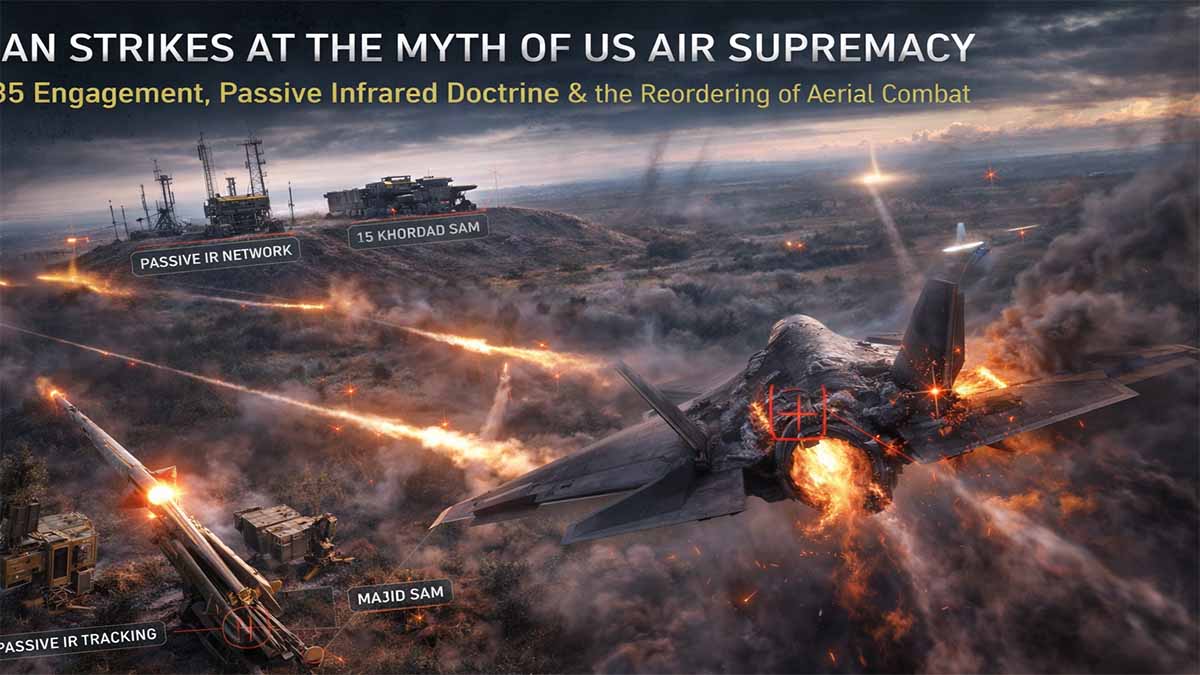
The mechanism of engagement has become the central analytical debate. Iran has developed air defense systems that can use passive infrared sensors rather than radar to target aircraft, a solution that previously proved effective in Yemen when employed by Iranian-supported Houthi rebels. The stealthy F-35 evades radar, but infrared sensors are passive and home in on heat. Air & Space Forces Magazine This is the critical distinction: the F-35’s celebrated stealth capability is primarily a radar cross-section reduction technology. Thermal emissions from its Pratt & Whitney F135 engine remain a persistent physical signature that no shaping or coating fully eliminates.
Because the missile’s seeker is passive, aircraft cannot rely on detecting radar emissions to identify the threat, forcing pilots to depend on infrared warning systems and evasive manoeuvres once a launch is detected. Defence Security Asia This asymmetry — a system that emits no trackable signal engaging an aircraft whose primary countermeasures are oriented toward active radar — represents a genuine doctrinal exploit, not merely a lucky shot.
Initial detection appears to have relied on multi-spectral, passive, and networked techniques that exploit limitations inherent to all stealth platforms. Low-frequency VHF or UHF radars, such as Iran’s indigenous Ghadir and Meraj systems, or reportedly integrated Chinese YLC-8B systems supplied in early 2026, provided long-range cueing. SSBCrack The terminal engagement is widely attributed to the Majid short-range air defence system. The March 2026 engagement occurred during escalating hostilities placing coalition aircraft in increasingly contested airspace where layered Iranian air defence systems were expected to operate at multiple ranges. During the mission over central Iran, the F-35A reportedly encountered air defence fire consistent with a short-range surface-to-air missile strike, after which the aircraft diverted and landed safely at a US base in the region, confirming that the damage was not catastrophic but operationally significant. Defence Security Asia
US officials’ responses have been measured but revealing. Defense Secretary Pete Hegseth said Thursday morning that the US is “winning decisively” and that Iran’s air defenses have been “flattened.” CNN Yet this claim sits in direct tension with the confirmed emergency landing of a fifth-generation aircraft following Iranian fire. CENTCOM stated that Iran has not shot down any US fighter aircraft — though it did separately acknowledge the F-35’s emergency landing — while also noting that “lies about US aircraft being shot down by Iran have been circulated multiple times on different platforms using fake or misleading imagery.” Airforce Technology Washington’s posture is to contest the severity while not denying the event itself.
The broader operational picture within Epic Fury further contextualizes the engagement. Allied forces initiated a massive preemptive offensive on 28 February 2026, executing nearly 900 strikes in just the first 12 hours of the conflict. JNS.org At the apex of this force structure are penetrating strike and air-dominance platforms: B-2 Spirit stealth bombers employed to deliver precision-guided munitions against Iranian ballistic missile complexes and hardened infrastructure, complemented by F-22 Raptors and F-35 Lightning II fighters securing air superiority and conducting early suppression of enemy air defenses. Army Recognition That the IRGC nonetheless managed to engage an F-35 in week three of this sustained campaign — despite declared degradation of Iranian air defences — is itself a data point warranting serious analytical weight.
The IRGC framed the incident within a broader narrative of evolving Iranian air defense capabilities, noting that “after the successful downing of more than 125 American-Zionist drones by Iranian air defense systems, this successful interception indicates the existence of effective and directed changes in the country’s integrated air defense systems.” Palestine Chronicle
The drone attrition figures are independently significant. US officials told Bloomberg a total of 12 General Atomics MQ-9 Reaper drones were lost in the war, including 9 shot down by Iran, one destroyed on the ground in Jordan by an Iranian missile, and two crashed. Wikipedia This represents a consistent, sustained capability to detect and engage platforms operating across the electromagnetic spectrum — from uncrewed reconnaissance assets to the world’s most sophisticated manned fighter.
The 2026 Iran war is already revealing something deeper than a single engagement: a glimpse into the architecture of modern warfare. From stealth aircraft and long-range precision strikes to swarms of low-cost drones and cyber-enabled operations, the campaign illustrates that a transformation is underway across the global defense landscape. The Jerusalem Post The incident reinforces that future air warfare will be defined by sensor fusion, passive detection, and rapid adaptation rather than any single technological edge. SSBCrack
Strategically, peer competitors are taking careful notes. Russia and China have both invested heavily in passive detection architectures, low-frequency radar, and MANPAD modernization — the precise toolset Iran appears to have exploited. An engagement that demonstrates the practical limits of US stealth doctrine in a contested, multi-layer air defence environment provides real-world validation for investment priorities that have been theoretical until now.
The episode underscores that survivability in modern air warfare depends not only on aircraft technology but also on the density, mobility, and integration of opposing air defence networks. As hostilities continue to evolve, both sides are expected to analyse the engagement carefully, since even limited damage to a stealth aircraft can influence doctrine, risk calculations, and future deployment patterns. Defence Security Asia
The F-35 incident does not end the era of stealth aviation. The aircraft survived, the pilot is stable, and US forces have conducted over 8,000 combat sorties without comparable losses. But it does introduce permanent uncertainty into operational planning equations that were previously anchored to the assumption of near-immunity for fifth-generation platforms. That uncertainty — not any single piece of hardware — is the durable strategic product of 19 March 2026.
Operation Epic Fury · 28 Feb – 25 Mar 2026 · Data compiled from CENTCOM, Air & Space Forces Magazine, CNN, Jerusalem Post
Key operational metrics
Confirmed losses by category
Engagement timeline
- 28 FebOperation Epic Fury launches · ~900 strikes in first 12 hours
- 1 MarIsraeli Hermes 900 drones shot down over Iran; IRIAF F-5 & F-4 destroyed in Tabriz strike
- 2 Mar3× US F-15E Strike Eagles downed by Kuwaiti friendly fire over Kuwait · 6 crew eject safely
- 11 MarUSAF MQ-9 Reaper shot down in Kerman province
- 12 MarKC-135 Stratotanker crashes in western Iraq · 6 crew killed (non-combat determination)
- 13 MarMQ-9 shot down at Bandar Abbas · 5× KC-135s damaged at Prince Sultan Air Base, Saudi Arabia
- 19 MarUS F-35A struck by suspected Iranian fire over central Iran · emergency landing confirmed by CENTCOM · pilot stable
- 20 MarMQ-9 shot down in Bushehr province · CENTCOM denies Iranian F-15 shootdown claim
Strategic doctrinal implications
Passive IR seekers deny aircraft the radar-warning advantage that structured countermeasures depend on.
Low-frequency VHF/UHF radars defeat X-band radar cross-section reductions — stealth is frequency-specific, not universal.
Mobile, dispersed short-range systems impose geometry constraints regardless of platform generation.
China and Russia are primary observers — both have invested heavily in passive detection architectures since 2020.
Competing assessments of the incident
- IRGC“First-ever successful engagement of F-35 globally · integrated AD fully operational”
- CENTCOMConfirmed emergency landing after “combat mission over Iran” · investigation underway · no shootdown confirmed
- PentagonHegseth: US “winning decisively” · Iran’s air defenses “flattened” — made same day as F-35 incident
- AnalystsICG’s Ali Vaez: “Not that stealth is obsolete — shows F-35 not invulnerable in a dense, adaptive AD environment”
- Air & SpacePilot suffered shrapnel wounds · hit by ground fire per unnamed sources · aircraft operationally recoverable
Sources: CENTCOM official statements · CNN · Air & Space Forces Magazine · Jerusalem Post · The Aviationist · Defence Security Asia · SSBCrack Defence Analysis · 25 March 2026
Navigator
Chapter 1 — The Engagement: What Happened on 19 March 2026 Confirmed timeline, CENTCOM statements, IRGC claims, CNN sourcing, pilot condition, aircraft variant, and the chain of custody for the most significant air defence event of Operation Epic Fury.
Chapter 2 — The Technical Exploit: How Passive Infrared Defeats Radar Stealth Anatomy of the Majid system, VHF/UHF cueing radars, the F-35’s thermal vulnerability, passive seeker logic, layered kill-chain architecture, and why the F-35’s own electronic warfare suite provided limited warning.
Chapter 3 — Strategic Reverberations: Doctrine, Deterrence & the Global Audience Operational cost escalation for US forces, implications for Indo-Pacific planning, Russian and Chinese doctrinal extraction, Iran’s A2/AD credibility, and what the engagement means for the future procurement calculus of stealth platforms.
Chapter 1: The Kill Chain Anatomy — How Iran Penetrated the F-35’s Stealth Architecture on 19 March 2026
1.1 The Operational Context: A War Already Rewriting Doctrine
Operation Epic Fury did not begin on equal terms. When United States Central Command (CENTCOM) and the Israel Defense Forces (IDF) launched their coordinated preemptive campaign against Iran on 28 February 2026, the opening phase deployed the full weight of American technological supremacy in a single choreographed opening salvo. Allied forces executed nearly 900 strikes in the first 12 hours, targeting Iranian ballistic missile complexes, nuclear infrastructure, IRGC command nodes, and naval assets across the entire depth of Iranian territory. JNS.org The operational ambition was unambiguous: compress Iran’s retaliatory capacity before it could be dispersed, deny the IRGC Aerospace Force its launch infrastructure, and establish uncontested airspace dominance within the first 72 hours.
The strategy partially succeeded. Tehran‘s missile and drone salvos declined by roughly 70 to 85 percent since the first day of strikes, largely thanks to an aggressive hunt for Iranian missile launchers and drone launch positions. Hudson Institute By Day 8, US Central Command confirmed that Iran‘s ballistic missile launch rate had declined to approximately 10 percent of its Day 1 rate and its drone launch rate to approximately 17 percent of its opening pace. Global Security From a kinetic suppression standpoint, Washington had inflicted severe attrition on Tehran‘s long-range strike capacity.
What the opening-phase metrics concealed, however, was the layer of Iranian capability that proved most consequential: a dispersed, mobile, passive, short-to-medium-range air defence architecture that had been deliberately constructed to survive precisely this kind of campaign. Unlike radar-emitting surface-to-air missile (SAM) batteries — which emit trackable electromagnetic signatures allowing Suppression of Enemy Air Defence (SEAD) operations to locate and destroy them — Iran‘s passive infrared-guided tier generates no detectable signal. It cannot be found by radar homing missiles. It cannot be jammed. And crucially, it does not announce its presence to the very aircraft it is about to engage.
This was not an improvised adaptation. It was the pre-planned residual layer of Iran‘s layered Anti-Access/Area Denial (A2/AD) doctrine.
1.2 The Engagement: 02:50 Local Time, 19 March 2026
The engagement occurred at approximately 02:50 local time during ongoing operations linked to the current regional conflict. The aircraft — a US Air Force F-35A Lightning II — sustained damage consistent with a surface-to-air missile strike before conducting an emergency landing at a US base in the Middle East. The Defense News
CENTCOM spokesperson Capt. Tim Hawkins confirmed the core facts with deliberate precision: the aircraft had been “flying a combat mission over Iran,” it landed safely, the pilot was in stable condition, and the incident was under investigation. Hawkins did not confirm the specific cause of the damage, the identity of the weapon system, or the extent of damage to the airframe. A subsequent report by Air & Space Forces Magazine, citing unnamed sources familiar with the matter, stated that the pilot suffered shrapnel wounds and that the aircraft was hit by ground fire. Air & Space Forces Magazine
The IRGC Aerospace Force issued its own statement the same day, claiming full responsibility and attributing the engagement to its integrated air defence network. According to Iranian statements and supporting media releases, the IRGC stated the engagement occurred at approximately 02:50 a.m. local time, and released forward-looking infrared (FLIR) video footage purportedly showing a targeting reticle acquiring an aerial object, followed by a missile launch and impact. The Defense News Analysis of the footage indicates that the aircraft was not destroyed. When reviewed in slow motion, the footage appears to show the F-35 continuing flight after the blast, maintaining structural integrity and confirming that the pilot was able to exit the engagement area and return to base. The Defense News
The evidentiary record therefore establishes: one confirmed emergency landing of a US F-35A after a combat mission over Iran; two CNN sources describing a strike by suspected Iranian fire; Air & Space Forces Magazine sources describing shrapnel wounds consistent with ground fire; and IRGC footage consistent with a short-range infrared missile engagement. The gap in the record — which specific weapon system, exact altitude and aspect at engagement, precise damage extent — remains under active investigation. What is not in dispute is that a fifth-generation stealth aircraft operating over Iranian territory sustained damage from Iranian forces. This would represent the first recorded instance of a manned US F-35 being successfully engaged by surface-to-air fire since the aircraft entered operational service in 2018. Military Watch Magazine
1.3 The Weapon System: The Majid (AD-08) Passive Infrared Architecture
The system most consistently identified across open-source technical analysis as the probable engagement weapon is the Majid short-range air defence system, also designated AD-08. Understanding its architecture is essential to understanding why the engagement succeeded.
The Majid system is produced by Iran‘s Defence Industry Organization under the Armed Forces Logistics Department and was first publicly displayed on 18 April 2021. It is designed as a short-range, point-defence air defence system rather than a wide-area coverage platform. The system uses passive electro-optical and thermal sensors combined with infrared-guided missiles, allowing it to operate without emitting radar signals. The Defense News
Its maximum engagement range stands at eight kilometres with an altitude ceiling of six kilometres, making it ideal for low-altitude threats. The system mounts on a highly mobile Aras-2 tactical vehicle, allowing rapid repositioning in contested environments. Each launcher carries four to eight missiles, each weighing 75 kilograms with a 156-millimetre diameter and 2.67-metre length. TIMES OF ISLAMABAD
The critical differentiator is guidance architecture. The missile uses a passive imaging infrared homing guidance system — heat-seeking technology. This guidance detects infrared radiation naturally emitted by targets without transmitting any signal that could alert the aircraft. TIMES OF ISLAMABAD The downstream consequence of passive guidance is absolute: a further benefit of using infrared guidance is that systems like the Majid do not trigger targets’ radar warning receivers, while their electronic jamming will have little effect. Military Watch Magazine
This is the technical core of the entire engagement. The F-35‘s defensive architecture — including its sophisticated Radar Warning Receiver (RWR) suite and the AN/ASQ-239 Barracuda electronic warfare system — is principally oriented toward detecting, classifying, and responding to active radar emissions. When a fire-control radar illuminates an aircraft, the RWR detects the signal, identifies the emitter, and cueing countermeasures. The Distributed Aperture System (DAS), a network of six high-resolution infrared cameras providing 360-degree situational awareness, is theoretically capable of detecting missile plumes. The incident raises critical questions regarding the AN/AAQ-37 Distributed Aperture System (DAS) and its potential failure to trigger a Missile Approach Warning (MAWS). 19FortyFive The Majid‘s passive seeker, however, never illuminates its target at all — meaning the RWR receives no signal to detect, leaving the entire active warning chain silent until the moment of launch or impact.
The aircraft’s electronic countermeasures, designed to jam radar frequencies, were rendered useless against a passive optical system. PressTV This is not a failure of the F-35‘s design. It is a category exploit — the equivalent of defeating a burglar alarm by using a method it was never designed to detect.
1.4 The Multi-Layer Kill Chain: From VHF Cueing to Terminal Engagement
The Majid alone did not shoot down the F-35. What enabled the engagement was a layered kill chain that combined multiple detection and engagement modalities, each addressing a different vulnerability in the F-35‘s stealth profile.
Tier 1 — Long-range volumetric detection (VHF/UHF radar): Initial detection appears to have relied on multi-spectral, passive, and networked techniques. Low-frequency VHF or UHF radars — such as Iran‘s indigenous Ghadir and Meraj systems, or reportedly integrated Chinese YLC-8B systems supplied in early 2026 — provided long-range cueing. SSBCrack The physics of radar stealth explains why. The F-35‘s signature reductions are optimised for X-band and S-band fire-control radar frequencies — the precise wavelengths used by most modern SAM guidance systems. VHF/UHF low-frequency radars operate at wavelengths (roughly 1–10 metres) that are comparable in scale to the aircraft’s airframe dimensions, producing a Rayleigh scattering effect that dramatically increases detectability. The F-35 is not designed to be stealthy at these frequencies. Long-range VHF radars can therefore provide gross tracking data — not the precision required for weapons guidance, but sufficient to cue shorter-range systems into the engagement corridor.
Tier 2 — Passive thermal surveillance (IRST networks): Once volumetric data established a likely approach vector, Infrared Search and Track (IRST) systems — passive optical sensors that scan for the thermal signature of aircraft in flight — could acquire and refine the track without emitting any detectable signal. Military analysts believe Iran found the jet using passive Infrared Search and Track (IRST) sensors. Instead of using radar, these systems silently scan the environment to lock onto the intense heat of jet exhaust. Wionews The F-35‘s Pratt & Whitney F135 engine — the most powerful fighter engine ever built for a single-seat aircraft, producing approximately 43,000 lbf with afterburner — generates a substantial thermal plume regardless of airframe stealth measures. Engine inlet shaping and exhaust nozzle geometry reduce but do not eliminate this signature.
Tier 3 — Terminal passive infrared engagement (Majid): With track data refined to sufficient accuracy, mobile Majid units pre-positioned along probable approach vectors executed the terminal engagement. The engagement envelope of the Majid system places it within the range where aircraft conducting close-in operations could be exposed even if longer-range radar-guided systems have been avoided or suppressed. Because the missile’s seeker is passive, aircraft cannot rely on detecting radar emissions to identify the threat, forcing pilots to depend on infrared warning systems and evasive manoeuvres once a launch is detected. Defence Security Asia
The critical enabling condition — that the F-35 was operating within Majid engagement range at all — reflects the evolving operational requirements of Epic Fury by its third week. A major shortcoming of the F-35 remains that delays to the completion of Block 4 software upgrades has left them unable to launch certain air-to-surface missiles, which requires them to fly closer to their targets to engage them, leaving them more vulnerable to strikes by short-range air defence systems like the Majid and Verba. Military Watch Magazine This is not a trivial operational constraint. It maps directly to a known programmatic vulnerability.
1.5 The Block 4 Deficit: A Known Vulnerability Enters Combat
The F-35‘s software modernisation programme carries direct operational consequences that predate Operation Epic Fury and are now visibly shaping mission profiles within it. After years of cost growth and schedule delays in its hardware and software modernisation effort, known as Block 4, the Department of Defense (DoD) is in the process of establishing a new major subprogram to help meet cost, schedule, and performance goals. Currently, Block 4 costs are over $6 billion more, and completion is at least 5 years later than original estimates. U.S. GAO
The Government Accountability Office (GAO) report GAO-25-107632, published 3 September 2025, provides the definitive documented record of this programme status. The Next Generation Distributed Aperture System will not be complete until 2026, making it a key driver for TR-3-enabled capability delays. This system is a critical TR-3 sensor suite, which provides the pilot with a comprehensive, real-time view of the operational environment and detects threats, like missiles. U.S. GAO The Next Generation DAS — the very system that provides upgraded missile approach warning capability — was still incomplete when Epic Fury commenced.
The Block 4 upgrade will slip a further two years — now five years past the original target — according to the Government Accountability Office. Some elements will be deferred until the F135 engine gets its core upgrade. The GAO suggested the government give fewer incentive fees to Lockheed Martin and Pratt & Whitney, as deliveries of the F-35 are chronically late. Breaking Defense In 2024, aircraft deliveries were an average of 238 days late.
The operational consequence is precise and damaging: aircraft that entered Operation Epic Fury were doing so with known software and sensor limitations that constrained their engagement geometry and degraded their ability to detect passive infrared threats at sufficient range to execute effective countermeasures. Washington deployed its most advanced fighter into a contested environment where the aircraft’s own modernisation programme had left exploitable gaps — gaps that Iran‘s doctrinal planners had apparently studied and pre-positioned assets to exploit.
1.6 Iran‘s Doctrinal Architecture: Deliberate Asymmetric Engineering Under Sanctions
The engagement of 19 March 2026 did not emerge from tactical improvisation. It reflects a coherent, multi-decade programme of asymmetric defensive doctrine built specifically to contest US air superiority in Iranian airspace without attempting to match US platforms capability-for-capability — a competition Tehran knew it could not win under sanctions.
Iran quietly reactivated concealed radar networks and positioned short-range infrared systems like the Majid along likely approach vectors. When the F-35 entered the kill zone, it was met not by a crippled defence network but by a fully integrated, strategically deployed air defence system that had been waiting for precisely this moment. PressTV The deception operation embedded in this positioning was itself strategically significant. US and Israeli planners, observing the degradation of Iran‘s active radar-emitting SAM batteries under SEAD operations, concluded that the air defence architecture was “flattened” — Defense Secretary Pete Hegseth used precisely this word on the morning of 19 March 2026, the same morning the F-35 was struck.
That declaration of air superiority and the subsequent engagement of a fifth-generation stealth aircraft occurred within hours of each other. The juxtaposition is not coincidental. It reflects Iran‘s deliberate strategy of suppressing its detectable (radar-emitting) defences to create the impression of a defeated air defence network, while preserving its undetectable (passive infrared) tier precisely for the moment when US and Israeli planners relaxed their threat assessments and authorized deeper penetration missions.
The Majid system represents one element of this architecture. Iran is reported to have made considerable investments in modernising its short-range air defence capabilities, with leaked Russian government documents in late February 2026 indicating that the Iranian Defence Ministry had signed an arms deal valued at $580 million to procure 500 9K333 Verba man-portable short-range surface-to-air missile launchers and 2,500 associated 9M336 missiles. Military Watch Magazine The Verba is a Russian fourth-generation MANPAD with a tri-spectral seeker (ultraviolet, near-infrared, mid-infrared) that is specifically designed to defeat infrared flares — the principal countermeasure employed by aircraft against heat-seeking missiles. At 500 launchers and 2,500 rounds, this represents a force-multiplier for persistent, dispersed, passive-layer engagement across Iranian territory.
The layered architecture thus integrates:
- VHF/UHF low-frequency radars (Ghadir, Meraj, possibly Chinese YLC-8B) for long-range volumetric cueing
- Passive IRST networks for silent track refinement
- Majid (AD-08) mobile point-defence for terminal passive infrared engagement
- Misagh-3 shoulder-launched MANPAD variants for ultra-short range coverage
- Herz-9 passive detection systems providing silent surveillance without radar emissions
- Russian 9K333 Verba advanced MANPAD systems with multi-spectral seekers defeating flare countermeasures
No element of this architecture emits a detectable radar signature during normal operation. The F-35‘s RWR suite — one of the most capable in the world — is effectively blind to the dominant threat mode Iran has constructed.
1.7 The ACH Matrix: Five Competing Hypotheses for the Engagement
Rigorous intelligence analysis requires that the 19 March event be evaluated against multiple competing explanatory hypotheses, not simply accepted through the most convenient lens.
Hypothesis 1 — Deliberate IRGC strategic ambush (highest probability): The engagement was a pre-planned deception operation: active radar SAMs were deliberately suppressed to invite deep penetration missions, while passive infrared assets were positioned along probable approach corridors, creating a lethal ambush. Supporting evidence: the timing (the same morning as Hegseth’s “flattened” declaration), the pre-positioning of Majid units along known ingress vectors, and the coherence of Iran‘s post-engagement messaging all indicate advance preparation. Probability assessment: high.
Hypothesis 2 — Opportunistic engagement by dispersed forces: IRGC air defence units, operating on distributed orders, detected and engaged an F-35 using available passive assets without central coordination. Supporting evidence: the decentralised nature of Iran‘s short-range air defence posture and the mobile, autonomous deployment of Majid systems on Aras-2 vehicles. This does not preclude Hypothesis 1; the two are not mutually exclusive. Probability assessment: moderate-high (possibly complementary to Hypothesis 1).
Hypothesis 3 — Chinese intelligence contribution: Integrated Chinese YLC-8B systems provided the initial VHF cueing that made the terminal engagement possible. Supporting evidence: reports of Chinese YLC-8B systems reportedly integrated in early 2026 SSBCrack are consistent with Beijing‘s strategic interest in demonstrating the practical limits of US stealth doctrine without direct military involvement. Probability assessment: plausible, unconfirmed.
Hypothesis 4 — Russian intelligence/systems contribution: The $580 million Verba procurement and broader Russian-Iranian defence cooperation provided both doctrine and specific technical capability that enabled the engagement. Supporting evidence: the conceptual alignment between Russian passive detection doctrine and the engagement methodology is striking; Russia has developed and exported passive infrared air defence philosophy precisely as a counter to US fifth-generation platforms. Probability assessment: moderate, particularly regarding doctrinal contribution.
Hypothesis 5 — F-35 operational limitation (non-adversarial cause): The emergency landing resulted from a mechanical failure or systems malfunction unrelated to Iranian fire, with the IRGC subsequently claiming credit for an unrelated event. Supporting evidence: CENTCOM‘s careful language (“flying a combat mission over Iran” rather than “struck by Iranian fire”); the absence of confirmed wreckage; the fact that the aircraft returned to base. Against: two CNN sources described the aircraft as being struck by suspected Iranian fire; Air & Space Forces Magazine described shrapnel wounds; the IRGC released FLIR footage with a visible impact consistent with a missile engagement. Probability assessment: low but non-negligible.
The weight of open-source evidence supports Hypothesis 1 as the primary explanatory framework, with Hypotheses 3 and 4 as probable enabling conditions and Hypothesis 2 as a complementary operational mechanism.
1.8 Second and Third-Order Strategic Effects
The significance of the 19 March engagement extends well beyond the physical damage to a single airframe. The second and third-order effects are already reshaping the operational calculus of Operation Epic Fury and will reverberate through US and allied air force planning globally.
First-order effect — Tactical mission profile revision: The demonstrated ability of Iranian passive infrared systems to engage F-35 aircraft at close range will force immediate revision of mission profiles for deep penetration operations. Stand-off distances must increase; flight profiles must be recalculated to minimise exposure within known Majid engagement envelopes; electronic warfare escort requirements will intensify. As hostilities continue to evolve, both sides are expected to analyse the engagement carefully, since even limited damage to a stealth aircraft can influence doctrine, risk calculations, and future deployment patterns. Defence Security Asia
Second-order effect — Global F-35 operator reassessment: The size of the F-35 program as by far the world’s largest fighter program outside China makes the first-ever successful surface-to-air strike against one of the aircraft highly significant, potentially resulting in revisions to planning for operating them across multiple theatres. Military Watch Magazine Fifteen nations operate or have committed to operate the F-35. Every one of them is now conducting a classified reassessment of mission profiles against adversaries equipped with passive infrared air defence systems.
Third-order effect — Adversary procurement acceleration: Russia and China are primary strategic observers of this engagement. Both have invested heavily in passive detection architectures. The demonstrated real-world effectiveness of an Iranian passive infrared system against a US fifth-generation aircraft provides the definitive validation data that justifies further investment in IRST networks, VHF/UHF radar proliferation, and MANPAD modernisation programmes oriented toward infrared seekers with flare-defeating multi-spectral guidance.
Fourth-order effect — Perception architecture and escalation dynamics: In the domain of strategic perception, the engagement creates a durable asymmetry in claimed capability. Even if the F-35 is repaired and returns to full operational status, the demonstrated vulnerability shapes adversary risk calculations for years. States contemplating whether to contest US air operations over their territory now have empirical evidence that the cost is non-zero — that US stealth platforms can be engaged, damaged, and forced to divert. This shifts the escalation ladder.
Fifth-order effect — Industrial and procurement implications: Defense companies are accelerating innovation, and governments, militaries, and investors are reassessing the technological foundations of national security. Defense innovation is no longer driven only by traditional defense contractors and long procurement cycles. The Jerusalem Post The 19 March engagement will accelerate investment in passive infrared suppression technology, next-generation exhaust cooling systems, improved IRST countermeasures, and potentially the acceleration of sixth-generation platform development specifically designed to address the residual thermal signature vulnerabilities that the F-35 carries.
1.9 Comparative Historical Context: Stealth Vulnerabilities in Precedent
The F-35 engagement is not the first instance of stealth aircraft encountering the limits of radar cross-section reduction. The 1999 shootdown of an F-117 Nighthawk over Serbia by a Serbian SA-3 Neva battery under Col. Zoltán Dani established the foundational precedent: the SA-3 operated at low frequency, achieved radar lock during a known flight path by exploiting the F-117‘s predictable routing and a seam in its stealth geometry, and successfully engaged the aircraft with a missile that the F-117‘s defensive systems did not defeat. The structural parallel to the 2026 engagement is exact — low-frequency detection, exploitation of a known stealth limitation, terminal engagement before the aircraft could respond.
The Serbian experience was subsequently studied exhaustively by China, Russia, and Iran. All three invested in low-frequency radar development, passive sensor networks, and integrated air defence doctrines specifically designed to exploit frequency-domain vulnerabilities in US stealth platforms. The 19 March 2026 engagement represents the maturation of that 27-year learning cycle — the first successful application of this doctrine against a fifth-generation aircraft in real combat.
What distinguishes 2026 from 1999 is the passive nature of the terminal engagement. The SA-3 used active radar guidance. The Majid uses passive infrared. The evolution removes even the last residual warning mechanism that the F-117 pilot in 1999 had available: the ability to detect radar illumination and execute defensive manoeuvres. In the Majid engagement, the first indication of the threat for the pilot is the missile itself.
| Engagement Parameter | F-117 / Serbia 1999 | F-35A / Iran 19 March 2026 |
|---|---|---|
| Aircraft generation | 4th-gen stealth (F-117) | 5th-gen stealth (F-35A) |
| Detection method | Low-frequency VHF radar | VHF/UHF cueing + passive IRST |
| Terminal guidance | Active radar (SA-3) | Passive infrared (Majid AD-08) |
| Radar warning received | Yes (limited) | Likely none |
| Outcome | Aircraft destroyed | Aircraft damaged, returned to base |
| Electronic countermeasure effectiveness | Partial | Near-zero against passive seeker |
| Strategic doctrine shift | Validated VHF detection | Validated passive IR engagement |
| Subsequent adversary adaptation | China, Russia, Iran studied | China, Russia now observing live validation |
Chapter 1 — Kill Chain Analysis: Iran F-35 Engagement · 19 March 2026
Operation Epic Fury · War-Room Intelligence Dashboard · Date of Analysis: 25 March 2026 · Source: CENTCOM, GAO, Air & Space Forces Magazine, Defence Security Asia
VHF/UHF Long-Range Cueing (Ghadir · Meraj · YLC-8B)
Low-frequency radar detects F-35 at range via Rayleigh scattering. Stealth coatings tuned for X/S-band — not effective at meter-wavelength frequencies. Provides gross track for handoff.
Passive IRST Track Refinement (Herz-9 · Networked EO)
Silent thermal sensors track F135 engine heat signature. Zero radar emission — F-35 RWR detects nothing. Track refined to weapons-quality accuracy without alerting aircraft.
Terminal Passive IR Engagement (Majid AD-08 on Aras-2)
Mobile launcher pre-positioned on approach vector. Passive imaging IR seeker acquires F135 thermal plume. Electronic countermeasures (jamming) ineffective — no radar to jam. MAWS may not trigger.
Bar = stealth effectiveness reduction / countermeasure effectiveness. Lower = more vulnerable. X/S-band: near-immune. IR/passive: critically exposed.
| Parameter | Specification | Tactical Impact |
|---|---|---|
| Guidance type | Passive imaging IR | No RWR trigger |
| Engagement range | 0.7 – 8 km | Close-in threat |
| Altitude ceiling | 6 km | Low-alt coverage |
| Missile weight | 75 kg · 156mm diam | Mobile deploy |
| Platform | Aras-2 mobile vehicle | Dispersed, hard to target |
| Radar signature | Zero (passive only) | SEAD-immune |
| Jamming susceptibility | Near-zero | EW-ineffective |
| First unveiled | 18 April 2021 | DIOrg production |
| Design philosophy | Point defence · passive | Post-SEAD residual |
| Date | Aircraft | Adversary System | Detection Method | Terminal Guidance | Outcome | EW Warning |
|---|---|---|---|---|---|---|
| 27 Mar 1999 | F-117A | SA-3 / Serbia | Low-freq VHF radar | Active radar | Destroyed | Partial |
| 19 Mar 2026 | F-35A | Majid AD-08 / Iran | VHF + passive IRST | Passive IR (no radar) | Damaged · returned | Likely none |
The 2026 engagement represents doctrinal escalation: passive terminal guidance eliminates the residual radar warning that was available in 1999. The aircraft survived because it is more survivable than the F-117; the warning deficit is categorically worse.
Sources: CENTCOM · GAO-25-107632 (gao.gov) · Air & Space Forces Magazine · Defence Security Asia · Hudson Institute · JINSA · 25 March 2026
Chapter 2: The Technical Exploit — Stealth Doctrine, Sensor Fusion, and the Physics of Passive Infrared Defeat
2.1 The Central Misunderstanding: Stealth Is Not Invisibility
The dominant misconception embedded in both popular reporting and some institutional planning assumptions is that the F-35 Lightning II represents a platform of near-perfect concealment — a ghost in contested airspace that adversaries with technologically inferior domestic defence industries are structurally incapable of detecting. This misunderstanding has now been empirically disproven over the skies of central Iran. Understanding precisely why requires a rigorous examination of what stealth technology actually achieves and, critically, what it does not.
Radar cross-section (RCS) reduction — the physical and materials-science discipline at the core of the F-35's stealth architecture — operates by minimising the fraction of incoming radar energy that reflects back toward a hostile emitter's receiver. The F-35's faceted airframe geometry, internal weapons carriage, radar-absorbent material (RAM) coatings, and carefully designed edge alignments are all calibrated to this purpose. The result, according to public statements from US Air Force generals, is an RCS roughly equivalent to a metal golf ball — approximately 0.001 square metres in the frontal aspect against X-band and S-band fire-control radar frequencies. For comparison, a fourth-generation aircraft like the F-16 presents an RCS of roughly 5 square metres — a factor of 5,000 times more detectable.
However, this extraordinary performance figure contains a critical qualifying clause: it applies primarily against X-band (8–12 GHz) and S-band (2–4 GHz) radar frequencies. These are the bands used by most modern surface-to-air missile (SAM) fire-control systems because they offer the combination of range, angular resolution, and accuracy required for weapons guidance. The F-35's entire stealth architecture is optimised against precisely the frequencies that threaten it in the mode US planners historically expected to encounter most. It is a solution engineered to win a specific frequency-domain battle.
Against low-frequency bands — VHF (30–300 MHz) and UHF (300 MHz–3 GHz) — the physics change fundamentally. At these frequencies, radar wavelengths measure between one metre and ten metres, becoming comparable in scale to the F-35's own airframe dimensions (approximately 15 metres in length, 11 metres wingspan). When radar wavelength approaches target dimension, a phenomenon called Rayleigh resonance scattering occurs: the aircraft's RAM coatings and geometric shaping — tuned for centimetre-wavelength X-band reflection reduction — become physically ineffective. The aircraft scatters VHF energy in proportion to its geometric size rather than its designed RCS. The F-35, invisible to an X-band fire-control radar at 200 kilometres, becomes detectable to a VHF early-warning radar at comparable or greater ranges.
This is not a newly discovered vulnerability. US engineers have understood it since the B-2 Spirit and F-117 programmes of the 1980s. It is an inherent physical limitation that no amount of stealth engineering can overcome without a fundamental redesign of the airframe at impractical scale. The practical response has been tactical: fly profiles that minimise exposure to VHF radar coverage, rely on electronic warfare (EW) assets to suppress or confuse VHF emitters, and accept that VHF radars produce only coarse positional data insufficient for weapons guidance. That tactical response is the exploitable gap that Iran has systematically closed.
2.2 The Thermal Domain: An Irreducible Physical Signature
Where RCS reduction is theoretically extensible through engineering investment — better coatings, more precise geometry, new materials — the infrared thermal signature of a jet aircraft carrying a high-performance engine represents a physical constraint of a different order. Heat is thermodynamic energy. It must go somewhere.
The Pratt & Whitney F135 engine — the single turbofan powering all three variants of the F-35 — produces approximately 43,000 lbf of thrust with afterburner, making it the most powerful engine ever built for a single-seat combat aircraft. To generate this thrust, the engine combusts jet fuel in a combustor section that reaches temperatures exceeding 1,700 degrees Celsius. Turbine gases exit the engine core at temperatures well above 1,000 Kelvin before any cooling or dilution. Researchers from the Changchun Institute of Optics, Fine Mechanics and Physics (CIOMP) analysed the infrared signature of F-35s in simulated combat scenarios and found that while the jet's radar-absorbing coating and exterior cooled to an average 281 degrees Kelvin — effectively masking it from traditional detection — its engine exhaust plume, which reaches nearly 1,000 Kelvin, emitted mid-wave infrared radiation three orders of magnitude stronger than its airframe. South China Morning Post
Three orders of magnitude — a factor of 1,000 times — is not a marginal detection advantage. It is categorical separation. An infrared sensor that can distinguish the F-35's exhaust plume from the ambient atmospheric background at 2.8–4.3 micrometer wavelength bandwidth (where atmospheric absorption is minimal) is not performing a difficult task. It is performing an easy one, relative to the challenge of detecting the airframe itself.
Lockheed Martin and Pratt & Whitney did not ignore this challenge. The F135 incorporates multiple infrared signature reduction measures. In designing the nozzle of the F135 engine, Pratt & Whitney aimed to rival the F-22's wedge nozzles in signature while beating it on maintenance costs. The nozzle flaps incorporate minute holes to supply cooling air, and overlap to create a sawtooth trailing edge, which introduces shed vortices to the exhaust and shrinks the plume. Serrated nozzles of this type can reduce engine exhaust plume by 40 percent compared to conventional circular nozzles. The F135 engine also has a higher bypass ratio than earlier fighter engines, meaning more cool air is available to dilute and cool core exhaust gases. Quora
These measures provide genuine infrared signature reduction against specific threat aspects. The F-35's exhaust is substantially less detectable than that of a legacy F-16 or F/A-18 from certain angles. But 40 percent plume reduction against a background signal that is 1,000 times stronger than the airframe itself still leaves a thermal signature that high-sensitivity infrared sensors can acquire at operationally significant ranges. At short range — within the Majid's engagement envelope of 0.7–8 kilometres — the thermal contrast is overwhelming. No production fighter engine in operational service eliminates this close-range thermal exposure.
2.3 The Ghadir and Qadir Architecture: Iran's Long-Range Detection Infrastructure
The engagement of the F-35A on 19 March 2026 required more than a single Majid launcher positioned at an airfield perimeter. It required cueing — a long-range detection capability that could track the aircraft as it approached, determine its probable corridor, and position passive terminal engagement assets along that corridor before the aircraft entered their engagement envelope. This cueing function was provided by Iran's long-range VHF/UHF radar network, specifically the Ghadir and Qadir (also transliterated Qadir) phased-array systems.
The domestically manufactured Qadir radar system, designed by the IRGC's Aerospace Division, is capable of detecting targets with a very small cross section from a long distance. The system has a direct range of 1,100 kilometres and can be used to detect different types of aircraft as well as ballistic missiles. It falls in the category of long-range three-dimensional radar systems. Global Security
The physics rationale for this detection capability is unambiguous: HF, VHF, and UHF frequencies achieve high-range performance as well as the role of early warning for air defence assemblies. In addition, these frequency bands are highly capable of detecting low-level radar cross-sections due to the inability of materials used in these aircraft to absorb long wavelengths. Global Security The Ghadir, operating at approximately 6-metre wavelength, directly exploits the Rayleigh resonance regime in which the F-35's airframe geometry scatters energy regardless of RAM coating effectiveness.
The Ghadir is a phased-array, three-dimensional radar with an advertised range of 1,100 kilometres for detecting ballistic missiles and 600 kilometres for aircraft. Iranian officials have claimed it can track stealth aircraft, cruise missiles, and small drones, thanks to its ability to resonate frequencies and monitor targets at altitudes up to 300 kilometres. Bulgarian Military
However, Ghadir carries an important operational limitation that constrains its role in the kill chain. Western analysts have raised doubts about the Ghadir radar's efficacy in detecting stealth aircraft, noting that while its HF over-the-horizon operation employs wavelengths long enough to partially overcome stealth shaping, the system's accuracy suffers from ionospheric refraction and multipath propagation, leading to errors in target localisation exceeding several kilometres. These physical constraints limit OTH radars to coarse early-warning roles rather than precise tracking for missile guidance, as ionospheric variability distorts signals unpredictably, particularly during solar activity or at night. Grokipedia
This limitation is operationally decisive — and it is precisely why the passive terminal engagement tier is indispensable. The Ghadir provides a gross track: it can say "there is a low-observable aircraft in this approximate region at this approximate time." It cannot provide the precision targeting data required for missile guidance. To close that precision gap, Iranian operators transitioned to passive electro-optical and IRST systems that refined the track without emitting any detectable energy. The multi-tier kill chain is not redundant engineering — it is a necessary architecture driven by the physical limitations of each tier.
Compounding this architecture, Iran has incorporated apparent Chinese technical support into its long-range detection layer. China has reportedly launched a programme to bolster Iran's defence systems after 2025–2026 security gaps were identified, including delivery of the YLC-8B radar. The YLC-8B is designed to detect targets with a radar cross-section of one square metre at ranges between 270 and 330 kilometres. It is also capable of detecting aircraft such as the F-35A Lightning II at distances exceeding 200 kilometres. Defense Mirror The YLC-8B represents a meaningfully more precise instrument than the Ghadir's over-the-horizon backscatter architecture: it operates in UHF band with active beam steering, providing significantly better angular resolution while retaining the frequency-domain advantage against stealth coatings.
The strategic implication is profound. Beijing has effectively contributed a detection-precision layer to Iran's kill chain against US fifth-generation aircraft without any direct Chinese military involvement — a form of enabling proxy capability that achieves substantial strategic effect at minimal escalation cost.
2.4 The IRST Revolution: Passive Detection as the Decisive Military Technology of 2026
The passive Infrared Search and Track (IRST) tier of Iran's engagement architecture represents the most strategically significant technological development in the engagement. IRST systems have existed since the Cold War, but their modern embodiments — with multi-element focal plane arrays, real-time digital signal processing, and cryogenic cooling enabling sensitivity in the mid-wave infrared (MWIR, 3–5 micrometer) band — represent a qualitative leap in capability that has not been matched by advances in infrared signature management aboard stealth platforms.
The operating principle is deceptively simple: all objects above absolute zero temperature emit electromagnetic radiation in proportion to their temperature (Planck's law). A fighter engine operating at combat power emits a thermal signature that is physically inescapable regardless of airframe shaping, RAM coatings, or electronic countermeasures. The IRST sensor requires only a sensitive enough detector, an appropriate bandpass filter to select the optimal thermal emission wavelength, and sufficient computational capacity to discriminate the aircraft's thermal signature from background atmospheric emission. It emits nothing. It has no radar output. It generates no signal that the target aircraft's warning receivers can detect, classify, or respond to.
Researchers from CIOMP found that by focusing on the 2.8–4.3 micrometer wavelength range — where atmospheric interference is minimal — infrared sensors mounted on an unmanned airship hovering at 20 kilometres altitude, deploying mercury-cadmium-telluride detectors and 300mm aperture telescopes, could detect an F-35 from over 1,800 kilometres from the rear and side aspects. Frontal detection was limited to approximately 350 kilometres due to the aircraft's reduced forward heat profile. South China Morning Post
These are stratospheric-platform figures. Ground-based and short-range IRST systems operate at vastly shorter ranges but with correspondingly greater certainty of target identity and track precision. The Herz-9 passive detection system — part of Iran's deployed air defence portfolio — is precisely this category of asset: a ground-based passive electro-optical sensor that acquires thermal tracks without emitting radar energy, feeding cueing data into the integrated air defence network for handoff to terminal engagement systems.
The engagement chain thus flows: Ghadir/YLC-8B provides gross detection at long range → Herz-9/IRST network refines track silently at medium range → Majid AD-08 executes terminal passive infrared engagement at close range. No element of this chain emits a detectable radar signal. The F-35's entire active warning architecture — its AN/ASQ-239 Barracuda electronic warfare system, its Radar Warning Receivers — operates on the assumption that threats will illuminate it with radar energy before attempting engagement. Against a fully passive kill chain, that assumption is valueless.
2.5 The DAS Question: Was the F-35's Own Detection System Functional?**
One of the most analytically consequential questions emerging from the 19 March engagement concerns the AN/AAQ-37 Distributed Aperture System (DAS) — the six-camera 360-degree infrared surveillance system that provides the F-35 pilot with full-sphere situational awareness and is theoretically capable of detecting missile launches in real time. The incident raises critical questions regarding the AN/AAQ-37 Distributed Aperture System (DAS) and its potential failure to trigger a Missile Approach Warning (MAWS). 19FortyFive
The DAS is specifically designed to detect the thermal bloom of a missile launch and provide the pilot with cueing for countermeasure deployment. If functioning correctly, it should have detected either the Majid's launch flash or the inbound missile's own thermal signature during terminal approach. The fact that the aircraft was struck — confirmed by shrapnel wounds to the pilot — raises three competing analytical possibilities.
Possibility A — DAS did detect, countermeasures were insufficient: The pilot received a warning and deployed flares or executed evasive manoeuvres, but the Majid's passive infrared seeker or the potential Verba's tri-spectral seeker discriminated the aircraft signature from countermeasure decoys and maintained track to impact. This is consistent with emerging understanding of multi-spectral passive seekers' resistance to single-band flare decoys.
Possibility B — DAS did not detect in time: The missile approached at an aspect angle or closure rate that provided insufficient warning margin for countermeasure deployment before impact. Pre-dawn operations at approximately 02:50 local time mean reduced background thermal contrast, potentially improving the missile seeker's acquisition performance relative to any DAS detection.
Possibility C — TR-3/DAS immaturity: The Next Generation Distributed Aperture System was identified by the GAO in September 2025 as incomplete, with TR-3-enabled capability delays. The Next Generation Distributed Aperture System will not be complete until 2026, making it a key driver for TR-3-enabled capability delays. This system is a critical TR-3 sensor suite which provides the pilot with a comprehensive, real-time view of the operational environment and detects threats, like missiles. The programme is still in the process of testing and verifying this system. U.S. GAO If the aircraft engaged was operating on pre-TR-3 or transitional TR-3 software, its MAWS capability may have been operating below full specification.
All three possibilities have distinct implications for the broader fleet. If Possibility A is correct, countermeasure philosophy for passive multi-spectral seekers requires fundamental revision. If Possibility B is correct, low-altitude night operations near Majid-dense environments require mission profile changes. If Possibility C is correct, the programmatic delay in completing Block 4 has placed combat-deployed aircraft at measurably higher risk than the programme office's operational claims suggest.
2.6 The Verba Multiplier: Russia's $580 Million Contribution to Passive Infrared Density**
While the Majid AD-08 is the primary system identified in the 19 March engagement, the strategic significance of the $580 million Russian 9K333 Verba procurement signed in early 2026 must be understood as a force multiplier that fundamentally changes Iran's passive infrared threat density.
The 9K333 Verba is designed to engage fixed-wing aircraft, helicopters, unmanned aerial systems, and cruise missiles. It represents Russia's latest-generation infrared-guided MANPADS, developed to succeed earlier systems such as Igla-S while introducing enhanced seeker discrimination and countermeasure resistance. According to its developers, the system retains operational effectiveness even in environments saturated with intense optical countermeasures — a capability considered critical in contemporary conflicts where flares, infrared jamming, and electronic warfare are routinely deployed to degrade missile guidance performance. Defence Security Asia
The technical architecture of the Verba's seeker is what distinguishes it from earlier MANPAD generations. The 9M336 missile incorporates a tri-colour, multi-spectral optical heat-seeker enabling the missile to detect and engage targets in three spectral regions: ultraviolet, near infrared, and mid-infrared sensors. A high-explosive (HE) fragmentation warhead weighing 1.5 kg provides the missile with increased probability of kill. The 9M336 missile can destroy targets flying at a speed of 500 m/s at altitudes between 10 metres and 4.5 kilometres. Army Technology
The 9K333 Verba's tri-band seeker guidance unit operates simultaneously in ultraviolet, near-infrared, and mid-infrared ranges. This configuration improves target detection accuracy, enables the system to distinguish real threats from decoys, and significantly enhances resistance to electronic interference. Defence Network reported that the Verba's protection against powerful jamming is ten times stronger than that of previous-generation systems. Voennoye Delo
The operational consequence is specific and devastating for conventional countermeasure philosophy. Standard aircraft survival equipment (ASE) suites on Western platforms typically deploy pyrotechnic flares that produce intense single-band infrared output, overwhelming first-generation infrared seekers. The Verba's tri-spectral seeker operates simultaneously across ultraviolet, near-infrared, and mid-infrared wavelength bands — exploiting the characteristic spectral signature of an aircraft's actual exhaust across multiple wavebands, then discriminating this against flare emissions that present mismatched profiles across the three bands. A flare that burns hot in the mid-infrared but presents minimal ultraviolet signature is discriminated against an aircraft exhaust that presents coherent signatures across all three bands. The system retains operational effectiveness even in environments saturated with intense optical countermeasures. Defence Security Asia
At 500 launchers and 2,500 rounds, the Verba procurement provides Iran with the capacity to distribute MANPAD teams across hundreds of positions simultaneously. Even if every position is staffed by a single operator, the geometric coverage that 500 dispersed passive infrared launchers provide across Iranian territory creates a probability landscape for penetrating aircraft that no mission profile can fully resolve. A force conducting 8,000 combat sorties over three weeks must transit this coverage field repeatedly. The law of large numbers works against the penetrating force: even a low per-sortie probability of encounter, multiplied across thousands of sorties, produces a meaningful expected number of engagements.
2.7 The Global Peer Intelligence Extraction: China, Russia, and the Doctrinal Windfall
The 19 March 2026 engagement occurred in a conflict that Moscow and Beijing are observing with extraordinary analytical intensity. Both states have invested decades and substantial defence budgets in developing counter-stealth architectures specifically targeting US fifth-generation aircraft. Both states have until this engagement been operating on theoretical models, simulation data, and the 1999 F-117 precedent. Around the world, governments, militaries, and investors are already reassessing the technological foundations of national security. Defense innovation is no longer driven only by traditional defense contractors and long procurement cycles; increasingly, breakthroughs are emerging from start-ups, dual-use technologies, and commercial AI ecosystems. The Jerusalem Post
China's investment in counter-stealth detection deserves particular analytical attention in this context. CIOMP researchers analysed the infrared signature of F-35s in simulated combat scenarios involving Taiwan. The research was published in the Chinese-language journal Aerospace Technology. The team found that while the jet's radar-absorbing coating and exterior cooled to an average 281 degrees Kelvin, its engine exhaust plume, which reaches nearly 1,000 Kelvin, emitted mid-wave infrared radiation three orders of magnitude stronger than its airframe. South China Morning Post This research was published before the Iran engagement. The 19 March event constitutes real-world validation of the theoretical model on which Beijing's counter-stealth detection investment rests.
Furthermore, China's reported deployment of the YLC-8B radar to Iran in early 2026 was not a passive technology transfer. It was an operational experiment — an opportunity to observe, in a real combat environment against an operational F-35, how effectively Chinese-supplied detection architecture contributes to a multi-domain kill chain against the platform that Beijing has identified as the primary threat to its Taiwan contingency planning. Every CENTCOM investigation report, every revised flight profile, every F-35 maintenance record from the 19 March aircraft — represents intelligence of extraordinary value to Chinese defence planners.
Russia's contribution is equally deliberate. The $580 million Verba deal was not concluded in a strategic vacuum. It provides Moscow with the opportunity to observe a combat validation of the Verba's multi-spectral seeker against US countermeasures — performance data that Russian engineers cannot obtain in the Ukraine theatre where F-35 or analogous fifth-generation aircraft do not operate.
2.8 The Sensor Fusion Architecture: How the Networked Kill Chain Defeats Compartmentalised Defences
The most sophisticated element of Iran's demonstrated capability is not any individual system. It is the integration of diverse detection modalities — long-range VHF radar, passive IRST, and short-range passive infrared terminal engagement — into a networked Integrated Air Defence System (IADS) that passes track data across sensors in a format usable by the terminal engagement layer.
Iran's integrated air defence developments through 2026, particularly the integration of artificial intelligence (AI) and passive detection technologies, have further enhanced automation, target discrimination, and network resilience. The national datalink architecture enables overlapping early-warning and fire-control coverage with redundancy and resilience across Iran's air defence network. PressTV A VHF radar that generates a positional error of several kilometres becomes operationally useful when its gross track is passed to a passive IRST sensor that narrows that error to hundreds of metres, which is then passed to a Majid launcher whose infrared seeker completes the terminal track autonomously. No element of this handoff requires a continuously emitting active radar — and therefore no element triggers the chain of SEAD operations that US forces would normally deploy against a radar-illuminating threat network.
This is the architectural insight that makes Iran's demonstrated capability genuinely difficult to suppress through conventional means. Suppression of Enemy Air Defences (SEAD) operations, as historically practised, depend on anti-radiation missiles (ARMs) that home on radar emissions. Against a passive kill chain, ARMs have nothing to home on. The Majid in its firing position emits no radar energy until the moment of potential launch. The IRST sensor that feeds it cueing data emits nothing at any point. The VHF Ghadir radar, while nominally a SEAD target, is a fixed installation that Israeli and US forces began targeting months before the current conflict — yet the 19 March engagement demonstrates that enough of the network survived to provide operational cueing.
2.9 The Doctrine vs. Physics Matrix: Five Emerging Realities for Air Operations
The 19 March 2026 engagement crystallises five structural realities that US and allied air force planners must now incorporate into operational doctrine:
| Reality | Established Assumption (Pre-2026) | Revised Understanding (Post-2026) |
|---|---|---|
| Radar stealth is dominant | F-35's X/S-band RCS reduction provides operational immunity | VHF/UHF radars provide cueing; passive IR completes engagement outside radar-dependent chain |
| Electronic warfare protects stealth | EW jamming disrupts threat guidance chains | Passive seekers generate zero radar signal to jam; EW provides minimal protection against IR |
| SEAD creates permissive airspace | Destroying active radar emitters creates windows for deep penetration | Passive detection tier survives SEAD; permissive assumption invalidated |
| Block 4 delivers capability on schedule | US forces operate with full-specification aircraft | GAO-25-107632: Block 4 is 5 years late, $6 billion over budget; Next Gen DAS incomplete at conflict start |
| Stand-off engagement avoids exposure | F-35 can strike from outside threat envelope | Incomplete Block 4 limits weapons carriage, forcing shorter stand-off ranges into Majid engagement envelope |
2.10 The Path Forward: Countermeasure Development and the Acceleration Race
The engagement will accelerate several parallel development tracks, each with distinct timelines and likelihood of operational fielding within the remaining duration of Operation Epic Fury or its aftermath.
Near-term (0–12 months): Tactical adjustments — revised ingress corridors, increased stand-off ranges, enhanced EA-18G Growler escort intensity for F-35 deep penetration missions, and deployment of LUCAS drone swarms as area-saturation tools intended to overwhelm passive-layer attention. Defense Secretary Pete Hegseth stated: "Quantity has a quality of its own as we continue to ramp up every tool of AI, of cyber, of space, electronic warfare and counter-drone capabilities — you name it, we're employing it." DefenseScoop
Medium-term (1–4 years): Directed infrared countermeasures (DIRCM) upgrades — high-power laser jammers that disrupt infrared seekers with broadband optical noise across multiple spectral bands simultaneously. These are the only credible near-peer countermeasure against multi-spectral seekers like the Verba. Current DIRCM systems are primarily helicopter and large aircraft protection assets. Integration into small fighter airframes is an active US development programme, but fielding timelines extend years.
Long-term (5–15 years): Sixth-generation platform development — the NGAD programme (redesignated the F-47 by the US Air Force in 2026) incorporating fundamentally redesigned thermal management to reduce exhaust signature at the engine design stage, not as an after-market mitigation. Plasma stealth concepts, active cooling of aerodynamic heating surfaces, and next-generation MWIR-absorbing exhaust coatings are all in development, but represent multi-billion-dollar engineering challenges with uncertain timelines.
The fundamental physical constraint remains. As long as aircraft carry high-performance jet engines operating through the thermodynamic cycle, they will emit thermal energy orders of magnitude above their airframe background signature. The engineering challenge is not to eliminate this — it is to manage it within the specific threat geometry of modern passive infrared engagement systems. That challenge is now defined, in precise operational terms, by the engagement over central Iran on 19 March 2026 at 02:50 local time.
| System | Detection Method | Range (aircraft) | Radar Emission | Electronic Jamming Effectiveness | F-35 Warning Generated |
|---|---|---|---|---|---|
| Ghadir (IRGC VHF OTH) | VHF backscatter | ~600 km (coarse) | Active (VHF) | Moderate (limited ARM utility) | Possible (if RWR covers VHF) |
| YLC-8B (Chinese UHF) | UHF active | ~200 km | Active (UHF) | Moderate | Possible |
| Herz-9 (passive EO) | Thermal/optical passive | Classified | Zero | Zero | None |
| Majid AD-08 (IR terminal) | Passive infrared | ~8 km | Zero | Zero | None (or very late) |
| Verba 9K333 (multi-spectral MANPAD) | Passive UV/NIR/MIR | ~6 km | Zero | Near-zero | None |
| Misagh-3 (MANPAD IR) | Single-band infrared | ~6 km | Zero | Zero | None |
Chapter 2 — Stealth Physics, Passive IR Defeat & Sensor Fusion Kill Chain
Technical Intelligence Dashboard · Operation Epic Fury · 25 March 2026 · Sources: GAO · CIOMP (SCMP) · Defence Security Asia · Army Technology
Bar = stealth protection / countermeasure effectiveness. 95% = near-immune. 3% = essentially unprotected. Rayleigh resonance scattering occurs at VHF where wavelength ≈ airframe dimension.
Ghadir / YLC-8B Long-Range Cueing ~200–600 km
VHF/UHF Rayleigh resonance scattering detects F-35 at range. Accuracy: ±several km (insufficient for weapons guidance). Role: gross track for IRST handoff. YLC-8B provides ±km precision at 200 km.
Herz-9 / IRST Passive Network ~50–100 km
Passive electro-optical + MWIR detectors. Zero radar emission. Acquires F135 exhaust plume (1,000 K vs 281 K airframe). Refines track to sub-100m accuracy for terminal handoff. Invisible to RWR.
Majid AD-08 Terminal Engagement 0.7–8 km
Passive imaging IR seeker. Zero radar emission. F-35 RWR silent. DAS may not trigger MAWS in time. Single missile impact: shrapnel wounds confirmed. Electronic jamming: completely ineffective.
Verba 9K333 (Reserve Layer) 0.5–6 km
Tri-spectral seeker (UV + NIR + MIR). Discriminates flares vs real exhaust across 3 wavebands. 10× countermeasure resistance vs Igla-S. 500 launchers / 2,500 rounds procured Feb 2026 ($580M). Flare defeat near-certain.
Triple-band seeker cross-references UV + NIR + MIR simultaneously. Aircraft exhaust presents coherent signature across all 3 bands; flares mismatch in 1–2 bands → discrimination. 10× countermeasure resistance vs Igla-S generation.
GAO-25-107632: Block 4 is 5 years behind original schedule, $6B over budget. Next Gen DAS — the upgraded missile approach warning system — was still incomplete at start of Operation Epic Fury.
| System | Type | Range | Guidance | Radar Emission | EW Jamming Effective | RWR Alert to F-35 | Flare Defeat |
|---|---|---|---|---|---|---|---|
| Ghadir | VHF OTH phased array | 600 km (AC) | Active VHF | Yes (VHF) | Moderate | Possible | N/A |
| YLC-8B (Chinese) | UHF active search | 200+ km (F-35) | Active UHF | Yes (UHF) | Moderate | Possible | N/A |
| Herz-9 | Passive EO/IR | Classified | Passive thermal | Zero | Zero | None | N/A |
| Majid AD-08 | IR-guided SAM (mobile) | 0.7–8 km | Passive IR imaging | Zero | Zero | None | Partial |
| Verba 9K333 | Multi-spectral MANPAD | 0.5–6 km | UV + NIR + MIR passive | Zero | Near-zero | None | Yes (3-band) |
| Misagh-3 | Single-band IR MANPAD | ~6 km | Passive IR (single) | Zero | Zero | None | Partial |
Sources: GAO-25-107632 (gao.gov) · CIOMP research (South China Morning Post Feb 2025) · Defence Security Asia · Army Technology · DefenseMirror · GlobalSecurity.org · 25 March 2026
Chapter 3: Strategic Reverberations — Doctrine, Deterrence, the Global South Narrative, and the Reordering of Air Power Hierarchies
3.1 The Perception War: Why a Damaged Aircraft Rewrites Strategic Calculus
In the grammar of coercive diplomacy and deterrence theory, credibility is not built solely on capability. It is built on demonstrated performance under operational conditions — the gap between what platforms are claimed to achieve and what adversaries observe them actually achieving in live combat. The F-35 programme has been marketed, since its inception, not only as a weapons system but as a strategic guarantee: the assurance that US and allied air forces could operate inside any contested airspace with acceptable risk, bypassing the adversary's defensive architecture entirely. That guarantee has functioned as a deterrent instrument — not merely against the adversary in any specific conflict, but against all potential adversaries calculating whether the escalation calculus favours challenging US air supremacy.
The 19 March 2026 engagement does not destroy this deterrent value. The aircraft survived, completed the mission cycle, and the pilot received medical attention for shrapnel wounds — the programme's fundamental survivability engineering held. The damaged F-35 is a reminder that risk is always present. What has fundamentally changed is not the operational capability but the cost calculus. Where previous generations accepted high attrition as the price of access, today's force is engineered to minimise losses while maximising operational effect. Air & Space Forces Magazine But that reassurance operates at a different level than the strategic perception regime. In the perception domain — which governs how adversaries calibrate their own risk tolerance, how allied buyers assess procurement value, and how the Global South interprets the durability of US technological primacy — what matters is the evidence that the engagement occurred at all.
Iran's claim that its air-defence network successfully struck a stealth aircraft provides a strategic narrative advantage even if the exact mechanism of the engagement remains under investigation. Demonstrating the ability to threaten a fifth-generation aircraft strengthens deterrence messaging by suggesting that layered air-defence systems can challenge technologically superior adversaries. Such claims complicate US signalling because the credibility of stealth-based power projection depends on the perception that advanced aircraft can operate with minimal risk inside defended airspace. Even limited evidence of vulnerability can influence regional actors, allies, and adversaries who closely monitor performance in real combat conditions. In high-threat A2/AD environments, perception of survivability often matters as much as actual capability because operational decisions are shaped by risk tolerance rather than theoretical performance. Defence Security Asia
This is the precise point at which Iran's strategic communication architecture becomes as important as its kinetic achievement. Tehran did not merely damage an F-35. It produced and distributed FLIR footage of the engagement. It issued attribution statements through the IRGC Aerospace Force with specific technical claims. It framed the event as a systemic collapse — not a lucky shot — through the mouths of senior officials including Mohammad Baqer Qalibaf, who described the strike as signalling the "collapse of an order." Each of these actions was designed to maximise the perception gap between US claims of total air superiority and the observable fact of an emergency landing.
3.2 The Doctrine vs. Reality Crisis: Stand-Off Economics and the Cost Asymmetry
The engagement introduces a structural economic constraint into US operational planning that deserves independent analytical treatment. The F-35's entire doctrinal value proposition rests on a specific cost logic: by enabling aircraft to penetrate denied airspace and deliver precision weapons from close range using internal weapons carriage, the F-35 reduces the campaign's dependence on expensive stand-off munitions. A Tomahawk cruise missile costs approximately $3.6 million per unit. An F-35 sortie, at approximately $42,000 per flight hour, can in principle deliver multiple precision strikes per sortie at substantially lower marginal cost. At $42,000 per flight hour, with an estimated 250 or more sorties per day in the opening phases of Operation Epic Fury, the daily operational cost of the F-35 fleet component alone is substantial. WarCosts
The economic logic collapses if the F-35 cannot safely penetrate the threat environment. This reversion to standoff warfare undermines the economic logic behind stealth strike doctrine, which was intended to reduce reliance on costly long-range missiles by allowing aircraft to operate closer to defended targets. Inventory constraints become a strategic factor because long-range precision weapons require complex manufacturing and cannot be replaced quickly during sustained high-intensity campaigns. The need to conserve expensive munitions can restrict operational flexibility, particularly when multiple theatres demand simultaneous readiness against peer or near-peer adversaries. Defence Security Asia
The munitions economics of Operation Epic Fury have already demonstrated this tension at scale. The first 100 hours of Operation Epic Fury are estimated to have cost $3.7 billion, equivalent to $891.4 million per day, according to analysis by the Center for Strategic and International Studies (CSIS). Within the first 100 hours, 168 Tomahawk cruise missiles were fired, each at approximately $3.6 million per unit. Center for Strategic and International Studies Over the first six days, Operation Epic Fury cost US taxpayers $11.3 billion in munitions alone, an estimate that excludes operating and maintenance costs of the engaged military force. Arizona Democratic Senator Mark Kelly described the interceptor economics as unsustainable: "The rounds we're firing — Patriot rounds, THAAD rounds — these weapon systems, each round is millions of dollars. The math on this doesn't work." Middle East Monitor
The further strategic consequence is magazine depth: the capacity to sustain high-tempo operations diminishes as premium munitions stocks deplete faster than industrial production can replenish them. The FY25 budget funded just 18 Tomahawks; the FY26 request was for 57 units, funded entirely through a budget reconciliation bill. If the war drags on, it could result in dwindling inventories of offensive weapons, particularly expensive assets like Tomahawk cruise missiles. Additionally, THAAD batteries had previously been sent to South Korea to provide assurance against North Korean threats; their redeployment to the Iran theatre prompted concern from Taiwan about emerging vulnerability gaps. Defense Security Monitor
The linkage between the F-35 engagement and this broader munitions economics problem is direct: if penetrating platforms must be routed further from targets, weapons release ranges increase, internal weapons carriage becomes insufficient, and campaigns shift toward more stand-off-dependent profiles that consume premium inventory at rates the industrial base cannot sustain during concurrent multi-theatre demands.
3.3 The US Defence Budget Response: $1.5 Trillion, F-35 Cuts, and the B-21 Pivot
The strategic response to the evolving threat environment is already legible in US defence budget architecture. Before Operation Epic Fury began, the FY2026 budget had already signalled a procurement pivot with direct relevance to the passive infrared threat demonstrated on 19 March. The US Department of Defense plans to procure just 47 F-35 Joint Strike Fighters in Fiscal Year 2026, marking a sharp decline from 74 units in FY2025 and 86 units in FY2024. The reduction reflects fiscal constraints, industrial base recalibration, and a strategic pivot toward fifth-generation fleet optimisation and future air dominance platforms. Army Recognition
The 2026 Air Force budget signalled a strategic leap toward peer conflict readiness. The B-21 Raider, the stealth nuclear-capable bomber built by Northrop Grumman, will receive $10.3 billion in total funding, including $2.6 billion in procurement — more than doubling the B-21's procurement funding year-over-year. Defense Magazine The B-21 is engineered with a fundamentally different threat assumption than the F-35: its multi-spectral stealth architecture incorporates active exhaust cooling and thermal management systems specifically designed to address the infrared signature vulnerabilities that the F-35's design — optimised for a 1990s threat environment — does not fully resolve.
President Donald Trump announced in January 2026 his intention to increase the defence budget to $1.5 trillion — approximately $500 billion over 2026 spending levels. That projected increase coincides with the Air Force and Navy expending billions in precision munitions during Operation Epic Fury. Congress is expected to address $500 million for "emerging needs" for the F-47 Next-Generation Air Dominance fighter in the FY2026 appropriations cycle. Air & Space Forces Magazine The F-47 NGAD programme — the US Air Force's sixth-generation platform — represents the long-term doctrinal response to the passive infrared and low-frequency radar vulnerabilities demonstrated by the 19 March engagement.
The budget trajectory reveals a strategic acknowledgment that the F-35, despite its extraordinary capabilities, is operating in a threat environment that has evolved faster than its modernisation programme. The Block 4 deficit documented in GAO-25-107632 — five years behind schedule, $6 billion over budget — means that the aircraft operating over Iran entered the conflict with known capability gaps that will not be closed until the early 2030s at the earliest.
3.4 The Indo-Pacific Mirror: China's Doctrinal Extraction from the Iran Theatre
No global audience is consuming the lessons of Operation Epic Fury more systematically than the People's Liberation Army (PLA). The Taiwan contingency — Beijing's primary strategic preoccupation — is a scenario in which US forces would need to operate F-35 platforms in exactly the contested, passive-infrared-dense, VHF-radar-saturated environment that Iran has now demonstrated against. The Iran war is handing China a playbook on how to beat the US military. The ability of F-35s to penetrate, map, and dismantle a regional IADS offers a template for how the United States and allies might contest Chinese or Russian A2/AD networks — but Iran's use of drones, ballistic missiles, and passive air defence systems simultaneously underscores that adversaries will continue to saturate the air and missile environment. 19FortyFive
China's counter-stealth investment maps precisely onto the Iranian capability demonstrated. China's JY-27V operates in the VHF band, which uses longer wavelengths compared to the shorter X-band frequencies targeted by stealth designs. These longer waves interact differently with stealth coatings, which are optimised to absorb or scatter higher-frequency signals. CETC claims the JY-27V's high-power aperture and intelligent signal-processing algorithms enhance its ability to locate and track low-RCS targets, potentially integrating with systems like the HQ-9B surface-to-air missile to deliver precise strikes. China has also deployed similar radar systems, including the YLC-8E and SLC-7, showcasing a growing portfolio of anti-stealth technologies. Bulgarian Military
Chinese doctrine is based on multi-level integration, with VHF radars merged via automated command centres, linked by fibre optics and satellite transmissions. This network overcomes the resolution limitations of individual VHF radars through functional redundancy. In practice, an F-35 entering Chinese airspace is statistically more likely to be detected than in an isolated environment. China is building a detection ecosystem capable of challenging the operational advantage of stealth aircraft in high-intensity warfare. Fly a jet fighter
The YLC-8B deployment to Iran in early 2026 provided Beijing with exactly the intelligence it needed: real engagement data on how a VHF/UHF cueing architecture, combined with passive infrared terminal engagement, performs against an operational US F-35A in a live combat environment. VHF radars can partially counter stealth features by picking up on the larger electromagnetic signatures that aircraft make at lower frequencies. These systems may not achieve the accuracy of fire-control radars, but they send early warning signals that direct other radar systems and air defence batteries. Reports confirm that Iran investigated and used Chinese radar technologies to find stealthy planes and combine radar data with its larger air defence system. Small Wars Journal
The operational intelligence dividend for Beijing cannot be overstated. Every CENTCOM sortie profile adjustment, every revised stand-off range decision, every change to F-35 mission packaging made in response to the 19 March engagement is observable — through electronic intelligence, satellite imagery, and signals collection — and feeds directly into PLA planning for a potential Taiwan scenario. Taiwan itself has directly expressed concern: Chen Kuan-ting, a Taiwanese legislator and member of the Foreign Affairs and Defence Committee, registered concern that as US military assets and resources are deployed to the Middle East, they "cannot be deployed in two places at the same time," and that Taiwan priorities should lie in Asia. Middle East Monitor
3.5 The Global South Narrative: Sanctions-Built Sovereignty as Strategic Paradigm
Beyond the Indo-Pacific strategic calculus, the 19 March engagement has reverberated powerfully through the discourse of the Global South — the constellation of states that have historically positioned themselves as non-aligned observers of US-China-Russia great-power competition and have chafed under the assumption that Western technological superiority is inherent and permanent.
Tehran's narrative construction around the Majid engagement specifically foregrounds the sanctions context. Iran developed, produced, and operationally deployed a system that successfully engaged the world's most expensive and proliferated fighter aircraft — while operating under four decades of comprehensive international economic sanctions that denied it access to advanced semiconductor supply chains, precision manufacturing technology, and the formal arms market. The political resonance of this claim in states from Venezuela to North Korea to Myanmar to Ethiopia — each operating under their own sanctions regimes — is immediate and visceral.
The domestic sovereignty dimensions extend to Iran's own public communication framework. Ibrahim Zolfaghari, spokesperson for the Khatam al-Anbiya Air Defence Headquarters, attributed the operation explicitly to the development of indigenous systems integrated into a unified detection and engagement network — a direct refutation of the claim that sanctions-constrained states cannot develop meaningful military-technological sovereignty. Whether the Majid entirely meets the criteria of genuine indigenous development — given the evident Russian doctrinal influence and reported Chinese radar contributions — is analytically distinct from the political effect of the claim itself.
The Global South narrative operates at the level of what scholars of strategic communication call legitimation discourse: the reframing of a military engagement as evidence of a broader shift in the distribution of technological capacity across the international system. Iran's reliance on passive thermal detection and mobile engagement systems demonstrates that domestically developed technologies can impose real constraints on technologically superior adversaries. The episode showcases Tehran's ability to shape engagement dynamics within its sovereign airspace. It also feeds into a broader Global South narrative that locally developed defensive doctrines can erode long-standing hierarchies in military power. Communistnews
This narrative has measurable second-order effects. States contemplating counter-US air defence investment programmes — from Venezuela to Myanmar to Ethiopia — now have empirical evidence that passive infrared architectures are accessible at cost points far below the threshold of conventional integrated air defence systems, and that they can produce operationally significant results against the most advanced Western platforms. The political authority of US power projection rests on the assumption of near-absolute technological superiority. The 19 March event erodes that assumption at the margins — but those margins matter strategically.
3.6 The Israel Dimension: Competing F-35 Narratives in the Same Theatre
The strategic reverberation calculus is complicated by the parallel F-35I Adir performance record in the same conflict — which tells a substantially different story. The Iran campaign produced the F-35's first confirmed kill against a manned aircraft — a milestone that carries significance beyond its immediate tactical weight. On 4 March 2026, an Israeli F-35I Adir shot down an Iranian Yak-130 light attack aircraft over Tehran — the first air-to-air kill by an F-35 against another manned platform in the aircraft's history. Defense.info
The Israeli operational record in Operation Roaring Lion has been one of near-total dominance. F-35I Adir formations penetrated Iranian airspace repeatedly over 26 days, striking targets from nuclear infrastructure to IRGC command nodes, while the Israeli Air Force recorded no confirmed F-35 losses. The F-35I incorporates Israeli customisations including indigenous electronic warfare suites developed specifically to counter the threat environment Iran presents — customisations that the baseline US F-35A does not carry.
This creates an analytical paradox: the same fifth-generation platform family is simultaneously being described as "vulnerable to Iranian defences" (the US F-35A emergency landing) and as "proving total air superiority" (the Israeli F-35I Adir sustained penetration operations). The resolution of this paradox lies in the specifics: the US F-35A was operating on pre-Block 4 or transitional software with an incomplete next-generation DAS; the F-35I Adir carries Israeli-developed electronic warfare packages that exceed the baseline US specification; and the specific engagement that produced the 19 March emergency landing occurred at close range, at night, under specific operational conditions that may not be representative of the broader campaign profile.
The Israeli evidence cuts against the most catastrophist interpretations of the 19 March event. It does not, however, nullify the strategic and doctrinal significance. The question is not whether the F-35 remains an extraordinarily capable platform — it clearly does. The question is whether the specific vulnerability pathway demonstrated — passive infrared attack at close range against an aircraft operating with known software limitations in a Majid-dense environment — constitutes a systematic exploitable weakness that adversaries will continue to develop and proliferate.
3.7 Escalation Ladder Dynamics: How Stealth Vulnerability Reshapes Coercive Bargaining
In classical deterrence theory, the introduction of a new capability that degrades an adversary's perceived military advantage produces specific escalatory dynamics. The state whose advantage has been partially degraded faces three options: accept the reduced advantage and adjust its military posture accordingly; escalate to reassert deterrence through additional capability demonstration; or pursue negotiated resolution that acknowledges the changed balance. Each option carries distinct costs and risks.
Washington's response to the 19 March engagement has followed a compressed version of the first option. CENTCOM confirmed the event, declined to specify severity, stated the investigation was ongoing, and continued operations. US President Donald Trump told reporters: "We're flying wherever we want. Nobody is even shooting at us." Al Jazeera This posture — operational continuity combined with public minimisation — serves the immediate mission but leaves unaddressed the structural recalibration that the engagement demands at the doctrinal level.
The deeper escalation concern is how the engagement affects Iran's own coercive calculus. A state that has demonstrated the ability to damage the adversary's most prestigious platform acquires a specific form of escalation leverage: the threat to do it again, more severely, in circumstances where the cost to the adversary is higher. Tehran has explicitly communicated this leverage. The IRGC framed the engagement as demonstrating "effective and directed changes in the country's integrated air defence systems" — language signalling continued development and deployment rather than a one-time event.
The five-hypothesis ACH matrix from Chapter 1 remains operational here. If the engagement was a deliberate strategic ambush rather than opportunistic contact, Iran chose when and how to demonstrate this capability — which means it has also chosen not to demonstrate it on other occasions, preserving the option for future use at a strategically optimal moment. This type of capability control introduces a form of non-linear deterrence that is analytically distinct from conventional deterrence: Tehran can choose to impose costs on specific mission profiles while declining to reveal the full extent of its passive infrared network architecture.
3.8 The F-47 NGAD and B-21 Horizon: Structural Responses and Their Timelines
The institutional response to the threat environment crystallised by the 19 March engagement is visible in US procurement decisions that predate the current conflict but now carry renewed urgency. The Next Generation Air Dominance (NGAD) programme — redesignated the F-47 — is being developed with an explicit mandate to address the limitations that the Iran campaign has exposed. Where the F-35's stealth architecture was optimised against the 1990s–2000s threat environment centred on X-band and S-band fire-control radars, the F-47 is being designed against the multi-spectral passive detection threat that has now been operationally validated.
The B-21 Raider, currently in active operational deployment during Operation Epic Fury, represents the mature version of this design philosophy at the bomber tier. Its thermal management systems actively cool exhaust before release, reducing infrared signature across the aspect angles most vulnerable to IRST engagement, and its stealth architecture addresses multiple spectral domains simultaneously rather than focusing predominantly on X-band RCS reduction. The B-21 has reportedly conducted missions over Iranian nuclear infrastructure without comparable engagement incidents, providing empirical validation of its superior multi-spectral stealth profile in the same threat environment.
The procurement gap between the current F-35A force and the eventual F-47 fielding — conservatively estimated for the mid-2030s — represents approximately a decade of operational exposure to the passive infrared threat architecture that the 19 March engagement demonstrated. During that decade, Iran, Russia, China, and an expanding list of states equipped with Russian or Chinese counter-stealth exports will continue to develop, deploy, and proliferate passive infrared engagement systems. The strategic management of this exposure gap — through DIRCM upgrades, mission profile revisions, Block 4 acceleration, and LUCAS drone saturation tactics — will define the operational effectiveness of US air power projection through the early 2030s.
3.9 Five-Order Effect Analysis: The Strategic Cascade from One Emergency Landing
| Order | Domain | Effect | Timeline |
|---|---|---|---|
| First | Operational | F-35 mission profiles revised; stand-off distances increase; EA-18G Growler escort requirements intensify; LUCAS swarm deployment expanded | Immediate (0–30 days) |
| Second | Doctrinal | US Air Force updates survivability assumptions; Block 4 acceleration pressure intensifies; DIRCM integration prioritised; 15 allied F-35 operators initiate classified reviews | 30–365 days |
| Third | Procurement | F-35 annual buy decreases; B-21 procurement accelerated; F-47 NGAD receives additional $500M; Lockheed Martin investor confidence pressured; Pratt & Whitney thermal management development programme receives new funding | 1–5 years |
| Fourth | Geopolitical | China's PLA extracts live-fire engagement data for Taiwan planning; Russian passive infrared export demand increases; Global South states receive strategic narrative validation; 15 US F-35 allies reassess dependence on American air power guarantees | 1–10 years |
| Fifth | Structural/Civilisational | The assumption of permanent Western technological air supremacy enters permanent contestation; multi-polar air power reality normalised; US deterrence architecture requires recalibration across all threatened domains | 10–30 years |
3.10 The Coherence Sentinel: Auditing Competing Claims Against the Evidence Record
Rigorous analysis requires an explicit audit of the competing narratives that have emerged from the 19 March engagement, tested against the verifiable evidence record.
Claim: "Iran shot down an F-35" — this claim, widely circulated in Iranian and Global South media, is overstated relative to confirmed evidence. The aircraft was damaged and returned to base. The pilot survived with shrapnel wounds. No wreckage has been produced. CENTCOM has not confirmed that the aircraft was rendered non-operational. Assessing this claim as a "shootdown" requires accepting IRGC characterisation over the available physical evidence.
Claim: "The incident is operationally insignificant" — this counter-claim, implicit in some US official communications and explicit in certain defence commentary, is equally understated. The first confirmed combat damage to an F-35 from enemy fire in the aircraft's operational history, occurring in an environment previously assessed as operating under degraded Iranian air defences, carrying implications for 15 allied operators globally, represents a strategically significant event regardless of the aircraft's ultimate operational status.
Claim: "Stealth is obsolete" — this maximalist interpretation is analytically wrong. The F-35 programme has conducted over 8,000 combat sorties in Operation Epic Fury with one confirmed damage incident. The Israeli F-35I fleet has conducted sustained deep penetration operations without comparable losses. High-end combat against a capable, integrated air defence system has always entailed risk. The key takeaway is not that modern air warfare is risk-free, but that the United States and its allies have fundamentally changed the cost calculus where previous generations accepted high attrition as the price of access. Air & Space Forces Magazine
Calibrated assessment: The 19 March engagement demonstrates that Iranian passive infrared air defence architecture has achieved a specific, bounded, and reproducible capability to engage fifth-generation US aircraft under defined conditions: close range, pre-dawn operations, against aircraft constrained by Block 4 software limitations to shorter stand-off weapons release profiles, following a deliberate deception operation that suppressed active radar emissions to generate false assessments of a "flattened" air defence network. That specific capability pathway is real, validated, and will be refined and proliferated. It does not end US air supremacy. It introduces a structural, manageable but non-trivial constraint that will cost operational flexibility, increased stand-off munitions expenditure, and accelerated next-generation platform investment across a decade-long transition period.
| Stakeholder | Assessment of 19 March Engagement | Strategic Interest |
|---|---|---|
| US CENTCOM | Operationally contained incident under investigation | Maintain operational continuity; manage allied confidence |
| IRGC / Tehran | Systemic validation; proof of multi-domain air defence resilience | Deterrence signalling; Global South narrative; negotiating leverage |
| Israel (IDF) | Isolated incident; F-35I Adir programme unaffected; IAF maintains air superiority | Distinguish F-35I custom-variant capability from US baseline |
| China (PLA) | Live-fire validation of passive IR + VHF kill chain; Taiwan planning intelligence dividend | Extract doctrinal lessons; accelerate counter-stealth investment |
| Russia | Verba/Majid doctrine confirmed; arms export validation | Expand MANPAD export market; validate passive IR architecture investment |
| Global South | Sanctions-constrained sovereignty can contest US technological primacy | Strategic autonomy narrative; defence procurement re-evaluation |
| 15 F-35 Allied Operators | Urgent classified operational review required | Survivability reassessment; mission profile revision; DIRCM prioritisation |
| Lockheed Martin | Programme integrity maintained; no aircraft lost | Manage reputational risk; accelerate Block 4; highlight F-35I Adir success |
Chapter 3 — Strategic Reverberations, Doctrine & Air Power Hierarchy Reordering
Geopolitical Intelligence Dashboard · Operation Epic Fury · 25 March 2026 · Sources: CSIS · CENTCOM · Air & Space Forces Mag · Defence Security Asia · Middle East Monitor
Operational (0–30 days) Immediate
F-35 mission profiles revised. Stand-off distances increase. EA-18G Growler escort intensified. LUCAS swarm saturation expanded. DAS investigation underway.
Doctrinal (30–365 days) Near-term
USAF updates survivability assumptions. Block 4 acceleration pressure. DIRCM integration prioritised. 15 allied F-35 operators initiate classified operational reviews.
Procurement (1–5 years) Medium-term
F-35 buy shrinks. B-21 procurement doubled. F-47 NGAD receives $500M+. Lockheed Martin thermal management programme funded. DIRCM fighters integration track opened.
Geopolitical (1–10 years) Extended
PLA extracts Taiwan-scenario planning data. Russian passive IR export demand rises. Global South states receive strategic validation. Allied F-35 operators reassess power projection guarantees.
Structural (10–30 years) Long-term
Western technological air supremacy enters permanent contestation. Multi-polar air power reality normalised. US deterrence architecture requires multi-decade recalibration.
Bar = degree of strategic impact (adverse risk in red, doctrine-benefit in blue for USAF/CENTCOM as lesson-learner).
| Claim | Source | Evidence Support | Calibrated Verdict | Strategic Effect |
|---|---|---|---|---|
| "Iran shot down an F-35" | IRGC / PressTV / Global South media | Aircraft survived; pilot stable; no wreckage | Overstated | Narrative victory; deterrence signal |
| "Operationally insignificant" | US officials / some NATO commentary | First ever F-35 combat damage; 15 operators affected | Understated | Strategic minimisation to maintain operational tempo |
| "Stealth is obsolete" | Multiple commentary outlets | 8,000 sorties; 1 damage incident; F-35I Adir unscathed | Wrong | Misleading; policy distortion risk |
| "New passive IR doctrine works" | IRGC / Defence Security Asia | Engagement confirmed; IR seeker suspected; CENTCOM investigation ongoing | Validated (conditionally) | Procurement/doctrine shift globally |
| "F-35 programme remains sound" | Lockheed Martin / USAF | Survived engagement; Block 4 shortfalls acknowledged by GAO | Partially correct | Manageable with Block 4 acceleration + DIRCM |
| "Iran's air defenses were flattened" | SecDef Hegseth · 19 March 2026 | Statement made same morning as F-35 engagement | Operationally inaccurate | Authoritative miscalculation that enabled engagement |
Sources: CSIS csis.org · CENTCOM media.defense.gov · Air & Space Forces Magazine airandspaceforces.com · Defence Security Asia · Middle East Monitor · Defence Magazine · 25 March 2026


[…] Iran Strikes at the Myth of US Air Supremacy: F-35 Engagement,… […]