















An Open-Source Intelligence Assessment — April 1, 2026
Abstract
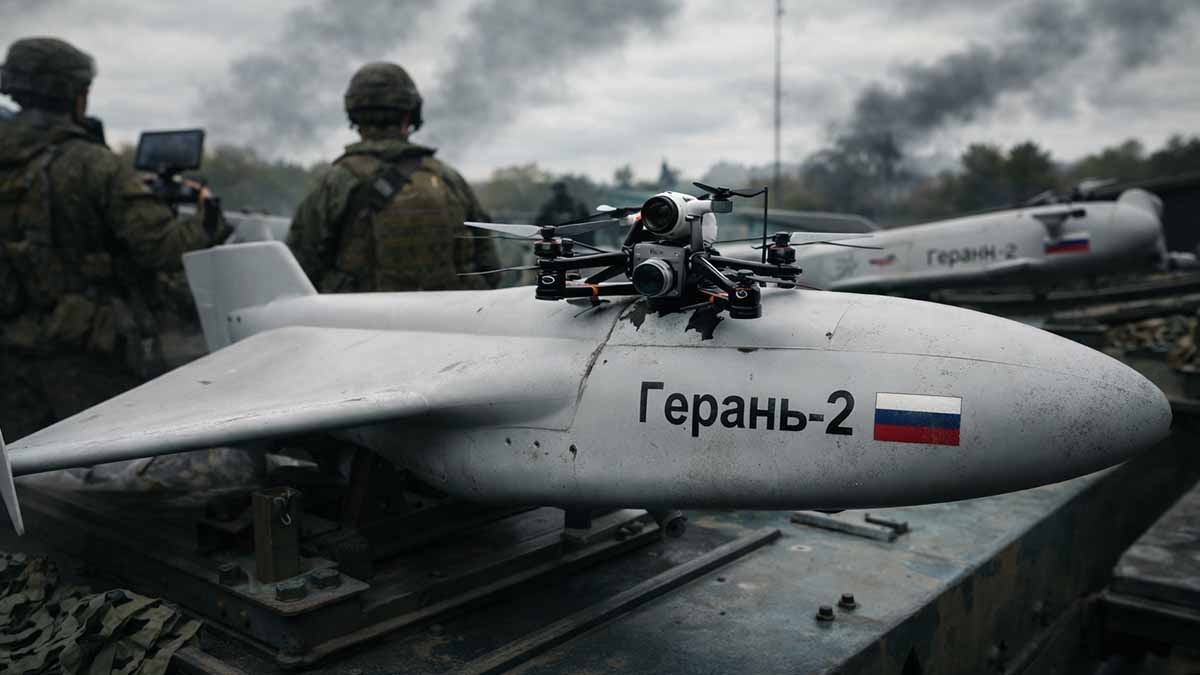
A significant tactical evolution in Russian unmanned aerial warfare was confirmed in March 2026 when Ukrainian air-defense operators intercepted a modified Geran-2 (the Russian designation for the Iranian Shahed-136 loitering munition) configured to carry two FPV drones mounted on its lifting wing. Ukraine’s Darknode anti-Shahed battalion reported on March 10 that it had destroyed a Russian Geran-2 configured to carry two FPV drones, intercepting the modified platform before payload release — leaving its intended mission (reconnaissance, terminal attack, or both) operationally ambiguous, though that ambiguity itself underscores the flexibility Russia is seeking. Army Recognition
The strategic logic is straightforward and tactically consequential. The Geran-2 solves the long-range ingress and navigation problem; the FPV solves the terminal discrimination problem. Instead of expending the entire platform in a single programmed impact, a carrier version can, in principle, release smaller drones against moving or concealed targets that a coordinate-only Shahed would struggle to hit — including vehicle parks, power nodes, radar detachments, and helicopters on dispersal pads. Army Recognition
This development did not emerge in a vacuum. Russia conducted mass Shahed/Geran strike drone campaigns throughout 2025, with Shahed/Geran-type drones comprising approximately 60% of all UAV launches in the final quarter of 2025. Institute for Science and International Security Since the beginning of 2026, Russia has launched Shahed strike drones at Ukraine every night, deploying over 4,600 UAVs in the first month and a half of the year alone. In 2025, Moscow attacked Ukrainian cities on 357 nights out of 365. The Kyiv Independent
The Geran-2 platform itself has undergone continuous battlefield modification. The base Geran-2 deployed in October 2022 was essentially a direct copy of the Iranian Shahed-136: GPS-guided, pre-programmed, flying a fixed route with no ability to deviate or respond to countermeasures. Within a year, Russia had added 2G/3G/4G cellular antennas to allow mid-flight operator adjustments. – Russia is modifying the Geran-2 platform in real time, on the battlefield, with each new variant addressing a specific Ukrainian defensive capability that emerged in preceding weeks or months — including a MANPAD-carrying variant with a 9K333 Verba infrared-homing surface-to-air missile mounted on its back, developed specifically to counter Ukrainian pilots flying manned intercept missions. –
The broader Geran family has also expanded. In 2025, the Geran-3 (Shahed-238) was introduced as the first jet-powered version, reaching speeds of up to 250 km/h. The Geran-5, the latest evolution, was developed between 2024 and 2025 based on the Iranian Karrar platform, operating at 450–600 km/h — fast enough to dash through air defense zones in minutes and serve as a “breaker” for slower drones, diverting air defense attention and saturating sensors. 423grifony
Production scale underpins the entire strategy. Russia is producing 404 Geran/Shahed-type drones per day according to Ukrainian Commander-in-Chief Oleksandr Syrskyi (January 18, 2026), with a stated target of 1,000 per day — a production surge that, if achieved, would enable 30,000 drone attacks per month. – As of March 2026, nearly 57,000 UAVs of this type had been launched against Ukraine since the first attack in September 2022. Kyiv Post
The air-defense implications are significant. This complicates air defense: a defender may detect what appears to be one inbound Shahed, only to face multiple terminal threats in the final minutes, with the smaller drones arriving lower, later, and potentially from a different angle. Army Recognition Ukraine’s countermeasures have evolved in parallel: the Sting interceptor drone, capable of speeds up to 315 km/h with AI thermal lock-on and fiber-optic control, successfully intercepted the first Geran-5 on January 6, 2026 after a 40-second pursuit. 423grifony
The supply chain enabling Russian production remains a persistent vulnerability and a live sanctions enforcement challenge. Ukrainian military intelligence files document that Geran-2 drones include components from American, European, Japanese, and Taiwanese manufacturers — with some components produced in 2024 and 2025, after the full-scale invasion and the implementation of sanctions. The Kyiv Independent
Russian UAV Warfare Evolution (Geran Ecosystem) — High-Level Analytical Table
| Category | Element / System | Description / Configuration | Operational Function | Strategic Implication | Key Data Points (2025–2026) | Vulnerabilities / Limits |
|---|---|---|---|---|---|---|
| Tactical Innovation | Geran-2 + FPV Carrier Variant | Modified Geran-2 carrying 2 FPV drones mounted on wing | Long-range carrier → deploy terminal drones for precision targeting | Shift from single-use strike → multi-stage attack system | Intercepted March 10, 2026 before payload release | Mission ambiguity (recon vs strike); release mechanics not yet validated |
| Kill Chain Evolution | Distributed Attack Architecture | Separation of navigation (Geran) and target discrimination (FPV) | Improves ability to hit moving / concealed targets | Transition toward modular swarm warfare logic | Targets: vehicles, radar, helicopters, power nodes | Requires coordination reliability + comms resilience |
| Baseline Platform | Geran-2 (Shahed-136 derivative) | GPS-guided loitering munition | Long-range one-way strike | Cheap mass attrition weapon | Introduced Oct 2022 | Vulnerable to EW, predictable flight path |
| Adaptive Upgrades | Cellular-enabled Geran-2 | 2G/3G/4G antennas added | Mid-flight retasking / route correction | Increased flexibility vs static defenses | Implemented within ~1 year of deployment | Reliant on network access / jamming risk |
| Experimental Variant | MANPAD Geran-2 | Equipped with 9K333 Verba infrared missile | Anti-air capability vs intercepting aircraft | Expands UAV role into counter-air domain | Developed to counter Ukrainian pilots | Weight, targeting complexity, limited engagements |
| Platform Expansion | Geran-3 (Shahed-238) | Jet-powered UAV | Faster penetration (≈250 km/h) | Reduces interception window | Introduced 2025 | Higher cost, potentially lower endurance |
| High-Speed Variant | Geran-5 (Karrar-based) | Jet UAV, 450–600 km/h | “Breaker drone” to saturate defenses | Creates multi-layer attack timing disruption | First intercepted Jan 6, 2026 | Detection easier at high speed; cost vs mass tradeoff |
| Operational Tempo | Mass Strike Campaign | Continuous UAV attacks | Persistent pressure on air defenses | Strategic exhaustion warfare | 357/365 days attacked in 2025 | Logistics strain; dependency on production flow |
| Launch Volume | UAV Deployment Rate | Massive scale launch doctrine | Saturation + attrition | Overwhelms defense economics | 4,600 UAVs in first 1.5 months of 2026 | Interceptor cost imbalance may invert over time |
| Cumulative Usage | Total UAV Launches | Since Sept 2022 | Long-term campaign scale | Institutionalized drone warfare | ~57,000 UAVs launched by March 2026 | Sustainability tied to supply chain |
| Production Capacity | Industrial Output | Daily production of Geran-type drones | Enables mass deployment doctrine | Industrialization of drone warfare | 404/day (Jan 2026), target: 1,000/day | Supply chain bottlenecks, sanctions pressure |
| Swarm Doctrine | Multi-Tier Attack System | Slow + fast + distributed drones | Sensor saturation + timing disruption | Moves toward networked swarm combat | Integration of Geran-2/3/5 + FPV layers | Requires coordination infrastructure |
| Air Defense Challenge | Multi-Vector Threat | One detected UAV → multiple terminal threats | Late-stage fragmentation attack | Increases interception complexity exponentially | Smaller drones arrive later/lower | Detection gaps, reaction time compression |
| Ukrainian Countermeasure | Sting Interceptor Drone | AI thermal lock + fiber optic control | UAV-on-UAV interception | Emergence of counter-drone ecosystem | 315 km/h; intercepted Geran-5 in 40 sec | Limited range; scalability unknown |
| Innovation Cycle | Battlefield Iteration Model | Continuous modification based on feedback | Rapid adaptation to defenses | Short innovation loops (weeks/months) | Each variant responds to Ukrainian tactics | Fragmentation of platform standardization |
| Supply Chain Structure | Global Component Sourcing | Western + Asian electronics | Enables sustained production | Weak point for sanctions enforcement | Components from US, EU, Japan, Taiwan (2024–2025) | Traceability gaps; dual-use loopholes |
| Strategic Doctrine | Cost-Imposition Warfare | Cheap drones vs expensive interceptors | Economic asymmetry | Forces defender resource depletion | High-volume low-cost attacks | Countered by cheaper intercept solutions |
| Future Trajectory | Modular UAV Ecosystem | Carrier drones + payload drones | Fully networked, adaptive strike systems | Precursor to AI-driven swarm warfare | Early stage demonstrated in 2026 | Requires robust autonomy + comms |
Key Meta-Insights
- Architecture Shift: From monolithic drones → distributed, modular systems
- Doctrine Shift: From precision strike → saturation + adaptive targeting
- Industrial Shift: From limited production → mass drone manufacturing economy
- Battlefield Shift: From air superiority → algorithmic + swarm contest
Document Index
Chapter I — Platform Evolution and Technical Configuration
- 1.1 Geran-2 Baseline Specifications and Operational History
- 1.2 The FPV Carrier Modification: March 2026 Intercept
- 1.3 The Geran Variant Family (Geran-3, Geran-4, Geran-5)
- 1.4 Parallel Development: Mini Geran-2 and Tactical Derivatives
Chapter II — Operational Doctrine and Strategic Implications
- 2.1 Two-Stage Strike Architecture: Long-Range Navigation + Terminal Guidance
- 2.2 Air Defense Saturation and Deception Logic
- 2.3 Rear-Area Threat Extension: Logistics, Airbases, Air Defense Positions
- 2.4 Fiber-Optic FPV Integration and Electronic Warfare Resistance
Chapter III — Production, Supply Chain, and Counter-Measures
- 3.1 Russian Drone Production Scale and Alabuga Facility
- 3.2 Western Component Supply Chain and Sanctions Evasion
- 3.3 Ukrainian Intercept Technologies: Darknode, Sting, Bumblebee, Bullet
- 3.4 Strategic Assessment: Erosion of Rear-Area Sanctuary
Chapter IV: Iran’s Immediate Drone Capabilities, the Two-Stage Strike Potential, the 2026 Iran War, and the Emerging Global Drone Proliferation Architecture
Russian UAV Strategic Assessment
Industrial Scaling & Interceptor Ecosystem Analysis
Production Scaling (2022-2026)
System Performance Metrics
Strategic Risk Pathways
| Platform | Type | Unit Cost | Max Speed | Strategic Role |
|---|---|---|---|---|
| Geran-2 | Strike | $70,000 | 185 km/h | Mass Attrition |
| Geran-5 | High-Speed | $110,000 | 600 km/h | Defense Saturation |
| Sting | Interceptor | $2,100 | 343 km/h | Economic Defense |
| JEDI Hunter | AI Interceptor | $12,500 | 350 km/h | Autonomous Defense |
Chapter 1: Platform Evolution and Technical Configuration — The Geran Family as a Modular Weapons Ecosystem
1.1 Geran-2 Baseline Specifications and the Russian Divergence from the Shahed-136 Blueprint
The engineering foundation of Russia’s current drone campaign lies in a deliberate and well-documented departure from the original Iranian Shahed-136 design. The Geran-2 measures 3.5 meters in length with a wingspan of 2.5 meters, a takeoff weight of 200 kilograms, and can carry a 50-kilogram warhead. The drone operates at altitudes ranging from 60 to 4,000 meters, with a maximum flight range of 2,000 kilometers. Powered by an engine producing 50 to 90 horsepower, the Geran-2 reaches a speed of up to 180 km/h and can sustain flight for up to 12 hours. Army Recognition
The structural divergence from the Iranian parent design was intentional and driven by mass-production logic. By July 2023, analyses of downed Geran-2 drones in Ukraine revealed that Russia had replaced the original lightweight honeycomb structure with a fuselage constructed from fiberglass over woven carbon fiber — a modification assumed to facilitate large-scale industrialization and streamline production. Army Recognition On the navigation side, the Kometa-M model, a Russian system compatible with the GLONASS satellite navigation system, replaced the imported satellite navigation unit. Army Recognition
The electronics aboard the Russian variant represent a composite of internationally sourced components assembled into a specifically Russian configuration. According to Ukraine’s Defense Intelligence Directorate (DIU), the electronic payload of the Geran-2 includes a single-board Raspberry Pi 4 microcomputer, a tracker, and two GSM modems for telemetry transmission. The countries of origin of the electronic component base include the United States, China, Switzerland, Taiwan, Japan, Germany, and the United Kingdom. Ukrainian news
The navigation hardening effort is central to understanding Russia’s strategic investment in the platform. The Kometa controlled reception pattern antenna (CRPA) ensures resilience against jamming and spoofing of GNSS signals and is fitted on virtually all Russian weapon systems that rely on such signals, including ballistic and cruise missiles, glide bombs, and drones such as the Geran-2 and Garpiya A1. Each element of the CRPA receiver processes signals with specific delays and phase shifts based on the direction and wavelength of incoming signals, as well as the relative positioning of the elements. Valisluureamet The Estonian Foreign Intelligence Service assessed in 2025 that the Kometa CRPA receivers very likely enhance the resilience of Russian weapon systems against Ukraine’s electronic warfare efforts, enabling more accurate and devastating strikes, and that the reduced effectiveness of electronic warfare in disrupting navigation signals heightens the need for alternative capabilities — such as kinetic strike options — within air-defense systems. Valisluureamet
By early 2025, Ukraine’s Defence Intelligence had documented additional structural modifications in the latest Geran production series. Since early 2025, Ukrainian specialists recorded that modifications include relocation of the flight controller, power distribution unit, and battery from the nose to the tail section, with additional ballast integrated into the UAV’s structure. An anti-interference eight-channel CRP satellite navigation antenna with a circular arrangement of peripheral patch antennas was found marked in Chinese and English as “Agricultural equipment parts,” with a serial number indicating production in 2024. Ukrainska Pravda Furthermore, there is information that Russia has begun using new domestically produced 12-channel Kometa CRP antennas alongside the eight-channel Kometa M8 variant. To record and transmit footage, Russian forces use one-time Telegram bots, Raspberry Pi microcomputers, webcams, and 3G/LTE modems. Ukrainska Pravda
The warhead configuration also evolved significantly. From March 2024, a new version of the Geran-2 was found in Ukraine in which the military load increased from 50 to 90 kilograms, achieved by repositioning certain equipment to free up the necessary internal volume. This increase in payload was likely accompanied by a reduction in autonomous range, though the drone likely maintained a range greater than 1,000 km — more than sufficient to strike any point in Ukrainian territory, with no location in Ukraine more than 600 km from areas under Russian control. Meta-defense
An additional and notable inertial navigation upgrade was confirmed by DIU in January 2026 regarding the Verba-armed variant: the inertial navigation system features the first use of the new 6-axis inertial module SCH1633-D0I manufactured by Murata of Japan — a module introduced at the end of 2024 for civilian automotive applications including autonomous driving and advanced driver-assistance systems. Ukrainska Pravda This cross-domain component migration from automotive to military applications exemplifies Russia’s procurement strategy under sanctions.
1.2 The FPV Carrier Modification: The March 2026 Intercept and Its Technical Implications
The March 10, 2026 interception by Ukraine’s Darknode battalion marks the first publicly confirmed instance of a Geran-2 configured as an airborne FPV carrier. The technical implications of this configuration extend well beyond what was physically recovered. The key point is not that the FPV itself suddenly acquires a bigger battery. Its organic range likely remains in the normal mini/micro-drone envelope of roughly 10 to 20 kilometers, though relay architectures can push standard FPV reach to 50 kilometers or more. What the Geran-2 changes is the launch point: it carries the FPV through the transit phase so that a short-range weapon can appear deep over logistics routes, urban approaches, air bases, or mobile air-defense positions. Army Recognition
The unresolved question of whether the intercepted Geran-2 retained its own warhead is operationally significant. Open sources do not yet confirm whether this aircraft retained its normal warhead, how the FPVs would have been released, or how robust their control links would be after separation. Army Recognition This ambiguity is itself a force-multiplier: Ukrainian air-defense operators must now evaluate every inbound Geran-2 against a threat model that includes the possibility of parasite drone release, warhead detonation, or both — requiring earlier engagement decisions with more resources committed per contact.
The Darknode intercept also revealed the difficulty of determining intent before payload release. The drone was destroyed before any FPV was deployed, meaning its mission — reconnaissance, terminal strike, or a hybrid of both — could not be resolved from physical evidence alone. This mirrors a broader Russian doctrinal tendency to embed operational ambiguity into hardware configurations, forcing defenders into worst-case planning assumptions. The Geran-2 as FPV carrier is not, at present, a mass-deployed operational capability — it is better characterized as a tested concept with high industrialization potential given Russia’s demonstrated track record of rapidly scaling battlefield innovations from prototype to production.
1.3 The Geran Variant Family: Geran-3, Geran-4, and Geran-5
Russia’s development of the Geran family reveals a systematic program of capability layering, with each variant addressing a specific gap exposed by Ukrainian defensive adaptation. The progression from Geran-2 to Geran-5 represents not incremental refinement but categorical escalation across speed, guidance, and lethality dimensions.
The Geran-3 represents the first turbojet transition within the family. The Geran-3, derived from Iran’s Shahed-238, is a long-range turbojet loitering munition with speeds up to 600 kilometers per hour and a maximum flight ceiling of 9,000 meters — placing it well outside the reach of small arms or standard anti-drone weapons. Ukrainian Air Force spokesperson Yurii Ihnat stated that the Geran-3 appears on radar with flight parameters similar to cruise missiles, due to its speed exceeding 500 kilometers per hour. Army Recognition Multiple guidance configurations were identified: a baseline version using satellite and inertial guidance via GPS and GLONASS; a model incorporating an infrared imaging seeker for passive terminal guidance; a third variant potentially using passive radar homing to target air defense radar emissions; and a fourth potentially including an electro-optical sensor for reconnaissance or visual guidance. Army Recognition
Russia has established production of an analogue to the Shahed-238 jet-powered drone — the Geran-3 — featuring a compact Tolou-10/13 twin-spool turbofan engine enabling flight speeds of 550–600 km/h and a range of 2,500 km. Ukrainska Pravda
The Geran-5 is qualitatively distinct from all predecessors. Ukraine’s Defense Intelligence Directorate (GUR) confirmed the Geran-5 is roughly 20 feet long with a wingspan of about 18 feet. The warhead weighs approximately 90 kg with a declared range of about 1,000 km. Unlike previous modifications of the Geran line, the device is made according to a normal aerodynamic scheme and bears a strong resemblance to Iran’s Karrar attack drone. Yahoo! Regarding its propulsion and electronics: the Geran-5 navigation system uses a 12-channel Kometa unit with anti-jamming capability supporting GLONASS and Beidou, combined with Raspberry Pi-based tracker hardware for data processing and course correction, and 3G/4G modems for alternative communication links. 423grifony
Testing of the Geran-5 began in the summer of 2025 at proving grounds in the Astrakhan region, with the first combat deployment occurring between January 1–10, 2026, during combined attacks alongside Geran-2/3 units and cruise missiles. The drone features a cruising speed of 550–600 km/h, reaching up to 800 km/h during its final dive phase. The Geran-5 serves as a “breaker” for slower drones, diverting air defense attention and saturating sensors, while its air-launch capability from Su-25 aircraft — demonstrated in 2025 tests — adds an additional 200–500 km to effective range. 423grifony
The weapons integration ambitions extend to aerial combat: GUR noted that Russia is separately considering equipping the Geran-5 with R-73 air-to-air missiles to counter Ukrainian aviation. The R-73 is a Soviet-era heat-seeking missile, also known as the AA-11 Archer by NATO, designed to be fired from fighter jets to attack other aircraft. Yahoo!
1.4 Parallel Development: The Mini Geran-2, the R-60 Armed Variant, the Verba MANPADS Variant, and the Gerpera Decoy
Beyond the primary numbered variants, Russia has developed several parallel derivative configurations that collectively constitute a modular ecosystem rather than a single weapons program. DIU confirmed a Geran-2 (series E) equipped with a 9K333 Verba MANPADS. The modification uses a Chinese-made Honpho TS130C-01 optical camera in the nose fairing and an Xingkay Tech XK-F358 mesh modem. Once an airborne target is detected, the operator activates two servo drives: the first starts the chemical battery and nitrogen cooling cylinder of the MANPADS homing head, while the second opens a specially manufactured protective cover after the homing head has cooled to the required temperature. Ukrainska Pravda
The R-60 armed variant, confirmed by DIU in December 2025, demonstrates yet another attack-on-interceptors modality: Russia adapted the Soviet-era R-60 air-to-air missile — mounted with its APU-60-1MD launch rail on a special bracket in the upper forward part of the Geran fuselage — to engage Ukrainian helicopters and aircraft involved in intercepting drones. The modified UAV carries two network cameras, one in the nose and one behind the missile launch rail, with video and control commands transmitted via the Chinese mesh modem Xingkay Tech XK-F358. Army Inform
The Gerbera decoy drone, produced alongside strike variants at the Alabuga plant, has undergone its own quiet lethalization. The Gerbera drones, previously used for decoy purposes, are now being equipped with high-explosive fragmentation warheads manufactured by the Bazalt weapons manufacturing company and KZ-6 engineering charges, activated using a detonator connected to the flight controller via a RUICHI SSR-10DD solid-state relay. Ukrainska Pravda This transition from pure decoy to armed decoy blurs the categorical boundaries Ukraine’s air-defense systems use for threat prioritization, forcing operators to treat every Gerbera contact as a potential lethal threat rather than a low-priority saturation asset.
Geran Family Comparative Specifications Table — April 2026
| Variant | Base Platform | Propulsion | Speed (km/h) | Range (km) | Warhead (kg) | Key Distinguishing Feature |
|---|---|---|---|---|---|---|
| Geran-2 | Shahed-136 | MD-550 piston, 50 HP | Up to 180 | 1,000–2,000 | 50–90 | Mass-production delta-wing; Kometa GLONASS; Raspberry Pi 4 |
| Geran-2 (FPV Carrier) | Geran-2 modified | Same | Up to 180 | 1,000–2,000 | Unknown/retained | Two FPV drones on lifting wing; confirmed March 10, 2026 |
| Geran-2 (R-60 armed) | Geran-2 Series E | Same | Up to 180 | Reduced | None/missile | R-60 AAM on dorsal bracket; dual cameras; XK-F358 modem |
| Geran-2 (Verba) | Geran-2 Series E | Same | Up to 180 | Reduced | None/missile | 9K333 Verba MANPADS; SCH1633-D0I inertial module (Murata Japan) |
| Geran-3 | Shahed-238 | Tolou-10/13 turbofan | 550–600 | 2,500 | 50–300 | First jet-powered variant; IR/radar homing options |
| Geran-5 | Iranian Karrar | Telefly TF-TJ2000A turbojet | 550–800 | ~1,000 | ~90 | Conventional airframe; GLONASS+Beidou; R-73 integration planned |
| Gerbera (armed) | Decoy derivative | Piston | ~180 | Tactical | HE-Frag (Bazalt) | Formerly pure decoy; now lethal with KZ-6 charge |
Geran Family: Speed vs. Range Matrix — April 2026
Sources: Army Recognition (March 2026) · DIU/War&Sanctions portal (January 2026) · ArmyInform (December 2025) · Ukrainska Pravda (January 2026) · Estonian Foreign Intelligence Service Annual Report (2025) · 423grifony.com (January 2026)
GERAN DRONE ECOSYSTEM 2026
Russian Modular UAV Evolution — Operational & Technical Overview
Scope: April 2026
0
Max Range (km)0
Max Speed (km/h)0
Max Warhead (kg)0
Variants IdentifiedSpeed Comparison
Range Comparison
Warhead Capacity
Operational Concept
The FPV-carrier configuration shifts warfare from single-point strike to distributed terminal engagement, enabling dynamic targeting of mobile assets deep behind defensive lines.
| Variant | Speed | Range | Warhead |
|---|---|---|---|
| Geran-2 | 180 | 2000 | 50–90 |
| Geran-3 | 600 | 2500 | 50–300 |
| Geran-5 | 800 | 1000 | 90 |
Chapter 2: Operational Doctrine and Strategic Implications — Two-Stage Strike Architecture, Air Defense Erosion, Rear-Area Sanctuary Collapse, and Fiber-Optic Warfare
2.1 Two-Stage Strike Architecture: Long-Range Navigation Merged with Operator-Controlled Terminal Engagement
The doctrinal innovation represented by the Geran-2 FPV carrier configuration belongs to a broader Russian strategic framework that CSIS analysts have characterized as a deliberate evolution from single-vector attacks toward multi-phase, multi-vector strike sequences. This framework did not emerge from the March 2026 intercept alone — it represents the culmination of a learning curve measurable across three years of operational data. By 2025, the average Russian salvo had tripled to nearly 370 munitions per event, with salvos now coming every 8.2 days on average. What began as rare events in 2022 has become a regular, calibrated feature of Russia’s coercive punishment campaign — a deliberate signal architecture as much as a kinetic one, with Moscow demonstrably calibrating the scale and tempo of its strikes to political conditions, reducing launches to roughly 3,300 in August 2026 during active negotiation talks, versus over 6,300 in July 2025 during periods of diplomatic stagnation. Center for Strategic and International Studies
The two-stage architecture works because it exploits a fundamental asymmetry in air-defense resource allocation. A defender detecting an inbound Geran-2 must immediately commit to an engagement decision: whether to expend a missile or gun ammunition against what may be a simple one-way munition, or defer and risk the Geran releasing FPV payloads at standoff range. This decision must be made in seconds, without reliable intelligence on whether the inbound contact is a standard strike variant, a carrier, a MANPADS-equipped hunter-killer, or a decoy. Russia is adapting its swarming methods through overlapping flight paths and staggered launch waves that force defenders to spread thin and deplete interceptors more quickly, while upgraded Geran variants flying at higher altitudes exploit radar gaps, straining Ukraine’s layered defenses. The Shahed’s hit rate, once below 10 percent, has risen to nearly 20 percent — not because Ukraine’s defenses are failing but because Russia is adapting its tactics. Center for Strategic and International Studies
The cost-exchange logic that underpins the entire strategy is brutal in its arithmetic. Starting in September 2024, Russia significantly ramped up its use of Shahed drones from approximately 200 launches per week to more than 1,000 per week by March 2025. The net result is drone saturation: it doesn’t matter if an individual Shahed hits its target. What matters is the compound effect on civilians and the stress placed on air defenses. By saturating the skies with low-cost weapons, Moscow wages an attritional campaign targeting both the will of the Ukrainian people and the readiness of its defense infrastructure simultaneously. Center for Strategic and International Studies
The FPV-carrier concept deepens this arithmetic further. Each Geran-2 that potentially carries two FPV drones generates not one target decision but three — the mothership and two potential release points — against air-defense systems already operating at saturation tempo. If Russia industrializes this configuration to even 10 percent of its daily Geran-2 output (currently assessed at 404 per day), the volume of potential multi-threat packages entering Ukrainian airspace each night becomes analytically unmanageable without substantially more radar and interceptor capacity than Ukraine currently fields.
2.2 Air Defense Saturation and Deception Logic: The Multi-Vector Exhaustion Campaign
The saturation and deception dimensions of Russia’s drone campaign operate across two simultaneous axes: quantitative exhaustion and qualitative confusion. Both axes accelerated dramatically across 2025 and into early 2026, generating compounding effects on Ukrainian air-defense architecture that no single countermeasure has yet reversed.
In October 2025, Russia conducted one of its most intensive strike months of the entire war — launching approximately 5,300 Shahed UAVs, 74 cruise missiles, and 148 ballistic missiles simultaneously. This represents one of the few months in which all three systems operated at above-average levels concurrently. In the same period a year earlier, Russia launched roughly 1,900 Shaheds, 42 cruise missiles, and 33 ballistic missiles — meaning the 2025 numbers are nearly three times higher across all systems. Air defense must now pivot rapidly between massed drone swarms and high-speed ballistic or cruise strikes, reinforcing the need for layered defense integrating radar, mobile interceptors, and electronic warfare systems. Center for Strategic and International Studies
The deception layer operates through platform ambiguity and altitude manipulation. When Russia deploys Gerbera decoys alongside Geran-2 strike variants, and when some of those Gerberas are now themselves armed (as documented in Section 1.4), operators face a tiered identification problem: identify decoy versus strike variant, then within the strike variant category identify warhead-only versus FPV-carrier versus MANPADS-armed hunter versus Verba-equipped anti-aircraft platform. Each identification failure type carries a different cost: engaging a decoy wastes a missile; failing to engage a carrier allows FPV release; failing to engage a MANPADS-armed variant risks Ukrainian pilot lives; failing to engage a Verba-equipped variant risks helicopter losses.
Russia’s recent aerial assaults showcase sophisticated use of swarm tactics combined with decoys — a strategy that overwhelmed Ukrainian air defenses. The first wave consisted primarily of Shahed-136 suicide drones designed to exhaust Ukrainian anti-aircraft resources. Following this barrage were low-flying cruise missiles targeting blind spots in defense systems, culminating in jet-powered drones capable of high-speed strikes that penetrated deep into enemy territory. Oreate AI
The Hudson Institute’s analysis of the French military perspective on the conflict frames this doctrinal synthesis in historically consequential terms: drone swarms capable of saturation, connectivity, real-time surveillance, and precision targeting represent not only a tactical revolution but a profound disruption of operational art, much like blitzkrieg once was. France’s Chief of Staff General Pierre Schill, in an order of the day issued on April 23, 2025, called on military branches to reinvent themselves in response. Hudson Institute
The CSIS assessment of Russia’s evolving salvo doctrine provides additional structural context for what makes the two-stage carrier concept particularly destabilizing: large-scale salvos make up about 10 percent of all Russian aerial operations, yet they have both increased in scale and frequency. A typical 2022 salvo involved about 100 weapons monthly; by 2025, the average tripled to nearly 370 munitions per salvo, appearing every eight days. Even if only a fraction of drones and missiles penetrate, the constant pace, volume, and adaptation gradually overwhelm the shield. Center for Strategic and International Studies
2.3 Rear-Area Threat Extension: The Systematic Collapse of Sanctuary
The strategic significance of the Geran-2 FPV carrier extends beyond its specific hardware configuration. Its deepest implication is doctrinal: the concept asserts that no location in Ukrainian-controlled territory can be considered a sanctuary from FPV-grade precision. Before this development, Ukrainian logistics officers, air-defense crews, and command nodes at depth could plan their activities on the assumption that FPV-range threats were bounded — that the 10–20 km organic envelope of radio-controlled FPV drones and the 30–50 km extended envelope achievable via relay or mothership architectures represented the terminal limit of precision-guided operator-controlled attack. The Geran-2 carrier eliminates that planning assumption entirely.
This erosion of rear-area sanctuary is not hypothetical — it is already empirically underway through Ukrainian strikes on Russia that have demonstrated the principle in reverse. Sergei Shoigu, Secretary of Russia’s Security Council and former Defense Minister, acknowledged on March 17, 2026, in Yekaterinburg, that Ukrainian drone attacks surged from around 6,200 in 2024 to over 23,000 in 2025 — a more than fourfold increase. Shoigu specifically cited the strike on the Aviastar aircraft factory in Ulyanovsk, approximately 1,800 km from the Ukrainian border, as evidence that Ukrainian drones have “broken distance records,” and warned that the Urals, Russia’s industrial heartland, now lie in a “direct threat zone.” Defense Magazine
The reciprocal application of this logic to Ukrainian territory — what a Geran-2 FPV carrier enables — is therefore strategically symmetrical. Logistics nodes at 300 km from the front that previously sat entirely beyond FPV threat radius now must be considered operationally exposed. Ukrainian air bases housing F-16 aircraft, Patriot battery positions at depth, ammunition dumps, and command facilities that were designed and sited with the assumption of FPV-range exclusion now require reassessment.
The campaign against Russian air-defense assets in Ukrainian-occupied and Russian territory demonstrates the mature form of this rear-area erosion logic. In February 2026, Ukraine’s SBU Alpha unit stated that its operators had neutralized approximately half of Russia’s operational Pantsir stockpile — each system costing $15 to $20 million. Attacks accelerated in February and March 2026, with overnight operations on March 6–7 employing FP-2 drones armed with enhanced 100-kilogram-plus warheads to destroy four Russian systems in a single night across occupied Zaporizhzhia and Kherson: including three medium-range missile launchers — identified as Buk, Tor, and S-300V systems — and a single Pantsir-S1. Kyiv Post
Throughout January 2026, Ukraine’s military intelligence agency HUR, through the special unit “Prymary,” successfully struck six key Russian assets in cold-weather operations, including a Pantsir-S1 short-range air defense system, both a Tor-M1 and the more advanced Tor-M2 along with its transport-loading vehicle, plus two radar installations: the RLM-ME radar of the Nebo-M complex responsible for low-altitude detection, and the three-coordinate Protivnik-GE radar used to track targets for missile systems and fighter aircraft. UNITED24 Media
The strategic significance of radar destruction in this context is especially acute for the FPV-carrier threat calculus. Without low-altitude detection radars, Russian air-defense operators cannot reliably identify inbound Geran-2 formations or classify their payload configurations. The Nebo-M’s RLM-ME component specifically handles low-altitude contacts — precisely the altitude regime in which FPV drones released from a Geran-2 carrier would operate after separation.
The Operation Spiderweb precedent from May 2025 illustrates how far rear-area sanctuary had already collapsed before the Geran-2 FPV carrier emerged. As many as 117 FPV Ukrainian drones targeted five Russian airbases — Belaya, Dyagilevo, Ivanovo Severny, Olenya, and Ukrainka — with the SBU claiming more than 40 Russian military aircraft struck, including Tu-160, Tu-95, and Tu-22M strategic bombers and A-50 airborne early warning aircraft. Zelenskyy stated that 34 percent of Russia’s strategic cruise missile carriers stationed at airbases had been hit. The Belaya strike in Irkutsk Oblast was the first Ukrainian strike in Siberia during the entire war. Wikipedia
The Geran-2 FPV carrier concept, applied at scale, would give Russia an analogous capability against Ukrainian rear installations — without requiring the elaborate concealment operations that Ukraine used to pre-position drones within FPV range of Russian airbases in Siberia.
| Target Category | Pre-FPV Carrier Threat Horizon | Post-FPV Carrier Threat Horizon | Implication |
|---|---|---|---|
| Ukrainian logistics nodes | ~50 km from front (relay-extended FPV) | Up to 2,000 km | Full territorial exposure |
| F-16 operating bases | Outside FPV range if positioned at depth | Potentially within range | Basing strategy must adapt |
| Patriot battery positions | Positioned to avoid FPV; covered by organic defenses | Exposed to FPV-precision attack at depth | Repositioning costs rise |
| Command facilities | Deep siting was protective | Depth no longer guarantees safety | C2 hardening required |
| Ammunition depots | Located far from front for protection | Within Geran-2 carrier FPV release envelope | Dispersal and hardening necessary |
2.4 Fiber-Optic FPV Integration and Electronic Warfare Resistance: The Unjammable Terminal Layer
The FPV drones carried by the Geran-2 in the March 2026 intercept have not yet been publicly characterized as fiber-optic variants. However, the broader trajectory of Russian FPV development — in which fiber-optic guidance has become the dominant innovation of 2025 — makes it highly probable that any industrialized Geran-2 FPV carrier system will eventually integrate fiber-optic-guided payloads, converting the carrier concept from an experimental platform into a tactically decisive combination: unlimited range on approach, unjammable precision on terminal engagement.
Fiber-optic drones eliminate the vulnerability to radio jamming entirely. Russian engineers described these drones as a “game changer” for both targeting and logistics disruption. These UAVs offer complete protection from Electronic Warfare, which has made them particularly valuable in environments where signal interference is constant and deliberate. DRONELIFE
The operational record of fiber-optic drone deployment in 2025 demonstrates the scale and pace at which this capability matured. In September 2025, Russia doubled its production of fiber-optic FPVs to more than 50,000 per month. Russia holds advantages in production volume and range, operating its own fiber-optic cable production facilities at a plant in Saransk, and actively cooperating with China on spool production. Meanwhile, Ukraine remains reliant on cable imports from China. The commander of Ukraine’s K-2 regiment declared in March 2025 that “2025 will become the year of fiber-optics.” Substack
With no radio link for electronic warfare systems to jam, fiber-optic drones can operate in areas where conventional drones struggle or fail. In Kursk, this advantage proved consequential: over seven months of fighting, Russian fiber-optic drones helped render Ukraine’s presence in the Kursk region increasingly unsustainable. Ukrainian forces ultimately withdrew back across the border in March 2025. Open-source strike videos indicate a disproportionate share of Russian fiber-optic drone attacks from August 2024 to September 2025 concentrated in the Kursk sector. Atlantic Council
The range evolution of fiber-optic systems across 2025 and into 2026 is itself significant to the carrier concept. Fiber-optic FPV drones were first fielded by Russia in the spring of 2024 and by Ukraine soon after. Maximum strike ranges increased over time, with Russian fiber-optic drones hitting areas of Kramatorsk more than 19 kilometers behind the front lines in October 2025. Prototypes with up to 50 km range have been developed. Wikipedia More recently, Russia has reportedly increased the range of its fiber-optic drones to up to 50–65 km, using them to strike Ukraine’s logistical nodes. “A fiber-optic drone is not designed to conduct 30–40 sorties per day. It is intended for a single sortie and a precise strike. Countering it is extremely difficult; so far, only kinetic interception is effective,” said a Ukrainian veteran. Substack
The practical limitations of fiber-optic systems — cable breakage, loop failures, payload constraints — are themselves driving rapid engineering adaptation. On March 22, 2026, Ukrainian Verkhovna Rada MP and Armed Forces platoon commander Tetyana Chornovol disclosed that her unit had built a dual-channel FPV system that switches from fiber-optic to radio control when the cable snaps. Adding the dual-channel capability raises the cost by UAH 2,500 — roughly USD $60 — compared to a standard fiber-optic-controlled drone. The cable problem is real and routine: long-range flights snap fiber regularly, and cable loops can coil back on themselves mid-flight and disrupt the video feed without physically breaking. DroneXL
This engineering detail is directly relevant to the Geran-2 carrier scenario. If Russia equips its carrier-delivered FPVs with dual fiber-optic/radio control, the resulting system would be: jammable (via radio link) only when the fiber-optic cable has already physically failed — meaning that any successful electronic warfare intervention against a released FPV would require either destroying the cable in flight or waiting for mechanical failure to occur. Neither of these is a reliable, scalable defensive mechanism. Countermeasures range from last-resort shotgun blasts and physical barriers to radar tripwires, acoustic sensors, and experimental AI-assisted detection systems. In 2025, countering fiber-optic drones became the central theme of NATO’s Innovation Challenge, with participants from Ukraine and the United States taking the podium. There is no silver bullet to neutralize the threat. Atlantic Council
The elite Russian drone unit Rubicon has most publicly demonstrated the operational ceiling of this technology combined with long-range depth penetration. Specializing in long-range fiber-optic FPVs, Rubicon has launched deep strikes into Ukrainian rear positions, crippling logistics and command nodes. Their presence on the Kostiantynivka front has forced Ukrainian brigades to rethink supply routes and drone deployment tactics. As a result, Ukraine is facing an acute shortage of trucks, pickups, and armoured transport vehicles, which are increasingly being destroyed. Across the front, it is now common to see improvised vehicles reinforced with metal cages to protect against drone attacks. The Interpreter
The global proliferation trajectory of fiber-optic drone technology is an additional strategic concern extending well beyond the Ukrainian theater. The reach of fiber-optic drone warfare is also expanding beyond Ukraine, reportedly to Mali and Myanmar. China’s People’s Liberation Army is already reportedly incorporating fiber-optic drones into its growing arsenals. The Interpreter
Operational Doctrine Summary Comparison Table — April 2026
| Doctrinal Dimension | 2022 Baseline | 2025 Evolved State | 2026 Emerging State |
|---|---|---|---|
| Salvo size (average) | ~100 munitions/event | ~370 munitions/event (CSIS, Sept 2025) | 500+ with nightly routine strikes |
| Salvo frequency | Monthly | Every 8.2 days | Near-continuous, negotiation-calibrated |
| FPV operational range | 5–10 km radio-controlled | 10–50 km with relay/fiber-optic | Carrier-delivered: theoretically unlimited |
| Electronic Warfare resistance | Low (radio-only) | Moderate (fiber-optic pioneered at scale) | High (dual fiber/radio, Kometa GNSS) |
| Rear-area threat horizon | Tactical belt only | Mid-depth (fiber-optic range) | Full depth (Geran-2 carrier concept) |
| Air defense attrition | Russian AD largely intact | ~$4 billion Russian AD destroyed in 2025 | ~50% of Pantsir fleet neutralized by Feb 2026 (SBU claim) |
| Strike system diversity | Shahed-136 + cruise missiles | Geran-2/3, fiber FPV, ballistic, cruise simultaneously | Geran-5, FPV carrier, armed Gerbera, fiber-optic fleet |
Two-Stage Strike System: Operational Threat Depth Expansion — April 2026
Sources: CSIS “Russia’s Massed Strikes” (Sept 2025) · CSIS “Drone Saturation” (Feb 2026) · Kyiv Post analysis (March 2026) · Atlantic Council (Feb 2026) · Lowy Institute (Aug 2025) · Euromaidan Press (March 2026) · UNITED24 Media (Feb 2026) · DronexL (March 2026) · Ukraine Arms Monitor (Dec 2025)
Chapter 3: Production, Supply Chain, and Counter-Measures — Industrial Scale, Sanctions Architecture Failure, and the Emergent Ukrainian Intercept Ecosystem
3.1 Russian Drone Production Scale and the Alabuga Facility: From Iranian Franchise to Global Export Platform
The Alabuga Special Economic Zone in Tatarstan, located approximately 1,100 kilometers east of the Ukrainian border, has undergone one of the most dramatic military-industrial transformations documented in open-source satellite analysis during the entire course of the Russo-Ukrainian War. What began in 2022 as a licensed assembly operation importing Iranian Shahed-136 knock-down kits has, by early 2026, evolved into a fully localized, vertically integrated production ecosystem that Russia’s own defense ministry now publicly showcases as a national industrial achievement. The scale, velocity, and institutional architecture of this expansion reveal a strategic commitment by Moscow to drone warfare as a permanent pillar of its military doctrine — one that transcends the immediate conflict in Ukraine and positions Russia as a potential global exporter of battle-hardened autonomous strike systems.
The physical expansion of Alabuga visible in satellite imagery analyzed by the Institute for Science and International Security — July 2025 is staggering in scale. High-resolution satellite imagery from mid-July 2025 reveals a vast expansion comprising hundreds of new residential buildings and a dozen new production facilities including workshops, warehouses, and office buildings. The hundreds of new residential buildings, when finished, could hold roughly 41,000 workers. The twelve new workspaces under construction could provide additional capacity to produce drones including the Shahed 136, the Gerbera decoy drone, or other unspecified variants. Institute for Science and International Security
The production trajectory confirms that Alabuga has dramatically surpassed its original contractual targets. The 6,000 drones stipulated in the initial contract by September 2025 were manufactured approximately a year ahead of schedule, and according to Ukraine’s Defense Intelligence, Alabuga is now producing more than 5,500 units per month. In 2022, Russia paid an average of $200,000 per drone. By 2025, that figure had fallen to approximately $70,000. Ukraine also confirms that Russia has modernized the drone with improved communications, longer-lasting batteries, and much larger warheads. CNN
The CEO of Alabuga, Timur Shagivaleev, appeared in a Russian Ministry of Defense documentary broadcast on the Zvezda channel on July 20, 2025, claiming that the facility now produces nine times more drones than originally planned. If this claim refers to the original stage-two contract rate of 2,060 Shahed-136 drones per year, then Alabuga is now producing approximately 18,540 drones per year, or roughly 1,545 per month from this measure alone. An alternative estimate based on a planned rate of 7.5 drone bodies per day suggests current output could be measured against an entirely separate, higher baseline. Institute for Science and International Security
The labor recruitment strategy powering this expansion combines coercion, deception, and geopolitical alliance — three vectors operating simultaneously. The North Korean dimension is particularly significant for long-term production sustainability. Ukraine’s Main Intelligence Directorate reported that Russia was using the North Korean Jihyang Technology Trading Company to recruit 12,000 North Korean workers for the Yelabuga SEZ. A meeting of local government officials with representatives of Jihyang was held at the Russian Ministry of Foreign Affairs at the end of October 2025. Russia reportedly offers the imported labor approximately $2.50 per hour, with shifts lasting at least 12 hours. Beyond Parallel
The 38 North analysis from December 2025 confirms the housing infrastructure matches the workforce numbers: ISIS estimates that the completed pre-fabricated dormitories will be able to host up to 13,840 workers, aligning with the 12,000 workers projected in the DIU report, with room for additional technical and security personnel. The Alabuga expansion echoes North Korean workers’ known conditions from comparable labor deployments, including minimum 12-hour daily shifts, six to seven days a week. 38 North
The strategic implication of North Korean drone-manufacturing expertise transfer extends beyond Ukraine. Alabuga may be looking to export drones in the longer term, seeking customers in North Korea, Iran, or other countries indifferent to sanctions on Russia. There are media reports of North Koreans coming to the site in 2025 to acquire Shahed drone technology to take back to North Korea for establishing a domestic production capability. Institute for Science and International Security Analysts believe Alabuga’s growth trajectory could allow Russia to potentially export an updated and battle-tested version of the drone it originally imported from Iran — perhaps even selling back to Tehran itself. David Albright, former UN weapons inspector and head of ISIS, told CNN that Moscow’s decision to publicize the factory signals that “Russian authorities are feeling more confident about their ability to make drones.” CNN
The localization process has also produced a structural geopolitical consequence: the effective marginalization of Iran from a production partnership it originally initiated. 90% of production stages now occur at Alabuga or other Russian facilities. A Western intelligence source describes the expansion and complete Russian integration of the Shahed-136 as having “effectively marginalized Iran,” revealing a rift between Moscow and Tehran. Iran may have expected Russia to take more supportive steps in return for the original technology transfer, but Moscow’s approach has been characterized as “purely transactional and utilitarian.” CNN
| Production Metric | 2022 Baseline | 2024 Mid-Point | 2025 Peak | 2026 Trajectory |
|---|---|---|---|---|
| Monthly output | ~300 drones | ~1,500 drones | ~5,500 drones | Target: 10,000–15,000/month |
| Unit cost | ~$200,000 (imported) | ~$80,000 (domestic) | ~$70,000 | Decreasing with scale |
| Workforce capacity | ~810 (initial plan) | Several thousand | Tens of thousands projected | ~41,000 when complete |
| Localization rate | ~10% domestic | ~70% domestic | ~90% domestic | Near-total domestic |
| Production facility | Single assembly hall | Expanded workshops | 12+ new buildings | ~40 total buildings projected |
3.2 Western Component Supply Chain and Sanctions Evasion: The Structural Failure of Export Controls
The component supply chain analysis of the Geran-2 represents one of the most comprehensively documented examples of sanctions architecture failure in contemporary conflict. Investigations published in February 2026 by a consortium of media organizations including the Organized Crime and Corruption Reporting Project (OCCRP), De Tijd, The Irish Times, Der Standard, Paper Trail Media, The Times, and the Kyiv Independent collectively constitute the most granular forensic accounting of how Western technology continues to power Russian weapons despite more than four years of progressively tightening sanctions regimes.
The scale of identified evasion is quantitatively documented and institutionally structured rather than episodic. Trade data obtained from the Import Genius platform shows 672 shipments of sanctioned components produced by European manufacturers being sent to Russia between January 2024 and March 2025. The shipments were dispatched by 178 intermediary companies, primarily based in China and Hong Kong. The European Union prohibits the direct export of many such items to Russia, yet the trade data confirms this flow continued systematically throughout the period examined. UAS Vision
OCCRP investigators identified hundreds of individual components inside downed Geran-2 drones, with only a few dozen appearing to be of Russian origin. Many parts are manufactured by companies in the United States and China, and more than 100 components are produced by roughly 20 European firms. These include microchips, receivers, transistors, diodes, antennas, and fuel pumps. Militarnyi
The composition shift underway in Russian procurement is strategically significant: in 2023, some Shahed-136 variants were up to 80% American-made by component count. That figure has since dropped, with Chinese parts now comprising up to 60% of some builds. Russia has been substituting Chinese components for American ones — a shift that Ukraine’s HUR tracks closely. Despite this substitution, Russian manufacturers have not rushed to replace Infineon transistors with Chinese equivalents they consider lower quality. DroneXL
The Bosch case exemplifies the structural helplessness of original equipment manufacturers within opaque multi-tier supply chains. A Bosch spark plug found in a Geran-2 that landed in Ukraine in 2025 was traced by investigators to Bosch production facilities in China in the summer of 2024, sold in China, then incorporated into a Chinese-made MD550 engine that was subsequently installed in a Russian military drone. Robert Bosch GmbH stated: “We are aware of an earlier discovery of the L7T spark plug type in a drone found in Ukraine. After we became aware of this, we immediately investigated and took appropriate measures.” The Kyiv Independent
The Geran-5 is not exempt from this supply chain pattern. A detailed component analysis published in January 2026 on the War&Sanctions portal revealed that the Geran-5 incorporates microchips and electronic modules manufactured by companies based in the United States, Germany, and China, including products from Texas Instruments, despite export restrictions imposed after Russia’s full-scale invasion. Many identified components are dual-use items widely available on the global market, complicating efforts to restrict access. The Defense News
Ukraine’s Sanctions Commissioner Vladyslav Vlasiuk articulated the strategic dependency most directly: “Without Western technologies, Russia would not be able to produce the Geran-2.” The EU’s Chief Sanctions Envoy David O’Sullivan acknowledged that tackling circumvention is a “key priority” and that recent packages have “added tools,” while trade records demonstrate the ongoing flow of restricted components continued throughout the period covered by the investigation. Kyiv Post
The routing architecture exploiting Hong Kong as a sanctions-evasion transit hub deserves particular analytical attention. More than €190 million worth of European components reached Russia via Hong Kong in the first two years after February 2022, according to analysis by the Committee for Freedom in Hong Kong Foundation. STMicroelectronics products appeared among those identified. The intermediary companies operate with sufficient legal distance from the original manufacturers that no violations of sanctions law have been attributed to any European producer named in the investigations. Brussels Signal
The sanctions enforcement challenge has a structural dimension that goes beyond individual supply chains. These are not exotic military-grade components. They are transistors that can be ordered online and delivered to an address in Georgia within days. The sanctions framework was designed to stop state-level procurement, and it has largely achieved that. What it was not designed for — and has largely failed to address — is commodity-grade civilian electronics flowing through commercial channels in volumes too large for enforcement agencies to systematically monitor. DroneXL
3.3 Ukrainian Intercept Technologies: Darknode, JEDI, Sting, Bumblebee, and the Counter-Drone Ecosystem
Ukraine’s response to Russia’s mass drone campaign has generated one of the most rapidly iterating counter-drone technology ecosystems in modern military history. The intercept ecosystem is not a single program or weapons system — it is a distributed, civilian-military innovation network that has demonstrated the capacity to develop, test, certify, and field new systems on timelines measured in months rather than years, specifically adapted to battlefield conditions that change weekly.
The Darknode battalion of Ukraine’s 412th Nemesis Separate Unmanned Systems Brigade is the institutional center of gravity for Ukraine’s intercept drone doctrine. Operating within the Unmanned Systems Forces (SBS) command structure, Darknode integrates radar data, acoustic sensors, and real-time intercept operations into a coherent layered defense architecture. Serhii “Varshava”, commander of Darknode’s interception company, reports that Russia has begun launching Shahed drones at extremely low altitudes — sometimes as low as 100 meters — specifically in response to Darknode’s effectiveness at higher altitudes. The unit has shot down Shaheds equipped with PTM-3 mines, R-60 air-to-air missiles, and man-portable air defense systems (MANPADS), demonstrating that the full spectrum of Geran-2 variants described in Chapter 1 is being encountered in live operations. Ukrainska Pravda
Darknode commanders have outlined the two primary requirements for scaling automated interception: saturating the defense line with a large number of crews and systems (already achievable), and developing an all-weather intercept drone that does not lose effectiveness in difficult weather conditions. The goal for advanced systems is full autonomy — taking off independently, reaching the target area, identifying it, and engaging once a command is given — with several elements of this autonomous chain already proven in operational conditions. Ukrainska Pravda
The JEDI Shahed Hunter system, formally codified by Ukraine’s Ministry of Defense and cleared for operational use on March 23, 2026, represents the most recent addition to the certified intercept ecosystem. The JEDI Shahed Hunter, as officially described by Ukraine’s Cabinet of Ministers, is a vertically launched multirotor interceptor drone weighing just over 4 kilograms, capable of carrying a payload of up to 500 grams. Its motors provide sufficient power to accelerate the drone to speeds exceeding 350 km/h and reach altitudes of up to 6 km. It automatically receives data from radar systems, allowing interceptor drones to enter the engagement zone more rapidly and destroy the target promptly. The system can protect airspace within a radius of up to 40 km and is equipped with daytime and thermal imaging cameras enabling day and night operations. Cabinet of Ministers of Ukraine
The Sting interceptor from Wild Hornets is the combat-proven workhorse of the intercept fleet. Built with a 3D-printed, aerodynamic, bullet-shaped frame and propelled by four rotors, the Sting reaches flight speeds of 213 mph (343 km/h) and cruises at altitudes of up to 10,000 ft (3,000 m). It uses Kurbas thermal imaging cameras from Odd Systems. The Sting has an engagement range of up to 25 kilometers and costs approximately $2,100. In December 2025, the Sting became the first interceptor to down the Russian Geran-3 — a jet-powered drone variant. As of February 2026, the Sting had destroyed over 3,900 Geran drones. Wikipedia
Wild Hornets spokesperson Alex Roslin framed the cost asymmetry directly: “They’re using $4 million Patriot missiles. Patriots are scarce. The United States reportedly used 300 Patriots to knock down Shahed drones fired by Iran. That’s $1.2 billion of Patriots against 300 Shaheds. We could have taken down those drones with our interceptor drones for around $600,000.” PBS The intercept cost ratio — approximately $2,100 per Sting against a $50,000–$70,000 Geran-2 — represents a 1:24 to 1:33 asymmetric advantage, fundamentally inverting the cost-exchange ratio that Russia uses to impose pressure on Ukrainian air defenses.
The Bumblebee interceptor from Swift Beat adds AI-driven autonomy to the intercept layer. The Bumblebee achieves over 70% accuracy in autonomous engagement post-lock-on. It uses AI to recognize infantry, fortifications, vehicles, and aerial drones. During the terminal phase, the drone ignores jamming and completes the strike autonomously. A memorandum signed with Ukraine’s Ministry of Defense in July 2025 paved the way for mass production, scaling to hundreds of thousands of units for 2026, specifically targeting Shahed interceptions. By spring 2025, Bumblebee drones had completed over 1,000 combat sorties. 423grifony
The global export dimension of Ukrainian intercept technology has emerged as a separate strategic variable with direct implications for the broader Iran-aligned threat theater. Wild Hornets confirmed it regularly receives inquiries from Middle Eastern and EU countries regarding potential exports of the Sting system, with reports of interest from UAE, Qatar, and discussions involving Saudi Aramco regarding protection of oil infrastructure from Iranian UAV attacks. As of March 2026, direct sales remain blocked at the level of the Ukrainian state, with the company stating: “Our priority is Ukraine’s defense.” The War Zone
| Intercept System | Developer | Speed | Range | Cost | Key Capability | Kill Count (as of early 2026) |
|---|---|---|---|---|---|---|
| Sting | Wild Hornets | 343 km/h | 25 km | ~$2,100 | Thermal imaging; jet Geran-3 capable | 3,900+ (Feb 2026) |
| JEDI Shahed Hunter | Ukrainian MoD-certified | 350+ km/h | 40 km | Undisclosed | Radar-integrated; auto lock-on; vertical takeoff | Newly operational (March 2026) |
| Bumblebee | Swift Beat | 300 km/h | Tactical | ~$1,000–5,000 | AI autonomous terminal engagement; 70%+ accuracy | Thousands (mass deployment from 2026) |
| Bullet | Degree-Trans LLC | Undisclosed | Tactical | Undisclosed | Modular; interceptor + strike + recon roles | Presented at Enforce Tac 2026 |
3.4 Strategic Assessment: The Erosion of Rear-Area Sanctuary and the Coming Escalation Threshold
The convergence of Russia’s industrial drone scaling, the failure of Western sanctions to sever critical component supply chains, the maturation of the two-stage Geran-2 FPV carrier concept, and Ukraine’s rapidly expanding but still volume-constrained intercept ecosystem defines a conflict trajectory that transcends the bilateral Ukrainian-Russian dimension and establishes precedents for future high-intensity warfare between any state actors capable of accessing similar technology. The strategic architecture emerging in April 2026 is characterized by five mutually reinforcing dynamics.
First, the production rate gap between Russian drone output (5,500+ per month) and Ukrainian intercept capacity remains adverse despite Ukraine’s rapid scaling. The most favorable cost-per-kill ratio achieved by Ukrainian interceptor systems ranges from 1:50 to 1:150 or even 1:200+ in mass-production cases. This ratio means that for every dollar Ukraine spends on Sting or Bumblebee intercepts, Russia must spend $50 to $200 on drones destroyed. However, the absolute volume gap — 5,500 drones per month entering Ukrainian airspace against an intercept fleet still scaling to match — means that even favorable cost ratios allow significant penetration. 423grifony
Second, the global proliferation of the Shahed/Geran design has now explicitly validated Ukrainian intercept technology in a second theater. Iran attacked targets in the US Central Command area of responsibility using Shahed-type drones. The American military is now working with Ukrainian advisers in the Middle East after having initially declined a Ukrainian proposal to partner on interceptor drones. A March 1 strike on Kuwait killed six US Army soldiers. Wild Hornets noted that 300 Patriots — costing $1.2 billion in total — were used against Shahed drones that Ukrainian interceptors could have neutralized for approximately $600,000. PBS
Third, the Russian strategic targeting logic visible in both the current conventional Geran-2 campaign and the emerging FPV-carrier concept is oriented toward the systematic exhaustion of defensive decision-making capacity rather than the destruction of any single asset class. 34,000 Geran-2 drones targeted Ukraine in 2025 alone, making up more than half of all drone attacks. The United Nations documented 682 civilian casualties from long-range weapons in 2025. These swarms of drones, often hundreds at once, are a bid to confuse and weaken Ukrainian air defenses, often allowing more destructive missiles to pass through the resulting gaps. OCCRP
Fourth, the sanctions enforcement architecture that would logically serve as the primary mechanism for constraining Russian production capacity has demonstrated systematic inadequacy against commercially routed dual-use components. Until enforcement mechanisms extend to third-country intermediaries in China, Hong Kong, and the Caucasus with consequence-bearing teeth — rather than moral suasion — the component supply enabling Alabuga’s output will continue to flow. CSIS assessed that targeting Russia’s ability to import critical electronic components through broader secondary sanctions and holding China accountable for sustaining the war economy in Ukraine represent the most strategically leverage-efficient interventions available to Western governments — more efficient, in cost-exchange terms, than supplying additional interceptor missiles. Center for Strategic and International Studies
Fifth, the two-stage Geran-2 FPV carrier concept, assessed as experimental in March 2026, carries a specific industrialization timeline risk. Russia’s record of transitioning battlefield innovations from prototype to mass deployment is measured in months at Alabuga — the same facility that moved from knock-down kit assembly to 90% localized production in under three years. If Russian engineers resolve the release mechanism, datalink, and FPV control robustness challenges identified in the March 10 intercept, the timeline from experimental concept to operational deployment could be shorter than any Western assessment cycle presently anticipates.
Production, Supply Chain & Counter-Measure Dashboard — April 2026
Sources: ISIS (July 2025) · CSIS Beyond Parallel (Feb 2026) · CNN (Aug 2025) · 38 North (Dec 2025) · OCCRP (Feb 2026) · IranWatch · Cabinet of Ministers of Ukraine (March 2026) · Ukraine MoD JEDI certification (March 2026) · Wild Hornets / PBS NewsHour (March 2026) · Ukrainska Pravda (March 2026)
Russian UAV War Architecture, Production Base, Supply Chain Failure, and Ukrainian Counter-Drone Ecosystem
| Domain | Subcategory | Core Element | Detailed Description | Operational Meaning | Strategic Meaning | Key Data / Indicators | Main Weakness / Constraint |
|---|---|---|---|---|---|---|---|
| Industrial Base | Production Hub | Alabuga Special Economic Zone | The Alabuga facility in Tatarstan evolved from an Iranian-licensed Shahed-136 assembly site into a localized, vertically integrated Russian drone production ecosystem by early 2026. | Converts Russia from importer/assembler into autonomous producer. | Makes drone warfare a durable pillar of Russian doctrine, not a temporary wartime adaptation. | Located ~1,100 km east of Ukraine; massive expansion visible by July 2025. | Still dependent on imported dual-use electronics and industrial bottlenecks. |
| Industrial Base | Physical Expansion | Factory + Housing Buildout | Satellite imagery showed hundreds of residential buildings and roughly a dozen new production facilities, including workshops, warehouses, and offices. | Supports mass labor concentration and uninterrupted production cycles. | Indicates preparation for sustained long-war manufacturing at industrial scale. | Housing projected for ~41,000 workers; 12 new workspaces under construction. | Large fixed-site concentration remains vulnerable to strategic strike, sabotage, or supply disruption. |
| Industrial Base | Production Trajectory | Output Acceleration | Alabuga exceeded original contractual goals well ahead of schedule and moved into very high-volume monthly output. | Enables high-frequency strike campaigns and stockpile replenishment. | Supports Russian doctrine of mass attritional drone warfare. | Initial 6,000-drone contract met about a year early; >5,500/month per Ukrainian intelligence. | High output only matters if component inflow and labor regime remain stable. |
| Industrial Base | Cost Curve | Falling Unit Cost | Drone unit prices dropped sharply from early imported-phase costs to later localized production costs. | Improves affordability of saturation attacks. | Expands Russia’s ability to impose economic exhaustion on defenders. | ~$200,000 per drone in 2022 vs ~$70,000 by 2025. | Cost still above very cheap decoy classes; vulnerable to cheaper interceptor inversion. |
| Industrial Base | Official Claim | Ninefold Overperformance | Alabuga leadership publicly claimed output far above original planning baselines in a July 20, 2025 broadcast. | Signals regime confidence and domestic propaganda value. | Shows state intention to normalize mass drone production as a national achievement. | Claimed 9x original planned output; one estimate implies ~18,540/year. | Public claims may blend truth with propaganda; exact baseline disputed. |
| Industrial Base | Localization | Iranian Franchise to Russian Control | Production stages increasingly shifted to domestic Russian sites, reducing Iranian centrality in the supply chain. | Improves resilience against external diplomatic pressure on Iran. | Russia internalizes a foreign weapon system into sovereign war industry. | Localization moved from ~10% in 2022 to ~90% in 2025. | Electronics and specialty components still expose foreign dependency. |
| Industrial Base | Export Potential | Battle-Hardened Drone Export Platform | Alabuga is increasingly framed not just as a war factory for Ukraine, but as a future export platform for Russia’s own strike drones. | Provides Russia with future arms market leverage. | Could transform Russian drone war lessons into geopolitical influence abroad. | Analysis suggests possible export to North Korea, Iran, or other sanctions-indifferent states. | Export ambitions depend on sanctions pressure, logistics, and diplomatic channels. |
| Labor System | Labor Sourcing | North Korean Workforce Pipeline | Russia reportedly used North Korean channels to recruit a very large labor force for Alabuga-linked production. | Expands manpower supply for around-the-clock industrial throughput. | Merges military production with authoritarian labor extraction networks. | Reported recruitment target: 12,000 North Korean workers. | Political sensitivity; dependency on foreign authoritarian labor arrangement. |
| Labor System | Labor Conditions | Coercive/Low-Wage Regime | Reported working conditions include low pay, long shifts, and dormitory-based labor concentration. | Maximizes output under war-economy discipline. | Suggests Russian drone industrialization is partly powered by coercive labor structures. | ~$2.50/hour; 12+ hour shifts; six to seven days/week. | Morale, reliability, and hidden labor frictions could degrade efficiency over time. |
| Labor System | Housing Infrastructure | Dormitory Expansion | Housing construction corresponds closely with projected imported labor numbers. | Allows workers to be embedded within the industrial zone. | Demonstrates long-duration labor planning, not short-term surge hiring. | Dormitories estimated to host up to 13,840 workers. | Concentrated housing creates visible signatures and fixed infrastructure dependency. |
| Geopolitics | Partnership Shift | Iran Marginalized | Russia’s localization of Shahed production reportedly reduced Iran’s leverage in the original partnership. | Russia no longer needs Iran in the same way it did in 2022. | Turns imported dependence into strategic autonomy and potential reverse leverage. | Western source described Iran as “effectively marginalized”; ~90% of production local. | Iran still matters as originator and as parallel partner in wider anti-Western networks. |
| Geopolitics | Technology Transfer | Potential Reverse Diffusion | There are indications that Russia’s adapted drone know-how could later flow back out to partners, including North Korea. | Production site becomes a training/transfer node, not only a factory. | Expands future proliferation risk beyond Ukraine. | Reports of North Koreans visiting to acquire Shahed-drone know-how. | Transfer chains may be harder to scale than airframe assembly itself. |
| Supply Chain | Sanctions Failure | Systemic Export-Control Breakdown | Investigations documented sustained flows of sanctioned or restricted components into Russia via intermediaries despite years of sanctions. | Russia maintains manufacturing continuity despite formal restrictions. | Demonstrates structural weakness of sanctions enforcement in commodity electronics. | 672 shipments from Jan 2024–Mar 2025 via 178 intermediaries, mainly in China/Hong Kong. | Heavily dependent on intermediary networks that could be targeted by stronger secondary sanctions. |
| Supply Chain | Component Origin | Western + Chinese Electronics | Downed Geran-2s contain large numbers of foreign-made microelectronics and subsystems. | Maintains quality and performance of Russian drones. | Proves Russian strike capacity is still entangled with globalized civilian technology markets. | Hundreds of components identified; only a few dozen reportedly Russian-origin. | Traceability creates pressure points for sanctions mapping and interdiction. |
| Supply Chain | European Footprint | EU-Made Components | More than 100 identified parts reportedly originate from roughly 20 European firms. | European industry indirectly sustains Russian weapons performance. | Undermines credibility of sanctions architecture and strategic coherence. | Includes microchips, receivers, transistors, diodes, antennas, fuel pumps. | Often legally insulated by multi-tier resale structures. |
| Supply Chain | US-to-China Shift | Procurement Substitution Pattern | Russia has increasingly replaced some American components with Chinese equivalents while preserving higher-quality Western parts where needed. | Supports continuity even under tighter Western export restrictions. | Shows adaptive procurement, not simple sanctions evasion. | Some 2023 builds were up to 80% American-made by component count; later some builds up to 60% Chinese parts. | Chinese substitutions may reduce reliability/quality for certain subsystems. |
| Supply Chain | Illustrative Case | Bosch Spark Plug / MD550 Engine Chain | A spark plug made in China by Bosch was traced into a Chinese-made engine and then into a Russian Geran-2. | Demonstrates how ordinary commercial goods enter weapons systems. | Shows limits of manufacturer control in opaque civilian-to-military supply routes. | Component traced from 2024 Chinese production into a 2025 drone found in Ukraine. | Hard to stop at OEM level because the chain is commercially diffuse. |
| Supply Chain | Transit Architecture | Hong Kong Hub | Hong Kong functions as a major routing point for components reaching Russia. | Creates legal and geographic buffering for sanctions circumvention. | Makes enforcement a third-country governance problem, not only an exporter problem. | More than €190 million in European components reportedly reached Russia via Hong Kong in first two post-2022 years. | Secondary sanctions and customs intelligence could raise cost of this route. |
| Supply Chain | Commodity Nature | Dual-Use Civilian Electronics | Many relevant parts are not exotic weapons components but common market-available electronics. | Makes interdiction vastly harder than stopping specialized military hardware. | Reveals mismatch between sanctions design and commercial reality. | Parts can be ordered online and moved through civilian channels. | Their ubiquity makes total interdiction improbable. |
| Russian Strike Doctrine | Strategic Method | Mass Drone Attrition Campaign | Russian drone warfare relies on persistent large-scale launches to force economic and cognitive exhaustion. | Wears down air defense decision cycles and stockpiles. | Makes the war partly an industrial contest of volume and adaptation. | 5,500+ drones/month cited as current production-rate order of magnitude. | If intercept scale rises enough, favorable Russian volume may erode. |
| Russian Strike Doctrine | Targeting Logic | Exhaustion over Precision | Drone waves are used not only to destroy assets but to overload sensors, confuse defenses, and open gaps for other weapons. | Air defense becomes a decision-saturation problem. | Rear-area sanctuary begins to erode under persistent UAV pressure. | 34,000 Geran-2 drones targeted Ukraine in 2025 according to the text; swarms often in the hundreds. | Requires high production continuity and robust mission-planning infrastructure. |
| Russian Strike Doctrine | Escalation Vector | Two-Stage FPV Carrier Risk | The experimental Geran-2 FPV-carrier concept could move from prototype to operational use quickly if release and datalink issues are solved. | Adds terminal discrimination and multi-threat complexity. | Marks a move from one-way strike logic to modular attack architecture. | Assessment notes Russian innovation cycles are measured in months, not years. | Still depends on solving release, control, and survivability problems. |
| Ukrainian Counter-Drone System | Institutional Core | Darknode Battalion | Darknode, within the 412th Nemesis Separate Unmanned Systems Brigade, is described as a central operational node in Ukraine’s intercept doctrine. | Integrates sensing, command, and interception into a layered system. | Shows Ukraine’s response is an ecosystem, not a single weapon. | Uses radar, acoustic sensors, and real-time intercept operations. | Scaling still constrained by weather resilience, manpower, and production. |
| Ukrainian Counter-Drone System | Russian Adaptation Pressure | Low-Altitude Shahed Flights | Russia reportedly adjusted Shahed tactics by flying at very low altitudes in response to Ukrainian intercept success. | Reduces detection and engagement windows. | Demonstrates tight action-reaction innovation loop on both sides. | Reports of flights as low as 100 meters. | Low-altitude operations can trade survivability for other flight constraints. |
| Ukrainian Counter-Drone System | Encountered Threat Spectrum | Armed Geran Variants | Darknode reportedly encountered Shaheds carrying PTM-3 mines, R-60 missiles, and MANPADS. | Ukrainian forces face diversified UAV payloads, not one standard threat. | Confirms Russian experimentation is happening in live combat, not just conceptually. | Multiple armed configurations reported in actual operations. | Exotic variants may remain limited in number or reliability. |
| Ukrainian Counter-Drone System | Automation Goal | Toward Autonomous Intercept | Ukrainian planners aim for systems that can launch, navigate, identify, and engage with minimal human input after command authorization. | Shortens response times and improves scaling potential. | Signals evolution toward AI-enabled air defense at tactical level. | Several parts of this chain reportedly already proven operationally. | All-weather reliability and sensor robustness remain unresolved. |
| Ukrainian Counter-Drone System | Certified New Interceptor | JEDI Shahed Hunter | Officially approved March 23, 2026; vertically launched multirotor interceptor linked to radar feeds and equipped for day/night use. | Increases speed of entry into engagement zone. | Moves Ukraine toward more formalized, standardized interceptor architecture. | 350+ km/h, up to 6 km altitude, ~40 km radius, payload up to 500 g. | Newly operational; battlefield scale and sustained kill rate still uncertain. |
| Ukrainian Counter-Drone System | Workhorse Platform | Sting | Combat-proven Wild Hornets interceptor optimized for drone-on-drone kills using thermal imaging and high speed. | Gives Ukraine a scalable lower-cost answer to Shahed/Geran attacks. | Inverts cost exchange ratio that Russia hoped to exploit. | 343 km/h, 25 km range, ~$2,100 cost, 3,900+ Gerans destroyed by Feb 2026. | Coverage and production still finite relative to Russian launch volume. |
| Ukrainian Counter-Drone System | Cost Exchange | Interceptor Economics | Ukrainian intercept drones can neutralize much more expensive Russian strike drones at favorable ratios. | Makes cheap defense possible if deployed in sufficient numbers. | Reverses the classic attacker-imposes-cost model. | Text cites ~1:24 to 1:33 for Sting vs Geran-2, and potentially even stronger at mass scale. | Favorable unit economics do not automatically solve volume shortfall. |
| Ukrainian Counter-Drone System | AI Layer | Bumblebee | AI-enabled interceptor/strike system with autonomous terminal phase and high post-lock accuracy. | Useful against jamming and fast terminal engagements. | Indicates Ukraine’s intercept ecosystem is moving beyond manual piloting. | 70%+ autonomous engagement accuracy post-lock; scaling to hundreds of thousands in 2026 per text. | Large scaling claims may exceed practical manufacturing and training capacity. |
| Ukrainian Counter-Drone System | Broad Ecosystem | Distributed Innovation Model | Ukraine’s counter-drone development is described as a civilian-military innovation network rather than a single centralized program. | Accelerates experimentation, iteration, and battlefield adaptation. | Creates a new wartime innovation model measured in months, not years. | Includes Darknode, JEDI, Sting, Bumblebee, and others. | Fragmentation can complicate standardization, procurement, and support. |
| Global Implications | Export Interest | Ukrainian Interceptor Demand Abroad | Foreign actors reportedly expressed interest in Ukrainian interceptor systems for protection against Shahed-type threats. | Ukraine’s war-generated know-how is becoming globally relevant. | Opens a future market and alliance opportunity around anti-drone defense. | Interest mentioned from UAE, Qatar, and Saudi-linked infrastructure discussions. | Exports remain blocked while Ukraine prioritizes domestic defense. |
| Strategic Assessment | Core Dynamic 1 | Volume Gap | Even with favorable cost ratios, Ukraine still faces an adverse absolute volume balance against Russian drone production. | Some drones will penetrate even with efficient interception. | Industrial scale becomes more decisive than tactical brilliance alone. | Russian output cited at 5,500+ per month; Ukrainian intercept fleet still scaling. | If Ukrainian mass production accelerates enough, this gap could narrow. |
| Strategic Assessment | Core Dynamic 2 | Validation in Other Theaters | Shahed-type threats outside Ukraine have increased international attention to Ukrainian interceptor solutions. | War lessons are becoming transferable to Middle East and broader defense planning. | Drone-defense competition is globalizing. | Text links Ukrainian advisers and interest from partners after attacks in CENTCOM area. | Political, legal, and production barriers may delay real transfer. |
| Strategic Assessment | Core Dynamic 3 | Rear-Area Sanctuary Erosion | Russian drone strategy increasingly targets defensive cognition and rear-area survivability, not just tactical frontline assets. | Critical infrastructure, cities, and logistics areas remain under constant pressure. | The distinction between front and rear becomes less stable. | UN-documented 682 civilian casualties from long-range weapons in 2025 cited in text. | Sustained effectiveness depends on continued production and component flows. |
| Strategic Assessment | Core Dynamic 4 | Sanctions Inadequacy | Existing sanctions mechanisms have not imposed sufficient friction on civilian-grade electronics networks feeding Russian production. | Russia keeps building despite formal isolation. | Sanctions without third-country enforcement do not meaningfully shut down volume drone production. | Text argues broader secondary sanctions on intermediaries are the most leverage-efficient option. | Politically costly; requires multinational enforcement discipline. |
| Strategic Assessment | Core Dynamic 5 | Prototype-to-Mass Risk | Russian battlefield innovation cycles are fast enough that experimental concepts may scale before Western assessment cycles fully adapt. | Warning time between detection of a new concept and operational deployment may be short. | Future drone escalation may happen faster than traditional procurement and policy systems can react. | Text stresses months-long Russian adaptation timelines at Alabuga. | Engineering problems can still slow transition from prototype to fieldable system. |
Condensed executive synthesis
| Axis | High-Level Conclusion |
|---|---|
| Russian production | Russia has transformed the Shahed/Geran from an imported Iranian system into a semi-autonomous Russian industrial war product. |
| Sanctions reality | Export controls have not cut the supply of critical dual-use electronics because the problem is commercial routing, not only state-to-state trade. |
| Operational contest | Russia is scaling volume; Ukraine is scaling interception quality, speed, and cost-efficiency. |
| Strategic balance | Ukraine may win the cost-exchange ratio while still losing throughput unless interceptor scale catches up. |
| Future risk | Modular carrier concepts, autonomous interception, and global proliferation point toward a new era of industrialized drone warfare. |
Chapter 4: Iran’s Immediate Drone Capabilities, the Two-Stage Strike Potential, the 2026 Iran War, and the Emerging Global Drone Proliferation Architecture
4.1 The Iranian Shahed Ecosystem at the Onset of Open Conflict: Operational Inventory and Combat Deployment in Operation Epic Fury
The events of February 28, 2026 — when US Central Command (CENTCOM) and Israel launched Operation Epic Fury, the coordinated preemptive military campaign that killed Supreme Leader Ali Khamenei and senior IRGC commanders — transformed the theoretical analytical framework of Iranian drone warfare into a live operational dataset of unprecedented strategic value. What Ukraine spent three years learning through incremental attrition, the Gulf Cooperation Council (GCC) states and US forces absorbed in hours: the Shahed-136-derived drone swarm, deployed by its original developer at full operational tempo against first-tier adversaries, is an instrument of strategic disruption capable of paralizing economies, exhausting air-defense inventories, and generating cascading civilian panic simultaneously across multiple states. The Iranian response, codenamed Operation True Promise IV, constitutes the most geographically dispersed Shahed deployment in the weapon’s operational history and provides the first comprehensive empirical dataset on Iranian large-scale drone employment against defended peer-capable adversaries rather than regional proxies or undefended civilian targets.
In the first four days of Iranian retaliation, Tehran launched over 500 ballistic missiles and 2,000 attack drones. Against Israel alone, approximately 162–180 ballistic missiles were fired in the opening phase alongside large numbers of Shahed-type drones. Against Gulf states, Iran fired hundreds of SRBM ballistic missiles and over 800 drones in the first 48 hours: an estimated 137 missiles and 541 drones against the UAE; 45 missiles and 9 drones at Bahrain; 65 missiles and 12 drones at Qatar; and 97 missiles and 283 additional drones across other GCC targets. Defense-Update
The CSIS analysis of the first week of Iran’s retaliatory campaign, drawing on open-source reporting from March 1–8, 2026, identifies the UAE as the primary weight-of-effort target: 1,422 detected drones and 246 missiles between March 1 and March 8, representing roughly 55 percent of all recorded strikes in the dataset and 66 percent of all detected drones across the entire Gulf theater. The UAE Ministry of Defense displayed recovered wreckage and explicitly identified Shahed-136, Shahed-107, and Shahed-238 unmanned aircraft systems in a March 3 briefing, providing formal open-source confirmation of multiple variant employment in a single theater simultaneously. Center for Strategic and International Studies
As of March 31, 2026, the UAE alone had intercepted and destroyed 433 ballistic missiles, 1,977 drone attacks, and 19 cruise missiles fired from Iran using THAAD and Patriot missile defense systems. The attacks killed 12 people — including 3 military personnel — and injured 188 others. A Shahed-type drone struck near the Fairmont The Palm Hotel on Palm Jumeirah. A fire broke out at the Ruwais Industrial Complex in Abu Dhabi housing the country’s largest oil refinery, forcing Abu Dhabi National Oil Company (ADNOC) to shut off a facility that would otherwise produce 922,000 barrels of oil per day. Wikipedia
For the first time in history, Iran attacked all six Gulf Cooperation Council countries: Bahrain, Kuwait, Oman, Qatar, Saudi Arabia, and the UAE. For decades, Gulf territory had remained largely insulated from direct Iranian fire; since the Tanker War of the late 1980s, Tehran had avoided openly targeting the region, relying instead on proxy groups. ACLED records hundreds of strikes in at least 26 of Iran’s 31 provinces by US-Israeli forces. ACLED
4.2 The CSIS Finding on Russian-Produced Geran-2 in the Iranian Strike Campaign: Bilateral Technology Flow Reversal
The most analytically significant single finding from the Operation Epic Fury drone campaign for this document’s central subject — the two-stage Geran-2 FPV carrier concept — is the CSIS assessment that a Russian-produced Geran-2 variant may have appeared in Iranian retaliatory strikes. This finding, if confirmed, represents a categorical transformation in the Russia-Iran drone technology relationship from unidirectional supply to reciprocal exchange, with profound implications for both the Geran-2 FPV carrier concept’s proliferation timeline and Iran’s capacity to deploy second-generation strike architectures derived from Russian battlefield innovations.
Open-source analysis of drone debris and video footage from the UAE indicates that a Geran-2 drone — a Russian-produced variant derived from the Iranian Shahed-136 — may have been used during the March 2026 retaliation. Serial markings suggest the system originated from the Kupol plant in Izhevsk, rather than Iran’s domestic production lines, and incorporated Russian modifications including the Kometa-M jam-resistant navigation system. The presence of a Russian-manufactured Geran-2 in Iran’s operations would suggest that the previously one-directional drone cooperation — where Iran supplied Shahed systems to Russia after 2022 — may be evolving into a more reciprocal exchange of loitering munition technologies between the two countries. Center for Strategic and International Studies
The strategic logic of this reversal is comprehensible within the transactional framework that has characterized the Russia-Iran defense partnership throughout the conflict period. Russia acquired the Shahed design from Iran, scaled it domestically, and then progressively diverged from the Iranian baseline through battlefield-driven modifications that Tehran’s own production line had not implemented: the Kometa-M navigation hardening, Raspberry Pi 4-based telemetry, GSM modem integration, PTM-3 active protection mines, R-60 air-to-air missiles, and Verba MANPADS dorsal mounts. Iran now observes the Russian-evolved variant outperforming its own domestic equivalent against modern air-defense systems — creating a pull demand for Russian production that would have seemed paradoxical in 2022 when the flow was entirely in the opposite direction.
If Russia has begun supplying Geran-2 units with Russian navigation modifications to Iran, then the FPV carrier concept tested on March 10, 2026 in Ukraine sits within the same technology pipeline. Iran’s access to a Russian-modified Geran-2 equipped with Kometa-M navigation, cellular telemetry, and the structural modifications that enabled dorsal payload carriage would provide the engineering baseline for Tehran to independently develop or receive its own FPV-carrier configuration — without requiring its own R&D program to rediscover the release mechanism and datalink solutions already tested by Russian engineers in the Ukrainian theater.
4.3 Iran’s Indigenous Drone Carrier Architecture: The IRIS Shahid Bagheri and Maritime Power Projection
Iran has not waited for Russia to transfer the Geran-2 FPV carrier concept before developing its own parallel architecture for delivering drone payloads to extended ranges from mobile launch points. The IRIS Shahid Bagheri — the world’s first purpose-built naval drone carrier — represents Tehran’s sovereign approach to the same operational problem that the Geran-2 FPV concept addresses for Russia: how to move precision strike capability closer to targets without exposing valuable launch infrastructure to preemptive attack.
The IRIS Shahid Bagheri is a drone carrier operated by the Islamic Revolutionary Guards Corps Navy (IRGCN), created by converting the container ship Perarin into a platform with an angled flight deck and a ski-jump ramp. It was commissioned on February 6, 2025, and is the first full-service UAV carrier of the IRGCN. The full reveal showed a full flight deck of Ababil-3N carrier drones, new stealth drones called the JAS-313, Bell 206 helicopters, Mi-171 helicopters, Homa VTOL drones, and a Mohajer-6 drone. IRGC Chief General Hossein Salami stated the vessel can travel independently at sea for up to one year. On March 2, 2026, US Central Command announced the ship had been struck by US forces during the 2026 Iran War. Wikipedia
The Shahid Bagheri was converted from the commercial container vessel Perarin into a 240-meter, 40,000-ton aviation support platform with an angled deck, ski-jump launch ramp, and approximately 180-meter runway for drones. Naval specialist reporting and Iranian state accounts described a top speed above 20 knots and endurance measured in months. Iran’s strategic logic was clear: Tehran wanted a mobile base able to push surveillance, one-way attack drones, and helicopter operations beyond the Strait of Hormuz and into the Gulf of Oman, Arabian Sea, and potentially farther into the Indian Ocean. Army Recognition
The Shahid Bagheri represents a naval-platform analog to the Geran-2 FPV carrier concept — the same operational logic applied at a different scale and domain. Rather than a drone carrying smaller drones, a ship carries dozens of drones, repositions them across oceanic distances, and releases them within strike range of high-value targets that would otherwise sit beyond the reach of shore-based launch infrastructure. A Shahed-136 launched from Iran’s coast has the same quoted range regardless of whether the launch platform is a truck in Chabahar or a ship at sea. What Bagheri did was move the launch point itself. Iran’s coastline runs along the Persian Gulf and the northern Gulf of Oman. The Strait of Hormuz and the approaches to the Gulf represent the outermost boundary of easy Iranian reach. The Red Sea, the Gulf of Aden, the broader Indian Ocean, and any shipping routes connecting Europe and Asia via Bab el-Mandeb require either very long-range systems or a mobile forward base. Second Line of Defense
The Bagheri was struck on March 2, 2026 — less than 72 hours after Iran’s retaliatory campaign commenced — indicating that US targeting priorities assigned the drone carrier exceptionally high threat value. Its destruction before it could fully demonstrate its operational potential in the Operation True Promise IV campaign deprived open-source analysis of a complete operational dataset. However, its commissioning, air group composition, and public capability statements confirmed that Iran had already integrated the strategic logic of mobile drone delivery into sovereign naval doctrine at operational scale, independent of any Russian technology transfer.
4.4 Iran’s Shahed-238 Deployment and the Jet-Powered Strike Tier
Iran’s deployment of the Shahed-238 — the jet-powered variant that serves as the basis for Russia’s Geran-3 — during Operation True Promise IV represents the first confirmed combat employment of this system against US-affiliated air-defense networks in a high-density, multi-wave campaign. The UAE Ministry of Defense in its March 3, 2026 briefing explicitly identified Shahed-238 unmanned aircraft systems among the recovered wreckage. The Shahed-238 is a long-range turbojet loitering munition with speeds up to 600 kilometers per hour and maximum flight ceiling of 9,000 meters, placing it well outside the reach of small arms or standard anti-drone weapons, and appearing on radar with flight parameters similar to cruise missiles. Center for Strategic and International Studies
The CFR analysis of the broader drone warfare architecture situates this development in global proliferation terms: in 2026, Russia advertised a target of producing up to 1,000 Geran-2 drones per day. Lockheed hopes to increase its annual production capacity to approximately 500 Long-Range Anti-Ship Missiles if US military investments in new production lines succeed — a figure dwarfed by the daily output target of Russia’s drone program. The LUCAS drone — the US reverse-engineered version of the Shahed-136 — was sped through the Pentagon’s acquisition pipeline in just 18 months and deployed to CENTCOM in December 2025. Council on Foreign Relations
4.5 The Cost-Exchange Crisis in the Gulf and Its Strategic Consequences
The Operation Epic Fury air-defense attrition data constitutes the most consequential empirical validation of the cost-exchange argument made throughout this document in the Ukrainian context. More than 800 interceptors representing billions of dollars have been used to defeat cheap $20,000 uncrewed aerial systems. The UAE alone used around 200 interceptors in the first few days. At this burn rate, Operation Epic Fury may face stockpile constraints for Standard Missile-3, THAAD, and Patriot Advanced Capability-3 interceptors without achieving military or political objectives. Redeploying air defense missiles from South Korea to the Middle East, as the Pentagon was reportedly doing, will not resolve the structural mismatch. The disruptive airpower used by Iran in the form of Shahed drones initiates an attrition dynamic that expensive interceptors cannot sustain. National Defense Magazine
Defense Secretary Pete Hegseth stated that Iranian drone attacks were down 95% since the start of the war — primarily by destroying launchers and factories on the ground — but analysts at the Stimson Center noted alternative explanations including “tactical recalibration” rather than capability exhaustion. James Patton Rogers, executive director of Cornell University’s Brooks Tech Policy Institute, described “a kind of ‘bunkerization’ taking hold” in major Gulf cities as civilians increasingly shelter from drone attacks. President Trump rebuffed a Ukrainian offer to assist US forces with low-cost Sting interceptors, stating “We don’t need their help in drone defense.” NPR
Washington initially ordered 350 Tomahawks for 2026, subsequently increasing to 1,000, but industry capacity for current annual delivery is only 100 missiles. $800 million would buy 23,000 LUCAS rounds at comparable strategic effect to far fewer Tomahawks — illustrating the core procurement reorientation forced by the Shahed ecosystem. The first week of fighting in Iran showed that 2,000 Shaheds are hard to intercept and can cause serious damage. Ukraine demonstrated it can intercept approximately 80 percent of Shahed strikes, but at larger volumes even capable defenses are overwhelmed. Council on Foreign Relations
4.6 Geopolitical and Strategic Consequences: The Five-Domain Cascade
The combination of Iran’s demonstrated Shahed mass-employment doctrine, the potential Russia-to-Iran reverse transfer of Geran-2 modifications including the FPV carrier concept, and the global proliferation of the Shahed/Geran design to North Korea, Houthi proxies, Lebanon, and potentially further afield generates five mutually reinforcing strategic consequences that operate simultaneously across military, economic, diplomatic, technological, and normative domains.
First, air-defense inventory depletion as a strategic lever. The Gulf states’ Patriot and THAAD burn rate during the first days of Operation Epic Fury — over 800 expensive interceptors against $20,000 drones — exposed the structural unsustainability of premium interceptor doctrine against mass drone campaigns. This asymmetry has now been confirmed not theoretically but empirically in a live high-intensity conflict, validating Ukraine’s three-year learning curve and creating an urgent procurement crisis across every US ally that relies on Patriot-class systems. National Defense Magazine
Second, the maritime chokepoint weaponization dimension. Shipping through the Strait of Hormuz slowed to a standstill with 150 freight ships, including many oil tankers, stalled. Two oil tankers — the Palau-flagged Skylight and the Marshall Islands-flagged MKD VYOM — were targeted off the coast of Oman. Brent crude prices reached approximately $100 a barrel — up more than 38 percent compared with before the start of the war — prompting plans for a record release of strategic oil reserves. Wikipedia
Third, the North Korea proliferation axis. Russia is passing on its Shahed drone know-how to North Korea as a thank-you for weapons and troops fighting the Ukrainians. The trajectory of drone innovation from Iran and Russia shows that low-cost attack drones can be built from commercially available components that circulate with few effective export restrictions. Drone exports have also been booming across Africa, contributing to an expanding pattern of drone strikes destabilizing much of central and sub-Saharan Africa. Bulletin of the Atomic Scientists
Fourth, the LUCAS proliferation acknowledgment. When CENTCOM launched airstrikes on Iran on February 28, 2026, it marked the combat debut of the US military’s newest drone, the Low-Cost Unmanned Combat Attack System (LUCAS). US Central Command confirmed that LUCAS drones were used in the strikes and said more “remain ready for employment.” The LUCAS is based on Iran’s own Shahed-136 — the first instance in recent decades of the US military constructing and fielding its own version of an adversary’s weapons system for offensive use. The idea that the United States, the world’s preeminent military power, would copy Iranian technology would have seemed fantastical just a few years ago. Foreign Affairs
Fifth, the Ukrainian counter-drone expertise as globally traded strategic commodity. UK Prime Minister Keir Starmer disclosed that Ukrainian and other specialists would aid Gulf efforts to foil Iranian drone strikes. British prime minister confirmed US can use British bases for “defensive” strikes on Iran. Ukrainian operators, possessing more accumulated counter-Shahed intercept experience than any other force on earth — with over 57,000 Shaheds engaged across three and a half years — have been repositioned as a globally demanded strategic resource in a second active theater within weeks of the conflict’s outbreak. Wikipedia
| Strategic Dimension | Pre-Feb 2026 Assessment | Post-Operation Epic Fury Reality (April 2026) |
|---|---|---|
| Iranian Shahed employment capacity | Estimated stockpile; limited to proxy/asymmetric use | 2,000+ drones in 4 days; all GCC states struck simultaneously |
| US air-defense cost sustainability | Theoretically questioned | Empirically confirmed unsustainable — 800+ expensive interceptors vs. $20K drones |
| Russia→Iran technology reverse flow | Unconfirmed / emerging hypothesis | CSIS open-source assessment: Russian Geran-2 (Kupol/Kometa-M) identified in UAE strikes |
| Shahed-238 (jet-powered) combat debut | Confirmed in Ukraine only | Confirmed in Gulf theater by UAE MoD (March 3, 2026) |
| North Korea proliferation | In progress at Alabuga | Confirmed; Russia transferring know-how as payment for troops/weapons |
| LUCAS (US Shahed clone) combat status | Deployed to CENTCOM (Dec 2025) | First combat use confirmed Feb 28, 2026 against Iran |
| Ukrainian intercept expertise global value | Regionally relevant | Globally demanded — UK deploys Ukrainian operators to Gulf (March 2026) |
Iran’s Shahed Drone Campaign — Operation True Promise IV Strike Distribution (March 1–8, 2026)
Sources: CSIS “Unpacking Iran’s Drone Campaign” (March 2026) · ACLED Middle East Special Issue (March 2026) · Flashpoint Operation Epic Fury tracker · Defense-Update.com (March 2026) · NPR (March 2026) · National Defense Magazine (March 2026) · Wikipedia 2026 Iran War · Foreign Affairs (March 2026) · CFR (March 2026) · Bulletin of Atomic Scientists (March 2026) · Al Jazeera (March 2026) · Army Recognition (March 2026)


