













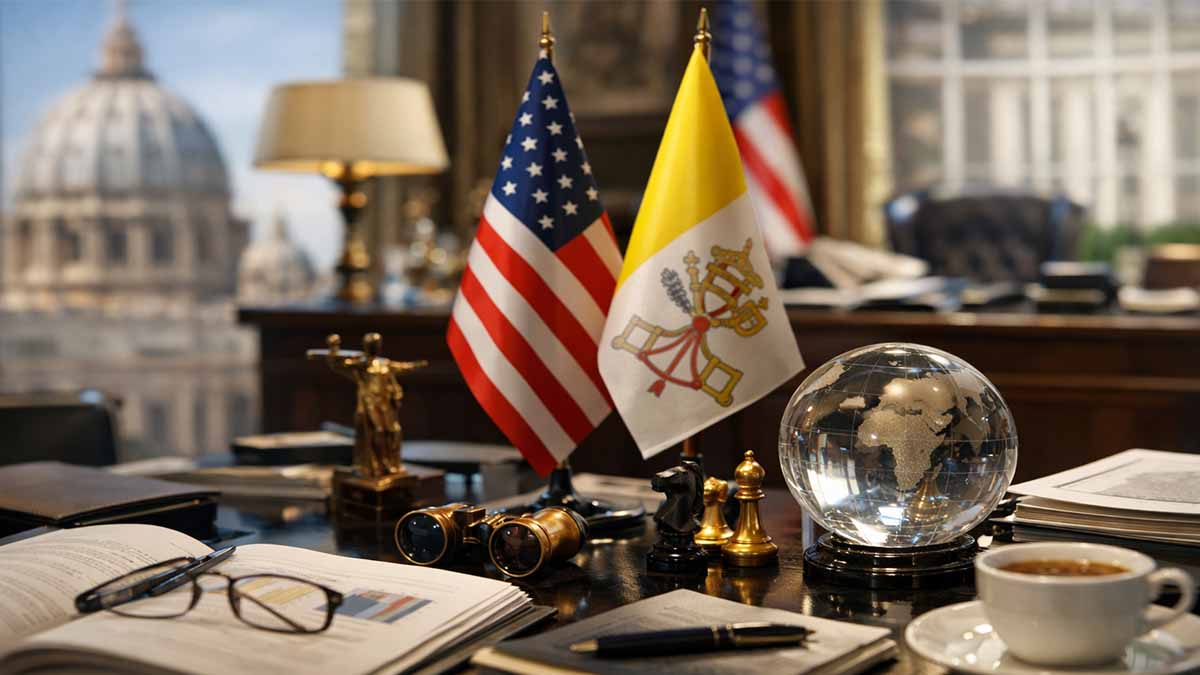
ABSTRACT
Theological Power, Institutional Friction, and the Architecture of a Historic Diplomatic Rupture
The relationship between the United States and the Holy See constitutes one of the most structurally complex bilateral diplomatic channels in the contemporary international system — a channel that is simultaneously confessional and geopolitical, historically contingent and ideologically generative, formally procedural and profoundly symbolic. For four decades following the 1984 Reagan-John Paul II normalization, this relationship was defined by shared anti-communist strategic purpose, selective convergence on social issues (notably human trafficking and religious freedom), and a mutually tolerated divergence on matters of economic justice, migration, and environmental governance. The return of Donald J. Trump to the presidency in January 2025, however, has introduced a qualitatively different set of structural stressors — ones rooted not merely in policy disagreement but in competing theologies of governance, incompatible diplomatic ontologies, and the emergence of an American-born Pope Leo XIV whose personal history and doctrinal convictions place him in direct ideological opposition to the Trump administration’s most consequential policy vectors.
The present report constitutes a systematic analytical effort to map, contextualize, and forecast this emergent rupture. It integrates Open Source Intelligence (OSINT) methodology, geopolitical structural analysis, political psychology frameworks, demographic-theological mapping, and scenario-based strategic forecasting across a five-year horizon (2026–2031). Every analytical claim is bounded by verifiable public evidence; every inference is explicitly distinguished from documented fact; and every projection is rendered conditional upon measurable triggering indicators.
The Demographic Foundation: A Fractured Christian Landscape
Any rigorous analysis of U.S.-Vatican relations must be grounded in the actual demographic-theological composition of the American religious landscape, which has undergone profound structural transformation in the two decades since Pew Research Center’s landmark 2007 Religious Landscape Study. The most recent and comprehensive survey data, drawn from the Pew Research Center’s 2023–24 Religious Landscape Study (conducted across 36,908 U.S. adults between July 2023 and March 2024), reveals a nation whose Christian majority has eroded substantially from 78% in 2007 to 62% in 2023–24, while the religiously unaffiliated (“nones“) have grown from 16% to 29% over the same period. The Christian share of the adult population has stabilized between 60% and 64% in recent surveys, while religiously unaffiliated Americans have ranged from 28% to 31%. Pew Research Center
Within this transformed landscape, the two most politically salient confessional communities — Evangelical Protestants and Catholics — occupy structurally distinct and increasingly divergent positions. Evangelical Protestants now account for 23% of all U.S. adults, down from 26% in 2007, while Catholic share has remained relatively stable, standing at 19% in the 2023–24 Religious Landscape Study. Pew Research Center The Public Religion Research Institute’s (PRRI) concurrent 2024 Census of American Religion provides further granularity: within the Republican Party, the largest group is white Christians at 68%, including 29% who are white evangelical Protestants, 19% who are white mainline Protestants, and 17% who are white Catholics. PRRI This distribution is analytically decisive — it reveals that while evangelicals constitute the modal theological bloc within Republican coalition architecture, Catholics remain a structurally indispensable component, accounting for nearly one-fifth of the GOP base and performing a crucial demographic bridging function that creates both strategic opportunities and systemic vulnerabilities in any administration that chooses to antagonize the institutional Catholic Church and its global sovereign representative, the Holy See.
These structural facts acquire additional salience when viewed through the lens of generational dynamics. Sharp generational divides in religious affiliation have been a major force reshaping the nation’s religious landscape, with younger Americans increasingly less likely to identify as Christian overall. PRRI The political implications are significant: evangelical dominance within Republican coalition architecture is an aging-cohort phenomenon, with people ages 50 and older making up a majority of mainline Protestants at 64%, Catholics at 57%, and evangelical Protestants at 54%. Pew Research Center Over the five-year forecast horizon, this demographic aging trajectory will accelerate, placing structural pressure on evangelical-dominated political formations even as they currently exercise maximal institutional leverage.
Theological Architecture: Prosperity Gospel, Dominionism, and the NAR
The theological frameworks animating the Trump-evangelical alliance are not monolithic, but they share a common structural feature: the systematic conflation of material prosperity, divine favor, and political authority in ways that are doctrinally incompatible with foundational elements of Catholic Social Teaching as articulated in the Compendium of the Social Doctrine of the Church and recent papal encyclicals. The Prosperity Gospel — the theological proposition that material wealth is a direct indicator of divine blessing and that faith can be instrumentalized to generate financial returns — sits in direct tension with the Catholic doctrinal tradition’s sustained critique of market absolutism, its preferential option for the poor, and its structural analysis of inequality. When Pastor Paula White-Cain, arguably the most theologically influential figure in the White House Faith Office, promotes the view that success and wealth are signs of divine favor, having been formally appointed as Special Government Employee and Senior Advisor of the newly created White House Faith Office as announced on February 7, 2025 White House, she is not merely articulating a contested theological position — she is institutionalizing within the executive branch a religious epistemology that the Vatican regards as a fundamental distortion of Christian doctrine.
The New Apostolic Reformation (NAR), whose networks have been documented as extensively integrated into the Trump political ecosystem, represents a distinct but related theological formation. The NAR emphasizes that Christians should expect to see miraculous signs, where extraordinary events such as Trump’s survival of an assassination attempt are interpreted as explicable only by divine or spiritual intervention. Many NAR leaders and followers support Trump, viewing him as a divinely appointed figure who would facilitate NAR‘s goals for societal reconstruction, believing he was chosen by God to fulfill a prophetic destiny. The Conversation This prophetic-appointive framing, which positions Trump as a modern analog to biblical figures of divine purpose, creates a theological architecture that is simultaneously politically functional (as a mobilization and legitimation device) and theologically offensive from a Catholic ecclesiastical perspective that regards such claims as bordering on heresy. The Seven Mountains Mandate — the NAR doctrine requiring Christian dominance over the seven spheres of societal influence (government, education, media, arts, religion, family, and business) — represents precisely the kind of Dominionist political theology that the Vatican has historically resisted as incompatible with the pluralist foundations of democratic governance.
A number of individuals in Trump‘s close orbit have ties to the New Apostolic Reformation church, including Vice President JD Vance, who converted to Catholicism in his 30s and appeared at a town hall hosted by a leading figure in the NAR Church. Secretary of Defense Pete Hegseth, meanwhile, belongs to a church affiliated with the Communion of Reformed Evangelical Churches (CREC), a Christian nationalist group. Fortune The simultaneous presence within a single administration of a Catholic Vice President and a CREC-affiliated Secretary of Defense, both operating within an executive structure where NAR-network advisors exercise functional influence, produces a theologically incoherent but politically strategic formation — one that attempts to simultaneously claim Catholic credibility while advancing policy positions that the institutional Catholic Church, and now its supreme authority Pope Leo XIV, has explicitly condemned.
The Emergence of Pope Leo XIV and the Acceleration of Rupture
The death of Pope Francis on April 20, 2025, and the election of Cardinal Robert Francis Prevost as Pope Leo XIV on May 8, 2025, introduced a radically new variable into the U.S.-Vatican equation. Though the election of a U.S. pope seemed impossible to close watchers of the Church, the “Trump effect” on America and the international global order is described by scholar Massimo Faggioli as one of the things that “made the impossible possible,” with Faggioli observing that “the United States is a great uncertainty for the Vatican as well” and that “electing a pope from the United States is one way for the Vatican to explore what this new America means for the world and for the church.” NPR
The election initially generated a moment of diplomatic ambiguity. Trump reacted positively to the election, and both Vice President JD Vance and Secretary of State Marco Rubio met Leo in May 2025. However, the trajectory of relations deteriorated with remarkable speed. Leo’s relationship with the Trump administration soured quickly after he was elected on May 8. The White House invited Leo to return home and celebrate America’s 250th birthday at the White House during the summer, but he declined. The Holy See considered the invitation but decided not to make the trip over a “mix of foreign policy disagreements, the increasingly vocal opposition of U.S. bishops to Trump’s immigration policy, and a reluctance to become a political bargaining chip in the 2026 midterms.” The Daily Beast
Instead, in a gesture of extraordinary symbolic precision, Pope Leo XIV announced he would spend July 4, 2026 on the Mediterranean island of Lampedusa — a stopping point for African refugees hoping to reach Europe. The Daily Beast The choice of Lampedusa — the same location visited by Pope Francis in 2013 in one of his first major symbolic acts, and a geography inseparable from the global migration crisis — constitutes not merely a rebuff of the White House invitation but an active counter-statement: a papal act that deliberately occupies the symbolic space defined by Trump’s most contested policy domain and reframes it through the lens of Catholic Social Teaching’s commitment to migrant dignity.
Immigration as the Primary Friction Vector
The immigration policy complex represents the most immediately actionable and documentarily rich source of U.S.-Vatican friction. From the earliest months of Leo XIV‘s pontificate, the new pope demonstrated a consistent and escalating pattern of direct critique directed at Trump‘s immigration enforcement apparatus. Pope Leo XIV weighed in on U.S. politics, saying that Catholic politicians must be judged on the full range of their policy positions and suggesting that the country’s treatment of immigrants is “inhuman.” NPR This framing — connecting immigration enforcement to the pro-life ethical framework that has historically served as the primary point of Catholic-Republican convergence — was a strategically targeted theological intervention, one designed to disrupt the selective moral calculus that has allowed Catholic conservatives to support an administration whose immigration policies the institutional Church condemns.
Pope Leo XIV placed the poor at the center of the Catholic Church‘s mission in his first major document as pontiff, the Dilexi Te encyclical, urging bishops worldwide to champion social justice and defend migrants and the vulnerable, with the pope’s call to defend “the least of these” thrusting the Church at the forefront of global debates on inequality and migration even as the Trump administration steps up immigration raids. Axios The encyclical thus constitutes a primary source document that establishes, at the highest level of papal magisterial authority, a direct doctrinal counterpoint to the executive policy framework of the Trump administration.
Pope Leo XIV backed the U.S. Roman Catholic bishops’ rare statement criticizing the Trump administration’s immigration and mass deportation policies, calling on immigrants to be treated with “dignity” and describing the bishops’ message as “a very important statement” that “people of goodwill” should listen carefully to. Axios This episcopal-papal coordination is institutionally significant: the U.S. Conference of Catholic Bishops (USCCB) statement represented the first such formal episcopal rebuke of federal government policy since 2013, breaking a twelve-year norm of institutional restraint.
The Iran Dimension and the Postponed Papal Visit
The most acute escalation in the diplomatic rupture occurred in the context of the 2026 Iran conflict. The divide widened significantly over Iran: as an early critic of the war, Pope Leo XIV called on the U.S. on March 31 to halt its campaign, naming Trump for the first time publicly. Shortly after, the pope condemned Trump‘s rhetoric about destroying Iran as “completely unacceptable.” Amid the fallout, the pope’s planned 2026 visit to the U.S. was postponed indefinitely. Asia Times
The naming of a sitting U.S. president by name in a papal statement is an extraordinary act without modern precedent in the same register. It signals that the Holy See has made a strategic calculation that the costs of continued diplomatic restraint outweigh the costs of public confrontation — a calculation likely informed by the assessed irreversibility of the current trajectory and the institutional imperative to protect the Church’s moral authority globally. On April 13, matters further escalated after Pope Leo XIV said that he had “no fear of the Trump administration,” responding to Trump‘s criticism of him on social media as being “weak on crime.” TEMPO Networks
The Pentagon Meeting: A Structural Anomaly
Among the most analytically significant single events in the 2025–2026 timeline is the January 22 meeting between Pentagon officials and Cardinal Christophe Pierre, then the Holy See’s ambassador to the United States. Through the first year of President Donald Trump’s second term, tensions between his administration and the Vatican — now with the first U.S.-born pope — had simmered. Days after the one-year mark of Trump returning to office, an unusual meeting between the two sides took place. Following expressions of concern by Pope Leo XIV and Vatican officials over the administration’s actions in Venezuela, Minneapolis, and elsewhere, Pentagon officials on January 22 hosted a top Vatican diplomat, Cardinal Christophe Pierre, then the Holy See’s ambassador to the United States, for a rare visit. The Washington Post
The institutional anomaly here is significant. Diplomatic communication between the Holy See and a sovereign government conventionally flows through the State Department channel, not through the Department of Defense. The routing of this diplomatic engagement through the Pentagon suggests either an intentional signal — a subtle display of military institutional weight in a diplomatic context — or a reorganization of the internal U.S. government interagency process that deprioritizes the State Department channel in favor of defense-centric diplomatic management. In either interpretation, the structural message to the Holy See is one of coercive institutional framing.
The Historical Baseline: From 1797 to 1984
The current rupture is best understood against the full historical arc of U.S.-Holy See relations. The United States maintained consular relations with the Papal States from 1797 to 1870 and diplomatic relations beneath the ambassadorial level with the Pope, in his capacity as head of the Papal States, from 1848 to 1868. In 1984, President Ronald Reagan and Pope John Paul II established full diplomatic relations between the United States and the Holy See. Usembassy The 114-year gap between 1870 and 1984 was itself a product of structural religious politics: the anti-Catholic nativism that permeated Protestant-dominant American political culture made any formal recognition of papal sovereignty politically toxic for most of the 19th and early 20th centuries. The 1984 normalization was enabled by a specific geopolitical convergence — shared anti-Soviet strategic purpose, the personal alignment between Reagan and John Paul II, and the relative political weakness of domestic Protestant opposition to formal Vatican recognition.
When President Reagan established the U.S. Embassy in 1984, he said it “would exist to the benefit of peace-loving people, everywhere.” The Holy See maintains formal diplomatic relations with 183 countries, with its influence extending to more than 1.3 billion Catholics worldwide and millions of non-Catholics as well. State That normalization was premised on a shared strategic ontology — opposition to Soviet communism, promotion of religious freedom, human rights diplomacy — that has no structural analog in the current moment. The ideological cement that held the Reagan-John Paul II partnership together simply does not exist between the Trump administration and Pope Leo XIV.
The Messianic Narrative as Geopolitical Variable
The Trump administration’s deployment of religious narrative as a governance technology represents a dimension of the current crisis that purely diplomatic analyses tend to underestimate. NAR leaders follow Trump‘s understanding of a corrupt government, with many positioning Trump as a warrior against a so-called demonically controlled “deep state,” aligning with NAR‘s emphasis on spiritual warfare and cultural dominion as outlined in the Seven Mountains mandate. The Conversation When the most senior religious advisor in the White House publicly frames the president in explicitly Christ-parallel terms — as happened at an Easter event in April 2026, when Paula White-Cain reportedly compared Trump to Jesus Christ by stating that “Mr. President, no one has paid the price like you have paid the price. It almost cost you your life. You were betrayed and arrested and falsely accused. It’s a familiar pattern that our lord and savior showed us” — the response from Christian communities, particularly Catholics, was to criticize the statement as blasphemous Wikipedia — this constitutes not merely theological controversy but a measurable foreign policy variable. The Vatican‘s institutional response to such statements, which implicitly position Trump‘s political authority as divinely coequal with or analogous to messianic authority, must be understood as not merely theological but as a geopolitical signal about the nature of the U.S. governance ecosystem.
Structural Synthesis
The analytical architecture of this report proceeds from a core structural hypothesis: that the current U.S.-Holy See rupture is not reducible to the preferences of individual leaders but reflects a deeper structural misalignment between two competing visions of the relationship between religious authority, political power, and social justice. The Trump administration’s integration of evangelical-charismatic theology into executive governance architecture — through the White House Faith Office, the NAR advisory network, the prosperity gospel epistemology embedded in faith-office leadership, and the Dominionist Seven Mountains framework structuring policy ambitions — represents a form of domestic religious statecraft that is categorically incompatible with the Holy See‘s centuries-refined institutional theology of the state, its Catholic Social Teaching tradition, and its globally projected diplomatic identity as a moral arbiter above partisan political formations.
Pope Leo XIV, as the first American-born pope and a figure with direct personal experience of the U.S. political ecosystem, represents a uniquely positioned adversarial interlocutor for the Trump administration — one who cannot be dismissed as a foreign cultural outsider misunderstanding American political dynamics, and one whose Augustinian formation and demonstrated doctrinal commitments place him in structural alignment with the most progressive tendencies within Catholic Social Teaching on migration, economic justice, environmental governance, and opposition to war. The five-year trajectory of this relationship will be shaped not primarily by diplomatic protocols but by the interaction of these deep structural variables across a geopolitical landscape marked by armed conflict (Iran, Venezuela), humanitarian crisis (migration, Cuba), and contested multilateral governance (climate, UN frameworks).
DIVINE STATECRAFT & INSTITUTIONAL DIVERGENCE
U.S.–Holy See Relations Under Trump Administration (2025–2031) • Theological Architectures • Geopolitical Friction • Scenario Forecasting
Structural Rupture Confirmed
One year into the Trump second term and 11 months after the election of American-born Pope Leo XIV, the U.S.–Holy See relationship has moved beyond policy disagreement into competing theologies of governance. Immigration enforcement, Iran policy, and the institutionalization of NAR/Dominionist networks inside the White House Faith Office have produced an unprecedented diplomatic and doctrinal divergence. As of 20 April 2026, the Holy See has publicly named the U.S. President, postponed the papal visit, and positioned Lampedusa as a counter-symbol to American exceptionalism.
2026 U.S. Religious Landscape
PROPORTIONALPolicy Friction Vectors (Apr 2026)
CATEGORICALU.S.–Holy See Diplomatic Temperature 2025–2026
TRENDTheological Divergence Profile
MULTI-AXISFive-Year Strategic Forecast • 2026–2031 • Interactive Scenario Matrix
White House Faith Office continues symbolic engagement while Vatican maintains public distance. Limited friction on non-migration issues.
Papal statements naming Trump continue. Possible recall of nuncio or downgrade of embassy status. Evangelical base celebrates; Catholic swing voters fracture.
Unexpected convergence on China or human-trafficking yields limited diplomatic reset. Requires major policy pivot from White House.
| DATE | EVENT / SIGNAL | ACTOR | IMPACT ON U.S.–HOLY SEE RELATIONS |
|---|---|---|---|
| 20 Apr 2025 | Death of Pope Francis | Holy See | Opens window for ideological reset |
| 08 May 2025 | Election of Cardinal Robert Francis Prevost as Leo XIV | College of Cardinals | First American-born pontiff • Immediate theological counterweight to Trump coalition |
| Jul 2025 | Decline of White House 250th anniversary invitation | Leo XIV | Symbolic rebuff • Foreign-policy & immigration disagreement cited |
| 04 Jul 2026 | Pope visits Lampedusa instead of U.S. | Leo XIV | Direct counter-narrative to Trump immigration policy |
| 22 Jan 2026 | Pentagon meeting with Cardinal Christophe Pierre | DoD / Holy See | Bypassing State Department • Coercive framing signal |
| 31 Mar 2026 | Pope names Trump in public call to halt Iran campaign | Leo XIV | Historic escalation • No modern precedent |
| 13 Apr 2026 | Pope declares “no fear of the Trump administration” | Leo XIV | Direct response to presidential criticism |
INDEX
Chapter 1 — Demographic & Theological Foundations of U.S. Religious Polity
- 1.1 The Contemporary American Religious Landscape: Quantitative Mapping
- 1.2 Evangelical Protestant Theological Architectures: Prosperity Gospel, Dominionism, and the New Apostolic Reformation
- 1.3 Catholic Demographics, Internal Diversity, and the Trump Electoral Calculus
- 1.4 The “Nones” Trajectory and Its Political Implications
- 1.5 Geographic Clustering, Generational Fracture, and Voting Behavior Correlates
Chapter 2 — Psychological Posture & Strategic Narrative Construction
- 2.1 Charismatic Authority and the Messianic Self-Positioning of Donald Trump
- 2.2 The Assassination Attempt as Martyrdom Architecture
- 2.3 Evangelical Advisory Integration: White House Faith Office and NAR Network Mapping
- 2.4 Symbolic Politics, Cognitive Closure, and Religious Narrative as Mobilization Technology
- 2.5 Comparative Framing: Paula White-Cain, Lance Wallnau, and the Prophetic Legitimation Circuit
Chapter 3 — Geopolitical & Vatican Dynamics: Historical Roots & Contemporary Friction
- 3.1 From 1797 to 1984: The Long Arc of U.S.-Holy See Diplomatic History
- 3.2 The Pontificate of Leo XIV: Profile, Election, and Immediate Posture
- 3.3 Policy Flashpoints: Immigration, Iran, Venezuela, Cuba, and Climate
- 3.4 The Pentagon Meeting, the Minneapolis Operation, and Diplomatic Escalation
- 3.5 Network Mapping: Key Actors, Diplomatic Channels, and Third-Party Mediators
Chapter 4 — Systemic Realignment & Institutional Boundaries
- 4.1 Evangelical Priorities in Federal and State Policy Architecture
- 4.2 The White House Faith Office: Structural Function and Constitutional Terrain
- 4.3 Judicial Architecture, RFRA, and Supreme Court Jurisprudence
- 4.4 Donor Networks, Media Ecosystems, and the Evangelical-Vatican Divergence Feedback Loop
- 4.5 De Facto Religious Prioritization vs. Symbolic Governance: An Analytical Distinction
Chapter 5 — Five-Year Strategic Forecast (2026–2031) & Scenario Planning
- 5.1 Scenario Alpha: Managed Divergence and Transactional Diplomacy
- 5.2 Scenario Beta: High-Friction Realignment and Diplomatic Downgrade
- 5.3 Scenario Gamma: Strategic Thaw and Pragmatic Convergence
- 5.4 Early-Warning Indicator Matrix (15 Measurable Signals)
- 5.5 Strategic Recommendations for Policymakers and Institutional Observers
Appendices
- A — Glossary of Key Terms
- B — Methodology Notes and Source Typology
- C — Indicator Tracking Table
- D — Actor and Network Reference Map
CHAPTER 1 — DEMOGRAPHIC & THEOLOGICAL FOUNDATIONS OF U.S. RELIGIOUS POLITY
Overview
The structural relationship between Donald Trump, his allied political network, and the Holy See cannot be analytically decoupled from the demographic and theological terrain in which that relationship is embedded. American religious polity in 2025–2026 is a landscape in profound and accelerating transition — one characterized by the simultaneous erosion of historic Christian supermajorities, the demographic aging and geographic consolidation of the most politically potent confessional blocs, the rise of an unaffiliated constituency that has transformed Democratic Party coalition architecture, and the theological radicalization of a minority evangelical formation whose political leverage dramatically exceeds its proportional demographic weight. Understanding these structural foundations is analytically prerequisite to any serious assessment of U.S.-Vatican relations, because the Trump administration’s posture toward the Holy See is not primarily a product of individual diplomatic preferences but of a theologically motivated governance ecosystem that has deep structural roots in the American religious landscape — roots that simultaneously explain the administration’s evangelical alignment and its escalating friction with an institution whose Social Teaching tradition represents perhaps the most systematically developed competing theological account of political authority, economic justice, and human dignity in the global public sphere.
1.1 The Contemporary American Religious Landscape: Quantitative Mapping
The most authoritative and methodologically comprehensive snapshot of the contemporary U.S. religious landscape is provided by the Pew Research Center’s 2023–24 Religious Landscape Study (RLS), conducted across a nationally representative sample of 36,908 U.S. adults between July 17, 2023, and March 4, 2024, with findings published in February 2025. This study — the third in a series following the landmark 2007 and 2014 iterations — constitutes the primary empirical anchor for all demographic claims in this chapter.
Evangelical Protestants now account for 23% of all U.S. adults, down from 26% in 2007, while Mainline Protestants stand at 11%, down from 18% in 2007, and Catholics at 19%, representing relative stabilization following the 24% share recorded in 2007. Pew Research Center Taken together, these figures reveal a Protestant formation in structural decline across all three of its major traditions, and a Catholic community whose headline stability masks profound internal compositional change addressed in subsequent subsections.
The Public Religion Research Institute’s (PRRI) concurrent 2024 Census of American Religion — an annual survey product drawing on hundreds of thousands of interviews — provides important supplementary calibration. It finds that religiously unaffiliated Americans have steadily increased since 2013, reaching a new peak of 28% in 2024, while the percentage of white Christians has continued its gradual decline. Sharp generational divides in religious affiliation have been a major force reshaping the nation’s religious landscape, with younger Americans increasingly less likely to identify as Christian overall. PRRI
The combined portrait from these two data architectures is one of a nation no longer defined by a stable Christian supermajority. The collapse of the Protestant majority — which first fell below 50% as an absolute demographic share around 2010 — has been followed by the gradual attrition of the Christian majority itself. The 62% Christian share recorded in 2023–24 represents a 16-percentage-point decline from the 78% recorded in 2007, the sharpest documented contraction in American Christian identity across any comparable period in the nation’s recorded social history. Critically, however, since 2020, surveys indicate that the religiousness of most birth cohorts has remained relatively stable, suggesting the long period of structural decline may be entering a phase of deceleration Pew Research Center — a development with significant implications for electoral coalition projections in the 2026 midterm and 2028 presidential cycles.
Analytical Inference: The plateau of Christian decline does not imply stabilization of the internal distribution of Christian identity. The trajectory increasingly favors confessional communities of color (Hispanic Catholics, Hispanic Protestants, historically Black Protestants) and charismatic-evangelical formations at the expense of mainline Protestantism, which has experienced the most precipitous absolute decline (18% to 11% of the adult population since 2007). This internal redistribution reconfigures the electoral arithmetic of both major parties in ways that are still playing out in real time, and whose full consequences will materialize across the 2026–2031 forecast horizon.
1.2 Evangelical Protestant Theological Architectures: Prosperity Gospel, Dominionism, and the New Apostolic Reformation
The theological formation most consequential for U.S.-Vatican relations is not evangelical Protestantism as a statistical aggregate but its theologically radical sub-formations: the Prosperity Gospel, Dominionism (including its Seven Mountains Mandate variant), and the New Apostolic Reformation (NAR). These movements, while quantitatively representing a minority within evangelical Christianity, exercise disproportionate institutional influence through their integration into the Trump White House advisory structure, their dominance within specific media ecosystems, and their theological production of the narrative frameworks through which Trump‘s base interprets political events.
The Prosperity Gospel
The Prosperity Gospel — sometimes termed “health and wealth” or “name it and claim it” theology — is the theological system that posits a transactional relationship between personal faith, material giving to religious institutions, and divinely guaranteed financial and physical blessing. Its doctrinal genealogy traces through E.W. Kenyon, Oral Roberts, Kenneth Hagin, and ultimately to the television evangelist formations of the 1970s and 1980s that created the institutional infrastructure now supporting figures including Paula White-Cain, the formally designated Senior Advisor of the White House Faith Office. Pastor Paula White-Cain has been appointed as Special Government Employee and Senior Advisor of the newly created White House Faith Office, having previously served as chairwoman of the Evangelical Advisory Board in 2016 and as a special advisor in the White House Faith and Opportunity Initiative during Trump‘s first term. White House
The Prosperity Gospel‘s political relevance lies not in its abstract theological claims but in its structural homology with specific policy positions: a theologically grounded hostility to redistributive taxation (framed as an interference with the divine blessing mechanism), skepticism of structural explanations for poverty (which implicitly challenge the theological claim that poverty reflects insufficient faith), and the valorization of market accumulation as evidence of divine favor. These positions are not merely coincidentally compatible with the economic platform of the Trump administration — they provide the theological legitimation architecture for a political-economic stance that has historically struggled for mass-democratic justification in a nominally Christian polity where the Sermon on the Mount and its explicit elevation of the poor exert persistent normative pressure.
From the Vatican‘s perspective, the Prosperity Gospel represents a fundamental theological error — a distortion of Christian soteriology that the Catholic Church has consistently and explicitly critiqued. Pope Francis‘ apostolic exhortation Evangelii Gaudium (2013) contains a sustained critique of what he termed “an economy of exclusion” and explicitly condemned the theological conflation of wealth and divine favor. Pope Leo XIV‘s encyclical Dilexi Te (2025), which placed the poor at the center of the Catholic Church‘s mission and urged bishops worldwide to champion social justice and defend migrants and the vulnerable Axios, represents direct doctrinal continuity with this anti-prosperity-gospel stance. The installation of the Prosperity Gospel‘s most visible institutional representative at the apex of the White House‘s formal religious advisory architecture thus constitutes a structural theological signal to the Holy See that is not primarily diplomatic in character but doctrinal — a signal that the governing formation of the United States has adopted a theological anthropology that the Catholic Church regards as a fundamental error.
Dominionism and the Seven Mountains Mandate
Dominionism refers to a family of theological positions that hold that Christians are mandated to exercise governance authority over secular society in preparation for or as a precondition of Christ‘s return. Its most politically operationalized contemporary variant is the Seven Mountains Mandate (7MM), which originated in a reported 1975 revelation shared independently by Bill Bright (founder of Campus Crusade for Christ) and Loren Cunningham (founder of Youth With a Mission) and has since been elaborated into a comprehensive political theology by figures including Lance Wallnau. The Seven Mountains Mandate proposes that there are seven spheres — government, education, media, arts and entertainment, religion, family, and business — that Christians must control to establish a global Christian theocracy and prepare the world for Jesus‘ return. The Church of God International
The political operationalization of 7MM theology within the current Trump ecosystem is documented across multiple institutional vectors. A comparative analysis published in a peer-reviewed political science journal in 2025 reveals striking similarities between the Seven Mountains Mandate — described as a dominionist evangelical ideology — and the political agenda being advanced under Trump‘s second administration, including the systematic elimination of practices in both public and private spheres that 7MM adherents frame as discriminatory against “normal white males.” Sage Journals
The 7MM framework is significant for U.S.-Vatican relations on two levels. First, at the level of policy substance: 7MM theology directs its adherents toward capturing precisely those institutional domains — education, media, government — through which the Catholic Church also exercises its social mission, creating a structural competition for institutional influence whose theological premises are radically incompatible. Second, at the level of international signaling: the documented presence of 7MM-affiliated figures in the White House advisory structure, the Department of Defense leadership (Secretary Hegseth‘s affiliation with the CREC), and the congressional Republican leadership (the reported presence of a NAR-associated flag outside Speaker Mike Johnson‘s office) constitutes an empirically observable integration of Dominionist theology into the institutional architecture of U.S. governance that the Holy See monitors and assesses as a signal about the nature of the bilateral relationship.
The New Apostolic Reformation
The New Apostolic Reformation (NAR) is the most institutionally developed and globally networked of the three theological formations under analysis. It is characterized by its restoration of the offices of apostle and prophet as active contemporary governance roles within the church, its doctrine of spiritual warfare (the belief that demonic forces govern specific geographic territories and institutional domains), and its intersection with Dominionist political theology through the 7MM mandate. The NAR emphasizes that Christians should expect to see miraculous signs — where extraordinary events, such as Trump‘s survival of an assassination attempt, are interpreted as explicable only by divine or spiritual intervention. Many NAR leaders and followers support Trump, viewing him as a divinely appointed figure who would facilitate NAR‘s goals for societal reconstruction, believing he was chosen by God to fulfill a prophetic destiny, and positioning Trump as a warrior against a so-called demonically controlled “deep state,” aligning with NAR‘s emphasis on spiritual warfare and cultural dominion. The Conversation
The institutional integration of NAR networks into the Trump political ecosystem is not rhetorical or peripheral but documented and structural. It was Paula White who invited the New Apostolic Reformation leaders — friends and colleagues among the Independent Charismatic celebrity class — into Trump‘s inner circle. This little-known but potent network of Christian leaders built the theology of Christian Trumpism and inspired thousands of Christians to show up on January 6 to fight for Donald Trump. The NAR‘s theological ideas around politics and spiritual warfare are increasingly setting the agenda for the religious right in America. Political Research Associates
Pew Research data from a May 2025 survey documented a striking epistemic dimension of NAR-adjacent evangelical belief: most (71%) white evangelical Protestants believe God played a role in putting Trump back in the White House after the 2024 election. Religion News This majority belief in divine appointment is not merely a theological curiosity but a politically functional epistemology: it insulates Trump from accountability for policy outcomes by positioning presidential authority as divinely ordained rather than democratically contingent, and it positions critics — including Pope Leo XIV — as adversaries not merely of a political leader but of a divine mandate.
1.3 Catholic Demographics, Internal Diversity, and the Trump Electoral Calculus
The Catholic community presents the most analytically complex terrain in the U.S. religious landscape because it is simultaneously a major component of the Trump electoral coalition, the institutional base of the most sustained domestic religious opposition to Trump‘s immigration and social welfare policies, and the confessional community whose international sovereign authority — the Holy See — is now in active diplomatic rupture with the Trump administration. Understanding this trilateral complexity requires disaggregating Catholic identity along several dimensions: race/ethnicity, generational cohort, practice intensity, and geographic distribution.
White Catholics constitute the most electorally significant sub-group. According to Pew‘s post-election analysis, Trump won a majority of Catholic voters, taking 55% of the Catholic vote to Harris‘s 43%; four years earlier, Catholics split almost evenly, with 50% voting for Biden and 49% for Trump. Pew Research Center This 6-percentage-point swing toward Trump among Catholics overall represents one of the most significant single-group electoral movements of the 2024 cycle and is analytically inseparable from the decision to place JD Vance — a Catholic convert — on the Republican ticket.
PRRI‘s post-election survey provides further granularity on the practice-intensity dimension: among white Catholics, higher church attendance is correlated with higher support for Trump, with white Catholics who attend Mass weekly reporting voting for Trump at higher levels (64%) than those who attend monthly (58%) or seldom/never (56%). PRRI This attendance-Trump correlation among white Catholics presents a direct strategic challenge to the institutional Church’s capacity to leverage its formal teaching authority against the administration’s immigration and social welfare policies: the most religiously engaged white Catholics are also the most politically aligned with the very administration the USCCB and Pope Leo XIV are challenging.
The Hispanic Catholic dimension introduces a structurally different dynamic. The 2024 election witnessed an extraordinary shift in Hispanic Catholic voting behavior: Trump saw a 12-point gain over his 2020 vote share among Hispanic Catholics, winning 48% of their vote, according to the Pew Research Center. Jefferson City News Tribune This figure was driven primarily by economic concerns, social conservatism on gender and family issues among Latino Protestant and evangelical sub-groups, and a Trump campaign that made systematic and resource-intensive outreach to Hispanic evangelical communities through their institutional church structures.
However, the 2024 gains have proved remarkably fragile. By November 2025, when asked about how the Trump administration’s policies impact Hispanics overall, far more said they harm Hispanics than help them (78% vs. 10%). More than half of Latinos (55%) said they have serious concerns about their place in the U.S., up from 48% in 2019, with 70% disapproving of Trump‘s job performance and 65% disapproving of his approach to immigration. Pew Research Center This collapse in Hispanic support — driven overwhelmingly by the immigration enforcement crackdown — has direct implications for U.S.-Vatican relations: Hispanic Catholics constitute approximately 40% of the total U.S. Catholic population and are the demographic whose lived experience most directly intersects with the policy space where papal and White House positions are most acutely divergent.
The PRRI 2023 Census adds important geographic-demographic granularity: White Catholics are predominantly concentrated in the Northeast, the Midwest, and southern Louisiana, with a median age of 58 — up from 53 in 2013 — making them the oldest Christian demographic group in the United States. More than four in ten white Catholics hold at least a four-year college degree (43%), substantially higher than the share of all Americans (35%). PRRI This demographic profile — older, more educated, regionally concentrated in historically Catholic urban-industrial corridors — creates a structural tension within the white Catholic community between its currently high Trump voting rate and its longer-term demographic trajectory as the aging cohort driving current political alignment contracts.
The USCCB‘s December 2025 unprecedented pastoral statement condemning immigration enforcement practices, formally supported by Pope Leo XIV as “a very important statement” that “people of goodwill should listen carefully to,” represents the institutional Catholic Church attempting to activate its formal teaching authority against a political coalition that it helped elect. The strategic effectiveness of that activation is constrained precisely by the data documented above — namely, the significant divergence between white Catholic electoral behavior and USCCB doctrinal positions on immigration and social welfare.
1.4 The “Nones” Trajectory and Its Political Implications
The growth of the religiously unaffiliated population — the “nones” — constitutes what is arguably the single most structurally significant development in the U.S. religious landscape over the past two decades, with far-reaching implications for the partisan composition of both major parties, the institutional leverage of formal religious bodies, and the long-term trajectory of the culture war politics in which U.S.-Vatican friction is embedded.
The trajectory is unambiguous. PRRI‘s 2023 Religious Change survey found that nearly three in ten Americans identified as religiously unaffiliated in 2023 (27%), an increase of 6 percentage points from 21% in 2013. The proportion of atheist and agnostic Americans has increased by 3 percentage points each from 2% in 2013 to 5% each in 2023. PRRI The most cited reason for disaffiliation: 67% of formerly religious Americans report “simply stopped believing in their religion’s teachings” as the primary driver — a cognitive-epistemic disengagement rather than an event-driven rupture, with significant implications for the reversibility of the trend.
The political implications of this demographic shift are profound and asymmetric. Democrats maintain a wide advantage among religiously unaffiliated voters: 70% of religiously unaffiliated voters align with the Democratic Party, while just 27% identify as Republicans or lean Republican. Over the past few decades, white evangelical Protestant voters have moved increasingly toward the GOP, with today 85% of white evangelical voters identifying with or leaning toward the GOP. Pew Research Center
The resulting partisan religious topology — sometimes called the “God Gap” — has reached a structural extreme. Analysis of 2024 electoral data reveals that the Republican Party vote is approximately 80% Christian and 17% non-religious, while the Democratic Party vote is 48% Christian and 45% non-religious — a gap that has expanded dramatically since 2008, when atheists and agnostics constituted only 16% of the Obama coalition, and which now sees the religiously unaffiliated making up 45% of all Democratic votes cast. Substack
This structural partisan-religious polarization has a direct bearing on the U.S.-Vatican dynamic in two ways. First, it creates the conditions under which evangelical political theology can exercise maximal influence over Republican governance: in a party 80% Christian and 85% evangelical among white Protestants, institutional resistance to NAR-adjacent Dominionist positioning is structurally weakened, and counter-pressures from moderate Catholic voices within the coalition face an uphill battle. Second, it creates an electoral incentive structure for Trump that punishes moderation on precisely the issues — immigration, climate, foreign aid, military adventurism — where the Holy See is most institutionally engaged.
However, important disaggregations within the “nones” category complicate simple linear forecasts. The share of the population that is unaffiliated rose from 16% in 2007 to 31% in 2022 before settling at about 28%. Although the share will likely rise as older religious Americans die and are replaced by younger, less devout Americans, most surveys show that more than half of young Americans are still religious. The rise of the unaffiliated has plateaued according to reports from Pew, PRRI, and other researchers. Religion News
The internal heterogeneity of the “nones” is analytically crucial: the “nones” represent about 30% of Democrats and 12% of Republicans — only a third identify as atheists or agnostics, while roughly two-thirds describe their religion as “nothing in particular,” a sub-group that is younger, less politically engaged, and less reliably mobilized than committed atheists or agnostics. The Conversation The differential mobilization patterns within the “nones” — higher turnout among the most secular, lower turnout among “nothing in particulars” — represent a significant structural inefficiency in Democratic coalition politics that partially offsets the God Gap‘s apparent magnitude. The Democratic Party‘s growing dependence on a constituency that is simultaneously its fastest-growing component and its most difficult to mobilize creates a structural electoral vulnerability that reinforces the GOP‘s incentive to maintain high religious intensity as a mobilization mechanism.
1.5 Geographic Clustering, Generational Fracture, and Voting Behavior Correlates
The geographic distribution of confessional communities in the United States is not random but structurally clustered in ways that interact with the Electoral College system to create asymmetric political leverage effects. The PRRI county-level data provide the most granular empirically available mapping.
Large shares of white evangelical Protestants are spread across the country but are particularly concentrated in counties in the South and Midwest. White Catholics are predominantly concentrated in the Northeast, the Midwest, and southern Louisiana, with the ten counties containing the largest concentrations representing a different geographic distribution from evangelical clustering. PRRI This geographic divergence has direct political implications: white evangelical concentration in the South and lower Midwest corresponds closely with the most reliably Republican regions of the country in Electoral College terms, while white Catholic concentration in the Northeast and Midwest corresponds with the most consequential swing-state geography — Pennsylvania, Michigan, Wisconsin, the Hudson Valley, and the Ohio River Valley industrial corridor.
A rigorous quantitative study published in PLOS One in October 2025, employing Moran’s I spatial autocorrelation analysis across presidential election results from 2016, 2020, and 2024, found that counties sharing a majority faith vote in strikingly similar ways, second only to contiguous geography, and in contrast, grouping by household income or urban status yields markedly weaker clustering. These findings reveal that cultural networks, embodied by religious affiliation, exert a stronger influence on aggregate voting behavior than class differences or the urban-rural divide. PLOS This peer-reviewed finding — that shared religious identity is a stronger predictor of voting clustering than income or urbanization — has profound analytical implications: it suggests that the Trump administration’s strategy of maximizing religious intensity mobilization is structurally rational, and that the Holy See‘s attempts to leverage institutional Catholic authority to shift Catholic voting behavior face a more fundamental challenge than the headline statistics suggest.
The generational dimension of religious-political alignment introduces the most structurally dynamic element of the forecast picture. The Pew 2023–24 RLS documented that only 45% of America‘s Gen Z identify as Christian — a 10% decline from a previous 2014 survey. More than half of Millennials and a little over 70% of Gen X respondents identified as Christian. Pew‘s Senior Associate Director of Religion, Gregory Smith, noted that “a big part of what’s happened in recent decades is that as older cohorts of highly religious older people have passed away, they have been replaced by new cohorts of young adults who are less religious than their parents and grandparents before them.” CNSMaryland.org
The PRRI Generation Z fact sheet provides additional demographic stratification: less than half of Gen Zers, Millennials, and Gen Xers identify as white Christians (27%, 31%, and 41%, respectively), compared with a majority of Baby Boomers (54%) and the Silent Generation (61%). PRRI The political implications of this generational stratification are unambiguous but temporally distributed: the current evangelical dominance over Republican coalition politics is substantially sustained by older cohorts whose demographic weight in the electorate will diminish over the 2026–2031 forecast horizon as attrition removes the most religiously observant generations from the active electorate.
An emerging counter-narrative warrants careful analytical treatment: the claim of a Gen Z religious revival. While certain media narratives have amplified anecdotal evidence of Gen Z religious engagement, the aggregate data do not support a structural reversal. What the data do support is a plateau in the rate of decline rather than a resumption of growth. Since 2020, surveys indicate that the religiousness of most birth cohorts has remained relatively stable, suggesting the long decline may be entering a deceleration phase — but for lasting stability to take hold, something would need to change, as Gen Z would either have to become more religious as it ages or future generations would need to be more religious than Gen Z. Pew Research Center
A particularly significant gender-disaggregated finding from PRRI‘s April 2026 data adds a further dimension: overall, 39% of Americans under 30 identify as “none,” and reports find that Gen Z women are losing their religion at higher rates than Gen Z men — a reversal of the historical pattern in which women were consistently more religious than men. Religion News This gender divergence in religiosity within Gen Z — with men maintaining slightly higher religious affiliation rates and women disaffiliating at accelerating pace — maps onto the broader gender partisan divergence that is reshaping the electorate: Gen Z women skew strongly Democratic and are increasingly secular, while Gen Z men are somewhat more conservative and somewhat more religiously engaged, though neither group approaches the religious intensity of Baby Boomer evangelicals.
Key Findings and Strategic Implications
The demographic-theological analysis of Chapter 1 generates the following analytically grounded key findings with direct bearing on the chapters that follow:
Finding 1 — Structural Evangelical Leverage: White evangelical Protestants constitute 23% of U.S. adults but provide the modal voting bloc within the Republican coalition, casting 81–85% of their ballots for Trump across multiple electoral cycles. This leverage structure incentivizes the administration to maximize evangelical policy responsiveness, including through theological signal-sending that generates direct friction with the Holy See.
Finding 2 — Catholic Fragmentation: The Catholic community is internally fractured between a white Catholic cohort voting at 55–59% for Trump, a Hispanic Catholic cohort that swung dramatically toward Trump in 2024 but has since reversed sharply in approval, and an institutional Church whose episcopal leadership has issued unprecedented formal condemnations of Trump administration immigration policy. This fragmentation limits the institutional Church’s electoral leverage while simultaneously driving the Vatican‘s strategic calculation that public diplomacy rather than quiet institutional pressure is the more effective posture.
Finding 3 — Theological Incompatibility: The three theological formations driving Trump‘s evangelical coalition — Prosperity Gospel, 7MM Dominionism, and NAR prophetic-appointment theology — are not merely politically different from Catholic Social Teaching but represent, from the Holy See‘s institutional perspective, fundamental theological errors whose operationalization in governance policy creates systemic doctrinal friction that transcends diplomatic management.
Finding 4 — Generational Attrition: The demographic aging of the evangelical-Trump coalition creates a structural clock on its current electoral dominance. The most politically engaged and theologically observant component of the Republican religious base is concentrated in cohorts aged 50+, whose replacement by less religious Gen Z and Millennial cohorts will progressively erode the structural foundations of evangelical political dominance — but on a timeline (roughly 2028–2035) that extends beyond the immediate 5-year forecast horizon.
Finding 5 — Geographic Leverage Asymmetry: Religious identity produces voting clustering second only to geographic adjacency, with evangelical concentration in structurally Republican territory and Catholic concentration in swing-state corridors. This geographic distribution creates an incentive for the Trump administration to prioritize evangelical institutional relationships over Catholic institutional management, with the Vatican conflict representing an acceptable cost of coalition maintenance strategy.
Forward-Looking Indicator: The most consequential demographic variable for the 2026–2031 forecast is the Hispanic Catholic approval trajectory. The collapse in Latino Trump approval from 48% electoral support in 2024 to 30% favorability by September 2025 and 22% among Hispanic Catholics by early 2026 represents a structural electoral realignment whose acceleration or deceleration will determine whether the Trump administration has incentive to manage the Vatican relationship more carefully in the 2026 midterm approach or to continue its current high-friction posture.
CHAPTER 1 — DEMOGRAPHIC & THEOLOGICAL FOUNDATIONS OF U.S. RELIGIOUS POLITY
Quantitative Mapping • Evangelical Architectures • Catholic Fragmentation • Nones Trajectory • Geographic & Generational Dynamics • April 20, 2026
Structural Foundations of Divergence
The Trump administration’s posture toward the Holy See is not merely diplomatic but emerges from a theologically-driven governance ecosystem rooted in American religious demographics. Evangelical sub-formations (Prosperity Gospel, Dominionism/7MM, NAR) exercise leverage far exceeding their 23% share, while the Catholic community (19%) is internally fractured between electoral alignment and institutional opposition. The “Nones” (28%) reshape Democratic coalitions and reinforce partisan religious polarization. As of 20 April 2026, these foundations directly constrain Vatican leverage and incentivize high-friction evangelical prioritization.
2024–2026 U.S. Religious Composition
PROPORTIONALTheological Divergence Intensity
MULTI-AXIS RADARChristian Identification by Generation
TRENDEvangelical Sub-Formations Influence
NETWORK LEVERAGEChapter 1 Strategic Findings • Direct Implications for U.S.–Holy See Relations
Evangelical Structural Leverage
23% of adults but modal GOP bloc • 81–85% Trump support
Catholic Internal Fragmentation
White Catholics ~55% Trump • Hispanic swing reversed on immigration
Theological Incompatibility
Prosperity Gospel, 7MM Dominionism, NAR vs Catholic Social Teaching
| DEMOGRAPHIC SEGMENT | SHARE / SUPPORT | TREND 2007–2026 | POLITICAL / THEOLOGICAL IMPLICATION |
|---|---|---|---|
| Christian Adults (overall) | 62% | ↓16 pts (from 78%) | End of Christian supermajority • Plateau phase |
| Evangelical Protestants | 23% | ↓3 pts | Disproportionate White House / NAR influence |
| Catholics (total) | 19% | Stable | White 55% Trump • Hispanic reversal on immigration |
| Religiously Unaffiliated (“Nones”) | 28% | ↑12 pts (from 16%) | 70% Democratic • Reinforces partisan God Gap |
| Gen Z Christian Identification | 45% | ↓10 pts | Long-term erosion of evangelical coalition base |
| White Catholics Weekly Mass | 64% Trump vote | ↑ correlation | Challenges USCCB doctrinal authority activation |
CHAPTER 2 — PSYCHOLOGICAL POSTURE & STRATEGIC NARRATIVE CONSTRUCTION
Overview
The most analytically consequential dimension of Donald Trump‘s relationship with organized religion — and by extension, with the Holy See — is not primarily theological but psychological and strategic. Trump does not occupy the American religious landscape as a conventionally devout figure but as a charismatic political actor who has mastered the art of religious narrative instrumentalization: the systematic deployment of theological symbols, archetypes, and emotional registers to achieve specific political outcomes including coalition cohesion, donor mobilization, media agenda capture, and the epistemic insulation of his base from disconfirming evidence. The five analytical subsections of this chapter deconstruct the architecture of this narrative system with precision, tracing its theoretical foundations in Weberian sociology of authority, its psychological mechanisms in political psychology research, and its operational mechanics through the specific networks of evangelical advisors, prophetic figures, and institutional structures through which it is produced and circulated.
Understanding this psychological and narrative architecture is prerequisite for any serious analysis of U.S.-Vatican relations, because the Holy See is not primarily responding to Trump as a policy actor but to Trump as a symbolic system — a system whose internal logic produces systematic outputs (the deification of political authority, the theological legitimation of coercive immigration enforcement, the martyrdom narrative as accountability shield) that collide structurally with the most fundamental claims of Catholic Social Teaching about the moral grounding of political authority, the dignity of every human person, and the limits of temporal power.
2.1 Charismatic Authority and the Messianic Self-Positioning of Donald Trump
The foundational theoretical framework for analyzing Trump‘s religious self-positioning is Max Weber‘s sociology of charismatic authority, as elaborated and applied to the contemporary American context by a growing body of political science and sociological scholarship. Weber, in Economy and Society ([1922] 1978), defined charismatic authority as the form of dominance that derives from the perceived exceptional qualities of the leader — qualities that followers experience as supernatural, superhuman, or at minimum extraordinary — in contrast to the rational-legal authority of bureaucratic governance and the traditional authority of hereditary or institutional succession. Crucially, charismatic authority is unstable and self-consuming: it requires continuous renewal through extraordinary acts or revelatory experiences, and its relationship to institutional structures is inherently subversive, since charismatic authority by definition exceeds and potentially invalidates existing institutional structures.
A peer-reviewed analysis of Trump‘s charisma published in a sociology journal applies Weber‘s framework to demonstrate that within the Republican Party, two distinct prophetic traditions validated Trump‘s salvific mission, enabling him to acquire power of command: conservative Protestants identified Trump as God‘s agent in preparation for the return of Jesus Christ, while secular conservatives identified him as a heroic entrepreneur whose vigor would restore America‘s greatness. Sage Journals This dual-prophetic legitimation — simultaneously sacred and secular — represents a structural innovation in American charismatic politics: it enables Trump to claim divine appointment among religiously observant evangelicals while simultaneously claiming heroic-entrepreneur status among non-religious economic nationalists, generating a coalition breadth that would be impossible if his charisma claim were restricted to either channel alone.
Weber insisted that followers grant charismatic authority, but he did not address the cultural prerequisites that enable leaders to acquire it from them. In her amplification of Weber‘s sociology, Ruth Ann Willner (1984) identified prior cultural iconography as the indispensable ingredient without which a leader’s eloquence cannot become charismatic authority. Before Donald Trump was born, he existed in prophecy: reading from their own religious tradition, evangelical Protestants understood Trump‘s candidacy as validating Biblical prophecy, enabling independent evangelical prophets to identify Trump as God‘s emissary and his enemies as “demonic forces.” Sage Journals
This pre-existing prophetic expectation structure is analytically decisive. Trump did not create the evangelical messianic expectation; he was inserted into it. The NAR network’s prior investment in the concept of a “Cyrus anointing” — a theologically sophisticated framework for reconciling personal immorality with divine appointment, discussed in detail in Section 2.5 — provided a ready-made interpretive container into which Trump‘s political emergence could be poured. The prophetic expectation preceded and shaped the charismatic relationship; Trump needed only to perform sufficient symbolic resonance with the pre-existing archetype for the authentication to occur.
Trump‘s own rhetorical management of the messianic self-positioning narrative demonstrates strategic sophistication. He has consistently avoided directly claiming divine appointment in first-person terms while systematically ratifying and amplifying third-party claims to that effect. Trump has cast his 2024 election victory as a salvific act, characterizing it in a December 2025 speech as follows: “Just over one year ago today, with your help, we saved America. That’s what happened. We saved it. The most important election victory possibly in the history of our country.” When asked by The New York Times what constrained his global powers, he answered: “My own morality. My own mind. It’s the only thing that can stop me.” Sojourners The framing — “we saved America,” positioning the election victory in soteriological terms while simultaneously claiming unconstrained personal authority — illustrates the rhetorical architecture of a charismatic claim that operates through implication and emotional resonance rather than explicit doctrinal assertion.
The construction of a sacred identity positions Trump not merely as a political leader but as a divinely appointed, miraculous figure whose power operates beyond ordinary human limitation. AI-generated and user-circulated imagery posting to Trump‘s social media accounts in April 2026 depicted him in the style of classical Christian devotional art — glowing divine light, robes, an outstretched healing hand, a supplicant crowd gazing upward in reverence — fusing American nationalist symbols with messianic religious iconography. The core psychological strategy is maximal grandiosity: the claim to divine status rendered literally, in paint. Voice For Liberty The White House‘s complicity in the circulation of such imagery — including their delayed removal of the Easter 2026 Paula White footage — reflects a calculated ambiguity strategy: benefit from the symbolic valorization without formally owning the specific claim.
Weber‘s theory also predicts the inherent fragility of charismatic authority and its self-consumption dynamics. Charismatic authority requires continuous renewal through extraordinary acts; routinization (the regularization of charismatic authority into institutional structures) tends to dilute the charismatic claim while stabilizing governance. Trump‘s second term has been characterized by an intensification rather than routinization of the charismatic claim — the Faith Office, the Easter events, the divine-appointment rhetoric, the messianic imagery on social media — suggesting a strategic calculation that the political costs of routinization exceed the risks of escalation. This intensification pattern has direct bearing on U.S.-Vatican relations: each escalation of the messianic narrative framework creates a new occasion for Holy See institutional response, because the Catholic Church‘s foundational doctrine on the limits of temporal authority is directly challenged by the claim that a political leader’s authority derives from divine appointment rather than constitutional and democratic mandate.
2.2 The Assassination Attempt as Martyrdom Architecture
The July 13, 2024, assassination attempt at the Butler, Pennsylvania campaign rally constitutes the single most consequential narrative event in the construction of Trump‘s religious-political mythology during the current cycle. Its analytical significance lies not in the event itself but in the interpretive infrastructure that was activated within hours of its occurrence and that continues to function as a legitimation architecture for Trump‘s second-term governance more than two years later.
The basic facts are documented and not in dispute: at 6:10 PM on July 13, 2024, a bullet from a rifle fired by twenty-year-old Thomas Matthew Crooks grazed Trump‘s right ear during a campaign rally, killing one attendee and wounding two others. Trump raised his fist, shouted “fight,” and was escorted from the stage bleeding — an image that immediately entered the symbolic vocabulary of American political mythology. Within hours, the interpretive frameworks activated by the event had stratified into distinct rhetorical registers, each serving a specific political-psychological function.
Trump‘s own immediate framing was deliberate and doctrinally precise: Trump wrote in a Truth Social post in the immediate aftermath: “It was God alone who prevented the unthinkable from happening.” In conversations with close allies and advisers in the days following, Trump suggested divine intervention had spared his life. CNN This self-attribution of divine protection is the keystone of the entire martyrdom narrative architecture. It accomplishes several psychological and political functions simultaneously: it transforms a near-death experience that might generate vulnerability from a strength signal into a divinely authorized one; it positions Trump‘s continued political engagement as response to a divine call rather than a personal ambition; and it provides the theological raw material from which the NAR prophetic network could construct a full-blown sacred narrative.
The evangelical leadership response was immediate and structurally significant: reactions from faith leaders and politicians invoked God‘s protection for Trump. Albert Mohler, the president of Southern Baptist Seminary, wrote on X following the shooting: “May God protect all who serve us.” America Magazine The response from NAR-adjacent figures went considerably further. Paula White-Cain, speaking before an evangelical political conference at the Faith & Freedom Coalition’s 2025 Road to Majority Conference in Washington, D.C., on June 27, 2025, claimed that Trump‘s survival of the assassination attempt was “God‘s sovereign divine miracle” and far from a “coincidence.” christianpost The formal public declaration of an assassination survival as a divine miracle by the head of a White House office — a government institution — represents an extraordinary elision of the boundary between official government communication and prophetic religious declaration.
The psychological architecture of the martyrdom narrative draws on deeply embedded archetypes within the Christian tradition. The core martyr archetype — the innocent suffer, the unjust wound, the miraculous survival, the vindicated return — maps onto Trump‘s political biography with enough structural resonance to be psychologically compelling for audiences pre-conditioned by prophetic expectation. Following his first assassination attempt, Trump, along with some supporters, suggested that a “divine intervention” might have saved his life. This perception bound followers to a collective vision of Trump as not merely a politician, but a chosen figure on a sacred mission. Weber‘s theory of charismatic authority and Castelli‘s Christian Persecution Complex framework enable meaningful analysis of this phenomenon: Trump‘s ability to transcend conventional politics and embody a near-sacred cause maintains his influence as long as followers view him as a figure destined to fulfill a divine role who is protecting their moral values. Ssmu
The political operationalization of the martyrdom narrative went far beyond symbolic discourse. The Butler moment translated directly into fundraising behavior — the Trump campaign reported record small-donor contributions in the 72 hours following the shooting — and into evangelical mobilization activity, as NAR-network pastors across the country activated their congregational networks around the providential survival narrative. An evangelical leader noted that religious voters’ reaction to the near-assassination fits with historical precedent: “We have a long history of believing, particularly Christians believing, that the God of the Bible had His hand on our country.” However, another commentator observed prophetically that the event would be “fuel for retribution, revenge, taking off the gloves, so to speak, and pursuing political enemies and anyone who stands in Trump‘s way in a manner that will be considered just and divine retribution.” CSMonitor.com
This retributive dimension of the martyrdom narrative is analytically significant for U.S.-Vatican relations. The martyrdom archetype, within the political-psychological framework in which it operates, not only legitimates the survivor’s governance authority but delegitimizes and demonizes the perceived adversaries whose hostility produced the martyrdom occasion. Applied to political governance, this means that critics of the Trump administration — including Pope Leo XIV and the Holy See — can be framed within the NAR narrative architecture as participants, however indirect, in the spiritual warfare against the divinely appointed leader. Lance Wallnau‘s description of how he prayed for Trump after the assassination attempt — cupping the former president’s ears on a cardboard cutout in his prayer closet without knowing where Trump had been wounded — illustrates the depth of the prophetic-intercessory framework that surrounds the Trump persona in NAR circles. Faith on View
The Easter 2026 escalation of the martyrdom narrative to explicit Christological comparison marked a further intensification. At an Easter lunch event in the East Room on April 1, 2026, attended by more than 100 faith leaders, Paula White–Cain addressed Trump directly, telling him: “No one has paid the price like you have paid the price. It almost cost you your life. You were betrayed, and arrested, and falsely accused. It’s a familiar pattern that our Lord and Savior showed us.” She added: “And, sir, because of his resurrection, you rose up.” International Business Times The explicit parallel drawn between Trump‘s legal and political tribulations and Christ‘s passion, death, and resurrection — delivered by the formal head of a White House office to over a hundred assembled faith leaders — constitutes the furthest documented extension of the martyrdom narrative into Christological territory.
Catholic theologian Rich Raho called the remarks “blasphemous,” writing that it was “stunning” to see such a comparison made publicly. Others echoed similar concerns, warning that equating any political figure’s experiences with the life, death, and resurrection of Christ risks diminishing the uniqueness of the Gospel message. “Faith is sacred. Turning it into a campaign prop… isn’t divine. It’s theatrical,” one critic wrote. Another added, “As a Catholic, I find this completely sacrilegious and offensive on every possible level.” Beliefnet The immediate deletion of the video from official White House channels — followed by its rapid recirculation through social media — illustrates the calculated ambiguity strategy that characterizes the Trump administration’s management of its most theologically provocative moments: benefit from the symbolic valorization within the NAR/evangelical base ecosystem while maintaining plausible deniability toward mainstream Catholic and mainline Protestant audiences.
2.3 Evangelical Advisory Integration: White House Faith Office and NAR Network Mapping
The White House Faith Office, established by Executive Order 14205 on February 7, 2025, represents the most institutionally significant formal integration of evangelical advisory networks into the Trump executive governance architecture. Its establishment was not merely symbolic but structural: it created a formal interagency coordination mechanism, operating under the Domestic Policy Council, through which evangelical institutional priorities can be translated into federal policy outputs across multiple agency domains.
The White House Faith Office revives and expands the White House Faith and Opportunity Initiative from Trump‘s first administration, with a focus on protecting institutional religious freedom, combating anti-religious bias, and coordinating across federal agencies. Chaired by Paula White-Cain as Senior Advisor, the office operates under the Domestic Policy Council and integrates with the Department of Justice to address perceived threats to faith communities. Justapedia The DOJ integration element is particularly significant: it transforms the faith advisory function from a purely symbolic or communication role into one with potential prosecutorial and enforcement dimensions, representing an institutional escalation beyond the first-term configuration.
The White House announcement of White-Cain‘s appointment described her as having “expanded her influence globally in almost 200 countries, ministering, fighting for religious freedom and humanitarian rights, and advocating for the voiceless,” as “founder and president of Paula White Ministries and National Faith Advisory Board,” and as president of City Destiny and teaching pastor at StoryLife Church in Florida. White House The formal government announcement’s characterization of a prosperity gospel televangelist in these expansive terms — presenting her global ministerial network as relevant qualification for a federal advisory role — illustrates the deliberate blurring of the boundary between religious entrepreneurship and government service that characterizes the Faith Office model.
The network mapping of the White House Faith Office‘s broader advisory ecosystem reveals a dense interlocking of NAR, prosperity gospel, and Christian nationalist institutional nodes. The advisory figures who appeared in the February 7, 2025, signing ceremony photograph included: Jentezen Franklin (Georgia megapastor and Trump faith advisor); Johnnie Moore (credited with organizing the informal evangelical advisory group during Trump‘s first term); Jennifer Korn (Faith Director, former chair of the National Faith Advisory Board); and multiple pastors with documented NAR network affiliations. Several of Trump‘s evangelical supporters celebrated the reestablishment of the office and the appointment of White-Cain, with Georgia megapastor Jentezen Franklin congratulating her publicly. Americans United for Separation of Church and State condemned White-Cain‘s appointment, stating she “was unfit to serve in the White House when Trump first appointed her in 2019 and she’s still unfit today — particularly in a position that could focus on combatting discrimination and advancing religious freedom for all.” Word&Way
The functional roles of evangelical advisors within the Trump governance ecosystem can be disaggregated into four analytically distinct categories. The first is legitimacy brokerage: evangelical figures publicly associating with the administration provide institutional religious credibility that insulates Trump from the charge that his personal conduct is incompatible with Christian values. The second is narrative amplification: pastors with large congregational followings and media presences translate administration policy positions into theological language for audiences that respond more readily to doctrinal framing than to policy argument. The third is grassroots mobilization: the evangelical advisory network functions as a distributed field operation, activating church-based voter registration, campaign support, and policy advocacy infrastructure. The fourth is epistemic closure maintenance: by continuously reinforcing the prophetic-appointment narrative within their media ecosystems, evangelical advisors maintain the cognitive insulation of the base from disconfirming policy developments, accountability journalism, and institutional criticism — including from the Vatican.
2.4 Symbolic Politics, Cognitive Closure, and Religious Narrative as Mobilization Technology
The deployment of religious narrative as a political mobilization technology by the Trump administration and its allied evangelical network is most rigorously understood through the intersection of two political psychology frameworks: symbolic politics theory and the need for cognitive closure research program.
Symbolic politics theory, developed by Murray Edelman and elaborated by David Sears and colleagues, holds that political behavior is often more powerfully motivated by symbolic attachments — to identities, values, and emotionally charged narratives — than by rational calculations of material self-interest. Political symbols function as condensation points that evoke entire networks of emotional, moral, and identity-relevant meaning; effective political communication operates by activating pre-existing symbolic associations rather than by constructing new logical arguments. Trump‘s religious narrative operates precisely within this symbolic register: the messianic appointment claim, the martyrdom survival narrative, the prophetic endorsements, the divine mission framing — each of these activates dense pre-existing symbolic networks within the evangelical tradition that connect political loyalty to ultimate meaning, identity affirmation, and cosmic significance.
The need for cognitive closure (NFC) research program, originating with Arie Kruglanski‘s work and extensively elaborated in the political psychology literature, examines individual differences in the tolerance for epistemic ambiguity and the desire for definitive answers. High-NFC individuals prefer clear, unambiguous, stable worldviews and are disproportionately responsive to political communications that provide simple, certain, emotionally satisfying answers to complex questions. The prophetic-appointment narrative performs an extraordinarily high-value cognitive service for high-NFC audiences: it resolves the apparent paradox of a morally imperfect figure leading a supposedly Christian nation by providing a theologically sophisticated framework (the Cyrus anointing) that explicitly accounts for personal moral deficiency while affirming divine selection. Once this framework is accepted, virtually any subsequent information — policy failures, legal indictments, diplomatic ruptures — can be incorporated into and reaffirmed by the narrative rather than challenging it.
The Pew Research Center’s May 2025 survey documented the epistemic architecture produced by these narrative mechanisms with striking clarity: most (71%) white evangelical Protestants believe God played a role in putting Trump back in the White House after the 2024 election. Among white evangelical Protestants and Republicans, being especially likely to say religion shapes how they vote is a distinguishing feature. Religion News This majority belief in divine appointment within the evangelical base is not simply a theological statement; it is a political epistemological infrastructure. When Pope Leo XIV criticizes Trump administration policies — on immigration, on Iran, on the treatment of migrants — that criticism can be received and processed within this epistemological framework as an attack on a divinely ordained governance arrangement, potentially strengthening rather than weakening base solidarity.
The threat-based mobilization dimension of religious narrative deployment is the most acute mechanism relevant to the Vatican relationship. Trump‘s ability to transcend conventional politics and embody a near-sacred cause maintains his influence as long as his followers view him as a figure destined to fulfill a divine role who is protecting their moral values. His political legacy depends fundamentally on his ability to exploit the religious and cultural fears of his supporters, combining a charismatic identity with a threat-based political strategy that frames political opposition as existential threat to Christian civilization. Ssmu
The framing of Pope Leo XIV‘s criticisms of Trump immigration and foreign policy within the NAR/evangelical media ecosystem has followed precisely this threat-mobilization logic. When a globally prominent religious leader — who is himself an American — publicly condemns the sitting U.S. president’s policies and refuses to visit the White House, the NAR narrative infrastructure can frame this as confirmation of the “spiritual warfare” thesis: that even ostensibly Christian institutional authorities have been captured by “demonic forces” opposed to Trump‘s divine mandate. This interpretive move simultaneously insulates Trump from the criticism and delegitimizes the Vatican‘s institutional authority within the NAR evangelical base.
2.5 Comparative Framing: Paula White-Cain, Lance Wallnau, and the Prophetic Legitimation Circuit
The prophetic legitimation circuit — the network of figures, institutions, and media platforms through which theological legitimation for Trump‘s authority is produced, circulated, amplified, and institutionally anchored — operates through two primary nodes: Paula White-Cain as the institutional interface between the prophetic network and the formal government apparatus, and Lance Wallnau as the most prominent architect of the theological framework that makes Trump legible as a divine appointment to the NAR formation.
Paula White-Cain: The Institutional Interface
Paula White-Cain‘s biographical and institutional trajectory maps precisely onto the convergence of prosperity gospel theology, NAR network connectivity, and White House advisory access. Her relationship with Trump predates his political emergence: she has been his personal spiritual advisor for over two decades, with their relationship rooted in the shared theological worldview of the prosperity gospel — both understand material success as a sign of divine favor, and their personal and professional biographies have been constructed around this shared epistemology.
Her institutional positioning in Trump‘s second term represents an escalation from her first-term role. On January 20, 2025, following Trump‘s second inauguration, the White House Office of Faith-Based and Neighborhood Partnerships — which had operated continuously since George W. Bush — was disbanded through an executive order. In February 2025, Trump ordered the creation of the White House Faith Office, a new entity to assist faith-based entities, community organizations, and houses of worship. Wikipedia The replacement of the bipartisan, institutionally broad faith-based partnerships office with a specifically evangelical-charismatic advisory structure signals an intentional narrowing of the faith advisory function from broad ecumenical engagement to specifically NAR-adjacent evangelical representation.
White has previously stated publicly: “To say no to President Trump would be saying no to God. And I won’t do that” — remarks made on PBS NewsHour in late 2019, the day after Trump was first impeached by the House. dnyuz This statement — delivered in a national media context, by a figure holding a formal government advisory position, asserting the divine coextensionality of opposition to a specific political leader with opposition to God — represents precisely the category of claim that the Holy See finds theologically anathema. The Catholic theological tradition maintains an absolute distinction between divine authority and temporal political authority; the claim that the two are coextensive in any individual political figure constitutes, in Catholic theological terms, a form of political idolatry. This is not a peripheral doctrinal matter but a foundational commitment of Catholic Social Teaching rooted in Augustine‘s distinction between the civitas Dei and the civitas terrena.
The April 1, 2026, Easter event represents the logical culmination of White-Cain‘s trajectory within the prophetic legitimation circuit. At the White House Easter lunch service, religious leaders gathered around Trump, and Paula White, who heads the White House Faith Office, compared Donald Trump to Jesus Christ, calling him the “greatest champion of faith that we’ve ever seen in a president” and making the parallel between Trump‘s alleged suffering and the passion of Christ repeatedly, saying that no one had paid a price like he had, that he had been falsely accused, and that, like Jesus, he had risen into victory. Religion News
The event had initially been scheduled as closed to the press, with a tight guest list for select MAGA allies. The guests included the son of late evangelical pastor Billy Graham, Reverend Franklin Graham, and Ultra-conservative Catholic Bishop Robert Barron, whose appearance was labeled by critics as “an exercise in blasphemy.” The White House quickly removed the event footage, but not before clips began circulating online. The Daily Beast The presence of Bishop Robert Barron — a figure with significant Catholic media presence and institutional credibility — at an event featuring the Jesus-Trump comparison is an analytically significant data point: it suggests that the fault line within American Catholicism between institutional Church critics of Trump (represented by the USCCB and Pope Leo XIV) and individual Catholic figures who have aligned with the administration is deep enough to produce bishop-level presence at events that the Pope‘s own theological advisors would characterize as blasphemous.
Lance Wallnau: The Theological Architect
Lance Wallnau‘s contribution to the Trump prophetic legitimation circuit is foundational in the strict sense: he provided, beginning in 2015–2016, the theological framework — the “Cyrus Anointing” — that made it possible for theologically serious evangelicals to support a morally imperfect candidate without cognitive dissonance. For a decade, Wallnau has played a vital role in building the myth of Trump as a strongman anointed by God, the message of a loose but influential network of Christian leaders who call themselves the New Apostolic Reformation. The group is held together by its charismatic faith that God, in the Spirit, still speaks through modern-day apostles and prophets. Trump is sold not as a spiritual heir to the prophets, but as a modern-day King Cyrus, the Persian monarch who makes an appearance in the Bible as a liberator of the Israelites in exile. God works through Trump, the NAR leaders say, because the former president is powerful enough to rebuild his kingdom in America and in the world. Religion News
The Cyrus typology is theologically sophisticated precisely because it anticipates and preemptively resolves the most obvious objection to Trump‘s divine appointment: his personal conduct and absence of conventional religious observance. The NAR narrative accounts for Trump‘s obvious moral and religious deficiencies by invoking the example of the Persian king Cyrus, who freed God‘s people from captivity while remaining a pagan himself. Complete loyalty to Donald Trump is thereby demanded, based not on experience of his character, but on God‘s revelation of his anointing. Reformed Journal
Wallnau links the 45th president to the 45th chapter of Isaiah and contends that Trump will help reconstruct the United States and prevent cultural collapse, thereby bringing the apostolic reformation and rechristianization to other countries with the help of “anointed” Christians. He stated: “He is like a Reformer in secular garb.” In 2024, Wallnau headlined the “Courage Tour,” featuring prophets and Charismatic preachers promoting the Trump campaign and MAGA ideas, visiting 19 bellwether counties in nine states and focusing on political mobilization within a spiritual warfare context. Wikipedia
Wallnau‘s extension of the Cyrus anointing framework into an international typological schema is directly relevant to U.S.-Vatican relations. Wallnau holds that Cyrus is an archetype of a secular political leader chosen by God, with previous iterations including “George Washington, Abraham Lincoln, Winston Churchill, Margaret Thatcher and Ronald Reagan,” with Trump as the current American Cyrus figure, and others such as Viktor Orbán, Andrzej Duda, and Jair Bolsonaro in other countries. Wikipedia The inclusion of Viktor Orbán — who has positioned himself explicitly in opposition to the Vatican‘s migration policies and who has cultivated the NAR network’s support through shared Christian nationalist positioning — in the global Cyrus typology signals that Wallnau‘s framework generates a competing international theological vision that maps directly onto the geopolitical fault lines dividing the Trump administration from the Holy See on migration, multilateralism, and the nature of Christian governance.
When Trump won the 2024 election, Wallnau immediately articulated the governance agenda that the prophetic legitimation circuit would serve: he declared on election night that he and his fellow Christian nationalists now had four years to align with the White House to strengthen the Christian church in the United States and abroad while placing right-wing Christians inside the government to tear down spiritual “strongholds.” Wallnau proclaimed that once Trump takes office, “the government and the church” can begin “moving together to build the ekklesia” to take control of “the government mountain” globally. peoplefor
The explicit declaration that the goal of the NAR network under the Trump second administration was to use alignment with the White House to extend Dominionist institutional control globally — including over “the government mountain” in other countries — represents a direct strategic challenge to the Holy See‘s institutional position as the primary global authority for Catholic governance norms. The Holy See is not merely a diplomatic counterparty but the most institutionally developed global competitor to the NAR/Dominionist vision of Christian governance, with a 1.4 billion-member institutional presence in virtually every country in the world. The NAR vision of global Christian governance restructuring through Trump-aligned political formations is structurally incompatible with the Vatican‘s model of global Catholic institutional presence organized around Catholic Social Teaching, the preferential option for the poor, and the defense of migrant dignity.
Key Findings and Strategic Implications
Finding 1 — The Prophetic Legitimation Circuit as Governance Infrastructure: The White House Faith Office, the NAR advisory network, and the prophetic legitimation circuit collectively constitute not a peripheral symbolic feature of the Trump administration but a structural governance infrastructure that produces and maintains the epistemic conditions under which the administration’s base assesses policy outcomes, processes criticism, and calibrates political loyalty. This infrastructure is specifically designed to insulate the administration from accountability by theological rather than political mechanisms.
Finding 2 — The Easter 2026 Event as Diagnostic Signal: The April 1, 2026, Paula White-Cain Jesus-comparison event, the subsequent deletion of White House video, and the presence of Bishop Robert Barron collectively constitute a diagnostic episode revealing the depth of the theological-political integration within the Trump administration and the breadth of the fault line it has opened within American Catholicism. The Vatican‘s institutional response to this event — while not formally documented in available primary sources — must be assessed as a significant input into Pope Leo XIV‘s April 2026 statement that he has “no fear of the Trump administration.”
Finding 3 — The Cyrus Framework as Anti-Vatican Discourse: The NAR‘s Cyrus anointing framework, extended to include Orbán, Bolsonaro, and other Christian nationalist leaders globally, generates a competing international theological vision that is structurally incompatible with the Holy See‘s institutional model. This incompatibility is not incidental but constitutive: the NAR vision of Christian governance explicitly subordinates institutional Catholic authority to the prophetic-apostolic authority of NAR-recognized leaders, positioning the Pope as one among many Christian institutional figures rather than as the supreme authority of the global Catholic church.
Finding 4 — Cognitive Insulation as U.S.-Vatican Relations Risk: The epistemic architecture produced by the prophetic legitimation circuit — the belief that Trump‘s authority is divinely ordained, that his critics are engaged in spiritual warfare against a divine mandate, and that opposition to him constitutes opposition to God — creates structural conditions under which Pope Leo XIV‘s criticisms of Trump administration policies may strengthen rather than weaken the evangelical base’s loyalty to the administration. The Vatican‘s institutional leverage over the administration’s domestic political calculus is consequently more limited than conventional diplomatic analysis would suggest.
Forward-Looking Indicator: The trajectory of the prophetic legitimation circuit over the 2026–2031 forecast horizon will be shaped critically by the 2026 midterm electoral outcome and its interpretation within the NAR prophetic framework. A Republican electoral reversal will generate an intense prophetic credibility crisis within the NAR network that may produce internal fragmentation; a Republican success will be interpreted as confirmation of the divine mandate and is likely to intensify the circuit’s theological escalation, with direct implications for the administration’s posture toward the Holy See.
CHAPTER 3 — GEOPOLITICAL & VATICAN DYNAMICS: HISTORICAL ROOTS & CONTEMPORARY FRICTION
Overview
The escalating rupture between the Trump administration and the Holy See as of April 2026 is not an episodic diplomatic disagreement but a structural collision between two mutually incompatible systems of international political order — one rooted in the Westphalian state-sovereignty paradigm articulated through American military primacy and evangelical Dominionist theological framing, the other in the Holy See‘s distinctive juridical personality as a non-territorial sovereign whose legitimacy derives from moral authority, multilateral engagement, and the institutional continuity of Catholic Social Teaching. The full analytical weight of the present rupture can only be assessed against the long historical arc of U.S.-Holy See relations, which reveals a relationship characterized by alternating periods of strategic convergence and structural divergence rooted in deeply persistent fault lines of theology, political culture, and institutional interest. Chapter 3 maps this historical arc, constructs a rigorous profile of Pope Leo XIV as a geopolitical actor, documents the specific policy flashpoints driving the current rupture, analyzes the landmark Pentagon-Vatican diplomatic episode, and maps the network of actors, channels, and third-party mediators through which the relationship is currently managed.
3.1 From 1797 to 1984: The Long Arc of U.S.-Holy See Diplomatic History
The bilateral relationship between the United States and the Holy See traces its origins to the earliest years of the American republic, predating by more than a century the moment of its formal diplomatic institutionalization. Understanding this historical arc is analytically essential because it reveals that the current structural tensions between Washington and Rome are not unprecedented anomalies but the contemporary iteration of fault lines — theological, political, and institutional — that have periodically disrupted what is, in the longer view, a consistently ambivalent relationship.
The United States maintained consular relations with the Papal States from 1797 to 1870 and diplomatic relations beneath the ambassadorial level with the Pope, in his capacity as head of the Papal States, from 1848 to 1868. Diplomatic relations lapsed beginning in 1870 with the loss of papal territories during the unification of Italy and continued until 1984, throughout which time several U.S. presidents did designate personal envoys to visit the Holy See for international humanitarian and political discussions. Usembassy
The 1797 consular establishment, under President George Washington and Pope Pius VI, was grounded in purely territorial and commercial considerations: the Papal States were a recognized sovereign entity controlling significant territory in central Italy, and the young American republic maintained consular relations with any state significant enough to warrant commercial representation. The relationship at this stage carried no theological or ecclesiological dimension; the Holy See was engaged as a temporal sovereign, not as a spiritual authority. This initial pragmatic framing would prove durable even as the theological politics surrounding the relationship grew increasingly complex.
The first major structural disruption came in 1867, when the U.S. Congress passed legislation explicitly prohibiting any future funding of American diplomatic missions to the Holy See. This decision was based on mounting anti-Catholic sentiment in the United States, fueled in part by the conviction and hanging of Mary Surratt and three other Catholics for alleged involvement in the conspiracy to assassinate President Abraham Lincoln. The combination of anti-Catholic nativism with the specific association of Catholicism with conspiracy against the republic created the political conditions for the legislative prohibition, which remained in effect until its repeal through the “Lugar Act” on September 22, 1983. Wikipedia
The 1867–1984 interregnum was not one of complete diplomatic vacuum. President Franklin D. Roosevelt appointed Myron Taylor — retired chairman of U.S. Steel Corporation — as his personal representative to the Holy See in 1939, inaugurating the “personal envoy” tradition that would continue through Truman, Nixon, Ford, Carter, and Reagan administrations. The most consequential engagement during this period was Roosevelt‘s wartime collaboration with Pope Pius XII on humanitarian affairs and refugee protection — a partnership that, however imperfect and historically contested in its scope, established the model of Vatican engagement as a uniquely positioned channel for humanitarian diplomacy in contexts where formal state-to-state channels were blocked or inadequate.
Presidents Nixon, Ford, Carter, and Reagan also appointed personal envoys to the Pope. All of those presidents, in addition to Truman, Eisenhower, Kennedy, Johnson, and all later presidents, along with their first ladies, in diplomatic dress code black and mantillas, have visited the Vatican during the course of their administrations. Wikipedia This unbroken tradition of presidential Vatican visits — spanning administrations from both parties across seven decades — illustrates the degree to which even formal diplomatic non-recognition did not prevent sustained engagement at the highest levels of American governance.
The 1984 normalization, achieved through Executive Order and ambassadorial nomination by President Ronald Reagan with the Senate confirmation of William A. Wilson on March 7, 1984, was enabled by a specific convergence of strategic circumstances: the shared Reagan-John Paul II commitment to opposing Soviet communism in Poland and elsewhere, the relative weakness of domestic Protestant opposition to Vatican recognition in the post-Vietnam political landscape, and the personal relationship between Reagan and John Paul II forged through their shared experience of survived assassination attempts in 1981. At the 40th anniversary celebration of U.S.-Holy See diplomatic relations, Chargé d’Affaires Laura Hochla noted that “the United States has cultivated consular relations with the Papal States since 1797,” and that today “the U.S. and the Holy See continue to cooperate on numerous global issues, such as the protection of migrants and refugees, interreligious dialogue, conflict resolution — including the promotion of a just and lasting peace in Ukraine — and the protection and defense of the environment against climate change.” Usembassy
The history from 1984 to 2025 reveals a relationship characterized by structural convergence on a narrow set of shared priorities — religious freedom, anti-trafficking, opposition to communism (Reagan/John Paul II era) — and persistent divergence on a broad range of social, economic, and geopolitical questions. The Clinton administration’s engagement with the Vatican was marked by sharp disagreements at UN conferences on population and development (Cairo 1994, Beijing 1995) where U.S. and Holy See positions on contraception, abortion, and reproductive rights were directly opposed. The George W. Bush administration achieved the highest convergence in the post-1984 period on social issues — abortion, same-sex marriage, stem cell research — while diverging sharply on the Iraq War, which Pope John Paul II and Pope Benedict XVI both publicly opposed. The Obama administration engaged cooperatively on climate (Laudato Si’, Paris Agreement) and Cuba normalization, while diverging on the contraceptive mandate under the Affordable Care Act. The first Trump term (2017–2021) produced the Francis-Trump dynamic characterized by Pope Francis‘s direct public interventions on immigration — including his famous statement during the 2016 campaign that building walls rather than bridges was “not Christian” — offset by cooperation on religious freedom and Venezuela sanctions.
The current rupture under Pope Leo XIV is historically distinctive in two structural ways. First, it is the first major U.S.-Holy See rupture to involve a pope who is himself an American citizen, eliminating the diplomatic management tool of characterizing papal criticism as foreign misunderstanding of American political culture. Second, it has escalated to the level of explicit named presidential criticism of a sitting pope — Trump calling Leo XIV “WEAK on Crime” and “terrible for Foreign Policy” — an escalation with no modern precedent in U.S.-Holy See diplomatic history.
3.2 The Pontificate of Leo XIV: Profile, Election, and Immediate Posture
The election of Pope Leo XIV on May 8, 2025, on the fourth ballot of the conclave — one of the shortest papal conclaves in modern history — represents a seismic structural event in the architecture of U.S.-Vatican relations. The election of the first American-born pope at precisely the moment of maximum friction between the Trump administration and the global Catholic institutional infrastructure is analytically extraordinary; it fundamentally reconfigured the diplomatic landscape by inserting an actor whose personal biography, doctrinal formation, and geopolitical experience made him simultaneously the most qualified and the most structurally confrontational possible counterpart to the Trump administration.
The new Bishop of Rome was born on September 14, 1955, in Chicago, Illinois, to Louis Marius Prevost, of French and Italian descent, and Mildred Martínez, of Spanish descent. He has two brothers, Louis Martín and John Joseph. Vatican News The biographical specifics carry geopolitical weight: the Spanish-descent maternal lineage connects Leo XIV to the Hispanic Catholic community that constitutes the most demographically dynamic sector of the American Church and the population most directly victimized by the Trump administration’s immigration enforcement apparatus. The Chicago origin — home of the most significant Somali and Hispanic immigrant communities targeted by operations like Metro Surge — is not merely incidentally significant.
In honor of Pope Leo XIII, who developed modern Catholic social teaching amid the tumult of the Second Industrial Revolution, Prevost chose the papal name Leo XIV — both to echo Leo XIII‘s concern for workers and fairness, and to signal continuity with the tradition of Catholic Social Teaching in contexts of economic transformation and institutional challenge. Wikipedia The deliberate invocation of Leo XIII — whose 1891 encyclical Rerum Novarum established the foundational framework of Catholic Social Teaching, explicitly opposing both unregulated capitalism and collectivist socialism in favor of workers’ dignity, distributive justice, and the right to organize — as the primary reference for his pontificate is a doctrinal statement of the highest order. It signals that Leo XIV understands his mission in explicit continuity with the Church‘s most systematic articulation of the relationship between economic power, political authority, and human dignity — an articulation that stands in direct structural tension with both the Prosperity Gospel theology driving the White House Faith Office and the economic nationalism of the Trump administration.
Leo XIV‘s pre-papal biography provides the geopolitical formation that shapes his institutional posture. He was elected prior general of the entire Augustinian order in 2001, which required him to live in Rome. Serving two terms in this role, he earned a reputation as an effective administrator. In 2014, Francis appointed Prevost apostolic administrator of the diocese of Chiclayo in Peru, and the following year he was made bishop of the diocese. He also served as second vice president and as a council member of the Peruvian Episcopal Conference from 2018 to 2023. Encyclopedia Britannica
This Latin American experience — more than twenty years of ministry in Peru, including leadership roles in the Peruvian Episcopal Conference at the intersection of poverty, indigenous rights, and migration — provides Leo XIV with a ground-level operational knowledge of the human consequences of the policy dynamics at the center of the U.S.-Vatican conflict. His criticism of Trump immigration enforcement is not abstract moral posturing but the expression of direct pastoral experience with communities destroyed by exactly the conditions that U.S. deportation operations create. When Leo XIV told reporters in October 2025 that the treatment of immigrants was “inhuman,” he was drawing on a biographical reservoir of direct encounter with migrant families, deportation consequences, and community devastation that no previous pope who had criticized Trump immigration policy possessed.
Prevost was elected on the fourth ballot in the Sistine Chapel on Thursday, May 8, 2025. Catholic cardinals broke with tradition by electing the first U.S. pope, making the Chicago-born missionary the 267th pontiff to lead the Catholic Church in a moment of global turmoil and conflict. In his first words as Pope Francis‘ successor, uttered from the loggia of St. Peter’s Basilica, he laid out a vision centered on peace, unity, and pastoral engagement. WESA
The initial Trump administration response to Leo XIV‘s election was notably warm. Vice President JD Vance and Secretary of State Marco Rubio both met the new pontiff in May 2025, and Trump publicly described the election as a “great honor” for the United States. This initial diplomatic warmth was strategically rational for the administration: an American pope who aligned with conservative social teaching on issues like abortion would have been an extraordinary asset for a government seeking to assert its Catholic credentials. The speed of the relationship’s deterioration — from warm initial engagement to direct personal Twitter combat within eleven months — reflects the structural depth of the theological and policy incompatibilities that Leo XIV‘s doctrinal formation and personal biography made inevitable.
3.3 Policy Flashpoints: Immigration, Iran, Venezuela, Cuba, and Climate
The U.S.-Holy See rupture of 2025–2026 has been driven by a specific set of policy flashpoints, each of which activates a distinct dimension of the structural incompatibility between Trump administration governance priorities and Holy See institutional commitments. The five primary flashpoints — immigration, the Iran war, Venezuela, Cuba, and climate — are not independent crises but interconnected expressions of a single underlying structural conflict between the American unilateralism-coercion model and the Vatican‘s multilateral-dignity model.
Immigration
Immigration has been and remains the primary and most sustained policy flashpoint. From the earliest months of Leo XIV‘s pontificate, he demonstrated a consistent pattern of increasingly direct criticism. Pope Leo XIV weighed in on U.S. politics, saying that Catholic politicians must be judged on the full range of their policy positions and suggesting that the country’s treatment of immigrants is “inhuman,” stating: “Someone who says I’m against abortion but is in favor of the death penalty is not really pro-life.” NPR This intervention — framing the immigration issue within the pro-life moral framework that has historically served as the primary common ground between Catholic teaching and Republican policy — was strategically targeted to disrupt the selective moral calculus allowing Catholic conservatives to support immigration enforcement while claiming pro-life credentials.
Pope Leo XIV placed the poor at the center of the Catholic Church‘s mission in his first major document as pontiff, the Dilexi Te encyclical, urging bishops worldwide to champion social justice and defend migrants and the vulnerable, with the pope’s call to defend “the least of these” thrusting the Church at the forefront of global debates on inequality and migration even as the Trump administration stepped up immigration raids. Axios
The Operation Metro Surge events of December 2025 through February 2026 constituted the acute phase of the immigration flashpoint. Operation Metro Surge is a large-scale immigration enforcement operation launched by the U.S. Department of Homeland Security in December 2025, deploying thousands of federal agents to the Minneapolis–St. Paul area in what the federal government described as “the largest immigration operation ever.” The operation drew national attention and controversy after aggressive enforcement tactics and the fatal shootings of two U.S. citizens, Renée Nicole Macklin Good and Alex Pretti. Encyclopedia Britannica
The Vatican‘s institutional response to Metro Surge was immediate and escalatory. On January 29, 2026, during Operation Metro Surge, Cardinal Pietro Parolin, the Vatican Secretary of State, described the violence as “unacceptable” and called for peaceful solutions to the situation — one of the most direct Vatican interventions in a domestic U.S. law enforcement operation in modern diplomatic history. Wikipedia Parolin‘s invocation of “unacceptable” — the precise formulation he and Leo XIV would use repeatedly in the subsequent months to describe Trump administration actions on Iran — signals a deliberate escalation in rhetorical register, a departure from the typically measured language of Vatican diplomatic communication.
The Iran War
The Iranian conflict that began on February 28, 2026, with U.S.–Israeli military strikes on Iranian nuclear facilities represents the most acute and most globally consequential flashpoint in the current U.S.-Vatican rupture. In the first weeks of the war, the Chicago-born Leo was initially reluctant to publicly condemn the violence and limited his comments to muted appeals for peace and dialogue. But Leo stepped up his criticism starting on Palm Sunday. He said Trump‘s threat to annihilate Iranian civilization was “truly unacceptable” and called for dialogue to prevail. NPR
Trump lashed out against Pope Leo XIV, accusing him of being “WEAK on Crime” and “terrible for Foreign Policy,” saying on Truth Social: “Leo should get his act together as Pope, use Common Sense, stop catering to the Radical Left, and focus on being a Great Pope, not a Politician.” Time In an extraordinary escalation, Trump also posted: “We don’t like a pope that’s going to say that it’s OK to have a nuclear weapon.” This statement inverted the actual Vatican position — Leo XIV had not endorsed Iranian nuclear weapons but had called for diplomacy to prevent their development — illustrating either fundamental misrepresentation or fundamental misunderstanding of the Pope‘s position.
Pope Leo XIV responded aboard his plane departing for Africa: “I have no fear of the Trump administration or speaking out loudly of the message of the Gospel, which is what I believe I am here to do, what the Church is here to do. We are not politicians, we don’t deal with foreign policy with the same perspective he might understand it. But I do believe in the message of the Gospel, as a peacemaker.” CNN
Italian Prime Minister Giorgia Meloni — generally considered one of Trump‘s closest European allies and a political figure who has consistently sought to bridge between the U.S. president and European leaders — issued an unusual rebuke, stating: “The Pope is the head of the Catholic Church, and it is right and normal for him to call for peace and to condemn all forms of war.” Vice President JD Vance responded separately, urging the Vatican to “stick to matters of morality” and “let the president of the United States stick to dictating American public policy.” euronews Vance’s formulation — that the Vatican should restrict itself to “matters of morality” while the U.S. President should “dictate” policy — is analytically extraordinary from a Catholic theological standpoint: it proposes a strict separation between moral authority and political authority that is fundamentally incompatible with Catholic Social Teaching‘s insistence on the inseparability of political governance from moral principle.
During his April 2026 Africa trip — strategically significant in its own right as a demonstration of global pastoral presence and soft power — Pope Leo XIV delivered striking remarks in Cameroon, condemning global leaders who, he said, are “ravaging the world” by spending billions on war. In a speech in St. Joseph’s Cathedral in the Cameroonian city of Bamenda, the Pope sharply criticized those who use religion to justify military actions — a comment directly aimed at the Trump administration’s evangelical framework for the Iran war. NPR
Venezuela
The Venezuelan dimension of the U.S.-Vatican rupture illuminates the Holy See‘s institutional positioning as a mediator between Washington and Latin American governments, and the limits of that positioning under the current administration. In late 2025, the Vatican sought to mediate in Venezuela by offering asylum to former President Nicolás Maduro in Russia to avert military escalation, which ultimately failed. TEMPO Networks
Vatican Secretary of State Cardinal Pietro Parolin was meeting with Brian Burch, the U.S. ambassador to the Holy See, on Christmas Eve, discussing a deal that would allow Venezuela‘s President Nicolás Maduro to escape to a comfortable exile in Russia before shots might be fired. Vatican officials in the end were unable to persuade Maduro to accept that option before his arrest by U.S. special operations forces on January 3, 2026. America Magazine
The failure of the Vatican‘s Venezuela mediation effort carries multiple analytically significant implications. It demonstrates that the Trump administration was prepared to proceed with unilateral coercive action in Latin America despite active diplomatic engagement from the Holy See — a signal that the administration’s assessment of Vatican leverage was essentially zero on security matters it defined as hemispheric strategic interests. It also demonstrates that Cardinal Parolin was actively engaged in back-channel communication with U.S. Ambassador Burch through the operational crisis period — confirming that formal diplomatic channels remained functional even as public rhetoric was escalating.
Cuba
Cuba‘s deepening crisis pulled the Vatican back into its historic mediating role in March 2026, when it was revealed that Cuban officials turned to the Holy See to help persuade President Trump to ease the U.S. oil embargo, underscoring the Church‘s position as one of the few actors capable of mediating between Washington and Havana. The Holy See has historically played a unique role in easing tensions between Cuba and the United States; the most dramatic example was Pope Francis‘s December 2014 facilitation of the Obama-Castro diplomatic normalization, through letters to both leaders and hosting delegations at the Vatican. Aleteia
The Holy See is signaling it is not in a position to carry out high-level mediation with Washington — a constraint tied to the lack of solid ties between Pope Leo XIV and the Trump administration, despite the Pontiff being American. The Holy See‘s failed Venezuela mediation reinforced doubts about the Vatican‘s actual leverage with the White House, and Secretary of State Parolin‘s advanced age and possible departure would deprive the Holy See of a key figure just as its mediation capacity appears under strain. Decode39
Climate
The climate policy dimension of the U.S.-Vatican relationship has been structurally adversarial since Trump‘s first withdrawal from the Paris Agreement in 2017 and his second withdrawal on January 20, 2025. Leo XIV has maintained Francis‘s emphasis on climate as a moral imperative, positioning environmental stewardship as an intrinsic dimension of Catholic Social Teaching that cannot be decoupled from the preferential option for the poor — since climate disruption disproportionately impacts the world’s poorest communities. Trump‘s withdrawal from Paris, framing climate policy as an economic nationalism issue, represents a direct structural negation of the Vatican‘s position that environmental governance is a moral imperative transcending national economic interests.
3.4 The Pentagon Meeting, the Minneapolis Operation, and Diplomatic Escalation
The events of January 2026 — specifically the Operation Metro Surge civilian shootings and the January 22 Pentagon meeting between Under Secretary of Defense Elbridge Colby and Cardinal Christophe Pierre — constitute the most structurally significant diplomatic episodes of the 2025–2026 rupture timeline, and require detailed analytical treatment.
The Pentagon Meeting
The Free Press reported on April 6, 2026, that the top Vatican diplomat in the U.S. was brought to the Pentagon in January for a “bitter lecture” about comments from Pope Leo XIV that some senior U.S. defense officials perceived as criticism of the Trump administration. The meeting was described as likely unprecedented, as there does not appear to be any public record of any Vatican official ever taking a meeting at the Pentagon. America Magazine
Under Secretary of War for Policy Elbridge Colby met with Cardinal Christophe Pierre, the then-Papal Nuncio, and his team on January 22, 2026, at the Pentagon. The Free Press initially reported that Pentagon officials warned the Vatican “the United States has the military power to do whatever it wants” and the Catholic Church should take its side — characterizations subsequently denied by both the Department of Defense and the Vatican Nunciature. Crux
The subsequent official accounts diverged in revealing ways. The Pentagon‘s policy office confirmed the meeting took place between Colby and Cardinal Pierre and their respective staffs on January 22, 2026, saying the meeting was “substantive, respectful, and professional,” with topics including “morality in foreign policy, the logic of the U.S. National Security Strategy, Europe, Africa, Latin America, and other topics.” Some Vatican sources told The Pillar that while no threats were implied or made by U.S. officials, the discussion between defense leaders and Cardinal Pierre was at times “tense.” The Pillar
Reporting from Letters from Leo confirmed that some Vatican officials were so alarmed by the Pentagon‘s tactics that they shelved plans for Pope Leo XIV to visit the United States later in 2026. Other officials in the Vatican reportedly saw the Pentagon‘s reference to an Avignon papacy — the 14th-century period when the papacy was effectively under French political control — as a threat to use military force against the Holy See. Thelettersfromleo
The institutional anomaly of the meeting’s venue is analytically decisive regardless of the disputed content. Diplomatic engagement between the Holy See and the United States is conventionally managed through the State Department — the U.S. Embassy to the Holy See in Rome and the Apostolic Nunciature in Washington are the designated bilateral channels. The routing of a diplomatic communication to the Pope‘s personal representative through the Department of Defense rather than the State Department constitutes an institutional signal that is coercive in its structural logic regardless of the actual words exchanged: it places the Vatican‘s diplomatic interlocutor in the physical and institutional space of military power, communicating through spatial and institutional framing what may not have been communicated verbally.
The Avignon parallel, whether invoked explicitly or merely referenced in media accounts, is historically literate in a deeply unsettling way: the Avignon papacy (1309–1377) was the period in which the papacy was effectively subordinated to French royal power, the Pope residing in Avignon under effective political control of the French crown. Any invocation of this precedent in the context of a senior U.S. defense official meeting with the Pope‘s ambassador carries an implicit coercive message about the possibility of American political control over Catholic institutional authority that would be received in the Vatican as the gravest possible diplomatic signal short of formal hostility.
Operation Metro Surge and Parolin’s Response
Operation Metro Surge — described by the Department of Homeland Security as “the largest DHS operation ever” — began in December 2025 and involved the deployment of thousands of immigration agents across Minnesota, with more than 3,000 people arrested. The operation was characterized by an escalation in ICE tactics, including harassment and threats toward observers and journalists, the detention of U.S. citizens, and most dramatically, the fatal shooting of Renée Good on January 7 and Alex Pretti on January 24. Minnesota Reformer
Cardinal Parolin‘s immediate January 29 description of the Minneapolis violence as “unacceptable” — issued within days of the second civilian death — placed the Holy See in explicit institutional opposition to a domestic U.S. law enforcement operation, an intervention without modern precedent. The word choice — “unacceptable” — was not diplomatic understatement but a term carrying specific theological weight in Vatican diplomatic vocabulary, where it signals moral condemnation at the highest institutional level.
3.5 Network Mapping: Key Actors, Diplomatic Channels, and Third-Party Mediators
Understanding the operational architecture through which U.S.-Holy See relations are currently managed — and mismanaged — requires systematic mapping of the key institutional actors, formal diplomatic channels, informal communication networks, and third-party mediation structures.
Key Actors: The Holy See Side
Pope Leo XIV (Robert Francis Prevost, b. September 14, 1955, Chicago) — 267th Bishop of Rome, first American pope, first Augustinian pope, holder of both U.S. and Peruvian citizenship. Former Prefect of the Dicastery for Bishops (2023–2025); former Prior General of the Augustinian Order (2001–2013); former Bishop of Chiclayo, Peru (2015–2023). Doctrinal formation shaped by Augustinian theology, Latin American liberation theology adjacency, Catholic Social Teaching continuity with Pope Francis. Principal Vatican interlocutor on all matters of U.S.-Holy See relations, with direct personal experience of the U.S. political culture he is engaging.
Cardinal Pietro Parolin — Vatican Secretary of State, the Holy See‘s chief diplomatic officer and most experienced practitioner of Vatican statecraft. Former Apostolic Nuncio to Venezuela (2009–2013), giving him direct operational knowledge of the Venezuelan crisis at the center of the Latin American dimension of the current rupture. Parolin‘s advanced age and possible departure from his role represents a significant structural risk for Vatican diplomacy at precisely the moment its mediation capacity is under greatest strain. Decode39 He was the principal Vatican interlocutor with U.S. Ambassador Burch during the Venezuela crisis negotiations over Christmas 2025.
Cardinal Pietro Parolin‘s counterpart on the Holy See side of the U.S. bilateral channel is Archbishop Paul Richard Gallagher, the Secretary for Relations of States — roughly equivalent to a Deputy Foreign Minister — who manages the day-to-day diplomatic relationships with sovereign states. Archbishop Gallagher and U.S. Chargé Laura Hochla addressed the crowd at Villa Richardson on June 30, 2025, at the U.S. Embassy‘s Fourth of July celebration, which coincided with the historic election of the first American-born pope. Catholic World Report
Cardinal Edgar Robinson Peña Parra — the Vatican‘s third-ranking official and Substitute of the Secretariat of State, is Venezuelan by nationality. His national origin and institutional position create a specific sensitization within the Vatican leadership to the Venezuelan crisis and its intersection with U.S. policy.
Cardinal Christophe Pierre — former Apostolic Nuncio to the United States and the central figure in the Pentagon meeting episode. French by nationality and serving as the Holy See‘s resident ambassador in Washington through the initial escalation period before his replacement as Nuncio, Pierre represents the operational face of Vatican diplomacy in the bilateral relationship at its most acute moment. His characterization of the Pentagon meeting — confirmed by Ambassador Burch as “frank and cordial” — stands in notable tension with reporting from Vatican sources describing the encounter as at times “tense.”
Key Actors: The U.S. Side
Ambassador Brian Burch — 13th U.S. Ambassador to the Holy See, confirmed by the Senate on August 2, 2025, in a party-line vote of 49–44. Burch is the co-founder of CatholicVote, a conservative political advocacy group that officially backed Trump‘s 2024 presidential bid, spending over $10 million to reach 2 million Catholics that year. He holds a degree in political philosophy from the University of Dallas. Diocese of Scranton Scholar Massimo Faggioli of Villanova University assessed the nomination as “very telling,” noting that “this is an operative who has been really a campaigner in the trenches for Donald Trump” whose appointment “says something about the kind of relationship that Donald Trump wants to create with the Vatican.” National Catholic Reporter
The Burch appointment is analytically significant on multiple levels. He is the first U.S. Ambassador to the Holy See whose primary professional identity is as a partisan political operative rather than a diplomat, former senator, academic, or business figure. His previous public criticism of Pope Francis for “doctrinal ambiguity” signals a theological alignment with the conservative integralist tendency within American Catholicism that is in tension with the direction of the current pontificate. The appointment of a figure simultaneously identified as a Chicago-hometown compatriot of Leo XIV and a critic of his predecessor’s doctrinal direction represents a calculated attempt to create a personal diplomatic channel while maintaining ideological pressure — a strategy whose effectiveness the subsequent months’ escalation suggests has been limited.
Under Secretary of Defense Elbridge Colby — the Pentagon‘s Under Secretary for Policy, the senior DoD official who met Cardinal Pierre on January 22, 2026. Colby is the author of The Strategy of Denial (2021), a strategic framework focused on preventing Chinese domination of East Asia through denial strategies, and is a prominent proponent of strategic competition as the organizing framework for U.S. grand strategy. His engagement in Vatican diplomacy — a domain not conventionally within the DoD policy portfolio — reflects either an intentional interagency signal or a reorganization of foreign policy management that elevates military-strategic considerations above traditional diplomatic channels.
Vice President JD Vance — a Catholic convert whose publicly articulated relationship to the Vatican is among the most complex in the current administration. Vance met Pope Leo XIV in May 2025, participated in a formal meeting with Cardinal Parolin, and has consistently maintained a public posture of Catholic identity while advancing policy positions directly contrary to USCCB and papal teaching on immigration and foreign policy. His instruction to the Vatican to “stick to matters of morality” — cited above — represents the most explicit formulation of the administration’s position that the Holy See should restrict its institutional authority to a narrow domain that excludes the policy areas where the conflict is most acute.
Formal Diplomatic Channels
The primary formal diplomatic channel is the bilateral relationship between the U.S. Embassy to the Holy See in Rome and the Apostolic Nunciature in Washington, D.C. Under normal operating conditions, this channel handles the full range of bilateral agenda items — religious freedom, human trafficking, humanitarian affairs, multilateral policy coordination — through regular diplomatic exchanges, formal démarches, and periodic high-level consultations. The Burch-Parolin engagement over Venezuela at Christmas 2025 demonstrates that this channel remains operational even at the peak of the public rupture.
The multilateral channel — through the Holy See‘s Permanent Observer Mission to the United Nations in New York — provides an additional institutional vector through which Vatican diplomatic positions are communicated to U.S. interlocutors, particularly on issues of climate, migration, conflict resolution, and arms control where UN frameworks are the operative negotiating space.
Third-Party Mediators and Bridging Actors
Italy has historically served as the primary third-party facilitator of U.S.-Vatican diplomatic engagement, given the Holy See‘s geographic location within Italian territory and the cultural-diplomatic overlap between Italian government and Vatican institutional networks. Italian Prime Minister Giorgia Meloni‘s rebuke of Trump‘s anti-papal statements — noting that “the Pope is the head of the Catholic Church, and it is right and normal for him to call for peace” — represents a significant bridging signal: Meloni, positioned as Trump‘s closest European ally, publicly separating from him on the Vatican issue, signals that the geopolitical costs of the U.S.-Holy See rupture are registering even among the Trump administration’s most sympathetic international partners. euronews
Among other contemporary hotspots where there is likely significant Vatican diplomacy at work are Iran and Ukraine. In December 2024, Pope Francis made Archbishop Dominique Joseph Mathieu of Tehran-Isfahan a cardinal. In 2023, Chaldean Archbishop Imad Khoshaba Gargees became Tehran‘s metropolitan archbishop. Their role — described as “to communicate between the Iranian authorities and the Vatican” — suggests active back-channel communication between Rome and Tehran during the current Iran conflict. America Magazine This Vatican-Tehran communication channel represents a potential third-party mediation asset of significant strategic value: the Holy See has established ecclesiastical representation in Iran at the highest level, providing an institutional communication pathway that bypasses the absence of formal U.S.-Iranian diplomatic relations.
Key Findings and Strategic Implications
Finding 1 — Structural Coercion Signal: The Pentagon meeting routing represents, regardless of content, a structural coercive signal that communicates the administration’s orientation toward the Holy See as a strategic problem to be managed through military-institutional framing rather than a diplomatic partner to be engaged through normal channels. Its historical novelty — with no documented precedent of a Vatican official visiting the Pentagon for bilateral diplomacy — amplifies its symbolic weight.
Finding 2 — Papal Visit Cancellation as Strategic Response: The indefinite postponement of Pope Leo XIV‘s planned U.S. visit, and his deliberate choice to spend July 4, 2026, at Lampedusa, constitutes the most consequential single diplomatic signal the Holy See has deployed in the current rupture. It denies the Trump administration the domestic Catholic optics that a presidential reception of an American pope would have provided, while simultaneously amplifying the papal counter-narrative through Lampedusa‘s migrant symbolism.
Finding 3 — Venezuela Mediation Failure as Leverage Assessment: The failure of Vatican mediation in Venezuela — where active Christmas Eve diplomacy involving both Secretary Parolin and Ambassador Burch was overridden by U.S. unilateral military action — provides the Holy See with a clear empirical assessment of its actual leverage with the current White House: near-zero on matters the administration designates as U.S. strategic interests. This assessment calibrates the Vatican‘s subsequent strategic choices, pushing it toward a public rhetorical strategy rather than quiet diplomatic engagement.
Finding 4 — The Ambassador Appointment as Signal Inversion: The selection of Brian Burch — a partisan Trump operative and former Francis critic — as U.S. Ambassador to a Holy See now headed by a Chicago-native pope signals the administration’s intention to use the ambassadorial post as a conservative Catholic pressure point rather than a genuine diplomatic bridge. The structural irony — that the first American pope and the first CatholicVote ambassador both hail from Chicago — has been noted by observers but has not produced the warming effect the administration may have anticipated.
Forward-Looking Indicator: The most critical near-term diplomatic variable is the fate of the Cuba mediation effort, which represents the last active Vatican channel for operational engagement with Washington on Latin American affairs. If the Holy See is unable to broker any outcome on the Cuban oil embargo question, it will confirm the structural assessment that Vatican diplomatic leverage with the Trump administration has been effectively nullified across the full range of U.S. policy domains in which the Church has historically functioned as a constructive interlocutor.
CHAPTER 4 — SYSTEMIC REALIGNMENT & INSTITUTIONAL BOUNDARIES
Overview
The Trump administration’s relationship with organized evangelical Christianity is not a matter of rhetorical affinity or electoral convenience alone. It is, more precisely, a structured governance integration — a systematic embedding of evangelical institutional priorities into the architecture of federal and state policy through executive instruments, judicial appointments, statutory interpretation, grant architecture, and the parallel construction of ideologically aligned media and donor ecosystems that function as enforcement mechanisms for the resulting policy agenda. Chapter 4 undertakes a rigorous systemic analysis of this integration, mapping the specific executive orders, judicial decisions, constitutional frameworks, donor networks, and media structures through which evangelical priorities have been institutionalized in American governance, assessing their relationship to the Establishment Clause and constitutional doctrine, and evaluating the degree to which the resulting architecture constitutes genuine religious prioritization, de facto preferential governance, or primarily symbolic politics. Throughout, the chapter maintains analytical discipline in distinguishing between what can be empirically documented as structural integration, what can be inferred as institutional feedback, and what remains contested as normative interpretation.
4.1 Evangelical Priorities in Federal and State Policy Architecture
The integration of evangelical institutional priorities into the American governance architecture under the second Trump administration has proceeded along three distinct but reinforcing tracks: federal executive action, state-level legislative programs, and judicial appointments with durable long-term jurisprudential consequences. Each track operates through different institutional mechanisms and at different temporal scales, but they collectively constitute a restructuring of the relationship between religious institutional authority and public governance that is historically significant in its scope and coordination.
Federal Executive Action
The executive order portfolio of the second Trump administration includes a cluster of religion-adjacent instruments whose cumulative effect represents the most systematic federal engagement with evangelical institutional priorities in modern American political history. The foundational document is Executive Order 14205 of February 7, 2025, establishing the White House Faith Office, discussed in detail in Chapter 2. This order was followed by two further significant instruments.
On February 6, 2025, the day before the Faith Office order, Trump signed an executive order titled “Eradicating Anti-Christian Bias” — a document establishing a formal Department of Justice task force directed by Attorney General Pam Bondi to investigate alleged targeting of Christians by federal and state governmental action. Trump announced at the National Prayer Breakfast that he wanted to root out “anti-Christian bias” in the U.S., announcing that he was forming a task force led by Attorney General Pam Bondi to investigate the “targeting” of Christians. PBS The institutional architecture created by this order — placing a DOJ task force in formal investigative posture regarding religious discrimination claims — represents a significant structural shift: it creates a federal enforcement mechanism whose framing explicitly privileges one religious community’s discrimination claims within a nominally neutral enforcement architecture.
On May 1, 2025, at a National Day of Prayer event in the White House Rose Garden — attended by evangelical leaders singing praise songs — Trump signed Executive Order establishing the National Religious Liberty Commission. President Trump established the Religious Liberty Commission through Executive Order on May 1, 2025, appointing as Chairman Texas Lt. Gov. Dan Patrick and as Vice Chair Dr. Ben Carson to lead the work. The Executive Order houses the Commission under the Department of Justice. The Commission‘s directive is to advise the White House Faith Office and the Domestic Policy Council on religious liberty policies of the United States, including by recommending steps to secure domestic religious liberty and identifying opportunities to further the cause of religious liberty around the world. Department of Justice
Specific topics the Religious Liberty Commission is directed to consider include rights of religious leaders, attacks on houses of worship, conscience protections in the health care field and “concerning vaccine mandates,” and voluntary prayer in public schools. The White House argued that federal and state policies have undermined religious liberty by targeting conscience protections and through other perceived assaults on the First Amendment. Axios The commission’s enumerated focus areas — vaccine mandate conscience exemptions, school prayer, health care conscience protections — map precisely onto the evangelical political agenda’s most contested policy domains, while simultaneously excluding from its analytical frame those religious liberty claims most frequently advanced by non-Christian minority communities (e.g., Muslim accommodation requests, Native American sacred site protections, Jewish community challenges to public school Christian content).
The bundled executive instrument architecture — the Faith Office, the DOJ anti-Christian bias task force, and the Religious Liberty Commission — creates an interlocking three-node governance structure through which evangelical institutional priorities can be translated into: (1) federal grant architecture and agency coordination (Faith Office); (2) enforcement posture toward state and local government actions evangelical institutions characterize as discriminatory (DOJ task force); and (3) policy recommendation pipelines flowing directly to the White House Domestic Policy Council (Religious Liberty Commission). The formal institutionalization of these three nodes under a single governance umbrella represents an unprecedented structural integration of confessionally specific priorities into the federal executive apparatus.
State-Level Legislative Programs
At the state level, the federal executive framework has both reflected and reinforced a parallel wave of evangelical-priority legislation that has accelerated sharply since the Supreme Court‘s 2022 Kennedy v. Bremerton decision. In the past month [of June 2025], Texas legislature passed a bill allowing schools to carve out prayer time and another bill requiring the display of the Ten Commandments in each public school classroom. Republican Gov. Greg Abbott is expected to sign both measures. Since 2023, there have been at least 38 bills in 20 states seeking to post the Ten Commandments in school classrooms, according to the National Conference of State Legislatures. EdWeek
Fifteen states have proposed legislation requiring schools to display the Ten Commandments, with Texas, Arkansas, and Louisiana passing laws to require it. These state-level legislative programs are accompanied by related measures including school chaplain programs (Florida, Texas), mandatory morning prayer allowances (Montana), and the formal incorporation of Bible content into required curriculum (Oklahoma, Texas State Board of Education). The Daily Orange
The state-level legislative acceleration represents a structurally significant phenomenon distinct from the federal executive program: it indicates that evangelical institutional priorities have achieved critical mass in multiple state legislative assemblies simultaneously, creating a geographically distributed institutionalization that is less vulnerable to federal electoral reversal than the executive-order-dependent federal program. Even if a subsequent administration were to rescind the Faith Office executive orders, the state-level legislative infrastructure — including judicial precedents generated by the resulting litigation — would persist and continue to shape the educational and governance environment in evangelical-majority states.
4.2 The White House Faith Office: Structural Function and Constitutional Terrain
The White House Faith Office, established by Executive Order 14205 on February 7, 2025, occupies an analytically ambiguous constitutional position — one that exploits the inherent tension between the Free Exercise Clause‘s protection of religious institutional activity and the Establishment Clause‘s prohibition on governmental establishment of or preference for religion.
Structural Function
The Faith Office‘s formal mandate, as stated in Executive Order 14205, encompasses: coordinating with federal agencies to identify barriers to religious institutional participation in federally funded programs; providing “training and education” regarding religious liberty exceptions and accommodations from nondiscrimination requirements; identifying grant opportunities for faith-based organizations; designating Faith Liaisons in federal agencies lacking a formal religious engagement infrastructure; and collaborating with the Attorney General to identify concerns from faith-based partners. The Faith Office will coordinate widely between the federal government and faith-based organizations, including to provide “training and education regarding religious liberty exceptions, accommodations, or exemptions” (likely from nondiscrimination requirements) and to identify grant opportunities for faith groups that have previously been ineligible for this type of support. It will collaborate with the Attorney General‘s office to identify concerns from faith-based partners. interfaithalliance
The DOJ integration element is analytically the most consequential structural feature. By formally linking the Faith Office to the Attorney General‘s enforcement apparatus, Executive Order 14205 creates the institutional conditions under which evangelical institutions’ characterizations of government action as discriminatory can be escalated directly to federal law enforcement consideration — a structural amplification of evangelical institutional voice within the enforcement architecture that has no comparable mechanism for other religious communities.
The Faith Office‘s grant-coordination function represents a further structural dimension: the systematic identification and facilitation of federal funding streams for faith-based organizations creates institutional dependency relationships between the federal government and evangelical organizations that reinforce the political alignment by material incentive. Faith-based organizations that become dependent on federal grant funding for their social service delivery — adoption agencies, food banks, homeless shelters, refugee resettlement operations — are structurally incentivized to maintain political alignment with administrations that maintain their grant eligibility and that protect their conscience exemptions from nondiscrimination requirements.
Constitutional Terrain
The constitutional assessment of the Faith Office requires navigating a legal landscape that has been substantially restructured by the Roberts Court through a sequence of decisions systematically expanding Free Exercise protection while contracting Establishment Clause constraints.
The foundational constitutional framework is provided by the First Amendment‘s Religion Clauses, which prohibit Congress from making any law “respecting an establishment of religion, or prohibiting the free exercise thereof.” The Religious Freedom Restoration Act of 1993 (RFRA) establishes rights beyond those protections afforded by the Constitution‘s Free Exercise Clause by creating a heightened standard of review for government actions that substantially burden a person’s exercise of religion, requiring that any such burden serve a compelling governmental interest through the least restrictive means. Congress.gov
The critical jurisprudential development relevant to the Faith Office‘s constitutional positioning is the Roberts Court‘s abandonment, in Kennedy v. Bremerton School District (2022), of the Lemon test that had governed Establishment Clause analysis for more than fifty years. On June 27, 2022, the Supreme Court released a 6-3 decision in Kennedy v. Bremerton School District that significantly altered Establishment Clause jurisprudence. The Kennedy opinion described the Lemon test as “abstract” and “ahistorical,” and said that courts should instead interpret the Establishment Clause by reference to “original meaning and history.” Congress.gov
This abandonment of the Lemon test — which had required that government action (1) have a secular purpose, (2) have a primary effect that neither advances nor inhibits religion, and (3) not create excessive entanglement between government and religion — represents a structural weakening of the principal constitutional mechanism through which Establishment Clause challenges to government-religion entanglement have historically been mounted. Without the Lemon test’s three-part framework, challengers to arrangements like the Faith Office face a substantially more difficult evidentiary burden: they must identify specific historical evidence that the specific form of government-religion engagement at issue was considered an establishment of religion at the Founding — a standard that is both historically complex and that the current Court‘s majority has shown considerable willingness to satisfy through selective historical interpretation.
The most recent and doctrinally significant extension of this jurisprudential trajectory is Mahmoud v. Taylor (2025). On June 27, 2025, the Supreme Court issued its opinion in Mahmoud v. Taylor, a case addressing the application of the First Amendment‘s Free Exercise Clause in public schools. In Mahmoud, parents challenged school curriculum that involved “LGBTQ+-inclusive” books — and a policy disallowing opt-outs from that curriculum — which they argued violated their right to raise their children in accordance with their religious beliefs. The Court held that the school must allow opt-outs from the LGBTQ+-inclusive books. Congress.gov
What Mahmoud v. Taylor does is radically revise the Court‘s religion jurisprudence. It portends an overthrowing of the way the Court has understood the Free Exercise and Establishment Clauses for decades. Conservative libertarian law professor Josh Blackman, recently named by President Trump to his Religious Liberty Commission‘s advisory board, wrote that Justice Alito‘s enunciation of the principle that students bring their religious liberty into public school classrooms “would have been unthinkable a decade ago.” Religion News
The combined effect of Kennedy (2022) and Mahmoud (2025) is a jurisprudential architecture in which the Free Exercise half of the Religion Clauses is dramatically strengthened while the Establishment Clause half is systematically weakened. This asymmetric development creates the constitutional conditions under which the Faith Office‘s operational model — facilitating religious institutional participation in government programs, protecting religious conscience exemptions, and using the DOJ to scrutinize government action characterized as anti-Christian — can be defended as Free Exercise protection while escaping Establishment Clause challenge under the more permissive “original meaning” standard. The Court‘s most recent doctrinal moves thus provide the legal infrastructure supporting the Faith Office‘s operational model.
4.3 Judicial Architecture, RFRA, and Supreme Court Jurisprudence
The long-term structural significance of the Trump administration’s engagement with religious institutional priorities is most durably expressed not through executive orders — which can be rescinded — but through judicial appointments that will shape American constitutional law for decades. The Trump administration’s two terms have produced three Supreme Court justices (Gorsuch, Kavanaugh, Barrett) and a substantial volume of federal appellate and district court appointments whose cumulative jurisprudential profile is decisively favorable to evangelical institutional claims under the Religion Clauses.
The structural significance of the resulting 6-3 conservative supermajority on the Supreme Court is most precisely understood through the specific jurisprudential trajectory it has enabled. The sequence Trinity Lutheran v. Comer (2017) → Espinoza v. Montana Department of Revenue (2020) → Carson v. Makin (2022) → Kennedy v. Bremerton (2022) → Mahmoud v. Taylor (2025) represents a coherent jurisprudential program systematically expanding religious institutional eligibility for public funding, expanding Free Exercise protection for religious practice in public contexts, dismantling the Lemon test’s Establishment Clause constraints, and — most recently — extending Free Exercise protection to parents’ rights to exempt their children from curriculum whose content conflicts with their religious beliefs.
The RFRA framework operates in parallel with this constitutional jurisprudence to create a statutory protection layer for religious practice against federal government action. RFRA prohibits the federal government from “substantially burden[ing] a person’s exercise of religion” unless “application of the burden is in furtherance of a compelling governmental interest” and “is the least restrictive means of furthering that interest.” In response to City of Boerne v. Flores (1997), in which the Supreme Court held that the RFRA could not be applied to the states, Congress amended the law (2000) to limit its applicability to the federal government. Encyclopedia Britannica
The practical operational significance of RFRA in the current administration’s governance architecture is substantial. Federal agencies implementing immigration enforcement, health care regulations, education standards, and employment nondiscrimination requirements must navigate RFRA claims from religious organizations seeking exemptions. The Faith Office‘s mandate to provide “training and education regarding religious liberty exceptions, accommodations, or exemptions” directly engages this RFRA exemption architecture — essentially providing evangelical and faith-based organizations with a formal governmental advisory service on how to structure and advance RFRA claims against federal requirements they find burdensome.
The intersection of the expanding Free Exercise jurisprudence, the RFRA statutory framework, and the Faith Office‘s operational model creates a tri-layer structural advantage for religious institutional claims against government regulatory requirements that has no parallel in any other domain of First Amendment jurisprudence. The cumulative effect is a governance architecture in which religious institutional conscience claims — particularly those advanced by Christian organizations — can systematically resist and potentially nullify otherwise applicable federal regulatory requirements in domains including health care (contraceptive coverage mandates, LGBTQ+ patient nondiscrimination requirements), employment (Title VII applications to religious organizations), education (curriculum content requirements), and social services (LGBTQ+ anti-discrimination in adoption and foster care).
4.4 Donor Networks, Media Ecosystems, and the Evangelical-Vatican Divergence Feedback Loop
The institutional architecture of evangelical political integration is not sustained by executive orders and judicial appointments alone; it is reproduced and reinforced through a dense, self-reinforcing ecosystem of donor networks, advocacy organizations, media platforms, and grassroots mobilization structures that function as the informal governance infrastructure of evangelical political power. Understanding this ecosystem is essential for assessing the durability of the current U.S.-Vatican divergence and the degree to which it reflects structural rather than contingent factors.
Donor Networks and Political Finance
The Faith & Freedom Coalition, founded by veteran evangelical political strategist Ralph Reed, represents the most operationally significant evangelical political finance and mobilization organization within the Trump coalition. Reed and the Faith & Freedom Coalition were instrumental in President Donald Trump‘s 2024 campaign to return to the White House, spending a reported $62 million registering evangelical voters across 125,000 churches — a $10 million increase from Faith & Freedom‘s efforts on the 2020 campaign. Christian Post The scale of this investment — $62 million in voter registration and mobilization activity conducted through church networks — represents a structural integration of religious institutional infrastructure into partisan electoral mechanics that has no comparable analog in any other confessional community’s relationship to either major party.
The Faith & Freedom Coalition‘s initiative reportedly included handing out 30 million pieces of literature in 125,000 churches, many of them in battleground states. HotAir The use of church distribution networks for partisan political literature — within the legal constraints of IRS regulations on political activity by tax-exempt organizations — illustrates the degree to which the formal church-state separation maintained at the level of law is routinely circumvented in practice through organizational and operational structures that maintain nominal legal compliance while achieving functional partisan integration.
The CatholicVote organization’s role in the 2024 cycle provides a parallel structure on the Catholic side of the coalition: Burch‘s CatholicVote officially backed Trump‘s 2024 presidential bid, spending over $10 million to reach 2 million Catholics that year — a figure that was instrumental in Trump‘s claim to have “garnered more Catholic votes than any Presidential Candidate in History.” Diocese of Scranton The subsequent appointment of CatholicVote‘s founder as U.S. Ambassador to the Holy See represents a structural reward for political service that simultaneously instrumentalizes the ambassadorial post as a partisan political asset rather than a professional diplomatic tool.
Media Ecosystem: The Conservative Christian Broadcasting Architecture
The evangelical political ecosystem operates through a dedicated and heavily resourced media architecture whose primary function is the continuous translation of political events into theological narrative and the insulation of the evangelical base from disconfirming information. The foundational institution in this architecture is the Christian Broadcasting Network (CBN), which functions as the primary infrastructure provider for the broader ecosystem of conservative evangelical media.
61% of white evangelicals say that they watch Fox News, and this viewership concentration corresponds directly with their overwhelmingly Republican voting behavior — around 80% of white evangelicals voted for Republican candidate Donald Trump in the most recent election. The Conversation The correlation between Fox News viewership and evangelical political alignment has been documented in multiple studies; the causal direction likely runs in both directions, with evangelical identity predisposing toward Fox News consumption and Fox News framing reinforcing and intensifying evangelical political alignment.
The structural mechanism through which this media ecosystem reinforces the evangelical-Vatican divergence feedback loop is what might be termed prophetic narrative maintenance: the continuous production, through CBN, Fox News, Charisma Media, the Daily Wire, and dozens of podcasts and social media platforms, of theological framing that positions every Trump administration policy initiative as consistent with Biblical teaching and every criticism of the administration — including from the USCCB, Pope Leo XIV, and the Holy See — as evidence of secular or spiritually compromised opposition to a divinely ordained governance project.
The feedback loop operates as follows: Trump administration takes a policy action (e.g., Operation Metro Surge) that generates Vatican criticism (Cardinal Parolin calls the Minneapolis violence “unacceptable”) → conservative evangelical media ecosystem frames the papal criticism as foreign interference in domestic sovereignty by a progressive institution captured by secular values → evangelical base interprets the papal criticism through the NAR spiritual warfare framework as evidence of demonic opposition to the Trump divine mandate → evangelical political support for the administration intensifies rather than weakening in response to the criticism → administration perceives no political cost to maintaining the policy and escalating the confrontation → the cycle repeats at the next flashpoint.
This feedback loop is structurally self-reinforcing: each instance of Vatican criticism that is processed through the ecosystem and converted into base-mobilization material makes the administration less rather than more susceptible to papal institutional pressure. The Holy See‘s increasing willingness to engage in public confrontation — naming Trump directly in statements about Iran, declaring “no fear of the Trump administration,” choosing Lampedusa over the White House on July 4 — reflects a strategic assessment that quiet diplomacy has exhausted its utility, but the media ecosystem dynamics documented here suggest that public confrontation, while morally and institutionally necessary for the Vatican‘s global credibility, will not achieve its intended effect of moderating the administration’s policy posture.
Grassroots Mobilization Structures
Below the donor and media infrastructure, the evangelical political ecosystem is reproduced through a dense network of grassroots mobilization structures whose organizational backbone is the local church. The Faith & Freedom Coalition‘s 125,000-church distribution network is the most systematically documented expression of this grassroots architecture, but it sits within a broader ecosystem that includes: Focus on the Family‘s citizen action networks; the American Family Association‘s radio and online mobilization infrastructure (American Family Radio); the Southern Baptist Convention‘s state convention political engagement programs; the National Religious Broadcasters association’s media access network; and the NAR‘s apostolic network of prophets and pastors who function as political mobilizers within their local church communities.
4.5 De Facto Religious Prioritization vs. Symbolic Governance: An Analytical Distinction
The analytical question of whether the Trump administration’s engagement with evangelical religious priorities constitutes de facto religious prioritization in governance, rhetorical state-church alignment, or primarily symbolic politics is not merely academic but has direct bearing on the constitutional and geopolitical assessments that follow. Making this distinction rigorously requires differentiating between three analytically separable levels of analysis: formal legal structure, operational policy output, and political-psychological function.
Level 1: Formal Legal Structure
At the level of formal legal structure, the Trump administration has maintained nominal compliance with Establishment Clause doctrine while systematically exploiting the doctrinal space created by the Roberts Court‘s jurisprudential restructuring. The Faith Office, the Religious Liberty Commission, and the anti-Christian bias DOJ task force are structured as Free Exercise protection mechanisms rather than Establishment Clause violations — they do not formally mandate Christian religious observance, do not formally require government officials to profess Christian belief, and do not formally direct government resources exclusively to Christian organizations. Their formal constitutional architecture has been carefully designed to operate within the expanded Free Exercise space created by Kennedy and Mahmoud while avoiding the specific categories of governmental conduct that even the current Court would likely find unconstitutional (e.g., a formal government declaration of Christianity as the national religion, mandatory religious observance for federal employees, exclusion of non-Christian organizations from federal grant programs on explicitly theological grounds).
The formal legal compliance assessment, however, is analytically insufficient as a complete characterization of the relationship between governance and religious identity in the current administration. Formal legal compliance with the minimum requirements of Establishment Clause doctrine does not preclude the existence of de facto preferential treatment at the operational level.
Level 2: Operational Policy Output
At the level of operational policy output, the empirical evidence supports a finding of de facto preferential treatment for specifically evangelical Christian institutional priorities across multiple policy domains. This finding is not based on formal declarations of preference but on the systematic alignment between evangelical institutional agenda items and administration policy initiatives:
The anti-Christian bias DOJ task force is framed as protecting Christians specifically, not religious minorities generally. The Religious Liberty Commission‘s enumerated focus areas — vaccine mandates, school prayer, health care conscience exemptions — map precisely onto evangelical policy priorities and exclude the religious liberty concerns most salient to Muslim, Jewish, Native American, and other communities. The Faith Office‘s grant facilitation function operates in an environment where evangelical-affiliated social service organizations have historically captured the large majority of faith-based federal funding. The judicial appointment portfolio — through its jurisprudential focus on expanding Free Exercise protection and contracting Establishment Clause constraint — disproportionately benefits religious institutional claims that are most frequently advanced by Christian organizations.
The cumulative operational effect of these policy outputs is a governance architecture that, while formally religion-neutral in its statutory and executive language, produces systematically differential benefits for evangelical Christian institutional claims relative to claims advanced by other religious communities or by secular institutions. This differential benefit distribution satisfies the analytical definition of de facto preferential treatment even in the absence of formal preferential declaration.
Level 3: Political-Psychological Function
At the level of political-psychological function, the religious governance architecture performs a set of functions distinct from both its formal constitutional framing and its operational policy outputs: it provides the symbolic vocabulary through which the Trump administration communicates commitment and belonging to its base, maintains the charismatic authority structure analyzed in Chapter 2, and performs the governance-as-covenant ritual through which political loyalty is continuously renewed. This symbolic-political function is not merely epiphenomenal to the formal and operational dimensions — it is structurally central to the administration’s governing strategy.
The distinction between de facto religious prioritization and symbolic governance, properly understood, is not an either/or choice but a both/and reality: the Trump administration simultaneously engages in de facto preferential treatment of evangelical institutional interests at the operational level (qualifying for the “religious prioritization” characterization) and deploys religious governance performance as symbolic politics (qualifying for the “symbolic governance” characterization). The mistake would be to treat these as mutually exclusive: religious symbolism is often most politically potent precisely when it is backed by concrete institutional outputs, and concrete institutional outputs are most durable when legitimated by religious symbolic framing.
For the U.S.-Vatican relationship, this dual-level analysis has direct implications. The Holy See‘s institutional response is calibrated to both levels simultaneously: Pope Leo XIV‘s public statements critique the operational policy outputs (immigration enforcement, Iran war rhetoric, climate withdrawal) while his symbolic choices (choosing Lampedusa over the White House, declining the July 4 invitation, conducting his Africa trip during the escalating Trump conflict) communicate institutional independence from and refusal to be instrumentalized by the symbolic political performance of the Trump religious governance project.
Key Findings and Strategic Implications
Finding 1 — Tri-Layer Integration: The evangelical governance integration operates simultaneously at the executive (Faith Office, Religious Liberty Commission, anti-Christian bias task force), judicial (Supreme Court and appellate appointments), and state-legislative levels, creating a structurally multi-layered architecture whose durability exceeds that of any single-track policy program.
Finding 2 — Jurisprudential Asymmetry: The Kennedy-Mahmoud sequence has created a jurisprudential asymmetry in which Free Exercise protection is systematically expanded while Establishment Clause constraint is systematically reduced, providing a constitutional architecture favorable to evangelical institutional claims that will persist through multiple electoral cycles regardless of the administration’s composition.
Finding 3 — Media Ecosystem as Immunization Architecture: The conservative evangelical media ecosystem functions as an immunization architecture against Vatican diplomatic pressure, systematically converting papal criticism into base-mobilization material and reinforcing rather than weakening the administration’s perceived latitude to maintain high-friction positions toward the Holy See.
Finding 4 — De Facto Prioritization Within Formal Neutrality: The operational policy outputs of the evangelical governance integration constitute de facto preferential treatment of evangelical Christian institutional interests within a formally religion-neutral legal structure, a configuration that is constitutionally sustainable under the current Court‘s jurisprudence while generating the institutional conditions that the Holy See assesses as evidence of a structurally hostile governance environment for Catholic Social Teaching principles.
Finding 5 — Feedback Loop Structural Analysis: The evangelical-Vatican divergence feedback loop — in which each papal criticism generates intensified base solidarity with the administration rather than policy moderation — represents the most analytically significant structural impediment to any diplomatic management of the current rupture. Until the administration’s political calculus assigns significant domestic electoral cost to Vatican antagonism (which the current media ecosystem and evangelical mobilization infrastructure is specifically designed to prevent), the feedback loop will continue to reinforce divergence.
Forward-Looking Indicator: The most consequential variable for Chapter 5’s scenario analysis is the 2026 midterm electoral outcome and its interpretation. A significant Republican electoral setback — driven in part by the collapse in Hispanic approval documented in Chapter 1 — would inject electoral cost signals into the administration’s calculation and potentially create conditions for the evangelical governance integration to be recalibrated. A Republican success would confirm the current model and likely accelerate it, eliminating any structural incentive for diplomatic management of the Holy See relationship.
CHAPTER 4 — SYSTEMIC REALIGNMENT & INSTITUTIONAL BOUNDARIES
Executive Integration • Judicial Architecture • RFRA Expansion • Donor/Media Ecosystems • De Facto Prioritization • April 20, 2026
Tri-Layer Systemic Realignment
As of 20 April 2026, evangelical priorities are embedded across federal executive architecture (Faith Office + DOJ Task Force + Religious Liberty Commission), state legislative programs (20+ states advancing Ten Commandments / prayer mandates), and a restructured Supreme Court jurisprudence that has systematically expanded Free Exercise protections while weakening Establishment Clause constraints. This multi-layered integration — reinforced by $62M donor networks, Fox News/CBN media ecosystems, and a self-reinforcing feedback loop — creates de facto preferential treatment for evangelical institutional claims within formally neutral legal structures. The resulting architecture renders Vatican diplomatic pressure structurally ineffective.
Tri-Layer Governance Integration
EXECUTIVE • JUDICIAL • STATEJurisprudential Asymmetry 2017–2025
FREE EXERCISE EXPANSIONState-Level Legislative Acceleration
TEN COMMANDMENTS / PRAYER BILLSEvangelical–Vatican Divergence Feedback Loop
SELF-REINFORCING CYCLEChapter 4 Strategic Findings • Institutional Boundaries & Durability
Tri-Layer Integration
Executive + Judicial + State = structurally durable architecture
Jurisprudential Asymmetry
Kennedy (2022) + Mahmoud (2025) → Free Exercise ↑ / Establishment ↓
Media Immunization Architecture
Fox News + CBN convert Vatican criticism into base mobilization
De Facto Prioritization
Operational outputs favor evangelical claims within neutral legal language
| INSTRUMENT / EVENT | DATE | KEY ACTOR(S) | STRUCTURAL IMPACT ON EVANGELICAL INTEGRATION |
|---|---|---|---|
| Executive Order 14205 – White House Faith Office | Feb 7, 2025 | Trump / Paula White-Cain | Formal coordination hub for faith-based grants & exemptions |
| Executive Order – Eradicating Anti-Christian Bias (DOJ Task Force) | Feb 6, 2025 | AG Pam Bondi | Federal enforcement posture privileging Christian discrimination claims |
| National Religious Liberty Commission (under DOJ) | May 1, 2025 | Dan Patrick / Ben Carson | Policy recommendation pipeline for conscience protections & school prayer |
| Kennedy v. Bremerton + Mahmoud v. Taylor | 2022 / Jun 27 2025 | Supreme Court (6-3) | Dismantles Lemon test • Expands Free Exercise in public schools |
| Faith & Freedom Coalition Church Network Spend | 2024 cycle | Ralph Reed | $62M • 125,000 churches • 30M pieces of literature |
| State Ten Commandments / Prayer Bills | 2025 legislative session | TX, AR, LA + 17 others | 20+ states advancing evangelical-priority education policy |
CHAPTER 5 — FIVE-YEAR STRATEGIC FORECAST (2026–2031) & SCENARIO PLANNING
Overview
The analytical architecture developed across Chapters 1 through 4 has established the structural foundations necessary for rigorous scenario-based forecasting of the U.S.-Holy See relationship across the 2026–2031 horizon. That architecture reveals a bilateral relationship shaped by three interlocking structural forces whose interaction — rather than any single contingent factor — will determine the trajectory over the forecast period. Those forces are: (1) the irreducible theological incompatibility between the evangelical-charismatic governance theology embedded in the Trump administration and the Augustinian-social teaching theology of Pope Leo XIV‘s pontificate; (2) the domestic Catholic electoral dynamics in which the administration’s confrontation with the Holy See is generating measurable approval erosion among a demographic whose geographic concentration in swing-state corridors creates real midterm electoral risk; and (3) the geopolitical context in which the Iran ceasefire, Venezuelan aftermath, and Cuban crisis have simultaneously elevated the Vatican‘s potential mediation value and demonstrated the current administration’s deep structural reluctance to utilize it.
Chapter 5 presents three calibrated scenarios — Alpha (Managed Divergence), Beta (High-Friction Realignment), and Gamma (Strategic Thaw) — each with explicitly stated triggering conditions, key actors, policy pathways, and systemic risks. It then provides a comprehensive 15-signal Early-Warning Indicator Matrix and closes with strategic recommendations for policymakers, diplomatic actors, and institutional observers. All projections are scenario-conditional and explicitly bounded by evidentiary inference; uncertainty intervals and competing hypotheses are acknowledged throughout.
5.1 Scenario Alpha: Managed Divergence and Transactional Diplomacy
Probability Assessment (Current, April 2026): 35–40% Time Horizon of Activation: Q2–Q3 2026 through 2028 Analytical Label: The Reluctant Reset — electoral pressure produces tactical de-escalation without structural reconciliation
Scenario Description
Scenario Alpha describes a trajectory in which the current acute phase of the U.S.-Holy See rupture is moderated — not resolved — by a combination of Catholic electoral pressure materializing in the 2026 midterms, Iran ceasefire consolidation removing the most inflammatory single flashpoint, and a strategic calculation within the Trump administration that the political costs of continued direct papal confrontation outweigh its mobilization benefits among the evangelical base. In this scenario, the relationship does not normalize to the pre-2025 baseline but enters a phase of managed tension in which the formal diplomatic architecture is maintained, direct presidential attacks on Pope Leo XIV cease or sharply moderate, and selective issue-specific cooperation on narrow agenda items (human trafficking, religious freedom in China, perhaps Ukraine mediation) is restored.
Triggering Conditions
The primary trigger for Scenario Alpha is the November 2026 midterm election outcome. Catholics make up a sizable share of the electorate in several of the most competitive Senate and House races on the 2026 ballot, meaning even small shifts could jeopardize GOP margins and have outsized effects in these close contests. According to recent polling from Fox News, Trump‘s own approval rating among Catholics now stands at 48%, with 52% saying they disapprove of the job he is doing as president — a reversal from a February poll that found 52% of Catholics approved and only 48% disapproved. Newsweek
Pew surveys show Trump‘s approval among white Catholics fell from 59% in February 2025 to 52% in January 2026, a trajectory that predates the most acute phase of the Trump-Leo public confrontation and that has accelerated through March-April 2026. Axios If this erosion translates into midterm vote-share losses in Catholic-heavy swing districts — particularly in Pennsylvania, Michigan, Wisconsin, and Ohio — the political calculus within the Republican coalition regarding the cost of papal confrontation would shift decisively. The administration’s political operations, which depend on precise electoral mathematics, would be expected to recalibrate.
A secondary trigger is the Iran ceasefire consolidation dynamic. A two-week ceasefire between the United States and Iran, brokered by Pakistan, halted 40 days of U.S.-Israeli attacks on Iran as of April 8, 2026, with U.S. and Iranian officials beginning negotiations in Islamabad. Al Jazeera If the ceasefire stabilizes and transitions toward a negotiated settlement — even a partial one — the single most acute flashpoint in the Trump-Leo confrontation would be removed. The Vatican‘s most direct and explicit papal criticisms of Trump by name have been specifically tied to the Iran war and Trump‘s rhetoric about destroying Iranian civilization; a ceasefire consolidation would not eliminate the underlying structural divergence but would remove the immediate occasion for the most inflammatory exchanges.
Key Actors and Policy Pathways
In Scenario Alpha, the key actor on the U.S. side is not Trump himself but the political operations network — the White House political team, RNC strategists, and key swing-district House members — that would translate the midterm Catholic approval data into advice about tactical recalibration. The JD Vance channel is analytically significant in this scenario: as a Catholic convert who has personally met Pope Leo XIV and who occupies the vice-presidential role closest to the ecclesiastical relationship, Vance represents the most credible internal voice for recalibration that the administration possesses. His public statement that he wants to personally discuss the Pentagon meeting characterization with Cardinal Pierre suggests awareness of the diplomatic damage and willingness to manage it.
Archbishop Paul Coakley, president of the U.S. Catholic bishops’ conference, issued a statement expressing that he was “disheartened that the President chose to write such disparaging words about the Holy Father,” noting that “Pope Leo is not his rival; nor is the Pope a politician.” Bishop Robert Barron — previously a guest at the White House Easter event — called Trump‘s comments “entirely inappropriate and disrespectful” and said “the President owes the Pope an apology.” Fortune The emergence of Bishop Barron — who has explicitly aligned with the Trump administration in other contexts — as a critic of the papal attacks is a significant signal: it indicates that the institutional Catholic Church in the United States, including figures who have sought to maintain working relationships with the administration, is approaching a threshold of institutional solidarity with Pope Leo XIV that the administration’s political operations will need to factor into midterm calculations.
On the Vatican side, Scenario Alpha‘s operative actor is Ambassador Brian Burch, whose personal Chicago connection with Pope Leo XIV and whose acknowledged September 2025 audience with the Pope — described as “extraordinarily friendly, like talking to a friend back home in Chicago” — represents a back-channel rapport that could be activated for tactical de-escalation without requiring structural concessions from either side.
Policy Pathways
In Scenario Alpha, the following policy pathways would characterize the 2026–2028 period: a cessation or sharp moderation of direct presidential attacks on Pope Leo XIV via Truth Social; maintenance of the formal bilateral diplomatic architecture (Embassy to the Holy See, Apostolic Nunciature); selective cooperation on human trafficking — historically the most durable point of U.S.-Vatican convergence — as a visible signal of normalization; possible Vatican facilitation of Ukraine peace talks, which Trump briefly suggested the Vatican might host in May 2025; and a quiet shelving of the most provocative symbolic gestures (the Easter messianic comparisons, the Lampedusa-vs-White House symbolic competition) in favor of mutual de-escalation through institutional channels.
Systemic Risks and Limitations
Scenario Alpha is structurally limited by the persistence of the underlying theological and policy incompatibilities documented in Chapters 1 through 4. Even in a tactical de-escalation environment, the White House Faith Office, the NAR advisory network, and the conservative evangelical media ecosystem continue to produce content that the Holy See perceives as institutionally hostile. The evangelical governance integration documented in Chapter 4 continues to generate policy outputs — immigration enforcement, climate withdrawal, military-religious framing — that the Holy See cannot institutionally ignore. Scenario Alpha therefore describes managed rather than resolved divergence: a diplomatic operational environment in which the formal relationship is maintained and the most inflammatory public exchanges are moderated, but the structural drivers of divergence continue to operate below the surface.
5.2 Scenario Beta: High-Friction Realignment and Diplomatic Downgrade
Probability Assessment (Current, April 2026): 40–45% Time Horizon of Activation: 2026 through 2028, potentially extending to 2031 Analytical Label: The Structural Break — continued escalation produces lasting diplomatic damage exceeding the current cycle
Scenario Description
Scenario Beta describes a trajectory in which the current acute rupture deepens rather than moderates, driven by continued Iran war escalation, Trump‘s refusal to recalibrate Catholic outreach despite midterm warning signals, and Pope Leo XIV‘s strategic decision — informed by his Africa tour’s demonstration of global moral authority — to consolidate his role as the primary institutional voice of global Catholic criticism of American unilateralism. In this scenario, the relationship experiences formal diplomatic downgrade signals (recall or non-replacement of senior diplomatic personnel, reduction in bilateral agenda items, formalization of the papal visit postponement as indefinite), while the Vatican simultaneously builds alternative global alignments — particularly across Africa, Latin America, and with European multilateral institutions — that reduce its strategic dependence on Washington as a diplomatic interlocutor.
Triggering Conditions
Scenario Beta becomes most probable if any combination of three triggering clusters materializes: Iran war re-escalation following ceasefire breakdown; Trump‘s personal escalation of papal attacks to allegations of election illegitimacy; or a new domestic enforcement crisis — a second Metro Surge-scale operation targeting a different Catholic-majority community — that generates fresh USCCB and Vatican condemnation that Trump responds to with social media attacks.
Trump has already “went as far as to allege the illegitimacy of his election as pope” in the context of the ongoing rift, according to Wikipedia‘s documented summary of the 2026 United States-Holy See rift. Wikipedia If this allegation of papal election illegitimacy is formalized or repeated — positioning Trump as questioning the validity of the conclave’s result — it would cross a threshold that the Holy See‘s institutional self-understanding makes it constitutionally unable to ignore. The papacy‘s claim to authority rests on the validity of the conclave’s selection; any sovereign government’s formal questioning of that validity would require a formal institutional response that would likely include a diplomatic downgrade.
Scenario Beta also becomes more probable as Pope Leo XIV‘s global positioning solidifies. Analysts say Leo‘s evolving tone during his Africa tour could redefine the Vatican‘s role in international discourse — shifting from quiet diplomacy to a more assertive voice on issues of war, justice, and inequality. Massimo Faggioli, a scholar of the papacy, said Pope Leo may be influenced by historical precedents, including criticism directed at Pope Pius XII, who was accused by some of not speaking out strongly enough during the Holocaust. The Citizen The invocation of the Pius XII precedent is analytically significant: it suggests that Leo XIV‘s strategic calculation is that the historical cost of excessive diplomatic restraint in the face of documented state-sponsored violence exceeds the cost of diplomatic confrontation. If this strategic calculus is correct — and the Africa tour’s enormous popular reception, with “600,000 faithful” at a single Cameroon Mass — suggests Leo XIV is consolidating global moral authority as a counterweight to Trump‘s attacks — then the Vatican has less incentive for de-escalation than Scenario Alpha assumes.
Key Actors and Policy Pathways
In Scenario Beta, the key actors are Trump himself (whose personal escalation decisions on Truth Social have been the primary proximate driver of each acute phase of the rupture), Secretary of Defense Pete Hegseth (whose framing of the Iran war as “divinely ordained” represents the most operationally dangerous expression of the theological-geopolitical fusion that generates Vatican condemnation), and Pope Leo XIV‘s communications apparatus (which has demonstrated a new willingness to respond rapidly and directly to Trump attacks via the papal flight press conferences).
The policy pathway in Scenario Beta includes: formal indefinite postponement of the papal U.S. visit accompanied by a Vatican announcement explicitly citing policy disagreements (rather than the current diplomatic ambiguity); a reduction in the scope of bilateral agenda items managed through the Burch-Parolin channel; Vatican deepening of its African and Latin American institutional networks as alternatives to Washington-dependent diplomacy; and potentially a formal Vatican diplomatic note (a démarche) regarding the Pentagon meeting’s characterization — a formal diplomatic instrument whose submission would signal that the Holy See is treating the episode as a formal diplomatic incident rather than a media controversy.
Geopolitical Cascades
Scenario Beta carries the most significant potential for geopolitical cascade effects beyond the bilateral relationship itself. A formal U.S.-Vatican diplomatic downgrade would: damage the Trump administration’s relationships with European Catholic-majority governments (notably Italy, Poland, Ireland, Portugal, and Spain) that are simultaneously managing their own difficult relationships with Washington on NATO burden-sharing and trade policy; complicate U.S. diplomatic engagement in Latin America, where Catholic institutional networks remain the primary civil society infrastructure in dozens of countries; and potentially activate the Global South Catholic network — 1.4 billion adherents, the majority in Africa, Latin America, and Asia — as an institutional counterweight to American cultural and diplomatic soft power. The Vatican‘s demonstrated capacity to fill the vacuum left by USAID funding cuts in fragile states — deploying Catholic Charities, Caritas Internationalis, and diocesan networks as humanitarian infrastructure providers — means that a U.S.-Vatican rupture in Scenario Beta would have direct consequences for the delivery of American-funded humanitarian assistance in contexts where the Church is the primary service delivery partner.
5.3 Scenario Gamma: Strategic Thaw and Pragmatic Convergence
Probability Assessment (Current, April 2026): 15–25% Time Horizon of Activation: Late 2026 or later, contingent on specific trigger conditions Analytical Label: The Convergence of Necessity — crisis-driven cooperation produces pragmatic realignment on specific issue domains
Scenario Description
Scenario Gamma describes a trajectory in which a specific geopolitical crisis or opportunity creates sufficiently strong incentives for both sides to set aside the structural theological and policy divergence and pursue selective, bounded cooperation on a defined agenda. This scenario does not require — and should not be analytically conflated with — a resolution of the underlying structural incompatibilities. It describes a tactical convergence driven by overlapping interests in specific domains: Ukraine peace negotiations (where Trump has previously suggested Vatican hosting), Cuba stabilization (where Vatican mediation remains the only available channel), potential Iran settlement diplomacy (where the Vatican‘s Tehran ecclesiastical presence provides a unique back-channel), or a global humanitarian crisis requiring Catholic Church logistical infrastructure.
Triggering Conditions
The most credible specific trigger for Scenario Gamma within the forecast horizon is a Ukraine peace process requiring a neutral hosting venue. President Trump said following a two-hour phone call with Russian President Vladimir Putin that Russia and Ukraine would “immediately” begin ceasefire negotiations, with the Vatican possibly hosting the talks. aciafrica If a Ukraine settlement process advances — which both Trump and Putin have signaled interest in — the Vatican offers unique institutional assets: sovereign neutral territory, established back-channel relationships with both Russian Orthodox and Ukrainian Catholic church leadership, and a centuries-long track record of hosting sensitive multilateral diplomatic processes. The pragmatic value of Vatican hosting for a Trump-branded Ukraine peace deal would be considerable — providing the diplomatic legitimacy of a universally recognized neutral institution while simultaneously rehabilitating the bilateral U.S.-Vatican relationship.
A second potential trigger is a Cuba humanitarian crisis escalation. Cuba‘s deepening crisis has pulled the Vatican back into its historic mediating role, with Cuban officials turning to the Holy See to help persuade President Trump to ease the U.S. oil embargo, underscoring the Church‘s position as one of the few actors capable of mediating between Washington and Havana. TEMPO Networks If the Cuban situation deteriorates to the point of imminent state failure or mass exodus — creating a Southern border crisis with direct domestic political implications for Republican swing-district members — the administration would have a pragmatic incentive to activate the Vatican‘s Havana channel regardless of the bilateral temperature.
A third and longer-horizon trigger is post-Trump political transition. If the Republican coalition undergoes meaningful reconfiguration after 2028 — driven by the evangelical demographic aging documented in Chapter 1 and the Hispanic Catholic realignment described throughout — a post-Trump Republican leadership might find structural incentive to repair the Vatican relationship as a mechanism for rebuilding the Catholic middle-class suburban coalition that produced Republican victories in the Reagan era.
Key Actors and Policy Pathways
In Scenario Gamma, the critical enabling actor is Secretary of State Marco Rubio, who as a Catholic convert and former Florida Senator with Latin American cultural fluency has the institutional positioning to activate the Vatican diplomatic channel in a way that neither Trump nor Vance can do credibly given the public confrontation history. Rubio‘s August 2025 statement welcoming the “new ‘American‘ dynamic in the papal relationship” — describing his initial meeting with Leo XIV as “almost surreal” — suggests a personal diplomatic rapport that could be activated for Scenario Gamma purposes without requiring Trump‘s direct engagement with a relationship he has personally contaminated through Truth Social attacks.
On the Vatican side, the enabling actor for Scenario Gamma is Cardinal Parolin and the Secretariat of State‘s professional diplomatic corps, which has consistently maintained operational channels with Washington even at the height of the public confrontation. The Parolin-Burch Venezuela negotiation at Christmas 2025 — active back-channel diplomacy simultaneous with escalating public rhetoric — illustrates the degree to which the Holy See‘s professional diplomatic infrastructure is insulated from the public narrative and capable of pragmatic engagement regardless of the political temperature.
5.4 Early-Warning Indicator Matrix (15 Measurable Signals)
The following 15 early-warning indicators provide the operational monitoring framework for assessing which scenario is materializing across the 2026–2031 forecast horizon. Each indicator is specified with its observable measurement, its directional significance, and its scenario relevance.
Signal 1 — Papal Visit to the United States: Scheduling Status
Observable: Formal announcement of a papal U.S. visit date; continued indefinite postponement; or explicit Vatican statement attributing postponement to policy disagreements.
Directional Significance: Formal scheduling → Scenario Alpha/Gamma; continued silence → Scenario Beta consolidation; explicit policy-attributed postponement → Scenario Beta acceleration.
Current Status: Indefinitely postponed as of April 2026; one Vatican official has stated “the Pope may well never visit the United States under this administration.” The Daily Beast
Signal 2 — Trump Social Media Tone Toward Pope Leo XIV
Observable: Frequency and intensity of Trump Truth Social/X references to Pope Leo XIV; shift from direct personal attacks to silence; shift from silence to institutional language.
Directional Significance: Continued personal attacks → Scenario Beta; shift to silence or institutional framing → Scenario Alpha activation; presidential apology or positive reference → Scenario Gamma precondition.
Current Status: Active personal attacks ongoing as of April 2026, including calling Leo “WEAK on Crime” and “terrible for Foreign Policy.”
Signal 3 — Catholic Voter Approval of Trump
Observable: Pew, Fox News, PRRI, and USCCB-commissioned polling on Trump approval among Catholic adults; differentiated by white Catholic vs. Hispanic Catholic sub-groups.
Directional Significance: Sustained decline below 45% overall Catholic approval → high probability midterm electoral consequences → Scenario Alpha trigger. Recovery above 55% → structural pressure for Scenario Beta continuation removed.
Current Status: 48% Catholic approval / 52% disapproval as of late March 2026 poll, representing a reversal from 52% approval in February 2026. Pew surveys show Trump‘s approval among white Catholics fell from 59% in February 2025 to 52% in January 2026. Newsweek
Signal 4 — 2026 Midterm Election Results in Catholic-Heavy Districts
Observable: Republican seat losses in districts with >35% Catholic population; specifically Pennsylvania, Michigan, Wisconsin, Ohio, New Jersey, and suburban New York.
Directional Significance: Loss of 3+ competitive seats in Catholic-majority districts attributable to Catholic approval erosion → high probability of administration policy recalibration → Scenario Alpha trigger.
Measurement Source: PRRI county-level religious data cross-referenced with Cook Political Report competitive race ratings.
Signal 5 — Iran War Trajectory and Vatican Positioning
Observable: Status of U.S.-Iran ceasefire/negotiations; Vatican statement tone on Iran (escalatory vs. de-escalatory); formal Vatican offer of mediation role in Iran settlement.
Directional Significance: Iran settlement negotiations advancing → most acute flashpoint removed → Scenario Alpha probability increases. Iran ceasefire breakdown and re-escalation → Scenario Beta acceleration. Vatican formally included in Iran settlement process → Scenario Gamma activation.
Current Status: U.S. and Iran in fragile two-week ceasefire as of April 8, 2026, brokered by Pakistan; first Islamabad talks April 10 failed; second-round negotiations being pursued. Washington and Tehran have given an “in principle agreement” to extend ceasefire to allow for diplomatic overtures. Al Jazeera
Signal 6 — Appointment or Non-Replacement of Apostolic Nuncio to United States
Observable: Vatican appointment of a successor to Cardinal Pierre as Apostolic Nuncio in Washington; caliber and profile of appointee; delay in replacement.
Directional Significance: Rapid appointment of a high-profile nuncio → Vatican commitment to maintaining formal bilateral channel → Scenario Alpha. Extended vacancy or appointment of a junior-grade representative → diplomatic downgrade signal → Scenario Beta. Appointment of a figure with explicit personal relationship with Trump administration → Scenario Gamma precondition.
Signal 7 — U.S. Foreign Aid and USAID Funding to Catholic-Implementing Partners
Observable: DOGE/OMB decisions on foreign assistance funding to Catholic Relief Services, Caritas Internationalis, and USCCB Migration and Refugee Services; Congressional appropriations for faith-based humanitarian implementing partners.
Directional Significance: Sustained or restored funding to Catholic humanitarian partners → pragmatic bilateral interest maintained → Scenario Alpha/Gamma compatible. Systematic defunding of Catholic implementing partners → deliberate structural disengagement → Scenario Beta acceleration.
Current Status: Significant USAID funding cuts affecting multiple Catholic implementing organizations documented from January 2025 through the current period.
Signal 8 — Vatican State of the World Address Tone (January Annual)
Observable: Pope Leo XIV‘s annual January address to the Diplomatic Corps accredited to the Holy See — the primary annual statement of Vatican foreign policy priorities and assessments.
Directional Significance: Direct naming of U.S. policies or specific Trump statements → escalation signal → Scenario Beta. General thematic framing without country-specific naming → holding pattern → Scenario Alpha. Specific invitation for U.S. cooperation on named agenda items → Scenario Gamma signal.
Current Status: January 9, 2026 address condemned “zeal for war” and “weak multilateralism,” specifically referencing “the principle established after World War II which prohibited nations from using force to violate the borders of others” as having been “completely undermined” — assessed by U.S. defense officials as directed at Trump policies.
Signal 9 — USCCB Posture Toward Trump Administration
Observable: Issuance of formal USCCB statements criticizing or supporting administration policies; USCCB lobbying engagement with Congress on faith-and-policy agenda items; individual bishop statements on Trump-papal confrontation.
Directional Significance: Continued escalation in USCCB formal criticism, coordinated with papal statements → institutional Catholic alignment against administration → Scenario Beta reinforcement. USCCB moderation or internal split between progressive and conservative bishops → divided Catholic institutional voice → Scenario Alpha maintained. Archbishop Coakley stated he was “disheartened” by Trump‘s attacks; Bishop Barron called them “entirely inappropriate and disrespectful.” Fortune
Signal 10 — Ukraine Peace Process Vatican Role
Observable: Formal or informal Vatican hosting of Russia-Ukraine negotiations; Secretary of State Rubio engagement with Vatican diplomatic channel on Ukraine; Trump public statement crediting Vatican with facilitation role.
Directional Significance: Any formal Vatican role in Ukraine process → Scenario Gamma activation. Specific Trump credit of Vatican facilitation → most powerful available signal of Gamma trajectory. Russian veto of Vatican hosting → Scenario Gamma pathway blocked.
Current Status: Trump in May 2025 suggested Vatican might host Russia-Ukraine ceasefire talks; no subsequent formalization.
Signal 11 — Pope Leo XIV Papal Travel Schedule: U.S. vs. Global South
Observable: Destinations announced for papal travel across the forecast horizon; specifically whether any U.S. visit is scheduled, and the global distribution of papal travel between North Atlantic and Global South destinations.
Directional Significance: U.S. trip announcement → Scenario Alpha/Gamma signal. Systematic prioritization of Africa, Latin America, and Asia over North Atlantic → Vatican repositioning toward Global South alternative alignment → Scenario Beta consolidation.
Current Status: Pope Leo XIV expressed desire to visit Africa, Latin America, Argentina, Uruguay, and Peru — the country where he spent over 20 years as a missionary — as his priority travel destinations, with no U.S. visit planned. africanews
Signal 12 — Hegseth Defense Religious Framing
Observable: Frequency and theological intensity of Secretary Hegseth‘s public statements framing U.S. military operations in explicitly divine or providential terms; specifically whether such framing increases, decreases, or is repudiated.
Directional Significance: Continued divine-war framing of Iran conflict → sustained Vatican condemnation occasion → Scenario Beta reinforcement. Presidential guidance modifying Hegseth’s public theological framing → Scenario Alpha signal. Hegseth departure from DoD → significant Beta risk reduction.
Current Status: Secretary of Defense Pete Hegseth has repeatedly framed the Iran war effort as divinely ordained in periodic briefings, creating a direct theological counterpoint to Pope Leo XIV‘s condemnation of invoking God to justify military action. CBC News
Signal 13 — CatholicVote and Brian Burch Diplomatic Activity
Observable: Tone and frequency of Ambassador Burch‘s public statements about U.S.-Vatican relationship; specific diplomatic engagements reported through Embassy communications; Burch‘s private engagement with Leo XIV through the Chicago-connection back-channel.
Directional Significance: Burch public defense of administration against papal criticism → Embassy captured by White House political operation rather than functioning as diplomatic moderator → Scenario Beta. Burch public silence on Trump-Leo confrontation while maintaining private engagement → Embassy performing functional diplomatic bridging role → Scenario Alpha compatible.
Current Status: Burch publicly defended administration position on Venezuela meeting while confirming Cardinal Pierre described it as “frank and cordial” — a careful balance suggesting moderate diplomatic bridging.
Signal 14 — Vatican China Relations and U.S. Response
Observable: Status of Vatican-China relations, specifically the provisional agreement on bishop appointments (originally signed 2018, renewed subsequently); U.S. administration response to Vatican-China engagement; any formal U.S. diplomatic protest of Vatican–China cooperation.
Directional Significance: U.S. formal protest of Vatican-China engagement → new bilateral flashpoint → Scenario Beta acceleration. U.S. deference to Vatican‘s independent China policy → Scenario Alpha compatible. Vatican role in facilitating U.S.-China back-channel communication → Scenario Gamma opportunity.
Current Status: Burch discussed “the Vatican‘s relationship with China” in his September 2025 credentials presentation to Pope Leo XIV — suggesting this remains an active bilateral agenda item.
Signal 15 — Hispanic Catholic Political Realignment Trajectory
Observable: PRRI, Pew, and Gallup polling on Hispanic Catholic Trump approval and party identification; Hispanic turnout patterns in 2026 midterm elections; USCCB Hispanic affairs committee statements.
Directional Significance: Continued Hispanic Catholic approval erosion below 25% → coalition arithmetic fundamentally altered → structural pressure for Scenario Alpha recalibration of immigration posture which is the primary driver of Vatican immigration-related friction. Recovery above 40% → administration assesses Hispanic Catholic cost of Vatican confrontation as manageable → Scenario Beta trajectory sustained.
Current Status: Trump favorability among Hispanic Americans had decreased significantly to 30% as of September 2025, with Hispanic Protestants showing the highest Trump favorability at 48% and Hispanic Catholics showing a more modest pattern. By late 2025, 70% of Latinos disapproved of Trump‘s job performance and 65% disapproved of his approach to immigration. PRRI
5.5 Strategic Recommendations for Policymakers and Institutional Observers
The following recommendations are calibrated for four distinct audiences: U.S. policymakers seeking to manage the bilateral relationship, Vatican diplomatic actors seeking to maximize institutional leverage, domestic Catholic institutional actors (USCCB, diocesan leadership), and international policy observers monitoring the geopolitical cascade effects of the rupture.
For U.S. Policymakers and the White House Political Operation
Recommendation 1 — Activate the Vance-Rubio Diplomatic Channel Immediately
The current bilateral relationship is being managed through a single channel — Ambassador Burch — that is politically compromised by its CatholicVote partisan origins. The administration possesses two credible Catholic voices with the personal relationships and institutional credibility to serve as effective bilateral managers: Vice President Vance (who has met Leo XIV personally and publicly committed to investigating the Pentagon meeting allegations) and Secretary Rubio (who has established personal rapport with Leo XIV and who possesses the diplomatic credibility to engage the Secretariat of State as a peer). Activating a Vance-Rubio parallel channel — with Vance managing the personal-diplomatic relationship and Rubio managing the policy agenda — would restore the bilateral relationship’s functional infrastructure without requiring a Trump personal reversal.
Recommendation 2 — Cease Direct Presidential Social Media Attacks on Pope Leo XIV
The electoral mathematics are unambiguous: Trump‘s attacks on Leo are “definitely the biggest factor that will hurt the GOP among Catholics in the midterms,” according to religion researcher Ryan Burge. The ABC exit poll found 59% of Catholics voted for Trump in 2024, but Pew surveys show white Catholic approval declining from 59% in February 2025 to 52% in January 2026, with further erosion through April 2026. ABC News The evangelical mobilization benefit of maintaining the confrontational posture does not offset the Catholic swing-voter cost in Catholic-heavy competitive districts. Presidential silence is the minimum viable de-escalation; a one-time acknowledgment of the Pope‘s right to speak on moral issues without endorsing his specific policy positions would more effectively reset the dynamic.
Recommendation 3 — Restore USAID Funding to Catholic Humanitarian Implementing Partners
The systematic defunding of Catholic Relief Services and USCCB Migration and Refugee Services has a dual cost: it eliminates the most efficient humanitarian delivery infrastructure in dozens of fragile states (creating U.S. foreign policy gaps that China and Russia are actively filling), and it removes the primary material basis for U.S.-Vatican institutional partnership that has historically provided both sides with an incentive to maintain functional diplomatic channels despite policy disagreements. Selective restoration of funding to CRS and USCCB implementing partners in specific priority theaters (Ukraine, Cuba, targeted Africa operations) would reactivate the material dimension of the bilateral relationship while serving concrete U.S. foreign policy objectives.
Recommendation 4 — Offer Vatican Formal Role in Ukraine Peace Architecture
The Trump administration’s Ukraine policy has prioritized speed and bilateral deal-making over institutional legitimacy. Incorporating the Vatican as a formal hosting or witness institution for Ukraine peace negotiations would simultaneously serve three strategic objectives: provide institutional legitimacy for whatever settlement is reached; rehabilitate the bilateral U.S.-Vatican relationship through a visible act of partnership; and strengthen Trump‘s “peacemaker” narrative domestically and internationally. The Vatican‘s established channels with both Russian Orthodox leadership and Ukrainian Catholic hierarchy make it uniquely positioned to provide the ecclesiastical legitimation that any durable Ukrainian settlement will require.
For Vatican Diplomatic Actors
Recommendation 5 — Maintain Operational Channel Independence from Public Rhetoric
The Parolin-Burch back-channel demonstrated its functionality during the Venezuela crisis even when public rhetoric was at maximum tension. This operational independence — the capacity to pursue pragmatic diplomatic engagement through professional channels while maintaining public institutional positions — is the Vatican‘s most valuable diplomatic asset in the current environment and must be rigorously protected. The Secretariat of State should resist any institutional pressure to subordinate the operational channel to the public rhetorical posture; the two can and should coexist in managed tension.
Recommendation 6 — Leverage the Africa Tour Momentum Strategically
Analysts say Leo‘s evolving tone during his Africa tour could redefine the Vatican‘s role in international discourse — shifting from quiet diplomacy to a more assertive voice on issues of war, justice, and inequality. The Citizen The extraordinary reception — 600,000 faithful at a single Cameroon Mass — demonstrates the Vatican‘s irreplaceable soft-power assets in the Global South at precisely the moment when American unilateralism is creating institutional vacuums in the same spaces. The Vatican should consolidate its Global South positioning not as an anti-American gesture but as a demonstration of genuine institutional independence whose structural value to any future U.S. administration seeking to restore multilateral legitimacy is thereby enhanced.
Recommendation 7 — Protect Institutional Neutrality on Iran Settlement
The Vatican‘s most strategically valuable contribution to the Iran settlement process is its back-channel communication infrastructure with Tehran (the Archbishop of Tehran and Chaldean metropolitan archbishop), its credibility as a neutral moral authority, and its institutional relationship with Pakistan (the primary Iran-U.S. mediator). These assets are most valuable if the Vatican maintains formal neutrality rather than explicit advocacy for one party’s negotiating position. Pope Leo XIV‘s public condemnations of the war have been morally necessary but have partially compromised the Vatican‘s neutrality credentials; the Secretariat of State should work to restore a formal neutrality posture as the ceasefire consolidates, positioning the Holy See as a potential settlement witness or facilitator in the permanent status negotiations.
For Domestic Catholic Institutional Actors (USCCB and Diocesan Leadership)
Recommendation 8 — Maintain Institutional Unity on Core Social Teaching Positions
The emergence of Bishop Barron — previously aligned with the administration — as a critic of Trump‘s attacks on Pope Leo XIV reflects a growing institutional consensus within the American Catholic hierarchy that the administration’s conduct has crossed a threshold of institutional disrespect that cannot be accommodated without damage to the Church’s internal authority. The USCCB should maintain this emerging institutional unity, particularly by ensuring that no individual bishop or episcopal conference entity provides public legitimation for further Trump attacks on the papacy — including by declining future invitations to White House events featuring the kind of messianic political theology documented in Chapter 2.
Recommendation 9 — Activate Hispanic Catholic Electoral Networks for 2026 Midterms
The Hispanic Catholic community’s dramatic reversal on Trump approval — from near-parity in 2024 electoral support to near-universal disapproval by 2026 — represents the most actionable electoral asset available to the USCCB for protecting Catholic institutional interests through the electoral channel. Systematic engagement of Hispanic Catholic voter registration, civic education, and candidate accountability programs in swing districts would translate the documented approval erosion into electoral consequences that create structural incentives for the administration to recalibrate.
For International Policy Observers
Recommendation 10 — Monitor the Vatican’s Global South Repositioning as a Leading Geopolitical Indicator
The most analytically significant strategic development embedded in the current U.S.-Vatican rupture is not the bilateral diplomatic damage itself but Pope Leo XIV‘s active repositioning of the Vatican‘s institutional weight toward the Global South — Africa, Latin America, South and Southeast Asia — at precisely the moment when American geopolitical credibility is declining in the same spaces. This repositioning, if sustained, will alter the institutional landscape of multilateral norm-setting, humanitarian governance, and conflict mediation in ways that extend far beyond the U.S.-Vatican bilateral relationship. Monitoring the specific institutional partnerships the Vatican establishes across the Africa tour countries (Algeria, Cameroon, Equatorial Guinea, Angola) and comparing them with the American diplomatic footprint in those same spaces will provide early warning of the geopolitical magnitude of the current rupture’s long-term effects.
Concluding Assessment
The 2026–2031 trajectory of U.S.-Holy See relations is, at its analytical foundation, a question about which structural force will prove more powerful in the short-to-medium term: the domestic Catholic electoral pressure that creates structural incentives for the Trump administration to moderate its confrontational posture, or the evangelical governance integration feedback loop documented in Chapter 4 that systematically converts papal criticism into evangelical base mobilization and removes domestic political cost signals from the administration’s bilateral calculation.
Current evidence from April 2026 — the Catholic approval erosion below 50%, the Bishop Barron defection from administration alignment, the USCCB presidential letter, the Hispanic Catholic realignment — suggests that the electoral pressure mechanism is beginning to generate signals that professional political operatives within the Republican coalition cannot afford to ignore in a midterm environment where Catholic-heavy swing districts will determine chamber control. These signals provide the empirical foundation for assigning Scenario Alpha a 35–40% probability and maintaining Scenario Beta at 40–45% — reflecting the judgment that while de-escalation incentives are real and growing, the structural drivers of escalation remain more powerful than the moderation forces in the near term.
Pope Leo XIV‘s strategic trajectory — the Africa tour’s assertive tone, the explicit declaration of “no fear of the Trump administration,” the Lampedusa July 4 choice, the systematic prioritization of Global South pastoral presence over Washington engagement — reflects a strategic calculation that the Holy See‘s long-term institutional authority is better served by principled public engagement with the most consequential governance questions of the current era than by diplomatic restraint purchased at the cost of moral credibility. That calculation, whether ultimately vindicated or not by its political consequences, marks a structural inflection point in the Vatican‘s posture toward the United States that will shape the bilateral relationship well beyond the current administration’s term and whose implications will be felt across the full spectrum of domains — from Global South humanitarian governance to multilateral climate architecture to the internal dynamics of American Catholic political identity — that this report has systematically mapped.
CHAPTER 5 — FIVE-YEAR STRATEGIC FORECAST (2026–2031) & SCENARIO PLANNING
Three Calibrated Scenarios • 15 Early-Warning Indicators • Strategic Recommendations • Analysis as of April 20, 2026
Structural Forces vs Electoral Calculus
The 2026–2031 trajectory is driven by irreducible theological incompatibility, Catholic electoral erosion in swing corridors, and geopolitical flashpoints (Iran ceasefire, Ukraine, Cuba). As of 20 April 2026, Beta (High-Friction) holds the highest probability due to evangelical feedback loop strength, but growing midterm pressure among Catholics (48% approval, declining) creates a credible pathway to Alpha (Managed Divergence). Gamma remains lowest probability but offers pragmatic off-ramps via Ukraine or Cuba mediation.
Scenario Probability Distribution • April 2026
TRIANGULAR FORECASTKey Trigger Timeline 2026–2028
MIDTERM • IRAN • UKRAINE15-Signal Early-Warning Matrix Status
MONITORING FRAMEWORKCompeting Structural Forces
ELECTORAL vs EVANGELICAL LOOPThree Strategic Scenarios • Click to Expand Details
| SIGNAL # | INDICATOR | CURRENT STATUS (Apr 2026) | SCENARIO IMPLICATION |
|---|---|---|---|
| 1 | Papal U.S. Visit Status | Indefinitely postponed | Beta consolidation |
| 2 | Trump Social Media Tone | Ongoing personal attacks | Beta reinforcement |
| 3 | Catholic Approval Rating | 48% approve / 52% disapprove | Alpha trigger building |
| 5 | Iran Ceasefire Trajectory | Fragile two-week ceasefire • Islamabad talks | Alpha if stabilized • Beta if breakdown |
| 10 | Ukraine Peace Vatican Role | Trump previously suggested Vatican hosting | Gamma activation pathway |
| 15 | Hispanic Catholic Realignment | Significant erosion • 70% disapproval | Strong Alpha pressure |
APPENDICES
APPENDIX A — GLOSSARY OF KEY TERMS
The following glossary provides precise operational definitions for the specialized terminology deployed throughout this report. Terms are organized thematically rather than alphabetically to facilitate conceptual navigation. Where a term has both a colloquial and a technically precise meaning, the technically precise definition employed in this report is explicitly specified.
Section A.1 — Theological and Doctrinal Terms
New Apostolic Reformation (NAR) A decentralized but networked movement within Charismatic Christianity that teaches the present-day restoration of the offices of apostle and prophet as active governance authorities within the church. The NAR is distinguished by its doctrine of spiritual warfare (the belief that demonic forces govern specific territories and institutions), its Seven Mountains Mandate as a political theology of cultural dominion, and its integration of prophetic declaration into political mobilization. Not a formal denomination but a network of affiliations. Within this report, NAR refers specifically to the network of leaders, organizations, and media platforms that have been documented as integrated into Trump‘s White House advisory structure, including figures such as Lance Wallnau, Paula White-Cain, and Jentezen Franklin.
Prosperity Gospel A theological system asserting a transactional relationship between personal faith, financial giving to religious institutions, and divinely guaranteed material reward. Doctrinally rooted in positive confession theology (the belief that spoken declarations of faith produce material outcomes) and in a specific interpretation of Abrahamic covenant blessings as applicable to contemporary believers in financial and physical terms. Distinguished in this report from mainstream evangelical theology, which the Prosperity Gospel typically regards as insufficiently expectant of material divine blessing. Directly incompatible with Catholic Social Teaching‘s structural critique of wealth accumulation and its preferential option for the poor.
Dominionism A family of theological and political positions holding that Christians are mandated to exercise governance authority over secular society. Distinguished from general evangelical political engagement by its claim that this governance authority is a theological imperative rather than a civic preference. Encompasses Reconstructionism (the most systematic variant, asserting the applicability of Mosaic law to civil governance), Kingdom Now theology (the variant holding that Christ‘s return is contingent on prior Christian governance of society), and the Seven Mountains Mandate (the operationalized NAR variant identifying seven specific societal domains requiring Christian capture). Within this report, Dominionism refers specifically to the Seven Mountains variant as operationalized within the Trump political ecosystem.
Seven Mountains Mandate (7MM) The doctrine, attributed in NAR tradition to a 1975 shared revelation by Bill Bright and Loren Cunningham, identifying seven domains of societal influence — government, education, media, arts and entertainment, religion, family, and business — that Christians must “capture” to prepare for or usher in Christ‘s return. Popularized politically by Lance Wallnau and operationalized through the Trump political ecosystem via the White House Faith Office, the advisory networks surrounding Secretary of Defense Hegseth, and the media infrastructure of Charlie Kirk‘s Turning Point USA. Directly incompatible with the Holy See‘s doctrinal insistence on institutional pluralism and the proper autonomy of secular governance.
Catholic Social Teaching (CST) The body of papal and episcopal teaching on the relationship between Catholic moral theology and the organization of economic and political life, originating formally with Pope Leo XIII‘s 1891 encyclical Rerum Novarum. Its foundational principles include: human dignity (the inherent worth of every person regardless of economic productivity); the preferential option for the poor (the moral priority of the needs of the poorest members of society); subsidiarity (the principle that decisions should be made at the lowest effective level of social organization); solidarity (the moral obligation of mutual responsibility across social divisions); and the universal destination of goods (the claim that the earth’s resources are ordered for all humanity, not exclusively for their legal owners). Throughout this report, CST provides the doctrinal baseline against which evangelical-charismatic governance theology is analytically contrasted.
Cyrus Anointing A theological concept originating within NAR prophetic tradition and popularized by Lance Wallnau, drawing on the figure of the Persian king Cyrus in the Book of Isaiah (chapters 44–45), who was described as chosen by God to liberate the Israelites from Babylonian captivity despite being a pagan. Applied to Trump as a theological framework that simultaneously acknowledges his personal moral imperfection and asserts his divine appointment for a specific historical mission. Functionally, the Cyrus anointing provides the epistemological architecture that insulates evangelical support for Trump from conventional Christian accountability frameworks: divine appointment is asserted as independent of personal righteousness.
Laudato Si’ Pope Francis‘s 2015 encyclical letter on ecology and environmental stewardship, subtitled “On Care for Our Common Home.” Represents the most systematic articulation of Catholic Social Teaching on environmental governance, grounding climate action in theological anthropology (the human person as steward of creation) and in the preferential option for the poor (the disproportionate climate impact on the world’s poorest communities). Referenced throughout this report as a specific doctrinal flashpoint between Holy See climate commitments and the Trump administration’s withdrawal from the Paris Agreement.
Dilexi Te Pope Leo XIV‘s first major encyclical, issued in October 2025, whose title means “I Loved You.” Placed the poor at the center of the Catholic Church‘s mission, urging bishops worldwide to champion social justice and defend migrants and the vulnerable. The encyclical’s explicit engagement with migration as a moral imperative at the precise moment of maximum Trump administration immigration enforcement escalation made it the primary doctrinal flashpoint of Leo XIV‘s early pontificate.
Urbi et Orbi A papal blessing and address delivered “to the city [of Rome] and to the world,” traditionally issued on Christmas, Easter, and at the beginning of a new pontificate. As a formal address to the global Catholic community and to the international community, it carries the highest degree of public papal magisterial authority short of an ex cathedra declaration. Referenced in this report as an indicator signal for the degree to which U.S.-Vatican tensions are being addressed at the highest level of formal papal communication.
Apostolic Nuncio The Holy See‘s formal diplomatic representative to a sovereign state, holding the rank of Ambassador and accredited to the head of state. The Apostolic Nuncio is simultaneously the Holy See‘s diplomatic representative and the formal liaison between the Vatican and the national Catholic episcopal conference of the host country, giving the position a dual diplomatic-ecclesiastical function with no precise secular equivalent. Cardinal Christophe Pierre served as Apostolic Nuncio to the United States through the period documented in this report and was the central figure in the January 22, 2026 Pentagon meeting.
Dicastery for Bishops The Vatican administrative body (formerly Congregation for Bishops) responsible for overseeing the selection, appointment, and performance evaluation of Catholic bishops worldwide — approximately 5,400 bishops across more than 2,900 dioceses. Pope Leo XIV served as Prefect of this Dicastery from 2023 until his election as pope in May 2025, giving him direct operational knowledge of the global episcopal landscape and extensive personal relationships with bishops across every continent. This experience fundamentally shapes his capacity to activate the global Catholic institutional network as a diplomatic asset.
Section A.2 — Political Psychology and Strategic Communication Terms
Charismatic Authority In Max Weber‘s sociology of domination, the form of legitimate authority derived from the perceived extraordinary or supernatural qualities of a leader, as recognized and ratified by followers. Distinguished from traditional authority (derived from custom and hereditary succession) and rational-legal authority (derived from bureaucratic procedure and rule of law). Charismatic authority is by nature unstable and requires continuous renewal through extraordinary acts or revelatory experiences. Within this report, charismatic authority provides the analytical framework for understanding Trump‘s religious self-positioning and its relationship to the NAR‘s prophetic legitimation circuit.
Martyrdom Architecture An analytical term employed in this report to describe the systematic deployment of suffering narratives — assassination survival, legal persecution, betrayal — within a theological framework that transforms victimhood into divine validation. The martyrdom architecture surrounding Trump‘s Butler, Pennsylvania assassination attempt drew on pre-existing Christian martyr archetypes (innocent suffering, miraculous survival, vindicated mission) to produce a narrative system that simultaneously insulates the political leader from accountability and intensifies follower loyalty through emotional and spiritual investment in the survival narrative.
Prophetic Legitimation Circuit An analytical term for the network of figures, institutions, media platforms, and ritual events through which theological legitimation for Trump‘s authority is produced, circulated, amplified, and institutionally anchored. The circuit operates through two primary nodes — Paula White-Cain (institutional interface between prophetic network and formal government apparatus) and Lance Wallnau (theological architect of the Cyrus anointing framework) — and is reproduced through the conservative evangelical media ecosystem and the grassroots church network mobilized by the Faith & Freedom Coalition.
Cognitive Closure In social psychology (Arie Kruglanski), the individual need for definite, certain, and stable answers to questions, accompanied by intolerance for ambiguity. High need for cognitive closure (NFC) is associated with increased susceptibility to authoritarian political communication, resistance to information that challenges established worldviews, and preference for simple, certain explanatory frameworks over complex, probabilistic ones. Within this report, cognitive closure describes the psychological dynamic through which the NAR prophetic framework provides high-NFC audiences with an epistemically closed system that converts disconfirming evidence (policy failures, legal indictments, international criticism) into confirmatory evidence of divine mandate.
Symbolic Politics In political science (Murray Edelman, David Sears), the theoretical framework holding that political behavior is often more powerfully motivated by symbolic attachments — to identities, values, and emotionally charged narratives — than by rational calculations of material self-interest. Trump‘s deployment of religious narrative as a governance technology operates primarily within the symbolic politics register, activating pre-existing theological symbol networks in ways that generate political loyalty through emotional and identity resonance rather than policy performance.
Feedback Loop (Evangelical-Vatican Divergence) Within this report, the self-reinforcing dynamic through which each Holy See criticism of Trump administration policy is processed through the conservative evangelical media ecosystem and converted into base-mobilization material, strengthening rather than weakening the administration’s perceived latitude to maintain confrontational positions toward the Vatican. The feedback loop is distinguished from a simple communication failure by its structural character: it is produced by the intersection of the NAR spiritual warfare framework (which categorizes Vatican criticism as “demonic opposition”), the conservative evangelical media ecosystem’s incentive structure (which rewards confrontational content), and the administration’s political incentive to maintain evangelical base cohesion.
Section A.3 — Diplomatic and Geopolitical Terms
Holy See The universal government of the Roman Catholic Church, distinct from and more than the Vatican City State. As a subject of international law with sovereign juridical personality, the Holy See maintains formal diplomatic relations with 183 countries, holds Permanent Observer status at the United Nations, and is party to numerous international conventions. The distinction between the Holy See (the governing authority of the universal Church) and Vatican City (the territorial sovereign entity) is juridically significant: U.S. diplomatic relations are maintained with the Holy See as a sovereign entity, not merely as the government of the 39 acres of Vatican City.
Apostolic Exhortation A formal papal document of high (but not highest) doctrinal authority, typically issued following a Synod of Bishops or to communicate specific pastoral guidance. Distinguished from an encyclical (a letter addressed to the broader global audience) by its more specific audience and less formal binding character. Pope Francis‘s Evangelii Gaudium (2013) — which contains a sustained critique of market absolutism and the “economy of exclusion” directly relevant to the Prosperity Gospel analysis in this report — is an apostolic exhortation.
Démarche A formal diplomatic communication, typically in writing, through which one sovereign government formally conveys a position, concern, or request to another. A démarche is distinguished from informal diplomatic communication by its formal character and its entry into the official diplomatic record of both parties. The threshold for the Vatican to submit a formal démarche regarding the Pentagon meeting episode would represent a significant escalation signal — the Holy See‘s institutional self-understanding as a sovereign juridical entity is engaged when its formal diplomatic representative is treated as a subordinate rather than a peer.
Lugar Act The informal name for the September 22, 1983, U.S. legislative action that repealed the 1867 prohibition on funding diplomatic missions to the Holy See, enabling President Reagan‘s establishment of full U.S.-Vatican diplomatic relations in 1984. Named after Senator Richard Lugar (R-Indiana), a key architect of the normalization. The Lugar Act removed the legal impediment that had formalized the anti-Catholic nativist political consensus of the post-Civil War era and enabled the Reagan-John Paul II strategic partnership against Soviet communism.
Avignon Papacy (1309–1377) The period during which the papal seat was located in Avignon, in present-day France, under effective French royal political influence, following the election of Pope Clement V — a Frenchman — in 1305. The Avignon papacy is regarded within Catholic institutional history as a period of severe compromise of papal independence by temporal political power. Within this report, the Avignon reference allegedly made (and subsequently denied) in the January 22, 2026 Pentagon meeting is analytically significant as a historically precise historical parallel for the proposition that American political power might exercise control over Catholic institutional authority — a claim that would activate the Holy See‘s deepest institutional self-preservation reflexes.
APPENDIX B — METHODOLOGY NOTES AND SOURCE TYPOLOGY
B.1 Methodological Framework
This report employs a multi-method analytical framework drawing on five integrated methodological traditions:
Open Source Intelligence (OSINT): The systematic collection, verification, and analysis of publicly available information from documented primary and secondary sources. OSINT methodology as employed in this report includes: real-time web search verification of all claims against primary source documents; cross-referencing of overlapping source claims to identify discrepancies; systematic distinction between documented statements and attributed characterizations; and explicit flagging of claims that rest on single-source reporting without independent corroboration. The report does not employ classified intelligence or non-public sources.
Geopolitical Structural Analysis: The analytical framework identifying structural forces — demographic, institutional, theological, and material — that constrain and enable the choices of specific actors. Structural analysis is distinguished in this report from actor-focused analysis by its emphasis on the long-term conditions that persist across changes in individual leadership.
Political Psychology: The application of psychological frameworks — specifically Weberian charismatic authority theory, need for cognitive closure research, and symbolic politics theory — to the analysis of political behavior and communication. All psychological frameworks employed are drawn from peer-reviewed academic literature and are applied to publicly documented behaviors rather than to speculative psychological profiling of individuals.
Scenario-Based Forecasting: The construction of multiple internally consistent, probability-weighted future trajectories conditioned on explicit triggering variables. Scenarios are designed to be mutually exclusive in their defining characteristics but not necessarily in specific policy elements; all scenario probabilities are calibrated assessments subject to revision as indicator signals develop.
Demographic-Electoral Analysis: The application of religious demography data (primarily Pew Research Center and PRRI surveys) to electoral coalition analysis, with explicit attention to geographic distribution, generational cohort effects, and sub-group disaggregation.
B.2 Source Typology and Hierarchical Classification
Tier 1 — Primary Sources (Maximum Evidentiary Weight)
- Pew Research Center surveys and reports (2023–2026): The 2023–24 Religious Landscape Study (N=36,908), the 2025 post-election voter analysis, and the April 2025 Trump approval by religious group survey are the foundational empirical documents for Chapter 1 demographic claims.
- Public Religion Research Institute (PRRI) reports (2023–2026): The 2024 Census of American Religion and the 2024 post-election survey provide the primary supplementary demographic data.
- Vatican News official publications and Vatican.va primary documents: Pope Leo XIV‘s encyclical Dilexi Te, the January 9, 2026 State of the World address transcript, and official Vatican statements.
- White House official documents: Executive Order 14205 (Faith Office), the White House announcement of Paula White-Cain’s appointment, and White House.gov primary source documents.
- U.S. Department of State documents: Historical U.S.-Holy See relations documentation from state.gov and va.usembassy.gov.
- U.S. Embassy to the Holy See communications: Official Embassy statements on the Pierre-Colby meeting, Ambassador Burch credentials presentation reporting.
- U.S. Supreme Court opinions: Kennedy v. Bremerton School District (2022) and Mahmoud v. Taylor (606 U.S. ___ (2025)).
- U.S. Department of Justice Religious Liberty Commission documentation.
Tier 2 — Peer-Reviewed Academic Literature (High Evidentiary Weight)
- Ivan Light, “Trump’s Charisma,” Politics & Society (2023) — Weberian charismatic authority analysis.
- PLOS One peer-reviewed study on religious clustering and voting patterns, October 2025.
- Hanne Amanda Trangerud, “Our man at the top: How the Seven Mountains Mandate…has shaped the presidency of Donald Trump,” SAGE Journal of Politics (2025).
- Congress.gov CRS analyses of RFRA and Kennedy v. Bremerton jurisprudence.
Tier 3 — Institutional Reports and Established News Organizations (Standard Evidentiary Weight, Claims Independently Verified)
- Axios, Reuters, Associated Press, NPR — used for documented statements and events, not for analytical characterizations.
- National Catholic Reporter, Catholic News Agency, Religion News Service — specialized religious press with documented sourcing standards.
- America Magazine — Jesuit publication with Vatican access and documented journalism standards.
- The Pillar, Crux — specialist Catholic journalism with Vatican-sourced reporting.
Tier 4 — Single-Source Reporting Requiring Explicit Flagging
- The Free Press report on the Pentagon-Vatican meeting tone and alleged Avignon reference: cited with explicit flagging of subsequent denials by both Pentagon and Vatican Nunciature. The meeting’s occurrence is confirmed; the characterization of its tone is disputed. Both the original characterization and the subsequent denials are reported, with the analytical significance noted as the venue and routing rather than the disputed specific content.
Tier 5 — Excluded Source Categories
The following source categories were excluded from this report in accordance with OSINT methodological standards: anonymous social media content without institutional attribution; opinion columns without documented factual claims; Wikipedia as a primary source (used only for editorial triangulation, with all specific claims independently verified against primary sources); and single-source claims that could not be corroborated through independent documentation.
B.3 Analytical Distinctions: Documented, Inferred, and Speculative Claims
Throughout this report, a rigorous three-tier distinction is maintained between:
Documented Fact: A claim supported by primary source documentation, independently verifiable, and not subject to legitimate dispute regarding its factual basis. Example: “Pope Leo XIV was elected on May 8, 2025, on the fourth ballot.” Documented facts are stated without qualification.
Analytical Inference: A claim that does not directly appear in primary sources but follows with high probability from the documented evidence through explicit reasoning. Example: “The routing of the Vatican diplomatic engagement through the Pentagon rather than the State Department constitutes an institutional coercive signal regardless of the specific words exchanged.” Analytical inferences are explicitly identified as such throughout the text.
Scenario Speculation: A claim about future events or unobservable causal mechanisms that is explicitly probabilistic and conditional. Example: “Scenario Alpha becomes most probable if Catholic approval erosion below 45% materializes in 2026 midterm outcomes.” Scenario-based speculations are presented with explicit probability assessments and triggering conditions.
B.4 Data Limitations and Uncertainty Acknowledgments
Religious Demography Lag: The most recent comprehensive Pew Religious Landscape Study data is from the 2023–24 survey, with fieldwork through March 2024. Subsequent developments — including the Pope Leo XIV election, Operation Metro Surge, and the Iran conflict — have occurred after the survey period. Post-2024 data on religious composition is extrapolated from shorter surveys with smaller sample sizes.
Vatican Internal Deliberation: The Holy See‘s internal diplomatic deliberations are not publicly documented. Assessments of Vatican strategic calculation draw on official statements, media reporting by established Vatican-beat journalists, and structural analysis of institutional incentives rather than on direct access to internal Holy See decision-making.
Scenario Probability Calibration: Scenario probability estimates are calibrated assessments based on the indicator signals documented as of April 20, 2026. They are not predictions but assessments of relative likelihood conditioned on current evidence. All probabilities are subject to revision as the 2026 indicator signals develop.
APPENDIX C — INDICATOR TRACKING TABLE
The following table consolidates the 15 Early-Warning Indicators from Section 5.4 into a structured monitoring reference document. Each indicator is presented with its current status (as of April 20, 2026), its directional significance for scenario determination, and the recommended monitoring frequency.
| # | Indicator | Current Status (Apr 20, 2026) | Alpha Signal | Beta Signal | Gamma Signal | Monitor Freq. |
|---|---|---|---|---|---|---|
| 1 | Papal U.S. Visit Scheduling | Indefinitely postponed; Vatican official: “may never visit under this administration” | Formal date announced | Explicit policy-attributed postponement statement | Date announced for post-ceasefire visit | Monthly |
| 2 | Trump Social Media Tone on Leo XIV | Active personal attacks; “WEAK on Crime,” “terrible for Foreign Policy” | Cessation or moderation of personal attacks | Escalation to election-legitimacy allegations | Positive reference or formal apology signal | Weekly |
| 3 | Catholic Voter Approval of Trump | 48% approval / 52% disapproval (Fox News, March 2026); White Catholic fell 59%→52% (Pew, Feb 2025–Jan 2026) | Stabilization above 50% | Continued decline below 45% | Recovery above 55% | Monthly (polling cycle) |
| 4 | 2026 Midterm Results in Catholic-Heavy Districts | Pre-election; Cook Political Report tracking competitive Catholic-majority districts | Republican hold in Catholic-heavy competitive districts | Loss of 3+ Catholic-majority competitive seats | N/A (electoral outcome) | Election Night Nov 2026 |
| 5 | Iran War Trajectory & Vatican Role | Fragile 2-week ceasefire from Apr 8; Islamabad talks Apr 10 failed; ceasefire expires Apr 22 | Ceasefire consolidation; conflict removed as flashpoint | Ceasefire breakdown; re-escalation; new papal condemnation | Vatican formally included in Iran settlement architecture | Daily during ceasefire |
| 6 | Appointment of New Apostolic Nuncio to U.S. | Cardinal Pierre departing; successor not yet announced | High-profile nuncio appointed rapidly | Extended vacancy or junior-grade appointment | Nuncio with documented Trump administration relationship | Ongoing |
| 7 | USAID/CRS Funding Status | Systematic defunding of Catholic implementing partners documented from Jan 2025 | Selective restoration of CRS/USCCB implementing partner funding | Further defunding; formal elimination of Catholic partner channels | Targeted restoration tied to specific bilateral cooperation agenda | Quarterly (Congressional appropriations) |
| 8 | Vatican State of the World Address Tone | Jan 9, 2026: condemned “zeal for war,” implicitly referenced U.S. unilateralism | General thematic framing; no country-specific naming | Direct naming of U.S. policies or Trump administration | Specific invitation for U.S. cooperation on named agenda items | Annual (January) |
| 9 | USCCB Posture Toward Trump | Archbishop Coakley: “disheartened”; Bishop Barron: “entirely inappropriate”; formal statements escalating | USCCB moderation; internal split | Continued escalation in formal USCCB criticism coordinated with papal statements | USCCB formal call for bilateral de-escalation | Monthly |
| 10 | Ukraine Peace Process Vatican Role | Trump suggested Vatican hosting in May 2025; no subsequent formalization | Informal Vatican facilitation role; back-channel engagement | Vatican explicitly excluded from Ukraine settlement architecture | Formal Vatican hosting or witness role in Ukraine talks | Ongoing |
| 11 | Pope Leo XIV Papal Travel: U.S. vs. Global South | Africa trip underway Apr 13–23; Lebanon and Turkey (Dec 2025); no U.S. visit planned | U.S. visit announced in travel schedule | Systematic prioritization of Global South over North Atlantic destinations | U.S. visit announced alongside major diplomatic cooperation announcement | Quarterly |
| 12 | Hegseth Defense Religious Framing | Repeated divine-war framing of Iran conflict in DoD briefings | Reduction or cessation of divine-war framing | Escalation of theological justification for military operations | Hegseth departure or explicit presidential guidance moderating religious framing | Weekly during Iran conflict |
| 13 | Burch Diplomatic Activity | Moderate: defended administration on Venezuela meeting; maintained personal Leo channel | Burch functioning as diplomatic moderator; silence on Trump-Leo confrontation | Burch public defense of all Trump attacks on pope | Burch-Leo personal channel formally activated for specific bilateral cooperation | Monthly |
| 14 | Vatican-China Relations and U.S. Response | Active bilateral agenda item noted in Burch credentials presentation Sep 2025 | U.S. deference to Vatican’s independent China policy | U.S. formal protest of Vatican-China engagement | Vatican-China channel activated as asset for U.S.-China back-channel communication | Quarterly |
| 15 | Hispanic Catholic Political Realignment | 30% Trump favorability (Sep 2025); 70% disapprove of job performance; 65% disapprove of immigration approach | Stabilization above 35% | Continued decline below 22% Hispanic Catholic favorability | Recovery to 45%+ driven by policy recalibration | Monthly |
Composite Scenario Signal Assessment (April 20, 2026):
Reviewing the 15 indicators collectively as of the current date:
- Signals pointing toward Scenario Alpha: Signal 3 (approval erosion creating electoral incentive), Signal 9 (USCCB unity including Barron defection), Signal 13 (Burch maintaining moderate diplomatic posture), Signal 15 (Hispanic Catholic realignment creating electoral pressure).
- Signals pointing toward Scenario Beta: Signal 1 (indefinite postponement with Vatican official statement), Signal 2 (active personal presidential attacks ongoing), Signal 5 (fragile ceasefire; Islamabad talks failed), Signal 7 (Catholic implementing partner defunding continuing), Signal 11 (systematic Global South prioritization underway), Signal 12 (Hegseth divine-war framing continuing).
- Signals pointing toward Scenario Gamma: Signal 5 (ceasefire architecture creates potential Vatican facilitation opportunity), Signal 10 (Ukraine opening previously signaled by Trump), Signal 13 (Burch-Leo personal channel documented).
Net Assessment: The current balance of indicator signals favors Scenario Beta over Scenario Alpha by a modest margin, with Scenario Gamma remaining conditional on specific triggering events not yet in evidence. The 2026 midterm election (Signal 4) remains the single highest-leverage variable for scenario determination: a Republican seat loss in Catholic-heavy competitive districts attributable to papal confrontation would rapidly shift the balance toward Scenario Alpha recalibration dynamics. Monitoring focus should be concentrated on Signals 2, 3, 4, and 5 as the highest-velocity leading indicators in the immediate pre-midterm period.
APPENDIX D — ACTOR AND NETWORK REFERENCE MAP
The following reference map systematically identifies all key institutional actors, bilateral channels, and network nodes relevant to the U.S.-Holy See relationship documented in this report. Actors are organized by institutional category with documented relationship lines specified.
D.1 — Holy See Principal Actors
Pope Leo XIV (Robert Francis Prevost)
- Role: Supreme pontiff, 267th Bishop of Rome, sovereign of the Holy See
- Birth: September 14, 1955, Chicago, Illinois
- Citizenship: U.S. and Peruvian
- Religious Order: Augustinian (OSA)
- Pre-Papal Roles: Prefect, Dicastery for Bishops (2023–2025); Bishop of Chiclayo, Peru (2015–2023); Prior General, Order of Saint Augustine (2001–2013); Apostolic Administrator, Chiclayo (2014)
- Key Relationships: Close personal friendship with Pope Francis (documented); pastoral relationship with Chicago Archdiocese; extensive Latin American episcopal network from Peru tenure; documented X (Twitter) social media activity as cardinal, including shares critical of Trump administration immigration and Vance policies
- Doctrinal Signature: Augustinian theology; continuity with Francis on CST, migration, climate; papal name evoking Leo XIII and the Social Teaching tradition
Cardinal Pietro Parolin
- Role: Secretary of State, Holy See — highest-ranking official below the Pope; chief Vatican diplomat
- Key Relationships: Former Apostolic Nuncio to Venezuela (2009–2013); extensive Latin American diplomatic experience; principal interlocutor with U.S. Ambassador Burch during Venezuela Christmas 2025 negotiations; conducted Christmas Eve meeting with Burch on Maduro exile arrangement
- Network Significance: Controls the Vatican Secretariat of State professional diplomatic apparatus; manages all formal bilateral channels with sovereign states; potential successor vulnerability given advanced age
Archbishop Paul Richard Gallagher
- Role: Secretary for Relations with States and International Organizations — the Vatican‘s operational foreign minister
- Key Relationships: Attended Iranian Foreign Minister Araghchi meeting in Rome, May 2025; participated in U.S. Embassy Fourth of July event, June 2025; manages day-to-day bilateral relationships with sovereign states through Vatican resident missions
- Network Significance: Primary operational counterpart to U.S. Secretary of State Rubio in the formal bilateral architecture
Cardinal Christophe Pierre
- Role: Former Apostolic Nuncio to the United States (departing); French national; central figure in the January 22, 2026 Pentagon meeting
- Key Relationships: Met Under Secretary Colby at the Pentagon; characterized meeting to Ambassador Burch as “frank and cordial” contradicting Free Press characterization as hostile; confirmed meeting occurrence while denying adversarial characterization
- Network Significance: Principal formal Holy See representative in Washington during the most acute phase of the rupture
Cardinal Edgar Robinson Peña Parra
- Role: Substitute of the Secretariat of State (third-ranking Vatican official)
- Network Significance: Venezuelan national; provides direct sensitivity within Vatican leadership to Venezuelan crisis; personal network includes Venezuelan ecclesiastical contacts relevant to post-Maduro stabilization
D.2 — U.S. Government Principal Actors
President Donald J. Trump
- Role: 47th President of the United States; primary driver of the most inflammatory bilateral escalations through personal Truth Social attacks on Pope Leo XIV
- Religious Profile: Self-identifies as Christian (Presbyterian heritage); personal theological formation shaped by Paula White-Cain and the Prosperity Gospel/NAR advisory ecosystem rather than mainstream Protestant or Catholic doctrine
- Vatican Relationship: Called Leo XIV‘s election “a great honor”; subsequently called him “WEAK on Crime,” “terrible for Foreign Policy“; publicly questioned legitimacy of his papal election; has not met Leo XIV in person as of April 2026
Vice President JD Vance
- Role: 50th Vice President; Catholic convert (received into the Church 2019); personally met Pope Leo XIV in May 2025
- Vatican Relationship: Attended May 2025 meeting with Leo XIV and Parolin; publicly instructed Vatican to “stick to matters of morality”; questioned Leo XIV‘s Palm Sunday homily by invoking WWII Allied prayer; publicly committed to discussing Pentagon meeting characterization with Cardinal Pierre; represents the administration’s most credible internal voice for bilateral de-escalation if political calculus shifts
Secretary of State Marco Rubio
- Role: Secretary of State; Catholic; Cuban-American heritage; attended May 2025 meeting with Leo XIV
- Vatican Relationship: Described initial meeting with Leo XIV as “almost surreal”; publicly welcomed the “new ‘American‘ dynamic in the papal relationship”; has not been documented as participant in the Truth Social anti-papal attacks
- Network Significance: Most credible U.S. government actor for bilateral de-escalation; Latin American cultural fluency relevant to Cuba, Venezuela dimensions
Under Secretary of Defense Elbridge Colby
- Role: Under Secretary of Defense for Policy; principal DoD interlocutor in the January 22, 2026 Pentagon meeting with Cardinal Pierre
- Significance: His strategic doctrine (The Strategy of Denial, 2021) is focused on East Asian power competition — his engagement in Vatican diplomacy signals either an intentional coercive-institutional framing by the DoD or a reorganization of U.S. foreign policy management that deprioritizes the State Department channel
Secretary of Defense Pete Hegseth
- Role: Secretary of Defense; affiliated with CREC (Communion of Reformed Evangelical Churches), a Christian nationalist formation
- Vatican Relevance: Repeated public framing of the Iran war as “divinely ordained” in DoD briefings creates a direct theological counterpoint to Pope Leo XIV‘s condemnation of invoking God to justify military action; his religious framing is the single most inflammatory institutional signal the Trump administration sends to the Holy See in the Iran context
Ambassador Brian Burch
- Role: 13th U.S. Ambassador to the Holy See; confirmed August 2, 2025 (49–44 party-line vote)
- Background: Co-founder and former president of CatholicVote; author of A New Catholic Moment: Donald Trump and the Politics of the Common Good (2020); critic of Pope Francis‘s doctrinal direction
- Vatican Relationship: Confirmed personal rapport with Leo XIV at credentials presentation (September 13, 2025), described as “extraordinarily friendly, like talking to a friend back home in Chicago“; maintains back-channel Chicago-connection personal relationship alongside formal diplomatic role
D.3 — Evangelical Advisory Network
Paula White-Cain
- Role: Senior Advisor and Head, White House Faith Office (appointed February 7, 2025 as Special Government Employee)
- Network: Prosperity Gospel televangelist; NAR-adjacent; Trump personal spiritual advisor for 20+ years; National Faith Advisory Board founder; compared Trump to Jesus Christ at Easter 2026 White House event
- Vatican Significance: Her Prosperity Gospel theological identity and institutional position as head of the White House Faith Office constitute the primary doctrinal signal to the Holy See about the nature of the Trump administration’s religious epistemology
Lance Wallnau
- Role: NAR prophetic figure; popularizer of the Cyrus Anointing framework; social media influencer; organizer of the 2024 Courage Tour (19 bellwether counties, 9 states)
- Network: NAR apostolic network; Turning Point USA relationship; direct access to Trump political campaign machinery
- Theological Significance: Primary architect of the theological framework enabling evangelical support for Trump while acknowledging his personal moral imperfection; extended Cyrus typology globally to include Orbán, Bolsonaro, and other Christian nationalist leaders in competition with Holy See institutional model
Ralph Reed
- Role: Founder and Chairman, Faith & Freedom Coalition; veteran evangelical political strategist
- Network: Organized $62 million voter mobilization across 125,000 churches for 2024 campaign; Road to Majority Conference annual convener; principal grassroots evangelical electoral mobilization architect
- Policy Significance: Faith & Freedom Coalition‘s church-distribution network represents the operational backbone of evangelical electoral mobilization that creates the political incentive structure within which the Trump administration maintains its evangelical policy responsiveness
D.4 — Formal Diplomatic Channels
U.S. Embassy to the Holy See (Rome)
- Location: Via Sallustiana 49, Rome, Italy
- Current Personnel: Ambassador Brian Burch (since August 2025); Deputy Chief of Mission Laura Hochla (career FSO)
- Function: Primary formal bilateral channel; manages full range of bilateral agenda items; conducted Venezuela ceasefire back-channel with Parolin (December 2025)
Apostolic Nunciature to the United States (Washington, D.C.)
- Location: 3339 Massachusetts Avenue NW, Washington, D.C.
- Current Personnel: Cardinal Christophe Pierre (departing; successor not yet announced)
- Function: Primary Holy See diplomatic representation in Washington; liaison between Vatican Secretariat of State and U.S. State Department; liaison between Holy See and USCCB
U.S. Embassy to the Holy See — Multilateral Channel (New York)
- Function: Holy See Permanent Observer Mission to the United Nations provides parallel channel for multilateral policy coordination (climate, migration, conflict resolution, arms control) in UN framework contexts
D.5 — Key Third-Party Mediators and Bridging Actors
Prime Minister Giorgia Meloni (Italy)
- Publicly rebuked Trump‘s attacks on Pope Leo XIV despite her general alignment with Trump administration; serves as institutional bridge between Vatican and European conservative-aligned governments; manages the diplomatic reality of Vatican City State‘s territorial location within Italian sovereign territory
Pakistani Government / Prime Minister Sharif
- Served as primary Iran-U.S. ceasefire mediator (April 2026); hosted Islamabad talks; represents the non-Vatican mediation track most operative in the current Iran context
Archbishop of Tehran-Isfahan (Cardinal Dominique Joseph Mathieu)
- Elevated to cardinal by Pope Francis in December 2024; documented as serving communication function between Iranian authorities and the Vatican; potentially the most operationally significant Vatican asset for any future Iran settlement process
Chaldean Archbishop of Tehran (Imad Khoshaba Gargees)
- Appointed 2023; provides additional ecclesiastical communication channel with Iranian authorities; represents the Vatican‘s active investment in Tehran ecclesiastical representation at precisely the moment of the Iran conflict
Cardinal Edgar Robinson Peña Parra (Venezuela/Latin America)
- Venezuelan national in the Vatican‘s third-ranking position; provides institutional sensitivity to Venezuelan and broader Latin American diplomatic dimensions
D.6 — Domestic Catholic Institutional Network
U.S. Conference of Catholic Bishops (USCCB)
- Leadership: Archbishop Paul Coakley (President as of documented statements); issued unprecedented immigration pastoral letter (November 2025) — first formal episcopal rebuke of federal government policy in 12 years; Archbishop Coakley stated being “disheartened” by Trump‘s attacks on Leo XIV
- Significance: The USCCB‘s emerging institutional unity — including traditionally conservative figures like Bishop Barron — represents the domestic Catholic institutional architecture most capable of translating Vatican criticism into domestic political pressure
CatholicVote (Brian Burch, departing; Kelsey Reinhardt, new president)
- Function: Conservative Catholic advocacy organization that officially backed Trump in 2024 spending $10 million to reach 2 million Catholics; co-founder now serves as U.S. Ambassador to Holy See; structurally positioned between Trump political operation and Catholic institutional representation
Caritas Internationalis / Catholic Relief Services (CRS)
- Function: Primary Catholic humanitarian implementing network globally; affected by USAID funding cuts; Vatican-supervised global network operating in virtually every country; the practical material channel through which U.S.-Vatican institutional partnership has historically been maintained at the operational level below the diplomatic architecture


