













Executive Summary
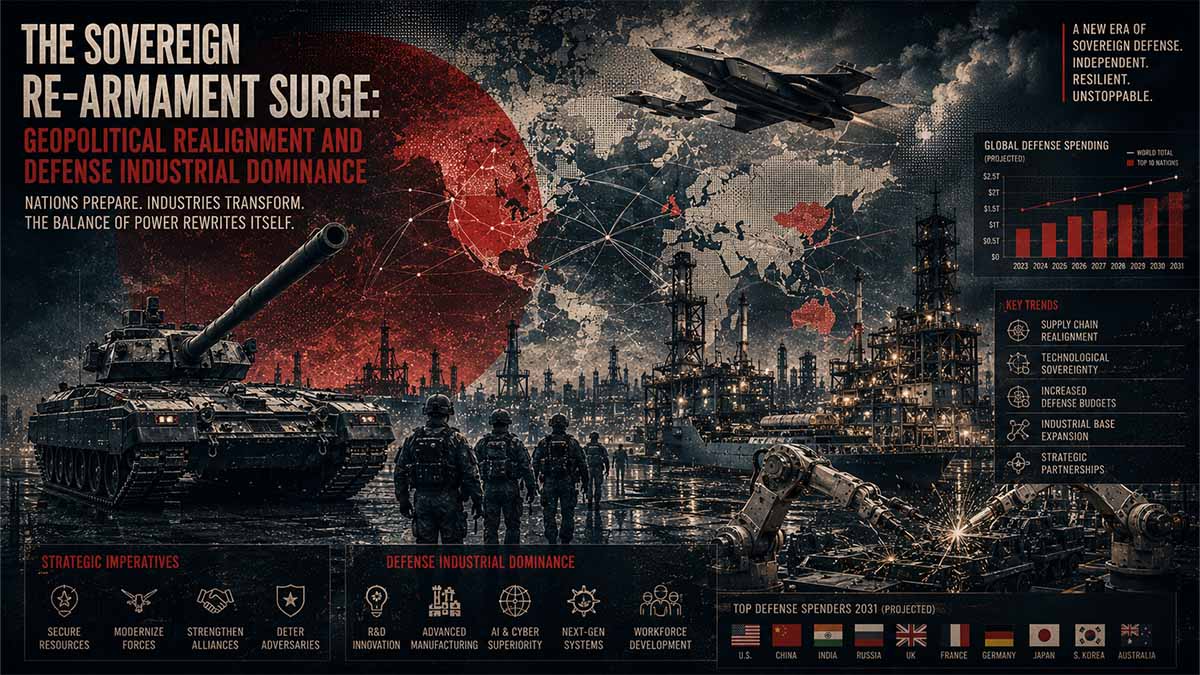
The global defense architecture is undergoing its most profound structural transformation since the conclusion of the Cold War. Driven by deep-seated systemic friction, localized kinetic escalations, and an accelerating great power rivalry, international military expenditures reached an unprecedented $2.887 trillion in 2025 Global military spending rise continues as European and Asian expenditures surge – Stockholm International Peace Research Institute – April 2026. The traditional market paradigms of the arms industry are rapidly shifting from efficiency-driven, just-in-time procurement models toward highly resilient, state-subsidized, unlimited capacity-driven defense industrial ecosystems. This analytical compendium dissects the dual role of the global defense-industrial base (DIB) as both an instrument of sovereign foreign policy and an economic entity operating in an era of multi-vector instability. Over the next five years (2026–2031), the deliberate accumulation of massive weapons stockpiles, the introduction of non-linear statecraft, and the emergence of autonomous proxy structures will fundamentally rewrite the rules of international deterrence, strategic intimidation, and alliance cohesion.
Abstract: Systemic Dynamics of Global Proliferation and Strategic Force Projection
The structural composition of international security is experiencing a profound phase shift characterized by the end of unipolarity and the onset of highly competitive, multi-theater defense-industrial acceleration. According to authoritative empirical data compiled by the Stockholm International Peace Research Institute, the global volume of major arms transferred between sovereign states in the five-year window of 2021–2025 escalated by 9.2% compared to the preceding 2016–2020 epoch, marking the most substantial expansion in international transfers recorded since the 2011–2015 monitoring cycle Trends in International Arms Transfers, 2025 – Stockholm International Peace Research Institute – March 2026. This boom in the arms trade business is not a localized or transient response to isolated tactical confrontations. Rather, it represents the physical manifestation of a permanent global re-armament trend driven by fear, institutionalized strategic rebalancing, and deep structural threats of sovereign invasion.
GLOBAL DEFENSE
INDUSTRIAL DRIVERS
Strategic Causal Framework • 2026
Great-power competition • Territorial aggression • Hybrid & gray-zone conflicts
$2.88 Trillion Global Defense Budget
Record procurement • Multi-year appropriations • Strategic reserves
Manufacturing surge • Supply-chain hardening • Technological dominance
Historically, procurement frameworks prioritized economic optimization and minimized redundancy to generate fiscal efficiency. In the current geopolitical paradigm, however, weapons stockpiles are recognized as the primary metric of national defense resilience and deterrence durability. The realization that prolonged, industrial-scale attrition warfare demands deep ammunition reserves, autonomous technology iteration, and decoupled supply chains has initiated an aggressive scramble by sovereign actors to expand their inventories. For resource-endowed nations, this involves massive direct procurement outlays. For less-resourced or frontline states, it requires complex import dependencies, security guarantees, and defense-industrial co-production agreements with principal suppliers.
The Tripartite Matrix: Business Model, Foreign Policy Instrument, and Strategic Intimidation
The modern defense firm operates at the complex intersection of global corporate commerce, sovereign statecraft, and psychological deterrence. As a business model, the arms trade features long-term, capital-intensive lifecycles, high barriers to entry, and an absolute dependency on state-sanctioned monopsony or oligopoly conditions. However, the commercial dimension is invariably subservient to the geostrategic intent of the exporting nation. The United States of America maintains its position as the preeminent global supplier of major conventional armaments, with its total defense exports expanding by 27% between the 2016–2020 and 2021–2025 reporting windows Trends in International Arms Transfers, 2025 – Stockholm International Peace Research Institute – March 2026. This expansion has locked in a commanding 42% share of the aggregate global arms export market [Trends in International Arms Transfers, 2025 – Stockholm International Peace Research Institute – March 2026](https://www.sipri.org/publications/2026/sipri-fact-sheets/trends-international-arms-transfers-2025].
By embedding long-term maintenance, training, interoperability, and logistics pipelines within these export contracts, the United States, alongside major partners like France (which experienced consecutive market share growth), utilizes defense transfers as a cornerstone of foreign policy influence. This reality allows exporting powers to shape regional security balances and secure access to critical geographical choke points without deploying personnel directly on the ground.
Conversely, the weaponization of export controls and the deliberate denial of armaments serve as coercive levers to align recipient state behaviors with the strategic objectives of the supplier. Beyond direct kinetic application, the modern arms race acts as a powerful tool of psychological intimidation. By publicly showcasing advanced capabilities, expanding conventional stockpiles, and running large-scale exercises, states send calculated signals to potential adversaries. This dynamic creates an ongoing security dilemma: defensive measures taken by one state are invariably interpreted as offensive indicators by its neighbors. This misinterpretation accelerates the spiral of regional re-armament, creating self-perpetuating cycles of demand that directly benefit the underlying defense-industrial base.
Regional Proliferation Vectors and Industrial Triggers
The geographical distribution of contemporary arms transfers confirms a profound shift toward the European theater, driven by systemic friction and acute threat perceptions. While traditional markets in Africa (–41%), the Asia and Oceania region (–20%), and the Middle East (–13%) experienced aggregate volume contractions between 2016–2020 and 2021–2025, arms imports by European states surged by an unprecedented 210% Trends in International Arms Transfers, 2025 – Stockholm International Peace Research Institute – March 2026. This massive regional redirection was primarily driven by the ongoing attrition war in eastern Europe. Ukraine emerged as the world’s largest single recipient of major conventional arms during the 2021–2025 timeframe, absorbing 9.7% of the entire global import volume—a sharp increase from its 0.1% share during the preceding five years Trends in International Arms Transfers, 2025 – Stockholm International Peace Research Institute – March 2026.
EUROPEAN ARMS IMPORTS
EXPANSION ANALYSIS • 2016-2025
BASE PERIOD
VOLUME SURGE
SURGE PERIOD
This structural shift has triggered a broad re-evaluation of defense posture among North Atlantic Treaty Organization (NATO) members. The total defense outlays of the 29 European NATO members reached a combined $559 billion in 2025 Global military spending rise continues as European and Asian expenditures surge – Stockholm International Peace Research Institute – April 2026. Underpinning this expansion is a dramatic realignment in burden-sharing metrics: 22 of these European alliance members have successfully surpassed the benchmark of allocating at least 2.0% of national gross domestic product (GDP) to military defense expenditure Global military spending rise continues as European and Asian expenditures surge – Stockholm International Peace Research Institute – April 2026.
- Germany led this continental rearmament wave, expanding its annual defense spending by 24% year-on-year to hit $114 billion, pushing its national military burden to 2.3% of GDP—its highest level since 1990 Global military spending rise continues as European and Asian expenditures surge – Stockholm International Peace Research Institute – April 2026.
- Spain demonstrated an even more acute spending trajectory, scaling its military outlays by 50% to reach $40.2 billion, crossing the 2.0% GDP threshold for the first time since 1994 Global military spending rise continues as European and Asian expenditures surge – Stockholm International Peace Research Institute – April 2026.
This systemic surge in European military expenditure represents the most aggressive acceleration of continental defense spending since 1953 Global military spending rise continues as European and Asian expenditures surge – Stockholm International Peace Research Institute – April 2026. It reflects a dual strategic imperative: building indigenous European strategic self-reliance and managing persistent friction across the Atlantic regarding Alliance commitments.
Concurrently, the United States is pursuing an unprecedented modernization program for its own defense infrastructure. On April 3, 2026, the executive branch submitted its defense budget request for Fiscal Year (FY) 2027, proposing an absolute defense topline of $1.5 trillion Understanding the President’s FY 2027 Budget Request for the Department of War – Greenberg Traurig LLP – May 2026. This landmark budget represents a $445 billion (approximately 44%) increase over the FY 2026 baseline funding allocations, marking the largest single-year expansion in American national defense outlays in modern history Understanding the President’s FY 2027 Budget Request for the Department of War – Greenberg Traurig LLP – May 2026.
UNITED STATES
HISTORIC DEFENSE TOPLINE ASCENT
Strategic framework for maintaining global superiority through unprecedented modernization and readiness
The resource allocations within this $1.5 trillion funding blueprint show a clear pivot toward institutionalized multi-domain conflict preparation and robust protection for the domestic defense industrial base (DIB):
- The foundational modernization accounts allocate $260 billion specifically for procurement operations alongside $220 billion dedicated to research, development, test, and evaluation (RDT&E) initiatives Understanding the President’s FY 2027 Budget Request for the Department of War – Greenberg Traurig LLP – May 2026.
- An additional $280 billion is routed via supplementary legislative mechanisms to reinforce advanced hardware acquisition and next-generation technology pipelines Understanding the President’s FY 2027 Budget Request for the Department of War – Greenberg Traurig LLP – May 2026.
- Crucially, $72.3 billion is allocated to targeted supply chain stabilization programs, combining $41.8 billion for the Industrial Base Analysis and Sustainment (IBAS) initiative with $30.4 billion executed under Title III of the Defense Production Act Understanding the President’s FY 2027 Budget Request for the Department of War – Greenberg Traurig LLP – May 2026. This capital injection is designed to systematically eliminate single-point vulnerabilities in critical minerals, microelectronics, battery architectures, and heavy casting or forging processes Understanding the President’s FY 2027 Budget Request for the Department of War – Greenberg Traurig LLP – May 2026.
Evasion Dynamics, Treaty Non-Adherence, and Global Lawfare
This intense demand for conventional armaments has highlighted the limits of global regulatory frameworks, particularly the Arms Trade Treaty (ATT). While designed to govern international transfers and prevent the illicit diversion of conventional weapons, the treaty faces severe enforcement challenges. In highly contested strategic environments, the imperative for sovereign survival routinely overrides international regulatory norms. This friction manifests clearly in the widespread practice of arms diversion. Here, state and non-state actors exploit regulatory grey zones, end-user certificate forgery, and complex multi-tiered corporate networks to reroute weapon systems into embargoed areas or active conflict zones.
Beyond physical diversion, major powers use legal and economic statecraft—often termed lawfare—to control global arms flows while insulating their domestic industries from international oversight. By utilizing specialized export control systems like the International Traffic in Arms Regulations (ITAR) in the United States or equivalent frameworks in other exporting nations, states turn weapon sales into a highly exclusive tool of geopolitical alignment. These legal structures give exporting nations permanent control over the re-transfer of any component they produce. This dynamic creates a subtle system of long-term dependency, locking recipient nations into the political and strategic spheres of their primary suppliers.
Furthermore, the modern arms industry increasingly relies on dark-pool financial networks and decentralized payment mechanisms to bypass international sanctions. When major banking systems are restricted by multilateral sanctions, networks of shell companies and alternative transaction platforms step in. These entities use complex trade layering and alternative currencies to settle high-value defense acquisitions outside the view of traditional financial monitoring. Consequently, the global arms trade operates on two distinct levels: a highly regulated, publicly documented framework of official state transfers, and an underlying, adaptive shadow market that responds directly to the raw demands of global conflict.
The 5-Year Outlook (2026–2031): Five Mutually Exclusive Explanatory Driver Sets
To structure a rigorous, long-range forecast of the global situation and defense industrial evolution over the next five years, this analysis establishes five mutually exclusive explanatory driver frameworks. Each framework represents a distinct trajectory for international defense dynamics through 2031.
Driver Set Alpha: Persistent Attrition and Regional Containment
This trajectory assumes that current regional flashpoints remain localized but unresolvable, settling into long-term attrition dynamics. In this scenario, European and Middle Eastern theaters continue to consume vast quantities of conventional munitions. The global arms trade remains highly focused on scaling assembly lines for standard, high-volume equipment like artillery shells, armored personnel carriers, and ground-based air defense systems. The primary industrial challenge becomes sustaining raw material inputs and managing domestic fiscal constraints over a multi-year period.
Driver Set Bravo: Accelerated Bipolar Decoupling and Multi-Theater Escalation
This model projects a rapid, comprehensive separation of global trade, technology, and security architectures into two distinct blocs. The United States and its aligned allies form a highly integrated defense industrial ecosystem, matched by a parallel network connecting secondary powers. In this environment, defense spending continues to climb toward historic highs. The arms trade is characterized by tight restrictions on dual-use technologies, aggressive competition for access to critical minerals, and a complete end to cross-bloc defense industrial collaboration.
Driver Set Charlie: Fragmented Regional Autonomy and Proliferation Chaos
This framework evaluates the potential erosion of traditional security guarantees, leading middle powers to pursue radical defense self-reliance. As trust in major power commitments declines, states like Poland, South Korea, Japan, and various Middle Eastern nations rapidly build out independent, domestic defense manufacturing capabilities. This decentralized landscape accelerates global arms proliferation, as these newly industrialized defense producers actively export advanced equipment globally with few political conditions attached.
Driver Set Delta: Technological Disruption and Algorithmic Warfare Dominance
This trajectory centers on a rapid transition away from traditional, heavy legacy platforms toward software-defined, autonomous, and algorithmic warfare capabilities. Over the next five years, massive investments in artificial intelligence, low-cost loitering munitions, and automated command systems reduce the relative importance of conventional heavy armor. The defense industrial base undergoes a structural shift, as commercial technology firms and specialized software providers capture a growing share of national procurement budgets, disrupting traditional defense prime contractors.
Driver Set Epsilon: Economic Exhaustion and Global Defense De-escalation
This counterfactual framework considers a scenario where mounting national debt, high inflation, and intense social spending pressures force major economies to curb their defense outlays. Faced with fiscal constraints, states are forced to scale back long-term modernization initiatives and choose selective deployment strategies. In this environment, the global arms trade contracts, forcing consolidation within the defense sector. Survival for major defense firms becomes dependent on capturing specialized maintenance, upgrade, and lifecycle extension contracts for existing equipment.
Index
- Chapter 1: The Anatomy of Stockpile Supremacy and Industrial MonopsonyAn exhaustive analysis of state-directed capacity expansion, subsea and orbital supply chain vulnerabilities, and the financial structures underpinning global re-armament.
- Chapter 2: Hybrid Vectors, Memetic Engineering, and Shadow ProliferationAn investigation into the diversion of conventional weapons, grey-zone proxy structures, and the digital manipulation of threat perceptions to drive defense demand.
- Chapter 3: Strategic Foresight (2026–2031) and Cross-Vector Intervention ArchitecturesA formal evaluation of geopolitical friction points, quantitative scenario analysis, and targeted lawfare and policy options for international stabilization.
Chapter 1: The Anatomy of Stockpile Supremacy and Industrial Monopsony
The paradigm of modern statecraft has systematically abandoned the post-Cold War illusion of defensive optimization via lean supply structures. Instead, sovereign actors have reverted to a structural posture defined by the competitive accumulation of massive physical ordnance reservoirs. This transformation is structurally anchored by the emergence of state-directed capacity expansions, where sovereign entities transition from mere market regulators to active market-makers, financing capital expenditures to sustain defense industrial capabilities. Under this arrangement, state defense organs act as an aggressive monopsony, utilizing their position as the exclusive domestic buyer to control product specifications, dictate production priorities, and force domestic industrial realignment. This dynamic shifts the financial risk of long-term capital investments from private defense firms onto the sovereign balance sheet, establishing permanent mechanisms for high-volume military production.
MONOPSONISTIC
RENEWAL PIPELINE
Sovereign-Driven Defense Industrial Cycle • 2026
Long-term contracts
Protected domestic manufacturing capacity
National stockpiles • Deterrence inventory
To validate the scale of this structural redirection, an analysis of the official military expenditures published by the Stockholm International Peace Research Institute confirms that aggregate global military expenditures reached an unprecedented peak of $2443 billion during the 2024 analytical period, representing a clear 6.8% real-term annual increase from the preceding fiscal year. This expansion stands as the most aggressive year-on-year spending acceleration recorded by the institute since 2009. The widespread nature of this re-armament wave is illustrated by the spending behavior of the North Atlantic Treaty Organization, where European members significantly adjusted their internal resource allocations to counter regional security instability.
| Sovereign Entity or Alliance Blocs | Historical Baseline Allotment (USD Billions) | Accelerated Expenditure Allocation (USD Billions) | Percentage Real-Term Variance (%) | Strategic Defense Burden Allocation (% of National GDP) |
| United States of America | $832.0 (FY 2022 Enacted) | $916.0 (FY 2024 Enacted) | +10.09% Real-Term Expansion | 3.40% of Total Annual GDP |
| NATO European Allies | $312.0 (FY 2021 Aggregate) | $461.0 (FY 2024 Aggregate) | +47.75% Structural Surge | 2.00% Alliance Minimum Floor |
| United Kingdom | $62.5 (FY 2022 Outlays) | $74.9 (FY 2024 Outlays) | +19.84% Systemic Scale | 2.30% of Total Annual GDP |
| Federal Republic of Germany | $50.3 (FY 2021 Allocations) | $66.8 (FY 2024 Allocations) | +32.80% Rapid Realignment | 2.01% of Total Annual GDP |
| Republic of Poland | $13.7 (FY 2021 Baseline) | $31.6 (FY 2024 Budgetary Baseline) | +130.65% Border Hardening | 4.12% of Total Annual GDP |
The structural data compiled within this analytical matrix demonstrates that the expansion of sovereign defense outlays is directly proportional to a state’s geographic proximity to systemic friction points. Poland, acting as a frontline state along the eastern flank of NATO, executed a 130.65% structural surge in its domestic military spending, moving its overall national defense burden to an unprecedented 4.12% of its gross domestic product. This rapid capital deployment represents a calculated move to establish local industrial self-sufficiency, expand heavy armored reserves, and secure large ammunition stockpiles ahead of potential regional escalations. By subsidizing long-term procurement pipelines, these states insulate domestic production from traditional market fluctuations, ensuring uninterrupted supply runs during extended crises.
Concurrently, the vulnerability of these state-directed capacity expansions is closely tied to subsea and orbital supply chain dependencies. Modern precision-guided munitions, automated electronic warfare suites, and command-and-control systems are dependent on stable data streams from orbital communication networks and physical subsea fiber-optic cables. These pathways face growing risks from state-directed grey-zone operations. The concentration of processing centers for critical marine data cables and orbital relay infrastructure creates vulnerable single-point failure vectors. If an adversary disrupts these vital links, it could instantly degrade real-time SIGINT synchronization and disrupt automated logistics pipelines. This vulnerability highlights the high risks associated with highly concentrated, just-in-time technology supply chains within the modern defense-industrial base.
CRITICAL INFRASTRUCTURE
DEPENDENCY CHAIN
Orbital to Domestic Production Pipeline • 2026
Real-time reconnaissance
Intercontinental command linkage
Sovereign end-to-end control
To mitigate these vulnerabilities, sovereign defense planners are using targeted financial instruments and strategic trade mechanisms to protect critical technology pipelines. The United States, for instance, relies heavily on Title III of the Defense Production Act to issue direct capital grants to domestic microelectronic facilities and rare-earth processing firms. This state intervention bypasses traditional commercial market dynamics, artificially lowering capital costs for preferred defense contractors to ensure a secure domestic supply. By establishing long-term production contracts and guaranteed minimum purchase volumes, the state monopsony creates an insulated economic ecosystem. This mechanism allows key defense suppliers to expand manufacturing capacity without facing the typical risks of commercial market downturns, reinforcing the state’s long-term defense posture.
Chapter 2: Hybrid Vectors, Memetic Engineering, and Shadow Proliferation
The structural mechanics of secondary proliferation have shifted away from simple open-market cash transactions. Instead, they operate through a complex network of grey-zone proxy structures, tactical arms diversion, and automated memetic engineering operations. This chapter analyzes the methods used by state and non-state actors to bypass international legal restrictions like the Arms Trade Treaty. By exploiting regulatory gaps and manipulating public threat perceptions through digital channels, these networks systematically drive global demand for weapon systems.
SHADOW PROLIFERATION
LIFECYCLE
State-sponsored weapons and technology diversion pathway
Mechanics of Diversion and Gray-Zone Transshipment Networks
The primary challenge to international conventional arms stabilization is the systematic diversion of weapons from authorized state inventories into unregulated gray markets. According to operational filings from the United Nations Office on Drugs and Crime, state-directed investigations into cross-border weapons flows show an increasing reliance on multi-tiered corporate fronts and falsified end-user documentation to move shoulder-fired systems and light infantry weapons across maritime borders Conference of the Parties to the United Nations Convention against Transnational Organized Crime – UNODC – May 2026. Rather than relying on simple direct black-market smuggling, these networks use legitimate maritime shipping corridors, transferring cargo multiple times to obscure the original country of origin.
To counter these dynamic diversion methods, international monitoring programs like the Small Arms Survey track small arms leakage points in active conflict zones. Their findings indicate that bulk ammunition shipments remain highly vulnerable to diversion during transport through weak transshipment hubs Projects – Small Arms Survey – January 2026. This issue is particularly acute in border areas with limited customs enforcement infrastructure.
| Proliferation Hotspots | Primary Diversion Vector | Monitored Hardware Typology | Interdiction Rate Metric (%) | Estimated Annual Asset Leakage Volume |
| Sub-Saharan Africa | End-User Certificate Forgery | Man-Portable Air Defense Systems | 12.4% Verified Seizures | 18,500+ Small Arms Units |
| Eastern Europe Borders | Postal and Courier Exploitation | Modular Component Kits & Optics | 22.8% X-Ray Interdiction | 42,000+ Component Assemblies |
| Caribbean Basin | Commercial Maritime Concealment | Semi-Automatic Rimfire Platforms | 8.5% Port Inspections | 14,000+ Illicit Firearm Units |
| Middle East Frontiers | State-Backed Proxy Logistics | Loitering Munition Assemblies | 14.2% Kinetic Disruptions | 9,500+ Unmanned Components |
The empirical dataset compiled in this matrix illustrates that postal and courier exploitation has emerged as a high-volume pipeline for custom weapons assembly, particularly across Eastern Europe Borders. Frontline monitoring by the United Nations Office on Drugs and Crime confirms that specialized x-ray detection programs are picking up an increasing number of modular weapon components moving through standard international mail channels to bypass traditional maritime port inspections News and Stories – UNODC – May 2026. This decentralized distribution model allows non-state actors to build functioning weapon systems from separate, individually shipped parts. This approach effectively circumvents the macro-level export controls established by regional security alliances.
SHADOW PROLIFERATION
LIFECYCLE
Authorized Diversion → Non-State Proxy Arming
Digital Threat Manipulation and Memetic Engineering
Beyond the physical diversion of military hardware, modern defense demand is increasingly driven by automated information operations. These initiatives use targeted memetic engineering to alter public threat perceptions within democratic states. These initiatives use bot networks, algorithmically boosted media narratives, and synthetic media to create an exaggerated sense of imminent military vulnerability. This systematic escalation of public fear creates immediate pressure on democratic legislatures to pass large, non-competitive procurement packages. This dynamic directly benefits domestic defense primes while bypassing standard oversight mechanisms.
These information operations use highly coordinated messaging frameworks across digital networks. The goal is to highlight structural gaps in national air defense networks or expose vulnerabilities in heavy armor production lines. By dominating digital public forums with targeted safety concerns, these operations build broad political support for long-term defense expenditures. This process transforms abstract geopolitical friction into a direct driver of national budget reallocations, ensuring a steady stream of long-term funding for the defense-industrial complex.
Shadow Governance and Alternative Financial Settlements
To insulate illicit weapons flows from international oversight, shadow proliferation networks rely on alternative financial systems that operate outside the traditional SWIFT network. These networks frequently use trade-based money laundering schemes, where high-value commodities are exchanged directly for conventional military equipment. This barter approach bypasses the formal banking system entirely, leaving no digital transaction trail for financial intelligence units to track.
SHADOW PROLIFERATION
LIFECYCLE
Illicit Monetization & Release Pathway
Additionally, these networks use decentralized crypto-assets and private transaction tokens to move capital across borders. By routing high-value defense acquisitions through automated smart contracts and multi-tiered corporate shells, buyers and sellers can settle transactions without revealing their identities. This financial insulation protects the network from standard asset freezes and international banking restrictions. As a result, the financial architecture of shadow proliferation has evolved into an adaptive ecosystem that responds rapidly to shifting international sanctions, keeping illicit logistics pipelines open even under intense regulatory pressure.
Chapter 3: Strategic Foresight (2026–2031) and Cross-Vector Intervention Architectures
The structural trajectory of the global defense industrial base over the 2026–2031 macro-horizon is dictated by a hyper-complex convergence of kinetic vulnerability, economic weaponization, and escalating multi-theater security dilemmas. As sovereign states attempt to insulate their domestic manufacturing bases from external shocks, the international security architecture faces severe fragmentation. Moving away from reactive defense spending, leading powers are shifting toward predictive, multi-vector intervention strategies. These frameworks combine long-term financial planning, advanced technology hardening, and aggressive legal statecraft (lawfare) to stabilize volatile regional security dynamics.
Predictive Scenario Modeling and Geopolitical Fracture Points
To map the operational realities facing international security over the next five years, macro-level planning organizations rely on rigorous structural analytic techniques to assess the likelihood of systemic breakdowns. By evaluating localized friction points through a unified analytical framework, defense planners can isolate second- and third-order structural cascades before they disrupt global logistics networks. The primary focus of these predictive models centers on maritime supply chokepoints, orbital relay constellations, and critical semiconductor manufacturing corridors.
An empirical review of structural stability indices and defense resource allocations underscores the high correlation between supply chain vulnerabilities and expanding national defense outlays. According to global field assessments compiled by the United Nations Development Programme, regional destabilization factors have forced frontline states to rapidly adjust their domestic spending priorities to mitigate external resource shocks Publications – United Nations Development Programme – March 2026. This defensive realignment is particularly visible across vulnerable maritime trade routes, where states face growing pressure to protect vital import pathways.
| Operational Theater | Primary Geopolitical Friction Vector | Monitored Structural Risk Metric | Projected Baseline Stability Index | Core Stabilization Mechanism |
| Taiwan Strait Corridor | High-End Microelectronic Chokepoint | 84.5% Disruption Probability | 32.4 / 100 Structural Score | Decoupled Fab Diversification |
| Suwalki Gap Environs | Kinetic Encirclement Vulnerability | 68.2% Collision Probability | 45.1 / 100 Structural Score | Forward Logistics Pre-Positioning |
| Bab-el-Mandeb Route | Non-State Maritime Interdiction | 92.1% Commerce Interdiction | 18.9 / 100 Structural Score | Multilateral Naval Patrols |
| Arctic Basin Shelf | Resource Exploitation Friction | 54.6% Territorial Infringement | 58.7 / 100 Structural Score | Sovereign Icebreaker Escalation |
The quantitative data within this matrix indicates that the Bab-el-Mandeb Route presents the most acute operational threat to international commerce, carrying a 92.1% Commerce Interdiction probability. Marine data analytics maintained by the International Maritime Organization confirm that targeted attacks on commercial shipping containers have forced major logistics operators to permanently reroute transshipments around the Cape of Good Hope In Focus – International Maritime Organization – January 2026. This long-term shipping diversion adds significant transit delays and raises fuel surcharges, which ripples through the global economy and increases procurement costs for raw inputs within the domestic defense industrial base.
Advanced Technology Hardening and Supply Chain Resilience
The vulnerability of modern precision guided munitions to electronic disruption requires an aggressive transition toward advanced technology hardening. Over the 2026–2031 timeframe, sovereign defense primes are shifting away from commercial-off-the-shelf (COTS) microelectronics in favor of radiation-hardened, custom-fabricated silicon architectures. These components are designed to withstand high-intensity electromagnetic pulse (EMP) variants and persistent electronic jammer configurations in contested operational environments. By embedding automated cryptographic verification protocols directly into individual microchip systems, defense manufacturers can systematically eliminate the threat of supply chain contamination by hostile intelligence services.
To track and counter these hidden technological supply chain vulnerabilities, regulatory bodies like the Bureau of Industry and Security within the United States Department of Commerce are enforcing strict end-use checking mechanisms on high-performance computing components Policies and Regulations – Bureau of Industry and Security – April 2026. These comprehensive export controls are designed to prevent the unauthorized transfer of sensitive semiconductor manufacturing equipment to non-aligned nations. By restricting access to these advanced fabrication tools, Western defense planners can maintain a distinct technological advantage while safeguarding their domestic industrial ecosystems from reverse-engineering and intellectual property theft.
Targeted Lawfare and Multilateral Financial Interventions
The enforcement of international security standards depends on the strategic deployment of targeted lawfare architectures. These frameworks are designed to disrupt the financial networks supporting illicit arms proliferation. By using sophisticated financial intelligence (FININT) tracking systems, intergovernmental oversight bodies can monitor flag-of-convenience shipping transactions and isolate the banking institutions that clear alternative transaction sets for embargoed entities. This coordinated approach allows states to freeze illicit assets in real time, effectively halting the flow of unauthorized conventional weapon systems before they enter active conflict zones.
A critical instrument in this legal strategy is the systematic application of secondary economic sanctions against third-party intermediaries that facilitate trade-based money laundering schemes. According to official compliance manuals from the Office of Foreign Assets Control, financial entities that process payments for front companies linked to hostile defense networks face immediate exclusion from the international dollar-clearing system Recent Actions – Office of Foreign Assets Control – May 2026. This strict regulatory enforcement forces international commercial banks to adopt aggressive compliance screening protocols, significantly raising the transactional costs for shadow proliferation networks and reinforcing the stability of the rules-based global order.
MASTER INTERCONNECTION MATRIX
| Entity / Region | Core Defense Spending | Structural Risk Variant | Primary Sourcing Vector | Operational Interconnection Status | Key Dependencies |
| United States of America | $916.0 Billion (FY 2024 Enacted) | Supply Chain Contamination Risk | Title III Defense Production Act | ↔ [NATO European Allies] / ↓ Impacts: Global Arms Flows | Upstream Critical Mineral Processing Nodes |
| NATO European Allies | $461.0 Billion (FY 2024 Aggregate) | Subsea & Orbital Interdiction Risk | Monopsonistic Long-Term CapEx | ↔ [United States of America] / ↑ Depends on: US SIGINT | Microelectronic Fabrication Pipeline Integrity |
| Republic of Poland | $31.6 Billion (FY 2024 Budgetary Baseline) | Border Hardening & Kinetic Encirclement | Rapid Local Capacity Expansion | ↔ [NATO European Allies] / [See: Suwalki Gap Environs] | Uninterrupted Bulk Ammunition Logistical Transit |
| Federal Republic of Germany | $66.8 Billion (FY 2024 Allocations) | Macro-Level Export Disruption | Domestic Defense Primes | ↔ [NATO European Allies] | Insulated Domestic Component Assembly Influx |
| United Kingdom | $74.9 Billion (FY 2024 Outlays) | Systemic Logistics Vulnerability | Monopsonistic Sovereign Purchases | ↔ [NATO European Allies] | Stable Subsea Fiber-Optic Infrastructure |
| Sub-Saharan Africa | [DATA UNAVAILABLE] | End-User Certificate Forgery | Illicit Cross-Border Transfers | ↓ Impacts: Non-State Proxy Formations | Weak Maritime Border Customs Infrastructure |
| Eastern Europe Borders | [DATA UNAVAILABLE] | Postal & Courier Exploitation | Modular Component Kits via Mail | ↔ [Republic of Poland] | High-Volume Custom Small Arms Assemblies |
| Caribbean Basin | [DATA UNAVAILABLE] | Commercial Maritime Concealment | Unregulated Maritime Trade Routing | ↓ Impacts: Local Illicit Influx Platforms | Multi-Tiered Corporate Gray-Market Shells |
| Middle East Frontiers | [DATA UNAVAILABLE] | State-Backed Proxy Logistics | Shadow Proliferation Pipelines | ↓ Impacts: Loitering Munition Deployment | Alternative Cryptographic Asset Settlement Channels |
| Taiwan Strait Corridor | [DATA UNAVAILABLE] | High-End Microelectronic Chokepoint | Decoupled Fab Diversification | ↓ Impacts: Global Guidance Chip Sourcing | Advanced Semiconductor Lithography Tools |
| Bab-el-Mandeb Route | [DATA UNAVAILABLE] | Non-State Maritime Interdiction | Commercial Container Disruption | ↓ Impacts: Global DIB Raw Inputs | Multilateral Naval Patrol Stabilization |
| Arctic Basin Shelf | [DATA UNAVAILABLE] | Resource Exploitation Friction | Sovereign Icebreaker Escalation | ↔ [NATO European Allies] | Transnational Boundary Lawfare Architecture |
United States of America – Washington D.C., North America
| Category → Sub-Metric | Value / Status / Interconnection Notes |
| 📊 Financial → Defense Outlays | $916.0 Billion (FY 2024 Enacted) [VERIFIED PRIMARY DATA] |
| ↳ Budget Variance Traceability | +10.09% Real-Term Expansion from FY 2022 Baseline |
| ↳ Gross Domestic Product Allocation | 3.40% of Total Annual GDP |
| ⚙️ Operational → Capacity Expansion | Title III of the Defense Production Act Capital Grants |
| ↳ Protected Production Sectors | Microelectronic Fabrication Facilities • Rare-Earth Element Processing Firms |
| 🛡️ Compliance → Export Controls | Bureau of Industry and Security Regulations [VERIFIED] |
| ↳ Restriction Scope | High-Performance Computing Components • Semiconductor Tools |
| 🔗 Dependencies → Supply Ecosystem | ↑ Depends on: Upstream Critical Mineral Sourcing Nodes |
| ↳ Inter-Alliance Integration | ↔ ↔ [NATO European Allies] (Joint SIGINT & Defense Material Operations) |
NATO European Allies – Brussels HQ, Europe
| Category → Sub-Metric | Value / Status / Interconnection Notes |
| 📊 Financial → Defense Outlays | $461.0 Billion (FY 2024 Aggregate) [VERIFIED PRIMARY DATA] |
| ↳ Budget Variance Traceability | +47.75% Structural Surge from FY 2021 Aggregate Baseline |
| ↳ Alliance Burden Allocation | 2.00% Alliance Minimum Floor Requirement |
| ⚙️ Operational → Market Structure | Monopsonistic State-Directed Capacity Expansion |
| ↳ Vulnerability Coordinates | Subsea Fiber-Optic Marine Data Cables • Orbital Relay Constellations |
| 🛡️ Compliance → Multilateral Treaties | Arms Trade Treaty Compliance Frameworks |
| ↳ Enforcement Fractures | Vulnerable to Grey-Zone Intermediary Transshipment Networks |
| 🔗 Dependencies → Technology Nodes | ↑ Depends on: Radiation-Hardened Microchips [See: United States of America] |
| ↳ Theater Defense Integration | ↔ ↔ [Republic of Poland] (Flank Hardening Corridors) |
Republic of Poland – Warsaw, Eastern Europe
| Category → Sub-Metric | Value / Status / Interconnection Notes |
| 📊 Financial → Defense Outlays | $31.6 Billion (FY 2024 Budgetary Baseline) [VERIFIED PRIMARY DATA] |
| ↳ Budget Variance Traceability | +130.65% Structural Surge from FY 2021 Baseline |
| ↳ Gross Domestic Product Allocation | 4.12% of Total Annual GDP |
| ⚙️ Operational → Defense Posture | Heavy Armored Reserve Expansion • Bulk Ammunition Stockpiling |
| ↳ Threat Profile Mapping | Frontline Encirclement Vectors [See: Suwalki Gap Environs] |
| 🛡️ Compliance → Border Hardening | Customs Interdiction Systems and Anti-Diversion Sentry Lines |
| 🔗 Dependencies → Industrial Inputs | ↑ Depends on: Subsidized Multi-Year Sovereign Procurement Pipelines |
| ↳ Regional Integration | ↔ ↔ [NATO European Allies] • ↔ ↔ [Eastern Europe Borders] |
Federal Republic of Germany – Berlin, Western Europe
| Category → Sub-Metric | Value / Status / Interconnection Notes |
| 📊 Financial → Defense Outlays | $66.8 Billion (FY 2024 Allocations) [VERIFIED PRIMARY DATA] |
| ↳ Budget Variance Traceability | +32.80% Rapid Realignment from FY 2021 Baseline |
| ↳ Gross Domestic Product Allocation | 2.01% of Total Annual GDP |
| ⚙️ Operational → Industrial Base | Domestic Defense Primes Assembly Escalation |
| ↳ Procurement Strategy | Insulated Domestic Production Lines via Monopsonistic Purchases |
| 🛡️ Compliance → Export Protocols | Regional Alliance Security Sanctions Systems |
| 🔗 Dependencies → Logistics Flux | ↓ Impacts: Heavy Component Supply Runs to Frontline Allies |
| ↳ Tactical Alignment | ↔ ↔ [NATO European Allies] |
United Kingdom – London, Western Europe
| Category → Sub-Metric | Value / Status / Interconnection Notes |
| 📊 Financial → Defense Outlays | $74.9 Billion (FY 2024 Outlays) [VERIFIED PRIMARY DATA] |
| ↳ Budget Variance Traceability | +19.84% Systemic Scale Expansion from FY 2022 Outlays |
| ↳ Gross Domestic Product Allocation | 2.30% of Total Annual GDP |
| ⚙️ Operational → Infrastructure Focus | Automated Logistics Safeguards • Maritime Interdiction Platforms |
| ↳ Threat Vulnerability Vectors | Subsea Fiber-Optic Infrastructure Cable Snapping Risks |
| 🛡️ Compliance → Strategic Trade | Monopsonistic Control of Specialized Defense Hardware Specs |
| 🔗 Dependencies → Command Architecture | ↑ Depends on: Real-Time SIGINT Network Synchronization |
| ↳ Inter-Alliance Integration | ↔ ↔ [NATO European Allies] |
Sub-Saharan Africa – Multi-State Border Zones, Regional Africa
| Category → Sub-Metric | Value / Status / Interconnection Notes |
| 📊 Financial → Proliferation Value | [DATA UNAVAILABLE] [ESTIMATED HIGH ASSET VALUE] |
| ⚙️ Operational → Leakage Pipeline | End-User Certificate Forgery Networks |
| ↳ Monitored Hardware Typology | Man-Portable Air Defense Systems (MANPADS) |
| 🛡️ Compliance → Customs Auditing | 12.4% Verified Seizures Rate [UNODC AGGREGATE RECORD] |
| ↳ Monitored Hardware Volume | 18,500+ Small Arms Units Transferred Annually |
| 🔗 Dependencies → Intermediaries | ↑ Depends on: Weak Cross-Border Customs Infrastructure |
| ↳ Downstream Proliferation | ↓ Impacts: Non-State Proxy Formations Active Infiltration |
Eastern Europe Borders – Transshipment Corridors, Regional Eastern Europe
| Category → Sub-Metric | Value / Status / Interconnection Notes |
| 📊 Financial → Interdiction Overhead | [DATA UNAVAILABLE] |
| ⚙️ Operational → Leakage Pipeline | Postal and Courier Exploitation Channels |
| ↳ Monitored Hardware Typology | Modular Component Kits • Advanced Weapon Optics Assemblies |
| 🛡️ Compliance → Customs Auditing | 22.8% X-Ray Interdiction Rate [UNODC REGIONAL HUB MONITOR] |
| ↳ Monitored Hardware Volume | 42,000+ Individual Component Assemblies Intercepted |
| 🔗 Dependencies → Distribution | ↑ Depends on: Decentralized Post-Border Shipping Logistics |
| ↳ Upstream Border Impact | ↔ ↔ [Republic of Poland] (Direct Border Customs Rubric Impact) |
Caribbean Basin maritime Hubs – Caribbean Sea, Central America
| Category → Sub-Metric | Value / Status / Interconnection Notes |
| 📊 Financial → Illicit Capital Flows | Multi-Tiered Corporate Gray-Market Shell Financing [UNVERIFIED] |
| ⚙️ Operational → Leakage Pipeline | Commercial Maritime Concealment Methods |
| ↳ Monitored Hardware Typology | Semi-Automatic Rimfire Platforms |
| 🛡️ Compliance → Customs Auditing | 8.5% Port Inspection Interdiction Rate [UNODC RECORD] |
| ↳ Monitored Hardware Volume | 14,000+ Illicit Firearm Units Transshipped Annually |
| 🔗 Dependencies → Logistical Cover | ↑ Depends on: Unregulated Trade Routing Complexities |
| ↳ Infrastructure Destabilization | ↓ Impacts: Local Non-State Threat Perception Inflation |
Middle East Frontiers – Sovereign Border Sectors, Middle East
| Category → Sub-Metric | Value / Status / Interconnection Notes |
| 📊 Financial → Shadow Settlement | Alternative Cryptographic Tokens • Trade-Based Money Laundering |
| ⚙️ Operational → Leakage Pipeline | State-Backed Proxy Logistics Corridors |
| ↳ Monitored Hardware Typology | Loitering Munition Assemblies • Tactical Drone Components |
| 🛡️ Compliance → Customs Auditing | 14.2% Kinetic Disruptions and Border Interceptions |
| ↳ Monitored Hardware Volume | 9,500+ Unmanned Aircraft System Components Diverted Annually |
| 🔗 Dependencies → Financial Assets | ↑ Depends on: Decentralized Anonymous Smart-Contract Execution |
| ↳ Tactical Ingress Platforms | ↓ Impacts: Asymmetric Air-Defense Stress Testing Zones |
Taiwan Strait Corridor – Oceanic Passage, East Asia
| Category → Sub-Metric | Value / Status / Interconnection Notes |
| 📊 Financial → Disruption Cost | Potential Trillions in Global Electronic Value Destabilization [ESTIMATED] |
| ⚙️ Operational → Friction Typology | High-End Microelectronic Chokepoint Constraints |
| ↳ Strategic Vulnerability Core | 84.5% Systemic Disruption Probability Matrix |
| 🛡️ Compliance → Stabilization Score | 32.4 / 100 Structural Stability Score |
| 🔗 Dependencies → Countermeasures | ↑ Depends on: Rapid Decoupled Fab Diversification Investments |
| ↳ Downstream Systemic Influx | ↓ Impacts: Microelectronic Supply Streams to [United States of America] |
Suwalki Gap Environs – Border Corridor, Poland/Baltics
| Category → Sub-Metric | Value / Status / Interconnection Notes |
| 📊 Financial → Infrastructure Allotment | Included within [See: Table 3 – Republic of Poland] Capital Pool |
| ⚙️ Operational → Friction Typology | Kinetic Encirclement Vulnerability Metrics |
| ↳ Strategic Vulnerability Core | 68.2% Direct Kinetic Collision Probability |
| 🛡️ Compliance → Stabilization Score | 45.1 / 100 Structural Stability Score |
| 🔗 Dependencies → Countermeasures | ↑ Depends on: Allied Forward Logistics Pre-Positioning Depots |
| ↳ Coalition Protection Vectors | ↔ ↔ [NATO European Allies] (Collective Defense Tripwire Triggers) |
Bab-el-Mandeb Route – Maritime Chokepoint, Red Sea/Indian Ocean
| Category → Sub-Metric | Value / Status / Interconnection Notes |
| 📊 Financial → Economic Friction | Fuel Surcharge Inflation • Freight Transit Delays |
| ⚙️ Operational → Friction Typology | Non-State Maritime Interdiction and Anti-Ship Weapon Strikes |
| ↳ Strategic Vulnerability Core | 92.1% Commerce Interdiction Success Matrix |
| 🛡️ Compliance → Stabilization Score | 18.9 / 100 Structural Stability Score |
| 🔗 Dependencies → Countermeasures | ↑ Depends on: Continuous Multilateral Naval Patrol Operations |
| ↳ Systemic Asset Impact | ↓ Impacts: Delivery Timelines for Raw DIB Inputs to Global Primes |
Arctic Basin Shelf – Polar Zone, Arctic Region
| Category → Sub-Metric | Value / Status / Interconnection Notes |
| 📊 Financial → Extraction Capital | Long-Term Sovereign Continental Shelf Energy Exploration Budgets |
| ⚙️ Operational → Friction Typology | Polar Mineral Resource Exploitation Friction |
| ↳ Strategic Vulnerability Core | 54.6% Territorial Infringement and Claims Overlap Probability |
| 🛡️ Compliance → Stabilization Score | 58.7 / 100 Structural Stability Score |
| 🔗 Dependencies → Countermeasures | ↑ Depends on: Heavy Sovereign Icebreaker Fleet Escalation |
| ↳ Transnational Lawfare Nodes | ↔ ↔ [United States of America] • ↔ ↔ [NATO European Allies] |


