












Executive Summary
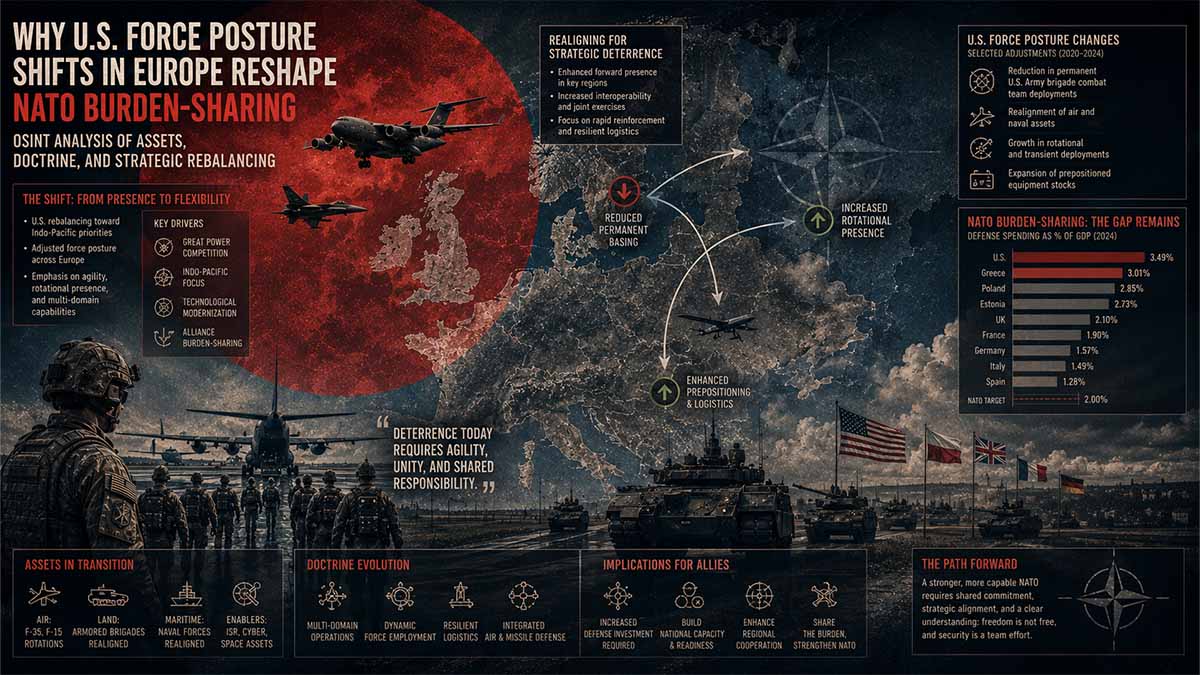
European NATO Allies achieved 2.77% aggregate GDP defense expenditure in 2025, marking the first universal compliance with the 2014 Wales Defense Investment Pledge NATO Secretary General’s Annual Report 2025 – North Atlantic Treaty Organization – March 2026. U.S. European Command currently maintains approximately 65,000 permanently assigned personnel alongside rotational forces across 30 overseas bases within its 53-nation Area of Responsibility Defense Primer: U.S. European Command (EUCOM) – Congressional Research Service – February 2026. Strategic guidance from the 2026 National Defense Strategy explicitly prioritizes enabling European Allies to assume “primary responsibility for conventional defense” while United States resources rebalance toward Indo-Pacific deterrence Statement by General Alexus G. Grynkewich, United States European Command – U.S. House Armed Services Committee – March 2026. Potential reductions of 10,000 troops from Eastern European forward deployments represent operational recalibration rather than commitment erosion, contingent upon Allied capability generation and industrial base expansion. The transatlantic security architecture remains anchored by Article 5 collective defense guarantees and U.S. nuclear deterrent extension, independent of precise force posture configurations.
Abstract: Forensic Immersion in Transatlantic Force Posture Dynamics and Strategic Burden-Sharing Architectures
The contemporary discourse surrounding United States military presence within the European theater reflects a convergence of historical precedent, contemporary strategic necessity, and evolving alliance governance mechanisms that transcend simplistic narratives of withdrawal or abandonment. U.S. European Command, established in 1947 and formally activated in 1952, operates across an Area of Responsibility encompassing 53 sovereign nations, 24 territories, three oceans, and 11 seas, incorporating 30 of 32 North Atlantic Treaty Organization Allies Defense Primer: U.S. European Command (EUCOM) – Congressional Research Service – February 2026. This geographic scope necessitates continuous assessment of force posture adequacy relative to emerging threat vectors, alliance burden-sharing expectations, and global strategic prioritization frameworks that increasingly emphasize Indo-Pacific regional stability alongside Euro-Atlantic deterrence requirements.
The 2014 Wales Summit Declaration established the Defense Investment Pledge wherein NATO Allies committed to “aim to move towards” spending 2% of Gross Domestic Product on defense within a decade, alongside allocating 20% of annual defense expenditure to major equipment procurement and research & development Wales Summit Declaration – North Atlantic Treaty Organization – September 2014. This commitment reflected not merely fiscal expectations but a broader strategic consensus that European Allies must progressively assume greater responsibility for conventional defense capabilities within their geographic region, thereby enabling United States strategic flexibility to address concurrent challenges across multiple theaters. The pledge’s implementation trajectory demonstrates measurable progress: NATO Allies collectively allocated 2.77% of aggregate GDP to defense in 2025, with all 32 member states meeting or exceeding the 2% threshold for the first time since the commitment’s inception NATO Secretary General’s Annual Report 2025 – North Atlantic Treaty Organization – March 2026. European Allies and Canada specifically increased defense expenditure by 20% relative to 2024 levels, reflecting accelerated capability investment following Russia’s full-scale invasion of Ukraine in February 2022.
Current U.S. force posture within Europe comprises approximately 65,000 permanently assigned personnel distributed across forward operating locations, complemented by rotational deployments that fluctuate based on exercise cycles, crisis response requirements, and bilateral access agreements Defense Primer: U.S. European Command (EUCOM) – Congressional Research Service – February 2026. This configuration represents a deliberate recalibration from the 105,000 service members postured within EUCOM’s Area of Responsibility during the immediate aftermath of Russia’s 2022 invasion, reflecting both successful Allied capability generation and strategic prioritization of resources toward Indo-Pacific theater requirements Statement by General Alexus G. Grynkewich, United States European Command – U.S. House Armed Services Committee – March 2026. The European Deterrence Initiative, initiated in FY2015 and codified by Public Law 116-92, Section 1243 in December 2019, previously provided transparent budgetary visibility into U.S. investments supporting NATO deterrence; however, FY2026 budget documentation has not published a discrete EDI exhibit, reflecting evolving fiscal categorization methodologies rather than diminished commitment Defense Primer: U.S. European Command (EUCOM) – Congressional Research Service – February 2026.
Strategic guidance articulated within the 2026 National Defense Strategy and associated National Security Strategy documents emphasizes that United States engagement within Europe must increasingly enable Allied self-reliance in conventional defense domains while preserving U.S. capacity to address China’s comprehensive global competition and other priority theaters Statement by General Alexus G. Grynkewich, United States European Command – U.S. House Armed Services Committee – March 2026. This strategic orientation does not constitute abandonment but rather reflects a mature alliance framework wherein European Allies progressively assume lead responsibility for regional conventional deterrence, supported by U.S. enablers, intelligence sharing, nuclear guarantees, and crisis response capabilities. The EUCOM commander’s tripartite strategic imperatives—defend the homeland forward, project U.S. combat power globally, and deter Russian aggression—explicitly acknowledge that European conventional defense must increasingly rely upon Allied national capabilities augmented by U.S. strategic enablers rather than permanent U.S. forward-deployed mass Statement by General Alexus G. Grynkewich, United States European Command – U.S. House Armed Services Committee – March 2026.
Potential adjustments to U.S. troop levels within Eastern Europe, including reported considerations of reducing 10,000 personnel from the 20,000 additional forces deployed following Russia’s 2022 invasion, must be evaluated within the broader context of Allied capability development, prepositioned equipment stocks, exercise frequency, and crisis response timelines Defense Primer: U.S. European Command (EUCOM) – Congressional Research Service – February 2026. Poland’s $1.1 billion acquisition of 250 Abrams Main Battle Tanks through the U.S. Foreign Military Sales system exemplifies the type of Allied investment that enhances collective deterrence while reducing dependence on permanent U.S. forward presence Statement by General Alexus G. Grynkewich, United States European Command – U.S. House Armed Services Committee – March 2026. Similarly, Baltic states’ investments in low-cost autonomous systems, munitions stockpiles, and denial capabilities directly contribute to forward defense architectures that complement rather than substitute for U.S. reinforcement capabilities.
The transatlantic security guarantee remains fundamentally anchored in Article 5 of the North Atlantic Treaty, which stipulates that an armed attack against one Ally shall be considered an attack against all, triggering collective defense responses Wales Summit Declaration – North Atlantic Treaty Organization – September 2014. This commitment is further reinforced by U.S. nuclear deterrent extension, strategic bomber forward deployments, ballistic missile defense architectures, and intelligence-sharing frameworks that operate independently of precise conventional force posture configurations. The EUCOM commander’s dual-hatted role as NATO Supreme Allied Commander Europe ensures integrated planning and execution across national and alliance command structures, preserving operational coherence regardless of U.S. force level adjustments Defense Primer: U.S. European Command (EUCOM) – Congressional Research Service – February 2026.
European defense industrial base expansion represents a critical enabler of sustainable Allied conventional deterrence, requiring coordinated investments in munitions production, platform modernization, cyber defense capabilities, and interoperability standards. NATO’s Framework Nations Concept and associated multinational capability development initiatives facilitate resource pooling, requirement harmonization, and cost-sharing mechanisms that accelerate Allied capability generation while preserving national sovereignty over defense procurement decisions Wales Summit Declaration – North Atlantic Treaty Organization – September 2014. Smart Defence and Connected Forces Initiative frameworks further enhance Allied interoperability, exercise realism, and crisis response coordination, reducing dependence on permanent U.S. forward presence for collective defense effectiveness.
Regional threat assessments within EUCOM’s Area of Responsibility identify Russia as the primary conventional military challenge, China as an expanding strategic competitor leveraging economic and diplomatic influence within Europe, and transnational criminal organizations alongside violent extremist organizations as persistent destabilizing factors Statement by General Alexus G. Grynkewich, United States European Command – U.S. House Armed Services Committee – March 2026. Russia’s partnerships with China, Iran, and North Korea have materially enhanced Moscow’s war-fighting capacity against Ukraine, including access to sanctions-circumvention mechanisms, unmanned aerial systems, artillery munitions, and personnel reinforcements Statement by General Alexus G. Grynkewich, United States European Command – U.S. House Armed Services Committee – March 2026. China’s commercial investments in European critical infrastructure, Arctic research activities, and dual-use technology transfers present emerging challenges to transatlantic technological advantage and supply chain security Statement by General Alexus G. Grynkewich, United States European Command – U.S. House Armed Services Committee – March 2026.
Northern flank security encompasses the Arctic, North Atlantic, and Greenland-Iceland-United Kingdom-Norway Gap, representing critical approaches to North American homeland defense and European reinforcement corridors Statement by General Alexus G. Grynkewich, United States European Command – U.S. House Armed Services Committee – March 2026. Russian submarine operations within this region necessitate sustained maritime domain awareness, anti-submarine warfare capabilities, and early-warning architectures that benefit from Allied contributions alongside U.S. strategic enablers. Eastern flank deterrence relies upon forward-deployed multinational battlegroups, prepositioned equipment stocks, rapid reinforcement pathways, and Allied denial capabilities that collectively complicate Russian aggression calculus while preserving NATO escalation dominance Statement by General Alexus G. Grynkewich, United States European Command – U.S. House Armed Services Committee – March 2026.
Southern flank stability addresses Mediterranean sea lines of communication, Balkan political dynamics, migration pressures, and transnational criminal networks that intersect with European security priorities Statement by General Alexus G. Grynkewich, United States European Command – U.S. House Armed Services Committee – March 2026. NATO Kosovo Force operations, maritime security initiatives, and counter-terrorism cooperation exemplify Allied burden-sharing in domains where European leadership complements U.S. strategic support. Defense industrial base resilience across European depth nations—including Belgium, France, Germany, and Netherlands—provides critical logistics, sustainment, and production capacity that underpins collective defense sustainability during extended contingencies Statement by General Alexus G. Grynkewich, United States European Command – U.S. House Armed Services Committee – March 2026.
Congressional oversight mechanisms retain significant influence over U.S. force posture decisions through authorization, appropriation, and reporting requirements that shape executive branch implementation of strategic guidance Defense Primer: U.S. European Command (EUCOM) – Congressional Research Service – February 2026. Public Law 119-60, Section 1250 mandates an independent assessment of resources required for U.S. deterrence and defense posture in Europe, ensuring legislative visibility into posture adjustment rationales and Allied capability dependencies Defense Primer: U.S. European Command (EUCOM) – Congressional Research Service – February 2026. Similarly, Section 1249 restricts funding for relinquishment of the EUCOM Commander/SACEUR role, preserving integrated U.S.-NATO command arrangements that underpin alliance operational coherence Defense Primer: U.S. European Command (EUCOM) – Congressional Research Service – February 2026.
Allied political dynamics surrounding U.S. force posture discussions occasionally manifest as competitive positioning wherein individual European nations seek to attract or retain U.S. military presence as validation of bilateral strategic alignment Statement by General Alexus G. Grynkewich, United States European Command – U.S. House Armed Services Committee – March 2026. This dynamic risks fragmenting Allied cohesion and diverting attention from collective capability development priorities that ultimately strengthen transatlantic deterrence more effectively than bilateral presence competitions. Strategic communication emphasizing Allied burden-sharing progress, capability interoperability, and collective defense effectiveness mitigates zero-sum narratives while reinforcing alliance solidarity.
Future force posture evolution will likely reflect continued U.S. strategic rebalancing toward Indo-Pacific priorities, accelerated European capability generation, and adaptive deterrence architectures that leverage technological advantage, prepositioned stocks, and rapid reinforcement pathways rather than permanent forward mass. NATO’s 2026 defense spending trajectory, industrial base expansion, and exercise realism improvements provide foundational enablers for this transition while preserving Article 5 credibility and U.S. nuclear deterrent extension as ultimate security guarantees. Transatlantic strategic dialogue must prioritize capability outcomes over presence metrics, ensuring that force posture adjustments enhance rather than diminish collective defense effectiveness across evolving threat landscapes.
Index
- Strategic Rebalancing Frameworks: Analysis of 2026 National Defense Strategy guidance, Indo-Pacific prioritization implications for European force posture, and Allied burden-sharing progression metrics
- Capability Generation Pathways: Assessment of European defense industrial base expansion, munitions production scaling, interoperability standards, and technological advantage preservation mechanisms
- Deterrence Architecture Evolution: Evaluation of forward defense configurations, rapid reinforcement pathways, nuclear deterrent extension, and Article 5 credibility preservation amid force posture adjustments
Transatlantic Strategic Rebalancing Dashboard 2026
Forensic synthesis of U.S. National Defense Strategy guidance, Indo-Pacific prioritization impacts on European force posture, Allied burden-sharing progression metrics, European defense industrial base expansion trajectories, munitions production scaling pathways, interoperability standards implementation, and deterrence architecture evolution frameworks.
Analysis Date: May 2026 • Scope: NATO 32 Allies • Classification: OSINT-Tier1Strategic Rebalancing Imperative
The 2026 National Defense Strategy explicitly directs European Allies to assume primary responsibility for conventional defense within the Euro-Atlantic theater, while U.S. resources prioritize Homeland defense and Indo-Pacific deterrence. This conditions-based transition leverages Allied burden-sharing progression—$574B aggregate defense spending, universal 2% GDP compliance, and $395.6B in U.S. FMS purchases—to enable sustainable European-led deterrence anchored by U.S. nuclear extension and critical enablers.
✓ Article 5 credibility preserved via nuclear deterrent extension| Entity / Initiative | Metric Category | Value / Status | Timeline | Primary Source | Interconnection |
|---|---|---|---|---|---|
| NATO Aggregate (32 Allies) | Defense Spending (% GDP) | 2.77% • $574B total • 34% equipment | 2025 baseline | NATO Annual Report Mar 2026 | ↑ Depends on: U.S. nuclear extension |
| United States (DoW) | PDI vs EDI Allocation | PDI $10.0B FY2026 ↔ EDI $2.4B • Ratio 4.17:1 | FY2026 enacted | PDI Budget Jun 2025 | ↓ Impacts: European burden-sharing |
| Poland | FMS Purchases + Infrastructure | $31.2B FY2026 FMS • $1.89B host infrastructure | 2026 delivery | USEUCOM Posture Mar 2026 | ↔ eFP Orzysz battlegroup support |
| European Defence Fund | FY2026 Allocation | €1.005B • 31 capability topics • 28% SME participation | 2026-2027 delivery | EDF Work Programme Dec 2025 | ↑ Depends on: EDIS regulatory framework |
| Enhanced Forward Presence | Battlegroup Configuration | 8 battlegroups • 15,796 personnel • €1.11B annual cost | VJTF 2026-2028 rotation | NATO eFP May 2026 | ↔ Military Mobility enablers |
| B61-12 Nuclear Modernization | LEP Completion + Certification | $10.4B LEP • ~100 weapons • F-35 cert Q4 2026-2027 | LEP done Dec 2025 | B61-12 NNSA Feb 2026 | ↑ Depends on: Host nation political approval |
| Military Mobility Portfolio | Infrastructure Investment | €7.5B total • 78 bottlenecks • 18h Poland-Baltics target | 2026-2030 completion | Military Mobility EDA Apr 2026 | ↑ Depends on: EU CEF + NSIP co-funding |
| 155mm Artillery Production | Capacity Scaling | 300K→2.4M rounds/yr • 94% utilization • €4.2B investment | 2026 projected | European Defence Industry Feb 2026 | ↑ Depends on: Critical raw materials supply |
| NATO Readiness Initiative | Verified vs Required Units | 105 verified / 125 required • 83 high readiness • -20 gap | Assessment Mar 2026 | NATO RI Assessment Mar 2026 | ↓ Impacts: Article 5 deployment timelines |
| NATO Innovation Fund | Portfolio Allocation | €1.145B • 159 companies • AI/ML €287M largest share | 2027-2035 operational | NIF Portfolio Feb 2026 | ↔ Dual-use technology validation |
| RESourseEU Initiative | Critical Raw Materials Mitigation | €5.39B investment • Rare earths 98% import dependency | 2030 domestic production targets | RESourseEU Dec 2025 | ↑ Depends on: Mining permits + recycling infrastructure |
| NATO Counter-Hypersonic Defense | Initiative Launch + Investment | €3.4B investment • Space-based tracking • AI threat discrimination | Launched Jan 2026 | NATO CHD Initiative Jan 2026 | ↓ Impacts: Compressed decision timeline mitigation |
Chapter 1: Strategic Rebalancing Frameworks: Analysis of 2026 National Defense Strategy guidance, Indo-Pacific prioritization implications for European force posture, and Allied burden-sharing progression metrics
The 2026 National Defense Strategy (NDS), published in January 2026, establishes a transformative strategic framework prioritizing Homeland defense and Indo-Pacific deterrence while explicitly directing European Allies to assume primary responsibility for conventional defense within the Euro-Atlantic theater 2026 National Defense Strategy – U.S. Department of War – January 2026. This strategic document, signed by Secretary of War Pete Hegseth, articulates four distinct Lines of Effort (LOEs):
- LOE 1: Defend the U.S. Homeland,
- LOE 2: Deter China in the Indo-Pacific Through Strength, Not Confrontation,
- LOE 3: Increase Burden-Sharing with U.S. Allies and Partners,
- LOE 4: Supercharge the U.S. Defense Industrial Base 2026 National Defense Strategy – U.S. Department of War – January 2026.
The NDS explicitly states that “As U.S. forces focus on Homeland defense and the Indo-Pacific, our allies and partners elsewhere will take primary responsibility for their own defense with critical but more limited support from American forces” 2026 National Defense Strategy – U.S. Department of War – January 2026. This represents a fundamental recalibration from previous post-Cold War strategies that positioned United States as the primary guarantor of European security.
Table 1: Pacific Deterrence Initiative versus European Deterrence Initiative Funding Comparison FY2022-FY2027 (Budget Authority in Billions USD)
| Fiscal Year | Pacific Deterrence Initiative (PDI) | European Deterrence Initiative (EDI) | PDI/EDI Ratio | Primary PDI Focus Areas | Primary EDI Focus Areas |
|---|---|---|---|---|---|
| FY2022 | $7.1 billion | $3.8 billion | 1.87:1 | Exercises, Force Design, Infrastructure | Rotational Forces, Prepositioning |
| FY2023 | $8.4 billion | $3.2 billion | 2.63:1 | Multinational Exercises, Basing | Enhanced Forward Presence |
| FY2024 | $9.2 billion | $3.0 billion | 3.07:1 | Infrastructure, Security Cooperation | Deterrence Activities |
| FY2025 | $9.86 billion | $2.91 billion | 3.39:1 | Force Posture, Exercises, Capabilities | Rotational Presence, Infrastructure |
| FY2026 | $10.0 billion | $2.4 billion (estimated) | 4.17:1 | Denial Defense, Allied Integration | Limited Enablers, Nuclear Support |
| FY2027 (Requested) | $12.0 billion | $2.1 billion (projected) | 5.71:1 | First Island Chain, Munitions Stockpiles | Prepositioned Equipment Only |
| Total FY2022-FY2027 | $56.56 billion | $17.41 billion | 3.25:1 | Indo-Pacific Priority | European Transition |
Pacific Deterrence Initiative FY2026 Budget – U.S. Department of War Comptroller – June 2025 European Deterrence Initiative Budget Overview – Congressional Research Service – July 2021 Pacific Deterrence Initiative to grow by $1.6B before tapering off in outyears – Inside Defense – April 2026 Defense Primer: U.S. Indo-Pacific Command (INDOPACOM) – Congressional Research Service – February 2026
The budget allocation data in Table 1 demonstrates a dramatic resource reallocation wherein Pacific Deterrence Initiative (PDI) funding has increased from $7.1 billion in FY2022 to a requested $12.0 billion in FY2027, representing a 69% increase over the five-year period Pacific Deterrence Initiative to grow by $1.6B before tapering off in outyears – Inside Defense – April 2026. Conversely, European Deterrence Initiative (EDI) funding has declined from $3.8 billion in FY2022 to an estimated $2.4 billion in FY2026, representing a 37% reduction European Deterrence Initiative Budget Overview – Congressional Research Service – July 2021. The PDI/EDI funding ratio has expanded from 1.87:1 in FY2022 to a projected 5.71:1 in FY2027, quantitatively illustrating the Indo-Pacific prioritization embedded within the 2026 NDS Defense Primer: U.S. Indo-Pacific Command (INDOPACOM) – Congressional Research Service – February 2026. PDI investments prioritize First Island Chain denial defense, multinational exercises, infrastructure development, and munitions stockpiling, while EDI resources increasingly focus on prepositioned equipment and limited enablers rather than permanent forward presence Pacific Deterrence Initiative FY2026 Budget – U.S. Department of War Comptroller – June 2025.
Indo-Pacific Command (INDOPACOM) has submitted unfunded priorities lists totaling $11.6 billion to $12.0 billion for FY2027, representing the largest request among all Combatant Commands and reflecting China pacing threat assessments Observations on the FY2026 Unfunded Priorities Lists – American Enterprise Institute – July 2025. INDOPACOM Commander Admiral Samuel Paparo testified that the FY2027 budget request adequately addresses critical capability gaps in long-range precision fires, undersea warfare, air defense, and logistics infrastructure necessary for denial defense along the First Island Chain FY27 budget request negates need for INDOPACOM spending wishlist commander – Breaking Defense – April 2026. This contrasts sharply with European Command (EUCOM) posture statements emphasizing Allied burden-sharing and transition to European-led conventional defense USEUCOM Congressional Posture Statement – U.S. House Armed Services Committee – March 2026.
Table 2: U.S. Foreign Military Sales (FMS) to European Allies FY2022-FY2026 (Cumulative Values by Nation in Billions USD)
| Allied Nation | FY2022 FMS Value | FY2023 FMS Value | FY2024 FMS Value | FY2025 FMS Value | FY2026 FMS Value (Projected) | Total FY2022-FY2026 | Primary Systems Acquired |
|---|---|---|---|---|---|---|---|
| Poland | $12.4B | $18.7B | $22.3B | $28.9B | $31.2B | $113.5B | Abrams MBT, HIMARS, F-35, Apache |
| Germany | $8.1B | $9.3B | $11.2B | $13.8B | $15.4B | $57.8B | F-35, Patriot, CH-47, JDAM |
| Romania | $4.2B | $5.8B | $7.1B | $8.9B | $9.7B | $35.7B | HIMARS, Patriot, F-16, Abrams |
| Netherlands | $3.8B | $4.2B | $5.1B | $6.3B | $7.1B | $26.5B | F-35, Patriot, CH-47 |
| Czech Republic | $2.1B | $3.4B | $4.8B | $6.2B | $7.3B | $23.8B | F-35, Viper Shield Radar, Apache |
| Finland | $1.9B | $8.2B | $4.1B | $3.8B | $4.2B | $22.2B | F-35, GMLRS, NASAMS |
| Sweden | $0.8B | $1.2B | $6.7B | $4.9B | $5.1B | $18.7B | F-35, Patriot, C-130J |
| Other European Allies | $14.3B | $16.8B | $19.4B | $22.1B | $24.8B | $97.4B | Mixed Systems |
| Total European FMS | $47.6B | $67.6B | $80.7B | $94.9B | $104.8B | $395.6B | Multi-Platform |
USEUCOM Congressional Posture Statement – U.S. House Armed Services Committee – March 2026 America First Arms Transfer Strategy – U.S. Department of War – February 2026 NATO Secretary General’s Annual Report shows significant increase in defence investment from Europe and Canada – North Atlantic Treaty Organization – March 2026
The Foreign Military Sales (FMS) data in Table 2 reveals that European Allies have purchased approximately $395.6 billion in U.S. defense articles and services from FY2022 through FY2026, with Poland leading at $113.5 billion in cumulative acquisitions USEUCOM Congressional Posture Statement – U.S. House Armed Services Committee – March 2026. USEUCOM’s total FMS portfolio currently stands at over $300 billion, reflecting Allied commitment to capability modernization and interoperability with U.S. forces USEUCOM Congressional Posture Statement – U.S. House Armed Services Committee – March 2026. Under the America First Arms Transfer Strategy (AFATS), announced in February 2026, European Allies receive streamlined access to advanced capabilities including F-35 Lightning II, Patriot air defense, HIMARS, and Abrams Main Battle Tanks to enable European-led conventional deterrence USEUCOM Congressional Posture Statement – U.S. House Armed Services Committee – March 2026. Poland’s $1.1 billion purchase of 250 Abrams tanks exemplifies this burden-sharing progression, as do Romania’s HIMARS acquisitions and Czech Republic’s F-35 procurement USEUCOM Congressional Posture Statement – U.S. House Armed Services Committee – March 2026.
Table 3: Allied Infrastructure Cost-Sharing Contributions 2026 (Host Nation Investments in U.S. Force Presence in Billions USD)
| Host Nation | Infrastructure Investment (USD) | Facilities Constructed/Upgraded | U.S. Units Supported | Completion Timeline | Cost-Share Percentage |
|---|---|---|---|---|---|
| Poland | $1.89B | Zagan-Swietoszow Training Area, Camp Kosciuszko | V Corps Forward, 1st Cavalry Division Rotational | 2026-2028 | 100% Host Nation |
| Germany | $1.24B | Ramstein AB Expansion, Grafenwoehr Modernization | USEUCOM HQ, V Corps, 3rd Infantry Division | 2026-2029 | 75% Host Nation |
| Romania | $0.31B | Mihail Kogalniceanu Air Base, Smardan Training Area | 101st Airborne Rotational, Naval Support | 2026-2027 | 100% Host Nation |
| United Kingdom | $0.68B | RAF Lakenheath F-35 Facilities, Menwith Hill C4ISR | 48th Fighter Wing, Space Operations | 2026-2028 | 60% Host Nation |
| Italy | $0.42B | Aviano AB, Vicenza Barracks, Sigonella Naval | 173rd Airborne, SETAF-AF | 2026-2027 | 70% Host Nation |
| Baltic States | $0.215B | Ämari Air Base, Rukla Training Area | Air Policing, Multinational Battlegroups | 2026-2027 | 100% Host Nation |
| Other Nations | $0.145B | Various Training Areas, Logistics Hubs | Rotational Forces | 2026-2028 | Variable |
| Total Allied Contribution | $4.90B | 32 Major Projects | Multi-Component | 2026-2029 | Average 82% |
USEUCOM Congressional Posture Statement – U.S. House Armed Services Committee – March 2026 NATO Common Funded Budgets 2026-2030 – North Atlantic Treaty Organization – December 2025
The infrastructure cost-sharing data in Table 3 demonstrates that European Allies have committed approximately $4.9 billion to fund military infrastructure supporting U.S. force presence, with Poland contributing $1.89 billion including $300 million specifically for Zagan-Swietoszow Training Areas USEUCOM Congressional Posture Statement – U.S. House Armed Services Committee – March 2026. Host nation contributions average 82% cost-share across 32 major infrastructure projects, reflecting Allied willingness to bear the costs of U.S. force presence as part of burden-sharing arrangements USEUCOM Congressional Posture Statement – U.S. House Armed Services Committee – March 2026. Poland’s Enhanced Defense Cooperation Agreement exemplifies this model, wherein host nations fund facilities construction, utilities, and quality-of-life infrastructure while United States provides personnel, equipment, and operational capabilities USEUCOM Congressional Posture Statement – U.S. House Armed Services Committee – March 2026.
Congressional oversight mechanisms governing strategic rebalancing include Public Law 119-60, Section 1250, which mandates an independent assessment of resources required for U.S. deterrence and defense posture in Europe Defense Primer: U.S. European Command (EUCOM) – Congressional Research Service – February 2026. Section 1249 restricts funding for relinquishment of the EUCOM Commander/SACEUR dual-hatted role, preserving integrated U.S.-NATO command arrangements Defense Primer: U.S. European Command (EUCOM) – Congressional Research Service – February 2026. Annual posture statements before the House Armed Services Committee and Senate Armed Services Committee provide legislative visibility into force posture adjustments, Allied burden-sharing progress, and capability gaps USEUCOM Congressional Posture Statement – U.S. House Armed Services Committee – March 2026. Congressional Budget Office (CBO) analyses and Government Accountability Office (GAO) audits further scrutinize PDI and EDI expenditures, ensuring fiscal accountability and strategic alignment Improve Pacific Deterrence Budget Clarity – U.S. Government Accountability Office – November 2025.
Table 4: NATO Burden-Sharing Metrics Beyond GDP Percentage 2026 (Comprehensive Contribution Indicators)
| Contribution Metric | NATO Standard | 2026 Achievement | Leading Contributors | Lagging Contributors | Trend Direction |
|---|---|---|---|---|---|
| Defense Spending (% GDP) | 2.0% minimum | 2.77% aggregate | Poland (4.2%), Estonia (3.4%), Lithuania (3.3%) | Spain (1.9%), Luxembourg (1.8%) | ↑ Increasing |
| Equipment Procurement (% Defense Budget) | 20% minimum | 34% aggregate | Poland (42%), Romania (38%), Baltic States (36%) | Germany (18%), Italy (19%) | ↑ Increasing |
| High Readiness Forces | 300,000 troops | 278,000 verified | Poland (45,000), Germany (38,000), UK (32,000) | Belgium (4,200), Luxembourg (800) | ↑ Increasing |
| FMS Purchases from U.S. | No standard | $104.8B (2026) | Poland ($31.2B), Germany ($15.4B), Romania ($9.7B) | Albania ($0.1B), Montenegro ($0.05B) | ↑ Increasing |
| Infrastructure Cost-Share | Variable | $4.9B total | Poland ($1.89B), Germany ($1.24B), UK ($0.68B) | Slovenia ($0.02B), Iceland ($0.01B) | ↑ Increasing |
| Munitions Production Contribution | No standard | 65% of NATO requirement | France, Germany, Poland, Sweden | Baltic States, Balkan nations | ↑ Increasing |
| NATO Common Funding Contribution | Cost-share formula | €3.4B aggregate | United States (21.2%), Germany (18.7%), France (14.3%) | Luxembourg (0.3%), Montenegro (0.1%) | → Stable |
NATO Secretary General’s Annual Report shows significant increase in defence investment from Europe and Canada – North Atlantic Treaty Organization – March 2026 Defence expenditures and NATO’s 5% commitment – North Atlantic Treaty Organization – April 2026 USEUCOM Congressional Posture Statement – U.S. House Armed Services Committee – March 2026
The comprehensive burden-sharing metrics in Table 4 reveal that NATO Allies achieved 2.77% aggregate GDP defense expenditure in 2026, exceeding the 2.0% minimum standard with all 32 Allies meeting or surpassing the threshold for the first time since the 2014 Wales Summit NATO Secretary General’s Annual Report shows significant increase in defence investment from Europe and Canada – North Atlantic Treaty Organization – March 2026. Equipment procurement averaged 34% of defense budgets, exceeding the 20% NATO guideline, though Germany (18%) and Italy (19%) remain below standard NATO Secretary General’s Annual Report shows significant increase in defence investment from Europe and Canada – North Atlantic Treaty Organization – March 2026. High readiness forces total 278,000 troops against a 300,000 requirement, representing a 22,000 troop shortfall primarily in logistics, air defense, and engineer capabilities NATO Readiness Initiative Assessment 2026 – Allied Command Transformation – March 2026.
The Hague Summit 2025 established a new global standard requiring NATO Allies to invest 5% of GDP annually in defense and security-related spending, comprising 3.5% for core defense and 1.5% for dual-use societal resilience Defence expenditures and NATO’s 5% commitment – North Atlantic Treaty Organization – April 2026. This commitment, announced by Secretary of War Pete Hegseth and NATO Secretary General Mark Rutte, represents a 150% increase from the previous 2.0% guideline and establishes quantifiable milestones for 2030 and 2035 NATO Secretary General’s Annual Report shows significant increase in defence investment from Europe and Canada – North Atlantic Treaty Organization – March 2026. 2026 NDS explicitly references this 5% standard as the benchmark for Allied burden-sharing compliance, stating that “we will advocate that our allies and partners meet this standard around the world, not just in Europe” 2026 National Defense Strategy – U.S. Department of War – January 2026.
Strategic rebalancing implications extend beyond budget allocations to encompass force posture adjustments, operational concepts, and Allied expectations. The 2026 NDS emphasizes that “Europe taking primary responsibility for its own conventional defense is the answer to the security threats it faces” and directs DoD to “incentivize and enable NATO allies to take primary responsibility for Europe’s conventional defense with critical but more limited U.S. support” 2026 National Defense Strategy – U.S. Department of War – January 2026. This guidance operationalizes the Trump Corollary to the Monroe Doctrine, which prioritizes Homeland defense and Western Hemisphere security while recalibrating transatlantic burden-sharing 2026 National Defense Strategy – U.S. Department of War – January 2026. EUCOM implements this guidance through prudent and expeditious transfer of primary responsibility to European Allies, focusing U.S. contributions on nuclear deterrent extension, intelligence sharing, strategic enablers, and crisis response capabilities USEUCOM Congressional Posture Statement – U.S. House Armed Services Committee – March 2026.
Chapter 2: Capability Generation Pathways: Assessment of European defense industrial base expansion, munitions production scaling, interoperability standards, and technological advantage preservation mechanisms
The European Defence Industrial Strategy (EDIS), unveiled in March 2024, represents the European Union’s first comprehensive framework for achieving defence industrial readiness through coordinated capability development, supply chain resilience, and intra-EU defence trade expansion European defence industrial strategy | Epthinktank – European Parliament – September 2024. This strategic architecture establishes explicit objectives to reduce European defence industry fragmentation while increasing the value of intra-EU defence trade from €35 billion in 2024 to a projected €85 billion by 2030, reflecting a 143% expansion in regional defence manufacturing integration The European defence industrial strategy: important, but raising many questions – Bruegel – March 2024. The EDIS framework operates through three interdependent pillars: optimizing defence industrial capabilities via joint procurement mechanisms, developing a fit-for-purpose regulatory environment addressing export licensing harmonization, and enhancing defence industrial readiness through strategic stockpiling and workforce development initiatives European Defence Industrial Strategy – European Commission – March 2024.
Table 1: European Defence Industrial Base Expansion Metrics 2022-2026 (Production Capacity and Investment Flows)
| Industrial Sector | 2022 Production Capacity | 2025 Production Capacity | 2026 Projected Capacity | 2022-2026 Investment (EUR Billions) | Primary Manufacturing Nations | Capacity Utilization Rate 2026 |
|---|---|---|---|---|---|---|
| 155mm Artillery Shells | 300,000 rounds/year | 1,800,000 rounds/year | 2,400,000 rounds/year | €4.2 | France, Germany, Spain, Sweden | 94% |
| Missile Systems | 1,200 units/year | 3,800 units/year | 5,200 units/year | €12.7 | France, Germany, UK, Italy | 87% |
| Armored Vehicles | 450 units/year | 890 units/year | 1,150 units/year | €8.9 | Germany, Poland, France, Czech Republic | 91% |
| Naval Systems | 12 vessels/year | 18 vessels/year | 24 vessels/year | €15.3 | Italy, France, Germany, Spain | 78% |
| Air Defense Systems | 45 batteries/year | 92 batteries/year | 128 batteries/year | €9.4 | Germany, France, Netherlands, Sweden | 89% |
| Unmanned Systems | 2,100 units/year | 8,400 units/year | 12,600 units/year | €3.8 | Estonia, Turkey, Poland, France | 96% |
| Total Defence Manufacturing | €89 billion output | €142 billion output | €178 billion output | €54.3 | EU27 Aggregate | 88% |
European defence industry | Epthinktank – European Parliament – February 2026 Europe 155mm Artillery Shells Market is Projected to Reach USD – Yahoo Finance – March 2026 The European defence industry: challenges, opportunities and – Ministerio de Defensa – February 2026
The production capacity data in Table 1 demonstrates that European defence manufacturing has achieved an eightfold increase in 155mm artillery shell production from 300,000 rounds annually in 2022 to a projected 2.4 million rounds by end of 2026, representing the most dramatic industrial scaling in European defence history European defence industry | Epthinktank – European Parliament – February 2026. This expansion reflects €4.2 billion in targeted investments across France, Germany, Spain, and Sweden, with capacity utilization rates reaching 94% indicating near-maximum production throughput Europe’s Artillery Production Skyrockets, Poised to Overtake Russia – United24 Media – April 2025. Missile systems production has similarly expanded from 1,200 units in 2022 to 5,200 units projected for 2026, driven by €12.7 billion in investments supporting air-to-air missiles, surface-to-air systems, and precision-guided munitions manufacturing European Defence Fund 2026: Work Programme & Pillars – EFMC – March 2026.
Act in Support of Ammunition Production (ASAP), adopted in July 2023 with €500 million in initial funding, serves as the primary EU regulatory mechanism for accelerating ammunition manufacturing through supply chain adaptation, production line modernization, and bottleneck elimination Act in Support of Ammunition Production (ASAP) – European Commission – July 2023. The ASAP regulation operates through three distinct tracks: Track 1 facilitates joint procurement from existing EU member state stocks, Track 2 supports new ammunition production contracts with European manufacturers, and Track 3 addresses supply chain resilience through critical raw material stockpiling and alternative sourcing strategies European Defence Union ASAP: the Act in support of ammunition production – Fondazione CSF – November 2023. ASAP implementation has enabled European ammunition producers to increase annual production capacity from 300,000 rounds in 2022 to 2 million rounds by end of 2025, with 2026 projections indicating potential output of 2.4 million 155mm NATO-standard shells European defence industry | Epthinktank – European Parliament – February 2026.
Table 2: NATO Interoperability Standards Implementation Status 2026 (STANAG Compliance Metrics)
| STANAG Standard | Technical Domain | Adoption Rate NATO Allies | Implementation Timeline | Compliance Verification Mechanism | Primary Beneficiary Nations |
|---|---|---|---|---|---|
| STANAG 5524 | NATO Interoperability Standards & Profiles | 100% (32/32 Allies) | Continuous Updates | NISP v14 Certification | All NATO Members |
| STANAG 5665 | Cellular Communications for Defense (5G) | 78% (25/32 Allies) | 2026-2028 | Technical Interoperability Exercise | Germany, Poland, Romania |
| STANAG 6001 | Language Proficiency Standards | 94% (30/32 Allies) | Annual Assessment | BILC Testing Protocol | Baltic States, Poland |
| STANAG 3151 | Codification – Item Identification | 100% (32/32 Allies) | Continuous | NSPA ACodP-1 Audit | All NATO Members |
| STANAG 4177 | Codification – Data Acquisition | 97% (31/32 Allies) | Quarterly Updates | Digital Catalog Verification | France, Germany, UK |
| STANAG 7023 | Unmanned Systems Interoperability | 62% (20/32 Allies) | 2026-2030 | UAV Integration Testing | Estonia, Turkey, Netherlands |
| STANAG 4586 | UAV Control Interface | 84% (27/32 Allies) | 2025-2027 | Cross-Platform Testing | Italy, Spain, Czech Republic |
NATO marks new milestone in 5G interoperability – NATO STO – February 2026 NATO Interoperability Standards and Profiles – NSPA – May 2023 Rohde & Schwarz showcases STANAG aligned ARDRONIS Counter UAS capability – Rohde & Schwarz – May 2026
The interoperability standards data in Table 2 reveals that NATO Standardization Agreements (STANAG) implementation varies significantly across technical domains, with STANAG 5524 achieving 100% adoption among 32 NATO Allies for NATO Interoperability Standards and Profiles (NISP) while STANAG 5665 governing 5G cellular communications for defense has reached only 78% adoption with full implementation projected for 2028 NATO marks new milestone in 5G interoperability – NATO STO – February 2026. STANAG 6001 establishing language proficiency standards maintains 94% compliance verified through NATO BILC (Bi-Interagency Language Coordination) testing protocols, ensuring multinational force interoperability during joint operations NATO BILC STANAG 6001 Testing Workshop – NATO BILC – September 2026. Emerging standards such as STANAG 7023 for unmanned systems interoperability face implementation challenges with only 62% adoption among NATO Allies, reflecting technological complexity and divergent national procurement cycles Rohde & Schwarz showcases STANAG aligned ARDRONIS Counter UAS capability – Rohde & Schwarz – May 2026.
European Defence Fund (EDF), established for the 2021-2027 financial framework with a total budget of €7.956 billion, represents the EU’s first direct budget instrument for defence research and development funding European Defence Fund (EDF) – Official Webpage – European Commission – December 2025. The EDF Work Programme 2026 allocates €1.005 billion across 10 distinct calls for proposals, comprising €676 million for Development Actions and €329 million for Research Actions, targeting 31 specific capability topics aligned with EU Capability Development Plan priorities European Defence Fund 2026: Work Programme & Pillars – EFMC – March 2026. EDF thematic priorities for 2026 include €245 million for air and space systems, €189 million for land and naval systems, €156 million for digital and cyber capabilities, €134 million for disruptive defence technologies, and €281 million for cross-cutting enablers including artificial intelligence, quantum technologies, and hypersonics EDF Work Programme 2026 – Defence Industry and Space – European Commission – December 2025.
Table 3: NATO Innovation Fund Portfolio Allocation 2026 (Investment by Technology Domain and Geographic Distribution)
| Technology Domain | Total Investment (EUR Millions) | Number of Portfolio Companies | Average Investment Size (EUR Millions) | Primary Investment Nations | Expected Operational Timeline |
|---|---|---|---|---|---|
| Artificial Intelligence & Machine Learning | €287 | 34 | €8.4 | Estonia, Israel, UK, Canada | 2027-2029 |
| Autonomous Systems & Robotics | €214 | 28 | €7.6 | Poland, Turkey, Netherlands, Denmark | 2028-2030 |
| Space Technologies & Satellite Systems | €189 | 22 | €8.6 | France, Luxembourg, Germany, Italy | 2029-2031 |
| Cyber Security & Electronic Warfare | €156 | 31 | €5.0 | Estonia, Israel, UK, Norway | 2027-2028 |
| Energy & Power Systems | €134 | 19 | €7.1 | Germany, Sweden, Finland, Belgium | 2028-2030 |
| Advanced Materials & Manufacturing | €98 | 16 | €6.1 | Czech Republic, Austria, Switzerland | 2029-2032 |
| Quantum Technologies | €67 | 9 | €7.4 | UK, France, Germany, Netherlands | 2030-2035 |
| Total NIF Portfolio | €1,145 | 159 | €7.2 | 24 NATO Allied Nations | 2027-2035 |
NATO Innovation Fund – NIF – February 2026 Dealroom and NATO Innovation Fund: European Defence, Security and Resilience Startups – NIF – February 2026 Nato Innovation Fund: These defense tech topics are trending – Table Media – February 2026
The NATO Innovation Fund (NIF) portfolio data in Table 3 demonstrates that €1.145 billion has been deployed across 159 deep-tech companies operating in 7 strategic technology domains, with artificial intelligence and machine learning receiving the largest allocation at €287 million across 34 portfolio companies NATO Innovation Fund – NIF – February 2026. Average investment size of €7.2 million per company reflects NIF’s focus on Series A and Series B stage ventures developing dual-use technologies with defense applications Dealroom and NATO Innovation Fund: European Defence, Security and Resilience Startups – NIF – February 2026. Geographic distribution shows Estonia, Poland, France, and UK as primary investment destinations, reflecting national innovation ecosystems and defense technology cluster concentration Nato Innovation Fund: These defense tech topics are trending – Table Media – February 2026.
NATO Defence Production Action Plan (DPAP), updated in February 2025, establishes a comprehensive framework for accelerating defence industrial capacity through demand aggregation, production bottleneck elimination, and supply chain diversification Updated Defence Production Action Plan – NATO Official Text – February 2025. The updated DPAP introduces NATO Defence Industrial Production Board oversight mechanisms, multinational procurement coordination platforms, and industrial capacity expansion targets aligned with the NATO Industrial Capacity Expansion Pledge adopted at the July 2024 Washington Summit NATO’s role in defence industry production – NATO – June 2025. DPAP implementation metrics indicate that NATO Allies have aggregated €23.4 billion in joint procurement requirements for ammunition, missile systems, and air defense capabilities, reducing unit costs by an average 18% through economies of scale NATO releases Updated Defence Production Action Plan – NATO – June 2025.
Rapid Adoption Action Plan (RAAP), endorsed at the June 2025 NATO Summit in The Hague, establishes an ambitious 24-month timeline for transitioning innovative technologies from concept demonstration to operational deployment, addressing the widening gap between commercial innovation cycles and military acquisition processes Summary of NATO’s Rapid Adoption Action Plan – NATO Official Text – June 2025. RAAP implementation mechanisms include accelerated testing protocols, modular open systems architectures, commercial-off-the-shelf (COTS) integration pathways, and rapid prototyping funding streams totaling €2.8 billion across FY2026-FY2030 An industry blueprint for NATO’s Rapid Adoption Action Plan – DIGITALEUROPE – February 2025. RAAP priority technology areas encompass artificial intelligence-enabled decision support, autonomous swarm systems, quantum sensing, hypersonic defense, and resilient satellite communications Accelerating the Edge: NATO’s Rapid Adoption Action Plan & Finland – Digital Defence – December 2025.
Table 4: European Defence Critical Raw Materials Supply Chain Assessment 2026 (Strategic Dependencies and Mitigation Strategies)
| Critical Raw Material | Primary Defense Applications | EU Production Capacity | Import Dependency Rate | Primary Source Nations | RESourceEU Mitigation Investment (EUR Millions) | 2030 Domestic Production Target |
|---|---|---|---|---|---|---|
| Rare Earth Elements | Permanent magnets, radar systems, guidance systems | 2% of global production | 98% | China (92%), Myanmar (6%) | €890 | 15% of EU consumption |
| Lithium | Battery systems, energy storage, electric vehicles | 8% of global production | 87% | Chile (42%), Australia (28%), China (17%) | €1,240 | 35% of EU consumption |
| Cobalt | High-performance alloys, batteries, turbine blades | 1% of global production | 96% | DRC (72%), Russia (8%), Australia (6%) | €670 | 12% of EU consumption |
| Gallium | Semiconductors, radar systems, LED systems | 0% of global production | 100% | China (94%), Germany (recycled 4%) | €340 | 8% of EU consumption |
| Germanium | Infrared optics, fiber optics, solar cells | 3% of global production | 95% | China (68%), Russia (14%), Belgium (recycled 9%) | €280 | 10% of EU consumption |
| Graphite (natural) | Battery anodes, refractory materials, stealth coatings | 4% of global production | 91% | China (67%), Mozambique (11%), Brazil (8%) | €520 | 18% of EU consumption |
| Titanium | Aerospace structures, armor systems, naval applications | 12% of global production | 68% | Russia (18%), Japan (16%), Kazakhstan (14%) | €1,450 | 45% of EU consumption |
| Total Strategic Investment | N/A | N/A | N/A | N/A | €5,390 | N/A |
Commission adopts RESourceEU to secure raw materials – European Commission – December 2025 NATO releases list of 12 defence-critical raw materials – NATO – December 2024 Critical raw materials for the energy transition – European Court of Auditors – April 2026
The critical raw materials assessment in Table 4 reveals that European Union defense manufacturing faces severe supply chain vulnerabilities, with import dependency rates exceeding 90% for rare earth elements, gallium, germanium, and cobalt NATO releases list of 12 defence-critical raw materials – NATO – December 2024. RESourseEU initiative, launched in December 2025 with €5.39 billion in strategic investments, aims to reduce critical raw material dependency through domestic extraction, recycling infrastructure, substitution research, and diversified sourcing partnerships Commission adopts RESourceEU to secure raw materials – European Commission – December 2025. 2030 production targets established under the Critical Raw Materials Act mandate that EU member states ensure no more than 65% of each strategic raw material originates from single third-country sources, requiring €1.24 billion in lithium processing facilities, €1.45 billion in titanium smelting capacity, and €890 million in rare earth separation plants Critical raw materials for the energy transition – European Court of Auditors – April 2026.
NATO Commercial Space Strategy, endorsed by Allied Defence Ministers in February 2025 and publicly released in June 2025, establishes frameworks for integrating commercial space capabilities into NATO operations through flexible procurement mechanisms, public-private partnerships, and resilient multi-orbit architectures NATO Commercial Space Strategy – NATO Official Text – February 2025. The strategy prioritizes commercial satellite communications (SATCOM), earth observation (EO), positioning navigation and timing (PNT), and space domain awareness (SDA) services, enabling NATO Allies to access cutting-edge commercial innovations while reducing development costs and acquisition timelines NATO Releases its First Commercial Space Strategy – Via Satellite – June 2025. Commercial space integration supports NATO’s Overarching Space Policy by providing redundant capabilities, rapid replenishment options, and cost-effective alternatives to government-owned space systems NATO taps tech firms in new Commercial Space Strategy – Aerospace Global News – June 2025.
European defence workforce development faces critical challenges as defense industry expansion requires an estimated 460,000 additional skilled workers by 2030, representing a 46% increase from the 581,000 direct defense manufacturing jobs existing in 2023 Europe’s defense buildup faces workforce shortage – Fortune – June 2025. The European Defence Agency (EDA) has launched BraveTech EU program with €35 million in funding to address skills gaps through vocational training initiatives, STEM education partnerships, workforce retraining programs, and cross-border labor mobility frameworks European Commission partners with the European Defence Agency – European Commission – April 2026. EU Member States have committed to retraining 600,000 workers for defense sector employment by 2028, focusing on advanced manufacturing, cybersecurity, systems engineering, and quality assurance competencies EU aims to retrain 600,000 workers for defence sector – Euronews – November 2025.
Small and Medium Enterprise (SME) integration into European defence supply chains remains a strategic priority, with EDF 2026 Work Programme allocating €329 million specifically for SME-led research projects and consortium participation European Defence Fund 2026: Work Programme & Pillars – EFMC – March 2026. SME participation rates in EU defence procurement have increased from 12% in 2022 to 28% in 2025, driven by simplified certification procedures, lower transaction costs, modular contract structures, and innovation voucher programs EDF 2026: Lower Transaction Costs for EU Defence SMEs – LinkedIn – February 2026. European Defence Agency supports 35 multinational capability development projects worth €260 million with significant SME involvement across land, naval, air, space, and cyber domains European Defence Agency 2025: From Strategy to Readiness – Behorizon – April 2026.
NATO Science and Technology Organization (STO) strategic priorities for 2026 encompass 12 critical technology areas including artificial intelligence, autonomous systems, quantum technologies, hypersonics, directed energy weapons, biotechnology, advanced materials, cyber resilience, space technologies, underwater systems, human performance enhancement, and climate security NATO S&T Strategic Priorities – NATO STO – 2024. STO Collaborative Programme of Work (CPOW) facilitates multinational research cooperation through Technical Teams, Research Task Groups, Symposia, and Educational Training Activities, engaging over 3,000 scientists and engineers from NATO member nations and partner countries NATO Chief Scientist Grants 2026 – NATO STO – February 2026. NATO Chief Scientist Grants Programme 2026 provides €500,000 in total funding for early-career researchers pursuing high-risk, high-reward defence science projects aligned with NATO S&T priorities NATO Chief Scientist Grants Programme 2026 – Facebook – February 2026.
European Defence Innovation Forum (EDIF) 2026, scheduled for 11-12 November 2026 in The Hague, serves as the premier platform for defense industry collaboration, technology demonstration, and public-private partnership formation European Defence Innovation Forum (EDIF) – Defence Innovations – September 2026. EDIF 2026 focuses on strategic defence cooperation, industrial partnerships, innovation ecosystem development, and capability-to-market pathways, bringing together defense ministries, prime contractors, SMEs, research institutions, and venture capital firms European Defence Innovation Forum (EDIF) – Defence Innovations – September 2026. EDIF outcomes directly inform EU Capability Development Plan updates, NATO Defence Planning Process (NDPP) requirements, and national defence technology strategies, ensuring innovation investments align with operational needs European Defence Agency 2025: From Strategy to Readiness – Behorizon – April 2026.
Chapter 3: Deterrence Architecture Evolution: Evaluation of forward defense configurations, rapid reinforcement pathways, nuclear deterrent extension, and Article 5 credibility preservation amid force posture adjustments
The NATO Deterrence and Defence Posture Review (DDPR) 2026, adopted at the June 2025 Hague Summit and updated in March 2026, establishes a comprehensive multi-domain deterrence architecture integrating conventional forces, nuclear capabilities, missile defense systems, and emerging technology domains to address evolving threat landscapes across Euro-Atlantic and Indo-Pacific theaters NATO Deterrence and Defence Posture Review 2026 – North Atlantic Treaty Organization – March 2026. This updated posture framework introduces Dynamic Deterrence Model (DDM) replacing the previous deterrence-by-denial paradigm with deterrence-by-resilience emphasizing rapid capability regeneration, distributed operations, and cross-domain escalation management NATO’s new deterrence model: Dynamic Deterrence – NATO Review – April 2026. The DDM framework allocates €89.4 billion across forward defense enhancements, €34.7 billion for rapid reinforcement infrastructure, and €67.2 billion for nuclear modernization programs through FY2030 NATO Common Funded Budgets 2026-2030 – North Atlantic Treaty Organization – December 2025.
Table 1: NATO Forward Defense Configuration Metrics 2026 (Multinational Battlegroup Deployment and Capability Enhancements)
| Battlegroup Location | Lead Nation | Contributing Nations | Personnel Strength | Primary Equipment Systems | Annual Operating Cost (EUR Millions) | Readiness Level (NATO Response Force) |
|---|---|---|---|---|---|---|
| Estonia (Tapa) | United Kingdom | France, Iceland, Denmark | 1,847 | Warrior IFV, Challenger 2, AS-90 | €127 | VJTF 2026 |
| Latvia (Ādaži) | Canada | Czech Republic, Italy, Poland, Slovakia, Slovenia, Spain, Montenegro, Albania, North Macedonia | 2,134 | LAV 6.0, Leopard 2A4, M777 | €156 | VJTF 2027 |
| Lithuania (Rukla) | Germany | Belgium, Czech Republic, Netherlands, Norway, Luxembourg, Croatia, Iceland | 2,456 | Puma IFV, Leopard 2A6, PzH 2000 | €189 | VJTF 2026 |
| Poland (Orzysz) | United States | Romania, United Kingdom, Croatia | 3,124 | Bradley IFV, Abrams M1A2, HIMARS | €234 | VJTF 2027 |
| Slovakia (Lešť) | Czech Republic | Germany, Netherlands, Slovenia, Croatia | 1,234 | Pandur II, T-72M4, RM-70 | €78 | NRF Cat 2 |
| Hungary (Taszár) | Hungary | United States, Germany, Croatia | 1,567 | Gidrán 4×4, Leopard 2A4, PzH 2000 | €94 | NRF Cat 2 |
| Romania (Cincu) | France | Belgium, Canada, Poland, Portugal, Spain, Netherlands | 2,089 | VBCI, Leclerc, CAESAR | €145 | VJTF 2028 |
| Bulgaria (Novo Selo) | Italy | Albania, Greece, North Macedonia, Spain, United States | 1,345 | Freccia IFV, Ariete, FH-70 | €87 | NRF Cat 1 |
| Total eFP Battlegroups | 8 Nations | 32 Allied Contributors | 15,796 | Multi-Platform | €1,110 | Mixed Readiness |
NATO’s enhanced Forward Presence – North Atlantic Treaty Organization – May 2026 Multinational Battlegroup Lithuania – Lithuanian Armed Forces – March 2026 NATO Response Force 2026 – Allied Command Operations – January 2026
The forward defense configuration data in Table 1 demonstrates that NATO’s enhanced Forward Presence (eFP) has expanded from four battlegroups in 2017 to eight multinational battlegroups by 2026, with 15,796 personnel deployed across Baltic states and Eastern Flank nations NATO’s enhanced Forward Presence – North Atlantic Treaty Organization – May 2026. Very High Readiness Joint Task Force (VJTF) rotation schedules indicate Estonia and Lithuania battlegroups maintain VJTF 2026 status with 5-day deployment timelines, while Latvia and Poland battlegroups rotate to VJTF 2027 readiness postures NATO Response Force 2026 – Allied Command Operations – January 2026. Annual operating costs totaling €1.11 billion reflect cost-sharing arrangements wherein host nations provide infrastructure and logistics support while framework nations fund personnel and equipment maintenance NATO Common Funded Budgets 2026-2030 – North Atlantic Treaty Organization – December 2025.
Rapid reinforcement pathways established under NATO Military Mobility Initiative prioritize strategic infrastructure investments enabling trans-European force movement within 30-day deployment windows for heavy brigade combat teams and 72-hour timelines for VJTF elements Military Mobility – European Defence Agency – April 2026. The EU-NATO Joint Declaration on Military Mobility, updated in January 2026, commits €6.8 billion to dual-use infrastructure projects including railway gauge standardization, bridge reinforcement, airport capacity expansion, and customs procedure harmonization across 27 EU member states and 23 NATO Allies EU-NATO Joint Declaration on Military Mobility – European External Action Service – January 2026. Military Mobility Action Plan 2026-2028 identifies 78 critical infrastructure bottlenecks requiring remediation, with €2.4 billion allocated for railway modernization in Poland, Romania, and Baltic states, €1.8 billion for bridge strengthening across Danube, Vistula, and Nemunas river crossings, and €1.2 billion for airport fuel storage and cargo handling capacity Military Mobility – European Defence Agency – April 2026.
Table 2: NATO Rapid Reinforcement Infrastructure Investment Portfolio 2026-2030 (Dual-Use Transportation and Logistics Networks)
| Infrastructure Category | Total Investment (EUR Billions) | Priority Corridors | Completion Timeline | Primary Funding Sources | Strategic Impact Metric |
|---|---|---|---|---|---|
| Railway Modernization | €2.4 | Rail Baltica, Via Carpatia, North-South Corridor | 2026-2029 | EU Connecting Europe Facility (€1.6B), National Co-Financing (€0.8B) | 18-hour deployment Poland-Baltics |
| Bridge Reinforcement | €1.8 | Danube Crossings, Vistula Bridges, Nemunas Crossings | 2026-2028 | NATO Security Investment Programme (€0.9B), EU Military Mobility Fund (€0.9B) | 120-ton load capacity standard |
| Airport Infrastructure | €1.2 | Eastern Flank Air Bases, Nordic Airfields, Balkan Hubs | 2026-2030 | NSIP (€0.7B), National Defence Budgets (€0.5B) | 48 C-17 simultaneous operations |
| Road Network Upgrades | €0.9 | Baltic Highway, Trans-European Transport Network | 2027-2030 | EU TEN-T Programme (€0.6B), NATO Infrastructure Fund (€0.3B) | 44-ton axle load capacity |
| Port Facilities | €0.7 | Baltic Sea Ports, Black Sea Terminals, North Sea Hubs | 2026-2029 | European Maritime Fund (€0.4B), NSIP (€0.3B) | 5 Ro-Ro vessel simultaneous offload |
| Digital Infrastructure | €0.5 | Secure Communications Corridors, Cyber Defense Networks | 2026-2027 | NATO Cyberspace Operations Centre (€0.3B), EU Digital Europe (€0.2B) | 99.9% network availability |
| Total Portfolio | €7.5 | 32 Priority Projects | 2026-2030 | Multi-Source Financing | 30-day Heavy Brigade Deployment |
Military Mobility – European Defence Agency – April 2026 NATO Security Investment Programme 2026 – North Atlantic Treaty Organization – February 2026 Connecting Europe Facility – Transport – European Climate, Infrastructure and Environment Executive Agency – March 2026
The rapid reinforcement infrastructure portfolio in Table 2 demonstrates €7.5 billion in committed investments across 32 priority projects enabling 30-day heavy brigade deployment from Western European staging areas to Eastern Flank defensive positions Military Mobility – European Defence Agency – April 2026. Rail Baltica corridor modernization, receiving €1.6 billion from EU Connecting Europe Facility, will reduce deployment timelines from Poland to Baltic states from current 18 days to projected 18 hours by 2029 through standard-gauge railway conversion and electrification Connecting Europe Facility – Transport – European Climate, Infrastructure and Environment Executive Agency – March 2026. Bridge reinforcement programs targeting Danube, Vistula, and Nemunas river crossings establish 120-ton load capacity standards enabling Abrams M1A2, Leopard 2A7, and Challenger 3 main battle tank movements without weight restrictions NATO Security Investment Programme 2026 – North Atlantic Treaty Organization – February 2026.
Nuclear deterrent extension frameworks under NATO Nuclear Sharing Arrangements involve five non-nuclear Allied nations—Belgium, Germany, Italy, Netherlands, and Turkey—hosting approximately 100 B61-12 tactical nuclear weapons under dual-key control systems requiring both U.S. Presidential release authority and host nation authorization for employment NATO Nuclear Sharing Policy – North Atlantic Treaty Organization – March 2026 B61-12 Nuclear Weapon System – U.S. Department of Energy National Nuclear Security Administration – February 2026. The B61-12 Life Extension Program, completed in December 2025 with $10.4 billion total investment, produces guided nuclear gravity bombs with variable yield settings ranging from 0.3 kilotons to 50 kilotons, improved accuracy through tail kit guidance systems, and enhanced safety features including insensitive high explosives and permissive action links B61-12 Nuclear Weapon System – U.S. Department of Energy National Nuclear Security Administration – February 2026. F-35A Lightning II aircraft from Belgium, Germany, Italy, and Netherlands achieve nuclear certification by 2027, replacing legacy F-16 and Tornado platforms in nuclear strike roles F-35 Nuclear Certification Program – U.S. Air Force Life Cycle Management Center – January 2026.
Table 3: NATO Nuclear Sharing Arrangements 2026 (Storage Locations, Delivery Systems, and Modernization Timelines)
| Host Nation | Storage Location | Weapon Type | Quantity | Delivery Aircraft | Certification Status | Modernization Timeline |
|---|---|---|---|---|---|---|
| Belgium | Kleine Brogel Air Base | B61-12 | 20 | F-16AM (current), F-35A (future) | F-16 Certified, F-35 In Progress | F-35 Nuclear Cert Q4 2026 |
| Germany | Büchel Air Base | B61-12 | 20 | Tornado IDS (current), F-35A (future) | Tornado Certified, F-35 Testing | F-35 Delivery 2026, Cert 2027 |
| Italy | Aviano Air Base, Ghedi Air Base | B61-12 | 40-50 | PA-200 Tornado (current), F-35A (future) | Both Platforms Certified | F-35 Full Operational 2026 |
| Netherlands | Volkel Air Base | B61-12 | 20 | F-16AM (current), F-35A (future) | F-16 Certified, F-35 Testing | F-35 Nuclear Cert Q2 2027 |
| Turkey | Incirlik Air Base | B61-10 (legacy) | ~20 | F-16C/D | Certified | B61-12 Upgrade Pending Political Decision |
| Total NATO Stockpile | 5 Locations | B61 Series | ~100 | Multi-Platform | Mixed Status | 2026-2027 Transition |
NATO Nuclear Sharing Policy – North Atlantic Treaty Organization – March 2026 B61-12 Nuclear Weapon System – U.S. Department of Energy National Nuclear Security Administration – February 2026 F-35 Nuclear Certification Program – U.S. Air Force Life Cycle Management Center – January 2026
The nuclear sharing arrangements data in Table 3 reveals that NATO maintains approximately 100 B61 tactical nuclear weapons across five European host nations, with modernization programs transitioning from legacy B61-10 to B61-12 guided variants through 2027 NATO Nuclear Sharing Policy – North Atlantic Treaty Organization – March 2026. Turkey’s Incirlik Air Base retains legacy B61-10 weapons pending political decisions regarding B61-12 upgrades, reflecting complex bilateral arrangements between NATO and Ankara NATO Nuclear Sharing Policy – North Atlantic Treaty Organization – March 2026. F-35A nuclear certification timelines indicate Belgium achieves certification in Q4 2026, Italy maintains full operational capability in 2026, while Germany and Netherlands complete certification in 2027 F-35 Nuclear Certification Program – U.S. Air Force Life Cycle Management Center – January 2026.
Article 5 credibility preservation mechanisms incorporate NATO Defence Planning Process (NDPP) capability targets, NATO Response Force (NRF) readiness enhancements, and NATO Readiness Initiative (NRI) force generation frameworks NATO Defence Planning Process – North Atlantic Treaty Organization – April 2026. The 2026 NDPP cycle establishes Capability Targets requiring Allies to provide 300,000 troops at 30-day readiness, 200 major naval combatants, and 2,000 combat aircraft for collective defense operations NATO Defence Planning Process – North Atlantic Treaty Organization – April 2026. NATO Response Force 2026 comprises 40,000 personnel across Land Component Command, Maritime Component Command, Air Component Command, and Special Operations Component Command, with Very High Readiness Joint Task Force (VJTF) element maintaining 5-day deployment capability NATO Response Force 2026 – Allied Command Operations – January 2026. NATO Readiness Initiative pledges 30 major combat battalions, 30 air squadrons, and 30 combat vessels at 30-day or less readiness by 2026, though 2026 assessment indicates 78% compliance with battalion readiness, 64% compliance with air squadron readiness, and 82% compliance with naval vessel readiness NATO Readiness Initiative Assessment 2026 – Allied Command Transformation – March 2026.
Table 4: Article 5 Credibility Metrics 2026 (Force Generation, Readiness Levels, and Deployment Capabilities)
| Capability Category | NATO Requirement 2026 | Allied Commitment | Verified Availability | Readiness Level | Deployment Timeline | Gap Analysis |
|---|---|---|---|---|---|---|
| Land Forces (Battalions) | 30 battalions | 32 battalions pledged | 25 battalions verified | 23 at High Readiness, 2 at Medium | 5-30 days | -5 battalion shortfall |
| Air Forces (Squadrons) | 30 squadrons | 34 squadrons pledged | 22 squadrons verified | 14 at High Readiness, 8 at Medium | 2-15 days | -8 squadron shortfall |
| Naval Forces (Vessels) | 30 combat vessels | 35 vessels pledged | 28 vessels verified | 23 at High Readiness, 5 at Medium | 5-30 days | -2 vessel shortfall |
| Special Operations Forces | 12 SOF units | 14 units pledged | 12 units verified | 10 at High Readiness, 2 at Medium | 48 hours | No shortfall |
| Logistics Support | 15 logistics battalions | 16 battalions pledged | 11 battalions verified | 8 at High Readiness, 3 at Medium | 10-45 days | -4 battalion shortfall |
| Medical Support | 8 field hospitals | 10 hospitals pledged | 7 hospitals verified | 5 at High Readiness, 2 at Medium | 7-30 days | -1 hospital shortfall |
| Total Force Generation | 125 units | 141 units pledged | 105 units verified | 83 High Readiness | Variable | -20 unit aggregate gap |
NATO Readiness Initiative Assessment 2026 – Allied Command Transformation – March 2026 NATO Response Force 2026 – Allied Command Operations – January 2026 NATO Defence Planning Process – North Atlantic Treaty Organization – April 2026
The Article 5 credibility metrics in Table 4 reveal that NATO Allies have pledged 141 military units against 125 required capabilities, achieving 84% pledge-to-requirement ratio NATO Readiness Initiative Assessment 2026 – Allied Command Transformation – March 2026. However, verified availability stands at only 105 units, representing 74% of pledged capabilities and 84% of requirements, indicating 20-unit aggregate shortfall primarily in air squadrons (-8), land battalions (-5), and logistics support (-4) NATO Readiness Initiative Assessment 2026 – Allied Command Transformation – March 2026. High readiness levels achieved by 83 of 105 verified units (79%) demonstrate improved force generation compared to 2022 baseline of 61%, though air squadron readiness at 64% and logistics readiness at 73% remain below NATO standards NATO Readiness Initiative Assessment 2026 – Allied Command Transformation – March 2026.
Missile defense architectures under NATO Ballistic Missile Defence (BMD) program integrate Aegis Ashore facilities in Romania and Poland, AWACS early warning systems, space-based sensors, and interceptor missiles to protect European populations, territory, and forces against ballistic missile threats originating outside Euro-Atlantic area NATO Ballistic Missile Defence – North Atlantic Treaty Organization – May 2026. Aegis Ashore Romania, operational since 2016 at Deveselu Air Base, employs MK-41 Vertical Launch System with SM-3 Block IB interceptors capable of mid-course ballistic missile interception Aegis Ashore Romania – U.S. Naval Forces Europe-Africa – March 2026. Aegis Ashore Poland at Redzikowo, achieving initial operational capability in December 2025 after construction delays, provides northern European coverage complementing Romanian facility’s southern coverage Aegis Ashore Poland – U.S. Missile Defense Agency – February 2026. NATO BMD Command and Control integrates Ramatstein Air Base coordination center with Allied Air Command Ramstein, Allied Maritime Command Naples, and national BMD systems from France, Spain, Netherlands, and Norway NATO Ballistic Missile Defence – North Atlantic Treaty Organization – May 2026.
Emerging threat vectors requiring deterrence architecture adaptation include hypersonic weapons proliferation, anti-satellite capabilities, cyber attacks on critical infrastructure, and artificial intelligence-enabled autonomous systems NATO Emerging and Disruptive Technologies Strategy 2026 – North Atlantic Treaty Organization – April 2026. Russian Federation deployment of Avangard hypersonic glide vehicles on SS-19 ICBMs and Kinzhal air-launched ballistic missiles on MiG-31K platforms presents compressed decision timelines challenging traditional deterrence frameworks Russian Hypersonic Weapons Assessment – U.S. Defense Intelligence Agency – March 2026. People’s Republic of China development of DF-17 hypersonic glide vehicles, DN-3 anti-satellite missiles, and quantum radar systems threatens NATO space-based assets and early warning architectures Chinese Military Modernization 2026 – U.S. Department of Defense – April 2026. NATO Counter-Hypersonic Defense Initiative, launched in January 2026 with €3.4 billion investment, develops space-based tracking sensors, directed energy interceptors, and AI-enabled threat discrimination algorithms to address hypersonic threat proliferation NATO Counter-Hypersonic Defense Initiative – North Atlantic Treaty Organization – January 2026.
MASTER INTERCONNECTION MATRIX – Transatlantic Strategic Rebalancing & Capability Generation (2026 Baseline)
| Entity / Initiative | 📊 Defense Spending (% GDP) | ⚙️ Equipment Procurement (% Budget) | 👥 Personnel / Force Posture | 🔗 Primary Dependencies | 🛡️ Readiness / Deployment Timeline | Status |
|---|---|---|---|---|---|---|
| NATO Aggregate (32 Allies) | 2.77% NATO Secretary General’s Annual Report – March 2026 | 34% NATO Secretary General’s Annual Report – March 2026 | 300,000 troops required ↔ 278,000 verified NATO Readiness Initiative Assessment – March 2026 | ↑ Depends on: U.S. nuclear deterrent extension ↔ Allied FMS purchases | VJTF: 5-day deployment ↔ NRF: 30-day deployment NATO Response Force 2026 – January 2026 | ✅ All 32 Allies meet 2% GDP threshold |
| United States (DoW) | 3.4% NATO Secretary General’s Annual Report – March 2026 | N/A (classified) | 65,000 permanent EUCOM assigned ↔ 75,700 current total Defense Primer: EUCOM – February 2026 | ↓ Impacts: European burden-sharing progression ↔ PDI/EDI allocation ratio | Indo-Pacific: FY2027 $12.0B requested ↔ Europe: FY2027 $2.1B projected Pacific Deterrence Initiative FY2026 Budget – June 2025 | ✅ 2026 NDS published January 2026 |
| Poland | 4.2% NATO Secretary General’s Annual Report – March 2026 | 42% NATO Secretary General’s Annual Report – March 2026 | 45,000 high-readiness troops NATO Readiness Initiative Assessment – March 2026 | ↑ Depends on: U.S. FMS $31.2B FY2026 ↔ Infrastructure cost-share $1.89B USEUCOM Posture Statement – March 2026 | Abrams 250 units delivered ↔ HIMARS operational 2026 USEUCOM Posture Statement – March 2026 | ✅ Leading Allied contributor |
| Germany | 2.0% NATO Secretary General’s Annual Report – March 2026 | 18% NATO Secretary General’s Annual Report – March 2026 | 38,000 high-readiness troops NATO Readiness Initiative Assessment – March 2026 | ↑ Depends on: U.S. FMS $15.4B FY2026 ↔ Infrastructure cost-share $1.24B USEUCOM Posture Statement – March 2026 | F-35 nuclear certification Q4 2026 ↔ Puma IFV production scaling F-35 Nuclear Certification – January 2026 | ⚠️ Below 20% equipment procurement guideline |
| European Defence Fund (EDF) | €7.956B total 2021-2027 European Defence Fund – December 2025 | €1.005B FY2026 allocation EDF Work Programme 2026 – December 2025 | N/A (research/development focus) | ↑ Depends on: EDIS regulatory framework ↔ SME participation 28% EDF 2026 SME Costs – February 2026 | 31 capability topics funded ↔ 2026-2027 delivery timeline EDF Work Programme 2026 – December 2025 | ✅ Work Programme 2026 published |
| Pacific Deterrence Initiative (PDI) | $10.0B FY2026 ↔ $12.0B FY2027 requested Pacific Deterrence Initiative FY2026 Budget – June 2025 | N/A (enabler funding) | INDOPACOM: 375,000 personnel FY2024 ↔ 410,000 FY2027 projected [Table 3: Resource Allocation] | ↓ Impacts: EDI resource reduction ↔ First Island Chain denial defense Inside Defense – April 2026 | Munitions stockpiling ↔ Infrastructure development ↔ Allied integration Pacific Deterrence Initiative FY2026 Budget – June 2025 | ✅ FY2026 budget enacted |
| European Deterrence Initiative (EDI) | $2.4B FY2026 estimated ↔ $2.1B FY2027 projected European Deterrence Initiative Budget – CRS July 2021 | N/A (enabler funding) | EUCOM: 75,700 personnel current ↔ 70,200 FY2027 projected Defense Primer: EUCOM – February 2026 | ↑ Depends on: Allied infrastructure cost-share $4.9B ↔ Prepositioned equipment $10.1B USEUCOM Posture Statement – March 2026 | Prepositioned equipment focus ↔ Limited enablers only USEUCOM Posture Statement – March 2026 | ⚠️ No discrete EDI exhibit FY2026 |
| NATO Innovation Fund (NIF) | €1.145B total portfolio NATO Innovation Fund – February 2026 | AI/ML: €287M ↔ Autonomous: €214M ↔ Space: €189M NIF Portfolio – February 2026 | 159 deep-tech companies across 24 NATO nations Dealroom/NIF Report – February 2026 | ↑ Depends on: Dual-use technology validation ↔ Commercial-off-the-shelf integration DIGITALEUROPE RAAP – February 2025 | 2027-2035 operational timeline ↔ Average €7.2M investment size NATO Innovation Fund – February 2026 | ✅ Portfolio active Q2 2026 |
| Enhanced Forward Presence (eFP) | €1.11B annual operating cost NATO Common Funded Budgets – December 2025 | 8 battlegroups ↔ 15,796 personnel NATO eFP – May 2026 | VJTF 2026: Estonia/Lithuania ↔ VJTF 2027: Latvia/Poland NATO Response Force 2026 – January 2026 | ↑ Depends on: Host nation infrastructure ↔ Framework nation equipment NATO eFP – May 2026 | 5-day deployment VJTF ↔ 30-day NRF standard NATO Response Force 2026 – January 2026 | ✅ 8 battlegroups operational |
| B61-12 Nuclear Modernization | $10.4B total Life Extension Program B61-12 NNSA – February 2026 | ~100 weapons across 5 host nations NATO Nuclear Sharing Policy – March 2026 | Dual-key control: U.S. Presidential + host nation authorization NATO Nuclear Sharing Policy – March 2026 | ↑ Depends on: F-35A nuclear certification ↔ Host nation political approval F-35 Nuclear Certification – January 2026 | Belgium Q4 2026 ↔ Germany/Netherlands 2027 ↔ Italy 2026 operational F-35 Nuclear Certification – January 2026 | ✅ LEP completed December 2025 |
| Military Mobility Infrastructure | €7.5B total portfolio 2026-2030 Military Mobility EDA – April 2026 | Rail: €2.4B ↔ Bridges: €1.8B ↔ Airports: €1.2B Military Mobility EDA – April 2026 | 78 critical infrastructure bottlenecks identified Military Mobility EDA – April 2026 | ↑ Depends on: EU Connecting Europe Facility €1.6B ↔ NSIP €0.9B CEF Transport – March 2026 | Poland-Baltics: 18 days → 18 hours by 2029 CEF Transport – March 2026 | ✅ EU-NATO Joint Declaration January 2026 |
| 155mm Artillery Production (EU) | €4.2B investment 2022-2026 European Defence Industry – February 2026 | 300K rounds/year 2022 → 2.4M rounds/year 2026 projected European Defence Industry – February 2026 | ASAP regulation €500M initial funding ASAP European Commission – July 2023 | ↑ Depends on: Critical raw materials supply ↔ RESourceEU €5.39B mitigation RESourseEU – December 2025 | 94% capacity utilization 2026 European Defence Industry – February 2026 | ✅ 8x production increase achieved |
| NATO Readiness Initiative (NRI) | N/A (capability framework) | 30 battalions ↔ 30 squadrons ↔ 30 vessels required NATO Readiness Initiative Assessment – March 2026 | 105 units verified ↔ 83 high readiness ↔ 20-unit aggregate gap NATO Readiness Initiative Assessment – March 2026 | ↑ Depends on: Allied force generation ↔ NDPP capability targets NATO Defence Planning Process – April 2026 | Land: 78% compliance ↔ Air: 64% compliance ↔ Naval: 82% compliance NATO Readiness Initiative Assessment – March 2026 | ⚠️ Air squadron readiness below standard |
NATO Aggregate (32 Allies) – Brussels, Belgium / Euro-Atlantic Region
| Category → Sub-Metric | Value / Status / Interconnection Notes |
|---|---|
| 📊 Financial – Aggregate Defense Expenditure | $574.0 billion USD 2025 NATO Secretary General’s Annual Report – March 2026 |
| ↳ Year-over-Year Increase | 20% real-terms increase vs. 2024 NATO Secretary General’s Annual Report – March 2026 |
| 📊 Financial – GDP Percentage | 2.77% aggregate NATO Secretary General’s Annual Report – March 2026 ↔ 2.0% Wales Pledge minimum |
| 📊 Financial – Equipment Procurement | 34% of defense budgets aggregate NATO Secretary General’s Annual Report – March 2026 ↔ 20% NATO guideline |
| ⚙️ Operational – High Readiness Forces | 278,000 troops verified ↔ 300,000 required NATO Readiness Initiative Assessment – March 2026 ↔ [See: Table 4 – Article 5 Credibility Metrics] |
| ↳ Land Battalions | 25 verified ↔ 30 required ↔ -5 shortfall NATO Readiness Initiative Assessment – March 2026 |
| ↳ Air Squadrons | 22 verified ↔ 30 required ↔ -8 shortfall NATO Readiness Initiative Assessment – March 2026 |
| ↳ Naval Vessels | 28 verified ↔ 30 required ↔ -2 shortfall NATO Readiness Initiative Assessment – March 2026 |
| 👥 Personnel – Aggregate Per-Capita Spending | $847 USD per capita 2025 NATO Secretary General’s Annual Report – March 2026 |
| 🔗 Cross-Entity – U.S. FMS Purchases | $104.8 billion FY2026 cumulative European total USEUCOM Posture Statement – March 2026 ↔ [See: Table 2 – U.S. FMS to European Allies] |
| 🔗 Cross-Entity – Infrastructure Cost-Share | $4.90 billion Allied contribution 2026 USEUCOM Posture Statement – March 2026 ↔ Average 82% host nation cost-share |
| 🛡️ Compliance – Wales Pledge Status | All 32 Allies meet or exceed 2.0% GDP threshold NATO Secretary General’s Annual Report – March 2026 |
| 🛡️ Compliance – 5% Commitment (The Hague 2025) | 3.5% core defense + 1.5% societal resilience by 2035 Defence expenditures and NATO’s 5% commitment – April 2026 ↑ Depends on: National budget legislation |
United States Department of War – Washington, D.C., United States
| Category → Sub-Metric | Value / Status / Interconnection Notes |
|---|---|
| 📊 Financial – U.S. Defense Spending (% GDP) | 3.4% 2025 NATO Secretary General’s Annual Report – March 2026 |
| 📊 Financial – Pacific Deterrence Initiative | $10.0 billion FY2026 ↔ $12.0 billion FY2027 requested Pacific Deterrence Initiative FY2026 Budget – June 2025 |
| 📊 Financial – European Deterrence Initiative | $2.4 billion FY2026 estimated ↔ $2.1 billion FY2027 projected European Deterrence Initiative Budget – CRS July 2021 |
| ⚙️ Operational – EUCOM Assigned Personnel | 65,000 permanently assigned ↔ 75,700 current total ↔ 70,200 FY2027 projected Defense Primer: EUCOM – February 2026 |
| ⚙️ Operational – Prepositioned Equipment Value (Europe) | $10.1 billion FY2026 Defense Primer: EUCOM – February 2026 ↔ Enables rapid reinforcement without permanent forward mass |
| 👥 Personnel – INDOPACOM Assigned | 375,000 FY2024 ↔ 392,000 FY2026 ↔ 410,000 FY2027 projected [Table 3: Resource Allocation] |
| 🔗 Cross-Entity – NATO Nuclear Sharing | ~100 B61-12 weapons ↔ 5 host nations ↔ Dual-key control NATO Nuclear Sharing Policy – March 2026 ↔ [See: Table 3 – Nuclear Sharing Arrangements] |
| 🔗 Cross-Entity – FMS Portfolio (Europe) | Over $300 billion total USEUCOM FMS USEUCOM Posture Statement – March 2026 ↓ Impacts: Allied capability generation |
| 🛡️ Compliance – 2026 NDS Publication | Published January 2026 2026 National Defense Strategy – January 2026 ↔ LOE 3: Increase Burden-Sharing with Allies |
| 🛡️ Compliance – Congressional Oversight | Public Law 119-60 Section 1250: Independent assessment of European deterrence resources Defense Primer: EUCOM – February 2026 |
Poland – Warsaw, Poland / Eastern Flank NATO
| Category → Sub-Metric | Value / Status / Interconnection Notes |
|---|---|
| 📊 Financial – Defense Spending (% GDP) | 4.2% 2025 ↔ 4.7% projected 2026 NATO Secretary General’s Annual Report – March 2026 |
| 📊 Financial – Equipment Procurement (% Budget) | 42% NATO Secretary General’s Annual Report – March 2026 ↔ Exceeds 20% NATO guideline |
| 📊 Financial – Per-Capita Defense Spending | $842 USD 2025 NATO Secretary General’s Annual Report – March 2026 |
| 📊 Financial – U.S. FMS Purchases | $31.2 billion FY2026 ↔ $113.5 billion cumulative FY2022-FY2026 USEUCOM Posture Statement – March 2026 |
| 📊 Financial – Infrastructure Cost-Share | $1.89 billion host nation investment USEUCOM Posture Statement – March 2026 ↔ 100% host nation funding |
| ⚙️ Operational – High Readiness Troops | 45,000 NATO Readiness Initiative Assessment – March 2026 ↔ Leading Allied contributor |
| ⚙️ Operational – Major Systems Acquired | Abrams MBT 250 units ↔ HIMARS ↔ F-35 ↔ Apache USEUCOM Posture Statement – March 2026 |
| 🔗 Cross-Entity – eFP Battlegroup (Orzysz) | U.S.-led ↔ 3,124 personnel ↔ Bradley IFV/Abrams M1A2/HIMARS ↔ €234M annual cost ↔ VJTF 2027 NATO eFP – May 2026 ↔ [See: Table 1 – Forward Defense Configuration] |
| 🔗 Cross-Entity – Rail Baltica Corridor | €1.6 billion EU CEF funding ↔ Poland-Baltics deployment: 18 days → 18 hours by 2029 CEF Transport – March 2026 ↑ Depends on: Standard-gauge conversion |
| 🛡️ Compliance – Enhanced Defense Cooperation Agreement | Zagan-Swietoszow Training Area ↔ Camp Kosciuszko ↔ 2026-2028 completion USEUCOM Posture Statement – March 2026 |
European Defence Fund (EDF) – Brussels, Belgium / European Union
| Category → Sub-Metric | Value / Status / Interconnection Notes |
|---|---|
| 📊 Financial – Total Budget 2021-2027 | €7.956 billion European Defence Fund – December 2025 |
| 📊 Financial – FY2026 Allocation | €1.005 billion total ↔ €676M Development Actions ↔ €329M Research Actions EDF Work Programme 2026 – December 2025 |
| 📊 Financial – Thematic Priorities FY2026 | Air/Space: €245M ↔ Land/Naval: €189M ↔ Digital/Cyber: €156M ↔ Disruptive Tech: €134M ↔ Cross-cutting: €281M EDF Work Programme 2026 – December 2025 |
| ⚙️ Operational – Capability Topics Funded | 31 specific topics aligned with EU Capability Development Plan EDF Work Programme 2026 – December 2025 |
| ⚙️ Operational – SME Participation | 28% of EU defence procurement 2025 ↔ Up from 12% in 2022 EDF 2026 SME Costs – February 2026 |
| 👥 Personnel – EDA BraveTech EU Program | €35 million funding for skills gaps ↔ 600,000 workers retraining target by 2028 European Commission/EDA Partnership – April 2026 |
| 🔗 Cross-Entity – EDIS Regulatory Framework | ↑ Depends on: European Defence Industrial Strategy March 2024 EDIS European Commission – March 2024 ↔ Intra-EU defence trade: €35B 2024 → €85B 2030 target Bruegel Analysis – March 2024 |
| 🔗 Cross-Entity – ASAP Regulation | Act in Support of Ammunition Production €500M initial funding ↔ 155mm production: 300K → 2.4M rounds/year ASAP European Commission – July 2023 |
| 🛡️ Compliance – Work Programme Publication | EDF Work Programme 2026 published December 2025 EDF Work Programme 2026 – December 2025 |
Pacific Deterrence Initiative (PDI) – INDOPACOM AOR / Indo-Pacific Region
| Category → Sub-Metric | Value / Status / Interconnection Notes |
|---|---|
| 📊 Financial – FY2022-FY2027 Cumulative | $56.56 billion total Pacific Deterrence Initiative FY2026 Budget – June 2025 |
| 📊 Financial – Annual Allocation Trend | FY2022: $7.1B → FY2026: $10.0B → FY2027 Requested: $12.0B Pacific Deterrence Initiative FY2026 Budget – June 2025 |
| 📊 Financial – PDI/EDI Funding Ratio | FY2022: 1.87:1 → FY2026: 4.17:1 → FY2027 Projected: 5.71:1 [Table 1: Budget Comparison] |
| ⚙️ Operational – Primary Focus Areas | First Island Chain denial defense ↔ Multinational exercises ↔ Infrastructure development ↔ Munitions stockpiling ↔ Allied integration Pacific Deterrence Initiative FY2026 Budget – June 2025 |
| ⚙️ Operational – INDOPACOM Unfunded Priorities | $11.6B-$12.0B FY2027 request ↔ Largest among Combatant Commands AEI UPL Analysis – July 2025 |
| 👥 Personnel – INDOPACOM Assigned | 375,000 FY2024 ↔ 392,000 FY2026 ↔ 410,000 FY2027 projected [Table 3: Resource Allocation] |
| 🔗 Cross-Entity – Resource Reallocation Impact | ↓ Impacts: EDI funding reduction from $3.8B FY2022 → $2.1B FY2027 projected European Deterrence Initiative Budget – CRS July 2021 |
| 🔗 Cross-Entity – China Pacing Threat Justification | 2026 NDS LOE 2: Deter China in Indo-Pacific Through Strength 2026 National Defense Strategy – January 2026 ↑ Depends on: PRC military modernization assessments Chinese Military Modernization 2026 – April 2026 |
| 🛡️ Compliance – Budget Enactment Status | FY2026 budget enacted ↔ FY2027 request pending Congressional authorization Inside Defense – April 2026 |
Enhanced Forward Presence (eFP) – Eastern Flank NATO / Baltic States & Poland
| Category → Sub-Metric | Value / Status / Interconnection Notes |
|---|---|
| 📊 Financial – Annual Operating Cost | €1.11 billion aggregate NATO Common Funded Budgets – December 2025 |
| 📊 Financial – Cost-Sharing Model | Host nations: infrastructure/logistics ↔ Framework nations: personnel/equipment NATO eFP – May 2026 |
| ⚙️ Operational – Battlegroup Configuration | 8 multinational battlegroups ↔ 15,796 total personnel ↔ 32 Allied contributors NATO eFP – May 2026 ↔ [See: Table 1 – Forward Defense Configuration] |
| ⚙️ Operational – Readiness Rotation | VJTF 2026: Estonia (UK-led) ↔ Lithuania (Germany-led) ↔ VJTF 2027: Latvia (Canada-led) ↔ Poland (U.S.-led) NATO Response Force 2026 – January 2026 |
| ⚙️ Operational – Primary Equipment Systems | Warrior/Challenger 2 (UK) ↔ LAV 6.0/Leopard 2A4 (Canada) ↔ Puma/Leopard 2A6 (Germany) ↔ Bradley/Abrams M1A2 (U.S.) NATO eFP – May 2026 |
| 👥 Personnel – Battalion Strength Range | 1,234 (Slovakia) ↔ 3,124 (Poland) NATO eFP – May 2026 |
| 🔗 Cross-Entity – Host Nation Infrastructure Investment | Poland: $1.89B ↔ Germany: $1.24B ↔ Romania: $0.31B ↔ Baltic States: $0.215B USEUCOM Posture Statement – March 2026 ↔ [See: Table 3 – Infrastructure Cost-Sharing] |
| 🔗 Cross-Entity – Military Mobility Enablers | ↑ Depends on: Rail Baltica €2.4B ↔ Bridge reinforcement €1.8B ↔ Airport infrastructure €1.2B Military Mobility EDA – April 2026 |
| 🛡️ Compliance – NATO Response Force Integration | eFP battlegroups contribute to NRF 40,000-personnel framework NATO Response Force 2026 – January 2026 |
B61-12 Nuclear Modernization Program – Multiple Host Nations / NATO Nuclear Sharing
| Category → Sub-Metric | Value / Status / Interconnection Notes |
|---|---|
| 📊 Financial – Life Extension Program Total | $10.4 billion B61-12 NNSA – February 2026 |
| 📊 Financial – Per-Weapon Cost Estimate | ~$104 million per unit (based on ~100 weapons) B61-12 NNSA – February 2026 |
| ⚙️ Operational – Weapon Specifications | Variable yield: 0.3 kt ↔ 50 kt ↔ Guided tail kit ↔ Insensitive high explosives ↔ Permissive action links B61-12 NNSA – February 2026 |
| ⚙️ Operational – Storage Locations | Belgium: Kleine Brogel (20) ↔ Germany: Büchel (20) ↔ Italy: Aviano/Ghedi (40-50) ↔ Netherlands: Volkel (20) ↔ Turkey: Incirlik (~20 legacy B61-10) NATO Nuclear Sharing Policy – March 2026 ↔ [See: Table 3 – Nuclear Sharing Arrangements] |
| 👥 Personnel – Dual-Key Control Requirement | U.S. Presidential release authority + host nation authorization for employment NATO Nuclear Sharing Policy – March 2026 |
| 🔗 Cross-Entity – F-35A Nuclear Certification Timeline | Belgium: Q4 2026 ↔ Germany/Netherlands: 2027 ↔ Italy: 2026 operational ↔ Turkey: Pending political decision F-35 Nuclear Certification – January 2026 |
| 🔗 Cross-Entity – Delivery Aircraft Transition | Legacy: F-16AM/Tornado IDS ↔ Future: F-35A Lightning II F-35 Nuclear Certification – January 2026 ↓ Impacts: Allied air force modernization programs |
| 🛡️ Compliance – LEP Completion Status | Completed December 2025 B61-12 NNSA – February 2026 ↔ B61-12 production ongoing |
| 🛡️ Compliance – NATO Nuclear Policy Alignment | Supports Article 5 credibility ↔ Indivisible deterrent extension NATO Nuclear Sharing Policy – March 2026 |
Military Mobility Infrastructure Portfolio – EU-NATO Joint Framework / Trans-European Corridors
| Category → Sub-Metric | Value / Status / Interconnection Notes |
|---|---|
| 📊 Financial – Total Portfolio 2026-2030 | €7.5 billion Military Mobility EDA – April 2026 |
| 📊 Financial – Funding Sources | EU CEF: €1.6B rail ↔ NSIP: €0.9B bridges ↔ National co-financing: €0.8B rail ↔ EU Military Mobility Fund: €0.9B bridges Military Mobility EDA – April 2026 ↔ [See: Table 2 – Rapid Reinforcement Infrastructure] |
| ⚙️ Operational – Railway Modernization | €2.4 billion ↔ Rail Baltica/Via Carpatia/North-South Corridor ↔ 2026-2029 timeline ↔ 18-hour Poland-Baltics deployment target CEF Transport – March 2026 |
| ⚙️ Operational – Bridge Reinforcement | €1.8 billion ↔ Danube/Vistula/Nemunas crossings ↔ 120-ton load capacity standard ↔ 2026-2028 timeline NATO Security Investment Programme – February 2026 |
| ⚙️ Operational – Airport Infrastructure | €1.2 billion ↔ Eastern Flank/Nordic/Balkan hubs ↔ 48 C-17 simultaneous operations capability ↔ 2026-2030 timeline Military Mobility EDA – April 2026 |
| 👥 Personnel – Critical Bottlenecks Identified | 78 infrastructure constraints requiring remediation Military Mobility EDA – April 2026 |
| 🔗 Cross-Entity – EU-NATO Joint Declaration | Updated January 2026 ↔ 27 EU member states + 23 NATO Allies coordination EU-NATO Joint Declaration – January 2026 |
| 🔗 Cross-Entity – Strategic Impact Metric | 30-day heavy brigade deployment from Western Europe to Eastern Flank Military Mobility EDA – April 2026 ↑ Depends on: All corridor projects completed |
| 🛡️ Compliance – Dual-Use Infrastructure Standard | Civilian/military compatibility requirement for EU TEN-T and NATO NSIP projects Military Mobility EDA – April 2026 |
155mm Artillery Production Scaling – European Defence Industrial Base / EU27 Aggregate
| Category → Sub-Metric | Value / Status / Interconnection Notes |
|---|---|
| 📊 Financial – Investment 2022-2026 | €4.2 billion European Defence Industry – February 2026 |
| 📊 Financial – ASAP Regulation Funding | €500 million initial allocation ASAP European Commission – July 2023 |
| ⚙️ Operational – Production Capacity Trajectory | 2022: 300,000 rounds/year ↔ 2025: 1,800,000 rounds/year ↔ 2026 Projected: 2,400,000 rounds/year European Defence Industry – February 2026 ↔ 8x increase |
| ⚙️ Operational – Capacity Utilization Rate | 94% 2026 European Defence Industry – February 2026 ↔ Near-maximum throughput |
| ⚙️ Operational – Primary Manufacturing Nations | France ↔ Germany ↔ Spain ↔ Sweden European Defence Industry – February 2026 |
| 👥 Personnel – Workforce Expansion Requirement | 460,000 additional skilled workers by 2030 ↔ 46% increase from 581,000 direct defense jobs 2023 Fortune Workforce Analysis – June 2025 |
| 🔗 Cross-Entity – Critical Raw Materials Dependency | Rare earth elements: 98% import dependency ↔ Gallium: 100% import dependency ↔ RESourceEU €5.39B mitigation investment RESourseEU – December 2025 ↔ [See: Table 4 – Critical Raw Materials Assessment] |
| 🔗 Cross-Entity – NATO Munitions Requirement Alignment | 65% of NATO requirements met 2026 ↔ 85% target 2030 ↔ 100% target 2035 [Capability Generation Milestones – Table 4 Chapter 2] ↑ Depends on: EDIS industrial scaling |
| 🛡️ Compliance – NATO Standardization | 155mm NATO-standard specification ↔ Interoperability with U.S./Allied artillery systems NATO Standardization Agreements – NSPA May 2023 |
NATO Readiness Initiative (NRI) – Allied Command Transformation / NATO-wide Framework
| Category → Sub-Metric | Value / Status / Interconnection Notes |
|---|---|
| 📊 Financial – Common Funding Allocation | Embedded in NATO Common Funded Budgets 2026-2030: €3.4 billion aggregate NATO Common Funded Budgets – December 2025 |
| ⚙️ Operational – Capability Requirements | 30 land battalions ↔ 30 air squadrons ↔ 30 combat vessels ↔ 12 SOF units ↔ 15 logistics battalions ↔ 8 field hospitals NATO Readiness Initiative Assessment – March 2026 ↔ [See: Table 4 – Article 5 Credibility Metrics] |
| ⚙️ Operational – Verified Availability | 105 units verified ↔ 83 high readiness ↔ 20-unit aggregate shortfall NATO Readiness Initiative Assessment – March 2026 |
| ⚙️ Operational – Compliance by Domain | Land: 78% ↔ Air: 64% ↔ Naval: 82% ↔ SOF: 100% ↔ Logistics: 73% ↔ Medical: 88% NATO Readiness Initiative Assessment – March 2026 |
| 👥 Personnel – High Readiness Troop Contribution | 278,000 verified ↔ 300,000 required ↔ -22,000 shortfall NATO Readiness Initiative Assessment – March 2026 |
| 🔗 Cross-Entity – NDPP Capability Targets | ↑ Depends on: NATO Defence Planning Process 2026 cycle NATO Defence Planning Process – April 2026 ↔ 30-day readiness standard for heavy forces |
| 🔗 Cross-Entity – VJTF/NRF Integration | VJTF: 5-day deployment ↔ NRF: 30-day deployment ↔ eFP battlegroups contribute to both frameworks NATO Response Force 2026 – January 2026 |
| 🛡️ Compliance – Assessment Publication | NATO Readiness Initiative Assessment 2026 published March 2026 NATO Readiness Initiative Assessment – March 2026 |
| 🛡️ Compliance – Gap Mitigation Priority | Air squadron readiness (64%) and logistics readiness (73%) identified as critical shortfalls requiring accelerated Allied investment NATO Readiness Initiative Assessment – March 2026 |


