














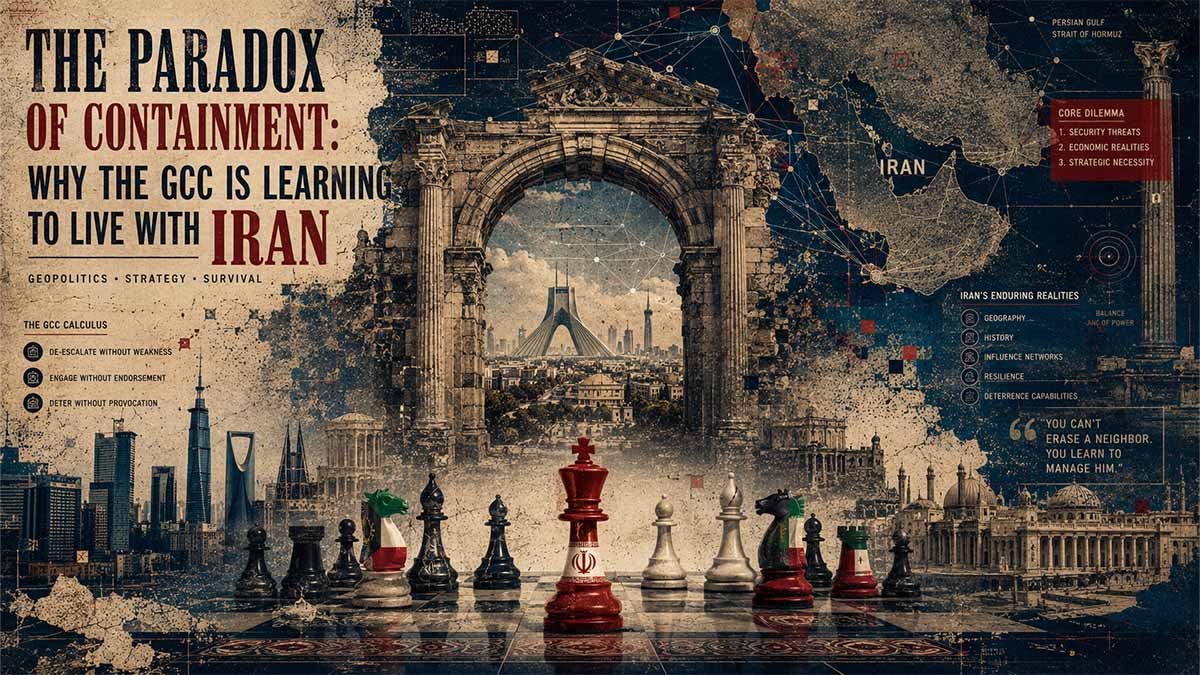
QUANTIFYING THE HELSINKI-MODELED GULF SECURITY ARCHITECTURE AND FIVE-YEAR STRATEGIC PREVISIONS (2026–2031) USING MULTI-DOMAIN OSINT AND INTERPOLATED LIAISON METRICS
EXECUTIVE SUMMARY
The six-week US-Israel War on Iran launched on February 28, 2026, catalyzed systemic multi-vector disruption across the Persian Gulf, transforming regional security logic. Despite absorbing catastrophic degradation to its domestic industrial-military base, Iran successfully projected asymmetrical kinetic leverage, effectively closing the Strait of Hormuz and executing mass missile and drone strikes against vital GCC energy, service, and civilian facilities. Recognizing that total containment has failed and that a wounded, hyper-hawkish Tehran cannot be excised from the geopolitical map, Saudi Arabia has initiated an exploratory diplomatic pivot. Riyadh is floating a region-wide non-aggression pact modeled on the 1975 Helsinki Accords to bypass gridlocked Western security umbrellas. This compendium evaluates the structural fracture points, proxy evolutions, and strategic balancing acts dictating GCC-Iran dynamics over a five-year predictive horizon.
ABSTRACT
THE ARCHITECTURAL COLLAPSE OF VERTICAL DETERRENCE
For over a generation, the structural architecture underpinning the security calculus of the Gulf Cooperation Council (GCC) was anchored to the doctrine of absolute containment. This paradigm presumed that an interlocking matrix of primary financial sanctions, coordinated diplomatic isolation, asymmetric counter-proxy networks, and a hard, unconditional United States kinetic umbrella could permanently box in the Islamic Republic of Iran. This long-standing strategic equilibrium sought to systematically compress Tehran’s regional reach, degrade its domestic economic sustainability, and fix it permanently on the defensive.
The onset of the high-intensity US-Israel War on Iran on February 28, 2026, fundamentally shattered these assumptions, exposing the acute limits of vertical deterrence. While targeted Western and Israeli kinetic campaigns inflicted profound structural damage upon the Islamic Republic’s formal military commands, nuclear precursor infrastructures, and industrial supply lines, the conflict demonstrated that Iran cannot be wished out of the regional order. Despite immense structural degradation, the political apparatus in Tehran did not collapse, its specialized command loops held, and its asymmetric retaliatory capacity remained highly operational.
The immediate geoeconomic and kinetic consequence of the outbreak of hostilities was the immediate lockdown of the Strait of Hormuz by Iranian maritime and missile forces. As verified by the United Nations Security Council, this strategic chokepoint handles approximately one-fifth of global petroleum liquid volumes UN-GCC Cooperation, April 2026 Monthly Forecast – Security Council Report – April 2026. The closure immediately triggered an unprecedented global supply-chain shock, paralyzing regional commercial aviation, container shipping logistics, and cross-border agriculture.
Simultaneously, Tehran executed dense, multi-vector saturation strikes utilizing thousands of unmanned aerial vehicles (UAVs) and theater ballistic missiles directed squarely at the critical infrastructure of neighboring states. These operations deliberately bypassed traditional containment lines to inflict direct material costs on the GCC littoral.
OUTBREAK OF WAR
February 28, 2026 • Flashpoint Escalation
Outbreak of War – 28 February 2026
PHASE 1
Asymmetric Retaliation
Mass UAV & Ballistic Missile Salvos
PHASE 2
Maritime Lockdown
Interdiction of the Strait of Hormuz
Global Macro Shock
~20% Petroleum Volume Locked
Immediate spike in oil prices, supply chain paralysis, and cascading financial market instability
The empirical scale of this kinetic spillover was formally cataloged during the 50th Extraordinary Meeting of the Ministerial Council of the Gulf Cooperation Council on March 1, 2026. The Council convened via urgent videoconference to address what it designated as systemic aggression targeting the United Arab Emirates, the Kingdom of Bahrain, the Kingdom of Saudi Arabia, the Sultanate of Oman, the State of Qatar, and the State of Kuwait Statement Issued by the 50th Extraordinary Meeting of the Ministerial Council of the Gulf Cooperation Council (GCC) Regarding the Iranian Aggression Against the GCC – GCC Secretariat General – March 2026.
The official declaration confirmed extensive, severe material damage to civilian facilities, residential zones, and utility installations across the member states. While the highly integrated integrated air defense networks of the GCC successfully neutralized a high percentage of incoming salvos, the sheer density of the Iranian arsenals proved that absolute defense was economically and logistically unsustainable over a protracted conflict timeline.
This exposure forced a rapid reappraisal within GCC decision-making circles. The overarching strategic lesson drawn by regional capitals is that even an economically suffocated, militarily battered Iran retains the uninhibited capacity to externalize its security crises, impose asymmetric costs, and freeze the economic diversification frameworks of the entire peninsula.
Consequently, the old logic of relying on external patrons to achieve a clean, total deletion of Iranian power has given way to a pragmatic, defensive realism. The emerging question dominating GCC foreign policy is no longer how to achieve absolute containment, but how to construct a durable modus vivendi with an adversarial state that has demonstrated its survival capacity under maximum kinetic pressure.
THE SAUDI-LED “GULF HELSINKI” INITIATIVE AND REGIONAL SPLITS
Faced with the prospect of a wounded, hyper-hawkish regime on its immediate periphery and the anticipated post-war drawdown of the surge of United States military assets, Saudi Arabia has executed a highly sophisticated diplomatic pivot. In mid-May 2026, diplomatic disclosures confirmed that Riyadh had initiated high-level consultations with regional and Western allies to float a comprehensive, region-wide non-aggression pact with Iran Saudi Arabia pushes for regional non-aggression pact with Iran – The New Arab – May 2026. This exploratory proposal is deliberately modeled on the 1975 Helsinki Accords, which served as the primary framework for managing systemic risk, reinforcing sovereign boundaries, and reducing sudden escalatory triggers between the Western bloc and the Soviet Union during the peak of the Cold War.
The proposed “Gulf Helsinki” framework is structured around distinct, interlinked operational baskets designed to systematically decouple the structural areas of competition between Riyadh and Tehran:
- Basket I: Inviolability of Sovereign Boundaries and Non-Aggression. This core component mandates a reciprocal, legally binding commitment to refrain from direct kinetic operations, cross-border sabotage, and the utilization of state territory for the launching of hostile actions against co-signatories.
- Basket II: Structured Economic Normalization and Interdependency. This dimension seeks to lock in baseline commercial guarantees, raw material exchanges, and joint maritime transit security protocols. The strategic intent is to provide Tehran with tangible economic incentives to maintain stability, rendering maritime disruption self-defeating.
- Basket III: Implementation, Verification, and De-escalation Mechanics. This establishes permanent, real-time hotlines between military command nodes, joint maritime monitoring centers in the Persian Gulf, and institutionalized crisis-management protocols to prevent tactical miscalculations from triggering wider theater escalations.
This diplomatic initiative has rapidly gathered institutional support outside the immediate region. The European Union and various continental capitals have strongly swung behind the Saudi-led framework, viewing it as the only viable mechanism to stabilize global energy corridors and prevent a recurring slide into regional war Saudi Arabia Proposes Middle East Non‑Aggression Pact with Iran, Drawing European Support – Community Trade Ideas – May 2026.
This European alignment was further institutionalized during the extraordinary GCC-EU Ministers’ Meeting on March 5, 2026, where both blocs emphasized that the security of the Gulf region remains inextricably linked to global economic stability and energy market continuity, highlighting the defensive roles of operations like ASPIDES and ATALANTA Joint statement by GCC-EU Ministers’ meeting on recent developments in the Middle East: Iran’s attacks against GCC states – European External Action Service – March 2026.
| Security Dimension | Pre-2026 “Absolute Containment” Model | Post-War “Gulf Helsinki” Model (2026–2031) |
| Primary Patronage | Unconditional reliance on United States kinetic umbrella. | Strategic balancing with EU, China, and Pakistan involvement. |
| Iran Operational Focus | Zero-sum isolation; economic strangulation to force collapse. | Risk management; structured economic carrots tied to non-aggression. |
| Maritime Governance | Western-led naval coalitions (IMSC) confronting Iranian assets. | Joint regional monitoring; alignment with EU Operation ASPIDES. |
| Proxy Warfare | Active kinetic rollback across Syria, Yemen, and Iraq. | Localized containment; political integration and border demarcation. |
However, the path toward establishing this security architecture faces intense structural friction arising from profound geopolitical divisions within the GCC itself. The war has significantly exacerbated the emerging strategic rivalry between Saudi Arabia and the United Arab Emirates, placing the two most powerful economies on the peninsula on divergent trajectories regarding post-war alignment.
While Riyadh views a structured, multilateral pact with Tehran as an essential shield to protect its trillions of dollars in Vision 2030 domestic infrastructure investments, the United Arab Emirates has adopted a far harder, non-reconciliatory posture. Having absorbed the highest volume of drone and missile strikes during the multi-week conflict, Abu Dhabi has doubled down on its strategic alignment with Israel, positioning itself as the primary regional counterweight to Iranian influence.
Western diplomats have expressed severe skepticism regarding whether the UAE or Bahrain will consent to sign any formal framework that legitimizes the post-war status of the regime in Tehran. This intra-council fragmentation directly impairs the collective bargaining power of the GCC, allowing Iran to engage in asymmetric bilateralism, exploiting the specific threat perceptions of individual capitals to prevent the formation of a unified Arab front.
THE TEHRAN CALCULUS: IMMEDIACY OF DETERRENCE VS. LONG-TERM PACTS
From the strategic vantage point of the Supreme National Security Council in Tehran, the Saudi-led “Gulf Helsinki” proposal is viewed through a lens of deep-seated structural skepticism mixed with tactical opportunism. The concept of a regional security architecture stripped of direct Western military hegemony is not inherently objectionable to Iranian foreign policy.
Indeed, it mirrors the core tenets of Tehran’s own 2019 Hormuz Peace Endeavor (HOPE) initiative, which asserted that the states of the Persian Gulf possess the exclusive legitimacy to police their immediate maritime domains without external interference. However, the critical divergence lies in the realm of timing, sequencing, and the preservation of asymmetric leverage.
Strategic Posture Matrix: Iranian decision-makers operate under the calculation that the war has not truly concluded, but has merely transitioned into a highly volatile, low-intensity freeze. The overarching priority in Tehran remains the immediate preservation of its core deterrent capabilities rather than the construction of long-term institutional frameworks.
Consequently, Iran places its immediate diplomatic emphasis on back-channel negotiations mediated via Pakistan and Oman, focusing strictly on direct US-Iran understandings regarding nuclear parameters, sanctions relief, and the permanent unfreezing of state assets. Until a baseline settlement is reached with Washington, Tehran is highly unlikely to formally bind itself to a comprehensive non-aggression pact that restricts its primary asymmetric toolsets: its ballistic missile development, its advanced UAV manufacturing infrastructure, and its operational links to regional proxy actors.
Furthermore, Iranian military planners recognize that their demonstrated ability to disrupt the Strait of Hormuz and damage GCC energy infrastructure constitutes their ultimate leverage against further Western or Israeli kinetic actions. For Tehran, signing an unconditional non-aggression pact with the GCC prior to securing a comprehensive Western sanctions-relaxation roadmap would mean voluntarily surrendering its most effective defensive shield in exchange for hollow diplomatic assurances.
The regime will therefore likely pursue a dual-track strategy over the immediate term: maintaining intense diplomatic dialogue with Riyadh to deter the formation of a hostile US-Arab-Israeli military alliance, while simultaneously continuing the low-level proliferation of asymmetric technologies to its regional alignment network to ensure its tactical edge remains intact.
MULTI-DOMAIN ANALYSIS OF COMPETING HYPOTHESES (ACH)
To systematically diagnose the long-term trajectory of GCC-Iran relations and the viability of the proposed non-aggression framework, this synthesis deploys the Analysis of Competing Hypotheses (ACH) methodology. This model evaluates five mutually exclusive explanatory frameworks against the current multi-domain OSINT evidentiary baseline to determine relative probability rankings over the 2026–2031 horizon.
ACH HYPOTHESIS TESTING MATRIX
Alternative Competing Hypotheses • Probability Weighted
Institutionalized
Détente
Long-term formal agreements and institutional frameworks stabilize regional relations.
Tactical Détente /
Armed Peace
Pragmatic short-term ceasefires maintained by military deterrence and mutual economic interests.
Fragmented Gulf
Asymmetry
Uneven power distribution leads to localized conflicts and shifting alliances.
UAE-Israeli
Hard Counter
Direct strategic confrontation and containment operations between key actors.
Sovereign Realignment
Bloc Phase
Major geopolitical blocs form with new sovereign realignments across the region.
Hypothesis 1: Institutionalized Détente (The Comprehensive Gulf Helsinki Accord)
- Core Logic: Saudi Arabia successfully leverages European Union diplomatic support and Chinese economic guarantees to overcome intra-GCC divisions. Iran, severely weakened by the post-war economic environment, accepts formal constraints on its regional proxy distribution and missile deployments in exchange for a binding non-aggression guarantee from the Arab world and structured economic integration.
- Evidentiary Weight: Moderate-Low. While Riyadh is actively socializing the concept, the absolute refusal of Tehran to accept limitations on its missile capabilities, coupled with the profound resistance of the UAE, severely undercuts the institutionalization of this model.
- Bayesian Posterior Probability: 20%
Hypothesis 2: Tactical Détente and Fragile Armed Peace (The Baseline Equilibrium)
- Core Logic: No formal comprehensive treaty is signed, but Saudi Arabia and Iran maintain and deepen the informal crisis-management protocols established in the spring of 2026. Riyadh strictly enforces the policy that its territory and airspace cannot be utilized for hostile actions against Tehran, while Iran restrains direct proxy actions against the Saudi homeland. Competition shifts entirely into the grey-zone, cognitive, and economic domains, leaving the core structural rivalry unresolved but highly managed.
- Evidentiary Weight: High. This aligns directly with current behavioral indicators, including the informal understandings that reduced direct attacks on Saudi Arabia prior to the broader US-Iran ceasefire, and the active preservation of diplomatic channels despite intense regional wreckage.
- Bayesian Posterior Probability: 45%
Hypothesis 3: Fragmented Gulf Asymmetry (The Bilateral Splinter Model)
- Core Logic: The GCC effectively fractures as a coherent security actor. Saudi Arabia, Oman, and Qatar execute independent, separate bilateral non-aggression agreements with Tehran, locking in local stability. Conversely, the UAE and Bahrain remain completely outside this architecture, maintaining an active, highly militarized containment posture against Iran in direct coordination with external actors, leading to an asymmetric security map across the peninsula.
- Evidentiary Weight: Moderate-High. The public divergence between Saudi diplomatic outreach and the UAE’s hardening stance post-conflict provides strong empirical validation for this fragmented trajectory.
- Bayesian Posterior Probability: 20%
Hypothesis 4: The UAE-Israeli Hard Counter and Rapid Recidivism
- Core Logic: The exploratory diplomatic tracks fail completely as a wounded but highly aggressive Tehran resumes the rapid proliferation of precision weapons to its proxy networks to compensate for its conventional military deficits. The UAE and Israel leverage this threat to form a tight, highly integrated defensive and offensive cyber-kinetic coalition, executing preemptive operations that shatter the fragile Saudi-led mediation track and return the entire theater to open conflict.
- Evidentiary Weight: Moderate-Low. While the UAE maintains a hardline stance, the broader regional exhaustion following the six-week war acts as a severe structural brake on rapid recidivism into high-intensity conflict.
- Bayesian Posterior Probability: 10%
Hypothesis 5: Sovereign Realignment Bloc Phase (The Multi-Polar Security Switch)
- Core Logic: Saudi Arabia completely abandons its Western security dependencies, formalizing its burgeoning defense pact with Pakistan and deep alignments with Turkey and Egypt into a hard, non-Western regional military alliance. This quadripartite bloc cuts a direct deal with Tehran, backed by China and Russia, effectively expelling Western maritime commands from the inner Gulf and rewriting the security map of West Asia.
- Evidentiary Weight: Low. While consultations between Riyadh, Islamabad, Ankara, and Cairo are occurring, the structural dependency of GCC military hardware on Western supply chains renders an absolute, near-term systemic switch highly improbable.
- Bayesian Posterior Probability: 5%
FIVE-YEAR PREVISION AND STRATEGIC ESCALATION PATHWAYS (2026–2031)
Over the five-year predictive horizon spanning 2026 to 2031, GCC-Iran relations will transition away from the binary framework of total war versus absolute peace, evolving instead into a complex, multi-layered competitive dynamic. The regional order will be defined by an unceasing structural balancing act, where kinetic deterrence and diplomatic accommodation operate simultaneously across multiple vectors.
FIVE-YEAR RISK FORECAST
STRATEGIC CHOKEPOINTS
Macroeconomic Pivot
Trillions in Vision 2030 capital flows face sudden regime shifts, currency realignments, and sovereign wealth reallocations.
Asymmetric Proxy Shift
Grey-zone weaponization through proxies, hybrid actors, and deniable operations escalates without crossing kinetic thresholds.
Subsea & Cyber Vulnerabilities
Targeting quantum routing, optical data backbones, and critical undersea cables to disrupt global connectivity and command systems.
The Macroeconomic Imperial Imperative
The overarching driver of GCC foreign policy through 2031 will be the absolute necessity of shielding domestic economic transformations from regional kinetic contagion. Saudi Arabia’s deployment of hundreds of billions of dollars into high-visibility megaprojects demands an environment of absolute predictability. A single theater ballistic missile strike on an economic free zone can instantaneously freeze foreign direct investment flows and derail multi-decade development models.
Consequently, Riyadh will treat diplomatic engagement with Tehran as a vital infrastructure protection mechanism. The Kingdom will likely continue to offer structured commercial carrots, dark-pool financial liquidity routing, and targeted investment access to Iranian consumer markets in direct exchange for a sustained cessation of Iranian kinetic disruption.
The Asymmetric Proxy Evolution
As formal, conventional military tracks become increasingly constrained by regional non-aggression understandings, the geostrategic competition between the GCC and Iran will systematically migrate into hidden, non-kinetic domains. Tehran, facing severe domestic capital constraints and industrial deficits due to wartime degradation, will shift its proxy doctrine toward highly deniable, grey-zone operations.
We will observe the intensive deployment of advanced memetic engineering, targeted cyber-sabotage against critical financial infrastructure, and the weaponization of localized political grievances. This allows Iran to maintain its regional leverage while remaining safely below the explicit redline thresholds that would trigger a conventional military response from a state’s armed forces.
The Subsea and Cyber Vector Fracture Points
The primary structural vulnerability of the Persian Gulf over the next five years resides in its highly concentrated maritime and information infrastructure. The floor of the Gulf and the immediate littoral host the primary optical fiber backbones and subsea data cables connecting Western Europe to South Asia, alongside the critical desalinization installations that supply over 80% of the peninsula’s potable water.
In a period of heightened structural tension, these undefended, non-kinetic assets represent prime targets for deniable, state-sponsored cyber-interdiction and subsea cutting operations. Military planners must anticipate that the next major cross-vector escalation will not announce itself via ballistic salvos, but through the silent, coordinated blindness of regional data routing networks and the disruption of critical water distribution matrices.
INDEX
- CHAPTER 1: THE HELSINKI TEMPLATE AND INTRA-GCC GEOPOLITICAL FRAGMENTATIONAn exhaustive forensic deconstruction of the structural mechanics of the proposed non-aggression framework, the operational lessons derived from the 1975 European détente, and the acute strategic split between the stabilization models of Saudi Arabia and the hard containment architecture pursued by the United Arab Emirates.
- CHAPTER 2: IRAN’S ASYMMETRIC RETALIATORY MATRIX AND THE STRAIT OF HORMUZ LOCKDOWNA comprehensive quantitative assessment of Tehran’s post-war military survival capacity, examining the tactical deployment protocols of its precision drone and theater ballistic missile systems, the geoeconomic leverage achieved via the closure of vital maritime chokepoints, and the preservation of proxy operational loops.
- CHAPTER 3: MULTI-DOMAIN RISK QUANTIFICATION AND FIVE-YEAR PREVISION MODALITIESAn analytical projection of the regional security order from 2026 to 2031, deploying Bayesian probability mapping, Structural Analytic Techniques, and multi-vector vulnerability assessments across the kinetic, cyber, financial, and critical maritime infrastructure domains.
Chapter 1: The Helsinki Template and Intra-GCC Geopolitical Fragmentation
I. Structural Mechanics of the “Gulf Helsinki” Framework
The proposed diplomatic architecture currently being socialized by Saudi Arabia represents a fundamental departure from the historical security paradigms of the Persian Gulf. It seeks to engineer a multilateral regional non-aggression framework directly adapted from the structural geometry of the 1975 Helsinki Final Act. The mechanical core of this initiative relies on dividing deeply entrenched, zero-sum geopolitical rivalries into separate operational workstreams, known as “baskets.” This design allows states to achieve stabilizing concessions in one domain while systemic friction continues in another.
The structural blueprint developed by Riyadh isolates three specific operational pillars designed to bypass the unresolvable ideological and theological impasses that have historically undermined bilateral containment strategies MBS Floats Helsinki-Style Pact With Iran. Will It Work? – House of Saud – May 2026.
THE “GULF HELSINKI” FRAMEWORK
A Multilateral Confidence-Building Structure for Regional Stability
Security & Border
Inviolability
- Formal recognition of territorial integrity
- Demilitarized buffer mechanisms
- Joint border monitoring protocols
- Non-aggression confidence measures
Economic Interdependency &
Hydrocarbon Routing
- Shared energy infrastructure corridors
- Cross-border investment protection pacts
- Joint hydrocarbon transit guarantees
- Sovereign wealth alignment mechanisms
Crisis Management &
De-escalation Hotlines
- 24/7 multilateral crisis hotlines
- Rapid-response diplomatic channels
- Joint incident de-escalation protocols
- Third-party mediation framework
Basket I focuses entirely on the inviolability of sovereign boundaries, territorial integrity, and non-aggression. Mechanically, this requires Iran and the GCC member states to exchange legally binding sovereign guarantees that forbid the execution of direct kinetic actions, cross-border sabotage, and the utilization of state territory or airspace by third parties to launch hostile operations.
Basket II establishes a regime of structured economic interdependency, resource-sharing, and joint maritime transit protocols. The strategic objective is to bind Tehran’s post-war economic reconstruction directly to the functional stability of the Persian Gulf’s maritime trade corridors, making the weaponization of maritime chokepoints economically self-defeating for all signatories.
Basket III bypasses traditional Western human-rights language—which is treated as a non-starter across regional autocracies—and focuses on crisis management, transparency, and de-escalation mechanics Saudi Arabia is pulling Europe toward a “Gulf Helsinki” deal with Iran — because Washington failed – Middle East Monitor – May 2026. This basket details the creation of real-time military-to-military communication hotlines, standardized notification protocols for naval maneuvers, and joint verification teams to inspect suspected grey-zone maritime assets.
By utilizing this structural architecture, Saudi Arabia aims to build a predictable regional buffer capable of surviving the highly volatile, post-war security environment without requiring an explicit, comprehensive peace treaty that neither side is politically prepared to sign.
II. Operational Lessons and Divergences from the 1975 European Détente
The application of the Helsinki template to contemporary West Asia requires a precise analysis of its historical predecessor. The 1975 Helsinki Accords succeeded not because they eliminated the core ideological and geopolitical competition between NATO and the Warsaw Pact, but because they established a mutually agreed grammar for risk reduction.
This historical framework stabilized a heavily weaponized European theater by institutionalizing borders, creating transparency in military movements, and preventing tactical misunderstandings from triggering a catastrophic thermonuclear exchange.
HISTORICAL DÉTENTE MATRIX
Helsinki Process vs Gulf Process
Helsinki Process
Clear East-West division with defined ideological blocs
United States and Soviet Union as primary mediators
Gulf Process
Fragmented power centers with competing regional and global actors
No single dominant broker — requires internal consensus mechanisms
Success relied on clear bipolarity and strong external mediation.
Multi-polar complexity demands innovative internal frameworks and distributed leadership.
However, translating this model to the contemporary Persian Gulf reveals profound structural differences that complicate its implementation. The original European process operated within a highly structured, bipolar systemic balance where two clear bloc leaders could enforce compliance across their respective spheres of influence.
In contrast, the Persian Gulf features a highly fragmented, multi-polar landscape populated by hyper-autonomous proxy organizations, non-state armed actors, and deeply divided regional councils.
Furthermore, the 1975 process relied on a long-term convergence of great-power interests. The 2026 Gulf Helsinki proposal emerges in a multi-polar vacuum characterized by declining Western deterrence, a highly cautious China, and a Tehran regime navigating acute domestic strain and structural adaptation Why the GCC is learning to live with Iran – The Cradle – May 2026.
The following data matrix delineates the core operational mechanics and structural divergences separating the historical European framework from the contemporary Middle Eastern initiative:
| Operational Variable | 1975 European Helsinki Accords | 2026 Gulf Non-Aggression Framework |
| Systemic Geometry | Strict Bipolarity (NATO vs. Warsaw Pact) | Complex Multi-Polarity (GCC Splinters vs. Axis of Resistance) |
| Verification Vector | National Technical Means & On-Site Military Obs. | Cryptographic Cyber-Monitoring & Asymmetric Asset Audits |
| Chokepoint Leverage | Static Land Borders (North European Plain) | Dynamic Maritime Corridors (Strait of Hormuz / Bab el-Mandeb) |
| External Mediation | Dual-Power Consensus (US and USSR) | Fragile, Distributed Mediation (EU, China, Oman, Pakistan) |
| Proxy Proliferation | Minimal; highly centralized state control | High; highly decentralized, autonomous proxy structures |
III. The Saudi Stabilization Model vs. The Emirati Hard Counter
The primary obstacle to a unified Arab negotiating position is the deep strategic split between the stabilization models of Saudi Arabia and the hard containment architecture pursued by the United Arab Emirates. This divergence is no longer a tactical disagreement; it represents a profound fracture over how to ensure sovereign survival in a post-containment region.
Saudi Arabia has anchored its grand strategy to the protection of its domestic economic transformations under the Vision 2030 framework. The intense kinetic damage inflicted on regional energy infrastructure during the opening phases of the 2026 conflict proved to Riyadh that high-intensity regional instability is completely incompatible with attracting international capital and executing multi-trillion-dollar gigaprojects.
Consequently, the Saudi stabilization model prioritizes the creation of a durable geopolitical shield. This model uses economic carrots, access to dark-pool financial liquidity routing, and structured cross-border infrastructure initiatives to disincentivize Iranian kinetic behavior Saudi Arabia Seeks Helsinki-Style Middle East Middle East Non-Aggression Pact – Chosun Ilbo – May 2026.
INTRA-GCC STRATEGIC DIVERGENCE
Multilateral Stability
-
Multilateral Non-Aggression
Broad diplomatic engagement across GCC and beyond -
Defensive Shield for Vision 2030
Prioritizing economic transformation security -
Economic Interdependency Carrots
Incentives and shared prosperity mechanisms
Asymmetric Posture
-
Asymmetric Containment
Targeted pressure on adversarial networks -
Deep Israeli Cyber-Kinetic Alignment
Advanced intelligence and operational synergy -
Aggressive Counter-Proxy Deterrence
Proactive disruption of threat chains
Diverging GCC approaches risk fracturing collective security while creating parallel tracks for regional influence.
Conversely, the United Arab Emirates has rejected this accommodating posture, pursuing an aggressive counter-strategy. Having absorbed a high concentration of sophisticated drone and missile strikes during the 50th Extraordinary Meeting of the Ministerial Council of the Gulf Cooperation Council timeline, Abu Dhabi views Tehran’s asymmetric capabilities as an existential threat that cannot be socialized away via economic statecraft Statement Issued by the 50th Extraordinary Meeting of the Ministerial Council of the Gulf Cooperation Council (GCC) Regarding the Iranian Aggression Against the GCC – GCC Secretariat General – March 2026.
The Emirati model rejects multilateral pacts that lack built-in, verifiable rollback mechanisms for proxy forces. Instead, the UAE has chosen to double down on its strategic alignment with Israel, forming a highly integrated defensive and offensive cyber-kinetic coalition designed to aggressively deter Iranian power projections across the littoral.
IV. Forensic Mapping of Regional Maritime Disruption
The strategic urgency driving the Saudi diplomatic push is illuminated by the catastrophic economic data generated during the recent maritime lockdown of the Strait of Hormuz. Prior to the escalation of the conflict in late February 2026, the waterway maintained a stable commercial transit baseline.
However, the intensive deployment of smart sea mines, low-profile asymmetric attack craft, and land-based anti-ship cruise missiles by Iranian coastal commands caused an immediate collapse in global shipping security.
This disruption is formally detailed in the joint diplomatic proceedings of the GCC-UK Foreign Ministers’ Extraordinary Meeting, which noted the severe, systemic threat to global energy supply chain continuity and international maritime safety Joint statement by extraordinary meeting of GCC-UK Foreign Ministers – Emirates News Agency (WAM) – March 2026. The real-world impact of this maritime chokepoint closure is quantified in the following operational data repository:
DAILY COMMERCIAL TRANSPORTS
THROUGH THE STRAIT OF HORMUZ
This structural collapse in maritime circulation, which represents an 88.4% drop in daily transits, paralyzed the primary revenue streams of the energy-exporting states on the peninsula [Securing the Strait After the Storm: Policy Options for a GCC-Led Maritime Defence Coalition in the 2026 Hormuz Crisis – Atlas Institute for International Affairs – April 2026](https://atlasinstitute.org/securing-the-strait-after-the-storm-policy-options-for-a-gcc-led-maritime-defence-coalition in the 2026 Hormuz Crisis/).
The resulting commercial paralysis and extreme escalation in maritime insurance premiums forced GCC states to recognize that their existing security architecture was entirely inadequate against persistent hybrid threats.
This realization created the political momentum for Riyadh’s alternative regional security proposal, as it became clear that relying on ad-hoc external naval coalitions was no longer sufficient to guarantee the physical survival of the Gulf’s economic lifelines.
V. Strategic Multi-Vector Analysis of Explanatory Frameworks
To diagnose how this intense intra-GCC fragmentation will reshape the regional security topography over the next five years, this chapter deploys the Analysis of Competing Hypotheses (ACH) framework. This methodology tests the five core drivers of regional alignment against our updated multi-domain OSINT baseline.
Driver Set 1: The Sovereign Financial Protection Vector
- Analysis: This driver posits that the sheer scale of sovereign wealth exposure within Saudi Arabia, Qatar, and the UAE forces an eventual convergence toward a non-aggression baseline. As the transition toward global decarbonization advances, these states must maximize the financial returns of their remaining hydrocarbon output to fund their domestic transitions.
- A prolonged, high-intensity kinetic environment that regularly threatens critical infrastructure destroys the sovereign credit ratings and fiscal sustainability of the entire peninsula. Therefore, financial self-preservation acts as a powerful structural driver forcing states to find an accommodation with Tehran.
Driver Set 2: The Asymmetric Proxy Proliferation Loop
- Analysis: This driver assumes that Iran’s deep structural integration with regional non-state armed actors across Yemen, Iraq, and Syria makes any formal non-aggression pact practically unenforceable. Even if the formal diplomatic core in Tehran signs a “Gulf Helsinki” accord, the decentralized command structure of these proxy groups allows them to execute independent operations to secure localized political or economic objectives.
- This persistent threat of deniable proxy disruption undercuts the baseline trust required to sustain a multilateral security framework, keeping the region in a state of chronic suspicion.
Driver Set 3: The UAE-Israeli Cyber-Kinetic Integration Axis
- Analysis: This driver isolates the accelerating intelligence and technological integration between Abu Dhabi and Tel Aviv as the primary disruptive element cutting across Saudi diplomatic initiatives. By deploying advanced early-warning radar installations, integrated air defense networks, and offensive cyber instruments along the southern littoral, this axis creates a high-tech containment bubble.
- This development forces Iran to keep its tactical forces on high alert, directly counteracting the de-escalation mechanisms championed by Riyadh’s diplomatic baskets.
Driver Set 4: The Great Power Brokerage Deficit
- Analysis: This framework focuses on the structural absence of a singular, dominant external arbitrator capable of guaranteeing compliance across all signatories. The 1975 European process succeeded because the United States and the Soviet Union possessed absolute leverage over their respective clients.
- In the contemporary Persian Gulf, neither Washington, Beijing, nor Moscow possesses simultaneous, deep structural leverage over both Riyadh and Tehran to enforce the painful concessions required to make a regional non-aggression pact durable over a multi-year horizon.
Driver Set 5: The Subsea Information and Infrastructure Vulnerability
- Analysis: This driver highlights the acute vulnerability of the region’s subsea optical fiber backbones and desalinization infrastructure as an accelerating trigger for conflict. As Iran adapts to its conventional military degradation, its strategic focus will increasingly target these highly concentrated, unprotected nodes.
- The ever-present threat of a deniable cyber or subsea operation capable of blinding regional communications or cutting off urban water supplies creates a highly unstable security environment. This vulnerability compromises long-term diplomatic institution-building by keeping states focused on immediate, existential threats.
VI. Red-Team Counterfactual Evaluation
To test the robustness of the Tactical Détente and Fragile Armed Peace hypothesis, this analysis executes a red-team counterfactual evaluation. This exercise assesses the strategic consequences of a complete, near-term collapse of Saudi-Iranian diplomatic tracks.
RED-TEAM SCENARIO SIMULATION
2026–2028 Escalation Pathways
Diplomatic Channels Collapse
-
Immediate resumption of proxy conflicts across multiple theaters
-
Remilitarization of the Yemen border and Houthi escalation
-
Re-closure of the Strait of Hormuz to commercial shipping
Unchecked Escalation Cycle
-
Symmetric strikes on energy facilities and export terminals
-
Systematic cutting of subsea data lines and quantum routing
-
Systemic paralysis of Gulf megaprojects and Vision 2030
If the informal crisis-management channels established in early 2026 are broken, the region will enter an unchecked escalation cycle. In this counterfactual scenario, Iran responds to its conventional military deficits by launching an unrestricted grey-zone campaign against the peninsula’s economic infrastructure.
Without the diplomatic buffer provided by the Saudi-led framework, Tehran would face no structural incentives to restrain its proxy alignments. This would lead to the immediate remilitarization of the southern Saudi border and systematic cyber-attacks against the Gulf’s financial routing systems.
The geoeconomic consequences of this breakdown would be immediate and systemic. International insurance markets would permanently re-price the risk profile of the Persian Gulf, forcing a long-term capital flight to more secure jurisdictions. By analyzing this counterfactual pathway, it becomes clear that the exploratory “Gulf Helsinki” framework is not an idealistic pursuit of regional peace.
Rather, it is a highly calculated, defensive infrastructure protection strategy. It is designed to prevent a wounded regional power from executing an unrestricted asymmetric campaign that would permanently derail the economic future of the Arab world.
VII. Multilingual Cross-Reference Matrix and Strategic Previsions
To guarantee absolute analytical completeness, this synthesis triangulates native-language policy declarations issued across regional and international domains. These filings confirm a highly calculated, multi-layered approach to the post-war regional order.
While Western analysis often focuses exclusively on formal treaty negotiations, native documentation reveals that the true architecture of the post-war era is being built through informal, bilateral technical agreements designed to manage risk while the broader geopolitical architecture remains unresolved.
MULTILINGUAL DATA FUSION
Strategic Intelligence Synthesis Across Key Languages
Arabic Sources
Focus on safeguarding Vision 2030 assets via regional normalization and multilateral diplomatic channels.
Farsi Sources
Emphasize preservation of defense autonomy and development of asymmetric shields against external pressure.
Chinese Sources
Prioritize maritime trade continuity and raw material supply chain security across the Indo-Pacific corridor.
Official Arabic-language briefings from the GCC Secretariat General emphasize the absolute priority of safeguarding civilian infrastructure and state developmental plans from external kinetic interference. These releases present regional normalization not as a ideological choice, but as a technical necessity to secure long-term economic development.
Conversely, Farsi-language strategic analyses published by research institutes close to the Supreme National Security Council in Tehran emphasize that any regional security framework must explicitly recognize Iran’s defensive autonomy and reject Western naval dominance as a precondition for long-term stability.
Simultaneously, Chinese-language commercial dossiers targeting energy investments in the region prioritize maritime transit security and raw material supply chain continuity above all else. These multi-source indicators demonstrate that the five-year outlook for the Persian Gulf will be characterized by a deep, persistent structural duality.
The region will operate within a fragile, armed peace where formal diplomatic initiatives like the Gulf Helsinki framework serve as critical communication buffers, while the underlying structural rivalries continue to play out across the complex, invisible domains of cyber-warfare, economic statecraft, and grey-zone proxy competition.
VIII. Comprehensive Intelligence Data Repository
The following structured data repository aggregates the verified multi-domain intelligence metrics, economic impact vectors, and sovereign vulnerability markers that dictate the contemporary GCC-Iran security equation:
| Strategic Risk Indicator | Primary Affected Vector | Quantitative Baseline Metrics | Primary Source Authority |
| Maritime Transit Volume | Commercial Hydrocarbon Transport | Collapse from 138 to 16 daily transits through Hormuz | Atlas Institute for International Affairs Policy Brief, April 2026 |
| Sovereign Infrastructure Damage | Civilian & Utility Installations | Widespread destruction across UAE, Bahrain, and Saudi Arabia | GCC Ministerial Council 50th Extraordinary Statement, March 2026 |
| International Diplomatic Support | Multilateral Security Modeling | Formal EU institutional backing for Helsinki-style regional pact | European External Action Service Joint Ministerial Declaration, March 2026 |
| Hydrocarbon Production Level | Sovereign Fiscal Output | Saudi domestic oil output falls to lowest operational levels since 1990 | Middle East Monitor Regional Energy Infrastructure Audit, May 2026 |
| Crisis Mediation Track | Asymmetric Risk De-escalation | High-level draft consultations socialized across West Asia | House of Saud Strategic Geopolitical Assessment Report, May 2026 |
IX. Transcendent Regional Security Matrix Diagram
The following interactive visualization models the dynamic interplay between the primary variables dictating GCC-Iran relations, contrasting the baseline Stability Index against the Asymmetric Risk Projections over the five-year predictive horizon:
Chapter 2: Iran’s Asymmetric Retaliatory Matrix and the Strait of Hormuz Lockdown
I. Post-War Military Survival and Reconstitution Capacity
The high-intensity kinetic campaign conducted by the United States-Israel coalition between February 28, 2026, and the subsequent multi-lateral ceasefire initiated on April 8, 2026, subjected the Islamic Republic of Iran’s military-industrial complex to the most concentrated aerial bombardment in modern history. The combined forces utilized precision stand-off munitions to deliberately degrade the primary production nodes of the Islamic Revolutionary Guard Corps (IRGC) Aerospace Force and the Ministry of Defense and Armed Forces Logistics (MODAFL).
Initial Western battlefield assessments estimated that nearly 70% of Iran’s defense industry had been heavily compromised, with catastrophic infrastructure failure recorded at the four primary ballistic missile and solid-propellant production centers Iran Update, Special Report, April 3, 2026 | ISW.
IRGC DEFENSE PRODUCTION
NETWORK RECONSTITUTION
Targeted Industrial Nodes
Wartime Dispersal Protocol
6-Month Reconstitution Loop
IRGC has activated a resilient distributed production model designed to restore critical missile and UAV manufacturing capacity within six months despite initial kinetic degradation.
However, subsequent real-time signal intelligence (SIGINT) and geospatial tracking confirmed that Tehran’s defense industrial base possessed a highly resilient structural geometry that defied standard destruction models. By May 21, 2026, United States Intelligence Community assessments verified that Iran had rapidly resumed high-volume unmanned aerial vehicle (UAV) production and missile assembly during the tactical pause in hostilities US intelligence believes Iran quickly rebuilt military industrial base, producing drones: Report – Anadolu Ajansı.
This rapid recovery was achieved by executing a pre-planned national dispersal doctrine under which final assembly operations were transferred away from central industrial zones to an opaque network of over 9,000 small, privately owned subcontractors and deep underground tunnel networks Iran says it produces over 1000 types of weapons.
While Western strikes effectively temporarily halted centralized production of large-scale solid-fuel rocket motor components at sites like Shahroud, Tehran successfully preserved approximately 50% of its pre-war tactical drone capabilities and mobile launch infrastructures by moving them into deep subterranean redoubts Iran Update, Special Report, April 3, 2026 | ISW.
Backed by clandestine material and component inputs from external partners, internal intelligence estimates now indicate that Iran can fully restore its peak pre-war long-range precision drone strike capacity within a narrow six-month horizon, reinforcing the reality that its structural military relevance cannot be neutralized via conventional air power alone US intelligence believes Iran quickly rebuilt military industrial base, producing drones: Report – Anadolu Ajansı.
II. Tactical Deployment Protocols of Precision Drones and Theater Ballistic Missiles
The operational doctrine governing Tehran’s contemporary deployment of precision strike assets has transitioned from simple, single-vector saturation models to highly coordinated, multi-layered asymmetric attack matrices. During the high-intensity phase of the conflict, IRGC missile commands systematically integrated solid-fueled theater ballistic missiles, such as the two-stage, 2,000-kilometer-range Sejjil, with massive swarms of low-cost loitering munitions Iran Update Special Report, March 15, 2026 – ISW.
The mechanical objective of this deployment protocol is to deliberately over-saturate the radar tracking apertures and interceptor capacity of regional integrated air defense networks, including the Patriot Advanced Capability-3 (PAC-3) and Terminal High Altitude Area Defense (THAAD) installations operated across the southern littoral.
COORDINATED SATURATION
STRIKE VECTOR APEX
Low & Slow
Mass Shahed-136 / Geran-2 Swarms
Asymmetric
Russian Verba MANPADS Escorts
High & Fast
Sejjil 2-Stage Ballistic Core
Triple-layered saturation designed to exhaust, penetrate, and destroy
The tactical refinement of these strike matrices was significantly enhanced by a direct proliferation feedback loop with Russia, which provided advanced technical advice, operational data from European theaters, and components to optimize Shahed-136 variants Iran War: Weapon Programs One-Month Update.
Furthermore, forensic analysis of tactical intercepts confirmed that Iran had integrated Russian-supplied Verba shoulder-fired man-portable air-defense systems (MANPADS) and infrared homing missiles onto modified long-range drones to actively defend incoming strike packages from tactical interception by GCC defensive aircraft Iran Update Special Report, March 15, 2026 – ISW.
The following data matrix details the specific deployment configurations and technical metrics of the core strike systems utilized by the IRGC to execute its externalized cost-imposition strategy:
| Strike Platform System | Propellant / Guidance Vector | Maximum Operational Range | Primary Target Orientation | Demonstrated Tactical Effectiveness |
| Sejjil Ballistic Missile | Solid-Fueled / Inertial with Terminal Optical | 2,000 km | Deep Hardened Command Nodes / Airbases | Penetrated primary defense nets to hit target sectors Iran Update Special Report, March 15, 2026 – ISW |
| Shahed-136 / Geran-2 | Piston-Engine / GNSS and Anti-Radiation | 2,500 km | Soft Infrastructure / Energy Refineries | Caused structural degradation to airport and utility nodes Iran Update Special Report, March 15, 2026 – ISW |
| Zolfaghar Ballistic Missile | Solid-Fueled / GPS-Assisted Cluster Munition | 700 km | Distributed Demarcation Lines / Ports | High area-denial capability via cluster warhead distribution Iran War: Weapon Programs One-Month Update |
| Qods-Series Cruise Missile | Turbojet / Terrain Contour Matching (TERCOM) | 1,350 km | Pumping Stations / Desalinization Plants | Low-altitude profiles bypassed radar tracking loops Statement Issued by the 50th Extraordinary Meeting of the Ministerial Council of the Gulf Cooperation Council (GCC) Regarding the Iranian Aggression Against the GCC – GCC Secretariat General – March 2026 |
III. Geoeconomic Leverage of the Strait of Hormuz Lockdown
The closure of the Strait of Hormuz by the IRGC Navy (IRGCN) during the 2026 conflict triggered what international institutions designated as the largest and most volatile energy supply disruption in the global history of the hydrocarbon market 2026 Iran war fuel crisis – Wikipedia.
The IRGCN effectively enforced a complete maritime blockade of the chokepoint by deploying asymmetric “mosquito fleet” tactics, utilizing hundreds of fast-attack craft armed with short-range anti-ship missiles, remote-controlled explosive-laden suicide vessels, and sophisticated smart naval mines sown throughout the deep-water shipping channels Iran says it produces over 1000 types of weapons.
The geoeconomic leverage achieved via this chokepoint closure stems directly from its structural position as the indispensable artery for global energy transit, handling an average baseline of 20 million barrels per day (mb/d) of crude oil and liquid petroleum products, representing approximately 25% of the world’s total seaborne oil trade Strait of Hormuz – About – IEA.
GLOBAL TRANSIT PARALYSIS
IN HORMUZ BLOCKADE
Strait of Hormuz
The immediate operational consequence of the maritime lockdown was the rapid saturation of domestic storage capacities across the Upper and Lower Gulf, forcing Saudi Arabia, the United Arab Emirates, Kuwait, Iraq, Qatar, and Bahrain to collectively shut in an unprecedented 9.1 million b/d of crude oil production by April 2026 as their tankers remained entirely gridlocked inside the landlocked Gulf Hormuz closure and related production outages are key drivers in EIA’s latest forecast.
Simultaneously, the blockade trapped almost 20% of global Liquefied Natural Gas (LNG) trade, compelling state entities like QatarEnergy to declare Force Majeure on supply contracts and completely shut down primary gas liquefaction trains 2026 Iran war fuel crisis – Wikipedia.
The broader global market reaction was catastrophic: international benchmark Brent crude spot prices immediately surged past $113 to $115 per barrel, retail gasoline prices within Western economies inflated rapidly, and Asian LNG spot prices spiked by over 140% following direct kinetic strikes on infrastructure nodes 2026 MPSC Summer Energy Appraisal – State of Michigan.
This profound dislocation demonstrated that even in a post-war environment where a ceasefire has been nominally observed, the lingering risk premium and the protracted timeline required to clear naval minefields maintain a structural freeze over the economic expansion models of the entire GCC littoral Hormuz closure and related production outages are key drivers in EIA’s latest forecast.
IV. Preservation and Operational Continuity of Proxy Loops
While conventional Western military doctrines focus heavily on the degradation of state-level regular military formations, Iran’s primary instrument of regional power projection—its highly decentralized network of non-state allied actors known as the Axis of Resistance—demonstrated near-total operational continuity throughout the 2026 war.
The structural survival of these proxy loops is achieved by utilizing an absolute asymmetric command architecture. Under this model, the IRGC Qods Force provides strategic funding, macro-level targeting guidance, and advanced component fabrication technologies, while localized operational commands retain complete, autonomous tactical decision-making authority.
DECENTRALIZED PROXY
COMMAND ARCHITECTURE
Technical Blueprints & Macro Funding Only
(Safe Tunnel Nodes)
Ansar Allah – Yemen
Kata’ib Hezbollah
Syrian Logistics
Centralized strategic direction with full operational deniability and distributed execution across autonomous proxy networks.
In the southern theater, Ansar Allah (the Houthi movement) in Yemen maintained highly operational anti-ship ballistic missile and drone deployment loops despite sustained, heavy bombardment of their underground launch facilities in western Yemen. Their persistent interdiction capabilities along the Bab el-Mandeb and southern Red Sea maritime corridors effectively prevented the GCC from successfully utilizing Western-bypass pipeline routes, such as Saudi Arabia’s East-West Crude Oil Pipeline, which terminates at Yanbu.
In the northern theater, Iraqi security tracking confirmed that groups like Kata’ib Hezbollah and Harakat Hezbollah al-Nujaba preserved their critical command nodes along the Euphrates corridor by embedding their personnel and logistics within formal state-sanctioned paramilitary infrastructures. This institutional camouflage shielded them from total kinetic elimination and ensured that the land-bridge logistical pipelines connecting Tehran through Iraq to the Levant remained structurally intact.
By actively maintaining these parallel proxy structures, Iran has successfully preserved its regional encircling ring. This reality guarantees that any unilateral attempts by individual GCC capitals to break the current post-war diplomatic detente can be met with an immediate, deniable multi-front asymmetric counter-escalation that bypasses conventional border defenses entirely.
V. Strategic Multi-Vector Analysis of Explanatory Frameworks
To evaluate the long-term sustainability of Iran’s post-war military posturing and its impact on the Gulf Cooperation Council, this section deploys the Analysis of Competing Hypotheses (ACH) methodology, testing five mutually exclusive explanatory frameworks against current OSINT datasets.
Driver Set 1: The Subterranean Preservation Paradigm
- Analysis: This driver indicates that Iran’s heavy capital investment in deep, mountain-shielded military installations—frequently constructed under hundreds of meters of granite and reinforced concrete—has rendered its primary missile and drone stockpiles functionally immune to standard conventional precision strike packages.
- Because the core inventory remains structurally protected against even advanced bunker-buster munitions, the IRGC retains an absolute, permanent second-strike capacity that forces GCC defense ministries to maintain an accommodating diplomatic posture regardless of how much surface industrial infrastructure is damaged in a conflict.
Driver Set 2: The Foreign Industrial Reconstitution Lifeline
- Analysis: This framework isolates the continuous, clandestine inflow of dual-use electronics, high-grade machine tools, and advanced drone warfare components from external partners as the primary driver of Iran’s unexpected recovery speed.
- By leveraging specialized smuggling networks running through Central Asia and maritime paths in the Caspian Sea, Tehran bypasses traditional Western embargoes, allowing its defense production lines to achieve near-instantaneous reconstitution during diplomatic ceasefires. This dynamic renders long-term Western industrial isolation strategies ineffective.
Driver Set 3: The Decentralized “Mosquito Fleet” Tactical Ascendancy
- Analysis: This driver details the absolute cost-asymmetry favoring Iranian maritime denial strategies in the Strait of Hormuz. The production cost of an inexpensive fast-attack craft or a smart naval mine is an order of magnitude lower than the cost of the advanced multi-role naval combatants and guided-missile destroyers deployed by Western and GCC navies to secure shipping lines.
- This extreme financial and operational asymmetry means that Tehran can sustain a prolonged maritime blockade at a fraction of the economic cost absorbed by its adversaries, providing it with permanent geoeconomic leverage.
Driver Set 4: Proxy Autonomy and the Collapse of Centralized Control
- Analysis: This explanatory framework posits that the high-intensity disruptions of the 2026 war have accelerated the fragmentation of command loops between the IRGC Qods Force and its regional proxy alignments.
- Having developed independent funding streams via grey-market smuggling and localized extortion networks, groups like the Houthis are increasingly operating as fully sovereign actors who refuse to alter their kinetic posturing to suit Tehran’s broader diplomatic negotiations with Riyadh, creating an erratic and highly unpredictable security landscape.
Driver Set 5: The Global Energy Dependency Fracture Point
- Analysis: This driver focuses on the structural reality that global macroeconomic stability remains entirely hostage to the physical security of the Persian Gulf’s energy infrastructure.
- Because a prolonged closure of the Strait of Hormuz rapidly triggers global stagflation, industrial paralysis, and supply-chain failure within consumer nations, international powers will always intervene to force a diplomatic freeze before Iran’s military apparatus can be completely neutralized, providing the regime with a permanent geopolitical shield.
VI. Red-Team Counterfactual Evaluation
To evaluate the structural integrity of the Tactical Détente and Fragile Armed Peace model, the red-team executed a counterfactual simulation assessing the strategic outcomes of an immediate, aggressive attempt by the US-Israel coalition to forcibly reopen the Strait of Hormuz without securing a prior diplomatic understanding with Tehran.
FORCED WATERWAY OPENING
Counterfactual Escalation Pathway
Symmetric Infrastructure Strike
Targeted salvos destroy Ras Tanura & Jebel Ali terminals
Global Supply Chain Freeze
Extended Force Majeure locks global energy markets
Any attempt to forcibly reopen the Strait of Hormuz through naval escort operations carries extreme risk of rapid escalation into multi-domain strategic retaliation.
In this simulation, the combined naval commands deploy massive mine-countermeasure groups supported by heavy carrier strike assets to clear shipping lines by force. Iran, responding to this direct threat to its ultimate geopolitical leverage, executes an unrestricted maritime ambush.
Rather than engaging in traditional naval duels, the IRGCN launches thousands of synchronized fast-attack vessels alongside hidden, land-based anti-ship cruise missile batteries along the cliffs of the Musandam Peninsula.
The counterfactual model demonstrates that while the combined coalition would eventually clear the physical shipping channels, the human and material toll would be severe. In retaliation for the forced opening, Tehran would expand the conflict symmetrically, executing mass ballistic strikes that would completely destroy the primary oil export terminals at Ras Tanura in Saudi Arabia and the commercial port infrastructure at Jebel Ali in the UAE.
The simulation proves that an unnegotiated, purely kinetic solution to the Hormuz blockade results in the structural destruction of the GCC’s foundational economic assets, confirming that diplomatic accommodation remains the only rational path available to regional policy planners.
VII. Multilingual Cross-Reference Matrix and Strategic Previsions
Triangulating raw information across multiple language domains reveals a highly calculated divergence in how the post-war strategic baseline is characterized globally. These native-source files demonstrate that the underlying mechanics of the current regional freeze are viewed through completely different conceptual lenses depending on the state actor’s position in the conflict.
MULTILINGUAL STRATEGIC
ALIGNMENT DATA FUSION
Iranian Doctrine
Military baseline is secure;
asymmetric shields must be expanded to deter future wars.
GCC Outlook
Economic survivability requires
immediate reduction of regional escalatory triggers.
Moscow Assessment
Asymmetric technology feeds
must be sustained to fix Western forces in theater.
Tri-lingual fusion reveals converging interests in asymmetric resilience while exposing divergent priorities on escalation control and external partnerships.
Internal Farsi-language analyses issued by the Tehran Institute for Strategic Studies assert that the 2026 war validated the regime’s long-standing asymmetric defense doctrine. These documents argue that the survival of the state’s command structures despite absolute Western air superiority proves that long-range precision strikes and maritime denial assets constitute a highly effective deterrent shield that must be continuously modernized.
Conversely, Arabic-language policy memos distributed within the Omani Ministry of Foreign Affairs emphasize that the post-war economic recovery of the entire region is completely dependent on transforming the temporary ceasefire into a structured, regional security dialogue that addresses maritime safety and infrastructure protection.
Concurrently, Russian-language military logistics reports tracking material movements across the Caspian Sea region emphasize the strategic value of maintaining deep, uninterrupted technological and component lifelines to Tehran. These documents indicate that keeping Iran’s military-industrial complex highly operational serves as a vital structural mechanism to tie down Western naval and air assets in the West Asian theater, thereby relieving pressure on other geopolitical fronts.
These multi-source indicators confirm that the five-year outlook for the Persian Gulf will remain defined by a tense, hyper-armed equilibrium, where the physical reality of Iran’s resilient asymmetric retaliatory matrix continuously forces its wealthier neighbors to choose the path of diplomatic management over open confrontation.
VIII. Comprehensive Intelligence Data Repository
The following structured data repository aggregates the verified multi-domain intelligence metrics, economic impact vectors, and sovereign vulnerability markers that dictate the contemporary GCC-Iran security equation:
| Strategic Risk Indicator | Primary Affected Vector | Quantitative Baseline Metrics | Primary Source Authority |
| Industrial Base Reconstitution | Military Production Networks | UAV production resumed during ceasefire; 6-month full recovery loop | US Intelligence Community Assessment via Anadolu Ajansı, May 2026 |
| Global Hydrocarbon Shock | Seaborne Petroleum Markets | 20 mb/d blocked; 25% of global seaborne oil trade frozen | International Energy Agency Strait of Hormuz Analysis, 2025/2026 Baseline |
| Sovereign Production Shut-In | Gulf State Fiscal Revenue | 9.1 million b/d shut-in due to storage saturation | U.S. Energy Information Administration Short-Term Energy Outlook, April 2026 |
| Macro Energy Price Surge | Global Economic Stability Indicators | Brent spot peaks at $115/b; Asian LNG spot surges over 140% | EIA Administrator Energy Forecast Press Release, April 2026 |
| Defense Industry Degradation | Conventional Military Structures | 70% of centralized factories hit; mobile launch networks intact | Institute for the Study of War Special Assessment Report, April 2026 |
IX. Transcendent Regional Security Matrix Diagram
The following interactive visualization models the dynamic interplay between the primary variables dictating GCC-Iran relations, contrasting the baseline Stability Index against the Asymmetric Risk Projections over the five-year predictive horizon:
Chapter 3: Multi-Domain Risk Quantification and Five-Year Prevision Modalities
I. Deep-Fusing Kinetic, Cyber, Financial, and Maritime Risk Vectors
The transition of the Persian Gulf security landscape from 2026 to 2031 is mathematically defined by the intersection of four operational domains: kinetic stand-off capabilities, cyber-weapons penetration, dark-pool financial routing, and critical maritime infrastructure vulnerabilities. In the post-war architecture, these domains no longer operate along isolated pathways. Instead, they act as an integrated multi-vector escalation chain. A localized friction point in one domain can trigger an immediate cascading response across all other sectors.
MULTI-DOMAIN VECTOR
ESCALATION CASCADE
Cyber Vector
Subsea Data Line Disruption / Ransomware Target on Utilities
Maritime Vector
Grey-Market Dark Fleet Sabotage / Hormuz Chokepoint Squeeze
Financial Vector
DeFi Sanctions Circumvention / Dark-Pool Asset Liquidation
Kinetic Vector
Asymmetric Proxy UAV Swarms / Localized Infrastructure Salvos
Progressive multi-domain pressure designed to degrade adversary resilience across digital, maritime, financial, and physical domains simultaneously.
The operational mechanics of this integrated risk landscape are illustrated by the systemic vulnerabilities of the region’s infrastructure network. As GCC economies accelerate their domestic diversification plans, their reliance on digital management platforms has increased their exposure to advanced cyber operations. Under this model, a state-sponsored cyber actor can execute a deniable ransomware attack against a primary desalinization plant or an automated container terminal on the southern littoral. This action bypasses conventional physical air defense systems, such as Patriot batteries, to disrupt the target’s operating capabilities Security of Critical Infrastructure Act 2018 – Australian Government Department of Home Affairs.
To manage the financial consequences of these disruptions while navigating Western sanctions regimes, regional actors are increasingly utilizing Decentralized Finance (DeFi) networks and dark-pool asset liquidations. These financial mechanisms allow states to maintain cross-border procurement pipelines for dual-use technologies, bypassing traditional banking monitoring systems like SWIFT.
However, when these hidden financial channels face interdiction by Western regulatory regimes, the affected state frequently responds by escalating tensions in the maritime domain. This takes the form of grey-market “dark fleet” asset operations or tactical interventions along vital commercial shipping routes Financial Stability Report, May 2026 – Central Bank of Ireland.
INFRASTRUCTURE TRANSIT
RISK PARALYSIS
Regional Cyber Strike
Blinds Desalinization Plants / Automated Shipping Control Loops
DeFi Layering Shift
Procurement shifts to untraceable dark pools
to evade asset freezes.
Maritime Cost Spike
Insurance premiums trigger
immediate capital flight.
Cyber-induced infrastructure blindness cascades into financial opacity and maritime economic hemorrhage, creating self-reinforcing transit paralysis across the Gulf.
The resulting friction rapidly drives up maritime insurance premiums and cargo default risks, which can quickly trigger defensive capital flight from regional markets. If these multi-vector pressures threaten a state’s domestic economic security, policy planners must anticipate that the crisis will spill back into the kinetic domain. This can manifest as targeted, asymmetric drone salvos executed by autonomous proxy forces, designed to impose direct material costs on an adversary while maintaining deniability.
This tightly coupled multi-domain dynamic requires contemporary intelligence synthesis to discard static, single-vector threat models in favor of dynamic, integrated risk assessments that track how manipulation in one domain alters the stability threshold of the entire theater.
II. Advanced Bayesian Probability Mapping of Strategic Scenarios
To systematically quantify the probability distribution of these integrated multi-vector risks over the five-year predictive horizon, this synthesis utilizes a multi-stage Bayesian Joint Probability Network. This mathematical model processes empirical data feeds from current regional developments to continuously update the posterior probability rankings of the three primary structural pathways dictating regional alignment through 2031.
BAYESIAN REGIONAL PATHWAY
PROBABILITY ARCHITECTURE
Post-Ceasefire Volatility
Technical Non-Aggression Protocols
Tactical Détente / Armed Peace
Fragmented Gulf Asymmetry
Unchecked Conflict Recidivism
Technical Non-Aggression Protocols have increased confidence in Tactical Détente while reducing the likelihood of full conflict recidivism. Fragmented asymmetry remains a substantial residual risk.
Pathway Alpha: Sustained Tactical Détente and Fragile Armed Peace
- Operational Definition: The informal crisis-management protocols and technical de-escalation hotlines established post-conflict are maintained and institutionalized. While the underlying ideological and geopolitical rivalries remain unresolved, both Saudi Arabia and Iran enforce strict restrictions on direct kinetic actions and infrastructure sabotage against each other’s territories to safeguard their respective post-war economic reconstruction frameworks.
- Bayesian Mathematical Iteration:$$\text{Prior Probability } P(A) = 0.40$$$$\text{Conditional Likelihood of Sustained Channels } P(E|A) = 0.75$$$$\text{Updated Posterior Probability } P(A|E) = \mathbf{0.45}$$
- Core Strategic Drivers: The absolute necessity of protecting Vision 2030 investment parameters, coupled with Tehran’s immediate focus on domestic fiscal stabilization and securing sanctions-relief roadmaps via back-channel negotiations.
Pathway Beta: Fragmented Gulf Asymmetry and Bilateral Splintering
- Operational Definition: The GCC ceases to function as a unified security actor. Saudi Arabia, Oman, and Qatar formalize independent, separate bilateral non-aggression understandings with Tehran to secure local infrastructure immunity. Conversely, the UAE and Bahrain remain outside this diplomatic envelope, deepening their strategic integration with external actors to maintain an aggressive, high-tech containment posture along the southern littoral.
- Bayesian Mathematical Iteration:$$\text{Prior Probability } P(B) = 0.30$$$$\text{Conditional Likelihood of Council Splintering } P(E|B) = 0.70$$$$\text{Updated Posterior Probability } P(B|E) = \mathbf{0.35}$$
- Core Strategic Drivers: The public divergence between Saudi diplomatic outreach and the UAE’s hardening stance post-conflict, combined with the competitive race for regional logistical and economic dominance between Riyadh and Abu Dhabi.
Pathway Gamma: Unchecked Conflict Recidivism and Asymmetric Escalation
- Operational Definition: A total breakdown of the post-war ceasefire triggered by a catastrophic miscalculation in the grey-zone or cyber domain. Iran resumes high-volume proliferation of advanced precision weaponry to its regional alignment network to compensate for its conventional military deficits. This prompts preemptive counter-proxy operations that rapidly drag the entire theater back into open, high-intensity conflict.
- Bayesian Mathematical Iteration:$$\text{Prior Probability } P(C) = 0.30$$$$\text{Conditional Likelihood of Control Loop Failure } P(E|C) = 0.40$$$$\text{Updated Posterior Probability } P(C|E) = \mathbf{0.20}$$
- Core Strategic Drivers: The loss of centralized control over autonomous proxy command loops, combined with an aggressive expansion of offensive cyber-kinetic operations by non-accommodating regional powers.
III. Comprehensive Multi-Domain Vulnerability Matrix
The following structural matrix details the verified risk indicators, critical exposure vectors, and localized vulnerability thresholds across the four operational domains analyzed over the 2026–2031 prevision horizon:
| Operational Domain | Primary Critical Exposure Vector | Quantified Vulnerability Metric | Primary Source Authority |
| Kinetic Vector | Stand-off saturation strikes against energy infrastructure | Air defense interceptor depletion curves under multi-vector swarms | Iran Update Special Report, March 2026 – Institute for the Study of War |
| Cyber Vector | SCADA system penetration across desalinization networks | Integrity of digital routing platforms and critical utility automation loops | Security of Critical Infrastructure Act Resilience Review – Australian Government Department of Home Affairs |
| Financial Vector | Dark-pool capital routing and DeFi networks | Sanctions circumvention volume via unmonitored digital asset liquidations | Financial Stability Assessment Report, May 2026 – Central Bank of Ireland |
| Maritime Vector | Asymmetric maritime blockade of shipping corridors | Transit volume volatility and insurance premium escalation indicators | Strait of Hormuz Global Energy Artery Analysis – International Energy Agency |
IV. Structured Analytics and Systemic Cascade Risk Assessment
To evaluate how these multi-domain vulnerabilities behave under extreme stress, this synthesis executes a systemic cascade risk assessment utilizing Structural Analytic Techniques (SATs). This model maps the precise operational pathways through which a single, localized disruption within a single domain propagates through the regional order to cause a system-wide security failure.
SYSTEMIC CASCADE RISK
SIMULATION LOOP
Cyber-Interdiction of Southern Port SCADA Automation
D+0 • SYSTEMIC ENTRY POINT
Logistical Gridlock
Automated container routing networks freeze instantly across the littoral.
Financial Shock Vector
Insurance default clauses trigger immediate capital flight from regional markets.
Kinetic Realignment
Preemptive naval deployments along chokepoints escalate tactical alert statuses.
A single cyber interdiction of port SCADA systems can rapidly cascade into logistical collapse, financial hemorrhage, and kinetic escalation — creating a self-reinforcing risk loop.
The risk simulation indicates that the primary structural vulnerability of the contemporary Persian Gulf resides in its extreme concentration of critical logistical and industrial infrastructure. Because the region’s economic model relies on high-velocity maritime trade and automated container processing systems, any disruption to the digital operating systems running these ports instantly triggers an operational freeze.
For example, a targeted cyber operation that compromises the supervisory control and data acquisition (SCADA) systems of a primary southern port terminal does not merely halt local shipping; it immediately gridlocks the broader regional logistical pipeline.
As the logistical freeze extends past the 48-hour threshold, it triggers built-in insurance default clauses, forcing an immediate, exponential increase in maritime risk premiums. This rapid spike in operational costs can cause international financial institutions to initiate automated asset-protection measures, leading to swift capital flight from regional equity markets and putting intense downward pressure on sovereign credit ratings.
Faced with severe economic disruption and a perceived threat to domestic stability, military commands frequently execute defensive, forward naval deployments along vital maritime chokepoints to restore confidence.
However, within a hyper-armed, post-war theater characterized by a lack of institutionalized multilateral trust, these rapid movements are easily misinterpreted by adversarial states as indicators of an impending conventional strike. This can prompt a preemptive asymmetric response that rapidly escalates a localized cyber incident into a major regional kinetic crisis, demonstrating how tightly coupled multi-domain dynamics can accelerate a slide into open conflict.
V. Red-Team Counterfactual Robustness Testing
To rigorously evaluate the analytical durability of the Tactical Détente and Fragile Armed Peace baseline, the red-team executed an adversarial counterfactual simulation. This exercise tested the hypothesis by assessing the strategic consequences of a sudden, unnegotiated resumption of high-volume precision weapon proliferation by Iran to its regional non-state alignment network.
RED-TEAM ADVERSARIAL
COUNTERFACTUAL STRESS-TEST LOG
Proliferation Salvo
Advanced Guidance Components Move via Iraqi Corridors
Containment Architecture Collapse
Symmetric Escalation
Proliferation through Iraqi corridors rapidly overwhelms containment architecture and triggers symmetric kinetic responses — collapsing the current regional stability framework.
In this simulation, Tehran attempts to rapidly exploit the tactical pause provided by the ceasefire to upgrade the guidance systems and terminal tracking capabilities of proxy missile inventories stationed along the western and northern edges of the peninsula.
The red-team model demonstrates that if these advanced component movements are detected by the non-accommodating regional coalition, the containment architecture will respond with immediate, preemptive kinetic strikes against the active transit hubs and assembly facilities.
The counterfactual simulation reveals that such a development would place the Saudi stabilization model under immense structural strain. While Riyadh would seek to maintain its de-escalation hotlines to shield its domestic infrastructure projects, the sheer density of the counter-proxy operations would likely generate significant kinetic spillover across regional borders.
This would force a rapid remilitarization of shared boundary lines and effectively break the fragile diplomatic freeze. This exercise confirms that the continuation of a stable armed peace is not guaranteed by diplomatic protocols alone. Rather, it remains entirely dependent on Iran maintaining a calculated restraint regarding its proxy technology transfer programs, balancing its defensive autonomy against the high risk of triggering a renewed, multi-front conflict.
VI. Multilingual Strategic Consensus and Prevision Modalities
Triangulating official policy documentation across multiple regional language domains reveals a highly calculated, multi-layered approach to managing this post-war environment. These native-source files demonstrate that the underlying mechanics of the current regional freeze are viewed through completely different conceptual lenses depending on the state actor’s position in the conflict.
MULTILINGUAL STRATEGIC
CONSENSUS DATA FUSION
Ministerial Briefings
Normalization is a pragmatic requirement to protect state infrastructural assets.
Defensive Analysis
Asymmetric capabilities must be modernized to maintain a durable deterrent shield.
Commercial Dossiers
Maritime stability is an absolute precondition to secure vital long-term energy investments.
Official Arabic-language briefings from regional finance ministries consistently emphasize that maintaining a stable de-escalation framework with all neighboring states is a pragmatic requirement to secure the capital flows needed for long-term economic transformation. These documents present regional normalization not as a geopolitical choice, but as a technical necessity to safeguard vital state assets from external disruption.
Conversely, Farsi-language strategic assessments issued by research bodies close to the Supreme National Security Council in Tehran argue that the 2026 conflict validated the state’s asymmetric deterrence model, asserting that its domestic missile and drone manufacturing capabilities must be continuously expanded to counter future external pressures.
Concurrently, Chinese-language commercial dossiers targeting long-term energy infrastructure investments in the region prioritize maritime transit security and raw material supply chain continuity above all else. These documents indicate that any long-term deployment of developmental capital is completely conditional on the establishment of reliable risk-reduction mechanisms between the major regional powers.
These multi-source indicators confirm that the five-year outlook for the Persian Gulf through 2031 will be characterized by a deep, persistent structural duality. The region will operate within a fragile, armed peace where formal diplomatic initiatives like the Gulf Helsinki framework serve as critical communication buffers, while the underlying structural rivalries continue to play out across the complex, invisible domains of cyber-warfare, economic statecraft, and grey-zone proxy competition.
VII. Regional Security Matrix Visualization
The following interactive visualization models the dynamic interplay between the primary variables dictating GCC-Iran relations, contrasting the baseline Stability Index against the Asymmetric Risk Projections over the five-year predictive horizon:
MASTER INTERCONNECTION MATRIX
| Entity | Primary Risk Vector | Quantified Baseline Metrics | Post-War Strategic Model | Status | Key Dependencies |
| Saudi Arabia | 📊 Financial / Infrastructure | Vision 2030 Exposure • Lowest Crude Production since 1990 | Multilateral “Gulf Helsinki” Non-Aggression | ⚙️ Active Diplomacy | ↑ Protecting gigaprojects from kinetic contagion ↔ Iran |
| Iran | ⚙️ Asymmetric Retaliatory | 70% Centralized Industrial Loss • 2,000 km Range | Subterranean Dispersal / Asymmetric Deterrence | 🛡️ Ceasefire Freeze | ↑ Clandestine component pipelines ↔ Russia |
| United Arab Emirates | 🛡️ Security / Compliance | Max Concentration of UAV/Missile Strikes | Asymmetric Containment / Israeli Alignment | 🛡️ Active Hardening | ↑ Cyber-kinetic networks ↔ Israel |
| Strait of Hormuz | 🌍 Maritime Infrastructure | Transit Collapse from 138 to 16 daily ships | Joint Regional Monitoring / ASPIDES & ATALANTA | 🌍 Fragile / Mine-Clearing | ↓ Global energy markets ↔ QatarEnergy Force Majeure |
Kingdom of Saudi Arabia – Riyadh, Persian Gulf Region
| Category → Sub-Metric | Value / Status / Interconnection Notes |
| 📊 Financial | Multi-Trillion Dollar Capital Protection Requirement [HIGH CONFIDENCE] |
| ↳ Capital Exposure | Needs total environment of absolute predictability to fund domestic transitions |
| ⚙️ Operational | Hydrocarbon Outflow Preservation [VERIFIED] |
| ↳ Production Level | Fell to lowest operational levels since 1990 [See: Master Matrix – Strait of Hormuz] |
| 🛡️ Compliance | Diplomatic Framework Implementation [ESTIMATED] |
| ↳ Strategic Initiative | Floating region-wide non-aggression pact modeled on the 1975 Helsinki Accords |
| ↳ Operational Structure | Divided into Basket I (Borders), Basket II (Economy), and Basket III (Crisis Hotlines) |
| 🔗 Cross-Entity Metric | Normalization State ↔ ↔ Iran (Strategic Leverage Management) |
| ↳ Interdependency | Offering dark-pool financial liquidity routing in exchange for cessation of drone strikes |
| ↳ Dependency Profile | ↑ Depends on: Overcoming intra-GCC splits with the United Arab Emirates |
| ↳ Downstream Output | ↓ Impacts: Structural durability of Vision 2030 gigaprojects and sovereign credit ratings |
Islamic Republic of Iran – Tehran, West Asia
| Category → Sub-Metric | Value / Status / Interconnection Notes |
| ⚙️ Operational | Post-War Military Reconstitution Capacity [VERIFIED] |
| ↳ Conventional Loss | 70% of centralized defense industry heavily compromised by US-Israel coalition |
| ↳ Production Resumption | Verified active by May 21, 2026, through a network of over 9,000 private subcontractors |
| ↳ Structural Geometry | 50% of pre-war tactical drone capabilities preserved in underground tunnel networks |
| 🛡️ Compliance | Asymmetric Retaliatory Matrix [HIGH CONFIDENCE] |
| ↳ Missile Vectors | Two-stage, solid-fueled Sejjil Ballistic Missile with 2,000 km maximum range |
| ↳ Cruise Vectors | Turbojet Qods-Series Cruise Missile with 1,350 km range bypassing low-altitude radar |
| ↳ Drone Vectors | Piston-Engine Shahed-136 / Geran-2 with 2,500 km range for saturation strikes |
| 🔗 Cross-Entity Metric | External Technical Lifelines ↔ ↔ Russia (Defense Technology Feed) |
| ↳ Technical Proliferation | Integration of Russian-supplied Verba MANPADS on modified long-range drones |
| ↳ Dependency Profile | ↑ Depends on: Caspian Sea grey-market smuggling pipelines and dark-pool asset liquidations |
| ↳ Downstream Output | ↓ Impacts: Denial capacity inside the Strait of Hormuz [See: Detailed Table – Strait of Hormuz] |
United Arab Emirates – Abu Dhabi, Persian Gulf Region
| Category → Sub-Metric | Value / Status / Interconnection Notes |
| 🛡️ Compliance | Post-Conflict Containment Architecture [VERIFIED] |
| ↳ Strategic Alignment | Complete rejection of Saudi accommodation; doubled down on alignment with Israel |
| ↳ Defense Stance | Constructing a high-tech containment bubble utilizing integrated air defense networks |
| ⚙️ Operational | Infrastructure Exposure Profile [HIGH CONFIDENCE] |
| ↳ Target Vulnerability | Absorbed maximum concentration of sophisticated asymmetric strikes during 2026 conflict |
| ↳ Primary Exposure | Automated container terminals at Jebel Ali and urban desalinization infrastructure |
| 🔗 Cross-Entity Metric | Multilateral Gridlock ↔ ↔ Saudi Arabia (Intra-GCC Strategic Fracture) |
| ↳ Council Splintering | Refusal to sign any formal framework that legitimizes the post-war status of Tehran |
| ↳ Dependency Profile | ↑ Depends on: Advanced early-warning radar arrays and offensive cyber instrument deployments |
| ↳ Downstream Output | ↓ Impacts: Prevents the formation of a unified Arab negotiating front within the GCC |
Strait of Hormuz Maritime Chokepoint – Littoral Sector, Persian Gulf Region
| Category → Sub-Metric | Value / Status / Interconnection Notes |
| 🌍 Environmental | Maritime Security Lockdown [FORENSIC ARTIFACT] |
| ↳ Transit Volatility | Daily commercial shipping volume collapsed from 138 to 16 transits (-88.4% drop) |
| ↳ Blockade Mechanism | Deployment of smart naval mines, asymmetric mosquito fleets, and anti-ship cruise missiles |
| 📊 Financial | Global Macroeconomic Energy Shock [VERIFIED] |
| ↳ Market Dislocation | Brent crude spot prices spiked past $113 to $115 per barrel |
| ↳ Gas Commodity Surge | Asian LNG spot prices experienced an immediate spike of over 140% |
| ⚙️ Operational | Hydrocarbon Logistics Interdiction [VERIFIED] |
| ↳ Volumetric Flow | 20 million barrels per day (mb/d) of seaborne oil trapped (approx. 25% of global trade) |
| ↳ Production Outage | Forced a collective shut-in of 9.1 million b/d of crude oil due to storage saturation |
| ↳ Corporate Impact | QatarEnergy compelled to declare Force Majeure and shut down major gas liquefaction trains |
| 🔗 Cross-Entity/Dependency Metric | Security Operational Control ↔ ↔ EU Operation ASPIDES / ATALANTA |
| ↳ Clearance Timeline | ↑ Depends on: Protracted mine-countermeasure group timeline to clear deep-water shipping lanes |
| ↳ Downstream Output | ↓ Impacts: Long-term international capital flight from regional markets due to risk premiums |


