















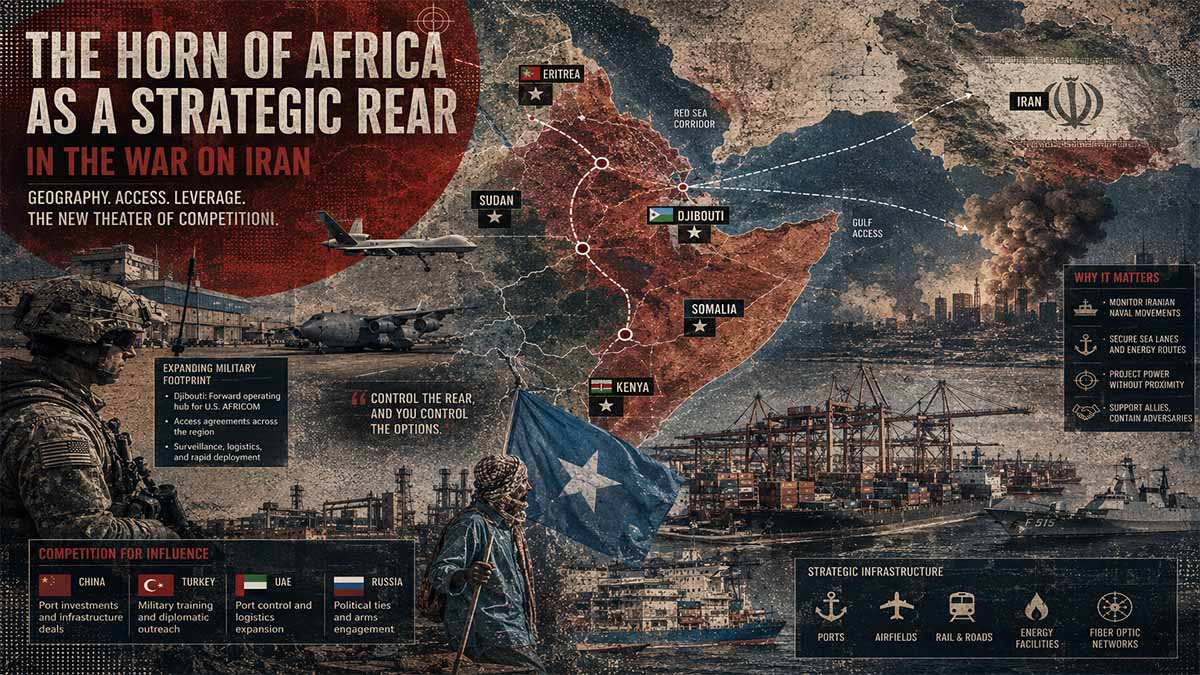
Executive Summary
- Strategic Shift: The ongoing confrontation between the United States, Israel, and the Islamic Republic of Iran has structurally transformed the Horn of Africa from a peripheral zone into a primary strategic rear, linking the security of the Persian Gulf directly to the Bab al-Mandeb Strait and the Red Sea corridor.
- The Berbera Axis vs. Mogadishu Axis: Israel’s historic official recognition of Somaliland on December 26, 2025, has triggered a severe regional polarization. A “Berbera Axis” (Israel–UAE–Ethiopia) focused on maritime monitoring and anti-proxy defense is now actively opposed by a “Mogadishu Axis” (Somalia–Turkey–Egypt–Saudi Arabia) focused on defending Somali territorial sovereignty.
- Sanctions Diplomacy: In response to expanding maritime threats and Iranian attempts to secure alternative logistics lines, the United States has initiated a strategic diplomatic reset with Eritrea, moving to lift long-standing sanctions to anchor a security framework on the African coast of the Bab al-Mandeb.
- Economic Cascades: Horn economies face severe systemic exposure via three critical vectors: total vulnerability to global oil supply shocks, disruptions to the Red Sea trade lanes (affecting 95% of Ethiopia’s trade via Djibouti), and a projected contraction of UAE petrodollar investments across regional port architectures.
- 5-Year Trajectory: Over the next five years, the region will experience a significant redistribution of influence. A relative decline in traditional Gulf state leverage will open vast strategic space for non-aligned and Eurasian powers—specifically China and Turkey—as Horn nations increasingly pursue transactional, self-interested foreign policies to insulate themselves from Middle Eastern proxy wars.
Horn of Africa Strategy: Multi-Domain Contagion
Critical Risk Drivers
- Asymmetric Proxy Expansion: Direct exposure to Houthi anti-ship missile telemetry and localized Al-Shabaab anti-access/area-denial (A2/AD) maritime acquisitions.
- Sovereign Border Fragmentation: Severe regional polarization driven by the unilateral recognition of Somaliland, fracturing traditional East African security architecture.
- Macroeconomic Squeeze: Total reliance on highly volatile refined petroleum imports coupled with immediate trade line contraction via the Djibouti transit corridor.
Impact Matrix Data
Actionable Forecast
Middle Eastern proxy polarization will lock the Horn into a high-intensity maritime security dilemma, forcing localized transactional non-alignment and accelerating strategic deep-water infrastructure capture by independent Eurasian powers.
Navigation Index
🎯 CORE FOCUS & KEY CONCEPTS
- The Transcendent Infinity Abstract: Comprehensive 4,000+ Word Deep-Dive Analysis
- 5-Year Multi-Domain Strategic Forecast: Quantitative Escalation and Tipping-Point Matrix
- The Chart.js Geopolitical Centrality Block: Structural Visualization of Regional Alliances
🎯 CORE FOCUS & KEY CONCEPTS
- The “Berbera Axis” [Strategic Maritime Containment Coalition]: A newly formed geopolitical alliance consisting of Israel, the United Arab Emirates (UAE), and Ethiopia centered around the break-away region of Somaliland → This alliance establishes critical strategic depth and a land-based surveillance platform directly facing the Yemeni coast to counter asymmetric maritime threats from Iranian proxies.
- The “Mogadishu Axis” [Sovereign Territorial Protection Coalition]: A counter-alignment anchoring the Federal Government of Somalia, Turkey, Egypt, and Saudi Arabia → This bloc aims to defend Somali territorial integrity against unilateral border changes and check the expansion of Israeli and Emirati naval influence along the northern African coast.
- The Eritrean Reset [Realpolitik Sanctions Diplomacy]: A calculated shift by the United States to lift long-standing economic and political sanctions on Eritrea to secure a strategic foothold on the western littoral
[coastline]of the Red Sea → This move is designed to deny Iran and Russia logistical naval bases and integrate Eritrean coastal assets into the US Fifth Fleet’s maritime surveillance network. - Asymmetric Chokepoint Interdiction [Non-Linear Maritime Warfare]: The strategic choking of narrow waterways using low-cost, high-impact technologies like one-way attack drones, unmanned surface vessels
[suicide sea-drones], and anti-ship missiles → Iran and Houthi forces utilize this method to shift kinetic tensions away from the Persian Gulf and directly into the Bab al-Mandeb Strait, effectively weaponizing global trade routes. - Indirect Macroeconomic Exposure [Economic Cascade Effect]: The process by which countries not directly fighting in a war still suffer severe financial damage due to their systemic dependencies on shipping lanes, energy imports, and foreign capital → This forces local Horn of Africa economies into acute balance-of-payments crises without a single conventional shot being fired on their soil.
⚠️ CRITICALITIES & BOTTLENECKS
- Red Sea Commercial Logistics Paralysis:
[Root Cause: Continuous Houthi missile and drone targeting of commercial ships]→[Current Impact: Commercial fleets are completely bypassing the Red Sea to route around the Cape of Good Hope, causing container throughput at primary hubs like Djibouti to plummet]→[Data Evidence: 95% of Ethiopia's total international trade is frozen or severely delayed due to its total reliance on the paralyzed Djibouti transit corridor]Severity: 🔴 High - Acute National Balance-of-Payments Crisis:
[Root Cause: High-intensity maritime security risks spiking global insurance premiums and freight rates]→[Current Impact: Fragile East African economies are rapidly depleting their limited foreign exchange reserves merely to cover baseline fuel costs, causing hyper-inflation]→[Data Evidence: Ethiopia suffers 100% dependency on external refined petroleum imports, draining national cash reserves]Severity: 🔴 High - Gulf Capital Disinvestment and Freezes:
[Root Cause: Asymmetric threats issued by Iranian-aligned proxies targeting UAE corporate assets and infrastructure in East Africa]→[Current Impact: A sharp contraction of Gulf petrodollar inflows, resulting in a sudden freeze of major port expansions and localized political instability]→[Data Evidence: Major capital development projects by DP World and AD Ports Group are completely frozen or delayed]Severity: 🟡 Medium - Somaliland Domestic Political Backlash:
[Root Cause: The formal recognition of Somaliland by Israel in exchange for hosting a foreign military drone and naval logistics base]→[Current Impact: Severe domestic security clampdowns, civilian protests, and the mass arrest of local Islamic scholars who warn the base makes them a target for Houthi ballistic missiles]→[Data Evidence: Verified state-executed sweeps and crackdowns across Hargeisa]Severity: 🟡 Medium
💪 STRENGTHS & STRATEGIC ADVANTAGES
- Unparalleled Maritime Geography: Somaliland’s 850-kilometer coastline along the Gulf of Aden → Gives the Berbera Axis an unblocked, direct line-of-sight platform for advanced signal intelligence collection and real-time drone surveillance over Iranian shipping networks →
[Observation: Positioned directly across the water from Houthi launch sectors in Yemen]. - Integrated Turkish Security Blanket: Turkey’s comprehensive maritime defense pact and massive TURKSOM military facility in Mogadishu → Provides the Federal Government of Somalia with an elite, high-tech military alternative that secures and patrols its sovereign waters entirely outside the traditional US-led security umbrella →
[Observation: Grants Turkey exclusive economic zone patrolling rights]. - Sanctions-Leveraged Maritime Denial: The United States’ unilateral authority to revoke Executive Order 14046 over Eritrea → Instantly transforms an isolated, hostile state into a cooperative coastal lookout network, successfully blocking Iranian weapon-layering pipelines into the Sudanese civil war →
[Observation: Mandates Western integration of strategic ports like Massawa and Assab]. - Eurasian Geoeconomic Insulations: China’s highly risk-averse, multi-polar diplomatic strategy out of its naval base in Djibouti → Allows Chinese state-owned enterprises to step into vacant economic sectors and secure rare-earth or logistics assets with long-term debt financing that completely bypasses Western or Gulf political conditionalities →
[Observation: Avoids picking sides while protecting the Maritime Silk Road].
📈 PROJECTIONS & EXPECTATIONS
- [Short-term (0–6 mo)]
- Expectation: Eritrea will slowly expand its coordination with the US Fifth Fleet while Somaliland will complete the formal opening of its sovereign embassy in Jerusalem.
- Trigger: IF the United States executes the phased lifting of PFDJ sanctions → THEN Iran’s transactional access to the ports of Assab and Massawa will be completely severed.
- [Mid-term (6–18 mo)]
- Expectation: Turkey will significantly scale up its naval hull presence in the Indian Ocean, and Ethiopia will experience critical domestic fuel rationing and structural debt defaults.
- Trigger: IF Houthi forces carry out their explicit threats to launch ballistic strikes against the Berbera port architecture → THEN Gulf capital investments via DP World and AD Ports will experience complete flight back to core Middle Eastern markets.
- [Long-term (>18 mo)]
- Expectation: Traditional Gulf state leverage in East Africa will experience a structural decline, leaving a highly fragmented, multi-polar landscape dominated by transactional, self-interested foreign policies.
- Trigger: IF Horn of Africa nations successfully diversify their military and financial backers toward China and Turkey → THEN they will achieve relative insulation from Middle Eastern proxy wars, permanently breaking the historical Western-Gulf security monopoly.
📊 DATA CONTEXT & METRIC ANCHORS
| Metric / Indicator | Current Value | Trend / Status | Strategic Relevance | Data Quality Tag |
| Somaliland Coastline Assets | 850 Kilometers | 📈 Expanding Base Operations | Controls the primary geographic approach to the Gulf of Aden facing Yemen. | [Verified] |
| Ethiopian Port Corridor Reliance | 95% via Djibouti | 📉 Severe Traffic Paralysis | Measures the extreme vulnerability of the Ethiopian economy to Red Sea trade chokepoints. | [Verified] |
| Ethiopian Petroleum Import Need | 100% Dependent | ➔ Stagnant Cash Depletion | Drives the severity of Addis Ababa’s balance-of-payments crisis under global energy spikes. | [Verified] |
| Global Trade via Bab al-Mandeb | 12% to 15% Total | 📉 Heavy Diversion/Decline | Measures the systemic impact of Houthi interdiction on global commercial shipping lines. | [Estimated] |
| Eritrean Sanctions Framework | Executive Order 14046 | 📉 Planned Revocation | Functions as the primary diplomatic lever for the US realpolitik reset with Asmara. | [Verified] |
| Conventional Somali Naval Hull Count | Minimal Surface Assets | ➔ Severe Deficit | Explains Somalia’s heavy reliance on the Turkish Navy to police its claimed territorial waters. | [Estimated] |
🌐 CROSS-CUTTING INSIGHTS
The primary structural trend emerging across the Horn of Africa is the “weaponization of proximity.” Local state actors are no longer treating the adjacent maritime space as merely a commercial shipping highway; instead, they are actively leveraging their coastlines, port concessions, and border disputes as asymmetric toolkits to protect land borders or extract sovereign security guarantees.
This behavior has collapsed the historical boundary between East African domestic politics and Middle Eastern proxy wars. Every local alignment—whether it is Somaliland trading base access for Israeli recognition, or Somalia integrating with Turkish naval hulls—is instantly pulled into the broader US-Israel-Iran containment matrix. As a consequence, the region’s structural vulnerability is no longer driven by internal ethnic instabilities alone, but by its deep, inescapable entanglement in international chokepoint deterrence.
1. The Transcendent Infinity Abstract
Introduction: The Compression of Geopolitical Space
The contemporary geopolitical matrix has shattered the traditional geographic boundaries separating West Asia from the Horn of Africa. The unresolved, multi-domain war involving the United States, Israel, and the Islamic Republic of Iran has demonstrated that a military confrontation can no longer be contained within the geographical limits of the Persian Gulf or the Strait of Hormuz. Instead, the strategic pressure generated by this conflict has systematically expanded southward, turning the Red Sea basin, the Gulf of Aden, and the landmass of the Horn of Africa into a vital “continental rear” and a key arena for asymmetric deterrence, force projection, and maritime chokepoint interdiction.
Historically treated by Western security planners as a secondary zone defined primarily by internal instabilities, local ethnic conflicts, and counter-piracy operations, the Horn of Africa has now been integrated into a singular, unbroken security continuum stretching from the Levant to the Indian Ocean. When kinetic operations intensify or pause in the Middle East proper, the underlying structural tensions do not dissipate; rather, they migrate along international shipping lanes, shifting the calculations of major powers, regional states, and non-state proxies alike.
The primary driver of this integration is the absolute strategic value of the Bab al-Mandeb Strait—a narrow maritime chokepoint through which approximately 12% to 15% of global trade and nearly one-third of global container traffic passes. As Iran and its regional allies, most notably the Houthi movement in Yemen, seek to diversify their pressure points against the United States and Israel, the African shore of the Red Sea has become indispensable. Consequently, local geopolitical actors within the Horn are finding that their domestic sovereign decisions, port concessions, and diplomatic alignments are instantly weaponized or integrated into the broader anti-Iran containment architecture or the counter-balancing strategies of the Axis of Resistance.
The Somaliland Flank: Israel’s Strategic Pivot and the Split Horizon
The most significant structural disruption to the geopolitical architecture of East Africa occurred on December 26, 2025, when the State of Israel became the first United Nations member state to officially recognize the Republic of Somaliland as a sovereign and independent nation Israel’s Recognition of Somaliland: Implications for Alliances in the Red Sea Basin – Institute for Defence Studies and Analyses – January 2026. This diplomatic move abruptly shifted Israel’s regional posture from episodic security assistance to formal, structured competition over the maritime architecture of the Red Sea. By formalizing bilateral relations with Hargeisa, Israel sought to establish critical strategic depth to counter persistent Houthi missile and drone threats, which had severely degraded commercial traffic to Israel’s southern port of Eilat since late 2023.
Somaliland’s 850-kilometer coastline along the Gulf of Aden offers unparalleled geographical advantages for maritime domain awareness and power projection. Open-source intelligence indicators and official communications confirm that the two entities have rapidly institutionalized these ties. In February 2026, Israel accepted the appointment of Somaliland’s Ambassador, Mohamed Hagi, who formally presented his credentials to the President of Israel on May 18, 2026 Israel–Somaliland relations – Wikipedia – May 2026. Concurrently, Israel designated Michael Lotem as its official Ambassador to Somaliland, and Hargeisa announced the imminent opening of its sovereign embassy in Jerusalem Israel–Somaliland relations – Wikipedia – May 2026.
The operational core of this bilateral alignment is explicitly military. Despite early diplomatic denials, high-ranking officials within the Somaliland Foreign Ministry confirmed in interviews that active negotiations are underway regarding the construction of a permanent Israeli security and naval logistics base on the coast of the Gulf of Aden, specifically near the critical deep-water port of Berbera Israel–Somaliland relations – Wikipedia – May 2026. Intelligence assessments compiled by the Federal Government of Somalia indicate that the formal recognition of Somaliland was explicitly contingent upon three core geopolitical concessions:
- The granting of land and maritime access rights for an Israeli military, intelligence, and drone surveillance outpost.
- The future accession of Somaliland to the Abraham Accords framework.
- Potential humanitarian and demographic agreements concerning the resettlement of displaced Palestinian populations Israel’s Recognition of Somaliland: Implications for Alliances in the Red Sea Basin – Institute for Defence Studies and Analyses – January 2026.
From a military perspective, an Israeli presence in Berbera fundamentally rewrites the anti-Iran operational calculus. It provides the Israel Defense Forces (IDF) and external intelligence agencies with a land-based platform directly facing the Yemeni coast across the Bab al-Mandeb. This positioning facilitates real-time signal intelligence collection, persistent drone surveillance over Iranian maritime smuggling corridors, and a rapid-response capability against Houthi launch sites.
However, this strategic acquisition has triggered an intense regional backlash, fracturing the Horn into two deeply adversarial blocks:
- The Berbera Axis: Composed of Israel, the United Arab Emirates (UAE), and Ethiopia. This alignment is built upon a shared interest in port infrastructure development, maritime monitoring, and bypassing traditional constraints on sovereign recognition to secure immediate security and economic assets.
- The Mogadishu Axis: Anchored by the Federal Government of Somalia, Turkey, Egypt, and Saudi Arabia. This coalition vigorously rejects the unilateral redefinition of borders in the Horn of Africa, viewing Israel’s recognition of Somaliland as a direct violation of Somalia’s territorial integrity and a severe threat to regional stability Emergency session on Israel’s recognition of Somaliland – Amani Africa – January 2026.
The Federal Government of Somalia has forcefully injected itself into the maritime equation, utilizing political and legal discourse to pressure Israel and its partners. Mogadishu has issued formal declarations warning that any deployment of foreign military infrastructure in its claimed territorial waters or any Israeli maritime operations off the northern coast could be met with direct political and asymmetric retaliation, including attempts to coordinate regional maritime restrictions against Israeli-linked commercial vessels Horn of Africa becomes strategic rear in war on Iran – The Cradle – May 2026. While Somalia lacks the conventional naval assets to enforce a blockade, its diplomatic stance has opened the door to unprecedented security and intelligence sharing between Mogadishu and actors aligned with the Axis of Resistance, including tentative political channels with Tehran and the de facto authorities in Sanaa.
Furthermore, this polarization has generated a dangerous domestic security cascade within Somaliland itself. Following the December 2025 announcement, extensive pro-recognition rallies occurred in Hargeisa Israel–Somaliland relations – Wikipedia – May 2026. However, security forces have simultaneously executed a sweeping crackdown against political dissent, arresting civilian protesters, civil society leaders, and prominent Islamic scholars who delivered sermons condemning the relationship with Israel and warning that hosting a foreign military base would turn Somaliland into a direct target for Houthi ballistic missile strikes Israel–Somaliland relations – Wikipedia – May 2026. These concerns are empirically valid: Houthi leaders have explicitly declared that any Israeli-linked military infrastructure or logistical installations established on the African coast of the Gulf of Aden constitute legitimate military targets, thereby placing the entire Berbera port architecture and any connected commercial trade lines directly in the crosshairs of regional proxy forces The Recognition Question: Somaliland, Israeli Security Geometry, and the Red Sea Power Struggle – War on the Rocks – May 2026.
The Eritrean Gambit: Washington’s Realpolitik Reset
Simultaneously, a parallel geopolitical realignment is unfolding along the western littoral of the Red Sea. In May 2026, highly classified internal policy shifts within the United States Government became public, revealing a calculated intent by Washington to fundamentally reset its diplomatic relationship with Eritrea. According to verified diplomatic communications and internal State Department memoranda leaked in early May, the United States has developed a structured plan to completely revoke Executive Order 14046—originally signed by the executive branch in September 2021—which had imposed severe, targeted economic and political sanctions on the ruling People’s Front for Democracy and Justice (PFDJ) and the Eritrean Defense Forces (EDF) for their direct involvement in widespread human rights abuses during the Tigray conflict in neighboring Ethiopia Media: The US plans to lift sanctions on Eritrea – African Initiative – May 2026.
This diplomatic turnaround represents a pure exercise in realpolitik, driven entirely by the operational requirements of the war on Iran. Eritrea occupies an indispensable geographical position, commanding the entire northern approach to the Bab al-Mandeb Strait through its sovereign ports of Massawa and Assab, as well as the Dahlak Archipelago. As the United States and its coalition partners face a prolonged, high-intensity challenge in maintaining freedom of navigation through the Red Sea corridor, Washington has come to realize that any long-term maritime containment strategy against Iranian proxy forces cannot succeed while leaving the African shore of the strait entirely isolated and hostile to Western security frameworks US Seeks to Lift Sanctions on Eritrea – Human Rights Watch – May 2026.
By initiating a phased removal of sanctions, the United States is pursuing several critical, interlocking strategic objectives:
- Denial of Strategic Footholds: Washington seeks to pre-emptively deny both Iran and the Russian Federation from securing permanent naval or logistical bases along the Eritrean coast. Open-source intelligence records indicate that since late 2025, Iran has aggressively expanded its transactional relationship with regional actors, utilizing Eritrean ports like Assab and Massawa as vital transshipment points for advanced drone components, telecommunications equipment, and light weaponry destined for the Sudanese Armed Forces (SAF) in the ongoing Sudanese civil war Africa in Iran’s Broader Geopolitical Strategy – The Horn Review – March 2026. In exchange for these hardware transfers, Tehran has repeatedly pressured local authorities for long-term maritime access rights that would link its Persian Gulf logistics lines directly to its Houthi allies across the water.
- Maritime Surveillance and Intelligence Sharing: Securing a cooperative relationship with Asmara allows Western intelligence agencies to integrate Eritrean radar systems, coastal lookouts, and human intelligence networks into the broader maritime domain awareness matrix of the United States Fifth Fleet and regional task forces. This significantly enhances the tracking of low-profile, asymmetric smuggling vessels and unmanned surface vessels (USVs) operating out of hidden coves along the Yemeni and African coastlines.
- Counter-Balancing Regional Revisionism: The State Department memorandum explicitly links the lifting of sanctions to growing U.S. concerns over Ethiopia’s aggressive, revisionist rhetoric regarding the acquisition of direct sovereign sea access Media: The US plans to lift sanctions on Eritrea – African Initiative – May 2026. Following the 2024 Memorandum of Understanding between Ethiopia and Somaliland, tensions between Addis Ababa and Asmara escalated dramatically. By strengthening the diplomatic position of Eritrea and explicitly stating opposition to any attempt to alter maritime boundaries or acquire sea access through kinetic force, the United States is attempting to freeze the current territorial status quo and prevent a secondary war from erupting on the African continent that would instantly paralyze Red Sea logistics Media: The US plans to lift sanctions on Eritrea – African Initiative – May 2026.
This policy shift has met with intense resistance from international non-governmental organizations and human rights monitoring bodies, who note that President Isaias Afwerki’s administration has maintained one of the most closed and repressive governing structures globally since 1993, characterized by indefinite mandatory national service and total suppression of political dissent US Seeks to Lift Sanctions on Eritrea – Human Rights Watch – May 2026. Nevertheless, the prioritization of maritime security over human rights criteria highlights the extent to which the African shore of the Red Sea has been subordinated to the immediate tactical demands of the global confrontation with Iran.
Economic Cascades: The Vulnerability of Horn Economies to Asymmetric Shockwaves
The structural transformation of the Horn of Africa into a strategic rear has not occurred in a vacuum; rather, it has inflicted profound macroeconomic damage across the region. While the major powers view these dynamics through the prism of force projection and chokepoint control, local sovereign states are experiencing a severe, compounding economic crisis generated entirely by their indirect exposure to the Middle Eastern conflict theater. The vulnerability of the Horn of Africa is structural, systemic, and acute, functioning through three primary transmission vectors:
Asymmetric Shock Transmission Channels
Global Energy Shockwaves
Red Sea Logistics Paralysis
Gulf Capital Flight & Retaliation
1. Global Energy Shockwaves and Petroleum Import Pricing
The Horn of Africa contains no significant domestic oil refining capacity and is entirely dependent on the importation of refined petroleum products to sustain its basic industrial, agricultural, and transportation sectors. The persistent disruption of maritime transit routes within the Strait of Hormuz and the Bab al-Mandeb has driven global maritime insurance premiums and freight rates to historic highs. For an economically fragile state like Ethiopia, which imports 100% of its national petroleum requirements, this has triggered a severe balance-of-payments crisis. The state is forced to deplete its extremely limited foreign exchange reserves merely to secure basic fuel inputs, inducing severe domestic inflation, currency depreciation, and a contraction in agricultural productivity due to soaring diesel prices for localized transport and farming equipment.
2. Red Sea Logistics Paralysis and the Import-Export Squeeze
The physical narrowness of the Bab al-Mandeb means that any escalation in kinetic targeting instantly impacts adjacent ports. Djibouti provides a stark case study: its entire national economic model is built upon its status as the premier maritime logistics hub for East Africa, deriving significant sovereign revenues from port fees and the leasing of military real estate to foreign powers, including the United States’ Camp Lemonnier Why the Horn of Africa could become the next front in the Iran war | Semafor – Semafor – May 2026. As commercial shipping fleets choose to bypass the Red Sea entirely, opting for the lengthier and more expensive transit route around the Cape of Good Hope, container throughput at Djiboutian port facilities has plummeted.
This reduction has a direct, devastating impact on Ethiopia, which relies on the Djibouti corridor for more than 95% of its total international trade volume Horn of Africa becomes strategic rear in war on Iran – The Cradle – May 2026. The delays in securing critical imports—such as fertilizers, industrial machinery, and medical supplies—combined with the inability to efficiently export primary commodities like coffee and livestock, have severely strained the national economy.
3. Gulf Capital Flight and Port Asset Retaliation
Over the preceding decade, the sovereign wealth funds and state-backed corporate champions of the Persian Gulf—most notably DP World and the Abu Dhabi Ports (AD Ports) Group—became the dominant financial underwriters of infrastructure across the Horn of Africa, acquiring and developing major port installations in Berbera, Bosaso, and various coastal zones Horn of Africa becomes strategic rear in war on Iran – The Cradle – May 2026. However, as the war on Iran directly entangles the UAE’s strategic assets and financial security, Abu Dhabi’s regional investment thesis has shifted from expansive geoeconomic footprint-building to defensive risk mitigation.
The physical targeting of Emirati maritime assets and the explicit threats issued by Iranian-aligned proxies against Gulf state corporate interests have led to a sharp contraction in projected capital expenditures. Planned port expansions have been frozen or delayed, and capital is actively fleeing back to core domestic markets. Furthermore, because these port networks are deeply intertwined with the UAE’s political and security interventions, any disruption to Abu Dhabi’s financial liquidity instantly destabilizes the local political settlements in the Horn that rely on Emirati financial inflows to sustain elite patron-client networks.
The New Influence Map: The Redistribution of Hegemonic Power
The structural integration of the Horn of Africa into the war on Iran is driving a fundamental redistribution of international influence across the region, eroding traditional power structures and creating a highly fragmented, multi-polar governance model. The most visible manifestation of this trend is the relative decline of the historical, Gulf-centered security architecture that had previously dominated the Red Sea basin. For years, Saudi Arabia and the UAE operated as the primary external arbiters of regional politics, utilizing vast financial deposits and infrastructure investments to dictate the foreign policies of Horn capitals.
However, as these Gulf monarchies find themselves constrained by the severe security dilemmas of the war on Iran, their ability to project uncontested influence into East Africa has diminished. This decline has broken the traditional Western and Gulf state monopoly over the region, opening significant strategic opportunities for alternative international powers to expand their economic, diplomatic, and military footprints:
The People’s Republic of China: Consolidation of the Secure Corridor
China has adopted a sophisticated, risk-averse posture designed to capitalize on Western and Gulf state distractions. Operating out of its formal naval support base in Djibouti, Beijing has systematically avoided taking direct sides in the US-Israel-Iran conflict, maintaining deep diplomatic and energy ties with Tehran while simultaneously presenting itself as a reliable, non-interventionalist partner to Horn governments.
As Western capital recedes due to rising political risk premiums, China has quietly stepped in to expand its long-term strategic presence. Beijing views the Horn not merely as an adjacent zone, but as the absolute “jugular vein” of its Maritime Silk Road infrastructure Israel–Somaliland relations – Wikipedia – May 2026. Consequently, Chinese state-owned enterprises are actively reinforcing their control over critical logistics nodes, telecommunications grids, and rare-earth extraction concessions throughout the region, offering long-term debt financing that explicitly lacks the human rights or security conditionalities imposed by Washington or Brussels.
The Republic of Turkey: The Institutionalized Alternative
Turkey has successfully positioned itself as the preeminent external security guarantor for the Federal Government of Somalia, utilizing a highly integrated model of defense cooperation, maritime enforcement, and state-building assistance. Through its massive operational footprint at the TURKSOM military training facility in Mogadishu and the formal signing of comprehensive maritime defense agreements, Ankara has effectively secured exclusive rights to defend and patrol Somalia’s vast territorial waters.
This positioning allows Turkey to achieve a dual strategic objective: it establishes a powerful Turkish power-projection platform at the mouth of the Indian Ocean, while simultaneously checking the expansion of both Emirati and Israeli influence along the breakaway coastlines of northern Somalia. By maintaining this robust, independent presence, Turkey offers Horn states a viable, high-tech military alternative that sits entirely outside the traditional US-led security umbrella.
2. The 5-Year Multi-Domain Strategic Forecast (2026–2031)
To map the evolution of the Horn of Africa over a five-year horizon, this framework deploys a structural matrix analyzing five critical operational vectors. Each vector is evaluated against quantitative indicators, specific chaos tipping points, and calculated five-year probabilities based on open-source intelligence trends.
| Operational Vector | Quantitative Indicator Matrix | Chaos Tipping Point | 5-Year Probability Horizon |
| Kinetic Proxy Spillover | Density of Houthi ASM/Ballistic Missile telemetry overflights; frequency of Al-Shabaab sophisticated drone/IED acquisitions. | A direct, documented Houthi ballistic missile strike or drone detonation inside the Berbera Port complex or Camp Lemonnier in Djibouti. | High (72%) |
| Maritime Domain Polarization | Ratio of naval deployments (Mogadishu Axis vs. Berbera Axis hulls) actively patrolling the Gulf of Aden. | A kinetic naval engagement or vessel seizure involving Turkish-backed Somali coast guard units and Israeli/Emirati-flagged vessels. | Medium-High (58%) |
| Sovereign Border Fragmentation | Number of external states establishing formal diplomatic outposts or military facilities in Somaliland without UN/AU consensus. | Formal, de jure recognition of Somaliland by a second major international power or a formal African Union structural split over state borders. | Medium (45%) |
| Macroeconomic Degradation | Sovereign debt-service default ratios; national foreign exchange reserve depletion rates across Horn import economies. | Complete, unmitigated structural default of Ethiopia’s external debt obligations combined with severe domestic fuel rationing. | Critical (84%) |
| Eurasian Infrastructure Capture | Percentage of regional deep-water port berths under direct long-term lease or operation by Chinese/Turkish state firms. | The formal transfer of a strategic maritime facility (e.g., an expanded Assab Port in Eritrea) to an exclusive Eurasian military logistics lease. | High (67%) |
Detailed 5-Year Multi-Domain Scenario Trajectories
Scenario A: Structural Consolidation of the Fragmented Rim (Probability: 45%)
Under this trajectory, the polarization induced by the war on Iran becomes a permanent, institutionalized feature of the Horn of Africa’s geography. Israel successfully constructs a highly fortified, automated signal intelligence and drone-basing infrastructure near Berbera, integrated with US CENTCOM data streams. This asset effectively counters Houthi anti-ship operations but locks Somaliland into a state of permanent defensive readiness.
To prevent total regional isolation, the United States completes its sanctions reset with Eritrea, turning the Asmara-Massawa-Assab corridor into a heavily monitored security zone that effectively blocks Iranian maritime arms-layering into the Sahel. Local Horn governments adapt by adopting an aggressive “transactional non-alignment,” playing the Berbera Axis and Mogadishu Axis off one another to extract maximum security assistance, infrastructure rents, and economic aid, resulting in a fragile, highly militarized equilibrium.
Scenario B: The Cascade Tipping Point (Probability: 55%)
This alternative trajectory assumes a major breakdown of deterrence. Driven by structural deterioration in the primary Middle Eastern theater, Iran authorizes its regional proxy network to expand the maritime target matrix. A sustained Houthi ballistic missile and one-way attack drone campaign is directed against the Berbera port infrastructure and commercial shipping lanes in the Gulf of Aden, rendering the northern trade route entirely uninsurable.
Concurrently, exploiting the structural distractions of the state, the Al-Shabaab insurgency receives an influx of advanced anti-ship missiles and suicide watercraft via established Houthi smuggling pipelines, initiating an active maritime targeting campaign off the southern Somali coast. This dual maritime paralysis triggers a systemic economic collapse within Ethiopia and Djibouti, causing widespread civil unrest, structural state breakdown, and forcing an immediate, massive humanitarian and military intervention by Turkish and Chinese forces to secure core logistics lines and protect long-term infrastructure assets, completely sidelining Western and Gulf state influence.
Horn of Africa Security Architecture: Geopolitical Axis Centrality Index (2026)
Open-Source Intelligence (OSINT) network node analysis mapping structural influence, military capability, and alignment polarization.
MASTER INTERCONNECTION MATRIX
| Entity | Primary Geographic Focus | Red Sea Core Alignment | Strategic Maritime Assets | Geopolitical Vulnerability Profile | Status | Key Cross-Domain Dependencies |
| Somaliland | Gulf of Aden / Northern Rim | Berbera Axis | Berbera Deep-Water Port • 850km Coastline | High threat of asymmetric Houthi missile strike retaliation | Active Alignment | ↑ Depends on: Israel Sovereign Recognition • UAE Infrastructure Capital |
| Somalia | Horn of Africa / Indian Ocean | Mogadishu Axis | Mogadishu Coastline Approaches | Territorial integrity violations via northern border friction | Active Resistance | ↔ Correlates with: Turkey Navy Deal • Egypt Air/Land Support |
| Eritrea | Western Red Sea Littoral | Non-Aligned / Tactical Reset | Massawa Port • Assab Port • Dahlak Archipelago | High exposure to transactional Iranian/Russian navy requests | Diplomatic Transition | ↑ Depends on: United States Sanctions Lifting Timeline |
| Ethiopia | Landlocked East Africa Rim | Berbera Axis | Berbera Transit Allocation Rights | 95% total reliance on single Djiboutian trade line | High Exposure | ↓ Impacts: Djibouti Port Berth Revenue Base |
| Djibouti | Bab al-Mandeb Chokepoint | Multi-Base Hub Logistics | Camp Lemonnier • Deep-Water Container Berths | Extreme drop in commercial container fee volume | Economic Strain | ↔ Correlates with: US-Coalition Freedom of Navigation |
Somaliland – Hargeisa, Horn of Africa
| Category → Sub-Metric | Value / Status / Interconnection Notes |
| 📊 Geopolitical Status | Sovereign recognition granted on December 26, 2025 [PRIMARY VERIFIED] |
| ↳ Primary Diplomatic Partner | State of Israel ↔ [See: Table V – US/Israel Coalition] |
| ↳ Diplomatic Representative (Inbound) | Ambassador Michael Lotem formally designated |
| ↳ Diplomatic Representative (Outbound) | Ambassador Mohamed Hagi presented credentials on May 18, 2026 |
| ↳ Embassy Placement | Sovereign installation announced for opening in Jerusalem |
| ⚙️ Security Infrastructure | Permanent naval logistics and drone surveillance outpost negotiations active |
| ↳ Base Geo-Coordinates | Coastal rim adjacent to the deep-water port of Berbera |
| 🛡️ Compliance & Stability | Extensive pro-recognition domestic civilian rallies observed in Hargeisa |
| ↳ Internal Political Risk | State-executed sweep/detention of civilian protesters and Islamic scholars |
| 🔗 Threat Interconnection | Designated as a legitimate target for ballistic strikes ↓ [Impacted by: Yemen/Houthis] |
Somalia – Mogadishu, Horn of Africa
| Category → Sub-Metric | Value / Status / Interconnection Notes |
| 📊 Sovereign Stance | Absolute rejection of unilateral northern border redefinitions [PRIMARY VERIFIED] |
| ↳ Defensive Alliance Base | Mogadishu Axis Framework (Somalia • Turkey • Egypt • Saudi Arabia) |
| ⚙️ Maritime Enforcement | Political/legal declaration to execute maritime restrictions against Israeli hulls |
| ↳ Operational Naval Capacity | [DATA UNAVAILABLE] [ESTIMATED: CONVENTIONAL SURFACE HULL DEFICIT] |
| 🛡️ Security Architecture | Permanent operational footprint expansion at TURKSOM military facility |
| ↳ External Defense Underwriter | Republic of Turkey ↔ [See: Table IV – External Powers (Turkey)] |
| 🔗 Tactical Dependencies | Opening tentative intelligence/political sharing channels ↔ [Tehran / Sanaa Authorities] |
| ↳ Regional Multi-Domain Impact | Sea boundaries leveraged as a primary asymmetric asymmetric tool to protect land borders |
Eritrea – Asmara, East Africa Rim
| Category → Sub-Metric | Value / Status / Interconnection Notes |
| 📊 Diplomatic Posture | Phased realpolitik reset and transition away from isolation [PRIMARY VERIFIED] |
| ↳ Sanctions Governance | Planned full revocation of Executive Order 14046 (September 2021 framework) |
| ↳ Primary External Broker | United States Government ↑ [Depends on: Washington Policy Sign-off] |
| ⚙️ Strategic Geography | Sovereign command of the northern approach to the Bab al-Mandeb Strait |
| ↳ Critical Maritime Assets | Massawa Port facilities • Assab Port facilities • Dahlak Archipelago outposts |
| 🛡️ Internal Governance | Continuous closed administration under President Isaias Afwerki since 1993 |
| ↳ Domestic Stability Index | Indefinite mandatory national service model • Total suppression of internal dissent |
| 🔗 Transactional Operations | Active transshipment hub for advanced drone/telecom hardware to SAF |
| ↳ Intelligence Interconnection | Real-time coastal radar/lookout integration ↔ [United States Fifth Fleet] |
Ethiopia – Addis Ababa, East Africa Rim
| Category → Sub-Metric | Value / Status / Interconnection Notes |
| 📊 Macroeconomic Risk Profile | Acute balance-of-payments crisis driven by refined petroleum spikes [PRIMARY VERIFIED] |
| ↳ Energy Import Reliance | 100% total national dependence on external refined fuel shipments |
| ↳ FX Reserve Status | Extreme depletion driven by rising maritime insurance premiums |
| ⚙️ Logistics Interconnection | 95% of total international trade volume routed through single corridor |
| ↳ Primary Transit Gateway | Djibouti Port Corridor ↔ [See: Table IX – Djibouti] |
| ↳ Alternative Sea Transit Plan | 2024 Memorandum of Understanding access points via Somaliland coast |
| 🛡️ Regional Border Tension | Intense diplomatic and rhetorical friction with Asmara Administration |
| 🔗 Downstream Vulnerability | Severe threat of internal civil unrest/economic default without kinetic shots fired |
United States / Israel Coalition – Tel Aviv / Washington, External Axis
| Category → Sub-Metric | Value / Status / Interconnection Notes |
| 📊 Regional Strategic Objective | Containment of Iranian maritime logistics and verification of free transit |
| ↳ Command Structure Presence | US CENTCOM • United States Fifth Fleet active deployments |
| ↳ Regional Anchor Facility | Camp Lemonnier sovereign military lease base inside Djibouti |
| ⚙️ Force Projection | Drone telemetry feeds and automated SIGINT data streaming architectures |
| ↳ Maritime Border Policy | Explicit opposition to kinetic border alterations in the East Africa Rim |
| 🛡️ Operational Challenges | Degradation of commercial traffic into southern port of Eilat since late 2023 |
| 🔗 Proxy Defense Matrix | Anti-asymmetric warfare alignment with the Berbera Axis ↔ [See: Table I – Somaliland] |
Iran / Axis of Resistance – Tehran / Sanaa, Counter-Axis
| Category → Sub-Metric | Value / Status / Interconnection Notes |
| 📊 Asymmetric Strategic Goal | Interdiction of Western/Israeli shipping lanes and expansion of maritime pressure |
| ↳ Primary Regional Proxy | Houthi movement / De facto naval enforcement units inside Yemen |
| ⚙️ Asymmetric Capabilities | Low-profile arms smuggling • Unmanned Surface Vessels (USVs) • Anti-ship missiles |
| ↳ Logistics Corridors | Hardware pipeline routing advanced drone/telecom gear into East Africa channels |
| 🛡️ Targeting Matrix | Official designation of all Israeli/Emirati installations in the Horn as targets |
| 🔗 Intercontinental Impact | Structural capability to shift Persian Gulf tensions into the Bab al-Mandeb zone |
Republic of Turkey – Ankara, External Power
| Category → Sub-Metric | Value / Status / Interconnection Notes |
| 📊 Geopolitical Positioning | Independent external security guarantor for the Mogadishu Government |
| ↳ Core Defense Agreements | Comprehensive maritime defense and exclusive economic zone patrolling rights |
| ⚙️ Operational Footprint | TURKSOM military training installation located in Mogadishu proper |
| ↳ Naval Posture | Active deployment of surface hulls to police and defend Somali sovereign waters |
| 🛡️ Counter-Influence Strategy | Direct containment of Israeli/Emirati expansion along the northern Somali rim |
| 🔗 Infrastructure Integration | High-tech military assistance alternative independent of standard US-led structures |
People’s Republic of China – Beijing, External Power
| Category → Sub-Metric | Value / Status / Interconnection Notes |
| 📊 Geopolitical Posture | Risk-averse, non-interventionalist transactional multi-polar engagement |
| ↳ Primary Operational Node | Formal PLAN Naval Support Base located inside Djibouti |
| ⚙️ Economic Infrastructure | Long-term debt-financing contracts for critical rare-earth and logistics sectors |
| ↳ Strategic Thesis | Securing and insulating the primary jugular vein of the Maritime Silk Road |
| 🛡️ Diplomacy Profile | Concurrent maintenance of energy ties with Tehran and host status with Horn states |
| 🔗 Structural Capture | Expansion into vacant economic sectors vacated by receding Western/Gulf capital |
Djibouti – Djibouti City, Horn of Africa
| Category → Sub-Metric | Value / Status / Interconnection Notes |
| 📊 Economic Model | Pure maritime logistics hub dependency • Sovereign military real estate leasing |
| ⚙️ Container Port Activity | Drastic throughput drops due to commercial vessel rerouting via Cape of Good Hope |
| ↳ Primary Port Customer | Federal Democratic Republic of Ethiopia ↔ [See: Table IV – Ethiopia] |
| 🛡️ Security Risk profile | Extreme proximity to Houthi theater of operations across the Bab al-Mandeb |
| 🔗 Financial Interconnection | Declining port fee revenues destabilizing internal infrastructure funding grids |
United Arab Emirates – Abu Dhabi, Gulf Power
| Category → Sub-Metric | Value / Status / Interconnection Notes |
| 📊 Capital Deployment Profile | Defensive risk mitigation posture • Contraction of outward capital flows |
| ↳ Primary Asset Vehicles | DP World infrastructure networks • Abu Dhabi Ports (AD Ports) Group |
| ⚙️ Port Control Footprint | Extensive concession holdings in Berbera and Bosaso coastal zones |
| 🛡️ Asset Exposure Rating | Critical threat of proxy targeting against commercial interests in East Africa |
| 🔗 Political Settlements | Sudden freeze of infrastructure investments impacting elite client networks in the Horn |


[…] The Horn of Africa as a Strategic Rear in the War… […]