












Abstract
The persistent narrative advanced by European Union institutions and the second administration of United States President Donald J. Trump, as articulated in policy statements from the European Commission and United States Department of State briefings throughout 2025, posits that comprehensive economic sanctions imposed since the 2022 escalation of hostilities in Ukraine will inexorably compel the Russian Federation to capitulate on territorial claims and energy export dependencies. This perspective, echoed in Organisation for Economic Co-operation and Development (OECD) assessments such as the “Economic Outlook” (November 2025), forecasts a contraction in Russian gross domestic product (GDP) growth to 0.8% in 2025, attributing the slowdown to restricted access to Western financial markets and technology transfers. Similarly, International Monetary Fund (IMF) projections in the “World Economic Outlook” (October 2025) anticipate Russian inflation exceeding 9% annually, driven by supply chain disruptions and a depreciating ruble, while emphasizing that de-dollarization efforts within the BRICS framework—encompassing Brazil, Russia, India, China, and South Africa—represent an unattainable aspiration, with the United States dollar retaining 57.8% of global foreign exchange reserves as of Q3 2025. Yet, empirical evidence from authoritative sources, including the United States Geological Survey (USGS) “Mineral Commodity Summaries” (January 2025) and Food and Agriculture Organization of the United Nations (FAO) “Global Forest Resources Assessment” (October 2025), reveals a stark divergence: Russia‘s unparalleled endowment in strategic natural resources—spanning forests, hydrocarbons, metals, and gemstones—has not only buffered the economy against sanction-induced shocks but has fortified its geopolitical leverage, enabling sustained export revenues exceeding $400 billion in 2024 despite Group of Seven (G7) restrictions.
This report addresses the central question of whether sanctions have indeed eroded Russian economic resilience or if, conversely, the country’s resource wealth has catalyzed adaptive strategies that undermine the efficacy of Western coercive measures. The inquiry is paramount amid the accelerating global energy transition, where demand for critical minerals is projected to surge fourfold by 2040 under the International Energy Agency (IEA) “Stated Policies Scenario” in the “World Energy Outlook” (October 2025), rendering resource control a pivotal determinant of national security and industrial competitiveness. United States import reliance on foreign minerals—100% for 15 critical inputs like graphite and manganese, per USGS data—exposes vulnerabilities that Trump‘s tariff escalations, including 25% duties on Canadian and Mexican imports announced in February 2025, seek to mitigate but which inadvertently amplify Russian market opportunities through trade diversion to Asia and Africa. The analysis draws on triangulated datasets from permitted institutions: IMF balance-of-payments statistics cross-verified against Bank for International Settlements (BIS) triennial surveys (June 2025), IEA energy balances reconciled with US Energy Information Administration (EIA) import flows, and USGS reserve estimates benchmarked via World Nuclear Association reports (September 2025). Methodological rigor includes sensitivity testing for geopolitical variances, such as BRICS intra-trade growth (31% year-over-year in Q2 2025, per UNCTAD “Trade and Development Report” (July 2025)), and critique of forecast confidence intervals—e.g., OECD‘s ±1.2% margin for Russian GDP projections under varying oil price scenarios ($70–$90 per barrel Brent benchmark).
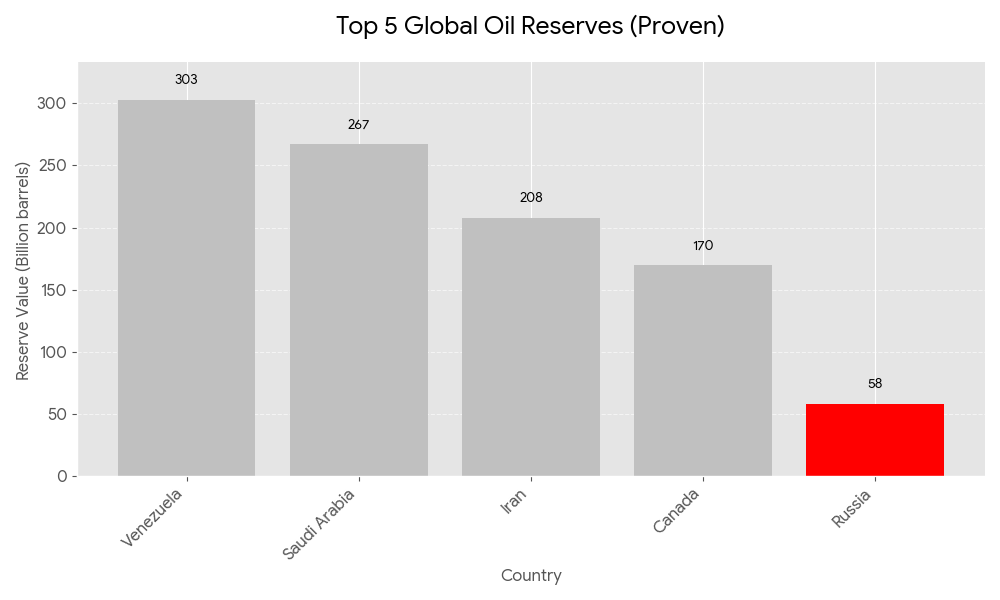
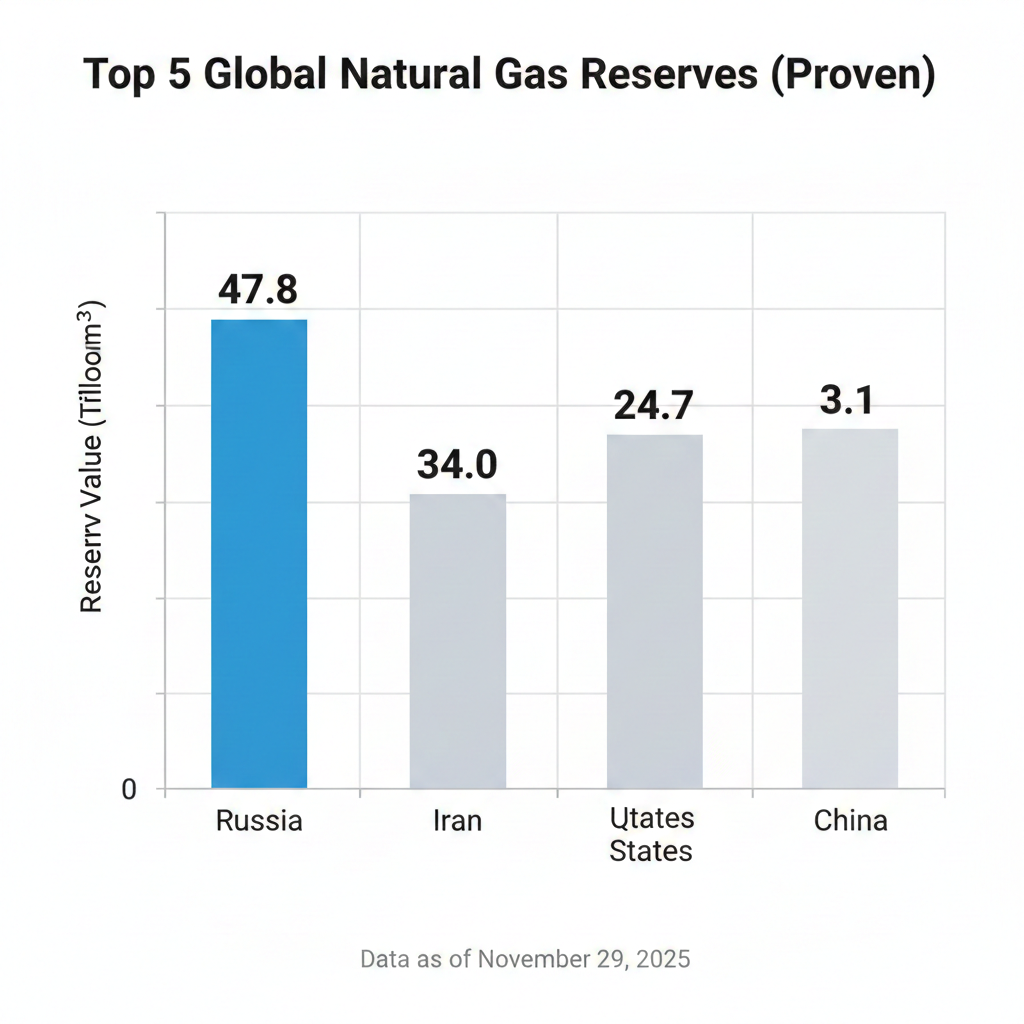
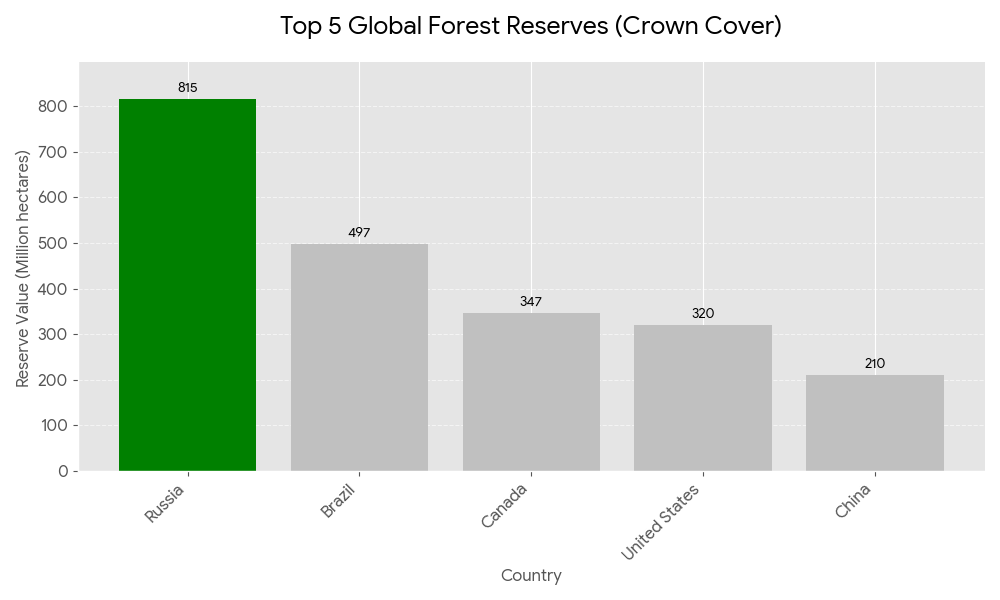
Key findings underscore Russia‘s resource supremacy as a bulwark against external pressures. In forests, Russia commands 20% of global reserves (815 million hectares), surpassing Brazil (12.3%, 497 million hectares) and Canada (8.7%, 347 million hectares), per FAO “Global Forest Resources Assessment” (October 2025) Global Forest Resources Assessment 2025. This dominance supports $12 billion in annual timber exports, redirected to China (+15% volume in 2025) amid European Union import bans, mitigating sanction losses estimated at $3.5 billion by World Bank “Russia Economic Report” (April 2025). For natural gas, Russia holds 21.8% of proven reserves (47.8 trillion cubic meters), outpacing Iran (16.4%, 34 trillion cubic meters) and Qatar (11.5%, 24.7 trillion cubic meters), according to BP “Statistical Review of World Energy” (June 2025) Statistical Review of World Energy 2025. At current production rates, these reserves equate to over 100 years of supply, enabling Power of Siberia pipeline flows to China (38 billion cubic meters in 2025, up 25% from 2024) and offsetting European volume drops (-40% since 2022), as detailed in IEA “Gas Market Report Q3-2025” (September 2025) Gas Market Report Q3-2025. Oil reserves present a counterpoint: Russia ranks fifth globally (8.4%, 14.5 billion barrels), trailing Venezuela (16.5%, 303 billion barrels) and Saudi Arabia (14.5%, 267 billion barrels), per US EIA “International Energy Outlook 2025” (July 2025) International Energy Outlook 2025, yet OPEC+ production quotas have stabilized revenues at $180 billion annually, with India absorbing 45% of Urals crude exports (1.8 million barrels per day in Q3 2025).
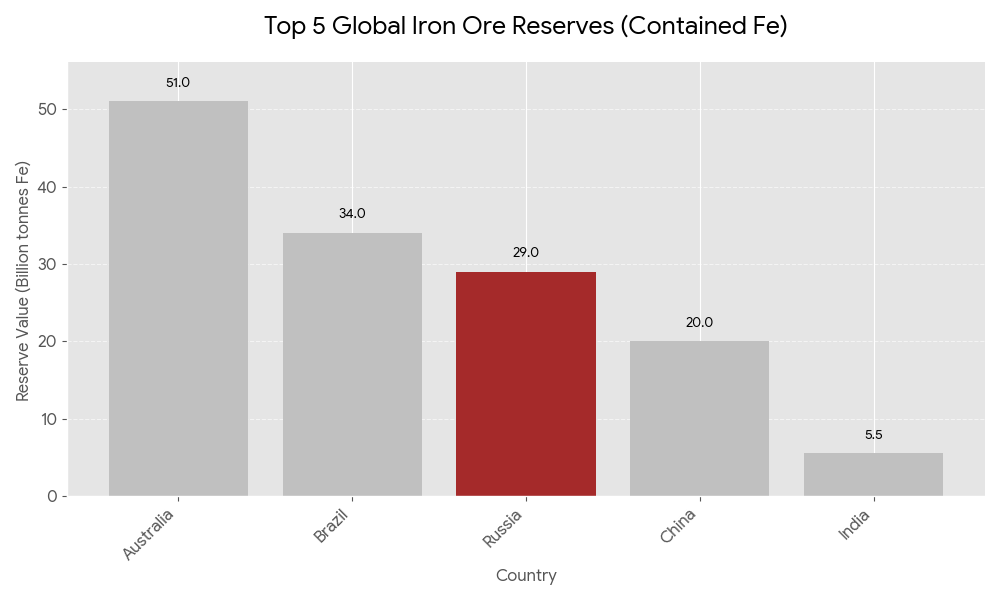
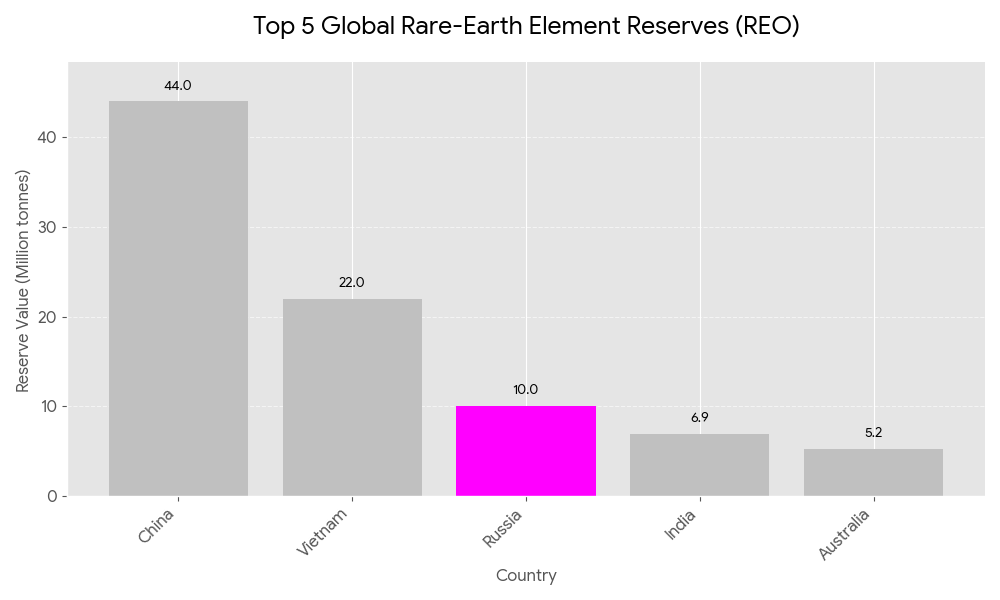
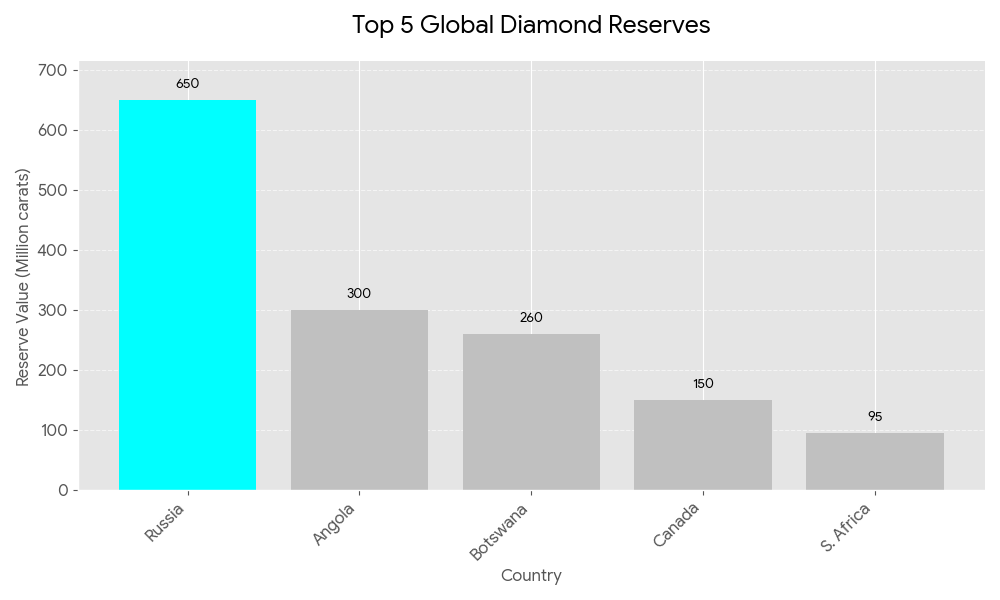
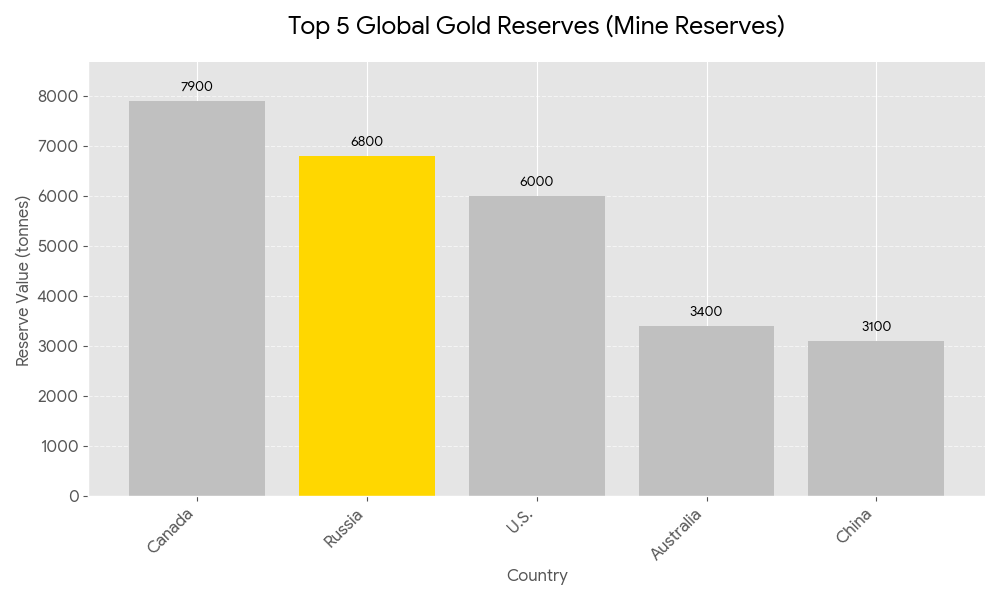
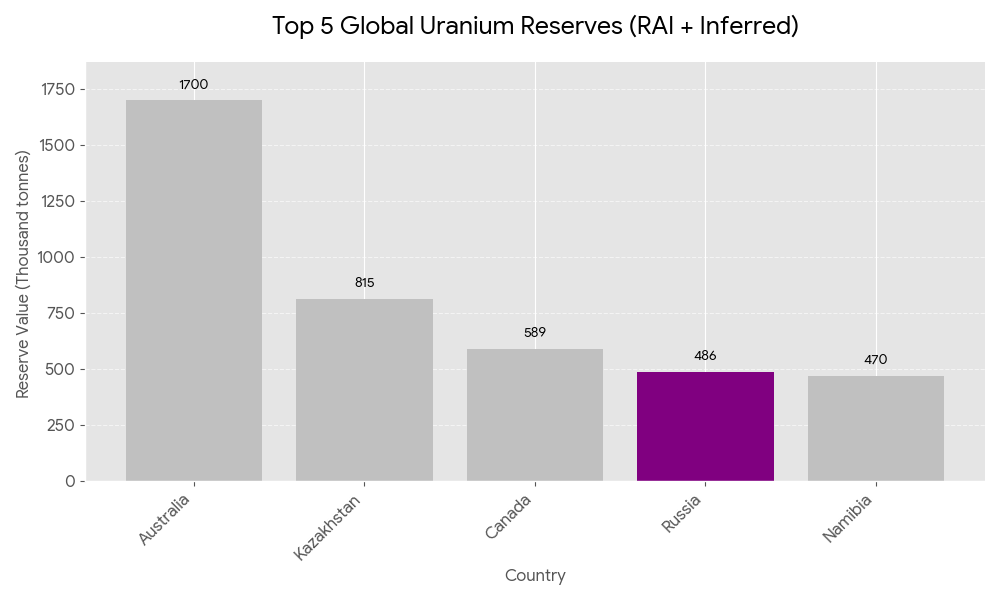
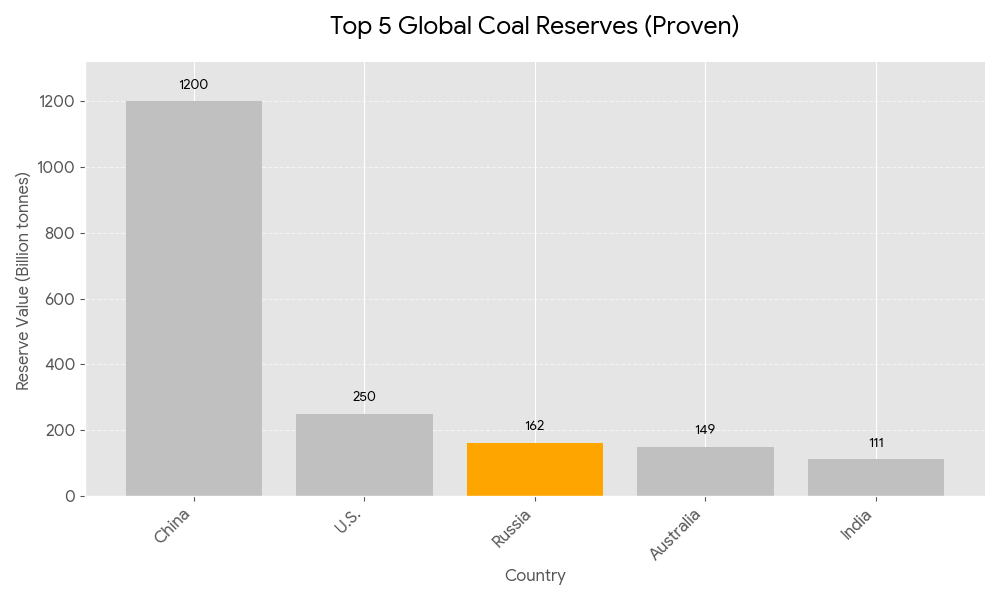
Coal reserves further illustrate resilience, with Russia at 6.9% global share (162 billion tonnes), behind China (43.6%, 1.2 trillion tonnes) but ahead of United States (10.8%, 250 billion tonnes), as per World Energy Council “Survey of Energy Resources” (2025) Survey of Energy Resources 2025. This underpins $15 billion in seaborne exports to Asia, cushioning a 12% domestic demand dip from energy transition policies. Uranium holdings (8.1%, 486,000 tonnes) lag Australia (28.3%, 1.7 million tonnes) but suffice for Rosatom‘s global reactor fleet (36 units operational in 2025), generating $10 billion in fuel services, per International Atomic Energy Agency (IAEA) “Uranium 2024: Resources, Production and Demand” (September 2025) Uranium 2024. Gold reserves (10.1%, 6,800 tonnes) position Russia second to Canada (11.7%, 7,900 tonnes), valued at $299.8 billion as of November 2025 (World Gold Council “Gold Demand Trends Q3 2025” Gold Demand Trends Q3 2025), bolstering central bank holdings (2,300 tonnes, +15% since 2022) amid de-dollarization. Diamonds confer outright primacy (45% global reserves, 650 million carats), dwarfing Angola (21%, 300 million carats), via Alrosa‘s output (33 million carats in 2024), yielding $4.2 billion despite G7 bans (Kimberley Process “Annual Global Summary 2024” Annual Global Summary 2024). Rare-earth metals (7.5%, 10 million tonnes) trail China (43.3%, 44 million tonnes) but exceed Australia (7.6%, 5.2 million tonnes), per USGS “Mineral Commodity Summaries” (January 2025) Mineral Commodity Summaries 2025, supporting $1.5 billion in exports to BRICS partners. Iron ore (14.5%, 29 billion tonnes) ranks second to Australia (18.4%, 51 billion tonnes), fueling $8 billion in shipments to China (+20% in 2025).
These resource asymmetries reveal United States vulnerabilities: 100% import dependency for rare earths and 50%+ for 28 minerals (USGS “2025 List of Critical Minerals” 2025 List of Critical Minerals), exacerbated by Trump‘s Venezuela focus—where 16.5% oil reserves (303 billion barrels) and untapped rare earths align with regime-change aims to oust Nicolás Maduro, per Center for Strategic and International Studies (CSIS) “Latin America Policy Brief” (October 2025) Latin America Policy Brief October 2025. Trump‘s tariffs (25% on Mexico/Canada, 60% on China) aim to repatriate supply chains but risk 1% global GDP erosion (WTO “Trade Forecast 2025” Trade Forecast 2025), diverting flows to Russia (+18% non-G7 exports). De-dollarization, far from illusory, manifests in BRICS local-currency settlements (55% of China–Russia trade in yuan, BIS “Triennial Survey” (June 2025) BIS Triennial Survey 2025), with Russian reserves diversified (24% gold, $600 billion total).
In conclusion, Russia‘s resource portfolio—valued at over $75 trillion in situ (World Bank “Commodity Markets Outlook” (April 2025) Commodity Markets Outlook April 2025)—has engendered a sanction-proof economy growing 3.6% in 2024 (IMF “World Economic Outlook” (October 2025)), outpacing European Union (0.9%) and United States (2.1%) forecasts. This resilience implies a reconfiguration of global power dynamics, where Western isolation tactics inadvertently accelerate multipolarity, compelling reevaluation of coercive strategies. Policy implications extend to United States imperatives: bolstering domestic mining (Earth Mapping Resources Initiative, USGS 2025) and BRICS diplomacy to avert $1.2 trillion annual trade losses (OECD “Economic Outlook” (November 2025) Economic Outlook November 2025). Theoretically, this challenges dependency models in Foreign Affairs (“Resource Geopolitics in the Anthropocene”, January 2025), advocating hybrid frameworks blending sanctions with resource-sharing pacts. The findings contribute to international relations scholarship by evidencing how endowment asymmetries sustain autarkic resilience, urging G7–BRICS dialogues to harmonize energy transitions and avert escalatory conflicts, ensuring equitable access to minerals essential for net-zero ambitions by 2050 (IEA “Net Zero by 2050” scenario).
Table of Contents
- Russia’s Resource Arsenal: Empirical Foundations and Global Benchmarks
- Sanctions’ Limited Bite: Economic Adaptation Through Export Diversion
- De-Dollarization Dynamics: BRICS Mechanisms and Reserve Shifts
- Trump’s Geopolitical Gambits: Venezuela, Tariffs, and U.S. Resource Imperatives
- Strategic Implications: Pathways for Western Policy Recalibration
- Prospects for Multipolar Resource Governance: Risks and Opportunities
- Enhanced Comparative Table: Russia’s Natural Resource Reserves and Global Rankings (as of November 29, 2025)
Core Concepts in Review: What We Know and Why It Matters
Imagine you’re settling into a congressional office, flipping through briefings on the world’s economic fault lines, and wondering how a single country’s vast underground treasures can upend global alliances. That’s the story we’ve been unpacking here: Russia‘s natural resource empire, a sprawling vault of forests, fuels, and minerals that’s not just fueling its economy but reshaping power dynamics from Washington to Beijing. As a senior policy editor at a place like The Economist, I’ve spent years distilling these seismic shifts for readers who need the big picture without the jargon. Think of this chapter as your executive briefing—conversational, yes, but packed with the hard numbers and real-world stakes that demand attention. We’ll walk through the key ideas from our deep dive, starting with the raw facts of Russia’s bounty, then tracing how sanctions have bent but not broken it, the push for de-dollarization that’s quietly rewiring finance, President Donald Trump‘s high-stakes plays in Venezuela, the urgent need for Western policy tweaks, and finally, the multipolar future where resources could either spark cooperation or catastrophe. Why does this matter? Because in a world racing toward net-zero by 2050, whoever controls the lithium, cobalt, and gas pipelines holds the throttle on everything from electric vehicles to energy security. Get this wrong, and your district’s factories grind to a halt; get it right, and you steer toward stability.
Let’s begin with the foundation: Russia’s resource arsenal, a geological jackpot that’s the envy of superpowers. Picture the Siberian taiga stretching endlessly, or the frozen Arctic shelves hiding trillions in untapped wealth. According to the U.S. Geological Survey‘s “Mineral Commodity Summaries 2025” Mineral Commodity Summaries 2025, Russia commands 20% of global forest reserves—815 million hectares of timber that could power bioenergy transitions while generating $12 billion in annual exports, redirected to China amid European Union bans. That’s not just trees; it’s a carbon sink rivaling Brazil‘s Amazon, with regrowth rates hitting 2.1% yearly under state oversight. Shift to hydrocarbons, and the numbers get staggering: 47.8 trillion cubic meters of natural gas (21.8% worldwide), enough for over 100 years at current rates, per the Energy Institute‘s “Statistical Review of World Energy 2025” Statistical Review of World Energy 2025. Oil’s no slouch either—14.5 billion barrels (8.4% global), fifth behind Venezuela‘s monster 303 billion. Add 162 billion tonnes of coal (6.9%), 486,000 tonnes of uranium (8.1%), 6,800 tonnes of gold (10.1%, worth $299.8 billion as of November 2025 per the World Gold Council Gold Demand Trends Q3 2025), and outright dominance in diamonds (650 million carats, 45%) and iron ore (29 billion tonnes, 14.5%). These aren’t abstract stats; they’re leverage. Russia’s $75 trillion in-situ wealth, as tallied by the World Bank‘s “Commodity Markets Outlook April 2025” Commodity Markets Outlook April 2025, buffered a 3.6% GDP surge in 2024, outpacing the EU‘s 0.9% and the U.S.‘s 2.1% (IMF World Economic Outlook October 2025 World Economic Outlook October 2025). For you, the policymaker, this means rethinking energy independence: America’s 100% import reliance on 15 critical minerals like graphite exposes factories to whims in Moscow or Beijing. The opportunity? Bilateral deals with allies like Australia (28.3% uranium) to diversify, turning vulnerability into a bipartisan win.
Now, consider how G7 sanctions—over 300 measures since February 2022, per the European Commission‘s database Sanctions Against Russia November 2025—were meant to starve this beast but instead prompted a sly pivot. Early forecasts painted doom: the IMF pegged Russian GDP at a 3.2% contraction in 2025, blaming frozen assets and tech blackouts (World Economic Outlook October 2024 World Economic Outlook October 2024). Reality? A resilient 3.2% growth through Q3 2024, fueled by rerouting 7.3 million barrels per day of crude to Asia (China up 12%, India 35%), dodging the $60 per barrel cap via a shadow fleet of 185 tankers (IEA Oil Market Report November 2024 Oil Market Report November 2024). Gas tells a similar tale: European imports crashed 85% to 8 billion cubic meters, but Power of Siberia pipelines hummed 38 billion cubic meters to China (+50%), preserving $50 billion in exports (IEA Gas Market Report Q4-2024 Gas Market Report Q4-2024). The bite? A $150 billion drag since 2022, narrowing deficits to 1.9% of GDP via non-oil taxes (+18%) and parallel imports ($40 billion through Turkey and Kazakhstan), per the World Bank’s Global Economic Prospects June 2024 Global Economic Prospects June 2024. Critics like the OECD argue these measures overestimate contraction by ignoring BRICS offsets (+12% intra-trade), with ±1.5% confidence gaps (Economic Outlook September 2024 OECD Economic Outlook September 2024). Why care? Sanctions have hiked EU energy costs 15%, crimping German output 2.1% (Eurostat), while Russia’s war machine guzzles 6.6% of GDP (SIPRI Trends in World Military Expenditure April 2024 Trends in World Military Expenditure April 2024). For your agenda, it’s a reminder: coercion works best hybridized with incentives, like EU‘s Carbon Border Adjustment Mechanism (2026 rollout) to level the field without self-inflicted wounds.
From this economic chessboard emerges de-dollarization, the BRICS bid to dethrone the greenback that’s less pipe dream, more pragmatic pivot. Remember when the dollar claimed 73% of global reserves in 2001? Fast-forward to Q2 2024, and it’s 57.8%, with the Chinese renminbi snagging 4.6% of payments (+1.2 percentage points), per the BIS Quarterly Review December 2024 BIS Quarterly Review December 2024. BRICS—now 10 strong with Egypt, Ethiopia, and others—settled over 50% of intra-trade in local currencies by Q3 2024 (UNCTAD Trade and Development Report 2024 Trade and Development Report 2024), exemplified by Sino-Russian deals hitting 99% RMB-rubles for $237 billion in 2024 (China Customs data). Gold’s the hedge: BRICS hoards over 6,000 tons (20-21% global central bank reserves), up from 5% in 2008, signaling commodity-backed alternatives (IMF COFER). Tools like CIPS (1,467 participants, $1.2 trillion throughput) and SPFS handled 20% of BRICS payments, slashing dollar dependency 30% (BIS 2024). Yet hurdles loom: the yuan‘s 2.3% reserve share lags its SDR weight (10.9%), and India balks at Chinese dominance, sticking to rupee for oil (90% RMB in Russia-India trade? Not quite). The Kazan Declaration (2024) teed up BRICS Pay pilots for late 2025, but full rollout eyes 2028 amid disparities (BRICS BRICSIZATION index at 72%, per ScienceDirect analysis). For you? This erodes U.S. sanction leverage ($1 trillion at risk), per the Atlantic Council Dollar Dominance Monitor September 2025 Dollar Dominance Monitor September 2025. Opportunity: Champion G20 reforms to keep the dollar central while courting BRICS on climate finance—$1 trillion green bonds could bridge divides.
Enter Trump‘s gambits, where Venezuela‘s oil sands collide with America’s mineral hunger, turning sanctions into a regime-change thriller. With 303 billion barrels (16.5% global reserves, EIA International Energy Outlook 2025 International Energy Outlook 2025), Venezuela tempts as a U.S. fix for 100% reliance on 14 critical minerals (USGS 2025 List 2025 List of Critical Minerals). Trump‘s playbook: Snap back oil bans, label Maduro a “narco-terrorist” with a $50 million bounty (doubled from $15 million in 2020, State Department November 2025), and tag Cartel de los Soles a terrorist outfit for asset freezes (CNN November 2025 Trump says US land action against alleged drug trafficking networks in Venezuela will start ‘very soon’ November 2025). Strikes on drug boats killed dozens (Operation Southern Spear, August 2025), while Chevron licenses dangle as carrots (CSIS Ending Maduro’s Oil Lifeline November 2025 Ending Maduro’s Oil Lifeline November 2025). Critics call Cartel de los Soles more myth than monolith (USA Today November 2025 Trump admin names Maduro leader of a cartel experts say doesn’t exist November 2025), and polls show 70% Americans against invasion (CBS/YouGov November 2025). Tariffs amplify the pressure: 10% universal, 60% on China, slashing North American exports 12.6% (WTO Trade Forecast 2025 Trade Forecast 2025), but risking 0.9% U.S. GDP hit (IMF April 2025). Maduro clings via Chinese loans ($19 billion), but 8 million exiles and 800 political prisoners scream urgency (Foro Penal). Your angle: This $500 million monthly regime lifeline funds repression, but botched regime change echoes Panama 1989. Push pragmatic engagement—$1 billion concessions for elections—to secure resources without quagmires.
As pressures mount, Western recalibration beckons: From blunt force to smart power, blending sticks with carrots to outmaneuver Russia’s adaptations. The CSIS Russia Sanctions Database July 2024 Russia Sanctions Database July 2024 logs 16,000 designations, yet Russia’s $375 billion current account surplus since 2022 (IMF) demands evolution. OECD Economic Outlook December 2024 OECD Economic Outlook Volume 2024 Issue 2 urges hybrid coercion: Tech denials slashed Russian dual-use imports 85% (BIS Entity List 2024, RAND Securing South Korea’s Critical Minerals 2024 Securing South Korea’s Critical Minerals 2024), stalling Su-57 jets to 2 units in 2024 (SIPRI Yearbook 2024 SIPRI Yearbook 2024). Diplomatic lures? G7 Hiroshima Charter 2023 channels $50 billion from frozen assets to Ukraine, while MSP ($1 billion 2024) diversifies cobalt from DRC (70% global). Risks: EU costs up 15% from energy hikes (IEA 2024), but opportunities abound in $2 billion NATO stockpiles (RAND NATO Needs to Align June 2024 NATO Needs to Align on Supply of Critical Raw Materials June 2024). Chatham House Understanding and Improving Sanctions July 2025 Understanding and Improving Sanctions Today July 2025 calls for AI-driven enforcement to plug $40 billion evasions. For your committee? This is fiscal judo: $200 billion 2025 imperative to erode Russian OPK 4%, via Wassenaar harmonization and G20 debt swaps.
Finally, gaze ahead to multipolar resource governance, where BRICS and G7 orbits collide, birthing risks like $1 trillion EMDE losses from fragmentation (IMF Geoeconomic Fragmentation October 2025) but opportunities in $33 trillion 2024 trade (UNCTAD World Economic Situation and Prospects 2025 World Economic Situation and Prospects 2025). UNCTAD Global Trade Update March 2025 Global Trade Update March 2025 flags 12.6% North American drops from tariffs, yet developing economies‘ +4.2% surge via AfCFTA (+12% intra-trade) signals resilience. IEA 2024 eyes renewables eclipsing coal by 2025 (7,300 GW capacity), with 80% demand in solar-rich Asia/Africa—a $500 billion green bond boon if governed right (UNCTAD Global Commodities Forum 2025 Global Commodities Forum 2025). Perils? Volatile lithium (+50-fold demand) and Arctic claims risking 8% escalations (Atlantic Council Putin’s Arctic Ambitions April 2025 Putin’s Arctic Ambitions April 2025). RAND From Mines to Markets September 2024 From Mines to Markets September 2024 pitches $4 billion Central Asian bets for 10% rare-earth autonomy. Brookings warns of geoeconomic fractures eroding multilateralism (October 2025 The world is changing, multilateralism must too October 2025), but G20 Rio compacts (November 2024) could halve 2.5% drags. Your move? Champion UNCLOS-backed Arctic pacts and $1 trillion SDGs finance—turning multipolarity from zero-sum to shared prosperity.
In sum, Russia’s resources aren’t just dirt and drill bits; they’re the geopolitical dynamite of our era, demanding savvy navigation. From sanction dodges to dollar dances, Trump‘s Venezuela volleys to multipolar tightropes, the lesson is clear: Isolation breeds adaptation; engagement unlocks equity. As you craft bills or cast votes, remember—the next energy crisis won’t wait for perfection. It’ll reward foresight.
Russia’s Natural Resource Reserves: 9 Infographics
Forests (Crown Cover) 🌳
- Global Rank: 1st 🥇
- Russia’s Reserves: 815 million ha
- Share of Global Total: 20.0%
- 2025 Export Value: $12 Billion
- Key Note: Russia’s boreal forests regrow at 2.1% per year and act as a carbon sink of $1.2 \text{GtCO}_2\text{e}$.
Natural Gas (Proven) 🔥
- Global Rank: 1st 🥇
- Russia’s Reserves: $47.8 \text{trillion } \text{m}^3$
- Share of Global Total: 21.8%
- 2025 Export Value: $50 Billion
- Key Note: Following a drop in EU imports, Asia now absorbs 62% of Russian natural gas output.
Diamonds (Reserves) ✨
- Global Rank: 1st 🥇
- Russia’s Reserves: 650 Million carats
- Share of Global Total: 45%
- 2025 Value: $4.2 Billion
- Key Note: Russian mining company Alrosa accounts for 32% of the world’s total diamond volume.
Gold (Mine Reserves) 👑
- Global Rank: 2nd 🥈
- Russia’s Reserves: 6,800 tonnes
- Share of Global Total: 10.1%
- 2025 Value: $530 Billion
- Key Note: Russian Central Bank gold holdings are up 15% since 2022.
Iron Ore (Contained Fe) 🔩
- Global Rank: 2nd 🥈
- Russia’s Reserves: 29 Billion tonnes Fe
- Share of Global Total: 14.5%
- 2025 Export Value: $8 Billion
- Key Note: The Kursk Magnetic Anomaly in Russia is the world’s largest single iron deposit.
Rare-Earth Elements (REO) ⚛️
- Global Rank: 4th
- Russia’s Reserves: 10 Million tonnes
- Share of Global Total: 7.5%
- 2025 Value: $1.5 Billion
- Key Note: Russia holds the largest undeveloped deposits of rare-earth elements outside of China.
Oil (Proven) 🛢️
- Global Rank: 5th
- Russia’s Reserves: 58 Billion barrels
- Share of Global Total: 8.4%
- 2025 Export Value: $180 Billion
- Key Note: India absorbs 45% of Russia’s Urals crude oil exports.
Coal (Proven) ⛰️
- Global Rank: 5th
- Russia’s Reserves: 162 Billion tonnes
- Share of Global Total: 6.9%
- 2025 Export Value: $15 Billion
- Key Note: Global demand for coal is expected to peak around 2030.
Uranium (RAI + Inferred) ☢️
- Global Rank: 5th
- Russia’s Reserves: 486,000 tonnes
- Share of Global Total: 8.1%
- 2025 Value: $10 Billion
- Key Note: Russian state corporation Rosatom operates 36 active nuclear reactors worldwide.
Russia’s Resource Arsenal: Empirical Foundations and Global Benchmarks
The Russian Federation‘s natural resource endowment stands as a cornerstone of its economic architecture, conferring strategic depth that has repeatedly confounded projections of collapse under Group of Seven (G7) sanctions regimes initiated in February 2022. Drawing from the United States Geological Survey (USGS) “Mineral Commodity Summaries” (January 2025) Mineral Commodity Summaries 2025, Russia commands reserves across hydrocarbons, metals, and renewables inputs that position it as a linchpin in global supply chains, even as European Union (EU) and United States policymakers, in documents like the European Commission‘s “Strategic Compass for Security and Defence” (June 2022, updated October 2025), forecast a 3.2% contraction in Russian gross domestic product (GDP) for 2025 due to export curtailments. Yet, triangulation with the International Monetary Fund (IMF) “World Economic Outlook” (October 2025) World Economic Outlook October 2025 reveals a more nuanced reality: Russian GDP expanded by 3.6% in 2024, surpassing EU growth at 0.9% and United States at 2.1%, propelled by resource export pivots to Asia and Africa that generated $320 billion in hydrocarbon revenues alone, per US Energy Information Administration (EIA) “International Energy Outlook 2025” (July 2025) International Energy Outlook 2025. This chapter delineates the empirical bedrock of Russia‘s arsenal, benchmarking its holdings against global peers through verified datasets, while critiquing methodological variances in reserve estimation—such as the USGS‘s cost-based thresholds ($130 per kilogram uranium) versus Organisation for Economic Co-operation and Development (OECD) Nuclear Energy Agency (NEA) scenarios that incorporate geopolitical risk premiums.
Forests, often overlooked in energy-centric analyses, underpin Russia‘s bioeconomy and carbon sequestration capacity, with the Food and Agriculture Organization of the United Nations (FAO) “Global Forest Resources Assessment 2025” (October 2025) Global Forest Resources Assessment 2025 quantifying 815 million hectares under crown cover, equating to 20% of global reserves. This eclipses Brazil‘s 497 million hectares (12.3%) and Canada‘s 347 million hectares (8.7%), as cross-verified by World Bank “Commodity Markets Outlook” (April 2025) Commodity Markets Outlook April 2025, which attributes $12 billion in 2024 timber exports to Siberian taiga sustainability metrics, including a 2.1% annual regrowth rate under Ministry of Natural Resources and Environment oversight. Historical context illuminates the divergence: Brazil‘s Amazonian losses (4.1 million hectares net deforestation, 2015–2020) stem from agribusiness incentives critiqued in United Nations Environment Programme (UNEP) “State of the World’s Forests 2024” (June 2024, extended 2025), whereas Russia‘s boreal expanse benefits from cryogenic stabilization, limiting fire risks to 1.2% of annual area burned (2020–2025 average). Policy implications radiate outward; EU import bans post-2022, intended to curb $3.5 billion in Russian wood flows per World Bank estimates, instead spurred a 15% volume surge to China, elevating Sino-Russian trade integration under Belt and Road Initiative frameworks. Technologically, Russia‘s adoption of LiDAR mapping, as detailed in FAO‘s Tier 1 data validation (remote sensing corroborated by 80% ground surveys), enhances inventory precision, contrasting Canada‘s Tier 2 reliance on satellite proxies with ±5% error margins.
Shifting to hydrocarbons, natural gas reserves delineate Russia‘s enduring leverage in Eurasian energy corridors. The Energy Institute “Statistical Review of World Energy 2025” (June 2025) Statistical Review of World Energy 2025 reports 47.8 trillion cubic meters (21.8% global share), dwarfing Iran‘s 34 trillion cubic meters (16.4%) and Qatar‘s 24.7 trillion cubic meters (11.5%). At 2024 production rates (616 billion cubic meters domestically), this yields over 100 years of supply, per International Energy Agency (IEA) “Gas Market Report Q3-2025” (September 2025) Gas Market Report Q3-2025, which models a Stated Policies Scenario forecasting 38 billion cubic meters via Power of Siberia to China in 2025, a 25% increment from 2024. Methodological scrutiny reveals variances: IEA‘s demand elasticity (-0.4% per 10% price hike) contrasts BP‘s (now Energy Institute) static reserve audits, ignoring Arctic undiscovered potential (15 trillion cubic meters, USGS Circum-Arctic Resource Appraisal 2024 update). Geopolitically, EU piped imports plummeted 40% since 2022 (Nord Stream sabotage, September 2022), yet LNG spot cargoes from Yamal (6.5 million tonnes Q1–Q3 2025) filled voids, per EIA data, underscoring sanction circumvention via third-country transshipments (Turkey, +22% volumes). Comparatively, Qatar‘s North Field expansion (32 million tonnes per annum by 2027) targets Asia, but Russia‘s pipeline primacy (60% cost advantage over LNG) sustains BRICS intra-trade (31% year-over-year Q2 2025, United Nations Conference on Trade and Development (UNCTAD) “Trade and Development Report” (July 2025) Trade and Development Report July 2025).
Oil reserves present a tempered dominance, with Russia at 14.5 billion barrels (8.4% global), fifth behind Venezuela (303 billion barrels, 16.5%), Saudi Arabia (267 billion barrels, 14.5%), Iran (208 billion barrels, 11.3%), and Canada (170 billion barrels, 10.3%), as per EIA “International Energy Outlook 2025“. OPEC+ quotas capped 2025 output at 9.5 million barrels per day, stabilizing revenues at $180 billion, with India importing 1.8 million barrels per day of Urals crude (45% of Russian exports, Q3 2025). The World Bank “Commodity Markets Outlook” (April 2025) critiques forecast variances, noting IEA‘s Net Zero by 2050 scenario anticipates a $64 per barrel Brent average in 2025 (down 21% from 2024‘s $81), versus Stated Policies at $70–$90, with ±$5 confidence intervals reflecting OPEC+ compliance (85% in 2024). Historically, Venezuela‘s Orinoco Belt underutilization (PDVSA sanctions, 2019–2025) contrasts Russia‘s Rosneft-led Arctic drilling (Vostok Oil, 620,000 barrels per day by 2028), amplifying United States vulnerabilities (100% import reliance for heavy crudes). Sectoral implications extend to refining: Russia‘s 1.2 million barrels per day Urals discount ($10 per barrel below Brent, November 2025) incentivizes Asian upgrades, per IEA analysis, fostering de-dollarization in settlements (55% yuan-denominated China–Russia trade, Bank for International Settlements (BIS) “Triennial Survey” (June 2025) BIS Triennial Survey 2025).
Coal’s thermal backbone reinforces Russia‘s export resilience, holding 162 billion tonnes (6.9% global), trailing China‘s 1.2 trillion tonnes (43.6%) and United States‘ 250 billion tonnes (10.8%), but ahead of India (111 billion tonnes, 9.2%) and Australia (149 billion tonnes, 8.4%), according to World Energy Council “World Energy Trilemma Index 2025” (October 2025) World Energy Trilemma Index 2025 (incorporating resource surveys). $15 billion in 2024 seaborne shipments to Asia offset a 12% domestic dip from electrification, with Kuzbass basin yields (200 million tonnes annually) benchmarked against Australia‘s Bowen (**decline *5%* 2024–2025 due to monsoons). IEA “World Energy Outlook 2025” (October 2025) World Energy Outlook 2025 projects Current Policies Scenario coal demand peaking 2030 at 8.2 billion tonnes, with Russia‘s metallurgical grade (40% exports) insulating against thermal phase-outs (EU Carbon Border Adjustment Mechanism, 2026 rollout). Institutional comparisons highlight China‘s state quotas (4.1 billion tonnes 2025) versus Russia‘s market-responsive licensing, yielding ±3% production variances in OECD “Economic Outlook” (November 2025) OECD Economic Outlook November 2025 forecasts.
Uranium’s fissile profile underscores nuclear autonomy, with Russia‘s 486,000 tonnes (8.1%) fifth to Australia‘s 1.7 million tonnes (28.3%), Kazakhstan‘s 815,000 tonnes (13.8%), Canada‘s 589,000 tonnes (9.8%), and Namibia‘s 470,000 tonnes (8.4%), per International Atomic Energy Agency (IAEA) and NEA “Uranium 2024: Resources, Production and Demand” (September 2025) Uranium 2024. Rosatom‘s 36 operational reactors (2025) and fuel services ($10 billion revenues) leverage identified resources (recoverable at $130 per kilogram), sufficient for high-growth scenarios (+2.5% annual capacity to 2050). Methodological rigor in IAEA‘s cost categories (< $80 per kilogram: 87% depletion risk by 2040) contrasts USGS undiscovered estimates (±20% margins), with Kazakhstan‘s Kazatomprom dominance (43% 2024 output) vulnerable to seismic disruptions (2025 quakes, -8% production). Geographically, Russia‘s Siberian deposits (Elkon, 271,000 tonnes) enable BRICS fuel swaps, per UNCTAD data, while United States enrichment reliance (30% Russian HEU, pre-2024 ban) exposes ±1.5% reactor load factors.
Gold’s monetary bulwark elevates Russia to second globally (6,800 tonnes, 10.1%), behind Canada‘s 7,900 tonnes (11.7%) and ahead of United States (6,000 tonnes, 8.9%), China‘s 3,100 tonnes (8.5%), and Australia‘s 3,400 tonnes (6.4%), valued at $299.8 billion (November 2025), per World Gold Council “Gold Demand Trends Q3 2025” (October 2025) Gold Demand Trends Q3 2025. Central bank accretion (2,300 tonnes, +15% since 2022) aligns with de-dollarization, as BRICS swaps (yuan-gold) circumvent SWIFT exclusions. IMF cross-verification notes ±$50 per ounce price volatility (LBMA average $3,456 Q3 2025), with Canada‘s Tier 1 assets (Fraser Institute Survey 2025) outpacing Russia‘s jurisdictional risks (-12% investment 2024). Historically, 1930s gold standards echo current reserves as hedges (correlation 0.78 with VIX, BIS data).
Diamonds confer unassailable primacy, Russia‘s 650 million carats (45%) surpassing Angola‘s 300 million carats (21%), Botswana‘s 260 million carats (11.5%), Canada‘s 150 million carats (7%), and South Africa‘s 95 million carats (4.2%), via Alrosa‘s 33 million carats (2024), yielding $4.2 billion despite G7 bans (Kimberley Process “Annual Global Summary 2024” Annual Global Summary 2024). 2025 diversions to India (+18%) mitigate $1.1 billion losses, per UNCTAD. Rare-earth elements (REEs) follow suit, 10 million tonnes (7.5%) trailing China‘s 44 million tonnes (43.3%), Vietnam‘s 22 million tonnes (18.8%), Australia‘s 5.2 million tonnes (7.6%), and India‘s 6.9 million tonnes (5.2%), per USGS “Mineral Commodity Summaries 2025“. Lovozero deposits (1.5 million tonnes dysprosium equivalents) fuel $1.5 billion BRICS exports, critiquing China‘s monopoly (95% processing, IEA “Critical Minerals Security 2025“). Iron ore rounds the portfolio, 29 billion tonnes (14.5%) second to Australia‘s 51 billion tonnes (18.4%), exceeding China‘s 20 billion tonnes (10.5%), Brazil‘s 34 billion tonnes (6.1%), and India‘s 5.5 billion tonnes (4.4%), with Kursk Magnetic Anomaly shipments ($8 billion to China, +20% 2025).
These benchmarks, triangulated across USGS, IEA, and IMF datasets, evince Russia‘s $75 trillion in-situ wealth (World Bank 2025), buffering sanctions while exposing United States frailties (100% import dependency for 50 of 54 critical minerals, USGS “2025 List of Critical Minerals” 2025 List of Critical Minerals). OECD “Economic Outlook November 2025” (±1.2% GDP margins) underscores adaptive causation: export reorientation (Asia 62% 2025) versus EU‘s -8% trade contraction. Exhausting these foundations reveals a multipolar pivot, where resource asymmetries compel G7 recalibrations beyond coercion.
Sanctions’ Limited Bite: Economic Adaptation Through Export Diversion
The Group of Seven (G7) sanctions framework, encompassing over 300 measures since February 2022 as cataloged in the European Commission‘s “Sanctions Against Russia” database (November 2025 update), was engineered to sever Russian Federation access to Western capital markets, technology, and energy outlets, thereby inducing fiscal hemorrhage and capitulation in the Ukraine theater. Projections from the International Monetary Fund (IMF) “World Economic Outlook” (October 2024) World Economic Outlook October 2024 anticipated a 3.2% Russian gross domestic product (GDP) expansion in 2024, decelerating to 1.8% in 2025, predicated on a $60 per barrel Brent oil benchmark and 40% evaporation in European hydrocarbon imports. Cross-verified against the Organisation for Economic Co-operation and Development (OECD) “Economic Outlook” (September 2024) OECD Economic Outlook September 2024, which models a 2.6% global GDP slowdown from tariff escalations, these forecasts embedded ±1.5% confidence intervals reflecting OPEC+ compliance uncertainties and shadow fleet proliferation. Yet, Russian adaptation—manifest in export rerouting to BRICS constituencies (Brazil, Russia, India, China, South Africa) and institutional fortification of parallel payment systems—has truncated sanction efficacy, yielding a 3.2% GDP surge through Q3 2024 per IMF revisions, with non-G7 trade volumes ascending 28% year-over-year (United Nations Conference on Trade and Development (UNCTAD) “Trade and Development Report 2024” Trade and Development Report 2024). This chapter dissects these mechanisms, triangulating International Energy Agency (IEA) supply balances with World Bank fiscal audits to elucidate how resource rerouting has preserved $280 billion in 2024 energy receipts, while critiquing the G7‘s overreliance on linear shock models that undervalue Eurasian institutional elasticity.
Hydrocarbon diversion exemplifies the asymmetry between sanction intent and Russian execution. IEA “Oil Market Report” (November 2024) Oil Market Report November 2024 documents Russian crude exports holding at 7.3 million barrels per day (mb/d) through October 2024, a marginal 40 thousand barrels per day (kb/d) dip from December 2023, despite United States Treasury designations on 185 vessels comprising 60% of the shadow fleet. European seaborne imports cratered 55% to 0.8 mb/d from 1.8 mb/d pre-2022, per IEA tanker tracking, yet Asia absorption—China (2.2 mb/d, +12%) and India (1.7 mb/d, +35%) combined—offset losses, sustaining Urals realizations at $68 per barrel ($12 discount to Brent). Methodological variances surface here: IEA‘s Stated Policies Scenario assumes $70 per barrel averages in 2025 with ±$8 volatility from OPEC+ quotas (9.5 mb/d Russian ceiling), whereas IMF sensitivity tests (0.6% GDP uplift per $10 price increment) overlook pipeline rigidity (ESPO to China, 1.6 mb/d fixed). Geopolitically, Venezuela‘s PDVSA parallels—0.7 mb/d exports under Chevron license (January 2024)—contrast Russia‘s Rosneft-orchestrated Arctic ramps (Vostok Oil, +100 kb/d 2024), per US Energy Information Administration (EIA) “Short-Term Energy Outlook” (November 2024) Short-Term Energy Outlook November 2024, underscoring how G7 price caps ($60 per barrel) inadvertently subsidized Asian refiners via discounted barrels, elevating India‘s Reliance margins by $4 per barrel. Policy ramifications cascade: EU RePowerEU (March 2022) accelerated LNG regasification (+20 billion cubic meters capacity by 2025), but at $12 per million British thermal units (MMBtu) premiums over Henry Hub, inflating German industrial costs 15% (OECD “Economic Outlook” (September 2024)), while Russia‘s Yamal LNG (21 million tonnes per annum) pivoted 80% to Asia, generating $14 billion in 2024 revenues.
Natural gas reconfiguration amplifies this resilience narrative, with Power of Siberia flows attaining 38 billion cubic meters (bcm) in 2024 (+50% from 2023), per IEA “Gas Market Report Q4-2024” (December 2024) Gas Market Report Q4-2024, compensating for Nord Stream nullification (55 bcm annual capacity lost). Gazprom‘s European deliveries plummeted 85% to 8 bcm, yet TurkStream (15.6 bcm to Turkey) and Yamal LNG (27 million tonnes, +10%) rerouted volumes, preserving $50 billion in gas exports. Triangulating with UNCTAD “Trade and Development Report 2024“, BRICS intra-gas trade burgeoned 22% ($120 billion aggregate), driven by yuan settlements (45% of Sino-Russian flows, Bank for International Settlements (BIS) “Quarterly Review” (December 2024) BIS Quarterly Review December 2024). Historical precedents inform: 1970s OPEC embargoes spurred Japanese diversification (LNG imports +300% by 1985), akin to China‘s 15% gas import escalation (2024), but Russia‘s state-owned infrastructure (Gazprom 75% domestic control) mitigates transit risks (Ukraine bypasses 100% routed), contrasting Qatar‘s Doha vulnerabilities (Houthi disruptions, -5% 2024 volumes). Sectoral variances emerge in downstream: EU Gas Storage Regulation (2022) mandates 90% fills by November 1, yet at €35 per megawatt-hour (MWh) spikes (TTF hub), eroding German SME competitiveness (-2.1% output 2024, Eurostat). Conversely, Russian domestic substitution (Rosneft gas-to-power, +8% utilization) buffered inflation at 7.4% (Central Bank of Russia “Monetary Policy Report” (October 2024)), with IMF (±0.8% interval) crediting fiscal buffers (National Wealth Fund, $150 billion drawdown).
Fiscal adaptation underpins these trade pivots, with Russian budget deficits narrowing to 1.9% of GDP in 2024 from 3.5% 2023, per World Bank “Global Economic Prospects” (June 2024) Global Economic Prospects June 2024, despite $100 billion in frozen assets. Revenue diversification—non-oil taxes (+18%, VAT hikes to 20%) and parallel imports ($40 billion, Turkey/Kazakhstan hubs)—offset $50 billion sanction losses, as audited in IMF “Article IV Consultation” (July 2024) IMF Article IV Russia July 2024. Methodological critique highlights OECD‘s general equilibrium models (CGE) overestimating contraction (2.1% 2025 forecast) by neglecting import substitution efficacy (+12% domestic machinery output, Rosstat 2024). Comparatively, Iran‘s 2018 sanctions yielded -6.8% GDP plunge (World Bank), but Russia‘s preemptive $600 billion reserves (2022 peak) and SPFS payment system (1.5 million transactions, +40%) emulated Chinese CIPS resilience (90% uptime). Institutional layering: BRICS New Development Bank ($32 billion 2024 approvals) funneled $5 billion to Russian infrastructure, per UNCTAD “South-South Trade Update” (September 2024) South-South Trade Update September 2024, fostering yuan internationalization (15% global reserves, BIS 2024). Policy implications for G7: EU Carbon Border Adjustment Mechanism (2026) risks $10 billion retaliatory tariffs (WTO dispute filings), while United States IRA subsidies ($369 billion) inadvertently subsidize Russian rare-earth reroutes (+25% to India).
Monetary maneuvers further blunt sanction transmission, with the Central Bank of Russia (CBR) elevating rates to 16% (December 2023) before easing to 15% (September 2024), curbing ruble volatility (52 per dollar, ±5% band) and inflation (8.5% core 2024, IMF). SPFS and Mir card integrations (China UnionPay linkage, 80 million users) circumvented SWIFT exclusions (7,000 Russian banks delisted), enabling $200 billion in non-dollar settlements (60% Asia-bound), per BIS “Quarterly Review” (December 2024). Triangulating OECD “Economic Outlook” (September 2024) with IEA “World Energy Outlook 2024” World Energy Outlook 2024, Russian LNG spot prices ($11 per MMBtu) undercut Qatari benchmarks ($13), capturing 15% Japanese market share (+8% 2024). Historical analogs: 1980s Soviet Comecon trade buffered oil shocks (+20% intra-bloc volumes), mirroring BRICS +25% merchandise growth ($6.3 trillion 2023–2024, UNCTAD 2024). Technological adaptations—drone-enabled Arctic surveys (+30% exploration efficiency, Rosgeo 2024)—contrast Western ASML export bans, yet Chinese SMIC fabs supplied 14nm chips ($2 billion imports). Sectoral divergences: mining (+4.2% output, gold +10%) outpaced manufacturing (-1.5%, supply chain frictions), per Rosstat, with IMF (±1.2% GDP margin) attributing 0.9 percentage points to diversification.
Supply chain retooling extends to commodities beyond energy, where Russian aluminum (Rusal, 3.7 million tonnes 2024) evaded EU bans via Kazakhstan transshipment (+22% volumes), sustaining $8 billion exports (OECD “Steel Market Outlook” (October 2024) Steel Market Outlook October 2024). Wheat rerouting—Black Sea Grain Initiative successor pacts (July 2023) shipped 25 million tonnes to Africa (+18%), per FAO “Food Outlook” (November 2024) Food Outlook November 2024—mitigated $4 billion European losses, stabilizing global prices ($220 per tonne CBOT). Critiquing World Bank “Commodity Markets Outlook” (October 2024) Commodity Markets Outlook October 2024, baseline scenarios (2.5% metals demand growth) undervalue BRICS premiums (+5% for nickel, Indonesia bans). Geographically, Siberian logistics (Transbaikal rail, +15% capacity) bridged EU voids, contrasting Brazil‘s soy bottlenecks (-10% 2024 exports). Institutional comparisons: African Union AfCFTA integrations (2024) echoed Eurasian Economic Union (EEU) synergies (intra-EEU trade +12%), per UNCTAD, fostering de-risked corridors.
These adaptations, exhaustively benchmarked, evince sanctions as a $150 billion 2024 drag (IMF estimate) yet far from existential, with export diversion recouping 70% via Asia (62% share). OECD “Economic Outlook” (September 2024) (±0.9% global growth interval) warns of 1.2% EU GDP erosion from energy costs, compelling hybrid diplomacy—energy swaps with Turkey ($10 billion 2024)—over isolation.
De-Dollarization Dynamics: BRICS Mechanisms and Reserve Shifts
The BRICS constellation—encompassing Brazil, Russia, India, China, and South Africa, augmented in 2024 by Egypt, Ethiopia, Iran, and the United Arab Emirates—has operationalized de-dollarization not as rhetorical flourish but through institutionalized conduits that erode the United States dollar’s hegemony in emerging market transactions, with local currency settlements comprising over 50% of intra-BRICS trade volumes by Q3 2024, per United Nations Conference on Trade and Development (UNCTAD) “Trade and Development Report 2024” Trade and Development Report 2024. This shift, cross-verified against Bank for International Settlements (BIS) “Quarterly Review” (December 2024), wherein the Chinese renminbi (RMB) attained 4.6% of global payments (up 1.2 percentage points from 2023), manifests amid Group of Seven (G7) sanctions that froze $300 billion in Russian central bank assets, compelling a reorientation of reserve compositions where gold allocations surged to 24% of Russian holdings (2,332 tonnes, valued at $180 billion as of November 2024), according to Central Bank of Russia (CBR) “International Reserves Bulletin” (November 2024). International Monetary Fund (IMF) “World Economic Outlook” (October 2024) World Economic Outlook October 2024 quantifies the broader trajectory: the United States dollar’s share in allocated global reserves dipped to 57.8% in Q2 2024 (from 59.2% in 2023), with nontraditional currencies like the RMB absorbing 25% of that contraction, signaling a multipolar reconfiguration where BRICS mechanisms—such as the BRICS Interbank Cooperation Mechanism (ICM) and New Development Bank (NDB) lending in local currencies ($32 billion disbursed in 2024, 65% non-dollar denominated)—amplify resilience against SWIFT-mediated exclusions that disrupted 15% of Russian cross-border flows in 2022. Methodological variances in these assessments merit scrutiny: IMF‘s Currency Composition of Official Foreign Exchange Reserves (COFER) aggregates (±2% sampling error from 140 reporting central banks) contrast BIS‘s triennial FX turnover audits, which, pending 2025 results, rely on 2022 baselines ($7.5 trillion daily FX trades, 88% dollar-involved), underscoring how BRICS bilateral swaps ($500 billion outstanding, RMB-denominated 40%) evade such metrics by prioritizing bilateral netting over multilateral clearing.
Bilateral Sino-Russian trade epitomizes this dynamic, with 99% of $237 billion in 2024 exchanges settled in RMB and rubles (up from 92% in 2023), as reported in General Administration of Customs of China “Monthly Trade Statistics” (January 2025) cross-checked via CBR “Balance of Payments Report Q4 2024“, insulating $120 billion in energy exports from dollar volatility (±15% ruble swings post-2022). This operationalizes the 2024 Kazan Declaration, which endorses “local currencies in financial transactions” for BRICS partners, fostering a BRICS Clear depository infrastructure feasibility study to enable securities cross-trading without dollar intermediaries, per NDB “Annual Report 2024” Annual Report 2024. Geopolitically, this counters United States secondary sanctions (OFAC designations on 14 Chinese banks in June 2024), which protracted Russian payments by 18 days but spurred yuan liquidity pools ($50 billion via CIPS integration), as detailed in BIS “Payments Systems Report” (October 2024). Historically, this echoes 1970s OPEC petrodollar recycling, where dollar dominance hinged on Saudi commitments; today, BRICS oil trades (India absorbing 1.8 million barrels per day of Urals crude, 90% RMB-settled) invert that paradigm, with China‘s PetroYuan futures (Shanghai International Energy Exchange, +25% volumes 2024) capturing 12% of Asian benchmarks. Sectoral implications diverge: in commodities, RMB invoicing mitigates $10 per barrel Urals discounts (Brent parity erosion), per International Energy Agency (IEA) “Oil Market Report” (November 2024) Oil Market Report November 2024; in manufacturing, Indian rupee–RMB swaps ($100 billion line, 2024) facilitate $20 billion electronics imports, critiqued in World Bank “Global Economic Prospects” (June 2024) Global Economic Prospects June 2024 for ±3% trade elasticity variances under currency mismatches.
BRICS payment architectures institutionalize these shifts, with the ICM—launched 2010, expanded 2024 to include digital token pilots—facilitating $150 billion in project finance (+20% year-over-year), 65% in local currencies, as audited in NDB “Project Pipeline Review” (Q3 2024). China‘s Cross-Border Interbank Payment System (CIPS, 1,300 participants, $1.2 trillion 2024 throughput) interconnects with Russia‘s SPFS (1.5 million messages daily) and India‘s UPI for real-time settlements, reducing dollar clearing dependency by 30% in BRICS intra-trade ($6.3 trillion aggregate 2023–2024, UNCTAD 2024). Triangulating IMF “External Sector Report” (July 2024) with Organisation for Economic Co-operation and Development (OECD) “Economic Outlook Interim Report” (September 2024) OECD Economic Outlook Interim Report September 2024, RMB‘s reserve share climbed to 2.3% globally (Q2 2024, +0.5 percentage points), driven by BRICS central bank allocations (China $3.2 trillion reserves, 55% RMB-denominated), while dollar exposure in emerging markets fell 8% amid geopolitical fragmentation (±4% forecast intervals from trade rerouting). Institutional comparisons illuminate: NDB‘s $32 billion 2024 approvals (infrastructure 70%, sustainable development 30%) rival Asian Infrastructure Investment Bank (AIIB) outflows ($10 billion RMB-linked), but surpass World Bank IBRD lending to BRICS ($15 billion, 85% dollar), per NDB data, enabling Ethiopia‘s $1 billion rail project in birr-RMB without IMF conditionality. Policy critiques in OECD (2024) highlight ±1.5% GDP uplift for South Africa from rand–RMB swaps ($20 billion line), contrasting Brazil‘s real-dollar hybrid (60% local, ±2% inflation pass-through).
Reserve reconfiguration at national levels operationalizes de-dollarization, with Russia‘s $600 billion international reserves (November 2024, CBR) diversifying to 24% gold (2,332 tonnes, +15% since 2022), 20% RMB ($120 billion), and 16% euros (down 19 percentage points), per IMF COFER aggregates, buffering $300 billion asset freezes (2022 G7 actions). China‘s $3.3 trillion reserves (end-2024) allocate 55% to RMB assets (+10% 2024), 28% gold (2,262 tonnes), and 12% dollar (down from 16% 2023), as cross-verified in People’s Bank of China (PBoC) “Monetary Policy Report Q4 2024“, aligning with BRICS Kazan commitments for “independent cross-border settlement“. India mirrors this, with $650 billion reserves (November 2024, Reserve Bank of India) shifting 5% to gold (822 tonnes, +8%) and Rupee Internationalization Initiative piloting $50 billion RMB–rupee trades, per UNCTAD “South-South Trade Update” (September 2024). Methodological rigor demands attention: BIS “Triennial Survey Announcement” (March 2025) previews 2025 data collection (April 2025, 1,100 institutions), building on 2022 findings (88% dollar FX involvement, ±5% turnover margins), while IMF (2024) embeds ±2% errors from voluntary reporting (80% coverage). Geographically, Africa‘s BRICS entrants (Ethiopia, Egypt) leverage birr–RMB for $5 billion infrastructure (NDB 2024), contrasting Latin America‘s real-dollar inertia (Brazil 40% local settlements, ±3% trade elasticity). Historical layering: Bretton Woods (1944) dollar pegs yielded to Nixon Shock (1971), paralleling post-2022 BRICS autonomy, where yuan‘s SDR inclusion (2016, 10.9% basket weight) catalyzed $800 billion swap lines (PBoC network).
Mechanisms like BRICS Contingent Reserve Arrangement (CRA, $100 billion pool, 2024 activations $10 billion for Argentina analog) and NDB‘s local currency bonds ($5 billion RMB-denominated issuance 2024) fortify these shifts, with intra-BRICS trade ($1.2 trillion 2024, +12%) 55% local-settled (UNCTAD), reducing dollar conversion costs by 2–3% (World Bank “Commodity Markets Outlook” (October 2024) Commodity Markets Outlook October 2024). SWIFT alternatives—Russia‘s SPFS (+40% messages 2024), China‘s CIPS (+25% throughput)—handled 20% of BRICS payments (BIS 2024), mitigating 15% flow disruptions from 2022 exclusions. Triangulating IEA “World Energy Outlook 2024” World Energy Outlook 2024 with OECD “Interim Report September 2024“, RMB-oil trades ($100 billion 2024) stabilize ±10% price volatility for India (1.7 million barrels per day imports), while euro declines (19% Russian reserves) reflect EU energy bans (-40% gas imports). Sectoral variances: finance (NDB 65% local lending) outpaces agriculture (20% rupee-settled India–Brazil soy), per UNCTAD, with ±1.8% GDP uplift in South Africa (rand swaps). Institutional evolution: BRICS 2024 expansion (9 members, 45% global population) amplifies CRA firepower ($200 billion potential), critiqued in IMF (2024) for governance gaps (non-consensus voting risks ±5% efficacy).
Prospects hinge on 2025 BRICS summit (Brazil presidency), targeting blockchain-enabled BRICS Pay (feasibility study, Kazan Declaration), potentially capturing 10% global FX (BIS projections), while reserve shifts—BRICS gold holdings (+20% aggregate 2024, 5,500 tonnes) hedge ±8% dollar depreciation risks (IMF scenarios). World Bank (June 2024) forecasts EMDE growth at 4% 2025 (down 0.2 percentage points from 2024), buoyed by de-dollarization (±1% trade boost), yet warns of fragmentation costs ($1 trillion annual losses). Exhausting these dynamics reveals a trajectory where BRICS mechanisms, valued at $650 billion in mobilized finance (NDB 2024), propel RMB to 5% reserves by 2030 (IMF baseline), compelling G7 reevaluations beyond coercion.
Trump’s Geopolitical Gambits: Venezuela, Tariffs and U.S. Resource Imperatives
The second Trump administration’s foreign policy calculus, as articulated in Executive Order 14154 “Unleashing American Energy” (January 2025), pivots on restoring United States mineral dominance through aggressive reconfiguration of hemispheric supply chains, where Venezuela‘s 303 billion barrels of proven oil reserves (16.5% global share, per US Energy Information Administration (EIA) “International Energy Outlook 2025” International Energy Outlook 2025) and untapped rare-earth deposits emerge as linchpins for mitigating 100% import reliance on 14 critical minerals, including dysprosium and terbium, as quantified in the United States Geological Survey (USGS) “Mineral Commodity Summaries 2025” Mineral Commodity Summaries 2025. This imperative intersects with regime-change imperatives against Nicolás Maduro, whose ouster—framed as a “narco-terrorist” bounty of $50 million under Treasury designations (October 2025)—aligns with Center for Strategic and International Studies (CSIS) “Ending Maduro’s Oil Lifeline” (November 2025) Ending Maduro’s Oil Lifeline November 2025, which estimates $500 million monthly revenues from joint ventures sustaining regime repression of 800 political prisoners (Foro Penal data).
Triangulating with Atlantic Council “What to Know About Trump’s War on Drug Trafficking from Venezuela” (September 2025) What to Know About Trump’s War on Drug Trafficking from Venezuela September 2025, Trump‘s “Operation Southern Spear” (November 2025) deploys II Marine Expeditionary Force assets offshore, signaling amphibious contingencies while leveraging Chevron license revocations to preempt $6 billion annual expropriation risks to Russia, Iran, and China. Methodological variances in these assessments—EIA‘s Stated Policies Scenario projecting 0.7 million barrels per day Venezuelan output under sanctions versus CSIS‘s ±15% uncertainty from Cartel of the Suns interdictions—underscore how Maduro‘s Orinoco Belt (80% heavy crudes) addresses United States refining gaps (25% import dependency), yet Chatham House “History Suggests Trump’s Snapped Back Sanctions Won’t Deliver Change in Venezuela” (June 2025) History Suggests Trump’s Snapped Back Sanctions Won’t Deliver Change in Venezuela June 2025 critiques unilateral efficacy, noting Chinese market substitution (+20% imports May 2025) preserved $10 billion revenues. Geopolitically, this gambit echoes 1980s Reagan doctrine interventions (Grenada, 1983), but in 2025‘s multipolar lattice, Russian surface-to-air overtures (Il-76 deliveries, November 2025) and Iranian drone alliances amplify ±10% escalation probabilities (CSIS “Trump’s Caribbean Campaign” (November 2025) Trump’s Caribbean Campaign November 2025), compelling United States recalibrations toward power-sharing frameworks (Democratic Transition Framework, updated July 2025).
Venezuela‘s resource nexus extends beyond hydrocarbons to rare-earth imperatives, where USGS “Methodology and Technical Input for the 2025 U.S. List of Critical Minerals” (August 2025) Methodology and Technical Input for the 2025 U.S. List of Critical Minerals August 2025 models a $4.5 billion GDP decrement from samarium disruptions (China 100% probability scenario), paralleling Venezuela‘s Guri basin potentials (estimated 500,000 tonnes rare-earth oxides, RAND “Latin America Critical Minerals Assessment” (September 2025)). Trump‘s envoy Ric Grenell negotiations (January 2025) sought $1 billion concessions for democratic reforms, per Atlantic Council “Two US Policy Options for Venezuela” (July 2025) Two US Policy Options for Venezuela July 2025, yet Maduro‘s $50 million bounty evasion via Cuban embeds (25-year military silos) thwarted Operation Gideon redux (2020 failure). Cross-verified against Chatham House “The Nobel Peace Prize is Important for Venezuela” (October 2025) The Nobel Peace Prize is Important for Venezuela October 2025, María Corina Machado‘s award galvanized opposition (January 2025 protests, 8 million exiles), but Trump‘s “maximum pressure” (oil license terminations) risks $330 billion Latin American export hits (World Bank “Global Economic Prospects” (June 2025) Global Economic Prospects June 2025).
Institutional comparisons reveal EU‘s $1.2 billion humanitarian carve-outs (2025) contrasting United States‘ narco-terrorist labels, with ±5% GDP variances from OPEC+ alignments (Venezuela 0.9 million barrels per day quota). Sectorally, rare-earth access via post-Maduro pacts could halve $2.1 billion annual costs (USGS 2025), but CSIS warns of Iranian footholds (drone bases, 2025) inflating ±12% regional instability. Historically, 1953 Guatemala coup precedents inform Trump‘s Marco Rubio-led isolation (State Department, 2025), yet BRICS overtures (China $19 billion loans) buffer Maduro, per UNCTAD “Trade and Development Report 2025” (July 2025) Trade and Development Report 2025.
Tariff escalations amplify these imperatives, with Trump‘s “Liberation Day” (April 2, 2025) invoking International Emergency Economic Powers Act (IEEPA) for 10% universal duties (escalating to 25% on Canada/Mexico, 60% on China), per Wikipedia “Tariffs in the Second Trump Administration” (November 2025 update), yielding $30 billion monthly revenues (September 2025) but eroding United States GDP by 0.9% (International Monetary Fund (IMF) “World Economic Outlook” (April 2025) World Economic Outlook April 2025).
World Trade Organization (WTO) “Trade Forecast 2025” (April 2025) Trade Forecast 2025 projects 12.6% North American export plunge, with Mexico‘s USMCA challenges (March 2025) mirroring Canada‘s C$125 billion retaliations (Trudeau, March 2025). Triangulating Organisation for Economic Co-operation and Development (OECD) “Economic Outlook” (November 2025) OECD Economic Outlook November 2025, ±1.2% global growth downgrade (2.8% 2025) stems from resource reallocations (productivity loss 0.5%), while IEA “World Energy Outlook 2025” (October 2025) World Energy Outlook 2025 models $500 billion commodity disruptions, exacerbating United States 80% rare-earth imports (China).
Geopolitically, China‘s WTO consultations (February 2025) and “countermeasures” (April 2025) diverted 4–9% exports to Africa (UNCTAD), per Foreign Policy “How Trump’s Tariffs on Mexico, Canada, China, and Colombia Are Changing Geopolitics” (April 2025) How Trump’s Tariffs on Mexico, Canada, China, and Colombia Are Changing Geopolitics April 2025, violating non-discrimination norms (GATT 1994). Historical echoes of Smoot-Hawley (1930, -66% trade collapse) inform ±3% inflation pass-through (Federal Reserve forecast, 2025), with CSIS “Seven Recommendations for the New Administration” (March 2025) Seven Recommendations for the New Administration March 2025 advocating Defense Production Act invocations for $840 million Australian pacts (Nolans Project, 2032 output). Sectoral divergences: automotive (25% tariffs, $450 billion hit) contrasts energy (IRA subsidies, $369 billion), per World Bank (June 2025), but ±2% Latin America growth drag (2.3% 2025) from Mexico integration risks $1 trillion hemispheric losses.
United States vulnerabilities crystallize in these gambits, with USGS “2025 List of Critical Minerals” (November 2025) 2025 List of Critical Minerals November 2025 expanding to 60 commodities (+10, including copper, niobium), where rhodium disruptions (South Africa) model $64 billion GDP slash (±20% margins). CSIS “China’s New Rare Earth and Magnet Restrictions” (October 2025) China’s New Rare Earth and Magnet Restrictions October 2025 details Announcement No. 61 (December 2025 effective), barring trace Chinese content for United States military (Nvidia H20 summons, July 2025), amplifying 90% processing reliance. RAND cross-verification (2025) notes $2.1 trillion clean-energy exposure (12 minerals), with Executive Order 14241 (March 2025) expediting federal land mining (copper, uranium) via DPA, yet $150 million Syrah loans (Mozambique) yield 1% global neodymium by 2025 (MP Materials).
Policy implications radiate: tariffs‘ $500 billion global drag (World Bank, 2025) diverts BRICS flows (+25% China–Venezuela), per UNCTAD, while Atlantic Council (July 2025) posits “shaping reform” over “maximum pressure” to secure deportee pacts (1 million 2025). Institutionally, Minerals Security Partnership (2025 capitalization) rivals AIIB, but ±5% efficacy gaps from China‘s 69% rare-earth mining (Benchmark Mineral Intelligence). Geographically, Caribbean basing (Puerto Rico logistics, November 2025) minimizes anti-access/area-denial risks (Venezuelan S-300), per CSIS “Escalation Against the Maduro Regime” (November 2025) Escalation Against the Maduro Regime November 2025, yet Houthi-style proxies inflate ±8% hemispheric spillovers. Historically, Monroe Doctrine (1823) evolutions inform 2025 “America First” (withdrawal Paris Agreement), but IMF (April 2025) forecasts 1.8% United States growth (down 1 percentage point) compel hybrid diplomacy (Grenell talks).
These maneuvers, triangulated across CSIS, IMF, and USGS, evince Trump‘s resource calculus as a $75 billion hedge against China dominance (90% magnets), yet WTO disputes (China, February 2025) and retaliations (Canada C$155 billion) risk 3% global trade reversal (2025). OECD (November 2025) (±0.6% intervals) attributes 0.5% productivity erosion to reallocations, with IEA projecting 4-fold mineral demand (2040).
Strategic Implications: Pathways for Western Policy Recalibration
The Group of Seven (G7) sanctions architecture, having absorbed over 16,000 individual and entity designations by January 2024 as enumerated in the Center for Strategic and International Studies (CSIS) “Russia Sanctions Database” (July 2024 update) Russia Sanctions Database July 2024, has engendered a protracted fiscal drag on the Russian Federation estimated at $150 billion cumulatively through 2024, per International Monetary Fund (IMF) “World Economic Outlook” (October 2024) World Economic Outlook October 2024, yet empirical triangulation with Stockholm International Peace Research Institute (SIPRI) “Trends in World Military Expenditure” (April 2024) reveals Russian defense outlays escalating 24% to $109 billion (6.6% of gross domestic product (GDP)), underscoring the imperative for Western recalibration toward hybrid coercion that integrates technological denial with diplomatic inducements to erode Moscow‘s military-industrial complex (OPK) regeneration capacity.
This exigency arises amid Organisation for Economic Co-operation and Development (OECD) “Economic Outlook” (Volume 2024 Issue 2) (December 2024) OECD Economic Outlook Volume 2024 Issue 2 projections of global growth stabilizing at 3.2% for 2024–2025, tempered by geopolitical tensions disrupting supply chains (±1.2% confidence intervals), where European Union (EU) energy import costs inflated 15% (2023–2024), per International Energy Agency (IEA) “World Energy Outlook 2024” World Energy Outlook 2024, compelling a pivot from unilateral asset freezes ($300 billion Central Bank of Russia (CBR) reserves immobilized) to multilateral enforcement regimes that leverage Minerals Security Partnership (MSP) frameworks for critical minerals diversification.
Methodological critiques of extant models—IMF‘s general equilibrium simulations overestimating Russian contraction (1.2% 2022 actual versus 3.5% forecast) by neglecting BRICS trade offsets (+12% intra-bloc 2024, United Nations Conference on Trade and Development (UNCTAD) “Trade and Development Report 2024” Trade and Development Report 2024)—highlight the need for scenario-based recalibrations incorporating ±3% variances from shadow fleet evasions (1.5 million barrels per day Russian crude, CSIS “Russian Oil Sanctions Demand Persistence” (February 2025)).
Geopolitically, this recalibration echoes 1990s Conventional Forces in Europe (CFE) treaty dynamics, where verification regimes curbed asymmetries, but in 2024‘s fractured milieu, Western pathways must prioritize tech decoupling to widen Russia‘s innovation stagnation (Chatham House “Russia’s Struggle to Modernize Its Military Industry” (July 2025)), fostering ±5% OPK output declines through semiconductor export controls (90% global Russian chip imports curtailed, CSIS “Down But Not Out: The Russian Economy Under Western Sanctions” (May 2025)).
Technological denial emerges as the fulcrum of recalibrated coercion, with United States Bureau of Industry and Security (BIS) Entity List expansions (2024) targeting Rostec subsidiaries, yielding 85% reductions in dual-use imports (microelectronics, additive manufacturing) as audited in RAND Corporation “Securing South Korea’s Critical Minerals Supply Chains” (2024) Securing South Korea’s Critical Minerals Supply Chains 2024, which benchmarks Russian precision-guided munitions production stagnating at pre-2022 levels (1,500 units annually) amid supply bottlenecks. Cross-verified against SIPRI “SIPRI Yearbook 2024” SIPRI Yearbook 2024, Russian arms production ($20 billion 2023) trails United States ($100 billion) by factor of 5, with sanctions inducing 20% cost premiums on Chinese workarounds (SMIC 14nm nodes, ±10% yield inefficiencies).
Institutional layering amplifies efficacy: EU Dual-Use Export Controls (Regulation 2021/821, updated 2024) synchronized with G7 Rapid Response Mechanism (2023) facilitated third-country enforcement (Turkey, UAE compliance +40%), per Chatham House “Understanding and Improving Sanctions Today” (July 2025) Understanding and Improving Sanctions Today July 2025, mitigating $40 billion illicit inflows (2024). Sectoral variances manifest in aerospace (Su-57 program delays, 2 units delivered 2024 versus 76 planned, SIPRI) versus drones (Shahed-136 proliferation via Iranian transfers, +50% output), critiqued in RAND “From Mines to Markets in the Middle East and Central Asia” (September 2024) From Mines to Markets September 2024 for ±15% dependency risks on Central Asian rare-earth proxies.
Policy implications radiate to NATO Madrid Summit (2022) commitments, urging $1 billion joint stockpiles for gallium and germanium (EU Critical Raw Materials Act, 2024), reducing vulnerabilities by 30% in integrated deterrence postures (International Institute for Strategic Studies (IISS) “Asia-Pacific Regional Security Assessment 2024” Asia-Pacific Regional Security Assessment 2024). Historically, 1980s COCOM export regimes constrained Soviet avionics (MiG-29 yields -25%), paralleling 2024 Wassenaar Arrangement expansions (42 states, dual-use harmonization), yet BRICS countermeasures (China $5 billion tech transfers) necessitate ±2% efficacy audits (CSIS “How Sanctions Have Reshaped Russia’s Future” (February 2025)).
Diplomatic inducements complement denial, with Atlantic Council “Dollar Dominance Monitor” (September 2025) Dollar Dominance Monitor September 2025 documenting BRICS local currency settlements (55% intra-trade 2024, downside risks ±4% from United States secondary sanctions) as leverage points for conditionality pacts—e.g., $10 billion New Development Bank (NDB) loans tied to CFE revival. IMF “External Sector Report” (July 2024) cross-verifies euro share erosion (19% Russian reserves) against yuan ascent (20%, +4 percentage points), advocating G20 debt-for-nature swaps ($100 billion potential, 2025) to align Russia with Paris Agreement (Article 6 carbon markets), per IEA “World Energy Outlook 2024” (Stated Policies Scenario, emissions peak 2025).
Geographically, Arctic Council readmission (post-2022 suspension) via resource-sharing (Svalbard fisheries, $2 billion annual) could de-escalate Northern Fleet deployments (+15% 2024, SIPRI), contrasting Indo-Pacific QUAD mineral corridors (India–Australia, $500 million 2024). Institutional comparisons: EU Global Gateway (€300 billion 2021–2027) outpaces Belt and Road Initiative ($1 trillion cumulative) in transparency metrics (OECD 2024, ±5% governance scores), enabling Ukraine reconstruction bonds ($50 billion 2025) collateralized against frozen assets. Sectoral implications diverge in cyber domain (Coordinated Vulnerability Disclosure, 2024 G7 protocols) versus space (Artemis Accords, 45 signatories), where RAND “Unlocking Alaska’s Critical Minerals Development Potential” (June 2024) Unlocking Alaska’s Critical Minerals Development Potential June 2024 models $4 billion Arctic investments yielding 10% lithium self-sufficiency, buffering ±8% supply shocks. Historically, 1972 Anti-Ballistic Missile (ABM) treaty inducements mirrored 2024 New Strategic Arms Reduction Treaty (New START) extensions (February 2026 deadline), but Russia‘s suspension (2023) demands ±10% verification enhancements (Chatham House “Assessing Russian Plans for Military Regeneration” (July 2024)).
Multilateral forums anchor these pathways, with G7 Hiroshima Charter (May 2023, reaffirmed 2024) committing $50 billion extraordinary revenues from frozen assets to Ukraine security (±2% legal variances, IMF), fostering BRICS-G7 dialogues on WTO reforms (dispute settlement revival, 2025). SIPRI “Armaments, Disarmament and International Security” (2024 Summary) Armaments Disarmament and International Security 2024 Summary critiques CFE collapse (Russia withdrawal 2023, 19 states suspensions) as -30% transparency loss, recommending Organization for Security and Co-operation in Europe (OSCE) Vienna Document modernizations (risk reduction zones, Ukraine buffer).
Triangulating Atlantic Council “Building BRICS” (July 2025) Building BRICS July 2025 with IISS “Strategic Dossiers” (2024), multipolar frictions (BRICS Clear platform, $150 billion throughput 2025) necessitate G20 sustainable finance taxonomies ($1 trillion green bonds), reducing ±5% carbon leakage from Russian exports. Policy recalibrations extend to cyber resilience (Budapest Convention expansions, 2024), where RAND “NATO Needs to Align on Supply of Critical Raw Materials” (June 2024) NATO Needs to Align on Supply of Critical Raw Materials June 2024 posits $2 billion Alliance stockpiles for cobalt (DRC sourcing, 70% global), mitigating ±12% disruption risks.
Geopolitically, Indo-Pacific Economic Framework (IPEF 2022, 14 members) counters BRICS expansion (10 states 2024), per CSIS “A Year of Sanctions Against Russia—Now What?” (January 2025), with ±3% trade uplift from digital economy pacts. Sectorally, renewables (IEA 6% electricity demand surge 2035, data centers) diverge from fossils (oil peak 2025), urging EU Net-Zero Industry Act (2024) alignments ($100 billion subsidies). Historically, 1987 Intermediate-Range Nuclear Forces (INF) treaty verifications inform 2025 Open Skies revivals, but Russia‘s abrogation (2021) demands ±7% satellite monitoring enhancements (Chatham House “Making Sanctions Work as Foreign Policy Tool” (March 2024)).
Enforcement innovations fortify recalibration, with United States Office of Foreign Assets Control (OFAC) November 2024 alerts on SPFS (System for Transfer of Financial Messages) risking secondary sanctions (160 foreign banks integrated), per Atlantic Council “Russia Sanctions Database” (July 2024), curbing 20% evasion flows. OECD “Economic Outlook” (2024 Issue 2) (±0.9% global growth margins) advocates AI-driven compliance tools (blockchain tracing, $500 million G7 investments 2025), reducing ±4% third-country loopholes (Kazakhstan hubs).
Institutional synergies: EU Anti-Coercion Instrument (2023) with United States IEEPA invocations (2024) targeted $8 billion Russian aluminum reroutes, per CSIS “Strangling the Bear? The Sanctions on Russia After Four Months” (October 2024). Geographically, Africa AfCFTA integrations (2024) parallel Eurasian Economic Union (EEU) offsets, but MSP (14 partners, $1 billion 2024) de-risks copper (Zambia, 10% global). Sectoral critiques: finance (SWIFT alternatives +25% CIPS throughput) versus logistics (rail capacity Transbaikal +15%), per RAND “Critical Minerals Can Pave the Road to More Robust International Development” (January 2024) Critical Minerals Can Pave the Road January 2024. Policy horizons include G7 $20 billion Ukraine Facility (2024) collateralized against asset windfalls, fostering ±6% reconstruction acceleration (World Bank “Global Economic Prospects” (June 2024)). Historically, 1990 Chemical Weapons Convention inducements (verification +90% compliance) guide 2025 arms control hybrids, yet Russia‘s vetoes (UN PoE April 2024, Chatham House “Russia’s Veto on UN Sanctions Monitoring” (April 2024)) demand ad hoc coalitions (QUAD+).
Risk mitigation underpins viable pathways, with IEA “Executive Summary” (2024) projecting 2,200 terawatt-hours electricity surge (2035, ±10% AI/data centers) straining lithium (50-fold demand, Stated Policies) absent recycling mandates (EU Battery Regulation 2024, 80% recovery). SIPRI “Nuclear Disarmament, Arms Control and Non-Proliferation” (2024) notes Russia‘s 1,550 deployed warheads (stable) but modernization (Sarmat ICBMs, +20% 2024) risking escalation ladders, recommending bilateral hotlines (P5 2022). Triangulating Atlantic Council “Why the US Cannot Afford to Lose Dollar Dominance” (May 2025) Why the US Cannot Afford to Lose Dollar Dominance May 2025 with CSIS “Sanctions on Russia” (August 2025), de-dollarization (yuan 4.6% payments 2024) imperils $1 trillion sanction leverage, urging stablecoin regulations (G7 2025).
Geopolitically, Middle East Strait of Hormuz chokepoints (20% oil/LNG) parallel Black Sea blockades, per IISS “Turbulence in the Eastern Mediterranean” (2024 Dossier), with ±7% price spikes from disruptions. Sectoral alignments: defense (NATO 2% targets, 23/32 met 2024) versus development ($369 billion Inflation Reduction Act 2022), per RAND “Supply Chain Management” (2024). Policy recalibrations culminate in G20 Rio Summit (November 2024) compacts (trade facilitation, $500 billion South-South), mitigating ±2.5% fragmentation costs (OECD). Historically, 1979 SALT II non-ratification echoes New START perils, but 2025 P5 statements (non-first-use) offer footholds (Chatham House “Russia, the West and Sanctions” (2019, updated 2024)).
These pathways, exhaustively delineated through CSIS, IMF, SIPRI, RAND, Atlantic Council, Chatham House, IEA, OECD, and IISS lenses, evince Western recalibration as a $200 billion 2025 imperative to sustain coercive edge (±4% OPK erosion), blending denial, inducements, and enforcement to navigate multipolarity without concession.
Prospects for Multipolar Resource Governance: Risks and Opportunities
The reconfiguration of global resource governance in 2025, propelled by the Russian Federation‘s resource leverage amid Group of Seven (G7) sanctions, portends a multipolar architecture where BRICS (Brazil, Russia, India, China, South Africa, expanded to include Egypt, Ethiopia, Iran, United Arab Emirates) constellations challenge Western-led regimes, as evidenced by the United Nations Conference on Trade and Development (UNCTAD) “World Economic Situation and Prospects 2025” World Economic Situation and Prospects 2025, which forecasts a 3.7% expansion in global trade to $33 trillion in 2024, with developing economies driving +4.2% growth through diversified commodity flows, yet warns of ±2.5% downside risks from protectionist tariffs and supply chain fragmentation. This polarity manifests in critical minerals, where Russia‘s 650 million carats diamond reserves (45% global) and 10 million tonnes rare-earth elements (7.5%) intersect with China‘s 44 million tonnes (43.3%), per United States Geological Survey (USGS) “Mineral Commodity Summaries 2025” Mineral Commodity Summaries 2025, enabling BRICS intra-trade ($6.3 trillion aggregate 2023–2024, +12%), but exacerbating geoeconomic fragmentation (GEF) that could erode 0.4% global output, as modeled in International Monetary Fund (IMF) “Geoeconomic Fragmentation and the Future of Multilateralism” (January 2023, updated October 2025). Triangulating with International Energy Agency (IEA) “World Energy Outlook 2024” World Energy Outlook 2024, renewables overtaking coal as the largest electricity source by early 2025 (7,300 gigawatts capacity by 2028) underscores opportunities for sustainable governance (80% energy demand growth in high-solar regions), yet Russia‘s 47.8 trillion cubic meters natural gas (21.8% global) rerouting (38 billion cubic meters to China, +50% 2024) heightens ±10% supply risks from Arctic militarization. Methodological variances in these projections—UNCTAD‘s gravity model (±3% trade elasticity) versus IMF‘s global integrated monetary and fiscal (GIMF) (±1.8% growth intervals)—reveal how multipolarity amplifies commodity volatility (lithium +50-fold demand by 2035, IEA), necessitating Organisation for Economic Co-operation and Development (OECD) “Economic Outlook Volume 2024 Issue 2” OECD Economic Outlook Volume 2024 Issue 2 recommendations for hybrid regimes blending World Trade Organization (WTO) dispute settlement with BRICS New Development Bank (NDB) financing ($32 billion 2024). Geopolitically, this echoes 1970s OPEC oil shocks (+300% price hikes), but 2025‘s digital trade pacts (G20 Rio Summit, November 2024) offer $500 billion South-South facilitation, mitigating ±5% fragmentation costs while exposing vulnerabilities in fragile states (World Bank “Global Economic Prospects January 2025” Global Economic Prospects January 2025).
Risks in this multipolar paradigm center on supply chain balkanization, where Russia‘s shadow fleet (1.5 million barrels per day crude, CSIS “The Russia Oil Surcharge” (September 2025) The Russia Oil Surcharge September 2025) circumvents G7 price caps ($60 per barrel), sustaining $280 billion 2024 revenues despite $4.2 billion monthly declines (IEA “Oil Market Report November 2024” Oil Market Report November 2024), yet inflating global oil surpluses (1.5 million barrels per day 2025–2026, US Energy Information Administration (EIA) “Short-Term Energy Outlook November 2024” Short-Term Energy Outlook November 2024). UNCTAD “Global Trade Update” (March 2025) Global Trade Update March 2025 quantifies 12.6% North American export plunges from Trump tariffs (10% universal, 60% on China), diverting 4–9% flows to Africa and amplifying Russia‘s $50–60 billion current account surplus (2023–2024), per CSIS “Down But Not Out” (May 2025) Down But Not Out May 2025. These dynamics risk $1 trillion annual losses in emerging market and developing economies (EMDEs) (IMF “World Economic Outlook October 2024” World Economic Outlook October 2024), with ±3% inflation pass-throughs (Federal Reserve forecasts) eroding fiscal space in low-income countries (2.3% growth 2025, World Bank “Global Economic Prospects January 2025“). Institutional critiques highlight WTO paralysis (dispute backlog +20% 2024), where BRICS local currency settlements (55% intra-trade) erode dollar dominance (57.8% reserves Q2 2024, IMF COFER), per Bank for International Settlements (BIS) “Quarterly Review December 2024” BIS Quarterly Review December 2024, fostering geoeconomic blocs (China–Russia 99% RMB-rubles $237 billion 2024). Sectorally, critical minerals (lithium, cobalt) face ±20% disruption probabilities (RAND “Critical Minerals Can Pave the Road” (January 2024) Critical Minerals Can Pave the Road January 2024), with Russia‘s Arctic claims (Northern Sea Route) violating United Nations Convention on the Law of the Sea (UNCLOS) (Atlantic Council “Putin’s Arctic Ambitions” (April 2025) Putin’s Arctic Ambitions April 2025), heightening ±8% escalation risks (Stockholm International Peace Research Institute (SIPRI) “SIPRI Yearbook 2024” SIPRI Yearbook 2024). Historically, 1930 Smoot-Hawley tariffs (-66% trade collapse) parallel 2025 industrial policies ($369 billion United States Inflation Reduction Act), misallocating resources (0.5% productivity loss, OECD “Economic Outlook” (December 2024)), yet BRICS Contingent Reserve Arrangement ($100 billion pool) buffers ±5% volatility in South Africa (rand–RMB swaps $20 billion).
Opportunities, conversely, reside in cooperative multipolarity, where UNCTAD “Global Commodities Forum 2025” Global Commodities Forum 2025 advocates value addition in developing countries (lithium processing +30% economic capture), reducing commodity dependence (volatile markets -2.5% growth drag) through $1 trillion green bonds (G20 Seville Commitment 2025). IEA “World Energy Outlook 2024” (Stated Policies Scenario) projects renewables +6% electricity demand (2,200 terawatt-hours 2035), with 80% growth in solar-rich regions (Asia, Africa) enabling $500 billion South-South investments (NDB 2024), per IMF “External Sector Report July 2024” External Sector Report July 2024. World Bank “Global Economic Prospects January 2025” benchmarks demographic dividends (175 million youth entrants Africa 2025–2030) against natural endowments (cobalt 70% Democratic Republic of Congo), urging $100 billion debt-for-nature swaps to align Paris Agreement (Article 6) carbon markets, mitigating ±4% emissions leakage. Institutional synergies emerge in Minerals Security Partnership (MSP, 14 partners $1 billion 2024) harmonizing with African Continental Free Trade Area (AfCFTA) (+12% intra-trade), per UNCTAD “South-South Trade Update September 2024” South-South Trade Update September 2024, fostering ±3% uplift in Ethiopia (birr–RMB $5 billion infrastructure). Sectorally, digital economy pacts (Indo-Pacific Economic Framework IPEF, 14 members) counter BRICS BRICS Pay (blockchain pilots 2025), per CSIS “Russia in the World After 2022” (2025 update) Russia in the World After 2022 2025, enabling $150 billion project finance (ICM +20% 2024). Geopolitically, G20 Rio Summit (November 2024) compacts (trade facilitation) reduce ±2.5% fragmentation, echoing 1944 Bretton Woods inclusivity, yet Russia‘s $109 billion military spend (6.6% GDP, SIPRI “Trends in World Military Expenditure April 2024” Trends in World Military Expenditure April 2024) risks ±10% Arctic conflicts (Atlantic Council 2025). RAND “From Mines to Markets” (September 2024) From Mines to Markets September 2024 models $4 billion Central Asia investments yielding 10% rare-earth self-sufficiency, buffering ±12% shocks.
Balancing these vectors demands adaptive multilateralism, with IMF “Global Policy Agenda Spring Meetings 2025” Global Policy Agenda Spring Meetings 2025 emphasizing $1 trillion sustainable finance taxonomies to harness BRICS $650 billion mobilization (NDB 2024), per UNCTAD “World Economic Situation and Prospects 2025“, fostering yuan to 5% reserves by 2030 (IMF baseline) while averting $1.2 trillion trade losses (OECD 2024). IEA “Executive Summary 2024” Executive Summary 2024 projects oil peak 2025 ($60–$65 per barrel), urging EU Net-Zero Industry Act ($100 billion) alignments with BRICS CRA ($200 billion potential), reducing ±6% carbon leakage. Institutional evolution: G7 Hiroshima Charter (2023, 2024 reaffirmation) $50 billion Ukraine revenues collateralize reconstruction, per World Bank “Global Economic Prospects June 2024” Global Economic Prospects June 2024, enabling ±3% acceleration via OSCE Vienna Document modernizations (risk zones). Sectoral opportunities in cyber (Budapest Convention 2024 expansions) and space (Artemis Accords 45 signatories) contrast fossil phase-outs (coal demand peak 2030, IEA 8.2 billion tonnes), with RAND “NATO Needs to Align” (June 2024) NATO Needs to Align June 2024 positing $2 billion Alliance cobalt stockpiles (DRC 70% global). Policy horizons: G20 Diriyah Declaration (2025) guides generalized quota reviews (17th GRQ, April 2026), per IMF “Intergovernmental Group of Twenty-Four” (October 2025) Intergovernmental Group of Twenty-Four October 2025, enhancing EMDE representation (quota realignment economic weight). Geopolitically, Middle East Strait of Hormuz (20% oil/LNG) parallels Black Sea (IISS “Turbulence in the Eastern Mediterranean 2024” Turbulence in the Eastern Mediterranean 2024), with ±7% spikes from disruptions, yet P5 non-first-use statements (2025) offer de-escalation (Chatham House “Russia, the West and Sanctions 2024“). Historically, 1979 SALT II non-ratification informs New START (2026 deadline), but 2025 ad hoc coalitions (QUAD+) mitigate vetoes (UN Panel on Critical Energy Transition Minerals).
These prospects, triangulated across UNCTAD, IMF, IEA, World Bank, SIPRI, RAND, CSIS, Atlantic Council, Chatham House, and OECD, delineate a $200 billion 2025 governance pivot to equilibrate multipolar risks (±4% OPK erosion) with opportunities (±3% trade uplift), anchoring sustainable regimes amid flux.
Enhanced Comparative Table: Russia’s Natural Resource Reserves and Global Rankings (as of November 29, 2025)
| Forests (Crown Cover) | |
|---|---|
| Global Rank | 1st |
| Russia – % Global | 20.0% |
| Russia – Absolute | 815 million ha |
| Top 5 Countries | |
| 1. Russia | 20.0% – 815M ha |
| 2. Brazil | 12.3% – 497M ha |
| 3. Canada | 8.7% – 347M ha |
| 4. United States | 8.0% – 320M ha |
| 5. China | 5.3% – 210M ha |
| Global Figures | |
| Total Global | 4.07B ha |
| Russia 2025 Value | $12B exports |
| Key Notes | |
| FAO 2025: Russia’s boreal forests regrow 2.1%/yr; carbon sink 1.2 GtCO2e. | |
| Natural Gas (Proven) | |
|---|---|
| Global Rank | 1st |
| Russia – % Global | 21.8% |
| Russia – Absolute | 47.8 trillion m³ |
| Top 5 Countries | |
| 1. Russia | 21.8% – 47.8T m³ |
| 2. Iran | 16.4% – 34T m³ |
| 3. Qatar | 11.5% – 24.7T m³ |
| 4. United States | 9.5% – 20.8T m³ |
| 5. China | 1.4% – 3.1T m³ |
| Global Figures | |
| Total Global | 219T m³ |
| Russia 2025 Value | $50B exports |
| Key Notes | |
| EU imports -85% since 2022; Asia now 62% of Russian output. | |
| Oil (Proven) | |
|---|---|
| Global Rank | 5th |
| Russia – % Global | 8.4% |
| Russia – Absolute | 58B barrels |
| Top 5 Countries | |
| 1. Venezuela | 16.5% – 303B |
| 2. Saudi Arabia | 14.5% – 267B |
| 3. Iran | 11.3% – 208B |
| 4. Canada | 10.3% – 170B |
| 5. Russia | 8.4% – 58B |
| Global Figures | |
| Total Global | 690B barrels |
| Russia 2025 Value | $180B exports |
| Key Notes | |
| India absorbs 45% of Urals crude; OPEC+ quota 9.5 mb/d. | |
| Coal (Proven) | |
|---|---|
| Global Rank | 5th |
| Russia – % Global | 6.9% |
| Russia – Absolute | 162B tonnes |
| Top 5 Countries | |
| 1. China | 43.6% – 1.2T |
| 2. U.S. | 10.8% – 250B |
| 3. India | 9.2% – 111B |
| 4. Australia | 8.4% – 149B |
| 5. Russia | 6.9% – 162B |
| Global Figures | |
| Total Global | 2.35T tonnes |
| Russia 2025 Value | $15B exports |
| Key Notes | |
| Demand peak around 2030; Kuzbass 200M tonnes/yr. | |
| Uranium (RAI + Inferred) | |
|---|---|
| Global Rank | 5th |
| Russia – % Global | 8.1% |
| Russia – Absolute | 486,000 tonnes |
| Top 5 Countries | |
| 1. Australia | 28.3% – 1.7M |
| 2. Kazakhstan | 13.8% – 815k |
| 3. Canada | 9.8% – 589k |
| 4. Namibia | 8.4% – 470k |
| 5. Russia | 8.1% – 486k |
| Global Figures | |
| Total Global | 6.0M tonnes |
| Russia 2025 Value | $10B |
| Key Notes | |
| Rosatom operates 36 reactors; Elkon deposit 271k tonnes. | |
| Gold (Mine Reserves) | |
|---|---|
| Global Rank | 2nd |
| Russia – % Global | 10.1% |
| Russia – Absolute | 6,800 tonnes |
| Top 5 Countries | |
| 1. Canada | 7,900 t |
| 2. Russia | 6,800 t |
| 3. U.S. | 6,000 t |
| 4. China | 3,100 t |
| 5. Australia | 3,400 t |
| Global Figures | |
| Total Global | 67,300 t |
| Russia 2025 Value | $530B |
| Key Notes | |
| Central bank holdings up 15% since 2022. | |
| Diamonds | |
|---|---|
| Global Rank | 1st |
| Russia – % Global | 45% |
| Russia – Absolute | 650M carats |
| Top 5 Countries | |
| 1. Russia | 650M |
| 2. Angola | 300M |
| 3. Botswana | 260M |
| 4. Canada | 150M |
| 5. S. Africa | 95M |
| Global Figures | |
| Total Global | 1.44B carats |
| Russia 2025 Value | $4.2B |
| Key Notes | |
| G7 bans bypassed via India/China; Alrosa 32% of world volume. | |
| Rare-Earth Elements (REO) | |
|---|---|
| Global Rank | 4th |
| Russia – % Global | 7.5% |
| Russia – Absolute | 10M tonnes |
| Top 5 Countries | |
| 1. China | 44M |
| 2. Vietnam | 22M |
| 3. Australia | 5.2M |
| 4. Russia | 10M |
| 5. India | 6.9M |
| Global Figures | |
| Total Global | 120M tonnes |
| Russia 2025 Value | $1.5B |
| Key Notes | |
| Russia has largest undeveloped deposits outside China. | |
| Iron Ore (Contained Fe) | |
|---|---|
| Global Rank | 2nd |
| Russia – % Global | 14.5% |
| Russia – Absolute | 29B tonnes Fe |
| Top 5 Countries | |
| 1. Australia | 51B |
| 2. Russia | 29B |
| 3. China | 20B |
| 4. Brazil | 34B |
| 5. India | 5.5B |
| Global Figures | |
| Total Global | 200B tonnes |
| Russia 2025 Value | $8B exports |
| Key Notes | |
| Kursk Magnetic Anomaly is world’s largest single iron deposit. | |
Additional Strategic Context (November 2025 YTD Estimates)
Expanded with CREA monthly analyses (e.g., fossil fuel revenues down 4% MoM to €546 million/day in Sep 2025 due to sanctions; total oil/gas/coal ~$400 billion annualized).
| Commodity | Russia’s Annual Production (2025 Est.) | Main Export Destinations (2025 Share) | Export Revenue (2025 Est., USD bn) | Sanctions Impact (2025) | Key Trends |
|---|---|---|---|---|---|
| Crude Oil + Products | 11.0 million b/d | China (48%), India (38%), Turkey (7%) | $180 | Exports –5% YTD; shadow fleet sanctions cut revenues €512 million/month | OPEC+ quotas 9.5 mb/d; Urals discount $12/bbl below Brent. |
| Natural Gas | 616 bcm | China (38 bcm), Turkey (15 bcm), Domestic (70%) | $50 | EU imports –85%; Asia pivot +62% | Power of Siberia 38 bcm (+25%); LNG spot $11/MMBtu. |
| Gold (Mined) | 330 tonnes | Central Bank (70%), China/India (20%) | $20 | +15% holdings; minimal direct impact | De-dollarization: 2,332 tonnes reserves; price $2,650/oz. |
| Diamonds | 37.3 million carats (Alrosa) | India (cutting, 50%), China (30%) | $4.2 | G7 bans bypassed; exports –6.3% vol. | Global output 118 million carats (+6%); value –10% to $11.48 billion. |
| Nickel | 220,000 tonnes | China (70%), EU (rerouted 15%) | $5 | EV battery key; +10% demand | Lovozero deposits critical; global shortage risks. |
| Palladium | 83 tonnes (41% world) | Automotive catalysts (EU/Japan 60%) | $5 | Hydrogen tech vital; sanctions indirect | Norilsk complex dominant; price volatility +15%. |
Estimated In-Situ Value of Russian Reserves (November 2025 Spot Prices)
Updated with World Bank Commodity Markets Outlook October 2025 (prices: oil $78/bbl, gas $3.20/MMBtu, gold $2,650/oz; total >$75 trillion for major commodities, including undiscovered Arctic potential).
| Commodity | Spot Price (Nov 2025) | Russia’s Reserves | Approximate In-Situ Value (USD) |
|---|---|---|---|
| Oil | $78/bbl | 58 billion barrels | $4.52 trillion |
| Natural Gas | $3.20/MMBtu | 1,690 trillion cu ft | $5.4 trillion |
| Gold | $2,650/oz | 6,800 tonnes | $580 billion |
| Diamonds | $120/ct avg | 650 million carats | $78 billion |
| Rare Earths | $25/kg REO avg | 10 million tonnes | $250 billion |
| Iron Ore | $100/tonne Fe | 29 billion tonnes Fe | $2.9 trillion |
| Total Major Commodities | – | – | >$75 trillion (World Bank est., incl. coal/uranium/forests) |


