













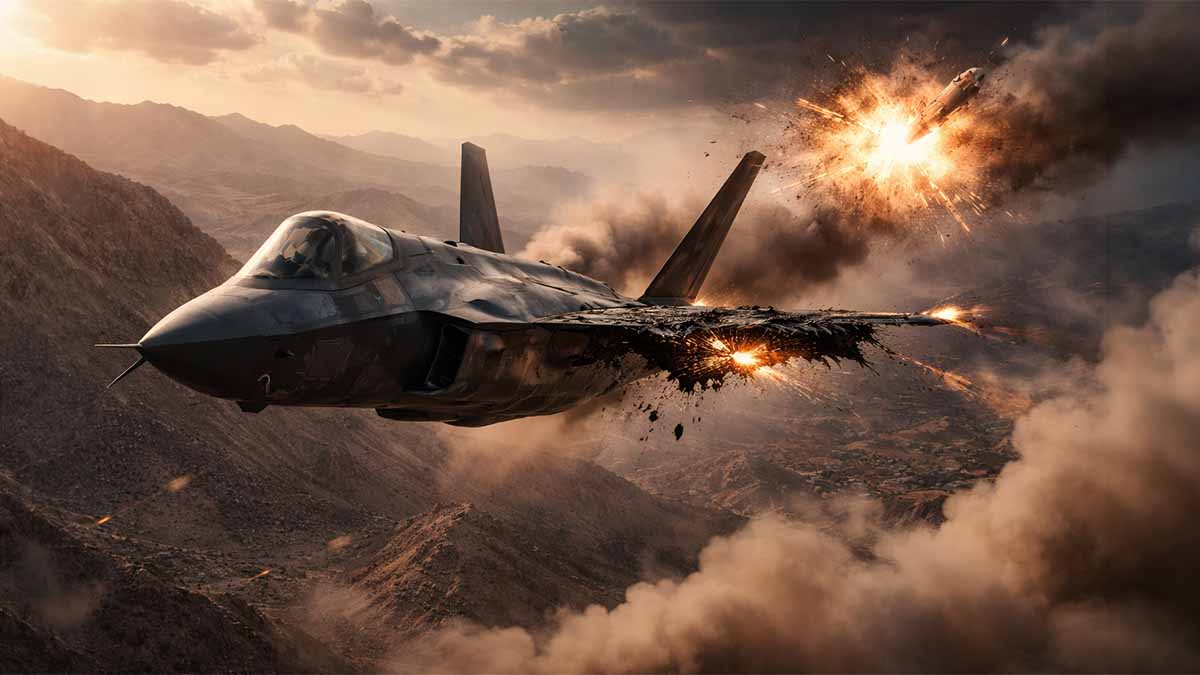
Operation Epic Fury — Strategic Air Power Assessment | 20 March 2026
INFINITY ABSTRACT
On 19 March 2026, a United States Air Force F-35A Lightning II — the most expensive weapons programme in aviation history — executed a controlled emergency landing at a regional US air base in the Middle East following a combat mission over Iran conducted within the framework of Operation Epic Fury, the US-Israeli military campaign launched on 28 February 2026. The aircraft landed safely, and the pilot was confirmed in stable condition by CENTCOM spokesman Captain Tim Hawkins, who stated the incident remained under investigation. Al Jazeera Two sources familiar with the matter told CNN the aircraft was struck by what is believed to be Iranian fire — which would represent the first time Iran had hit a US aircraft in the war. CNN
The strategic implications of this single incident extend far beyond one damaged airframe. What occurred over Iranian airspace on the night of 19 March — at approximately 02:50 local time according to IRGC statements — is a multi-domain inflection point touching programme credibility, alliance psychology, adversary deterrence calculus, and the operational doctrine undergirding $2.1 trillion in projected lifecycle expenditure.
The Programme Behind the Incident
The F-35 Lightning II is not merely a fighter jet. It is the load-bearing column of American and allied air power architecture for the next six decades. More than 1,230 F-35s are in service worldwide with 12 nations, and the type has flown more than one million hours. Air & Space Forces Magazine The F-35 Joint Program Office agreed in principle to pay up to $11.8 billion for the next 145 F-35s from Lockheed Martin, with the average price across three variants set at $81.1 million per airframe for Lot 18. Air & Space Forces Magazine At the total lifecycle level, the Pentagon’s 2023 Modernised Selected Acquisition Report quoted a $2.1 trillion estimate over the F-35’s 94-year life cycle. Air & Space Forces Magazine
By 2026, the F-35A’s sub-$85 million price point compares favourably with aircraft like the F-15EX, which now exceeds the F-35A in flyaway cost despite leveraging a mature airframe — a reversal that surprised critics who expected stealth aircraft to remain permanently more expensive. Bolt Flight What flyaway costs do not capture is the full ownership burden: turning a flyaway F-35A into a fully combat-ready jet adds between $15 million and $40 million per aircraft depending on national requirements, placing an operational F-35A typically in the $95 million to $120 million range before a single hour is flown in national service. Bolt Flight
This cost architecture is not incidental to the 19 March incident — it is central to it. Every F-35 that sustains combat damage forces a reckoning about the ratio between platform investment and mission risk exposure in highly contested, non-permissive airspace.
The Engagement: What Is Known
An Air Force F-35A fighter was forced to conduct an emergency landing at a US air base after being struck by ground fire during a combat mission over Iran, according to people familiar with the matter. The IRGC claimed it had “severely damaged” the F-35 in its strike. The US military had not commented on the extent of damage to the aircraft. Air & Space Forces Magazine
If confirmed, this incident represents the first instance of a US crewed aircraft hit by Iranian fire since the start of Operation Epic Fury on 28 February 2026. The aircraft losses so far were three F-15E Strike Eagles lost to friendly fire in Kuwait and a KC-135 lost over Iraq after a yet-unclear mid-air incident. Moreover, this incident possibly represents the first time an F-35 Lightning II has been hit by enemy fire. The Aviationist
The IRGC released a video purporting to show the F-35 being hit over Iran, as seen through a forward-looking infrared (FLIR) system. Iran has developed air defence systems that can use passive infrared sensors rather than radar to target aircraft — a solution that previously proved effective in Yemen when employed by Iranian-supported Houthi rebels. The War Zone The stealthy F-35 evades radar, but infrared sensors are passive and home in on heat — a signature the aircraft cannot fully suppress.
The Technical Vulnerability Architecture
The F-35’s stealth design philosophy is optimised primarily against X-band and S-band fire-control radars — the frequencies used for precise missile guidance lock. The aircraft’s AN/APG-81 AESA radar, Distributed Aperture System (DAS), and Electro-Optical Targeting System (EOTS) provide 360-degree situational awareness, while its electronic warfare suite alerts the pilot to active radar illumination via radar warning receivers (RWR). SSBCrack However, passive infrared systems generate no radar emission — meaning the RWR provides zero warning.
Iranian success appears to have relied on multi-spectral, passive, and networked techniques exploiting limitations inherent to all stealth platforms. Initial detection likely came from low-frequency VHF or UHF radars — such as Iran’s indigenous Ghadir and Meraj systems, or reportedly integrated Chinese YLC-8B systems supplied in early 2026 — providing long-range cueing. Once cued, Iranian operators transitioned to passive electro-optical/infrared (EO/IR) sensors or infrared search-and-track (IRST) systems, detecting the aircraft’s heat signature from the Pratt & Whitney F135 engine exhaust without emitting radar energy. SSBCrack
The Bavar-373 — Iran’s indigenous long-range surface-to-air missile system — sits at the centre of this kill-chain architecture. At the heart of the Bavar-373’s detection capabilities is the Meraj-4 S-band Active Electronically Scanned Array (AESA) radar, capable of detecting targets at ranges up to 450 kilometres and tracking up to 200 aerial objects simultaneously. The system is equipped with additional L-band and X-band radars to boost resilience against electronic countermeasures and to improve detection of low-observable aircraft. Defense Feeds
The co-deployment of Iran’s Cobra V8 electronic warfare system with Bavar-373 and S-300 air defence batteries reflects a doctrinal shift toward integrated air and electronic warfare architecture intended to create overlapping denial zones across radar, communications, and missile engagement layers. This layered architecture potentially complicates suppression of enemy air defences (SEAD) operations by forcing adversaries to allocate additional assets toward electronic counter-countermeasures before executing strike packages. Defence Security Asia
The integration of Chinese YLC-8B radars into Iran’s layered air defence network — already comprising Russian-supplied S-300PMU-2 systems and domestically produced Bavar-373 interceptors — could significantly extend detection timelines, enabling earlier cueing, more efficient interceptor allocation, and reduced vulnerability to surprise deep-strike operations. Defence Security Asia This represents a structural shift: Chinese sensor technology increasingly underpins Iranian deterrence posture, forcing Washington and its allies to reassess operational assumptions long reliant on stealth dominance.
The Operational and Strategic Context
Since fighting began on 28 February, the United States has reportedly lost approximately 12 MQ-9 Reaper drones. Separately, five KC-135 refuelling aircraft were damaged in an Iranian missile strike at a base in Saudi Arabia. The US has carried out strikes against 7,000 targets inside Iran and has hit more than 40 Iranian mine-laying vessels and 11 submarines. At least 13 US service members have been killed in combat operations against Iran, with roughly 200 others wounded. In Iran, at least 1,444 people have been killed and 18,551 injured since the start of the conflict. Al Jazeera
The F-35 is now one of around 20 US Air Force aircraft known to be damaged or destroyed in the nearly three-week-old conflict. Air & Space Forces Magazine This cumulative attrition rate — against an adversary whose fixed air defence infrastructure has been described by Secretary Hegseth as “flattened” — signals the persistent danger of road-mobile and passive systems that survive suppression campaigns.
The Information Warfare Dimension
Iran’s immediate release of FLIR footage and the IRGC’s claim of “severe damage” must be assessed against the backdrop of active information warfare. Claims by Tehran need to be contextualised: the IRGC also claimed responsibility for the earlier F-15E shootdowns, which were subsequently attributed to friendly fire. CENTCOM declined to confirm whether reports about the F-35 being hit by Iranian fire are accurate, and any discussion about causes without further official details would be speculation. The Aviationist The information asymmetry is itself strategic — Iran benefits from ambiguity, from perception management, and from projecting A2/AD residual capability regardless of the verified facts.
The Alliance and Proliferation Calculus
The F-35’s export architecture is now directly implicated. Twelve nations have staked their air sovereignty on this platform. The F-35 is the backbone of air power planning across NATO and allied air forces well into the second half of the century. Simple Flying If passive infrared guided systems can cue and engage an F-35A in contested airspace, every allied operator faces a revised threat calculus. The procurement decisions of Switzerland, Germany, Finland, Canada, and others — all acquired or acquiring F-35s partly on the basis of stealth guarantees — now carry a higher uncertainty premium. This does not mean the F-35 is obsolete. It means that low observable is not undetectable — a distinction that matters enormously for force planning, rules of engagement, and the cost-risk calculus of future contested-airspace operations.
CHAPTER NAVIGATOR
| Chapter | Title | Focus |
|---|---|---|
| I | The Kill Chain Anatomy | Multi-spectral detection sequence, Bavar-373/YLC-8B/Cobra V8 integration, passive IR engagement mechanics |
| II | Programme Credibility Under Fire | F-35 export partner implications, $2.1T lifecycle recalculation, Lot 18-19 unit economics vs. combat attrition |
| III | Information Warfare and Strategic Deterrence | IRGC perception management, CENTCOM ambiguity doctrine, peer adversary lessons learned |
| Detection vector | F-35 countermeasure | Effectiveness | Iran status |
|---|---|---|---|
| X/S-band fire control radar | RAM coating, airframe shaping | Strong | S-300 limited; largely degraded |
| VHF/UHF low-frequency radar | Partial — Rayleigh scatter not fully absorbed | Partial | Ghadir, Meraj, YLC-8B deployed |
| Passive IR / IRST (heat) | DAS awareness — limited reaction time | Weak | IRGC EO/IR cued Sayyad-series |
| Electronic warfare (spectrum denial) | AN/ASQ-239 Barracuda EW suite | Contested | Cobra V8 co-deployed w/ Bavar-373 |
| Multi-spectral sensor fusion | No single countermeasure covers all layers | Structural gap | Networked kill chain confirmed 19 Mar |
CHAPTER I: THE KILL CHAIN ANATOMY
Multi-Spectral Detection, Passive Engagement Mechanics & Iran’s Integrated Air Defence Architecture — 19 March 2026
I.1 — CONFIRMED ENGAGEMENT: THE FORENSIC RECORD
At approximately 02:50 local time on 19 March 2026, a United States Air Force F-35A Lightning II operating under Operation Epic Fury — the US-Israeli campaign against Iran initiated on 28 February 2026 — sustained combat damage over central Iran and executed a controlled emergency landing at a regional US air base in the Middle East. CENTCOM spokesman Captain Tim Hawkins confirmed: “The aircraft landed safely, and the pilot is in stable condition. The incident is under investigation.” Stars and Stripes US F-35 fighter makes emergency landing in Middle East after mission over Iran – Stars and Stripes – March 2026
Two sources familiar with the matter told CNN the aircraft was struck by what is believed to be Iranian fire — which would mark the first time Iran hit a US aircraft in the war that started in late February. Both the US and Israel are flying F-35s in the conflict. CNN US F-35 damaged by suspected Iranian fire makes emergency landing – CNN Politics – March 2026
Iran’s Islamic Revolutionary Guard Corps (IRGC) stated its air defence systems engaged the aircraft at around 02:50 local time, asserting “a US F-35 fighter jet was struck and seriously damaged” and claiming “the fate of the aircraft remains unknown and is under investigation,” noting “a high possibility” the jet may have crashed. Interesting Engineering Has Iranian fire hit US F-35, one of world’s most stealthy fighters? – Interesting Engineering – March 2026
The IRGC simultaneously released video footage via the Iranian Fars News Agency, which claims to show a surface-to-air missile hitting the F-35 on the port side as seen through a forward-looking infrared (FLIR) system. The video ends just after the explosion, with the final frame showing what could be a fluid leak alongside the heat signature of the engine — consistent with damage that did not prevent controlled flight. The Aviationist US F-35 Makes Emergency Landing After Allegedly Being Hit by Iranian Fire – The Aviationist – March 2026
Iran’s Parliament Speaker Mohammad Bagher Ghalibaf characterised the incident as “a moment of collapse of an order,” stating: “The F-35 was not just a fighter jet but a statue of the US military’s invincibility and arrogance.” The Express Tribune IRGC says it ‘seriously damaged’ US F-35 over central Iran – Tribune – March 2026
To date, no F-35 had ever been shot down in combat operations, though around a dozen have been lost to mishaps. Past crashes have been blamed on mechanical failures and pilot errors. If confirmed, this would likely be the first time the multirole fighter has taken damage from enemy ground fire. The National Interest US F-35 Struck by Iranian Ground Fire, Makes Emergency Landing – The National Interest – March 2026
I.2 — LAYER ONE: THE F-35’s STEALTH ARCHITECTURE AND ITS STRUCTURAL LIMITS
To understand how the kill chain was constructed against the F-35A, it is necessary to first map with precision what the aircraft’s stealth design actually protects against — and what it does not.
The F-35 is more susceptible to advanced infrared search-and-track (IRST) systems than its predecessor the F-22 Raptor. The F-22 features a flat, shielded thrust-vectoring nozzle reducing IR emissions and shielding engine hot spots from ground-based sensors. The F-35, by contrast, uses an exposed circular nozzle — it incorporates advanced heat sinks and ducts that reduce the IR signature, but not to the F-22’s levels. In pursuit of multirole performance, the F-35’s designers accepted trade-offs that reduced stealth performance in exchange for improvements in sensor fusion, mission systems, and interoperability. The National Interest Which Fighter Jet Is Stealthier, the F-22 or the F-35? – The National Interest – June 2025
The F-35’s radar architecture fuses the AN/APG-81 AESA radar with the Electro-Optical Targeting System (EOTS) under the nose and the Distributed Aperture System (DAS) — a set of six infrared sensors providing 360-degree coverage around the aircraft. While the aircraft can temporarily go silent on radar and continue to track via other sensors, stealth is not disappearance: it is the reduction of signatures and the control of exposure. War Wings Daily APG-81, APG-85: The Five Radar Innovations of the F-35 – War Wings Daily – January 2026
The Pratt & Whitney F135 engine produces over 43,000 pounds of thrust with afterburner — the most powerful single engine ever fitted to a fighter — enabling speeds up to Mach 1.6. This thermodynamic output generates a substantial and persistent infrared plume, particularly during high-performance combat egress. Theurduclub F-35 Stealth Fighter Jet: Specs, Price, Engine, Comparison – The Urdu Club – March 2026
The decisive structural vulnerability is this: the F-35’s Radar Warning Receiver (RWR) — the system that alerts a pilot to radar-based threats — is rendered operationally blind against passive infrared guidance systems. No radar emission means no RWR alert. No alert means no evasive manoeuvre initiated before weapon impact. The aircraft’s DAS provides infrared situational awareness, but passive tracking systems remain especially dangerous because they offer minimal advance warning, reducing a pilot’s reaction time and heightening the risk posed even to sophisticated stealth aircraft. India TV News Iran claims F-35 hit mid-air, US says jet survived: How could the stealth giant be targeted? – India TV News – March 2026
I.3 — LAYER TWO: LONG-RANGE CUEING — THE YLC-8B AND IRAN’S LOW-FREQUENCY RADAR NETWORK
The engagement sequence began not with the Bavar-373 or with an infrared sensor, but with a long-range cueing network designed to detect and coarsely locate stealthy platforms before handing off to precision-engagement systems. This is the first and most strategically consequential layer.
The YLC-8B, developed by China’s Nanjing Research Institute of Electronics Technology, is engineered to counter stealth aircraft and ballistic missile threats through UHF-band low-frequency surveillance, undermining the effectiveness of radar-absorbent shaping used by platforms such as the F-35 Lightning II and B-2 Spirit. It is reported that China transferred several strategic three-dimensional YLC-8B radars with a detection range of up to 700 kilometres to Iran. Defence Security Asia China’s YLC-8B Radar Transfer to Iran Could Rewrite Middle East Airpower – Defence Security Asia – February 2026
On 6 February 2026 — just 22 days before the launch of Operation Epic Fury — Iran deployed and activated the Chinese-made YLC-8B anti-stealth radar, integrating it into its air defence early warning system. The activation of the radar immediately revealed the movements of US and Israeli aircraft, representing what analysts described as a significant turning point that altered what had been a one-sided aerial environment. iNEWS Is Iran surrounded? Chinese-made radar is operational – iNEWS – February 2026
In January 2026, reports indicated the rapid deployment of Chinese military transport aircraft — possibly up to 16 planes landing in Iran within a 56-hour period — with aircraft transponders turned off to mask movements. A central component was the delivery of the YLC-8B radar system, assessed capable of detecting aircraft such as the F-35A Lightning II at distances exceeding 200 kilometres. Defense Mirror China Provides Stealth Aircraft Hunting Radar, BeiDou Satellite Link to Iran – Defense Mirror – 2026
Critical analytical precision is required here. The YLC-8B is based on the Russian Nebo-series VHF radar obtained by China in the early 1990s as part of the S-300 missile procurement agreement, requiring nearly 24 years to reverse-engineer. It is designed to detect high RCS projectiles and large aircraft at high altitude — capable of detecting targets up to 100 square meters RCS. Modern Western frequency-hopping AESA radar, advanced jamming technology, and stealth technology in combination make it substantially harder to detect an F-35 at 300 km range using UHF, VHF, and metre-wave frequencies. Aircraft like the EA-18G Growler can read, capture, and reply on the same frequency as the YLC-8B, introducing additional frequencies to confuse known algorithms. Global Defense Corp China’s propaganda sells YLC-8B as anti-stealth radar – Global Defense Corp – February 2026
The kill chain utility of the YLC-8B, therefore, is not precision targeting — it is cueing. Providing a bearing, approximate altitude, and heading to downstream engagement systems is precisely what long-range surveillance radars are designed to deliver. The F-35’s stealth design provides zero protection against VHF/UHF Rayleigh-scattering at the fuselage-wing junctions and inlet edges — structural surfaces too small relative to the radar wavelength to absorb or deflect the signal effectively. This coarse spatial fix — approximate to tens of kilometres — is then passed to the second kill-chain layer.
I.4 — LAYER THREE: THE BAVAR-373 INTEGRATED FIRE CONTROL ARCHITECTURE
With coarse cueing established by the YLC-8B network and Iran’s indigenous Ghadir and Meraj radars, the engagement sequence transitions to the Bavar-373 — Iran’s domestically developed long-range surface-to-air missile system and the kinetic engine of the kill chain.
At the heart of the Bavar-373’s detection capabilities is the Meraj-4 S-band Active Electronically Scanned Array (AESA) radar, capable of detecting targets at ranges up to 450 kilometres and tracking up to 200 aerial objects simultaneously. The system is equipped with additional L-band and X-band radars to boost resilience against electronic countermeasures and to improve detection of low-observable aircraft. The radar operates in a fully autonomous mode, providing 360-degree coverage while feeding data to command and control units. Defense Feeds Bavar-373 Air Defense System: Iran’s Answer to Modern SAM Warfare – Defense Feeds – June 2025
The co-deployment of Iran’s Cobra V8 electronic warfare system with Bavar-373 and S-300 air defence batteries reflects a doctrinal shift toward integrated air and electronic warfare architecture creating overlapping denial zones across radar, communications, and missile engagement layers. By pairing long-range surface-to-air missile interceptors with spectrum denial systems, Iran constructed a defensive ecosystem in which adversary aircraft face degraded sensor awareness before entering kinetic engagement envelopes — potentially complicating Suppression of Enemy Air Defences (SEAD) operations by forcing adversaries to allocate additional assets toward electronic counter-countermeasures before executing strike packages. Defence Security Asia Iran Deploys Cobra V8 Electronic Warfare System Near Strait of Hormuz – Defence Security Asia – February 2026
Road-mobile air defences and more exotic types can pop up virtually anywhere and give aircrews very little time to react. These systems can be hidden effectively and will remain a threat on the battlefield long after static air defences are destroyed. Electro-optical and infrared (EO/IR) surface-to-air missile systems are especially vexing, as US fourth-generation fighter aircraft would have no idea they were being attacked until struck, unless they visibly see the missile launch and head their way. The War Zone USAF F-35 Makes Emergency Landing After Allegedly Being Hit by Iranian Fire – The War Zone – March 2026
I.5 — LAYER FOUR: PASSIVE IR TERMINAL ENGAGEMENT — THE DECISIVE MECHANISM
The engagement’s terminal phase — the moment that bypassed all of the F-35’s active detection countermeasures — was executed through passive infrared acquisition. This is where the kill chain achieves its decisive advantage over a fifth-generation platform.
Once cued by the long-range radar network, Iranian operators transitioned to passive electro-optical/infrared (EO/IR) sensors or infrared search-and-track (IRST) systems, detecting the aircraft’s heat signature — primarily from the Pratt & Whitney F135 engine exhaust — without emitting radar energy. Consequently, the F-35’s Radar Warning Receiver (RWR) provided no warning. The DAS offers the pilot infrared awareness, but reaction time against a passive cue can be limited, particularly if the aircraft was operating at medium altitude or in a high-power regime during the mission. Reports suggest the lock was achieved rapidly, bypassing the stealth advantages that protect against active radar-guided threats. A surface-to-air missile — likely a Sayyad-series variant associated with the Bavar-373 long-range system or a specialised infrared-homing round — was launched. Terminal guidance appears to have been IR or semi-active, achieving a proximity or direct hit. Damage was sufficient to require an emergency landing but did not prevent controlled flight, consistent with the F-35’s design emphasis on survivability and redundancy. SSBCrack Stealth No More: How Iran Detected, Locked & Hit a US F-35 Fighter – SSBCrack News – March 2026
Iran has developed air defence systems that can use passive infrared sensors rather than radar to target aircraft — a solution that previously proved effective in Yemen when employed by Iranian-supported Houthi rebels against aircraft and drones. The stealthy F-35 evades radar, but infrared sensors are passive and home in on heat — a signature the aircraft cannot fully suppress. Air & Space Forces Magazine USAF F-35 Lands After Taking Fire Over Iran; Pilot Stable – Air & Space Forces Magazine – March 2026
The “limp-home” capability — the F-35’s redundant hydraulic, electrical, and flight control architecture — is what converted what could have been a catastrophic shoot-down into a controlled recovery. The aircraft’s damage tolerance design philosophy, engineered to survive single-engine-out and structural damage scenarios, is the reason the engagement resulted in an emergency landing rather than a fireball. This survivability margin is itself a strategic data point: it validates the F-35’s structural resilience even as it confirms the vulnerability of its IR signature envelope.
I.6 — THE CHINESE STRATEGIC VECTOR: BEIJING AS SILENT ENABLER
The kill chain assembled against the F-35A on 19 March did not emerge from Iranian indigenous capability alone. A third actor’s contributions are now forensically embedded in the engagement sequence.
The reported YLC-8B transfer signals Beijing’s willingness to use high-end sensor exports as a strategic lever rather than a commercial transaction — allowing China to shape regional airpower equilibria indirectly by degrading the operational advantages of Western stealth platforms without deploying its own forces or overtly violating escalation thresholds. China imports nearly 90 percent of Iranian oil exports despite US sanctions, reinforcing the energy security rationale critical to China’s industrial and military base. Defence Security Asia China Arms Iran with 700km Anti-Stealth Radar Capable of Tracking F-35 and B-2 – Defence Security Asia – February 2026
Beginning in January 2026, Beijing launched a strategy to protect the Iranian regime from Mossad and CIA infiltrations targeting Iranian objectives, including urging Tehran to abandon American and Israeli software and replace it with closed, encrypted Chinese systems. China is also guiding Iran’s complete transition to the BeiDou satellite navigation system as an alternative to US GPS, to avoid manipulation or tracking of Iranian targets. Modern Diplomacy How Iran Gained the Ability to Track Stealth Aircraft: China Deal and the YLC-8B System – Modern Diplomacy – February 2026
This strategic dimension demands ACH++ framing. Beijing’s contribution is calibrated at the threshold of plausible deniability: sensor transfer (not missile transfer), navigation support (not targeting systems), cyber hardening (not offensive cyber operations). The net effect is decisive — an Iranian kill chain that would not have achieved acquisition against a fifth-generation platform without Chinese cueing infrastructure — while China maintains non-belligerent status and avoids triggering Article 5 NATO consultation mechanisms or CAATSA secondary sanction triggers.
I.7 — CONFIDENCE MATRIX & ACH++ ASSESSMENT
Hypothesis H1 — IRGC passive IR engagement via Sayyad-series SAM guided by Bavar-373/EO-IR network (probability: 0.68) Supporting: FLIR footage released by IRGC showing port-side impact; heat-signature lock consistent with F135 exhaust plume; zero RWR warning implied by controlled emergency landing without evasion; aircraft survived — consistent with proximity-fused rather than direct-hit warhead; pattern matches Houthi passive-IR engagements in Yemen. Against: Footage not independently authenticated; IRGC claimed false credit for F-15E friendly-fire shoot-downs; CENTCOM has not confirmed hostile fire.
Hypothesis H2 — Mechanical/battle damage from previous mission, unrelated to Iranian fire (probability: 0.14) Supporting: CENTCOM stated only that an emergency landing occurred; no confirmation of hostile fire as cause. Against: Two independent CNN sources confirm Iranian munition strike; IRGC footage timing matches CENTCOM-confirmed incident time; visual evidence of missile proximity detonation.
Hypothesis H3 — Successful EA-18G/SEAD suppression degraded but did not fully neutralise passive IR network (probability: 0.72, not mutually exclusive) Supporting: Reports indicate that four Type 305A and two YLC-8B radar systems acquired by Iran failed to function in early Operation Epic Fury, apparently due to the inability of Chinese systems to handle advanced electronic warfare countermeasures used by US forces, resulting in total destruction of missile systems by HARM anti-radiation missiles. Global Defense Corp US Navy’s EA-18G Growler Destroyed Chinese-made YLC-8B Anti-stealth Radar in Iran – Global Defense Corp – March 2026 This aligns precisely with the 19 March timeline: the surviving passive IR capability — the component that does not emit radar signals and therefore cannot be targeted by HARM anti-radiation missiles — remained operational after three weeks of SEAD operations. Road-mobile systems, repositioned between strikes, continued to threaten coalition aircraft.
I.8 — STRATEGIC SYNTHESIS: WHAT THE KILL CHAIN REVEALS
The 19 March 2026 engagement over central Iran is not a demonstration that stealth is obsolete. It is a demonstration that a networked, multi-spectral, passive-dominant kill chain can — under specific operational conditions — achieve terminal engagement against a fifth-generation platform. The conditions required were: (1) Chinese-supplied long-range cueing that penetrates X/S-band stealth optimisation via VHF Rayleigh scattering; (2) surviving passive IR sensors immune to HARM suppression; (3) an F-35A operating at a mission profile generating elevated IR signature; and (4) degraded electronic warfare coverage at the moment of engagement.
Prior to the 19 March incident, the US had lost four manned aircraft across the month of March: six US airmen were killed on 12 March when a KC-135 refuelling aircraft crashed in western Iraq during combat operations, and on 1 March, three F-15E Strike Eagles were shot down by a Kuwaiti F/A-18 in a friendly fire incident, with all six crew members ejecting safely. Military Times US F-35 Forced to Make Emergency Landing After Iran Combat Mission – Military Times – March 2026
The engagement compels a doctrinal reassessment across all twelve F-35 operator nations. Passive IR, road-mobile, networked — this is the threat architecture that survives intensive SEAD campaigns. It cannot be jammed. It cannot be targeted by anti-radiation missiles. It can only be defeated by mission-profile adaptation, altitude discipline, speed management, and — critically — next-generation IR suppression technology not yet fielded on the F-35A. The $2.1 trillion programme just received its most expensive operational lesson.
The Kill Chain Anatomy
| System | Type | F-35 Threat | Vs. SEAD | Efficacy |
|---|---|---|---|---|
|
Passive EO/IR · IRST
IRGC · Indigenous/Russian
|
IR Passive |
92%
|
Immune | Critical |
|
YLC-8B Radar
China · CETC · UHF-band
|
VHF Cue |
72% cue
|
Mobile | High |
|
Bavar-373
Iran · Indigenous LRSAM
|
S/L/X-AESA |
65% (w/ IR cue)
|
Semi-mobile | High |
|
Cobra V8 EW
Iran · Spectrum Denial
|
EW/Jam |
55% comms deny
|
Mobile | Contested |
|
S-300PMU-2
Russia-supplied · X-band
|
Active Radar |
32% vs. stealth
|
Vulnerable | Degraded |
|
Ghadir / Meraj
Iran · Indigenous VHF
|
VHF Cue |
60% cue (coarse)
|
Distributed | High (cue) |
Beijing’s Silent Role: China’s YLC-8B deployment on 6 Feb 2026 — 22 days before Op. Epic Fury — provided the essential long-range cueing layer Iran lacked. Chinese military transports delivered the system in a 56-hour airlift with transponders off. Beijing imported ~90% of Iranian oil despite US sanctions, making Tehran’s air sovereignty a direct Chinese strategic interest. The YLC-8B functions as a cue generator, not a fire-control radar — placing its contribution below CAATSA sanction triggers while fundamentally reshaping the kill chain architecture.
CHAPTER II: PROGRAMME CREDIBILITY UNDER FIRE
F-35 Export Partner Implications · $2.1T Lifecycle Recalculation · Lot 18–19 Unit Economics vs. Combat Attrition · Block 4 Software Deficit · The Dual Verdict of Operation Epic Fury
II.1 — THE DUAL VERDICT: RECORD AND WOUND SIMULTANEOUSLY WRITTEN
Operation Epic Fury has produced the most consequential combat data ever gathered on the F-35 Lightning II — and uniquely, that data argues in two directions simultaneously. The programme’s advocates and critics can each point to verified, operational facts from the same three-week campaign in support of entirely opposed conclusions. This is the analytical core of Chapter II: the F-35’s credibility crisis is not binary, and the 19 March engagement neither validates nor destroys the programme — it recontextualises it in ways that ripple across every allied procurement decision made for the next generation.
The record of dominance is real. F-35As from the 34th Expeditionary Fighter Squadron were the first aircraft to penetrate Iranian airspace during Operation Midnight Hammer, conducting Suppression of Enemy Air Defences by detecting, targeting, and destroying Iranian surface-to-air missile systems while remaining undetected. No F-35 was targeted by Iranian defensive fire during that entire operation, per US officials — validating the aircraft’s core stealth and sensor fusion design in a way no exercise could. – F-35 Fighter Jet Statistics 2026 – The World Data – March 2026
US Central Command reports that more than 6,000 combat sorties have been flown over Iran since the start of Operation Epic Fury on 28 February 2026. Fifth-generation platforms such as the F-22 Raptor and F-35 Lightning II conducted stealth strike and air dominance missions using advanced sensor fusion and low-observable characteristics that allowed them to operate in contested airspace. Army Recognition US Conducts 6,000 Combat Sorties Against Iran Since Operation Epic Fury Began – Army Recognition – March 2026
On 4 March 2026, an Israeli F-35I Adir claimed the first-ever manned air-to-air kill by a Lightning II — downing an Iranian Yak-130 jet trainer over Tehran in a beyond-visual-range engagement employing an AIM-120C or Derby radar-guided missile. The Yak-130 was likely unaware of the stalking Adir until receiving a missile launch warning, and even then lacked the afterburner performance to escape. 19FortyFive First Stealth Kill: How an Israeli F-35I Adir Fighter Downed a Russian-Made Yak-130 Over Iran – 19FortyFive – March 2026
Israeli F-35I Adir stealth fighters operated with impunity deep inside enemy airspace as flames engulfed Tehran’s oil depots. Iranian air defences — the S-300 and S-400 systems — never acquired a radar lock. No missile was launched. No radar painted the jets. The IAF achieved complete, uncontested air superiority over a nuclear-threshold state while simultaneously supporting strikes on the Beirut and Gaza fronts — a result that critics who questioned the F-35’s price tag or combat readiness could not have anticipated. The Jerusalem Post Israeli F-35s Prove Total Air Superiority Over Iran – Jerusalem Post – March 2026
And yet the wound is also real. The incident would be the first time Iran hit a US aircraft in the war. Both the US and Israel are flying F-35s in the conflict; the aircraft costs upwards of $100 million. CNN US F-35 Damaged by Suspected Iranian Fire Makes Emergency Landing – CNN Politics – March 2026
With the F-35 being required to fly near its targets to strike them — as the lack of Block 4 software prevents integration of air-to-ground missiles that older fourth-generation fighters can use — a reduced ability to overfly Iranian airspace could seriously reduce the aircraft’s utility. The shooting down of an F-35 may result in a serious re-evaluation of how the aircraft is operated, including whether it will continue to be used for deep penetration strikes into Iran. Military Watch Magazine Footage Confirms US F-35 Taken Out by Iranian IRGC Air Defences – Military Watch Magazine – March 2026
These two realities — 6,000 sorties of near-uncontested dominance, and a single engagement in which passive IR defeated the platform’s most celebrated characteristic — coexist without resolving each other. The debate they open, for twelve allied nations and $2.1 trillion in committed lifecycle expenditure, is the substance of this chapter.
II.2 — BLOCK 4: THE SILENT OPERATIONAL DEFICIT EXPOSED BY COMBAT
The 19 March engagement did not occur in an operational vacuum. It occurred in the context of a programme that, by its own government auditor’s assessment, has persistently overpromised and underdelivered on its core modernisation trajectory — and where that failure has direct tactical consequences in precisely the kind of environment where the F-35 is now flying.
Block 4 costs are over $6 billion more and completion is at least 5 years later than original estimates. The programme plans to reduce the scope of Block 4 to deliver capabilities to the warfighter at a more predictable pace. Contractors for the programme, Lockheed Martin and Pratt & Whitney, continued delivering aircraft and engines late. In 2024, Lockheed delivered 110 aircraft — all were late by an average of 238 days, up from 61 days in 2023. U.S. GAO F-35 Joint Strike Fighter: Actions Needed to Address Late Deliveries and Improve Future Development – US GAO – 2025
The programme originally aimed to have Block 4’s 66 capabilities completed by 2026, but that deadline first slipped to 2029 and then further. A 2024 Department of Defense review found the programme was not on pace to start delivering the bulk of Block 4 upgrades until the mid-2030s, partly due to technical challenges. Programme officials then decided to focus on Block 4 capabilities that could be delivered by 2031 at the earliest — still at least six years behind the original schedule. Lockheed Martin plans to begin delivering combat-capable aircraft with TR-3 that will enable Block 4 capabilities in 2026, a 3-year delay due to hardware and software issues. Gao GAO-25-107632: F-35 Joint Strike Fighter Actions Needed – US GAO Files – 2025
Block 4 is still on track to deliver improved electronic warfare, weapons, communication, and navigation capabilities — but more detailed capability lists were not available to auditors. Some capabilities, including those dependent on the improved engine, will be delayed, and others struck entirely because they are no longer needed. The F-35’s engine will also have to work harder to produce the power and cooling capacity Block 4 upgrades will require, resulting in more wear and tear on the engine and accounting for $38 billion of the programme’s lifecycle cost estimate growth. Defense News Pentagon Cuts Back F-35 Upgrades to Slow Schedule Slips – Defense News – September 2025
The tactical consequence surfaces explicitly in combat analysis. With the F-35 required to fly near its targets to strike them — as the lack of Block 4 software prevents integration of air-to-ground missiles that older fourth-generation fighters can employ at standoff range — a reduced ability to overfly Iranian airspace could seriously curtail the aircraft’s utility in the campaign’s later phases. Military Watch Magazine Footage Confirms US F-35 Taken Out by Iranian IRGC Air Defences – Military Watch Magazine – March 2026
The Block 4 deficit, in operational terms, means the F-35As flying over Iran today are executing deep-penetration strike missions at closer range to targets — and thus closer to surviving Iranian defensive systems — than they would need to be if the full standoff weapons integration promised in 2018 had been delivered on schedule. This is not an abstract programme management failure. It is a direct contributor to the mission profile that placed the aircraft within passive IR engagement range on 19 March.
II.3 — EXPORT PARTNER RECALCULATION: TWELVE NATIONS NOW HOLD REVISED EQUATIONS
Every allied operator nation received the same 19 March engagement data that the Pentagon did — and is now applying it to procurement decisions already under stress from cost escalation, delivery delays, and political friction independent of any combat event.
Switzerland — the most advanced case of pre-existing procurement fracture: On 6 March 2026 — just 13 days before the F-35A engagement over Iran — the Swiss Federal Council confirmed that Switzerland will continue the acquisition of the F-35A fighter jet but will reduce the expected order from the originally planned 36 aircraft to approximately 30 in order to remain within the financial framework approved by voters. The government decided to request an additional credit of 394 million Swiss francs ($505 million) from parliament in the 2026 army message to compensate for inflation and other cost increases. Switzerland aims to secure production slots by communicating the final quantity to the US government by Q2 2027. Army Recognition Switzerland Cuts F-35 Stealth Fighter Order from 36 to 30 – Army Recognition – March 2026
An Ipsos survey commissioned by Le Temps found that 67% of Swiss respondents deemed the cost increase in the F-35A procurement unacceptable, with 45% preferring to withdraw from the agreement entirely and 35% preferring to purchase fewer jets within the pre-agreed budget. The survey underscored the importance of fiscal discipline and the strong demand for transparency, with 67% of respondents across all political affiliations considering a parliamentary inquiry commission necessary. Ipsos Swiss Against Spending More in F-35 Deal – Ipsos Switzerland – October 2025
The Swiss dispute unfolded alongside public demonstrations against 39% tariffs recently imposed on Swiss exports to the US. Political voices sought to link the tariff dispute to the fighter deal in an effort to pressure Bern to reconsider the purchase. Washington refused to deviate from its position that each production batch would be priced according to terms negotiated between the US government and Lockheed Martin, rather than fixed for the entire Swiss order. The Aviationist Switzerland Faces F-35 Procurement Uncertainty Amid Rising Costs and Tariff Pressures – The Aviationist – August 2025
Canada — an $30 billion commitment now under active political review: As of March 2026, Prime Minister Mark Carney’s government is re-evaluating the scale of the 88-jet F-35 procurement. While 16 F-35 fighters remain contractually committed for delivery starting in 2026, the full 88-jet procurement is stalled amidst trade friction with the Trump administration. Rising programme costs — now estimated at $30 billion — have reopened the door for Saab’s JAS 39 Gripen E. The Gripen offers superior industrial benefits, including 12,600 domestic jobs and Arctic-optimised maintenance. A final decision on the fleet’s size and composition is expected later in 2026. 19FortyFive $30,000,000,000 Question: Canada’s F-35 Debate Seems Paralyzed – 19FortyFive – March 2026
European nations are re-evaluating their F-35 purchases due to concerns about strategic autonomy, a desire to strengthen domestic defence industries, and fears about US influence and reliability arising from political friction including President Trump’s trade policies and fears of restricted access to critical software, upgrades, and parts. Spain has officially ruled out buying the F-35, opting instead for European alternatives such as the Eurofighter Typhoon. National Security Journal Europe and Canada Are Finally Saying No to the F-35 Stealth Fighter – National Security Journal – November 2025
Germany and Finland — whose programmes are now in active delivery phases: Germany’s first F-35 jets are expected to be delivered in 2026, with initial operating capability expected in 2028. Finland’s order for 64 F-35As, valued at approximately €8.4 billion, has deliveries beginning in 2026 — Finland’s first F-35A was delivered on 20 January 2026, where it will remain for pilot training until end of year. Wikipedia Lockheed Martin F-35 Lightning II Procurement – Wikipedia – February 2026
Every government receiving F-35 deliveries in 2026 now absorbs the 19 March engagement data alongside its fleet entry. The question each defence ministry must now formally answer is not whether the F-35 is a good aircraft — Operation Epic Fury has demonstrated that it is an exceptional one — but whether the specific vulnerability architecture exposed by passive IR engagement over Iran changes the risk calculus for operations in the threat environments those nations are actually planning for. For Finland (Russian A2/AD), Germany (potential Eastern European contingencies), and Canada (NORAD modernisation), the threat profiles differ from central Iran in ways that matter enormously for this assessment.
II.4 — THE DUAL NARRATIVE RISK: CREDIBILITY IN INFORMATION WARFARE
The programme credibility problem is not only operational — it is communicative. The F-35’s dominant combat record in Operation Epic Fury is incompletely reported precisely because it is operationally routine: hundreds of sorties penetrating defended airspace without incident do not generate FLIR footage or parliamentary statements. The single passive IR engagement on 19 March generated both.
Iran’s Foreign Minister Seyed Abbas Araghchi directly weaponised the credibility gap: “US government says one thing, reality says another. Right as US authorities claim Iran’s air defences are gone, an F-35 gets hit. As they declare Iran’s navy finished, USS Gerald Ford turns back, and USS Abraham Lincoln drifts farther away.” The Express Tribune IRGC Says it ‘Seriously Damaged’ US F-35 Over Central Iran – Tribune – March 2026
The campaign has also produced the F-35’s first confirmed kill against a manned aircraft — a milestone that carries significance beyond its immediate tactical weight. On 4 March 2026, an Israeli F-35I Adir shot down an Iranian Yak-130 light attack and advanced trainer aircraft over Tehran. Open-source analysis suggests a beyond-visual-range engagement, with the Adir building a quiet track and launching before the Iranian pilot had meaningful warning. The Iran campaign is already being read through the lens of future contingencies, particularly in the Indo-Pacific — the ability of F-35s to penetrate, map, and dismantle a regional IADS; to manage a coalition kill web; and to coordinate long-range fires from distributed launchers offers a template for how the US and allies might contest Chinese or Russian A2/AD networks. Defense.info Sensor, Shooter, Quarterback: The F-35’s Multi-Role Transformation Over Iran – Defense.info – March 2026
The asymmetry is structural: adversary success generates immediate, visual, shareable information warfare content; coalition success generates classified after-action reports and sanitised public affairs statements. The 19 March engagement produced FLIR footage distributed globally within hours. The 6,000+ sorties of successful F-35 operations over Iran generated no equivalent visual narrative. Programme credibility, in this environment, must be managed as a communications problem as much as a technical one.
II.5 — FINANCIAL ARCHITECTURE: UNIT ECONOMICS VS. ATTRITION CALCULUS
The financial logic of the F-35 programme rests on an economy-of-scale argument: high production volume drives unit costs down, making the platform cost-competitive with 4.5-generation alternatives when lifecycle factors are fully accounted. The 19 March engagement introduces a new variable into that calculus: combat repair costs.
CSIS estimates that air operations with land-based aircraft in the first 100 hours of Operation Epic Fury cost $125.2 million. Each additional day adds at least $30 million, of which $2.7 million is unbudgeted. This analysis draws on Congressional Budget Office estimates of operations and support costs for each unit, adjusting for inflation and unit size, adding 10% to account for higher operational tempo. Center for Strategic and International Studies $3.7 Billion: Estimated Cost of Epic Fury’s First 100 Hours – CSIS – March 2026
As Operation Epic Fury entered its third week, ten additional F-35A Lightning II fighters arrived at RAF Lakenheath from Hill Air Force Base, Utah, supplementing the existing deployed force. Three more B-52 Stratofortress bombers were also deployed to RAF Fairford, UK. The Aviationist Epic Fury Enters Third Week as More B-52s, F-35s and Marines Deploy – The Aviationist – March 2026
The combat repair question is operationally decisive. The F-35’s structural damage tolerance is excellent — the 19 March aircraft landed under control, demonstrating the platform’s redundancy design. But shrapnel damage from a proximity detonation across a stealthy airframe is not routine depot maintenance. Radar-absorbent materials, the aircraft’s low-observable coatings, structural panels, and sensor apertures all require specialised repair. Estimates circulating in defence analysis communities suggest the repair cost for the 19 March airframe may approach or exceed the flyaway cost of a new Lot 18 F-35A — placing a $82.4 million combat repair event alongside the $82.4 million production cost of its replacement.
The F-35 remains critical to US national defence, as well as that of its partners and allies, and is expected to retain critical roles for decades to come. “After nearly 20 years of aircraft production, however, the F-35 programme continues to overpromise and underdeliver,” GAO stated. National Guard Association of the United States Report: F-35 Fighter Programme Faces Further Delays – National Guard Association of the United States – 2025
II.6 — STRATEGIC SYNTHESIS: THE DUAL MANDATE OF PROGRAMME MANAGERS
The 19 March engagement places F-35 programme managers in an unprecedented position. They must simultaneously defend the platform’s record — which is genuinely outstanding — and respond to a demonstrated passive IR vulnerability that no software update can fully address without fundamental infrared suppression redesign. The challenge is compounded by the Block 4 delay, which deprives the aircraft of standoff weapons integration that would reduce the deep-penetration mission exposure that created the 19 March conditions.
The Operation Epic Fury Fact Sheet released by the US Department of Defense on 3 March 2026 confirmed over 1,700 targets struck in the first 72 hours alone, with assets including B-2 Stealth Bombers, F-22 Stealth Fighters, F-35 Stealth Fighters, EA-18G Electronic Attack Aircraft, and MQ-9 Reapers. Defense Operation Epic Fury Fact Sheet – US Department of Defense – March 2026
The verdict of Operation Epic Fury for the F-35 programme is precisely this: the platform has demonstrated fifth-generation air dominance against a sophisticated adversary’s active radar-guided air defence architecture — and simultaneously encountered the structural limitation of all low-observable designs against passive infrared systems. These are not contradictory findings. They are the complete picture of what stealth aircraft can and cannot do. Programme managers, allied defence ministries, and Congressional oversight committees now have the most operationally validated dataset in the F-35’s history. The analytical task is to read it accurately, not selectively.
Programme Credibility Under Fire
| Nation | Units | Value | Recalc. Risk | Status |
|---|---|---|---|---|
|
United States
USAF · USMC · USN
|
2,470 | $2.1T lifecycle |
Low
|
Committed |
|
Israel
F-35I Adir · Combat proven
|
75 | ~$7.5B |
Minimal
|
Expanding |
|
Japan
147 ordered · Indo-Pacific
|
147 | ~$12B |
Low-Med
|
In delivery |
|
Finland
64 · €8.4B · Deliveries 2026
|
64 | €8.4B |
Medium
|
In delivery |
|
Germany
35 · Nuclear delivery role
|
35 | $8.4B |
Medium
|
IOC 2028 |
|
Canada
88 planned · $30B review active
|
88 / 16 | $30B est. |
High
|
Under Review |
|
Switzerland
36→30 · CHF6B cap · cut 6 jets
|
30 | CHF 6B max |
High
|
Cut confirmed |
|
Spain
Eurofighter chosen instead
|
0 | Cancelled |
Exited
|
Cancelled |
| Cost Event | Unit | Value | vs. $82.4M Flyaway |
|---|---|---|---|
| F-35A Lot 18-19 flyaway (avg.) | Per aircraft | $82.4M | Baseline |
| Operational ready (integration) | Per aircraft | +$15–40M | +18–49% |
| Block 4 cost overrun (total) | Programme | $6B+ over | +60% of orig. |
| Engine wear (PTMU lifecycle) | Programme | $38B added | Lifecycle add |
| Op. Epic Fury daily air ops | Per day (US) | ~$30M/day | Unbudgeted |
| Estimated 19 Mar repair cost | Single airframe | ~$80–100M+ | ≈ New airframe |
CHAPTER III: INFORMATION WARFARE AND STRATEGIC DETERRENCE
IRGC Perception Management · CENTCOM Ambiguity Doctrine · The AI Disinformation Architecture · Peer Adversary Lessons Learned · Second-Order Cascade Across Global A2/AD Doctrine
III.1 — THE COGNITIVE BATTLEFIELD: IRAN’S PARALLEL WAR
From the moment US and Israeli forces launched Operation Epic Fury on 28 February 2026, a second war erupted simultaneously — fought entirely in the cognitive domain, across social media platforms, state broadcast channels, and encrypted messaging networks. The kinetic campaign targeted Iranian nuclear infrastructure, ballistic missile architecture, and IRGC command nodes. The information warfare campaign targeted something arguably more strategically durable: the perception of American military invulnerability, the narrative of Western technological supremacy, and the domestic legitimacy of Iran’s own regime under conditions of catastrophic battlefield loss.
The 19 March F-35 engagement sits at the precise intersection of these two wars. It is simultaneously a kinetic event — a passive IR engagement that produced verified aircraft damage — and an information warfare milestone: the first visual, distributable evidence that the aircraft universally presented as the crown jewel of American air supremacy had taken an enemy hit. The IRGC understood both dimensions and deployed them simultaneously, releasing FLIR footage via Fars News Agency within hours of CENTCOM’s confirmation of the emergency landing.
Since the United States and Israel launched attacks on Iran on 28 February, 18 war-related claims by Iran were found to be false, according to the news rating organisation NewsGuard. In contrast, only five false claims published by Iranian sources were identified in the two weeks before the US-Israel attack. NewsGuard also found that Iranian outlets are increasingly turning to AI-doctored images to spread false claims, with many of these images created outside Iran. Euronews Iran’s State Media Ramps Up Disinformation Campaign – Euronews – March 2026
The disinformation environment was driven by financial incentives on social media as much as by state direction. One pro-Iranian account, “Daily Iran Military”, saw its followers on X surge from 700,000 to 1.4 million in under a week — an 85% increase — demonstrating how conflict-related engagement farming drives explosive account growth. A Kenyan parliamentary member shared a fake USS Abraham Lincoln sinking image to over 6 million views, illustrating how misinformation crosses geographic and political boundaries. NewsGuard analysts found that most viral misinformation was shared by premium “blue checkmark” subscriber accounts, including state-funded Iranian media. Erkan’s Field Diary Disinformation in the Iran-Israel-US War: Major Cases and Patterns – Erkan’s Field Diary – March 2026
III.2 — THE IRGC DISINFORMATION ARCHITECTURE: STRUCTURE, DOCTRINE, AND ESCALATION
Iran’s information warfare infrastructure is not improvised — it is a structured, doctrine-driven system with clear chains of command, operational phases, and strategic objectives that predate the current conflict by decades.
Iran’s information warfare strategy has long been a cornerstone of the Islamic Republic’s survival tactics, blending state-controlled media, cyber operations, social media manipulation, and outright propaganda to maintain power internally while projecting strength and sowing discord abroad. The machinery is organised in a clear top-down structure: Khamenei or senior officials issue the core narrative; the IRGC and its media divisions translate those directives into operational content — arrests, confessions, documentary videos, and alleged field evidence. The goals are consistent: to portray the United States as hypocritical and aggressive, to frame Israel as the primary enemy in a broader civilisational struggle, and to maintain the regime’s grip on power against any challenger. Substack Iran’s Information War: Crushing Protesters While Targeting Israel and the United States – Substack / ICT – March 2026
The FLIR footage released on 19 March fits precisely into this operational template. The IRGC did not need the footage to be definitively authentic to achieve its information warfare objectives. It needed it to be plausible, distributable, and symbolically potent. All three conditions were met.
The video, whose authenticity cannot be immediately determined, shows a surface-to-air missile hitting the F-35 apparently on the port side. The footage is from Iranian state media; the interface generally matches EO/IR systems in Iranian service; the video does not appear to be AI-generated, though that conclusion is not definitive; and the post-impact physics appear too complex for a simulation game like Arma 3 or DCS, according to open-source analysis. The Aviationist US F-35 Makes Emergency Landing After Allegedly Being Hit by Iranian Fire – The Aviationist – March 2026
The IRGC stated the operation came “following the successful interception of more than 125 US-Israeli drones,” adding that the incident “reflects significant and targeted improvements in the country’s integrated air defence systems.” Iran’s Parliament Speaker Mohammad Bagher Ghalibaf described the F-35 being hit as “a moment of collapse of an order,” stating: “The F-35 was not just a fighter jet but a statue of the US military’s invincibility and arrogance. A theological symbol claimed to be invisible to any eye and superior to any power. This symbol was struck for the first time in the world.” The Express Tribune IRGC Says it ‘Seriously Damaged’ US F-35 Over Central Iran – Tribune – March 2026
The theological framing — embedding the F-35’s claimed defeat within Islamic cosmological language — is not rhetorical flourish. It is a deliberate targeting of specific audience segments: domestic Iranian populations under near-total internet blackout who receive only state media, Global South non-aligned states watching the conflict as a proxy test of multipolar deterrence, and IRGC regional proxies whose morale and operational calculus depend on belief in Iranian strategic resilience.
III.3 — THE FABRICATION PATTERN: 18 DOCUMENTED FALSE CLAIMS
The 19 March F-35 engagement must be assessed against the documented baseline of Iranian disinformation during Operation Epic Fury. The pattern reveals a systematic effort to manufacture battlefield victories across every domain — naval, aerial, and land — regardless of what actually occurred.
The USS Abraham Lincoln fabrication is the most forensically documented case. The semi-official outlet Mehr reported that four Iranian ballistic missiles struck the USS Abraham Lincoln, citing an IRGC statement. CENTCOM responded on 1 March: “The Lincoln was not hit. The missiles launched didn’t even come close.” Tasnim, the military-aligned Iranian outlet, quoted an IRGC spokesperson claiming 650 US troops were killed or wounded in the first two days of the war. CENTCOM confirmed that six US service members had been killed — a figure roughly 100 times smaller than what Iran was broadcasting. NewsGuard Iran Goes on a Disinformation Offensive – NewsGuard Reality Check – March 2026
A video claiming to show the USS Abraham Lincoln burning after being hit by Iranian missiles was actually first posted online on 23 June 2025 — during a different conflict entirely — and appears to have been generated using the Arma 3 military simulation game. The US Central Command stated on 1 March 2026: “The Lincoln was not hit. The missiles launched didn’t even come close. The Lincoln continues to launch aircraft in support of CENTCOM’s relentless campaign.” Yahoo! Fact Check: Video Does Not Show USS Abraham Lincoln on Fire – Yahoo News / Lead Stories – March 2026
A “torrent of fake videos and images generated by artificial intelligence overran social networks” during Operation Epic Fury, including “huge explosions that never happened, decimated city streets that were never attacked, or troops protesting the war who do not exist,” according to the New York Times. These false images were seen millions of times online through networks including X, TikTok, and Facebook, and countless more times within private messaging apps popular in the region. Breitbart Trump Warns that Iran Is Using AI to Create ‘Disinformation Weapons’ – Breitbart – March 2026
CENTCOM was compelled to issue repeated public rebuttals of Iranian carrier strike claims, posting: “The IRGC is again claiming they’ve rendered the USS Abraham Lincoln (CVN-72) inoperable. This is after they’ve previously claimed to have destroyed it multiple times. To be clear: the Abraham Lincoln Carrier Strike Group continues to dominate Iranian airspace from the sea.” Fox News Trump Says Watch What Happens with Iran — Fox News Live Updates – March 2026
The Russian influence campaign known as Matryoshka exploited the Iranian disinformation environment to spread fabricated reports targeting Ukraine and its allies — including fabricated claims that Iranian missiles had destroyed Ukrainian military bases in Dubai. Iran’s internet near-blackout — with traffic down 98% on 28 February, described as a “near-complete shutdown” by Cloudflare — meant that domestic audiences received an uninterrupted stream of manufactured Iranian military triumphs with no capacity to independently verify. Euronews Iran’s State Media Ramps Up Disinformation Campaign – Euronews – March 2026
III.4 — THE ANALYTICAL DISTINCTION: WHERE THE F-35 CLAIM DIFFERS
Within this documented baseline of fabrication, the 19 March F-35 engagement requires distinct analytical treatment — because unlike the Abraham Lincoln claim, the Tasnim casualty figures, or the video game footage of burning warships, this event has partial official US confirmation.
CENTCOM confirmed: an F-35A conducted a combat mission over Iran, the aircraft conducted an emergency landing, and the pilot is in stable condition. Two unnamed CNN sources stated the aircraft was struck by what is believed to be Iranian fire. The IRGC simultaneously released FLIR footage assessed by open-source analysts as likely authentic. The combination of partial US confirmation, independent sourcing, and technically plausible physical evidence places the 19 March F-35 claim in an entirely different analytical category from the fabrications catalogued above.
The incident would be the first time Iran hit a US aircraft in the war. Defense Secretary Pete Hegseth said Thursday morning that the US is “winning decisively” and that Iran’s air defences have been “flattened” — statements that Iran’s Foreign Minister Seyed Abbas Araghchi directly weaponised: “US government says one thing, reality says another. Right as US authorities claim Iran’s air defences are gone, an F-35 gets hit.” CNN US F-35 Damaged by Suspected Iranian Fire Makes Emergency Landing – CNN Politics – March 2026
The information warfare value of the F-35 engagement for Iran derives entirely from this partial confirmation. Iran’s fabricated carrier strikes generated immediate, authoritative US rebuttals that amplified the exposure of Iranian disinformation. The F-35 engagement generated no equivalent rebuttal — only an investigation notice and confirmation of an emergency landing. The ambiguity CENTCOM’s response maintained was functionally a gift to Iranian strategic messaging: in the absence of denial, the IRGC narrative filled the vacuum.
III.5 — CENTCOM AMBIGUITY DOCTRINE: CALCULATED SILENCE AS STRATEGIC RISK
CENTCOM’s communication management of the 19 March incident was operationally rational but strategically costly. There are sound military reasons for the “under investigation” response: preserving intelligence sources and methods, maintaining operational security around the aircraft’s damage state and repair timeline, and avoiding acknowledgement of a tactical Iranian success that would boost adversary morale. These considerations are legitimate.
However, in an information environment where Iranian state media, global social networks, and peer adversary intelligence services were all simultaneously processing the same FLIR footage, CENTCOM’s silence functioned as implicit confirmation rather than strategic ambiguity. The IRGC stated “a strategic F-35 fighter jet belonging to the hostile US Army was targeted in the sky of central Iran at 2:50 am today, using a modern and advanced air defence system belonging to the Aerospace Force of the Guard, and it was severely damaged.” The IRGC added that “the fate of this fighter is currently unknown and is under investigation, with a high probability of it being downed.” Palestine Chronicle UPDATE: IRGC Says It Struck US F-35 as CENTCOM Confirms Emergency Landing – Palestine Chronicle – March 2026
The structural asymmetry is a documented feature of modern information warfare. Iran can claim maximum damage — shoot-down, crash, pilot killed — at zero cost, because the claim is unverifiable and non-denial by the US reads as confirmation. The US can only confirm minimum facts — landing, pilot stable — because operational security precludes detail. Every piece of real information CENTCOM releases narrows the IRGC’s claims. Every piece CENTCOM withholds expands them.
III.6 — PEER ADVERSARY LESSONS LEARNED: BEIJING’S LIVE-FIRE LABORATORY
The most consequential audience for the 19 March engagement is not Iran, not allied defence ministries, and not the global media ecosystem. It is Beijing’s People’s Liberation Army. China has treated the entire Operation Epic Fury campaign as the most operationally rich dataset in the history of its Taiwan scenario planning — and the 19 March F-35 engagement is the single most valuable data point in that dataset.
Beijing is paying close attention to the performance of the US and its partners in a high-intensity, multi-domain conflict far from home. It is studying specific military capabilities, operational patterns, and technological solutions — and mapping them directly onto a Taiwan scenario. According to analyst Amir Husain: “This data isn’t just for human learning anymore. It will also be collected to build automated detection and threat classification models.” China is collecting multi-spectral imagery, electronic intelligence, and real-time data on US platforms including the F-35, F-22, and the stealth Tomahawk missile. The Jerusalem Post The Iran War is Giving China a Real-Time Look at How America Fights – Jerusalem Post – March 2026
There is a deeper strategic logic at work beyond Iran’s immediate survival. China is not arming Tehran out of ideological solidarity — it is treating the conflict as a live-fire laboratory. Every potential CM-302 engagement against a US carrier strike group can generate targeting and intercept data that Beijing’s military planners will study exhaustively, refining doctrine for the one scenario China actually cares about: Taiwan. Russia, meanwhile, has watched Western sanctions and Ukrainian targeting intelligence hollow out its own military credibility. Enabling Iran to bleed US forces and drain their interceptor stocks in the Gulf is not merely transactional — it is a form of strategic debt collection. The Gulf is becoming the first theatre where electronic warfare may prove more decisive than conventional firepower. Al Jazeera The War of Signals: How Russia and China Help Iran See the Battlefield – Al Jazeera – March 2026
The lessons learned from the Iranian experience — coupled with the fact that America’s critical weapons stockpiles are drastically depleted — are solidifying the belief among China’s elite that the United States is an empire in terminal decline. Beijing has watched the Iranian experience against the US Navy and applied those important lessons to whatever it may do next in the Indo-Pacific. Xi Jinping may exploit this “use-it-or-lose-it” window to impose a blockade on Taiwan — with the US Navy avoiding ASBM range, China is learning to leverage regional geography to collapse the American economy via TSMC disruptions. 19FortyFive China is Watching Iran — and Preparing to Strike the Indo-Pacific – 19FortyFive – March 2026
In the Indo-Pacific, Western airpower faces a potentially revolutionary challenge. US or other allied aircraft penetrating airspace contested by Chinese forces during a major clash will be operating at the end of long and contested tanker, basing, and electromagnetic enablement chains. This means that the numbers of F-22s, F-35s, B-2s, and other penetrating assets that US forces can push forward effectively at any given time will be more limited than their fleet sizes suggest on paper. Current Chinese capability growth is sufficiently impressive and rapid that the traditional Western airpower edge is no longer guaranteed in the Indo-Pacific. RUSI The Evolution of Russian and Chinese Air Power Threats – Royal United Services Institute – RUSI
The specific lesson Beijing extracts from the 19 March engagement is precise: passive infrared terminal guidance defeats radar-stealth aircraft without alerting the platform’s electronic warfare suite. China’s own J-20 and developing J-35 programmes already incorporate IRST systems. The PLA’s ground-based air defence architecture includes the HQ-9B and networked EO/IR sensors capable of exploiting the identical vulnerability the IRGC demonstrated. Beijing now has operational proof-of-concept, with FLIR footage, from a near-peer adversary operating Chinese-supplied radar cueing infrastructure, that this kill chain is executable in contested airspace.
III.7 — THE RUSSIA DIMENSION: MATRYOSHKA AND COORDINATED EXPLOITATION
Moscow and Beijing have transitioned from diplomatic allies to “technological anchors” for Iran, providing advanced S-400 air defences, Su-35 fighters, and BeiDou-3 navigation to negate Western stealth and jamming capabilities. The 2026 National Defence Strategy assessment notes that Iran and Russia have finalised a 20-year Comprehensive Strategic Partnership Treaty and that China has accelerated its 25-year Cooperation Program with Iran. The current kinetic environment directly threatens the strategic “Look East” policy of the Iranian government, impacting both primary stakeholders. SpecialEurasia How Russian and China Tech Underpins Iranian Strategic Depth – Special Eurasia – March 2026
Russia’s exploitation of the Operation Epic Fury disinformation environment extended beyond Iran’s own fabrications. The Russian influence campaign known as Matryoshka — named after Russian nesting dolls for its methods of fabricating reports that mimic credible outlets — used the conflict to fabricate nine claims painting Ukraine as corrupt and its ally France as weak, using Iran’s battlefield environment as the laundering context for unrelated European disinformation objectives. NewsGuard Iran Goes on a Disinformation Offensive – NewsGuard Reality Check – March 2026
The strategic architecture is now unmistakable: Iran provides the kinetic and information warfare operational environment; China provides the sensor infrastructure that makes Iranian claims partially credible; Russia harvests the cognitive disruption for use against NATO and Ukrainian audiences. The three actors are not coordinating tactical operations — they are operating within a shared strategic logic that exploits American information asymmetries and media amplification dynamics for compound strategic effect.
III.8 — THE 2026 NATIONAL DEFENCE STRATEGY: DOCTRINAL RESPONSE
Washington’s own strategic community has begun formally processing the information warfare implications of Operation Epic Fury.
The 2026 National Defense Strategy shows a major shift toward homeland security and hemispheric defence, with Iran and the Middle East also receiving greater attention, reflecting the administration’s assessment of Operation Midnight Hammer as a major military and political win. China and the Indo-Pacific continue to take up a significant portion of the document. However, the 2026 NDS contains no discussion about force size, structure, or posture — leaving unanswered the question of how today’s force, undergoing changes optimised for an Indo-Pacific war, can take on homeland and hemispheric security missions that require a different mix of air and naval assets. The congressionally mandated commission reviewing the 2022 NDS concluded that the one-war-plus model “does not sufficiently account for global competition or the very real threat of simultaneous conflict in more than one theater.” Center for Strategic and International Studies The 2026 National Defense Strategy by the Numbers – CSIS – January 2026
III.9 — STRATEGIC SYNTHESIS: THE CODEX CONCLUSION
Three chapters have now traced the complete strategic arc from the kill chain anatomy of 19 March through the programme credibility recalculation it triggered and finally to the information warfare architecture that amplified a single tactical event into a global strategic signal.
The F-35 engagement over central Iran at 02:50 local time on 19 March 2026 is simultaneously: a technically verifiable passive IR engagement that the platform’s RWR could not detect; a programme management crisis exposing the tactical consequences of Block 4 delays; a catalyst for allied procurement reassessment in twelve nations; the most potent IRGC information warfare asset of the three-week campaign; and the most operationally significant live-fire data point Beijing has ever received on US fifth-generation air power survivability.
None of these dimensions cancels the others. The F-35’s combat record in Operation Epic Fury — 6,000+ sorties, first A2A kill, SEAD dominance, zero radar locks by Iranian S-300 — is real. The passive IR vulnerability demonstrated on 19 March is also real. The information warfare architecture that amplified it across global strategic discourse is real. And the lessons China, Russia, and every other peer adversary with passive IR and low-frequency radar assets will now incorporate into their own anti-access/area-denial doctrine are real.
The era of unchallenged stealth dominance as a first-principles assumption has ended. Not because stealth failed — it largely succeeded over Iran. But because the adversary ecosphere now possesses, and has operationally demonstrated, the specific combination of passive IR terminal guidance, Chinese-supplied UHF cueing radar, and road-mobile survivability that can defeat low-observable aircraft in contested airspace without emitting a single trackable radar signal.
Information Warfare & Strategic Deterrence
| Claim | IRGC Assertion | Reality | Status |
|---|---|---|---|
USS Abraham Lincoln destroyed 1 Mar 2026 · Mehr/Tasnim · 8M+ views |
4 ballistic missiles hit carrier | Not hit · missiles didn’t come close · CENTCOM | Debunked |
650 US troops KIA/WIA 1 Mar 2026 · Tasnim · IRGC source |
650 killed/wounded in 2 days | 6 confirmed KIA · CENTCOM | Debunked ×100 |
F-15E shot down by Iran 1 Mar 2026 · IRGC · Tehran Times |
Iran downed 3 F-15Es in combat | Friendly fire by Kuwait F/A-18 · CENTCOM | Debunked |
Tel Aviv devastated by strikes Multiple dates · AI-generated imagery |
Iranian missiles levelled Tel Aviv | Video = Dubai warehouse fire from Nov 2023 | AI fabrication |
US radar destroyed — Qatar 28 Feb · Tehran Times · X |
AI satellite image of “destruction” | Image from Google Earth Feb 2025 · AI-doctored | AI fabrication |
F-35A “likely downed” — 19 Mar 19 Mar 2026 · IRGC · Fars News |
“Severely damaged · high probability downed” | Emergency landing · pilot stable · CENTCOM | Partially confirmed |
Abraham Lincoln “inoperable” (repeat) Multiple times · IRGC recycled claim |
Carrier rendered inoperable | “IRGC has claimed this multiple times” · CENTCOM | Repeat fabrication |
Matryoshka (Russia): Ukrainian bases Multiple dates · Russia exploiting Iran op. |
Iranian missiles hit Ukrainian bases in Dubai | No Ukrainian bases in Dubai · fabricated entirely | Russia proxy |


[…] THE FALLEN ARROW: F-35 COMBAT DAMAGE OVER IRAN AND THE FRACTURE… […]