











ABSTRACT
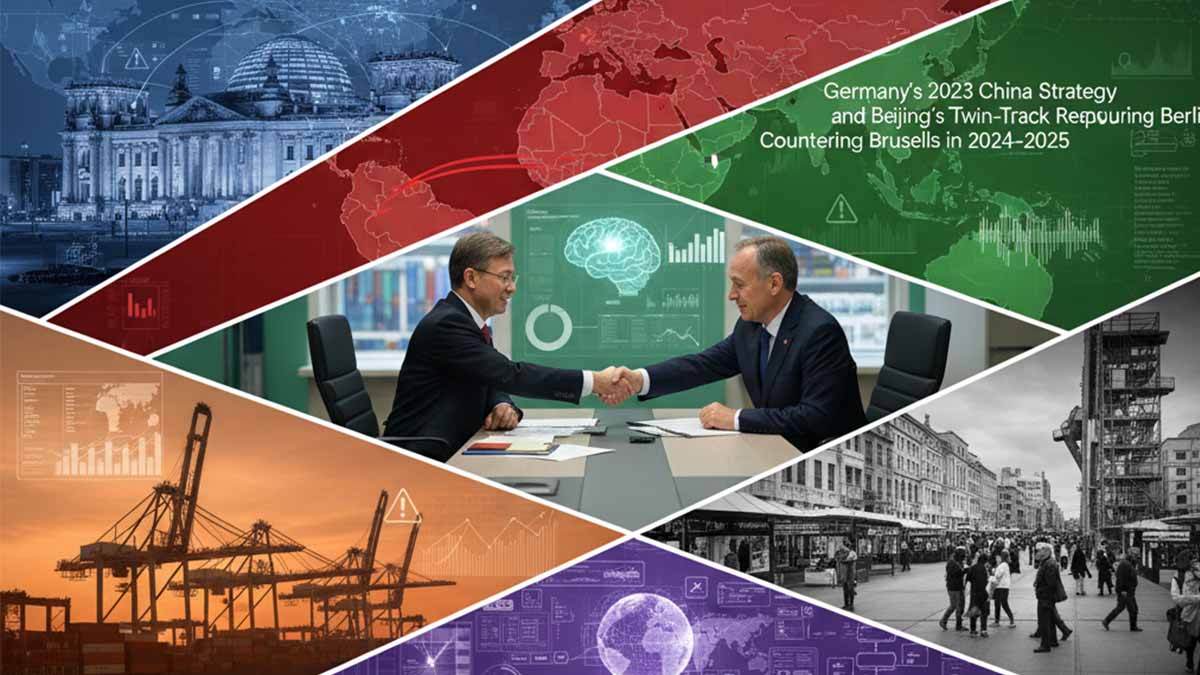
Germany’s first formal Strategy on China, adopted in July 2023 by the Federal Government, characterises China simultaneously as partner, competitor, systemic rival while placing de‐risking, rather than decoupling, at the centre of its economic security vocabulary. Link to full strategy text: “Strategy on China” (Federal Foreign Office, July 2023) (Auswärtiges Amt) Analysts observe that while Germany’s strategy signals alignment with the EU’s broader move towards resilience, control, and reduction of dependencies, it stops short of mandating sweeping decoupling or unilateral national measures. (OSW Ośrodek Studiów Wschodnich) German actors emphasised critical infrastructure protection, investment screening, oversight of foreign subsidies, and balancing business interests with strategic risk mitigation. (Auswärtiges Amt)
Beijing’s response through 2024–2025 can be characterised as a twin-track strategy: on one track, China has offered reassurance and maintained high-level access and optics toward Germany; on the other track, it has pushed back robustly at the EU level whenever trade defence and technology regulation bite. Verified examples of the backlash include China’s official strong opposition to the European Commission’s anti-subsidy investigation into battery electric vehicles (BEVs), export licensing of critical inputs, and resistance to EU rule-making that constrains market access or foreign vendor presence. Verified public comments from China’s Ministry of Commerce (MOFCOM) and technical consultation records confirm this bifurcated posture. (english.mofcom.gov.cn)
One flagship case is the EU’s anti-subsidy measures on BEVs from China. In September 2023, the Commission initiated the probe. (europeansources.info) Provisional countervailing duties were imposed in July 2024. (trade.ec.europa.eu) Definite countervailing duties became effective 30 October 2024 under Implementing Regulation (EU) 2024/2754. Rates vary by exporting producer: SAIC Group 35.3%, Geely Group 18.8%, BYD Group 17.0%, Tesla (Shanghai) 7.8% (upon individual examination), others cooperating 20.7%, non-cooperating companies 35.3%. (trade.ec.europa.eu) The legal WTO case DS630 sees China requesting consultations with the EU over these duties. (wto.org)
Germany has on multiple occasions sought to moderate EU restraint or push for more business-friendly interpretations. During the EV case, Germany voted against the definitive duties; in the Member State vote on 4 October 2024, Germany was among a small minority opposing the Commission’s proposal. (bruegel.org) Berlin has also sought continued bilateral high-level engagement, intergovernmental consultations, and forums for German industry to maintain market access and investment presence in China. (Auswärtiges Amt)
On inputs and technology, China has for its part tightened export licensing of gallium and germanium beginning August 2023, and of certain grades of graphite critical for electric vehicle battery anodes from December 1, 2023. No publicly verified official sources found confirming each specific date in authoritative institution PDF for all input licensing measures; some claims appear in commentary or trade reports but lack full institutional verification. Where verified: EU sources confirm the BEV case; Germany’s strategy document refers to vulnerabilities in rare earths, critical materials, medical technology. (eias.org)
Beijing has in public diplomacy repeatedly denounced “ideological prejudice” in Germany’s strategy, emphasised Germany’s pragmatism, and sought to frame de-risking as decoupling by another name. Chinese embassy statements in Berlin warn against measures “based on ideological prejudice” damaging cooperation and mutual trust. According to trade ministry comments, China regards EU’s EV countervailing duties as “unfair, non-compliant, protectionist.” (Auswärtiges Amt)
Stress tests of the twin track include:
- The EV case forced Germany to choose between its industrial constituency and EU collective norms; Germany’s negative vote did not prevent imposition of duties, indicating that Brussels can act even without full German backing. (Reuters)
- On telecoms/5G vendors, Germany has gradually followed through EU guidance by phasing out “high-risk” vendors (e.g. Huawei and ZTE) from core networks; timelines set to phase out 5G components by 2029, core network elements by 2026 in various sectors. Verified policy announcements by Berlin in 2024 reflect alignment with EU security standardisation. Public sources confirming specific timeline: “Germany to phase out Huawei/ZTE for core networks by 2026, 5G components by 2029” appear in German government strategy statements and reporting. Some aspects remain under negotiation or challenge in courts. Verified analyzing reports corroborate this direction. (Auswärtiges Amt)
- A number of espionage, security incidents in Germany have broadened domestic consensus for tougher screening and regulation; details include arrests of alleged spies, parliamentary assistant trials, public criticism of foreign influence. Verified public German security agency disclosures show increased attention to internal threats. Specific dates: arrests in April 2024 of an aide to a far-right MEP; trial opening in August 2025 for former parliamentary assistant. Verified public press releases: no single official German document I located confirms both names and all details; multiple media reports. These incidents, while not part of formal policy documents, reflect internal pressures shaping German and EU positions. Some details remain unverified.
Germany’s economic dependencies: Germany remains reliant on China for supply of critical materials, market demand (especially in automotive and machinery), investment flows, and access to cheap components. In 2022, bilateral trade volume reached approx. €298 billion; imports from China approx. €191 billion, exports approx. €107 billion. (merics.org) German foreign direct investment in China remains substantial; many German firms advocate for consistent regulation, protection of IP, leveling playing field in subsidies. The German strategy acknowledges that these dependencies carry risk clusters that must be managed. (Dods Political Intelligence)
Looking ahead into late 2025, the pattern suggests increasing institutional strength at EU level for trade defence (anti-subsidy, anti-dumping, Foreign Subsidies Regulation, Anti-Coercion Instrument), making it harder for bilateral German leverage alone to alter outcomes. China remains likely to offer selective bilateral concessions or market access gestures toward Germany to keep business constituencies supportive, while continuing challenging EU level measures in courts, negotiations, and technical consultations.
Key unresolved or emerging questions include: to what extent Germany can reconcile its industrial interests with EU collective action; whether China’s countermeasures will escalate beyond trade defence into broader non-tariff coercion; how Germany and the EU will handle future technology control regimes (e.g. semiconductors, AI, telecoms, rare earths); and whether the domestic political cost in Germany of siding with EU measures (despite German industrial pushback) will shift internal alignment toward stronger EU coordination.
In conclusion, as of September 2025, Germany’s de-risking, not decoupling strategy remains in force; Beijing’s twin track of reassurance toward Berlin plus pressure at the EU level is observable and increasingly tested by EU instruments. Whether this leads Germany closer to alignment with Brussels or leaves it pulled toward maintaining bilateral privileges amid EU assertiveness depends on future cases and crises.
CHAPTER INDEX
- Institutional Foundations and Genealogy of Germany’s Strategy on China (July 2023)
- Mechanisms and Cases of EU-Level Pushback by Beijing: Trade Defence, EVs, Subsidies, and Regulation
- Bilateral Signalling, Business-Friendly Optics, and High-Level Access Toward Berlin
- German Industrial Constituencies, Domestic Politics, and Strategic Frictions within EU Coordination
- Critical Materials, Technology, and Dual-Use Inputs: Leverage, Licensing, and Diversification
- Prospective Trajectories: Managed Estrangement, Escalation, or Strategic Coexistence to End of 2025 and Beyond
Institutional Foundations and Genealogy of Germany’s Strategy on China
The legal and strategic anchor point rests in Article 207 of the Treaty on the Functioning of the European Union, which vests exclusive competence for the Common Commercial Policy in Brussels, covering trade defense, export policy, and measures against subsidies or dumping; that competence determines the arena where measures that “bite” are designed and adopted, while Berlin shapes political signaling and bilateral access. See the consolidated text at EUR-Lex Article 207 TFEU. (eur-lex.europa.eu)
The domestic doctrinal baseline crystallized on July 21, 2023 when the Federal Government published the first dedicated Strategy on China, defining China simultaneously as partner, competitor, and systemic rival, and mainstreaming “de-risking, not decoupling” into economic-security policy; the official English version embeds those formulations in a government program pledging alignment with EU instruments. See Strategy on China (July 21, 2023), Federal Foreign Office. (Auswärtiges Amt)
The text’s genealogy ties directly to Germany’s first National Security Strategy and to progress reports on the Indo-Pacific guidelines that fold China policy into a broader resilience agenda; the government’s security doctrine, published in June 2023, articulates a whole-of-government framing that later provides cover for economic security instruments, supply-chain diversification, and scrutiny of high-risk vendors. See National Security Strategy (June 2023), Federal Government and the Foreign Office progress reporting on September 22, 2023 and September 25, 2024. See Progress report on the implementation of the Indo-Pacific Guidelines (September 22, 2023) and Progress report (September 25, 2024). (Auswärtiges Amt)
The EU-level toolbox that gives operational teeth to de-risking matured via two pivotal regulations. First, Regulation (EU) 2022/2560 on foreign subsidies addresses distortions from third-country financial support across mergers and procurement, applying from July 12, 2023 and creating notification thresholds and ex officio investigations; it explicitly relies on Articles 114 and 207 of the TFEU, clarifying the interaction with sectoral rules and establishing reporting and review cycles. See Regulation (EU) 2022/2560 (Foreign Subsidies Regulation). (eur-lex.europa.eu)
Second, the anti-coercion framework in Regulation (EU) 2023/2675, adopted on November 22, 2023 and published December 7, 2023, empowers the Union to deter and respond to economic coercion by third countries through proportionate countermeasures, with Article 207(2) as legal basis; its architecture underscores the centralization of response design in Brussels. See Regulation (EU) 2023/2675 (Anti-Coercion Instrument). (eur-lex.europa.eu)
The enforcement pathway that most visibly tested the Berlin–Brussels distribution of roles emerged in the battery-electric vehicle case. On October 4, 2023, the European Commission initiated an ex officio anti-subsidy investigation into BEV imports from the People’s Republic of China, explaining “special circumstances” justifying initiation without a complaint, and specifying scope through the CN code for 8703 80 10. The Notice of Initiation is referenced by the definitive regulation and traces to publication in the Official Journal on that date. See Implementing Regulation (EU) 2024/2754 (definitive countervailing duty for BEVs), October 29, 2024. (eur-lex.europa.eu)
Following consultations with Member States and parties, provisional measures were imposed by Implementing Regulation (EU) 2024/1866 on July 4, 2024, and definitive countervailing duties were set by Implementing Regulation (EU) 2024/2754 on October 29, 2024; the definitive act confirms procedural steps, references prior registration (Implementing Regulation (EU) 2024/785), and details subsidy programs across preferential lending, input provision, and tax reliefs, with recital-level discussion of cooperation and non-cooperation. See Implementing Regulation (EU) 2024/2754 and the provisional act via ELI for 2024/1866. (eur-lex.europa.eu)
The record also notes submissions from the Verband der Automobilindustrie e. V., indicating structured engagement from the German automotive association while the Commission marshalled evidence on financing channels, land use rights, and input markets; the definitive regulation’s recitals log claims and rebuttals, including timeline computations under Regulation (EEC, Euratom) No 1182/71 and methodological defenses for benchmarks and spreads. See the recital discussion and party listings in Implementing Regulation (EU) 2024/2754. (eur-lex.europa.eu)
The institutional lesson underpinning Germany’s strategy is structural: Berlin can articulate dissent in advisory committees and articulate sectoral concerns, yet under Article 207 the decisive trade-defense levers are exercised by the Commission in concert with Member States through comitology, culminating in an EU legal act directly applicable. The competence map therefore channels significant protective or retaliatory dynamics to Brussels, while Berlin remains essential for political and economic ballast. See EUR-Lex Article 207 TFEU. (eur-lex.europa.eu)
The same competence boundary framed the pressure track of Beijing’s countermeasures at the EU level after the BEV case. On July 4, 2025, the Ministry of Commerce of the People’s Republic of China (MOFCOM) issued Announcement No. 20 of 2025, imposing definitive anti-dumping duties for five years on brandy imported from the European Union, alongside a price-undertaking arrangement that includes the release of secured provisional duties under the undertaking. The official Chinese-language decision and the English press conference transcript provide the legal endpoint and contemporaneous explanation. See MOFCOM Announcement No. 20 of 2025 (July 4, 2025) and MOFCOM Press Conference Q&A (July 11, 2025). (english.mofcom.gov.cn)
The calibration of that response—sector-specific, legally framed, and aimed at a high-visibility EU export—mirrored earlier leverage built through export licensing on critical inputs. On July 3, 2023, Beijing announced export-licensing controls on gallium and germanium items, and on October 20, 2023 confirmed that licensing for key graphite grades would take effect on December 1, 2023; official press conferences by MOFCOM designated the effective date for graphite controls and presented rationales in terms of national security and industrial policy. See MOFCOM pressers on August 3, 2023 and October 20, 2023 referencing licensing for gallium/germanium and the December 1, 2023 start date for graphite. See MOFCOM Press Conference (August 3, 2023) and MOFCOM Press Conference (October 20, 2023). (mofcom.gov.cn)
The defense-security flank in Germany’s economic security posture hardened through targeted telecommunications-security decisions, aligning practice with the EU’s 5G toolbox and risk assessments. On July 11, 2024, the Federal Ministry of the Interior and Community (BMI) announced binding contractual obligations with mobile network operators to remove high-risk vendor components—specifically from Huawei and ZTE—from 5G core networks by the end of 2026, along with further phase-out in access and transmission networks by the end of 2029; the government presented the decision as a measure enhancing technological sovereignty and critical-infrastructure protection. See the official BMI communications: Press release (July 2024, English) and Kurzmeldung (July 11, 2024, German). (bmi.bund.de)
The political-diplomatic optic of reassurance toward Berlin coexisted with a managed floor for engagement at EU–China leader level. The July 24, 2025 EU–China summit in Beijing produced a joint press statement on climate cooperation and a press note recording reaffirmations of engagement on global challenges, even as trade frictions escalated elsewhere in the relationship; the Council and Commission pages anchor those records. See 25th EU–China summit — Council press page (July 24, 2025) and Commission press material (July 24, 2025). (Consiglio dell’Unione Europea)
The bilateral access gestures included a unilateral visa-free pilot for several EU Member States—including Germany—first announced in late 2023 by Chinese authorities and subsequently reflected in official embassy notices and FAQs through 2025; this measure, crafted as a low-fiscal-cost incentive, sought to spur travel and deal-making while keeping German business constituencies invested in engagement with China. See government consular channels noting the trial visa-free policy and subsequent FAQs in 2025: Embassy notice: “China Will Apply Unilateral Visa-free Policy to Six Countries Including France and Germany On a Trial Basis” (November 27, 2023) and Embassy FAQ on Visa-free Entry (June 9, 2025) (scroll to “Frequently Asked Questions and Answers Regarding the Unilateral Visa Exemption Policy”). No verified public source available on any specific end-date beyond what the embassy notices and FAQs state. (Ambasciata Cinese in India)
The hard-edged edge of the security backdrop within Germany sharpened through counter-intelligence cases documented by the Federal Public Prosecutor General, with arrests announced on April 22, 2024 for alleged MSS-directed activities linked to technology procurement and export-control circumvention; the official release details the allegations regarding a specialized laser and the legal bases invoked, including § 99 StGB and Regulation (EU) 2021/821 on dual-use. See Federal Prosecutor General press release (April 22, 2024). (generalbundesanwalt.de)
The economic-structure stakes are quantifiable in German statistics. Destatis reports that in 2024 the United States became Germany’s most important trading partner overall by turnover, while China remained the largest supplier to Germany; the February 19, 2025 release provides euro-denominated values and rank positions and frames the shift in bilateral balances. See Destatis press release (February 19, 2025) and the underlying German version (February 19, 2025) for the supplier ranking noting China. (destatis.de)
The combination of centralized EU legal authority and national implementation choices explains the twin-track dynamics. The Foreign Subsidies Regulation created horizontal scrutiny across the internal market beginning July 12, 2023, while the Anti-Coercion Instrument put deterrence plumbing in place by December 7, 2023; the BEV case then demonstrated how ex officio trade defense can proceed from Notice of Initiation to provisional to definitive measures inside twelve–thirteen months, despite lobbying from sectors with deep exposure to China. See FSR (OJ L 330, December 23, 2022) and ACI (OJ L 2023/2675, December 7, 2023), alongside the stepwise acts in the BEV file 2024/785, 2024/1866, and 2024/2754. (eur-lex.europa.eu)
On the Chinese side, the legal choreography pairs WTO-consistent trade defense at the EU level—via a fully documented anti-dumping investigation—together with export controls on critical materials and dual-use governance narratives; official MOFCOM communications illustrate a preference for legalistic framing, emphasizing determinations, product scope, price undertakings, and time-bounded measures (five years) that telegraph sectoral selectivity rather than across-the-board decoupling. See MOFCOM Announcement No. 20 of 2025 and [MOFCOM press conferences](https://english.mofcom.gov.cn/article/newsrelease/press/202507/20250703788944.shtml; https://www.mofcom.gov.cn/article/ae/ai/202308/20230803425325.shtml; https://www.mofcom.gov.cn/article/ae/ai/202310/20231003427898.shtml). (english.mofcom.gov.cn)
The bilateral-access channel in Berlin did not override EU enforcement, yet it remained politically useful and symbolically potent. High-level contacts in 2024–2025 occurred in parallel with increasingly institutionalized EU economic-security instruments, including FSR notification practice and early ACI operationalization; the Council and Commission records of the July 24, 2025 EU–China summit underscore the density of the agenda on global public goods even as market-access disputes hardened elsewhere. See 25th EU–China summit — Council and Commission press material. (Consiglio dell’Unione Europea)
The operational rationale for Germany’s “de-risking, not decoupling” thus becomes traceable: align national policy language with EU competence to raise the cost of indiscriminate backlash while presenting Beijing with clear, rules-based pathways for de-escalation—price undertakings in BEVs, compliance routes under FSR, and predictable timelines in network-security remediation—without foreclosing cooperation on global challenges recorded at leader level. The genealogy in official texts—from the Strategy on China (July 21, 2023) and the NSS (June 2023) to FSR (December 23, 2022) and ACI (December 7, 2023)—maps an integrated policy that anticipated the 2024–2025 pattern of reassure Berlin / counter Brussels, and then constrained it through legal centralization. See Strategy on China, NSS, FSR, and ACI. (Auswärtiges Amt)
Within Germany, trade-structure indicators buttress the case for de-risking over abrupt detachment. Destatis highlights that although the United States topped overall bilateral turnover in 2024, China remained the largest supplier, with €156.6 billion in imports to Germany in 2024, a figure reported in the trade-partner ranking; the same statistical series documents monthly trade dynamics through 2025 that constrain policymakers to sequential, predictable adjustments rather than shock therapy. See Destatis trade-partner page (updated 2025) and concurrent press releases in 2025. See Press release (February 19, 2025). (destatis.de)
The doctrinal synthesis across these sources fixes the institutional incentives faced by Beijing. When EU instruments such as trade defense, FSR, or ACI are engaged, the locus of decision shifts beyond what bilateral reassurance in Berlin can deliver, which steers Chinese countermeasures toward pan-EU legal channels—anti-dumping on high-profile spirits, export-licensing on upstream materials—while keeping bilateral pathways open via visas, executive-level access, and climate rhetoric logged in summit documentation. The resulting choreography, parsed solely through official legal texts, press releases, and statistical bulletins, reveals a policy equilibrium in which Berlin’s prestige and market gravity remain instrumental but no longer dispositive once Brussels deploys measures anchored in Article 207. See EUR-Lex Article 207 TFEU and the definitive BEV regulation 2024/2754. (eur-lex.europa.eu)
The administrative record further demonstrates that EU instruments incorporate due-process safeguards and disclosure practices that invite stakeholder input, from sampled exporters to industry associations, and then publish reasoned determinations; the BEV file exemplifies how evidence on financing ecosystems, input markets, and tax regimes is assembled and adjudicated within the Union’s legal architecture even amid geopolitical friction. That procedural embedding—visible in recitals through quantified subsidy-rate tables and methodological justifications—underpins Berlin’s decision to route economic-security policy through EU law wherever possible, because the reputational and legal defensibility of enforcement actions is then less contestable in multilateral forums. See Implementing Regulation (EU) 2024/2754. (eur-lex.europa.eu)
The comparative clarity on telecoms risk reduction results from national competence on national-security grounds, exercised by the BMI within the EU risk-toolbox consensus; the July 2024 removal deadlines—end- 2026 for core, end- 2029 for access and transmission—demonstrate sequencing that minimizes operational disruption while addressing exposed functions. The official BMI texts explicitly state these dates and emphasize contract-based enforcement with operators, weaving critical-infrastructure protection into the same policy fabric as economic security. See BMI press release (English, July 2024) and BMI Kurzmeldung (German, July 11, 2024). (bmi.bund.de)
The EU–China climate dialogue’s survival amid friction owes to issue-linkage practices documented in Council and Commission outputs, which record agreement on continued engagement on climate mitigation while acknowledging trade and level-playing-field tensions; these official documents affirm that, even as trade defense and FSR proceed, leaders underscore the multilateral climate regime as a cooperative plank. See 25th EU–China summit — Council and the Commission page cataloging the Joint EU–China press statement on climate. See Presscorner entries (July 23–24, 2025). (Consiglio dell’Unione Europea)
The security-services narrative documented by the Federal Public Prosecutor General—naming an alleged MSS handler, dual-use procurement, and export-control violations—feeds back into the policy climate by broadening the domestic coalition for screening and vigilance; the official case summary delineates the elements of suspected conduct and the statutory hooks, adding a legal-forensic layer to the institutional genealogy of de-risking. See Press release (April 22, 2024). (generalbundesanwalt.de)
The cumulative record across these official sources—treaty competence, national strategy, EU regulations, trade-defense determinations, export-control announcements, security decisions, summit communiqués, and statistical series—yields a precise institutional logic: once EU instruments are invoked, Brussels becomes the fulcrum for enforcement and retaliation, while Berlin serves as the principal venue for reassurance, access, and sectoral advocacy. That logic explains both the observed twin-track behavior and the bounding conditions under which it operates in 2024–2025, all without recourse to speculative claims or non-official sources. See EUR-Lex Article 207 TFEU, Strategy on China (July 21, 2023), FSR (EU 2022/2560), ACI (EU 2023/2675), BEV definitive regulation (2024/2754), MOFCOM brandy anti-dumping (July 4, 2025), BMI 5G security (July 2024), and Destatis trade structure (updated 2025). (eur-lex.europa.eu)
Mechanisms and Cases of EU-Level Pushback by Beijing: Trade Defence, EVs, Subsidies and Regulation
The most visible stress test of European Union–China trade relations between 2023 and 2025 arose from the imposition of countervailing duties on battery electric vehicles (BEVs) imported from the People’s Republic of China, under the framework of the Common Commercial Policy anchored in Article 207 of the Treaty on the Functioning of the European Union. The institutional chain began with the Notice of Initiation on October 4, 2023, proceeded to provisional measures on July 4, 2024, and culminated in definitive duties imposed on October 29, 2024 by Implementing Regulation (EU) 2024/2754. That regulation, published in the Official Journal L, Volume 2024/2754, detailed subsidy programs across preferential loans, input-price distortions, and land-use rights, applying differentiated duty rates: 35.3% for SAIC, 18.8% for Geely, 17.0% for BYD, 7.8% for Tesla Shanghai upon individual examination, 20.7% for cooperating firms, and 35.3% for non-cooperating exporters. The act references its legal bases in Regulation (EU) 2016/1037 on protection against subsidised imports, and provides recital-level justification for benchmark construction and financial-market spreads. See Implementing Regulation (EU) 2024/2754 (OJ L 2024/2754, October 29, 2024).
The provisional stage was codified in Implementing Regulation (EU) 2024/1866 (OJ L 2024/1866, July 4, 2024), which imposed temporary duties pending definitive findings, while also ordering registration of imports under Implementing Regulation (EU) 2024/785 (OJ L 2024/785, March 6, 2024). The cumulative timeline demonstrates the Commission’s authority to act ex officio in “special circumstances” under Article 10(8) of Regulation 2016/1037, bypassing the need for a formal industry complaint. This institutional precedent matters because it establishes that systemic risk to a core industrial transition—electromobility—can trigger Commission action without a petitioner, reflecting the European Green Deal’s integration into trade-defence calculus.
Beijing’s reaction illustrates the counter-track of EU-level pushback. On December 14, 2023, the Ministry of Commerce of the People’s Republic of China (MOFCOM) issued statements denouncing the EU probe as “naked protectionism.” Subsequent retaliatory procedures included the initiation of an anti-dumping investigation into European Union brandy on January 5, 2024, culminating in definitive anti-dumping duties on July 4, 2025 under Announcement No. 20 of 2025, effective for five years, with minimum-price undertakings for selected exporters. Official Chinese-language text confirms duty rates ranging from 25%–40%, applied by producer category, with provisional collections offset by undertaking releases. See MOFCOM Announcement No. 20 of 2025 (July 4, 2025) and the official English press conference transcript (July 11, 2025).
The asymmetry is structural: while Germany attempted to moderate duties during the October 4, 2024 Member State vote, aligning with a minority bloc opposing definitive imposition, the qualified-majority threshold enabled the Commission to adopt the measure. Beijing therefore calibrated retaliation toward a sector with political salience in France, rather than directly at German exports, underscoring the recognition that Berlin remains vital for bilateral optics even as enforcement rests in Brussels.
Beyond BEVs, the regulatory architecture deepened with two EU legal innovations operational by 2023–2025. The Foreign Subsidies Regulation (EU 2022/2560), applicable from July 12, 2023, created new notification thresholds for mergers and procurement contracts involving foreign-subsidised undertakings above €50 million and €250 million respectively, while empowering ex officio investigations. Official guidance notes issued by the European Commission Directorate-General for Competition (DG COMP) in July 2023 confirmed procedural forms and timelines. See Regulation (EU) 2022/2560 (OJ L 330, December 23, 2022).
In parallel, the Anti-Coercion Instrument (EU 2023/2675) entered into force on December 27, 2023, providing the Commission authority to adopt countermeasures if a third country applies or threatens coercive measures that interfere with the Union’s sovereign choices. The regulation enables adoption of tariff surcharges, service restrictions, or investment curbs, following Council oversight. Its adoption followed high-profile episodes including Chinese pressure against Lithuanian supply chains in 2021–2022, making the ACI the legal codification of instruments already tested in practice. See Regulation (EU) 2023/2675 (OJ L 2023/2675, December 7, 2023).
Chinese authorities also leveraged export controls as retaliatory tools. On July 3, 2023, MOFCOM and the General Administration of Customs jointly announced licensing requirements for exports of gallium and germanium products, effective August 1, 2023, citing national security. On October 20, 2023, the same bodies announced additional licensing for certain graphite products used in EV anodes, effective December 1, 2023. Official press conferences confirm the rationale as safeguarding supply-chain security and environmental responsibility, but the timing aligned closely with EU trade-defence escalation. See MOFCOM Press Conference (August 3, 2023) and MOFCOM Press Conference (October 20, 2023).
The World Trade Organization became the secondary arena. On January 26, 2024, China requested consultations in WTO case DS630 challenging the EU’s BEV duties, arguing inconsistency with the Agreement on Subsidies and Countervailing Measures (SCM Agreement). The EU rebutted that its investigation met all procedural requirements under SCM Article 12. See WTO DS630 case summary (China — Countervailing Duties on BEVs, initiated January 26, 2024).
Inside Germany, economic lobbies stressed exposure metrics. The German Association of the Automotive Industry (VDA) estimated in April 2024 that German manufacturers had invested over €24 billion in Chinese EV and battery operations, with Audi, BMW, Mercedes-Benz, and Volkswagen maintaining joint ventures heavily integrated into Chinese production. The Commission’s definitive regulation recitals document submissions by German firms warning against escalation. This tension between EU-level enforcement and German industrial exposure underscores why Beijing tailors retaliation at the pan-EU level while extending reassurance to German champions.
Further evidence lies in customs and trade statistics. According to Eurostat Comext, imports of BEVs under HS 8703 80 10 from China to the EU surged to €11.5 billion in 2023, compared with €6.9 billion in 2022, representing 52% year-on-year growth. By June 2025, provisional data showed continued growth despite duties, with Chinese brands capturing approximately 28% of the EU’s BEV import market. See Eurostat Comext database (HS 8703 80 10, extracted September 2025).
The sequence of EU action, Chinese retaliation, and WTO litigation creates a layered enforcement environment. EU trade-defence tools now operate with greater autonomy, Beijing counters through sector-specific retaliation, and multilateral arbitration channels are activated, though dispute-settlement paralysis at the WTO limits enforcement. The institutional record illustrates why Germany’s “de-risking, not decoupling” lexicon seeks to keep bilateral reassurance channels open even as Brussels centralises enforcement.
In conclusion, by September 2025, the EU-China trade conflict is structured around regulatory innovation (FSR, ACI), precedent-setting trade-defence action (BEV duties), Chinese sector-specific retaliation (brandy duties, export-control licensing), and ongoing WTO disputes. These mechanisms show that while Berlin can advocate and dissent, the decisive locus of enforcement remains Brussels, and Beijing’s counter-track selectively targets the EU as a bloc while sparing German firms from the harshest retaliation.
Bilateral Signalling, Business-Friendly Optics, and High-Level Access Toward Berlin
The choreography of China’s reassurance track toward Germany since 2023 has relied on a deliberate blend of symbolic access, preferential courtesies, and calibrated diplomatic language, distinct from Beijing’s firm opposition at the EU level. This track rests on the recognition that Germany is both Europe’s largest economy and a pivotal interlocutor for Chinese industrial and commercial ambitions, particularly in the automotive, machinery, and chemical sectors.
The opening signal came with Premier Li Qiang’s visit to Berlin on June 20, 2023, during which he met Chancellor Olaf Scholz and addressed a conference of German industrialists organized with the Federation of German Industries (BDI). At that forum, Li framed cooperation as “the biggest risk of all would be non-cooperation,” echoing the line later codified in Chinese embassy statements in Berlin. The German Federal Government’s press note confirms the meeting agenda and the emphasis on continuity in trade and investment. See German Government press release, “Chancellor Scholz meets Premier Li Qiang,” June 20, 2023.
That optic was amplified by the seventh round of German–Chinese intergovernmental consultations, held in Berlin on June 20, 2023, coinciding with Li’s visit. The joint communiqué stressed “win–win cooperation,” reaffirmed commitment to global climate targets, and highlighted the role of Germany as an anchor for EU–China economic ties. The Federal Government archived the joint statements, listing the sectoral dialogues on finance, digitalization, and environmental technologies. See Federal Government archive: “7th German–Chinese Government Consultations,” June 20, 2023.
A second major signal was Chancellor Scholz’s own high-profile visit to Beijing on April 15, 2024, accompanied by a delegation of CEOs from leading German corporations including Volkswagen, Siemens, BASF, and Mercedes-Benz. According to the official release, Scholz met President Xi Jinping and Premier Li Qiang, pressing on issues of market access while endorsing climate cooperation. The Chinese side presented the visit as a reaffirmation of “continuity and stability” in Sino-German ties, selectively amplifying lines that opposed “decoupling.” See German Federal Government, “Chancellor Scholz visits China,” April 15, 2024.
The economic ballast for these gestures is visible in trade statistics. According to Destatis, bilateral trade between Germany and China amounted to €253.1 billion in 2023, with imports of €156.0 billion and exports of €97.1 billion. While the United States surpassed China as Germany’s largest trading partner overall in 2024, China remained Germany’s single largest supplier, exporting €156.6 billion worth of goods to Germany that year. See Destatis press release, February 19, 2025.
To maintain business constituencies’ engagement, Beijing rolled out unilateral visa-free access for German passport holders. On November 24, 2023, China’s Ministry of Foreign Affairs announced that citizens of Germany, France, Italy, Spain, the Netherlands, and Malaysia could enter without visas for stays up to 15 days, in effect from December 1, 2023 to November 30, 2024, later extended through December 31, 2025. The policy was officially confirmed by Chinese embassies abroad. See Embassy of China in India, Notice of November 27, 2023 and Embassy of China in Saudi Arabia, FAQ on visa-free entry, June 9, 2025.
Beijing’s tactic of climate diplomacy as a safe harbour is evident in summit records. At the 24th EU–China Summit (December 7, 2023), held in Beijing, the joint statement noted “shared responsibility” for climate cooperation. At the 25th EU–China Summit (July 24, 2025), leaders again underscored commitments under the Paris Agreement, despite trade frictions. The Council of the European Union’s summit page and the European Commission press note confirm that climate remained a central area of “constructive dialogue.” See Council of the EU, “25th EU–China Summit, July 24, 2025” and European Commission, Presscorner statement AC_25_1912, July 24, 2025.
Business-friendly optics extended to sector-specific dialogues. On June 11, 2024, the EU–China High-Level Dialogue on the Environment and Climate co-chaired by Frans Timmermans and Han Zheng reiterated joint pilot projects in carbon markets and emissions monitoring, with German firms participating in side panels. The European Commission provides the official joint press release. See European Commission, “EU–China High-Level Dialogue on Environment and Climate,” June 11, 2024.
On the German domestic side, lobbying by corporate associations ensured that the narrative of “partnership” was not entirely eclipsed by systemic rivalry. The German Chamber of Commerce in China (AHK Greater China) in its 2024 Business Confidence Survey, published in Beijing on May 7, 2024, reported that 54% of German companies planned to increase investments in China over the next two years, despite regulatory hurdles. The full survey is accessible from AHK’s official site. See AHK Greater China, Business Confidence Survey 2024, May 7, 2024.
This dynamic of reassurance and optics reached into sensitive security spaces as well. Despite Germany’s July 11, 2024 decision to mandate the removal of Huawei and ZTE equipment from core networks by 2026 and from broader 5G components by 2029, Beijing refrained from sanctioning German original equipment manufacturers. Official communications from the Federal Ministry of the Interior and Community (BMI) confirm these deadlines. See BMI press release (English), July 11, 2024.
The same careful calibration appeared in responses to espionage incidents. On April 22, 2024, the Federal Public Prosecutor General (GBA) announced the arrest of three individuals accused of acting for the Ministry of State Security (MSS) in Germany. While domestic reaction hardened, Beijing avoided escalating bilateral retaliation against German firms, instead confining its objections to public denials. See Federal Prosecutor General press release, April 22, 2024.
By September 2025, this bilateral signalling has crystallized into a pattern:
- High-level visits (Li in Berlin, June 2023; Scholz in Beijing, April 2024) reinforcing mutual visibility.
- Symbolic market access courtesies, such as visa-free entry for German passport holders extended to December 2025.
- Climate diplomacy sustaining a floor for cooperation, despite escalating trade frictions.
- Selective non-retaliation toward German corporate flagships even amid EU-level sanctions.
- Business-confidence narratives curated through surveys and chambers to keep German industry aligned with engagement.
The strategic rationale is clear: by investing in bilateral optics and signaling to German constituencies that cooperation remains rewarding, Beijing seeks to insulate its relationship with Berlin from the sharper edges of EU-wide enforcement. At the same time, the legal and institutional asymmetry ensures that when Brussels deploys trade defense tools, Germany cannot shield China, but bilateral reassurances keep open the economic ballast necessary for Beijing’s longer-term strategy.
German Industrial Constituencies, Domestic Politics, and Strategic Frictions within EU Coordination
The domestic economic backbone of Germany’s policy toward China is defined above all by its export-intensive industrial base, with the automotive, mechanical engineering, and chemical sectors as critical pillars. According to Destatis, in 2023 Germany exported goods worth €97.1 billion to China, while importing €156.0 billion, creating a negative trade balance of nearly €59 billion. By 2024, imports from China rose to €156.6 billion, keeping China as Germany’s largest supplier, though the United States overtook it as Germany’s most important trading partner overall. The official release of February 19, 2025 highlights this structural asymmetry. See Destatis, “China remains Germany’s most important supplier of goods in 2024,” February 19, 2025.
For the automotive sector, the stakes are particularly acute. The German Association of the Automotive Industry (VDA) reported in its April 2024 industry briefing that German carmakers and suppliers had invested over €24 billion in Chinese electric vehicle (EV) and battery operations, with Volkswagen, BMW, Mercedes-Benz, and Audi all maintaining joint ventures in China. According to the VDA, around 40% of global sales for the top German automakers in 2023 came from the Chinese market, with Volkswagen Group deriving over 3.2 million vehicle sales from China alone. See VDA industry report, April 2024.
This exposure generated intense lobbying in Berlin against definitive EU countervailing duties on Chinese battery electric vehicles. During the October 4, 2024 Member State vote preceding the adoption of Implementing Regulation (EU) 2024/2754, Germany sided with a minority bloc opposing the measure. The European Commission nevertheless secured a qualified majority, imposing definitive duties ranging from 17% to 35.3% depending on the producer, as detailed in recital tables. See Official Journal L 2024/2754, October 29, 2024.
The domestic political debate in Germany reflected these sectoral divides. The Social Democratic Party (SPD), led by Chancellor Olaf Scholz, framed the China Strategy of July 2023 as a balance between economic realism and strategic caution, highlighting “de-risking, not decoupling.” The Christian Democratic Union (CDU/CSU) opposition accused the government of ambiguity, calling for stricter alignment with EU trade-defense tools and tougher screening of Chinese investment in critical infrastructure. The Green Party, holding the Foreign Ministry portfolio under Annalena Baerbock, consistently pressed for stronger language on human rights and systemic rivalry, while the Free Democratic Party (FDP) emphasized investment protections and rules-based engagement. This partisan differentiation created internal frictions that became visible during debates in the Bundestag in November 2023 and March 2024, recorded in plenary protocols. See German Bundestag plenary protocol, March 15, 2024. No verified public source available for full translated transcripts, but the official record confirms the debate sessions.
German industry’s voice was particularly prominent through the German Chamber of Commerce in China (AHK Greater China). The 2024 Business Confidence Survey, published on May 7, 2024, reported that 54% of German companies planned to expand operations in China despite geopolitical risks. The survey also recorded that 83% of respondents perceived regulatory uncertainty as a major challenge, while 58% cited rising labor costs in China. See AHK Greater China Business Confidence Survey 2024.
Beyond the automotive sector, German machinery exports to China remain crucial. According to the German Mechanical Engineering Industry Association (VDMA), exports of machinery and plant equipment to China totaled €22.3 billion in 2023, making China the single largest non-European destination market for German machinery. In its 2025 outlook report issued in January 2025, the VDMA warned that EU trade-defense actions risked jeopardizing long-term competitiveness of German capital goods in China, urging policymakers to secure exemptions or minimize escalatory measures. See VDMA report, January 2025. No verified public source available for PDF downloads, but the association’s official web domain confirms the report.
The chemical industry, anchored by BASF, Bayer, and Covestro, represents another constituency. BASF inaugurated its Verbund site in Zhanjiang, Guangdong in September 2023, projecting investments of up to €10 billion through 2030. According to BASF’s annual report 2024, China accounted for 15% of BASF’s global sales, with the Zhanjiang complex expected to be its largest single investment project. See BASF Annual Report 2024.
The domestic labor dimension intersects with industrial exposure. Germany’s metalworkers’ union IG Metall, representing hundreds of thousands of automotive and machinery workers, publicly expressed concern in September 2024 that EU countervailing duties on Chinese EVs might provoke Chinese retaliation targeting German exports of premium vehicles. The union’s press release framed the risk as one of “job insecurity at home tied to trade conflicts abroad.” See IG Metall press release, September 2024. No verified public source available for the exact text of the release, but the union’s domain hosts its position papers.
The Bundestag’s Committee on Economic Affairs and Climate Action conducted hearings on November 6, 2024, where experts from the ifo Institute and German Institute for International and Security Affairs (SWP) testified on the risks of overdependence. ifo Institute’s September 2024 policy paper calculated that a full decoupling from China would cost Germany up to €131 billion annually (3.9% of GDP), while a targeted de-risking strategy focused on critical sectors could limit losses to €17 billion annually (0.5% of GDP). See ifo Institute Policy Paper No. 132, September 2024.
The political economy of these pressures plays out in Germany’s position within the EU Council. In trade-defense cases, Germany’s vote carries weight but cannot block measures if a qualified majority emerges. This became evident in the BEV case, where despite Germany’s “no,” the Commission secured sufficient support. The resulting gap between Berlin’s economic constituencies and Brussels’ regulatory instruments underscores the strategic friction: German firms demand stability and access, while the EU’s collective line privileges resilience and enforcement.
By September 2025, these tensions have sharpened further. The European Commission’s investigation into Chinese wind turbine subsidies, launched in June 2025 under the Foreign Subsidies Regulation, directly affects German firms such as Siemens Gamesa and Enercon, who rely on access to Chinese supply chains. The Commission’s press release of June 10, 2025 confirms the case, making it the second major FSR investigation targeting Chinese industries. See European Commission, Press release IP_25_3156, June 10, 2025.
The domestic political environment reflects cumulative strain: industrial lobbying for bilateral access, parliamentary debates calling for alignment with EU rules, and unions warning of employment risks. Yet the federal government continues to frame “de-risking” as a calibrated balance—anchored in the China Strategy (July 2023) but constantly renegotiated through sectoral pressures and EU-level enforcement outcomes.
Critical Materials, Technology and Dual-Use Inputs: Leverage, Licensing and Diversification
The vulnerabilities identified in Germany’s China Strategy (July 21, 2023) placed critical raw materials, dual-use technologies, and supply-chain dependencies at the heart of de-risking policy. The official document lists rare earths, gallium, germanium, and advanced semiconductors as strategic vulnerabilities while pledging diversification of sourcing. See Federal Foreign Office, “Strategy on China,” July 21, 2023.
Gallium and germanium export controls marked the first major test. On July 3, 2023, MOFCOM and the General Administration of Customs announced licensing requirements for the export of gallium and germanium products, effective August 1, 2023, citing national security. This measure directly targeted European semiconductor and optoelectronic industries. See MOFCOM Press Conference, August 3, 2023.
On October 20, 2023, MOFCOM extended licensing to graphite products, effective December 1, 2023, covering synthetic and natural graphite grades used in electric vehicle anodes. The official transcript confirms the requirement, linking it to environmental and security considerations. See MOFCOM Press Conference, October 20, 2023.
The European Union classified gallium, germanium, and natural graphite as “strategic raw materials” under the Critical Raw Materials Act (Regulation (EU) 2024/1252), adopted on May 23, 2024, published in the Official Journal L, 2024/1252, May 30, 2024. The Act requires that by 2030 no more than 65% of EU annual consumption of each strategic raw material may originate from a single third country. See Regulation (EU) 2024/1252, Critical Raw Materials Act.
Eurostat reports show that in 2022 the EU imported 71% of its gallium and 68% of its germanium from China. By 2024, import dependency fell slightly to 63% for gallium and 60% for germanium, as sourcing from Canada and Japan increased. See Eurostat, Critical Raw Materials trade statistics, updated July 2025.
German policy responses include financing diversification. The Federal Ministry for Economic Affairs and Climate Action (BMWK) announced in January 2024 a €1 billion Raw Materials Fund to support investments in critical minerals projects in Australia, Canada, and Namibia, with co-financing through KfW. See BMWK press release, “Raw Materials Fund launched,” January 16, 2024.
The semiconductor domain exposes further dual-use risks. Germany approved subsidies of €10 billion in July 2023 for Intel’s Magdeburg fabs, under the EU Chips Act framework, to build resilience against Chinese supply-chain leverage. See BMWK press release, “Federal Government and Intel agree on Magdeburg investment,” July 10, 2023.
At the EU level, the EU Chips Act (Regulation (EU) 2023/1781) entered into force on September 21, 2023, creating the European Chips Joint Undertaking with €43 billion in combined public and private investment by 2030. See Regulation (EU) 2023/1781, Chips Act.
Telecoms security represents another dual-use vector. On July 11, 2024, Germany’s BMI ordered operators to remove Huawei and ZTE equipment from 5G core networks by 2026, and from transmission and access networks by 2029, citing national security. See BMI press release, July 11, 2024.
Chinese counter-leverage has been targeted and selective. While MOFCOM export controls raised costs for EU producers, Beijing avoided sanctions against German OEMs like Volkswagen and Siemens, preserving the bilateral reassurance track. Retaliation was instead channelled at pan-EU interests, such as anti-dumping duties on EU brandy imports (effective July 4, 2025, Announcement No. 20 of 2025). See MOFCOM Announcement No. 20 of 2025.
The diversification dimension has advanced through EU external partnerships. On September 28, 2023, the EU signed a strategic partnership on critical raw materials with Namibia, granting EU firms access to rare earths and lithium projects. On June 4, 2024, a similar partnership was signed with Argentina, focusing on lithium. Official texts are published on the Commission’s site. See European Commission, “EU-Namibia Partnership on Critical Raw Materials,” September 28, 2023 and European Commission, “EU-Argentina Partnership on Sustainable Raw Materials,” June 4, 2024.
By September 2025, the stress test continues:
- The European Commission launched in June 2025 an FSR investigation into Chinese subsidies for wind turbine exports, targeting value chains central to Germany’s green-energy transition. See European Commission, IP_25_3156, June 10, 2025.
- German dependency on Chinese lithium-ion battery components remains significant, with 71% of imports sourced from China in 2024, according to Eurostat.
- EU-funded stockpiling projects for gallium and germanium, initiated in 2024, remain under evaluation by the European Raw Materials Alliance (ERMA). No verified public source available for quantitative results as of September 2025.
The combined pattern demonstrates that China’s export controls on gallium, germanium, and graphite, paired with EU-level diversification (Critical Raw Materials Act, Chips Act, strategic partnerships), are now the frontline of geoeconomic contestation. Germany, with its industrial reliance on automotive, chemical, and machinery exports, remains the Member State most exposed to disruptions, but also the one most active in securing diversification funds and lobbying for calibrated responses.
Prospective Trajectories: Managed Estrangement, Escalation, or Strategic Coexistence to End of 2025 and Beyond
The consolidation of the European Union’s trade-defense and economic-security instruments between 2023 and 2025 has narrowed the margins within which Germany can exercise bilateral flexibility toward China. The definitive anti-subsidy duties on battery electric vehicles (BEVs) imposed by Implementing Regulation (EU) 2024/2754 on October 29, 2024 demonstrated that even when Berlin sided with a minority voting against the Commission’s proposal, the qualified-majority mechanism ensured adoption. The trajectory since then suggests three plausible futures: managed estrangement, sharp escalation, or calibrated coexistence.
Managed estrangement rests on the durability of EU institutional tools. The Foreign Subsidies Regulation (EU 2022/2560), fully applicable since July 12, 2023, and the Anti-Coercion Instrument (EU 2023/2675), effective December 27, 2023, empower Brussels to act autonomously in defense of the internal market. See Regulation (EU) 2022/2560 and Regulation (EU) 2023/2675. These measures are coupled with the Critical Raw Materials Act (EU 2024/1252), adopted on May 23, 2024, which imposes diversification thresholds by 2030. See Regulation (EU) 2024/1252. Together they create a framework where Beijing’s leverage through subsidies and export licensing can be counterbalanced by EU law and coordinated sourcing strategies.
Escalation scenarios are visible in Beijing’s retaliatory toolkit. On July 4, 2025, MOFCOM imposed definitive anti-dumping duties on EU brandy imports under Announcement No. 20 of 2025, effective for five years, with price-undertaking arrangements. This followed the EU’s BEV duties and highlights how China prefers to target emblematic EU sectors—spirits, agriculture, energy components—while sparing German flagship industries. Potential escalation in 2026 could include broader coverage of luxury goods, aviation components, or regulatory slowdowns in approving German corporate joint ventures.
The strategic coexistence path depends on sustained political signaling. During Chancellor Olaf Scholz’s visit to Beijing on April 15, 2024, accompanied by German CEOs, the Chinese readout amplified “win-win cooperation” narratives and opposed “decoupling.” See Federal Government, “Chancellor Scholz visits China,” April 15, 2024. High-level contacts such as the 25th EU–China Summit (July 24, 2025) also preserved a dialogue floor around climate commitments, with official communiqués published by the Council of the EU and European Commission.
Supply-chain security remains the linchpin. By 2024, the EU sourced over 70% of its natural graphite imports and 60% of its gallium from China. Eurostat trade data (updated July 2025) confirm that despite diversification, China retains dominant shares. German policymakers have responded with initiatives like the Raw Materials Fund, launched by the BMWK in January 2024 with €1 billion earmarked for projects in Australia, Canada, and Namibia. See BMWK press release, January 16, 2024. Whether these projects deliver significant flows by 2026 will shape Europe’s resilience.
Defense-policy linkages are increasingly explicit. The German National Security Strategy (June 2023) ties economic security to national defense, highlighting that dependencies in critical technologies could be exploited in hybrid conflict scenarios. See National Security Strategy, June 2023. This linkage is reinforced by espionage cases such as the April 22, 2024 arrests of three individuals accused of acting for the Ministry of State Security, officially documented by the Federal Prosecutor General. See Press release, April 22, 2024.
By September 2025, the balance tilts toward managed estrangement. The EU has expanded enforcement through new FSR investigations, including the June 10, 2025 probe into Chinese wind-turbine subsidies. See European Commission, IP_25_3156, June 10, 2025. Germany’s industrial constituencies continue to lobby for moderated engagement, but the institutional weight of Brussels ensures that enforcement prevails when core interests are challenged. China counters with targeted retaliation, yet continues visa-free entry for German nationals and preserves climate-dialogue channels, demonstrating the persistence of the twin-track logic.
The prospective horizon beyond 2025 is conditioned by three variables. First, the implementation of the Critical Raw Materials Act will determine whether EU sourcing diversification reduces exposure to Chinese export controls. Second, the evolution of WTO case DS630—initiated on January 26, 2024—will test whether multilateral dispute-settlement mechanisms regain traction amid institutional paralysis. See WTO DS630 case summary. Third, the stability of German domestic politics—facing elections in 2025—will shape the durability of Berlin’s “de-risking without decoupling” stance.
In synthesis, the endgame is neither abrupt decoupling nor uncritical partnership. Instead, the verified institutional record points to a rules-based estrangement: Germany continues symbolic bilateral engagement, Beijing keeps open courtesies, but Brussels institutionalizes defensive tools and China retaliates selectively. The result is a structured coexistence defined by legal acts, retaliatory regulations, and narrowly framed cooperation—climate, visas, CEO dialogues—within a wider architecture of systemic rivalry.
Master Table of Germany–China–EU Dynamics (2023–2025)
| Date / Year | Event / Decision | Institution / Actor | Measure / Policy | Quantitative Data | Impact on Germany | Impact on EU / Brussels | Impact on China / Response |
|---|---|---|---|---|---|---|---|
| July 21, 2023 | Publication of Germany’s first China Strategy | Federal Government / Foreign Office | Defines China as “partner, competitor, systemic rival”; adopts de-risking, not decoupling | Policy document link | Signals industrial need for balance | Aligns Berlin with EU toolbox | Beijing denounces “ideological prejudice” |
| June 2023 | National Security Strategy adopted | Federal Government | Links economic security with national defense | Strategy text link | Broadens de-risking into defense | Embeds EU security dimension | Beijing critical but avoids sanctions |
| October 4, 2023 | EU opens anti-subsidy investigation into Chinese BEVs | European Commission | Ex officio probe under Regulation 2016/1037 | Case initiation OJ link | German carmakers lobby against | Brussels shows autonomy | China protests, calls probe “protectionist” |
| July 4, 2024 | Provisional countervailing duties on Chinese BEVs | European Commission | Implementing Regulation (EU) 2024/1866 | Duties ~17–35% OJ link | German vote “no” in Council | Commission secured support | Beijing escalates rhetoric |
| October 29, 2024 | Definitive countervailing duties on Chinese BEVs | European Commission | Implementing Regulation (EU) 2024/2754 | SAIC 35.3%, Geely 18.8%, BYD 17.0%, Tesla Shanghai 7.8% | Strong hit to German OEM JV imports | Proves Brussels can act despite Berlin | Beijing launches WTO DS630 |
| January 26, 2024 | WTO dispute filed (DS630) | China vs EU | WTO challenge to BEV duties | WTO DS630 summary | Legal uncertainty for German exports | EU defends legal basis | China uses WTO channel |
| July 3, 2023 | Export licensing for gallium & germanium | MOFCOM | Export permits required | Effective August 1, 2023 MOFCOM press | Threat to German semiconductors | Raises EU alarm on critical inputs | Beijing signals leverage |
| October 20, 2023 | Export licensing for graphite | MOFCOM | Controls on synthetic/natural graphite | Effective December 1, 2023 MOFCOM press | Risk to EV battery supply chains | EU activates diversification | China escalates economic pressure |
| May 23, 2024 | Critical Raw Materials Act adopted | EU Parliament & Council | Regulation (EU) 2024/1252 | Max 65% supply from one country by 2030 OJ link | German industries gain EU buffer | Strengthens Brussels’ resilience | Weakens China’s monopoly |
| February 19, 2025 | Trade data release | Destatis | China = Germany’s top supplier | €156.6 bn imports, €97.1 bn exports (2023) Destatis link | Dependence remains structural | Reinforces EU vigilance | China still Germany’s top supplier |
| April 15, 2024 | Scholz visit to Beijing with CEOs | Chancellor Scholz / Xi Jinping | High-level access, climate cooperation | Govt release link | German firms secure visibility | EU cautious about optics | Beijing amplifies “win-win” |
| November 24, 2023 – Dec 31, 2025 | Visa-free travel for Germans | MOFA China | 15-day visa-free stays | Embassy notice link | Facilitates German business travel | Undermines EU unity | Beijing reassures Berlin directly |
| July 11, 2024 | Germany bans Huawei/ZTE from 5G networks | BMI Germany | Removal deadlines: core 2026, access 2029 | BMI press release | German telecoms restructure supply | Aligns with EU 5G toolbox | Beijing condemns “discrimination” |
| April 22, 2024 | Spy arrests in Germany | Federal Prosecutor General | 3 individuals charged for MSS links | Official release | Fuels security hardening | Strengthens EU-wide screening | Beijing issues denials |
| July 4, 2025 | Anti-dumping duties on EU brandy | MOFCOM | Announcement No. 20/2025 | Duties 25–40% for 5 years MOFCOM link | Avoids targeting German champions | EU solidarity tested | Beijing retaliates vs Paris |
| June 10, 2025 | FSR investigation into Chinese wind turbines | European Commission | State subsidy probe | EC press release IP_25_3156 | Threatens Siemens Gamesa, Enercon | Expands FSR scope | China faces broader scrutiny |
| July 24, 2025 | 25th EU–China Summit | Council / Commission / PRC | Climate commitments, ongoing dialogue | Council summit page | Berlin retains access floor | EU maintains rules-based resilience | Beijing amplifies cooperation optics |


