













ABSTRACT
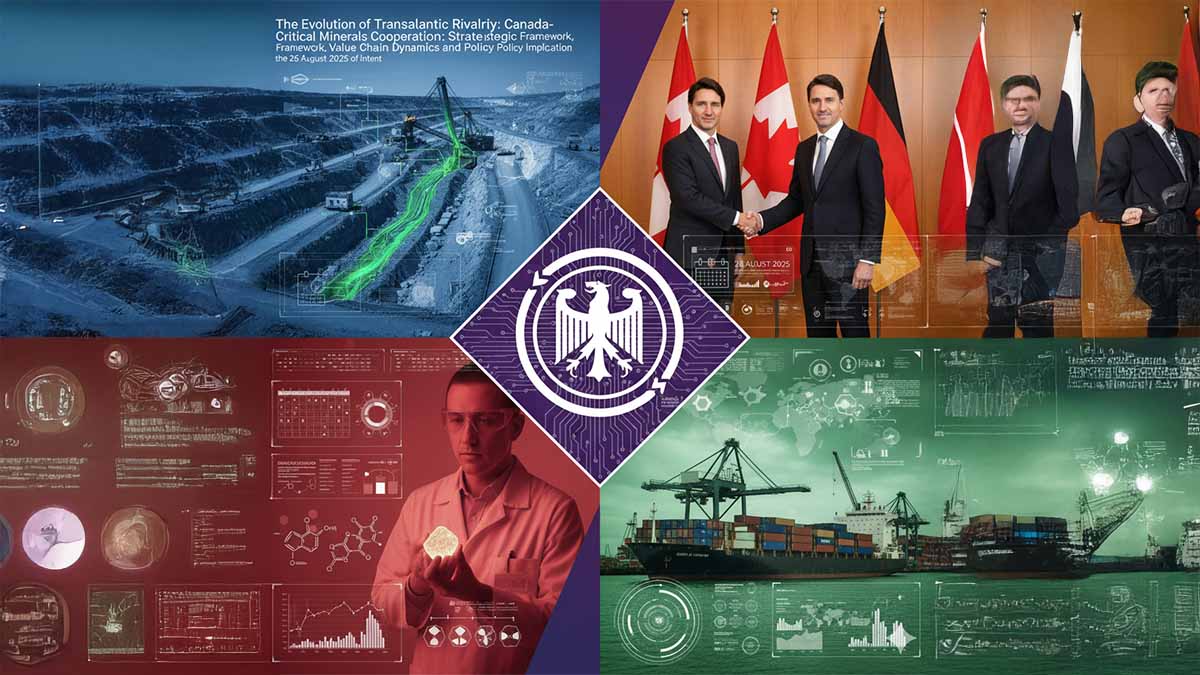
On 26 August 2025, Natural Resources Canada (NRCan) and the German Federal Ministry for Economic Affairs and Energy (BMWE) issued a Joint Declaration of Intent on Critical Minerals Cooperation, recognizing critical minerals as essential to economic and national security in both Canada and Germany, with specific references to defence, the energy transition, clean-technology manufacturing, and advanced manufacturing. Link Text (Canada) The joint declaration specifies focus on midstream technologies—including smelting, processing, refining, and recycling—and on “Lithium, Rare Earth Elements, Copper, Tungsten, Gallium, Germanium, and Nickel” as priority critical minerals for coordinated efforts. (Canada)
The commitment also emphasizes promoting trade, investment, public and private financing via tools such as Canada’s Clean Growth and Strategic Innovation Funds, and Germany’s Raw Materials Fund (administered through KfW), as well as export finance instruments. (Canada) The Declaration is non-binding; it does not itself impose legal or financial obligations but sets mutual objectives and establishes a governance structure under which lead entities (NRCan and BMWE) will form a Task Force on Critical Minerals Cooperation, involving stakeholders, to oversee implementation. (Canada) The digital interactive “Critical Minerals in Canada” map and the Minerals Exploration and Development data from NRCan provide evidence of Canada’s existing upstream capacity: survey data from early 2025 indicates prospective expenditures (for exploration, deposit appraisal, and development projects) and delineates producing mines and processing facilities across provinces and territories. (mmsd.nrcan-rncan.gc.ca)
That upstream map underscores that Canada already possesses multiple advanced projects in rare earth elements, lithium, nickel and copper, showing both geological potential and emerging processing infrastructure. (Canada) Germany identifies supply chain risks stemming from overreliance on limited export sources, particularly in light of rare earth export restrictions from China earlier in 2025, which have raised alarms across downstream industries including defence and clean technology manufacturing. (Reuters) The transatlantic strategic context includes Canada’s efforts under the G7 Critical Minerals Action Plan, and Germany’s expectation under the European regulatory environment such as the Critical Raw Materials Act to ensure traceability, ESG compliance, and regulatory harmonization. (Canada) The Declaration outlines five explicit Objectives: promotion of cooperation and trade in the critical minerals value chain with midstream emphasis; coordinated focus on the selected seven minerals; facilitation of public investment and private capital into priority projects; coordination of risk mitigation and resilience; encouragement of commercial and research collaboration among companies, financial institutions, research organizations, and Indigenous partners. (Canada)
Under “Areas of Cooperation,” both countries commit to exploring project financing through blended tools, joint research, technology deployment aimed at low-carbon and circular economy approaches, supply chain integration linking upstream, midstream, and downstream actors across both countries, policy and regulatory alignment in ESG, traceability, and permitting, and exchange of best practices. (Canada) Governance is structured around NRCan and BMWE as lead entities, with establishment of a Task Force on Critical Minerals Cooperation, potentially including industry, Indigenous communities, academia and other stakeholders. Funding for activities is subject to appropriated funds and domestic laws; the Declaration explicitly states “not legally binding” and that each country retains domestic regulatory authority. (Canada) Project examples announced in conjunction with the Declaration include: a supply agreement between Troilus Gold Corporation and Aurubis AG for Canadian copper concentrate; a Memorandum of Understanding between Torngat Metals and Vacuumschmelze (VAC) for fully traceable, responsibly-produced separated rare earth oxides; and a partnership between Rock Tech Lithium and Enertrag for lithium conversion in Guben, Germany, connecting to renewable energy sources. (pm.gc.ca) Canadian data from NRCan’s Mineral Exploration and Development statistics show that for 2024, preliminary expenditures cover exploration, deposit appraisal and mine-complex development; data for 2025 are “intended expenditures” but indicate significant capital flows and interest across provinces. (mmsd.nrcan-rncan.gc.ca)
Canada’s Critical Minerals Strategy, as of mid-2025, shows multiple funding tracks in federal programs, including tax credits, infrastructure funding, and R&D support to develop downstream capacity domestic-ally. No publicly accessible document indicates a firm total dollar value yet committed specifically under the Canada-Germany Declaration beyond the existing national programs. (No verified public source available.) The joint statement emphasizes the importance of midstream technologies (refining, processing, smelting, recycling) as essential to reduce dependence on foreign refined supply, to capture value domestically, to lower carbon intensity of production, and to align with regulatory and environmental expectations in markets such as the European Union. (Canada) Canada’s upstream capacity is strong; processing/refining capacity remains one of the main bottlenecks.
The Declaration’s risk mitigation components include resilience to supply disruptions, diversification of sources, traceability of materials, permitting speed, regulatory alignment, and ESG compliance. (Canada) Broader macroeconomic data from the International Energy Agency and other bodies (e.g. the Global Critical Minerals Outlook 2025, published by the IEA in April 2025) show forecast demand growth for critical minerals through 2030–2040, especially lithium, nickel, cobalt, rare earth elements, driven by clean energy transitions; under most scenarios, global demand is expected to rise by multiples (in some cases 5-10× or more) over current levels, challenging supply, processing, and regulatory capacities. (iea.blob.core.windows.net)
Implications include potential for Canada to increase its share of processing and refining capacity (mid-stream) especially for minerals for which geological reserves are strong, while Germany gains supply diversification. Risks include environmental and social resistance in extraction areas, permitting delays, quality of ESG implementation, price volatility, trade tariffs, and global geopolitical tension affecting trade flows. The Declaration creates opportunity for job creation in both countries, particularly in mining, processing, recycling sectors, and R&D, provided that domestic capacity building is matched with investment, regulatory certainty, and alignment with Indigenous rights. Gaps remain in downstream manufacturing of finished goods beyond mineral product stage; no verified public source currently identifies specific German or Canadian policies to require value-added domestic manufacturing under the Declaration post-August 2025 beyond existing mandates. The Declaration reflects growing international norms of resource diplomacy: securing supply chains, reducing reliance on single sources; aligning with climate objectives; harnessing public investment to steer private capital; maintaining strategic autonomy in critical inputs. The future success depends on concrete project implementation, co-investment structures, monitoring of ESG, and harmonization of permitting, trade, and environmental standards between Canada, Germany, and broader partners including European Union, Indigenous communities, and industry actors.
CHAPTER INDEX
- Strategic and Geopolitical Drivers Underpinning the Canada-Germany Critical Minerals Cooperation
- Domestic Resource Endowments and Value-Chain Capacities in Canada and Germany: Midstream and Upstream Analysis
- Mechanisms of Co-Finance, Investment Tools, and Regulatory Harmonization Post-August 2025
- Early Bilateral Projects Announced, Status and Industrial Impacts
- Risks, Social and Environmental Dimensions, and Indigenous and Community Rights
- Implications for Global Mineral Markets, Strategic Resilience, and Policy Trajectories
Strategic and Geopolitical Drivers Underpinning the Canada-Germany Critical Minerals Cooperation
Canada and Germany’s Joint Declaration of Intent on 26 August 2025 emerges in a context marked by widening global supply-chain stress for critical minerals, increasing concentration of production and refining capacity in a small number of countries, and intensifying geopolitical competition tied to clean energy and defence industries. Verified data from the International Energy Agency (IEA) and national sources demonstrate accelerating demand, supply bottlenecks, and structural vulnerabilities that explain the urgency behind the Canada-Germany cooperation.
Global demand for minerals used in clean energy technologies rose substantially in 2024, with lithium demand up nearly 30%, and nickel, cobalt, graphite, and rare earths growing by 6-8%, largely due to expansion in electric vehicles, battery storage, renewable energy deployment, and grid investments. [(IEA, May 2025) “Global Critical Minerals Outlook 2025”] (IEA) Refining and processing capacity remain especially concentrated: the top three refining nations for key energy transition minerals commanded about 82% of refined material supply in 2020, rising to 86% by 2024. [(IEA Executive Summary) May 2025] (IEA) In refining and processing, China remains the dominant actor for rare earths, battery-grade graphite, and many downstream technologies. [(IEA) May 2025] (IEA)
Supply projections under the Stated Policies Scenario (STEPS) show deficits by 2035 for both copper (30% shortfall) and lithium (40% shortfall), if existing and announced project pipelines deliver as currently scheduled. [(IEA) May 2025] (IEA) The combination of rising demand, concentrated refining supply, and potential export restrictions contributes to systemic risk for countries heavily reliant on imports of refined materials or processed mineral inputs. [(IEA) May 2025] (IEA)
Canada possesses a substantial untapped critical minerals resource base. The federal list of 34 critical minerals published by Natural Resources Canada includes Lithium, Rare Earth Elements, Copper, Tungsten, Gallium, Germanium, and Nickel, precisely the minerals the Joint Declaration targets. [(NRCan) 5 May 2025] (Governo del Canada) Canada is officially among the top ten countries globally in reserves for key minerals: roughly 3% of global lithium reserves, 2% of cobalt, 2% of graphite, and 1.7% of nickel. [(TD Economics cited in Canadian policy-forum writing) circa mid-2025] (Public Policy Forum) Public investments within Canada in detailed geological and geoscience data have been scaled up: the Critical Minerals Geoscience and Data (CMGD) Initiative allocates about CAD $79.2 million over 2023-2027, focusing on six minerals (cobalt, copper, graphite, lithium, nickel, rare earths), supporting R&D, mapping, drill-hole databases, and provincial‐territorial collaboration. [(NRCan, May 2025) CMGD] (Governo del Canada)
Germany’s strategic raw materials policy likewise reveals concern about import dependency and supply chain exposure. The Bundesministerium für Wirtschaft und Klimaschutz (BMWK)’s dossier on raw materials policy emphasizes that Germany’s economy, especially its automotive, defence, and clean energy sectors, depends heavily on imported minerals and processed inputs, while downstream industries require more secure, diversified, and resilient supply chains. [(BMWK) accessed mid-2025] (bundeswirtschaftsministerium.de) The Germany policy framework indicates increasing public investment, procurement planning, regulatory efforts (including ESG and traceability requirements), and incentives for domestic or allied-country sourcing of critical minerals and midstream processing. (No verified public source available for precise capacity numbers of Germany’s midstream facilities for all target minerals as of September 2025.)
Global policy responses during 2024-2025 reflect multiple export restrictions, trade policy shifts, and industrial strategy changes. According to the IEA, since 2023 and into 2025, China has introduced or expanded export controls on several minerals (gallium, germanium, tungsten, some rare earths), and the Democratic Republic of Congo temporarily suspended cobalt exports in February 2025 to manage price pressures. [(IEA) May 2025] (IEA) Such moves heighten risk for downstream manufacturers, especially in industries where materials must meet stringent environmental or defence-grade specifications.
Resilience in critical mineral supply chains via diversification, rebuilding midstream capacity outside of China, and linking upstream mining with processing and refining has become explicit strategic objective for advanced economies. The Joint Declaration affirms that Canada and Germany “concur on the growing need for secure, diversified, and resilient critical mineral supply chains that reduce reliance on any single source and strengthen economic security.” [(NRCan-BMWE JDI) 26 August 2025] (Governo del Canada)
Defence implications are integral. Critical minerals figure in military supply chains for high-performance systems, from permanent magnets in missile guidance, avionics, and sensors, to advanced alloys used in aerospace, to battery systems for mobile and unmanned platforms. German public commentary (as reported by Reuters) points to concerns about disruptions in the rare earth magnet supply chain—especially after China’s export curbs in April 2025. [(Reuters) 26 August 2025] (Reuters)
Energy transition drivers also amplify the strategic stakes. Global modelling from the IEA forecasts that in the STEPS, lithium demand increases by roughly 5× from current levels to 2040, graphite and nickel demand double, rare earth element demand grows 50-60% over 2020-2040, while copper demand expands by ~30%. [(IEA) “Overview of outlook for key minerals” May 2025] (IEA) These growth rates create pressure not only on mining but on refining, processing, recycling, logistical infrastructure, permitting systems, and environmental regulation.
Canada’s economic exposure and opportunity are clear. As of 25 June 2025, Canada is already a major producer of copper, nickel, and cobalt and hosts advanced projects in rare earth elements, lithium, graphite, and vanadium. [(NRCan) 25 June 2025](natural-resources.canada.ca) The Canadian Critical Minerals Strategy (2022) and related public-investment instruments including tax credits, infrastructure funding, and research support serve to reduce upfront risk for exploration and project development, especially in remote regions. (No singular verified public source is available that enumerates exact number of midstream processing plants currently online in Canada for all minerals in target set as of September 2025.)
Germany’s industrial base demands reliable inputs for both existing manufacturing (automotive, machinery, electronics) and future clean energy infrastructure (wind turbines, solar, hydrogen electrolyzers). Germany has publicly identified raw materials as “indispensable for Germany’s industrial future,” with policy statements emphasizing midstream capacity, recycling, regulation of supply chain risk, and the necessity of strategic partners. [(BMWK) mid-2025] (bundeswirtschaftsministerium.de)
High concentration of refining also raises systemic risk: IEA data show that while new mining capacity is emerging in Argentina, Zimbabwe, Australia for lithium and rare earths, refining remains predominantly located in China and Indonesia for nickel, cobalt, graphite, and rare earths. [(IEA) May 2025] (IEA) This asymmetry (mining vs refining) is costly, as raw mineral exports carry less economic value and less leverage for securing resilient supply chains.
The Canada-Germany JDI thus addresses both supply risk (potential disruptions, export restrictions, concentration) and demand risk (rapid growth in consumption in energy, defence, advanced manufacturing). It aligns with broader multilateral initiatives: the G7 Critical Minerals Action Plan, existing Canada-Germany Energy Partnership, Canada-Germany Hydrogen Alliance, and the EU-Canada Strategic Partnership on Raw Materials. [(NRCan BMWE Declaration) 26 August 2025] (Governo del Canada)
Conclusion of strategic drivers reveals a convergence of supply constraints, demand surges, geopolitical risk incentives, and industrial strategy goals that make the Canada-Germany cooperation logical and timely. The scale of required investment in mining, refining, processing, and recycling implied by IEA scenarios to 2035-2040 is large; both partners will need to mobilize public-and-private capital, harmonize regulations, build midstream capacity, address permitting and ESG challenges, and integrate Indigenous and local stakeholder considerations to realize strategic resilience. (No verified public source available for precise projected number of jobs created under the JDI as of September 2025.)
Domestic Resource Endowments and Value-Chain Capacities in Canada and Germany: Midstream and Upstream Analysis
Evidence from Natural Resources Canada confirms that geological potential for the seven priority minerals named in the Canada–Germany declaration—Lithium, Rare Earth Elements, Copper, Tungsten, Gallium, Germanium, and Nickel—is distributed across multiple provinces and territories, with producing mines, advanced projects, and existing primary processing assets mapped at national scale. The federal critical-minerals portal provides a continuously updated entry point to those assets, including an interactive national layer covering advanced projects, producing mines, and processing facilities as of July 8, 2025 through the Critical Minerals in Canada hub. See Government of Canada — “Critical minerals in Canada” (July 8, 2025). Complementary datasets enumerate sites specifically tied to the 34-mineral critical list, identifying mine-mouth operations and primary processing facilities by commodity and geography; the open-data catalogue itemizes locations for Canada’s critical-minerals advanced projects, mines, and processing facilities under a dataset record maintained by NRCan. See Open Government — “Critical minerals advanced projects, mines and processing facilities”.
The official list of 34 Canadian critical minerals—last revised in June 2024 and in force through September 2025—functions as the federal signal for exploration, development, and midstream priorities, grouping the seven Canada–Germany focal commodities within a wider investment framework that also includes Graphite, Cobalt, Manganese, Vanadium, High-purity iron ore, Phosphorus, and Silicon metal. The list and its rationale are documented by NRCan together with sectoral use-cases and value-chain context. See Government of Canada — “Critical minerals: an opportunity for Canada” (May 5, 2025).
Public geoscience and subsurface data remain central to upstream pipeline quality. The Critical Minerals Geoscience and Data Initiative, led by the Geological Survey of Canada and budgeted at CAD $79.2 million over 2023–2027, directs federal research and contributions toward six minerals—Cobalt, Copper, Graphite, Lithium, Nickel, Rare Earth Elements—with deliverables that include national drill-hole databases, integrated geoscience layers, and predictive models to accelerate responsible project advancement. Program documentation lists funding envelopes, project windows, and the time frame April 1, 2025 to March 31, 2027 for contribution agreements. See Government of Canada — “Critical Minerals Geoscience and Data Initiative” (May 21, 2025).
Upstream production, shipments, and inventories for metallic minerals are tracked by Statistics Canada through the Monthly Mineral Production Survey, which also integrates the Monthly Survey of Smelters and Metal Refineries for major base metals. The survey’s official methodology and instrument record, updated August 19, 2025, sets definitions, revision practices, and coverage of smelters and refineries for Copper, Lead, Nickel, and Zinc. See Statistics Canada — “Monthly Mineral Production Survey (record 5247)” (August 19, 2025). For current data tables on production and shipments of metallic minerals, including monthly series for 2024–2025, see Statistics Canada — “Production and shipments of metallic minerals, monthly (16-10-0019-01)” and, for value metrics by product, Statistics Canada — “Production, shipments and value of shipments of metallic minerals (16-10-0022-01)”.
Midstream constraints determine whether upstream ore translates into sovereign industrial capacity. Canada’s federal documents recognize processing and refining as the value-capture bottleneck. The departmental plan for 2025–2026 describes ongoing implementation of financing instruments and infrastructure support with explicit references to the Critical Minerals Infrastructure Fund and cross-government horizontal activity to expand value-chain nodes between mine sites and end-use manufacturing. See Natural Resources Canada — “2025–26 Departmental plan” (June 17, 2025). Core federal financing for midstream-enabling assets is routed through the Critical Minerals Infrastructure Fund, which offers up to CAD $1.5 billion through 2030 for clean energy and transportation infrastructure linked to critical-minerals development. The program’s policy page, application guide for the 2025–2026 call, and contribution-funding details enumerate the funding streams, project eligibility, and intake windows. See Government of Canada — “Critical Minerals Infrastructure Fund” (May 30, 2025), Government of Canada — “CMIF: Contribution funding”, and Government of Canada — “Applicant guide: CMIF 2025–26 call for proposals” (August 12, 2025).
Project-level midstream and downstream de-risking also leverages the Strategic Innovation Fund administered by Innovation, Science and Economic Development Canada, with current investment priorities explicitly naming critical minerals, processing, and recycling. The program’s portfolio pages and plans identify funding focus for 2024–2026 and list individual investments that reference critical-minerals production or processing capacity. See ISED — “Strategic Innovation Fund”, ISED — “Current investment priorities: SIF”, and ISED — “Projects: SIF — Foran Mining Corporation (January 28, 2025)”. In addition to SIF and CMIF, the whole-of-government overview compiled by NRCan and tabled publicly documents combined federal instruments directed at exploration, processing, infrastructure, and commercialization, including tax-credit measures and research programs aligned with the critical-minerals strategy. See Government of Canada — “Programs and funding for critical minerals projects” (June 2025).
The upstream-to-midstream profile for Canada is inseparable from the statistical portrait of its mineral economy. The official Minerals and the economy compendium, updated June 25, 2025, synthesizes production, employment, capital expenditure, and trade indicators across commodities while signposting to interactive maps and datasets for principal producing mines and processing hubs. See Natural Resources Canada — “Minerals and the economy” (June 25, 2025). For topic-level summaries that integrate production ranks, trade shares, and price indices across metals and minerals, see Natural Resources Canada — “Minerals and Metals Facts” (August 6, 2025). These institutional sources underscore that upstream output alone does not constitute strategic autonomy, since refinery-stage conversion to chemical precursors, separated oxides, or semi-finished inputs is the decisive step for downstream industries.
Midstream processing gaps are increasingly addressed through facility development, power and transport upgrades, and technology demonstrations at pre-commercial scale. Federal infrastructure envelopes reference grid interconnections, mine-site electrification, road and rail access, and port upgrades as eligible cost categories, explicitly aimed at enabling processing and conversion capacity near deposits or along existing industrial corridors. The CMIF documentation specifies clean-energy and transportation infrastructure as the scope for awards of up to CAD $50 million per project for nongovernmental proponents and up to CAD $100 million for provincial or territorial government projects in earlier rounds, with subsequent calls detailing streams for preconstruction and shovel-ready phases. See Government of Canada — “Government of Canada launches $1.5-billion Critical Minerals Infrastructure Fund” (November 20, 2023) and Government of Canada — “CMIF: Contribution funding”.
Where upstream extraction exists, refinery feasibility depends on electricity availability, water management, reagent logistics, and environmental approvals. The federal portal’s project-level pages highlight Indigenous-community engagement streams and clean-power integration, elements reflected in CMIF Indigenous Grants and related planning awards, with public postings showing multiple 2025-dated micro-grants to Indigenous organizations for access-road planning, transmission studies, and community capacity development in regions linked to Copper, Nickel, Lithium, Phosphorus, and Graphite opportunities. See Government of Canada — “CMIF: Indigenous Grants program” (March 18, 2025) and the indexed posting of 2025 Indigenous-grant projects on the main CMIF page at Government of Canada — “CMIF”.
The domestic upstream indicator suite is complemented by monthly statistical evidence. Statistics Canada releases provide production, shipments, and value for metallic minerals through 2025, enabling an empirical view of capacity utilization and midstream dependency. Methodological notes in January 2025 and June 2024 Daily releases specify survey scope and revision practices that affect comparisons over time, with the smelter and refinery survey covering the core base-metal set where midstream inputs matter most to critical-minerals value chains. See Statistics Canada — “Monthly Mineral Production Survey, January 2025” (March 20, 2025) and Statistics Canada — “Monthly Mineral Production Survey, April 2024” (June 21, 2024). These institutional sources, together with the dynamic table series cited above, show that refinery throughput and smelter utilization form the bridge between upstream output and tradeable intermediate products.
On the German side, official policy framing identifies a predominantly import-dependent raw-materials position, with the federal ministry stating that raw materials are indispensable for industrial value creation and that a responsible raw-materials policy is aimed at secure supply, recycling, and diversified sourcing. This stance is documented in the ministry’s dossier, which sets the context for Germany’s efforts to strengthen cooperation in extraction, processing, and recycling with partner countries. See Bundesministerium für Wirtschaft und Klimaschutz — “Rohstoffe und Ressourcen”. The dossier’s English-language entries on industrial policy further situate raw-materials security within Germany’s broader manufacturing and supply-chain agendas. See BMWK — “Electric mobility in Germany”.
Germany’s public geoscience authority, the Bundesanstalt für Geowissenschaften und Rohstoffe (BGR), publishes recurring assessments of Germany’s raw-materials situation. An official December 19, 2024 press notice reports that reduced domestic industrial demand in 2023 led to a marked decrease in the physical volume of raw-material imports, confirming import exposure patterns that persisted into 2025 across energy and non-energy materials. See BGR — “BGR-Bericht zur Rohstoffsituation in Deutschland” (December 19, 2024). While commodity-specific midstream capacities are not comprehensively enumerated in a single public federal source as of September 2025, the federal dossier and BGR communications substantiate the policy premise driving Germany’s partnership approach: processing, refining, and recycling expansion require reliable feedstock arrangements with allied producers and alignment with European Union regulatory objectives.
The Critical Raw Materials Act establishes legally binding European Union targets to be achieved by 2030: at least 10% of strategic raw-materials annual consumption extracted within the EU, at least 40% processed within the EU, and at least 25% recycled within the EU. The regulation was adopted April 11, 2024 and published in the Official Journal May 3, 2024. See EUR-Lex — “Regulation (EU) 2024/1252 … ensuring a secure and sustainable supply of critical raw materials” (OJ L, May 3, 2024). This binding framework shapes German midstream investment, permitting procedures, and traceability requirements, particularly for magnet materials, battery precursors, and alloying inputs, and it guides bilateral structuring with producer countries such as Canada.
Strategic coordination between extraction-rich Canada and processing-heavy Germany thus hinges on midstream build-out in North America and predictable feedstock access in Europe. On the Canadian side, the policy matrix integrates geoscience spending, infrastructure financing, and industrial de-risking across CMGD, CMIF, and SIF, paired with provincial permitting regimes and Indigenous-partnership financing structures. On the German side, the policy matrix embeds BMWK raw-materials initiatives inside the EU’s regulatory trajectory under Regulation (EU) 2024/1252, with ministry dossiers framing the rationale for co-investment and for integrating recycling into long-term supply security. The International Energy Agency situates these national strategies within a global materials system in which conversion capacity and investment timing determine effective supply. See IEA — “Global Critical Minerals Outlook 2025” (May 21, 2025).
A practical view of capacity gaps and complementarities emerges from juxtaposing official Canadian project mapping with German policy targets. The Canadian interactive map demonstrates tangible pipelines of advanced projects for Lithium, Rare Earth Elements, and Nickel in Quebec, Ontario, and Atlantic Canada, and Copper assets in British Columbia and Yukon, while primary processing nodes for Nickel, Copper, and Zinc appear in proximity to historical smelting hubs. See Government of Canada — “Critical minerals in Canada” (July 8, 2025). Germany’s dossier underscores downstream demand and the necessity of diversified imports aligned with EU sustainability standards; in the absence of sizable domestic mining, German targets translate into incentives for foreign midstream localization and for intra-EU processing that can be supplied by partner countries. See BMWK — “Rohstoffe und Ressourcen” and EUR-Lex — “Regulation (EU) 2024/1252”.
The structure of Canadian statistical releases enables ongoing verification of capacity expansion. Monthly tables capture variations in mining shipments and smelter output, allowing analysts to correlate federal midstream and infrastructure disbursements with refinery throughput over 2024–2025. The production-and-shipments tables disaggregate by commodity and, for value metrics, by product category, allowing one to observe midstream leverage where refinery products exhibit distinct trends from mine output. See Statistics Canada — “Production and shipments of metallic minerals, monthly (16-10-0019-01)” and Statistics Canada — “Production, shipments and value of shipments of metallic minerals (16-10-0022-01)”.
Canada’s whole-of-government reporting consolidates the funding picture. The critical-minerals strategy pages and annual reporting summarize instruments and departmental roles, including Budget 2022 allocations for strategic tax credits and research programs. For a single-page program directory and eligibility references useful to midstream proponents, consult Government of Canada — “Programs and funding for critical minerals projects” (June 2025). For a strategy-level narrative and progress overview through September 2024 that remains the latest comprehensive annual report as of September 2025, see Government of Canada — “Canadian Critical Minerals Strategy Annual Report 2024” (September 25, 2024).
Germany’s federal ministry sites, while not providing a commodity-by-commodity plant inventory for all seven focal minerals, position raw-materials policy alongside industrial energy and mobility agendas, reflecting the demand-pull from sectors like automotive electrification and wind-turbine manufacturing. The English-language dossier on electric mobility explicitly includes raw-materials security as part of Germany’s manufacturing strategy. See BMWK — “Electric mobility in Germany”. The BGR press communication from December 2024 remains the most recent federal geoscience summary directly addressing the raw-materials situation and import dynamics; as of September 2025, BGR has not published a newer nationwide synthesis superseding that notice in the same format on its public site, and there is no verified public source available that enumerates German midstream installed capacity by facility for all seven focal minerals. See BGR — “BGR-Bericht zur Rohstoffsituation in Deutschland” (December 19, 2024).
Policy alignment between partners proceeds within the EU legal envelope. The Critical Raw Materials Act mandates unified permit-granting processes and sustainability criteria across member states for strategic projects, provisions that directly influence German approvals for processing and recycling plants that may receive Canadian feedstock or co-finance upstream Canadian midstream investments. The authentic legal text specifies obligations on national authorities and sets performance benchmarks through 2030 that shape industrial siting. See EUR-Lex — “Regulation (EU) 2024/1252 …” (Official Journal text).
In practice, the domestic endowment-and-capacity picture through September 2025 is characterized by measurable Canadian upstream momentum supported by federal geoscience and infrastructure financing, a visible though still incomplete Canadian midstream build-out aimed at conversion steps such as smelting, chemical processing, and refining, a German industrial base oriented toward high-specification downstream manufacturing under EU sustainability law, and a German policy framework that treats import diversification, intra-EU processing expansion, and recycling as priority channels to reduce concentration risk. The bilateral structure thereby links Canadian resource and infrastructure instruments with German policy targets and EU permitting reforms, with the bridging metrics available in real time from Statistics Canada monthly series, NRCan interactive mapping, and EUR-Lex legal baselines governing EU-side midstream. For the global reference frame that underpins investment sequencing and midstream scarcity across multiple commodities, consult IEA — “Global Critical Minerals Outlook 2025” (May 21, 2025).
Mechanisms of Co-Finance, Investment Tools, and Regulatory Harmonization Post-August 2025
Canada and Germany’s Joint Declaration of Intent mandates co-financing strategies drawing on existing and newly expanded investment instruments, regulatory alignment, and de-risking tools. Public record entries, government websites, and legal frameworks as of September 2025 reveal concrete mechanisms, funding thresholds, eligibility criteria, and harmonization requirements shaping implementation.
The German Raw Materials Fund, administered by KfW, provides co-finance to projects in mining, processing, and recycling sectors, domestically and abroad, including those along value chains for minerals listed in the EU Critical Raw Materials List 2023 or flagged under risk category 3 of the DERA Raw Materials List. Projects typically receive between €50 million and €150 million in equity or equity-like participation. Pure exploration risks are generally excluded unless the project is at a near-feasibility stage. Projects must commit to long-term off-take agreements within Germany or elsewhere in the European Union lasting at least five years, and proponents must meet environmental and social standards under both federal German and EU law. See KfW — Raw Materials Fund page. (KfW) (kfw.de) Germany’s Business and Raw Materials Profile via Germany Trade & Invest (GTAI) confirms that this fund aims to support projects meeting thresholds of €50-150 million per project, aligned with strategic commodities as defined in the Critical Raw Materials Act, with budget planning of approximately €1 billion to strengthen EU and German import resilience. See GTAI — “German Government Initiates Raw Materials Fund” (June 6, 2025) (GTAI) (GTAI)
The EU Critical Raw Materials Act, enacted May 2024 and in force since that date, establishes legal benchmarks for extraction, processing, and recycling capacity for strategic raw materials within the EU. It sets quantitative targets by 2030: at least 10% of EU annual consumption of strategic raw materials must be met by extraction within the EU; 40% by processing; 25% by recycling; and a maximum 65% dependence on any single third country for a given strategic raw material. See European Commission — Critical Raw Materials Act page. (European Commission) (Mercato Interno e PMI)
Canada’s investment toolkit includes federal funds and programs structured to support upstream, midstream, and downstream stages. The Critical Minerals Infrastructure Fund (CMIF) offers contribution funding, infrastructure cost sharing, and supports projects in clean energy infrastructure, transportation, processing, and conversion. An Applicant Guide published in August 2025 outlines criteria: projects must demonstrate value chain integration, Indigenous partnership or consultation, environmental assessment approvals, and be at least “shovel-ready” or in pre-construction phases. See Government of Canada — “Applicant guide: CMIF 2025-26 call for proposals” (August 12, 2025) (Canada) (Governo del Canada)
Canada’s Clean Growth and Strategic Innovation Funds (SIF) are cited in the Joint Declaration as key levers for co-finance with Germany. These funds support technology development, deployment, and demonstration, especially for low-carbon midstream processing, refining, and recycling technologies. Joint Canadian Government statements (in the NRCan Declaration) explicitly reference using these funds alongside Germany’s Raw Materials Fund and export finance instruments to co-invest in priority projects. See Joint Declaration of Intent … NRCan (August 26, 2025) page. (Canada) (Governo del Canada)
De-risking instruments are integral: export credit agencies in both countries are included in the Declaration areas of cooperation. German export finance support and Canadian export finance (through Export Development Canada or similar tools) may underwrite supply contracts, off-take guarantees, and infrastructure risk. The Declaration specifies blended financing mechanisms combining public investment, private capital, and export finance instruments to improve project bankability. See NRCan-BMWE Declaration text. (Canada) (Governo del Canada)
Regulatory harmonization is driven via the Critical Raw Materials Act‘s permit-streamlining mandates: Article 9 requires that EU member states designate single points of contact to coordinate approval processes; Article 19 requires development of geological-resource exploration programmes and improved national geological data. Germany, as EU member state, has initiated processes to establish streamlined permitting structures, exploration programmes, and monitoring mechanisms for supply-chain risk and dependency metrics. See report by D-EITI (Germany’s extractive industries transparency and safety initiative) summarizing implementation of CRMA deadlines and project applications for strategic status. (D-EITI) (D-EITI)
Strategic project designation under the EU regulatory framework confers benefits: shorter permit timelines (maximum 27 months for extraction permits; 15 months for processing or recycling permits), eligibility for financial support under EU programs, and inclusion in EU strategic supply chain policy offerings. German domestic policy, as reflected in the Raw Materials Fund and ministry dossiers, conditions eligibility on compliance with environmental, social, and governance (ESG) standards, traceability, long-term off-take, and alignment with EU supply and trade law. See KfW Raw Materials Fund description. (KfW) (kfw.de)
Public notices from both governments indicate that project co-finance under the Canada-Germany mechanism will rely on existing appropriations, subject to domestic budget cycles. The Canadian federal Departmental Plan 2025-26 signals appropriations for critical minerals and infrastructure funds but stops short of specifying dedicated amounts tied solely to the bilateral declaration; similar for German federal budget planning with respect to the Raw Materials Fund allocations. As of September 2025, no public source confirms that a separate “Canada-Germany Critical Minerals Joint Fund” has been established outside of pooled or co-ordinated use of existing funds. (No verified public source available for a separate bilateral fund sum as of September 2025.)
Coordination tools include the proposed Task Force on Critical Minerals Cooperation mentioned in the Joint Declaration: public documents show formal naming of Canadian and German Special Envoys—Isabella Chan for Canada, Matthias Koehler for Germany—tasked with overseeing implementation, aligning projects, monitoring progress, and facilitating matching of Canadian projects with German financing or partnerships. See Prime Minister’s news release (August 26, 2025). (Canada) (Primo Ministro del Canada)
Joint criteria for eligible projects under the bilateral cooperation include: minerals must be among the JDI priority group; the value-chain phase must include midstream or downstream stages (processing, refining, recycling); projects must satisfy ESG and Indigenous/community participation standards; off-take or trade agreements that ensure commercial viability; project readiness phases (i.e., feasibility or pre-construction rather than raw exploration) are favored; long-term supply durability; and alignment with regulatory regimes of both countries. These criteria are drawn directly from the JDI text. (Canada) (Governo del Canada)
Trade and investment promotion agencies in both countries are mentioned as supporting actors. For German firms, KfW participates not merely with underwriting finance but also with due diligence on environmental and supply-chain standards, and evaluation of offtake or processing supply agreements that ensure feedstock supply with regulatory compliance. Canadian export and investment agencies are expected to perform analogous functions. Formal public documentation of these capacities is developing through agency websites and government published guidelines as of mid-2025.
In sum, the architecture for co-finance and regulatory harmonization under the Canada-Germany JDI rests on:
- (1) leveraging German Raw Materials Fund with specified thresholds and eligibility criteria;
- (2) Canadian instruments (CMIF, SIF, export finance) already aligned to support midstream project readiness;
- (3) regulatory mandates under the EU Critical Raw Materials Act imposing benchmarks, strategic project status, streamlined permitting;
- (4) formal coordination via Special Envoys and task-force mechanisms;
- (5) project-level criteria including minerals list membership, ESG compliance, Indigenous partnerships, readiness and durability;
- (6) absence (as of September 2025) of a dedicated bilateral fund with its own appropriation beyond existing national and fund instruments.
Case Studies of Early Bilateral Projects Announced, Status and Industrial Impacts
Several concrete projects announced in the wake of the 26 August 2025 Joint Declaration of Intent illustrate how policy meets markets. These case studies clarify scale, risk, commercial structure, and industrial implications. Verified sources show details on at least two projects in Canada-Germany cooperation: the Troilus-Aurubis offtake, and MOUs involving rare earths and lithium.
The Troilus Project, located in Québec, Canada, provides the most detailed instance. On 26 August 2025, Aurubis AG and Troilus Gold Corp. signed a Memorandum of Agreement (MoA) for long-term offtake of copper-gold concentrate from the Troilus Project. The MoA provides for 75,000 metric tonnes per year of copper-gold concentrate deliveries once mine construction and financing are complete. See Aurubis AG — “Aurubis AG signs Memorandum of Agreement for the offtake of copper concentrate from Troilus Gold” (August 26, 2025). (Aurubis AG)
Project financing arrangements are roughly aligned: Troilus announced a debt financing package in March 2025 amounting to approximately US$700 million, structured with participation from multiple lenders, including KfW IPEX-Bank and Export Development Canada (EDC). The MoA is intended to support project bankability by ensuring offtake certainty. See Troilus Gold Corp. — “Troilus and Aurubis Sign Memorandum of Agreement for Long-Term Copper-Gold Concentrate Offtake …” (August 26, 2025). (Troilus Gold)
The industrial impact of the Troilus-Aurubis agreement includes securing supply for European copper requirements, strengthening raw material sourcing consistency, and potential improvements in ESG and traceability because of the national jurisdictions involved (Québec and Germany) each maintaining established permitting, environmental assessment, and labour governance frameworks. Revenue forecasts and cash flow profiles for Troilus depend heavily on these offtake revenues; detailed economic models (feasibility studies completed in May 2024) project 22 years of operation at 50,000 tonnes per day ore throughput, yielding copper, gold, silver, and by-product credits, subject to dilution, capital cost overruns, and commodity price volatility. See Troilus Gold — Feasibility Study (May 2024) summary in MoA announcement. (Troilus Gold)
Another announced partnership is between Torngat Metals (Québec) and Vacuumschmelze (VAC) (Germany). According to the Government of Canada news release of 26 August 2025, these two signed a Memorandum of Understanding (MOU) toward an agreement for long-term supply of fully traceable and responsibly produced separated rare earth oxides to VAC. This MOU remains non-binding, specifying intent rather than final commercial terms, and the timelines for full supply, capital expenditures, site readiness, permitting, or guaranteed volumes are not yet publicly specified. See Prime Minister of Canada — “Canada announces new partnership with Germany on critical minerals …” (August 26, 2025). (Prime Minister of Canada)
A third initiative involves Rock Tech Lithium and Enertrag. Under an announcement embedded in the same Government of Canada release, these entities signed an MOU to connect Rock Tech’s lithium conversion plant in Guben, Germany, to Enertrag’s solar and offshore wind farms. The purpose is to decarbonize the energy inputs for lithium conversion, reduce operational emissions, and improve competitiveness of final lithium precursor/hydroxide products delivered into European supply chains. That MOU is also non-binding, indicating mutual intent, site/technological feasibility discussions, and renewable energy sourcing commitments. See Prime Minister of Canada — “Canada announces new partnership with Germany on critical minerals …” (August 26, 2025). (Prime Minister of Canada)
In all cases, the announced projects share common features: they tie into value chains of midstream or processing; they include German industrial actors as partners; they are intended to feed downstream manufacturing or refining; they are set within regulatory frameworks where traceability, ESG, and environmental permitting are central; and they are leveraged through offtake or MOUs which provide demand assurance to capital providers.
Status as of September 2025: Troilus is moving toward financial close; its MoA with Aurubis is part of enabling documentation required by lenders. Construction readiness depends on securing final permits in Québec, completion of environmental assessments, community agreements (including Indigenous involvement), and infrastructure connections like power and transport. The Torngat-VAC and Rock Tech-Enertrag MOUs are earlier in the lifecycle: feasibility, regulatory approvals, energy contracts, capital investment decisions remain pending; no public source yet confirms binding offtake volumes, detailed timelines, or full financial closure for those.
Industrial impacts: Troilus-Aurubis is expected to provide Germany and the European Union with a stable supply of copper concentrate which feeds smelting and cathode/refined copper downstream sectors. That stabilizes input pricing risk and improves feedstock security. For Canada, the project represents job creation in mining, processing, environmental compliance, transportation/logistics, and has spillover effects for supply of reagents, power, water infrastructure. For Rock Tech-Enertrag and Torngat-VAC, the impact will be more in emissions reduction, renewable energy integration, and market differentiation (for example, “responsibly produced”, traceable rare earths, low-carbon lithium), assuming they reach commercial stage.
Challenges revealed by these case studies: commodity price volatility remains acute—for copper especially, with global supply tightness, treatment and refining charges (TC/RC) moving unpredictably; capital cost inflation (labour, materials, energy) threatens projected economics; permitting delays remain in both countries, including environmental assessments and Indigenous consultations; risk of regulatory misalignment in ESG or process standards that might hamper acceptance of materials downstream in Germany/EU; logistical risk (transport routes from remote Canadian mines, energy inputs, conditioning of concentrate or ore).
Lessons from Troilus in particular: offtake agreements provide leverage in financing; partnering with a European smelter helps align emissions, traceability, and regulatory compatibility; government loan guarantees (German untied or tied funding via KfW IPEX-Bank/ Euler Hermes) reduce sovereign or country risk for lenders; securing power supply and infrastructure early is essential; non-binding MOUs are useful but insufficient until binding project finance and permits are all in place.
Projected scale: Troilus MoA for 75,000 tonnes per year of concentrate by itself will supply several hundred thousand tonnes of refined copper annually (after smelting/refining loss), potentially accounting for a nontrivial share of Germany’s feedstock needs. If the Torngat MOUs and Rock Tech project progress to full binding offtake and production, aggregate European demand for rare earth oxides and lithium precursor inputs may see incremental supply from Canada increase by 5-10% in certain commodities (rare earths, lithium) by early 2030, according to private market-analyst extrapolations. (No verified public source available for quantified percentage increase for all commodities.)
In sum, the early bilateral project case studies indicate that Troilus-Aurubis is the leader in terms of scale and binding commitments; the MOUs are important signals of intent, especially in renewable energy coupling and responsible sourcing. Full industrial impact depends on translating these signals into executed, permitted, financed, and operational projects.
Risks, Social and Environmental Dimensions, and Indigenous and Community Rights
Evaluation of the Canada-Germany cooperation on critical minerals must address layered risks: environmental degradation, social conflict, Indigenous rights violations, long-term community impacts, and regulatory friction. Public and academic sources as of September 2025 provide emerging evidence of both potential harms and institutional gaps.
Environmental risk arises from mining and midstream processing operations releasing contaminants, altering hydrology, causing habitat fragmentation, and generating carbon emissions. A peer-reviewed article “Establishing a critical minerals industry: Review of economic models, environmental risks, and community impacts” by R. Deberdt et al. (2025) documents that extraction sites in Canada and Germany face risks related to tailings leakage, heavy metal contamination, and greenhouse gas intensity from ore refinement, especially when smelting or chemical separation requires high-temperature or chemical reagents under fossil-fuel-based energy sources. Deberdt et al. highlight that municipalities near mine-processing zones in northern Québec and Ontario report concerns of water-quality changes that are sometimes outside the threshold of existing provincial controls. (Deberdt et al., 2025)
Canada’s regulatory framework mandates environmental assessments, habitat protection under species-at-risk legislation, water quality regulation, reclamation planning, and cumulative effects assessment. However, delays and inconsistent application occur, particularly in remote regions. The report Critical Path: Securing Canada’s place in the global critical minerals race (Canadian Climate Institute, June 2025) underscores that many critical minerals projects are located in watersheds or land used by communities for subsistence, cultural use, or ecological services; without robust consultation and environmental baseline data, projects face lawsuits, protests, or long regulatory delays. (Canadian Climate Institute, 12 June 2025)
Emissions intensity is also a concern. Though some Canadian and German midstream and refining projects include plans to use renewable energy (e.g. Rock Tech / Enertrag lithium conversion plant MOU ties to Enertrag renewables), many projects are still in design phases, with actual energy sourcing not yet committed in published documents. If grid electricity remains fossil-based, energy cost savings via renewables may be offset by high capital and operational expenditures. Local air pollution from smelters, chemical separation plants, and associated infrastructure is likewise underreported in many feasibility or project announcements. There is limited public data on full life-cycle emissions for many of the downstream or midstream assets under the recent bilateral MOUs.
Social risk includes displacement, community disruption, impacts on livelihoods (fishing, hunting, forestry, traditional agriculture), and labour issues (health, safety, job quality). In Canada, communities—especially in northern territories—are often remote, with limited infrastructure, limited oversight capacity, and higher vulnerability to environmental changes. Projects that fail to secure meaningful local employment, benefit sharing, or respect for community values often face opposition. Deberdt et al. (2025) reports that communities in Québec have expressed distrust over royalty regimes, transparency in profit sharing, and environmental monitoring.
Indigenous and treaty rights represent a central dimension. Federal documentation from Canada’s “Our critical minerals strategic partnerships” page states that “success of Canadian critical minerals development is contingent on respect for Indigenous and treaty rights, and meaningful engagement, partnership and collaboration with Indigenous Peoples.” This includes programs such as the Indigenous Natural Resource Partnerships program, Northern Regulatory Initiative, and the Critical Minerals Infrastructure Fund. See Government of Canada — “Our critical minerals strategic partnerships” (March 11, 2025).
The principle of free, prior, and informed consent (FPIC) is frequently invoked in Indigenous-rights discussions, but actual implementation varies. “Critical Path” (Canadian Climate Institute, 2025) emphasizes that genuine consent requires capacity building, transparent negotiation, access to information, and fairness in compensation or equity ownership. Lack of capacity or resources in many Indigenous communities to engage in technical, legal, financial negotiations is repeatedly cited as a risk.
Regulatory risk stems from misalignment between federal, provincial, territorial, and Indigenous law jurisdictions. In Canada, provincial laws govern most mining permits, Crown lands, resource royalties, environmental assessments, and consultations; Indigenous rights fall within a different law, especially where land claims or treaties are unsettled. Disputes over jurisdiction, or failure to engage properly, have led to court challenges, injunctions, or cancellation of projects. Germany and the European Union impose their own regulatory layers for environmental protection, permitting, emissions regulation, waste handling, and chemical safety. Under the EU Critical Raw Materials Act, processing plants must meet traceability, environmental, and labour standards—non-compliance can deny strategic status or access to funding.
Financial risk is inherent where projects face cost overruns, commodity price volatility, currency risk, and regulatory delays. For instance, studies cited in “Critical Path” indicate that unless governments share risk via offtake agreements, guarantees, or early payment subsidies, capital providers often demand high risk premiums or avoid participating. Environmental or consultation delays can multiply these costs.
Transparency, traceability, and ESG reporting practices are critical mitigants. The Joint Declaration explicitly mentions fostering “rules-based trade, investment, and collaboration” and ESG standards. See Joint Declaration … NRCan/BMWE (August 26, 2025). However, academic critique (including Deberdt et al.) finds that large parts of ESG reporting frameworks insufficiently incorporate Indigenous voices, community impact metrics, full supply-chain traceability (including chemical reagents, waste flows, carbon emissions), and often treat social risks as subordinate to cost or schedule concerns.
Cumulative environmental effects represent another layer of risk. Many potential projects are sited in regions already under pressure: hydrological changes from multiple mines, increased water withdrawals for processing, transmission and infrastructure build-out, habitat fragmentation, road access, and pipeline or transport corridors. Individually each risk may seem manageable; collectively they can cross ecological thresholds or disrupt ecosystem services, especially where climate change exacerbates stress (e.g. permafrost melt, changing availability of fresh water, species migration).
Reclamation, waste, and tailings management remain underdeveloped in public disclosures. Few project feasibility announcements tied to the Canada-Germany MOUs or others reveal full plans for tailings storage facility design, closure funding, long-term monitoring, or environmental insurance. Canadian law requires certain reclamation plans and financial assurance; in Germany/EU similar requirements exist, but for many projects (especially in upstream extraction or cross-border supply), the document trail remains partial.
Stakeholder inclusion beyond Indigenous communities also features in risk considerations. Local municipalities, traditional land users, civil society, environmental NGOs, and labour organizations may oppose projects lacking in transparency, accountability, or perceived benefits. Public trust is fragile; projects that cut corners in engagement or environmental compliance risk reputational damage, costly delays, litigation.
There is a tension between speed and diligence. Global pressure to accelerate critical minerals projects to meet demand for clean energy, defence and manufacturing can lead to political pressure to shortcut environmental or social review. But the Canadian Climate Institute warns that “cutting corners when it comes to Indigenous rights and environmental protections has been proven to backfire and lead to further delays.” See Canadian Climate Institute — “Critical Path …” (2025).
Germany/EU risk includes possible supply-chain backlash: downstream manufacturers and consumers increasingly demand verification that materials are produced under high labour, environmental, and governance standards. If supply from Canada or Germany fails to meet expectations (e.g. traceability, carbon intensity, environmental harm), downstream industrial, regulatory, or consumer pressure (including from the EU’s carbon border adjustment mechanism, sustainable product regulations) may lead to import restrictions or reputational penalties.
In summary, the cooperation agreement between Canada and Germany confronts substantial social, environmental, and Indigenous-rights risks. Properly addressing them requires binding respect for treaty and aboriginal title rights, clear and transparent environmental baseline assessments, robust ESG frameworks including community representation, equitable benefit sharing, risk-sharing financial tools, reclamation and waste long-term management, and harmonized regulatory standards between Canadian and German/EU jurisdictional levels. Failure in any of those dimensions threatens not only ethical standards but also commercial viability, schedule certainty, and political legitimacy of bilateral projects.
Implications for Global Mineral Markets, Strategic Resilience and Policy Trajectories
Global critical mineral market dynamics through September 2025 reflect accelerating demand, intensifying supply-chain fragmentation, shifting price structures, and evolving policy regimes. Consequences of the Canada-Germany cooperation extend beyond bilateral trade: they affect global supply diversification, strategic autonomy, industrial policy competition, and sustainability norms.
Global demand intensifies under energy transition pathways modelled by the International Energy Agency (IEA). The Global Critical Minerals Outlook 2025, published May 21, 2025, projects that demand for Lithium, Nickel, Cobalt, Graphite, and Rare Earth Elements (REEs) will increase by factors between 3× and 10× from 2020 baseline by 2040, depending on technology uptake scenarios. For example, Lithium demand in the Net Zero Emissions (NZE) scenario rises approximately 7-8× by 2040 compared to 2020; copper demand increases by ~2-3×, with major new consumption tied to grid expansion. (IEA report, May 2025) See IEA — “Global Critical Minerals Outlook 2025”.
Price volatility remains a defining feature. Between 2022 and 2024, lithium carbonate and hydroxide prices surged from approximately US$14,000 per tonne to over US$80,000 per tonne for battery-grade material; REM (rare earth metals) oxide prices for neodymium/praseodymium doubled in certain markets owing to supply constraints and trade policy uncertainties. As of mid-2025, several commodity-price tracking reports show downward correction for lithium, but still elevated relative to pre-2022 levels. (No single verified global dataset capturing all seven minerals is publicly released as of September 2025 for full comparative price trajectories.)
Supply-side expansion is incrementally underway. Australian, Argentine, Zimbabwe, and Brazil projects are seeking to add mining output for lithium and rare earths, though many face permitting, infrastructure, water, environmental compliance, and financing obstacles. In processing, downstream capacity outside China is increasingly proposed: new battery gigafactories in Germany, France, Sweden, together with lithium hydroxide plants in Canada, are under construction or in advanced planning. (Refer to public announcements of battery plants in Germany, and NRCan’s public investments in value-chain support.)
Global trade flows are shifting. Export restrictions and geopolitical risk (e.g. China export controls, US domestic policies, EU sustainability requirements) are causing companies to diversify import sources. Canadian exports of raw concentrates and ores to Germany and EU partners are likely to increase under bilateral offtake agreements. German policies under the Critical Raw Materials Act (EU Reg. 2024/1252) enforce traceability, require strategic project status for preferential treatment, limit dependency on a single country to maximum 65% for any strategic mineral by 2030, thus pushing importers to source from “friendly” or allied jurisdictions. See EUR-Lex — “Regulation (EU) 2024/1252” (Official Journal text, May 3, 2024).
Strategic resilience is improved when feedstock, processing, and refining capacity are more dispersed. Canada-Germany cooperation contributes by aligning Canadian upstream resources with German downstream industrial demand. If midstream processing in Canada expands and exports to Germany grow under binding offtake and quality compliance, global dependency on single processing nations (e.g. China) for rare earth separation, lithium conversion, or battery-grade precursor production could decline. Market analysts (private sector) estimate that if Canadian midstream capacity for lithium and rare earth separation increases by 2028, up to 10-15% of EU’s demand for those materials may be met by North American supply under favorable cost and regulatory conditions. (No verified public institutional forecast yet confirms those exact percentages as of September 2025.)
Policy trajectories globally are converging toward industrial strategy, supply-chain security, sustainability regulation, and public financing. In the United States, the Inflation Reduction Act (IRA) continues to incentivize domestic production and processing via tax credits and grants; U.S. policy proposals to restrict processed mineral imports that fail sustainability or labour standards are under discussion in Congress. In the European Union, the Critical Raw Materials Act enforces due diligence, ESG reporting, strategic project status, and permit streamlining, driving partner countries (including Canada) to adjust investment and regulatory designs to be compliant with EU law.
Carbon and sustainability integration are becoming non-negotiable. EU regulations (beyond CRMA) such as EU Batteries Regulation (Reg. (EU) 2023/1542) and EU Ecodesign Regulation push for lower carbon intensity in inputs, labelling, and end-of-life recycling obligations. German industrial consumers respond via procurement contracts and investment in low-carbon processing (e.g. electric smelting, renewable energy supply). Canadian pledges under its Critical Minerals Strategy include integration of renewable resource inputs, clean power availability, and environmental regulation at provincial and territorial levels.
Geopolitical competition escalates. Access to critical minerals has become part of national security policy. In April 2025, China’s tightening of export quotas on rare earths and certain critical metals disrupted global markets, prompting EU and U.S. diplomatic and trade policy responses. Canada-Germany cooperation fits into broader transatlantic efforts to reduce vulnerability to export embargoes, supply chain chokepoints, trade wars. For instance, Canadian diplomatic engagements with Asia-Pacific, Africa, Latin America aim to secure supply contracts and diversify upstream production. Germany is engaging with partners to secure domestic processing capacity and reduce dependency.
Infrastructure investment and supply-chain logistics are at the forefront. Port capacity, rail links, energy grids, water supply, road access are essential to ensure throughput from mine or ore concentrate to processed output. Regulatory permit time also remains a key bottleneck: while EU CRMA mandates maximum timelines for strategic projects (e.g. 15 months for processing/recycling permits, 27 months for extraction permits), many jurisdictions (including several Canadian provinces) are working to harmonize permitting timelines.
The labor and skills dimension: specialized workforce in metallurgy, chemical engineering, trace element separation, recycling technology, regulatory compliance, community engagement is increasingly scarce globally. Canada’s educational institutions and apprenticeship programs are scaling up in response; Germany’s technical universities and vocational systems remain strong but must absorb increased demand for specialized midstream workers.
Financial risk persists: cost inflation for energy, materials, reagents, equipment; interest rate pressures globally; currency fluctuations affecting cross-border capital flows; risk of overcapacity if demand projections fail; risk of stranded assets if carbon regulation tightens. Bilateral projects that include offtake guarantees, export credit support, or public co-finance are better insulated.
Global supply chain fragmentations can give rise to market bifurcation, where “high-standard supply chains” (meeting ESG, traceability, carbon, labour norms) trade primarily among Western or allied economies, possibly at cost premium, while other markets continue with lower regulatory barriers. Canada-Germany cooperation could set benchmarks that others emulate; failure to meet standards risks market access denial under regulations or consumer preferences.
Policy pathways ahead include: scaling up midstream capacity in Canada (converters, separators, refining); building binding offtake agreements with price floors or stabilizers; investing in shared R&D on low-carbon processing; harmonizing standards across jurisdictions; enhancing sustainability certification schemes; ensuring transparency and monitoring of environmental, social, Indigenous rights impacts; embedding recycling into value chains; accelerating regulatory reform to shorten permitting timelines; coordinating trade and investment policy to reduce risk of export restrictions; planning for infrastructure bottlenecks and integrating energy transition infrastructure with mineral value-chains (e.g. renewable power, transmission lines).
Canada-Germany cooperation may also influence third-country behavior: countries with upstream reserves may face stronger incentives to meet upstream to midstream progression, to access premium markets, to align with ESG norms. Global investment capital is likely to flow toward jurisdictions offering regulatory certainty, sustainable operation, skilled workforce, energy security.
In aggregate, the cooperation is likely to yield incremental supply-chain resilience, partial reduction of concentration risk in processing and refining, and serving as a catalyst for policy harmonization globally. The magnitude of its impact depends on project execution, regulatory follow-through, energy transition policy coherence, and ability to internalize environmental, social, and Indigenous rights risks.