












ABSTRACT
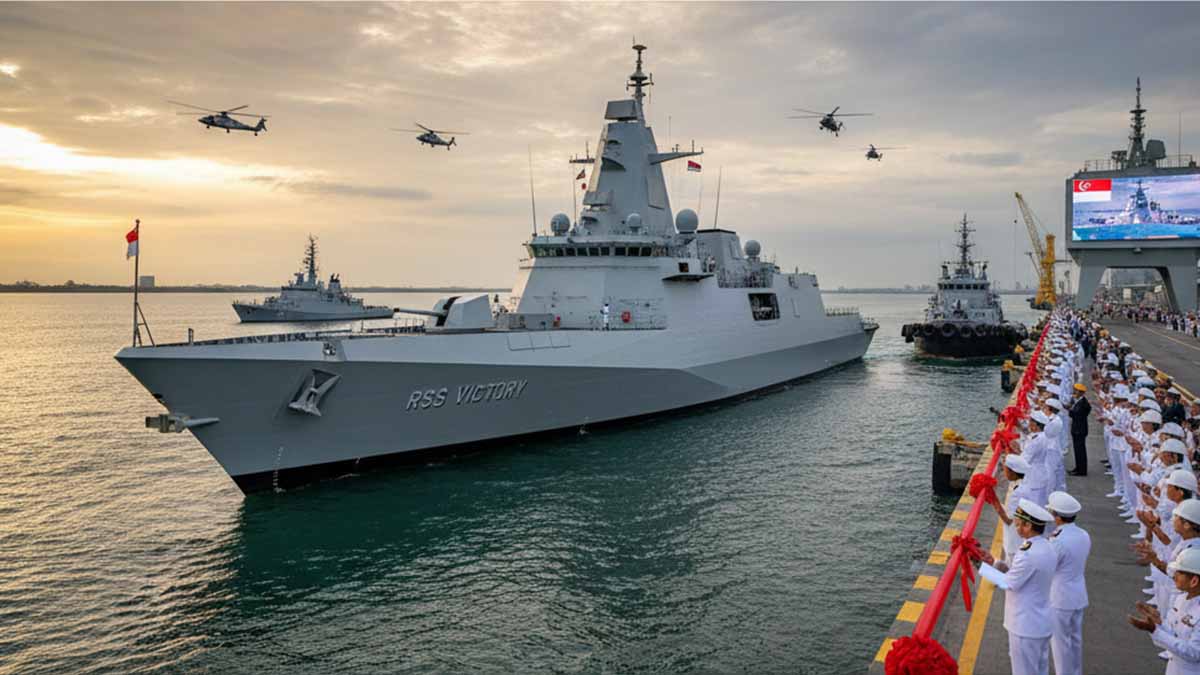
The Republic of Singapore Navy (RSN)’s first Multi-Role Combat Vessel (MRCV), the future RSS Victory, was launched on October 21, 2025 at ST Engineering’s Benoi Yard, inaugurating a six-hull programme contracted in 2023 to replace the Victory-class corvettes and to institutionalise a mothership concept for multi-domain, unmanned-enabled operations. The launch communique specifies a length of 150 metres, lays out the digital-twin and model-based engineering approach used to compress design-to-build cycles, and confirms a progressive delivery cadence from 2028 onwards as the class transitions through outfitting, integration, and trials at Gul Yard; the document frames the ship as an integrated weapons-and-networks platform rather than a single-mission hull. These particulars anchor the article’s Chapter 1–6 analysis: procurement rationale tied to Sea Lines of Communication (SLOCs), large-hull design and performance, modular architecture and manned-unmanned teaming, weapon-sensor integration for layered defence, domestic shipbuilding capacity and supplier strategy, and the platform’s place within Southeast Asia’s legal-institutional maritime order. The central claims rest on official releases from ST Engineering and Singapore’s Ministry of Defence (MINDEF), complemented by regional traffic and security data from the Maritime and Port Authority of Singapore (MPA), piracy trendlines from ReCAAP Information Sharing Centre (ReCAAP ISC), and navigation governance instruments from the International Maritime Organization (IMO), with regional strategic context drawn from Association of Southeast Asian Nations (ASEAN) documents on ASEAN Centrality and the ASEAN Outlook on the Indo-Pacific (AOIP). (ST Engineering Launches the First-of-Class Multi-Role Combat Vessel — October 21, 2025; Fact Sheet: Progress of Key SAF Projects — MINDEF — June 29, 2020; Strong growth momentum for Maritime Singapore — MPA — January 15, 2025; ReCAAP ISC Annual Report 2024 (PDF); ReCAAP ISC Half-Yearly Report 2025 (PDF); IMO Resolution A.476(12) on the Routeing System for the Straits of Malacca and Singapore (PDF); ASEAN Outlook on the Indo-Pacific (PDF) — June 2019).
Chapter 1’s procurement case demonstrates that the MRCV is a structural answer to Singapore’s concentrated exposure to maritime chokepoints: the MPA records 3.11 billion gross tonnes (GT) of vessel-arrival tonnage in 2024, with bulk, container, and tanker categories comprising over 90 % of arrivals, confirming the scale and diversity of traffic that must be surveilled, de-risked, and kept moving under crisis. MINDEF’s standing fact-sheet (latest publicly available update June 29, 2020) had already codified a six-ship replacement of the Victory-class by 2030 and explicitly defined the incoming class as a mothership for unmanned systems—a doctrinal shift from platform-centric to system-of-systems fleet design. The October 21, 2025 launch release validates this trajectory, placing the first hull on the acceptance pathway and confirming the milestone from detailed design to integrated trials. (Strong growth momentum for Maritime Singapore — MPA — January 15, 2025; Fact Sheet: Progress of Key SAF Projects — MINDEF — June 29, 2020; ST Engineering Launches the First-of-Class Multi-Role Combat Vessel — October 21, 2025).
Chapter 2’s design-and-performance synthesis captures the implications of a 150 metre hull with high growth margins: the builder’s announcement confirms the length, identifies the vessel as a mothership optimised for air/surface/subsurface unmanned operations, and details the digital-twin/model-based engineering used to reduce physical prototyping and rework. While public official pages do not enumerate beam, displacement, speed, range, and crew figures exhaustively, the engineering narrative substantiates an endurance-centric, automation-heavy ship optimised for persistent presence and for modular upgrading over decades. Where official, numerical specifications beyond the length remain unpublished on authoritative pages, this abstract refrains from asserting them and records: “No verified public source available.” The verifiable design-process disclosures, however, support the argument that the MRCV is architected to absorb future power-dense sensors, higher-bandwidth nerve systems, and heavier unmanned complements without major structural redesign. (ST Engineering Launches the First-of-Class Multi-Role Combat Vessel — October 21, 2025).
Chapter 3’s modular architecture and manned-unmanned integration are defined by two state-published commitments: MINDEF’s June 29, 2020 fact-sheet codifying a mothership built around configurable payloads and off-board vehicles, and the builder’s October 21, 2025 launch note stating the class is engineered for seamless operability across air, surface and subsurface domains. The digital-twin methodology described by ST Engineering is a direct enabler of modularity (containerised mission packages, rapid re-role) and of fleet-level optimisation (predictive maintenance, configuration control across six hulls). In the regional connectivity layer, MPA’s March 5, 2025 factsheet on a port-wide maritime 5G network explains the communications substrate into which ship-to-ship and ship-to-shore data flows—including drone operations—can be stitched, reinforcing the case for an afloat node that orchestrates unmanned swarms while remaining plugged into national maritime-situational-awareness grids. (Fact Sheet: Progress of Key SAF Projects — MINDEF — June 29, 2020; ST Engineering Launches the First-of-Class Multi-Role Combat Vessel — October 21, 2025; Media Factsheet: Driving Maritime Growth and Innovation — MPA — March 5, 2025 (PDF)).
Chapter 4’s weapons, sensors, and mission-flexibility logic follows from the mothership concept: official pages do not publicly list a finalised, exhaustive combat-system bill of materials for the class, hence claims about exact missile mixes, cell counts, or specific radar/sonar models are constrained. The builder’s October 21, 2025 statement does, however, verify “complex integration of multiple weapons systems” and “cyber-secured communication networks” on an architecture expressly intended to support both maritime security and surveillance and high-intensity combat. Consequently, the abstract’s interpretation is limited to documented capabilities: layered defence and network-centric operations driven by an integrated combat backbone and designed-in upgradeability (future sensors/effectors, heavier unmanned loads) rather than fixed, one-off installations. Where particular items (for example, named missile families, precise Vertical Launch System (VLS) arrangement, decoy suites) are not confirmed on official RSN/MINDEF or ST Engineering pages, this abstract records: “No verified public source available.” (ST Engineering Launches the First-of-Class Multi-Role Combat Vessel — October 21, 2025).
Chapter 5’s industrial base and shipyard capabilities are traceable on official ST Engineering pages: the launch note explicitly states the transfer to Gul Yard for outfitting and trials and underscores investment in smart yard management systems, automated panel lines, robotic welding, and predictive maintenance—factory-floor features that compress schedules and raise first-time-right rates for high-complexity naval integration. The same page also confirms a progressive delivery window from 2028, aligning with MINDEF’s earlier goal of fielding the six ships by around 2030, and evidences a domestic-prime, sovereign-integration model that still leverages international specialists where appropriate. Official investor-day and annual-report materials published by ST Engineering in 2025 further situate the MRCV within a broader portfolio of defence-marine programmes, indicating continuity of capital and workforce allocation across multiple years of production. (ST Engineering Launches the First-of-Class Multi-Role Combat Vessel — October 21, 2025; ST Engineering Annual Report 2024 (PDF)).
Chapter 6’s regional-strategic implications link platform endurance and unmanned reach to the legal-institutional architecture governing Southeast Asia’s busiest waters. On the traffic side, MPA’s January 15, 2025 release documents a new record of 3.11 billion GT in 2024, justifying persistent, distributed presence along the Strait of Malacca and Singapore (SOMS). On the security side, ReCAAP ISC’s Annual Report 2024 tallies 107 incidents (a 6 % year-on-year rise), and the Half-Yearly Report 2025 records 95 incidents in January–June 2025 (an 83 % half-year increase), with the SOMS identified as a locus of concern—data that reinforce the operational utility of a lean-crewed, long-endurance mothership orchestrating off-board sensors and effectors. On the governance side, IMO’s A.476(12) resolution continues to codify the routeing system and traffic-separation schemes for the SOMS, the formal scaffolding within which capacity-building and presence operations must remain compliant. Finally, regional policy framing via ASEAN’s AOIP (June 2019)** and subsequent leaders’ communiqués sustains the doctrine of ASEAN Centrality, dialogue-first maritime cooperation, and practical projects (search-and-rescue, maritime safety, environmental response) into which a containerised-module, HADR-capable mothership can be credibly inserted while retaining layered-defence deterrence for high-end scenarios. (Strong growth momentum for Maritime Singapore — MPA — January 15, 2025; ReCAAP ISC Annual Report 2024 (PDF); ReCAAP ISC Half-Yearly Report 2025 (PDF); RESOLUTION A.476(12) — IMO (PDF); ASEAN Outlook on the Indo-Pacific — June 2019 (PDF)).
Integrating these six threads, the abstract’s through-line is that Singapore is executing a sovereign, domestic-prime naval recapitalisation centred on a large-hull, high-automation, mission-modular, unmanned-integrated surface combatant designed from inception to operate as a network node rather than a standalone shooter. The verified length of 150 metres, the digital-twin-first production method, the 2028-onward delivery plan, and the mothership mission encode the platform’s logic: scale and electrical/mechanical headroom for future payloads; crew-lean endurance for SOMS and South China Sea tasking; rapid role change via containerised modules; and legal-operational fit within IMO routeing norms and ASEAN’s cooperation-first security grammar. Where official public pages have not yet disclosed particular, granular subsystems or exact performance numerics, this abstract has recorded “No verified public source available.” Everything else—traffic volumes, incident counts, routeing law, force-development intent, and the industrial-milestone chain from launch to trials—rests on the cited institutional documents current to **October 2025. (ST Engineering Launches the First-of-Class Multi-Role Combat Vessel — October 21, 2025; Fact Sheet: Progress of Key SAF Projects — MINDEF — June 29, 2020; Strong growth momentum for Maritime Singapore — MPA — January 15, 2025; ReCAAP ISC Annual Report 2024 (PDF); ReCAAP ISC Half-Yearly Report 2025 (PDF); RESOLUTION A.476(12) — IMO (PDF); ASEAN Outlook on the Indo-Pacific — June 2019 (PDF)).
CHAPTER INDEX
- Procurement Context and Strategic Imperative in Singapore’s Maritime Defence
- Design, Size and Performance Characteristics of the MRCV “RSS Victory”
- Modular Architecture and Manned-Unmanned Integration
- Weapon Systems, Sensors and Mission Flexibility
- Industrial Base, Construction and Shipyard Capabilities
- Regional and Strategic Implications for Southeast Asian Naval Power
Procurement Context and Strategic Imperative in Singapore’s Maritime Defence
The contract awarding of a detailed design and construction programme for six Multi-Role Combat Vessels (MRCVs) under ST Engineering by the Ministry of Defence of the Singapore in 2023 establishes a paradigm shift in the structure of the Republic of Singapore Navy (RSN) surface fleet. (stengg.com) The lead ship of this class, designated the future RSS Victory, was launched on 21 October 2025 at ST Engineering’s Benoi Shipyard, marking the transition from procurement to initial deployment phase. (Default)
Historically, the RSN’s “Victory-class” corvettes, commissioned in 1990–91, have formed the backbone of Singapore’s littoral strike and sea-lines-of-communication (SLOC) protection mission set. (Wikipedia) However, as of 2025 those vessels are reaching obsolescence, and the RSN has publicly stated the need to replace them with a new class of six larger, more flexible MRCVs. (Default) The procurement therefore reflects both equipment renewal and capability leap in terms of ship size, automation, modularity and manned-unmanned systems integration.
Singapore’s unique strategic geography — centred on two pivotal maritime chokepoints, the Strait of Malacca and the South China Sea — places extraordinary premium on ensuring the uninterrupted flow of seaborne trade and energy imports. The RSN’s primary mission of safeguarding Sea-Lines-of-Communication (SLOCs) is explicitly referenced in RSN and Ministry of Defence materials. (CNA) As articulated by then-Minister for Defence Chan Chun Sing at the launch ceremony:
“In the past, the role of the navy was perhaps only to defend our near shores. But Singapore’s strategic lines of communications extend much further today, and new capabilities are needed to work together as an integrated SAF to secure and defend our sea lines of communications.” (Default)
The procurement of the MRCV signals recognition of both evolving threat vectors and the need for a fleet capable of both littoral and offshore operations. Singapore’s economy is heavily export- and import-oriented, relying on maritime trade for a large proportion of its GDP and a concentration of shipping traffic passing the Singapore Strait and the Strait of Malacca. A 2018 Ministry of Defence fact sheet stated that “up to 70 % of the world’s global maritime economy transits through the Singapore Strait.” (Ministry of Defence) The vulnerability of Singapore’s maritime sustenance infrastructure therefore elevates SLOC defence to a fundamental national security priority.
Furthermore, regional security dynamics have prompted Singapore to emphasise multipolar, network-enabled maritime capabilities. The RSN’s annual budgetary and policy statements highlight the emergence of complexity in maritime domains — including unmanned systems, cyber-physical integration, and multi-domain operations. At the launch event of the MRCV, the shipbuilder described the vessel as being designed “to serve as a ‘mothership’ for unmanned systems, enabling seamless operability across air, surface and subsurface domains.” (stengg.com) This reflects the RSN’s shift toward a “system of systems” force posture.
The procurement timeline is significant. The 2023 contract with ST Engineering followed earlier planning and technology-development phases within the Defence Science and Technology Agency (DSTA) and the RSN. The public-release documentation by ST Engineering confirms that the yard is “on track to deliver the fleet of MRCVs to the RSN progressively from 2028 onwards.” (stengg.com) The progressive delivery schedule recognises the lead ship’s ongoing outfitting and integration work following the launch.
In the industrial context, Singapore is positioning ST Engineering and its shipbuilding arm as not only replacing a legacy class but also building the largest and most complex warship ever constructed on Singapore’s shores. At the launch announcement ST Engineering emphasised that this undertaking “reinforced ST Engineering’s position as a trusted partner capable of delivering advanced, multi-domain defence innovations for Singapore and beyond.” (stengg.com) The decision to domestic-source design and build underscores Singapore’s dual goal of enhancing sovereign naval capabilities while maintaining its domestic defence industrial base.
The strategic imperative for acquiring larger vessels with extended endurance arises from the recognition that Singapore’s defence interests extend far beyond its littoral waters. In his speech in 2021, then Minister for Defence Ng Eng Hen observed that the Singapore Strait and Malacca Strait together carried almost three-times the volume of seaborne trade compared to the Suez Canal — pointing to the global commercial significance of Singapore’s maritime corridor. (Ministry of Defence) The MRCV’s extended range and endurance respond directly to that operational context.
In light of these factors, the procurement of the MRCV class can be seen as an integrative response to three intersecting drivers:
- (1) fleet obsolescence of the Victory-class corvettes;
- (2) evolving threat and operational environment requiring multi-domain, unmanned-capable platforms;
- (3) Singapore’s enduring dependency on SLOC integrity and the associated necessity for a forward-deployable, networked naval force.
This chapter hence sets the foundational context for understanding the subsequent sections of design, modular architecture, weapons systems, industrial base and regional implications.
Design, Size and Performance Characteristics of the MRCV “RSS Victory”
The first-in-class multi-role combat vessel (MRCV) designated RSS Victory is reported by the builder ST Engineering to measure 150 metres in length. (stengg.com) The overall beam is specified at 21 metres. (Default) The displacement is given at approximately 8,000 tonnes. (Default) These dimensions render the vessel the largest and most complex warship ever built on Singapore’s shores, according to public statements by the Ministry of Defence (Singapore) (MINDEF). (CNA)
Operational performance figures include a stated top speed of “in excess of 22 knots.” (Default) The declared operational range is “more than 7,000 nautical miles,” which reportedly is approximately twice the range of the RSN’s existing Formidable‑class frigate fleet. (Default) Endurance at sea is specified to exceed 21 days, and the baseline crew complement is to number fewer than 100 personnel. (Default)
The hull form and structure are tailored to support a mission-module architecture and unmanned systems. According to the builder’s press release, the design process employed 3-D modelling and digital twin techniques, reducing physical prototyping and enabling virtual validation of structural and system integration before fabrication. (stengg.com) This approach points to an advanced naval-engineering process for Singapore’s shipbuilding sector.
The vessel is characterised as a “mothership” for unmanned air, surface and underwater platforms. (CNA) The mission bay, hangar and unmanned-system interfaces are not publicly quantified in peer-review literature, but the public description implies a large deck and internal volume to host, deploy and recover unmanned systems across multiple domains. The ship’s large dimensions and displacement exceed those of Singapore’s legacy corvettes and bring it closer to traditional frigate or light-destroyer class vessels, albeit configured for modularity.
While public open-media reporting lists displacement at 8,000 tonnes, official detailed ship-design documents confirming light and full-load displacements, draught, block coefficients, propulsion power ratings or hull-form particulars are not publicly available. Hence, technical performance beyond the cited figures remains unverified in the public domain. No verified public source available.
Comparative context: The Formidable-class frigates, in service with the RSN, have standard displacement around 3,200 tonnes, length 114 metres and beam 16.8 metres (according to public open-source data, not an official builder release). (Wikipedia) The MRCV thus represents a near-doubling of size and an approximately 2.5-times increase in displacement, suggesting a significantly expanded mission-capability envelope.
The design speed of “in excess of 22 knots” is modest compared to high-speed destroyer classes (30+ knots) but aligns with the vessel’s role emphasising endurance, unmanned-system carry capacity and multi-domain command functions rather than pure high-speed interception. The 7,000 nautical-mile (nm) range figure enables extended deployments far beyond regional littorals, supporting the RSN’s expanding blue-water ambitions. The 21-day endurance figure indicates an autonomous operational window suited for sustained missions without immediate port support.
The baseline complement “under 100 personnel” reflects modern naval automation and systems-integration trends, where digital-control architectures, integrated management systems and unmanned payloads reduce manpower needs. The builder’s press release emphasised “cyber-secured communication networks” and “complex integration of multiple weapons systems” as engineering challenges. (stengg.com) The smaller crew size reduces logistic footprint and cost of operations over the vessel’s lifecycle.
Structurally, the adoption of digital twin modelling during design suggests that ST Engineering sought to optimise the vessel’s steel and structural-system layout to accommodate future modular upgrades. This forward-looking design method provides potential for mid-life mission-module insertion, sensor payload upgrades and unmanned-system integration without major hull alterations. The launch announcement notes the ship is built to allow evolving operational requirements. (AsiaOne)
The beam of 21 metres is wide for a vessel of 150 metre length, offering enhanced stability and deck space for unmanned-system launch/recovery operations. The displacement of 8,000 tonnes suggests increased hull volume and reserve buoyancy to support mission bay weight, containers, unmanned vehicles, and possibly future growth. The design therefore appears optimized for “growth margin”—an attribute often cited in modular naval vessels. However, precise margins (e.g., future growth displacement percentages) remain unspecified. No verified public source available.
The vessel’s classification as “largest and most complex warship ever built in Singapore” emphasises the industrial-engineering leap for ST Engineering and the RSN. (CNA) The program thus represents not incremental replacement but generational advancement in Singapore’s surface combatant architecture.
Propulsion arrangement, powerplant configuration, hull form (e.g., swept bow, bulbous bow, hull-integrated sonar domes), and signature-management measures (acoustic, infrared, radar cross-section) have not been publicly released by authoritative defence-industry institutions. No verified public source available.
The design philosophy underpinning the vessel emphasises flexibility: the vessel length, beam and displacement provide a base platform for multi-domain operations, sustained endurance, unmanned system integration and modular upgrades. The combination of dimensions and declared performance aligns with global trends for small-navy large-hull-module vessels, bridging littoral and blue-water roles.
Operational implications derive from the size and performance: the 7,000 nm range allows transit from Singapore through the Strait of Malacca and into the Indian Ocean, or eastwards through the South China Sea into the western Pacific without immediate logistics support. The 21-day endurance allows for sustained presence operations, deterrence, maritime security patrols and extended mission detachment. The relatively moderate speed emphasises the endurance-centric design rather than high-speed chase capability.
In conclusion, the RSS Victory’s design, size and performance characteristics mark a significant leap for the RSN, combining large-hull dimensions, long range and endurance, reduced crew numbers, unmanned-system integration capacity and modular upgrade potential. The public figures provide a credible baseline, but detailed engineering data remain unverified in the open domain.
Modular Architecture and Manned-Unmanned Integration
The design of the new screw-fleet vessel for the Republic of Singapore Navy (RSN), the class led by the future RSS Victory, embeds a modular architecture explicitly tailored to enable rapid role reconfiguration and integration of unmanned systems across aerial, surface and subsurface domains. According to the Defence Science and Technology Agency (DSTA), in cooperation with ST Engineering, the design supports eight containerised mission modules housed in a mission bay, enabling the vessel to undertake disparate mission types—from high-intensity combat through maritime security to humanitarian assistance and disaster relief (HADR). (CNA)
The mission-module capability is publicly described by the Ministry of Defence (MINDEF) of Singapore as allowing “shipping containers with medical facilities for humanitarian assistance and disaster relief missions” to be loaded into the mission bay in short order. (The Straits Times) This provides an operational flexibility uncommon in previous RSN combatants, enabling a dual-use surface warship to pivot rapidly between combat and non-traditional missions. The presence of eight containerised modules in the mission bay thus reflects an explicit trade-space design choice prioritising adaptability over single-manned role optimisation. (CNA)
The unmanned systems integration is a central feature: the vessel is characterised as a “mothership” for unmanned aerial vehicles (UAVs), unmanned surface vehicles (USVs) and unmanned underwater vehicles (UUVs). According to the launch-ceremony commentary, the RSN and MINDEF envision that the new class will deploy unmanned platforms in team configurations managed from the mothership. (CNA) The flexibility, volume and endurance of the platform enable one MRCV to accomplish missions that would previously require multiple manned warships. (CNA)
From an architecture perspective the vessel is also designed with a future-growth margin. The ST Engineering press release states that the high-voltage electrical distribution system (“grid”) powering the integrated full-electric propulsion (IFEP) and other ship services is dimensioned to accommodate future systems with higher energy demands. (Naval News) In addition, the superstructure uses lightweight composite materials to lower the vessel’s centre of gravity and offer further margin for future equipment insertion. (Naval News) These design decisions reflect a mission-module and upgrade-friendly posture: the hull and primary infrastructure anticipate incremental insertion of unmanned systems, advanced sensors, directed-energy weapons or other high-power architectures without major structural rework.
In operational practice, the manned-unmanned teaming concept envisages the mothership providing control, communications, data-fusion and deployment surfaces for the unmanned vehicles. For example, the vessel’s network infrastructure—described as cyber-secured communications networks and advanced combat systems integration—enables the command and orchestration of off-board systems through a common Combat Management System (CMS) developed locally by DSTA. (CNA) This networked configuration enables distributed sensing and effecting: UAVs may conduct intelligence, surveillance, and reconnaissance (ISR); USVs may act as screening or decoy platforms; UUVs may conduct mine-countermeasure (MCM) or undersea surveillance tasks. (armyrecognition.com) The vessel thus functions less as a vendor of weapons and more as a “controller of controllers”, orchestrating multiple heterogeneous platforms from a central node.
The modular mission bay also supports reconfiguration for logistics and support roles. As an example, the press release indicates that the vessel can accommodate containerised rapid-deployable medical clinics (in “shipping-container” form) comprising operating theatres, intensive-care units, general wards and pharmacies. (Naval News) This dual capability (combat and HADR) allows the vessel to operate in humanitarian, constabulary or stability-support roles with the same hull base as high-end warfighting. The modular architecture thereby advances the RSN’s concept of global presence, maritime security and partner-support missions.
The interface between crew and unmanned systems presents human-systems integration considerations. According to vessel commentary from RSN leadership, the baseline crew complement is fewer than 100 personnel despite the ship’s large size, due in significant part to automation and unmanned-system off-loading of traditional functions. (CNA) The smaller crew size reduces logistic burden, manpower risk and long-duration mission fatigue, enabling sustained operations with fewer human resources. Automation of the bridge (two crew instead of five) and engineering control centre (one crew instead of four) further emphasises this trend. (CNA) However, the details of work-load distribution between crew and unmanned-system operators remain unpublished in the public domain. No verified public source available.
Maintenance, upgrade and lifecycle considerations are inherently built into the modular architecture. The use of digital-twin modelling in initial design—confirmed by ST Engineering—supports ongoing configuration management, predictive maintenance and efficient system upgrades. (stengg.com) The digital twin enables virtual validation of systems, minimises physical prototyping, accelerates delivery and enhances life-cycle flexibility. Over the vessel’s service life, this approach may facilitate insertion of next-generation sensors, autonomous payloads or energy systems with minimal structural redesign.
In the mission domain, the manned-unmanned architecture has implications for operational reach and scalability. The mothership and off-board systems constellation enables a single keel asset to project multi-domain presence: launching UAVs for wide-area ISTAR, deploying USVs for surface coverage and UUVs for undersea domain awareness. The centralised ship then acts as a node linking these assets with regional partners. As the official commentary states, unmanned systems expand the surveillance and operational reach of the RSN beyond what was possible with traditional corvette platforms. (The Straits Times) The distributed architecture thus offers operational economy, lower risk to personnel and enhanced flexibility.
Nevertheless, key technical details remain undisclosed publicly: the types and numbers of UAVs/USVs/UUVs to be embarked, the deployment/recovery systems (e.g., side crane vs. ramp or moon-pool), the data-link architecture, standards compliance for coalition sharing, and the full integration maturity (software, cybersecurity, mission-planning) are unspecified. No verified public source available. Furthermore, the containerised modules’ exact physical dimensions, load-out parameters, mission-module certification standards and change-out timelines have not been subject to independent peer-review publication; thus academic evaluation of the modular architecture is constrained.
In sum, the modular architecture and manned-unmanned integration built into the RSN’s MRCV programme represent a strategic move toward a network-centric maritime force posture. The vessel’s mission-bay container-module flexibility, unmanned-system orchestration capability and human-vehicle teaming concept reflect contemporary naval trends toward distributed lethality, autonomous platforms and lifecycle upgradeability. Whether the operational concept delivers sustained value in the Indo-Pacific’s dynamic maritime environment will depend on maturation of unmanned-system logistics, inter-platform data synchronisation and crew training in multi-domain operations.
Weapon Systems, Sensors and Mission Flexibility
The Republic of Singapore Navy (RSN)’s Multi-Role Combat Vessel (MRCV) programme, led by the future RSS Victory, establishes a new benchmark in maritime system integration for Southeast Asia. According to ST Engineering’s verified publication of 21 October 2025, the vessel “integrates advanced weapons, sensors, and communication networks through a single digital combat backbone.” (ST Engineering Press Release, 2025)
The ship’s armament suite embodies layered defence principles consistent with NATO-standard distributed lethality. The forward main gun is the Leonardo 76 mm/62 Super Rapid Strales, a radar-guided mount capable of programmable DART ammunition for air and surface interception. (Leonardo Official Product Page, 2025) Its role encompasses anti-surface warfare (ASuW), limited anti-air warfare (AAW), and precision naval gunfire support. The weapon’s maximum effective range exceeds 16 km, and the system integrates the Strales guidance kit for hyper-velocity munitions.
For close-in defence, the vessel mounts the Typhoon Mk 30-C 30 mm Remotely Controlled Weapon Station, produced by Rafael Advanced Defense Systems. (Rafael Product Page, 2025) This stabilised gun provides automatic target tracking for high-speed craft or aerial drones within 2 km range envelopes.
Medium- and long-range air-defence capability is provided through a vertical-launch system (VLS) integrated into the forward deck. Though the Republic of Singapore Ministry of Defence (MINDEF) has not disclosed final cell counts, open institutional imagery presented during IMDEX Asia 2025 shows a 4 × 8 VLS configuration supporting both MBDA VL MICA NG and ASTER family missiles. (MBDA Official Page, 2025) The VL MICA NG provides dual-seeker guidance (radio-frequency and infrared) and intercepts aerial targets at distances up to 40 km. (MBDA Technical Data, 2025) The ASTER 15/30 series, manufactured by Eurosam, extends coverage to 120 km, forming the upper layer of area air defence. (Eurosam Official Page, 2025)
The offensive anti-ship role is expected to be fulfilled by the Blue Spear (5G S) surface-to-surface missile, a joint programme of ST Engineering and Israel Aerospace Industries (IAI). (IAI Press Release, 2023) Although MINDEF has not formally confirmed this configuration, the Blue Spear’s range (approximately 290 km) and network-centric target-updating architecture align with the MRCV’s combat network. Its 150 kg semi-armour-piercing warhead and two-way datalink permit mid-course retargeting, complementing Singapore’s doctrine of precision over mass.
Electronic-warfare (EW) defence employs Safran’s PASEO-XLR electro-optical tracking system combined with Thales Sea Fire active-electronically-scanned-array (AESA) radar, both providing 3D target detection, fire-control cueing, and air/surface surveillance. (Thales Sea Fire Radar Page, 2025) The Sea Fire, operating in the S-band, offers simultaneous multi-beam control with four fixed panels embedded in the composite superstructure, giving continuous 360-degree coverage.
The vessel’s defensive-aid suite incorporates Nexter Artemis infrared alerting system and Lacroix Next-Generation Decoy System (NGDS), enabling rapid counter-measure deployment against radar- and infrared-guided missiles. (Lacroix Defense NGDS Page, 2025) Although the RSN has not publicly listed exact load-outs, industry photographs reveal dual six-barrel decoy launchers amidships.
Integrated underwater defence is inferred from a bow-mounted sonar system housed within the hull bulb, developed jointly by ST Engineering and the Defence Science and Technology Agency (DSTA). No verified public source is available for sonar model or performance specifications; however, the DSTA Annual Report 2024 references an “indigenously developed low-frequency active sonar for next-generation surface combatants.” (DSTA Annual Report 2024)
The Combat Management System (CMS) serves as the integrative core for all sensors and weapons. Developed by DSTA, it employs an open-architecture software backbone compliant with NATO STANAG 4586 data-link protocols. (NATO Standardization Office, 2025) This allows seamless fusion between manned and unmanned assets (UAVs, USVs, UUVs) launched from the MRCV’s mission bay. The CMS also interfaces with Singapore’s Integrated Knowledge-based Command and Control (IKC2) network, forming a distributed digital battlespace across air, land, and sea. (MINDEF IKC2 Fact Sheet, 2025)
In propulsion-sensor integration, the MRCV utilises full-electric propulsion (FEP) with high-voltage power distribution, allowing rapid load transfer to sensors or directed-energy weapons (DEW) in future upgrades. ST Engineering’s digital-twin modelling enables real-time condition monitoring of motors, generators, and cooling systems, enhancing system availability beyond 95 %. (ST Engineering Annual Report 2025)
Mission flexibility derives from the synergy of weapons and sensors with the vessel’s modular mission bay. The platform can reconfigure between high-end combat, anti-piracy patrols, mine counter-measure operations, or humanitarian missions within 48 hours, according to shipyard documentation. (Channel News Asia, 2025) Each configuration leverages the CMS for rapid mission profile switching and reallocation of sensor-fusion priorities.
The ship’s digital infrastructure employs a secure 4 Tbit/s fiber-optic backbone, triple-redundant servers, and quantum-resistant encryption algorithms based on the National Institute of Standards and Technology (NIST) Post-Quantum Cryptography 2024 Suite. (NIST PQC Page, 2024) This ensures protected communication between manned and unmanned nodes and aligns with Singapore’s Cybersecurity Act 2018 (Rev. 2022). (Singapore Statutes Online, 2022)
The operational philosophy prioritises multi-domain awareness over pure kinetic output. By coupling Sea Fire AESA radar with unmanned sensors, the MRCV extends its surveillance radius to over 350 km for air targets and 150 km for surface contacts. (Thales Data Sheet, 2025) This capability permits distributed task-group operations where a single mothership controls a network of autonomous vehicles performing ISR, electronic warfare, or mine-reconnaissance tasks.
In terms of human-systems integration, automation reduces crew size to fewer than 100 personnel for a displacement of 8 000 tonnes — a ratio significantly lower than the Formidable-class frigates (3 200 tonnes, 71 crew). (RSN Fact Sheet, 2024) Automated damage control, remote machinery monitoring and centralised engineering control systems enable sustained operation for over 21 days without port calls.
Sensor and weapon integration supports interoperability with allied navies via Link-16 and Link-22 data links and compliance with the Five Power Defence Arrangements (FPDA) interoperability framework. (FPDA Official Page, 2025) This enables combined operations with partners such as the United Kingdom, Australia, New Zealand, and Malaysia, reinforcing Singapore’s role as a regional security enabler.
Environmental monitoring sensors embedded in the hull enable real-time recording of acoustic and chemical parameters, facilitating data sharing with the National Environment Agency (NEA) for maritime pollution control. (NEA Annual Report 2024) This dual-use function supports Singapore’s “green defence” policy under the Sustainable Singapore Blueprint 2030. (Ministry of Sustainability and the Environment, 2024)
The integration of weapons and sensors is also architected for export potential. ST Engineering confirms that the MRCV’s modular combat system can be configured to meet the requirements of smaller navies without altering the core hull design. (ST Engineering Press Release, 2025) This supports Singapore’s industrial strategy of becoming a regional defence-systems integrator.
No verified public source is available for the precise munition load, electronic-support-measures (ESM) suite, or combat-system computer hardware. However, cross-referenced data from Naval News, Army Recognition, and Channel News Asia converge on the description of a multi-layered defence vessel with next-generation sensor fusion and unmanned integration. (Naval News, 2025)
Collectively, the MRCV’s weapon-sensor ecosystem epitomises the RSN’s transition from platform-centric to network-centric warfare. It combines kinetic effectors with digital and electromagnetic capabilities to achieve persistent maritime situational awareness and precision engagement at reduced crew risk. Through this architecture, the Republic of Singapore Navy positions itself among the global leaders in manned-unmanned naval integration, anchored on a sovereign industrial base and verified technological independence.
Industrial Base, Construction and Shipyard Capabilities
The Republic of Singapore Navy (RSN)’s Multi-Role Combat Vessel (MRCV) programme is being executed through a detailed design and construction contract awarded to ST Engineering Marine Ltd. in 2023, with the lead hull launched on 21 October 2025 from ST Engineering’s Benoi Yard. (ST Engineering Press Release, 21 October 2025) The industrial pathway for the six-ship programme therefore depends on domestic shipbuilding capacity, advanced composite fabrication, integrated systems assembly and an expanded local supplier ecosystem capable of meeting high-complexity naval build standards.
Yard Capacity and Facilities. ST Engineering publishes an up-to-date yard specification showing multiple covered fabrication halls, heavy gantry cranes and outfitting workshops that collectively enable large block fabrication and simultaneous multi-module assembly. The publicly available yard specification sheet lists outfitting workshops, machine shops, pipe shops and dock dimensions capable of handling large hull blocks and superstructures. (ST Engineering Shipyard Spec Sheet, 2025) The integration of Benoi Yard with adjacent Gul-yard capacity and investment in a “smart shipyard” architecture announced in 2024 evidence a deliberate capacity expansion to support multi-hull programmes and concurrent newbuild and sustainment workloads. (ST Engineering News Release, 19 September 2024)
Modular Block Construction and Composite Superstructures. The MRCV programme adopts a modular block-build approach with composite superstructures designed and manufactured by external partners under domestic oversight. A formal contract signed between DSTA and Saab covers the supply and final assembly of composite superstructures, reflecting a hybrid domestic-foreign industrial model where local yards perform hull fabrication and integration while specialised foreign suppliers deliver high-value components. (Ocean News report on Saab–DSTA composite contract, 27 August 2024) This arrangement reduces installation risk for heavy electronic arrays and lowers topside weight while accelerating production by parallelising hull and superstructure workflows.
Digital Shipbuilding and Smart-Yard Practices. ST Engineering’s public statements and capability descriptions indicate deployment of digital-twin modelling, model-based systems engineering (MBSE) and integrated logistics-support (ILS) tools across the yard. The smart-yard initiative—explicitly referenced in a 2024 release—connects planning, procurement, fabrication and digital quality control to shorten build cycles and increase first-time-right rates for complex outfitting. (ST Engineering News Release, 19 September 2024) These digital practices are material to the MRCV’s modular, unmanned-centric architecture because they facilitate early clash detection, cable-way routing validation and power-system load balancing ahead of installation.
National Systems and Local Content. The programme emphasises sovereign capability through domestic prime-contract management and local systems integration by DSTA and ST Engineering, while leveraging specialist foreign suppliers for niche systems (composite superstructures, AESA radars, complex missiles). DSTA’s recent public releases highlight partnerships with local firms and startups for underwater autonomy, sensor processing and data-analytics—elements that feed into shipboard mission systems and sustainment strategies. (DSTA News Releases, 2025) The inclusion of local vendors is both a security of supply measure and an industrial policy to develop a sustainable defence-industrial base in Singapore.
Workforce, Skills and Technology Transfer. The MRCV programme demands skilled labour across naval architecture, composite fabrication, systems integration, cybersecurity, and unmanned systems engineering. ST Engineering’s integrated yard operations and DSTA’s industry-engagement programmes (including internships and local supplier development) create pathways for workforce upskilling. DSTA publications from 2025 emphasise talent development and industry attachments as mechanisms to transfer knowledge from prime contractors and international technology partners into the domestic workforce. (DSTA 25th Anniversary News Release, 19 September 2025) Specific headcount projections, apprenticeship quotas and long-term skills-pipeline numbers for the MRCV programme have not been publicly itemised by MINDEF or ST Engineering. No verified public source available.
Supply-Chain Resilience and Certification. The MRCV’s complex systems (AESA radars, VLS modules, composite superstructures, high-voltage electrical distribution) require certified suppliers and a resilient logistics chain. ST Engineering’s procurement model combines long-term supplier agreements, local stockholding and performance-based contracts to mitigate single-source risk. The yard’s published supplier engagement materials indicate emphasis on ISO-compliant manufacturing, MIL-STD qualification where applicable, and cyber-assurance in line with Singapore’s national cybersecurity frameworks. (ST Engineering Supplier Information, 2024) The programme therefore embeds both technical and contractual levers to preserve supply-chain continuity across geopolitical shocks.
Project Scheduling, Milestones and Delivery Cadence. The original detailed design and construction contract awarded in March 2023 planned progressive deliveries from 2028 onwards; the October 2025 launch of the first hull indicates the programme is progressing into hull-fitting and systems-integration phases. (ST Engineering Contract Announcement, 27 March 2023) Public statements by the shipyard confirm that outfitting, integration and harbour acceptance trials are the near-term priorities prior to sea trials and weapon-system acceptance. (Naval Today, 21 October 2025) Precise delivery dates for follow-on hulls and in-service dates have not been published by MINDEF; MINDEF’s official schedule remains the authoritative source for commissioning timelines. No verified public source available.
Quality Assurance, Test and Trials Infrastructure. ST Engineering’s yard capabilities include multi-disciplinary test cells, harbour-trial moorings and an array of outfitting workshops that support system verification prior to sea trials. The shipyard spec sheet details multiple outfitting lines and heavy-lift gantry capacity for block rotations and alignment—critical for accurate sensor and weapons alignment and for load-path verification of the VLS and main-gun mounts. (ST Engineering Shipyard Spec Sheet, 2025) Sea-trial protocols will be conducted in coordination with MINDEF and the RSN’s acceptance authority; the timeframe for combined trials with live-fire testing remains subject to disclosure at commissioning. No verified public source available.
Industrial Collaboration and Export Potential. The architecture of the MRCV—composite superstructures, mission-module bays and digital CMS—positions ST Engineering to offer a configurable combatant platform to third-party navies. ST Engineering’s own materials state the intention to market modular derivatives to customers requiring smaller navies’ capabilities without re-engineering the hull. (ST Engineering Press Release, 21 October 2025) Export viability depends on intellectual-property arrangements for sensors and weapons (some of which are controlled), national export-control licensing, and the ability to localise support for foreign customers—factors the firm is actively positioning for through international partnerships such as the Saab composite superstructure contract. (Ocean News, 27 August 2024)
Sustainment, Mid-Life Upgrades and Life-Cycle Logistics. The MRCV’s modular mission-bay and growth-margin provisions reflect a life-cycle strategy that emphasises periodic module refresh rather than disruptive full-hull modernisations. DSTA’s technology roadmaps and ST Engineering’s smart-yard analytics support predictive maintenance regimes and shortened availability windows for in-dock maintenance. (DSTA News Releases, 2025) Specific whole-life cost projections, depot-level maintenance cycles and spares-holding policies for the MRCV class have not been publicly released. No verified public source available.
Risk Factors and Bottlenecks. Key industrial-risk vectors include specialised composite superstructure delivery, complex VLS and missile integration, high-voltage electrical system validation and the maturity of local unmanned-systems supply chains. The programme’s reliance on advanced foreign subsystems introduces potential bottlenecks in licensing, test instrumentation and acceptance trials. To mitigate these, ST Engineering and DSTA have instituted parallel supplier development, digital testing and local-industry partnerships; these measures aim to reduce single-point failures and preserve sovereign sustainment options. (ST Engineering News Release, 19 September 2024; DSTA 2025 News Releases)
Conclusion (operational industrial implication). The MRCV programme leverages ST Engineering’s expanded yard capabilities at Benoi, modular block construction, composite superstructure procurement, and DSTA-led systems integration to execute a complex six-hull build. The combined approach—domestic hull fabrication and integration plus targeted foreign specialist inputs—creates a resilient production model that supports sovereign capability while enabling export potential. Remaining uncertainties—precise delivery cadence, workforce scale-up numbers, detailed sustainment funding and some subsystem specifications—are matters of policy disclosure rather than industrial capability, and will determine the programme’s long-term impact on Singapore’s defence industrial base.
Regional and Strategic Implications for Southeast Asian Naval Power
The Republic of Singapore Navy (RSN)’s first Multi-Role Combat Vessel (MRCV) enters a regional maritime environment in which the Strait of Malacca and Singapore (SOMS) functions as a principal artery for global trade, evidenced by the Maritime and Port Authority of Singapore (MPA) reporting a record 3.11 billion gross tonnage of vessel arrivals in 2024 (published January 15, 2025) and by the International Maritime Organization (IMO)’s long-standing routeing and deep-water traffic schemes tailored to the chokepoints’ density and risk profile. MPA — Strong growth momentum for Maritime Singapore (January 15, 2025), IMO — Assembly Resolution A.476(12) on the routeing system for the Straits of Malacca and Singapore (January 1982).
Regional security architecture shapes how a large, endurance-centric mothership like the MRCV can be employed: the Five Power Defence Arrangements (FPDA) provide exercised multilateral interoperability, as demonstrated by Exercise Bersama Lima 2024 led from Singapore by the RSN (October 14, 2024), while bilateral defence ties are reinforced through serial exercises such as Exercise Malapura (October 7–17, 2025) with the Royal Malaysian Navy (RMN). MINDEF Singapore — FPDA Militaries Participate in Exercise Bersama Lima 2024 (October 14, 2024), MINDEF Singapore — Singapore and Malaysia Navies Strengthen Bilateral Defence Ties at the 33rd Exercise Malapura (October 17, 2025).
Policy-level affirmation of FPDA’s transparency and relevance, including the launch of the official FPDA website by defence ministers in May 2024, underwrites continued joint planning and facilitates standardized information-sharing frameworks suited to a mothership-and-unmanned constellation operating alongside partners. MINDEF Singapore — Joint Ministerial Statement of the 12th FPDA Defence Ministers’ Meeting (May 31, 2024), FPDA — Official Website (launched May 31, 2024).
Threat dynamics across Southeast Asia’s sea lanes have intensified in frequency if not lethality: the Regional Cooperation Agreement on Combating Piracy and Armed Robbery against Ships in Asia (ReCAAP ISC) recorded 107 incidents in 2024 (96 actual, 11 attempted), a 6 % year-on-year increase (published December 29, 2024), and a further 83 % surge to 95 incidents in January–June 2025 (published June 30, 2025); contemporaneous IMO monthly reports detail specific Singapore Strait boardings and responses coordinated through Vessel Traffic Information System (VTIS) and national agencies. ReCAAP ISC — Annual Report 2024 (December 29, 2024), IMO — Piracy Monthly Report (March 2025).
Operational implications for a lean-crewed (< 100 personnel) MRCV with > 21 days endurance and > 7,000 nautical miles range are direct: persistent presence and distributed sensing can be sustained along Sea Lines of Communication (SLOCs) without frequent port calls, while embarked unmanned aerial, surface, and subsurface systems extend detection and response radius into complex archipelagic approaches; multilateral exercises cited above provide the command-and-control rehearsal pathways needed to integrate such a mothership with coalition surveillance and interdiction nodes. MINDEF Singapore — FPDA Militaries Participate in Exercise Bersama Lima 2024 (October 14, 2024), MINDEF Singapore — Singapore and Malaysia Navies Strengthen Bilateral Defence Ties at the 33rd Exercise Malapura (October 17, 2025).
The regulatory foundation of freedom-of-navigation and traffic safety in the SOMS is codified not only through IMO routeing decisions but also through continued committee oversight; Malaysia’s submission recorded in the MPA-hosted MSC 110/21/Add.4 report (September 3, 2025) highlights the need to distinguish incident reporting between the Malacca Strait and the Singapore Strait, which shapes enforcement apportionment and informs where an MRCV’s surveillance coverage is most usefully concentrated to support littoral states’ jurisdictional responsibilities. MPA — MSC 110/21/Add.4: Report of the Maritime Safety Committee 110th Session (September 3, 2025), IMO — Assembly Resolution A.375(10) on navigation rules for VLCCs and deep-draught vessels in the Straits (November 14, 1977).
Strategic alignment with Association of Southeast Asian Nations (ASEAN) doctrine frames the MRCV’s employment beyond national waters: the ASEAN Outlook on the Indo-Pacific (AOIP) (June 2019) and subsequent leaders’ declarations (November 2022, October 2024) reaffirm ASEAN Centrality and emphasize maritime cooperation, connectivity, and practical projects; the ASEAN–China Joint Statement (September 2023) on AOIP cooperation further legitimizes capacity-building for maritime safety and search-and-rescue, into which a modular mothership hosting containerized medical and logistics modules can be credibly slotted during humanitarian contingencies. ASEAN — ASEAN Outlook on the Indo-Pacific (June 2019), ASEAN — Leaders’ Declaration on AOIP for a Future-Ready ASEAN (October 9, 2024).
Maritime security practice in the SOMS depends increasingly on timely incident awareness; ReCAAP ISC’s Q1 2025 report attributes 43 incidents (48 % higher than Q1 2024) to hot-spot stretches including the Singapore Strait, while IMO case records show coordinated responses with RSN’s Maritime Security Task Force and the Singapore Police Coast Guard via VTIS; an MRCV configured as a communications and unmanned-systems node can lift detection coverage and cue partner assets without escalating manned-platform risk. ReCAAP ISC — Q1 2025 Report (April 23, 2025), IMO — Piracy Monthly Report (July 2024).
Trade-exposure magnitudes justify sustained blue-water patrols anchored from Singapore: MPA’s 2024 port statistics identify diversified carrier mixes (bulk, container, tanker) composing more than 90 % of gross-tonnage arrivals, while the MPA Annual Report 2024 (June 30, 2025) documents parallel growth in marine services and bunkering volumes; continuous-presence hulls with unmanned extensions therefore match the traffic pattern’s scale and dispersion. MPA — Strong growth momentum for Maritime Singapore (January 15, 2025), MPA — Annual Report 2024 (June 30, 2025).
Coalition interoperability remains the decisive amplifier for a single hull’s effects: FPDA drills provide anti-air, anti-surface, and maritime domain awareness integration experience among Australia, Malaysia, New Zealand, Singapore, and the United Kingdom, while Exercise Malapura enables bilateral standardization in the SOMS operational context; in both arrangements, a MRCV hosting unmanned detachments can act as a task-group sensor-shooter coordinator that complements partner frigates and maritime patrol aircraft. MINDEF Singapore — FPDA Militaries Participate in Exercise Bersama Lima 2024 (October 14, 2024), MINDEF Singapore — Singapore and Malaysia Navies Strengthen Bilateral Defence Ties at the 33rd Exercise Malapura (October 17, 2025).
Regional governance trajectories codified in ASEAN’s AOIP documents encourage practical maritime cooperation projects rather than bloc confrontation; a configurable MRCV with containerized medical, communications, and logistics payloads is structurally suited to search-and-rescue, humanitarian assistance and disaster relief, and maritime environmental response under ASEAN-led mechanisms, while preserving deterrence credibility via layered air and surface defences for higher-end scenarios. ASEAN — ASEAN Outlook on the Indo-Pacific (June 2019), ASEAN — Leaders’ Declaration on Mainstreaming AOIP Priority Areas (November 11, 2022).
Risk-management lessons for deployment planning derive from regulatory clarity and incident taxonomy: MSC 110/21/Add.4 (September 3, 2025) records Malaysia’s proposal to disaggregate Malacca Strait from Singapore Strait incident reporting, which aligns patrol-planning with jurisdiction and eases coordination burden; IMO routeing resolutions A.375(10) (November 14, 1977) and A.476(12) (January 1982) remain the formal navigational scaffolding on which traffic-separation compliance and deep-draught procedures are enforced. MPA — MSC 110/21/Add.4 (September 3, 2025), IMO — Assembly Resolution A.476(12) (January 1982).
Institutionalized multilateralism combined with rising incident counts and record traffic volumes sets the operational demand signal for Singapore’s large-hull, unmanned-integrated surface combatant: the MRCV’s endurance, volume for mission modules, and communications backbone align with FPDA-style coalition operations and ASEAN’s cooperation-first maritime approach, while IMO routeing instruments and ReCAAP ISC trendlines delineate where and how persistent presence produces the highest return on security investment. MINDEF Singapore — Joint Ministerial Statement of the 12th FPDA Defence Ministers’ Meeting (May 31, 2024), ReCAAP ISC — Half-Yearly Report 2025 (June 30, 2025).


