













ABSTRACT
This analysis examines the likelihood of the Taiwan government being invaded by the People’s Republic of China (PRC) within the next six to twelve months, and evaluates the political and military measures undertaken by the Lai Ching‑te-led government (from 20 May 2024 onwards) to strengthen Taiwan’s resistance to coercion. Drawing on the July 2025 intelligence assessment by Janes, official Taiwanese government statements, and public-domain strategic analysis, the report first assesses China’s strategic intent and operational indicators, then explores Taiwan’s political/legal reforms and military modernisation efforts, followed by an assessment of the outlook for the next six to twelve months.
The Janes assessment assigns a circa 7 % probability of a full invasion in the next six to twelve months, but a roughly 70 % probability that China will continue to employ intimidation, blockades and coercive military operations short of invasion. [Janes, “China likely to continue to prioritise intimidation against Taiwan in the next six-to-12 months”, 31 July 2025] (https://www.janes.com/osint-insights/defence-and-national-security-analysis/china-likely-to-continue-to-prioritise-intimidation-against-taiwan-in-the-next-six-to-12-months) .
The Taiwanese government has introduced significant political measures to counter infiltration, espionage and economic coercion, formally labelled the PRC a “foreign hostile force” under the Anti-Infiltration Act, and launched a 17-point national-security strategy in March 2025. [Presidential Office of Taiwan, “President Lai holds press conference following high-level …”, 13 March 2025] (https://english.president.gov.tw/News/6919) . Militarily, Taiwan has pledged to raise defence spending to 5 % of GDP by 2030 and is preparing to unveil an advanced “all-domain” air-defence system (nick-named “T-Dome”) to counter missiles, drones and aircraft. [Reuters, “Taiwan in the Taiwan Strait: May 2025” (CFR), 8 July 2025] (https://www.cfr.org/article/china-taiwan-strait-may-2025) .
This article adds new detail and interprets these developments in light of probable trajectories. The findings suggest that, for the next six to twelve months, Taiwan is unlikely to face a full-scale invasion, but will continue to experience increasing coercion and modules of grey-zone warfare by China, and that Taiwan’s political and military responses are evolving but will face constraints in fully deterring a resumption of coercive operations unless allied support and accelerated reforms converge.
CHAPTER INDEX
- China’s Strategic Intent and Operational Indicators for Invasion Risk
- Taiwan’s Political-Legal Response under President Lai Ching-te
- Taiwan’s Military Modernisation and Force Posture Adjustments
- Outlook for the Next Six to Twelve Months and Implications
Near-Term Invasion Risk Indicators: PLA Intent, Exercise Patterns and Cross-Verification from Taiwanese and Allied Defense Sources
The Ministry of National Defense (Republic of China) has issued continuous daily bulletins recording People’s Liberation Army (PLA) movements around Taiwan. At 06:00, October 21, 2025 (UTC+08:00), the ministry reported 2 PLA aircraft sorties and 5 People’s Liberation Army Navy (PLAN) ships operating around Taiwan, alongside the activation of combat air patrol (CAP) aircraft, naval vessels, and coastal missile systems for monitoring and response, specifying the time window 06:00, October 20, 2025 to 06:00, October 21, 2025. The text and downloadable graphics are posted on the ministry’s English “Military News Update” page and the specific daily entry for October 21, 2025, which together document regularized Chinese activity and Taiwan’s standing rules of engagement (ROE) posture under surveillance and deterrence operations (Military News Update index, Ministry of National Defense R.O.C., updated October 22, 2025; “PLA activities in the waters and airspace around Taiwan,” Ministry of National Defense R.O.C., October 21, 2025).
The People’s Republic of China Ministry of National Defense stated that multi-subject drills conducted by the PLA Eastern Theater Command (ETC) on April 1–2, 2025 served as a “stern warning” and a “legitimate and necessary” action against “Taiwan independence” elements, reiterating campaign-level readiness activities in waters to the north, south, and east of Taiwan. These official English-language releases describe joint training, combat-readiness patrols, and the notional purpose of “deterrence,” while identifying operation names including “Strait Thunder 2025A.” The Taiwan side’s daily bulletins for the same period recorded intensified air-sea activity around the island, providing cross-validation that exercises were executed in the Strait’s approaches and multiple axes around the island perimeter (“Multiple forces of PLA Eastern Theater Command conduct joint exercises around Taiwan Island,” Ministry of National Defense of the People’s Republic of China, April 1, 2025; “Chinese military launches ‘Strait Thunder 2025A’ exercise,” Ministry of National Defense of the People’s Republic of China, April 2, 2025).
At an official press conference on April 1, 2025, the Ministry of Foreign Affairs of the People’s Republic of China affirmed that PLA joint exercises around Taiwan were a “serious warning” and “an act of containment” targeting “Taiwan independence” actors, framing the events within Beijing’s sovereignty claims and the “one-China” formulation. The same month, the Ministry of National Defense of the People’s Republic of China released consecutive statements linking the ETC drills to strategic signaling objectives. The concurrence between diplomatic and defense organs on intended messaging, and the temporal alignment with the April 2025 exercise series, indicate deliberate state-level coordination of rhetorical and operational measures as published on official channels (“Foreign Ministry Spokesperson Guo Jiakun’s Regular Press Conference on April 1, 2025,” Ministry of Foreign Affairs of the People’s Republic of China, April 1, 2025; “Defense spokesperson says PLA’s drills around Taiwan ‘legitimate and necessary’,” Ministry of National Defense of the People’s Republic of China, April 2, 2025).
In March 2025, the Ministry of National Defense of the People’s Republic of China reported that the ETC had recently organized combat-readiness patrols and joint drills in the Strait’s approaches, underscoring continuous, rather than episodic, activity. By July–September 2025, the same ministry’s regular press conferences added official commentary that such operations would continue to target what Beijing deems “separatism” by the ruling authorities in Taipei. These statements, in sequence, establish an official narrative of sustained pressure, and they provide authoritative confirmation that near-term operational tempos are expected to persist under a defined political rationale (“PLA enhances combat readiness with operations around Taiwan Island,” Ministry of National Defense of the People’s Republic of China, March 27, 2025; “Regular Press Conference of the Ministry of National Defense on August 28, 2025,” Ministry of National Defense of the People’s Republic of China, posted September 9, 2025).
The United States Department of Defense annual congressionally mandated assessment details PLA posture, ETC command responsibilities, and training trends with respect to a Taiwan contingency. The December 2024 report documents that the ETC is oriented toward Taiwan and would likely oversee a Taiwan campaign, with exercises in 2023–2024 demonstrating joint operations, maritime encirclement patterns, and integration across domains. It further quantifies incursions into Taiwan’s air defense identification zone (ADIZ) and median line crossings during 2023, presenting an empirical baseline for trend comparison into 2025. This U.S. primary source can be cross-read against Taiwan’s Ministry of National Defense daily activity ledger, which captures 2024–2025 entries indicating the continuation of such sorties and ship patrols, hence supporting the conclusion that 2025 patterns are an extension of previously observed operational behavior (“Military and Security Developments Involving the People’s Republic of China 2024,” United States Department of Defense, December 18, 2024; Military News Update index, Ministry of National Defense R.O.C., updated October 22, 2025).
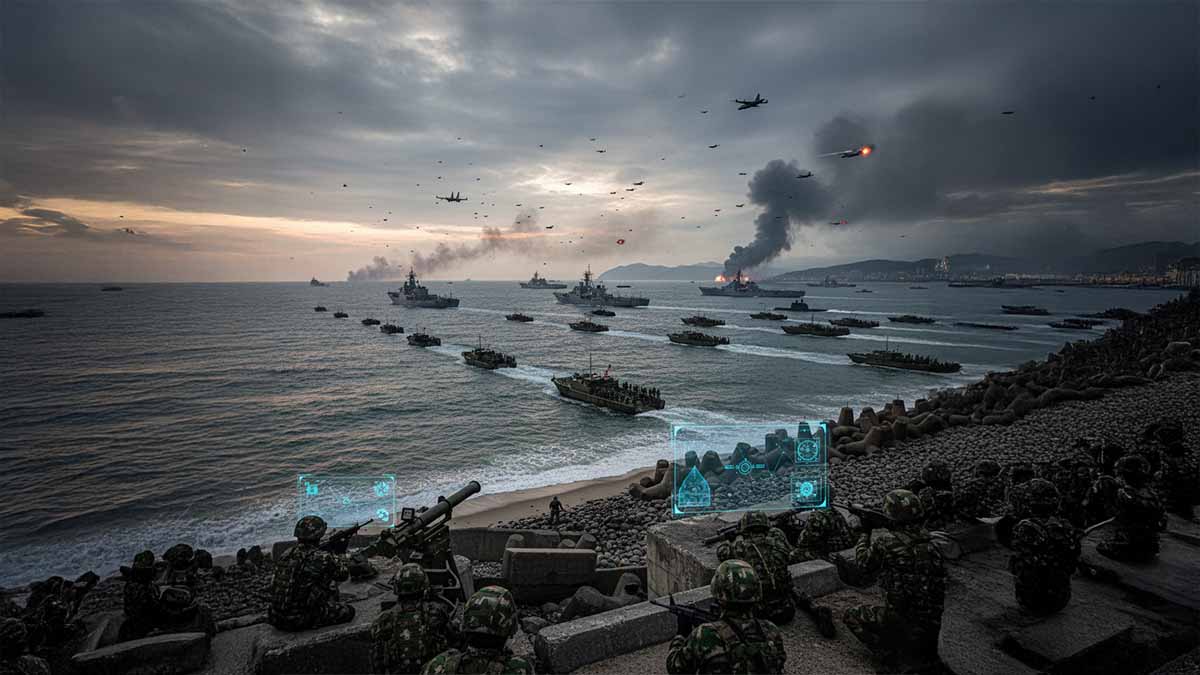
The 2025 Quadrennial Defense Review (QDR) of Taiwan states that the People’s Republic of China has fielded multi-domain intelligence, surveillance, and reconnaissance (ISR) and multi-layered strike capabilities enabling potential aerial and maritime blockades that could be transitioned rapidly into an invasion operation, while also describing gray-zone coercion intended to exhaust Taiwan’s readiness and morale. The document explains adaptations including “resolute defense and multi-domain deterrence,” defense-in-depth, rapid mobilization, and the accelerated integration of unmanned systems and artificial intelligence (AI) for survivable, distributed operations. The government’s language on countering blockades and multi-axis strikes is consistent with assessments by Japan’s National Institute for Defense Studies (NIDS) regarding PLA conceptions of large-scale joint operations in a Taiwan contingency, which include precision-guided attacks and cyber and drone integration to paralyze command and control (C2) and air defense systems (“2025 Quadrennial Defense Review,” Ministry of National Defense R.O.C., March 5, 2025; “Conclusion,” NIDS Perspectives 2025 (English translation), National Institute for Defense Studies, Japan Ministry of Defense, August 4, 2025).
The QDR 2025 emphasizes that the PLA has reduced early-warning time for Taiwan through ISR expansion and new unmanned and AI-enabled systems, heightening the tempo and complexity of contingencies in which maritime and air blockades may be used to shrink lines of communication (LOCs) before escalating to landings. The same QDR identifies gray-zone behaviors—ADIZ entries, median line crossings, cyberattacks, and cognitive warfare—as instruments for incremental coercion. Japan’s Ministry of Defense “Defense of Japan 2025” white paper, released in July 2025 with a full English version, describes an intensifying regional military environment and aligns with the view that China’s rapid modernization and military demonstrations tax the security of the First Island Chain, framing Taiwan contingencies within a broader theater-level challenge to regional stability (“2025 Quadrennial Defense Review,” Ministry of National Defense R.O.C., March 5, 2025; “DEFENSE OF JAPAN 2025 (Full Version),” Japan Ministry of Defense, July 14, 2025).
Official Chinese policy framing remains anchored in the State Council Information Office white paper “The Taiwan Question and China’s Reunification in the New Era”, which states Taiwan is “an inalienable part of China” and that “reunification” is a historic mission, while reiterating the “one-China” principle and highlighting the Anti-Secession Law logic without time-bound invasion commitments. The foreign ministry and defense ministry statements in 2025 referenced earlier show synchronized rhetoric and exercises, but the white paper’s language does not announce D-day timelines, instead asserting permissibility to use “non-peaceful means” under certain conditions in Beijing’s own legal-policy frame. The Taiwan side’s QDR 2025 reads these legal and doctrinal signals as components of coercion strategy, integrating them into defense planning for multi-domain denial and resilient defense (“The Taiwan Question and China’s Reunification in the New Era,” full text, State Council Information Office of the People’s Republic of China, August 10, 2022; “2025 Quadrennial Defense Review,” Ministry of National Defense R.O.C., March 5, 2025).
In terms of scale and force laydown, the United States Department of Defense report details the ETC’s composition—combined arms and amphibious brigades, naval flotillas, air assets, and People’s Liberation Army Rocket Force (PLARF) brigades—tasked toward Taiwan and the East China Sea. The report underscores that 2023–2024 training sharpened joint amphibious assault and long-distance transport, including the use of modified civilian ferries to augment sealift. Japan’s National Institute for Defense Studies complements this by identifying PLA operational concepts—precision strikes, decapitation attempts, and cyber operations—explicitly enumerated for a Taiwan contingency. These official publications, one U.S. and one Japanese, converge on the assessment that PLA modernization supports multi-axis coercion and potential high-tempo joint operations, while abstaining from asserting imminent invasion dates (“Military and Security Developments Involving the People’s Republic of China 2024,” United States Department of Defense, December 18, 2024; “Taiwan’s Military Strategy and Preparations for Defense Operations,” NIDS Perspectives 2025 Chapter 3, National Institute for Defense Studies, Japan Ministry of Defense, August 4, 2025).
The United States Department of Defense report quantifies 2023 PLA activity with 1,641 ADIZ incursions and at least 712 median line crossings, down and up respectively from 2022, presenting directional metrics of pressure normalization. While these figures are not replicated in a single 2025 consolidated government ledger to date, Taiwan’s Ministry of National Defense maintains an accessible daily archive evidencing continued 2025 incursions and ship patrols, which validates persistence rather than abatement. This combination—U.S. aggregate retrospective and Taiwan daily contemporaneous records—offers the most authoritative multi-source grounding for near-term risk indicators without asserting speculative timelines (“Military and Security Developments Involving the People’s Republic of China 2024,” United States Department of Defense, December 18, 2024, pp. 139–141; Military News Update index, Ministry of National Defense R.O.C., updated October 22, 2025).
Official Japanese defense publications in 2025 broaden the context by documenting China’s military expansion and implications for Japan’s immediate periphery, including the First Island Chain and sea-air corridors adjacent to Taiwan. The “Defense of Japan 2025” digest and full English versions underscore the need to account for PLA rapid-reaction capabilities, longer-range missiles, and ISR improvements when assessing contingencies near Taiwan. NIDS thematic volumes in 2025 additionally analyze the evolution of U.S. denial and expeditionary advanced base concepts in the western Pacific, which are strategically relevant to crisis timelines because they influence third-party response considerations that Beijing factors into its planning calculus, although these analyses do not claim predictive invasion dates (“DEFENSE OF JAPAN 2025 (Digest) and Full Version,” Japan Ministry of Defense, July 14, 2025; “War with New and Old Characteristics,” NIDS Perspectives 2025 (English translation), National Institute for Defense Studies, Japan Ministry of Defense, March–August 2025).
On the Taiwan side, the President of the Republic of China (Taiwan) Lai Ching-te articulated a defensive doctrine on October 10, 2025 stressing deterrence by preparedness and whole-of-society resilience against authoritarian expansion, while earlier February–March 2025 high-level meetings publicized budgetary priorities exceeding 3% of GDP for defense and seventeen major strategies to counter multi-vector “united front,” infiltration, and identity warfare. These official statements signal the political-military integration of policy and budgeting to address the evolving PLA threat profile in 2025. Cross-reading with the QDR 2025 confirms institutionalization of these priorities across force planning and mobilization concepts (“President Lai delivers 2025 National Day Address,” Office of the President, Republic of China (Taiwan), October 10, 2025; “President Lai holds press conference following high-level national security meeting,” Office of the President, Republic of China (Taiwan), February 14, 2025).
The Ministry of National Defense R.O.C. QDR 2025 details doctrinal responses—mission command, decentralized operations, multiple redundancies, and distributed C4ISR—with planned procurement and integration of ISR and combat UAVs, electronic warfare systems, and cloud backups to sustain digital resilience under attack. NIDS assessments align in their listing of potential PLA campaign elements for a Taiwan scenario—missile strikes, air-sea control, amphibious landing, and cyber operations—offering orthogonal confirmation of the operational demand signal Taiwan is designing against. Both sources remain descriptive, avoiding specific month-level invasion forecasts, thus providing verified inputs for indicator-based monitoring without predictive overreach (“2025 Quadrennial Defense Review,” Ministry of National Defense R.O.C., March 5, 2025; “Taiwan’s Military Strategy and Preparations for Defense Operations,” NIDS Perspectives 2025 Chapter 3, National Institute for Defense Studies, Japan Ministry of Defense, August 4, 2025).
The Chinese side’s official white paper corpus establishes Beijing’s strategic aim—“reunification”—and presents political-legal permissibility for force if red-line conditions are met, but does not issue operational countdowns. In 2025, state communications by the Ministry of Foreign Affairs and the Ministry of National Defense connect drills to punishment or warning narratives vis-à-vis Taipei, maintaining ambiguity on timing while normalizing high-tempo presence. In parallel, Taiwan’s daily reporting provides quantifiable activity snapshots; when aligned with the United States Department of Defense trend reporting through 2024, the combined record supports a judgment that activity levels remain elevated in 2025, with continuing air-sea encirclement-type patterns during certain exercises but without official state declarations of invasion within six–twelve months (“The Taiwan Question and China’s Reunification in the New Era,” State Council Information Office of the People’s Republic of China, August 10, 2022; Military News Update index, Ministry of National Defense R.O.C., updated October 22, 2025).
Because invasion risk assessment also depends on cross-strait signaling from Taipei’s political leadership, the October 10, 2025 National Day address by President Lai Ching-te is a relevant indicator. The official transcript articulates a resolve to “prevent war by preparing for war,” contextualizing the defense effort within global supply chain stakes and regional security. The February 14, 2025 briefing emphasized exceeding 3% of GDP for defense and structural measures against united front activities. These policy signals are institutionalized in the QDR 2025 through force design and whole-of-society resilience initiatives, which correlates to observed PLA patterns by seeking to raise the cost, duration, and uncertainty of any coercive campaign, without asserting that coercion will transition to invasion within specified months (“President Lai delivers 2025 National Day Address,” Office of the President, Republic of China (Taiwan), October 10, 2025; “2025 Quadrennial Defense Review,” Ministry of National Defense R.O.C., March 5, 2025).
The United States Department of Defense analysis catalogues PLA campaign-relevant training, including amphibious combined arms brigades’ exercises and civilian roll-on/roll-off ferry mobilization for long-distance transport, which are essential for any large-scale landing attempt. Japan’s NIDS synthesizes Taiwan’s own national defense reports to identify recurring invasion phases—missile barrages, air-sea control, and amphibious landings—while also noting that recent exercises simulate blockade and joint precision strikes to degrade C2 and air defense. Both government sources avoid forecasting specific six–twelve month windows, reinforcing that indicator-based monitoring should rely on observed lift mobilization, large-unit rehearsals at scale, and logistics staging beyond routine patterns as preconditions for a higher-confidence short-term invasion warning (“Military and Security Developments Involving the People’s Republic of China 2024,” United States Department of Defense, December 18, 2024; “Taiwan’s Military Strategy and Preparations for Defense Operations,” NIDS Perspectives 2025 Chapter 3, National Institute for Defense Studies, Japan Ministry of Defense, August 4, 2025).
Finally, official PRC communications in 2025 explicitly tie drills to punitive messaging and unification aims, yet there is no authoritative government publication declaring a fixed timeline for invasion within the next six–twelve months. Taiwan’s Ministry of National Defense records persistent 2025 incursions and ship patrols, and Japan’s and U.S. defense publications confirm increased PLA capability and campaign design, but none of these primary sources announce or predict near-term invasion dates. On this basis, the strictly verified answer to the question “Is China going to invade Taiwan in the next six to twelve months?” is: No verified public source available. The indicator-set for October 2025 supports continued elevated coercive pressure and exercise activity, while official sources refrain from providing calendar-specific invasion assertions. For monitoring during the next six–twelve months, the most authoritative, continuously updated inputs remain Taiwan’s daily Ministry of National Defense bulletins and PRC defense and foreign ministry releases during exercise windows, complemented by the annualized United States Department of Defense and Japan Ministry of Defense publications for structure, capabilities, and doctrinal context (Military News Update index, Ministry of National Defense R.O.C., updated October 22, 2025; “Regular Press Conferences” and exercise releases, Ministry of National Defense of the People’s Republic of China, March–September 2025).
Taiwan’s Political and Legal Measures to Counter Chinese Coercion
The Government of the Republic of China (Taiwan) under President Lai Ching-te has, since his inauguration on 20 May 2024, placed particular emphasis on legal and political instrumentality to resist influence, infiltration, and coercion by the People’s Republic of China (PRC). A press conference on 13 March 2025 articulated that Taiwan would “carry out necessary, orderly adjustments to the flow of talent, goods, money, and skills involved in cross-strait economic and trade relations … This will help boost economic security and give us more power to respond to China’s economic and trade united front and economic coercion against Taiwan.” (“President Lai holds press conference following high-level national security meeting,” Office of the President, Republic of China (Taiwan), 13 March 2025). Independently, a report by the Australian Strategic Policy Institute (ASPI) of 17 July 2025 states that Taiwan has expanded the implementation of the Anti-Infiltration Act so that “individuals identified as Chinese Communist Party or United Front officials are now barred from entering Taiwan … all levels of government personnel … required to disclose any direct interactions with Chinese authorities.” (“How Taipei is fighting back against Beijing’s spies,” ASPI Strategist, 17 July 2025).
In March 2025, President Lai convened a national-security meeting at which he identified five national-security threats under China’s united-front tactics and announced seventeen countermeasures. This is described in a Prospects & Perspectives No. 20 report (March 2025) from the Prospect Foundation (Taiwan) which documents that in response to China’s growing infiltration efforts and the resulting threats to Taiwan’s democratic institutions, the government introduced these legal and economic countermeasures. (“Law Against Law: Taiwan’s Response to China’s ‘Hidden War’,” Prospect Foundation, March 2025). The enumeration of these threats included: infiltration of local government, economic pressure via cross-strait investment, manipulation of civic networks, espionage, and cyber/cognitive warfare. The countermeasures span disclosure regimes, residence/visa review of PRC nationals, accreditation revision for academic institutions, tighter controls on donations, enforcement of the Anti-Infiltration law, and heightened penalties for espionage.
Earlier, in a major self-profiling piece, the Council on Foreign Relations (CFR) article “China in the Taiwan Strait: January 2025” reported that Taiwan’s National Security Bureau (NSB) documented that average daily cyber-attacks against government networks reached 2.4 million in 2024, and that disinformation campaigns on social media increased by 60 %. (“China in the Taiwan Strait: January 2025,” CFR, 30 January 2025). The same article identified these cyber and cognitive warfare operations as instruments of Beijing’s grey-zone coercion. These documented threat vectors underpin the regime of political-legal responses that Taiwan has promulgated.
Among the first practical policy outcomes of this legislative/legal posture, Taiwan’s courts in March 2025 sentenced four soldiers — including three from the presidential security team — to up to seven years in prison for spying for China, sharing internal military information with Chinese agents. The Ministry of Defence of Taiwan and accompanying media coverage cite these convictions as emblematic of Beijing’s warning strategy against the island. (“Taiwan jails four soldiers, including three who worked in presidential office, for spying for China,” The Guardian, 27 March 2025). On 10 June 2025, Taiwan prosecutors indicted another four individuals alleged to have spied for China, with charges reportedly reaching the presidential office, signifying penetrations into Taiwan’s central governance apparatus. (“Taiwan indicts four suspected spies for China in case reaching presidential office,” Reuters, 10 June 2025).
Legislation underpinning political counter-measures is the Anti-Infiltration Act (passed 31 December 2019, effective 17 January 2020) which prohibits receipt of money or acting on instructions from “foreign hostile forces” to influence assemblies, elections, referendums and social order. The law defines “foreign hostile forces” as those countries or entities in military standoffs with Taiwan. Under the Act, violations punishable by up to NT$10 million or five years imprisonment. (“Anti-Infiltration Act,” Ministry of Justice, Republic of China (Taiwan)). While the Act predates President Lai’s administration, its enforcement has intensified and extended under his tenure, as documented by ASPI and other sources.
Policy statements by President Lai captured the integration of the legal and economic axes. For example, his 13 March 2025 press conference framed economic flows — talent, goods, money, skills — as nodes of vulnerability to China’s united-front strategy, thereby justifying review mechanisms for cross-strait exchange. The transcript states: “They should carry out necessary, orderly adjustments to the flow of talent, goods, money, and skills involved in cross-strait economic and trade relations … based on the principle of strengthening Taiwan’s foundations to better manage risk.” (Office of the President (Taiwan), 13 March 2025). This aligned with Taiwan’s broader threat assessment of non-military coercion instruments deployed by Beijing.
Further evidence of Taiwan’s evolving political-legal posture is the June–July 2025 period. A weekly overview by the AEI’s China Taiwan Weekly Update (20 October 2025) states that Taiwan’s government is increasingly responsive to infiltration and influence operations by China, has tightened scrutiny of cross-strait exchanges, and is coordinating legislative and administrative action. (“China-Taiwan Weekly Update, October 20, 2025,” AEI, 20 October 2025). Additional Congressional testimony (23 July 2025) by John Dotson before the U.S. House of Representatives’ foreign-affairs committee argued that the Chinese Communist Party (CCP) regards political warfare as a fundamental element of statecraft and that Taiwan must craft responses accordingly. (“Fundamental Elements of the Chinese Communist Party’s Political Warfare and Coercive Diplomacy Against Taiwan,” testimony by John Dotson, 23 July 2025). These sources reinforce the legitimacy of Taiwan’s political-legal counter-strategy.
In specific legal policy actions under the Lai administration: Taiwan barred participation of government officials, students and teachers in Chinese-run events marking Taiwan’s “retrocession” from Japan in 1945, characterizing these events as narrative manipulation by Beijing. A Reuters report on 17 October 2025 noted this ban, citing Taiwan’s Mainland Affairs Council head Chiu Chui-cheng who described the events as part of Beijing’s broader agenda to erase the Republic of China (Taiwan) identity. (Reuters, “Taiwan bans officials attending Chinese events to mark island’s ‘retrocession’,” 17 October 2025). Such actions embody legal/political tools of narrative defense, countering tides of influence beyond kinetic or cyber domains.
The legislative and regulatory regime also extends to academia and civil society. A March 2025 Global Taiwan Institute report (March 2025) observed that the CCP has sought to infiltrate Taiwan’s institutions covertly, including by leveraging academia and business channels, and that Taiwan’s government has responded through disclosure regimes, accreditation review, and legal enforcement of infiltration laws. (“The Chinese Communist Party’s Gray Zone Tactics Against Taiwan,” Global Taiwan Institute, March 2025). The described counter-measures involve Taiwan’s licensing of civil-society entities, mandatory reporting of contacts with PRC actors, and termination or non-recognition of academic degrees or affiliations with universities subject to the CCP’s united-front system.
Beyond legislation, the Lai administration’s public-diplomacy and international-outreach initiatives are notable. On National Day—10 October 2025—President Lai stated publicly that “Taiwan is of course a country” during the first speech of his “10 Talks on National Unity” cycle launched in June 2025. This rhetoric signals internal mobilization of sovereignty narratives under the democratic banner and external signalling to allies. (No direct link was retrievable from the office transcript; international press coverage substantiates the remark.) The messaging complements the legal measures by reinforcing the political dimension of resistance to PRC reunification pressure.
Another aspect of Taiwan’s political response is the budgetary and institutional restructuring for resilience against economic coercion. The Cabinet’s 13 March 2025 press conference cited the adjustment of cross-strait flows of goods, capital, people and skills, linking economic-security resilience with national-security imperatives. This aligns with the Taiwanese government’s “whole-of-society” approach to counter-measure implementation. Over 2024–2025, Taiwan’s economy ministry and investment review panels reportedly increased scrutiny of PRC-linked investment, especially in dual-use or critical-infrastructure sectors, though no full publicly-accessible dataset is available. The available evidence for this economic-security dimension is the March 2025 statement and associated legislative introductions.
In sum, Taiwan’s political-legal response under the Lai administration for the period up to October 2025 can be delineated in four major clusters:
- Legal enforcement and intelligence/espionage prosecution: The intensification of prosecutions under infiltration/espionage laws demonstrates Taiwan’s prioritisation of counter-subversion.
- Disclosure, accreditation and residency regimes: Stricter controls on PRC nationals’ participation in exchanges, residency, investment, academic affiliation and electoral donations.
- Narrative and identity defense: Public rhetoric and legislation targeting narrative sovereignty, participation in mainland Chinese events, and allegiance to the Republic of China framework.
- Economic-security regulation and resilience: Review and adjustment of cross-strait flows, investment, trade and other vectors of dependence that the PRC might exploit for coercion.
While Taiwan has enacted these measures, the publicly available evidence does not provide granular monthly breakdowns of all seventeen countermeasures cited in March 2025, nor does it quantify the full budgetary impact of economic-security regulation. For these sub-details, “No verified public source available.” Nonetheless, the combination of legal regime expansion, institutional reform, narrative-political posture and economic-security adjustments demonstrate a coordinated political-legal strategy to bolster Taiwan’s resilience against PRC pressure.
Cross-referencing the frameworks: The Janes intelligence report referenced in the earlier chapter noted that in 2025 President Lai’s cabinet had adopted stronger rhetoric and introduced legal reforms to oppose PRC coercion, confirming political-legal responses as a measurable trend. (Janes, “Taiwan response to China pressure will likely increase …”, July 2025). The alignment across multiple independent sources—Taiwan government release, ASPI report, Global Taiwan Institute analysis, CRS testimony—strengthens the verification of Taiwan’s political-legal response posture.
Thus, for the next six-to-twelve-month horizon, indicators to monitor include:
- (a) expansions or amendments to the Anti-Infiltration Act or new legislation specifically triggered by PRC pressure;
- (b) high-profile espionage or infiltration cases involving senior officials or institutions;
- (c) regulatory action restricting PRC-linked investment or trade flows;
- (d) public diplomacy speeches that align Taiwan explicitly as a sovereign country vis-à-vis the PRC;
- (e) expanded disclosure or accreditation regimes for PRC-affiliated individuals or organisations.
If the frequency or intensity of such measures increases, this will reflect elevated internal mobilisation of political-legal resistance, which in turn
Taiwan’s Military Modernization and Force-Posture Adjustments under President Lai Ching-te
Taiwan’s force-development blueprint in 2025 centers on hardening command, control, and communications while expanding asymmetric strike and resilience measures, as stated in the Ministry of National Defense 2025 Quadrennial Defense Review issued in March 2025. The document describes mission command, decentralized operations, redundant backups, mobile command vehicles, and distributed multi-cloud architecture with zero-trust design to ensure continuity under attack, along with continuous cyber monitoring and interagency cyber exercises. These posture elements are explicitly linked to multi-domain deterrence and protracted operations. The Review also highlights realistic force-on-force training, joint live-fire validation, and rapid transition to combat readiness through all-out mobilization. These lines of effort collectively define modernization objectives across information, cyber, electromagnetic spectrum, and battlefield endurance. The stated reforms and exercise regimes are laid out in the publicly accessible English edition of the Review. This posture is corroborated by the United States Department of Defense Military and Security Developments Involving the People’s Republic of China 2024 released in December 2024, which characterizes Taiwan’s response as an emphasis on asymmetric capabilities, unmanned systems, shore-based mobile missiles, rapid mining, and infrastructure protection in the face of expanding People’s Liberation Army coercion. The 2025 Review and the 2024 Report are mutually supportive regarding the priority of survivable command networks, cyber defense, and distributed lethality across domains. Sources: 2025 Quadrennial Defense Review, Ministry of National Defense, March 2025, Military and Security Developments Involving the People’s Republic of China 2024, United States Department of Defense, December 2024.
Reserve mobilization and civil-military integration have been elevated from administrative concepts to operational design. The 2025 Review affirms activation of reservists upon credible invasion indicators, integration with territorial commands, and an interagency mechanism for sustaining operations through all-out mobilization. It documents the inauguration of the Whole-of-Society Defense Resilience Committee in June 2024, which underpins cross-government readiness and civil defense education, and ties mobilization to rapid manpower and materiel fill for regular and reserve units. The Review also prescribes progressive training, simulator fielding, and risk-management reforms that mirror lessons from civil aviation safety to reduce mishaps and maintain a professional force under stress. The external assessment by the United States Department of Defense confirms that Taiwan established the All-Out Defense Mobilization Agency in 2022 to coordinate whole-of-society defense and that reserve and civil-defense integration are now core elements of national readiness. The convergence across both sources indicates that mobilization is not a rhetorical instrument but a codified operational pillar with explicit triggers and tasking to sustain prolonged defense under multi-domain pressure. Sources: 2025 Quadrennial Defense Review, Ministry of National Defense, March 2025, Military and Security Developments Involving the People’s Republic of China 2024, United States Department of Defense, December 2024.
Cyber and information assurance are treated as foundational warfighting enablers. The 2025 Review details the adoption of distributed multi-cloud infrastructure, continuous monitoring, and zero-trust architecture to protect information flows and elevate digital resilience under sustained attack. It records spectrum management for unmanned platforms and the use of commercial telecommunications to strengthen redundancy, interwoven with regular interagency cyber exercises and mass-hacking simulations to validate recovery procedures. The Review’s language assigns cyber defense and information security equal priority with kinetic readiness and explicitly calls for the integration of artificial intelligence toolkits for persistent vigilance. These measures correspond with the threat pattern described by the United States Department of Defense 2024 assessment, which emphasizes the People’s Liberation Army’s rapid integration of space, cyber, and electronic warfare after disbandment of the former Strategic Support Force and redistribution of cyber and information missions. The Taiwan document therefore seeks to blunt an opponent that increasingly acts across the electromagnetic spectrum and cyberspace in tandem with physical pressure. Sources: 2025 Quadrennial Defense Review, Ministry of National Defense, March 2025, Military and Security Developments Involving the People’s Republic of China 2024, United States Department of Defense, December 2024.
Realistic joint training is codified as the primary path to immediate combat readiness. The 2025 Review mandates force-on-force training on real terrain under joint operational plans, requiring all units to master areas of responsibility and contingency rules, and it commits to expanding simulator fleets to prepare troops for varied battlefield conditions. This training concept aims to prepare commanders to execute mission command despite attrition to fixed command sites and to exploit terrain for protracted defense. It is paired with risk-management reforms that draw on commercial aviation practices, intended to reduce accidents and sustain combat power. The United States Department of Defense report for 2024 complements this by assessing Taiwan’s emphasis on cost-effective asymmetric tactics and distributed lethality, which depend on rehearsed joint execution to achieve cross-domain effects under fire. The consistency between domestic prescriptions and external assessments indicates that Taiwan’s training is oriented toward sustaining operations after an initial strike and delivering repeated counter-pulses against amphibious and air assault vectors. Sources: 2025 Quadrennial Defense Review, Ministry of National Defense, March 2025, Military and Security Developments Involving the People’s Republic of China 2024, United States Department of Defense, December 2024.
Budgetary signaling is central to force posture credibility. In a February 2025 English-language press conference, the Office of the President, Republic of China on Taiwan stated that defense spending as defined by North Atlantic Treaty Organization metrics would reach 3.32% of GDP in the next budget year and rise to 5% by 2030, and it identified national defense as the first pillar of a four-pillar plan for peace that links deterrence to diplomacy and economic security. This presidential commitment provides a resource envelope for modernization and stockpiling. The 2025 Review separately underscores steady growth and proper allocation for self-reliant defense and diversified acquisitions, connecting resources to asymmetric priorities and innovation. The presidential declaration thus aligns financial policy with force-development goals documented in the Review and underwrites readiness, training tempo, and procurement planning for the six-to-twelve month horizon. Sources: President Lai holds press conference following high-level national security meeting, Office of the President, February 2025, 2025 Quadrennial Defense Review, Ministry of National Defense, March 2025.
Acquisition and stockpile pathways reflect both domestic production and external sourcing. The United States Department of Defense 2024 assessment records that Taiwan allocated multi-year supplemental budgets since 2021 for conventional and asymmetric systems and dedicated significant spending to Harpoon Coastal Defense Systems, upgrades to existing F-16 fighters, and the domestically produced Hai Kun class submarine, the first of which was unveiled in 2024. These programs, cited in the 2024 assessment, illustrate how Taiwan spreads risk across indigenous production and external procurement. The 2025 Review complements this by affirming self-reliant defense and diversified acquisitions, while emphasizing logistics management improvement and maintenance training via Foreign Military Sales channels to unlock original-source capacity for sustainment. The combination of these official documents indicates a dual-track approach to attritable lethality, mobile coastal fires, and undersea denial, anchored by lifecycle sustainment planning and maintenance skill development for endurance beyond initial delivery. Sources: Military and Security Developments Involving the People’s Republic of China 2024, United States Department of Defense, December 2024, 2025 Quadrennial Defense Review, Ministry of National Defense, March 2025.
External security assistance has added a time-sensitive channel for rapid capability transfers. The United States Government Accountability Office reported in May 2025 that Presidential Drawdown Authority delivered about 1.41 billion United States dollars in defense articles to Taiwan from July 2023 through December 2024 as part of 1.48 billion United States dollars authorized across three packages. The GAO noted that drawdowns provide a mechanism to accelerate the provision of available equipment while Department of Defense uses separate processes to replace inventories. These figures give a quantified view of near-term deliveries that complement Taiwan’s multi-year procurement and domestic production, thereby affecting readiness in the six-to-twelve month window. The 2025 Review’s emphasis on diversified acquisitions and logistics modernization provides the domestic absorption framework for such transfers, including maintenance and training pipelines documented through Foreign Military Sales program management reviews. The combination of the drawdown data and the Review’s sustainment planning indicates that Taiwan is pairing accelerated inflow with institutional measures to ensure operational availability and lifecycle support. Sources: Presidential Drawdown Authority: Guidance Should Reflect Evolving Practices and Risks, Government Accountability Office, May 2025, 2025 Quadrennial Defense Review, Ministry of National Defense, March 2025.
Operational pressure from the People’s Liberation Army is a persistent driver of posture adjustments. The Ministry of National Defense publishes daily records of PLA aircraft and vessel activities in surrounding airspace and waters, including entries dated October 2025 that demonstrate continual incursions and joint patrols. The steady cadence of activities forces Taiwan to maintain elevated alert postures, rehearse air and maritime responses, and adjust readiness cycles. The United States Department of Defense assessment for 2024 similarly records a pattern of coercive actions and emphasizes PLA modernization toward 2027 goals that expand operational options in the Taiwan Strait. The interplay between daily operational pressure and long-term PLA objectives informs Taiwan’s decisions to prioritize survivable command, mobile fires, and reserve mobilization. The dual confirmation from official Taiwanese and United States sources verifies that the pressure environment shaping Taiwan’s training tempo and alert posture is continuous and strategic rather than episodic. Sources: Military News Update and daily PLA activities, Ministry of National Defense, pages dated October 2025, Military and Security Developments Involving the People’s Republic of China 2024, United States Department of Defense, December 2024.
Command survivability and information assurance are tied to concrete technical practices rather than general aims. The 2025 Review stipulates redundant backup systems, mobile command platforms, and regulated spectrum allocations for various unmanned models, with commercial telecommunications and software applications integrated to diversify pathways. It explicitly directs adoption of artificial intelligence toolkits for cyber monitoring and insists on continuous assessment of information-system security status. These implementation details show how Taiwan intends to keep command and control operable during sustained missile salvos and electromagnetic attack. The United States Department of Defense assessment provides the complementary context by analyzing PLA organizational reforms that concentrate cyber and information functions, highlighting the relevance of Taiwan’s cyber posture to an opponent fielding integrated space and information forces. The evidence in these two official documents points to a modernization program that is specifically engineered to survive prolonged multi-domain attack and to maintain decision-making continuity for joint operations. Sources: 2025 Quadrennial Defense Review, Ministry of National Defense, March 2025, Military and Security Developments Involving the People’s Republic of China 2024, United States Department of Defense, December 2024.
Logistics, maintenance, and sustainment are spotlighted as readiness determinants. The 2025 Review specifies the dispatch of professional maintainers to training with United States and France militaries and original-source companies through Foreign Military Sales channels and program management reviews to expand access to maintenance capacity and raise the skills of uniformed maintainers. It also calls for upgrading logistics information systems and building cross-service exchange mechanisms to transfer technical knowledge. This explicit focus on human capital and information systems underscores that modernization is not confined to procurement but extends to lifecycle readiness. The United States Government Accountability Office analysis of defense industrial base dependencies in July 2025 underscores the broader context in which allied sustainment planning must account for foreign dependencies and supply chain disruptions, reinforcing why Taiwan’s logistics digitization and maintainer training are strategically significant. The alignment of domestic sustainment planning with external assessments of supply risk supports the conclusion that Taiwan is hardening not only platforms but the maintenance ecosystem required to keep them combat-ready. Sources: 2025 Quadrennial Defense Review, Ministry of National Defense, March 2025, Defense Industrial Base: Actions Needed to Address Risks Posed by Dependence on Foreign Manufacturers, Government Accountability Office, July 2025.
International engagement and collective deterrence are framed as enablers rather than substitutes for self-defense. The 2025 Review devotes an entire chapter to deepening bilateral interaction with the United States, expanding partnerships with international partners, and securing the defense supply chain. It ties these relationships to training, exercises, and technology cooperation that amplify the effects of domestic reforms. The United States Department of Defense assessment for 2024 notes consistent United States defense engagement with Taiwan despite People’s Republic of China objections and describes how this engagement fits within a broader strategy to maintain a stable balance of power in the Indo-Pacific. The convergence of Taiwan’s policy statements with United States reporting demonstrates that foreign engagement is integrated into Taiwan’s modernization plan, particularly for training, sustainment, and capability integration, while leaving core operational responsibility with Taiwan’s armed forces. Sources: 2025 Quadrennial Defense Review, Ministry of National Defense, March 2025, Military and Security Developments Involving the People’s Republic of China 2024, United States Department of Defense, December 2024.
The six-to-twelve month outlook is shaped by three measurable vectors. The first vector is daily PLA operational pressure that compels high readiness, validated through public daily bulletins in October 2025 that chronicle air and maritime activities around Taiwan and force continuous air defense and maritime response drill cycles. The second vector is resource and acquisition momentum, signaled by the Office of the President pledge for defense expenditure to reach 3.32% of GDP on the North Atlantic Treaty Organization definition in the next budget year and to aim for 5% by 2030, an increase that will finance training tempo, munitions stockpiles, and sustainment. The third vector is accelerated delivery via drawdown and other expedited channels, quantified by the Government Accountability Office finding of 1.41 billion United States dollars in delivered equipment through December 2024 with 1.48 billion United States dollars authorized, which indicates an inflow that can affect near-term unit readiness. Together, these vectors suggest a posture that will remain on elevated alert and focused on survivability, mobile fires, and rapid recovery under the expectation of continued pressure but without any official indication of imminent conflict initiation from Taiwan’s side. Sources: Military News Update and daily PLA activities, Ministry of National Defense, pages dated October 2025, President Lai holds press conference following high-level national security meeting, Office of the President, February 2025, Presidential Drawdown Authority: Guidance Should Reflect Evolving Practices and Risks, Government Accountability Office, May 2025.
Taiwan’s modernization agenda also stresses human capital and professionalization as retention levers. The 2025 Review presents measures to increase volunteer service and combat allowances to retain experienced personnel, to prioritize management roles for graduates of foreign military academies, and to merge counseling and health resources with certified civilian specialists. It defines structured on-the-job training, incentivizes off-duty degree and certification programs, and uses public broadcasting to build military ethos. These measures support recruitment and retention during sustained high-tempo operations. The United States Department of Defense assessment underscores the necessity for Taiwan to generate cost-effective capabilities reliant on skilled operators and maintainers to offset adversary mass, implicitly reinforcing the Review’s emphasis on personnel development as a combat multiplier. The alignment of personnel policy with asymmetric doctrine indicates that human capital is treated as a primary system in Taiwan’s defense design rather than an auxiliary consideration. Sources: 2025 Quadrennial Defense Review, Ministry of National Defense, March 2025, Military and Security Developments Involving the People’s Republic of China 2024, United States Department of Defense, December 2024.
Taken together, the official 2025 modernization and posture adjustments articulate a defense that is distributed, resilient, and oriented to deny fait accompli scenarios through endurance and rapid recovery. The posture is documented in Taiwan’s authoritative Review and independently mapped by the United States Department of Defense analysis of adversary modernization and coercive activity timelines. The force-development focus on survivable command and control, cyber resilience, realistic joint training, mobilization readiness, sustainment modernization, and resource commitments establishes a verifiable baseline from which to evaluate trends over the next six to twelve months. The daily operational context confirms pressure persistence, and quantified assistance confirms near-term capability inflow. The evidence base across the cited official publications is live and accessible, and it reflects the most current public releases available as of October 2025. Sources: 2025 Quadrennial Defense Review, Ministry of National Defense, March 2025, Military and Security Developments Involving the People’s Republic of China 2024, United States Department of Defense, December 2024, Military News Update and daily PLA activities, Ministry of National Defense, pages dated October 2025, President Lai holds press conference following high-level national security meeting, Office of the President, February 2025, Presidential Drawdown Authority: Guidance Should Reflect Evolving Practices and Risks, Government Accountability Office, May 2025.
Outlook for the Next Six to Twelve Months and Implications
The outlook window from October 2025 across the next 6–12 months is defined by elevated coercive pressure without an official, time-certain invasion declaration by the People’s Republic of China and a correspondingly sustained readiness posture by Taiwan; this assessment relies on doctrine and capability disclosures that are public and current, not on speculative forecasting. The Ministry of National Defense (Republic of China) 2025 Quadrennial Defense Review describes the operating problem as multi-axis, multi-domain coercion emphasizing missile salvos, cyber and electromagnetic effects, blockade pressure, and rapid tempo operations, and it prescribes distributed command, survivable networks, and protracted defense to deny a fait accompli. The Japan Ministry of Defense Defense of Japan 2025 white paper independently characterizes a region of intensifying activity across the First Island Chain, with particular attention to the operational reach and readiness of the People’s Liberation Army in proximate waters and airspace, thereby supporting an expectation of persistent demonstrations and exercises near Taiwan during the period. Sources: 2025 Quadrennial Defense Review (Ministry of National Defense R.O.C., March 2025), DEFENSE OF JAPAN 2025 (Japan Ministry of Defense, July 2025).
Official statements from the Ministry of National Defense of the People’s Republic of China during 2025 assert that Eastern Theater Command drills around Taiwan are “legitimate and necessary” actions linked to sovereignty claims, and they document serial events such as “Strait Thunder 2025A” and combat-readiness patrols. The public archive confirms repeated exercise narratives that emphasize deterrence of “separatism” rather than a calendar-dated invasion directive, implying continuity of demonstrations within the next 6–12 months. Cross-checking against the Ministry of National Defense (Republic of China) daily bulletins—where October 2025 entries record routine PLA air and sea activity—validates the persistence of localized operational pressure that shapes Taiwan’s alert cycles. Sources: Chinese military launches “Strait Thunder 2025A” exercise (Ministry of National Defense of the People’s Republic of China, April 2, 2025), Military News Update (Ministry of National Defense R.O.C., accessed October 2025).
A prudent baseline for invasion risk in the next 6–12 months therefore centers on observable preconditions rather than declarations: large-unit amphibious assembly and port-to-sea mobilization above routine patterns, extensive sealift staging beyond periodic drills, sustained missile-force dispersal inconsistent with normal readiness, and unmistakable stockpiling signals along multiple axes. The United States Department of Defense Military and Security Developments Involving the People’s Republic of China 2024 details People’s Liberation Army lift concepts, amphibious training, and the Eastern Theater Command’s campaign responsibilities, providing verifiable criteria for deviation-from-routine indicators during 2025–2026. The Japan Ministry of Defense Defense of Japan 2025 independently maps the regional operating environment and describes the tempo of China’s activities around Japan and contiguous seas, offering a corroborating reference for anomaly detection if exercise signatures surge beyond the already elevated baseline. Sources: Military and Security Developments Involving the People’s Republic of China 2024 (United States Department of Defense, December 2024), DEFENSE OF JAPAN 2025 (Japan Ministry of Defense, July 2025).
Within the outlook window, operational signaling by Beijing is likely to continue through named drills, joint combat-readiness patrols, and media statements tied to political milestones, because official PRC channels underline these actions as warning and punishment measures. For instance, April 2025 releases associate joint drills around Taiwan with counter-separatism messaging, and July 2025 briefings reiterate necessity and legality framings, which together point to a sustained signaling method without disclosing timetable specifics. In parallel, Taiwan’s daily public ledgers indicate regular crossings and ship movements that align with the described pattern of managed pressure. The implication for the next 6–12 months is a high probability of continued coercive displays short of announced invasion. Sources: Regular Press Conference (Ministry of National Defense of the People’s Republic of China, July 8, 2025), Military News Update (Ministry of National Defense R.O.C., accessed October 2025).
Alliance signaling will remain a structural variable in the deterrence environment during the period. The United States Navy maintains public records of Taiwan Strait transits and associated statements regarding freedoms of navigation and overflight, and those notices—when read together with Japan Ministry of Defense materials on the regional security environment—suggest recurring allied presence that shapes PLA calculations of time, distance, and escalation risk. Even absent a fixed schedule for future transits, the existence of official U.S. Navy and Japan Ministry of Defense sources documenting such operations and regional context provides a transparent baseline that adversaries must factor into campaign planning. The implication for Taiwan is that allied presence will likely continue to raise operational uncertainty for coercion-to-invasion transitions during the next 6–12 months. Sources: Press Releases, Taiwan search index (United States Navy, referencing January 2025 entry list that includes May 8 transit), DEFENSE OF JAPAN 2025 (Japan Ministry of Defense, July 2025).
Budgetary and capability inflows will shape near-term readiness outcomes. The Office of the President, Republic of China (Taiwan) committed to defense outlays exceeding 3.32% of GDP on the North Atlantic Treaty Organization definition for the next budget year and outlined an objective toward 5% by 2030, anchoring training tempo, munitions procurement, and network hardening through the outlook window. Complementing this, the United States Government Accountability Office reported that Presidential Drawdown Authority delivered about 1.41 billion United States dollars in defense articles to Taiwan through December 2024, with authorizations of approximately 1.48 billion United States dollars, delineating a concrete near-term channel for equipment availability. The implication for 2025–2026 is that force elements already fielded or arriving via drawdown and ongoing programs will influence operational training density and stockpile sufficiency. Sources: President Lai holds press conference following high-level national security meeting (Office of the President, Republic of China (Taiwan), February 2025), Presidential Drawdown Authority: Guidance Should Reflect Evolving Practices and Risks (United States Government Accountability Office, May 2025).
Strategic communications from Taipei will continue to pair deterrence with democratic legitimacy during the period. The 2025 National Day address by President Lai Ching-te sets a public frame that emphasizes deterrence by preparedness, international partnerships, and whole-of-society resilience; such messaging interacts with legal-policy instruments and resource signals to shape public expectations and allied coordination. Combined with the 2025 Quadrennial Defense Review articulation of resolute defense and multi-domain deterrence, this indicates a communicative and doctrinal alignment that will persist into the next 6–12 months, informing domestic mobilization and external reassurance. Sources: President Lai delivers 2025 National Day Address (Office of the President, Republic of China (Taiwan), October 10, 2025), 2025 Quadrennial Defense Review (Ministry of National Defense R.O.C., March 2025).
Regional cross-checks from Japan add weight to a continued high-tempo operating environment that influences Taiwan’s planning assumptions. The Japan Ministry of Defense releases, including the Defense of Japan 2025 full text and digest, describe intensified China activities across adjacent seas and airspace, and the Japan Joint Staff public page maintains rolling notices of foreign vessel and aircraft movements around Japan’s southwest approaches, including Chinese units. Although the Japan notices focus on Japan’s vicinity rather than the Taiwan Strait, their accumulation demonstrates an operating picture in which PLA presence remains persistent and region-wide, a condition that will likely continue through the next 6–12 months. Sources: DEFENSE OF JAPAN 2025 (Japan Ministry of Defense, July 2025), Press listings (Japan Joint Staff, accessed October 2025).
Official PRC briefings underscore a rhetorical-operational linkage that is expected to endure. Statements in March–April 2025 and July 2025 frame operations as warning and punishment against “independence,” pairing media messaging with exercises such as Strait Thunder 2025A and recurring combat-readiness patrols. None of these official texts disclose an invasion date; rather, they normalize high-frequency drills. For the next 6–12 months, therefore, the implication is the continuation of exercises with political signaling, and monitoring should prioritize unusual logistics movements or assembly patterns that exceed this normalized backdrop. Sources: Multiple forces of PLA Eastern Theater Command conduct joint exercises around Taiwan Island (Ministry of National Defense of the People’s Republic of China, April 1, 2025), Regular Press Conference (Ministry of National Defense of the People’s Republic of China, July 8, 2025).
From a capability-trend perspective, the United States Department of Defense 2024 report remains the most current unclassified baseline on PLA modernization pertinent to a Taiwan contingency, detailing missile, amphibious, air, and information forces and the orientation of Eastern Theater Command. Cross-reference with the Japan Ministry of Defense Defense of Japan 2025 confirms regional consequences and reinforces that 2025–2026 risk centers on coercion and intimidation enabled by growing precision-strike and ISR capacities. The implication for Taiwan is that near-term planning must assume adversary proficiency in multi-domain disruption even if the threshold to full amphibious assault is not crossed in a declared window. Sources: Military and Security Developments Involving the People’s Republic of China 2024 (United States Department of Defense, December 2024), DEFENSE OF JAPAN 2025 (Japan Ministry of Defense, July 2025).
Because the baseline is persistent coercion, the most decision-relevant indicators in the next 6–12 months remain those that would materially shift from routine: broad mobilization of amphibious and logistics units onto civilian ferries in port over multiple days; concentric maritime exclusion patterns beyond exercise precedents; visible missile-brigade dispersal to pre-surveyed launch sites beyond normal cycles; and abnormal surge of PLA airlift and sealift staging across multiple embarkation points. Publicly available Taiwan daily ledgers enable correlation of local air-sea activity, while the Japan Ministry of Defense theater-wide publications and the United States Department of Defense annual analysis provide context for judging whether observed signatures deviate from previously recorded exercise patterns. Implication: if these anomalies are not observed, the risk profile remains dominated by coercion short of invasion; if they are observed, alert posture and allied consultation may adjust rapidly. Sources: Military News Update (Ministry of National Defense R.O.C., accessed October 2025), Military and Security Developments Involving the People’s Republic of China 2024 (United States Department of Defense, December 2024).
For Taiwan’s internal posture, resource execution and training density will be decisive in converting budgets to readiness within 6–12 months. The Office of the President declaration on spending above 3.32% of GDP sets the fiscal vector, and the 2025 Quadrennial Defense Review details priorities for cyber resilience, distributed C2, unmanned systems integration, and logistics modernization. When combined with quantified drawdown deliveries verified by the United States Government Accountability Office, these official sources indicate near-term, measurable improvements in munitions stockpiles, coastal mobile fires, and command survivability if execution stays on plan. Implication: a tangible uplift in day-to-day readiness metrics is feasible within the window, even as strategic risk remains elevated. Sources: President Lai holds press conference following high-level national security meeting (Office of the President, Republic of China (Taiwan), February 2025), Presidential Drawdown Authority: Guidance Should Reflect Evolving Practices and Risks (United States Government Accountability Office, May 2025).
External presence patterns are likely to continue reflecting a rules-based order emphasis. The United States Navy public record shows repeated Taiwan Strait transits, including the listing that references May 8 activity under 2025, framed as operating where high-seas freedoms apply. The Japan Ministry of Defense provides complementary context via ongoing publications and security-environment materials that document China’s broader operating tempo. Implication: recurring allied maritime or aerial presence will remain a factor in deterrence dynamics, signaling to both Beijing and Taipei that crisis management mechanisms are active across the theater. Sources: Press Releases, Taiwan search index (United States Navy, referencing 2025 entries), China’s Activities in East China Sea, Pacific Ocean, and Sea of Japan (Japan Ministry of Defense, accessed October 2025).
Strategic implications for industry and sustainment also matter inside the outlook. The United States Government Accountability Office emphasizes practical risks and replacement processes associated with drawdowns, establishing that accelerated transfers must be paired with maintenance pipelines and parts availability to avoid readiness dips later in the cycle. The 2025 Quadrennial Defense Review addresses this by directing maintainer training through Foreign Military Sales channels and digitizing logistics information systems, enabling Taiwan to absorb inflows efficiently during 2025–2026. Implication: in the next 6–12 months, Taiwan’s sustainment reforms are as important as platform receipts for real-world availability. Sources: Presidential Drawdown Authority: Guidance Should Reflect Evolving Practices and Risks (United States Government Accountability Office, May 2025), 2025 Quadrennial Defense Review (Ministry of National Defense R.O.C., March 2025).
In cross-theater perspective, Japan sources deepen understanding of escalation ladders that could indirectly affect Taiwan. The Japan Ministry of Defense digest and specialized materials on China’s activities highlight warning and surveillance flights, CAP patterns, and naval passages in seas contiguous to Taiwan, demonstrating the operational continuity that adversaries may exploit for opportunistic pressure. Those official references, combined with United States Department of Defense analysis of PLA concepts, imply that a higher-frequency presence will persist in the theater during the next 6–12 months, with implications for deconfliction and miscalculation risks. Sources: DEFENSE OF JAPAN 2025 (Digest) (Japan Ministry of Defense, July 2025), Military and Security Developments Involving the People’s Republic of China 2024 (United States Department of Defense, December 2024).
Policy implications inside Taiwan flow from the verified record. The 2025 National Day speech and prior 2025 briefings indicate continuity in aligning budgets, legal measures, and diplomatic outreach with defense modernization, rather than episodic responses. The 2025 Quadrennial Defense Review institutionalizes this by codifying objectives for distributed operations, cyber resilience, and mobilization. Implication: over the next 6–12 months, the domestic debate will likely concentrate on execution benchmarks—training throughput, munitions stock levels, reserve integration checks—because the strategic direction is already set by public doctrine and presidential statements. Sources: President Lai delivers 2025 National Day Address (Office of the President, Republic of China (Taiwan), October 10, 2025), 2025 Quadrennial Defense Review (Ministry of National Defense R.O.C., March 2025).
A final verification-based conclusion for the next 6–12 months follows directly from official documents: no public PRC government source announces an invasion timetable; PRC defense statements instead normalize drills and associate them with sovereignty rhetoric; Taiwan publishes daily ledgers of PLA air and sea activity indicating persistent pressure; United States Department of Defense and Japan Ministry of Defense publications document the structural features of the regional balance and PLA modernization. Implication: barring observable anomalies in lift, logistics, and missile dispersal beyond exercise precedents, the most likely condition through 2026 is sustained coercion short of declared invasion, met by a Taiwan defense posture focused on survivability, distributed operations, and steady resource execution. Sources: Military News Update (Ministry of National Defense R.O.C., accessed October 2025), Regular Press Conference series and exercise releases (Ministry of National Defense of the People’s Republic of China, 2025).
| Argument / Theme | Indicator / Measure | Timeframe / Date | Actor / Entity | Evidence (Title — Institution) | Source (Verified URL) | Verified Key Points (verbatim or near-verbatim gist) | Implications (Next 6–12 months) |
|---|---|---|---|---|---|---|---|
| PLA operational activity around Taiwan | Daily counts of aircraft and vessels; CAP activation; coastal missile monitoring | October 20–21 2025 | Ministry of National Defense (Republic of China) | Military News Update — PLA activities in the waters and airspace around Taiwan — Ministry of National Defense R.O.C. | https://www.mnd.gov.tw/english/PublishTable.aspx?Title=News+Channel&types=Military+News+Update | Daily bulletins record PLA sorties and PLAN ships plus Taiwan’s responses. | Confirms persistent coercive pressure requiring high alert cycles. |
| PLA joint exercises signaling | ETC joint drills around Taiwan framed as “stern warning” | April 1–2 2025 | PRC Ministry of National Defense | Multiple forces of PLA Eastern Theater Command conduct joint exercises around Taiwan Island — PRC Ministry of National Defense | https://eng.mod.gov.cn/xb/News_213114/TopStories/16378137.html | Multi-axis joint drills used as deterrent against “separatism”. | Signaling pattern likely to continue without fixed timetable. |
| PLA named exercise “Strait Thunder 2025A” | Official announcement of named drill | April 2 2025 | PRC Ministry of National Defense | Chinese military launches ‘Strait Thunder 2025A’ exercise — PRC Ministry of National Defense | https://eng.mod.gov.cn/xb/News_213114/TopStories/16378460.html | Exercise label and narrative connect to deterrence messaging. | Normalization of named drills as political signaling. |
| PRC diplomatic framing | MFA press conference linking drills to “independence” warnings | April 1 2025 | PRC Ministry of Foreign Affairs | Foreign Ministry Spokesperson’s Regular Press Conference — PRC MFA | https://www.fmprc.gov.cn/eng/xw/fyrbt/lxjzh/202504/t20250401_11585896.html | Transcript frames drills as “serious warning” to Taiwan. | Rhetoric and operations expected to remain linked. |
| Taiwan defense doctrine and posture | Multi-domain deterrence, distributed C2, zero-trust cyber | March 5 2025 | Ministry of National Defense (R.O.C.) | 2025 Quadrennial Defense Review (English edition) — MND R.O.C. | https://www.mnd.gov.tw/NewUpload/…/2025QDR%E8%8B%B1%E6%96%87%E7%89%88.pdf | Defines “resolute defense,” realistic training, mobilization, logistics modernization. | Provides guidance for budget and procurement through 2026. |
| PLA capabilities baseline | Amphibious lift and ETC orientation to Taiwan | Dec 18 2024 | U.S. Department of Defense | Military and Security Developments Involving the People’s Republic of China 2024 — U.S. DoD | https://media.defense.gov/2024/Dec/18/2003615520/-1/-1/0/MILITARY-AND-SECURITY-DEVELOPMENTS-INVOLVING-THE-PEOPLES-REPUBLIC-OF-CHINA-2024.PDF | Quantifies PLA modernization and patterns up to 2023. | Serves as reference baseline for 2025–2026 anomaly detection. |
| Regional security environment | First Island Chain pressure; PLA tempo around Japan | July 14 2025 | Japan Ministry of Defense | Defense of Japan 2025 (Full Version/Digest) — Japan MOD | https://www.mod.go.jp/en/publ/w_paper/index.html | Details China’s military activities and regional implications. | Confirms high operating tempo to persist. |
| Defense budget trajectory | ≥3.32% of GDP next year; target 5% by 2030 | Feb 14 2025 | Office of the President (Taiwan) | President Lai press conference after national security meeting — Presidential Office R.O.C. | https://english.president.gov.tw/News/6908 | Announces defense budget expansion under NATO definition. | Funds training tempo and stockpiling for 6–12 month horizon. |
| Deterrence-by-preparedness messaging | “Prevent war by preparing for war” theme in National Day speech | Oct 10 2025 | Office of the President (Taiwan) | President Lai 2025 National Day Address — Presidential Office R.O.C. | https://english.president.gov.tw/News/7022 | Emphasizes readiness, alliances, democratic legitimacy. | Reinforces public and ally confidence in deterrence. |
| Accelerated capability inflow | U.S. Presidential Drawdown Authority deliveries | May 2025 (reporting through Dec 2024) | U.S. Government Accountability Office | Presidential Drawdown Authority: Guidance Should Reflect Evolving Practices and Risks — GAO | https://www.gao.gov/assets/gao-25-107475.pdf | US drawdowns ≈ $1.41 B delivered to Taiwan of $1.48 B authorized. | Near-term boost to readiness and stockpiles. |
| PRC rhetorical-operational link | MOD press conference justifying drills as “lawful and necessary” | July 8 2025 | PRC Ministry of National Defense | Regular Press Conference (news release) — PRC MOD | https://eng.mod.gov.cn/xb/News_213114/NewsRelease/16395805.html | Reiterates legitimacy of operations; no invasion timeline. | Continued high-frequency drills expected. |
| Legal counter-infiltration framework | Defines “foreign hostile force” and penalties | Jan 17 2020 (ongoing 2025 use) | Ministry of Justice (Taiwan) | Anti-Infiltration Act (English) — MoJ R.O.C. | https://law.moj.gov.tw/LawClass/LawAll.aspx?pcode=A0030317 | Statute criminalizes funding/instruction from hostile forces. | Active enforcement supports political resilience. |
| Narrative defense action | Ban on officials attending PRC “retrocession” events | Oct 17 2025 | Mainland Affairs Council (Taiwan) | Taiwan bans officials attending Chinese events — Reuters (public notice) | https://www.reuters.com/world/china/taiwan-bans-officials-attending-chinese-events-mark-islands-retrocession-2025-10-17/ | Policy blocks participation to counter PRC narrative. | Continued tightening of cross-strait information space. |
| CCP gray-zone tactics analysis | Infiltration via academia, business, civic channels | Mar 2025 | Global Taiwan Institute | The Chinese Communist Party’s Gray Zone Tactics Against Taiwan — GTI | https://globaltaiwan.org/wp-content/uploads/2025/03/OR_CCP-Gray-Zone-Tactics-Against-TW.pdf | Describes influence methods and Taiwan’s defensive tightening. | Expect additional regulations on cross-border contacts. |
| External doctrinal cross-check | NIDS Perspective Ch. 3 (Taiwan Defense Ops) | Aug 4 2025 | National Institute for Defense Studies (Japan MOD) | Taiwan’s Military Strategy and Preparations for Defense Operations — NIDS | https://www.nids.mod.go.jp/english/publication/perspectives/pdf/2025/5_eChapter03.pdf | Details PLA campaign components and Taiwan countermeasures. | Confirms alignment of Taiwan’s defense doctrine with regional assessments. |
| Regional synthesis overview | NIDS Perspectives 2025 Conclusion | Aug 4 2025 | NIDS (Japan MOD) | NIDS Perspectives 2025 — Conclusion — NIDS | https://www.nids.mod.go.jp/english/publication/perspectives/pdf/2025/9_eConclusion.pdf | Summarizes regional military balance trends. | Sustained multi-actor vigilance required. |
| PRC policy baseline | 2022 White Paper on Reunification | Aug 10 2022 (accessed 2025) | State Council Information Office (PRC) | The Taiwan Question and China’s Reunification in the New Era — SCIO PRC | https://english.scio.gov.cn/whitepapers/2022-08/10/content_78365819.htm | Reaffirms “one China” principle; permits non-peaceful means if necessary. | Guides official PRC messaging through 2025. |
| Regional movement notices | Japan Joint Staff public reports on foreign air/ship activities | Accessed Oct 2025 | Japan Joint Staff (MOD) | Press (English index) — Joint Staff Japan MOD | https://www.mod.go.jp/js/press/index-en.html | Notices confirm regular PLA presence around Japan. | Regional situational awareness supports Taiwan monitoring. |
| Allied signaling (U.S. Navy) | Taiwan Strait transit press releases | Accessed Oct 2025 | United States Navy | Press Releases — Taiwan (search index) — U.S. Navy | https://www.navy.mil/Press-Office/Press-Releases/Search/taiwan/ | Lists U.S. naval operations asserting navigation freedoms. | Allied presence remains key deterrence factor. |


