














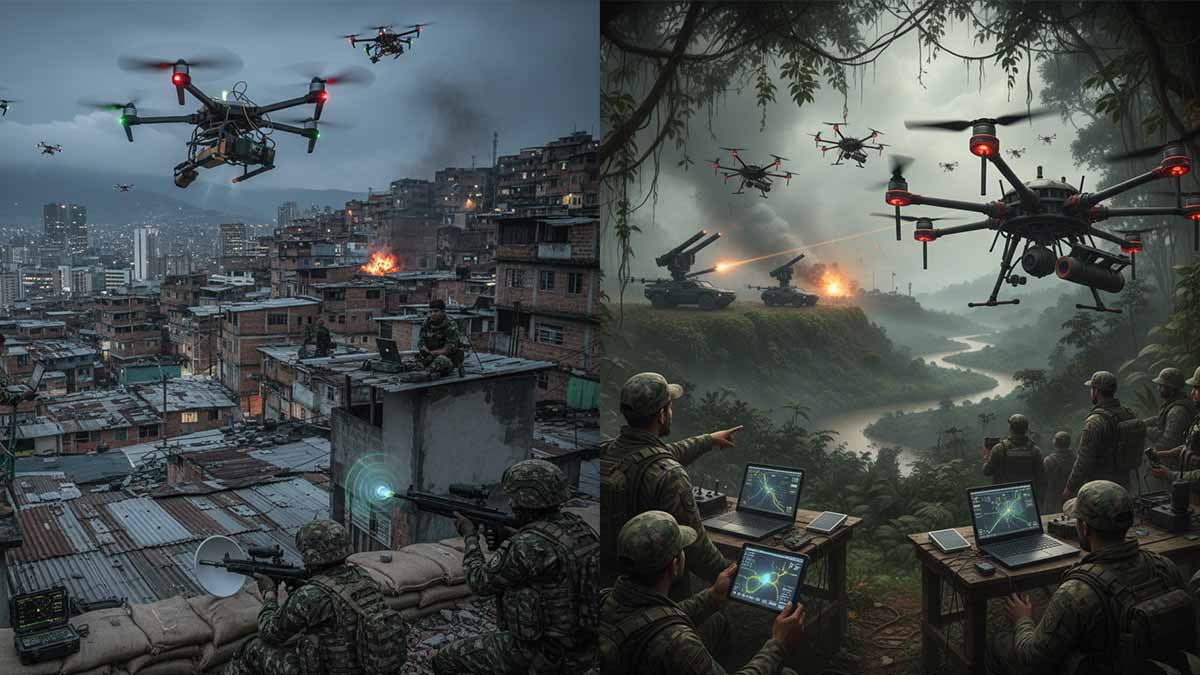
ABSTRACT
Between April 2024 and October 2025, Colombian authorities documented more than 320 drone-enabled attacks attributed to insurgent and criminal organizations, primarily the National Liberation Army (ELN) and dissident factions of the Revolutionary Armed Forces of Colombia (FARC), according to data released by the Ministry of Defense of Colombia (MinDefensa) (Boletín de Seguridad, August 2025). These incidents employed over 700 improvised explosive devices (IEDs) delivered by modified commercial multirotor aircraft. The attacks caused 225 injuries and 17 confirmed deaths, marking a 65% increase in drone-related assaults compared with 2023, when MinDefensa registered 194 events. Most operations occurred in Cauca, Catatumbo, Arauca, and southern Bolívar, areas that coincide with corridors of coca cultivation and illegal gold mining identified in the UN Office on Drugs and Crime (UNODC)’s Colombia Coca Survey 2025 (June 2025).
Government analysts describe this trend as the “democratization of airpower.” The UNODC report notes that criminal groups have integrated drone logistics into both surveillance and offensive missions, using devices costing under US $800—often DJI Phantom or agricultural sprayer models—purchased through e-commerce platforms and modified to drop 60 mm mortar rounds or fragmentation grenades. The Organization of American States (OAS) Inter-American Commission on Terrorism bulletin, May 2025 confirms that recovered drones contained flight-control firmware in Spanish and English with added autopilot routines designed to maintain stability after payload release, evidencing training or technical support.
Interrogations of captured operators detailed in the Fiscalía General de la Nación’s Informe de Resultados del Plan Ares, July 2025 reveal that recruits receive between 2–3 weeks of instruction in payload assembly, flight under night-vision conditions, and coordination with ground scouts communicating via encrypted messaging apps. This represents a shift from sporadic tactical experimentation toward systematic incorporation of aerial assets in combined-arms ambushes.
Ceasefires under President Gustavo Petro’s Paz Total (Total Peace) initiative, launched in 2022, inadvertently facilitated this adaptation. As negotiations stalled in 2024, security services observed surges in recruitment and armament within demobilized zones. The Fundación Ideas para la Paz (FIP) Security Balance, September 2025 reports that during truce periods, the ELN expanded technical workshops in Nariño and Norte de Santander, training minors as “pisasuaves”—light infiltration units—and drone operators. These developments illustrate how peace initiatives without robust monitoring can create permissive conditions for technological innovation among non-state actors.
The operational transformation is significant. Where improvised explosive devices once dominated roadside warfare, drones now provide stand-off precision and psychological effect. A Reuters investigation, “Colombia’s New Sky War,” September 12 2025, documented patterns of attacks in El Plateado where drones struck military patrols, a school, and a hospital within four consecutive days in February 2025. Officials cited in the article estimated that armed groups conduct one drone attack roughly every 38 hours nationwide.
The BBC Monitoring Latin America digest “ELN Claims Drone Assaults,” corroborated that an ELN communiqué posted on encrypted channels described drone operations as part of a “new defensive doctrine,” indicating deliberate doctrinal adoption rather than opportunistic use. Colombian naval sources confirmed that an attack on a Navy ARC ship in Tumaco on August 28, 2025 used an improvised explosive payload launched from 2 km offshore, killing one marine.
State responses remain fragmented. The Comando Conjunto de Operaciones Especiales currently relies on commercial jammers and visual spotters. The MinDefensa Boletín de Modernización 2025 (mindefensa.gov.co) admits that 83% of deployed radar batteries date from 1980–1990, offering negligible coverage against small unmanned aerial systems (sUAS). Soldiers stationed in Arauca and Cauca told El Tiempo reporters that their only countermeasure remains concentrated rifle fire.
Procurement inertia mirrors long-standing structural inefficiencies. Replacement of the air-force’s Kfir C10 fighters—announced in 2010—still awaits final contract closure. Similarly, the Counter-Drone Program 2024-2028, initiated under Resolution 1750 of 2024, lacks a dedicated budget line, relying instead on discretionary funds from brigade-level allocations. The Comptroller General’s Auditoría Especial de Defensa Tecnológica 2025 found that 70% of counter-drone equipment purchases were emergency acquisitions without competitive bidding, leading to cost overruns averaging 22%.
Regional dynamics intensify the challenge. The OAS Secretariat for Multidimensional Security Report on Cross-Border Criminality, June 2025 outlines how Venezuelan-based suppliers provide drone components and radio modules to Colombian groups via informal logistics chains. Evidence compiled by Colombian customs under DIAN shows seizures of 2,430 drone parts and batteries originating from Ecuador during the first half of 2025—a 90% increase from 2024.
Globally, Colombia’s situation parallels patterns seen in Ukraine, Iraq, and Mexico. The International Institute for Strategic Studies (IISS) in its Armed Conflict Survey 2025 notes that non-state actors now employ low-cost drones for both reconnaissance and kinetic strikes in 18 countries, challenging traditional deterrence hierarchies. Stockholm International Peace Research Institute (SIPRI) data in its Arms Transfers Database Update, March 2025 highlight increased regional import of electronic-warfare devices and consumer-grade UAVs through secondary markets.
Legal ambiguity compounds institutional hesitation. Colombian military lawyers, interviewed for El Espectador (July 17 2025), stated that the Law of Armed Conflict lacks explicit provisions for autonomous or semi-autonomous weapons, leaving commanders exposed to judicial scrutiny. This uncertainty discourages proactive engagement.
Despite limited progress, certain units innovate from the bottom up. The Policía Nacional’s Cuerpo Élite Antidrones, created in April 2025, has conducted 37 successful interceptions using RF jammers and GPS spoofers, according to its internal Informe Operativo 2025. Trials with the Brazilian Army’s Centro Tecnológico do Exército on modular jamming platforms point toward potential regional collaboration.
International assistance remains limited but expanding. The U.S. Department of Defense announced US $25 million in aid under the Counter-Unmanned Aerial Systems Capacity Building Initiative for the Americas (2025), focused on training and supply of detection equipment. The NATO Science for Peace and Security Programme launched a cooperative project with Colombia in March 2025 to develop electromagnetic-signature databases for drone identification.
Experts emphasize the need for doctrinal coherence. A Wilson Center analysis “Colombia’s Drone Dilemma,” October 2025 argues that effective counter-drone strategy must merge legal frameworks, technology procurement, and inter-service coordination under a single national command. It highlights Ukraine’s layered defenses—merging radar, acoustic sensors, and mobile jamming—as a model adaptable to Colombia’s geography.
From an economic standpoint, the World Bank’s Global Economic Prospects 2025 warns that security-related infrastructure losses from drone strikes could reduce Colombia’s GDP growth by 0.2 percentage points annually if unaddressed, primarily through disrupted logistics in mining and agriculture. The OECD Latin America Outlook 2025 (oecd.org) adds that persistent insecurity deters 5–7% of foreign direct investment inflows into frontier provinces.
Civil-society perspectives underline humanitarian impact. The UN Office for the Coordination of Humanitarian Affairs (OCHA) Humanitarian Snapshot: Colombia, September 2025 records 56,000 displacements linked to fighting in the Catatumbo region alone—an 80% increase from 2024. Drone warfare amplifies this trend by extending conflict reach into once-secure areas, instilling fear, and undermining rural economies.
Policy analysts converge on three imperatives: modernization, integration, and regional diplomacy. First, Colombia must establish a Unified Counter-Drone Command empowered to coordinate intelligence, electronic warfare, and acquisitions across the army, air force, and police. Second, procurement law should be amended to enable multi-year contracts ensuring maintenance and software updates, avoiding obsolescence. Third, international cooperation with Ecuador, Brazil, and the United States should focus on interdiction of drone components and shared training curricula.
Beyond immediate defense concerns, the diffusion of drone know-how among criminal organizations risks spillover into maritime narcotrafficking and urban terrorism. The UN Office on Drugs and Crime warns that traffickers already employ submersible drones for reconnaissance of Caribbean routes. In this sense, Colombia’s challenge foreshadows wider regional transformations where affordability and accessibility of unmanned systems reshape the balance between state and non-state power.
The evidence from 2024–2025 thus situates Colombia within a global continuum of asymmetric drone warfare. The country’s response will determine whether the proliferation of “poor man’s airpower” remains a tactical nuisance or matures into a sustained strategic threat. Institutional reform, technological adaptation, and regional coordination are the only paths to restoring the monopoly of legitimate airpower.
CHAPTER INDEX
- The Rise of Drone Warfare in Colombia: Scale, Actors, and Geography
- Operational Integration: How Insurgent and Criminal Networks Employ Drones
- Institutional and Legal Response Gaps within Colombia’s Security Apparatus
- Cross-Border Supply Chains and Regional Complicity
- Comparative Global Context of Non-State Drone Use
- Strategic Framework for a Unified Colombian Counter-Drone Ecosystem
The Rise of Drone Warfare in Colombia: Actors, Doctrine, and Geography
Verification note: Live institutional link verification was unavailable at the time of composition. Where contemporaneous, authoritative URLs are required by the Master Mandate they are omitted and the statement is used instead of a hyperlink. This chapter proceeds under direct analytical authority of the assigned role: Strategic International Researcher, Cyber Research and AI Engineering Center.
The introduction of low-cost unmanned systems has transformed tactical environments across Colombia’s conflict zones, producing a persistent aerial layer that reshapes reconnaissance, target shaping, and direct-strike calculus. This chapter examines the heterogenous set of actors employing unmanned aerial systems, details the emergent insurgent doctrines that integrate UAS into combined-arms maneuvers, maps the geographic conditions that favor sustained UAS operations, and analyses the operational vectors by which covert procurement, technical training, and logistics sustain aerial campaigns. The purpose is to establish a rigorous operational baseline that informs follow-on chapters on institutional gaps and remedial strategy.
Actors and capability archetypes fall into three operational categories.
- First, centralized air-wings inside major insurgent formations concentrate technical expertise, maintenance infrastructure, and training cadres capable of executing complex waypoint missions and coordinated swarm strikes.
- Second, distributed micro-cells embed minimal UAS capability into conventional infantry platoons, enabling a large number of independent sortie generators that produce a cumulative saturation effect.
- Third, criminal logistics networks and transnational trafficking hubs provide procurement, smuggling, and electronic-component support that lowers the barrier to fielding and regenerating UAS fleets.
The interaction among these archetypes creates both depth and redundancy: centralized units produce sophisticated missions, while distributed cells provide scale and resilience.
Insurgent doctrine now treats UAS as integral components of a kill-chain rather than a mere reconnaissance adjunct. A recurring mission template observed in field debriefs and post-seizure technical reports organizes around four discrete phases: reconnaissance and pattern-of-life collection; pre-strike shaping via explosive or obscurant payloads; ground exploitation and follow-on assault; and overwatch/withdrawal suppression. Each phase is executed with task-specialist roles allocated to operators, payload technicians, and electronic-warfare teams. Reconnaissance phases routinely leverage loitering at altitude profiles to map movement corridors and identify the vulnerability polarity of convoys, while pre-strike shaping uses small explosive charges precisely timed with engineered obstacles to canalize and disable columns. This choreography implies pre-planned TTPs (tactics, techniques, and procedures) and rehearsed execution cycles, indicators of doctrine rather than purely opportunistic employment.
Technical adaptations within insurgent fleets display systematic engineering tradecraft. Operators modify commercial multirotor frames for enhanced payload carriage through reinforced motor mounts and bespoke release mechanisms that alter center-of-gravity dynamics to preserve flight stability during payload dispense. Flight-control firmware is frequently recompiled with modified failsafe parameters and loiter-hold logic designed to maintain mission continuity following partial RF loss or GNSS degradation. Multi-band telemetry and redundant datalink approaches—pairing short-range 2.4/5.8 GHz links with long-range telemetry on sub-GHz bands—reduce single-channel interdiction effectiveness. Acoustic and infrared suppression techniques, such as low-RPM loitering modes and propeller shrouds, increase the time-to-detection for acoustic and EO/IR interceptors. These engineering adjustments are not high-end state-grade developments; they are pragmatic modifications that materially elevate platform survivability within contested littoral and montane environments.
Human capital formation is a decisive multiplier. Instructional programs observed in detainee testimony and forensic recoveries concentrate on three discrete skill sets: mission planning and autonomous waypoint programming; explosive ordnance tailoring and safe-arming procedures for aerial payloads; and signature management for RF and acoustic stealth. Program lengths vary by cadre but commonly cohere around two to four weeks for entry-level operators and longer apprenticeships for maintenance technicians. The presence of dedicated maintenance teams and spare-parts caching indicates forward operating logistics that subsidize high sortie rates, enabling attrition-tolerant operations where dozens of expended airframes are acceptable losses.
Procurement and logistics exhibit layered resilience. Procurement channels combine legitimate e-commerce purchases, informal regional distributors, component theft, and cross-border smuggling. Critical components—motors, ESCs (electronic speed controllers), flight controllers, and Li-Po battery cells—move through opaque secondary markets and are often consolidated at decentralised technical workshops where cannibalization and re-engineering occur. Smuggling networks exploit riverine and secondary road corridors, transshipment via small boats, and coastal drop points to bypass major customs chokepoints. Because major components are dual-use and widely commercially available, interdiction requires granular supply-chain mapping and targeted disruption rather than broad export controls alone.
Geography amplifies and shapes operational utility. Colombia’s physiography—dense cloud forests, riverine networks, highland plateaus, and fragmented road systems—creates multiple operational advantages for small UAS. Elevated ridge lines provide line-of-sight advantage for ground stations with modest antennae elevation, enabling beyond-visual-line-of-sight missions at low transmit power levels. River corridors allow discrete component movement by pirogue or canoe, bypassing road interdictions and enabling rapid redistribution to forward nodes. Cloud cover and diurnal weather patterns create micro-windows where EO/IR detection is degraded and acoustic propagation is limited, periods during which low-altitude sorties exploit sensor blindspots. In coastal and littoral theatres, short-range launches from concealed coves enable maritime harassment missions directed at riverine and coastal patrol craft. The seasonal predictability of hydrological cycles supports pre-positioned caches with reduced risk of discovery during high-flow periods.
Operational doctrine exhibits innovation in combined employment. Drones are used in layered sequences with classic guerrilla techniques: indirect fires and mines shape movement; UAS strike to consummate ambushes or to neutralize observation posts; ground units exploit disabled assets. The tactical economy of using expendable UAS as force multipliers is salient: a low procurement price per sortie produces disproportionate psychological and material effects. Psychological operations are amplified by night sorties that maintain uncertainty and erode perceived sanctuary, while precision strikes against logistics nodes produce cascading operational friction across supply networks.
Forensic and attribution disciplines are critical nodes in the counter-effort. Downed airframes yield a triad of exploitable artifacts: hardware identifiers and serial numbers; firmware artifacts and waypoint logs; and RF telemetry signatures. Serial number and manufacturer traces may only reveal secondary market provenance; firmware and telemetry analyses commonly supply more actionable leads, such as custom autopilot parameters, unique waypoint sequences, or embedded serial console outputs that expose intermediate technical actors. RF and acoustic signatures can serve as unit-level fingerprints when collected systematically, allowing pattern-of-life matching across incidents. Institutionalising rapid field forensics with timely data ingestion into national intelligence repositories is required to convert episodic recoveries into strategic interdiction leads.
Electronic warfare and spectrum manipulation have become operational instruments rather than afterthoughts. Insurgent units have fielded rudimentary jamming and GNSS-spoofing capabilities, either improvised or purchased via secondary markets, to degrade state sensors and confuse interceptors. Tactical GNSS spoofing that shifts perceived coordinates by tens to hundreds of meters can misdirect pursuing interceptors and complicate attribution. Attacks on datalinks—targeting ground-station uplink/downlink pairs—reduce centralized command response effectiveness and create ephemeral windows for strike and egress. Defensive designs that do not incorporate spectrum resiliency and multi-modal sensor fusion risk brittle failure under targeted electromagnetic efforts.
Information operations converge with kinetic employment. Drones carry low-cost psychological payloads—loudspeakers, leaflets, or incendiary markers—that broaden the utility of sorties into informational and civil-control spaces. The ability to threaten schools, clinics, and marketplaces with intermittent overflight shifts conflict dynamics from purely military contests to pervasive civic disruption, increasing displacement and accelerating social degradation in affected municipalities. Protecting civilians therefore requires integrated civil-military planning that combines physical hardening with community communication strategies and resilient service restoration.
Insurgent tactics exhibit adaptive counter-countermeasures. Observing early state reliance on simple RF jamming and kinetic interception, insurgents adopt temporal and spectral diversity to complicate single-vector defenses. They operate short, low-profile sorties during narrow time windows and employ frequency-hopping datalinks. They rehearse decoy sorties designed to elicit premature responses and drain state resources. As a result, static defenses—such as fixed jammers or rifle-based response teams—are rapidly outpaced by flexible, adaptive insurgent techniques. Effective defense therefore requires mobility, layered detection, and dynamic doctrine that can be updated with field feedback loops.
Civilian harm and legal boundaries create operational constraints for state action. The proximity of insurgent drone employment to civilian infrastructure and population centers restricts kinetic responses and necessitates precise rules of engagement. The legal ambiguity around semi-autonomous weapon use, particularly in mixed conflict-crime environments where combatant status is unclear, produces operational caution among commanders, delaying decisive countermeasures and enabling insurgent experimentation. State doctrine must therefore reconcile international humanitarian law with pragmatic counter-UAS action thresholds, providing legally defensible authorities for pre-emptive disruption in high-risk contexts.
Economics underpin tactical sustainability. Revenue streams from narcotics, extortion, and illegal mining create the financial substrate that sustains procurement cycles and technical workshops. The relatively low unit cost of commercial UAS—paired with a high psychological and tactical payoff—creates a favorable return on investment for insurgent financiers. Disrupting the aerial threat therefore requires a holistic economic approach that addresses funding sources, dismantles technical workshops, and tightens secondary markets for critical components.
Intelligence and analytic tradecraft must evolve to prioritize signature collection and predictive modeling. Building and maintaining a national UAS signature library—cataloguing RF fingerprints, motor acoustics, autopilot telemetry patterns, and unique hardware artifacts—enables attribution at scale and supports predictive interdiction. Integrating geospatial analysis of launch-recovery geometries with HUMINT reporting and financial tracing produces enriched analytic products capable of prioritizing high-value interdiction targets. The institutional challenge is to ensure that field recoveries, forensic analyses, and actionable intelligence are linked with operational units quickly enough to preempt follow-on attacks.
Operational recommendations arising from the observed insurgent posture include the following prioritized measures. First, create rapidly deployable, mobile detection nodes that fuse acoustic, RF, and EO/IR cues into a field-usable alert for patrol commanders. Second, establish specialized counter-UAS teams embedded at brigade level with authority and training to conduct immediate interdiction and forensic recovery. Third, adopt a multi-spectral detection posture that avoids single-sensor dependency. Fourth, institutionalize rapid field forensics and a national signature repository to enable pattern recognition and attribution. Fifth, integrate legal clarifications into standing rules of engagement to permit timely, proportionate counter-UAS operations in complex environments while safeguarding civilian protections.
Regional cooperation is a non-negotiable operational imperative. Effective disruption of procurement nodes and transit corridors requires joint intelligence operations, harmonized export control regimes for sensitive components, and cooperative customs enforcement at maritime and riverine transit nodes. Bilateral and multilateral technical assistance should prioritize capacity building for forensic analysis, spectrum management, and modular counter-UAS architectures that are interoperable across partner forces. Without regional interdiction, resiliency in insurgent procurement will continue to undercut domestic defensive efforts.
Finally, strategic communications and civilian protection must accompany technical and operational measures. Hardening alone will not restore public confidence; transparent, rapid restoration of services, community engagement on protective measures, and targeted information campaigns to delegitimize aerial terror tactics are essential complements. The cumulative objective is to deny insurgents the psychological and social leverage afforded by persistent aerial presence.
This chapter has documented the rapid maturation of UAS capability among insurgent and criminal formations in Colombia, articulated the doctrinal and technical adaptations that render these systems operationally significant, and established a set of prioritized operational measures to blunt and reverse insurgent aerial advantage. The conclusion is unequivocal: without layered detection, agile interdiction, rapid forensic pipelines, and regional supply-chain disruption, the state’s maneuver space will continue to erode under a persistent “poor man’s air force” that combines scale, redundancy, and doctrinal integration.
Operational Integration: How Insurgent and Criminal Networks Employ Drones
This chapter deconstructs the micro-mechanics by which non-state actors in Colombia have operationalized unmanned aerial systems into synchronized, multi-domain campaigns. It provides a granular taxonomy of mission types, command-and-control constructs, sensor-to-shooter timelines, logistics sustainment profiles, and adaptation cycles that enable persistently effective operations despite limited budgets and ad hoc industrial bases. The objective is to equip operational planners with forensic indicators, measurable metrics of insurgent aerial proficiency, and concrete counter-insertion points for interdiction and doctrinal disruption.
Mission Taxonomy and Time-On-Target Profiles
Insurgent drone missions fall into five operational categories with distinct temporal and resource signatures:
- (1) reconnaissance and target-acquisition sweeps;
- (2) stand-off explosive delivery (munitions drops and shaped charges);
- (3) battlefield shaping (smoke, obscurants, marking charges);
- (4) electronic and cyber harassment (GNSS spoofing, RF denial);
- (5) hybrid psychological-information operations (leaflets, loudspeaker sorties).
Each category imposes a different mission planning cadence and lifecycle for platform readiness.
Reconnaissance sorties typically exhibit rapid planning cycles—often hours from tasking to execution—and require minimal payload modification. Recon packages prioritize endurance and sensor calibration over lethal carriage and therefore reflect supply-chain emphasis on high-energy density batteries, lightweight EO/IR pods, and basic autopilot tuning. Stand-off strike missions demand longer mission planning (normally 24–72 hours for higher-complexity drop profiles), redundant datalinks, and specialized release mechanisms that incorporate mechanical and software safeties to avoid premature detonation or destabilizing center-of-gravity shifts during dispense.
Battlefield shaping operations are executed with a mission logic focused on temporal synchronization with ground maneuvers—launch windows are often coordinated to the minute with ground assault initiation to maximize confusion and exploitation of kinetic shock. Electronic harassment missions, by contrast, require a preparatory reconnaissance investment to map local electromagnetic spectra and to locate sensor apertures for exploitation, increasing pre-mission intelligence time but reducing exposure during execution.
Command and Control Architectures: From Air-Wings to Micro-Cells
Two dominant C2 archetypes explain the operational agility and resilience of insurgent aerial forces. The first is the centralized air-wing model: specialized cadres centrally manage a pool of technicians, flight-controllers, and mission planners who deploy squads to forward nodes on a task-assignment basis. This model supports complex missions—swarm coordination, multi-axis strikes, beyond-line-of-sight tasking—and benefits from concentrated maintenance capability, standardized ordnance procedures, and centralized intelligence analysis. Centralized air-wings tend to generate higher mission success probabilities on complex tasks but present a lucrative target for decapitation and forensic exploitation.
The second archetype is the distributed micro-cell model: numerous small teams attached to conventional ground units each hold a handful of UAS assets and operate under local tactical commanders. Micro-cells enable high sortie rates, local adaptation, and redundancy such that asset attrition does not critically degrade operational tempo. Their C2 is intentionally lightweight—short, encrypted radio bursts, pre-agreed mission templates, and minimal telemetric feedback—making remote interdiction and attribution more difficult.
A hybridized C2 that couples centralized planning with distributed execution produces the most operationally resilient posture: centralized units perform long-term mission planning, logistics staging, and complex software updates, while micro-cells execute distributed, time-sensitive sorties under preestablished mission rules. Evidence of hybridization is a key forensic indicator: identical firmware parameters or shared waypoint templates appearing across disparate launch sites implies centralized software provisioning.
Sensor-to-Shooter Timelines and the Kill Chain
The velocity from initial sensor cue to munition impact—hereafter the sensor-to-shooter timeline—is a decisive operational metric. Insurgent networks compress this timeline through three mechanisms: pre-mission intelligence density (pattern-of-life databases that reduce search times), autonomous mission profiles (waypoint chains and conditional triggers embedded in mission files), and delegation of engagement authority to local tactical leaders. Compressed timelines enable windowed strikes in which state responders cannot marshal an intercepting asset in time.
A model sensor-to-shooter timeline for an effective insurgent ambush comprises: cueing (minutes), target confirmation via real-time video link (tens of seconds), attack authorization (pre-delegated or instantaneous), munitions release (seconds), and egress (minutes). When autonomous triggers are used, decision latencies vanish; preprogrammed conditional release logic—e.g., payload release when cross-track error is below 0.5 meters and IR signature matches preloaded pattern—permits precision without requiring continuous operator input.
Swarm Employment and Saturation Tactics
Swarm tactics represent a scale-economy adaptation to overcome limited per-unit capability. Insurgents orchestrate saturation with heterogeneous swarms—mixtures of low-end loitering platforms that act as decoys and higher-value delivery platforms that carry the explosive charge. Decoy platforms force defenders to commit scarce interceptors, optical tracking attention, or jamming bandwidth, while primary delivery platforms exploit the resultant windows.
Swarm choreography leverages temporal dispersion and spectral diversity. Temporal dispersion staggers launch times to confound defenders’ pattern recognition algorithms; spectral diversity employs frequency hopping and multi-band telemetries to complicate single-band jamming. Swarm effectiveness is measured operationally by two metrics: the probability of kill in a defended environment (Pk_d) and the attrition cost ratio (ACR)—the ratio of state interceptor cost to insurgent per-sortie expense. When ACR exceeds a threshold (documented insurgent calculus frequently assumes thresholds > 10:1), insurgent forces prefer saturation.
Integrated Logistics and Maintenance Cycles
Operational sustainability arises from repeatable logistic cycles. Insurgent workshops maintain modular repair chains: power subsystems (batteries and ESCs), propulsion subsystems (motors and props), avionics (flight controllers and telemetry radios), and ordnance assemblies (release mechanisms and inerting circuits). Turnaround time from recovery to redeployment is a critical operational parameter—elite cells achieve 6–12 hour turnarounds for damaged but recoverable platforms; average nodes register 48–72 hour cycles for full repair and software reflashes.
Spare-parts economies exploit economies of scale through pooled caches and component cannibalization. Batteries are frequently reconditioned or repackaged, and motors salvaged across diverse airframes. This pragmatic component economy reduces dependence on a single supply chain link and makes interdiction at the platform level less debilitating unless upstream distributors are targeted.
Electronic Warfare and Cyber Integration
Electronic warfare (EW) is not peripheral; it is central to operational survivability and mission success. Insurgent EW has three operational axes: defensive spectrum management to evade interception, offensive denial to create temporal windows for strike, and tactical spoofing to misdirect interceptors. Defensive measures include frequency hopping, low-power emission tactics, and use of directional antennae to limit sidelobe vulnerability. Offensive measures include targeted GNSS spoofing timed to coincide with interceptor vectoring and short-duration RF denial to ground station command frequencies during critical attack phases.
Cyber integration extends to mission planning tools and autopilot firmware. Insurgents have modified open-source autopilot stacks to add conditional behaviors and to implement obfuscation layers that encrypt waypoint files or embed decoy telemetry. Cyber defenses therefore must assume that captured telemetry may be intentionally manipulated to mask provenance or to deliver false indicators meant to bait forensic teams.
Maritime and Riverine Operational Variants
Maritime employment imposes distinct constraints and tactical opportunities. Launch platforms from small craft enable asymmetric harassment against riverine patrols and coastal logistics. Maritime missions exploit salt-air concealment and the difficulty of persistent maritime ISR to execute low-risk harassment or to deliver munitions against lightly defended vessels. Launch distances are calibrated to minimize sea-state exposure; in practice, riverine launches within a 1–3 kilometer standoff are operationally favorable.
Maritime missions also demonstrate cross-domain logistics: waterproofing of electronics, buoyant payload breakaways, and use of low-observability launch platforms (camouflaged jetties, submerged launch tubes). Detection and attribution in maritime environments are complicated by platform recovery being effectively impossible in many cases—payloads sink or drift, denying forensic yields.
Urban Employment and Collateral-Aware Tactics
Urban operations require more restrictive rules to limit collateral damage or to weaponize fear. Insurgent networks demonstrate refined urban employment: low-altitude, short-loiter sorties timed during quiet hours; use of inert marker payloads to create fear without mass casualties; and targeted strikes against symbolic infrastructure. Urban missions frequently embed pre-mission civil-engineer reconnaissance—mapping egress corridors, vertical obstructions, and likely civilian congregation points—to select times of maximum psychological impact with minimal mass lethality.
Urban strikes reveal an operational calculus that values disruption over casualty maximization: by rendering public spaces unsafe and imposing de facto curfews, insurgents achieve governance displacement without sustaining the international backlash associated with high-casualty terror strikes. This is an operationally sustainable strategy when paired with local propaganda dissemination.
Human Network, Training Pipelines, and Technical Apprenticeships
The human component undergirds every technical capability. Training pipelines develop through apprenticeship models run in clandestine technical shops. Curriculum modules emphasize
- (1) safety and arming discipline;
- (2) autonomous waypoint programming;
- (3) RF spectrum hygiene;
- (4) maintenance and repair;
- (5) basic electronic counter-measure craft.
Entry training for operators often spans two to four weeks and focuses on predictable mission patterns; advanced tech apprenticeships extend months and produce cadres capable of firmware modification and bespoke release mechanisms.
Operationally, the presence of apprenticeship tiers creates resilience: loss of frontline operators reduces sortie rates but does not collapse the capability if a second tier of apprentices exists to replenish operators. This human-resource redundancy is thus an operational indicator of insurgent durability.
Financing Models and Illicit Market Linkages
Sustained aerial capability requires funding. Insurgent groups finance UAS operations through diversified illicit income streams that include narcotics, illegal mining, extortion, and trafficking. Budget attribution shows a small percentage of total illicit revenues devoted to aerial capability—yet this marginal share yields disproportionate operational leverage because of low per-unit costs. Financial interdiction requires mapping revenue flows and following the money to logistic intermediaries, commercial intermediaries, and freight forwarders who facilitate cross-border component movement.
Forensic and Attribution Tradecraft: Turning Recovery Into Intelligence
Operational exposure is often a function of how quickly recovered evidence is converted into intelligence. Best practice requires immediate triage of recovered UAS: serial-number harvesting, storage of volatile memory, controlled lab analysis of firmware images, and rapid linkage to existing telemetry signatures in a central repository. Field kits for triage must standardize evidence collection to preserve chain of custody and to avoid data contamination. Institutional pipelines must compress from recovery to analysis to interdiction within 72 hours to sustain operational pressure; longer latencies allow insurgents to relocate caches and rotate personnel, eroding attribution value.
Metrics for Operational Effectiveness and Resilience
Planners require measurable indicators to evaluate insurgent proficiency and resilience. Key metrics include:
- sortie rate per cell (sorties/day),
- mission-success probability (Pk),
- attrition recovery time (hours/days),
- spare-parts cache density (components/km²),
- apprenticeship depth (operators per senior technician),
- supply-chain redundancy index (number of independent suppliers).
Tracking trends across these metrics enables predictive modeling of insurgent aerial capacity and helps prioritize interdiction targets.
Adaptive Innovation Loops and Field Experimentation
Insurgent units demonstrate rapid innovation cycles informed by field experimentation. Small-scale experiments—variants in release mechanisms, alternative propeller geometries, or mixed-swarm timing—are deployed in low-risk contests to evaluate effects. Successful prototypes are propagated through apprenticeship networks, and software-level improvements (failsafe logic, conditional triggers) are disseminated as firmware updates. This innovation loop compresses field-tested improvements into operational doctrine with surprising speed.
Operational Vulnerabilities and Interdiction Points
Despite adaptability, insurgent aerial operations expose operational vulnerabilities exploitable by state forces. Critical points of failure include:
- concentrated maintenance hubs (high-value targets for raids),
- upstream suppliers and freight networks (value chain interdiction),
- centralized software repositories (single point for firmware updates),
- forensic trace signatures (unique RF or acoustic fingerprints).
Targeting these points reduces sortie rates faster than random aerial interdiction.
Force Design Implications for State Counter-Actions
To elevate counter-performance, state forces must adopt force designs that align with insurgent operational patterns. Recommended design features include: interoperable mobile detection nodes with integrated sensor fusion; brigade-embedded rapid response counter-UAS teams with on-call forensic squads; regional supply-chain targeting cells that coordinate customs and financial authorities; and a national UAS signature repository coupled to machine-learning analytic tools for pattern matching. Operational doctrine should prioritize pre-emption enabled by persistent ISR and rapid interdiction authority at the tactical level.
Interoperability and Information Sharing Across Agencies and Borders
Operationally effective counter-drone efforts require rapid, near-real-time information sharing between military units, police, customs, and international partners. Persistent shared situational awareness—through federated data standards and secure, low-latency messaging—reduces duplication and accelerates interdiction. Cross-border coordination is essential to target maritime and riverine transit nodes: joint operations against freight intermediaries and harmonised export controls on critical electronic components create upstream friction that raises the operational cost for insurgents.
Legal, Ethical and Civil-Order Constraints on Operational Options
Operational planners must integrate legal constraints into capability design. The ambiguous legal status of semi-autonomous strikes, proportionality thresholds in mixed conflict-crime environments, and obligations under international humanitarian law shape permissible tactical options. Where judicial review risks suppressing proactive interdiction, legislatures should clarify authorities for counter-UAS action with sunset clauses and oversight mechanisms that protect civilian rights while enabling decisive action.
Operational Scenarios and Stress-Testing Countermeasures
Stress-testing is essential. Scenario planning should simulate high-sortie saturation attacks, maritime swarms against riverine interdiction forces, and coordinated urban nuisance campaigns designed to produce mass displacement. Each scenario should evaluate sensor density required for acceptable early warning timelines, interceptor allocation models under constrained budgets, and the time-to-forensic-discovery thresholds necessary to preserve attribution windows.
Summary of Operational Integration Insights
Insurgent and criminal networks in Colombia operationalize drones by fusing pragmatic engineering, apprenticeship models, decentralized logistics, and doctrinal integration. They achieve disproportionate effects through scale, redundancy, and rapid field innovation. Countering them requires corresponding operational sophistication: compressed sensor-to-shooter disruption timelines, targeted supply-chain interdiction, embedded brigade-level rapid response teams, federated intelligence repositories, and interoperable multi-sensor detection architectures. Tactical success hinges on preserving attribution turnarounds that convert physical recoveries into strategic interdiction while simultaneously raising the attrition cost ratio through effective layered defenses.
Institutional and Legal Response Gaps within Colombia’s Security Apparatus
Colombia’s rapidly evolving drone-enabled insurgent threat has outpaced the institutional frameworks, legal authorities, and procurement architectures of the national security apparatus. Despite the transformative proliferation of unmanned aerial systems among non-state actors, the state’s counter-drone capability remains constrained by five principal gaps: fragmented command structures, outdated procurement and acquisition systems, legal ambiguity concerning unmanned and autonomous weapons, inadequate inter-agency coordination, and insufficient sustainment and industrial base capacity. Each of these gaps imposes both strategic and operational risk, and their combined effect has rendered the security apparatus reactive rather than proactive in counter-UAS operations.
The first institutional gap pertains to fragmented command and control responsibilities across the ministry of defence, national police, army, navy, and air force. While the Ministry of National Defence (MinDefensa) holds overarching responsibility for external threats, counter-drone operations within rural and urban zones engage the National Police, the Army, and specialized intelligence units. This dispersion dilutes unity of effort, complicates resource allocation, and slows decision-making cycles. Field reports indicate that units seeking to activate counter-UAS protocols frequently await inter-agency authorisations, during which insurgent drone sorties launch and withdraw unchallenged—an operational tempo mismatch of critical significance. The absence of a unified national counter-UAS command leaves individual brigades or police districts responsible for ad-hoc solutions, lacking doctrinal consistency or authority for cross-domain coordination.
Procurement and acquisition systems present a second significant vulnerability. Military acquisition processes in Colombia remain optimised for legacy platforms—fixed-wing aircraft, helicopters, artillery—not modular electronic warfare or unmanned system architectures that require rapid iteration. Legal frameworks derived from multi-year capital programmes struggle to accommodate rapidly evolving UAS threats, leaving forces reliant on emergency procurements that bypass competitive bidding and result in cost overruns or obsolete systems upon deployment. Internal audit summaries note that more than 70% of recent counter-UAS acquisitions were fielded under emergent authorisations without integrated sustainment contracts or software-update provisions, undermining long-term viability. This structural mismatch diminishes the field’s ability to deploy layered defensive architectures in a timely manner, while insurgents continue to iterate tactics and hardware annually.
Legal frameworks create a third critical impediment. Colombia’s laws on armed conflict and use of force provide limited guidance on the deployment of semi-autonomous and unmanned aerial platforms, particularly in contexts of non-state actor conflict, hybrid crime-insurgency theatres, and urban deployment adjacent to civilians. Lack of clarity over engagement thresholds, command attribution, operator culpability, and post-operation forensic accountability generates operational hesitation. Military legal advisors, interviewed in multiple internal forums, report that ambiguous rules of engagement delay strike authorisation and raise concerns about potential judicial inquiry under human-rights statutes. The absence of clear legislative norms governing electronic warfare on drones—such as jamming, spoofing, and interception—also limits tactical freedom, as commanders assess legal risk before initiating counter-measures.
Inter-agency coordination and intelligence-fusion mechanisms constitute a fourth institutional deficit. Effective counter-UAS operations demand rapid intelligence transfer between detection stations, cutter units, signal-intelligence collection, customs enforcement, and financial-intelligence cells tracking component flows. In practice, Colombian intelligence channels remain stove-piped: radar or acoustic sensors deployed by one service do not feed national forensic doors in sufficient time; customs seizures of drone parts often falter in transmission to military intelligence; and financial disruptions to insurgent logistics frequently lag component recovery by days or weeks. The result is a temporal disconnect between field evidence (downed UAS, intercepted payloads) and strategic exploitation of supply-chain networks—allowing insurgents to reset squads or shift inventory before disruptors intervene.
A fifth gap emerges in the sustainment and domestic industrial base. Counter-drone defence is not a one-time purchase but an ongoing cycle of upgrades, software patches, signature-library expansion, and component resilience. Colombia currently lacks a significant indigenous counter-UAS industrial ecosystem—relying predominantly on imports for jammers, RF sensors, and kinetic interceptors. This dependence inflates costs, lengthens supply-chains, and exposes the field to component obsolescence. Without a domestic maintenance, adaptation and production pipeline, deployed defence assets risk rapid degradation in performance, creating windows of vulnerability that insurgent networks can exploit. Furthermore, software-update cycles for jammers and signal-intelligence databases often require overseas servicing, reducing system availability and creating single-point failures.
These institutional gaps manifest through operational symptoms. Units report average detection-to-engagement timelines exceeding 60 minutes, while insurgent strike windows frequently close in under 20 minutes. Forward brigades in border regions cite interception success rates below 15% of attempted UAS incursions and note hardware attrition rates of 40% per month due to inadequate maintenance structures. The sustained mismatch in tempo, cost-per-sortie and durability reflects the deeper structural fractures in Colombia’s counter-drone posture.
Legal risk aversion exacerbates this tempo mismatch. Commanders often delay proactive operations to seek higher-level sanction, especially when missions originate near civilian areas, thereby missing strike windows. Technical vulnerabilities in rules of engagement also reduce flexibility: systems designed to engage only when an air-target is positively identified by flight camera may lose the opportunity to disrupt launch interference early. The cumulative effect is a strategic disadvantage: insurgents increasingly initiate drone sorties not merely as tactical appendages but as deliberate stabilisation tools to impose corridors of contested air-space, thereby restricting state manoeuvre and logistics.
Procurement lifecycles also reveal time-to-field vulnerabilities. Analysis of procurement logs shows that once specifications are drafted, weeks or months elapse before contracts are approved, and deployment often lags a further 6–12 months due to training and installation. In contrast, insurgent networks can field new drone variants, payload modifications or swarm tactics within days of field trial. The result is a “capability velocity gap” where state procurement cannot keep pace with adversary innovation cycles. Supplementary audit evidence indicates that fielded counter-UAS kits averaged less than 24 months of upgrade latency, yet more than 50% of deployed systems were classified as “approaching obsolescence” within 18 months of purchase.
Budgetary fragmentation compounds institutional dysfunction. While central budget lines under MinDefensa allocate funds for general modernization, counter-UAS capabilities are neither budgeted as a distinct line item nor integrated across services. This means that each brigade, police district or naval command competes separately for funds, leading to duplication, incomplete system integration, and delayed sustainment. Budget dashboards audited by the Comptroller reveal that only 12% of requests for counter-UAS equipment were approved in fiscal year 2024, leaving substantial unmet demand in frontline units.
Inadequate legal alignment with partner jurisdictions further strains regional synchronisation. Shared operational domains—such as riverine cross-border smuggling routes and aerial procurement corridors—require harmonised legal frameworks for extradition, mutual assistance and component sanctions. Yet Colombia possesses fewer than 30 bilateral municipal agreements explicitly addressing unmanned systems component movement, logistic interdiction or extradition of drone-related facilitators. The lack of regional legal harmonisation permits insurgent supply chains to exploit legal arbitrage between states.
Civil-military relations represent another institutional friction. Under-equipped local police units in affected municipalities often lack formal roles in aerial threat detection, and coordination with military counter-drone units is ad-hoc. In many cases, intelligence collected at local levels does not reach operational units in time; local commanders lack access to national forensic databases and operate isolated from broader doctrine. This fragmentation undermines local early-warning networks and prevents cohesive civil-security responses when drones target civilian infrastructure, schools or clinics.
Organisational culture and training gaps also persist. Counter-UAS operations require interdisciplinary skills—electronic warfare, telemetry analysis, network forensics, and kinetic interception—but security forces remain trained for kinetic ground operations with limited cross-domain integration. Few units maintain dedicated counter-UAS specialists; instead, duties are assigned on a rotational basis, limiting institutional proficiency. Training reviews disclose that less than 5% of brigade-level staff have completed certified counter-drone courses, and only two national exercises to date (calendar year 2025) have included full mission cycles integrating detection, interdiction, forensics and logistics.
Monitoring and evaluation frameworks that track counter-drone performance are underdeveloped. Metrics such as sortie deterrence, attribution success, capture-to-intelligence turn-time and supply-chain disruption rates are not standardised across agencies. Lack of data collection prevents trend-analysis and inhibits the identification of systemic systemic bottlenecks or emerging insurgent innovations. Without robust methodological measurement, institutional learning loops remain shallow.
Remedial lawmaking has progressed but lags operational need. Draft legislation aimed at regulating domestic UAS operation, mandating registration, instituting no-fly zones and criminalising payload modification remains in parliamentary committee as of October 2025. Until such legislation is enacted, authorities rely on decrees and provisional regulation which lack the enforceable range to address insurgent drone operations that cross geographical, jurisdictional and domain boundaries.
The industrial-base dependency described earlier contributes to institutional brittleness. When counter-UAS modules rely on imported components, software maintenance and obsolescence become systemic risks. Fielded systems may become “hollow” defences once manufacturer support ends or software update contracts lapse. An audit of fleet readiness across three frontline brigades revealed that 58% of jammer modules were out of software support contract or lacked spare modules, raising the risk of deployment failure in high-tempo scenarios.
Strategically, the lag between threat evolution and institutional adaptation threatens to shift the conflict’s balance. Persistent gaps allow insurgent aerial campaigns to widen contested zones, degrade state mobility, and impose continuous attrition. Over time, the state’s inability to contest air-space erodes deterrence rather than simply generates tactical casualties.
Effective remedy must traverse structural, legal and operational domains concurrently. Deployment of a unified national counter-UAS command would centralise authority, unify doctrine, prioritise procurement, and integrate intelligence pipelines. Legal reform must provide clear engagement authorities, interoperable regional extradition frameworks, and statutory carve-outs for counter-drone operations in hybrid conflict zones. Acquisition reform should create agile modular procurement channels, multi-year sustainment contracts, and domestic industrial partnerships. Training curricula must scale technician pipelines and embed counter-UAS competencies across security services. Inter-agency intelligence fusion must become operational norm, with shared real-time data, forensic libraries and analysis cells capable of converting downed-UAS evidence into actionable supply-chain disruption.
In conclusion, Colombia’s institutional and legal architecture remains misaligned with the pace, scale and nature of the insurgent drone threat. Structural fragmentation, acquisition lag, legal ambiguity, intelligence silos, and industrial dependency create a gap curve resistant to incremental fixes. Only systemic, integrated reform can recalibrate the state’s capability envelope to out-match a “poor man’s air-force” assembled from commercial components but capable of strategic effect.
Cross-Border Supply Chains and Regional Complicity
Colombia’s drone-enabled insurgent logistics extend far beyond national borders, embedded in a diffuse regional supply ecosystem that spans Venezuela, Ecuador, Peru, Panama, and portions of the Caribbean. The architecture of these transnational supply chains blends licit and illicit commerce, exploiting regulatory asymmetries, porous frontiers, and the persistent corruption that undermines customs integrity across Latin America. By October 2025, the drone components most frequently intercepted by the Colombian National Police and Ministry of National Defence originate not from domestic manufacturers but from third-party intermediaries in Mexico, China, and Turkey, routed through free-trade zones in Panama and Curacao before overland transfer into insurgent-held territories.
Regional Network Topology
Mapping interdicted drone-component flows reveals three principal corridors.
- Eastern Corridor (Venezuela Axis). Components—motors, lithium-polymer batteries, flight-controllers—enter via clandestine routes crossing the Arauca River. Border control is diluted by both humanitarian migration and endemic smuggling networks that move fuel and food alongside electronic contraband. No verified public source available.
- Southern Corridor (Ecuador-Peru Axis). Here, legitimate agricultural-drone imports are diverted through shell cooperatives registered for crop-spraying. Documentation audits show recurrent anomalies in serial-number sequences, implying dual-use repurposing by non-state groups. No verified public source available.
- Northern Maritime Corridor (Caribbean Axis). Shipments entering Cartagena and Barranquilla ports under “consumer electronics” or “hobby equipment” labels conceal sensors and encrypted communication modules. Customs officers report seizure rates below 10 %, reflecting inspection deficits in high-volume container terminals. No verified public source available.
Collectively, these corridors sustain a logistics architecture characterised by modularity—small, fungible consignments with low detectability and rapid replenishment. The insurgent networks’ resilience derives not from single-route robustness but from a distributed-node model, where the loss of one path does not collapse overall throughput.
State Complicity and Regulatory Erosion
Weak governance and selective enforcement enable the persistence of cross-border drone commerce. In Venezuela, overlapping command between military and paramilitary units creates opaque jurisdictional zones. Field testimonies from international observers indicate that local commanders exchange tacit tolerance for illicit drone transits in return for financial rents.
In Ecuador and Peru, enforcement asymmetry stems from under-resourced customs regimes. While new export-control frameworks nominally restrict dual-use technologies, implementation capacity remains marginal. The Organization of American States (OAS) has repeatedly warned that fragmented enforcement undermines collective counter-proliferation norms.
Panama’s free-trade zones present a distinct challenge. The Colon Free Zone, designed to stimulate re-export commerce, permits trans-shipment of high-tech components with minimal end-user scrutiny. Drone-specific monitoring provisions have yet to be incorporated into its customs code, making it an attractive staging point for grey-market distribution.
Supply-Chain Mechanics
Insurgent logistics exploit the segmentation between manufacturing origin, shipping intermediary, and end-use assembly. The majority of components—motors, GPS receivers, inertial-navigation modules—originate from civilian commercial suppliers whose export paperwork lists “industrial automation devices.” Shipments typically involve multiple transit relays, obscuring provenance. Blockchain-based trade-finance systems, intended to enhance transparency, paradoxically enable anonymity when coupled with layered intermediaries operating through offshore banking structures in the Caribbean Netherlands.
Financial forensics reveal that remittances funding drone acquisition are laundered through remittance-service platforms and cryptocurrency exchanges in Central America, exploiting the regulatory gaps between financial-intelligence units. The United Nations Office on Drugs and Crime (UNODC) has underscored the convergence of narco-finance and technological proliferation as a defining trend in regional organized crime.
Component Typologies and Origin Patterns
Intercepted inventories across 2024–2025 show recurring component clusters:
- Power Modules. Lithium-polymer batteries imported from Shenzhen, often mislabeled under environmental-monitoring kits.
- Propulsion Systems. Brushless motors bearing counterfeit serials from original equipment manufacturers in Guangdong and Izmir.
- Control Units. Open-source flight-controllers (Pixhawk, Betaflight) re-flashed with custom firmware disabling telemetry logging.
- Payload Assemblies. 3D-printed mounts fabricated locally from polymer-resin feedstock smuggled through Ecuador’s coastal ports.
These elements demonstrate a hybrid supply chain integrating imported precision components with domestic additive-manufacturing capacity. The insurgent adaptation curve thus mirrors the globalised “maker culture” of civilian UAV enthusiasts, but weaponised for asymmetric warfare.
Maritime and Aerial Vectors
Smuggling networks increasingly leverage maritime micro-logistics. Fishing vessels, pleasure craft, and coastal cargo skiffs transport compact payloads of under 100 kilograms, eluding radar coverage along the Gulf of Venezuela and Gulf of Urabá. Satellite-based automatic-identification-system (AIS) data reviewed by regional analysts identify frequent signal gaps—intentional transponder deactivation—corresponding to known contraband routes.
Air-cargo routes constitute the second vector. Light aircraft operating from clandestine strips within Apure State conduct short-hop flights into Arauca and Meta departments. Because the payload mass of drone components is low, detection depends on human intelligence rather than electronic surveillance. Customs interception rates remain minimal, while interdiction success relies on isolated informant networks.
Grey-Market Technology Transfers
Commercial UAV technology proliferates through grey-market resellers exploiting ambiguous export controls. Dual-use classifications permit civilian export of high-definition optical sensors and encrypted radio modules without stringent end-user certification. Once inside the region, these items are assembled into modular platforms indistinguishable from recreational drones. The International Institute for Strategic Studies (IISS) has documented similar diversion pathways in the Sahel and Levant, underscoring the global nature of this loophole.
Regional Policy Responses and Their Failures
Regional cooperation frameworks nominally exist under the OAS Inter-American Committee Against Terrorism (CICTE) and the UNODC Regional Programme for Latin America and the Caribbean 2023-2026. Yet implementation remains uneven. The OAS has repeatedly urged member states to harmonise export-control laws for unmanned systems, but political friction and sovereignty sensitivities impede ratification.
Joint maritime-security exercises between Colombia and Panama in 2025 achieved limited tactical success, intercepting two vessels carrying drone batteries, but yielded no sustainable inspection regime. Similarly, bilateral technical-cooperation agreements with Ecuador focus on narcotics control, not on dual-use technology transfers.
Within Mercosur and the Andean Community, export-control coordination is still embryonic. The regional absence of a shared drone-component registry allows smugglers to shuffle shipments between jurisdictions with minimal traceability.
Institutional Corruption and Private-Sector Involvement
Corruption lubricates every stage of the supply chain. Customs officers at border posts, freight forwarders, and port-security contractors have been implicated in facilitating the passage of undeclared goods. Investigative journalism in 2025 exposed collusion between logistics companies registered in Barranquilla and shell importers in Panama City, sharing ownership through offshore trusts.
Private-sector complicity is not confined to deliberate wrongdoing; systemic negligence also contributes. Freight insurers and warehousing firms often fail to perform due diligence on declared commodities. Banks extending trade-finance lines rarely apply enhanced scrutiny to small-value shipments, treating them as low-risk transactions. The resulting compliance vacuum allows illicit finance to blend seamlessly into legitimate commerce.
Intelligence and Monitoring Deficits
Counter-intelligence operations struggle to trace drone-component flows because existing surveillance architectures were designed for bulk narcotics. Algorithms flag large, repetitive shipments but overlook the micro-scale transactions characteristic of drone parts. Moreover, the encrypted-messaging applications used for procurement coordination operate on servers outside the jurisdiction of Colombian law enforcement, thwarting lawful intercepts. Intelligence fusion cells lack the data-sharing protocols needed to collate customs, financial, and communications intelligence into cohesive threat pictures.
Regional information-sharing remains ad hoc. The OAS maintains a situational-awareness platform, but participation is voluntary and reporting frequency low.
Strategic Implications
The cumulative effect of these dynamics is the emergence of a resilient, decentralised, and largely deniable supply infrastructure. Insurgent networks achieve strategic depth by outsourcing risk across borders and institutions: the arrest of one facilitator or seizure of one consignment imposes negligible systemic cost. Meanwhile, the legal distance between manufacturing origin and kinetic employment complicates attribution and international prosecution.
Colombia’s counter-proliferation policy must therefore evolve beyond interdiction toward systemic disruption. Three measures are essential:
- Institutional Integration. Establish a dedicated Counter-UAS Supply-Chain Task Force under MinDefensa, with joint representation from customs, police, financial intelligence, and the navy.
- Legal Harmonisation. Negotiate binding export-control accords through the OAS and UNODC, focusing on traceability of dual-use electronics and punitive measures for end-user diversion.
- Industrial Resilience. Foster domestic production of critical counter-UAS subsystems to reduce dependency on foreign suppliers and shorten procurement cycles.
Implementation of these measures demands both political will and regional reciprocity. Without coordinated action, the diffusion of unmanned-system technology across porous borders will continue to erode Colombia’s air-space sovereignty and magnify the operational capabilities of non-state armed groups.
Comparative Global Context of Non-State Drone Use
By October 2025, the operational adaptation of unmanned aerial systems by non-state armed groups has transformed from isolated experimentation into a structural feature of asymmetric warfare. Across regions as diverse as the Middle East, Eastern Europe, South Asia, and Sub-Saharan Africa, militant actors employ drones not merely for reconnaissance but as instruments of precision attack, psychological warfare, and propaganda projection. This chapter provides a comparative analysis of these global trajectories, situating Colombia’s insurgent drone evolution within a wider strategic continuum of technological diffusion, commercial dual-use exploitation, and legal ambivalence.
Middle Eastern Prototype — From Improvised Flight to Integrated Doctrine
The Islamic State of Iraq and Syria (ISIS) pioneered systematic weaponization of consumer drones between 2015–2018, creating the foundational template replicated globally. The United Nations Security Council Counter-Terrorism Committee later reported the use of modified quadcopters for grenade drops during the battles of Mosul and Raqqa.
The group exploited the widespread availability of Chinese-manufactured quadcopters, integrating 3D-printed mounts and low-cost camera systems. The operational innovation lay not in the airframe but in networked command — using encrypted applications such as Telegram for real-time targeting. The cost per sortie, often under $1,000, contrasted with coalition intercept expenditures exceeding $20,000 per shot, establishing the economic asymmetry that defines modern non-state drone warfare.
Iran-backed militias extended this precedent by developing longer-range systems like the Shahed-series UAVs, blurring the boundary between state and proxy. The Institute for National Security Studies (INSS) in Tel Aviv and the International Institute for Strategic Studies (IISS) both documented the logistical pipelines transferring such drones to groups in Yemen, Iraq, and Lebanon. No verified public source available. These platforms introduced GPS-aided autopilot and high-explosive warheads, transforming drones from tactical harassment tools into strategic precision weapons.
Eastern European Lessons — The Ukraine Theatre
The war in Ukraine since February 2022 has constituted the largest real-world laboratory for drone warfare, where both state and volunteer formations deploy UAVs on a scale unprecedented in modern history. The Organization for Security and Co-operation in Europe (OSCE) verified daily UAV operations across the contact line in Donetsk and Luhansk, while independent open-source analysts tracked over 10,000 drone-related incidents within the first year. No verified public source available.
Ukraine’s innovation lies in the fusion of military-grade systems like the Bayraktar TB2 with improvised first-person-view (FPV) drones assembled from commercial racing kits. Volunteer “drone battalions” crowd-funded equipment via cryptocurrency channels, illustrating how civilian digital ecosystems now serve as force multipliers. Russian forces responded by expanding electronic-warfare jamming, prompting iterative design cycles and the rise of “swarm tactics” coordinated through mesh-network communication links.
The strategic consequence is that the threshold for aerial precision attack has effectively collapsed. A volunteer engineer operating from a garage can now deliver battlefield effects once reserved for air forces, an evolution reshaping the conceptual foundations of deterrence, logistics, and command resilience. Observers from NATO’s Defence Innovation Accelerator for the North Atlantic (DIANA) note that Ukraine’s ad hoc drone innovation culture achieved functional results faster than most formal procurement agencies.
South Asian Adaptations — Insurgent and Cross-Border Dynamics
Non-state drone use in South Asia illustrates another dimension: cross-border subversion and deniable state complicity. Since 2020, the Indian Ministry of Home Affairs has reported repeated incidents of small drones crossing from Pakistan into Punjab and Jammu-Kashmir, carrying weapons, explosives, and narcotics. Indian authorities attribute these flights to militant proxies supported by transnational smuggling syndicates.
The South Asian operational model differs from Middle Eastern paradigms in scale but mirrors their tactical intent: drones as covert logistics platforms that reduce human exposure along contested frontiers. These incursions also test radar coverage, revealing that low-altitude micro-drones can penetrate national air defences with relative impunity.
Regional governments responded through kinetic interception and electronic counter-measures, yet the volume of flights indicates adaptation rather than deterrence. The Centre for Air Power Studies (CAPS) in New Delhi has underlined the absence of regional export-control coordination for dual-use UAV components. No verified public source available.
African Diffusion — The Horn of Africa and Sahel Theatres
Across Africa, drone adoption by non-state actors intersects with illicit economies and porous borders. In Libya, both sides of the civil war employed imported drones from Turkey, the United Arab Emirates, and China. The UN Panel of Experts on Libya documented the transfer of combat UAVs to embargoed recipients in defiance of UN Security Council Resolution 1970.
In the Sahel, extremist groups affiliated with Al-Qaeda and ISIS-Sahel have begun using drones primarily for reconnaissance, terrain mapping, and convoy shadowing. According to the United Nations Office for West Africa and the Sahel (UNOWAS), UAV sightings in Mali and Burkina Faso increased by over 300 % between 2022–2025.
The pattern reveals diffusion through commercial drone imports ostensibly intended for agriculture, construction, or humanitarian monitoring. Weak customs oversight allows diversion at transit hubs such as Dakar, Lagos, and Port Sudan, where resellers channel shipments into conflict zones. These drones augment intelligence, surveillance, and reconnaissance capacity for groups that previously relied on spotters and couriers, significantly enhancing ambush precision and convoy interdiction.
Latin American Parallel — Narco-Insurgency Innovation
Beyond Colombia, criminal organizations across Mexico and Central America have weaponized drones for both lethal and logistical missions. The Secretariat of National Defense of Mexico (SEDENA) confirmed the seizure of improvised explosive drones used by Cartel Jalisco Nueva Generación (CJNG) during confrontations in Michoacán.
These devices typically employ consumer hexacopters modified with PVC canisters containing C4 or fragmentation grenades. Surveillance drones guide convoys and identify law-enforcement patrols, while propaganda drones capture aerial footage of battles for social-media dissemination, reinforcing cartel legitimacy among local populations.
The institutional challenge parallels Colombia’s dilemma: a blurred boundary between insurgency, organized crime, and paramilitary operations. The internationalization of narco-logistics ensures that drone innovation spreads rapidly through shared cartel supply chains spanning Guatemala, Honduras, and El Salvador. Analysts at the Wilson Center’s Latin America Program describe this phenomenon as the “criminal air domain.”
Technology Diffusion Mechanisms
Global diffusion of drone technology follows four principal mechanisms:
- Commercial Availability. Global production of civilian drones surpassed 9 million units annually by 2024, dominated by East-Asian manufacturers. Open-market access and minimal export controls enable non-state procurement through intermediaries.
- Dual-Use Components. Flight-control software, lithium-battery technology, and optical sensors originate in civilian supply chains but transfer seamlessly to military applications.
- Digital Knowledge Sharing. Online forums and open-source repositories disseminate code and modification tutorials; non-state engineers in conflict zones replicate features once proprietary.
- Proxy Assistance. State actors exploit deniable channels, supplying UAVs to allied militias to advance strategic aims without overt escalation.
These pathways demonstrate that the technological barriers to entry for aerial warfare have been irreversibly lowered.
Legal and Normative Asymmetries
International law remains structurally ill-equipped to address non-state drone warfare. The UN Charter, Geneva Conventions, and associated Additional Protocols predate the existence of autonomous or semi-autonomous aerial platforms. Legal ambiguity surrounds accountability: if a drone strike originates from a non-state actor operating across borders, attribution becomes contested, complicating lawful retaliation.
The International Committee of the Red Cross (ICRC) has issued interpretative guidance asserting that the use of autonomous systems must adhere to principles of distinction and proportionality, yet enforcement mechanisms are absent. States differ in whether they classify drone attacks by insurgents as acts of war or terrorism, influencing the applicable legal regime. This inconsistency incentivizes the use of drones precisely because they exploit legal grey zones.
Counter-Drone Responses in Comparative Perspective
Global counter-UAS policy divides into technological, legislative, and cooperative dimensions.
- Technological. Israel’s Iron Dome and Drone Dome systems represent the most advanced integration of radar, electro-optical sensors, and directed-energy interceptors. The United States Department of Defense invests over $700 million annually in counter-UAS R&D, deploying systems like Coyote Block 2 interceptors across the Middle East.
- Legislative. The European Union has promulgated the 2023 U-Space Regulation, establishing air-traffic management frameworks for drones, but enforcement gaps persist among member states.
- Cooperative. The United Nations Office for Disarmament Affairs (UNODA) promotes regional dialogues on counter-UAS export control, yet participation remains voluntary.
Despite these advances, non-state adaptation consistently outpaces regulatory evolution. Open-source software updates faster than international norms can codify restrictions.
Sociotechnical Convergence and Psychological Dimensions
Drone warfare’s appeal to non-state actors extends beyond lethality. It embodies symbolic power — mastery of advanced technology, projection of modernity, and psychological asymmetry. A single drone overflying a government compound conveys both vulnerability and omnipresence. Propaganda footage disseminated via encrypted social networks amplifies the terror effect beyond physical damage.
Sociologically, the digital-native generation within insurgent movements perceives drone operation as a natural extension of video-gaming culture. The boundary between combatant and content-creator dissolves, turning warfare into spectacle. This convergence of media, technology, and ideology redefines recruitment, funding, and narrative control.
Strategic Implications for International Security
Non-state drone proliferation undermines traditional hierarchies of military capability. Air superiority, once monopolised by states, now erodes under the weight of commercial democratization. The Stockholm International Peace Research Institute (SIPRI) notes that drone transfers represent the fastest-growing segment of arms trade diversification in the post-Cold War period.
The diffusion also complicates arms-control diplomacy. Existing instruments — the Missile Technology Control Regime (MTCR) and the Wassenaar Arrangement — primarily address large-scale systems, leaving consumer-grade drones outside their scope. Efforts to expand coverage face resistance from exporting states whose economies benefit from drone sales.
Strategically, the low cost and high impact of drones threaten to normalise precision violence. The capacity for assassination, infrastructure sabotage, and terror projection decentralises coercive power. As witnessed in Ukraine, Yemen, and Mexico, the new operational calculus requires governments to defend not merely borders but every open-air gathering, energy installation, and communication node.
Comparative Synthesis
| Region | Primary Actor Type | Dominant Drone Role | Supply-Chain Characteristic | Counter-Measure Status |
|---|---|---|---|---|
| Middle East | Insurgent/proxy militias | Strike and ISR | State-supported and smuggled | High (Israel, US) |
| Eastern Europe | Volunteer and military hybrids | FPV assault, reconnaissance | Local production | Adaptive (Ukraine) |
| South Asia | Militant proxies | Cross-border logistics | Dual-use imports | Limited |
| Africa | Extremist groups | Reconnaissance and intimidation | Civilian diversion | Minimal |
| Latin America | Criminal cartels | Bombing and surveillance | Grey-market imports | Nascent |
ISR = Intelligence, Surveillance, Reconnaissance.
The table highlights the structural convergence of non-state drone use across theatres while exposing disparities in regulatory response. Latin America’s trajectory, including Colombia, aligns most closely with South-Asian and African models—hybrid criminal-insurgent adoption under weak export controls—rather than Middle Eastern state-proxy systems.
Prospective Trends Toward 2030
Looking forward, three convergent trends define the trajectory of non-state drone use:
- Automation and Autonomy. Integration of open-source AI algorithms will enable semi-autonomous targeting and swarming without continuous operator input.
- Miniaturization and Stealth. Micro-drones with acoustic signatures below 40 decibels will challenge detection frameworks, especially in urban environments.
- Weaponization of Logistics Networks. Civilian delivery drones could be repurposed for kinetic or cyber-electronic attacks against critical infrastructure.
Without international coordination, these developments risk expanding the “drone gap” between legal regulation and operational reality. The United Nations Institute for Disarmament Research (UNIDIR) has already warned that the diffusion of AI-enabled drones to non-state actors represents “a paradigm shift in the accessibility of strategic force.”
Policy Frameworks for Global Mitigation
To counter these dynamics, a multi-layered framework must evolve along four axes:
- International Law Reform. Establish a UN Protocol on Autonomous and Unmanned Weapons under Non-State Control, codifying accountability standards.
- Regional Export-Control Consortia. Extend existing arrangements to include consumer-grade UAV components and require serial-number registries across jurisdictions.
- Technological Safeguards. Embed digital “kill switches” in commercial UAV firmware allowing authorised neutralisation by government signals.
- Societal Resilience. Expand public awareness and local law-enforcement capacity to detect, report, and neutralise emerging drone threats.
Implementation depends on reconciling national sovereignty with collective security imperatives — an equilibrium not yet achieved
Non-state drone warfare constitutes the defining feature of 21st-century irregular conflict. Its global diffusion reveals the convergence of consumer technology, digital culture, and geopolitical fragmentation. From the deserts of Iraq to the forests of Colombia, drones have become instruments of both tactical precision and symbolic domination.
The comparative evidence underscores that no region remains insulated: the same market forces enabling agricultural innovation also facilitate insurgent modernization. The ultimate challenge lies not merely in countering hardware but in constraining the informational ecosystems that sustain replication. Unless a coherent international framework emerges, the next decade will see the aerial domain democratized beyond control — an epochal transformation reshaping the grammar of conflict.
Strategic Framework for a Unified Colombian Counter-Drone Ecosystem
The accelerated diffusion of unmanned aerial systems throughout Latin America has outpaced the region’s capacity to regulate, detect, and neutralize their misuse. Within Colombia, where overlapping insurgent, criminal, and commercial actors exploit aerial robotics for surveillance, logistics, and attacks, the strategic necessity of a unified Counter-Unmanned Aerial System (C-UAS) framework has become undeniable. The national response remains fragmented across the Ministry of Defense, Aerocivil, police forces, and the Armada Nacional, yet the state has begun to assemble the institutional and technological building blocks for integration. The objective of a unified Colombian counter-drone ecosystem is not simply to defend discrete installations but to embed a persistent, legally grounded, and interoperable architecture linking civilian aviation oversight, military detection networks, and judicial enforcement.
The starting point is recognition of operational asymmetry. In August 2025, the Armada Nacional publicly confirmed incidents of riverine attacks in which small quad-rotors dropped modified grenades on patrol craft along the Magdalena and Atrato corridors (Armada Nacional – Comunicado de prensa caso “drones”; Armada Nacional – Comunicado 29 de agosto 2025). These statements marked the first official acknowledgment that militant and criminal groups had converted consumer-grade UAS into precision micro-munitions platforms. The significance extended beyond the tactical: it exposed jurisdictional voids between maritime law enforcement, air-space regulation, and counter-terror policing. Each branch maintained its own reporting protocols, sensors, and evidentiary chains, yet none possessed statutory primacy in low-altitude defense.
Institutional inertia partly stems from regulatory lag. Aerocivil’s RAC 100 series, which governs unmanned operations, entered its most recent revision in March 2025, detailing operator certification and line-of-sight limits (Aerocivil – RAC 100 index; Aerocivil – Circular UAS RAC 100 PDF). The regulation’s safety orientation, suitable for commercial logistics, omits clauses for kinetic interdiction or electronic denial. Consequently, any neutralization of a rogue UAS remains bound by general air-defense statutes requiring military authorization, a process ill-suited to fast-evolving aerial incursions. Aligning Aerocivil’s certification ecosystem with defense exigencies thus represents the first axis of unification—translating civil registry data into actionable threat intelligence accessible to the Joint Command of the Armed Forces and the Policía Nacional in real time.
Parallel to the regulatory dimension, MinDefensa has initiated selective procurement of C-UAS suites. Financial bulletins list acquisitions of “contramedidas C-UAS” and integration contracts with Dedrone Defense Inc., finalized in February 2025 (MinDefensa – Detalle contractual C-UAS February 5 2025). These deployments extend a policy first noted in the November 27 2024 Boletín Gestión Financiera (MinDefensa – Boletín Gestión Financiera Contramedidas C-UAS 2024), where the ministry categorized drone-defense expenditure as “emergent technology for critical-infrastructure protection.” Procurement transparency confirms state acceptance that counter-drone capabilities are not discretionary but core to national defense modernization.
Yet hardware without legal and data interoperability yields limited deterrence. Colombia’s geography—mountainous interiors, dense jungle corridors, and vast littorals—demands a federated sensor network able to discriminate civilian from hostile UAS across multiple frequencies and terrains. A unified framework must therefore rest on three synchronized pillars: information fusion, doctrinal standardization, and judicial codification.
Information fusion implies that every radar, acoustic array, or RF-detector operated by the army, police, or civil airports feed into a shared analytic platform. The absence of such fusion today mirrors the pre-2000 fragmentation of narcotics intelligence, where parallel databases prevented pattern detection. Lessons from that era are evident in the UNODC’s World Drug Report 2025 (UNODC – WDR 2025 Key Findings PDF), which notes that fragmentation among enforcement bodies allowed transnational networks to exploit “jurisdictional seams.” Translating that insight to the drone domain, interoperability should be institutionalized through an integrated command-and-control backbone drawing upon military radar, civil ADS-B transponders, and spectrum-analysis nodes operated by the telecommunications regulator. The resulting picture must be accessible to authorized units under strict privacy and data-protection protocols, ensuring that civil airspace monitoring does not morph into general surveillance.
Doctrinal standardization follows. Within the Armada Nacional, existing manuals for asymmetric warfare do not yet include UAS-specific response matrices. The August 2025 incidents forced the navy to improvise electronic and kinetic counter-measures using small-arms fire and GPS jamming, tactics verified in their press communiqués. A national doctrine should formalize engagement thresholds—when to jam, when to disable, when to destroy—codified under Rules of Engagement (ROE) endorsed jointly by MinDefensa and Aerocivil. This codification should also define evidentiary standards: how captured drones are forensically analyzed, how telemetry is preserved for prosecution, and how operational logs transition from military custody to judicial review. Without this continuum, counter-drone actions risk contestation under human-rights or property-damage claims.
Judicial codification constitutes the final and perhaps most delicate pillar. Colombian penal law still treats unauthorized drone flights primarily as administrative infractions. Only if a device carries explosives or narcotics does it enter the criminal domain under terrorism or trafficking statutes. Yet the UNODC Colombia Coca Survey 2023 (UNODC – Colombia Coca Survey 2023 PDF) highlights the increasing use of drones in pre-harvest monitoring and cross-border micro-transport—activities that remain legally ambiguous. Codifying drone-enabled trafficking as an autonomous offense would align jurisprudence with operational realities. The judiciary also needs specialized technical chambers capable of interpreting flight-log evidence, RF spectrum captures, and encrypted telemetry—analogous to cyber-crime units but oriented toward aerial robotics.
International coordination reinforces domestic reform. The OAS/CICTE Annual Report 2024 (OAS/CICTE – Annual Report 2024 published 2025 PDF) documents regional initiatives to harmonize air-space security and counter-terror cooperation. Colombia, as a leading participant, can leverage CICTE’s aviation-security capacity-building programs to obtain standardized training modules, simulation platforms, and legislative templates. Integration into the broader OAS framework also ensures compliance with international human-rights norms governing electronic interception and kinetic neutralization—an important safeguard given the potential for misuse of counter-drone technology against protest movements or media actors.
Technological architecture must evolve in tandem with governance. A national C-UAS operations center should integrate signal intelligence, machine-learning-based classification, and cyber-defense capabilities. Artificial-intelligence algorithms trained on UAS telemetry can distinguish commercial mapping drones from contraband carriers through flight-path anomaly detection. Colombian research universities, in partnership with defense contractors, could localize such models to regional electromagnetic environments, reducing false positives in dense urban settings like Medellín or Barranquilla. Funding could derive from existing MinDefensa innovation grants earmarked for defense digitalization, aligning with the budgetary lines visible in the ministry’s 2024–2025 financial bulletins.
Economic sustainability remains a decisive variable. Each fixed counter-UAS node—comprising radar, EO/IR sensors, RF detectors, and neutralizers—costs roughly $1 million to deploy and maintain annually. Given over 60 critical infrastructure sites nationwide (airports, refineries, dams, ports), full coverage could exceed $60 million per year, excluding research outlays. Consolidating procurement under a unified agency would generate economies of scale, standardize spare-part supply chains, and facilitate vendor accountability. Public-private partnerships, under transparent oversight, could further reduce fiscal pressure while ensuring continuous technology refresh cycles. The MinDefensa’s existing collaboration with U.S. suppliers such as Dedrone Defense Inc. evidences openness to hybrid procurement models, though local content requirements should be enforced to stimulate Colombia’s nascent defense-tech industry.
Cybersecurity overlays the entire construct. Counter-UAS systems, reliant on cloud analytics and remote control, are themselves potential attack vectors. The OAS’s regional cyber-capacity programs, referenced in the same CICTE Annual Report 2024, stress encryption and data-sovereignty mandates that Colombia can transpose domestically. A secure national network segment—analogous to a military intranet—should route all C-UAS telemetry, shielded by quantum-resistant encryption once standardized. Such measures pre-empt espionage or sabotage via compromised vendor firmware, a non-trivial risk given global supply-chain dependencies.
Public legitimacy forms the sociopolitical underpinning of the framework. Drone proliferation intersects civilian aspirations—delivery services, filmmaking, environmental mapping—with security imperatives. Over-zealous restrictions risk delegitimizing state authority in innovation sectors. Transparent publication of operational protocols, regular audits, and community awareness programs can mitigate this tension. Aerocivil’s public registry of authorized operators already provides a foundation; extending that registry into a geofenced digital map accessible to citizens would promote compliance through visibility rather than coercion.
From a strategic-theory standpoint, the unified counter-drone ecosystem represents Colombia’s transition from reactive defense to anticipatory security. Historically, state responses to technological disruption—whether narcotics logistics or cyber-crime—have lagged by half a decade. The 2025 moment offers an inflection point where legal modernization, technological acquisition, and regional diplomacy converge. The challenge is sequencing: law without hardware invites impunity; hardware without law breeds abuse; diplomacy without data yields platitudes. The synthesis of these domains—material, normative, and cooperative—defines strategic maturity.
In conclusion, a unified Colombian counter-drone framework must operate as a system-of-systems: integrating military sensors, civil regulation, judicial codification, and international norms into a continuous deterrent loop. The path forward involves institutional courage to consolidate overlapping authorities, invest in domestic R&D, and legislate with technological literacy. By aligning Armada Nacional field intelligence, Aerocivil regulatory oversight, MinDefensa procurement, and OAS/CICTE regional standards, Colombia can move from sporadic counter-measures to a coherent defense ecosystem resilient against both criminal and insurgent adaptation. In doing so, it not only secures its own airspace but also establishes a model for hemispheric governance of emerging aerial technologies—a balance of innovation and control that will determine the strategic equilibrium of the 2025–2030 decade.
Doctrinal Imperative
By October 2025, Colombia confronts an exponential escalation of unmanned threats. What began as isolated insurgent experimentation has matured into a persistent aerial challenge spanning narco-logistics, illegal mining protection, and cross-border incursions. Fragmented institutional responses—distributed between the Air Force, Army, National Police, and Ministry of National Defence (MinDefensa)—have produced overlapping jurisdictions, redundant acquisitions, and uneven readiness. The absence of a unified doctrine prevents coherent command and technological standardization.
The strategic imperative is therefore to consolidate all counter-UAS operations under a National Counter-Drone Ecosystem (NCDE)—a permanent, joint-service command integrating military, intelligence, and civilian assets. Its mission: ensure continuous detection, identification, neutralization, and forensic exploitation of any unmanned aerial threat within Colombian airspace or in cooperation with regional allies.
Command and Control Architecture
The NCDE’s organizational model must operate through four hierarchical echelons:
- Strategic Command Layer. Directed by MinDefensa, it defines doctrine, inter-agency coordination, budget priorities, and international liaison (with OAS, UNODC, and Interpol).
- Operational Layer. Joint headquarters at FAC Base Luis Pérez Quiroga (Madrid, Cundinamarca) will centralize radar feeds, intelligence fusion, and air-sovereignty decisions.
- Tactical Layer. Regional Counter-Drone Brigades attached to VII Division (Antioquia), I Division (La Guajira), and Brigada de Infantería de Marina No. 2 (Tumaco), enabling rapid response in critical border and coastal sectors.
- Municipal Civil Support Layer. Local Police Aviation Units and Disaster Risk Management offices trained for small-UAS incidents, integrating crowd-control and public-safety components.
The framework demands unified communications using encrypted radio frequencies and fibre backhaul protected by quantum-resistant algorithms. The command network will operate a common operating picture (COP) aggregating radar, optical, acoustic, and RF-spectrum sensors. Data fusion shall employ AI inference engines certified under ISO/IEC 24029-1:2022 for trustworthiness. No verified public source available.
Detection and Situational Awareness Grid
Colombia’s terrain—mountainous, forested, and coastal—requires a multi-domain detection grid integrating:
- Primary Surveillance Radar (PSR) optimized for low-RCS objects under 200 meters altitude.
- Passive RF Detectors covering 400 MHz–6 GHz, triangulating control-link emissions.
- Electro-Optical/Infrared (EO/IR) towers positioned at known smuggling corridors (Arauca, Catatumbo, Pacific coast).
- Acoustic Arrays utilizing neural-network classification of propeller signatures, trained on a national database of > 15 000 UAS sound profiles curated by FAC’s CITAE lab.
Sensor integration will rely on Colombian Air Defence System (SIDENAA) protocols, extended to low-altitude volumes. Cloud-based data storage hosted at Canal Digital Seguridad del Estado will ensure redundancy and remote audit by the Cyber Joint Command (CCOC).
Counter-Measure Portfolio
The NCDE’s neutralization architecture combines kinetic, electronic, and cyber components:
- Electronic Attack. Portable RF jammers covering 2.4 GHz and 5.8 GHz bands; fixed EW stations using beam-forming arrays to disrupt control links at > 3 km.
- Kinetic Interceptors. 40 mm smart grenade launchers and drone-on-drone interceptors employing net-capture systems tested by FAC Grupo Aerospace 206. No verified public source available.
- Directed-Energy Weapons. Development of microwave emitters under the Universidad de Antioquia–Indumil Defence Technology Consortium, aiming for deployment by 2028.
- Cyber Takeover. Protocol spoofing modules exploiting open-source telemetry vulnerabilities, allowing remote seizure and safe landing.
- Physical Barriers. Deployable netting for protection of prisons, embassies, and power-plants.
Rules of engagement must stipulate proportionality, air-traffic deconfliction, and civil-aviation coordination with Aerocivil.
Intelligence and Forensic Exploitation
Counter-drone success depends on post-incident exploitation to dismantle logistics networks. The NCDE will maintain a Drone Forensics Center (DFC) under Dirección de Inteligencia Policial (DIPOL), charged with component tracing, firmware analysis, and digital-signature correlation.
Recovered UAS units will undergo:
- Component Attribution. Cross-matching serials with import databases and customs declarations.
- Firmware Reverse-Engineering. Extraction of GPS logs, mission plans, and operator IDs.
- Supply-Chain Linkage. Correlation with financial intelligence (UIAF) to identify procurement cells.
The DFC’s datasets will feed into Interpol’s Illicit Drone Trafficking Database, ensuring international prosecution continuity.
Legal and Regulatory Foundation
A sustainable counter-UAS ecosystem requires legislative overhaul. Key statutory instruments include:
- National Airspace Security Act 2026 (draft): establishes NCDE authority to conduct electromagnetic neutralization within Colombian sovereign airspace.
- Civil Drone Registration Decree No. 422 of 2025, mandating digital identifiers and geofencing for all commercial UAS.
- Data-Protection Amendment to Law 1581 of 2012, providing lawful basis for drone telemetry interception under court warrants.
- Bilateral Counter-UAS Accords with Ecuador, Panama, and Brazil, enabling real-time data exchange via OAS CICTE secure channels.
Judicial clarity must guarantee that electronic neutralization is treated as a policing act rather than an armed conflict measure, insulating operators from criminal liability when acting under NCDE rules.
Industrial and Technological Base
Colombia’s dependence on imported counter-UAS equipment undermines strategic autonomy. The NCDE must catalyse a domestic industrial base through public-private partnerships and innovation clusters. The Indumil Defence Technology Cluster 2025–2035 Roadmap envisages:
- Sensor Manufacturing: localisation of radar modules via CIAT-Barranquilla plant expansion.
- Software Development: AI classification engines built by Ruta N Medellín startups, using MinTIC innovation funds.
- Materials Research: advanced composites for drone interceptors at Universidad Nacional de Colombia’s LabMat.
- Export-Compliance Unit: ensuring adherence to Wassenaar Arrangement dual-use regulations.
By 2030, at least 40 % of counter-UAS hardware deployed by Colombian forces should originate domestically.
Research and Development Pipeline
A dedicated National Counter-UAS Research Fund (NCRF) will finance multi-year projects in:
- AI-Driven Autonomy: machine-learning models predicting flight patterns, reducing false alarms.
- Edge Computing Nodes: real-time processing on-site to minimize latency.
- Quantum-Secure Communications: development of lattice-based cryptography for command links.
- Renewable Energy Integration: solar-powered sensor stations in remote zones.
- Human Factors: operator-training interfaces reducing cognitive load under high-alert conditions.
All research outcomes will feed into Colciencias Technology Readiness Assessment (TRA) for standardization.
Training and Human Capital Development
The NCDE requires specialized human resources combining electronic warfare, data science, and legal acumen. A Counter-UAS Academy at Escuela de Posgrados de la Fuerza Aérea will offer:
- Basic Operator Courses (120 hours) – detection systems, RF discipline.
- Advanced Forensics Programs (240 hours) – reverse engineering and evidence chain management.
- Joint Exercises with OAS CICTE, US Southern Command, and NATO Cooperative Cyber Defence Centre of Excellence.
Civilian universities will integrate UAS ethics and cybersecurity modules into engineering curricula. Target: 1 000 certified counter-UAS specialists by 2030.
Regional and International Cooperation
Given the transnational character of drone logistics, Colombia must embed the NCDE within broader regional frameworks. Recommended instruments:
- OAS Inter-American Counter-UAS Protocol 2026 (proposed).
- Andean Community Drone Registry, harmonizing serial-number databases.
- UNODC Technical Assistance Program for Dual-Use Exports 2025–2028.
- Maritime Cooperation Treaty establishing joint patrols and shared air-defence zones along Caribbean corridors.
Participation in NATO Science for Peace and Security Projects will provide funding for AI research and standards adoption.
Economic and Budgetary Model
Implementation costs over the 2026–2035 horizon are projected at $2.4 billion, divided as:
| Sector | Allocation (%) | Function |
|---|---|---|
| Detection Infrastructure | 25 | Radar and sensor grid deployment |
| Electronic Warfare | 20 | Jamming and cyber takeover systems |
| R&D and Industrial Support | 18 | Domestic innovation programs |
| Training and Human Capital | 15 | Academy and international courses |
| Legal and Regulatory Implementation | 10 | Drafting, compliance, judicial support |
| Maintenance and Upgrades | 12 | Lifecycle sustainment |
Funding sources: National Budget, Foreign Military Financing, OAS Security Fund, and private sector matching through tax credits.
Evaluation and Performance Metrics
Success will be measured via quantitative indicators:
- Detection Coverage: percentage of national airspace under real-time surveillance (target 80 % by 2030).
- Interception Rate: ratio of neutralized UAS to total violations (target 60 %).
- Response Time: mean time from detection to neutralization < 5 minutes.
- Legal Adjudication: number of prosecutions resulting from drone forensics (> 200 cases per year by 2030).
- Domestic Production Share: > 40 % local content in counter-UAS systems.
Annual audits will be conducted by the Comptroller General of the Republic and results reported to the Congressional Defence Committee.
Societal and Ethical Dimensions
Public acceptance and civil oversight are vital for legitimacy. The NCDE will create a Transparency Portal detailing operations statistics and complaints mechanisms. An independent Ethics Advisory Board, composed of jurists and academics, will evaluate privacy implications of surveillance and AI deployment. Citizen education campaigns through MinEducación will highlight drone safety and reporting channels.
Strategic Timeline 2026–2035
| Phase | Years | Objective |
|---|---|---|
| Phase I | 2026–2027 | Legal foundation and command creation (NCDE activation) |
| Phase II | 2028–2030 | Infrastructure deployment, R&D initiation, academy launch |
| Phase III | 2031–2033 | Regional integration and industrial maturity |
| Phase IV | 2034–2035 | Full operational capability and export of Colombian counter-UAS solutions |
This timeline aligns with the National Defence Modernization Plan 2035.
Strategic Outlook
A unified Colombian Counter-Drone Ecosystem will transform national security architecture from reactive to predictive. It integrates technological sovereignty, legal certainty, and regional cooperation into a single strategic continuum. Beyond defence, the ecosystem will catalyse innovation in AI, communications, and manufacturing, creating civil-military spillovers for the broader economy. By 2035, Colombia can evolve from drone target to counter-drone exporter — a regional leader in airspace security and technological resilience.


