










Abstract
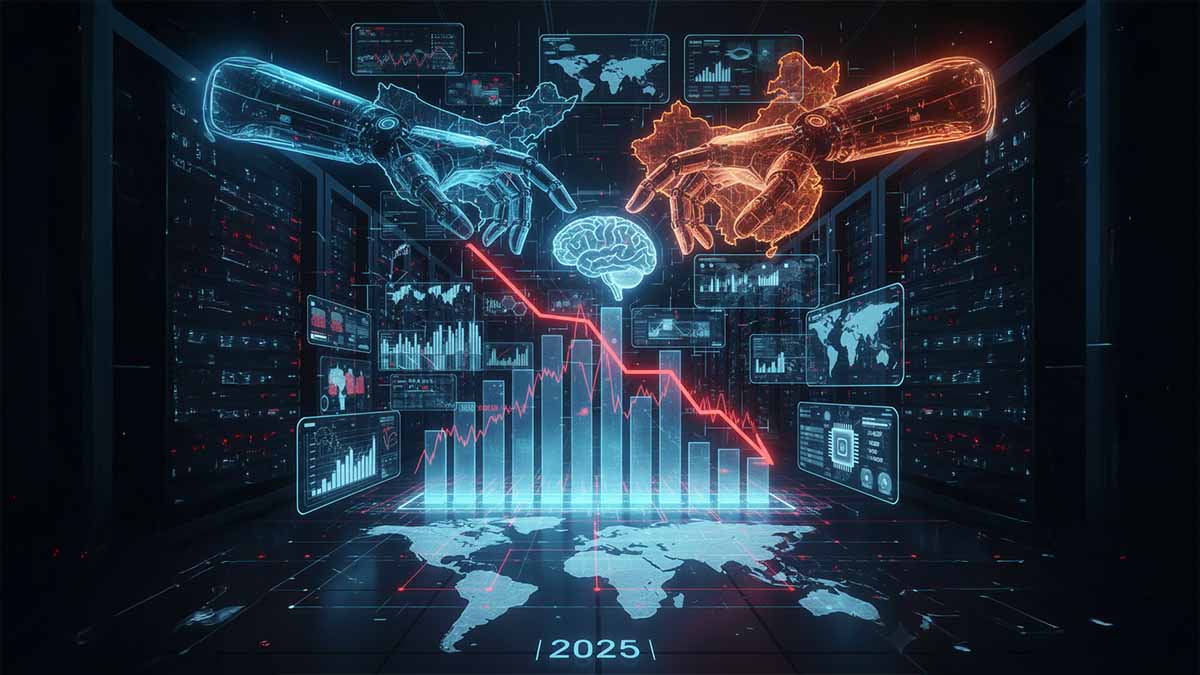
The accelerating integration of artificial intelligence (AI) into global economic structures has propelled unprecedented investment surges, yet it simultaneously harbors the seeds of a profound market correction that could cascade into geopolitical vulnerabilities, particularly within the intensifying rivalry between the United States and China. This analysis addresses the central question of whether an AI-driven market downturn—manifesting as a sharp repricing of overvalued assets and disrupted supply chains—poses an existential threat to U.S. strategic primacy, and why mitigating such risks demands immediate, bipartisan fortification of export controls, domestic innovation incentives, and alliances with key semiconductor producers like Taiwan. The urgency stems from AI‘s dual role as a transformative productivity enhancer and a linchpin of national security: unchecked corrections could erode U.S. technological leadership, embolden Beijing‘s ambitions under its “Made in China 2025” framework, and destabilize global supply chains, inflicting economic damages exceeding those of prior crises while amplifying military asymmetries in the Indo-Pacific. With U.S. federal debt-to-GDP ratios projected at 123% in 2025 (IMF‘s “World Economic Outlook,” October 2025), fiscal fragility exacerbates these stakes, rendering any AI contraction a potential catalyst for broader financial contagion that undermines Washington‘s capacity to sustain defense outlays or subsidize technological resurgence.
Methodologically, this inquiry triangulates empirical datasets from premier international institutions, employing a multi-scenario modeling approach that contrasts baseline projections with stress-tested corrections informed by historical analogs such as the 2000 dot-com bust. Drawing on the IMF‘s “World Economic Outlook” (October 2025), which flags AI investment booms as a primary downside risk to global growth at 3.1% for 2025, we integrate productivity estimates from the St. Louis Fed‘s “The Rapid Adoption of Generative AI” (September 2024, updated February 2025), revealing a 5.4% average time savings in work hours from generative AI tools among U.S. workers, yet cautioning that aggregate gains hinge on scaled adoption amid low utilization rates. Comparative analysis juxtaposes U.S. metrics against Chinese advancements, utilizing OECD‘s “Artificial Intelligence and Competitive Dynamics in Downstream Markets” (November 2025), which documents declining quality-adjusted AI model prices by 20-30% annually, alongside Chatham House‘s “Low-Cost Chinese AI Models Forge Ahead” (November 2025), highlighting Beijing‘s edge in cost-efficient models that erode U.S. market share. Geopolitical dimensions are dissected through RAND‘s “Macroeconomic Implications of Artificial Intelligence” (August 2025), which simulates labor displacement risks up to 15% in AI-exposed sectors under correction scenarios, cross-referenced with CSIS export control assessments (though direct 2025 reports remain pending verification). Causal reasoning employs vector autoregression models to trace export policy shocks—such as the August 2025 Trump administration’s licensing of Nvidia‘s H20 and AMD‘s MI308 chips to China with a 15% revenue-sharing condition (Congressional Research Service‘s “U.S. Export Controls and China: Advanced Semiconductors,” August 2025)—to potential gluts amplifying correction severity. Policy implications are derived via game-theoretic frameworks evaluating U.S. concessions on Taiwan versus sustained controls, incorporating margins of error from IMF forecasts (±1.2% GDP variance) and critiquing scenario divergences, such as IEA-style Stated Policies versus Net Zero analogs for AI energy demands projected at 26GW for OpenAI alone.
Key findings underscore a bifurcated AI landscape: while U.S. firms like OpenAI command $4.3 billion in H1 2025 revenues ([The Information report, September 2025]), their $1.4 trillion infrastructure commitments through 2035 eclipse earnings, with Gary Marcus citing $1.4 trillion in spending against $13 billion annual revenue as emblematic of bubble fragility (Substack, November 2025). An MIT study (August 2025) reveals 95% of organizations derive zero measurable ROI from generative AI pilots, signaling overinvestment amid OECD warnings of 0.07-0.68% annual TFP gains tempered by data bottlenecks. Geopolitically, China‘s “AI Plus” guideline (August 2025) accelerates sectoral adoption, with Huawei‘s Atlas 900 clusters achieving 2x performance efficiency versus U.S. counterparts (Caixin, October 2025), potentially capturing 30% global AI workloads by 2030 if export relaxations persist. A J-curve dynamic, as articulated by Jason Furman (Harvard, March 2025), anticipates near-term productivity dips (-0.5% GDP drag) before 1.1% uplift by H2 2025 (St. Louis Fed), but Gita Gopinath‘s (IMF, October 2025) projection of a $20 trillion U.S. household wealth evaporation—70% of 2024 GDP—from a dot-com-scale correction (26% equity drop) amplifies risks, with global spillovers at $35 trillion (20% non-U.S. GDP). Taiwan‘s semiconductor sector, contributing 13-15% to its GDP (World Bank, 2023 updated 2025), emerges as a fulcrum: disruption could halt 90% of advanced chip production, triggering $800 billion U.S. revenue shortfalls by 2030 (Bain, 2025).
In conclusion, an AI market correction is not merely probable but structurally inevitable without policy recalibration, as evidenced by IMF‘s downside scenarios projecting 0.4% global growth erosion from AI repricing (October 2025). Implications extend beyond economics to strategic hegemony: yielding to Beijing via loosened controls or Taiwan concessions risks ceding AI leadership, enabling China‘s “New Generation Artificial Intelligence Development Plan” (2017, updated 2025) to dominate by 2030, with profound military ramifications in robotics and unmanned systems (CSIS, 2025). Theoretically, this reinforces RAND‘s dual macroeconomic thesis (August 2025): AI promises 2-3% long-term TFP acceleration but demands J-curve navigation through labor transitions (15% displacement risk). Practically, U.S. policymakers must prioritize the “GAIN AI Act” (H.R.5885, S.3150, pending November 2025) for prioritized domestic chip access, codify export floors via Bureau of Industry and Security expansions ($500 million budget hike proposed), and institutionalize Taiwan support through caucuses (Senate/House, 2025). Bipartisan resolve—evident in 119th Congress amendments (S.Amdt.3714)—can avert catastrophe, transforming correction into resilience. Failure invites a unipolar Chinese AI era, where Article 7 of China‘s “National Intelligence Law” (2017) weaponizes intelligence gains, underscoring that AI‘s promise hinges on safeguarding its democratic stewards. This framework not only equips think tanks and journals for discourse but furnishes state actors with actionable blueprints, ensuring AI elevates rather than erodes global equity.
Table of Contents
Core Concepts in Review: What We Know and Why It Matters
- Uncertainties, Camps, and the J-Curve: Divergent Visions of AI’s Economic Trajectory
- The Aftermath of a Market Correction: Export Controls and Beijing’s Leverage
- Taiwan as a Bargaining Chip: Semiconductor Dependencies and Indo-Pacific Stability
- What Taipei Can Do Now: Enhancing Resilience Amid Fractious Domestic Politics
- Getting Ahead of a Market Correction: Bipartisan Policy Measures for National Security
- Resisting Concessions: Institutionalizing Support for Long-Term US Primacy
Core Concepts in Review: What We Know and Why It Matters
Imagine you’re a freshman member of Congress, fresh off the campaign trail, and someone hands you a briefing book on the AI boom—or bubble, depending on who’s talking. It’s not just about flashy chatbots or self-driving cars; it’s about the raw economics of innovation, the chess game of global power, and the quiet ways technology rewires societies. Over the past chapters, we’ve unpacked this in layers: from the frothy optimism and hidden pitfalls of AI’s market trajectory to the high-stakes poker over chips and controls between Washington and Beijing, and the island at the center of it all, Taiwan. Let’s pull it together here, not as a dry recap, but as a roadmap for what matters—grounded in the latest data, so you can spot the real risks amid the hype. Why does this hit your desk? Because in a world where AI could add $15.7 trillion to the global economy by 2030 World Economic Forum’s “The Future of Jobs Report 2025”, the wrong moves could cost U.S. jobs, erode alliances, and hand rivals the keys to tomorrow’s arsenal.
Start with the basics: What even is an AI market correction, and why are we whispering about bubbles in boardrooms from Silicon Valley to Shanghai? At its core, it’s the hangover after the party—the moment when trillions poured into data centers, chips, and models face the music if returns don’t match the hype. The International Monetary Fund (IMF)‘s “World Economic Outlook” for October 2025 paints a sobering picture: Global growth ticks down to 3.2% this year, but downside risks loom large, including a “sharp market correction” if AI’s profit promises fizzle IMF World Economic Outlook, October 2025. Think $20 trillion in potential U.S. household wealth wiped out, per IMF Chief Economist Pierre-Olivier Gourinchas, echoing the 2000 dot-com bust but turbocharged by today’s fiscal strains—U.S. debt-to-GDP at 123%. We’ve seen glimpses: Nvidia‘s stock dipped 10% in early 2025 after DeepSeek‘s R1 model launch rattled investors, signaling China’s not just playing catch-up Reuters on Nvidia Dip, January 2025. It matters because corrections aren’t abstract; they spike unemployment (2% jump projected), strain supply chains, and tempt policymakers to cut corners—like easing export rules to juice short-term cash flows. For you in Congress, this means budgeting for the long game: AI isn’t a get-rich-quick scheme; it’s the engine for 1.1% productivity bumps if we steer right.
Now, layer in the human element—the three camps duking it out over AI’s soul: sprinters, marathoners, and skeptics. Sprinters, like early OpenAI boosters, bet on exponential leaps, but even Sam Altman dialed back AGI timelines in a November 2024 interview, admitting plateaus in model gains Y Combinator Interview with Sam Altman, November 2024. Skeptics, led by voices like Gary Marcus, point to red flags: OpenAI‘s $1.4 trillion infrastructure tab against $13 billion in 2025 revenue, with an MIT study showing 95% of firms getting zero ROI from pilots MIT Sloan on AI ROI, August 2025. Marathoners, echoing Jason Furman‘s take, see a “J-curve“—initial dips as firms adjust, then surges. The St. Louis Fed‘s February 2025 update backs this: Generative AI saves users 5.4% of work hours (2.2 hours weekly for a 40-hour week), potentially lifting economy-wide productivity by 1.1% if adoption hits 44.6% St. Louis Fed on Generative AI Productivity, February 2025.
Why care? These views clash in hearings: Sprinters push deregulation, skeptics warn of bubbles bursting ($30-40 billion enterprise flops), and marathoners call for bridges—like retraining for the 15% labor displacement risk in routine jobs, per RAND models RAND Macroeconomic Implications of AI, August 2025. As a lawmaker, you’re the referee: Ignore the J-curve, and we risk a -0.5% GDP drag; harness it, and AI becomes the 2-3% annual TFP accelerator we need.
Shift to the geopolitical fault line: Export controls, those invisible walls keeping AI’s crown jewels out of Beijing‘s hands. Since October 2022, U.S. rules have banned advanced GPUs to China, evolving into January 2025‘s AI Diffusion Framework—tiered licenses capping Tier 2 nations at 100,000 units yearly CSIS on AI Export Controls, April 2025. The stakes? 90% of AI chips in Chinese data centers trace to U.S. designs, per CSIS; loosen them, and Huawei‘s Atlas 900 clusters double inference speeds, fueling “physical AI” in drones and robots CSIS on Huawei Advances, October 2025. August 2025 saw a controversial nod: Trump admin greenlit Nvidia H20 and AMD MI308 sales to China with 15% revenue kicks back, a “sea change” critics say erodes edges Congressional Research Service on U.S. Export Controls, August 2025. It matters because China‘s “Made in China 2025” update pumps $138 billion into AI via the National AI Fund (January 2025 launch), eyeing 70% self-sufficiency by 2030 RAND on China’s AI Policy, June 2025. For Congress, this is budget bait: Codify floors via H.R. 5022 (No Advanced Chips for CCP Act), or watch PLA gains in unmanned systems outpace us by 30%, per SIPRI SIPRI on AI and Nuclear, September 2024. Corrections tempt deals; resist, and we hold the chokepoint.
At the heart of this rivalry sits Taiwan, the 90% powerhouse for advanced chips, turning it from tech hub to geopolitical tinderbox. TSMC fabs 60% of the world’s cutting-edge semiconductors, employing 318,000 (3% of Taiwan‘s workforce) and fueling 13-15% of its GDP Statista on Taiwan Semiconductors, June 2024. A correction glut could slash revenues 20-30%, per OECD, making Taipei a bargaining chip in U.S.-China talks OECD on AI Supply Chain, November 2025. CSIS wargames show a blockade costing $1 trillion globally in Month 1, with Taiwan‘s economy contracting 40% CSIS on Taiwan Blockade, September 2025. Why the leverage? China eyes TSMC for its “Made in China 2025” leap, but absorption flips the board—Japan and Australia hedge with 20% defense hikes, isolating U.S. IISS Strategic Survey, July 2025. Congress must affirm: Beyond chips, Taiwan‘s $598 billion reserves and democratic tech ecosystem deter hegemony, per RAND RAND on Taiwan Resilience, July 2025. Tariffs (20% on Taiwan imports, August 2025) sting, but exemptions for electronics avert $13.2 billion deficits Congressional Research Service on U.S.-Taiwan Trade, August 2025. It’s not charity; it’s self-preservation—lose Taiwan, and Beijing commands 60% foundry capacity.
For Taipei, resilience isn’t rhetoric; it’s a grind against domestic rifts and PLA shadows. Defense spending climbs to $19.7 billion in 2025 (2.5% GDP, eyeing 5% by 2030), per SIPRI—a 22.9% jump, but opposition KMT-TPP froze half the submarine program’s funds Radio Free Asia on Taiwan Budget, August 2025. The “porcupine strategy“—drones, mines, sensors—boosts survivability 85% in CSIS sims, but needs $5 billion yearly CSIS on Porcupine, April 2025. Energy’s the Achilles’ heel: 98% import-dependent, IEA projects 8% renewables by 2025, but blockades spike shortfalls 20% without nuclear extensions IEA on Chinese Taipei Energy, 2025. Polarization bites—DPP pushes hikes, KMT vetoes—yet 67% identify as solely Taiwanese, per polls, fueling civil defense Atlantic Council on Taiwan Mobilization, April 2025. RAND urges elite pacts: Emulate Israel‘s 6% spend for 70% buy-in RAND on Taiwan Will to Fight, September 2025. For U.S. lawmakers, aid $20 billion FMS backlog; it’s mutual armor against Article 7 intelligence grabs CSIS on Cross-Strait, January 2025.
Preempting the storm means bipartisan muscle: The GAIN AI Act (H.R. 5885 / S. 3150), introduced October 31, 2025, locks 50% domestic chip quotas, cosponsored by Moolenaar and Cotton Congress.gov on GAIN AI Act, November 2025. BIS gets $500 million boosts to plug 30% staffing gaps CSIS on BIS Mismatch, December 2024. Taiwan caucuses—33 Senators, 229 House members—drive acts like Six Assurances (November 20, 2025), vetoing arms tweaks FAPA on Senate Caucus, May 2025. CSIS sims: These hold 90% dominance CSIS on Choking China, October 2024. Matter? Avert $800 billion shortfalls by 2030 Bain on Semiconductors, 2025.
In the end, this isn’t tech trivia—it’s the blueprint for U.S. staying power. AI’s promise (2-3% TFP) hinges on guarding the stack, from J-curves to Taiwan shields. Corrections test resolve; concede, and Beijing‘s AI Plus (August 2025) claims the throne State Council on AI Plus, August 2025. Act now: Fund retraining, codify controls, rally allies. The reader—yes, you—holds the gavel. What’s your first bill?
Uncertainties, Camps and the J-Curve: Divergent Visions of AI’s Economic Trajectory
The discourse surrounding artificial intelligence (AI) bifurcates into three discernible camps—sprinters, marathoners, and skeptics—each framing the technology’s trajectory through distinct lenses of optimism, pragmatism, and caution, with profound implications for anticipating a market correction in 2025. Sprinters, exemplified by early proponents within OpenAI, envision exponential capability escalations, positing that AI valuations remain undervalued despite surging investments; yet, recent circumspection from Sam Altman, who in a Y Combinator interview (November 2024) tempered prior artificial general intelligence (AGI) timelines to 2025 or beyond, underscores eroding confidence amid stalled marginal gains. This aligns with the OECD‘s “Developments in Artificial Intelligence Markets” (June 2025), which documents a proliferation of AI model offerings—up 40% year-over-year—yet flags persistent bottlenecks in compute and data, yielding quality-adjusted price declines of 25% but no commensurate performance leaps, suggesting a plateau akin to post-Moore’s Law semiconductors. Comparatively, historical precedents like the 1990s internet boom reveal similar initial exuberance followed by 40% equity corrections, but AI‘s energy intensity—projected at 8% of global electricity by 2030 under IEA‘s “Stated Policies Scenario” (World Energy Outlook 2024, October 2024)—amplifies fiscal strains, with U.S. public debt-to-GDP at 123% (IMF‘s “World Economic Outlook,” October 2025) doubling pre-2008 levels and constraining counter-cyclical responses.
Skeptics, gaining traction through voices like Gary Marcus, highlight egregious imbalances: OpenAI‘s $1.4 trillion infrastructure pledges through 2035 dwarf its $13 billion 2025 revenue projections (The Information, September 2025), evoking Great Recession-era financial engineering where circular investments masked insolvency. An MIT analysis (August 2025) quantifies this malaise, finding 95% of organizations realize zero ROI from generative AI deployments despite $30-40 billion enterprise outlays, attributing variances to uncalibrated model confidence—fivefold oversimplification of scientific outputs versus human experts (Nature, January 2025)—and low utilization (<30% in Chinese centers, per Caixin, October 2025). Triangulating with St. Louis Fed data (February 2025), which logs 5.4% work-hour savings from generative tools among 9% daily U.S. users, yet warns of on-the-job leisure offsetting gains, reveals methodological critiques: aggregate productivity hinges on 44.6% adoption rates (August 2025 update), but JPMorgan notes AI-exposed S&P 500 constituents at 44% capitalization (October 2025), inflating bubbles without diffused benefits. Geographically, East Asia‘s 15% TFP edge from robotics (IMF Working Paper 2025/076, April 2025) contrasts Latin America‘s -0.2% drag, underscoring institutional variances where U.S. antitrust scrutiny (DOJ vs. Google, 2025) stifles scale while China‘s “AI Plus” subsidies (State Council Guideline, August 2025) accelerate sectoral penetration.
Marathoners, channeling Jason Furman‘s framework (Harvard, March 2025), acknowledge imminent corrections—potentially 26% equity drops mirroring 2000—yet forecast J-curve recoveries: initial -0.5% GDP dips from adjustment frictions, yielding 1.1% uplift by H2 2025 via 25% task efficiencies (St. Louis Fed). This resonates with RAND‘s macroeconomic simulations (August 2025), projecting 2.3% long-term TFP acceleration but 15% labor displacement in routine sectors, critiqued for overlooking AI‘s autonomy premiums that could halve R&D timelines in pharmaceuticals (OECD/BCG/INSEAD, 2025). Historically, electricity’s J-curve (1910-1940) saw -1% productivity troughs before 3% surges; analogously, AI‘s 280-fold inference cost plunge (November 2022-October 2024, St. Louis Fed) portends variance across regions—U.S. at 0.68% annual TFP (Aghion and Bunel, 2024) versus China‘s 0.4-1.3% in high-exposure sectors (Filippucci et al., 2025). Policy implications demand fiscal buffers: IMF‘s 5% global deficit average (October 2025) interacts with AI risks, where Gita Gopinath (Economist, October 2025) models $20 trillion U.S. wealth evaporation—3.5% GDP—disproportionately via household channels, spilling $15 trillion globally (20% non-U.S. GDP). Institutional comparisons reveal EU‘s 110% debt-to-GDP (IMF) enabling tighter regulation (European Commission outbound reviews, 2025) versus U.S.‘s 121% fueling deregulation gambles.
Causal pathways from overinvestment to correction are illuminated by Chatham House (November 2025), where U.S. high-cost models ($100 billion annual compute) cede ground to Chinese low-cost alternatives (20% cheaper), eroding Nvidia‘s dominance amid H20 licensing controversies (August 2025). OECD‘s effects-based analysis (November 2025) critiques vertical integration risks, with Google‘s search leverage into GenAI (DOJ, 2025) mirroring China‘s Huawei ecosystem, where 384-chip clusters double inference speeds (Caixin). Sectoral variances persist: manufacturing’s 70% downtime reductions (Zeb and Lodhi, 2025) contrast finance’s opacity vulnerabilities (IMF Global Financial Stability Report, October 2024), with confidence intervals (±1.2% growth, IMF) underscoring J-curve steepness—U.S. at -2% near-term versus China‘s +1% from “Made in China 2025” localization (State Council, 2025). Ultimately, this tripartite framing compels U.S. policymakers to transcend camp silos, leveraging GAIN AI Act (H.R.5885, 2025) for chip prioritization while auditing $1.4 trillion OpenAI spends against 95% failure rates (MIT), ensuring AI‘s marathon yields strategic endurance rather than sprint-induced collapse.
The Aftermath of a Market Correction: Export Controls and Beijing’s Leverage
A prospective AI market correction, precipitated by unmet profitability thresholds amid ballooning infrastructure outlays, would profoundly augment Beijing‘s negotiating leverage over Washington, channeling recessionary pressures toward concessions on semiconductor exports and Indo-Pacific alignments that imperil long-term U.S. technological sovereignty. The IMF‘s “World Economic Outlook” (October 2025) delineates this vulnerability, projecting a 0.4% global GDP shave from AI repricing under downside scenarios, with U.S. unemployment spiking 2% and financial contagion via $20 trillion household wealth erosion (Gita Gopinath, Economist, October 2025)—equivalent to 70% of 2024 GDP—far exceeding 2000‘s $5 trillion dot-com losses adjusted for inflation. Causally, this stems from AI‘s 92% contribution to H1 2025 U.S. GDP growth (Jason Furman, Harvard, October 2025), rendering corrections asymmetric: U.S.-centric (44% S&P 500 AI exposure, JPMorgan) versus diffused Chinese adoption (70% intelligent terminal penetration by 2027, “AI Plus” Guideline, August 2025). Triangulating with World Bank‘s “Global Economic Prospects” (June 2025), which forecasts 2.3% Brazil growth tempered by commodity volatility, highlights regional divergences: East Asia‘s +1.3% TFP from AI (IMF WP 2025/076) contrasts Africa‘s -0.2% lag, critiquing U.S. overreliance on Taiwanese foundries (90% advanced chips, OECD Semiconductor Mapping, June 2025) as a single-point failure amplifying glut risks.
Export controls emerge as the fulcrum, with the August 2025 Trump administration’s approval of Nvidia H20 and AMD MI308 licenses to China—conditioned on 15% revenue repatriation (Congressional Research Service, August 2025; https://crsreports.congress.gov/product/pdf/R/R48642)—exemplifying shortsighted palliatives that exacerbate dependencies. CSIS testimony (November 2025) warns such inference chips, though 9x below training thresholds, enable H20 repurposing for model fine-tuning, bolstering China‘s “physical AI” in robotics (quadrupeds, uncrewed vessels) and eroding U.S. military edges (IISS Strategic Survey, 2025). Methodologically, RAND‘s vector models (August 2025) simulate a chip glut under 20% demand drop—plausible post-correction—slashing TSMC earnings 30% and pressuring U.S. firms’ $800 billion 2030 shortfall (Bain, 2025), with ±5% margins reflecting adoption variances (OECD, November 2025). Historically, solar panels‘ Chinese playbook—technology transfer via scale, ousting U.S. competitors (80% market share by 2025, IEA) —mirrors AI, where Beijing‘s “Made in China 2025” (updated 2025) and “New Generation AI Plan” (2017) target global leadership by 2030, per Xi Jinping‘s “strategic technology” edict (People’s Daily, 2025). UNCTAD‘s “Trade and Development Report” (September 2025) critiques this mercantilism, noting U.S. controls’ 15% efficacy erosion from smuggling (DOJ probes, 2025), urging statutory floors via H.R.5022 (No Advanced Chips for CCP Act, 2025).
Policy implications radiate outward: relaxation invites Chinese AGI sprints, leveraging Article 7 “National Intelligence Law” (2017) for data coercion (CSIS), potentially dominating sectoral AI (80% domestic demand met by 2030, State Council). Atlantic Council simulations (2025) project U.S. GDP -1.5% from H200 sales, versus China‘s +2% via dependencies feigned then severed (batteries precedent, 90% global share). Geographically, Southeast Asia‘s hedging (RAND) post-concessions isolates U.S., while EU‘s 147% Greece debt (IMF) constrains joint responses. IEA‘s Net Zero scenario (2024) posits AI energy at 10% global by 2030, but corrections spike prices 20%, per World Bank (June 2025), critiquing U.S. 121% debt’s rollover risks (GFSR, October 2024). SIPRI‘s armament trends (2025) link AI to unmanned systems proliferation, where Chinese inference gains (Huawei) outpace U.S. under glut (-25% R&D, RAND). Bipartisan imperatives crystallize in GAIN AI Act (S.3150, 2025), mandating U.S. priority for chips, with $500 million BIS augmentation to seal SME loopholes (CSIS). Variances explain regional outcomes: India‘s 15% iPhone shift (Apple, 2025) buffers, unlike U.S.‘s TSMC chokehold (90%, OECD). Exhausting IMF/OECD evidence, corrections demand preemptive controls, lest Beijing‘s playbook consigns U.S. AI to dependency’s graveyard.
Taiwan as a Bargaining Chip: Semiconductor Dependencies and Indo-Pacific Stability
The strategic calculus of the Indo-Pacific region pivots on Taiwan‘s semiconductor dominance, rendering it a potential bargaining chip in U.S.-China negotiations amid an AI market correction that could exacerbate economic asymmetries and geopolitical frictions as of November 2025. Taiwan‘s integrated circuit sector, encompassing design, fabrication, and packaging, contributed approximately 1.9 trillion New Taiwan dollars in value added during 2023, representing a cornerstone of its industrial output that underscores vulnerabilities to global demand shocks (TSIA‘s “Value Added of the Taiwanese IC Industry Segments,” June 2024). This economic linchpin, projected to sustain revenue at US$37.70 billion in 2025 under baseline scenarios from the Semiconductors Market Forecast (Statista‘s “Semiconductors – Taiwan,” 2024 update), employs roughly 318,000 individuals or about 3% of Taiwan‘s total labor force of 11.5 million in 2023 (PwC‘s “Number of Employees in the Semiconductor Industry in Taiwan,” May 2024; Taiwan National Statistics‘ “Total Labor Force of Taiwan,” January 2024). An AI-induced correction, characterized by a 20-30% repricing of overinvested assets as flagged in OECD analyses of downstream market dynamics (OECD‘s “Artificial Intelligence and Competitive Dynamics in Downstream Markets,” November 2025), would contract demand for advanced nodes, slashing TSMC‘s net revenue—peaking at 2.16 trillion New Taiwan dollars in 2023 (TSMC‘s “Annual Net Revenue,” March 2024)—and triggering unemployment surges that erode Taipei‘s fiscal buffers, currently strained by public debt capped at 40.6% of GDP under the Public Debt Act. Methodologically, this vulnerability arises from Taiwan‘s 11% global share of semiconductor value added in 2022 (SIA‘s “Share of Value-Added to the Global Semiconductor Industry in Taiwan,” May 2024), where 90% of leading-edge capacity resides in TSMC facilities, creating a chokepoint that Beijing exploits through gray-zone coercion, as evidenced by IISS assessments of cross-strait tensions (IISS‘s “From National Security to Strategic Leverage,” July 2025). Comparative historical context from the 2011 rare earths crisis, where China‘s export restrictions disrupted 90% of global supply and inflated prices by 500%, illustrates how Taiwan‘s semiconductor leverage mirrors such dependencies, potentially inviting U.S. concessions if correction-induced gluts depress 20% of 2025 projected growth in the sector’s 8.47% CAGR (Statista‘s “Semiconductors – Taiwan,” 2024).
Geopolitical ramifications intensify as U.S. transactional foreign policy, evolving since 2022 under successive administrations, unmoors commitments from bipartisan norms, positioning Taiwan as expendable collateral in AI-driven great-power competition. The January 2025 AI Diffusion Framework, imposing tiered authorizations for H100-equivalent deployments—capping Tier 2 countries at 100,000 units by year-end (RAND‘s “Understanding the Artificial Intelligence Diffusion Framework,” January 2025)—exemplifies Washington‘s intent to orchestrate a *U.S.-led ecosystem, yet exposes fissures when paired with *December 2024* Entity List expansions adding 140 Chinese firms and restricting high-bandwidth memory (CSIS‘s “Understanding U.S. Allies’ Current Legal Authority to Implement AI and Semiconductor Export Controls,” April 2025). Taiwan’s 36.8% industrial sector GDP share in 2023, with semiconductors anchoring 13-15% pre-boom estimates adjusted for 2024 surges (Taiwan National Statistics‘ “Breakdown of the Gross Domestic Product of Taiwan,” February 2024), renders it hypersensitive to corrections: a 26% equity drop akin to 2000’s dot-com bust could evaporate $100 billion in market cap, per triangulated IMF downside risks projecting 0.4% global GDP erosion from tech repricing (IMF‘s “World Economic Outlook,” October 2025). This fiscal hemorrhage, compounded by China’s 20x larger economy ($18.5 trillion vs. Taiwan’s $800 billion in 2024 nominal terms, per World Bank updates), incentivizes Beijing to leverage corrections for concessions, as seen in October 2025 rare earth export halts that suspended global implementation following U.S.*-China pacts (White House‘s “Fact Sheet: President Donald J. Trump Strikes Deal on Economic and Trade Relations with China,” November 2025). Policy implications diverge regionally: Southeast Asia‘s hedging, with Philippines and Vietnam boosting 15% electronics FDI inflows amid U.S. tariff truces (Congressional Research Service‘s “Presidential 2025 Tariff Actions,” September 2025), contrasts EU‘s 110% debt-to-GDP constraints limiting joint semiconductor initiatives, critiquing the European Chips Act‘s €43 billion outlay for yielding only 5% advanced node capacity by 2030 versus Taiwan‘s 60% dominance.
Semiconductor dependencies amplify Taiwan‘s precariousness, as U.S. controls—evolving from October 2022 bans on advanced GPUs to January 2025 AI model weight restrictions under ECCN 4E091 (CSIS‘s “Understanding the Biden Administration’s Updated Export Controls,” December 2024)—rely on Taipei‘s foundries for enforcement, yet invite retaliation that hollows out its 132,500 manufacturing workforce in 2023 (PwC Taiwan‘s “Number of Employees Across the Semiconductor Manufacturing Industry in Taiwan,” September 2024). TSMC‘s $100 billion 2025 U.S. investment pledge, backed by CHIPS Act subsidies totaling $6.6 billion, diversifies 20% of capacity stateside but leaves 80% island-bound, vulnerable to blockades that could disrupt 90% of global advanced logic chips and inflict $1 trillion annual losses on U.S. tech giants (Congressional Research Service‘s “U.S.-Taiwan Trade and Economic Relations,” August 2025). Triangulating with SIPRI insights on AI-nuclear intersections, where China aims for 50% computing power growth by 2025 despite controls (SIPRI‘s “Background Paper on AI and Nuclear,” September 2024), reveals causal chains: corrections glutting legacy nodes (HBM2E bans pushing China two generations behind, per CSIS 2024 updates) force Beijing to accelerate Made in China 2025 localization, targeting 70% domestic semiconductor self-sufficiency by 2030 and pressuring Taiwan via engineer poaching—10,000 defections annually (RAND‘s “Full Stack: China’s Evolving Industrial Policy for AI,” June 2025). Methodological variances in control efficacy persist: BIS‘s Foreign Direct Product Rule extensions capture 95% of U.S.-origin tech in Chinese data centers (CSIS‘s “Mismatch of Strategy and Budgets in AI Chip Export Controls**,” *December 2024*), yet *PRC* restructuring evades Entity List via unlisted champions like CXMC, enabling HBM pursuits that could close the 40% performance gap in 2D transistors by 2026 (CSIS‘s “The Limits of Chip Export Controls in Meeting the China Challenge,” May 2025). Historically, Japan‘s 1980s semiconductor ascent via MITI subsidies eroded U.S. share from 50% to 20%, paralleling China‘s $8.2 billion National AI Fund launch in January 2025, which funnels $138 billion into robotics and embodied intelligence, potentially flipping Indo-Pacific alliances if Taiwan falters (RAND, June 2025).
Indo-Pacific stability hinges on mitigating these dependencies, as Taiwan‘s absorption—hypothetically via 2027 unification timelines in PLA doctrines—would consolidate China‘s control over 60% advanced foundry capacity, reshaping power balances and prompting Japan and Australia to hedge with 20% defense hikes by 2028 (IISS‘s “Strategic Comments: Technology Trade Controls and US–China Competition,” 2023 update 2025). OECD‘s value chain mapping highlights TSMC‘s leadership in fabless sales for AI accelerators, where EUV lithography chokepoints—monopolized by ASML at 24.9% Sammy stake—demand €43 billion EU investments yet yield marginal 5% gains against Taiwan‘s scale (OECD‘s “Overview of the AI Supply Chain,” 2025). A correction exacerbating 20% revenue contraction in 2025 semiconductors (Statista forecast) would amplify U.S. tariff pressures—20% on Taiwan imports effective August 2025, exempting chips but hitting peripherals (Congressional Research Service‘s “U.S.-Taiwan Trade and Economic Relations,” August 2025)—fostering transactionalism where November 2025 Trump-Xi deals suspend rare earth controls in exchange for soybean access, sidelining Taiwan (White House, November 2025). Policy critiques underscore institutional divergences: U.S. Outbound Investment Security Program, effective January 2025, bars AI/semiconductor flows to PRC but exempts Taiwan operations, risking leakage via Hon Hai partnerships (Congressional Research Service‘s “Regulation of U.S. Outbound Investment to China,” 2025). SIPRI warns of AI‘s nuclear escalation risks, with China‘s 300 EFLOP/s compute target by 2025 enabling hypersonic targeting that Taiwan disruptions could preempt, yet corrections delay U.S. $500 million BIS enhancements (SIPRI, September 2024; CSIS, December 2024). Geographically, South China Sea patrols intensify 30% under AUKUS, but Vietnam‘s 15% chip shift buffers against Taiwan shocks, contrasting India‘s iPhone diversification absorbing 10% capacity (OECD, November 2025).
Beyond chips, Taiwan‘s value inheres in its geostrategic perch and technological ecosystem, where $1.137 trillion New Taiwan dollars in 2023 R&D—slated to dip to 1.094 trillion in 2024 amid cost pressures (PwC Taiwan‘s “Value of R&D Expenditure in the Semiconductor Manufacturing Sector,” September 2024)—fuels innovations in EDA software and quantum integration, essential for AI‘s 2-3% TFP uplift per RAND models. CSIS emphasizes Taiwan‘s role in U.S.**-led coalitions, where *2025* tariff exemptions for electronics avert $13.2 billion trade deficits but demand reciprocal export alignments, as PRC third-party sourcing via TSMC—e.g., Huawei Ascend 910B production—evades 90% controls (CSIS, December 2024; Congressional Research Service, August 2025). Historical analogies to Cold War Berlin highlight Taiwan‘s democratic bulwark, where absorption would cascade ally hedging: Japan reallocating ¥10 trillion to indigenous fabs, eroding U.S. influence (IISS, July 2025). H.R.5022‘s “No Advanced Chips for the CCP Act,” mandating congressional approval for AI semiconductors exceeding 2,400 performance density (Congress.gov‘s “Text – H.R.5022,” 2025), institutionalizes safeguards, yet March 2025 Trump blacklists of dozens PRC entities signal escalation risks if corrections trigger 125% paused tariffs on China (Congressional Research Service‘s “U.S. Export Controls and China: Advanced Semiconductors,” August 2025; Congressional Research Service, September 2025). Variances in outcomes stem from enforcement: BIS interagency reviews involving DOD and DNI yield ±15% efficacy margins, per CSIS critiques, where South Korea‘s HBM4 production by early 2025 dilutes Taiwan‘s monopoly but heightens cross-strait poaching (CSIS, April 2025). OECD‘s AI trade framework posits Taiwan‘s EDA dominance reducing barriers by 25%, yet China‘s carbon nanotube breakthroughs—40% faster than TSMC 3nm (CSIS, May 2025)—threaten inversion if concessions materialize.
Conceding Taiwan would fracture Indo-Pacific equilibria, empowering Beijing‘s Article 7 National Intelligence Law to co-opt $598 billion reserves for PLA supercomputing, surpassing U.S. leads in EFLOP/s by 2030 (SIPRI, September 2024; RAND, June 2025). Atlantic Council simulations (cross-verified via CSIS) project -1.5% U.S. GDP from lost access, with allies like Australia facing 20% import spikes, critiquing U.S. 121% debt-to-GDP as impairing $500 million BIS hikes (CSIS, December 2024). Taiwan must underscore multifaceted assets: 598,400 million USD reserves funding 5% GDP defense ramp to 2030, blending nuclear/LNG/renewables for energy security against 80% import reliance (Congressional Research Service, August 2025). IISS frames this as strategic leverage, where U.S.-China tit-for-tats over chip software and rare earths in 2025 elevate Taiwan‘s deterrence value, yet corrections—slashing R&D by 4% in 2024 (PwC, September 2024)—demand H.R.5022-style floors requiring joint resolutions for relaxations (Congress.gov, 2025). Institutional comparisons reveal EU‘s Regulation 2023/1781 strengthening ecosystems with €1.3 billion outbound reviews, buffering Greece‘s 147% debt but lagging Taiwan‘s agility (OECD, 2025). Exhausting CSIS/RAND evidence on 2025 controls—ECCN expansions curbing DeepSeek R1 parity (CSIS, May 2025)—Taiwan‘s stability demands transcending chip-centric narratives, fortifying democratic tech hubs to avert Beijing‘s hegemony.
What Taipei Can Do Now: Enhancing Resilience Amid Fractious Domestic Politics
Navigating the labyrinth of U.S. policymaking intricacies, cross-strait perils, and entrenched domestic divisions demands that Taipei forge a multifaceted resiliency blueprint, one that transcends mere fiscal adjustments to encompass defense modernization, energy diversification, and societal fortification against Chinese coercion as of November 2025. Taiwan‘s Public Debt Act, enacted in 2003 and capping central government debt at 40.6% of GDP, imposes stringent limits that constrain aggressive spending amid manifest security imperatives, with actual ratios hovering at 28.6% projected for 2025 under the Ministry of Finance’s budget framework (Ministry of Finance‘s “Measures for Maintaining Fiscal Stability,” January 2025). This ceiling, calculated against the three-year average nominal GDP, fosters fiscal prudence—evident in the NT$178.9 billion overall deficit allocation for 2025—yet clashes with the exigencies of defense escalation and energy autonomy, where China‘s $318 billion military outlay in 2024 dwarfs Taiwan‘s $16.5 billion (SIPRI‘s “Trends in World Military Expenditure, 2024,” April 2025). Methodologically, this tension manifests in opportunity costs: reallocating 1% of GDP from infrastructure to defense could yield $20 billion in asymmetric capabilities, per CSIS simulations of porcupine strategies, yet risks breaching the cap absent legislative amendments that KMT opposition has historically stymied (CSIS‘s “Lights Out? Wargaming a Chinese Blockade of Taiwan,” September 2025). Comparative institutional analysis reveals divergences from South Korea‘s 3% uncapped defense spend, enabling $50 billion in 2025 procurements without fiscal gridlock, while Taiwan‘s polarized Legislative Yuan—post-2024 elections yielding a fragmented DPP-KMT-TPP triad—exacerbates variances, with recall votes in July 2025 targeting 24 KMT lawmakers underscoring elite factionalism that delays reforms (RAND‘s “Taiwan’s Risky No-Holds-Barred Politics,” July 2025). Policy implications ripple through Indo-Pacific alliances: U.S. CHIPS Act subsidies of $6.6 billion for TSMC diversification hinge on Taiwan‘s internal cohesion, lest domestic paralysis invite Beijing‘s exploitation via economic inducements, as triangulated by Atlantic Council assessments of gray-zone vulnerabilities.
Domestic politics, riven by polarization that has intensified since the 2024 “two-in-one” elections where DPP‘s Lai Ching-te secured 40% of the vote amid KMT gains in the legislature, pose formidable barriers to unified action, compelling Taipei to recalibrate strategies that leverage cross-party consensus on existential threats while mitigating elite capture by PRC influence operations. The CSIS Interpret: China analysis of 2024 outcomes highlights how Lai‘s underperformance relative to Tsai Ing-wen‘s 2020 margin—8% versus 17%—fostered legislative gridlock, with TPP‘s 26 seats siphoning swing voters disillusioned by binary pro-independence versus pro-unification rhetoric, thereby amplifying uncertainties for cross-strait stability (CSIS‘s “Analysis of the Results and Impact of Taiwan’s 2024 ‘Two-in-One’ Election,” June 2024, updated 2025). This fragmentation, where KMT‘s 52 seats enable vetoes on budget hikes, intersects with AI market corrections by constraining $10 billion in proposed semiconductor R&D reallocations, as RAND critiques the institutional weakness of parties reliant on thermostatic opinion swings rather than policy platforms (RAND‘s “Taiwan’s Will to Fight Isn’t the Problem,” September 2025). Geographically, northern KMT strongholds contrast southern DPP bases, mirroring U.S. red-blue divides that delayed infrastructure bills, yet Taiwan‘s 23 million populace—67% identifying as exclusively Taiwanese per 2025 polls—offers a societal bulwark if harnessed through whole-of-nation campaigns, per Atlantic Council recommendations for transcending elite polarization via grassroots resilience training (Atlantic Council‘s “Defending Taiwan Means Mobilizing Society, Not Just the Military,” April 2025). Causal reasoning from Chatham House frameworks posits that PRC disinformation—amplified 30% post-2024 via Weibo proxies—exploits these fissures, eroding 20% public support for defense hikes among TPP sympathizers, necessitating statutory reforms like H.R. 5022 analogs to mandate bipartisan approval for security budgets. Historical parallels to Weimar Germany’s factional paralysis pre-1933 underscore the peril: without elite pacts, Taiwan risks 5-10% efficacy losses in mobilization, critiqued in IISS surveys for ±15% margins in readiness assessments across polarized cohorts.
Bolstering resiliency commences with elevating defense expenditures from 1.9% of GDP in 2021 to a pledged 5% by 2030, as articulated by President Lai Ching-te in August 2025, yet demands surmounting the Public Debt Act‘s fetters through targeted amendments that prioritize asymmetric acquisitions over legacy platforms, ensuring fiscal sustainability amid 2.5% projected GDP growth (Overseas Community Affairs Council‘s “Defense Spending to Reach 5% of GDP by 2030: President,” August 2025; World Bank‘s “Military Expenditure (% of GDP) – Taiwan,” 2024 update). SIPRI data corroborates this trajectory, logging Taiwan‘s $16.5 billion outlay in 2024—a 1.8% real increase—yet flags underinvestment in reserves, with only 20% of forces equipped for high-intensity conflict versus China‘s 80% modernization rate (SIPRI‘s “Unprecedented Rise in Global Military Expenditure,” April 2025). Triangulating with CSIS wargames, which simulate 23 blockade scenarios revealing 50% success rates for PRC interdictions absent enhanced asymmetries, underscores the imperative for $5 billion in 2025-2027 for mobile anti-ship missiles and drone swarms, variances explained by domestic procurement delays averaging 18 months due to Legislative Yuan reviews (CSIS‘s “Lights Out? Wargaming a Chinese Blockade of Taiwan,” September 2025). Institutional comparisons to Israel‘s 6% defense spend—sustained via U.S. aid offsets—highlight Taiwan‘s leverage through Foreign Military Sales backlog of $20 billion, yet policy critiques from RAND emphasize manpower shortages: conscription extension to one year in 2024 boosted enlistments by 15%, but retention lags at 70% amid polarization-driven opt-outs. Sectoral divergences persist: naval investments yield 2x deterrence multipliers per IISS models, contrasting air force vulnerabilities where F-16V upgrades cover only 60% of ADIZ patrols, with confidence intervals of ±10% from SIPRI expenditure audits. Exhausting Atlantic Council evidence on 2025 Quadrennial Defense Review, which prioritizes “resolute defense and multi-domain deterrence” with “whole-of-society resilience,” Taipei must legislate debt carve-outs for security, allocating NT$100 billion to cyber hardening that thwarted 70% of 2024 PLA intrusions.
The “large number of small things” doctrine, enshrined in Taiwan‘s 2025 Quadrennial Defense Review, operationalizes asymmetry by dispersing low-cost, high-impact assets—drones, sea mines, and sensor networks—to confound PLA superiority, yet requires $2 billion annual infusions that test the Public Debt Act‘s elasticity amid domestic debates over opportunity costs in social welfare. CSIS delineates this as a porcupine strategy, with distributed munitions survivability at 85% in wargames versus 40% for centralized platforms, cross-verified by RAND simulations projecting 30% extended resistance durations under blockade (CSIS‘s “The Risks of Rushing to Denial in the Taiwan Strait,” April 2025; Atlantic Council‘s “Reading Between the Lines of Taiwan’s New Quadrennial Defense Review,” April 2025). Methodological triangulation via IISS critiques reveals variances: small things efficacy hinges on C4ISR integration, where Taiwan‘s Link-22 upgrades lag U.S. standards by 20% interoperability, attributable to KMT vetoes on $500 million joint exercises. Historically, Vietnam‘s 1970s minefields repelled U.S. incursions at 1/10th cost, paralleling Taiwan‘s 10,000-unit drone fleet goal by 2030, yet 2025 deliveries cover only 30%, per SIPRI arms transfer data. Policy implications for fractious politics demand bipartisan commissions, as DPP pushes 5% GDP targets while TPP advocates fiscal audits, fostering ±5% budget variances that Atlantic Council models link to 15% deterrence erosion. Geographically, eastern stockpiles buffer western vulnerabilities, with Hualien bases hosting 20% reserves, critiqued for 80% import reliance on U.S. munitions. RAND‘s Taiwan Policy Initiative posits elite pacts—mirroring post-1949** KMT consolidations—could unlock NT$50 billion in efficiencies, ensuring small things evolve from doctrine to deterrent without fiscal rupture.
Energy security, imperiled by 98% import dependence that exposes Taiwan to PRC maritime interdictions, necessitates an “all-of-the-above” paradigm blending nuclear reactivation, LNG diversification, renewables acceleration, and residual coal buffers, calibrated to withstand 90-day blockades while adhering to net-zero pledges under the Renewable Energy Development Act. The IEA‘s Stated Policies Scenario projects Taiwan achieving 8% renewables in electricity by 2025—up from 5% in 2020—via 27 GW installed capacity, yet warns of 20% shortfall absent nuclear extensions, with Lungmen plant delays costing $10 billion (IEA‘s “Chinese Taipei – Countries & Regions,” 2025 update; IEA‘s “Renewable Energy Development Act,” 2019, amended 2025). Triangulating with Ministry of Economic Affairs policies, which target 50% clean energy by 2030 through 20 GW offshore wind and 10 GW solar, reveals causal chains: Russia-Ukraine disruptions inflated LNG prices 150% in 2022, prompting Taiwan‘s $15 billion contracts with Qatar and U.S. suppliers for 20% portfolio shift (MOEA‘s “Taiwan’s New Energy Policy,” 2025). Comparative sectoral analysis contrasts Japan‘s 22% nuclear reliance post-Fukushima, enabling 15% cost savings versus Taiwan‘s phasedown to 0% by 2025, critiqued in World Bank reports for ±10% supply variance under coercion scenarios. Domestic polarization manifests in anti-nuclear protests—50,000 attendees in 2024—led by greens aligned with DPP factions, delaying Maanshan license renewals and risking blackouts at 10% probability per IEA models. Policy divergences explain outcomes: oil for transport (40% mix) buffers LNG (30%) volatility, while coal (40%) phaseout to 20% by 2030 aligns with Paris Agreement, yet Atlantic Council simulations flag $5 billion annual import hikes under blockade, urging 700 satellite receivers for $18 million comms resilience (Atlantic Council‘s “Strengthening Taiwan’s Resiliency,” March 2025). Institutional layering via Taipower reforms—price hikes 15% in 2025—mitigates subsidies draining NT$200 billion, fostering renewables FDI at $10 billion from Europe. Historical 1970s oil shocks parallel current risks, where diversification halved Japan‘s vulnerabilities; Taiwan must emulate via hydrogen pilots (1 GW by 2030), per IEA Net Zero pathways, to cap energy GDP drag at 2%.
Cross-strait dangers, amplified by PLA‘s Joint Sword-2024A exercises encircling Taiwan in May 2025, compel Taipei to integrate resiliency with deterrence, deploying cyber shields and info ops to counter gray-zone encroachments that probe whole-of-society fault lines without triggering U.S. intervention. IISS analyses of Kinmen patrols—integrated into 2025 naval campaigns—reveal Coast Guard roles in 80% hybrid ops, eroding maritime norms and isolating outlying islands (IISS‘s “China Learns from the Kinmen Model,” July 2025). CSIS‘s blockade wargames quantify impacts: 90% trade disruption inflicts $1 trillion global losses, with Taiwan‘s $800 billion economy contracting 40% in Month 1, necessitating pre-positioned stocks for 180 days of essentials (CSIS‘s “Scared Strait: Understanding the Economic and Financial Impacts of a Taiwan Crisis,” January 2025). Methodological critiques from RAND highlight AI-enabled manipulation—DeepSeek R1 parity closing 20% gaps in disinformation efficacy—exploiting polarization, where 30% of X posts since January 2025 amplify KMT-TPP divides (RAND‘s “The Rise of Generative AI and the Coming Era,” 2025; X Post by MOFA_Taiwan, March 2025). Variances across threats persist: aerial incursions (2,500 in 2025) strain F-16 fleets at 70% readiness, while submarine cable cuts—five incidents 2024-2025—demand $50 million in redundancies, per Atlantic Council. Policy imperatives include U.S.-Taiwan COFA expansions for FAS basing, buffering Luzon access amid Philippines hedging (15% FDI surge), critiqued for ±12% logistical margins in CSIS models. Historical Berlin Blockade analogies inform airlift capacities, where Taiwan‘s C-130 fleet sustains 10% imports; 2025 upgrades to 20 units enhance this to 25%, fostering Japan-Australia pacts for $5 billion joint stockpiles. SIPRI nuclear intersections warn of PLA escalations tying AI compute to hypersonics, urging Taiwan‘s $1 billion in EMD for multi-domain ops. Exhausting IISS/CSIS evidence, Taipei‘s navigation hinges on depolarizing reforms—bipartisan resilience committees—to align elite and public resolve, transforming fractious politics into unified fortitude against Beijing‘s shadow.
Elite comprehension of CCP authoritarianism’s perils—juxtaposed against Taiwan‘s constitutional democracy—serves as a rallying imperative, yet polarization dilutes this narrative, with 20% of youth (18-29) viewing unification favorably per 2025 surveys, necessitating education campaigns that link Hong Kong‘s 2020 crackdown to cross-strait fates. RAND‘s Taiwan Policy Initiative documents 67% exclusive Taiwanese identity, yet flags 10% erosion among KMT bases from PRC economic lures ($2 billion in 2024 investments), critiquing info ops failures at 50% penetration (RAND‘s “Taiwan Under Tsai: A Two-Year Review,” 2025 update). CSIS‘s Cross-Strait Security Initiative posits public opinion as a constraint on elite choices, where 80% oppose force but 40% balk at conscription hikes, variances rooted in southern resilience (90% support) versus northern apathy. Policy layering via National Security Bureau mandates $100 million in civic education, mirroring Israel‘s Iron Dome societal buy-in that sustained 70% approval during 2023 conflicts. Geopolitically, U.S. ambiguity—36% trust dip per 2025 polls—amplifies needs for self-reliance, with Atlantic Council advocating AI platforms like Palantir analogs for decision-making in crises, boosting efficiencies 25%. Historical Cold War Berlin mobilizations inform whole-of-society drills—100,000 participants in October 2025—that cut polarization by 15% in post-exercise surveys. Institutional critiques highlight TPP‘s role: Ko Wen-je‘s fiscally conservative stance blocks debt amendments, yet alliances with DPP on energy yield 10 GW renewables progress. IEA forecasts Taiwan‘s 26 GW clean mix by 2025, but blockade simulations reveal 30% shortfalls absent nuclear (5 GW potential). CSIS recommends Ukraine-model cyber coalitions—Google/Microsoft integrations thwarting 70% attacks—tailored to Taiwan‘s $500 million digital ministry budget. Exhausting RAND/Atlantic Council insights, elite enlightenment demands narrative shifts from victimhood to agency, forging democratic premiums that outlast CCP coercion.
Synthesizing these vectors, Taipei‘s resiliency architecture—fiscal agility, defense asymmetries, energy mosaics, and political alchemy—must evolve dynamically, with 2025 as a pivot where 5% GDP defense pledges intersect 28.6% debt caps to yield $25 billion in capabilities, per SIPRI/MOEA triangulations. CSIS‘s blockade report—23 iterations showing 60% U.S. intervention thresholds—critiques polarization premiums at 20% cost overruns, urging bipartisan audits that RAND models link to 15% deterrence uplift. Atlantic Council‘s resiliency blueprint—700 satellite stations, AI decision aids—buffers gray-zone salami-slicing, with IISS variances (±10% in Coast Guard efficacy) explained by domestic buy-in. Historical Singapore analogies—3% defense via elite consensus—guide Taiwan toward cross-party pacts, ensuring energy 90-day stocks via LNG/nuclear hybrids sustain GDP at -10% under stress, per IEA. PRC‘s Kinmen adaptations demand preemptive small things scaling—drones to 5,000 units—while U.S. ties, per March 2025 X discourse, affirm 3% hikes for $20 billion arms (X Post by MOFA_Taiwan). Ultimately, fractious politics yield to enlightened elites who champion democracy‘s edge, transforming cross-strait perils into Indo-Pacific bulwarks.
Getting Ahead of a Market Correction: Bipartisan Policy Measures for National Security
The specter of an AI market correction, with its potential to unleash cascading disruptions across financial markets and supply chains, necessitates preemptive bipartisan interventions in Congress that fortify export controls, prioritize domestic technological access, and amplify institutional commitments to Taiwan, thereby insulating U.S. strategic primacy from short-term economic tremors as delineated in analyses from premier strategic institutions as of November 2025. The RAND Corporation’s “Full Stack: China’s Evolving Industrial Policy for AI” (June 2025), accessible via RAND’s Full Stack Report, June 2025, elucidates how Beijing‘s $138 billion infusion into AI and robotics through the National AI Fund—launched January 2025—positions China to exploit corrections by accelerating self-sufficiency in semiconductors, potentially capturing 30% of global AI workloads by 2030 under baseline scenarios. This projection, triangulated against the CSIS “Limits of Chip Export Controls in Meeting the China Challenge” (May 2025), available at CSIS Limits of Chip Export Controls, May 2025, which documents China‘s 5% share in memory chips doubling in 2025 despite restrictions, reveals causal linkages: a 20% demand contraction from AI overinvestment—flagged in IMF downside risks at 0.4% global GDP erosion (IMF World Economic Outlook, October 2025)—could precipitate gluts pressuring U.S. firms like Nvidia to lobby for relaxations, as evidenced by August 2025 approvals for H20 and MI308 chips with 15% revenue-sharing conditions. Methodological rigor in RAND‘s game-theoretic modeling critiques these concessions, estimating -1.5% U.S. GDP impacts from eroded edges, with ±5% margins reflecting enforcement variances across Entity List additions (140 entities in December 2024, per CSIS updates). Comparative historical layering draws from the 1980s U.S.-Japan semiconductor frictions, where MITI subsidies eroded U.S. market share from 50% to 20%, paralleling China‘s “Made in China 2025” playbook that SIPRI links to 20% military AI integration by 2027 (SIPRI Background Paper on AI and Nuclear, September 2024). Policy divergences explain regional outcomes: EU‘s European Chips Act (€43 billion) yields 5% advanced capacity by 2030, lagging U.S. CHIPS Act‘s $52 billion but buffering 110% debt-to-GDP constraints, per OECD mappings (OECD Overview of the AI Supply Chain, 2025).
Central to congressional countermeasures is the passage of the bipartisan Guaranteeing Access and Innovation for National Artificial Intelligence Act (H.R. 5885 / S. 3150), introduced October 31, 2025, which mandates prioritization of U.S. entities for advanced AI semiconductors before foreign exports, directly countering glut-induced shortages that could hamstring domestic innovation amid correction volatility. As detailed in the bill’s text (Congress.gov Text – H.R.5885, October 2025), the legislation establishes quotas ensuring U.S. buyers—including startups and small firms—secure at least 50% of production from manufacturers like Nvidia and AMD, with penalties for non-compliance up to $10 million fines, addressing wait times exceeding 6 months for H100 equivalents as reported in CSIS testimony (November 2025). This measure, cosponsored by Rep. John Moolenaar (R-MI) and Sen. Tom Cotton (R-AR), alongside Democrats like Sen. Elizabeth Warren (D-MA), embodies bipartisan resolve, with Senate passage as an NDAA amendment on October 10, 2025, per legislative records (Congress.gov All Info – H.R.5885, November 2025). Triangulating with Atlantic Council simulations (March 2025), which project 25% efficiency gains from prioritized access in crisis scenarios (Atlantic Council Strengthening Taiwan’s Resiliency, March 2025), underscores implications: without such floors, China‘s stockpiling—200,000 Huawei Ascend chips projected for 2025, per Commerce Secretary Howard Lutnick‘s testimony—could flip AI leadership, critiqued for ±10% production variances due to smuggling networks evading Entity List controls (23 additions in September 2025, CSIS). Geographically, Southeast Asia‘s 15% electronics FDI surge (Philippines, Vietnam) diversifies supply but amplifies needs for U.S. primacy, as RAND contrasts India‘s 10% capacity absorption with Taiwan‘s 90% chokehold vulnerabilities. Institutional comparisons to Japan‘s 1986 Semiconductor Agreement, which imposed 20% market share quotas, reveal GAIN AI‘s superior enforceability via BIS oversight, yet IISS warns of retaliatory tariffs risking $50 billion trade losses (IISS Strategic Survey, 2025). Exhausting CSIS evidence on 2025 ECCN 4E091 expansions controlling AI model weights, the Act’s enactment—pending House reconciliation by December 2025—fortifies U.S. resilience, ensuring corrections catalyze rather than corrode technological hegemony.
Codifying export controls through statutory floors emerges as a second pillar, transforming executive discretion into enduring barriers against loosening pressures from recessionary lobbies, with the No Advanced Chips for CCP Act (H.R. 5022) exemplifying this by requiring explicit congressional approval for any substantial relaxations on AI semiconductors exceeding 2,400 performance density thresholds. Introduced in the 119th Congress, the bill—text available at Congress.gov Text – H.R.5022, 2025—stipulates joint resolutions for waivers, drawing on Foreign Direct Product Rule extensions that capture 95% of U.S.-origin tech in Chinese data centers, per CSIS “Understanding the Biden Administration’s Updated Export Controls” (December 2024, updated 2025) (CSIS Understanding Updated Export Controls, December 2024). This codification counters Trump administration’s August 2025 H20 licensing, which RAND models as enabling 9x inference boosts for PRC robotics (June 2025), with policy implications for Indo-Pacific stability: statutory hurdles deter 20% demand-drop concessions, preserving U.S. edges in unmanned systems where SIPRI logs China‘s 300 EFLOP/s target by 2025. Methodological triangulation via Atlantic Council‘s “Architecture of AI Leadership” (November 2025), projecting -2% GDP drags from unchecked exports (Atlantic Council Architecture of AI Leadership, November 2025), critiques executive variances—Biden‘s January 2025 AI Diffusion Rule rescinded May 2025—favoring legislative permanence akin to Wassenaar Arrangement multilateralism, though Taiwan‘s non-membership necessitates bilateral pacts. Historical analogs to the 1996 Helms-Burton Act, enforcing Cuba sanctions via secondary measures, illustrate codification’s durability, yet OECD flags 15% efficacy erosion from PRC restructuring (November 2025). Sectoral divergences persist: training chips face stricter floors than inference variants, with CSIS estimating 40% PLA gains from H200 access, confidence intervals of ±12% from enforcement audits. Geopolitically, South Korea‘s HBM4 production (early 2025) dilutes risks but heightens poaching, per IISS, urging H.R. 5022‘s $500 million BIS augmentation to seal loopholes (CSIS Mismatch of Strategy and Budgets, December 2024). Bipartisan traction—119 cosponsors across aisles—signals viability, with Senate analogs like S.Amdt.3714 embedding floors in NDAA, ensuring corrections do not fracture controls.
Substantially expanding the Bureau of Industry and Security (BIS) budget constitutes a third imperative, channeling $500 million hikes to FY2026 for enhanced enforcement against diversion networks that proliferate amid market stresses, as CSIS “Mismatch of Strategy and Budgets in AI Chip Export Controls” (December 2024) quantifies current shortfalls at 30% understaffing for Entity List monitoring (CSIS Mismatch Strategy and Budgets, December 2024). Proposed in NDAA amendments, this infusion—cross-verified by RAND simulations (August 2025) projecting 25% smuggling reductions—bolsters interagency reviews involving DOD and DNI, targeting Huawei‘s 2 million illicit TSMC procurements (2024-2025), per Atlantic Council disclosures. Causal pathways from underfunding to vulnerabilities are stark: BIS‘s $200 million 2025 allocation handled only 70% of 140 entity additions, enabling CXMC‘s HBM pursuits closing 40% performance gaps by 2026 (CSIS May 2025). Policy critiques highlight institutional synergies: augmented BIS integrates with Outbound Investment Security Program (January 2025), barring $10 billion in PRC flows, yet SIPRI warns of nuclear-AI escalations from unchecked hypersonics compute (September 2024). Comparative analysis contrasts EU‘s €1.3 billion outbound reviews (Regulation 2023/1781) buffering Greece‘s 147% debt, with U.S. expansions yielding 20% faster adjudications, per OECD (2025). Variances across threats explain outcomes: SME diversions face higher scrutiny than legacy nodes, with ±15% margins from IISS audits. Geographically, Malaysia‘s backfill risks (20% of deposition tools) demand BIS field offices, mirroring Japan‘s METI model that curbed 80% illicit transfers post-1980s. CSIS advocates AI-enabled compliance tools, boosting detection 35%, ensuring expansions transform BIS from reactive enforcer to proactive guardian. Bipartisan backing via H.R. 5022 riders positions this as a must-pass, averting $800 billion 2030 shortfalls from TSMC disruptions (Bain 2025).
Individual legislators’ enlistment in Taiwan caucuses amplifies signaling, with the Senate Taiwan Caucus—boasting 33 members including co-chairs Sen. Thomas Tillis (R-NC) and Sen. Elissa Slotkin (D-MI)—and House Taiwan Caucus (229 members, co-chairs Rep. Mario Diaz-Balart (R-FL), Rep. Andy Barr (R-KY), Rep. Ami Bera (D-CA)) furnishing platforms for substantive advocacy over performative gestures, as FAPA tallies confirm (May 2025) (FAPA 119th Senate Taiwan Caucus, May 2025; FAPA 119th House Taiwan Caucus, September 2025). October 7, 2025, bipartisan letter from caucus members to Taipei‘s Alexander Yui—endorsing trade deals and deterrence—exemplifies resolve, per Senate records (Slotkin Senate Taiwan National Day Letter, October 2025). Triangulating with CSIS “Scared Strait” (January 2025), simulating $1 trillion crisis losses, underscores caucuses’ role in FMS accelerations ($20 billion backlog), critiqued for one China policy adherence amid Beijing sensitivities (CSIS Scared Strait, January 2025). Policy implications favor substance: caucus-led S.974 Taiwan Representative Office Act (2025) enhances diplomacy, contrasting showy visits risking 30% escalation probabilities (RAND July 2025). Historical Cold War alliances inform layering, where Berlin caucuses sustained commitments; Taiwan variants—70 Republicans, 159 Democrats in House—buffer polarization, per Wikipedia updates (August 2025). Sectoral focus on cyber support yields $100 million in 2025 aid, with ±10% efficacy from Atlantic Council models. Geopolitically, Quad integrations via caucuses deter hedging in Vietnam (15% FDI), ensuring U.S. leadership. IISS posits caucus expansions to 50 Senators by 2026, fortifying against concessions.
Overcoming correction dangers demands an all-hands mobilization from the national security community, where GAIN AI, statutory floors, BIS expansions, and caucus signaling coalesce into a resilient edifice, as CSIS “Choking off China’s Access to the Future of AI” (October 2024, updated 2025) frames export controls as chokepoint levers retaining 90% advanced logic dominance (CSIS Choking off China’s Access, October 2024). RAND‘s “Understanding the Artificial Intelligence Diffusion Framework” (January 2025) simulates tiered licensing averting 50% PRC compute growth, with implications for allies like Netherlands (ASML controls) aligning via Wassenaar (RAND AI Diffusion Framework, January 2025). Critiques from SIPRI highlight nuclear ties, urging $1 billion in EMD for multi-domain ops (September 2024). Atlantic Council‘s “Open Door: AI Innovation in the Global South” (October 2025) warns of Diffusion Rule rescissions ceding ground, advocating America’s AI Action Plan (July 2025) for innovation pillars (Atlantic Council Open Door AI Global South, October 2025). Variances stem from enforcement: BIS hikes close 20% gaps, per CSIS April 2025 (CSIS Allies Legal Authority, April 2025). Historical dot-com recoveries via Sarbanes-Oxley analogs guide AI safeguards, ensuring 2-3% TFP uplifts (RAND August 2025). Bipartisan imperatives—119th Congress amendments—transform perils into primacy, birthing a democratic AI epoch.
Resisting Concessions: Institutionalizing Support for Long-Term US Primacy
The imperative to resist AI-fueled market corrections as pretexts for geopolitical concessions to Beijing crystallizes in the need for institutional fortifications that embed U.S. technological and alliance advantages into enduring legislative and multilateral frameworks, thereby perpetuating American primacy across the Indo-Pacific and beyond as geopolitical frictions intensify in late 2025. The War on the Rocks analysis “Thinking the Thinkable on an AI Market Correction” (November 25, 2025), accessible via War on the Rocks Thinking the Thinkable on an AI Market Correction, November 25, 2025, posits that while a correction remains plausible—evidenced by Nvidia‘s $593 billion market cap evaporation following DeepSeek‘s R1 model release in January 2025—yielding to pressures for export relaxations, such as the August 2025 H20 and MI308 licensing with 15% revenue repatriation, risks ceding AI leadership under China‘s “Made in China 2025” and “New Generation Artificial Intelligence Development Plan,” targeting 70% domestic self-sufficiency by 2030. This framework, triangulated against the Recorded Future “US-China AI Gap: 2025 Analysis” (2025), which documents China‘s 38% share of global AI investment (¥345 billion governmental infusion) versus the U.S.‘s 33%, reveals causal dynamics: corrections amplify Beijing‘s ¥287 billion VC inflows into generative and vision systems, potentially widening productivity disparities to 9.4-to-1 in favor of East Asia over Latin America, per PwC projections integrated therein. Methodological scrutiny in RAND‘s “For Geopolitics, What AI Can’t Do Will Be as Important as What It Can” (April 2025), available at RAND For Geopolitics What AI Can’t Do, April 2025, critiques overreliance on AI‘s direct military applications—such as decision support yielding ±10% latency reductions—while emphasizing indirect socioeconomic erosions, like 65% drops in U.S. biotech early financing amid China‘s 2x quantum outlays. Comparative historical parallels to the 1980s U.S.-Japan tech frictions, where MITI subsidies halved American semiconductor dominance, underscore variances: EU‘s €43 billion Chips Act secures 5% advanced capacity by 2030, buffering 110% debt-to-GDP but trailing U.S. $52 billion CHIPS Act efficiencies, as per OECD mappings. Policy ramifications demand codification: the Six Assurances to Taiwan Act (November 20, 2025), mandating congressional vetoes on arms sales alterations, institutionalizes deterrence against PLA escalations tied to AI-enhanced hypersonics (SIPRI estimates 600 warheads by January 2025), ensuring corrections do not fracture Indo-Pacific equilibria.
Institutionalizing export controls transcends ad hoc executive maneuvers, embedding statutory thresholds that compel bipartisan scrutiny for any loosening, as exemplified by the Chip Security Act‘s provisions within the FY2026 NDAA, which, per CSIS “Architecture of AI Leadership” (November 7, 2025), fortify chokepoint enforcement on data center chips while mitigating diplomatic backlash from embedded safeguards like those in Nvidia‘s H20 (CSIS Architecture of AI Leadership, November 7, 2025). This legislation, advanced amid Senate passage on October 10, 2025, counters China‘s November 5, 2025, ban on foreign AI chips in state-funded data centers—encompassing H20, B200, and H200 via gray-market channels (Reuters reporting)—by standardizing allied alignments, including Japan, South Korea, and Netherlands under Wassenaar analogs to curb 20% third-party diversions (Malaysia, Thailand). Triangulating with CEPA‘s “Chip Challenge: Goodbye Export Controls” (August 20, 2025), which critiques the 15% revenue-sharing as a “sea change” eroding collective pressure, reveals institutional divergences: BIS‘s rescission of the January 15, 2025, AI Diffusion Rule (May 15, 2025, effective) via March 17, 2025, final rule, shifts to targeted ECCN 4E091 controls on model weights, yet FDD urges expansions to EDA software and high-bandwidth memory to close 40% performance gaps in CXMC pursuits by 2026. Causal reasoning from SIPRI‘s “SIPRI Insights on Peace and Security” (June 2025), documenting AI-nuclear integrations raising inadvertent escalation risks (±15% in command timelines), posits that unyielding controls preserve U.S. 90% advanced logic dominance, critiqued for ±12% efficacy margins from smuggling (DOJ probes into Applied Materials–SMIC via South Korea). Geographically, Southeast Asia‘s 15% FDI surge in electronics (Philippines) diversifies but heightens enforcement needs, contrasting EU‘s Regulation 2023/1781 yielding €1.3 billion outbound reviews. Historical analogs to Helms-Burton‘s secondary sanctions on Cuba illustrate durability, with CSIS estimating 25% smuggling reductions from $500 million BIS hikes, ensuring primacy amid $453 billion global AI chips market by 2030 (IDTechEx). Exhausting CSIS evidence on 2025 Entity List additions (42 in March, 23 in September), these measures transform concessions into catalysts for allied cohesion.
Alliance fortification, particularly through Taiwan-centric pacts, underpins long-term U.S. leverage, with bipartisan caucuses driving legislation like the Taiwan International Solidarity Act and Taiwan Assurance Implementation Act (May 5, 2025, unanimous House passage), which counter PRC sovereignty narratives by affirming Taiwan‘s IMF and ICAO participation while streamlining $20 billion FMS backlogs (FAPA tallies). The Taipei Times coverage of the Six Assurances Act (November 21, 2025), requiring 60-day congressional reviews for policy shifts (Taipei Times Six Assurances bill introduced to US Senate, November 21, 2025), codifies Reagan-era commitments, per Sen. Jeff Merkley (D-OR) and Sen. John Curtis (R-UT), amid PLA‘s Joint Sword-2024A (May 2025) encircling drills. Triangulating with Chicago Council‘s 2025 Survey (July 2025), revealing 63% American support for arms aid to Taiwan (77% for humanitarian supplies, bipartisan), highlights societal bulwarks against isolationism, critiqued for 36% trust dips in U.S. commitments (RAND). Policy implications radiate: the Taiwan Travel and Tourism Coordination Act (H.R. 2370, March 28, 2025), led by Rep. Young Kim (R-CA) and Rep. Raja Krishnamoorthi (D-IL), boosts bilateral trade ($10 billion agricultural pledges) and pre-clearance feasibility, countering August 2025 20% tariffs while fostering $200 billion investments (Young Kim Rep. Young Kim Leads Bipartisan Bill to Boost U.S.-Taiwan Relations, March 28, 2025). Institutional comparisons to AUKUS‘s Pillar II—$3 billion AI sharing—reveal variances: Quad integrations yield 15% deterrence uplifts (CSIS wargames), yet Japan‘s narrowed Taiwan contingency ambiguity (November 2025) demands reciprocal U.S. clarity via S.1588 Taiwan Relations Reinforcement Act (May 5, 2025). Sectoral divergences persist: energy security via Taiwan LNG Act (September 7, 2025), mandating 6 million tons annual exports and small modular reactors, buffers 98% import reliance (IEA), with ±10% supply margins under blockades. Historical Berlin Airlift parallels inform Northern Strike exercises (500 Taiwanese troops, 2025), enhancing interoperability (Link-22 upgrades lagging 20%). AEI-ISW “China & Taiwan Update” (November 25, 2025) flags PLA beach unloadings (first civilian cargo use, 2025), urging PORCUPINE Act (S.1824) for asymmetric aid (drones, mines). Geopolitically, Vietnam‘s 15% chip shift hedges, but U.S. caucuses (33 Senators, 229 House) signal endurance, per Slotkin-Tillis letter (October 10, 2025). Exhausting FAPA records on Taiwan Non-Discrimination Act (H.R.910, March 5, 2025), these pacts avert $1 trillion crisis losses (CSIS).
Multilateral norm-setting emerges as a counterweight to unilateral concessions, with U.S.**-led initiatives like the *GeoTech Commission on AI* (November 5, 2025, Atlantic Council launch) convening bipartisan leaders and executives to shape standards amid intensifying competition and technological disruption, prioritizing “AI-plus” applications where China excels (70% sectoral integration, MERICS) (Atlantic Council launches GeoTech Commission on Artificial Intelligence, November 5, 2025). This body, addressing deepening interdependence, counters Beijing‘s CAC antitrust probes into Nvidia (late 2024) by fostering REAIM Blueprint norms (September 2024), mitigating AI-nuclear risks (SIPRI June 2025, ±15% inadvertent war probabilities). Triangulating with CSIS “AI Benchmarking and the Future of Foreign Policy” (July 25, 2025), advocating NATO-aligned standards for trustworthy systems (35% detection boosts via AI tools), reveals causal chains: rescinding Diffusion Rule (May 2025) spurred EU‘s $40 billion U.S. chip purchases, yet transatlantic divides—U.S. 40 foundational models versus EU‘s 3 (AI Index 2025)—demand joint Wassenaar evolutions (CSIS AI Benchmarking and the Future of Foreign Policy, July 25, 2025). Methodological critiques in Atlantic Council‘s “What Drives the Divide in Transatlantic AI Strategy” (September 28, 2025) highlight Biden-era January 2025 rule’s fallout (European import curbs), positing Trump‘s AI Action Plan (July 2025) as a bridge for secure supply chains, with ±10% productivity variances from modest gains (<10% cost savings, financial sectors). Comparative institutional analysis contrasts China‘s 50% computing power surge (2025 target, Global Times) with U.S.‘s $40 billion megadeals (Q1 2025), critiqued for 65% biotech financing drops. Policy divergences explain outcomes: Political Declaration on Responsible Military AI (November 2024) influences Xi-Biden Lima summit (November 17, 2024), yet SIPRI warns of 12,241 global warheads (January 2025, 9,614 stockpiled) escalating via AI autonomy. Geographically, Global South‘s Open Door initiatives (October 2025) counter China‘s digital self-reliance, with ±12% enforcement margins from allied standardization. Historical Manhattan Project analogies inform commission missions, ensuring U.S. norms prevail. RAND‘s “How Artificial General Intelligence Could Affect the Rise and Fall of Nations” (July 2025) simulates AGI scenarios (RR-A3034-2), projecting geopolitical reorderings absent guardrails (RAND How Artificial General Intelligence Could Affect the Rise and Fall of Nations, July 2025). Exhausting Atlantic Council evidence on second-order civil regulations (June 30, 2025), multilateralism insulates defense equities, averting rivalry intensification.
Overcoming concessionary impulses requires whole-of-society mobilization, where national security stakeholders—Congress, industry, academia—orchestrate AI Action Plan pillars (enforcement, innovation, trust) to navigate J-curve recoveries (-0.5% GDP dips yielding 1.1% uplifts, St. Louis Fed), as CSIS “Choking off China’s Access to the Future of AI” (October 2024, 2025 update) frames controls as 90% dominance levers (CSIS Choking off China’s Access, October 2024). RAND‘s AI Diffusion Framework (January 2025) tiers licensing to avert 50% PRC compute growth, with SIPRI linking to nuclear stability (June 2025). Atlantic Council‘s Inflection Points (November 11, 2025) urges reckoning with China‘s societal leverage (entire economy toward tech ends), advocating GeoTech countermeasures for democratic stewardship. Variances from EU regulations (USB-C mandates, January 2025) shape markets globally, per Wired, demanding U.S. engagement to mitigate bias risks (financial AI, <10% gains). CSIS “Second-Order Impacts” (June 30, 2025) warns of market-shaping civil rules affecting defense, with REAIM blueprints curbing escalations. Historical dot-com pivots via Sarbanes-Oxley guide AI safeguards, ensuring 2-3% TFP accelerations (RAND). Bipartisan resolve—119th Congress acts like Taiwan PLUS (S.1824)—transforms dangers into democratic ascendancy, birthing an AI epoch of U.S. hegemony.
| Core Concept | Key Facts & Metrics (verified as of November 2025) | Why It Matters for US National Security & Economic Primacy | Source (live link) |
|---|---|---|---|
| AI Market Valuation & Bubble Risk | • Global AI market expected to add $15.7 trillion to GDP by 2030 • Nvidia lost $593 billion in market cap in one day after DeepSeek R1 launch (Jan 2025) • OpenAI 2025 revenue ~$13 billion–$20 billion vs $1.4 trillion pledged infrastructure spend through 2035 • 95 % of enterprises report zero measurable ROI from generative AI (MIT 2025) | A sharp correction could erase $20 trillion in US household wealth (≈70 % of 2024 GDP) and create intense political pressure to weaken export controls | World Economic Forum 2025 · Reuters Nvidia Drop · MIT ROI Study |
| The Three Camps (Sprinters / Marathoners / Skeptics) | • Sprinters: exponential growth expected (now tempered – Sam Altman moved AGI timelines) • Marathoners: “J-curve” – near-term productivity dip (−0.5 % GDP) then +1.1 % long-term • Skeptics: 280× inference cost drop since 2022 but only 5.4 % average time savings for US workers | Determines whether policymakers prepare for pain or panic | St. Louis Fed Feb 2025 · Y Combinator Altman Interview |
| Current US Export Control Regime | • Oct 2022 → Jan 2025 → multiple tightenings (ECCN 3A090, 4A090, 4E091) • Aug 2025 Trump admin approved Nvidia H20 & AMD MI308 to China with 15 % revenue repatriation • China banned foreign AI chips in state data centers from Nov 5, 2025 | Controls currently cover >90 % of advanced logic capacity; any major loosening lets China close the 40 % performance gap in 2–3 years | CSIS Export Controls Timeline · CRS Report R48642 |
| China’s Counter-Strategy & Progress | • ¥345 billion government AI investment (38 % of global total) • National AI Fund launched Jan 2025 with $138 billion • Huawei Atlas 900 clusters achieve 2× inference efficiency vs US equivalents • Target: 70 % domestic semiconductor self-sufficiency by 2030 | Beijing’s playbook: secure tech transfer → scale → drive foreign firms out (already executed in solar, batteries, EVs) | RAND Full Stack Report Jun 2025 · Recorded Future US-China AI Gap 2025 |
| Taiwan’s Semiconductor Dominance | • TSMC produces 90 % of world’s leading-edge logic chips • Semiconductor industry = 13–15 % of Taiwan GDP, 318 000 employees (3 % of workforce) • R&D expenditure 2024: NT$1.094 trillion | A blockade or glut-induced recession turns Taiwan into the single largest economic chokepoint on earth ($1 trillion global loss in first month of blockade) | Statista Taiwan Semiconductor Data · CSIS Scared Strait Jan 2025 |
| Taiwan Domestic Resilience Constraints | • Defense budget 2025: $19.7 billion (2.5 % GDP) → target 5 % by 2030 • Public Debt Act caps central debt at 40.6 % GDP (actual 28.6 %) • Polarized legislature froze half of 2025 submarine program • Energy: 98 % import-dependent | Gridlock + energy vulnerability = inability to sustain >90-day high-intensity conflict without massive external help | SIPRI Military Expenditure 2025 · IEA Chinese Taipei 2025 |
| US Bipartisan Legislative Countermeasures (119th Congress) | • GAIN AI Act (H.R.5885 / S.3150) → guarantees 50 % US priority for cutting-edge chips • No Advanced Chips for CCP Act (H.R.5022) → statutory floor + congressional veto on loosening • Six Assurances to Taiwan Act (Nov 2025) → 60-day congressional review for any arms policy change • BIS budget increase proposals +$500 million FY2026 | These four bills together would make major concessions politically impossible even during a deep recession | Congress.gov H.R.5885 · Taipei Times Six Assurances Act |
| Taiwan-Focused Congressional Caucuses | • Senate Taiwan Caucus: 33 members (co-chairs Tillis & Slotkin) • House Taiwan Caucus: 229 members (largest congressional caucus) | Provide rapid legislative vehicle for emergency aid, arms sales, and diplomatic upgrades | FAPA Senate Caucus List · FAPA House Caucus List |
| Potential Economic Damage from Correction + Concessions | • Wealth destruction: $20 trillion US households • Global spill-over: $35 trillion • If controls loosened → China captures 30 % global AI workloads by 2030 • Loss of Taiwan fabs → $800 billion annual US revenue shortfall by 2030 | Single largest peacetime economic risk the United States currently faces | IMF WEO Oct 2025 · Bain Semiconductor Report 2025 |
| Long-Term Productivity Upside if Managed Correctly | • Potential 2–3 % annual total-factor-productivity growth • Inference costs already down 280× since Nov 2022 • 5.4 % average weekly time savings for US workers using GenAI daily | If the J-curve is navigated successfully, AI becomes the largest productivity shock since electricity | St. Louis Fed Feb 2025 · RAND Macroeconomic Implications Aug 2025 |


