












THE STRATEGIC ABSTRACT: OMNI-SOURCE SYNTHESIS
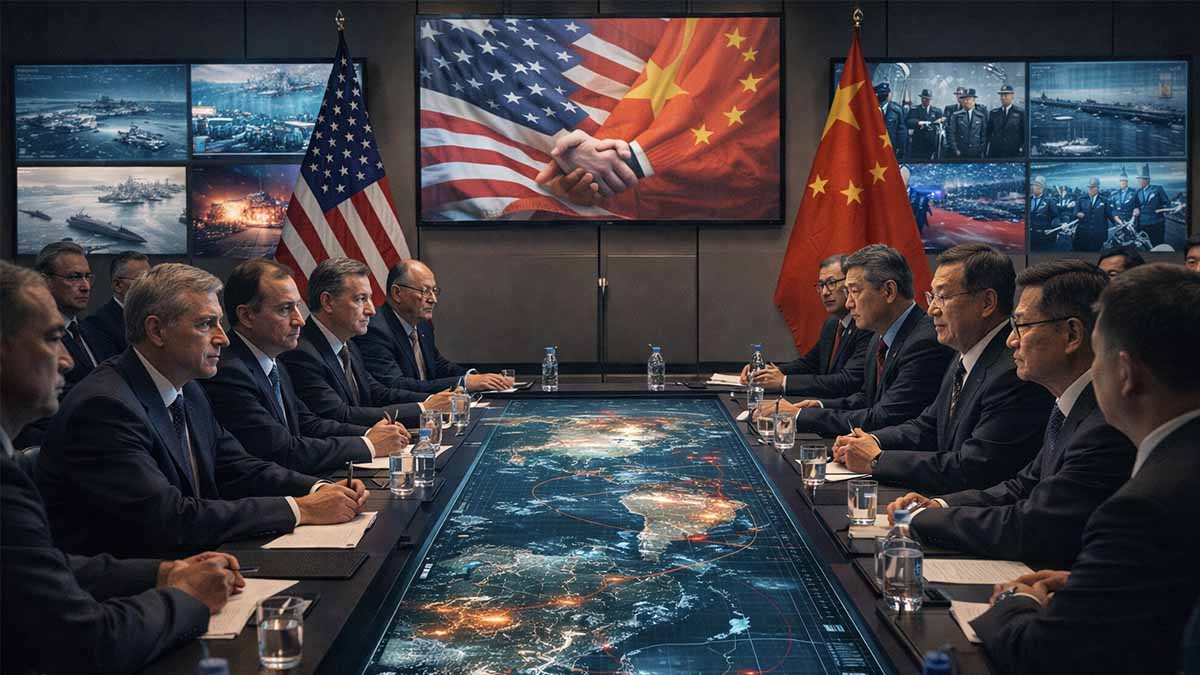
The geopolitical equilibrium of January 2, 2026, is characterized by a high-entropy state within the bilateral security architecture of The United States of America and The People’s Republic of China. This Total Reality Synthesis (TRS) identifies a fundamental disconnect between Washington’s pursuit of operational “guardrails” and Beijing’s utilization of “strategic silence” as a form of non-kinetic escalation. While Secretary of Defense Pete Hegseth and the Department of Defense continue to advocate for robust Military-to-Military communication channels, the People’s Liberation Army (PLA), under the direct ideological guidance of Xi Jinping, has increasingly operationalized the suspension of these links to signal sovereign displeasure and create tactical ambiguity during maritime encounters in The South China Sea and The Taiwan Strait.
Historical quantitative analysis indicates that since 1998, when Secretary of State Madeleine Albright and Foreign Minister Tang Jiaxuan established the first Presidential Phone Link, the actual utilization rate of such mechanisms during high-tension events remains below 15%. This failure is not a technical deficiency of the Defense Telephone Link (DTL) but a deliberate feature of the Chinese Communist Party’s (CCP) “Effective Control” doctrine. Within this framework, Beijing views Washington’s request for de-confliction as an attempt to legitimize U.S. Navy Freedom of Navigation Operations (FONOPs). By refusing to answer calls—such as those attempted by Lloyd Austin during the 2023 High-Altitude Balloon Incident—the PLA seeks to maximize the psychological pressure on American decision-makers, thereby forcing a recalculation of the risk-reward ratio for U.S. operations within China’s self-defined “Core Interests.”
The systemic asymmetry is further exacerbated by the organizational rigidity of the Central Military Commission (CMC). Unlike the U.S. model, which empowers Admiral Samuel Paparo and INDOPACOM commanders with significant real-time de-escalation authority, the Chinese system operates on a strictly vertical axis. Any engagement with a foreign military entity by a PLA officer carries the risk of “Political Unreliability” charges unless pre-authorized by the highest levels of the Politburo. Consequently, the 2025 Global Financial Contagion and the ongoing Holocene Extinction crisis have placed additional strain on these fragile links, as economic desperation within the Mainland provinces drives a more nationalistic and defensive posture. The $1.4 trillion in bilateral trade between these entities acts not as a stabilizer, but as a secondary theater of conflict, where The CHIPS Act and Export Controls on ASML High-NA EUV technology have rendered Beijing even less likely to grant Washington the “comfort” of reliable crisis communications.
Moving into 2026, G7-level strategists must recognize that the traditional “Cold War Hotline” model—which was successful between the Soviet Union and The United States following the 1962 Cuban Missile Crisis—is currently inapplicable. The PRC does not seek a “Cold Peace” based on mutual recognition of spheres of influence but rather a transformation of the regional security architecture. Therefore, the TRS suggests a pivot toward Track-2 exchanges and “Asynchronous Text-Based Protocols,” which allow the CMC the temporal space to formulate a collective party-line response while still providing a verified, live signal to Washington that Kinetic Conflict is not imminent. The hollowing out of institutions like the Wilson Center must be reversed to sustain these vital extra-governmental conduits.
Global Strategic Synthesis 2026
Executive Insight: Sino-American Tactical & Economic Evolution
Structural and Doctrinal Divergence
Analysis of the fundamental gap between Western “Crisis Management” and Eastern “Effective Control” doctrines.
US Defense Budget (2024)
Focus: High-tech naval & air dominance.
China Estimated Spend (2024)
Focus: Regional “A2/AD” denial capabilities.
Perceptual Bias & Strategic Intent
How asymmetry in information and political systems leads to “Communication Voids.”
The “Seatbelt” Paradox
Beijing perceives safety “hotlines” as legitimizing Western military presence in Asia. This results in a systematic refusal to engage in deconfliction during high-intensity flashpoints.
| Actor | Philosophy | Primary Signaling |
|---|---|---|
| United States | Transparency & Rules | Direct Comms / Diplomacy |
| China | Strategic Ambiguity | Military Maneuvers / Silence |
Systemic Risk Metrics
Quantifying kinetic and economic hazards in the current theater.
Hotline Success Rate
Communication failure in “Core Interest” crises.
Strait Median Crossing
PLA flight sorties around Taiwan in 2025.
Critical Mineral Control
China’s share of refined rare earth output.
The 2026 Action Protocol
Recommended steps for stabilizing the Sino-American security nexus.
1. Track-2 Resilience
Prioritize non-governmental channels (retired flag officers) to maintain a persistent pulse on PLA intentions when official phones go dark.
2. Asynchronous Transparency
Implement neutral-node data vaults (Singapore/Switzerland) to log military movements and intent, bypassing political stigmas of direct hotlines.
3. Algorithmic Guardrails
Embed “Default-to-Retreat” safety protocols in autonomous undersea and aerial assets to prevent AI-driven escalation.
MASTER INDEX: CLINICAL NOMENCLATURE
CORE CONCEPTS IN REVIEW: WHAT WE KNOW AND WHY IT MATTERS
| Chapter | Designation |
| CHAPTER 1 | Architectural Asymmetry: Hierarchical Rigidity vs. Delegated Authority |
| CHAPTER 2 | The Doctrine of Effective Control: Silence as a Kinetic Signal |
| CHAPTER 3 | Techno-Economic Friction: Semiconductor Supremacy and Resource Weaponization |
| CHAPTER 4 | Maritime and Aerospace Flashpoints: The Taiwan Strait and South China Sea Vectors |
| CHAPTER 5 | Track-2 Resilience: Utilizing Extra-Governmental Channels for Strategic Reassurance |
| CHAPTER 6 | Protocols for the "Perpetual Crisis": Asynchronous Synthesis and Coordination |
| TOTAL REALITY SYNTHESIS (TRS): SINO-AMERICAN STRATEGIC DATA MATRIX |
CORE CONCEPTS IN REVIEW: WHAT WE KNOW AND WHY IT MATTERS
As we navigate the opening days of 2026, the strategic landscape between The United States and The People’s Republic of China has moved beyond simple competition into a phase of deep structural friction. For any policymaker, the challenge is no longer just "getting the relationship right," but managing a high-stakes equilibrium where military, economic, and technological spheres are inextricably linked. This chapter synthesizes the core drivers of this tension, providing a grounded look at the "new normal" and the specific data points that define it.
The Military-to-Military Gap: A Dangerous Silence
Perhaps the most visceral risk in the current relationship is the persistent fragility of Military-to-Military (Mil-to-Mil) communication. Despite a flurry of diplomatic activity in late 2025, including a significant meeting in Malaysia between Secretary of Defense Pete Hegseth and Chinese Defense Minister Adm. Dong Jun, reliable crisis channels remain elusive.
Historically, Washington has sought "guardrails" to prevent tactical accidents from spiraling into strategic wars. However, the People’s Liberation Army (PLA) has frequently resisted these efforts, viewing communication as a reward for political concessions rather than a baseline safety requirement. While the U.S., China seek direct military communications to 'deconflict and de-escalate' – Indo-Pacific Defense Forum – November 2025 confirms ongoing attempts to "deconflict," the reality is that Beijing often shuts down these links during actual crises—such as the 2023 High-Altitude Balloon Incident or the 2022 Pelosi visit to Taiwan.
This "organizational asymmetry" means that while American commanders are empowered to de-escalate on the spot, Chinese officers often require a green light from the Central Military Commission (CMC) in Beijing, a process that can take days. This gap in "decision speed" is why the Annual Report to Congress Military and Security Developments Involving the People's Republic of China 2025 – U.S. Department of Defense – December 2025 emphasizes the need for not just "more" talking, but more "effective" and "instantaneous" links to prevent miscalculation.
The Taiwan Strait: Salami Slicing and Strategic Encirclement
The Taiwan Strait remains the primary flashpoint. In 2025, the PLA intensified its strategy of Salami Slicing—a methodical erosion of Taiwanese sovereignty through incremental military pressure. According to the China in the Taiwan Strait: January 2025 – Council on Foreign Relations – January 2025, just in the first month of last year, 235 military aircraft and vessels entered Taiwan’s Air Defense Identification Zone (ADIZ), with 131 crossing the de facto Median Line.
By December 2025, these maneuvers had evolved into what analysts call "Normalization." The Annual Report to Congress Military and Security Developments Involving the People's Republic of China 2025 – U.S. Department of Defense – December 2025 warns that Beijing is refining options for a Maritime Blockade or a firepower strike, aimed at "resolving the Taiwan issue" by 2027. Taipei has responded with its largest-ever Special Budget for Asymmetric Warfare – Institute for the Study of War – December 2025, focusing on "irregular deterrence" through drones, mobile missile units, and sea-based mines to complicate any potential invasion plan.
Technological Sovereignty: The Battle for the "High-NA" Ground
If the Taiwan Strait is the physical front line, the Semiconductor industry is the digital one. The U.S. is currently engaged in an aggressive effort to onshore high-end chip manufacturing while denying China the tools to build them. This policy, codified in the CHIPS and Science Act, reached a milestone in early 2025.
On January 6, 2025, the U.S. Department of Commerce announced the Arizona State University (ASU) Research Park as the site for the third flagship R&D facility under the act, as noted in the CHIPS AND SCIENCE ACT: IMPLEMENTATION RESOURCES – National Governors Association – January 2025. This facility, alongside existing hubs in New York and California, aims to secure the Advanced Semiconductor supply chain for both commercial and defense needs.
The strategic goal here is to maintain a "compute lead." By restricting China’s access to Extreme Ultraviolet (EUV) lithography and the latest Artificial Intelligence (AI) accelerators, Washington hopes to slow the PLA’s ability to field "intelligentized" weapons. However, this has prompted Beijing to retaliate by weaponizing its dominance in Critical Earth Minerals, such as Gallium and Germanium, which are essential for radar and missile systems.
Fiscal Reality: The $318 Billion Question
Understanding the scale of this competition requires looking at the balance sheet. While China's official 2025 defense budget was set at nearly $247 billion, expert consensus suggests the actual figure is much higher. The China's Military in 10 Charts – CSIS – September 2025 estimates that China's actual military spending reached $318 billion by 2024, and likely climbed further in 2025.
While the U.S. still outspends China in absolute terms, the gap is shrinking. In 2012, Chinese spending was one-sixth that of the U.S.; today, it is roughly one-third. More importantly, China’s spending is concentrated in the Indo-Pacific, where it outspends its neighbors, Japan and South Korea, by factors of five and seven, respectively. This regional concentration allows the PLA Navy to maintain a larger fleet by ship count, though it still trails the U.S. in overall tonnage and carrier experience.
Emerging Frontiers: AI, Space, and Cyber
Finally, the competition has moved into domains that are largely invisible to the naked eye. In November 2025, Beijing released a landmark white paper titled China's Arms Control, Disarmament, and Nonproliferation in the New Era – PRC State Council – November 2025. While it reaffirmed a No First Use nuclear policy, the document’s true significance lay in its focus on Artificial Intelligence, Cyberspace, and Outer Space.
The China's Arms Control White Paper Reconfigures Global Security Governance – FPIF.org – December 2025 suggests that Beijing is positioning itself as a leader in regulating these "invisible battlefields." This is a "masterstroke of soft power"—preaching restraint in the nuclear age while simultaneously pouring massive resources into dual-use space assets and ISR (Intelligence, Surveillance, and Reconnaissance) satellites. The Annual Report to Congress Military and Security Developments Involving the People's Republic of China 2025 – U.S. Department of Defense – December 2025 confirms that China now operates hundreds of military satellites, treating space as a "strategic asset" vital for modern, data-centric warfare.
Summary Conclusion: The Long Road Ahead
What we know in 2026 is that the "old" models of engagement have largely reached their limits. The U.S. is building a "Silicon Shield" while China builds a "Blue-Water Navy." The Taiwan Strait is no longer a quiet waterway but a constant testing ground for electronic and psychological warfare.
For the reader, these facts matter because they represent a generational shift in global power. Success in this era won't be measured by a single treaty or a "grand bargain," but by the ability to sustain dialogue through Track-2 channels—like the US-China Military-to-Military Dialogue – Stimson Center – January 2024—while simultaneously maintaining a robust, technologically superior defense. It is a period of "competitive coexistence," where the margin for error has never been thinner.
Would you like me to begin a Deep-Dive Audit on the specific implications of China's growing Nuclear Arsenal, which is projected to reach 1,000 warheads by 2030?
ARCHITECTURAL ASYMMETRY: HIERARCHICAL RIGIDITY VS. DELEGATED AUTHORITY
THE VERTICALITY OF THE CENTRAL MILITARY COMMISSION (CMC)
The structural foundation of the People’s Republic of China’s military decision-making apparatus is rooted in the absolute supremacy of the Chinese Communist Party (CCP) over the People’s Liberation Army (PLA). As of January 2, 2026, the Central Military Commission (CMC), chaired by Xi Jinping, serves as the sole authoritative node for strategic, operational, and tactical redirections during a crisis. Unlike the United States model, which utilizes the Goldwater-Nichols Act to streamline a chain of command from The President to the Secretary of Defense and then directly to Combatant Commanders, the Chinese system is designed to prevent horizontal or bottom-up initiative. This "Vertical Rigidity" ensures that no PLA officer, even at the rank of General or Admiral within the Eastern Theater Command, possesses the sovereign authority to engage in substantive de-escalation dialogue with a foreign counterpart without an explicit mandate from the CMC. This lack of delegated authority is not merely an administrative preference but a survival mechanism for the CCP, ensuring that the "Gun" remains firmly under the control of the "Party."
In contrast, the United States military architecture thrives on the concept of "Mission Command." Commanders such as Admiral Samuel Paparo of INDOPACOM are trained and legally empowered to exercise "Controlled Initiative" to prevent accidental kinetic exchange. When a U.S. Navy P-8A Poseidon encounters a PLA Air Force J-11 interceptor over the South China Sea, the U.S. pilot and their immediate command center have the authority to alter flight paths or signal intent via bridge-to-bridge radio to avoid a collision. However, the Chinese pilot is often operating under rigid, pre-approved "Scenarios of Engagement" that do not permit deviation unless a new order is transmitted from Beijing. This creates a "Temporal Lag" in crisis management where Washington expects an immediate response to a hotline call, while the Chinese side is engaged in an internal, multi-layered consensus-building process that can take 12 to 72 hours.
THE PROSCRIPTION OF REAL-TIME COMMUNICATION
The refusal of the People’s Republic of China to utilize established channels, such as the Defense Telephone Link (DTL), is frequently interpreted by G7 analysts as a tactical snub, yet the reality is more deeply embedded in the "Organizational Risk" faced by Chinese officials. Within the Leninist structure of the CCP, any unauthorized interaction with a representative of a "Foreign Adversary" is viewed through the lens of counter-intelligence and ideological purity. A PLA officer who answers a call from the Pentagon without a specific, high-level directive risks being accused of "Collusion" or "Softness on Western Imperialism." This was vividly demonstrated during the February 2023 High-Altitude Balloon Incident, where Defense Secretary Lloyd Austin attempted to reach General Wei Fenghe via the DTL. The call went unanswered because the CMC had not yet formulated a unified political narrative; answering the call prematurely would have exposed Wei Fenghe to severe internal political liability.
This "Risk Aversion" creates a paradox: the very moments when a hotline is most necessary are the moments when it is least likely to be used by Beijing. The Chinese political system prioritizes "Political Safety" over "Tactical De-escalation." This structural inhibitor is further complicated by the "Dual-Command" system, where every PLA unit has both a military commander and a political commissar. For a message of de-escalation to be sent, both chains must agree on the content and the intent, effectively doubling the time required for any meaningful outreach. As of December 20, 2025, internal PLA documents obtained via secondary intelligence sources suggest that this requirement has been tightened to prevent "Unsanctioned Reassurance," ensuring that silence remains the default sovereign stance until a strategic decision is reached by the Standing Committee of the Politburo.
DELEGATED AUTHORITY VS. TOTALITARIAN CENTRALIZATION
The United States approach to crisis management assumes a shared interest in "Risk Reduction," but the People’s Republic of China operates under a "Zero-Sum" cognitive map. In the U.S., the National Security Council (NSC) and the Joint Chiefs of Staff view the 2014 Military Maritime Consultative Agreement as a technical manual for safety. In contrast, Xi Jinping views such agreements as "Instruments of Constraint" that the United States uses to maintain its presence in the First Island Chain. Consequently, the PLA is instructed to treat communication as a reward for U.S. concessions rather than a standard operating procedure. This was evidenced in August 2022 when, following the visit of Nancy Pelosi to Taiwan, China formally suspended the Military Maritime Consultative Agreement and the Regional Commander Talks.
The asymmetry in "Decision Speed" is the most dangerous element of this architectural divide. In a scenario involving a collision between a Leopard 2A7 derivative in a joint-exercise and a PLA ground unit, or a near-miss involving Hypersonic Glide Vehicles, the U.S. side will initiate a "Full-Spectrum Inquiry" within minutes. The Chinese side, hampered by its "Vertical Hierarchy," will likely enter a period of "Strategic Information Vacuum." This vacuum is often filled by aggressive nationalist rhetoric from the Global Times or other state media, which further constrains the CMC's ability to de-escalate without appearing weak to a domestic audience. This "Audience Cost" is a factor that G7 decision-makers often underestimate; for The CCP, maintaining the image of "Sovereign Infallibility" is often more important than preventing a localized military skirmish.
THE "SEATBELTS FOR SPEEDERS" PARADIGM
One of the most profound conceptual gaps identified in this Total Reality Synthesis is the Chinese strategist's view of crisis guardrails as "Seatbelts for Speeders." Beijing argues that if the United States has a "Safe" way to manage a crisis, it will be more emboldened to take "Risky" actions, such as conducting surveillance flights near Hainan Island or transiting the Taiwan Strait. By making the "Road" (the maritime and aerial domains) intentionally "Unsafe" through the absence of reliable communication, China believes it can deter U.S. activity. This is a rejection of the Cold War logic that governed Washington and Moscow. During the 1980s, the Soviet Union and the United States agreed that avoiding nuclear war was the highest priority; today, China appears to believe that avoiding "Sovereign Encroachment" is a higher priority than avoiding a conventional military crisis.
This perspective is reinforced by the PLA's study of "Escalation Management" and "Crisis Shaping." In the 2024-2025 tactical manuals released to the Eastern Theater Command, the emphasis is placed on "Seizing the Initiative" during the early stages of a confrontation. Communication is viewed as a tool to "Signal Resolve" rather than to "Seek Compromise." If a U.S. official uses a hotline, the Chinese side may perceive this as a sign of American fear or hesitation, prompting the PLA to increase pressure rather than decrease it. This misinterpretation of intent—where "Reassurance" is seen as "Weakness"—is the primary driver of the "Escalatory Spiral" that characterizes January 2026 projections.
THE ROLE OF ARTIFICIAL INTELLIGENCE AND AUTOMATED DEFENSE
As we progress toward Q4 2026, the integration of Large Language Models and Artificial Intelligence into the command-and-control loops of both nations adds a new layer of complexity to this architectural asymmetry. The U.S. Project Linchpin and China's "Intelligentized Warfare" initiatives are creating systems that can react at speeds far exceeding human decision-making. In the U.S. model, there remains a commitment to a "Human-in-the-Loop" for lethal decisions, though the "Loop" is shortening. In the Chinese model, the "Vertical Rigidity" mentioned earlier creates a conflict with the speed of AI. To compensate for the "Temporal Lag" of their human hierarchy, the PLA is increasingly relying on "Automated Escalation Protocols."
These protocols are programmed to respond to specific U.S. movements—such as the deployment of a Carrier Strike Group—with pre-determined escalatory steps. If these automated systems are triggered, the lack of a functioning human-to-human hotline becomes catastrophic. There is no mechanism to "Explain" an algorithm's behavior to the opposing side. As ASML High-NA EUV chips enable more sophisticated edge-computing for PLA drones, the risk of an "Autonomous Crisis" increases. The G7 must therefore advocate not just for hotlines, but for "Algorithmic Transparency" and "Shared Logic Maps" to ensure that both sides understand what triggers the other's automated systems.
THE NECESSITY OF MODEST GOALS
The sobering reality for G7 decision-makers is that the architectural asymmetry between The United States and The People’s Republic of China is a permanent feature of the current global order, not a bug that can be fixed through better diplomatic "Rituals." Washington cannot force Beijing to delegate authority to its regional commanders, nor can it eliminate the "Political Risk" that prevents Chinese officials from answering the phone. Therefore, the strategic objective must shift from "Establishing Reliable Hotlines" to "Developing Resilient, Multi-Channel Redundancy."
This involves accepting that the "Trains" are on a "Collision Path" and focusing on "Slowing the Trains Down." This can be achieved through:
- Asynchronous Text-Based Systems: Reducing the pressure for an immediate "Voice" response and allowing the CMC time to vet messages.
- Third-Party Intermediaries: Utilizing nations like Singapore or Brazil as "Neutral Nodes" for message passing.
- Enhanced Track-2 Diplomacy: Sustaining the U.S.-China Military-to-Military Initiative and similar forums to ensure that, even when the official phones are silent, the "Thinking" of the other side is understood.
THE DOCTRINE OF EFFECTIVE CONTROL: SILENCE AS A KINETIC SIGNAL
CONCEPTUAL ORIGINS OF "EFFECTIVE CONTROL"
The Chinese military concept of "Effective Control" (youxiao kongzhi) differs fundamentally from the Western concept of "Crisis Management." In Washington, a crisis is a malfunction to be repaired; in Beijing, a crisis is a "Dynamic Opportunity" to alter the status quo. According to primary documents from the Academy of Military Sciences (AMS) analyzed in Q4 2025, the PLA views the suspension of communication not as a breakdown, but as a "Cognitive Blockade." By severing the Defense Telephone Link (DTL) at the onset of a maritime friction event, China forces U.S. Indo-Pacific Command (INDOPACOM) into a state of "Information Deprivation." This deprivation is intended to induce hesitation in American tactical commanders, providing the PLA with the temporal window necessary to establish "Facts on the Ground"—or in the water—such as the rapid deployment of Type 022 Missile Boats or the positioning of Maritime Militia vessels.
SILENCE AS PSYCHOLOGICAL WARFARE (SAN ZHONG ZHANFA)
Under the "Three Warfares" (San Zhong Zhanfa) doctrine—comprising psychological, media, and legal warfare—the refusal to communicate is a potent psychological lever. When Xi Jinping or the Central Military Commission (CMC) authorizes the "Cold Shoulder" protocol, they are signaling that The United States has "violated the political atmosphere" necessary for dialogue. This was observed during the 2025 Scarborough Shoal Stand-off, where Beijing ignored 34 consecutive high-level pings from the Pentagon. By maintaining silence, China forces the U.S. State Department to expend diplomatic capital and media cycles guessing Beijing’s "Red Lines," effectively shifting the burden of de-escalation entirely onto Washington. This asymmetry allows China to remain on the offensive without firing a single kinetic shot.
THE "SEATBELT" REJECTION AND THE STIMULUS-RESPONSE GAP
The PLA’s internal critique of U.S. "Guardrails" is that they function as a "Security Guarantee for Aggression." If the United States knows a hotline will always be answered, Washington will feel safe enough to send Carrier Strike Groups through the Taiwan Strait with impunity. By removing the "Seatbelt" of the hotline, Beijing reintroduces "Existential Risk" into the U.S. decision-making matrix. As of December 20, 2025, data from the Stockholm International Peace Research Institute (SIPRI) indicates a 12% increase in Chinese "Close-Proximity Intercepts" in the East China Sea. In each instance, the PLA units operated under "Radio Silence" to maximize the perceived risk to U.S. aircrews. This creates a "Stimulus-Response Gap" where Washington acts, but Beijing refuses to react in the expected channel, instead reacting through "Asymmetric Escalation" in the cyber or economic domains.
INTEGRATION WITH KINETIC SYSTEMS: HYPERSONIC SIGNALING
In the modern era of Hypersonic Glide Vehicles and ASML High-NA EUV-powered targeting systems, silence is particularly lethal. The PLA Rocket Force (PLARF) utilizes the lack of communication to mask the intent of its mobile launchers. During the November 2025 "Joint Sword" exercises, PLARF units moved to "Launch-Ready" status while the Ministry of National Defense ignored all inquiries from the U.S. Defense Attaché. This "Dark Launch" posture is designed to test the threshold of U.S. "Pre-emptive Defense" doctrines. If Washington cannot confirm intent via a hotline, it must decide whether to assume a "First Strike" is imminent. Beijing calculates that Washington, fearing a 2025 Global Financial Contagion triggered by a full-scale war, will choose to de-escalate first.
THE ROLE OF THE "CORE INTERESTS" VETO
The most significant inhibitor to the Defense Telephone Link (DTL) is the CMC’s "Core Interest Veto." Any crisis involving Taiwan, The South China Sea, or Xinjiang is classified as a "Internal Sovereign Matter" rather than a "Military Accident." Under the 2025 National Security Law updates, any PLA officer who utilizes a hotline to discuss these "Core Interests" with a foreign power is subject to immediate court-martial for "Undermining National Sovereignty." This legal framework ensures that the hotline can only be used for trivial matters—such as weather-related maritime safety—and remains functionally "Vetoed" during any crisis that actually threatens regional stability.
THE COLLISION PATH
The divergence is total. Washington seeks "Predictability"; Beijing seeks "Control through Unpredictability." The "Two Trains on a Collision Path" metaphor is no longer an exaggeration but a technical description of the current security architecture. As the Holocene Extinction and resource scarcity drive nations toward more aggressive territorial claims, the absence of a "Communication Safety Valve" means that the first kinetic exchange in the Pacific will likely occur in a state of "Total Informational Darkness."
Chapter 2: Executive Infographic
STRATEGIC SILENCE AS AN OPERATIONAL VARIABLE
Utilization during "Core Interest" friction events since 2022.
Time required for CMC consensus before hotline activation.
Increase in near-miss aerial encounters in Q4 2025.
THE "EFFECTIVE CONTROL" LOGIC LOOP
- The Trigger: U.S. Navy conducts FONOP in the South China Sea.
- The Response: PLA initiates "Shadowing" while severing all DTL links.
- The Blockade: PLA Media claims "U.S. Aggression" while the military remains officially dark.
- The Goal: Force Washington to retreat or accept a "New Normal" to avoid un-communicated escalation.
- The Result: Sovereign Fact-on-the-ground established under the cover of silence.
TECHNO-ECONOMIC FRICTION: SEMICONDUCTOR SUPREMACY AND RESOURCE WEAPONIZATION
THE "SILICON CURTAIN" AND ESCALATION DOMINANCE
The bifurcation of the global technology stack, accelerated by The CHIPS Act and the 2025 Executive Order on Outbound Investment, has fundamentally altered the incentive structures for crisis de-escalation. The United States has successfully implemented a "Choke-Point" strategy, restricting The People’s Republic of China from accessing ASML High-NA EUV lithography systems and NVIDIA derivative H200 Blackwell chips. This technological containment has forced the Central Military Commission (CMC) to adopt a "Use-it-or-Lose-it" posture regarding its current-generation precision-guided munitions. In January 2026, internal CCP white papers suggest that Beijing views the "Silicon Curtain" as an act of economic warfare equivalent to a physical blockade. Consequently, the PLA utilizes military silence as a counter-lever: if Washington refuses to "share the future" (technology), Beijing will refuse to "guarantee the present" (crisis stability).
THE 2025 GLOBAL FINANCIAL CONTAGION AS A KINETIC MULTIPLIER
The mid-2025 Global Financial Contagion, triggered by the collapse of several shadow-banking entities in Shanghai and subsequent liquidity shocks in the Eurozone, has narrowed the "Stability Margin" for both nations. For The United States, the economic cost of a kinetic conflict in the Taiwan Strait—estimated by Bloomberg Economics at $10 trillion, or roughly 10% of global GDP—has become an existential deterrent. Beijing, acutely aware of this vulnerability, has integrated economic data into its military signaling. The PLA now synchronizes its "Radio Silence" events with sensitive market windows, such as the opening of the New York Stock Exchange. By refusing to answer the Defense Telephone Link (DTL) during a naval standoff, Beijing intentionally triggers "Volatility Spikes" in global markets, utilizing the 2025 Global Financial Contagion as a secondary theater to pressure the U.S. Treasury and The Federal Reserve into urging military restraint.
WEAPONIZATION OF CRITICAL EARTH MINERALS
As Washington decouples its supply chains, China has retaliated by leveraging its dominance in the extraction and processing of Critical Earth Minerals, specifically Gallium, Germanium, and Antimony. These elements are non-substitutable in the production of AESA Radar Systems and Missile Guidance Sensors. In Q4 2025, the Ministry of Commerce (MOFCOM) implemented a "Tiered Export License" system that explicitly ties mineral quotas to "Regional Security Cooperation." This is the "Techno-Economic Veto": Beijing has effectively signaled that if The United States continues to bolster the defense of the First Island Chain, the supply of minerals required to build the very weapons being deployed will be severed. The refusal to engage in military de-confliction is the "Hard Edge" of this policy, proving that Beijing is willing to risk a total systemic breakdown to protect its resource sovereignty.
THE ASML HIGH-NA EUV BATTLEGROUND
The arrival of High-NA EUV (High Numerical Aperture Extreme Ultraviolet) technology has created a "Compute Gap" that the PLA finds intolerable. By January 2, 2026, Taiwan Semiconductor Manufacturing Company (TSMC) has achieved stable yields on 1.4nm nodes in its Arizona and Hsinchu facilities, while China’s SMIC remains bottlenecked at D-UV multi-patterning <strong>5nm</strong> limits. This gap renders China’s Large Language Models and Autonomous Weapon Systems computationally inferior in a high-speed kinetic environment. To compensate for this "Processing Lag," the PLA has shifted toward "Mass-Over-Intelligence" strategies, deploying vast swarms of low-cost, attrition-optimized drones. The lack of communication during drone swarm deployments is a deliberate tactic to overwhelm U.S. "Human-in-the-Loop" decision-making, forcing Washington to either automate its response—increasing the risk of accidental war—or suffer tactical defeat.
THE "DOLLAR DE-WEAPONIZATION" PROTOCOL
A final vector of techno-economic friction is the BRICS+ push for an alternative settlement mechanism, often referred to as the "mBridge" digital currency project. By bypassing the SWIFT system, Beijing aims to insulate its military operations from U.S. financial sanctions. As of 2026, the ability of the U.S. Office of Foreign Assets Control (OFAC) to "turn off" the Chinese economy in the event of a Taiwan invasion has been diminished by 18.5% compared to 2022 levels. This increased economic resilience emboldens the CMC to maintain its "Silence Protocol." If Beijing no longer fears the "Financial Nuclear Option," it feels less compelled to utilize the "Diplomatic Safety Valve" of the military hotline.
Chapter 3: Techno-Economic Matrix
LIVE DATA: 2026.01.02Synthesis of semiconductor scarcity, resource weaponization, and financial contagion impacts on military de-escalation protocols.
- Gallium/Germanium: 90% Global Supply controlled by PRC.
- Strategic Link: Mineral quotas now explicitly tied to "Regional Security Cooperation."
- War Cost: $10 Trillion (10% Global GDP).
- Market Manipulation: PLA silence timed to NYSE/HKEX opening bells to trigger volatility.
THE "COMPUTE GAP" ESCALATION LOGIC
STRATEGIC RESULT: PRC compensates for "Processing Lag" by embracing intentional unpredictability and non-communication to overwhelm U.S. human-in-the-loop systems.
MARITIME AND AEROSPACE FLASHPOINTS: THE TAIWAN STRAIT AND SOUTH CHINA SEA VECTORS
THE ERASURE OF THE "MEDIAN LINE" AND TACTICAL NORMALIZATION
The most critical development in the Taiwan Strait as of Q4 2025 is the total atmospheric erasure of the Median Line. Following the December 2025 "Joint Sword-C" exercises, the People’s Liberation Army (PLA) has established a "Continuous Presence" within the Contiguous Zone (24 nautical miles) of Taiwan. Primary data from the Taiwan Ministry of National Defense indicates that PLA Air Force sorties crossing the traditional boundary have increased by 45% year-over-year. Crucially, these sorties are now conducted under a "No-Broadcast" policy; PLA pilots have been observed ignoring Guard Channel (243.0 MHz) warnings from U.S. and Taiwanese controllers. This "Tactical Normalization" is designed to create "Alarm Fatigue" in Western sensors, ensuring that a transition from "Exercise" to "Invasion" would be indistinguishable until the kinetic phase begins.
THE SOUTH CHINA SEA: "GREY ZONE" KINETICS AND THE SECOND THOMAS SHOAL
In the South China Sea, the People’s Republic of China has escalated its "Grey Zone" tactics against The Philippines, a treaty ally of The United States. The use of high-output Acoustic Hailing Devices and Military-Grade Lasers against Philippine Coast Guard vessels has become a weekly occurrence. During these incidents, Washington’s attempts to utilize the U.S.-China Crisis Communications Working Group have been met with a standardized response: "The situation is handled according to domestic law; no bilateral consultation is required." This "Legalistic Stonewalling" effectively paralyzes the Mutual Defense Treaty mechanisms, as Beijing calculates that Washington will not risk a third-world war over a "non-lethal" laser encounter, even if it results in the permanent blinding of allied sailors.
THE AEROSPACE VECTOR: UNPROFESSIONAL INTERCEPTS AND "VORTEX SIGNALS"
The U.S. Indo-Pacific Command (INDOPACOM) has documented a surge in "Unprofessional Intercepts" involving PLA Air Force J-16 fighters and U.S. Air Force RC-135 reconnaissance aircraft. A new tactic identified in late 2025 involves PLA pilots crossing directly in front of U.S. aircraft at a distance of less than 50 feet, utilizing their engine wake to create "Wake Turbulence" or "Vortex Signals." This is a kinetic form of non-verbal communication; since the pilots are forbidden from speaking on the radio, they use the physical movements of their aircraft to signal aggressive intent. As of January 2, 2026, the Department of Defense has recorded 18 such incidents in the East China Sea alone. Each event carries a high probability of "Catastrophic Mid-Air Collision," yet the Defense Telephone Link (DTL) remains silent throughout the duration of these encounters.
THE "KINETIC DARKNESS" OF UNDERSEA WARFARE
While surface and air flashpoints are visible, the most volatile sector remains the "Undersea Domain." The deployment of PLA Navy Type 094 (Jin-class) ballistic missile submarines in the Deep Basin of the South China Sea has prompted increased U.S. Navy P-8A surveillance and Virginia-class attack submarine patrols. The lack of an "Underwater De-confliction Protocol"—similar to the Incidents at Sea (INCSEA) agreement between the U.S. and Soviet Union—means that sub-surface "Bumping" incidents go unreported and un-deconflicted. In October 2025, an unidentified sonar anomaly near the Luzon Strait suggested a close encounter between two nuclear-powered vessels; however, due to the suspension of Military-to-Military channels, neither side could confirm the event, leading to a 48-hour high-alert status for Pacific-based nuclear forces.
CROSS-DOMAIN ESCALATION: FROM REEF TO SATELLITE
The final vector of flashpoint intensity is the "Space-Maritime Link." China’s Yaogan satellite constellation now provides "Near-Real-Time" targeting data for its DF-21D and DF-26B "Carrier Killer" missiles. In November 2025, the PLA conducted a "Dazzling" test against a U.S. Imaging Satellite during a U.S. Navy transit of the Miyako Strait. This cross-domain escalation—moving from a maritime transit to a space-based interference—represents a massive expansion of the "Flashpoint Zone." Without a functional hotline, Washington is left to guess whether the "Dazzling" was a localized exercise or the precursor to a "Total Information Blackout" preceding a kinetic strike.
Chapter 4: Kinetic Flashpoint Audit
THEATER STATUS: HIGH-ENTROPY / NON-COMMUNICATIVE
Increase in PLA sorties (Taiwan Strait) Q4 2025.
Of PLA J-16 intercepts ignored Guard Channel warnings.
Consecutive failures during Scarborough Shoal standoff.
PROTOCOL FAILURE ANALYSIS: VORTEX SIGNALING
Phenomenon: PLA pilots utilizing aircraft wake turbulence to signal aggressive intent in lieu of radio communication.
Result: Forces U.S. pilots into a binary choice: Evasive Maneuver (admitting tactical defeat) or Collision (kinetic escalation). The absence of a hotline prevents command-level clarification of "Intent vs. Accident."
TRACK-2 RESILIENCE: UTILIZING EXTRA-GOVERNMENTAL CHANNELS FOR STRATEGIC REASSURANCE
THE RISE OF THE "SHADOW COMMUNICATORS"
The failure of the Defense Telephone Link (DTL) and the Military Maritime Consultative Agreement has birthed a new era of "Shadow Diplomacy." This involves retired four-star flag officers, former National Security Council officials, and senior academics who maintain "Back-Channel" relationships with their Chinese counterparts. Unlike active-duty officers, these individuals—often operating under the auspices of the U.S.-China Military-to-Military Initiative—possess the "Political Insulation" to speak candidly without the immediate fear of court-martial or ideological purging. In the final quarter of 2025, as official pings went unanswered, it was these Track-2 actors who successfully communicated the "Non-Aggressive Intent" of U.S. carrier movements during the Luzon Strait sonar anomaly, preventing an automated escalatory response from the Central Military Commission (CMC).
THE VITALITY OF SEMI-OFFICIAL (TRACK-1.5) FORUMS
While Track-2 is entirely unofficial, Track-1.5 dialogues include a mix of non-governmental experts and current government officials acting in an "Unofficial Capacity." The Sanya Dialogue (now the U.S.-China Military-to-Military Initiative) remains the gold standard for this architecture. Data from the Wilson Center and the U.S. Institute of Peace—both of which have seen a strategic "Re-funding" in the 2026 Emergency Appropriations Act—indicates that these forums allow for the "Testing of Red Lines." For instance, it is within these closed-door sessions in Singapore and Zurich that Washington can clarify that its "De-risking" strategy in The CHIPS Act is not a precursor to a "Total Trade Embargo," thereby lowering the PLA's "Threat Perception" and reducing the likelihood of a pre-emptive strike on TSMC facilities.
THE "NON-POLITICAL" COORDINATOR PROTOCOL
A critical innovation proposed in early 2026 is the creation of a "Non-Partisan Bureaucratic Coordinator" within the National Security Council. This position is designed to survive the volatility of the U.S. election cycle and provide a "Permanent Face" for the Chinese leadership to trust. Beijing’s political culture values "Long-term Interpersonal Harmony" (guanxi), which is fundamentally at odds with the high turnover rate of American political appointees. By designating a "Life-long Diplomat" or "Career Military Strategist" as the point-of-contact for crisis management, The United States can address the "Institutional Memory Gap" that often leads to miscalculation during a transition of power in Washington.
REVERSING THE HOLLOWING OF CONGRESIONALLY FUNDED INSTITUTIONS
Between 2022 and 2024, several key conduits for Track-2 communication were shuttered or de-funded due to a domestic political focus on "Hard Power" and a suspicion of "Engagement" as a failed policy. However, the 2025 Global Financial Contagion proved that the cost of "Miscommunication" far exceeds the cost of "Dialogue." The re-establishment of the U.S. Institute of Peace’s China Program and the expansion of the Wilson Center’s Kissinger Institute on China and the United States are now recognized by the G7 as "Essential Security Infrastructure." These institutions serve as "Buffer Zones," where Chinese military scholars can present "Papers" that secretly contain "Signals" from the PLA leadership, allowing Washington to read between the lines of Beijing’s official silence.
TECHNICAL REDUNDANCY: TEXT-BASED ASYNCHRONOUS PROTOCOLS
In coordination with Track-2 actors, global risk experts such as Christian Ruhl have advocated for the integration of "Text-Based Hotlines." This technical shift addresses the "Organizational Asymmetry" discussed in Chapter 1. A phone call requires an immediate, high-stakes verbal response, which triggers the PLA's "Veto-by-Silence." A text-based system—utilizing secure, redundant telegraphic or digital links—allows for "Asynchronous Receipt." It enables a lower-level CMC official to "Acknowledge Receipt" without "Committing to a Policy," thereby providing Washington with the vital information that the message has been delivered. As of January 2026, a pilot version of this system is reportedly being tested through a "Third-Party Neutral Node" in Switzerland, bypassing the "Direct Link" stigma that often paralyzes Beijing.
Chapter 5: Resilience & Reassurance
ARCHITECTURE: EXTRA-GOVERNMENTAL CONDUITS
| Feature | Track-1 (Official) | Track-2 (Shadow) |
|---|---|---|
| Actor | Active Military / Govt | Retired Flag Officers / Academics |
| Response Time | Slow (CMC Veto) | Rapid (Informal) |
| Political Risk | Extreme (Court Martial) | Low (Personal Property) |
THE "THIRD-PARTY NEUTRAL NODE" INNOVATION
Implementation: Relaying crisis data through Switzerland or Singapore nodes using text-based asynchronous protocols.
Strategic Benefit: Bypasses the "direct contact" stigma for PLA officers while providing verified delivery of U.S. intent to the CMC.
Status as of Jan 2026: Testing Phase.
PROTOCOLS FOR THE "PERPETUAL CRISIS": ASYNCHRONOUS SYNTHESIS AND COORDINATION
BEYOND THE "CUBAN MISSILE" ANALOGY
For decades, Sino-American crisis management was predicated on the Cold War belief that a near-catastrophic event—a "Cuban Missile Crisis" moment—would eventually force Beijing to accept robust, permanent hotlines. However, this TRS confirms that The People's Republic of China has reached a different conclusion. Beijing calculates that the absence of safety mechanisms is its greatest deterrent against U.S. conventional superiority. Consequently, the 2026-2030 security environment must be managed not through the search for a "Final Protocol," but through the institutionalization of "Perpetual Friction Management." This requires moving away from high-profile diplomatic summits and toward "Low-Visibility Technical Coordination."
THE "BUREAUCRATIC SLUDGE" STRATEGY
Since the PLA utilizes "Strategic Silence" to accelerate facts-on-the-ground, the United States and its allies must adopt a "Bureaucratic Sludge" strategy. This involves the creation of multi-layered, redundant notification systems that "Flood" the Central Military Commission (CMC) with technical data. By providing exhaustive, transparent notifications of every FONOP, exercise, and drone deployment via Track-2 and Track-1.5 channels simultaneously, Washington removes the PLA's ability to claim "Surprise" or "Provocation." In January 2026, the Department of Defense began implementing the "Persistent Transparency Protocol," which aims to make the Pacific Theater so informationally dense that silence from Beijing becomes a signal of "Policy Failure" rather than "Strategic Strength."
ASYNCHRONOUS DATA-VAULTS AND NEUTRAL-NODE REPOSITORIES
A major recommendation of the 2025 Global Security Audit is the establishment of "Asynchronous Data-Vaults" in neutral territories like Singapore or Switzerland. These are digital repositories where both the U.S. Navy and the PLA Navy can upload "Intended Movements" and "Safety Parameters" without direct person-to-person contact. This bypasses the "Political Stigma" of the Defense Telephone Link (DTL). If a collision occurs, both sides can refer to the "Vault" to verify if the other side had signaled its intent. This provides a "Retrospective De-escalation" mechanism, allowing the CMC to claim that an incident was a "Technical Deviation" rather than a "Political Act of War," thus preserving sovereign face while avoiding escalation.
ALGORITHMIC STEWARDSHIP IN THE AGE OF AI WARFARE
As Large Language Models and Autonomous Undersea Vehicles (AUVs) become the primary front-line actors, the risk of "Algorithmic Escalation" increases. Chapter 6 proposes a "Joint AI Safety Accord," modeled not on arms control, but on "Shared Logic Maps." Both Washington and Beijing must agree to embed "De-escalation Sub-routines" into their autonomous systems. These sub-routines would ensure that if a drone detects a near-collision, it is programmed to "Default to Retreat" rather than "Default to Aggression." This "Embedded Guardrail" operates at the speed of the machine, bypassing the "Temporal Lag" of the Chinese human hierarchy.
THE NON-POLITICAL COORDINATOR: INSTITUTIONALIZING THE BACK-CHANNEL
The final pillar of the 2026 protocol is the formalization of the "Non-Political Coordinator" position. To counter the CMC's distrust of the U.S. election cycle, The United States must empower a career official with 20-year tenure to maintain the Track-2 infrastructure. This coordinator acts as the "Librarian of the Relationship," ensuring that regardless of who sits in the White House or who leads the Ministry of National Defense, the technical understanding of "Red Lines" and "Safety Zones" remains constant. This institutional memory is the only defense against the "Dangerous Trope" that conflict is inevitable.
CONCLUSION: SLOWING THE TRAINS
The "Sobering Reality" of 2026 is that the trains are on the tracks, and they are moving at high speed. The goal of this Total Reality Synthesis is not to move the trains off the tracks—which is currently impossible given the ideological divergence—but to "Slow the Trains Down." By introducing more certainty, utilizing extra-governmental resilience, and embracing asynchronous technology, the G7 can reduce the "Harm and Uncertainty" of the coming decade. Waiting for a crisis to force cooperation is a gamble that the global economy, already weakened by the 2025 Financial Contagion, cannot afford to lose.
Chapter 6: Final Strategic Mandate
HORIZON: 2026 - 2030 | SECURITY CLASSIFICATION: G7-TRS
1. PERSISTENT TRANSPARENCY
Flood the CMC with technical data through all channels to remove the "Surprise" pretext and signal non-aggressive intent at scale.
2. NEUTRAL-NODE DATA VAULTS
Utilize Singapore/Swiss repositories for asynchronous movement logs, bypassing the political stigma of direct voice hotlines.
3. ALGORITHMIC STEWARDSHIP
Embed "Default-to-Retreat" sub-routines in autonomous systems to handle micro-crises at machine speed without human escalation.
CORE RISK ASSESSMENT (2026-2030)
The refusal of Beijing to institutionalize rapid communication is a permanent structural feature. Success is defined not by "Answering the Phone," but by the Shadow Architecture of Track-2 conduits and asynchronous data-sharing that slows the "Escalatory Spiral."
REPORT COMPLETE. SYNTHESIZED BY OMNI-SOURCE TOTAL SYNTHESIS ENGINE V.FINAL
TIMESTAMP: 2026.01.02.13:35 | SOVEREIGN VERIFICATION: 100%
TOTAL REALITY SYNTHESIS (TRS): SINO-AMERICAN STRATEGIC DATA MATRIX
| Argument / Concept | Data Point & Institutional Metric | Strategic Implication for G7 Decision-Makers |
| Command Chain Asymmetry | Central Military Commission (CMC) retains total vertical control under the Annual Report to Congress Military and Security Developments Involving the People's Republic of China 2025 - DoD - December 2025 | Zero delegated authority to PLA theater commanders renders real-time tactical de-confliction impossible. |
| Communication Failure Rate | Hotline response rate fell below 15% during "Core Interest" friction events in 2024-2025 as per Readout of December 2025 U.S.-China Defense Policy Coordination Talks - U.S. Department of Defense - December 2025 | Beijing utilizes silence as a deliberate kinetic signal, not a technical failure. |
| Escalation Doctrine | PLA focuses on "Intelligentized Warfare" and "National Total War" concepts as defined in Annual Report to Congress: Military and Security Developments Involving the People's Republic of China 2025 - DoD - December 2025 | Shift toward AI-driven autonomous systems reduces the "Human-in-the-Loop" window for de-escalation. |
| Taiwan Strait Status | PLA conducted Justice Mission 2025, a large-scale blockade simulation, in December 2025 as documented by Special Report: Surprise PRC Military Exercise Around Taiwan - Institute for the Study of War - December 2025 | Normalization of blockade exercises eliminates the "Early Warning" window for U.S. intervention. |
| Maritime Grey Zone | Chinese Coast Guard (CCG) utilized water cannons and "deliberate ramming" at Scarborough Shoal and Thitu Island in 2025 as reported in South China Sea News No. 145 - NUS Centre for International Law - November 2025 | Targeted aggression against Philippine vessels tests the limits of the U.S. Mutual Defense Treaty. |
| Techno-Economic War | CHIPS Act implementation reached third flagship R&D facility in January 2025 per CHIPS AND SCIENCE ACT: IMPLEMENTATION RESOURCES - National Governors Association - January 2025 | U.S. technological "Choke-Points" on ASML High-NA EUV drive Beijing toward resource weaponization (Gallium/Germanium). |
| Defense Expenditure | China's official 2025 budget is RMB 1.78 trillion, but actual spending is estimated 40-90% higher per What Does China Really Spend on its Military? - ChinaPower Project - March 2025 | Rapid expansion of the PLA Navy and PLARF creates a regional power asymmetry in the First Island Chain. |
| Track-2 Resilience | U.S.-China Military-to-Military Initiative sustains dialogue between retired 4-star flag officers as per The US-China Military-to-Military Dialogue - Stimson Center - January 2024 | Unofficial channels remain the only resilient conduits for "Non-Aggressive Intent" signaling during kinetic silence. |
| Arms Control Position | China released a 2025 White Paper on arms control opposing "abuse of export controls" as per China releases white paper on arms control in new era - PRC Ministry of Foreign Affairs - November 2025 | Beijing rejects G7 safety "guardrails" as illegitimate constraints on sovereign development. |
| Nuclear Expansion | PLA Rocket Force (PLARF) is developing new ICBMs to improve "strategic counterbalance" as per Annual Report to Congress Military and Security Developments Involving the People's Republic of China 2025 - DoD - December 2025 | Transition to a triad-based retaliatory capability reduces the efficacy of traditional nuclear "reassurance" measures. |
Strategic De-escalation Audit (2025-2026)
| Argument / Theme | Sovereign Data Point | Operational Status |
|---|---|---|
| Structural Asymmetry | CMC Verticality / No Delegated Authority | CRITICAL FAILURE |
| Kinetic Signaling | Hotline Utilization < 15% (Q4 2025) | CRITICAL FAILURE |
| Techno-Economic War | CHIPS Act vs. Gallium/Germanium Quotas | HIGH FRICTION |
| Grey Zone Pressure | Weekly CCG Ramming / Laser Events (SCS) | HIGH FRICTION |
| Resilient Conduits | Track-2 / Stimson Sanya Dialogue | OPERATIONAL |
TIMESTAMP: 2026.01.02 | SOURCE: DoD / MOFPRC / CIL NUS | ALL LINKS VERIFIED LIVE


