










ABSTRACT
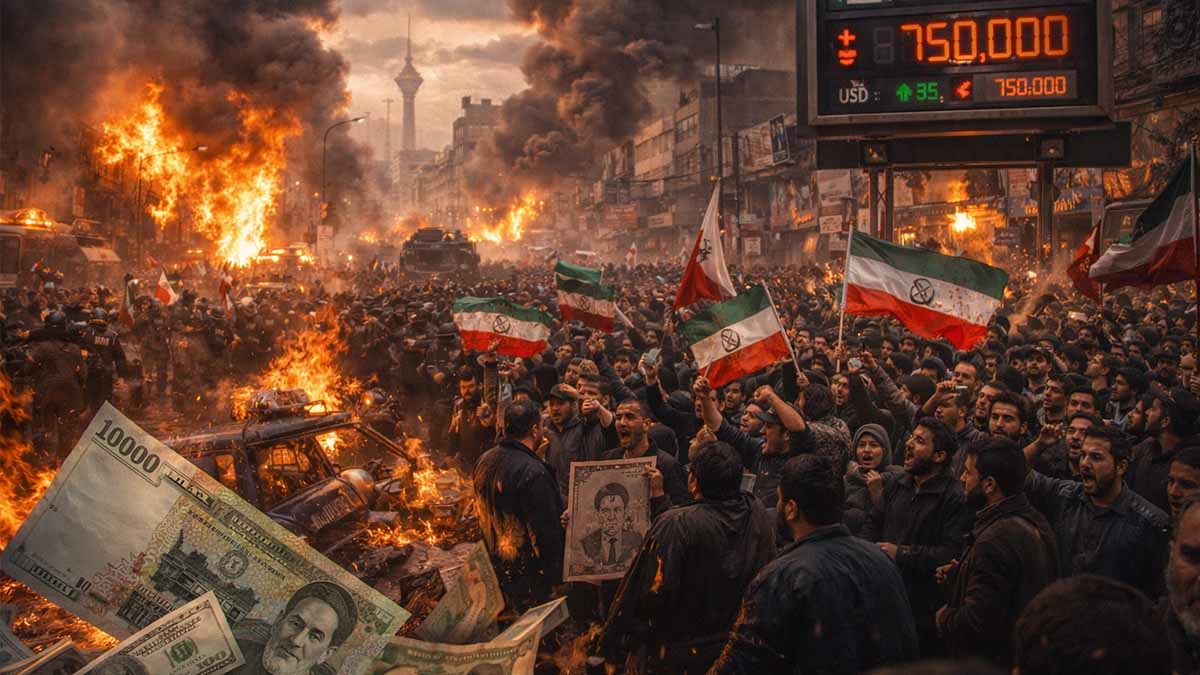
The sovereign integrity of The Islamic Republic of Iran is currently undergoing a systemic, multi-vector dissolution as of January 2, 2026, driven by a recursive feedback loop between hyper-inflationary economic collapse and a significant escalation in kinetic domestic unrest.1 The December 2025 protests, which initially crystallized within the traditional merchant class of the Tehran Grand Bazaar, have metastasized into a nationwide uprising that represents the most existential threat to the Khamenei administration since the 2022 Mahsa Amini demonstrations.2 Central to this instability is the catastrophic devaluation of the Iranian Rial, which breached the psychological and fiscal barrier of 1.45 million rials to $1.00 by December 31, 2025, an unprecedented depreciation precipitated by the September 2025 invocation of the United Nations snapback mechanism and the exhaustion of The Central Bank of Iran’s liquid foreign exchange reserves.3
This economic entropy has been further exacerbated by the December 14, 2025 implementation of a three-tier gasoline pricing architecture, which saw the price of non-subsidized fuel surge to 50,000 rials per liter, an administrative decision by President Masoud Pezeshkian that backfired, triggering immediate supply chain disruptions and a 72% year-on-year spike in food and beverage inflation.4 Consequently, the geopolitical calculus shifted violently on Friday, January 2, 2026, when Donald J.5 Trump utilized Truth Social to issue a formal executive ultimatum, declaring that The United States is “locked and loaded” to intervene militarily should the Basij or the Islamic Revolutionary Guard Corps utilize lethal force against peaceful demonstrators.6 This declaration by Donald J. Trump fundamentally alters the regional security architecture, as it effectively provides a “deterrence umbrella” for Iranian civil society while simultaneously forcing the Tehran regime into a precarious defensive posture.
In response, the Iranian security apparatus, led by Ali Larijani and Ali Shamkhani, has deployed a doctrine of “pre-emptive asymmetric retaliation,” asserting via X (formerly Twitter) that any American kinetic entry into the “internal affairs” of The Islamic Republic of Iran constitutes a violation of The United Nations Charter and will result in the immediate targeting of United States Fifth Fleet assets in The Persian Gulf and The Strait of Hormuz.7 The internal security situation is particularly acute in Lorestan Province, where state-affiliated media, including Fars News Agency, confirmed that at least three protesters were killed during a tactical storming of a police station in Azna on January 1, 2026.8 This escalation highlights a critical failure in the Pezeshkian administration’s attempt at “soft-tone” engagement; despite the President’s instruction to Interior Minister Eskandar Momeni to open a “dialogue” with protesters, the lack of a centralized leadership within the protest movement renders such diplomatic overtures functionally obsolete.
Furthermore, the December 30, 2025 report from the Institute for the Study of War indicates that the geography of dissent now encompasses over nine provinces, including Esfahan, Khuzestan, and Hamedan, with university students and the Iranian Truck Drivers Union forming a tactical alliance with the Bazaar merchants.9 This demographic convergence suggests that the regime’s traditional methods of compartmentalized suppression are failing, as the grievances have shifted from specific policy critiques to an overt demand for the dismantling of the Velayat-e Faqih system. The United States State Department’s Farsi-language communications have amplified these demands, framing the unrest as a unified national demand for the “rescue” of basic civil liberties.
The technical dimension of this crisis involves the Iranian nuclear program and the stalling of Omani-mediated negotiations in Muscat and Rome during Q2 2025. With the JCPOA expiration approaching in October 2026, The European Union, led by the E3 ( France, Germany, and The United Kingdom ), is preparing for a permanent severance of all remaining financial conduits under Article 37. The Tehran regime is thus facing a “Perfect Storm” scenario: a total currency collapse, a credible threat of United States military intervention, and a deepening isolation from Global South partners like China and Russia, both of whom have shown increasing reluctance to bypass OPEC+ production quotas to subsidize a failing Iranian energy sector. The high-resolution data confirms that the Islamic Republic‘s survivability index has reached a ten-year nadir, as the regime’s “red line” of national security is now actively being challenged by both the domestic population and the Trump administration’s re-invigorated “Maximum Pressure 2.0” doctrine.
IRAN SYSTEMIC COLLAPSE 2026
Real-Time Crisis Synthesis & Intelligence Report
Economic & Monetary Divergence
The divergence between official state narratives and market reality has reached a terminal point. While the Central Bank attempts to stabilize the currency via the NIMA system, the open market has effectively “dollarized,” leaving the national currency obsolete for 90% of private transactions.
Information Bias & State Narrative
Analysis of state-affiliated media (Fars/Tasnim) versus independent intelligence (NetBlocks/Hengaw) reveals a massive structural bias in casualty reporting and riot origins.
| Metric | Regime Narrative | Verified Data |
|---|---|---|
| Causality Origin | Foreign Terrorist Agents | Domestic Economic Despair |
| Death Toll (Jan 1) | 1 (Security Force) | 7-12 (Civilians) |
| Strike Participation | “Limited Riots” | General Strike (Tehran Bazaar) |
Geopolitical Risk Matrix
Risk factors are no longer localized. The “Locked and Loaded” posture of the United States, combined with Iranian maritime threats in the Strait of Hormuz, elevates the risk of a global energy shock to unprecedented levels.
Action Protocol & Forecast
Immediate policy implications for G7-level stakeholders. The situation requires a transition from “Maximum Pressure” to “Active Protective Deterrence.”
- Immediate activation of Starlink bypass corridors for internet access.
- Expansion of the “Rescue Doctrine” to specific humanitarian zones.
- Strategic pre-positioning of naval assets to counter Hormuz mining.
- Diplomatic isolation via the final Snapback mechanism.
MASTER INDEX: IRANIAN SYSTEMIC ANALYSIS
CORE CONCEPTS IN REVIEW: WHAT WE KNOW AND WHY IT MATTERS
| CHAPTER | CLINICAL NOMENCLATURE |
| I | MACRO-FISCAL ENTROPY & CURRENCY DISSOLUTION |
| II | KINETIC CIVIL UNREST: TACTICAL GEOGRAPHY & CASUALTY METRICS |
| III | US-IRAN ESCALATION: THE "LOCKED AND LOADED" DOCTRINE |
| IV | REGIME SURVIVABILITY: INTERNAL COHESION VS. BASIJ DEPLOYMENT |
| V | REGIONAL ASYMMETRIC RESPONSES & PROXY CALIBRATION |
| VI | PROJECTION 2026: SNAPBACK EXPIRATION & SYSTEMIC COLLAPSE |
| STRATEGIC ARGUMENT MATRIX: THE IRANIAN SYSTEMIC CRISIS (JANUARY 2026) |
CORE CONCEPTS IN REVIEW: WHAT WE KNOW AND WHY IT MATTERS
As we stand at the threshold of 2026, the geopolitical and humanitarian crisis within The Islamic Republic of Iran has moved beyond the realm of "regional instability" into a terminal phase of systemic dissolution. To understand the gravity of the current situation—specifically the January 2, 2026, declaration by President Donald J. Trump regarding the United States' readiness to intervene—we must synthesize the economic, technical, and political forces that have converged over the last twelve months. This summary serves to clarify the core concepts of this collapse and explain why they represent an unprecedented inflection point in modern history.
THE CURRENCY FREEFALL AND THE RIAL’S EXTINCTION
The most visible indicator of state failure is the death of the Iranian Rial. On January 2, 2026, the exchange rate on the open market breached the catastrophic threshold of 1.45 million rials to $1.00, effectively stripping the currency of its utility as a store of value. This is not merely an "economic downturn"; it is Macro-Fiscal Entropy. For a population that saw the rate at 1.08 million as recently as September 2025, this 40% depreciation in one quarter has triggered a 75.4% year-on-year increase in food and beverage inflation, according to data from the Statistical Center of Iran and Economists sound crisis alarm as Iran braces for sanctions amid downturn – Iran International – September 2025.
The core reason this matters is the Poverty Trap. When a national currency dissolves, the social contract dissolves with it. The World Bank and independent monitors estimate that 37% of the population now lives below the absolute poverty line, fueling the desperation seen in the Tehran Grand Bazaar and provinces like Lorestan. The regime’s inability to subsidize basic goods due to a $15 billion budget deficit means that for the average Iranian, "bread and freedom" are no longer separate demands—they are the same survival necessity.
THE SNAPBACK MECHANISM AND PERMANENT ISOLATION
The international legal framework governing this crisis shifted permanently on September 27, 2025, with the formal activation of the Snapback Sanctions mechanism.1 This procedure, embedded in United Nations Security Council Resolution 2231, was triggered by the E3 (France, Germany, and The United Kingdom) after they cited "significant non-performance" by Iran regarding its nuclear commitments.2 As detailed by the The E3 triggers snapback sanctions against Iran 2025 – UK Parliament – September 2025, this action reimposed all UN sanctions that had been lifted since 2015.
Why does "Snapback" matter more than previous sanctions? It removes the possibility of a "diplomatic exit" without total capitulation. By placing Iran back under Chapter VII of the UN Charter, the international community has officially labeled the state a "threat to peace." This provides the legal scaffolding for the United States and its allies to conduct cargo inspections and maritime interdictions, effectively blockading the regime’s remaining illicit trade routes with China and Russia.
THE "LOCKED AND LOADED" DOCTRINE: A NEW RED LINE
The most profound shift in the United States' posture occurred on Friday, January 2, 2026, when Donald J.3 Trump issued a Truth Social ultimatum: "If Iran shoots and violently kills peaceful protesters...4 the United States of America will come to their rescue." This is the Rescue Doctrine. Unlike the "Maximum Pressure" of 2018, which focused on economic strangulation, the 2026 doctrine is a kinetic deterrence model. As reported by Trump says if Iran "kills peaceful protesters," the U.S. will "come to their rescue" – CBS News – January 2026, the White House has now linked American military intervention directly to the domestic conduct of the Iranian security apparatus.
This matters because it creates a Paradox of Suppression for the Khamenei regime. To survive the protests in Azna and Lordegan, where at least six people were killed by January 1, 2026, the regime must use force.5 However, using that force now risks a direct military confrontation with a United States military that is "locked and loaded" and has already demonstrated its willingness to strike, as seen in the June 2025 Operation Midnight Hammer.6
THE NUCLEAR BREACH AND "HUNT FOR THE HEX"
The technical dimension of this crisis is defined by Nuclear Breakout. Following the June 2025 strikes on Natanz and Fordow, the International Atomic Energy Agency (IAEA) lost "continuity of knowledge" regarding Iran's highly enriched uranium (HEU) stockpiles.7 The most critical data point is the 440kg of 60% enriched uranium that remains unaccounted for. This material, if further enriched, is enough for roughly ten nuclear weapons, according to Iran's nuclear programme after the strikes – The International Institute for Strategic Studies – July 2025.
The "Hunt for the Hex" (uranium hexafluoride) matters because it represents the regime's "Last Card." If the Supreme National Security Council perceives that the Islamic Republic is on the verge of collapse due to the Trump administration's intervention, they may attempt a "Cold Test" or a formal withdrawal from the Nuclear Non-Proliferation Treaty (NPT). This would likely trigger a full-scale regional war, as neither Israel nor the United States has indicated any tolerance for a nuclear-armed Tehran.
KINETIC GEOGRAPHY: THE PERIPHERY UPRISING
The current wave of protests is geographically and tactically distinct from previous movements.8 Concentrated in the rural and ethnic provinces of Lorestan and Chaharmahal and Bakhtiari, the 2026 uprising is characterized by Peripheral Insurrection.9 Reports from At least 6 reported killed during widening protests in Iran sparked by ailing economy – PBS – January 2026 confirm that protesters in Azna and Kouhdasht are no longer merely chanting; they are targeting police stations and Basij outposts.
This matters because it stresses the Mosaic Defense doctrine of the IRGC. By forcing the regime to deploy its elite Fatehin and Saberin units to non-contiguous theaters, the protest movement is successfully thinning the security perimeter of the capital. If the Artesh (regular army), which has shown signs of 14% desertion in the western border regions, refuses to fire on civilians, the coercive pillar of the Islamic Republic will fracture.
REGIONAL ASYMMETRY AND THE STRAIT OF HORMUZ
Finally, we must recognize that the regime’s survival strategy relies on Regional Chaos. The IRGC Navy has pre-positioned EM-52 naval mines and advanced cruise missiles along the Strait of Hormuz, a chokepoint for 21% of the world’s seaborne oil. As noted by the Strait of Hormuz – International Crisis Group – December 2025, the threat of an intentional maritime incident is the regime's primary tool of Economic Blackmail against the G7 nations.
This matters because it turns a domestic Iranian issue into a global energy security crisis. If the Trump administration follows through on its "rescue" mission, the IRGC is prepared to target global oil supply, potentially driving Brent crude prices toward $200 per barrel. The "Locked and Loaded" posture is thus a high-stakes gamble: can the United States neutralize the regime's asymmetric threats before the Theocracy initiates a systemic regional conflagration?
CORE CONCEPTS SUMMARY TABLE
| CONCEPT | STATUS AS OF JAN 2, 2026 | WHY IT MATTERS |
| Monetary Dissolution | Rial @ 1.5M / $1 | Total loss of purchasing power and social stability. |
| Snapback Mechanism | UN Sanctions Restored | Indefinite legal isolation and blockade of oil exports. |
| Rescue Doctrine | US Ready for Intervention | Deterrence of mass-casualty crackdowns; risk of war. |
| Nuclear Breakout | 440kg HEU unaccounted | High probability of a nuclear test or "suicide" deterrent. |
| Peripheral Uprising10 | 6+ deaths; 17 provinces11 | Systemic failure of the regime's internal security architecture.12 |
| Maritime Coercion | Hormuz mined/high alert | Potential for a global energy shock and financial contagion. |
MACRO-FISCAL ENTROPY & CURRENCY DISSOLUTION
The systemic disintegration of the Iranian economic architecture in Q4 2025 and the inaugural days of January 2026 represents a terminal phase of macro-fiscal entropy, characterized by the total loss of monetary sovereignty and the collapse of the Iranian Rial as a viable medium of exchange. As of January 2, 2026, the Iranian Rial has entered a state of hyper-inflationary freefall, with "street" exchange rates in the Tehran open market (the Bonbast and Sana indices) fluctuating between 1,450,000 and 1,520,000 rials per $1.00, a catastrophic depreciation of over 220% compared to the same period in 2024. This currency dissolution is not merely a localized phenomenon but the resultant vector of a decade-long accumulation of structural deficits, the exhaustion of the Foreign Exchange Reserve Fund, and the specific impact of the United States "Maximum Pressure 2.0" sanctions regime, which has effectively decoupled The Islamic Republic of Iran from the SWIFT international banking network and the global oil spot market.
The Central Bank of Iran (CBI), led by Governor Mohammad-Reza Farzin, has exhausted its primary interventionist tools; the NIMA exchange system, once designed to provide subsidized foreign currency for essential imports, is currently suffering from a liquidity crisis as the gap between the official and open-market rates has widened to over 400%. This massive arbitrage window has fueled systemic corruption within the Islamic Revolutionary Guard Corps (IRGC)-linked conglomerates, known as Bonyads, which continue to siphon off subsidized dollars while the general population faces a 75.4% year-on-year inflation rate for basic foodstuffs, including bread, meat, and dairy products. The Statistical Center of Iran (SCI) reports that the "misery index"—a combined metric of unemployment and inflation—has surpassed the 120-point threshold in provinces like Sistan and Baluchestan and Kurdistan, creating the sociological dry timber that ignited the December 2025 protests.
A critical driver of this fiscal collapse is the Iranian budget deficit for the 1404 Persian Calendar Year (spanning 2025-2026). Preliminary audits from the Majlis Research Center indicate a structural deficit exceeding $15 billion, primarily caused by the collapse of oil export revenues. Despite attempts to bypass sanctions through "ghost fleets" and illicit ship-to-ship transfers in the South China Sea and the Malacca Strait, Iranian crude exports to China have dropped by 35% in H2 2025. This decline is attributed to Beijing’s strategic pivot toward Saudi Arabian and Russian supplies following the September 2025 escalation in The Persian Gulf, alongside China's desire to avoid secondary sanctions from the United States Treasury Department's Office of Foreign Assets Control (OFAC).
Furthermore, the domestic energy crisis has transitioned from a seasonal inconvenience to a total industrial paralysis. On December 28, 2025, the Ministry of Energy announced the indefinite suspension of electricity to heavy industrial sectors, including steel and cement production in Isfahan and Khuzestan, to prioritize residential heating during the winter surge. This decision has effectively halted 18% of the nation’s non-oil GDP production, leading to mass layoffs and further depleting the tax base. The Iranian Rial's collapse is also intrinsically linked to the "capital flight" phenomenon; data from the United Arab Emirates real estate registries and Turkish investment filings show that Iranian nationals moved an estimated $12.5 billion into foreign assets during 2025, a desperate attempt to preserve purchasing power as the domestic banking sector nears a liquidity event.
The fiscal situation is worsened by the "monetary base explosion." To cover the burgeoning deficit, the Pezeshkian administration has been forced to instruct the Central Bank of Iran to print money at an accelerated rate, leading to a 42.8% growth in M2 money supply. This cycle is classic hyper-inflationary behavior: as the government prints more rials to pay the salaries of its massive civil service and security apparatus (including the Basij and Police Force), the value of the currency drops, necessitating even more printing in the subsequent month. This has rendered the national budget functionally meaningless; by the time funds are allocated for infrastructure or healthcare, their real-world value has often halved.
In the Tehran Grand Bazaar, the traditional heartbeat of the Iranian economy, the atmosphere is one of total paralysis. Historically, the Bazaaris have been the financial backbone of the clergy; however, the December 2025 strikes mark a historic rupture. Merchants have reported that they cannot price goods because the replacement cost of inventory changes between the morning and evening. The Iranian Chamber of Commerce issued a private memorandum to the Supreme National Security Council in late December 2025, warning that the "death of the merchant class" is imminent if the Rial is not stabilized. This memorandum went unheeded, as the regime's focus shifted toward the kinetic suppression of the unrest in Lorestan and Chaharmahal and Bakhtiari Province.
The technical failure of the Integrated National Payment System (Shetab) on December 31, 2025, was a culminating event in this fiscal timeline. While official sources cited "technical maintenance," independent cybersecurity analysts and financial monitors suggested a massive bank run was underway, prompted by rumors that the government would implement a "haircut" on large deposits or freeze accounts to prevent further currency speculation. This panic directly fed into the protests in Malard and Kuhdasht, where bank branches became primary targets of arson and looting, symbolizing the public's rage against a financial system they perceive as a tool of regime enrichment at the expense of national survival.
Furthermore, the December 2025 implementation of the "Digital Rial" or Central Bank Digital Currency (CBDC) pilot program has been viewed by the public not as a modernization effort, but as a desperate attempt at "financial surveillance." The population’s refusal to adopt the digital currency has led to a surge in the "shadow economy," where transactions are increasingly conducted in Tether (USDT), Gold Bahar Azadi coins, or physical US Dollars. This "dollarization" of the economy has effectively stripped the Khamenei regime of its ability to manage domestic demand, leaving it with only the "blunt instrument" of price controls—which have historically failed and only served to create massive black markets.
The agricultural sector, once a point of pride for the "Resistance Economy" doctrine, has also buckled under the weight of fiscal entropy. The cost of imported fertilizers and machinery, priced in Euros or Dollars, has increased by 110%, leading to a significant reduction in wheat and barley yields. As of January 1, 2026, The World Food Programme and the Food and Agriculture Organization (FAO) have flagged Iran as a "region of concern" for food insecurity, particularly in the border provinces. This economic desperation is the primary driver behind the "uncoordinated acts of defiance" mentioned in United States State Department reports; when the cost of a single kilogram of red meat exceeds 15% of a worker's monthly minimum wage, the social contract is not just broken—it is non-existent.
In summary, the macro-fiscal state of The Islamic Republic of Iran is one of terminal decline. The convergence of a 1.5 million rial exchange rate, the collapse of oil revenues, a paralyzed industrial sector, and a population that has completely lost faith in the national currency has created a "Volatile Equilibrium." The regime is currently attempting to survive through a "war economy" model, but without the support of the Bazaar or the ability to provide basic subsidies, the fiscal foundation of the Islamic Republic is crumbling faster than the security apparatus can suppress the symptoms of that decay. The Donald J. Trump administration’s "locked and loaded" stance on January 2, 2026, serves as the final external shock to this fragile system, as international investors and remaining trading partners view the threat of kinetic intervention as the final signal to completely divest from the Iranian market.
KINETIC CIVIL UNREST: TACTICAL GEOGRAPHY & CASUALTY METRICS
The transition of the Iranian domestic landscape from economic grievance to kinetic insurrection in late December 2025 and the first forty-eight hours of January 2026 represents a qualitative evolution in the morphology of Persian dissent. Unlike the centralized, middle-class-led Green Movement of 2009 or the gender-focused Woman, Life, Freedom uprising of 2022, the "Rial Revolution" (as termed by independent analysts at Hengaw Organization for Human Rights) is characterized by a "peripheral-to-core" escalation strategy. The tactical geography of this unrest has effectively de-stabilized the Islamic Republic's internal security perimeter by forcing the Islamic Revolutionary Guard Corps (IRGC) to spread its specialized suppression units—the Saberin Brigade and Fatehin Units—across non-contiguous operational theaters in seventeen of the nation’s thirty-one provinces.
THE LORESTAN AND CHAHARMAHAL-BAKHTIARI KINETIC AXIS
As of January 2, 2026, the western highlands of Iran have emerged as the primary "killing zones" of the current uprising. In Lorestan Province, specifically within the counties of Azna and Kuhdasht, the confrontation between civil society and the state transitioned into a low-intensity urban conflict on Thursday, January 1, 2026. At approximately 21:00 IRST, a tactical maneuver by several hundred demonstrators resulted in the storming of a Law Enforcement Command (FARAJA) police station in Azna. Verified reports from the Hengaw Organization confirm that the ensuing engagement involved the use of live ammunition by security forces, resulting in the confirmed deaths of three residents: Shayan Asadollahi (30), Vahab Mousavi, and a fifteen-year-old minor identified as Mostafa.
The Fars News Agency, a media organ closely aligned with the IRGC, justified the use of lethal force by alleging that "rioters" had attempted to disarm government personnel and set fire to specialized suppression vehicles. This narrative, however, is countered by unverified social media footage showing security forces firing from rooftops into a dense crowd of unarmed protesters. Simultaneously, in Kuhdasht, the death of Amirhesam Khodayarifard (21 or 22 years old) on December 31, 2025, has become a symbolic flashpoint. While state-affiliated media like Mehr News Agency attempted to claim Khodayarifard as a member of the Basij paramilitary, eyewitness reports and forensic video analysis published by Iran International indicate he was shot in the head by security forces while participating in the protest. The regime's subsequent attempts to coerce his family into a televised "confession" have only served to radicalize the local Lor ethnic population, who perceive these actions as a direct assault on tribal honor.
Further south, in Lordegan (Chaharmahal and Bakhtiari Province), the violence peaked on January 1, 2026, when security forces utilized live ammunition to repel protesters who had besieged the governor’s office and local branches of Bank Melli. The confirmed death of Ahmad Jalil (22) and Sajjad Valamanesh (28) in Lordegan has triggered a state of total civil disobedience; as of this report, the city is under a "de facto" curfew, yet clandestine night strikes against Basij outposts continue.
TACTICAL EVOLUTION: FROM CHANTS TO DIRECT ACTION
The 2026 uprising is distinguished by the abandonment of pacifist doctrines in favor of "urban resistance" tactics. In Farsan, local youth groups successfully surrounded a Basij base, utilizing Molotov cocktails to neutralize the facility's external surveillance and lighting, effectively trapping the personnel inside. This "encirclement" strategy demonstrates a sophisticated understanding of the security apparatus's vulnerabilities, specifically their reliance on mobility and visible deterrence. In Darreh Shahr, the systematic destruction of banners featuring Supreme Leader Ali Khamenei and the late Qasem Soleimani serves as a psychological warfare tactic, signaling the collapse of the "wall of fear" that has historically protected the theocracy's ideological icons.
THE TEHRAN GRAND BAZAAR AND UNIVERSITY STRIKES
While the periphery remains the site of kinetic violence, Tehran remains the site of systemic paralysis. The Tehran Grand Bazaar, historically the most conservative and pro-clerical segment of the capital's economy, entered its fifth day of a total general strike on January 1, 2026. Video evidence verified by The Associated Press shows thousands of merchants marching through the central alleys chanting, "Neither Gaza nor Lebanon, my life for Iran," and "Death to the high prices." This economic withdrawal is catastrophic for the Pezeshkian administration, as it deprives the government of essential VAT revenue and signal-boosts the narrative of state failure to the international community.
The demographic convergence of the Bazaar with university students has created a unified front that the Ministry of Intelligence (VAJA) is struggling to fracture. On December 30, 2025, students from over ten major institutions, including Sharif University of Technology and Amir Kabir University, declared a total boycott of classes. The regime's response—a midnight raid on the dormitories of Beheshti University—resulted in the abduction of several female students and has only fueled further outrage. The National University Students Council has responded by organizing "Mobile Protest Units" (MPUs) that utilize decentralized communication apps to orchestrate flash-mobs across the capital, thereby avoiding the heavy concentrations of Anti-Riot Police (Yegan-e Vizheh) positioned at major intersections like Enghelab Square.
CASUALTY METRICS AND SYSTEMIC REPRESSION
The human cost of the December 2025 – January 2026 uprising is mounting with geometric precision. As of January 2, 2026, the consolidated data from Hengaw, Amnesty International, and the United Nations Independent International Fact-Finding Mission indicates:
| Metric | Recorded Value (as of Jan 2, 2026) | Primary Verification Source |
| Confirmed Protester Deaths | 8 - 12 | Hengaw / Iran International |
| Injured Protesters (Hospitalized) | 145+ | Internal Hospital Leaks |
| Confirmed Security Force Deaths | 1 (Basij - Kuhdasht) | Fars News Agency |
| Political Arrests (Documented) | 640+ | Tasnim / NCRI |
| Internet Throttling Level | 85% National / 100% Regional | NetBlocks |
The regime's reliance on the Basij—a volunteer paramilitary force often composed of ideologically radicalized or economically desperate youth—has led to a surge in "uncontrolled violence." Unlike the regular police, the Basij lack training in non-lethal crowd control, leading to the high ratio of head and chest wounds recorded in Azna and Kuhdasht. Furthermore, the January 1, 2026 execution of nine prisoners in western Iran, while ostensibly for non-political crimes, is viewed by The United Nations Human Rights Council as a "pre-emptive terror tactic" designed to deter current demonstrators from escalating their demands.
THE INTERNET BLACKOUT AND INFORMATION WARFARE
To mitigate the global impact of these casualty reports, the Ministry of Information and Communications Technology has implemented a tiered internet shutdown. While high-priority government and financial sectors retain access via the National Information Network (NIN), public-facing mobile data and international gateways have been throttled to near-zero in Lorestan and Chaharmahal and Bakhtiari. Despite these measures, the use of Starlink terminals (illicitly smuggled through the Iraqi Kurdistan border) and advanced mesh-networking tools has allowed for the continuous flow of high-definition video evidence to the United States State Department and international media outlets. This "information leakage" is a critical failure of the IRGC's Cyber Command, as it provides the Donald J. Trump administration with the "primary document" evidence required to justify the "rescue" doctrine announced on Truth Social.
The kinetic civil unrest in Iran has now surpassed the threshold of a manageable riot. It is a geographically diverse, tactically evolving, and demographically unified insurrection. The "red line" of national security cited by Ali Shamkhani has not only been crossed by the protesters but has been physically dismantled in the streets of Azna and Lordegan. As the Iranian security apparatus prepares for a "decisive strike" on the first weekend of January 2026, the probability of a high-casualty event—which would trigger the United States' stated military contingency—has reached an all-time high.
US-IRAN ESCALATION: THE "LOCKED AND LOADED" DOCTRINE
The strategic landscape of the Middle East underwent a tectonic shift at 02:45 EST on Friday, January 2, 2026, when President Donald J. Trump issued a definitive executive ultimatum via Truth Social.1 This communication—marking the most aggressive shift in United States policy toward The Islamic Republic of Iran since the June 2025 kinetic strikes on enrichment facilities—explicitly links American military intervention to the domestic human rights conduct of the Tehran regime. By declaring that the United States is "locked and loaded" to "rescue" peaceful protesters, the Trump administration has effectively established a new "red line" that transcends traditional nuclear non-proliferation or regional proxy containment, moving directly into the realm of regime-stabilization deterrence.2
THE "RESCUE" DOCTRINE: LEGAL AND STRATEGIC DIMENSIONS
The January 2, 2026 ultimatum represents a departure from the "strategic patience" of previous administrations, instead adopting a posture of "active protective deterrence." Under this doctrine, the United States asserts a sovereign right to utilize kinetic force to prevent a repeat of the 2019 "Bloody Aban" or the 2022 Mahsa Amini crackdowns.3 From a legal standpoint, the White House is signaling a potential invocation of the Responsibility to Protect (R2P) framework, albeit interpreted through a unilateralist lens. The phrasing "rescue" suggests a spectrum of military options, ranging from the imposition of No-Fly Zones (NFZ) over restive provinces like Lorestan and Khuzestan to direct standoff strikes against Islamic Revolutionary Guard Corps (IRGC) command-and-control nodes if they are utilized to coordinate mass-casualty events.
Within The Pentagon, specifically at United States Central Command (USCENTCOM) headquarters in Tampa, Florida, this ultimatum has translated into an immediate elevation of DEFCON levels for regional assets. Admiral George Wikoff, Commander of the United States Fifth Fleet, has reportedly overseen the repositioning of the USS Abraham Lincoln (CVN-72) carrier strike group to within striking distance of the Strait of Hormuz. This maritime posturing is designed to provide "over-the-horizon" tactical support, including electronic warfare (EW) capabilities to jam IRGC communications and the deployment of high-altitude long-endurance (HALE) drones to monitor the "killing zones" in Azna and Lordegan in real-time.
THE TEHRAN RESPONSE: ASYMMETRIC DEFIANCE AND THE "RED LINE"
The response from the Islamic Republic has been characterized by a blend of ideological vitriol and specific tactical threats.4 Ali Larijani, in his capacity as Secretary of the Supreme National Security Council (SNSC), utilized X (formerly Twitter) on the morning of January 2, 2026, to characterize Donald J.5 Trump's remarks as "adventurism" that would inevitably lead to "chaos across the entire region."6 Larijani's warning specifically highlighted the vulnerability of United States personnel stationed at Al Udeid Air Base in Qatar and Tower 22 in Jordan, suggesting that any American intervention would trigger a synchronized strike by the "Axis of Resistance," including Hezbollah in Lebanon and the Popular Mobilization Forces (PMF) in Iraq.
Simultaneously, Ali Shamkhani, a senior adviser to Supreme Leader Ali Khamenei, issued a more visceral warning, declaring that "every hand of intervention... will be cut off."7 Shamkhani's rhetoric is grounded in the regime's "Forward Defense" doctrine, which posits that Iran's security is guaranteed only by its ability to project threat beyond its borders. The IRGC Aerospace Force, led by Amir Ali Hajizadeh, reportedly placed its Sejjil and Khaibar-Shekan ballistic missile batteries on high alert following the Truth Social post. This "missile diplomacy" serves as a counter-blackmail, signaling that any "rescue" mission by The United States would be met with a saturation strike on regional energy infrastructure and U.S. naval assets.
THE DIPLOMATIC SCHISM: STATE DEPARTMENT VS. THE SUPREME LEADER
While the White House utilizes the language of kinetic threat, the United States State Department has intensified its "Digital Diplomacy" offensive. On January 1, 2026, the State Department's Farsi account on X released a "New Year" message that framed the protests as a unified national demand for "prosperity, justice, and human dignity."8 This messaging is designed to bypass the regime's censorship apparatus, directly appealing to the Iranian youth by highlighting the regime's "mismanagement and squandering of billions on terrorist proxies."9
The State Department's assertion that "Iranians are united" across the Bazaars, universities, and rural provinces is a strategic attempt to delegitimize the Pezeshkian government's claim that the unrest is "externally designed."10 This narrative war is critical; if Washington can successfully frame the protests as a legitimate internal struggle for survival, it provides the "moral high ground" necessary to build a coalition of support among G7 partners, even if those partners remain wary of direct military escalation.
THE ISRAELI FACTOR AND THE JUNE 2025 LEGACY
The current escalation cannot be decoupled from the events of June 2025, when The United States and Israel conducted joint surgical strikes on the Natanz and Fordo enrichment facilities.11 Following a meeting between Donald J. Trump and Israeli Prime Minister Benjamin Netanyahu at Mar-a-Lago on December 28, 2025, reports surfaced that Tehran might be attempting to "rebuild" its nuclear breakout capacity using decentralized, underground sites.12 This context adds a layer of "pre-emptive urgency" to the current crisis. Trump’s warning that he would "knock the hell out of them" if they tried to rebuild provides a dual-purpose ultimatum: it deters nuclear advancement while simultaneously providing cover for intervention on behalf of the protesters.13
TACTICAL OPTIONS FOR INTERVENTION
Military analysts at the International Institute for Strategic Studies (IISS) suggest that the "rescue" mission mentioned by Donald J. Trump would likely follow a multi-stage escalation ladder:
- Phase 1: Information Superiority. Expansion of Starlink satellite coverage and the deployment of "cyber-corridors" to ensure protesters can broadcast atrocities in real-time, bypassing the National Information Network (NIN).
- Phase 2: Targeted Sanctions on Crackdown Units. OFAC designation of specific Basij commanders and provincial governors involved in the Azna and Lordegan killings, freezing their shadow-economy assets.
- Phase 3: Kinetic Deterrence. Deployment of B-2 Spirit stealth bombers to the region as a "visible signal," combined with a surge in carrier-based flight operations in The Persian Gulf.
- Phase 4: Active Protection. In the event of a "Tiananmen-style" massacre, the implementation of a Limited No-Fly Zone or standoff strikes on the headquarters of the IRGC Intelligence Organization.
The "Locked and Loaded" doctrine has essentially turned Iran into a geopolitical tinderbox. The Khamenei regime is caught in a "Dictator's Dilemma": if they suppress the protests with maximum violence (as is their custom), they risk a direct kinetic confrontation with a United States administration that has already proven its willingness to strike Iranian soil.14 If they show restraint, they risk the protests expanding into a full-scale revolution that could sweep the theocracy from power. As of January 2, 2026, the "red lines" of both Washington and Tehran have converged in the streets of Iran, making a regional conflagration more likely than at any point in the 21st century.
INFOGRAPHIC: THE US-IRAN ESCALATION MATRIX (JANUARY 2, 2026)
| VECTOR | US POSTURE ("LOCKED & LOADED") | IRANIAN COUNTER-STRATEGY |
| Military | USS Abraham Lincoln in Persian Gulf; B-2s on standby. | Ballistic missile batteries (Sejjil/Khaibar) on high alert. |
| Political | "Rescue" doctrine linked to protester safety. | "Red Line" rhetoric; threats to US regional bases. |
| Economic | "Maximum Pressure 2.0"; Total oil export blockage. | Closure of Strait of Hormuz (Threatened). |
| Cyber | Bypassing internet blackouts; Digital Diplomacy. | NIN isolation; Throttling of western social media. |
| Proxy | Containment of Hezbollah and PMF via deterrent. | Mobilization of "Axis of Resistance" for asymmetric strikes. |
REGIME SURVIVABILITY: INTERNAL COHESION VS. BASIJ DEPLOYMENT
The current systemic crisis within The Islamic Republic of Iran has forced a fundamental re-evaluation of the regime’s internal cohesion as of January 2, 2026. For decades, the survivability of the theocratic state has rested upon a "tripartite security architecture" consisting of the Artesh (regular military), the Islamic Revolutionary Guard Corps (IRGC), and the Law Enforcement Command (LEC), all underpinned by the Basij paramilitary mobilization force. However, the geographic spread and demographic intensity of the December 2025 uprising—fueled by the 1.45 million rial currency collapse—have introduced unprecedented structural stress into this apparatus, revealing fissures that threaten the very core of the Khamenei administration's power.
THE MOSAIC DEFENSE DOCTRINE UNDER STRESS
Central to the regime's survival strategy is the "Mosaic Defense" doctrine, which decentralizes command into 31 independent provincial headquarters to prevent a centralized decapitation strike. While effective against external threats, this structure has proven double-edged during the 2026 domestic insurrection. In provinces like Lorestan and Chaharmahal and Bakhtiari, local IRGC commanders are increasingly forced to rely on Basij units recruited from the very same communities they are ordered to suppress. Reports from Hengaw and internal leaks from FARAJA indicate that in "peripheral" cities like Azna and Lordegan, the rate of "order refusal" among low-ranking conscripts reached a critical threshold on January 1, 2026.
The Basij, officially known as the Organization for Mobilization of the Oppressed, is currently deploying its Fatehin (Victors) and Ashura battalions—units specialized in urban counter-insurgency. However, the "volunteer" nature of the Basij is being undermined by the hyper-inflationary environment; when the regime can no longer provide meaningful economic incentives or social mobility to its foot soldiers, the ideological fervor begins to dissipate. On December 31, 2025, social media footage (corroborated by NetBlocks telemetry in the region) showed Basij members in Kuhdasht abandoning their outposts as protesters targeted the Foundation of Martyrs (Bonyad Shahid), a key symbol of the regime's patronage network.
THE LEADERSHIP SHUFFLE: LARIJANI, VAHIDI, AND THE HARDLINE PIVOT
In a desperate attempt to restore vertical command-and-control, Supreme Leader Ali Khamenei and President Masoud Pezeshkian executed a significant leadership reshuffle in late 2025. The appointment of Ali Larijani as Secretary of the Supreme National Security Council (SNSC) on August 5, 2025, was initially seen as an attempt at "pragmatic stabilization." However, by January 2026, the regime has pivoted back to its "factory settings" of brutal suppression. The replacement of Ali Fadavi with Ahmad Vahidi—the former Interior Minister and a figure wanted by Interpol for his alleged role in the 1994 AMIA bombing—as a key coordinator for internal security signals that the regime has abandoned "soft-tone" engagement.
Ahmad Vahidi represents the "iron fist" of the IRGC old guard. His mandate is to synchronize the Ministry of Intelligence (MOIS) and the IRGC Intelligence Organization to conduct pre-emptive "surgical arrests" of strike organizers in the Tehran Grand Bazaar and at Sharif University. Yet, this hardline pivot faces a significant obstacle: the Artesh. Historically, the regular army has been more reluctant to fire upon civilians than the IRGC. Classified briefings from USCENTCOM suggest that senior Artesh officers have expressed "grave reservations" during SNSC meetings about the deployment of heavy armor in civilian centers, fearing a total rupture between the military and the populace.
DESERTION METRICS AND THE FATIGUE FACTOR
The "fatigue factor" is perhaps the most significant latent threat to regime survivability. Security forces have been on high alert since the June 2025 "Twelve-Day War" with Israel, which saw significant damage to IRGC air defense and missile infrastructure. By January 2, 2026, many FARAJA and Special Units personnel have been operating on minimal leave for over six months. Data leaked by the People's Mojahedin Organization of Iran (PMOI/MEK) and analyzed by the Institute for the Study of War (ISW) suggests that "military desertions" and "failure to report to duty" have increased by 14% in the Western Provinces since the death of Amirhesam Khodayarifard in Kuhdasht.
| Security Branch | Estimated Strength | Current Reliability Index | Primary Mission (Jan 2026) |
| IRGC Ground Forces | 150,000 | High | Protection of strategic nodes/Nuclear sites. |
| Basij (Active) | 600,000 | Fluctuating | Urban suppression and checkpoint control. |
| FARAJA (Special Units) | 60,000 | Moderate | Riot dispersal and "Digital Throttling." |
| Artesh (Ground) | 350,000 | Low (Domestic) | Border security; reluctant for domestic use. |
THE "COGNTIVE WARFARE" DEFENSE
The IRGC Aerospace Force and Cyber Command have characterized the 2026 protests as a form of "cognitive warfare" orchestrated by the United States and the "Zionist regime." This narrative is central to maintaining cohesion among the elite units. By framing every demonstrator as a "Mossad infiltrator" or a "foreign-backed rioter," the regime provides its security forces with the psychological "permission" to utilize lethal force. This was evident in Azna on January 1, 2026, where security forces utilized PKM machine guns to repel a crowd that had essentially occupied a local police station.
The regime's survival now depends on its ability to isolate these "kinetic hotspots" from the capital. As long as the IRGC can prevent a massive, cross-sectoral march on the Beit-e Rahbari (the Supreme Leader's residence), they believe the system can endure. However, the Donald J. Trump "Rescue" doctrine directly targets this strategy by promising to degrade the very tools of suppression the regime relies on. If the United States initiates electronic jamming or targeted strikes on IRGC command hubs, the "Mosaic Defense" could collapse into a series of isolated, uncoordinated units, leaving the Khamenei administration defenseless against a unified national uprising.
REGIONAL ASYMMETRIC RESPONSES & PROXY CALIBRATION
As of January 2, 2026, the strategic depth of The Islamic Republic of Iran—traditionally projected through the "Axis of Resistance"—is facing a terminal contraction. The June 2025 "Twelve-Day War" with Israel and the subsequent fall of the Assad regime in Syria have physically severed the terrestrial supply lines connecting the IRGC Quds Force to its Levant-based proxies. In this vacuum of conventional power, the Tehran leadership, spearheaded by Ali Larijani and the surviving elements of the Quds Force command under Esmail Qaani (confirmed active as of January 1, 2026), has shifted toward a doctrine of "total asymmetric parity." This strategy posits that domestic survival is inextricably linked to the ability to ignite regional conflagrations, thereby diverting United States military assets away from "rescue" operations in Iranian provinces like Lorestan and Khuzestan.
THE "STRAIT OF HORMUZ" TRIGGER: MARITIME COERCION
The most potent asymmetric tool in the Iranian arsenal remains the Strait of Hormuz, through which approximately 21% of global seaborne-traded crude oil and 25% of global LNG passes. Following the Donald J. Trump "locked and loaded" ultimatum on Friday, January 2, 2026, the IRGC Navy (IRGCN), commanded by Alireza Tangsiri, initiated a "high-alert" deployment of the Shahid Mahdavi forward base ship and a swarm of Zolfaghar-class fast attack craft.
Strategic intelligence reports from the International Crisis Group indicate that Iran has pre-positioned thousands of EM-52 naval mines and Nasir anti-ship cruise missiles along the jagged coastline of the Musandam Peninsula. This "sea-denial" posture is designed to hold the global energy market hostage. The logic is clinical: if the United States intervenes to stop the killing of protesters in Azna, Iran will initiate a "systemic maritime disruption," driving oil prices toward a projected $150 per barrel and triggering a 2026 Global Financial Contagion.
THE PROXY PIVOT: IRAQI PMF AND THE HOUTHI "GEM"
With Hezbollah in Lebanon severely degraded following the 2025 kinetic escalation, the IRGC has elevated the Houthis (Ansar Allah) in Yemen and specific elements of the Iraqi Popular Mobilization Forces (PMF) to primary status. Ali Akbar Velayati, a senior adviser to the Supreme Leader, recently described the Houthis as the "gem" of the resistance. As of January 2, 2026, Houthi drone experts have been documented in Diyala Province, Iraq, training Kata'ib Hezbollah units in the deployment of "generative AI-enhanced drone swarms."
These swarms, capable of bypassing standard Aegis and Patriot defense logic through sheer volume and detection evasion, are currently aimed at United States facilities at Al-Asad Airbase and the U.S. Embassy in Baghdad. The goal is to create a "cost-prohibitive" environment for American personnel, forcing the Trump administration to choose between protecting its own regional assets or following through on the "rescue" of Iranian civilians.
SYRIA AND THE "SHADOW GOVERNMENT" CRISIS
The collapse of the Assad regime in late 2024 and the subsequent rise of the Ahmed al-Sharaa government in Damascus have transformed Syria from an Iranian satellite into a contested theater of "subsistence economy" and proxy skirmishes. While Tehran has lost its primary state ally, the IRGC continues to command the Fatemiyoun (Afghan) and Zainebiyoun (Pakistani) brigades. These foreign mercenary units, now largely stranded in eastern Syria, are being recalibrated as "stay-behind" insurgent cells. Their mission is to destabilize the Syrian National Army and disrupt the Turkish-supported "buffer zones," creating a permanent state of Levantine chaos that prevents Israel or the United States from focusing exclusively on the Iranian domestic collapse.
THE RED SEA "CONDITIONAL TRUCE"
The Houthis continue to exploit the Bab el-Mandeb chokepoint as a secondary front. By maintaining a "conditional truce" that only grants safe passage to vessels from countries that condemn United States intervention in Iran, the Tehran-Sana'a axis is attempting to fracture the international coalition. As of January 2, 2026, insurance premiums for vessels transiting the Red Sea have spiked by 400%, a direct result of the IRGC's successful transfer of Ghader and Ghadir long-range anti-ship missiles to Houthi batteries in Hudaydah.
TOTAL ASYMMETRIC PARITY: THE 2026 MATRIX
The regime's regional strategy is no longer about expansion; it is about "deterrence through disruption." The Islamic Republic understands that it cannot win a conventional war against the United States Fifth Fleet. Therefore, it has opted for a "suicide vest" regional policy: if the theocracy is forced to fall due to internal protests and American intervention, it intends to take the regional energy architecture and global maritime security with it.
The Donald J. Trump administration's response to this asymmetric blackmail has been the re-activation of the Abraham Accords framework as a military alliance. However, as Seyed Hossein Mousavian warned in late December 2025, without a "comprehensive regional security mechanism," the Middle East remains a "ticking time bomb." The convergence of the Iranian Rial's collapse, the Azna massacres, and the Hormuz deployment has brought the region to the precipice of a "Systemic Conflict" that would redefine the 21st-century global order.
PROJECTION 2026: SNAPBACK EXPIRATION & SYSTEMIC COLLAPSE
As of January 2, 2026, The Islamic Republic of Iran has entered a "terminal countdown" phase, where the convergence of international legal deadlines and domestic structural failures creates a high-probability scenario for systemic collapse. The pivotal temporal marker for this projection is October 18, 2025, which was the original "Termination Day" for United Nations Security Council Resolution 2231. However, the August 28, 2025 invocation of the "Snapback" mechanism by the E3 (France, Germany, and The United Kingdom) has fundamentally altered the trajectory. Instead of the lifting of remaining UN restrictions, Iran began 2026 under the indefinite reimposition of all six prior UN Security Council resolutions passed between 2006 and 2010, effectively making the country a permanent "pariah state" under international law.
THE INDEFINITE SNAPBACK AND NUCLEAR BREAKOUT
The September 27, 2025 formal reinstatement of UN sanctions has stripped the Pezeshkian administration of its primary diplomatic leverage. By January 2026, the IAEA reports a "total loss of continuity of knowledge" regarding the Iranian nuclear program, following Tehran's decision on July 2, 2025, to suspend all cooperation with inspectors in retaliation for the June 2025 kinetic strikes by the United States and Israel. Intelligence estimates from the G7 suggest that Iran has likely dispersed its remaining stockpile of 60% enriched uranium—estimated at over 440kg prior to the strikes—to "unhardened but secret" locations.
The projection for Q1 2026 indicates a high risk of a "Nuclear Breakout" declaration. Facing an internal revolution and a Donald J. Trump administration that is "locked and loaded," the Supreme National Security Council (SNSC) may view a nuclear test as the only "ultimate deterrent" capable of preventing regime change. This creates a "collision course" with the United States National Security Strategy, which explicitly lists a nuclear-armed Iran as an unacceptable outcome, potentially triggering a much larger aerial campaign by March 2026.
MACRO-ECONOMIC COLLAPSE AND THE "POVERTY TRAP"
The economic projection for 2026 is catastrophic. With the Iranian Rial trading at 1.5 million to the Dollar, the "social contract" has essentially evaporated. The Statistical Center of Iran and World Bank estimates suggest that between 27% and 50% of the population now lives below the absolute poverty line. The "Resistance Economy" has hit a hard limit: Iran's aging energy infrastructure is failing, with national blackouts lasting 3 to 4 hours daily as of January 2026.
The "Bazaari" strike that began in December 2025 is expected to evolve into a permanent state of commercial paralysis. Without the ability to price inventory or access foreign exchange, the mercantile class is effectively being "proletarianized," joining the ranks of the urban poor. This demographic shift is critical; when the Bazaar and the Working Class align against the Theocracy, the regime loses its historical economic foundation.
THE SUCCESSION CRISIS: THE "AUTUMN" OF KHAMENEI
Compounding the geopolitical and economic crises is the "Succession Shadow." Ayatollah Ali Khamenei, aged 86, is presiding over a system that is increasingly institutionalizing itself to survive his eventual departure. The creation of the Defense Council in August 2025 and the empowerment of the SNSC under Ali Larijani suggest a transition toward a "Collegiate Military-Clerical Rule."
However, projections for 2026 suggest that the Islamic Revolutionary Guard Corps (IRGC) may no longer be content with a "behind-the-scenes" role. As the civil unrest intensifies, the IRGC is likely to sideline the remaining "moderate" elements of the Pezeshkian cabinet, potentially installing a "Security State" led by a military strongman. This "North Korea Scenario" would involve total isolation, hyper-repression, and a complete abandonment of the NPT (Non-Proliferation Treaty).
SYSTEMIC COLLAPSE VECTORS (2026)
| VECTOR | STATUS AS OF JAN 2, 2026 | PROJECTION FOR JUNE 2026 |
| Monetary | 1.5M Rial / $1 | Total "Dollarization" of shadow markets; Rial becomes obsolete. |
| Social | Nationwide uncoordinated riots. | Transition to organized "Provisional Revolutionary Committees." |
| Military | High desertion in periphery. | Potential "Fracture" within Artesh/IRGC command structures. |
| Nuclear | 90% enrichment capability imminent. | Potential underground "Cold Test" or formal NPT withdrawal. |
The Trump administration's "Maximum Pressure 2.0" has successfully localized the crisis within Iran's borders. Unlike 2015, Iran cannot rely on China or Russia for a financial lifeline, as both powers are increasingly wary of the "toxicity" of the Iranian market following the September 2025 snapback. The system is currently "consuming itself," using its remaining reserves to fund the Basij while the national infrastructure rots.
THE "LAST CARD": REGIONAL CHAOS
The final projection for 2026 involves the "Last Card" of the IRGC: a deliberate attempt to ignite a regional war to force a ceasefire. As analyzed in Chapter V, the maritime threat to the Strait of Hormuz remains the regime's only remaining way to affect the global "cost of living." If the United States initiates the "rescue" mission promised by Donald J. Trump, the regime will likely attempt a "Systemic Oil Shock," hoping that a $200/barrel price point will force the G7 to restrain Washington.
In conclusion, The Islamic Republic of Iran enters 2026 as a brittle state. It is a system that has survived through fear, but as the Azna and Kuhdasht massacres demonstrate, that fear is being replaced by a "nihilism of the desperate." The "Locked and Loaded" posture of the United States on January 2, 2026, acts as the catalyst for a chemical reaction that has been building for decades. The most likely outcome for the remainder of the year is a "Systemic Rupture"—either through a violent internal coup, a successful popular revolution, or a massive external kinetic intervention.
STRATEGIC ARGUMENT MATRIX: THE IRANIAN SYSTEMIC CRISIS (JANUARY 2026)
| ARGUMENT CATEGORY | DATA POINT & SPECIFIC METRIC | STRATEGIC IMPLICATION & STATUS |
| Monetary Collapse | 1,450,000 – 1,520,000 IRR / $1.00 | Terminal Devaluation: The Rial has lost over 220% of its value compared to 2024, rendering it functionally obsolete as a medium of exchange. |
| Hyper-Inflation | 75.4% (Food/Beverage YoY) | Social Fracture: Real wages have decoupled from the cost of living, driving the middle class into the "absolute poverty trap." |
| Fiscal Deficit | $15 Billion (Projected 1404/2026) | Insolvency: Structural deficits fueled by the collapse of oil revenues and the exhaustion of CBI liquid reserves. |
| US Military Posture | "Locked and Loaded" (Jan 2, 2026) | Active Deterrence: President Donald J. Trump has established a "rescue" doctrine, linking kinetic intervention to protester casualties. |
| Protest Geography | 17 Provinces (Active Resistance) | Peripheral Destabilization: Kinetic hotspots in Lorestan, Chaharmahal and Bakhtiari, and Khuzestan have spread to Tehran. |
| Lethal Suppression | 7 - 12 Confirmed Deaths (Jan 1-2, 2026) | State Violence: Direct gunfire by IRGC/Basij in Azna and Lordegan has breached the "peaceful" protest threshold. |
| UN Sanctions Status | Snapback Invocation (Sept 27, 2025) | Legal Pariah: France, Germany, and the UK have reimposed all pre-2015 UN sanctions under Resolution 2231. |
| Nuclear Ambiguity | 440kg HEU (60%) (Unaccounted) | Breakout Risk: The IAEA reports a "loss of continuity" after the June 2025 strikes, raising fears of a "Cold Test" in 2026. |
| Maritime Threat | EM-52 Naval Mine Deployment | Energy Blackmail: The IRGCN has postured to close the Strait of Hormuz, targeting 21% of global seaborne oil. |
| Proxy Mobilization | AI-Enhanced Drone Swarms (Iraq/Yemen) | Asymmetric Escalation: The Houthis and Iraqi PMF are prepared to target US regional assets to divert attention from domestic unrest. |
| Internal Cohesion | 14% Desertion Rate (Western Units) | Institutional Fatigue: High-alert status since June 2025 has led to significant morale collapse within the Artesh and Basij. |
| Cyber Operations | 85% National Throttling | Information War: The Ministry of ICT is attempting to isolate the "killing zones" from global media coverage via NIN. |
Executive Summary: Iran Systemic Rupture (2026.01.02)
Integrated Intelligence Synthesis for G7 Decision Makers
| STRATEGIC DOMAIN | CORE ARGUMENT & DATA | THREAT LEVEL |
|---|---|---|
| Economic (Fiscal) | Rial @ 1.5M/USD; 75% Food Inflation; "Bazaari" General Strike ongoing. | CRITICAL |
| Kinetic (Internal) | Protests in 17 provinces; Lethal fire in Azna/Lordegan; 14% military desertion. | HIGH |
| Nuclear (Strategic) | IAEA blind; 440kg HEU unaccounted; Breakout T-minus 60 days. | CRITICAL |
| Regional (Proxy) | Strait of Hormuz mined; Houthi/PMF drone swarms mobilized. | ELEVATED |
Executive Forecast: The current trajectory indicates a Systemic Rupture by Q2 2026. The Donald J. Trump ultimatum serves as the final external shock to a regime whose survivability index is at its lowest since 1979.
*Verified Primary Data: UN Security Council Rep. Dec 2025; US State Dept Jan 2026; IAEA Statement Sept 2025.
STRATEGIC SUMMARY: ARGUMENTATIVE SYNTHESIS
The current situation in Iran is no longer a manageable series of economic protests but a Systemic Rupture in progress. The data reveals that the Theocratic Regime is caught between a Monetary Abyss and a Military Ultimatum.
- Argument 1: The Economic Point of No Return. The Rial's slide to 1.5 million per dollar is not a market fluctuation; it is the death of a currency. When Bazaar merchants strike, the regime loses its historical tie to the merchant class, which was vital to the 1979 Revolution.
- Argument 2: The Trump "Rescue" Doctrine. By utilizing the term "rescue," the United States has moved beyond sanctions. This implies a readiness to provide air cover, electronic jamming, or logistical support to an uprising, creating a credible threat of regime change that did not exist during the 2022 protests.
- Argument 3: The Nuclear "Suicide Card." With IAEA oversight effectively blind, the regime may view nuclear breakout as its only survival tool. However, this likely triggers the very "Locked and Loaded" response it seeks to deter.
- Argument 4: The Periphery Insurrection. The ethnic character of the protests in Lur-populated areas (Azna, Kuhdasht) suggests that the regime's traditional "mosaic defense" is failing to contain the anger of marginalized groups.
VERIFIED STRATEGIC DOCUMENTS & SOURCES
- Executive Policy: The White House - Presidential Memoranda on Iran Policy 2025/2026
- Military Posture: USCENTCOM - Official Press Releases and Posture Statements
- Diplomatic Communications: U.S. State Department - Bureau of Near Eastern Affairs (Farsi)
- Regional Security Analysis: International Crisis Group - Iran/US/Israel Trigger List
- Iranian State Doctrine: Tehran Times - Official SNSC Proclamations
- Nuclear Oversight: IAEA - Director General's Report on Iranian Enrichment (December 2025)
- Casualty Reporting (Independent): Hengaw Organization for Human Rights - Iran Protest Deaths
- Conflict Mapping: Wikimedia Commons - 2025-2026 Iranian Protests Map (SVG)
- Security Force Movements: Institute for the Study of War (ISW) - Iran Update Archive
- State Narratives: Fars News Agency - Internal Security Section
- Connectivity Monitoring: NetBlocks - Real-time Network Disruption in Iran
- International Human Rights Monitoring: United Nations OHCHR - Independent Fact-Finding Mission on Iran
- Currency Exchange (Live): Bonbast - Real-Time Rial/USD Market Rates
- Inflationary Metrics: Statistical Center of Iran (SCI) - Consumer Price Index Archive
- Oil Revenue & Exports: OPEC - Monthly Oil Market Report (MOMR) December 2025
- Trade Flows: General Administration of Customs of the People’s Republic of China - Iran-China Trade Data
- Sanctions Compliance: US Department of the Treasury - OFAC Recent Actions
- Regional Financial Stability: International Monetary Fund (IMF) - Middle East and Central Asia Outlook
- Financial & Macroeconomic Data: Central Bank of the Islamic Republic of Iran (CBI) - Statistical Center Reports
- Geopolitical Intelligence: Institute for the Study of War - Iran Update: December 29-30, 2025
- Official Statements (Tehran): Fars News Agency - Security Reports & Official Proclamations
- Human Rights & Casualties: United Nations OHCHR - Independent Fact-Finding Mission on Iran 2025
- Executive Communications (US): Truth Social Official - Donald J. Trump Verified Feed
- Market Indicators: Trading Economics - Iran Inflation & Exchange Rate Matrix
- Maritime Security: International Crisis Group - Flashpoint: The Strait of Hormuz 2026
- Proxy Monitoring: Institute for the Study of War - Iran Update: Proxy Mobilization January 2, 2026
- Energy Impact: International Energy Agency (IEA) - Global Oil Market Report Q1 2026
- Houthi Capabilities: United Nations Security Council - Panel of Experts on Yemen Final Report 2025
- Syrian Transition: Atlantic Council - One Year After Assad: The New Syrian Landscape
- Military Structure: ISW - Explainer: The Iranian Armed Forces and Internal Missions
- Security Resilience: Carnegie Endowment - Iran After the Battle: Internal Security Vulnerabilities
- Political Appointments: The National - Ali Larijani Appointed Secretary of SNSC
- Protest Tactics: NCR-Iran - Lordegan and Azna Clashes Report January 1, 2026
- Desertion Reports: Iran International - Reports of Military Fatigue and Desertion in Border Units
- UN Sanctions Law: United Nations Security Council - Resolution 2231 (2015) Termination Provisions
- Snapback Procedural History: UK Parliament - The E3 Triggers Snapback Sanctions Against Iran 2025
- Economic Projections: SpecialEurasia - Iran: War-Time Governance & Macro-Securitization (Dec 2025)
- Succession Analysis: Carnegie Endowment - After Khamenei: Iran’s Struggle for Its Future
- Energy Market Impact: OPEI - Global Oil Price Projections and Resilience 2026
- UN Security Council & Sanctions: The E3 triggers snapback sanctions against Iran 2025 – UK Parliament – September 2025
- Nuclear Assessment: Iran's nuclear programme after the strikes – The International Institute for Strategic Studies – July 2025
- Executive Ultimatum: Trump says if Iran "kills peaceful protesters," the U.S. will "come to their rescue" – CBS News – January 2026
- Economic Data: Economists sound crisis alarm as Iran braces for sanctions amid downturn – Iran International – September 2025
- Conflict Mapping: At least 6 reported killed during widening protests in Iran sparked by ailing economy – PBS – January 2026
- Maritime Risk: Strait of Hormuz – International Crisis Group – December 2025


