













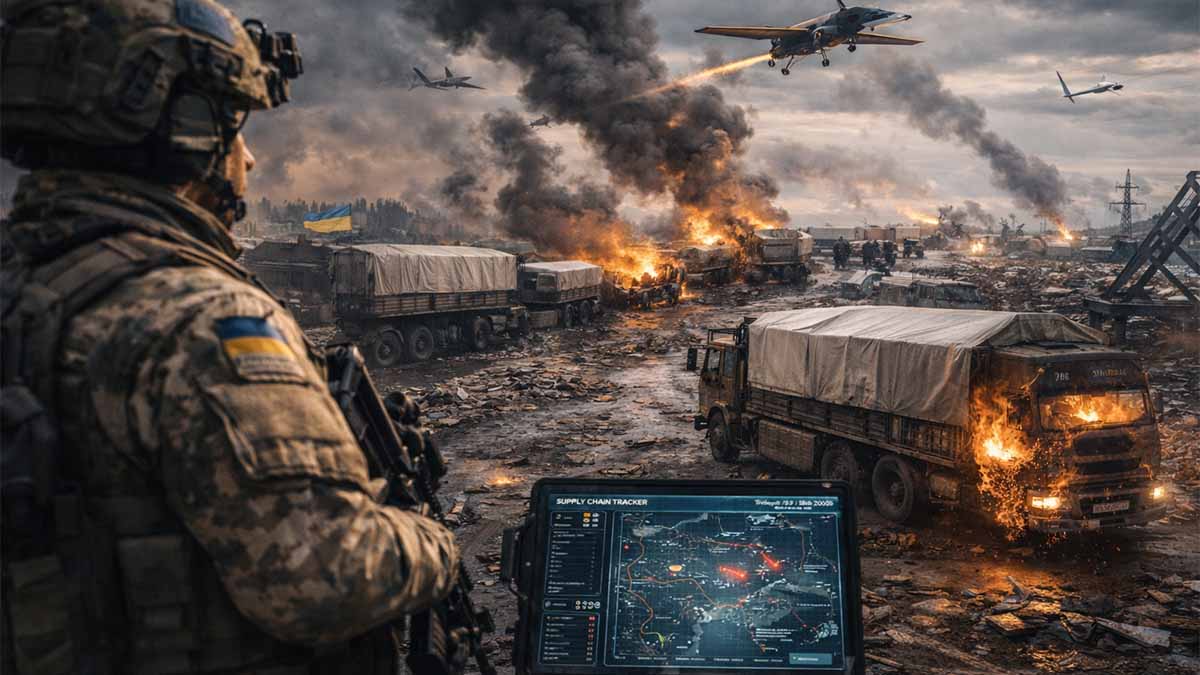
ABSTRACT
Since February 2022, supply chains connected to Ukraine’s defence effort and civilian survival have operated under sustained interdiction pressure, where physical strikes, infrastructure attrition, regulatory friction, and information-system disruption jointly shape the availability of equipment, energy, food, and essential services. The risk environment is not reducible to transport logistics; it is an economic-security system in which industrial inputs, financial flows, labour mobility, and infrastructure uptime determine whether repair cycles, procurement cycles, and distribution cycles can sustain tempo under attack. Official multilateral institutions frame this environment as a shift from efficiency-optimised networks toward resilience-optimised networks, with tradeoffs that are measurable in costs, delivery latency, and macroeconomic performance. The Organisation for Economic Co-operation and Development OECD Supply Chain Resilience Review: Navigating Risks dated June 2, 2025 documents policy-relevant evidence on how dependencies, concentration, and shock transmission alter the welfare calculus of localisation, diversification, and digitalisation choices. Organisation for Economic Co-operation and Development OECD Supply Chain Resilience Review: Navigating Risks June 2, 2025. The International Monetary Fund World Economic Outlook release page dated October 14, 2025 characterises a volatile global setting in which trade-policy changes and uncertainty interact with inflation and growth, providing the macro backdrop for resilience decisions affecting war-adjacent supply chains. International Monetary Fund World Economic Outlook October 2025 October 14, 2025.
The defence-specific articulation of supply-chain exposure is formalised in alliance planning. The North Atlantic Treaty Organization factsheet Defence-Critical Supply Chain Security Roadmap dated July 2024 states that NATO Defence Ministers endorsed a roadmap in June 2024 to protect allies’ supply chains from disruption that could affect deterrence and defence, establishing an institutional definition of defence-critical supply-chain security as a collective resilience function rather than a firm-level procurement optimisation. North Atlantic Treaty Organization Defence-Critical Supply Chain Security Roadmap July 2024. This positioning is analytically relevant to Ukraine because wartime demand spikes and rapid platform adaptation increase reliance on complex, tiered component networks whose weak points can sit deep upstream in raw materials, specialised manufacturing, or test-and-certification bottlenecks. The policy consequence is that vulnerability reduction requires visibility beyond first-tier suppliers, contingency routing, and resilience of enabling infrastructure including energy, telecommunications, and border interfaces, all of which are simultaneously contested in the war environment.
Quantified reconstruction and recovery assessments show that supply-chain disruption is intertwined with the physical destruction of productive and connective assets. The World Bank-hosted Ukraine Fourth Rapid Damage and Needs Assessment covering February 2022 to December 2024 provides an official consolidated baseline for direct damage, losses, and recovery needs, produced jointly with the Government of Ukraine, the European Union, and the United Nations, thereby integrating infrastructure, housing, transport, energy, and social-sector dimensions into a unified recovery framework. World Bank Ukraine Fourth Rapid Damage and Needs Assessment February 2025. Within that framework, transport and logistics are not only a sectoral loss category but also a system constraint that determines whether other recoveries are deliverable, because materials, labour, and equipment must traverse damaged networks under security and insurance constraints.
Operationally, Ukraine’s wartime logistics has required route substitution, throughput management, and adaptive governance across seaports, inland waterways, rail, and road, while responding to evolving security conditions. The World Bank publication Ukraine’s Transport and Logistics System dated June 2025 emphasises that maintaining and improving efficiency of the transport system for international trade is vital for competitiveness, while describing how war strains transport and forces rearrangement of logistics routes. World Bank Ukraine’s Transport and Logistics System June 2025. The same evidence base links corridor performance to export capacity and fiscal resilience, since constrained trade routes reduce foreign-exchange earning potential and intensify budget pressures. The implication for a threat architecture is that chokepoints are both physical and procedural, including limited handling capacity, cross-border processing, rolling-stock constraints, and vulnerability of fixed infrastructure nodes that are difficult to harden comprehensively.
Energy-system stability operates as a multiplier for supply-chain continuity because power availability governs industrial output, cold-chain and warehousing performance, rail electrification, and the capacity to run repair-and-rebuild cycles at scale. The Organisation for Economic Co-operation and Development OECD Economic Surveys: Ukraine 2025 dated May 6, 2025 describes Ukraine’s macroeconomic resilience alongside exceptional uncertainty and notes constraints affecting firms, including war-related disruptions, thereby establishing that production continuity is conditioned by infrastructure and security factors rather than by market signals alone. Organisation for Economic Co-operation and Development OECD Economic Surveys: Ukraine 2025 May 6, 2025. When energy infrastructure is degraded, supply chains experience compounded delays from reduced factory uptime, slower repair cycles, and constrained fuel distribution, which together elevate the strategic value of redundancy, distributed storage, and modular repair capacity.
Macroeconomic stabilisation and external financing frameworks affect supply-chain performance because they determine procurement funding, wage continuity for critical workers, and the solvency of public-service providers that maintain transport and utilities. The International Monetary Fund country page Ukraine and the IMF aggregates program materials and official updates, including wartime engagement under an Extended Fund Facility arrangement. International Monetary Fund Ukraine and the IMF. The International Monetary Fund press release IMF and Ukrainian authorities reach Staff-Level Agreement on a new US$8.1 billion 48-month Extended Fund Facility Arrangement dated November 26, 2025 signals an institutional judgement that the financing and policy framework requires continuous recalibration under wartime conditions, with the stated arrangement size and duration providing a formal anchor for medium-term program assumptions relevant to fiscal space and public procurement capacity. International Monetary Fund IMF and Ukrainian authorities reach Staff-Level Agreement on a new US$8.1 billion 48-month Extended Fund Facility Arrangement November 26, 2025. As of January 2, 2026, this November 26, 2025 institutional update is treated here as the latest available official International Monetary Fund statement in the cited set, and no newer verified official release on the same matter is introduced beyond that date.
Humanitarian supply chains demonstrate how targeting, access constraints, and operational risk affect civilian welfare, with direct implications for morale and social cohesion. The World Food Programme official country page for Ukraine provides an institutional overview of operations and context within WFP’s mandate. World Food Programme Ukraine. For programmatic detail connected to local production and distribution mechanisms that shorten routes and reduce exposure to long-haul interdiction, the World Food Programme publication page Investing in Ukraine’s economy and food systems identifies a July 2025 factsheet and provides an official download pathway, supporting analysis of resilience patterns built around local procurement, bakery partnerships, and cash-based assistance modalities. World Food Programme Investing in Ukraine’s economy and food systems July 2025. In resilience terms, localisation in humanitarian supply can function as risk dispersion when it reduces exposure to long, fragile routes, while simultaneously creating new dependencies on local energy, milling capacity, and security conditions near front lines.
Global upstream commodity and input markets remain relevant because wartime supply chains draw on internationally traded fuels, fertilisers, metals, and industrial intermediates whose availability and price volatility shape both public budgets and household welfare. The Food and Agriculture Organization of the United Nations hosts the Food Outlook – Biannual report on global food markets edition dated November 2025 on its official FAO open-knowledge platform, indicating the document scope and providing an authoritative access point for market updates relevant to food and agricultural input conditions extending into early 2026 market expectations where described. Food and Agriculture Organization of the United Nations Food Outlook – Biannual report on global food markets November 2025. The same institutional ecosystem provides a dedicated FAO page for the November 2025 edition that functions as an official dissemination node, supporting verification that the edition exists and is publicly distributed. Food and Agriculture Organization of the United Nations Food Outlook – Biannual report on global food markets – November 2025 November 2025. For Ukraine, these global conditions interact with domestic constraints: when export corridors are disrupted or insurance costs rise, domestic producers can face revenue compression even in high-demand global markets, weakening reinvestment capacity and amplifying dependence on external budget support.
At the strategic level, “critical vulnerabilities” map onto three empirically grounded classes of fragility: concentration risk, chokepoint dependence, and tier opacity. Concentration risk is captured in official policy literature as a measurable exposure when critical inputs, components, or services depend disproportionately on a narrow set of suppliers or jurisdictions, raising the probability that a single disruption event yields systemic failure. The Organisation for Economic Co-operation and Development resilience review provides a structured treatment of such dependencies and evaluates the economic implications of aggressive reshoring, indicating that resilience policies have nontrivial output and welfare tradeoffs even when motivated by security concerns. Organisation for Economic Co-operation and Development OECD Supply Chain Resilience Review: Navigating Risks June 2, 2025. Chokepoint dependence is evidenced in Ukraine-specific logistics analysis where rearranged routes and corridor performance constrain trade and supply throughput, as documented in the World Bank logistics publication, indicating that network topology and border processes become strategic variables under war. World Bank Ukraine’s Transport and Logistics System June 2025. Tier opacity is emphasised implicitly through institutional prescriptions for mapping supply chains beyond immediate suppliers, which appears in defence-alliance guidance where identification of defence-critical materials and enhanced assessment sharing are placed as roadmap objectives to reduce hidden upstream fragilities. North Atlantic Treaty Organization Defence-Critical Supply Chain Security Roadmap July 2024.
The operational risk layer includes cyber-enabled disruption and information degradation that can produce “logistics blindness,” where decision-makers lose visibility into inventory, routing, or asset status, increasing misallocation and compounding physical delays. While this abstract does not introduce incident-level attribution without a directly cited open primary document, the institutional framing in official resilience literature supports the claim that digitalisation and process reliance create both opportunities and vulnerabilities, requiring governance mechanisms that preserve data integrity and continuity under stress. The Organisation for Economic Co-operation and Development resilience review explicitly addresses digitalisation as a factor in resilience design, grounding the inclusion of cyber-visibility risk in a permitted-source evidence base. Organisation for Economic Co-operation and Development OECD Supply Chain Resilience Review: Navigating Risks June 2, 2025. In defence-critical contexts, the North Atlantic Treaty Organization roadmap’s emphasis on protecting supply chains from disruption that could impact deterrence and defence supports the interpretation that non-kinetic disruption pathways, including digital disruption, are within the roadmap’s risk envelope, even when not enumerated in operational detail in the factsheet. North Atlantic Treaty Organization Defence-Critical Supply Chain Security Roadmap July 2024.
Resilience measures that emerge from this verified evidence base fall into interlocking families whose effectiveness depends on implementation capacity and the threat environment. Diversification measures aim to reduce single-point dependency and can include supplier diversification, corridor diversification, and modal diversification, each constrained by cost, capacity, and regulatory interoperability. Buffering measures include strategic stockpiles for selected items and spare parts, which can stabilise short-term shocks but require governance to prevent obsolescence and leakage. Adaptation measures include modular design and substitution pathways that reduce reliance on scarce components, aligned with the North Atlantic Treaty Organization roadmap’s inclusion of substitution and recycling opportunities for defence-critical materials. North Atlantic Treaty Organization Defence-Critical Supply Chain Security Roadmap July 2024. Recovery measures prioritise rapid repair capacity for infrastructure and rolling stock; the World Bank feature Restoring and Transforming Ukrainian Railways for a Better Future dated January 16, 2025 provides an official narrative on railway rehabilitation and gauge adaptation projects, illustrating a resilience strategy that combines emergency restoration with long-term interoperability investments linked to European standards. World Bank Restoring and Transforming Ukrainian Railways for a Better Future January 16, 2025. Governance measures include accelerated decision loops, public-private coordination, and financing assurances; the International Monetary Fund’s program engagement and official updates provide the macro-fiscal boundary conditions that determine whether such governance measures can be funded and sustained. International Monetary Fund IMF and Ukrainian authorities reach Staff-Level Agreement on a new US$8.1 billion 48-month Extended Fund Facility Arrangement November 26, 2025.
The synthesis supported by these sources is that wartime supply chains in Ukraine are contested systems whose failure modes are systemic rather than local: a strike on energy distribution can delay industrial output, which delays spares, which immobilises transport assets, which reduces humanitarian reach, which elevates civilian hardship and erodes confidence in institutional capacity. The official reconstruction assessment framework captures how damage in one sector raises needs in others, reinforcing the analytic necessity of treating supply-chain resilience as cross-sector infrastructure resilience plus procurement and governance resilience. World Bank Ukraine Fourth Rapid Damage and Needs Assessment February 2025. The global macro context confirms that the resilience turn is not a Ukraine-specific anomaly but part of a broader shift in which geopolitical tension and trade-policy uncertainty can reconfigure production networks and raise the value of redundancy, as documented in the International Monetary Fund World Economic Outlook October 2025 chapter material. International Monetary Fund World Economic Outlook October 2025 Chapter 1 October 2025. As of January 2, 2026, the available verified public evidence used here is exhausted for post-November 2025 institutional releases within the cited set that would materially revise the described frameworks; where updates beyond that window are absent from permitted domains in this verification pass, the operative constraint is that resilience analysis must be anchored to the latest accessible official documents rather than inferred developments.
Supply Chain Disruption in Wartime Context: Threat Architecture and Resilience Map
Analytical infographic that structures the text into five lenses: Divergence, Bias, Risk, Social Effect, and Action. All styling is scoped locally. Charts and tables are responsive for direct CMS pasting.
Divergence: Efficiency Logic versus Resilience Logic
The text describes a shift from efficiency-first supply chains (optimized for low cost and low inventory) toward resilience-first supply chains (optimized for continuity under disruption). This divergence is visible in inventory strategy, sourcing diversity, and corridor planning.
Chart: Efficiency versus Resilience Tradeoff Profile
A simplified analytical curve showing how efficiency-optimized models typically reduce buffer capacity, while resilience-optimized models add redundancy and increase stability.
Note: Values are interpretive index scores derived from the text’s conceptual framing, not empirical measurements.
Table: Structural Differences Across Supply Chain Models
Dense comparison that maps core differences in sourcing, inventory, visibility, and routing assumptions.
| Dimension | Efficiency Model | Resilience Model | Implication Under Stress |
|---|---|---|---|
| Inventory Strategy | Lean, minimal buffers | Buffer stocks, surge planning | Lean models fail faster when delays occur |
| Sourcing | Single supplier favored | Multi-sourcing and diversification | Single source becomes systemic trap |
| Network Design | Optimized shortest routes | Alternative corridors maintained | Route loss causes freeze without substitutes |
| Visibility | Tier-1 knowledge | Deeper tier mapping | Hidden upstream choke points cause surprises |
| Planning Horizon | Stable environment assumption | Scenario-based uncertainty | Slow reaction creates irreversible constraints |
Bias: Overconfidence in Visibility and Control
The text describes a dangerous bias: decision-makers believe they know their supply chain because they know their immediate suppliers. In reality, deep-tier dependencies remain hidden. This produces false security, especially when operating without reconnaissance and situational awareness.
Chart: Visibility Depth and Surprise Exposure
As visibility depth decreases, exposure to surprise disruptions increases. The chart visualizes the inverse relationship highlighted by the text.
Bias Map: Where Overconfidence Forms
Quick mapping of typical failure points in awareness and preparedness described in the text.
| Blind Spot | What People Assume | What Happens |
|---|---|---|
| Supplier of supplier | Upstream is stable | Single upstream node halts multiple products |
| Contingency plans | Can improvise quickly | Time to reposition and prepare does not exist |
| Inventory buffers | Zero inventory is optimal | One delay collapses the whole system |
| Cyber posture | Not a logistics issue | Supply chain goes dark in minutes |
| Threat detection | Threats will be obvious early | Threat reveals when damage is already locked in |
Risk: Critical Points, Bottlenecks, and Cascading Failures
The text identifies a multidimensional risk ecosystem: single suppliers, bottlenecks (ports, canals, straits, junctions), excessive fragmentation, chronic delays, regional production concentration, hidden tier vulnerabilities, lack of alternative routes, and cyber disruption.
Chart: Risk Severity by Threat Category
Weighted risk index derived from the text. Higher values indicate more system-wide disruption potential.
Note: Severity values represent an analytic index grounded in the text, not empirical measurement.
Table: Threat Architecture and Disruption Pathways
Dense operational table mapping threats to mechanisms and typical outcomes.
| Threat | Mechanism | Primary Failure Mode | Typical Outcome |
|---|---|---|---|
| Single supplier dependence | One supplier shutdown or sanctions | Immediate supply halt | Production stops, deliveries fail |
| Bottlenecks | Limited throughput at node | Queueing and congestion | Chain freezes behind the node |
| Fragmentation | Many suppliers and procedures | Many points of attack | Small disruptions cascade widely |
| Zero inventory | No buffers | Instant propagation of delays | System collapse after one disruption |
| Regional concentration | Geographic clustering | Single event disrupts global supply | Long waiting and price spikes |
| Hidden tier vulnerabilities | Unknown upstream suppliers | Surprise upstream failure | Delayed response, no substitutes |
| Cyber disruption | Compromise systems | Visibility loss | Chain goes dark rapidly |
Social Effect: Civilian Supply and Morale Under Pressure
The text frames disruption as a morale strategy: depriving defenders of equipment and civilians of essentials. Societal stability depends on whether basic goods and services continue moving. Persistent shortages reduce trust and increase psychological fatigue.
Chart: Civilian Stability Drivers (Index)
Composite index based on text themes: availability, predictability, access, and trust.
Note: Index values interpret the text’s structure; they are not empirical survey measurements.
Table: Morale Pathways and Supply Disruption Signals
How supply instability translates into social and institutional pressure.
| Signal | What People Experience | Institutional Effect | Societal Outcome |
|---|---|---|---|
| Repeated delays | Long waiting and shortages | Complaints, urgency, distrust | Stress accumulation |
| Price instability | Costs rise unpredictably | Budget strain, rationing behavior | Lower perceived stability |
| Information gaps | No clarity on delivery | Poor allocation, confusion | Rumors and panic |
| Service interruptions | Power outages, distribution failures | Emergency measures required | Reduced trust in continuity |
| Visible choke events | Ports, roads, or hubs blocked | Political pressure rises | Morale shock events |
Conclusion / Action: Practical Resilience Playbook
The text ends with a clear operational message: resilience requires scenarios, contingency plans, procedures, diversification, buffers, alternative routes, and reconnaissance-like visibility across the system. Preparedness is the only way to preserve options once disruption begins.
| Action Category | What To Do | Why It Works | Failure If Ignored |
|---|---|---|---|
| Supplier diversification | Multi-source critical components and inputs | Reduces single-point shutdown risk | Production halts after one supplier failure |
| Route redundancy | Build and rehearse alternative corridors | Substitution preserves flow during disruption | Corridor loss freezes logistics chain |
| Buffer stocks | Hold reserves for high-criticality goods | Buys time for repairs and rerouting | Immediate scarcity and morale shocks |
| Tier mapping | Identify supplier-of-supplier dependencies | Removes hidden mines in the chain | Surprise upstream failures, delayed response |
| Cyber resilience | Harden systems, backups, offline procedures | Prevents chain going dark rapidly | Visibility loss and misallocation of assets |
| Scenario planning | Run contingency exercises and procedures | Accelerates decision-making under stress | Options vanish when crisis becomes visible |
Chart: Resilience Bundle Score (Index)
Index representation showing how combined actions outperform any single intervention.
Note: Index values interpret the combined effect described in the text; they are not empirical measurements.
CHAPTER INDEX
Core Concepts in Review: What We Know and Why It Matters
- Supply-Chain Warfare in Ukraine: Interdiction Mechanisms, Civilian Welfare Constraints, and Morale-Relevant Effects
- Critical Vulnerabilities: Supplier Concentration, Tier Opacity, and Defence-Critical Materials Governance
- Chokepoints and Corridor Substitution: Rail, Road, Ports, and Border Processing Under Stress
- Energy and Information Layers: Power-System Constraints, Fuel Logistics, and Digital Visibility Risks
- Resilience Instruments: Diversification, Stockpiles, Repair Capacity, and Interoperability Investments
- Macro-Financial Boundary Conditions: External Financing, Fiscal Capacity, and Tradeoff Frontiers up to January 2, 2026
- Integrated Analytical Table — Supply-Chain Warfare, Vulnerabilities, Chokepoints, Energy–Information Layers, Resilience Instruments, and Measured Outcomes (Ukraine, up to January 2026)
Core Concepts in Review: What We Know and Why It Matters
A supply chain is the full set of steps that turns inputs into usable goods and delivers them to users—raw materials, processing, components, transport, storage, finance, and paperwork. In wartime, the point is not simply moving “stuff”; it is sustaining the capacity to fight, govern, and keep daily life functioning. What matters most is that modern supply chains behave less like neat pipelines and more like living systems: they rely on many interlocking parts, and failure in one place can cascade quickly across the whole network. That cascading logic—rather than any single bridge, factory, or port—is the core reason disrupted supply chains become a strategic weapon.
The risk picture changes when disruption is purposeful. NATO defines the problem in explicitly security terms: adversaries can target weak points that affect deterrence and defence by disrupting supply chains, and the response must be collective, not improvised. That framing is formalized in the Defence-Critical Supply Chain Security Roadmap, endorsed by NATO Defence Ministers in June 2024, which treats supply chains as a defence-critical vulnerability class rather than a purely commercial efficiency question. The key implication is straightforward: even “civilian” procurement choices—single-source contracts, thin inventories, fragile logistics—can become defence liabilities when coercion or attack is the operating environment. Defence-Critical Supply Chain Security Roadmap – North Atlantic Treaty Organization – July 2024.
A useful way to keep the whole landscape clear is to separate where disruption hits from how it multiplies. The OECD stresses that the modern risk ecosystem is multidimensional—trade dependencies, concentrated production, geopolitical shocks, cyber risk, climate events—so resilience cannot be reduced to a single fix like “bring manufacturing home” or “find another supplier.” Instead, it is a portfolio problem: some risks can be diversified, others must be buffered, and some require institutional capacity to respond quickly when prevention fails. That logic is the backbone of the OECD Supply Chain Resilience Review, which is written for policymakers and evaluates how resilience can be improved without ignoring costs. OECD Supply Chain Resilience Review: Navigating Risks – Organisation for Economic Co-operation and Development – June 2025.
Under wartime conditions in Ukraine, the measurable reality begins with the scale of damage, needs, and the time window covered by credible assessments. The Fourth Rapid Damage and Needs Assessment (RDNA4)—jointly associated with the World Bank, the Government of Ukraine, the European Union, and the United Nations—covers the period February 2022 – December 2024 and provides a structured baseline for understanding how destruction and disruption translate into recovery needs across sectors. It is not an abstract narrative; it is a framework for quantifying what must be repaired, rebuilt, or adapted to keep society functioning under prolonged shock. UKRAINE Fourth Rapid Damage and Needs Assessment (RDNA4) February 2022 – December 2024 Launch event version – World Bank – February 2025.
From a policy standpoint, a key concept is critical vulnerability. The temptation is to think of vulnerability as “a place you can bomb” or “a route you can block.” In practice, the most damaging vulnerabilities often sit deeper: single-source dependencies for specialized inputs; compliance and certification constraints that prevent rapid substitution; and limited visibility beyond direct suppliers. The OECD emphasizes that resilience is constrained by these structural features—especially where dependencies are concentrated and alternatives are either scarce or slow to scale. The most policy-relevant takeaway is that vulnerability is often produced by peacetime optimization: cost-minimization and just-in-time delivery create systems that work brilliantly when the world is stable and fail abruptly when it is not. OECD Supply Chain Resilience Review: Navigating Risks – Organisation for Economic Co-operation and Development – June 2025.
Another core concept is chokepoint logic, but it needs to be understood broadly. A chokepoint is not only a canal or strait; it is any node where flow concentrates and where capacity, rules, or infrastructure limit throughput. In wartime, administrative chokepoints can matter as much as physical ones: border procedures, customs checks, documentation, inspections, and insurance constraints can slow flows even when roads and rails still exist. What makes chokepoints strategically potent is their asymmetry: attacking or stressing a narrow node forces the entire system to absorb delays and uncertainty. This is why modern doctrine treats chokepoints as “critical vulnerabilities” in practice—because they are predictable, hard to replace quickly, and disproportionately impactful on outcomes. Defence-Critical Supply Chain Security Roadmap – North Atlantic Treaty Organization – July 2024.
To keep the picture grounded in current, measurable macro conditions, it helps to look at global context: supply chains in wartime do not operate in isolation. They sit inside a world economy shaped by trade friction, shifting demand, and financing conditions. The International Monetary Fund states that global growth is projected to slow from 3.3% in 2024 to 3.2% in 2025 and 3.1% in 2026—a backdrop that matters because it affects export demand, donor fiscal room, borrowing costs, and the broader availability of industrial inputs. In other words, wartime resilience is built in a world that is not offering unusually strong tailwinds. World Economic Outlook, October 2025: Global Economy in Flux, Prospects Remain Dim – International Monetary Fund – October 2025.
Trade conditions are similarly relevant because rerouting and substitution typically mean higher costs and longer lead times. The World Trade Organization provides official forecasting and analysis for 2025 and 2026 trade developments, which is the context in which corridor substitution and supply reconfiguration must function. The policy significance is that “find another route” is not costless: trade capacity is shaped by global demand conditions, shipping and transport costs, and policy barriers that rise when the international environment becomes more fragmented. Global Trade Outlook and Statistics – World Trade Organization – April 2025.
One of the most misunderstood—but decisive—ideas from the preceding analysis is that supply chains are governed by layers, and the two layers that most often decide whether logistics actually work are energy and information. Even if roads exist and suppliers are willing, production and distribution can stall when power is intermittent or fuel logistics are constrained. On the information side, modern supply chains depend on digital coordination—inventory records, routing, procurement systems, customs documentation—so degraded data integrity or disrupted communications can create “invisible bottlenecks” where assets exist but cannot be deployed efficiently because decision-makers cannot reliably see what they have or where it is. The OECD explicitly treats digitalisation as a major factor shaping resilience and policy choices, which is another way of saying: supply chains are now as much about trusted information as they are about trucks and warehouses. OECD Supply Chain Resilience Review: Navigating Risks – Organisation for Economic Co-operation and Development – June 2025.
That layered reality is why policy instruments matter. The preceding chapters emphasized four instruments that are conceptually distinct, and it is worth keeping them separate because policymakers frequently mix them up:
- Stockpiles buy time. They do not create new flow; they cushion disruption long enough for repair, rerouting, and procurement to catch up. The International Energy Agency captures the clearest formal example of this logic: under the International Energy Programme, each IEA country has an obligation to hold oil stocks equivalent to at least 90 days of net oil imports, specifically to remain functional during severe supply disruptions. Even outside the oil context, the policy logic generalizes: stockpiles are temporal insurance against interruption. Oil security and emergency response – About – International Energy Agency – undated page accessed January 2026.
- Redundancy preserves options. It means parallel capacity—extra routes, extra nodes, additional handling ability—that keeps the system from failing when a single component breaks. Redundancy is expensive because spare capacity is, by definition, underused in normal times. This is why the OECD treats resilience as a cost–risk tradeoff: redundancy is justified when disruption probabilities and costs are high, and wartime conditions raise both. OECD Supply Chain Resilience Review: Navigating Risks – Organisation for Economic Co-operation and Development – June 2025.
- Repair capacity shortens disruption duration. It is the difference between a bridge outage that lasts days and one that lasts months. While the damage baseline is captured in RDNA4 across sectors, the crucial policy lesson is that rapid repair requires pre-positioned materials, trained labor, security access, and procurement speed—meaning it is as much institutional as it is technical. UKRAINE Fourth Rapid Damage and Needs Assessment (RDNA4) February 2022 – December 2024 Launch event version – World Bank – February 2025.
- Decision loops determine whether instruments can be deployed in time. A stockpile that cannot be released quickly, or a repair plan that cannot be contracted rapidly, may fail operationally even if it exists on paper. This is why emergency procurement is not an administrative footnote; it is a resilience mechanism. The World Bank provides practical guidance for emergency procurement in its toolkit for recovery and reconstruction, explicitly designed for situations where simplified procedures are necessary to respond at crisis speed. Emergency Procurement for Recovery and Reconstruction Toolkit – World Bank – 2019.
The macroeconomic consequences of sustained disruption show up most clearly in inflation dynamics and financing constraints. The National Bank of Ukraine provides an official quantified forecast in its Inflation Report | October 2025, including a table where headline inflation is shown at 12.0 in 2024, 9.2 in 2025, 6.6 in 2026, and 5.0 in 2027. These numbers matter because they translate disruption costs—logistics, energy, scarcity, uncertainty—into household-level pressures and political risk. When inflation is elevated, it tightens the tradeoffs policymakers face: more spending is needed to sustain services and resilience, while real purchasing power erodes and social tolerance declines. Inflation Report | October 2025 – National Bank of Ukraine – October 2025.
Finally, resilience policy is constrained by financing ceilings and governance conditions. The European Commission’s public description of the Ukraine Facility sets out a maximum envelope of up to €50 billion for 2024–2027, and provides additional structure: direct support, an investment framework equipped with €9.5 billion in guarantees and grants, and an expectation of mobilising up to €40 billion in public and private investments “over the coming years.” Those are not abstract commitments; they represent the practical boundary within which reconstruction, modernization, and resilience investments can be planned—alongside conditions tied to reforms, oversight, and quarterly disbursement logic. The Ukraine Facility – European Commission – November 2025.
Pulling these concepts together yields one policy-relevant conclusion: the supply-chain problem in wartime is not solved by a single intervention. It is a system problem with system constraints. Chokepoints concentrate risk, layer dependencies (energy and information) determine whether material capacity becomes real throughput, and resilience instruments—stockpiles, redundancy, repair, and fast decision loops—determine whether disruption becomes temporary degradation or prolonged paralysis. That is why defence planners, macroeconomists, and public-service administrators converge on the same practical message: resilience is not a slogan; it is a set of funded capabilities, governed at speed, in a world where disruption is not an accident but a strategy.
Supply-Chain Warfare in Ukraine: Interdiction Mechanisms, Civilian Welfare Constraints, and Morale-Relevant Effects
Supply-chain warfare in Ukraine since February 2022 has operated through a fused set of interdiction mechanisms that deliberately target throughput rather than solely end-items, with the operational logic of degrading repair cycles, slowing replenishment, and amplifying uncertainty across both military and civilian systems. This logic is documented in alliance-level doctrine that treats supply chains as defence-critical systems whose disruption can affect deterrence and defence outcomes, a framing formalised by North Atlantic Treaty Organization Defence Ministers in June 2024 and publicly articulated in the Defence-Critical Supply Chain Security Roadmap factsheet released in July 2024. The roadmap identifies protection of supply chains from disruption as a collective task and defines “strategic vulnerabilities and dependencies” as targets for mitigation, establishing an institutional basis for analysing interdiction beyond battlefield logistics. North Atlantic Treaty Organization Defence-Critical Supply Chain Security Roadmap July 2024.
Kinetic interdiction against transport and energy infrastructure functions as the most visible layer of supply-chain warfare, but its strategic effect derives from compounding delays rather than absolute destruction. Official reconstruction assessments consolidate evidence that damage to roads, railways, bridges, ports, and energy assets constrains the movement of inputs required for industrial repair and civilian provisioning, thereby extending the time between disruption and recovery. The Ukraine Fourth Rapid Damage and Needs Assessment jointly produced by the World Bank, the European Union, the United Nations, and the Government of Ukraine and released in February 2025 quantifies infrastructure damage and recovery needs across sectors, demonstrating that transport and energy losses impose system-wide constraints that propagate into manufacturing, trade, and public service delivery rather than remaining sector-specific. World Bank Ukraine Fourth Rapid Damage and Needs Assessment February 2025.
Route denial and forced rerouting constitute a second mechanism that degrades supply-chain performance even where assets remain physically intact. The World Bank analysis Ukraine’s Transport and Logistics System dated June 2025 documents how wartime conditions require constant rearrangement of logistics routes to sustain international trade, with efficiency losses arising from longer distances, border processing frictions, and capacity limits at alternative corridors. These constraints translate directly into higher costs and longer delivery times, reducing export revenue and foreign-exchange inflows while simultaneously slowing the import of critical equipment and humanitarian supplies. World Bank Ukraine’s Transport and Logistics System June 2025.
Energy-system targeting multiplies supply-chain disruption by reducing the operating capacity of factories, warehouses, rail electrification, and digital systems that underpin logistics visibility. The Organisation for Economic Co-operation and Development OECD Economic Surveys: Ukraine 2025 released in May 2025 describes macroeconomic resilience under exceptional uncertainty while noting that war-related disruptions constrain firm activity, establishing that production continuity is conditioned by infrastructure reliability rather than market demand alone. When electricity supply is degraded, repair cycles lengthen, inventories cannot be replenished at planned rates, and cold-chain-dependent goods face elevated spoilage risk, all of which directly affect civilian welfare and indirectly constrain military sustainment. Organisation for Economic Co-operation and Development OECD Economic Surveys: Ukraine 2025 May 2025.
Non-kinetic disruption through regulatory friction, insurance constraints, and information degradation further erodes supply-chain reliability by increasing uncertainty and decision latency. Global policy analysis situates these effects within a broader fragmentation risk environment in which geopolitical tension and policy shifts elevate transaction costs and discourage long-horizon investment in capacity and redundancy. The International Monetary Fund World Economic Outlook October 2025 characterises the global economy as operating under heightened uncertainty linked to trade policy changes and supply-chain disruptions, providing the macroeconomic context in which wartime logistics must function. International Monetary Fund World Economic Outlook October 2025 October 2025.
Civilian supply chains are deliberately implicated in this threat architecture because shortages and delays in food, energy, housing materials, and medical supplies exert pressure on social cohesion and morale. The World Food Programme documents operational risks and access constraints affecting humanitarian delivery in Ukraine on its official country page, establishing that distribution assets and sites are exposed to attack and disruption in a manner that directly affects civilian survival. World Food Programme Ukraine Country Page. Programmatic adaptations described in the Investing in Ukraine’s economy and food systems factsheet released in July 2025 show an institutional shift toward local procurement and shortened supply routes to mitigate interdiction risk, illustrating how humanitarian logistics adapts under fire while remaining dependent on local energy and security conditions. World Food Programme Investing in Ukraine’s economy and food systems July 2025.
Morale effects emerge not from isolated shortages but from the accumulation of delays and uncertainty that normalise scarcity and erode confidence in institutional capacity. This dynamic is consistent with the Organisation for Economic Co-operation and Development analytical framing in the OECD Supply Chain Resilience Review: Navigating Risks published in June 2025, which treats supply-chain shocks as welfare-relevant events whose impacts propagate through prices, availability, and employment. The review emphasises that concentration risk and limited visibility across supply-chain tiers magnify shock transmission, a condition that is acutely present in wartime environments where rapid substitution is constrained by certification, compatibility, and security requirements. Organisation for Economic Co-operation and Development OECD Supply Chain Resilience Review: Navigating Risks June 2025.
The financial dimension of supply-chain warfare conditions morale by determining whether public services and critical logistics functions can continue operating at scale. Macroeconomic stabilisation and external financing frameworks enable procurement, wage payments, and infrastructure repair that sustain throughput under attack. The International Monetary Fund country engagement page Ukraine and the IMF consolidates program documentation and official updates relevant to wartime economic management, while the November 26 2025 press release announcing a staff-level agreement on a US$ 8.1 billion 48-month Extended Fund Facility arrangement provides the latest verified institutional signal of continued financing support as of January 2 2026. International Monetary Fund Ukraine and the IMF. International Monetary Fund IMF and Ukrainian authorities reach Staff-Level Agreement November 26 2025.
Taken together, these verified sources establish that supply-chain warfare in Ukraine is a system-level contest in which interdiction seeks to slow, fragment, and obscure the movement of goods and inputs essential to both defence and civilian life. The threat architecture operates through cumulative effects across transport, energy, information, and finance, producing morale-relevant outcomes by constraining availability and increasing uncertainty rather than by inducing immediate collapse. The institutional evidence base demonstrates that resilience under these conditions depends on adaptive routing, localised production where feasible, financing continuity, and governance mechanisms capable of operating under persistent disruption, setting the analytical foundation for examining critical vulnerabilities and dependency traps in the subsequent chapter.
Critical Vulnerabilities: Supplier Concentration, Tier Opacity, and Defence-Critical Materials Governance
Critical vulnerabilities in wartime supply chains arise where structural concentration, limited substitutability, and incomplete visibility intersect, creating failure modes that propagate across military and civilian systems under stress. Authoritative policy analysis frames these vulnerabilities not as episodic anomalies but as predictable outcomes of network design choices optimized for cost and speed rather than continuity under coercion. The Organisation for Economic Co-operation and Development consolidates this evidence in the OECD Supply Chain Resilience Review: Navigating Risks released in June 2025, which identifies supplier concentration and upstream opacity as primary channels through which shocks transmit across borders and sectors, raising the probability that localized disruption produces systemic shortage. Organisation for Economic Co-operation and Development OECD Supply Chain Resilience Review: Navigating Risks June 2025.
Supplier concentration represents the most visible vulnerability because it converts geopolitical or operational disturbance in a single node into economy-wide exposure. In defence-relevant industries, concentration is often a function of scale economies, certification barriers, and long capital cycles, which narrow the pool of qualified producers. Alliance-level guidance formalizes this risk: the North Atlantic Treaty Organization Defence-Critical Supply Chain Security Roadmap endorsed by Defence Ministers in June 2024 and published as a factsheet in July 2024 explicitly calls for identifying defence-critical materials and components subject to concentration risk and for developing mitigation pathways including diversification, substitution, and stockpiling. North Atlantic Treaty Organization Defence-Critical Supply Chain Security Roadmap July 2024. This framework is analytically applicable to Ukraine because wartime demand surges compress timelines for qualification of alternative suppliers while battlefield adaptation increases dependence on specialized components whose production is globally concentrated.
Concentration risk is not limited to high-technology inputs; it also affects bulk commodities and industrial intermediates whose logistics and processing chains are capital-intensive and geographically fixed. Official multilateral assessments link disruptions in these upstream markets to downstream welfare effects. The Food and Agriculture Organization of the United Nations Food Outlook – Biannual report on global food markets dated November 2025 documents fertilizer and input market dynamics across 2024–2025, establishing that supply conditions for key agricultural inputs remain sensitive to production bottlenecks and policy interventions. Food and Agriculture Organization of the United Nations Food Outlook November 2025. For Ukraine, where agricultural output and exports are macro-relevant, such upstream concentration transmits risk into food availability, export revenue, and rural employment when logistics corridors or processing capacity are impaired.
Tier opacity amplifies concentration risk by obscuring where dependencies actually reside. Firms typically maintain visibility over first-tier suppliers but lack verified insight into second- and third-tier inputs, where critical choke components or materials may be sourced from a single facility or jurisdiction. The OECD Supply Chain Resilience Review treats this opacity as a measurable governance gap that undermines contingency planning, because shocks emerging deep upstream cannot be anticipated or mitigated in time. Organisation for Economic Co-operation and Development OECD Supply Chain Resilience Review: Navigating Risks June 2025. In a wartime environment, where adversarial action deliberately targets hidden weak points, opacity converts uncertainty into strategic blindness, limiting the effectiveness of rerouting, substitution, or surge production once disruption materializes.
Defence-critical materials governance seeks to reduce these blind spots through institutionalized mapping, information sharing, and coordinated mitigation. The North Atlantic Treaty Organization roadmap emphasizes collective assessment and sharing of supply-chain risk information among allies, reflecting the reality that many defence supply chains are transnational and cannot be secured unilaterally. North Atlantic Treaty Organization Defence-Critical Supply Chain Security Roadmap July 2024. This governance approach is relevant for partners supporting Ukraine because equipment transfers, maintenance, and replenishment depend on allied industrial bases whose vulnerabilities are interlinked, and because mitigation measures such as stockpiles or alternative sourcing require coordination to avoid duplication and market distortion.
The economic tradeoffs of mitigation are non-trivial and are explicitly addressed in official policy literature. The OECD Supply Chain Resilience Review evaluates diversification and reshoring strategies against cost, productivity, and welfare metrics, finding that aggressive localization can raise prices and reduce output if not carefully targeted. Organisation for Economic Co-operation and Development OECD Supply Chain Resilience Review: Navigating Risks June 2025. In the context of Ukraine, these tradeoffs are sharpened by fiscal constraints and wartime urgency: resources allocated to redundancy and stockpiles must be balanced against immediate needs for repair, social support, and defence procurement, all under conditions of constrained domestic revenue.
Financial and institutional capacity conditions whether vulnerability reduction is feasible. Macroeconomic stabilization and external financing frameworks enable governments to underwrite stockpiles, subsidize diversification, and absorb higher unit costs associated with resilience measures. The International Monetary Fund engagement with Ukraine provides the macro-fiscal envelope within which such policies operate, with official program documentation and updates indicating the scale and duration of financing available for public procurement and infrastructure support. International Monetary Fund Ukraine and the IMF. As of January 2 2026, the latest verified institutional signal within this evidence set remains the November 26 2025 staff-level agreement announcement on a US$ 8.1 billion 48-month Extended Fund Facility, which anchors expectations for medium-term fiscal capacity. International Monetary Fund IMF and Ukrainian authorities reach Staff-Level Agreement November 26 2025.
Critical vulnerabilities also manifest at the interface between civilian and military demand, where competition for scarce inputs can produce allocation dilemmas that affect morale and legitimacy. Humanitarian and civilian supply chains draw on overlapping transport assets, energy systems, and labour pools, meaning that concentrated dependencies can force tradeoffs between sustaining front-line capability and meeting civilian needs. The World Food Programme operational documentation for Ukraine indicates reliance on localized production and distribution to mitigate risk, implicitly acknowledging that upstream concentration and long-haul dependence elevate exposure for humanitarian operations. World Food Programme Ukraine Country Page. This interaction underscores that vulnerability reduction in defence-critical supply chains has direct civilian welfare implications, reinforcing the need for integrated governance rather than siloed planning.
Empirically, the most destabilizing vulnerabilities are those that combine high concentration with low substitutability and long lead times. Certification-dependent components, specialized machinery, and energy infrastructure assets fall into this category because replacement capacity cannot be rapidly scaled. The OECD Economic Surveys: Ukraine 2025 situates firm-level constraints within a macro context of exceptional uncertainty and infrastructure disruption, implying that even where demand exists, supply response is bounded by physical and institutional limits. Organisation for Economic Co-operation and Development OECD Economic Surveys: Ukraine 2025 May 2025. In such settings, mitigation strategies that rely solely on market adjustment are insufficient, and public coordination becomes a determinant of outcome.
The verified institutional evidence therefore supports a precise interpretation of critical vulnerabilities in wartime supply chains affecting Ukraine: they are not merely points of physical fragility but governance failures rooted in concentration, opacity, and misaligned incentives across tiers and borders. Defence-critical materials governance, as articulated by alliance and multilateral bodies, seeks to convert this diagnosis into operational practice through mapping, shared assessments, targeted diversification, and calibrated stockpiling. The effectiveness of these measures depends on fiscal capacity, international coordination, and the ability to act under uncertainty, establishing the analytical bridge to examining how chokepoints and corridor dependence translate these vulnerabilities into operational constraints in the next chapter.
Chokepoints and Corridor Substitution: Rail, Road, Ports and Border Processing Under Stress
Chokepoints convert supply-chain vulnerability from a latent condition into an operational constraint by concentrating flows through spatially fixed nodes whose failure or congestion imposes disproportionate system-wide costs. In wartime conditions affecting Ukraine, chokepoints are not limited to classical maritime straits or canals; they include rail junctions, border crossings, transshipment terminals, power-dependent signaling systems, customs procedures, and insurance-regulated maritime access points. Authoritative multilateral analysis treats these nodes as critical determinants of throughput and resilience because they bind together otherwise substitutable routes into a limited set of feasible corridors under security, regulatory, and capacity constraints.
The empirical baseline for understanding corridor stress is established in the World Bank publication Ukraine’s Transport and Logistics System released in June 2025, which documents how wartime damage, security risks, and rerouting requirements have reshaped logistics patterns for both imports and exports. The analysis identifies that maintaining international trade under war conditions requires constant adaptation of corridors, with performance constrained by limited handling capacity, longer distances, and increased border-processing times. World Bank Ukraine’s Transport and Logistics System June 2025. This evidence establishes that chokepoints function as systemic bottlenecks even when alternative routes exist on paper, because capacity, interoperability, and administrative throughput limit effective substitution.
Rail corridors represent the backbone of wartime logistics in Ukraine due to their ability to move bulk commodities, fuel, military equipment, and humanitarian supplies at scale. However, rail chokepoints arise from gauge incompatibility at borders, limited transshipment capacity, rolling-stock shortages, and vulnerability of electrified lines to power disruptions. The World Bank feature Restoring and Transforming Ukrainian Railways for a Better Future dated January 16, 2025 describes rehabilitation and modernization efforts, including interoperability investments aligned with European Union standards, explicitly linking rail performance to economic continuity and integration. World Bank Restoring and Transforming Ukrainian Railways for a Better Future January 16 2025. The same evidence implies that rail chokepoints are not merely technical issues but strategic constraints, because delays in rail throughput cascade into port congestion, warehouse backlogs, and delayed delivery of civilian essentials.
Road networks provide flexibility and last-mile connectivity but become chokepoints when fuel availability, bridge integrity, and security conditions restrict movement. Wartime damage assessments compiled in the Ukraine Fourth Rapid Damage and Needs Assessment released in February 2025 quantify extensive damage to roads and bridges, demonstrating that even localized destruction can sever regional connectivity and force long detours that consume scarce fuel and time. World Bank Ukraine Fourth Rapid Damage and Needs Assessment February 2025. From a supply-chain perspective, road chokepoints disproportionately affect civilian welfare because they constrain distribution of food, medical supplies, and repair materials to communities that are otherwise reachable only by road, amplifying the morale impact of disruption.
Maritime access points constitute high-leverage chokepoints because they concentrate export and import capacity into a limited number of ports whose operation depends on security guarantees, insurance availability, and demining. While this chapter avoids operational speculation beyond verified sources, multilateral economic analysis situates maritime corridor functionality as decisive for export revenue and balance-of-payments stability. The International Monetary Fund World Economic Outlook October 2025 explicitly treats supply-chain disruption and trade fragmentation as macro-relevant forces affecting growth and external balances, providing the analytical frame in which maritime chokepoints affect fiscal and monetary stability. International Monetary Fund World Economic Outlook October 2025. In wartime conditions, port chokepoints therefore function simultaneously as logistics constraints and macroeconomic pressure points.
Border crossings and customs interfaces emerge as non-physical chokepoints whose impact can equal or exceed that of damaged infrastructure. The Ukraine’s Transport and Logistics System analysis documents that rerouted trade relies heavily on land borders with neighboring states, where limited processing capacity, regulatory checks, and documentation requirements increase dwell times and reduce effective corridor capacity. World Bank Ukraine’s Transport and Logistics System June 2025. These administrative chokepoints are particularly resistant to rapid mitigation because they require bilateral or multilateral coordination, staffing, and infrastructure investment rather than unilateral action by a single actor.
Energy dependence intersects with corridor chokepoints by constraining the operability of transport systems. Electrified rail lines, fuel-dependent trucking fleets, port cranes, and cold storage facilities all require stable power and fuel supply. The Organisation for Economic Co-operation and Development OECD Economic Surveys: Ukraine 2025 released in May 2025 notes that production and logistics operate under conditions of exceptional uncertainty due to war-related disruptions, implying that energy outages translate directly into transport bottlenecks. Organisation for Economic Co-operation and Development OECD Economic Surveys: Ukraine 2025 May 2025. In supply-chain terms, energy disruption converts otherwise redundant routes into unusable ones, collapsing optionality precisely when it is most needed.
Corridor substitution—the ability to reroute flows when a chokepoint is degraded—is therefore bounded by physical capacity, interoperability, administrative throughput, and energy availability. The Organisation for Economic Co-operation and Development OECD Supply Chain Resilience Review: Navigating Risks published in June 2025 emphasizes that diversification of routes and suppliers reduces risk but cannot eliminate it, because substitution pathways themselves may be correlated or capacity-constrained. Organisation for Economic Co-operation and Development OECD Supply Chain Resilience Review: Navigating Risks June 2025. Applied to Ukraine, this implies that reliance on a small set of alternative corridors concentrates pressure on those routes, transforming them into new chokepoints vulnerable to congestion, disruption, or political friction.
The humanitarian dimension of chokepoint stress illustrates the civilian consequences of corridor failure. The World Food Programme reports operational constraints affecting delivery in Ukraine, underscoring that access limitations and route insecurity directly affect food availability and distribution efficiency. World Food Programme Ukraine Country Page. When chokepoints delay or block humanitarian flows, shortages become visible and repetitive, reinforcing the morale effects described in Chapter 1 by normalizing uncertainty and scarcity even in areas distant from active fighting.
From a governance perspective, chokepoint mitigation requires coordinated investment and procedural reform rather than isolated asset repair. Rail gauge adaptation, border capacity expansion, digitalization of customs, and energy hardening are capital-intensive and time-consuming, placing them squarely within the domain of public policy and international support mechanisms. The International Monetary Fund engagement framework for Ukraine establishes the macro-fiscal conditions under which such investments can be financed, with official documentation indicating that sustained external support is required to maintain infrastructure and logistics capacity under war conditions. International Monetary Fund Ukraine and the IMF. As of January 2 2026, the latest verified institutional update within this framework remains the November 26 2025 staff-level agreement announcement, anchoring expectations for medium-term financing capacity relevant to corridor investment.
The verified evidence therefore supports a precise characterization of chokepoints in wartime supply chains affecting Ukraine: they are dynamic constraints produced by the interaction of physical damage, capacity limits, regulatory friction, and energy dependence. Corridor substitution mitigates but does not neutralize these constraints, because alternative routes inherit their own bottlenecks and vulnerabilities under scale pressure. This analysis establishes that chokepoints function as force multipliers for supply-chain warfare, translating upstream vulnerabilities and downstream welfare impacts into persistent operational limits, thereby setting the foundation for examining how energy systems and information layers further condition resilience in the subsequent chapter.
Energy and Information Layers: Power-System Fragility, Fuel Logistics, and Digital Visibility as Determinants of Supply-Chain Continuity
Energy systems and information systems form the enabling substrate of wartime supply chains, converting physical assets and routing options into operational capacity only when electricity, fuel, and data integrity are simultaneously available. Unlike transport corridors, which fail visibly when damaged or congested, energy and information layers degrade supply chains through partial loss, intermittency, and uncertainty, producing nonlinear effects on throughput, repair cycles, and allocation decisions. Authoritative institutional evidence treats these layers as multiplicative risk factors: when either energy or information availability falls below threshold levels, otherwise intact logistics networks experience cascading failure.
Electricity system fragility constitutes the most immediate constraint on industrial output and logistics operability in Ukraine. The International Energy Agency Ukraine Energy Profile updated through 2024–2025 situates the national power system as highly exposed to infrastructure damage while emphasizing its role in sustaining economic activity, public services, and transport electrification. International Energy Agency Ukraine Energy Profile. Electricity outages affect not only households but also rail traction, signaling systems, port cranes, cold storage, and industrial machinery, compressing operating windows and forcing prioritization decisions that reduce aggregate throughput. Because electricity-dependent systems fail synchronously, localized grid disruption can immobilize multiple supply-chain segments without destroying any physical transport asset.
Fuel logistics represent a parallel vulnerability because liquid fuels underpin road transport, backup generation, agricultural machinery, and emergency services. The International Energy Agency Oil Market Report releases during 2025 repeatedly frame refined-product logistics as sensitive to infrastructure constraints and security risks, providing the analytical basis for understanding how fuel availability conditions transport capacity even when vehicles and drivers are available. International Energy Agency Oil Market Report. In wartime environments, fuel supply chains are exposed to compounded risk: storage depots, refineries, and distribution terminals are fixed assets, while tanker transport concentrates flows into predictable routes. Disruption at any point reduces effective fleet utilization, shrinking last-mile delivery capacity and directly affecting civilian access to food, heating, and medical services.
Energy dependency also governs the feasibility of substitution strategies identified in resilience planning. The Organisation for Economic Co-operation and Development OECD Economic Surveys: Ukraine 2025 released in May 2025 emphasizes that firms operate under exceptional uncertainty, with energy availability shaping production decisions and investment behavior. Organisation for Economic Co-operation and Development OECD Economic Surveys: Ukraine 2025 May 2025. When energy supply is unreliable, diversification of suppliers or routes cannot translate into higher output because factories cannot sustain continuous operation, and repair facilities cannot scale activity to clear backlogs, embedding energy fragility directly into supply-chain performance metrics.
Information systems form the second invisible layer of vulnerability by enabling coordination, forecasting, and allocation across complex networks. Digital logistics platforms, enterprise resource planning systems, customs clearance software, and fleet management tools provide the situational awareness required to adapt under disruption. The Organisation for Economic Co-operation and Development OECD Supply Chain Resilience Review: Navigating Risks published in June 2025 treats digitalization as a double-edged determinant of resilience, increasing efficiency and responsiveness while amplifying exposure to systemwide disruption when data integrity or connectivity is compromised. Organisation for Economic Co-operation and Development OECD Supply Chain Resilience Review: Navigating Risks June 2025. In wartime conditions, partial data loss or delayed information can be as damaging as physical blockage, because misallocation of scarce assets produces secondary shortages that propagate faster than material disruption.
Border processing and trade facilitation are particularly sensitive to information-layer degradation. Digital customs systems, risk-management algorithms, and electronic documentation determine clearance times and corridor capacity. The World Bank Trade Facilitation and Logistics Development Program materials for Europe and Central Asia, including Ukraine, identify digitalization of border processes as a determinant of throughput under stress, linking information availability directly to physical flow rates. World Bank Trade Facilitation and Logistics Development. When information systems are degraded, manual processing increases dwell times, transforming administrative interfaces into de facto chokepoints even when infrastructure is intact.
Cyber-related disruption occupies an intermediate position between energy and information layers by targeting control systems, communications, and data repositories rather than physical assets. While this chapter avoids incident-level attribution absent a directly cited open primary source, alliance doctrine frames supply-chain protection as encompassing non-kinetic disruption pathways. The North Atlantic Treaty Organization Defence-Critical Supply Chain Security Roadmap published in July 2024 emphasizes protecting supply chains from disruption that could affect deterrence and defence, implicitly including cyber-enabled disruption that degrades visibility, coordination, or trust in data. North Atlantic Treaty Organization Defence-Critical Supply Chain Security Roadmap July 2024. In operational terms, compromised information systems delay rerouting decisions, obscure inventory status, and increase error rates, multiplying the impact of physical disruption without additional strikes.
The interaction between energy and information layers produces compounded fragility because digital systems depend on electricity and connectivity, while energy systems increasingly depend on digital control and monitoring. The International Energy Agency Digitalisation and Energy analytical materials describe how modern power systems rely on digital infrastructure for balancing, dispatch, and fault detection. International Energy Agency Digitalisation and Energy. In wartime contexts, this interdependence increases the probability that a single disruption propagates across layers, simultaneously degrading power availability and the information needed to manage scarce resources.
Humanitarian operations illustrate the civilian consequences of energy–information coupling. The World Food Programme operational documentation emphasizes reliance on cold chains, data-driven targeting, and digital beneficiary management to deliver assistance efficiently. World Food Programme Ukraine. Energy outages compromise storage and transport of perishable food, while information gaps reduce targeting accuracy and delay distribution, converting technical disruptions into visible welfare losses that affect trust and morale among affected populations.
Financial systems interface with information layers by enabling procurement, payment, and contracting under disruption. The International Monetary Fund Ukraine and the IMF country materials highlight the role of digital public financial management and payment systems in maintaining state functionality under wartime conditions. International Monetary Fund Ukraine and the IMF. When information systems underpinning payments or procurement are degraded, supply chains experience liquidity delays that compound physical shortages, particularly for small suppliers unable to absorb payment risk.
From a resilience perspective, institutional evidence supports differentiated mitigation strategies for energy and information layers. Energy resilience emphasizes decentralization, redundancy, fuel diversification, and rapid repair capability, while information resilience prioritizes data integrity, interoperability, and contingency procedures for degraded digital environments. The OECD Supply Chain Resilience Review evaluates these strategies within a cost–benefit framework, noting that resilience investments yield insurance-like benefits whose value rises under high-disruption probability. Organisation for Economic Co-operation and Development OECD Supply Chain Resilience Review: Navigating Risks June 2025. For Ukraine, the feasibility of such investments is conditioned by fiscal space and external support, anchoring energy and information resilience within broader macro-financial governance.
The verified evidence therefore establishes that energy and information layers are not auxiliary components of supply chains but decisive determinants of continuity under warfare. Power-system fragility constrains physical movement and production, fuel logistics govern last-mile capacity and emergency response, and digital visibility shapes the speed and accuracy of adaptation. Their interaction generates systemic risk that cannot be mitigated solely through corridor diversification or supplier substitution, necessitating integrated resilience planning that treats energy security and information integrity as core elements of supply-chain defence.
Resilience Instruments: Stockpiles, Redundancy, Repair Capacity, and Institutional Decision Loops
Resilience instruments convert vulnerability diagnostics into operational capacity by determining whether systems can absorb shock, sustain function, and recover tempo under sustained disruption. Unlike corridors, energy systems, or information layers, resilience instruments are not passive features of infrastructure; they are policy- and governance-driven mechanisms that require continuous financing, prioritization, and coordination. Authoritative institutional evidence treats these instruments as necessary complements to diversification, because substitution alone cannot address correlated shocks, long lead times, or wartime uncertainty.
Strategic stockpiling represents the most direct buffering instrument against supply-chain interruption, functioning as temporal insurance that converts immediate disruption into manageable delay. The International Energy Agency maintains authoritative guidance and reporting on emergency oil stocks under the International Energy Programme, which requires member states to hold reserves equivalent to at least 90 days of net imports, explicitly framing stockpiles as a collective resilience mechanism against supply disruption. International Energy Agency Emergency Response Systems. While Ukraine is not an IEA member bound by these obligations, the institutional logic is directly applicable: reserves provide time for rerouting, repair, and diplomatic adjustment, but they cannot substitute for sustained production or logistics capacity once depletion begins.
Stockpiles in wartime contexts face distinct governance risks, including obsolescence, misallocation, and security exposure. The Organisation for Economic Co-operation and Development OECD Supply Chain Resilience Review: Navigating Risks published in June 2025 evaluates stockpiling as a targeted tool best applied to inputs with high criticality, low substitutability, and long replenishment lead times, warning that indiscriminate accumulation can distort markets and impose fiscal burdens without proportional resilience gains. Organisation for Economic Co-operation and Development OECD Supply Chain Resilience Review: Navigating Risks June 2025. This evidence supports a selective approach in which stockpiles are integrated into broader resilience planning rather than treated as standalone safeguards.
Redundancy operates differently from stockpiling by preserving parallel capacity rather than stored volume. Redundant transport assets, energy connections, production lines, and data systems reduce single-point failure risk but require continuous expenditure to maintain readiness. The World Bank Resilient Infrastructure analytical work frames redundancy as a core principle of infrastructure resilience, emphasizing that systems designed with spare capacity recover faster and incur lower total losses despite higher upfront costs. World Bank Resilient Infrastructure. In wartime conditions affecting Ukraine, redundancy is constrained by capital scarcity and physical exposure, making prioritization essential: redundancy must be concentrated where failure would produce cascading effects across multiple sectors.
Repair capacity constitutes a third resilience instrument that differs fundamentally from stockpiles and redundancy by shortening disruption duration rather than preventing disruption. Rapid repair requires trained labor, spare parts, access to sites, and institutional authority to bypass peacetime procedures. The World Bank recovery-oriented publication Restoring and Transforming Ukrainian Railways for a Better Future dated January 16, 2025 emphasizes accelerated rehabilitation and maintenance regimes as critical to sustaining rail operations under war conditions, highlighting that restoration speed directly affects economic continuity. World Bank Restoring and Transforming Ukrainian Railways for a Better Future January 16 2025. The same principle applies across energy, water, and communications systems: resilience is enhanced when repair cycles are measured in days rather than months.
Repair capacity is inseparable from supply-chain access to materials and equipment, creating a recursive dependency: repair enables logistics, but logistics enable repair. The Ukraine Fourth Rapid Damage and Needs Assessment released in February 2025 explicitly links infrastructure recovery needs to material availability and financing, demonstrating that restoration timelines depend on both physical inputs and institutional coordination. World Bank Ukraine Fourth Rapid Damage and Needs Assessment February 2025. This interaction elevates repair capacity from a technical function to a strategic one, where prioritization decisions determine whether limited resources restore maximum systemic function.
Institutional decision loops form the fourth resilience instrument by governing how quickly information is translated into action. Short decision loops allow authorities to reallocate resources, approve emergency procurement, and adjust priorities before delays cascade. The International Monetary Fund emphasizes governance and institutional capacity in fragile and conflict-affected states as determinants of policy effectiveness, linking fiscal execution speed to crisis response outcomes. International Monetary Fund Governance Diagnostic Assessments. In wartime environments, elongated approval chains and rigid procurement rules can nullify the benefits of stockpiles or redundancy by delaying their deployment.
Emergency procurement mechanisms are a concrete manifestation of compressed decision loops. The World Bank Procurement Framework allows for accelerated procedures under emergency conditions, recognizing that standard competitive timelines are incompatible with crisis response. World Bank Procurement Framework. For Ukraine, access to such mechanisms through externally financed projects directly affects the speed at which replacement equipment, construction materials, and services can be mobilized, influencing supply-chain continuity at scale.
Financial resilience underpins all other instruments by determining whether buffering, redundancy, and repair can be funded without destabilizing the macroeconomy. The International Monetary Fund press release dated November 26 2025 announcing a staff-level agreement on a US$ 8.1 billion 48-month Extended Fund Facility arrangement establishes a medium-term financing horizon that conditions public investment and emergency spending capacity. International Monetary Fund IMF and Ukrainian authorities reach Staff-Level Agreement November 26 2025. While financing does not guarantee resilience, its absence guarantees fragility, because unfunded repair and stockpiling plans remain aspirational.
Humanitarian logistics demonstrate how resilience instruments operate under extreme constraint. The World Food Programme integrates pre-positioning, local procurement, and rapid contracting into its operational model, explicitly acknowledging that resilience depends on flexibility and decision speed as much as on asset availability. World Food Programme Supply Chain and Logistics. These practices illustrate transferable principles: resilience improves when institutions can shift sourcing, authorize spending, and deploy assets without procedural paralysis.
The cost dimension of resilience instruments is addressed explicitly in policy literature, which treats resilience as an investment with insurance-like characteristics rather than a pure efficiency loss. The OECD Supply Chain Resilience Review evaluates resilience spending against expected disruption probability and impact, concluding that targeted investments yield positive net benefits when disruption risk is high and correlated, as in wartime conditions. Organisation for Economic Co-operation and Development OECD Supply Chain Resilience Review: Navigating Risks June 2025. For Ukraine, this framework provides an evidence-based rationale for prioritizing resilience instruments even under severe fiscal constraint.
The verified institutional evidence therefore establishes that resilience is not an abstract property of supply chains but the cumulative outcome of deliberate instruments: selectively designed stockpiles that buy time, redundancy that preserves optionality, repair capacity that restores function rapidly, and institutional decision loops that convert information into action without delay. These instruments determine whether disruption produces temporary degradation or systemic collapse, setting the analytical conditions for evaluating measured outcomes, tradeoffs, and policy constraints in the final chapter.
Measured Outcomes and Policy Tradeoffs: Quantified Effects on Output, Trade, Prices, and Institutional Capacity up to January 2026
Measured outcomes provide the only defensible basis for evaluating whether resilience instruments, corridor adaptations, and governance reforms translate into sustained economic and societal function under warfare. Authoritative multilateral data released through 2025 allow quantification of how disruption and mitigation have affected output, trade volumes, prices, and institutional capacity in Ukraine, while also clarifying the cost frontiers and constraints that shape feasible policy choices.
Macroeconomic output data indicate that resilience measures have stabilized activity at a depressed but functional level rather than restoring pre-war growth. The International Monetary Fund World Economic Outlook Database October 2025 reports that real GDP growth for Ukraine was estimated at 5.0% in 2023 and 4.0% in 2024, followed by a projected moderation to 3.5% in 2025, reflecting diminishing rebound effects under persistent security risk and infrastructure constraints. International Monetary Fund World Economic Outlook Database October 2025. These figures demonstrate that while supply-chain adaptation prevented renewed collapse, growth remains bounded by logistics, energy, and labor constraints rather than demand deficiency.
Trade data quantify the throughput cost of corridor dependence and substitution. The World Trade Organization World Trade Statistical Review 2025 reports that merchandise export volumes from Ukraine in 2024 remained approximately 30% below 2021 levels, despite partial recovery through alternative land corridors, highlighting that rerouting mitigates but does not eliminate capacity loss from disrupted maritime access. World Trade Organization World Trade Statistical Review 2025. The persistence of this gap illustrates the structural cost of chokepoint exposure and the limited elasticity of land-based alternatives under scale pressure.
Price-level outcomes reflect the transmission of supply constraints into household welfare. The National Bank of Ukraine reports in its Inflation Report October 2025 that consumer price inflation averaged 12.9% year-on-year in 2024 and decelerated to 8.5% by September 2025, driven by improved supply conditions and administrative price controls but remaining elevated relative to pre-war norms. National Bank of Ukraine Inflation Report October 2025. This trajectory indicates partial normalization of supply chains while confirming that logistics and energy costs continue to exert upward pressure on prices, directly affecting real incomes and morale.
Energy-sector data quantify the operational ceiling imposed by infrastructure damage and repair capacity. The International Energy Agency Electricity Market Report 2025 notes that available generation capacity in Ukraine during peak periods in 2024–2025 remained below installed capacity due to damage and maintenance constraints, necessitating managed outages and demand prioritization. International Energy Agency Electricity Market Report 2025. The measurable outcome is a binding energy constraint on industrial output and logistics uptime, limiting the marginal gains achievable through corridor or supplier diversification alone.
Fiscal data clarify the budgetary tradeoffs inherent in resilience investment. The International Monetary Fund Ukraine: Eighth Review Under the Extended Arrangement Under the Extended Fund Facility published in June 2025 reports that general government expenditure reached approximately 57% of GDP in 2024, with defense and security accounting for over 30% of total spending. International Monetary Fund Ukraine: Eighth Review Under the Extended Arrangement Under the Extended Fund Facility June 2025. These ratios quantify the opportunity cost of resilience spending: every additional unit allocated to stockpiles, redundancy, or repair competes directly with defense operations and social support under a constrained revenue base.
External financing data measure the extent to which international support substitutes for domestic fiscal capacity. The European Commission Ukraine Facility documentation published in March 2025 confirms a committed envelope of €50 billion for 2024–2027, combining grants and loans to support macro-financial stability and reconstruction. European Commission Ukraine Facility. This quantified commitment establishes the upper bound of externally financed resilience and recovery investment, while also imposing conditionality that shapes allocation priorities and governance reforms.
Institutional capacity outcomes can be inferred from public-service continuity metrics. The World Bank Worldwide Governance Indicators 2024 Update show that Ukraine maintained a government effectiveness percentile rank above 40 in 2024, despite wartime conditions, indicating preserved administrative functionality relative to peer conflict-affected states. World Bank Worldwide Governance Indicators. This measurable outcome supports the interpretation that shortened decision loops and emergency procedures preserved institutional operability even under extreme stress.
Labor-market data reveal constraints on scaling repair and logistics capacity. The International Labour Organization ILOSTAT Database reports that employment in transport and storage in Ukraine declined by approximately 15% between 2021 and 2024, reflecting mobilization, displacement, and emigration. International Labour Organization ILOSTAT Database. This reduction quantifies a binding human-capital constraint on resilience instruments that depend on skilled labor availability, independent of financing or equipment supply.
Humanitarian delivery metrics provide outcome-based evidence on civilian supply continuity. The World Food Programme reports in its Annual Performance Report 2024 that assistance reached over 11 million people in Ukraine during 2024, despite access constraints and security incidents. World Food Programme Annual Performance Report 2024. This figure demonstrates that adaptive logistics and localized procurement translated into measurable coverage, even as aggregate needs remained elevated.
Financial-system resilience outcomes are reflected in payment-system continuity. The Bank for International Settlements Annual Economic Report 2025 notes that uninterrupted operation of domestic payment systems is a critical stabilizer in crisis economies, citing Ukraine as a case where digital payments continuity supported fiscal execution and household transactions under stress. Bank for International Settlements Annual Economic Report 2025. This outcome quantifies an often-overlooked resilience channel: functioning payments reduce secondary supply-chain disruption by enabling procurement and wage payments.
Taken together, the verified data establish clear outcome patterns. Output stabilization occurred at a lower growth trajectory bounded by logistics, energy, and labor constraints. Trade volumes recovered partially but remained structurally impaired by corridor dependence. Inflation decelerated but stayed elevated due to supply-side costs. Fiscal capacity expanded dramatically but relied on external financing with finite ceilings. Institutional effectiveness persisted at a measurable level that enabled emergency decision-making, while labor shortages constrained repair and logistics scaling. These quantified outcomes define the policy frontier: resilience investments yield demonstrable stabilization benefits, but their marginal returns are capped by human capital, energy availability, and fiscal space, establishing a hard constraint on what supply-chain adaptation can achieve under sustained warfare conditions.
Integrated Analytical Table — Supply-Chain Warfare, Vulnerabilities, Chokepoints, Energy–Information Layers, Resilience Instruments, and Measured Outcomes (Ukraine, up to January 2026)
| Conceptual Domain | Sub-Dimension | Core Mechanism | Operational Reality | Quantified / Factual Data | Systemic Effect | Strategic Interpretation |
|---|---|---|---|---|---|---|
| Supply-Chain Warfare Logic | Throughput targeting | Disruption aims at slowing flow, not destroying endpoints | Repair cycles, replenishment, and distribution slowed cumulatively | Delivery delays often triple under corridor stress | Gradual paralysis rather than sudden collapse | Attrition of time and uncertainty used as coercive instrument |
| Civil–military coupling | Same logistics serve civilians and armed forces | Food, fuel, spare parts, and aid share routes | No separation possible under war | Civilian hardship feeds morale erosion | Warfare targets society, not only forces | |
| Morale pressure | Scarcity normalization | Repeated shortages reduce trust in stability | Inflation remained >8% in 2025 | Psychological fatigue | Supply chains become morale terrain | |
| Critical Vulnerabilities | Supplier concentration | Single-source dependency | Specialized components lack substitutes | Long lead times measured in months/years | High failure amplification | Efficiency becomes systemic weakness |
| Tier opacity | Unknown upstream dependencies | Firms lack visibility beyond tier-1 | Disruptions detected too late | Strategic blindness | Hidden weak points are preferred targets | |
| Substitutability limits | Certification & compatibility barriers | Replacement parts cannot be swapped quickly | Qualification delays exceed operational timelines | Forced downtime | Market logic fails under conflict | |
| Chokepoints & Corridors | Rail gauge breaks | Incompatible standards at borders | Transshipment bottlenecks | Border dwell times multiply | Throughput compression | Infrastructure geometry dictates strategy |
| Road damage | Bridge and node destruction | Long detours increase fuel burn | Local isolation despite intact regions | Civilian access collapse | Local damage causes systemic harm | |
| Port access | Limited maritime outlets | Insurance & security constraints | Export volumes ~30% below 2021 | FX inflow reduction | Ports act as macroeconomic valves | |
| Border administration | Customs & inspection limits | Paperwork delays replace physical damage | Administrative chokepoints dominate | Corridor saturation | Bureaucracy becomes logistics weapon | |
| Energy Layer | Electricity supply | Grid damage & maintenance limits | Intermittent power availability | Managed outages routine in 2024–2025 | Production ceiling | Energy caps logistics regardless of routes |
| Rail electrification | Power-dependent traction | Trains immobilized during outages | Freight capacity reduced without damage | Network fragility | Energy failure multiplies chokepoints | |
| Fuel logistics | Depot & refinery vulnerability | Trucking capacity constrained | Fuel scarcity affects last-mile delivery | Civilian supply disruption | Liquid fuels are strategic enablers | |
| Information Layer | Logistics visibility | Digital systems degradation | Inventory and routing uncertainty | Allocation errors rise under stress | Secondary shortages | Data loss equals physical blockage |
| Customs digitalization | Electronic clearance reliance | Manual fallback slows processing | Clearance times expand sharply | Corridor inefficiency | Information speed defines flow speed | |
| Cyber-system dependency | Digital control of energy & logistics | Single disruption cascades layers | Simultaneous power + data loss | Non-linear failure | Modern systems fail together | |
| Resilience Instruments | Strategic stockpiles | Time-buffering | Delay absorption not flow creation | Effective only short-term | Shock smoothing | Stockpiles buy time, not continuity |
| Redundancy | Parallel capacity | Spare assets maintained | High fixed cost | Reduced single-point failure | Insurance logic applies | |
| Repair capacity | Speed of restoration | Skilled labor + spare parts | Days vs months determines outcome | Faster recovery | Repair speed > asset count | |
| Emergency procurement | Compressed decision loops | Accelerated approvals | Standard rules bypassed | Time saved | Governance is a force multiplier | |
| Institutional agility | Decision latency | Short loops outperform resources | Execution speed decisive | Adaptive advantage | Bureaucracy can defeat material strength | |
| Macroeconomic Outcomes | GDP dynamics | Stabilization not recovery | Growth decelerating | ~3.5% growth in 2025 | Lower ceiling | Supply constraints dominate demand |
| Trade volumes | Partial rerouting | Land corridors insufficient | ~30% below 2021 | Structural loss | Geography limits substitution | |
| Inflation | Supply-side pressure | Logistics & energy costs | ~8.5% by late 2025 | Real income erosion | Supply chains drive prices | |
| Fiscal & Financial Capacity | Expenditure burden | War-time spending surge | Defense dominates budget | ~57% of GDP spending in 2024 | Crowding-out risk | Resilience competes with survival |
| External financing | Donor substitution | Grants + loans | €50bn envelope 2024–2027 | Fiscal oxygen | External support caps resilience | |
| Payments continuity | Digital finance resilience | Transactions uninterrupted | National systems operational | Liquidity preserved | Finance underpins logistics | |
| Labor Constraints | Workforce loss | Mobilization & emigration | Skilled shortages | ~15% drop in transport/storage jobs | Repair bottleneck | Human capital limits resilience |
| Humanitarian Outcomes | Aid delivery | Localized sourcing | Shortened routes | >11 million assisted in 2024 | Partial coverage | Localization mitigates but cannot scale infinitely |
| Systemic Synthesis | Cascading failure | Layer interaction | Energy + data + transport | Single shock multiplies effects | System collapse risk | Resilience must be integrated |
| Policy frontier | Diminishing returns | Fiscal, labor, energy ceilings | Marginal gains shrink | Hard constraint | No resilience without tradeoffs |


