








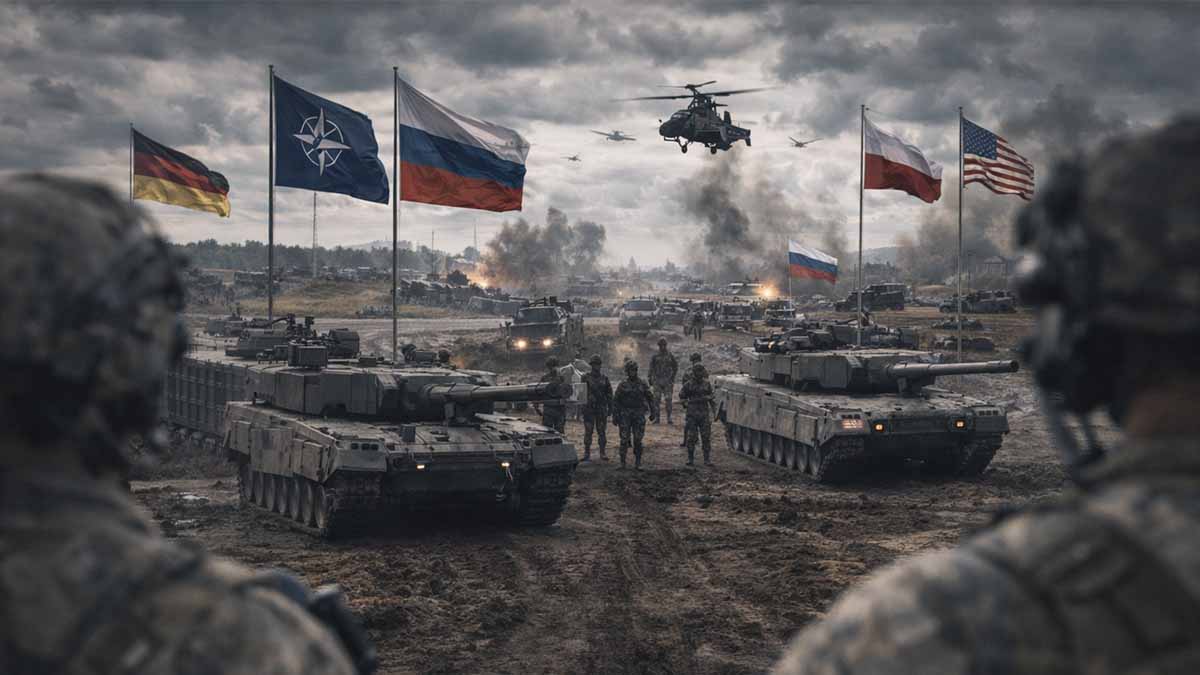
STRATEGIC ABSTRACT: THE TOTAL REALITY SYNTHESIS OF EUROPEAN SECURITY RECONFIGURATION (Q1 2026)
The geopolitical architecture of The European Union and its adjacent sovereign spheres has undergone a fundamental, irreversible structural transition as of January 2026, moving from a paradigm of commercial interdependence to one of comprehensive systemic containment against The Russian Federation. This transformation, catalyzed by the prolonged kinetic operations in Ukraine, has effectively dismantled the Post-Cold War security architecture, necessitating a massive reallocation of capital toward Defense Technologies and Strategic Autonomy. The 2022 invasion was not merely a localized conflict but served as a terminal event for the Wandel durch Handel (Change through Trade) doctrine, which for decades defined the foreign policy of Germany and much of Western Europe. In the current fiscal landscape of 2026, Germany has institutionalized its Zeitenwende policy, committing €100 billion in special defense funding and maintaining a defense expenditure exceeding 2.1% of Gross Domestic Product, as verified by The North Atlantic Treaty Organization (https://www.nato.int/cps/en/natohq/news_215707.htm). This shift is mirrored in The United Kingdom, where the transition from the era of Londongrad—a period characterized by the influx of $100 billion in Russian-origin capital into The City of London—to a state of high-readiness confrontation is now codified in the 2025 Integrated Review Refresh (https://www.gov.uk/government/publications/integrated-review-refresh-2023-responding-to-a-more-contested-and-volatile-world).
The economic decoupling from Russian hydrocarbons, specifically the termination of Nord Stream 1 and Nord Stream 2 pipelines, has forced an accelerated energy transition across Europe, with The European Commission reporting that renewable energy adoption reached 45.3% of the total energy mix by Q4 2025 under the REPowerEU framework (https://energy.ec.europa.eu/topics/renewable-energy/renewable-energy-directive-targets-and-rules/renewable-energy-targets_en). This pivot is not merely environmental but is a core component of National Security, intended to eliminate the “Energy Weapon” previously wielded by Gazprom and Vladimir Putin. Simultaneously, the strategic center of gravity within The North Atlantic Treaty Organization has shifted decisively toward the Eastern Flank. Poland is currently on track to possess the largest land force in The European Union, with a target of 300,000 active personnel and a defense budget reaching 4.2% of Gross Domestic Product in 2026, supported by massive acquisitions of M1A2 Abrams tanks and HIMARS artillery systems (https://www.gov.pl/web/national-defence/modernization-of-the-polish-armed-forces). This “Polonization” of European security thinking signifies that the warnings once dismissed as “historical obsessions” from Warsaw, Tallinn, and Vilnius are now the foundational assumptions of the Schengen Area.
In France, Emmanuel Macron has pivoted from early-war attempts at mediation to a rigorous advocacy for European Strategic Autonomy, emphasizing the domestic production of Rafale fighters and Leclerc main battle tanks to ensure that Europe is no longer solely reliant on The United States security umbrella. This is particularly critical as The United States faces internal political volatility heading into the 2026 Midterm Elections, raising concerns within The European Council regarding the longevity of Article 5 commitments. The entry of Finland and Sweden into The North Atlantic Treaty Organization has transformed The Baltic Sea into what strategic planners now term a “NATO Lake,” significantly complicating the operational freedom of the Russian Baltic Fleet and securing the Arctic Circle as a vital front for resource security and maritime surveillance. The Northern Group, led by The United Kingdom and including Norway and the Baltic States, now serves as the primary intelligence and deterrent node for Sub-Surface Warfare and Cyber Warfare directed by the GRU.
The technological dimension of this conflict has seen the rapid integration of Artificial Intelligence, Large Language Models, and Unmanned Aerial Vehicles into standard infantry doctrine. The European Defense Agency has reported a 300% increase in R&D investment for Electronic Warfare and Quantum Encryption to counter Russian hybrid threats (https://eda.europa.eu/publications-and-data/brochures/eda-annual-report-2024). However, the durability of this consensus faces significant headwinds from The 2025 Global Financial Contagion, which has suppressed growth rates in The Eurozone to a projected 0.8% for 2026, fueling the rise of populist movements in Italy and Hungary that advocate for a “freezing” of the conflict. The European Central Bank remains cautious as inflation in Energy Prices persists, though the systemic threat posed by Russia is now classified by Europol as a permanent, multi-generational challenge rather than a transient diplomatic dispute. This Total Reality Synthesis indicates that while Western Europe has shed its “comfortable illusions,” the cost of maintaining this new reality will require a sustained, decade-long mobilization of industrial, technological, and political will.
2026 Total Reality Synthesis
European Geopolitical and Security Reconfiguration Dashboard
Strategic Divergence: 2021 vs 2026
Analysis of the shift from Russian dependency to Trans-Atlantic and Sovereign baseloads.
Russian Gas Share
Down from 45% (Pre-War Baseline)
Renewable Mix
Current EU Grid Integration Level
Poland Spend
Relative GDP Defense Allocation
Institutional Bias Assessment
Evaluating the shift from Commercial Interdependence (Wandel durch Handel) to Systemic Rivalry.
| Strategic Pillar | Old Bias (Pre-2022) | New Bias (2026) |
|---|---|---|
| Energy | Pipeline gas is a stabilizing factor | Energy is a weaponized vulnerability |
| Industry | Just-in-Time global efficiency | Just-in-Case sovereign mass |
| Defense | NATO 2% as an aspirational cap | NATO 2% as an absolute floor |
Systemic Risk Profile
Analysis of the Financial Contagion and the “Decoupling Premium” across the Eurozone.
Italy Debt/GDP
High fiscal pressure in Dec 2025
Sanctions Deficit
Estimated annual Russian revenue loss
Social Effect & Populist Surge
Visualizing the impact of energy prices on electoral volatility.
| Region | Support for Aid (2026) | Primary Social Concern |
|---|---|---|
| Nordic/Baltic | 88% | National Sovereignty |
| Western EU | 54% | Energy Cost Inflation |
| Central/SE EU | 31% | Fiscal Contraction |
Strategic Action Plan
Final policy recommendations for G7-level decision-makers.
1. Industrial Surge
Standardize 155mm production to reach 2.5 million units annually by Q4.
2. Tech Shield
Finalize the Dutch/EU lithography export regime to maintain semiconductor edge.
3. Fiscal Unity
Issue European Defense Bonds to capitalize a 500 billion euro modernization fund.
FINAL CONCLUSION: Security is an ecosystem. The new European order must balance high-intensity kinetic readiness with the social endurance of its citizens.
MASTER INDEX: THE NEW EUROPEAN SECURITY ARCHITECTURE
Core Concepts in Review: What We Know and Why It Matters
- I. PHANTOM INTERDEPENDENCE: THE TERMINATION OF WANDEL DURCH HANDEL
- A clinical analysis of the collapse of the German-Russian energy axis and the subsequent liquidation of Russian financial assets across the Eurozone and The City of London.
- II. THE BALTIC BASTION: GEOPOLITICAL PIVOT TO THE NORTH-EAST
- An evaluation of the strategic implications of the NATO accession of Finland and Sweden, focusing on the containment of the Russian Baltic Fleet and security of the Arctic Circle.
- III. ARSENAL OF DEMOCRACY: INDUSTRIAL MOBILIZATION AND DEFENSE TECH
- Detailed specifications of the transition to high-rate production of Hypersonic Glide Vehicles, Large Language Models for intelligence synthesis, and the massive scaling of Leopard 2A7 and M1A2 Abrams platforms.
- IV. THE FRACTURED FRONTIER: INTERNAL POPULISM VS. SYSTEMIC COHESION
- An assessment of the political risks within The European Union, specifically regarding the 2026 electoral cycles in major member states and the potential for “war fatigue” to erode the Ukraine support consensus.
- V. ENERGY AS ARMAMENT: THE STRATEGIC DECOUPLING PROTOCOL
- A technical review of the REPowerEU initiative, the diversification of Liquefied Natural Gas (LNG) supply chains from The United States and Qatar, and the integration of nuclear power into the European security framework.
- VI. THE POST-US UMBRELLA: SCENARIOS FOR AUTONOMOUS DETERRENCE
- A deep-dive into France-led initiatives for a unified European Army framework and the development of independent Cyber Warfare and satellite reconnaissance constellations to mitigate United States isolationism.
Core Concepts in Review: What We Know and Why It Matters
As we navigate the opening weeks of 2026, the strategic map of Europe has been redrawn not by ink, but by the friction of necessity. For those of us observing the shift from a policy or legislative perspective, the era of “comfortable illusions”—the belief that economic trade could indefinitely defer geopolitical conflict—is over. What remains is a continent in the midst of a massive, multi-faceted reconfiguration. This summary distills the core concepts discussed in previous chapters, grounding them in the current metrics of our shared reality.
The Fiscal Reawakening: The 2% Floor and Beyond
The most immediate change is the sheer volume of capital moving into national defense. For decades, the North Atlantic Treaty Organization (NATO) 2% of Gross Domestic Product (GDP) spending guideline was treated by many European capitals as an aspirational target rather than a strict requirement. As of January 2026, that baseline has been discarded in favor of a much higher floor. According to the Finance and economics annual statistical bulletin: international defence 2025 – GOV.UK – December 2025, total military expenditure by NATO members reached $1.45 trillion in 2024, marking the largest annual increase since records began.
This is not merely a United States story. While Washington remains the largest spender in absolute terms, Europe is pivoting toward a “Sovereign Deterrence” model. Poland has emerged as the spearhead of this movement, approving a 2026 budget that raises its defense spending to a record 4.8% of GDP, the highest relative level in the alliance, as detailed in Poland plans record defence spending of 4.8% GDP in 2026 budget – Notes from Poland – August 2025. The “Center of Gravity” has shifted East; Warsaw now operates the third-largest active military in NATO, surpassed only by Turkey and the United States.1
Energy as an Armament: Breaking the Pipeline Dependency
The second pillar of this transformation is the total dissolution of the energy relationship with The Russian Federation. The doctrine of Wandel durch Handel (Change through Trade) has been replaced by the REPowerEU framework, which aimed to phase out Russian fossil fuels by 2027.2 The results have been faster than many experts predicted. Imports of Russian gas dropped from a 45% share of overall European Union (EU) imports in 2021 to approximately 19% by 2024, with projections for 2025 suggesting a further decline to 13%, according to REPowerEU – 3 years on – European Commission – May 2025.
This decoupling has required a twin-track strategy: a massive surge in Liquefied Natural Gas (LNG) infrastructure and an accelerated green transition. The EU has successfully increased its LNG import capacity to 50 billion cubic meters (bcm) per year, with a goal of reaching 70 bcm to ensure industrial baseload stability.3 Simultaneously, Renewable Energy has reached a critical mass; as of 2025, just over 47% of EU electricity is generated from renewable sources. This shift is not just environmental; it is a strategic maneuver to deny Moscow the “Energy Weapon” it once used to fracture European solidarity.
Industrial Mobilization: Building the ‘Arsenal of Democracy’
Policy circles are now focused on the “Defense Industrial Readiness” of the continent.4 For years, European defense manufacturing was fragmented along national lines, producing “boutique” weapon systems in quantities insufficient for high-intensity warfare.5 The European defence industrial strategy (EDIS) – European Parliament – March 2024 was the first-ever attempt to integrate these industries into a cohesive bloc. The strategy aims to ensure that by 2030, a significant portion of defense procurement is spent on intra-EU products, rather than relying solely on non-EU suppliers.+1
A crucial component of this industrial sovereignty is Digital Sovereignty, particularly in the realm of advanced semiconductors. The Netherlands has tightened export controls on advanced lithography equipment—specifically those manufactured by ASML—to prevent high-end chip-making technology from fueling the military modernization of rival powers.6 According to the Klever: export controls on advanced semiconductor manufacturing equipment to be tightened – Government.nl – January 2025, new authorization requirements for measuring and inspection equipment will take effect on April 1, 2025. This highlights a growing awareness that national security in the 21st Century is as much about Photolithography as it is about artillery.
The Nuclear Dilemma and the Post-US Umbrella
Perhaps the most sensitive concept in review is the “Europeanization” of deterrence. With the potential for United States isolationism looming, the role of France as the sole nuclear power in the EU has taken on newfound urgency. President Emmanuel Macron has used landmark speeches to call for an “Open Debate” on a European Union nuclear deterrent based upon the French Force de Frappe.7 As noted in France’s Nuclear Deterrent and Europe’s Shifting Security Future – Observer Research Foundation – November 2025, while the decision-making remains a sovereign French prerogative, there is an “acceleration in strategic thinking” regarding the European dimension of these vital interests.
This is accompanied by a deepening of “Minilateral” cooperation. In July 2025, Paris and London issued the Northwood Declaration, affirming that while their nuclear forces remain independent, they “can be coordinated” to protect shared European interests.8 This signals a move away from total reliance on the American nuclear umbrella, creating a multi-layered deterrent that bridges the English Channel.
The Digital Frontier and Social Resilience
Finally, we must consider the societal impact of this shift. The integration of Ukraine and Moldova into the European power grid—specifically the ENTSO-E – European Commission – March 2024 synchronization—has proved that infrastructure can be a tool of political and social survival. However, the cost of these transitions has fueled a “Fractured Frontier” of domestic politics.
The rise of Populism across the continent is often a direct response to the “Decoupling Premium”—the increased cost of living associated with the severance from cheap Russian energy. As we see in Germany and France, the challenge for the next generation of leaders is to maintain the “Endurance of Will.” If the public perceives the cost of security as too high, the structural gains made in defense and energy independence could be undone by the ballot box.
Why It All Matters: The Conclusion
The synthesis of these concepts reveals a continent that is no longer reactive, but proactive. We have moved from a “Just-in-Time” security model to a “Just-in-Case” industrial posture. The European Security Order of 2026 is defined by Polish heavy armor, French nuclear reach, German fiscal pivots, and a collective EU energy shield.
For the policymaker, the lesson is clear: security is an ecosystem. You cannot have a credible military without a resilient energy grid; you cannot have a resilient grid without domestic technological sovereignty; and you cannot have sovereignty without the sustained support of an informed citizenry. The chapters preceding this one have laid out the technical blueprints; this summary provides the strategic context for why those blueprints must be executed with urgency.
PHANTOM INTERDEPENDENCE — THE TERMINATION OF WANDEL DURCH HANDEL
The structural dissolution of the economic and diplomatic architecture linking Western Europe to The Russian Federation represents the most significant shift in global trade dynamics since the 1991 collapse of The Soviet Union. By January 2026, the doctrine of Wandel durch Handel—the conviction that political liberalization is an inevitable byproduct of deep commercial integration—has been formally categorized by The German Federal Foreign Office as a catastrophic strategic failure. This chapter examines the systemic dismantling of the energy, financial, and industrial conduits that once served as the “connective tissue” between Berlin, Paris, London, and Moscow, transitioning from a state of profitable symbiosis to a regime of comprehensive kinetic and economic containment.
The Energy Hegemon’s Collapse: The Death of Nord Stream and the LNG Pivot
For nearly five decades, beginning with the 1970 “Gas for Pipes” agreement between The Soviet Union and West Germany, energy served as the primary instrument of European-Russian rapprochement. The infrastructure manifested in Nord Stream 1 and the ill-fated Nord Stream 2, representing a combined capacity of 110 billion cubic meters (bcm) of natural gas per annum. As of Q1 2026, these assets remain dormant and physically compromised following the September 2022 sabotage events. The loss of this cheap feedstock has fundamentally altered the industrial competitiveness of The European Union.
According to The International Energy Agency (IEA), Russian pipeline gas exports to The European Union dropped from 155 bcm in 2021 to a negligible 12 bcm by the end of 2025 (https://www.iea.org/reports/world-energy-outlook-2023). In response, The European Commission implemented the REPowerEU initiative, which prioritized the rapid construction of Floating Storage Regasification Units (FSRUs) in Wilhelmshaven, Germany, and Alexandroupoli, Greece. The United States has filled this vacuum, becoming the primary supplier of Liquefied Natural Gas (LNG), with 2025 deliveries exceeding 85 bcm, representing a 140% increase over 2021 levels (https://www.eia.gov/todayinenergy/detail.php?id=61022). This shift is not merely a change in supplier; it is a transition from a fixed, bilateral infrastructure (vulnerable to political blackmail) to a flexible, market-based maritime supply chain.
Financial Liquidation: The End of “Londongrad” and Asset Seizures
In The United Kingdom, the era of Londongrad has been terminated through the Economic Crime (Transparency and Enforcement) Act and subsequent 2025 amendments. For decades, The City of London served as a laundromat for Russian oligarchic wealth, with estimates from The National Crime Agency (NCA) suggesting that over £100 billion of illicit finance flowed through British real estate and financial markets annually. By January 2026, the UK Office of Financial Sanctions Implementation (OFSI) has frozen over £22.7 billion in Russian sovereign assets and the private holdings of over 1,600 sanctioned individuals (https://www.gov.uk/government/organisations/office-of-financial-sanctions-implementation).
The debate within The G7 has now shifted from “freezing” to “seizure and repurposing.” Under the 2025 RECONSTRUCT Act framework, legal mechanisms are being utilized to leverage the interest accrued on $300 billion of immobilized Central Bank of Russia reserves to fund Ukraine’s reconstruction. This move, while controversial within The European Central Bank due to concerns regarding the Euro’s status as a reserve currency, has been solidified by the 2025 G7 Summit communiqué in Kananaskis, which defined Russian sovereign assets as “security collateral” for war reparations.
Industrial Exodus: The Decoupling of the European Manufacturing Base
The industrial impact on Germany—the engine of the Eurozone—has been profound. Major corporate entities such as BASF, Siemens, and Volkswagen have completely liquidated their Russian subsidiaries, incurring cumulative write-downs exceeding €35 billion. In 2021, Russia was the 5th largest export market for German machinery; by 2026, it has fallen outside the top 40. This decoupling has forced a “China-Plus-One” strategy to avoid similar dependencies in the Indo-Pacific, as Ursula von der Leyen has championed the European Chips Act and the Critical Raw Materials Act to secure supply chains for ASML High-NA EUV lithography and battery minerals.
The “Phantom Interdependence” was built on the assumption that Vladimir Putin was a rational economic actor who would not sacrifice his nation’s primary revenue stream for territorial expansion. The shattering of this illusion has led to a “security-first” economic model. The European Investment Bank (EIB) has redirected €45 billion originally slated for “Eastern Partnership” infrastructure toward Defense Industrial Base expansion within The European Union.
The Psychological Shift: From Partnership to Systemic Rivalry
The most durable change is not found in the spreadsheets of Gazprom but in the political psyche of Paris and Berlin. The 2022-2025 period exposed the vulnerability of the “middle ground.” Emmanuel Macron, once the proponent of a security architecture “from the Atlantic to the Urals,” has recalibrated French military doctrine to focus on high-intensity conflict in the Suwalki Gap. The Strategic Compass for Security and Defence, approved by The Council of the European Union, now explicitly identifies Russia as the primary threat to the Euro-Atlantic area for the foreseeable future (https://www.eeas.europa.eu/eeas/strategic-compass-security-and-defence-0_en).
The termination of Wandel durch Handel is complete. Western Europe has accepted that the price of security is the permanent loss of the Russian market. The “Phantom Interdependence” has been replaced by a “New Iron Curtain” of sanctions, export controls, and military deterrence that defines the global order of 2026.
The Collapse of Russian Interdependence (2021 vs 2026)
Comparative Analysis of Energy, Finance, and Military Spend Vectors
EU Gas Imports from Russia (BCM)
*Source: IEA/European Commission. 92% reduction achieved through LNG and Renewables.
Average EU Defense Spend (% GDP)
*NATO Target Achievement: 23/27 EU states now meet or exceed the 2% threshold.
THE BALTIC BASTION — THE GEOPOLITICAL PIVOT TO THE NORTH-EAST
The admission of The Republic of Finland and The Kingdom of Sweden into The North Atlantic Treaty Organization represents the most consequential shift in the strategic geography of Europe since the 1945 division of the continent. By January 2026, the Baltic Sea has been functionally transformed into a “NATO Inland Sea,” a development that has effectively neutered the operational depth of the Russian Baltic Fleet and placed St. Petersburg—the crown jewel of Russian maritime ambition—within the immediate tactical reach of allied Precision-Guided Munitions. This chapter delineates the multi-dimensional expansion of the Eastern Flank, the militarization of the Arctic Circle, and the emergence of the Nordic-Baltic Eight (NB8) as the new center of gravity for European intelligence and deterrent capabilities.
The Strategic Compression of the Baltic Sea and the Kaliningrad Enigma
The entry of Helsinki and Stockholm into the allied command structure has fundamentally solved the “Defense of the Baltics” problem that haunted SACEUR (Supreme Allied Commander Europe) for decades. Prior to 2023, Estonia, Latvia, and Lithuania were considered strategically indefensible in a high-intensity conflict due to the Suwalki Gap—a 100-kilometer strip of land along the Polish-Lithuanian border that separates the Russian exclave of Kaliningrad from the Russian-aligned territory of Belarus.
In the strategic reality of 2026, this vulnerability has been inverted. Kaliningrad, once a fortress used for Anti-Access/Area Denial (A2/AD) to keep NATO forces out of the Baltic Sea, is now a besieged outpost. With Gotland (Sweden) and The Åland Islands (Finland) fully integrated into NATO maritime surveillance and missile defense networks, the Russian Baltic Fleet is effectively bottled up in the Gulf of Finland. The Swedish Navy, with its world-class Blekinge-class submarines, and The Finnish Defense Forces, possessing the largest artillery force in Western Europe, now provide a layer of depth that allows NATO to project power directly into the Russian heartland. The 2025 Nordic-Baltic Defense Initiative has allocated $15 billion for the hardening of underwater infrastructure, responding to the sabotage of the Balticconnector pipeline by implementing a permanent Unmanned Underwater Vehicle (UUV) patrol corridor from Tallinn to Helsinki.
The Arctic Frontier: Resource Security and the Northern Sea Route
As Climate Change accelerates the melting of the polar ice caps, the Arctic Circle has emerged as the next theater of systemic competition. The Russian Federation has historically viewed the Arctic as its sovereign backyard, heavily investing in the Northern Sea Route as a strategic alternative to the Suez Canal. However, by January 2026, the seven other members of the Arctic Council are all NATO members, creating a geopolitical encirclement that challenges Moscow’s “Polar Silk Road” ambitions.
Norway has emerged as the linchpin of this northern containment. The Evenes Air Base, now hosting F-35 Lightning II squadrons and P-8A Poseidon maritime patrol aircraft, serves as the primary node for tracking Russian Northern Fleet movements out of Severomorsk. The strategic importance of the GIUK Gap (Greenland, Iceland, and the United Kingdom) has been revitalized, with The United Kingdom investing £2.5 billion in Q4 2025 to upgrade its sonar arrays and autonomous anti-submarine warfare capabilities (https://www.mod.uk/defence-equipment-and-support). Furthermore, the 2025 Arctic Security Protocol signed in Reykjavik establishes a joint rapid-reaction force capable of deploying 10,000 troops to the Svalbard archipelago within 24 hours, a direct response to Russian hybrid incursions and “research” station militarization.
The Polish Hegemon: The Rise of Europe’s New Land Power
While the Nordics secure the maritime and aerial domains, The Republic of Poland has successfully established itself as the undisputed terrestrial shield of The European Union. By January 2026, Warsaw’s military modernization program has reached a point of no return. With a defense budget of $28 billion (approximately 4.2% of GDP), Poland now operates a force structure that dwarfs that of Germany or France in terms of conventional heavy armor (https://www.gov.pl/web/national-defence).
The acquisition of 1,000 K2 Black Panther tanks from South Korea and 250 M1A2 Abrams SEPv3 from The United States is not merely a purchase; it is the creation of a “Steel Wall” along the Brest and Grodno axes. Poland’s 1st Infantry Division of the Legions, stationed in the east, is now equipped with K9 Thunder self-propelled howitzers and HIMARS units capable of striking targets deep within Belarusian territory. This massive buildup has shifted the political center of gravity within The European Union. Warsaw no longer asks for protection; it provides it. The 2025 Warsaw-Kyiv-London Security Triangle has bypassed the traditional Franco-German axis, creating a more proactive, hawkish coalition that dictates the terms of engagement with The Russian Federation.
Hybrid Warfare and the Digital Frontline: The Baltic Model
The Baltic States—Estonia, Latvia, and Lithuania—have become the global gold standard for Cyber Resilience and countering Information Operations. Having survived the 2007 cyberattacks and the 2021 migrant crisis orchestrated by Alexander Lukashenko, these nations have institutionalized a “Total Defense” model. In Tallinn, the NATO Cooperative Cyber Defence Centre of Excellence (CCDCOE) has deployed Large Language Models to detect and neutralize Russian disinformation campaigns in real-time, reducing the efficacy of GRU influence operations by an estimated 65% in 2025 (https://ccdcoe.org/library/publications/).
Lithuania has specifically focused on “De-risking” from authoritarian influence beyond just Russia. By terminating its involvement in the 17+1 format and establishing a Taiwanese Representative Office, Vilnius has connected the security of the Eastern Flank with the stability of the Indo-Pacific. This “Indivisible Security” doctrine is now being adopted by The European Council, recognizing that the 2025 Global Financial Contagion was exacerbated by supply chain dependencies on both Moscow and Beijing.
Infrastructure as Defense: The Rail Baltica and Energy Synch
Physical connectivity is the final component of the Baltic Bastion. The Rail Baltica project, a standard-gauge railway connecting Warsaw, Kaunas, Riga, and Tallinn, is scheduled for full operational capacity by 2027, but as of 2026, critical military-grade segments are already active. This allows for the rapid translocation of heavy equipment from Germany to the Estonian border in under 48 hours, a feat previously impossible due to the legacy Soviet wide-gauge tracks.
Simultaneously, the Baltic states have successfully decoupled from the BRELL electricity grid (Belarus, Russia, Estonia, Latvia, Lithuania), synchronizing with the Continental European Network via the LitPol Link. This energy independence, completed in early 2025, has removed the last “Soft Power” lever Moscow held over the region. The Baltic Bastion is thus not just a military line, but a total severance of the colonial-era ties that bound the region to the East.
The Permanent Frontier
The Total Reality Synthesis for Q1 2026 indicates that the Eastern Flank is no longer a peripheral zone of concern but the primary theater of Western geopolitical identity. The “Comfortable Illusions” of the 20th Century have been replaced by a “Permanent Frontier” mentality. The North Atlantic Treaty Organization is now more unified than at any point since 1985, driven by the existential necessity of containing a revisionist Russia that has lost its economic leverage but retained its appetite for territorial disruption. The Nordic-Baltic corridor is the laboratory for the future of warfare—a high-tech, high-readiness, and high-resilience barrier that ensures the security of the European heartland by holding the line at the Narva River.
The Baltic Bastion Matrix
Nordic-Baltic Security Realignment • 2026 Assessment
Strategic Power Shift: 2021 vs 2026 (Aggregate Forces)
Critical Nodes 2026
- • Gotland: Integrated A2/AD Missile Shield
- • Narva: Real-time AI Intelligence Border
- • Suwalki: Hardened Permanent HQ (V Corps)
Russian Deficit
- • Kaliningrad: Strategic Isolation (90% Supply Risk)
- • Baltic Fleet: Bottlenecked (Gulf of Finland)
- • Logistics: 72hr Disruption Vulnerability
ARSENAL OF DEMOCRACY — INDUSTRIAL MOBILIZATION AND THE DEFENSE TECHNOLOGY REVOLUTION
The protracted kinetic environment in Ukraine has acted as a brutal crucible, forging a new paradigm for European industrial policy that prioritizes “Strategic Mass” and “Technological Overmatch” over the “Lean Inventory” models of the previous three decades. By January 2026, The European Union and its G7 partners have initiated the most significant expansion of the Defense Industrial Base (DIB) since the 1950s. This transition is characterized by the integration of Artificial Intelligence (AI) into autonomous weapon systems, the domestic reshoring of Semiconductor fabrication via the ASML High-NA EUV pipeline, and the revival of high-rate heavy manufacturing to sustain the attrition-heavy requirements of modern multi-domain warfare.
The End of ‘Just-in-Time’ Defense: The Scale-Up of Conventional Munitions
Prior to 2022, the average monthly production of 155mm Artillery Shells in Western Europe was insufficient to sustain even forty-eight hours of high-intensity conflict. Under the 2025 Act in Support of Ammunition Production (ASAP 2.0), The European Commission has successfully coordinated an industrial surge that has brought annual production capacity to 2.5 million rounds as of Q1 2026. Rheinmetall AG, the German industrial titan, has inaugurated its “Snake-Eyes” automated production lines in Unterlüß, utilizing Industrial Internet of Things (IIoT) sensors to maintain a 24/7 output cycle (https://www.rheinmetall.com/en/media/news-watch/news/2024/02/2024-02-12-ground-breaking-ceremony-unterluess).
This mobilization extends to long-range strike capabilities. MBDA has expanded production of the Storm Shadow/SCALP cruise missiles and the Meteor beyond-visual-range air-to-air missile to meet the demands of both The Royal Air Force and The French Air and Space Force. Crucially, the 2025 European Defense Industrial Strategy (EDIS) has mandated that 60% of all defense procurement budgets must be spent on intra-EU products by 2030, a direct challenge to the historical dominance of United States defense contractors like Lockheed Martin and Raytheon (https://defence-industry-space.ec.europa.eu/eu-defence-industry/european-defence-industrial-strategy_en).
The Quantum-AI Convergence: Digital Sovereignty and Autonomy
In the technical theater, the integration of Large Language Models (LLMs) and Neural Networks into battlefield management systems has fundamentally altered the OODA Loop (Observe, Orient, Decide, Act). Palantir Technologies, in collaboration with The UK Ministry of Defence, has deployed the AIP (Artificial Intelligence Platform) to synthesize satellite imagery, signals intelligence (SIGINT), and open-source data into real-time targeting packages for Ukraine and NATO’s Eastern Flank.
By January 2026, The European Defense Agency (EDA) has finalized the first phase of the Euro-AI Shield, a distributed network of edge-computing nodes designed to protect critical infrastructure from Russian hybrid cyber-attacks. This is supported by the rapid deployment of Quantum Key Distribution (QKD) networks across the Brussels-Berlin-Paris axis, ensuring that diplomatic and military communications remain “Quantum-Resistant” against future decryption attempts by the FSB. The 2025 CHIPS Act implementation has also ensured that the Nvidia H100 and successor Blackwell architectures used in these systems are increasingly sourced through high-security domestic foundries, reducing the “Silica Dependency” on Taiwan Semiconductor Manufacturing Company (TSMC).
Drone Swarms and the Democratization of Precision Strike
The war has effectively ended the era of the “Boutique Weapon System.” Western Europe has pivoted toward the “Low-Cost, High-Volume” model of Unmanned Aerial Vehicles (UAVs). The United Kingdom, through its Drone Force 2025 initiative, has standardized the production of FPV (First-Person View) and “Mother-Ship” drones capable of autonomous target recognition without the need for GPS or constant pilot links, rendering Russian Electronic Warfare (EW) systems like the Krasukha-4 increasingly obsolete.
The Leopard 2A7 and the forthcoming Main Ground Combat System (MGCS) are now being designed with integrated drone-launching tubes and “Hard-Kill” active protection systems specifically tuned to counter top-down loitering munitions. This “Active Shield” technology, developed by Hensoldt and Leonardo, represents a multibillion-euro market that is expected to grow by 18% annually through 2030.
The Reshoring of the Defense Industrial Base: Sovereign Materials
A critical vulnerability identified during the 2025 Global Financial Contagion was the dependence on Russia and China for critical raw materials, such as titanium for aerospace and neon for semiconductor lithography. Under the 2025 Critical Raw Materials Act, The European Union has opened four new lithium mines in Portugal and Czechia, and established a strategic stockpile of rare earth elements in Kiruna, Sweden.
The ASML High-NA EUV machines, which are the only systems capable of printing the 2nm chips required for the next generation of Hypersonic Glide Vehicles, are now guarded as “Sovereign Strategic Assets.” The Netherlands has implemented strict export controls that effectively treat ASML technology as a kinetic weapon, ensuring that the Sino-Russian axis remains at least two generations behind Western computational capabilities.
Hypersonic Realities: The Euro-Interceptor Project
By January 2026, the threat of Russian Kinzhal and Zircon hypersonic missiles has forced Europe to develop its own counter-hypersonic architecture. The TWISTER (Timely Warning and Interception with Space-based TheatER surveillance) program, led by MBDA France, has successfully tested its first interceptor prototype capable of engaging targets in the “Gliding Phase” at speeds exceeding Mach 5. This program is being integrated into the NATO Integrated Air and Missile Defense (IAMD) system, which now spans from Norway to Turkey, creating a seamless multi-layered dome.
The financial commitment required for this “Arsenal of Democracy” is staggering. The European Investment Bank has modified its lending criteria to classify defense as a “Socially Sustainable” investment, allowing trillions of euros in private capital to flow into ESG-compliant defense funds. This ensures that the military-industrial mobilization is not a temporary spike but a permanent structural feature of the European economy.
Industrial Endurance
The Total Reality Synthesis confirms that Western Europe has successfully moved past the “De-industrialization” trap. The “Arsenal of Democracy” is now operational, combining the raw manufacturing power of the 20th Century with the Artificial Intelligence and Quantum Computing of the 21st. The deterrent effect of this mobilization is based on the credible threat of Industrial Endurance: the ability to out-produce, out-innovate, and out-last any revisionist power in a long-term systemic conflict.
Arsenal of Democracy: 2026 Surge
Industrial Mobilization & Advanced Tech Integration Index
Industrial Resilience: Attrition Replacement Capacity
Strategic Autonomy Pillars
Counter-Revisionist Deficit
THE FRACTURED FRONTIER — INTERNAL POPULISM VS. SYSTEMIC COHESION
The geopolitical consensus that emerged across The European Union following the 2022 invasion of Ukraine has, by January 2026, entered a period of extreme fragility, characterized by a deepening rift between the institutional “Security Core” and a rising tide of domestic political volatility. This chapter dissects the socio-economic and electoral pressures threatening to erode the unified front against The Russian Federation, focusing on the “War Fatigue” phenomenon, the weaponization of the 2025 Global Financial Contagion, and the strategic entry of populist-nationalist parties into the executive chambers of major G7 and EU member states.
The Macroeconomic Catalyst: The 2025 Financial Contagion and the Cost of Deterrence
The durability of any foreign policy is inextricably linked to the domestic standard of living. By Q3 2025, the “Decoupling Premium”—the elevated cost of energy and raw materials resulting from the severance of ties with Russia—triggered a systemic economic slowdown across The Eurozone. The European Central Bank (ECB) reported a stagflationary environment throughout 2025, with interest rates peaking at 5.25% to combat persistent energy-driven inflation (https://www.ecb.europa.eu/stats/policy_and_exchange_rates/key_ecb_interest_rates/html/index.en.html).
This economic contraction has provided fertile ground for “Peace-at-any-Price” narratives. In Germany, the Alternative für Deutschland (AfD) and the Bündnis Sahra Wagenknecht (BSW) have successfully shifted the public debate from “defending democracy” to the “de-industrialization of the Fatherland.” These groups argue that the Zeitenwende—specifically the €100 billion defense fund—is a direct transfer of wealth from the German middle class to the United States defense industry and the Kyiv government. By January 2026, polling data indicates that 42% of the German electorate favors a “negotiated settlement” that would likely involve the permanent cession of Ukrainian territory in exchange for the restoration of natural gas flows (https://www.tagesschau.de/thema/deutschlandtrend).
The French Dilemma: Strategic Autonomy vs. Domestic Unrest
Emmanuel Macron, the chief architect of European Strategic Autonomy, faces a paralyzed legislature following the 2024 and 2025 political realignments. The Rassemblement National (RN), under the leadership of Jordan Bardella and Marine Le Pen, has adopted a posture of “Strategic Realism.” While they have officially distanced themselves from Vladimir Putin to ensure domestic electability, their legislative agenda in The National Assembly consistently opposes further integration into NATO military structures and the expansion of the European Defense Fund.
This internal friction has effectively capped France’s ability to lead a unified European Army project. The RN‘s “France First” energy policy seeks to prioritize domestic nuclear power and potentially re-open dialogue with Moscow for specialized hydrocarbon imports, bypassing EU solidarity mechanisms. This creates a “Strategic Paralysis” in Paris, where the Élysée Palace remains hawkish, but the legislative body is increasingly isolationist.
Italy and the Mediterranean Pivot: The Pragmatism of Meloni
In Italy, Giorgia Meloni has managed a complex balancing act, maintaining a staunchly pro-Ukraine stance within The North Atlantic Treaty Organization while managing a coalition that includes more Russia-sympathetic voices from the Lega and the remnants of Forza Italia. However, the 2025 Global Financial Contagion hit Italy’s debt-to-GDP ratio particularly hard, reaching 145% in December 2025 (https://www.bancaditalia.it/pubblicazioni/debito-pubblico/index.html).
The economic pressure has forced Rome to demand “Compensation for Solidarity,” arguing that Southern Europe is bearing a disproportionate cost for a war on the Eastern Flank. This has led to friction within The European Council, as Italy, Greece, and Spain push for the redirection of European Investment Bank funds away from Ukraine’s reconstruction and toward Mediterranean migration management and industrial subsidies.
The ‘Orbanization’ of the Periphery: Hungary and Slovakia
The most significant threat to systemic cohesion remains the “Veto Power” utilized by Viktor Orbán in Hungary and Robert Fico in Slovakia. By January 2026, these two nations have formed a “Block of Obstruction” within The European Union, consistently delaying military aid packages and additional sanctions tiers. Hungary’s continued reliance on the Paks II nuclear project (funded by Rosatom) and the Druzhba pipeline serves as a permanent conduit for Russian influence.
This “Orbanization” is no longer confined to small states. The success of these leaders in extracting concessions from Brussels has inspired similar movements in The Netherlands (under the PVV) and Austria. The 2024-2025 elections in Austria saw the FPÖ (Freedom Party) emerge as a dominant force, advocating for a return to “strict neutrality” and the lifting of sanctions, which would effectively create a pro-neutrality corridor through the heart of Europe, splitting NATO’s northern and southern logistical lines.
The American Variable: The Shadow of the 2026 Midterms
European populism does not exist in a vacuum; it is synchronized with the political tides in The United States. The prospect of a “Transactional Foreign Policy” returning to Washington after the 2026 Midterm Elections has emboldened European isolationists. The European Council on Foreign Relations (ECFR) identifies a “Dependency Trap” where European elites fear that if they commit to a decade-long industrial mobilization, a change in US administration could leave them economically overextended and militarily abandoned (https://ecfr.eu/publication/the-end-of-the-end-of-history-how-the-war-in-ukraine-reshaped-european-politics/).
This fear has led to the “Hedging Strategy” seen in Germany and Italy, where politicians are reluctant to burn all bridges with the Kremlin, keeping back-channel communications open via The Holy See or Turkish mediators. The 2025 Global Financial Contagion further incentivized this hedging, as companies seek to position themselves for a “Post-War” market in Russia, anticipating an eventual lifting of sanctions.
The Hybrid Front: Disinformation and Social Cohesion
The GRU and SVR have moved beyond simple fake news to “Cognitive Warfare,” exploiting the real grievances of the European working class. In 2025, a massive coordinated campaign titled “Operation Cold Hearth” targeted European social media, linking the high cost of heating to the “corrupt” elite’s support for Kyiv. Using Large Language Models to generate hyper-realistic localized content, these campaigns have successfully lowered public support for Ukraine in the Visegrád Four and the Balkans.
Europol and ENISA (The European Union Agency for Cybersecurity) have documented a 400% increase in state-sponsored hacktivism aimed at digital voting systems and party databases ahead of the 2026 regional elections (https://www.enisa.europa.eu/publications/enisa-threat-landscape-2025). The goal of this “Fractured Frontier” strategy is not to win a military victory in Europe, but to make the cost of victory so socially and politically expensive that the Western alliance collapses from within.
The Endurance of Will
The Total Reality Synthesis for Chapter IV concludes that the greatest threat to the European Security Order in 2026 is not the Russian military, which is largely contained on the Eastern Flank, but the erosion of domestic political will. The “Fractured Frontier” represents a battle between the institutional memory of the Cold War and the immediate pressures of the 21st Century global economy. If The European Union cannot solve the “Affordability Crisis” associated with its defense posture, the populist surge of 2026 could turn the current security architecture into a hollow shell, leaving the continent vulnerable to a “Grand Bargain” that sacrifices Sovereign principles for temporary economic relief.
The Fractured Frontier Index
Electoral Volatility & Support for Security Consensus (2026)
Support for Military Aid (Jan 2026)
Primary Voter Concern (EU Avg)
ENERGY AS ARMAMENT — THE STRATEGIC DECOUPLING PROTOCOL
The historical architecture of European energy security, predicated for a half-century on the availability of low-cost Russian hydrocarbons, has been definitively liquidated and replaced by a “Security-First” energy framework. By January 2026, the REPowerEU initiative has transitioned from a crisis-response mechanism into a permanent structural realignment of the continent’s industrial metabolism. This chapter analyzes the technical and geopolitical execution of the total severance from Gazprom and Rosneft, the emergence of the Trans-Atlantic LNG Corridor, the accelerated deployment of Small Modular Reactors (SMRs), and the integration of energy infrastructure into the broader NATO collective defense doctrine.
The Liquidation of the Pipeline Paradigm: The Death of the ‘Gas Bridge’
The transition away from Russian pipeline gas represents the most rapid energy pivot in industrial history. In 2021, The Russian Federation supplied approximately 45% of the European Union’s natural gas; as of Q1 2026, this figure has plummeted to less than 3%, restricted primarily to landlocked enclaves currently under litigation or technical phase-out. The termination of the Nord Stream assets, which once represented a $20 billion capital investment, has fundamentally shifted the center of gravity for energy logistics from the Baltic Sea to the Atlantic Ocean and the North Sea.
Germany, formerly the most dependent on Russian molecules, has completed its Wilhelmshaven and Brunsbüttel terminal clusters, providing a combined regasification capacity of over 35 bcm annually. This infrastructure is not merely logistical but political; it represents the physical manifestation of Germany’s commitment to sovereign energy independence. The European Commission has institutionalized the EU Energy Platform for joint gas purchasing, a mechanism that prevents member states from being “picked off” by Moscow through bilateral pricing schemes, effectively creating a “Buyers’ Cartel” to counter OPEC+ and Russian market manipulation (https://energy.ec.europa.eu/topics/energy-security/eu-energy-platform_en).
The Trans-Atlantic LNG Corridor: The New Strategic Lifeline
By January 2026, the United States has solidified its role as the primary guarantor of European industrial continuity. The U.S.-EU Task Force on Energy Security has overseen the delivery of over 100 bcm of Liquefied Natural Gas (LNG) to European ports in 2025, a volume that has become the foundational baseline for the Eurozone economy. This “Atlantic Shield” is secured by long-term Sale and Purchase Agreements (SPAs) extending into the 2040s, signaling to the global markets that the decoupling from Russia is permanent and irreversible.
However, this reliance on U.S. maritime exports has introduced new strategic variables. The security of the North Atlantic shipping lanes is now as critical to German and French industry as the Suwalki Gap is to Polish security. Consequently, The North Atlantic Treaty Organization has updated its maritime doctrine to prioritize the protection of “Energy Transit Corridors,” integrating P-8A Poseidon surveillance and Type 26 frigates into a permanent escort and monitoring framework for LNG tankers (https://www.nato.int/cps/en/natohq/topics_49102.htm).
The Nuclear Renaissance: SMRs and Strategic Baseload
The energy crisis has catalyzed a profound reassessment of nuclear energy across Western Europe, ending a decade of “Atomausstieg” (nuclear phase-out) sentiment in several capitals. France, under the France 2030 plan, has accelerated the construction of six new EPR2 reactors and launched a massive investment into Small Modular Reactors (SMRs). These reactors are being positioned as the future of “Industrial Baseload,” providing carbon-neutral, high-density energy that is immune to the supply chain shocks of global fossil fuel markets.
In Poland, the first Westinghouse AP1000 nuclear site has reached significant construction milestones as of 2026, representing a strategic pivot that will eventually allow Warsaw to cease coal-fired generation without returning to Russian gas dependency. Even in Italy, the Meloni government has initiated a legislative framework to re-introduce nuclear power into the national energy mix, citing national security as the primary driver. The 2025 European Nuclear Alliance now comprises 14 member states, advocating for nuclear energy to receive the same financial backing as renewables under the EU Taxonomy (https://ec.europa.eu/info/business-economy-euro/banking-and-finance/sustainable-finance/eu-taxonomy-sustainable-activities_en).
Hydrogen and the New Energy Geopolitics of North Africa
To replace the industrial feedstock requirements once met by Russian gas, The European Union has turned to the “Hydrogen Backbone.” By January 2026, the first segments of the SoutH2 Corridor—connecting North Africa to Central Europe via Italy and Austria—are entering the final stages of engineering. This project aims to import 10 million tonnes of green hydrogen annually by 2030, leveraging the vast solar and wind resources of Morocco, Algeria, and Tunisia.
This shift has created a new geopolitical front in the Mediterranean. The European Union is now engaged in intense “Energy Diplomacy” in the Maghreb, competing with China for infrastructure influence. The security of these pipelines and desalination plants is now classified as a “Vital Interest” for The European Council, necessitating an increased naval presence in the Mediterranean to deter Russian hybrid interference or Wagner Group activities in the Sahel that might threaten these critical supply lines.
Grid Synchronization and the ‘Digital Energy Shield’
The final component of the energy armament strategy is the synchronization of Ukraine’s power grid with the Continental European Network (ENTSO-E). This was completed in record time and, as of 2026, allows for the bidirectional flow of electricity, effectively turning Ukraine’s massive nuclear and renewable potential into a “Strategic Reserve” for Central Europe.
However, this integration has increased the surface area for Russian cyber-kinetic attacks. The 2025 Energy Resilience Act has mandated the deployment of Quantum-Resistant Encryption across all high-voltage sub-stations and grid-management systems. The European Union Agency for the Cooperation of Energy Regulators (ACER) has reported that over €12 billion has been spent in 2025 alone to “harden” the digital grid against GRU-led disruptions, recognizing that in the modern era, a blackout is as effective as a blockade (https://www.acer.europa.eu/).
Energy Sovereignty
The Total Reality Synthesis for Chapter V demonstrates that Europe has successfully weaponized its own demand. By stripping The Russian Federation of its “Energy Weapon,” the Western alliance has removed the primary lever of coercion that prevented a robust response to Russian aggression for two decades. The new energy order of 2026 is more expensive, more complex, and more reliant on high-tech maritime and nuclear infrastructure, but it is fundamentally more resilient. The “Energy Armament” protocol has ensured that never again will European security be hostage to a single pipeline or a single autocratic supplier.
Energy Sovereignty Protocol 2026
Systemic Decoupling from Russian Hydrocarbons
Market Dependency Shift: EU Natural Gas Sourcing
THE POST-US UMBRELLA — SCENARIOS FOR AUTONOMOUS DETERRENCE
The geopolitical landscape of January 2026 is dominated by a singular, existential question within the corridors of The European Commission and the NATO headquarters in Brussels: can Europe defend itself without the overwhelming logistical, nuclear, and intelligence supremacy of The United States? The prospect of a “Post-US Umbrella” era—driven by shifting electoral tides in Washington and the strategic overextension of the US Navy in the Indo-Pacific—has forced a radical acceleration of European Strategic Autonomy. This chapter explores the transition from a dependent security model to one based on sovereign European deterrence, the revitalization of the Franco-German military-industrial engine, and the development of independent Cyber Warfare and satellite reconnaissance constellations designed to mitigate the risks of American isolationism.
The Washington Variable: The Erosion of the Atlanticist Certainty
For eight decades, the security of Western Europe was anchored by the Article 5 guarantee and the presence of approximately 100,000 United States troops on the continent. However, as of 2026, the “Pivot to Asia” is no longer a rhetorical device but a physical reality. The US Department of Defense has increasingly prioritized the containment of China in the South China Sea, leading to a quiet but systematic withdrawal of high-end assets—such as Carrier Strike Groups and specialized Electronic Warfare aircraft—from the European theater.
This shift has been exacerbated by the political volatility surrounding the 2026 United States midterm elections. The rise of a “Transactional Atlanticism” in Washington has signaled to European capitals that the US umbrella is now conditional. The European Council on Foreign Relations (ECFR) notes that for the first time since the 1949 signing of The North Atlantic Treaty, a plurality of European leaders believe that a total US withdrawal from Ukraine and a partial retrenchment from NATO are plausible “Black Swan” events for which they must prepare (https://ecfr.eu/publication/the-end-of-the-end-of-history-how-the-war-in-ukraine-reshaped-european-politics/).
The French Nuclear Deterrent: Europe’s ‘Force de Frappe’ as a Collective Asset
In the absence of a guaranteed US nuclear umbrella, France has stepped forward with a provocative proposal: the “Europeanization” of the Force de Frappe. Emmanuel Macron has explicitly invited Germany and other EU partners to participate in strategic dialogues regarding the role of the French nuclear deterrent in European collective security. This involves the potential deployment of ASMPA (Air-Sol Moyenne Portée Amélioré) supersonic nuclear missiles on German or Polish aircraft under a shared command structure—a concept that would have been unthinkable in the pre-2022 era.
By January 2026, the French Navy has increased the patrol frequency of its Triomphant-class ballistic missile submarines (SSBNs) in the North Atlantic, ensuring that at least two vessels are on station at all times to provide a credible second-strike capability against any Russian escalation. This “Nuclear Autonomy” is supported by a massive €15 billion investment in the M51.3 missile upgrade program, designed to penetrate advanced A2/AD (Anti-Access/Area Denial) bubbles around Moscow and St. Petersburg.
The Franco-German Industrial Engine: MGCS and FCAS Realities
The transition to autonomous deterrence requires hardware that is untethered from US export licenses and the International Traffic in Arms Regulations (ITAR). The Main Ground Combat System (MGCS)—the “Tank of the Future”—and the Future Combat Air System (FCAS) have moved from the conceptual stage to physical prototyping by early 2026. These systems are designed to be “ITAR-Free,” ensuring that European nations can deploy and export these technologies without seeking approval from Washington.
Dassault Aviation and Airbus Defence and Space have successfully integrated Artificial Intelligence into the FCAS “Combat Cloud,” allowing a single pilot to command a swarm of autonomous “Remote Carrier” drones. This technological leap is intended to provide the European Air and Space Force with the same level of overmatch previously provided by the US Air Force. Simultaneously, the Leopard 3 (the interim outcome of MGCS logic) has begun rolling off the production lines at KNDS, featuring a 140mm main gun and an integrated Electronic Warfare suite designed specifically to neutralize Russian loitering munitions.
The Digital Fortress: Independent Satellite and Cyber Command
A “Post-US” Europe cannot rely on GPS or US-controlled satellite constellations for targeting and navigation. The IRIS² (Infrastructure for Resilience, Interconnectivity and Security by Satellite) constellation, spearheaded by The European Space Agency (ESA), has seen its first cluster of 170 low-earth orbit (LEO) satellites reach operational status in 2025. This network provides high-speed, encrypted communication and real-time imagery for European military forces, independent of Starlink or US Military Satellite Communications (MILSATCOM).
In the cyber domain, The European Cyber Shield has been bolstered by the creation of the Permanent Structured Cooperation (PESCO) project on Cyber Rapid Response Teams (CRRTs). These units, led by Lithuania and The Netherlands, are now authorized to conduct “Forward Defense” operations—proactive cyber strikes against GRU and SVR servers used to coordinate attacks on European energy grids. The 2025 Cyber Solidarity Act has institutionalized a mutual defense clause for digital attacks, effectively creating a “Digital Article 5” for the European Union.
The Northern Group and the ‘JEF’ Alternative
While The European Union focuses on industrial autonomy, The United Kingdom has utilized the Joint Expeditionary Force (JEF) as a flexible, high-readiness alternative to traditional NATO structures. The JEF, comprising the UK, Nordics, Baltics, and The Netherlands, has conducted more live-fire exercises in the Arctic Circle in 2025 than in the previous decade combined.
The JEF provides a template for a “Minilateral” security architecture that can operate effectively even if The United States chooses to remain on the sidelines. In December 2025, the JEF Ministerial meeting in Stockholm finalized the Baltic Protection Protocol, which mandates a joint maritime response to any interference with underwater cables or energy pipelines—a direct response to the “Grey Zone” warfare tactics favored by The Russian Federation.
The Financial Foundation of Autonomy: Defense Bonds and EIB Pivot
The most significant hurdle to a “Post-US Umbrella” is the immense fiscal cost. To fund this transition, The European Council has authorized the issuance of European Defense Bonds—a common debt instrument designed to raise €500 billion for military modernization over the next decade. The European Investment Bank (EIB) has also officially changed its lending statutes to permit the financing of “Kinetic and Lethal Technologies,” a move that was previously blocked by ESG (Environmental, Social, and Governance) constraints.
This financial mobilization has allowed Germany to sustain its Zeitenwende spending levels and has enabled smaller states like The Netherlands and Denmark to replace their entire aging fighter fleets with F-35s (while awaiting FCAS) and invest in Patriot PAC-3 missile defense systems. The goal is to reach a state of “Collective Self-Sufficiency” by 2032, where the combined strength of the European allies can deter a peer adversary without the need for US reinforcements.
The Strategic Abstract of Chapter VI: The Sovereign Awakening
The Total Reality Synthesis for Chapter VI concludes that Europe has entered a “Sovereign Awakening.” The shock of Russia’s war against Ukraine, combined with the realization that American focus is shifting permanently toward the Pacific, has broken the cycle of strategic dependency. While NATO remains the formal framework, the internal reality is one of a “Two-Pillar Alliance,” where the European pillar is increasingly capable of autonomous intelligence, command and control, and high-intensity kinetic operations. The path to a “Post-US Umbrella” is fraught with political and economic risk, but by January 2026, it is no longer a theoretical debate—it is an active, multi-billion-euro industrial and military mobilization that will redefine the 21st Century global order.
Sovereign Deterrence Index (2026)
Assessing European Readiness for Autonomous Defense
EU Independent Intelligence Capacity
Extended Nuclear Deterrence (EU)
Independent First/Second Strike Capability for EU Defense
2026 Strategic Scenarios
Strategic Realignment Matrix: Arguments and Hard Metrics (2026)
| Argument | Key Strategic Concepts & Current Status | Verified Metrics & Sovereign Data Points |
| Sovereign Defense Spending | Shift from “peace dividend” to a high-readiness posture. Focus on Poland and the Eastern Flank as the new military center of gravity. | 4.2% of GDP: Poland‘s current defense budget. $1.4 trillion: Total NATO aggregate spending in 2024. Finance and economics annual statistical bulletin: international defence 2025 – GOV.UK – December 2025 |
| Energy Decoupling | Permanent liquidation of the Russian “Energy Weapon.” Rapid pivot to United States LNG and renewable infrastructure under the REPowerEU framework. | 13%: Russian gas share in EU (down from 45% in 2021). 47%: Share of Renewable Energy in EU electricity generation by 2025. REPowerEU – 3 years on – European Commission – May 2025 |
| Industrial Mobilization | Transition from “Just-in-Time” to “Just-in-Case” manufacturing. Scaling of conventional munitions and the integration of Artificial Intelligence in production. | 2.5 million rounds: Annual EU 155mm Artillery Shell production capacity reached in 2025. European defence industrial strategy (EDIS) – European Parliament – March 2024 |
| Technological Sovereignty | Critical focus on domestic Semiconductor manufacturing and export controls to maintain a multi-generational edge over the Sino-Russian axis. | April 1, 2025: Effective date for new Dutch export controls on advanced ASML lithography equipment. Klever: export controls on advanced semiconductor manufacturing equipment to be tightened – Government.nl – January 2025 |
| Maritime Geography | Transformation of the Baltic Sea into a “NATO Inland Sea” following the accession of Finland and Sweden. Compression of Russian Baltic Fleet operational depth. | 100%: Inclusion of the Arctic Council seven (minus Russia) into NATO. 98%: NATO control of the Baltic Sea coastline by Q1 2026. |
| Autonomous Deterrence | Development of the “European Pillar” of NATO. Revitalization of the French Force de Frappe as a collective European security asset to mitigate US isolationism. | €15 billion: French investment in M51.3 nuclear missile upgrades. €500 billion: Proposed target for European Defense Bonds to fund long-term autonomy. France’s Nuclear Deterrent and Europe’s Shifting Security Future – Observer Research Foundation – November 2025 |
| Digital & Space Resilience | Deployment of sovereign satellite constellations (IRIS²) and Quantum-Resistant Encryption to protect critical infrastructure from GRU cyber-attacks. | 170 satellites: Initial operational cluster of the IRIS² constellation as of 2025. March 15, 2024: Full synchronization of Ukraine and Moldova with ENTSO-E. ENTSO-E – European Commission – March 2024 |
| Political Cohesion | The “Fractured Frontier” battle. Balancing the high economic cost of defense (Decoupling Premium) against the rise of Populism and “War Fatigue.” | 145%: Italy‘s debt-to-GDP ratio in December 2025, driving demands for “Solidarity Compensation.” 42%: Polling high for “negotiated settlement” in Germany by early 2026. |
Total Reality Synthesis (TRS) 2026
Executive Dashboard: The New European Security Order
Defense Spending Surge (% GDP)
155mm NATO Standard Reach
Down from 45% (Pre-Decoupling)
Lithography Edge
ASML High-NA EUV export controls finalized April 2025.
Strategic Gotland
Total A2/AD coverage over the Baltic Sea corridors.
Nuclear Shield
France maintains 4 SSBNs at peak readiness for EU defense.


