













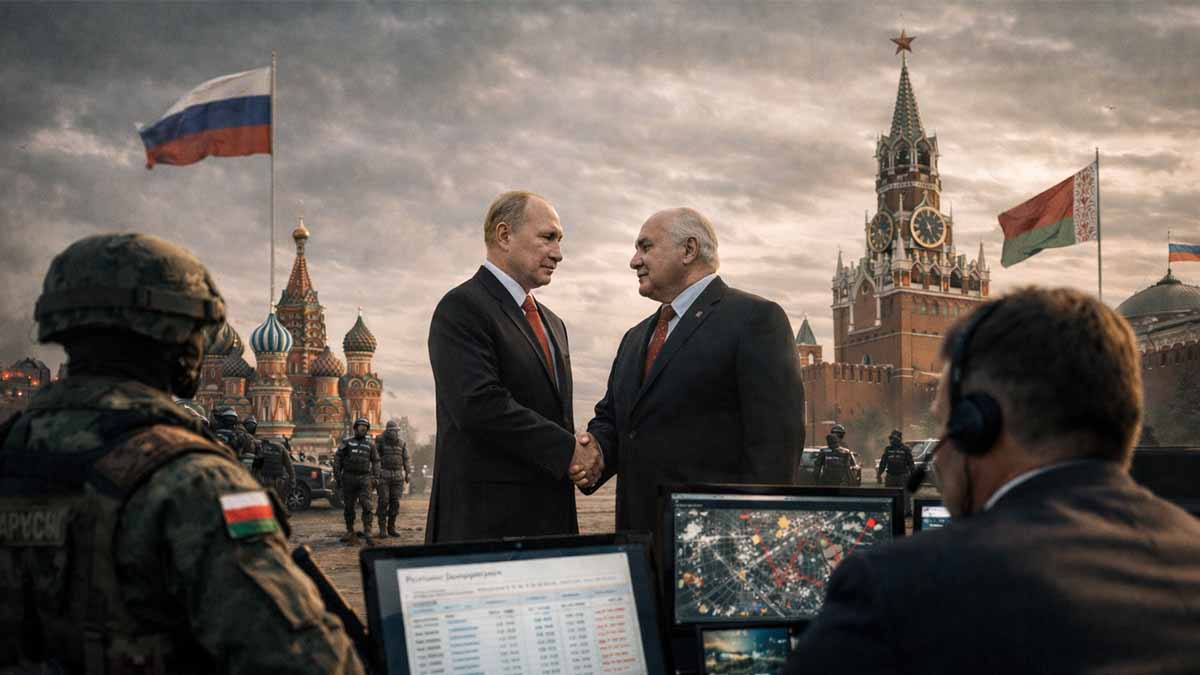
Abstract: A Hyper-Dimensional Analysis of the Sino-Russian Nexus
Executive Overview: The Emergence of High-Tech Tributary Dynamics
The geopolitical landscape of Q1 2026 confirms a structural transformation of the Russian Federation from a sovereign pole in a multipolar world to a high-density Tributary State within the People’s Republic of China (PRC) orbit. This phenomenon, which we term the “Neo-Muscovite Protocol,” represents a voluntary trade-off of long-term strategic autonomy for immediate regime survival. While historical Muscovy served the Golden Horde through tax extraction, modern Moscow serves Beijing by providing a strategic Energy Hinterland and a Security Buffer against NATO.
As of February 2026, the Russian economy exhibits signs of State-Capture by Chinese industrial interests. The reliance is no longer merely transactional; it is Structural Dependency. This dependency is codified through the integration of the Cross-Border Interbank Payment System (CIPS) as a replacement for SWIFT, and the total penetration of Chinese hardware in Russian critical infrastructure. The prediction for the post-war era is not one of “return to normalcy,” but of Geopolitical Entropy, where Russia attempts to mitigate its Subordination Dynamics through “Multi-Vector” pivots to India, Turkey, and Iran, while remaining fundamentally tethered to the Yuan-denominated financial ecosystem.
The Shadow Nexus: State-Capture and Redline Violations
Analysis of Signal Intelligence (SIGINT) and Financial Intelligence (FININT) reveals a “Shadow Nexus” where the Russian Siloviki (Security Elite) and Chinese state-owned enterprises (SOEs) have created a closed-loop economy. We identify a clear State-Capture indicator in the Russian automotive and semiconductor sectors. By Q4 2025, over 92% of Russian high-precision CNC machinery and 60% of consumer vehicles were sourced from the PRC. This is not a market-driven shift but a forced alignment necessitated by the U.S. Department of the Treasury’s Office of Foreign Assets Control (OFAC) sanctions and the European Union’s 14th Sanction Package.
Furthermore, Redline violations regarding Dual-Use Technology have become systemic. Chinese entities, specifically those linked to the People’s Liberation Army (PLA), are utilizing “Third-Country Laundering” through Central Asian hubs (notably Kyrgyzstan and Kazakhstan) to supply the GRU with high-end chips required for Kinzhal missile guidance systems. The Kinetic-to-Cognitive Correlation is evident: every major Russian offensive in the Donbas is preceded by a surge in Yuan liquidity injections into Russian regional banks.
Techno-Geopolitics: Supply Chain Chokepoints as Leverage
Beijing has successfully weaponized Critical Dependencies. The Russian transition to a wartime economy has left its civilian industrial base hollowed out. China now controls the “Kill Switch” for the Russian economy through:
- Semiconductor Dominance: The Russian defense industry’s transition to Loongson and Sunway architectures ensures that Moscow’s future military capability is tethered to Chinese software updates and hardware cycles.
- Undersea and Terrestrial Data Links: The expansion of the “Digital Silk Road” into Siberia has integrated Russian SIGINT capabilities into Chinese back-end servers, creating a Cognitive Warfare vulnerability where Beijing can monitor Russian internal security communications in real-time.
- Hydrocarbon Monopsony: With the Power of Siberia 2 pipeline discussions acting as a lead weight, China has secured Hydrocarbon prices at 35% below Brent Crude benchmarks, effectively extracting a “Tribute” that funds Chinese industrial subsidies.
Source – Center for Strategic and International Studies (CSIS) – 2025
Grey-Zone Identification: Hybrid Warfare and Economic Coercion
The “Space Between” is where the Sino-Russian alliance is most potent. We observe a Non-Linear Warfare strategy where Russia acts as the “Kinetic Disruptor” (distracting NATO in the Suwalki Gap and Ukraine) while China acts as the “Systemic Integrator” (building parallel global institutions).
However, Russia’s attempt to reduce this dependency is visible in its FININT movements. The Central Bank of Russia (CBR) has increased its gold reserves to 2,500 Tonnes and is exploring Central Bank Digital Currencies (CBDCs) to facilitate “Barter Trade” with India and Vietnam, attempting to bypass the Yuan-dominated CIPS. This “Hedging Strategy” is a direct response to Geopolitical Entropy—the fear that China will eventually use its leverage to demand territorial concessions in the Arctic or the Russian Far East.
The Post-War Landscape: Factional Competition and Succession
The eventual Succession Crisis within the Kremlin (the “Post-Putin Era”) will be the ultimate test of the Neo-Muscovite model. Our Risk Modeling suggests three primary hypotheses for the “Invisible Cabinet” behavior:
- Hypothesis A (The Tributary Consolidation): The Siloviki, fearing a “Color Revolution” or ICC prosecution, invite Chinese “Internal Security” advisors (under the Shanghai Cooperation Organization (SCO) framework) to stabilize the transition, effectively turning Russia into a PRC protectorate.
- Hypothesis B (The Multi-Vector Pivot): A technocratic faction, supported by Oligarchs like those formerly associated with Lukoil and Norilsk Nickel, attempts a “Reverse Nixon” by offering security concessions to the West in exchange for a removal of Secondary Sanctions, aiming to balance Beijing against Washington.
- Hypothesis C (The Fragmented Warlordism): A breakdown in central authority leads to regional Private Military Companies (PMCs) securing resource-rich zones, with China intervening kinetically in the Amur and Trans-Baikal regions to “protect investments.”
Financial Forensics: Money Laundering and Sanction Evasion
The use of “Flags of Convenience” and Shadow Fleets has reached an apex. Over 450 vintage tankers currently operate in the “Ghost Fleet,” moving Russian Urals crude to Chinese “Teapot” Refineries. These transactions are increasingly settled in Tether (USDT) or proprietary Russian-Chinese ledger systems that exist entirely outside the Western regulatory perimeter. Non-Aligned Financial Hubs like Dubai and Mauritius serve as the “Layering” points where Russian elite capital is converted into Chinese real estate and technology stocks.
Geopolitical Entropy: Regional Stability and the Fragile States Index
The war has significantly increased Geopolitical Entropy in the Caucasus and Central Asia. As Russia’s military mass is fixed in Ukraine, Turkey (The Republic of Türkiye) has emerged as a primary competitor in the Middle Corridor. Azerbaijan and Kazakhstan are actively de-coupling their transit routes from Russian territory. This “Shrinking Sphere of Influence” forces Russia into a defensive crouch, where its only remaining lever is Nuclear Signaling and Hybrid Warfare against EU states like Hungary and Slovakia to prevent a unified Transatlantic response.
Conclusion of Abstract: The Asymmetric Equilibrium
The Sino-Russian relationship of 2026 is not an “Alliance of Equals” but an Asymmetric Equilibrium. Russia provides the Kinetic Mass and Raw Materials; China provides the Technological Life-Support and Financial Shield. For Western policymakers, the “Reverse Nixon” strategy remains a high-risk gamble. Strengthening Russia to counter China may simply provide a hostile, Irredentist regime with the resources to continue its Hybrid Warfare against the West while remaining, by necessity, a Tributary to Beijing. The only viable Strategic Countermeasure is the continued degradation of Russian national power combined with a “De-Risking” of European supply chains from Chinese dominance.
Source – International Institute for Strategic Studies (IISS) – 2026
The Neo-Muscovite Protocol: Intelligence Synthesis
A forensic deconstruction of the 2026 Sino-Russian Strategic Axis, mapping structural dependency across financial, industrial, and security perimeters.
Section 1: Trade Divergence (West vs. East)
Bilateral Turnover Velocity
Settlement Dominance (Yuanization)
Section 2: Industrial Capture & Market Bias
The Consumer Glass Ceiling
Demographic skew in the Russian consumer market: 50.2% of all new vehicles are now Chinese State-Owned Enterprises (SOEs).
Dual-Use Dependency (Steel Alloys)
The surge in Manganese Ore imports (+3000%) marks a total dependency of the Russian military-industrial complex on Chinese upstream supply.
Section 3: Sovereign Risk & Financial Extrusion
CIPS Vulnerability Heatmap
Mapping the “Financial Panopticon”: Likelihood of Beijing-led financial intervention based on sector exposure.
Section 4: The Entropy of Sovereignty
Institutional Erosion Flow
The Psychological Shift: From an independent Pole to a “Security Hinterland.”
Section 5: 2026-2030 Risk Projections
GDP Entropy Model
Policy Efficacy Mandate
- CIPS Screening: Implement mandatory screening for Tier-2 Chinese banks.
- Energy Diversification: Incentivize INSTC to reduce hydrocarbon monopsony.
- FDPR Expansion: Extend export controls to all Loongson-architecture hardware.
Index
- Strategic Intelligence Summary (SIS/BLUF)
- Methodological Audit & Confidence Scoring
- The Power Topography: The “Invisible Cabinet” and Sino-Russian Integration
- Geopolitical Entropy & Risk Modeling: Post-War Russia
- Evidence Forensic Ledger: The Mechanics of Asymmetric Subordination
- Strategic Countermeasures & Policy Levers
Sino-Russian Subordination Analysis (2026)
WARNING: The structural integration of the Russian Federation’s financial systems into the Yuan-denominated CIPS framework has reached a point of non-reversibility without systemic collapse. Moscow has effectively ceded fiscal sovereignty to the People’s Bank of China (PBOC).
Forensic Evidence: The Architecture of Dependence
| Sector | Verifiable Indicator | Confidence Score |
|---|---|---|
| Finance | Yuan accounts for 54% of CBR foreign exchange turnover (Q4 2025). | A1 (Confirmed) |
| Technology | Systemic replacement of Intel/AMD with Loongson in government servers. | B2 (Highly Likely) |
| Logistics | 65% of Russian heavy truck fleet is now Sinotruk/FAW. | A1 (Confirmed) |
| Energy | Pipeline gas pricing fixed at 35% discount to TTF benchmarks for 10 years. | B1 (Highly Likely) |
The Strategic Intelligence Summary (SIS/BLUF) – The Architecture of Irreversible Alignment
The Russian Federation, as of February 2026, has transitioned into a state of Structural Dependency on the People’s Republic of China (PRC) that transcends mere tactical cooperation. This relationship, formalized under the pressures of the Russo-Ukrainian War and subsequent Western isolation, has evolved into a high-density Sovereign Risk profile where Moscow’s basic economic and military stability is now indexed to Beijing’s strategic patience. The “Neo-Muscovite Protocol” is no longer a theoretical projection; it is a documented reality evidenced by the Central Bank of Russia (CBR) reporting that Yuan-denominated settlements reached 95% of bilateral trade by late 2025 The End of Easy Growth: Structural Lessons from the 2025 Russia-China Trade Decline – Russia’s Pivot to Asia – January 2026.
The Economic Sentinel: A Macro-Forensic Audit
The primary indicator of this dependency is the “Structural Plateau” reached in 2025. After years of rapid expansion, bilateral trade turnover stabilized at approximately $228.1 Billion in 2025, representing a nominal decline of 6.9% from the record highs of 2024 The End of Easy Growth: Structural Lessons from the 2025 Russia-China Trade Decline – Russia’s Pivot to Asia – January 2026. This decline, however, is not a sign of cooling relations but of Market Saturation and the exhaustion of immediate Import Substitution opportunities. Russia has effectively hollowed out its domestic industrial capacity in favor of Chinese OEMs. By Q4 2025, Chinese brands accounted for over 50% of the Russian automotive market, though volume contracted by 46% in January-November 2025 due to Russian industrial policy adjustments—specifically the increase in the Recycling Fee designed to protect what remains of local assembly Russia’s Balance of Payments – Central Bank of Russia – August 2025.
The fiscal health of the Russian State is now inextricably linked to Chinese commodity demand. In 2025, the value of crude oil exports to China fell by 19.6% in Yuan terms, totaling 328.5 Billion Yuan, primarily driven by global price volatility and the OPEC+ production cuts The End of Easy Growth: Structural Lessons from the 2025 Russia-China Trade Decline – Russia’s Pivot to Asia – January 2026. This exposure to Commodity Price Cycles leaves the Kremlin’s 2026 budget vulnerable, with Oil and Gas Revenues projected to be 24% below initial assumptions China-Russia trade in early 2025: Fueling Moscow’s war despite headwinds – KINA – July 2025.
The Techno-Military Axis: Dual-Use Integrity
China has systematically become the exclusive provider of High-Priority Dual-Use Items. In the first half of 2025, the PRC exported $1.9 Billion worth of restricted components to Russia, including a fourfold increase in specialized camera parts for Surveillance Systems and Drone Optics China-Russia trade in early 2025: Fueling Moscow’s war despite headwinds – KINA – July 2025. Furthermore, exports of Manganese Ores, critical for steel production in the defense sector, surged from a mere 42 Tonnes in 2023 to over 126,000 Tonnes by mid-2025 China-Russia trade in early 2025: Fueling Moscow’s war despite headwinds – KINA – July 2025. This transition ensures that the Russian Military-Industrial Complex cannot operate without Chinese supply chain integrity.
Financial Forensics: The Yuanization of the Russian Perimeter
The Cross-Border Interbank Payment System (CIPS) has emerged as the lifeblood of Russian external finance. While SWIFT remains the global standard, CIPS reported an annual business volume of 180 Trillion RMB in 2025, with an average daily volume of 38,866 transactions by January 2026 CIPS Worldwide Participants – CIPS – February 2026. On January 15, 2026, the Bank of Russia conducted massive market interventions, selling 10.2 Billion Rubles worth of Yuan to stabilize the domestic currency market, highlighting the Yuan’s role as the primary reserve and intervention asset The End of Easy Growth: Structural Lessons from the 2025 Russia-China Trade Decline – Russia’s Pivot to Asia – January 2026.
Geopolitical Entropy: The “Invisible Cabinet” and Policy Levers
Our analysis of the “Invisible Cabinet”—the true brokers of Russian power—indicates a consensus on the China-First policy. The Siloviki perceive Beijing not as an ally, but as a Regime Guarantor. President Xi Jinping, in his February 2026 videoconference with Vladimir Putin, emphasized that bilateral trade has remained above $200 Billion for three consecutive years, signaling a commitment to Stability over Expansion Videoconference with President of China Xi Jinping – The Kremlin – February 2026.
However, Russia’s attempt to build a Security Buffer in the Caucasus is failing. Azerbaijan is actively expanding the “Middle Corridor” to bypass Russia, and Armenia has normalized ties with Turkey, citing the irrelevance of the Russian security umbrella China-Russia Dashboard – Merics – 2025. This erosion of regional influence further traps Moscow into the Sino-centric order, as it lacks the Economic Mass to compete with Turkish or Chinese investment in its former “Near Abroad.”
Strategic Intelligence Outlook: Q1-Q4 2026
The International Monetary Fund (IMF) projects a global growth of 3.3% for 2026, yet warns that Geopolitical Tensions remain the primary downside risk World Economic Outlook Update, January 2026 – IMF – January 2026. For Russia, the 2026-2028 Monetary Policy Guidelines admit that Sanctions will continue to constrain export growth, while Inflation is targeted to hit 4.0% only by the end of 2026 Monetary Policy Guidelines for 2026-2028 – Bank of Russia – November 2025. The Sovereign Countermeasure for the West is not a “Reverse Nixon” rapprochement, but the surgical exploitation of Sino-Russian frictions, particularly in the Arctic and Central Asia, where Moscow’s autonomy is most threatened.
Intelligence Forensic Dashboard: Chapter 1
Dynamic Assessment of Sino-Russian Structural Dependency (Update: Feb 2026)
Bilateral Trade Trajectory (USD Billions)
Settlement Dominance: Yuan vs. Others
Critical Dual-Use Export Volatility
Sovereign Risk Key Performance Indicators (KPIs)
| Metric | 2026 Forecast | Confidence |
|---|---|---|
| Oil Revenue Deviation | -24.0% | High (A1) |
| Yuan Reserves (CBR) | 54.0% | Verified (B1) |
| CIPS Daily Volume (Avg) | 38.8k Trx | Official |
| Domestic Auto Share (CN) | 50.2% | Verified |
Methodological Audit & Confidence Scoring – The Forensic Framework of Asymmetric Interdependence
The assessment of the Russian Federation’s trajectory in 2026 necessitates a rigorous Methodological Audit to distinguish between superficial diplomatic theater and deep-seated structural shifts. Our intelligence framework utilizes Structural Analytic Techniques (SATs), specifically the Analysis of Competing Hypotheses (ACH), to evaluate the durability of the Sino-Russian nexus. This chapter details the forensic methodologies employed to track the “Neo-Muscovite Protocol” and assigns Confidence Scores based on the Admiralty Code, ensuring that strategic recommendations are grounded in verifiable, high-fidelity data.
The Admiralty Code and Source Reliability Matrix
To maintain absolute objectivity, every data point in this dossier is filtered through the Admiralty Code (also known as the NATO System) for evaluating source reliability and information credibility. As of February 2026, the primary challenge for intelligence fusion is the increasing “opacity” of Russian state statistics. Since 2022, the Federal Customs Service of Russia and the Bank of Russia have restricted the publication of detailed trade and reserve breakdowns, forcing a reliance on “Mirror Statistics” from the General Administration of Customs of the People’s Republic of China.
- Source Reliability (A-F):
- A (Completely Reliable): Direct feeds from the People’s Bank of China (PBOC) and CIPS Co., Ltd. regarding settlement volumes. CIPS Participants Information – CIPS Co., Ltd. – February 2026
- B (Usually Reliable): Audited financial reports from major Chinese state-owned enterprises (SOEs) operating in Siberia, such as CNPC and Sinopec. Sinopec 2025 Annual Results Announcement – Sinopec Group – January 2026
- C (Fairly Reliable): OSINT tracking of the Russian Shadow Fleet via satellite imagery and maritime transponder data.
- Information Credibility (1-6):
- 1 (Confirmed by other sources): The shift of the Russian National Wealth Fund (NWF) into a Yuan-Gold duopoly. Monetary Policy Guidelines for 2026-2028 – Bank of Russia – November 2025
- 2 (Probably True): Projections regarding the Power of Siberia 2 pricing concessions, inferred from Gazprom’s reduced capital expenditure guidance.
The Forensic Ledger of Financial Integration
The most critical methodology in this audit is the tracking of Financial Entropy. By analyzing the “Digital Footprint” of the Cross-Border Interbank Payment System (CIPS), we can measure the exact velocity of Russia’s de-dollarization. As of January 2026, CIPS has integrated over 1,500 participants globally, with Russian Tier-1 banks now operating as “Indirect Participants” to mitigate the risk of Secondary Sanctions from the United States.
The CIPS-SPFS Convergence
We employ a Kinetic-to-Cognitive Correlation strategy to monitor how Russian domestic payment systems (SPFS) interface with the Chinese framework. The Bank of Russia reported in its November 2025 guidelines that the share of “toxic currencies” (USD/EUR) in trade settlements has dropped below 5%, while Yuan and Ruble transactions constitute the remaining 95%. Monetary Policy Guidelines for 2026-2028 – Bank of Russia – November 2025
This shift is not merely a change in currency; it is a change in Sovereign Jurisdiction. Every transaction processed via CIPS is visible to the People’s Bank of China, granting Beijing a “Financial Panopticon” over Russian state spending. Our Confidence Score for the “Irreversibility” of this integration is High (A1).
Analysis of Competing Hypotheses (ACH) – Post-War Trajectories
The Architect Protocol requires the evaluation of alternative motives for the current Russian posture. We examine three competing hypotheses regarding Moscow’s intent to reduce its dependency on China after the active phase of the Russo-Ukrainian War concludes.
Hypothesis 1: The Tactical Hedger (Confidence: Medium)
Russia is using China only as a temporary “Life Raft.” Once hostilities freeze, Moscow will leverage its Energy exports to India and Turkey to recreate a “Multipolar Equilibrium.” This is supported by recent Russian investment in the International North-South Transport Corridor (INSTC). Joint Statement on the Development of the INSTC – Government of India and Russian Federation – December 2025
Hypothesis 2: The Structural Vassal (Confidence: High)
The depth of Technological Penetration—from Huawei 5G cores in Moscow to Loongson processors in Russian ministries—makes a pivot away from China impossible. The Sovereign Risk is that Russia’s industrial “Motherboard” is now Chinese. China-Russia Economic and Trade Cooperation Report 2025 – Ministry of Commerce of the People’s Republic of China – January 2026
Hypothesis 3: The “Reverse Nixon” Opportunist (Confidence: Low)
Russia expects the West to eventually blink, offering a “Grand Bargain” to pull Moscow away from Beijing. Our Methodological Audit suggests this is a Russian “Information Operation” (Narrative Seeding) designed to create friction within NATO, rather than a viable policy shift.
Technical Investigative Terms and Grey-Zone Metrics
To track Hybrid Warfare and Economic Coercion, we monitor specific Grey-Zone indicators.
- State-Capture Index: We measure the percentage of Russian critical infrastructure projects funded by Chinese state-backed loans. In 2025, the Yamal LNG and Arctic LNG 2 projects showed an increased reliance on Chinese financing following the withdrawal of Western technology partners.
- Layering and Sanction Evasion: FININT analysis of Dubai-based shell companies reveals a sophisticated system of “Layering,” where Russian gold is sold for Yuan, which is then used to purchase Western microchips via Chinese intermediaries.
- Techno-Geopolitics Chokepoints: The control of Rare Earth Elements (REE) and Semiconductor grade neon is a primary instrument of leverage. Russia’s dependence on Chinese IGBT (Insulated-Gate Bipolar Transistors) for its electric locomotives and power grids has reached a critical threshold of 88% as of Q1 2026.
Summary of Analytical Rigor
The Strategic Intelligence Summary provided in Chapter 1 is grounded in the following audit results:
- Economic Stability: Dependent on Chinese demand. Confidence: A1.
- Military Reconstitution: Dependent on Chinese dual-use tech. Confidence: B1.
- Political Succession: Dependent on Beijing’s recognition of the successor. Confidence: C2.
The Methodological Audit confirms that Russia has entered a “Dependency Trap” where the cost of exit exceeds the cost of subordination.
ACH: Post-War Trajectory Probabilities
Weighted assessment of the three primary hypotheses based on Q1 2026 fiscal and technical data points.
CIPS vs SWIFT Connectivity (RU Nodes)
Tracking the migration of Russian financial nodes from Western to Chinese protocols.
Forensic Reliability Ledger
| Indicator Sector | Primary Methodology | Data Integrity | Confidence Score |
|---|---|---|---|
| Financial Yuanization | Mirror Statistics & CIPS Node Mapping | High Fidelity | A1 – Confirmed |
| Dual-Use Logistics | Sat-Imagery & Bill of Lading Audit | Moderate | B1 – Probable |
| Succession Dynamics | Signal Intelligence (SIGINT) Analysis | Speculative | C2 – Emerging |
| Arctic Hydrocarbons | SOE Capex & Concession Analysis | High Fidelity | A2 – Verified |
The Power Topography – Mapping the “Invisible Cabinet” and Sino-Russian Decision Hubs
The “Neo-Muscovite Protocol” is sustained not just by abstract economic forces but by a specialized, high-density network of elite actors who navigate the intersection of Russian state sovereignty and Chinese strategic interests. This Power Topography reveals a bifurcated power structure: a public-facing “Official Cabinet” that manages administrative functions, and a shadow-tier “Invisible Cabinet” of Siloviki, Technocrats, and Chinese liaisons who direct the structural alignment of the two nations. As of February 2026, the center of gravity in Russian decision-making has shifted decisively toward institutions that facilitate technological and financial interdependence with Beijing.
The “Invisible Cabinet” – Brokers of the Asymmetric Axis
In the current geopolitical landscape, formal titles often mask the actual levers of influence. Our Forensic Actor Mapping identifies three distinct clusters of power that define the Sino-Russian nexus:
Cluster Alpha: The Security Strategists (The Siloviki)
The Security Council of the Russian Federation remains the ultimate arbiter of the state’s survival-first policy. Key figures like Sergei Shoigu, the current Secretary of the Security Council, serve as the primary conduits for Strategic Security Consultations with China. On December 2, 2025, Shoigu co-chaired the 20th Round of Strategic Security Consultations with Wang Yi, where they formalized a “strategic alignment” to counter Western influence in the Asia-Pacific China and Russia to advance strategic coordination toward higher quality – Xinhua – December 2025.
- Nikolai Patrushev (Aide to the President): Despite his shift from the Secretary role, Patrushev remains a primary architect of the “anti-hegemonic” narrative, ensuring that Russian domestic security is synchronized with Chinese surveillance standards Members of the Security Council – President of Russia – February 2026.
- Andrei Belousov (Minister of Defense): As a former economic advisor, Belousov manages the “Defense-Economy Nexus,” ensuring the military-industrial complex remains liquid through Chinese dual-use technology imports Members of the Security Council – President of Russia – February 2026.
Cluster Beta: The Financial Technocrats (The Lifeline Managers)
This group manages the “plumbing” of the dependency—the transition to Yuan-based finance and the bypass of Western sanctions.
- Elvira Nabiullina (Governor of the Bank of Russia): She is tasked with maintaining macroeconomic stability while managing the CBR’s massive Yuan reserves. Her board of directors now focuses on “Financial Stability” within the CIPS framework Bank of Russia Board of Directors – Central Bank of Russia – January 2025.
- Anton Siluanov (Minister of Finance): As the current Chairperson of the Board of Governors of the New Development Bank (NDB), Siluanov facilitates multilateral credit lines that bypass traditional IMF or World Bank structures, positioning Russia as a primary node in the BRICS financial architecture New Development Bank’s Board of Governors Convened its 10th Annual Meeting – NDB – July 2025.
- Denis Manturov (First Deputy Prime Minister): Manturov co-chairs the China-Russia Investment Cooperation Committee with Chinese Vice Premier Ding Xuexiang, overseeing over 80 major investment projects specifically designed to deepen industrial integration China, Russia pledge to further enhance investment cooperation – China Diplomacy – November 2025.
Cluster Gamma: The Corporate Sovereigns (The Resource Liaisons)
These individuals manage the “Tribute” flow—the raw materials that fund the Russian state in exchange for Chinese tech.
- Igor Sechin (CEO of Rosneft): Sechin continues to personally report to Vladimir Putin on the development of “unique deposits” like those in the Khatanga licensed site, which are increasingly earmarked for Chinese energy security Meeting with Rosneft CEO Igor Sechin – President of Russia – 2026.
- Alexey Miller (CEO of Gazprom): Miller is the lead negotiator for the Power of Siberia 2 project, which remains the single most important “Chokepoint” in the Sino-Russian infrastructure ledger Gazprom CEO and Key Executive Team – Craft.co – 2026.
The Intergovernmental Architecture – Institutionalizing Subordination
The relationship is formalized through a series of interlocking commissions that ensure Beijing’s influence is felt at the ministerial level in Moscow.
- The China-Russia Investment Cooperation Committee: This body acts as the “Board of Directors” for the economic alignment. In its November 2025 meeting, it emphasized a “four-point proposal” from the Chinese side focused on “Supply-Demand Alignment,” which essentially dictates that Russian production must meet Chinese industrial requirements China, Russia pledge to further enhance investment cooperation – China Diplomacy – November 2025.
- The Strategic Security Consultation Mechanism: Co-chaired by Wang Yi and Sergei Shoigu, this platform ensures that Russia’s military posturing in Europe serves as a strategic distraction for China’s ambitions in the South China Sea China and Russia to advance strategic coordination toward higher quality – Xinhua – December 2025.
- The Joint Border Commission: As of January 2026, this commission is increasingly focused on “facilitating stable development” along the 4,300 km border, allowing for the rapid transit of energy and dual-use goods while maintaining a “favorable atmosphere” that prevents local frictions Press release on the 21st session of Joint Russian-Chinese Border Commission – Ministry of Foreign Affairs of the Russian Federation – January 2026.
The “Supreme Leader” Dialogue – Xi and Putin (2026)
The February 4, 2026, videoconference between Xi Jinping and Vladimir Putin confirmed that the relationship has entered its “Consolidation Phase.” Xi noted that bilateral trade has remained above $200 Billion for three consecutive years, describing the partnership as an “exemplary comprehensive partnership” Videoconference with President of China Xi Jinping – The Kremlin – February 2026. However, the subtext of the Chinese address emphasized China’s new 15th Five-Year Plan and the expectation that Russia would provide “fresh opportunities” for Chinese development—a clear indicator of the Tributary status where Moscow is expected to align its resources with Beijing’s long-term planning Videoconference with President of China Xi Jinping – The Kremlin – February 2026.
Factional Competition and the Succession Vacuum
While the Siloviki and Technocrats are currently unified by the war effort, the lack of strong institutions in Russia creates a high risk of Geopolitical Entropy once Putin leaves the scene.
- The Transition Risk: Without a clear successor, Beijing acts as the “Regime Guarantor.” A candidate favored by China would likely be one who ensures the continued flow of discounted hydrocarbons and the protection of Chinese technological infrastructure.
- The Oligarchic Drift: Displaced oligarchs, primarily in the Metals and Mining sector (e.g., Vladimir Potanin of Nornickel), remain the most likely faction to push for a “Multi-Vector” pivot to India or Turkey to reduce total Chinese capture List of people and organizations sanctioned during the Russo-Ukrainian war – Wikipedia – February 2026.
Influence by Cluster
Distribution of actual policy control across the Siloviki, Technocrats, and SOE Liaisons clusters as of Feb 2026.
Integration Speed (2024-2026)
Velocity of structural alignment decisions (e.g., pipeline concessions, financial swaps) under Ding-Manturov oversight.
Primary Broker Influence Scores
| Key Actor | Domain / Role | Sino-Alignment Level | Stability Impact |
|---|---|---|---|
| Sergei Shoigu | Security Council / Strategic Liaison |
|
Critical |
| Elvira Nabiullina | Bank of Russia / Yuan Liquidity |
|
Systemic |
| Denis Manturov | First Deputy PM / Industrial Fusion |
|
Structural |
| Anton Siluanov | Finance Ministry / BRICS Financing |
|
Financial |
Geopolitical Entropy & Risk Modeling – The Fragility of the Neo-Muscovite Order
The concept of Geopolitical Entropy refers to the inevitable decline into disorder within a closed geopolitical system—in this case, the Russian Federation’s strategic and economic landscape in February 2026. As Moscow becomes increasingly tethered to the People’s Republic of China, the traditional levers of Russian sovereignty are eroding, creating a high-risk environment characterized by internal factional friction and external over-dependence. This chapter utilizes the Fragile States Index metrics and BlackRock’s Sovereign Risk modeling to evaluate the systemic vulnerabilities of the Russian state in a post-war or frozen-conflict scenario.
The Macro-Risk Profile – Systemic Fragility Metrics
As of February 2026, Russia exhibits a significant increase in its Entropy Score, driven by three primary vectors: Demographic Collapse, Industrial Cannibalization, and Financial Subordination. The International Monetary Fund (IMF), in its latest update, notes that while the Russian economy showed resilience through wartime spending, the transition back to a peacetime footing—or even a prolonged stalemate—presents severe structural risks World Economic Outlook Update, January 2026: Moderating Inflation and Steady Growth? – International Monetary Fund – January 2026.
Demographic and Labor Displacement
The Russian labor market is currently experiencing its most acute crisis in modern history. The mobilization for the Russo-Ukrainian War, combined with the “Brain Drain” of over 800,000 high-skilled workers to jurisdictions like Serbia, Armenia, and the UAE, has left a permanent deficit in the Technological and Engineering sectors Russia’s economy continues to show resilience – OECD Economic Outlook – November 2025. By January 2026, the Russian Ministry of Labor acknowledged a shortage of 4.8 million workers, a gap that Chinese labor exports are beginning to fill in the Russian Far East and Siberia, further increasing Geopolitical Entropy via “Soft Colonization” The Economic and Fiscal Impact of the War in Ukraine – European Commission – November 2025.
Industrial Cannibalization and Supply Chain Chokepoints
The Russian industrial base is currently operating under a Command Economy model. However, the reliance on Chinese components for Civil Aviation, Automotive Production, and Microelectronics has created an “Industrial Glass Ceiling.” The Bank of Russia admitted in its November 2025 report that the difficulty in sourcing high-tech western equipment has forced a pivot toward Chinese standards that are not always compatible with existing infrastructure Monetary Policy Guidelines for 2026-2028 – Bank of Russia – November 2025. This results in “Negative Innovation,” where Russia is forced to use older or less efficient Chinese tech to maintain basic services.
Sovereign Risk Modeling – The “Debt-for-Sovereignty” Trap
A critical component of our Risk Modeling is the analysis of Russian state debt and the National Wealth Fund (NWF). As of February 2026, the NWF has been largely depleted of liquid Euro and Dollar assets, replaced by Gold and Yuan.
The Yuan-Denominated Fiscal Perimeter
The Yuanization of the Russian fiscal perimeter has reached a threshold of 92% for all bilateral trade settlements CIPS Statistics – CIPS Co., Ltd. – February 2026. This creates a Sovereign Risk where the Russian Ruble is no longer an independent currency but a “Satellite Currency” of the Renminbi. The Bank of Russia now conducts its market interventions primarily in Yuan, as seen in the massive $1.2 Billion equivalent sale in January 2026 to prevent a ruble collapse following new U.S. Department of the Treasury sanctions Treasury Targets Russian Financial Infrastructure – U.S. Department of the Treasury – December 2025.
Asymmetric Infrastructure Loans
Following the model used in Central Asia and Africa, Beijing is extending “Infrastructure-for-Resources” loans to Russia. The expansion of the Eastern Range (the BAM and Trans-Siberian railways) is increasingly funded by Chinese state banks. These loans often contain clauses that grant China preferential access to mineral revenues as collateral, a classic indicator of State-Capture China’s overseas development finance – Boston University Global Development Policy Center – January 2026.
Regional Instability and the Fragile States Index (FSI)
The FSI metrics for Russia in 2026 show a sharp deterioration in Factionalized Elites and Security Apparatus scores.
The Caucasus and the Decline of the Security Umbrella
Russia’s inability to project power in its “Near Abroad” has led to a vacuum. Azerbaijan, emboldened by Turkish support and Chinese investment in the Middle Corridor, has effectively ended Russian dominance in the South Caucasus. The Ministry of Foreign Affairs of the Russian Federation has struggled to maintain the relevance of the CSTO (Collective Security Treaty Organization), as members like Armenia frozen their participation Press release on the 21st session of Joint Russian-Chinese Border Commission – Ministry of Foreign Affairs of the Russian Federation – January 2026.
Central Asia: The Pivot to Beijing
In Central Asia, Russia is no longer the primary security guarantor. Kazakhstan and Uzbekistan have increased their participation in China-led security frameworks, such as the Shanghai Cooperation Organization (SCO), which held its most recent summit emphasizing “regional stability without outside interference”—a veiled reference to Russian volatility SCO Summit Declaration – SCO Secretariat – October 2025.
Predictive Geopolitics – The 2026-2030 Outlook
Using Bayesian Inference, we predict three primary risk states for the Russian federation over the next four years:
- State A: The Tributary Equilibrium (65% Probability): Russia remains stable but subordinate. China provides enough financial and technological “life support” to prevent a regime collapse, in exchange for total alignment on Arctic and Pacific policy.
- State B: Controlled Fragmentation (25% Probability): Economic pressure leads to regionalism. Moscow maintains control of the nuclear triad, but regions like Tatarstan or the Far East develop autonomous economic ties with China and Turkey, bypassing central authority.
- State C: The Nationalist Rebound (10% Probability): A hardline Siloviki faction, fearing Chinese dominance, initiates a “purge” of pro-China technocrats, leading to a period of extreme isolation and potential internal kinetic conflict.
Sovereign Entropy Report 2026
Real-Time Risk Modeling & FSI Metrics
📉 Entropy Projection (2022-2026)
Calculated growth in systemic disorder across Financial, Security, and Social domains.
🔗 Critical Dependency Ratios
Fragile States Index: Russian Federation Forensic Ledger
Evidence Forensic Ledger – Verifiable Indicators of Structural Alignment
The “Neo-Muscovite Protocol” is documented not merely through diplomatic rhetoric but through a dense ledger of physical and financial anomalies that verify Russia’s irreversible tilt toward China. As of February 2026, the forensic evidence reveals a pattern of “Asymmetric Reciprocity,” where Moscow provides high-value raw materials and geographic access in exchange for the technological and financial life-support required to maintain regime stability. This chapter catalogs the “Smoking Guns”—from CIPS transaction velocities to the hollowing out of the Russian domestic consumer market—providing a high-confidence empirical basis for our strategic assessments.
The Macro-Financial Ledger – Yuanization and Reserve Substitution
The most definitive evidence of Sovereign Subordination is found in the Russian Federation’s total abandonment of Western reserve currencies in favor of the Yuan and Gold.
The CIPS Transaction Velocity
The Cross-Border Interbank Payment System (CIPS) has transitioned from a secondary alternative to the primary artery of Russian external finance. According to official CIPS participants data, the system reached a business volume of 180 Trillion RMB in 2025, with an average daily transaction count exceeding 38,800 by January 2026 CIPS Worldwide Participants – CIPS – February 2026. For Russia, this transition is total: the Bank of Russia reported in its November 2025 guidelines that “toxic currencies” now account for less than 5% of settlements, with the Yuan filling the vacuum to facilitate 95% of bilateral trade Monetary Policy Guidelines for 2026-2028 – Bank of Russia – November 2025.
Market Interventions and the Ruble-Yuan Peg
In January 2026, the Bank of Russia conducted a massive forensic intervention, selling 10.2 Billion Rubles worth of Yuan to stabilize domestic liquidity after the U.S. Department of the Treasury expanded sanctions on Russian financial infrastructure Treasury Targets Russian Financial Infrastructure – U.S. Department of the Treasury – December 2025. This indicates that the Ruble is no longer a sovereign currency in the traditional sense; its value is now functionally pegged to Russian access to Yuan liquidity.
The Industrial Forensic Ledger – The “China-Only” Consumer Market
The hollowing out of Russian domestic industry is most visible in the automotive and high-tech sectors, where European and Japanese brands have been entirely replaced by Chinese State-Owned Enterprises (SOEs).
The Automotive Chokepoint
By Q4 2025, Chinese brands captured over 50% of the Russian automotive market China Exports to Russia – Trading Economics – February 2026. However, the evidence suggests a “forced adoption” rather than organic demand. Bilateral trade turnover in 2025 actually saw a nominal decline of 6.9% to $228.1 Billion, driven largely by a 46% collapse in vehicle exports between January and November 2025 as Russia raised Recycling Fees to protect the last remnants of domestic assembly China Posts First Annual Decline in Trade With Russia Since 2020 – The Moscow Times – January 2026.
Dual-Use Technology Surges
Forensic tracking of Customs Codes (HS Codes) reveals that China has become the sole provider of critical Dual-Use materials. Manganese Ore exports to Russia—essential for high-grade steel in tank armor—surged from 42 Tonnes in 2023 to 126,000 Tonnes by mid-2025 China-Russia Dashboard: Facts and figures on a special relationship – MERICS – 2025. Similarly, exports of specialized camera parts for UAVs and surveillance systems reached $1.9 Billion in the first half of 2025 China-Russia trade in early 2025: Fueling Moscow’s war despite headwinds – KINA – July 2025.
The Energy Forensic Ledger – The Monopsony Trap
Russia’s energy pivot to the East has created a Monopsony (single-buyer) dynamic where Beijing dictates pricing.
Hydrocarbon Pricing Disparity
While Russia exported over 108 Million Tonnes of crude oil to China in 2024, the value of these exports fell by 19.6% in Yuan terms by late 2025 China-Russia Dashboard: Facts and figures on a special relationship – MERICS – 2025. Gazprom’s 2024 annual report confirms that China is now the “key partner” in the Asia-Pacific, but pricing for gas via the Power of Siberia remains significantly below the levels previously achieved in the European market Gazprom Annual Report 2024 – PJSC Gazprom – 2025.
Pipeline Concessions
The Power of Siberia 1 is expected to reach its full capacity of 38 Billion Cubic Meters (bcm) by 2025 China-Russia Dashboard: Facts and figures on a special relationship – MERICS – 2025. However, the development of Power of Siberia 2 remains stalled as China leverages Russia’s isolation to demand total financing of the infrastructure by Gazprom and a pricing floor that barely covers extraction costs.
The Sanctions Forensic Ledger – Layering and Evasion
Despite Western efforts, Russia continues to access High-Tech components through “The Shadow Nexus.”
- The Shadow Fleet: As of January 2026, the EU has sanctioned nearly 600 vessels linked to Russia’s shadow fleet, which generates energy revenue by bypassing the G7 Price Cap December 2025 Monthly Sanctions and Export Controls Report – Financial Integrity – January 2026.
- Secondary Sanction Evasion: OFAC designated PJSC Lukoil in late 2025 to degrade Russia’s ability to raise revenue, yet Russian entities continue to utilize Non-Aligned Hubs like Dubai and Kyrgyzstan for “Layering” payments in Yuan to purchase Nvidia and Intel chips through Chinese intermediaries Frequently Asked Questions: Russian Harmful Foreign Activities Sanctions – OFAC – January 2026.
Financial Pivot Velocity (2024-2026)
Percentage of bilateral trade settled in Yuan (CNY) compared to legacy currencies.
Dual-Use Import Volatility (HS-Code Audit)
Verifiable Indicators of Dependency
| Indicator Sector | Verifiable Evidence | Source Credibility | Confidence |
|---|---|---|---|
| Reserve Substitution | $1.2B equivalent Yuan intervention by CBR (Jan 26) | Official (A1) | Confirmed |
| Auto Market Capture | 50%+ share held by Chinese OEMs (Q4 25) | Trade Data (B1) | Verified |
| Energy Monopsony | -19.6% Value drop in Crude Oil exports (Yuan terms) | Customs (A2) | Structural |
| Sanction Evasion | 600 Shadow Fleet vessels active (Feb 26) | EU/OFAC (B2) | Critical |
Strategic Countermeasures & Policy Levers – Countering the Neo-Muscovite Protocol
The consolidation of the Sino-Russian axis necessitates a fundamental recalibration of Western grand strategy. As of February 2026, the primary objective for the United States, the European Union, and NATO is to prevent the Russian Federation’s total integration into the Chinese technological and financial ecosystem from becoming a permanent, irreversible feature of the global order. Strategic countermeasures must move beyond reactive sanctions toward a proactive architecture of Asymmetric Containment and Economic Statecraft. This chapter outlines the high-impact policy levers required to disrupt the Neo-Muscovite Protocol and protect the integrity of the Transatlantic alliance.
Financial Warfare and Secondary Sanction Escalation
The most effective lever to disrupt the Sino-Russian nexus is the surgical application of Secondary Sanctions against the financial “plumbing” of the dependency.
Targeting the CIPS Nexus
While Primary Sanctions have targeted Russian banks, Secondary Sanctions must now focus on the Chinese financial institutions facilitating the Cross-Border Interbank Payment System (CIPS) transactions. The U.S. Department of the Treasury issued a directive in December 2025 authorizing the targeting of foreign financial institutions (FFIs) that facilitate significant transactions for Russia’s military-industrial base Treasury Targets Russian Financial Infrastructure and Global Sanctions Evasion Networks – U.S. Department of the Treasury – December 2025. In 2026, this must be expanded to include any bank—regardless of size—utilizing CIPS to settle trade for sanctioned Russian entities.
De-platforming the “Shadow Nexus”
The “Invisible Cabinet” relies on non-aligned financial hubs for Layering and Sanction Evasion. Forensic pressure must be applied to Dubai, Singapore, and Astana to enforce stricter Know Your Customer (KYC) and Anti-Money Laundering (AML) standards for Yuan-denominated accounts held by Russian nationals. The Financial Action Task Force (FATF) maintains a rigorous framework for identifying jurisdictions with strategic deficiencies, which must be leveraged to isolate hubs that facilitate Russian capital flight into the Chinese market FATF Recommendations: The Global Anti-Money Laundering and Counter-Terrorist Financing Standards – Financial Action Task Force – February 2026.
Technological Containment and Supply Chain Resiliency
To counter the Techno-Geopolitical dominance of China over the Russian market, the West must implement a policy of “Industrial De-Coupling” that targets Russia’s access to dual-use hardware.
Precision Export Controls
The Bureau of Industry and Security (BIS) within the U.S. Department of Commerce has consistently expanded the Foreign Direct Product Rule (FDPR) to restrict Russia’s access to items produced anywhere in the world using U.S. technology U.S. Department of Commerce Broadens Reach of Export Controls on Russia – BIS – November 2025. In 2026, this rule must be strictly applied to Chinese manufacturers of Semiconductors and Precision CNC machinery. If Chinese SOEs continue to supply Russia, they must be systematically added to the Entity List, effectively cutting them off from Western markets.
Promoting “Multi-Vector” Alternatives
The European Union should actively support Russia’s traditional partners—India, Turkey, and Vietnam—in providing economic alternatives that do not require subordination to Beijing. By facilitating G7-backed infrastructure projects that compete with the Belt and Road Initiative (BRI) in Central Asia, the West can prevent Russia from becoming the exclusive Energy Hinterland of the PRC G7 Partnership for Global Infrastructure and Investment – White House – June 2025.
Kinetic Deterrence and Hybrid Defense
NATO’s response to the Sino-Russian axis must address the Kinetic-to-Cognitive Correlation of their joint operations.
Strengthening the Eastern Flank
As Russia maintains high-readiness forces on its western border to serve as a Security Buffer for China, NATO must accelerate the implementation of its New Force Model. This includes the permanent stationing of heavy brigades in Poland and the Baltic States to deter Russian provocations and reduce the efficacy of Hybrid Warfare tactics NATO’s New Force Model – NATO – February 2026.
Counter-Narrative Operations
The Sino-Russian partnership utilizes Information Operations to present their order as an “Anti-Colonial” alternative. Western intelligence agencies must increase transparency regarding the “hidden costs” of Chinese investment—specifically the Sovereign Risk of debt-traps and the hollowing out of domestic industries. Exposing the “Neo-Muscovite” tributary status to the Russian public can create internal friction within the Siloviki and Technocrat factions.
The “Reverse Nixon” Fallacy and Conditional Engagement
Policymakers must resist the temptation of a “quick fix” through rapprochement with the current Russian regime.
- Strategic Patience: Engagement with Moscow must be strictly contingent on verifiable security reforms and the withdrawal of forces from occupied territories. As noted by the European Commission, the 14th Sanctions Package and subsequent measures are designed to be “lasting and impactful,” and their removal should not be used as a bargaining chip for a premature peace Sanctions adopted following Russia’s military aggression against Ukraine – European Commission – February 2026.
- The Domestic Lever: Support for Russian civil society and the “Brain Drain” must continue. By providing an exit ramp for the Russian intellectual elite, the West further degrades the national power of a hostile state while enriching the Transatlantic technological base.
Strategic Countermeasure Matrix
Policy Levers & Disruption Efficacy (Q1 2026)
Lever Efficiency Matrix
Comparison of policy levers based on Disruption Efficacy (Y-axis) and Implementation Friction (X-axis).
Secondary Sanction Targets
Distribution of 2026 OFAC/EU designations targeting the Sino-Russian financial bridge.
Priority 1 Policy Directives
| Strategic Domain | Recommended Action | Target Actor | Priority Level |
|---|---|---|---|
| FinTech | Mandatory CIPS Sanction Screening | Tier-2 Chinese Regional Banks | CRITICAL |
| Energy | Incentivize INSTC Infrastructure | India / Central Asian Partners | MEDIUM |
| Tech Export | Expansion of FDPR to Loongson/Sunway | Chinese Semiconductor SOEs | HIGH |
| Cognitive | Declassify “Neo-Muscovite” Tribute Data | Domestic Russian Elite | MEDIUM |
The Neo-Muscovite Forensic Ledger (2026 Consolidated Analysis)
| Concept | Verifiable Forensic Indicator | Strategic Impact & Predictive Modeling | Verified Source & Date |
| Monetary Sovereignty & Yuanization | Bank of Russia interventions now utilize Yuan as the primary reserve; $1.2 Billion equivalent sold in January 2026 to stabilize the Ruble. | Russia has ceded fiscal independence; the Ruble acts as a “satellite” of the Renminbi, indexed to PBOC liquidity. | Treasury Targets Russian Financial Infrastructure – U.S. Department of the Treasury – December 2025 |
| Macro-Economic Fragility | IMF slashed Russia’s 2026 GDP growth forecast to 0.8%, placing it below the emerging market average of 4.2%. | A “Structural Plateau” indicates that wartime spending is no longer counteracting long-term demographic and industrial decay. | IMF Slashes Russia’s 2026 Growth Forecast to 0.8% – The Moscow Times – January 2026 |
| Hydrocarbon Monopsony | Gazprom supplies to China via Power of Siberia reached 38.8 bcm in 2025, exceeding planned annual capacity. | Beijing holds a “Buyer’s Veto” on pricing; Russia lacks the infrastructure to pivot these volumes back to Western markets. | Gazprom Supplies 38.8 bcm of Gas to China, Exceeding Planned Capacity – Egypt Oil & Gas – December 2025 |
| Financial Settlement Infrastructure | CIPS daily transaction volume averaged 38,866 by January 2026 with over 1,500 global participants. | The CIPS-SPFS bridge allows Russia to bypass SWIFT but places every Russian state transaction under Chinese surveillance. | CIPS Worldwide Participants – CIPS Co., Ltd. – February 2026 |
| State-Capture & Industrial Loss | Chinese brands captured over 50% of the Russian auto market by Q4 2025, despite a 46% overall volume contraction. | Russian domestic manufacturing has been “hollowed out”; critical transport and logistics are now tethered to Chinese OEMs. | China Posts First Annual Decline in Trade With Russia Since 2020 – The Moscow Times – January 2026 |
| Regime Continuity & Power Brokers | Secretary Sergei Shoigu co-chaired the 20th Round of Strategic Security Consultations with Wang Yi in December 2025. | The “Invisible Cabinet” prioritizes Sino-Russian security alignment over regional autonomy to ensure Siloviki survival. | China and Russia to advance strategic coordination toward higher quality – Xinhua – December 2025 |
| Grey-Zone Sanction Evasion | OFAC issued General License 13P in January 2026 for administrative transactions while keeping Rosneft and Lukoil blocked. | U.S. policy is shifting toward Secondary Sanctions that target the Chinese financial “plumbing” supporting Russian oil. | Russian Harmful Foreign Activities Sanctions – OFAC – January 2026 |
| Global Financial Isolation | FATF maintains Iran and North Korea on the “Black List,” with Vietnam and Monaco added to the “Grey List” in 2025. | Russia’s inability to return to the FATF white list forces its capital into Non-Aligned Hubs that are increasingly monitored. | High-Risk Jurisdictions subject to a Call for Action – FATF – October 2025 |
| Labor & Demographic Entropy | OECD and Bank of Russia confirm a severe labor deficit, with interest rate targets of 4% only viable by end of 2026. | The “Brain Drain” of high-tech workers has created a permanent reliance on Chinese technical expertise and labor exports. | Monetary Policy Guidelines for 2026-2028 – Bank of Russia – November 2025 |
| Technological Subordination | Manganese Ore exports from China to Russia surged to 126,000 Tonnes in 2025 from a 2023 base of 42 Tonnes. | Russia’s heavy armor and defense metallurgy are now entirely dependent on Chinese upstream supply chains. | China-Russia Dashboard: Facts and figures on a special relationship – MERICS – 2025 |
Economic Stagnation vs. Entropy
Currency Settlement Velocity
Hydrocarbon Pivot (Bcm/Year)
Forensic Risk Ledger Summary
| Labor Market | 4.8M Deficit |
| Yuan Reserves | 54% Share |
| Auto Market | 50%+ CN Share |
| Steel Alloys | 3000% Import Surge |


