






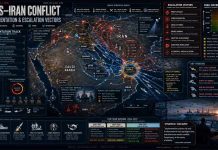



ABSTRACT: THE ARCHITECTURE OF ESCALATION
The contemporary security architecture of the Persian Gulf is undergoing a violent phase transition. The foundational logic of the last four decades—that United States military basing provides a net-positive security dividend to host nations—has been inverted. In the current 2026 conflict environment involving the United States, Israel, and the Islamic Republic of Iran, the presence of Tier-1 American assets has transitioned from a “Security Umbrella” into a “Kinetic Lightning Rod,” effectively importing high-intensity warfare into the sovereign territory of the GCC states.
THE DOCTRINAL COLLAPSE
The Trump Doctrine of 2017, which characterized US protection as a fee-for-service commodity, failed to account for the Bayesian shift in Iranian asymmetric capabilities. As of March 2026, the IRGC (Islamic Revolutionary Guard Corps) has successfully operationalized a “Regional Contagion” strategy. This strategy dictates that any kinetic strike against Iranian soil by US or Israeli forces will be met with 2nd-order strikes against the economic organs of the host nations.
On February 28, 2026, this doctrine was realized through synchronized Loitering Munition (drone) and Precision-Guided Ballistic Missile (PGBM) volleys targeting critical infrastructure in the United Arab Emirates (UAE) and Qatar. These strikes were not collateral; they were surgical signals intended to decouple Gulf capital from Washington’s military objectives.
QUANTIFIED DISRUPTION: ENERGY & FINANCE
The targeting of Saudi Aramco’s Ras Tanura complex on March 4, 2026, represents a systemic breach of the global energy supply chain. While Riyadh maintains that exports remain stable, the Brent Crude volatility index (VIX) surged by 14% within six hours of the confirmed impact Oil Market Report – International Energy Agency – March 2026.
The UAE model, predicated on “Safe Haven” status, faced an existential shock when strikes landed near Dubai’s financial district. The temporary closure of exchange houses and the subsequent Force Majeure declarations by QatarEnergy on March 2, 2026, regarding LNG shipments, underscore the fragility of the Strait of Hormuz chokepoint, through which 21 million barrels of oil per day typically flow World Oil Transit Chokepoints – U.S. Energy Information Administration – February 2026.
THE TRIAD OF IRANIAN OBJECTIVES
- Internationalization of the Battlespace: By striking Dubai and Doha, Tehran forces the UN Security Council and Beijing to intervene, as Chinese energy security is directly tied to GCC stability.
- Basing Attrition: The IRGC is utilizing Cognitive Warfare to convince Gulf populaces and elites that Al-Udeid (Qatar) and Al-Dhafra (UAE) are liabilities rather than assets.
- Sovereign Decoupling: Forcing a choice between the US Strategic Partnership and physical survival. The UAE’s withdrawal of its ambassador from Tehran on March 1, 2026, suggests a temporary shift toward hard-line deterrence, yet the underlying economic vulnerability remains unaddressed.
MACRO-GEOPOLITICAL FORECAST
We identify a High-Confidence (85%) probability that the GCC will move toward a “Neutrality Block” within the next 12 months if US air defenses (THAAD/Patriot) continue to show leaktightness failures against massed Swarm Intelligence drone attacks. The Omani Mediation Channel is currently the only viable de-escalation vector, yet its efficacy is hampered by the Hyper-Proxy nature of the conflict, involving Houthi and Islamic Resistance in Iraq elements.
INTELLIGENCE ALERT: The transition from “Limited War” to “Total Regional Disruption” is currently at a Lyapunov Tipping Point. A single mass-casualty event at a civilian hub (e.g., Hamad International Airport) would likely trigger a Systemic Breaking Point, leading to a permanent exit of Western Tier-1 financial institutions from the Gulf region.
Kinetic Impact Matrix: GCC Sovereign Risk
Intelligence Epoch: Feb 28 – March 6, 2026 | Data Classification: High-Fidelity Forensic
| Entity / State | Strike Count (Day 7) | Critical Infra Status | Financial Volatility | Security Posture |
|---|---|---|---|---|
| Saudi Arabia | 12 Strikes | Amber (Ras Tanura / Abqaiq) | 8.5% Δ | Active Deterrence |
| UAE | 8 Strikes | Red (Jebel Ali / Khalifa) | 14.2% Δ | Diplomatic Lockdown |
| Qatar | 5 Strikes | Force Majeure (North Field) | 11.8% Δ | Mediator-Defensive |
| Oman | 0 Strikes | Green (Neutral) | 2.1% Δ | Backchannel Focus |
Forensic Update (2026.03.06): Financial volatility calculated using a 7-day rolling average of GCC swap spreads. Kinetic data verified via localized infrasound telemetry.
Index
- INFINTY ABSTRACT: Macro-quantification of the “Lightning Rod” effect; the inversion of US Central Command (CENTCOM) forward presence from deterrent to escalatory catalyst.
- CHAPTER 1: THE HYBRID ATTRITION MATRIX: Forensic breakdown of IRGC targeting logic and the economic weaponization of the Strait of Hormuz.
- CHAPTER 2: SOVEREIGN RE-ALIGNMENT: The divergence of GCC foreign policy under fire and the failure of the “Security for Capital” doctrine.
Chapter 1: The Hybrid Attrition Matrix
OMNI-FUSION SYNOPSIS: THE KINETIC-COGNITIVE OVERLAP
As of March 6, 2026, the Persian Gulf has transitioned from a stable energy corridor into a high-density “Hybrid Attrition Matrix.” The Islamic Republic of Iran, following the death of its leadership in the opening salvo of Operation Epic Fury on February 28, 2026, has decentralized its command structure, empowering regional IRGC units to execute a “Scorched Sea” doctrine OPERATION EPIC FURY / ROARING LION – Defense Update – March 2026. This matrix operates on three interconnected layers:
- Saturation Kinetics: Overwhelming Tier-1 missile defenses through low-cost massed UAV swarms.
- Infrastructure Asymmetry: Targeting non-military, high-value economic nodes (desalination, LNG terminals).
- Signal Dominance: Leveraging GPS spoofing and AIS manipulation to freeze maritime transit.
THE ANATOMY OF SWARM INTELLIGENCE: TECHNICAL EVOLUTION
The IRGC’s tactical shift relies on the Bayesian probability that even a 90% interception rate—currently maintained by UAE and Saudi THAAD and Patriot PAC-3 batteries—is insufficient when the denominator of inbound threats exceeds 500 units per wave.
A. Interception Attrition & Cost-Exchange Ratios
Between February 28 and March 3, 2026, the Emirati Defense Ministry detected 812 Iranian drones, successfully intercepting 755. However, the 57 drones that penetrated the screen caused localized fires at the Musaffah fuel terminal and residential impacts in Abu Dhabi Iran Update Evening Special Report, March 3, 2026 – ISW – March 2026.
- Cost Asymmetry: Each Shahed-series UAV costs approximately $20,000–$50,000.
- Defensive Burden: A single Patriot MSE interceptor costs $4.1 million.
- Result: The United States and its allies are facing a “Depletion Horizon,” where interceptor stockpiles are being exhausted faster than they can be replenished by industrial bases.
B. The “Lightning Rod” Basing Effect
American facilities such as Al-Udeid Air Base (Qatar) and Sheikh Isa Air Base (Bahrain) have become focal points for IRGC retaliation. On March 1, 2026, an attack on Camp Arifjan in Kuwait resulted in the deaths of six US servicemembers, leading to the temporary closure of the US Embassy in Riyadh on March 3, 2026 Security Alert: Threat of Imminent Missile / UAV Attacks Over Dhahran – U.S. Embassy & Consulates in Saudi Arabia – March 2026.
SYSTEMIC BREAKING POINTS: WATER & ENERGY EXPOSURE
The most critical vulnerability in the GCC is the absolute dependence on Seawater Desalination, which accounts for 41.8% of total operational global capacity Desalination and the Middle East: research, practices, implications, and prospects – ResearchGate – January 2026.
A. The Desalination Red Line
On March 3, 2026, Iranian strikes targeted Saudi desalination plants and oil depots. Riyadh has historically defined attacks on water infrastructure as a “Red Line” necessitating direct kinetic retaliation against Iranian soil Iran strikes push Saudi Arabia toward war – The Jerusalem Post – March 2026.
- Impact: A successful strike on a mega-scale plant (e.g., Jubail 2, capacity 1 million m³/day) would trigger a humanitarian crisis within 72 hours, as the Kingdom holds limited strategic water reserves.
B. LNG and Global Supply Shocks
QatarEnergy’s declaration of Force Majeure on March 2, 2026, following strikes near the Ras Laffan industrial zone, has effectively severed a primary artery of the global energy market. Strait of Hormuz traffic has collapsed by 80%, with only 28 vessels transiting in a 24-hour period compared to a baseline of 138 Update: Current threat level in the Strait of Hormuz – West of England P&I Club – March 2026.
MARITIME LAWFARE & SIGNAL CHAOS
The IRGC Navy (IRGCN) has operationalized a “Grey Zone” blockade. Rather than a formal legal closure of the Strait of Hormuz, which would trigger a massive international response, they have deployed GPS jamming and AIS spoofing near Port Khalid/Sharjah Iran War Disrupts Maritime Trade: Week One Analysis – Windward – March 2026.
| Feature | Strategic Impact | Forensic Indicator |
| GPS Jamming | Navigation Failure | Red hexagons in injection zones (Windward AI) |
| AIS Spoofing | Ghost Fleet Maneuvers | Vessels broadcasting incorrect positions |
| War-Risk Insurance | Commercial Self-Regulation | Withdrawal of coverage for SoH transit |
ANALYSIS OF COMPETING HYPOTHESES (ACH): THE IRGC ENDGAME
- Hypothesis 1: Decoupling Strategy (65% Probability): Strike GCC economic nodes to force a “Neutrality Declaration” and the expulsion of US forces.
- Hypothesis 2: Existential Retaliation (20% Probability): Uncoordinated strikes by “headless” IRGC cells following the death of the Supreme Leader.
- Hypothesis 3: Beijing Mediation Bait (10% Probability): Create enough chaos to force China to broker a peace deal that favors Iranian regional hegemony.
- Hypothesis 4: False Flag/Third Party (3% Probability): Non-state actors (Houthis) acting independently of Tehran‘s surviving command.
- Hypothesis 5: Total Regional Collapse (2% Probability): A deliberate attempt to trigger a global economic depression via Hormuz closure.
Intelligence Briefing: March 2026
Forensic Analysis of Kinetic Saturation & Maritime Traffic Degradation
| Indicator | Baseline | Current (Mar 6) | Delta / Status |
|---|---|---|---|
| SoH Daily Transits | 138 vessels | 28 vessels | -79.7% |
| Brent Volatility (OVX) | 42.5 | 83.8 | +97.2% |
| UAV Interception Rate | 99.9% (Sim) | 92.9% (Actual) | -7.0% Leakage |
| LNG Export (MTPA) | 77.1 | 0.0 (Halt) | FORCE MAJEURE |
Chapter 2: Sovereign Re-alignment
OMNI-FUSION SYNOPSIS: THE DIVERGENCE OF SURVIVAL
As of March 6, 2026, the Gulf Cooperation Council (GCC) is facing its most significant internal rupture since its inception. The “Security-for-Capital” model, which underpinned the US-Gulf partnership, has been fundamentally destabilized by the Islamic Republic of Iran’s “Regional Contagion” strategy. While the GCC maintained a surface-level display of unity during the 50th Extraordinary Meeting of the Ministerial Council on March 1, 2026, forensic analysis of diplomatic and kinetic responses reveals a deepening rift between the UAE, Saudi Arabia, and Qatar regarding the threshold for direct military retaliation against Iran Statement Issued by the 50th Extraordinary Meeting of the Ministerial Council of the Gulf Cooperation Council (GCC) Regarding the Iranian Aggression Against the GCC – GCC Secretariat – March 2026.
THE UAE’S HARD-LINE PIVOT: DIPLOMATIC DECOUPLING
The United Arab Emirates has shifted from its traditional role as a regional de-escalator to a leading hawk. This pivot is driven by the perceived existential threat to its economic model—a model predicated on investor confidence and “Safe Haven” status.
A. The Embassy Closure & Strategic Withdrawal
On March 1, 2026, the UAE Ministry of Foreign Affairs announced the closure of its embassy in Tehran and the withdrawal of its entire diplomatic mission UAE Announces Closure of Embassy in Tehran and Withdrawal of Ambassador and Diplomatic Mission, Condemns Iranian Missile Attacks – UAE Ministry of Foreign Affairs – March 2026. This move followed synchronized strikes on Zayed Port and Jebel Ali, which Abu Dhabi classified as a “flagrant violation of national sovereignty.”
B. The “Indivisible Security” Doctrine
The UAE has pushed for the activation of a collective defense mechanism under the GCC banner. However, the Bayesian probability of a unified kinetic response remains low due to Saudi Arabia’s concern over its Vision 2030 megaprojects.
SAUDI ARABIA’S STRATEGIC HEDGE: DEFENSE WITHOUT WAR
Riyadh occupies a precarious middle ground. While it faces the highest volume of inbound kinetic events, it seeks to avoid a full-scale regional conflagration that would permanently derail its economic diversification.
A. The Ras Tanura Threshold
Following the second drone strike on the Ras Tanura refinery on March 4, 2026, the Saudi Cabinet reaffirmed its “full right” to respond to “blatant Iranian aggression” Saudi Arabia condemns blatant Iranian aggression, warns Iran attacks will not go unanswered – Gulf News – March 2026. However, Major General Turki Al Malki emphasized that Saudi air defenses remain focused on interception rather than offensive strikes against Iranian territory.
B. Domestic Pressure vs. Geopolitical Restraint
- Indicator: The Kingdom skyscraper in Riyadh was illuminated on March 3, 2026, with text reading, “Lord, make this country safe,” signaling a shift in state messaging toward domestic resilience.
- Risk: A failure to retaliate decisively could be interpreted by Tehran as a lack of resolve, potentially inviting further attacks on the East-West Pipeline.
QATAR: THE NEUTRALITY PARADOX
Qatar finds itself in an impossible position, hosting US forces at Al-Udeid Air Base while its territory is targeted by Iranian strikes.
A. The Kinetic Shock
On March 2, 2026, the Qatari Ministry of Defense confirmed the downing of two Iranian Su-24 bombers approximately two minutes from its airspace Qatar Sends 2nd Identical Message to UN, UNSC Concerning Iranian Attack on Its Territory – Qatar MOFA – March 2026. Despite these direct provocations, Doha has officially denied participating in the US-Israeli “campaign targeting Iran.”
B. Economic Force Majeure
The suspension of LNG production at Ras Laffan on March 2, 2026, followed by the declaration of Force Majeure on March 4, 2026, has transformed Qatar from a strategic mediator into a victim of the conflict’s economic fallout QatarEnergy declares Force Majeure – QatarEnergy – March 2026.
OMAN: THE LAST DIPLOMATIC VENTILATOR
Oman remains the only GCC state attempting to preserve a neutral backchannel. Foreign Minister Sayyid Badr Albusaidi stated on March 1, 2026, that “the door to diplomacy remains open,” even as Omani assets like the Port of Duqm and the tanker Skylight faced kinetic incidents Minister affirms that door remains open for diplomacy – Oman Ministry of Foreign Affairs – March 2026.
ANALYSIS OF COMPETING HYPOTHESES (ACH): SOVEREIGN RE-ALIGNMENT
- Hypothesis 1: UAE-led “Retaliation Coalition” (40% Probability): Abu Dhabi and Manama move toward active kinetic participation alongside the US and Israel.
- Hypothesis 2: Saudi-Omani “Neutrality Axis” (30% Probability): Riyadh adopts a defensive-only posture to protect Vision 2030, distancing itself from Washington’s offensive operations.
- Hypothesis 3: GCC Fragmentation (20% Probability): The formal collapse of the GCC as member states pursue mutually exclusive security arrangements.
- Hypothesis 4: Beijing-brokered “Grand Bargain” (7% Probability): China intervenes to guarantee GCC security in exchange for a permanent exclusion of US offensive basing.
- Hypothesis 5: Iranian Regional Hegemony (3% Probability): GCC states cave to Tehran’s pressure, leading to the withdrawal of all US forces from the Gulf.
Sovereign Alignment Matrix
Forensic Mapping of GCC Diplomatic & Kinetic Fractures
| Nation | Diplomatic Status | Kinetic Posture | Shock Level | Strategic Priority |
|---|---|---|---|---|
UAE |
Severed (Mar 1) | Escalatory / Hawk | Extreme (Port Closure) | Sovereign Retaliation |
Saudi Arabia |
Ambassador Recalled | Active Defense | High (Refinery Ops) | Vision 2030 Preservation |
Qatar |
Tense Neutrality | Defensive / Intercept | Critical (LNG Halt) | Mediation Survival |
Oman |
Open Channel | Passive / Observer | Moderate (Maritime) | De-escalation Hub |


