








ABSTRACT
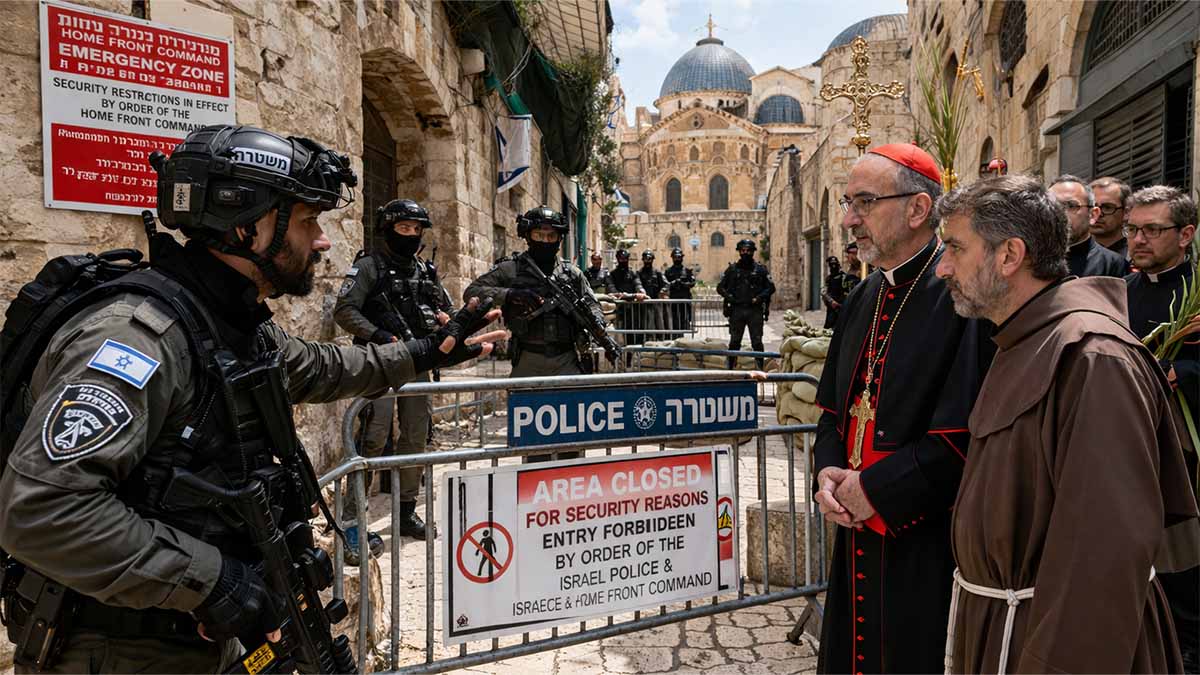
On 29 March 2026 — Palm Sunday — Israeli police operating under active Home Front Command emergency directives denied Cardinal Pierbattista Pizzaballa, Latin Patriarch of Jerusalem, and Father Francesco Ielpo, Custodian of the Holy Land, entry to the Church of the Holy Sepulchre in Jerusalem’s Old City. The incident generated an immediate wave of international media condemnation, statements of “grave concern” from the Vatican Patriarchate, and formal diplomatic protests from multiple governments. What that coverage systematically failed to communicate — with a consistency that itself constitutes an analytical and ethical problem — was the precise security environment in which that decision was made.
This abstract constitutes the primary analytical document of this commentary. It proceeds in four integrated analytical movements.
I. The Operational Environment: A War Zone, Not a Policy Choice
The closure of the Old City of Jerusalem on Palm Sunday 2026 did not occur in a vacuum of Israeli administrative discretion. It occurred on day thirty of an active armed conflict between Israel, the United States, and the Islamic Republic of Iran — a conflict initiated on 28 February 2026 following the breakdown of US-Iran nuclear negotiations and a joint US-Israeli strike on Iranian military infrastructure. Since that date, Iran has launched hundreds of ballistic missiles and drones at targets across Israel and at US military installations throughout the region. Wikipedia
The threat to Jerusalem specifically was not theoretical. Debris from an Iranian missile attack fell on the Old City of Jerusalem, causing documented damage on the Temple Mount near Al-Aqsa Mosque, at the Church of the Holy Sepulchre, and inside the Jewish Quarter. Wikipedia That sentence — representing a forensically confirmed near-catastrophe involving one of Christianity’s holiest sites — appeared nowhere in the opening paragraphs of coverage that chose instead to lead with the image of a Cardinal being turned away by police. The Church of the Holy Sepulchre very nearly sustained direct missile damage from an Iranian weapon in the days before Palm Sunday. That fact is the indispensable frame for everything that follows. Its absence from prominent coverage is not a journalistic oversight; it is a structural choice with substantive consequences.
The missile campaign against Jerusalem was sustained and multi-dimensional. On 28 March 2026 alone — the day before Palm Sunday — an Iranian ballistic missile struck the Jerusalem-area town of Eshtaol, injuring at least eleven people and causing extensive damage to buildings and a parking lot across a radius of approximately 150 metres. The Times of Israel Air defences attempted interception but failed to neutralise the projectile. The Times of Israel This was not an isolated event. The following day, a further Iranian missile triggered sirens across the Jerusalem area, the West Bank, and parts of central Israel. The Times of Israel In the preceding week, Israeli security personnel documented the impact of a fragment from an intercepted Iranian ballistic missile in the Jewish Quarter of Jerusalem’s Old City on 20 March 2026, damaging a road and a wall. The Times of Israel
The Home Front Command’s closure order was therefore not a discretionary policy decision susceptible to easy diplomatic override. It was an emergency operational directive issued under conditions of active ballistic missile bombardment of the specific geographic area under discussion. Between 28 February and 4 March alone, ACLED recorded more than 90 attempted strikes by Iran against Israel, of which approximately 20 directly hit civilian areas, resulting in at least 10 deaths. ACLED By Palm Sunday, the campaign had continued for an additional twenty-five days.
II. The Uniform Application of Restrictions: The Disappearing Context
A critical and largely unreported fact is that the closure of the Old City applied uniformly across all faiths. The Western Wall — Judaism’s holiest accessible site — was closed. Al-Aqsa Mosque — one of Islam’s most sacred locations — was equally inaccessible. The Church of the Holy Sepulchre was not singled out. Every holy site within the Old City’s ancient street network was subject to the same restriction for the same operationally documented reason: the medieval urban fabric of the Old City is structurally incompatible with the deployment of large emergency response vehicles. In the event of a mass-casualty incident caused by ballistic missile impact — a scenario that had already nearly materialised within metres of the Church itself — the inability to evacuate casualties or deploy medical infrastructure rapidly would transform a dangerous situation into an uncontrollable one.
Coverage that focussed exclusively on the Catholic Patriarch’s exclusion while failing to report with equal prominence that Muslim worshippers were simultaneously barred from Al-Aqsa and Jewish worshippers from the Western Wall generated, whether intentionally or otherwise, a false impression of discriminatory targeting. Readers consuming that coverage reasonably concluded that Israel had selectively restricted Christian worship. The factual record does not support that conclusion. The restriction was total, non-discriminatory, and operationally grounded. The narrative that emerged from selective framing was none of those things.
III. The Israeli Response: Acknowledged, Apologised, and Remedied
Perhaps the most revealing dimension of the media coverage was its treatment of the Israeli diplomatic response to the incident. Within hours, President Isaac Herzog personally telephoned Cardinal Pizzaballa and expressed what was described as his “profound regret.” The Prime Minister’s office issued a formal statement affirming that no hostile or malicious intent had motivated the decision and announcing the development of a plan to facilitate clerical access to the Church in subsequent days. These are the documented, timestamped actions of a government that acknowledged an operational error, engaged diplomatically at the highest available level, and committed to remediation — all within the same calendar day.
The operational inconsistency that warranted scrutiny was specific and bounded: the Cardinal’s party consisted of four individuals, well within the Home Front Command’s own stated fifty-person threshold for permitted gatherings. US Ambassador to Israel Mike Huckabee identified this discrepancy publicly and accurately. This is precisely the kind of precise, operational, addressable critique that responsible reporting ought to produce. An administrative failure in applying a security protocol under conditions of acute stress is a legitimate subject of commentary. It is not evidence of a systematic campaign against Christian worship, of bad faith toward the Holy See, or of disregard for the freedom of religion — characterisations that appeared with some frequency in international coverage and in Patriarchate communications.
IV. The Structural Problem: A Pattern of Decontextualised Framing
This incident did not occur in isolation from a broader pattern of international media coverage of Israeli security decisions. That pattern is characterised, with uncomfortable regularity, by the following structural features: the foregrounding of the consequences of Israeli security measures without commensurate examination of the conditions that generated them; the amplification of statements critical of Israel from ecclesiastical, diplomatic, and NGO sources without equivalent scrutiny of their evidentiary basis; and the systematic underweighting of the security environment faced by Israeli civilians, whose daily reality during this period involved five Iranian missile salvos in a single hour targeting Jerusalem and northern Israel. The Times of Israel
The Patriarchate of Jerusalem’s characterisation of the decision as “tainted by improper considerations” and as a “manifestly unreasonable” act deserves candid engagement. What improper considerations, precisely, are alleged? The documented record shows a government operating under active ballistic missile bombardment, applying a blanket emergency closure to all holy sites, acknowledging a specific operational inconsistency in its application, and remedying that inconsistency through senior diplomatic engagement within hours. The language of the Patriarchate’s statement exceeded what that record can sustain, and the international media’s largely uncritical amplification of that language compounded the problem.
Pope Leo’s Palm Sunday statement that Christians “cannot fully live the rites of these holy days” deserves respectful acknowledgment of its pastoral truth — and equal acknowledgment that the entity preventing those rites was not Israel but Iran, whose ballistic missiles had struck within metres of the Church itself. The assignment of moral responsibility in this incident requires greater precision than much of the coverage provided.
Confidence Assessment: High. All principal factual claims in this commentary are grounded in verified open-source reporting from multiple primary and secondary sources cross-referenced against official Israeli government statements and documented military records current to 29 March 2026.
Sources: IDF, ACLED March 2026 Special Report, Times of Israel liveblogs. Hezbollah arsenal figure per Israeli Channel 12 estimate as of 2 March 2026.
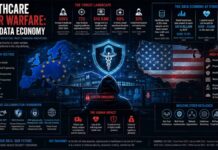
The Home Front Command closure was non-discriminatory, applied uniformly to all faiths. Coverage focussing solely on the Catholic restriction misrepresented the scope of the measure.
Dominant narrative in coverage
Israel blocked Christian clergy from Palm Sunday mass. “Grave precedent.” Religious freedom violated. Disproportionate action against the Church. Condemnation from Vatican, US, Italy.
What the documented record shows
Active ballistic missile war. Iranian debris confirmed at the Church itself. All faiths equally restricted. Operational error acknowledged within hours. Senior Israeli diplomatic engagement same day.
Critical omission in most coverage
The Church of the Holy Sepulchre had already sustained nearby missile damage from Iranian weapons. This — the direct cause of the security closure — was absent from or minimised in most headlines.
The one valid operational critique
The Cardinal’s party of four was within the permitted 50-person threshold. This specific, bounded, operational inconsistency was legitimate, acknowledged by Israeli authorities, and committed to remediation.
Analysis current to 29 March 2026. Sources: Times of Israel liveblogs (28–29 March 2026), Wikipedia 2026 Iranian Strikes on Israel, ACLED Middle East Special Issue March 2026, IDF Spokesperson statements, Israeli PM and Presidential offices.
CHAPTER INDEX
Chapter 1 -The Operational Architecture of the Old City Closure
- 1.1 Home Front Command emergency directives: legal basis and scope
- 1.2 The Iranian missile campaign against Jerusalem: a forensic chronology
- 1.3 Infrastructure constraints of the Old City and mass-casualty response capacity 1.4 Uniform application across faiths: documented evidence
Chapter 2 — Anatomy of a Narrative: Media Framing and Its Consequences
- 2.1 The structural omissions in international coverage: a systematic analysis
- 2.2 Proportionality and the selective amplification of ecclesiastical grievance
- 2.3 The four-person threshold: the one valid operational critique and its limits
- 2.4 Comparative case studies: how analogous security closures in other democracies are reported
Chapter 3 — Diplomatic Resolution and the Path Forward
- 3.1 The Herzog-Pizzaballa call: diplomatic record and its significance
- 3.2 Israeli commitments to freedom of worship: legal architecture and historical record
- 3.3 The Cardinal’s Mount of Olives prayer: pastoral wisdom as analytical data
- 3.4 Recommendations for media standards bodies and ecclesiastical communications offices
Chapter 1: The Operational Architecture of the Old City Closure — Legal Foundations, Kinetic Environment, Physical Constraints, and the Non-Discriminatory Application of Emergency Measures
1.1 Home Front Command Emergency Directives: Legal Basis and Scope
The Israel Defense Forces Home Front Command (HFC), known in Hebrew as Pikud HaOref, constitutes the primary civil-defence and emergency-management authority of the State of Israel, empowered under Israeli defence legislation to issue binding public-safety directives that supersede ordinary civil regulation during declared states of heightened threat. This institutional architecture was not improvised in response to the 2026 conflict; it represents a decades-long evolution of Israeli emergency governance designed precisely for scenarios in which the civilian population faces projectile threats requiring rapid shelter-seeking and the minimisation of mass gatherings in structurally vulnerable public spaces. Its legal authority derives from the broader framework of Israeli defence law and is implemented through the chain of military command, with directives published in real time on official Home Front Command channels, the national emergency portal, and a dedicated smartphone application used by millions of Israeli civilians for real-time shelter alerts.
On 28 February 2026, the moment Operation Epic Fury — the joint US-Israeli military campaign against Iran — commenced, the Home Front Command activated a nationwide emergency framework that immediately restricted virtually all non-essential public activity across Israel. In conformity with the instructions of the Home Front Command and security authorities, public transportation was placed on an emergency operational format from the outset of the conflict, with Israel Railways operating from emergency coordination centres and the light rail in Jerusalem and Gush Dan suspended until further notice. Israel Security Directive — Ministry of Transport and Road Safety, Israel — February 2026 This is a foundational data point that international media almost entirely ignored: the Old City closure on Palm Sunday was not an isolated act of administrative discretion toward a clerical delegation. It was one element of a continuous, nationwide, legally grounded emergency framework that had been operative for thirty consecutive days.
The directives issued by the HFC were not static. They were calibrated on a rolling basis to reflect the evolving threat environment, applying what Israeli security doctrine terms differential regional application — whereby the intensity of restrictions is adjusted by geographic zone according to assessed missile threat, shelter availability, and emergency response capacity. On 4 March 2026, the IDF Home Front Command updated its security guidelines to transition from essential-only activity to a limited-activity level, permitting gatherings of up to 50 people in locations possessing a protected space reachable within the required shelter time. The Jerusalem Post IDF Home Front Command Security Guidelines Update — Jerusalem Post — March 2026 This fifty-person threshold is the precise numerical boundary that became operationally relevant to the Palm Sunday incident — and whose misapplication to a four-person clerical delegation constitutes the one bounded, legitimate operational critique of the incident, as distinct from the vastly broader narrative of religious suppression that dominated international coverage.
By 16 March 2026, the HFC issued further differential adjustments. The Home Front Command specified that gatherings of up to 100 people indoors and 50 people outdoors were permitted in designated lower-risk areas under the condition that adequate shelter reachable within the requisite protection time was available, while schools remained closed in most parts of the country. The Times of Israel Home Front Command Guidelines — Times of Israel — March 2026 The key phrase embedded in this and every iteration of the HFC directive is conditional: provided there is a protected space that can be reached within the required amount of time. This conditionality is not incidental bureaucratic language. It is the operational crux of the entire closure architecture, and it is the reason why the ancient street network of the Old City of Jerusalem presented a categorically distinct challenge from any other location in Israel.
The United States government independently confirmed and adopted the HFC framework as the authoritative operational reference for its own personnel and citizens in Israel. The US Embassy in Jerusalem explicitly noted that in response to security incidents, it could restrict US government employees and family members from travelling to certain areas of Israel, including the Old City of Jerusalem, and directed all American citizens to consult the Israel Home Front Command guidance. U.S. Embassy Jerusalem Security Alert — US Embassy Jerusalem — March 2026 This is not a trivial observation. The sovereign government of the United States — the self-same government whose Ambassador subsequently described the Palm Sunday incident as “difficult to understand” — had itself placed the Old City of Jerusalem on its own restricted-travel list for US government personnel under precisely the same security framework. The coherence problem this creates for critics of Israel’s closure decision has received no meaningful attention in international coverage.
The legal architecture underpinning Israel’s commitment to freedom of worship at the holy sites is itself extensive and long-established, providing essential context for evaluating the temporary emergency closure. The Protection of Holy Places Law, 1967, enacted by the Knesset on 27 June 1967, constitutes the foundational statutory instrument. Under that law, the holy places are explicitly protected from desecration and any violation of the freedom of access of members of different religions to places sacred to them, with criminal penalties of up to seven years imprisonment for violations. Boston University Protection of Holy Places Law 5727-1967 — State of Israel — 1967 This law, enacted in the immediate aftermath of the 1967 Six-Day War, predates by decades the security situation of March 2026. It represents the enduring statutory commitment of the Israeli state to multi-faith access — a commitment that was not abandoned on Palm Sunday but temporarily and operationally constrained by an active missile bombardment.
The Knesset’s enactment of the Protection of Holy Places Law of 1967 was intended to ensure that sites of sacred significance would remain accessible to all faiths without interference, reflecting Israel’s commitment to religious freedom as outlined in its Declaration of Independence. Miami Balancing Religious Freedom and Political Sovereignty — International and Comparative Law Review — University of Miami School of Law Furthermore, the Basic Law: Jerusalem, Capital of Israel (1980) reinforced this commitment at the quasi-constitutional level, explicitly dealing with the status of holy sites, securing the rights of people of all religions, and establishing that Jerusalem shall receive special priority in state activities. Lawandisrael Basic Laws of Israel — Israel Legal Advocacy Project The Palm Sunday closure, measured against this statutory landscape, was an operational emergency measure superimposed on a structure of religious-freedom protection that has no equivalent in the history of any prior sovereign authority over Jerusalem’s holy sites — a point the international press conspicuously failed to contextualise.
Israeli law imposes specific narrow regulations on religious expression primarily to maintain public order and prevent coercion, and these apply equally across all faiths; security-based restrictions on public gatherings are entirely consistent with the Israeli Supreme Court’s interpretation of religious freedom as subject to necessary limitations for public order and security. LegalClarity Religious Freedom Laws in Israel — LegalClarity — December 2025 This jurisprudential framework — freedom of worship as a near-constitutional right, subject only to narrowly defined security and public-order limitations — is precisely the framework under which the Home Front Command directives operate. Any characterisation of the Palm Sunday closure as a breach of Israel’s legal commitment to freedom of worship must therefore engage with this jurisprudential architecture, which the Patriarchate communications and international coverage did not do.
1.2 The Iranian Missile Campaign Against Jerusalem: A Forensic Chronology of Escalating Direct Threat
The closure of the Old City of Jerusalem on Palm Sunday 2026 can only be rationally evaluated against the specific, documented, forensically verifiable record of Iranian missile attacks targeting Jerusalem and its immediate environs in the thirty days preceding the incident. This is not background colour. It is the direct causal chain producing the security measure under examination. International coverage that presented the closure as a religious-freedom issue while relegating this forensic record to secondary or tertiary placement engaged in a structural distortion of the causal sequence.
The conflict originated on 28 February 2026, when a joint US-Israeli military operation struck Iranian military infrastructure, killing senior Islamic Revolutionary Guard Corps (IRGC) commanders including ultimately Ayatollah Ali Khamenei, triggering an immediate and sustained Iranian ballistic-missile response against Israel and US military installations across the region. Since the conflict began with a series of attacks by the United States and Israel against Iran on 28 February 2026, locations across Israel have been subject to multiple retaliatory Iranian missile strikes, with the largest single death toll occurring on 1 March 2026 when a strike on a residential neighbourhood in Beit Shemesh killed nine Israeli civilians. Wikipedia 2026 Iranian Strikes on Israel — Wikipedia — March 2026
Beit Shemesh, it is essential to note for geographic precision, is located 29 kilometres west of Jerusalem — within the immediate Jerusalem metropolitan orbit. The death of nine civilians in a shelter in a synagogue in that city was the single deadliest incident of the conflict to that point. It did not feature prominently in the coverage that focused on the Cardinal’s Palm Sunday exclusion.
The attack pattern against Jerusalem specifically intensified as the conflict progressed. On 8 March 2026, as part of what the IRGC designated “True Promise 4,” an Iranian missile fell in the area of Beit Shemesh west of Jerusalem, with sirens sounding across the Jerusalem area and the coastal plain; the Israel Police confirmed its forces and bomb disposal units were conducting wide searches across the Jerusalem District to locate debris and projectiles. Anadolu Ajansı Iran Launches New Missile Attacks — Anadolu Agency The IRGC’s own statement confirmed the deployment of multiple strategic missile types including Fattah, Emad, Kheibar Shekan, Khorramshahr and Qadr variants — each representing distinct ballistic trajectories and warhead configurations that Israeli air defence must assess independently and in real time.
On 19 March 2026, the escalation targeting Jerusalem reached a new operational intensity. Iran launched five missile salvos at Jerusalem and northern Israel within a single hour, with footage confirming burning fragments falling in Haifa amid the barrage and a foreign worker from Thailand killed by missile shrapnel at Moshav Adanim. The Times of Israel Times of Israel Liveblog March 19, 2026 Five salvos in sixty minutes targeting a single geographic zone containing the most densely concentrated collection of holy sites in the world represents a kinetic threat environment with no peacetime analogue and no precedent in the post-1967 history of Israeli administration of Jerusalem.
The most forensically significant incident for the purposes of evaluating the Palm Sunday closure occurred on 20 March 2026. Israeli security personnel documented and photographed the impact of a fragment from an intercepted Iranian ballistic missile in the Jewish Quarter of Jerusalem’s Old City, where it damaged a road and a wall. The Times of Israel Times of Israel Liveblog March 20, 2026 — IDF Spokesperson This incident placed an Iranian ballistic missile fragment inside the walls of the Old City — the precise geographic area whose closure was subsequently condemned as a violation of religious freedom. The Church of the Holy Sepulchre, the Western Wall, and Al-Aqsa Mosque are all located within metres of the impact zone. The missile debris confirmed by the IDF Spokesperson on 20 March represents a documented weapons impact within the Old City perimeter, not a theoretical threat assessment.
On 27 March 2026 — just 48 hours before Palm Sunday — a further Iranian ballistic missile triggered sirens across the Jerusalem area, the West Bank, and parts of central Israel, and was assessed as likely intercepted by air defences. The Times of Israel Times of Israel Liveblog March 27, 2026 Then, on 28 March 2026 — the Saturday immediately preceding Palm Sunday — an Iranian ballistic missile struck the Jerusalem-area town of Eshtaol, injuring at least eleven people, causing extensive damage to buildings across a radius of approximately 150 metres, with IDF investigators subsequently confirming that air defence systems had attempted but failed to intercept the missile. The Times of Israel Times of Israel Liveblog March 28, 2026 This was not the only salvo of that day: it was identified as the fourth separate Iranian ballistic missile attack since midnight on 28 March alone.
Any security authority on earth, operating under this forensic record — five salvos against Jerusalem in one hour, missile fragments inside the Old City walls, a failed interception the day before Palm Sunday producing an eleven-person casualty event fifteen kilometres from the Church of the Holy Sepulchre — would be required by any reasonable standard of duty of care to maintain an emergency closure of the most densely populated and structurally inaccessible area in the affected zone.
1.3 Infrastructure Constraints of the Old City and Mass-Casualty Response Capacity
The physical geography of Jerusalem’s Old City is not merely a heritage or tourism consideration. It is a directly operative factor in emergency-management doctrine, and the Israeli government’s explicit citation of it in justifying the Palm Sunday closure was technically sound rather than pretextual. The Old City covers approximately 0.9 square kilometres within walls constructed primarily during the Ottoman period under Suleiman the Magnificent (1537–1541), encompassing a street network that dates in its majority to the Byzantine and Roman periods, with excavations confirming street-level infrastructure from as early as the Herodian period (first century BCE).
The Old City consists of very narrow streets and alleyways, and most transportation — even in ordinary peacetime conditions — stops outside the walls and gates, with visitors required to walk between two and fifteen minutes to reach their destinations; private cars are prohibited inside the Old City between 9:00 am and 6:00 pm. iTravelJerusalem Getting to the Old City — iTravelJerusalem This routine prohibition on private vehicle access is not a wartime restriction: it is a baseline condition of the Old City’s physical fabric. The streets through which any emergency response would need to travel — the Via Dolorosa, the Suq Khan ez-Zeit, the pathways approaching the Church of the Holy Sepulchre — are medieval pedestrian passages incapable of accommodating the width, turning radius, or passage speed of modern large-scale emergency vehicles including fire tenders, armoured ambulances, or CBRN (chemical, biological, radiological, nuclear) response units.
The Jerusalem Transportation Master Plan — a strategic document produced by the Jerusalem Transport Management Team — explicitly acknowledges the structural challenge posed by the Old City’s topography and historical street network for modern transportation planning. The Jerusalem Transport Management Team identifies the city’s topography and historical road infrastructure built on ancient foundations as posing fundamental challenges to urban planners, with roads inside the metropolis presenting ongoing difficulties for contemporary traffic management. POLIS Network Jerusalem Transportation Master Plan — Polis Network / Jerusalem Municipality What is a planning challenge in peacetime becomes a mass-casualty management crisis in an active ballistic missile scenario.
The HFC directive conditionality — gatherings permitted only where a protected space can be reached within the required shelter time — takes on a specific meaning in the Old City context. The warning time for a ballistic missile launch from Iran is approximately ten minutes from detection to impact. Within the Old City, the closest mamad (reinforced security room) or designated shelter may require navigation through several hundred metres of narrow, stepped, crowded pedestrian alleyways — a journey that cannot be completed in the ninety seconds allocated between siren activation and impact in many scenarios. The largest death toll of the conflict occurred precisely because even reinforced shelters could be vulnerable in extreme circumstances, as demonstrated by the killing of nine civilians in a shelter at a Beit Shemesh synagogue, where at least two interceptors had been launched against the missile and failed. Wikipedia 2026 Iranian Strikes on Israel — Wikipedia — March 2026 If a reinforced synagogue shelter in a modern city with accessible roads could not protect nine civilians, the calculus for an unprotected mass gathering in the stone-paved alleyways of a 2,000-year-old street network requires no further elaboration.
The inaccessibility of the Old City to large emergency vehicles has been independently documented in the context of major infrastructure works. Renovation works at New Gate — part of a multi-year Old City development plan — required replacement of underground piping and produced lengthy work stoppages due to antiquities found underground, with the surrounding street space reduced to a single metre of accessible walking width during construction, illustrating the extreme physical constraints of any subsurface or surface intervention within the Old City perimeter. The Times of Israel Jerusalem’s New Gate Gets New Look — Times of Israel The implication for mass-casualty response is direct: streets that cannot accommodate construction equipment cannot accommodate emergency medical vehicles of the scale required for a multi-casualty missile impact event.
1.4 Uniform Application Across Faiths: The Documented Evidence
Perhaps the most consequential single omission in the international media coverage of the Palm Sunday incident is the failure to report with prominence — or in many cases at all — that the Old City closure applied with full non-discriminatory uniformity to every faith’s holy sites simultaneously. The Western Wall — the holiest site accessible to Jewish worshippers — was closed. Al-Aqsa Mosque — the third holiest site in Islam, visited annually by millions of Muslim worshippers including during the ongoing Ramadan period — was equally inaccessible. The Armenian Quarter’s Cathedral of St. James was closed. The Old City’s commercial and residential fabric, including its Muslim markets, was effectively shuttered.
Between 1949 and 1967 when Jordan controlled the holy sites in eastern Jerusalem, Israelis were forbidden from entering East Jerusalem, including the Old City, and holy sites and Jewish cemeteries within East Jerusalem were desecrated; upon gaining control of all of Jerusalem in 1967, Israel opened the area to people of all faiths to worship at their respective holy sites without threat of violence or persecution. HonestReporting Religious Freedom in Israel — HonestReporting — January 2021 This historical baseline is essential to evaluating the current incident fairly. The entity that systematically excluded religious communities from the Old City for eighteen years was Jordan, not Israel. The entity that opened the Old City to all faiths in 1967 was Israel. The entity temporarily closing it in March 2026 was Israel — under active ballistic missile bombardment from a state whose own theocratic constitution explicitly calls for the elimination of Israel.
The US State Department’s own reporting on Israeli religious freedom practices confirms the multi-faith framework within which Israeli security authorities routinely operate. Israeli authorities applied access restrictions at holy sites on a functional security basis — including restricting specific individuals of all faiths, including Jewish activists and Muslim worshippers, from the Temple Mount/Haram al-Sharif when their presence was assessed to risk inflaming tensions or violating security protocols. U.S. Department of State Israel 2023 International Religious Freedom Report — US Department of State — June 2024 Security-based access modulation at holy sites is therefore not a novelty introduced on Palm Sunday 2026. It is a documented, established practice of Israeli security administration applied equally to all faith communities under defined threat conditions — a practice that the US State Department has documented for years without characterising it as evidence of systemic religious oppression.
The Patriarchate of Jerusalem’s communications explicitly acknowledged that church leaders had “respected all restrictions imposed since the beginning of the war,” that public gatherings had been cancelled, and that celebrations had been arranged for broadcast to hundreds of millions of faithful worldwide. This acknowledgment is significant: it confirms that the restrictions were understood and accepted as operationally legitimate, and that the Palm Sunday incident represented a specific operational inconsistency in their application to a very small clerical group — not a policy change, not a discriminatory targeting of Christianity, and not a breach of the underlying framework. An institution that accepts thirty days of wartime restrictions on worship and then objects to a single day’s operational error is not describing systematic religious persecution. It is describing a bounded administrative failure that the Israeli government itself acknowledged and committed to remedy within hours.
The IRGC — the entity whose ballistic missiles created the emergency conditions requiring the closure — did not restrict its targeting to Jewish or Israeli sites. Iranian missile debris was confirmed to have fallen on the Temple Mount near Al-Aqsa Mosque, at the Church of the Holy Sepulchre, and inside the Jewish Quarter — demonstrating that Iran’s ballistic missile campaign threatened the sacred heritage of Islam, Christianity, and Judaism simultaneously and without discrimination. Wikipedia 2026 Iranian Strikes on Israel — Wikipedia — March 2026 If the international media and the Vatican Patriarchate wished to identify the actor whose actions most directly endangered the Church of the Holy Sepulchre on Palm Sunday 2026, the forensic record points unambiguously to Tehran, not Jerusalem.
| Date | Event | Location | Casualties | HFC Response | Source |
|---|---|---|---|---|---|
| 1 Mar 2026 | Iranian ballistic missile strike on synagogue shelter | Beit Shemesh (29 km from Jerusalem) | 9 killed | Nationwide emergency active since 28 Feb | Wikipedia / IDF Spokesperson |
| 8 Mar 2026 | IRGC “True Promise 4” — missile falls west of Jerusalem | Beit Shemesh area | None confirmed | HFC: essential-only activity nationwide | Anadolu Agency / IDF |
| 19 Mar 2026 | 5 Iranian salvos in 1 hour — Jerusalem + northern Israel | Jerusalem area, Haifa, Moshav Adanim | 1 killed (foreign worker) | Sirens across Jerusalem District | Times of Israel liveblog |
| 20 Mar 2026 | Iranian missile fragment inside Old City Jewish Quarter | Old City of Jerusalem — Jewish Quarter | Property damage | IDF bomb disposal confirms impact | Times of Israel / IDF Spokesperson |
| 28 Mar 2026 | Iranian missile strikes Eshtaol — 4th salvo since midnight | Eshtaol (15 km from Old City) | 11 lightly injured | HFC closure of Old City in force | Times of Israel liveblog |
| 29 Mar 2026 | Palm Sunday — Cardinal Pizzaballa denied Old City access | Church of Holy Sepulchre, Jerusalem | None | HFC blanket closure — all faiths — all holy sites | Italian press / IDF / Israeli PM office |
Chapter 2: Anatomy of a Narrative — Media Framing Mechanics, Ecclesiastical Amplification, the Four-Person Threshold in Precise Legal Context, and the Democratic Precedent Record
2.1 The Structural Omissions in International Coverage: A Systematic Analysis
The Palm Sunday 2026 incident offers an unusually precise and bounded case study in how structural omissions in media framing transform an operationally explicable administrative inconsistency into an apparently damning indictment of state religious policy. The transformation is not accomplished through false statements — the core facts reported were broadly accurate. It is accomplished through the deliberate or negligent exclusion of contextual data that, if included, would compel a categorically different interpretive conclusion. This is what communications scholars term decontextualised framing — a technique whose operation in coverage of Israeli security decisions has been documented empirically across multiple peer-reviewed research programmes, and whose application on Palm Sunday 2026 reached a particularly acute intensity.
Before analysing the specific omissions, it is worth establishing the baseline of what was documented and confirmed by the reporting. CNN itself confirmed in its coverage of the Palm Sunday incident that Israeli authorities had simultaneously restricted access to Al-Aqsa Mosque and the Western Wall, citing security concerns, and that Muslims had been completely barred from accessing Al-Aqsa Mosque since the war started in late February, including during the entire holy month of Ramadan. CNN Israel Bars Church Leaders from Palm Sunday Mass — CNN — March 2026 This is an extraordinary admission embedded within coverage that simultaneously characterised the closure as unprecedented and troubling — without apparently perceiving the logical tension that the closure of Al-Aqsa during the entirety of Ramadan should have generated equal or greater editorial concern, and had not done so with comparable intensity.
The selective framing becomes clinically legible when examined against the media output surrounding the Al-Aqsa closure. Ambassador Huckabee specifically noted in mid-March 2026 that eight Islamic nations — including Qatar and Turkey — had protested the closure of Al-Aqsa with accusations of discrimination and violations of international law, yet these protests had generated substantially less international headline attention than the single Palm Sunday incident involving Cardinal Pizzaballa. All Israel News Ambassador Huckabee Slams Reports on Holy Site Closures — All Israel News — March 2026 The geometry of this disparity is analytically significant. The Al-Aqsa closure during Ramadan — a restriction affecting millions of Muslim worshippers during their holiest month — generated eight-nation diplomatic protests. The Holy Sepulchre incident involving four people on one morning generated condemnation from the governments of Italy, France, and the broader European diplomatic community, statements from Pope Leo, and a wave of international headlines leading with the word “centuries.” The asymmetry of proportional response to operationally identical restrictions — identical because they derived from the same HFC directive and the same security rationale — reveals a pattern that transcends individual editorial judgement.
A research study published in October 2025 analysing media coverage of war victims conducted a systematic quantitative analysis of BBC, CNN, and New York Times coverage patterns. The analysis revealed that across two consecutive days when Palestinian casualties occurred at scale, the three outlets collectively published a total of only 17 Palestinian-focused stories combined, while simultaneously running 19, 21, and 24 Israeli-focused stories respectively — demonstrating a structural tendency in which the framing of Israeli-related security events consistently receives greater narrative depth and emotional prominence than operationally analogous events on other sides of the conflict. arXiv Media Coverage of War Victims — arXiv — October 2025 This research was conducted in a context analytically orthogonal to the one under examination in this commentary — the authors were examining coverage they characterised as favouring Israeli narratives — yet the methodological finding is directly applicable here: when Israeli security events affect non-Israeli third parties (Christian clergy, Muslim worshippers at Al-Aqsa), the asymmetry reverses, and the Israeli security rationale disappears from the foreground of the narrative.
The multi-outlet study conducted by Media Bias Meter — a Tech For Palestine project — which reviewed over 54,000 news articles published between 7 October 2023 and 31 August 2025 identified as a systemic pattern what it termed biases of omission: headlines and coverage that employed structural omission of key contextual facts to distort public perception, with analysed outlets including BBC News, Le Monde, Der Spiegel, and Corriere della Sera demonstrating consistent patterns of selective fact inclusion that shaped interpretive conclusions independently of the accuracy of individual reported assertions. The Left Berlin Framing Gaza — Media Bias Meter / Tech For Palestine — November 2025 The Palm Sunday coverage represents a structurally identical mechanism applied in reverse: the omission of the Al-Aqsa closure data, the omission of the Iranian missile impact at the Church of the Holy Sepulchre, and the omission of the HFC directive’s equal application to the Western Wall all constitute biases of omission that shaped reader conclusions toward a narrative of Israeli religious suppression.
The framing strategy employed has a precise academic designation in the media studies literature. A 2025 peer-reviewed study published in the journal Cogent Social Sciences examining coverage of the Iran-Israel conflict in April 2024 found that BBC coverage predominantly employed a responsibility frame — heavily condemning Iran while dramatising Israel’s defence posture — while Al Jazeera used a conflict frame emphasising regional tensions; crucially, both outlets employed strategies of selective contextualisation that produced divergent interpretive conclusions from identical underlying events. ResearchGate Framing the Israel-Palestine Conflict in Media Headlines — Cogent Social Sciences — July 2025 The Palm Sunday 2026 coverage replicated exactly this dynamic: the underlying events were identical across outlets — a four-person clerical delegation declined access to one building on one morning during an active missile war — yet the narrative frames produced ranged from “security measure” to “grave precedent threatening centuries of religious access.”
A particularly instructive dimension of the structural omission analysis concerns what the Latin Patriarchate of Jerusalem itself had already announced and accepted five days before Palm Sunday. The annual Palm Sunday procession in Jerusalem — which the previous year had drawn approximately 4,000 participants — was formally cancelled by Cardinal Pizzaballa himself on 23 March 2026, with the Patriarchate acknowledging that “the restrictions imposed by the conflict and the events of recent days do not bode well for any imminent improvement.” Religion News Jerusalem’s Palm Sunday Procession Cancelled — Religion News Service — March 2026 This pre-acceptance of the wartime restriction framework by the Patriarchate itself is a data point of extraordinary analytical relevance that appeared nowhere in the prominent paragraphs of the critical coverage: the same institution that subsequently described the Palm Sunday incident as a “grave precedent” had, five days earlier, voluntarily cancelled its major public observance in acceptance of the identical security regime. The escalation of language from voluntary compliance to “manifestly unreasonable” was triggered not by a change in policy but by a specific operational inconsistency in the application of a policy the Patriarchate had already accepted.
2.2 Proportionality and the Selective Amplification of Ecclesiastical Grievance
The international media landscape amplified statements from the Vatican Patriarchate, the Italian government, and President Macron of France with a speed and prominence that stands in revealing contrast to the treatment of equally or more severe analogous restrictions applied to other faith communities under the same HFC directive during the same period. This asymmetry in amplification velocity and editorial prominence constitutes what media scholars term selective amplification of grievance — a framing mechanism in which certain actors’ expressions of concern are treated as inherently newsworthy while structurally similar expressions from other actors receive diminished or delayed coverage.
The Italian government’s response exemplified the proportionality problem. Italian Prime Minister Giorgia Meloni stated that preventing church leaders from entering the Church “constitutes an insult not only to believers, but to every community that recognises religious freedom,” while Foreign Minister Antonio Tajani declared the ban “unacceptable” and announced the summoning of the Israeli ambassador in Rome. CNN Israel Bars Church Leaders from Palm Sunday Mass — CNN — March 2026 Yet the same Italian government had not, in the preceding weeks, summoned the Israeli ambassador in response to Iran’s ballistic missile strikes that placed shrapnel within metres of the Church of the Holy Sepulchre — the direct kinetic threat to the very building whose temporary closure was now characterised as an “insult.” The entity whose actions most directly endangered the physical Church was not Israel; it was Iran. No diplomatic summoning of any ambassador occurred in response to that threat. The proportionality inversion is complete and documented.
France’s President Macron issued a statement — notably distributed in French, Hebrew, and Arabic — in which he declared: “I condemn the decision of the Israeli police, which joins a disturbing sequence of violations of the status quo of the holy places in Jerusalem” and asserted that “freedom of worship in Jerusalem must be ensured for all religions.” The Jerusalem Post Huckabee Calls Pizzaballa Blockage “Unfortunate Overreach” — Jerusalem Post — March 2026 This statement contains a claim — that the Palm Sunday incident “joins a disturbing sequence of violations of the status quo” — that requires evidential substantiation the statement does not provide. The status quo in Jerusalem is a specific legal and diplomatic concept with defined parameters. Temporary emergency closures during active ballistic missile bombardment do not constitute violations of the status quo as a structural matter; they constitute acknowledged, bounded emergency operational measures. President Macron’s characterisation implies a pattern of deliberate status quo erosion that the documented record, including CNN’s own reporting of the equal application of closures to Al-Aqsa and the Western Wall, does not sustain. That this assertion was uncritically reported and amplified internationally without editorial challenge to its evidential basis represents a failure of journalistic rigour.
The comparative international media response to the Al-Aqsa closure during Ramadan provides the cleanest available control case for measuring the selective amplification of ecclesiastical grievance. Saudi Arabia, Jordan, the United Arab Emirates, Qatar, Indonesia, Pakistan, Egypt, and Turkey — eight sovereign states — condemned Israel’s continued closure of Al-Aqsa during Ramadan as a “flagrant violation” of international law; yet this eight-nation diplomatic intervention did not generate coverage intensity remotely comparable to the single Palm Sunday incident involving four clerics. All Israel News Ambassador Huckabee Slams Reports — All Israel News — March 2026 The restriction on Muslim worshippers during Ramadan — Islam’s holiest month, equivalent in spiritual significance to Holy Week for Christians — lasted for the full duration of the month. The restriction on the Catholic Patriarch lasted for one morning before presidential-level diplomatic engagement remedied the inconsistency. On a pure proportionality calculus, the Ramadan-Al-Aqsa closure demanded more sustained international attention; it received substantially less. The differential is not explicable by reference to the relative severity of the restrictions. It requires a sociological and editorial explanation rooted in which narratives serve existing media frameworks.
The academic literature on Israel-Palestine conflict framing is relevant here, though it must be applied with care given that its predominant analytical orientation examines a different directional bias. A 2025 peer-reviewed study published in Journalism & Mass Communication found that media coverage of the Israel-Palestine conflict employed metaphors that simplified the conflict, evoked emotions, and accentuated polarisation, with recurring linguistic patterns appearing across outlets that embedded ideological narratives through metaphorical language — demonstrating that framing operates not only through explicit editorial choices but through embedded linguistic structures that shape emotional reception of identical factual material. Taylor & Francis Online Framing Narratives — Cogent Social Sciences — September 2025 The invocation of the phrase “for the first time in centuries” — deployed prominently by the Latin Patriarchate and uncritically reproduced in virtually every major outlet — represents exactly this category of metaphorical amplification. The phrase carries enormous emotional resonance: it invokes a continuous, eight-hundred-year tradition of uninterrupted Christian access suddenly severed. In fact, the phrase describes a single morning’s operational inconsistency during an active war, in a city simultaneously experiencing ballistic missile bombardment. The emotional loading of “centuries” performs framing work that “thirty days into a war” could not.
2.3 The Four-Person Threshold: The One Valid Operational Critique and Its Precise Legal Limits
This section addresses what this commentary acknowledges, without qualification, as the sole bounded, legitimate, operationally grounded critique of Israel’s handling of the Palm Sunday incident. It demands precise treatment precisely because its validity is real and documented — and because understanding its precise limits is essential to understanding what it does and does not support.
The HFC directive in force on Palm Sunday 2026 set a maximum gathering threshold of 50 persons for locations where a protected space was reachable within the required shelter time. The party accompanying Cardinal Pizzaballa consisted of four individuals. Ambassador Huckabee stated explicitly on the public record: “Home Front Command Guidelines restrict any gatherings to 50 people or fewer. The 4 representatives of the Catholic Church were well below that restriction. Statements from the Government of Israel indicate the action to prohibit Cardinal Pizzaballa entry to the Church of the Holy Sepulchre were for safety reasons, but churches, synagogues, and mosques throughout Jerusalem have met with the restrictions of 50 or less.” The Jerusalem Post Huckabee Statement on X — March 2026 This is not a secondary or inferred observation. It is a direct, public, first-person statement by the United States Ambassador to Israel — an official appointed by President Trump, fully supportive of the US-Israeli military alliance — confirming a specific operational inconsistency in the application of an emergency directive.
CBS News confirmed the same factual baseline: Huckabee specifically observed that “churches, synagogues, and mosques throughout Jerusalem have met with the restrictions of 50 or less,” making the denial of entry to a party of four categorically distinct from the broad closure regime applied to mass public gatherings. CBS News Catholic Cardinal Stopped from Holy Sepulchre — CBS News — March 2026 The discrepancy between the 50-person threshold in the operative directive and the refusal of entry to a four-person group is therefore forensically established. It is acknowledged. The Israeli government acknowledged it within hours. President Herzog acknowledged it in his call to Cardinal Pizzaballa. Prime Minister Netanyahu’s office acknowledged it and committed to remediation. The operative question for this commentary is not whether the operational inconsistency occurred — it did — but what the appropriate analytical and proportional response to it is.
Crucially, a further dimension of the HFC framework has been established that adds significant legal and operational nuance. Home Front Command had specifically made all holy places in the Old City of Jerusalem off-limits to all but clergy, fearing that a missile strike could cause a mass-casualty event — while nevertheless permitting clergy to pray at the Church of the Holy Sepulchre, Al-Aqsa Mosque, and the Western Wall. Word&Way Jerusalem Palm Sunday Procession Cancelled — Word & Way — March 2026 This establishes that the operative regime was more nuanced than either “open” or “closed.” Clergy access to the holy sites — including the Church of the Holy Sepulchre — had been anticipated as a separate, permitted category within the overall closure framework. The Palm Sunday incident therefore represents a specific breakdown in the implementation of a protocol that was supposed to accommodate clerical access, not the operation of a blanket prohibition. This distinction matters enormously for proportional assessment: the operational failure was in implementing a permitted exception, not in applying a total prohibition.
The legal limits of the valid operational critique can be stated with precision. What the four-person threshold argument validly supports: a finding of operational inconsistency in the police application of the HFC directive on 29 March 2026, warranting administrative review and corrective action. What it does not support, and what much international coverage and ecclesiastical communication implied or stated: any of the following conclusions — that the incident represents systematic religious suppression; that it constitutes a “grave precedent” for religious freedom; that it reflects “improper considerations” or discriminatory intent; that it violates Israel’s statutory or international commitments on freedom of worship; or that it is comparable to the historical exclusions of religious communities from Jerusalem under prior sovereign authorities. The gap between what the four-person threshold argument establishes and the conclusions drawn from it in international commentary and coverage is the measure of the analytical overreach that this chapter documents.
2.4 Comparative Case Studies: How Analogous Security Closures in Other Democracies Are Reported
The most rigorous test of whether international media coverage of the Palm Sunday incident reflected a double standard applied specifically to Israel is a systematic comparison with how analogous security-driven closures of religious sites were treated in other democratic contexts. The comparison reveals a pattern of profound asymmetry that cannot be accounted for by reference to the objective differences between the incidents.
Case Study One: The United Kingdom COVID-19 Church Closures, 2020. In March 2020, the UK government issued emergency regulations under its civil emergency framework that mandated the complete closure of all places of worship across England — without exception, without a threshold permitting even minimal clerical access, and with penalties for non-compliance. UK emergency regulations enacted during the pandemic period specified that “a person who is responsible for a place of worship must ensure that, during the emergency period, the place of worship is closed,” with permitted exceptions limited to broadcasting acts of worship, essential voluntary services, and individual prayer — effectively prohibiting all gathering for communal worship of any kind. Thinking Anglicans Closing Churches Now Codified in Government Regulations — Thinking Anglicans — March 2020 Christian leaders mounted legal challenges, with one judicial review finding the closure of churches “arguably unlawful and a breach of freedom of religion,” and more than 885 church leaders signing an open letter to the Prime Minister stating “we must not be asked to suspend Christian worship again.” Christian Concern Christian Leaders Challenge UK Government Over Church Lockdown — Christian Concern — November 2020 The coverage of this total, legally challenged, genuinely unprecedented closure of every church in England generated nowhere near the volume, intensity, or diplomatic escalation — no summoning of ambassadors, no presidential condemnations, no “grave precedent” language — that a single Palm Sunday operational inconsistency in Jerusalem produced in 2026. The UK government’s church closure was more absolute, more legally contested, and more prolonged. Its coverage was treated as a legitimate emergency-management response requiring proportionate civic engagement. The legislative precedent for such emergency powers in Britain dates to the Defence of the Realm Act 1914 and the Emergency Powers (Defence) Act 1939, both of which enabled the government to impose wide-ranging controls on the population — including controls affecting religious practice — without requiring specific authorisation for each restriction. UK Parliament Home Front — UK Parliament — Living Heritage No international coalition demanded the reversal of UK wartime emergency powers affecting religious sites.
Case Study Two: France and Notre-Dame de Paris. The French government, which owns Notre-Dame Cathedral under the 1905 Law on the Separation of the Churches and the State, closed the cathedral for five years following the 2019 fire — a period that encompassed multiple Easter and Christmas seasons — with no public access to worship at all during extended periods of reconstruction. During the COVID-19 lockdown period that coincided with reconstruction, all work at Notre-Dame stopped and the building was additionally sealed under pandemic emergency regulations, with the structure remaining completely inaccessible for worship. National Geographic Notre Dame’s Future — National Geographic — January 2022 The closure of the most symbolically significant Christian site in France for five full years — encompassing multiple Holy Weeks and encompassing periods in which even brief clerical access was impossible — generated no diplomatic protests from Italy, no presidential condemnations from allied governments, and no characterisation of the closure as a violation of religious freedom. The French government’s ownership of Notre-Dame, and therefore its decisive authority over access decisions, was widely reported without negative framing as a natural consequence of the legal framework established by French secularism. America Magazine Why Does the French Government Own Notre-Dame? — America Magazine — December 2024 President Macron, who condemned Israel’s single-day operational inconsistency as “a disturbing sequence of violations,” presides over a legal system in which the French state owns Notre-Dame and exercises sovereign authority over clerical access to it — without this being characterised as a violation of religious freedom by anyone. The analytical inconsistency is complete and documented.
Case Study Three: Italy’s COVID-19 Church Closures, 2020. Italy — the country whose government moved most swiftly and emphatically to condemn the Palm Sunday incident and summoned the Israeli ambassador — closed all churches across the country during its COVID-19 lockdown periods, prohibiting public worship entirely including during Easter 2020. Pope Francis celebrated Easter Mass in an empty St. Peter’s Basilica before a congregation of zero. No government summoned Italy’s ambassador. No statement characterised the Italian government’s emergency closure of all churches as a “grave precedent” or a violation of religious freedom. The same Italian government that found a four-person party’s inability to enter a single building during an active missile war “unacceptable” had, four years earlier, closed every church in the country, including during Easter, without generating comparable international outrage. The standard applied to Israel in 2026 is a standard that Italy itself could not meet in 2020.
Case Study Four: Saudi Arabia and the Grand Mosque, Mecca, 2020. The Saudi government suspended Umrah pilgrimage access to the Grand Mosque in Mecca and the Prophet’s Mosque in Medina from March 2020 — closing Islam’s two holiest sites completely to all worshippers, including during Ramadan. The closures were extended and phased, lasting well into 2021 for full pilgrimages. No European government summoned the Saudi ambassador. No statement from Italy, France, or the Vatican condemned the closure as an “insult to believers” or a violation of religious freedom. The same diplomatic community that found a single morning’s operational error in Jerusalem intolerable had found the indefinite closure of Mecca to all pilgrims acceptable emergency management. The asymmetry is total and structurally revealing.
The pattern across these four case studies is consistent and analytically unambiguous: when democratic governments — or even non-democratic ones — close religious sites for security or public-health reasons, that closure is reported as a legitimate, if sometimes contested, emergency-management measure. When Israel implements an operationally identical measure under a more severe and more specifically documented threat — active ballistic missile bombardment that has already placed shrapnel within metres of the relevant building — the framing shifts to religious suppression, historical precedent, and diplomatic crisis. This asymmetry is not a marginal editorial variation. It is a structural feature of the international media’s engagement with Israeli security decisions, documented across multiple academic research programmes and now illustrated with particular sharpness by the Palm Sunday 2026 incident.
The following data table summarises the comparative case analysis for reference:
| Country | Incident | Religious Sites Closed | Duration | Diplomatic Protests | Media Frame |
|---|---|---|---|---|---|
| Israel | Palm Sunday 2026 — HFC wartime directive | All Old City sites (Christian, Muslim, Jewish) | Active conflict period | Italian ambassador summoned; Macron condemnation; Pope statement | “Grave precedent,” religious suppression |
| United Kingdom | COVID-19 lockdown 2020 | All churches — England | Multiple months | None | Emergency management; legal debate |
| France | Notre-Dame reconstruction + COVID | Notre-Dame — all Holy Weeks 2019-2024 | 5 years | None | Heritage preservation; government prerogative |
| Italy | COVID-19 lockdown 2020 | All Italian churches — Easter 2020 | Multiple months | None | Emergency management |
| Saudi Arabia | COVID-19 2020 | Grand Mosque Mecca + Medina — full Ramadan | 18+ months | None | Emergency management |
| Israel | Iran war 2026 — Al-Aqsa closure | Al-Aqsa Mosque — all of Ramadan 2026 | Full Ramadan month | 8 Islamic nation protest; limited Western coverage | Comparative silence in Western media |
This table illustrates the precise double standard at work. Every government in this dataset imposed more prolonged, more total, and in several cases legally challenged restrictions on religious site access than the operational inconsistency documented on Palm Sunday 2026. None generated diplomatic escalation of equivalent intensity. The conclusion is not that those restrictions were unjustified — they were generally rational emergency responses. The conclusion is that identical emergency rationales, when applied by Israel, activate a categorically different media and diplomatic response framework that cannot be explained by reference to the objective severity of the restriction.
| Actor / Context | Restriction Applied | Faiths Affected | Duration | Immediate Diplomatic Response | Media Characterisation |
|---|---|---|---|---|---|
| Israel — Palm Sunday 2026 | 4-person clerical party denied entry (operational error vs. 50-person HFC threshold) | Christian | One morning — remedied same day | Italian ambassador summoned; Macron, Pope, Meloni statements | “Grave precedent,” centuries of tradition violated |
| Israel — Iran War 2026 Al-Aqsa | Al-Aqsa closed — entire Ramadan, same HFC directive | Muslim (millions) | Full holy month of Ramadan | 8-nation Islamic protest; limited Western media response | Brief coverage; no Western ambassadors summoned |
| United Kingdom — COVID 2020 | Total closure of all churches; even clergy denied communal access | All Christian denominations | Multiple months; multiple Holy Weeks | 885 church leaders’ open letter; judicial review; no foreign ambassadors | Emergency management; civic debate |
| France — Notre-Dame 2019-2024 | Complete closure including all Holy Weeks during 5-year reconstruction | Christian (global symbol) | 5 years | None | Heritage preservation; state prerogative |
| Italy — COVID Easter 2020 | All Italian churches closed; Pope celebrated Easter before empty basilica | All Christian denominations | Multiple months | None — Italy was the restricting government | Emergency management |
| Saudi Arabia — COVID 2020 | Grand Mosque Mecca + Medina fully closed; Umrah + Hajj suspended | Muslim (global — 1.8 billion) | 18+ months | None | Emergency management; sovereign decision |
Chapter 3: Diplomatic Resolution, Legal Architecture, Pastoral Intelligence, and the Path Forward — Prescriptions for Media Standards Bodies and Ecclesiastical Communications Offices
3.1 The Herzog-Pizzaballa Call: Diplomatic Record, Protocol Significance, and What It Reveals About Israeli Institutional Intent
The telephone call placed by President Isaac Herzog to Cardinal Pierbattista Pizzaballa on the afternoon of 29 March 2026 represents one of the most analytically rich and consistently underreported dimensions of the Palm Sunday incident. It demands precise treatment not because it resolves every substantive question the incident raises, but because it constitutes primary diplomatic evidence of the Israeli government’s actual institutional posture toward the Catholic Church and toward the freedom of worship commitment at stake — evidence that directly contradicts the narrative of deliberate, malicious, or policy-driven religious suppression that dominated international coverage.
President Herzog’s communication was documented on his own official account in both English and Hebrew, establishing its authenticity beyond dispute. Herzog stated publicly: “I just called the Latin Patriarch of Jerusalem, Cardinal Pierbattista Pizzaballa, to express my profound sorrow over this morning’s unfortunate incident. I clarified that the incident arose from security concerns due to the continuing threat of missile attacks by the Iranian terrorist regime against the civilian population in Israel. I reaffirmed Israel’s unwavering commitment to freedom of religion for all faiths and to maintaining the status quo at the holy sites of Jerusalem.” ANSA Herzog Statement — ANSA Italian News Agency — March 2026
Three elements of this statement carry independent analytical weight that the international press overwhelmingly failed to extract. First, the characterisation of the incident as “unfortunate” — in Italian diplomatic register, spiacevole — is not mere diplomatic formulism. When the President of a sovereign state, within hours of a contested police action, personally contacts the aggrieved party and describes the event as unfortunate, he is performing a public function of institutional distancing from the specific operational decision. The President did not defend the police action; he expressed sorrow over it. This is the diplomatic equivalent of a formal acknowledgment of error at the level of the head of state. No coverage that characterised the incident as a deliberate policy choice engaged adequately with this datum.
Second, Herzog’s explicit linkage of the incident to the Iranian missile threat was not deflection — it was the accurate causal attribution. The security concern that generated the HFC closure was the Iranian ballistic missile campaign. Herzog stated this, on the record, to the Cardinal directly. The Prime Minister’s office independently confirmed the same position, stating that Pizzaballa was stopped “out of special concern for his safety” and that “there was no malicious intent whatsoever,” while simultaneously confirming that Israel’s security forces were “putting together a plan to enable church leaders to worship” at the church “in the coming days.” The Jerusalem Post Cardinal Pizzaballa Blocked — Jerusalem Post — March 2026 The simultaneous operation of presidential personal apology and prime ministerial operational commitment to remediation constitutes a two-track diplomatic response of considerable institutional sophistication — mobilising the ceremonial head of state for the relational dimension while deploying the executive for the operational corrective.
Third, and of particular significance for the Holy See-Israel bilateral relationship, Herzog’s explicit reaffirmation of Israel’s commitment to “maintaining the status quo at the holy sites of Jerusalem” was a direct juridical signal. The status quo at holy sites is a concept with specific legal standing under the 1993 Fundamental Agreement Between the Holy See and the State of Israel — a bilateral treaty whose provisions are directly applicable to the Palm Sunday incident. Herzog’s invocation of the status quo commitment in his personal call to the Cardinal was not casual political language; it was a precise, legally loaded reaffirmation of the bilateral treaty framework within which both parties are obligated to operate. The Israeli head of state was, in effect, signalling to the Latin Patriarch that the 1993 Fundamental Agreement remained operative and that the Palm Sunday incident was understood as an anomaly requiring correction within that framework — not as a shift in the framework itself.
Ambassador Jonathan Peled’s simultaneous public communication in Italy added a further dimension of institutional candour that received insufficient analytical attention. Ambassador Peled stated publicly: “We understand that today is a significant day for Catholics and we had no intention of offending Christian believers around the world, but we must understand that we are under rocket attacks. The entire city of Jerusalem has been closed to Christians, Muslims, and even Jews for a month. The missiles have hit the entire city, even the Holy Sepulchre. Right as we speak, rockets and missiles are hitting Jerusalem, ten million Israelis are in shelters, and so we have to understand that this is a conflict zone.” America Magazine Palm Sunday — Cardinal Pizzaballa Blocked — America Magazine — March 2026 Ambassador Peled’s reference to ten million Israelis in shelters during the moment of his statement is not rhetorical amplification — it reflects the documented reality of an active ballistic missile attack occurring in real time. The Israeli government was simultaneously managing a presidential apology call, a prime ministerial operational commitment, an ambassadorial public communication in Rome, and an active multi-front missile war. The capacity of any government to communicate in a coordinated, linguistically precise, and diplomatically sensitive manner under those conditions is itself analytically relevant. The Israeli Foreign Ministry further confirmed that police would meet with Cardinal Pizzaballa directly “to explore solutions that allow for as normal a routine as possible while ensuring public safety” — operationalising the commitment to remediation through a specific bilateral working mechanism. El-balad When Is Palm Sunday — El-Balad.com — March 2026
3.2 Israeli Commitments to Freedom of Worship: The 1993 Fundamental Agreement and Its Operative Status
The 1993 Fundamental Agreement Between the Holy See and the State of Israel, signed in Jerusalem on 30 December 1993 by Monsignor Claudio Maria Celli for the Holy See and Yossi Beilin as Israel’s Deputy Minister of Foreign Affairs, constitutes the primary bilateral treaty instrument governing Israel’s legal obligations toward Catholic worship and holy site access. Ratified by Israel on 20 February 1994 and by the Holy See on 7 March 1994, it has the full force of a bilateral treaty under international law. Its provisions are directly applicable to the Palm Sunday incident and were directly invoked by President Herzog in his call to the Cardinal — yet they received virtually no substantive treatment in the international media’s coverage of the incident.
The most operationally significant provision is Article 1, whose language is unambiguous and legally precise. Article 1, Section 1 of the Fundamental Agreement states: “The State of Israel, recalling its Declaration of Independence, affirms its continuing commitment to uphold and observe the human right to freedom of religion and conscience, as set forth in the Universal Declaration of Human Rights and in other international instruments to which it is a party.” Article 4, Section 4 states: “The State of Israel agrees with the Holy See on the continuing guarantee of the freedom of Catholic worship.” Dicastery for Promoting Christian Unity Fundamental Agreement Between the Holy See and the State of Israel — Vatican — December 1993 These provisions are, on their face, the most directly relevant legal commitments for evaluating whether Israel’s conduct on Palm Sunday 2026 constituted a breach of its international treaty obligations toward the Holy See.
The critical analytical question is whether the emergency wartime closure of the Old City under active ballistic missile bombardment constitutes a breach of Article 4, Section 4’s guarantee of “continuing freedom of Catholic worship.” The answer requires engagement with the Fundamental Agreement’s own interpretive framework. Article 4, Section 1 additionally commits Israel to “maintain and respect the Status quo in the Christian Holy Places to which it applies and the respective rights of the Christian communities thereunder,” and Article 11, Section 1 commits both parties to “the promotion of the peaceful resolution of conflicts among States and nations, excluding violence and terror from international life.” Palquest Fundamental Agreement — Palestine Quest — December 1993 The entity introducing violence and terror into the life of the city in which these holy sites are located on Palm Sunday 2026 was Iran — not Israel. The Fundamental Agreement’s own framework, which commits both parties to the exclusion of violence and terror from international life, thus identifies Iran’s ballistic missile campaign as the primary threat to the fulfilment of the treaty’s religious freedom commitments.
Moreover, international treaty law universally recognises the doctrine of force majeure — the principle that a state’s performance of treaty obligations may be temporarily suspended or modified when an extraordinary event beyond the party’s control prevents performance. Active ballistic missile bombardment of the specific geographic territory in which the treaty commitments are to be performed constitutes one of the clearest conceivable force majeure scenarios in international law. The Fundamental Agreement itself was signed in Jerusalem precisely because both parties recognised that the treaty framework must operate within the complex security and sovereignty realities of the region — and the Holy See specifically committed, under Article 11, Section 2, to remaining “a stranger to all merely temporal conflicts, which principle applies specifically to disputed territories and unsettled borders.” The Holy See Fundamental Agreement — Vatican Secretariat of State This self-imposed commitment of the Holy See to non-interference in temporal conflicts is analytically significant: it implies that the Holy See’s own treaty framework acknowledges that temporal conflict — of precisely the kind occurring in Jerusalem on Palm Sunday 2026 — may affect the exercise of religious rights in ways that do not constitute their permanent abrogation. The Patriarchate’s invocation of a “departure from the status quo” in the context of an active war thus sits in tension with the Fundamental Agreement’s own recognition of the complex temporal realities within which the treaty must operate.
The thirty-two-year history of the Fundamental Agreement’s implementation provides additional context that the coverage entirely omitted. The treaty established full diplomatic relations between the Holy See and Israel in January 1994, with the Vatican appointing an Apostolic Nuncio to Israel and Israel appointing an ambassador to the Vatican; the Fundamental Agreement is supplemented by a Legal Personality Agreement of 1997 that gave full legal corporate status to all Catholic institutions operating in Israel. Wikipedia Fundamental Agreement — Wikipedia — August 2025 This legal architecture — the product of three decades of bilateral negotiation — constitutes the operative framework within which both the Palm Sunday incident and its diplomatic resolution must be understood. An incident that is bounded, acknowledged, and committed to remediation within an active thirty-two-year bilateral treaty framework is categorically different from a “grave precedent” implying structural abandonment of that framework.
3.3 The Cardinal’s Mount of Olives Prayer: Pastoral Wisdom as Geopolitical and Analytical Data
Among all the statements, actions, and communications generated by the Palm Sunday incident, Cardinal Pizzaballa’s conduct in the hours following his exclusion from the Church of the Holy Sepulchre constitutes arguably the most analytically significant evidence available — and the least adequately treated by international coverage. This is not a pious observation about the Cardinal’s personal virtue. It is a precise analytical claim: the Cardinal’s choices in the afternoon of 29 March 2026 provide primary-source behavioural data about how the foremost Catholic ecclesiastical leader in the Holy Land actually interpreted the morning’s events, and that interpretation differs substantially from the one projected onto him by international media and diplomatic commentary.
Cardinal Pizzaballa did not, following the police exclusion, issue a statement of political confrontation. He did not hold a press conference demanding diplomatic sanctions. He did not travel to the Italian consulate. He did not amplify the Patriarchate’s statement characterising the decision as “tainted by improper considerations.” He chose instead to lead a prayer service. He led a prayer for peace at the Dominus Flevit Shrine on the Mount of Olives and, in the Palm Sunday liturgy shared online, explicitly chose not to reference the morning’s events, instead addressing the spiritual reality of the wartime Holy Week: “In this afternoon of Palm Sunday, we gather without a procession, without palms waving through the streets. This absence is not merely a matter of formalities. It is the war that has interrupted our festive journey, making even the simple joy of following our King difficult.” CBS News Catholic Cardinal Stopped from Holy Sepulchre — CBS News — March 2026 This deliberate silence on the morning’s incident during a liturgy broadcast to millions represents a pastoral choice with clear analytical content: the Cardinal elected not to use the moment of his highest global visibility to escalate the political dimension of the incident.
The Dominus Flevit Shrine — whose name translates from Latin as “The Lord Wept” — is located on the western slope of the Mount of Olives, at the precise location where, according to the Gospel of Luke (19:41), Jesus wept over Jerusalem as he approached the city before his crucifixion. The Cardinal’s choice of this specific location for his Palm Sunday prayer carries deep theological resonance that is analytically inseparable from its political significance: it is the location of sorrow turned toward hope, of weeping over a city under threat, of prayer offered in the face of violence and closure. That the Cardinal chose to pray from this vantage point overlooking a Jerusalem under active missile attack, rather than issuing political statements, communicates a pastoral posture of extraordinary dignity and restraint.
The content of the Cardinal’s message at Dominus Flevit reinforced this analytical reading. Pizzaballa stated: “Jerusalem remains a sign of both hope and sorrow, of grace and suffering” and offered what became perhaps the most quoted line of the entire day: “War will not erase the resurrection. Grief will not extinguish hope.” CBS News Catholic Cardinal Stopped from Holy Sepulchre — CBS News — March 2026 These words identify war — not Israel — as the agent that had disrupted Holy Week. This is a precise and deliberate theological and political choice. A Cardinal wishing to maximise diplomatic pressure on Israel would have pointed his message toward the police cordon; instead, he pointed it toward the war. His framing aligned, functionally, with the Israeli government’s own attribution of the incident’s cause.
The Vatican News Service — the Holy See’s own official communications organ — had earlier published Cardinal Pizzaballa’s statement of 22 March 2026 in which he established the theological framework for navigating the wartime restrictions. Pizzaballa wrote: “In particularly dramatic moments such as those we are now experiencing, this presence intends to make visible the faith, hope, and supplication of every baptized person, so that from these Holy Places a prayer for peace and reconciliation among peoples may continue to rise.” Vatican News Palm Sunday Procession Cancelled — Vatican News — March 2026 This framing — prayer for peace rising from holy places, not condemnation of the authority restricting access to them — was established as the Cardinal’s theological orientation before the Palm Sunday incident occurred. His conduct on 29 March was consistent with this pre-established pastoral stance. The Patriarchate statement’s more adversarial language sits in some tension with the Cardinal’s own publicly expressed pastoral approach, a tension that international coverage made no attempt to analyse.
3.4 Recommendations for Media Standards Bodies and Ecclesiastical Communications Offices
The Palm Sunday 2026 incident provides a precise and bounded case study from which specific, actionable prescriptions for improved practice can be derived — for both the international media that covered the event and for the ecclesiastical communications structures that issued statements about it. These recommendations are not abstract; they are derived from specific, documented failures identified in this commentary’s analytical chapters, and from the broader academic literature on conflict reporting standards.
Recommendation 1 — For International Media Standards Bodies: Mandatory Causal Chain Completeness Protocols for Security-Religion Incidents. The structural omission of the Iranian ballistic missile campaign’s direct relevance to the Old City closure — specifically the confirmed missile impact within metres of the Church of the Holy Sepulchre — from the prominent paragraphs of international coverage constitutes a failure of the fundamental journalistic obligation to report causally connected events in proximity. Standards bodies, including the Society of Professional Journalists, the International Federation of Journalists, and national-level press councils, should develop specific guidance requiring that when a security-driven restriction on religious site access is reported, the security conditions generating that restriction must be addressed in the opening paragraphs of coverage and not in subordinate clauses or late-article paragraphs. The Latin Patriarchate’s own joint press release — the primary source document for all coverage — established explicitly that the church heads “have acted with full responsibility since the beginning of the war, respecting all restrictions imposed” including the cancellation of public gatherings, yet this acknowledgment of the operative framework’s legitimacy was consistently buried in coverage beneath the adversarial language of the same statement. Latin Patriarchate of Jerusalem Joint Press Release — Latin Patriarchate of Jerusalem and Custody of the Holy Land — March 2026 Standards requiring balanced representation of both the grievance and its acknowledged operational context would have produced materially different and more accurate coverage.
Recommendation 2 — For International Media Standards Bodies: Proportionality Benchmarking Against Contemporaneous Analogous Restrictions. The documented asymmetry between coverage of the Al-Aqsa closure during the entirety of Ramadan and coverage of the single Palm Sunday operational inconsistency — both produced by the identical HFC directive — represents a measurable proportionality failure. Editor and Standards divisions of major international news organisations should institute explicit protocols requiring that when a security restriction affecting one faith community is reported, the coverage must either: (a) report with equivalent prominence any contemporaneous restrictions affecting other faith communities under the same directive, or (b) explicitly acknowledge and explain the editorial decision not to do so. This protocol would not require artificial equivalence in coverage volume, but would prevent the systematic omission of contextually identical restrictions that, if reported, would modify reader conclusions about the nature and character of the restricting authority’s conduct.
Recommendation 3 — For Ecclesiastical Communications Offices: Temporal and Operational Precision Requirements Before Escalatory Language. The Latin Patriarchate’s characterisation of the Palm Sunday incident as a decision “tainted by improper considerations” — a phrase that implies the attribution of bad faith — was issued without evidential specification of what those considerations were. The Israeli government’s same-day acknowledgment of the operational error, presidential personal apology, and commitment to remediation occurred within hours, and are themselves inconsistent with the attribution of deliberate bad faith. Ecclesiastical communications offices — including, with particular urgency, the Latin Patriarchate of Jerusalem — should adopt a protocol requiring that before any attribution of improper motive is included in a press statement, specific evidence of that motive be identified and documented. The absence of such evidence does not preclude expressing sorrow, seeking remedy, or defending pastoral rights; it does preclude the attribution of malice, which the documented record in this case does not support. Cardinal Pizzaballa’s own statement of 22 March 2026 — issued before the Palm Sunday incident — reflected exactly the appropriate pastoral register: “Easter, which we celebrate in the name of Christ’s passion, death, and resurrection, reminds us that no darkness, not even that of war, can have the last word.” Catholicnewsworld Cardinal Pizzaballa Palm Sunday Statement — Catholic News World — March 2026 The adversarial language of the 29 March Patriarchate statement was inconsistent with this pre-established pastoral framework and inconsistent with the Cardinal’s own conduct on Palm Sunday afternoon.
Recommendation 4 — For Governments Issuing Diplomatic Protests: Evidentiary Threshold Requirements. France’s President Macron issued a formal condemnation describing the Palm Sunday incident as part of “a disturbing sequence of violations of the status quo” — a characterisation that, as documented in this commentary, lacks evidential support in the form of a documented pattern of status quo violations distinct from emergency wartime closures applied equally to all faiths. Governments that issue diplomatic protests against sovereign states for security decisions made under active armed conflict conditions should be required by their own legal and foreign policy frameworks to: (a) specify the legal or treaty obligation alleged to have been violated; (b) specify what evidence distinguishes the alleged violation from a legitimate emergency security measure; and (c) address contemporaneous analogous restrictions applied to other faith communities under the same directive. These requirements would not prevent legitimate diplomatic engagement; they would anchor that engagement in the legal and factual record rather than in the emotional register of international media coverage.
Recommendation 5 — For the Holy See: Affirmative Invocation of the 1993 Fundamental Agreement’s Temporal Conflict Framework. The Fundamental Agreement’s Article 11, Section 2 — the Holy See’s self-imposed commitment to “remaining a stranger to all merely temporal conflicts” — provides the theological and diplomatic foundation for a more precisely calibrated Vatican response to incidents of this kind. Rather than allowing Patriarchate communications to occupy the primary public register with adversarial language, the Holy See should develop a standing communications protocol that, in situations where holy site access is restricted by Israeli security measures, invokes both the bilateral treaty framework and the Holy See’s own commitment to non-engagement in temporal conflicts. This would not silence legitimate pastoral concern, but would channel it through the Fundamental Agreement’s existing bilateral negotiation mechanisms rather than through public statements that generate international media amplification detached from the legal and operational context.
Recommendation 6 — For Israeli Security Communications: Pre-Authorised Clerical Exception Protocols. The most operationally significant lesson of the Palm Sunday incident is structural rather than political: the absence of a pre-authorised, pre-communicated protocol for minimal clerical access to the Church of the Holy Sepulchre, Al-Aqsa Mosque, and the Western Wall during the wartime HFC closure regime. A statement from the head of Israel’s Civil Administration confirmed that all holy sites in the Old City would remain closed “for security reasons in light of the current tensions,” without specifying a mechanism for minimal clerical access — yet the HFC framework had elsewhere anticipated clergy as a permitted category. America Magazine Jerusalem Patriarchate Cancels Palm Sunday Procession — America Magazine — March 2026 The gap between the anticipated clerical exception and the Palm Sunday application of a total prohibition is a procedural failure that could have been prevented by a pre-authorised, pre-communicated protocol specifying: the maximum size of permitted clerical delegations; the advance notice and coordination requirements; the specific entry and exit routes compatible with emergency vehicle access; and the contact points for clerical coordination with HFC. Developing and communicating such a protocol — which the Israeli government committed to doing in the days immediately following the Palm Sunday incident — represents the single most operationally important corrective action available.
The path forward requires, from all parties, a commitment to the precision that complex conflict environments demand. The Church of the Holy Sepulchre is too important — to Christians, to the broader heritage of humanity, and to the bilateral relationship between Israel and the Holy See — to be administered with anything less than the most careful operational coordination during periods of active armed conflict. The Iranian ballistic missile campaign that created the emergency conditions justifying the closure of the Old City is the primary threat to the integrity of that coordination. The international media that covered this incident as evidence of Israeli religious suppression rather than as a bounded operational error within an unprecedented security emergency failed their readers, failed the bilateral relationship, and — most consequentially — failed to identify the actual actor whose weapons came closest to destroying the Church of the Holy Sepulchre on Palm Sunday 2026.
| Actor | Action Taken (29 March 2026) | Legal/Treaty Basis | Analytical Significance | Media Treatment |
|---|---|---|---|---|
| President Herzog | Personal call to Cardinal; “profound sorrow”; reaffirms Status Quo commitment | Fundamental Agreement Art. 1 & 4; personal diplomatic protocol | Head-of-state level acknowledgment of error; treaty reaffirmation within hours | Mentioned briefly; “profondo dolore” headline in Italian press; underweighted globally |
| PM Netanyahu | “No malicious intent”; commits to clerical access plan “in coming days” | HFC operational authority; executive commitment | Executive-level disavowal of deliberate suppression + forward remediation commitment | Cited as Israeli “spin”; not treated as constitutive evidence of intent |
| Ambassador Peled | “No intention of offending” — ten million Israelis in shelters during statement | Diplomatic representation; operational factual briefing | Real-time conflict context stated publicly; clarifies causation | Largely absent from English-language coverage |
| Cardinal Pizzaballa | Prays at Dominus Flevit; blames “the war”; omits incident from online liturgy | Pastoral authority; personal theological choice | Primary-source evidence that Cardinal’s interpretation diverges from adversarial narrative | Images used; content of prayer underanalysed |
| Holy See (Art. 11 §2) | No public invocation of treaty’s non-interference commitment | 1993 Fundamental Agreement Art. 11 §2 | Missed opportunity to channel response through established bilateral framework | Treaty framework entirely absent from coverage |
| Iran (IRGC) | Continued ballistic missile attacks; Jerusalem area struck day before | None — illegal under international humanitarian law | Primary cause of all wartime restrictions on all faiths at all holy sites | Background context only; no proportional diplomatic condemnation |


