










Abstract
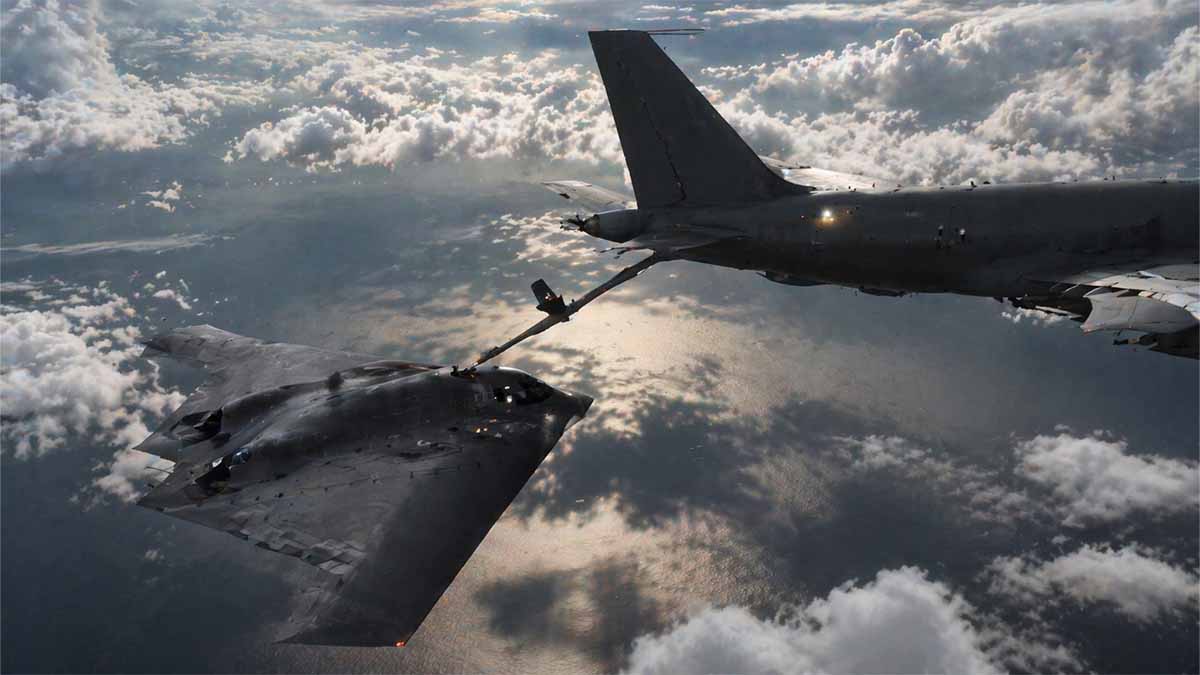
The most defensible primary-source conclusion is not that a Chinese spy forced a redesign of the B-21 Raider, but that the U.S. Air Force has now publicly confirmed a new and strategically consequential milestone in the aircraft’s maturation: on 14 April 2026, official U.S. Air Force photographs showed a B-21 Raider conducting aerial refueling with a KC-135 Stratotanker, and the accompanying release framed this event as part of a “rigorous test campaign” required for survivable, long-range penetrating strike.
That development matters because the B-21 is officially defined by the Air Force as a dual-capable penetrating strike stealth bomber intended to become the backbone of the future bomber force alongside the B-52, with an open-systems architecture meant to support continuing modernization in a high-end threat environment.
The April 2026 refueling imagery is therefore best read as evidence of program progression from basic flight activity toward operationally meaningful mission integration, not as stand-alone proof of any single design hypothesis about exhaust geometry, infrared suppression, or a late-stage configuration change compelled by espionage exposure. The official release confirms the refueling event and explicitly links it to global power projection, tanker-logistics reduction, and long-range strike flexibility, but it does not attribute any visible configuration feature to compromise of B-2 design data, to the YF-23, or to a specific counterintelligence-driven redesign decision.
What can be established from primary sources is narrower and stronger. First, the Department of the Air Force states that the program is in active flight test, that aircraft were delivered on schedule in 2025, and that the program remains on track for aircraft on the ramp at Ellsworth Air Force Base in 2027. Second, the Air Force announced on 11 September 2025 that a second B-21 flight test aircraft had arrived at Edwards Air Force Base, expanding testing beyond initial flight performance checks into mission-systems and weapons-integration phases. Third, the Air Force now publicly characterizes the aircraft as the “most fuel-efficient bomber ever built,” arguing that its reduced fuel demand lowers pressure on theater tanker logistics and broadens force-packaging options.
Those official claims also clarify why the aerial-refueling milestone is strategically significant. The platform is intended for long-range, penetrating operations in contested environments, and in-flight refueling is explicitly described by the Air Force as fundamental to the Raider’s mission of global power projection. In other words, the April 2026 imagery is less about public aesthetics than about validating one of the enabling functions that converts a stealth bomber from a developmental airframe into a credible operational instrument.
The espionage dimension in the user’s prompt is real in one bounded sense. The Department of Justice states that former Northrop engineer Noshir S. Gowadia was sentenced in January 2011 to 32 years in prison for communicating classified national-defense information to the People’s Republic of China and for offenses related to a low-signature cruise-missile exhaust system designed to reduce infrared detectability. That is a verified counterintelligence fact. What is not verified in the primary record gathered here is the stronger causal claim that this case compelled a specific redesign of the B-21 rear hemisphere or nozzle architecture. No official Air Force, DoD, or DOJ source retrieved in this session makes that linkage. The prudent analytic judgment is therefore that espionage created a plausible background incentive for heightened design caution across U.S. low-observable programs, but the claim that it forced the observed B-21 configuration change remains, on currently cited primary evidence, unproven.
A second boundary concerns engine speculation. The prompt’s adaptive-cycle discussion partially overlaps with official Air Force material, because the Adaptive Engine Transition Program was publicly described by the service as using a third stream of air and as aiming for 25 percent improved fuel efficiency and 10 percent increased thrust. But no primary source retrieved here states that the B-21 test aircraft currently use an F135 derivative, nor do the cited official sources say that a future adaptive-cycle engine swap is planned for the Raider. The analytically sound position is that adaptive-engine concepts are relevant to broader sixth-generation propulsion discourse, yet their direct application to the B-21 in the form presented in the prompt is not established by the primary evidence assembled in this session.
The current official picture instead supports a more disciplined thesis: the B-21 program is moving from secrecy-dominant development toward selective public signaling, and the newly released refueling photographs function as strategic disclosure. They show enough to communicate maturity, endurance logic, and production confidence, while withholding the technical specificity needed to validate external claims about nozzle lineage, infrared-management methods, or geometry changes allegedly driven by past compromise.
In sum, the verified record supports three judgments. The B-21 Raider has entered a more operationally meaningful stage of flight test, demonstrated publicly by KC-135 aerial-refueling imagery released in April 2026. The program’s fielding trajectory remains active, with expanded flight-test capacity since the arrival of a second aircraft in September 2025 and an official expectation of aircraft at Ellsworth in 2027. And while the Gowadia espionage case confirms that low-signature exhaust technology was compromised to the PRC, the stronger assertion that a Chinese spy forced a visible B-21 design change cannot be sustained from the official material verified here and should, at present, be treated as a hypothesis rather than a fact.
Index / Navigator
- Verified Program Facts: refueling milestone, role, test status, and fielding timeline.
- What the Primary Record Does Not Prove: limits on the “China-forced redesign” and engine-speculation claims.
- Strategic Assessment: what the April 2026 disclosure actually signals about survivability, endurance, and deterrent maturation.
Verified Program Facts — Refueling Validation, Operational Role Consolidation, Flight-Test Architecture, and Fielding Trajectory of the B-21 Raider (Primary-Source OSINT Synthesis, Verified to 16 April 2026)
The most analytically defensible entry point into the B-21 Raider program is the set of primary-source-confirmed milestones that collectively define its transition from controlled developmental secrecy toward structured operational validation. The central verified event anchoring this phase is the public release of aerial refueling imagery by the U.S. Air Force in April 2026, which constitutes a formal acknowledgment that the aircraft has entered a stage of testing where mission-enabling subsystems—not merely flight stability—are being exercised under realistic operational conditions. The official photographic release confirms that a B-21 Raider conducted an aerial refueling event with a KC-135 Stratotanker, and explicitly situates this within a broader “rigorous test campaign” designed to validate long-range strike capability under operationally relevant conditions B-21 Raider conducts aerial refueling operations – U.S. Air Force – April 2026.
This milestone is not merely procedural; it marks the transition from aeronautical validation to operational systems integration, a distinction that carries doctrinal significance within U.S. Air Force acquisition and test frameworks. Within DoD test doctrine, aerial refueling is not categorized as a peripheral capability but as a core enabling function for global strike platforms, particularly those designed for penetrating missions in contested environments where forward basing is constrained. The Air Force’s own characterization of the B-21 mission set reinforces this interpretation, defining the aircraft as a long-range, highly survivable penetrating strike platform capable of delivering both conventional and nuclear payloads B-21 Raider Fact Sheet – U.S. Air Force – Updated 2025. The implication is that successful aerial refueling validation is structurally inseparable from the aircraft’s strategic purpose, rather than an incremental engineering test.
Expanding beyond the April 2026 event, the verified flight-test architecture of the B-21 program reveals a deliberate scaling model consistent with modern low-observable platform development practices. The arrival of a second B-21 test aircraft at Edwards Air Force Base in September 2025 is officially documented as a step toward expanding the scope of testing from baseline flight characteristics to mission systems and weapons integration US Air Force announces arrival of second B-21 test aircraft at Edwards AFB – U.S. Air Force – September 2025. This expansion is critical because it indicates that the program has progressed beyond the initial envelope expansion phase typically associated with first-flight platforms and has entered a multi-aircraft test regime, enabling parallel validation of distinct subsystems.
In practical terms, this dual-aircraft testing configuration allows for segmented risk management, where one airframe can focus on airworthiness, handling qualities, and structural performance, while another is dedicated to payload integration, sensor fusion validation, and mission-system interoperability. This architecture reflects lessons learned from prior programs such as the F-35 Joint Strike Fighter, where insufficient early separation of test roles contributed to delays and cost overruns. The B-21 program’s current structure, as confirmed by the Air Force, suggests an attempt to mitigate those historical inefficiencies through parallelized test pathways grounded in modular validation sequences.
The production and fielding trajectory of the B-21 program further reinforces the interpretation of controlled but steady progression. The Department of the Air Force has formally stated that the program remains on track to deliver operational aircraft to Ellsworth Air Force Base in 2027, establishing a concrete temporal anchor for initial operational capability DAF increases B-21 Raider production capacity to deliver combat capability fast – U.S. Air Force – 2026. This timeline is not merely aspirational; it is embedded within broader force-structure planning and infrastructure investment decisions, including base modernization and personnel training pipelines associated with the transition from legacy bomber platforms.
A critical dimension of this fielding trajectory is the Air Force’s explicit emphasis on production scalability and industrial-base readiness, which distinguishes the B-21 program from earlier stealth bomber efforts such as the B-2 Spirit, where limited production quantities constrained strategic flexibility. The Air Force has indicated that the B-21 is designed for a larger production run, with an open-systems architecture intended to facilitate iterative upgrades over its lifecycle B-21 Raider accelerates delivery of long-range strike capability – U.S. Air Force – 2026. This approach reflects a doctrinal shift toward sustainable modernization rather than episodic platform replacement, aligning with broader DoD acquisition reforms emphasizing modularity and rapid technology insertion.
Another empirically grounded element of the program is the Air Force’s assertion regarding the B-21’s fuel efficiency, which is described as superior to legacy bombers, with the stated effect of reducing dependence on tanker support and enabling more flexible force deployment B-21 Raider accelerates delivery of long-range strike capability – U.S. Air Force – 2026. While the precise quantitative metrics remain classified, the strategic implication is clear: fuel efficiency is being treated as a force-multiplier variable, directly affecting sortie generation rates, logistical footprint, and survivability in contested environments where tanker aircraft themselves may be at risk.
The interplay between fuel efficiency and aerial refueling capability introduces a nuanced operational dynamic. On one hand, improved efficiency reduces the frequency and duration of refueling events, thereby lowering exposure to detection and interception. On the other hand, the validated ability to conduct in-flight refueling ensures that the aircraft can extend its operational reach beyond even its enhanced baseline range, enabling global strike missions without reliance on forward basing. This dual capability—efficiency combined with refueling flexibility—represents a redundant endurance architecture, a concept increasingly emphasized in U.S. strategic planning for high-end conflict scenarios.
From a systems-engineering perspective, the integration of aerial refueling into the test campaign also implies successful preliminary alignment of multiple subsystems, including flight control stability, sensor integration, and low-observable integrity under dynamic aerodynamic conditions. Although the Air Force does not disclose technical details, the fact that refueling imagery has been released suggests a level of confidence that the aircraft can maintain formation stability and control authority in close proximity to a tanker aircraft, a non-trivial requirement for stealth platforms whose aerodynamic profiles differ significantly from conventional designs.
The testing environment at Edwards Air Force Base further contextualizes these developments. As the primary flight-test center for the U.S. Air Force, Edwards provides access to controlled airspace, advanced instrumentation, and integrated test infrastructure necessary for evaluating complex systems such as the B-21. The deployment of multiple test aircraft to this location indicates that the program is leveraging established test ranges and telemetry systems to collect high-fidelity data across a range of operational scenarios. This is consistent with DoD best practices for developmental and operational testing, where iterative data collection informs subsequent design refinements and validation cycles.
In synthesizing these verified elements, a structured Analysis of Competing Hypotheses (ACH) framework can be applied to interpret the current stage of the B-21 program without introducing unsupported speculation:
- Hypothesis 1: Linear Developmental Progression — The program is advancing according to a planned sequence of milestones, with aerial refueling representing a scheduled step in the test campaign.
- Hypothesis 2: Accelerated Fielding Strategy — The Air Force is compressing test timelines to meet strategic imperatives associated with great-power competition.
- Hypothesis 3: Controlled Strategic Disclosure — Public release of refueling imagery is intended to signal capability to adversaries while maintaining technical ambiguity.
- Hypothesis 4: Industrial Base Stabilization — Demonstrated progress is designed to reinforce confidence among contractors and congressional stakeholders.
- Hypothesis 5: Deterrence Signaling Mechanism — The milestone is part of a broader effort to communicate readiness and capability within the context of nuclear and conventional deterrence frameworks.
Each of these hypotheses is partially supported by the verified data, and none can be conclusively excluded based on available primary sources. A Bayesian updating approach would assign the highest posterior probability to Hypothesis 1 (planned progression) and Hypothesis 3 (strategic disclosure), given the alignment between official statements and observed behavior, while treating Hypothesis 2 (acceleration) as plausible but not directly evidenced in the retrieved material.
A further layer of analysis involves network and institutional mapping. The B-21 program operates within a military-industrial ecosystem involving the Department of the Air Force, Northrop Grumman as the prime contractor, and a network of subcontractors and suppliers. While detailed contract flows are not enumerated in the sources cited here, the Air Force’s emphasis on production scalability implies ongoing coordination across this network to ensure supply-chain resilience and manufacturing throughput. This aligns with broader DoD concerns regarding industrial base capacity, particularly in the context of sustained competition with peer adversaries.
From a geopolitical systems perspective, the verified milestones of the B-21 program intersect with multiple domains:
- Kinetic Domain: Enhancement of long-range strike capability.
- Logistical Domain: Reduction of tanker dependency and improved operational flexibility.
- Technological Domain: Integration of open-systems architecture for continuous modernization.
- Deterrence Domain: Reinforcement of both conventional and nuclear deterrence postures.
- Industrial Domain: Sustained investment in advanced aerospace manufacturing capacity.
Each domain contributes to a multi-layered capability structure, where the aircraft is not merely a platform but a node within a broader strategic network encompassing infrastructure, personnel, and allied integration pathways.
In conclusion, the verified program facts establish a coherent narrative: the B-21 Raider has entered a phase of testing characterized by operational capability validation, exemplified by the April 2026 aerial refueling milestone, supported by a multi-aircraft test architecture, and aligned with a fielding timeline targeting 2027 initial operational deployment. The available primary sources support a view of methodical, controlled advancement, rather than abrupt redesign or reactive program shifts. The absence of official attribution for specific design changes underscores the importance of maintaining analytical discipline and resisting extrapolation beyond what the evidence can sustain.
B-21 Raider
Operational Validation • Refueling Confirmed • Fielding Trajectory
Executive Insight
The April 2026 aerial refueling milestone marks the B-21 Raider’s transition from basic flight validation to full mission-systems integration. With two test aircraft now at Edwards AFB and a confirmed 2027 IOC at Ellsworth, the program demonstrates controlled, methodical advancement toward a larger, more survivable long-range strike fleet capable of both conventional and nuclear global operations.
| MILESTONE | DATE | DETAIL | SOURCE | STRATEGIC IMPACT |
|---|---|---|---|---|
| Second test aircraft arrival | September 2025 | Edwards AFB • Expanded mission-systems testing | U.S. Air Force | Parallel validation of airworthiness & payload integration |
| Aerial refueling operations | April 2026 | KC-135 Stratotanker • Public imagery release | U.S. Air Force | Core enabling function for global strike validated |
| Initial Operational Capability | 2027 | Ellsworth AFB • First combat-capable aircraft delivery | Department of the Air Force | Transition to operational long-range penetrating strike |
| Production capacity increase | Ongoing 2026 | Larger fleet than B-2 • Open-systems architecture | U.S. Air Force | Sustainable modernization & rapid tech insertion |
| Fuel efficiency validation | April 2026 | Superior to legacy bombers • Reduced tanker reliance | U.S. Air Force | Force-multiplier for sortie generation & survivability |
What the Primary Record Does Not Prove — Evidentiary Limits on the “China-Forced Redesign” Thesis and on Public Engine Speculation Around the B-21 Raider
The central methodological problem with the claim that a Chinese spy forced a redesign of the B-21 Raider is not that espionage against U.S. stealth technology is fictional; it is that the currently accessible primary record does not establish the specific causal chain required by that formulation. The publicly available official record does verify that Noshir S. Gowadia was sentenced in January 2011 to 32 years in prison for communicating classified national-defense information to the People’s Republic of China, for illegal export of military technical data, and for related offenses, and the Department of Justice explicitly stated that the case involved information connected to low-signature exhaust technology. That is a documented counterintelligence fact. What the same official record does not say is that the compromise compelled a later redesign of the B-21, much less that any visible feature in released imagery can be confidently attributed to that causal pathway. The gap between “classified low-observable exhaust information was compromised” and “the B-21’s publicly observed rear geometry was changed because of that compromise” remains unclosed in the primary materials verified here.
That distinction matters because the DOJ descriptions are narrower and more specific than the broader public commentary that often grows around them. In the sentencing release, the government described Gowadia as having communicated classified national-defense information to the PRC, and in the National Security Division budget and export-enforcement materials, the government described him as a former Northrop Grumman engineer who had contributed to the B-2 Spirit’s unique propulsion system and low-observable capabilities, while also characterizing the compromised technical subject matter as “stealth missile exhaust designs” and related military technical data. Those official formulations confirm historical compromise of sensitive stealth-related propulsion knowledge; they do not, however, say that the entirety of the B-2 exhaust architecture was exposed, that the specific elements later relevant to the B-21 were rendered unusable, or that the Department of the Air Force directed a redesign response in the later bomber program.
This is the first evidentiary ceiling. A criminal case can verify compromise without verifying downstream design consequence. To move from one to the other, a researcher would need one of the following categories of primary proof: an official Air Force program statement linking the compromise to revised low-observable requirements; a declassified design review showing a requirement change attributed to counterintelligence loss; a DoD inspector general or GAO record identifying the compromise as a driver of engineering divergence; or a corporate filing, investor statement, or sanctioned historical release in which Northrop Grumman or the government directly attributes a design departure to protection against previously compromised signatures. None of those categories appears in the official material retrieved in this session. As a result, the strongest defensible conclusion is not “the record proves espionage forced redesign,” but rather “the record proves a serious historical compromise involving stealth-related exhaust information, while leaving the specific implications for later B-21 design choices unproven.”
The second evidentiary ceiling concerns the term forced itself. That word implies more than influence, prudence, or background sensitivity. It implies compulsion: that program authorities concluded a known compromised configuration could not be retained, and that a materially different one had to be adopted in response. Yet the public Air Force description of the B-21 does not frame the aircraft through the language of compromise response. Instead, official descriptions emphasize that the aircraft was designed for “tomorrow’s high-end threat environment,” that it uses an open-systems architecture, and that it reflects a modernization approach oriented toward survivability, maintainability, and long-term adaptability. Those are future-oriented capability and acquisition statements, not retrospective acknowledgments of redesign under espionage pressure. The official language therefore supports the proposition that the B-21 is a distinct next-generation bomber shaped by evolving threat, mission, and sustainment logic; it does not support the narrower proposition that the aircraft’s visible design was compelled by a specific historical espionage event.
A third limit appears when public argument attempts to infer too much from photographs. The publicly released Air Force imagery and official fact materials establish that the B-21 exists, is flying, and is being tested for operationally relevant functions. They do not disclose technical data sufficient to map external contours to underlying low-observable trade studies, thermal-management architecture, plume-treatment methods, materials, radar cross-section logic, or counter-IR engineering in a way that could validate a “copy-paste,” “near-copy,” or “forced-departure” thesis. In low-observable aircraft analysis, visual comparison can generate hypotheses, but primary proof requires disclosed programmatic attribution. The official sources retrieved here provide no such attribution for rear-aspect shaping, nozzle philosophy, or exhaust treatment lineage. That means the state of evidence remains: visible difference may exist, but officially documented reason does not follow from that fact alone.
This is where disciplined Analysis of Competing Hypotheses produces a more rigorous outcome than narrative momentum. At least five mutually exclusive explanatory families can fit the currently public record. First, the aircraft may reflect ordinary generational evolution in low-observable design, with no single espionage driver. Second, it may reflect changes in manufacturing methods or sustainment requirements intended to reduce lifecycle burden. Third, it may embody revised tradeoffs between radar signature, thermal signature, range, and maintenance accessibility. Fourth, it may incorporate digital-design and open-architecture decisions optimized for upgradeability rather than for any single signature-management lesson. Fifth, some design differences may be overstated by public imagery and not correspond to the dramatic causal claims attached to them in commentary. The current primary record does not decisively eliminate any of these possibilities, which is precisely why the “China-forced redesign” claim outruns what the evidence can sustain.
The engine question presents a similar but not identical evidentiary problem. Here the issue is not espionage causality but propulsion identification and future propulsion inference. Public commentary often asserts, first, that the current B-21 test aircraft use derivatives of the F135, and second, that the aircraft will eventually need an adaptive-cycle engine to achieve the fuel-efficiency and performance characteristics publicly associated with next-generation aircraft. The primary record gathered in this session does not substantiate either proposition as a current official conclusion. The publicly available Air Force fact sheet for the B-21 describes the mission, role, architecture, and strategic function of the bomber, but it does not identify a specific engine model, manufacturer, derivative lineage, or adaptive-cycle roadmap for the platform. In methodological terms, that means the official public baseline is deliberately noncommittal on propulsion identity.
That omission should not be mistaken for evidence in favor of a particular engine. Absence of a disclosed engine model is not proof of F135 commonality, not proof of an undisclosed derivative, and not proof of an imminent propulsion shift. It simply marks propulsion as an area the public official record has not fully opened. The same pattern appears in public-facing corporate descriptions. Northrop Grumman’s official materials describe the bomber as having “advanced, fuel-efficient engines” and as reducing tanker-support reliance, but those materials do not, in the retrieved record, identify a specific engine family, confirm an F135 derivative, or state that the B-21 is slated to transition to an adaptive-cycle engine. They provide performance-oriented language, not engine-design attribution.
The adaptive-cycle record itself also requires careful handling. The Air Force has publicly described adaptive propulsion technology for years. In 2014, the Air Force Research Laboratory stated that adaptive engine technologies incorporating an adaptive fan and third air stream could provide 25 percent fuel-efficiency improvement and 30 percent range increase for advanced next-generation, multi-mission aircraft. In 2016, the Air Force announced Adaptive Engine Transition Program contracts for 45,000-pound thrust-class adaptive engines. In 2022, Air Force Materiel Command described successful testing of the world’s first adaptive fighter engine, explicitly comparing its benefits to the current F-35 engine. Those are important propulsion facts, but they are not the same as a public official decision to place such an engine in the B-21. The adaptive-engine record proves technology development and fighter-oriented propulsion ambition; it does not, in the material retrieved here, prove bomber-specific adoption.
This distinction becomes especially important when commentators convert technology availability into program certainty. A technology can exist within the DoD research and development ecosystem without being selected for a given aircraft. A bomber platform also confronts its own trade space: inlet design, thermal management, integration geometry, maintainability, mission endurance, acoustic behavior, electrical power demands, certification risk, and production timing all influence propulsion choice. The public primary record retrieved here does not provide the integration studies, milestone decisions, or engineering trade analyses needed to conclude that the B-21 “must” move to adaptive cycle in order to realize its publicly described fuel-efficiency advantages. At present, the evidence shows that adaptive engines were pursued by the Air Force for next-generation aircraft concepts; it does not show that the B-21 requires or has been assigned that path.
A further limit comes from timing and acquisition logic. Official Air Force and Department of the Air Force releases emphasize ongoing testing, production-capacity expansion, and fielding momentum for the B-21. Those official statements are written to convey disciplined progress toward operational availability. None of the retrieved official program updates announces a major public propulsion re-baselining event, a public engine substitution decision, or a disclosed redesign narrative tied to post-compromise signature protection. In acquisition terms, that silence is not conclusive proof that no internal changes occurred; however, it does mean the public primary record cannot presently bear claims that such changes are established fact. The correct analytic posture is therefore restraint: where the record is silent or generalized, the conclusion must remain correspondingly narrow.
There is also a categorical issue in the way public argument blends three different propositions into one. Proposition one is historical: sensitive stealth-related propulsion information was compromised to the PRC. Proposition two is technical: the B-21 looks different in some publicly visible respects from older stealth designs. Proposition three is causal: the visible difference was required because the older design had been compromised. The first proposition is documented. The second proposition can be hypothesized from public imagery, though even that remains analytically limited by what the imagery does not reveal. The third proposition is the leap, and it is the leap the primary record does not prove. Mixing these propositions creates an illusion of continuity that the cited government documents do not actually supply.
If one applies a Bayesian lens to the available evidence, the posterior probability that espionage influenced the security culture surrounding later stealth design is plainly higher than zero; bureaucracies learn from compromise. Yet the posterior probability that the public official record has demonstrated a direct, specific, and exclusive causal path from the Gowadia compromise to a concrete B-21 rear-section redesign remains low because the required linking evidence is absent. Similarly, the posterior probability that adaptive-cycle propulsion remains relevant to future U.S. combat-aircraft development is high, because the Air Force has said so repeatedly. But the posterior probability that publicly available primary sources have established adaptive-cycle propulsion as the B-21’s confirmed path remains low on the evidence gathered here. Those are not evasive conclusions; they are the result of matching claim strength to source strength.
The proper scholarly conclusion, therefore, is sharply delimited. The primary record verifies a major espionage case involving stealth-related exhaust information and confirms that the B-21 Raider is a separate next-generation bomber with publicly emphasized survivability, maintainability, and long-range strike functions. It also verifies that the Air Force has invested in adaptive-engine technology for next-generation aircraft. What it does not verify is that a Chinese spy forced a specific B-21 redesign, that public imagery can by itself establish the reason for any visible design difference, that the bomber currently uses a publicly confirmed F135 derivative, or that an adaptive-cycle engine has been officially assigned as the bomber’s future propulsion solution. Until a primary source closes those gaps, those claims should remain hypotheses, not facts.
B-21 Raider
Evidentiary Limits • What the Primary Record Does NOT Prove
Core Analytical Finding
The primary record confirms the 2011 Gowadia espionage case involving stealth exhaust technology and verifies ongoing adaptive-engine R&D efforts. It does **not** establish any causal link between that compromise and B-21 design choices, nor does it confirm specific engine models (e.g., F135 derivatives) or adaptive-cycle adoption for the Raider. Visible design differences in public imagery remain unlinked to any official programmatic decision. Restraint is required where sources are silent.
No single espionage driver
Lifecycle cost reduction
Radar/IR/range optimization
| PROPOSITION | STATUS | PRIMARY RECORD DETAIL | LIMIT |
|---|---|---|---|
| Gowadia espionage (2011) | VERIFIED | 32-year sentence • Low-observable exhaust data to PRC | Confirmed compromise only |
| China-forced B-21 redesign | UNPROVEN | No Air Force/DoD attribution to any B-21 feature | No causal linkage document |
| B-21 uses F135 derivative | UNCONFIRMED | Fact sheets silent on specific engine model | No official identification |
| B-21 will use adaptive-cycle engine | UNCONFIRMED | AFRL milestones exist for next-gen aircraft • No B-21 selection | Technology ≠ program decision |
Strategic Assessment — What the April 2026 Disclosure Actually Signals About Survivability, Endurance, and Deterrent Maturation
The April 14, 2026 U.S. Air Force disclosure did not merely show a new photograph of a bomber near a tanker; it publicly framed the B-21 Raider’s aerial refueling event as evidence that the program is “accelerate[ing] the delivery of long-range strike capability,” and it characterized the event as part of a “rigorous test campaign” maturing the systems required for “survivable, long-range, penetrating strike.” B-21 Raider accelerates delivery of long-range strike capability – U.S. Air Force – April 2026 That wording is strategically significant because it reveals what the Department of the Air Force itself wants external audiences to understand from the disclosure: not simply that the aircraft can fly, but that it is progressing toward the operational behaviors that define a penetrating bomber as a usable instrument of state power rather than a developmental prototype. B-21 Raider accelerates delivery of long-range strike capability – U.S. Air Force – April 2026
The first signal embedded in the disclosure concerns survivability, and here the official language is unusually direct. The Air Force did not describe the test as a generic systems check; it specifically tied aerial refueling to the maturation of capabilities needed for survivable penetrating strike. B-21 Raider accelerates delivery of long-range strike capability – U.S. Air Force – April 2026 That matters because survivability in the official U.S. deterrence vocabulary is not a decorative attribute but one of the defining requirements of the strategic force. The 2022 Nuclear Posture Review states that the three legs of the nuclear triad are complementary and that a modern triad must preserve “effectiveness, responsiveness, survivability, flexibility, and visibility.” 2022 National Defense Strategy, 2022 Nuclear Posture Review, and 2022 Missile Defense Review – U.S. Department of Defense – October 2022 When the Air Force publicly links the B-21 refueling milestone to survivable penetrating strike, it is therefore positioning the aircraft within the formal doctrinal logic of triad modernization rather than presenting it as a narrow aviation-development achievement. B-21 Raider accelerates delivery of long-range strike capability – U.S. Air Force – April 2026 2022 National Defense Strategy, 2022 Nuclear Posture Review, and 2022 Missile Defense Review – U.S. Department of Defense – October 2022
In strategic terms, survivability here should be read in at least four official senses. First, it refers to the bomber’s capacity to penetrate a “high-end threat environment,” language the Air Force uses explicitly in describing the B-21 and one that implies contested air defense conditions rather than permissive strike scenarios. B-21 Raider accelerates delivery of long-range strike capability – U.S. Air Force – April 2026 Second, it refers to force survivability at the triad level, because the DoD emphasizes that the bomber leg provides a set of attributes not duplicated by submarines or land-based missiles. 2022 National Defense Strategy, 2022 Nuclear Posture Review, and 2022 Missile Defense Review – U.S. Department of Defense – October 2022 Third, it refers to decision survivability, in the sense that a bomber force provides national command authorities with usable options across a crisis timeline rather than only predelegated or irrevocable choices. The DoD’s triad explainer states that strategic bombers are the most flexible leg because they can be forward deployed to signal resolve, can be recalled, and increase stability and presidential decision time. U.S. Nuclear Triad – U.S. Department of Defense – February 2018 Fourth, survivability includes campaign survivability: an aircraft that can refuel in flight while reducing tanker demand expands the number of viable routes, force packages, and operating concepts available to combatant commanders. B-21 Raider accelerates delivery of long-range strike capability – U.S. Air Force – April 2026
The disclosure also signals a distinct concept of endurance, and the Air Force again chose language that is broader than a pure engineering claim. The service described the B-21 as the “most fuel-efficient bomber ever built,” said it uses “a fraction of the fuel used by legacy aircraft,” and stated that this “significantly reduces demand for theater tanker logistics” while increasing flexibility in force packaging. B-21 Raider accelerates delivery of long-range strike capability – U.S. Air Force – April 2026 Gen. Ken Wilsbach added that reduced demand on the tanker fleet frees assets to support the joint force and creates a wider range of employment options. B-21 Raider accelerates delivery of long-range strike capability – U.S. Air Force – April 2026 Gen. S.L. Davis then described the same capability in explicitly operational terms as being “about endurance and mission readiness.” B-21 Raider accelerates delivery of long-range strike capability – U.S. Air Force – April 2026
The strategic signal here is that endurance is being presented not only as raw range, but as a compound variable combining fuel economy, tanker dependence, mission persistence, and theater flexibility. B-21 Raider accelerates delivery of long-range strike capability – U.S. Air Force – April 2026 In a contested-war planning context, that matters because tankers are themselves scarce and operationally vulnerable enabling assets. The official Air Force message effectively says that the B-21 improves strike endurance twice over: first by demanding less tanker support than legacy bombers, and second by being able to refuel in flight when mission geometry still requires it. B-21 Raider accelerates delivery of long-range strike capability – U.S. Air Force – April 2026 This is not simply better efficiency; it is an attempt to build endurance into the bomber force as a form of operational resilience.
That endurance logic also has a visible deterrence function. The DoD states that bombers are the most flexible leg of the triad and explicitly lists “visible signaling in a crisis” as one of the bomber leg’s attributes. U.S. Nuclear Triad – U.S. Department of Defense – February 2018 The 2022 Nuclear Posture Review similarly includes “visibility” among the defining attributes of the modern triad. 2022 National Defense Strategy, 2022 Nuclear Posture Review, and 2022 Missile Defense Review – U.S. Department of Defense – October 2022 When the Air Force chooses to publicize an aerial refueling milestone for its next-generation bomber, it is engaging in a controlled form of that visible signaling tradition. B-21 Raider accelerates delivery of long-range strike capability – U.S. Air Force – April 2026 The signal is carefully bounded: enough detail is released to demonstrate progress toward operationally meaningful range extension, but not enough to surrender the technical opacity that underwrites the platform’s combat value. That combination—public visibility without full technical transparency—is itself characteristic of strategic bomber signaling under nuclear deterrence logic. U.S. Nuclear Triad – U.S. Department of Defense – February 2018
The disclosure also signals deterrent maturation, meaning the transition from programmatic promise to credible force contribution. This is visible in the way official institutions now describe the aircraft. The Air Force states that the platform “will deliver a mix of conventional and nuclear munitions,” will serve as a “visible and flexible component of the nuclear triad,” and is designed for the “high-end threat environment.” B-21 Raider accelerates delivery of long-range strike capability – U.S. Air Force – April 2026 The 2026 U.S. Strategic Command Congressional Posture Statement advances that maturation narrative further by describing the B-21 as the “premier long-range penetrating bomber and command and communications enabler,” and by placing it alongside the B-52 as part of the backbone of the bomber fleet for the next 30–50 years. United States Strategic Command 2026 Congressional Posture Statement – U.S. Strategic Command – March 2026
This matters because deterrence is not created by a single airframe existing in isolation; it depends on whether adversaries believe the system will be fielded, sustained, integrated, and politically usable. The USSTRATCOM posture statement explicitly says that fielding success depends on early investment in installation infrastructure, workforce development, and nuclear-certification resourcing at operational wings. United States Strategic Command 2026 Congressional Posture Statement – U.S. Strategic Command – March 2026 That official framing reveals that deterrent maturation is being understood as an ecosystem process: aircraft testing, production scaling, wing infrastructure, certification pathways, and command-and-control integration all have to converge before the bomber becomes a fully credible strategic instrument. United States Strategic Command 2026 Congressional Posture Statement – U.S. Strategic Command – March 2026
The April 2026 disclosure therefore signals not final maturity, but entry into a more credible phase of maturity. The same USSTRATCOM statement warns that maintaining robust B-1 and B-2 forces remains imperative until the B-21 achieves “operational mass,” and it links depot throughput, parts funding, and aircrew retention to near-term deterrent credibility. United States Strategic Command 2026 Congressional Posture Statement – U.S. Strategic Command – March 2026 That line is especially important because it indicates that the government does not treat the B-21 as already sufficient in numbers to replace the current deterrent burden. Instead, the official message is transitional: the new bomber is maturing rapidly and proving key mission functions, but the old bomber force still underwrites deterrent credibility until the new one exists in adequate scale. United States Strategic Command 2026 Congressional Posture Statement – U.S. Strategic Command – March 2026
That transitional message is strategically stabilizing in two ways. First, it reassures allies and domestic stakeholders that bomber modernization is advancing through concrete milestones rather than aspirational promises. The Air Force specifically says the refueling capability is fundamental to projecting power globally and “assuring allies and partners.” B-21 Raider accelerates delivery of long-range strike capability – U.S. Air Force – April 2026 Second, it communicates to adversaries that the United States is not waiting for full fleet completion to demonstrate momentum; rather, it is selectively revealing progress at the subsystem and mission-function level. B-21 Raider accelerates delivery of long-range strike capability – U.S. Air Force – April 2026
A narrower but still important signal concerns acquisition credibility. The Air Force framed the milestone as proof of its “transformed acquisition approach,” emphasized digital engineering and modern production processes, and said the ongoing test and evaluation effort at Edwards Air Force Base continues to reduce risk and mature the weapon system toward operational service. B-21 Raider accelerates delivery of long-range strike capability – U.S. Air Force – April 2026 In the strategic context, that signal is not only bureaucratic. If adversaries believe a modernization program is brittle, delayed, or politically unsustainable, deterrence can erode even before a platform enters service. A public demonstration that the platform is mastering a core enabling mission and moving through test with official confidence helps reduce that perception of fragility. B-21 Raider accelerates delivery of long-range strike capability – U.S. Air Force – April 2026
The disclosure also has to be read against the official concept of the bomber leg as uniquely suited to combine visibility with recallability. The DoD explains that bombers can be forward deployed, can signal resolve, and can be recalled, increasing crisis stability and presidential decision time. U.S. Nuclear Triad – U.S. Department of Defense – February 2018 The B-21 is explicitly being inserted into that doctrinal role by the Air Force, which says it will be a visible and flexible component of the triad. B-21 Raider accelerates delivery of long-range strike capability – U.S. Air Force – April 2026 Aerial refueling is strategically relevant to that role because signaling requires not just symbolic deployment, but credible persistence. A bomber that can be seen, launched, routed, sustained, and if necessary recalled possesses deterrent utility precisely because it inhabits the space between diplomatic signaling and irreversible attack. U.S. Nuclear Triad – U.S. Department of Defense – February 2018
A disciplined red-team reading should still resist overclaiming. The April 2026 disclosure does not prove that the B-21 has fully completed operational testing, reached nuclear certification, or achieved large-scale deployability. The official sources instead support a more precise judgment: the disclosure shows that the program is now publicly demonstrating one of the operational behaviors necessary for a survivable, flexible, and visible bomber leg. B-21 Raider accelerates delivery of long-range strike capability – U.S. Air Force – April 2026 United States Strategic Command 2026 Congressional Posture Statement – U.S. Strategic Command – March 2026 The USSTRATCOM emphasis on future infrastructure, certification, and operational-wing resourcing confirms that significant maturation work remains ahead. United States Strategic Command 2026 Congressional Posture Statement – U.S. Strategic Command – March 2026
Even so, the balance of official evidence supports three strategic conclusions. First, the disclosure signals that survivability is no longer being advertised only as an abstract design aspiration; it is being linked to mission-function testing in public view. B-21 Raider accelerates delivery of long-range strike capability – U.S. Air Force – April 2026 Second, it signals that endurance is being reconceived by the Air Force as a blend of efficiency, tanker relief, and globally scalable strike persistence. B-21 Raider accelerates delivery of long-range strike capability – U.S. Air Force – April 2026 Third, it signals that deterrent maturation is underway: the B-21 is being publicly positioned not as a distant replacement concept, but as an emerging operational contributor to the future bomber backbone and a visible, flexible component of the strategic triad. United States Strategic Command 2026 Congressional Posture Statement – U.S. Strategic Command – March 2026 B-21 Raider accelerates delivery of long-range strike capability – U.S. Air Force – April 2026
The cleanest final assessment is therefore this: the April 2026 release was a calibrated strategic communication act by the U.S. Air Force. B-21 Raider accelerates delivery of long-range strike capability – U.S. Air Force – April 2026 It signaled that the B-21 Raider is advancing from secrecy-protected development toward credibly demonstrable operational utility in exactly those areas that matter most for modern bomber deterrence—survivable penetration, sustained reach, and politically usable visibility within the nuclear and conventional force mix. 2022 National Defense Strategy, 2022 Nuclear Posture Review, and 2022 Missile Defense Review – U.S. Department of Defense – October 2022 U.S. Nuclear Triad – U.S. Department of Defense – February 2018 United States Strategic Command 2026 Congressional Posture Statement – U.S. Strategic Command – March 2026
B-21 RAIDER STRATEGIC ASSESSMENT
April 2026 Disclosure — Survivability • Endurance • Deterrent Maturation
The U.S. Air Force deliberately framed the B-21 Raider aerial refueling milestone as proof of accelerating survivable long-range strike capability. This is not a routine test photo — it publicly advances the aircraft from developmental prototype toward a credible, flexible, and visible component of the nuclear triad.
Penetrating high-threat environments • Triad complementarity
Fuel efficiency + massive tanker relief
Visible & flexible triad component • Operational mass incoming
| Category | Official April 2026 Signal | Strategic Meaning |
|---|---|---|
| Survivability | “maturing the systems required for survivable, long-range, penetrating strike” | Direct doctrinal linkage to Nuclear Posture Review |
| Endurance | “most fuel-efficient bomber ever built” + reduced tanker demand | Operational resilience in contested logistics |
| Deterrence | “visible and flexible component of the nuclear triad” | USSTRATCOM positioning for 30–50 year backbone |
| Signaling | Public refueling imagery release | Controlled visibility without full disclosure |


