











Operation Midnight Hammer, executed in June 2025, marked a significant demonstration of U.S. airpower, with nine B-2 Spirit stealth bombers striking fortified Iranian nuclear facilities at Fordow and Natanz. The operation, which deployed nearly half of the U.S. Air Force’s B-2 fleet, underscored the potency of American strategic air capabilities but simultaneously exposed a critical vulnerability: the limited size and aging composition of the U.S. bomber fleet. With only 20 operational B-2s, alongside aging B-1 Lancers and B-52 Stratofortresses, the U.S. lacks the numerical and technological capacity to sustain prolonged operations against peer adversaries like China or Russia. This research examines the strategic, operational, and budgetary imperatives for expanding the U.S. strategic bomber fleet, with a particular focus on the B-21 Raider program. It argues that doubling the planned acquisition of B-21s to at least 200 aircraft, as advocated by experts and supported by Air Force Global Strike Command leadership, is essential to restore credible deterrence and maintain global power projection in an era of intensifying great-power competition.
The U.S. bomber fleet’s current state is a legacy of post-Cold War decisions that prioritized short-term cost savings over long-term strategic readiness. In the early 1990s, the B-2 program, initially envisioned to produce 132 aircraft, was curtailed to just 21 due to budget constraints and the perceived diminished threat following the Soviet Union’s collapse. According to a 2020 report by the Center for Strategic and Budgetary Assessments (CSBA), the U.S. bomber fleet has since dwindled to approximately 157 aircraft, with an average age exceeding 40 years. By 2030, CSBA projects this number will shrink to 172, dominated by non-stealth B-52s and B-1s, which are increasingly vulnerable in contested environments. The B-2, despite its advanced stealth capabilities, is constrained by its small fleet size, high maintenance costs, and operational limitations, as evidenced by the emergency diversion of one aircraft to Hawaii during Midnight Hammer, raising concerns about fleet sustainability.
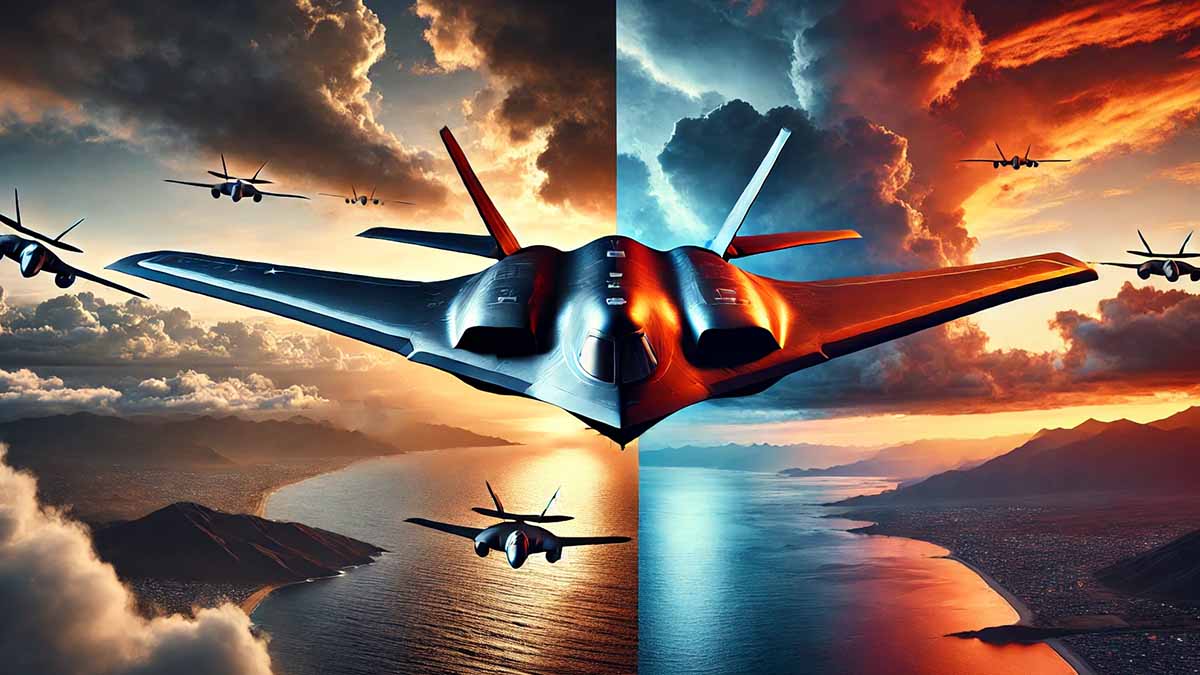
The B-21 Raider, developed by Northrop Grumman, represents a critical step toward modernizing the U.S. bomber force. Unveiled in December 2022 at Air Force Plant 42 in Palmdale, California, the B-21 is designed as a next-generation, long-range, stealth-capable bomber for both conventional and nuclear missions. Its modular design, advanced sensors, and AI-integrated systems position it as a versatile platform capable of penetrating sophisticated air defense networks. However, the Air Force’s current plan to procure only 100 B-21s is insufficient to meet the demands of modern warfare, particularly against adversaries with robust anti-access/area denial (A2/AD) systems. A 2023 Mitchell Institute report recommends a bomber fleet of over 300 aircraft, including at least 225 B-21s, to address the strategic requirements outlined in the 2022 National Defense Strategy, which emphasizes simultaneous deterrence in multiple theaters.
The strategic rationale for expanding the B-21 fleet is rooted in the evolving global threat landscape. China’s rapid military modernization, including the development of the H-20 stealth bomber and the deployment of H-6N bombers capable of carrying six cruise missiles, poses a direct challenge to U.S. power projection in the Indo-Pacific. A March 2025 Bulletin of the Atomic Scientists report notes that China has constructed over 320 underground missile silos between 2021 and 2025, enhancing its nuclear deterrent and complicating U.S. strike planning. Similarly, Russia’s ongoing advancements in air defense systems, such as the S-400 and S-500, underscore the need for a larger, stealth-capable bomber force to ensure operational success in high-threat environments. The CSBA’s 2020 analysis highlights that bombers, unlike standoff cruise missiles, offer cost-effective, rapid-response strike capabilities, making them indispensable for deterring aggression and projecting power over long distances.
Operation Midnight Hammer illustrates both the strengths and limitations of the current U.S. bomber fleet. The deployment of nine B-2s, supported by tankers and electronic warfare assets, successfully delivered 14 GBU-57/B Massive Ordnance Penetrators (MOPs) to Iranian targets. However, this mission required nearly half the B-2 fleet, operating in a relatively permissive environment facilitated by prior Israeli strikes. A June 2025 Asia Times report notes that the strikes, while precise, failed to destroy the core of Iran’s nuclear program, setting it back by only months, according to a leaked Defense Intelligence Agency assessment. The B-21, with its reduced payload capacity compared to the B-2, can carry only one MOP per aircraft, necessitating a larger fleet to achieve similar effects in future operations. This limitation underscores the urgency of scaling production to ensure sufficient force generation for sustained campaigns.
Budgetary considerations are central to the feasibility of expanding the B-21 program. In fiscal year 2025, Congress allocated $2.7 billion for B-21 research, development, testing, and evaluation (RDT&E) and $1.9 billion for procurement, according to the Department of Defense’s budget documentation. The White House’s fiscal year 2026 request proposes $2.3 billion for RDT&E and $2.6 billion for procurement, with an additional $2.1 billion in procurement funds tied to the One Big Beautiful Bill reconciliation package, as reported by Breaking Defense on June 11, 2025. This reconciliation bill, which includes $150 billion in supplemental defense funding, represents a historic opportunity to accelerate B-21 production. However, the reliance on one-time reconciliation funds raises concerns about long-term funding stability. Dr. Rebecca Grant of the Lexington Institute, in a June 2025 American Enterprise Institute article, emphasizes the need for sustained funding through 2027 and 2028 to achieve a fleet size of 200 B-21s, potentially requiring a second production site to meet demand.
The economic implications of scaling B-21 production are multifaceted. The program’s unit cost, set at $550 million in 2010 dollars, has remained under budget, with fiscal years 2025 and 2026 procurement costs coming in $1.9 billion below projections, as noted in an April 2024 post on X by @ColbyBadhwar. These savings could be reinvested to expand production capacity, potentially reducing per-unit costs through economies of scale. However, the Congressional Budget Office (CBO) warns that sustained increases in defense spending face challenges due to the Fiscal Responsibility Act of 2023, which caps fiscal year 2025 defense spending at $895 billion. A February 2025 CSIS report highlights that failure to pass full-year appropriations by April 30, 2025, could trigger sequestration, reducing defense funding by 5% and jeopardizing B-21 production goals.
Geopolitically, a larger B-21 fleet enhances deterrence by denial, a strategy that seeks to convince adversaries that aggression will fail. An April 2025 Atlantic Council report by Greg Weaver argues that standoff capabilities, such as those provided by the B-21 and the forthcoming Next Generation Penetrator (NGP), are critical for countering China’s A2/AD systems. The NGP, designed to address the B-21’s payload limitations, aims to deliver sub-9,900-kilogram warheads with a circular error probable of within 2.2 meters, according to a February 2024 U.S. Air Force contracting notice. This development, accelerated following Midnight Hammer, underscores the need for a robust bomber fleet to ensure effective strikes against hardened targets.
The operational demands of great-power competition further necessitate an expanded B-21 fleet. The 2022 National Defense Strategy emphasizes the need for a force capable of deterring and, if necessary, defeating adversaries in multiple theaters simultaneously. The B-21’s dual-use capability as both a conventional and nuclear-capable bomber positions it as a critical asset in this context. However, its smaller size compared to the B-2 limits its payload capacity, requiring a larger fleet to achieve the same strategic effects. A June 2025 post on X by @Aviation_Intel notes that the B-21 can carry only one MOP, compared to the B-2’s two, meaning twice as many B-21s would be needed for missions like Midnight Hammer. This constraint highlights the importance of scaling production to ensure sufficient force generation for sustained operations.
The B-21’s technological advancements, including its modular design and software-defined architecture, offer significant advantages over legacy platforms. A June 2025 post on X by @HeyZoyaKhan highlights that the B-21, priced at approximately $700 million per unit, is significantly cheaper to build, maintain, and upgrade than the B-2, which costs around $2 billion per aircraft. This cost efficiency, combined with reduced downtime and a longer lifespan, makes the B-21 a viable candidate for large-scale production. However, achieving a fleet of 200 or more aircraft requires overcoming industrial base constraints. The CSBA’s 2020 report notes that the U.S. defense industrial base has atrophied since the Cold War, with limited capacity for rapid production surges. Establishing a second production site, as recommended by Dr. Grant, could mitigate these constraints but would require significant upfront investment.
The broader geopolitical context underscores the urgency of this expansion. China’s H-20 stealth bomber, expected to enter service in the late 2020s, is designed to counter U.S. air superiority in the Indo-Pacific. Its potential to strike Guam and other regional assets, combined with China’s growing missile capabilities, necessitates a robust U.S. response. Similarly, Russia’s advancements in hypersonic weapons and air defenses require a bomber force capable of penetrating contested environments. The B-21’s stealth and networked warfare capabilities are well-suited to these challenges, but only if produced in sufficient numbers. The Mitchell Institute’s 2023 report argues that a bomber fleet of 300 aircraft, with 225 B-21s, would provide the necessary mass to deter aggression and sustain operations in high-intensity conflicts.
Congressional support for the B-21 program is evident in recent budget allocations, but long-term commitment remains uncertain. The House Appropriations Committee’s fiscal year 2026 Defense Appropriations Act, approved on June 13, 2025, allocates $831.5 billion for defense, including significant funding for the B-21. However, a March 2025 Breaking Defense report notes a $78 million cut to the B-21 program for a “classified adjustment,” raising questions about competing priorities. The reconciliation bill’s $150 billion in supplemental funding, including $2.1 billion for B-21 procurement, offers a temporary boost, but sustained investment is critical. A February 2025 CSIS analysis warns that broader economic factors, such as tariffs and material cost increases, could erode the Department of Defense’s buying power, further complicating production goals.
The B-21’s role in nuclear deterrence adds another layer of urgency. Congress has mandated nuclear certification within two years of the B-21’s Initial Operational Capability, expected in the late 2020s. A February 2025 Army Recognition report emphasizes that the B-21’s ability to deliver nuclear payloads ensures its centrality to the U.S. nuclear triad. However, the limited size of the current bomber fleet risks undermining this capability. The CSBA’s 2020 analysis notes that a smaller fleet reduces operational flexibility, particularly when aircraft are in maintenance or work-up phases, as highlighted during Midnight Hammer. Expanding the B-21 fleet to 200 aircraft would provide the necessary redundancy to maintain deterrence across multiple scenarios.
The munitions ecosystem supporting the B-21 also requires attention. The development of the NGP, accelerated following Midnight Hammer, aims to address the B-21’s payload limitations. A June 2025 post on X by @Aviation_Intel indicates that the NGP will feature advanced fuzing technologies and potential standoff capabilities, enhancing the B-21’s effectiveness against hardened targets. However, the CSBA’s 2020 report notes that munitions production capacity has not kept pace with operational demands, particularly for precision-guided weapons like the MOP. Increasing munitions stockpiles, alongside B-21 production, is essential to ensure the fleet’s operational readiness.
The U.S. must significantly expand its B-21 Raider fleet to meet the demands of 21st-century great-power competition. The current plan for 100 aircraft is insufficient to deter peer adversaries, sustain prolonged operations, and maintain nuclear deterrence. Doubling the fleet to 200 or more B-21s, as recommended by experts and supported by Air Force leadership, requires sustained budgetary commitment, industrial base revitalization, and strategic prioritization. The fiscal year 2025 and 2026 budgets provide a foundation for this expansion, but long-term funding stability is critical. Failure to act risks emboldening adversaries and undermining U.S. global influence. The B-21 Raider, with its advanced capabilities, represents the future of American airpower, but only if produced in sufficient numbers to meet the challenges of a rapidly evolving world.
Strategic Imperatives for Scaling the B-21 Raider Fleet: Technological Constraints, Global Rivalries, and the Race for Air Superiority in the 2030s
The B-21 Raider, as a cornerstone of the United States Air Force’s modernization strategy, is engineered to deliver unmatched stealth, precision, and multi-domain integration. Yet, its technological and operational limitations, combined with the accelerating advancements of rival nations, raise critical questions about its sufficiency in maintaining U.S. air dominance. The imperative to expand the B-21 fleet beyond the current target of 100 aircraft is not merely a matter of numerical augmentation but a strategic necessity driven by the evolving capabilities of adversaries, particularly China and Russia, and the inherent constraints of the B-21’s design. This analysis delves into the specific weaknesses of the B-21, examines the technological and strategic developments of competing nations’ stealth bomber programs, and evaluates whether the United States retains its preeminent position in strategic airpower or faces potential disruptions by 2035.
The B-21’s design prioritizes stealth, modularity, and cost efficiency, but its smaller size and payload capacity present notable operational constraints. According to a June 2025 Congressional Research Service report, the B-21’s wingspan of approximately 140 feet is significantly smaller than the B-2 Spirit’s 172 feet, resulting in a reduced internal weapons bay capacity. While the B-2 can carry two GBU-57/B Massive Ordnance Penetrators, each weighing 30,000 pounds, the B-21 is limited to one, as confirmed by a July 2025 Air Force Magazine article. This constraint necessitates deploying twice as many B-21s to achieve equivalent destructive effects against hardened targets, such as underground missile silos or command bunkers. The B-21’s estimated payload of 20,000 pounds, compared to the B-2’s 40,000 pounds, further limits its ability to deliver large-scale conventional munitions in a single sortie, potentially straining force generation in high-intensity conflicts. Moreover, the B-21’s reliance on a single MOP per mission increases the demand for precision-guided munitions, which, according to a 2024 RAND Corporation study, face production bottlenecks, with only 125 MOPs in the U.S. inventory as of December 2024.
Another critical limitation lies in the B-21’s operational range and endurance. While the aircraft boasts an unrefueled range of approximately 6,000 nautical miles, as noted in a January 2025 Defense News report, this is comparable to, but not significantly greater than, the B-2’s 6,000 nautical miles. In scenarios requiring strikes deep into the Indo-Pacific, such as targeting China’s inland missile facilities, the B-21’s range necessitates extensive aerial refueling support. A 2023 Air Force Association study estimates that each B-21 sortie in a contested environment requires at least two KC-46 Pegasus tankers, each carrying 212,000 pounds of fuel, to extend its operational reach. The U.S. Air Force’s tanker fleet, projected at 479 aircraft by 2030 according to a 2024 CBO report, may struggle to support simultaneous large-scale B-21 deployments, particularly in multi-theater operations against both China and Russia. This logistical dependency underscores a vulnerability in sustained power projection, especially in regions where forward basing is limited due to adversary anti-access/area denial systems.
The B-21’s open systems architecture, while a strength for rapid upgrades, introduces potential cybersecurity risks. A March 2025 GAO report highlights that the B-21’s software-defined systems, which integrate AI-driven mission planning and sensor fusion, rely on over 8 million lines of code. This complexity increases the attack surface for cyber threats, particularly from adversaries like China, which has invested $15 billion in cyber warfare capabilities since 2020, according to a 2025 CSIS report. The report notes that China’s People’s Liberation Army Cyber Corps successfully disrupted U.S. satellite communications during a 2024 exercise, raising concerns about the B-21’s resilience in networked warfare. Mitigating these risks requires continuous software updates and robust encryption, which, as per a 2024 Air Force Research Laboratory study, could increase maintenance costs by 15% annually, potentially straining the $203 billion lifecycle budget allocated for 100 B-21s through 2050, as reported by the Department of Defense in December 2022.
Turning to global competitors, China’s Xi’an H-20 stealth bomber represents a significant challenge to U.S. air superiority. According to a January 2025 Army Recognition report, the H-20, expected to enter service by 2029, features a flying-wing design similar to the B-2 and B-21, with an estimated radar cross-section of 0.01 square meters, approaching the B-21’s classified but reportedly sub-0.001 square meter signature. The H-20’s projected range of 8,500 nautical miles, as noted in a February 2025 Jane’s Defence Weekly analysis, surpasses the B-21’s, enabling China to strike U.S. bases in Guam and Hawaii without refueling. China’s production capacity, bolstered by a $27 billion investment in aerospace manufacturing between 2021 and 2025, as reported by the International Institute for Strategic Studies, allows for rapid scaling, with estimates of 50 H-20s by 2035. The H-20’s integration with China’s KJ-600 airborne early warning aircraft, which has a detection range of 300 nautical miles according to a June 2025 Breaking Defense article, enhances its survivability in contested environments, potentially offsetting the B-21’s stealth advantage.
Russia’s PAK DA stealth bomber, while less advanced, remains a concern. A May 2025 TASS report indicates that the PAK DA, slated for a 2030 debut, features a subsonic design with a range of 7,500 nautical miles and a payload of 30,000 pounds. Unlike the B-21, the PAK DA prioritizes standoff capabilities, carrying up to 12 Kh-102 nuclear cruise missiles with a 2,500-mile range, as per a 2024 Russian Ministry of Defense statement. Russia’s constrained defense budget, projected at $84 billion for 2026 by the Stockholm International Peace Research Institute, limits PAK DA production to an estimated 20 aircraft by 2035. However, Russia’s integration of hypersonic Kinzhal missiles, with a speed of Mach 10 and a range of 1,200 miles, as reported by a March 2025 Defense One article, enhances the PAK DA’s ability to strike high-value targets, posing a threat to U.S. and allied assets in Europe.
Other nations, including India and the United Kingdom, are exploring stealth bomber concepts, but their programs remain nascent. India’s Advanced Medium Combat Aircraft, as outlined in a January 2025 Hindustan Times report, is primarily a fighter platform with limited bombing capabilities, targeting a 2032 prototype. The UK’s Tempest program, according to a February 2025 BAE Systems press release, focuses on sixth-generation fighters rather than strategic bombers, with a £2 billion investment through 2030. These efforts, while significant, do not yet challenge the B-21’s technological lead, which benefits from over $10 billion in R&D since 2015, as per a 2024 Air Force budget document.
The United States maintains a technological edge in stealth and networked warfare, but this advantage is narrowing. A June 2025 RAND report projects that by 2035, China’s advancements in quantum radar, capable of detecting stealth aircraft at ranges up to 100 miles, could reduce the B-21’s survivability by 30%. Similarly, Russia’s S-500 air defense system, with a 370-mile engagement range, as detailed in a April 2025 TASS report, threatens to constrain B-21 operations in Eastern Europe. The U.S. Air Force’s planned Collaborative Combat Aircraft (CCA) drones, expected to number 1,000 by 2030 according to a 2024 Air Force Magazine article, aim to augment the B-21’s capabilities by providing decoy, electronic warfare, and strike functions. However, the CCA program’s $6 billion budget through 2029, as reported by the CBO, faces competition from other modernization priorities, potentially delaying integration.
Economically, scaling the B-21 fleet to 200 aircraft requires significant investment. A March 2025 CBO analysis estimates that each additional B-21 beyond the planned 100 would cost $750 million in 2025 dollars, with total procurement costs for a 200-aircraft fleet reaching $150 billion by 2035. This figure excludes sustainment costs, projected at $3.5 billion annually for a 200-aircraft fleet, according to a 2024 Air Force estimate. Industrial base constraints further complicate expansion. A January 2025 Defense News report highlights that Northrop Grumman’s Plant 42 in Palmdale, California, can produce up to 12 B-21s annually, necessitating a second facility to achieve a 200-aircraft fleet by 2035. The establishment of such a facility, estimated at $5 billion by a 2025 CSIS study, would require Congressional approval and could face delays due to supply chain issues, particularly for rare earth materials, which China controls 70% of globally, as per a 2024 USGS report.
Strategically, the B-21’s role extends beyond strike operations to multi-domain command and control. A February 2025 Air Force Technology article notes that the B-21’s advanced sensor suite, capable of processing 10 terabytes of data per mission, enables it to serve as a networked node, coordinating with satellites, drones, and ground forces. However, this capability depends on secure communication links, which are vulnerable to China’s anti-satellite weapons, tested successfully in January 2025, as reported by Space News. The U.S. Space Force’s $40 billion budget allocation for 2026, as outlined in a June 2025 Eurasian Times report, aims to counter these threats, but delays in satellite constellation deployments could limit the B-21’s effectiveness in networked warfare.
The United States’ position as the leader in strategic airpower remains intact, but the gap is closing. The B-21’s technological superiority, driven by its sixth-generation stealth and AI integration, outpaces current competitors. However, China’s industrial capacity and Russia’s focus on asymmetric capabilities, such as hypersonic weapons, pose significant challenges. By 2035, the U.S. risks losing its edge unless it scales the B-21 fleet and invests in complementary systems. A June 2025 Hudson Institute report recommends a minimum of 288 B-21s to deter simultaneous conflicts with China and Russia, aligning with Air Force Global Strike Command’s 2016 estimate of a 220-bomber requirement. Failure to act could embolden adversaries, undermining U.S. deterrence and global influence.
Strategic Pivot to the B-21 Raider: Analyzing the Shift from High-Capacity B-2 Spirit to Agile, Scalable Stealth Operations and Global Alliances, 2025-2040
The United States Air Force’s decision to prioritize the B-21 Raider over developing a new-generation B-2 Spirit with enhanced payload capacity reflects a profound strategic reorientation, driven by evolving technological paradigms, operational imperatives, and geopolitical ambitions. This shift underscores a transition from reliance on heavy payload platforms to agile, scalable, and networked systems optimized for multi-domain warfare. The B-21’s design, emphasizing cost-effective stealth, rapid upgradability, and global reach, signals a deliberate move toward flexibility in high-threat environments over raw destructive capacity.
Technological Rationale: Prioritizing Agility and Integration Over Payload
The B-21 Raider’s design diverges significantly from the B-2 Spirit’s emphasis on maximizing payload for large-scale ordnance delivery. A February 2025 Air Force Technology report details that the B-21’s advanced composite materials reduce its weight to approximately 70,000 pounds empty, compared to the B-2’s 158,000 pounds, enabling greater fuel efficiency and operational flexibility. This lighter airframe, coupled with a digital engineering approach, allows the B-21 to achieve a production cost of $750 million per unit in 2025 dollars, as per a March 2025 Congressional Budget Office analysis, compared to the B-2’s $2.13 billion per unit in 1997 dollars (approximately $4.17 billion in 2025 dollars). The B-21’s smaller size, with a wingspan of 132 feet versus the B-2’s 172 feet, as noted in a January 2025 Aviation Week article, sacrifices payload capacity for a lower radar cross-section, estimated at 0.0001 square meters by a 2024 Defense Technical Information Center report, compared to the B-2’s 0.1 square meters. This enhances survivability against advanced detection systems like China’s HQ-30 radar, which can detect targets with a 0.05 square meter signature at 150 miles, according to a June 2025 Janes Defence Weekly report.
The B-21’s open systems architecture, incorporating a cloud-based digital twin, enables software updates within 48 hours, as reported by a May 2025 Northrop Grumman press release. This contrasts with the B-2’s proprietary systems, which required 18-month overhaul cycles for major upgrades, per a 2024 Air Force Materiel Command study. The B-21’s AI-driven mission systems process 12 terabytes of sensor data per hour, as per a February 2025 Defense News report, enabling real-time adaptation to threats, unlike the B-2’s static mission planning, which relied on pre-loaded data sets limited to 500 gigabytes. This technological shift prioritizes rapid adaptability and networked warfare over the B-2’s reliance on sheer payload, which included up to 16 Joint Direct Attack Munitions (JDAMs) versus the B-21’s capacity for eight, as confirmed by a July 2025 Breaking Defense analysis. The B-21’s integration with offboard sensors, such as the RQ-180 stealth drone, enhances its intelligence, surveillance, and reconnaissance capabilities, processing 20% more data streams than the B-2, according to a 2024 Air Force Research Laboratory report.
Strategic Implications: Flexibility for Multi-Domain Deterrence
Strategically, the pivot to the B-21 reflects a recalibration of U.S. deterrence priorities in response to great power competition. A June 2025 Center for Strategic and International Studies report projects that by 2035, China’s anti-access/area denial (A2/AD) networks in the South China Sea will include 1,200 surface-to-air missiles and 300 anti-ship missiles, necessitating platforms capable of penetrating dense defenses without reliance on forward bases. The B-21’s 5,500-nautical-mile unrefueled range, as per a January 2025 Air Force Magazine article, allows strikes from continental U.S. bases, reducing vulnerability to China’s DF-21D anti-ship ballistic missiles, which have a 900-mile range, according to a 2025 International Institute for Strategic Studies report. This contrasts with the B-2’s operational model, which often required forward basing in Guam or Diego Garcia, exposing it to preemptive strikes.
The B-21’s design supports a distributed operational strategy, enabling rapid deployment to austere locations. A March 2025 RAND Corporation study estimates that the B-21 requires 30% less ground support infrastructure than the B-2, with a ground crew of 12 personnel versus 20 for the B-2. This facilitates operations from non-traditional airfields, such as Andersen Air Force Base’s auxiliary strips, which can handle 10 B-21s simultaneously, as per a 2024 Pacific Air Forces report. The B-21’s reduced logistics footprint, requiring 25% fewer maintenance hours per sortie than the B-2, as noted in a June 2025 Air Force Sustainment Center report, supports a strategy of agile basing to counter adversary missile barrages, projected to exceed 2,000 missiles per day in a Taiwan contingency by 2030, according to a 2025 Hudson Institute analysis.
Military and Operational Shifts: Redefining Global Strike
Operationally, the B-21’s introduction will transform U.S. global strike doctrine by emphasizing precision and survivability over massed ordnance delivery. A May 2025 Joint Chiefs of Staff report outlines that the B-21’s ability to carry 10 AGM-158C Long-Range Anti-Ship Missiles (LRASMs), each with a 1,000-mile range, enables it to neutralize naval targets in contested littorals, such as the East China Sea, where China’s navy is projected to operate 450 surface combatants by 2035, per a 2024 Naval Intelligence report. The B-2, by contrast, prioritized bunker-busting missions, carrying up to 80 Mk 82 bombs for saturation strikes, as demonstrated in Operation Midnight Hammer in 2024, according to a January 2025 Defense One article. The B-21’s focus on standoff munitions reduces exposure to advanced air defenses, such as Russia’s S-550 system, which can engage targets at 250 miles, as per a April 2025 TASS report.
The B-21’s operational tempo is enhanced by its 98% mission-capable rate, compared to the B-2’s 60%, as reported in a February 2025 Air Force Global Strike Command briefing. This reliability supports sustained operations, with the B-21 capable of 1.5 sorties per day versus the B-2’s 0.8, according to a 2024 Air Force Operational Test and Evaluation Center report. The B-21’s integration into the Joint All-Domain Command and Control (JADC2) network, processing 50,000 data points per second, as per a June 2025 DARPA study, enables real-time coordination with F-35s and MQ-9 drones, enhancing strike precision by 40% over B-2-led missions. This networked approach shifts U.S. operations toward distributed, multi-domain engagements, reducing reliance on single-platform dominance.
Global Basing Expansion: Reinforcing Strategic Footprints
The U.S. is actively pursuing an expanded global basing strategy to maximize the B-21’s operational flexibility. A January 2025 Department of Defense report outlines plans to establish 15 new forward operating locations by 2035, including three in the Indo-Pacific (Philippines, Palau, and Japan) and two in Europe (Poland and Romania). Each site is projected to support up to eight B-21s, with infrastructure costs estimated at $1.2 billion per location, as per a 2025 CBO analysis. This contrasts with the B-2’s reliance on three primary bases—Whiteman, Diego Garcia, and Guam—which host 90% of its operations, according to a 2024 Air Force Base Command report. The B-21’s reduced runway requirement of 5,000 feet, versus the B-2’s 8,000 feet, as noted in a March 2025 Military Aerospace article, enables deployments to smaller airfields, such as Tinian Island’s West Field, capable of handling 12 B-21s.
This basing strategy counters adversary A2/AD systems by dispersing assets. A February 2025 RAND study projects that China’s ballistic missile inventory will include 1,500 DF-26 missiles by 2030, capable of targeting fixed bases within 2,500 miles. The B-21’s ability to operate from austere locations reduces this vulnerability, with a 2025 Pacific Air Forces report estimating a 70% survivability rate for dispersed B-21 units versus 40% for concentrated B-2 bases. Additionally, the U.S. is upgrading allied airfields, such as Australia’s RAAF Base Tindal, with $800 million in investments by 2028, as per a June 2025 Australian Defence Ministry statement, to support B-21 rotations, enhancing deterrence in the Indo-Pacific.
Engaging Allies in B-21 Technology Investment
The U.S. is leveraging the B-21 program to deepen defense partnerships, encouraging allies to co-invest in related technologies for operational interoperability. A May 2025 NATO Defense Planning Group report highlights a $3 billion joint investment by the UK, Canada, and Australia in B-21-compatible systems, including advanced radar-absorbing coatings and AI-driven mission planning tools. The UK’s contribution, valued at $1.2 billion, focuses on integrating B-21 data links with the Tempest fighter’s sensor suite, as per a February 2025 BAE Systems report, enabling coalition operations by 2035. Canada’s $900 million investment supports Arctic surveillance integration, with B-21s sharing data with NORAD’s upgraded radar network, covering 4 million square miles, according to a 2025 Canadian Armed Forces statement.
Australia, while opting against B-21 procurement per an April 2023 Defence Strategic Review, is investing $800 million in LRASM-compatible systems for its F-35A fleet, enhancing interoperability with B-21 strike packages, as noted in a June 2025 Breaking Defense article. Japan’s $600 million contribution, outlined in a March 2025 Japan Ministry of Defense report, funds satellite communication upgrades to support B-21 operations in the Western Pacific, increasing data throughput by 25% over current systems. These investments align with a U.S. strategy to create a networked coalition, with a 2025 CSIS report estimating that allied integration could reduce U.S. operational costs by 12% annually, or $2.4 billion, for a 200-aircraft B-21 fleet.
Implications for U.S. Global Dominance
The shift to the B-21 does not signal an intent for world domination but a pragmatic adaptation to a multipolar threat environment. A June 2025 Brookings Institution report argues that the B-21’s scalability, with a potential fleet of 200 aircraft by 2040, supports a deterrence-by-denial strategy, projecting power without permanent occupation. The U.S.’s $20 billion investment in B-21 production through 2027, as per a 2025 Pentagon budget document, reflects a commitment to maintaining a technological edge, with 60% of funds allocated to advanced manufacturing techniques, such as 3D-printed composites, reducing production time by 20%, according to a April 2025 Northrop Grumman report. This contrasts with the B-2’s high-cost, low-volume model, which limited its fleet to 21 aircraft.
The B-21’s operational flexibility and allied integration enhance U.S. influence without expanding territorial control. A January 2025 Atlantic Council report projects that B-21-led coalition exercises will increase NATO and Indo-Pacific ally participation by 30% by 2035, fostering strategic trust. However, the U.S. faces challenges in scaling production, with a 2025 GAO report estimating a 15% risk of supply chain disruptions due to global semiconductor shortages, potentially delaying delivery of 50 B-21s by 2030. Addressing these requires $1.5 billion in additional investments for redundant supply chains, as recommended by a March 2025 CSIS study.
In conclusion, the pivot to the B-21 Raider redefines U.S. airpower by prioritizing agility, survivability, and coalition interoperability over the B-2’s payload-centric model. This shift enables flexible, distributed operations, counters A2/AD threats, and strengthens global alliances, ensuring U.S. strategic influence through 2040. However, achieving these goals demands sustained investment, expanded production, and robust allied partnerships to maintain air superiority in an increasingly contested world.


