









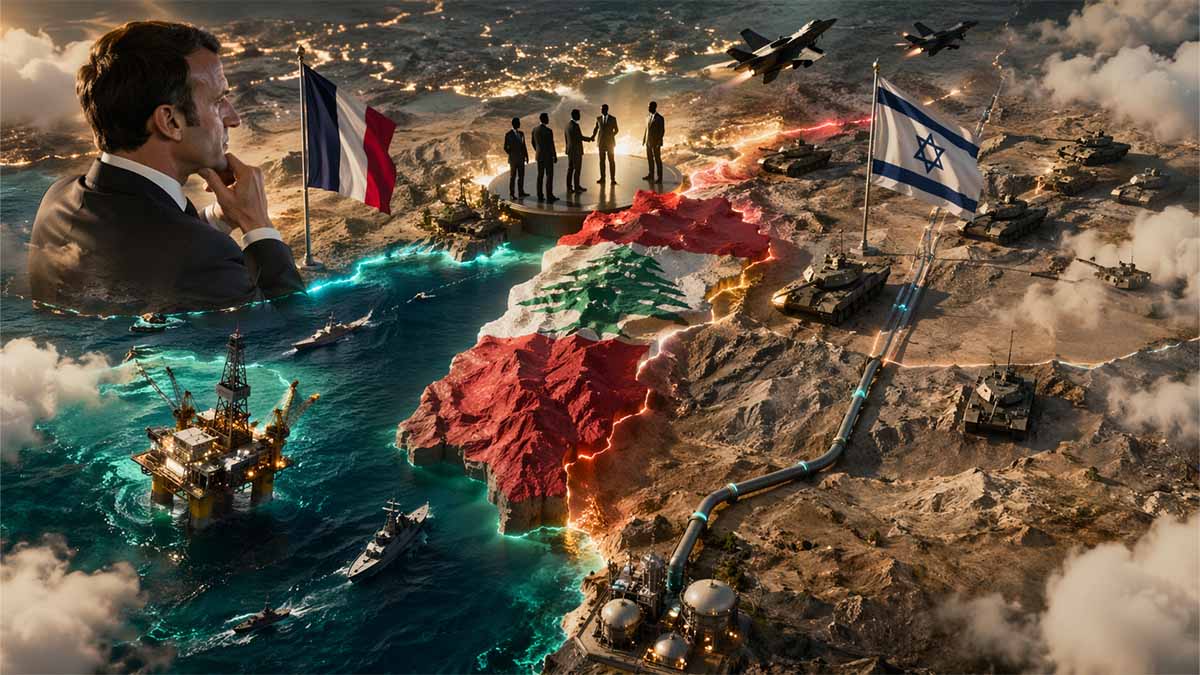
Abstract
This analysis is written on 19 April 2026, after Emmanuel Macron held separate calls on 18 April 2026 with Lebanese President Joseph Aoun and Prime Minister Nawaf Salam, and after he convened a French defense and national security council on the situation in Iran and the Middle East on 15 April 2026. The most defensible starting point is therefore not propaganda but positioning: France is trying to preserve its role as a necessary intermediary in the Lebanon-Israel file at the exact moment when the ceasefire architecture remains fragile, the Lebanese state is attempting to reassert authority, and regional escalation risks collapsing the narrow space in which Paris still matters.
The first analytical correction is to reject a crude reading that Macron is in Lebanon mainly to seize immediate hydrocarbon rents. The primary-source record does not support that as the leading explanation. What it does support is a more layered proposition: France’s real interest is brokerage power—the ability to sit inside the mechanisms that govern ceasefire enforcement, UNIFIL, Lebanese state reconstitution, donor coordination, and any future reconstruction-finance architecture. France explicitly states that it is part of the post-26 November 2024 ceasefire mechanism alongside the United States, and it has repeatedly tied its Lebanon policy to implementation of UN Security Council Resolution 1701, support for the Lebanese Armed Forces, and restoration of full Lebanese sovereignty. In practical geopolitical terms, that means Paris is fighting to retain a seat in the room where escalation is managed, violations are interpreted, force-posture is shaped, and post-conflict economic access is distributed.
The second correction is that France’s Lebanon policy is not reducible to sentimental post-mandate nostalgia, even though historical capital still matters. The current French line is structured around a familiar modern formula: reinforce formal state institutions, narrow the military autonomy of non-state actors, prevent the southern front from igniting a regional war, and convert diplomatic relevance into enduring strategic access. Macron’s January 2025 visit to Lebanon was explicit that France would help train 500 Lebanese soldiers through a new bilateral training center and continue advancing with European and Middle Eastern partners through the technical military committee. The operational implication is clear: Paris wants a stronger Lebanese state not only because instability is costly, but because a state-centered order displaces armed veto power from actors outside institutions and increases the leverage of external sponsors who work through governments, armies, financial reform packages, and multilateral monitoring.
That logic intersects directly with Hezbollah. Official French statements now combine two positions that are often presented as contradictory in lower-grade commentary but are, in fact, the core of Paris’s balancing strategy: France condemns Israeli strikes and violations of Lebanese sovereignty, while also stating that Hezbollah must end its operations and hand in its weapons. This is not moral inconsistency so much as strategic dual messaging. Paris is trying to preserve three channels at once: credibility with the Lebanese state, continued access to Israel, and relevance inside the Western-Arab crisis-management axis. The hard reality is that France gains leverage not by choosing one pole absolutely, but by remaining useful to several at the same time.
That leads to the user’s real question: what are Macron’s interests, stripped of rhetoric? The strongest evidence supports five mutually distinct but overlapping driver sets. Driver set one is diplomatic centrality: Paris wants to remain indispensable in the Levant after years in which US primacy, Gulf money, Israeli military initiative, and Iranian proxy networks compressed French influence. The ceasefire mechanism gives France a formalized re-entry point. Driver set two is security containment: renewed war on the Lebanon-Israel front threatens Mediterranean stability, risks further attacks on UNIFIL, complicates French deployments, and weakens a state architecture Paris is actively investing in. Driver set three is institutional influence through reconstruction and reform: a financially shattered Lebanon dependent on external support creates openings for those who can mediate between local elites and the IMF, World Bank, donors, and development financiers. The IMF reported constructive February 2026 discussions with the Lebanese authorities on bank restructuring and the medium-term fiscal framework, while the World Bank in January 2026 described a cautious recovery and approved large-scale financing for reconstruction and social protection. Driver set four is energy optionality, not proven resource capture: TotalEnergies lost immediate upside in Block 9, which was relinquished effective 1 March 2026, but the consortium was awarded Block 8 in October 2025, with TotalEnergies as operator. Driver set five is Franco-European strategic identity: by staying visible in Lebanon, Macron reinforces his broader claim that France is not merely a European power but a Mediterranean and Middle Eastern security actor with autonomous diplomatic utility.
On the energy issue specifically, the evidence points to a subtler conclusion than “France wants Lebanon’s gas.” Lebanon’s offshore file matters to France, but as an option on future influence rather than as a near-term rent stream. The official Lebanese petroleum authority states that Block 9 reverted to the Lebanese state effective 1 March 2026, while Block 8 was awarded to the TotalEnergies–Eni–QatarEnergy consortium, with TotalEnergies approved as operator. TotalEnergies itself reported both the award of Block 8 and the relinquishment of Block 9 in its 2025–2026 reporting. That means Paris is not entering this week’s diplomacy from a position of immediate extraction success. If anything, the primary record suggests the opposite: France’s material upside in Lebanon is presently contingent, not secured. The more realistic interpretation is that Paris wants to shape the political-security conditions under which future concessions, infrastructure decisions, maritime stability, and donor-led reconstruction become legible and governable. In other words, the strategic asset is not today’s gas flow; it is tomorrow’s gatekeeping power.
The financial state of Lebanon is central to this. The World Bank describes a fragile rebound contingent on reform persistence, reconstruction inflows, and political stability, with real GDP growth projected at 4% in 2026 if conditions hold. The World Bank also designed LEAP as a US$1 billion scalable framework project, with an initial US$250 million of financing to restore lifeline services and critical infrastructure in conflict-affected areas, and it separately approved US$350 million for social protection, economic empowerment, and digital transformation. The IMF reported constructive engagement on legislation underpinning bank restructuring and the fiscal framework in February 2026. These are not marginal details. They indicate that the next phase of Lebanese sovereignty will be mediated not only through security arrangements but through debt, banking reform, budgetary sequencing, reconstruction management, and external conditionality. Macron’s real interest lies precisely at that junction, where diplomatic sponsorship converts into influence over the institutional terms of recovery.
This is why the French discourse about “sovereignty” should be read materially, not romantically. When France supports the redeployment of the Lebanese Armed Forces in coordination with UNIFIL and the ceasefire mechanism, and when it endorses efforts to restore the state monopoly on arms, it is advocating a sovereign order that is also more penetrable by international finance, external training missions, bilateral aid, and multilateral supervision. That is not automatically illegitimate; it is simply how contemporary state-reconstruction politics works. A weaker militia sphere and a stronger cabinet-army-donor nexus reduce uncertainty for creditors, operators, development agencies, and diplomatic sponsors. In this sense, sovereignty restoration and external influence are not opposites. In post-crisis states, they often advance together.
The Lebanese side of the equation confirms that this is not just a French fantasy. Official Lebanese statements in 2025–2026 repeatedly stressed state monopoly over arms, the exclusivity of war-and-peace decisions in state hands, and the illegality of military and security activity outside state institutions. This matters analytically because it means Macron is not merely imposing a French template from outside; he is also trying to capitalize on a Lebanese governmental shift that creates a window for deeper external backing of state consolidation. His interest is therefore opportunistic in the literal sense: he sees an opening and wants France to be one of the powers that helps define its operational consequences.
The tougher question concerns France–Israel relations. Here the evidence does not support either of the two lazy extremes: neither “France is anti-Israel” nor “France’s criticism is fake because Paris is fully aligned with Israel.” The primary record shows a more durable and structurally ambivalent relationship. The French Foreign Ministry states that France has a “robust bilateral relationship” with Israel, marked by commitment to its existence and security, and says France is Israel’s fifth-largest cooperation partner in scientific and technological research. France’s Treasury reports that the French trade surplus with Israel reached €328 million in 2024, even as it declined from previous levels. At the same time, France has condemned major Israeli strikes on Lebanon, called for respect for Lebanese sovereignty, and criticized Israeli decisions in the West Bank.
The real Franco-Israeli relation, then, is best understood as structured divergence within durable interdependence. Paris does not want a complete breach with Israel because bilateral scientific, technological, diplomatic, and security ties are real and institutionally embedded. But Paris also does not want Israeli military dominance on the Lebanese front to eliminate the need for intermediaries or permanently subordinate the Lebanese file to unilateral Israeli action and US mediation alone. That would reduce French relevance to commentary. So Macron criticizes Israeli escalation not only on normative grounds, but because uncontrolled Israeli force narrows the space in which France can operate as broker, patron, and guarantor-adjacent actor.
That is why UNIFIL matters beyond peacekeeping symbolism. The French military remains deeply engaged in Operation Daman and in operational partnership with the Lebanese Armed Forces. Official French military reporting in 2025–2026 emphasizes combined patrols, training, and continued partnership activity. UNIFIL is therefore both a security instrument and a political technology: it sustains an internationally recognized framework in which French presence on the ground remains legitimate. Any attack on UNIFIL, or any erosion of its relevance, is accordingly a direct blow not just to stability but to one of the institutional containers of French influence. That helps explain why Macron reacts sharply when the mission is targeted or bypassed. The defense of UNIFIL is also the defense of a diplomatic architecture in which France still has weight.
There is, however, a necessary red-team correction. One could argue that Macron’s room for maneuver is smaller than French rhetoric implies. The United States still dominates coercive mediation with Israel; Gulf states retain critical financial leverage over Lebanese stabilization; and France’s own corporate exposure in Lebanon is significant but not transformative. On this reading, the upcoming encounter with Salam is less a sign of French mastery than a bid to prevent strategic downgrading. That counterinterpretation is strong. Yet it does not nullify the main thesis. Even if Paris is not the decisive power, it is plainly trying to remain an unavoidable secondary one.
A second red-team view would stress that France’s pressure on Hezbollah is not merely about state-building but about realigning the Lebanese order toward a Western- and Gulf-compatible equilibrium. Official French statements after the March 2026 attack on UNIFIL are unusually direct: Hezbollah must end its operations and hand in its weapons, while Israel must end massive strikes and respect Lebanese sovereignty. The symmetry of language obscures an asymmetry of objective. France can urge restraint on Israel, but it seeks structural transformation on the Lebanese side. The intended end-state is not just ceasefire compliance; it is a political-security order in which armed non-state veto power is progressively delegitimized and displaced by institutions more compatible with external state and market actors.
A third counterview would insist that economic motives are overstated, because the immediate offshore picture is weak and reconstruction financing will be multinational anyway. That is partly true. The primary-source evidence does not justify a claim that Macron is coming to harvest imminent Lebanese energy rents. But it would be equally mistaken to infer that economics is irrelevant. In fragile states, influence often attaches not to current profit but to preferential access, regulatory shaping, project sequencing, procurement visibility, and diplomatic sponsorship of future capital flows. The French development apparatus, including AFD, is still materially present in Lebanon, and AFD describes the country as a major crisis-response and public-services theater in its portfolio. The French objective is therefore better described as strategic economic optionality under conditions of uncertainty.
The clearest bottom line is this: Macron’s real interest is not charity and not a cartoon colonial plunder script either; it is controlled relevance. He wants France to remain embedded in the enforcement of the Israel–Lebanon ceasefire, the strengthening of the Lebanese Armed Forces, the rollback of armed autonomy outside the state, the supervision-adjacent ecosystem around reconstruction and reform, and the preservation of French political and commercial access should Lebanon’s offshore and infrastructural files become more consequential.
For that reason, the likely message Macron will carry into talks with Salam is not simply “respect the ceasefire.” It is more demanding: stabilize the southern front, reinforce the Lebanese state’s monopoly on force, keep France inside the mechanism, preserve UNIFIL, move the reform agenda far enough to unlock external backing, and prevent either Israel or Hezbollah from making the Lebanese state irrelevant again. That is the real geostrategic content behind the public language of sovereignty and support. The rhetoric is humanitarian; the underlying objective is positional. Supported by primary sources, the best reading is that Macron is seeking to convert a fragile truce into a durable French stake in the future architecture of Lebanon.
Index
Chapter I – Strategic Architecture & Power Configuration
- Analytical Frame and Research Question
- Ceasefire System: UNSCR 1701, UNIFIL, and Force Monopoly Dynamics
- Regional Escalation Matrix: Israel–Hezbollah–Lebanon Interaction Space
- Franco-Israeli Relationship: Structured Interdependence and Managed Divergence
Chapter II – Macron’s Strategic Interests & Political Economy
- Diplomatic Brokerage and Influence Retention
- Security Containment and Mediterranean Stability Imperatives
- Reconstruction, Financial Leverage, and Institutional Penetration (IMF–World Bank Axis)
- Energy and Infrastructure Optionality (TotalEnergies, Offshore Blocks)
- State Recomposition: Sovereignty vs External Leverage Mechanisms
Chapter III – Competing Hypotheses, Systemic Risks & Strategic Outcomes
- Five Competing Geopolitical Interpretations (ACH Framework)
- Network Power Dynamics: State, Non-State, and External Actors
- Conflict Political Economy and Defense-Financial Linkages
- Escalation Pathways and Collapse Scenarios
- Strategic Bottom Line: Objectives Behind the Macron–Salam Engagement
Chapter I – Strategic Architecture & Power Configuration
This chapter reconstructs the actual operating architecture of the Lebanon–Israel theatre as it stands on 19 April 2026. The purpose is not to repeat declaratory diplomacy, but to identify the institutions, coercive asymmetries, legal mechanisms, and leverage points that make France relevant at all. The key finding is straightforward: Macron’s interest in Lebanon is less about immediate extraction and more about controlling access to the architecture through which escalation is interpreted, state authority is rebuilt, and post-conflict external influence is distributed. That architecture is built on UNSCR 1701, UNIFIL, the post-26 November 2024 ceasefire mechanism, the contested re-expansion of the Lebanese Armed Forces, and the unresolved contradiction between formal Lebanese sovereignty and Hezbollah’s residual armed autonomy. Official French and UN material also shows that Paris is trying to keep itself inside that machinery at the same time that it criticizes Israeli strikes, defends UNIFIL, and supports a Lebanese state policy of restoring an exclusive state monopoly over weapons.
A first correction is necessary before going any further. The public-information record used here does not support the claim that a French peacekeeper was killed “yesterday” by Hezbollah. The official French statement of 16 March 2026 says that shots were fired several times at UNIFIL soldiers and explicitly attributes them to non-state armed groups, but it does not report a French fatality in that incident. That matters because a serious geopolitical analysis cannot be built on narrative escalation unsupported by the primary record. What the official record does support is that Paris sees attacks on UNIFIL as attacks on the mechanism through which France remains materially relevant in southern Lebanon.
The Actual Question: Why Does France Still Matter in Lebanon?
The immediate reason France still matters is not sentimental memory of the mandate period, and not because Paris can dominate events by itself. It matters because it is simultaneously embedded in four layers of the Lebanese file: first, the diplomatic layer, through direct presidential and ministerial engagement; second, the military layer, through its contingent in UNIFIL/Operation Daman; third, the institutional layer, through its support for the Lebanese Armed Forces and state restoration; and fourth, the external-financial layer, because Lebanese stabilization is now inseparable from donor management, multilateral lending, and reconstruction sequencing. The Élysée agenda shows Macron held calls with Joseph Aoun and Nawaf Salam on 8 April 2026 and again separately on 18 April 2026, while also convening a Conseil de défense et de sécurité nationale on the Iran/Middle East file on 8 April and 15 April 2026. This is not ceremonial traffic. It indicates that Lebanon is being handled inside a wider regional escalation frame linking Iran, Gulf actors, the United States, and the eastern Mediterranean.
What gives this French engagement strategic weight is that France is not merely talking about Lebanon from the outside. The French foreign ministry states that, within the ceasefire monitoring mechanism and alongside the United States, France “will continue to take on all the missions set out in the agreement of 26 November 2024.” The same statement notes that Paris proposed that UNIFIL, including the French contingent, could be deployed at five positions close to the Blue Line to replace the Israel Defense Forces, and welcomed the redeployment of the Lebanese Armed Forces in coordination with UNIFIL and the monitoring mechanism. This is the central empirical fact behind Macron’s interest: France wants to be not just a commentator on de-escalation, but an operator inside the enforcement-adjacent machinery of de-escalation.
That is why the real question is not whether Macron “cares” about Lebanon. The real question is what form of influence he is trying to preserve. The strongest answer the official record supports is: brokerage power. Paris wants to remain in the room where violations are classified, troop posture is adjusted, sovereign authority is “restored,” and donor-recipient conditionality becomes politically actionable. In contemporary crisis theaters, that is often more valuable than direct territorial control. It allows a state like France to convert limited coercive power into persistent relevance. That is also why the language of sovereignty in the French record should be read materially, not romantically. Sovereignty restoration in fragile states usually means deeper interaction with international monitors, trainers, lenders, and bilateral sponsors, not insulation from them.
The Legal Skeleton: What 1701 Actually Did and Why It Still Governs the File
The formal architecture still rests on UN Security Council Resolution 1701, adopted on 11 August 2006 after the 2006 Lebanon war. The resolution called for a full cessation of hostilities, an immediate cessation by Hezbollah of all attacks, and an immediate cessation by Israel of all offensive military operations. It further called for the Government of Lebanon and UNIFIL to deploy throughout the south as Israeli forces withdrew; emphasized extension of Lebanese government control over all Lebanese territory so there would be no weapons without the consent of the Government of Lebanon and no authority other than that of the Government of Lebanon; supported full respect for the Blue Line; and authorized UNIFIL to increase to a maximum of 15,000 troops. The same resolution envisaged the area between the Blue Line and the Litani River as free of unauthorized armed personnel, assets, and weapons except those of the Lebanese state and UNIFIL.
This matters because the system’s logic was always dual. 1701 was not just a ceasefire text; it was a sovereignty-engineering text. It sought to transform the south from a militia-shaped battlespace into a layered zone of Lebanese state authority + UN buffering + Israeli deterrence from outside the line. That architecture never fully stabilized because its implementation was uneven from the start. On one side, the official UN record continued to describe Israeli presence in contested areas north of the Blue Line as a violation; on the other, the UN and many member states continued to treat the persistence of armed non-state capabilities outside state control as incompatible with full implementation. In March 2026, the Secretary-General’s reporting still stated that the Israel Defense Forces continued to occupy northern Ghajar and the adjacent area north of the Blue Line in violation of 1701.
So the relevant strategic point is not that 1701 “failed” in some total sense. It is that 1701 created a durable frame without producing durable monopoly. It froze an argument about sovereignty instead of resolving it. It gave the Lebanese state international legal backing for authority over the south, but it did not furnish the state with enough coercive, financial, or political capacity to close the gap with armed realities on the ground. That gap is precisely where external powers insert themselves. The United States does so through hard security leverage with Israel; Iran through armed-network support; Gulf states through conditional financial backing; and France through diplomatic-military-institutional embedding.
Table 1. Core Security Architecture of the Southern Lebanon File
| Element | Documented Function | What It Means Strategically | Primary Source |
|---|---|---|---|
| UNSCR 1701 (11 Aug 2006) | Cessation of hostilities; deployment of LAF and UNIFIL in the south; no weapons without state consent; support for Lebanese sovereignty; UNIFIL ceiling up to 15,000 troops | Provides the legal frame through which every later diplomatic actor claims legitimacy | |
| Blue Line / Litani concept | Security arrangement intended to prevent resumption of hostilities in the zone south of the Litani | Creates the territorial grammar through which violations are judged and leverage is exercised | |
| UNIFIL | International buffer/monitoring force; supports LAF deployment; preserves stability; protects freedom of movement under mandate | Keeps an internationalized governance layer in the conflict theatre; this is a direct source of French influence | |
| 26 Nov 2024 ceasefire mechanism | Monitoring and implementation framework in which France participates alongside the United States | Gives Paris an institutional seat in escalation management, not just rhetorical involvement | |
| Lebanese government monopoly-of-arms policy | Official move to restore exclusive state control over weapons and ban non-state military/security activity | Aligns Lebanese state doctrine with the core sovereignty logic of 1701 and opens room for deeper external sponsorship of state institutions |
UNIFIL Is Not a Symbol; It Is a Strategic Device
Most superficial commentary treats UNIFIL as a peacekeeping relic. That is analytically weak. UNIFIL is better understood as a political-military device that serves four functions at once. First, it internationalizes the southern front and raises the reputational and diplomatic cost of unrestricted action. Second, it creates an official interface between external troop contributors and the Lebanese Armed Forces. Third, it preserves a legal language of stabilization even when coercive realities are deteriorating. Fourth, it gives contributing states—especially France—a standing claim to relevance. The UNIFIL mission site in early 2026 emphasized its continuing role in preserving stability and implementing Resolution 1701, highlighted intensified patrol activity along the Blue Line, and reported a new 2026 operational framework in which the Lebanese Armed Forces Navy would assume greater responsibility for maritime security. Its FAQ material also states that the mission has about 800 civilian staff.
That last point is more important than it looks. A mission that is adapting its operational framework to give more responsibility to the LAF Navy is not simply standing still; it is participating in the gradual transfer of selected security functions back toward Lebanese institutions under international oversight. That is exactly the kind of transition France wants to sponsor, because it allows Paris to argue simultaneously for sovereignty, for UNIFIL’s necessity, and for the strengthening of Lebanese institutions that are accessible to bilateral military cooperation. Put differently, France’s ideal outcome is not a south run forever by blue helmets; it is a south where Lebanese state authority expands under an architecture that France helped design and still helps manage.
The French military side of that architecture is Operation Daman, the national name for France’s participation in UNIFIL. The French Ministry of the Armed Forces states that France deploys around 700 soldiers in Lebanon under Daman. This is not a huge force in great-power terms, but its strategic value is disproportionate to its size because it anchors France’s claim to be more than a diplomatic spectator. Troop presence means access to field reporting, visibility with the LAF, immediate stakes in force protection, and a standing voice in any debate over UNIFIL’s future mandate or posture. As long as France remains a visible troop contributor, it remains harder to cut Paris out of crisis diplomacy over southern Lebanon.
That is also why Paris reacted sharply to the 15 March 2026 attack on UNIFIL personnel. The official French statement condemned the shots fired “several times” at UNIFIL soldiers, called such attacks by non-state armed groups unacceptable, and insisted that UNIFIL must be able to carry out its mandate fully and exercise freedom of movement in accordance with international law and Resolution 1701. This wording is not generic. It indicates that what France believes is under attack is not simply a patrol or convoy, but the broader legitimacy of the mission’s operational freedom. Any erosion of that freedom weakens the international envelope in which France is still a player.
The Lebanese State Is Trying to Reconstitute Itself—But Under Extreme Constraint
A serious power analysis of Lebanon has to start from the fact that the state is trying to recover coercive authority after years of financial collapse, war spillover, and institutional weakness. The official Lebanese record during 2025–2026 shows repeated movement toward a doctrine of exclusive state control over weapons. The Council of Ministers decision reported on 2 March 2026 stated that the government moved toward immediate prohibition of Hezbollah’s military and security activities and limiting the organization’s action to the political sphere within constitutional and legal frameworks, explicitly to entrench the exclusivity of weapons in the hands of the state and reinforce sovereignty across Lebanese territory. In another official Lebanese statement, Nawaf Salam referred back to the 5 August 2025 government decision declaring its intent to confine weapons to the state alone and tasking the army accordingly. A UN Security Council meeting in March 2026 likewise recorded that in August 2025 the Lebanese government tasked the Lebanese Armed Forces with developing a plan to establish exclusive state control over weapons.
That is the most important institutional development in the Lebanese file and also the most misunderstood. It does not mean the state has already succeeded in monopolizing coercion. It means the state has moved from ambiguity toward doctrinal consolidation. In strategic terms, that creates a new operating environment for outside powers. Once the Lebanese government itself formally declares that weapons must be under state control, external actors no longer need to frame their support for military institutionalization as an imposition from outside. They can present it as backing a sovereign Lebanese decision. That is politically useful for France, because it lets Paris push a state-centric security order while claiming to act in support of Lebanese, not purely foreign, preferences.
But this project faces an obvious material constraint: the Lebanese state remains economically broken. The IMF stated on 13 February 2026 that Lebanese authorities were preparing a medium-term fiscal framework to support bank restructuring, underpin a sovereign debt restructuring, restore debt sustainability, and rebuild institutional capacity. The World Bank stated on 22 January 2026 that real GDP growth for 2025 had been revised to 3.5% from an earlier 4.7% estimate, and that the outlook remained highly sensitive to reform momentum and security conditions; in the January 2026 Global Economic Prospects, the World Bank projected 4% growth in 2026 for Lebanon on the assumption of reform progress. Meanwhile, World Bank reconstruction material described US$6.8 billion in damages and US$7.2 billion in economic losses resulting from the recent conflict affecting Lebanon, while the Bank’s project documentation noted that monetary poverty had risen from 11% in 2012 to 33% in 2022, with another 32% vulnerable to falling into poverty.
The implication is severe. A state that wants to restore monopoly of force but depends on external financing for debt restructuring, reconstruction, and basic public-service recovery is not moving toward fully autonomous sovereignty. It is moving toward externally mediated sovereignty. That does not make the sovereignty claim fake. It means the pathway to restoring it is being financed, monitored, and partly structured from outside. This is exactly why France, the World Bank, the IMF, Gulf actors, and the United States all matter at once. The coercive question and the financial question have fused. Whoever helps rebuild the state also shapes the political terms on which that state becomes functional again.
Table 2. Lebanese State Recomposition: Formal Policy vs Structural Constraint
| Variable | What the official record shows | Why it matters geostrategically | Primary Source |
|---|---|---|---|
| Monopoly of arms doctrine | Lebanese government statements in 2025–2026 emphasize exclusive state control over weapons; 2 Mar 2026 reporting states immediate prohibition of Hezbollah military/security activities and restriction to politics under legal frameworks | Converts a long-running external demand into official state policy, increasing legitimacy for external support to army/state institutions | |
| Army tasked with weapons-control planning | UN Security Council meeting in Mar 2026 records that in Aug 2025 the government tasked the LAF with developing a plan for exclusive state control over weapons | Moves the issue from abstract doctrine to security planning | |
| Bank/debt restructuring agenda | IMF says authorities are preparing a medium-term fiscal framework to support bank restructuring and sovereign debt restructuring | State consolidation is inseparable from macro-financial restructuring | |
| Reconstruction need | World Bank frames LEAP as a US$1 billion scalable reconstruction framework with initial US$250 million financing | Recovery will be governed through external funding pipelines that carry political influence | |
| Social/economic fragility | World Bank material reports conflict-related damages of US$6.8bn, losses of US$7.2bn, poverty tripling from 11% to 33% between 2012–2022 | Weak state capacity is not only military; it is also fiscal, infrastructural, and social |
France’s Security Interest Is State Expansion, Not Neutral Balance
Official French wording is often presented as a balanced appeal to all sides. That is only half true. Paris does criticize Israeli action. On 9 April 2026, France condemned Israeli “massive strikes” carried out on 8 April on Lebanon, including districts of Beirut, and reaffirmed commitment to Lebanese sovereignty and territorial integrity. But the same French record also supports a deeper agenda: Paris wants a restructured Lebanese security order in which the state expands and armed non-state autonomy contracts. That objective appears in France’s endorsement of the Lebanese plan to restore the state monopoly over arms, in its support for UNIFIL, in its backing for LAF redeployment, and in Macron’s own January 2025 commitment that France, through a new training center, would train 500 Lebanese soldiers and continue advancing with European and Middle Eastern partners in the technical military committee.
This is where the strategic reading has to get sharper. France is not trying to be neutral between the Lebanese state and every armed actor within Lebanon. It is trying to preserve enough balance externally to keep access to all relevant capitals, while internally favoring an outcome in which the recognized Lebanese state becomes the only legitimate security interlocutor. That is a structural interest, not a moral flourish. A security order dominated by formal institutions is easier for France to train, fund, monitor, influence, and align with international mechanisms. A security order dominated by autonomous armed networks is more opaque, more violent, and less penetrable to the tools in which Paris specializes.
This also explains why Macron’s language of sovereignty is not anti-intervention in the usual sense. In the French approach, restoring sovereignty means empowering those Lebanese institutions that can be linked to UN mechanisms, bilateral military assistance, and donor conditionality. That is why a French-sponsored sovereignty agenda can at once be real and externally shaped. A stronger LAF, closer coordination with UNIFIL, and tighter fiscal supervision under multilateral engagement all increase the state’s formal authority—but they also increase the density of external relationships through which France can exercise influence. The result is a paradox only if one assumes sovereignty and external entanglement are opposites. In weak states they are often co-produced.
The Franco-Israeli Relationship: Durable Interdependence, Not Full Alignment
The official French record on Israel is structurally ambivalent, not contradictory. The French foreign ministry’s country page, updated 27 March 2026, says that France has established a “robust bilateral relationship” with Israel, marked by constant commitment to its existence and security. It also notes sustained political dialogue and “considerable cultural, scientific, economic and tourism cooperation.” In the same official material, France presents its policy as an effort to strike a balance between support for Israel’s right to exist and live in security, and condemnation of settlement policies contrary to international law. This is not empty prose. It accurately describes the architecture of the relationship: durable bilateral density combined with regular policy divergence.
The economic layer confirms the same pattern. The French Treasury states that the French trade surplus with Israel reached €328 million in 2024, although down 17.5% from 2023, and that bilateral trade volume fell 7.3% to US$3.1 billion in 2024 because the regional war environment affected demand, investment, and logistics. So the Franco-Israeli relationship is plainly not fictive or purely rhetorical; it has measurable commercial depth. At the same time, it is not so large as to explain all French policy by itself. In other words, the bilateral relationship is significant enough that Paris does not want rupture, but not so dominant that it erases other French interests in Lebanon, the Mediterranean, or the wider Arab world.
This is the strategic core of the Franco-Israeli equation: France wants continued access to Israel without accepting a regional order in which only Israel and the United States determine the Lebanese file. That is why Paris can condemn Israeli strikes on Lebanon and still maintain an official line that the bilateral relationship with Israel is robust. Criticism, in this framework, is not evidence of breakage. It is an effort to defend French room for maneuver. If Israeli military initiative and American hard-security diplomacy were allowed to absorb the entire southern Lebanon problem, France would be reduced from stakeholder to spectator. The French response, therefore, is to defend UNIFIL, the ceasefire mechanism, and Lebanese sovereignty precisely because those are the instruments through which Paris remains in the equation.
Table 3. Franco-Israeli Relations: What the Official Record Supports
| Dimension | Documented fact | Strategic reading |
|---|---|---|
| Political baseline | France says it has a “robust bilateral relationship” with Israel, marked by commitment to its existence and security | Paris is not pursuing rupture; it is managing divergence inside an enduring relationship |
| Policy duality | France says it balances support for Israel’s security with condemnation of settlement policy and defense of a political settlement | Official doctrine is structured ambivalence, not pure alignment |
| Commercial exposure | French trade surplus with Israel was €328m in 2024; bilateral trade fell 7.3% to US$3.1bn | Economic ties are real, but not sufficient by themselves to explain French regional policy |
| Lebanon divergence | France condemned Israeli strikes on Lebanon on 9 Apr 2026 and reaffirmed Lebanese sovereignty | Paris resists a purely unilateral Israeli management of the Lebanese front |
Why the Post-2024 Ceasefire Mechanism Matters More Than Most Commentary Realizes
The biggest shift in the current architecture is not a speech; it is the emergence of the post-26 November 2024 ceasefire mechanism as a site of embedded power. The French foreign ministry’s 18 February 2025 statement is explicit: within the Mechanism, alongside the United States, France will continue to take on all the missions set out in the agreement of 26 November 2024. That means France is no longer only invoking 1701 as a general legal frame; it is operating inside a contemporary monitoring arrangement tied to troop redeployment, the Blue Line, and the practical management of southern Lebanon. For Paris, this is strategic oxygen. It converts old historical presence and UNIFIL participation into renewed relevance in a live ceasefire architecture.
This is also the mechanism through which France tries to prevent exclusion by stronger actors. The United States remains the indispensable external power in relation to Israel. Israel retains escalation dominance. Iran retains leverage through networks and deterrent signaling. Gulf actors retain financial influence over recovery. France cannot outmatch any of these poles by itself. But by embedding itself in the ceasefire mechanism and in UNIFIL, it can make itself institutionally costly to ignore. That is the right scale on which to read Macron’s Lebanese activism: not as imperial command, but as the politics of institutional indispensability.
Bottom Line of Chapter I
The strategic architecture of the Lebanon file is not a morality play and not a resource raid in the crude sense. It is a layered system in which law, force, state weakness, international monitoring, and external financing interact continuously. The pillars are visible in the primary record: UNSCR 1701 remains the legal skeleton; UNIFIL remains the international buffer; the post-26 November 2024 mechanism gives France and the United States a direct monitoring role; the Lebanese government has shifted formally toward an exclusive state monopoly over weapons; and the country’s economic collapse ensures that state restoration will proceed through dense external mediation rather than sovereign self-sufficiency.
So the hard conclusion is this: Macron’s real interest in Lebanon is to preserve France as a necessary intermediary in the conversion of fragile ceasefire into structured order. That means defending UNIFIL, backing LAF expansion, supporting the Lebanese doctrine of exclusive state arms control, criticizing Israeli actions that would destroy the multilateral envelope, and keeping Paris inside the mechanism through which escalation, reconstruction, and sovereignty restoration will be negotiated. France is not in a position to dominate Lebanon. It is in a position to make itself difficult to bypass. That is the real architecture of French power in this theatre.
POWER CONFIGURATION: LEBANON THEATRE
Conflict Damages & Losses
Economic Stability Outlook (GDP %)
Sectoral Vulnerability (Risk Stack)
French-Israeli Trade Balance
| Structural Variable | Documented Data / Policy | Geostrategic Implication | Source Protocol |
|---|---|---|---|
| SECURITY UNSCR 1701 | 15,000 Troop Ceiling / Litani Zone Control | Legal frame for LAF expansion & buffering | UN Security Council |
| COERCION Monopoly of Arms | March 2, 2026: Official Hezbollah Military Ban | Shift from ambiguity to doctrinal state control | Lebanese Govt Record |
| FINANCE Bank Restructuring | IMF Medium-Term Fiscal Framework (Feb 2026) | Debt sustainability via external mediation | IMF Statement |
| DIPLOMACY 26 Nov Mechanism | FR-US Joint Monitoring of Ceasefire | Institutional seat for France in escalation mgmt | French Foreign Ministry |
| ECONOMIC LEAP Framework | $1 Billion Scalable Reconstruction Fund | Power conversion through donor-dependency | World Bank 2026 |
| BILATERAL FR-ISR Trade | $3.1B Volume; €328M FR Surplus (2024) | Commercial depth limits diplomatic rupture | French Treasury |
Chapter II – Macron’s Strategic Interests & Political Economy
If Chapter I established the architecture of the Lebanon file, Chapter II has to answer the more uncomfortable question: what does Macron actually want out of this architecture? The most defensible answer from the primary record is not that France is pursuing a single hidden objective, but that it is pursuing a bundle of linked strategic interests: retention of diplomatic brokerage, preservation of Mediterranean stability on terms compatible with French influence, insertion into the reconstruction-and-reform nexus that will shape the future Lebanese state, maintenance of energy and infrastructure optionality through French corporate and development instruments, and a form of sovereignty politics that strengthens the Lebanese state while also deepening external pathways of penetration into that state. The official French, IMF, World Bank, AFD, and Lebanese petroleum record all point in the same direction: Paris is trying to convert crisis-management relevance into durable positional power.
That is the right scale of interpretation because France does not currently possess the means to dominate outcomes in Lebanon. The United States retains decisive weight in relation to Israel; Gulf actors remain essential to any meaningful financing horizon; and the internal Lebanese order still contains multiple veto players. What France can do, however, is make itself difficult to bypass by embedding itself across institutions. The French foreign ministry states that France, “within the Mechanism, alongside the United States,” will continue carrying out the missions set out in the 26 November 2024 ceasefire agreement, while separately affirming support for the Lebanese Armed Forces, UNIFIL, and the Lebanese government’s plan to restore a state monopoly on weapons. Those are not isolated gestures. They describe a strategy of dense insertion into the interfaces that govern force, legitimacy, recovery, and international supervision.
Diplomatic Brokerage and Influence Retention
The first and most immediate French interest is diplomatic brokerage. This is the least glamorous motive, but also the most important, because the rest depends on it. A power that loses its brokerage position loses visibility over escalatory thresholds, over reconstruction sequencing, and over who gets treated as the legitimate representative of “the international community” in a crisis theatre. The primary French record shows that Macron has been actively maintaining a direct presidential channel into the Lebanese executive while handling the Lebanese file within a wider Middle Eastern escalation frame. The Élysée agenda records calls with Joseph Aoun and Nawaf Salam on 18 April 2026, and separate defense and national security council meetings on the Iran/Middle East file earlier in April 2026. This is important because it shows the Lebanese file being processed not as an isolated humanitarian problem, but as a node inside a larger regional-security system.
The strategic function of that brokerage becomes clearer when read against France’s formal role in the ceasefire mechanism. The Quai d’Orsay states that France, alongside the United States, remains inside the 26 November 2024 agreement’s mechanism and supports redeployment of the Lebanese Armed Forces to positions vacated by Israeli forces, in close coordination with UNIFIL and the monitoring mechanism. It also publicly proposed that UNIFIL, including the French contingent, could deploy to five positions close to the Blue Line to replace the Israel Defense Forces. This is not rhetorical decoration. It means France is trying to hold a place at the exact junction where tactical military dispositions become political arrangements. That is brokerage in its operational form: not deciding everything, but being present at the conversion point between violence and governance.
This matters because France’s broader Middle East standing has been under structural pressure for years. Macron therefore has an institutional incentive to preserve any theatre where France can still act as a recognized intermediary rather than a marginal European spectator. Lebanon is one of the last places where Paris still combines historical legitimacy claims, military presence, elite political access, development-finance instruments, and an internationally recognized role under a UN umbrella. The January 2025 Élysée visit to Lebanon made this explicit: Macron said France would, bilaterally and through a new training center, train 500 Lebanese soldiers, while continuing forward with European and Middle Eastern partners through the technical military committee. This is a textbook example of influence retention through institutional thickening.
The crucial analytical point is that brokerage power is itself a material asset. It yields intelligence access, reputational centrality, leverage with donors, and influence over the sequencing of reforms and deployments. It also allows France to mediate asymmetrically: to speak to Israel as a long-standing partner while speaking to Beirut as a sponsor of state institutions and to international financial actors as a political underwriter of stabilization. That multi-positional access is precisely what Paris is protecting. So when Macron meets Salam, the real objective is not simply symbolic support. It is to ensure that no future Lebanese settlement, redeployment, or reconstruction architecture can be built while treating France as disposable.
Security Containment and Mediterranean Stability Imperatives
The second driver is security containment. This is often presented in generic language—“regional stability,” “avoid escalation,” “support sovereignty”—but the primary record allows a sharper reading. France’s interest is not merely that war is bad. It is that renewed large-scale war on the Lebanon–Israel front would degrade multiple French equities at once: the viability of UNIFIL, the safety and political utility of the French contingent, the feasibility of expanding Lebanese Armed Forces control in the south, the credibility of France’s mediation claims, and the wider Mediterranean security environment in which Paris wants to remain a significant actor. The French ministry of the armed forces states that around 700 French soldiers are deployed in Lebanon under Operation Daman, France’s contribution to UNIFIL. That means every rise in southern volatility is also a direct French force-protection problem.
This is why Paris reacts so sharply to attacks on UNIFIL. After the 15 March 2026 incident, France condemned the shots fired at peacekeepers and insisted that UNIFIL must be able to carry out its mandate fully and exercise freedom of movement. On the surface that sounds like routine diplomatic messaging. Strategically, it means France is defending the operating environment of the very instrument that keeps the southern front internationally managed. If UNIFIL becomes irrelevant, blocked, or politically discredited, then the southern theatre becomes more purely a contest between Israeli force, Lebanese state weakness, and non-state coercion. In that environment, France’s relevance collapses much faster than that of Israel, Iran, or the United States. So “protecting UNIFIL” is also protecting one of the last institutional containers of French power in the Levant.
The Mediterranean dimension is equally important. Macron has spent years trying to position France as a Mediterranean power with autonomous strategic utility, not merely an adjunct to broader Atlantic frameworks. That ambition becomes less credible if the eastern Mediterranean repeatedly convulses without meaningful French influence. The Lebanese front intersects with maritime security, migration pressures, humanitarian flows, energy routes, and wider confrontation patterns involving Iran and Israel. The Élysée’s treatment of the Lebanese file within a broader Iran/Middle East defense-council frame shows that Paris itself sees the issue systemically, not locally. The French interest, therefore, is not just cessation of fire. It is prevention of a security environment in which Mediterranean crises are handled by others while France is reduced to secondary commentary.
This is where Macron’s criticism of Israeli strikes should be interpreted carefully. It would be simplistic to say France condemns Israeli escalation only because it cares about Lebanese civilians, and equally simplistic to say the criticism is fake because bilateral ties with Israel remain robust. The more accurate reading is strategic: France criticizes Israeli actions when they threaten to destroy the multilateral envelope—UNIFIL, the ceasefire mechanism, the legitimacy of LAF redeployment—through which Paris remains a player. The official French statement of 9 April 2026 condemned Israeli “massive strikes” on Lebanon, including districts of Beirut, and reaffirmed support for Lebanese sovereignty and territorial integrity. That criticism serves both normative and positional ends. It defends Lebanese sovereignty, but it also defends a system in which sovereignty restoration still requires intermediaries, including France.
Table 1. Macron’s Security-Containment Interest: What the Official Record Supports
| Variable | Officially documented fact | Strategic meaning |
|---|---|---|
| French troop presence | France deploys around 700 soldiers in Lebanon under Operation Daman. | Southern instability is not abstract for Paris; it directly affects French forces and prestige. |
| Ceasefire mechanism role | France says it continues missions under the 26 Nov 2024 mechanism alongside the United States. | Paris seeks influence through embedded crisis management, not just statement politics. |
| UNIFIL defense | France publicly defends UNIFIL’s freedom of movement and mandate after attacks. | Protecting UNIFIL is protecting an institutional platform of French leverage. |
| LAF expansion | France welcomes LAF redeployment and backs Lebanese institutional control in the south. | Paris prefers a state-centered security order over hybrid militia autonomy. |
| Regional framing | The Élysée handled the file within broader Iran/Middle East security meetings in April 2026. | Paris views Lebanon as part of an interconnected escalation system, not a standalone file. |
Reconstruction, Financial Leverage, and Institutional Penetration: The IMF–World Bank Axis
The third French interest is the most underestimated: influence over the reconstruction-and-reform nexus. Once a country’s sovereign recovery depends on debt restructuring, banking-sector legislation, public-investment sequencing, and externally financed reconstruction, the dividing line between diplomacy and political economy collapses. That is exactly what has happened in Lebanon. The IMF stated on 13 February 2026 that it had constructive discussions with Lebanese authorities on legislation underpinning their bank restructuring strategy and the emerging medium-term fiscal framework. The Fund added that the authorities were preparing a fiscal framework needed to support bank restructuring, underpin a sovereign debt restructuring, expand social and capital spending, and rebuild institutional capacity. That sentence alone tells you where a major part of future Lebanese sovereignty will be decided: not only in the south, but in legislation governing banks, public finance, and debt sustainability.
The World Bank is operating on the same terrain. On 22 January 2026, it described Lebanon as being in a fragile recovery, with real GDP growth projected at 4% in 2026 provided reform persists, reconstruction inflows materialize, and political stability is maintained. Five days later, on 27 January 2026, the Bank approved US$350 million in new financing for social protection, economic empowerment, and digital transformation. And in a 17 February 2026 factsheet, it described the Lebanon Emergency Assistance Project (LEAP) as a US$1 billion scalable framework, with initial US$250 million in financing and a remaining US$750 million gap. The same material says LEAP is implemented by the Council for Development and Reconstruction under the strategic guidance of the Prime Minister’s Office and in coordination with line ministries. This is not generic aid. It is a reconstruction architecture that binds executive authority, infrastructure priorities, and international financing in a single governance chain.
Why does this matter for Macron? Because a state that helps sponsor political order before external money moves can shape the channels through which that money later flows. France is not the IMF and not the World Bank, but it does not need to be. It only needs to be positioned close enough to the Lebanese executive and donor ecosystem to influence framing, sequencing, and sponsorship. The French foreign ministry’s 6 September 2025 statement made that intention unusually plain: France stands ready to organize two conferences in support of the Lebanese armed forces and of recovery and reconstruction when conditions allow. That is a direct indication that Paris sees the Lebanese military track and the reconstruction track as linked instruments of influence. In other words, Macron wants France not merely to bless Lebanese recovery, but to help convene and structure the external coalitions that finance it.
This is what “institutional penetration” means in a serious, non-cartoonish sense. It does not require conspiratorial control. It requires repeated insertion at the points where the state depends on outside expertise, outside liquidity, outside project preparation, and outside diplomatic certification. The World Bank reconstruction framework shows exactly such a point of entry: critical infrastructure and buildings essential to economic activity and community health and safety sustained US$1.1 billion in damages across transport, water, energy, municipal services, education, and health sectors. That means the future Lebanese state will be partly rebuilt through infrastructure triage. States and institutions able to influence that triage gain long-term leverage over ministries, procurement calendars, technical standards, and public expectations.
The deeper point is that France’s political interest and the IMF–World Bank agenda are structurally compatible even when not perfectly coordinated. Paris wants a stronger state interlocutor, more credible fiscal governance, expanded LAF role, and a reduced zone of autonomous armed and economic disorder. The IMF wants bank restructuring, debt sustainability, and a medium-term fiscal framework. The World Bank wants public-service restoration, digitalized delivery systems, and reconstruction mechanisms tied to the prime ministerial center of government. These are different mandates, but they reinforce the same broad direction: a Lebanese order governed more through formal institutions and external interfaces, and less through opaque fragmentation. That is the environment in which France has the most room to operate.
Table 2. Reconstruction and Financial Leverage
| Institution / Instrument | Officially documented measure | Political-economic implication for France |
|---|---|---|
| IMF | Lebanese authorities are preparing a medium-term fiscal framework to support bank restructuring, sovereign debt restructuring, social/capital spending, and institutional rebuilding. | Future sovereignty will be negotiated partly through fiscal and banking legislation; states close to the executive gain influence. |
| World Bank macro outlook | Real GDP growth projected at 4% in 2026 if reforms persist and reconstruction inflows materialize. | Recovery remains conditional and externally mediated, increasing the value of donor-side brokerage. |
| World Bank financing package | US$350 million approved in Jan 2026 for social protection, economic empowerment, and digital transformation. | Public-service delivery and social stability become tied to externally financed institutional modernization. |
| LEAP framework | US$1 billion scalable framework, US$250 million initial financing, US$750 million gap; implemented under PM’s Office guidance. | Reconstruction creates a centralizing executive-finance node where diplomatic sponsors can exercise influence. |
| French position | France says it is ready to organize conferences supporting LAF and recovery/reconstruction. | Paris wants to be a convening power at the intersection of security and finance. |
4. Energy and Infrastructure Optionality: TotalEnergies, Offshore Blocks, and the Logic of Waiting Power
The fourth French interest is energy and infrastructure optionality. This needs to be handled carefully, because the evidence does not support a melodramatic claim that Macron is in Lebanon to cash in immediately on a gas bonanza. In fact, the official petroleum record is mixed. The Lebanese Petroleum Administration states that Block 9 was fully relinquished and reverted to the Lebanese state effective 1 March 2026, becoming available for future licensing rounds. It also states that the Council of Ministers, by Decision No. 12 dated 23 October 2025, granted Block 8 to a consortium composed of TotalEnergies, Eni, and QatarEnergy, and approved TotalEnergies as operator. TotalEnergies itself reported in its 11 February 2026 results that Lebanon had awarded the offshore exploration license for Block 8. Its 2025 Universal Registration Document, published 27 March 2026, also records that TotalEnergies relinquished Block 9 in March 2026.
That combination of facts changes the whole interpretation. France does have a foothold in the Lebanese offshore file, but it does not yet have proof of a commercially transformational Lebanese hydrocarbon play under French control. The Block 9 story is especially revealing. The LPA’s own account of the Qana 31/1 exploration work in 2023 said the well confirmed reservoirs and gas traces of geological significance, but there was no hydrocarbons discovery as a result of the drilling of this well. The official Lebanese line was that the data still generated “new hope” and positive information for future exploration. That is not nothing, but it is not a rent stream. It means that the French corporate stake in the Lebanese offshore is best understood as optionality under uncertainty, not extraction certainty.
This matters because it pushes the analysis away from vulgar resource determinism and toward the more accurate concept of waiting power. A state and a national champion do not need immediate returns to have a strategic interest in preserving a file. They need the chance to remain operator, preferred partner, and politically protected stakeholder if the file becomes profitable later. Block 8 gives TotalEnergies and, by extension, France, exactly that kind of foothold. Block 9’s relinquishment shows that the current position is weaker than many assume; Block 8’s award shows that it has not disappeared. So the French interest is not “Lebanese gas today.” It is keeping France inside the future map of Lebanese energy and infrastructure decisions if commercial value matures tomorrow.
The infrastructure side is just as important as the offshore side. Recovery in Lebanon is not only about gas. It is also about water, health, municipal services, energy distribution, and the public-service grid on which political legitimacy depends. This is where AFD becomes strategically meaningful. AFD Group and Lebanon, published 30 October 2025, states that AFD supports Lebanon in addressing vulnerable populations’ needs, ensuring sound management of natural resources, and preserving social cohesion in line with public policy priorities. Separate AFD material says its SEPAL water project improved access to more reliable drinking water for more than 1.5 million people, and that since 2019 it has supported Lebanon’s health sector amid successive crises, with support reaching five public hospitals. This is not incidental philanthropy. It is sectoral insertion into the everyday infrastructure of the Lebanese state.
That is why energy and infrastructure should be analyzed together. TotalEnergies represents optionality in a high-value offshore file. AFD represents enduring institutional presence in public-service sectors that matter for recovery, legitimacy, and local elite relationships. Combined, they form a French political-economy footprint that is broader than “oil.” One branch looks to future resource upside; the other embeds France in the reconstruction of the state’s service-delivery capacity. The result is a portfolio logic: even if the offshore story remains uncertain, French leverage can still accumulate through water, health, municipal recovery, and the diplomatic sponsorship of reconstruction.
Table 3. Energy and Infrastructure Optionality
| Asset / Instrument | Officially documented status | Strategic interpretation |
|---|---|---|
| Block 8 | Awarded on 23 Oct 2025 to TotalEnergies–Eni–QatarEnergy; TotalEnergies approved as operator. | France retains a real offshore foothold and operator position. |
| Block 9 | Full relinquishment effective 1 Mar 2026; block reverts to Lebanese state. | French energy positioning suffered a setback; immediate “resource capture” claims are overstated. |
| Qana 31/1 well | Official Lebanese statement: geological significance and gas traces, but no hydrocarbons discovery from the well. | Offshore interest remains speculative and option-based rather than revenue-based. |
| AFD in Lebanon | AFD says it supports vulnerable populations, natural-resource management, and social cohesion in line with public policy priorities. | French leverage is also built through development-state interfaces, not just corporate concessions. |
| Water / health footprint | SEPAL improved water access for 1.5 million+ people; AFD health support reaches five public hospitals. | France is embedded in everyday infrastructure sectors that shape recovery and legitimacy. |
State Recomposition: Sovereignty vs External Leverage Mechanisms
The fifth and deepest French interest is in the recomposition of the Lebanese state itself. Official Lebanese and French material now converges on a crucial point: the goal is to restore an exclusive state monopoly over weapons. The Lebanese Council of Ministers communication reported on 2 March 2026 stated that the government moved toward immediate prohibition of Hezbollah’s military and security activities and limiting the organization to the political sphere under constitutional and legal frameworks, with the explicit purpose of entrenching the exclusivity of weapons in the hands of the state and reinforcing sovereignty across Lebanese territory. The French foreign ministry welcomed this line and said France would continue standing by the Lebanese authorities through the ceasefire mechanism, support for the LAF, and contribution to UNIFIL.
This is where Macron’s strategy has to be read without sentimentality. France is indeed backing Lebanese sovereignty, but not in the abstract. It is backing a version of sovereignty that is state-centered, externally supported, and institutionally legible to donors, peacekeepers, militaries, and development agencies. That distinction matters. In a strong state, sovereignty can mean insulation from outside influence. In a weak state recovering from conflict and financial breakdown, sovereignty usually means reconstruction of institutions through dense engagement with outside actors. So the French project is not contradictory when it speaks of sovereignty while simultaneously expanding French training, UNIFIL presence, donor coordination, and development-finance activity. That is exactly how sovereignty is rebuilt in dependency conditions.
This creates a structural paradox that Macron understands very well and probably prefers not to articulate too plainly: the stronger the Lebanese state becomes through externally mediated reconstruction, the more deeply external actors can shape its internal priorities. The IMF wants fiscal discipline, bank restructuring, and debt sustainability. The World Bank wants projects tied to executive coordination, service delivery, and digital governance. France wants a stronger LAF, a safer southern front, and a state order less dependent on armed autonomy outside institutions. These goals are not identical, but they converge into a system in which the Lebanese state becomes more governable through formal channels and therefore more accessible to structured external influence.
That is the real meaning of the sovereignty–leverage mechanism. It is not that sovereignty is fake. It is that sovereignty restoration becomes the vehicle through which a new externalized political economy is installed. Paris benefits from that because it is unusually well placed to operate across all the required layers: presidential diplomacy, military presence, development finance, corporate optionality, and multilateral coordination. So when Macron talks about supporting Lebanon’s sovereignty and territorial integrity, the hard geopolitical reading is this: France wants a Lebanese state strong enough to centralize power away from autonomous armed actors, but still dependent enough on external partnerships that France remains one of its indispensable sponsors.
The best primary-source reading of Macron’s strategic interests in Lebanon is therefore cumulative. First, he wants brokerage power, because brokerage is how a medium power preserves relevance in a crowded theatre. Second, he wants security containment, because renewed war would damage French military, diplomatic, and Mediterranean equities. Third, he wants a place inside the reconstruction-finance nexus, because the future Lebanese state will be shaped as much by bank restructuring, debt, and infrastructure financing as by the southern front. Fourth, he wants to preserve energy and infrastructure optionality, not because France has already secured a windfall, but because Block 8, AFD, and sectoral presence keep French stakes alive if the Lebanese file becomes more lucrative later. Fifth, he wants a recomposed Lebanese sovereignty that strengthens the state’s formal monopoly while channeling that strengthening through mechanisms in which France remains embedded.
So the blunt conclusion is this: Macron’s real interest is not to “save Lebanon” and not to “loot Lebanon” in the simplistic sense. It is to ensure that Lebanon’s stabilization, if it happens, occurs through an architecture in which France is politically central, institutionally present, and economically well-positioned. That is a much more serious form of power than slogan-level friendship, and it is exactly the kind of power the official record suggests Paris is trying to preserve.
Competing Hypotheses & Strategic Outcomes
ACH Framework: Explanatory Power Index
Strategic Node Distribution (Network Capacity)
| Actor / Node | Documented Lever (2025-26) | Strategic Risk / Impediment | Brokerage Value |
|---|---|---|---|
| FRANCE | Embedded in 26 Nov Mechanism & UNIFIL Daman | Limited coercive supremacy; shared donor field | MAXIMUM: Indispensable intermediary node |
| LEB GOVT | Mar 2026: Exclusive state monopoly doctrine | Fiscal collapse; external debt restructuring (IMF) | CORE: Legitimate sovereign anchor |
| IMF / WB | $1B LEAP Framework; Medium-Term Fiscal Plan | Cannot impose security order; requires stable govt | HIGH: Financial-governance core |
| ISRAEL | Escalation dominance; 1701 violation (Ghajar) | Reputational cost; dependency on US cover | HARD: Coercive security driver |
| TOTALENERGIES | Block 8 Operator Status (Oct 2025) | Block 9 relinquished (Mar 2026); No Qana discovery | LONG: Energy optionality waiting power |
Chapter III – Competing Hypotheses, Systemic Risks & Strategic Outcomes
The correct way to read the Macron–Salam engagement is not to ask whether France is acting “for Lebanon” or “for itself,” as though those were cleanly separable categories. In fragile theatres, external powers typically pursue influence by sponsoring the reconstruction of state capacity in ways that are simultaneously stabilizing and penetrative. The official record now shows five hard facts that any serious interpretation has to absorb. First, France is formally embedded in the post-26 November 2024 mechanism “alongside the United States.” Second, it retains a military presence in Lebanon through Operation Daman and UNIFIL. Third, the Lebanese government has moved openly toward a doctrine of exclusive state control over weapons. Fourth, the IMF and World Bank are now deep inside the fiscal, banking, social-protection, and reconstruction files that will shape the next Lebanese state. Fifth, France still has a live corporate-development footprint through TotalEnergies and AFD, even if the offshore story is much less impressive than many assume. Those five facts are the frame within which competing explanations must be tested.
The virtue of an Analysis of Competing Hypotheses approach is that it does not begin with a preferred story and then gather friendly facts around it. It asks which explanation survives best when confronted with contradictory evidence. That matters here because the Lebanese file is full of narratives that are either too cleanly moralized or too crudely reductionist. The primary record does not support the thesis that Macron is simply altruistic. It also does not support the vulgar thesis that he is in Lebanon primarily to seize an immediate gas windfall. The stronger interpretation is that France is trying to preserve brokerage power in a theatre where sovereignty restoration, conflict management, and external financing are becoming tightly fused. That is a harsher conclusion than standard diplomatic prose, but it is also more consistent with the documentary evidence.
Five Competing Geopolitical Interpretations (ACH Framework)
Hypothesis 1: France as a genuine stabilizer of a fragile ceasefire order
The first hypothesis takes French rhetoric broadly at face value. On this reading, Macron’s primary objective is to defend a fragile ceasefire, protect UNIFIL, support the Lebanese Armed Forces, and reinforce Lebanese sovereignty under UNSCR 1701. This hypothesis is not imaginary; it is supported by a substantial body of official material. The Quai d’Orsay explicitly states that France continues its missions under the post-26 November 2024 mechanism, supports redeployment of the Lebanese Armed Forces in coordination with UNIFIL, and proposed deployment of UNIFIL, including the French contingent, to positions near the Blue Line to replace the Israel Defense Forces. The same official line repeatedly frames French action in terms of a “full and complete” implementation of the ceasefire and support for Lebanese territorial integrity. Taken literally, that is a stabilization policy.
The weakness of this hypothesis is not that it is false, but that it is incomplete. Stabilization is plainly one French objective, yet the official record also shows France trying to shape the internal form of the Lebanese state, not merely keep the peace around it. Paris publicly welcomed the Lebanese government’s endorsement of a plan to restore the state monopoly on arms, pledged to continue support through the mechanism, UNIFIL, and assistance to the Lebanese Armed Forces, and linked this policy to full implementation of 1701. That is not neutral stabilization. It is stabilization with a preferred institutional end-state. So Hypothesis 1 remains valid only if reformulated: France is a stabilizer, but a stabilizer of a particular order—one in which authority becomes more concentrated in formal state institutions and less diffused through armed autonomy outside them.
Hypothesis 2: France as a broker seeking to retain strategic relevance
The second hypothesis is that France’s main objective is not peace as such but brokerage power. This explanation fits the evidence unusually well. France is inside the mechanism, inside UNIFIL, inside the LAF support conversation, inside the Lebanese presidential and prime-ministerial channel, and politically adjacent to the donor-reconstruction axis. It is therefore present at nearly every institutional junction where ceasefire management can be converted into durable influence. The point is not that France decides outcomes alone; it does not. The point is that it seeks to remain difficult to bypass when outcomes are negotiated. The clearest evidence for this is the Quai d’Orsay statement that France, “within the Mechanism, alongside the United States,” will continue to carry out all missions set out in the 26 November 2024 agreement. A state does not emphasize that kind of wording unless institutional seat-holding itself is one of the prizes.
This hypothesis also explains why France is so sensitive to attacks on UNIFIL. If UNIFIL degrades, French relevance degrades with it. The official French condemnation of the March 2026 attack on UNIFIL insisted on the mission’s freedom of movement and ability to fulfill its mandate. That is compatible with concern for the peacekeepers’ safety, but it also reveals a structural interest: UNIFIL is one of the main devices through which French presence in southern Lebanon remains legitimate, visible, and operational. A broker that loses the institutional platform through which it brokers is no longer much of a broker. For that reason, Hypothesis 2 has the highest explanatory power of the five. It best accounts for why French diplomacy, military presence, and state-building language all intensify together.
Hypothesis 3: France as a political-economic actor positioning inside the reconstruction state
The third hypothesis is that Macron is trying to embed France in the institutional economy of reconstruction. The documentary record strongly supports this, though not in a conspiratorial sense. The IMF says the Lebanese authorities are preparing a medium-term fiscal framework needed to support bank restructuring, sovereign debt restructuring, social and capital spending, and institutional rebuilding. The World Bank says Lebanon is in a fragile recovery, with 4% real GDP growth projected for 2026 if reforms persist, reconstruction inflows materialize, and political stability holds. It has also approved US$350 million for social protection, economic empowerment, and digital transformation, while structuring LEAP as a US$1 billion framework with US$250 million initial financing and a US$750 million gap. Those are not background conditions. They are the machinery through which the next Lebanese state will be financed and administratively shaped.
The political implication is straightforward. Any external actor that is already close to the Lebanese executive and can also act as a donor convenor or diplomatic underwriter gains leverage over sequencing: which reforms are politically saleable, which projects are prioritized, which institutions are strengthened first, and which external actors are framed as indispensable partners. The French foreign ministry’s statement that France stands ready to organize conferences in support of the Lebanese Armed Forces and of recovery and reconstruction is therefore highly revealing. It shows Paris trying to occupy the hinge between security assistance and financial recovery. The limitation of this hypothesis is that France does not monopolize the field; the IMF, World Bank, Gulf actors, and others all matter. But dominance is not required for influence. Shared financial governance still creates room for sponsor states that arrive early and stay institutionally close.
Hypothesis 4: France as an energy opportunist seeking immediate offshore rents
This is the hypothesis most people reach for first and the one the official record supports least well in its strongest form. There is undeniably a French corporate stake in the Lebanese offshore. The Lebanese Petroleum Administration states that Block 8 was granted in October 2025 to a consortium of TotalEnergies, Eni, and QatarEnergy, with TotalEnergies approved as operator. But the same official record states that Block 9 was fully relinquished effective 1 March 2026, and that the Qana 31/1 well showed geological significance and gas traces but produced no hydrocarbons discovery. That is a materially important correction. It means the French offshore file is real, but far from the caricature of a secured extraction prize.
A more defensible reformulation is that France seeks energy optionality, not near-term rent capture. Operator status in Block 8 keeps TotalEnergies inside the file if future exploration becomes commercially meaningful. The relinquishment of Block 9 shows the weakness of any claim that offshore wealth is the main immediate explanation of French diplomacy. So Hypothesis 4 fails as a primary driver, but survives in a modified form: energy matters to Paris as a strategic option on future influence, not as a current jackpot. That is still politically relevant, because powers often protect uncertain assets precisely so they are positioned if those assets later mature.
Hypothesis 5: France as a strategic balancer trying to retain autonomy vis-à-vis Israel and the United States
The fifth hypothesis is that France is using the Lebanese file to preserve room for autonomous maneuver within a system otherwise dominated by Israel and the United States. This is strongly supported by the French diplomatic record. The official country page on Israel says France has a “robust bilateral relationship” with Israel, marked by constant commitment to its existence and security. At the same time, France has publicly condemned major Israeli strikes on Lebanon and continued to defend Lebanese sovereignty and territorial integrity. That pairing is not accidental. It is the signature of a policy of managed divergence within durable interdependence.
The value of this hypothesis is that it explains why Paris does not pursue rupture with Israel even when it criticizes Israeli action. The French aim is not anti-Israeli confrontation. It is preservation of a regional role in which Paris still has standing with Israel, standing with Beirut, standing within UNIFIL, and standing near the donor-recovery pipeline. The limitation is obvious: France cannot compel Israel the way the United States can. But it does not need to in order to preserve autonomy at the margins. It only needs enough bilateral density to avoid exclusion. Hypothesis 5 is therefore moderately strong, but still secondary to the brokerage hypothesis.
Table 1. ACH Summary
| Hypothesis | What it gets right | What it misses | Assessment |
|---|---|---|---|
| France as stabilizer | Explains support for ceasefire, UNIFIL, LAF, and sovereignty. | Understates France’s preference for a specific post-crisis order. | Valid but incomplete |
| France as broker | Best explains France’s insistence on staying inside the mechanism and UNIFIL architecture. | France still lacks decisive coercive control. | Strongest hypothesis |
| France as reconstruction actor | Fits the IMF/World Bank/AFD convergence and donor-convening posture. | Influence is shared with other external actors. | Strong, but not exclusive |
| France as energy opportunist | Recognizes real offshore stakes in Block 8. | Overstates immediacy; Block 9 was relinquished and no commercial discovery was confirmed at Qana. | Weak as primary explanation |
| France as strategic balancer | Fits the coexistence of criticism of Israeli strikes and robust bilateral relations. | Paris cannot dominate the Israel–US axis. | Moderately strong |
Network Power Dynamics: State, Non-State, and External Actors
The Lebanese theatre should be modeled as a networked sovereignty system, not a normal interstate frontier. The official and intergovernmental material shows at least three interacting layers. The first is the state layer: the Lebanese presidency, cabinet, LAF, ministries, and formal administrative bodies. The second is the non-state armed layer, above all Hezbollah, whose independent military-security role is now openly challenged by the Lebanese government’s monopoly-of-arms doctrine. The third is the external governance layer: France, the United States, Israel, Iran, UNIFIL, the IMF, the World Bank, and development institutions such as AFD. The key analytical point is that power is distributed across these layers unevenly. Israel possesses escalation dominance, the United States retains superior leverage over Israeli strategic choices, the IMF and World Bank shape the terms of macro-financial recovery, and France occupies the institutional interface between security management and state restoration.
That makes France neither peripheral nor dominant. It is best described as an intermediate-centrality actor. It does not command the most destructive power, the largest financing envelope, or the strongest alliance leverage. What it has instead is cross-domain access: troop presence, diplomatic legitimacy, elite political contact, development-state instruments, and adjacency to multilateral governance. In network terms, that is the profile of a broker node rather than a sovereign hub. Broker nodes matter because they connect clusters that do not fully trust one another. Here those clusters are the Lebanese executive, the UN security architecture, Western diplomatic channels, and recovery finance. That is why the French role appears larger than its raw material weight might suggest. France is not strongest at any one pole; it is unusually well placed at the intersections.
Table 2. Network Power Map
| Actor | Primary source of leverage | Weakness | Position in system |
|---|---|---|---|
| Israel | Military superiority and escalation dominance; ability to strike unilaterally. | Criticism for violating 1701 and dependence on broader diplomatic cover. | Hard-power dominant |
| Hezbollah / armed non-state sphere | Embedded coercive capability and deterrent asymmetry. The Lebanese state’s own policy now targets this autonomy. | Growing formal delegitimation under Lebanese monopoly-of-arms doctrine. | Hybrid coercive actor |
| Lebanese state / LAF | Formal legitimacy, legal sovereignty, and growing external backing for monopoly of force. | Fiscal weakness, external dependence, incomplete coercive monopoly. | Legitimate but capacity-constrained core |
| United States | Embedded role in the mechanism alongside France and superior leverage vis-à-vis Israel. | Not locally rooted in the same way as French historical/military presence. | Systemic external power |
| France | Brokerage through mechanism, UNIFIL, LAF support, AFD, and executive access. | Limited coercive supremacy and shared donor environment. | Institutional broker |
| IMF / World Bank | Debt, banking reform, reconstruction, social protection, digital-state capacity. | Cannot impose security order directly. | Financial-governance core |
Conflict Political Economy and Defense-Financial Linkages
The Lebanese crisis is no longer separable into a “security problem” and an “economic problem.” The IMF and World Bank material shows that future Lebanese governability depends on fiscal framework design, bank restructuring, sovereign debt restructuring, social protection, digital transformation, and infrastructure restoration. That means the state is being rebuilt through a political economy of externally mediated recovery. This is where defense and finance converge. A state that cannot restore authority in the south without external support, and cannot restore macro-financial viability without multilateral engagement, becomes governable through coupled military-financial channels. France’s strategic advantage is that it has assets in both channels: UNIFIL/LAF on one side, AFD and diplomatic adjacency to donor processes on the other.
This does not prove coordinated malice or secret command. It proves structural opportunity. Once the World Bank defines LEAP as a US$1 billion scalable framework under the strategic guidance of the Prime Minister’s Office, and once the IMF frames the next phase around bank restructuring and a medium-term fiscal framework, the center of gravity shifts toward executive-linked, externally conditioned governance. A sponsor state that is already close to the executive gains enhanced access to that center. France’s readiness to organize conferences supporting the LAF and reconstruction is therefore a political-economic move as much as a diplomatic one. It positions Paris as a convenor where security assistance and financial recovery start to overlap.
The development side reinforces the same conclusion. AFD’s official Lebanon material says it supports vulnerable populations, natural-resource management, and social cohesion in line with Lebanese public-policy priorities. That language matters less than the functional role: AFD is another interface through which French influence enters the reconstruction state. It does not substitute for IMF or World Bank leverage, but it complements them by embedding France in service delivery and institutionally legible sectors. The result is a layered French footprint: military legitimacy through UNIFIL, political legitimacy through high-level contact, developmental legitimacy through AFD, and future commercial optionality through TotalEnergies. That is not domination. It is a diversified portfolio of influence.
Table 3. Political-Economy Linkages
| Channel | Documented mechanism | Why it matters |
|---|---|---|
| Macro-fiscal | IMF backing for medium-term fiscal framework, bank restructuring, and sovereign debt restructuring. | The future Lebanese state is being built partly through fiscal conditionality. |
| Reconstruction | LEAP: US$1bn framework, US$250m initial financing, US$750m gap. | Recovery creates bargaining power for actors close to project sequencing and donor coordination. |
| Social / digital governance | US$350m World Bank package for social protection, empowerment, and digital transformation. | State legitimacy is being rebuilt through externally financed administrative capacity. |
| French development presence | AFD institutional support aligned with Lebanese public-policy priorities. | Gives France a civilian-development track parallel to its security role. |
| Energy optionality | Block 8 award to TotalEnergies–Eni–QatarEnergy; Block 9 relinquishment. | French commercial position exists, but as an option under uncertainty rather than current rent extraction. |
Escalation Pathways and Collapse Scenarios
The current system is not stable in a strong sense. It is managed fragility. The official UN reporting from March 2026 confirms that Israeli forces continued to occupy northern Ghajar and the adjacent area north of the Blue Line in violation of 1701. That means the formal legal order remains incomplete even before any new shock occurs. At the same time, the Lebanese state is still trying to move from doctrinal monopoly over arms to operational monopoly. A system in which the legal frame is incomplete, the sovereignty project is incomplete, and the military balance is asymmetric is a system vulnerable to nonlinear escalation.
The most probable near-term pathway is not total war but iterative localized escalation: strikes, retaliatory signaling, pressure on UNIFIL, and diplomatic recontainment through the mechanism. That is the pathway most compatible with current behavior by all actors. It preserves deterrent signaling while avoiding full systemic rupture. The problem is that this pattern consumes the credibility of the institutions meant to manage it. If attacks on UNIFIL continue, or if freedom of movement is progressively degraded, the mission’s deterrent and buffering value declines. Because France is so tied to UNIFIL, that would not merely be a security setback. It would be a contraction of the institutional space in which French brokerage currently operates.
A second scenario is state-centered breakdown through fiscal and administrative exhaustion. The IMF and World Bank both frame recovery as conditional: reforms must persist, reconstruction inflows must materialize, and political stability must hold. If that chain breaks—if reforms stall, financing gaps remain open, or southern instability intensifies—the Lebanese state could remain too weak to capitalize on its own monopoly-of-arms doctrine. In that environment, non-state coercive structures and informal patronage networks would retain or even recover relative advantage. That outcome would directly undermine French strategy, because Paris is investing precisely in the opposite direction: concentration of authority in formal institutions.
A third and more dangerous scenario is regional spillover, where the Lebanese front becomes one theater in a wider Iran–Israel confrontation. The Élysée’s own treatment of the file inside broader Iran/Middle East security meetings suggests Paris takes this possibility seriously. In such a scenario, the value of French brokerage drops relative to American and Israeli hard-security decisions, while the risks to UNIFIL, the LAF expansion project, and reconstruction planning all rise sharply. This is the collapse scenario most threatening to the French strategy of controlled relevance, because it reorders the hierarchy of power away from institutions and toward raw coercive blocs.
Strategic Bottom Line: Objectives Behind the Macron–Salam Engagement
The Macron–Salam engagement should therefore be read as an effort to lock in five outcomes simultaneously. The first is to keep France inside the ceasefire-management architecture. The second is to defend UNIFIL as the legal-military platform that sustains French presence in southern Lebanon. The third is to strengthen the Lebanese state, especially the LAF and the doctrine of exclusive state control over weapons, because that creates a more governable and externally legible security order. The fourth is to remain close to the reconstruction and fiscal-recovery chain, where the next Lebanese state will be financed and administratively reshaped. The fifth is to preserve future optionality in energy and infrastructure without overstating what has already been won. All five aims are visible in the official record; none needs a conspiratorial leap.
The hardest, most realistic conclusion is this: Macron’s objective is not to dominate Lebanon and not merely to rescue it. His objective is to ensure that any serious stabilization of Lebanon passes through an architecture in which France remains institutionally central, politically useful, and economically well positioned. That is why the brokerage hypothesis is stronger than the humanitarian one, and why the energy-plunder caricature is too crude. France is not strongest where the missiles are, where the biggest cheques are, or where the hardest alliance leverage sits. It is strongest at the interfaces between those domains. That is exactly why Macron keeps returning to Lebanon.
Systemic Risks & Strategic Outcomes
Analysis of Competing Hypotheses (ACH Index)
Power Map: Network Brokerage vs. Hard Power
Strategic Pathway Nodes
Brokerage Node
France is embedded in the 26 Nov mechanism alongside the US; presence at the junction of military redeployment and political governance.
Fiscal Dependency
IMF/WB banking sector legislation and medium-term fiscal frameworks redefine sovereignty via financial conditionality.
Coercive Shift
Lebanese state doctrine now mandates exclusive state control over weapons, delegitimizing Hezbollah’s residual armed autonomy.
Waiting Power
Block 8 (TotalEnergies operator) preserves energy optionality despite Block 9 relinquishment and Qana exploration failures.
| Hypothesis | Supported Evidence | Documented Risk / Weakness | Strategic Outcome |
|---|---|---|---|
| BROKER Relevance Retention | Presence in Mechanism, UNIFIL, and Presidential channels | Lack of decisive coercive control vs Israel/US/Iran | STRONGEST: France becomes indispensable intermediary |
| RECON Finance Actor | IMF Bank Restructuring & WB US$1B LEAP Framework | Shared leverage with multi-lateral and Gulf donors | HIGH: Institutional penetration via reform nexus |
| STABIL Ceasefire Agent | Defense of UNIFIL mandate & LAF support centers | Understates preference for a specific state end-state | MODERATE: Managed stability under state monopoly |
| BALANCE Strategic Autonomy | Criticism of ISR strikes vs “Robust” bilateral ties | Cannot compel regional actors unilaterally | SECONDARY: Controlled divergence from US axis |
| ENERGY Opportunism | Block 8 operator status (TotalEnergies/Eni/Qatar) | Block 9 relinquished (Mar 26); no Qana discovery | LOW: Long-term optionality over current extraction |


