










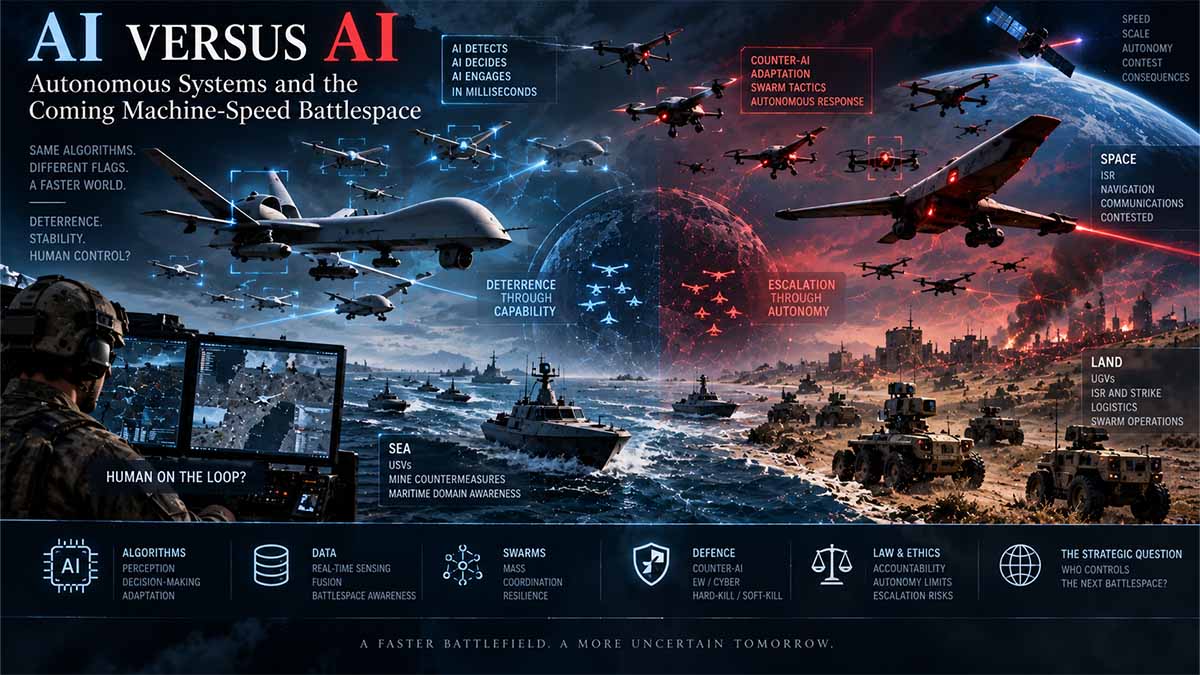
SEO title: AI Versus AI: Autonomous Warfare Beyond the Drone Revolution
Scope: This assessment examines how AI-enabled uncrewed systems across the aerial, surface, subsurface and ground domains are changing military competition from remotely operated platform warfare toward machine-assisted and increasingly autonomous contests in sensing, classification, navigation, coordination, electronic warfare, targeting support and counter-autonomy, with a five-year analytical horizon through 2031 and specific attention to the United States, NATO, the European Union, Italy, France, Germany and the United Kingdom.
Executive Summary / BLUF
The principal judgment is that the next transformation in uncrewed warfare will not be defined primarily by a better UAV, USV, UUV/AUV or ground robot, but by the emergence of an autonomy stack in which sensors, edge computing, artificial intelligence, communications, navigation, cooperative behaviour and weapons are integrated sufficiently tightly for machines to detect, classify, manoeuvre against, deceive, suppress and in some circumstances physically defeat other machines at operational tempos that exceed conventional human control loops.
The proposition “AI versus AI” therefore describes something broader and more defensible than fully autonomous weapons independently deciding whom to kill, because the verified record already shows military institutions investing simultaneously in AI-enabled reconnaissance, collaborative autonomy, autonomous navigation, swarm operations, counter-drone interception, electronic-warfare resilience and machine-assisted command systems, while lethal-authorisation rules remain subject to national policy and international-law constraints. [Summary of NATO’s revised Artificial Intelligence (AI) strategy — NATO — Jul 2024] Official NATO source
This transition is already institutional rather than speculative, because the United States has built dedicated unmanned maritime squadrons and all-domain robotic task forces, NATO maintains an Autonomy Implementation Plan, the European Commission identifies autonomous air, ground, surface and underwater fleets together with counter-drone systems as a European defence priority, and European states are creating national AI, drone and counter-drone programmes. [Summary of NATO’s Autonomy Implementation Plan — NATO — Oct 2022] Official NATO source [White Paper for European Defence – Readiness 2030 — European Commission — Mar 2025] European Commission source
The most consequential operational change is likely to occur in the sensor-to-decision-to-effect cycle, because autonomy reduces the dependence of every vehicle on a continuously connected human operator, permits multiple platforms to be supervised by fewer personnel, and allows distributed systems to continue operating when bandwidth, satellite navigation or radio-frequency links are degraded, which directly changes the economics and survivability of massed uncrewed operations.
Counter-autonomy will consequently become at least as important as autonomy itself, because every improvement in autonomous navigation, target recognition, cooperative behaviour or communications creates an incentive for opponents to develop machine-speed detection, deception, electronic attack, cyber exploitation, interceptor drones, directed energy and autonomous defensive systems; Germany’s defence ministry, for example, publicly identifies interceptor drones, net-launching drones, lasers, guns, missiles and electromagnetic-spectrum systems within its expanding counter-drone architecture. [Wichtige Weichenstellung und Aufwuchs für kriegstüchtige Streitkräfte — Bundesministerium der Verteidigung — Apr 2026] Official German Defence Ministry source
The operational advantage will therefore migrate away from ownership of the individual drone toward the quality of the software-defined combat ecosystem, including training data, onboard processing, sensor fusion, electronic protection, communications resilience, navigation without dependable GNSS, machine-to-machine coordination, software-update speed and the industrial ability to replace expendable hardware at scale.
The five-year outlook does not support a defensible prediction that humans will disappear from lethal decision chains, but it strongly supports the judgment that humans will progressively move upward from controlling individual vehicles toward supervising missions, setting constraints and managing groups of autonomous systems, while increasing numbers of tactical detection, route planning, tracking, prioritisation and defensive-response functions migrate to machines.
For Europe, this creates an industrial and sovereignty problem as significant as the military problem, because competitive autonomy depends not simply on airframes and shipyards but on processors, sensors, secure datalinks, AI models, training and synthetic data, software engineering, electromagnetic-warfare systems and continuous test-and-evaluation infrastructure, while interoperability across NATO forces requires these systems to exchange trusted data at operational speed.
The decisive uncertainty is therefore not whether AI and autonomous systems will penetrate military operations, which official policy and procurement records already establish, but how far lethal engagement authority, adaptive machine behaviour and autonomous system-to-system combat will be delegated before technical reliability, legal governance, escalation concerns and operational experience impose limiting boundaries.
AI Versus AI: Industrial Sovereignty Will Decide the Autonomous Battlefield
Artificial intelligence is turning military autonomy from a platform problem into an industrial-sovereignty test, because the decisive advantage will belong not to the country that buys the largest number of drones but to the one that can control the software, data, compute, sensors, communications, certification and production system behind them. NATO’s Rapid Adoption Action Plan, adopted in June 2025, set a general ambition of moving relevant technology from identified requirement to acquisition and integration within 24 months, while the Alliance’s July 2026 Innovation Scale-Up Package shifted attention from invention toward manufacturing, capital and demand. The fiscal and security implication is direct: states unable to update autonomous systems at operational speed will purchase hardware whose battlefield value can decay faster than its procurement cycle, while those that control the full autonomy stack can alter combat performance without replacing the platform.
The United States is industrialising autonomy rather than merely buying drones
Washington’s most consequential decision was to make autonomous warfare a procurement-system experiment rather than a single weapons programme. The Department of Defense’s Replicator initiative was designed to field multiple thousands of all-domain attritable autonomous systems within roughly 18–24 months, while later tranches added software intended to improve collaborative autonomy and resilience under jamming. The important figure is therefore not simply the number of vehicles but the speed at which the Pentagon is attempting to convert commercial technology into military capability.
That conversion mechanism is already measurable. A collaborative-autonomy software procurement supporting Replicator moved from solicitation to award in approximately 110 days, using the Software Acquisition Pathway, Commercial Solutions Opening procedures and Other Transaction authorities, while related competitions attracted submissions from more than 550 hardware and software companies. In December 2024, the Pentagon added an AI Rapid Capabilities Cell, jointly operated by the Chief Digital and Artificial Intelligence Office and the Defense Innovation Unit, covering command and control, logistics, cyber operations, weapons testing and uncrewed systems. The United States is therefore building a pipeline in which commercial innovation, military testing, software integration and scaled procurement are parts of the same industrial process.
Its advantage is reinforced by infrastructure beneath the platforms. The Department of Defense’s 2023 Data, Analytics and Artificial Intelligence Adoption Strategy explicitly tied AI adoption to federated infrastructure, data quality, assurance and governance, while the Department reported more than $1.8 billion in AI and machine-learning investment in the fiscal year referenced during the strategy’s rollout. American autonomy therefore rests on a broader technology economy capable of supplying software, cloud, advanced computing and venture capital before military procurement reaches production scale.
NATO is turning interoperability into industrial policy
NATO cannot manufacture autonomous systems as a sovereign state would, but it is increasingly shaping the market in which its members acquire them. The Defence Innovation Accelerator for the North Atlantic, or DIANA, entered its 2026 programme with 150 innovators, 16 accelerator sites, more than 200 test centres and more than 600 mentors. More than 3,600 proposals were submitted for the 2026 challenge programme, and 15 companies later advanced into the Mission Track with €300,000 each in non-dilutive funding.
The Alliance has also created a €1 billion NATO Innovation Fund and, through the June 2025 Rapid Adoption Action Plan, established the 24-month acquisition-and-integration ambition for relevant emerging technologies. The July 2026 Innovation Scale-Up Package then moved the problem from demonstration toward production by focusing on demand signals, manufacturing capacity and private investment.
The more important institutional shift sits below procurement. NATO’s Digital Backbone and January 2026 Alliance Digital Strategy treat tactical-edge AI, federated data spaces, sensor fusion and sensor-to-effector data flows as common infrastructure. This changes the meaning of interoperability: two national drones are no longer genuinely interoperable merely because their radios can communicate; autonomous systems increasingly need common data structures, security rules, identity management and machine-readable operational objects if they are expected to exchange tracks or divide tasks automatically.
Europe has money, but fragmentation still taxes scale
The European Union has responded to the industrial problem with finance and procurement rules. The Security Action for Europe — SAFE instrument provides up to €150 billion in long-maturity loans for defence investment, including drones, counter-drone systems, artificial intelligence, electronic warfare and cyber capabilities, while generally requiring collaborative procurement and at least 65% of relevant component costs to originate from the EU, Ukraine or eligible EEA/EFTA states.
The European Defence Industry Programme — EDIP, adopted in December 2025, adds €1.5 billion for 2025–2027, including €300 million for the Ukraine Support Instrument. The Commission’s Readiness Roadmap 2030 sets a target of 35% joint procurement, at least 55% of defence investment procurement from the European Defence Technological and Industrial Base, and full functionality of the European Drone Defence Initiative by the end of 2027.
The constraint is not the absence of engineering talent but the conversion of national projects into production runs large enough to matter. The Commission’s 2025 simplification proposal sought to reduce permitting for qualifying defence projects to approximately 60 days and estimated direct administrative-cost savings of roughly €710 million. Those figures expose the real European problem: autonomous warfare operates on software and manufacturing cycles that can be shorter than the procedures used to authorise factories and contracts.
France is building the clearest sovereign military-AI stack
France has gone furthest among the major European powers in institutionalising sovereign military AI. The Agence ministérielle pour l’intelligence artificielle de défense — AMIAD, created on 1 May 2024, has identified approximately 400 defence AI use cases and plans to reach 300 personnel by the end of 2026. Its mandate includes embedded AI in weapons, autonomous robotics, sensors and collaborative combat rather than restricting itself to administrative or analytical applications.
The architecture is deliberately national. AMIAD operates a classified supercomputer inaugurated at Suresnes in September 2025, allowing sensitive defence information to be processed inside a controlled environment, and in March 2025 the agency signed a cooperation agreement with Mistral AI covering multimodal models, robotics, automation, embedded models and industrialisation.
France is also changing the acquisition side. Under the Pacte drones aériens de défense, the Direction générale de l’armement issued a simplified requirement with roughly twenty principal criteria, selected a supplier after rapid trials and ordered 1,000 soldier drones, which were delivered less than a year after the tender began. The selected system weighs approximately 1.8 kilograms, has a range of 2 kilometres and endurance of roughly 40 minutes. The DGA placed approximately €38 billion in orders during 2025, yet its 2026 leadership increasingly emphasised mass, open architectures and short-cycle innovation. France’s problem is therefore no longer sovereign capability; it is whether a system built historically around exquisite platforms can produce inexpensive autonomous mass without losing technical control.
Germany has the scale but must compress institutional time
Germany possesses the strongest manufacturing potential in continental Europe, but its pathway is constrained by procurement and certification latency. Bundeswehr acquisitions above €25 million normally require approval by the Bundestag Budget Committee, while major projects continue to pass through planning, procurement and assurance structures built for conventional weapons rather than continuously updated software.
Berlin has begun to alter that system. The May 2026 Reform-Agenda Rüstung reorganised defence procurement around stronger technology scanning, simplified acquisition and closer supplier management, while the Bundeswehr’s 2026 Software Defined Defence approach explicitly seeks to separate software evolution from hardware replacement.
The Uranos KI programme translates that concept into an operational system by combining aerial and ground sensors with artificial intelligence for tactical reconnaissance, with initial capability planned for Brigade Lithuania from approximately mid-2027. The Bundeswehr has also identified more than 400 AI-related projects or entries, suggesting extensive experimentation but also a future requirement to consolidate them into common architectures.
Germany’s loitering-munition procurement shows a second shift. In 2026 the Bundeswehr signed contracts with Helsing, Stark and Rheinmetall, maintaining multiple suppliers and combining software-native entrants with an incumbent prime contractor. The constraint is therefore not technological absence but institutional velocity: if Germany can make software certification and procurement move at the speed of its industrial engineering, it can become Europe’s largest autonomous-manufacturing power.
Britain is using autonomy to change the cost structure of military power
The United Kingdom has been more explicit than its European peers in treating autonomy as a force-economics problem. The Defence Industrial Strategy 2025 committed approximately £4 billion during the current Parliament to uncrewed and autonomous military systems and identified up to £180 million for digital decision capabilities supporting scalable autonomous operations and AI-enabled decision support.
London has also consolidated innovation under UK Defence Innovation — UKDI, whose 2026 priorities are Autonomy, Decision Advantage, Logistics and Support, Effects and Protection. The Innovation Support to Operations Cycle 8 requires concepts to be manufacturable and capable of scaling in approximately twelve months, while Project PANOPTES, launched in September 2026, seeks an integrated counter-UAS capability capable of autonomous operation through a phased route from development and minimum viable products toward a future programme of record.
Britain’s advantage is speed and integration with the United States; its vulnerability is dependence. The UK can import technology and remain operationally effective so long as the critical layers it chooses not to own remain available. Its sovereignty model is therefore selective: control the sensitive mission software, data, electronic warfare and weapons integration while exploiting allied and commercial technology elsewhere.
Italy has the industrial assets, but the software layer must now catch up
Italy starts from a different position. It already possesses major aerospace, radar, electronics, helicopter, shipbuilding and naval-systems capabilities, but its defence AI architecture was formalised later than France’s. The Strategia della Difesa in materia di Intelligenza Artificiale, published in February 2026, created the policy foundation for systematic AI adoption, while the Laboratorio di IA per la Difesa — LIAD is intended to function as an AI Delivery Center connecting defence data and computing resources with universities, industry, SMEs and start-ups.
The more consequential document is the Strategia Digitale della Difesa 2026–2030, which sets a defence data-governance model for 2026, qualified cloud capability during the first half of 2027, data-platform and data-lakehouse capability by 2028, and a sovereign disconnected cloud by 2028. These are not administrative targets: without governed data and controlled compute, Italy cannot train, validate and deploy military AI at scale.
Italy’s comparative opening is maritime. Its existing naval industrial base, shipbuilding capability and geographic exposure make underwater autonomy, acoustic processing, maritime sensor fusion, autonomous navigation and counter-drone defence more plausible areas of specialisation than attempting to replicate the full American aerial ecosystem. The presence of NATO’s Centre for Maritime Research and Experimentation in La Spezia adds an institutional advantage, but the decisive test will be whether LIAD and the 2026–2030 digital programme translate into deployable software, recurring contracts and a larger software-native defence sector.
The next 24 months will decide whether autonomy remains imported or becomes sovereign
Between September 2026 and the end of 2028, the decisive issue will not be how many autonomous demonstrations European ministries can announce but whether procurement, data, software, certification and production begin operating as one system. France must prove that AMIAD and the DGA can combine sovereign high-end AI with inexpensive mass; Germany must show that its 2026 procurement reform reduces actual acquisition and software-update timelines; Britain must convert its £4 billion commitment into systems that retain national control over mission-critical layers; Italy must deliver its 2027 cloud and 2028 sovereign disconnected-cloud milestones while turning LIAD into an operational software pipeline.
The cost of inaction will fall first on defence budgets, which will continue buying platforms whose software cannot adapt fast enough, then on domestic industry, which will lose scale to foreign suppliers, and finally on operational commanders, who will discover that nominal ownership of a drone does not guarantee control over its autonomy. In machine-speed warfare, the state that cannot modify the software, secure the data, replace the components and manufacture the next batch does not own the weapon system in the strategically relevant sense.
Navigational Index
The Autonomy Stack Becomes the Weapon System
How artificial intelligence, onboard computation, distributed sensing, resilient navigation and cooperative autonomy transform the drone from a remotely controlled aircraft or vessel into one node within a distributed combat architecture.
Counter-Autonomy Creates Machine-Speed Warfare
How detection, electronic warfare, autonomous interception, cyber effects, deception, directed energy and machine-versus-machine engagement compress the defensive decision cycle and alter the traditional relationship between platform cost, munition cost and battlefield mass.
Industrial Sovereignty Determines Operational Autonomy
How the United States, NATO and the major European powers are organising procurement, AI governance, software infrastructure and industrial capacity, and why Italy, France, Germany and the United Kingdom face materially different pathways toward an autonomous force structure.
Master Abstract
The platform is becoming subordinate to the autonomy layer
The central military transformation is not the replacement of crewed aircraft, warships or armoured vehicles by visually similar robotic equivalents, but the redistribution of military functions across networks of heterogeneous machines whose individual platforms can be cheaper, more numerous and more expendable while intelligence increasingly resides in software, sensors and the network connecting them. The U.S. Navy now operates dedicated organisations for unmanned surface vessels, with Unmanned Surface Vessel Squadron Seven, established in April 2026, explicitly tasked with resilient distributed systems capable of operating in bandwidth-limited or denied environments, while U.S. Sixth Fleet’s CTF 66 was established as an all-domain organisation integrating robotic and autonomous systems with U.S., joint and NATO forces in Europe and Africa. [Unmanned Surface Vessel Squadron 7 Established! — U.S. Navy — Apr 2026] Official U.S. Navy source [Lightfish Unmanned Vessel First Joint Maritime Launch — U.S. Fleet Forces Command — Feb 2026] Official U.S. Navy source
The same architecture is appearing in the air domain, where the relevant metric increasingly becomes not the performance of a single remotely piloted vehicle but the ability of multiple systems to share observations, divide tasks, re-route around threats and continue operating when communications are imperfect, while human operators move toward supervisory command rather than continuous manual piloting. DARPA’s OFFensive Swarm-Enabled Tactics programme explicitly developed interfaces through which users could monitor and direct potentially hundreds of unmanned platforms, while NATO’s SAPIENCE experimentation has examined autonomous drones cooperating with each other rather than functioning as isolated remotely piloted vehicles. [OFFSET: OFFensive Swarm-Enabled Tactics — DARPA] Official DARPA programme source [NATO backs autonomous drone competition in London — NATO — Aug 2024] Official NATO source
AI versus AI is principally a contest between decision architectures
The phrase AI versus AI should therefore be understood as a competition between opposing decision architectures rather than simply two robotic vehicles exchanging fire, because AI can enter the engagement chain before any weapon is released through sensor processing, object classification, anomaly detection, route selection, threat prioritisation, swarm allocation, electronic-warfare management and defensive cueing. The United States’ Replicator programme provides an important institutional signal because its first phase sought large numbers of attritable autonomous systems across warfighting domains, while Replicator 2 subsequently shifted toward defence against small uncrewed aerial systems, effectively demonstrating that autonomy and counter-autonomy are being developed as two sides of the same force-design problem. [Defense Innovation Official Says Replicator Initiative Remains On Track — U.S. Department of Defense — Jan 2024] Official U.S. defence source [DOD Innovation Official Discusses Progress on Replicator — U.S. Department of Defense — Dec 2024] Official U.S. defence source
This dynamic produces a technological feedback loop in which successful electronic jamming encourages more autonomous navigation, frequency-independent control or onboard perception; autonomous navigation increases the importance of visual, infrared, acoustic and terrain-based recognition; distributed swarms increase the value of automated prioritisation and inexpensive interceptors; and increasingly autonomous attackers generate demand for defensive systems whose reaction cycles are too fast or whose target volume is too large for every detection and tracking decision to be handled manually. NATO’s 2025 Innovation Challenge addressing fibre-optic-controlled FPV systems illustrates this adaptation cycle particularly clearly, because physical fibre links allow certain systems to circumvent conventional radio-frequency jamming, forcing counter-drone architectures to diversify beyond reliance on electromagnetic disruption alone. [NATO’s 16th Innovation Challenge Counters Fibre-Optic Drones — NATO Allied Command Transformation — Jun 2025] Official NATO ACT source
Autonomy will increasingly migrate to the edge
The most strategically important technical movement is likely to be edge autonomy, meaning the transfer of sufficient sensing, inference and mission logic onboard the platform or distributed formation so that the system can continue performing useful functions when datalinks are intermittent, jammed, delayed or deliberately minimised, because remotely controlled mass becomes operationally fragile when every vehicle requires reliable broadband connectivity and persistent human attention. The U.S. Navy’s emphasis on unmanned operations under bandwidth-limited or denied conditions, together with NATO’s broader digital-transformation programme connecting platforms, sensors, weapons and data across domains, indicates that network resilience and local decision capability are being treated as structural requirements rather than optional enhancements. [Unmanned Surface Vessel Squadron 7 Established! — U.S. Navy — Apr 2026] Official U.S. Navy source [Delivering capabilities through multinational cooperation — NATO — Jul 2026] Official NATO source
This does not automatically imply autonomous lethal authority, because navigation autonomy, sensor autonomy, formation autonomy and weapon-release autonomy are analytically distinct capabilities, and collapsing them into a single category produces misleading conclusions about both technical maturity and legal risk. The United States’ policy framework governing autonomous weapons was expressly updated to minimise the probability and consequences of failures in autonomous and semi-autonomous weapon systems, while NATO’s revised AI strategy embeds lawfulness, responsibility and accountability, explainability and traceability, reliability, governability and bias mitigation within its responsible-use framework, meaning that increasingly autonomous combat architectures are developing alongside rather than outside institutional control structures. [DoD Announces Update to DoD Directive 3000.09, “Autonomy in Weapon Systems” — U.S. Department of Defense — Jan 2023] Official U.S. defence source [Summary of NATO’s revised Artificial Intelligence (AI) strategy — NATO — Jul 2024] Official NATO source
Surface, air and subsurface autonomy will converge operationally
The distinction between UAV, USV, UUV/AUV and UGV will remain technically important because propulsion, communications, sensing and navigation differ sharply between air, surface, underwater and terrestrial environments, yet operationally these systems are likely to become components of the same reconnaissance-strike architecture, because an airborne sensor can classify a maritime contact, a surface platform can relay communications or deploy another vehicle, an underwater system can collect acoustic data, and another autonomous asset can perform interception or deliver an effect. The European Commission’s Readiness 2030 defence white paper explicitly frames the capability requirement as a comprehensive unmanned fleet covering air, ground, surface and underwater systems with autonomous capabilities, accompanied by counter-drone systems, while separately identifying AI and electronic warfare among Europe’s critical capability areas. [White Paper for European Defence – Readiness 2030 — European Commission — 2025] Official European Commission source
Underwater autonomy is especially significant because persistent high-bandwidth control is intrinsically more difficult underwater than in the air or on the surface, which increases the operational value of onboard navigation, acoustic interpretation, mission management and local decision functions, while the protection of seabed infrastructure creates missions in which persistent autonomous surveillance can be more scalable than permanent crewed presence. The Italian Navy already places the underwater domain, artificial intelligence and uncrewed systems within its future-force discussion, while its Marine 2050 material identifies the SCIAMANO Drone Carrier concept and broader drone operations as elements of future maritime force development. [Marine 2050 — Marina Militare] Official Italian Navy source
Counter-autonomy will determine whether autonomous mass remains economically sustainable
The strategic promise of uncrewed mass is partly economic because relatively inexpensive platforms can distribute sensors and weapons while reducing the concentration of personnel and capital in a limited number of exquisite platforms, yet that logic survives only if the cost of finding, controlling and replacing those systems remains favourable relative to the cost imposed on the defender. Once a defender can automatically identify small targets, allocate interceptors, combine electronic and kinetic effects and deploy equally inexpensive counter-drones, the contest becomes a continuous competition between cost per effect, probability of penetration, software adaptation rate and production replacement rate, rather than a simple comparison of aircraft or vessel performance.
Germany’s 2026 public defence programme provides unusually clear evidence of this emerging layered model, because the Bundeswehr reports procurement or consideration of interceptor drones, conventional gun and missile systems, net-launching drones, laser systems and electromagnetic-spectrum effects for different ranges and target classes, while the German defence ministry has separately approved Uranos KI, an AI-supported network of unmanned aerial and ground sensor platforms intended initially for Panzerbrigade 45 in Lithuania, with an initial capability planned between 2026 and 2028. [Wichtige Weichenstellung und Aufwuchs für kriegstüchtige Streitkräfte — Bundesministerium der Verteidigung — Apr 2026] Official BMVg source [Verteidigungsinvestitionen: Bewaffnung für F-35 und neue Aufklärungssysteme — Bundesministerium der Verteidigung — Dec 2025] Official BMVg source
European autonomy is becoming a sovereignty issue
Europe’s problem is therefore not simply whether it can manufacture enough drones, because the militarily relevant system includes sensors, edge processors, secure computing environments, training data, AI models, radio architecture, resilient positioning and navigation, electronic warfare, verification tools, software-development pipelines and the ability to issue rapid field updates after an adversary changes tactics. This makes autonomy partly an industrial-sovereignty question and partly a data-sovereignty question, because dependence on foreign hardware, cloud infrastructure, model architectures or critical electronic components can become an operational vulnerability even when the physical drone itself is manufactured domestically.
The European Commission has consequently incorporated drones, counter-drones, AI and electronic warfare into its defence-readiness agenda, while NATO has simultaneously developed an Alliance-wide approach to AI, autonomy and digital integration, meaning that European states face two parallel requirements: preserving enough sovereign technological capacity to modify systems during conflict while ensuring that national platforms remain interoperable within coalition command-and-control architectures. [EDIS | Our common defence industrial strategy — European Commission] Official European Commission source [Digital Transformation — NATO Allied Command Transformation] Official NATO ACT source
Italy is constructing the strategic layer before fielding at scale
Italy’s position is significant because the Ministry of Defence published a dedicated 2026 Defence Artificial Intelligence Strategy, explicitly describing AI adoption as a strategic and political imperative and calling for its systematic integration throughout defence, while the subsequent Digital Defence Strategy 2026–2030 links data governance, AI, machine learning, digital infrastructure and NATO multi-domain interoperability. [Strategia della Difesa in materia di Intelligenza Artificiale — Ministero della Difesa — Feb 2026] Official Italian Ministry of Defence source [Strategia digitale della Difesa 2026–2030 — Ministero della Difesa — Apr 2026] Official Italian defence document
The Italian trajectory therefore appears to recognise correctly that the underlying requirement is broader than acquiring individual UAVs, because research planning includes artificial intelligence, remotely operated and autonomous systems and the SCIAMANO conceptual drone-carrier project, while the Navy’s longer-term thinking explicitly connects AI, drone operations and counter-drone requirements. [Ricerca Tecnologica e Innovazione — Ministero della Difesa] Official Italian Ministry of Defence source
France is moving simultaneously on autonomous functions and counter-drone defence
France’s trajectory similarly reflects the two-sided nature of the autonomy competition, because the Direction générale de l’armement has publicly demonstrated experimentation with drone-mounted video sensors assisted by artificial-intelligence modules for automated detection, while French defence authorities have accelerated counter-drone evaluation and procurement as a distinct operational priority. [La DGA au Forum innovation défense 2025 — Direction générale de l’armement — Dec 2025] Official French Ministry of the Armed Forces source [La DGA de combat accélère pour une lutte anti-drone adaptée et éprouvée — Direction générale de l’armement — Apr 2026] Official French defence source
France is therefore not approaching autonomous warfare solely as a procurement problem, because its institutional architecture increasingly treats AI-enabled perception, autonomous-system testing and counter-drone defence as parts of the same technological continuum, which is consistent with the broader assessment that states unable to shorten the software adaptation cycle between threat discovery, algorithm modification, testing and field deployment will lose much of the theoretical advantage provided by autonomous mass.
Germany is connecting AI reconnaissance with layered counter-drone defence
Germany offers one of the clearest European examples of the transition from individual unmanned platforms toward integrated machine-supported battlefield sensing, because Uranos KI is intended to combine aerial and terrestrial unmanned sensor platforms and process large data volumes with artificial intelligence in order to improve tactical battlefield awareness, initially for the German brigade stationed in Lithuania and eventually more broadly across Army brigades. [Verteidigungsinvestitionen: Bewaffnung für F-35 und neue Aufklärungssysteme — Bundesministerium der Verteidigung — Dec 2025] Official German Defence Ministry source
At the same time, Berlin is building multiple counter-UAS mechanisms rather than relying on a single technological solution, which demonstrates an important lesson for the wider autonomy race: the future defensive architecture is unlikely to consist of one “anti-drone weapon”, because RF-controlled systems, autonomous vehicles, fibre-linked platforms, high-speed aircraft, surface drones and eventually sophisticated collaborative swarms expose different vulnerabilities and therefore require mutually supporting electromagnetic, cyber, kinetic and directed-energy layers.
The United Kingdom is explicitly financing the transition to autonomous force design
The United Kingdom has moved unusually far in translating the autonomy thesis into explicit force-development policy, because the Strategic Defence Review 2025 calls for prioritising attack and surveillance drones together with counter-drone systems and emphasises AI, autonomous systems, cyber capabilities and electronic warfare, while the government subsequently announced an additional £2 billion during the Parliament for autonomous technologies and established a trajectory toward expanded drone and counter-drone investment. [The Strategic Defence Review 2025 — UK Government — Jun 2025] Official UK Government source [Successful trial paves the way for improved reconnaissance on Army operations — UK Ministry of Defence — Jun 2025] Official UK Government source
The UK’s February 2024 Defence Drone Strategy had already placed the integration of uncrewed and autonomous systems at the centre of future defence capability, while later programmes such as Project NYX, under which unmanned aircraft are intended to operate alongside Apache attack helicopters, demonstrate the transition from remotely piloted adjuncts toward human-machine force packages in which crewed and uncrewed systems perform complementary functions. [The UK’s approach to Defence Uncrewed Systems — UK Ministry of Defence — Feb 2024] Official UK Government source [Futuristic helicopter drones programme advances as British-based companies selected to develop prototypes — UK Government — Jan 2026] Official UK Government source
Key Evidence Table
| Indicator | Value/status | Reference date | Definition/scope | Issuer | Exact source |
|---|---|---|---|---|---|
| NATO autonomy policy | Alliance implementation framework established | 2022 onward | AI-enabled autonomous systems, responsible use, protection against autonomous threats | NATO | [Summary of NATO’s Autonomy Implementation Plan — NATO] Source |
| NATO AI governance | Six responsible-use principles retained in revised strategy | Jul 2024 | AI used in defence, including governability and reliability | NATO | [Summary of NATO’s revised Artificial Intelligence (AI) strategy] Source |
| European unmanned requirement | Air, ground, surface and underwater autonomous fleet identified as priority | 2025 | European defence-readiness capability gap | European Commission | [White Paper for European Defence – Readiness 2030] Source |
| U.S. distributed maritime autonomy | USVRON 7 established | Apr 2026 | Resilient distributed unmanned maritime systems, including bandwidth-limited environments | U.S. Navy | [Unmanned Surface Vessel Squadron 7 Established!] Source |
| U.S. European all-domain robotics | CTF 66 operating as all-domain robotic/autonomous task force | 2024–2026 | Naval, joint and NATO integration in Europe and Africa | U.S. Sixth Fleet | [Lightfish Unmanned Vessel First Joint Maritime Launch] Source |
| German AI reconnaissance | Uranos KI approved; eight initial complete systems from two suppliers; initial capability planned 2026–2028 | Dec 2025 | AI-supported aerial and ground unmanned battlefield-sensor network | German Defence Ministry | [Verteidigungsinvestitionen: Bewaffnung für F-35 und neue Aufklärungssysteme] Source |
| German counter-autonomy | Interceptor drones, guns, missiles, net drones, lasers and electromagnetic effects reported as fielded, tested or considered across target classes | Apr 2026 | Layered counter-UAS architecture | German Defence Ministry | [Wichtige Weichenstellung und Aufwuchs für kriegstüchtige Streitkräfte] Source |
| Italian AI framework | National Defence AI Strategy published | Feb 2026 | Systemic integration of AI across defence | Italian Ministry of Defence | [Strategia della Difesa in materia di Intelligenza Artificiale] Source |
| Italian maritime autonomy | SCIAMANO drone-carrier concept incorporated into future naval discussion | Current planning horizon | Distributed maritime drone operations and counter-drone concepts | Marina Militare | [Marine 2050] Source |
| French AI-enabled sensing | AI module demonstrated for automated detection from drone video sensors | Dec 2025 | Machine-assisted aerial ISR | Direction générale de l’armement | [La DGA au forum innovation défense 2025] Source |
| UK autonomous-technology investment | Additional £2 billion announced during the Parliament | Jun 2025 | Autonomous technology including drones | UK Government | [Successful trial paves the way for improved reconnaissance on Army operations] Source |
Principal Gaps and Watch Indicators
Operational delegation of lethal authority remains the most important unresolved variable, because public policy documents describe responsible autonomy more clearly than they disclose the exact rules, software thresholds and commander authorities governing individual operational systems; evidence that national militaries had authorised broader autonomous target selection and engagement under operational conditions would materially strengthen the thesis that machine-versus-machine warfare is moving from sensing and manoeuvre into genuinely autonomous lethal decision cycles.
Communications-denied performance requires particular observation because autonomy that functions only when high-quality datalinks, cloud connectivity or GNSS remain available would provide significantly less transformation than systems capable of local inference, collaborative navigation and mission continuation in contested electromagnetic environments; exercises explicitly demonstrating prolonged multi-platform autonomous operations under realistic jamming would therefore constitute a major signpost.
System-of-systems interoperability will determine whether NATO develops interoperable autonomous mass or a collection of nationally incompatible drone fleets, and the most consequential indicators will include shared data architectures, common mission interfaces, autonomous-system certification standards, machine-to-machine communications protocols and multinational testing in which platforms from several allies dynamically exchange targeting or sensor information.
Counter-autonomy cost curves require monitoring because the value proposition of expendable uncrewed mass changes substantially if inexpensive autonomous interceptors, electronic effects or directed-energy systems achieve favourable exchange ratios against attacking formations, making verified procurement cost, intercept probability, magazine depth and regeneration rates more important than platform performance in isolation.
Software adaptation speed is likely to become an operational readiness variable comparable to ammunition supply, because adversarial systems whose detection models, navigation logic or electronic signatures remain static can be countered after sufficient observation, whereas forces able to retrain models, test modifications and push verified software updates rapidly can regenerate combat effectiveness without redesigning the physical platform.
Industrial bottlenecks in processors, electro-optical sensors, propulsion, batteries, radio-frequency components, navigation hardware and secure compute infrastructure could constrain apparently scalable autonomous systems, meaning that announcements of drone quantities should be evaluated against actual production capacity, component sovereignty and replacement rates rather than treated as proof of sustainable wartime mass.
Preliminary Five-Year Net Assessment
On the verified record available through 14 September 2026, the strongest defensible assessment is that military competition is entering a period in which machine-versus-machine interaction becomes normal before fully autonomous machine-versus-machine lethal decision-making becomes universal, because the enabling technologies required for autonomous sensing, classification, navigation, formation management, threat recognition and defensive response are already entering institutional programmes while political, technical and legal constraints continue to govern the delegation of lethal authority.
Between 2026 and 2031, the most significant competitive advantage is therefore expected to accrue not automatically to the force possessing the largest number of drones, nor necessarily to the force possessing the most sophisticated individual platform, but to the force capable of connecting inexpensive and heterogeneous machines to a resilient software-defined operational architecture that can sense earlier, classify more accurately, communicate under attack, distribute tasks dynamically, survive navigation degradation, learn from encounters, update software faster than the opponent and defeat hostile autonomous systems at an economically sustainable exchange ratio.
The implication for military planning is fundamental, because the relevant unit of combat power is progressively changing from the platform to the networked decision-and-effect system, while the appropriate analogy for future force readiness shifts away from maintaining inventories of aircraft and vessels alone toward sustaining a continuously evolving combination of machines, data, models, communications, electronic warfare, computing infrastructure and industrial replacement capacity.
The phrase “AI versus AI” is therefore analytically justified provided that it is used with precision: it does not yet establish an inevitable future of unrestricted autonomous weapons independently selecting and killing one another, but it accurately captures a developing battlespace in which opposing artificial-intelligence systems increasingly compete over who sees first, who understands first, who deceives whom, whose navigation survives, whose swarm remains coherent, whose electronic warfare adapts, whose interceptor is allocated correctly and whose decision architecture converts machine-generated information into military effect before the opposing architecture can respond.
AI Versus AI: Autonomous Systems and the Coming Machine-Speed Battlespace
Executive BLUF / Core Strategic Vector The next operational disruption in uncrewed warfare will not be defined by incremental platform mechanics (UAV, USV, UUV, UGV), but by the emergence of a cross-domain Autonomy Stack. Sensors, edge computing, synthetic intelligence, resilient communications and cooperative behaviours are compressing the sensor-to-decision cycle below human cognitive latency. “AI versus AI” characterizes an institutional contest between opposing software architectures competing over sensing, classification, electronic warfare resilience and counter-autonomy before kinetic weapon release.
The Autonomy Stack Subordinates the Physical Platform
Military value is migrating away from isolated platform performance toward continuous software integration. Autonomous edge computing enables UAVs, USVs, and UUVs to perform feature extraction, tracking, and route re-planning locally, ensuring operational continuity even when RF and GNSS satellite uplinks are severed.
Institutional Evidence & Programmatic Verification Matrix
Cross-audited against public institutional disclosures through September 2026| Indicator / Program | Issuer / Authority | Ref Date | Value / Status Scope | Operational Impact Vector |
|---|---|---|---|---|
| Autonomy Implementation Plan | NATO HQ | Oct 2022+ | Alliance implementation framework for AI-enabled uncrewed systems. | Multi-domain interoperability & responsible protection thresholds. |
| Revised Artificial Intelligence Strategy | NATO HQ | Jul 2024 | 6 Responsible Use Principles retained (Reliability, Governability, Lawfulness). | Constrains unmonitored targeting; codifies legal and ethical bounds. |
| Readiness 2030 (White Paper) | European Commission | Mar 2025 | Autonomous air, ground, surface & underwater fleets + Counter-UAS prioritized. | European defence funding alignment; sovereign industrial capacity mandate. |
| Unmanned Surface Vessel Squadron 7 | U.S. Navy (SURFPAC) | Apr 2026 | Resilient distributed surface operations in bandwidth-denied environments. | Shifts distributed maritime combat from manual tele-op to edge swarming. |
| Uranos KI Sensor Network | BMVg (Germany) | Dec 2025 | 8 initial complete systems approved; deployment with Panzerbrigade 45 (2026–2028). | AI multi-sensor fusion across aerial/terrestrial tactical reconnaissance. |
| Layered Counter-UAS Architecture | BMVg (Germany) | Apr 2026 | Interceptor drones, net-launchers, lasers, EW disruptors, kinetic guns/missiles. | Multi-tiered counter-autonomy matching varied cost-per-kill threats. |
| AI & Digital Strategy / SCIAMANO | Min. Difesa / Marina | Feb–Apr 2026 | Systemic AI adoption + Digital Strategy 2026-2030 + Drone Carrier concepts. | Prioritizes underwater infrastructure protection & C2 governance readiness. |
| Strategic Defence Review / NYX | UK MoD / Cabinet | Jun 2025 / Jan 2026 | +£2B allocated for autonomous technologies; Apache MUM-T prototype contracts. | Shifts doctrine directly toward integrated crewed-uncrewed teaming (MUM-T). |
Structural Dilemmas & Battleground Asymmetries
The operational tensions defining 2026–2031 military procurementThe Bandwidth & EW Paradox
High-definition human tele-operation breaks down under aggressive EW and directional jamming. Conversely, physical solutions like fibre-optic FPV cables (demonstrated at NATO ACT’s 2025 Innovation Challenge) bypass RF jamming but tether operational range. Edge autonomy remains the sole scalable architecture capable of operating in severed electromagnetic environments.
The Cost-Per-Interception Crisis
Firing $1.5M surface-to-air missiles against $15k autonomous attritable loitering munitions collapses defensive sustainability over sustained campaigns. The counter-autonomy architecture must field micro-interceptor drones, directed energy (lasers), and automated medium-caliber kinetic cannons cued by edge algorithms to realign cost exchange ratios.
Software-Defined Adaptation Latency
A robotic airframe is tactically obsolete if its neural vision network or frequency-hopping pattern cannot adapt to newly fielded adversary camouflage or jamming vectors within hours. Combat readiness is fundamentally transitioning from maintaining physical platform inventories toward sovereign automated synthetic retraining pipelines.
Strategic Key Judgments (Analytical Verdicts)
Defensible probabilistic assessments for defence planners through 2031Audited Information Gaps (Unresolved Records)
- Lethal Engagement Rules: Public military doctrine asserts responsible governance, but exact algorithmic engagement thresholds under severed C2 links remain classified.
- Interoperability Standardization: Clear metrics are lacking on whether NATO allies can cross-link disparate AI models (e.g., French DGA modules vs. German Uranos KI).
- Real-World Attrition vs. Cost Ratios: Actual magazine replenishment rates for autonomous counter-drone interceptors are missing from official public defense disclosures.
Observable Strategic Watch Indicators (2026–2031)
The Autonomy Stack Becomes the Weapon System
Principal judgment
The decisive transformation in uncrewed warfare is no longer the replacement of a pilot, sailor or vehicle crew by a remote operator, because the operationally significant change is the progressive transfer of sensing, perception, navigation, coordination, task allocation and selected engagement functions from the human-machine interface into a distributed computational architecture carried by the platforms themselves and by the wider combat network. NATO's Autonomy Implementation Plan explicitly anticipates Allied deployment of interoperable autonomous “systems of systems”, management of different levels of autonomy, operational experimentation at scale and protection against hostile autonomous systems, which establishes that the Alliance is already treating autonomy as an architectural property of military forces rather than as a feature attached to an individual drone. Summary of NATO’s Autonomy Implementation Plan — NATO — October 2022
The resulting autonomy stack should therefore be understood as the combination of sensors, onboard computation, artificial-intelligence models, localisation and navigation, communications, collaborative algorithms, mission software, electronic protection, human-machine interfaces and kinetic or non-kinetic effectors that collectively determine what an uncrewed system can perceive, understand and accomplish after deployment, because removing a cockpit or bridge crew without transferring these functions into software merely produces a remotely operated vehicle rather than a genuinely autonomous combat node. NATO's revised AI strategy makes essentially the same architectural distinction from a different direction, because it identifies quality data, AI integration, interoperability, testing, evaluation, verification and validation, responsible AI governance and convergence between AI and other emerging technologies as prerequisites for operational adoption rather than treating the AI model itself as the capability. Summary of NATO’s Revised Artificial Intelligence Strategy — NATO — July 2024
This distinction changes the meaning of military technological superiority, because the performance of the aircraft, boat, underwater vehicle or ground robot increasingly establishes only the physical envelope within which the autonomy stack operates, whereas the ability to recognise a target among clutter, navigate when satellite positioning is unreliable, determine which member of a formation should investigate a contact, redistribute tasks when another vehicle is destroyed, distinguish deception from genuine signatures, conserve communications bandwidth, and present an intelligible decision to a human commander determines whether the platform remains operationally useful once the enemy begins actively contesting it.
From remotely piloted vehicle to distributed combat node
The first generation of modern military drones largely preserved the organisational logic of crewed aviation, because the pilot moved from the cockpit to a ground station while command relationships, sensor interpretation and many mission decisions remained overwhelmingly human, whereas the emerging architecture progressively separates human intent from continuous human control, allowing operators to specify objectives, geographic limits, rules, priorities or prohibited actions while software executes increasing portions of the tactical process. The U.S. Department of Defense's governing policy deliberately recognises multiple levels of autonomy rather than treating autonomy as a binary condition, while requiring autonomous and semi-autonomous weapon systems to permit commanders and operators to exercise appropriate levels of human judgment over the use of force and to demonstrate adequate performance, reliability and suitability under realistic conditions before employment. DoD Announces Update to DoD Directive 3000.09, “Autonomy in Weapon Systems” — U.S. Department of Defense — January 2023
The practical military consequence is that the traditional one-operator/one-platform relationship becomes progressively inefficient once formations grow beyond small numbers, because a force deploying dozens or hundreds of uncrewed systems cannot economically assign one trained operator to manually steer every vehicle, interpret every sensor feed and approve every navigational adjustment without recreating the manpower burden that autonomy was intended to reduce. DARPA's completed OFFensive Swarm-Enabled Tactics — OFFSET programme explicitly addressed this scalability problem by developing swarm autonomy and human-swarm interfaces intended to allow users to monitor and direct potentially hundreds of unmanned platforms, while the programme's operational concept envisioned large groups of autonomous air and ground robots executing dynamically generated tactics rather than functioning as independent remotely piloted vehicles. OFFensive Swarm-Enabled Tactics — DARPA
The important operational threshold is therefore not reached when a drone can simply follow a waypoint route without pilot input, because commercial autopilots have performed variations of that function for years, but when the vehicle can interpret changing circumstances sufficiently well to determine how to continue pursuing the commander's objective after the original plan ceases to describe the environment accurately. A machine that can follow predetermined coordinates is automated; a system that can perceive obstacles, discriminate relevant objects, revise its route, coordinate with other platforms and change its tactical behaviour within authorised boundaries begins to approach meaningful mission autonomy, while a formation that can distribute those behaviours among different members becomes a combat architecture rather than a collection of vehicles.
Perception becomes the first layer of combat autonomy
Autonomy begins with perception rather than weapons release, because a machine incapable of constructing a sufficiently accurate representation of its environment cannot safely navigate, cooperate, evade threats or contribute reliable information to targeting regardless of the sophistication of its flight controls. The militarily significant AI layer therefore includes computer vision, radar processing, electro-optical and infrared interpretation, acoustic classification, electronic-support measurements and multi-sensor fusion, with machine-learning systems converting raw data into detections, tracks, confidence estimates and classifications that can be consumed either by humans or by other machines.
This produces one of the central structural changes in future warfare, because sensor information no longer necessarily needs to travel from the edge of the battlespace to a distant headquarters before becoming operationally useful, since onboard processing can extract the militarily relevant portion locally and transmit a track, classification or anomaly instead of continuously streaming raw high-bandwidth video. NATO's digital-transformation architecture explicitly places data exploitation and real-time information sharing at the centre of Multi-Domain Operations, while its implementation strategy calls for an Alliance Data Sharing Ecosystem, Digital Backbone, Digital Interoperability Framework and supporting architectures, demonstrating that autonomous systems are being developed within a broader data-centric operational concept rather than as isolated robotic fleets. NATO’s Digital Transformation Implementation Strategy — NATO — October 2024
The distinction matters particularly in communications-contested warfare, because transmitting every sensor frame from every platform creates both bandwidth requirements and electromagnetic signatures, whereas processing at the edge can permit the vehicle to send comparatively compact machine-generated information only when operationally relevant conditions are detected. This architecture also introduces serious technical risk, however, because the battlefield becomes dependent on the reliability of the perception algorithm itself, meaning that camouflage, decoys, environmental clutter, sensor saturation, adversarial manipulation and unfamiliar objects can undermine a force whose operators have transferred excessive confidence from direct observation to machine-generated classification.
The military contest consequently expands from hiding objects from human observers toward deceiving the adversary's models, because an opposing force that understands the sensor modalities and classification logic used by autonomous systems can deliberately alter visual, thermal, acoustic, electromagnetic or behavioural signatures in order to increase false negatives, create false positives or overload the opponent's prioritisation processes. NATO's revised AI strategy explicitly identifies the requirement to safeguard Allied AI against adversarial use, protect models and data, establish Alliance-wide testing, evaluation, verification and validation capabilities, and improve understanding of hostile AI applications, indicating that model security has already become an element of defence readiness rather than an abstract software problem. Summary of NATO’s Revised Artificial Intelligence Strategy — NATO — July 2024
Onboard computation moves decision capacity toward the edge
Perception becomes militarily transformative only when sufficient computing capacity accompanies the sensors, because autonomous systems operating in contested environments cannot assume continuous access to remote cloud infrastructure or high-bandwidth control networks, particularly when the opposing force is deliberately attacking communications, navigation and command links. The autonomy stack therefore requires a balance between processing capability, electrical demand, weight, cooling, latency and cost, because sophisticated AI inference can improve perception and decision support while simultaneously consuming payload, battery life and thermal margin that could otherwise be used for sensors, propulsion or weapons.
This trade-off creates fundamentally different designs from conventional remotely piloted systems, because a platform optimised for autonomy may require a larger fraction of its cost and electrical budget to be assigned to processors, memory, secure storage and sensor-fusion hardware, while the value of the physical airframe or hull can decline relative to the value of the software and electronics carried inside it. The emerging system is therefore increasingly analogous to a distributed computer network whose nodes also happen to fly, sail, dive or move across land, with the loss of individual nodes becoming tolerable so long as information, mission state and tactical functionality can be redistributed across the surviving network.
NATO's digital-transformation programme describes the intended Alliance environment in comparable terms, because the stated objective is to enable multi-domain operations through integrated data, cloud services, artificial intelligence, communications and interoperable digital infrastructure, while Allied Command Transformation states that the challenge has moved beyond discovering individual technologies toward integrating useful innovation into interoperable operational capability at sufficient speed and scale. Building Operational Advantage: Allied Command Transformation at the 2026 NATO Summit — NATO Allied Command Transformation — July 2026
The battlefield implication is substantial because computational redundancy can partially replace platform redundancy, meaning that an autonomous formation does not necessarily require every member to possess identical capabilities if sensing, processing, relay and effect functions can be distributed intelligently across the group. One vehicle can therefore provide elevated electro-optical surveillance, another can carry electronic-support sensors, another can act as communications relay, another can perform local inference, and another can carry the principal effector, while the combined formation behaves operationally as a single distributed system whose functional capabilities exceed those of its individual components.
Resilient navigation determines whether autonomy survives electronic warfare
Navigation is the autonomy stack's second foundational layer because the ability to perceive an environment has limited military value if a system cannot reliably determine its own position, maintain orientation or execute a mission after its preferred navigation source is degraded, and this problem becomes especially acute as militaries confront jamming, spoofing and interruption of global navigation satellite system signals.
The architectural response cannot consist simply of installing a better GPS receiver, because robust autonomy increasingly requires navigation diversity, potentially combining inertial measurements, terrain or scene matching, visual odometry, radar or lidar mapping, celestial or magnetic references, cooperative localisation and signals of opportunity depending on mission environment and platform constraints. The resulting requirement reinforces onboard computation because several of these methods depend on continuous comparison between sensor observations and stored or dynamically generated representations of the surrounding environment.
The same principle becomes even more important underwater, where continuous satellite navigation and conventional radio-frequency control are unavailable once a vehicle is submerged, meaning that autonomous underwater systems inherently require greater local mission management than many remotely piloted aerial systems. The architectural lesson extends across domains, because the less reliable the communications and navigation environment becomes, the greater the operational value of systems capable of continuing a bounded mission locally rather than waiting for remote instructions.
The effect is paradoxical from an electronic-warfare perspective, because successful jamming can accelerate the adoption of greater autonomy: when an opponent proves capable of severing the communications channel on which manual control depends, designers have an incentive to transfer additional perception, navigation and decision functions onboard, thereby converting electronic denial from an absolute mission kill into one condition the autonomous system is expected to manage. Counter-drone development therefore generates its own countermeasure cycle, in which radio-frequency disruption encourages increasingly independent navigation and terminal behaviour, which then forces defenders toward multi-sensor detection and physical interception rather than assuming that command-link disruption alone can neutralise the threat.
Cooperative autonomy changes mass from numerical quantity into coordinated behaviour
The most important distinction between autonomous mass and simple numerical mass is cooperation, because launching one hundred individually controlled drones creates one hundred separate command-and-control problems, whereas collaborative autonomy attempts to convert them into a formation capable of dividing responsibilities, sharing observations, deconflicting movement and adapting collectively to changing conditions.
DARPA's OFFSET experiments provide an unusually clear official precedent for this concept because they tested collaborative autonomous air and ground vehicles, developed a human-swarm interface and sought to convert a commander's intent into algorithms that the swarm could execute collectively, while the programme specifically investigated command, control and collaboration as swarm size and operational complexity increased. OFFSET Swarms Take Flight in Final Field Experiment — DARPA — December 2021
This architecture does not require every vehicle to communicate continuously with every other vehicle, because robust collaborative autonomy can instead rely on local information exchange, predefined roles, distributed consensus mechanisms or mission rules that permit useful behaviour even when parts of the network become disconnected, although the sophistication and reliability of such behaviour varies significantly across systems and cannot be assumed merely because a programme uses the term “swarm.” The analytical distinction is essential because formations that depend on continuous central control remain vulnerable to communications disruption and central-node failure, whereas genuinely distributed architectures can potentially continue performing portions of the mission after losing individual vehicles, relays or command links.
Collaborative autonomy also permits heterogeneous swarms, which are more strategically consequential than formations consisting solely of identical drones because different physical platforms can specialise in complementary functions and therefore create a modular combat system whose configuration changes according to mission requirements. A reconnaissance formation could contain high-endurance sensors, inexpensive forward scouts, electronic-warfare nodes, communications relays and expendable effectors, with the autonomy layer determining how these resources are allocated as the tactical environment evolves rather than requiring the commander to micromanage every asset.
The implications extend directly to force economics because the military value of an individual platform can fall while the aggregate effectiveness of the formation rises, allowing some nodes to be intentionally inexpensive, attritable or functionally narrow provided that their contribution is coordinated by the wider system. This reverses the logic underlying many twentieth-century weapons programmes, in which improving capability tended to concentrate progressively more sensors, communications, survivability and weapons into increasingly expensive multi-role platforms whose destruction represented both financial loss and a major reduction in available combat power.
Human-machine teaming replaces continuous teleoperation
The emergence of autonomy does not remove humans from military command so much as alter the level at which they interact with machines, because manual piloting, sensor interpretation and route management can progressively migrate downward into software while humans retain responsibility for mission intent, operational constraints, escalation decisions and those uses of force for which national policy requires human judgment.
This architecture is already visible in official British planning, because the RAF Autonomous Collaborative Platform Strategy describes autonomous collaborative platforms as a force multiplier designed to augment existing capabilities and allow the Royal Air Force to learn, develop and fight faster, while the broader Defence Drone Strategy seeks common digital and integration standards across uncrewed systems used by the Royal Navy, British Army and Royal Air Force rather than treating each vehicle as an independent procurement object. Royal Air Force Autonomous Collaborative Platform Strategy — UK Ministry of Defence — March 2024 Defence Drone Strategy: The UK’s Approach to Defence Uncrewed Systems — UK Ministry of Defence — February 2024
The military command problem therefore shifts from vehicle control to exception management, because the human supervisor becomes most valuable when the machine encounters ambiguity, competing priorities, unexpected escalation risk or circumstances outside its authorised mission envelope, rather than when performing routine manoeuvres that software can execute more rapidly and consistently. Such an arrangement scales considerably better than direct teleoperation but creates a different cognitive burden, because supervising many autonomous agents requires the interface to communicate what those agents are doing, why they are doing it, what uncertainty they perceive and when human intervention is necessary.
Explainability therefore becomes an operational variable rather than merely an ethical preference, because a commander who cannot understand why several autonomous vehicles altered route, reclassified a contact or abandoned an objective cannot exercise meaningful supervision even if a formal human-authorisation requirement remains on paper. NATO's revised AI strategy accordingly places explainability and traceability, reliability, governability and accountability among the principles governing responsible AI adoption, while also calling for testing and validation structures capable of evaluating AI systems before operational deployment. Summary of NATO’s Revised Artificial Intelligence Strategy — NATO — July 2024
The network becomes part of the weapon
The autonomy stack cannot be separated cleanly from communications because the operational objective is not to eliminate connectivity but to prevent the loss of connectivity from producing immediate mission failure, which means future systems will require communications architectures capable of moving between high-bandwidth cooperative operation, degraded connectivity and local autonomous behaviour depending on electromagnetic conditions.
This requirement introduces a critical balance between connectivity and signature, because highly connected formations can share richer tactical information but repeated transmissions reveal electromagnetic presence, consume spectrum and create attack surfaces for jamming, interception and cyber exploitation, whereas highly autonomous nodes can reduce transmission requirements but must carry more local processing and operate with less comprehensive knowledge of the wider battlespace.
NATO's Digital Transformation Implementation Strategy is relevant because it explicitly seeks a common digital backbone and interoperability architecture through which Allied forces can exchange data and generate multi-domain effects, while NATO's September 2026 description of its National Digital Transformation Champions Network warns that national digital-transformation programmes cannot become disconnected solutions that prove difficult to integrate later. Mission-Driven Digital Transformation: the National DT Champions Network is Redefining ACT & National Efforts — NATO Allied Command Transformation — September 2026
This interoperability problem will become increasingly severe as autonomy deepens because two allied aircraft can operate in the same airspace with relatively modest digital integration, whereas autonomous systems expected to share sensor tracks, divide search sectors, negotiate formation responsibilities or hand a target from one node to another require a much richer common machine-readable environment. Interoperability therefore moves from the traditional ability of two headquarters to exchange formatted messages toward machine-to-machine semantic interoperability, in which different national systems must understand the same objects, confidence levels, geographic references, mission states and authorisation constraints quickly enough for automated cooperation to remain operationally useful.
Software velocity becomes a measure of combat readiness
Once a significant share of military performance resides in software, the traditional procurement model becomes increasingly misaligned with the tempo of competition because a platform acquired through a decade-long development programme can face tactical countermeasures that appear within weeks or months, while its physical structure remains unchanged for years. The United Kingdom's Defence Drone Strategy explicitly recognises this problem by stating that technological adaptation can occur on timescales measured in weeks, requiring procurement and industry relationships capable of responding at comparable speed. Defence Drone Strategy: The UK’s Approach to Defence Uncrewed Systems — UK Ministry of Defence — February 2024
The implication is that combat readiness increasingly includes the capacity to collect operational data, identify failure modes, retrain or modify algorithms, validate those changes, certify them against safety and legal requirements, distribute them securely and measure their battlefield effect before the adversary completes the equivalent cycle. A fleet of physically intact autonomous vehicles whose perception software can no longer recognise enemy camouflage or whose communications protocol has become vulnerable to exploitation can therefore become operationally obsolete without suffering a single kinetic loss.
This creates a form of continuous capability competition more closely resembling cyber operations than conventional weapons acquisition, because advantage can migrate rapidly between adversaries as detection models, electronic signatures, communications methods and countermeasures change, while hardware production and software modification proceed on fundamentally different timescales. The state able to integrate operational feedback into validated software more rapidly can potentially alter the effectiveness of thousands of already fielded systems without manufacturing an entirely new fleet, whereas a state whose certification and procurement system requires years to approve software changes can possess sophisticated hardware yet lose functional relevance during the conflict in which it is expected to operate.
Open architecture becomes strategically significant
The autonomy stack consequently favours modular architectures because tightly coupling sensors, processors, communications, algorithms and effectors into proprietary configurations makes rapid substitution difficult when components are disrupted, sanctions affect suppliers or battlefield experience reveals an unexpected vulnerability. The British Defence Drone Strategy therefore places explicit emphasis on digital and integration standards intended to permit seamless operational integration, while NATO's autonomy policy similarly identifies interoperable systems of systems as an Alliance objective. New UK Strategy to Deliver Drones to Armed Forces — UK Ministry of Defence — February 2024 Summary of NATO’s Autonomy Implementation Plan — NATO — October 2022
The industrial consequence is that the strategically valuable company or national capability may no longer be the producer of the complete drone, because value can concentrate instead in mission software, sensor fusion, resilient navigation, compute modules, secure communications, synthetic training environments, data engineering and verification infrastructure, all of which can migrate across multiple airframes or hulls. This architecture also creates new dependencies, however, because nominal national ownership of a platform does not provide genuine sovereign control if critical algorithms, model updates, encryption keys, processor supply or proprietary software interfaces remain controlled externally.
Autonomy therefore transforms software sovereignty into military sovereignty, particularly during sustained conflict when the force must modify systems without waiting for foreign vendors, export licences, proprietary cloud infrastructure or inaccessible training pipelines. The issue is not autarky, which would be technically and economically unrealistic for most European states, but the capacity to understand, alter, verify and sustain the components whose failure would prevent national systems from functioning under hostile conditions.
Verification becomes harder as behaviour becomes adaptive
Traditional weapons testing generally seeks to determine whether a system behaves predictably within specified environmental conditions, whereas increasingly autonomous systems complicate this model because their behaviour can depend on sensor inputs, probabilistic machine-learning outputs, interactions with other autonomous agents and environmental conditions that cannot be exhaustively reproduced during testing.
This challenge explains why NATO's revised AI strategy specifically calls for an Alliance-wide Testing, Evaluation, Verification and Validation — TEV&V landscape rather than treating conventional certification procedures as automatically sufficient for AI-enabled systems. Summary of NATO’s Revised Artificial Intelligence Strategy — NATO — July 2024
The difficulty grows further when several autonomous vehicles interact because the relevant object of evaluation is no longer only the individual platform but the emergent behaviour of the group, meaning that technically correct decisions made by individual nodes can collectively generate congestion, duplicated targeting, resource depletion or unanticipated escalation unless coordination logic is tested at formation scale.
Verification must consequently examine not only whether the system performs correctly in nominal conditions but how it degrades when sensors disagree, communications fragment, location estimates diverge, adversarial deception succeeds, individual agents disappear or machine classifications remain uncertain. A robust military autonomy stack therefore requires graceful degradation, because a system that performs impressively when all digital services operate normally but becomes unsafe or unusable once one dependency fails is unsuitable for the environment in which sophisticated armed forces will deliberately attack those dependencies.
The autonomy stack compresses the observe–decide–act cycle
The strategic significance of this architecture ultimately lies in time, because perception, classification, information fusion and task allocation that previously required several human and organisational handovers can increasingly occur within machine-speed processing chains, allowing commanders to receive a substantially refined tactical picture and allowing defensive systems to respond to fast or numerous threats before conventional command procedures would complete the equivalent sequence.
NATO recognised this acceleration problem in its original AI strategy, which stated that AI would increase the speed of the threats confronting the Alliance, while its digital-transformation strategy subsequently defined multi-domain effectiveness around information sharing, orchestration and effects delivered at the “speed of relevance.” Summary of the NATO Artificial Intelligence Strategy — NATO — October 2021 NATO’s Digital Transformation Implementation Strategy — NATO — October 2024
The decisive advantage does not therefore arise simply because an AI algorithm “thinks faster” than a human, which is too crude a description of the operational mechanism, but because automation can remove repeated information-transfer and coordination delays from a distributed system while maintaining persistent sensing across far more simultaneous objects than a limited number of operators can manually inspect.
This advantage becomes most pronounced when both sides employ autonomous systems, because the relevant competition progressively becomes one between two interacting decision architectures, each attempting to detect the other's machines, infer their behaviour, disrupt their communications, deceive their sensors, preserve its own navigation and allocate finite effectors before the opponent completes the same process. Under those conditions, the platform is physically visible, but the decisive contest occurs inside the autonomy stacks governing the platforms.
The weapon is therefore becoming a system of systems
The accumulated evidence supports a fundamental change in the appropriate unit of analysis for uncrewed warfare, because measuring fleets only by numbers of UAVs, USVs, UUVs or UGVs increasingly obscures the variables that determine their combat effectiveness, including the percentage capable of useful operation without continuous control, the quality of their onboard perception, the resilience of their navigation, the degree of collaborative behaviour, their ability to function after network fragmentation, the ease with which software can be modified and the interoperability of their data with other sensors and weapons.
NATO's Autonomy Implementation Plan is unusually explicit on this point because it defines Allied ambition around interoperable systems of systems, scalable operational experimentation, protection from hostile autonomy and pathways for AI-enabled autonomous systems rather than around the acquisition of a particular category of vehicle. Summary of NATO’s Autonomy Implementation Plan — NATO — October 2022
The force-design consequence is correspondingly profound because future acquisition decisions cannot be evaluated solely through traditional platform specifications such as range, endurance, payload, speed or survivability, since two physically comparable drones can possess radically different military value if one depends on uninterrupted remote control while the other can autonomously navigate through interference, fuse several sensors, exchange local observations with neighbouring systems, continue a mission after partial network failure and accept software updates as adversary tactics evolve.
The autonomy stack therefore becomes the functional weapon system, while the drone increasingly becomes the mobile physical substrate through which that weapon system senses and acts.
Key judgments
The evidence supports the judgment that military autonomy is moving from a platform-centric model toward a distributed software-and-data architecture, because NATO, DARPA, the U.S. Department of Defense and the United Kingdom are independently structuring autonomy around human-machine teaming, interoperable systems, collaborative behaviour, digital integration, AI assurance and scalable command rather than merely developing improved remotely controlled vehicles. Summary of NATO’s Autonomy Implementation Plan — NATO — October 2022 OFFensive Swarm-Enabled Tactics — DARPA
The evidence further supports the judgment that edge computation and resilient navigation are prerequisites for meaningful combat autonomy, because systems that lose operational utility whenever control links or satellite navigation fail remain remotely dependent even when marketed as autonomous, while systems capable of local perception, navigation and mission continuation can preserve useful behaviour inside contested electromagnetic environments.
The balance of evidence also supports the judgment that cooperative autonomy is more consequential than individual vehicle autonomy, because it changes the relationship between operators and force size, allows specialised heterogeneous systems to function as a distributed formation and permits tactical responsibilities to be redistributed as vehicles, communications links or sensors are lost.
The most important technological competition will consequently occur across the complete autonomy stack rather than within AI models alone, because a sophisticated classifier provides limited operational advantage if navigation, communications, processing, software security or human-machine interfaces fail, while comparatively modest AI integrated into a robust and rapidly adaptable architecture can generate substantial operational value.
The deeper strategic consequence is that software velocity, data quality and validation capacity become elements of military readiness, because autonomous fleets will require continual adaptation against changing camouflage, electronic warfare, deception, communications attack and counter-autonomy techniques rather than periodic hardware upgrades measured principally in procurement cycles.
What would change the assessment
The assessment would strengthen materially if official operational records demonstrated sustained large-scale formations operating collaboratively during realistic electronic attack with substantial loss of external communications while continuing to redistribute missions autonomously, because such evidence would establish that distributed autonomy had moved decisively beyond controlled experimentation into robust operational employment.
The assessment would weaken if field experience demonstrated that communications fragility, machine-perception errors, computational constraints, cyber vulnerabilities or human supervisory burden forced advanced militaries to revert systematically toward continuous teleoperation, because that outcome would indicate that autonomy remained primarily an enabling feature rather than the organising principle of the combat system.
The assessment would also require revision if AI verification, legal constraints or alliance-interoperability problems prevented software from being updated at battlefield tempo, because the theoretical advantage of software-defined warfare depends heavily on the ability to alter operational behaviour more rapidly than physical platforms can be redesigned.
Open official record
The public record does not establish the exact degree of mission autonomy, autonomous target classification or autonomous engagement authority incorporated into many operationally deployed systems, because detailed software architectures, thresholds, training data, failure rates and rules governing intervention are generally not disclosed publicly and should therefore not be inferred from broad programme descriptions.
The public record also does not permit reliable cross-national measurement of autonomy level, because NATO itself seeks greater shared characterisation of autonomous systems and national programmes employ terminology such as autonomous, automated, remotely operated, optionally crewed, collaborative and AI-enabled without a universally applied operational scale, making quantitative league tables of national autonomy capability methodologically unsound at present. Summary of NATO’s Autonomy Implementation Plan — NATO — October 2022
The records most capable of changing this assessment would therefore be verified operational test reports covering communications-denied performance, machine-perception failure rates, cooperative behaviour after node losses, autonomous navigation under GNSS denial, operator-to-platform ratios, time required for battlefield software modification and validation, and the precise boundaries governing machine-initiated engagements, because these measures would reveal whether current programmes have achieved the robust distributed autonomy implied by their architectures rather than merely demonstrating individual components.
The Autonomy Stack Becomes the Weapon System
Executive BLUF / Core Strategic Vector The decisive transformation in uncrewed warfare is no longer the replacement of human operators on platforms, but the progressive transfer of sensing, perception, navigation, coordination, and task allocation into a distributed computational architecture—the Autonomy Stack. Removing a cockpit or bridge crew without transferring these functions into software merely produces a remotely operated vehicle rather than a genuine autonomous combat node.
The Autonomy Stack Becomes the Weapon System
Military technological superiority no longer rests on individual platform performance alone, but on the integrated autonomy stack. NATO's Autonomy Implementation Plan and revised AI strategy establish that interoperable systems of systems, rigorous verification, and modular edge intelligence determine operational survivability under contested conditions.
Institutional Evidence & Programmatic Verification Matrix
Cross-audited against public institutional disclosures and official allied doctrines| Indicator / Program | Issuer / Authority | Ref Date | Value / Status Scope | Operational Impact Vector |
|---|---|---|---|---|
| Autonomy Implementation Plan | NATO HQ | Oct 2022 | Interoperable systems of systems and multi-level autonomy frameworks. | Treats autonomy as an architectural force property rather than platform add-on. |
| Revised AI Strategy | NATO HQ | Jul 2024 | 6 Responsible Use Principles, TEV&V landscape, model security. | Establishes rigorous validation and defensive model protection standards. |
| OFFSET Programme | DARPA | Dec 2021 | Swarm autonomy, human-swarm interfaces, and dynamic tactic execution. | Demonstrated scalable multi-agent air/ground cooperative coordination. |
| DoD Directive 3000.09 Update | U.S. DoD | Jan 2023 | Multi-level autonomy governance and rigorous realistic suitability testing. | Enforces human judgment oversight and reliability standards before deployment. |
| Digital Transformation Strategy | NATO ACT | Oct 2024 | Alliance Data Sharing Ecosystem, Digital Backbone, and semantic interoperability. | Unifies multi-domain operations through machine-readable data architecture. |
| Defence Drone & ACP Strategy | UK Ministry of Defence | Feb / Mar 2024 | Common digital integration standards, autonomous collaborative platforms (ACP). | Aligns multi-service uncrewed procurement around rapid software adaptation. |
Structural Dynamics & Battleground Asymmetries
The core operational shifts defining the autonomy racePerception & Edge Computation
Autonomy starts with local perception and onboard compute. Processing sensor data at the edge bypasses vulnerable high-bandwidth transmission links, while exposing systems to adversarial model deception and camouflage manipulation.
Resilient Nav & Jamming Paradox
GNSS denial and jamming accelerate autonomy adoption. When remote control links are severed, systems must rely on diverse navigation (inertial, terrain matching, visual odometry) to sustain local mission completion.
Software Velocity vs. Hardware
Combat readiness now hinges on software update speed. Fleets can become obsolete in weeks if perception models cannot adapt to enemy countermeasures faster than traditional procurement cycles.
Strategic Key Judgments (Analytical Verdicts)
Defensible probabilistic assessments for defence planners through 2031Audited Information Gaps (Unresolved Records)
- Mission Autonomy Thresholds: Public doctrine does not disclose exact software autonomy limits, target classification rates, or engagement authority rules.
- Cross-National Benchmarks: Universal operational scales for comparing national autonomy capabilities remain absent across alliance declarations.
- Real-World Failure Rates: Verified operational test reports detailing perception errors and cooperative degradation under heavy jamming are restricted.
Observable Strategic Watch Indicators (2026–2031)
Counter-Autonomy Creates Machine-Speed Warfare
Principal judgment
Counter-autonomy is becoming a distinct layer of modern air and force protection because the defender can no longer assume that defeating the communications link between an operator and an uncrewed vehicle will defeat the vehicle itself, while the combination of autonomous navigation, onboard perception, fibre-optic control, frequency-agile datalinks and increasingly resilient mission software is progressively removing several of the vulnerabilities on which first-generation counter-drone systems depended. NATO's June 2025 challenge on fibre-optic-controlled FPV drones explicitly recognised that physically tethered control can circumvent conventional radio-frequency jamming, while the Alliance required candidate defensive systems to combine detection, prioritisation, trajectory calculation and neutralisation, with radar, thermal, acoustic and optical sensing available as complementary modalities rather than assuming that a single sensor or jammer could solve the problem. [Frontline Innovation: NATO’s 16th Innovation Challenge Counters Fibre-Optic Controlled Drone Threats — NATO Allied Command Transformation — June 2025] Official NATO source
The deeper consequence is that counter-drone defence is evolving from a weapon problem into a machine-speed decision problem, because the defensive system must discover a small object, separate it from clutter, establish a track, estimate its trajectory, infer whether it constitutes a threat, assign an appropriate effector, determine whether the engagement is safe, execute the engagement and assess whether another threat requires attention before the attacking system crosses the remaining distance. NATO's current Counter-UAS Data Challenge, announced on 9 September 2026, makes that transformation unusually explicit because it seeks AI capable of fusing radar, radio-frequency detection, cameras and acoustic sensors into a single operational picture specifically to improve the speed and reliability of detection, tracking, classification and identification of small drones. [NATO launches data challenge to counter drone threats — NATO Communications and Information Agency — September 2026] Official NCIA source
This creates the central mechanism behind AI versus AI warfare, because an autonomous or semi-autonomous attacker attempts to reduce its observability, maintain navigation, penetrate defensive geometry and adapt its route or terminal behaviour, while the defending architecture increasingly uses algorithms to detect it, correlate several weak observations, predict the intercept geometry, choose between jamming, kinetic interception, laser, high-power microwave or conventional air defence, and execute the response rapidly enough to preserve the defended asset. The decisive competitive variable consequently becomes neither the sophistication of the attacking drone nor the lethality of the defensive weapon in isolation, but the speed, reliability and economic sustainability of the entire sensor-to-decision-to-effect chain.
The defensive kill chain is being compressed into software
Traditional short-range air defence contains recognisable stages of surveillance, detection, identification, command evaluation, weapon assignment and engagement, but small autonomous drones impose a fundamentally different time-and-volume problem because their physical signatures can be weak, their approach geometry can exploit terrain and structures, their unit cost can permit simultaneous attack from several directions, and the defender may have only a short interval between reliable classification and impact.
The emerging architecture therefore seeks to automate the portions of the defensive cycle in which machine processing has a structural advantage, particularly multi-sensor correlation, track maintenance, trajectory estimation, classification, threat ranking and fire-control support, while humans retain those decisions that doctrine, rules of engagement or safety constraints require them to retain. NATO's 2025 fibre-optic-drone challenge reported that artificial intelligence was already being proposed for target classification, trajectory prediction and fire control, while candidate systems offered operational modes ranging from manual control through AI assistance to semi-autonomous engagement, which is a far more important indicator of the emerging architecture than the individual turret or radar designs displayed in the competition. [Frontline Innovation: NATO’s 16th Innovation Challenge Counters Fibre-Optic Controlled Drone Threats — NATO Allied Command Transformation — June 2025] Official NATO source
The concept can be represented analytically as a sequence of functions rather than a single counter-drone weapon:
Detection → correlation → classification → identification → trajectory prediction → threat ranking → effector allocation → engagement authorisation → fire control → neutralisation → kill assessment → reallocation.
The decisive compression occurs when several of these functions cease to require successive human hand-offs, because a multi-sensor system can continuously update tracks, estimate whether the object is closing on a protected point, assign a confidence level to its classification and recommend or prepare the appropriate engagement before an operator would have manually completed the same information-processing sequence.
That compression matters even more during saturation attack, because the defence must solve not one engagement but an allocation problem across multiple simultaneous tracks, different weapon envelopes and finite resources, meaning that the system must determine whether a particular contact should receive electronic attack, an interceptor drone, gunfire, a laser dwell, a high-power microwave effect or a more expensive missile while preserving sufficient magazine depth for threats that have not yet appeared.
The resulting battle is therefore computational before it is kinetic, because the defender that classifies incorrectly wastes effectors, the defender that prioritises incorrectly protects the wrong asset, the defender that processes tracks too slowly allows the threat to enter terminal range, and the defender that cannot maintain a coherent air picture under sensor disagreement loses the ability to exploit its weapons regardless of their nominal performance.
Sensor fusion becomes the first battlefield of counter-autonomy
Small drones present a difficult sensing problem because no single detection modality remains consistently superior across all conditions, while the characteristics that make one sensor effective can create vulnerabilities elsewhere in the architecture. Radar can provide range, velocity and track continuity but must distinguish small aircraft from clutter, birds, terrain returns and structures; passive radio-frequency sensors can identify or geolocate emitters but become less useful against autonomous, emission-controlled or fibre-connected platforms; electro-optical and infrared systems can support visual classification and terminal tracking but are affected by background conditions, weather, obscuration and viewing geometry; acoustic sensors can contribute additional discrimination at short range but are environmentally sensitive and difficult to use alone.
NATO's September 2026 Counter-UAS Data Challenge therefore seeks precisely the capability that a mature counter-autonomy network requires: AI-enabled fusion of radar, RF, camera and acoustic observations into one coherent track picture, because the Alliance identifies conversion of fragmented sensor information into reliable detection and identification as a major remaining technical challenge. [NATO launches data challenge to counter drone threats — NATO Communications and Information Agency — September 2026] Official NCIA source
This is technically more consequential than simply adding additional sensors, because fusion must determine whether observations from physically different sensors correspond to the same object, reconcile differing update rates and localisation uncertainty, preserve tracks when one sensing modality temporarily disappears, and prevent multiple uncertain detections from being mistaken for multiple separate threats.
Machine learning is attractive in this role because classification models can exploit combinations of radar micro-Doppler, visual geometry, thermal behaviour, acoustic signatures and RF characteristics that would be difficult for a human operator to evaluate simultaneously, although the military advantage depends entirely on how reliably these models generalise to adversarial behaviour and unfamiliar platforms.
The problem immediately becomes adversarial because an intelligent attacker does not simply accept the defender's sensing assumptions, but attempts to fly in clutter, minimise emissions, alter routes, use visual or thermal concealment, exploit terrain, deploy decoys, change frequencies, abandon radio control entirely or deliberately present signatures that generate uncertainty in the classification system.
Counter-autonomy therefore produces a contest over confidence, because the attacker does not necessarily need to become invisible if it can force the defender to remain uncertain for several additional seconds or induce enough false tracks to saturate the decision architecture, while the defender does not necessarily need perfect identification if it can combine weak evidence from several independent sensors quickly enough to establish an actionable threat probability under its authorised rules of engagement.
Fibre-optic drones demonstrate why electronic warfare alone cannot solve the problem
The rapid emergence of fibre-optic-controlled FPV systems provides one of the clearest demonstrations that counter-autonomy is an adaptive competition rather than a fixed technological solution, because radio-frequency jamming attacks the communication dependency of a remotely controlled drone, whereas a drone connected to its operator through physical fibre removes that dependency from the engagement equation.
NATO Allied Command Transformation stated in June 2025 that these systems can circumvent traditional electronic-warfare defences precisely because conventional jamming attacks the radio-frequency control link that the fibre-connected vehicle no longer requires, while NATO therefore asked industry for solutions incorporating detection, tracking and physical or non-kinetic neutralisation rather than assuming that stronger jamming would restore the previous defensive advantage. [Frontline Innovation: NATO’s 16th Innovation Challenge Counters Fibre-Optic Controlled Drone Threats — NATO Allied Command Transformation — June 2025] Official NATO source
The technical lesson extends far beyond fibre optics, because every countermeasure that attacks one external dependency gives the attacker an incentive to reduce that dependency through autonomy, physical connectivity or alternative sensing, which means that successful electronic warfare can accelerate autonomous design rather than permanently solve the drone problem.
DARPA's Rapid Experimental Missionized Autonomy — REMA programme illustrates the inverse side of this adaptation cycle because its explicit purpose is to add an autonomy subsystem to commercial and military drones so that they can continue predefined missions after their connection to the operator has been lost, while DARPA states that one objective is to render electromagnetic countermeasures aimed at severing operator-drone links less effective. [REMA — Rapid Experimental Missionized Autonomy — DARPA] Official DARPA programme source
DARPA's development model is itself strategically revealing because REMA was structured around platform-agnostic autonomy and rapid software increments rather than a new bespoke airframe, with DARPA reporting a development concept intended to deliver improved autonomy repeatedly at approximately one-month intervals, explicitly seeking to outpace adversarial countermeasures. [DARPA’s REMA Program to Add Mission Autonomy to Commercial Drones — DARPA — February 2024] Official DARPA source
The tactical feedback loop is therefore increasingly clear:
jamming improves → attackers reduce RF dependence → autonomy increases → defenders depend more heavily on multi-sensor detection and physical defeat → attackers improve concealment and evasive behaviour → defenders automate classification and interception → attackers optimise against automated detection → defensive AI must adapt again.
This loop is the operational core of AI-versus-AI competition because software improvement on one side directly changes the optimal technological response on the other.
Electronic warfare is shifting from “jam the drone” to attack the autonomy stack
Electronic warfare remains indispensable, but its role broadens as autonomy increases because the defender is no longer attacking only a command link, but potentially a complete set of dependencies that includes positioning signals, datalinks, telemetry, sensor emissions, inter-drone communications and the electromagnetic environment from which the machine derives situational information.
The simplest electronic defeat occurs when the drone requires a persistent operator link and loses control when that link is disrupted, while more resilient architectures can transition to inertial navigation, onboard visual navigation, predefined routes or autonomous terminal behaviour after communications loss, meaning that the same jammer can produce radically different operational effects depending on the attacking software architecture.
This creates an important distinction between link denial and mission denial, because breaking the datalink constitutes mission denial only when the system's operational logic requires the link to continue functioning; otherwise the defender may merely force the platform into an autonomous mode whose behaviour has already been anticipated by the designer.
Future counter-autonomy therefore requires layered electronic effects in which the defensive network seeks not only to sever communications but to degrade navigation, corrupt situational understanding, suppress cooperative links, deny external references and create enough uncertainty that the attacker's autonomous logic cannot confidently continue the mission.
The Italian Ministry of Defence's 2026 research call is particularly significant because it explicitly places autonomous systems, swarming, hardening, manned-unmanned teaming, directed-energy weapons, electromagnetic-pulse technologies and countermeasures against unmanned and loitering systems within the same technology-development framework, demonstrating that at least one major European defence establishment is already treating autonomy and counter-autonomy as interconnected capability areas rather than separate procurement categories. [Avviso apertura Call PNRM 2026 — Ministero della Difesa — 2026] Official Italian Ministry of Defence source
Cyber effects move the contest inside the machine
Cyber and counter-autonomy intersect because increasingly autonomous platforms are software-defined systems with processors, firmware, sensors, digital buses, mission software, cryptographic components, data links and machine-learning models, meaning that their attack surface exists not only in physical space but within the computational architecture that allows them to perceive and act.
The strategically important distinction is that cyber effects can theoretically attack function rather than structure, because a kinetic interceptor must physically reach the vehicle while a successful cyber or electronic effect can potentially degrade navigation, disable a sensor, interfere with cooperation, corrupt data or force the platform into a degraded state without destroying the airframe.
The publicly verified record does not establish that such access is routinely achievable against modern military drones, and it would be methodologically incorrect to assume that every autonomous system can be remotely hijacked merely because it contains software, because encryption, network isolation, hardened communications and platform-specific protocols significantly affect exploitability.
The defensible assessment is instead that greater autonomy increases the strategic value of cyber resilience and software assurance, because a system whose mission logic has migrated from an operator into onboard software concentrates more military functionality inside code, while NATO's revised AI strategy explicitly identifies protection against adversarial AI, secure development, testing, evaluation, verification and validation as requirements for trustworthy military AI. [Summary of NATO’s Revised Artificial Intelligence Strategy — NATO — July 2024] Official NATO source
The strategic implication is asymmetrical because a kinetic weapon generally destroys the platform it hits, while a sufficiently serious software vulnerability can theoretically affect every deployed platform sharing the vulnerable architecture, making cyber assurance and rapid software patching comparable to armour protection or electronic protection in determining fleet survivability.
Deception becomes an algorithmic weapon
As defensive classification becomes increasingly automated, deception becomes more technically sophisticated because the attacker seeks not only to conceal itself from human observers but to manipulate the features on which machine classifiers depend.
A drone does not need to disappear completely if it can create a sufficiently ambiguous combination of radar cross-section, thermal contrast, visual appearance, acoustic signature and flight behaviour to postpone confident classification, while decoy systems can force a defensive architecture to distribute sensors, attention or effectors across targets whose military value differs substantially.
This introduces the possibility of economic deception, in which a cheap or expendable object deliberately presents enough evidence of danger to trigger a disproportionately expensive defensive response, thereby converting the defender's classification uncertainty into depletion of its own magazine.
The importance of AI-assisted classification therefore extends directly into ammunition economics because a defensive architecture that cannot distinguish low-value decoys from lethal systems will spend expensive weapons at the rate chosen by the attacker, whereas better sensor fusion allows the defender to preserve scarce effectors for targets whose trajectory, payload indicators or behaviour justify them.
This is one reason NATO's September 2026 counter-UAS initiative focuses not merely on detection but explicitly on classification and identification, because identifying that an object exists is no longer sufficient when weapon allocation must be optimised across several classes of threat and several classes of effector. [NATO launches data challenge to counter drone threats — NATO Communications and Information Agency — September 2026] Official NCIA source
Autonomous interception changes the geometry of defence
The interceptor drone represents perhaps the clearest manifestation of literal machine-versus-machine warfare because the defender substitutes another agile uncrewed system for a missile or gun and assigns it the task of finding, pursuing and physically defeating the attacking vehicle.
This model is attractive because interceptor drones can potentially exploit the same economics that made attacking drones disruptive, particularly reusable launch mechanisms, comparatively inexpensive airframes and software-defined guidance, although actual cost-effectiveness depends on probability of kill, launch reliability, seeker performance and the number of interceptors required per threat rather than nominal platform price alone.
Machine-speed assistance becomes especially important during the terminal phase because two small, manoeuvring aerial vehicles produce an intercept problem in which position, closure rate, heading changes and collision geometry must be recalculated continuously, while humans face substantial difficulty manually steering defensive drones against multiple simultaneous high-speed targets.
NATO's 2025 fibre-optic challenge found that several candidate systems combined AI-assisted tracking, trajectory prediction, automated fire control and compact kinetic interceptors, while autonomous turrets with thermal optics and external sensor integration were among the dominant proposals, indicating that the defence is already migrating toward automated target prosecution even where humans remain responsible for final engagement decisions. [Frontline Innovation: NATO’s 16th Innovation Challenge Counters Fibre-Optic Controlled Drone Threats — NATO Allied Command Transformation — June 2025] Official NATO source
The deeper force-design consequence is that counter-autonomy can eventually create defensive swarms against attacking swarms, in which the relevant problem is no longer whether one interceptor can kill one drone but whether software can assign defensive agents across a moving threat cloud without duplication, gaps or excessive expenditure.
At that point engagement management becomes a combinatorial allocation problem, because the defending architecture must continually determine which threat is closest to which protected asset, which interceptor has sufficient energy and geometry to reach it, whether another sensor has a higher-confidence track, whether the target can be defeated more cheaply by electronic attack and whether the remaining interceptor inventory must be reserved for later contacts.
The battle therefore becomes increasingly similar to distributed resource scheduling under adversarial conditions, except that incorrect allocation can produce physical destruction within seconds.
High-energy lasers attack the cost-exchange problem differently
Lasers alter the traditional economics of air defence because their physical ammunition is electrical energy rather than a separately manufactured interceptor, meaning that the practical magazine is constrained by power generation, energy storage, cooling, optical performance and target-engagement time rather than exclusively by the number of missiles carried.
The British DragonFire programme provides the clearest public quantitative example because the UK Ministry of Defence reports an operating cost of approximately £10 per shot, while conventional missile engagements can cost hundreds of thousands of pounds per round; the UK also reports that DragonFire successfully engaged drones travelling as fast as 650 kilometres per hour, achieved above-the-horizon tracking and engagement during recent trials, and is planned for installation on a Royal Navy Type 45 destroyer by 2027. [Boost for Armed Forces as new laser weapon takes down high-speed drones — UK Government — November 2025] Official UK Government source
The technology attacks a genuine economic vulnerability in missile-based defence because a defender cannot sustainably fire very expensive interceptors at very inexpensive attackers if the enemy can generate enough targets to force that exchange repeatedly, while the laser reduces marginal engagement cost by several orders of magnitude provided the target remains within the system's optical, geometric and environmental envelope.
France's HELMA-P programme provides a second useful official reference because the Ministry of the Armed Forces describes a system capable of automatic tracking through lidar and electro-optical sensors, designed to defeat micro- and mini-drones, with an official objective of 100 percent destruction at 1,000 metres under the relevant test conditions, while the French DGA states that the system achieved a 100 percent success rate during its 2020–2021 evaluation programme and can cause structural failure within seconds. [Laser HELMA-P — Ministère des Armées et des Anciens combattants] Official French defence source [Lutte anti-drones: le ministère des Armées commande un premier prototype de système d’arme laser — Direction générale de l’armement] Official DGA source
The system also illustrates why directed energy is not simply a substitute missile, because HELMA-P reportedly has a mass of 80 kilograms, automatically tracks targets through video/lidar processing, can successively engage several drones and was deployed as a prototype during the Paris 2024 Olympic security operation, demonstrating a transition from laboratory experimentation toward operational protection missions. [HELMA-P — Ministère des Armées et des Anciens combattants] Official French Ministry source
The physical limitations are equally important because a laser does not instantaneously explode every target merely by illuminating it, but must maintain sufficient energy density on a vulnerable point long enough to produce structural, propulsion, battery, sensor or electronics failure; Germany's Bundeswehr describes the complete chain as radar or optical detection, precision tracking, beam pointing, energy deposition and sustained aimpoint maintenance, while identifying fog, rain, dust, atmospheric turbulence, power supply and cooling as material constraints on operational effectiveness. [Laserwaffen der Bundeswehr: Was moderne Wirklaser heute können — Bundeswehr — April 2026] Official Bundeswehr source
This means the correct comparison is not “laser replaces missile” but laser changes the effector mix, because missiles retain advantages against some longer-range, high-speed or adverse-weather targets while lasers become attractive against targets that can be tracked precisely and held within the beam long enough for thermal effect.
Laser engagement is becoming increasingly automated
Germany's 2026 testing programme is particularly important for the AI-versus-AI thesis because the Bundeswehr reports that its latest laser demonstrator uses software to perform target tracking automatically and expects future systems to employ AI-supported target selection, explicitly linking automation to the need to respond more rapidly to increasingly fast drone threats. [Laserwaffen der Bundeswehr: Was moderne Wirklaser heute können — Bundeswehr — April 2026] Official Bundeswehr source
The same official source reports that radar can detect dozens of targets, after which the laser system can process them sequentially according to priority and threat, while German testing includes JUPITER on a Boxer vehicle, naval laser concepts, and the Laser Weapon Demonstrator 24 intended primarily for drone defeat, with a market-ready objective stated for 2028 and a naval system objective for approximately 2029.
Those dates should not be interpreted as proof of full fleet deployment, because the Bundeswehr explicitly describes demonstrators and development objectives rather than declaring mass operational availability, but they provide unusually direct public evidence of the technology trajectory: sensor detects many targets → software maintains tracks → algorithmic prioritisation becomes feasible → energy weapon services the queue sequentially → human control moves toward supervisory engagement management.
This mechanism reveals why autonomy is as important to the defensive weapon as it is to the attacking drone, because the laser's low marginal shot cost provides little advantage if human operators cannot classify and service incoming targets quickly enough to exploit the available energy.
High-power microwave weapons address the swarm problem through area effect
High-power microwave systems solve a different physical problem because they seek to produce electromagnetic effects against electronic components rather than concentrating thermal energy on one precise structural aimpoint, which potentially makes them more suitable for simultaneously affecting multiple closely grouped electronic targets.
The U.S. Air Force Research Laboratory's Tactical High-power Operational Responder — THOR was specifically developed for counter-swarm defence and uses high-power microwave energy to disable drones, with AFRL reporting that the system was developed for approximately $15 million, fits inside a 20-foot transport container, can be transported by C-130, can be set up in approximately three hours, and generates electromagnetic effects on an essentially instantaneous timescale once the target is engaged. [Counter-Swarm High Power Weapon: Tactical High-Power Operational Responder — Air Force Research Laboratory]
AFRL subsequently demonstrated THOR against a swarm in April 2023 and reported that multiple drones were defeated by speed-of-light high-power microwave pulses, while the laboratory later described its next Mjolnir prototype as intended to improve speed, weight and capability. [AFRL conducts swarm technology demonstration — Air Force Research Laboratory — May 2023] Official AFRL source
The UK is pursuing a comparable concept through its Radiofrequency Directed Energy Weapon — RFDEW, with the Ministry of Defence reporting a planned engagement range of up to 1 kilometre, a stated marginal firing cost of approximately £0.10 per shot, high automation allowing operation by a single person, and the ability to affect several drones simultaneously rather than servicing them sequentially. [Cutting-edge drone killer radio wave weapon developing at pace — UK Ministry of Defence — May 2024] Official UK Government source
British soldiers subsequently used the demonstrator during the Army's largest counter-drone swarm exercise then conducted, with the UK Government reporting simultaneous defeat of multiple drones and near-instant effect during the 2025 trial. [British soldiers take down drone swarm in groundbreaking use of radio wave weapon — UK Government — April 2025] Official UK Government source
These figures expose the potentially dramatic transformation in defence economics because a ten-pence RF engagement against a drone swarm occupies a fundamentally different cost regime from a missile interceptor priced in the tens or hundreds of thousands, even though direct comparison requires caution because range, weather sensitivity, probability of effect, power requirements, collateral electromagnetic consequences and target hardening differ materially between the systems.
The most important strategic limitation is that high-power microwave effects depend on the electronic susceptibility of the target, which creates incentives for attackers to harden electronics, improve shielding, redesign critical circuits or diversify platform architectures, meaning that RFDEW effectiveness itself becomes another variable in the autonomy-counter-autonomy adaptation cycle rather than a permanent technological solution.
Directed energy changes the meaning of magazine depth
Conventional air defence has a physically countable magazine because launch cells, missiles and ammunition determine how many engagements can be attempted before rearmament, whereas directed-energy systems replace part of that constraint with energy availability, thermal management and engagement time.
This does not produce an infinite magazine because generators have finite output, batteries require recharging, thermal systems must reject heat, optics have performance limits and each target consumes time within the engagement sequence, but it can dramatically increase defensive persistence against suitable threats because the system no longer needs a newly manufactured projectile for every attempt.
The U.S. Army's DE M-SHORAD programme provides an official technical benchmark with a 50-kilowatt-class laser integrated onto a Stryker vehicle, designed for counter-UAS and other short-range air-defence missions, while earlier Army experimentation with a 10-kilowatt MEHEL surrogate reportedly accumulated nearly 200 confirmed UAS kills across exercises and demonstrations before development shifted to higher-power systems. [Army to field laser-equipped Stryker prototypes in FY 2022 — U.S. Army — August 2021] Official U.S. Army source [Every Minute Counts — U.S. Army] Official U.S. Army source
The U.S. Army has also explored 300-kilowatt-class Indirect Fire Protection Capability high-energy laser technology together with high-power microwave systems, showing that directed energy is being developed at several power levels for different defensive envelopes rather than as one universal counter-drone weapon. [Army gets closer to fielding new air defense systems — U.S. Army] Official U.S. Army source
For maritime defence, the U.S. Navy's HELIOS programme provides another scale reference because official Navy budget documentation describes the Surface Navy Laser Weapon System as a 60-kilowatt-or-higher-class system intended to dazzle or destroy unmanned aircraft and contribute against fast surface craft, with FY2025 funding supporting at-sea testing aboard USS Preble (DDG-88). [Strengthening Maritime Dominance — Department of the Navy FY2025 Budget Highlights]
The broader conclusion is not that directed energy automatically solves mass attacks, because every directed-energy system still faces aperture, power, cooling, line-of-sight and engagement-time constraints, but that it changes the marginal economics of each additional defensive engagement, which is one of the most important requirements for surviving a battlespace where the attacker can manufacture comparatively inexpensive autonomous vehicles at scale.
The cost exchange is no longer simply missile versus drone
The conventional framing of counter-drone economics compares the price of a cheap drone with the price of an expensive interceptor missile, but that comparison becomes incomplete once the defensive architecture includes jamming, guns, interceptor drones, lasers and electromagnetic effects whose marginal costs, ranges and target sets differ by orders of magnitude.
The rational defensive architecture therefore becomes a cost-aware effector allocator in which the system seeks to apply the least expensive reliable effect that can defeat the threat within the remaining engagement window, while preserving scarce long-range missiles and high-value munitions for targets that cannot be serviced by cheaper layers.
The resulting hierarchy can be represented conceptually as follows:
| Defensive layer | Principal effect | Public technical evidence | Economic characteristic | Principal constraint |
|---|---|---|---|---|
| Electronic warfare | Deny or degrade links/navigation | Effective against RF-dependent systems, less useful against fibre-controlled threats | Low recurring cost after deployment | Autonomous, hardened or fibre-linked attackers |
| High-power microwave | Electronic disruption over an area | UK RFDEW: up to 1 km, ~£0.10 per shot; AFRL THOR demonstrated against multiple drones | Extremely low stated marginal cost | Target electronic susceptibility, power and electromagnetic management |
| High-energy laser | Thermal structural/electronic defeat | DragonFire ~£10 per shot; U.S. Army 50 kW class; Navy HELIOS ≥60 kW class | Very low marginal shot cost | Weather, line of sight, dwell, cooling, power |
| Guns / programmable ammunition | Kinetic hard kill | Widely fielded counter-UAS layer | Moderate recurring ammunition cost | Accuracy, range, ammunition depth, collateral risk |
| Interceptor drones | Mobile machine-on-machine intercept | Increasing experimentation and NATO challenge emphasis | Potentially favourable against cheap threats | Guidance, probability of kill, interceptor inventory |
| Missile interceptor | High-confidence kinetic defeat across larger envelope | Established SHORAD/air-defence architecture | High unit cost | Magazine depth and exchange ratio |
The relevant decision variable is therefore no longer “what weapon can kill the drone?”, because several weapons can often kill the same drone, but “what is the lowest-cost reliable effect that can kill this drone soon enough without compromising the defence against the next threat?”
AI becomes central precisely because answering that question across several simultaneously moving targets is a real-time optimisation problem involving threat priority, range, probability of kill, remaining magazine, energy state, collateral constraints and the geometry of several defensive systems.
The attacker's objective becomes saturation of the decision system
Mass does not need to overwhelm the defender purely by producing more physical targets than available missiles, because it can overwhelm the information architecture first by generating more detections, uncertain classifications and competing engagement decisions than operators or software can reliably process before the threats reach the defended area.
A swarm can therefore achieve tactical effect even if many individual vehicles are destroyed, provided that the aggregate attack forces the defender to expose radars, activate jammers, consume expensive effectors, divide attention, reveal defensive geometry or permit a small number of more valuable systems to penetrate.
This means the relevant saturation threshold is not simply number of attackers > number of interceptors, but can emerge at several different points:
- sensor saturation, when too many ambiguous tracks degrade detection quality;
- processing saturation, when fusion and classification queues accumulate faster than they can be resolved;
- decision saturation, when human authorisation becomes the bottleneck;
- effector saturation, when available weapons cannot service all valid tracks;
- thermal saturation, when a directed-energy system cannot reject heat fast enough;
- power saturation, when available electrical generation cannot support the required firing tempo;
- geometric saturation, when threats approach simultaneously outside the field of regard of one sensor or effector;
- magazine saturation, when physical interceptors or ammunition are exhausted.
The central purpose of counter-autonomy is therefore to move the saturation threshold upward by automating those functions that machines can perform consistently and by diversifying effectors so that every target does not compete for the same limited missile inventory.
Counter-autonomy creates a new defensive version of mission command
As incoming threats become faster and more numerous, the human role in defensive warfare increasingly shifts from manipulating individual sensors and weapons toward defining engagement policies, confidence thresholds and prioritisation logic, because insisting that every operator manually inspect every sensor image and individually allocate every effector recreates the latency that machine-speed attack is designed to exploit.
This does not require autonomous lethal authority in the strongest sense, because significant acceleration is possible even when the human retains final engagement authority if the machine has already correlated the sensor data, ranked the threats, selected a recommended effector, calculated the intercept and prepared the engagement solution before presenting it for approval.
Germany's 2026 laser experimentation illustrates this intermediate architecture particularly clearly because the Bundeswehr reports automated target tracking today while identifying AI-assisted target selection as a future development intended to increase reaction speed against faster drones. [Laserwaffen der Bundeswehr: Was moderne Wirklaser heute können — Bundeswehr — April 2026] Official Bundeswehr source
The strategic threshold therefore occurs before fully autonomous weapons, because once machine systems perform the entire perception, prioritisation and fire-control chain up to the final authorisation point, the human becomes the slowest remaining component, creating institutional pressure either to simplify the decision or to delegate narrowly defined categories of defensive engagement under tightly bounded circumstances.
This pressure will become strongest in point defence against clearly characterised machine threats, where the target is an inbound unmanned platform rather than an ambiguous human actor and where failure to respond within the available time directly endangers the protected force.
France demonstrates the transition from tracking autonomy to effect autonomy
France's HELMA-P programme is particularly instructive because its public technical description already connects automatic target detection and tracking with a directed-energy effector capable of defeating fully autonomous drones, demonstrating that the defender does not need access to the attacker's communications architecture if it can detect the vehicle physically and apply energy directly to it. [HELMA-P — Ministère des Armées et des Anciens combattants] Official French defence source
French defence documentation states that HELMA-P can be coupled with optical, radar and acoustic sensing, while the DGA's later Christie test-drone programme was specifically designed to measure laser power, beam size at impact and stability of the beam on the selected aimpoint, which shows that the key performance variable is not raw laser output alone but energy density maintained on a vulnerable point for sufficient time. [La DGA au forum innovation défense 2025 — Direction générale de l’armement — December 2025] Official DGA source
This is a technically important distinction because future defensive AI can improve directed-energy effectiveness without increasing laser power merely by improving track precision, aimpoint selection and dwell management, meaning that better perception software can translate directly into greater weapon efficiency.
Germany is explicitly moving toward algorithmic prioritisation
Germany's April 2026 public testing record provides unusually detailed insight into how counter-autonomy is expected to mature, because the Bundeswehr describes radar capable of tracking dozens of targets, software-driven continuous tracking, rapid sequential laser engagement and eventual AI-supported target selection based on priority and threat assessment. [Laserwaffen der Bundeswehr: Was moderne Wirklaser heute können — Bundeswehr — April 2026] Official Bundeswehr source
This architecture is important because it makes the software layer responsible for determining not merely where the target is but the order in which the defence services the threat set, creating a direct relationship between algorithmic prioritisation and physical survival during saturation.
A classifier that incorrectly ranks a reconnaissance drone above an inbound explosive drone can therefore waste the engagement window even when every radar and laser component operates according to specification, which means that future testing must evaluate tactical decision logic as rigorously as beam power or radar range.
Italy is beginning to institutionalise layered C-UAS rather than isolated jammers
Italy's public record shows a comparable transition toward integrated architecture because the Italian Army states that its current C-UAS systems use multi-sensor and multi-domain architectures for identification, interception and threat management while controlling the electromagnetic spectrum, and lists Drone Dome, AD3S and ACUS Enhanced among systems already acquired or delivered. [C-UAS — Esercito Italiano] Official Italian Army source
The Army also conducted dedicated C-UAS on-the-move experimentation in March 2025 for convoy defence, which is operationally more demanding than protection of a static installation because detection, sensor registration, weapon geometry and communications must continue while the defended formation itself is moving. [Il Capo di Stato Maggiore dell’Esercito alla dimostrazione delle capacità antidrone — Esercito Italiano — March 2025] Official Italian Army source
Italy's Documento Programmatico Pluriennale 2025–2027 goes further in the maritime domain by funding a programme for naval counter-drone systems designed for detection, tracking, identification and defeat of drones or drone swarms, including jammers and next-generation effectors; the programme received an additional €100 million through the 2025 budget and extends financing through 2035, demonstrating that counter-UAS is becoming a sustained naval capability line rather than an ad hoc protection measure. [Documento Programmatico Pluriennale della Difesa 2025–2027 — Ministero della Difesa]
The Italian Navy's 2025 operational experimentation subsequently involved four naval units, twenty defence companies, four uncrewed maritime vehicles and ten uncrewed aerial vehicles, including kinetic reconnaissance missions, command-and-control integration, counter-drone technologies and data-fusion testing, which is precisely the type of integrated environment in which autonomous attack and counter-autonomy begin to merge into one combat architecture. [OPEX 2025 — Marina Militare — March 2026] Official Italian Navy source
The United Kingdom is testing both sequential and area-effect energy defence
The United Kingdom is noteworthy because it is developing two physically different directed-energy pathways at the same time, with DragonFire representing precision laser defeat and RFDEW representing electromagnetic area effect, which offers a useful model for future layered counter-autonomy.
DragonFire potentially provides highly precise engagement with an officially stated approximately £10 marginal shot cost, while RFDEW is described at approximately £0.10 per shot and capable of affecting several electronic targets simultaneously, although the two systems have fundamentally different engagement physics and therefore cannot be treated as interchangeable. [Advanced future military laser achieves UK first — UK Government — January 2024] Official UK Government source [Cutting-edge drone killer radio wave weapon developing at pace — UK Government — May 2024] Official UK Government source
Their combination illustrates the future defensive logic unusually clearly: electronic warfare attempts to deny control, high-power microwave attacks groups of susceptible electronics, lasers precisely destroy targets that can be held in the beam, kinetic interceptors cover conditions where directed energy is insufficient, and missiles remain available for higher-end threats whose speed, range or survivability requires them.
The United States is shifting counter-UAS from a niche capability into force-wide architecture
The U.S. Department of Defense's December 2024 Strategy for Countering Unmanned Systems explicitly treats the problem across domains and establishes counter-unmanned systems as a department-wide challenge rather than a specialist air-defence mission, while linking the strategy to the Joint Counter-small UAS Office and Replicator 2, which was designed specifically around protection of critical installations and force concentrations from small aerial systems. [DoD Announces Strategy for Countering Unmanned Systems — U.S. Department of Defense — December 2024] Official U.S. Department of Defense source
The importance of this shift became even clearer in August 2026, when the U.S. Army's JIATF-401 described a year-long directed-energy pilot intended to test high-energy lasers and high-power microwaves under sustained operational conditions, with the stated purpose not merely of proving that they can defeat drones but of measuring tactics, maintainability, integration with normal base operations and the fully burdened cost of operating them over 365 days. [JIATF-401 Counter-UAS and Critical Infrastructure Protection Media Roundtable — U.S. Army — August 2026] Official U.S. Army source
That distinction is strategically important because laboratory cost-per-shot figures can be misleading if field operation requires extensive cooling, maintenance, specialised technicians, power infrastructure or restricted airspace, and the U.S. pilot therefore represents the correct next analytical step from technical feasibility toward operational economics.
Machine-versus-machine warfare changes what “superiority” means
In a mature counter-autonomy environment, tactical superiority will depend increasingly on which side can update its perception and decision architecture faster than the opponent can change its signatures and tactics, because hardware performance alone cannot guarantee advantage in a contest where software defines detection thresholds, routing, classification, trajectory prediction and engagement allocation.
An attacker that learns the defender's radar geometry can change approach altitude or route, an attacker that discovers dependence on RF detection can reduce emissions, an attacker confronted by jamming can increase autonomy or use physical fibre, an attacker confronted by lasers can seek weather, obscuration or saturation, and an attacker confronted by microwave systems can improve electromagnetic hardening.
The defence must then observe the adaptation, collect data, retrain or modify its algorithms, validate the change, update the deployed systems and measure whether the countermeasure restores effectiveness.
This produces a competitive cycle measured increasingly in software release intervals rather than platform generations, which is why DARPA's REMA objective of repeated platform-agnostic autonomy increments approximately every month is strategically more important than it first appears. [DARPA’s REMA Program to Add Mission Autonomy to Commercial Drones — DARPA — February 2024] Official DARPA source
Battlefield mass becomes a function of production, computation and decision capacity
The traditional military concept of mass measures personnel, platforms, formations or munitions, but autonomous warfare adds at least three further dimensions because computational mass, sensor mass and decision capacity determine how effectively physical numbers can be converted into combat effect.
One thousand inexpensive drones that require one thousand human operators, stable communications and continuous manual interpretation do not create the same military mass as one thousand systems that can distribute reconnaissance sectors, share tracks, navigate through disruption and concentrate automatically against emerging objectives.
The defensive equivalent is equally important because one hundred interceptors do not constitute useful defensive mass if their sensor network can create only ten reliable tracks or if the command architecture can authorise only a handful of engagements before saturation.
Counter-autonomy therefore shifts the key force-design metric from inventory toward effective simultaneous engagement capacity, which depends on how many targets can be detected, classified, prioritised, assigned and serviced concurrently under realistic communications, power and electronic-warfare conditions.
That metric is not publicly disclosed in sufficiently comparable form across current national programmes, and any ranking that assigned synthetic “AI counter-drone scores” to countries would therefore manufacture precision rather than measure actual operational capability.
The economics favour layered defence rather than a single wonder weapon
The verified public evidence strongly supports a layered architecture because every counter-autonomy mechanism has a different failure mode, while combining them allows the defender to preserve expensive effectors for threats that defeat cheaper layers.
Electronic attack can be extraordinarily efficient against systems dependent on vulnerable links but ineffective against fibre-controlled or sufficiently autonomous platforms; lasers have extremely low marginal firing cost but require favourable geometry, optical conditions, power and dwell; high-power microwave systems offer simultaneous electronic effect against multiple targets but depend on target susceptibility; guns provide physical hard kill but consume ammunition and create collateral considerations; interceptor drones can offer favourable economics but require their own guidance and launch infrastructure; missiles provide greater reach and high probability of physical destruction but create the most difficult cost-exchange problem against mass-produced low-cost attackers.
The future C-UAS architecture is therefore best understood as an automated portfolio manager of defensive effects, continuously choosing the cheapest sufficiently reliable response rather than defaulting to the most powerful available weapon.
This is where AI becomes genuinely military rather than merely analytical, because the machine is not being asked simply to recognise an image but to convert recognition into resource allocation under time pressure, uncertainty and adversarial adaptation.
The most important technical race is moving from weapon speed to decision speed
Missiles already fly faster than drones and lasers already propagate energy at the speed of light, meaning that the ultimate bottleneck increasingly resides upstream of the effector in the time required to discover the threat, classify it correctly, decide whether it merits engagement and align the appropriate weapon.
Improving weapon speed therefore provides diminishing returns if the track is generated too late, while improved sensor fusion, automated classification and predictive tracking can expand effective engagement time without altering the physical range of the effector.
This produces a profound inversion in air-defence design because additional milliseconds or seconds gained in software can translate into additional metres or kilometres of practical engagement space, particularly against low-altitude targets whose physical detection horizon is constrained.
Counter-autonomy consequently becomes a race over information latency: which machine sees first, which model classifies correctly first, which architecture predicts the trajectory first, which defender assigns the correct effector first and which system completes the engagement before the opposing autonomy stack can adapt.
The 2026–2031 trajectory is toward automated defensive ecosystems
The evidence does not justify claiming that fully autonomous lethal counter-drone engagement will become universal by 2031, because national rules of engagement, technical validation, safety requirements and legal policy remain materially different, but the balance of evidence strongly supports a narrower and more important judgment that the functions around lethal engagement will become progressively automated even where a human retains formal release authority.
Detection will become increasingly fused rather than sensor-specific, track correlation increasingly automated, trajectory prediction increasingly algorithmic, threat ranking increasingly software-assisted, defensive drones increasingly autonomous, jamming increasingly adaptive, lasers increasingly software-tracked, microwave systems increasingly integrated into automated cueing networks, and effector allocation increasingly dependent on computational optimisation.
The result will be a battlefield in which the human commander's most important contribution is progressively displaced upward toward policy, mission design, engagement constraints and exception handling, while the machines perform a growing proportion of the continuous tactical processing required to keep pace with other machines.
Key technical evidence
| System / programme | Verified public parameter | Operational significance | Evidentiary status |
|---|---|---|---|
| NATO fibre-optic C-UAS challenge | 500 m detection requirement; system under 100 kg; day/night and adverse-weather requirement; 162 proposals | Demonstrates demand for highly mobile multi-sensor protection against RF-independent FPV drones | NATO operational innovation requirement |
| UK DragonFire | ~£10 per shot; recent trials against drones up to 650 km/h | Precision low-marginal-cost hard kill | UK MOD trial claim |
| UK RFDEW | Up to 1 km; ~£0.10 per shot; simultaneous multiple-target effect | Extremely favourable theoretical swarm-defence economics | UK MOD demonstrator claim |
| France HELMA-P | 80 kg; automatic video/lidar tracking; stated 100% destruction objective at 1,000 m | Compact precision laser with automated track chain | French MoD/DGA programme data |
| U.S. DE M-SHORAD | 50 kW class | Mobile laser defence of manoeuvre forces | U.S. Army prototype programme |
| U.S. Navy HELIOS | 60 kW class or higher | Maritime laser defence and counter-ISR | Department of the Navy budget record |
| AFRL THOR | 20-ft container; C-130 transportable; ~3-hour setup; ~US$15m development cost | Counter-swarm high-power microwave area effect | AFRL programme record |
| German laser demonstrator development | Radar can detect dozens of targets; software performs track; AI-supported target selection envisaged | Direct movement toward automated threat servicing | Bundeswehr 2026 test programme |
| Italian naval C-UAS | €100m additional 2025 budget integration; programme extends through 2035 | Long-term integrated detection/tracking/identification/defeat architecture | Italian defence planning document |
The table should not be used as a performance ranking because the systems differ in maturity, range, target set, test conditions and intended operational role, while some values represent objectives or programme characteristics rather than independently verified combat performance.
What would change the assessment
The assessment would strengthen materially if official trials demonstrated autonomous defensive systems simultaneously detecting, classifying and allocating effectors against large heterogeneous swarms containing RF-controlled, fibre-controlled and autonomous vehicles under realistic jamming and deception, because such evidence would establish that machine-speed defensive orchestration had progressed from individual subsystem demonstrations to integrated combat architecture.
The assessment would strengthen further if ministries began publishing sustained operational metrics such as probability of kill, false-alarm rate, average detection range by target class, track continuity under clutter, simultaneous track capacity, mean engagement time, energy consumed per kill, operator-to-system ratio and fully burdened cost per successful intercept, because these variables would allow genuine comparison of different counter-autonomy approaches.
The assessment would weaken if sustained operational deployments showed that weather, power generation, cooling, electromagnetic compatibility, sensor false positives, human-authorisation delays or maintenance burdens prevented directed-energy and AI-enabled systems from sustaining the engagement tempo demonstrated during controlled trials.
Open official record
The public record does not currently establish comparable operational probabilities of kill for the principal laser, microwave, interceptor-drone and electronic-warfare systems discussed above, while test geometry, weather conditions, target composition and engagement rules differ sufficiently that claimed successes cannot responsibly be converted into one performance league table.
The public record similarly does not establish the degree to which operational counter-UAS systems currently allow algorithms to select targets and initiate lethal engagements without immediate human approval, because national policies frequently describe high-level human-control requirements without disclosing the detailed engagement logic of specific deployed systems.
The publicly disclosed cost per shot of directed-energy weapons should also not be confused with total cost per defended engagement, because those figures generally measure marginal firing energy rather than procurement, maintenance, power infrastructure, cooling, specialist support, sensor networks or the cost of maintaining the entire defensive architecture, which is precisely why the U.S. JIATF-401's 2026 year-long pilot is explicitly seeking a fully burdened operating-cost picture rather than relying only on laboratory firing costs. [JIATF-401 Counter-UAS and Critical Infrastructure Protection Media Roundtable — U.S. Army — August 2026] Official U.S. Army source
The decisive missing records are therefore integrated operational tests showing exactly how sensor fusion, algorithmic prioritisation, electronic warfare, interceptor drones, guns, missiles, lasers and microwave systems share the same threat picture and allocate targets under saturation, because the future of counter-autonomy will be determined less by whether each individual technology works than by whether the entire defensive ecosystem can remain coherent when hundreds of machine-generated decisions compete for execution within the same compressed tactical window.
Counter-Autonomy Creates Machine-Speed Warfare
Executive BLUF / Core Strategic Vector Counter-autonomy is transitioning from an isolated weapon problem into an end-to-end machine-speed decision cycle. Defenders can no longer rely purely on radio-frequency electronic disruption due to resilient onboard navigation and tethered fibre-optic links (e.g., NATO ACT June 2025 Innovation Challenge). Survival against saturating uncrewed incursions depends on automated multi-modal sensor fusion, algorithmic threat ranking, and an optimized effector portfolio spanning directed energy, interceptor drones, and kinetic systems capable of operating inside human cognitive reaction latency.
Compressing the Defensive Kill Chain into Software
Traditional short-range air defence collapses under multi-directional, low-cost autonomous mass. The emerging counter-autonomy architecture automates multi-sensor correlation, trajectory estimation, and threat prioritization, presenting fully computed firing solutions for supervisory human approval within sub-second tactical windows.
Institutional Counter-Autonomy Evidence Matrix
Audited parameters, operational test records, and public procurement baselines| System / Programme | Authority / Country | Verified Parameter | Operational Significance | Cost / Engagement Vector |
|---|---|---|---|---|
| Fibre-Optic C-UAS Challenge | NATO ACT (Jun 2025) | 500 m detection; <100 kg weight limit; day/night & all-weather; 162 proposals. | Direct response to physical tethering that completely bypasses RF jamming. | Mandates automated kinetic / optical / laser neutralisation. |
| Counter-UAS Data Challenge | NATO NCIA (Sep 2026) | Multi-sensor AI fusion: Radar, RF detection, Optical cameras, and Acoustic feeds. | Converts fragmented, weak sensor signals into a unified operational track picture. | Algorithmic triage reduces false positive alarms under heavy clutter. |
| DragonFire Laser | UK MoD (Nov 2025) | Engaged drones up to 650 km/h; above-the-horizon tracking; planned Type 45 fit (2027). | Precision thermal structural defeat of fast aerodynamic threats. | ~£10 per shot marginal energy firing cost. |
| RFDEW (Radiofrequency DEW) | UK MoD (2024–2025) | Up to 1 km engagement range; automated single-operator architecture. | Simultaneous electronic defeat across an entire approaching swarm geometry. | ~£0.10 per shot; ideal for wide swarm suppression. |
| HELMA-P Laser Weapon | France DGA / MinArm | 80 kg system; automated video/lidar tracking; 100% destruction at 1,000 m in tests. | Operationalised at Paris 2024 Olympics; fine aimpoint dwell validation (Christie project). | Thermal structural burn-through within seconds. |
| THOR & Mjolnir (HPM) | U.S. AFRL (May 2023) | 20-ft containerized; C-130 transportable; ~3-hr field setup; ~$15M dev cost. | Speed-of-light microwave pulses disable internal silicon circuits of drone clusters. | Area denial without kinetic fragmentation risks. |
| Laser Demonstrators (JUPITER/LWD) | Bundeswehr (Apr 2026) | Radar tracks dozens of contacts; automated sequential track; AI target selection planned. | Fielded on Boxer chassis; target market-ready date 2028 (ground) / 2029 (naval). | Software manages threat queue prioritization automatically. |
| Naval C-UAS Multi-Year Plan | Marina Militare / DPP | +€100M budget addition; long-term commitment funded through 2035; OPEX 2025 integration. | Multi-sensor, multi-domain defense for surface combatants against coordinated swarms. | Combines EW, soft-kill jammers, and hard-kill effectors. |
Defensive Vector Breakdowns & Operational Paradoxes
Key trade-offs governing machine-speed defensive systemsThe EW Countermeasure Feedback Loop
Jamming operator uplinks directly accelerates adversary autonomy. DARPA's REMA (Rapid Experimental Missionized Autonomy) demonstrates this loop by deploying platform-agnostic autonomy kits at one-month software intervals to render RF jamming obsolete, shifting defense toward physical interceptors and directed energy.
The Multi-Tiered Effector Allocator
No single weapon counters all vectors. High-energy lasers require optical dwell and line of sight; microwaves require electronic susceptibility; cannons risk collateral damage; interceptor drones demand guidance bandwidth. AI serves as an automated resource allocator, dynamically pairing incoming threats with the cheapest viable effector.
True Cost vs. Fully Burdened Logistics
While directed energy boasts marginal costs of £10 (DragonFire) or £0.10 (RFDEW) per firing, real-world utility hinges on logistics. As tracked by the U.S. Army JIATF-401 year-long pilot (Aug 2026), power generation, thermal cooling, environmental degradation, and maintenance define true operational viability.
Strategic Key Judgments (Analytical Verdicts)
Defensible assessments on the machine-speed air defence revolution through 2031Audited Information Gaps (Unresolved Records)
- Standardized Operational P(k): Combat probability-of-kill records across varying atmospheric obscurations (fog, rain, battlefield dust) remain unpublished.
- Fully Burdened Operating Cost: True life-cycle and support costs (power generation, specialized cooling, optical maintenance) are not yet quantified in public records.
- Autonomous Engagement Boundaries: The precise software logic governing automated lethal fire vs manual supervisory sign-off under saturation attacks remains classified.
Observable Strategic Watch Indicators (2026–2031)
Industrial Sovereignty Determines Operational Autonomy
Principal judgment
Operational autonomy will ultimately be constrained less by whether a state can purchase an unmanned aircraft, surface vessel or loitering munition than by whether it controls enough of the industrial and digital stack behind that system to keep it functioning, adapting and reproducing under wartime conditions, because autonomous combat capability depends simultaneously on sensors, processors, memory, navigation hardware, radio-frequency components, batteries, propulsion, secure communications, data infrastructure, AI models, software-development pipelines, testing facilities, certification authorities and manufacturing capacity. NATO now treats this industrial problem explicitly as an Alliance-level readiness requirement, with its July 2026 Innovation Scale-Up Package stating that Allies must combine high-end systems with less expensive, scalable capabilities while creating demand signals, mobilising private capital and facilitating manufacturing, whereas its June 2025 Rapid Adoption Action Plan establishes an ambition to move new technological products from identified requirement to acquisition and integration generally within 24 months. NATO Innovation Scale-Up Package — NATO — July 2026 Summary of NATO’s Rapid Adoption Action Plan — NATO — June 2025
The resulting concept of sovereignty is more demanding than traditional defence-industrial sovereignty, because a country can possess a domestically assembled drone while remaining operationally dependent on foreign semiconductors, proprietary firmware, imported infrared sensors, external cloud infrastructure, satellite navigation, non-sovereign model weights, foreign-controlled software interfaces or vendors holding exclusive authority to modify critical code. The militarily relevant question therefore becomes not merely who manufactures the platform, but who controls its data, algorithms, integration interfaces, cryptographic systems, software releases, component supply and technical certification throughout the combat lifecycle.
This distinction matters particularly for AI-enabled forces because software-defined capability can deteriorate or improve far more rapidly than conventional hardware, meaning that a state able to modify detection models, navigation logic, electronic-warfare behaviour or collaborative-autonomy software within weeks can alter the combat value of an existing fleet without manufacturing new airframes, whereas a force dependent on an external vendor or lengthy national certification process can possess substantial inventories while losing operational relevance as adversaries change tactics.
Industrial sovereignty in autonomous warfare should therefore be understood as the ability to design, train, integrate, test, modify, certify, manufacture, secure and sustain the software-hardware system under national or assured allied control at wartime speed.
The United States is industrialising autonomy through procurement reform rather than a single drone programme
The United States currently possesses the most structurally diversified Western pathway toward autonomous force generation because its advantage derives not simply from defence primes but from the interaction of the Department of Defense, commercial AI companies, semiconductor and cloud industries, software firms, venture capital, university research, the Defense Innovation Unit, the Chief Digital and Artificial Intelligence Office and the military services.
The Pentagon's Replicator initiative provides the clearest institutional demonstration of this approach because the programme was designed to field multiple thousands of all-domain attritable autonomous systems across several domains within approximately 18–24 months, while explicitly treating the initiative as a mechanism for changing how the Department acquires and scales technology rather than as one conventional programme of record. The Future Character of War — U.S. Department of Defense — December 2024
The industrial significance is even clearer in Replicator's second tranche because the Department selected not only air and maritime hardware but integrated software enablers intended to improve autonomous collaboration and resilience against jamming, using Defense Innovation Unit Commercial Solutions Openings to bring commercial suppliers into the programme more rapidly. Deputy Secretary of Defense Kathleen Hicks Announces Additional Replicator All-Domain Attritable Autonomous Capabilities — U.S. Department of Defense — November 2024
The acquisition mechanism is strategically important because the traditional defence-prime model is poorly matched to software-defined warfare when technological cycles are measured in months, and Pentagon officials reported that one collaborative-autonomy software procurement supporting Replicator moved from solicitation to award in approximately 110 days, using a combination of the software acquisition pathway, Commercial Solutions Opening and Other Transaction authorities. Directing Modern Software Acquisition to Maximize Lethality — U.S. Department of Defense — 2025
The same Replicator effort attracted submissions from more than 550 hardware and software companies to related Commercial Solutions Openings, illustrating that the United States is attempting to convert the breadth of its commercial technology ecosystem into military supply rather than depending exclusively on incumbent prime contractors. Structuring Change to Last — U.S. Department of Defense — August 2024
The strategic implication is that American autonomy programmes increasingly separate platform production from autonomy software, permitting software companies to provide collaborative behaviour, navigation, perception or mission-management capability across multiple airframes rather than requiring each vehicle manufacturer to own the complete stack.
The United States is building the infrastructure beneath the algorithms
The American advantage would be much weaker if Replicator consisted only of rapid drone procurement, because autonomous warfare at scale requires persistent access to compute, data and deployable software infrastructure. The Pentagon's 2023 Data, Analytics and Artificial Intelligence Adoption Strategy therefore identifies interoperable and federated infrastructure, high-quality data, assurance, governance and AI ecosystems as prerequisites for battlefield decision advantage rather than treating algorithms as standalone capabilities. 2023 Data, Analytics and Artificial Intelligence Adoption Strategy — U.S. Department of Defense — November 2023
The same strategy explicitly adopts an “adopt-buy-create” framework, meaning the Department should use commercially available technology where appropriate, procure specialised solutions where needed and develop sovereign military capabilities where commercial products cannot satisfy requirements, which is a fundamentally different industrial philosophy from assuming that every military AI capability must originate inside a traditional acquisition programme. 2023 Data, Analytics and Artificial Intelligence Adoption Strategy — U.S. Department of Defense
The Department has simultaneously established the Joint Warfighting Cloud Capability, distributed data-science structures and the Chief Digital and Artificial Intelligence Office, while reporting more than $1.8 billion in AI and machine-learning investment for the fiscal year cited in its 2023 strategy rollout. Remarks on the State of AI in the Department of Defense — U.S. Department of Defense — November 2023
In December 2024 the Department went further by creating an AI Rapid Capabilities Cell, jointly operated by CDAO and DIU, explicitly covering command and control, operational planning, logistics, weapons development and testing, cyber operations and uncrewed and autonomous systems, thereby creating a mechanism intended to move frontier commercial AI into operational defence applications more rapidly. CDAO and DIU Launch New Effort Focused on Accelerating DOD Adoption of AI Capabilities — U.S. Department of Defense — December 2024
The American model is consequently not simply mass manufacture, but the industrialisation of a pipeline:
commercial innovation → military problem definition → rapid contracting → test and evaluation → software integration → operational experimentation → iterative update → scaled procurement.
That pipeline itself constitutes strategic infrastructure.
American sovereignty is powerful but not absolute
The United States nevertheless faces its own industrial vulnerabilities because autonomous systems rely heavily on advanced semiconductors, batteries, rare-earth materials, precision optics, motors, electronic components and manufacturing capacity that are distributed across international supply chains, while the extraordinary strength of American software and AI does not eliminate dependence on globally sourced physical components.
The Pentagon has therefore placed increasing emphasis on supplier cybersecurity and supply-chain resilience, with Replicator specifically conducting cybersecurity reviews of participating companies before public disclosure of certain systems, illustrating the recognition that a software-defined weapon can be compromised upstream through its industrial ecosystem before it reaches the battlefield. Structuring Change to Last — U.S. Department of Defense — August 2024
The principal American structural advantage is therefore not autarky but substitution capacity, because a large commercial market, extensive defence research system and deep capital base make it easier to replace suppliers, redesign software, fund scale-up and sustain parallel development pathways when one technology fails.
That distinction will become increasingly important in prolonged warfare, because sovereignty should not be measured only by whether a component was manufactured domestically before the war but by whether the state can replace, reproduce or redesign that component after supply disruption begins.
NATO is building an industrial adoption architecture above national markets
NATO does not possess a unified defence-industrial base under supranational ownership, yet it is increasingly constructing mechanisms that can shape national industrial ecosystems toward interoperability and faster adoption.
The first major element is the Defence Innovation Accelerator for the North Atlantic — DIANA, whose 2026 programme includes 150 innovators, supported through 16 accelerator sites, more than 200 test centres and more than 600 mentors, creating an Alliance-wide mechanism through which small technology companies can obtain defence-relevant testing, operational feedback and access to multiple national markets. Kicking Off NATO DIANA’s 2026 Programme — NATO DIANA — January 2026
The scale of demand is notable because DIANA received more than 3,600 proposals for the 2026 challenge programme, from which 150 companies entered the cohort and 15 subsequently advanced into the Mission Track, where each receives €300,000 in non-dilutive funding and continued access to NATO testing facilities and operational users. NATO DIANA Announces Full Cohort of 15 Innovators to Move Forward to Mission Track — NATO DIANA — September 2026
The second element is the NATO Innovation Fund, a €1 billion multi-sovereign venture-capital structure backed by participating Allies and intended to invest in deep technologies including artificial intelligence, autonomy, quantum technologies, advanced materials, propulsion and space. NATO launches Innovation Fund — NATO — June 2022
The third element is adoption itself, because NATO's 2025 Rapid Adoption Action Plan sets a general target of moving relevant new technology from requirement identification to acquisition and integration within 24 months, while the 2026 Innovation Scale-Up Package explicitly seeks to send demand signals, mobilise capital and facilitate manufacturing for non-traditional suppliers. Summary of NATO’s Rapid Adoption Action Plan — NATO — June 2025 NATO Innovation Scale-Up Package — NATO — July 2026
NATO is therefore increasingly attempting to solve the valley between prototype and operational adoption, which has historically prevented many defence technologies from progressing beyond demonstrations.
NATO's digital backbone may become as important as its hardware standards
Alliance autonomy cannot scale if national systems exchange only human-readable reports while their machines operate on incompatible data structures, because cooperative autonomy requires sensors, models, command systems and effectors to exchange machine-readable information with low latency.
NATO's Digital Backbone therefore has direct implications for autonomous warfare because the Alliance defines it as the technical architecture connecting the tactical edge to decision-makers and effectors across land, maritime, air, space and cyberspace, while federating networks, cloud systems and data services into a common operational environment. NATO Digital Backbone — NATO — December 2024
The January 2026 Alliance Digital Strategy goes further by explicitly identifying tactical-edge AI inference, federated data spaces, sensor fusion and sensor-to-effector data flows with real-time predictive analytics and cognitive decision augmentation as elements of future NATO digital operations. Alliance Digital Strategy — NATO — January 2026
This matters industrially because a NATO-compatible drone is no longer adequately defined by whether its radio can communicate with allied headquarters; future interoperability increasingly requires agreement on data schemas, metadata, identity management, security policies, confidence measures, software interfaces and machine-readable operational objects.
The country that produces an autonomous platform but cannot integrate it into the Alliance data architecture therefore risks producing tactically capable hardware that remains operationally isolated.
Europe is attempting to convert fragmented national demand into industrial scale
The European Union's principal industrial weakness remains fragmentation because European armed forces traditionally procure different platforms, generate relatively small production runs and maintain nationally segmented certification, contracting and support systems, thereby reducing the economies of scale available to the United States and other large defence markets.
The EU's response is increasingly financial and regulatory rather than purely technological.
The Security Action for Europe — SAFE instrument provides up to €150 billion in long-maturity loans for defence investments and explicitly covers drones, anti-drone systems, artificial intelligence, electronic warfare, cyber capabilities and critical infrastructure, while requiring generally collaborative procurement and stipulating that at least 65% of relevant component costs originate from the EU, Ukraine or eligible EEA/EFTA states. SAFE — Security Action for Europe — European Commission
The strategic purpose is therefore not simply to spend more, but to transform procurement expenditure into European industrial demand large enough to support capacity expansion and reduce external dependencies.
The European Defence Industry Programme — EDIP, formally adopted in December 2025, adds €1.5 billion in grants for 2025–2027, including €300 million for the Ukraine Support Instrument, while establishing mechanisms intended to strengthen the availability and supply of defence products across the Union. European Defence Industry Programme: Council Gives Final Approval — Council of the European Union — December 2025
The European Commission's Readiness Roadmap 2030 further proposes that joint procurement converge toward 35%, that at least 55% of defence investment procurement come from the European Defence Technological and Industrial Base, and that the European Drone Defence Initiative become fully functional by the end of 2027. Readiness Roadmap 2030 — European Commission — October 2025
These figures define an industrial policy as much as a defence policy because the EU is attempting to turn procurement rules, loan finance and demand aggregation into manufacturing capacity.
Europe's central vulnerability is not invention but industrial conversion
European companies and research institutions possess substantial competence in aerospace, missiles, sensors, radars, electronic warfare, robotics, automotive manufacturing, semiconductors and AI, yet the industrial challenge is converting those capabilities into high-volume, rapidly modifiable military systems.
The Commission has implicitly acknowledged that regulatory delay itself has become a defence-readiness problem, proposing a fast-track regime intended to reduce permitting for qualifying defence projects to approximately 60 days, while estimating that its broader simplification package could reduce direct administrative costs by approximately €710 million. New Simplification Proposal Will Speed Up Defence Investments in the EU — European Commission — June 2025
The problem is particularly acute for autonomous systems because commercial technology evolves faster than traditional European procurement cycles, meaning that a system can become technically outdated before a conventional multinational development programme reaches mass production.
Europe therefore faces a structural choice between preserving acquisition processes optimised for highly complex platforms developed over decades and creating parallel acquisition channels for software-intensive, attritable and rapidly evolving systems whose useful design cycle can be measured in months.
France, Germany, Italy and the United Kingdom are approaching that problem differently.
France is constructing the most deliberately sovereign AI architecture in Europe
France's model is distinguished by unusually explicit national control over the AI production stack because the Ministry of the Armed Forces has created a dedicated institution, Agence ministérielle pour l'intelligence artificielle de défense — AMIAD, whose mission is not merely policy coordination but the production and deployment of AI systems across defence.
AMIAD was established on 1 May 2024, has identified approximately 400 defence AI use cases, plans to reach 300 personnel by the end of 2026, and operates principally from Bruz and Palaiseau, combining operational engineering with research. AMIAD, une agence clé pour l’IA de défense — Ministère des Armées
The agency's scope directly covers embedded AI in weapon systems, sensors, autonomous robotics and collaborative combat, together with operational AI for intelligence, cyber security and decision support, which means France has established one organisational centre spanning precisely the functions required for autonomous warfare. AMIAD, une agence clé pour l’IA de défense — Ministère des Armées
France has also built sovereign computing capacity because AMIAD operates a classified supercomputer inaugurated at Suresnes in September 2025, intended to process highly sensitive defence information without requiring that classified data be transferred to uncontrolled commercial infrastructure. AMIAD, une agence clé pour l’IA de défense — Ministère des Armées
This is strategically significant because national AI sovereignty cannot be achieved merely by owning a model if sensitive training data must be processed on foreign-controlled infrastructure.
France is binding sovereign models to sovereign defence infrastructure
France has moved further by connecting its defence AI agency directly with national AI industry, including a March 2025 cooperation agreement between AMIAD and Mistral AI covering multimodal models, robotics, automation, embedded models and industrialisation of selected defence products. IA de défense: Sébastien Lecornu inaugure le pôle recherche de l’Amiad — Ministère des Armées — March 2025
The industrial logic is clear: France is attempting to maintain national control over the three most important digital layers simultaneously:
compute infrastructure → models and software → military integration.
That configuration gives France a comparatively strong pathway toward sovereign military AI even if semiconductor hardware remains internationally sourced.
France is simultaneously reshaping drone procurement around shorter cycles through the Pacte drones aériens de défense, which groups French industry under DGA leadership to structure a sovereign drone sector. Le « pacte drones aériens de défense » désormais pleinement opérationnel — Direction générale de l’armement — December 2024
The practical effect became visible in 2025–2026 when the DGA issued a simplified requirement containing only about twenty principal requirements, selected a supplier after rapid pre-contract trials, ordered 1,000 soldier drones, and delivered them less than a year after tender launch; the selected quadcopter weighs approximately 1.8 kilograms, has a stated range of 2 kilometres and flight endurance of approximately 40 minutes, while being designed and assembled in France. La DGA commande 1 000 drones du combattant — DGA — July 2025 La DGA livre à l’armée de terre les 1 000 premiers drones du combattant — DGA — January 2026
The programme demonstrates a structural shift because France did not attempt to impose the conventional specifications of a long-cycle military aircraft programme on a disposable tactical drone.
France is trying to reconcile mass with the traditional high-end industrial model
The French challenge is that its defence-industrial system remains exceptionally strong in complex sovereign platforms but historically optimised for comparatively small numbers of technologically sophisticated systems, whereas autonomous warfare simultaneously demands high-end sovereign technology and large quantities of inexpensive systems.
The DGA's 2025 activity illustrates the enormous scale of the existing industrial apparatus, with approximately €38 billion in orders placed during 2025, which the agency described as a historical level. Un niveau historique de commandes passées par la DGA en 2025 — DGA — February 2026
Yet DGA leadership in 2026 explicitly identified mass, speed, open architectures, short-cycle innovation and continuous operational feedback as requirements for contemporary forces, with particular emphasis on drones, robotics, AI, electronic warfare and collaborative systems. DGA de combat: gagner en masse et en rapidité — Ministère des Armées — June 2026 Eurosatory 2026: comment la DGA prépare les capacités aéroterrestres de demain — Ministère des Armées — 2026
France therefore enters the autonomy transition with unusually strong sovereign institutions but must adapt an industrial culture historically built around exquisite systems to a battlefield increasingly demanding replaceable systems.
Germany possesses enormous industrial depth but faces the hardest procurement-conversion problem
Germany's structural position differs markedly because it possesses Europe's largest industrial economy, deep automotive and mechanical engineering, major defence producers, strong optics and electronics sectors and substantial software capability, yet its defence acquisition system has historically been more procedurally constrained and fragmented than the urgency of autonomous warfare allows.
The Bundeswehr still requires parliamentary approval for acquisitions exceeding €25 million, meaning major projects normally proceed through the Bundestag Budget Committee before contract signature. Planung: Der Weg zu Großprojekten in der Beschaffung — Bundeswehr — February 2025
This democratic control is institutionally significant and should not be portrayed as inherently incompatible with rapid acquisition, but the cumulative planning, parliamentary, procurement and certification sequence creates particular difficulty for technologies whose relevant hardware and software can change within months.
Berlin has recognised the problem and in May 2026 announced a major Reform-Agenda Rüstung intended to reorganise the BAAINBw procurement office, increase market and technology scanning, simplify acquisition, strengthen industrial cooperation and improve visibility over suppliers and supply chains. Reform-Agenda Rüstung: Bundeswehr stellt sich in der Beschaffung neu auf — Bundeswehr — May 2026
The reform matters specifically for autonomous systems because German procurement must become capable of purchasing not simply finished platforms but continually evolving software-defined capability.
Germany is explicitly moving toward software-defined defence
Germany has now adopted the language and architecture of Software Defined Defence, with the Bundeswehr describing the separation of software from hardware as a mechanism allowing weapons and reconnaissance systems to be updated faster and cyber vulnerabilities to be addressed earlier. Software Defined Defence beschleunigt Weiterentwicklung von Waffensystemen — Bundeswehr — February 2026
This doctrinal shift is strategically significant because Germany's traditional industrial strength lies precisely in complex physical engineering, whereas the competitive advantage in autonomous warfare increasingly lies in rapid integration of software into physical systems.
The Uranos KI programme demonstrates this transition materially because the Bundeswehr is acquiring a system in which drones, terrestrial sensor platforms and AI combine into an integrated tactical reconnaissance architecture capable of fusing information close to real time, with initial versions intended for two battalions of Brigade Lithuania from approximately mid-2027. KI-Projekte & Innovationen — Bundeswehr — 2026
The German military has simultaneously created a database containing more than 400 AI-related projects or entries, indicating broad experimentation but also suggesting a future requirement for rationalisation, common architecture and transition from pilots to production. KI-Projekte & Innovationen — Bundeswehr — 2026
Germany's industrial pathway is therefore likely to depend on whether procurement reform can convert a wide experimental base into interoperable software-defined operational systems quickly enough.
Germany is rapidly diversifying suppliers for attritable systems
German loitering-munition procurement provides evidence that this transition is beginning, because the Bundeswehr conducted early troop testing before contract award and subsequently signed purchase contracts in 2026 with Helsing, Stark and Rheinmetall, deliberately maintaining several suppliers rather than converging immediately on a single national system. Loitering Munition: Bundeswehr beschafft Präzisionswaffe — Bundeswehr — 2026
The same official Bundeswehr description states that the systems use onboard sensors and intelligent software to detect and pre-sort possible military targets while retaining human authorisation for weapon employment, meaning Germany is effectively procuring AI-supported sensor-to-shooter systems rather than remotely piloted munitions alone. Loitering Munition: Bundeswehr beschafft Präzisionswaffe — Bundeswehr — 2026
The supplier mix is also strategically important because Helsing represents the new defence-software sector, Stark represents the emerging autonomous-system industrial base and Rheinmetall represents the traditional prime-contractor structure, providing Germany with a real-world test of whether a national ecosystem can integrate software-native entrants with incumbent heavy defence industry.
If successful, this hybrid structure could become one of Germany's largest advantages.
Germany's principal constraint is governance latency rather than technological absence
Germany clearly possesses the technical ingredients required for advanced autonomy, including defence AI, sensor fusion, optics, radar, electronic warfare, industrial manufacturing and large-scale systems integration, yet the institutional challenge remains translating those ingredients into operational capability quickly enough.
The Bundeswehr itself acknowledges that AI integration requires standardisation, interoperability, reliable algorithms, skilled personnel and human supervision, while Germany applies Article 36 weapons reviews and NATO responsible-AI principles throughout the lifecycle of AI-enabled military systems. Rechtliche Rahmenbedingungen für KI in der Bundeswehr — Bundeswehr — July 2026
Those safeguards are not inherently barriers to autonomy, but they mean Germany must create fast assurance, not abandon assurance, because software that changes frequently cannot realistically undergo a conventional multi-year approval cycle after every tactical update.
The German industrial race is therefore as much about constructing a new certification model as building new drones.
The United Kingdom is explicitly attempting to change the economics of its force
The British pathway differs again because London has made autonomous and uncrewed systems part of an explicit economic redesign of conventional force structure.
The Defence Industrial Strategy 2025 states that military effect increasingly derives from dynamic networks of crewed, uncrewed and autonomous assets and associated data flows, and commits the Ministry of Defence to spending approximately £4 billion on uncrewed and autonomous military systems during the current Parliament. Defence Industrial Strategy 2025: Making Defence an Engine for Growth — UK Ministry of Defence — September 2025
The same strategy identifies a procurement plan worth up to £180 million for digital decision capabilities supporting scalable autonomous operations and AI/machine-learning-enabled decision support. Defence Industrial Strategy 2025 — UK Ministry of Defence
The strategic objective is therefore not simply to buy additional drones but to change the cost structure of British military power, substituting portions of expensive crewed capability with cheaper autonomous mass where the operational problem permits.
That places the UK conceptually closer to the American Replicator model than to the traditional European platform-development model.
UK Defence Innovation is becoming the acquisition bridge between laboratory and force
Britain has also consolidated defence innovation under UK Defence Innovation — UKDI, whose five 2026 priorities are Autonomy, Decision Advantage, Logistics and Support, Effects, and Protection, effectively mapping innovation investment directly onto the architecture required for AI-enabled warfare. UKDI unifies innovation to accelerate frontline capabilities and drive national growth — UK Government — July 2026
The acquisition philosophy is unusually explicit in current competitions.
The UK's Innovation Support to Operations Cycle 8 requires proposals to be cost competitive, designed for manufacture and scalable in approximately twelve months, demonstrating an intentional attempt to link innovation funding directly to production feasibility rather than reward technically impressive prototypes that cannot be manufactured quickly. Innovation Support to Operations Cycle 8 — UK Government — August 2026
The separate Novel Autonomy and Robotics competition funds disruptive technologies for land, sea and air autonomous systems, while Project PANOPTES, launched in September 2026, seeks an integrated counter-UAS capability capable of autonomous operation and establishes a multi-phase pathway from development through minimum viable products toward a future programme of record. Novel Autonomy & Robotics Competition Document — UK Government — August 2026 Project PANOPTES Competition Document — UK Government — September 2026
The British model is therefore increasingly built around prototype → MVP → operational trial → programme of record, with manufacturability and cost assessed early rather than after technical development is complete.
Britain's principal advantage is institutional speed; its vulnerability is strategic dependence
The United Kingdom possesses a strong AI research sector, advanced aerospace and missile companies, sophisticated electronic warfare, globally competitive universities and a relatively mature innovation-finance ecosystem, while its defence relationship with the United States provides access to technologies and architectures that few European countries can match.
Yet this strength contains a sovereignty trade-off because deep Anglo-American integration can reduce the incentive to reproduce capabilities domestically that are readily available from the United States, which improves interoperability and can reduce cost but creates strategic dependence if future political or export-control conditions restrict access.
The British solution appears to be selective sovereignty rather than comprehensive sovereignty, maintaining national control over mission-critical areas while deliberately exploiting allied and commercial technology elsewhere.
This approach can be highly effective provided that Britain correctly identifies which layers cannot safely be externalised, particularly cryptography, sensitive data, mission software, electronic warfare, model deployment and sovereign weapon integration.
Italy is building the governance layer before possessing comparable industrial scale
Italy enters the autonomy race with a strong aerospace, helicopter, radar, electronics, shipbuilding and naval-systems base, together with globally relevant companies and valuable dual-use industrial capacity, but its AI-autonomy ecosystem remains less institutionally mature than the French model and less heavily financed than the American or British models.
The February 2026 Strategia della Difesa in materia di Intelligenza Artificiale is therefore strategically important because it defines AI adoption as an unavoidable strategic and political requirement and explicitly seeks systematic integration across Italian defence. Strategia della Difesa in materia di Intelligenza Artificiale — Ministero della Difesa — 2026
The strategy establishes an Ufficio per l'IA and a Laboratorio di IA per la Difesa — LIAD, with LIAD intended to function as an AI Delivery Center performing technology scouting, facilitating access to defence data and computational capacity, and building partnerships with universities, industry, SMEs and start-ups to create what the Ministry explicitly describes as a sovereign and competitive Defence Tech ecosystem. IA e Difesa 2026 — Ministero della Difesa
This is precisely the correct institutional direction because the greatest danger for Italy would be to treat AI as software purchased separately by each service or programme, producing isolated pilots without common data infrastructure, reusable models or national integration authority.
Italy's Digital Defence Strategy reveals the underlying infrastructure requirement
Italy's Strategia Digitale della Difesa 2026–2030 provides considerably more technical depth because it establishes explicit capability milestones for data and cloud infrastructure, including a defence data-governance model by 2026, data-platform and data-lakehouse capabilities by 2028, a qualified cloud solution during the first half of 2027, and a sovereign disconnected cloud objective by 2028 for environments requiring greater national control. Strategia Digitale della Difesa 2026–2030 — Ministero della Difesa — 2026
These apparently administrative milestones are directly relevant to autonomous warfare because AI cannot be industrialised without governed data, scalable compute and secure deployment infrastructure.
A national autonomy stack ultimately requires a lifecycle that can:
ingest operational data → classify and protect it → train or adapt models → test them → deploy them → monitor battlefield performance → update them → preserve auditability.
Italy's digital strategy begins to construct that lifecycle institutionally, while the Ministry explicitly links the strategy to technological sovereignty and reduction of critical dependencies. Informazioni Difesa: la Strategia Digitale della Difesa 2026–2030 — Ministero della Difesa — August 2026
The decisive question is now execution speed.
Italy's comparative weakness is not traditional defence industry but software-native scale
Italy possesses significant traditional industrial capabilities, particularly through Leonardo, Fincantieri and a broad network of specialised electronics, aerospace and naval suppliers, but autonomous warfare requires a larger ecosystem of software-native firms, AI engineers, robotics start-ups, component manufacturers, venture capital and rapid-procurement pathways than the traditional prime-contractor structure alone can provide.
The LIAD strategy recognises precisely this requirement by explicitly including SMEs and start-ups and proposing easier access to defence data and computing resources, but institutional intent must still be translated into funded programmes, common software architectures and recurring operational demand. IA e Difesa 2026 — Ministero della Difesa
Italy therefore faces a different problem from France: Paris already possesses a highly centralised sovereign AI institution and is moving aggressively into industrialisation, while Rome is constructing the organisational and digital foundations that could allow its industrial base to operate in the same manner.
The difference is time rather than technological impossibility.
Italy's naval sector provides a potential strategic advantage
Italy nevertheless possesses a potentially distinctive pathway through the maritime and underwater domains because its shipbuilding, naval electronics and Mediterranean operating environment create strong incentives for unmanned surface and underwater systems, seabed surveillance, autonomous mine warfare, harbour protection and distributed maritime sensing.
This creates an opportunity to build sovereign competence around maritime autonomy rather than attempting to replicate every American aerial-drone programme, while the NATO Centre for Maritime Research and Experimentation at La Spezia provides Italy with proximity to an Alliance institution specifically focused on maritime science, autonomous systems and experimentation. NATO's July 2026 industry-cooperation strategy confirms that the NATO Science and Technology Organisation includes the Centre for Maritime Research and Experimentation in La Spezia, giving Italy an institutional node inside NATO's technology ecosystem. Strategy for Industry-NATO Cooperation — NATO — July 2026
A coherent Italian strategy could therefore concentrate sovereign investment on underwater AI, acoustic processing, maritime sensor fusion, autonomous navigation, naval swarm command and counter-autonomy, where Italy's existing industrial and geographical advantages are strongest.
France, Germany, Italy and Britain are solving different sovereignty problems
The four principal European powers should therefore not be treated as if they were pursuing the same industrial model.
| Country | Structural advantage | Current institutional mechanism | Principal autonomous-force opportunity | Principal constraint |
|---|---|---|---|---|
| France | Centralised sovereign defence-industrial system; strong national AI ambition | AMIAD, classified compute, DGA, Pacte drones | Sovereign end-to-end AI and autonomous systems integrated with national weapon programmes | Scaling inexpensive mass alongside high-end sovereign systems |
| Germany | Europe's largest industrial/manufacturing base; powerful electronics, automotive and defence sectors | BAAINBw reform, Software Defined Defence, Uranos KI, multi-vendor loitering munitions | Massive industrial conversion into software-defined autonomous force systems | Procurement, certification and parliamentary decision latency |
| United Kingdom | Strong AI, aerospace, venture ecosystem and close U.S. integration | UKDI, Defence Industrial Strategy, £4bn autonomous-system commitment | Rapid adoption of commercial technology and autonomous force packages | Dependence on external technology in areas where sovereign control is not retained |
| Italy | Strong aerospace, radar, helicopter, naval and shipbuilding sectors | AI Defence Strategy, LIAD, Digital Defence Strategy 2026–2030 | Maritime/underwater autonomy and integration of national industrial champions with AI ecosystem | Smaller software-native defence ecosystem and later institutional start |
This comparison should not be interpreted as a ranking because sovereignty can be optimised differently according to geography, alliance posture, industrial structure and fiscal capacity.
Sovereign compute is becoming an element of military power
AI sovereignty ultimately requires computational infrastructure because states that cannot process sensitive defence data under their own security rules must choose between limiting AI use or exposing critical information to external infrastructure.
France has made this principle explicit through AMIAD's classified supercomputing infrastructure, while Italy's 2026–2030 Digital Defence Strategy targets sovereign disconnected cloud capability, and NATO itself is building a federated Digital Backbone rather than one monolithic cloud controlled by a single national provider. AMIAD, une agence clé pour l’IA de défense — Ministère des Armées Strategia Digitale della Difesa 2026–2030 — Ministero della Difesa NATO Digital Backbone — NATO
The underlying equation is straightforward:
- No controlled compute → limited sovereign training.
- No sovereign training environment → dependence on external models or providers.
- No sovereign deployment infrastructure → restricted use of classified operational data.
- No control of operational data → weaker battlefield adaptation.
The autonomous system is therefore ultimately dependent on a digital industrial base extending far beyond the visible platform.
Data sovereignty may matter more than model sovereignty
The most powerful AI model is not automatically the most useful military model because defence applications frequently depend on highly specific operational datasets, including radar signatures, infrared imagery, acoustic recordings, electromagnetic emissions, terrain information, maintenance histories, adversary tactics and classified sensor observations.
The country capable of continuously collecting and exploiting these data can fine-tune smaller models for narrow military tasks, while a country possessing access to a sophisticated general-purpose model but lacking its own operational datasets remains dependent on generic capabilities.
NATO's digital strategy therefore emphasises standardised data labelling, metadata tagging, access control and federated data spaces, because AI interoperability cannot be separated from data interoperability. Alliance Digital Strategy — NATO — January 2026
France similarly treats data infrastructure as central to AMIAD, while Italy's Digital Defence Strategy establishes data governance and data-lakehouse infrastructure as formal capability objectives.
The strategic asset is therefore not simply the algorithm but the classified feedback loop between operations and algorithm development.
Software-update authority becomes equivalent to ammunition sovereignty
A conventional force asks whether it possesses enough ammunition to sustain operations, whereas a software-defined autonomous force must also ask whether it possesses the authority and technical capability to modify its software after the enemy adapts.
This creates a new concept of software magazine depth.
- If adversarial camouflage causes perception accuracy to decline, a new model may be required.
- If GPS interference changes, navigation logic may require modification.
- If the enemy adopts a new communications method, electronic-warfare software may require retraining.
- If a counter-drone system begins exploiting a predictable manoeuvre, autonomous routing logic may need adaptation.
- If allied data standards change, interoperability software may require revision.
- A country that must request these changes from a foreign vendor possesses the hardware but lacks complete operational autonomy.
This is why France's AMIAD, Germany's Software Defined Defence initiative, Britain's digital decision programme and Italy's LIAD are more strategically significant than their bureaucratic titles suggest: all four represent attempts to create national institutions capable of continuously modifying military software rather than purchasing it once.
Verification and certification are emerging as industrial chokepoints
Rapid software modification creates a serious problem because military systems cannot simply install unverified battlefield code in the same manner as consumer applications, particularly where changes affect navigation, target recognition, weapons, cyber security or interaction with other autonomous agents.
The strategic challenge is therefore not to eliminate certification but to make certification continuous and machine-speed compatible.
Traditional testing often assumes a relatively stable configuration, whereas AI-enabled systems may contain models whose behaviour changes after retraining, meaning that each operationally significant update may alter performance under conditions that cannot be exhaustively reproduced.
NATO has therefore expanded its innovation ecosystem around testing and validation, with DIANA now providing access to more than 200 test centres and the Alliance creating additional testing, evaluation, verification and validation structures for emerging technology. NATO DIANA Test Centres — NATO DIANA
The country that creates automated test harnesses, synthetic environments, digital twins, red-team models and modular certification will therefore gain a major industrial advantage because it can update autonomous systems rapidly without sacrificing assurance.
Certification speed becomes combat power.
Open architectures determine whether industry can scale horizontally
Closed proprietary architectures create dependency because each new sensor, algorithm or weapon requires negotiation with the original integrator, while open interfaces permit multiple suppliers to compete at subsystem level.
France's DGA now explicitly promotes open, modular and evolutive architectures to accelerate integration of new capabilities, while Germany's Software Defined Defence similarly seeks to decouple software evolution from hardware replacement. Eurosatory 2026: comment la DGA prépare les capacités aéroterrestres de demain — Ministère des Armées Software Defined Defence beschleunigt Weiterentwicklung von Waffensystemen — Bundeswehr
This approach has industrial consequences because open architectures allow governments to avoid replacing an entire platform merely because one component is obsolete, while allowing small companies to contribute specialised perception, navigation or electronic-warfare modules without manufacturing the complete weapon system.
The industrial base therefore becomes more horizontal, with prime contractors increasingly acting as architecture managers and integrators while specialised companies provide rapidly replaceable digital components.
That shift can threaten incumbent business models, which is one reason procurement reform will be politically and industrially difficult even where the operational logic is compelling.
Semiconductor sovereignty is the hardest autonomy problem Europe cannot solve quickly
The software layers of autonomy receive the most attention, yet edge AI ultimately runs on processors, memory, power-management electronics and sensors whose supply chains remain globally distributed.
Europe has substantial semiconductor competence but does not currently possess complete sovereign control across the most advanced logic, AI accelerator, memory and packaging stack required to reproduce the entire American commercial AI ecosystem domestically.
This means European strategic autonomy cannot realistically mean technological autarky.
The more defensible objective is assured access plus substitution capacity, combining European production where economically and technically feasible with trusted allied supply chains, diversified vendors, stockpiles of critical components and platform architectures capable of replacing one processor or sensor family with another.
A drone architecture tied permanently to one foreign chip, operating system or AI accelerator creates a latent industrial vulnerability regardless of where its fuselage is manufactured.
Production capacity becomes part of software architecture
Autonomous warfare also changes the optimal relationship between engineering and manufacturing because systems intended to be attritable must be designed for replacement from the beginning.
This means that performance optimisation cannot be separated from manufacturability, repairability, component availability and production cycle time.
Britain's 2026 Innovation Support to Operations programme explicitly requires designs capable of scaling in approximately twelve months, while NATO's Innovation Scale-Up Package specifically targets manufacturing capacity and private investment as part of technological readiness. Innovation Support to Operations Cycle 8 — UK Government — 2026 NATO Innovation Scale-Up Package — NATO — July 2026
The design philosophy therefore changes from:
maximise individual platform performance
toward:
maximise operational effect per unit of constrained industrial capacity.
A slightly less capable drone that can be manufactured at ten times the rate, accepts several sensor suppliers and receives monthly software improvements can provide greater wartime combat power than an exquisite vehicle whose production chain yields only small numbers.
Venture capital becomes a defence capability
Autonomous systems also change defence financing because many strategically important technologies now originate in dual-use start-ups whose survival depends on private capital before governments place major production contracts.
NATO's €1 billion Innovation Fund therefore represents more than technology investment, because it attempts to solve the structural financing gap in which defence-focused deep-tech companies require long development periods but cannot obtain sufficient commercial capital before government demand becomes certain. NATO launches Innovation Fund — NATO — June 2022
The United States already possesses an enormous venture ecosystem capable of funding defence-tech firms before large military contracts arrive, while the United Kingdom is developing a similar ecosystem and France increasingly supports sovereign defence start-ups through DGA, AID and national industrial policy.
Germany possesses abundant capital but historically less defence-focused venture intensity, while Italy's defence-tech start-up ecosystem remains smaller and therefore represents an area where industrial policy could materially affect future autonomy.
A country lacking growth capital can invent excellent autonomous technology and still lose it if the company fails or is acquired abroad before achieving scale.
Industrial resilience requires redundancy rather than national autarky
The central sovereignty lesson is therefore not that every NATO country should attempt to manufacture every chip, camera, motor, battery, AI model and drone domestically, because such duplication would destroy economies of scale and weaken the Alliance.
A more credible architecture is distributed Allied sovereignty, in which several trusted suppliers exist for critical components, common standards permit substitution, intellectual-property arrangements allow emergency modification, production capacity is geographically distributed, and national forces retain sufficient authority over their mission software and classified data to continue operating if one commercial or political dependency becomes unavailable.
NATO's industrial role therefore becomes particularly important because Alliance-level interoperability can transform national specialisation from dependency into resilience.
Italy does not need to reproduce Britain's entire AI ecosystem if British and Italian systems can exchange trusted machine data.
France does not need to manufacture every German sensor if its architecture permits secure substitution.
Germany does not need to recreate the entire American cloud ecosystem if sensitive operational functions can remain sovereign while interoperable services are federated.
The strategic objective is controlled interdependence, not isolation.
Autonomous force structure will be determined by industrial throughput, not prototype sophistication
The final measure of autonomy will therefore not be how many successful demonstrations a country conducts, because laboratory performance does not establish wartime force generation.
A mature autonomous industrial base must be capable of simultaneously:
- producing platforms in meaningful volume;
- replacing destroyed systems;
- securing critical electronic components;
- collecting operational data;
- retraining and modifying models;
- testing those models under adversarial conditions;
- certifying new software rapidly;
- distributing secure updates;
- maintaining interoperability with allied systems;
- training operators and maintainers;
- funding new suppliers before they reach scale;
- and transitioning promising prototypes into sustained procurement.
The United States currently possesses the deepest combined commercial and defence ecosystem for performing these functions at scale, while NATO is attempting to distribute comparable mechanisms across the Alliance and the European Union is using finance, joint procurement and industrial policy to reduce the fragmentation that prevents European technological competence from converting efficiently into production.
France has the clearest sovereign national AI architecture.
Germany possesses potentially the greatest European industrial scaling power but must compress procurement and certification latency.
The United Kingdom has constructed the most explicit European policy linking autonomy to force economics and rapid industrial adoption.
Italy possesses major aerospace and maritime industrial assets and now has the beginnings of the required AI and digital-governance architecture, but must accelerate software-native industrial growth and convert LIAD and its sovereign-cloud programme into operational pipelines before the technological gap becomes structural.
Comparative autonomy-sovereignty matrix
| Dimension | United States | France | Germany | United Kingdom | Italy |
|---|---|---|---|---|---|
| Commercial AI ecosystem | Very high | High and increasingly sovereign | High industrial/technical depth | High | Developing |
| Defence AI institution | CDAO / AI RCC / service structures | AMIAD | Distributed Bundeswehr/BMVg architecture | UKDI / MOD digital organisations | Ufficio IA / LIAD |
| Sovereign defence compute | Very substantial | Explicit classified sovereign infrastructure | Significant but more distributed | Significant with allied dependence | Sovereign-disconnected cloud planned |
| Rapid autonomous procurement | Replicator / DIU | Pacte drones / DGA de combat | Improving through procurement reform | Explicit UKDI rapid pathways | Developing |
| Software-defined force policy | Mature | Increasingly explicit | Explicit Software Defined Defence | Explicit in industrial strategy | Digital Defence Strategy emerging |
| Venture-defence integration | Extremely deep | Increasing rapidly | Growing | Strong | Smaller |
| Manufacturing depth | Very high but supply-chain dependent | High | Extremely high industrial potential | Medium-high specialised | High in aerospace/naval sectors |
| Maritime autonomy potential | Very high | High | Moderate-high | High | Very high comparative opportunity |
| Principal risk | Global component dependence and scale-management complexity | Reconciling sovereign high-end development with cheap mass | Procurement and assurance latency | Selective external dependence | Scale, software ecosystem and execution speed |
The matrix represents a qualitative structural assessment derived from the official architectures described above and is not a numerical ranking of combat capability.
Strategic divergence inside Europe will persist
European convergence on defence spending does not eliminate the fundamental differences between national autonomy strategies because each state begins from a different political economy.
France instinctively approaches autonomy as a matter of strategic sovereignty.
Germany increasingly approaches it as a matter of industrial and digital transformation.
The United Kingdom approaches it as a matter of force redesign and rapid technology adoption.
Italy is approaching it as a matter of digital sovereignty combined with industrial modernisation, with maritime autonomy providing the clearest potential specialisation.
These approaches can complement one another if NATO and EU standards allow them to interoperate, but they can also generate fragmentation if every state develops incompatible mission systems, security classifications, AI certification regimes and communications architectures.
European autonomous power will therefore depend on whether national sovereignty is defined as control over critical capabilities rather than ownership of every component.
The decisive industrial competition will occur after deployment
Traditional procurement often treats delivery as the end of industrial development, whereas autonomous systems invert this logic because operational deployment generates the data required to improve the next software version.
A future autonomous fleet therefore has a lifecycle closer to a cyber platform than a conventional aircraft:
deploy → observe → collect data → discover failure → retrain → test → certify → update → redeploy.
The industrial ecosystem capable of completing that cycle most rapidly gains an advantage even if both sides began with similar hardware.
This means wartime industrial capacity must include software engineers and AI researchers alongside welders, machinists and electronics technicians, while data pipelines become logistics infrastructure and model-validation environments become production facilities.
A country that can manufacture 10,000 drones but cannot update their software after the adversary develops an effective countermeasure does not possess sustainable autonomous mass.
Conversely, a country that controls excellent software but cannot replace airframes, batteries, sensors and motors does not possess sustainable autonomous mass either.
The capability exists only when software velocity and manufacturing velocity converge.
Key judgments
Industrial sovereignty is becoming a direct determinant of operational autonomy because autonomous weapons depend on a layered technology stack extending far beyond the visible vehicle, while meaningful sovereignty requires control or assured access across software, data, compute, sensors, electronic components, communications, production and certification.
The United States retains the strongest overall structural position because its defence institutions can draw on the world's deepest commercial AI, cloud, semiconductor-design, software and venture-capital ecosystem, while mechanisms such as Replicator, DIU and the AI Rapid Capabilities Cell increasingly convert those advantages into operational military capability at accelerated speed. CDAO and DIU Launch New Effort Focused on Accelerating DOD Adoption of AI Capabilities — U.S. Department of Defense
NATO is evolving from standard-setting alliance toward technology-adoption ecosystem, with DIANA, the NATO Innovation Fund, the Rapid Adoption Action Plan, the Digital Backbone and the 2026 Innovation Scale-Up Package collectively addressing experimentation, finance, interoperability, procurement speed and manufacturing rather than treating innovation as research alone. NATO Innovation Scale-Up Package — NATO — July 2026
The European Union is attempting to overcome fragmented industrial demand through finance and procurement rules, with SAFE providing up to €150 billion, EDIP adding €1.5 billion for 2025–2027, and Readiness 2030 establishing explicit joint-procurement and European-industrial targets. SAFE — European Commission European Defence Industry Programme — Council of the EU
France possesses Europe's most coherent sovereign military-AI architecture, centred on AMIAD, classified compute, national model partnerships, DGA integration and an increasingly rapid drone-procurement structure.
Germany possesses the greatest latent European manufacturing scale, but its ability to translate that industrial depth into autonomous combat power depends on procurement reform, Software Defined Defence and a faster mechanism for certifying frequently changing AI-enabled systems.
The United Kingdom has adopted the clearest European policy of using autonomous systems to alter force economics, with approximately £4 billion planned for uncrewed and autonomous military systems during the Parliament and rapid-development programmes explicitly requiring manufacturability and short scaling timelines. Defence Industrial Strategy 2025 — UK Government
Italy now possesses the policy foundation required for sovereign defence AI but remains earlier in the conversion process, with LIAD, the AI Defence Strategy and the 2026–2030 Digital Defence Strategy establishing the governance, data and cloud foundations on which operational autonomous systems can be built. IA e Difesa 2026 — Ministero della Difesa Strategia Digitale della Difesa 2026–2030 — Ministero della Difesa
The deepest strategic conclusion is therefore that the country that owns the drone does not necessarily own its autonomy.
Operational autonomy belongs to the actor able to control the data, modify the software, secure the compute, replace the electronics, certify the update and manufacture the next thousand systems after the adversary has learned how to defeat the first thousand.
What would change the assessment
The assessment would strengthen materially if NATO and EU states begin publishing common machine-readable autonomy standards, software interfaces and certification frameworks that allow AI modules, sensors and mission applications developed in one Allied country to move rapidly onto platforms produced in another, because this would demonstrate that distributed Allied sovereignty is becoming operational rather than political.
The assessment would also strengthen if France, Germany, Italy and the United Kingdom begin issuing recurring multi-year procurement contracts for inexpensive autonomous platforms rather than limited experimental batches, because predictable demand is the principal industrial signal required for suppliers to invest in automated production and component inventories.
The assessment of Italy would improve materially if LIAD publishes measurable deployment outputs, sovereign compute capacity, operational AI release cycles and programmes integrating national AI software into fielded autonomous systems, because the present institutional framework is strategically coherent but remains too recent to demonstrate production-scale operational effect.
The German assessment would improve materially if the BAAINBw reform produces demonstrably shorter procurement cycles for software-intensive systems and Germany establishes rapid certification mechanisms allowing fielded AI to be updated without recreating the complete acquisition process.
The European assessment would weaken if SAFE and EDIP spending principally reproduces nationally fragmented procurement rather than generating common platforms, component supply chains and interoperable digital architectures, because additional funding alone would then increase inventories without resolving Europe's structural scale problem
Open official record
The public official record does not permit reliable comparison of national autonomous-system production capacity, because ministries generally publish contract values and selected quantities but not maximum monthly wartime output, semiconductor inventories, motor availability, battery capacity, critical sensor stocks or surge-production constraints.
No complete official data set establishes how much European autonomous-system hardware depends on Chinese, American, Taiwanese, South Korean or other external electronic components, making precise national “sovereignty percentages” methodologically unjustifiable.
The public record also does not establish national AI training compute in a directly comparable form, because France has disclosed the existence of classified sovereign defence computing while other governments disclose infrastructure through different classification and accounting categories.
Comparable data are similarly unavailable for software-release cadence, AI testing throughput, model-validation time, classified-data availability, cybersecurity vulnerability and the proportion of autonomous-system code that national militaries can modify without contractor assistance.
These are not secondary technical details; they are the variables that will determine whether industrial sovereignty survives contact with adaptive machine warfare.
Industrial Sovereignty Determines Operational Autonomy
Executive BLUF / Core Strategic Vector Operational autonomy will be constrained less by platform acquisition than by control over the industrial, computational, and algorithmic stack. A state can assemble physical airframes while remaining completely subservient to foreign semiconductors, proprietary firmware, external training clouds, and non-sovereign models. True sovereignty is defined by the end-to-end capacity to design, train, certify, modify, and manufacture systems at wartime velocity.
The U.S. Pathway: Procurement Reform & Commercial Tech Pipeline
The United States operationalizes autonomy by fusing commercial venture-backed tech with defense acquisition reforms. Programs like Replicator separate platform manufacturing from autonomous software, using Commercial Solutions Openings (CSOs) to contract software in 110 days while anchoring AI on the Joint Warfighting Cloud Capability.
Comparative Institutional Sovereignty & Industrial Architecture Matrix
Cross-audited against national industrial strategies and official procurement policies| Dimension | United States | France | Germany | United Kingdom | Italy |
|---|---|---|---|---|---|
| Defence AI Institution | CDAO / DIU / AI RCC | AMIAD (300 staff by 2026) | Distributed Bundeswehr / BMVg | UKDI / Defence Digital | Ufficio IA / LIAD |
| Sovereign Compute Strategy | JWCC & Commercial Multi-Cloud | Classified Supercomputer (Suresnes) | Significant / Allied Distributed | High Allied & US Cloud Interlock | Disconnected Sovereign Cloud (2028) |
| Rapid Procurement Model | Replicator CSOs (~110-day award) | Pacte Drones / DGA Fast-Track | Reform-Agenda Rüstung (BAAINBw) | UKDI 12-Month Scale Cycles | Emerging via LIAD Partnerships |
| Software-Defined Force Policy | Mature Adopt-Buy-Create | DGA Open Modular Architecture | Software Defined Defence (Feb 2026) | Explicit (£180M Digital Decision) | Digital Defence Strategy 2026–2030 |
| Manufacturing Depth & Scale | Massive Attritable Output | High-End Sovereign Base | Massive Latent Heavy Scale | £4B Parliament Commitment | High Aerospace & Naval Base |
| Principal Vulnerability / Risk | Global Component Bottlenecks | Balancing Exquisite vs Cheap Mass | Procurement / Approval Latency | Selective Foreign Tech Dependence | Scale & Execution Latency Gap |
Strategic Dilemmas & Industrial Sovereignty Choke Points
The core structural tensions governing Western autonomous force generationThe Semiconductor & Silicon Choke Point
Complete sovereign autarky in leading-edge AI inference chips is economically impossible for European nations. True sovereignty shifts toward assured allied supply chains, component stockpiling, and modular platform architectures that can swap alternative processor families without redesigning physical hulls.
The European Fragmentation Paradox
Despite initiatives like SAFE (€150B loan facility) and EDIP (€1.5B), national defense spending remains fragmented across incompatible bespoke systems. Without standardized machine-readable data interfaces and joint certification regimes, European spending risks scaling national costs rather than industrial mass.
Software Magazine Depth as Readiness
Combat readiness is no longer solely an artillery stockpile count. If enemy counter-autonomy adapts, the state that lacks authority or infrastructure to retrain neural vision weights, modify navigation algorithms, and deploy validated patches within days loses operational relevance regardless of drone inventory.
Strategic Key Judgments (Analytical Verdicts)
Defensible probabilistic assessments for industrial defense leadership through 2031Audited Information Gaps (Unresolved Records)
- Wartime Production Surge Limits: Ministries publish contract figures, but maximum monthly replenishment rates for chips, sensors, and airframes remain secret.
- Hardware Bill-of-Materials Dependency: Precise percentage dependencies of European autonomous systems on foreign silicon and Chinese rare-earths are not disclosed.
- Software Update Cadence: Official public data sets omit verified metrics on the exact time required to retrain, legally certify, and flash newly modified models to fielded units.