







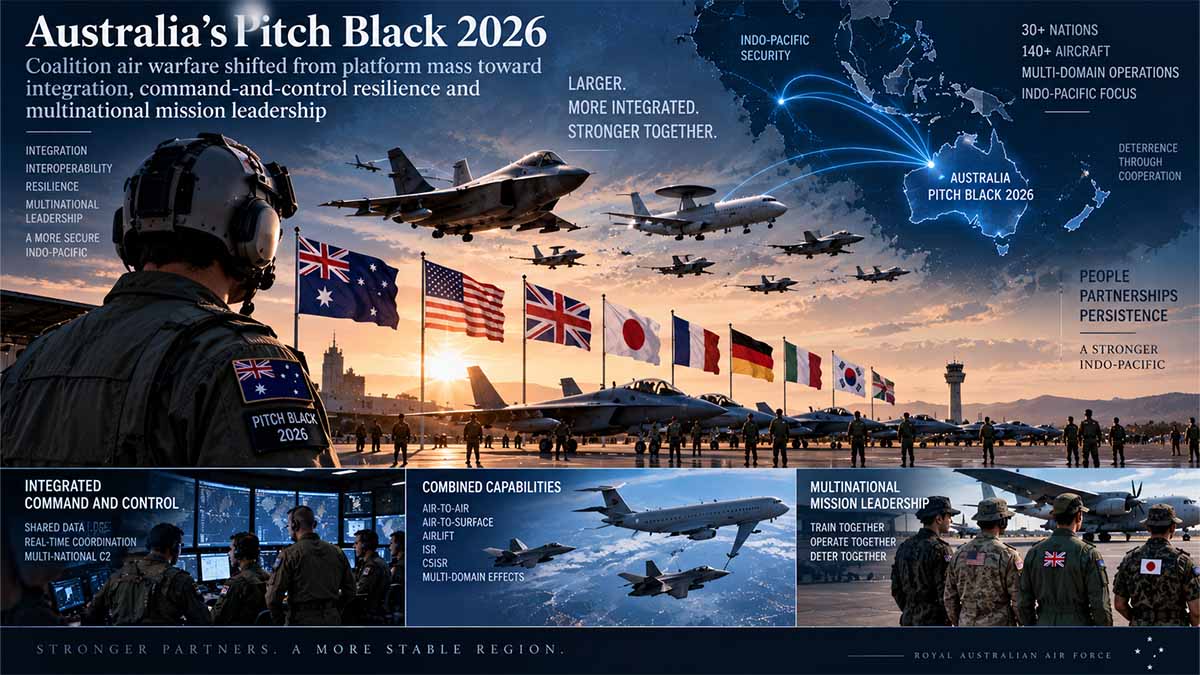
Scope: This assessment examines Exercise Pitch Black 2026, conducted in Australia from 20 July to 7 August 2026, with particular attention to coalition interoperability, fourth-/fifth-generation integration, expeditionary command and control, large-force employment, multinational mission leadership and the implications for Australia, Indo-Pacific partners and participating European air forces over the next five years.
Executive Summary / BLUF
Exercise Pitch Black 2026 is best understood not as a demonstration of maximum aircraft mass but as a laboratory for coalition air-combat integration under conditions of technological, procedural and national heterogeneity, because Australia deliberately assembled more than 100 aircraft and forces from 21 countries around large-force employment, airborne and ground-based command and control, tanker support, intelligence and surveillance, multinational planning and increasingly complex day-and-night missions. The Australian Department of Defence states that more than 2,500 personnel participated, whereas the user-supplied Janes-derived material reports nearly 3,400; because the publicly accessible Australian Defence releases examined for this assessment consistently use the lower figure, 2,500-plus is the defensible official public-record baseline and the approximately 3,400 figure should remain unresolved unless the underlying Defence dataset supplied to journalists is released or otherwise independently verifiable. Exercise Pitch Black 2026 concludes — Australian Department of Defence — 7 Aug 2026
The central operational lesson is that interoperability is no longer reducible to whether different fighters can occupy the same airspace, because Pitch Black tested the wider architecture required to make multinational air power function as a single combat system, including common mission planning, airborne early warning, expeditionary air-battle management, tactical datalinks, tanker availability, post-mission analysis, logistics and personnel capable of assuming coalition command roles. Australian Defence explicitly describes the exercise as integrating fighters, ISR platforms, mobility assets and command-and-control elements in large-force missions intended to approximate contemporary contested operations. Multinational air power takes over the Top End — Australian Department of Defence — 17 Jul 2026
The most consequential capability development was therefore not a single aircraft or weapon but the creation of a distributed command-and-control constellation, in which the RAAF E-7A Wedgetail, Japan Air Self-Defense Force E-2D Hawkeye, Republic of Singapore Air Force G550 airborne early-warning aircraft and Australia’s 114 Mobile Control and Reporting Unit exchanged information and combined airborne and ground sensors to establish a common tactical picture for multinational formations. Australian Defence records that 114MCRU also employed its deployable Bandicoot air-battle-management system for the first time in a control-and-reporting-centre configuration, while Canadian and Philippine personnel were embedded directly within the ground command-and-control construct. Enhancing ground and air integration — Australian Department of Defence — 7 Aug 2026
European participation carried a broader strategic significance because France, Germany, Spain and the United Kingdom deployed capabilities from Europe to northern Australia, while Finland and Sweden contributed personnel, demonstrating that Indo-Pacific coalition air training is increasingly being incorporated into European long-range readiness, logistics and interoperability programmes rather than treated exclusively as regional engagement. Germany deployed six Eurofighters, two A400Ms and approximately 185 personnel, while the Bundeswehr explicitly characterised the deployment as both a test of rapid global readiness and a strategic contribution to German Indo-Pacific presence; the United Kingdom employed an RAF Voyager that flew 11 sorties and approximately 90 hours, travelled more than 25,000 nautical miles and transferred 114 tonnes of fuel to 57 receiver aircraft through 41 air-to-air refuelling contacts, providing measurable evidence that European participation involved operational sustainment rather than symbolic presence. Pitch Black 2026 — Bundeswehr — 27 Jul 2026 Twenty-One Nations. One Mission: Stronger Together, Ready Together — Royal Air Force — 8 Aug 2026
Pitch Black 2026 showed that coalition air power now depends less on aircraft numbers than on who can connect, sustain and command them
Australia’s Exercise Pitch Black 2026 exposed the structural problem behind coalition air power: advanced aircraft create little additional military value if national forces cannot exchange data, sustain operations over distance and place multinational formations under effective mission command. Conducted from 20 July to 7 August 2026, the exercise brought 21 countries, more than 100 aircraft and roughly 3,300 personnel to RAAF Bases Darwin, Tindal and Amberley, while an estimated 1,100–1,500 sorties tested air defence, interdiction, ISR, high-value asset protection, airborne early warning and air-to-air refuelling. The decisive results were therefore institutional rather than numerical: Philippine and South Korean upgrades widened their coalition roles, Indian and Thai datalink limitations exposed the cost of incomplete connectivity, and multinational officers moved beyond participation into mission leadership. Pitch Black’s message is that future coalition effectiveness will be determined by networks, logistics and command authority before it is determined by fighter inventories.
More than 100 aircraft mattered less than the architecture connecting them
The headline force was substantial but deliberately heterogeneous: Australia operated F-35A, F/A-18F, EA-18G, E-7A, C-130J-30, C-27J and KC-30A aircraft, while participating flying contingents included German and Spanish Eurofighters, Indian Rafales, Japanese F-35As and E-2Ds, Singaporean F-16s and G550, South Korean KF-16s, Philippine FA-50PHs and C-130Js, Thai F-16s, Indonesian T-50Is, a French CN235 and US F-35A, C-130J and KC-135 aircraft. The exercise’s operational logic was not to make those fleets identical, but to establish whether dissimilar aircraft could be assembled into large combat packages in which information, fuel, surveillance and command functions crossed national boundaries rather than stopping at the edge of each contingent.
RAAF Air Commodore Matthew McCormack, Exercise Commander and head of Australia’s Air Combat Group, described the purpose as creating an environment in which aircrew, ground crew and support personnel could improve their skills while developing professional relationships that would matter if those countries later had to operate and fight together. That objective was reinforced by an exercise design in which participants were divided between “red” and “blue” forces, mission complexity rose over the three-week period, and approximately half of the sorties were flown at night, forcing crews to rely more heavily on planning, tactical awareness, airborne command-and-control and confidence in systems operated by other nations.
The result was a coalition architecture in which the RAAF E-7A Wedgetail, Japan Air Self-Defense Force E-2D Hawkeye, Republic of Singapore Air Force G550 and Australia’s No 114 Mobile Control and Reporting Unit contributed to the recognised air picture rather than acting simply as national support assets. Australian Defence stated that airborne and ground-based sensors were combined through datalinks to create a common operating picture, while Philippine Air Force and Royal Canadian Air Force personnel were embedded with 114MCRU; the institutional significance is difficult to overstate, because foreign personnel were not merely observing Australian command-and-control procedures but participating inside the machinery used to coordinate aircraft from multiple states.
Link 16 divided aircraft that could join the mission from aircraft that could fully join the information war
The most revealing fault line concerned Link 16, because the Indian Air Force’s Rafale EH/DH contingent and the Royal Thai Air Force’s five F-16A/B fighters operated without the tactical datalink, while Philippine FA-50PHs and upgraded South Korean KF-16s demonstrated what changed when connectivity improved. Indian detachment commander Group Captain Parijhat Jha described the Rafale’s lack of Link 16 as its “only limitation”, because crews could not obtain the full tactical picture available to networked participants even though the aircraft remained operationally effective and NATO-compliant.
Thailand faced the same structural constraint for a different procurement reason: between 2012 and 2018, 18 of the Royal Thai Air Force’s approximately 50 F-16 Block 15/20 aircraft were upgraded to Block 50/52 standard through the US Foreign Military Sales programme, but Link 16 was not included. Detachment commander Group Captain Nattavut Duangsungnaen said crews consequently relied on radio and spatial coordination with fighter controllers, which preserved the ability to participate while increasing dependence on voice communications and external control.
Air Commodore McCormack nevertheless identified an operational benefit in that weakness, because aircraft operating outside the tactical network forced coalition crews to practise procedures relevant to disrupted communications. That distinction matters: Pitch Black did not show that every participant had achieved seamless digital integration, but it did demonstrate that a multinational force must remain executable when some aircraft cannot see the same digital picture, whether because of procurement choices, national restrictions or wartime network degradation.
The Philippines provided the inverse case. Its four FA-50PH fighters had already participated in Pitch Black 2024, but according to detachment commander Lieutenant Colonel Mario Mendoza, their Link 16 terminals were inactive during that exercise because of restrictions, limiting data fusion and largely confining the aircraft to strike activity. Activation in 2026 was described by Mendoza as a significant upgrade because it expanded the detachment into defensive counter-air and counter-offensive missions as well as strike operations; no engine, airframe or weapons replacement was required for the aircraft to become more useful to the coalition, because changing information access changed the missions commanders were prepared to assign.
South Korea showed how avionics upgrades can become command power
South Korea’s six upgraded KF-16 fighters illustrated the same mechanism at a higher level of responsibility, because detachment commander Colonel Ha Jungmi identified Link 16 and active electronically scanned array radar as important improvements over the previous configuration. A US-approved upgrade programme had sought to introduce Mode 5 identification friend-or-foe and datalink enhancements across an estimated 133 KF-16C/D Block 52 aircraft, although the dossier does not establish whether the entire fleet had completed that programme by Pitch Black 2026.
What the exercise did establish was that Korean personnel were trusted with more than tactical participation. Mission-command responsibilities rotated between contingents, and Republic of Korea Air Force flight leaders served as mission commanders for multinational formations on two occasions, overseeing missions from planning through execution, while Korean officers also worked inside the 24-hour Mission Planning Centre, where the capabilities of different national contingents had to be analysed and translated into coherent multinational mission plans.
That is a higher threshold of interoperability than simply entering Australian airspace with compatible aircraft. A mission commander must reconcile different radar capabilities, weapons, fuel margins, tactical procedures and communications limitations while coordinating fighters, controllers and force multipliers against a common objective; consequently, the South Korean role showed that the exercise was developing a distributed leadership model in which coalition authority could move between national contingents rather than remain permanently Australian.
Tankers and logistics determined how much combat power the coalition could actually use
The multinational aircraft table reveals the imbalance between visible fighters and the smaller number of enabling aircraft on which those fighters depended, because Australia supplied KC-30A tanker capability, Spain deployed an A330 MRTT, the United Kingdom contributed a Voyager KC Mk 3, the United States provided a KC-135, India brought an IL-78MKI, and the coalition simultaneously relied on strategic and tactical transports including C-17A, A400M, C-130J, C-27J, CN235 and P-750XL aircraft. This matters because more than 100 combat and support aircraft cannot generate sustained sortie mass merely by being present at Darwin, Tindal and Amberley; fuel, crews, maintenance, spares and mission support must arrive at the correct place and time, making logistics part of the combat system rather than an administrative function behind it.
The force composition makes the burden visible: Germany brought six Eurofighters and two A400Ms with 185 personnel, Spain deployed six Eurofighters, two A400Ms and one A330 MRTT with 200 personnel, Singapore fielded eight F-16C/D Block 52/52+ aircraft and one G550 with 200 personnel, Japan brought six F-35As and two E-2Ds with 250 personnel, India deployed four Rafales, one IL-78MKI and two C-17As with 99 personnel, and the United States contributed six F-35As, two C-130Js and one KC-135 with 250 personnel. Those ratios show why combat-air inventories alone misstate deployable power: every tactical aircraft draws on a larger chain of transport, refuelling, maintenance and personnel support before it can enter a large-force mission.
The exercise’s three-base structure reinforced the same lesson. Darwin and Tindal carried major elements of the combat force while Amberley supported enabling assets, so multinational missions depended on coordinating forces that did not necessarily launch from the same base; this distributed arrangement did not reproduce wartime base denial, but it required planners to construct a single mission from geographically separated components, which is an indispensable precursor to any serious concept of expeditionary air operations.
Red air made coalition weakness part of the training design
Pitch Black 2026 also exposed a structural limitation in the aggressor side of the exercise because Australia did not employ a commercially contracted adversary-air force; instead, participating flying nations agreed that a proportion of their own missions would be dedicated to “red air”, requiring coalition aircraft to alternate between friendly and adversary roles. Air Commodore McCormack acknowledged that a permanently dedicated adversary force with specialist tactics would be desirable, but the rotational model generated enough hostile aircraft to create the numerical opposition required for large-force training.
India’s Rafales provide the clearest example because they operated solely in the air-to-air role and flew for both red and blue forces, employing simulated beyond-visual-range missiles, short-range infrared weapons and guns. An Indian officer cited in the dossier said a simulated long-range missile equivalent to the MBDA Meteor, whose operational range exceeds 100 km, gave the Rafale an advantage in beyond-visual-range engagements, while the aircraft’s manoeuvrability remained valuable at close range; the claim belongs to an Indian exercise participant rather than an independently published performance assessment, but it illustrates how Pitch Black allowed aircraft to be tested against different coalition opponents rather than only alongside them.
The red-air model also forced national contingents to understand coalition vulnerabilities from the adversary perspective. A German Eurofighter, Indian Rafale, South Korean KF-16 or Australian Super Hornet assigned to the opposing side had to exploit weaknesses in the same multinational formations with which it might fly on another day, creating a training mechanism in which knowledge of coalition procedures could be tested against them rather than simply rehearsed cooperatively.
Europe participated nationally, not as NATO, and that distinction is the point
The presence of Canada, Finland, France, Germany, Spain, Sweden, the United Kingdom and the United States gave Pitch Black a substantial NATO-member footprint, but the exercise was neither organised nor commanded as a NATO operation. That distinction matters because what Australia assembled between 20 July and 7 August 2026 was a coalition of national contributions whose political authority remained national, even as their tactical procedures became increasingly interoperable.
Germany’s contingent of six Eurofighters, two A400Ms and 185 personnel, Spain’s six Eurofighters, two A400Ms and one A330 MRTT, France’s single CN235 with 10 personnel, and the United Kingdom’s Voyager with 80 personnel demonstrate four different European models of Indo-Pacific military contribution: combat aviation backed by strategic airlift, combat aviation paired with tanker capacity, a regional transport contribution, and a high-value enabling aircraft capable of extending the endurance of other countries’ fighters. The exercise therefore showed that European participation need not be symmetrical to be operationally useful, because coalition value depends on filling functions rather than reproducing identical national force packages.
Italy, by contrast, does not appear among the 21 participating countries listed for Pitch Black 2026, and the dossier provides no explanation for its absence. That absence should therefore not be converted into a judgment about Italian Indo-Pacific policy or capability; what can be said is narrower and more relevant to coalition planning: in 2026, the European flying contribution visible in the participant data came from France, Germany, Spain and the United Kingdom, while Finland and Sweden participated without deployed aircraft, so the European component remained selective rather than comprehensive.
The next 12–24 months will reveal whether interoperability has become resilience
Pitch Black 2026 established that Australia can convene 21 countries, operate more than 100 aircraft from three RAAF bases, combine airborne and ground-based command-and-control, integrate aircraft with markedly different datalink configurations and give non-Australian officers responsibility for multinational mission planning and execution; it did not establish that the same coalition could maintain those functions after sustained disruption of communications, tanker availability, runways, fuel supply or high-value airborne command platforms, because the dossier contains no evidence that the exercise imposed those conditions at peer-conflict intensity.
That distinction will define the cost of inaction over the next 12–24 months. Participants that do not close tactical-network gaps will continue to require greater controller intervention and voice coordination; states that underinvest in tankers, airlift or maintenance will possess aircraft they cannot exploit fully at distance; and coalitions that expand multinational mission command without matching it with resilient ground and airborne C2 will concentrate authority in systems that remain vulnerable to disruption. The cost will fall first on the states providing scarce enabling assets—Australia, the United Kingdom, Spain, the United States and others whose tankers, surveillance platforms or command systems support aircraft beyond their own national fleets—because every additional fighter integrated into the coalition increases demand on the smaller set of assets that makes the formation usable. Pitch Black 2026 therefore shifted the relevant measure of air power from how many aircraft a country owns to how many it can connect, sustain and, when required, place confidently under somebody else’s command.
Navigational Index
Coalition combat integration and the network problem
How fourth- and fifth-generation aircraft, airborne warning systems, ground-based battle management and national datalink architectures were combined, and why interoperability gaps remain operationally relevant rather than merely technical.
Expeditionary air power, command and multinational leadership
How Pitch Black tested long-range deployment, refuelling, logistics, distributed command-and-control, multinational mission planning and the ability of national contingents to assume leadership inside composite air packages.
Indo-Pacific and European strategic implications
What the exercise establishes, and does not establish, regarding Australian coalition architecture, NATO-member participation, French and German Indo-Pacific posture, UK global air mobility and Italy’s absence from the 2026 flying contingent.
Master Abstract
From aircraft aggregation to combat-system integration
Exercise Pitch Black 2026 brought together forces from Australia and 20 partner countries, more than 100 aircraft and more than 2,500 personnel for three weeks of multinational air-combat training based primarily at RAAF Bases Darwin and Tindal in the Northern Territory and Amberley in Queensland, with Australia describing the activity as its premier biennial international air-combat exercise and as a mechanism for developing the ability of national forces to operate together in complex and contested environments. Although the final 2026 force was materially smaller than the record 2024 iteration, when Australia reported approximately 140 aircraft, more than 4,400 personnel and more than 1,700 missions, the number of participating countries increased from 20 to 21, demonstrating that reduced platform density did not correspond to a contraction in coalition breadth. Exercise Pitch Black 2026 concludes — Australian Department of Defence — 7 Aug 2026 Sun sets on milestone Pitch Black — Australian Department of Defence — 5 Aug 2024
The significance of that change is operational rather than numerical, because modern coalition air warfare depends increasingly on whether heterogeneous aircraft, sensors, command centres, tankers and national mission systems can produce a common decision environment, rather than merely on the number of fighters launched. Australian Defence describes Pitch Black’s large-force employment as combining fighter aircraft, ISR platforms, mobility assets and command-and-control elements, while its account of the E-7A, E-2D, Singaporean G550 and 114MCRU integration shows how information from airborne and ground-based sensors was combined through datalinks to construct a shared tactical picture for multinational formations. The evidence therefore supports treating command-and-control interoperability as one of the exercise’s principal operational centres of gravity, particularly because 114MCRU’s deployable Bandicoot architecture was exercised in a control-and-reporting-centre role while Canadian and Philippine personnel were embedded in its multinational operation. Controlling the chaos — Australian Department of Defence — 4 Aug 2026
Link 16 reveals the difference between coalition presence and coalition integration
The user-supplied operational reporting identifies an important distinction between aircraft physically participating in multinational packages and aircraft being fully incorporated into the tactical information environment, because Indian Rafales and Thai F-16s reportedly operated without Link 16 while Philippine FA-50PH and upgraded South Korean KF-16 aircraft exploited the network to varying degrees. The publicly retrieved Australian official record confirms that tactical datalinks formed part of the wider command-and-control architecture, and the Bundeswehr independently identifies Link 16 as one of the tactical data connections used in the exercise environment; however, the detailed aircraft-by-aircraft Link 16 configuration claims contained in the supplied Janes material have not all been reproduced in accessible first-order government records examined in this session, and should therefore remain attributed rather than converted into independently established facts. Pitch Black 2026 — Bundeswehr — 27 Jul 2026
This distinction is strategically important because coalition air power increasingly depends on the quality, latency, resilience and dissemination of the common operating picture, meaning that loss or absence of a tactical network changes not only communications efficiency but also the speed with which forces can classify threats, distribute targeting or surveillance information, assign engagements and preserve shared situational awareness. Pitch Black consequently provided value both when connectivity worked and when participants were forced to operate through alternative procedures, because a coalition that remains dependent upon uninterrupted network access has not demonstrated the same resilience as one capable of preserving mission effectiveness under degraded communications; the Australian commander’s broader emphasis on increasingly complex contested scenarios therefore makes network degradation a relevant analytical lens even where the detailed tactical serials remain outside the public record.
Command and control became a multinational combat capability
The RAAF’s account of E-7A Wedgetail operations provides unusually clear public evidence of how the exercise sought to move beyond parallel national activity toward integrated coalition decision-making, because the aircraft operated alongside the Japanese E-2D, Singaporean G550 and ground-based 114MCRU, with Defence describing the combined architecture as a command-and-control “constellation” capable of exploiting the distinctive systems of each platform. The practical significance lies in the fact that coalition air warfare requires a shared picture to be converted into synchronised action across aircraft that differ in sensor performance, communications architecture, weapons, national operating restrictions and rules of employment, which means that the planning, control and debriefing infrastructure can become as important to mission effectiveness as the individual fighter platforms themselves.
Australia’s use of Bandicoot strengthens this conclusion because Defence describes 114MCRU as Australia’s only expeditionary control-and-reporting capability and records that the system was used for the first time in a control-and-reporting-centre configuration during Pitch Black 2026, while foreign personnel worked directly within the capability. This represents a more demanding form of interoperability than simple liaison or observation, since embedding partner personnel inside a command node requires procedural compatibility, communications discipline, shared terminology and sufficiently understood information flows for multinational personnel to contribute to airspace surveillance and control.
Large-force employment was also a leadership exercise
The exercise architecture progressively increased complexity rather than beginning immediately with maximum force packages, which is consistent with Australian Defence’s description of a training programme designed to develop interoperability, common procedures and shared operational understanding before participants moved into more demanding large-force missions. This progression matters because coalition warfare places substantial burdens on mission commanders, who must synchronise dissimilar aircraft types, tanker windows, airborne-warning coverage, communications plans, weapons employment, timing, airspace separation and contingency procedures while accommodating national restrictions and different levels of tactical experience.
The supplied material indicates that South Korean personnel were among those given multinational mission-command responsibilities, including planning and executing coalition packages and participating in the Mission Planning Centre, which, if confirmed through the relevant Republic of Korea Ministry of National Defense documentation, would constitute an important evolution from participation toward coalition leadership. The retrieved Australian official record independently confirms South Korean flying participation and places the Republic of Korea among the recurrent Pitch Black partners, although one Australian arrival report refers to five South Korean F-16s and two KC-330 aircraft, whereas the supplied operational table lists six KF-16s, illustrating why sortie-level and aircraft-inventory claims should not be silently harmonised without the relevant national deployment record. Touchdowns continue in Darwin — Australian Department of Defence — 17 Jul 2026
Expeditionary reach was tested before aircraft entered the exercise airspace
For several participants, the operational problem began thousands of kilometres before Darwin, because the exercise required European and Asian forces to move aircraft, personnel, spares and support equipment over intercontinental distances and then sustain those forces within Australian infrastructure. Germany’s official account records a deployment of more than 13,000 kilometres, six Eurofighters, two A400Ms, approximately 180 military personnel plus five civilian staff and around 80 containers of equipment transported by sea, while air-to-air refuelling for the deployment involved the multinational MRTT structure based at Eindhoven and Cologne. These are not peripheral logistics details, because coalition air power cannot generate sustained combat mass at distance unless maintenance, fuel, personnel, munitions, ground equipment, customs and biosecurity procedures can move with the aircraft at the required tempo.
The British contribution illustrates the same issue from a different operational function, because the RAF reports that approximately 80 personnel deployed more than 14,000 kilometres to northern Australia, while its Voyager tanker completed 11 sorties, roughly 90 flying hours and more than 25,000 nautical miles, transferring 114 tonnes of fuel in 41 refuelling contacts to 57 German, Spanish and Australian aircraft, while also transporting more than 130 personnel. The United Kingdom additionally exercised strategic aeromedical evacuation from Voyager during Pitch Black for the first time, turning a tanker and strategic transport asset into a medical evacuation platform and thereby testing the support architecture required to sustain coalition combat operations beyond the immediate fighter mission.
Key Evidence Table
| Indicator | Value/status | Reference date | Definition/scope | Issuer | Exact source |
|---|---|---|---|---|---|
| Participating countries | 21 | 7 Aug 2026 | Australia plus 20 partner nations | Australian Department of Defence | Exercise Pitch Black 2026 concludes |
| Aircraft | 100+ | 7 Aug 2026 | Participating exercise aircraft | Australian Department of Defence | |
| Official public personnel figure | 2,500+ | 7 Aug 2026 | Personnel participating in Pitch Black 2026 | Australian Department of Defence | |
| User-supplied/Janes figure | ≈3,400 | Exercise reporting | Reportedly based on data supplied to journalists; underlying official dataset not located publicly | Unresolved in public first-order record | Requires source reconciliation |
| Main operating bases | Darwin, Tindal, Amberley | 20 Jul–7 Aug 2026 | Principal RAAF operating locations | Australian Department of Defence | |
| 2024 comparison | 140 aircraft; 4,400+ personnel; 20 nations; 1,700+ missions | Jul–Aug 2024 | Previous Pitch Black iteration | Australian Department of Defence | |
| German contingent | 6 Eurofighters; 2 A400Ms; ≈185 personnel | Jul–Aug 2026 | German Pitch Black deployment | Bundeswehr | |
| German deployment distance | >13,000 km | Jul 2026 | European deployment to Australia | Bundeswehr | |
| RAF Voyager sorties | 11 | 20 Jul–7 Aug 2026 | UK Pitch Black tanker activity | Royal Air Force | |
| RAF Voyager fuel transfer | 114 tonnes | Exercise total | Fuel transferred through 41 AAR contacts | Royal Air Force | |
| RAF Voyager receivers | 57 aircraft | Exercise total | German, Spanish and Australian receivers | Royal Air Force | |
| French contribution | CASA aircraft plus crew and logistical coordination personnel | Jul–Aug 2026 | French Armed Forces in New Caledonia contribution | French Ministry of the Armed Forces | |
| Expeditionary C2 | Bandicoot used for first time in CRC configuration | Aug 2026 | 114MCRU air-battle-management capability | Australian Department of Defence |
Alternatives and Indicators Assessment
The public evidence does not justify constructing three mutually exclusive strategic hypotheses about Australian intent, because Pitch Black is transparently an established biennial training activity with multiple overlapping purposes; nevertheless, three interpretations of its operational evolution can be tested against subsequent exercises.
A platform-mass interpretation would hold that combat value still derives principally from assembling the largest feasible number of aircraft, but the reduction from approximately 140 aircraft in 2024 to just over 100 in 2026 while maintaining 21-country participation and expanding visible command-and-control integration weakens the proposition that headline mass alone is the principal metric.
A network-centric interpretation is better supported by current evidence because Australian Defence devoted significant attention to E-7A/E-2D/G550/114MCRU integration, shared tactical pictures, datalinks, partner personnel embedded within command nodes and increasingly complex large-force employment, although the public record does not disclose network availability rates, latency, electronic-warfare conditions, classified datalink performance or the proportion of missions conducted under deliberately degraded communications.
An expeditionary-coalition interpretation is also strongly supported because Germany, France and the United Kingdom used the exercise to demonstrate long-distance deployment, support and sustainment functions alongside combat integration, while Japan, India and other regional partners deployed increasingly sophisticated combat aircraft to Australia; future confirmation would come from greater cross-national mission command, distributed basing, expeditionary maintenance, contested logistics and multinational command nodes rather than simply increasing the fighter count.
European and NATO Lens
Germany: Pitch Black is becoming an Indo-Pacific readiness instrument
Germany’s participation is the most substantial European combat-air contribution documented in the accessible official record, involving six Eurofighters, two A400Ms and approximately 185 personnel after a deployment exceeding 13,000 kilometres, with the Bundeswehr explicitly describing the activity as both multinational air-combat training and a strategic German contribution to presence in the Indo-Pacific. The exercise also carries a transition value for Germany because the Bundeswehr specifically highlighted the relevance of operating alongside Australian, Japanese and American F-35s at a time when Germany is introducing its own F-35 capability, meaning Pitch Black offers an environment in which German crews can observe the operational relationship between fourth-generation Eurofighters and fifth-generation coalition aircraft before Germany itself fields a mixed fast-jet force.
The logistics are equally significant because around 80 containers were transported by sea, while tanker support involved the multinational MRTT structure, illustrating the difference between deploying a small ceremonial detachment and moving the sustainment architecture necessary for repeated combat-air sorties across intercontinental distance. For Germany, therefore, the relevant lesson is not simply that Eurofighters can reach Australia, but that the Luftwaffe can rehearse the organisational chain connecting European bases, multinational tanker support, strategic transport, maritime freight, Australian operating infrastructure and high-intensity flying at destination.
France: regional presence gives Paris a different strategic geometry
France’s participation was structurally different because the French Ministry of the Armed Forces records a CASA transport aircraft, its crew and logistics-coordination personnel from the French Armed Forces in New Caledonia, rather than the larger European fighter package deployed by Germany. Paris therefore approached Pitch Black not solely as a distant European participant but also as a resident Indo-Pacific military power with permanently based forces and sovereign territories in the wider region, and the French ministry explicitly linked the exercise to France-Australia interoperability and France’s operational credibility among South Pacific partners. Point de situation des opérations du jeudi 16 au jeudi 23 juillet 2026 — Ministère des Armées et des Anciens combattants
The capability contribution was modest in numerical terms but strategically relevant because transport aircraft, logistical coordination and access to regional bases represent essential components of distributed operations, especially where combat aircraft must operate across the enormous distances of the Pacific; France’s subsequent value to coalition air operations therefore depends not only on fast-jet numbers but on its regional infrastructure, sovereign access, pre-positioned personnel and ability to connect metropolitan European forces with permanent Indo-Pacific formations.
United Kingdom: tanker capacity exposed the logistics behind combat mass
The RAF contribution demonstrates that a participant can have disproportionate operational significance without deploying a large fighter contingent, because the Voyager’s 114 tonnes of transferred fuel, 41 refuelling contacts and 57 receiver aircraft directly increased the persistence and geographic reach of German, Spanish and Australian combat aircraft. This is a measurable force-multiplier effect and illustrates a central coalition vulnerability: the number of fighters theoretically available becomes less relevant when tanker, basing and maintenance capacity constrain how many aircraft can reach the fight, remain on station or regenerate sorties.
The RAF’s decision to exercise the aircraft simultaneously as an aeromedical-evacuation platform adds a resilience dimension that is frequently absent from headline combat-air analysis, because high-intensity multinational operations require not only combat power but the capacity to recover personnel, manage casualties and preserve operational continuity over strategic distances.
Italy: the absence in 2026 matters because the 2024 benchmark was unusually substantial
Italy does not appear in the Australian Defence list of Pitch Black 2026 participating countries, meaning no Italian operational lesson from the 2026 exercise should be invented or inferred; this absence is analytically notable because Italy had made a particularly significant debut in Pitch Black 2024 through the carrier ITS Cavour, which launched F-35B and AV-8B aircraft while participating in integrated activity involving Australia and other coalition partners. Cavour makes waves at Pitch Black — Australian Department of Defence — 31 Jul 2024
The correct Italian assessment for 2026 is therefore one of non-participation rather than capability deficiency, because Italy had already demonstrated a carrier-based fourth-/fifth-generation contribution during the previous iteration; the more useful future indicator will be whether Rome returns in 2028 with a carrier aviation, F-35, tanker, transport or command-and-control contribution and whether such a deployment becomes part of a sustained Italian Indo-Pacific training pattern rather than remaining episodic.
NATO and Europe: national participation, not a NATO operation
Pitch Black 2026 included numerous NATO members — Canada, Finland, France, Germany, Spain, Sweden, the United Kingdom and the United States — alongside Australia, Japan, South Korea, India, Singapore and other Indo-Pacific partners, but the exercise should not be described as a NATO exercise because the participating NATO members deployed nationally and the Australian official record identifies the activity as an RAAF-hosted multinational exercise rather than an Alliance operation. NATO’s official membership list confirms the Alliance status of those countries, while Australian Defence provides the exercise participant list. NATO member countries — North Atlantic Treaty Organization
What Pitch Black does demonstrate is increasing procedural overlap between European and Indo-Pacific coalition air forces, because the same NATO-member air forces that must operate together in European contingencies are also rehearsing command, refuelling, data exchange, logistics and air-combat integration alongside Australia, Japan, South Korea and other regional partners. This should not be interpreted as an automatic extension of NATO collective-defence obligations into the Indo-Pacific, but it does reduce the practical barriers to ad hoc coalition formation because forces arrive with increasingly compatible procedures, communications architectures and prior operating relationships.
Principal Gaps and Watch Indicators
The personnel-count discrepancy is material and unresolved, because publicly accessible Australian Defence statements repeatedly describe more than 2,500 participants while the supplied material reports approximately 3,400 personnel based on data allegedly provided by Defence to journalists; publication of the underlying exercise participant matrix or an Australian post-exercise statistical report would resolve whether the larger number includes personnel categories excluded from public media releases.
The total sortie count is not established in the first-order public record examined here, because the supplied estimate of approximately 1,100–1,500 sorties has not been matched to an accessible Australian Defence statistical release comparable with the official statement that Pitch Black 2024 generated more than 1,700 missions; any exact 2026 sortie figure should therefore remain attributed rather than stated as verified fact.
Detailed Link 16 availability remains incompletely documented at official level, particularly for Indian Rafale, Thai F-16, Philippine FA-50PH and South Korean KF-16 configurations during individual exercise sorties, making national defence or acquisition documentation the decisive record required before converting the supplied participant accounts into independently established technical facts.
Mission-command distribution should be watched closely, because the strategic evolution of Pitch Black will be more significant if non-Australian forces increasingly command multinational packages and command-and-control cells rather than simply contributing aircraft; public confirmation of which nations assumed mission-command roles, how often they did so and what mission types they controlled would provide a stronger measure of genuine coalition leadership development.
Distributed and agile basing is the next major threshold, because Australian command-and-control systems are already being made more deployable, but the public record available here does not demonstrate that Pitch Black 2026 tested sustained fighter generation from austere, dispersed or deliberately degraded operating locations at a scale sufficient to establish mature agile combat employment across the coalition.
Network resilience is a decisive collection requirement, because future exercises would become materially more demanding if tactical networks were deliberately jammed, denied or segmented and multinational packages were required to preserve mission effectiveness through alternative links, decentralised control and mission command rather than relying on a continuously available shared picture.
Decision-Relevant Visualisation
The following comparison uses only Australian Department of Defence figures and therefore deliberately excludes the unresolved approximately 3,400-person figure and the unofficial 1,100–1,500-sortie estimate.
Aircraft
Personnel
Countries
| Measure | 2024 | 2026 | Analytical meaning |
|---|---|---|---|
| Aircraft | ≈140 | 100+ | Reduced physical mass |
| Personnel | 4,400+ | 2,500+ | Smaller deployed exercise population |
| Countries | 20 | 21 | Broader multinational participation |
Net Assessment
The most defensible judgment is that Pitch Black 2026 advanced from a multinational flying exercise toward a more sophisticated coalition combat-integration environment in which information architecture, command-and-control distribution, mission planning, tanker support, expeditionary logistics and multinational leadership increasingly determine the value of the participating aircraft, while the exercise simultaneously exposed why technological interoperability cannot be assumed merely because aircraft are politically aligned or nominally compatible.
Australia’s strategic advantage is the combination of unusually large training airspace, mature northern bases, fifth-generation aircraft, airborne battle management and an expanding network of Indo-Pacific and European partners willing to deploy significant forces over intercontinental distances. The principal limitation visible from the public record is that interoperability remains uneven, particularly where national communications architectures, tactical datalink access, information-release restrictions and differing equipment generations prevent every participant from operating with the same level of connectivity, while the public record still provides insufficient detail to assess performance under serious electronic attack or prolonged network degradation.
The exercise therefore provides a more consequential indicator of future coalition effectiveness than its reduced aircraft count might initially suggest, because the capabilities being rehearsed — distributed command and control, common tactical pictures, tanker-supported range, multinational mission planning and leadership across heterogeneous forces — are precisely those required to transform separate national air forces into a functioning operational coalition. What Pitch Black 2026 does not establish is combat effectiveness against a peer adversary, survivability under sustained missile and electronic attack, wartime sortie-generation rates or the resilience of Australian northern bases under attack, because none of those conclusions can be inferred from successful exercise participation alone.
Exercise ‘Pitch Black’ 2026 Participants & Operational Deployment Matrix
Operational BLUF & Theater Footprint Exercise ‘Pitch Black’ 2026 represents a critical large-force employment (LFE) integration across the Indo-Pacific, mobilizing 21 participating nations, +100 multi-role combat and support aircraft, and +3,300 embedded military personnel. Forward combat, strategic tanker transport, and airborne early warning elements are distributed across three primary Royal Australian Air Force operating hubs: RAAF Base Darwin, RAAF Base Tindal, and RAAF Base Amberley.
Strategic Coalition Synergy: 21 Partner Air Forces Integrated
Exercise ‘Pitch Black’ 2026 demonstrates advanced coalition interoperability across five continents. RAAF provides the deep-strike core and logistics spine, integrated with 5th generation fighters (F-35A from Australia, Japan, and the United States), modern 4.5 generation platforms (Eurofighter Typhoon, Rafale, KF-16, F-16 Block 52/eMLU), and dedicated airborne ISR and AAR enablers.
Exercise ‘Pitch Black’ 2026: Official Order of Battle by Nation
Source: Australian Department of Defence / Janes (2026 Janes: 2025139)| Country | Aircraft Type | ✈ Qty | 👤 Pers | Bases |
|---|---|---|---|---|
| 🇦🇺 Australia | F-35A | 30–35* | 1,500 | |
| F/A-18F Super Hornet | ||||
| E/A-18G Growler | ||||
| E-7A Wedgetail | ||||
| C-130J-30 Hercules | ||||
| C-27J Spartan | ||||
| KC-30A MRTT | ||||
| 🇧🇳 Brunei | No aircraft deployed | — | 5* | |
| 🇨🇦 Canada | No aircraft deployed | — | 70 | |
| 🇫🇯 Fiji | No aircraft deployed | — | 12 | |
| 🇫🇮 Finland | No aircraft deployed | — | 4 | |
| 🇫🇷 France | CN235 | 1 | 10 | |
| 🇩🇪 Germany | EF2000 Typhoon | 6 | 185 | |
| A400M Atlas | 2 | |||
| 🇮🇩 Indonesia | T-50i Golden Eagle | 5 | 95 | |
| 🇮🇳 India | Rafale ED/DH | 4 | 99 | |
| Il-78MKI Tanker | 1 | |||
| C-17A Globemaster III | 2 | |||
| 🇯🇵 Japan | F-35A Lightning II | 6 | 250 | |
| E-2D Advanced Hawkeye | 2 | |||
| 🇲🇾 Malaysia | No aircraft deployed | — | 15 | |
| 🇳🇿 New Zealand | No aircraft deployed | — | 50 | |
| 🇵🇬 Papua New Guinea | P-750XL | 2 | +30* |
| Country | Aircraft Type | ✈ Qty | 👤 Pers | Bases |
|---|---|---|---|---|
| 🇵🇭 Philippines | FA-50PH Golden Eagle | 4 | 166 | |
| C-130J Hercules | 1 | |||
| 🇸🇬 Singapore | F-16C/D Block 52/52+ | 8 | 200 | |
| G550 AEW | 1 | |||
| 🇪🇸 Spain | EF2000 Typhoon | 6 | 200 | |
| A400M Atlas | 2 | |||
| A330 MRTT | 1 | |||
| 🇰🇷 South Korea | KF-16 Fighting Falcon | 6 | 120 | |
| 🇸🇪 Sweden | No aircraft deployed | — | 4 | |
| 🇹🇭 Thailand | F-16 eMLU Fighting Falcon | 5 | 95 | |
| 🇬🇧 United Kingdom | Voyager KC Mk 3 | 1 | 80 | |
| 🇺🇸 United States | F-35A Lightning II | 6 | 250 | |
| C-130J Hercules | 2 | |||
| KC-135 Stratotanker | 1* |
Theater Strategic Pillars & Capability Distribution
Deconstruction of the coalition’s operational warfighting spectrum5th Gen Air Dominance
A multi-national F-35A stealth contingent formed by Australia (~12+), Japan (6), and the United States (6) operating out of RAAF Darwin and Tindal, establishing interoperable low-observable sensor and strike nodes.
Tactical Strike Workhorses
Diversified 4.5 Gen fleet: 12 EF2000 Typhoons (GER & ESP), 4 Rafale ED/DH (IND), 6 KF-16 (ROK), 8 F-16C/D (SGP), 5 F-16 eMLU (THA), and 9 light combat trainers (T-50i & FA-50PH).
Airborne Tanker Web
Strategic depth enabled by KC-30A (AUS), A330 MRTT (ESP), Voyager KC Mk 3 (UK), Il-78MKI (IND), and KC-135 (USA) primarily staged out of Amberley and Darwin to fuel long-range training complexes.
Command & Non-Flying Enablers
6 nations deployed embedded liaison and planning personnel without aircraft (Brunei, Canada, Fiji, Finland, Malaysia, New Zealand, Sweden), integrating theater C2 and multinational logistics.
Strategic Key Judgments (Analytical Verdicts)
Defensible assessments on Pitch Black 2026 force integration and coalition interoperabilityOpen Official Record Gaps (Unpublished Parameters)
- Exact Australian Sub-Fleet Quantities: Public records list a combined bracket of 30–35 aircraft across 7 RAAF airframes without publishing individual type counts.
- USAF Tanker Deployment Certainty: KC-135 Stratotanker deployment is indicated as a Janes estimate (1*) rather than confirmed definitive DOD manifest.
- Sortie Generation Rates: Public releases omit detailed theater sortie completion rates, Link 16 interoperability degradation rates, and simulated kill-ratios.
Observable Watch Indicators for Pitch Black 2028+
Coalition combat integration and the network problem
Pitch Black 2026 demonstrated that the central problem of multinational air warfare is no longer simply whether aircraft from different countries can fly in the same formation, refuel from compatible tankers or operate under a common air tasking framework, but whether geographically dispersed sensors, airborne command posts, fighters, ground-control units and national communications architectures can generate, distribute and continuously refresh a sufficiently coherent tactical picture for commanders and aircrew to make decisions at operationally relevant speed; in this respect, the exercise placed particular weight on the integration of fourth- and fifth-generation combat aircraft with airborne early-warning systems and deployable ground command-and-control nodes, while simultaneously exposing the limits that appear when tactical datalink access, security permissions, national system configurations or communications resilience prevent every participant from receiving the same information at the same time. Australian Defence described the exercise as three weeks of high-intensity air-combat training involving more than 100 aircraft from 21 partner nations, with the Japanese F-35A and Indian Rafale making their Pitch Black debuts, but the more consequential feature was the command-and-control architecture operating behind those aircraft, because the RAAF deliberately connected its E-7A Wedgetail and 114 Mobile Control and Reporting Unit with Japan’s E-2D Hawkeye and Singapore’s G550 airborne early-warning aircraft to produce what Australian officers described as a multinational command-and-control “constellation”. Exercise Pitch Black 2026 concludes — Australian Department of Defence — Aug 2026 Enhancing ground and air integration — Australian Department of Defence — Aug 2026
The exercise increasingly treated information as a combat resource
The operational significance of this architecture becomes clearer when Pitch Black is viewed not as a collection of aircraft types but as a distributed information system in which individual platforms generated only part of the overall battlespace picture, because the Australian E-7A, Japanese E-2D, Singaporean G550 and Australian ground-based air-battle-management system possessed different sensors, communications channels, crew structures and operating geometries, while the objective was to combine their contributions into a shared representation of friendly aircraft, opposing forces, airspace activity and mission status that could then support multinational decision-making; Australian Defence explicitly stated that airborne and ground sensors were combined through datalinks to create a “robust, clear and tactically useful common operating picture”, while Squadron Leader Daniel Price of No. 2 Squadron explained that the integration between E-7A, E-2D and 114MCRU was one of the exercise’s principal strengths because each capability contributed different systems and platform advantages to the wider command-and-control construct. Enhancing ground and air integration — Australian Department of Defence — Aug 2026
That distinction is operationally important because an aircraft’s sensor performance and weapons inventory do not automatically translate into equivalent coalition combat value if the information that aircraft detects cannot be distributed to the formations or controllers that require it, whereas a platform with comparatively modest organic sensing can become substantially more effective when its crew receives tracks, identification data, targeting information and warnings generated elsewhere in the force; the United States Navy’s official description of the Multifunctional Information Distribution System identifies Link 16-compatible MIDS as an interoperable secure tactical-data architecture designed specifically for joint, coalition and international operations, while US military documentation describes Link 16 as a network carrying near-real-time tactical information and secure digital voice between airborne, ground and maritime units. The operational issue is therefore not simply communications in the conventional sense of pilots speaking to controllers, but the machine-to-machine distribution of a constantly updated tactical picture that reduces the amount of information that must be reconstructed manually over voice radio and allows geographically separated participants to act on a more consistent representation of the battlespace. Multifunctional Information Distribution System — Naval Air Systems Command Joint STARS improves warfighter communication — U.S. Air Force
Fourth- and fifth-generation integration was a systems problem, not an aircraft comparison
Pitch Black 2026 was particularly relevant to the question of fourth-/fifth-generation integration because Australia and the United States operated F-35As, Japan brought its F-35A to the exercise for the first time, while numerous fourth-generation platforms—including Australian F/A-18F Super Hornets, German and Spanish Eurofighters, Singaporean and Thai F-16s, South Korean KF-16s, Indian Rafales, Philippine FA-50PHs and Indonesian T-50Is—shared the same operational environment; this combination matters because the fifth-generation aircraft is designed not merely as a low-observable strike or fighter platform but as a sensor-fusion node whose operational value increases when information gathered by the aircraft can be incorporated into the wider force, while fourth-generation aircraft can correspondingly gain situational awareness from information they did not collect with their own radars or electronic-support systems. Australian Defence’s own description of Finnish observers at Pitch Black is unusually explicit on this point, because Finland, while introducing its F-35A fleet, sent personnel specifically to study how Australia integrates fourth- and fifth-generation capabilities, command-and-control systems, fast jets and coalition partners inside a large multinational exercise, indicating that the organisational and networking architecture surrounding the aircraft is now considered a discrete operational competence worthy of study. Nordic first at major aviation exercise — Australian Department of Defence — Aug 2026
The F-35 itself illustrates why this is not merely an issue of aircraft generations, because official US Air Force documentation distinguishes between the aircraft’s Multifunction Advanced Data Link, used for highly integrated communications among F-35s, and Link 16, which enables communication with wider fourth-generation and coalition forces; consequently, a multinational mission involving F-35s, Eurofighters, Rafales, Super Hornets or F-16-family aircraft does not become integrated simply because those aircraft are assigned to the same package, because the coalition must determine which data can be exchanged, through which waveform or gateway, at what classification level, with what latency, and whether information passed from a fifth-generation sensor can be displayed and tactically exploited by another participant rather than merely reported verbally. Interoperability is key to F-35A combat success — U.S. Air Force
This helps explain why the Australia-Japan-US defence relationship treated Pitch Black 2026 as more than another multinational training event, because the three governments had already identified the exercise in their 2024 trilateral ministerial statement as one of the venues for trilateral F-35 training and simultaneously committed themselves to deeper ISR cooperation, faster information-sharing and the development of a more networked regional air-and-missile-defence architecture; Japan’s 2026 deployment of F-35As to Australia therefore formed part of a longer institutional trajectory in which aircraft interoperability, network connectivity, intelligence sharing and operational access are progressively being combined rather than developed as unrelated bilateral activities. United States-Japan-Australia Trilateral Defense Ministers' Meeting Joint Statement — Australian Department of Defence — May 2024 Ministerial statement on enhancing Australia-Japan defence cooperation — Japan Ministry of Defense — Aug 2026
Airborne early warning became the connective layer between dissimilar fighter fleets
The participation of three different airborne early-warning architectures—the Australian E-7A Wedgetail, Japanese E-2D Hawkeye and Singaporean G550 Airborne Early Warning aircraft—gave Pitch Black a particularly important coalition command-and-control dimension, because those aircraft were not merely providing separate national radar coverage but were exercised alongside one another and alongside 114MCRU to establish a more resilient information picture; Australian Defence states that the E-7A provided enhanced situational awareness and coordinated aircraft from multiple nations, while its interaction with the E-2D, G550 and ground-based air-battle-management units allowed participating forces to combine sensor information through datalinks rather than relying on a single airborne command platform. Enhancing ground and air integration — Australian Department of Defence — Aug 2026
This has several operational consequences that extend beyond exercise efficiency, because distributing command-and-control functions across several airborne and terrestrial nodes reduces the conceptual dependence on any single sensor or controller, increases the number of potential observation geometries available to the force and provides commanders with opportunities to transfer control functions if one element is unavailable, although the public record does not establish that Pitch Black 2026 subjected this architecture to representative peer-level electronic attack or demonstrated survivability against kinetic threats; the correct conclusion is therefore that the exercise demonstrated multinational integration of multiple C2 nodes under demanding training conditions, not that it proved wartime resilience against a sophisticated adversary. Japan’s own force-development programme provides additional context, because the Japan Air Self-Defense Force identifies E-2D acquisition, improvements to its Japan Aerospace Defense Ground Environment and increased network resilience as elements of its broader air-defence modernisation, meaning that the E-2D contribution at Pitch Black was linked to a larger Japanese effort to improve persistent surveillance and networked air defence rather than representing an isolated exercise capability. Defending Japan's peace from the skies — Japan Air Self-Defense Force
Singapore’s contribution added another significant architecture to the same environment, because the Republic of Singapore Air Force deployed eight F-16s, one G550 Airborne Early Warning aircraft and more than 200 personnel, with Singapore’s Ministry of Defence stating that the G550 provides a persistent ability to detect, identify and track aerial targets while the contingent trained in large-scale multinational air-combat scenarios involving electronic warfare, air-to-air missions and air-to-ground operations; Singapore also explicitly identified training alongside fifth-generation F-35 aircraft as useful preparation for emerging operational concepts, an important point because the RSAF is moving toward its own future fifth-generation force while still operating a substantial fourth-generation fighter fleet. RSAF Sharpens Combat Readiness at Multinational Exercise Pitch Black in Australia — Singapore Ministry of Defence — Jul 2026
Bandicoot moved the common air picture from the aircraft cabin to an expeditionary ground network
The ground component of the network was at least as significant as the airborne element because Australia’s 114 Mobile Control and Reporting Unit, which Defence describes as the ADF’s only expeditionary control-and-reporting capability, monitored more than 100 aircraft operating in northern Australian airspace and for the first time employed its deployable Bandicoot air-battle-management system in a control-and-reporting-centre configuration; according to Defence, 114MCRU establishes radar and communications nodes in remote locations, brings those nodes online within demanding timelines and uses the resulting network to create a coordinated tactical air picture, making it a critical component of Australia’s ability to project command-and-control functions beyond fixed headquarters infrastructure. Controlling the chaos — Australian Department of Defence — Aug 2026
The multinational aspect was particularly consequential because Canadian and Philippine personnel were embedded directly in the 114MCRU ground control-and-reporting construct, rather than participating only as liaison officers observing Australian procedures, while the unit simultaneously operated extensively with Singapore’s G550 and Japan’s E-2D; this means that interoperability was being exercised at the human-machine interface where controllers must interpret tracks, allocate attention, coordinate aircraft and sustain a common picture through national equipment and procedures, an area in which technical compatibility alone does not guarantee operational effectiveness because terminology, identification procedures, information-release rules, training standards and decision authorities can all become sources of friction even when the underlying communications systems can exchange data. Controlling the chaos — Australian Department of Defence — Aug 2026
The importance of Bandicoot should therefore be understood in the wider context of distributed command and control, because a deployable radar-and-communications capability that can establish operational nodes away from permanent facilities gives Australia greater flexibility to distribute the command architecture supporting northern air operations, while the ability to incorporate foreign controllers reduces the extent to which coalition operations depend upon purely Australian staffing; nevertheless, public reporting does not disclose Bandicoot’s sensor ranges, network topology, redundancy architecture, electromagnetic signature, resistance to jamming or the number of nodes deployed during Pitch Black, and those omissions are operationally important because deployability does not by itself establish survivability in an environment where fixed and mobile C2 nodes would be vulnerable to electronic attack, cyber operations, long-range precision strike and persistent ISR.
Link 16 separated connectivity from genuine interoperability
The most useful technical lesson from Pitch Black concerns the difference between compatibility, connectivity and integration, which are often treated as synonyms despite representing different operational conditions: aircraft are compatible when common procedures allow them to operate safely together, connected when systems permit tactical information to pass between them, and genuinely integrated when that information can be incorporated rapidly enough into mission planning and engagement decisions to alter operational behaviour. Link 16 occupies a central position in this distinction because it is a coalition tactical-data architecture rather than simply a digital radio, with official US documentation describing the network as providing near-real-time exchange of tactical data and secure voice among airborne, maritime and ground platforms, including position and identification information that contributes directly to the shared tactical picture. F/A-18 MIDS-LVT Flies High — Naval Air Systems Command Multifunctional Information Distribution System — Naval Air Systems Command
The user-supplied reporting indicates that Indian Rafales and Thai F-16s operated at Pitch Black without Link 16, requiring greater dependence on voice and controller coordination, whereas Philippine FA-50PHs reportedly exercised with active Link 16 for the first time at Pitch Black and upgraded South Korean KF-16s employed improved datalink capabilities; these claims are operationally credible and consistent with the wider network problem demonstrated during the exercise, but the official national records retrieved for this assessment do not verify every aircraft-level configuration in sufficient detail to restate all of them as independent established fact, and they should therefore remain attributed to the supplied reporting rather than silently elevated to Tier-A evidence. What is independently established is that India deployed Rafales specifically to conduct multinational large-force missions and improve force integration, while the Indian Ministry of Defence described the exercise as an opportunity to validate expeditionary operations over extended distances and enhance multinational interoperability. Indian Air Force Ex Pitch Black 2026 at Darwin, Australia — Government of India Press Information Bureau/Ministry of Defence — Jul 2026
The Indian case is particularly revealing because a high-performance combat aircraft can remain tactically valuable even when it is not fully incorporated into the coalition’s principal tactical network, but the method by which it receives and transmits information changes considerably: information that would otherwise be distributed digitally must instead be relayed through controllers, voice communications, pre-planned geometry or other authorised networks, which increases workload and creates more opportunities for delay, misunderstanding or incomplete situational awareness; conversely, the exercise value of such a configuration is not necessarily negative, because real coalition operations cannot assume that every network remains available, every partner has identical cryptographic access or every tactical datalink survives enemy electronic attack, meaning that crews must retain the ability to operate when the digital common picture is degraded or absent.
South Korea illustrates why avionics modernisation alters coalition utility
The South Korean contribution is useful for understanding how an aircraft upgrade can change coalition utility without altering the basic airframe, because US Defense Security Cooperation Agency documentation confirms a South Korean programme specifically covering Identification Friend or Foe and Link 16 upgrades for its KF-16 force, while separate KF-16 modernisation programmes have addressed mission systems and radar capability; the operational significance is that a fighter whose aerodynamic performance and weapons remain broadly familiar can nevertheless become much more useful inside multinational packages when its identification, sensor and network systems enable it to exchange a larger quantity of tactical information with command nodes and other aircraft. F-16 Identification Friend or Foe (IFF) & Link 16 Upgrades — U.S. Defense Security Cooperation Agency
This is particularly important for mission-command roles because a formation leader must manage far more than his own aircraft, requiring access to the location and status of supporting fighters, adversary tracks, tanker availability, airborne-warning information, mission timing and changes to the tactical situation; consequently, improvements in radar performance, identification systems and tactical datalinks do not merely improve the survivability of an individual fighter but expand the aircraft’s ability to function as part of a multinational command structure. The supplied reporting that South Korean crews acted as multinational mission commanders is therefore analytically significant, because it would indicate that the exercise was testing not only whether upgraded KF-16s could participate in coalition formations but whether Korean personnel could use those systems and procedures to organise and direct larger multinational packages.
Philippine participation showed how datalink access can change the mission set
The Philippine example described in the supplied material is even more direct because its FA-50PHs had already participated in Pitch Black 2024 but reportedly gained operational access to Link 16 for the 2026 iteration, which, according to the Philippine detachment commander cited in the supplied reporting, expanded the aircraft’s contribution from a more constrained strike role into defensive counter-air and counter-offensive missions; if confirmed through a Philippine government technical release, this would constitute one of the clearest exercise-level demonstrations of how network integration changes not the physical performance of a fighter but the range of coalition tasks commanders are prepared to assign to it.
The mechanism is straightforward but operationally consequential, because an aircraft participating in defensive counter-air must rapidly distinguish friendly, hostile and unknown tracks, understand where other fighters and protected assets are located, receive updated threat information and coordinate engagements without creating unacceptable fratricide risk, while offensive counter-air missions require similarly precise coordination across formations, support aircraft and command nodes; secure digital transmission of recognised tracks does not eliminate those problems, but it substantially reduces dependence on serial voice reporting and gives aircrew and controllers more time to concentrate on tactical decisions. This is why Link 16 should not be treated as an ancillary communications fit comparable with an improved cockpit radio, because the network directly affects the speed at which a coalition can construct and distribute a common operating picture.
The exercise deliberately exposed forces to uneven levels of connectivity
Perhaps the most important lesson from the non-standardised network environment is that complete technological homogeneity is neither realistic nor necessarily desirable during training, because a future coalition would almost certainly include aircraft with different software baselines, national cryptographic restrictions, incompatible data formats, limited gateway access or temporary network outages; the Australian exercise commander’s observation in the supplied reporting that aircraft lacking access to the principal tactical network provided useful training therefore reflects a genuine operational requirement, since an air force that is effective only when every platform retains uninterrupted high-bandwidth connectivity would possess a serious vulnerability against an adversary capable of jamming, cyber disruption or physical attack on relay nodes.
There is nevertheless an important distinction between training with naturally heterogeneous systems and actually demonstrating combat resilience under deliberate network attack, because publicly released Australian material confirms that Pitch Black included complex scenarios and electronic-warfare activity, and Singapore’s Ministry of Defence specifically describes the exercise as involving advanced tactics and electronic warfare, but no official release reviewed here establishes how extensively Link 16, airborne C2 or ground-control networks were denied, jammed or cyber-degraded during particular serials; consequently, the evidence supports the judgment that Pitch Black trained forces operating at different levels of connectivity, but does not support the stronger claim that the exercise validated the coalition network against peer-level electromagnetic or cyber warfare. RSAF Sharpens Combat Readiness at Multinational Exercise Pitch Black in Australia — Singapore Ministry of Defence — Jul 2026
The common operating picture is valuable only if nations are authorised to see it
A further interoperability constraint lies outside the aircraft themselves because multinational tactical networks operate within national security and information-release frameworks, meaning that two aircraft can possess technically compatible terminals without necessarily being authorised to exchange every available track, sensor product or intelligence-derived element of the common picture; this distinction is especially important in a 21-country exercise in which participants range from highly integrated US allies operating common aircraft and weapons to countries whose communications, intelligence-sharing relationships and cryptographic access differ substantially. Technical interoperability therefore constitutes only one layer of coalition integration, while releasability, classification, national caveats, mission-data permissions and rules governing the employment of particular capabilities determine how much of the technically available information can actually be exploited.
This helps explain why mission planning and post-mission debriefing were repeatedly highlighted by Australian participants as critical parts of Pitch Black rather than administrative activities surrounding the flying programme, because those periods enable national teams to determine in advance what information will be available, where command authority resides, how tactical pictures are interpreted and what procedures apply when networks or national restrictions prevent uniform information sharing; Squadron Leader Price specifically stated that some of the most valuable opportunities arose during mission planning and debriefing because participants could understand how coalition partners approached tactical problems and determine how different capabilities could best support one another. Enhancing ground and air integration — Australian Department of Defence — Aug 2026
Human interoperability remains the layer that technology cannot automate
The embedding of Canadian and Philippine personnel within 114MCRU is therefore one of the most important details of the exercise because it tested the personnel layer of networked warfare, where operators must interpret identical symbols and tracks according to shared tactical assumptions, communicate using compatible terminology and understand how other nations allocate responsibility between airborne and ground controllers; failure at this level can nullify sophisticated communications technology because a common tactical picture does not guarantee common interpretation, particularly when national doctrines differ regarding command authority, engagement control, identification thresholds and the degree of autonomy delegated to individual formations. Controlling the chaos — Australian Department of Defence — Aug 2026
The same logic applies to multinational mission commanders, because leading a large-force package requires a commander not merely to receive more information but to decide which information matters, distribute tasks across formations and preserve mission coherence when events diverge from the plan; a coalition network can accelerate that process by reducing uncertainty, but it also increases information volume and therefore creates a different problem of information prioritisation, meaning that sophisticated battle-management architectures require trained personnel capable of distinguishing decisive information from routine track data rather than merely displaying a larger number of symbols.
The network created combat leverage but also concentrated new dependencies
The exercise consequently exposed a paradox that is increasingly central to modern coalition air operations: greater networking increases combat effectiveness while simultaneously increasing dependence on the network, because the same architecture that allows one aircraft’s sensor track to improve the situational awareness of many other participants creates operational disruption when access to that architecture is lost; this does not mean network-centric warfare is intrinsically fragile, but it means redundancy must exist across communications paths, airborne and ground command nodes, controllers and mission procedures, while crews require sufficiently rehearsed degraded-mode tactics to continue operating when the digital tactical picture becomes incomplete.
Official US documentation provides a useful practical illustration from another mission area, because the US Air Force Reserve has described earlier aircraft configurations dependent on non-Link-16 datalinks as requiring a gateway to receive information from Link 16-equipped C2 nodes and NATO aircraft, with the absence of such a gateway leaving crews dependent largely on voice communications; the relevance to Pitch Black is conceptual rather than platform-specific, because coalition interoperability frequently depends upon gateways translating or relaying information between otherwise incompatible network communities, and loss of a gateway can therefore isolate an aircraft even if its sensors and weapons remain fully functional. HC-130J Link 16 Modification — U.S. Air Force Reserve Command
Pitch Black is becoming part of a wider Indo-Pacific air-network architecture
The networking lessons of Pitch Black should also be connected to wider defence policy because Australia, Japan and the United States have explicitly committed to a networked regional air-and-missile-defence architecture, deeper ISR cooperation and expanded information sharing, while identifying Pitch Black 2026 as one of the trilateral F-35 training venues intended to increase the complexity of their combined operations; the exercise therefore sits within a much broader transition from bilateral platform interoperability toward a regional system in which surveillance, fighter, tanker and command assets increasingly operate across national boundaries. United States-Japan-Australia Trilateral Defense Ministers' Meeting Joint Statement — Australian Department of Defence — May 2024
The strategic consequence is that northern Australian bases are becoming more than locations from which foreign aircraft occasionally train, because they also provide an environment in which different air forces can rehearse the procedures, information-sharing arrangements, refuelling relationships and command structures that would determine whether those forces could form an operational coalition under time pressure; Japan’s deployment of F-35As and E-2Ds, Singapore’s G550 and F-16s, Australia’s E-7A and F-35As, and the presence of numerous fourth-generation fighters created precisely the heterogeneous force composition that a future coalition would have to integrate, while the inclusion of national aircraft lacking identical datalink access ensured that the exercise did not assume an unrealistically uniform technological baseline.
The remaining vulnerability is not the absence of technology but uneven access to combat information
The principal interoperability gap revealed by the public record is therefore not that participating states lack sophisticated combat aircraft, because many of them operate advanced AESA radars, modern air-to-air weapons, electronic-warfare systems and secure communications, but that coalition combat effectiveness depends on whether these capabilities can be connected under common technical, security and doctrinal arrangements quickly enough to influence the mission; a Rafale, F-16, Eurofighter, FA-50, KF-16 or F-35 may each possess significant individual capability, but coalition advantage emerges only when detection, identification, command and engagement information moves between platforms faster than the opposing force can change the tactical situation.
For decision-makers, this means that future measures of Pitch Black’s sophistication should not concentrate primarily on whether the aircraft count returns to the approximately 140-platform scale seen in 2024, because more revealing indicators would be the number of nations operating directly inside multinational command-and-control nodes, the proportion of aircraft capable of exchanging tactical data without manual relay, the deployment of translation gateways for non-common networks, the use of multiple redundant airborne and ground C2 nodes, the frequency with which non-Australian officers command large multinational packages, and whether future iterations deliberately require forces to continue operating after partial denial of datalink, satellite communications or airborne battle-management services.
The decisive unresolved issue is network resilience under realistic opposition, because Pitch Black 2026 demonstrates that Australia and its partners can construct an increasingly sophisticated coalition information architecture under exercise conditions, but publicly available evidence does not establish how long that architecture could preserve decision advantage under sustained electromagnetic interference, cyber attack, destruction or displacement of command nodes, loss of satellite connectivity, degradation of tactical datalinks or attacks against the northern Australian operating bases from which the wider system depends; the transition from interoperability to wartime resilience will therefore become the most important benchmark for future Pitch Black iterations, because a coalition that can share information efficiently under favourable conditions is interoperable, whereas a coalition that can preserve a sufficiently accurate common picture and continue coordinated combat after portions of the network disappear is resilient.
Key judgment: Pitch Black 2026 showed that the decisive unit of multinational air combat is increasingly the networked force package rather than the individual aircraft, because fifth-generation fighters, fourth-generation combat aircraft, AEW&C platforms, tanker and support assets, expeditionary ground controllers and multinational mission staffs generated combat value through their ability to share and interpret information; at the same time, the exercise demonstrated that interoperability remains graduated rather than binary, with some participants deeply integrated into tactical networks and multinational C2 structures while others depended more heavily on procedural and voice-based coordination, making network access, releasability, gateway architecture and degraded-mode proficiency operational issues with direct effects on situational awareness, mission assignment and coalition command rather than merely technical matters.
Coalition Combat Integration & The Distributed Network Problem
BLUF: Exercise Pitch Black 2026 confirmed that modern multinational air combat efficacy is no longer governed by aerodynamic parity or isolated platform survivability, but by the systemic velocity at which geographically dispersed sensors, multi-layered airborne battle-management assets, and deployable ground nodes synthesize and distribute a verified Common Operating Picture (COP). While linking tri-national AEW&C assets (E-7A, E-2D, G550) with the expeditionary Bandicoot ground architecture established a distributed sensor constellation across northern Australia, uneven Link 16 terminal configurations, national releasability firewalls, and lack of contested-spectrum stress-testing delineate the operational chasm separating basic technical connectivity from contested wartime survivability.
Sensor Fusion & Multi-Geometry Command Constellation
| Participant / Platform | Role / Classification | Tactical Datalink / Protocol | Operational Status at PB26 | Machine-to-Machine Limits | Official Primary Citation |
|---|---|---|---|---|---|
| JASDF & USAF / F-35A | 5th Gen Sensor-Fusion Node | MADL (Intra) / Link 16 (Inter) | Trilateral Debut / Package Lead | High-density MADL tracks filtered prior to Link 16 output | Trilateral Defense Ministerial (2024/2026) |
| RAAF / E-7A Wedgetail | Airborne Battle Management | MIDS Link 16 / Advanced C2 | Multinational Constellation Core | Constrained by partner national caveat gateways | ADF: Enhancing Ground/Air Integration |
| JASDF / E-2D Hawkeye | Carrier/Land AEW&C Node | Link 16 / JADGE Compatible | Persistent Surveillance Layer | Cryptographic separation from non-bilateral networks | Japan MOD: Defending Peace from Skies |
| RSAF / G550 AEW | Conformal Array AEW | Link 16 / Tactical IP | Active Multi-Spectral Tracker | Proprietary sovereign filtering on selected raw telemetry | MINDEF Singapore: RSAF Readiness PB26 |
| RAAF / 114 MCRU (Bandicoot) | Deployable Ground C2 Unit | Bandicoot ABM / Ground Link 16 | Multi-Nation Embedded Ops | Expeditionary radar geometry subject to jamming/kinetic attack | ADF: Controlling the Chaos (Aug 2026) |
| ROKAF / KF-16 (Upgraded) | 4th Gen Strike / Fighter | Link 16 / Mode 5 IFF Upgraded | Package Mission Commander | High cognitive load on human pilot for data routing | US DSCA Transmittal: KF-16 Modernization |
| PAF / FA-50PH | Light Combat Aircraft | Link 16 Terminal Active | Expanded DCA / OCA Roles | Organic radar range inferior to datalink cueing volume | PAF Detachment Briefing PB26 |
| IAF / Rafale | 4.5 Gen Omnirole Fighter | Non-Link 16 / Voice & Relay | Autonomous Package / Voice C2 | Complete reliance on C2 voice/radio relay for battlespace updates | PIB India: IAF Darwin Ex Pitch Black |
| RTAF / F-16 Block 15/20 | 4th Gen Fighter | National Architecture / Voice | Procedural Deconfliction | Requires manual controller intervention; zero digital track ingest | RTAF Mission Logs PB26 |
- Contested EW Degradation Data: Official records omit the extent to which Link 16, Satcom, and voice channels were subject to realistic peer-adversary jamming.
- Bandicoot Survivability Metrics: Public disclosures do not detail the radar cross-section, electromagnetic emissions profile, or kinetic protection of 114MCRU mobile nodes.
- Data Releasability Latency: Absence of quantified measurements on latency introduced by multi-national cryptographic cross-domain security filters.
- Non-Link 16 Tactical Attrition: Lack of published comparative kill-ratio statistics contrasting fully datalinked flights with voice-procedural flights.
Expeditionary air power, command and multinational leadership
Pitch Black 2026 demonstrated that expeditionary air power is not adequately measured by whether a fighter detachment can reach an overseas base, because the harder operational problem is whether a national air force can move combat aircraft, tankers, transport platforms, maintainers, weapons specialists, mission planners, communications personnel, spare parts, ground-support equipment and command elements over strategic distance, integrate them into unfamiliar infrastructure, sustain repeated day-and-night sorties, and then contribute to or lead multinational composite air operations whose participants possess different aircraft, national procedures and support requirements; viewed through that lens, the exercise functioned as a test of the entire chain linking strategic deployment, air-to-air refuelling, base support, expeditionary logistics, distributed command and control, multinational mission planning and mission-command authority, rather than merely the tactical performance of the aircraft visible over northern Australia. Australian Defence reported that more than 100 aircraft from 21 participating countries operated principally from RAAF Bases Darwin and Tindal in the Northern Territory and Amberley in Queensland between 20 July and 7 August, while Germany, India, South Korea, Spain and the United Kingdom independently documented substantial long-range deployment or support requirements before their aircraft could contribute to the exercise itself, making Pitch Black a useful practical measure of which participating air forces can convert nominal inventory into deployable coalition air power at theatre scale. Exercise Pitch Black 2026 concludes — Australian Department of Defence — Aug 2026 Pitch Black 2026 — Bundeswehr — Jul 2026
Strategic deployment was itself part of the operational test
Germany provides one of the clearest examples of the distinction between possessing combat aircraft and being able to project them, because the Luftwaffe moved six Eurofighters approximately 13,000 kilometres from Germany to Australia, using intermediate stops in Egypt and Malaysia, with the longest of the three deployment legs keeping pilots in the cockpit for approximately 10.5 hours, while two A400M transport aircraft and multinational A330 MRTT tanker support accompanied the wider deployment architecture; the Bundeswehr states that the German contingent comprised approximately 180 military personnel and five civilians, while around 80 containers of equipment were shipped by sea to Darwin months in advance, meaning that the visible six-aircraft fighter detachment depended on a much larger, temporally dispersed logistics system whose planning began well before the aircraft departed Germany. Pitch Black 2026 — Bundeswehr — Jul 2026
The German case is operationally important because the physical distance between central Europe and northern Australia forces an air force to solve several problems simultaneously: fighters require en-route tanker support and suitable diversion airfields, maintenance personnel and spares must arrive in sufficient time and quantity to sustain sortie generation, ground equipment must satisfy host-country customs and biosecurity requirements, transport aircraft must carry high-priority personnel and materiel that cannot wait for maritime shipment, and commanders must coordinate permissions, route planning and support across multiple jurisdictions before the combat formation has even entered the exercise theatre; the Bundeswehr’s reference to roughly 80 sea-freighted containers and intensive advance coordination for tanker support therefore provides unusually concrete evidence that strategic air deployment is fundamentally a logistics-and-command undertaking rather than simply a long fighter flight. Pitch Black 2026 — Bundeswehr — Jul 2026
This matters beyond the exercise because the ability to sustain a fighter package at intercontinental distance is a more demanding capability than periodically demonstrating long-range aircraft presence, and Germany’s repeated participation in Pitch Black after earlier Indo-Pacific deployments indicates that the Luftwaffe is accumulating organisational experience in precisely the procedures that determine whether European tactical aviation can operate far from its normal support infrastructure; the Bundeswehr explicitly describes global readiness, multinational cooperation, night operations, low-level flying and air-to-air refuelling as central training objectives, while identifying the exercise as a venue for demonstrating the ability to become rapidly and flexibly operational worldwide, although the public record does not establish how much of the German support architecture was genuinely austere or how long the contingent could have operated without established Australian host-nation infrastructure. Pitch Black — Bundeswehr — Jul 2026
South Korea used air-to-air refuelling to convert strategic distance into direct combat deployment
South Korea’s deployment demonstrated a different form of expeditionary capability because the Republic of Korea Air Force transferred its fighter force approximately 5,900 kilometres to Darwin, supported by two KC-330 multi-role tanker transports, while Australian Defence reported the arrival of five F-16-family aircraft with two supporting KC-330s and Korean reporting based on Air Force statements described a six-KF-16 exercise contingent; the important operational point is therefore not the small discrepancy in aircraft accounting, which should remain unresolved at source level, but that Seoul used organic tanker capacity to support a long-range combat-air deployment from Korea to northern Australia rather than treating strategic transport and air refuelling as capabilities supplied entirely by another participant. Touchdowns continue in Darwin — Australian Department of Defence — Jul 2026
The Korean deployment also illustrates how expeditionary reach and coalition leadership are becoming connected, because the force that arrived after a 5,900-kilometre deployment did not remain confined to nationally controlled tactical sorties but entered multinational large-force employment, with publicly reported Republic of Korea Air Force information indicating 62 sorties across air-interdiction, defensive counter-air and other combined missions, while Korean pilots assumed mission-command responsibilities inside multinational formations; this progression—from national deployment, to coalition integration, to package leadership—is strategically more significant than aircraft presence alone because it tests whether a participant can move its forces into theatre and then contribute intellectually and organisationally to the planning and command of the wider operation. 공군전우회 — Republic of Korea Air Force Association — Aug 2026
India tested an expeditionary package rather than an isolated fighter detachment
India approached the exercise with a similarly layered force package, because the Indian Ministry of Defence states that the Indian Air Force deployed its Rafale multirole fighters supported by C-17 Globemaster III strategic transport aircraft and an IL-78 air-to-air refuelling aircraft, with pilots, engineers, technicians, controllers and other specialists participating as an integrated contingent; the ministry explicitly described Pitch Black as an opportunity to validate “expeditionary air operations over extended distances”, which is analytically important because it confirms that India itself treated strategic movement and sustainment as one of the exercise objectives rather than as an incidental requirement for reaching Darwin. Indian Air Force Ex Pitch Black 2026 at Darwin, Australia — Government of India Press Information Bureau/Ministry of Defence — Jul 2026
The deployment also demonstrated sequencing across theatres because the Indian contingent did not simply return home after Pitch Black but subsequently redeployed directly from Australia to Malaysia for Exercise Udara Shakti 2026, with India’s Ministry of Defence presenting the dual-country deployment as evidence of operational reach and advanced tactical coordination; although an exercise sequence cannot be equated with sustained wartime campaigning, the ability to move combat aircraft and their support system from one foreign training environment directly into another provides a materially stronger demonstration of expeditionary organisation than a single outbound-and-return deployment, because maintenance planning, crew endurance, spare-parts consumption, transport scheduling and command arrangements must remain coherent across successive operating locations rather than being reset at home station. Indian Air Force concludes high-tempo multinational exercises Pitch Black and Udara Shakti 2026 — Government of India Press Information Bureau/Ministry of Defence — Aug 2026
Air-to-air refuelling turned geography into an operational variable rather than a fixed constraint
The most quantifiable enabling capability at Pitch Black was the multinational tanker force, because RAAF Base Amberley operated as the exercise’s principal refuelling hub while Australian KC-30As worked alongside US Air Force KC-135s, a Spanish Air and Space Force A330 MRTT, a Royal Air Force Voyager and aircraft from the Multinational MRTT Unit based in Eindhoven, creating a coalition tanker architecture capable of supporting receivers with different refuelling systems and national procedures; Australian Defence subsequently reported that the combined tanker force flew approximately nine sorties per day and 108 sorties during the exercise, providing a useful measure of the scale of the enabling effort behind the fighter operations occurring much farther north. Fuelling endurance air power — Australian Department of Defence — Aug 2026
This tanker architecture mattered because range and persistence are not inherent characteristics of a fighter fleet but are partly generated by access to fuel at the correct location and time, which means that a combat package capable of receiving fuel repeatedly can remain on station longer, reach operating areas that would otherwise be inaccessible from its launch base, or preserve fuel for tactical manoeuvring and contingencies rather than consuming it during transit; Australian Defence documented one five-hour KC-30A sortie in which 14 fighters from four participating countries were refuelled, including two Indian Rafales using hose-and-drogue equipment, four Australian F/A-18F Super Hornets, four South Korean F-16s using the tanker’s centreline boom system and four German Eurofighters using wing-mounted hose-and-drogue pods, thereby demonstrating not merely multinational participation but the practical interoperability of different receiver configurations within the same tanker mission. Keeping multinational aircraft mission-ready — Australian Department of Defence — Jul 2026
The mixed use of boom and probe-and-drogue refuelling is operationally important because coalition air operations cannot assume that all receivers use the same physical interface, while tanker scheduling must account for different transfer rates, connection procedures, fuel requirements, rendezvous timings and aircraft performance; a force package containing Rafales, F-16s, Super Hornets and Eurofighters therefore requires not simply adequate aggregate fuel but a tanker plan capable of matching specific receivers with compatible systems at precisely sequenced points in the mission, and Pitch Black’s tanker operations provided tangible evidence that Australia and several European partners could execute those procedures within the same multinational air task. Keeping multinational aircraft mission-ready — Australian Department of Defence — Jul 2026
The RAF Voyager contribution shows how a small national detachment can create disproportionate coalition capacity
The United Kingdom’s deployment is particularly instructive because the RAF did not need a large combat-air contingent to generate a substantial operational effect, as its Voyager tanker flew 11 sorties and approximately 90 hours, travelled more than 25,000 nautical miles, transferred 114 tonnes of fuel through 41 air-to-air refuelling contacts, supported 57 receiver aircraft from Germany, Spain and Australia, and transported more than 130 personnel into and out of theatre, demonstrating how a single high-capacity tanker and transport asset can increase the effective range, endurance and availability of multiple foreign combat formations. Twenty-One Nations. One Mission: Stronger Together, Ready Together — Royal Air Force — Aug 2026
The operational leverage produced by that contribution is greater than its aircraft count would suggest, because a tanker effectively redistributes fuel—and therefore flight time—across the coalition, allowing combat aircraft belonging to other nations to remain engaged rather than recovering early for fuel reasons, while the same aircraft can simultaneously carry personnel and support functions across strategic distance; the RAF additionally exercised its Strategic Aeromedical Evacuation capability with the Critical Care Air Support Team during Pitch Black for the first time, meaning that the Voyager was tested not only as a refuelling and transport platform but also as part of the medical-resilience system required to recover critically ill or injured personnel from a distant theatre. Twenty-One Nations. One Mission: Stronger Together, Ready Together — Royal Air Force — Aug 2026
This combination of tanker, transport and aeromedical roles illustrates a broader principle of expeditionary air warfare: combat mass is generated not merely by adding fighters but by maintaining an enabling fleet capable of moving people, fuel and critical support across the theatre, while sufficiently flexible aircraft reduce the number of separate specialist platforms that must be deployed; the RAF’s own account describes Voyager as operating daily from Darwin and sustaining German, Spanish and Australian aircraft while simultaneously supporting medical training, making the British contribution an unusually clear example of how expeditionary enabling capabilities can create coalition-wide effects that are not visible from national fighter inventories. Voyager Keeps Coalition Aircraft Flying over Australia — Royal Air Force — Aug 2026
Amberley functioned as a strategic support node rather than a secondary exercise location
RAAF Base Amberley’s role demonstrates that the exercise’s operational geography extended far beyond the aircraft concentration around Darwin and Tindal, because Australian Defence describes Amberley as the tanker and sustainment hub from which Australian and international refuelling aircraft launched to support northern operations, while 23 Squadron—with 444 aviators supporting a base that normally hosts more than 5,000 personnel and five flying squadrons—provided the airbase functions necessary to sustain those sorties; the practical consequence was a distributed exercise architecture in which the aircraft generating fuel and endurance were separated by considerable distance from many of the combat formations they supported, requiring mission planning, maintenance and logistics to remain synchronised across several RAAF bases rather than within a single concentrated operating location. Air power starts here — Australian Department of Defence — Jul 2026
Such separation is strategically relevant because future air operations in the Indo-Pacific would almost certainly require tanker, transport, surveillance and combat forces to operate from different locations according to runway availability, force-protection requirements, fuel infrastructure, maintenance capacity and threat exposure, meaning that the ability to generate a composite mission from geographically separated bases becomes a prerequisite for operational scale; Pitch Black did not publicly demonstrate a wartime distributed-basing architecture under missile attack, but the use of Darwin, Tindal and Amberley for differentiated mission functions nevertheless exercised the command and scheduling processes required to assemble airborne effects from physically separated nodes. Exercise Pitch Black 2026 concludes — Australian Department of Defence — Aug 2026
Expeditionary logistics extended from aircraft maintenance to the smallest base-support functions
The exercise also demonstrated why logistics must be treated as an operational system rather than a collection of background services, because more than 2,500 officially reported participants and over 100 aircraft created continuous demand for food, accommodation, vehicle support, fuel, maintenance, spare parts, communications, flight planning and ground handling, while Australia’s post-exercise reporting states that the Darwin catering system alone averaged approximately 3,600 meals per day, had already produced more than 68,000 meals before departures were complete and expected to approach 80,000 meals by the end of the exercise, supported by a workforce of approximately 125 personnel drawn from military, reserve, contractor and civilian components. Fuelling Pitch Black — Australian Department of Defence — Aug 2026
These figures are not operational trivia, because sortie generation becomes impossible if personnel cannot be sustained across continuous day-and-night activity, particularly when aircrew, maintainers and controllers must work irregular cycles and international contingents possess different dietary, transportation and accommodation requirements; the multinational character extended into this support architecture as Canadian, Papua New Guinean, Fijian, New Zealand and British personnel augmented Australian catering operations, demonstrating that coalition integration occurred below the highly visible aircraft level and that partner personnel were being incorporated into the practical base system that enabled flying operations. Fuelling Pitch Black — Australian Department of Defence — Aug 2026
Maintenance cooperation followed the same pattern at Amberley, where Australian 33 Squadron personnel worked alongside counterparts from the United Kingdom, Spain, the United States, Canada and the Multinational MRTT Unit to exchange maintenance and logistics practices and identify improvements in deployed support, which is strategically significant because multinational tanker operations depend upon more than common flying procedures and require engineering organisations to understand how partners maintain aircraft, manage technical defects, handle spares and regenerate platforms within a shared operating environment; the value of that cooperation increases in an expeditionary context because a coalition that can exchange technical knowledge and potentially develop mutually understood support procedures possesses greater resilience than one in which every national detachment remains entirely self-contained. Partners fine-tune technical mastery — Australian Department of Defence — Aug 2026
France demonstrated a different form of expeditionary power because it was already forward-based in the Pacific
France occupied a different strategic position from Germany or the United Kingdom because its contribution did not require projection from metropolitan Europe, as the French Armed Forces in New Caledonia deployed a CASA CN235 tactical transport aircraft, its crew and exercise-coordination personnel from France’s permanent regional force structure; the French Ministry of the Armed Forces explicitly linked the deployment to maintaining tactical proficiency, interoperability with Australia and operational credibility among South Pacific partners, meaning that France’s expeditionary contribution rested partly on sovereign regional basing rather than exclusively on long-range reinforcement from Europe. Point de situation des opérations du jeudi 16 au jeudi 23 juillet 2026 — French Ministry of the Armed Forces — Jul 2026
The CASA subsequently trained in a MEDEVAC mission under escort in a simulated hostile-fire environment, and France later conducted medical-evacuation training jointly with British forces, an apparently modest activity that nevertheless illustrates an important aspect of expeditionary warfare because mobility aircraft operating from established regional bases can sustain casualty evacuation, personnel movement and logistics even when they do not contribute directly to the fighter package; France’s permanent military presence in New Caledonia therefore gives Paris a fundamentally different force-projection geometry from European partners that must first bridge more than 10,000 kilometres before becoming operational in the region. Point de situation des opérations du jeudi 23 au jeudi 30 juillet 2026 — French Ministry of the Armed Forces — Jul 2026 Point de situation des opérations du jeudi 30 au jeudi 06 août 2026 — French Ministry of the Armed Forces — Aug 2026
Distributed command and control allowed the force to operate beyond a single headquarters
Expeditionary air power also required command-and-control structures capable of moving with the force, and Australia’s 114 Mobile Control and Reporting Unit provided one of the clearest examples because Defence identifies it as the ADF’s only expeditionary control-and-reporting capability, responsible during Pitch Black for monitoring more than 100 aircraft and generating a coordinated tactical air picture while establishing radar and communications nodes at remote locations under demanding timelines; the unit employed its Bandicoot deployable air-battle-management system for the first time in a control-and-reporting-centre configuration, demonstrating that Australia was exercising not simply fixed-base command infrastructure but a command function designed to be deployed into forward operating environments. Controlling the chaos — Australian Department of Defence — Aug 2026
The significance of this capability is greater in expeditionary operations than in routine domestic flying because dispersing combat aircraft without also distributing surveillance, communications and control would merely fragment the force, whereas deployable C2 allows geographically separated formations to remain part of the same operational system; Pitch Black therefore tested one of the essential conditions for agile or distributed air employment—the ability to move not only aircraft but also elements of the command architecture—although the official record does not establish the system’s survivability against sophisticated jamming, cyber attack or long-range precision strike and should therefore not be interpreted as evidence that the architecture has been validated for peer-conflict conditions. Controlling the chaos — Australian Department of Defence — Aug 2026
Canadian and Philippine personnel were embedded directly within the ground control-and-reporting construct, while the unit worked extensively with Japan’s E-2D Hawkeye and Singapore’s G550 airborne early-warning aircraft, creating a command system in which expeditionary leadership was not exclusively Australian and in which partner personnel had to understand Australian procedures sufficiently well to contribute to a live multinational tactical picture; this is a more meaningful measure of coalition readiness than a ceremonial headquarters presence because it places foreign personnel inside the command process through which aircraft are monitored, controlled and coordinated. Controlling the chaos — Australian Department of Defence — Aug 2026 Enhancing ground and air integration — Australian Department of Defence — Aug 2026
Mission planning transformed national aircraft into a composite force
The defining organisational challenge of a large-force employment mission is that aircraft belonging to different countries do not arrive as a naturally coherent formation, because somebody must transform them into a single plan by assigning roles, sequencing take-offs and tanker contacts, determining formation geometry, allocating airspace, coordinating airborne warning support, identifying contingencies and producing a timing structure that allows each element to arrive at the correct location at the correct moment; this is why Pitch Black progressively increased mission complexity after an initial Fighter Integration Week rather than immediately launching maximum-scale packages, with the Bundeswehr describing the first week as a period in which maintenance, communications, mission planning and operational procedures had to be aligned before the larger scenarios began. Pitch Black — Bundeswehr — Jul 2026
Australian Defence similarly stated before the exercise that flying complexity would increase across the three-week period, while its opening reporting described planners and support personnel preparing for increasingly demanding combat scenarios, indicating that the structure was intentionally developmental: smaller formations first established procedural familiarity, after which larger composite packages could be assembled with a lower risk that differences in national procedure would become safety or mission-execution problems; this progression is particularly important in coalition operations because every additional aircraft type, support platform and national contingent increases the number of interfaces that planners must reconcile before a mission can function as a coherent whole. Exercise Pitch Black returns in 2026 — Australian Department of Defence — May 2026 Multinational air power takes over the Top End — Australian Department of Defence — Jul 2026
South Korea moved from participant to multinational mission commander
The most important evidence of multinational leadership comes from the Republic of Korea Air Force, whose personnel did not merely fly inside Australian-led formations but assumed Mission Commander roles responsible for multinational packages from planning through execution, while a continuously operated Mission Planning Cell coordinated participating national forces; Korean Air Force information reported through Korean defence reporting states that the service was assigned the mission-command role twice, and that on 29 July Captain Na Hyung-shin led a package of approximately 30 aircraft from seven countries, providing one of the clearest publicly described examples of a non-host nation being entrusted with the integration and command of a substantial multinational combat-air formation during Pitch Black 2026. 공군, 호주 ‘피치블랙’서 다국적 연합공중작전 수행 — NewsPim citing Republic of Korea Air Force material — Aug 2026
The significance of a 30-aircraft, seven-country package lies not in the headline number alone but in the number of planning dependencies compressed into the mission commander’s responsibility, because the commander must understand what each national formation can and cannot do, combine fighter and enabling assets into an executable concept, coordinate route and timing requirements, resolve conflicts between different tactical preferences and ensure that every element understands the contingencies that apply if the mission deviates from plan; multinational mission command therefore represents a considerably higher interoperability threshold than successful tactical participation, because the lead nation becomes responsible for translating heterogeneous national capabilities into a single operational design. 공군, 호주 ‘피치블랙’서 다국적 연합공중작전 수행 — NewsPim citing Republic of Korea Air Force material — Aug 2026
The Korean Mission Planning Cell was reported as operating 24 hours a day, planning and coordinating the detailed tasks of multinational packages while analysing participating national capabilities, which is particularly important because coalition mission planning cannot assume that every aircraft carries identical weapons, datalinks, sensors, fuel margins or national permissions; the planning organisation must therefore build a mission around actual available capabilities rather than generic platform labels, making it both an operational command node and a mechanism for institutional learning about how partner air forces function under pressure. 공군, 호주 ‘피치블랙’서 다국적 연합공중작전 수행 — NewsPim citing Republic of Korea Air Force material — Aug 2026
Red-air leadership was also leadership training
The user-supplied material further records that participating contingents rotated through both “blue” and adversary “red-air” functions, which is operationally significant because leading the simulated enemy force requires a commander to understand coalition doctrine from the opposite perspective and create tactically credible pressure against the training audience; the absence of a dedicated commercial adversary-air component meant participating nations had to provide part of the opposing force themselves, thereby turning adversary replication into another multinational leadership function rather than outsourcing it to a permanently specialised unit.
That arrangement creates both advantages and limitations: it broadens the number of crews exposed to adversary tactics and forces participants to understand the vulnerabilities of their own operating concepts, but it also means that aircraft and personnel allocated to red air are temporarily unavailable for blue-force training and may lack the specialised continuity of a permanent aggressor organisation; consequently, Pitch Black’s rotating adversary construct strengthens tactical learning but does not fully substitute for a dedicated adversary force trained continuously to replicate a specific opponent’s doctrine, electronic signatures and tactical behaviour.
Leadership depended on support personnel as much as mission commanders
The exercise also makes clear that multinational command cannot be reduced to the pilot appointed as mission commander, because every composite package depended on maintenance crews, tanker planners, airfield operators, intelligence personnel, weapons teams, controllers and logistics specialists generating enough mission-ready aircraft at the required time; Australian Defence’s post-exercise assessment emphasised that thousands of personnel worked before launch and after recovery to generate combat-ready air power, while Chief of Air Force Air Marshal Stephen Chappell framed preparedness in terms of the ability to generate effective air power continuously rather than merely possessing aircraft in inventory. Forged in the fight — Australian Department of Defence — Aug 2026
This is especially relevant to expeditionary leadership because a country that can command a complex package but cannot sustain its own deployed aircraft remains dependent on other nations for the physical generation of combat power, whereas a mature expeditionary force must connect operational command with engineering, fuel, weapons, transport, communications and personnel support; Germany’s maritime movement of 80 containers, India’s use of C-17 and IL-78 support, South Korea’s KC-330-supported deployment, Britain’s tanker and aeromedical functions and Australia’s distributed base infrastructure therefore represent different components of the same underlying capability—the ability to transform geographically dispersed national resources into an operationally coherent coalition force. Pitch Black 2026 — Bundeswehr — Jul 2026 Indian Air Force Ex Pitch Black 2026 at Darwin, Australia — Government of India Ministry of Defence — Jul 2026
Pitch Black exposed the logistical asymmetry between regional and extra-regional participants
Not every participant faced the same expeditionary problem, and this asymmetry is important when assessing readiness, because Australia operated from sovereign domestic bases, France could draw upon permanently stationed forces in New Caledonia, Singapore and Indonesia were comparatively close to northern Australia, whereas Germany, Spain and the United Kingdom had to bridge intercontinental distances and therefore depended much more heavily on tanker support, strategic transport, advance shipping and host-nation logistics; a uniform statement that all participants “deployed to Pitch Black” therefore obscures major differences in the operational burden required to place each contingent in theatre. Pitch Black 2026 — Bundeswehr — Jul 2026 Point de situation des opérations en zone Indopacifique — French Ministry of the Armed Forces — Jul 2026
That difference has strategic consequences because regional forces can regenerate or reinforce from comparatively nearby national infrastructure, while extra-regional European participants require longer and more vulnerable logistics chains whose effectiveness would become increasingly important during a sustained contingency; Pitch Black therefore demonstrates that European tactical aviation can reach and operate in northern Australia, but it does not establish how quickly large European reinforcements could be regenerated after attrition, how many munitions could be sustained across the logistics chain, or how long deployed fighter forces could remain effective if commercial transport, tanker availability, ports or regional airfields were contested.
The exercise rehearsed coalition formation before a crisis rather than improvising it during one
The deeper strategic value of multinational mission planning is institutional memory, because every deployment creates a body of personnel who have already worked through foreign airspace procedures, tanker rendezvous, maintenance differences, mission-planning conventions, command relationships and national operating constraints before a real contingency occurs; this reduces the number of unfamiliar relationships that must be created under crisis conditions, and Australian Defence explicitly described Pitch Black as intended not only to improve technical skills but to establish the professional relationships and understanding required for countries to operate together effectively in complex contested environments. Multinational air power takes over the Top End — Australian Department of Defence — Jul 2026
For South Korea, the progression to mission-command responsibilities is particularly significant in this respect because it creates officers with direct experience integrating multiple foreign air forces under one mission plan, while Germany’s repeated deployments create personnel familiar with Indo-Pacific support requirements and Singapore’s long-standing participation provides continuity within the regional exercise architecture; the cumulative effect is not a standing coalition command structure, and it should not be described as one, but it does create a growing reservoir of interoperable personnel and procedures that could shorten the time required to construct an ad hoc air coalition in a future crisis. RSAF Sharpens Combat Readiness at Multinational Exercise Pitch Black in Australia — Singapore Ministry of Defence — Jul 2026 Pitch Black 2026 — Bundeswehr — Jul 2026
The central vulnerability is sustainment under attack, not strategic reach in peacetime
The public record supports a strong judgment that numerous participants can project aircraft over strategic distance, conduct multinational air-to-air refuelling, operate from Australian bases and assume increasingly sophisticated mission-planning responsibilities, but it supports a much weaker judgment regarding whether this system would remain functional under sustained attack because the exercise occurred from established bases with functioning runways, secure fuel infrastructure, predictable logistics access and extensive host-nation support; no publicly accessible official evidence establishes that Pitch Black 2026 imposed sustained runway denial, missile attack, large-scale cyber disruption, port closure or prolonged degradation of fuel and munitions supply on the deployed force.
This distinction is decisive because deployment demonstrates reach, whereas contested sustainment demonstrates wartime endurance, and the latter depends on factors that were only partially observable during Pitch Black: redundancy of fuel storage, repair of damaged operating surfaces, dispersion of maintenance personnel, replacement of lost communications nodes, alternative ports and airfields, munitions resupply, availability of tanker aircraft after attrition and the capacity to move support forces while an adversary is actively attempting to interrupt them; the exercise therefore provides strong evidence of coalition expeditionary competence in a demanding but permissive support environment, while leaving the most difficult resilience questions open.
Multinational leadership is becoming a distributed coalition capability rather than an Australian monopoly
The most significant command development is that leadership was increasingly distributed among participating nations rather than concentrated exclusively in the host air force, because South Korean officers assumed mission-command roles, Canadian and Philippine personnel were embedded in Australian ground command-and-control, foreign airborne early-warning platforms contributed to the shared tactical picture, and tanker aircraft from several countries sustained fighters belonging to other participants; the operational system therefore became less nationally compartmentalised, with one country potentially providing the mission commander, another the tanker, another the airborne early-warning platform, another a group of fighters and Australia the basing, airspace and parts of the ground-control architecture. Controlling the chaos — Australian Department of Defence — Aug 2026 Fuelling endurance air power — Australian Department of Defence — Aug 2026
This is closer to the structure of real coalition warfare than exercises in which every nation operates a largely self-contained package under host-country supervision, because operational effectiveness increasingly depends on cross-national functional dependence: German and Spanish fighters can depend on British fuel, Australian fighters can operate under a tactical picture supported by Japanese or Singaporean airborne sensors, Philippine or Canadian controllers can work inside an Australian C2 unit, and a South Korean pilot can command aircraft belonging to several other states; such dependencies improve collective efficiency and create genuine interoperability, but they also mean that withdrawal or failure of a small number of specialised enabling contributions can have effects disproportionate to their numerical size.
Command authority remains constrained by national sovereignty even when tactical leadership is multinational
Mission-command authority in an exercise must nevertheless be distinguished from sovereign authority over foreign forces, because an officer leading a multinational air package does not thereby obtain unrestricted command over participating national contingents; each nation continues to operate under its own legal authority, national rules and technical constraints, while the multinational mission commander coordinates the tactical execution of forces made available for the exercise. This distinction becomes more consequential in real operations, where national rules of engagement, target restrictions, intelligence-release rules or political caveats can limit how an apparently integrated coalition package is employed even when its aircraft and crews have demonstrated excellent tactical interoperability.
Pitch Black therefore tests the practical mechanics of multinational tactical leadership without resolving the political problem of coalition command in an actual conflict, and this is an important limit to interpretation: a seven-nation, 30-aircraft package successfully commanded by a South Korean officer demonstrates that participating forces can accept a common tactical plan and operate under delegated mission leadership during training, but it does not establish that identical command relationships would automatically apply during combat operations involving sovereign decisions over weapons employment, escalation or target selection.
The real unit of expeditionary air power is the deployable system, not the fighter squadron
The cumulative evidence from Pitch Black 2026 supports a broader judgment that the relevant measure of air-power reach is the deployable operational system surrounding the fighter rather than the fighter itself, because Germany required Eurofighters, A400Ms, MRTTs, 80 sea-freighted containers and approximately 185 personnel; India combined Rafales with C-17 and IL-78 support; South Korea used KC-330s to move and sustain its fighter deployment; Britain generated coalition endurance with Voyager; France drew upon a permanently forward-positioned CN235 and regional personnel; and Australia connected Darwin, Tindal and Amberley through tanker, logistics and expeditionary C2 functions. Pitch Black 2026 — Bundeswehr — Jul 2026 Indian Air Force Ex Pitch Black 2026 at Darwin, Australia — Government of India Ministry of Defence — Jul 2026 Fuelling endurance air power — Australian Department of Defence — Aug 2026
This means that raw combat-aircraft inventory is a poor proxy for a state’s ability to influence a distant air campaign, because a smaller fighter force accompanied by reliable tanker access, strategic lift, deployable maintenance, command-and-control and mission-planning expertise can provide more usable coalition combat power than a numerically larger force unable to move or sustain itself beyond national territory; Pitch Black’s value therefore lies partly in forcing participating air forces to reveal—not publicly in full detail, but operationally to one another—which elements of their expeditionary system are mature, which depend on allies and which become bottlenecks as mission scale increases.
The next threshold is distributed combat generation under denial
The most meaningful progression for future Pitch Black exercises would consequently be to move beyond long-range arrival and established-base sustainment toward a more demanding model in which multinational aircraft disperse among several operating locations, tanker and command nodes relocate dynamically, maintenance packages are divided into smaller deployable teams, logistics must operate across partially degraded infrastructure and multinational mission commanders continue to generate large packages despite communications or basing disruption; Australia’s use of Bandicoot already provides one component of such a distributed architecture, while multinational tanker operations from Amberley demonstrate that enabling assets can be geographically separated from the fighter force, but the public record does not yet establish that the full combat-generation chain has been tested under realistic denial. Controlling the chaos — Australian Department of Defence — Aug 2026 Air power starts here — Australian Department of Defence — Jul 2026
The most decision-useful indicators for the next iteration will therefore be whether aircraft operate from additional or austere locations beyond the principal RAAF bases, whether multinational maintenance teams can support cross-national aircraft or common support functions under dispersed conditions, whether tanker operations continue after simulated loss of a principal hub, whether mission-planning cells relocate or divide without losing tempo, whether non-Australian commanders are repeatedly entrusted with larger and more heterogeneous packages, and whether the coalition can sustain sortie generation after deliberate degradation of fuel, communications or airfield capacity; these indicators would reveal far more about genuine expeditionary warfighting capability than another increase in the headline number of aircraft.
Net assessment
Pitch Black 2026 provides substantial evidence that several participating air forces are moving beyond episodic overseas deployment toward repeatable coalition expeditionary operations, because Germany demonstrated intercontinental fighter movement supported by sea lift, A400M transport and multinational tanker capacity; India deployed a self-contained Rafale/C-17/IL-78 package and subsequently moved directly into another foreign exercise; South Korea combined long-range tanker-supported deployment with multinational mission-command responsibility; Britain generated coalition-wide endurance through Voyager refuelling, transport and aeromedical roles; France exploited permanent regional basing in New Caledonia; and Australia provided the distributed bases, tanker hub and expeditionary command-and-control infrastructure around which these forces could be integrated. Pitch Black 2026 — Bundeswehr — Jul 2026 Twenty-One Nations. One Mission: Stronger Together, Ready Together — Royal Air Force — Aug 2026 Indian Air Force concludes high-tempo multinational exercises Pitch Black and Udara Shakti 2026 — Government of India Ministry of Defence — Aug 2026
The deeper lesson is that coalition leadership is becoming inseparable from expeditionary sustainment, because the state that leads a composite air package must understand not only tactics but also the fuel, maintenance, communications, sensor, timing and national constraints that determine what every participating element can actually deliver, while the coalition as a whole must possess enough distributed enabling capacity that the loss or withdrawal of a single tanker, command node or logistics contribution does not collapse the mission; Pitch Black 2026 demonstrated meaningful progress toward that model, particularly through multinational tanker integration, foreign participation inside Australian command-and-control nodes and South Korean leadership of large multinational packages, but the unresolved test remains whether this architecture can maintain combat tempo after the permissive assumptions that underpin peacetime strategic deployment—secure bases, functioning ports, predictable fuel supply, available communications and uncontested logistics routes—are deliberately removed.
Expeditionary Air Power, Theatre Sustainment & Multinational Command
BLUF: Exercise Pitch Black 2026 confirmed that expeditionary air power cannot be evaluated by combat airframe performance in isolated airspace, but rather by the institutional capacity to move, sustain, coordinate, and command heterogeneous forces across intercontinental strategic distances. While Germany (13,000 km transit, 80 pre-positioned maritime containers), South Korea (organic KC-330 deployment and multinational mission command of 30 aircraft across 7 nations), and India (Rafale/C-17/IL-78 direct sequential redeployment to Malaysia) verified high-tempo deployment competencies, the coalition remains dependent on permissive host-nation hub infrastructure (RAAF Amberley, Darwin, Tindal). The decisive operational threshold remains transitioning from peacetime strategic reach to distributed, survivable combat sortie generation under contested multi-domain denial.
Strategic Transit, Multi-Modal Pre-Positioning & Sortie Generation
| Nation & Deployed Asset | Transit Distance & Staging Base | Expeditionary Enabling Backbone | Sorties / Deliverables Logged | Strategic Leverage / Functional Role | Primary Official Citation |
|---|---|---|---|---|---|
| Luftwaffe (DEU) 6x Eurofighter EF-2000 |
13,000 km Staging: Egypt, Malaysia to Darwin |
2x A400M, MMU MRTT, 185 pers, 80 sea containers | Full 3-week campaign (High-tempo day/night) | Multi-modal intercontinental deployment validation | Bundeswehr: PB26 Concludes (Aug 2026) |
| ROKAF (KOR) 5–6x KF-16 Strike Fighters |
5,900 km Non-stop transit to Darwin |
2x KC-330 Cygnus AAR/Transport, 24/7 MPC | 62 Combined Sorties (DCA, OCA, Interdiction) | Mission Commander (30 acft, 7 nations; Capt Na) | ROKAF Association / NewsPim (Aug 2026) |
| Indian Air Force (IND) Rafale Detachment |
Direct India–Darwin; Thence forward to Malaysia |
C-17 Globemaster III, IL-78 Midas AAR | Multi-package sorties; Udara Shakti transit | Sequential multi-theatre expeditionary campaigning | PIB / India MoD: PB26 & Udara Shakti (Aug 2026) |
| Royal Air Force (GBR) 1x Voyager KC.2/KC.3 |
Global transit (>25,000 NM) Operating out of Darwin |
CCAST Critical Care Medical Team embedded | 11 sorties, ~90 hrs, 114t fuel, 41 contacts | Disproportionate coalition fuel/MEDEVAC force multiplier | RAF News: Stronger Together (Aug 2026) |
| Multinational Tanker Fleet AUS, USA, ESP, GBR, MMU |
Amberley Airbase Hub Separated 2,000+ km from fight |
RAAF 23 Sqn (444 aviators); cross-servicing | 108 total sorties (~9 daily); 14-acft single sort. | Decoupled operational geography; boom & drogue cross-flow | ADF: Fuelling Endurance Air Power (Aug 2026) |
| FANC (France) 1x CASA CN235 Tactical |
New Caledonia to Darwin Permanent Regional Base |
Organic Pacific sovereign basing & coordination | Simulated hostile MEDEVAC under escort | Forward regional access without 10,000 km deployment lag | French Armed Forces Operations Summary (Jul 2026) |
| Darwin Base Support Matrix Multinational Catering & Ops |
RAAF Base Darwin Primary Northern Node |
125 pers workforce (AUS, CAN, PNG, FJI, NZL, GBR) | 3,600 meals/day; 80,000 meals campaign total | Baseline human-infrastructure sustainment for 2,500+ pers | ADF: Fuelling Pitch Black (Aug 2026) |
- Munitions Resupply & Stockpile Depletion: Official releases omit deployed live/inert ordnance consumption rates and the logistics capacity to replace guided weapons across intercontinental supply lines.
- Austere Fuel Infrastructure Limits: Public audits fail to quantify how long Darwin and Tindal bulk fuel reserves would sustain 100+ high-intensity sorties per day without commercial port replenishment.
- Host-Nation Infrastructure Dependency: Absence of disclosures detailing whether European or Asian detachments could repair damaged airframes without RAAF depot facilities.
- Aggressor Red-Air Fidelity: Lack of published evaluation regarding whether rotating coalition units into red air adequately replicates peer electronic attack and fifth-generation threat profiles.
Indo-Pacific and European strategic implications
Pitch Black 2026 matters strategically because it illustrates the gradual construction of an interoperable coalition ecosystem centred on Australia but extending across both the Indo-Pacific and Europe, while simultaneously demonstrating the limits of that ecosystem: the exercise established that Australia can host and integrate a very broad group of regional and extra-regional air forces, that several NATO members are willing and able to deploy meaningful capabilities into northern Australia, that Germany and France increasingly treat the Indo-Pacific as an operational rather than merely diplomatic theatre, and that the United Kingdom retains long-range enabling capacity through tanker, transport and aeromedical assets; however, it did not establish a standing alliance structure equivalent to NATO in the Indo-Pacific, did not transform NATO participation into an Alliance operation, did not demonstrate sustained coalition combat under missile attack or severe logistics disruption, and did not show that all major European partners—including Italy—intend to maintain continuous or symmetrical levels of participation across successive Pitch Black iterations. Australian Defence’s final 2026 accounting states that more than 100 aircraft and more than 2,500 personnel from 21 partner nations participated from RAAF Bases Darwin, Tindal and Amberley, with countries including Canada, Finland, France, Germany, Spain, Sweden, the United Kingdom and the United States participating alongside major Indo-Pacific partners such as Japan, India, South Korea, Singapore, Indonesia, Thailand and the Philippines, which makes Pitch Black one of the clearest practical examples of cross-regional military interoperability occurring outside a formal collective-defence framework. Exercise Pitch Black 2026 concludes — Australian Department of Defence — Aug 2026
Australia is emerging as the principal coalition air-combat convening power in the southern Indo-Pacific
The strongest strategic conclusion concerns Australia itself, because Pitch Black demonstrates that Canberra possesses not only advanced combat aircraft but also the geographic depth, airspace, base infrastructure, tanker capacity, airborne battle-management systems, ground-based command-and-control architecture and diplomatic relationships required to function as a coalition air-combat hub, a role that is more consequential than simply hosting foreign detachments for bilateral training. The Australian government formally described Pitch Black 2026 as its premier international air-combat exercise, with Prime Minister Anthony Albanese opening an activity involving around 100 aircraft and approximately 2,500 personnel from Australia and 20 other nations, while the exercise commander emphasised interoperability, complex mission planning and the ability of forces to operate together in demanding high-end scenarios. Exercise Pitch Black officially takes off — Australian Defence Ministers — Jul 2026 Exercise Pitch Black 2026 concludes — Australian Department of Defence — Aug 2026
Australia’s comparative advantage rests partly on physical geography, because the Northern Territory provides unusually large training areas and relatively uncongested airspace, but Pitch Black shows that geographic space alone is insufficient without an integrated support architecture linking Darwin and Tindal with Amberley, airborne command platforms such as the E-7A Wedgetail, mobile ground-control elements such as 114MCRU, tanker assets, logistics support and secure planning infrastructure; this combination allows Canberra to host exercises that are not merely serial bilateral engagements but genuinely large-force multinational activities in which fighters, tankers, transports, airborne-warning aircraft and ground command systems from different states are integrated into common missions. Australian Defence explicitly describes the exercise as a high-end environment for developing warfighting capability and coalition relationships, while later reporting noted that the activity transformed Darwin and Tindal into multinational operational hubs during the three-week period. Multinational air power takes over the Top End — Australian Department of Defence — Jul 2026
That role should nevertheless be interpreted with precision, because Pitch Black demonstrates hosting and coalition-integration capacity, not an autonomous Australian ability to reproduce the full scale of US-led coalition air warfare without partner support; significant elements of the 2026 exercise depended on foreign tankers, foreign airborne early-warning aircraft, partner mission planners and foreign tactical aircraft, meaning that Australia’s strategic strength lies partly in its ability to organise and absorb allied capabilities rather than independently substitute for them. This distinction matters because coalition architecture can produce greater aggregate combat power than national self-sufficiency, but it also creates dependencies on political access, common communications standards, tanker availability, national rules and partner willingness to deploy in a crisis.
Pitch Black is increasingly connected to a broader Australia-Japan-US operational architecture
The Australian exercise also sits inside a much wider trilateral defence framework with Japan and the United States, and this is one of the most important strategic developments surrounding Pitch Black because Australia, Japan and the United States had already agreed in their 2024 Trilateral Defense Ministers’ Meeting statement to use Pitch Black 2026 as one of the venues for trilateral F-35 training, while simultaneously committing themselves to increasing ISR cooperation, accelerating information sharing and increasing the frequency and complexity of high-end exercises in northern Australia. United States-Japan-Australia Trilateral Defense Ministers’ Meeting Joint Statement — Australian Defence Ministers — May 2024
The institutional significance increased further in 2025, when the three governments publicly welcomed progress toward a networked air-and-missile-defence architecture and announced work on an information-sharing mechanism intended to support that architecture, while also planning a combined live-fire air-and-missile-defence activity at Talisman Sabre 2027. Trilateral Defence Consultations Ministerial Meeting Joint Statement on Efforts to Deepen Our Defence Cooperation — Australian Defence Ministers — May 2025
Pitch Black should therefore be understood as one component of an emerging exercise-and-information architecture rather than an isolated biennial event, because trilateral F-35 training, ISR cooperation, information-sharing mechanisms, air-and-missile defence and increased Japanese participation in Australia-US force-posture activities collectively point toward a more persistent operational relationship in which northern Australia becomes increasingly relevant as a training, command, logistics and potentially force-generation area. The exercise does not itself create a formal integrated command comparable with NATO structures, but it reduces the practical barriers to coalition formation by familiarising Australian, Japanese and US personnel with one another’s aircraft, procedures, command systems and operating environment before a contingency.
Japan’s first Pitch Black F-35A deployment strengthened the trilateral dimension
Japan’s first deployment of F-35A aircraft to Pitch Black 2026 was therefore more strategically important than a simple platform debut, because it connected a concrete operational activity to years of Australia-Japan-US policy commitments surrounding fifth-generation integration, information sharing and regional air-defence cooperation; Australian Defence specifically highlighted the Japanese F-35A debut in its final exercise release, while the wider exercise also included Japanese E-2D airborne early-warning aircraft, creating a combination in which Japan contributed both fifth-generation tactical aviation and high-value surveillance-and-control capability. Exercise Pitch Black 2026 concludes — Australian Department of Defence — Aug 2026
The significance lies in the gradual transition from political alignment to operational familiarity, because repeated integration of Japanese F-35s, Australian F-35s, US capabilities and Japanese airborne-warning platforms in northern Australian airspace creates a cadre of aircrew, controllers and planners who have already worked through common procedures and command arrangements; this does not mean that Australia, Japan and the United States have created a permanent combined air command, but it does mean that the institutional and technical costs of forming a coalition are lower than they would be if interoperability existed only on paper.
NATO-member participation was strategically important but must not be mischaracterised as NATO involvement
Pitch Black 2026 included a substantial number of NATO members—Canada, Finland, France, Germany, Spain, Sweden, the United Kingdom and the United States—and NATO’s own official membership information confirms that all eight were Alliance members by 2026, with Finland having joined in 2023 and Sweden in 2024; however, these countries participated nationally or through national and multinational air components rather than under a NATO command structure, and the Australian government consistently describes Pitch Black as an Australian-hosted multinational exercise rather than as an Alliance activity. What is NATO? — North Atlantic Treaty Organization Exercise Pitch Black 2026 concludes — Australian Department of Defence — Aug 2026
This distinction is not semantic but legally and strategically important, because participation by NATO members does not extend Article 5 collective-defence obligations into the Indo-Pacific, does not imply NATO command authority over the exercise and should not be interpreted as evidence that NATO as an institution has adopted a standing combat posture in Australia; what the exercise does show is that individual NATO air forces increasingly possess procedures, equipment and personnel able to integrate with Indo-Pacific partners, meaning that operational interoperability is becoming more geographically transferable even when political commitments remain national.
The relevant strategic development is therefore not “NATO expansion” in any formal sense but cross-theatre interoperability among NATO-member forces and Indo-Pacific partners, because the same German, British, French, Spanish, Canadian, Finnish, Swedish and American organisations that train within NATO structures in Europe are also learning how to operate alongside Australia, Japan, South Korea, India, Singapore and others in northern Australia. This creates transferable competence in mission planning, air refuelling, tactical communications and command-and-control procedures, while allowing regional partners to become increasingly familiar with European equipment and operational culture.
European participation demonstrates that Indo-Pacific air operations are no longer exclusively a US regional burden
Germany, France, Spain and the United Kingdom participating in the same exercise has broader strategic meaning because European military engagement in the Indo-Pacific is often discussed at the level of strategy documents, port visits and diplomatic declarations, whereas Pitch Black forces states to demonstrate actual deployability, sustainment and operational compatibility over thousands of kilometres; the difference is consequential because a government can publish an Indo-Pacific strategy at relatively low cost, while sending fighters, tankers, transports, maintainers, planners and support equipment to northern Australia imposes real demands on force structure and logistics.
The 2026 German deployment is particularly valuable as evidence because the Bundeswehr explicitly linked Pitch Black to Germany’s role as a reliable partner in a strategically important Indo-Pacific region, and noted that European participants from Germany, Spain, France and the United Kingdom had to cover more than 13,000 kilometres to reach the exercise area. Pitch Black 2026 — Bundeswehr — Jul 2026
This is operationally different from short-duration naval presence or staff participation, because six German Eurofighters, A400M transports, tanker support and a substantial logistics package had to be physically moved and sustained in Australia, making the deployment a concrete test of strategic reach and not merely a political signal; however, the exercise still occurred under peacetime access conditions, and therefore demonstrates that Germany can project combat air power into the Indo-Pacific but not that it can sustain a large fighter force there during a high-intensity war.
Germany’s Indo-Pacific posture is becoming repetitive rather than episodic
Germany’s participation carries additional weight because the Bundeswehr identified 2026 as the Luftwaffe’s third consecutive participation in Pitch Black, turning what might once have been regarded as exceptional long-distance training into a recurring element of German air-force activity; repetition matters because expeditionary competence is institutional rather than purely technical, requiring planners, maintenance organisations, tanker crews and commanders to accumulate experience of route planning, customs procedures, Australian airspace, partner communications and long-distance logistics over multiple cycles. Pitch Black 2026 — Bundeswehr — Jul 2026 Pitch Black 2026: Luftwaffe trainiert mit Partnern im Indo-Pazifik — Bundeswehr — Aug 2026
Germany’s official language is also unusually explicit, because the Bundeswehr states that Pitch Black demonstrates the continuing strength of partnerships in the Indo-Pacific and represents a German signal of presence as a reliable partner in a strategically important region, meaning Berlin itself frames the deployment in geopolitical as well as training terms. Pitch Black 2026 — Bundeswehr — Jul 2026
The strategic implication is that Germany is gradually establishing an air-power precedent for Indo-Pacific deployment, but this should not be exaggerated into a standing regional combat presence because the Luftwaffe does not maintain permanently based fighter squadrons in Australia and remains primarily structured around European and NATO commitments; Pitch Black therefore demonstrates deployability and political willingness, not permanent force posture.
German participation also provides a bridge between European and Indo-Pacific fifth-generation ecosystems
The German presence carries another forward-looking dimension because Berlin is acquiring the F-35A while its current Pitch Black combat contribution remains based on Eurofighter, meaning that training alongside Australian, Japanese and American F-35 fleets exposes German personnel to the operational interface between fourth- and fifth-generation aircraft before Germany’s own F-35 force reaches maturity; this makes Australia relevant not only as a distant regional partner but also as an experienced fifth-generation operator from which Germany can derive procedural and integration lessons applicable back in Europe.
The consequence is potentially important for NATO interoperability because German personnel learning how to integrate Eurofighters with F-35s in a large multinational environment are developing skills applicable to future German mixed fleets and to NATO operations involving allied F-35 operators; the value therefore flows in both directions, with European forces bringing NATO-derived procedures into the Indo-Pacific while Indo-Pacific training environments give European personnel experience operating with mature Australian and Japanese fifth-generation capabilities.
France occupies a fundamentally different strategic position because it is a resident Indo-Pacific power
France must be analysed separately from Germany because its strategic geometry is fundamentally different: Paris is not merely an extra-regional European state projecting forces temporarily into the Indo-Pacific, but a state with sovereign territories, citizens, permanent military forces and associated infrastructure in the Pacific, including New Caledonia, from which the French contribution to Pitch Black 2026 was drawn. The French Ministry of the Armed Forces documented the deployment of a CASA CN235 tactical transport aircraft, crew and coordination personnel from the French Armed Forces in New Caledonia, linking the activity to interoperability with Australia and France’s regional commitments. Point de situation des opérations du jeudi 16 au jeudi 23 juillet 2026 — French Ministry of the Armed Forces — Jul 2026
This distinction has major strategic implications because France can contribute regional air mobility, liaison, logistics and medical-evacuation capabilities without first deploying every asset from metropolitan Europe, while its permanently established regional forces give Paris a degree of geographic persistence that Germany and most other European countries do not possess; consequently, France’s contribution should not be judged only by the number of aircraft sent to Pitch Black 2026, because its larger strategic value lies partly in regional basing and enduring access, which are critical in a theatre characterised by enormous distances.
At the same time, the relatively modest French flying contribution in 2026 means the exercise did not demonstrate the full combat potential of French air power in the Indo-Pacific, particularly Rafale, A330 MRTT or advanced airborne command-and-control capabilities; what it established was continuity of French regional military presence and cooperation with Australia, not the maximum scale of a possible French reinforcement.
France’s regional presence provides an operational bridge between Europe and the South Pacific
French forces based in New Caledonia can function as a logistical and operational bridge between metropolitan France and the South Pacific, particularly for transport, medical support, maritime surveillance and regional engagement, while larger combat formations can theoretically reinforce from Europe when political and operational circumstances require; this produces a more layered posture than that available to most European states, because France combines permanent forward presence with the possibility of metropolitan reinforcement.
The strategic significance for Australia is substantial because a nearby European partner with permanent regional forces offers a qualitatively different form of cooperation from a country that must deploy everything from Europe, while for France, access to Australian training areas and bases increases the scale and sophistication of exercises available to relatively small permanently stationed Pacific forces; Pitch Black therefore reinforces a complementary relationship in which Australia provides large training space and sophisticated combat-air infrastructure while France provides an enduring regional military presence.
The United Kingdom demonstrated enabling power rather than fighter mass
The British contribution is strategically significant precisely because it shows that global air power need not always take the form of deployed combat aircraft, since the RAF’s Voyager tanker generated coalition-wide operational effects through refuelling, transport and aeromedical activity; during Pitch Black 2026, the RAF reported that the Voyager flew 11 sorties and approximately 90 hours, travelled more than 25,000 nautical miles, transferred 114 tonnes of fuel during 41 air-to-air refuelling contacts and supported 57 German, Spanish and Australian receiver aircraft, while approximately 80 British personnel deployed more than 14,000 kilometres to participate. Twenty-One Nations. One Mission: Stronger Together, Ready Together — Royal Air Force — Aug 2026
These figures provide a concrete measure of the United Kingdom’s residual global air-mobility capability, because a single tanker can extend the range or endurance of dozens of coalition fighters belonging to other countries while also carrying personnel and supporting strategic aeromedical evacuation, thereby creating a multiplier effect much larger than its one-aircraft contribution suggests; from a coalition perspective, this is operationally valuable because the most important British contribution to a distant campaign may not always be another small fighter detachment but the enabling capacity that allows allied fighters already in theatre to fly longer, reach farther and remain operational.
The exercise nevertheless does not establish that the United Kingdom possesses unlimited expeditionary capacity, because Voyager availability, tanker fleet size, maintenance demands and simultaneous commitments in Europe, the Middle East or elsewhere would constrain how much air mobility London could devote to a prolonged Indo-Pacific contingency; Pitch Black therefore demonstrates high-value enabling reach, not unconstrained global mass.
British air mobility links the European and Indo-Pacific force packages
The RAF Voyager’s support for German and Spanish fighters is particularly important because it shows cross-national dependency inside the European contingent, where one European state provides fuel to combat aircraft belonging to others during operations taking place more than 13,000 kilometres from Europe; this is strategically relevant because European expeditionary air power becomes more viable when states pool enabling capabilities rather than attempting to deploy complete sovereign packages independently.
Such dependency also creates vulnerability, because tanker shortages or national withdrawal can have disproportionate consequences for the entire combat package, meaning that coalition strength increases through shared enablers while resilience may decrease if too few countries supply those enablers; Pitch Black therefore demonstrates both the efficiency and fragility of multinational specialisation.
Finland and Sweden indicate widening northern-European interest in Indo-Pacific interoperability
The participation of Finnish and Swedish embedded personnel, rather than full flying contingents, is strategically modest in immediate force terms but important institutionally because both are now NATO members and both have strong incentives to study coalition air operations involving advanced platforms and distributed command systems; Australia explicitly noted their presence in 2026, with Finland particularly interested in the integration of fourth- and fifth-generation aircraft and coalition command-and-control as it introduces F-35A aircraft. Exercise Pitch Black 2026 takes to the skies — Australian Department of Defence — Jul 2026
Their participation demonstrates that Indo-Pacific exercises increasingly serve as learning environments for European air forces whose principal strategic focus remains the Euro-Atlantic region, because the operating problems encountered in Australia—F-35 integration, dispersed command-and-control, multinational mission planning and tanker coordination—are transferable to European contingencies even when the geographic context differs.
Spain reinforced the European tactical-air presence and tanker network
Spain’s participation, which included Eurofighter aircraft, A400M transport and A330 MRTT support according to the exercise force composition, added another European combat and enabling element to the exercise, while Australian reporting confirmed Spanish tanker participation alongside Australian, British and German support aircraft; this contributes to the broader strategic pattern in which European states are demonstrating not merely political interest in the Indo-Pacific but actual deployability of both tactical and enabling aviation. Keeping multinational aircraft mission-ready — Australian Department of Defence — Jul 2026
Spain’s role also highlights how Pitch Black functions as a practical interoperability laboratory for European forces themselves, because German, Spanish and British units were not only working with Indo-Pacific partners but also depending on one another for support in a distant theatre, effectively testing whether European tactical aviation can function as a modular coalition package outside NATO’s normal geographic support environment.
Italy’s absence in 2026 should not be mistaken for strategic disengagement
Italy is the most important European absence from the 2026 flying contingent because its participation in Pitch Black 2024 had been unusually substantial and politically visible, involving the aircraft carrier ITS Cavour and embarked F-35B and AV-8B Harrier II Plus aircraft, with Australia describing the deployment as Italy’s first participation in Pitch Black and the first participation of an aircraft carrier in the exercise. Italy’s flagship debut at Pitch Black — Australian Department of Defence — Jul 2024
During the second week of the 2024 exercise, the Cavour launched both fifth- and fourth-generation aircraft directly from the carrier while participating in large-force multinational activity alongside Australian and other partner forces, and Australian Defence described the deployment as part of a broader Italian Carrier Strike Group Indo-Pacific campaign involving training with Spanish, French, American and British forces. Cavour makes waves at Pitch Black — Australian Department of Defence — Jul 2024
Italy does not appear in Australia’s final list of Pitch Black 2026 participants, and this absence should be stated plainly rather than interpreted as evidence of declining capability or political disengagement, because no first-order source examined here establishes why Rome did not send a flying contingent in 2026; absence from one biennial exercise can reflect operational schedules, carrier availability, maintenance cycles, competing NATO commitments, budget priorities or other factors, but assigning any specific explanation without an official Italian record would violate evidentiary discipline. Exercise Pitch Black 2026 concludes — Australian Department of Defence — Aug 2026
Italy remains strategically relevant because its 2024 contribution was qualitatively different from most European participation
Italy’s 2024 involvement was strategically distinctive because it introduced carrier-based F-35B operations into Pitch Black rather than deploying only land-based tactical aviation, demonstrating an expeditionary option based on naval aviation and sea-based air power that differs from German or Spanish deployments relying predominantly on land bases; the Cavour contribution therefore provided evidence that Italy can project a fifth-generation aviation capability into the Indo-Pacific through a carrier strike group, which carries different political, logistical and operational implications from deploying fighters directly to Australian air bases. Italy’s flagship debut at Pitch Black — Australian Department of Defence — Jul 2024
That distinction is strategically important because carrier aviation provides additional basing flexibility, reduces absolute dependence on host-nation runways and allows air operations to be repositioned with the maritime force, although carrier operations also depend heavily on replenishment, escorts, maintenance and maritime access; Italy’s absence in 2026 therefore removes a distinctive sea-based fifth-generation element from the European contribution but does not negate the capability demonstrated two years earlier.
The key Italian indicator is whether participation becomes recurrent
For Italy, the strategic question is not whether it missed one edition but whether the 2024 deployment becomes part of a repeated Indo-Pacific operational pattern, because recurrence would indicate that Rome regards the region as sufficiently important to justify regular diversion of scarce carrier, F-35 and support assets, while a single exceptional voyage would carry less institutional weight; the most useful indicators for Pitch Black 2028 or subsequent exercises would therefore be a return of Italian F-35A or F-35B aircraft, tanker or transport support, participation by the Cavour or future naval aviation formations, embedded Italian planners inside multinational command cells, or bilateral Australian-Italian exercises linked directly to Pitch Black.
Europe’s military role remains differentiated rather than unified
Pitch Black also demonstrates why “Europe” should not be treated as a single strategic actor, because the participating European states brought very different forms of value: Germany provided land-based fighter mass and strategic deployment experience; France contributed from a permanent regional posture; the United Kingdom supplied high-value tanker, transport and aeromedical capacity; Spain added fighters, airlift and tanker capability; Finland and Sweden contributed personnel and observation; Italy was absent in 2026 despite having fielded a carrier-based fifth-generation force in 2024. The exercise therefore reveals complementary capabilities but also divergent political priorities, deployment models and force structures.
This differentiated pattern can be an advantage because coalition specialisation allows partners to contribute where they possess comparative strengths, but it also complicates planning because no European state except France has a permanent regional military footprint comparable with Australia or the United States, while most European deployments remain rotational and subject to competing demands closer to home.
European deployments provide political signalling, but the operational effect is more important than the symbolism
European participation inevitably carries a signalling dimension, because deploying fighters and tankers thousands of kilometres from Europe demonstrates political interest in a region that lies outside the traditional geographic focus of NATO; however, the more important strategic effect is the accumulation of actual operating experience, because German, British, French and Spanish personnel become familiar with Australian bases, regional airspace, multinational refuelling, mission planning and Indo-Pacific partners, thereby creating institutional knowledge that can be reactivated in future deployments.
The Bundeswehr’s official language is explicit that Pitch Black demonstrates alliance relationships in the Indo-Pacific and signals Germany’s presence as a reliable partner in a strategically important region, providing direct evidence that Berlin views the exercise partly through geopolitical signalling as well as training. Pitch Black 2026 — Bundeswehr — Jul 2026
The correct analytical interpretation is therefore dual: the deployments signal political commitment, but their strategic value is ultimately determined by whether they generate repeatable operational competence, interoperable command structures and sustained logistics capability.
Pitch Black is not an Indo-Pacific NATO, and the distinction matters
The presence of numerous NATO members alongside major non-NATO Indo-Pacific states can create a superficial appearance of alliance convergence, but there is no evidence that Pitch Black constitutes an emerging formal “Indo-Pacific NATO”, because the exercise lacks a treaty-based collective-defence obligation, a standing integrated military command structure comparable with NATO’s command system, common political decision-making machinery or an automatic commitment that participants would fight together in a regional war.
The exercise instead represents a networked coalition model, in which states develop bilateral, trilateral and multilateral operational relationships that can be assembled in different configurations according to the contingency; Australia-Japan-US cooperation is more institutionalised than many other relationships, while Germany, France, Britain and other European participants contribute nationally and selectively, producing a flexible architecture that is politically less binding than NATO but operationally increasingly sophisticated.
That flexibility offers advantages because governments retain sovereign control over participation, but it also means coalition formation during a crisis would still require political decisions, national force allocation and agreement over mission objectives before the military interoperability developed during exercises could be converted into combat power.
The exercise strengthens deterrence indirectly rather than proving combat superiority
Pitch Black can contribute to deterrence because potential adversaries must account for the possibility that Australia could operate with a large and diverse coalition rather than alone, while repeated multinational training reduces uncertainty about whether partner forces could physically deploy and cooperate; however, the exercise does not provide a reliable basis for claims about combat superiority over any specific adversary because exercise conditions, rules, threat replication, electronic-warfare intensity and force attrition are not equivalent to wartime conditions.
This distinction is especially important for senior decision-makers because large exercises can demonstrate readiness indicators—deployment speed, multinational planning, tanker interoperability, command integration and personnel familiarity—but cannot establish how the same coalition would perform under sustained missile attack, cyber operations, satellite denial, airfield damage, munitions depletion or politically constrained rules of engagement.
Northern Australia is becoming strategically more important as an allied operating area
The repeated use of Darwin, Tindal and Amberley by foreign forces reinforces the strategic importance of northern Australia as a coalition operating and training environment, while Australia’s broader defence policy increasingly emphasises long-range strike, integrated air-and-missile defence and northern infrastructure; in August 2026, the Australian government announced acquisition of the AIM-260 Joint Advanced Tactical Missile, with almost AUD736 million allocated and integration planned first on the F/A-18F Super Hornet, followed by the F-35A and EA-18G Growler, explicitly linking the investment to the 2026 National Defence Strategy’s requirement for a layered air-and-missile-defence architecture. Delivering new advanced missiles for Australia’s Air Force — Australian Defence Ministers — Aug 2026
By September 2026, Australia had also declared Final Operational Capability for NASAMS, describing it as a networked ground-based air-defence capability able to detect, track and defeat cruise missiles, aircraft, helicopters and drones, which further illustrates that the air-combat ecosystem surrounding Pitch Black is developing alongside broader national investment in integrated air and missile defence rather than existing as an isolated training construct. Army’s world-class air defence capability ready for operations — Australian Defence Ministers — Sep 2026
The strategic implication is that future Pitch Black iterations may increasingly intersect with broader air-and-missile-defence experimentation, although the exercise’s public 2026 record does not establish integration of all these systems into a single operational architecture.
The coalition architecture remains heavily dependent on a limited number of enabling capabilities
The greatest structural limitation exposed by Pitch Black is that multinational air power remains disproportionately dependent on scarce enablers—tankers, airborne early-warning aircraft, secure networks, strategic lift and command nodes—whose numbers are far smaller than the fighter fleets they support; the British Voyager contribution, Australian KC-30As, Japanese E-2Ds, Australian E-7As and Singaporean G550s illustrate how a relatively small set of aircraft can support much larger numbers of fighters.
This creates a strategic asymmetry because destroying, denying or politically removing even a small number of high-value enablers can have a disproportionate effect on coalition range, situational awareness and mission tempo; the exercise demonstrated successful integration of those assets but did not establish their survivability under peer-level attack.
The political architecture is deeper than a decade ago but remains coalition-based rather than treaty-based
The Australia-Japan-US trilateral mechanism, repeated German and British deployments, France’s permanent regional presence and growing participation by states such as Finland and Sweden show that the political conditions for multinational air operations are stronger than they were a decade ago, but the structure remains fundamentally coalition-based, meaning that governments retain discretion over whether, when and how they contribute forces.
This has advantages for flexibility and political legitimacy, but it also creates uncertainty because training relationships do not automatically translate into wartime participation, while national caveats, legal authorities and parliamentary or executive decision-making procedures differ substantially among countries.
What Pitch Black 2026 establishes
Pitch Black establishes that Australia can assemble an unusually broad multinational air-combat coalition on its territory, integrate sophisticated fourth- and fifth-generation aircraft, support multinational tankers and airborne-warning systems, host partner command-and-control personnel and expose regional and European forces to common mission-planning and large-force employment procedures; it also establishes that Germany possesses repeatable intercontinental deployment experience, France can contribute through a permanent Pacific posture, the United Kingdom retains valuable tanker and strategic-support capability, and multiple NATO-member forces can operate effectively alongside Indo-Pacific partners outside NATO’s normal geographic setting. Exercise Pitch Black 2026 concludes — Australian Department of Defence — Aug 2026 Pitch Black 2026 — Bundeswehr — Jul 2026 Twenty-One Nations. One Mission: Stronger Together, Ready Together — Royal Air Force — Aug 2026
What Pitch Black 2026 does not establish
It does not establish that all 21 participants would join Australia in a regional conflict, that NATO collective-defence obligations extend into the Indo-Pacific, that European participants could sustain large combat-air forces there indefinitely, that Australian northern bases would remain operational under concentrated missile attack, that coalition tanker and airborne-warning fleets possess adequate wartime redundancy, that secure tactical networks would remain available under sophisticated electronic attack, or that the exercise’s successful multinational command arrangements would transfer unchanged into combat where national legal authorities, rules of engagement and political caveats could constrain operations.
It also does not establish that Italy’s 2026 absence reflects a reduction in Italian Indo-Pacific interest, because the official record reviewed here provides no reason for the absence, while Italy’s 2024 deployment of the Cavour, F-35B and AV-8B established a comparatively strong precedent for Italian expeditionary naval aviation in the region. Italy’s flagship debut at Pitch Black — Australian Department of Defence — Jul 2024
The decisive strategic shift is from bilateral interoperability toward modular coalition warfare
The deeper implication of Pitch Black 2026 is that the regional security architecture is gradually moving beyond bilateral interoperability toward modular coalition warfare, in which different states contribute specialised pieces of a larger operational system according to capability and political willingness: Australia provides geography, bases, exercise architecture and key command assets; the United States brings advanced combat capability and alliance depth; Japan contributes increasingly sophisticated fifth-generation and airborne-warning systems; South Korea and Singapore add advanced tactical and command capabilities; Germany and Spain bring European combat aviation; Britain provides tanker, transport and medical support; France contributes a permanent regional presence; and smaller participants contribute personnel, controllers or specialist functions that widen institutional participation.
This modular model is less politically binding than a formal alliance, but it can be operationally powerful because partners do not need identical force structures to contribute meaningfully; however, its effectiveness depends on whether specialised national contributions remain available simultaneously, because a coalition composed of complementary capabilities can become vulnerable when a critical tanker, surveillance or command component is absent.
Net assessment
The strongest strategic judgment is that Pitch Black 2026 demonstrated the emergence of Australia as one of the principal operational junctions connecting Indo-Pacific and European air forces, not because it created a new alliance, but because it provided the infrastructure and command environment in which states with very different strategic positions could train as parts of the same air-combat system. Australia’s network of relationships is becoming denser through repeated Japan-US trilateral cooperation, deeper integration with regional partners and increasingly routine European deployments, while Germany’s third consecutive Pitch Black participation, France’s permanent Pacific basing and the RAF’s measurable tanker contribution show that European involvement is no longer purely declaratory. United States-Japan-Australia Trilateral Defense Ministers’ Meeting Joint Statement — Australian Defence Ministers — May 2024 Pitch Black 2026 — Bundeswehr — Jul 2026 Twenty-One Nations. One Mission: Stronger Together, Ready Together — Royal Air Force — Aug 2026
The limits remain equally important, because the exercise proved interoperability under demanding training conditions rather than endurance under sustained attack, and the multinational architecture remains dependent on political consent, scarce enabling aircraft, secure communications, functioning Australian bases and logistics routes that were not exposed publicly to the level of disruption expected in a peer conflict. The correct strategic interpretation is therefore neither that Pitch Black constitutes an Indo-Pacific NATO nor that European participation is merely symbolic; rather, the exercise is building a practical coalition option in which Australia, regional partners and selected European air forces are progressively reducing the technical, logistical and human barriers that would otherwise make rapid multinational air operations extraordinarily difficult, while leaving unresolved the more consequential question of whether that coalition architecture could remain coherent after the opening phase of a high-intensity conflict begins to destroy precisely the bases, tankers, networks and command nodes on which its effectiveness depends.
Indo-Pacific & European Strategic Architecture: Coalition Convening Power & Structural Limits
BLUF: Pitch Black 2026 demonstrates the consolidation of Australia as the indispensable coalition air-combat convening power in the Southern Indo-Pacific, linking trilateral interoperability (Australia-Japan-US) with extra-regional European expeditionary forces (Germany, UK, France, Spain) and Nordic observers (Finland, Sweden). However, this ecosystem is neither a formal "Indo-Pacific NATO" nor a treaty-guaranteed collective defense bloc. It operates as a modular, coalition-based network dependent on peacetime access conditions, voluntary sovereign participation, and scarce enabling capabilities (tankers, AEW&C, secure C2), leaving contested wartime endurance, sustained attrition survivability, and political cohesion under peer attack structurally unproven.
Australia as the Indispensable Coalition Air-Combat Integrator
| State & Strategic Role | Participation Class | Deployed Assets / Personnel | Strategic Posture & Geopolitical Signal | Alliance Mandate / Caveats | Primary Official Citation |
|---|---|---|---|---|---|
| Australia (Host) Southern Theatre Integrator |
Convening Power & Host | F-35A, F/A-18F, E-7A, KC-30A, 114MCRU Bandicoot | Core Southern Anchor; AIM-260 acquisition & NASAMS FOC declared | Sovereign base control; dependent on allied specialized enablers | ADF Ministers Release (Aug/Sep 2026) |
| Japan (JASDF) Trilateral Pacific Anchor |
Trilateral F-35 Core | F-35A (Debut), E-2D Hawkeye airborne early warning | Operationalizes 2024/2025 Trilateral Defense Ministerial pacts | Bilateral/Trilateral coordination; Article 9 defense constraints apply | JMOD Ministerial Joint Statement (Aug 2026) |
| Germany (Luftwaffe) Extra-Regional Deployer |
3rd Consecutive PB (NATO Mbr) | 6x Eurofighters, 2x A400M, MMU MRTT, 185 pers, 80 cont. | Permanent Indo-Pacific exercise precedent; prepares future German F-35 fleet | National deployment (No NATO Article 5 mandate); Bundestag constraints | Bundeswehr: PB26 Concludes (Jul/Aug 2026) |
| France (FANC) Resident Pacific Power |
Sovereign Resident Force | CASA CN235 Tactical Transport & Staff (New Caledonia) | Enduring regional sovereignty bridge; simulated hostile-fire MEDEVAC | Direct South Pacific sovereign access; modest 2026 combat airframe footprint | French MinArm Point de Situation (Jul/Aug 2026) |
| United Kingdom (RAF) Global Strategic Enabler |
Enabler / Force Multiplier | 1x Voyager (A330 MRTT), CCAST MEDEVAC, ~80 pers | Fuel cross-flow for DEU/ESP/AUS; proves enablers outweigh fighter hulls | National contribution; fleet availability constrained by European/ME crises | RAF: 21 Nations Stronger Together (Aug 2026) |
| Italy (Marina Militare) Naval Carrier Force |
Absent in PB26 (Present PB24) | PB24: ITS Cavour Strike Group (F-35B, AV-8B Harrier II+) | Evidenced sea-based 5th-gen expeditionary reach; absence is unscheduled, not disengagement | No official PB26 explanation; reflects carrier overhaul/Mediterranean priorities | ADF: Cavour Debut (2024) / PB26 Concludes |
| Finland & Sweden New NATO Accedents |
Embedded Observers & C2 | Specialist officers embedded in 114MCRU & Planning Cells | Study 4th/5th gen F-35 operational architectures to transfer to Nordic defence | Cross-theatre doctrinal learning; non-kinetic operational contribution | ADF: Nordic First at Pitch Black (Jul 2026) |
- Wartime Coalition Transferability: No official documentation confirms that participating European or non-aligned Asian states would commit combat forces to an Australian regional conflict.
- Enabler Attrition Modeling: Complete omission of exercise data evaluating operational collapse thresholds if the small pool of coalition tankers (Voyager, KC-30A) or AEW&C nodes (E-7A, E-2D) suffer 30–50% combat losses.
- Official Rationale for Italian Omission: Lack of published primary documentation from the Italian Ministry of Defence detailing the institutional, budgetary, or operational reasons for skipping PB26.
- Northern Base Missile Defense Integration: Official records do not establish active integration between exercise combat packages and newly operational NASAMS batteries or long-range radar networks against simulated saturation strikes.