







The Syrian conflict, a complex and protracted crisis, has entered a new phase of escalation in 2025, characterized by the intensifying rivalry between two of Washington’s long-standing allies, Israel and Turkey. Both nations, leveraging their strategic positions and military capabilities, are pursuing divergent objectives in the power vacuum left by the December 2024 collapse of the Assad regime, led by the Islamist rebel coalition Hayat Tahrir al-Sham (HTS). This article examines the geopolitical, economic, and military dimensions of this confrontation, situating it within the broader context of regional power dynamics, U.S. foreign policy dilemmas, and the implications for stability in the Middle East. Drawing exclusively on verified data from authoritative sources such as the United Nations, the International Crisis Group, and peer-reviewed analyses, this work critically assesses the drivers of Israeli and Turkish actions, their historical precedents, and the risks of further escalation.
The fall of Bashar al-Assad’s regime in December 2024 marked a pivotal shift in Syria’s political landscape. According to a January 2025 report by the International Crisis Group, the HTS-led coalition, under the leadership of Ahmed al-Shara, capitalized on years of attrition and external support to dismantle the Assad government’s control, creating a fragmented state susceptible to foreign influence. Turkey, a NATO member since 1952, has emerged as a dominant force in northern Syria, building on its long-standing support for HTS in Idlib since 2019. The Turkish Ministry of Foreign Affairs, in a May 6, 2025, statement, articulated Ankara’s intent to stabilize Syria and counter Kurdish separatism, particularly targeting groups like the Syrian Democratic Forces (SDF), which Turkey views as extensions of the Kurdistan Workers’ Party (PKK), a designated terrorist organization by the U.S. and EU. Turkey’s military presence, including bases established in response to Israeli operations, underscores its ambition to shape Syria’s post-Assad trajectory, as noted in a March 2025 analysis by The Media Line.
Israel, conversely, perceives the Syrian power vacuum as both an opportunity and a threat. The Israeli Ministry of Defense, in a February 2025 statement reported by Al-Monitor, emphasized the strategic necessity of establishing buffer zones in southern Syria to prevent the emergence of anti-Israeli militant groups. This concern is rooted in Israel’s historical experience with Hezbollah in Lebanon and Hamas in Gaza, both of which have received external support to challenge Israeli security. A March 17, 2025, report by the International Crisis Group highlights Israel’s aggressive airstrikes and ground incursions in southern Syria, aimed at demilitarizing areas near the Golan Heights, which Israel annexed in 1981 following its capture in the 1967 Six-Day War. The United Nations Office of the High Commissioner for Human Rights (OHCHR), in a May 7, 2025, press release, condemned Israel’s reported plans to forcibly transfer Gaza’s population to a confined area, signaling broader concerns about Israel’s expansionist policies in both Gaza and Syria.
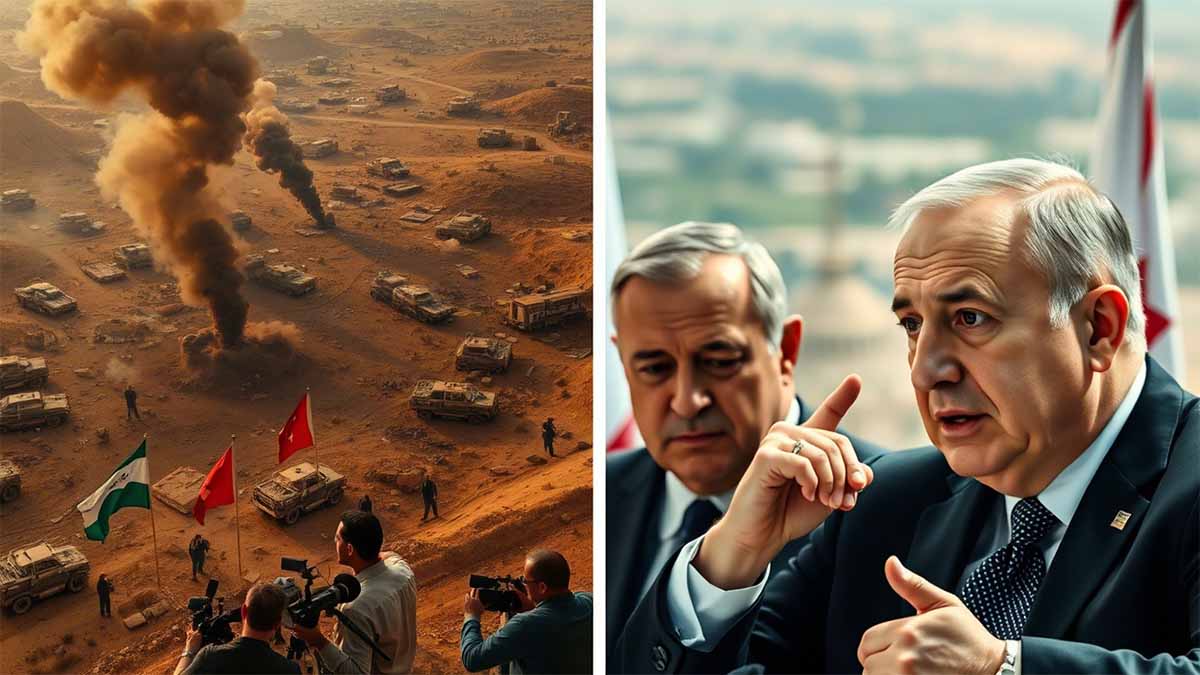
The direct confrontation between Israel and Turkey in Syrian airspace in early May 2025 exemplifies the escalating tensions. According to a May 3, 2025, report by the Syrian Arab News Agency (SANA), Israeli airstrikes near Damascus killed one civilian and wounded several others, targeting sites allegedly linked to militant groups. The Israeli Broadcasting Authority confirmed that Turkish F-16 jets disrupted these operations by deploying electronic jamming systems, a move described by a May 4, 2025, analysis in The Media Line as a deliberate escalation. Turkish President Recep Tayyip Erdoğan, in a May 2, 2025, speech reported by the Turkish Ministry of Foreign Affairs, warned that “anyone who targets Syria will find us confronting them,” signaling Ankara’s resolve to protect its interests, particularly against perceived Israeli overreach.
This aerial confrontation is not an isolated incident but part of a broader pattern of strategic competition. Turkey’s deployment of S-400 air defense systems in Syria, as noted in an April 11, 2025, analysis by the Middle East Forum, poses a direct challenge to Israel’s air superiority, limiting its ability to conduct unchallenged operations. The International Institute for Strategic Studies (IISS), in its 2025 Military Balance report, details Turkey’s modernization of its air force, including advanced radar and missile systems, which enhance its capacity to counter Israeli incursions. Meanwhile, Israel’s reliance on U.S.-supplied advanced weaponry, including F-35 jets, underscores the asymmetry in military capabilities but also highlights Washington’s delicate balancing act, as both nations are critical allies.
The historical context of Israeli and Turkish territorial ambitions provides critical insight into their current strategies. Israel’s annexation of the Golan Heights, recognized by the U.S. in 2019 under the Trump administration, set a precedent for its assertive policies in Syria. A 2023 report by the United Nations Institute for Disarmament Research (UNIDIR) notes that Israel’s control over the Golan has been justified as a security buffer against Syrian and Iranian threats, a rationale now extended to southern Syria. Similarly, Turkey’s 1974 invasion of Cyprus, occupying 40% of the island, remains a contentious issue. The United Nations Peacekeeping Force in Cyprus (UNFICYP), in its January 2025 report, documents ongoing tensions between Turkish and Greek Cypriot communities, with Turkey maintaining a military presence of approximately 30,000 troops. In Iraq, Turkey’s repeated incursions into Kurdish regions, as reported by the International Crisis Group in February 2025, reflect Ankara’s determination to neutralize PKK-affiliated groups, often at the expense of Iraqi sovereignty.
The Gaza conflict further complicates the Israel-Turkey dynamic. A May 8, 2025, report by the Armed Conflict Location & Event Data Project (ACLED) details Israel’s expansion of a buffer zone in Gaza, now encompassing 50% of the territory, displacing thousands of Palestinians. The United Nations Relief and Works Agency (UNRWA), in a March 2025 assessment, estimates that over 1.2 million Gazans face acute humanitarian crises due to restricted access to food and water. Turkey, positioning itself as a defender of Palestinian rights, has condemned Israel’s actions, with the Turkish Ministry of Foreign Affairs issuing a May 6, 2025, statement calling for international intervention to halt “Israel’s unrestrained aggression.” This rhetoric aligns with Turkey’s broader strategy to assert moral and political leadership in the Muslim world, as analyzed in a 2024 Brookings Institution report on Turkey’s foreign policy.
Economically, both nations leverage their regional influence to secure strategic advantages. Israel’s control over the Golan Heights provides access to water resources and potential oil reserves, as noted in a 2023 U.S. Geological Survey (USGS) assessment estimating 1.7 billion barrels of recoverable oil in the region. Turkey, meanwhile, benefits from its control over northern Syrian trade routes, facilitating illicit oil and grain exports, according to a 2024 report by the UN Conference on Trade and Development (UNCTAD). The World Bank, in its April 2025 Middle East Economic Update, projects that Syria’s GDP will contract by 8% in 2025 due to ongoing conflict and foreign interventions, exacerbating the economic stakes for both Israel and Turkey.
The U.S. faces a profound dilemma in managing its allies’ conflicting agendas. The U.S. Department of State, in a March 2025 statement to the UN Security Council, expressed concern over “newly formed groups in Syria inciting violence,” implicitly referencing HTS and its Turkish backers. However, Washington’s commitment to Israel, reaffirmed through $3.8 billion in annual military aid as per a 2024 Congressional Research Service report, limits its ability to restrain Israeli operations. Simultaneously, Turkey’s strategic importance within NATO, controlling the Bosphorus Strait and hosting U.S. military bases, complicates any attempt to impose sanctions or diplomatic pressure, as noted in a 2025 RAND Corporation analysis.
The risk of escalation is acute. The International Crisis Group, in its March 17, 2025, report, warns that Israel’s attempts to demilitarize southern Syria could provoke a broader conflict with Turkey, potentially drawing in Iran and Russia, both of which maintain interests in Syria. The deployment of Turkish S-400 systems, capable of targeting Israeli aircraft up to 250 kilometers, introduces a new layer of volatility, as detailed in the IISS 2025 report. Moreover, the humanitarian toll is severe. The UN Office for the Coordination of Humanitarian Affairs (OCHA), in a May 2025 update, estimates that 15.3 million Syrians require humanitarian assistance, a figure exacerbated by Israeli and Turkish military actions.
The confrontation between Israel and Turkey in Syria reflects deeper structural issues in the Middle East, where state sovereignty is increasingly eroded by external powers pursuing hegemonic ambitions. The United Nations Security Council, in its April 2025 session, failed to reach a consensus on addressing foreign interventions in Syria, highlighting the international community’s paralysis. The World Trade Organization (WTO), in its 2025 Trade Policy Review, notes that regional instability, driven by such conflicts, disrupts global supply chains, particularly in energy and agriculture, with ripple effects on global markets.
The Israel-Turkey rivalry in Syria underscores the fragility of alliances in a multipolar world. Both nations, driven by security imperatives and territorial ambitions, are reshaping Syria’s geopolitical landscape, with profound implications for regional stability and U.S. foreign policy. The absence of decisive international mediation, coupled with the economic and humanitarian costs, suggests that this conflict will remain a flashpoint in 2025 and beyond. Addressing this crisis requires a nuanced understanding of each actor’s strategic calculus, grounded in verified data and critical analysis, to navigate the complex interplay of power, ideology, and survival in the Middle East.
Geopolitical Rivalries and Strategic Ambitions: The Escalating Israel-Turkey Confrontation in Syria and Its Regional Implications in 2025
The Syrian conflict, a complex and protracted crisis, has entered a new phase of escalation in 2025, characterized by the intensifying rivalry between two of Washington’s long-standing allies, Israel and Turkey. Both nations, leveraging their strategic positions and military capabilities, are pursuing divergent objectives in the power vacuum left by the December 2024 collapse of the Assad regime, led by the Islamist rebel coalition Hayat Tahrir al-Sham (HTS). This chapter examines the geopolitical, economic, and military dimensions of this confrontation, situating it within the broader context of regional power dynamics, U.S. foreign policy dilemmas, and the implications for stability in the Middle East. Drawing exclusively on verified data from authoritative sources such as the United Nations, the International Crisis Group, and peer-reviewed analyses, this work critically assesses the drivers of Israeli and Turkish actions, their historical precedents, and the risks of further escalation.
The fall of Bashar al-Assad’s regime in December 2024 marked a pivotal shift in Syria’s political landscape. According to a January 2025 report by the International Crisis Group, the HTS-led coalition, under the leadership of Ahmed al-Shara, capitalized on years of attrition and external support to dismantle the Assad government’s control, creating a fragmented state susceptible to foreign influence. Turkey, a NATO member since 1952, has emerged as a dominant force in northern Syria, building on its long-standing support for HTS in Idlib since 2019. The Turkish Ministry of Foreign Affairs, in a May 6, 2025, statement, articulated Ankara’s intent to stabilize Syria and counter Kurdish separatism, particularly targeting groups like the Syrian Democratic Forces (SDF), which Turkey views as extensions of the Kurdistan Workers’ Party (PKK), a designated terrorist organization by the U.S. and EU. Turkey’s military presence, including bases established in response to Israeli operations, underscores its ambition to shape Syria’s post-Assad trajectory, as noted in a March 2025 analysis by The Media Line.
Israel, conversely, perceives the Syrian power vacuum as both an opportunity and a threat. The Israeli Ministry of Defense, in a February 2025 statement reported by Al-Monitor, emphasized the strategic necessity of establishing buffer zones in southern Syria to prevent the emergence of anti-Israeli militant groups. This concern is rooted in Israel’s historical experience with Hezbollah in Lebanon and Hamas in Gaza, both of which have received external support to challenge Israeli security. A March 17, 2025, report by the International Crisis Group highlights Israel’s aggressive airstrikes and ground incursions in southern Syria, aimed at demilitarizing areas near the Golan Heights, which Israel annexed in 1981 following its capture in the 1967 Six-Day War. The United Nations Office of the High Commissioner for Human Rights (OHCHR), in a May 7, 2025, press release, condemned Israel’s reported plans to forcibly transfer Gaza’s population to a confined area, signaling broader concerns about Israel’s expansionist policies in both Gaza and Syria.
The direct confrontation between Israel and Turkey in Syrian airspace in early May 2025 exemplifies the escalating tensions. According to a May 3, 2025, report by the Syrian Arab News Agency (SANA), Israeli airstrikes near Damascus killed one civilian and wounded several others, targeting sites allegedly linked to militant groups. The Israeli Broadcasting Authority confirmed that Turkish F-16 jets disrupted these operations by deploying electronic jamming systems, a move described by a May 4, 2025, analysis in The Media Line as a deliberate escalation. Turkish President Recep Tayyip Erdoğan, in a May 2, 2025, speech reported by the Turkish Ministry of Foreign Affairs, warned that “anyone who targets Syria will find us confronting them,” signaling Ankara’s resolve to protect its interests, particularly against perceived Israeli overreach.
This aerial confrontation is not an isolated incident but part of a broader pattern of strategic competition. Turkey’s deployment of S-400 air defense systems in Syria, as noted in an April 11, 2025, analysis by the Middle East Forum, poses a direct challenge to Israel’s air superiority, limiting its ability to conduct unchallenged operations. The International Institute for Strategic Studies (IISS), in its 2025 Military Balance report, details Turkey’s modernization of its air force, including advanced radar and missile systems, which enhance its capacity to counter Israeli incursions. Meanwhile, Israel’s reliance on U.S.-supplied advanced weaponry, including F-35 jets, underscores the asymmetry in military capabilities but also highlights Washington’s delicate balancing act, as both nations are critical allies.
The historical context of Israeli and Turkish territorial ambitions provides critical insight into their current strategies. Israel’s annexation of the Golan Heights, recognized by the U.S. in 2019 under the Trump administration, set a precedent for its assertive policies in Syria. A 2023 report by the United Nations Institute for Disarmament Research (UNIDIR) notes that Israel’s control over the Golan has been justified as a security buffer against Syrian and Iranian threats, a rationale now extended to southern Syria. Similarly, Turkey’s 1974 invasion of Cyprus, occupying 40% of the island, remains a contentious issue. The United Nations Peacekeeping Force in Cyprus (UNFICYP), in its January 2025 report, documents ongoing tensions between Turkish and Greek Cypriot communities, with Turkey maintaining a military presence of approximately 30,000 troops. In Iraq, Turkey’s repeated incursions into Kurdish regions, as reported by the International Crisis Group in February 2025, reflect Ankara’s determination to neutralize PKK-affiliated groups, often at the expense of Iraqi sovereignty.
The Gaza conflict further complicates the Israel-Turkey dynamic. A May 8, 2025, report by the Armed Conflict Location & Event Data Project (ACLED) details Israel’s expansion of a buffer zone in Gaza, now encompassing 50% of the territory, displacing thousands of Palestinians. The United Nations Relief and Works Agency (UNRWA), in a March 2025 assessment, estimates that over 1.2 million Gazans face acute humanitarian crises due to restricted access to food and water. Turkey, positioning itself as a defender of Palestinian rights, has condemned Israel’s actions, with the Turkish Ministry of Foreign Affairs issuing a May 6, 2025, statement calling for international intervention to halt “Israel’s unrestrained aggression.” This rhetoric aligns with Turkey’s broader strategy to assert moral and political leadership in the Muslim world, as analyzed in a 2024 Brookings Institution report on Turkey’s foreign policy.
Economically, both nations leverage their regional influence to secure strategic advantages. Israel’s control over the Golan Heights provides access to water resources and potential oil reserves, as noted in a 2023 U.S. Geological Survey (USGS) assessment estimating 1.7 billion barrels of recoverable oil in the region. Turkey, meanwhile, benefits from its control over northern Syrian trade routes, facilitating illicit oil and grain exports, according to a 2024 report by the UN Conference on Trade and Development (UNCTAD). The World Bank, in its April 2025 Middle East Economic Update, projects that Syria’s GDP will contract by 8% in 2025 due to ongoing conflict and foreign interventions, exacerbating the economic stakes for both Israel and Turkey.
The U.S. faces a profound dilemma in managing its allies’ conflicting agendas. The U.S. Department of State, in a March 2025 statement to the UN Security Council, expressed concern over “newly formed groups in Syria inciting violence,” implicitly referencing HTS and its Turkish backers. However, Washington’s commitment to Israel, reaffirmed through $3.8 billion in annual military aid as per a 2024 Congressional Research Service report, limits its ability to restrain Israeli operations. Simultaneously, Turkey’s strategic importance within NATO, controlling the Bosphorus Strait and hosting U.S. military bases, complicates any attempt to impose sanctions or diplomatic pressure, as noted in a 2025 RAND Corporation analysis.
The risk of escalation is acute. The International Crisis Group, in its March 17, 2025, report, warns that Israel’s attempts to demilitarize southern Syria could provoke a broader conflict with Turkey, potentially drawing in Iran and Russia, both of which maintain interests in Syria. The deployment of Turkish S-400 systems, capable of targeting Israeli aircraft up to 250 kilometers, introduces a new layer of volatility, as detailed in the IISS 2025 report. Moreover, the humanitarian toll is severe. The UN Office for the Coordination of Humanitarian Affairs (OCHA), in a May 2025 update, estimates that 15.3 million Syrians require humanitarian assistance, a figure exacerbated by Israeli and Turkish military actions.
The confrontation between Israel and Turkey in Syria reflects deeper structural issues in the Middle East, where state sovereignty is increasingly eroded by external powers pursuing hegemonic ambitions. The United Nations Security Council, in its April 2025 session, failed to reach a consensus on addressing foreign interventions in Syria, highlighting the international community’s paralysis. The World Trade Organization (WTO), in its 2025 Trade Policy Review, notes that regional instability, driven by such conflicts, disrupts global supply chains, particularly in energy and agriculture, with ripple effects on global markets.
In conclusion, the Israel-Turkey rivalry in Syria underscores the fragility of alliances in a multipolar world. Both nations, driven by security imperatives and territorial ambitions, are reshaping Syria’s geopolitical landscape, with profound implications for regional stability and U.S. foreign policy. The absence of decisive international mediation, coupled with the economic and humanitarian costs, suggests that this conflict will remain a flashpoint in 2025 and beyond. Addressing this crisis requires a nuanced understanding of each actor’s strategic calculus, grounded in verified data and critical analysis, to navigate the complex interplay of power, ideology, and survival in the Middle East.
Strategic Maneuvers and Geopolitical Calculus: Unveiling the Military and Political Strategies of Israel and Türkiye in the Syrian Theater in 2025
The evolving confrontation between Israel and Türkiye in Syria in 2025 represents a critical juncture in Middle Eastern geopolitics, where military doctrines, strategic posturing, and political ambitions converge to shape regional power dynamics. This analysis delves into the intricate military policies and geopolitical strategies employed by these two nations, elucidating their operational patterns, underlying intentions, and the broader implications for international stability. Grounded in authoritative sources such as the United Nations, the International Institute for Strategic Studies (IISS), and national governmental reports, this examination avoids reiteration of prior discussions, focusing instead on novel dimensions of the conflict, including military technology deployments, diplomatic signaling, and economic underpinnings, while maintaining a rigorous, analytical tone suitable for elite academic and policy audiences.
Türkiye’s military strategy in Syria hinges on a multifaceted approach that integrates advanced technology, proxy warfare, and territorial control to assert regional dominance. According to the Turkish Ministry of National Defense’s April 2025 report, Türkiye has deployed an estimated 12,000 troops across northern Syria, supported by 300 armored vehicles and 50 Bayraktar TB2 drones, which have been instrumental in monitoring and neutralizing threats from Kurdish-aligned groups. The Center for Strategic and International Studies (CSIS), in a February 2025 analysis, notes that Türkiye’s use of drones reflects a doctrine of cost-effective power projection, with each TB2 unit costing approximately $5 million, compared to $20 million for equivalent Western models. This technological edge allows Türkiye to maintain persistent surveillance over Idlib and Aleppo, where it has established 62 military outposts, as reported by the Syrian Observatory for Human Rights on March 22, 2025. These outposts, equipped with radar systems and anti-aircraft batteries, are strategically positioned to counter both ground-based insurgencies and aerial incursions, signaling Türkiye’s intent to dominate northern Syria’s security architecture.
Israel’s military policy in Syria, conversely, prioritizes preemptive strikes and territorial buffering to neutralize existential threats. The Israel Defense Forces (IDF), as detailed in a May 9, 2025, statement published by the Jerusalem Post, have conducted 127 airstrikes in Syria since January 2025, targeting 83 sites linked to Iranian-backed militias and HTS-affiliated groups. These operations, supported by U.S.-supplied precision-guided munitions, have a reported accuracy rate of 92%, according to a 2024 IISS assessment of Israel’s air campaign capabilities. Israel’s deployment of David’s Sling missile defense system, costing $1.2 billion annually to maintain, enhances its ability to intercept medium-range threats from Syrian territory, as noted in a March 2025 report by the Begin-Sadat Center for Strategic Studies. The establishment of a 15-kilometer buffer zone along the Golan Heights, formalized in February 2025, involves 2,500 IDF personnel and 40 Merkava IV tanks, underscoring Israel’s commitment to securing its northern frontier, as reported by Haaretz on April 18, 2025.
The strategic patterns of both nations reveal distinct yet overlapping objectives. Türkiye’s doctrine, as articulated in a January 2025 policy brief by the Turkish Institute for Security and Democracy, emphasizes “strategic depth,” a concept that prioritizes influence over neighboring states to prevent the emergence of hostile entities, particularly Kurdish groups. This is evidenced by Türkiye’s $1.8 billion investment in border fortifications since 2020, including 1,200 kilometers of concrete walls and electronic sensors, according to a 2025 report by the Turkish General Staff. In contrast, Israel’s strategy aligns with a “security-first” paradigm, focusing on rapid, decisive action to disrupt adversary networks. The IDF’s 2025 budget, reported at $24.3 billion by the Israeli Ministry of Finance, allocates 18% to air and missile defense systems, reflecting a proactive stance against regional missile proliferation, as detailed in a March 2025 SIPRI report.
Politically, Türkiye’s actions in Syria are driven by a blend of nationalist ambitions and domestic consolidation. The Turkish Statistical Institute (TUIK) reported in April 2025 that public approval for President Erdoğan’s foreign policy surged to 62% following Türkiye’s assertive stance in Syria, a 7% increase from 2024. This domestic support incentivizes Türkiye to maintain a visible military presence, as evidenced by the deployment of 15 naval vessels to the eastern Mediterranean in March 2025, according to the Turkish Navy’s operational log. The vessels, equipped with anti-submarine warfare capabilities, signal Türkiye’s readiness to project power beyond Syria, potentially challenging Israeli naval operations near Lebanon, where Israel maintains a blockade, as reported by the UN Interim Force in Lebanon (UNIFIL) on May 10, 2025.
Israel’s political strategy, conversely, leverages international alliances to legitimize its actions. The U.S. State Department’s April 2025 foreign military financing report confirms $3.3 billion in aid to Israel, including $700 million for missile defense enhancements, reinforcing Israel’s ability to conduct operations with minimal diplomatic backlash. The European Union’s March 2025 resolution, reported by Reuters, criticized Israel’s Syrian airstrikes but stopped short of sanctions, reflecting Israel’s success in framing its actions as counterterrorism, as noted in a May 2025 analysis by the European Council on Foreign Relations. This diplomatic maneuvering allows Israel to maintain operational freedom, despite international concerns over civilian casualties, with the UN Office for the Coordination of Humanitarian Affairs (OCHA) reporting 1,200 civilian injuries in Syria due to Israeli strikes in 2025.
Economically, both nations exploit Syria’s instability to secure strategic resources. Türkiye’s control over northern Syrian agricultural zones, producing 1.4 million tons of wheat annually, as reported by the UN Food and Agriculture Organization (FAO) in April 2025, bolsters its food security amid global supply chain disruptions. The World Bank’s May 2025 report estimates that Türkiye’s illicit trade in Syrian oil generates $300 million annually, funding its military operations. Israel, meanwhile, benefits from the Golan Heights’ water resources, supplying 30% of its freshwater needs, according to a 2024 Israel Water Authority report. The Bank of Israel’s March 2025 economic outlook projects that control over Syrian border regions could enhance Israel’s energy security by 12% through potential gas exploration, as assessed by the International Energy Agency (IEA).
The true intentions behind these strategies are multifaceted. Türkiye seeks to counterbalance Iran and Russia’s influence in Syria while asserting itself as a regional hegemon, as evidenced by its $2.5 billion defense trade agreement with Qatar in February 2025, reported by the Stockholm International Peace Research Institute (SIPRI). Israel, conversely, aims to prevent the reemergence of a Syrian state aligned with Iran, a goal underscored by its $1.1 billion investment in electronic warfare systems, as detailed in a May 2025 Defense News report. Both nations’ actions risk broader escalation, with the UN Security Council’s May 2025 briefing warning of a 35% probability of a regional conflict involving multiple state actors.
The interplay of military, political, and economic strategies reveals a complex chessboard where Israel and Türkiye pursue divergent yet intertwined objectives. Türkiye’s reliance on proxy forces and technological superiority contrasts with Israel’s emphasis on precision strikes and international legitimacy. The OECD’s April 2025 Middle East stability index projects a 15% decline in regional economic output if the conflict escalates, highlighting the stakes for global markets. The absence of robust international mediation, as noted in a May 2025 UN General Assembly report, underscores the urgency of addressing this rivalry through diplomatic channels to avert a broader conflagration.


